Reprinted from author’s substack 11 March 2026 and reformatted for Rebel Breeze
(Reading time: mins.)
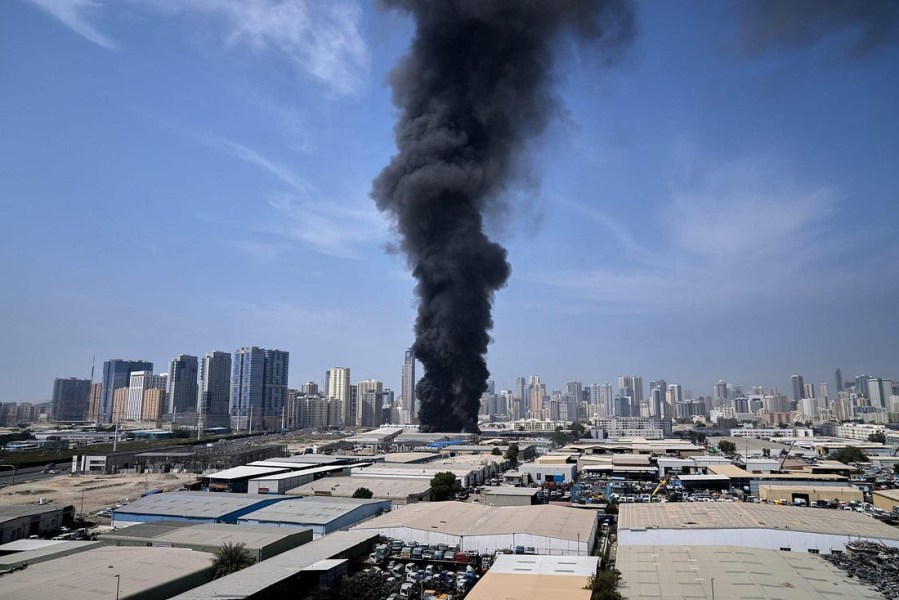
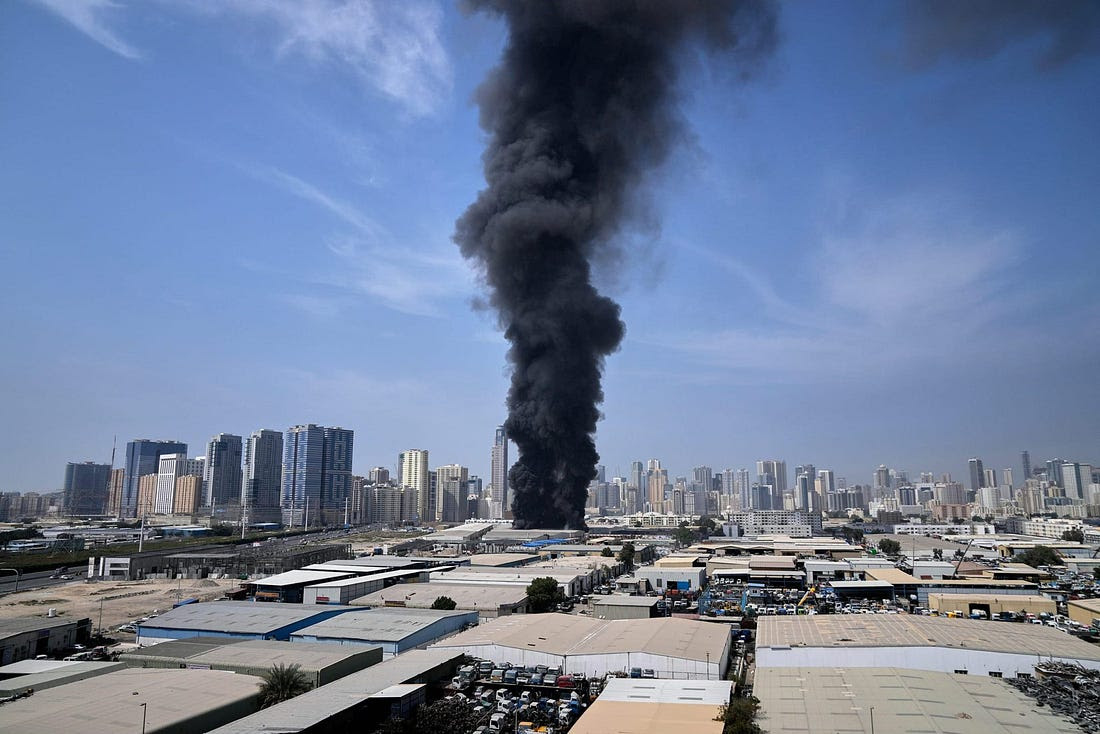
Photo: US Military Base Qatar Under Iranian Attack 2026
On February 28th the Zionist regime of Israel and the USA commenced a lethal bombing campaign against Iran, choosing as their first target a school where more than 168 girls were murdered.
The Western press took its time in questioning the attack and the western governments never really did.
The press “explains” that the school was near a centre of the Revolutionary Guard, but they don’t explain that it was a cultural centre and a clinic and pharmacy all of which enjoy protection under the Geneva Conditions.
They tell us that these places “perhaps explain the attack.”[1] Well no, they don’t. They remain war crimes.
Iran’s response was robust. So robust that the western press and politicians condemned it and asked Iran to not attack the other states of the region (calling the Emirates countries or nations is a bit much).
They never asked the US or its attack dog, Israel, to cease its attacks.
Iranian civilians are less important than investments in Dubai and other places. Iran attacked military bases, radar installations and hotels housing US soldiers who had transferred there given the possibility of an attack on their bases. The counterattacks uncovered some truths.
The first one is that the Arab monarchies of the region are nothing more than US lapdogs and the myths about their economies went up in smoke in seconds. They are not safe places to invest in and less so to live in as shown by the mass of tiktokers crying into the camera.
It is worth pointing out that many of them boasted about not paying taxes and one or other explicitly stated they had set up in the region in order not to pay taxes and now they want their respective governments to spend taxes that they not only didn’t pay but didn’t want to in order to rescue them.
It might be that Dubai and the other monarchies never fully recover.
Another truth that was revealed is the real role of US military bases. The Yanks like to say that it is to protect and defend the countries they are located in against attacks.
That myth also went up in smoke just like the myth of Dubai as a safe place for digital nomads, tiktokers, bankers and even drug traffickers like the Kinahans who have lived there openly for the last number of years.[2] They will all have to think of other places.
The military bases were not capable of defending the monarchies and moreover the US transferred a good part of its military capability to Israel and left them to their fate.
Recently the president of South Korea announced that the USA had transferred part of its defence system to Israel.[3] The presented lamented the situation but explained that there was little he could do, i.e. the USA decides everything.
In the case of Spain, President Sánchez said he would not allow the USA to use the shared military bases in the country to launch attacks on Iran. Trump’s response revealed the real role these bases play and the real authority over them.
He said they didn’t need them, but if they want to, no one is going to tell them no.[4] In many of the military bases, in law, it is the host country that commands and controls the base. The reality is otherwise and Trump showed it.
In others cases, particularly in Japan and some European countries it is the US that has formal control.
The bases are not there to defend the host countries but rather to defend US interests and to act as they see fit. The Arab monarchies have just learnt that lesson the hard way. Spain has yet to, but Trump has warned them that it is in practice he who decides what is done, where and how.
This brings us to the question of military bases in Colombia. Theoretically Colombia has authority over the bases and can limit what is done. In practice it is not so.
The supposedly progressive government of Gustavo Petro never did anything to expel the Yanks from the bases in the country. Nor is he going to do so in the few remaining months of his presidency.
The question is what will the new government that comes into office on August 7th do? For the moment it looks like the next president will be Iván Cepeda from the same political force as Gustavo Petro.
In the midst of tensions between Colombia and the USA Cepeda stated from Madrid that Colombia wasn’t a Yankee colony.[5] When he is president he will have ample time to prove it and can start on August 7th by ordering the north American troops out of the country.
The rest of the countries in the world should do the same.
It is clear that the bases are an extension of the USA and at all times serve it and nobody else.
Note: If you found this article of interest, why not register with Rebel Breeze for free, so that you will be notified by email of subsequent articles. You can de-register any time you wish.
In future, there will be no red lines in attacking your country.
Yes, I do mean YOUR country, wherever you are. In whatever war it’s in. And in this imperialist world, it’s a safe bet your country will be part of a war, directly or a little indirectly, sometime in your lifetime. Or in your kids’ lifetimes.
The Adversary will be able to carpet-bomb your residential areas, your hospitals and medical centres, schools and universities, places of religious worship, markets, restaurants, coffee shops, bars, bakeries, internet access sites, gyms, your infrastructures and municipal authorities.
There might be some condemnations at high levels abroad, even threats of court cases but nothing will be actually done in practice.
The Adversary will be able to attack your food stores, blockade you from food and fuel imports, bomb your farms and fishing fleets. It will be able to call down aerial strikes on people in their homes, in vehicles or shoot them by snipers or drones as they walk in the street.
Your cities’ food delivery trucks, construction and rubble-clearing and heavy lifting vehicles will be targeted, along with their drivers and operators. That is so that your people will have to dig with your hands to find victims under the rubble of bombed buildings.
Your ambulances and paramedics will be targeted so that picking up wounded or even corpses becomes a high-risk job and your hospitals will be bombed, shot at and invaded to reduce the life chances of any bombing victim found alive in the rubble or on the street.
Your country’s infrastructures of electricity generation and supply, water supply, sewage collection and treatment, waste collection and treatment, telecommunication and public transport will be bombed and bombed and bombed again.
Your reporters will be shot on the street and their homes bombed, as will your media networks offices. That hardly seems necessary anyway since no-one who sees any of the atrocities, no-one with power anyway, will even try to stop what is being done to you and your people.
That’s because there are no red lines anymore.
Your populations will be refugees in your own land and their tents and shacks will be bombed and fire-bombed. They will be bombed wherever they go and they will be bombed on the way there. They will be told some areas are safe and then they’ll be bombed and shot at there also.
Food, fuel, water and medicine supplies will be blocked, blockaded and even bombed. Many of you will be hungry, thirsty and cold. The weaker ones, also the very young and the elderly, will die prematurely of diseases and ailments or untreated wounds and sores.
People with special medical needs will die from lack of specialised medical treatment, procedures, equipment or medication.
Your children will be denied education, safety and even life. Your young and middle-aged men and women will be denied work, safety and even life. Your elders will be denied safety in retirement — and even life.
Some of you will resist, of course. Those the Adversary can catch will be put in prisons; mostly not even a trial will be required but when it does, it will be a mockery of standard judicial procedure. In jail they will be beaten, humiliated, tortured, degraded, half-starved, raped and die.
Some of your resistors will be shot after they’ve been captured. Random civilians will be shot by snipers or drones, thrown into graves and earth pushed over them, perhaps even while alive; other bodies will lie in the street to make you sick with terror and the smell of their decomposing bodies.
Other civilians – including children – will be used as human screens or shields for the Invader’s troops and even their armoured vehicles. They will be used to test mines, booby traps and IEDs.
You will be taught how little your lives matter and how easily they can be wiped out.
There is no longer humanitarian international law, no Geneva Convention; there are no longer any red lines.
It will happen because …
The Zionist state has committed all the crimes listed above and has done so while being photographed, filmed and even live-streamed by reporters, victims, witnesses and even by the Zionist soldiers themselves, in thousands of boastful videos and photographs.
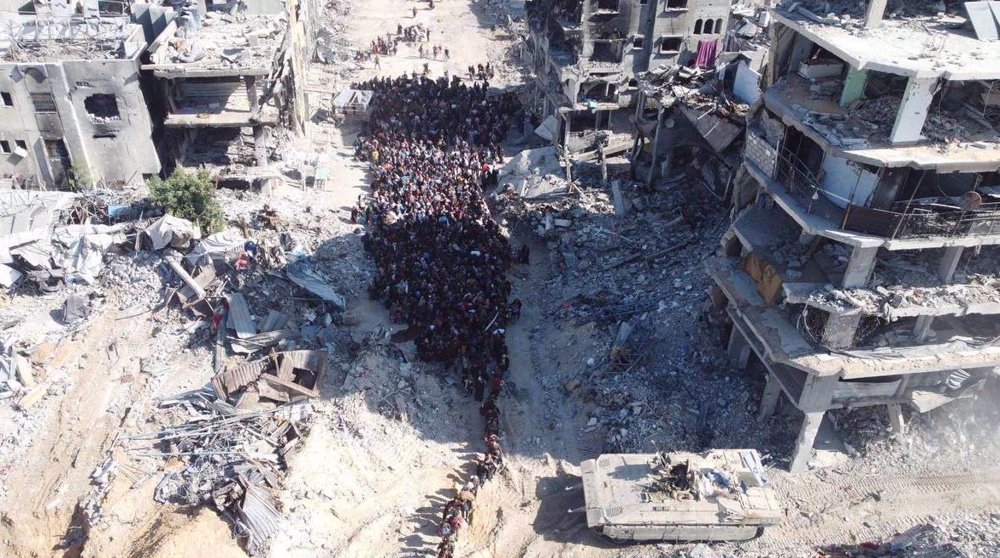
Jabalia, North Gaza, IOF rounding up Palestinian civilians after destroying their neighbourhoods.
Their military leaders, politicians and media have proclaimed their intentions and followed them up in practice.
There have been some high-level international complaints and criticisms and even court cases but nothing in practice has been done by the relevant international bodies to physically stop the Zionist genocide or even to deprive them of the weapons and finance to carry out that genocide.
Yes, we know that there have been many human rights violations committed by Western powers in other wars: Dresden, Hiroshima/ Nagasaki, Korea, Algeria, Vietnam, Ireland, Lebanon, Iraq … And some of them were photographed too.
But never before has there been such blatant anddaily violation of all principles of international law at so many levels to be seen live on our screens while Western powers leaders justified it and all international institutions were either complicit or helpless.1
So now that the unthinkable has been done there, it is no longer unthinkable anywhere. And if not unthinkable, then history shows us that it will indeed be thought of. History shows us too that what is thought of will also be done.
What hasn’t been done yet?
Poisoning your water supplies? Why not? So long as there be a water supply for the invading soldiers and good clean water for the occupiers, the settlers. Germ warfare? Why not? As long as the invaders and settlers are immune or the pathogens die out in time for occupation.
There are no red lines any longer and you can expect none when war comes to your country.
Anything goes.
End.
Footnotes
1And people who protested it in western states were maligned, hounded in work and academia, beaten on the street, arrested …
Responding to its latest genocidal atrocity which it claims was “a tragic error”,1 bombing a displaced person’s tent camp2, the zionist state offered some excuses for its general behaviour which are not only not acceptable but are not even true.
In fact the Israeli state does exactly the things of which it accuses its Palestinian resistance.
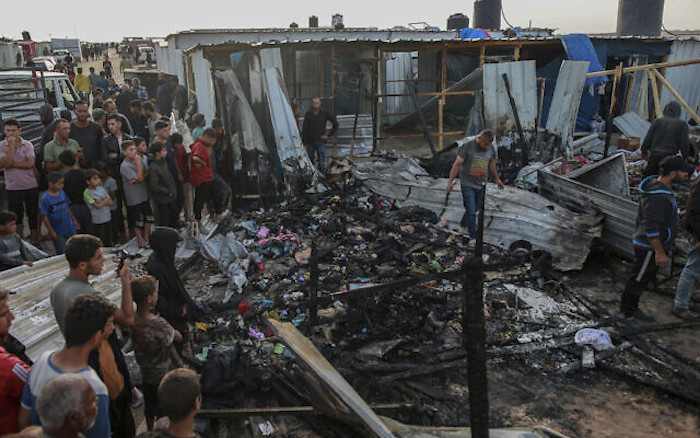
Palestinians look at the destruction after an Israeli strike on a camp for internally displaced people declared “safe area” by the Israeli military in Rafah, Gaza Strip, May 27, 2024 (Photo cred: AP Photo/Jehad Alshrafi)
Let’s examine one of its claims in the statement: “Israel says it does its best to adhere to the laws of war and says it faces an enemy that makes no such commitment, embeds itself in civilian areas and refuses to release Israeli hostages unconditionally.”3
Every phrase about its own conduct is the opposite of what the zionist state does. Every accusation directed at the ‘other’ is what it does itself.
The Israeli state embeds its armed forces in civilian areas by a) requiring military service of nearly every Israeli male and female and b) by providing military backing to its settlers, including those in areas of what international bodies recognise as ‘illegal occupation’.
The Israeli regime and its armed forces ignore the international rules of war with regard to attacks on (Palestinian and Arab) civilians, journalists, medical and aid personnel4 and civilian cultural, administrative, infrastructural, educational and religious locations and buildings.
It is the zionist state that refuses to release their captives unconditionally (even re-detaining those they’ve agreed to release under prisoner exchange deals). At the time of writing the zionist state has detained 8,875 Palestinians since 8th October last year, including about 295 women, 630 children, 76 journalists (49 still in detention) and has issued 5,210 “administrative detention orders” (i.e internment without trial).5
On the other hand, the resistance forces target mostly the Israeli armed forces but also settlers. They allow military helicopters to land and remove IOF dead and wounded but do not fire on them, unlike the IOF who fire on paramedics, doctors and hospitals, killing many medical personnel.
Of course the Resistance is embedded amongst the people because it is of it, born of the population’s will to resist and also fights to protect it, insofar as it can. Were this not so the Resistance would long ago have been expelled by the people or exposed to the occupying forces.
However, the Resistance does not base itself in hospitals, in mosques or in refugee centres, which the Occupation’s military does not hesitate to bomb or invade.
Two Medical Staff Kuwait Hospital Rafah, South Gaza, Killed by Israeli Missile 27 May 2024 (Photo sourced: Resistance News Network)
Recently, Netanyahu, Biden, Sunak and some others, in responding to the International Criminal Court’s statement that it was going to issue arrest warrants for Netanyahu and Gallant,6 along with three Hammas officials, exclaimed in rage that there is no equivalence between the two groups.
They are absolutely correct.
The Palestinian resistance has not stolen land, does not target Israeli women and children, hospitals, schools and universities nor are its members afraid to fight its enemies on the ground without armour or air cover.
Bodies of two workers of the Kuwait Hospital in Rafah killed by missile strike on othe gate of the hospital today. (Sourced at: Resistance News Network)
The symbolic decision of the Irish, Spanish and Norwegian states to recognise a Palestinian state drew the ire of the same parties as with the ICC statement, the Israeli Foreign Minister accusing the Irish State’s leaders in a racist video of having rewarded Palestinian “terrorism” with statehood.
This is yet another example of the zionists accusing others of what they themselves have done.
The zionist settlers waged a war against the English occupiers and the indigenous Palestinian people from the 1920s to the 1940s through the terrorist groups of the Irgun, Lehi, Haganah and Palmach, going on in 1948 to kill and rape Palestinians, burning villages and expelling 700,000 people.7
The Zionists declared their state in 1948 and demanded recognition, granted by the USSR and the USA, thereby rewarding their terrorism with recognition of their state, which was followed by other states later.
One of the terrorist groups, the Haganah, became the core of the army of the zionist state.
1At first they tried to justify it by saying that Resistance militants were gathered there, then remembered it was an area they had claimed safe from bombing and so changed their story to one of “tragic error”, blaming the chaos of war. But these bombings are ordered and directed far from any battle-chaos and with satellite and drone imagery to consult. Which means the area could not be confused with some other and the bombing was deliberate.
2On Sunday, 26th May 2024 killing 45 Palestinians and wounding 250 (at the time of writing), having also bombed a number of UNRWA displaced person centres.
4As recently as today the Occupation killed two medical workers as they shelled the doorway to Kuwait Hospital in southern Rafah, Gaza. There is not a medical centre in Gaza which the Occupation has not partially damaged or completely destroyed.
5Source: Adameer, Palestinian prisoner support organisation.
6Prime Minister and Minister for ‘Defence’ (sic) of ‘Israel’, respectively.
A Zionist march and rally was organised for Dublin today as an “Israel solidarity” event by the Ireland Israel Alliance. Despite prior publicity and drawing from around the country the attendance numbered only a few hundred.
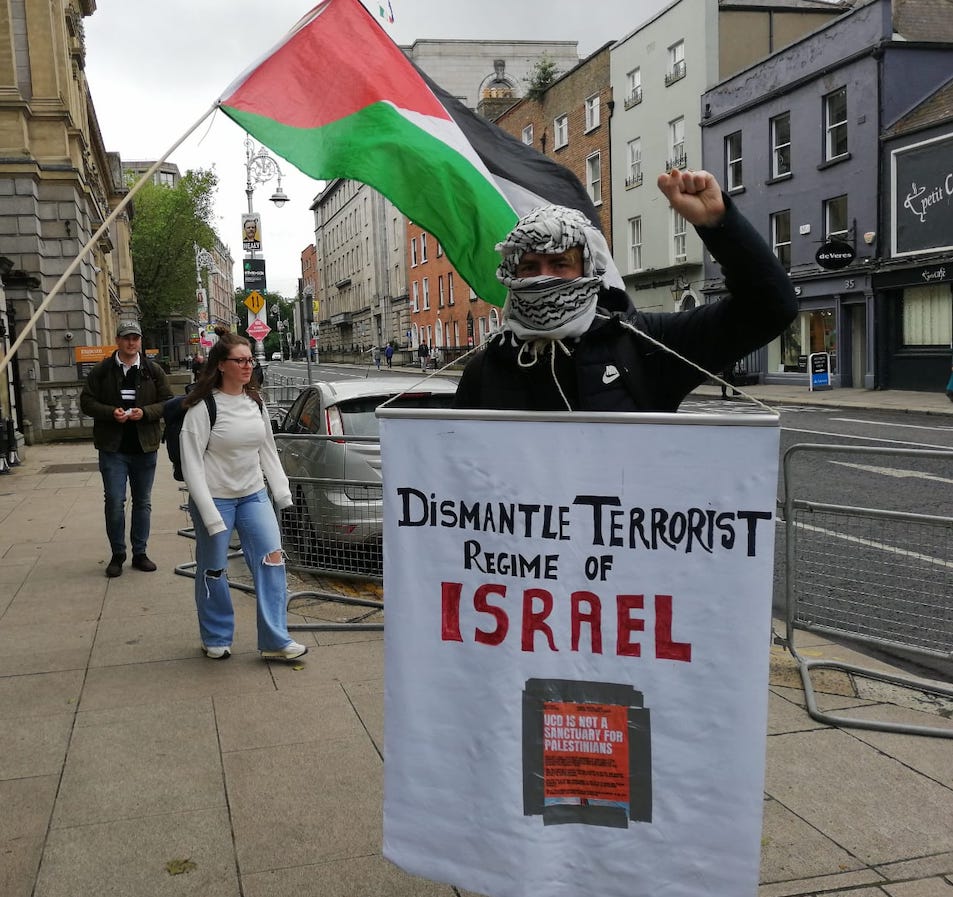
Around a hundred anti-zionists with flags, banners, amplifier and loudhailer occupied the announced destination of the Zionist rally an hour prior to the scheduled arrival of the IIA march and had to wait even longer as the Zionist groups arrived at Stephens Green.
One of the banners displayed by among the anti-zionists outside Leinster House on Sunday (Photo: Rebel Breeze)(Photo: Rebel Breeze)
During the week the IIA issued a statement in line with the Israeli state’s Foreign Minister that “Ireland rewards Palestinian terrorism with a State”1 in response to the announcement by the Irish, Spanish and Norwegian states that they intended to formally recognise the Palestinian state.
Palestinian solidarity supporters in Dublin organised at short notice a counter-rally. “It’s a bit rich for Zionists who set up their settler state with terrorism”, said one in Dublin today, “claiming that Palestinian statehood rewards Palestinian ‘terrorism’!”2
One of the banners displayed by among the anti-zionists outside Leinster House on Sunday (Photo: Rebel Breeze)
Although Palestinian Christians are suppressed and killed by Israeli armed forces, the IIA were supported by right-wing Christian Zionists, among them the All Nations Church, the Irish branch of the International Christian Embassy Jerusalem and the TJCII.
According to advance releases to the press, the newly inaugurated Chief Rabbi of Ireland, Yoni Wieder was to speak at the zionist rally.3
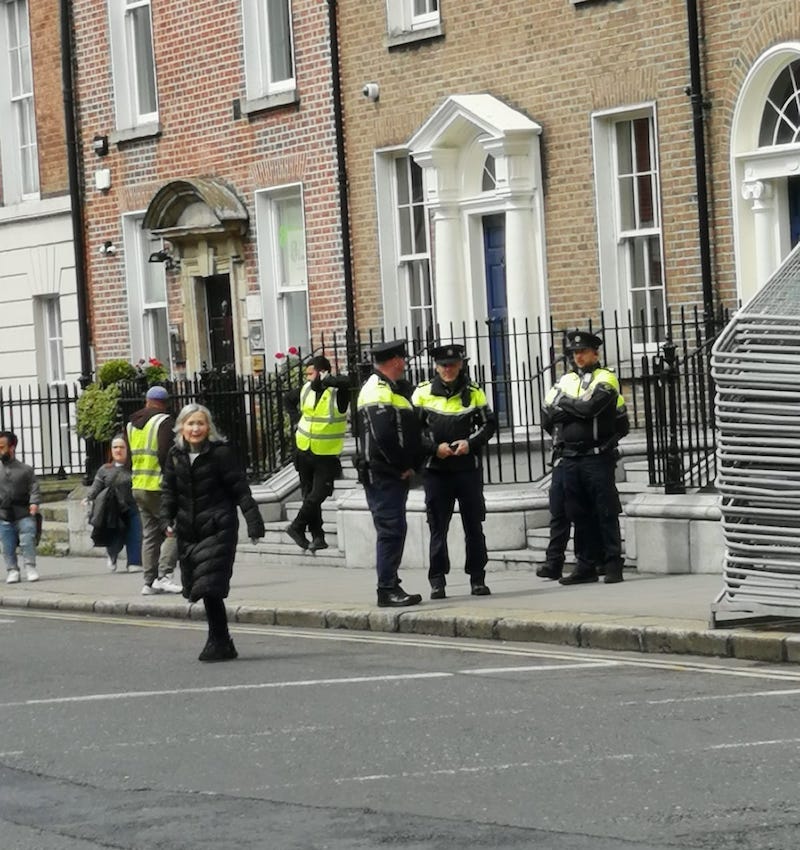
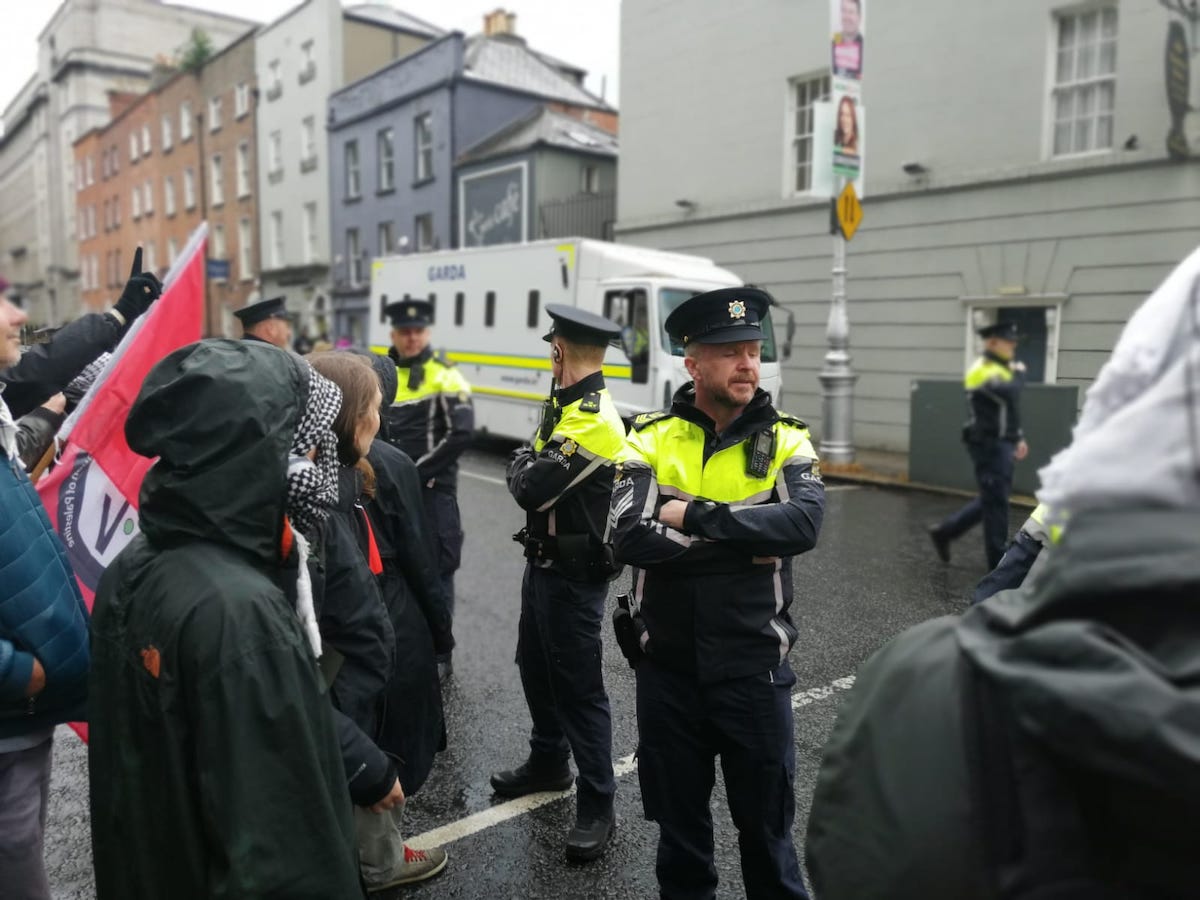
Some Gardaí in Molesworth Street, stacked crowd barriers not yet erected at that point and contractor staff awaiting instructions. (Photo: Rebel Breeze)
The anti-zionists organised their event at a day or two’s notice and according to some sources the IPSC4 had called on its branches not to counter protest the Zionist event but around a hundred Palestinian supporters attended, mainly Irish but also with Palestinians and a sprinkling of others.
In their prior publicity the Zionists trotted out their usual claims that Palestinian solidarity is based on anti-Semitism and that Jews are being victimised,5 ignoring the fact that zionism does not equal judaism and that in fact a substantial number of Jews have opposed zionism.6
The population of Ireland went from being largely supportive of ‘Israel’ in 1948 to being mostly pro-Palestinian from the 1970s onwards because of their observation of the genocidal and ethnic cleansing actions of the Israeli state.
Placard displayed among the Palestine supporters (Photo: Rebel Breeze)
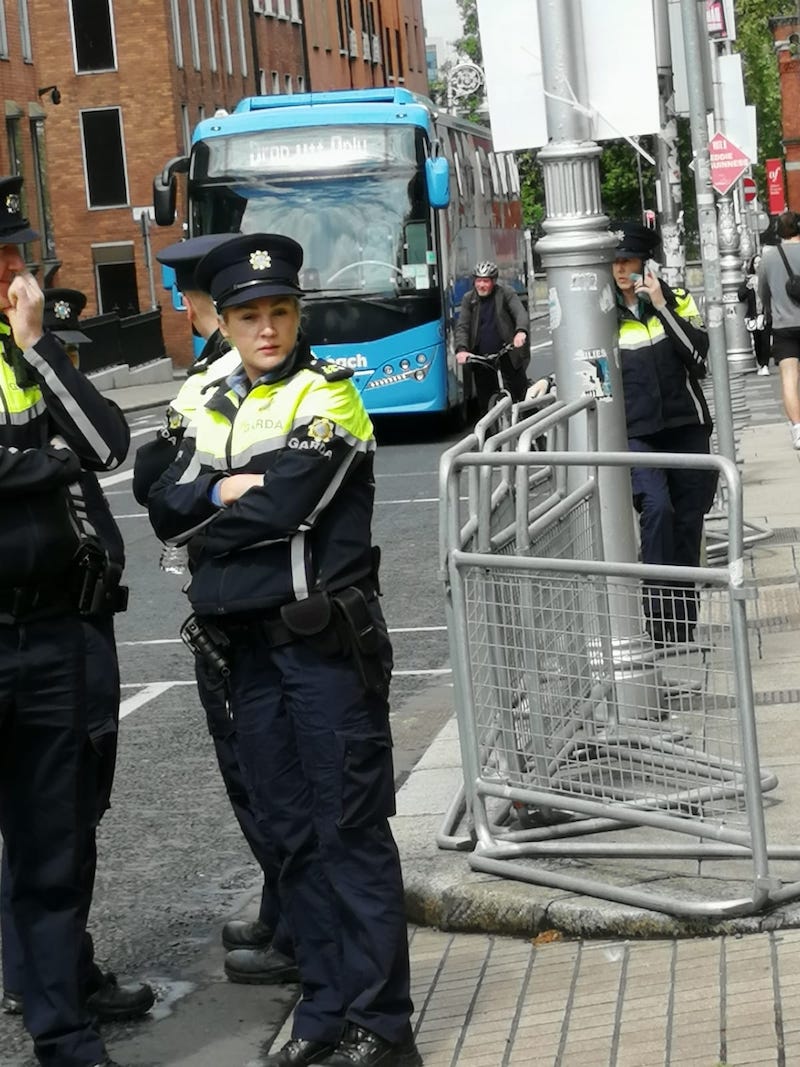
There was a fairly high Garda presence at the events and after some delay crowd barriers were erected across the east end of Molesworth Street with a second line of barriers a little further west beyond which the Zionists were setting up a stage.
The anti-Zionists in front of Leinster House awaited the arrival of the pro-Israel march which when it got going could be seen passing the Stephens Green end of Kildare Street, eventually coming down Dawson Street and turning into Molesworth Street.
View in distance of the zionist rally location before the arrival of their march from Stephens Green (Photo: Rebel Breeze)
As they arrived the Palestinian solidarity people attempted to move across the road but the Gardaí pushed back, individual Gardaí at times viciously shoving and being resisted; here and there an arrest seemed threatened but was evaded by solidarity action around the targeted person.
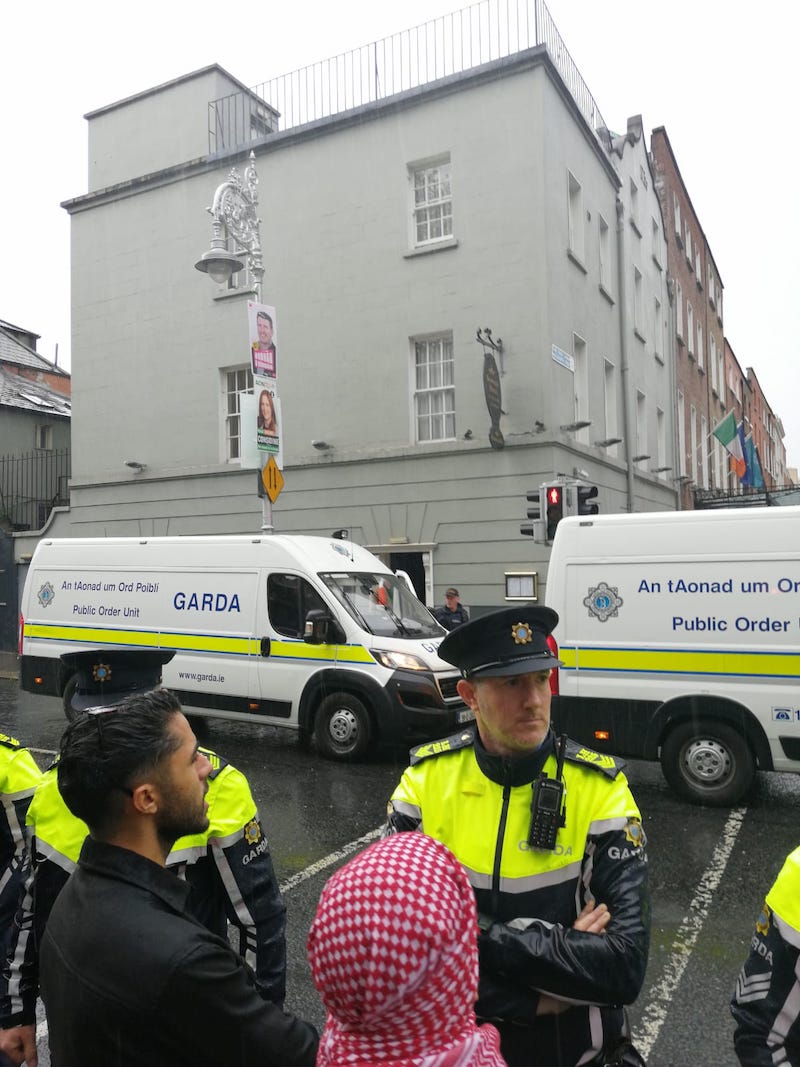
With the Palestinian supporters pushed to a couple of feet in front of the pedestrian pavement of Leinster House, the Gardaí stopped and by then two vans of the Public Order Unit had arrived and were deployed but some time later stood down, got in their vans and were driven off.
(Photo: Rebel Breeze)View northward in Kildare Street outside Leinster House on Sunday (Photo: Rebel Breeze)View southward in Kildare Street outside Leinster House on Sunday (Photo: Rebel Breeze)The arrival of a Garda prisoner transport van in Kildare Street outside Leinster House on Sunday raised tensions among some of the anti-zionist demonstrators (Photo: Rebel Breeze)
There could have been some confused impulses among the Gardaí given the public symbolic positions of the Government in recognition of the Palestinian state and the sharp and public diplomatic language flying between the Irish and Israeli states.
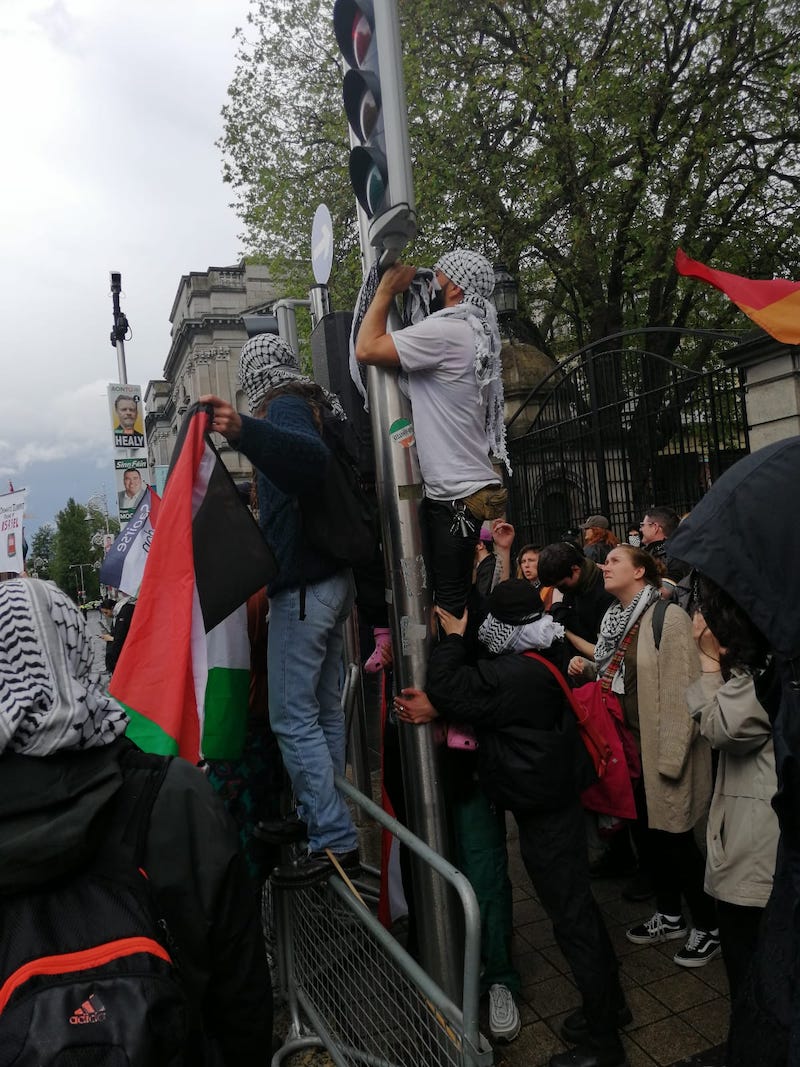
Two Garda vans were parked in front of the entrance to Molesworth St, partially blocking the views of the zionists and their opponents. The latter however stood with banners and flags on top of barriers and an amplifier was also strapped to a pole to better carry the message to the Zionists.
Palestinian supporters attaching an amplifier speaker to a pole outside Leinster House, directed at the Zionist rally in Molesworth Street (Photo: Rebel Breeze)
Despite the IIA having recommended its supporters to bring Israeli and Irish flags, only one Tricolour could be seen among their blue-and-white Israeli flags. One placard depicted the whole of Ireland covered with a menora, the traditional Jewish multi-candlestick.
Some of the Zionists’ placards repeated the debunked accusations of programmed mass rapes by the Palestinian resistance on October 7th last year, for which no evidence whatsoever or known victim exists despite Israeli state propaganda parroted by some of its western media supporters.
Zionist marchers arrive at their rally point in Molesworth Street, with two sets of barriers placed between them and the Palestine supporters (Photo: Rebel Breeze)
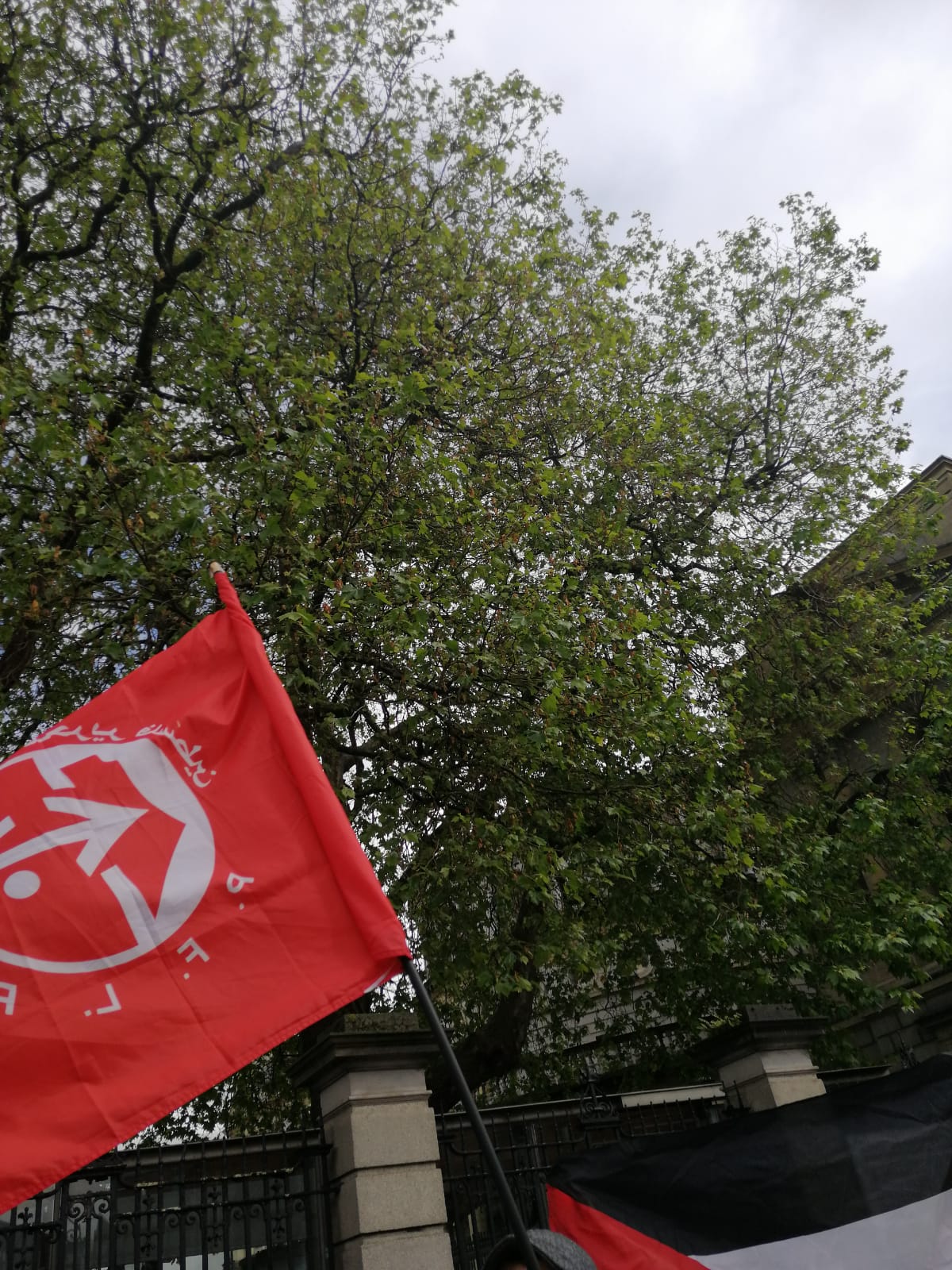
Among the Palestinian supporters the Palestine national flag was very much in evidence, also a couple of the PFLP7 and one in the colours of the anti-fascist Popular Front Government of 1930s Spain bearing the words “Connolly Column”, honouring the Irish who fought fascism there.
Here too there was only one Tricolour to be seen.
Flag of the PFLP seen against the trees (Photo: Rebel Breeze)
There were intermittent rain showers during the events, often persistent and somewhat heavy, streams running northwards along the road and pavement edge down Kildare Street but the demonstrators remained without shelter, many also without specific rain gear or umbrellas.
Women (mostly) speaking through amplification led the slogans that have become common on Palestine solidarity demonstrations in English, Irish and Arabic but with a few additions, including “Zionist scum – Off our streets!” Also “West-Brit Blueshirt scum – Off our streets!”
View of the rain’s ‘river’ running down between the Leinster House pedestrian pavement and the road. (Photo: Rebel Breeze)View of small section of Palestinian supporters’ line with police line in front and the rainwater swirling around their feet. The Zionist rally is taking place behind the police line and beyond two lines of metal crowd barriers. (Photo: Rebel Breeze)
At intervals Arabic resistance music was played and sections of the Palestine solidarity crowd began to sway or even dance, including one young woman from Gaza who seemed accomplished in traditional dance. Irish patriotic songs were played for a period also.
Among the Palestinian supporters the Zionist chants or speakers could not be heard, nor can one know how much of the Palestinian solidarity chants could be heard by the Zionists. Eventually the Zionists left to jeers from their opposition, a Garda helicopter watching over them in the sky.
The Gardaí left and the Palestinian supporters did too, mostly leaving together in a group.
(Photo: Rebel Breeze)
AFTERMATH – FIGHT IN PARNELL/ O’CONNELL STREET
That was not all however for perhaps an hour later a fight developed between what seemed to be a far-Right man against a group of Palestinian supporters in Parnell Street. According to some people, the man had approached them aggressively about their Palestine solidarity activism.
Disliking their response, he punched one of the Palestine solidarity demonstrators in the face and when the women in the group protested, struck a couple of them too. Another male in the group then launched at the Far-Right man and gave him a bloody face.
When observed by this reporter, the man was covered in tattoos, stripped to the waist and shouting about being “for the Irish” (which for some reason the Far-Right assume Palestinian supporters are not — though many have a far better track record in that respect than do Far-Right activists).
In Palestine that same day the zionist air force bombed a tent town of displaced people in northwest Gaza, which they had declared a safe area, murdering over 30 and injuring many more, some of whom will die. They also bombed 10 UNRWA displacement centres.
2The zionists had a number of terrorist organisation pushing the formation of the Israel State: Haganah, Irgun, Palmach … Haganah became the core of the Israeli armed forces.
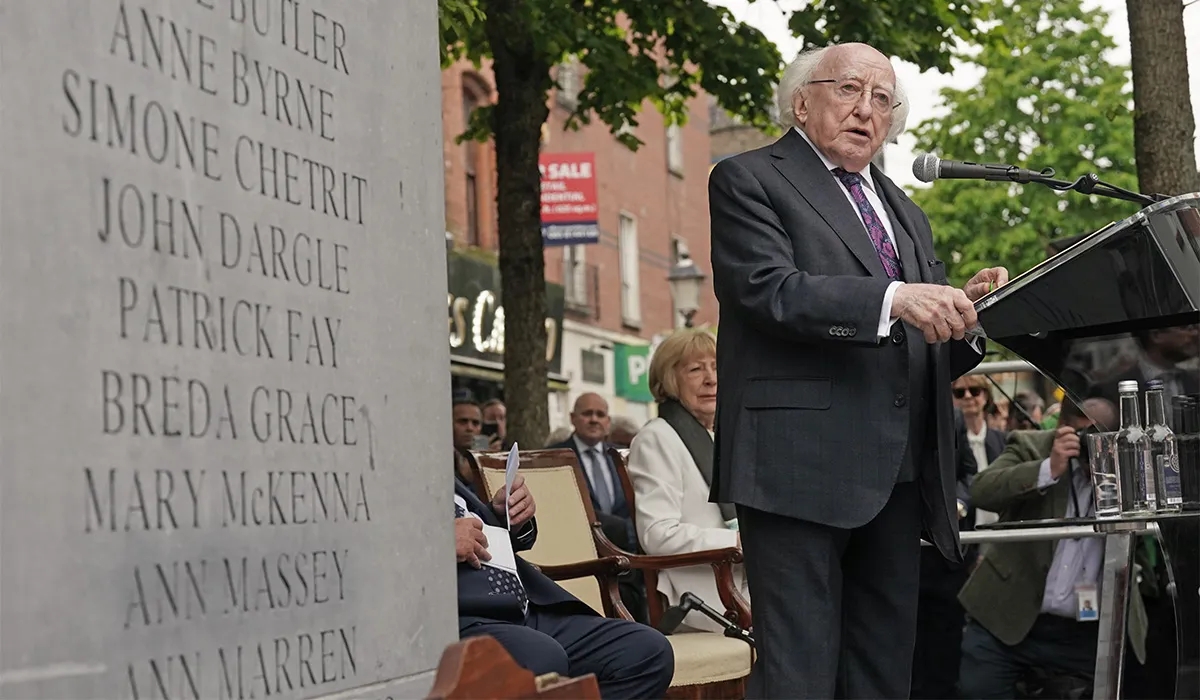
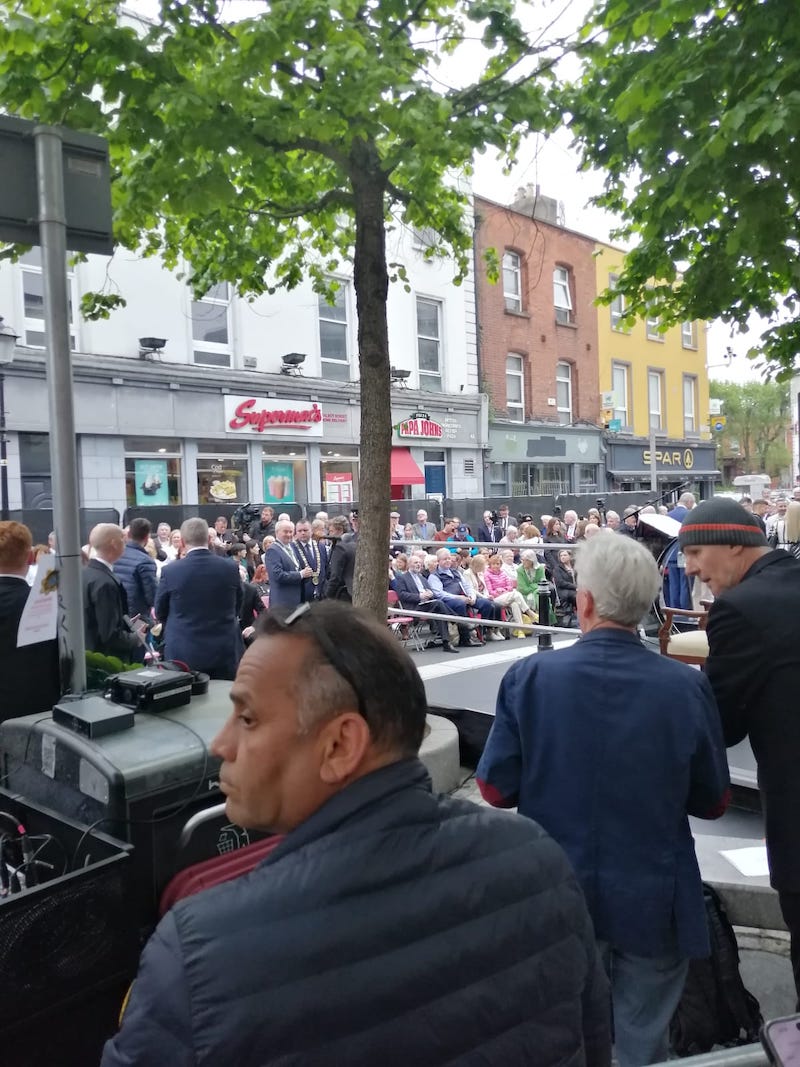
President Michael D Higgins speaks during a wreath-laying ceremony at the Memorial to the victims of the Dublin and Monaghan bombings on Talbot Street in Dublin, to mark the 50th anniversary of the Dublin and Monaghan bombings. (Photo cred: Brian Lawless/PA Wire)
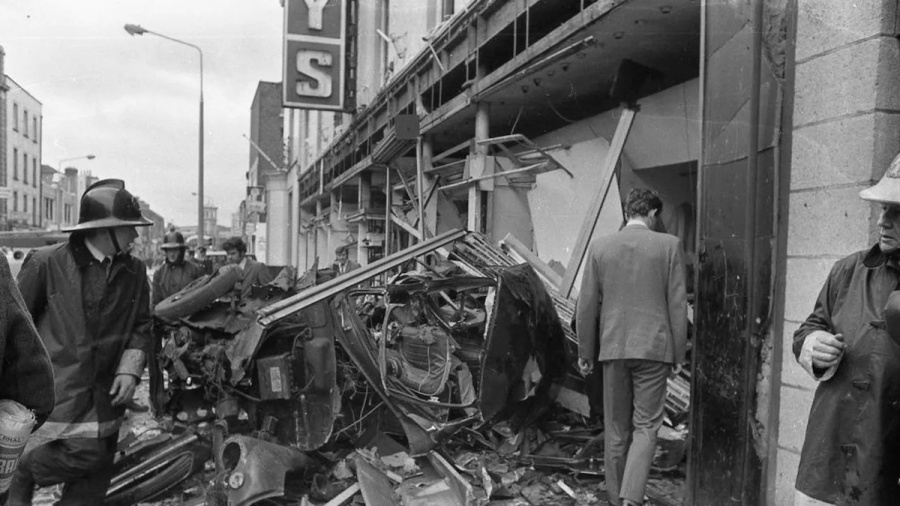
Fifty years ago, on May 17th bombs exploded in Dublin and Monaghan killing 34 people. The anniversary was marked in Talbot St. Dublin beside the monument erected in memory of those murdered on that day.
The attendance at the anniversary was addressed by Michael D. Higgins, the southern president.(1)
He made a number of points in his speech, mixing his praise for the Good Friday Agreement and Elizabeth Windsor’s visit to Ireland with calls for the rights of the victims to know the full truth, oblivious to the inherent contradictions in his statement.
He did acknowledge that there were huge problems with the subsequent investigations and cited the Barron Report.
The report compiled by the late Judge Henry Barron, published 10th December 2003, provided some of the answers, pointing as it did to systemic failures at State level, one that included possible collusion between the security forces and loyalist paramilitaries.
Also featured was the disappearance of important forensic evidence and files, the slow-motion conduct of the investigation, a reluctance to make original documents available, and the refusal to supply other information on security grounds.(2)
There is nothing surprising about this. The dust had barely settled in Dublin and Monaghan and the Irish Government and the Opposition rushed out to deflect and suppress any debate.
Both the Taoiseach at the time, Cosgrave (Fine Gael) and the Opposition leader Jack Lynch (Fianna Fáil) both issued statements that were remarkably similar.
In them they broadened out responsibility for the attacks to anyone who had been involved in any violent act; i.e. they blamed the IRA by implication and failed to mention loyalists at all. This was not accidental. It was deliberate.
The nature of the bombings, the coordination, technology used all indicated the involvement of the British secret services, coupled with the fact that the loyalists never again showed the same capability ever.
Under no circumstances was the southern establishment going to accuse the British of anything.
Just over two years earlier, following the murder of 14 people on the streets of Derry by the Parachute Regiment in full view of TV cameras, an angry nation protested and burned the British Embassy in Dublin to the ground. Cosgrave and Lynch sought to avoid a repetition of that.
As the Barron Report pointed out the Garda investigation was poor, forensic evidence was destroyed, the team set up to investigate it was wound down after just two months and the murder inquiry itself was closed after seven months.
All of this shows clearly that they had no interest in getting to the bottom of it. So much so, when the RUC informed them that they had arrested some suspects in relation to the bombing, the Gardaí did not follow it up.
Years later when Judge Barron carried out his investigation, it was not just the British who were uncooperative. The Gardaí and the Department of Justice didn’t provide him with any information, their files were “missing”.
So, any call for truth means demanding the southern government reveal what it knows and also who shut down the inquiry, why, what happened to the files etc.
It was ironic that the Taoiseach, Simon Harris, the former Taoisigh, Micheál Martin (Fianna Fáil) and Leo Varadkar (Fine Gael) who were present and laid wreaths represent those who covered up the bombings.
If we are going to talk about truth, then a starting point should be that Fine Gael and Fianna Fáil covered it up and bear part of the blame for the failure to prosecute anyone.
But when Higgins and others demand the British hand over files and information, including the information offered at the time but not sought by the Gardaí, a question arises. Why would you ask the British government for information and files on a bombing that took place in Dublin?
There is only one possible answer: the British were involved in the bombing.
So, a good starting point would be not so much to talk euphemistically of full disclosure, but rather for them to admit their guilt and tell us all what they did and how and provide all the documentation relevant to their admission of guilt.
No Irish politician has ever demanded that the British own up for it. The demand is they give over information on those who carried it out, as if they were not serving members, at the time, of the British security forces.
The Irish state deliberately failed the victims of the bombings and continues to do so, to this day.
It is telling that the Barron Report on the bombings in not available on Irish government sites but rather on a site set up by victims of the bombings, Justice for the Forgotten (http://www.dublinmonaghanbombings.org/home/).
The Irish state has little interest in talking about the issue or of informing the Irish public, most of whom were born after the bombings.
Though Higgins criticised the Legacy Act, which puts a time limit on prosecutions, the Good Friday Agreement was always about drawing a line under what had happened. The GFA rewrote history to portray the British as honest brokers in a tribal sectarian conflict and not as an imperial power.
Acknowledging their role in the Dublin and Monaghan bombings would undermine that carefully crafted and now universally accepted lie about the British role in Ireland. The British will not release the files as to do so would be an admission of what their role in Ireland is.
The southern establishment despite its occasional calls for clarity and truth, dreads the British even considering such a move, as again it would undermine their role in the conflict as well and their responsibility for the ensuing cover up.
Thirty-five people were killed by bombings on 17th May 1974, the most in one day during the recent 30 Years War but outside of Ireland and even within it, most people are unaware of that fact. That’s because the perpetrators were not the IRA.
And probably also because the victims were killed not just in Ireland but within the Irish state. Also no doubt because the perpetrators were Loyalists led by British Intelligence.
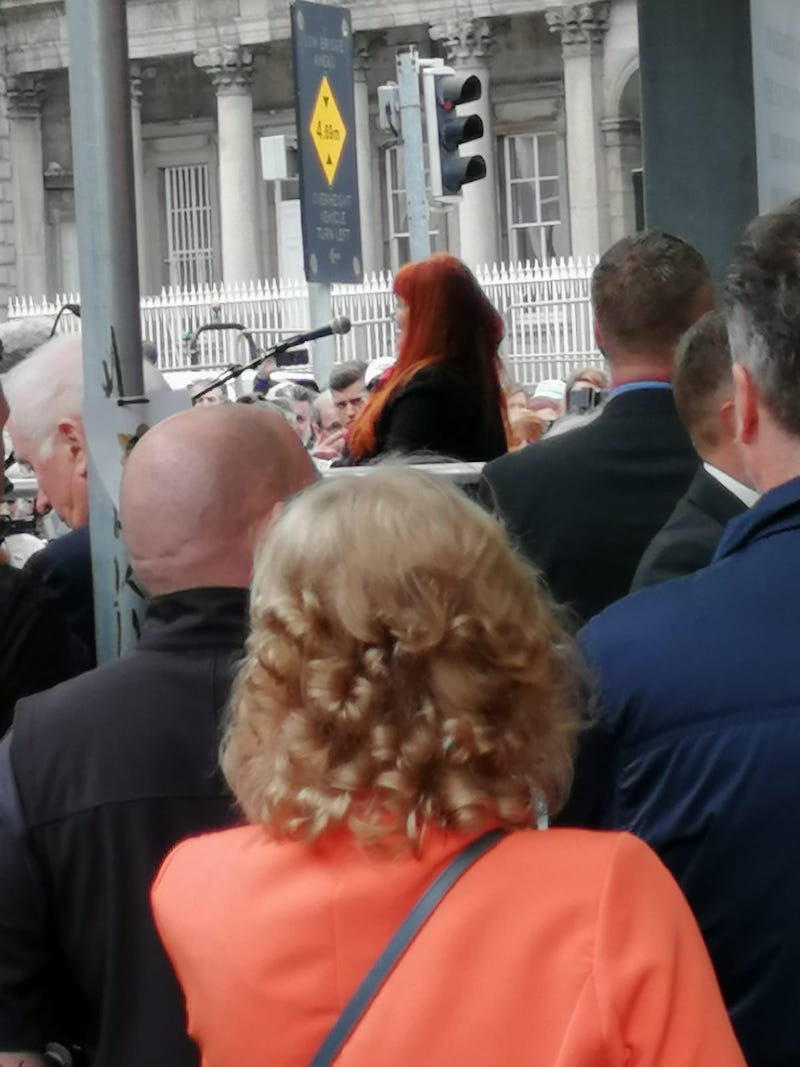
Section of westward end of attendance at event as President Michael D Higgins approaches (just out of view)(Photo: D.Breatnach)
Three bombs exploded on that day in the middle of a rush hour in Dublin City Centre: Talbot Street, Parnell Street and South Leinster Street. Somewhat later, a bomb exploded also in Monaghan Town. Altogether 35 were killed1 and “about 300”2 injured, some permanently.
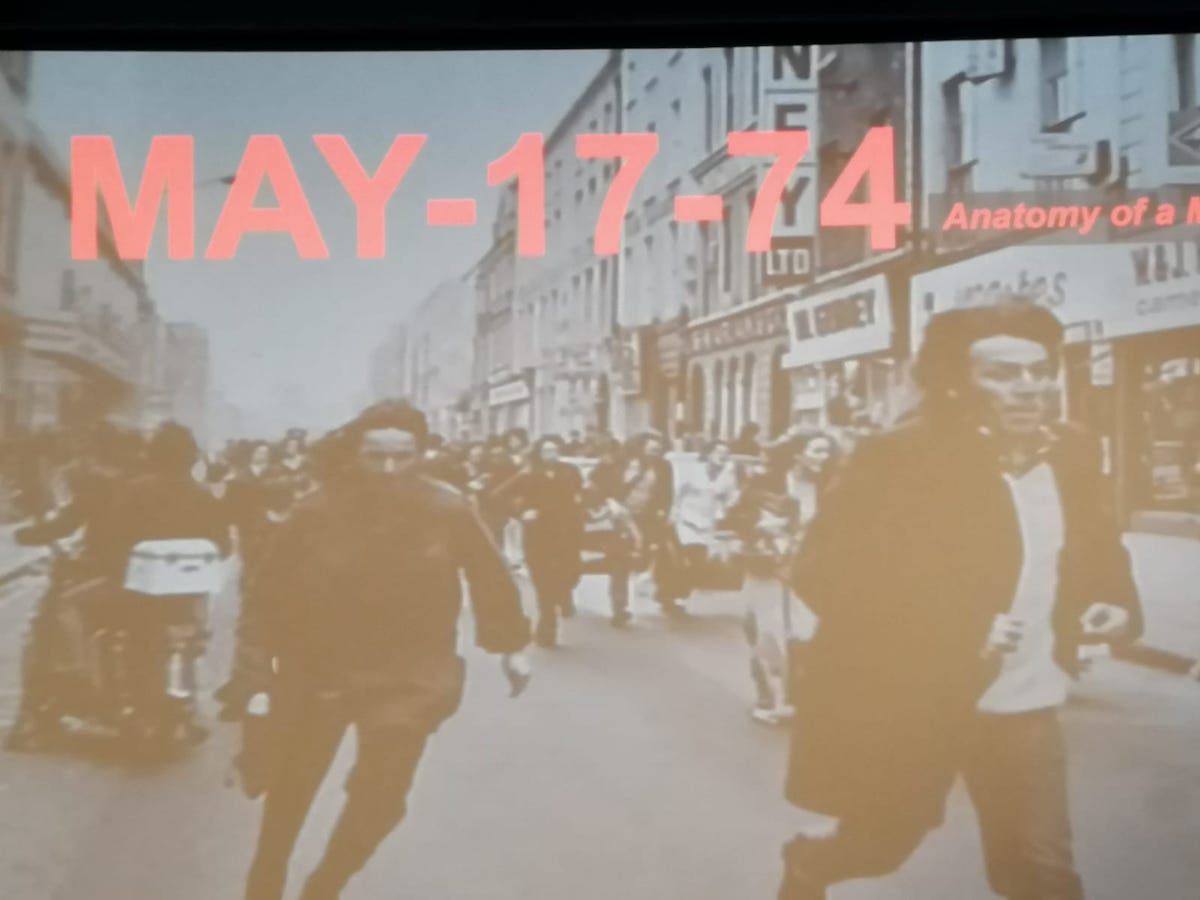
The names of some of the victims being displayed at the premiere of the Anatomy of a Massacre documentary. (Photo: D.Breatnach)
Within days and perhaps hours a number of suspects among Loyalist murder gangs had been identified but they were not arrested or even questioned about the atrocity – no-one ever was. Despite that, the Gardaí closed the case investigation seven months afterwards that same year.
A new documentary on the atrocities by Fergus Dowd was premiered in Dublin on Friday to two full screen auditoria in the Lighthouse Cinema, Smithfield, featuring interviews with witnesses, victims and relatives of victims, a former Taoiseach and a former State forensic scientist.
May-17-74 Anatomy of a Massacre is directed by Joe Lee and produced by Fergus Dowd.
The forensic expert had been given very little of the remains of cars containing the bombs since most had been sent to the RUC (colonial police) for their analysis (!) from which nothing useful emerged but he was able to determine that a high amount of amatol had been used.
At that time only the IRA among “paramilitary organisations” had the expertise to develop that explosive material which leads commentators to believe that the Loyalists received the necessary quantities from those seized from the IRA and held by the British armed forces.3
Given that many of the Loyalists involved were members of the Ulster Defence Regiment, a British Army unit, on the face of it the explosives could have been directly supplied by the British Army or indirectly obtained through the UDR as members of the British Army.
Nothing adverse is known about the Garda Commissioner who sent the exploded car remains to the colonial police but his Deputy and successor was Ned Garvey and whistle-blowing British spook Fred Holroyd claimed Garvey was a British Intelligence “asset” and to have met him in Dublin.
Confronted with this exposé years later Garvey admitted having met Holroyd but not to being a British spy – though he had not informed his superiors of his meeting with a foreign secret service agent. 4 Sadly this is not alluded to in the documentary.
As documented in Anatomy there had been a Loyalist bombing campaign of Dublin since 1969,5 with those in 1972 and 1973 killing between them three transport workers and no-one had been arrested by Gardaí or extradition sought in connection with even those fatal explosions.
No documentary about the bombing was made by RTÉ, the Irish broadcaster until 2004, thirty years after the atrocity.
However a much earlier documentary was by British company Yorkshire Television on ITV in 19936. RTÉ had declined the offer of joint screening and many people in Ireland who did not have access to ITV at the time missed it or had to go to a friend or relative to view it.
The British documentary was mentioned only in passing by one of the interviewees in Anatomy but without reference to RTÉ’s declining of the offer of joint screening.
British spook whistleblower Colin Wallace states that he was obliged to report on every meeting he had with Loyalists or others and his erstwhile bosses would have kept those papers, as they would have for the MI5 operatives who steered the bombing gang for Dublin and Monaghan.
The existence of MI5 documents that would throw much light on the bombings was referred to a number of times in Anatomy and the Justice for the Forgotten campaign keeps seeking them. Irish Government ministers regularly state that they have requested them but are always refused.
Missing from the documentary was what is now known of the secret contemporary memos of Arthur Galsworthy, British Ambassador to the Irish state: It is only now that the South has experienced violence that they are reacting in the way that the North has sought for so long …
… I think the Irish have taken the point.
Galsworthy also noted that the Irish Foreign Affairs Minister Garret FitzGerald told him that “the government’s view was that popular hostility appeared to be directed more against the IRA“.
In the immediate aftermath of the bombing, both Liam Cosgrave for the Government and Jack Lynch for the Opposition sought to widen the blame to include Irish Republicans.7
VIEWING THE DOCUMENTARY
Two screens at the Lighthouse cinema were fully booked to view the premiere.
The documentary is fascinating and some of the witnesses and relatives really excellent in their descriptions and commentary. Others interviewed pulled no punches in castigating successive Irish governments for closing the investigation and allowing it to remain closed.
Some, too, alleged a conjunction of interests between the Irish and UK states in ensuring the truth about the perpetrators and the Irish State’s reaction never surfaced.
Many people prominent in Irish political circles at different ends were present to see the premiere and after a few words from Margaret Unwin, Coordinator of the Justice for the Forgotten campaign, along with filmaker Dowd, the Resistance Choir sang their song composed about the bombing.
The Resistance Choir performing their song about the bombing massacre (Photo: D.Breatnach)Section of crowd from the Monument eastward (Photo: D.Breatnach)
Justice for the Forgotten organise a commemoration of the atrocity every year at which some music and poetry is performed, along with speeches by politicians representing the Irish State, and the local authority Councils of Dublin City and Monaghan and another individual or two.
Some of what is said there I have welcomed and some disliked but most of all I detest Ministers in the Irish Government coming there to tell us how they want the British State to release their secret documents regarding the event but never have any action to pressurise its Ministers in mind.
Cormac Breatnach playing low whistle at event (Photo: D.Breatnach)
This year, the 50th anniversary, the event took place after noon on Friday 17th May with a large crowd but only one speaker listed, President of the Irish State Michael D. Higgins, with traditional Irish music from Cormac Breatnach and Eoin Ó Dillon, a duo performing at the event for years.
Eoin Ó Ceannabháin sang The Parting Glass and poet Rachel Hegarty performed her poem about the bombing. But there was a surprise speaker also, an Italian from Breschia who also referred to state collusion in a bombing against an anti-fascist rally in his home town the same year, a few weeks later.
Poet Rachel Hegarty performing her poem about the event (Photo: D.Breatnach)
The MC of the event, Aidan Shields, son of fatal victim Maureen, told the audience to applause that Justice for the Forgotten would be sending a delegation to Breschia for the 50th commemoration of the atrocity in their town.
At left, Aidan Shields, son of fatal victim and MC at event, with Monument to the victims centre (Photo: D.Breatnach)
WHY THE BOMBING?
Trainee journalists are told to answer the ‘Five Ws’ in their reports: who, what, where, when and why.
The answers to four of those questions have been known for decades: Dublin and Monaghan is where; 17 May 1974 was the when; the bombing atrocity was the what. The who were the Loyalists and British Intelligence. But nobody seems to attempt to answer the why – or even to ask that question.
For the earlier 1972 bombing, the “why” is clear: to get the Irish parliament to vote for the Amendment to the Offences Against the State Act.
And they were successful in that since, all logic to the contrary, some of the Opposition decided to believe that the bombing was the work of Irish Republicans. So we now have that no-jury political court and senior Gardaí can give ‘evidence’ unseen by the accused from Garda “secret files”.
Apart from the guidelines of journalism, there are also those with regard to criminal investigations, which outline the importance of motive and opportunity. The British secret service certainly had opportunity – but what was their motive?
A bombing such as that in Dublin on 1974, in the Irish State’s capital city, is a message to the Irish ruling class (though the victims be different) were the. And from the British state through their intelligence service, which would hardly dare to carry out such an attack without at least the endorsement of their masters.
So the message was … what? “We will bomb your capital city if you don’t do what we want or if you do what we don’t want”? But the Irish ruling class was already cooperating about as fully as possible with the occupation in the Six Counties and repressing resistance in the Twenty-Six.
A similar campaign occurred in the 1980s, in the Basque Country within the French state (mostly). The Spanish Government waged a terrorist campaign8 of bombings, kidnappings and assassinations against suspected activists of the armed Basque liberation group ETA.
It seemed that what the Spanish authorities wanted was for the French to turn over Basque activists who were on the “French” side of the Border to the Spanish authorities, something the French had been unhappy to do, the Guardia Civil believed to be torturers even after Franco’s death.
After some of those bombings, the social-democratic French Government led by Mitterand began to hand over Basque activists to the authorities across the border, sometimes without even going through the official extradition procedures.
The Irish State did also permit extradition of Irish Republicans to the Six Counties (and later to Britain too) after the Dublin and Monaghan bombings, but not until ten years later, with Dominic McGlinchy, which hardly looks like the effect following its cause.
The Sunningdale Agreement had been signed in December 1973 which proposed some kind of power-sharing between nationalists and unionists with a role for the Government of the Irish state against which the Loyalists of the Ulster Workers’ Council had organised a general strike.
A British whistleblower, Colin Wallace claims that the bombing was a warning to the Irish ruling class to keep their fingers out of the colony.
VICTIMS AND RULING CLASS
Apart from not answering or even seeking the motivation for MI5 to arrange and oversee the bombing, I have not seen any discussion of the class nature of the locations. The bombings of 1972 and 1973 targeted transport workers.
But the bombings on the north side of the river in areas to the east of O’Connell Street also took place in areas where working and lower middle-class people worked, shopped and got on to the public transport buses. This hardly seems accidental.
Aftermath in Talbot Street facing westward with Connolly Station tower in far background (Photo: PA)
A part of MI5’s message could have been: “This time it was mostly the kind of people nobody (who are in power) cares about, so be thankful. Next time we might hit the north-east centre around Henry Street, or areas around Trinity College, Dame Street and Grafton Street on the south side.”
One other point that is rarely made is that the bombing and the State’s reaction to it showed the totally craven and foreign-dependent nature of the Irish ruling class, to allow their capital city to be bombed by another state without seeking revenge or even restitution.
The French state made a deal with the Spanish after some bombs exploded in territory to which it laid claim but does anyone believe the result would have been the same if the Spanish terrorist groups had bombed Paris?
End.
FOOTNOTES
1 Some accounts give a total of 34 or 35 dead from the four bombings: 34 by including the full-term unborn child of victim Colette Doherty, who was nine months pregnant; and 35 by including the later still-born child of Edward and Martha O’Neill. Edward was killed outright in Parnell Street.
4 When Fianna Fáil came into government, they sacked Garvey but presumably not wanting to expose British Intelligence penetration of the Irish State’s management upper echelons, gave as a reason only that they had no confidence in him. This opened the way for Garvey to claim wrongful dismissal and win, giving him a payout and retaining his pension. Garvey was also important in running the notorious “Heavy Gang” within the Special Branch.
5 The Wolfe Tone Monument in Stephens Green had been blown up and the O’Connell monument, the Glasnevin ‘Round Tower’ had also been bombed.
6 “Yorkshire Television broadcast a documentary entitled ‘Hidden Hand – the Forgotten Massacre‘ made as part of its ‘First Tuesday‘ series. The programme dealt with the Dublin and Monaghan bombings of 17 May 1974. [The programme came to the conclusion that the Ulster Volunteer Force (UVF) would have required assistance to carry out the bomb attacks. There was speculation as to where such assistance might have come from. While no firm conclusions were reached, it was suggested that the security forces in Northern Ireland were the most likely source of help. Allegations concerning the existence of a covert British Army unit based at Castledillon were considered; as well as alleged links between that unit and Loyalist paramilitaries. It was shown that Merlyn Rees, the former Secretary of Sate, had known of the unit’s existence. On 15 July 1993 the UVF issued a statement in which it claimed sole responsibility for the Dublin and Monaghan Bombings.]” https://cain.ulster.ac.uk/events/dublin/chron.htm
As Limerick and Waterford county teams prepared to face one another in the GAA hurling semi-final at Croke Park stadium, anti-internment protesters and campaigners lined up outside Dublin’s General Post Office, in the city centre, to mark the 50th Anniversary on the introduction of internment without trial in the British colony of the Six Counties. Their placards, leaflets and speakers denounced the continuing practice of interning political activists in Ireland today.
Seen at the anti-internment event in Dublin today (Photo crdt: Sean Hogan)
The event was organised by the Anti-Internment Group of Ireland, an independent and non-affiliated campaigning organisation and the supporters included a mixture of socialist Irish Republicans and anarchists. The heavy and persistent rain of the morning held off and Dublin city centre was thronged as GAA hurling supporters added to the usual shoppers. The banners and placards of the picketers drew considerable interest from those passing and here and there people stopped to discuss with them.
Some young Basque girls were curious but also delighted to see their nation’s flag, the ikurrina, being flown at the event and stopped to engage one of the picketers in discussion. Also in evidence was the flag of Amnistia, Basque organisation around solidarity with its political prisoners and against repression, along with the flag of Palestine.
Flag of the Amnistia organisation (solidarity with their political prisoners) in the Basque Country seen on the anti-internment event in Dublin today (Photo crdt: Sean Hogan)
Around 200 leaflets were distributed to passers-by, discussions were held and contacts were made with people interested in supporting the work of the Anti-Internment Group Ireland.
After some time in a picket line and distributing leaflets, a representative of the organisers, speaking in Irish and in English, welcomed the attendance and introduced a speaker from the Anti-Imperialist Action organisation.
One of the leafleters outside the GPO at the anti-internment event in Dublin today (Photo: C.Sulish)
SPEAKERS
Speaking in Irish as some passers-by stopped to listen, the young man said they were there to commemorate the introduction of internment and mindful of the existence of political prisoners all over the world. The were also protesting the extradition to Lithuania of Liam Campbell to face trial in a country in which he had never previously set foot.
The organisers’ representative then spoke in English about the history of repression in the Six Counties colony, how from the moment the nationalist community there stood up to demand equal rights and justice the State had responded with violence. Since the people raised the level of their resistance in response, the State in turn raised the level of its violence higher again, in a rising spiral of violence.
The nationalist community in the Six Counties had marched for civil rights and had been met with the violence of the colonial police and of the Loyalists — the speaker said — but they had continued to resist. Internment without trial was introduced to break that resistance but, knowing that would also lead to increased resistance, the State had prepared the Paratroopers to shoot unarmed civilians dead. They had done that in Ballymurphy on the very day that internment had been introduced1, he reminded his audience and later had shot dead two unarmed Cumann na mBan Volunteers (Republican women’s organisation) who were alerting people to the raiding parties of the British Army. At the start of the following year, the British Army murdered unarmed civilians again, this time in Derry2.
That year 1972, the speaker stated, had the highest death toll of any year during the three decades of the war3 and Loyalists were also bombing streets nearby in Dublin, again in 1973, killing workers. In 1974 Loyalists and British intelligence bombed the Dublin city centre again and Monaghan, killing the highest number of people killed in one day during the war4. That year too, the IRA bombed pubs in England and killed people and the State brought in the repressive Prevention of Terrorism Act against the Irish community. They jailed a score of innocent people on extremely serious charges5 and one of them, Giuseppe Conlon, died in jail6.
The speaker went on to say that although there had been hard repression before, the introduction of internment without trial and the follow-up massacres by the British Army had lit a fuse to a chain-reaction of violence for decades to follow.
Pointing out that internment consists of jailing people without trial, the speaker stated that the practice continues today, by refusing bail to political activists awaiting trial in the non-jury courts on both sides of the British Border. The Anti-Internment Group of Ireland will continue striving to expose this reality and he called on people to support the monthly pickets in the city centre and to follow the End Internment page on Facebook.
ONGOING AGITATING AGAINST INTERNMENT
As the applause died down people began to pack away flags, banners, placards and leaflets and to catch up socially among themselves or to engage with passers-by who had stopped to listen and/ or to ask questions.
Organisers of the event said they hope to hold another picket at some venue in the city centre in a month’s time – when scheduled, the event will be announced on the End Internment FB page.
End.
Leafleter right foreground, person reading leaflet left foreground, picket line of the anti-internment event in Dublin today. (Photo: C.Sulish)
(Photo: S.Hogan)
(Photo: S.Hogan)View of the picket with a passer-by expressing solidarity with the picketers (far right of photo). (Photo: C.Sulish)
FOOTNOTES
1Between 9-11 August, British paratroopers caused the deaths of 11 unarmed civilians in Ballymurphy.
213 people were shot dead by British paratroopers on Bloody Sunday in Derry as they protested against internment and a 14th died later of his wounds.
3The period from August 1971 to the end of the year saw a huge jump to 136 violent deaths (including British and colonial armed forces) and the following year, 1972 is counted the most violent year of the conflict overall with 479 people killed (including 130 British soldiers) and 4,876 injured.
5The Birmingham Six, Guildford Four, Maguire Seven, Giuseppe Conlon and Judith Ward. All were eventually cleared after long years of campaigning around them and failed court appeals.
6Giuseppe Conlon, hearing that his son Gerry had been arrested for the Guildford Pub Bombings, came to London to help him in 1974 and was swept up into the police net to become one of the innocent framed victims. Giuseppe Conlon was not a healthy man and died in his 7th year in jail, before the verdicts on the other framed prisoners were finally overturned. His son Gerry, also an innocent man in jail, was not permitted to attend his father’s funeral.



















 rebelbreeze