DUBLIN SEES LARGE PALESTINE SOLIDARITY MARCH ALSO FASCIST PROVOCATION AND GARDA REPRESSION

Clive Sulish

(Reading time: 5 mins.)

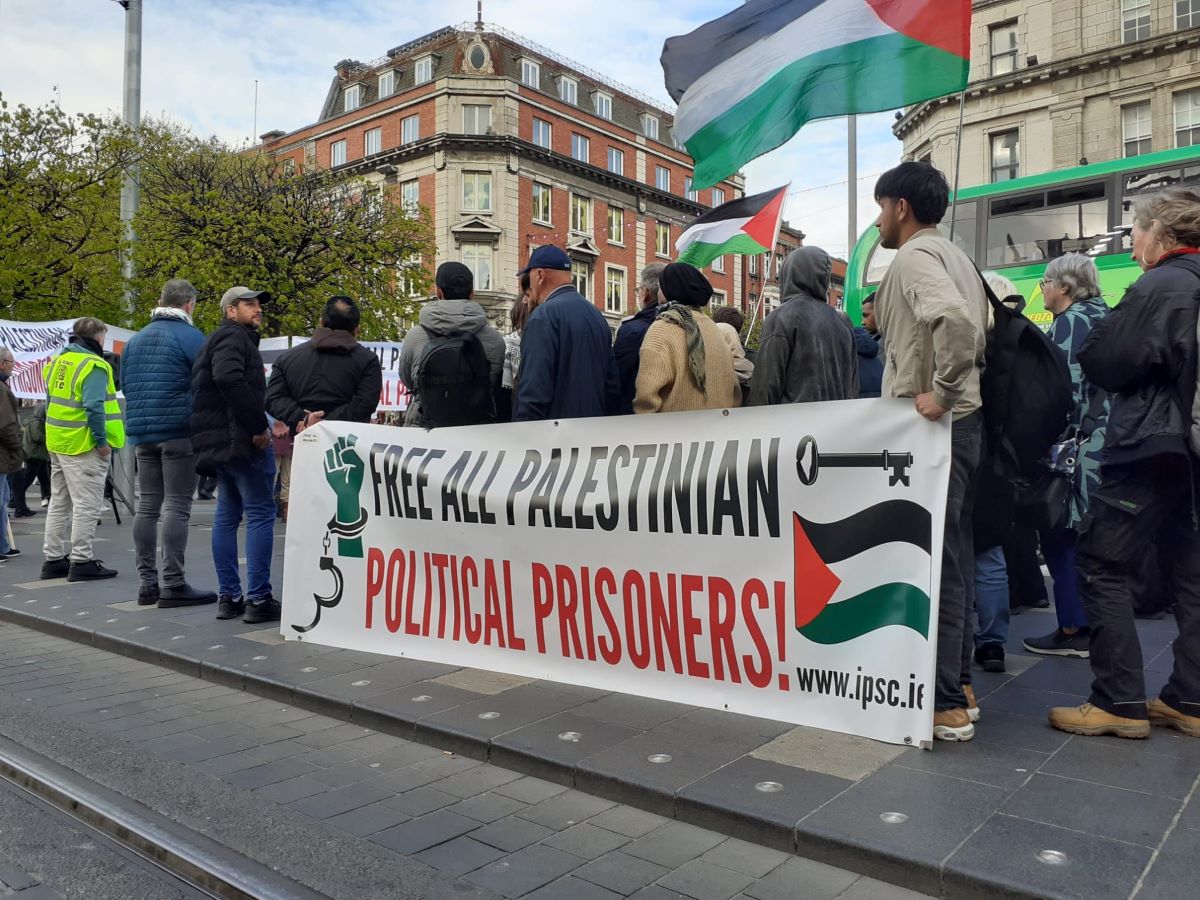
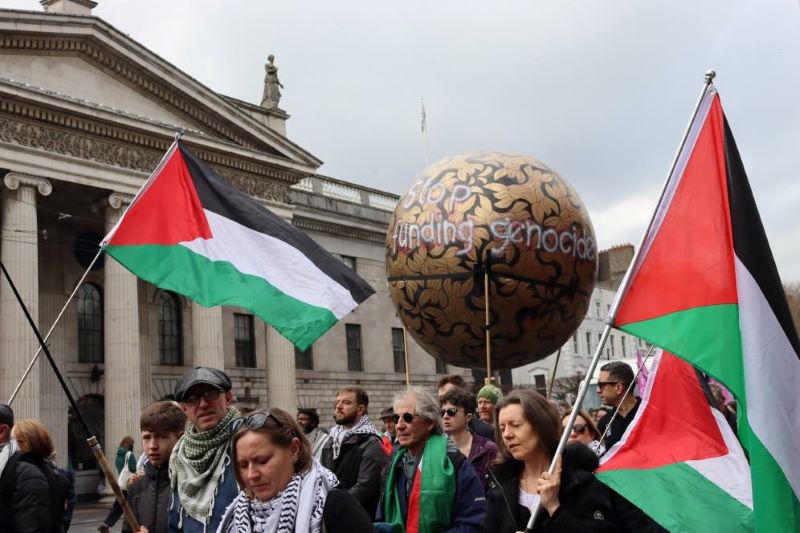
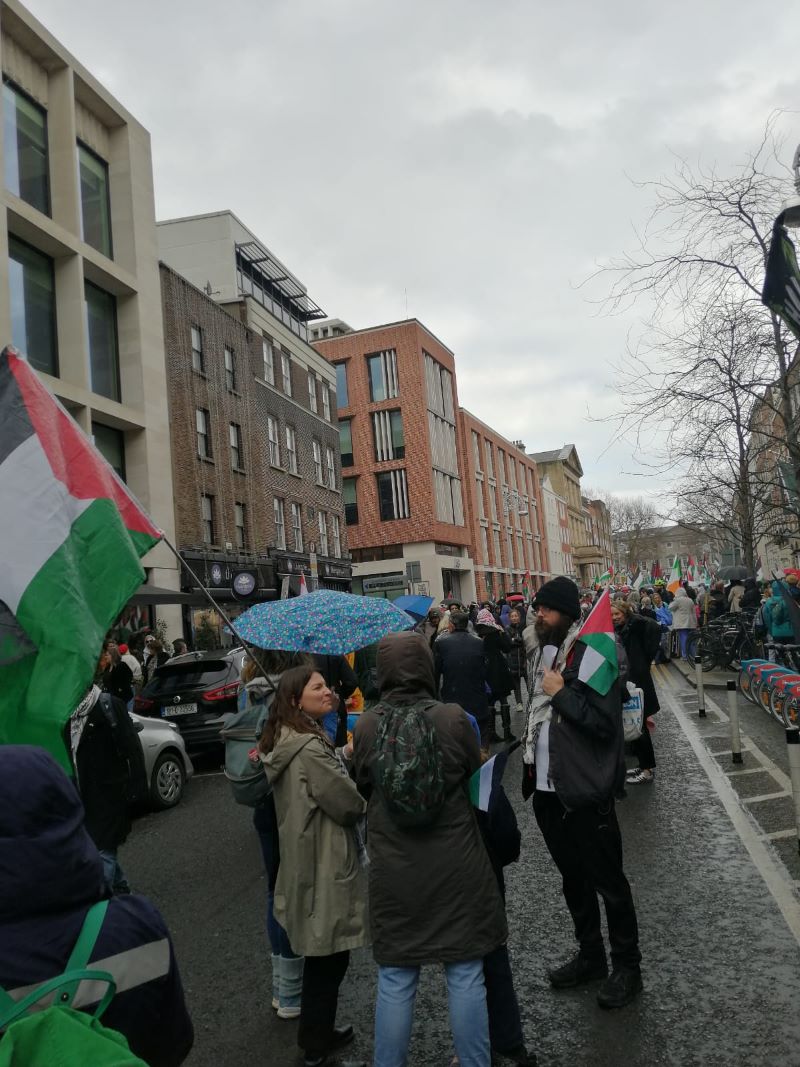
Dublin city centre on Saturday witnessed another giant Palestine solidarity march with a breakaway group; also a picket against internment of Irish Republicans; fascist provocations and Gárda repression resulting in the arrest of a demonstrator.

The national demonstration march had been called by the Ireland Palestine Solidarity Campaign as part of a solidarity and protest pattern that included fortnightly Dublin marches last year but is now generally monthly and at times with other events in addition.

One of the banners just having crossed O’Connell Bridge on the IPSC-organised march (Sourced: IPSC Facebook)

Numbers on these marches in a city of only around 1.5 million population are impressive, though they draw on some participation from outside Dublin but there also regular local pickets and demonstrations of much smaller numbers at locations of high visibility or of specific significance.1

The march set off from the Garden of Remembrance in the north city centre proceeding towards Leinster House, seat of the parliament of the Irish State, near O’Connell Bridge passing a picket with an anti-Internment banner organised by the Anti-Imperialism Action organisation.

Anti Imperialist Action displaying a banner against extradition to the passing Palestine solidarity march. (Photo sourced: Anti Imperialism Action Leinster FB page)

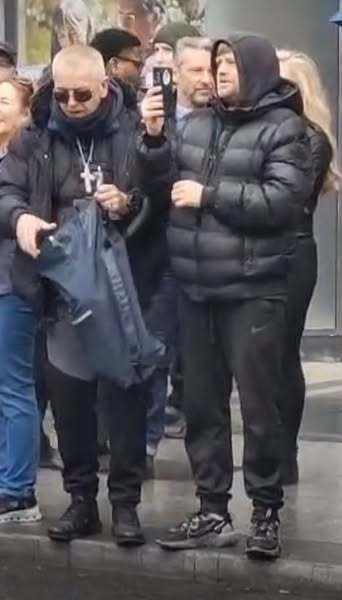
As the march reached the non-pedestrianised stretch of Grafton Street a half-dozen fascists made their presence felt on the sidelines by throwing insults at a section of the marchers, who responded with louder From Ireland to Palestine – Occupation is a crime! and antifascist slogans.

Not just the Irish state but fascists and other far-Right elements in Ireland have a real problem with Palestine solidarity, claiming that’s because the protesters should be marching for Ireland. However those elements for the most part have zero track record in marching for Irish independence.

No, for them ‘Irish nationalism’ consists of demonstrating against immigration and burning buildings intended – or which they believe intended – for housing refugees. Clearly as fascists and far-Right what they detest about marches such as these is internationalist solidarity itself.

Placard calling for what is surely the minimum we have the right to expect from the Irish Government, followed by some of the placards of Mothers Against Genocide. (Photo sourced: IPSC FB page)

Incongruously for those who want only internal causes upheld, the fascists of the Loyalist variety in the occupied Six Counties uphold the Zionist state of ‘Israel’ and those inside the Irish state, as was seen in Dublin on Saturday too, laud and uphold as an example Donald Trump!

BREAKAWAY2

Mock Icon of Irish Central Bank carried against processing Israeli Bonds (Source photo: IPSC FB page).

Very shortly after the verbal exchange with the fascists, a section of the march diverted to walk up the pedestrianised section of Grafton Street. A couple of Gardaí, reinforced by the fascists, attempted to prevent this but the marchers flowed around the obstruction to continue up the street.

On Wednesday evening, some of those present had marched down that very street on their way to occupy O’Connell Bridge, bringing traffic in both directions to a halt for half an hour.3

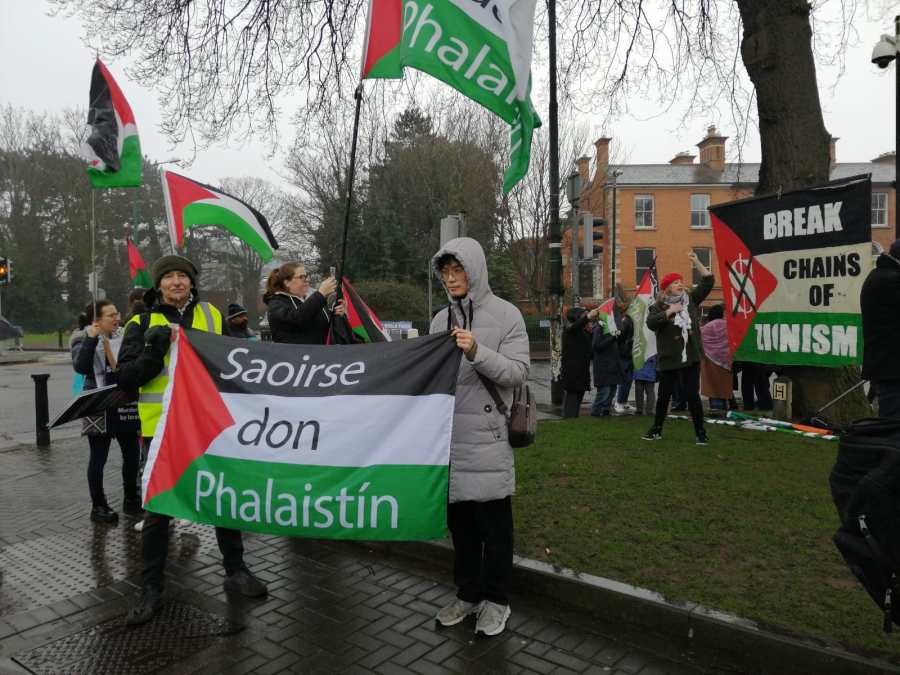
Further along the pedestrianised street the breakaway, including Ireland Action for Palestine and Saoirse Don Phalaistín groups, joined with another section of marchers who had earlier broken away from the IPSC march, this one led by the Mothers Against Genocide banner.

The shouted slogans from what were broadly two differing sections tended to merge with regard to calls to stop the bombing, opposition to genocide and broad support for Palestine but differed in that one section was also calling for support for the Palestinian Resistance and resistance generally.4

Content of slogans from the groups differed less markedly in calling for Irish Government intervention in support of Palestine, with the ‘Mothers’ mostly demanding the enactment of the Occupied Territories Bill5 and others condemning Government collusion in Shannon Airport.

The whole breakaway mass marched along South Stephens Green and turned north into Dawson Street, to pause inside the junction with Molesworth Street, where the tail of the main march, was already beginning to reduce although speakers and artists were performing on the IPSC platform.

Molesworth Street facing Dawson Street after the breakaway sections arrived and before the later incidents. (Source: R. Breeze)
View of the IPSC-organised march at its destination, the Garda barriers in Molesworth Street across the road from the entrance to Leinster House. (Photo: R. Breeze)

On Dawson Street, across from the junction, the fascists had installed themselves, including a man in a red ‘Trump’ hat waving a “Make America great again” flag.

Two known fascists from the group trying to harass Palestine solidarity marches from Grafton Street to Dawson Street. (Photo sourced: AFA https://www.facebook.com/afaireland)

The Palestine solidarity protesters here – some distance from the diminishing main march crowd,6 with some IPSC stewards standing watching nearby, responded to the fascists’ jeers and Trump fan with jeers of their own, slogans and some bursts of song.7

According to a report form Anti-Fascist Action observers nearby and posted later that day, a senior Garda officer approached one of the fascists and had a quiet word with them, after which the fascists packed their banner and went away quietly smiling while the Public Order Unit arrived.

Soldiers of the master race (ehem) packing up after notification from their friend in the Gardaí that the POU would soon be deployed against some of the Palestine solidarity demonstrators. (Photo sourced: AFA Ireland)

These then began to aggressively push the demonstrators back towards Molesworth Street and as a demonstrator remarked it was the POU that were now blocking Dawson Street to traffic.

Soon the Gardaí seemed to decide to arrest one of the Palestine solidarity demonstrators and charged into the crowd, shoving, knocking down and even punching people who resisted strongly or just held on to the intended victim as long as they were able to.

A woman struck back at a POU man who had seized her by the throat but even so it took the intervention of one of his unit to get him to release his hold. The marks of his hand on her throat could be seen afterwards. Interestingly a press report later stated the Gardaí denied there was any incident.

( https://www.standard.co.uk/news/uk/cofounder-irish-government-dublin-ireland-international-holocaust-remembrance-alliance-b1218253.html)

Eventually the Gardaí succeeded in their intent and the protester was taken away to chants of Let him go! Numbers of the main march were dwindling greatly by this point but so were those of the breakaway section and people there were concerned to support their arrested comrade.

One of three police stations was the likely destination: Store Street, Pearse Street or Kevin Street. It was established that he was held at the latter station and was later released, given a few days to decide, under the Public Order Act whether to accept a caution or to be charged and face trial.

More confrontations of various sorts are likely as the Zionist genocide in Palestine ratchets even higher and frustration mounts at the Irish Government’s persistent refusal to end their collusion with the Zionist state and with its main supplier, US imperialism.

End.

FOOTNOTES

1Mostly by organisations not part of the IPSC.

2Breakaway actions by groups often take place when they seek another target to that of the march organisers or to spread the visual and auditory impact of the demonstration or to break the ‘normalisation’ pattern, as when protesters feel the IPSC leadership is organising set marches of minimum disruption, on routes agreed with the Gardaí (which is not legal requirement in the Irish state).

3See https://rebelbreeze.com/2025/03/21/dublin-traffic-clogged-up-as-palestine-solidarity-protesters-march-around-city-centre

4There is only one solution – Intifada revolution! From Ireland to Palestine – Occupation is a crime!

5 Agreed years ago in the Irish Parliament before but prevented from enactment by successive coalition Governments.

6As soon as the IPSC march arrives numbers always begin to leave, either to commence return home journeys or because they feel they are not going to hear anything new and their contribution was to be part of a visible mass, which they have now done.

7The Irish-language Gráinne Mhaol and English-language Come Out Ye Black n’ Tans.

DUBLIN COURTS INCREASINGLY TRYING POLITICAL CASES

Clive Sulish

(Reading time: 3 mins.)

The CCJ (Criminal Courts of Justice) in Parkgate Street, Dublin, are seeing an increase in political cases in recent weeks with activists in housing and Palestine solidarity as well as Irish Republicans fighting extradition to the British colony.

Eoghan Ó Loingsigh, who made the mistake of asking a Garda for his badge number while they were carrying out an eviction, appeared there in February only to see his case thrown forward to June.

Picket anti-extradition display by Anti-Imperialism Action outside Heuston Station in February. (Photo: R.Breeze)

Another housing activist’s charge of attempting to break into an empty property was dismissed. The property in question, empty for a number of years is leased to the Salvation Army and three years ago two RHL1 activists were evicted from it by 100 Gardaí (some armed) with helicopter support.

Jack Brazil, a Palestine solidarity activist whom the Gardaí are trying, believe it or not, to tie into the racist and criminal riots of November last year, had yet another appearance in court without trial as he’s still trying for CCTV footage from Gardaí to support his alibi for the night.

At least the remaining bail restriction on Brazil was lifted: at the outset he had to sign on at Mountjoy Garda station once every week, observe a curfew of 12am-6am and not to loiter at any point in the Dublin city centre (D1 and D2). His case is now remanded to 26 March.

Jack Brazil (in the suit) and other Palestine solidarity activists outside the CCJ after Brazil’s most recent appearance there. (Photo: R.Breeze)

Jim Deneghan had a number of court appearances fighting extradition to the Six Counties on foot of charges alleging an act during the 30 Years War there – fifty years ago. He was unsuccessful and it appears that the only avenue open to him now would be to challenge it in the High Court.

Should they even grant him leave to do that which is not always the case.

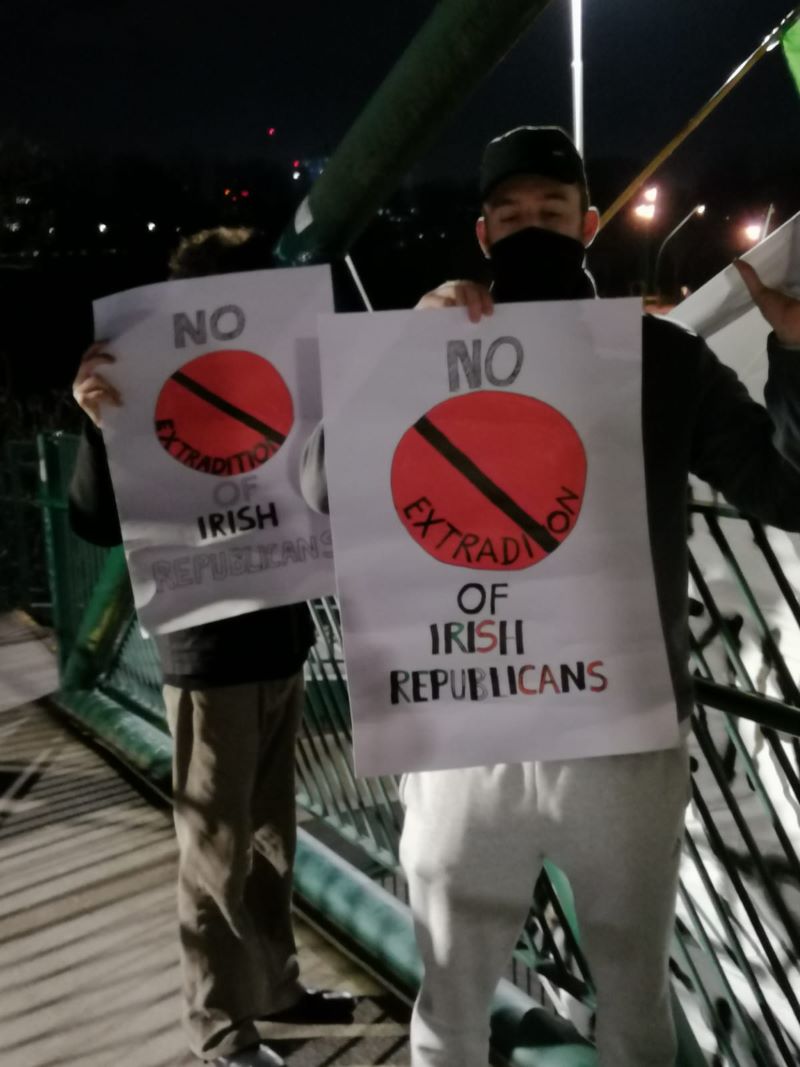
Some of the AIA-organised anti-extradition banner drop on the Fairview pedestrian bridge hold up placards against extradition. (Photo: R.Breeze)

Another extradition case has been dealt with in the Special Criminal Court, which is located within the same building as the CCJ, distinguished from other courts by the glass-enclosed reception ‘box’ through which one must pass to gain entry, first satisfying ‘security’ provisions.2

Sean Walsh has been fighting extradition to the UK’s Irish colony, the Six Counties on a charge of membership of an armed Republican organisation, which is deemed illegal on both sides of the British Border. He is in custody in Portlaoise awaiting a decision from the ECHR in Brussels.

Independent Dublin Republicans organised solidarity pickets outside the court on the mornings of Denneghan’s appearances, while Anti-Imperialist Action held a picket against extradition outside the nearby Heuston Train Station and a more recent banner drop on the Fairview Pedestrian Bridge.

Picket organised by Independent Dublin Republicans outside court where extradition of Jim Deneghan (Centre, next to State Harp) was being decided in February. (Photo sourced: IDR Facebook page)

The CCJ courts, in particular those on the ground floor are extremely busy with what seems at times like industrial-scale processing of setting further dates for court appearances, granting or refusing bail, requiring ‘discovery’ and other documentation from the Gardaí and some sentencing.

The human subjects of these proceedings are mostly from what might be termed the under-class of Dublin with some migrants added for good measure. Most face charges of possession of drugs, anti-social behaviour, threatening behaviour, theft and breach of bail conditions.

A huge amount of court, lawyer and Garda time is taken up with processing people accused under these charges. On the other hand the processes also interfere hugely with the normal lives of those charged and in addition, in the case of political activists, disrupt some of their legal activity.

And can cost them loss of pay and even threaten their employment. Which might be deliberate on the part of the system or if not, at least something those who manage it will not regret.

Banner drop by AIA from Fairview pedestrian footbridge. (Photo: R.Breeze)

The sheer number of that social group being processed through the courts daily is an indication of something really wrong with Irish society and which worsens even through generations, while the major reaction of the State is to maintain the social conditions and repress its victims.

By and large the middle class only come into contact with that element of society when they are prosecuting or defending them in court, or professionally dealing with them in hospital or social services environments.

It is also where many of those who are trying to change the prevailing social and economic conditions, i.e political activists, will first rub shoulders with that group while next to them on court seating benches. Unless the political repression goes a step further and they meet in jail.

End.

1Revolutionary Housing League which had renamed the building, on Eden Quay, ‘James Connolly House’.

2The non-jury SCC was established under an Amendment to the Offences Against the State Act, pushed through Leinster House by Fianna Fáil amidst collapse of its opposition during a panic caused by (British Intelligence) terrorist bombing of Dublin in 1972 killing two and maiming many. The scene of many unjust decisions, its most famous was the conviction of the innocent ‘Sallins Four’ when the SCC was based at Green Street, appropriately enough the scene of many injustices under the British occupation, including the death sentence on Robert Emmet after his famous speech. The existence of the SCC is opposed by Amnesty International and Irish civil rights organisations and, until a few years ago, by the majority political party in Ireland, Sinn Féin, which no longer opposes it.

PALESTINE SUPPORTERS SCORN SIDE STREET TO DENOUNCE US EMBASSY AT ITS FRONT

Clive Sulish

(Reading time: 2 mins.)

Many who supported Saturday’s march of the Ireland Palestine Solidarity Campaign advertised as going to protest at the US Embassy found themselves led to a rally in a residential street bordering the Embassy and far from the main road.

The IPSC march had gathered at the Department of Foreign Affairs on Stephens Green and proceeded from there to Ballsbridge, the last section passing through quiet residential streets to hold the rally in Elgin Road, some distance from and hardly visible from the main road.

Section of the IPSC march on Saturday (Photo cred: IPSC)

Before the arrival of the IPSC march a handful of people gathered near the main road, displaying Palestine national colours to acclamation from passing motorists. As the IPSC march arrived nearby some others with flags, banner and placards joined them near the front entrance of the Embassy.

From that position one could see the IPSC rally taking place quite some distance down the quiet street, distant enough that speeches could not be heard, though chants from the crowd were audible.

Earlier in the day the Palestinian resistance had released three of their prisoners in good health while the Palestinian prisoners of ‘Israel’ were beaten and insulted as they were leaving and made to wear special demeaning clothes (which they burned). Four had to be rushed to hospital after release.

Long before Trump’s proposal of ethnically cleansing Gaza of Palestinians, it is important to understand that Israel’s genocide could not have been sustained for more than a week without funding and munitions supply by the USA, which also supported them politically.

In the sixteen-plus months of the current phase of Israeli genocide, the IPSC has led a march to the ‘Israeli’ Embassy only a few times and to the US Embassy exactly twice, each time to the side road (though the stage of the first one was closer to the Embassy’s main entrance than was today’s).

The front of the IPSC march at its destination at the rally on Saturday. (Photo cred: IPSC).
The IPSC rally in the distance, taken from in front of the US Embassy main entrance. (Credit photo: Rebel Breeze)

A police officer approached the early demonstrators near the Embassy main entrance to encourage them to move down to the location of the IPSC rally but they politely declined. One of the IPSC’s committee members also wandered by to see who these mavericks could be.

A Zionist passing by claimed the demonstrators should be ashamed but they told him it was he who should feel shame, supporting genocide. Anger soared when he called for killing more Palestinians – including children– until some began to suspect he was provoking an assault leading to arrest.

Certainly he felt safe enough with Gardaí close by.

As the group consolidated a woman began to lead call-and-answer chants which were taken up: Saoirse – don Phalaistín! Resistance is an obligation- in the face of occupation! 1, 2, 3, 4 – Occupation no more! 5, 6, 7, 8 – Israel is a terrorist state! Free, free – Palestine!

Section of those who chose to stand near the US Embassy main entrance (out of shot to the right of photo) and in full view of passing traffic on the main road (just out of view to left of photo). (Photo credit: Rebel Breeze)

Also From the river to the sea – Palestine will be free! From Ireland to Palestine – Occupation is a crime! Car horns of passing motorists joined in, beeping in solidarity.

It began to rain heavily and the protesters endured it for a while before heading for shelter.

End.

THE REBEL WOMEN’S TOUR

Orla Dunne

(Reading time: 3 mins.)

Myself and my sister, Brenda went on the Rebel Women’s Tour in the General Post Office on Saturday, 1st February 2025. Our Guide was Kim.

Two women’s groups were highlighted: Inghinidhe na hÉireann which was founded by Maud Gonne in 1900 and inspired Cumann na mBan. Inghinide na hÉireann is Irish for “Daughters of Ireland”. It was founded solely for women and adopted Saint Brigid as their patron saint.

Cumann na mBan:

In 1914, Inghinide (modern spelling ‘Iníní’) na hÉireann was merged with Cumann na mBan (abbreviated C na mBan, translated in English as the “Women’s League”). It was formed in Wynn’s Hotel on Lower Abbey Street on the 2nd of April 1914.

Brenda’s husband’s grandmother, Christina Caffrey, was a member. Our Grand Aunt, Theresa Rudkins nee Byrne was also a member as was also an old neighbour of our sister Eileen, Mary Breslin. Cumann na mBan was then led by Kathleen Lane O’Kelley.

One key member whom we are all familiar with is Countess Constance Markiewicz who took an active role in the 1916 Easter Rising which I will come to later.

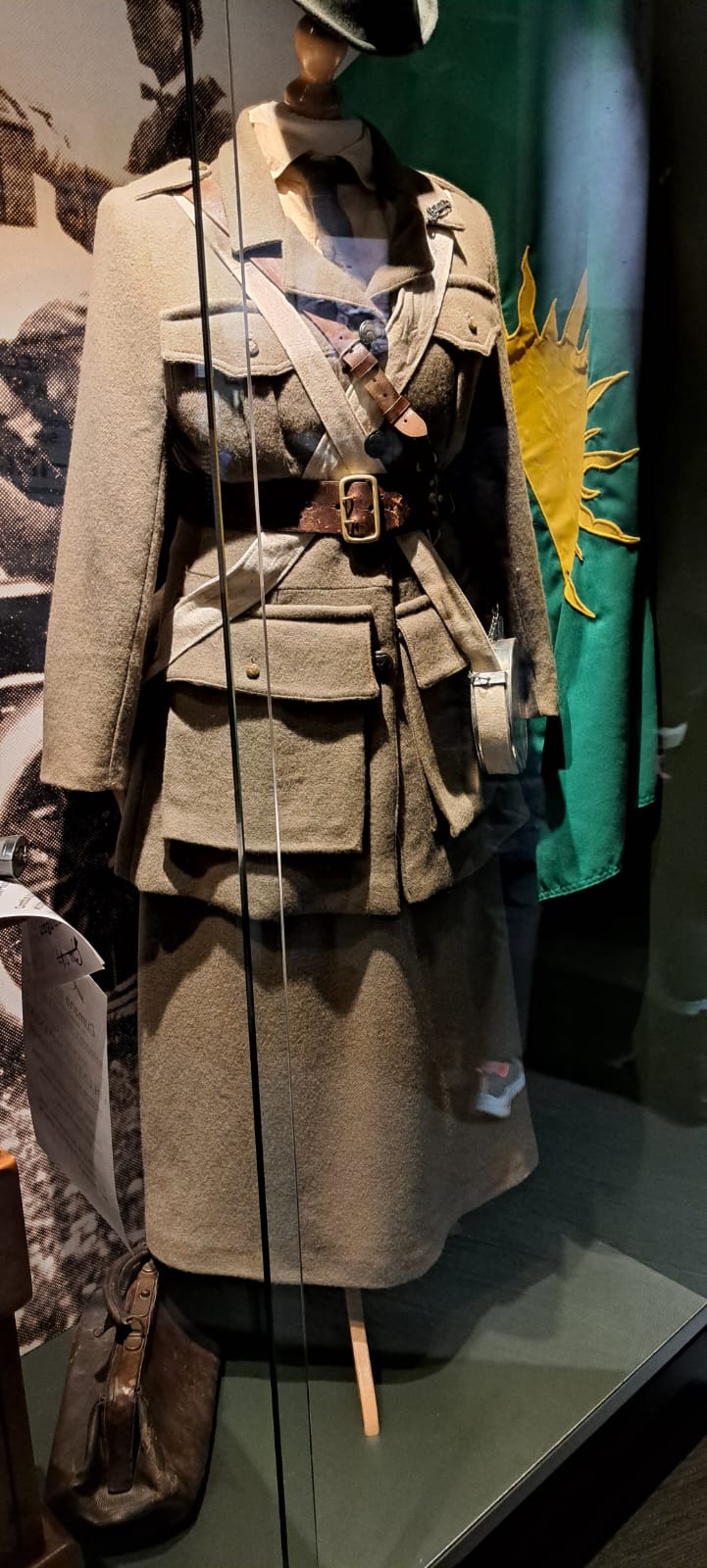
Cumann na mBan uniform on display in the GPO Museum (Photo: O. Dunne)

1913 Lockout:

During the 1913 Lockout by an employers’ consortium, women including Dr Kathleen Lynn, Helena Moloney, Delia Larkin (sister of Jim Larkin) and Rosie Hackett opened soup kitchens at Liberty Hall to assist struggling workers and families.

The 1916 Easter Rising:

It is estimated that approximately 200 women took part in the Rising and 77 were imprisoned.
The only woman sentenced to death was Countess Markiewicz who was second-in-command to Commandant Michael Mallin in St. Stephen’s Green.

Constance Markievicz (colourised) in ICA uniform (Source photo: Internet)

However due to her being female, it was then changed to life imprisonment. She subsequently served 13 months in prison in both Ireland and England. She was outraged that she would not be executed.

Winifred Carney:

Winifred Carney was named as the first woman to enter the GPO on Easter Monday 1916. It is thought that she entered the building wielding a typewriter and revolver.

Winifred Carney (Source photo: Internet)

Elizabeth O’Farrell:

Elizabeth O’Farrell was one of the last three women to remain with the GPO garrison along with Julia Grennan and Winifred Carney and all three spent their last days of freedom in Moore Street. Ms O’Farrell accompanied Patrick Pearse on his journey of surrender to the British forces.

Elizabeth O’Farrell(colourised) after release from jail (Source photo: Internet)

There is a photograph of this and all that can be seen of her are her feet and the end of her dress, as she stood at the far end of Pearse from the photographer.

Julia Grennan (Source photo: Internet)

WOMEN DURING THE WAR OF INDEPENDENCE:

Women also played a significant part during the War of Independence. Over 300 women are believed to have assisted by smuggling weapons and ammunition into Ireland and relaying messages from area to area.

WOMEN DURING THE IRISH CIVIL WAR:

The Irish Civil War lasted for almost one year from June 1922 to May 1923 and again women participated in the struggle, believed to have been mainly on the Anti-Treaty side. Female members of the Irish Citizen Army were armed.

Grace Gifford (colourised) with paintbrush and easel (Source photo: Internet)

One such example is Grace Gifford Plunkett who married her beloved fiance, Joseph Mary Plunkett in May 1916 just hours before his execution. She herself was incarcerated in February 1923 in Kilmainham Gaol for her part in the Civil War.

While there she painted a copy of Mary and Child on the wall of the cell.

End.

COURT LIFTS CURFEW ON PALESTINE SUPPORTER

Diarmuid Breatnach

(Reading time: 2 mins.)

One of a number of Palestine struggle supporters appeared in court again on Wednesday and, though the case was postponed for hearing until 26 February, was successful in having one of the conditions of his bail, his daily curfew, removed.

Jack Brasil raises a clenched fist outside the Dublin Court on Wednesday. (Photo: D.Breatnach)

Palestine struggle supporters sat in Dublin’s Central Criminal Court with Jack Brasil, New Zealander of Irish descent, through many other case applications until his own was dealt with, before accompanying him out of the intimidating building.

Another of the bail-related restrictions, that Brasil not present stationary in the Dublin 1 or 2 areas (i.e in the Dublin City centre) remains, at least for the moment. This restriction has also been imposed on a number of other Palestine solidarity activists in a clear restriction of their civil rights.

As in many other Western states, Palestine solidarity activists have been charged with offences under Ireland’s criminal code but, when released on bail, remain under restrictions for months at a time after their arrest, interfering with their normal routines.

It also hampers or even prevents their participation in solidarity activities.

Palestine struggle supporters outside the Dublin court on Wednesday after Jack Brasil had the curfew removed from the conditions of bail. (Photo: D.Breatnach)

To date it seems that none of the Irish civil rights NGOs have challenged the State on the wide-scale use of those undemocratic bail restrictions from participation in lawful solidarity protests on people who are, even according to the criminal code, innocent, unless convicted in a court of law.

During the 2014-2015 mass-popular protests against the imposition of a third water tax in preparation for the privatisation of water supply in the Irish state, similar restrictions were imposed on protesters. Two however refused to accept the conditions and were jailed.

Protests outside Mountjoy Jail followed and, under the threat of hunger strike by the detained, they were released and the restrictions removed. It may be that this option will need to be explored by Palestine supporters if charged in Ireland in the future.

end.

Who are the political prisoners in Colombia?

(Article originally written for the Political Prisoners Collective Asociación Arrakala)

Gearóid Ó Loingsigh January 19 2025 (Reading time: 6 mins.)

NB: Edited by RB from original article for formatting purposes

Who and what is a political prisoner is controversial, though it shouldn’t be. Once upon a time we all knew or recognised a political prisoner. It was obvious, evident.

But two centuries of legislative changes, the work of the press and more than one NGO seeking to please its master i.e. those who finance it, has disfigured the political prisoner and its corollary outside, the rebel, the dissident, the activist.

Before trying to vindicate the figure of the political prisoner we should be clear that the prison itself has not been a constant in history.

There have always been places of reclusion, but they were transitory, provisional, where the prisoner was held whilst they awaited their sentence, be it execution, or exile, the confiscation of assets or in the case to debtors’ prison, the payment of the debt or the taxes owed.

The idea of a prison as somewhere you serve a term of a number of years as a prisoner according to the gravity of the crime is novel. It is about 250 years old.

The seriousness of the crime and the proportionality of the sentence are not obvious. In many jurisdictions a bank robbery is more serious than the rape of a woman.

Historically, crimes against property were more severely punished than crimes against the person. There are exceptions to that but in general, in all judicial systems crimes against property are more severely punished.

Of course, murder usually carries a stiff sentence, but countries with long sentences or even life sentences usually consider such sentences for crimes against property and other crimes. In the USA that possibility exists in various states.

In a number of countries the crimes punishable by death include, blasphemy, adultery, prostitution, spying, bribery, corruption, drug trafficking, homosexuality.

Political crimes are also severely punished with harsh sentences and the death penalty, depending on the country. Such punishment for political crimes only disappeared where it was abolished for all crimes.

Political crimes

Margaret Thatcher the British prime minister (1979-1990) once declared that there was no political crime, only criminal offences. She said in relation to IRA and INLA militants in prison in Ireland that political murder, political attacks nor any political violence existed.

With this she aimed to ignore not just the long history of such crimes in national laws in many countries but also International Humanitarian Law.

The preamble to the UN Universal Declaration of Human Rights recognizes rebellion as the last legitimate resort in the face of human rights abuses.

“Whereas disregard and contempt for human rights have resulted in barbarous acts which have outraged the conscience of mankind… if man is not to be compelled to have recourse, as a last resort, to rebellion against tyranny and oppression, that human rights should be protected by the rule of law.”[1]

The Geneva Conventions, the basis of IHL in common article 3 to the four conventions reads “In the case of armed conflict not of an international character occurring in the territory of one of the High Contracting Parties, each Party to the conflict shall be bound to apply, as a minimum, the following provisions…”[2] 

And goes on to explain the provisions that apply. With this the Geneva Conventions acknowledge the existence of organised and armed rebellion against a state as something more than criminality. Otherwise, it wouldn’t attempt to govern the behaviour of the parties to the conflict.

Though it is worth pointing out that the IHL never clearly defined what was an internal armed conflict nor a war of national liberation. However, it is clear that it can’t be reduced to mere violence.

There are those that raise high the figure of Prisoner of Conscience, not just as the highest expression of a political prisoner but as the only one. According to Amnesty International such a prisoner is in jail for their ideas without having used or advocated violence.

It is an absurd definition. For years they praised Mandela as a prisoner of conscience, but Nelson Mandela led an organisation with an armed wing and ended up in jail for conspiracy to overthrow the state. He was no pacifist.

The definition Amnesty uses can be summarised as They who opine but do not act are political prisoners, those who think but do not apply their thinking are political prisoners.

This excludes great figures from Colombian history such as Policarpa or José Antonio Galán who were executed following their capture. According to this definition José Martí was a political prisoner when he wrote, but a criminal when he returned to Cuba to free it.

But this is not correct, a political prisoner may be a person who never even raised a rock, not to mention a rifle. They may even be pacifists. It is not necessarily a person linked to armed groups, though neither does it exclude them.

There are various types of political prisoners in Colombia.

· There are the militants of guerrilla groups, the majority of them in prison for armed actions, though there are those who played a political role in such groups, what the courts refer to as ideologues.

· There are also those who are victims of frame ups, the majority of them militants of one or other unarmed Left group, social organisation, trade union etc. The state imprisons them through frame-ups in order to limit their political work.

· Then there are those who are prisoners for things related to their political activity i.e. people who in the midst of protests, strikes, occupations of buildings break some law and are arrested, such as those who carry out pickets that are not permitted.

Amongst this group there are also the youths of the Frontline of the National Strike. Yes, throwing a stone is a crime in and of itself but these youths threw stones in response to state violence during the protests.

But, what distinguishes political prisoner from a common prisoner? Brandishing weapons or throwing stones is done by lots of people from narcos to drunks on a Saturday night. Pablo Escobar attacked the state with weapons and car bombs, but he was never a political prisoner.

He was always a criminal.

The first point is the political prisoner is captured in the struggle for a better world.

They seek changes in society that benefit a broad section of the population when their struggle is national in character or large group when the struggle is local or in the neighbourhood with specific demands.

So, a right-wing paramilitary could never be a political prisoner because they seek the status quo, or even a worsening of the conditions of the people.

A political prisoner acts altruistically, seeking no personal benefit though they may end up benefiting from the changes they seek for peasants, youths or neighbours because they are from that community.

But they never seek personal benefit for themselves but rather for society or a particular group in society. Once again neither the paramilitaries, nor the narcos or the Uribistas could ever be political prisoners because what they seek is always for their own personal benefit or small powerful group.

So a guerrilla may be a political prisoner, as may be the youths from the National Strike and similar protests. The environmentalist that blocks the entry of a mining company’s machinery is also one, even if they commit a crime such as damaging or destroying the company’s installations.

In 1976 eighty intellectuals and figures from the world of culture met in Algiers and proclaimed the Algiers Declaration – Universal Declaration of the Rights of Peoples. The document is entirely political and does not have the force of law but was and continues to be a moral reference point.

In Article 28 it states:

Any people whose fundamental rights are seriously disregarded has the right to enforce them, specially by political or trade union struggle and even, in the last resort by the use the force.[3]

Political prisoners are those who comply with this article.

Though the methods used, whether they are violent or pacific may have some influence, they do not determine who are political prisoners.

Of course, in the case of guerrillas, a war crime may wrest credibility from their status as a political prisoner, but in general the use or not of violence is not what determines who is a political prisoner.

It is the demands and the selfless commitment of the militant to the cause that defines whether they are political prisoners or not. Those who deny this are the ones who benefit from the capitalist system.

Their denial is nothing more than publicity and public relations for Julio Mario Santodomingo, Juan Manuel Santos, Gustavo Petro and the large NGOs. Colombia is full of political prisoners and those who deny this also deny the reality of capitalism in the country.

End.
NB: For more articles by Gearóid see https://gearoidloingsigh.substack.com

NOTES

[1] UN (1948) Universal Declaration of Human Rights. https://www.ohchr.org/sites/default/files/eng.pdf

[2] See https://ihl-databases.icrc.org/en/ihl-treaties/gci-1949/article-3?activeTab=1949GCs-APs-and-commentaries

[3] See Declaration of Algiers https://permanentpeoplestribunal.org/algiers-charter/?lang=en

PADDY HILL, THE BIRMINGHAM SIX AND THE CRAIGAVON TWO

Diarmuid Breatnach

(Reading time: 3 mins.)

There were also others: the Guildford Four, Maguire Seven and Judith Ward, all innocent and all convicted in separate cases, mostly in 1974, in the same year that the Prevention of Terrorism Act was passed to silence the Irish community.

Yet others continue being framed, including the Craigavon Two.

There were also others: the Guildford Four, Maguire Seven and Judith Ward, all innocent and all convicted in separate cases, mostly in 1974, in the same year that the Prevention of Terrorism Act was passed to silence the Irish community.

Paddy Hill in 2017 outside the Dublin court where the Jobstown case was being tried (Photo sourced: Internet)

The agitation for civil rights for the community of Catholic background in the British colony of the Six Counties in Ireland began in the last years of the 1960s and very soon people in Britain were marching in solidarity with those facing violent colonial repression in the Six Counties.

The Irish were the most numerous and longest-established migrant community in Britain and had become active in many social, trade union and political circles with the potential to educate and strongly affect the host community.1 This was a problem for the British ruling class.

The jailing of so many people, in many cases obviously innocent, hundreds of arrests, thousands of detentions and interrogations with desertion by much of the British liberal and Left sector terrorised the Irish community so that many stepped away from solidarity campaigning.

That repression muted the Irish community’s solidarity actions until the 1981 Hunger Strikes brought them out again in thousands.

After his release in March 1991 Paddy Hill founded Mojo to campaign for framed innocent people and supported the campaign to free the Graigavon Two, another case that bears many of the hallmarks of a frame-up for political reasons, as famous barrister Michael Mansfield2 commented:

There is nothing more particular about it (the Craigavon Two case) than in all the other miscarriages and the same features appear in all these things.”3

PSNI Constable Steven Carroll was shot dead by an AK47 bullet on 9th March 2009 in Craigavon, Armagh while responding to a fake crime call, the “dissident” group the Continuity IRA claiming responsibility.4 The arrests of John Paul Wooton and Brendan McConville followed.

Political cases in the Six Counties almost invariably are tried by the no-jury Diplock Court and the judge there refused both men bail. This might seem normal except that they did not go to trial until three years later – and kept in jail throughout the period.

Shortly before the eventual trial a man approached the PSNI saying he had seen McConville near the scene and on the evening of the killing of the Constable. This man was the only witness for the PSNI Prosecution but his partner, with him on the evening in question, refused to confirm his tale.

The night was raining and dark and the eyesight of the alleged witness was exposed as weak by the Defence. The coat he alleged McConville to be wearing was a different type, length and colour to that which the Prosecution was alleging McConville had been wearing on the night in question.

This ‘witness’ was also described by his father as having ‘a Walter Mitty character’ and the PSNI admitted paying him as an informant. An AK47 was recovered near the scene of the killing and the one fingerprint recovered from it did not match those of either Wooton or McConville.

Craigavon Two

Brendan McConville and Paul Wooton, taken in 2017. (Photo sourced: Petition for the release of the Craigavon Two)

There was no evidence against either man of having even handled the weapon never mind fired it, no evidence placing either at the scene apart from the dubious testimony placing one of them nearby. Incredibly, it might seem, nevertheless they were found guilty on 12th May 2012.

McConville was sentenced to 25 years and Wooton to ten. Their appeal two years after conviction in May 2014 was unsuccessful and in fact the Prosecution used it to add another four years to Wooton’s sentence.

Paddy Hill of the Birmgham Six and Gerry Conlon of the Guildford Four, both sadly deceased, both innocent but served long years in jail, both supported the campaign of the Craigavon Two. (Photo sourced: Internet)

Paddy Hill was not the only former framed prisoner to support the campaign to free the Craigavon Two. Gerry Conlon was asked to examine the case and became a convinced and dedicated campaigner for the men, speaking out about it as late as a week before his untimely death.5

Paddy Hill and the rest of the Birmingham Six were framed by the British system and served 18 years in jail. In May this year McConville and Wooton will have reached their 16th in jail. For how much longer will they and their close ones be tortured?

End.

Footnotes

1The Irish diaspora in Britain had provided the British working class with its anthem (The Red Flag), its classic novel (The Ragged-Trousered Philanthropists) and two leaders of its first mass movement, the Chartists (Fergus O’ Connor and Bronterre O’Brien) and had also formed a strng section of the First International Workingmen’s Association led by Marx and Engels. In 1974 people of Irish background were estimated to form up to 10% of the population of some British cities.

2Mansfield led the appeal cases of the Birmingham Six and of the Guildford Four.

3Quoted in the campaign petition https://www.change.org/p/ccrc-the-craigavon-2-deserve-justice-now

4The same organisation had claimed the killing of two British soldiers at the Massarene Barracks, also in Co. Armagh, only days previously.

521 June 2014, a few months after his 60th birthday.

Further information and petition

Petition: https://www.change.org/p/ccrc-the-craigavon-2-deserve-justice-now

AWARD-WINNING DOCU-DRAMA LIFTS THE LID ON IRISH STATE CENSORSHIP

Clive Sulish

(Reading time: 5 mins.)

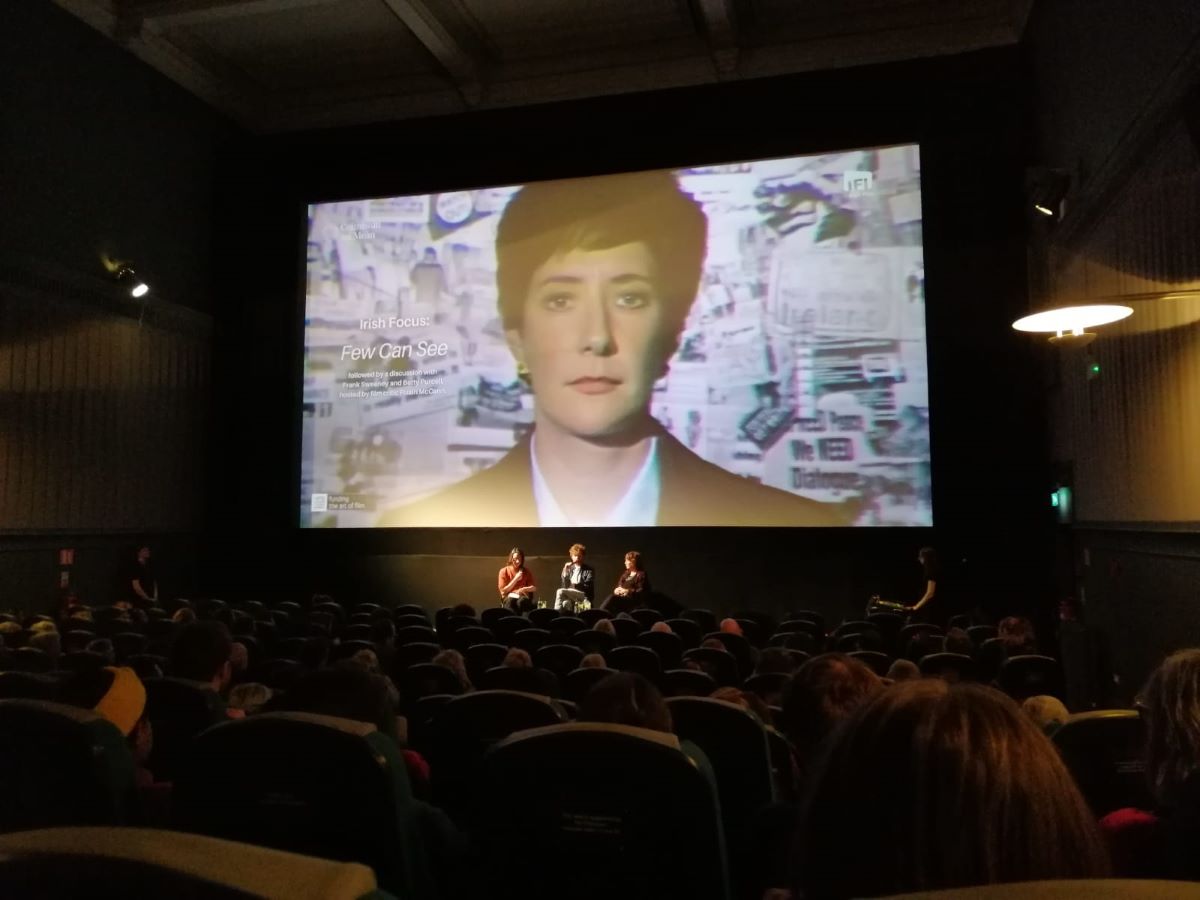
FEW CAN SEE – Censoring the Conflict was screened last week (Wednesday 4th night) in the Irish Film Institute to a moderately-sized audience, followed by questions of film-maker Frank Sweeney and Betty Purcell by​​​​​​ Ruairí McCann from Belfast.

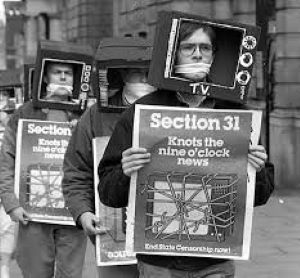
Sweeney took a look at state censorship during the three decades’ war in Ireland which was effected through the introduction of Section 31 of the Broadcasting Act, the sacking of the entire RTÉ Board of Directors and the jailing of a journalist.

Henceforth, self-censorship was the rule.

Specifically, the State ban applied during this period in refusals to interview any member of the IRA (Provisional or Official) and was later extended to Provisional Sinn Féin. It was enforced within RTÉ by management including members of the Workers’ Party1 who also led one of the unions.

Docudrama Few Can See focused on the application of the ban to spokespersons of people in the occupied Six Counties and of a number of campaigning groups: Gays Against the H-Blocks; Concerned Parents Against Drugs; the Gateaux bakery strike in Finglas (factory closed 1990).

Gay rights activists in Cork also campaigned against the H-Blocs and were subjected to censorship under Section 31. (Photo sourced: ICCL website)

Frank Sweeney said he had been intrigued by Betty Purcell’s memoir of her time producing programs for RTÉ and her battles with censorship there2. Conducting interviews with people about their experiences of being censored, he then worked the material into a script.

The format was of a 1980s studio with a program presenter in the style of the times and smoking, intercut with grunge-style footage, electronic interference noise and visuals, then narrowing to interviews with actors playing the parts of victims of the ban at the time.

If the intention was to show how ridiculous it could be to apply a political ban aimed at alleged terrorists instead to community struggles against oppression and the heroin epidemic, the struggle of gays around legality and health and a bakery strike, it succeeded.

The ‘RTE presenter’ in the docudrama screening (Photo: R.Breeze)

However, the issues of whose interests the State was representing in that period of heavy censorship and why it felt threatened were not teased out. Nor why it was able do what it did.

Had those issues been addressed we might have observed a vulnerable neo-colonial ruling class during a high point of struggle against the very colonial and neo-colonial nature of the state and the colony of its imperial neighbour, which also imposed censorship on broadcasting at home.

An aspect of such censorship which might not occur to one but which was discussed in the documentary is the effect of censorship not only on struggles of the time but also on the lack of available footage for archives in the future, leaving history the poorer in material.

Few Can See film has been screening around the world this year and has won some awards including the  Tiger Short Award at International Film Festival Rotterdam and is due in Barcelona next year, hopefully to be screened in Ireland again, followed by a fuller discussion.

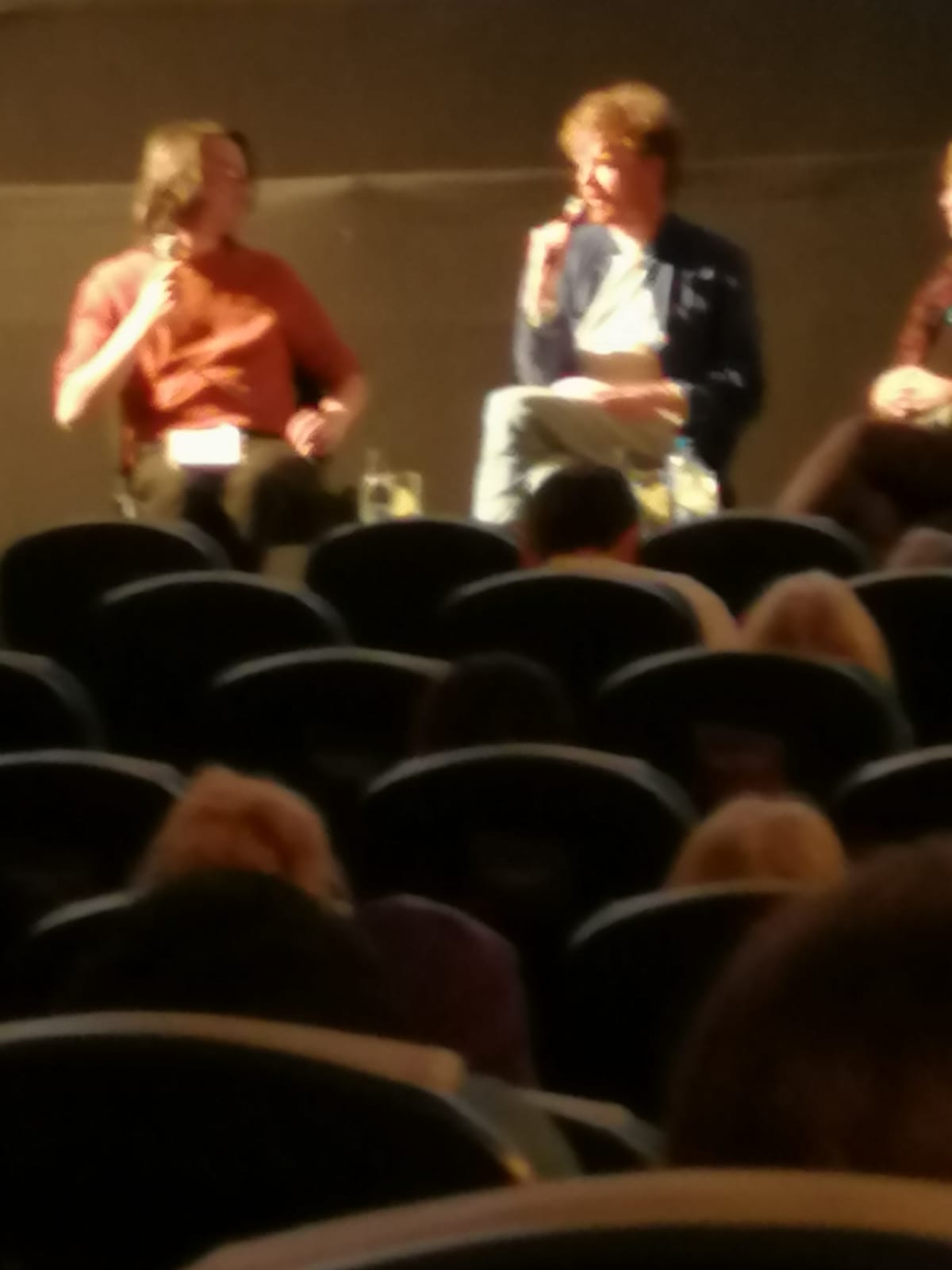
Film maker Frank Sweeney (centre) speaking during post-screening discussion at the IFI with Ruairí McCann (left) and Purcell (almost out of shot, right). (Photo: R.Breeze)

In addition to exposing the State-led censorship of the past, Sinn Féin might benefit from the film as those who were being gagged were either members or were thought to be supporters of the party. However, SF has its own history of censoring critics both within the party and outside.

And as one member of the audience was heard to remark: “It’ll be the dissidents, not SF that will be getting censored now.” True, though no longer enforced by the State, rather voluntarily by program makers, editors and by the reporters themselves, as with the genocide in Palestine.

Indeed both Sweeney, Purcell and a member of the audience alluded to ongoing censorship around that subject. But it is not only suppression of the truth which is the problem but also the obligatory insertion of the false narrative that everything began on 7th October with the Palestinian raid.

BACKGROUND: THE BROADCASTING BAN MECHANISM

Section 31 of the Broadcasting Authority Act 1960 empowered the Minister for Posts and Telegraphs to issue a ministerial order to the government-appointed RTÉ Authority not to broadcast any material specified in the written order.

The first order under the section was issued in 1971 by Fianna Fáil Minister for posts and Telegraphs Gerry Collins. It instructed RTÉ not to broadcast

any matter that could be calculated to promote the aims or activities of any organisation which engages in, promotes, encourages or advocates the attaining of any particular objectives by violent means.

Collins refused clarification when RTÉ asked for advice on what this legal instruction meant in practice and RTÉ interpreted the Order politically to mean that spokespersons for the Provisional and Official IRA could no longer appear on air.

The following year, the government sacked the RTÉ Authority for not sufficiently disciplining broadcasters the government accused of breaching the Order.

RTÉ’s reporter Kevin O’Kelly had referred to an interview that he conducted with the then Provisional IRA Chief of Staff, Seán Mac Stíofáin, on the Radio Éireann This Week programme. The recorded interview was not itself broadcast, nor was Mac Stiofáin’s voice heard.

Premiere balladeer Christy Moore (right) marching with Provisional Sinn Féins Joe Cahill (Photo sourced: Internet)

Mac Stiofáin was arrested after the O’Kelly interview and charged with membership of the IRA, an organisation listed as illegal by the State.

Soon afterwards O’Kelly was jailed for ‘contempt’ at the non-jury Special Criminal Court because he refused to identify a voice on a tape seized by the Gardaí as that of Mac Stiofáin. However Mac Stiofáin was convicted anyway in the “sentencing tribunal” of the SCC.

O’Kelly appealed to the Supreme Court and a fine was substituted as a means of purging O’Kelly’s alleged contempt. O’Kelly declined to pay the fine but it was said to have been paid anonymously and O’Kelly was released.

In 1976, when Conor Cruise O’Brien  (Labour) Minister for Posts and Telegraphs amended Section 31 of the Broadcasting Act, he also issued a new Section 31 Order. This censored spokespersons for specific organisations, including the legal Sinn Féin political party, rather than specified content.

That prevented RTÉ from interviewing Sinn Féin spokespersons under any circumstances, even if the subject was unrelated to the IRA campaign in Northern Ireland conflict.

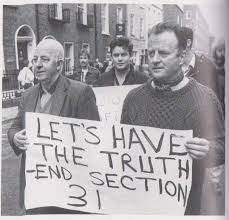
Visually impacting and clever punning in placard parade protest against Section 31. (Photo sourced: Internet)

Bizarrely even a call-in show on radio about gardening was interrupted once because a caller was a member of Sinn Féin. 

The changes undermined the relatively liberal interpretations by RTÉ of its censorship responsibilities under the original 1971 Order and encouraged a process of self-censorship and illiberal interpretation.

However in 1976 O’Brien attempted to extend the censorship to newspaper coverage of the conflict, targeting in particular The Irish Press, revealing his thinking in an interview with Washington Post reporter Bernard Nossiter, naming as a possible target Press Editor, Tim Pat Coogan.

Nossiter immediately alerted Coogan, who then published the Nossiter-O’Brien interview in the Irish Press (as did The Irish Times).

Due to public opposition the proposed provisions were amended to remove the perceived threat to newspapers.

But Fine Gael and Labour were not to be left out as the 1973-77 Fine Gael/ Labour Coalition Government also tried to prosecute the Irish Press for its coverage of the maltreatment (not to say torture) of republican prisoners by the Garda ‘Heavy Gang’, with the paper winning the case.

SOURCES

https://en.wikipedia.org/wiki/Censorship_in_the_Republic_of_Ireland

https://www.imdb.com/title/tt34242057/

1The Workers’ Party grew out of Official Sinn Féin which was declining after the split which led to the creation of Provisional Sinn Féin in 1970 and later another split, resulting in the 1974 creation of the Irish Republican Socialist Party. The WP was extremely hostile to the IRSP and PSF, in particular the latter.

2Inside RTÉ – a memoir, Betty Purcell, New Island Books (2014).

NEITHER ELECTING ONE DALY NOR FIFTY

Diarmuid Breatnach

(Reading time: 3 mins.)

Clare Daly stood for election in the 2024 elections of the Irish State, in the Dublin Central parliamentary constituency, one with a tradition of independent representation going back to Maureen O’Sullivan and Tony Gregory before her.

Daly was standing as one of the loose Left coalition of Independents for Change in a heavy competition for the four-seat constituency.

Clare Daly has a track record as elected public representative and socialist political activist, also as a prominent Socialist Party activist, with which organisation she partedcompany in August 2012.

She was elected MEP for the Dublin constituency from July 2019 to July 2024, TD1 for Fingal from Feb. 2016-July 1999 and TD Dublin North Feb. 2011-2019; in recent years Daly has been better known outside Ireland due to her public interventions in the European Parliament.

Daly and her partner Wallace were both vilified by pro-imperialist liberals and ‘Left’ for publicly opposing US/NATO/ EU imperialist campaigns against Islamic regimes and the Russian Federation, being subjected to a host of unfounded allegations contrary to their actual record.

Tik Tok clips of Daly’s biting attacks on the EU’s complicity in the US-backed ‘Israeli’ genocide provided relief for many around the world from the Zionist sycophancy and insincere and ineffective concern for the victims of that daily genocide prevalent in the EU Parliament.

And who can forget Daly’s calling German politician and EU Commission President Ursula Van Der Leyen out as ‘Frau Genocide’ in the European Parliament in December last year!2

While an MEP, Daly also intervened in the discussion around the Irish Gombeen3 class’ attempt to push us towards NATO, further undermining a quite tattered Irish neutrality. And while a TD, she and her partner Mick Wallace TD were arrested protesting the foreign militarisation of Shannon.

To their credit both risked jail by refusing to pay the fines imposed but the Gombeen ruling class decided to restrict the damage of its exposure of collusion with US imperialism by also reducing the punishment of both to a few hours in captivity.

Daly has been one of the few TDs prepared to speak in public against the repression of Irish Republicans and to visit some of the consequent victims in jail.

In the EU Parliament, Daly also denounced the Spanish State’s police invasion of Barcelona and violence against voters there on 1st October 2017 during the referendum on Catalunya’s independence.

2024 Dublin Central election poster for Clare Daly.

In Ireland today

In her election flyer here Daly highlighted representation independent of political party for her electoral area, housing, health service, cost of living, Palestine, the endangered climate and Irish neutrality without any indication of how these issues might be effectively addressed.

Daly’s election flyer did not mention capitalism or imperialism, nor did she campaign on a platform of overthrowing the current neo-colonial and neo-liberal capitalist system in force, instead indicating her wish to “hold to account the people who’ve got us into this mess.”

“Holding to account” is something to which Daly is accustomed doing and does it well, eloquently, with passion and fluently, scarcely having to refer to her notes while doing so. But like ‘speaking truth to power’, it has little effect on those who are in control of the political-social system.

It can indeed have an effect on the victims of the system but we are left with the question of what to do about the situation. Refreshing as it may be to hear her again in Leinster House, neither voting Daly in — nor fifty Dalys — is going to change any of the conditions under which we suffer.

BY THE WAY,

in case anyone’s interested, I gave my first preference vote to Daly and hope she does get elected.

End.

1Teachta Dála, the title of a public representative elected to the parliament of the Irish State.

2Imperialist politician and proven plagiarist in her doctoral thesis.

3Vernacular term in Ireland for huckster, carpet-bagger-type capitalists, derived from the Irish language gaimbíneachas, profiteering, nowadays used to describe the neo-colonial Irish capitalist class.

WHAT WE’VE LEARNED FROM SINWAR’S DEATH

Diarmuid Breatnach

(Reading time main text: 4 mins.)

Yahya Sinwar, head of the Palestinian resistance organisation Hamas, was killed in action by an Israeli Occupation Force in what was for them a routine operation in Gaza on 16th October, his last moments captured on video and broadcast widely.

From that event alone there is much for us to learn about Hamas and the Palestinian Resistance in general as well as about Sinwar himself — but also about the IOF, the way it fights and the extent of its self-discipline.

For the bare details as publicly shared, Sinwar was in military outfit, in tac vest, armed with a pistol and automatic rifle and accompanied by two local Hamas commanders in the Tal as-Sultan, Rafah area of Gaza patrolled by the IOF, very close to the semi-permanent IOF front lines.1

One may assume Sinwar was on a reconnaissance operation.

Sinwar with Hamas comrades in 2021 (photo cred: John Michillo)

Something gave away their position to a passing patrol in an area where, as far as the IOF were concerned, nothing should be alive except themselves. Pursued, they split up, local commanders in one building and Sinwar into another so the patrol called a tank to fire into each.

The patrol attempted to enter the building into which the individual fighter had gone but two grenades beat them back, injuring one soldier,2 so they retreated and called for a tank to put another shell in the building.

Still wary in the aftermath, they sent a surveillance drone into the building and the image it captured was what was seen in the widely-circulated video: a Palestinian fighter, apparently unarmed, right hand mangled. As they watched, he threw a stick at the drone with his left hand but missed.

So the IOF patrol had another tank round fired into the building and they went on their way.3

The last image of Hamas chief Yahya Sinwar alive. Right arm mangled he stares at the IOF drone videoing him in house ruined by IOF bombing in Tal Al-Sultan, Rafah, before throwing a stick at it. Moments later the IOF call a tank to put a shell in the building, collapsing it on top of him.

But unusually,4 they came back. Perhaps someone thought they recognised Sinwar in the camera video? It was then they discovered that one of the three fighters they had killed was Yaha Sinwar, confirmed by test results matching his DNA records they had from his years in captivity.

According to ‘Israeli’ postmortem, although he’d been hit by shrapnel and his right hand was mangled, what killed Sinwar was a bullet to the brain – which raises other questions.5

Whatever he was doing at that time, it was clear that he was there as a commander and Resistance fighter, armed and dressed for combat in a highly dangerous area, regularly patrolled by the IOF and only a short distance from their secured front lines.

That alone spoke of courage but also his and his comrades’ resistance in the face of superior numbers declared their courage and determination. But Sinwar’s continuing to resist while badly wounded and his comrades dead, spoke of heroism.

Although only weeks from his 62nd birthday and after 22 years in a Zionist jail, Sinwar seems to have been quite fit. However, according to the results of a postmortem examination carried out by the IOF, Yahya Sinwar had not eaten in 72 hours prior to his death – a period of three days.6

The event was revealing in outlining how the IOF infantry is accustomed to fighting. They are fine with killing civilians but when confronted with armed resistance fighters, they hold for a short while if at all before retreating and calling up artillery or air strikes.

Their dead and wounded are picked up by helicopter and rushed to undamaged ‘Israeli’ hospitals, well equipped and staffed less than an hour away, a journey that is never fired upon by the Palestinian Resistance.

The contrast could not be starker, as the IOF fire on Palestinian paramedics and their vehicles, blockade Palestinian hospitals from receiving fuel and other essential supplies, even bombing and occupying them, kidnapping and killing medical personnel.

What people saw in the video of Sinwar’s last moments exposed Israeli lying propaganda about Sinwar, accusing him of living safe and well inside the tunnels and never emerging or, if he does, going about in a burka, disguised as a woman, also of intending to flee to Egypt with ‘hostages’.7

Iconic photo of Yahya Sinwar in May 2021, sitting in an armchair outside his home in Gaza, ruined by IOF bombardment. He went there directly after concluding an interview with words to the effect that he did not fear assassination by the IOF, that they knew who he was and the route he would take and if they wanted to kill him “Be my guest … I won’t bat an eyelid.”

The quick circulation of the video by the IOF exposed also the renowned indiscipline of their military and their total lack of comprehension of the mental and emotional processes of the people they have been occupying and oppressing for seven decades.

Their indiscipline is attested to by the thousands of videos on social media posted by the IOF during their genocidal operations as, contrary to orders, they film themselves blowing up buildings including a university, humiliating and brutalising prisoners, even on occasion raping them.

The IOF are renowned too for leaving graffiti inside occupied houses and for prancing around houses they have destroyed, often wearing the intimate underclothing of Palestinian women, whom they have at least turned into refugees and may have killed.

In those circumstances their release of the video before discussing it with their intelligence and propaganda department is not surprising but doing so underlines their failure to understand their enemy. They thought that killing Sinwar would undermine Palestinian morale.

They, colonialists and other oppressors in general fail to take account of the human will to resist and the potency of the memory and example of martyrs. This is an aspect we understand well in Ireland.

The Zionist intelligence services would surely have preferred not to have Sinwar’s last moments shared publicly and possibly would have liked the opportunity to lie about them.

Yahya Sinwar gives the victory sign with both hands while speaking from a rally in Gaza.

Sinwar was clearly a remarkable individual, Palestinian Resistance fighter, thinker and leader but the IOF made him a martyr and in their arrogance showed his heroism not just to the Palestinians — nor to Arabs alone — but to the world.

End.

APPENDIX: HIGHLY ABBREVIATED BIOGRAPHY (Reading time: 2 mins.)

Yahya Ibrahim Hassan Sinwar (Arabic: يحيى إبراهيم حسن السنوار, romanizedYaḥyá Ibrāhīm Ḥasan al-Sinwār; 29 October 1962 – 16 October 2024) was a Palestinian resistance fighter, former political prisoner and subsequently politician who was killed in action.

Sinwar served as chairman of the Hamas Political Bureau from August 2024 and as the leader of Hamas in the Gaza Strip from February 2017, until his death in October 2024, succeeding Ismail Haniyeh (assassinated by Israeli strike while on a fraternal visit to Iran) in both roles.

He was born in the Khan Yunis refugee camp in Egypt-ruled Gaza in 1962 to a family who were refugees from Majdal (Hebrew: Ashkelon) during the 1948 Palestine War. He gained a bachelor’s degree in Arabic studies at the Islamic University of Gaza.8

Sinwar’s first arrest was in 1982 for ‘subversive activities’, serving several months in the Far’a prison where he met other Palestinian activists and dedicated himself to the Palestinian cause. Though arrested again in 1985, upon his release he continued his organising trajectory.

Israeli propaganda has claimed that during this period his work in internal security against Zionist agents and informers earned him the nickname “Butcher of Khan Younis” but no-one who knew him or seriously studied him even heard of that alleged nickname until after his death.9

Ismail Haniyeh, leader of the Hamas politburo, welcomes Sinwar with a kiss after the latter’s release from jail in the prisoner exchange of 21 October 2021 (Photo cred: Abed Rahim Khatib/ Flash 90)

Sentenced to four life sentences in 1989, Sinwar spent 22 years in prison until his release among 1,026 others in a 2011 prisoner exchange for Israeli soldier Gilad Shalit. According to John Elmer10 Sinwar wanted others released before him but the prisoners insisted he be one of those leaving.

The prisoners had elected Sinwar as their leader in the prison11 and he was known for encouraging prisoners to use their time productively and to study – in particular to study the enemy. He certainly practised what he preached, becoming fluent in Hebrew and studying IOF tactics.

And also, incredibly, in writing a political novel, The Thorn and the Carnation.12

Sinwar (centre photo) photographed carrying the son of Mazen Faqha, a Hamas leader who was shot dead by unidentified gunmen in Gaza at martyrs’ memorial 27 March 2017. Another photo of Sinwar shows him carrying the child and an automatic rifle; yet another, carrying an automatic rifle and a child who might be a girl, perhaps the child of another martyred fighter. The child and the gun may be seen as symbolising the future through resistance.

On 21 November 2011, a month after his release, Sinwar married Samar Muhammad Abu Zamar and the couple had three children. Sinwar’s wife received a master’s degree in theology from the Islamic University of Gaza. His brother Mohamed remains active in the resistance and is being sought by the IOF.

Re-elected as Hamas leader in 2021, Sinwar survived an ‘Israeli’ assassination attempt that same year.

FOOTNOTES

1At their ‘Philadelphi Corridor’

2According to Jon Elmer, admittedly only days after the event, this is not mentioned in most reports or discussion on line. https://www.youtube.com/watch?v=Dj43mbQ3AiE

3All of this is according to the Israeli Occupation Force.

4 According to Jon Elmer, blogger and weekly podcast military analyst for the Electronic Intifada, also in discussion with Justin Podur https://www.youtube.com/watch?v=Dj43mbQ3AiE (at 1.23.3), that was so unusual because the IOF don’t usually go back to carry out battle analyses for intelligence.

5https://www.firstpost.com/explainers/hamas-leader-yahya-sinwar-death-autopsy-report-idf-israel-13827027.html Not that carrying out field executions would be any stranger to the IOF

6https://www.firstpost.com/explainers/hamas-leader-yahya-sinwar-death-autopsy-report-idf-israel-13827027.html

7https://thecradle.co/articles/netanyahu-aide-arrested-over-intel-leak-used-to-sabotage-gaza-ceasefire

8 Often attacked by the IOF and once by Fatah, its campus was bombed and its buildings destroyed on the night of 10 October 2023.

9This is admitted even in the hostile Wikipedia page about Sinwar.

10Discussion Justin Podur and Jon Elmer on https://www.youtube.com/watch?v=Dj43mbQ3AiE

11This seems not unusual among political prisoners:Irish Republican prisoners also elected their OC in the British Occupation jails: Mairead Farrell had been O/C in Armagh Jail and, before he entered his fatal hunger strike, Bobby Sands had been O/Cof the H-Blocks.

12https://books.google.ie/books/about/The_Thorn_and_the_Carnation_Part_I.html