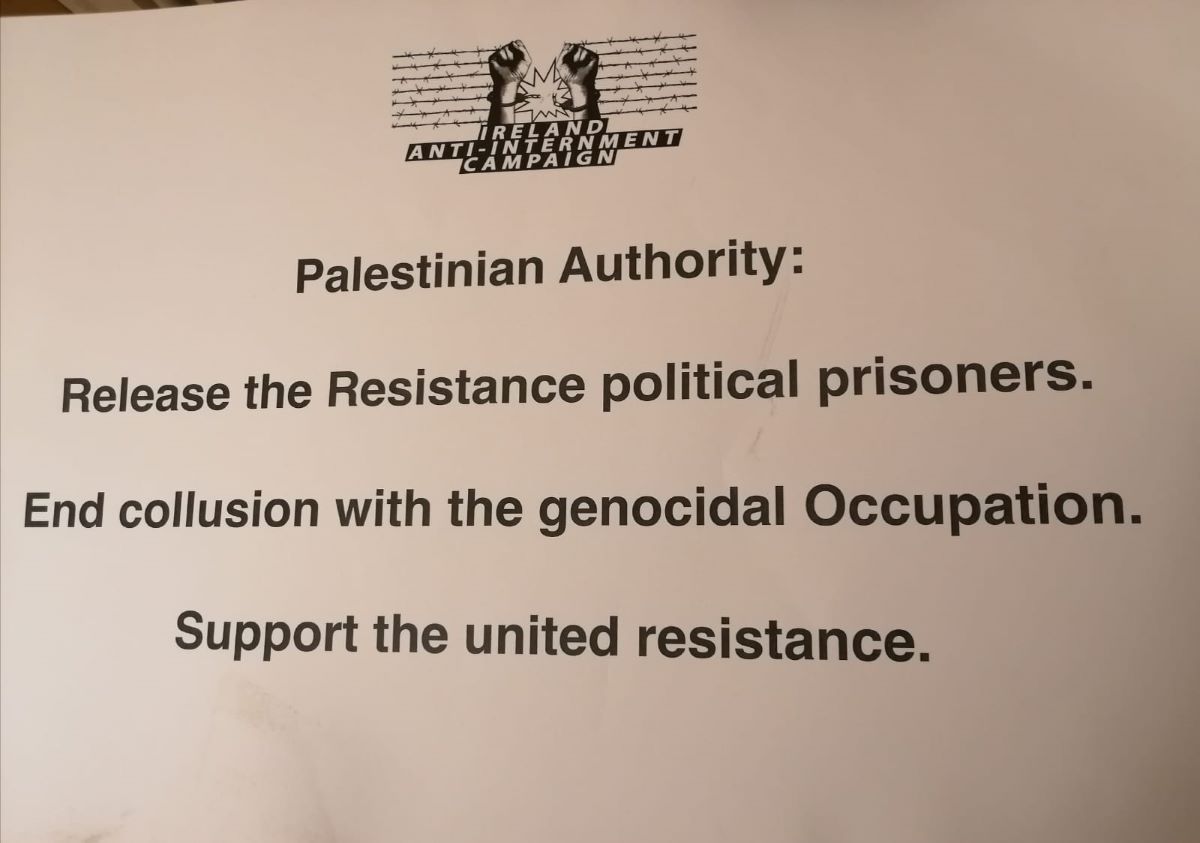
The Palestinian Authority had a small protest against it in Dublin on the afternoon of Friday 23rd August 2024. This seems to be the first protest that has taken place outside the Palestinian Embassy at 66 Lower Leeson Street.
It would perhaps have been the first protest against the PA in Ireland, were it not for the Palestinian solidarity activists who attempted to convey the Palestinian reality in contrast to the Ambassador’s speech at a public meeting in Belfast in February, before being evicted by Sinn Féin supporters.
Palestinian solidarity activists protesting the Palestinian Authority and Embassy?
At first sight that seems bizarre but as some solidarity activists and most people of Middle Eastern origin know, the PA is not only widely considered unrepresentative and corrupt – and in fact has not held elections since 2006 – but also represses protests in the West Bank against ‘Israel’.
However, the Ireland Anti-Internment Campaign says that its main purpose in calling the protest was to raise awareness of the harm the PA is doing to the Palestinian Resistance, in arresting Resistance fighters and disrupting resistance defence against ‘Israeli’ army incursions.
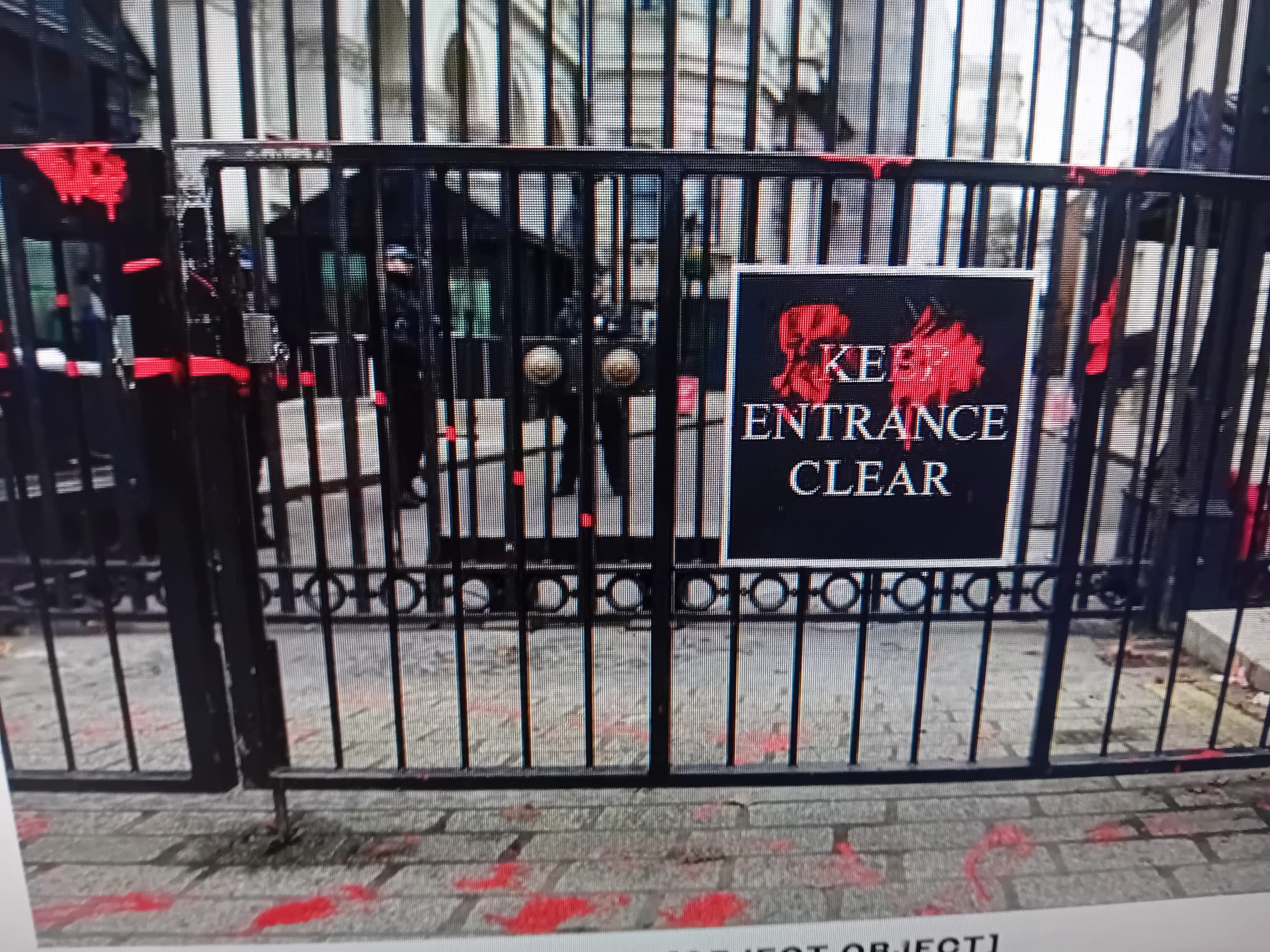
Photo of placard being displayed outside the Palestine Embassy today. (Photo: R.Breeze)
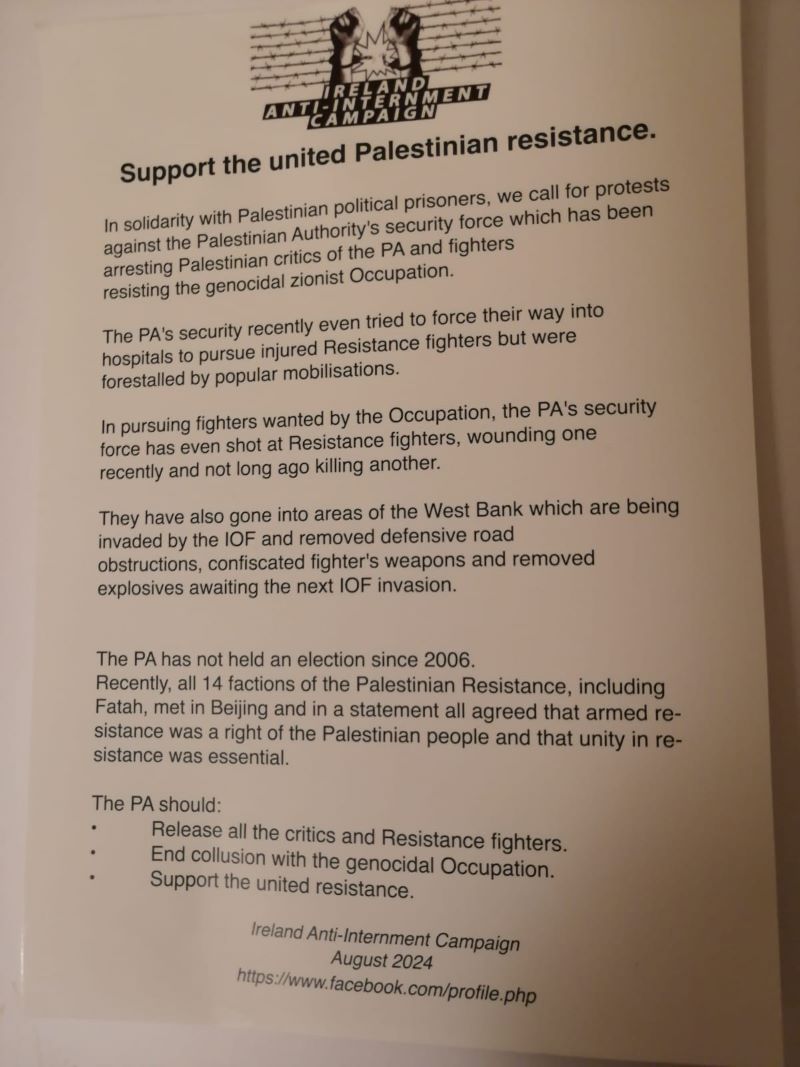
The IAIC’s leaflet handed out at the event points out that the PA’s security force shot and wounded and even killed Resistance fighters, also attempting to enter hospital in force to arrest fighters on two occasions recently, their attempts being frustrated by large mobilisations.
Could a picket on the Palestinian Authority and its Embassy be considered divisive? “Not with justification,” replied an IAIC spokesperson. “It’s the actions of the PA that are divisive. We are supporting the broad resistance there, not one faction or another.”
He points out – as did their leaflet – that 14 Resistance factions including Fatah met in Beijing recently and agreed that the Palestinians have a right to resist, including with weapons and called for unity of all the resistance organisations. “The PA is acting against that unity”, he said.
But why is it that the IAIC called this protest and not one of the Palestinian solidarity organisations? “You’d need to ask them that,” says the spokesperson. “We regularly fly a Palestinian flag on our anti-internment in Ireland pickets; the PA was overdue to be done but nobody else was doing it.”
(Photo: R.Breeze)
The IAIC was founded a decade ago to raise awareness about ongoing internment of Irish Republican activists by revoking ex-prisoners’ licence and through refusal of bail by special no-jury courts. In those cases it can take two years for a case to come to trial.
However the IAIC has organised or participated in other events also, such as those around framed prisoners like the Craigavon Two in the Six Counties and the Munir family in England. It has also called two of its pickets since October 2024 to specifically highlight Palestinian prisoners.
Will the group be regularly picketing the Palestinian Authority now? “Probably not. It’s not what we were set up for but we felt the ice needed breaking on this. Others need to step forward now,” replied their spokesperson, though signalling that they would support others in doing it.
Photo of copy of the leaflet being distributed outside the Palestine Embassy today. (Photo: R.Breeze)
It is probable that a representative of the PA will be welcomed soon by the Irish Government as part of its recognition of the ‘Palestinian State’. One wonders how this reception of a corrupt and Occupation-collusive organisation will be mediated in the Palestinian solidarity sector in Ireland.
The Governments of the EU, including Ireland’s, formally recognise the PA but not only that – so does Sinn Féin in Ireland, EH Bildu in the Basque Country and Esquerra Republicana in Catalonia. This corresponds across the board also to support for ‘the Two-State Solution’ (sic).
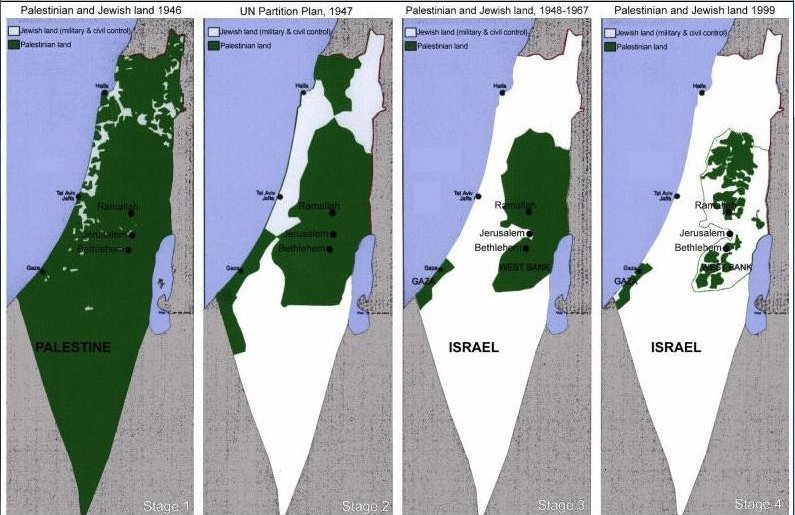
What that entails is allocating the Palestinians less than 20% of their homeland weaving around illegal zionist settlements, with least water and some of the worst land, under the permanent watchtowers and guns of their genocidal neighbour.
Organisations and individuals within the broad Palestinian solidarity movement will need to decide exactly what their solidarity with Palestine actually means, especially for the Palestinians themselves.
Conflict with security forces of the Palestinian Authority broke out in Tulkarm city in the West Bank today as they tried to seize Palestinian Resistance commander Abu Sujaa (Mohamed Jaber), who was receiving treatment in Thabet Thabet Hospital.
According to reports the PA fired tear gas and used pepper spray inside the Hospital grounds, also striking with batons at protesters including women. Shots were fired at the PA’s HQ and protesters are calling the PA “traitors” and “collaborators”.
After a tense stand-off the PA forces eventually had to leave empty-handed.
Abu Sujaa is a commander of the Tulkarm Brigade, Soraya Al-Quds (Islamic Jihad), one of the main organisations of the Resistance. It is reported that he was injured while handling explosives and taken to hospital; when the PA learned of his presence there they sent forces to capture him.
The arrest attempt by the PA and treatment of protesters has been condemned Soraya Al-Quds and by a number of other Palestinian Resistance organisations including the Al Aqsa Martyrs Brigade coalition, Mujahadeen Movement, PFLP, Hamas and Popular Resistance Committees.
A statement also condemning the PA’s action by students at Birzeit University was signed off by the student movements of Hamas, PFLP, DFLP, PPSF, and PPP.
The point was also made that Abdul Nasser, one of the own PA’s employees, a security officer in uniform, was filmed executed by the IOF recently in cold blood in front of their headquarters in Tubas “without any action, condemnation, or denunciation” by the PA’s leaders.
Abu Sujaa is far from being the first Palestinian Resistance fighter targeted by the PA which holds many prisoners but has also killed fighters, including Ahmed Abu Al-Ful in early May1 and Motasim Al-Arif a month later, on that occasion also while trying to capture Abu Shujaa.2
Two Palestinian civil society activists recently went on hunger strike in protest at their detention by the PA, Fakri Jaradat being released after a week of hunger strike (but 16 days detention) but Ghassan Al-Saadi was transferred to Al-Razi Hospital in Jenin in deteriorated health condition.
This evening, according to local sources quoted on Resistance News Network, PA Security Forces stormed the city of Tubas, apparently in order to assassinate the resistance fighter Omar Meselmani who is wanted by the Occupation, since they shot at him directly.
Palestinian unity?
The Palestinian representative bodies recognised internationally are the PA and the PLO,3 both dominated by the Fatah leadership. The latter were represented at the Beijing Palestinian Unity conference last weekend at which all 14 factions agreed on the need for a unity government.
The PLO excludes Islamist organisations from membership, though both the PFLP and the DFLP delegates stated at the conference that they wished to admit those resistance organisations to the PLO, no such decision was recorded (presumably blocked by Fatah) in the conference decisions.
One might have thought that in the circumstances of the Beijing Agreement, the PA would be keeping a low profile or at least certainly steering clear of conflict with Resistance organisations. On the contrary however, the PA seems to be intent on exacerbating divisions.
Islamic Jihad, possibly divining the PA’s intentions, has declared it will not be drawn into a civil war with the organisation, despite its actions and collusion with the Occupation. But can that posture be maintained if the PA continues persecuting and even shooting its fighters?
Perhaps the PA is doing its best, in order to avoid its being sidelined and as an aid to the beleaguered Israeli occupation, to ensure that civil war breaks out among the Palestinians.
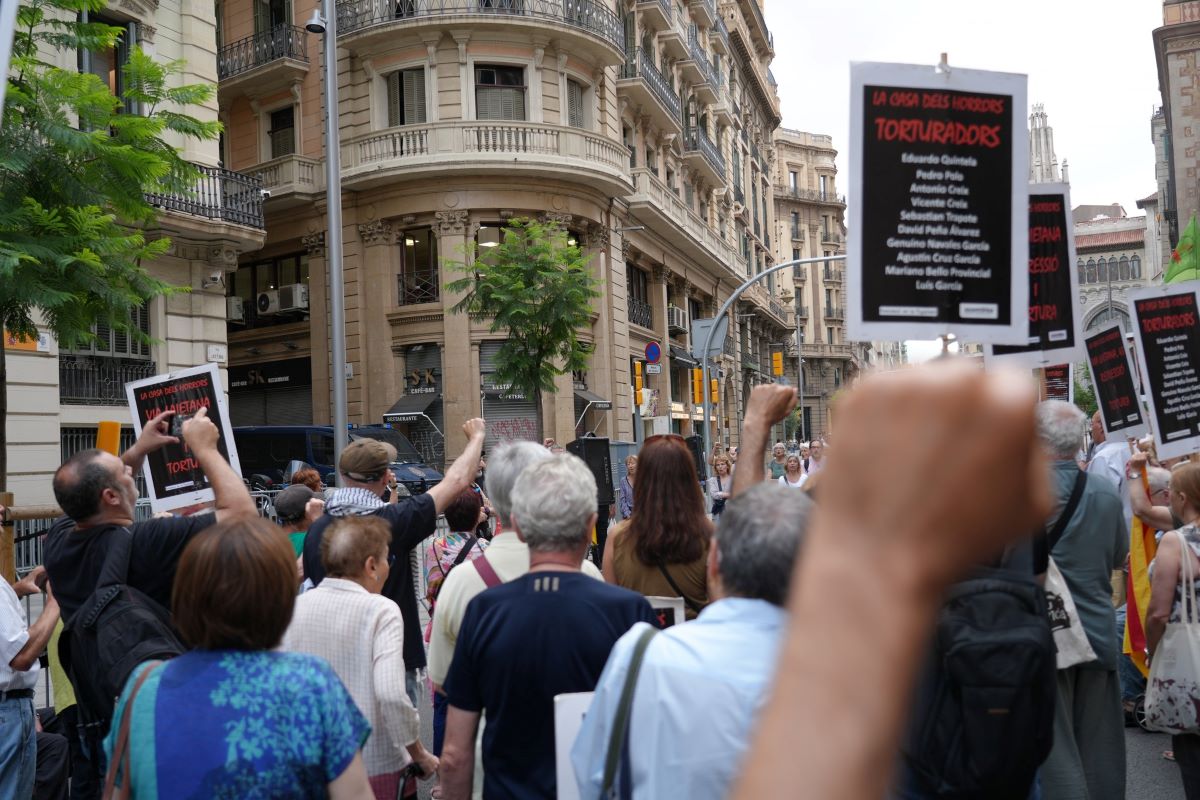
On July Tuesday evening, a number of uniformed police officers watch the people in the road outside their police station on Via Laietana in Barcelona, the Catalan capital, many in the crowd holding placards protesting torture and impunity and a number carrying a banner.
The MC, a slim elderly woman, approaches the microphone stand, her back to the police station. Speaking in Catalan she reviews the reason for their rally which is to renew the historical memory of the Spanish State’s repression of dissent through torture with impunity.
The MC at the event speaking briefly (Photo cred: D.Breatnach)
A number of torture survivors address the crowd, sometimes experiencing difficulty in reading some passages of their notes. The crowd, mostly middle-aged or elderly, listen in silence. Some of them were victims too, many knew victims personally, many of the latter now dead.
For the past three years, the campaigners have been coming here every two weeks, renewing the historical memory and campaigning for a change of use in this building on one of the main roads of their city.
One of the torture survivors displaying the Vermella, the socialist version of the Catalan independence flag. (Photo cred: Albert Bergadá Corso)Torture survivor speaking (Photo cred: Albert Bergadá Corso)Another torture survivor speaking, Catalan independence flag visible in the crowd. (Photo cred: D.Breatnach)
REPRESSION AND TORTURE HEADQUARTERS
During the Franco fascist Dictatorship (1936-1975), this police station was the Barcelona HQ of repression and torture, its victims ranging from democrats to anarchists, republicans and communists. The Resistance methods were also varied: unarmed, industrial or armed.
The crowd takes to the street in front of the police station
After Franco’s death, repression continued through the period known as the Transition with torture as a standard police practice continuing for decades afterwards. Claims of torture were routinely ignored by judges who sentenced activists on the basis of their retracted admissions.1
On the few occasions when torture claims were investigated, it was done cursorily and on the much rarer occasions of trial and conviction for torture, the perpetrators as a rule saw no jail time.
The police station with a history of torture on Via Laietana, Barcelona, as demonstrators begin to gather in front. (Photo cred: D.Breatnach)Commemorative plaque near the police station, regularly defaced and regularly repaired. (Photo cred: D.Breatnach)
The methods are known by police and military torturers across the world: punches, slaps and baton blows through towels (causing pain but leaving no marks), forced stress positions, electrical shocks of particularly sensitive areas, simulated asphyxiation through plastic bags, simulated drowning …
In the past these included suspending victims upside down by their ankles or upright balanced on toes. Of course all tortures are also accompanied by threats to the victims and their families, humiliation (including nakedness), sometimes sexual threats and even actual penetrations.2
Crowd gathering to begin their event. (Photo cred: D.Breatnach)
IRISH SONG IN THE STREET
The MC returns to the microphone at the conclusion of the witness testimonies and asks the crowd to welcome an activist, writer and singer from Ireland. The Irishman says he is honoured to speak at a location of struggle and even more so to bring solidarity from one nation’s struggle to another.
Though the fact is routinely overlooked or even denied, he says there are political prisoners in Ireland and because of the recent mistreatment of one of those in a prison in the British colony, all his comrades protested and were in turn supported by political prisoners in the Irish state jail.
Wearing a Palestinian scarf, speaking in Spanish, having apologised for his lack of anything but a few words in Catalan, the Irishman highlights the role of police stations as local centres of repression on behalf of the bourgeoisie, the repression all too often including torture.
The Irishman applauds the protesters’ upholding of historical memory and also their campaign to have the building reappointed as a social centre, before continuing to introduce his choice of two short songs of resistance from his homeland, one in English and the other in Irish.
The Irishman singing (Photo cred: Albert Bergadá Corso)
The first song he sings is Four Green Fields,3 which he has explained symbolises the four provinces of Ireland, the nation represented by an elderly woman. This is followed by Gráinne Mhaol,4 the nation again represented by a woman but younger, a warrior and pirate clan chieftain.
Following the applause, the MC returns and begins to read out a long list of known police and military individuals, after each one the crowd roaring “Torturadors!”
Crowd singing L’Estaca (Photo cred: Albert Bergadá Corso)
The event concludes with the singing of L’Estaca (The Stake – a song of resistance composed by Catalan Lluis Llach during the Franco dictatorship), many doing so with clenched fists raised. Soon afterwards, the crowd begins to break up, the road open to traffic once more, shoppers and tourists going by.
Section of the crowd at the anti-police-torture event with the Cathedral of Barcelona, destination of many tourists, visible in the background. (Photo cred: Albert Bergadá Corso)(Photo cred: Albert Bergadá Corso)
End.
FOOTNOTES 1A number of cases alleging torture found their way to the European Court of Human Rights but the Spanish State has never been found guilty of torture there (although in the case of one Basque woman, awarding her damages payment for failure of the State to investigate her allegations, the judges concluded almost in an aside that she had probably been tortured). It seems that the Strasbourg Court required the kind of evidence that could not reasonably be produced by the alleged victims. A number of judgements and payments have been recorded against the Spanish State on failure to investigate allegations of torture against political activists.
2 In the latter category two cases are well known, each suffered by Basques, one a woman and the other a man.
3 Composed by Tommy Makem who regularly performed with the Clancy Brothers folk group.
4 Composed by Pádraig Mac Piarais/ Patrick Pearse but structurally based on a much older Irish traditional song welcoming a bride to her new home. The heroine of his song is Gráinne Ní Mháille, a 17C clan chief in Co. Mayo.
SOURCES AND USEFUL LINKS
The campaigners may be followed on X (Twitter) @comissdignitat @p_represaliades
In an anti-imperialist struggle, if we don’t support the Resistance, what are we doing?
Among the Left – and even among many liberals — the importance of internationalist solidarity is generally accepted as taken for granted. However, as with many principles, it is in its application that we find substantial disparity.
After the October 7th breakout from the Zionist siege of Gaza the leading elements of the western world rushed to condemn the Palestinian resistance led by the Hamas group. Atrocity propaganda created by the Zionists abounded.1
Hamas2 and Islamic Jihad3 had planned and carried out the breakout operation in which they knocked out the Zionist surveillance and automatic firing defences, damaged communications, went through and over the apartheid wall and overran the Golani Brigade4 forces.5
The Resistance killed many of the IOF6 and captured others. In addition, the Resistance captured a number of civilians in order to exchange them for the huge number of Palestinian political prisoners held by the Zionist authorities.
Some Left groups joined the anti-Resistance chorus immediately while others took a little longer but then did so too. In Ireland, for example, leading figures in People Before Profit and the Socialist Party condemned Hamas, seen as the leading Palestinian element in the operation.
So too did the leadership of the formerly revolutionary Irish Republican political party Sinn Féin.7
Of the Left Zionists in ‘Israel’ (in so far as they can be called ‘Left’), they too joined the chorus. The Israeli state’s presidency has had representation from the Labour Party without interruption from 1948 to 1977 and most of the settlement expansions took place under a Labour government.8
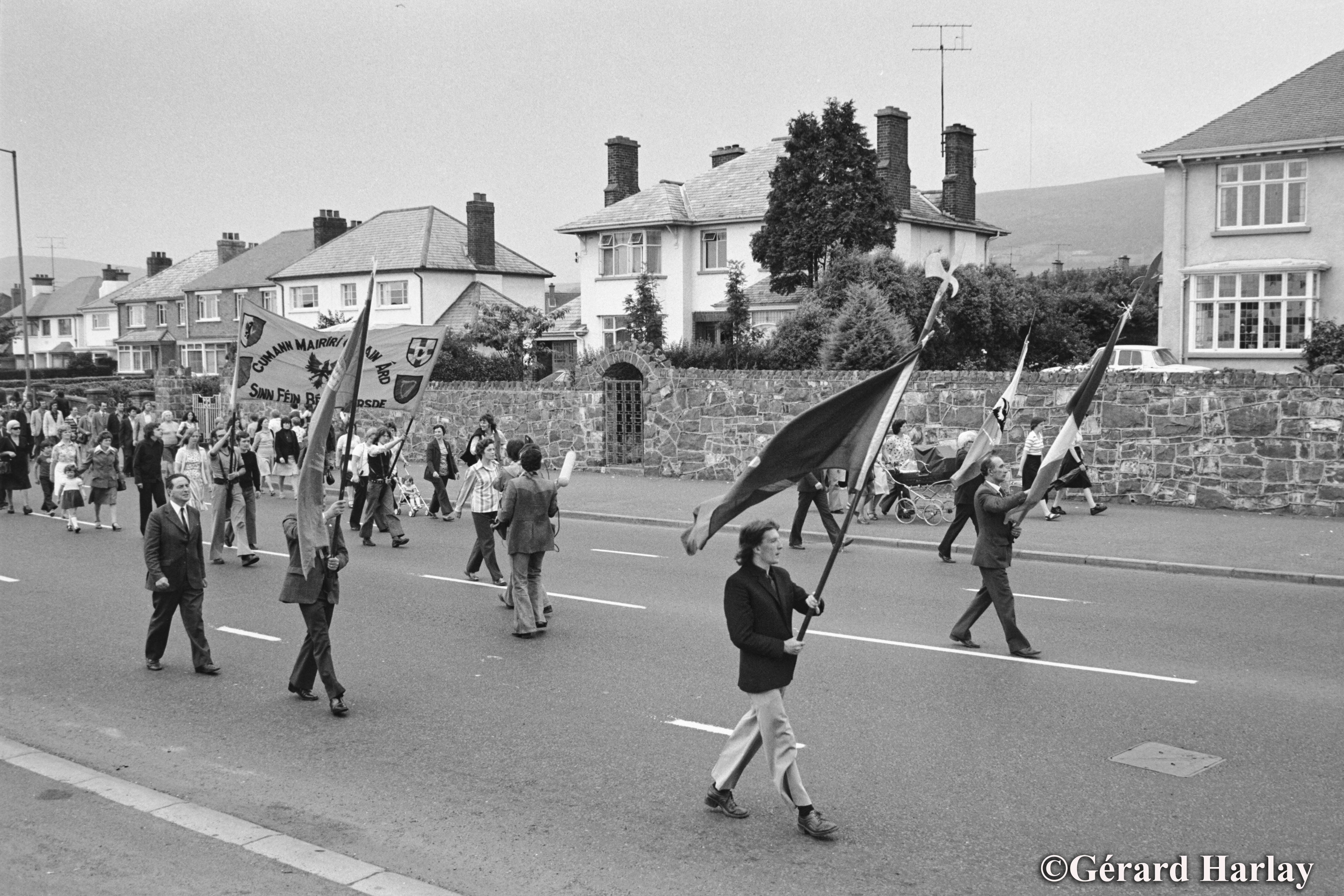
Saoirse Don Phalaistín solidarity group banner (bearing logo of the People’s Front for the Liberation of Palestine on right of photo) after Palestine solidarity march in Dublin 27 January 2024. Also visible in addition to the Palestinian national flag perhaps are two versions of the Starry Plough flag of the Irish Citizen Army, the Republican Congress version at extreme left and the original version above the banner. (Photo: D.Breatnach)
CIVILIANS
Some of the western ‘Left’ organisations stated that it was not the armed breakout of the Palestinians to which they objected but instead the killing of civilians. The liberals and media also made much of the issue of ‘civilians’ – to an extent never accorded to Palestinian civilians.
It is important to note that the adult civilians in the ‘Israeli’ state are, apart from tourists, settlers. They are colonising land from which the indigenous Palestinians have been ethnically cleansed. In addition military service is required of all ‘citizens’9 and a great many are armed anyway.
This is similar to what the Indigenous people of the Americas and Antipodes faced from European settlers from the 18th to the 20th Centuries or the Irish during the various plantations from the 17th Century onwards and the Land War during the 19th.
One baby was killed on October 7th quite likely by excessive heat in a burning building and another 13 children were killed, according to ‘Israeli’ social services. But by whom? By Palestinians or by indiscriminate Hellfire missiles from IOF helicopters and at least one tank firing into a building?10
Civilians may have been deliberately killed knowing they were civilians or by crossfire or by Israeli counterattack. Certainly there was at least one teenager taken captive, the daughter of the Irishman settler who infamously said he would rather his daughter were dead than captured by Hamas.
We’d like to know, of course, which case and how many. But in terms of solidarity principle, it’s beside the point: While we are not required by internationalist solidarity basic principles to approve of every one of its actions, we ARE required to be in solidarity with the Resistance.
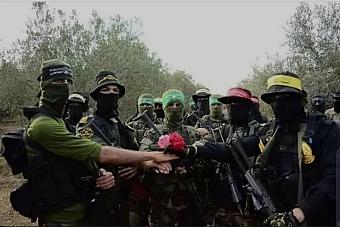
A number of Palestinian armed resistance groups displaying unity in the struggle (Photo sourced: Iran News)
BUT, ISLAMIST…!
Many in western society are secular in their politics, many of agnostic or atheist position. So, that is our choice. Others belong quite strongly to one religious belief or another. What is different about Islamists (or fundamentalist Christians) is that they aspire to a society run in accordance with their religious beliefs.
We may not agree with that objective. We should not agree with the subordinate social and political status accorded to women in some religious cultures nor to the outlawing of LGBT sexuality. But even so, we should support the Resistance, Islamist or otherwise, in resisting repression.
Basque society was largely conservative Catholic while resisting Spanish State fascism up to the 1970s; Welsh mining society was often conservative Methodist in the struggles of the miners in the 1930s. The Irish Republican movement was permeated by Catholic symbolism and ideology.
We could have been, should have been capable of supporting the resistance in each of those cases while not supporting the religious conservative, reactionary or fundamentalist beliefs or conduct of participants or leaders in those struggles.
For revolutionaries, the general principles or internationalist solidarity are not of the kind from which one can pick and choose, while rejecting others. We are however entitled to accord ‘favoured status’ to an organisation the ideology and practice of which we most approve.
We may for example prefer a secular or even socialist resistance organisation (e.g the People’s Front for the Liberation of Palestine). We may carry its flags, promote its statements, share its social media postings. But we do so while also expressing solidarity with the Resistance as a whole.
That is reasonable and honourable. It is neither to participate in attempts to break up whatever unity exists among the organisations of the resistance.
During the 30 Years War in Ireland, there were those in Britain who participated in those activities – people who colluded for example with SF refusing to share a platform with the IRSP11 on Hunger Strike commemorations, threatening refusal to attend if their wishes were not acceded to.
No doubt that seemed justified to the Provisionals in their promotion of their organisation above any other choice but that activity split commemoration committees, disheartened activists and killed some solidarity events on the annual calendar.12
HOW BEST TO DO IT … AND IN PUBLIC
We often hear people ask a speaker from the resistance movement what we should do in solidarity. This is in general incorrect behaviour because we have our own revolutionary program and we best know our own circumstances and capabilities.
It is a different thing to ask what are the things that the resistance movement needs: medicines, weapons, representation, contacts, publicity etc. But we still have to decide how well to fit the effort of obtaining those within our capabilities or even whether the objective is worth the energy expanded.13
The Resistance can tell us what they need but the decision on which solidarity actions to take is ours. However whether to express solidarity is not a choice for revolutionaries – it is an obligation.
As revolutionaries we have a public position and part of that should be public solidarity with the Resistance. It is not unknown for some to claim to support a resistance organisation but to decline to do so publicly.
An African National Congress speaker in London years ago told me privately that they supported the Palestinian and Irish resistance but would not do so publicly as it might undermine support they were receiving from UK and other western bourgeois organisations.
I argued with him against this.14 Relating the discussion to a senior SF activist later I was astounded at the response that they would do the same if required.
Solidarity with the Resistance means also solidarity with those incarcerated during the struggle, the resistance in the jails. Again, though an organisation may think differently, we are not required to support the specific organisation to which the prisoners owe allegiance.
Nor does any Resistance organisation have the right to dictate to us whether we may or may not express solidarity with political prisoners who are aligned with that organisation. Over the years, the Ireland Anti-Internment Campaign has faced down attempted coercion along those lines.
So also did the Irish Political Status Committee in London. And both groups remained independent. Unfortunately the Troops Out Movement of the day was unable to do so and after a brief period of asserting independence, eventually succumbed to domination by Provisional Sinn Féin.15
Supporting political prisoners is an act of necessary solidarity with the resistance and also one of self-defence in the longer term but it does not necessarily mean expressing support with the actions or organisation of the prisoners before or indeed after they were jailed.
Banners and flags presumably at Celtic FC home stadium during the current episode of the Zionist genocidal war. (Photo sourced: Internet).
SUMMARY
We are entitled if we wish to prioritise support for a specific organisation or its program but not obliged to do so, nor to accept their advice on how to conduct our solidarity work. Nor is it required of us to condone every action of the Resistance in general.
But we are required to publicly support the Resistance in general and not to join in public condemnations. And that’s the minimum to do if we are going to claim being in solidarity with a struggle.
For any revolutionary struggle, internationalist solidarity is an important factor, in encouragement to the Resistance, in de-legitimising the repression and in practical terms of supplies to the resistance, also in hampering the repression through blockades, boycotts or industrial action.
If we don’t support the Resistance, how can we claim to be in solidarity with Palestinians? Charity is not the same as solidarity. Pity is not the same as support. Outrage at the crimes of the oppressor is not the same as solidarity with the Resistance.
Furthermore, why should we expect solidarity with our struggles, now and in the future, if we cannot express that solidarity with the struggles of others?
End.
POSTCRIPT
Some will have searched in vain for a reference from Lenin, Mao, Trotsky, Luxemburg – or Connolly or even a famous Irish Republican leader – to justify the principles I have discussed here. At the end of the day, people should stand by principles because they have been tried and tested and are aligned with revolutionary experience but should also test them on their own experience in struggle.
In presenting some credentials towards giving these principles some consideration I can only say that I have thought about them and sought to practise them over decades of activism in Britain and Ireland.
Among the areas of Resistance and of political prisoners which have claimed my activity have been Ireland, Palestine, S. and SW Africa, Vietnam, Housing struggle, US Indigenous and African American people, organised Workers, Anti-Fascism & Anti-Racism, Kurdistan, the Basque Country, Syria, Haiti, Western Sahara, Catalunya, the Donbas …
FOOTNOTES
1All since thoroughly debunked though still repeated on occasion: “‘Israeli’ babies beheaded, torn from a womb and stabbed, women raped, people and houses burned.” These fake atrocity stories were repeated in the western media and by some politicians, including Biden and helped create an atmosphere assisting genocide by the ‘Israeli’state.
2Hamas began as an Islamist community organisation which then became a political party and developed an armed wing (like most Palestinian political groups, in response to the armed Zionist State and its settlers). In 2006 the party won the Palestinian legislative elections but the defeated Fatah (widely acknowledged as corrupt) administration in Gaza refused to give way and, in a short conflict, the Fatah armed group was defeated by that of Hamas. They chose not to do the same in the West Bank, presumably to avoid civil war from which the ‘Israeli’ state would benefit but from that moment onwards the Zionist State blockaded Gaza and the organisation was labelled a “terrorist” group in the west and financial support went instead to the Fatah-run Palestinian Authority in the West Bank (which has refused to run new elections in two decades).
3Palestinian Islamic Jihad was formed in 1981. The armed wing of PIJ is Al-Quds Brigades (also known as “Saraya”), also formed in 1981, which is active in the West Bank and the Gaza Strip, with its main strongholds in the West Bank being the cities of Hebron and Jenin. In addition to this organisation and Hamas there exist a number of other resistance factions, some of which are secular, all working together as a broad armed resistance front with organisational autonomy but ofen in joint operations also.
4The Golani Brigade of the Gaza Division is the most highly decorated IOF Brigade, having taken part in all of the state’s major ethnic cleansing and genocidal operations. On October 7th hey were overrun in minutes and 72 killed with an unknown number captured (‘unknown’ because many, along with their Palestinian fighter captors were burned to death in their cars by ‘Israeli’ Apache helicopter Hellfire missiles).
5 The Palestinian operation went deep, passing Golani’s 3rd defensive line.
6‘Israeli’ Occupation Forces, aka the official but misnomer IDF (“Israeli Defence Forces”).
7The current iteration of Sinn Féin abandoned its revolutionary anti-colonial and anti-imperialist path in embracing the pacification process in1999. It stood down its armed wing, the IRA and largely dissolved it, also having their weapons decommissioned, since when it has participated in the administration of the colony and in recruitment of the colonial police force.
8Yet for years the Socialist Party have opposed boycotting the Zionist State, calling instead for unity with the “Israeli Left”.
10Documented by military and survivor sources on ‘Israeli’ media.
11The Irish Republican Socialist Party with an armed wing up to the 1990s, the Irish National Liberation Army, which contributed three Volunteers to the 10 martyrs who died on hunger strike in 1981.
12And what, in the end, did the Provisionals achieve with the supremacy gained?
13The Resistance organisation may ask us to arrange meeting for them to address our state’s parliament, or for interviews with the media … Or even to restrict our propaganda from solidarity to self-interest for people, as Sinn Féin did in England in the 1980s when they were promoting Time To Go: “Push the issue of the expenditure on troops, better spent on the health and social services.@
14If to do so incurred a legal penalty would have been a different situation, of course.
15And from that moment onwards became a less broad and less effective, eventually ceasing to exist as a solidarity organisation.
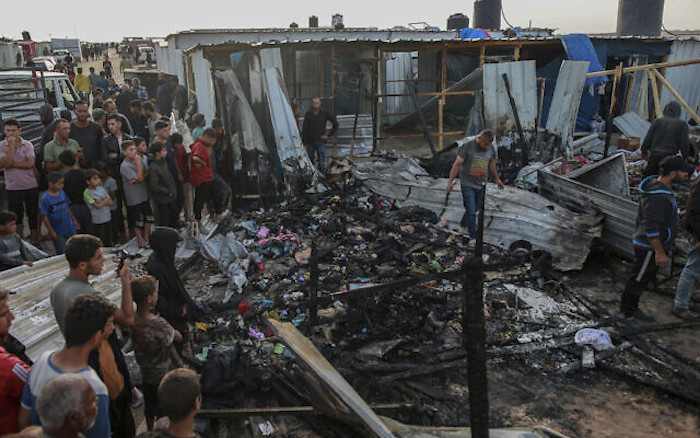
Responding to its latest genocidal atrocity which it claims was “a tragic error”,1 bombing a displaced person’s tent camp2, the zionist state offered some excuses for its general behaviour which are not only not acceptable but are not even true.
In fact the Israeli state does exactly the things of which it accuses its Palestinian resistance.
Palestinians look at the destruction after an Israeli strike on a camp for internally displaced people declared “safe area” by the Israeli military in Rafah, Gaza Strip, May 27, 2024 (Photo cred: AP Photo/Jehad Alshrafi)
Let’s examine one of its claims in the statement: “Israel says it does its best to adhere to the laws of war and says it faces an enemy that makes no such commitment, embeds itself in civilian areas and refuses to release Israeli hostages unconditionally.”3
Every phrase about its own conduct is the opposite of what the zionist state does. Every accusation directed at the ‘other’ is what it does itself.
The Israeli state embeds its armed forces in civilian areas by a) requiring military service of nearly every Israeli male and female and b) by providing military backing to its settlers, including those in areas of what international bodies recognise as ‘illegal occupation’.
The Israeli regime and its armed forces ignore the international rules of war with regard to attacks on (Palestinian and Arab) civilians, journalists, medical and aid personnel4 and civilian cultural, administrative, infrastructural, educational and religious locations and buildings.
It is the zionist state that refuses to release their captives unconditionally (even re-detaining those they’ve agreed to release under prisoner exchange deals). At the time of writing the zionist state has detained 8,875 Palestinians since 8th October last year, including about 295 women, 630 children, 76 journalists (49 still in detention) and has issued 5,210 “administrative detention orders” (i.e internment without trial).5
On the other hand, the resistance forces target mostly the Israeli armed forces but also settlers. They allow military helicopters to land and remove IOF dead and wounded but do not fire on them, unlike the IOF who fire on paramedics, doctors and hospitals, killing many medical personnel.
Of course the Resistance is embedded amongst the people because it is of it, born of the population’s will to resist and also fights to protect it, insofar as it can. Were this not so the Resistance would long ago have been expelled by the people or exposed to the occupying forces.
However, the Resistance does not base itself in hospitals, in mosques or in refugee centres, which the Occupation’s military does not hesitate to bomb or invade.
Two Medical Staff Kuwait Hospital Rafah, South Gaza, Killed by Israeli Missile 27 May 2024 (Photo sourced: Resistance News Network)
Recently, Netanyahu, Biden, Sunak and some others, in responding to the International Criminal Court’s statement that it was going to issue arrest warrants for Netanyahu and Gallant,6 along with three Hammas officials, exclaimed in rage that there is no equivalence between the two groups.
They are absolutely correct.
The Palestinian resistance has not stolen land, does not target Israeli women and children, hospitals, schools and universities nor are its members afraid to fight its enemies on the ground without armour or air cover.
Bodies of two workers of the Kuwait Hospital in Rafah killed by missile strike on othe gate of the hospital today. (Sourced at: Resistance News Network)
The symbolic decision of the Irish, Spanish and Norwegian states to recognise a Palestinian state drew the ire of the same parties as with the ICC statement, the Israeli Foreign Minister accusing the Irish State’s leaders in a racist video of having rewarded Palestinian “terrorism” with statehood.
This is yet another example of the zionists accusing others of what they themselves have done.
The zionist settlers waged a war against the English occupiers and the indigenous Palestinian people from the 1920s to the 1940s through the terrorist groups of the Irgun, Lehi, Haganah and Palmach, going on in 1948 to kill and rape Palestinians, burning villages and expelling 700,000 people.7
The Zionists declared their state in 1948 and demanded recognition, granted by the USSR and the USA, thereby rewarding their terrorism with recognition of their state, which was followed by other states later.
One of the terrorist groups, the Haganah, became the core of the army of the zionist state.
1At first they tried to justify it by saying that Resistance militants were gathered there, then remembered it was an area they had claimed safe from bombing and so changed their story to one of “tragic error”, blaming the chaos of war. But these bombings are ordered and directed far from any battle-chaos and with satellite and drone imagery to consult. Which means the area could not be confused with some other and the bombing was deliberate.
2On Sunday, 26th May 2024 killing 45 Palestinians and wounding 250 (at the time of writing), having also bombed a number of UNRWA displaced person centres.
4As recently as today the Occupation killed two medical workers as they shelled the doorway to Kuwait Hospital in southern Rafah, Gaza. There is not a medical centre in Gaza which the Occupation has not partially damaged or completely destroyed.
5Source: Adameer, Palestinian prisoner support organisation.
6Prime Minister and Minister for ‘Defence’ (sic) of ‘Israel’, respectively.
The anniversary on Sunday of the death on hunger strike of IRA Volunteer Bobby Sands was marked with a number of posts on social media. I would like to add an Irish migrant’s1 perspective and some analysis of his legacy.
The Irish diaspora was a powerful sector in solidarity for the Irish struggle not only because of their cultural background but also because of their numbers. Some British cities had an estimated diaspora population of 10% (Irish-born and 1st and 2nd generations).
Furthermore, the higher proportion of those in turn was of the working class, a section of society which, although they in no way had their hands on the standard levers of power, certainly had a strong potential of the kind the British ruling class had learned to fear.
Irish Republicans of course formed part of that sector and organised within it but on the other hand the IRA’s bombing campaign in Britain was of no help at all. The popular fear of being caught in an explosion greatly enabled the Government to tighten the screws under the guise of “security”.
Karl Marx, a strong supporter of Irish freedom had commented after the Clerkenwell prison bombing of 18672 that “One cannot expect the London proletarians to allow themselves to be blown up in honour of the Fenian emissaries” (i.e who they were trying to free from the jail).
In 1974 the Labour Government had repressive legislation ready and on 29 November, using hysteria arising from the Birmingham and Guildford pub-bombings they rushed through the Prevention of Terrorism Act (1974) which permitted the holding of suspects for two days without charge.
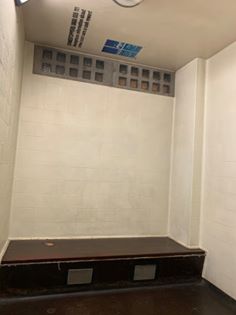
An underground cell in London’s Paddington Green police station – this is where Irish detainees under the Prevention of Terrorism Act might be kept and interrogated for seven days without visitors or access to solicitor. “The old cells were 12-foot square, contained no windows and were reportedly too hot in the summer and too cold in winter” (Wikipedia).(Photo: Posted in 2020 on Internet by Green Anti-Capitalist Front who occupied the empty building intending to turn it into community centre.)
That could be extended for another five days – and often enough was — by application to the Home Secretary. Access to solicitor was usually denied and though not lawful, the fact of the detention itself was often denied to concerned people making enquiries of the police station.
The prospect of disappearing for seven days into police custody somewhere was naturally terrifying and a ‘suspect’ could also be deported without trial to Ireland – even to the British colony of the Six Counties, which amounted according to their law to “internal exile”.
Snapshot of London police harassment and intimidation of Irish solidarity activists in 1981. (Photo sourced: Internet)
The framing of a score of innocent Irish people3 in five different trials4 with very heavy sentences added to the intended terrorising of the Irish community in Britain, the “suspect community”5, many of whom believed the victims to be not only innocent but most not even politically active.6
Irish solidarity activity in Britain diminished greatly after 1974 as state repression impacted across the Irish community. But the hunger strikes and concerns to save the lives of the strikers in 1981 broke the hold of state terror as people took to the streets in their thousands once again.
They were unsuccessful but never returned to that state of immobilising fear that had settled over the community.
The Irish in Britain Representation Group got its initial start in 1981 which happened as follows: the bourgeois Federation of Irish Societies had its AGM in May 1981 and one of the members proposed that a motion of sympathy to the Sands family be recorded when he died.
IBRG and Irish Republican POW Support Committee banners on march Birmingham 1984 (Source: Mullarkey Archive)
The meeting’s Chairperson ruled the proposal out of order and ‘the Fed’ continued with their ordinary business. The then Editor of the Irish Post7, writing in his “Dolan” column, found this disturbing and suggested there might be a need for a new type of Irish community association.
A number of individuals wrote in and the ball got rolling, though it took until 1983 to set up the branch-based organisation with a constitution and democratic safeguards in operational rules. The IBRG soon had a number of branches in London and others in the North and Midlands.
For the next two decades the organisation campaigned for the release of the framed prisoners, against the Prevention of Terrorism Act, strip-searching, all racism but in particular the anti-Irish and anti-Traveller varieties, for Irish representation in education, services, Census category, etc.
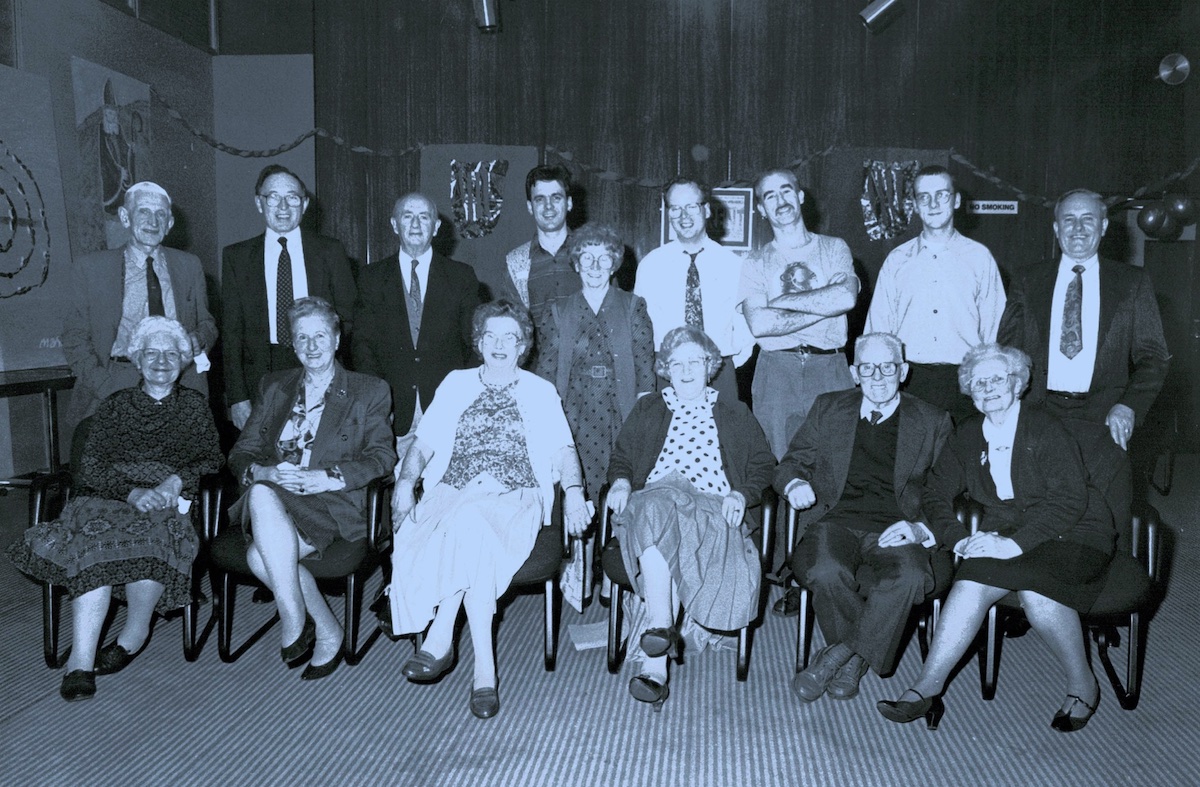
Lewisham Irish Centre Management Committee and Staff, possibly 1994. The Centre was campaigned for and won by the Lewisham Branch of the IRBG in conjunction with the Lewisham Irish Pensioners’ Association (which the IBRG had also founded).
The IBRG also called for British departure from Ireland and collaborated with other organisations in marches, demonstration, pickets, conferences, producing also a number of important report documents. The organisation’s officers were drawn from migrant Irish and those born in Britain.
Bobby Sands Mural on gable end of a house in Belfast (Photo cred: Brooklyn Street Art)
REPRESENTATION OF BOBBY SANDS
Bobby Sands was a man of great courage whose leadership qualities were recognised by his fellow political prisoners when they elected him as their Officer Commanding in the H-Blocks. He was also an accomplished writer and poet.
When the British reneged on the agreement that ended the 1980 hunger strike and a new one was planned, Sands insisted on being first on the list, which also meant that in the event of resulting deaths, his would be the earliest.
Most people will agree easily with all the above evaluation of the man but from that point onwards, his representation is manipulated to suit different agendas, in particular those of pacifists, social democrats, liberals and a variety of opportunists.
Some of them love above all his quotation that “Our revenge shall be the laughter of our children”. They forget many other things he wrote and seek to turn him into an angel or saint of pacifism.
Since they embraced the pacification process, Sinn Féin try to represent Sands as an advocate for and proof of the effectiveness of participating in the parliamentary electoral system, based on his success in a 1981 Westminster by-election with 30,492 votes, 51.2% of the total of valid votes.
What both these groups fail to recognise is that Sands was an IRA volunteer and was sentenced for possession of handguns in 1972 and again in 1976. If he was an angel, it was of the Archangel type, fighting against what he considered evil.
He was proposed in the Fermanagh-South Tyrone by-election mainly in order to support the campaign of the prisoners against criminalisation and for the political status recognition that they had previously. Saving the lives of the hunger strikers was of course part of the plan too.
Nine protesting Republican prisoners contested the general election in the Irish State in June. Kieran Doherty and Paddy Agnew (who was not on hunger strike) were elected in Cavan-Monaghan and Louth respectively, and Joe McDonnell narrowly missed election in Sligo-Leitrim.
But that is a long way from proving that the electoral process is a viable way of dislodging the ruling class and their system and, in fact, history has proven the opposite.
Nobody knows what position Sands and the other nine would have taken on the electoral process had they lived. Possibly some would have gone along with the SF leadership on that and some others would now be reviled as “dissidents” (as are indeed some H-Block survivors).
All we can say for certain is that they were men of courage in that all of them had joined the armed struggle for Irish national liberation. They had even higher courage of a level hard to imagine, to risk and then experience slow physical disintegration and death by the day and by the hour.
Long after their erstwhile prominent enemies are forgotten, their names will shine in our history and Bobby Sands’s, the brightest of them all.
2A bomb was planted against the prison wall to free a member of their group who was being held on remand awaiting trial at Clerkenwell Prison, London. The explosion damaged nearby houses, killed 12 civilians and wounded 120; no prisoners escaped and the attack was a failure. Michael Barrett was found guilty of the bombing despite his claim supported by witness testimony of having been in Glasgow during the bombing and was hanged on Tuesday 26 May 1868 outside Newgate Prison, the last man to be publicly hanged in England (the practice was ended from 29 May 1868 by the Capital Punishment Amendment Act 1868). https://en.wikipedia.org/wiki/Clerkenwell_explosion.
3Carole Richardson of the Guildford Four was not Irish but she was the girlfriend of one of three Irishmen.
4Birmingham Six, Guidford Four, Giuseppe Conlon, Maguire Seven and Judith Ward. They were not acquitted and released until decades later, by which time Giuseppe Conlon had died in jail.
5Suspect Community by Paddy Hillyard, Pluto Press (1993)
6Believing them innocent and not active worked even better to terrorise because if the likes of those could be framed and jailed, no-one was safe. But perhaps safest was to do absolutely nothing to draw the attention of the State.
7Brendán Mac Lua, co-founder of the Irish community newspaper in 1970 which is now a very different periodical.
8The lark is associated with Sands because he wrote a story about a man who had captured a skylark, a bird that unusually sings in flight. In the cage the bird would not sing so the man draped the cage with cloth and still the bird would not sing, nor would it do so when he refused it food and water until eventually, it died in the dark, silent to the last.
The past six months of an almost incredible level of Israeli genocide and Palestinian resistance have taught the world some valuable lessons but particularly perhaps those of us living among the Western powers.
PART TWO: LESSONS FROM THE ISRAELI ZIONISTS
Diarmuid Breatnach
(Reading time:5 mins.)
The Nature of Zionism
The Zionists have taught us the nature of Zionism as an ideology upholding a people allegedly chosen by religion to occupy a land and to repress or expel the indigenous occupants of that land.
Nature of settler states
As Zionism is a variant of occupier-settler ideology we have, by extension, learned to recognise the nature of all settler states. To be fair, the evidence of that nature was clearly before us but we had perhaps learned to push it to the backs of our minds.
The European settler states of USA and Canada practiced genocide against their native indigenous peoples, of which only discriminated fractions remain from “California” to “Newfoundland”, from Pacific to Atlantic coasts. Both those states have diligently supported the Zionist settler project.
Lithograph image of aftermath of the Wounded Knee massacre of Indigenous people, USA, 29 December 1890 (Image sourced: Internet)
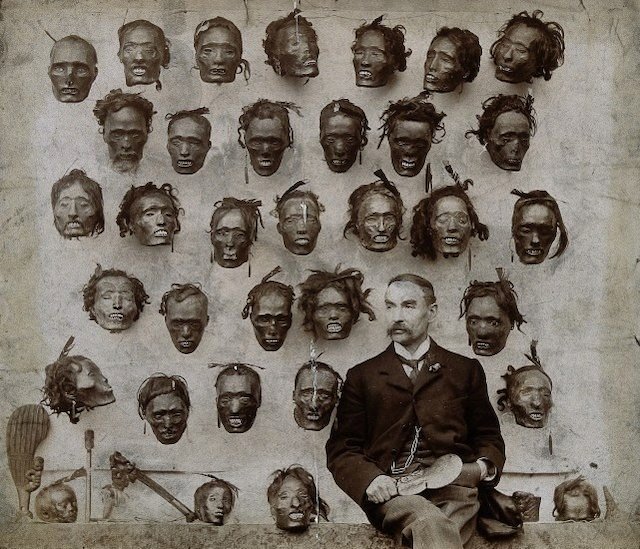
Those Northern American territories were primarily English colonies1 as were Australia and New Zealand, both also practicing genocide and discrimination against their indigenous populations and both those states too have supported the Zionist settler project.
European coloniser collection of New Zealand Indigenous heads 1895 (Photo source: Khamen.ir)
Less unanimous have been the mainly Spanish and Portuguese settler colonies of what is now called “Latin America”, from Brazil to Argentina to Mexico. Their indigenous populations too were ethnically cleansed and subjected to genocide, although to varying degrees of intensity.2
The Caribbean islands have all been settler and imported slave colonies of the states of England, Spain and France3, all now having nominal independence but, with the exception of Cuba,4 remaining within the imperial ambit of the USA (mostly) and France and have responded accordingly.
Nature of the zionist state
The Zionist State has demonstrated to us the true outcome of the Israeli zionist ideology, expansionist and prepared to inflict any horror upon the indigenous people in order to achieve its aims, descending to depths of inhumanity unimaginable only if Nazism were forgotten history.
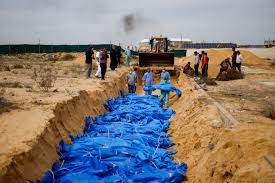
An early mass grave of Palestinians killed by the Israeli military in Gaza back in November 2023 as the cemeteries were already full (Photo cred: Mohammed Salem/ Reuters)
Currently the Israelis’ toll of Palestinians is at least 34,049 dead and 76,901 wounded, with an estimated further 8,000 under rubble in Gaza, nearly 2 million displaced (many several times), all medical, educational and social facilities and infrastructure degraded if not totally destroyed.5
And with at least 9,500 prisoners (i.e hostages) reportedly ill-treated, humiliated and even tortured, of which an Israeli-admitted 27 have died during these six months alone and 3,660 are held without trial or release date in “administrative detention”.6
Brazen Truth and Lies
We have also learned from the Zionist state its brazen genocidal intentions towards the Palestinians, expressed for internal Israeli consumption, alongside its outlandish lies for the international public about October 7th: beheaded babies, mass rapes, disfigurements, burning alive, etc.
All of those have been debunked and the recorded statistics alone (but also backed by evidence of other agencies) expose the lies that the Israeli army is attacking only7 the Palestinian resistance, that it is not applying collective punishment and using starvation as a weapon.
False Israeli Zionist propaganda about the Palestinian resistance “beheading babies” repeated by US President Joe Biden in press statement, claiming he had seen photos. His aides later ‘clarified’ that he was relying on reports from the Israeli state and had not seen actual photos. (Photo sourced: Internet)
Not bothering to give excuses for its demolition of universities and museums, schools and places of Muslim and Christian worship, ‘Israel’ has claimed the existence of tunnel entrances in them as excuses for the total elimination of Palestine’s main hospitals and degradation of all others.
It has done this despite its lack of evidence of such use of the hospitals, despite denials of hospital staff and organisations and without having to explain how such claims, even if they were true, could justify siege of hospitals, killing patients and staff and their destruction as functioning hospitals.
What Israel and the western imperialist states have shown us to date is that Israel has impunity to carry on its genocide. Not only will it not be boycotted, much less blockaded, not to even mention invaded, it will continue to be supplied with weapons, money and political support.
Even after the ICJ judgement in favour of S. Africa that Israel was “plausibly committing genocide” and restrictions imposed on Israel by the court, the genocide continued without pause and without any serious international repercussions by any western state.
Israel has given us a clear demonstration in practice of the hollowness of western institutional democracy and liberalism, not only in its continued support for the genocidal state but in the repression by western states of those who have supported the Palestinians in word or deed.
Demonstrations and pickets have been forbidden8, protesters threatened and arrested9, academics hounded and sacked,10 artists and public speakers cancelled, social media profiles hampered or blocked. In fact, all the kinds of undemocratic actions of which some other states are often accused.
Exposure of the world order of legal democratic institutions
The exposure of these institutions was almost complete. The United Nations of 193 states was shown powerless to act without the authorisation of the five Permanent Members11 of the Security Council — which itself was shown nullified by a veto of even one Member.12
United nations
United Nations building with approach flanked by national flags of member states(Photo sourced: Internet)
The International Court of Justice, a sub-institution of the UN itself, with a history of never even trying a western power, though judging Israel plausibly guilty of genocide,13 failed in its judgement on 26th January to order an immediate cease to the state’s attacks on the Gaza population.
The ICJ failed even to take action on Israel’s non-compliance with the interim measures it ordered, viz: “to take all measures to prevent any acts that could be considered genocidal according to the 1948 Genocide Convention”, other than to issue another non-complied order on 28th March.14
The United Nations failed to defend its own aid organisation for the relief of Palestinians (both in Palestine and as refugees in other parts) from unsupported Israeli allegations of the participation of 0.04% of its staff in the Palestinian resistance operation of October 7th 2023.
The UNWRA chiefs responded by failing to stand up to Israeli bullying and by sacking nine of their own workers without any evidence presented against them and without a right to a hearing or appeal. It also for a time failed to denounce Israel for reported torture of the agency’s employees.15
The UN failed to defend the staff of UNWRA from unproven allegations, unfair internal treatment and Israeli intimidation and murder or to maintain the essential funding of UNWRA essential for the Palestinians, or to insist on the regular and protected entry of aid trucks safe from Israeli attack.
The European Union refused to even call for a ceasefire; continued to act as Israel’s biggest export market; some of its members withdrew UNRWA funding and continued to supply the genocidal state with arms, while many states repressed their own citizens acting in solidarity with Palestine.
The need for revolutionary resistance
The Zionist state and its imperialist backers and, to be fair to it, our own Irish state too, have demonstrated to us the fragile and temporary nature of western liberalism and democracy on the one hand and the need, by implication, of revolutionary resistance and organisation on the other.
IN CONCLUSION
It remains to us to learn those hard-earned lessons, to internalise them and to apply them externally. We owe that to the Palestinians and to ourselves.
End.
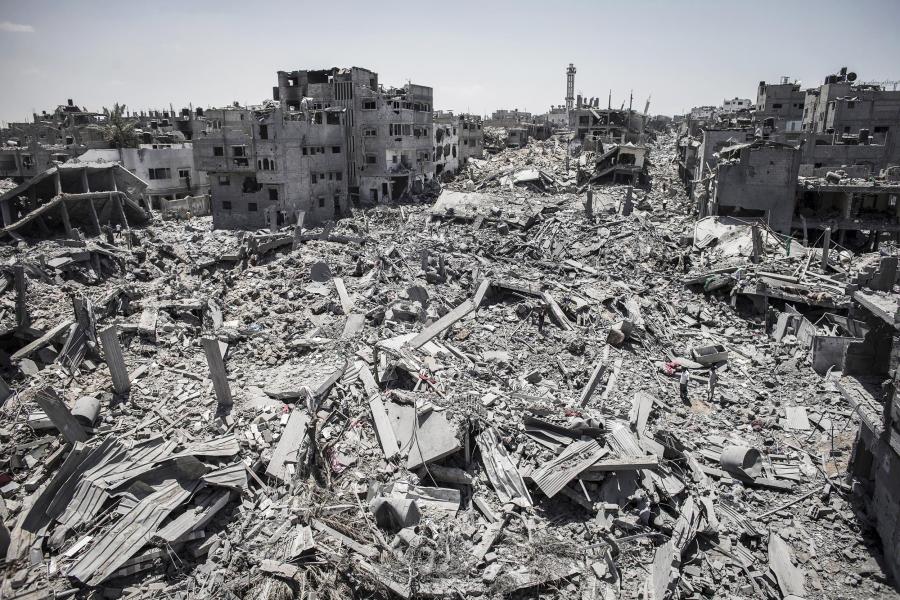
Part of Gaza after Israeli bombardment back July 2014; now of course it is much, much worse. (Image sourced: Internet)
1The Dutch also colonised the north-east of what is now the USA and the French particularly Louisiana, in what is now the USA and Quebec in what is now Canada. What is now SW USA was part of the Spanish colonial empire, subsequently part of the Mexican Empire and gained by the USA in two wars with Mexico.
2The disparity in approach of these states is underlined by for example on the one hand El Salvador unreservedly supporting the zionist state and by Nicaragua on the other hand taking Germany to the International Court of Justice in accusation of being complicit in the Israeli genocide by supporting the state with weapons and finance.
3Without overlooking the fact that each of those states (England now as the United Kingdom) contains other dominated nations within it.
4During the existence of the USSR Cuba was often described as being under Soviet colonial influence but remains today the only truly independent (though part-occupied) state in the whole of the Caribbean.
6 At the time of writing Adameer, the Palestinian prisoner and human rights organisation reports 9,500 Palestinian prisoners of which 3,660 are “administrative detainees”, 200 children and 80 women. Seventeen of the prisoners are elected Legislative Council members (similar to MPs or TDs) https://www.addameer.org/statistics. These figures have changed regularly during the 6 months of zionist genocide and the trend is always upward except for a brief period during the truce and exchange of hostages.
A solidarity rally in Dublin to mark 17th April Palestinian Prisoners’ Day was staged by the IPSC outside the iconic General Post Office building on Dublin’s main street and was supported by the Ireland Anti-Internment Campaign.
At a public meeting about Palestinian prisoners after the event Tala Nasir, a lawyer working with the prisoner support group Adameer, stated that there are 8,000 Palestinians currently held by the zionist state of which 275 are women and 500 are children.
Ms. Nasir was on a round-Ireland speaking tour organised by the Ireland Palestine Solidarity Campaign, the main Palestine solidarity organisation in Ireland but which has not been prominent in highlighting the situation of the Palestinian political prisoners.
On the other hand, at its street information pickets, although primarily working for Irish political prisoners, the Ireland Anti-Internment Campaign has regularly flown a Palestinian flag in support of political prisoners from that nation also.
An IAIC spokesperson recalled that at their traditional annual prisoner solidarity rally in December, their speaker stated: “Wherever there is oppression, there will be resistance; but also wherever there is resistance there will be political prisoners and in Ireland we have centuries of that experience.”
The organisation maintains that although large-scale official internment last used in the occupied Six Counties ended in 1795, it continues on a smaller scale under another name: “Remand in custody”, in which Republicans regularly wait two years before their case comes to court.
The decision to deny bail is taken by the special no-jury political courts: Diplock Court in the Six Counties and Special Criminal Courts within the Irish state, all of which have been condemned by civil liberties organisations in Ireland and abroad.
Israel also has a form of internment without trial which they call “administrative detention”, under which Palestinians can be detained for up to six months at a time as a preventive measure without any kind of trial or evidence shown against them.
PALESTINIAN POLITICAL PRISONERS
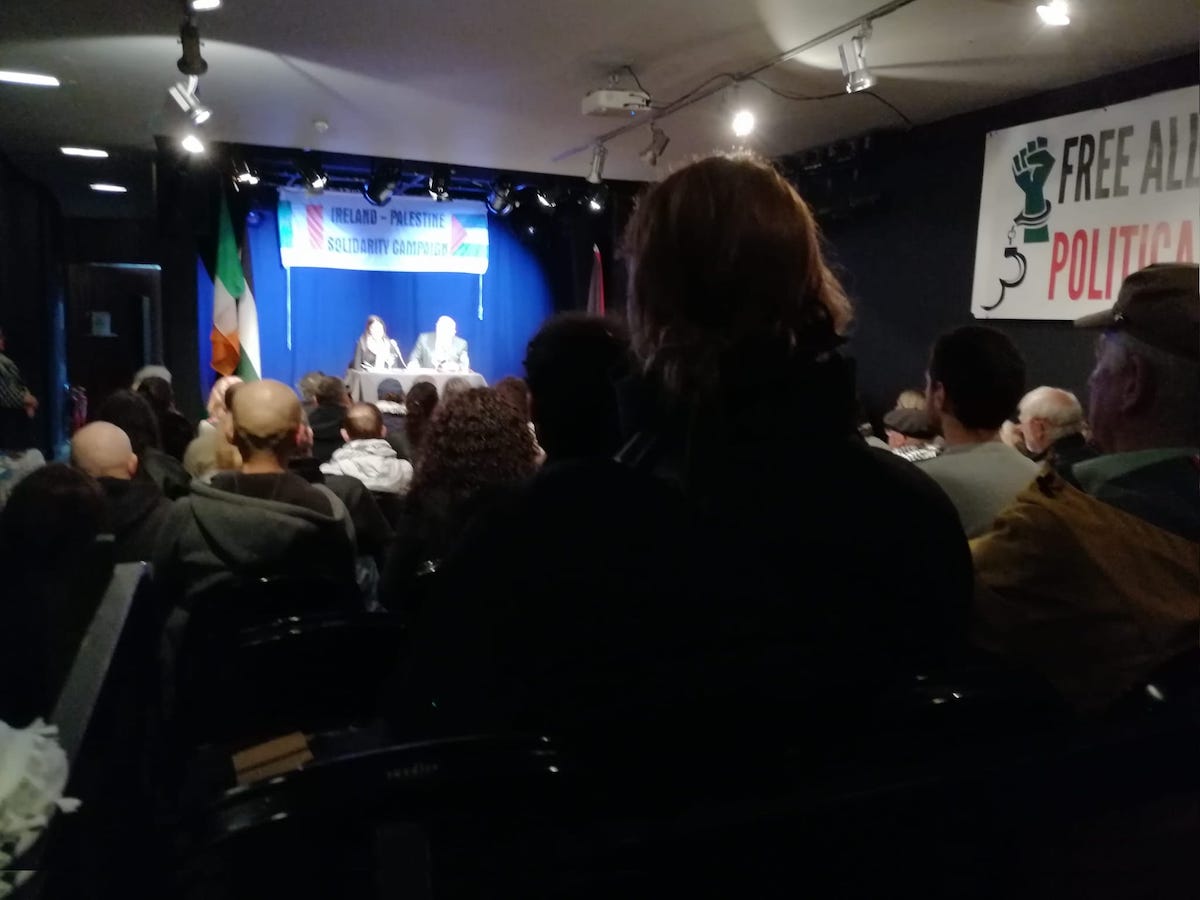
Tala Nasir, a lawyer of the Adameer organisation was introduced by Gary Daly (of Lawyers for Palestine group) to the audience in the theatre of Pearse House, formerly the home of Patrick and Willie Pearse and sculpture business address of their English father (and of Willie).
Ms. Nasir informed the packed audience that Israel has declared her organisation of Palestinian prisoner support and advocacy to be a “terrorist” on “evidence” they declare “secret” but the absence of which results in no other state accepting that designation in the case of Adameer.
“Once you’re a prisoner you will always be a prisoner,” stated Ms. Nasir, illustrating that in raids the Israeli military frequently detain former prisoners, often repeatedly. “Crimes” can include a comment on social media, “Liking” or sharing a comment against Israel.
Even the posting of a “green heart” symbol may be interpreted as a sign of support for Hamas and may become the reason for a person’s arrest. Children are most often accused of throwing stones, statements written for them in Hebrew, told to sign them, sufficient “evidence” for jail.
Ms Nasir said that 80% of the prisoners are held under “Administrative Detention” without trial and no defence is possible since the “reason” for it is secret and neither the accused nor their lawyer may see the allegations. The six months detention is automatic and can renewed repeatedly.
Prisoners must buy their own food from the canteen but after October 7th it was closed for periods. Child prisoners told Adameer: “We wake up hungry and go to sleep hungry”. Typically adult prisoners have lost 15-20 kg from their previous weight when released.
The prisoners were prevented from going out of their cells which also meant they were unable to shower for many days and also had to wear the same clothes every day. They were also humiliated through being blindfolded and strip-searching, sometimes by male, sometimes female soldiers.
Beatings are common and prisoners have commented on their transport vehicles not only smelling awful but seeing the floor covered in blood. Sixteen prisoners have been killed in the last 6 months and though autopsies have recorded bruises and broken bones, Israeli investigations are closed.
All but one of the Israeli prisons are in the “Israel” area and the lawyer is not permitted to visit the prisoners there without special permission, which is why, she said, so many of the Palestinians are transferred to those prisons, which she maintains is a war crime.
Declaring her greater trust in and dependence on the solidarity of the people of the world, “in particular the global South” who have had similar experiences to those of the Palestinians, the Palestinian lawyer nevertheless said that she has to practice diplomacy at times.
Tala Nasir called for the widest possible support for Adameer’s Call For Action, which is the simple task of sending text supplied emails to two specified officials responsible for prisons and prisoners telling them they will be held answerable for war crimes.
The Ireland Palestine Solidarity Campaign have a march booked in Dublin for this coming Saturday 23rd April, commencing at the Garden of Remembrance at 1pm.
A spokesperson for IAIC stated they would be on the streets again in order to proclaim the continue existence of political prisoners in Ireland and that Republican activists are essentially being interned without trial from no-jury political courts to spend two years or more in jail awaiting trial.
“The IAIC is a democratic non-sectarian independent organisation,” the spokesperson said “and welcomes support from concerned democratic people and we’ll continue to fly the Palestinian flag. If people follow our page they should receive adequate advance notice in order to attend.”
The past six months of an almost incredible level of Israeli genocide and Palestinian resistance have taught the world some valuable lessons but particularly perhaps to those of us living among the Western powers.
The Palestinians have taught us the strength and value to an occupied and oppressed people of resistance, from generation to generation, maintaining and developing culture and nurturing historical memory while the occupier tried to erase it all and make the endeavour seem hopeless.
Palestinian woman in Gaza defiant, January 8, 2009 (Photo cred: Eric Gaillard/Reuters)
Without a navy, air force, tanks, armoured vehicles or standard artillery (apart from home-made rockets and missiles), they faced what is often called the “strongest military power in the Middle east”. Despite periodic massacres they have regularly risen against the oppressor.
In truth, it was a lesson that at one time we hardly needed in Ireland, learned even earlier than the Palestinians. But we needed reminding of it.
It is also important for the morale and dignity of the resistance that it shows itself capable of striking at the enemy.
We’ve been reminded of the importance of long-term preparation. The Palestinian resistance built kilometres of tunnels underground in which they also set weapon production factories, developing their own weapons and repurposing existing weapons, including unexploded Israeli Army bombs.
In their Al Aqsa Flood attack on October 7th and fighting since, the Palestinians taught us the value of not only of daring and prior preparation but of coordination and unity, as a number of resistance organisations cooperated in struggle, some secular and some Islamic fundamentalist.1
Palestinian resistance fighters from different organisations displaying their unity in struggle in this photo (Photo sourced: Internet)
In meeting the subsequent genocidal rage of the occupier, the Palestinian resistance have taught us that all the technological might and expertise of the enemy was incapable of crushing a prepared, courageous, united and determined resistance.
The Israeli domination of the air from which it rained down genocidal bombing on civilians and civilian infrastructure, or targeted assassinations of the families of resistance fighters, was not sufficient to defend its ground troops from attack and is itself under attack from GTA missiles.2
The occupier was effective only in genocidal actions against the civilian population and civilian infrastructure for which it will forever be reviled in historical memory. It achieved neither of the objectives it declared as it unleashed its war against Gaza: the wiping out of the resistance and release of captives.
Imperialism
We been shown – if we were willing to see it – the unity of western imperialism in supporting the ‘right ‘of a European settler group to establish itself on the land of the indigenous, creating an ethnocentric and theocratic state founded with an act of ‘ethnic cleansing’.3
We have been taught the willingness of the western imperialist states to tolerate the proliferation of acts and policies which it claims go against its fundamental liberal values: oppression, apartheid, discrimination and repression, while lauding the ‘European liberal values’ of the occupier state.
Betrayal
Another lesson which we should have learned too within the necessity of unity in a broad front is that it needs to be on a principled basis and the dangers in unity without such safeguards, leading to treachery, betrayal and collusion with the occupier.
The secular left-wing Fatah4 organisation may have seemed at one time the ideal one to follow though some would have favoured the further-left People’s Front for the Liberation of Palestine.5 But it was Fatah, as leading element in the PLO alliance, that signed up to the Oslo accords.6
In return for limited autonomy in a fraction of Palestinian land and without consideration of the right of return to the expelled Palestinians, the Fatah leadership with Yasser Arafat at its head agreed to this “peace process” while its officials scrambled for the gains of official corruption.
Hence the Palestinian Authority, corrupt, unrepresentative, undemocratic and repressive, working in collusion with the occupying authority. Again, our own history should have taught us that lesson but again, it is good to be reminded.
The Palestinians taught us how to deal with such a poisonous fungal growth with the Second Intifada and their last elections, those of 20067 and the carrying through of the electorate’s wishes in 2007, along with the ongoing resistance since.
Western Mass Media and alternatives
In reporting the events in Palestine over the decades but in particular over the last six months, we have learned the heavy anti-Palestinian and pro-Israeli bias of the WMM, that accepted without question the transparent lies of the Israeli regime and even questioned the massacre statistics.
Never once has the unjust claim of the occupiers to their stolen gains been questioned, never once the fundamentally just claim of the indigenous even mentioned. The Palestinian resistance has been reduced to one organisation in reporting, to be held up as a bogeyman monster.
(Image sourced: Internet)
If atrocities from across the Palestinian people were reported in the media, they were framed as of dubious provenance, while the most outlandish and illogical claims of the occupier were reported as reasonable fact.
We have, in fact, been taught not to trust the western mass media when reporting on international events and, by extension, not to trust it on domestic issues either. Conversely we have learned to rely more on alternative Internet media but also on the need to navigate those with some caution.
We have also learned that some of the most prominent alternative sources on the war between NATO/Ukraine and Russia, attacked by liberals and sections of the Left as “Russian-controlled” or “Putinistas” turned out to be the most reliable in reporting the realities of the Israeli genocide.
Internationalist solidarity
We have relearned the importance of international solidarity, both as we expressed it ourselves and saw its outpouring across the globe. We have been taught the existence of an alternative world of human solidarity in opposition to one based on expropriation, exploitation and competition.
We saw Hizbolah in Jordan and Syria come to the assistance of the Palestinians and pay the price for doing so, as did Ansar Allah (“Houthis”) in Yemen and as has also Iran — what the Electronic Intifada has called “the Axis of Resistance”.
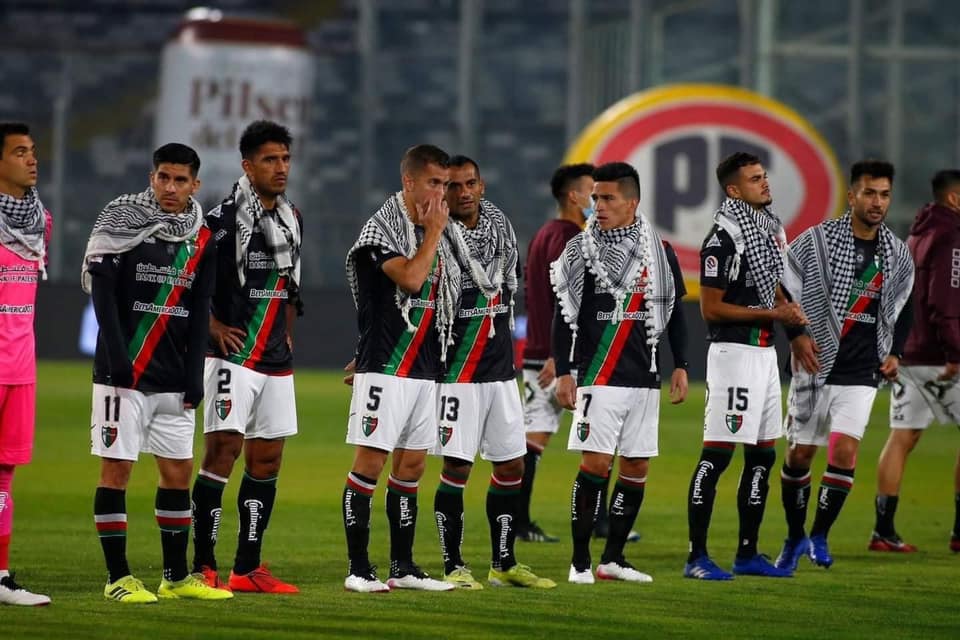
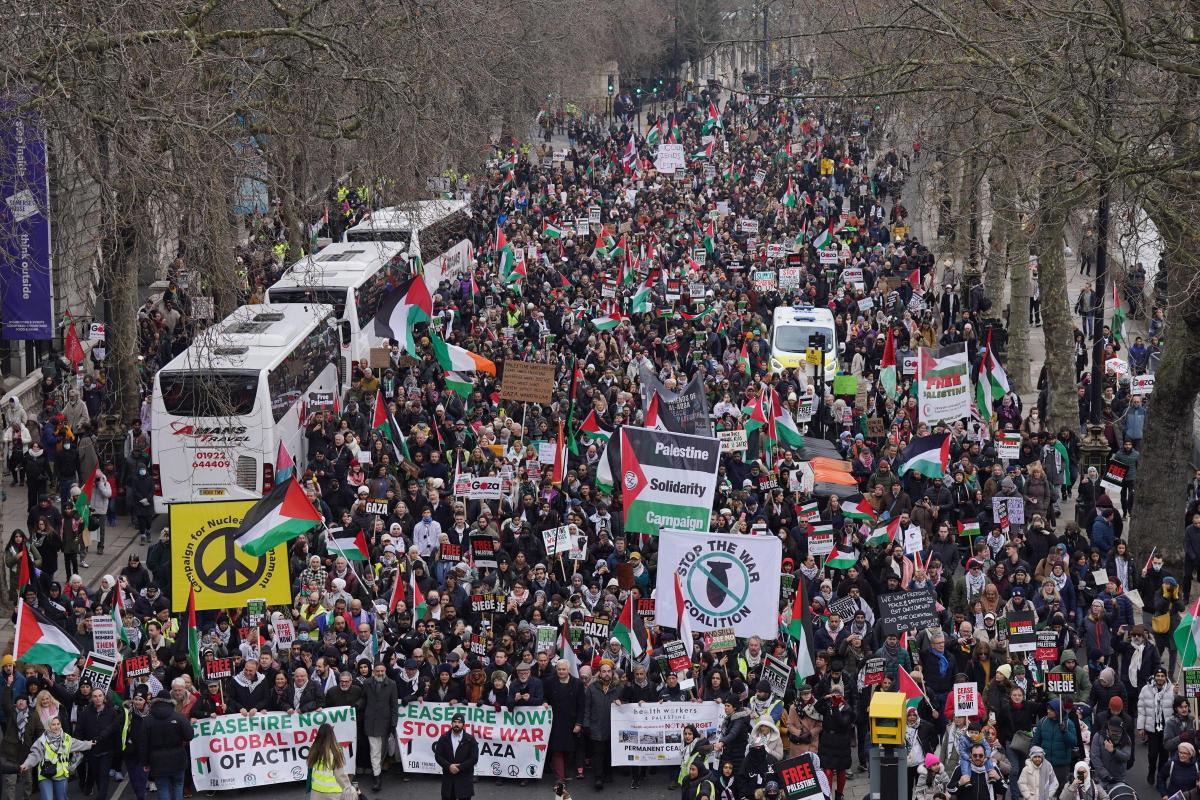
Chilean football team players May 2021 (Photo sourced: Internet)London, January 2024 (Photo cred: PA)
And we have learned to use internationalism as a measuring stick also in evaluating institutions, political parties and politicians in our own countries. We have seen the meaning of anti-semitism twisted and employed in repression with a stifling censorship across public life – academic, political and social.
Downing Street (containing home of the UK Prime Minister) 29 December 2023 (Photo sourced: Internet)
Political parties and politicians have revealed either their complicity in and collusion with the criminal Israeli genocide or alternatively their inability to resist and effectively oppose it. That has exposed their lack of fitness to lead us in our domestic struggles too.
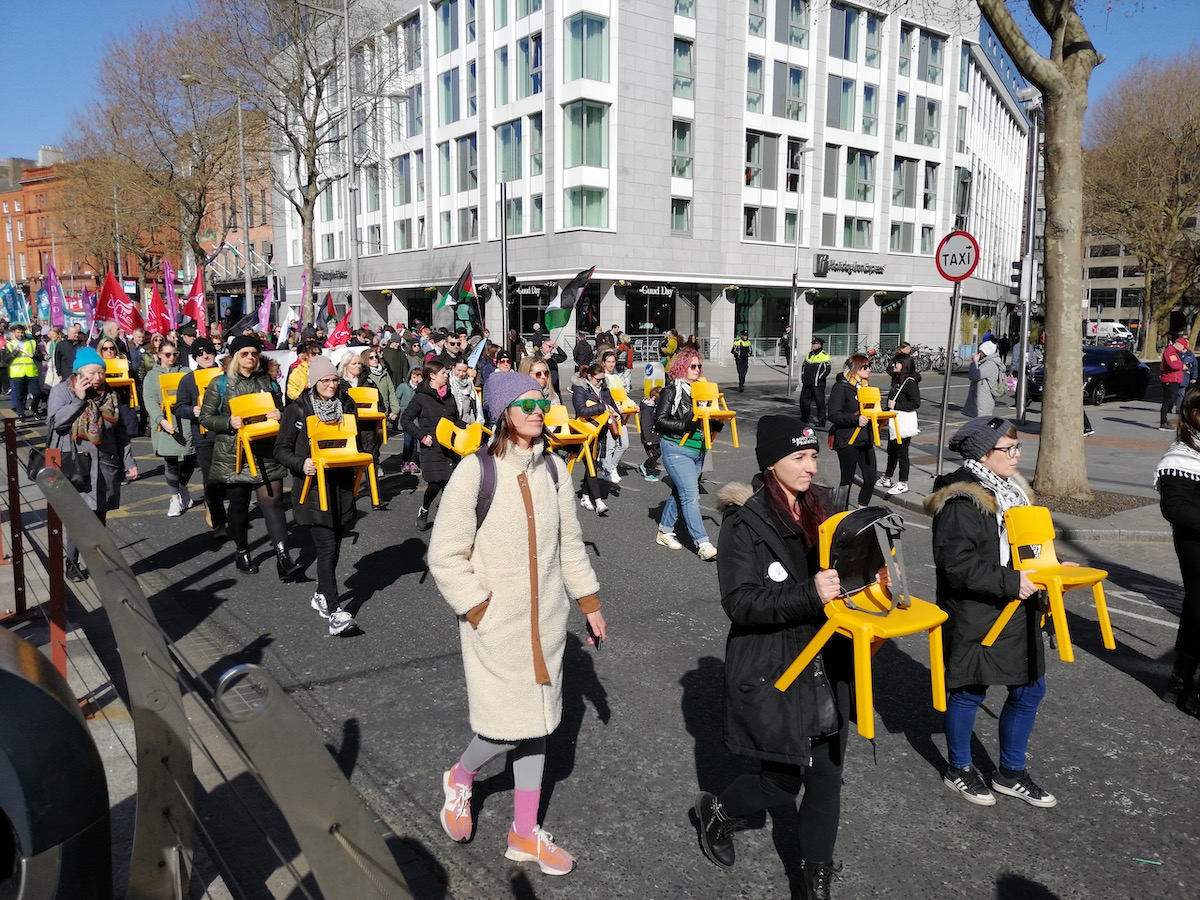
Teachers and others in Palestine solidarity demonstration in Dublin, March 2024 symbolically carrying infant school chairs in protest against the Palestinian children murdered by the Israeli armed forces. (Photo: D.Breatnach)
IN CONCLUSION
The need for revolutionary resistance
The Palestinian resistance has taught us important lessons, including the need of revolutionary resistance in addition to revolutionary organisation and preparation.
It remains to us to learn those hard-earned lessons, to internalise them and to apply them externally. We owe that to the Palestinians and to ourselves.
End. (Read alsoPart B – What the Israeli Zionists have taught usfollows.)
FOOTNOTES
1Hamas – Izz ad-Din al-Qassam Brigades; Palestinian Islamic Jihad – Al-Quds Brigades; Popular Resistance Committees Al-Nasser Salah ad-Din Brigades; Popular Front for the Liberation of Palestine’s Abu Ali Mustafa Brigades; Popular Front for the Liberation of Palestine – General Command Jihad Jibril Brigades; Democratic Front for the Liberation of Palestine (DFLP) – National Resistance Brigades, Al-Aqsa Martyrs’ Brigades; Palestinian Mujahideen Movement and its Mujahideen Brigades.
3The expulsion of 700,000 Palestinians and massacres such as the one in the village of Dir Yassin.
4Fatah wasfounded in 1957 and was the majority party in the Palestine Liberation Organisation.
5The PLO was founded in 1964 and the PFLP in 1967, next in size of organisation in the PLO to Fatah (Islamic organisations were excluded from the PLO; Hamas recently proposed the reconstruction of the PLO open to all resistance organisations).
6The Oslo Accords were the result of a number of conferences, overseen by the USA and was part of the second of the current“peace processes” which include Ireland, the Basque Country and Colombia.
7Hamas won the elections throughout the accepted Palestinian territories but Fatah tried to continue to keep control, being dislodged from Gaza in 2007 by Hamas, which held back from doing the same thing in the West Bank which has remained under the undemocratic, repressive and colluder control of the Palestine Authority.
Thousands on Saturday (24th) witnessed Palestine supporters demonstrating outside the Israeli Embassy in Dublin’s Ballsbridge, their reactions for the most part ranging from neutral to applause, some having their photos taken alongside the picketers.
On this Saturday there was no Palestine solidarity march in Dublin and some instead attended a picket of the Zionist Embassy.
There were also a handful of hostile provocative reactions, ranging from mention of “the hostages” to cheering “Israel” and one who tried to make an issue of Jewishness but was firmly told that opposition to Zionism has nothing to do with anti-semitism.
Palestinian solidarity flag displaying designed by Brazilian political cartoonist Carlos Latuf during an earlier attack by the Zionist State on Palestinians.The building housing the Israeli Embassy is in the background. (Photo:Rebel Breeze)
Those who mention “the hostages” refer only to the 130 or so prisoners taken by the Palestinian resistance in their operation of October 7th, never to the thousands of civilians, including children, taken prisoner by the Zionist state and, if judicially processed, tried in Israeli military courts.
Initially the crowds leaving the Rugby game between the Irish and Welsh teams, seemed neutral as they passed the picketers but gradually grew warmer.
The handful of passersby who expressed support for the Zionist state were militantly denounced by the picketers as “Genocide supporters” but much more common from the crowds were signs of approval such as applause, thumbs-up and occasional cheers and clenched-fist gestures.
A few in the crowd also shook hands with or gave a fist-bump to a demonstrator and some also thanked the picketers.
Some asked to have their photos taken alongside a picketer, one also waving a borrowed Palestinian flag. A woman approached one of the demonstrators, removed her Ireland rugby colours scarf and wrapped it around the picketer’s neck, saying “We support you” before walking away.
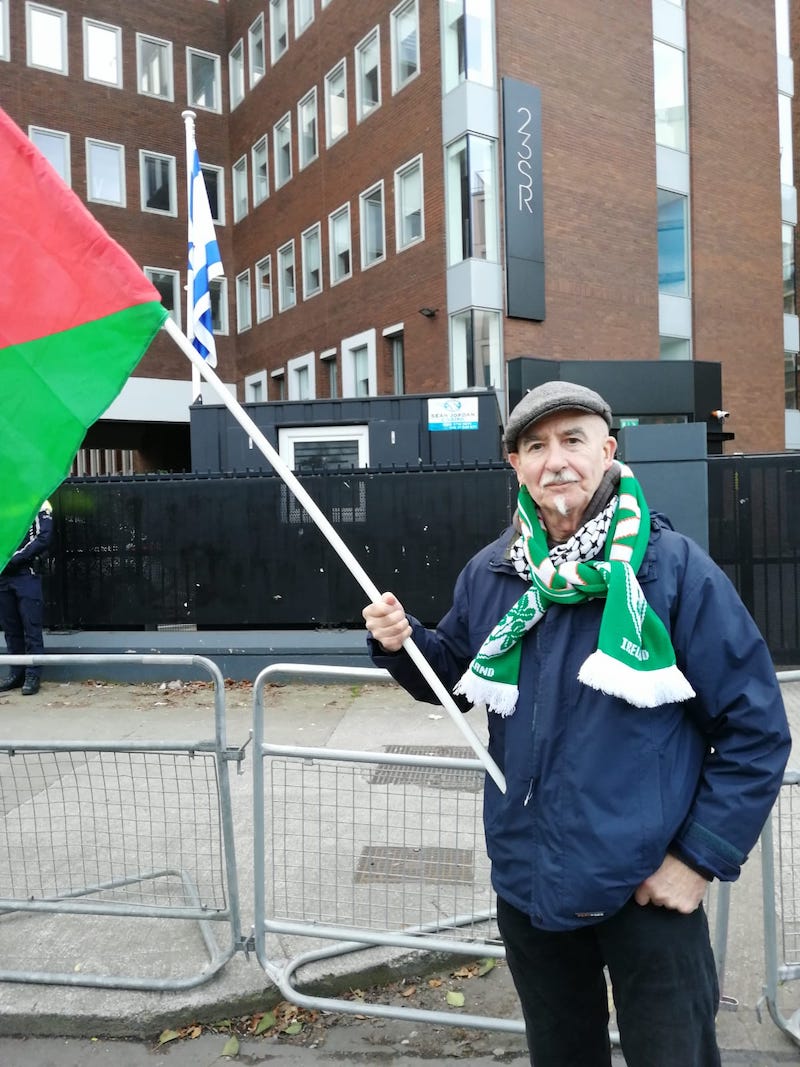
One of the Palestine solidarity picketers wearing the Irish rugby colours scarf with which he was presented by one of the Irish team’s fans returning from the game. (Photo: Rebel Breeze)
The nearly non-stop chants of the picketers, led by a young man of Middle Eastern appearance in a keffiyeh were directed at solidarity with the Palestinians and denunciation of the Israeli State, including calls for boycott and sanctions and the expulsion of the Israeli Ambassador.
One of the female demonstrators, a regular at the site, is garbed in white “blood-stained shroud.” At least half the picketers appeared Irish by appearance and accent. A majority were female, which seems to be the pattern in pickets, rallies and marches in solidarity with Palestine.
The thousands who passed the picketers were in contrast to the earlier near-deserted Shelbourne Road, as the Gardaí had closed the road to vehicular traffic in the vicinity of the Aviva Stadium where the Ireland rugby team was playing the Welsh one.
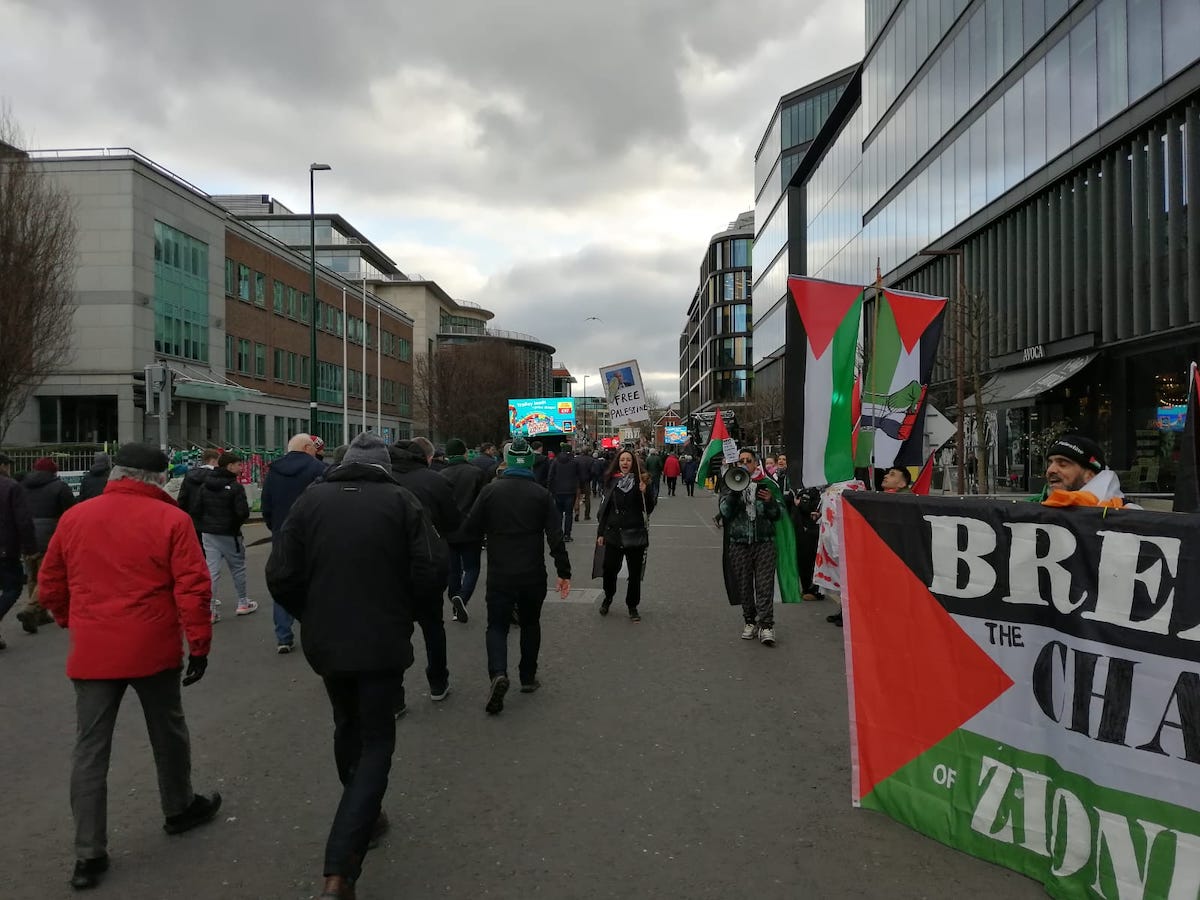
A fragment of the rugby fans leaving the Aviva Stadium after the game and passing the picketers. (Photo: Rebel Breeze)
The Israeli Embassy moved in 2019 to its current location on the fifth floor of a multiple-business-occupied building at 23 Shelbourne Road. Formerly the zionist embassy occupied an upper floor at Carrisbrook House, Northumberland Road, with every other floor unoccupied.
Some of the occupants of the current building, which is protected by a Garda presence, have reportedly asked their landlord to remove the Embassy but the request was denied.
When Gardaí reopened the road a senior Garda officer directed the demonstrators, ‘for their safety’, to remove from the road in front of the Embassy building to the side. However, it is the Gardaí who have barricaded off the entire section of pedestrian pavement in front of the building.
It seems likely that this will become an issue at some point in the future.
The scene outside the Israeli Embassy in Dublin shortly before the commencement of the protest, showing the pedestrian footpath completely fenced off by Garda barricades. (Photo: Rebel Breeze)
THE RUGBY
The Irish team beat the Welsh one 31-7 on Saturday. The Irish rugby team is a 32-County team, unlike soccer, where the Irish state and the colony each has their own ‘national’ team and are obliged to compete against one another internationally.
However, the song played for the Irish rugby team is the anodyne Ireland’s Call and not Amhrán na bhFiann/ The Soldiers Song, which is played for the Irish soccer team and in Gaelic Athletic games.
Rugby has gained in wider popularity in Ireland in recent decades but formerly in most parts of Ireland was considered a game for Anglophiles or “West Brits”.
Also, with the exception of Limerick, socially a game of the upper middle class, being played in Anglican colleges and in Catholic colleges of the English public school model.
Until the advent of the now-defunct Irish Press(1931-1995), neither of the main national newspapers, TheIrish Times nor TheIrish Independent reported on Gaelic Athletic Association games, reporting instead on the minority rugby, hockey and cricket matches.