INTERNATIONALIST SOLIDARITY — BUT WITHOUT CRITICISM?

Diarmuid Breatnach

One cannot criticise the national liberation movement or Left political party in another country, apparently. Or so some think. Why not? “Because it goes against internationalist solidarity to do so.” “Besides, one doesn’t live in the other country or maybe know their conditions and their culture as well as does the group one is criticising.” So, one should just applaud their resistance and say nothing negative. Apparently.

Like many positions, that seems fine until you break it down a bit. So let’s take a look at this more closely. The Khmer Rouge was a national liberation organisation of socialist or communist orientation in Kampuchea (Cambodia). The Khmer Rouge had both male and female fighters and they led a struggle against US Imperialism and against feudal rule in their country. The US carpet-bombed the country and aided the Cambodian Government in resisting the Khmer Rouge, who were in turn assisted by the North Vietnamese and the Chinese. So, a clear case of which side we’re on, right? With the Khmer Rouge. Against US Imperialism and feudalism.
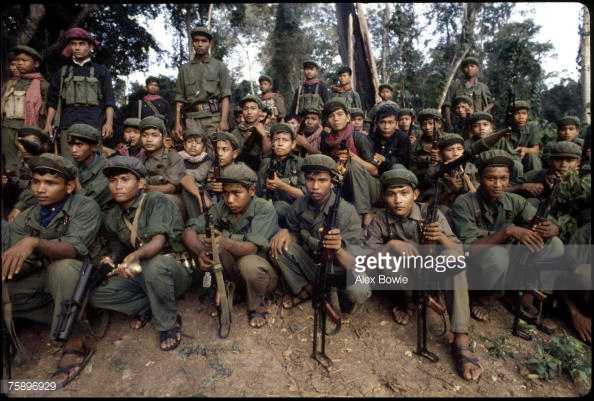
Khmer Rouge fighters
Khmer Rouge fighters (Photo: Internet)

But when in 1975 the Khmer Rouge leadership declared that all Cambodians needed to return to the land and, in order to implement this policy, exterminated all who disagreed or who they thought might disagree, and in the course of their programme caused hunger and illness which killed more, all of which came to a total of around 21% of the country’s population, what then? Are we still in solidarity with the Khmer Rouge then? What? No? We’re actually condemning them?
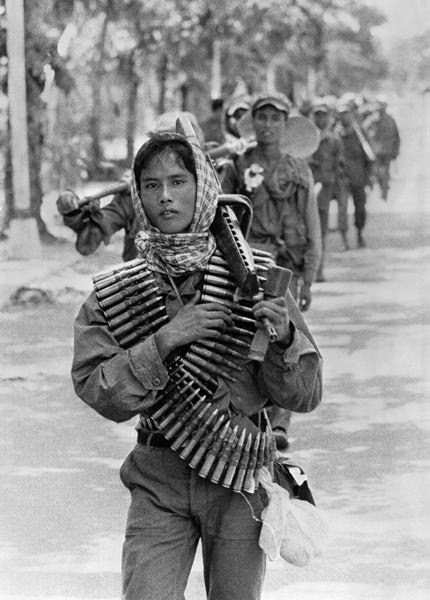
The young Khmer Rouge guerrilla soldiers enter17 April 1975 Phnom Penh, the day Cambodia fell under the control of the Communist Khmer Rouge forces.
The young Khmer Rouge guerrilla soldiers enter17 April 1975 Phnom Penh, the day Cambodia fell under the control of the Communist Khmer Rouge forces. Khmer Rouge fighters (Photo: Internet)

Good! And so we should. But what happened to “uncritical support and solidarity” and “we don’t know what’s going on there as well as the locals” etc, etc?

Ok, that was an extreme example and there was a massacre and huge loss of life. But the massacre event had a trail leading up to it and that trail could have been marked. Apparently two of the leaders back in their Paris student days had written theses advocating returning to a peasant economy. No doubt there were other signs in terms of who became leaders and how they maintained their leading positions – this was the time of the high tide of leader-worship, when in China photos of Mao and in Vietnam photos of Ho Chi Minh, predominated not only in official buildings but in public spaces and in the hands of their supporters abroad. Whether Ho Chi Minh or Mao Tse Tung were good or bad revolutionaries, or even a mixture of good and bad, is not the point. What is the point is whether it is healthy to treat living human beings as saints or gods; whether if you trust them unquestioningly today you will be able to question them (or be permitted to) if they take the wrong path or just a wrong turning tomorrow.

Now let’s take another example, much closer to home and much less in magnitude – the French Mayor of Vitry-sur-Seine in 1981 who, it was reported, in an anti-immigration demonstration, personally drove an earth mover to demolish a hostel for migrants from Mali. He was a member of the Communist Party of France and also the Party’s General Secretary, Georges Marchaise, ran a racist campaign when he stood as a candidate in the French Presidential Election that year. Now, the Communist Party of France had organised the Maquis and most of the urban French Resistance to Nazism and had led the liberation of Paris before the Allies arrived.  Surely Georges Marchaise had been elected by his large party and the Mayor of Vitry-sur-Seine not only by his party supporters but also by a majority of the people of his town. So who are we to criticise them, right? No, wrong, you think – and quite rightly so. We are not only entitled to – we should criticise them, expose them and try to get them to change.  And our criticism should also serve as a warning to any others thinking of taking the same path.
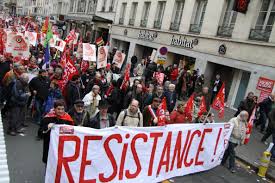
Anti-Austerity march of Communist Party of France in Paris 2012.jpeg
Anti-Austerity march of Communist Party of France in Paris 2012 (Photo from Internet)

Back to another big example now. Before WWI all the socialist parties in the world (that included what we would now call communist and social democratic parties) agreed that imperialist war would be a terrible thing and against workers’ interests. Some even vowed that if their governments tried to join a war, they would turn the imperialist war into a war against capitalism. But when it came to the crunch, the main socialist party in nearly every European country made an alliance with their capitalist class and recruited cannon fodder for them. There were very few exceptions and among them were the Irish Labour Party, which had been founded on a resolution by James Connolly in 1912 …. and the Bolsheviks. Although it didn’t openly oppose it, the Irish Labour Party was in general critical of the War and two of the party’s founders, Connolly and Larkin, overwhelmingly so. The Bolsheviks placed ending the War among their main slogans for insurrection and as a result recruited many soldiers and sailors into the actual insurrection.

OK, so would we have had the right to criticise the war collusion policies of the British Labour Party, of the German socialists, French, Italian, Belgian, Australian? Of course we would have had the right – and would have been correct to do so.

And another big example. The Shah of Persia was an ally of western imperialism and had a substantial repressive apparatus, including a huge secret service. In 1978/’79, a wide movement began to rise up against the Shah and his regime fell suprisingly quickly – so quickly that the CIA, who had their HQ for the Middle East in the country, were caught shredding their documents (many of which were pieced together again by Iranians).

There were a number of different interest groups but two important and very different ones were socialist activists, many of them students, on the one hand and Muslim fundamentalists on the other. When the Shah was overthrown, the latter group seized power and thereafter wiped out the socialists. I don’t know whether any mistakes were made by the socialists in their alliances or if anything could have been done to avoid the outcome. But if there were and if there was something, and we thought we knew what it was, would it not have been criminally negligent and uninternationalist of us not to have told them? And if necessary to have argued it with them?  And would our criticism not also help others who might find themselves in similar situations now and in the future?

Now, let’s take a minute to look at the other side of the coin. A leader of the popular movement Podemos in the Spanish state recently made a public intervention in Colombian politics the nature of which need not concern us here. But in the course of that, he denounced the Basque armed group ETA and likened them to Latin American fascist murder squads. Was he entitled to do so?

No, he was not. He was entitled to criticise ETA armed actions but in the course of that he should have taken account of the fact that the state in which he lives had practiced fascist repression on ETA for nearly a decade before it took up arms and has never ceased its repression of the Basque people since 1939. He was not at all entitled to compare ETA to fascist murder squads.

During the recent 30-year war, was the Communist Party of Great Britain entitled to publicly criticise IRA bombings in Britain, a number of which killed and injured innocent civilians? Yes, it was. But it was not correct to join the right-wing chorus denouncing them as vile murderers. And with the right to criticise also came a duty of solidarity, to campaign for British withdrawal from Ireland, against repression of the Irish community in Britain and for decent prison conditions and repatriation for Irish republican prisoners in jails in Britain (and the score of politically-framed uninvolved Irish prisoners).

To its shame, the CPGB took the road of histrionic censure but without taking up its duty of solidarity, an internationalist duty more applicable to itself than to any others around the world, since its party is based in the very colonial state that was waging war in Ireland.

I take one last example. At a certain point during the South African people’s struggle against the white racist regime (a settler ruling class which was totally supported by imperialism) it emerged that some things were not quite right within the resistance movement and, as time went on, that they were a lot worse than “not quite right”. We began to hear rumours that Winnie Madzikela Mandela was a member of a corrupt clique that had brutalised and even murdered people within the movement. But Winnie had become an icon of the struggle – a strong, handsome, militant woman with a husband, a leader, decades in jail. And the struggle seemed to be entering a crucial phase so, not wanting to undermine that struggle, we said nothing. (When her husband, Nelson Mandela was released, he agreed to an investigation into Winnie’s clique and ended up divorcing her. However, she is still a member of the ANC’s national Executive).

Worse, in a way, were the rumours of concentration camps being run by the ANC’s armed wing Umkhonto we Sizwe in neighbouring countries which were jailing ANC dissidents, torturing and even killing them. But the struggle was at a high point …… and we didn’t want to undermine …..

Yes, beginning to sound familiar, isn’t it? Besides, for some of us, the source of these stories were Trotskyists and we didn’t trust their bona fides too much ….. But it turned out that there had been these camps and they had done the things that were rumoured …. and testimonies of some of those cases have now been documented in the Truth and Reconciliation hearings. What’s more, it seems that some of the people in the ANC leadership were not only aware of them but had a hand in setting them up.

Mandela may not have known about them while in jail but learned of them at least when released. He eventually criticised the torture carried out in them but did nothing to root out those responsible.  This is crucial in terms of what happened later.

When the South African deal was done, an accommodation between the ANC and the white settler ruling class, it was also a settlement with imperialism which not only continued its plunder of the South African resources and labour but increased it. The masses got the vote and little else but a top stream of the ANC, SACP and NUM benefited in terms of government jobs and corruption. The recent head of the National Union of Mineworkers and current Deputy President of the ANC, Cyril Ramaphosa, is a millionaire and on the board of Lonmin, a British corporation mining platinum in South Africa.

In 2012, workers went on strike at Lonmin and other mines, looking for substantial pay rises; many were saying that the NUM was not fighting for them and wanting representation by a new union, AMCU. The mine-owners refused to negotiate, SACP said the strikers should be arrested, Ramaphosa asked the Government to crack down on the strikers, Zuma (President of the ANC and of South Africa and one of those implicated in the concentration camp scandal) covered for his Chief of Police Riah Phiyega while she organised what followed – the massacre of 34 striking miners in one day (in addition to some more over previous days) and many injured.

The Marikana Massacre of striking miners by the South African police of the ANC government. The victim in a green top or blanket is believed to a Mgcineni Noki, a strike leader, who was shot 14 times.
The Marikana Massacre of striking miners by the South African police of the ANC government. The victim in a green top or blanket is believed to be Mgcineni Noki, a strike leader, who was shot 14 times.  (Photo from Internet)

The Marikana massacre brought many of the elements that had been separately visible earlier together into high relief: ANC, NUM and SACP (South African Communist Party) corruption and jobbery; intolerance and brutality against any dissent; collusion with the white settler regime and foreign imperialists – now coupled with exploitation of black workers and murderous repression on a scale not seen in a single incident in South Africa since the Sharpeville Massacre of 1960.

Were we right to have said nothing about the activities of Winnie’s gang? And not to have tried to check out the rumours about the concentration camps? Were we right to say nothing critical about Mandela and the deal he led the people in accepting? I don’t think so. I think we had an internationalist right to speak, comrades – an internationalist duty. And it was a duty we failed to fulfill.

I could have picked so many other examples from history but I chose these as being ones on which most people would take the same side, so as to get the principle across without sectional positions being taken.

There is another very important role of criticism. It helps to clarify things for us in our own struggles. We have to think things through (hopefully) before criticising and then consider and weigh the reply we receive, then think about our reply to that as well. And so on. And many if not all of these issues will be in some way applicable to us too, either now or in the future.

But in criticising, do we abandon solidarity? Most assuredly we should not. Obviously we could have had no solidarity with Pol Pot and his clique or with his party comrades who followed them – our solidarity is fundamentally with the people and it was the Cambodian people who deserved our solidarity, which in that case had to be oppositional to the party. But we should, as well as being in solidarity with the Mali migrants in Vitry-sur-Seine in 1981, also be in support of French workers there in struggles against French capitalism, while simultaneously criticising any racist tendencies in their movement or parties.

We could and should have, were we adults during WWI, have criticised the policies of the socialist parties who colluded in the bloodbath of Europe, the Dardanelles and the Middle East, even if we had never set foot in one of the countries of those parties at the time.

Maybe it would help to bring the issue down to a more personal level. In families, we generally accept that we should express and act in solidarity with one another. Does that mean that if someone in our family does something really wrong, we should remain silent? Clearly not. We can support him in changing, we can support him in other ways but we cannot – or should not – support him in continuing to act wrongly. For the good of society, the family and even of the individual, we are obliged to point out the wrongdoing and that we disagree with it – in other words, to criticise. What kind of family members would we be if we did not do that, if our attitude were “Whatever you do is fine, no matter what it is or who ends up getting hurt, you or someone else”?revolutionary solidarity
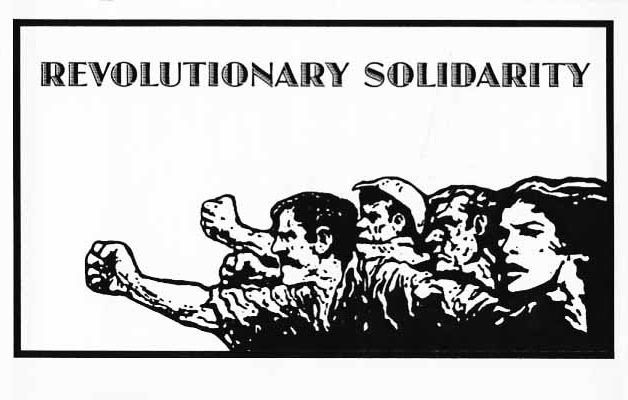
And if we are internationalists, of whatever particular socialist trend, we have an internationalist duty to our ‘family’ around the world not only to act in solidarity but also to express criticism when we think our comrades elsewhere embark on the wrong road or take a wrong turning. Proletarian internationalism and uncritical support not only don’t go together – they are actually opposites. There may be considerations of in what manner to present the criticism but continued silence is not an internationalist option.

end
BLACKMAILING AND BULLYING A CHILD FOR PEACE

Diarmuid Breatnach

A Derry schoolboy has been subjected to emotional blackmail and pressure by his school to sign a “peace scroll” and, arising out of an altercation over his refusal in which it was alleged he was being “sectarian”, was sentenced to two after-school detentions.  Why is he being treated in this way, what is this “peace scroll” about and who is promoting it?

According to Pauline Mellon, writing about it in her blog, a boy in her Derry community in September last year was pressured by a teacher in his school to sign a “Peace scroll” with which a Reverend David Latimer is trying to create a world record with the number of signatures. “The child was told by a teacher that he would be ‘the only child in the North not to have signed’ and was further questioned as to whether his refusal was sectarian in nature.” Not surprisingly, the child reacted to this suggestion and used a word for which the school seeks to discipline him.

The school has a policy (on “abusive language”) which makes no provision for contributing factors,” says Pauline Mellon. However, although the school Board is sticking to the letter of their policy in this regard, they seem not quite so rigorous in upholding their own procedures in other respects.

When the parents questioned the School Principal over his decision to impose two detentions and what circumstances if any he had taken into consideration, the Principal immediately cut off communication with them and escalated the issue to stage 4 of the school’s complaints procedure. Stage 4 of the school’s complaints procedure requires a written submission to the Chair of the school board from parents.”

Although the parents at this stage had made no such written submission, a sub-committee of the School Board declared that they had investigated the complaint (from whom?!) and upheld the Principal’s decision. The sub-committee had decided to use as “a written submission” some letters written by the parents to the Principal after he refused meet them, thereby violating the parents’ rights to prepare their own submission if they wished to go to Stage 4 of the Complaints Procedure and, indeed, violating the terms of the Procedure itself.

As if to underline their casual attitude to their own procedures, the School Board wrote to the parents to outline their “findings” without even using the school’s headed paper. When this was pointed out to them, the Board apologised for sending the decision on plain paper and said it would not happen again. However, there was a much more significant breach of their procedures, in that the sub-committee had kept no minutes of their meeting, about which the parents have learned only recently. Then when the parents did actually submit a level 4 submission, it was totally ignored.

As Pauline Mellon observed, the Chairman of the Board was in breach of his duties according to “Department of Education guidelines which state that the chairperson has responsibility for all meetings and must ensure that minutes of ALL meetings are retained.”

One can imagine the impact of a comparable chain of events on any individual, let alone a child studying for his GCEs. The parents took him to a counsellor, after which they wished to discuss the counsellors’ report with the boy’s form teacher. The Board prevented this meeting, confusing the counsellors’ report with the parents’ “ongoing issues with the Board”.

Nine months after the first incident in this chain of events, the Board invited the parents to meet with them. The parents brought along an observer and the Board refused to allow the meeting to go ahead with the observer present and when the parents protested, they were escorted off the premises, witnessed by an Independent local authority councillor. The Board in this case is the authority and has the power and the school is also their territory. There are a number of people on the Board. In summary, they held the advantages of power, territory and numbers – yet they refused to allow two parents to be accompanied by an observer to support them (and at a later date to bear witness to what went on, should that become necessary). One must wonder what they had to fear in allowing this one additional person …. and why.

The School Board has a Parent’s Representative on it – the parents of the child sought a meeting with this person, not once but a number of times, but the person concerned has so far failed to meet with them. This is indeed extraordinary – how can anybodfy discharge their duties as a Parents’ Representative to the Board if they refuse to meet with parents who are in dispute with the Board?

There is a body which governs Catholic schools, of which the school in question is one – the Catholic Council for Maintained Schools (CCMS). This is an organisation of the Catholic Church but receives public funding through the Northern Ireland Executive. The parents took the issue to that Council. The CCMS admitted that headed paper should have been used in writing to the parents and commented that the school’s Board had not fulfilled their role; they also noted the parents’ attempt to discuss their child’s counsellor’s report with his form teacher but would not comment on whether the refusal would be normal practice. All in all, the CCMS considered that the Board’s actions of using a letter to the Principal as a submission and refusing the parents the right to submit their own Level 4 submission were “reasonable” and “in accordance with School policy”.

Presumably in their deliberations, the CCMS had discovered that the Board’s sub-committee had failed to keep any minutes but left the parents to discover this through other means at a later date. At a later complaint to the CCMS, the Council refused to acknowledge the failure of the School Board’s Chairperson in ensuring minutes were kept, as laid out in the Department of Education’s guidelines. Finally, the CCMS denied that any breach of the child’s rights took place.

The Chairperson of the CCMS is Bishop John McAreavey, who according to Pauline Mellon, has not even had the decency to acknowledge or respond to two separate letters the parents of the child in question sent to him. This was in contrast to the Bishop of Derry, Rev. McKeown who replied to the parents after they wrote to him. “Bishop McKeown who has knowledge in these matters agreed with the parents that a common sense approach should have been taken and expressed concern that such a small matter had used up so much time and energy.”

Pauline Mellon takes a similar line in concluding her article: “… a matter that should have never made it outside of the school assembly hall from the outset has exposed the School Board in question as being ineffective, unprofessional, non-transparent and unaccountable. It has exposed CCMS, a group acting under the wing of the Catholic Church, as not having learned from previous incidents when the Church has closed ranks and has attempted to silence people.”

As to the Rev. Latimer himself, the promoter of the “Scroll” signatures, although he promised the parents to look into the matter, they have heard nothing from him since.

Who is the Rev. David Latimer?

According to the Department of Education of Northern Ireland, Rev. Latimer is “a visionary”, for which term they offer no explanation apart from his Guinness Book of Records bid for “most signatures on a scroll” and his promotion of it in the schools. http://www.welbni.org/index.cfm/go/news/date/0/key/922:1 Indeed, it is amazing that 84 schools have signed up to the project, as the article says on their website  – even more so if none of those saw any wording to endorse and to which to encourage their children to subscribe (see further below).

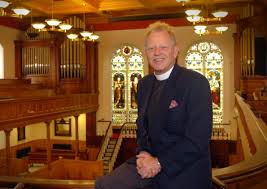
The Rev. David Latimer, photographed in church

David Latimer was a systems analyst with the Northern Ireland Electricity Board and married before he decided to become a cleric. He did so in 1988 and is now Minister of two churches, the First Presbyterian in Derry’s Magazine Street and the Monreagh Presbyterian, established in 1644 across what is now the British Border in Donegal.

In 2011, David Latimer was invited to address Sinn Féin’s Ard-Fheis and did so. On that occasion he said, referring to Martin McGuinness, that they had “… been journeying together for the last five years and during that time we have become very firm friends, able to easily relax in each other’s company.”

Rev. Latimer went on to say that “The seeds of division and enmity that have long characterised Catholic and Protestant relations were neither sown in 1968 or 1921 but during the 1609 Settlement of Ulster. Mistrust and bad feelings resulting from the colonisation of Ireland by Protestant settlers were followed by centuries of political and social segregation. Partitioning Ireland did little to ease sectarian mistrust and separateness between Protestants and Catholics left in the 6 counties as each community continued to be defined by its particular religious affiliation with little mixture between the two groups.”

The impression given there is of some peaceful colony of Protestants arriving in Ireland around 1609 which led to “bad feelings” and “mistrust”. No mention of the seizure of land from the Irish and their expulsion to the hills or abroad. No mention of the suppression of the religious faith of the majority and the imposition of that of the minority, centuries of discrimination, theft of land, genocide. One can see that this might quite rationally give rise to “bad feelings” and “mistrust”. No mention of the actual promotion by the British of sectarianism and the creation of the Orange order, with the intention of breaking up the unity between “Protestant, Catholic and Dissenter” of the United Irishmen at the end of the 18th Century.

It was again reasons of “little mixture between the two groups” which Rev. Latimer went on to blame for the recent 30 Years War:
“Little wonder this part of Ireland descended into a spiral of communal disorder and violence that was to last for decades. Victims of differences, extending back across trackless centuries that have isolated us from one another it is, with the benefit of historical hindsight, not surprising that our two communities should view each other with suspicion and regard one another as ‘the enemy.’”

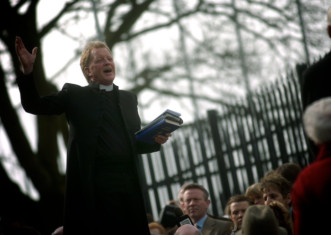
Dr David Latimer, First Derry Presbyterian Church, conducts a redediication ceremony on Derry's Walls. Photo: Stephen Laitmer
Dr David Latimer, First Derry Presbyterian Church, conducts a redediication ceremony on the City’s fortifications, “Derry’s Walls”. Photo: Stephen Latimer

Did the Catholics and Protestants go to war with one another in the late 1960s or at any time during the 30 Years War? No, what happened was that Catholics demanded civil and human rights of which they had been denied in that British colony-statelet since 1921; the state forces tried to suppress their peaceful campaign with batons, tear gas and bullets; right wing and sectarian forces among the Loyalists were mobilised and burned Catholics out of their homes and murdered some. The British Army were sent in to support the “Northern Ireland” sectarian police and the IRA came into limited action to counter them, after which hundreds of “nationalists” were interned without trial, followed by escalation of IRA action, the Paratroopers’ massacres in Derry and in Ballymurphy, and so on.

In fact, Latimer’s false account of history has been the standard British ruling class’ version to justify their war in Ireland for foreign consumption and to the British population throughout those years: the reasonable British with the thankless task of keeping the two tribes apart.

I found the content of the Latimer’s speech on SF’s website without an account of the audience’s reaction but according to the Irish Echo, an Australian on-line newspaper, it “received a rapturous reception from the republican audience”.

Reverend David Latimer and the British Army

Pauline Mellon says that according to the parents, “the child based his decision not to sign the scroll on Rev Latimer’s service in the British Army and with him being stationed in Afghanistan. The child also raised concerns over what he views as Reverend Latimer’s “selective” approach to local human rights issues.”

Surely the boy is mistaken? At least about him having served with the British Army? Well, actually no. In June 2008 Rev. Latimer gave an interview to the Derry Journal to explain why he felt justified in going with the British Army to Afghanistan although he had to “wrestle with his conscience”. Presumably he is an accomplished conscience-wrestler by now since he also admitted to having participated in other British Army missions for more than 20 years.

“It would be against my nature to be part of something that is creating destruction or generating pain or grief within any community”, he was quoted as saying. “The only way I can reassure myself in being part of this is that I am involved with a unit that is going out to provide resources to people who have no choice but to be there because they are under orders.”

Who are they “who have no choice …. because they are under orders”? Ah, yes, the soldiers, pilots and drone technicians who have invaded another country, killing those who resist and generally intimidating the population. Leaving aside the spurious question of “choice”, does one help justice by administering spiritual comfort to an invading army? To whom does one have a greater moral duty? The answer is clear I think and if one lacks the courage to stand up for the population the least one could do is not to offer comfort to their invaders.

Put perhaps Rev. Latimer intends to be some kind of Camillo Torres, preaching for the poor and castigating the wrongdoer? No, of course not. Well then, perhaps subtly undermining Army propaganda? He invites us to think so: “In the quieter times, I will be around for people who will have questions about what they are doing there and about God. I might not have all the answers but I am there to give a view different to the Army view.”

In what way his view might be different to that of the Army he once again fails to explain, or to inform us whether his views were also different on the other more than twenty occasions in which he served with the British Army previously. Surely if he were intending to undermine Army propaganda, he’d hardly be telling us and the Army in a newspaper interview!

http://www.derryjournal.com/news/rev-david-latimer-explains-why-he-feels-duty-bound-to-head-to-afghanistan-1-2126853

He tells us the hospital he’ll be working in over there will be treating Afghanis as well as British servicemen. Hopefully, they will be treating Afghani victims of torture in British and US Army prisons as well as children given a beating in the barracks. He won’t be trying to convert the Muslims to Christianity, he tells us. And I think we can believe that, since abusing people’s religion, their culture, customs, raiding their houses and generally intimidating them is hardly likely to incline them towards one’s religion.Rev Latimer British Army Uniform

Going on to discuss the possible dangers he would face, Rev. Latimer informs the readers of the Derry Journal that “We know the (military) base is likely to be attacked and we will undergo training in how to deal with chemical, biological and nuclear attacks.” He need not worry, the Afghans don’t have any of those weapons. However, he should exercise caution should he ever have cause to pass through the special arms stores of the British or US military, who do indeed have precisely those weapons and, furthermore, have used most of them in warfare at some point.

I will receive some weapons training, although this will be limited on how to disable a gun and make it safe.” Useful, just in case any member of the Afghani resistance accidentally drops a gun …. perhaps when calling on the Reverend to make enquiries about the philosophy of the Christian religion.

Peace” and “Peace” Treaties and Agreements

The vast majority of people would say that Peace is a good thing; despite that, “peace” remains a problematic concept and not one upon everyone can agree. And “peace” is also frequently being promoted in some part of the world by some of the most warlike states with the most horrifying armaments. For those in power, the invoking of the word “Peace” can be a powerful way of invalidating resistance, silencing dissent and of justifying the status quo which has been achieved through vanquishing the enemy in battle or by the recruitment of collaborators in the enemy’s leadership.

During WWI, the British and the French concluded the secret Asia Minor Agreement (also known as the Sykes-Picot Agreement), with the endorsement of Imperial Russia; the Agreement divided the Arab world between the French and the British should they succeed in beating the Ottoman Empire. To the shock and embarrassment of the imperialists, the Bolsheviks published the terms when they took power in 1917. Although this Agreement was intended to bring “peace” between the competing British, French and Russians, it has been in part the source of many wars with others, as well as coups and uprisings in the Middle East since then.

“Peace” does not mean the same to all: many of the British and French public during WWI would have said that “peace” meant defeating the Germans and Turks, conversely many Germans and Turks would have thought the direct opposite. The Russians mostly wanted an end to the War so “Peace” was one of the most popular of the Bolsheviks’ slogans for their October Revolution, after which they pulled Russian troops out of the War; it was one of the reasons so many soldiers and sailors sided with them.

The end of the First World War brought “peace” and “peace treaties”; among these was the Treaty of Versailles between Britain and France on one side and Germany on the other. In effect, the principal victors screwed Germany for war reparations, occupying the industrial Ruhr Valley. Many historians agree that the Versailles Treaty was a contributory factor to the later rise of the National Socialist Party (the “Nazis”) in Germany and also to the Second World War.

After WWII, the “peace” treaties  divided the world largely between the USA, the British, the French and the USSR. Some aspects of that division led to two big wars — the Korean and Vietnam Wars – and a host of smaller ones. The USA has fought 20 military engagements since WWII; the British have fought 28 and the French have been directly involved in 15 military actions or wars (these figures do not of course include the wars and coups fought by the many proxies of these powers). Furthermore, not one of those wars was fought on the territories of those states and, in most cases, took place far from them.

To look for a moment further than the three world powers above, Sri Lanka had a war going on inside it since 1983 and had peace talks a number of times. The origin of the war was the communal differences and inequalities promoted by the British when they ruled Ceylon as a colony and continued by the Sinhalese majority Government afterwards. In 2008, the ruling Sinhalese Government decided on all-out war and, abandoning the mutually-agreed ceasefire, surrounded the Tamil Tigers’ “liberated areas” with a ring of steel through which no-one could pass. They then subjected the areas to indiscriminate continuous shelling and air bombardment before sending in their troops, wiping out most of the opposing guerrillas but also thousands of civilians. According to UN estimates, 6,500 civilians were killed and another 14,000 injured between mid-January 2009.  The Times, the British daily, estimates the death toll for the final four months of the war (from mid-January to mid-May) at 20,000.

There’s peace in Sri Lanka now, all right — the peace of the grave.

Sri Lanka’s “peace” is similar to the one that followed the 1798 Rebellion in Ireland – that was “peace” after a defeat of the Irish Republican forces by bloody suppression and rabid sectarianism. Of course that “peace” was temporary only (as Sri Lanka’s will no doubt prove to be too) and was followed by other brief uprisings in 1803, 1848, 1867, the Land War 1879-’82, 1916 Rising, the War of Independence 1919-1921, the Civil War 1922-’23, the IRA campaign during WWII …. The partition of Ireland as part of the 1921 Agreement was supposed to bring peace to both parts of the country but again it proved to be a temporary one.

Despite the sectarian riots burning Catholics out of their homes and the wave of terror and repression by the Six Counties statelet in the early 1920s, conflict broke out again with the IRA’s Border Campaign of 1956-’62. In 1967 the Civil Rights campaign in the Six Counties began; the repression with which it was met by State and Loyalists caused the uprising of the Catholic ghettoes of Derry and Belfast afterwards. Then more repression, more resistance, then troops, then 30 years of war with the British Army and colonial police against the Republican guerrilla forces. The Good Friday Agreement claims to be bringing peace but history – and the ongoing repression of dissent by the statelet’s forces — indicates otherwise.

One of the reasons that peace is not necessarily brought by treaties and agreements is that they are themselves intended as temporary measures: by both parties, as in agreements between competing imperialist and colonialist powers, or by one of the parties, for example by the US Government in the case of the Native American Indians. Or they are violated by succeeding governments, as in the case of William of Orange’s promises in the Treaty of Limerick. Or they don’t deal comprehensively with the underlying causes of conflict, as with treaties and agreements between Britain and Ireland in general.

In fact, when a colonial or imperialist power seeks an agreement or treaty with a people or a weaker nation, what it is seeking is not usually peace but pacification – it wants an absence of conflict, or of resistance, so that it can continue extracting the benefits which it was doing before the people began to resist.

Or sometimes, the stronger power wants merely to delay things, to “buy time” until it is expects to be in a better position (and its opponent perhaps in a weaker one) than that which it was at the time. In 1925 the British Government intervened in a conflict between the mine-owners and the miners in Britain, paying a subsidy for nine months to prevent the miners’ pay from dropping. During that period, the Government laid in stocks of coal and bought up newsprint to prepare for a big battle with the miners’ union in particular. In 1926 they took on the British trade union movement and succeeded in forcing the TUC to call it off the General Strike within nine days of its beginning, leaving the miners to fight on alone for eight months until they were defeated.

So what kind of “peace” is being promoted by the Reverend Latimer? Some detailed plan, or some wishy-washy generalisation? That is not an easy question to answer. It is known to be an attempt to get into the Guinness Book of Records by having the most schoolchildren sign it which many have done, including in Donegal and Derry. Is it just a publicity stunt, where people sign up to some vague notion of “peace” which can mean one thing to one person and something completely different to another? What is the context for this “scroll”? “Peace” between whom and on what terms? Or is there a political agenda, as there was in the campaign around the Good Friday Agreement?

The Scroll’s FB page does not explain and the parents have not managed to find out; in addition a number of Google searches of mine failed to turn it up either. What is known about its origins, perhaps the only thing apart from it aiming at a world record, is that it is being energetically promoted by Rev. David Latimer.  And as we have seen, he goes on British Army missions and his role in all this is far from clear.


Schools in our society

Coming back to where we began, the pressure and attempted intimidation of a schoolboy is wrong and should not have been inflicted on this boy (and on who knows on how many others). It should not have been but it was and, when the parents objected, the agents of that blackmail, intimidation and repression should have backed down. And if they refused to back down, the managing agents, the School Board should have upheld the parents’ objections. And if they did not, the Catholic Council for Maintained Schools should have done so. All of them failed to do what was right.

As adults, we tend to see schools as neutral institutions, some with good standards, some not so good, with a continuum of teachers ranging from great to abysmal. Schools however do play a role in socialising children to accept authority and discipline outside the home and also into accepting ideas dominant in the society in which the school is located. Seen in that light, we should perhaps be less shocked at this treatment of a boy and his parents.

However this Guinness Book of Records project is not even part of the school’s official program nor of the State’s curriculum and it was the boy’s resistance to the undue pressure brought to bear on him that sparked the verbal response for which he is now being ‘disciplined’ and which he and his parents are resisting.

If the school were an institution dedicated to real learning, it would encourage questioning, even though its teachers and managers might find that uncomfortable at times. It would value courage and principle and instead of persecuting this boy, would encourage him and value his principled stand, his courage and his persistence. But instead it does the opposite and because the boy’s parents do value their child’s principles and courage and want to support him, they also find themselves in conflict with the school.

Such small-scale battles go on constantly everywhere in our society, in institutes of education, in workplaces, in other organisations and associations, in communities. People fight those battles, often on their own or in little groups, or they fail to resist; whichever they do will affect their individual character and their social and political attitudes thereafter, one way or the other. Drawing on those lessons can lead to understanding more general truths about society and can also help to develop the strength of character to withstand psychological and other bullying and pressure at other times in life. Fair play to the boy for his principles and the courage to stand up for them against authority figures and fair play too to his parents who are supporting him.

End.


Pauline Mellon’s article in her blog http://thederrydiary.blogspot.co.uk/2015/07/judge-jury-and-educationers.html


IN SPAIN THE PEOPLE SHOULD RULE — THAT WOULD BE DIGNITY

Rebel Breeze: This piece was received months ago but somehow got overlooked for which we apologise.  Events since then make the points in this short document perhaps even more relevant.

Red Roja describes itself as “a revolutionary marxist organisation active within the Spanish state”.  It states that it is “an autonomous organisation independent of any other party or organisation and also economically and politically independent of the State or of any other power, being anticapitalist, of the class, feminist, radically democratic, internationalist, anti-fascist and ecologist.”
(Translation D.Breatnach from http://redroja.net/index.php/que-es-red-roja/quienes-somos)

In Spain, ‘The people should rule — that would be Dignity’
Red Roja Red Network Rede Vermelha
Traducido por  John Catalinotto

The following is a statement of the organization Red Network in Spain to the Dignity marches of March 21, a year after a similar march brought 1.5 million people to Madrid to protest austerity measures.

On March 22, 2014, more than a million people from all over the Spanish state marched in Madrid for ‘Dignity’ against austerity.

On March 22, 2014, more than a million people from all over the Spanish state
marched in Madrid for ‘Dignity’ against austerity

We once again demand that those who caused the crisis be made to pay for it.

An unpayable debt is crushing us, we who suffer every day from unbearable job insecurity, dismantling and privatization of health and education, increasing retirement age, the disappearance of aid for dependents, and our millions of unemployed people who are worth less than nothing to those in power. … The austerity measures and cuts are only being used to pay for a debt created to rescue the gang of bankers, big business people and their servants in the National Assembly, who are playing chess with our lives. Besides using our suffering to line their pockets, they expect us to hang our heads and die in silence. That we refuse to do.

Regarding this, we are nowhere near satisfied with hearing only about “restructuring” or “audits” of that debt. We cannot stop at half-measures when our lives are at stake, when there can be no doubt that this debt is responsible for the criminal foreclosures, the endless unemployment and for the disappearance of even the modest steps taken against domestic violence that condemns many women to terror, suffering and death. It is not a technical problem to say, “NO DEBT PAYMENT.” It is a punch that the people can throw to demand control of their own lives.

In these times, it is understandable that there are illusions that an election can bring “victory,” that we can “throw out the PP” [the rightist Popular Party] or “get rid of the wealthy strata.” But more is needed. No one involved in the new electoral initiatives is speaking about the national and European laws that impose the payment of that illegitimate and criminal debt before anything else. Good will is not enough; neither is honesty. Proof of this is the victory of Syriza in Greece, which has not pushed back by even one step the measures the Troika [the European Commission, the International Monetary Fund and the European Central Bank] had taken against the Greek people. It has become clear who rules Greece: It’s the EU dictatorship. Democracy is an illusion.

Moreover, even this demonstration, though necessary, is insufficient. It is not enough to come together to demand “Bread, Work and Housing” (things that would only be possible after we refuse to pay the debt), or to have a great demonstration of dignity. As seen in Greece and as we see every day in our streets, bankers and big business are not going to give up lining their pockets out of good will.

We need to unite, to organize neighborhoods, towns, businesses and schools, and strike a blow together, all at one time. Only through the unification of our struggles, only if the people who are working and suffering get organized, can we bring about policies that work in our own favor.

The vote is not enough. The people need to organize. The people need to rule.

That would be Dignity.

TÁ OR NÍL — SAME-SEX MARRIAGE, SURROGACY, HOMOSEXUALITY

Diarmuid Breatnach

When the votes are counted after today, we will either have a new clause inserted into our Bunreacht (Constitution) or we will not. If we do not, many of the “Vote Yes” campaign and opinion will be despondent. The revolutionaries among them should not be so but should instead reflect on their weakness as a force and on how to make that force stronger.

Should the vote result in a change in the Constitution, it will be probably the biggest blow so far to the power of the Catholic Church in lay society, a power it has enjoyed and abused even before 1921 but certainly since. Some, on both sides of the question, will see it as a blow against the Catholic religion itself but that is not necessarily so. Christianity and its Catholic variant survived and even thrived without State support in the past – indeed when its followers were discriminated against in every conceivable way by State power, a situation its faithful endured for centuries in Ireland as a whole and continue to do today, to a lesser extent, in the Six Counties.

What is the issue upon which we were being called to vote today? Although the NO campaign has tried to make us think it is, it is clearly not about whether two-gender households are better for raising children, whether surrogate birthing is right or wrong. It is not about whether we approve or homosexuality or not – although I suspect that is the real issue at base with many of the NO campaigners. In fact, it seems to me that it would be quite possible to disapprove of homosexuality and still to vote “Tá”, a question I will return to later. This might seem illogical, until we examine the actual issue upon which we are voting: do we agree with inserting a clause into the Bunreacht (Constitution) which states that a couple has a right to marry regardless of gender.

Presented with this question, which is a legal and Constitutional one, a number of issues arise, I think.

  1. What does the Bunreacht say at the moment about this question?
  2. What right has the State to define anything about sexual relationships?
  3. Are we in favour of equal civil rights for people?

1. It may come as a surprise to people that our Bunreacht, our Constitution, currently says nothing about the gender issue in marriage. There is nothing actually in our Bunreacht to prevent same-sex marriage. But the prohibition does exist in law. In other words, legislators at some point decided to propose and pass a law which confined the right (and rite) of marriage to heterosexual couples alone. Why did they do so if it was not an issue at that time? It seems to me that they were aware that same sex relationships did exist and strove to exclude those people from the rights enjoyed by others. This was the point of a number of other pieces of legislation against homosexuality which were not finally overturned until 1993 in this State (1982 in the Six Counties, 1980 in Scotland, 1967 in England and Wales) – five years after the European Court of Human Rights ruled that this state’s laws against male homosexual acts violated human rights.

According to the Catholic Church (and most other churches), despite the current legal situation with regard to homosexuality at the moment, it is still wrong. Well, the Catholic Church – and before them the established Anglican Church of Ireland – can have their views but they are not entitled, nor is any other church, to impose those on lay society, neither by legislation nor by other means. They are, of course, entitled to express their opinion – just like any other organisation.

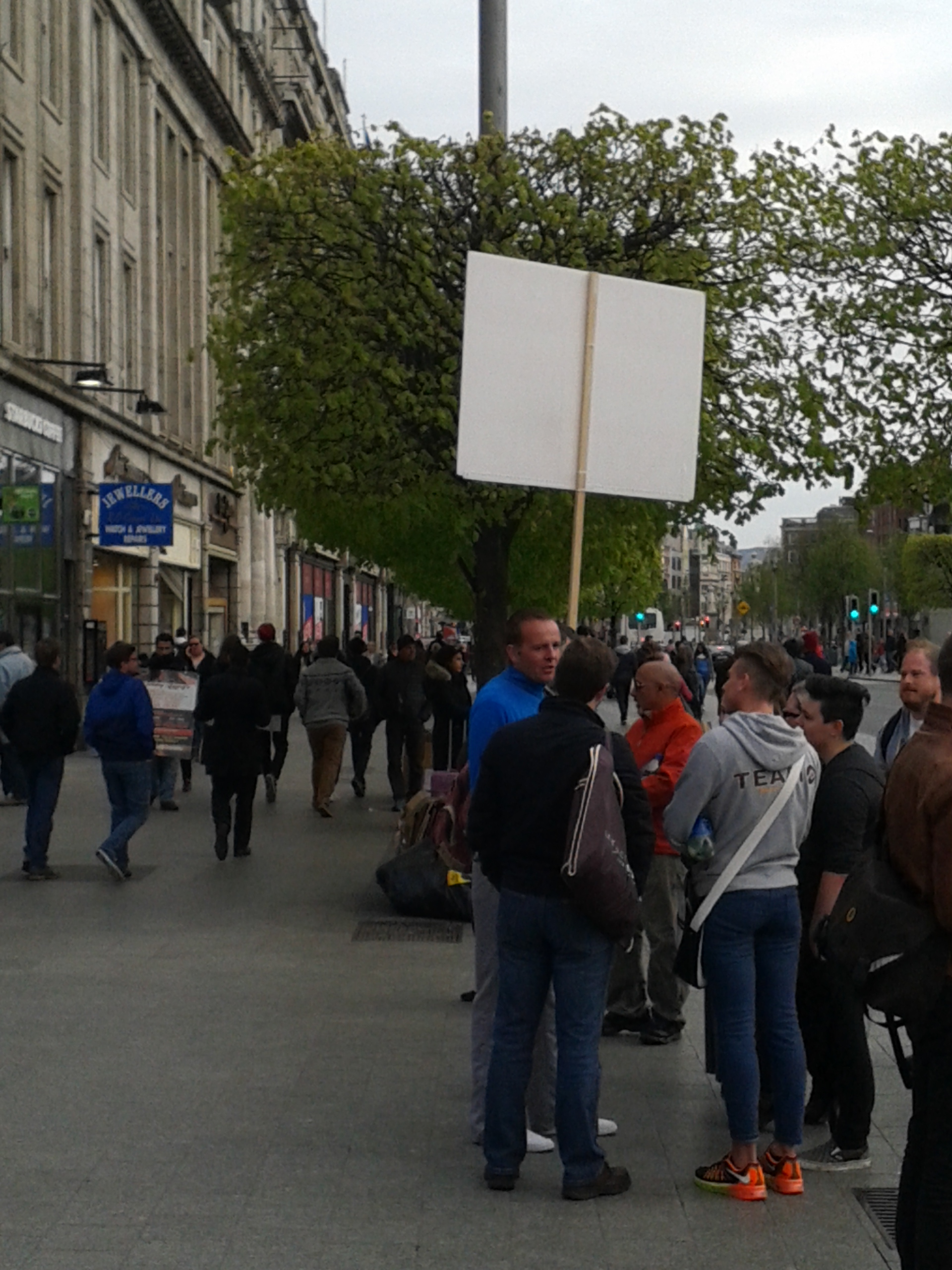
“God and Nature say NO” was the caption on this placard paraded in O’Connell St. near the Spire, some weeks prior to the Referendum. Some young people are arguing with the placard-holder.
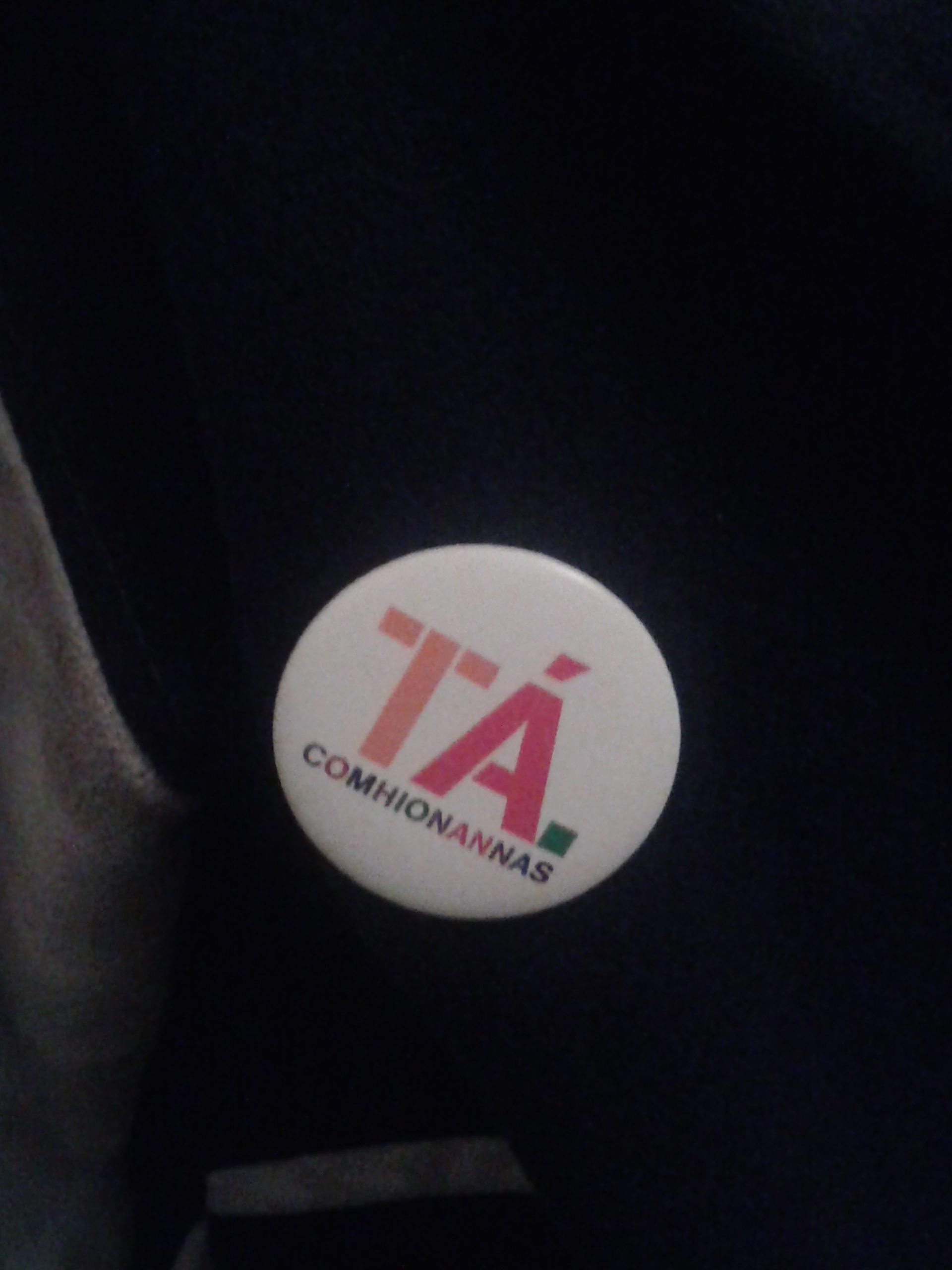
One of the many badges worn in support of a vote to insert the clause into the Irish Constitution (there was also an English-language one)
One of the many badges worn in support of a vote to insert the clause into the Irish Constitution. There was also an English-language one and each were to be seen nearly everywhere in public in the weeks prior to the Referendum.

So, going back to the beginning of the legal status of heterosexual marriage within our current legal system, it was introduced as an excluding measure, at a time when male homosexuality was illegal and subject to heavy punishment and when lesbianism was frowned upon (though not actually illegal for complicated reasons). In other words, a law excluding a group of people was passed at a time when any man who declared himself to be one of those people was subject to prison sentence and any woman who did so was subject to extreme opprobrium in society. What chance was there for their point of view to be represented? In the absence of such representation and informed opinion-making, how can any democrat defend the laws passed at that time?

2. Turning now to the question of what right the State has to make a ruling of any kind upon a sexual relationship between any two people, of either gender, it must be difficult indeed for anyone to justify that without recourse to church canon or prejudice. Those who do so tend to bring up questions of childcare, inheritance and taxation – in fact just about the same questions that were brought up in the Irish referendum on divorce in 1995. But childcare, or at least the financial aspect of it, can be regulated by the State without any interference whatsoever in the sexual relationship between the parents. Whether it does so fairly at the moment is another question which has no bearing on the concept. And inheritance – ignoring for a moment whether we agree with a political economy where land and other wealth may be appropriated by individuals or families and then legally handed on through their following generations — can also be managed without recourse to State regulation of marriage. Taxation, similarly. Were we to have a socialist society, one based on other principles than that which we now have, even those current excuses for state interference should no longer be even a consideration.  In fact, it is difficult to see any reason why even now the State continues to have a role in the formalisation of a sexual contract between two individuals or, indeed, in its dissolution, except perhaps in ensuring fair divisions of belongings.

3. Those opposed to insertion of the new clause into the Bunreacht have done so from a number of perspectives of opposition: to lesbianism and homosexuality on religious or other grounds; to formalising same sex relationships; to the alleged undermining of the “sanctity of marriage” or of “romance”; in opposition to surrogate child-bearing and raising of children by gay and lesbian parents ….

Those supporting the new clause have defended the naturally-occurring continuum of sexual preference; maintained that the “sanctity of marriage” will be the same between same-sex couples, as will “romance”; denied that it opens the way to or encourages surrogate child-bearing and raising of children within a gay or lesbian household ….

Who is right and who is wrong? There is no doubt that as long as cultural beliefs and practices have been recorded, homosexuality and lesbianism have existed within societies — sometimes tolerated, often repressed, on rare occasions celebrated. We see homosexuality occurring too among animals. If there is such a thing as “sanctity of marriage” and “romance”, why should same-sex couples have any less of it than heterosexuals? Surrogate child-bearing is already possible and the hugely unequal distribution of wealth in our society – and between even our society and many others – ensures it can and will continue while the rewards are financial. Raising of children within a same-sex household is already happening, even without surrogacy. It is more difficult for gay men at present, but in the case of a gay man having custody of his children through widowhood (yes, some gay men do marry women), or the mother deserting the children or being deemed unfit by a court to have custody, a gay man may bring up his children within a homosexual parent household.

But will this change in the Constitution (and therefore also in the law) make surrogacy and child-rearing by gay couples more likely to happen? Will it increase the frequency of its occurrence? I think the answer to that, logically, must be yes – despite all the denials of the “Vote Yes” camp. And I think some of them must know that. Slowly perhaps and who knows by how much – but logically it must tend to increase the chances. But is that so awful? I find the idea of surrogacy in general distasteful but isn’t that just a prejudiced reaction? Probably. Will children reared by same-sex parents experience uncertainty about their own sexuality? Some will probably and some won’t. And if they do, why should they not be able to resolve that in time – as children reared in heterosexual relationships also find themselves having to do? Is uncertainty about sexuality such a terrible thing? In a judgmental, prohibitive and penalising society, it can be – so let’s create a society that is the opposite.

However, I have to say that I think all those questions and considerations are beside the point. If marriage is to be a legal status, then it is a civil right for everyone who is at the age of consent (and of sufficient mental ability to know to what they are consenting — in so much as any one of us was or does!). The right to same-sex marriage, as a civil right, should be supported even by people who do not approve of homosexuality, or marriage, or surrogacy, of child-rearing in a homosexual household. As for myself, someone who seeks revolutionary social, economic and political change, who wishes to see the overthrow of this State, a revolutionary as opposed to a reformist, I must nevertheless support reforms that extend civil rights, even when not led from below …. and so I voted “TÁ”.

IRISH HISTORY … AND HERDS OF ELEPHANTS

Diarmuid Breatnach

Politics is about the present and the future, obviously … but it is also about the past.

Different political interests interpret and/or represent the past in different ways, emphasising or understating different events or aspects or even ignoring or suppressing them entirely. There is choice exercised in whom (and even what particular pronouncement) to quote and upon what other material to rely. And by “political interests” I mean not only groups, formal (such as political parties) or informal, but also individuals. Each individual is political in some way, having opinions about some aspects of questions that are political or at least partly-political. For example, one often hears individuals say today that they have no interest in politics, yet express strong opinions of one kind or another about the right to gay and lesbian marriage, the influence of the Catholic Church, and how the country is being run by Governments

So when an individual writes a history book, there are going to be political interpretations, although not all writers admit to their political position, their prejudices or leanings, in advance or even in the course of their writing. One historian who does so is Padraig Yeates, author of a number of historical books: Lockout Dublin 1913 (a work unlikely to be ever equalled on the subject of the title), A City In Wartime — 1914-1919, A City in Turmoil 1919-1921and his latest, A City in Civil War – Dublin 1921-’24. The latter was launched on Tuesday of this week, 12th May and therefore much too early for people for who did not receive an earlier copy to review it. So it is not on the book that I am commenting here but rather on the speeches during the launch, which were laden with overtly political references to the past and to the present. If a review is what you wanted, this would be an appropriate moment to stop reading and exit – and no hard feelings.

The launch had originally been intended to take place at the new address at 17 D’Olier Street, D2, of Books Upstairs. However the interest indicated in attending was so great that Padraig Yeates, realising that the venue was going to be too small, went searching for a larger one. Having regard to how short a time he then had to find one and with his SIPTU connections, Liberty Hall would have been an obvious choice. Whether he had earlier been asked to speak at the launch I do not know but, having approached Jack O’Connor personally to obtain the use of Liberty Hall, in the latter’s role of President of SIPTU, the owners of that much-underused theatre building, it was inevitable too that O’Connor would be asked to speak and act as the MC for the event.

O’Connor’s introduction was perhaps of medium length as these things go. He talked about the author’s work in trade unions, as a journalist and as an author of books about history. O’Connor’s speech however contained much political comment. Speaking of the period of the Civil War (1919-1923), he said it had “formed what we have become as a people”. That is a statement which is of dubious accuracy or, at very least, is open to a number of conflicting interpretations. The Civil War, in which the colonialism-compromising Irish capitalist class defeated the anti-colonial elements of the nationalist or republican movement, formed what the State has become – not the people. The distinction between State and People is an essential one in our history and no less so in Ireland today.

Talking about the State that had been created in 1921 (and not mentioning once the creation of the other statelet, the Six Counties) and referring to the fact that alone among European nations, our population had not risen during most of the 20th Century and remained lower than it had been up to nearly the mid-Nineteenth, a state of affairs due to constant emigration, O’Connor laid the blame on the 26-County State and in passing, on the capitalist class which it served. He was undoubtedly correct in blaming the State for its failure to create an economic and social environment which would stop or slow down the rate of emigration – but he did not explain why it was in the interests of the capitalists ruling the state to do so. Nor did he refer to the cause of the original drastic reduction in Ireland’s population and the start of a tradition of emigration – the Great Hunger 1845-’49.

The Great Hunger memorial on Dublin's Custom House Quay. The Great Hunger and its immediate aftermath initiated mass Irish emigration.
The Great Hunger memorial on Dublin’s Custom House Quay. The Great Hunger and its immediate aftermath initiated mass Irish emigration.

Even allowing for the fact that O’Connor wished to focus on the responsibility of the 26-County State, the Great Hunger was surely worthy of some mention in the context of Irish population decline.  Just a little eastward along the docks from Liberty Hall is the memorial to that start of mass Irish emigration. It was the colonial oppression of the Irish people which had created the conditions in which the organism Phytophthora infestans could create such devastation, such that in much less than a decade, Ireland lost between 20% and 25% of its population, due to death by starvation and attendant disease and due also to emigration (not forgetting that many people emigrating died prematurely too, on the journey, upon reaching their destination and subsequently). Phytophthora devastated potato crops in the USA in 1843 and spread throughout Europe thereafter, without however causing such a human disaster as it did in Ireland. In Mitchell’s famous words: “The Almighty, indeed, sent the potato blight, but the English created the famine.” And that is what makes that period of population decline uncomfortable for some historical commentators.

Indeed, O’Connor did not mention British colonialism once, nor Partition, nor imperialism. And nor did either of the other two speakers, nor the author. I remarked on this to an Irish Republican present, to which he responded with a rhetorical question: “Did you expect them to?” Well, yes, perhaps naively, I did. While not expecting an Irish Republican analysis from Padraig Yeates and perhaps not either from anyone he would consider appropriate to speak at the launch of one of his books, dammit, we are talking about history. The presence of Norman/English/British Colonialism for 800 years prior to the creation of the Irish Free State, and its influence on that state’s creation and on subsequent events in Ireland, is worthy of at least a mention in launching a book about the Civil War. Not to mention its continuing occupation of one-fifth of the nation’s territory.

Colonialism and Imperialism and, in particular, the Irish experience of the British variant, were not so much ‘the elephant in the room at the launch as a veritable herd of pachyderms. They overshadowed us at the launch and crowded around us, we could hear them breathing and smell their urine and excreta – but no-one mentioned them. The date of the launch was the anniversary of the execution of James Connolly 99 years ago, a man whom the Labour Party claims as its founder (correctly historically, if not politically), a former General Secretary of the ITGWU, forerunner of SIPTU and the HQ building of which, Liberty Hall, was a forerunner too of the very building in which the launch was taking place. His name and the anniversary was referred to once, though not by O’Connor, without a mention of Sean Mac Diarmada, executed in the same place on the same day. And most significantly of all, no mention of who had Connolly shot and under which authority.

That circumspection, that avoidance, meant that a leader of Dublin capitalists, William Martin Murphy, could not be mentioned with regard to Connolly’s death either i.e. his post-Rising editorial in the Irish Independent calling for the execution of the insurgents’ leaders. But of course he did get a mention, or at least the class alliance he led in 1913 did, in a bid to smash the ITGWU, then under the leadership of Larkin and Connolly. This struggle, according to O’Connor and, it must be said also to Padraig Yeates, was the real defining struggle of the early years of the 20th Century, not the 1916 Rising, the War of Independence nor yet the Irish Civil War. It was in 1913 that “the wrong side won”.

One-eyed as that historical vision must be, we have to question whether it is even partially correct. The Lockout was a great defeat for the ITGWU and for the leading elements in the Irish workers’ movement. But the Lockout did not break the trade union and, in fact, it later began to grow in membership and in branches. Other trade unions also survived and some expanded. So in what manner was 1913 decisive in ensuring that “the wrong side won” in later years? The Irish trade union movement was still able to organise a general strike against conscription in April 1918 and the class to organise a wave of occupations of workplaces in April 1919. 

True, the Irish working class had lost one of its foremost theoreticians and propagandists by then, in the person of James Connolly. And who was it who had him shot? Not Murphy (though he’d have had no hesitation in doing so) nor the rest of the Irish capitalist class. In fact, worried about the longer-term outcome, the political representatives of the Irish nationalist capitalist class for so long, the Irish Parliamentary Party, right at the outset and throughout, desperately called for the executions to halt. General Maxwell, with the support of British Prime Minister Asquith, ordered and confirmed the executions of Connolly and Mallin of the Irish Citizen Army and British Army personnel pulled the triggers; in essence it was British colonialism that executed them, along with the other fourteen.

For the leaders of the Labour Party and of some of the trade unions, and for some authors, Padraig Yeates among them, the participation of Connolly and the Irish Citizen Army in the Rising was an aberration. For these social democrats, the struggle should have been against the Irish capitalist class only (and preferably by an unarmed working class). It is an inconvenient fact that Ireland was under colonial occupation of a state that had strangled much of the nation’s economic potential (and therefore of the growth of the working class) in support of the interests of the British capitalist class. It is an inconvenient fact that the Irish capitalist class had been divided into Unionist and Nationalist sections, the former being descendants of planter landowners and entrepreneurs whose interests were completely bound up in Union with Britain. It is an inconvenient fact that the British and the Unionists had suppressed the last truly independent expression of the Irish bourgeoisie, the United Irishmen and, in order to do so effectively, had created and enhanced sectarian divisions among the urban and rural working and middle classes. It is also an inconvenient fact that the British cultivated a client “nationalist” capitalist class in Ireland and that the police and military forces used to back up Murphy’s coalition in 1913 were under British colonial control.

To my mind, a good comprehensive analysis of the decline in prominence of the Irish working class on the political stage from its high point in early 1913 and even in 1916, has yet to be written. One can see a number of factors that must have played a part and the killing of Connolly was one. But something else happened between 1913 and 1916 which had a negative impact on the working class, not just in Ireland but throughout the World. In July 1914, WW1 started and in rising against British colonialism in Ireland, Connolly also intended to strike a blow against this slaughter. As the Lockout struggle drew to its close at the end of 1913 and early 1914, many union members had been replaced in their jobs and many would find it hard to regain employment, due to their support for the workers and their resistance to the campaign to break the ITGWU. It is hard to avoid the conclusion that many joined the British Army or went to work in war industries in Britain. Although the Irish capitalist class supported the British in that War (up to most of 1917 at any rate) it was imperialism which had begun the war and British Imperialism which recruited Irish workers into its armed forces and industries.

Reaching back in history but to different parts of Europe, Padraig Yeates, in his short and often amusing launch speech, cracked that “for years many people thought Karl Kautsky’s first name was ‘Renegade’ ” — a reference to the title of one of Lenin’s pamphlets: The Proletarian Revolution and the Renegade Kautsky. Yeates apparently admires Kautsky and quoted him on Ireland. But Kautsky advocated no uprisings against imperialism or colonialism in the belief that “super-imperialism” (also called “Hyper Imperialism”) would regulate itself peacefully, letting socialists get on with the task of evolving socialism. Two World Wars since then and current developments have negated Kautsky’s theory but more to the point, to advocate his theory as a guiding principle at the time he did was a major ideological threat to proletarian revolution and to the evolving anti-colonial struggles of the world and therefore he was a renegade to any variant of genuine socialism and socialist struggle.

This is relevant in analysing the position of the trade union leaders and the Irish Labour Party today. They are social democrats and their central thesis is that it is possible to reform capitalism, by pressure on and by involvement in the State. They deny what Lenin and others across the revolutionary socialist spectrum declare, that the state serves the ruling class and cannot be coopted or taken over but for socialism to succeed, must be overthrown.

It is the social-democratic analysis that underpinned decades of the trade union leaders’ social partnership with the employers and the State, decades that left them totally unprepared, even if they had been willing, to declare even one day’s general strike against the successive attacks on their members, the rest of the Irish working class and indeed the lower middle class too since 2011. Indeed Padraig Yeates, speaking at a discussion on trade unions at the Anarchist Bookfair a year or two ago, conceded that social partnership had “gone too far”. Can Jack or any other collaborationist trade union leader blame that on the transitory defeat of the 1913 Lockout? They may try to but it is clear to most people that the blame does not lie there.

Two other speakers addressed the audience at the launch, Katherine O’Donnell and Caitriona Crowe. Catriona Crowe is Head of Special Projects at the National Archives of Ireland and, among other responsibilities, is Manager of the Irish Census Online Project, an Editor of Documents on Irish Foreign Policy, Vice-President of the Irish Labour History Society. She is also Chairperson of the SAOL Project, a rehabilitation initiative for women with addiction problems, based in the North Inner City. It was her, I think, who made the only mention of “Blueshirts” and her also that mentioned the anniversary of James Connolly. Although her speech was overlong in my opinion for a book launch in which she had already been preceded by two longish speeches, strangely I can remember very little of what she had to say.

Katherine O’Donnell’s contribution however made a considerable impression upon me. She declared herself early in the speech to be lesbian and a campaigner for gay and lesbian rights and is Director of the Women’s Studies Centre at the School of Social Justice at UCD. O’Donnell began by praising Padraig Yeates’ work, of which she declared herself “a fan”. In a speech which at times had me (and sometimes others too) laughing out loud, she discussed the contrast in the fields of historical representation between some historians and those who construct historical stories through the use of imagination as well as data; she denounced the social conservatism of the state, including the parameters of the upcoming referendum on same-sex marriage, the legal status of marriage in general and the climate of fear of prosecution engendered by the shameful capitulation of RTE to the Iona Institute on the accusation of “homophobia” (she did not mention them specifically but everyone knew to what she was referring).

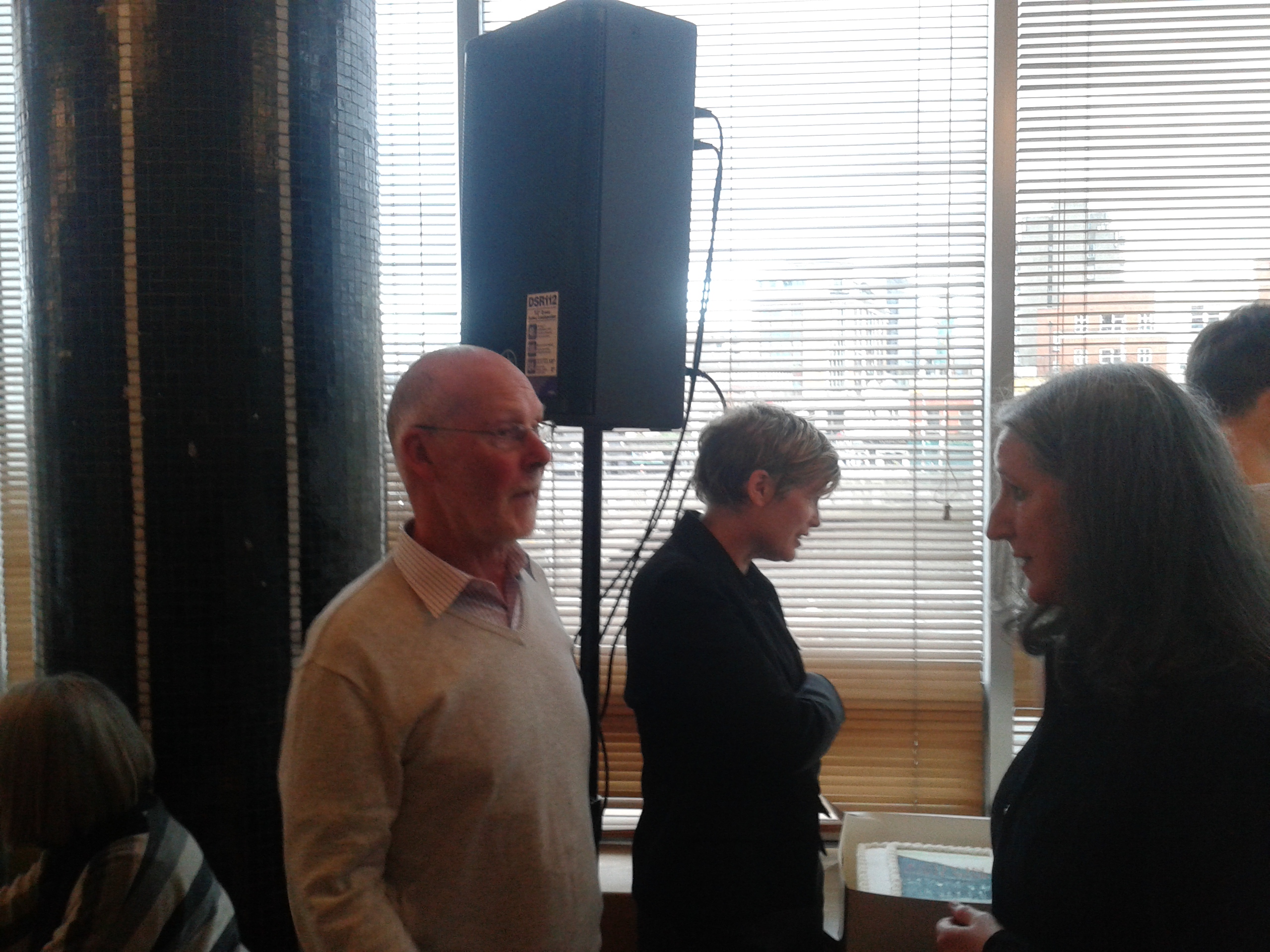
After the launch speeches -- (L-R) Padraig Yeates, Katherine O'Donnell, Caitriona Crowe.
After the launch speeches — (L-R) Padraig Yeates, Katherine O’Donnell, Caitriona Crowe.

Jack O’Connor, between speeches, made a reference to a giant banner hanging off Liberty Hall which had the word “NO” displayed prominently, saying that they had received congratulatory calls from people who thought it was against same-sex marriage. The banner was however against privatisation of bus services. The current banner on Liberty Hall says “YES” to the proposal in the forthcoming referendum and he said that now busmen were calling them up complaining …. to laughter, O’Connor commented that “it’s hard to the right thing, sometimes”. Presumably what he meant was that it is hard to know what the right thing to do is, or perhaps to please everybody. 

It is indeed hard to please everybody but I’d have to say that it is not hard to know that the purpose of and ‘the right thing to do’ for a trade union, is to fight effectively and with commitment for its members and for the working class in general. And that is precisely the responsibility which has been abrogated by Jack

In the background to this photograph of a Reclaim the Streets demonstration in 2002 is Liberty Hall, draped in a hug "Vote Labour" banner. SIPTU has maintained that position through a number of coalition governments in which Labour has participated and that have attacked the living standards and rights of workers.
In the background to this photograph of a Reclaim the Streets demonstration in 2002 is Liberty Hall, draped in a hug “Vote Labour” banner. SIPTU has maintained that position through a number of coalition governments in which Labour has participated and that have attacked the living standards and rights of workers.

O’Connor personally, along with other leaders of most of the trade unions, including the biggest ones for many years, SIPTU and IMPACT. And also by the Irish Congress of Trade Unions. That is why Jack O’Connor gets booed now if he ever dares stand on a public platform related to trade union struggle, a treatment received also by David Beggs before he retired from the Presidency of ICTU.

Back in 2011, another giant banner hung from Liberty Hall – that time it urged us to VOTE LABOUR, as did leaders of other trade unions. Stretching magnanimity, we might give the trade union leaders the benefit of the doubt and say they had forgotten that the Labour Party had only ever been in Government in coalition, most often with the right-wing Blueshirt Fine Gael party and that its most recent spell sharing power had given us one of the most repressive governments in the history of the State. Let us imagine for a moment that these social-democratic union leaders had forgotten all that. But, after February 2011, as Labour and Fine Gael went into coalition and both reneged on their election promises, as the Coalition government began to attack the working class and the lower middle class, what is their excuse then? When did they denounce the Labour Party to their members, publicly disaffiliating from the party? No, never, and the fact that those disgusting connections continue was underlined by the presence at the book launch of a Labour Party junior Government Minister and the late arrival of none other than Joan Burton, Minister for Social Constriction …. er, sorry, Protection.

Plaques in Glasnevin's Republican Plot recording the names of 77 of the 81 Irish Volunteers officially executed by the Free State between November 1922 and May 1923. Their police and military killed about another 150 without judicial procedure.
Plaques in Glasnevin’s Republican Plot recording the names of 77 of the 81 Irish Volunteers officially executed by the Free State between November 1922 and May 1923. Their police and military killed about another 150 without judicial procedure.

Considering that the book being launched was about the Civil War, it is really extraordinary that no speaker mentioned the repression by the Free State during and after that war. I am certain that Padraig Yeates has not glossed over that, he is much too honest and too good a historian to do so. But that only one speaker at the launch (Catriona Crowe) should mention the sinister Oriel House and none the at least 25 murders its occupants organised, nor the 125 other murders by Irish Free State soldiers and police, nor the 81 state executions between November 1922 and January 1923, sets one wondering at just how much self-hypnosis sections of our political and academic classes are capable.

Elephants, elephants everywhere

but not one can be seen!

End.

THE WOMEN STARTED IT

(Reading time: 5 mins)

Diarmuid Breatnach

We celebrate International Women’s Day on March 8th but are we aware that on that day in 1917, women started the Russian revolution?  It was one of the many contributions of women the world over to the struggles of humanity.

BACKGROUND

          There were many causes of discontent with the ruling regime in Russia in 1917: it was monarchic, autocratic, repressive, incompetent. It had put the country into a war with Germany and Austria, which was in its third year. People were very hungry with food shortages for a number of reasons including the trains being used to transport war materials and soldiers rather than to bring food into the city. Nationalities within Russia and Greater Russia were denied self-determination.

Peasants were serfs to the aristocracy, who could beat, imprison and even hang them. Officers, always from the aristocracy or — to a lesser degree — from the professional classes regularly struck ordinary soldiers or had them whipped. The officers were also for the most part grossly incompetent.

The Christian Church (Russian Orthodox) was allied to the regime and corrupt. Free speech was suppressed and the secret police could be anywhere; the regular police were brutal and could not be challenged by ordinary people. Wages were often barely enough to live on.

START OF THE REVOLUTION

          Petrograd was the Imperial capital city of Russia (the name had been changed in 1914 from St. Petersburg, which sounded too German) and in February and March 1917 a number of factories there were on strike for better wages.   In particular, on March 7th (February 22 according to the calendar in use in Russia then), workers in the large Putilov works went on strike. The factory owners sacked the workers but not had not yet replaced them; there were some clashes with police.

The following day, March 8th (by our calendar), International Women’s Day, women in Petrograd organised a number of meetings and rallies. Led by no political party but in an atmosphere of deep discontent throughout the city, the women’s activities became increasingly energetic and militant. Demonstrations began to march, demanding bread and the women went to factories not yet on strike, calling on the workers to down tools and join the demonstrations. As as many as 50,000 did.

Two days later, a general strike had seized Petrograd’s manufacturing industries, much of the city’s services and even some commercial business, bringing clerks, teachers and students to swell the numbers in protests. Everywhere there were street meetings, marches; red flags and banners began to appear among the crowds. Slogans hardly considered before were shouted and became current, including calling for the monarch, the Tsar, to abdicate or to be deposed.

Demonstration during the "February Revolution" 1917. Note the prominence of women in the demonstration.
Demonstration during the “February Revolution” 1917

The Petrograd police were powerless to control the demonstrators who would have turned on them had they intervened. On the 11th, three days after the women’s mobilisation, the Tsar called on the Russian Army to intervene and to shoot demonstrators.

Russia had the largest single army in the world and despite the war, thousands were still in Petrograd. They had been used in the past against the workers and in 1905 had massacred people on a demonstration to petition the Tsar. But now, after three years of war and shortages, they were not keen to do so and particularly reluctant to open fire on women. Soldiers began to mutiny and, when threatened by officers, often shot them instead.

On that day, the Chairman of the Duma, the parliament which the Tsar Nicholas had kept powerless, sent an emergency telegram to the Tsar, who was at the Headquarters of the Russian Army, asking him for urgent action. The Tsar’s reply was dismissive – his wife, the Empress Consort Alexandra, had written to him that the problems in Petrograd were being exaggerated.

A Russian Army barricade during the "February Revolution" -- the soldiers refused the orders of their officers to shoot demonstrators.
A Russian Army barricade during the “February Revolution” — the soldiers refused the orders of their officers to shoot demonstrators.

But the garrison of Petrograd, including elite units, had mutinied by the 12th, four days after the women’s marches and demonstrations. In addition the Cossack troops, usually reliable in shooting and sabring demonstrators and rioters, were disobeying the orders of their officers to attack the people (although they had not joined the mutiny). Officers began to go into hiding as more of them were being shot by soldiers from their own units. Symbols of Tsarist rule were being torn down in public places.

Two days later, on the 14th, the socialist parties and organisations established the Petrograd Soviet, last seen there twelve years previously, in 1905, before it was crushed by the Russian army. The Petrograd bourgeoisie were frightened but were unused to ruling except as permitted to by the Tsar, who himself now seemed unable to control events. Their powerless Duma (parliament), although ordered closed down by the Tsar that morning, set up a temporary committee to restore law and order and later, their Military Commission as part of the Provisional Government they created.

Thus began a period of dual authority in the city – the revolutionary workers, soldiers (and later, sailors) through the Soviet on the one hand and the bourgeoisie through their Military Committee on the other.

The Petrograd Soviet set the tone for what was to come by approving a number of points in Order No.1, effectively the first law drawn up by the Soviet, point 4 of which stated:

The orders of the Military Commission of the State Duma shall be executed only in such cases as do not conflict with the orders and resolution of the Soviet of Workers’ and Soldiers’ Deputies.”

The Soviet was making sure it could not be overruled by the new unelected body which the bourgeoisie had set up, the Provisional Government, or by its Military Commission.  

Senior Army and political appointees advised the Tsar to do what just over a week previously would have been unthinkable – to abdicate. On the 15th, the Tsar abdicated on his own behalf and of his son, nominating instead his brother, the Grand Duke Alexandrovich, to be Tsar. But he in turn knew he had no support as things stood and refused the “crown”.

July Days Russia 1917
Demonstrating workers shot down by Army units in the Russian “July Days”, 1917

The Russian monarchy of centuries had been overthrown — only seven days after the women’s mobilisation in Petrograd.

Maneouvers by the different sides continued during May and June, including an attempted military coup by senior officers commanding army units away from Petrograd. The fortunes of the revolution swayed back and forth across the country until demonstrations in July supported by the Anarchists and the Bolsheviks were suppressed by army units loyal to the Mensheviks and Socialist Revolutionaries political parties in power.

Workers were being disarmed, soldiers re-submitted to the old discipline and revolutionary leaders were being hunted; the War was also ongoing.

In October, the Bolsheviks seized power, ended Russia’s involvement in the War and began to construct a socialist state.

Two years later the people had to fight to defend it against a right-wing military uprising supported by eight states, including the Allies but were successful in the end.

But it was the women who had started the ball rolling seven months earlier on March 8th, with their rallies and demonstrations and calling the workers out from the factories. Henceforth too, they played their part in government, in building the country and in the armed forces, particularly during the war against fascism and in defence of the USSR from June 1941 to the fall of Berlin and Nazi Germany in 1945.

Nearly 200,000 women were decorated and 89 eventually received the Soviet Union’s highest award, the Hero of the Soviet Union. Some served as pilots, snipers (some of the ace snipers at the famous battle (or siege) of Stalingrad were women), machine gunners, tank crew members and partisans, as well as in auxiliary roles of nursing, construction, administration, factory work and of course food production.

end.

Soviet female combat pilots in WW2. The USSR was the only state to have female combat pilots.
Soviet female combat pilots in WW2. The USSR was the only belligerent state to have female combat pilots during WW2.

WHAT SHOULD WE DO?

“What should I do?” The anguish reached out to me; I felt it empathically. The cry of a person who is prepared to act and wants to change things for the better, to resist what is wrong around us on so many fronts – and that’s the problem.

There so many issues: the Water Tax, the persecution of Republican activists including framing and jailing them, the harassment and torture of Republican prisoners, the threat of fracking, privatisation of resources and services, cuts in services, cuts in salaries, high cost of private accommodation and low social housing provision causing homelessness, the decline of the Irish language and of the Gaeltacht …. and others. And that’s without mentioning international solidarity – and not because I don’t consider that essential, either.

Of course, we can put all these problems down to capitalism and, in the case of repression of Republicans (and with regard to international solidarity), to imperialism …. so let’s just overthrow those systems and then we can sort out those problems! But that leads to the question of “How” which in turn brings one back again to that anguished question, or to its variant “Which problem should I prioritise?”

Indeed, it is a question that cuts to the heart of the matter. For the issues call to us to act and since we can’t be everywhere at once we have to make choices. It is a question as old as class society and speeches are always being made recommending this choice or that while books have been written attempting to answer it. Lenin wrote a series of articles in the revolutionary newspaper Iskra (“Spark”) and published later as a booklet under a title that echoes that very cry above: What Is to Be Done? It had a subtitle too: “Burning questions of our movement” (by which he meant the socialist movement in Russia at the time).

Whether we choose to believe that work was absolutely correct, partly correct or completely wrong is in some ways irrelevant, for it was written for the movement in Russia in 1902 and published in 1905. I happen to think that it contains many useful ideas, although I am aware that there is a view that it has been mistranslated but, even so, in many ways, all that is beside the point. The fact is that today we have no blueprint and nothing more than perhaps the equivalent of a trouble-shooting manual: “for this problem, try this; if that doesn’t work, try that; while doing so beware of that other.” And that manual is cobbled together from older and more recent history of struggles, of analyses of the capitalist system and of how it behaves.

Scary, surely, to go up against a system that has ruled for around four centuries, that has spread across the world, that controls education, mass media, the State with its police, judges, prison and armed forces – and all without us having a blueprint. Well, if it’s any consolation, the capitalists don’t have a blueprint either … or if they do, they keep having to ignore it and react to events which they have not been able to predict, as well as to the extent of resistance for which they were unprepared. And they clearly make mistakes. Still, 400 years is a long time … a long time for them to learn tactics and strategy and to get comfortable in control and a long time to make us think that we can’t defeat them.

We can defeat them, of course and the indications from history and the internal workings of capitalism — and of its offshoot imperialism — are that we will. But what to do to make that happen? Yes, back to that question. And to the one that logically follows it: which issue to prioritise? For none of us is capable of being everywhere at once and even stretching over a few issues at a time begins to tear at our fabric.

The Marxist-Leninist approach argues for the creation of a revolutionary party that will make decisions on prioritisation and allocate resources to those struggles it chooses as it does so. Of course, the party will make mistakes from time to time and it will learn from those, getting better as it goes along. That’s the theory anyway. In application, or in alleged application, the results have not vindicated the theory – not in the long run, or even in the medium-term. Sure, we have been at it for less than 200 years: the first time workers captured a city was in 1871 and the first successful overthrow of the State was in Russia in 1917, very nearly a century ago. Much less time to learn, to make mistakes and to correct them but still ….

Of course, the alternative method of organising has even less to recommend it on results: amorphous, disparate collectives have not ever successfully overthrown a State and even their success in capturing a city (Barcelona, 1936) is debatable.

So, what is to be done? How to decide which struggle to prioritise? This is not a question I think can be answered by pointing and saying “That one and no other” or even, except at rare junctures, “That one and no other for the moment”. Individuals, collectives and parties will need to choose from the selection as a painter chooses from a palette: “this colour now, then that, no, scrub that one, now mix this with that, no, a bit more light …” and so on, always working towards the desired result which, although in the head, is also taking place on the canvas and making its own demands as it does so.

The truth is that all of those issues I mentioned in passing at the start of this piece, all of those, need addressing. All of them need people to fight in them. That is because they are all part of the same problem and also because we can’t just allow a cancer to grow unchecked in one part of the body while we address the tumours in another. Some individuals and perhaps even collectives are better suited to fight on some issues than on others: for example, a factory shop committee is probably not best placed to lead the struggle against fracking in a rural area, while a rural environmental collective is probably not in the best position to lead the struggle against the Water Tax. Individuals will need to pick and choose according to their own situation, their locality, their own knowledge.

And that would be fine, if the resistance movement as a whole were integrated enough to make creative use of that disparity – for particular struggles to be able to call for temporary additional resources and to be heard by the whole resistance movement, so that it could try to allocate those resources to one or other sector as seemed appropriate. But the resistance movement is far from integrated – it is fragmented and, even worse, it suffers from something akin to schizophrenia.

There a number of ways to imagine schizophrenia and the most popular is to see it as the development of two or more personalities in the one individual. But another is to see it as a disintegration of the personality – where the various aspects in our minds break free and appear as distinct personalities in themselves. The voices that speak in our heads to say things like “You shouldn’t have done that” or “Please make that happen” break free and seem to become different personalities. At times they conflict with one another while the central core personality tries to make sense of what is going on. Something like that, anyway. It is in that sense that I think the resistance movement in Ireland suffers from schizophrenia.

The splitting off of aspects of the revolutionary movement in Ireland has been towards two major poles of attraction: the Socialist one and the Republican. Of course there are some elements who incorporate both to one degree or another but I think examining them as distant poles of attraction is useful and much closer to their concrete manifestation within the revolutionary movement.  In order to examine them as opposite poles I think it is also useful to imagine a stereotype individual inhabiting each pole. Let us then imagine a stereotypical Irish Republican and a stereotypical Irish Socialist.

The Irish Republican is probably working class or maybe lower middle class; he may or may not have done well at secondary education but in any case he is unlikely to have gone to university. He sees himself in a tradition of resistance to British Colonialism and Imperialism stretching back at least to the United Irishmen and perhaps even back to the Norman conquest which began in 1169. His priority is the removal of the British from Ireland. He experiences “political policing” (of which some socialists are now complaining) practically from the moment he becomes publicly active – he has had his name and address taken by Special Branch and/or RUC/PSNI and they have opened a file on him. The Republican’s recent predecessors have been jailed (as are some of his contemporaries now), beaten or even shot dead; they were engaged in armed struggle against the colonial and imperial armed forces in the Six Counties for 30 years and perhaps he looks forward to take the gun up again some day, to strike back at the colonial overlord. He will turn out on demonstrations and pickets against repression of Republican activists, in support of Republican prisoners, including framed ones. He will almost certainly attend mass demonstrations against the Water Tax and may participate in local direct action against it. The Republican’s idealogues are Wolf Tone, Patrick Pearse and Bobby Sands.

The Irish socialist is probably medium or lower middle class and has finished secondary education; she has almost certainly gone on to university. She sees herself as belonging to a tradition of only a couple of centuries, with an Irish tradition going back to the early part of the 20th Century, in particular to the 1913 Lockout and the Limerick Soviet of 1919. She may or may not give a high place in her history to the Irish Citizen Army in the 1916 Rising. Her priority is the defeat of the capitalist class, probably in Ireland first but will turn out in demonstrations against racism, gender discrimination and homophobia in Ireland. The Irish Socialist aspires to a general strike giving rise to a revolutionary take over of the State; in the interim she may or may not think electing left-wing TDs or trade union officials an important activity. She probably can’t conceive of taking up a gun. The Irish Socialist has never had her name taken by the Special Branch or been framed by the RUC/PSNI and may never even have been detained by the police, though she has probably been pushed around by them. She will almost certainly attend mass demonstrations against the Water Tax and may participate in local direct action against this Tax. Her idealogues are Karl Marx, Lenin, possibly Trotsky and James Connolly.

Granted these are stereotypes but they are not so far from reality as to be unhelpful in describing in turn many and perhaps most Irish Republicans and Socialists and therefore in identifying one of the principal fracture lines in the Irish movement of resistance.

If the Republican and the Socialist parts of the Irish resistance movement were to be combined, or at the very least to work on a more collaborative basis, the “What should I do?” question would be easier to answer. It would be simpler to be on a picket for prisoners one week and resisting water meters the next, even if one’s main sphere of activity were among Republicans. The socialist could attend a picket against cuts one week and one for the human rights of Republican prisoners on another, even if her main sphere of activity was among Socialists. But that is not the situation that exists at the moment and, though a number of attempts have been made to combine the two trends in one organisation, they have not met with any great success to date.

So, I have not yet answered the question, have I? Am I saying that what we should be doing is creating some kind of synthesis or at least a collaborative alliance between the the socialist and republican parts of the resistance movement? Well, yes, certainly. But also, and as a contribution to that, as individuals we should try and spread our activity between the areas of greatest concern of each of those sections of the resistance movement. We should, I think, take some time to support resistance to the water tax, demonstrations against cuts etc. in their own right but also find some time to support resistance to British colonialism and its repression of Republican political activists. “If we are not part of the solution, then we are part of the problem” may be a glib truism but it is particularly applicable in this case.

So, how will we find the time to spread ourselves around? How do we ever? We balance and juggle priorities between our politically active and our social lives, with employment thrown in when we have a job. Or upskilling or studying. And possibly cultural or sporting or other activities. But how to choose, how to prioritise? Each of us has to make those decisions herself and himself. Not a very helpful answer? Well, I did state earlier on that there wasn’t a blueprint, so I couldn’t have one myself, could I? This however I feel fairly confident in predicting: if we don’t find a way to support both those parts of the resistance movement to some degree, it will always be fractured. And while it is so, it cannot be successful in either ridding Ireland of our capitalist classes or in finally throwing off the colonial yoke.

end

New Song: They’re Stealing Our Water

Black n Tans lorry plus RIC
British colonial police in Ireland, Auxilliaries and RIC in Dublin raid during War of Independence 1920 or 1921.

Cromwellian Massacre at Drogheda
Drawing depicting Cromwellian troops massacre at Drogheda 1649

A little bit rough in places but think I should get it out now and hopefully get people singing it ASAP.  I am surprised no-one seems to have used this tune, The Sea Around Us, and the mention of “water”, already.  Thanks to Ruairi O’Broin at the February session of Song Central for suggesting the “bank guarantee” line in the chorus, much better than what I had there originally.

Amended a little again since I wrote the above but still not sat down and really consistently worked at it.  Amended yet again slightly in 2020.

THEY’RE STEALING OUR WATER

Diarmuid Breatnach (To the air of “The Sea Around Us”, also known as “The sea, Oh the sea”)

Chorus:

The sea, oh the sea, a ghrá gheal mo chroí,

‘though long it may roll between England and me,

We’ve still got our gombeens* with a bank guarantee

and they’re trying to steal our own water!

(The chorus can go in after each verse, or each second, as people prefer).

1.

The Norse came to Ireland right outa’ the blue,

took us as slaves and plundered and slew;

But their days were all numbered from Clontarf they knew

— they never troubled us much for the after.

2.

Then the English came over our patience to try,

our land for to steal and our culture deny

And they took all that we had … I tell you no lie —

but at least they left us our water!

3.

‘Twas many a hard battle with the English we fought,

as used be our wont and indeed so we ought;

but as time went by, it all came to naught

and they put poor aul’ Éire in a halter.

4.

But we rose up once more and again and again —

we had stalwart youth and women and men;

We fought them in city and mountain and glen

and forced them their plans for to alter.

5.

Then those who at our struggle took fright

stepped in and took over the fruits of our fight;

The Gombeens and Church turned our dawn into night

and in a wink we were back under the halter!  

6.

The parasites live off our sweat and our blood — 

OLYMPUS DIGITAL CAMERA

they’d tax the very air that we breathe if they could;

But our media says to resist is not good …

and compliance would get us much further.

7.

Our resources are for the people to share in —

is linne ar fad é, uisce na hÉireann;

and it’s now the baton and prison we’re darin’ —

they’ll not steal from our sons and our daughters!

8.

The people are standing firm and steady —

they know that we’ve paid for the water already!

Our banners unfurled and more things ready:

You can be sure this time we won’t falter!

February 2015.

Dennis O Brien
Denis O’Brien, a billionaire widely believed to have plans to buy Irish Water if/when it becomes privatised. He is a major shareholder in Sierra Construction, the company installing water meters and also in Independent Newspapers. The Moriarty Tribunal found that he had benefited from information from the Irish Minister for telecommunications whom O’Brien had paid €50,000 through circuitous channels. The information had assisted him in bidding for the mobile phone contract, which he later sold at a personal profit of €317 a few years later.

Brian Cowen
Brian Cowen, former Taoiseach (equivalent to Prime Minister) in the Fianna Fáil-Green Party coalition Government 2011, which began the bank bailout.

Joan Burton angry maybe
Joan Burton (Labour), Minister for Social Protection in the Labour-Fine Gael coalition Government at time of writing


Enda Kenny winking
Enda Kenny (Fine Gael), Taoiseach (equivalent to Prime Minister) in the Labour-Fine Gael coalition Government at time of writing


!

Water Tax Demo crowd

* “Gombeen”, from the Irish “Gaimbíneach” is a profiteer, a venal person, a moneylender, a capitalist.

JOE HILL — new song by David Rovics on 100th anniversary of the singer-organizer’s death by capitalist firing squad

Tribute by David Rovics in 2015, the anniversary year of the execution of Joel Haglund, alias Josef Hilstrom a.k.a. Joe Hill) 


David Rovics is a socialist troubadour from and in the USA of many years’ standing and has composed many songs about many issues.  He also regularly tours and this year plans to go on a tour of Joe Hill’s homeland to celebrate this worker organizer, singer, song and other text writer and martyr.  You can look him up on

davidrovics.com


(The punctuation arrangement below is mine — there was none in the text I received).

1.

Joel Haglund came from Sweden

Which was very far from Eden:

By the time he left most of his family died;

His sisters and his mother,

His father and his brothers

So with one remaining sibling at his side,

He got a notion

To sail across the ocean

Where he heard the streets were paved with gold;

Not long after his arrival

As he toiled for survival

He realized the bill of goods that he’d been sold.

Joel Haglund, aka Joe Hill

2.

He got a whole lot wiser —

Became an organizer —

And he organized with artistry and skill.

He spoke up, raised his fist

Got right on the blacklist

That’s why he changed his name to Joe Hill.

He heard that it was best

If he headed to the west

Where the Industrial Workers of the World

Were finding the solutions

For making revolution

With red songbook and red flag unfurled.

Chorus:

A hundred years ago, the bard

With the union card,

Proved his music was too powerful, too strong;

They couldn’t stand the sound —

They had to take him down —

Lest he organize the working class in song.

3.

Soon as he paid his dues,

He tried hard to light the fuse,

Speaking, singing, writing lyrics and cartoons;

He sent off the whole mess

To the Wobbly press

And they sang his songs as they fought the goons!

He joined a singing movement

That fought for improvement

By abolishing wage-slavery worldwide;

He sang the Wobbly line

Beseeching workers to combine

Learn from Mr Block — the bosses lied.

(Chorus)

4.

His life would be cut short

By a kangaroo court

Eager to determine one man’s fate;

Evidence was circumstantial

But that’s inconsequential

When you’ve become an enemy of the state.

They put him up against the wall

And that was all

They gunned him down in 1915 —

He took all the bullets he could take

There by the Salt Lake

For being the best bard they’d ever seen

(Chorus)


The Irish War of Independence and the retreat from stated objectives in spite of the precariousness of the British position

(This is reprinted with minimal editing from a section of a much longer piece of mine published in English and in Spanish a year ago https://rebelbreeze.wordpress.com/2014/01/30/how-can-a-people-defeat-a-stronger-invader-or-occupying-power-2/)


Diarmuid Breatnach

The War of Independence 1919-1921 and retreat from stated objectives

Three years later (after the 1916 Rising), the nationalist revolutionaries returned to the armed struggle, this time without a workers’ militia or an effective socialist leadership as allies, and began a political struggle which was combined a little later with a rural guerilla war which soon spread into some urban areas (particularly the cities of Dublin and Cork). The political struggle mobilised thousands and also resulted in the majority of those elected in Ireland during the General Election (in the United Kingdom, of which Ireland was part) being of their party.

The struggle in Ireland and the British response to it was generating much interest and critical comment around the world and even in political and intellectual and artistic circles within Britain itself. In addition, many nationalist and socialist revolutionaries around the world were drawing inspiration from that fierce anti-colonial struggle so near to England, within the United Kingdom itself.

The dismantling by the nationalist forces, by threats and by armed action, of much of the control network of the colonial police force, which consequently dismantled much of their counter-insurgency intelligence service, led the British to set up two new special armed police forces to counter the Irish insurgency. Both these forces gained a very bad reputation not only among the nationalists but also among many British loyalists. The special paramilitary police forces resorted more and more to torture, murder and arson but nevertheless, in some areas of Ireland such as Dublin, Kerry and Cork, they had to be reinforced by British soldiers as they were largely not able to deal effectively with the insurgents, who were growing more resolute, experienced and confident with each passing week.

However, two-and-a-half years after the beginning of the guerrilla war, a majority of the Irish political leadership of the nationalist revolutionary movement settled for the partition of their country with Irish independence for one part of it within the British Commonwealth.

Much discussion has taken part around the events that led to this development. We are told that British Prime Minister Lloyd George blackmailed the negotiating delegation with threats of “immediate and terrible war” if they did not agree to the terms. The delegation were forced to answer without being allowed to consult their comrades at home. Some say that the President of the nationalist political party, De Valera, sent an allegedly inexperienced politically Michael Collins to the negotiations, knowing that he would end up accepting a bad deal from which De Valera could then distance himself. Michael Collins, in charge of supplying the guerrillas with arms, stated afterwards that he had only a few rounds of ammunition left to supply each fighter and that the IRA, the guerrilla army, could not fight the war Lloyd George threatened. He also said that the deal would be a stepping stone towards the full independence of a united Ireland in the near future. None of those reasons appear convincing to me.

How could the leadership of a movement at the height of their successes cave in like that? Of course, the British were threatening a worse war, but they had made threats before and the Irish had met them without fear. If the IRA were truly in a difficult situation with regard to ammunition (and I’m not sure that there is any evidence for that apart from Collins’ own statement), that would be a valid reason for a reduction in their military operations, not for accepting a deal far short of what they had fought for. The IRA was, after all, a volunteer guerrilla army, much of it of a part-time nature. It could be withdrawn from offensive operations and most of the fighters could melt back into the population or, if necessary, go “on the run”.

If the military supply situation of the Irish nationalists was indeed dire in the face of the superior arms and military experience of Britain, was that the only factor to be taken into account? An army needs more than arms and experience in order to wage war – there are other factors which affect its ability and effectiveness.

The precariousness of the British situation

In 1919, at the end of the War, the British, although on the victorious side, were in a precarious position. During the war itself there had been a serious mutiny in the army (during which NCOs and officers had been killed by privates) and as the soldiers were demobbed into civilian life and into their old social conditions there was widespread dissatisfaction. Industrial strikes had been forbidden during the War (although some had taken place nonetheless) and a virtual strike movement was now under way.

In 1918 and again in 1919, police went on strike in Britain. Also during 1919, the railway workers went on strike and so did others in a wave that had been building up since the previous year. In 1918 strikes had already cost 6 million working days. This increased to nearly 35 million in 1919, with a daily average of 100,000 workers on strike. Glasgow in 1921 saw a strike with a picket of 60,000 and pitched battles with the police. The local unit of the British Army was detained in barracks by its officers and units from further away were sent in with machine guns, a howitzer and tanks.

James Wolfe in his work Mutiny in United States and British Armed forces in the Twentieth Century(http://www.mellenpress.com/mellenpress.cfm?bookid=8271&pc=9) includes the following chapter headings:

Workers pass an overturned tram in London during the 1926 British General Strike. In general, goods travelled through Britain with authorisation from the workers or under police and troop protection.

Workers pass an overturned tram in London during the 1926 British General Strike. In much of the country no transport operated unless authorised by the local trade union council or under police and army escort.

4.2 The Army Mutinies of January/February 1919
4.3 The Val de Lievre Mutiny
4.4 Three Royal Air Force Mutinies January 1919
4.5 Mutiny in the Royal Marines – Russia,
February to June 1919
4.6 Naval Mutinies of 1919
4.7 Demobilization Riots 1918/1919
4.8 The Kinmel Park Camp Riots 1919
4.9 No “Land Fit For Heroes” – the Ex-servicemen’s Riot in Luton
4 4.10 Ongoing Unrest – Mid-1919 to Year’s End

 The British Government feared their police force would be insufficient against the British workers and was concerned about the reliability of their army if used in this way. There had already been demonstrations, riots and mutinies in the armed forces about delays in demobilisation (and also in being used against the Russian Bolshevik Revolution).

Elsewhere in the British Empire things were unstable too. The Arabs were outraged at Britain’s reneging on their promise to give them their freedom in exchange for fighting the Turks and rebellions were breaking out which would continue over the next few years. The British were also facing unrest in Palestine as they began to settle Jewish immigrants who were buying up Arab land there. An uprising took place in Mesopotamia (Iraq) against the British in 1918 and again in 1919. The Third Afghan War took place in 1919; Ghandi and his followers began their campaign of civil disobedience in 1920 while in 1921 the Malabar region of India rose up in armed revolt against British rule. Secret communiques (but now accessible) between such as Winston Churchill, Lloyd George and the Chief of Staff of the British armed forces reveal concerns about the reliability of their soldiers in the future against insurrections and industrial action in Britain and even whether, as servicemen demanded demobilisation, they would have enough soldiers left for the tasks facing them throughout the Empire.

The Irish nationalist revolutionaries in 1921were in a very strong position to continue their struggle until they had won independence and quite possibly even to be the catalyst for socialist revolution in Britain and the death of the British Empire. But they backed down and gave the Empire the breathing space it needed to deal with the various hotspots of rebellion elsewhere and to prepare for the showdown with British militant trade unionists that came with the General Strike of 1926. Instead, the Treatyites turned their guns on their erstwhile comrades in the vicious Civil War that broke out in 1922. The new state executed IRA prisoners (often without recourse to a trial) and repression continued even after it had defeated the IRA in the Civil War.

If the revolutionary Irish nationalist leaders were not aware of all the problems confronting the British Empire, they were certainly aware of many of them. The 1920 hunger strike and death of McSwiney, Lord Mayor of Cork, had caught international attention and Indian nationalists had made contact with the McSwiney family. The presence of large Irish working class communities in Britain, from London to GlaSgow, provided ample opportunity for keeping abreast of industrial disputes, even if the Irish nationalists did not care to open links with British militant trade unionists. Sylvia Pankhurst, member of the famous English suffragette family and a revolutionary communist, had letters published in The Irish Worker, newspaper of the IT&GWU. The presence of large numbers of Irish still in the British Army was another source of ready information.

Anti-Treaty cartoon, 1921, depicts Ireland being coerced by Michael Collins, representing the Free State Army, along with the Catholic Church, in the service of British Imperialism

Anti-Treaty cartoon, 1921, depicts Ireland being coerced by Michael Collins, representing the Free State Army, along with the Catholic Church, in the service of British Imperialism

The revolutionary Irish nationalist leaders were mostly of petite bourgeois background and had no programme of the expropriation of the large landowners and industrialists. They did not seek to represent the interests of the Irish workers—indeed at times sections of them demonstrated a hostility to workers, preventing landless Irish rural poor seizing large estates and to divide them among themselves. Historically the petite bourgeoisie has shown itself incapable of sustaining a revolution in its own class interests and in Ireland it was inevitable that the Irish nationalists would come to follow the interests of the Irish national bourgeoisie. The Irish socialists were too few and weak to offer another pole of attraction to the petite bourgeoisie. The Irish national bourgeoisie had not been a revolutionary class since their defeat in 1798 and were not to be so now. Originally, along with the Catholic Church with which they shared many interests in common, they had declined to support the revolutionary nationalists but decided to join with them when they saw an opportunity to improve their position and also what appeared to be an imminent defeat of the British.

In the face of the evident possibilities it is difficult to avoid the conclusion that the section of revolutionary Irish nationalists who opted for the deal offered by Lloyd George did so because they preferred it to the alternatives. They preferred to settle for a slice rather than fight for the whole cake. And the Irish bourgeoisie would do well out of the deal, even if the majority of the population did not. The words of James Connolly that the working class were “the incorruptible heirs” of Ireland’s fight had a corollary – that the Irish bourgeoisie would always compromise the struggle. It is also possible that the alternative the nationalists feared was not so much “immediate and terrible war” but rather a possible Irish social revolution in which they would lose their privileges.

Irish Free State bombardment 4 Courts
Start of the Irish Civil War 1922: Irish Free State bombardment, with cannon on loan from the British Army, of the Republican HQ at the Four Courts, Dublin.


Another serious challenge to the Empire from Irish nationalist revolutionaries would not take place until nearly fifty years later, and it would be largely confined to the colony of the Six Counties.

end selected extract