Three members of my family fought in the 1916 Rising and eleven “did their bit” in the War of Independence. So it‘s probably not that surprising that as a child, I grew up with stories, real, imagined, and embellished, of those ancestors and their times.
Of those three “1916 men” the one who most aroused my curiosity was my granny’s cousin, Desmond Ryan. “A bit of a consequence”, according to my great-aunt Polly, or “the son of the fellah who wrote the first Irish play that got him a medal from Yeats and Lady Gregory“ according to my uncle.
Desmond actually was “a bit of a consequence”; however his father, W.P. Ryan, while he did write a number of plays “i nGaeilge” didn’t quite write the first to be performed in Dublin and I’m not too sure about the medal either. W.P. was a journalist, editor, novelist, and socialist. His clash with Cardinal Logue, Archbishop of Armagh, while editor of The Irish Peasant, is chronicled in his “The Pope’s Green Island” and his novel “The Plough and the Cross”, both of which bear fruitful reading today. His 1913 book “The Labour Revolt and Larkinsim” together with his work as assistant editor of the London Daily Herald did much to explain and create sympathy among British socialists for the participants of Dublin’s Lockout in 1913.
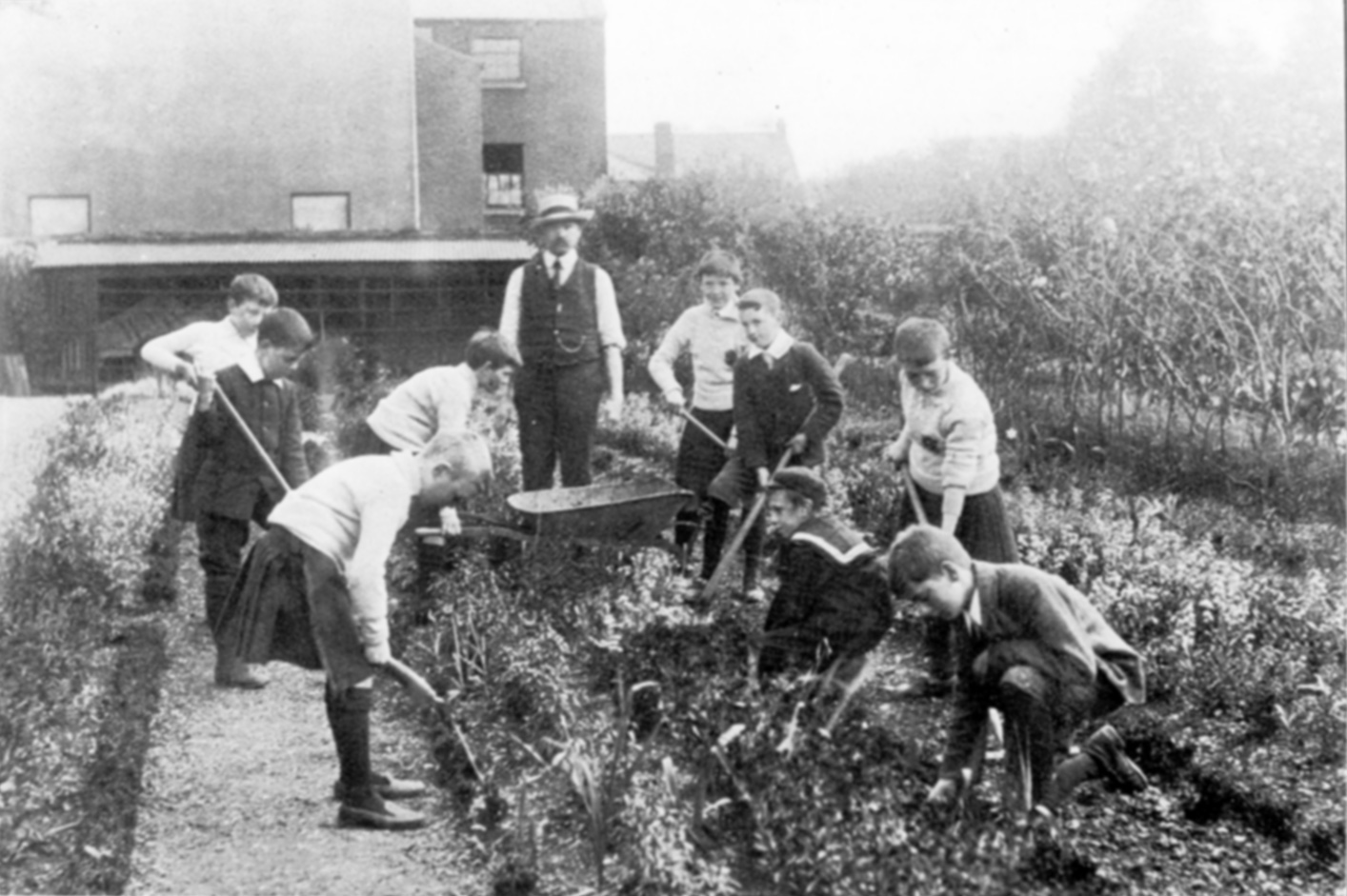
St. Enda’s boys at work — part of the school curriculum was gardening
W.P.’s inability to toe the line with the bishops saw him return to London, leaving Desmond, “the Consequence”, in the tender care of Patrick Pearse at Saint Enda’s School as a boarder. As most of his Ryan siblings were either in Tipperary or had emigrated, Desmond found himself a temporary orphan save for my great grandparents who promptly “adopted” him and welcomed him into their home.
Willie Moynihan, my great grandfather, was a not very successful publican, and politically, if he had any politics, followed his brother Michael’s line in the Irish Parliamentary Party. Michael was a very successful publican and over a number of decades served as a representative for a number of wards for the IPP on Kingstown (Dún Laoghaire) Borough Council. When the IPP took control of Dún Laoghaire, Michael – being their veteran campaigner in the borough – was given the honour of making the opening speech of that session in which he congratulated the Pope on his recent birthday. It caused a sensation at the time. Now while I realise this was far more politically loaded than it appears today, somehow it strikes me as petty compared with the many other problems Dún Laoghaire faced back then.
Despite his humble roots Michael Moynihan at that stage had a number of pubs, a big house on Haig Terrace, a mansion in Killiney, and was about to be made a Justice of the Peace despite a string of convictions for after-hours drinking and illegal gambling schools in his pubs. His gesture, despite the symbolism, always strikes me as just another example of the “re-branding process” which the IPP really stood for and intended to deliver with Home Rule. They might have cut the cake differently but basically it was to be business as usual – just a new name over the door and on the corporate notepaper.
Nobody ever told me how my great-grandparents reacted to having a socialist with a strong sense of Nationalism in their midst. However Desmond was a boy with a mission and felt it his duty to convert the family or at the very least his young cousins even if their parents were beyond redemption. His stories of St. Enda’s fired the children’s imagination, and I still smile as I remember my great-aunt Polly, throwing back her shoulders, raising herself beyond her full height, and summoning some of the worst traits of amateur dramatics, taking off Desmond, taking off Patrick Pearse, taking off Robert Emmet leading the 1803 Rebellion.
Desmond began leaving his copybooks from school in the house when he visited. These were filled with essays on Fionn MacCumhaill, the Red Branch Knights, Cú Chulainn, and other mythical heroes. The copious marginal notes and comments by Patrick Pearse drew my grandmother and her sister further into this world of Celtic heroics, standing in stark contrast to the stories of the famine during the previous century told by their parents. A generation later both my mother and uncle remember being equally moved by the same essays which were unfortunately lost during a house move in the 1940s.
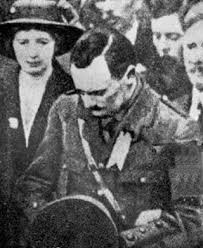
Patrick Pearse, at the 1st August 1915 interment in Glasnevin Cemetery of Diarmuid Ó Donnobháin Rosa, whose body had been sent from the USA for burial there.
As Desmond’s involvement with the revolution grew his visits to the house became less so there was some delight when he turned up in July 1915 with an invitation to go to the funeral of a Fenian from Cork called Jeremiah O’Donovan Rossa. Pearse, the fellah who wrote all those notes and comments in the margins of Desmond’s copy books was going to give a speech. Willie Moynihan didn’t approve of this fellah called Pearse but his wife relented understanding her children’s curiosity and she was fond of Desmond and didn’t want to let him down.
Desmond, not surprisingly, faded out of family stories after that, as Pearse’s exhortation to revolution was too much for a God-fearing, law abiding woman, like my great grandmother. He would go on to write biographies of Pearse, Connolly, Collins, and De Valera, as well as the first major account of 1916 by a participant. His pioneering journalism during the War of Independence did much to counteract the black propaganda of the State murder gangs who assassinated at will back then. However it was his invitation to a funeral which endured in family lore on a day that changed the family’s political axis forever.
Polly could “do” the speech, and recited it with all the subtlety of a Victorian melodrama well into her eighties. She would recall Pearse as “a bit of a fruitcake” or “sixpence short of a shilling”, but despite his questionable sanity would qualify this with “my God! But that fellah could talk!” Remarkably, with the emergence of the Pathé newsreel footage of the funeral in recent years (footnote to link?), she seemed to have taken all Pearse’s movements and gestures in, and even in old age could deliver it as if she had recently studied the film frame by frame. This delightful entertainment of my childhood had deeply affected her and despite occasionally lamenting how dull Dublin became once the British left, it had been a seminal moment at which she became and remained a republican right down to her bones.
On very rare occasions my granny would “do” the speech. But her version was different. She didn’t have her sister’s dramatic flair, but she too had been affected by Pearse that August day. With her a previously unseen veil of steel and determination seemed to come over her; probably that same steely veil that saw her defy her parents and join Cumann na mBan and which enabled her to carry cases of hand grenades and weapons across the city on numerous occasions. Her rendition suggested she had taken the words in and considered them rather than the exaggerated gestures of which her sister Polly was so fond. Significantly it was through this involvement that she met my grandfather, a member of H Company, 1st Battalion, the Dublin Brigade.
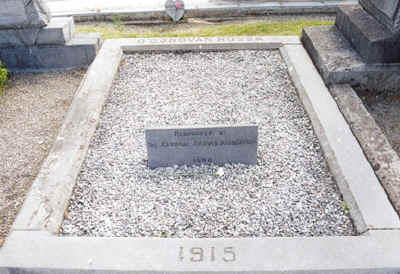
Ó Donnobháin Rosa’s grave, Glasnevin Cemetery, Dublin
As the decade of commemorations gathered momentum, last August saw the centenary of O’Donovan Rossa’s funeral. In many ways it started the countdown to the revolution of 1916-22. Earlier this year I found myself in Glasnevin Cemetery and wandering around came face to face with Rossa’s grave and all those childhood memories came flooding back. It’s difficult, even with all the photographs and the film footage, to really understand just how significant Pearse’s speech was.
Looking at the photographs I wonder just how many lives were changed that day. In its own small way my own family bears testimony to it. As historians and commentators continue to play “what if” in relation to events of that period I found myself doing the same at Rossa’s grave, making similar speculations with what potentially, for me anyway, might have been serious consequences. What if Desmond Ryan hadn’t fired my granny’s imagination so that she went to the funeral? What if she hadn’t been inspired by Pearse that day? Would she have joined Cumann na mBan? More importantly, without being in that circle would she have met my grandfather? The next question doesn’t bear thinking about, because, despite the occasional rocky road, I’ve rather enjoyed being alive, and without that chain of events unleashed by the combination of Rossa, Pearse and that Speech on that August day I might never have been born.
So on the 1st August 2015 I found myself in town at the O’Donovan Rossa Bridge to pay a personal tribute to Rossa, and Pearse, and that speech. In particular I was paying tribute to Desmond Ryan. Because somehow in that crazy way that small events ripple out to have more serious consequences I find myself thinking I owe them for my very existence.
End.
Crowd at erection of plaque to rename the former Richmond Bridge over the Liffey after O’Donnobháin Rosa on 2nd August 2015 (Christchurch is visible in the far background, after Dublin City Council’s offices building to the left).
Hugo McGuinness is a historian specialising in the period of history referred to above.
Maribel Eginoa Cisneros died on the 13th of this August in the Santutxu district of Bilbao. She was many things – a democratic Basque patriot, dancer, choir singer, herbalist, mycologist, carer, wife, mother ….
I and two of my siblings travelled to attend the funeral. For me it was a farewell to a warm, intelligent and cultured person who, along with her husband, two of her daughters and a son-in-law, had been very welcoming to me. More than that or because of that, I thought of them as “my Basque family”.
Somewhere I have a Basque family related through blood and marriage but I don’t know them. Different loyalties and some German blood during the Spanish Civil War took my mother out of the Basque Country; the ties were cut and left behind. My mother became a woman in Madrid, where she met my father soon after.
Although they never met, it was because of my mother that I had first met Maribel. My mother, Lucila Helmann Menchaca (the Basques spell it Mentxaka), was born in Algorta, in the Getxo district, not far from Bilbao and spent her early childhood there. How her parents met is another story but Luci grew up bilingual in Castillian (Spanish) and German, with a Basque mother who hardly knew any Euskera (Basque) and a German father. All of Luci’s children, the five boys and one girl, knew of their mother’s childhood in the Basque Country and as we grew older, a desire grew with it to see where she had been born; each of us individually making the pilgrimage.
ONGI ETORRI – BASQUE WELCOME
I was a total stranger and low on funds on my first visit to the Basque Country. I had one contact, a woman I had met only a couple of times when she worked as an au pair in Dublin; she promised to help me get based and I arranged to phone her when I arrived. But the flight was delayed and then could not land at Bilbao airport – too much cloud, the pilot said – and we would land instead at Zaragossa, over 154 miles (248 Km) away. There the passengers had to wait for a coach and eventually arrived in Bilbao in the early hours of the morning. Of course, I had not booked an hotel, so the driver of the last taxi available tried a few without success and then brought me to the Nervión, a four-star hotel over its namesake river, dark and unlovely with a nightly rate that hit me in the gut.
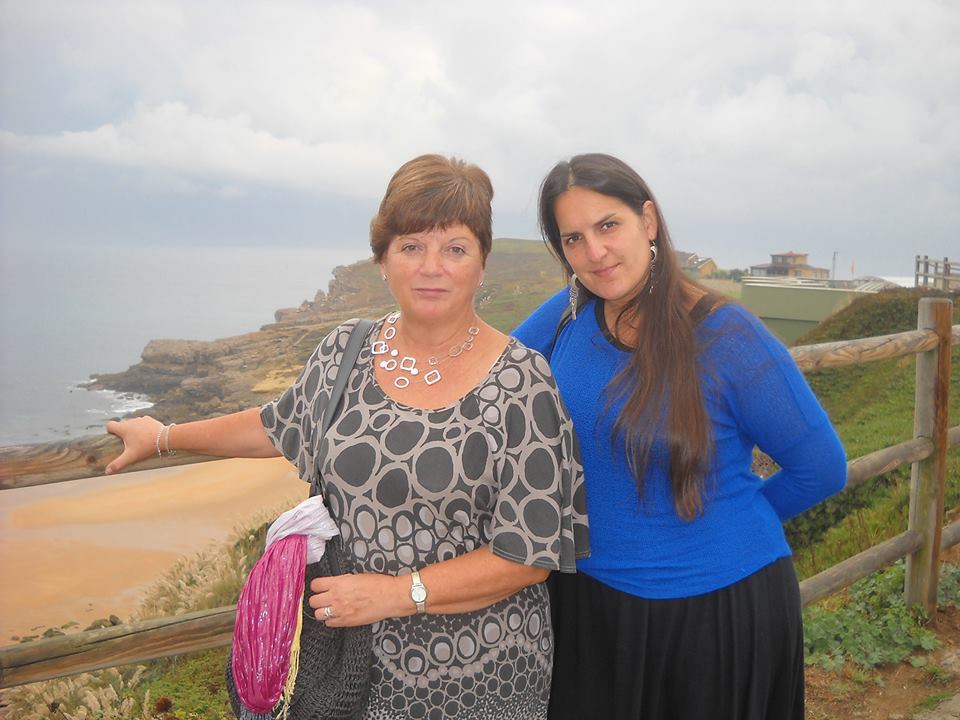
Maribel and Ziortza on a visit to the Cantabrian coast (Photo from Maribel’s family)
Next morning I phoned my contact, Ziortza and she came to the Nervión and waited while I checked out. I expected to be brought to a cheap hotel or hostel but was instead brought to her family’s home and there, for the first time, I met Ziortza’s parents, Maribel Eginoa and Josemari Echeverria (women don’t change their surnames now when they marry there). I was welcomed, fed and shown to what was to be my room during my stay. It was Ziortza’s, who moved in with her parents – the other two sisters lived in their own apartments with their partners and children. I was fed wonderfully every day too.
I was stunned by the depth of the hospitality from people I did not know, a trait I have encountered again and again among many Basques I have met. Nor was that all. Ziortza took me on her days off on excursions to some different places and towns and her sister Gurrutze and husband Gorka took me on a tour along the Bay of Biscay before turning uphill to iconic Gernika (Spanish spelling “Guernica”). Ziortza also gave me instructions on how to get to Algorta by local train, where my hand-drawn map could take me to where my mother had lived, a trip I preferred to make alone.
The next occasion I returned to Bilbao, this time to begin to know the southern Basque Country, I stayed in their apartment again, in the same room, but this time without discommoding them, since Ziortza had moved out to her own place.
THE UNEXPECTED ONE
Maribel and Josémaria were fairly comfortable and retired when I met them but they had some hard times behind them. Josémari’s father had been a Basque nationalist and fought against Franco, a fact that did not escape the victorious Franco authorities. When it came to time for the Spanish military service obligatory for males (much resisted in the Basque Country and now
Only a few months before her death (hard to believe) — Maribel Eginoa (photo Maribel’s family)
abolished throughout the State), they sent Josémari to one of the worst places to which they could send the son of a Basque nationalist – Madrid. His superior officers took pleasure in reminding him of his father and of what they thought of Basque nationalists (or even Basques in general). For the couple, it was a difficult separation but they married as soon as he was finished with the Spanish Army. Maribel was 21 years of age.
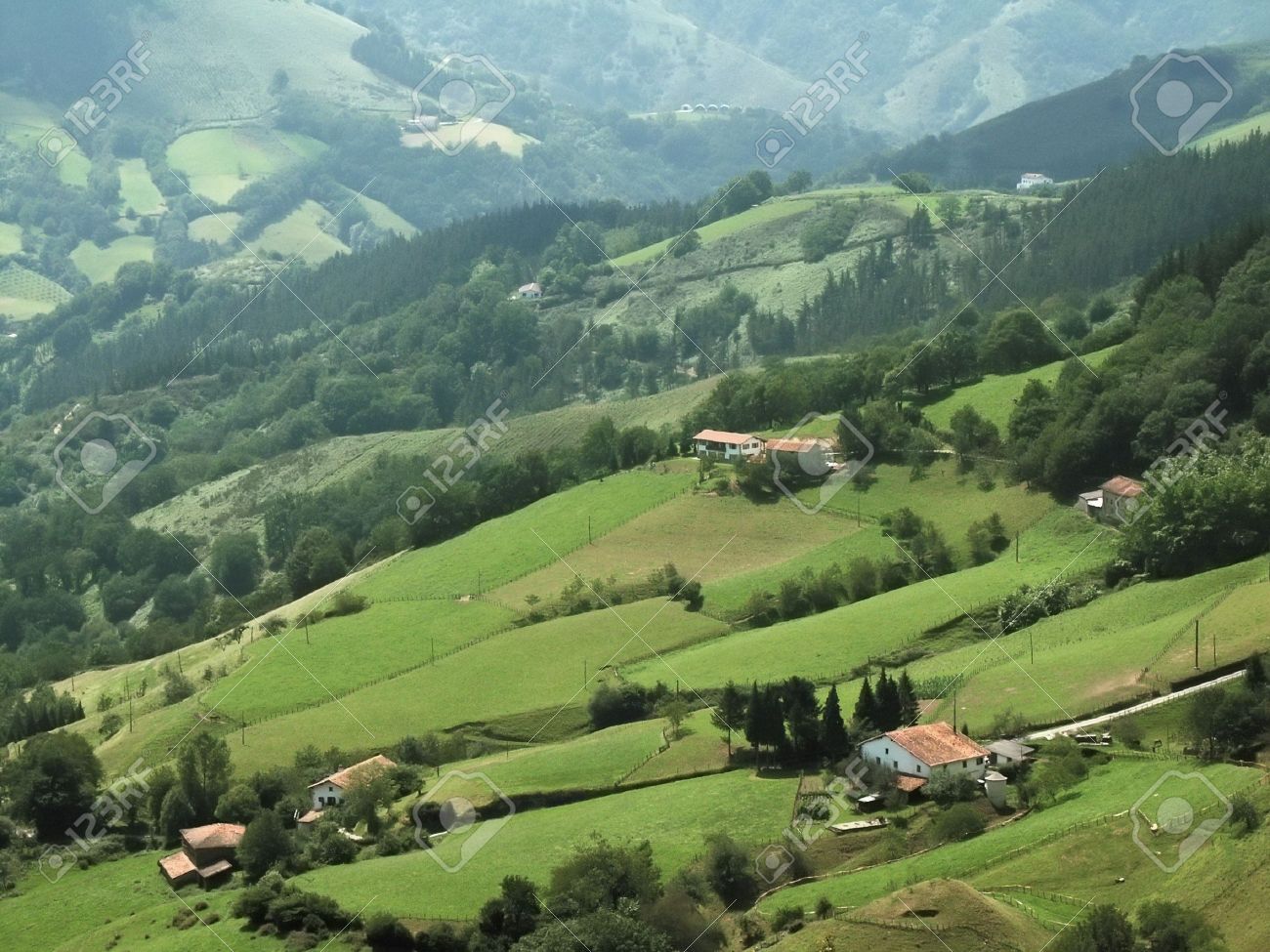
Pyrenean landscape in Iparralde (“the northern country”, the part of the Basque Country ruled by France). (photo from Internet)
In their early years together they often travelled to Iparralde (“the northern country”), the Basque part under French rule, with a Basque dance group called Dindirri. The French state has no tolerance for notions of Basque independence but does not harry the movement as does the Spanish state in Hegoalde (“the southern country”). Maribel was fluent in French as well as in Castillian.
Born ten years after the most recent of another four siblings, Maribel was the result of an unexpected pregnancy. “It was destiny,” commented one of her daughters. “The unexpected one would be the one to take care of everyone in the future.” One of Maribel’s siblings had died after a few days, another at the age of 19 due to surgical negligence, another had cerebral palsy. Maribel’s sister herself had an intellectually challenged boy and, when she emigrated with her husband and daughter, left him in Maribel’s care. As Maribel’s mother grew old and infirm, she took care of her too. Her brother with cerebral palsy, although in a home for his specialist care, spent weeks at a time in the family home. And another relative came to stay with them too, for awhile. Maribel looked after everyone.
Of course, her husband Josémari helped, as did her daughters. And they all accepted that this was how things were. And to add to that, the couple visited friends and neighbours in hospital.
LANGUAGE AND POLITICS
When I met Maribel and Josémari, I heard them speak to their daughters in Euskera — the Basque native language. But they themselves had not been raised speaking it – they went to classes to learn the language and raised their children with it. Speaking or learning Euskera was illegal under Franco except for some dispensation to Basque Catholic clergy. It was the latter who founded the first illicit “ikastolak”1 to teach Euskera and later these were set up by lay people too. The ikastola, teaching all subjects except language through Euskera, is now the school type attended by the majority in the southern Basque Country and is mainstream in the Euskadi or CAV administrative area, encompassing the provinces of Bizkaia, Alava and Guipuzkoa.
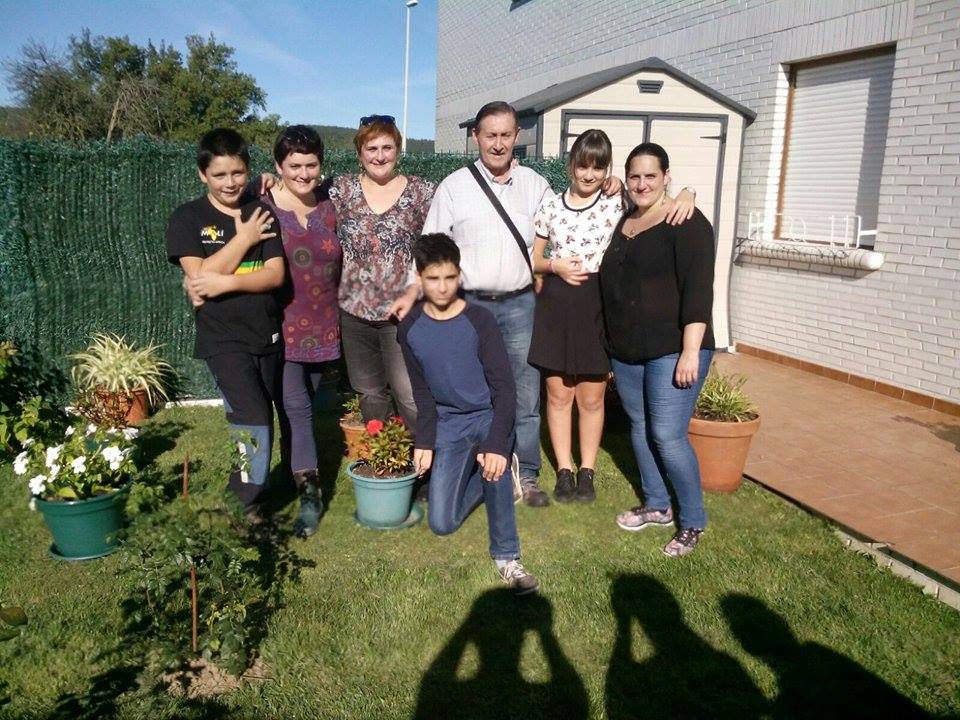
Most of “my Basque family: Front R-L: Aimar and Markel, Gurrutze’s sons; Back R-L: Gurrutze, Maider, Josemari, Maddi & Ziortza. (Photo from Maribel’s family)
Under Spanish state repression the old Basque Nationalist Party was decimated and although still in existence, its youth wing became impatient with what they perceived as the timidity of their elders. The PNV youth found a similar impatience among leftish Basque youth who had picked up on the vibrations of the youth and student movement of the 1960s. These youth brought to the table the narratives of anti-colonial and anti-imperialist struggles, mixed with socialist ideas of the Cuban and Algerian revolutions. Thus was Euskadi Ta Askatasuna (Homeland and Freedom) born — doubly illegal, as they espoused Basque self-determination and socialism. And so they were spied upon by the Guardia Civil, harassed, arrested, tortured, jailed … after nine years of which ETA took up arms.
Of the Spanish state’s main political parties today, the ultra-right Partido Popular and the social democratic PSOE, the first receives very little electoral support in the CAV administrative area and the second always less than the total of Basque parties. Maribel and Josémari, like most of patriotic Basque society, were presented with the choice of supporting the PNV (Basque Nationalist Party) or the Abertzale Left, the broad political movement of which ETA was a part. The PNV was known for jobbery and corruption and collusion with the Spanish state so of course Maribel and Josemari raised their family in loose allegiance to the Abertzale Left, attending many marches of the movement, public meetings, pickets and now and then hearing gunshots and explosions, hearing of people they knew going into clandestinity and others arrested, tortured and jailed. Everyone knew someone who became a political prisoner (and that is still largely the case) — a neighbour, work colleague, a past pupil. One of Maribel’s daughters saw most of her quadrilla – a small circle of Basque school friends who typically stay close throughout life – go to jail; part of her life is now organised around making visits to jails throughout the Spanish and French states, thanks to the cruel dispersal policy.
At the funeral service in the packed Iglesia del Karmelo in the Bilbao district of Santutxu, I remembered Maribel’s warm personality and hospitality. In fact it was around that hospitality that I unwittingly caused a rift between us. By the last time I returned to stay with them, I had become active in Basque solidarity work in Ireland. Beset with communication difficulties with the organisations in Euskal Herria (the Basque Country) and desperate for regular sources of accurate information, I was essentially based at their home while seeking out and establishing contacts every day. Maribel, as a considerate Basque hostess, wanted to know in advance whether I was going to be available for meals and I sometimes forgot to tell her when I was not. I also didn’t get into the Basque rhythm of lunch, supper and main meal. In my focus on finding needed contacts I just didn’t appreciate the distress I was causing and that it might have appeared, as one daughter told me, that I was treating her parent’s apartment as an hotel. In subsequent annual visits to Bilbao, staying with others, I tried to make amends but though we remained friendly, it was never as before. Some rips you can darn but the fabric is never what it was.
Iglesia del Karmelo, in Santutxu, Bilbao
In Maribel’s funeral service, the daughters led the singing of the “Agur Jaunak”2; I had the words printed out but didn’t recognise the air at first so by the time I caught on, was unable to find the place to join in. The first time I heard it, sung in performance by Maribel and Josemaria in their choir in another church, the song brought tears to my eyes. The couple belonged to two choirs and had even performed abroad; for many years choirs had been a big thing in the Basque Country but are not so popular now. The Agur Jaunak is a moving piece of music and the final words of farewell, now laden with additional meaning, brought forth my tears at the funeral too (and in fact bring some to my eyes now even recalling it).
When I got back to Dublin I decided to write an article dedicated to Maribel. And to the Basque love of mushrooms. Maribel and her husband were both mycologists (students of fungi) and she was a great cook too. At the time the urge to write struck me, it was autumn, the optimum time for fungi, when the weather is still fairly warm in much of Europe, but also damp.
MOUNTAIN PEOPLE AND MUSHROOMS
The Basques imagine themselves in many forms but the most enduring is probably as a mountain people. Not all the country is mountainy, of course – it has lowlands along most of its coastline (yes, they sometimes see themselves as mariners too) and even some highlands are plateau rather than mountain. But. Mountain people, nevertheless. My mother told us that Basque patriots when they died were often cremated and their ashes carried up the mountains inside the ikurrina, the Basque national flag. On reaching the top, the flag would be shook out, consigning the ashes to the winds. The Basque irrintzi cry, like yodelling, is typical of methods that use the voice to communicate from mountain to mountain. Climbing is a popular sport and so is hill walking, often also done as a form of youth political and social activity.
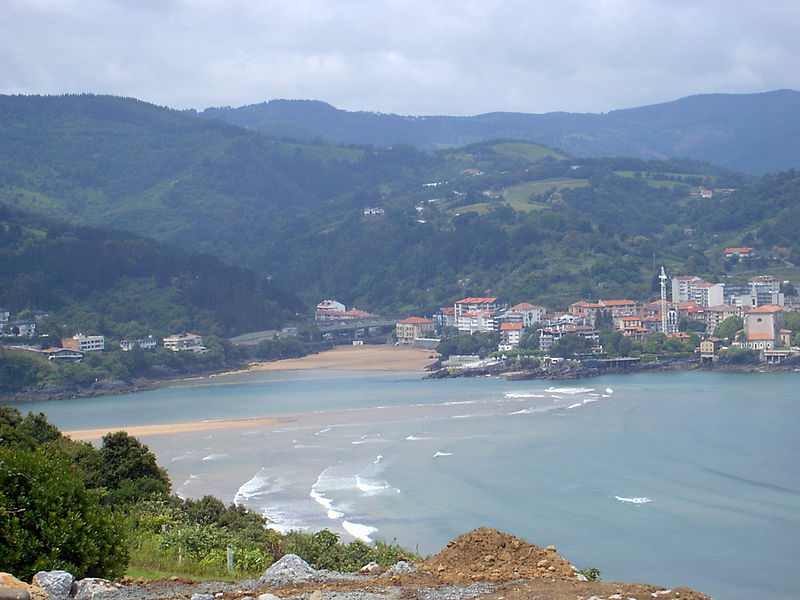
Mundaka coastline in Bizkaia province on south-eastern coast — with mountains visible behind (photo Wikipedia)
Even among Basques living on the coast or other lowlands, it is hard to meet a native who has not been to the mountains and high valleys and many go there regularly, sometimes in organised groups. One of the reasons they go, apart from reinforcing their cultural affinity, is to pick edible fungi. I am told that there are 100 edible species known in the Basque Country and that “between 40 and 50 varieties are eaten regularly”.3
As opposed to other regional administrations, a fee does not have to be paid in the CAV administration (three of the southern Basque provinces) to collect these mushrooms, although breaching rules can cost between 30 and 250 euros in fines. The regulations specify a collection limit of two kilograms per person per day and one is obliged to use a knife to remove and a wicker basket to store.
Sadly, illegal commercial operations have cashed in on the love of mushrooms in the Spanish state and gangs have been discovered recruiting poorly-paid migrants or unemployed natives to collect without a licence in administrations where such is a requirement, breaching conservation rules and running the risk of arrest. These gangs are less likely to succeed in the southern Basque Country, a society highly organised on a voluntary and local basis and in general quite conscious of the importance of conservation.
Display of edible fungi from the New Forest, England, showing the conservation-friendly collecting basked and knife (photo from Internet)
Further northwards, 25 km. from Iruňa (Pamplona), is the Harana (valley) Ultzama, a natural reserve, over half of it thick woodland. It is in Nafarroa (Navarre), the fourth southern Basque province.
“A mycological park over 6,000 hectares has been marked out, a great luxury for mushroom-lovers. …. The park’s information point, in the municipality of Alkotz, indicates the routes where these mushroom can be found as well as information about the species and how to identify those that have been collected throughout the day.” The collection permit costs €5 per day and is available from the information office or on their website.4
The Basques go in family groups or groups of friends, knowing the edible types (or accompanied by at least one who knows) and they bring baskets, not plastic bags. The idea is that the spores of picked mushrooms will drop through the weave as they walk and so seed growths of new mushrooms further away from where the parent fungi were picked. It is actually illegal to go picking with plastic bags and though there are not many of them, the forest police will arrest people who break that law. In a nation overburdened with police forces, that force is the only one that seems free from popular resentment.
The best mushroom sites are kept secret by those who know and the location of those sites is sometimes handed down through generations. In a peninsula renowned for its types of food and preparation styles, Basque cuisine lays claim to the highest accolade. Yet it uses hardly any spices or herbs. Sea food is high on the cuisine list of course but so is the ongo, the mushroom.
On a Sunday in October 2010, I was present in Bilbao when Maribel and Josemari’s mycological group had an exhibition in a local square, where they also cooked and sold fungi. Josemari and Mirabel worked all day in the hot sun and then had their own feast with their group afterwards, though by then I imagine many would not have had a great appetite.
I was staggered by the number of different species of fungi native to Euskal Herria and their variety of shapes and colours — I was told by the couple, and can well believe it, that their association had exhibited just over 300 species in that exhibition, between edible, inedible and poisonous. This figure was down on the previous year, when they had exhibited 500! Apparently there are over 700 species known to the country.
I tried to imagine how many Irish people would attend such an exhibition in Dublin, even on a sunny day such as we had there — perhaps 20, if the organisers were lucky. The square in that Santutxu district of Bilbao was full, as were the surrounding bar/cafés. There were all ages present, from babies at their mothers’ breasts to elderly people making their way slowly through the crowds. The food was all centred around cooked edible fungi: shish kebabs of mushroom, peppers, onions; burgers made of minced mushrooms and a little flour; little mushrooms with ali-oli on top, served on small pieces cut off long bread rolls; big pieces of brown mushroom almost the size of the palm of one’s hand.
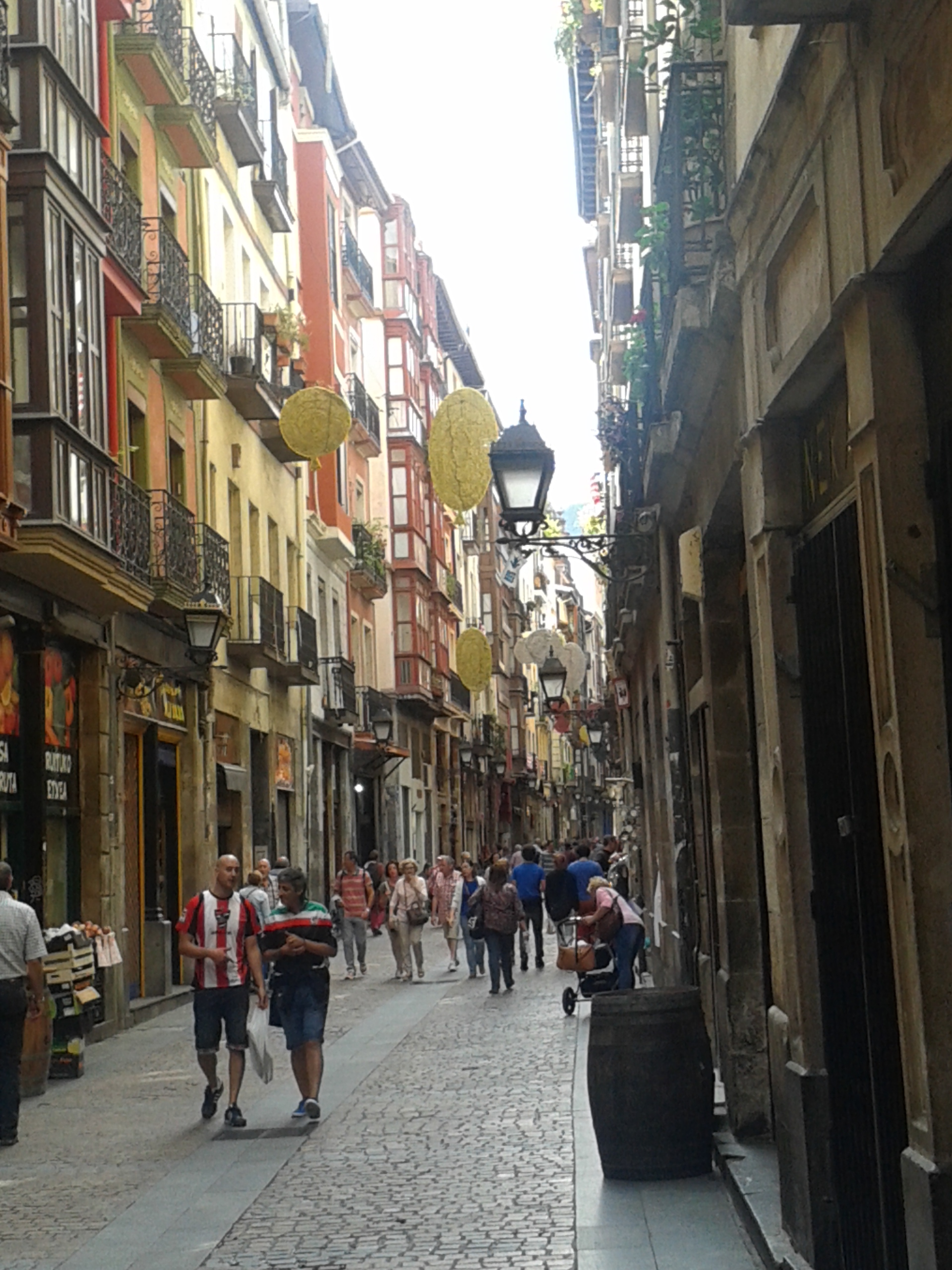
Street in the Casco Viejo medieval part of Bilbao, showing decorations for the Bilbo festival in August (photo D.Breatnach)
The people queued for the food and those selling it couldn’t keep up with demand. And the people also, including children, queued to see the fungi being exhibited. Unlike the Irish, who doubtless also have varieties of edible native fungi in their land but have largely shown an interest in only the common white cultivated kind and, among certain groups of mostly young people, the ‘magic’ variety, the Basques love their fungi.
I ate some there in that square and again, with other food also, down in the Casco Viejo (the medieval part of Bilbo city), where some new friends took me de poteo (from bar to bar) and wouldn´t let me buy even one round. Many bars serve pintxos, small cold snacks, some plain enough and others more involved – normally one eats and drinks and pays the total before leaving. But some of those bars have a room upstairs or to the side where meals are served and one had an excellent restaurant where we ate well and, of course, my friends wouldn’t let me pay my share of that either. True, I had organised some solidarity work for one of their family in prison but all the same ….. When it comes to hospitality, in my opinion the Basques deserve the fame even better than the Irish, who have been justly known for that quality too.
Some of the company had been the previous day in the town of Hernani, where a rally convened to call for Basque Country independence had been banned by the Spanish state. Despite the judicial order, thousands of young people had participated in the rally and had been planning to attend the rock concert afterwards. The Basque Region Police had attacked the peaceful demonstration with plastic bullets and then baton-charged the young people. Many were injured by the plastic bullets, by batons, and by being trampled in the narrow streets when people tried to flee the charging police. It was an object lesson in the drawbacks to regional autonomy or “home rule”. However, the resistance had been so strong that the police eventually had to retreat and allow the rock concert to proceed without further interference. But that too is another story.
AGUR — SLÁN
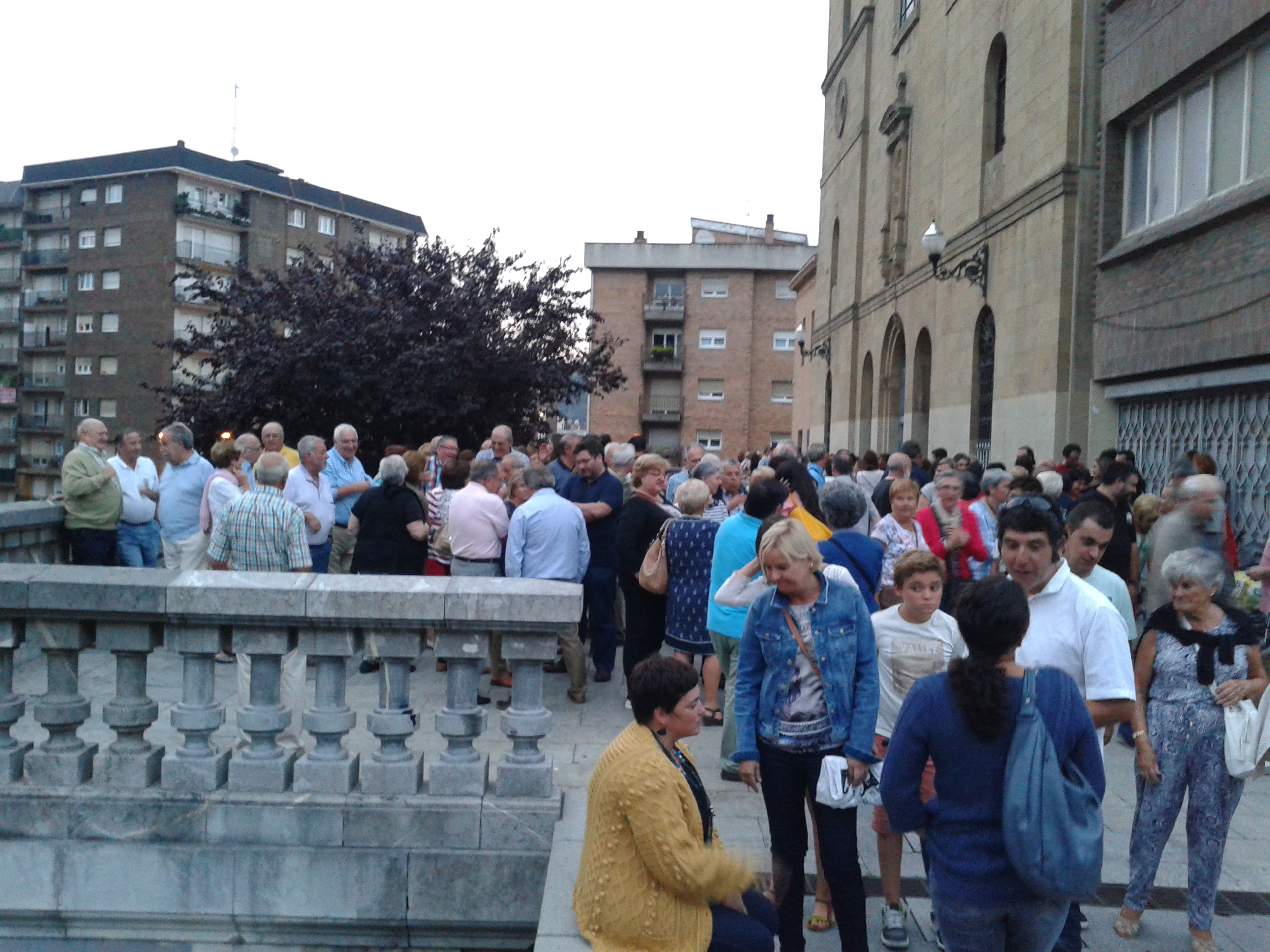
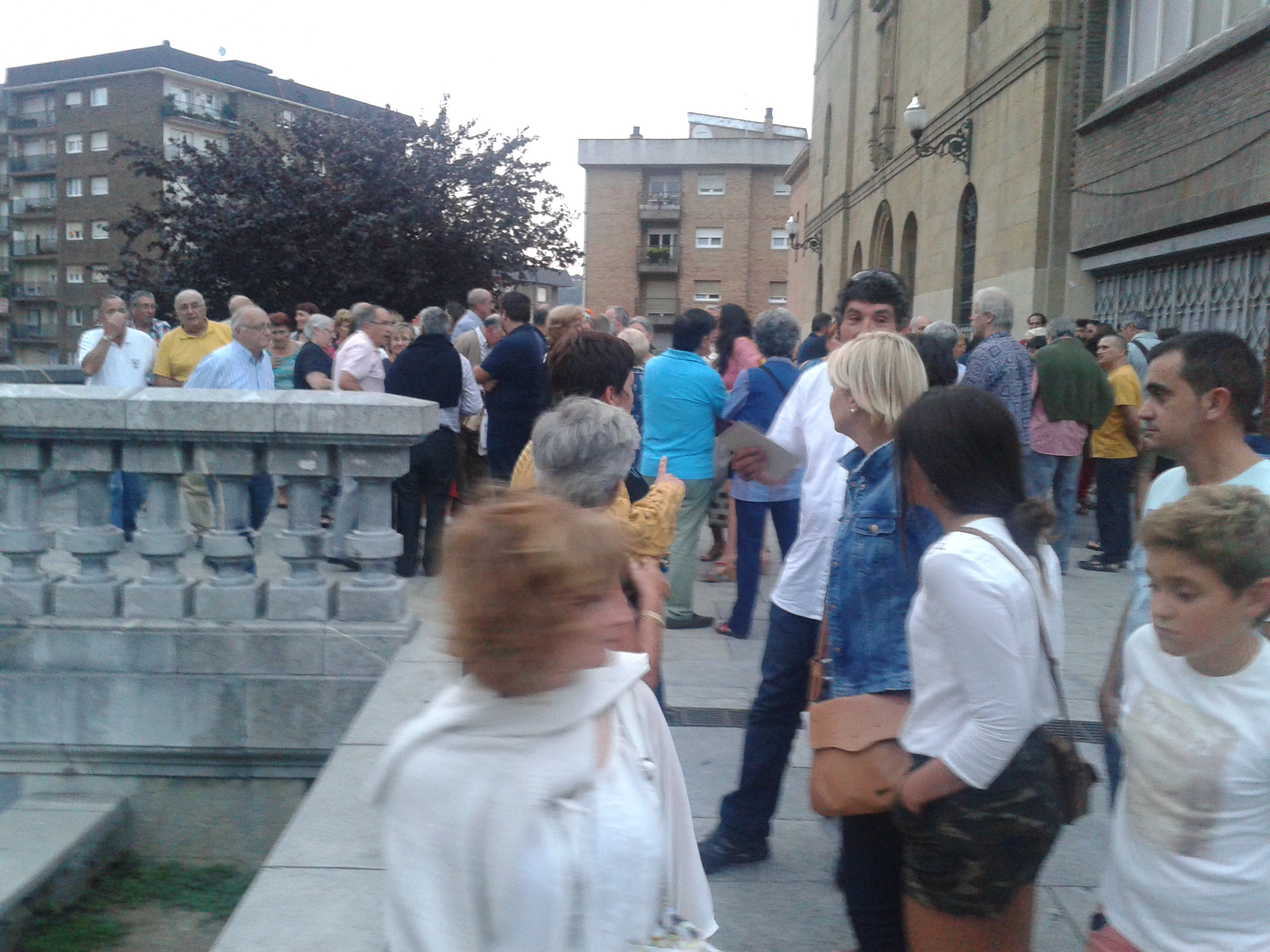
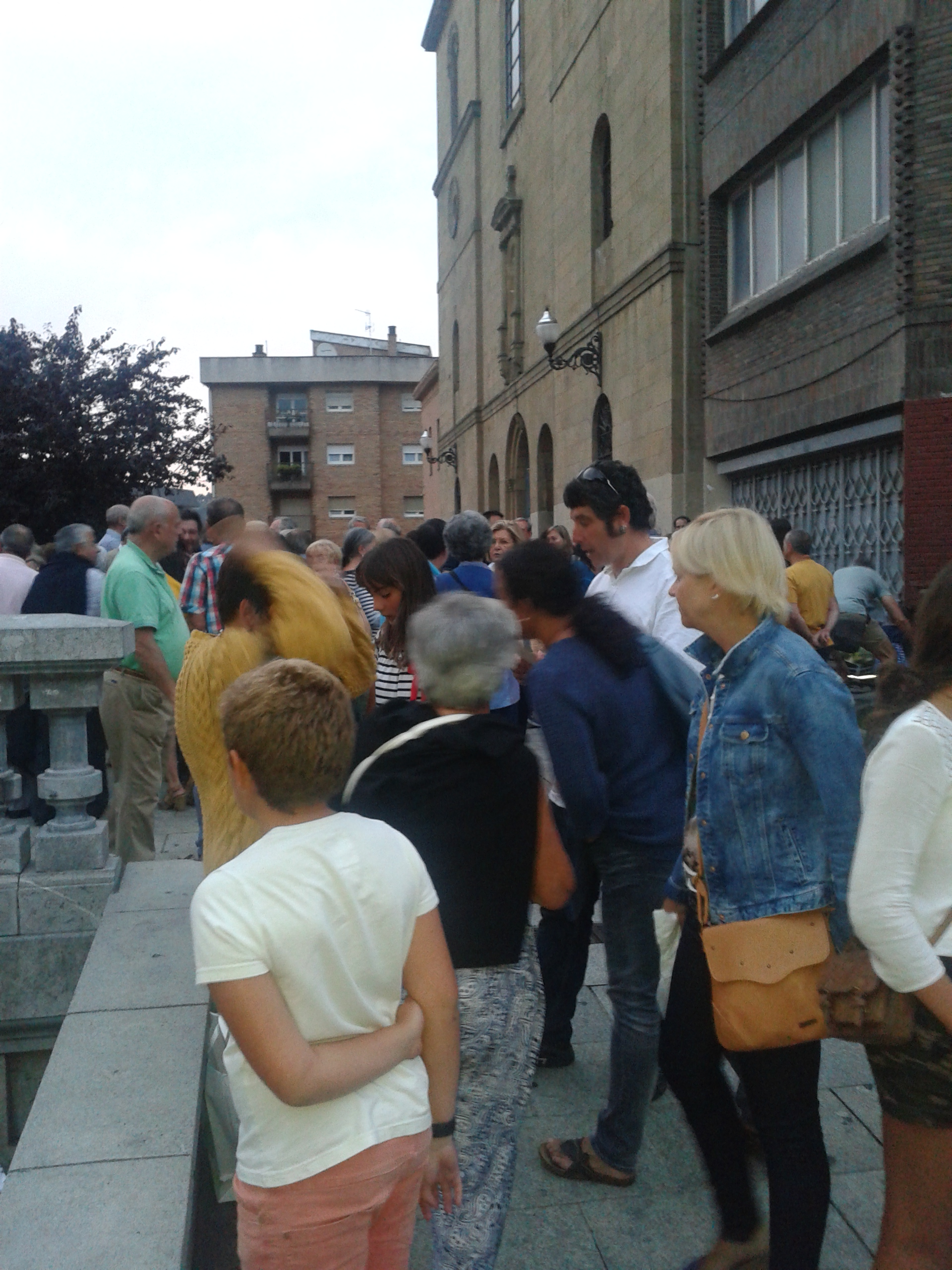
But five years later, outside the church after Maribel’s funeral, I waited with my two brothers on the margins of the crowd. I saw some youth among the mourners, including Goth and punk types, presumably friends of Maribel and Josemari’s daughters. Most in attendance were of older generations, however. It was noticeable how prominent the women were – garrulous and assertive. There were of course representatives of various branches of the movement, who knew the couple personally.
Small section of the funeral crowd outside the church with Gorka in the foreground in white shirt (photo D. Breatnach)
Inside the church I had already conveyed my condolences to Josemari, who had seemed amazed, amidst his grief, that I had travelled from Ireland for the funeral. I was surprised, in turn, that he would have expected any less; for me, there was no question – I’d have borrowed the money to go if necessary. His son-in-law burst into tears when I hugged him and that was it for me, my composure crumbled and we cried in one another’s arms. Now I waited for the crowd to thin so I could hug the daughters, the two who live in Bilbao and Maider, who lives in Gastheiz (Vitoria).
I stayed in a friend’s house a couple more days, renewing contacts and making a few new ones, meeting some old friends and then it was back to Dublin once more. Agur to Euskal Herria and agur to Maribel Eginoa – a loss to her family, to her nation, to me and to humanity.
End.
Footnotes
1 “ikastola” = school or college; plural “ikastolak”
2Agur translates as “goodbye” butcan also be a greeting. The Agur Jaunak’s lyrics are short and simple; the song is performed usually a capella, in giving honour to a person or persons and traditionally everyone stands when it is sung. The provenance of the air is a matter under discussion but it is only the Basques who are known to have lyrics to it. https://www.youtube.com/watch?v=xNMaMNMpYEk is one of the best versions I could find on the Internet although there is a somewhat cheesy bit by one of the performers in it. https://www.youtube.com/watch?v=d7Z8E-xhYTU is vocally another lovely interpretation sung unusually high although I dislike the crescendo at the end which is not the traditional way of singing it, which is to end on a low note.
A central character in a Cory Doctorow novel comments that the cast-iron railings donated by householders in Britain for use in making munitions during WWII were instead dumped into the Channel.
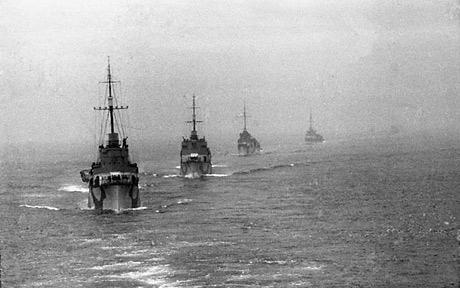
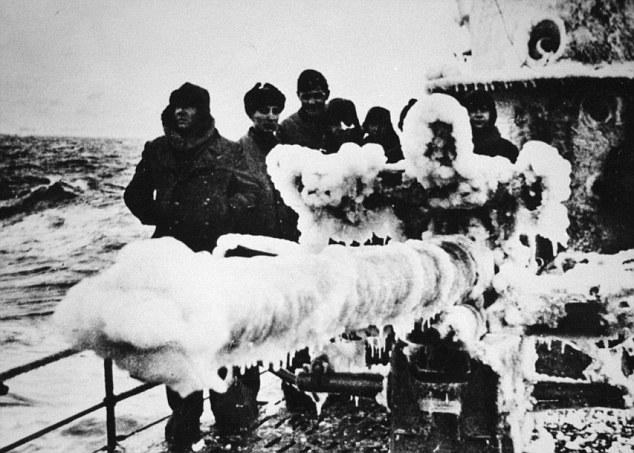
Doctorow takes liberties with the present and the future but not so much with the past. Even so I doubted this story. I doubted even more the reason given, that the iron was allegedly unsuitable for making munitions but that the people were not told in order to keep their morale up – the belief that their sacrifice was helping the war. While working in London I had heard stories myself of the railings going to help Soviet Russia, convoys carrying the iron on those awful Artic runs to Murmansk, across a sea infested with Nazi submarines and so cold that your body in the sea had minutes at most to live. And no ship would stop to pick you up either, because it would endanger their whole crew and the rest of the convoy.
Did I doubt that the British Government was capable of keeping the truth from the people in the cause of war morale? Not for one minute – they have lied and concealed truth from the people for reasons much worse throughout history …. and continue to do so. No, what I doubted was that the metal was unusable. I’ve worked in a few foundries and although they were non-ferrous, I think I know a little about metal and its preparation. I’ve been a welder too.
Allied warship in Artic waters during WWII giving some idea of the conditions
Cast iron is what it sounds like, iron that has been cast – melted in high heat and then poured into molds to the required shape. But it isn’t just iron – among other things it also contains carbon. So does steel, even the lower-carbon steels – but cast iron contains a much higher proportion of carbon, at least 2% and often just over 4%. Not much, you might think but it does make a big difference.
Once, many familiar objects were made out of cast iron – gutters, drainpipes, gas pipes, sewer pipes, manhole covers, gas lamp-poles, baths ….. A very hard metal but also brittle. You’ve seen an old metal broken drainpipe, right? Broken into a point? Cast iron, for sure. Steel doesn’t break like that. Corrodes, dents, bends and under extreme pressure, shears – but doesn’t shatter or break off like cast iron when it gets a hard enough knock. Well, maybe steel will shatter in extreme cold but we’re talking about within a normal range of temperatures here.
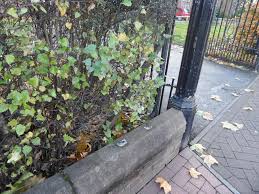
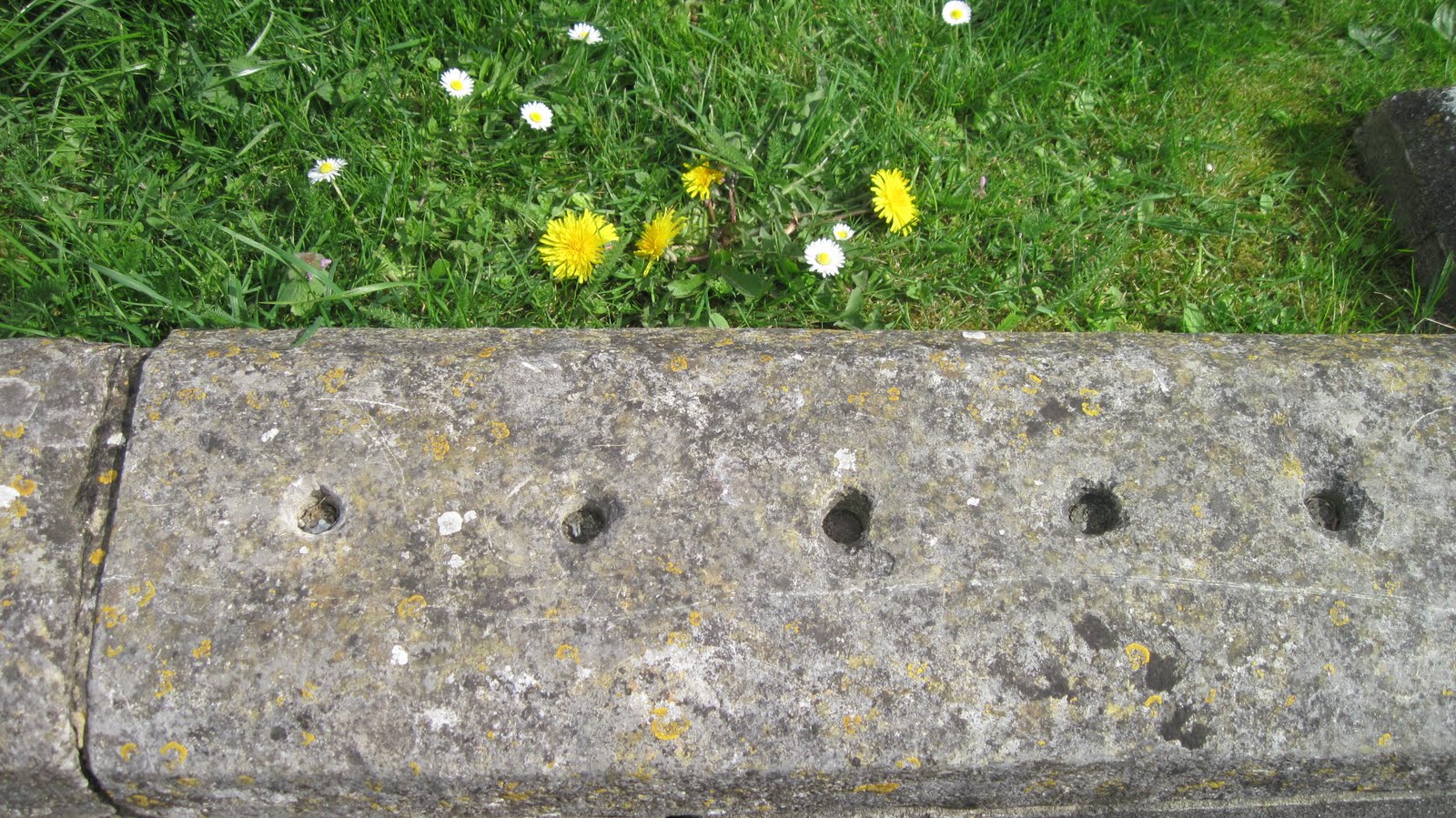
A wall of a former girl’s boarding school showing where railings were removed during WWII (no doubt to the warm approval of the local lads). The holes show the lead that was poured into the hole in the stone around the railing bar to grip it tightly when it set.
Cast iron is denser and heavier than steel and needs a greater thickness than steel to make something, it being possible to work the latter while very thin. Think of a food ‘tin can’: it’s not tin, though typically it had a coating of tin inside. It is steel, pressed very thinly – “thin can” would have been a more accurate name. Now, think of those cans you’ve seen, rusting away from the outside (the reason for the protective coating of tin inside).
So why use cast iron at all? Well, corrosion-resistance is one of the reasons to choose it as a material — cast iron doesn’t corrode as badly or as quickly as steel (stainless steel of course is something else). And cast iron melts at a lower temperature than steel, which makes it significantly cheaper to produce. Cast iron is very good under compression, i.e. at bearing weight and, when used in arches, could and did make effective iron bridges (though not good under tension or “pull”, where steel has it beat). And it can be machined well – so engine blocks and big machine frames could be made from it. And the kitchen range stove.
For years my mother wanted a big cast iron frying pan like those she had been familiar with from the Spanish state, because the heat stayed in the pan longer and food stuck less (this was before Teflon and other non-stick surfaces). The cast iron pan is heavy to manipulate but I prefer cooking in it myself.
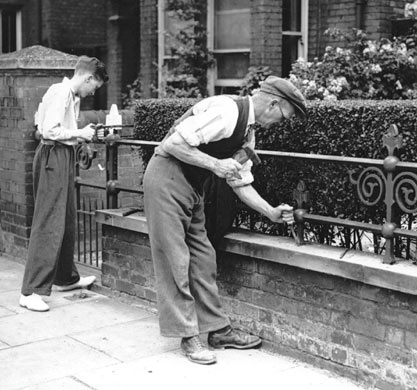
Boy and possibly father or grandfather removing railings, probably during WWII
Now, iron is common to cast iron, steel and wrought iron. All iron can be melted down and re-used. You might have to process some other elements out and add other elements but so what? Is it being suggested that Britain in the mid-20th Century did not have the technology to do so? Or even that it was cheaper to dump the cast iron, at a time when cheaper imports could not possibly be available?
But then what happened to the missing railings? They were definitely removed and to this day you can see some walls in Britain, with rows of holes filled with lead, where the railings were secured. The newspaper magnate and owner of the Daily Express, Lord Beaverbrook (William Maxwell Aitken),who was variously Minister for for Aircraft Production and later for Supply, had put out the call for the public to donate the cast-iron railings for armament production.
A stone wall, probably limestone, showing the holes once occupied by railings. Curiously there is no sign of the lead that was also poured into the holes to hold the railings firmly in place. Perhaps it was removed at some time when the scrap price for lead made such extraction worth the trouble.
There are at least hundreds of recorded eye-witness accounts of the removal of railings and gates, as well as quite a few photographs showing people working on their removal. But where they went is a mystery. There are no similar eye-witness accounts of the arrival of those railings in the steelworks of England, Wales and Scotland, even though the histories of those steelworks are well documented.
Discounting the popular belief that the metal was “unsuitable”, the London Gardens Trust website writer has this to say:
“Another more likely explanation is that far more iron was collected – over one millions tons by September 1944 – than was needed or could be processed. Certainly the huge underground munitions factory Beaverbook set up at Corsham in Wiltshire ran far below capacity for its short life.”
So why not just halt the collection? One reason might be that Government Ministers hate admitting mistakes. But another could be the desire to keep the war effort morale going among the population:
“Faced with an oversupply, rather than halt the collection, which had turned out to be a unifying effort for the country and of great propaganda value, the government allowed it to continue. The ironwork collected was stockpiled away from public view in depots, quarries, railway sidings. After the war, even when raw materials were still in short supply, the widely held view is that the government did not want to reveal that the sacrifice of so much highly valued ironwork had been in vain, and so it was quietly disposed of, or even buried in landfill or at sea.”
John Farr wrote an article in Picture Postcard Monthly, (‘Who Stole our Gates”, PPM No 371, March 2010), in which he claims that only 26% of the iron work collected was used for munitions. He also states that “most of the pertinent records at the Public Records Office had been shredded”.
A recurring tale in London is that the railings were taken out on barges and dumped in the Thames Estuary. The source for this seems to be an 1984 often-quoted letter to the Evening Standard by journalist Christopher Long. It seems too that this might have been Cory Doctorrow’s source, although his character said “the Channel” (hardly likely in time of war),
Christopher Long claimed to have this information from dockers in Canning Town, East London, who gave accounts of the disposal. So much was dumped, they said, that ships in the estuary needed local pilots to guide them because their compasses were made unreliable by the sheer amount of iron down below.
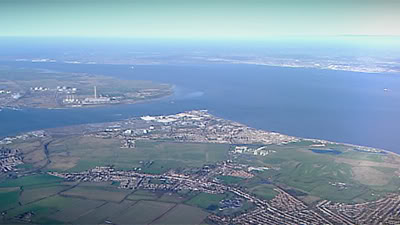
Aerial view of the Thames Estuary — was this the final destination of the railings?
Sadly, we are unlikely to verify or disprove this story except through archaeological underwater investigation. Strangely, Christopher Long appears not to have rigorously documented his sources or to have recorded the names of his informants, much less made oral history recordings. If he did do all that, he did not refer to it in his letter or subsequent publication.
But it does seem extraordinary that, if true, this information could be kept a secret for so long. One possible reason is a political one – but from the Left rather than the Government. Support for the Soviet Union from British workers was a significant element in British Left-wing discourse during the War and afterwards. It may not have suited the Left to undermine the dominant narrative of British railings, torn out by British workers, going to make Soviet tanks. And collectors of oral history among working class communities tend to be of Left-wing ideology, it would appear.
But it would also seem that these stories are not too far away in time to be investigated, as other investigations of oral history of WWI in Britain or the 1916 Rising in Dublin have shown. And how hard would it be to investigate the often-repeated story that some of the railings are to be found in West African ports, as allegedly they had been used as ballast in ships bound for Africa?
It occurs to me that one unexpected effect of the mass removal of railings would have been rendering public many of the parks in bourgeois areas, previously accessible to “residents only”. Perhaps working class people living nearby would have been particularly enthusiastic about removing these to support the war effort?
On 6th September 2015, the Galway GAA team played the Kilkenny team in the Croke Park national stadium. I wrote this at the time but never posted it for some reason then and came across it to my surprise today.
Fans making their way along Cavendish Row and along Parnell Street on their way to Croke Park. (Photo D.Breatnach)Fans making their way up O’Connell Street and along Cavendish Row on their way to Croke Park. (Photo D.Breatnach)
I write to express my admiration for your work and my sympathies with regard to the criticisms with which you are currently being bombarded. I hope you will forgive my ignorance of much of the work you have been doing in the area of Heritage, which is not really where my strengths lie. But I love the way you talk, the way you shoot down those critics, especially those TDs who ask those nasty questions. And I’m sure you had something to do with removing Westport House from the NAMA sell-off, even if it is in Enda’s constituency. Such a fine example of our colonial architectural heritage!
Heather Humhpreys, Minister for Arts, Heritage and the Gaeltacht
But as we know, Minister, that wouldn’t be the kind of thing that would be appreciated by your critics. They’d rather you devoted your talents to a shabby row of Dublin houses of dubious architectural importance in a grubby street market. A street which they say is “pre-Famine” — as if that were something to boast about! Laid down earlier than Sackville Street (now O’Connell Street) they say …. Sure why would we want to keep a street that old …. or remember that embarrassing episode in our history either, when we lost a third of our population to over-reliance on one crop! We learned from that, though, didn’t we? Sure we grow hardly any crops at all now and get them all in from abroad. And we live in cities now — who wants to be getting up at 6 a.m. in all kinds of weather and plodding through muck? If people like growing things that much, get a house with a garden, I say. And a gardener to do the donkey work.
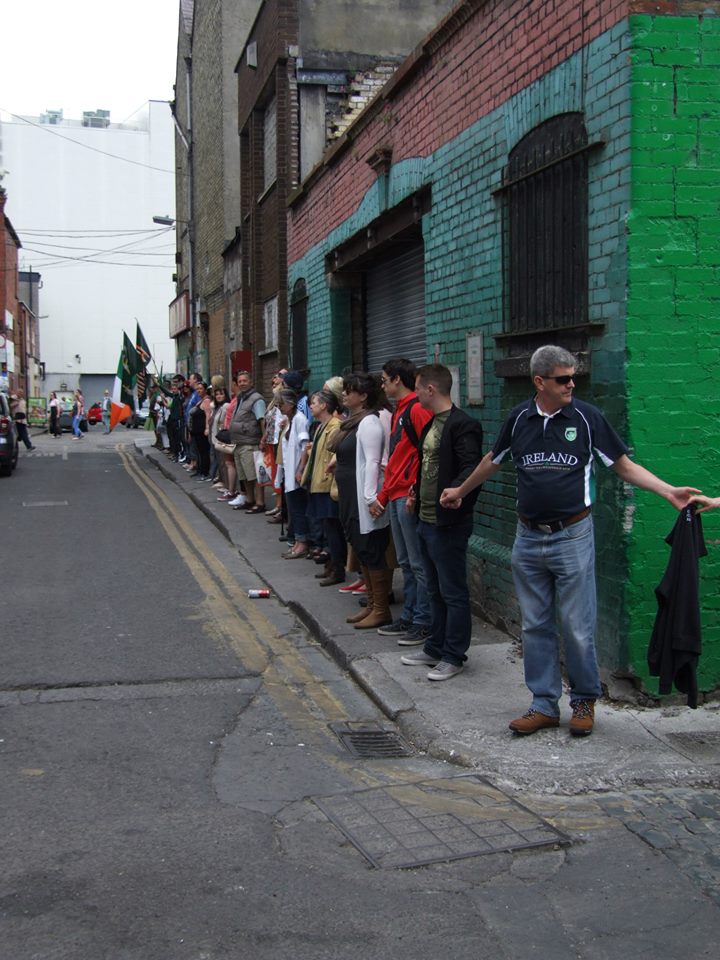
Supporters at the symbolic Arms Around Moore Street event organised by the Save Moore Street From Demolition campaign in June this year. This is the corner of Moore Lane and Henry Place, across which Volunteers had to run under machine-gun and rifle fire from Parnell Street (at the end of Moore Lane, to the right of the photo) and at least one Volunteer died here.
But I’m digressing, Minister, my apologies. Apparently the reason they want to save that shabby terrace, that “pre-Famine street” — and the backyards and surrounding lane-ways, if you please! — is for HISTORICAL reasons. Historical! Sure have we not had enough of history – Brehon Laws, Golden Age, Clontarf, Normans, 800 years of British occupation, blah, blah, blah! Weren’t we sick of it at school?
I’ve never liked Labour too much (somehow even the word sounds sweaty) but I have to admire their Education Ministry’s efforts to remove history as a subject from the compulsory school curriculum. I’m sure they’re doing it for their own reasons – after all, wasn’t their party founded by that communist James Connolly? Sorry, revealing my own knowledge of history there, ha, ha! But whatever their reasons, they are on the right track. Who wants to know where we are coming from? It’s where we ARE and where we are GOING TO, that matters!
But some people just can’t let it go, can they? They trail history around like something unpleasant stuck to a shoe. So what if 300 of the GPO garrison occupied that terrace in 1916? The Rising, if you ask me, was a big mistake and I know plenty of people agree with me, even if most don’t have the courage to say so. Wouldn’t we be much better off if we’d stayed in the UK? And kept the Sterling currency? And as for the War of Independence …. don’t get me started!
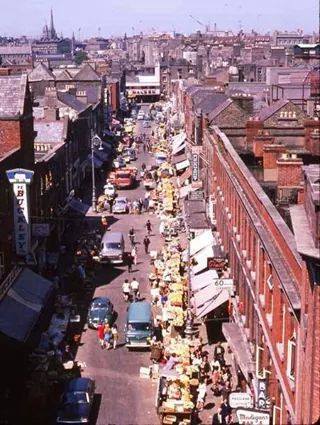
Aerial view Moore Street, looking northwards, 1960s, before the building of the ILAC and the running down of the street market.
And then there’s all that communist-sounding stuff about treating “all the children of the nation equally” — what kind of rubbish is that? Some are born to big houses with swimming pools and some are born to flats, or even rooms. That’s just the way of life. And some will claw their way up to get to own big houses and if they are a bit uncouth, well that can’t be helped, they still deserve where they get to. And their children at least will be taught how to fit into their new station. That’s democracy! But everyone equal? Please!
Sorry, back to the Moore Street controversy. OK, after the mob pressured the Government, four houses in the street were made a national monument. But was that enough for the mob? Oh, no, not at all — eight years later the State had to buy the four houses to satisfy them. Thankfully the specul ….. sorry, the developer, got back a good return on his investment – four million, wasn’t it? That’s the kind of thing that makes one proud to be Irish – buying run-down buildings and letting them run down more, then selling them for a million each. That’s your entrepreneur! If only we had more like that, to lift this country up!
I must say I really liked that developer’s plan to build a big shopping centre from O’Connell Street into the ILAC, knocking those old houses in Moore Street down (although I know he had to leave those “national monument” four houses still standing in the plans). I do hope whoever has bought the debt off NAMA and now owns those houses will carry on with that plan. Actually, I’d like the whole of O’Connell Street under glass if it were possible. Wouldn’t it be great to do your shopping from the north end of the street to the south and from left to right, without ever having to come out into the weather? Of course, not much shopping there now, with Clery’s closed …. still ….
And then they’re going on about the market ….. traditional street market …. blah, blah. What’s wrong with getting your veg and fruit from the supermarket? Or getting them to deliver it your house, come to that? “Traditional street market” my ar….. excuse me, I got carried away there. Those street markets are all very well for your Continentals, your Africans, Asians, Latin Americans and so on. Or for us to go wandering around in when we’re abroad on holiday, maybe. But back home? It’s the nice clean supermarkets for me any day.
Well now, if the mob insists on saving the street market, here’s an idea: why not provide a showcase stall or barrow, stacked with clean vegetables and polished fruit, right in the middle of the new shopping centre. After all, that’s heritage, isn’t it? And aren’t yourself the Minister for Heritage?
Mary: He’s never struck me as the playful or frivolous type.
FB: Perhaps he wants to ….. you know …..
Mary: What? Have sex with me?
FB: Well, yes. Lots of romances have bloomed between people who met on Facebook.
Mary: Probably a few kidnappings and rape too, I shouldn’t wonder.
FB: We can’t possibly be held responsible for ….
Mary: Oh, please! Spare me the official disclaimer! But do you really think John Brown might be trying to seduce me?
FB: Well, maybe … probably … yes. Why are you laughing hysterically?
Mary: He’s gay! He’s been “out” for ten years! He’s been living with a male partner for three years .. He announced just last week that they broke it off actually.
FB: Well, there you go.
Mary: What? “There you go” what?
FB: He broke up with his partner last week and this week he’s nudging you.
Mary: But he’s gay!
FB: Gay men have been known to convert …. revert … whatever.
Mary: Only in Christian evangelist imagination.
FB: Well, perhaps he’s bisexual.
Mary: He’s not.
FB: How do you know?
Mary: He’s always been quite clear about that. Besides ….
FB: What?
Mary: He didn’t nudge me.
FB: Yes he did.
Mary: No he didn’t.
FB: How can you be so sure?
Mary: He told me.
FB: When? You haven’t been messaging him.
Mary: I texted him just now on my mobile.
FB: Oh ……… He’s lying.
Mary: It could be you that’s lying.
FB: Why would I lie about that?
Mary: Well, to increase traffic on FB. I nudge him, he nudges me, we start additional conversations, other people start nudging …. etc. etc. More FB traffic, more interest from advertisers, more money for you.
FB: ……………….
Mary: Well?
FB: Patrick Smith poked you.
Mary: What! WHAT did you say?
FB: No, no! Poked …. as in …. as in … kind of like “nudged”.
Mary: Oh, for Heaven’s sake! You’re trying it on again!
FB: ………….
Mary: Well, aren’t you?
FB: Well, yes. Would you like to play one of the FB games?
Mary: You mean like pretend I did something I didn’t, lie to my FB friends and generally up traffic on FB?
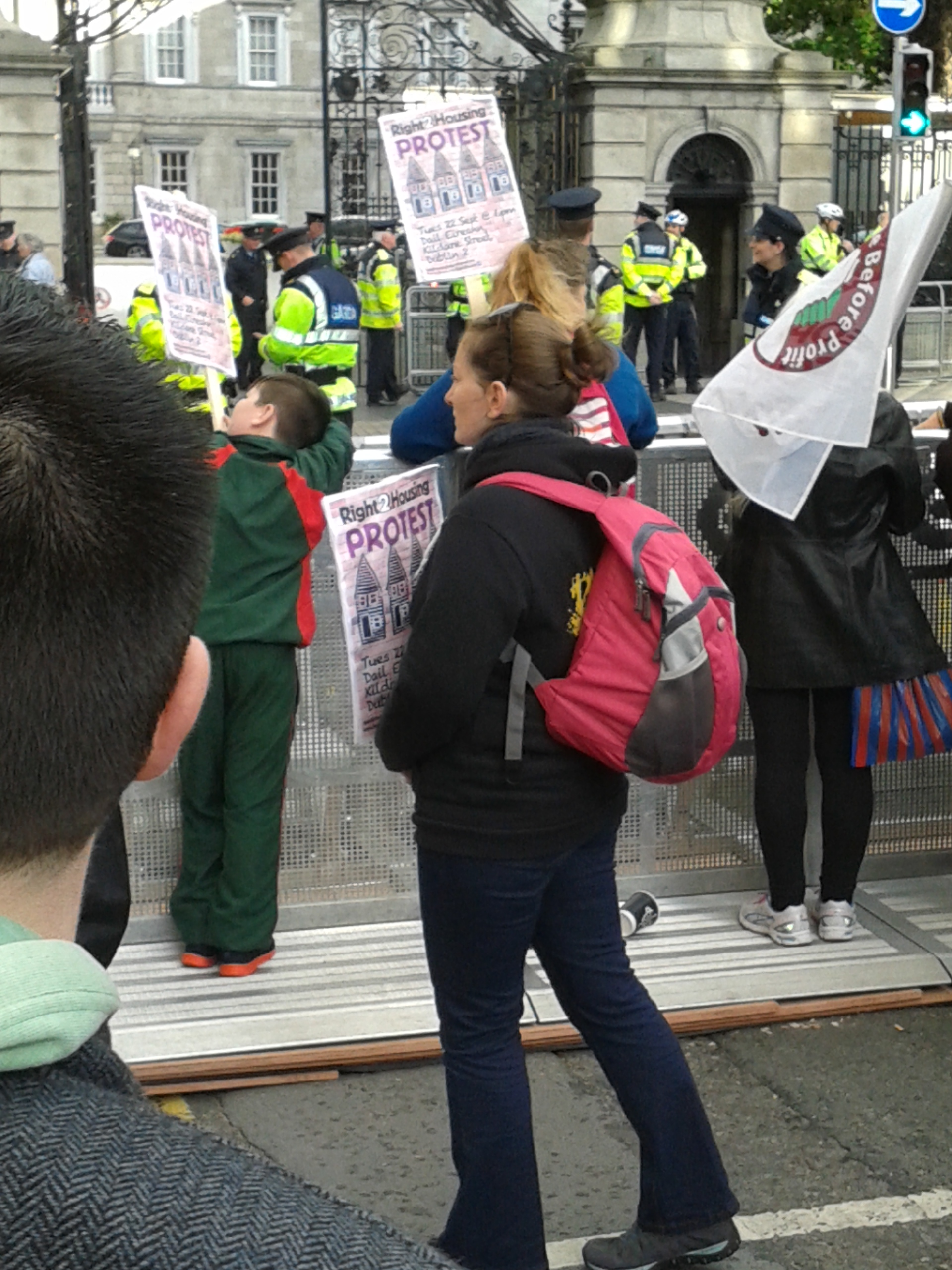
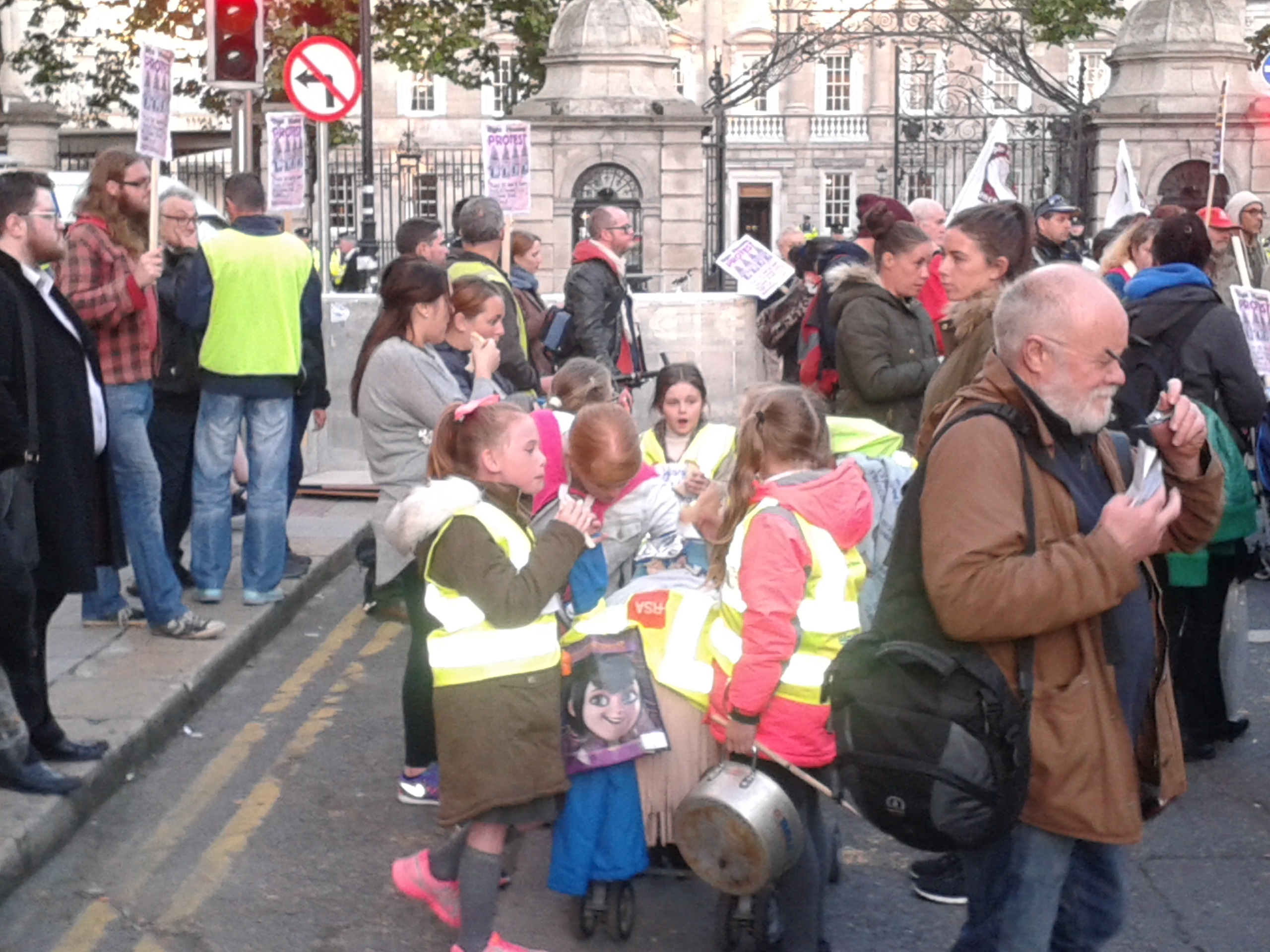
A few hundred people turned out to “welcome” the Irish Government Ministers and supporting TDs (elected members) back to the Dáil after the summer recess of the Irish parliament. The protesters were not allowed within fifty yards of the main gates, with lines of Gardaí, the Irish national police force, standing behind the special new double barriers which they now employ here. Kildare Street, the address of the Dáil, was closed by Gardaí to pedestrian and motor traffic and public transport buses using that street as part of their regular routes had to be re-routed.
There was a special focus among many of the protesters on the housing crisis in Dublin with a number of organisations working with or campaigning for the homeless present and a number of placards drawing attention to the issue.
Some protesters had met at 4pm at the GPO in Dublin’s O’Connell Street and had marched to the Dáil from there, while others had arrived at the Dáil itself from 5pm onwards. There were others demonstrating too in Merrion Street, on the other side of the Dáil complex.
Around the other side, in Merrion Street, I met some protesters coming away from the protest there and stopped to talk to them. They informed me that it was ending there and I returned along Nasseau Street to Molesworth Street.
Among others, schoolchildren lean on the barrier which facing the Dáil, the Irish Parlia
When I started up Dawson Street I saw a small march coming down towards me. These were clearly the remainder of those who had been in Merrion Street earlier. Among this section were young mothers and some of their children had notes attached to their chests, for example “I am five and I am homeless”. I joined this group for the short walk remaining in Dawson Street and into Molesworth Street.
Speeches were still going on there and it seemed a musician or singer would have made a nice change – or even a comedian, or a juggler. After a short while the speeches ended and the crowd began to disperse, at which point I approached the women I had been told were homeless and spoke to one. Shortly after, I left to buy a cup of coffee and start an article about that homeless woman and her children.
Around 6am I awoke, still half in the script and trying to figure a way to win through. But not for long, as I was driven stumbling by the urea imperative – I had to go to the toilet. In the hallway I switched on the light, still thinking about the situation I had been in and, turning into what I thought was the open doorway, immediately stubbed my toe and nearly my nose on the door. After suitable curses, I stood in front of the enamel directing the hose while I thought about the damned situation.
I had debts. And there was a gang …. or gangs … and I was kind of in one of them and the big boss was putting the squeeze on me. Now, in my other life, the waking one, I’ve never really been in a gang, not even in my teens, although that’s not to say I didn’t have anything to do with them. I did – running from them, hiding from them, sometimes fighting and (of course) getting beaten up by them.
My social class set, the lower middle class, didn’t have gangs. The working class had them and curiously, the upper middle class had them too. The Geldoff types (he was from my home town). And since I didn’t usually have money to go to dances and discos, the dangerous times in my hometown were mostly daytime. The Geldoff types hung out in the Bamboo café across the road from Murray’s record shop, where us gangless lower middle class hung out. And the working class had no café or record shop, just their areas – the ‘Noggin, York Road ….
They weren’t anything like the legendary Ringsend or Dolphin’s Barn, but they were tough enough in my book. Ringsend lads came to the Top Hat Ballroom in my hometown once to settle a score and chased the locals all the way up to the ‘Noggin and the Farm, over a mile away. Local folklore had it that as they queued up in Ringsend earlier that evening to get into taxis for the foray, old dockers had handed each youth a docker’s hook.
There were times when walking down the main street in Dún Laoghaire had felt like something out of High Noon or some other western film, when the hero doesn’t want to go out in the street, he knows death is waiting there – but he has to. In his case, it was duty or some kind of fatalism sending him out there. In my case, it was fear of isolation. I didn’t want to end up cut off from my contemporaries – the boys and, yes, especially the girls. Where they hung out, I would have to go. Of course death wasn’t waiting for me, unless it were accidental …. only a beating.
Anyway, I deviate. Which doesn’t make me a deviant, by the way ….. Anyway, back to the script.
One of the things I was being pressured about had to do with promoting the gang leader’s mice. Yes, mice. Don’t ask me – I didn’t write the script.
For some reason the boss’ mice needed to be distributed, to take over everywhere. And one of the places Big Al wanted his mice installed was in a closed down fairground. It was in my area, so of course Big Al thought it was my responsibility to do it.
Big Al, photo taken during one of his philosophical debates
The thing is, that abandoned fairground already had mice, as I tried to tell Big Al. I’d hardly ever actually seen one but you could hear them, rustling, scratching and sometimes squeaking as they fought.
Big Al wasn’t interested. Were they HIS mice?
Well, no ….
Well, didn’t I see the problem?
I nodded. I could see I had a problem and I’d have a worse one if I didn’t do as he wanted.
Big Al’s mice arrived next day delivered by motorbike courier, in a plastic bag. Yeah, I know … but remember — I’m not the script writer.
I took some of the mice out. They were sleek, strong, well-fed, pinky-white mice. I carried the bag to the empty fair ground and let some of them out, to see how they got on. They scurried eagerly down lots of holes and there was suddenly a lot of squeaking underground. Then silence.
After a while, one came back, mauled and bloody. I waited but no others arrived. I put the rest of Al’s mice on the ground so they could avenge their mates. I had no choice, unless I wanted to tell Big Al I had disobeyed his instructions.
Those mice knew what was waiting for them and not a single one went down any hole. They milled around above ground. Then they found an unopened can of beer left by some inebriated street drinker, bit through into it …. and proceeded to get really, really drunk.
Some of Al’s mice before they discovered the beer can
They were still drunk when Big Al dropped by to see how his mouse colonising was progressing.
“What the fuck is going on?” Big Al and his bodyguard were looking in amazement at his carousing, stumbling mice.
I told him what had happened. He shook his head, muttered something, shook his head again, then went off grumbling to get some more mice – maybe Super-mice, or Ninja Mice, or something.
I knew the drunken mice would be history. If a cat or a kestrel didn’t get them …. well, Big Al had a low tolerance for failure. I should have felt sorry for them …. and I kind of did … but also a kind of contempt. The fairground mice had lived a hard life, braving flood and ice, finding what food they could, breeding, tunneling, avoiding alley cats, kestrels …
Big Al’s mice had been fed high-protein diets, reared in secure environments, built up muscle, each probably outweighed the biggest fairground mouse by a couple of ounces. But those scruffy, lean, dirty mice had finished off the advance guard of Al’s mice in minutes. And the rest? Didn’t even have the courage to make a fight of it but went and got drunk instead!
I left them to it. Al would be back and he’d probably want to supervise the operation against the Fairground Mice himself. That was fine with me. I didn’t like the job and I secretly wished the native mice well.
Anyway, I had other problems to deal with. I still had to organise my area for Big Al’s other operations – or else. I didn’t know exactly what the “else” might be and truth to tell, I didn’t even want to think about it.
In the end, I couldn’t do it. I could fool myself that I could manage the area for Al in a more decent way than somebody else working for him …. maybe. But I would still have to become too much like Al himself to do it. So, one alternative only – get out, go on the run and hope Big Al or his goons couldn’t find me. I didn’t even know where I was going to go – just out.
In my benighted life, I had one bit of success.
I ducked into a shop and got to use their phone. That’s right, no mobiles – maybe this script was set in the 1980s …. Not that I remember seeing big hair, shoulder pads or baggy trousers …
Anyway, I phoned up the electric phone company and got to speak to the Area Manager about my bill …. yes, the actual Area Manager! I told him I was going out of business and after a little haggling he agreed to accept 20% of the bill in payment and to wipe the slate clean.
Then I phoned my cousin, also my best friend and told him I was getting out. He was disappointed in me. Really, really disappointed. I could imagine him shaking his head.
“What about community organisation, man?” he asked.
“I can’t do it, Mort. Big Al is too much to go up against.”
“I can’t believe it – and you from a long line of trade union organisers.”
That got to me because, in the script, it was true. My Da had been a union organiser most of his life. My Ma too. And one of my Grandas as well. Strikes, union meetings, pickets, marches, police stations and courthouses had been a part of my childhood, almost as much as school throughout the year and the seaside in summer.
In real life, of course, my Da had been many things but never a trade union organiser. Active trade union member, yes – organiser, no. And my Ma – well, maybe if there had been a Housewife’s Union …. she would have probably been the General Secretary.
Anyway, in the script, Mort shamed me. And talked some more. And I argued. And he put forward a plan.
For some reason, this plan, which of course required community organising, needed a public appeal by television. Mort said I should do it. I told him I couldn’t – I’d freeze on camera and anyway I was too closely involved. I begged him to nominate someone else. He thought for a little while.
“Ok, but you have to go with whoever I choose – no backing out.”
“Sure! Thanks!” I gulped, relief flooding me.
His next words ejected that relief right out again.
“Ask your Ma.”
After I recovered from the shock and hung up, I went to see Ma. This was Ma in the script and nothing like the Ma I had in the real life, the one who was born in the Basque Country and spoke English with a German accent, because her Da had been a German.
And this script Ma was easy-going, unruffled …. Still, she took some persuading before she agreed. And while she was getting ready for her TV appearance – having her hair done, rehearsing her appeal, buying new shoes (who was going to see her shoes on TV?!!) — I was down on the street in my area, doing the rounds, talking to shopkeepers, community workers, youth, pensioners ….
Of course, Big Al was going to get to hear what I was doing. But the gamble was that my Ma’s appeal would be broadcast before he could make his move …. and after that, it would be much more difficult for Big Al to demonstrate the full meaning of that “else” with which he had threatened me. And hopefully the community would start to solidify and be able to resist. Doing nasty things to me wouldn’t be that productive any more. And whatever else Big Al was, he was a pragmatist.
Yes, of course, there’s always the unpredictable emotional element ….
I was pondering that when something pulled me half out of the script.
It was around 6am and I was still half in the script and trying to figure a way to win through. But not for long, as I was driven stumbling from my bed by the urea imperative – I had to go to the toilet.
In the hallway I switched on the light, still thinking about the script I had been in and, turning into what I thought was the open doorway, immediately stubbed my toe and nearly my nose on the door. After suitable curses, I did the business in the toilet and thought about the events in the script.
Then I wondered whether I could somehow get hold of the scriptwriter and how I could make him pay for what he put me through.
Had I met him? No, never. How did I know he was male? I don’t know, but for some reason I was sure he was. Which is strange, because nobody in my life had ever fucked with my head the way some women had. But yes, he is male – I’m sure of it. Now, where could he be hanging out ….?
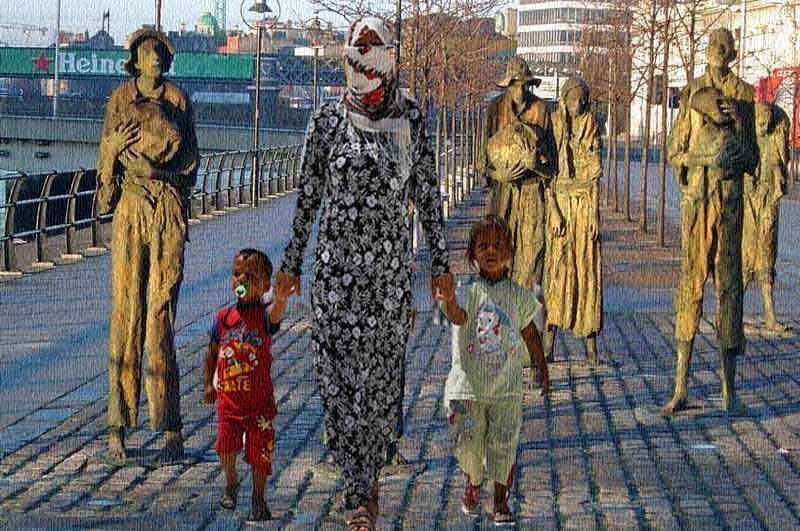
The Great Hunger (1845-1849) emigrants’ monument on the north quays of the river Liffey, Dublin, with superimposed image of African woman and children (image from Memet Uludag on Facebook).
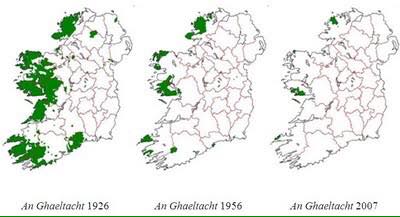
Maps showing the decline in the Irish-speaking areas, the Gaeltacht, during the life of the Irish state
“Irish is nearly dead as a spoken language.” A shock ran through the Irish-speaking community at the news…. but although the after-shocks reached linguists afar …. the news caused but a small ripple in Irish society at large.
It should have been big news. In only nine decades of the existence of the Irish state, the Irish-speaking areas had shrunk by 90%. This seemed to herald the imminent death of Irish as a spoken language – a language that, albeit shrunk to being the mother-tongue of small minority of the Irish population, had survived almost a millennium of colonial occupation and a consistent policy to replace it with English.
The loss would be greater than Ireland’s alone – this is an early Indo-European Celtic language of more than four thousand years of development, the language of the earliest vernacular literature of Western Europe, an extremely rich literature of pagan mythology and folklore containing epics which did not suffer the extent of moralistic destruction which either the Reformation or the Inquisition visited upon so many others across Europe. The language is probably unique on the Continent in being that of a state and which is also that of the first recorded settlers of the land. It was (perhaps still is) the Celtic language with the largest number of speakers. It is the mother of Scots Gaelic and Manx Gaelic too.
It seemed almost too difficult to grasp that this had occurred in a state that claims to be independent, which also claimed the language as the first in status in the State, according to its Constitution. And this has, seemingly contradictorily, occurred at a time when there are more Irish-medium schools, Gaelscoileanna, than ever before in the history of the State.
How did it come to pass? Emigration, some might say. Certainly emigration on a large scale has been a feature of Ireland’s demographics since at least the Great Hunger (although it was in the years after that disaster that the outlying western areas began to hemorrhage). Even so, although emigration has been a constant, so also has been the population – in other words, the birth-and-survival-rate kept up with the emigration. Did the Gaeltacht areas experience higher emigration rates than elsewhere then? Certainly – not just to go overseas but also to Irish cities, especially to Dublin. Industry was scarce in the Irish-speaking areas, despite the efforts of cooperatives and Gael-Linn and the land in most places is rocky and poor.
The Gaeltacht Death or Life (image downloaded from the Internet)
Yet, the reality appears to be that the Gaeltacht population reached a level at which it stayed – so how can there be a continual reduction reaching 90% in the Irish-speaking areas? If the population has not decreased, certainly not to that extent – then the Irish-speakers must have. Have many ceased to speak the language then, losing it over a generation, or two, or three? Or has an inward migration of English-language-only speakers replaced Irish-speakers? Yes to the first and yes, to an extent, to the second.
The Basques have a saying: “No language was ever lost because people didn’t learn it but rather because those who had it, stopped speaking it.” (As an aside, I find myself wanting to say “her”, because in Irish the word “language” is of feminine gender: “Beatha teanga í a labhairt” — literally “the life of a language is to speak her”). Observers speak of children raised in Irish-speaking families, or in a mixed-language household, even in the Gaeltacht, speaking English with their peers as they leave the primary school where the subjects are taught through Irish.
So, the people make a choice and some people of other mother-tongues move in – that’s democracy, isn’t it? Freedom to move, freedom to speak the language you want. But is it really so? Certainly one can assume that the people moving in are making a free choice (unless one takes into account dearer house prices in the cities). But are the ones moving out making a free choice? If the absence of industry and therefore employment is a constant in the Gaeltacht then it is not an entirely free choice to leave. If the work were there, one can assume many of the people would stay.
Ok, but the ones who stop speaking Irish – surely that is a free choice? One suspects cultural factors at play there. The attractive world for pre-teenager – which is what most childhood years have become — and teenager, is a world dominated by and represented through the English language. It is transmitted in English through so many media …. all with very little competition in Irish. The Irish-language TV channel, TG4 is in practice a bilingual one. Publishers find only a small market for books aimed at children and young adults in Irish, whereas the English-language market stretches not only throughout Ireland but abroad — Britain, the USA, Canada, Australia, New Zealand … All of this without mentioning TV, pop-song lyrics, video games, Internet, films ….
But one must also take into account the fact that when those Gaeltacht children visit their nearby towns and cities – Letterkenny, Dublin, Waterford, Cork, Tralee, Galway, Ballina – they hear English all around them. Worse … they hear only English around them – unless they hear other languages from tourists or perhaps an Eastern European language from migrants. What they are practically guaranteed NOT to hear is Irish.
So, hardly anyone speaks her – sorry, it – and it’s not cool and most people of your age around the country don’t speak the language and what do you need it for anyway? It’s not surprising Irish-speaking is in decline.
“You can’t blame the State – they tried their best, didn’t they? Sure Irish is still a compulsory subject in the schools.” “The national broadcaster has provided a radio station and TV channel for Irish-language use, too! And they give some grants to families speaking Irish in the Gaeltacht, right?”
Ní mar a shíltear a bhítear (loosely translated as “not all is as it seems”. Yes, Irish is taught in the schools but no attempt has ever been made to make it a language of daily use – for work, public transport, banking, shopping, post office, health service, education … Radió na Gaeltachta was won through a civil rights campaign – Feachtas Cearta Sibhialta Muintir na Gaeltachta – and people refused to pay their radio and TV licenses, were dragged to court, fined, refused and some even went to jail before TG4’s precursor, Teilifís na Gaeilge, was supplied. The Irish-speaking grants were a help to households but were not properly administered so that houses that were not Irish-speaking, or had lapsed, continued to receive them. This gave rise to false statistics that helped to conceal the decline in the Irish-speaking areas.
The Gaelscoileanna outside the Gaeltacht, at 143 in the 26 Counties, though an impressive success story, are not State initiatives — they were started by local groups who then battled for state support. Many are still in temporary buildings or in need of repair while others are awaiting the funding that will allow them to employ teachers. As for the other services – nothing. Oh, yes, some of them are supposed to have one designated member of staff who can provide a service in Irish – you can avail of him or her if she or he is not off sick, on holiday, on training or relocated. And if you can wait ….. and put up with the embarrassment while you hold up the queue. Even having one’s address used in the Irish form requires a battle, sometimes drawn out and one still finds one’s letters, from time to time, forwarded from someone else’s address or disappearing somewhere forever. Or discovering that one’s address, which one gave in Irish, has been converted back to English in some office.
A couple of years ago a Dublin court ruled that a man did not have a right to have the case against him heard through Irish. Gardaí are not subject to even the notional obligations to carry out their tasks through Irish or answerable to the Language Ombudsman and, although citizens have a right to have any legally-required procedure in Irish, cases regularly arise of people detained and threatened for insisting on being dealt with through Irish by the Gardaí (police).
Ó Glíosáin showed in research published in the 1980s the decline in Irish-speaking competency among people who had learned Irish at school and who had considered themselves competent speakers upon leaving secondary education. The rate of decline was in the order of a third for every decade passing since they left school. For all its faults, the blame cannot be placed on the educational system, the usual scapegoat. Ó Glíosáin spoke about the absence of “domains of language” for Irish outside the Gaeltacht. In Dublin, with a population of over a million, there is only one social space where everything should happen through Irish. One social space, in the capital of the State, to serve a population of over a million, more than one-fifth of the entire population of the State!
The lack of Irish services obtains even in the Gaeltacht, believe it or not. A man wrote recently of a bank branch in Connemara unable to deal with him making a withdrawal through Irish that asked him to make an appointment. Some years ago, I went to an AIB branch in the Donegal Gaeltacht area and, among a staff of five who were serving customers, could find not one able to give me a service in Irish. People in the Gaeltacht cannot get a decent service in Irish from their local authority, their health service nor, in many cases, their GP. This was so even when, decades ago, many Gaeltacht people hardly knew English.
Anyway, it’s all over now ….
So beat the drum slowly and play the fife lowly ….
Cnag go mall ar an druma is séid ar an fhíf go híseal …
Or is it? Irish has been in difficult situations before and still managed to survive. But this may be its greatest emergency. Can Irish-speaking survive if the Gaeltacht dies? Some say not, some say yes. But it will be without a doubt another great blow to the language and a great fall in its status. We should say NO — we will not suffer that to happen! We will not bequeath a headstone to future generations.
But what can we do?
What can be done – what must be done – must be done by us, each an every one of us, and also by the State. We must accustom the public to hear Irish spoken. Some will respond and some will not. Some will be hostile. But it must be done and WE must do it. And the more it is heard, the more it will be acknowledged, the more people will think it worthwhile to speak what they know, to learn more, to demand services through Irish, to keep speaking the Irish they know. Spreagan Gaeilge Gaeilge – “Irish inspires/ generates Irish”.
We can greet the bus or taxi driver or shop assistant or post office official in Irish and thank them, saying goodbye in the same language. In pubs and cafes we can ask for our drinks, tea, coffee in Irish (we can repeat the request in English if the response seems uncertain; our purpose here is not to embarrass or shame or be superior, only to have the language heard). I know all of this can be done because a few people have been doing it for years. We can ensure our greetings are always in Irish – “the first word in Irish” is a transposition of a slogan from the Basque Country. We can ensure wherever signs, slogans and banners may be, that we provide these in Irish too. Sure, this is the cúpla focal, tokenistic …. but tokens are not to be disparaged; we do not disparage tokens of love and affection. Of course the tokens must be followed by the real practice, just as needs be the case with tokens of love.
Part of a recent lunchtime demonstration outside the office of the Department responsible for the Gaeltacht. It was called by a new incarnation of Misneach, an organisation active in the mid-1960s. (Photo D. Breatnach)
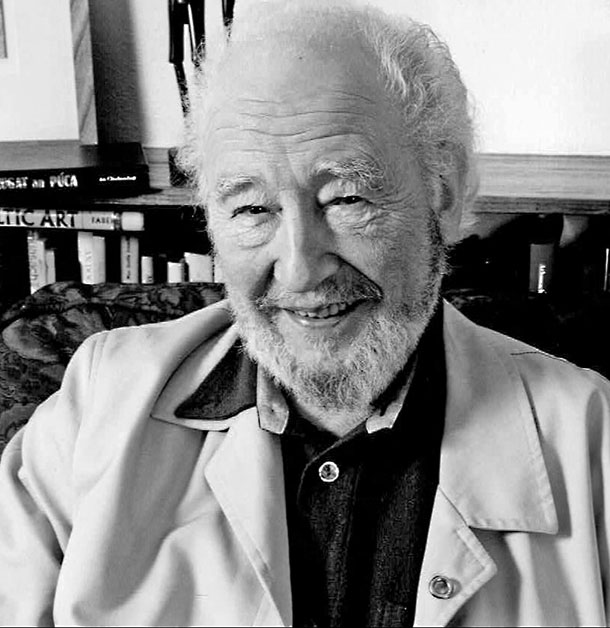
Deasún Breatnach (1921-2007), a founder member of the language-campaigning organisation Misneach, who went to jail in the 1960s to win the right to have his car insurance documentation in Irish or bilingual.
And there are battles that must be fought with the State, with local authorities, with utilities and service providers including private companies. Both logic and history make it clear that this is so. I have already alluded to the civil rights campaign in the Gaeltacht areas and the refusals to pay radio and TV licenses. In the 1960s a Dublin man asked Norwich Union to supply him a bilingual vehicle insurance document or one in Irish. The company declined. The man bought the insurance but refused to display an English-only document on his car. The State’s laws require that every driver display a document showing that they had insurance but no law required a private company to provide that documentation in Irish. The Gardaí regularly stopped the man who explained his stance and they noted his details and allowed him to proceed. For about a year nothing else happened until one day he was summoned to go to court and, despite his explanation and his reference to his right under the Constitution, he was fined. He refused to pay the fine and went to prison. Demonstrations followed with a friend of his playing the bagpipes outside Mountjoy Jail. In less than a fortnight, “an anonymous cleric paid the fine” and subsequently the law was changed. Every vehicle insurance company wishing to practice in Ireland subsequently has to provide Irish documentation or a bilingual version.
Some policies will have to be put in place in the Gaeltacht and closely followed. Policies relating to housing, employment and service delivery will be among them. Some will be welcome and some controversial … but needs must.
The State has already shown by its attitude and by the sad statistics that it does not wish to save Irish as a spoken language. Nor is it only the record of the Gaeltacht decline which speaks volumes. Recently this Government showcased in a video its plan for the centenary commemoration of the 1916 Rising. Among the many criticisms the video attracted was that the Irish in it was of a terrible quality – the Government had employed a translator who had used Google Translate. The video was withdrawn.
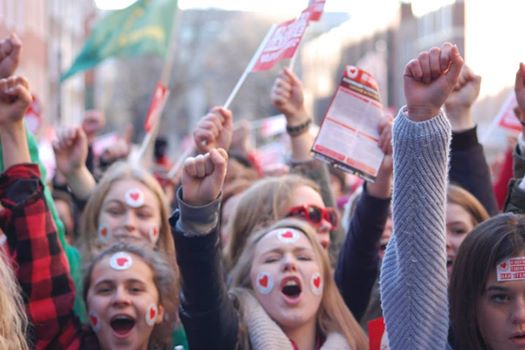
Small section of crowd in large “Dearg le Fearg” (Red with Rage) demonstration March 2014 about lack of support for the irish language. (image downloaded from the Internet)
Towards the end of 2013, the Irish Language Commissioner, a public servant, accusing the State of “lip-service” towards Irish and actual obstruction, announced that he would not seek reappointment at the end of his term – an announcement that led to a number of big demonstrations in 2014 under the slogan “Dearg le Fearg” (Red with Rage). In July 2014, the Government appointed a Minister for the Department of Arts, Heritage and Gaeltacht who does not speak Irish – Heather Humphreys. She has, in turn, a Minister of State with specific responsibility for the Gaeltacht, Joe McHugh, appointed in the same month … and, although apparently he is learning it, he does not speak Irish either. And note that responsibility for “Culture” is longer in the same Department as Irish – it has been moved to the much more prestigious Department of Tourism, Culture and Sport.
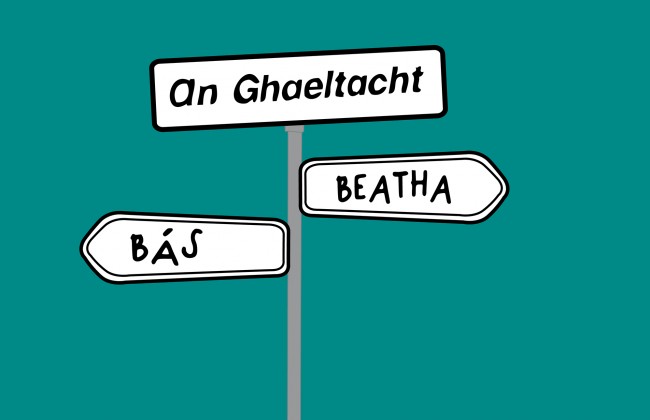
The State is being challenged from many diverse directions – on issues of services, state finances, centennial commemoration of the fight for independence, conservation, social housing, social welfare, employment and employment rights, health service, gender and sexuality equality, natural resources, Traveller rights, migrant rights … Irish must be seen and heard in these battles and the civil rights of Irish speakers inside and outside the Gaeltacht must also be presented separately, as an issue in itself. These are battles to be fought in campaigns to be planned and time is short. But we can start today, with ourselves. Beatha teanga í a labhairt.











 rebelbreeze