“PRO-LIFE” — REALLY? AND DO WE LEARN FROM YEAR TO YEAR?

Diarmuid Breatnach

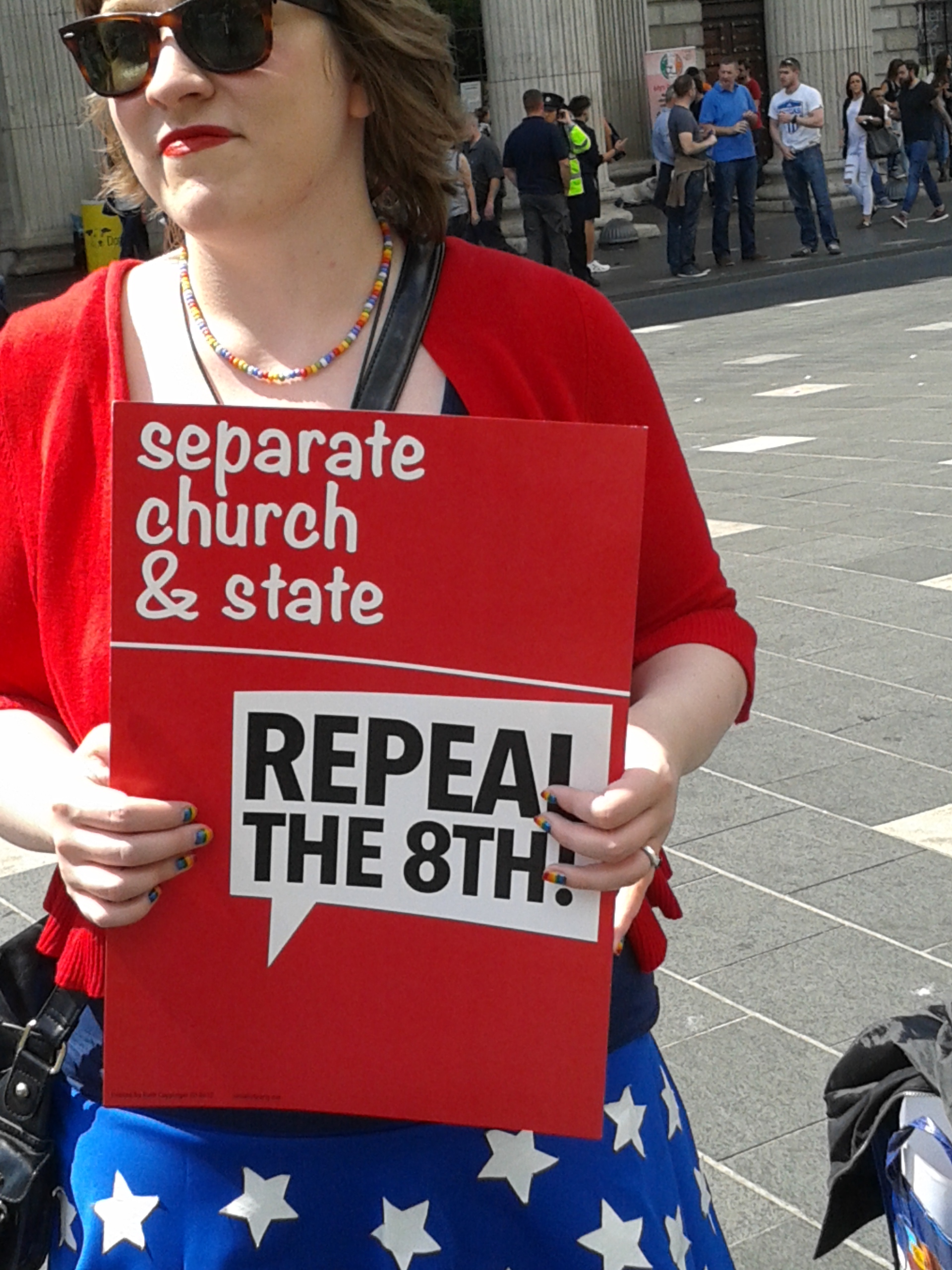
They came down O’Connell Street in their tens of thousands – colourful banners and heart-shaped balloons, music in sections, black, brown and white faces and if many were old, many were also young – and not just the children brought by a parent. “Right to life” was the most common chant, obviously tailored to undermine their opposition’s “Right to choose”, from those who favour the unfettered right to abortion. And LIFE is the name of the organisation that brought these marchers together on their annual march through Dublin city centre.Separat Church & State top
Bad photo of approach of anti-abortion march in O'Connell Street
Bad photo of approach of anti-abortion march in O’Connell Street

Nobody has a right to kill!” was the last line in another chant. So with that, the name of their organisation and “Right to life”, we have what they are about, right? They are for life and are upholding, apparently, the Christian Commandment “Thou shalt not kill”. Yes, it was there on the tablets of stone Moses brought down the mountain, Number Six – wayyy down the list. Actually, apparently in Hebrew it translates as “Though shalt not murder”. And defining “murder” is not so simple either. But anyway, the Jewish faith has the same prohibition. In fact, there is hardly a religion that does not. Of course, the Old Testament also calls for “an eye for an eye” and says that “you shall not suffer a witch to live”. But anyway ….

Interestingly, the highest leaders of organised religions across the world have blessed their soldiers as they went off to kill soldiers and civilians in other lands. Sometimes their victims were infidels according to the ones who were killing them but often they didn’t even have that excuse, as when the first Crusade attacked the overwhelmingly Christian city of Damascus, or when Catholic Spain fought Catholic France, or when Protestant England fought Protestant Germany, or Catholic Italy invaded Catholic Spain, Catalonia and the Basque Country. But presumably, those pastors, bishops, pontiffs, cardinals and mullahs can fall back on the dispute about the meaning – it wasn’t “murder”, it was legal killing.
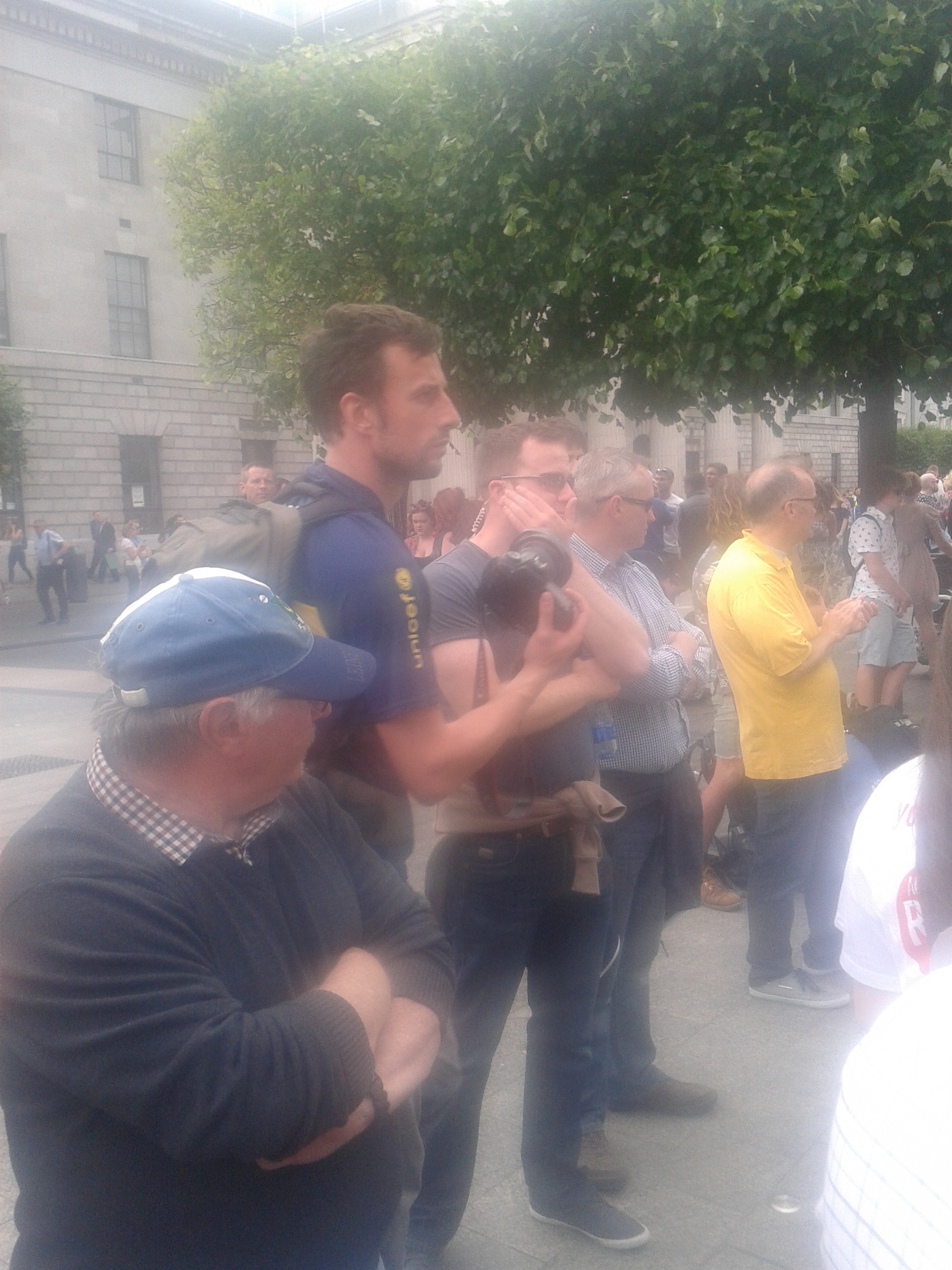
Two Special Branch officers (political police) centre photo in sunglasses -- blue pattern shirt and brown T-shirt top next to him.  There were eight SB identified, all watching the counter-protesters.
Two Special Branch officers (political police) centre photo in sunglasses — blue pattern shirt and brown T-shirt top next to him. There were eight SB identified, all watching the counter-protesters.  The blue-patterned shirt individual threatened a counter-protester without identifying himself.

The wiping out of the Guanches of the Canaries was not murder, the genocide of the indigenous American “Indians”, the enslavement and consequent killing of hundreds of thousands of Africans – they were not murder either. Nor the wiping out of every single Tasmanian and most of the Australian Aborigines. The West was exploring and, by the way, bringing Christianity and civilization to those poor benighted people.

I’d hazard a guess that compiling a list of Christian bishops in most denominations who condemned the wars in Malaya, Korea and Vietnam would a short one. Cardinal Spellman, notorious as anti-communist and anti-militant organized labour, a supporter of McCarthy’s witch-hunts, had the words “Kill a Commie for Christ” put into his mouth due to his enthusiastic support for the US waging the Vietnam War. Leaving out the maimed in mind and body, even in the wombs of their mothers, somewhere between 1.5 and 3.6 million were killed in that war – but presumably they weren’t murdered.

Billions of people are killed by unsafe working conditions, uncontrolled pollution, police and army repression, crime in slums, famine, alcohol and drug addiction, curable disease – almost all conditions that can be avoided except that doing so would cut into profits of local capitalists and/or foreign “multinationals” (read, monopoly capitalists/ imperialists). Those “entrepreneurs” aren’t murdering anyone either, even when their practices are illegal (even by their own laws) …. The ways of God are indeed mysterious, certainly so if the ways of his representatives on Earth are anything to go by.

Some suggested actions for lowering the abortion rate which involve caring for people instead of just foetuses

I have digressed, mea culpa. I have gone down a well-worn philosophical and logical path to ask a particular question: Are those tens of thousands marching down O’Connell Street really for Life and against killing human beings? I doubt it and I have not seen among their number most people I see against the bombardment of Gaza or the invasion of Iraq and Afghanistan, nor vice versa. A few, certainly, but not many. So I have to assume that it is not life that they value so much, except the life of a foetus. And once born, it is pretty much up to luck what happens to that foetus, as far as most of these ardent defenders of life are concerned.

As I said, that philosophical and logical path of discussion has been well trodden before me and no doubt to better effect than mine here. But I wish now to take another path of discussion – I wish now not to criticise the opposition, the anti-abortion brigade, but rather ours, the pro-choice movement of which loosely I am a member.

All Irish surveys and opinion polls published show a rising trend of support for the unfettered right to abortion, even if that section is still a minority. The majority of those polled have been for a greater access to abortion than is currently available in this state. Furthermore, some scandals involving refused abortions, refused permission to travel and the death of a woman who needed an abortion have mobilised considerable passion which the pro-choice movement could enlist in its favour.

Yet, despite what the polls tell us, and despite those high-profile cases, the anti-abortioners succeed in mobilising much larger numbers in opposition to abortion than do those who are in favour of permitting it. Putting this conundrum to some pro-choice campaigners, they have all answered to the effect that the anti-abortioners receive huge funding from reactionary political and religious foundations, especially in the USA. They spend millions on advertising and propaganda, I am told.

I’m sorry, I don’t accept that reply. Because despite their well-funded advertising and propaganda, the opinion polls show a climbing majority for some access to abortion and a climbing minority in favour of unfettered access.

The Riot Squad were also there for the counter-demonstrators.  Some may be seen in this misty image of them at the Princes Street end of the GPO.
The Riot Squad were also there for the counter-demonstrators. Some may be seen in this misty image of them at the Princes Street end of the GPO.

The Antis just seem to be better at mobilising their supporters – why is that? Well, the funding again, I’m told. They hire coaches and bus people in. So why can’t we do that? Are we incapable of raising money to hire coaches? Obviously not in the case of the Water Tax, for example. Republican groups hire coaches traveling to other parts of the country and pay their share as individuals; they often fund their posters, placards, banners public meeting-room hires, for example through fund-raising events. We don’t see many fund-raising events in support of the right to abortion. In fact, the public doesn’t see much evidence of the movement as a rule except when we come out to protest about a high-profile case or to oppose the march of the anti-abortioners. And our movement doesn’t seem to do much mobilising for the latter, either. And this march happens every year so it can easily be planned for.

Yet how many were there to show their opposition to these tens of thousands of anti-abortion campaigners? Maybe six hundred …. at a very long stretch, a thousand. Going by the opinion polls, in Dublin alone there are a great many more people who support unfettered access to abortion than appear on that counter-demonstration.

Nor did we even distribute our meagre forces in the most effective way.

Each year, it is the same. The anti-abortion people march down from the Garden of Remembrance, and the pro-choice people wait for them at the Spire. Most on the island, some on the east side pavement. The heaviest concentration of people is on the island (or pedestrian reservation), between the Spire and for about 20 or so yards heading north. Then the line starts to straggle. We didn’t even stretch quite to Larkin’s statue. Even those low numbers, properly distributed, could reach from the Spire down to O’Connell Bridge. But we don’t do that. We bunch up in a short concentration so that every section of their march is quickly past us and, what’s more, it allows them to focus their loudhailers and PA systems on our heaviest concentration in order to drown us out, as they were doing on Saturday.

The section containing most of the counter-demonstrators.  The anti-abortioners were able to park two mobile PAs in front of them there to drown out their opposition as the march went by.
The section containing most of the counter-demonstrators, from left photo to the Spire. The anti-abortioners were able to park two mobile PAs in front of them there to drown out their opposition as the march went by.

Broadly speaking, we outnumber them but on most mobilisations, they outnumber us hugely. They appear more broadly militant and organise better. And they learn. I didn’t see anything like as many people in religious robes this year, which suggests to me that they are tailoring their presentation to avoid an over-identification in popular perception with religion. They can’t keep all their religious nutcases under wraps but I saw much less crosses or rosary-waving this year. They have adapted their slogans and chosen what seems the hardest argument to oppose, that which appears to be for “life”, and they ensure that they are all on message, chanting the same lines, again and again.

They are the reactionaries – how is that they seem better able to learn than us? Should it not be the other way around?


End

REFERENDUM IN IRELAND — VOTING RESULTS

The returning officer, Ríona Ní Fhlanghaile, has declared that the 26-County state has voted in the Referedum IN FAVOUR OF INSERTING A CLAUSE IN THE CONSTITUTION THAT PERMITS COUPLES OF EITHER GENDER TO MARRY by 1,201,607 votes to 734,300. That’s 62.1% yes to 37.9% no. The total turnout was 60.5% which is higher than in some other Irish referenda.  The “Yes” vote exceeded the “No” in every county in the state except in Roscommon, where the vote was close.  The “Yes” vote was significantly higher in all other counties and generally across rural and urban areas too.

The vote in favour is not surprising given that all the main political parties, as well as Sinn Fein and Left parties were all advocating a “Yes” vote.  However, on its own that does not explain the wide gap between the two positions and the high turnout, especially in the face of the Irish Catholic Church hierarchy’s position against legalisation of same-sex marriage.  It is hard not to see this as to some extent a conscious decision to oppose or ignore the Church’s position and to take a stand in favour of equality and civil rights.

TÁ OR NÍL — SAME-SEX MARRIAGE, SURROGACY, HOMOSEXUALITY

Diarmuid Breatnach

When the votes are counted after today, we will either have a new clause inserted into our Bunreacht (Constitution) or we will not. If we do not, many of the “Vote Yes” campaign and opinion will be despondent. The revolutionaries among them should not be so but should instead reflect on their weakness as a force and on how to make that force stronger.

Should the vote result in a change in the Constitution, it will be probably the biggest blow so far to the power of the Catholic Church in lay society, a power it has enjoyed and abused even before 1921 but certainly since. Some, on both sides of the question, will see it as a blow against the Catholic religion itself but that is not necessarily so. Christianity and its Catholic variant survived and even thrived without State support in the past – indeed when its followers were discriminated against in every conceivable way by State power, a situation its faithful endured for centuries in Ireland as a whole and continue to do today, to a lesser extent, in the Six Counties.

What is the issue upon which we were being called to vote today? Although the NO campaign has tried to make us think it is, it is clearly not about whether two-gender households are better for raising children, whether surrogate birthing is right or wrong. It is not about whether we approve or homosexuality or not – although I suspect that is the real issue at base with many of the NO campaigners. In fact, it seems to me that it would be quite possible to disapprove of homosexuality and still to vote “Tá”, a question I will return to later. This might seem illogical, until we examine the actual issue upon which we are voting: do we agree with inserting a clause into the Bunreacht (Constitution) which states that a couple has a right to marry regardless of gender.

Presented with this question, which is a legal and Constitutional one, a number of issues arise, I think.

  1. What does the Bunreacht say at the moment about this question?
  2. What right has the State to define anything about sexual relationships?
  3. Are we in favour of equal civil rights for people?

1. It may come as a surprise to people that our Bunreacht, our Constitution, currently says nothing about the gender issue in marriage. There is nothing actually in our Bunreacht to prevent same-sex marriage. But the prohibition does exist in law. In other words, legislators at some point decided to propose and pass a law which confined the right (and rite) of marriage to heterosexual couples alone. Why did they do so if it was not an issue at that time? It seems to me that they were aware that same sex relationships did exist and strove to exclude those people from the rights enjoyed by others. This was the point of a number of other pieces of legislation against homosexuality which were not finally overturned until 1993 in this State (1982 in the Six Counties, 1980 in Scotland, 1967 in England and Wales) – five years after the European Court of Human Rights ruled that this state’s laws against male homosexual acts violated human rights.

According to the Catholic Church (and most other churches), despite the current legal situation with regard to homosexuality at the moment, it is still wrong. Well, the Catholic Church – and before them the established Anglican Church of Ireland – can have their views but they are not entitled, nor is any other church, to impose those on lay society, neither by legislation nor by other means. They are, of course, entitled to express their opinion – just like any other organisation.

“God and Nature say NO” was the caption on this placard paraded in O’Connell St. near the Spire, some weeks prior to the Referendum. Some young people are arguing with the placard-holder.
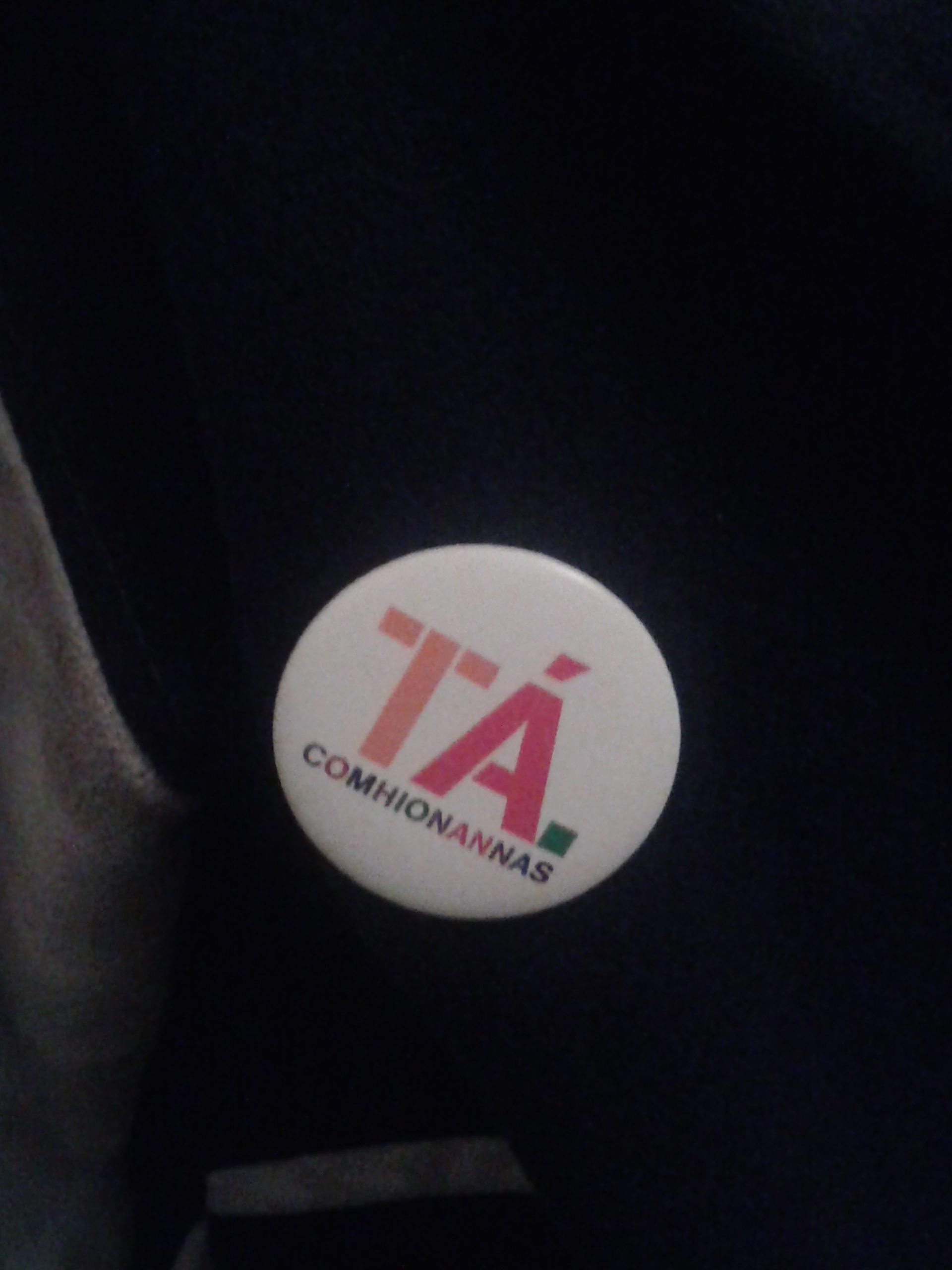
One of the many badges worn in support of a vote to insert the clause into the Irish Constitution (there was also an English-language one)
One of the many badges worn in support of a vote to insert the clause into the Irish Constitution. There was also an English-language one and each were to be seen nearly everywhere in public in the weeks prior to the Referendum.

So, going back to the beginning of the legal status of heterosexual marriage within our current legal system, it was introduced as an excluding measure, at a time when male homosexuality was illegal and subject to heavy punishment and when lesbianism was frowned upon (though not actually illegal for complicated reasons). In other words, a law excluding a group of people was passed at a time when any man who declared himself to be one of those people was subject to prison sentence and any woman who did so was subject to extreme opprobrium in society. What chance was there for their point of view to be represented? In the absence of such representation and informed opinion-making, how can any democrat defend the laws passed at that time?

2. Turning now to the question of what right the State has to make a ruling of any kind upon a sexual relationship between any two people, of either gender, it must be difficult indeed for anyone to justify that without recourse to church canon or prejudice. Those who do so tend to bring up questions of childcare, inheritance and taxation – in fact just about the same questions that were brought up in the Irish referendum on divorce in 1995. But childcare, or at least the financial aspect of it, can be regulated by the State without any interference whatsoever in the sexual relationship between the parents. Whether it does so fairly at the moment is another question which has no bearing on the concept. And inheritance – ignoring for a moment whether we agree with a political economy where land and other wealth may be appropriated by individuals or families and then legally handed on through their following generations — can also be managed without recourse to State regulation of marriage. Taxation, similarly. Were we to have a socialist society, one based on other principles than that which we now have, even those current excuses for state interference should no longer be even a consideration.  In fact, it is difficult to see any reason why even now the State continues to have a role in the formalisation of a sexual contract between two individuals or, indeed, in its dissolution, except perhaps in ensuring fair divisions of belongings.

3. Those opposed to insertion of the new clause into the Bunreacht have done so from a number of perspectives of opposition: to lesbianism and homosexuality on religious or other grounds; to formalising same sex relationships; to the alleged undermining of the “sanctity of marriage” or of “romance”; in opposition to surrogate child-bearing and raising of children by gay and lesbian parents ….

Those supporting the new clause have defended the naturally-occurring continuum of sexual preference; maintained that the “sanctity of marriage” will be the same between same-sex couples, as will “romance”; denied that it opens the way to or encourages surrogate child-bearing and raising of children within a gay or lesbian household ….

Who is right and who is wrong? There is no doubt that as long as cultural beliefs and practices have been recorded, homosexuality and lesbianism have existed within societies — sometimes tolerated, often repressed, on rare occasions celebrated. We see homosexuality occurring too among animals. If there is such a thing as “sanctity of marriage” and “romance”, why should same-sex couples have any less of it than heterosexuals? Surrogate child-bearing is already possible and the hugely unequal distribution of wealth in our society – and between even our society and many others – ensures it can and will continue while the rewards are financial. Raising of children within a same-sex household is already happening, even without surrogacy. It is more difficult for gay men at present, but in the case of a gay man having custody of his children through widowhood (yes, some gay men do marry women), or the mother deserting the children or being deemed unfit by a court to have custody, a gay man may bring up his children within a homosexual parent household.

But will this change in the Constitution (and therefore also in the law) make surrogacy and child-rearing by gay couples more likely to happen? Will it increase the frequency of its occurrence? I think the answer to that, logically, must be yes – despite all the denials of the “Vote Yes” camp. And I think some of them must know that. Slowly perhaps and who knows by how much – but logically it must tend to increase the chances. But is that so awful? I find the idea of surrogacy in general distasteful but isn’t that just a prejudiced reaction? Probably. Will children reared by same-sex parents experience uncertainty about their own sexuality? Some will probably and some won’t. And if they do, why should they not be able to resolve that in time – as children reared in heterosexual relationships also find themselves having to do? Is uncertainty about sexuality such a terrible thing? In a judgmental, prohibitive and penalising society, it can be – so let’s create a society that is the opposite.

However, I have to say that I think all those questions and considerations are beside the point. If marriage is to be a legal status, then it is a civil right for everyone who is at the age of consent (and of sufficient mental ability to know to what they are consenting — in so much as any one of us was or does!). The right to same-sex marriage, as a civil right, should be supported even by people who do not approve of homosexuality, or marriage, or surrogacy, of child-rearing in a homosexual household. As for myself, someone who seeks revolutionary social, economic and political change, who wishes to see the overthrow of this State, a revolutionary as opposed to a reformist, I must nevertheless support reforms that extend civil rights, even when not led from below …. and so I voted “TÁ”.

LÁ FHÉILE STIOFÁIN/ ST. STEPHENS’ DAY

Diarmuid  Breatnach
(Traducido al castellano al fondo)

Singing Wren 46 (Michael Finn)

(Reading time: 5 minutes)

  ” We made it!  We made it!  Safe for another year!”

Wren on rock


“Shut up, you idiot!  The day’s not over yet!”


Meanwhile, not far away ….

Wren Boys Sligo
Mummers Sligo maybe

THE WREN-BOY TRADITION IN IRELAND

In England it is called “Boxing Day” but in Ireland the 26th of December is “St. Stephen’s Day”.  Despite the Christian designation it has long been the occasion in Ireland for customs much closer to paganism.

It was common for a group of boys (usually) to gather and hunt down a wren.  The wren can fly but tends to do so in short bursts from bush to bush and so can be hunted down by determined boys.  The bird might be killed or kept alive, tied to a staff or in a miniature bower constructed for the occasion.

The Wren Boys would then parade it from house to house while they themselves appeared dressed in costume and/or with painted faces.  In some areas they might only carry staff or wands decorated with colourful ribbons and metallic paper while they might in other areas dress in elaborate costumes, some of them made of straw (Straw Boys) and these were sometimes also known as Mummers although a distinction should be drawn between these two groups.  The Mummers in particular would have involved acting repertoires with traditional character roles and costumes, music and dance routines while the simpler Wren Boys might each just contribute a short dance, piece of music or song.  In all cases traditional phrases were used upon arrival, the Mummers having the largest repertoire for in fact they were producing a kind of mini-play.

The origins of the customs are the subject of debate but a number of Irish folk tales surround the wren.  The bird is said in one story to have betrayed the Gaels to the Vikings, leading to the defeat of the former.  There is a Traveller tradition that accuses the wren of betraying Jesus Christ to soldiers while another tradition has the bird supplying the nails (its claws) for the crucifixion of Jesus Christ.  Yet another tradition has the wren as King of the Birds, having used its cunning in a competition to determine who would be the avian King, hiding itself under the Eagle’s wind and flying out above the exhausted bird when it seemed to have won, having left all others behind and could fly no higher.

By the 1960s the Wren Boy custom was beginning to die out even in areas where it had held fast but it slowly began to be revived by some enthusiasts.  Nowadays fake wrens are used.  Christmas Day in Ireland was traditionally a day to go to religious service and to spend at home with family or to go visiting neighbours.  It was not a day of presents or of lights or Christmas Trees, customs brought in by the English colonizers in particular from Prince Albert, the British Queen Victoria’s royal consort, who was German.  St. Stephen’s Day may have celebrated the Winter Solstice (the wren being a bird that on occasion sings even in winter) but moved to a Christian feast day; in any case it produced colour and excitement at a time which did not have the religious and commercial Christmas season to which, in decades, we have become accustomed.

The lovely song The Boys of Barr na Sráide from a poem by Sigerson Clifford takes as its binding thread the boys in his childhood with whom Sigurson went “hunting the wren”.  It is sung here by Muhammed Al-Hussaini (currently resident in London and part of the singing circle of Comhaltas Ceoltóirí na hÉireann, meeting in the Camden Irish Centre).  There are recordings of others performing this song well but the unusual origin of this one as well as its quality persuaded me to choose this one.  In addition, I had the pleasure of participating in a singing circle with this lovely and modest singer in London in October this year (see The London Visit on the blog), who greeted me in Irish.  Muhammed also plays the violin on this, accompanied by Mark Patterson on mandolin and Paul Sims on guitar.

ends.

LA TRADICIÓN DE “CHICOS DEL REYEZUELO” EN IRLANDA

Diarmuid Breatnach


En Inglaterra se llama “Boxing Day”, pero en Irlanda el 26 de diciembre es “
la fiesta de San Esteban“. A pesar de la designación cristiana, ha sido durante mucho tiempo la ocasión en Irlanda de costumbres mucho más cercanas al paganismo.

          Para eso era común que un grupo de niños (generalmente) o chavales se reuniera y cazara a un reyezuelo. Ese pájaro es capaz de volar pero tiende a hacerlo en ráfagas cortas de arbusto a arbusto y, por lo tanto, puede ser cazado por niños determinados. El pájaro podía ser asesinado o mantenido vivo, atado a un bastón o en una glorieta en miniatura construida para la ocasión.

Los “Wren Boys” (Chicos del Reyezuelo) lo desfilarían de casa en casa mientras ellos mismos aparecían vestidos con disfraces y / o con caras pintadas. En algunas áreas, solo pueden llevar bastos o varitas decoradas con cintas de colores y papel metálico, mientras que en otras áreas pueden vestirse con trajes elaborados, algunos de ellos hechos de paja (Straw Boys/ Buachaillí TuI = Chicos de la Paja) y a veces también se los conoce como Mummers, aunque se debe hacer una distinción entre estos dos grupos. Los Mummers en particular tenían repertorios involucrados de actuación con roles y disfraces de personajes tradicionales, música y rutinas de baile, mientras que los Wren Boys más simples podrían contribuir con un baile corto, una pieza musical o una canción. En todos los casos se usaron frases tradicionales a la llegada, los Mummers tenían el mayor repertorio porque de hecho estaban produciendo una especie de pequeño teatro. Se les daba dinero , pastel o caramelos.

Los orígenes de las costumbres son objeto de debate, pero una serie de cuentos populares irlandeses rodean al reyezuelo. En una historia se dice que el pájaro traicionó a los Gaels a los Vikingos, lo que llevó a la derrota de los primeros. Hay una tradición de los Travellers (gente étnica nómada de Irlanda) que acusa al reyezuelo de traicionar a Jesucristo a los soldados, mientras que otra tradición dice que el pájaro suministra los tornillos (sus garras) para la crucifixión de Jesucristo. Sin embargo, otra tradición le tiene al reyezuelo como el Rey de los Pájaros, después de haber usado su astucia en una competencia para determinar quién sería el Rey de las aves, escondiéndose bajo el viento del Águila y volando por encima del pájaro agotado cuando parecía haber ganado, todos los demás detrás y no poder volar más alto.

En la década de 1960, la costumbre de Wren Boy comenzaba a desaparecer incluso en áreas donde se había mantenido firme, pero algunos entusiastas comenzaron a revivirla lentamente. Hoy en día se usan reyezuelos falsos. El día de Navidad en Irlanda era tradicionalmente un día para ir al servicio religioso y para pasarlo en casa con la familia o para visitar a los vecinos. No fue un día de regalos ni de luces ni de árboles de Navidad, costumbres traídas por los colonizadores ingleses en particular del alemán Príncipe Alberto, el consorte real de la Reina Victoria británica. El día de San Esteban puede haber celebrado el solsticio de invierno (el reyezuelo es un pájaro que en ocasiones canta incluso en invierno) pero se mudó a una fiesta cristiana; en cualquier caso, produjo color y emoción en un momento que no tenía la temporada de Navidad religiosa ni entonces la comercial a la que, en décadas, nos hemos acostumbrado.

La encantadora canción The Boys of Barr na Sráide (mezcla del inglés con el gaélico: “Los Chicos de la Altura de la Calle” [toponómico de puebo en el Condado de Kerry]) de un poema por Sigerson Clifford toma como hilo conductor a los chicos de su infancia con quienes Sigurson fue “cazando al reyezuelo”. Aquí lo canta Muhammed Al-Hussaini (actualmente residente en Londres y parte del círculo de canto de Comhaltas Ceoltóirí na hÉireann, reunido en el Centro Irlandés de Camden). Hay grabaciones de otros interpretando bien esta canción, pero el origen inusual de esta, así como su calidad, me convenció para elegir esta. Además, tuve el placer de participar en un círculo de canto con este encantador y modesto cantante en Londres en octubre de este año (ver The London Visit en el blog), que me recibió en irlandés. Muhammed también toca el violín en esto, acompañado por Mark Patterson con mandolina y Paul Sims con guitarra.

Fin.

DYSLEXIA – A COUNTRY WHERE SURPRISE IS EXPECTED

Diarmuid Breatnach

(The author is known as a traveller to many exotic places, including expeditions in search of mythical lands, most famously “The United Kingdom”, the “Republic”, “Norn Ireland” and “The Mainland.” Here he writes about the land of Dyslexia).

Dyslexia is, as the suffix “-ia” suggests, a country …. think of India, Mongolia, Russia, California [now relegated to a vassal state], Hibernia [also something of a vassal state], Narnia [er .. no, that is an imaginary land in a series of children’s tales]. The existence of Dyslexia strangely was not even suspected until 1881, when Oslawd Khanber claimed to have visited the land. His discovery was widely doubted until confirmed by Ludorf Linber in 1887. The people of this newly-discovered land were distinguished by all having a difficulty to varying degrees in spelling and/or in remembering sequences of numbers. Khanber and Linber both named this land (and the rest of the world agreed) “Dyslexia”, from the Greek root “dys” meaning “bad/ abnormal/ difficult” and “lex” meaning “word” (although in Latin it means “law”, understood as “written word”).

Dyslexia was, like many other lands and people, not named by the natives themselves, but by people from elsewhere. Such examples abound, for example “Australia”, “America”, “Scotland”, “Eskimo”, “Teddy Boys”, “Pagans”, “Celts”, “Saxons”, “Teagues”, “Gypsies”, “E.T.s” etc. Attempts to identify what the Dyslexics themselves called their land have so far collapsed in confusion, with different spellings and even pronunciations hotly argued for against others.

In fact, there have been accusations of racism aimed at those who named the land “Dyslexia” and the people “Dyslexics” — it seems particularly cruel to create a word itself so difficult to spell to name a people with a known disability in spelling. Previously, Dyslexics just called themselves “people” and the land “the land”, while those who came across migrants from there before Dyslexia was actually discovered called them other names such as “stupid”, “slow”, “thick” or “people with ADD or ADHD” (1) . However, most “Dyslexics” today have not only adopted the name and learned to spell it but are wont to proudly declare “I’m Dyslexic” (but rarely “I am a Dyslexic”).

When Dyslexia came to the attention of the rest of the World no-one seemed astonished that it should be discovered long after the North and South Poles, the Mariana Trench, the Matto Grosso Plateau and indeed a great number of planets. What did astonish the World was that Dyslexia had apparently independently within its borders invented television, radio, Ipads, microwave ovens, central heating and hot showers and of course the internal combustion engine and nuclear power.

This proliferation of technology would have been normally amazing (if anything normal can be said to be amazing, or vice versa) in a previously undiscovered country but what was really, really amazing was that everyone in Dyslexia had overcome a disability to climb to such industrial heights. The obstacles must have been tremendous. Imagine confusing, for example, sodium chloride, a common table salt, with sodium chlorate, which is used as a weedkiller (and also as an ingredient in making home-made bombs, a curious fact since nitrogenous fertiliser, with a directly opposite effect to sodium chlorate when spread on weeds, is also sometimes used in making home-made bombs). Anyway, shake sodium chloride in small quantities on your weeds and they probably won’t like it but most will survive – especially those that actually like a little of it, like relatives of the cabbages and such. Shake a little sodium chlorate on your food, however and …. well …. no, don’t try it – without urgent and skilled medical attention you will die quickly and painfully. For another example, imagine confusing “defuse” with “diffuse”: one goes to de-escalate a conflict and ends up spreading it around. Other confusions are possible between the noun or verb “ware”, the (usually) adverb “where” and the past tense verb “were”. And so on.

For physics, knowledge of and accuracy in mathematics is essential – algebra, logarithms, binary codes, sines and co-sines, square roots (these last are mathematical constructs, not mythical regulated-shape carrots as propagated by anti-EU campaigners). In calculating distances, heights and depths, spaces and circumferences, ability in geometry, trygonometry and ordinary mathematics is required. Somehow, the Dyslexics, the inhabitants of Dyslexia, had overcome their disability or compensated for it in some way, so that they had as flourishing and environment-poisoning an industrial society as the most developed parts of the world, such as the United States of America (most developed industrially, that is).

Dyslexics are said, despite this disability with letters and numbers, to be of above-average intelligence. They had to be, to develop all those complicated benefits of industrial society despite their handicap.

Strangely, one may think, many Dyslexics have become literary figures famous throughout the world, Hans Christian Andersen, Agatha Christie, F. Scott Fitzgerald and WB Yeats among them. Contrary to popular belief among non-natives, James Joyce was not from Dyslexia. This prevalence of Dyslexics among so many giants of literature and indeed of virtually every other field of human endeavour has given rise to a group of Dyslexians who call their disability “the gift of Dyslexia”.

The Dyslexics are often garrulous and sociable and this is especially true when in Dyslexia itself. The difficulty in remembering telephone numbers for example makes every telephone call an adventure. Say a native wished to phone another native called Cathy (also known as Cthy, or Ktay, Thyca etc), and the phone number was 731 1062 (please note, this is an imaginary telephone number by which Cathy or no-one else can be reached). The Dyslexic might phone 371 1026 – all the correct digits but in a different order (note, this also is an imaginary telephone number by which no-one may be reached).

The conversation, somewhat simplified, might go like this: “Yes, hello?” (female voice, breathless with anticipation of another adventure).

Our caller: “Hi, is that Cathy?”

Recipient (giggling): “No, it’s not. There isn’t any Cathy here. I’m Wanda.”

Our caller: “Oh, hi Wanda, you sound very nice. How about going on a wanda with me?”

Wanda (with a little giggle but playing cautious): “Maybe …. What’s your name?”

Our caller: “Terry.”

Wanda: “Where were you thinking of wandering with me?” (A moment’s pause while both mentally translate the last part of that into “wandering on me”).

Terry (clearing his throat which has suddenly gone dry): “Well, there’s a nice new Indian restaurant opened up in town. Do you like Indian food, Wanda?”

“Ohhh, Terry, I love it. So spicy!” (Very slight pause as both translate “spicy” as a description for food flavouring into a metaphor instead). “When were you thinking of?”

“Er … tonight too soon?”

“No, I happen to be free tonight.”

“Shall I come and pick you up? Say …. seven pm?”

“That would be lovely, Terry. I live off the Trans City Road, tenth left, first right, eighth left, in Hopeful Street, the seventh house on the left-hand side if you’re coming from town, with a brown and white door and a hydrangea bush in the garden.”

“Got it – tenth left off the Trans City Road, tenth left, first right, eighth left, Hopeful Street, seventh house on the left-hand side, brown and white door and a hydrangea bush in the garden. At seven pm. I’m looking forward to meeting you.”

Most Dyslexics are always open to adventure, ‘going with the flow’. One never knows what a simple telephone call may bring or to what an appointment or written address may lead. But as a result, Dyslexics are also philosophic about missed appointments, forgotten birthdays and so on; they waste little time mourning something lost and instead look forward to something gained. Terry might or might not make it to Wanda’s but they both know the world is full of other possibilities. Cathy, for example, who failed to receive a call from Terry to congratulate her on her gaining a dystinction in her dyploma, received later that evening what non-natives would term “a wrong number” call from a Sofia who had meant to call a Geraldine. Sofia had intended trying to patch up a long-running difficult relationship with Geraldine and instead found herself making the aquaintance of Cathy, who seemed much nicer and more understanding than was Geraldine. Sofia soon put her problems with Geraldine aside and agreed to Cathy’s suggestion that they meet for a late coffee (which they both knew could lead to an early drink and who-knows-what from there). Cathy had by now forgotten that she was hoping Terry would call.

Dyslexia is not just another land, nor even just a strange one – it’s an entirely different way to live.

end

Footnotes:

1.   A supposed disability the existence of which is hotly debated but has exonerated many teachers accused of bad teaching methods and states accused of having too large classes in their schools and which has been profitable for some educational psychologists and extremely so for some chemical companies.

PROVIDING MORE HOSTEL BEDS WON’T PREVENT DEATHS LIKE THAT OF “JOHNNY” CORRIE

Jonathan CorryJonathan (“Johnny) Corrie, a homeless man of 43 years of age, was found dead early on Monday in Molesworth Street, very near to Dáil Éireann (the Irish Parliament),  He was a drug and alcohol misuser and the cause of death has yet to be established.  

MANY PEOPLE THINK THE WAY TO AVOID DEATHS LIKE THIS IS TO HAVE MORE HOSTEL BEDS FUNDED. THEY ARE WRONG.

More hostel beds might help but they might not. There are many types of hostels — I have worked in some of them and managed three at different times. A hostel that opens at a certain time (not one of the type I managed) and operates a first come, first served policy, often cannot be accessed regularly by a person with a chaotic lifestyle. A hostel that does not accept drug or alcohol misusers would have been no good to Jonathan Corrie — the hostels I managed did accept them. Behaviour in a hostel might be an issue — one of the hostels I managed was for street drinkers and they were permitted to drink in the hostel. We developed a system of short-term sanctions for managing problematic behaviour and managed to hold on to many who had been barred from many other hostels.  But even so, we did occasionally have to evict and impose a ban for a period before we would consider re-admittance. At least one of those, readmitted a number of times, died months later on the street.

Some people are assuming that this person died of the cold; he may have done but he may have died from a number of other causes. Presumably there will be an autopsy. For drug misusers, the most common causes of accidental death in my experience have been overdose or liver failure through hepatitis. Overdose most often occurs when the drug strength is unpredictable and suddenly goes stronger than the person has been used to (for example, purer product or the person has just come out of prison), or when the drug is combined with others, which may include alcohol. Practically all cocaine overdoses have been in combination with alcohol.  I understand that at the moment some drugs being injected are a mixture of previously-know drugs and other, newer ones, including some from other parts of the world that are usually chewed rather than injected.

Hepatitis C, though usually contracted through sharing needles, is survivable and drugs can continue to be taken; however, a compromised liver cannot survive alcohol consumption. I have known a number of people die that way after contracting the infection through sharing needles.

If drugs were available on prescription, the quality would be consistent. [By the way, that would also cut out the dealers and the need to collect high revenue to pay for the habit, whether through theft, prostitution or begging.] If needles and other equipment were provided, drug users could cut down on their chance of infection. If supervised premises for injecting, including hostels, were provided, they would hugely reduce the number of infected people. The first and third of these are illegal under the laws in this state (although in London I managed a hostel where drug users could inject in their own rooms) and very few politicians are prepared to stick their neck out and support it, EVEN THOUGH THEY KNOW THAT MOST PROFESSIONALS IN THE FIELD SUPPORT THESE MEASURES (well, most I have met anyway). Needle exchange projects are few and very far between, through lack of funding and “not-in-my-backyard” pressure. The prevalent attitude towards drug use and misuse in Irish society, including among many who have a revolutionary attitude towards the State, ensures that no change will come about yet with regard to adequate and effective provision for drug users.

Lastly, among all the discussion about “addictive personalities” and “gateway drugs”, one also has to look at environmental factors and early life experiences, if one wants to see the causes of addition and seek solutions. Perhaps there will always be a few who develop an addiction, now matter how good the society and family background, schooling etc. But it is a logical assumption that a society based on the greed of the few, alienation and cultural impoverishment of the many and economic impoverishment of a section is likely to increase the numbers of people who seek excitement or escape through alcohol or other drugs and leave themselves open to developing a substance addiction.

http://www.herald.ie/news/a-toothbrush-water-and-a-needle-face-of-man-who-died-yards-from-dail-eireann-30789666.html

“SOMEWHERE OVER THE RAINBOW” WAS WRITTEN BY A ‘RED’

Diarmuid Breatnach


DID YOU KNOW IT WAS A ‘RED’ WHO WROTE “BROTHER CAN YOU SPARE ME A DIME?” WELL, NOT SO SUPRISING, MAYBE. BUT HOW ABOUT THE SONGS FOR “THE WIZARD OF OZ” and “FINIAN’S RAINBOW”?


Yip Warburg, author of lyrics of many songs, including those in the Wizard of Oz.
Yip Harburg, author of lyrics of many songs, including those in The Wizard of Oz musical.

Yip Harburg, born in the poor Lower East Side Manhattan to Russian Ashkenazi Jew migrants, was a socialist and the writer of the lyrics of the songs in The Wizard of Oz and worked on the music too.

In fact, a lot of the production team and actors were “pinkos” of some kind, including Judy Garland.  The “Brother Can You ..” melody was based on a Russian lullaby. In this Amy Goodman interview on Democracy Now TV (see link bottom of piece), Yip’s son Ernie Harburg talks about his father and included is quite a bit of footage of Yip himself, talking and singing, as well as footage of the first Wizard of Oz film.

When some people think it appropriate, while supporting the Palestinians, to synonymise the words “Jew” and “Israeli”, confusing the ethnic grouping of Jews with the fascist, racist and colonist ideology of Zionism, they are ignorant of or forget not only those Jews who combat Zionism today like Finkelstein and Chomsky but also the public criticisms of Zionism and the creation or actions of the state of Israel expressed by Albert Einstein, authors Erich Fromm, Howard Zinn, Isaac Asimov, Philip Roth, I.F. Stone; violinist Yehudi Menuhin; journalists Joe Klein (Time magazine), Roger Cohen (NY Times); Richard Falk (UN Special Rapporteur), historian Gabriel Kolko and many, many others. Those Jews are following a tradition: political and religious dissidence was endemic in Western Jewry and Jews have been to the forefront in socialist movements in Europe and in the USA, as well as in the struggles against racism and for civil rights in the latter.

“Music makes you feel; words make you think; songs make you feel the thoughts,”  said Yip Warburg.  At the time of the Depression in the USA (caused by the financiers, surprise, surprise), with massive unemployment and poverty, the authorities and some of the public wanted songs like “Happy Times Are Here Again” and no-one was writing songs about the suffering except for his father, says Yip’s son Ernie Harburg. Not on Broadway, maybe, but in some speakeasies, in some bars and on some radio shows, the blues and folk singers were composing and singing those songs, some writers like Steinbeck were writing their stories and photographers like Dorothea Lange, Jack Delano, Gordon Parks and others were recording their faces.

People were out on the streets and picket lines too, shouting, marching, holding placards, getting their heads busted by cops and sherrifs and goons and breaking some of their heads back too. Sometimes the protesters and campaigners were shot and sometimes even executed. As the financiers swing us around to those times again, we celebrate the victories and learn from the defeats, take pride in the courage of all those who fought and mourn those who fell, whether they fought against the police and municipal authorities, the witch-hunters like McCarthy and the ignorant red-haters, the National Guard, the FBI …

Scene from the Musical Theatre production of Americana, which featured Warburg's song "Brother Can You Lend Me a Dime?"
Scene from the Musical Theatre production of Americana, which featured Warburg’s song “Brother Can You Lend Me a Dime?”

And we singers, singing the lyrics and melodies of others and of our own, written in the past or in the present, give honour to the fighters in whole periods of struggle even as, in the book of history, the first lines in the next chapter are being written.

GUESS WHO’S COMING TO DINNER?

Diarmuid Breatnach 

Lorna was nervous but tried not to show it – especially to Kevin. He drove competently and seemed unaware of her tension. Of course she had known for months it would come to this. There had to be an end to the hiding some day. And now she was going to have to present him to her parents. She shuddered …. or thought she had; thankfully, Kevin hadn’t noticed.

They passed a small wood in a hollow, the trees still wearing their autumn leaves but some already lying on the road, jewels of yellows, oranges and reds, mixed with green, glittering with the wet of a recent shower. In that wood one summer, in her teens, a picnic and a boy, hands trembling exploring, fast-beating heart, her virginity gladly given. at The memory sparked a little arousal; she looked out the passenger window in case it showed in her face. Kevin could be very perceptive …. often just when she didn’t want him to be.

As they drove through the Sligo village she remembered so well from her childhood and teens, she began surreptitiously to do her breathing exercises. Approaching the side road, she had a sudden impulse to say nothing, to just keep going. “Left ahead,” she said instead. And, a little further, “Turn right there, Kevin. Right … that’s the house.”

Slightly uphill from the parking space, the path ran up to and curved along the house to the front door. The house, traditionally whitewashed and, with the exception of the conservatory added to the end, pretty traditional in appearance too. The treetops, grown taller, visible behind the roof, the fuschia bushes growing along the path and the cotoneaster hugging the house wall. Bel, kept inside the house so as not to frighten the expected visitor, barking an intruder warning.

The engine switched off, Kevin looking at the house, then at her. “Looks lovely”, he said and sounded as though he meant it. She turned to him, smiling brightly: “Get the bags, will you? Do the traditional male thing. I’ll carry the wine and the flowers.”

He kissed her quickly, grinned and got out of the car, leaving her free to do her breathing exercises unobserved. In …. hold, two, three, four, five. Out, two, three, four, five …..

Walking up the path, Bel barking madly now, hearing the crunch of gravel. As Lorna got near the door, she called out to the dog. The barking stopped a second at voice recognition, then started again – welcoming this time. The outer door opened, her father there, the skin around his eyes crinkling as he smiled. A hug, careful with the flowers, and a “Fáilte abhaile, a stór.” Then the appraising look at Kevin, the hand stretched out: “And to you too, young man.”

Her father turned and opened the inner door. There was her mother, holding Bel back by his collar as he whined and wriggled, his tail whipping from side to side. Lorna put the flowers and wine on the table and went to the dog, giving him her hand and, while he lathered it with his saliva, hugged her mother cautiously. Then she took the dog to introduce him to Kevin. Of course Bel could smell her on the stranger and that made the introductions easier.

After the greetings, matters proceeded through stages – coffee and tea and biscuits, inquiries about the journey, traffic and road surfaces, comments on the weather, a little local news, as Bel gazed at Lorna and thumped his tail from time to time, her mother jumping up regularly to check on the cooking, the aroma growing around them.

And so to dinner, the table set with the best delf and cutlery, grace said by her mother; Kevin, her atheist lover bowing his head respectfully and agnostic Lorna chiming “Amen” at the end. The dinner delicious of course and greatly enjoyed by Kevin, her father appreciating the Rioja selected by Kevin and brought with them, the flowers they had brought now with some fern leaves picked by her mother, making a nice display in the vase in the window, the westering sun filling the dining area with gorgeous light. The conversation flowed around her job, Kevin’s, Lorna’s parents’ farm, the local area …. It was all going so well. Lorna wasn’t fooled for a moment.

A little after dessert, her father stood up. “Come now, Kevin …. I’ll show you around a little of our wee farm. We have to walk a little of that dinner off.”

Kevin got up eagerly, then hesitated, glancing towards Lorna. “You can do the washing up tomorrow, Kevin,” she smiled. “Go on, while there’s still light to see.”

The two most important men in her life walked out the back door, Bel eagerly escorting them, her father putting his cap on his balding head and picking up his ash stick on the way.

The men’s voices faded and the women turned to meet one another’s eyes, then quickly down to the table, going about their shared tasks with the ease of custom, of practice thousands of times through the years …. and the tension slowly building while desultory conversation centred around the tasks. Then, so soon, all the washing-up done and rinsed, their hands dried and the kettle on the ring for tea. Her mother turned to her and said: “He seems very nice.”  

“He is”, she replied, knowing it was an opening shot.  “I’m serious about him,” she added, as though this were not obvious, the first of her lovers down through the years that she had ever brought to meet her parents.  She was hoping to head off the barrage.

But Lorna, how could you! Of all the fine men you could have had!”

He is a fine man. I already told you he’s black but I didn’t think …”


“Lorna Patricia, you wash your mouth out this minute! You know very well that neither your father nor I are racist.”

But it’s different when your daughter wants to marry one, is that it? ‘We’re not racist but …’ ”

No, Lorna, it has nothing to do with that – we’re not bothered by the colour of his skin …. that’s not it all.”

Then what is it? Is it because he’s not a Catholic, then? Because, as I think you know, I’m not much of a one myself!”


“That’s not it at all, Lorna. That’s between you and God …. and between Kevin and God. That’s what He gave you free will for.”

Then what on earth is all this about? What’s wrong with him?”


“Oh Lorna, do you really not know? Can you not see?” Her mother’s voice rising in a wail.

No … no, I can’t. See what? What’s wrong?”


“He’s from Dublin, Lorna. Dublin! He’s a jackeen!”

End