Revolutionary socialist & anti-imperialist; Rebel Breeze publishes material within this spectrum and may or may not agree with all or part of any particular contribution. Writing English, Irish and Spanish, about politics, culture, nature.
A campaign for conservation of the ancient Moore Street Dublin inner-city street market area and 1916 Battleground, in its 11th year of Saturdays on the actual street is seeking to reach 2000 on-line signatures for the group’s petition this year.
The site was formerly under threat of construction of a giant ‘shopping mall’ from the ILAC to O’Connell Street. However ‘shopping malls’ are not making so much money nowadays so the new plan is largely a ‘shopping area’ with an hotel and a new road from the ILAC to O’Connell Street.
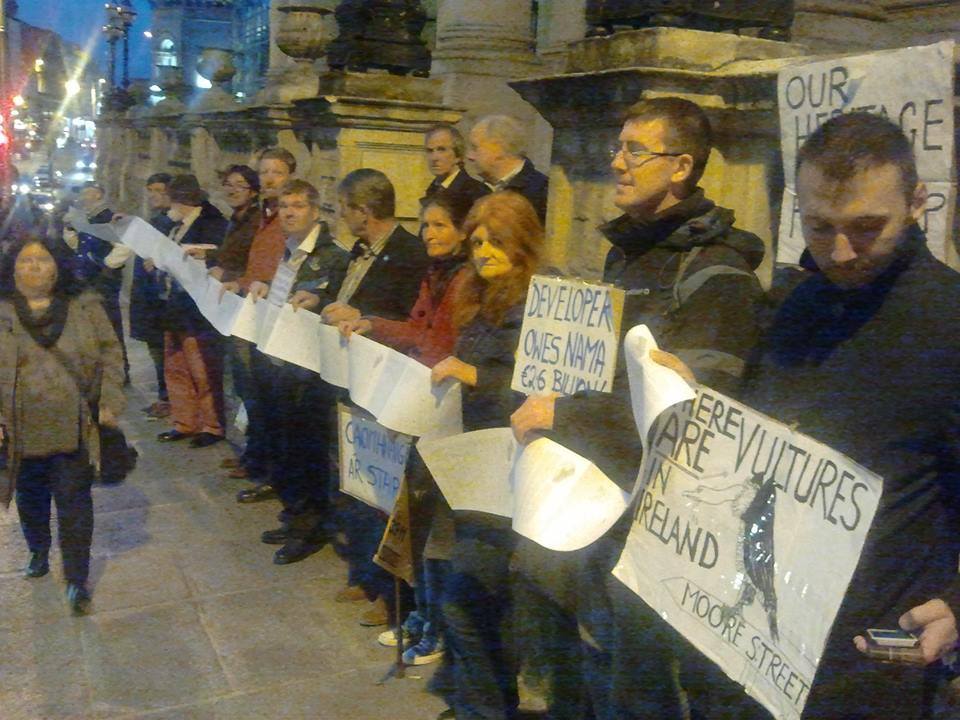
Picket/ lobby of Dublin City Council in 2014, petition stretch and posters organised by the Save Moore Street From Demolition Group, founded a couple of months earlier to prevent Dublin City Council City Manager giving property speculator Joe O’Reilly Nos. 24-25 in exchange for Nos.14-17, which would have allowed him to demolish from No.25-No.18. The campaign was successful in preventing that as councillors voted against the swap. (Photo: SMSFD archives)
Moore Street is of course already ‘a shopping area’ but what that means to property speculators is a street of chain stores, something like the Grafton and Henry Streets. Such streets are busy during shopping hours but largely deserted at night and anathema to the living social city centre.
Independent small shops and street stalls characterise a street market, typically with some cafes, a bakery and restaurant. But the agent of Hammerson, the speculator company, has closed down a bakery and a number of successful restaurants and cafés on the street.
On the Friday of Easter Week, 300 or so of the GPO garrison evacuated the burning building and occupied the central terrace in Moore Street to gain a respite, setting up their new HQ there and a field hospital caring for their wounded and for a wounded soldier of the British Army.
The new intended street would cut right through the historic 1916 terrace, the footprint and path traversed by much of the 300 or so GPO Garrison in 1916 as they evacuated their burning former HQ and prepared to relocate to William & Woods site in nearby King’s Inn Street.
Moore Street, according to campaigners, is of great Irish cultural and historical importance but is also of international historical stature: surrender site of the first anti-colonial uprising of the 20th Century and of the first rising against World War and last location in freedom of five of its leaders.
Those five, Connolly, Pearse, Clarke, Mac Diarmada and Plunkett, were also five of the Seven Signatories of the 1916 Proclamation, a document of huge symbolic significance in history and still often referenced in contemporary discourse.
Campaigners point to the presence in the street of the Irish Citizen Army, which they claim as “the first workers’ army” and of its leader, Connolly along with three of the first women’s republican military organisation, Cumann na mBan: Elizabeth O’Farrell, Julia Grenan and Winifred Carney.
The Irish Citizen Army recruited women too, including appointing some of them as officers in command of male Volunteers, another first in world history.
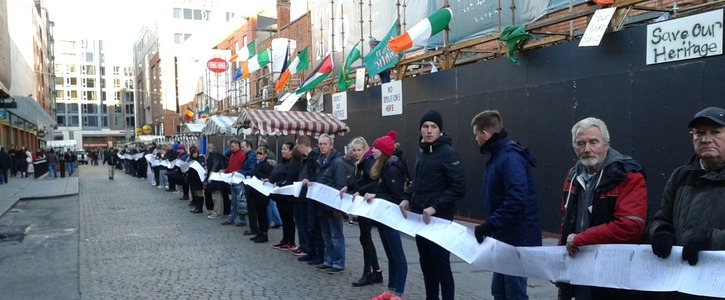
Signed petition sheets sellotaped edge to edge in January 2016, stretched along Moore Street as the 6-day occupation of the endangered buildings came to an end and shortly before the 6-week blockade began. (Photo: SMSFD archive)
SUCCESSES AND DEFEATS
The campaign has had some previous successes, including four buildings being declared a historical monument in 2007, refusal of land-swap in 2014 (see photo), a six-week blockade of the site and a High Court declaration in 2016 of the whole area being a national historical monument.
However, the campaign insists the historical monument is all 16 buildings in the terrace, not just four. And the High Court decision was successfully appealed in February 2017 by the Minister of Heritage on the grounds that a Judge did not have the power to declare a national monument.
The campaigners, now in their 11th year of Saturdays on the street, say that they stopped counting hard copy petition signatures once they passed 380,000. But last year they started an electronic petition in which they aimed for 1,000 by year’s end — and exceeded their target.
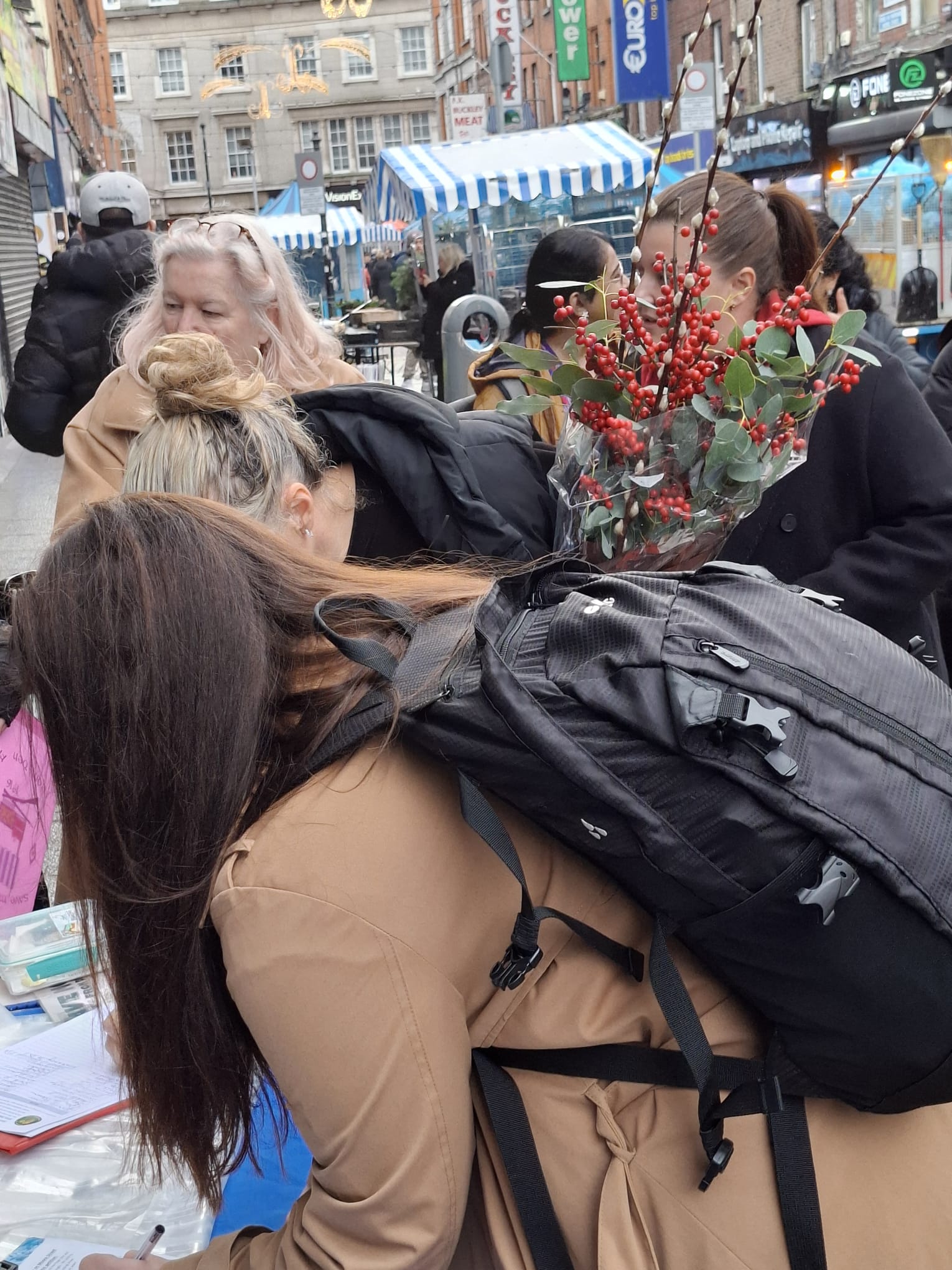
Women Christmas shopping crowding around the petition table to sign hard copy and on-line petition last Saturday. (Photo from weekly SMSFDalbum 20 December 2025.)
This year they’ve aimed to reach 2,000 but, with nearly another 300 needed with a week to go before the end of 2025, reaching their target seems very unlikely.
The campaign group supporters say that they have held the line so long because of the support of hundreds of thousands, not only of indigenous Irish but also of settled migrants (the latter being the mainstay of the traditional fresh fruit and vegetable stalls) and want the signatures to reflect all that.
“At this stage, the strongest help we can get from ordinary people is to sign the on-line petition and to get their contacts to do so too,” said one of the campaigners on the street recently. “On-line signatures are identifiable to one person, verifiable and the total can be checked on line.”
“The authorities will remember that people took direct action in the past to halt demolition, as in the occupation and blockade of 2016 but thousands of online petition signatures are an indication that the activists represent much more than themselves alone”.
The Save Moore Street From Demolition campaigners are on the street every Saturday from 11.30am-1.30pm and their online petition is on https://my.uplift.ie/petitions/save-moore-street The group has Instagram and Facebook pages also.
end.
Note: If you found this article of interest, why not register with Rebel Breeze for free, so that you will be notified by email of subsequent articles. You can de-register any time you wish.
Diarmuid Breatnach (slightly edited repost from 2014)
(Reading time:3 mins.)
In England it is called “Boxing Day” but in Ireland the 26th of December is “St. Stephen’s Day”. Despite the Christian designation it has long been the occasion in Ireland for customs much closer to paganism.
It was common for a group of boys (usually) to gather and hunt down a wren, a small songbird.
The wren can fly but tends to do so in short bursts from bush to bush and so can be hunted down by determined boys. The bird might be killed or kept alive, tied to a staff or in a miniature bower constructed for the occasion.
The Dreoilín singing on a mossy rock.
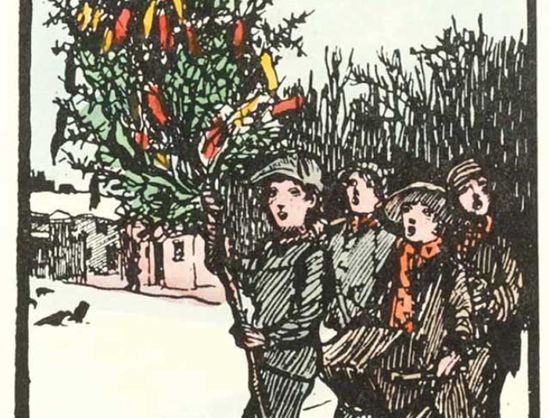
The Wren Boys would then parade it from house to house while they themselves appeared dressed in costume and/or with painted faces.
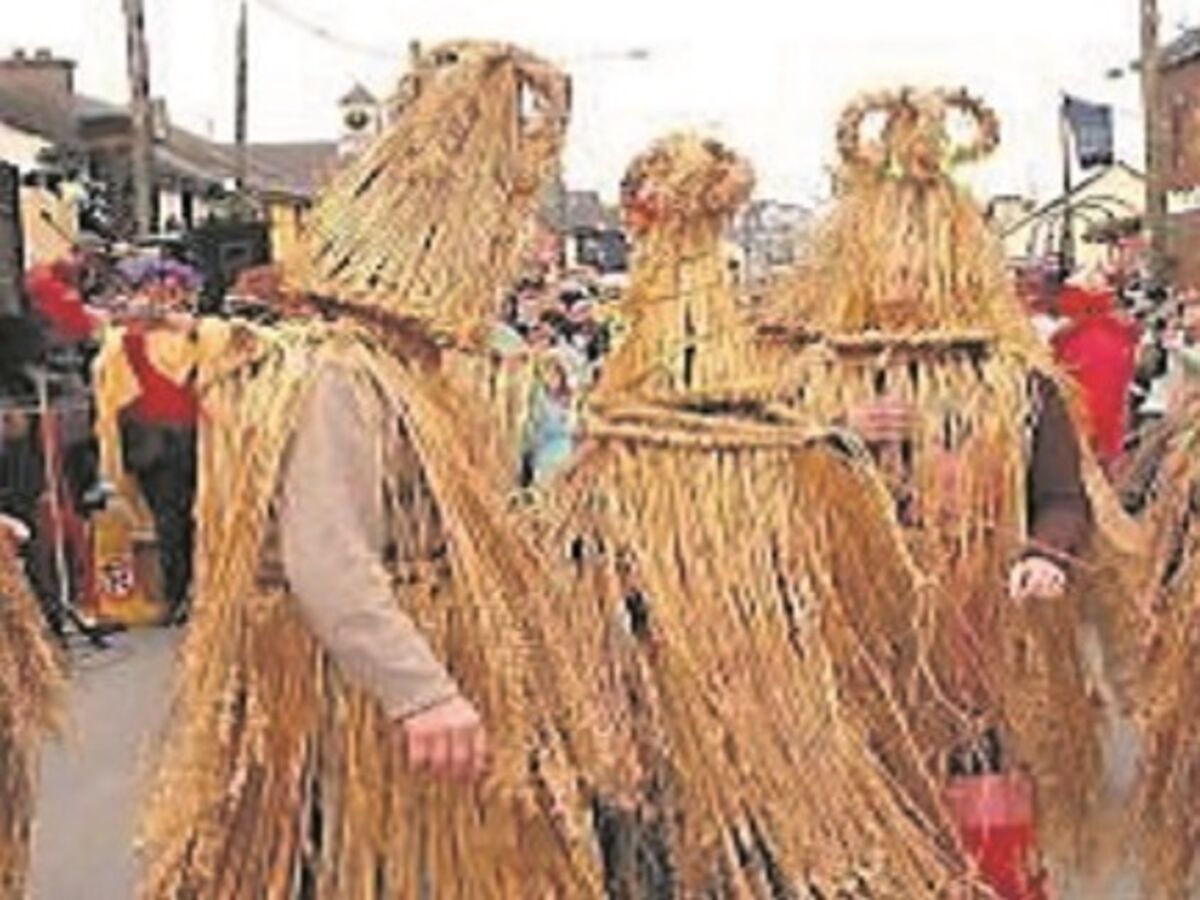
In some areas they might only carry staff or wands decorated with colourful ribbons and metallic paper while they might in other areas dress in elaborate costumes, some of them made of straw (Straw Boys) and these were sometimes also known as Mummers.
However a distinction should be drawn between these two groups. The Mummers in particular would have involved acting repertoires with traditional character roles and costumes, music and dance routines.
The simpler Wren Boys however might each just contribute a short dance, piece of music or song. In all cases traditional phrases were used upon arrival, the Mummers having the largest repertoire for in fact they were producing a kind of mini-play.
The origins of the customs are the subject of debate but a number of Irish folk tales surround the wren.
Straw Boys at a festival.
The bird is said in one story to have betrayed the Gaels to the Vikings, leading to the defeat of the former. There is a Traveller tradition that accuses the wren of betraying Jesus Christ to soldiers while another tradition has the bird supplying the nails (its claws) for the crucifixion of Jesus Christ.
Yet another tradition has the wren as King of the Birds, having used its cunning in a competition to determine who would be the avian King, hiding itself under the Eagle’s wind and flying out above the exhausted bird when it seemed to have won.
By the 1960s the Wren Boy custom was beginning to die out even in areas where it had held fast but it slowly began to be revived by some enthusiasts. Nowadays fake wrens are used.
Christmas Day in Ireland was traditionally a day to go to religious service and to spend at home with family or to go visiting neighbours.
It was not a day of presents or of lights or Christmas Trees, customs brought in by the English colonizers in particular from Prince Albert, the British Queen Victoria’s royal consort, who was German.
St. Stephen’s Day may have celebrated the turn of the season heralded by the Winter Solstice (the wren being a bird that on occasion sings even in winter) but moved to a Christian feast day.
In any case it produced colour and excitement at a time which did not have the religious and commercial Christmas season to which, in decades, we have become accustomed.
The lovely song The Boys of Barr na Sráide from a poem by Sigerson Clifford takes as its binding thread the boys in his Co. Kerry childhood with whom Sigurson went “hunting the wren” but follows also their fight against the invader and their subsequent emigration to England or the USA.
Drawing of Wren Boys out on their round.
I’ve been singing this song in private recently but also at the December gathering of the monthly 1916 Performing Arts Club in Dublin.
In this recording it is sung by Muhammed Al-Hussaini (then resident in London and part of the singing circle of Comhaltas Ceoltóirí na hÉireann, meeting in the Camden Irish Centre) in which I had the pleasure of participating on a visit to London in 2014 (see The London Visit on the blog).
There are recordings of others performing this song well but the unusual origin as well as its quality persuaded me to choose this one and, in addition the memory of participating in a singing circle with this lovely and modest singer in London, who greeted me in Irish.
Muhammed also plays the violin on this recording, accompanied by Mark Patterson on mandolin and Paul Sims on guitar.
Mummers from Fingal, north of Co. Dublin
Ends.
Note: If you found this article of interest, why not register with Rebel Breeze for free, so that you will be notified by email of subsequent articles. You can de-register any time you wish.
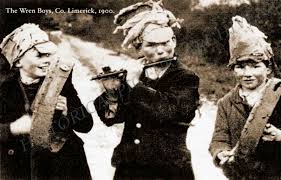
The photo with the recording shows some of the Limerick fighters of the Kerry IRA in the War of Independence (1919-1921) or perhaps in the Civil War (1922-1923)
There were lively scenes today outside Dublin’s British Embassy in solidarity with the hunger strikers in British jails awaiting trial on charges arising out of Palestine Action’s operations against the Israeli arms company, Elbit Systems UK.
Two of the six hunger strikers are in their 50th days without food and approaching the point where fatal seizures are possible or suffering irreversible damage to body systems. Their demands are release on bail, a fair trial, de-proscription of Palestine Action and the closure of Elbit Systems.
Early shot of hunger-striker solidarity protesters outside the British Embassy compound today. (Photo: R.Breeze)
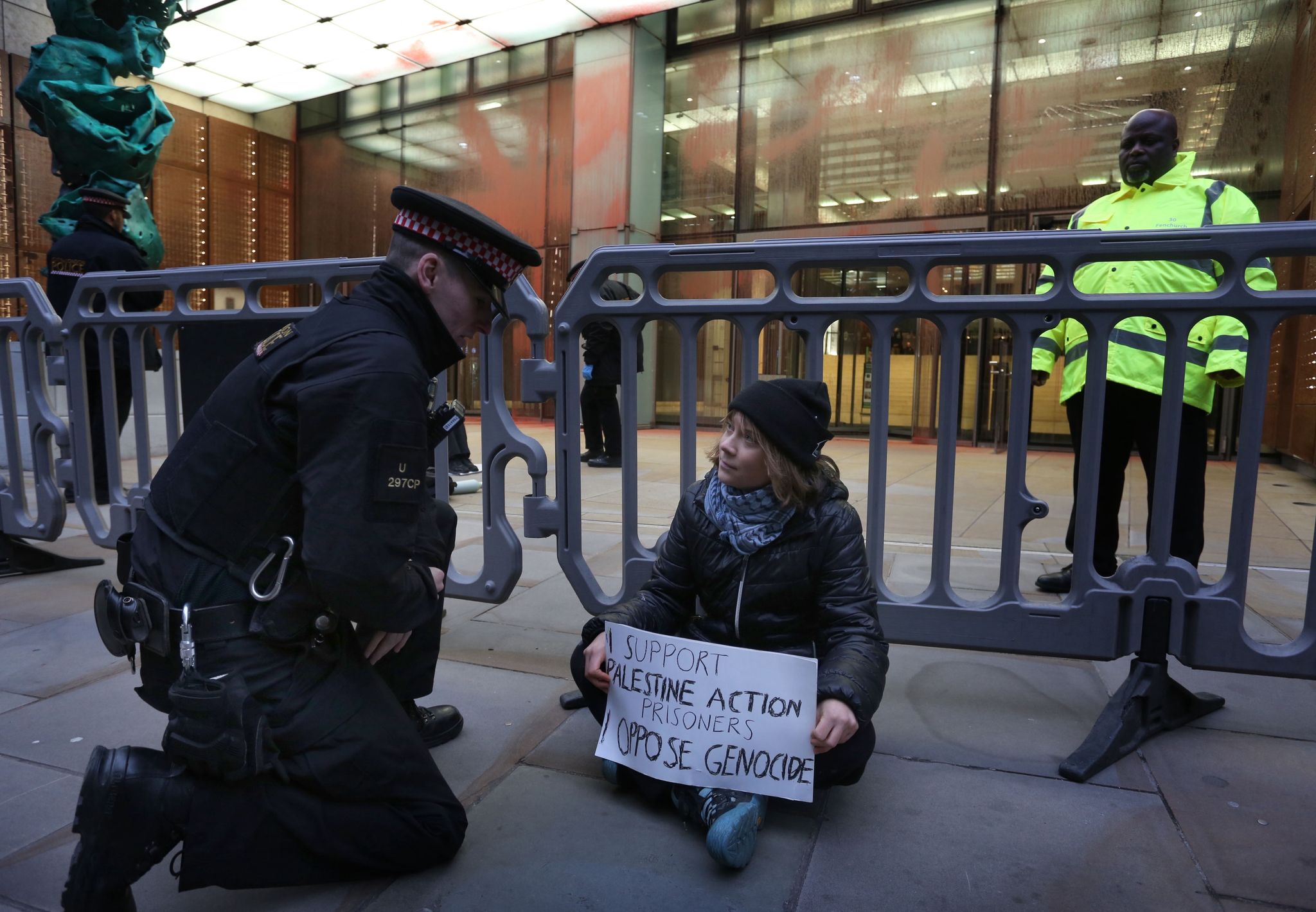
There have been daily solidarity protests in Britain, including those led by the Irish Brigade1 in London amid general mass media silence but the arrest of Greta Thurnberg today on ‘terrorism’ charges may bring a focus on the hunger-strikes for a change.
Today also The National newspaper revealed that Barclay’s had asked the British Government to ban Palestine Action and already the question is being asked: How is it that was not admitted by the Government when Huda Ammori took the Palestine Action banning to judicial review?
(Greta Thurnberg about to be arrested earlier in Central London). Photo source: Internet)
The rally today, like that outside the British Embassy last week, was organised by the Peadar O’Donnell Socialist Republican Forum, while another solidarity rally in Dublin last week but on College Green, in the City Centre, was organised Communities for Palestine.
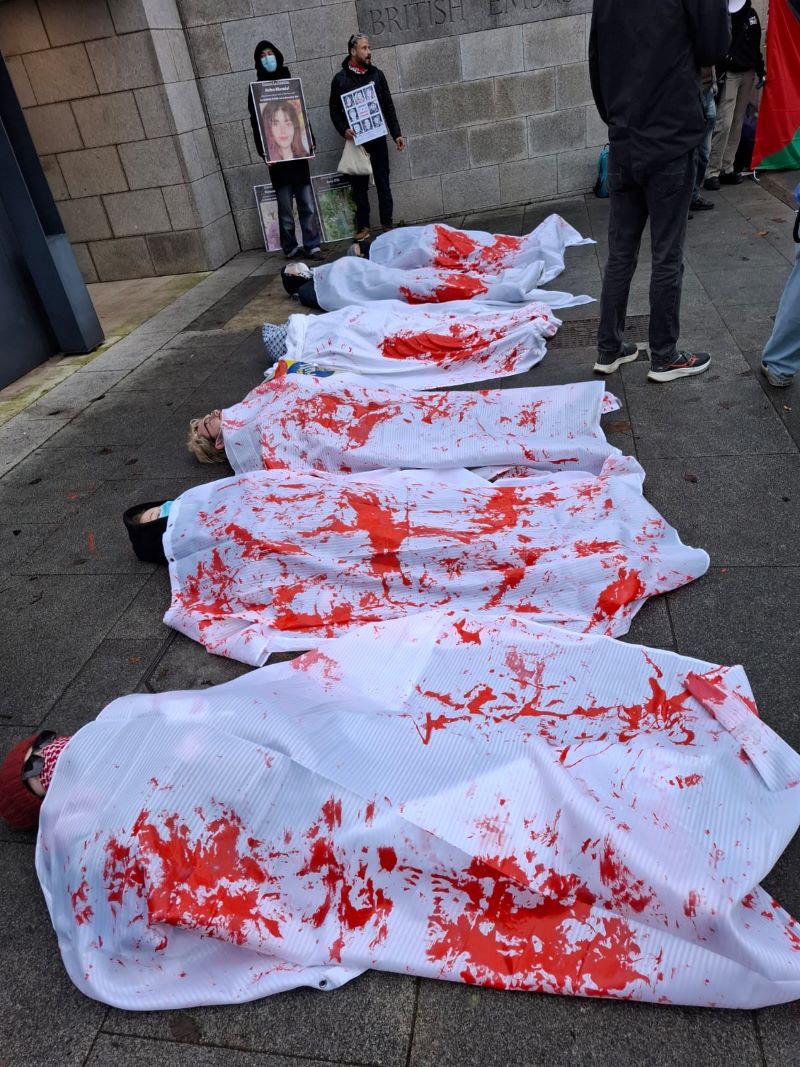
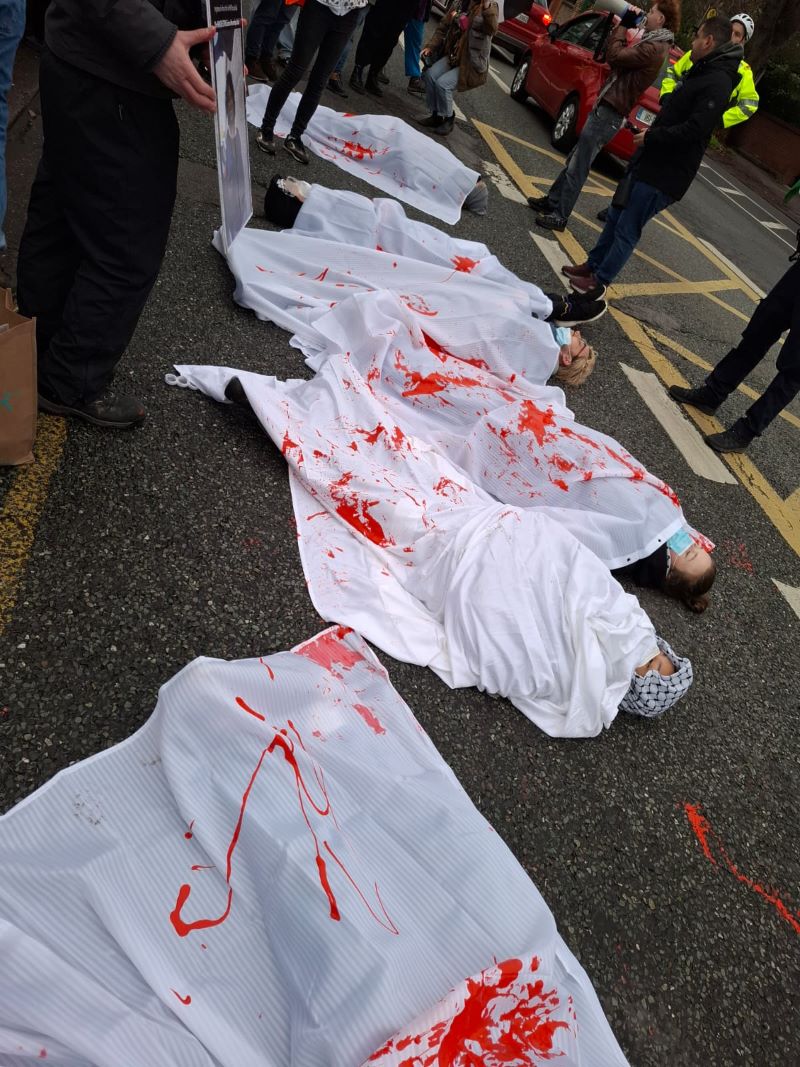
The ‘corpses’ in the road outside the British Embassy compound today. (Photo: R.Breeze)
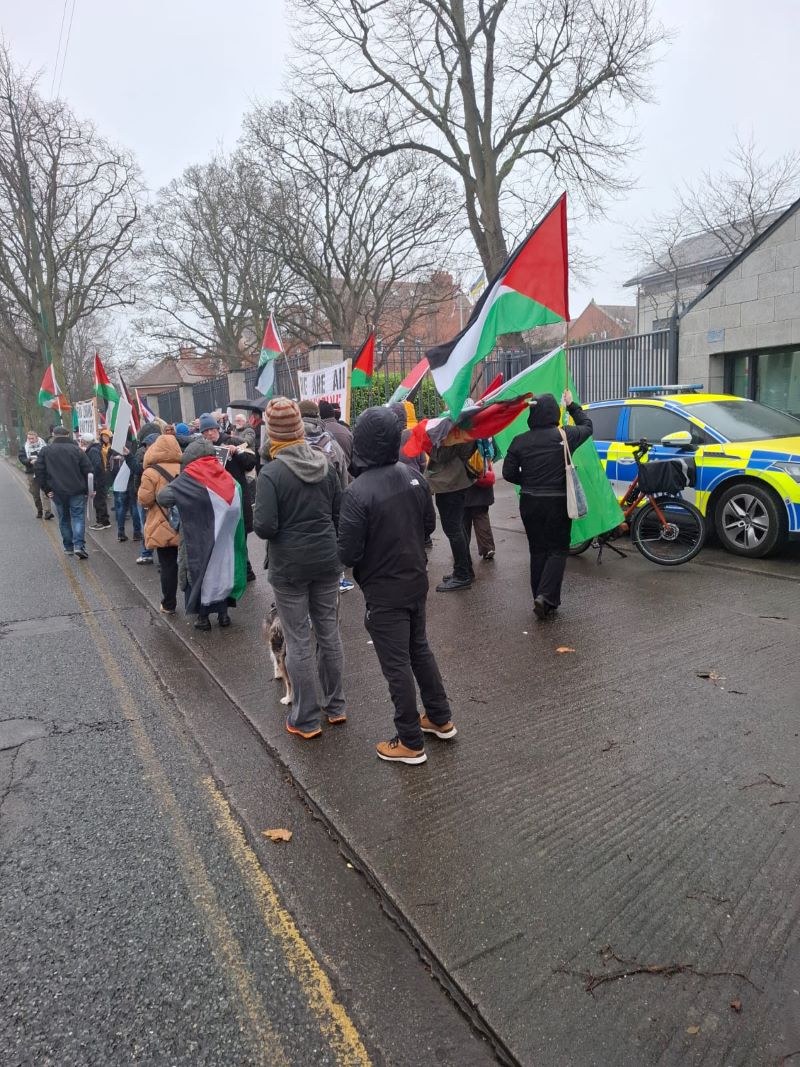
The chants led outside the Embassy today included the usual ones heard on Palestine solidarity marches, including those referencing the Intifada, the occupation of Ireland and the Irish-language Saoirse don Phalaistín! But there were also new ones and additions to older slogans.
A new Four, Five and Six was added to a previous only One, Two and Three: One – We are the people; Two – We won’t be silenced; Three – Stop the bombing now, now, now! Four – Free our people; Five – Free our land; Six – Kick Zionism out, out, out!
Some other changed and new chants included: One, Two, Three, Four– Support the Filton 24! Five, Six, Seven, Eight – Israel is a terrorist state. We are all Palestine Action! Victory to the hunger-strikers! Brick by brick, wall by wall – all the colonies will fall!
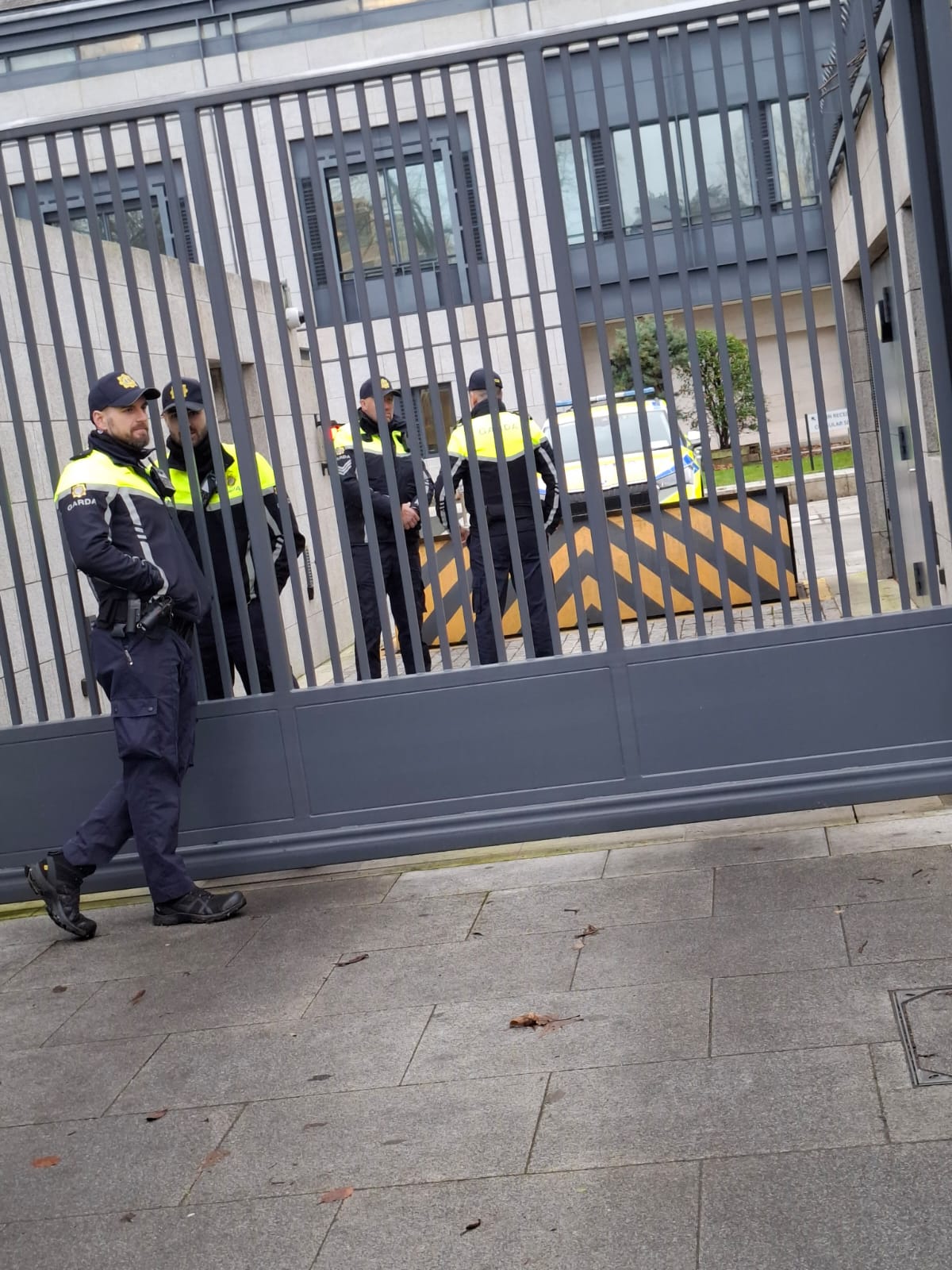
Slogans also castigated British Government collusion in the Israeli genocide, Irish state collusion through militarisation of Shannon Airport and Gardaí collusion through their defence of the British Embassy.
Numbers of Gardaí and one of their vehicles actually inside the British Embassy compound today. (Photo: R.Breeze)
On two occasions the MC asked demonstrators to line both sides of the road outside the Embassy, which is one of the main Dublin routes from and towards the South. Passing traffic frequently sounded their horns in solidarity, passengers often signing thumbs-up or with clenched fist.
But at one point, most of the demonstrators occupied the road, blocking traffic in each direction. The Gardaí moved quickly to break this up and were soon violently shoving demonstrators off the road, one in particular screaming with wild eyes so that he was twice seen restrained by colleagues.2
However part of the northbound road remained occupied in front of the Embassy entrance and at this point a new group of protesters arrived and, unpacking white curtain material, began to squirt red paint on it, then to lie down in the road under the material like massacre victims.
A number of speeches were made during the event and later a man called the crowd to remember also the 1981 hunger strikes in Ireland, for which he sang the Joe McDonnell3 Ballad, with its wonderful chorus lines: You dare to call me a ‘terrorist,’ while you look down your guns!4
Another man recounted the story told by Bobby Sands5 of the caged lark which would not sing for its captor and how that bird came to represent Sands himself, before reciting a poem of an Irish migrant in London in anguish as Bobby Sands lay dying.
The ‘corpses’ were moved from the road to immediately in front of the British Embassy compound today. (Photo: R.Breeze)
The current hunger-strikes are sometimes referenced as “the first coordinated hunger strikes in Britain” since those of the Irish Republicans in 1981. Of course, those strikes were not in Britain but in occupied Ireland and therefore currently part of the United Kingdom.
There are important differences of course. The Irish Republican hunger strikers were convicted, albeit by special non-jury courts, of armed resistance to British occupation; the current hunger strikers have not yet even been tried and none of the charges against them include armed action.
And the motivation of the Palestine Action accused is purely internationalist solidarity against a regime committing daily massacres in a programmed genocide.
Nevertheless, the British ruling class may yet come to regret the day they permitted anti-Zionism to become so strongly linked to anti-British colonialism, and anti-genocide internationalism so closely linked to the memory of Irish colonial resistance.
End.
Note: If you found this article of interest, why not register with Rebel Breeze for free, so that you will be notified by email of subsequent articles. You can de-register any time you wish.
FOOTNOTES
1An ad-hoc broad Palestine solidarity organisation composed of Irish migrants and diaspora in London.
2This may possibly be the same Garda who was seen wildly striking with his baton and pepper-spraying peaceful participants at a Palestine solidarity march to Dublin Port some weeks ago.
4And you dare to call me a terrorist, while you look down your guns! When I think of all the things that you have done: You have plundered many nations, divided many lands, You have terrorised their people, ruled with an iron hand – And you brought the stain of terror, to my land.
5Bobby Sands relinquished his elected post of Officer Commanding the Republican male prisoners in Long Kesh in order to lead the hunger strikes of 1981. On 5th May he was the first of the Ten to die.
In the aftermath of the Bondi massacre, we might ask: Is anti-Semitism1 on the rise?
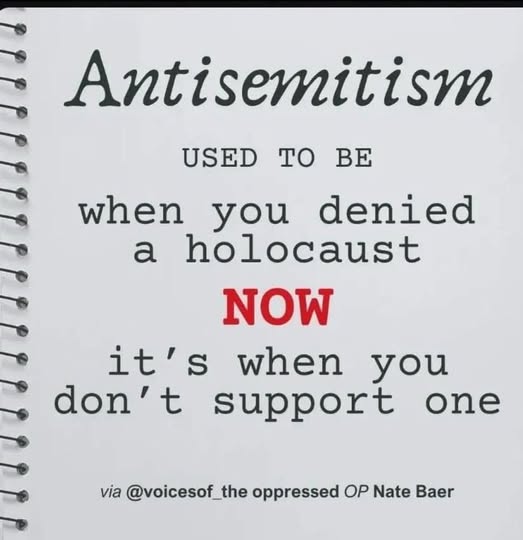
It is hard to be certain, given that politicians and media keep conflating anti-Zionism and anti-Israel feelings with anti-Semitism, mixing acts against one with acts against the other, despite their being two very different things.
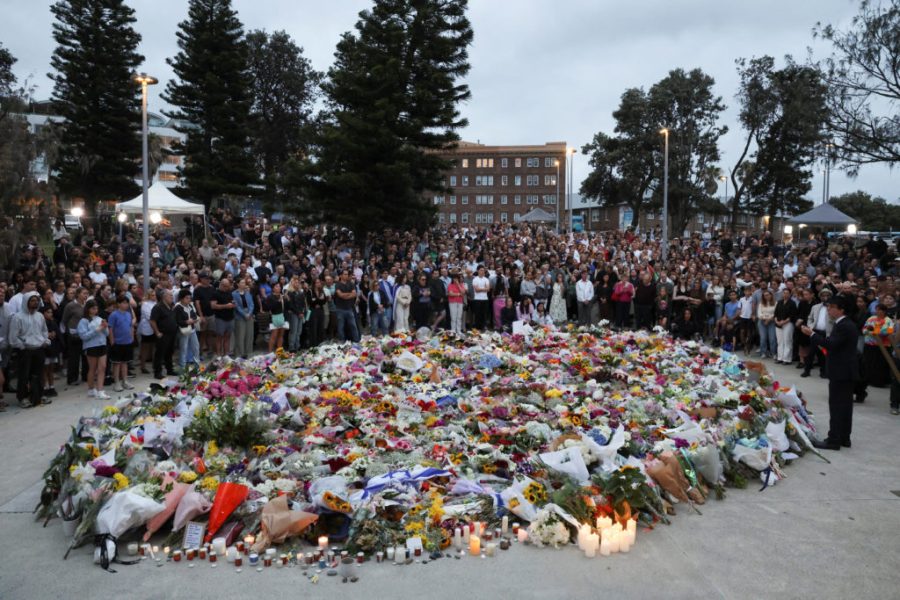
People pay respects at Bondi Pavilion to victims of a shooting during a Jewish holiday celebration at Bondi Beach, in Sydney, Australia, December 15, 2025. REUTERS/Hollie Adams
But would it be surprising if anti-Semitism were indeed on the rise? And if it is, who are the main culprits?
Undoubtedly, the western imperialists who support the Israeli settler colony and repress their own citizens for opposing genocide must contribute to anti-semitism.
Above all however the Israeli State itself and its genocide against the indigenous Palestinian people, while insisting that the Zionist State is the ‘national’ expression of Judaism, that their Zionism is Judaism, must be counted as particularly responsible.
Zionism is a late 19th Century political movement for the creation of a Jewish state, founded by a small group of European Ashkenazi2 Jewish background which received the support at the time of imperialist European capitalists, particularly the British variety (some of them anti-Semites too!).
A branch of Evangelical Christianity, especially in the USA has also become Zionist.3 Leaving aside religious and prophetic belief, this sector provides a strong base of political and financial support, particularly through AIPAC,4 for US imperialist support for the Israeli Zionist state.
Judaism is a religion, often described as ‘of the Book’, which it shares with Christianity and Islam, all of them with origins in West Asia but with Christianity recruiting most of its congregations and states in Europe (now also the whole West, with the USA, Canada, Australia and New Zealand).
Later, the main supporters of the Zionist project were the USA. A dedicated foothold in West Asia, secure from socialist revolution among its colonial Zionist settler population and with any nationalist Arab movement suppressed by this garrison, was of course attractive to the imperialists.
The project of conflating Judaism with Israeli Zionism has been underway for well over a century but even in the wake of the Nazi genocide, Zionism did not have the support of the majority of Jews around the world.5 This changed as the 20th Century progressed but appears to be reverting now.6
ANTI-SEMITISM?
As more and more people, particularly youth around the world take to the streets and to educational establishments to denounce the daily genocide of the Palestinian people by the Israeli State and the collusion of the Western regimes, they face heavy repression of the states.
Beating with truncheons, use of irritant sprays, threats to academic study programs, arrests, strip-searching and serious charges are already occurring in the Irish state. To those must be added banning of organisations under false ‘terrorism’ classification in the UK and Canada.7
Special repressive measures are routinely taken against public displays of Palestinian solidarity in Germany, Austria and France. Journalists have been harassed and arrested, recording equipment confiscated and professionals have their careers threatened, all for opposing the Israeli genocide.8
Some of the resentment felt by the victims of such repression may be misdirected upon people of Jewish background, particularly since the Zionists and the Imperialists work so hard to identify the one with the other.
In addition there is a long anti-Semitic tradition in European Christian society from the Middle Ages9 which was employed and extended by fascist and Nazi movements in the 1930s, combined with a false and perverted nationalism. And currently fascist movements are once again on the rise.
It is instructive to see British fascist and Israeli flags side by side among groups counter-protesting gatherings of Palestinian solidarity in England, or British colonial Loyalists burning Palestinian flags alongside symbols of Irish Republicanism such as the Irish Tricolour.
AN ANTI-SEMITIC ATROCITY
Is is difficult, particularly in the absence so far of information from the perpetrators,10 to view the Bondi Beach massacre in Australia as other than an anti-Semitic atrocity. The victims were attending a Jewish religious festival when fired upon.
First panel shows the shooters, father and son, said to be linked to ISIS; Second panel shows one of the shooters being tackled and disarmed by Syrian-born Australian Ahmed al Ahmed who was later injured and underwent surgery. (Photo sources: Internet)
Had one of the victims, media-characterised as a saintly rabbi but in fact a Zionist supporter of the genocidal Israeli State (who had himself photographed among its soldiers while holding an automatic rifle)11 been an intended target cannot justify the resulting civilian ‘collateral damage’.
In fact, such disregard for other casualties surrounding a targeted individual is a standard feature of Israeli Occupation Forces assassinations and can never be those supported by Palestine internationalist supporters or by any other democratic movement.
Western politicians and media now strive to employ this massacre and its attendant horror to further strengthen Zionism and to further conflate anti-Semitism with anti-Zionism, none more so than Netanyahu who claimed that recognition of Palestinian nationhood was a causative factor.12
And in Australia, the massacre is already being used in propaganda against the Palestine solidarity movement: Prime Minister Albanese has stated the intention to outlaw the Palestinian liberation and solidarity slogan: ‘From the river to the sea, Palestine will be free!’.13
The fact remains that the Israeli Zionists themselves are the greatest cause of any rise of anti-Semitism in the World.
End.
Note: If you found this article of interest, why not register with Rebel Breeze for free, so that you will be notified by email of subsequent articles. You can de-register any time you wish.
1Although the term ‘Semitic’ describes ethnic cultural groups including Jews and Arabs, the term ‘anti-Semitic’ has been taken largely to mean anti-Jewish, i.e. against people of Jewish religious background, despite its much more recent conflation with anti-Zionism.
2One of the European-based sections of the Jewish community, speaking European languages and the German-based Yiddish, using Hebrew only for religious purposes.
4American Israel Public Affairs Committee, a powerful pro-Israeli Zionist lobbying organisation providing funding to most US Congress and Senate elected members.
7The direct-action organisation Palestine Action was declared a ‘terrorist organisation’ under UK law on 5 July 2005 and so far over 2,490 people have been arrested for declaring support for the organisation.
9Jews in many Christian European countries were required by law to live in ghettoes or were expelled, such as the expulsion of Jews and Muslims by the Christian Monarchs of the Spanish Kingdoms 1492-1614.
10According to reports they were a father and son, the first killed at the scene and the second hospitalised, just now out of a coma.
As two of the six hunger strikers awaiting trial on actions against the Israeli arms company Elbit approach 50 days fasting and concern for their survival rises, the Irish recall their own history and the 10 Republican deaths on hunger strike in 1981.
The 1981 hunger striker martyrs were jailed active service Volunteers of the Provisional IRA (7) and Irish National Liberation Army (3) demanding their treatment as political prisoners. On May 5th Bobby Sands died on hunger strike, followed in stages by another nine Irish Republicans.
The Palestine Action activists on hunger strike in jail face charges of criminal damage and alleged assault during actions targetting buildings belonging to Elbit Systems in Britain, involving destruction of manufacturing equipment and weapons and daubing with red paint.
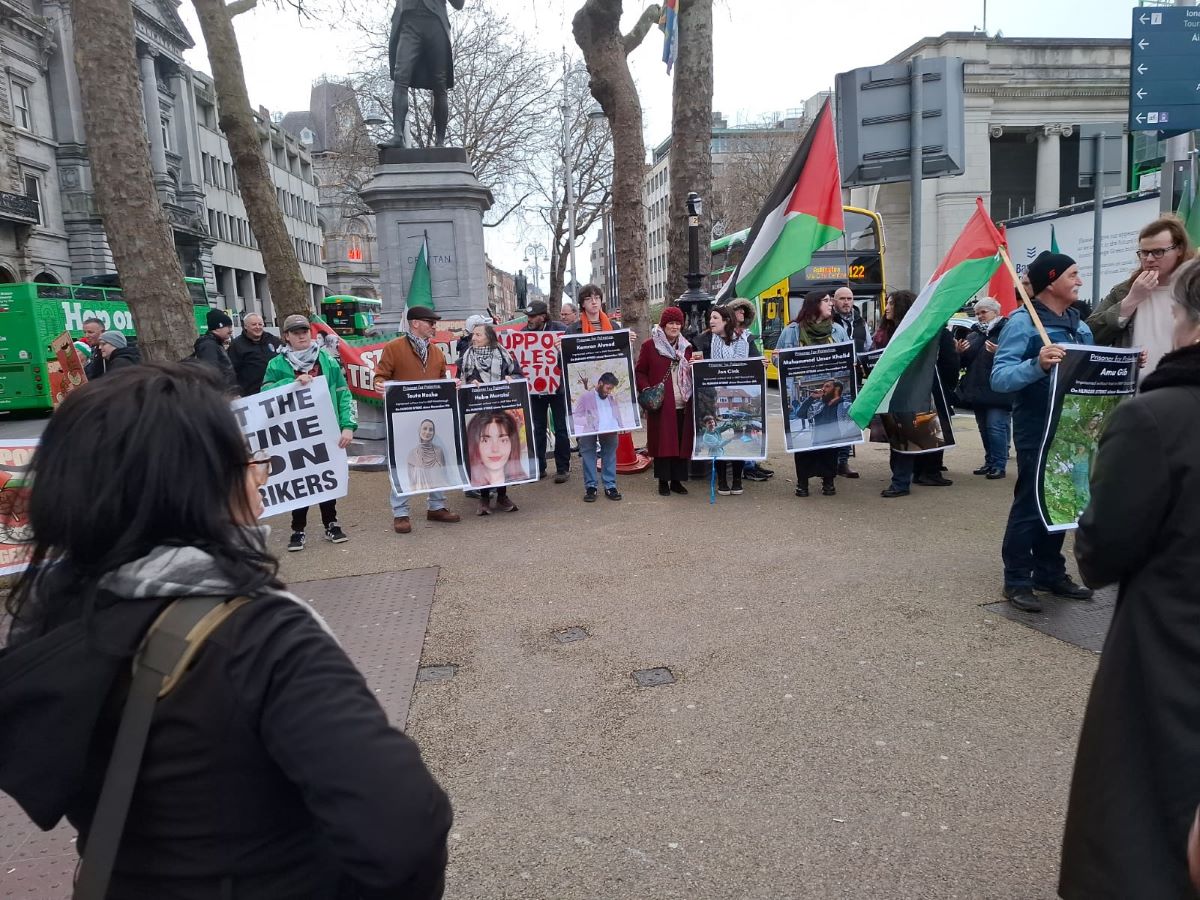
Placards representing the hunger-strikers and banners calling for solidarity with them on College Green, facing Trinity College, Dublin Saturday 13 June organised by Communities for Palestine. (Photo:Rebel Breeze)
The actions and charges predate the banning on 5 July of Palestine Action under the Terrorism Act 2000. That designation has since been protested across the UK1 with around 2,500 charged with “supporting terrorism” under the same Act (potential penalty 14 years prison or more).
The hunger-strikers have won strong support in Britain with solidarity pickets taking place now daily, along with demonstrations and marches. The protests have seen support from among the Irish diaspora, in particular in London led by the ad-hoc broad grouping of the Irish Brigade.2
Apart from humanitarian considerations, protests have also been directed at the UK’s mass media and its attempt to ignore the hunger-strikes and the solidarity actions.
MPs raised the issue too in the Westminster Parliament. Particularly shocking to many was not so much the video recording of the curt dismissal of Independent MP Jeremy Corbyn’s parliamentary question by a UK junior Minister but rather Labour MPs laughing at the put-down of Corbyn.3
On Thursday, more than 800 doctors, nurses, therapists and carers wrote to Justice Secretary David Lammy to warn that “without resolution, there is the real and increasingly likely potential that young British citizens will die in prison, having never even been convicted of an offence”.4
In Ireland itself, solidarity protests have taken place in Dublin city centre and at the British Embassy on the city’s outskirts, in addition to in Belfast and Derry within the British colony of the Six Counties. Again and again speakers referenced Irish history and in particular that of 1981.
Placard-holders facing westward traffic at College Green rally near Trinity College, Dublin Saturday 13 June. (Photo: Rebel Breeze)
In Dublin on Saturday 13 June, facing Trinity College, speakers at event organised by Communities for Palestine called for solidarity with the hunger strikers, denounced daily genocide in Palestine, the chairperson also leading the crowd in the now-famous chant led by the Bob Vylan band of “Death to the IDF!5”
Threatened Irish neutrality in the face of the growing threat of war by NATO was also raised by speakers, as was the continued British occupation of part of Ireland, the Irish State’s collusion with the Israeli genocide in Gaza and the US militarisation of Shannon Airport.
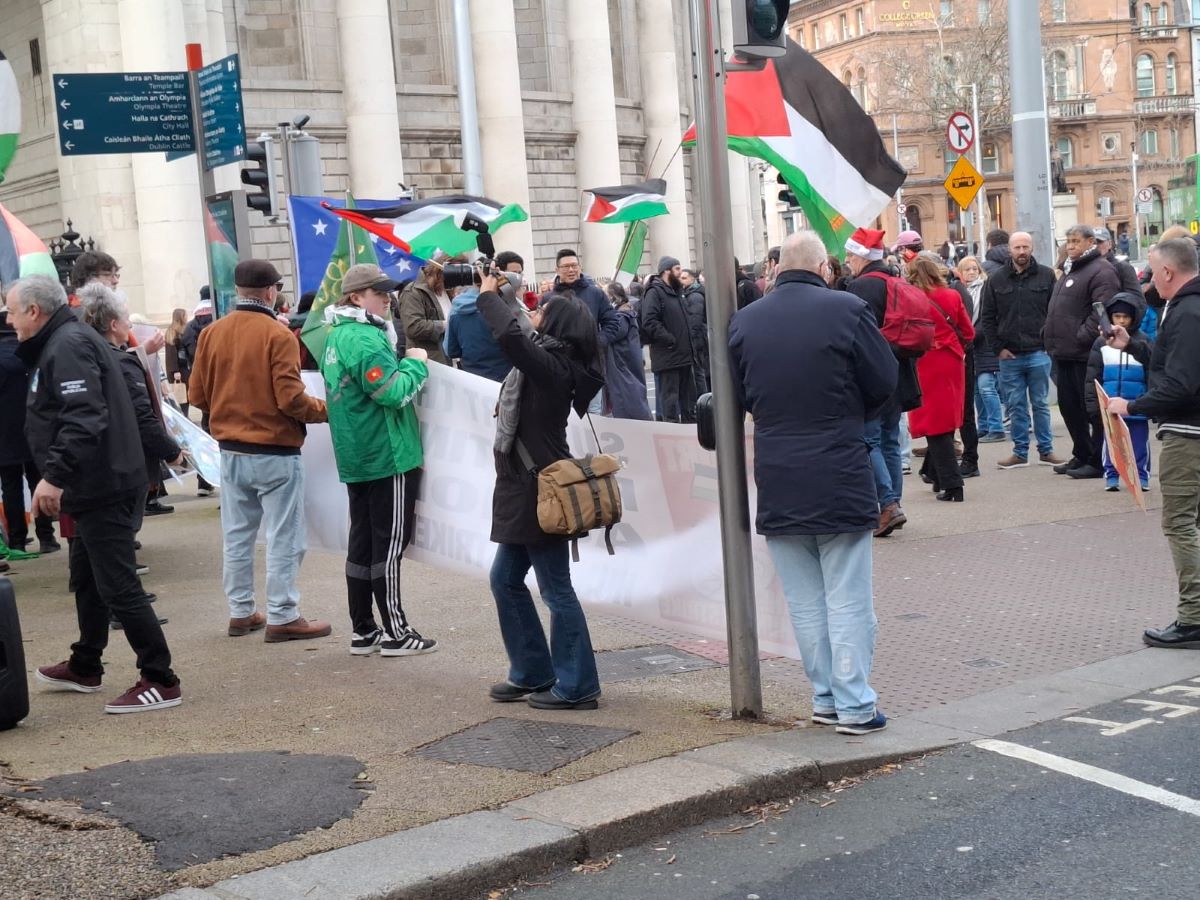
View of a section of the organised by Communities for Palestinerally from behind the main bannercalling for solidarity with the hunger-strikers on College Green, facing Trinity College Saturday 13 June. (Photo:Rebel Breeze)
On Wednesday afternoon, in almost incessant rain, a large crowd protesting outside the British Embassy in Dublin heard calls from a variety of speakers (independent Palestine solidarity, Irish Republican, Socialist TD Paul Murphy) to save the hunger-strikers’ lives.
The chairperson of the rally repeatedly referred to the building as “the colonial British Embassy” and led chants in solidarity with the hunger strikers, with Palestinian prisoners of Israel and with Irish Republican prisoners in both administrations.
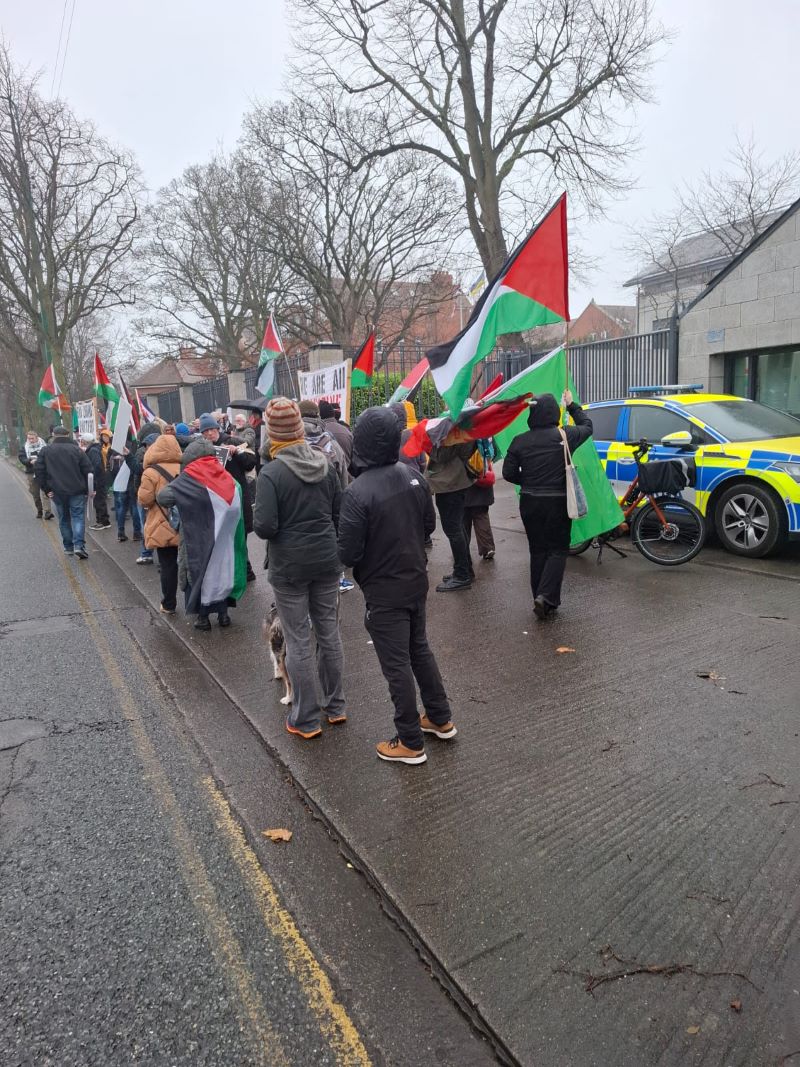
Section of protest rally at main entrance British Embassy (the actual building is set back from the road) on Wednesday 17 June. (Photo: Rebel Breeze)
Referring to the Labour Party MPs laughing at Jeremy Corbyn’s pleas for the hunger strikers, she reminded participants of their cheering the 1916 execution of Connolly6 and dubbed the police “Lackeys of imperialism” as they tried to prevent demonstrators climbing up along the railings.
The slogans were not only of humanitarian concern but also of solidarity, of rage at the genocide in Palestine, of memory of Irish struggle and continuing British occupation. Among chants of hunger striker solidarity at least two speakers voiced the Republican slogan Tiocfaidh ár lá.7
The hunger-strikers’ demands are release on bail, a fair trial, deproscription of their organisation and closure of Elbit factories. The State would claim fair trials and as their period in detention has far exceeded the normal length even for those refused bail, could easily at least release them on bail.
The problem at issue for the British State is that conceding at all risks undermining their according terrorist status to the organisation (which postdates the arrests), a status already in serious danger.
And they need that to stamp out resistance to their genocide collusion, which they perceive as essential to their imperialist system. In that sense a concession in Britain now would have more impact than would have had to the hunger strikers in the colony in 1980 and 1981.
On the other hand, the State’s repression has brought more and more people into the struggle and has exposed the roles of the media, police, judiciary and the Labour Party. Now, the hunger-strikes are helping to draw Palestine solidarity feeling alongside Irish anti-colonial sentiment.
After some time at protest rally some demonstrators mount the wall to display their flags over the railings towards the British Embassy building, set back from the road on Wednesday 17 June. (Photo: Rebel Breeze)
End.
Note: If you found this article of interest, why not register with Rebel Breeze for free, so that you will be notified by email of subsequent articles. You can de-register any time you wish.
FOOTNOTES
1Led by the Defend Our Juries civil rights organisation.
2A broad and growing section of the Palestine solidarity movement in London that has been leading the Kneecap court case music solidarity sessions and the hunger-strikers’ solidarity actions there.
5The famous occasion was in June at this year’s Glastonbury Festival with the irony that it was live-streamed by the BBC in order to avoid featuring the Kneecap band from Ireland and their unequivocal expressions of solidarity with the Palestinian struggle. ‘IDF’ is the acronym of the armed forces of the Israeli state, more often named “Israeli Occupation Forces” (IOF) by Palestinian supporters.
6It was actually worse than that: as has been pointed out on occasion in articles in Rebel Breeze, the Labour Party, being in the UK coalition war government, were part of actually agreeing the post-1916 death sentences.
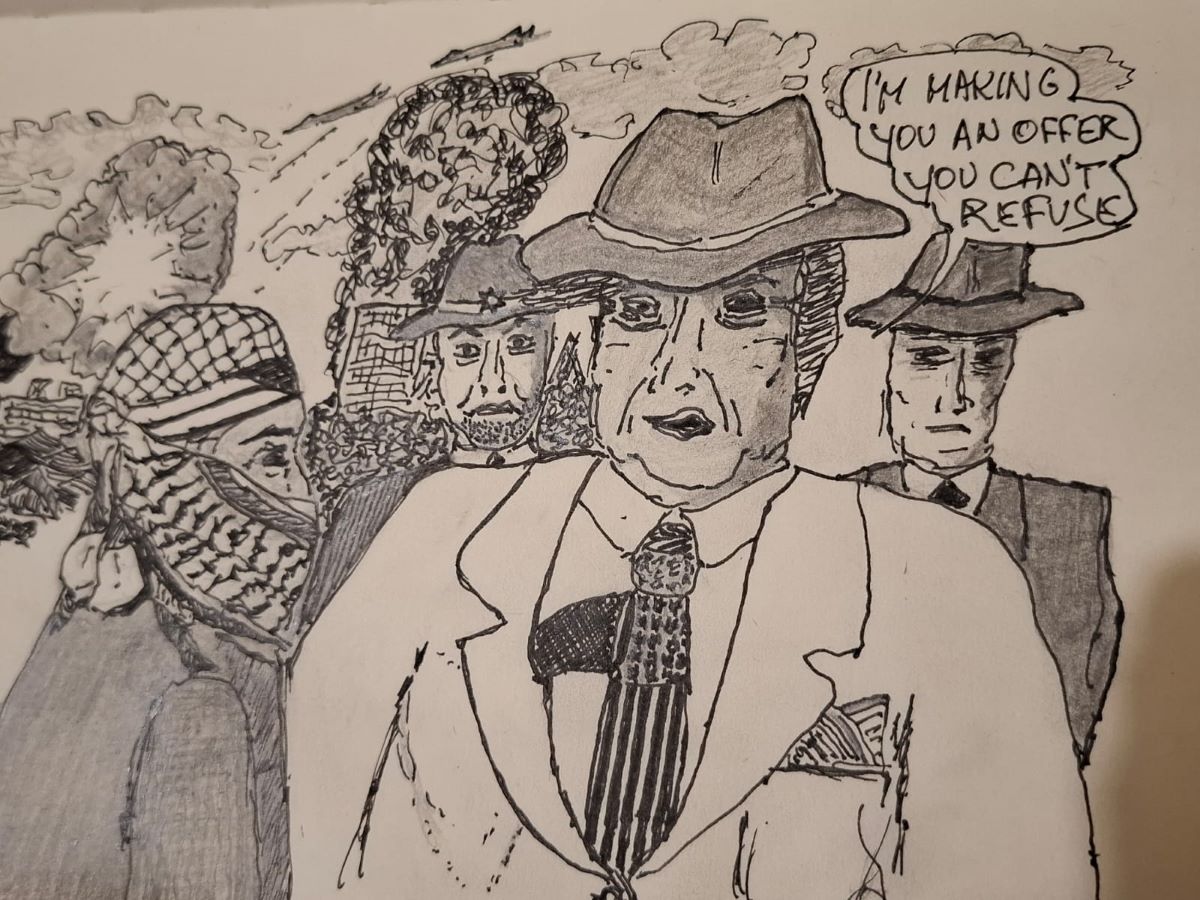
It was great to see the Irish pacification process being referenced with regard to the Trump plan for Gaza1 because that is exactly what the latter is: a plan to pacify the Resistance while ensuring it gets none of what it fought for.2
In other words, exactly like the Irish pacification process.
(Cartoon by D.Breatnach)
Hamas and Palestine Islamic Jihad grew out of previous Palestinian pacification processes. The Madrid Conference (1991) and the Oslo Agreement (1993) were imperialist/ Zionist attempts to pacify the wide-scale militant Palestinian resistance period of the First Intifada.3
Fatah at that time was the leading group in numbers and influence in the Palestine Liberation Organisation (from which Islamic groups were excluded) but also in Palestinian society in general. But Fatah had agreed to recognise ‘Israel’ and also the two-state solution (sic).
In the Oslo Agreement, furthermore, the question of the return to their homeland of the refugees was left aside. It appears that the Fatah leadership had lost faith in the eventual victory of their people’s struggle and had decided to get what they could by using the struggle to bargain.
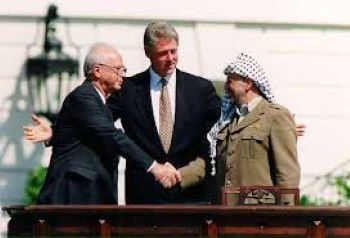
The Oslo Agreement: US Imperialism’s President Clinton oversees Yitzak Rabin, Premier of Zionist state of ‘Israel’ shaking hands with Yasser Arafat of Fatah, then leader of the PLO.
What Fatah got was Palestinian Authority control in the first elections (1996), with internal control over/ management of the Palestinian population of the West Bank and Gaza, but not of the Palestinians in Jerusalem (captured by ‘Israel’ in 1967): a far cry from a free Palestine.4
In the Algiers conference of 1988 Fatah had won majority agreement to recognise ‘Israel’ and to accept the two-state solution5 (sic), i.e. embodying a Palestinian state on 20% of Palestinian land, under the eyes and guns of their Zionist neighbour).
Fatah’s rule became known for corruption and nepotism, which then had to be protected and defended from the Palestinian masses, leading to authoritarian, repressive and often arbitrary rule. And repression of the Resistance, along with direct collusion with the ‘Israeli’ State.
Continuing ‘Israeli’ repression and settlement expansion in turn led to the Second Intifada; Fatah lost to Hamas in the Palestinian parliamentary elections of 2006 followed by defeat of Fatah’s attempted coup in Gaza in 2007 (but the West Bank remaining under unelected Fatah control).
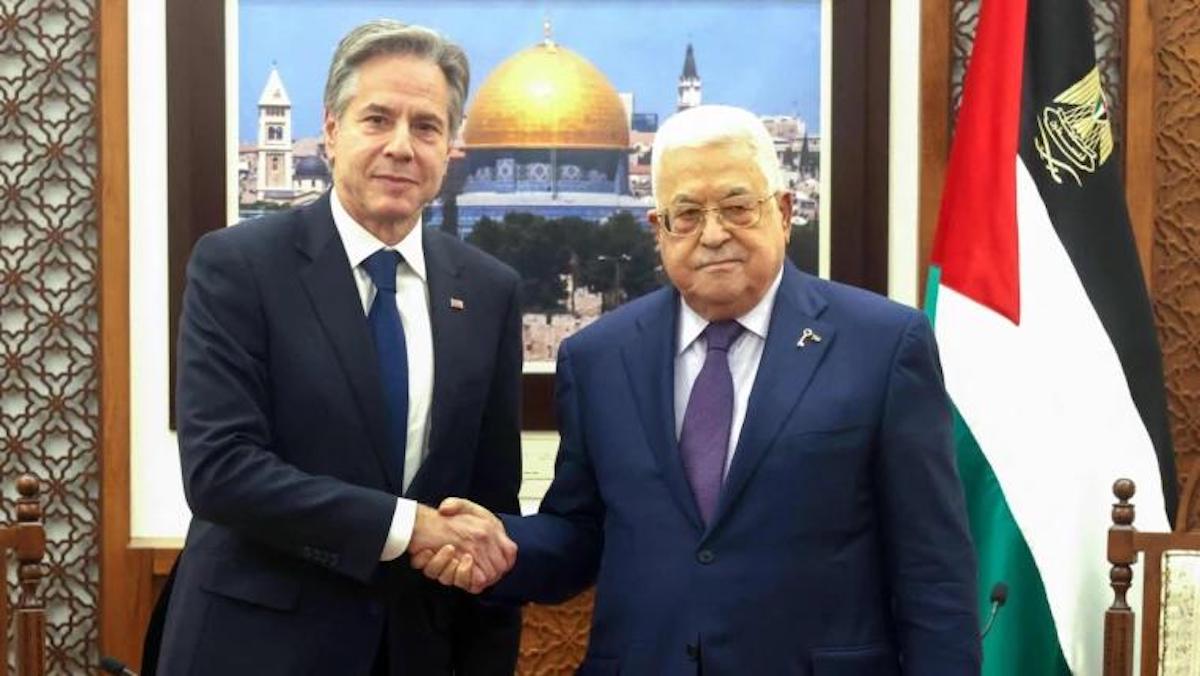
Mahmoud Abbas of Fatah has refused to announce elections since, sitting in unelected control of the PA’s office in the West Bank, collecting the various international grants, presiding over corruption,6 repressing Palestinian resistance of deed or word and colluding with the ‘Israeli’ Occupation.
US Imperialism’s then Secretary of State Anthony Blinken and the PA’s Mahmoud Abbas in Palestine, soon after the start of the accelerated Zionist genocide in Gaza, December 2023
BUT WHAT ABOUT THE IRISH CONNECTION?
Starting with Palestine and South Africa in 1991, an imperialist pacification process spread to Ireland, Basque Country, Kurdish Turkey, Colombia, India, Philippines, Sri Lanka. With some variations the drive has been the same: to give up revolution and join the system.
One of the features of this process was the apparent need of a recognised leader to sell it to the resistance support base and to front it for the world: Arafat (Palestine), Mandela (S. Africa), Adams/McGuinness (Ireland), Ocalan (Turkish Kurdistan), Otegi (Basque Country).
The Provisional IRA was by far the major organisation in the Irish Republican resistance; it gave up armed struggle in return for vague promises and the release of its prisoners under licence.7 Another organisation complied also even as new ‘dissident’ fighters were being jailed.
Nearly 30 years after the signing of the Good Friday Agreement, Ireland is no nearer the Provisional IRA’s declared aims Irish reunification, independence and sovereignty. The Sinn Féin party helps run the colony8 and is attempting to become part of the neo-colony’s government.
Sinn Féin representatives Tina Black (Mayor of Belfast) and Michelle O’Neill, First Minister of the British colony, laying a wreath at the British War Memorial in Belfast, July 2022 (Cred: Liam McBurney/ PA Wire)
Neither the Spanish, French nor Turkish states were interested in other than crushing the Basque and Kurdish resistance and the corresponding movements disabled themselves without getting anything in exchange other than continued repression.9
The resistance movements in parts of India and Philippines continue to resist but in Sri Lanka was wiped out.10
One feature of the spread was the contagion-like way in which leaders of one infected resistance sought to entice others to follow suit: S. Africa and Palestine to Ireland; S. Africa and Ireland to Basque Country; Ireland to Colombia (where only the FARC but not the ELN accepted it).
In only one iteration of the pacification processes was there a partial achievement of the stated aims of the resistance: South Africa got national enfranchisement but the economy remained under imperialist extractive control and its working people under repression.11
In the course of giving up armed struggle, allegedly just changing the methods, the leaders gave up what they had fought for, the very reason for which they had first come into the struggle. Of course, they could still shout the slogans, just not make them real in any way.
The Irish version (and the Basque one) decommissioned their weapons, which makes it very relevant to the Trump Plan for the Palestinian Resistance, particularly Hamas and PIJ. No resistance movement should even discuss giving up their weapons until the defeat of the enemy.
(Image sourced: Internet)
It will be interesting to see what positions the former parties of Irish and Basque resistance, Sinn Féin and EH Bildu12 and their supporters take on this US/ ‘Israeli’ plan for the Palestinian Resistance.
One of the features of the pacification process was the apparent need of a recognised leader to sell it to the resistance support base and to front it to the world: Arafat (Palestine), Mandela (S. Africa), Adams/McGuinness (Ireland), Ocalan (Turkish Kurdistan), Otegi (Basque Country).
Who will the imperialists find to play this role in Palestine?13
End.
NB: If you found this article of interest, why not register with Rebel Breeze for free, so that you will benotified by email of subsequent articles. You can de-register any time you wish.
4“This mirrors Israel’s post-Oslo approach to the occupied West Bank in pacifying the population through economic incentives, avoiding political concessions, and entrenching structural dependence. This model, often dubbed “economic peace,” has transformed the Palestinian Authority (PA) into a subcontractor of occupation – flush with foreign funds, but powerless to deliver sovereignty.” https://thecradle.co/articles-id/34757
7Those released under licence could be returned to jail (and a number were) at the decision of the Secretary of State for Northern Ireland without trial, hearing or details of why the individual was considered to be ‘a threat to public safety.’
8Its representative, Michelle O’Neill, is currently First Minister of the colony’s government. In the Irish State, the party has 33 TDs (MPs), only two behind the party with next largest representation, Fianna Fáil. They Party has abandoned its opposition to the repressive legislation of the State, welcomed British Royal visits to both parts of Ireland, supports recruitment to the colonial gendarmerie and its leader refused to rule out coalition with the neo-colonial political parties of membership of the British Commonwealth. https://www.thejournal.ie/mar-lou-mcdonald-commonwealth-4561600-Mar2019/
9The Basque leadership abandoned armed struggle unilaterally at the time without gaining even the end of dispersal of their jailed fighters throughout the state. The Turkish Kurdish PKK tried to make progress through political electoral means only under continuing repression. But their Syrian version of armed Kurdish forces got a new lease of life with the vulnerability of the Assad regime in Syria but ended up as a NATO proxy in the latter’s war for regime change. The PKK in Turkey very recently agreed to disarm while their Syrian part remains in difficult relationship with the new (formerly ISIS) regime in Syria and some other ISIS elements under Turkish influence.
11See The Marikana Massacre of striking miners by the ANC Government’s police.
12Both parties support the Two-State proposal for Palestine.
13Some liberal and social-democratic sections seem to have fixed on Marwan Marghouti in this role, which of course is no reason not to support his release on human rights grounds. https://www.youtube.com/watch?v=q6IgjlHaaIs
The week before last in Ireland we were led through motions of Palestine solidarity actions once more, motions without practical effect, first by the Irish trade unions, followed the following day by the Ireland Palestine Solidarity Campaign.
Seen on the IPSC National march (Photo by: Participant)
On Friday, the unions announced a ‘stand out for Palestine’ day – well, not a day exactly, more like a lunch break. It was not a strike, not even a work stoppage, rather some dedicated employees surrendering their lunch break to stand with Palestinian flags etc in front of their workplaces.
Not even a work stoppage of one day, half-day, or even an hour. The union leaderships, in most cases, organised nothing, leaving it up to their members to get together and to sacrifice their lunch breaks.
More of us went through the motions again on Saturday 29 November. From the Garden of Remembrance, down O’Connell Street, across the river, around by Trinity College, up Dawson Street and into Molesworth Street, facing Leinster House.
Seen on the IPSC National march (Photo by: Participant)
The Ireland Palestine Solidarity Campaign organised this ‘National Demonstration’ as it does roughly every month. It is supposed, presumably, to impress the Government with its numbers and pressure them to end their collusion with the ongoing genocide of Palestinians.
It has not done so — nor did it in any month or any year in the life of the IPSC, the longest-active Palestine solidarity organisation in Ireland. Nor have the monthly marches brought about any change in Irish Government collusion since the genocide of Gaza began in October 2023.
That is not the fault of the IPSC. What they are to be blamed for is not recognising that and adjusting appropriately to actions of greater pressure. Or, perhaps they recognised it indeed but nevertheless refused to change towards any effective pressurising methods.
The IPSC was for a long time near the ‘middle of the road’ but it has moved further into that position as the genocidal actions of the Zionist colony became worse and as awareness of Israeli crimes spread and grew in Ireland (which it did in part thanks indeed to the work of the IPSC).
Section of the IPSC National march (Photo by: Participant)
Solidarity work however is not about education in the abstract, raising awareness without using that awareness to bring about change. I am sure the IPSC leadership is aware of that and would wish much change but they do not adapt their actions, rather continuing with the monthly motions.
Probably they do not increase the pressure out of fear of losing their influence with the political class. Which would perhaps be well and good if the political class were delivering on ending collusion with the genocidal state – but they are not, nor is there any indication that they will.
Ireland remains the biggest single importer of Israeli products next to the USA and the biggest in the EU. The Irish Government permits military consignments to fly to Israel through ‘neutral’ Irish airspace and USA aircraft and military personnel to stopover and refuel at Shannon Airport.
Seen on the IPSC National march as passing O’Connell monument (Photo by: Participant)
Occupying the ground near the middle is only a good thing if it can be used to support action for change; it is a hindrance if the act of being there comes to be more important than the end objective: an end to genocide and the Occupation, with freedom and independence for Palestine.
The IPSC could use its mass base to blockade Dublin Port, through which Israeli products come into the country. It could also blockade other major stocking and distribution points.
The IPSC could organise mass days of action against retail and tech outlets handling Israeli exports and mobilise pickets in support of retail workers refusing to handle Israeli products, such as a Tesco worker currently facing disciplinary procedures (i.e punishment) for that very ‘crime’.
The worker in question, employed by Tesco in Newcastle, Co. Down is a member of the IWW and also of USDAW, main union for retail workers in the UK (as in the colony) but while the word is that his union is defending them, it is not seeking to extend and widen the boycott.
Defending a worker’s right not to act against their conscience is an individual and personal issue.1 It is understood that the motivation of this worker is one of solidarity with the Palestinian people and against genocide, which is what the trade unions need to be promoting and mobilising.
Union leaderships become bureaucracies with buildings and paid officials, employing administrative staff, growing more and more cautious and afraid of State action (particularly against their funds), moving further away from the ethos that first led to the unions’ creation.
Organised workers in Italy have shown the potential in dock strikes and mass mobilisations but again it was not the mainstream unions that led the action. Canadian provincial trade union Federations have marked all ‘Israel’ goods and services as ‘hot’2 and not to be handled.
Union membership in Ireland has declined as union leadership collusion with management and government escalated from the 1980s and resistance actions decreased; an increase in militant action is likely to boost recruitment but in any case organising resistance is the supposed role of trade unions.
Questions around solidarity with Palestine bring many other underlying issues to the fore: media partiality, government collusion, imperialist and colonialist influence, effective means of applying pressure, appropriate leadership, resistance to oppression, solidarity with prisoners.
We have been taught lessons of great importance – but at a terrible cost; we owe it to the Palestinians and to ourselves to apply them.
End.
Note: If you found this article of interest, why not register with Rebel Breeze for free, so that you will benotified by email of subsequent articles. You can de-register any time you wish.
From The Cradle news updates on Telegram 6 December 2025:
Ontario’s largest labor federation backs ‘hot cargo’ boycott of Israeli goods
The Ontario Federation of Labour has become the fourth provincial labor federation in Canada to adopt a “hot cargo” resolution against Israeli goods and services.
The move designates all trade ties with Israel as products and services workers will refuse to handle due to their connection to exploitation and oppression. The OFL’s decision follows growing momentum across the country as labor groups escalate solidarity actions.
The New Brunswick Federation of Labour first set the precedent in May when it voted to stop handling weapons destined for Israel. Similar resolutions soon followed in Nova Scotia and Newfoundland and Labrador, culminating in Ontario’s endorsement last week.
Together, these federations represent a significant portion of Canada’s organized labor movement.
The OFL’s stance signals a widening labor-led boycott effort, reinforcing a broader push within Canadian unions to apply economic pressure and support calls for accountability over Israel’s war crimes.
1Individual ‘conscience’ can object to many things we consider necessary, for example to give contraception methods information, or about pregnancy termination, to deal politely with migrants, to serving people in the national language, to sending children to integrated education or even to any school, etc. etc.
2‘Blacked’ was a common term for such cases in the recent past, as was ‘tainted’ further back still (á la Larkin and Connolly) – see Appendix.
Leaders of two main neo-colonial Irish political parties are reported vehemently opposing a proposal by Dublin City Council to rename one of the city’s parks. That’s almost enough to make most decent people want to support the proposed name change.
The current name is Herzog Park, situated in Rathgar and the controversy is around a proposed removal of ‘Herzog Park’ and change to ‘Hind Rajab Park’.
Of course, the far-Right ‘patriots’ who are so much against the Irish Government won’t be supporting the name-changing or supporting local democracy – not to mention humanitarianism or international solidarity (except in the case of solidarity with US or British-based fascists).
The Herzog in question was Chaim Herzog, 6th President of the State of ‘Israel’1, raised in Ireland after his father, Yitzhak Halevi Herzog, moved from his birthplace in the Russian Empire to England and then to Dublin, where he was Chief Rabbi of the Jewish faith in Ireland (1921-1936).
Both Herzogs, father and son, were part of the founding of the Israeli State in 1948 of which Yitzham Halevi’s great-grandson, Isaac Herzog is President currently.2
Chaim Herzog (like his father and son) was a Zionist, which is to say he was part of a European movement that believed those of the Jewish faith should have a state of their own for which they were entitled to occupy a land, despite any indigenous people, upon which to establish that state.3
He was also a member of the Haganah, the Zionist murder gang that carried out the ethnic cleansing of the Nakba before going on to form the IOF; and he was later military Governor of the West Bank.
Hind Rajab was a Palestinian girl of five years who was killed by the armed forces of the Zionist State of Israel while fleeing Gaza on 29 January 2024. She appears to have been the last survivor of a gradual killing of her uncle, aunt and four cousins including 15-year old Layal Hamadeh.
The distress call came first from Hind’s cousin Layal, begging for help and explaining that they had been targeted by the Israeli Occupation Forces and that the adults were dead but the call terminated amid screams. Gazan emergency services phoned them and Hind told them Layal was dead.
The sequence suggests that the IOF were monitoring movement in the car or perhaps even the calls, as after they had shelled the other occupants, they shot Layal and finally Hind. Not content with that, they also killed the heroic Palestinian ambulance crew4 who lost their lives in rescue attempt.
Placard held at Monday night’s protest lobby of Dublin City Council (Photo: D.Breatnach)
The Park got its current baptism in 1995 which is hard to excuse. Of course the Zionazis were not as reviled 30 years ago as they are now but the facts of their general racism, apartheid and repression of Palestinians were clear – we were no long the Israelophiles we had been formerly.5
BUT WHO ARE TODAY’S REAL NAZIS?
Foremost unofficial ambassador for Zionism in Ireland Alan Shatter, former Fine Gael’s Minister for Justice & Equality and Minister of Defence from 2011 to 2014, of course entered the fray and, commenting on the proposed name-changing, accused Dublin City Council of nazism.6
Shatter’s statement and his sporadic public interventions in support of the genocidal state would provide good ammunition for anyone campaigning against the principle of free speech. How does the Israeli State he defends itself compare to Nazism, his hurled attack on Dublin City Council?
The Nazis carried out ethnic cleansing and genocide against Jews and Roma and mass murders of Communists, Socialists, Gays and Lesbians, Jehovah’s Witnesses and physically and mentally Disabled people.
The State of ‘Israel’ is carrying out daily ethnic cleansing and genocide against Palestinians.
The Nazis attacked and invaded other countries, starting with those near their State in Germany.
The State of ‘Israel’ has attacked 12 countries, starting with those near its base in Palestine, including its 1956 bombing of Egypt in the French-British war against the nationalisation of the Suez Canal.
The Nazis carried out collective punishment against civilians in areas where Nazi forces were attacked.
The IOF for years demolished the family home of anyone who took armed action against them, even after they had killed the alleged individual. Worse, they have collectively punished the whole population of Gaza, allegedly due to the 7th October Resistance operation.7
The State of ‘Israel’ is carrying out collective punishment against Palestinians in Gaza and the West Bank by bombing and shelling, house and infrastructure demolition, also against Palestinians and other people by similar bombings in Lebanon, Syria, Yemen and Iran.
There are four main differences between the crimes of the Nazis and the State of ‘Israel’:
The Nazi extermination campaign was more ordered and faster, included trains to extermination camps with ovens for disposing of the bodies of the victims.
The Zionazis, after the mass expulsions of 1948, carried out a more gradual process of appropriation and genocide until the last two years in Gaza and they don’t have ovens to burn the corpses of their victims, leaving most of them to rot under bombed-out rubble.
The other huge difference between the two is that eventually the rest of the Western powers united against the Nazis, while today they are all united in actively supporting the Zionist genocide.
And of course, although the Nazis kept their actual genocide secret from the vast majority of the German and Austrian populations, for fear they would not support it, the leaders of ‘Israel’ boast of their actions and intentions and opinion polls show the majority of ‘Israelis’ agree with them.
PURPOSE OF PROPOSED CHANGE OF PARK’S NAME
It is hard to imagine decent people being opposed to dropping the Herzog dedication in the park’s name, as that Zionist’s connection with Ireland, though a historical fact, is not one in which we should take pride.
Banner of an Irish sport association in solidarity with Palestine at Dublin City Hall protest lobby. (Photo: D.Breatnach)
If we wanted to honour a representative of Irish Jewry (rather than of Irish Zionism) there were a number of worthwhile candidates, such as antifascist and anti-Zionist Irish Jews Max8 and Maurice Levitas9 or Irish Republican Jews Estella Solomon (Cumann na mBan) and her brother Bethel.10
More than one proposal has been put forward to replace Herzog’s name on the park, the other being Terence Wheelock’s.11
I support the Wheelock family’s campaign for Gardai to be held accountable for the fatal injury to Terence Wheelock in Garda custody in 2005. I have attended protests and covered some of the campaign in articles on the Rebel Breeze blog and I would support a memorial park in his name.
At 24-hours’ notice a rally in support of the Hind Rajab name change was called for Dublin City Hall at 6pm Monday 1 December 2025. Speaking after a number of elected councillors, Abubakker Abed pointed out that whatever about the replacement, a Zionist should not be honoured here.
View of Monday night’s protest lobby of Dublin City Hall. (Photo: D.Breatnach)
Abed is a prominent Gaza journalist for the Electronic Intifada media and recent Palestinian refugee studying in Ireland. A number of Jewish people spoke also, David Landy pointing out that the Jewish community in Ireland is split between supporters of Israel and anti-Zionists.
A speaker from the Bronx, New York, also a Jew, recalled how Chaim Herzog had bragged about the demolition of a row of Palestinian houses in the West Bank, calling them ‘toilets’ and remarked how likening people to dirt or animals reminded him of the Nazis’ portrayal of the Jews.
Banner of an Irish sport association in solidarity with Palestine at Dublin City Hall protest lobby. (Photo: D.Breatnach)
However, in the Hind Rajab naming proposal there is not only the removal of a dedication to a Zionist but also in a sense its replacement by its opposite, the remembrance of a murdered child, with her family victims of Zionism and, in a sense of all Palestinian victims of ongoing genocide.
If you support the proposal for both those purposes, as I do, you may want to sign the petition: https://c.org/kBvN64BhWv.
End.
Note: If you found this article of interest, you may wish to register with Rebel Breeze for free, so that you will be notified by email of subsequent articles. You can de-register any time you wish.
2Much in the news at the moment because of the controversial application by Benjamin Netanyahu, for a pardon – without admitting guilt – to charges of corruption and bribery.
10I learned of the Solomon siblings only yesterday, through a post by Dave Gibney on Facebook. https://www.facebook.com/dgibney100 A number of others were listed by David Landy, speaking outside City Hall during the rally on Monday night.
Recently an Irish Palestine solidarity organisation posted a report that 20,000 Palestinian children have been killed in 23 months, an average higher than one child per hour.1 “Have been killed”? Traffic accidents? Unknown causes?
They were killed by Israel, isn’t that the case? Then why not bloody say so! They were murdered by a genocidal European Zionist settler colony called Israel and itcontinues to murder them, along with their older siblings, parents, extended families and neighbours.
We can find different ways to present the facts of the ongoing genocide in order to try to shock but it does not alter the fundamental and well-known truth that a genocide is being committed before our eyes. Why is this continuing despite what everyone knows? Well, because it can!
Israel will continue to do what it does because it can and the cost of doing it is not high enough, as Ali Abunimah said three months ago.2 Or to turn that a little, the Irish Government will continue doing what it does in collusion with the genocide because the cost of doing so is not high enough.
The EU is the biggest importer of Israeli goods and the Irish state is the highest importer in the EU, also the 2nd single biggest Israeli goods importer in the world. And still the weapons of genocide fly through our skies. The Irish Government continues collusion because the cost to them is low.
Marches and pickets show solidarity towards a beleaguered people suffering genocide and in that they are very important. They also show us our strength in numbers. But they do not cost our government much. Not even enough to really stop the Central Bank assisting genocide.
In England, Palestine Action raised the cost of collusion in genocide by targeting the Israeli weapons manufacturer Elbit Systems in Bristol. Activists were arrested but they kept doing it. This Zionist death company has now closed its targeted Bristol factory.
While this was happening, the British Government, in support of Elbit and others and in collusion with the genocide of Palestinians, not only arrested and charged Palestine Action people but designated the organisation as ‘terrorist’ and any supporters as people supporting ‘terrorism’.
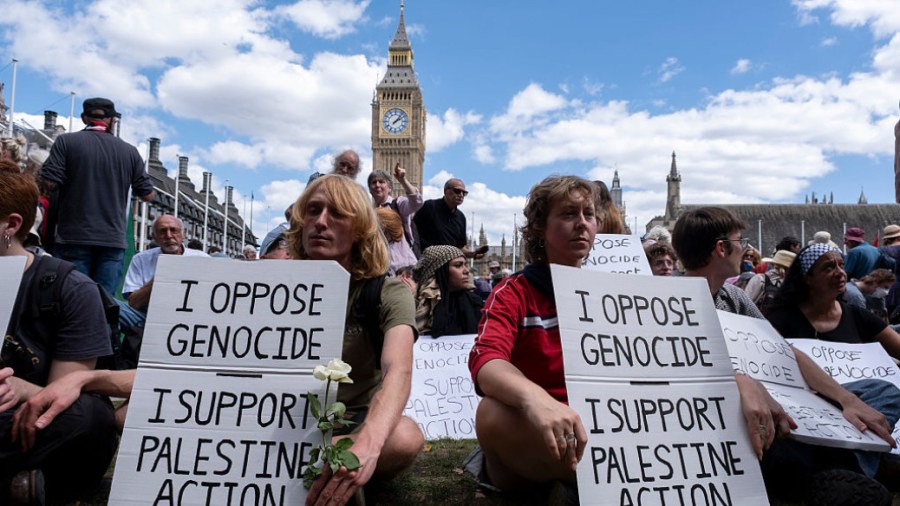
People defied that designation and were arrested for holding a placard saying they were opposed to genocide and supported Palestine Action.
Placards in Westminster August 2025 (Photo credit: Mike Kemp In Pictures/ Getty Images)
Following that action and repression, 1,500 gathered in London on Saturday 6th September 2025 to continue that solidarity and to defeat the attack on civil liberties. By midnight, the last arrest recorded by the police for the day, they had arrested nearly 390 people.
The ‘crime’ of nearly all was to display placards stating “I am opposed to genocide. I support Palestine Action.” The police were unable to arrest them all as it took them 11 hours to arrest the 390. The organisers continued the action in London and other parts of the UK.3
More recently there have been other such acts of public defiance, organised by the Save Our Juries campaigning group and the numbers now arrested on charges of “assisting terrorism” (sic) have reached at least 2,269.
In addition, eighteen arrested Palestine Action activists were jailed, refused bail with some embarking on hunger strike4 of whom two were recently admitted to hospital.
The closure of Elbit Systems, the mass defiance of the terrorist categorisation of Palestine Action and the prison hunger strikes are raising the cost of supporting genocide of Palestinians and criminalising Palestine solidarity action, hitting collusion where it hurts, politically and practically.
We in Ireland are the most-pro-Palestine country in Europe … but we are not doing that.
We are not raising the cost high and despite that being clear to us and to our political and solidarity organisations and trade unions, made clear well over a year ago, we are still not doing it. Until we raise the cost high enough to make them stop, our government will continue its collusion.
And until the external cost is raised high enough to make them stop, Israel will continue its ethnic cleansing and genocide. But marchers attempting to blockade Dublin Port in early October were pepper-sprayed without warning and savagely batoned, with some arrested.
Gathering outside Dublin courthouse in solidarity with two Palestine solidarity activists assaulted and charged by Gardaí during early October attempt to blockade Dublin Port (Photo: R. Breeze).
A trio of activists were arrested in May for invading Shannon Airport to protest the ‘neutral’ Irish State’s collusion with US military flights through there4 and last weekend another three young people were arrested for a similar action.
Activists in Ireland are slowly starting to raise the cost of collusion for the State. However, they are not supported by the leadership of the mass movement which, while aware its tactics are not forcing the Government to end its collusion, nevertheless persists solely in repeating them.
End. Note: If you found this article of interest, why not register with Rebel Breeze for free, so that you will be notified by email of subsequent articles. You can de-register any time you wish.
2Director of the Electronic Intifada, speaking on 29 August at a public meeting organised by the Ireland Palestine Solidarity Campaign in Dublin and hosted by the FÓRSA trade union. The other guest speaker was Abubaker Abed from Gaza, now studying in Ireland after being a journalist for the EI and threatened with assassination by Zionists.
3The Six Counties are at the moment in the UK but the British colonial gendarmerie went very lightly there in dealing with Palestine Action supporters – the rulers do not wish do have Palestine activists as political prisoners while they contain also Irish Republican prisoners.
(Reading time:3 mins.) (Reprinted with gratefully-received permission of author of article1 originally published in the Electronic Intifada, a non-profit online publication covering the Israeli-Palestinian conflictfrom a Palestinian perspective)
Nadav Zafrir – a guru in Tel Aviv’s tech scene – offers a textbook example of how spies can make a killing.
Zafrir has gone from commanding Unit 8200 – an elite division in Israel’s military focused on electronic espionage – to leading Check Point,2 a big success story in the business known as cybersecurity.
One element of his rise which has received scant attention is that he has been helped along the way by the European Union.
In 2020, the Brussels bureaucracy issued a research grant worth more than $2.5 million to Illusive Networks, a firm then chaired by Zafrir.
Illusive Networks had developed what it called a “solution that allows early detection of cyber attacks” and the grant was explicitly aimed at enabling the firm to “expand into the EU market.”
As “ethics checks” for EU-funded research projects involve little more than box-ticking, it is a safe bet that Brussels officials did not raise objections to Unit 8200’s activities before approving the grant.
The sinister nature of those activities was summarized in a 2014 letter signed by a few dozen of its veterans.
“The Palestinian population under military rule is completely exposed to espionage and surveillance by Israeli intelligence,” the letter reads. “While there are severe limitations on the surveillance of Israeli citizens, the Palestinians are not afforded this protection.”
A state which discriminates based on race or ethnicity is by definition an apartheid state. Although the 2014 letter did not use the word “apartheid,” the practices it described certainly fit the definition of apartheid.
Those practices did not materialize overnight. As Nadav Zafrir was head of Unit 8200 from 2009 to 2013, he had definitely practised apartheid – a crime against humanity, according to the International Criminal Court.
By issuing a research grant to his firm, the EU was rewarding a spy chief who had served an apartheid system.
Ireland’s dereliction of duty
Profiles of Zafrir in the mainstream press do not call out his crimes. Rather, they celebrate how he has an “X factor” and how he has been offered a “compensation” package worth more than $15 million for 2025.
Since he joined Check Point as CEO last year – a time when his old buddies in the Israeli military were busy inflicting a genocide on Gaza – he has garnered numerous favourable headlines.
Checkpoint leader Zafrir
Check Point is consolidating its position by either snatching rivals or teaming up with them.
A partnership accord has been inked, for example, between Check Point and another Tel Aviv firm Wiz. “Check Point’s cloud network security tools will be merged into Wiz’s cloud security platform,” The Times of Israelinformed its readers in February.
Technology reporters may get excited by what’s happening in the clouds. Back on the ground, activists are raising awareness about Check Point’s inextricable links to Israel’s military.
In Ireland, a protest against Check Point last month grabbed some media attention.
It involved a disruption of a promotional event organized by Check Point and featuring a speech from the former rugby international Brian O’Driscoll, who is regarded as a hero to many following that sport.3
The group behind the protest – Your Tech = Their Deaths – is rightly sounding the alarm about Irish companies and public authorities that use Check Point’s software.
I contacted the Office of the Director of Public Prosecutions (DPP) in Dublin following reports that it had renewed a contract relating to Check Point technology over the past few weeks. The DPP’s office replied that it “does not comment on any arrangements related to cybersecurity.”
Ireland is a country still grappling with the effects of colonization. Overcoming those effects requires not only the unification of the island but a willingness to stand up for oppressed peoples around the world.
The other kind of Israeli checkpoint, this a temporary one in the West Bank in April 2024. These are in addition to the fixed ones and Palestinians driving or walking may have to go through many in one journey. Israeli checkpoints are some of the areas of confrontation and arbitrary arrest of Palestinians. (Photo: Times Israel Jaafar ASHTIYEH/ AFP)
Defending Palestinian rights – through action, not just rhetoric – is surely a moral duty for Ireland. Handing over money to Check Point is a dereliction of that duty.
End.
Note: If you found this article of interest, why not register with Rebel Breeze for free, so that you will be notified by email of subsequent articles. You can de-register any time you wish.
2An ironic name, given that the IOF and even settlers set up checkpoints to harass Palestinians on towns’ entrances and exits and many points along the roads and that their checkpoints are where Palestinians are routinely arrested and sometimes killed. (Rebel Breeze editorial comment)
3According to reports the protest received rough handling by Gardaí and by security personnel and one participant was subsequently threatened by Driscoll’s lawyers but the promotional event nevertheless had to be abandoned (Rebel Breezeeditorial comment).

















 rebelbreeze