
Author: rebelbreeze
Revolutionary socialist & anti-imperialist; Rebel Breeze publishes material within this spectrum and may or may not agree with all or part of any particular contribution. Writing English, Irish and Spanish, about politics, culture, nature.
Swimming against the current
ANOTHER FAILURE OF THE TRADE UNION MOVEMENT
“Today in Ireland, migrant workers earn 22% less per hour than their Irish counterparts (ESRI, 2023), while migrant women earn 11% less than their male counterparts and 30% less than Irish men (ESRI, 2023). Here is another fact. According to the latest Discrimination Report in Ireland, the workplace is the second place where discrimination and racist incidents occur, as also documented in the previous reports (INAR, 2023).”

The paid work migrants do is a coin of two sides, one bright and the other dark.
On the bright side, we know that, in Ireland, the employment rate among the migrant population is higher than that of the national population (71.6 and 76.4, respectively). But, simultaneously, the unemployment rate is lower among migrants (4.6 and 5.9, respectively). In other words, compared to the national population, the migrant population has more working and fewer unemployed migrants.
This is good news and bad news. Because on the one hand, we can all see that migrants are making a necessary and important contribution to local economies through their work (often taking essential positions in the food and agri industry and other low-paid jobs that do not attract the national population). Still, on the less visible side of the coin, we can also see that it is in the work environment where most…
View original post 499 more words
IDENTIFICAR EL TREBOL IRLANDÉS
¿Sabrías decir cuál de los tréboles silvestres que crecen en Irlanda es el trébol ‘genuino’ (Seamair óg)?

Ahora, mientras todavía está en flor, es un buen momento para ver la planta, las hojas más pequeñas y la flor amarilla (buí) en ella es lo que realmente la distingue de sus primos los tréboles, con sus hojas más grandes y flores en blanco (S . Bhán, T. repens) o rosa-rojo-púrpura (S. Dhearg, T. Pratense).
¿Cómo sabemos que el Seamair Bhuí (Trébol menor, Trifolium dubium) es el auténtico “trébol”? Bueno, tal vez no podamos estar seguros, pero en la década de 1890, a partir de una encuesta de opinión en una sociedad irlandesa todavía bastante tradicional, T. Dubium surgió como la primera opción.
Foto: El trébol, Seamair Bhuí/ Trifolium dubium/ Lesser trefoil, de tamaño real, fotografiado en la ciudad de Dublín con hierba creciendo a través de él. (Foto: D. Breatnach)
El botánico y zoólogo aficionado Nathaniel Colgan (1851-1919) pidió a personas por toda Irlanda que le enviaran especímenes de lo que creían ser un trébol irlandés, de los cuales los dos más comunes eran el trébol amarillo seguido por el blanco.1
Cien años después, el Dr. Charles Nelson repitió el experimento en 1988 y descubrió que el trébol de flor amarilla seguía siendo el más elegido.2 Según Wikipedia, el trébol amarillo es la especie nominada por el Departamento de Agricultura de Irlanda como el trébol “oficial” de Irlanda.
Si deseas elegir tu propio trébol para el Día de San Patricio, deberás aprender a identificarlo por sus hojas, ya que en Irlanda no florecerá en marzo. Sin embargo, puedes reconocerlo actualmente por sus flores y crear una imagen mental del tamaño de sus hojas para retenerla en tu memoria.
LOS IRLANDESES Y EL TRÉBOL
¿Qué pasa con el trébol y los irlandeses de todos modos? La historia infantil sobre el misionero cristiano Patricio usando la hoja para explicar la Santísima Trinidad cristiana es solo eso, una historia ficticia, aunque mencionada en una de las entradas de Wikipedia para “trébol”.
Ni los celtas en general ni los gaélicos en particular necesitaban que nadie les explicara una deidad tres en uno, ya que tenían sus propias trinidades paganas (Éiriu, Fódlha, Banba; las de la Mór-Righean/ Morrigu). Los investigadores no han encontrado ninguna referencia a la importancia del trébol antes de 1681.3
El propio Patrick, en lo que se considera su genuina Confessio autobiográfica, nunca mencionó el trébol ni una sola vez. Mi sospecha es que la fábula del trébol-cristiano-trinidad fue creada fantasiosamente por colonos británicos como el botánico Caleb Threkeld o por cristianos irlandeses nativos alrededor de 1726.4
Aunque algunas fuentes en por el Internet han afirmado propiedades medicinales o uso druídico para el trébol, nunca citan las fuentes originales reales, lo que puede indicar que las referencias no son confiables u oscuras, si es que verdaderamente existen.
Curiosamente, en el periodo previo a la Rebelión de 1798, un vecino de Drogheda llamado John Sheil, que era presbiteriano y miembro de los United Irishmen, utilizó el trébol como una metáfora para representar una trinidad diferente: la de los católicos, los protestantes (anglicanos) y los disidentes (todas las denominaciones protestantes no anglicanas).
“….. la planta de tres hojas….
son tres en uno
Para probar su unidad
en esta comunidad
Que aguanta con impunidad
A los Derechos del la Humanidad.”5
Sin embargo, el verde era el color de los Irlandeses Unidos y, en momentos de represión por parte de las fuerzas de ocupación y por la Orden Leal de la Naranja, una ramita de trébol en el Día de San Patricio podría ser una forma útil de indicar resistencia y al mismo tiempo afirmar que era un reverencia inofensiva a un santo cristiano.
Sin embargo, incluso usarlo el día de San Patricio podría haber sido peligroso en algunos sectores, como cuando The Wearing of the Green informó, en referencia al trébol, que
“… Es el país más angustioso que jamás hayas visto
Porque están ahorcando a hombres y mujeres por llevar el verde.”
fin.
NOTAS AL PIE
1 https://en.wikipedia.org/wiki/Nathaniel_Colgan
2 Ibíd.
3 “Thomas Dinely, un inglés que viajó por Irlanda en 1681 notó que personas de todas las distinciones usaban cruces para conmemorar al santo en este día, pero notó que solo los vulgares, como él los llamaba, usaban tréboles”. https://www.museum.ie/en-IE/News/From-shamrock-and-rosettes-to-Patricks-Pot
4 https://www.dib.ie/biography/threlkeld-caleb-a8548
5 Los Derechos del Hombre, por John Sheils. El aire con el que se canta más comúnmente es el de la canción en lengua irlandesa Eanach Cuain/ Anach Cuan, pero he compuesto un aire original para él y lo canto un poco más rápido que la canción sobre la tragedia del hundimiento del barco.
FUENTES
https://en.wikipedia.org/wiki/Trifolium_dubium
https://www.dib.ie/biography/threlkeld-caleb-a8548
https://en.wikipedia.org/wiki/Nathaniel_Colgan
https://www.museum.ie/en-IE/News/From-shamrock-and-rosettes-to-Patricks-Pot
https://droghedalife.com/news/weaver-and-song-writer-john-sheil-the-topic-of-next-walking-tour

DRIPPING WITH PROPAGANDA – BUT ALSO REVEALING
NEWS & VIEWS NO 4. – Diarmuid Breatnach
(Reading time: 4 mins.)
A recent article appearing briefly on breakingnews.ie was packed with some of the typical anti-Russian propaganda of the current western mass media but also, unintentionally, revealed the purpose of the US/NATO proxy war in Ukraine.
Whether one is pro-NATO, pro-Russia or of some other position, it can be instructive to dissect this mass media propaganda to which we are subjected daily in western states.
Let’s take the headline first, which serves not just as an ‘attractor’ or ‘hook’ to draw the reader but also as a statement in itself and, in this case, very definitely as propaganda.
“NATO prepares military plans to defend against bruised but unbowed Russia” is the headline. So straightaway we are being told that NATO needs to defend itself against Russia, which is turning truth completely on its head.
Firstly, where in the world is the Russian Federation attacking NATO? In Ukraine? But then the Ukrainian state is not actually in NATO, is it? Unless what is meant is US/NATO’s plans to get the Ukrainian state into NATO, of course, which they’re generally vague about.
But if not there, where? Nowhere, of course.
Who threatens whom?
As to reversing reality, one look at a map of Europe with NATO states indicated makes it clear that it is not NATO that needs to defend itself but Russia — and bears out the Russian line that one of the reasons they went to war was to stop their encirclement by NATO.

Then, we need to consider that NATO is not a country or one region in the world that could need defence. No, it is a military alliance of European states with the United States. And if it ever was a defensive alliance, that ‘reason’ for its existence disappeared with the fall of the USSR in 1991.
Far from scrapping NATO or even freezing its expansion then, US/NATO started collecting former USSR states into its alliance until nearly every state on Russia’s eastern borders had joined the alliance or was friendly towards it and hostile towards Russia.
The former Ukrainian regime was friendly towards Russia until the coup in 2014 by pro-NATO elements, which are the regime now in power and responsible for a decade of cultural attacks on – and artillery bombardment of – the ethnic Russian population of the Donbas area.

Only a propaganda-blinded fool or a liar could deny that Russia has been and is under threat from US/ NATO, rather than the reverse.
We could do with looking at the record of states in invasion of – and interference in – other countries.
The USA is the founder and leader of NATO; since the end of WWII, the USA has been involved in 34 armed actions against smaller nations, not including coups and proxy wars. This includes initiating 81% of all global armed conflicts from 1945 to 2001.
The United Kingdom is a major NATO member and, with direct involvement in 35 armed conflicts since WWI, has exceeded the USA’s tally by one and France’s tally of 33, also an important NATO member, by two.
How many Russian Federation armed conflicts since it came into existence? Thirteen, mostly on or around its own state’s territory, whereas the armed conflicts of the USA, UK and France were mostly outside their own territories and far from their borders.
So who has more reason to fear attack from whom?
“What we see in general is that the Russians are careful around NATO. They are not seeking a conflict with NATO. I think that is a sign that they are very, very busy,” the article quotes NATO Chairman, Dutch Admiral Rob Bauer saying. “Busy” with what, is he inferring?
Nuclear weapons
“NATO, as an organisation, does not provide weapons or ammunition to Ukraine and has sought to avoid being dragged into a wider war with nuclear-armed Russia,” states the article.
True, as far as that goes but how many NATO states are supplying the Ukrainian state with military equipment? It would be quicker to list how many are not supplying it!
In that quoted sentence, there is almost an admission that were it not for Russia’s nuclear weapons, the US/ NATO forces would be willing to intervene directly to attack and invade Russia.
Indeed, they may still do so. NATO Chairman, Admiral Rob Bauer, in briefing the press, “laid out the biggest revamp to the organisation’s military plans since the Cold War” (of course for purely defensive reasons!).
“US President Joe Biden and his Nato counterparts are set to endorse a major shake-up of the alliance’s planning system at a summit in the Lithuanian capital, Vilnius, next week,” we are told.
“About 100 aircraft take to the skies in that territory each day, and a total of 27 warships are operating in the Baltic and Mediterranean Seas, with those numbers set to rise. In new plans, NATO aims to have up to 300,000 troops ready to move to its eastern flank within 30 days.”
Of course, weapons and military transport require funding (a big source of profits for the arms industries). “In 2014, NATO committed to move towards spending 2% of GDP on their military budgets by 2024” (2014 was the year of the US/NATO-inspired coup, 8 years before the invasion).
“At their July 11-12 summit, the leaders will set the 2% figure as a spending floor, rather than a ceiling to aim for.”
“Russia bruised but unbowed”
When wishing to force the enemy to surrender, it may be sufficient to bombard it from the air and sea. But in order to extract its riches, the situation requires either invading troops on the ground or a compliant regime.
In this context it is significant that Admiral Baur commented that of Russia’s ground forces, around “94% is now engaged in the war in Ukraine”, meaning that the state’s principal ground defence forces are already engaged in war and presumably taking casualties.
But Russia’s armed forces are “bruised but by no means bowed” in the war in Ukraine, commented Admiral Bauer, which looks very much like an admission that pushing Russian forces into a proxy war in the Ukraine was intended to sap Russia’s military strength.
So that Russia can be invaded, carved up into US/NATO dependencies, its rich natural resources plundered for the benefit of western imperialist states? No, surely not, the USA, UK and France would never go to war for imperialist plunder, would they?
End.
SOURCES:
https://tribune.com.pk/story/2345663/us-initiated-81-global-armed-conflicts-from-1945-to-2001
https://en.wikipedia.org/wiki/List_of_wars_involving_the_United_States
https://en.wikipedia.org/wiki/List_of_wars_involving_the_United_Kingdom
NEUTRALIDAD IRLANDESA: ¿A QUIÉN LE IMPORTA?
28 de junio, Clive Sulish
(Tiempo en leer parte principal: 8 minutos)
Una multitudinaria reunión pública en el centro de la ciudad de Dublín el sábado escuchó y aplaudió a personas destacadas que hablaron en contra de que el Estado irlandés se convierta en parte de alianzas militares, ya sea PESCO1 (“OTAN a escondidas”2) o la propia OTAN.
El panel de oradores de alto perfil presidido por la eurodiputada irlandesa Clare Daly contó con la participación de su colega eurodiputado Mick Wallace, Sevim Dagdalen (MP Die Linke), Medea Benjamin (fundadora de Code Pink) y Anne Wright (ex comandante del ejército de EEUU pero opositora a la Guerra en Irak).
El célebre rapero antiimperialista Lowkey también participó como orador, al igual que Yanis Varoufakis (ex-Syrza)3, quien se dirigió a la reunión mediante un video grabado desde el extranjero y aplaudió a los irlandeses por su larga resistencia al colonialismo y los instó a estar orgullosos de la neutralidad de su estado.

FONDO
Existe un impedimento constitucional para que el estado irlandés participe en una asociación de guerra con otro estado y durante la Segunda Guerra Mundial la posición oficial del estado fue la neutralidad.
Sin embargo, siempre fue una neutralidad pro-aliada con los aviadores británicos derribados que podían cruzar al territorio del Reino Unido y los militares estadounidenses a menudo cruzaban la frontera del Reino Unido para visitar el “sur”, mientras que los aviadores alemanes derribados eran internados durante la guerra.
El impedimento no es absoluto y generalmente se lo conoce como el “Triple bloqueo”, que enumera las tres condiciones que permitirían al gobierno enviar más de 12 tropas al extranjero:
- un mandato de las Naciones Unidas
- una decisión del gobierno
- y un voto del Dáil 4
En los últimos años, algunos políticos y comentaristas públicos han planteado la idea de que el estado irlandés podría reincorporarse a la Commonwealth británica y, desde la guerra en Ucrania, ha surgido un discurso de que el estado debe unirse a una alianza militar externa para protegerse de la Rusia.

La encuesta Irish Times/Ipsos de abril, en medio de críticas por no seguir las mejores prácticas en su diseño e incluso acusaciones de tratar de incitar a los encuestados a favor de unirse a alguna alianza militar externa, arrojó dos tercios claramente en contra de que el Estado irlandés haga tal cosa.
La propaganda rusofóbica ha especulado sobre las actividades de los arrastreros rusos en el Mar de Irlanda. Esto es completamente una alarma y una discusión agitadas sin el más mínimo fundamento, ya que Rusia nunca ha presentado la más mínima amenaza, militar o políticamente, para el pueblo irlandés.
Por otro lado, Gran Bretaña ha invadido y ocupado Irlanda durante más de 800 años y todavía está en posesión de una quinta parte de su territorio y tiene importantes intereses económicos y financieros en el país como, más recientemente, los Estados Unidos y la Unión Europea.
La Royal Navy del Reino Unido entra con frecuencia en aguas nacionales irlandesas y el Estado ha permitido regularmente que sus barcos, junto con los buques de guerra de otros países de la OTAN, atraquen en puertos irlandeses. Y también la Royal Air Force, ha surgido recientemente, para patrullar el espacio aéreo territorial irlandés.

Como parte de esta falsa alarma y discurso, el Gobierno irlandés5 fundó recientemente el Foro Consultivo sobre Política de Seguridad Internacional que tenía previsto reunirse la semana pasada en Cork y Galway, y luego durante dos días en el Castillo de Dublín.
El presidente del Estado, Michael D. Higgins, en una intervención inusual durante una entrevista con el Examiner expresó su preocupación por lo que percibía como la “deriva hacia la OTAN” y criticó la composición de los oradores y presidente de esta organización por ser pro- OTAN.
Michael D comentó sobre “los almirantes, los generales, la fuerza aérea, el resto” y describió a su presidenta, Louise Richardson, como una persona “con un DBE muy grande – Dama del Imperio Británico”.
El presidente Higgins se disculpó más tarde por lo que calificó como “un comentario trivial” sobre Richardson, pero no retiró sus comentarios sobre la composición general del Foro, que de hecho ha sido criticado por otros, incluidos Richard Boyd Barrett TD6 y la senadora Frances Black.
LA REUNIÓN EN DUBLÍN
Varoufakis se refirió a Irlanda como si la nación hubiera ganado su independencia, como sucedió con todos los oradores que siguieron (con la excepción de Lowkey).
Se escuchó a un miembro de la audiencia comentar irónicamente a otro que estaba agradecido de haber asistido ya que hasta ahora no había estado al tanto de la “independencia” de Irlanda.

Lowkey, el rapero radicado en Gran Bretaña, hizo trizas la ilusión de la neutralidad del estado irlandés al relatar el uso de los aeropuertos irlandeses no solo para los vuelos del Ejército de los EE.UU en el territorio estatal.
El rapero expuso la ‘neutralidad’ del gobierno irlandés en el entrenamiento de soldados que iban a luchar en Ucrania y también en su continuo apoyo al Estado de Israel y fue aclamado cuando declaró que, como iraquí, estaba orgulloso de que su país hubiera “pateado el culo de los británicos”.
En un ejercicio magistral de crítica respaldada por la investigación, Lowkey pasó a despojar de la pretensión de independencia e imparcialidad del “Foro Consultivo” fundado por el gobierno, exponiendo los antecedentes imperialistas e incluso de la OTAN de los principales miembros del panel y su presidente.
Todos los miembros del panel de Neutrality — Who Cares fueron oradores efectivos e hicieron puntos útiles, aunque fue curioso escuchar a uno de ellos denunciar a los “fascistas rusos” sin comentar sobre las unidades fascistas en el ejército nacional del régimen ucraniano.
Fue Lowkey quien clavó los clavos más largos y afilados en la crucifixión verbal de la campaña del gobierno irlandés hacia la OTAN y quien provocó los vítores más fuertes de su audiencia, en su mayoría irlandesa.
Incluso el célebre orador Daly no estuvo muy cerca, aunque ella también expuso la propaganda del Gobierno y las porristas pro-OTAN. El eurodiputado desmintió la excusa de proteger los cables de comunicación subterráneos, señalando que el 25% de ellos están fuera de servicio regularmente.

El eurodiputado irlandés también satirizó la idea de que cualquier cable submarino esté protegido por la OTAN, ¡teniendo en cuenta dónde reside la responsabilidad de la voladura del gasoducto Nord Stream!7
Finalmente, advirtió a la audiencia que esté atenta a un intento de eliminar el Triple Lock bajo algún tipo de excusa como un primer paso para permitir que el Gobierno ingrese a una alianza militar.
UNA PARTE DE IRLANDA YA EN LA OTAN
Se dejó a un joven miembro de la audiencia en la sección de preguntas y respuestas, leyendo una declaración en nombre de la organización Acción Antiimperialista, señalar que una parte de Irlanda ya está en la OTAN, a saber, los Seis Condados, ocupados por Gran Bretaña y una parte del Reino Unido.
El joven llamó a un frente amplio para unirse en torno a la oposición a formar parte de una alianza militar externa y el imperialismo (ver declaración completa en el apéndice). Antes se habían distribuido pequeños volantes que abogaban por el mismo curso de acción dentro de la reunión.
El partido People Before Profit también distribuyó folletos en contra de unirse a la OTAN a las personas que asistieron a la reunión.
De hecho, es difícil ver por qué la presencia de la OTAN en una parte de Irlanda debería estar tan ausente de los discursos del panel. Dado que no puede haber sido accidental, debemos reflexionar sobre cuál podría haber sido la razón de su omisión.
¿Están de acuerdo los del panel con la ocupación colonial de una parte de Irlanda? Eso parece difícil de creer, al menos para algunos de ellos. O tal vez creen que su discusión sería una distracción del tema de la neutralidad y, de ser así, ¿cómo puede ser eso?
¿O es que buscan el apoyo de sectores de la sociedad irlandesa que se sienten cómodos con la continua ocupación y partición de Irlanda? Si es así, están tratando de construir el movimiento contra el ingreso irlandés en la OTAN en términos que consideren aceptables para los tímidos sectores de la clase media.
Cuando se hace necesaria una acción resuelta o cuando la reacción comienza a hacer mella, esas secciones se desvanecerán del movimiento anti-OTAN. Por razones tanto prácticas como ideológicas, la campaña debe atraer a la clase obrera sobre una base descaradamente anticolonial y antiimperialista.

Dondequiera que ha ido el Foro del Gobierno, ha encontrado oposición pública. Hubo piquetes en sus sedes de Cork y Galway, mientras que dentro de la primera se desplegó una pancarta contra la OTAN y muchos en la audiencia denunciaron la dirección del Gobierno.
Incluso después de que sacaron a los manifestantes, otro se puso de pie para denunciar el discurso del presidente antes de que él también fuera maltratado.
En el Castillo de Dublín, sede del Foro el lunes y martes con una larga historia como centro administrativo de la ocupación británica, personas contrarias a la OTAN, la guerra o el militarismo ya favor de la independencia irlandesa desplegaron pancartas y pancartas de protesta y enarbolaron banderas nacionales.


EN CONCLUSIÓN
El silencio general de los medios de comunicación sobre la reunión de Neutrality Who Cares en Dublín y la minimización de las protestas contra el Foro en todos sus lugares es parte de la campaña de la clase irlandesa Gombeen para unirse a la OTAN, a pesar de la conocida oposición de la amplia población irlandesa.
No se olvida que cuando decenas de miles atestaron las calles de Dublín marchando contra la triple imposición de impuestos del servicio de agua y la privatización, cómo los medios de comunicación informaron de la participación simplemente de “varios miles” o incluso “cientos”.
Sin embargo, los comentarios del Presidente del Estado y las declaraciones de algunos periodistas en los medios de comunicación revelan que incluso en sus propias secciones, los Gombeen no se salen con la suya. En la población general, sin embargo, el estado de ánimo es claramente de no militarización de Irlanda.
Si el movimiento anti-OTAN permanece activo y militante y adopta una postura antiimperialista generalmente amplia, yendo a la mayoría de los sectores de la sociedad pero especialmente a la clase trabajadora, el impulso de los Gombeen hacia la participación en PESCO y la OTAN será derrotado de manera decisiva.
Fin.
NOTAS AL PIE
1 Cooperación Permanente Estructurada es el extraño nombre de esta alianza militar propuesta para toda la Unión Europea.
2 Como lo describe Clare Daly.
3 Syriza es un partido de coalición socialdemócrata de izquierda que fue elegido para el gobierno de Grecia en 2015 con la promesa de implementar las reformas sociales y económicas necesarias frente a la UE y otras resistencias imperialistas. Sin embargo, una vez que la UE y el BCE comenzaron a apretar las tuercas, la resistencia de la dirección del partido se desintegró. Varoufakis había sido nombrado ministro de Finanzas y, para darle lo que le corresponde, trató de reunir a sus colegas del gabinete en torno a un programa de incumplimiento de los dictados de la UE, pero no tuvo éxito. Aunque sigue siendo la principal oposición socialdemócrata en Grecia, el partido ha seguido perdiendo popularidad en las elecciones desde entonces.
4. Las fuerzas irlandesas de mantenimiento de la paz de la ONU que superaban los 12 efectivos han sido enviadas al extranjero con esas tres condiciones satisfechas a muchos conflictos por todo el mundo, sobre todo al Líbano, donde han sufrido algunas bajas y al Congo, donde han sufrido muchas.
5. El Gobierno irlandés es una coalición de los dos principales partidos de oposición tradicionales, Fianna Fáil y Fine Gael, con el Partido Verde. El Partido Laborista no tiene una posición notablemente diferente sobre la alianza militar externa y el Sinn Féin recientemente abandonó su oposición de décadas a la membresía irlandesa en la OTAN y la UE.
6. Barrett es Teachta Dála (miembro del parlamento irlandés) y miembro del partido político de izquierda People Before Profit. Frances Black, con una exitosa carrera como cantante, es una senadora independiente en el mismo parlamento que ha patrocinado un proyecto de ley para prohibir los productos de los asentamientos ilegales israelíes. El Proyecto de Ley de Control de la Actividad Económica (Territorios Ocupados) de 2018 fue aprobado en su totalidad por el Senado en 2018 y pasó su primera votación en el Dáil Éireann a principios de 2019. Luego se envió para un escrutinio detallado en el Comité Selecto de Asuntos Exteriores y Comercio del Oireachtas. Esta revisión se llevó a cabo durante varios meses, escuchando el testimonio y los aportes de expertos, y en diciembre de 2019 el Comité también votó a favor del proyecto de ley. Desde entonces el Gobierno está tardando en sacarlo adelante.
7. Aunque aún no se dispone de pruebas directas, la evidencia circunstancial apunta hacia la responsabilidad de las fuerzas armadas estadounidenses y el periodista Seymour Hersh (ganador del premio Pullitzer por exponer la masacre militar estadounidense en Mai Lai, Vietnam y su posterior intento de encubrimiento) ha confirmado la responsabilidad de las fuerzas armadas estadounidenses sobre la base del conocimiento de sus contactos internos.
APPÉNDICE
Traducción del texto de la declaración leída durante el período de preguntas y respuestas de la reunión pública Neutralidad – a Quien Le Importa? en Dublín el 24 de junio de 2023:
Acción Antiimperialista Irlanda mantiene la posición revolucionaria de que Gran Bretaña, la OTAN y cualquier otro poder imperialista no son bienvenidos en Irlanda. La Acción Antiimperialista se ha mostrado activa en la oposición a todas las formas del imperialismo en Irlanda y ha estado en primer plano en la oposición a la OTAN.
La OTAN es una gran amenaza para Irlanda y el pueblo irlandés, y al darnos cuenta de ello, instamos y llamamos a todos aquí a oponerse abiertamente a la presencia de la OTAN en Irlanda, ya sea uno activista contra la guerra, un republicano socialista, un anti- Fascista, sindicalista o simplemente en contra de la presencia de una potencia extranjera en Irlanda, apoye esta posición y asegúrese de que sus hijos e hijas no sean enviados a ser masacrados en guerras ilegales de conquista.
Si bien todo el enfoque se ha centrado en el impulso hacia la OTAN para los 26 condados, no podemos olvidar que los Seis Condados ya están ocupados por la OTAN en virtud de la ocupación ilegal de Gran Bretaña. Solo un amplio frente militante de fuerzas progresistas en los 32 condados puede oponerse firmemente a la presencia de la OTAN en Irlanda. Todos tienen un papel que desempeñar en tan amplio frente que Acción Antiimperialista y otras se esfuerzan por establecer.
Rechazar la OTAN. ¡Gran Bretaña y la OTAN fuera de Irlanda ahora!
FUENTES Y MÁS INFORMACIÓN
Anti-Imperialist Action statement on line: https://anti-imperialist-action-ireland.com/blog/2023/06/21/the-free-states-imperialist-circus/?fbclid=IwAR27Y7HSZOJKgLe_oivFx828jHfUMFa4mNXADUY1jhFh1KaDsoxGmsxhN1Q
https://www.gov.ie/en/campaigns/e2a6b-consultative-forum-on-international-security-policy/
THE TRICOLOUR: A WEAPON FROM THE MOMENT IT WAS SEWN
Diarmuid Breatnach
(Reading time: 6 mins.)
Recently the Taoiseach1 of the Irish State criticised people protesting the Government’s plans to slide the state into external military alliances of “misappropriating” the Irish Tricolour and, incredibly, even of “weaponising” it.
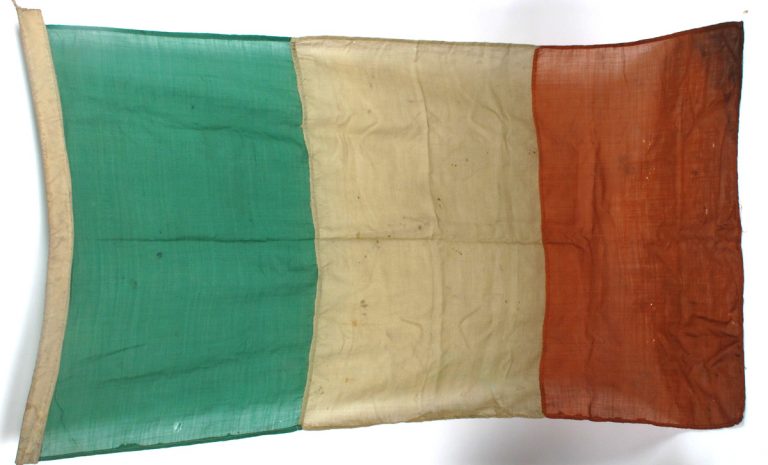
The Irish tricolour was a weapon from the moment it was sewn – a psychological weapon, laden with political meaning, sewn by French revolutionaries, presented to and flown by Irish Republican revolutionaries from generation to generation.

Prior to the advent of the Tricolour, the Irish Republican flag was typically the gold harp on a green background2 but when a group of Young Irelanders went to Paris in solidarity with the revolution of 1848 there, the Tricolour sewn in silk was presented to them by revolutionary French women.
The symbolism of the Tricolour was firstly in its form; the French Revolution adopted a tricolour in opposition to the monarchist Fleur-de-Lison a blue background and different tricolours became popular as flags of new republics.
In the Irish Tricolour, the ancient Irish and the Norman-Irish, basically Catholics, were represented symbolically by green, with orange for the settlers (after William of Orange) of one sect or another of the Protestant faith; the colour white, symbolised peaceful national unity in an Irish Republic.
And it presented an equal unity, as opposed to the unity of Scotland and Ireland with England but under the clear domination of the latter, as represented in the Union Jack, which incorporates the St. Andrew’s and St. Patrick’s crosses with the English one of St. George.
THE TRICOLOUR UNFURLED IN IRELAND
The Irish Tricolour we know was first unfurled by Thomas Francis Meagher “of the Sword” at the Wolfe Tone Club in Wexford on 7th March 1848 and in Dublin in Lower Abbey Street on 13th April 1848.
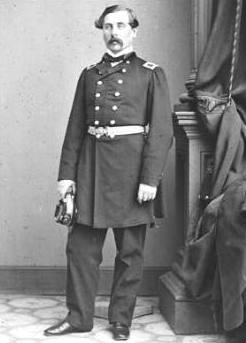
Meagher’s nickname was due to his renunciation of the Gombeens of his day trying to deny the right to resort to arms if necessary to win freedom3.
Meagher and other Young Irelanders were arrested around the failed uprising of 1848, just after the worst year of the Great Hunger and, after wide-scale international and domestic protests at the sentences of execution, transported to penal colonies, from which many escaped.
Taking his Republicanism and inclusivity seriously, both in Ireland and abroad, Meagher raised and commanded the Irish Brigade (composed of five regiments4) in the United States, fondly nicknamed Mrs. Meagher’s Own, to fight for the Union against the Confederacy and slavery.
As the years of struggle progressed, the Tricolour took its place among the ranks of Irish Republicans alongside the older Harp on Green or, for some Fenians, the gold or orange Sunburst on a blue background and so it was in the 1916 Rising when it began to be the most chosen.
Other flags were flown during the 1916 Rising also but the Tricolour was one of two erected on the roof of the GPO, headquarters of the Rising and became the most prominent during the War of Independence (1919-1921).
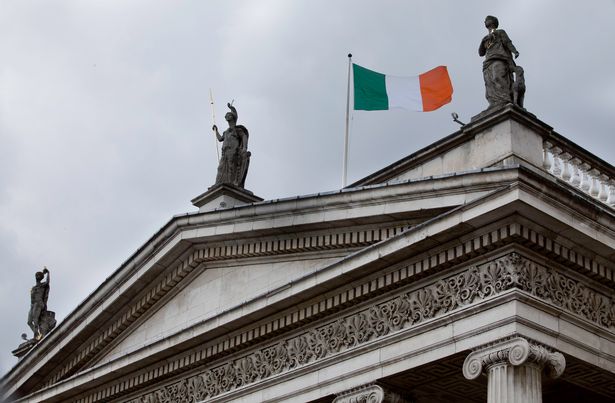
During the Irish Civil war by the British-supported, armed and provisioned Free State Army against the Republican movement (1922-1923), it was flown by both sides. Even after the defeat of the Republican movement and repression, it was not immediately named the state’s flag.
Though it was displayed by the Free State when joining the League of Nations in 1923, and denounced by the Republican movement as an usurpation, it did not seem that the new state was too attached to it5 and some Irish ships flew the British Red Ensign until 1939 and WW2.
The first time the Tricolour was formally adopted by the Irish State was in the 1937 Bunreacht (Constitution) which was brought in by De Valera’s Fianna Fáil6 Government and even then it was under a pretence of Republicanism with claim laid to the whole of Ireland.
Display of the Tricolour was suppressed in the Six Counties colony from 1922 and officially banned under the Flags and Emblems Acts (1954). Many a battle was fought with the colonial police by people asserting their right to display it, the Act not being repealed until 1987.7
“A FLAG OF INCLUSIVITY, MISAPPROPRIATED BY A MINORITY”
One must agree with Varadkar that the flag signifies inclusivity and was misappropriated by fascists and other racists in recent years but it is shameful of him to attribute similar exclusivity to Republicans, who in many cases fought those same fascists to which he referred.

Not only fought them in recent years but also back in the 1930s, when Irish fascists were called the Blueshirts. Surely Varadgar is familiar with the latter’s history also, since they were one of three reactionary groups that joined to create Fine Gael – yes, Varadkar’s own political party.
And the first Irish Republicans, the United Irishmen, sought the unity of “Catholic, Protestant (Anglican) and Dissenter (other Protestant sects)” for an independent Republic, an ideology carried on by all Republican groups thereafter and given expression in the 1916 Proclamation.
But this is not the first time that people in authority have tried to equate Irish Republicans with fascists, as a few years ago Garda Commissioner Drew Harris issued a press statement in which he accused Republicans of having organised a far-Right demonstration — which he later recanted.
One would think Drew Harris, ex-Assistant Commissioner of the British colonial police force, the PSNI8, well-known for their sectarianism and collusion with the colonial brand of fascism, the Loyalists, would be able to distinguish between Irish Republicans and fascists with ease.
Varadkar is ridiculous in accusing Republicans of “weaponising” the Tricolour since it was always an ideological weapon from the moment of its creation and then eventually used by the State to try, with monumental lack of success, to deny it to Republicans.
But Varadkar is right in that the Irish Tricolour has been misappropriated by a minority; but rather than Republicans, that minority is the Gombeen ruling class, foreign-dependent, neo-liberal, selling out the country’s resources and networks to foreign capitalist monopolies.
And causing homelessness, or rent and mortgage hopelessness, emigration and austerity for the vast majority of the people in the Irish state, both native and immigrant, for the benefit of a tiny minority of parasites incapable of even developing a viable Irish national economy.
Republican groups, like all groups are minorities but so are the elites, though even smaller. But in representation? Republicans, whatever faults they may have from time to time clearly represent a much larger and wider section of society than do the Gombeens.
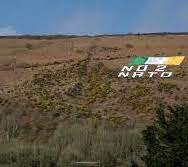
This has been evidenced by the militant opposition of wide Irish society to triple water taxation and privatisation, repugnance for the celebration of British occupation forces and the wide opposition to joining a military alliance, all projects pushed by the Gombeens in different governments.
The Irish Tricolour has been commented upon in a number of Irish Republican songs, sometimes even in the song title: White, Orange and Green and Green, White and Gold.
Probably it is most appropriately referenced in the chorus of a song directed at the Gombeens, the very minority who have misappropriated it:
Take it down from the mast, Irish Traitors,
It’s the flag we Republicans claim;
It can never belong to Free Staters
For you’ve brought on it nothing but shame9.
End.

FOOTNOTES
1 Currently Prime Minister of the Coalition Government of Fianna Fáil, Fine Gael and the Greens.
2 Flag of the Society of United Irishmen, who led insurrections in 1798 and 1803.
3 Daniel O’Connell’s son intended to force a motion of that kind on the Irish Repeal Association founded by his father and also sought to have the motion passed without debate. O’Meagher said that while he did not exalt violence, neither would he allow his sword to be taken from him in case it should be needed. He and others such as Thomas Davis left the Association at that point and became known as “the Young Irelanders”, first mockingly and later with pride.
4 Including the 69th New York Infantry or “Fitghting 69th”. 7,715 men served in the brigade, 961 were killed or mortally wounded and around 3,000 were wounded. (Wikipedia The Irish Brigade)
5 A 1928 British document said: The government in Ireland have taken over the so called Free State Flag in order to forestall its use by republican element and avoid legislative regulation, to leave them free to adopt a more suitable emblem later. (Wikipedia)
6 The party was a split from the losers of the Civil War of which De Valera had been leader, formed in order to participate in elections for Government and presented itself as Republican. The 1937 Bunreacht also laid claim in Articles 2 & 3 to the whole of Ireland which were removed in
7 During a period of direct rule by the British Government.
8 The colonial gendarmerie, formerly the Royal Ulster Constabulary for the Six Counties, preceded by the Royal Irish Constabulary for the whole of Ireland.
9 Soldiers of ‘22 by Brian Ó hUigín, acclaiming the Republican resistance to the counter-revolution of the Free State during the Civil War.
REFERENCES
History of the Irish Tricolour: https://www.1916rising.com/cms/history/leaders-soldiers-and-poets/history-of-the-irish-flag/#:~:text=Irish%20tricolours%20were%20mentioned%20in,accorded%20the%20flag%20until%201848.
https://en.wikipedia.org/wiki/Flag_of_Ireland

IRISH NEUTRALITY – WHO CARES?
Clive Sulish
(Reading time main article: 6 mins.)
A packed public meeting in Dublin city centre on Saturday listened to and applauded prominent people speaking against the Irish State becoming part of military alliances, whether PESCO1 (“NATO by stealth”2) or NATO itself.
The high-profile panel of speakers chaired by Irish MEP Clare Daly featured fellow MEP Mick Wallace, Sevim Dagdalen (MP Die Linke), Medea Benjamin (founder of Code Pink) and Anne Wright (ex-US Army Major and opponent of the US-Iraq War).
Celebrated anti-imperialist rapper Lowkey was also a speaker as was Yanis Varoufakis (ex-Syrza)3 who addressed the meeting by recorded video from abroad and applauded the Irish for their long resistance to colonialism and urged them to be proud of their state’s neutrality.
BACKGROUND
There is a constitutional impediment to the Irish state’s participating in a war partnership with another state and during WW2 the state’s official position was neutrality.
However, it was always a pro-Allied neutrality with British downed airmen allowed to cross over into UK territory and US servicemen often crossing the UK border to visit the ‘south’, while German downed airmen were interned for the duration of the War.
The impediment is not absolute and is usually referred to as the ‘Triple Lock’, listing the three conditions which would enable to government to send more than 12 troops overseas:
- a mandate from the United Nations
- a Government decision
- and a Dáil vote 4
In recent years some politicians and public commentators have floated the idea that the Irish state could rejoin the British Commonwealth and, since the war in the Ukraine, a discourse has arisen that the State needs to join an external military alliance in order to protect itself from Russia.
The Irish Times/Ipsos poll in April, amid criticisms of not following best practice in its design and even accusations of trying to steer respondents towards favouring joining some external military alliance, delivered two thirds clearly against the Irish state doing any such thing.
Russophobic propaganda has speculated on the activities of Russian trawlers in the Irish Sea. This is entirely a whipped-up alarm and discussion without the slightest foundation in fact since Russia has never presented the slightest threat, militarily or politically, to the Irish people.
On the other hand, Britain has invaded and occupied Ireland for over 800 years and is still in possession of one-fifth of its territory and has substantial economic and financial interests in the country as, more recently, have the USA and European Union states.
The UK’s Royal Navy frequently enters Irish national waters and the State has regularly permitted its ships, along with warships of other NATO countries, to dock in Irish harbours. And also the Royal Air Force, it has recently emerged, to patrol Irish territorial air space.
As part of this false alarm and discourse, the Irish Government5 recently founded the Consultative Forum on International Security Policy which was scheduled to meet last week in Cork and Galway, then for two days in Dublin Castle.
The President of the State, Michael D. Higgins, in an unusual intervention during an interview with the Examiner expressed concern at what he perceived as the “drift towards NATO” and criticised the composition of the speakers and chairperson of this organisation as being pro-NATO.
Michael D commented on “the admirals, the generals, the air force, the rest of it” and described its chair Louise Richardson, as a person “with a very large DBE – Dame of the British Empire”.
President Higgins apologised later for what he said was “a throway remark” about Richardson but did not withdraw his remarks about the overall composition of the Forum which has indeed been criticised by others, including Richard Boyd Barrett TD6 and Senator Frances Black.
THE DUBLIN MEETING
Varoufakis referred to Ireland as though the nation had won its independence, as was the case with every speaker that followed (with the exception of Lowkey).
A member of the audience was heard to remark ironically to another that he was grateful he had attended as heretofore he hadn’t been aware of Ireland’s ‘independence’.
Lowkey, the British-based rapper, tore the illusion of Irish state neutrality to tatters by recounting the use of Irish airports not only for US Army flights under Air America through Shannon, but also airlines run by the CIA and others using other airports in Irish state territory.
The rapper exposed the ‘neutrality’ of the Irish government in training soldiers going to fight in Ukraine and also in its continued support for the Israeli State and was cheered when he declared that, as an Iraqi, he was proud that his country had “kicked the ass of the British”.
In a masterful exercise in research-backed criticism, Lowkey went on to strip the pretence of independence and impartiality from the Government-founded “Consultative Forum”, exposing the imperialist and even NATO background of the main panel members and its chairperson.
All the members of the Neutrality Who Cares panel were effective speakers and made useful points although it was curious to hear one of them denouncing “Russian fascists” without commenting on the fascist units in the Ukrainian regime’s national army.
It was Lowkey who drove the sharpest and longest nails into the verbal crucifixion of the Irish Government’s drive towards NATO and who brought the loudest cheers from his mostly Irish audience.
Even celebrated speaker Daly did not come very close, though she too exposed the propaganda of the Government and pro-NATO cheerleaders. The MEP debunked the excuse of protecting underground communication cables, pointing out that 25% of them are out of action regularly.
The Irish MEP also lampooned the idea of any underwater cable being protected by NATO, considering where the responsibility for the blowing up of the Nord Stream gas pipeline lies!7
Finally she warned the audience to be on the look out for an attempt to remove the Triple Lock under some kind of excuse as a first step to permit the Government to enter a military alliance.
A PART OF IRELAND ALREADY IN NATO
It was left to a youth member of the audience in the Q&A section, reading a statement on behalf of the Anti-Imperialist Action organisation, to point out that a part of Ireland is already in NATO, viz. the Six Counties, occupied by Britain and a part of the United Kingdom.
The youth called for a broad front to unite around opposition to becoming part of an external military alliance and imperialism (see full statement in appendix). Small flyers advocating the same course of action had been distributed inside the meeting earlier.
The People Before Profit party also distributed leaflets against joining NATO to people attending the meeting.
Indeed, it is hard to see why the presence of NATO in a part of Ireland should be so markedly missing from the panel’s speeches. Since it cannot have been accidental we must ponder what the rationale for its omission could have been.
Do those on the panel agree with the colonial occupation of a part of Ireland? That seems hard to believe, at least of some of them. Or perhaps they believe its discussion would be a distraction from the neutrality issue and if so, how can that be?
Or is it that they seek the support of sections of Irish society who are comfortable with the continued occupation and partition of Ireland? If so, they are seeking to build the movement against Irish membership of NATO in terms they think acceptable to timid sections of the middle class.
When resolute action becomes necessary or when reaction starts to bite, those sections will fade out of the anti-NATO movement. For practical as well as for ideological reasons, the campaign must appeal to the working class on an unashamedly anti-colonial and anti-imperialist basis.
Wherever the Government’s Forum has gone, it has encountered public opposition. It was picketed at its Cork and Galway venues, while inside the former, an anti-NATO banner was unfolded and many in the audience denounced the Government’s direction.
Even after the protesters had been hustled out, another stood up to denounce the chairperson’s speech before he too was manhandled away.
In Dublin Castle, venue for the Forum on Monday and Tuesday with a long history as administrative centre of British occupation, people against NATO, war or militarism and for Irish independence displayed banners and placards of protest and flew national flags.
AIA Tweet featuring National TV broadcaster RTÉ quoting Irish Government leaders’ ridiculous comments on the display of Irish Republican flags by protestors outside main pedestrian entrance to Dublin Castle in the city centre.
IN CONCLUSION
The general mass media silence on the Neutrality Who Cares meeting in Dublin and in downplaying the protests against the Forum at all its locations is part of the Irish Gombeen class drive to join NATO, despite the well-known opposition of the wide Irish population.
It is not forgotten that when tens of thousands thronged Dublin streets marching against triple water service taxation and privatisation, how the mass media reported participation merely by “several thousand” or even “hundreds”.
Nevertheless the comments of the President of the State and remarks by some journalists in the mass media do reveal that even in their own sections, the Gombeens do not have it all their own way. In the general population, however, the mood is clearly for non-militarisation of Ireland.
If the anti-NATO movement remains active and militant and adopts a generally broad anti-imperialist stance, going to most sections of society but especially to the working class, the Gombeens’ drive towards participation in PESCO and NATO will be decisively defeated.
End.
FOOTNOTES
1Permanent Structured Cooperation is the strange name of this proposed European Union-wide military alliance.
2As described by Clare Daly.
3Syriza is a Left social-democratic coalition party that was elected to government in Greece in 2015 on a promise to implement necessary social and economic reforms in the teeth of EU and other imperialist resistance. However, once the EU and the ECB began to tighten the screws, the resistance of the party’s leadership disintegrated. Varoufakis had been appointed finance minister and to give him his due, he tried to rally his cabinet colleagues around a program of non-compliance with EU diktats but was unsuccessful. Although it remains the main social-democratic opposition in Greece, the party has continued to slide in popularity in elections since.
4Irish UN peacekeeping forces exceeding 12 personnel have been sent overseas with those three conditions satisfied to many conflicts around the world, most notably Lebanon, where they have suffered some casualties and to the Congo, where they suffered many.
5The Irish Government is a coalition of two traditional main oppositional parties, Fianna Fáile and Fine Gael, with the Green Party. The Labour Party does not have a noticeably different position on external military alliance and Sinn Féin recently dropped their decades-long opposition to Irish membership of NATO and the EU.
6Barrett is a Teachta Dála (member of the Irish parliament) and member of the People Before Profit left-wing political party. Frances Black, with a successful career in singing, is an independent Senator in the same parliament who has sponsored a Bill to ban products from the illegal Israeli settlements. The Control of Economic Activity (Occupied Territories) Bill 2018 was passed in full by the Senate in 2018, and passed its first vote in Dáil Éireann in early 2019. It was then sent for detailed scrutiny in the Oireachtas Select Committee on Foreign & Affairs and Trade. This review took place over several months, hearing from expert testimony and input, and in December 2019 the Committee also voted in favour of the bill. Since then the Government is delaying bringing it forward.
7Although direct proof is not yet available, circumstantial evidence points towards US armed forces’ responsibility and journalist Seymour Hersh (Pullitzer Prize winner for exposing the US military massacre in Mai Lai, Viet Nam and its subsequent attempted cover-up) has confirmed the US military’s responsibility on the basis of inside knowledge from his contacts.
APPENDIX
Text of statement read out during Q&A period of Neutrality – Who Cares public meeting in Dublin 24 June 2023:
Anti Imperialist Action Ireland hold the revolutionary position that Britain, NATO and any other imperialist power is not welcome in Ireland. Anti-Imperialist Action have been active in opposing all forms of imperialism in Ireland and have been to the fore in opposition to NATO.
NATO is a great threat to Ireland and the Irish People, and in realisation of that, we urge and call on everyone here to vocally oppose the presence of NATO in Ireland whether you be an anti-war activist, a Socialist Republican, an anti-Fascist, a trade unionist, or just against the presence of a foreign power in Ireland, get behind this position and ensure that your sons and daughters aren’t sent off to be slaughtered in illegal wars of conquest.
While all the focus has been about the push towards NATO for the 26 Counties we cannot forget that the Six Counties are already occupied by NATO by virtue of Britain’s illegal occupation. Only a militant broad front of progressive forces all across the 32 counties can make a firm stand against NATO’s presence in Ireland. Everyone has a part to play in such a broad front which Anti-Imperialist Action and others are working hard to establish.
Reject NATO. Britain and NATO out of Ireland now!
SOURCES & FURTHER INFORMATION
Anti-Imperialist Action statement on line: https://anti-imperialist-action-ireland.com/blog/2023/06/21/the-free-states-imperialist-circus/?fbclid=IwAR27Y7HSZOJKgLe_oivFx828jHfUMFa4mNXADUY1jhFh1KaDsoxGmsxhN1Q
https://www.gov.ie/en/campaigns/e2a6b-consultative-forum-on-international-security-policy/

COLLAPSE OF BUILDING KILLING TWO GIRLS COMMEMORATED
Diarmuid Breatnach
(Reading time: 6 mins.)
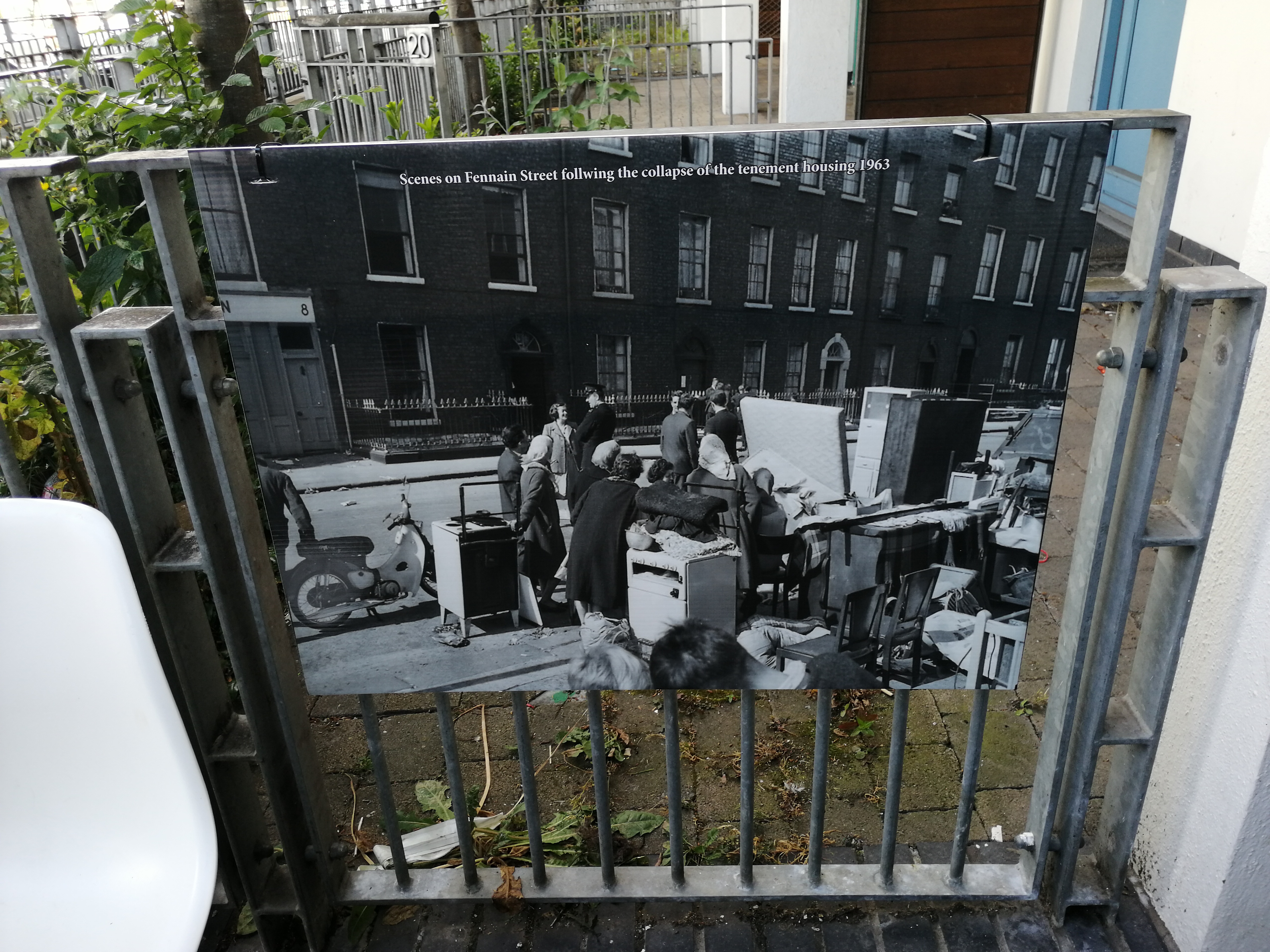
The collapse of multi-occupation buildings in Dublin’s Fenian Street killed two girls. A day from the anniversary of the tragedy sixty years later, local residents in a working-class block of flats organised a moving and informative commemoration.
On 12th June 1963, Marion Vardy and Linda Byrne, returning from a shop were killed when the buildings collapsed.
After another two people were killed in a Bolton Street collapse, a galvanised Dublin City Council inspection condemned many other buildings in the city and 155 families were rehoused immediately, though some in Army barracks.
And a number had to camp out for some days in the street. But it was not the first fatal building collapse in Dublin. On 2nd September 1913 (with the epic Lockout struggle only days old), two adjacent buildings had collapsed in Church Street, killing seven people.1
All the buildings in question were privately-owned with working class people paying rent to the owners. Emergency inspections by Dublin City Council inspectors in 1963 resulted in the condemning of 156 Dublin buildings as too dangerous for residence.
For years, other buildings in the Dublin inner city could be seen braced on a side by a massive timber frame.


COMMEMORATIVE EVENT
A display of panels describing the tragedy and panels of photos had been erected around the entrance to St.Andrew’s Court block of flats in Fenian Street, where a crowd had gathered for the well-organised commemoration.
Paul McKeown chaired the event speaking eloquently when he could be heard (there was no public address facility) about the actual tragedy and the context of housing provision for working class people in the inner city.
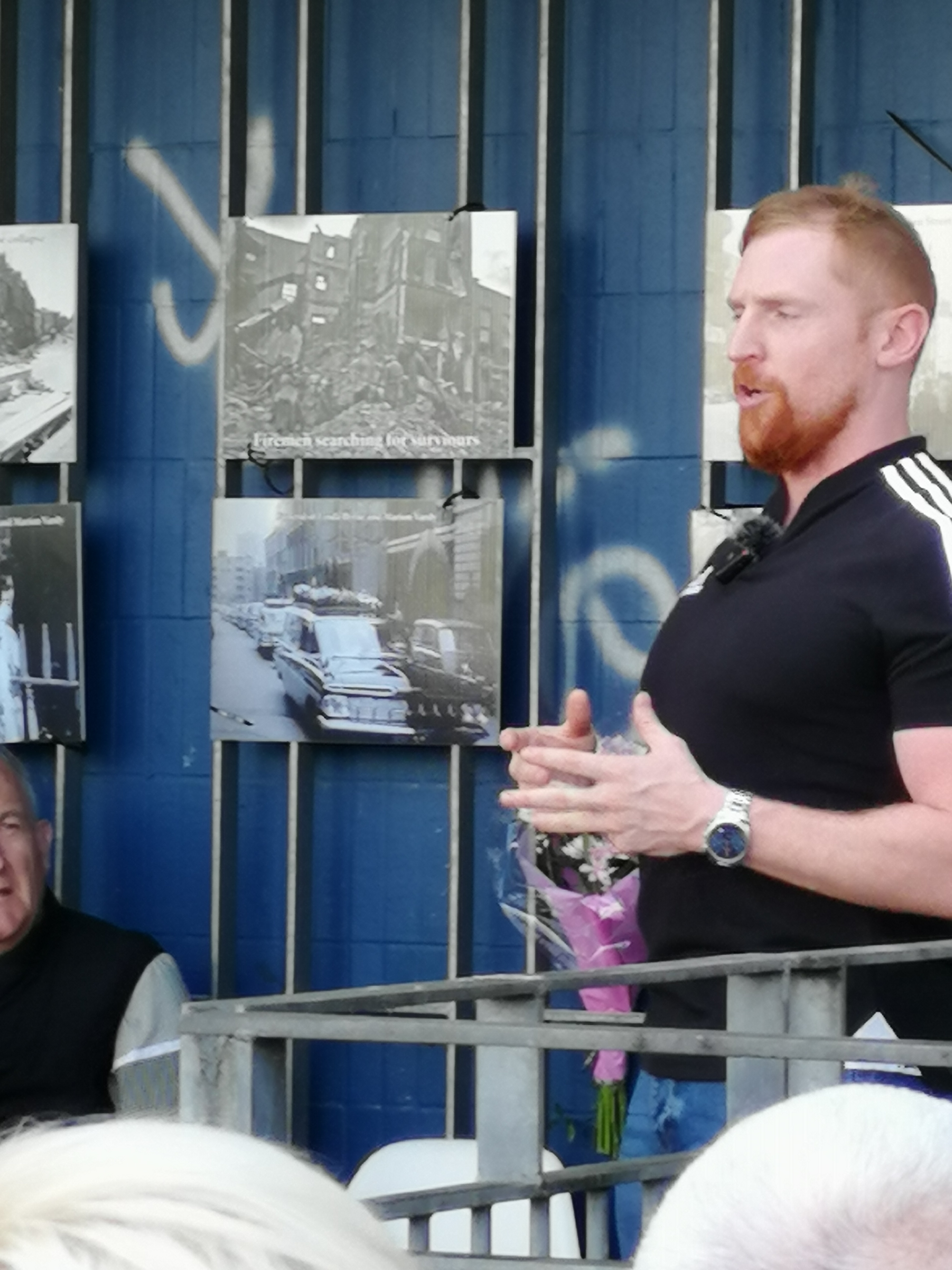
As a Catholic priest had performed the religion’s Last Rites over the bodies of the girls in 1963, McKeown invited a priest to recite some prayers at the event, which he duly did, after which the MC introduced a representative from the Henrietta Street Tenement Experience.2
The Henrietta Street speaker provided interesting snapshots of what past life was like for working people of the inner city in terms of occupation, accommodation and schooling. Some women sewed shirts in a factory while others sold items in street markets, such as Moore Street.3

The floors in the poorest homes had no covering and toilets were very few, their use often shared by a great many residents. Although virtually all children would end schooling at the age of 14, the eldest boy often left years earlier to work, as a newsboy or shop messenger, for example.
Labouring on the nearby docks and carting would be the main employment for the men. No doubt emigration, almost a constant in Irish history, played a part too. Rats and mice were endemic in the buildings.
Though alternative and eventually new housing was found for all, it was to Dublin’s outlying areas, breaking up communities and their ways of life, separating them from services used, employment, etc. Many felt isolated and took the long journey to return to the city centre for social contact.

ATTACK ON NEARBY REFUGEES
The local flats overlook the location in Sandwith Street that in May had seen an attack by fascists on refugees who had been living in tents because the nearby International Protection Office, a State body, had failed to allocate them accommodation while processing their applications.
A few locals might have joined in and certainly some had attended the crowd but the fascists were imported (as indeed were the refugees and subsequently their antifascist defenders). Some locals at least resented the way they were being portrayed in some social media subsequently.

“We’ve had generations of Travellers4 in the flats and migrant people too,” commented one. “We’re more ethnically diverse than Dalkey,” he added. “Middle class people don’t talk to us, they talk down at us,” was another comment.
They claim that they have been neglected for generations by all the government parties but also by small left-wing parties, also by people who were quick to criticise them and to see them in negative stereotypes. “Nobody talks about class prejudice”, commented McKeown.
The inner city working class population has been moved out of much of the city and this area, which was previously seen as the least valuable real estate in Dublin, as McKeown observes, is now attracting property speculators for gentrification.

McKeown feels his people are not wanted in the area and he’s probably right. It’s not just that they are not the typical users of the wine bars and coffee bars of gentrified areas but that their current location would take in big rents after construction of hotels and upper-market flats.
Past the site of the attack on the refugees there is a new block of apartments, two bedrooms for 3,000 euro a month, one bedroom for 2,000. An empty bloc across the road which people say was well-maintained, remains empty since Dublin City Council moved the residents out 5 years ago.
The local residents say that they have been promised that a new block of apartments will be built on the latter site and that all the units will go for “social housing”, presumably meaning for affordable rent.5They want that to be true but are not sure whether they should trust the authorities.
After the speeches of the commemoration people were invited to partake of food and music in the inside square of the flats which contains minimal playground facilities.

The music was provided by a trio including Shay Connolly playing ballads with the food served by local residents, in a relaxed atmosphere. The area at the back of the flats had become a sun-trap and while some soaked it up, I and some others eventually fled the heat.
PAST, PRESENT AND FUTURE
The commemoration of historical events can be of great importance. The event in 1963 forms part not only of an older story but also of the present, which is the lack of decent housing provision for the population of Ireland, in particular for those living in the inner cities.

Working and lower middle class people were wanted in the inner city to work its industries and its shipping port and to service the houses of higher social classes. As industry and port declined and the higher social classes moved out, the need for their work declined.
When their poor areas are seen instead as development prize areas, there is even less demand for the people who have lived in these areas for generations.
One can see this as the inexorable play of impersonal market forces or as the operation of finance and rentier capitalism in a capitalist economy and more, a Gombeen capitalist state where everything is done for the foreign capitalists and as little as possible for the working classes.
From the latter viewpoint, voting different political parties in to government will make no essential difference; what is needed is a fundamental change in the economy which can only be brought about by an organised, conscious and militant working class seizing their rightful inheritance.
End.

FOOTNOTES
1 I recall reading that a number of Dublin City Councillors, including Nationalist ones, were slum landlords.
2 It is open for visits from Wednesdays through to the weekend, I am told.
3 The market and area are subject to a long war between property speculators and conservationists (see smsfd.ie)
4 An Irish indigenous nomadic ethnic group of at least five centuries existence, much discriminated against.
5 “Social housing” is often understood as provision for people unemployed and on state welfare provision. Perhaps “Public housing on affordable rent” is a better description, housing both people working and those on benefits, the rents adjusted to means. This was widely built in the middle of the last century but none has been built in Dublin for decades, all governments insisting that the “private sector” (i.e big landlords, property speculators and vulture funds) can solve the problem while the housing crisis intensifies year after year.
SOURCES & OTHER READING
1963 Collapse: https://www.rte.ie/archives/2023/0531/1386694-fenian-street-homes-collapse/
1913 Collapse: https://www.historyireland.com/the-church-street-disaster-september-1913/
Tenement conditions 1913: https://csu1916.wordpress.com/lockout/dublin-1911/tenements/
2023 DCC failure to enforce standards on landlords: https://www.irishexaminer.com/news/arid-41080388.html
BUILDING BRICS
Diarmuid Breatnach
(Reading time: 5 mins.)
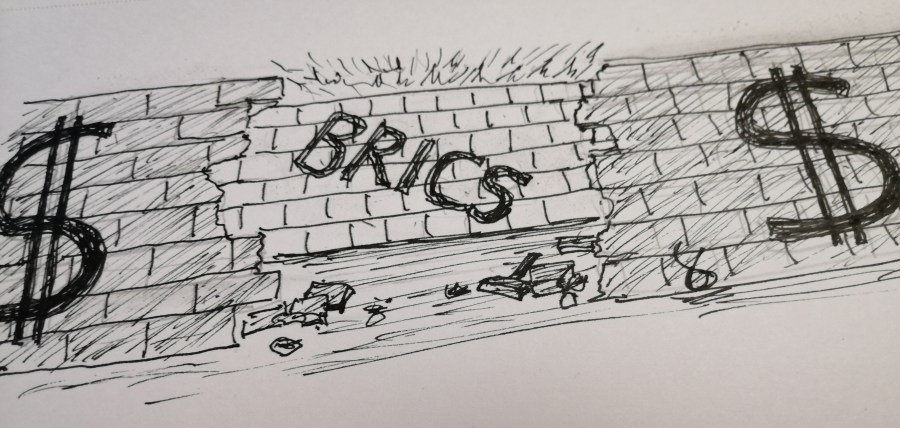
For decades the US Dollar has dominated financial transactions across the world – backed not only by the USA’s industrial and agricultural output but by its imperialist domination of many economies and its military power.
But perhaps no longer, for now there is a serious competitor in the field, one with the acronym BRICS, from the first letter of the states that created it (in order of no significance): Brazil, Russia, India, China, South Africa.
Apart from the backing of powerful economies with more applying to join, this currency standard is based on the price of precious and semi-precious metals. The UK’s Sterling (and the Irish state’s, for a while) was based on silver but the Dollar has for many years been backed by … debt.
A currency is based on the assumption that every unit will be payable and backed by a unit (e.g. gold) of the declared value. But if the value unit markers of the US Dollar, in coins, notes, cheques and credit transfers were to be presented to the US Treasury, it could never pay them.1
In fact, it could not even pay a significant percentage of them and has been running a national defaulting on debt currency for many years, this year once again deciding to continue doing so to the tune of $31.5 trillion.
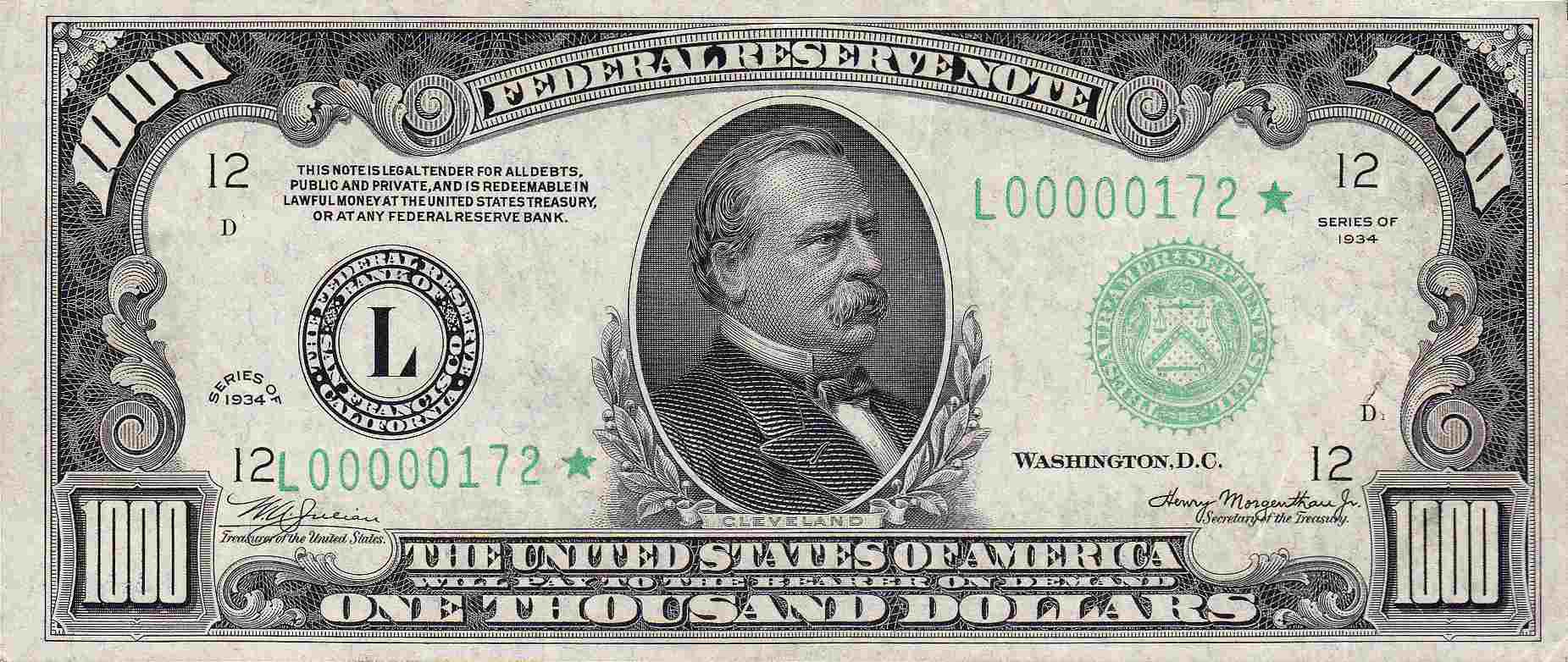
The USA has been able to continue doing this to date because so many of the world’s economies have been dominated by US Imperialism or in alliance with it; they fear that calling in the debt would lead to the collapse of the USA system and to their own interlinked financial structures.
BRICS consists of a financial alliance of economies of which their leaders for one reason or another feel in their interests to end the world dominance of the Dollar.
Previously, South Africa’s Foreign Minister Naledi Pandor said that there are 12 countries interested in joining the initiative.
Of the 12, she mentioned seven countries specifically, namely Saudi Arabia, United Arab Emirates, Egypt, Algeria, Argentina, Mexico and Nigeria. In March this year Russia announced its support for Algeria’s bid to join BRICS.
In April the expansion of that list interested in joining to 19 states was announced with formal applications from Algeria, Argentina, Bahrain, Egypt, Indonesia, Iran, Saudi Arabia and United Arab Emirates.
And with expressions of interest from Afghanistan, Bangladesh, Belarus, Kazakhstan, Mexico, Nicaragua, Nigeria, Pakistan, Senegal, Sudan, Syria, Thailand, Tunisia, Turkey, Uruguay, Venezuela and Zimbabwe.
COMMUNICATIONS, COMMON CURRENCY & LENDING BANK
Plans for an optical fibre submarine communications cable between BRIC members – partly motivated to avoid US National Security Agency spying on telecommunications in and out of the USA – have not advanced far since first discussed in 2012 but have not been abandoned.
Likewise, discussions of a common currency have not come to fruition yet either. However that may be more imminent.
As challengers to Western-led international currency, BRICS “in the order of the scale of GDP, now collectively outweigh not only the reigning hegemon, the United States, but the entire G-7 weight class put together” (former White House senior advisor Joseph W. Sullivan).2
The same commentator believes that such a common currency has a much greater chance of stability than the Eurozone, because of the geographic diversity of its members, which enables a broader range of goods and services.
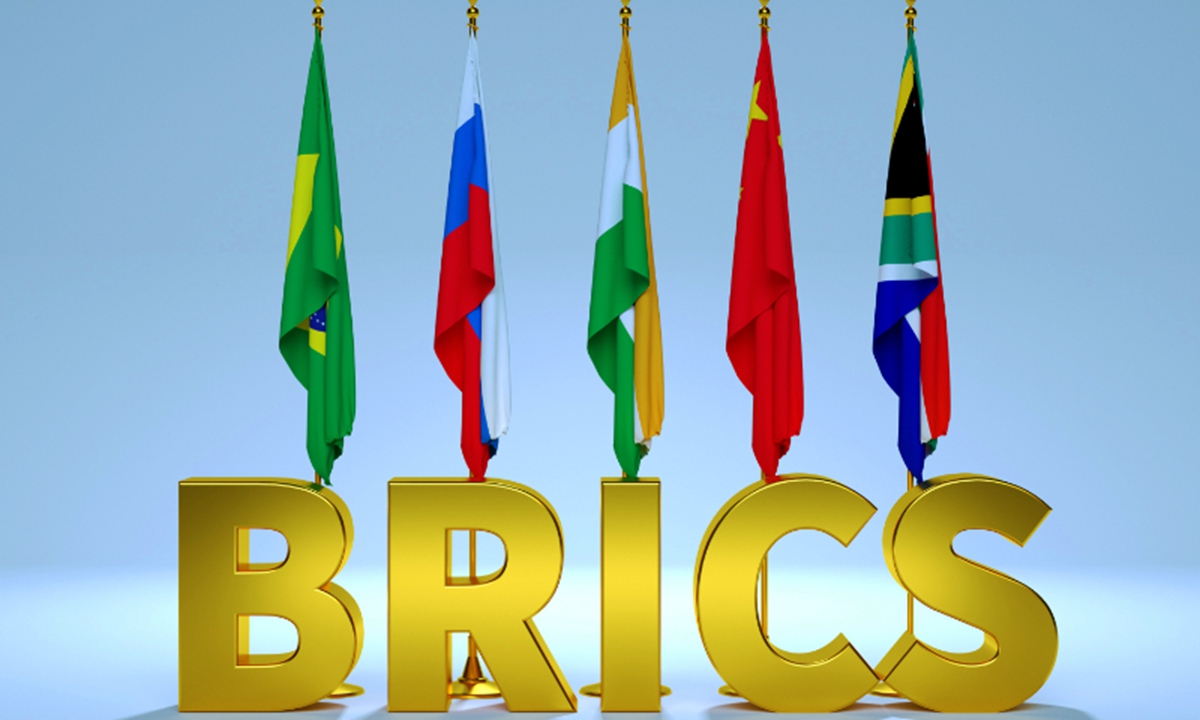
The biggest attraction for applicants to join is probably access to loans from the New Development Bank to members for infrastructure projects, which is the NDB’s main advertised purpose. Heretofore, the IMF and the World Bank have been the main external lenders.
Both the latter institutions have imposed harmful changes on borrowing economies, often driving them further and deeper into debt and into greater dependency on western imperialism. Those lending institutions have also supported corrupt and oppressive regimes.
The NDB has authorised lending up to $34 billion annually, with South Africa the HQ for the African continent with a starting capital of $50 billion ($10 billion from each of the five founders) and so far has 53 projects underway worth around $15 billion total.
Should the NDB prove its ability to issue loans to nationally-desired projects without the penurious and destructive conditions currently attached to IMF and World Bank funding, many, many regimes in the underdeveloped world are likely to apply to BRICS for membership.
And should client regimes currently dependent on western imperialism refuse to jump across to BRICS, they may well face coups from more nationally-ambitious sections of their elites or insurrections from below.
IS BRICS A GOOD OR A BAD THING?
Some anti-imperialists, including some socialists, have been celebrating the creation of BRICS, some even proclaiming it as the financial reflection of a new anti-imperialist order.
Of the five founding economies, only one claims to be socialist. Capitalist economies, we know, tend to develop into imperialist ones, sometimes but not always invading the countries of other economies but always exporting surplus capital there to exploit labour and natural resources.
So some or all of the capitalist economies in BRICS currently are likely to become imperialist also.
That apart, having much or even all of the world’s economies divided between two blocs may give weak economies opportunities they would not otherwise have or at least a choice and perhaps the opportunity to bargain for the conditions of their relationship to world finance.
In other words, a return in many fundamental ways to the division of the world before the collapse of the Soviet Union.
THREAT OF WAR?
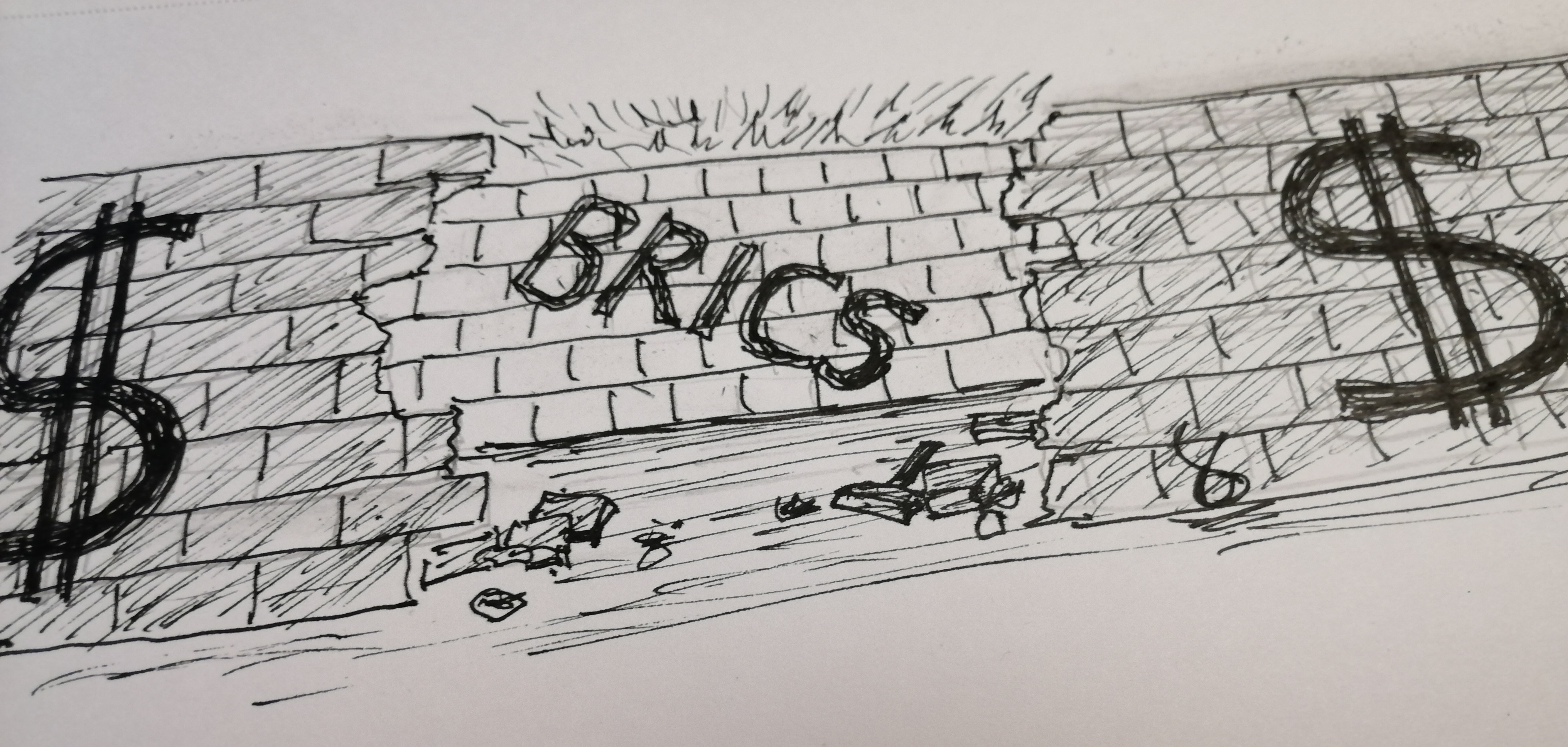
But does this bring the threat of world war, arms race, etc, as seemed to be always present between the USA and the USSR?
Possibly but the threat of world war is already very much with us, as US/NATO uses the Ukrainian regime as a proxy in its decades-long threatening encirclement of Russia, and also in its posture (not unrelated) towards Iran and the USA’s world competitor China.
The working class in countries that are part of BRICS will still be exploited and will need to overthrow their respective national ruling classes if they are to end that exploitation and also save the environment from destruction.
Imperialism always means war whether direct or by proxy, small or large, against competing economies or people resisting domination and exploitation. Since the end of WW2 alone the USA has been involved in 201 military interventions in 51 regions.3
In the same period, the UK has carried out 28 military interventions in Asia, Africa, Middle East, Caribbean and Europe4 and France 32 in similar regions.5 Competition for world resources between Germany and the UK and with France led to WW1 and again to WW26.
BRICS has been created anyway, whatever our opinion and is set to grow significantly, causing some big changes in the world as a result. In the short term this development is likely to be to the advantage of the smaller economies and even nations struggling for independence.
End.
FOOTNOTES
2. Writing for American magazine Foreign Policy
3. https://tribune.com.pk/story/2345663/us-initiated-81-global-armed-conflicts-from-1945-to-2001
4. https://www.historyguy.com/british_wars_1945present.htm
5. https://www.historyguy.com/french_wars_1945-present.html
6. Other states were of course involved, including the imperial competition for the Pacific and Asia between the USA/ UK and Japan in WW2 with the SE Asian peoples, in particular communist-led Chinese fighting Japanese imperialism and of course in Europe the mighty contribution and sacrifice of the USSR against the fascist powers. But the initiation of both world wars was competition and contention between Germany, France and the UK.
SOURCES
https://en.wikipedia.org/wiki/BRICS
https://en.wikipedia.org/wiki/National_debt_of_the_United_States
https://www.bbc.com/news/world-africa-65784030
https://tribune.com.pk/story/2345663/us-initiated-81-global-armed-conflicts-from-1945-to-2001
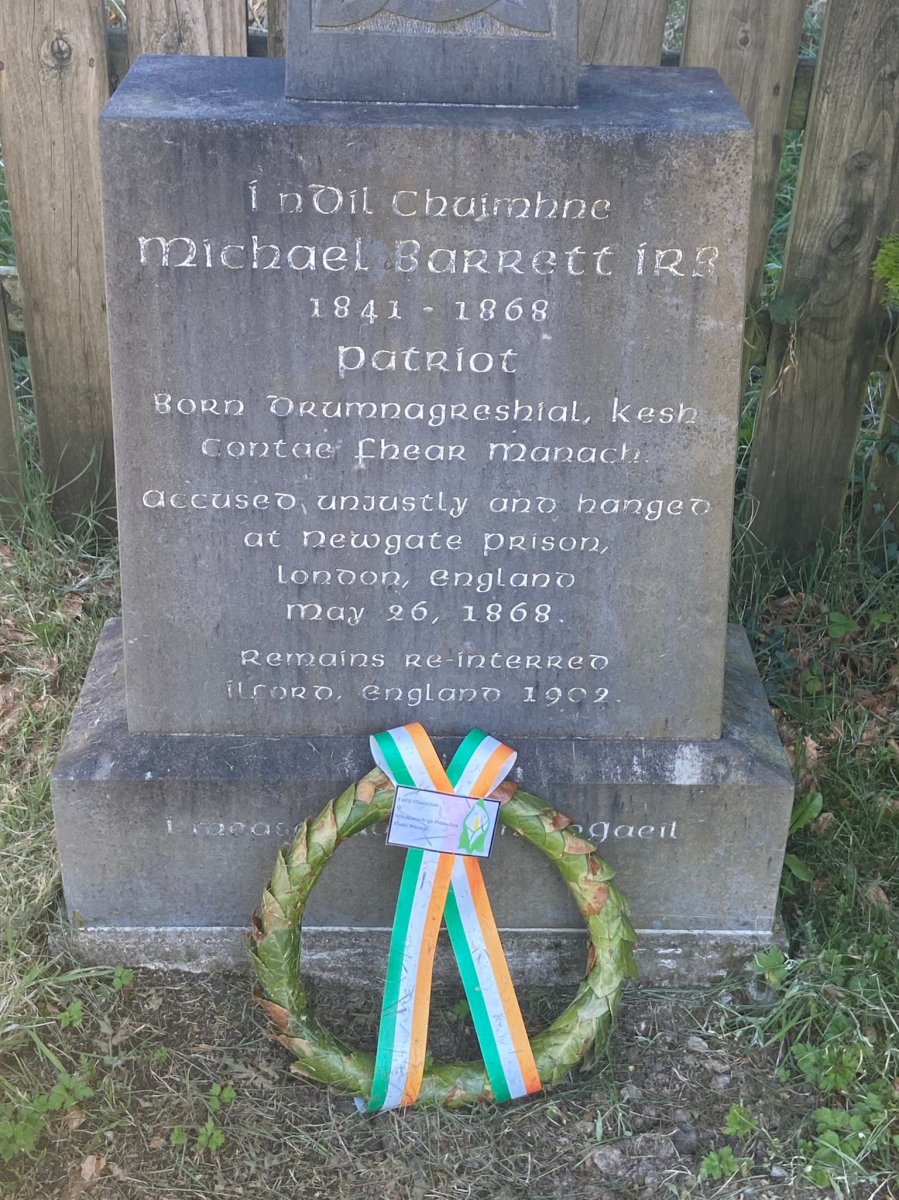
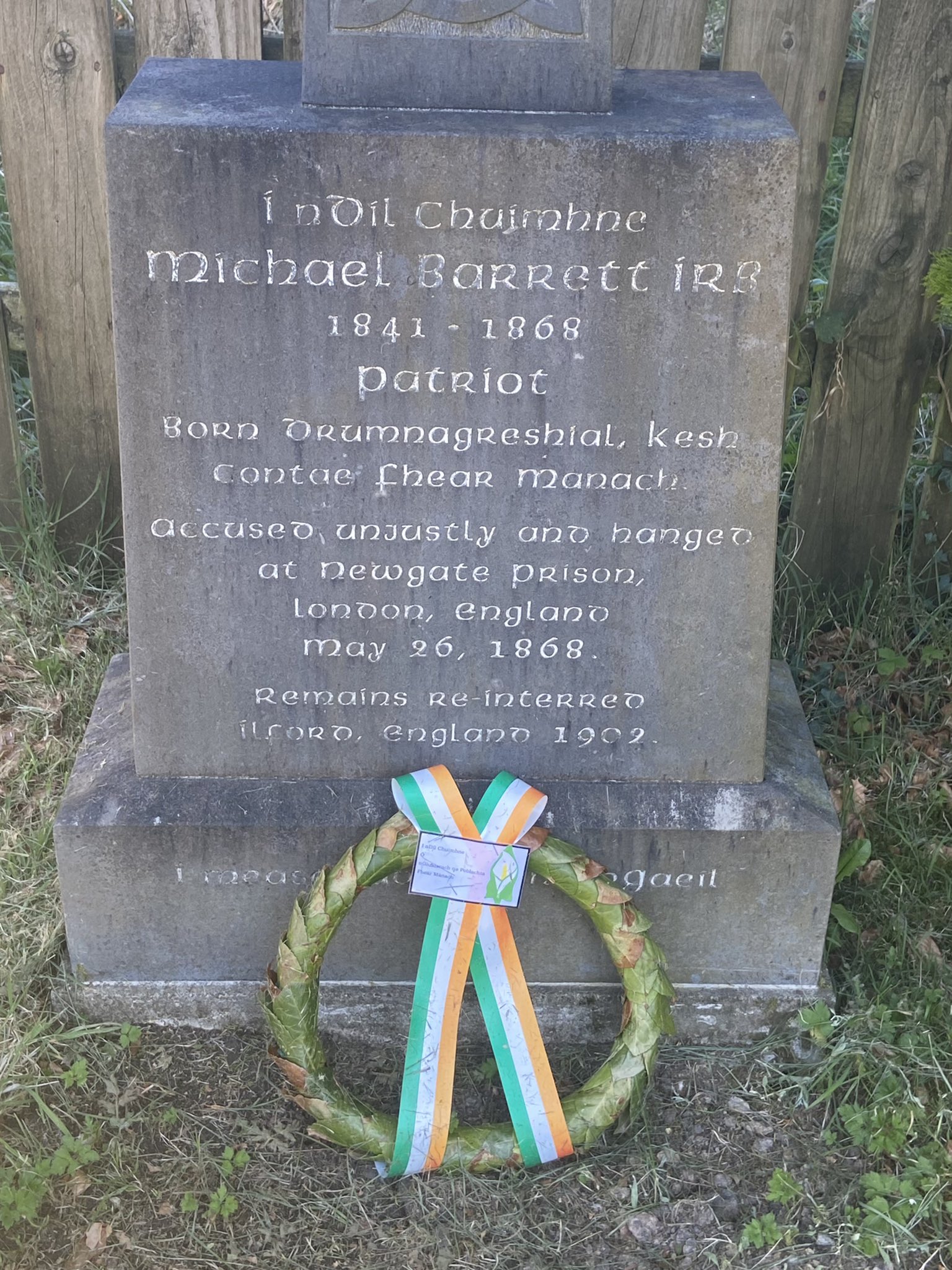
ORATION at GRAVESIDE of INNOCENT MAN PUBLICLY HANGED IN BRITAIN
(Reading time: 14 mins.)
Pat Reynolds gave this oration in East London Cemetery on Sunday 21st May 2023 for Michael Barrett, the last man publicly hanged in Britain
A cháirde agus a chomrádaíthe,
Tá fáilte go leor romhaibh chun chruinnithe i gcuimhne Michael Barrett inniu. Welcome friends and comrades to this commemoration today for Michael Barret and Patrick O’Donnell. I have been asked to speak of Michael Barret and the movement he represented.
Michael was born in Ederney in the Maguire County of Fermanagh in 1841 and was judicially hanged though innocent by the British Government in 1868 at Newgate Prison, where the Old Bailey now stands.
Newgate prison was closed in 1903 and his remains with others were interred here in this cemetery. He was the last person to be publicly hanged in Britain.
A Fenian bombing took place on 13th December 1867 to try and rescue O’Sullivan Burke the Fenian who planned the successful prison van escape in Manchester.
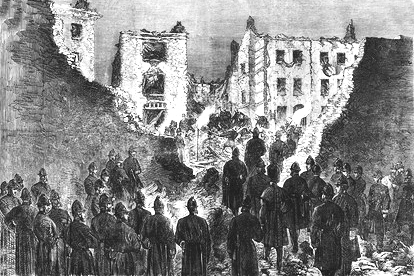
The bombing blew a huge hole in the wall and demolished nearby tenement buildings, killing 12 people and injuring many others. It led to a huge State-engineered backlash in Britain against the Fenians and put their cause back some 10 years.
Michael Barret, who had gone to Glasgow to work was an innocent man and was in Glasgow at the time of the incident.
False evidence given by a police informer Patrick Mullaly who was given a free passage to Australia implicated Barrett, but he had compelling evidence that he was in Glasgow at that time. After two hours the jury declared him guilty.
One of the trial lawyers Montagu Williams stated of Barrett:
‘On looking at the dock, one’s attention was attracted by the appearance of Barrett, for whom I must confess I felt great commiseration. He was a square built fellow, scarcely five feet eight in height and dressed like a well-to-do farmer.
This resemblance was increased by the frank, open, expression on his face. A less murderous countenance than Barrett’s I have not seen. Good humour was latent in his every feature and he took the greatest interest in the proceedings’.
Barrett ended his speech from the dock thus:
‘I am far from denying, nor will the force of circumstances compel me to deny my love of my native land. I love my country and if it is murderous to love Ireland dearer than I love my life, then it is true, I am a murderer.
If my life were ten times dearer than it is and if I could by any means, redress the wrongs of that persecuted land by the sacrifice of my life, I would willingly and gladly do so.’
The Daily Telegraph the next day stated that Barrett had:
‘Delivered a most remarkable speech, criticising with great acuteness evidence against him, protesting that he had been condemned on insufficient grounds, and eloquently asserting his innocence.’
In Fermanagh his aged mother had walked many miles to appeal to the local Tory MP Captain Archdale, a noted Orangemen, who rejected her. Barrett was hanged in front of 2,000 jeering people singing Rule Britannia. The following day Reynolds’ News recorded that;
‘Millions will continue to doubt that a guilty man had been hanged at all; and the future historian of the Fenian panic may declare that Michael Barrett was sacrificed to the exigencies of the police, and the vindication of the good Tory principle, that there is nothing like blood.’
His hangman was the notorious Calcraft who had botched the hanging of the Manchester Martyrs, Allen, Larkin and O’Brien.
There is a huge difference between an accident leading to deaths by patriots fighting tyranny and the deliberate actions of the imperialists, which is why patriots have to be always careful to avoid civilian deaths.
There are many similarities between the Clerkenwell bombing and the Birmingham bombing of 1974.
In both cases they set back the cause of Irish freedom for many years, deeply harmed the Irish community in Britain and was used by the State for repressive measures against the community and to divide off the Irish community from the English working classes.
Disraeli brought in the Habeas Corpus Act and created the Special Branch. Of interest is that their first definition of Irishness was ‘Persons who were born in Ireland or whose recent forebears came from Ireland.” Back in the 1980s the GLC adopted the same definition.
We also had the Birmingham Six case with the ‘appalling vista’ of Lord Denning the Appeal Judge, who later regretted that the six innocent men were not hanged. For Gladstone it set him on his mission ‘to pacify Ireland’.
I ask you two questions today, what kind of people and community gave rise to patriots like Michael Barrett and the Manchester Martyrs, and the second question, what kind of regime or government would hang knowingly innocent men.
To understand the Fenians we have to understand the colonisation of Ireland and in particular the Great Starvation of Ireland An Gorta Mór. Over one and a half million people were starved to death by British imperialism and another two million forced to emigrate to Britain and the USA.
There was no famine in Ireland at this time, and it is imperialistic propaganda to call it such. It was clearly genocide in a land overflowing with food.
The potato crop made up under 25% of the agricultural produce of Ireland, but at this time Ireland was part of the UK where the potato crop was about 5% of the total produce of the UK. I know of no country where there was famine because of a 5% failure of the crops.
Michael Davitt back in 1904 called the Great Starvation a ‘Holocaust’ as did others. Ken Livingstone drew some comparison between the Great Starvation and the experience of the Jewish community during the Second World War.
Hitler named his strategy ‘The Hunger Plan’ where he starved Poles and Jews and others groups of food, and these victims are included in the Holocaust figures including also his starvation of the Warsaw Ghetto.
The shipment of food grown by the people of Ireland to Britain during the Great Starvation was a clear decision by the British government to starve the Irish people.
The Nazi Governor in Poland Hans Frank wrote of the starvation of Jews ‘that we sentence 1.2 million Jews to die of hunger should be noted only marginally’.
The economic theory of laissez-faire is a total invention, within years they could spend millions in Crimea, a place most English had never heard of.
I recall the great Irish writer Frank O’Connor stating ‘Famine is a useful word when you do not wish to use words like ‘genocide’ or ‘extermination’, and again ‘It was not that the people were too simple to realise the Dachau-like nightmare of their circumstances’.
He goes on ‘The word famine itself is a question begging for its meaning ‘an extreme and general shortage of food’, and to use it of a country with a vast surplus of food, cows, sheep, pigs, poultry, eggs and corn, is simply to debase a language’.
O’Connor went further: ‘Irish historians who are firmly convinced that the Famine was all a mistake in the office, explain it in terms of an economic theory called laissez-faire. This is another cock that won’t fight.
Anyone who can believe that the British government maintained a garrison of 100,00 men in Ireland for the purpose of not interfering in trade and industrial affairs attaches some meaning to the word history that escapes me’.
The Great Starvation of the Irish people was a daily planned strategic intervention by the English government which is borne out by the evictions and forced migrations which followed and by the white supremacist and racist beliefs held in England at that time, which has largely been ignored by the historians.
The failure of the Young Ireland movement in the 1848 rebellion led to the deportation of their leaders and a flight of others to France and the USA. From this came the Fenian movement and the Irish Republican Brotherhood set up in the USA and Ireland in 1858.
There was of course also the French Revolution of 1848 which inspired people all over the world and which also inspired the Fenians.
The American Civil War of 1861-65 was to inspire the Irish in the USA. Over 30,000 Irishmen were to lose their lives in War the vast majority fighting for the Union and for the abolition of Slavery.
Revisionists question whether the Irish were really fighting for the abolition of Slavery, yet the same historians in hindsight claim that the British and Irish who fought in the 2nd World war were fighting against fascism and the Nazis.
The Irish men who died firing against slavery are entitled to the same respect from history.
The 1867 rebellion in Ireland did not really take off. Frantz Fanon stated: ‘Each generation must, out of relative obscurity, discover its mission, fulfil it, or betray it’. The Fenians took a more measured road and passed it on to the next generation, but not without a fight.
In the USA they invaded the British Canadian Dominion twice in 1867 with about 700 Fenian soldiers, veterans of the American Civil War. They held a convention in in 1867 with 6,000 armed men present.
In Britain the Fenians massed near Chester Castle in an attempt to seize the guns there and get them to Ireland via Holyhead for the Fenian Rising. As in the USA they were betrayed by spies and with Chester Castle reinforced by soldiers, the raid was called off in February 1967.
In September Colonel Kelly was arrested in Manchester and was released when Fenians attacked the prison coach which later led to the Manchester Martyrs, Allen Larkin and O’Brien who were innocent men framed up by the English government.
The impact of the Manchester Martyrs in Ireland was huge with some 17 monuments put up in their honour and with the Catholic Church forced to backtrack on their anti-Fenian stance and allow masses and commemorations to be widely held in Ireland.
Michael Barrett is part of this sacrifice of the Irish abroad to Irish freedom made within a year of each other. My call is for Michael Barrett to be included within the Manchester Martyrs’ history and commemoration.
By the 1870s the Irish had moved to parliamentary means to move their fight for liberation onwards. You will notice that the fight for Irish freedom goes in flows, a rebellion often followed by political and parliamentary activity along with agitation. Both means were effective for their times.
In Ireland we had Michael Davitt and the Land League, again we have the huge contribution from Britain to this effort from Davitt. We also had the bombing campaign in Britain by O’Donovan Rossa and Tom Clarke from 1880-87, the Invincibles in Dublin and the execution of Lord Cavendish in 1882.
We have the great Irish Literary and Gaelic revival. Again, the Irish Literary Society was founded in Southwark, SE London in the 1880s which spread to Dublin, Belfast and Cork.
We had the Gaelic League and the GAA as part of this revival which led on to the 1916 Rising and the founding of the nation.
What kind of regime or government could knowingly judicially murder innocent men like Michael Barrett and the Manchester Martyrs? We know the history of British colonisation of Ireland and British Imperialism.
This is the same British Imperialism which would in 1919 lead to the Amritsar massacre in India. But let us stay in 1860s iwith this colonial Empire.
In 1865 the Jamaican people rose up against British colonial rule in Jamaica which left 400 dead in a colonial reign of state terrorism. They hung the leader Paul Bogle and 14 others and executed seven women and prosecuted George William Gordon who had nothing to do with the Rebellion.
They executed him. The Fenians at the time raised funds to help the survivors bring action against the English government. You see here a long history of hanging both Irish and Black people across their colonies.
Today I salute the Irish in Britain who marched in the 1980’s against apartheid in South Africa and who today march with the Palestinian people following a noble Fenian internationalist tradition.
British rule in Ireland was based on Imperialism, White Supremacy and Racism. This was first formulated by Gerald of Wales in 1187 some 700 years before they hanged Barrett and the Manchester Martyrs.
Gerald in his books Topography of Ireland and Conquest of Ireland used racism to justify the conquest of Ireland and portrayed the Irish as inferior, backward, inhuman, uncivilised, feckless and lazy.
This was a litany of manufactured racist lies when Ireland had been the ‘Island of Saints and Scholars’ and the seat of learning in Western Europe bringing enlightenment to Europe during the Dark Ages.
Gerald’s views were published across Europe and held sway until around 1650 for about 500 years. This first racialisation of the Irish did not require any religious framework.
When Henry 8th split with Rome in 1534 the racist code used for conquest in Ireland was then overlaid with a state-sponsored sectarian religious code.
Irish scholars were driven out of Oxford where they were a dominant force and Henry sought to build up his fleet to destroy Irish fleets on the south coast to control trading in Irish sea ports and towns.
There followed the Plantation of Elizabeth 1st who knighted Gilbert the mass murderer of Munster who later founded a British colony in Newfoundland.
Later on, we had the Cromwellian conquest of Ireland with large-scale massacres at Drogheda and Wexford, widespread smaller massacres and the forced transporting of Irish slaves to the Caribbean.
Revisionists deny this history and seem to wrongly believe that these people were on some kind of ‘Cromwell Tours of the Caribbean’. For the record these forced transported people were not indentured people.
It is of interest that Gerald of Wales’ views on the Irish were not held of African people from 1200 onwards but were lifted from the Irish situation and applied to African people on the advent of enslavement to justify what the European colonial powers were doing.
So now Africans can be perceived in the same way as the Irish, as backward, inferior, childlike and have their freedoms taken away.
Let us now look at racism and the White Supremacist views of British Imperialism in the 1800s which gave rise to the great Starvation, the Manchester and London hangings of innocent men.
Robert Knox in The Races in 1850 described the Celts as an inferior race which became part of the ‘scientific’ racism of the day, with Knox updating Gerald of Wales.
Even Engels came out with his racist views of the Irish ‘The race that live in these ruinous cottages in measureless filth, and stuck in this atmosphere penned in, as if on purpose, this race must have reached the lowest stages of humanity’, instead of seeing what British imperialism and racism had done to the Irish people at home and abroad.
John Bedoe in his Races of Britain in 1862 views the Irish as Africanoid and having African roots, and again as ‘European Negroes’. Punch portrayed the Irish as apes and monsters, even Parnell, and the Irish as Aboriginals and on the same level as gorillas.
Charles Kingsley on visits to Ireland in the 1860’s states ‘I am haunted by the human chimpanzees I saw’ and ‘to see white chimpanzees is dreadful’. A new Gorilla at London Zoo is called ‘Paddy’ and the ‘Irish Yahoo’ is seen as the missing link between man and gorilla.
The Irish are described ‘as half naked savages who retain a vast amount of their primitive savagery to this day’.
We can see how scientific racism is now applied equally to Black and Irish for the purpose of colonisation and oppression.
In this context we can see the mindset of the British establishment who committed genocide against the Irish people, and who over centuries had murdered Irish people at random. We can see how the same regime of government can hang innocent people at home and abroad.
Michael Barrett, a self-educated man emerges from this dunghill of White Supremacy and pure racism as a heroic figure, like the Manchester Martyrs a true patriot as shown in his speech from the dock. He should be remembered with the Manchester Martyrs and not separated from their heroic end.
Barrett, a Christlike figure and a Cúchulainn who died on behalf of his people and for his political beliefs.
He was part of an Irish tradition in Britain of being in the forefront of democratic rights for liberty justice and freedom, not just for the Irish but also the British people.
We see in the Chartist movement of the 1840s being led by Irishmen Fergal O’Connor and Bronterre O’Brien that fight for liberty and the rights of man.
Also the leadership of Donegal man Doherty leading the workers of Lancashire and the ongoing links in the trade union movement to today from leaders like Mick Lynch inspired by James Connolly to Pat Cullen of the RCN.
We see it in the gift of The Red Flag song from a County Meath man and The Ragged Trousered Philanthropists novel by Noonan to the British working class.
In honouring Michael Barrett today, we stand full square for a United Ireland as proclaimed in the Fenian and 1916 Proclamations and for working class liberty in Britain.
I will finish today by reading the Fenian Proclamation of 10th February 1867 from the Irish People to the World. In it we can see what the 1916 Proclamation borrowed and built on. It is also what Michael Barrett lived and in the end died for.
- Fenian Proclamation, 1867
Proclamation of the Irish Republic, issued February 10th, 1867, by the Irish Republican Brotherhood.
- I.R.
— PROCLAMATION! —
THE IRISH PEOPLE TO THE WORLD
We have suffered centuries of outrage, enforced poverty, and bitter misery. Our rights and liberties have been trampled on by an alien aristocracy, who, treating us as foes, usurped our lands and drew away from our unfortunate country all material riches.
The real owners of the soil were removed to make room for cattle, and driven across the ocean to seek the means of living, and the political rights denied to them at home, while our men of thought and action were condemned to loss of life and liberty.
But we never lost the memory and hope of a national existence. We appealed in vain to the reason and sense of justice of the dominant powers. Our mildest remonstrances were met with sneers and contempt. Our appeals to arms were always unsuccessful.
Today, having no honourable alternative left, we again appeal to force as our last resource. We accept the conditions of appeal, manfully deeming it better to die in the struggle for freedom than to continue an existence of utter serfdom.
All men are born with equal rights, and in associating together to protect one another and share public burthens, justice demands that such associations should rest upon a basis which maintains equality instead of destroying it.
We therefore declare that, unable longer to endure the curse of Monarchical Government, we aim at founding a Republic based on universal suffrage, which shall secure to all the intrinsic value of their labour.
The soil of Ireland, at present in the possession of an oligarchy, belongs to us, the Irish people, and to us it must be restored.
We declare also in favour of absolute liberty of conscience, and the complete separation of Church and State.
We appeal to the Highest Tribunal for evidence of the justice of our cause. History bears testimony to the intensity of our sufferings, and we declare, in the face of our brethren, that we intend no war against the people of England —
our war is against the aristocratic locusts, whether English or Irish, who have eaten the verdure of our fields — against the aristocratic leeches who drain alike our blood and theirs.
Republicans of the entire world, our cause is your cause. Our enemy is your enemy. Let your hearts be with us. As for you, workmen of England, it is not only your hearts we wish, but your arms. Remember the starvation and degradation brought to your firesides by the oppression of labour.
Remember the past, look well to the future, and avenge yourselves by giving liberty to your children in the coming struggle for human freedom.
Herewith we proclaim the Irish Republic.
THE PROVISIONAL GOVERNMENT
 rebelbreeze