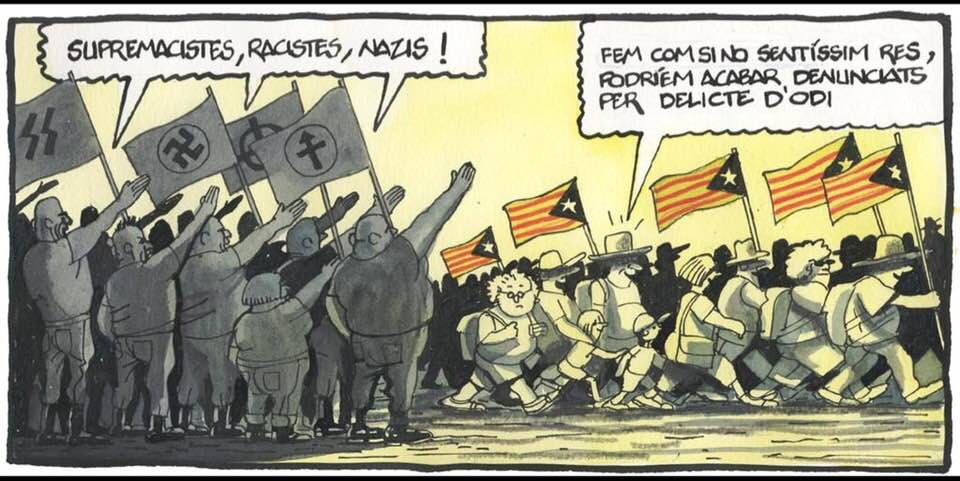
On the anniversary of Kristalnacht, the Spanish TV channel Telecinco showed a program about the Nazi attack on Jewish premises and people on 9-10 November 1938 which, because of the breaking of shop windows and looting, came to be be known by that name, which translates as Broken Glass Night. In showing the program, they inserted shots of Catalan independentist events, drawing a clear parallel between the two.
A journalist at a German television channel denounced the Spanish TV station for this and challenged them to explain their actions.
Wikipedia: Estimates of the number of fatalities caused by the pogrom have varied. Early reports estimated that 91 Jews were murdered during the attacks.Modern analysis of German scholarly sources by historians …. puts the number much higher. When deaths from post-arrest maltreatment and subsequent suicides are included, the death toll climbs into the hundreds. Additionally, 30,000 Jewish men were arrested and incarcerated in concentration camps.
Jewish homes, hospitals, and schools were ransacked, as the attackers demolished buildings with sledgehammers.The rioters destroyed 267 synagogues throughout Germany, Austria, and the Sudetenland,and over 7,000 Jewish businesses were either destroyed or damaged.
Spanish unionists have often accused the Catalan independentist movement of being Nazi or Fascist. No evidence has ever emerged of the Catalan pro-independence movement being anti-semitic or even right wing. A few years ago the Catalan Parlament, with a pro-independence majority, passed a law to give migrants equal access to health care with Catalan nationals but the Spanish High Court ruled the law illegal. The Parlament passed the law again this year. Giving migrants equal rights in health services hardly sounds typical of fascists.
But logic has nothing to do with this. Nor has history.
In accusing the Catalan movement of being fascist in nature, Spanish unionists not only exhibit their ignorance of the nature of Catalan society and the independence movement, but also their ignorance of the history of the Spanish State.
It is in fact the Spanish unionist forces which have a very close connection with fascism.
It was the military coup and fascist forces in the Spanish Civil War (or more correctly, the Anti-Fascist War) which sought the overthrow of the democratically-elected Popular Front Government and which, in order to succeed, called in the German Nazis and Italian Fascists for military assistance. Catalonia ndependentists were a major component of the anti-fascist alliance but Barcelona eventually fell to the fascist forces and a fascist dictatorship under General Franco followed. After Franco died, the right-wing forces put together a political party to participate in forthcoming ‘democratic’ elections and named it the Partido Popular.
Franco & Hitler reviewing fascist troops in the northern Basque Country during the Iberian Antifascist War (Image source: Internet)
This party gathered most of the old regime and die-hard fascists into it and is one of the two main political parties of the Spanish state. From December 2011 until it was unseated recently in a no-confidence vote due to corruption scandals, the PP was in Government of the Spanish state. It was that Government that sent Spanish police searching for referendum ballot boxes in September last year and on 1st August 2017 to attack voters with truncheons, boots, fists and rubber bullets. It was the PP Government which charged and jailed without bail Catalan independence activists and began proceedings against hundreds of others including a great many Catalan town mayors, which the current PSOE Government is processing.
The PP has been nearly eliminated electorally in Catalonia but another political party with similar ideology is strong there, also Spanish unionist, criticising the Catalan independence movement at every opportunity and supporting Spanish repression of the movement.
There are also actual openly-fascist organisations in the Spanish state which have representation inside the police and military and which regularly flaunt their banned fascist emblems, salutes and slogans with impunity. As well as being anti-semitic and otherwise racist, Spanish state unity is a central them with these too.
(Source of image: Internet)
All of these elements – along with many Spanish unionists of other political types, such as many in the PSOE – have denied the democratic right to self-determination of the Catalan people and supported fascist-type attacks on their activists and movement.
In summary then, although of course one may – as anywhere else – find some anti-semites and nazi types in Catalan society, even in the independence movement, the greatest number and natural home of this type is to be found in the Spanish unionist movement and its various political parties – the very ones who are accusing the Catalans of being fascists.
But drawing parallels, no matter how irrational, between the Nazi Kristalnacht and the democratic Catalan independence movement is a new low, even for them.
Quite a few pro-Catalan independence people have expressed horror and indignation at the statements of Spanish politician José Manuel García-Margallo in an interview recently. They should instead that be grateful that he spoke much of the truth and dispelled unrealistic illusions about the way forward for Catalonia.
Ex-Foreign Minister of the Spanish State José Garcia-Margallo, photographed recently. (Photo source: VilaWeb)
Did he threaten the independence movement with violence? Yes and not too subtly. That was no doubt his purpose as well as perhaps reassuring Spanish unionists, whether fascist or otherwise. But nevertheless, he spoke an important truth.
Spanish ex-Foreign Minister José Manuel García-Margallo said that Spain would not withdraw ‘peacefully’ from the Principality. ‘It will not deliver the keys to the dependencies and furl up the flag’, he told ‘El morn de Catalunya Ràdio’. He expressed support for the accusations of ‘rebellion’ against the Government of Puigdemont, President Forcadell, Jordi Cuixart, Jordi Sànchez and the General Secretary of ERC, Marta Rovira. According to him, the unilateral way to achieve independence ‘necessarily’ implies violence.
Margallo was raised in a family with close military relatives, two of which died in the anti-colonial Rif uprising, one of whom was a colonial Governor of a town there. The ex-Minister of Foreign Affairs was educated (and presumably brought up in) a part of the occupied Basque Country which must have helped condition him and his early adult life was spent under the Franco dictatorship. His early political career was there too and took shape during the ‘Transition‘ and since.
Translation of the transcript of the excerpt below:
“-Mónica Terribas: Crime of ‘rebellion’, does it exist there are or not, José Manuel? (DB: one of the charges against the Catalan activists but which requires the use of violence).
“-García-Margallo: I think there is a crime of rebellion. I share the theses of Llarena, that is, I believe that what we saw on the streets during the course of the (events outside the) Ministry of Economy was violent. I think that, by definition, unilateral secession can only be achieved by violence. That is, I say that hypothetically this leads to violence. Because? We have discussed it many times and we all agree: the Constitution does not allow secession. Therefore there will be no referendum agreed. Secondly, the Spanish state will not withdraw peacefully, that is, it will not deliver the keys to the dependencies and furl up the flag. So how is the Catalan Republic proclaimed? If it cannot be by agreement and it can not be by unilateral abandonment, then it will have to be by violence. And that necessarily leads to rebellion.”
Margallo’s political party, the Partido Popular is of course a coalition of a number of Franco-fascist organisations, put together to operate in the ‘new’ Spanish state. But the greater truth about the Spanish ruling class is more important than all this.
The Dictatorship ruled as the only face available of the Spanish ruling class – representing “old money”, from the expropriation of the labour power of workers and the plunder of its colonies but also “new money”, appropriated from the losers in the Spanish Anti-Fascist War.
In the 1960s and 1970s the Spanish State began to receive substantial US and other investment, particularly in military form. But the concern of investors was that with the rise of national liberation movements and the upsurge of the youth and student movement around the world, that an unyielding dictatorship would lead to revolution, so pressure began to be applied, although it was understood that attempts at reform after so much repression could also precipitate a revolution. Given the prevailing circumstances within the Spanish state, such a revolution could only be a socialist one.
When General Franco died in November 1975 two years and one month after his chosen successor Admiral Carerro Blanco had been assassinated, the reformers got room to move (internally Opus Dei and externally the US and others, especially the EU or Common Market as it was then). Reform and normalisation of control meant bringing on board of the ship of State two significant political forces with their corresponding large trade unions, illegal until then: the social-democratic PSOE with their UGT trade union and the Marxist CPE with their more militant Comisiones Obreras union. And imposing a Monarchy.
Both those illegal opposition forces agreed, accepted the monarchy and were legalised; then controlled and even sacrificed their own members. They pushed for agreement of the monarchist and unionist Constitution of 1978, in which the majority of a dazed and hopeful population of the state (but not in the Basque Country) voted in favour of it (and which is now being used to illegalise Catalan bids for independence).
Subsequently the PSOE gained an electoral majority and while in government in the 1980s ran assassination squads against the Basques (chiefly GAL and BVE groups, although foreign fascist gunmen were also brought in for individual jobs).
Under alternating governments of the PSOE and of the PP, the State forcesregularly used repression, particularly in the Basque Country, including torture of detainees and jailing people on the basis of ‘confessions’ tortured from them and which they repudiated in court. And they dispersed political prisoners throughout the jails of the State, hundreds or thousands of kilometres from their families.
This Spanish State is one that had at one time ruled much of the world and never ceded territory without a fight — with the English, the French, the Dutch, the North Americans; with native resistance and liberation movements from the Canaries to the Caribbean, to America, the Philippines and Africa. As a monarchy and feudal system, it overthrew the Arab colony of generations and expelled Arabs and Jews, brought in the terror of the Inquisition (the worst of all the states that had it), suppressed the rising of the Comuneros and resistance of the Basque and Catalan nations. As a semi-feudal capitalist monarchy, it overthrew a Republic and then raised a military coup with foreign fascist aid to overthrow another.
So this José Manuel García-Margallo is being on the whole brutally honest here and shattering the illusions many people had, especially those of a liberal or social-democratic turn of mind, that somehow Catalonia would win genuine independence without having to fight a Spanish military repression. But they should look on his utterances as doing them a favour, forcing them to look at reality.
In fact, for all that I have recounted about the particular nature of the Spanish State and its history, the more general historic truth is also that NO capitalist state (not to mention an imperialist one) is going to stand by and see itself being dismembered and losing huge chunks of what it considers its territory and economy.
Nations that won true independence had to fight for it. In the last century alone, how did Algiers win independence from the French? How did Kenya in Africa and Aden in the Middle East expel the British occupation forces? How did the Vietnamese expel the French occupation forces and defeat the US aggressors? How were the Nazi and Italian fascist and Japanese invaders of so many countries defeated?
People who hear the truth, no matter how bitter it tastes, should spend no time in bewailing it but instead concentrate on preparation.
Book-cases line the walls, filling up with biographies, histories, political and social theory from anarchist, marxist, feminist and Basque independentist perspective – and some classical literature. On the low central table are children’s illustrated stories and puzzles. One can see samples in the window too.
Maribel and Diarmuid outside the shop while it was being prepared for opening.
An alternative Left bookshop has opened in the iconic town of Gernika (Guernica in Spanish and in the title of Picasso’s famous painting of the town’s
Maribel and Inigo outside the shop while it was being prepared for opening.
bombing and strafing by the Luftwaffe and Italian air force in 1937). Going by the title of Inuri Gorria (“Red Ant”), the bookshop is a medium-sized (as these things go) one-level shop situated on one of the town’s main streets, with passing one-way traffic of private and public transport. Virtually next door is one of those open-front fruit shops and further down the same street, past bars and other businesses, is the nearby Herriko Taberna (literally “Peoples’ Tavern”. That is one of the many such social centre-taverns run by the official Basque pro-independence Left1 but of which many were ordered closed by the Spanish state in recent years on unsubstantiated accusations that they were linked to the armed organisation ETA, which is now dissolved). Once the people running the ‘Herriko’ and the trend represented by the new bookshop were strongly united but no longer, due to the change in direction adopted by the leadership of the Abertzale (pro-national ndependence) Left in recent years. Of course both trends will still attend at some events, particularly demonstrations about Basque political prisoners.
The Inuri Gorria bookshop opened officially on 12th October, which is a bank holiday in the whole Spanish state; called el Dia de la Hispanidad, it celebrates the spreading of the Castillian language as a result of the conquest of much of the Americas by the Spanish Kingdom in the 15th and 16th Centuries. Not surprisingly, it is also the official day for celebrating the armed forces of the State. Also unsurprisingly, the celebrations are opposed by anti-imperialists throughout the territory of the Spanish state and in particular perhaps by those nations still seeking independence. 2 No doubt many in the Gernika area were glad to have something progressive to celebrate on that date, which they did by gathering at the opening to view the books and eat some pintxos, later repairing to a local bar which displays photos of political prisoners from the local area (as does the Herriko). On this occasion some who would still count themselves members of the “oficialistas”, though likely from an internal critical position, attended also. There was also a Basque traditional festival in the town with many dressing in traditional clothing and taking part in cultural activities.
Closeup of evening of day of traditional Basque festival in Gernika. (Photo: D.Breatnach)Evening of day of traditional Basque festival in Gernika. The banner may have been attached by the ‘official’ independence movement leadership. (Photo: D.Breatnach)
“The material I have here is of an alternative Left and feminist political kind”, said the owner, Maribel Egizabal, when I dropped in again some days later. “I have children’s books and games, of an educational kind about values, sections on feminism and about women, alternative philosophy, social movements, ethnic minorities and racism, city life, ecology, the history and culture of the Basque Country.”
One of the books she stocks is a local history of the nearby Busturia area dealing with the effects of the Anti-Fascist War (1936-1939), a substantial piece of work which she herself had a major part in researching and writing3, produced by one of the groups in which she is active, Laia, a local history group. The history of that period and of the executions and repression that followed the victory of the fascist troops is very much a sharp issue today and not only in the Basque Country but throughout the Spanish state.
Monument in Gernika to George Steer, English journalist and author who broke the Gernika bombing story for the London Times (and put the blame where it was earned). (Photo: D.Breatnach)
The material in Inuri Gorria is mostly in the Euskera and Castillian (Spanish) languages but there are also some 2nd-hand books in French and English and Maribel hopes to add additional material in those languages. “With regard to political philosophy, I stock material in anarchist, marxist, feminist and independentist traditions. I don’t want to just sell books”, she told me “but to also provide a meeting-space for discussion and learning by social and political movements of the people.”
Maribel is a straight-talking woman with a long history in the feminist, Basque independentist and socialist movements, in different organisations, including the Basque internationalist solidarity organisation of Askapena, also Askagintza, an organisation working with people with drug addiction issues as well as the local history group alluded to above. “Inuri Gorria will be interested in material dealing with struggles around the world as well as in the Basque Country,” she tells me, “including of course struggles of other nations within this state such as Catalunya and of movements and organisations within the Spanish Left.”
The shop being prepared on the day I first called. (Photo: D.Breatnach)
When I dropped by a third time, the day before my return to Dublin, Maribel was buoyant at the interest in the shop and its material being shown, especially by younger people.
“They are particularly interested in political theory,” she told me enthusiastically. It has long been remarked that the Abertzale Left movement was lacking in political education of its youthful following. No doubt the repression and banning of a succession of the movement’s youth organisations played a part in this but that does not explain the lack of educational materials, study and discussion groups, lecture series etc.4
View of front window display after shop up and running. (Photo: D.Breatnach)
Gernika is worth a visit on its own and is connected by public train and bus services to Bilbao (also a longer-distance bus service to Bilbao and other areas). The town centre is attractive and hosts the Peace Museum (low charge and well-worth a visit) documenting life before the Anti-Fascist War, during it, including the town’s infamous bombing (which the Fascists tried to blame on the ‘Reds’5) and the ensuing occupation by fascist Spanish, colonial Moroccan and Italian fascist troops. Higher up, the ‘Gernika Tree’ and some of its offspring stand near the Gernika Assemby House (Gernikako Gazteen Etxebizitza/ Casa de Juntas de Gernika), built in 1826 to succeed several other buildings nearby. It was there the lords of Bizkaia (whose original member, according to Basque legend, was a Gael) from medieval times assembled to discuss issues and that the monarchs of the Spanish Kingdom affirmed the Basque rights or Fueros until abrogated in 1876. Entry is free and guided tours are offered by arrangement (but as generally the case with many buildings in the southern Basque Country, it will close between 2pm and 4pm.)
The Inurri Gorria bookshop will normally open 10am-12noon and 4.30-8pm on weekdays and 10-12noon on Saturdays, remaining closed on Sundays but of course may be in use on other occasions by some of the organisations and movements Maribel alluded to.
1Their currrent political parties are Sortu (and the pro-independence social-democratic coalition EH Bildu).
2Ironically, migrants of Latin American origin may be seen celebrating the day also: it is the one day in Spanish calendar that they may feel specifically includes them.
3Busturia 1937-1977 – represión y resistencia de un pueblo (‘repression and resistance of a people’), Maribel Egizabal & Unai Serrano, Busturia (2018), IBSN 978-84-697-8677-2.
4The Abertzale Left is not the only movement one can accuse of such neglect of the political education of youth, one finds the same generally in the Irish Republican movement (both in the Provisionals and in the various splits since).
5Calling all the opponents of the military coup “Rojos” (‘Reds’) was a propaganda policy of the coupist military leaders and fascists (and copied elsewhere, as sometimes in The irish Independent); in fact their opposing broad movement included democratic anti-fascists and constitutionalists, trade unionists, Basque and Catalan nationalists and Republicans as well as Communists and Anarchists. It seems clear that without the intervention of Nazi Germany and Fascist Italy, aided by the “Non-Interventionist” policy of France and the UK, the popular forces would have defeated the military and fascist insurrection.
From Eoin O’Donnel’s filming and editing via Joe Mooney of East Wall History Group, a recording of Diarmuid Breatnach singing Christy Moore’s wonderful song Viva La Quinze Brigada (also known as Viva la Quinta Brigada which, however, is also the title of another song from the same conflict but in Castillian or Spanish language). The Fifteenth Brigade of the Spanish Republican Army was also the Fifth International Brigade, the mostly English-speaking one. It contained volunteers from English-speaking USA, Canada, Australia, Scotland, Wales, England and ireland but due to high Irish emigration, all those countries also contained Irish diaspora and they were to be found in the contingents from those countries.
The video also contains photos of the commemoration of Jack Nalty, resident of East Wall’s, the last Irishman to die in action during the Iberian Anti-Fascist War (usually known as the “Spanish Civil War”). The day-long event on 28th September (anniversary of his death) included songs and poems, a march led by a lone piper, unveiling of a plaque, booklet launch and showing of two films. It was a celebration in particular of Jack Nalty’s life but more generally of the Irish who, against the position of their Government, the Church of the majority, the dominant media and even, for those in the IRA, against their own organisation’s orders, went to fight against a fascist military uprising against the elected Republican Government of the Spanish state.
It was also a celebration of antifascist resistance around the world and of the principle and practice of internationalist solidarity.
A plaque to the fallen of the Irish volunteers of the International Brigade (containing many names but by no means all of the Irish who fell there). The plaque is on the wall of the Theatre side of Liberty Hall, HQ of SIPTU, Dublin. (Photo D.Breatnach).
On the 80th Anniversary of his death in the Anti-Fascist War in ‘Spain’, the East Wall History Group organised a remembrance of a local man from that dockland Irish area who was the last Irishman to die fighting in the war against Franco and Spanish Fascism. The event was attended by relatives of that Irish antifascist fighter and of another, by a cross-section of Left and Irish Republicans, including historians and by a number of elected representatives from the Dublin City Council and the Dáil (Irish Parliament).
Crowd assembling outside school before event. (Photo: D.Breatnach)
Jack Naltywas the last Irish and one of the last International Brigaders to fight and die in that war. The rest of the Brigaders, those not held as prisoners by Franco’s forces, were withdrawn soon afterwards as the indigenous anti-fascist forces fought on, losing against the Spanish military coupists with their German Nazi and Italian fascist allies.
Those commemorating Jack Nalty met at the St. Joseph’s Co-Educational School on the East Wall Road at 1pm on Sunday (23rd September) and included a cross-section of members of organisations and independent activists, socialists, republicans, communists and anarchists and other members of the local community. At the front entrance of the School a number of relatives of Jack Nalty held a banner along with a son of an Irish International Brigader and the crowd was addressed by Joe Mooney, of the East Wall History Group.
Joe Mooney speaking at start of event, relatives of International Brigaders beside him holding the banner in the colours of the Spanish Republic (Photo: D.Breatnach)
Mooney told the crowd that John Nalty came to the area at the age of six from Galway and on 31st August 1908 entered the East Wall National School on the Wharf Road. Just over thirty years later, 23rd September 1938, he would die on a Spanish battlefield, shot down in a hail of fascist bullets as he engaged in one last heroic act.
“A member of the IRA during the War of Independence, Jack was a Republican, Socialist and trade unionist”, Mooney said, “representing 600 oil workers in Dublin Port. But in 1936 when the Spanish Civil War — or Anti-Fascist War as it should more accurately be called1 – began, he volunteered for the International Brigades to join the fight against European fascism. He was badly wounded and came back to Ireland, but would again go into action and was killed at the Battle of the Ebro. Having being among the first Irish volunteers to travel to Spain, he would die on their last day as they were preparing to withdraw from combat.
Nalty’s unit had been called to retreat when it was realisted that two machine-gunners had been left behind and he went back to collect them. On their retreat they were fired at and Jack Nalty was killed.
Section of crowd lined up in front of house where Jack Nalty had lived (Photo: D.Breatnach)
Mooney also asked those present to remember not only Jack Nalty but the ‘comradeship of heroes’ from Dublin’s Docklands and North Inner City – Dinny Coady, Tommy Wood and others.
The crowd then set off in a march led by a piper to East Road to unveil a memorial plaque. Across the road from Jack Nalty’s former house, the crowd paused to hear Diarmuid Breatnach sing a few verses of Christy Moore’s tribute to the Irish “Brigadistas”: “Viva La Quinze Brigada”.2
UNVEILING THE PLAQUE
Joe Mooney unveiling the plaque not far from Jack Nalty’s former house (Photo: D.Breatnach)The plaque (text difficult to read in photograph) (Photo: D.Breatnach)
The plaque could not be attached to Jack Nalty’s house and was affixed a little further down the road. Joe Mooney siad a few words there and introduced James Nugent who gave a speech he had prepared and the plaque was unveiled. Nugent concluded by saying that “the history of the past helps us to understand the present and to create the future.”
Kate Nugent read a message from the daughters of Steve Nugent (sadly died 2017) who researched the story of his uncle Jack and Mary Murphy read a short post from Vicky Booth (granddaughter of Syd Booth, who was with Jack when he died).
(Photo: D.Breatnach)Piper plays lament by plaque (Photo: D.Breatnach)
Harry Owens gave a short tribute speech on behalf of Friends of the International Brigades and Manus O’Riordan, son of Irish communist and International Brigade Volunteer, sang the chorus ofAmhrán na bhFiann (“The Soldiers’ Song”, Irish national anthem) and the Internationale.
Section of crowd a location of the plaque (Photo: D.Breatnach)At the unveiling ceremony (Photo: D.Breatnach)Also at the unveiling ceremony (Photo: D.Breatnach)
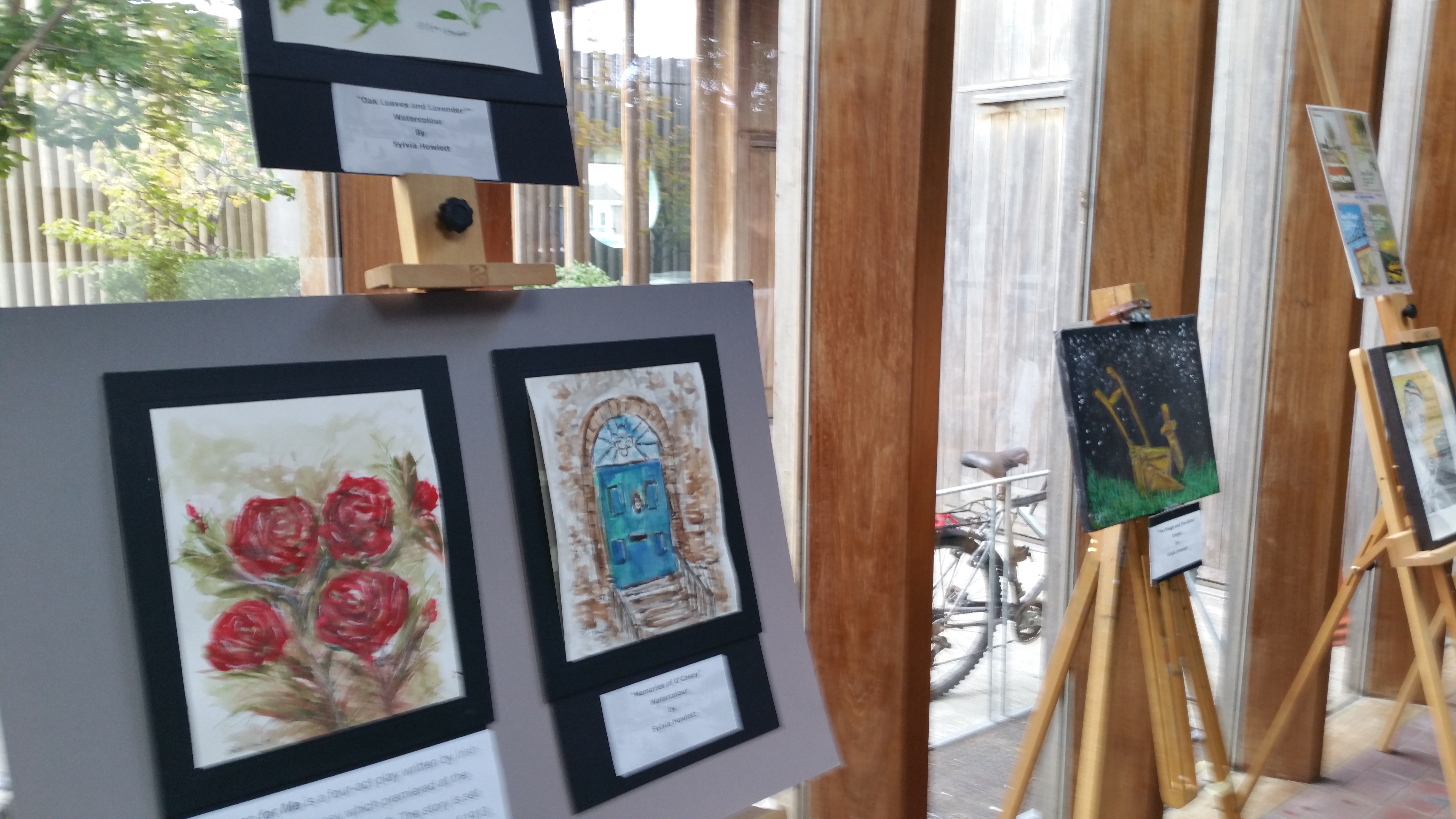
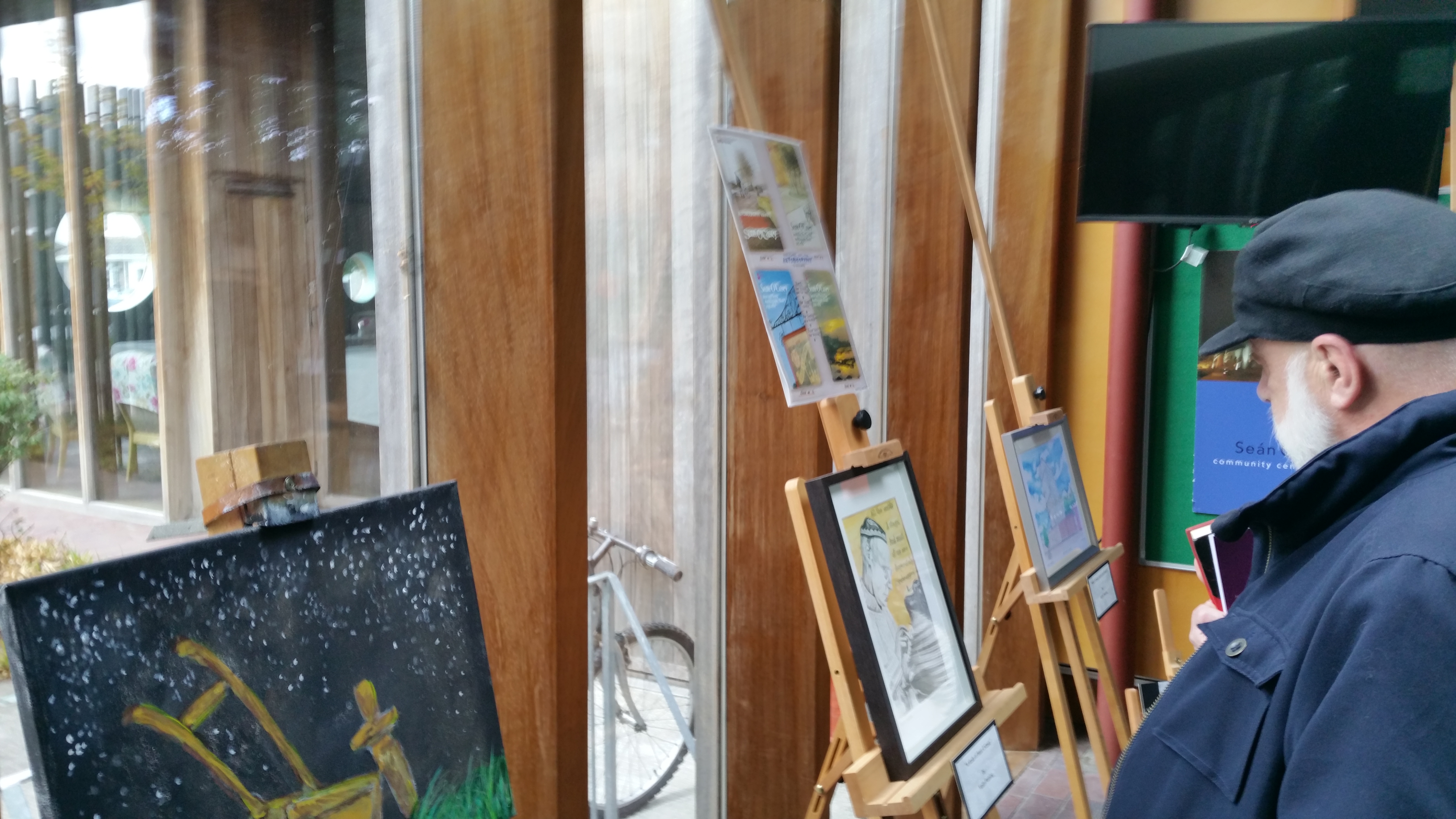
Joe Mooney acknowledged the presence of elected representatives Mary Lou McDonald, Sean Crowe and Cieran Perry and asked people to march to the nearby Sean O’Casey Centre to see the art exhibition and see two short films.
Marching from the plaque site, heading for the SO’C Centre (Photo: D.Breatnach)(Photo: D.Breatnach)Section of the attendance relaxing at the Sean O’Casey Centre between the plaque event and the films to be shown, also examining the art exhibition [see photos at end of post]
Back at the Sean O’Casey Community Centre, two short films were shown. One was a school project film in which a descendant of Jack Nalty interviews the latter’s nephew about his famous uncle. The second was dramatic film in which a Spanish trumpet player joins the fight against the fascist military uprising by Franco and other generals and features also actors playing two Irish International Brigaders, O’Connor and Charlie Donnelly3. When the former trumpet player is shot he sees into the future ….
Eddie O’Neill talked about the pulling out of the International Brigades in October 1938 in a bid to have the “non-interventionist” Western democracies put pressure on Nazi Germany and Fascist Italy to have them withdraw too, which did not happen. They marched through Barcelona on 17th October and were addressed in an emotional rally by La Pasionara4 and Eddie asked Nerea Fernández Cordero to read an English translation.
Nerea on stage just after reading translation of La Pasionara’s farewell to the Brigaders (Photo: D.Breatnach)Eddie O’Neill at the SO’C Centre with concluding speech: “We can’t afford to forget.” (Photo: D.Breatnach)
Nerea told the audience that she is from Extremadura (a province of the Spanish state next to the Border with Portugal) and her grandfather, Antonio Fernández had fought against Franco, been captured, escaped to the mountains but was in time recaptured. Upon his release he had married Nerea’s grandmother and lived a peaceful life. Nerea said that she was proud of her grandfather and those who fought Franco and that “ we know La Pasionara’s speech in Spanish by memory.”
Reading of translation of La Pasionara’s speech to English from Youtube:
At the event the newly published pamphlet “In Pursuit of an Ideal – from East Wall to the Ebro” about Jack Nalty wasmade available for the first time and copies are available from the organisers.
Eddie O’Neill recalled being in the Spanish state with a group from Friends of the International Brigades to commemorate those who fought against Franco during that war and afterwards searching for an appropriate pub in which to socialise. They found a pub with a Guinness sign and went there which however turned out to be one of the most fascist pubs in the area but undeterred, they continued to celebrate the memory of the antifascist fighters there. A lone man in suit and tie asked people as they passed him to use the toilet why they were commemorating people who had died so long ago but when they explained he said he could not understand English.
“We can’t afford to forget,” O’Neill told his audience, “least of all when the forces of fascism are gathering again.”
To conclude the event O’Neill called on Diarmuid Breatnach who sang the whole of Christy Moore’s “Viva La Quinze Brigada”, calling on the audience to join him in the chorus, remembering those who fought and gave their lives in the struggle against fascism.
Eddie O’Neill close at right of photo at unveiling ceremony (Photo: D.Breatnach)
AN ANNUAL EVENT?
The organisers are reputedly considering making this an annual event – it is to be hoped that they do so.
Another section of the crowd at the plaque unveiling. (Photo: D.Breatnach)Also at the plaque unveiling ceremony (Photo: D.Breatnach)
POSTCRIPT: JACK NALTY – ATHLETE COMPETING FOR IRELAND
In publicity prior to the event, the East Wall History group posted the following:
“In addition to his political and trade union activity, Jack Nalty was also a busy athlete, a regular competitor and medal winner with the Dublin Harriers. In 1931 he represented his country at the International Cross Country Championship, held at Baldoyle. Fellow competitor Tim Smyth became the first Irishman to win this competition.
“(The full Irish Group for the event held on 22nd March 1931 is listed as: Frank Mills, J. Behan, John Nalty, J.C. McIntyre, John Timmins, T. King, T. O’Reilly, Thomas Kinsella, Tim Smythe).
“This British Pathe footage shows the runners in action. Somewhere in the group is John (Jack) Nalty, East Wall resident, Republican and hero of the International Brigades. (The Pathe footage is viewable on post on the East Wall History Group event — CS)
“Ironically, the same year as the competition the future leader of Irish Fascism, General Eoin O’Duffy had become the President of the National Athletic and Cycling Association (NACA) , and apparently was an admirer of Jack Nalty as an athlete!”
(Photo: D.Breatnach)
FOOTNOTES
1Basques in the provinces of Bizkaia, Guipuzkoa and Alava say it was not a civil war there, i.e between different sections of Basque society — the fascist forces came from outside. In the fourth southern Basque province of Nafarroa, where the Carlists took control, they wiped out around 2,000 antifascists but it was hardly a war. The Catalans also say that the fascist forces invaded them and that it was not a civil war but an antifascist one. In some other places in the Spanish state many also say that the presence of Nazi German and Fascist Italian military in such numbers invalidated the term “civil war”.
2Also known as “Viva La Quinta Brigada”, which is however also the title of a different song from the Anti-Fascist War. Both titles are correct for this song since the Irish were in the Fifth of the International Brigades but when added to the ten indigenous Brigades (Spanish, Basque, Catalan etc), that became the Fifteenth. Wikipedia quotes authors to report an estimate that “during the entire war, between 32,000 and 35,000 members served in the International Brigades, including 15,000 who died in combat; however, there were never more than 20,000 brigade members present on the front line at one time.”
3Charlie Donnelly was a poet and member of the Republican Congress. He went to Spain to fight against Franco, where he died in February of 1937 at the Battle of Jarama. He is also one of those 19 names mentioned in Christy Moore’s song (“Viva La Quinta Brigada” or “Viva La Quinze Brigada”).
4Isidora Dolores Ibárruri Gómez(9 December 1895 – 12 November 1989), born and brought up in the Basque Country to a Basque mother and Spanish father, founder-member of the Spanish Communist Party and known for her political writing and speeches. She wrote an article when quite young under the pen-name “La Pasionara” (the Passion Flower) and was known by that nickname throughout her life.
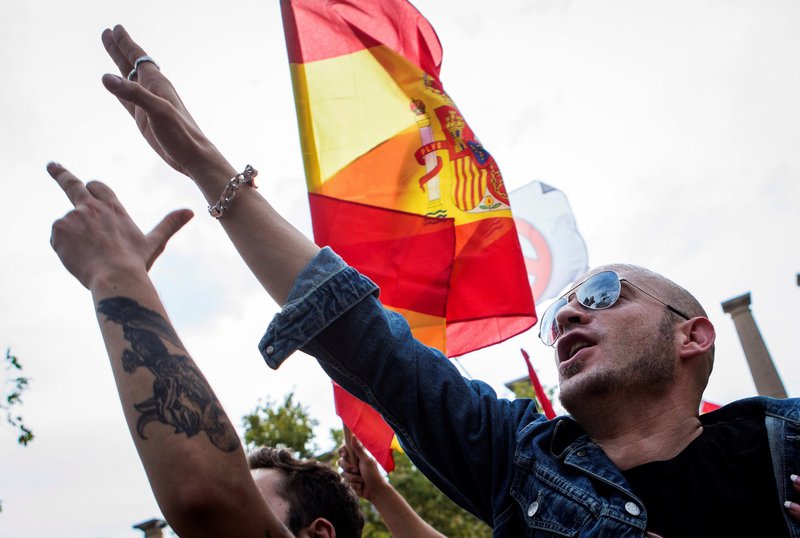
Death threat, fascist salute and Franco’s version of the Spanish flag, all illegal and displayed with impunity at this demonstration against Catalan independence and many other fascist events. (Photo credit: EFE/ Enric Fontcuberta 4651#Agencia EFE)
Some 2,000 people (according to the Urban Police) demonstrated this Sunday in Barcelona to reject any negotiation with Catalan sovereignty and in support of the unity of Spain.
(Translation from Catalan newspaper report — see link below end translation — by D.Breatnach)
The protest, called by real estate entrepreneur and former Guardia Civil (spanish state police — Trans) member Juan Manuel Opazo with the support of the ultra-royalist party Vox, crossed the Avenida del Paralelo under the slogan “No [pacts] with either terrorists or separatists.” Sixty associations and movements such as the Catalan Civic Convivencia, the Catalan Association of Victims of Terrorism, Catalonian Employers or Somatemps supported the event.
At the top of Avenida Mistral the demonstration came in sight of an anti-fascist protest called by anti-fascist movements and booing booing was exchanged from both sides. The Mossos (Catalan Police) kept both groups apart.
The march ended on Avenida María Cristina, where the Parliament is situated. Many of there asked the Spanish Prime Minister, Pedro Sánchez, to not negotiate “with separatists” and to convene elections.
Coaches from 30 cities throughout Spain, such as Alicante, Malaga, Bilbao or Valladolid, among others, brought supporters to the protest.
Photo: Unionist march supporters give the fascist salute and threaten shooting at the anti-fascists and carry Spanish fascist symbols.
COMMENT (D. Breatnach):
The comparatively small size of the march and the fact that it was only possible by bussing in supporters from other parts of the state may be taken as an indication of how small the support base is for this far-right variety of Spanish unionism.
The monster march for independence Diada (Catalan National Day) on Tuesday will provide a useful comparison: one million marchers are expected.
The list of organisations supporting the march gives the lie to their frequent representations as “concerned citizens” who are “opposed to terrorism” etc, particularly the Catalan chapter of the “Association of Victims of Terrorism”, an organisation which for yearshas been hounding Basque independentist organisations with the assistance of the Spanish courts. To outsiders it might seem like a legitimate organisation held together in solidarity against terrorism but it is well known to be an extremely right-wing organisation, composed of ex-military and Spanish police (and no doubt serving members too) and their relatives. Some of them were indeed victims of armed Basque actions but it has to be acknowledged that was in a war which the Spanish state first launched against the Basques themselves, not only during Franco’s time but for decades afterwards too.
The impunity of fascists breaking the laws against fascist symbols, gestures, slogans and against threats, which has often been remarked upon throughout the Spanish state, was once again demonstrated. On the other hand even rap words, a poster, video or a verbal argument with police officers coming from a left-wing or independentist perspective can and have resulted in prison sentences.
Spanish unionism has a number of types and the one displayed in the reported march is the most extreme – the type that led to the creation of the fascist Falange, a military uprising, massacres of surrendered prisoners and civilians, rapes and other tortures and Franco’s dictatorship. But this could not exist on its own. With the collusion of the leaderships of the social-democratic PSOE and the Communist Party of Spain – and their respective trade unions – after the death of Franco, torture and all kinds of undemocratic laws and court rulings continued with the addition of death squads to force a rejected monarchy on the people and the obligatory unity of the state in the Constitution now in force. All of this together is what now confronts the Catalan independentist movement. But it also confronts any Spanish democrat and should call them to mobilise against Spanish unionism which is inextricably bound up with fascist ideology.
Elise Hendrick is originally from the USA and a much-travelled activist, commentator and speaker of a number of languages. Rebel Breeze interviewed her to ascertain her reflections on recent nazi upsurges and the response to them, in particular on the North American continent.
Torch-bearing Nazis in “Unite the Right” rally, Charlottesville, just before they attacked the anti-fascist counter-demonstrators (Photo source: Internet)
Rebel Breeze: Elise, go raibh maith agat for agreeing to this interview. With regard to recent events, you will recall that after nazis planned a rally in Charlottesville, ostensibly against “Islamicisation” and events ended in the deaths of two anti-fascists, a number of comments emerged in social media and from some politicians, criticising the anti-fascists for staging a counter-rally. Firstly, do you think these comments had any validity?
Elise Hendrick: In a word, no. It’s really hard to express in words the level of dismissal that that ‘criticism’ merits, because a verbal response already honours it too much. A look at the people making those ‘criticisms’ tends to show that they’re actually coming from political allies of those the antifascists were protesting.
RB: Can you give some examples of what you mean by this?
EH: One example is a video blogger by the name of Tim Pool, who tries to maintain an air of journalistic detachment in his condemnations of Antifa tactics, but who has turned out to be on very good terms with neo-Nazis, including those who organised the pogrom in Charlottesville (discussed various times on the anarchist/antifascist website It’s Going Down).
USA Antifascists masked to prevent identification by fascists or police. (Photo source: Internet).
One really amusing case I happened across was a thread about Antifa on US left author Paul Street’s Facebook page, in which various people showed up to make utterly outlandish claims about who antifascists are and what they stand for. I hadn’t seen any of these names before, so I decided to check out their Facebook pages to see who I was dealing with. It turned out that one of them had at the top of his Facebook page a post praising his friend Garret Kirkland, who was the organiser of the shambolic white supremacist rally in Boston.
Even when a lot of these media ‘critics’ aren’t actually tied to fascist groups themselves, they often make arguments that either trivialise or justify fascist violence or seek to create a moral equivalency between fascists and those defending their communities from fascists. One of the most notorious (and irritating) examples of this is Lee Fang of The Intercept, who, despite claiming to be an ‘investigative journalist’, has shown no interest in fact-checking rumours spread by neo-Nazis as well as a remarkable lack of curiosity about who militant antifascists are, what they actually stand for, and what they have to say about the accusations against them. He outright refuses to acknowledge the reality of violence by fascist groups, and constantly seeks to reduce the political conflict between fascists and those opposing them to a bunch of equally reprehensible people who just like punching each other.
Fang and others like him would certainly recoil at being called fascist sympathisers, but their dishonest and ill-considered arguments do fascists a great favour.
RB: Given that you think people should indeed present themselves to oppose public events organised by fascists, what are your thoughts on the debate about whether the anti-fascist opposition should use physical force or instead should be peaceful?
EH: What I find interesting is that there are basically two separate discussions going on. On the one hand, there is a surprisingly well-thought-out and sophisticated discussion about the role of physical force alongside other means of resistance to fascist mobilisations, how best to go about it, how it should be organised, and how best to coordinate it with other forms of action. I’ve been struck, as someone who has long been extremely critical of the lack of a real tactical/strategic discourse on the left both in the US and in Britain at just how self-reflective and serious these discussions have been.
White supremacists, armed, in Charlottesville (Photo source: Internet).
This debate gives me hope, because it’s people actually doing what we should have been doing all along: Working out what our objectives are, working out broadly what’s likely to help us get there, and then figuring out the details and reporting back on practical experience with implementing that strategy. On the other hand, you have people who will gatecrash these discussions to tell you there needs to be a debate on tactics. They never actually let us in on what they would like to contribute to this debate, except for a belief that everything would be better if the central committee of whatever newspaper cult (whether it’s the ISO or the SWP in the UK) they’re in were in total control of the resistance.
In that sense, you could say that what we have is a combination of a vibrant debate and a rapidly developing political consciousness combined with a power struggle being conducted by representatives of groups that have managed to keep a lid on left organising despite token numbers and few actual ideas. I can only hope the rank and file of these groups are beginning to realise that their ‘revolutionary vanguards’ are treading water here and haven’t got a clue what to do in this sort of situation. The difference between those ‘vanguards’ and the rest of us is that the rest of us are at least willing to admit that we’re just getting acclimatised. Self-appointed vanguards feel a need to pretend they know everything already, even when no one believes it.
Members of Redneck Revolt — a left-wing paramlilitary group that sometimes escorts antifascists and anti-racists (Photo source: Internet).
As for my own thoughts about the approach to take, I think we’ve seen enough at this point, both in the current struggle within the US and going back over the entire history of fascism wherever it’s shown itself, to know that no antifascist strategy is complete without actually being willing to engage the fash in combat. Fascists are experts at using liberal tolerance against liberalism, and any space they’re not kicked out of is one where they will build strength until no one is able to occupy that space without their blessing.
We also can’t rely on the state, because the cops tend to sympathise more with fascists than with the left and those the fascists target. In the current situation in the US, the level of sympathy is particularly striking: the various police ‘unions’ overwhelmingly supported the campaign of Donald Trump and all it stands for. What’s more, the FBI’s counterintelligence section has issued an advisory (declassified with significant redactions) against FBI agents sharing any intelligence of any kind on the far right with local police departments because of the degree of far-right infiltration of the police. The advisory offered little in the way of detail, but FBI counterintelligence won’t be issuing that sort of blanket advisory unless the infiltration they’d uncovered was pervasive.
So what we’re facing is an armed, paramilitary movement of genocidal racists who have determined that it’s now or never. They’re never just protesting, no matter what their lawyers will tell the court. In their own internal discussion, they describe the current situation as a ‘war’, and not a metaphorical one. When people like that assemble in your town with their guns and truncheons and the blessing of the police, you don’t invite them to chat over tea and cakes. You make sure they have a long convalescence in which to regret their choice of venue.
RB: Not all our readers may know about the presence of armed fascists in Charlottesburg. Can you say a little about this and also about whether it could have been expected?
EH: It not only could have been expected, it was in fact expected by those who showed up to oppose them. White supremacists have been showing up armed to their own and other people’s protests for a few years now. The far-right ‘Oathkeeper’ paramilitary, one of the more professional white supremacist paramilitary forces in the US today, made a point of brandishing semiautomatic rifles at Black Lives Matter protests against racist killings by police. Since the current cycle of far-right mobilisations began, they and other paramilitaries routinely show up, heavily armed and in paramilitary uniforms, to provide security and intimidate the opposition. In the various fascist attempts to establish a presence in Berkeley, they’ve shown up with guns, knives, clubs, and other weapons. They also repeatedly attacked antifascists by driving cars directly at them. It bears noting that Charlottesville was not the first car attack by fascists in the US; it was the first successful car attack.
So some, if not all, of those who showed up to oppose the fascists in Charlottesville will have been expecting to face an armed racist mob. The level of violence displayed by the fascists, however, does seem to be significantly higher than in previous mobilisations of the past year. Where in other places, the violence has tended to be limited to a few punch-ups, the ‘Unite the Right’ mob in Charlottesville attempted to carry out a full-scale pogrom, brutally beating anyone in their path, especially people of colour. In addition to Heather Heyer, who was killed when a fascist drove his car into the counter-demo, Tyler Magill, a University of Virginia librarian and anti-racist organiser, was beaten so badly about the head and neck with a tiki torch that he spent several days in intensive care before dying of a stroke. This is why I’ve insisted on referring to the fascist mobilisation in Charlottesville as a pogrom, rather than as a mere ‘rally’.
Interesting note: The left video journalist collective Unicorn Riot managed to infiltrate the planning group for the Charlottesville pogrom on the chat platform Discord, and has released the text of the chat between the various organisers. One of the things discussed in advance of the day was the legality of attacking counterdemonstrators with cars. I’m not sure to what extent the antifascist contingent were made aware of the content of these discussions in advance of the day, but in any case, a substantial number of those who turned out to oppose the fash in Charlottesville were aware that they’d likely be facing an armed mob, even if the level of violence itself was surprising.
RB: Do you see any role at all for peaceful opposition? Canada, Boston and Barcelona all saw fascist rallies swamped by peaceful (apart from a few incidents) demonstrations in opposition.
EH: Certainly. This is an important question because there is this misconception I’ve seen in many places that militant antifascists – much like those republicans James Connolly once described as the ‘physical force men’ – think that the only tactic that should be applied is main force. There’s no one seriously advocating that force should be the only form that opposition to the far-right mobilisation should take, even though antifascists are frequently caricatured as believing this.
My view, and that of pretty much every militant antifascist I’ve ever read or discussed the matter with, is that we need all sorts of tactics deployed in order to deny fascists space in which to organise and to counteract them politically. The same people who acquaint fascists with the pavement one day will be protesting peacefully, organising their workplaces, helping out with Tropical Storm Harvey relief, or any number of other efforts the next.
The thing to remember about Boston was that everyone present had Charlottesville firmly in mind. The fascists there had seen the humiliating defeat they suffered (leading their leaders to whimper into the cameras about how scary it all is), and half of them ran away before their rally even got started. Those who remained were outnumbered by a factor of something like 100 to 1. In a situation like that, there’s not really much need to prove to fascists that they’re outclassed; only the utterly suicidal would try to start some shit under those circumstances, and your average fascist isn’t all that interested in becoming a hero of the cause.
There were, of course, militant antifascists present at the Boston rally, as there are at pretty much any antifascist event anywhere in the US. The fash were unharmed because no one saw any particular need to engage them directly.
This brings me to one of the things that have really impressed me about the antifascist mobilisation in the US. I have long been quite critical of the lack of any real tactical or strategic thinking on the left in the US and in Britain, where, for so long, the one-size-fits-all tactic has been the A-B march, and the only metric of success is how many people showed up. The tactical debate amongst militant antifascists has massively enriched – and to some extent, really started – the tactical debate on the left in the US.
If you look at sites like It’s Going Down, you can read reports from antifascist groups of their actions. They are almost invariably quite thoughtfully written, and tend to include a detailed analysis of what worked, and, even more importantly, what didn’t work and why. The tactical discourse amongst militant antifascists is one of the first times in recent history I’ve seen tactical decisions on the US left discussed openly and orientated around specified objectives, rather than simply saying – like many of those on the left who today are condemning direct resistance against fascism – ‘our march against the invasion of Iraq was a great success; pity the invasion still went forward’.
RB: Looking ahead, how do you see the fascists and the State responding to these setbacks for them? And what do you think the antifascist movement should be doing?
EH:The fascists seem to be fairly uncertain how to deal with the unexpected degree of resistance they’ve been facing. There’s been a fair bit of the usual internecine shit-slinging, and divisions have become more evident. We’ve seen one of the major white supremacist paramilitaries, the III% group, issue a stand-down order to their members telling them to cease providing security to neo-Nazi events. It’s too early to tell for certain what the rank-and-file reaction to that will be. Given that they were providing security for fascists in the first place, there was clearly a fair bit of support for doing so, so this might cause a split in the group. Indeed, a recent report of III% forces teaming up with neo-Nazis in Yellow Springs, Ohio, suggests that not everyone in the group intends to comply. Of course, the stand-down order might also be complied with, in which case the fash will have lost a significant portion of the firepower that makes facing them in the US more akin to a standoff with the UVF than the BNP.
Richard Spencer, one of the organisers of the Unite the Right rally, crying after confrontation with anti-fascists (Photo source: Internet).
It may also put pressure on the other major paramilitary group backing them, the Oathkeepers, to do the same. One thing that is definitely clear is that the fash are worried, and looking to adapt their tactics. One interesting bit of information that came out of the Unicorn Riot dump of the chat logs of the organisers of the ‘Unite the Right’ pogrom was the suggestion that people should wear ‘Make America Great Again’ caps in order to create the impression that antifascists were attacking common-and-garden Trump supporters rather than armed neo-Nazi cadres. That suggests an awareness that the only way to maintain any level of public sympathy with them is to ensure that a least some of their number appear to be ‘normies’, as they are called in fash parlance.
Meanwhile, it took only a fortnight after the Charlottesville pogrom for the media and the political class to go on the offensive against antifascism. The Washington Post published an article claiming that a ‘peaceful’ right-wing demonstrator was attacked by Antifa. What they left out was that this same ‘peaceful’ demonstrator can be seen on video pepper-spraying random people without provocation. In a particularly dishonest move, the WaPo selected an image of the altercation in which the fascist’s right hand, which held the pepper spray canister, could not be seen.
The Washington Post on 28th August doubled down on this by publishing an editorial by Marc Thiessen that explicitly states that antifascists are ‘the moral equivalent of neo-Nazis’, a view that not long ago could only have been published in a holocaust denial publication like the ‘journal’ of the Institute for Historical Review. Meanwhile, a possible direction state repression could take is exemplified by the suggestion by the Mayor of Berkeley, California, the site of a recent failed fascist rally and massive counter-protest that was brutally repressed by the police, that Antifa should be classified as a ‘gang’ under California’s draconian ‘gang’ laws.
Not unlike the standards for “proving” IRA membership prevailing in the 26-County Special Criminal Court, these laws allow pretty much anyone to be classified as a ‘gang member’ or a ‘gang associate’ based on the flimsiest of evidence. If you’re related to or friends with a ‘known gang member’, or are mentioned in a ‘gang document’ (i.e., a letter written by someone classified as a ‘gang member’) you automatically become a ‘gang associate’. You become a full ‘gang member’ based not on actually being a member of an actual gang, but on the number of boxes like this that are ticked.
Using this exponential guilt-by-association approach, prosecutors in California have issued injunctions against gangs that don’t even exist, making it an offence for communities to assemble and friends and family to stay in touch. This hasn’t happened yet, it’s important to note, but it’s certainly plausible. If the ‘gang’ and ‘terrorism’ laws are brought to bear against antifascists, it will be the hardest test the movement has faced thus far. Whilst any such designation would be open to legal challenge on the grounds that it seeks to outlaw political activity, I reckon the key will be to stand in solidarity with the communities already being attacked with these repressive laws.
If antifascists successfully avoid being subjected to these laws, and decide on that basis not to make common cause with those who are targeted with them, not only will that disconnect us from communities that are under attack by fascists and the state (whose target selection criteria are remarkably similar), but it would also mean that, if cosmetic amendments are made to the laws to make it easier to target antifascists, we would have denied our solidarity to those whose solidarity we may ultimately need.
I don’t see an easy answer to this one, and I’d probably be reluctant to be all that public about it even if I did in order to avoid the state catering for our response before we’ve even begun to prepare it. What’s clear is that a community defence movement based on direct action like the growing antifascist movement in the US will have powerful enemies. As for what antifascists should be doing going forward, I think the key will be not to rest on our laurels, keep improving our intelligence work, and build strong relationships with the communities under fascist attack (which are often also the communities antifascists are coming from). We should look at the current struggle against these relatively small and weak fascist groups as valuable experience for the much harder community defence work that also needs to be organised.
Also, we will need to do better at exposing what hides behind the euphemism ‘alt right’. One recent poll suggested that the overwhelming majority of respondents had no idea that the ‘alt right’ were a bunch of armed white supremacists and fascists. As such, educating the public on the views and activities of these groups will be essential.
(Translator’s note: These events were preceded by a number of apparently Muslim extremists driving a car into crowds in the Ramblas on Thursday, which left thirteen dead and 100 wounded, and also in Cambrils on Friday, killing one person and wounding six. A number of suspects were also killed by police).
The first act in the events was that fascist organizations like the Falange, National Democracy or Plataforma per Catalunya (Platform for Catalonia) had called people to demonstrate in the Rambla against what they described as the “Islamisation of Europe”.
A response quickly followed with the call for a counter-demonstration of community groups of Ciutat Vella (the old city) and anti-fascist organizations, under the slogan “no pasarán” (Translator: “They shall not pass!” — originally a famous slogan from the defence of Madrid during the anti-fascist resistance war of 1936-1939).
A very violent clash could have occurred, were it not for the relative proportions of those participating.
Section of large anti-fascist demonstration called at very short notice (Photo: Sergi Alcazar)
On the seaward side of the Boqueria plaza there were between two and three hundred antifascists, of all ages, national and ethnic backgrounds, who condemned the terrorism of Islamic State and the fascism of the extreme right. On the mountain side, no more than a score of people nostalgic for past fascist regimes and a boy of no more than twenty years arguing that under Franco one did not live so poorly.
With these proportions, very soon the fascists found themselves cornered by the antifascists, who limited themselves to shouting a number of slogans such as “Nazis no!”, “The streets will always be ours!”, “Let there be not even one!” or “Fascists get out of our neighborhoods!”
Among the Islamophobes and those nostalgic for previous fascist regimes, the most conciliatory of them said that the problem is that “The outsiders come, they place a bomb and do the savagery they did yesterday, because we fight among ourselves.” Others simply shouted “A Christian Spain and never Muslim!”, “No more mosques, please!” and “Spain forever!”.
Among the demonstrators were Manuel Canduela, leader of National Democracy and known face of the Spanish extreme right. Among the anti-fascist demonstrators, CUP elected members Mireia Boya and Mireia Vehí.
Small group of fascists at the Ramblas, also called at short notice (Photo: Sergi Alcazar)
There were moments of tension and violence. For example, when a fascist attempted to assault a group of anti-fascists, the latter responded by throwing plastic bottles, lighters and even some eggs. The Mossos d’Esquadra (Translator note: Catalonia government police infamous for violence against Left and Catalan independist demonstrators) and the Urban Guard intervened to protect the right-wingers. The cops protecting fascists outnumbered the fascists they were protecting – by at least two to one.
Young woman directly confronts Nazi at the Ramblas during a more general confrontation (Photo: Sergi Alcazar)
Little by little, the handful of fascists left the place, escorted by the police, contemplating the failure of their call. In the end there was only one man left, around the age of forty, wearing a Spanish Army T-shirt, leather waistcoat, many tattoos and an aromatic small cigar (Trans: ? ”un aromatico purito”). “I am neither a Nazi nor racist: I am Spanish,” he argued.
A Muslim girl, in a bandana, opposed his arguments against “the Islamization of Europe”.
“I am against those who kill us,” he told her.
“As are we,” she replied.
A fascist is led to safety from the Ramblas by Mossos d’Escuadra, notorious police of the Catalonian autonomous government. Moments earlier he had been restrained by them as he tried to take advantage of their arrival to strike an anti-fascist (Photo Sergi Alcazar)
RECENTLY DISCOVERED DURING DEMOLITION WORK, THE UNDERGROUND COMPLEX HAD NOT BEEN SEEN BY HUMAN EYES SINCE 1938
(Translation to English by D.Breatnach from article by Daniel Ramirez in El Espanol on line on 14 May this year — link given at end of translation. Photos reproduced and article translation published by kind permission of El Espanol)
A hole in the ground, in the entrails of the city. Dry earth covered with mud. It had rained. The American girlsand those dressed up run in search of a taxi when the Raimundo Fernández Villaverde street dies, just as they rise in the Nuevos Ministerios area. Noise from horns, ambulances, shouts. And in the middle of it all, the big hole.
It is surrounded by cranes and scrap metal. Also building workers and architects in yellow vests. In the centre, five or six metres deep, a door of cement and brick. It may not be interfered with. In the guts of the Artillery Workshop, recently demolished, the financial heart of Madrid has just discovered an air raid shelter, built in 1938. That’s the reason for the dug earth, the mud, the emptiness.
The Condor Legion was a Luftwaffe air force unit supporting Franco) (Image source: Internet)
The demolition of this neomudéjar-style building to make room for a block of housing split the Madrid City Council of which Carmena is Mayor. Those who wanted to keep it lined up against the rest, but few knew what was hidden by the floor of the now defunct first concrete construction of the city, built in 1899 by the Ministry of War. It belonged to the state – in military use for decades – until 2014, when it was sold to a real estate cooperative for 111 million euros.
“It’s the first visit after its discovery”
Steps descending from entrance. (Photo Jorge Barreno, El Espanol newspaper)
Just beyond the open door, stairs. The cement benches that allayed the fear of death appear six metres down. Virgin earth for camera and notebook. “This is the first visit after its discovery,” says Isabel Baquedano, archaeologist of the General Directorate of Heritage of the Community of Madrid, which froze the work permit until the survival of the shelter had been ensured.
One last look at daylight. Baquedano brings to life the race to the basement. The hole in the earth was then an inner courtyard in the Artillery Workshop. On the floor, a door. Then another, like the one that we are now going through.
Photo showing entrance to air-raid shelter in a demolition/ building site (Photo Jorge Barreno, El Espanol newspaper)
HEMINGWAY AND THE AERIAL BOMBING
Hemingway said that, at the beginning of the war, the citizen would quickly see the enemy plane and the sirens would soon be screaming. Then they flew much higher and the deaths multiplied. A bomb was “that growing whistle, like a subway train that crashes against the cornice and bathes the room in plaster and broken glass.” The American, with lively irony, used to joke: “While you hear the glass tinkle as you fall you realize that, at last, you are back in Madrid.”
The stairs and walls are brick. “Like those of almost all shelters,” explains Baquedano. The archaeologist who acts as a guide for this visit outlines a universal, institutionalised architecture, fruit of necessity, constructed in a race against time. “The International Red Cross came to draw up a map of the air raid shelters in Madrid,” says Javier Rubio, a historian whose brother was hiding in Madrid at the time.
The shelter, when built, had an electricity supply. (Photo Jorge Barreno, El Espanol newspaper)
Small steps for the flashlight to illuminate. In 1938, a filthy, rusty cabling gave light to the whole refuge. There were also subterranean armchairs and red velvet, but this is not the case now.
The chroniclers wrote that seeing a drunk and desperate man who pushed and jumped over elderly people and children was not unusual. Here is a quick but military descent. It is believed that this basement only sheltered the military of the Artillery Workshop, when a few meters away, in the Glorieta de Cuatro Caminos, a hospital had a similar space.
One of the galleries (Photo Jorge Barreno, El Espanol newspaper)
The lightbulbs, intact, but empty. The shelter is a labyrinth of intersecting galleries. The photographer and Javier, one of the construction workers, leads the route with lanterns. The cement benches show some marks, made by the archaeological study commissioned by the Community, which confirmed the finding. They are almost at ground level. “Capacity is estimated for between 80 and 100 people,” says Baquedano.
WHAT DID NOGAL KEYS SAY?
In 1938, Madrid was the epic of a lost war. General Miaja, a Republican hero, defended the trenches exposed to gunfire. Gun in hand, he shouted for men who knew how to die. Strips of paper were stuck to shop windows to prevent the bombing’s vibration from shattering them.
“Everybody went scared to his hole.Life had fled streets and squares; not a light, nor a noise in the ghostly environment of the big city,” said journalist Manuel Chaves Nogales. “This little bourgeois liberal” – so he described himself – who predicted the birth of a dictatorship regardless of the colour of victory, saw in the bombings a sort of lottery in which Madridians participated unconcerned: “Insensate and heroic, Madrid learned to live with joyful resignation. “
Little is left of that daily fear in these difficult tunnels, sometimes too narrow, fresh, guardians of absolute silence, still oblivious of the shopping centres that have grown up around them.
Intersection of galleries in the underground complex (Photo Barreno)
SÁNCHEZ MAZAS AND TALES TO FORGET
Some spoke, others were silent. Close or open your eyes? Different ways of coping. The fearful Rafael Sánchez Mazas, in the words of those who dealt with him then, wrote a novel to the rhythm of the bombs. For evasion and for other reasons. Chapter by chapter, he read it to his Falange colleagues at the Chilean embassy, where Carlos Morla Lynch, the diplomat in charge, provided refuge for them.
In the famous photo, Sánchez Mazas in the middle, several refugees listen to that unfinished novel of the title Rosa Kruger. Here the benches, in a row, do not invite conversation. Only recollection, although it may be the lack of habit.
In line with what Chaves said, Agustín de Foxa, in his “De Corte a Checa”, reflected: “At five o’clock in the morning, the local people commented on the bombardment by eating churros and drinking glasses of anise.”
“To leave a trail, not to disappear at all”
At the doors of the shelter, or perhaps inside, in these benches unequivocal proof of the finding, the tears of farewells ran. “Like those insects that perform the nuptial flight before they die, the men who were being sent to the Sierra or those who awaited in agitation their execution were longing for female presence and love so as to leave a trail, so as not to disappear altogether.”
Old cabling from 1938 (Photo Jorge Barreno, El Espanol newspaper)
“Little is known of this shelter,” Baquedano continues on this path of short steps. Archaeologists found no traces beyond the benches. The soldiers who arrived after the war used the subway as a shooting gallery. That is the reason for the gouges that bullets have left in the brickwork.
THE NOISE OF THE BOMBS
Suddenly a noise. Loud, deafening. The conversation ends abruptly. The cameraman and the journalist look at Javier, who laughs. “Calm down, the cranes are moving the scrap and it will have fallen up above.” It is a noise to make one cower and which makes the legs tremble.
A cosmopolitan and naive noise, which has nothing to do with the thunder of the shell that haunted Arturo Barea. In his “Forging of a Rebel” he confessed to having nightmares about the impact. He imagined the mutilation of bodies, their rotting, the limbs torn off the sidewalk … When the sirens began to sound and the danger became true, Barea reported feeling “a deep relief”, a result of the return to reality, the only way out then fromthat spiral of madness.
“My mouth was filled with vomit”
“We would go down to the basement, sit there with other guests, all in pajamas or gowns, while the antiaircraft barked and the explosions shook the building, sometimes my mouth filled with vomit, but it was a comfort because everything was real, I was deeply asleep,” he wrote.
On leaving, the light, and a city that beats, has nothing to do with that Madrid that, in Foxa’s words, turned off the lanterns for fear of bombing, while the last trams passed on their routes with their tragic, blue-green painted lights.
At the fence, several curious people approach the hole. Office workers, clerks, consultants, lawyers … In 1938, Barea said, there were neighbors of distant neighborhoods who came to see up close what a bombing was. “They left happy and proud with pieces of shrapnel, still hot, as a souvenir.”
Additional notes from translator, D. Breatnach:
There were a few words and phrases with which I had difficulty since the apparent translation from dictionaries did not seem to make sense in the article and I converted them into what seemed to be the sense in the text and context.
The future of the archaelogical site by law requires protection from the owners of the site in which it is located. It may or may not be open to limited or full public access.
In the original article there was a lovely version of the Viva la Quinta Brigada song, about the 5th Brigade of the Republican forces (not Christy Moore’s wonderful song which, despite the original title is about the 15th International Brigade). I tried to embed it here but failed but you may find it on the original article link below.