BRITISH QUEEN’S LONG SERVICE TO COLONIAL & IMPERIALIST WAR

Diarmuid Breatnach

(Reading time main text: 5 mins)

Recently the Queen of the UK and Commonwealth regions reached the 70th year of her reign, called by convention the “platinum jubilee” and has received congratulations from the heads of imperialist, colonial and neo-colonial states around the world. In Ireland, she has also received the congratulations of the head of a formerly Republican party now aspiring to neo-colonial government. When Mary Lou MacDonald, President of Sinn Féin praised Elizabeth II for her “long service” we should ask: service to whom and to what? We are also entitled to compare her words to those of James Connolly, Irish revolutionary socialist and republican, in reference to the British Monarchy.

WHAT THE PRESIDENT OF SINN FÉIN SAID

Mary Lou McDonald, President of Sinn Féin was widely reported reacting to the news that a tree is to be planted in the grounds of Parliament Buildings at Stormont to mark the anniversary.

“I think it is important that we are respectful of the identity of our citizens who are British,” she said on Thursday.

“I think that is entirely appropriate and I welcome that decision.

She was reported wishing well to those who will celebrate the jubilee, and said she believes those who won’t “are now big enough, bold enough, generous enough to acknowledge the identity of others.”

“Can I also extend to the British Queen a word of congratulations because 70 years is quite some record,” she added.

“That is what you call a lifetime of service.”

Any logical consideration of those words should quickly find some problems with them. What does “respecting the identity of our (Irish) citizens who are British” or “acknowledging the identity of others” actually mean? One would imagine that respecting the identity of others would involve primarily not subjecting them to discrimination, racism or religious sectarianism. Does respecting the national identity of any people give them the right to seize with armed force and occupy a part of the nation? Because that is what constitutes the basis for the British colony of the Six Counties in Ireland and the administration of that colony is the purpose of the Stormont Parliament and Executive. Furthermore, discrimination and sectarianism is precisely what is suffered by a huge part of the population of that colony – from the very institutions being upheld by SF and by its President.

Stripped down to its essentials, we are only “big enough, bold enough, generous enough” if we accept the partition of our small nation, the forcible retention of a colony and pay our respects to the Head of that state and the Commander-in-Chief of its armed forces.

This is a monarch who has presided over her armed forces’ participation in at least 24 wars or interventions since her inauguration, two of them in our national territory. Her armed forces invaded foreign lands, bombed and shot down those who resisted, carried out massacres, tortured prisoners and she has personally decorated the leaders of those armed forces, including those who murdered Irish people. The very least one could expect from an Irish politician with any dignity would have been silence or “no comment” on the occasion.

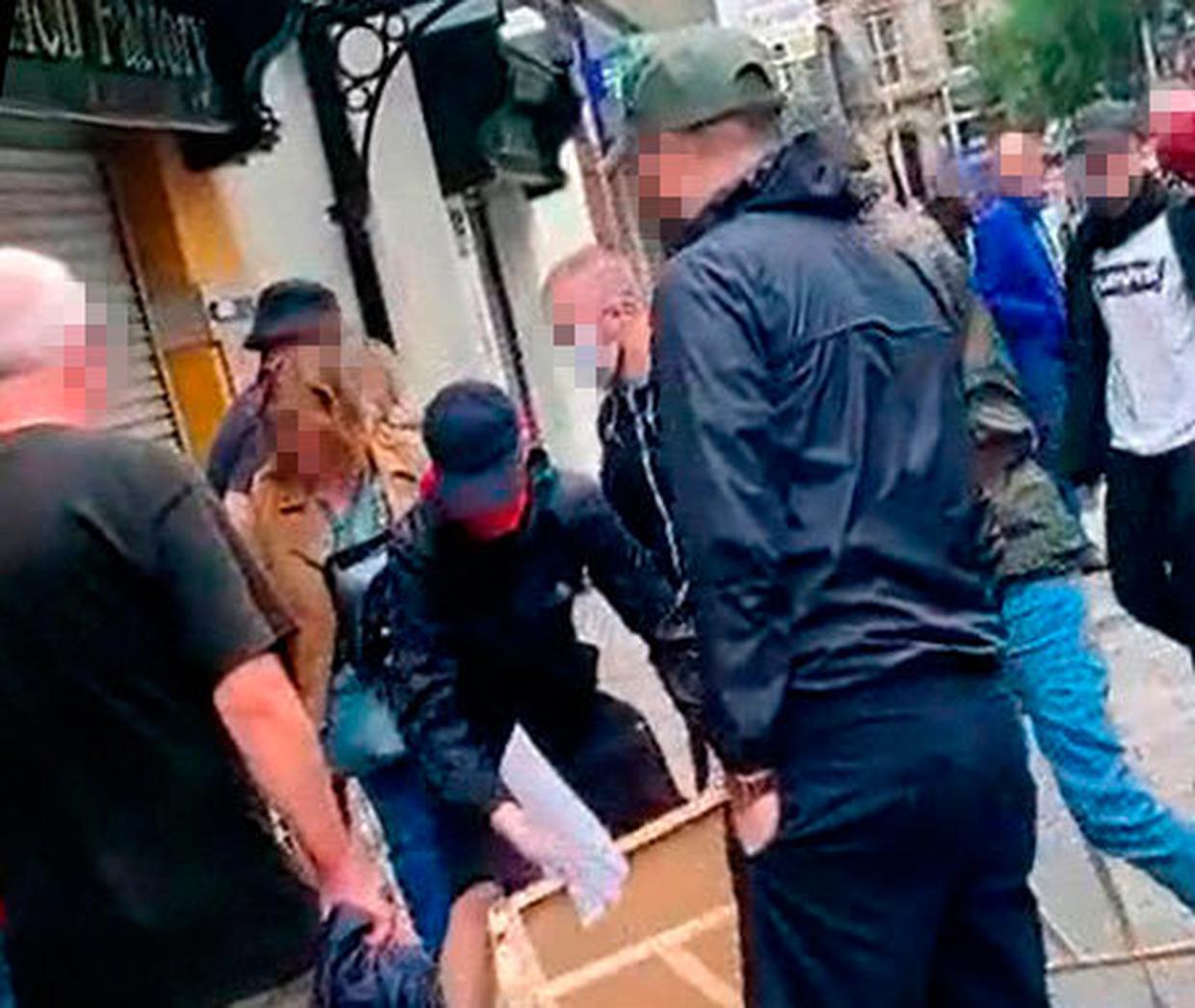
A poster calling for retired Army officer General Sir Mike Jackson to be jailed and advertising a march commemorating Bloody Sunday, on display in the Bogside area of Derry, Six Counties. Jackson was one of many military murderers to be decorated by the British Queen. (Photo by Niall Carson/PA Images via Getty Images).

This is far from the worst thing that the Sinn Féin leadership has done with regard to the British Monarch, for in May 2011 they called for no protests against her while she desecrated the Garden of Remembrance in Dublin and while the Gardaí attacked “dissident” Republican protesters nearby and outside her state reception in Dublin Castle, the old seat of her royal enforcers in Ireland. The following year, Martin McGuinness, prominent in the leaderships of both the IRA and Sinn Féin, welcomed her to her colony and shook her hand.

Martin McGuinness, in leadership of Sinn Féin and the IRA, welcomes the British Queen to visit her colony in 2012 (Photo sourced: Internet)

WHAT JAMES CONNOLLY SAID

James Connolly on occasions too referred to contemporary British monarchs – but in markedly different terms to those from the leadership of Sinn Féin in recent decades.

“What is monarchy? From whence does it derive its sanction? What has been its gift to humanity? Monarchy is a survival of the tyranny imposed by the hand of greed and treachery upon the human race in the darkest and most ignorant days of our history. It derives its only sanction from the sword of the marauder, and the helplessness of the producer, and its gifts to humanity are unknown, save as they can be measured in the pernicious examples of triumphant and shameless iniquities.

“Every class in society save royalty, and especially British royalty, has through some of its members contributed something to the elevation of the race. But neither in science, nor in art, nor in literature, nor in exploration, nor in mechanical invention, nor in humanising of laws, nor in any sphere of human activity has a representative of British royalty helped forward the moral, intellectual or material improvement of mankind. But that royal family has opposed every forward move, fought every reform, persecuted every patriot, and intrigued against every good cause. Slandering every friend of the people, it has befriended every oppressor. Eulogised today by misguided clerics, it has been notorious in history for the revolting nature of its crimes. Murder, treachery, adultery, incest, theft, perjury – every crime known to man has been committed by some one or other of the race of monarchs from whom King George is proud to trace his descent.

…………………….

Two completely opposite attitudes to British Monarchy: Mary Lou McDonald (L) and James Connolly (R)

“Fellow-workers, stand by the dignity of your class. All these parading royalties, all this insolent aristocracy, all these grovelling, dirt-eating capitalist traitors, all these are but signs of disease in any social state – diseases which a royal visit brings to a head and spews in all its nastiness before our horrified eyes. But as the recognition of the disease is the first stage towards its cure, so that we may rid our social state of its political and social diseases, we must recognise the elements of corruption. Hence, in bringing them all together and exposing their unity, even a royal visit may help us to understand and understanding, help us to know how to destroy the royal, aristocratic and capitalistic classes who live upon our labour. Their workshops, their lands, their mills, their factories, their ships, their railways must be voted into our hands who alone use them, public ownership must take the place of capitalist ownership, social democracy1 replace political and social inequality, the sovereignty of labour must supersede and destroy the sovereignty of birth and the monarchy of capitalism.

“Ours be the task to enlighten the ignorant among our class, to dissipate and destroy the political and social superstitions of the enslaved masses and to hasten the coming day when, in the words of Joseph Brenan, the fearless patriot of ’48, all the world will maintain

“The Right Divine of Labour
To be first of earthly things;
That the Thinker and the Worker
Are Manhood’s only Kings.”2

SUPPORT FOR SINN FÉIN

Most followers of the Sinn Féin party, who are by long tradition anti-monarchist and desire a reunified and independent Ireland, tend to regard those kinds of heretical statements by the party leaders as no more than some kind of camouflage to get them into power. Once there, they imagine, their party will lead them to the hallowed objectives of Irish independence and unity. In fact, the same kind of attitude that was that of the early followers of Fianna Fáil, “the Republican party”3.

The blindness, or more accurately the ability of self-deception exhibited by these followers is amazing. The majority continued to believe the leadership when it publicly abandoned armed struggle against British colonialism and declared it would never return to that (believing that to be a fake position) and even when it had most of its arms decommissioned. Then the party not only fielded candidates in elections in the partitioned Irish state but also in the colonial one and, in arguably its greatest betrayal of its previous position, participated in the running of the colonial state which it continues to do. Since then its leaders have sought support for and even assisted in recruitment for the sectarian and colonial gendarmerie4 and, more recently, declared its acceptance of non-jury special courts, a clear reference in particular to the no-jury Special Criminal Courts of the Irish state5, condemned by a number of civil rights organisations6 and of which the party’s own supporters have been frequent victims.

The attitude of the larger mass of instinctively pro-independence people, mostly working-class or lower middle-class is that they might as well give Sinn Féin a turn in government – after all they can hardly treat them worse than the other gombeen7 parties that have been in government since the creation of the Irish State. Such attitudes account for the rapid growth in the party’s electoral base in recent years when it became the first party in terms of elected representatives so that two other neo-colonial parties, with a long history of hatred for one another, were obliged to join and form a coalition with a third8 in order to form a government excluding the new kid on the block.

General Jackson with Prince Charles, heir apparent to the throne of England and Commander-in-Chief of the Paratroop Regiment (Photo sourced: Internet)

The attitude expressed by the President of the SF party runs not only completely contrary to the traditions of Irish Republicanism but even to its own history. It is more than that, it is an expression of the lack of dignity and craven forelock-tugging attitude of the neo-colonial Gombeen class that has ruled the Irish state since its inception.

While socialists and republicans rightly condemn that mentality and its practical applications, we should place our hopes in another outlook, as outlined by Connolly over a century earlier, and in the practical expression of that outlook today and in the near future. It is surely appropriate then to end this commentary with Connolly’s own words on another British royal jubilee, Queen Victoria’s in 1897:

“….. It is time then that some organised party in Ireland — other than those in whose mouths Patriotism means Compromise, and Freedom, High Dividends — should speak out bravely and honestly the sentiments awakened in the breast of every lover of freedom by this ghastly farce now being played out before our eyes. Hence the Irish Socialist Republican Party — which, from its inception, has never hesitated to proclaim its unswerving hostility to the British Crown, and to the political and social order of which in these islands that Crown is but the symbol — takes this opportunity of hurling at the heads of all the courtly mummers who grovel at the shrine of royalty the contempt and hatred of the Irish Revolutionary Democracy. We, at least, are not loyal men; we confess to having more respect and honour for the raggedest child of the poorest labourer in Ireland to-day than for any, even the most virtuous, descendant of the long array of murderers, adulterers and madmen who have sat upon the throne of England ….

“The working class alone have nothing to hope for save in a revolutionary reconstruction of society; they, and they alone, are capable of that revolutionary initiative which, with all the political and economic development of the time to aid it, can carry us forward into the promised land of perfect Freedom, the reward of the age-long travail of the people.”9

End.

APPENDIX:

List of armed interventions and wars by British Armed forces under Queen Elizabeth II:

Mau Mau Uprising(1952–1960)

Jebel Akhdar War
(1954–1959)

Cyprus Emergency
(1955–1959)

Suez Crisis(1956–1957)

Border Campaign
(1956–1962)

First Cod War
(1958–1961)

Upper Yafa disturbances[22](1959)

Dhofar Rebellion
(1962–1975)

Indonesia–Malaysia confrontation
(1963–1966)

Aden Emergency(1963–1967)

The Troubles(1968–1998)

Invasion of Anguila, Caribbean
(1969)

Second Cod War
(1972–1973)

Third Cod War
(1975–1976)

Falklands War
(1982)

Multinational Force in Lebanon
(1982–1984)

Gulf War
(1990–1991)

Bosnian War
(1992–1995)

Operation Desert Fox
(1998)

Kosovo War
(1998–1999)

Sierra Leone Civil War(2000–2002)

War in Afghanistan
(2001–2021)

Iraq War
(2003–2009)

First Libyan Civil War(2011)

2019–2021 Persian Gulf crisis(2019–present)

FOOTNOTES:

1In Connolly’s time, the term “social democrats” covered most revolutionaries in Europe in addition to reformists whereas today it is confined to describing only the latter.

2Commenting in 1910 on the announced visit of King George V to Ireland https://www.marxists.org/archive/connolly/1911/xx/visitkng.htm

3Fianna Fáil was a 1926 split from Sinn Féin led be De Valera, based on participating in elections within the Irish State, initially supported by many Irish Republicans in elections and when voted into Government in 1932 released Republican political prisoners jailed by the Government of pro-Treaty forces. Subsequently however a FF Government banned the IRA and jailed and even executed some Republicans.

4A gendarmerie is an armed state-wide military-like police force, such as for example the ones in the Spanish, Italian and Turkish states, typical of a State endeavouring to impose central rule on subject nations or regions where recurrent resistance may be expected. In Ireland the English occupation had the Royal Irish Constabulary which after 1922 in the colonial statelet became the Royal Ulster Constabulary, later changing its name to the Police Force of Northern Ireland. It has always been a sectarian (anti-Catholic) and repressive force.

5Both the Irish State and the colonial statelet have no-jury courts to jail political dissidents on low evidential requirements and under emergency legislation. The position SF’s elected representatives since 1972 has been to vote against the existence of the Special Criminal Court until two years ago, when it began to abstain and finally this year at its Ard-Fheis (annual general meeting), after an extremely poor debate, the party voted to accept such a court.

6Including the Irish Council for Civil Liberties and Amnesty International.

7A term of contempt dating from the years of the Great Hunger to describe capitalists who are happy to use the colonial system to amass personal wealth at the expense of their compatriots; its source is in the Irish language (an gaimbín/ gaimbíneachas — https://www.dictionary.com/browse/gombeen)
8Fianna Fáil, Fine Gael and the Green Party. The first two have been the major parties of the State almost since its inception, with the Greens being a smaller and more recent phenomenon. Fine Gael are the political representatives of the neo-colonial class that supported the partition of the country in the Anglo-Irish Agreement of 1921 for which they fought a Civil War (1922-1923) against the Irish Republicans (chiefly the IRA and Sinn Féin). Fianna Fáil led a major split in the Republican movement to form an Irish Government and soon attracted support (and later domination) by a section of native capitalists, soon becoming the favoured choice of the neo-colonial Irish capitalist class, alternating in government from time to time with Fine Gael (the latter in coalition, several times with the social-democratic Labour Party). However, since 1981 no Irish political party has commanded an absolute majority in elected representatives and all governments of the State since then have been coalitions of one kind or another.

9https://www.marxists.org/archive/connolly/1897/xx/qundimnd.htm Queen Victoria’s Jubilee Day, 22 June 1897, was marked by Connolly and Maud Gonne with protests on the streets of Dublin. Connolly dumped a symbolic coffin into the River Liffey and shouted “to hell with the British Empire”, for which ‘crime’ he spent the night in jail.

SOURCES:

James Connolly on visit of King George in 1911: https://www.marxists.org/archive/connolly/1911/xx/visitkng.htm

and on Queen Victoria’s Diamond Jubilee: https://www.marxists.org/archive/connolly/1897/xx/qundimnd.htm

For list of armed conflicts in which the UK has led or participated since coronation date of Elizabeth Windsor in 1953: https://en.wikipedia.org/wiki/List_of_wars_involving_the_United_Kingdom

Invasion of Anguila (missing from above list): https://en.wikipedia.org/wiki/Operation_Sheepskin#:~:text=Operation%20Sheepskin%20was%20a%20British,itself%20as%20an%20independent%20Republic.

UK Armed forces officially recorded in the Middle East: https://commonslibrary.parliament.uk/research-briefings/cbp-8794/

British military bases around the world: https://en.wikipedia.org/wiki/Overseas_military_bases_of_the_United_Kingdom

The Queen’s Service To ….

Gearóid Ó Loingsigh

(Reading time: one minute)


Queen Elizabeth II / Sinn Fein president Mary Lou McDonald

Mary Lou McDonald, the current president of Sinn Féin, surprised a few, just a few, with her recent comments thanking the English queen, Elizabeth, for her service.  She stated that “Can I also extend to the British Queen a word of congratulations because 70 years is quite some record.  That is what you call a lifetime of service.”(1)

Why someone who describes herself as a republican would want to heap praise on a monarch and refer to the reign of the monarch as service is bewildering.  However, it is not that strange in the context of the Irish peace process.  It is part of the long road of Sinn Féin’s accommodation to the British state that was laid out in the Good Friday Agreement.  Sinn Féin at that time abandoned any pretence of having a critique of imperialism and capitalism.

The agreement signed basically stated that the British had no selfish interest in Ireland and the conflict was a communal one.  Putting it in blunt terms, two savage tribes agreed to settle their differences, the British state was not one of those savage agents in the conflict.(2)

Exactly what service has the English queen given and to whom?  As a monarch she has blessed every British military adventure since her coronation in 1953, including the savagery of the British repression of the Mau Mau rebellion in Kenya, various other colonial wars, not to mention her awarding of an OBE to Lt. Colonel Derek Wilford the man responsible for Bloody Sunday in Derry in 1972.  In 2019 she stood over her behaviour when she stated that the British government would “bring forward proposals to tackle vexatious claims that undermine our armed forces, and will continue to seek better ways of dealing with legacy issues that provide better outcomes for victims and survivors”.(3)  The massacre of Bloody Sunday was placed in the category of vexatious claims.

Part of the service that McDonald now lauds includes this and many more such incidents.  Though it is not unexpected.  It can only surprise those who pay no attention to the outcomes of peace processes around the world.  Yasser Arafat spent more time repressing Palestinians than he did fighting the Israelis after the Oslo Accords.  In South Africa, the former mining trade union leader Cyril Ramphosa became a mining magnate, whose company was involved in the massacre of 34 striking miners at Marikana in 2012.(4)  He and the ANC made their peace with white capitalists and obtained a share of the wealth, in Ramphosa’s case a very substantial amount which some estimates place around $780 million dollars.  In El Salvador, the FMLN eventually gained power, but did not implement a single thing they had ever fought for and their former commander Joaquín Villalobos is now a consultant to right wing forces on how to defeat left wing movements and contributes to the right-wing think tank The Inter-American Dialogue, which includes such illustrious figures as Violetta Chamorro from Nicaragua and former head of the World Bank, Robert Zoellick, to name just two unsavoury characters.(5)  In Colombia, the ink hadn’t even dried on the agreement and the FARC commander Timochenko declared that the Colombian armed forces would be allies of the FARC in building a new country.  The murder of just over 300 members of the FARC since the signing of the peace agreement has not caused him to change his evaluation of the Colombian armed forces, in fact he has doubled down on his position.

It is in the nature of the beast.  In every peace process that has happened, the former enemies of the state reconciled themselves to the regime and the system, without exception.  McDonald’s declarations are just a confirmation of that and also a sign that it is a bottomless pit and there is no level of political depravity that Sinn Féin will not sink to.

Notes

(1)  Belfast Telegraph (10/02/2022) Sinn Féin leader congratulates Queen on ‘lifetime of service’ https://www.belfasttelegraph.co.uk/news/northern-ireland/sinn-fein-leader-congratulates-queen-on-lifetime-of-service-41334673.html

(2)  The agreement can be consulted at https://www.dfa.ie/media/dfa/alldfawebsitemedia/ourrolesandpolicies/northernireland/good-friday-agreement.pdf

(3)  The Irish Post (20/12/2019) Anger as Queen’s speech appears to dismiss fight for justice for Bloody Sunday victim’s as ‘vexatious claims’ https://www.irishpost.com/news/anger-queens-speech-appears-dismiss-fight-justice-bloody-sunday-victims-vexatious-claims-175999

(4)  The Guardian (19/05/2015) Marikana massacre: the untold story of the strike leader who died for workers’ rights https://www.theguardian.com/world/2015/may/19/marikana-massacre-untold-story-strike-leader-died-workers-rights
 
(5) See https://www.thedialogue.org

Bombing children at play

(from The Treason Felony Blog le buíochas: The Weaver Street Bombing and not dealing with the past)

(Reading time: 3 mins.)

In Belfast, on 13th February 1922, some children playing in Milewater Street, at the corner of Weaver Street, off the York Road, were approached by two Special Constables and told to go and “play with their own” (Special Constables invariably being Protestant, the children were Catholics in a largely Protestant district). They joined other children in the mainly Catholic-occupied Weaver Street and played on a swing attached to a lamp-post. Ten minutes later, two men came to the North Derby Street end of Weaver Street (one eye witness claimed one Special Constable had just spoken to the same two men). They were about 20 metres away from where the children were playing. One of the men then threw a bomb into the middle of the children. As the bomb exploded, gunfire directed into Weaver Street from North Derby Street, covered the two men’s retreat.

Weaver St map
Map showing Weaver Street running from North Derby Street to Milewater Street (which isn’t named on the map)

The explosion killed or injured Mary Johnson (13), Catherine Kennedy (14), W.J. Dempsey (13), Annie Pimley (16), John O’Hanlon (16), Elizabeth O’Hanlon (11), Murtie O’Hanlon (16), Barney Kennedy (10), John McCluskey (12), Rose Ann McNeill (13), Mary McClinton (18), Mary Kerr (6), Susanne Lavery (14), George O’Connor (16), Joseph Conway (12), Patrick Maguire (14), Kate O’Neill (14), Robert McBirney (16) and William Connolly (13). All lived in Weaver Street. Adults standing in their doorways were also badly injured.

The force of the blast threw the children up into the air and caused catastrophic injuries, maiming many of those who survived. Mary Johnson and Catherine Kennedy died immediately. Eliza O’Hanlon died the next day. Statements made in the press and in Westminster indicate that three of those injured had died by the next day, the third being O’Hanlon. By the time the inquest was held on 3rd March, a fourth girl had died from the blast. Two adults were to succumb to their injuries. Margaret Smith died on the 23rd March, while Mary Owens (who lived in nearby Shore Street) died from injuries sustained in the blast on the 6th April.

This was not the first bombing of its kind. On September 25th the previous year, a bomb had been thrown into a group of Catholic children on Milewater Street, injuring nine, including four under six years of age. One man, George Barry, died from injuries he received. The bomb had such force that two houses were wrecked. A bomb had also been thrown by loyalists into a group of school children in Herbert Street on 12th January, injuring six (the Belfast Telegraph erroneously reported it as an IRA attack). The same month, a bomb had been thrown into Weaver Street from a passing taxi.

The Belfast Telegraph claimed the 13th February bomb was one of the largest ever used in the city. It also implausibly offered justification for the bomb attack, saying shots had earlier been fired at an armoured car in Weaver Street. In retrospect, the Belfast Telegraph’s link to an attack of an armoured car merely ties the Special Constabulary closer to the bombing (the ‘Specials’, created at roughly the same time, performed the Black and Tans roles in repression and reprisals in the north).

James Craig also included a reference to the bomb in a report sent to the Colonial Secretary, Winston Churchill and read in Westminster the next day. It stated that there had been…

..the indiscriminate throwing of bombs over a wall into Weaver Street, a Sinn Fein area, which resulted in the death of two children and the wounding of fourteen others. These outrages are greatly deplored by my Government, especially the latter dastardly deed, involving the lives of children.

Craig was more concerned about a gun battle in Clones between republican forces and Special Constables travelling to Enniskillen the day before the Weaver Street bombing. Joe Devlin fumed that Craigs wording was deliberately vague and that some international press had been led to believe that the bomb was thrown by republicans.

As sectarian attacks continued through 1921 and 1922, and even after the 13th February bomb, the (relatively) safe places for Catholic families to live in that part of the York Road had shrank to the area around Weaver Street. The attacks continued to intensify in early summer. On 18th May Thomas McCaffrey from Shore Street was killed. On the night of 20th May, Thomas McShane from Jennymount Street was killed. That same night the remaining Catholic residents of Weaver Street, Milewater Street, North Derby Street, Shore Street and Jennymount Street, some one hundred and forty-eight families, were forced from their homes at gunpoint. By the 21st May 1922 the Catholic community that had established itself around Weaver Street had fled. The 1924 street directory only shows one household remaining from the 1918 directory (in comparison, nearby Seaview Street had two thirds of the same households). Houses in Weaver Street remained occupied until the 1960s as Unilever and the Associated Feed Mills bought up property around Shore Street, Weaver Street and Milewater Street eventually enclosing all but the York Road end of Milewater Street.

The view today of where Weaver Street met North Derby Street. This is more or less where the bomb was thrown from.

Today, Shore Street and Weaver Street are gone, no longer visible on the streetscape of Belfast. Patiently neglected over the decades after 1922, their former occupants were dispersed around other districts of the city. Similarly, the detail of its own particular sadness, sectarianism and savagery are now, largely, long forgotten. The memory of the violence of 1920-22, mostly unarticulated, was indelibly etched into the psyche of the Catholic residents of Belfast.

Some 20-25% of those killed in the 1920-22 conflict died in Belfast but, with few notable exceptions, little was written or said about it over the decades that followed (even today only a handful of books have been written about it). So despite what has happened since 1969, few have considered how the memory of 1920-22 influenced communities. Even fewer have considered the role an absence of public discourse around the violence of 1920-22 may have had in later outbreaks of sectarian violence in the 1930s and 1960s.

Today, the very obliteration of Weaver Street from the streetscape of Belfast, somehow elevates it as an appropriate metaphor for the eclipse of public discourse on the violence of 1920-22.

end.

FURTHER READING

https://www.irishtimes.com/culture/heritage/why-don-t-we-remember-the-weaver-street-massacre-in-belfast-1.4797959?fbclid=IwAR2rDtvRV9j1bM8p9SnIxfAEl5ejHHAutwFJG7-U3XtKGiaYPbfwRsiMa38

BRITISH SUPREME COURT VINDICATES TORTURED “HOODED MEN” – CRITICISES POLICE CHIEF

Diarmuid Breatnach

(Reading time up to ‘Background’: 4 mins.)

A group of Irish people were jubilant in London’s Little George Street on 15th December. The location was that of the UK’s Supreme Court and it was unusual for Irish people to be happy at a judgement of a British court. But the judges inside had quashed an appeal by the Police Service of Northern Ireland1 against a judgement of the High Court in Belfast, that the colonial police force had been wrong not to investigate the claims of fourteen men of being tortured in the British colony in 19712.

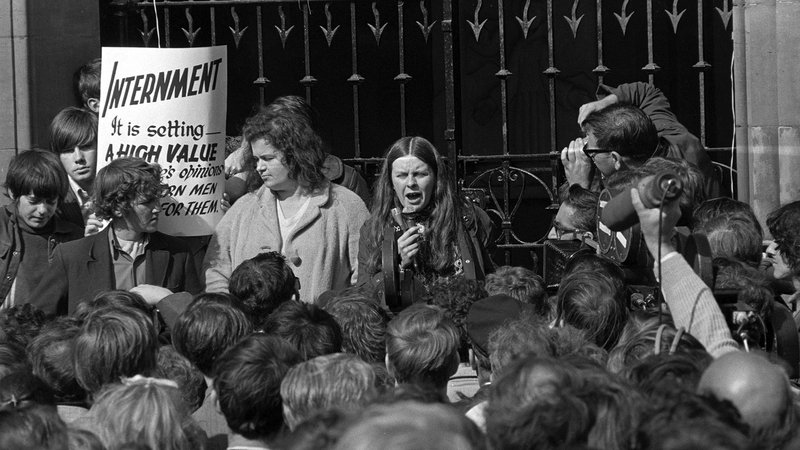
Bernadette Devlin (now McAlliskey) addressing an anti-internment rally in Derry in August 1971 (Photo cred: Popperfoto, Getty Images)

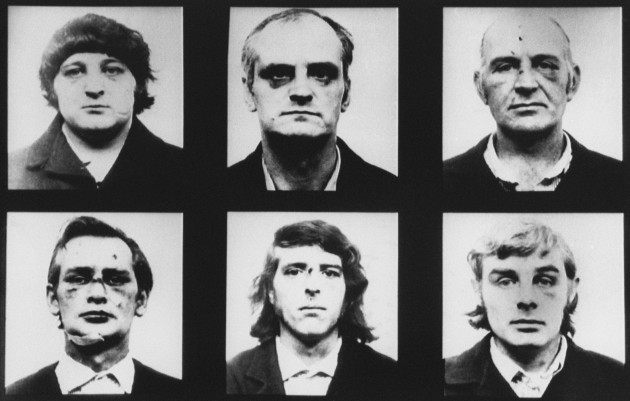
The claims related to what happened during the introduction of internment without trial in the occupied Six Counties in August 1971. What many internees experienced ranged from brutal treatment to torture: “Many of those arrested reported that they and their families were assaulted, verbally abused and threatened by the soldiers. There were claims of soldiers smashing their way into houses without warning and firing rubber baton rounds through doors and windows. Many of those arrested also reported being ill-treated during their three-day detention at the holding centres. They complained of being beaten, verbally abused, threatened, harassed by dogs, denied sleep, and starved. Some reported being forced to run a gauntlet of baton-wielding soldiers, being forced to run an ‘obstacle course’, having their heads forcefully shaved, being kept naked, being burnt with cigarettes, having a sack placed over their heads for long periods, having a rope kept around their necks, having the barrel of a gun pressed against their heads, being dragged by the hair, being trailed behind armoured vehicles while barefoot, and being tied to armoured trucks as a human shield” (for the soldiers against attack by the IRA). (Wikipedia)

(Photo sourced: Internet)

Some were hooded, beaten and, having been told they were hundreds of feet in the air, were then thrown from a helicopter — but were actually only a few feet from the ground. In addition, they were subjected to disorientating “white noise”, forced to remain in stress positions for long periods and deprived of food, water and sleep. Fourteen men who endured this for seven days became known as the “Hooded Men” and have been campaigning for over 50 years to have the British State admit that in its Irish colony, it had tortured them. Interestingly, some of those techniques have also been complained of more recently – by prisoners of the British military in Iraq3 — and this despite a statement by the UK’s Attorney General in 1977 that the techniques would not be used by them again.4

(Photo sourced: Internet)

Unusually, the Irish State5 took the case of the Fourteen to the European Court of Human Rights in Strasbourg and in 1976 obtained a judgement that “the five interrogation techniques” were torture.

The British State appealed the ECHR judgement and in 1978 won a judgement that although the treatment of the Hooded Men amounted to “inhuman and degrading treatment” and breached Article 3 of the European Convention of Human Rights it nevertheless fell short of torture6.

When documentation came to light proving that British Government Ministers had approved the treatment, the Irish State appealed the revised judgement of the ECHR but in 2018 was unsuccessful.

Meanwhile, the legal team of the Hooded Men pursued their case through the legal system of the UK’s Irish colony. In October 2014 the PSNI formally decided not to investigate the allegations, following which in 2015 judicial review proceedings against the PSNI, Secretary of State for Northern Ireland and Department of Justice were initiated by Francis McGuigan, one of the ‘Hooded Men’. A co-appellant was Mary McKenna, the daughter of Sean McKenna, another of the Hooded Men, who died in 1975, never having fully recovered from his mistreatment. The proceedings followed the discovery of additional documentary materials relevant to the mistreatment of the men, which were featured in a 2014 RTÉ Documentary, The Torture Files.7

Following this Documentary, the Chief Constable stated that the PSNI would assess “any allegation or emerging evidence of criminal behaviour, from whatever quarter” concerning the ill-treatment of the Hooded Men “with a view to substantiating such an allegation and identifying sufficient evidence to justify a prosecution and bring people to court’”. However in October 2014 the PSNI took the decision not to investigate. In late 2017, the High Court ruled that the failure by the Police Service of Northern Ireland (PSNI) to investigate the allegations of torture was unlawful.

Some of the Hooded Men in London for the Supreme Court judgement. (Photo sourced: Internet)

Instead of accepting the judgement however the PSNI sought to appeal the High Court decision but in September 2019 the Court of Appeal ruled that the decision should stand. One would have to contrast the determination of the colonial police in the courts to their appalling record in investigating collusion between their own force and Loyalist murder gangs, for the PSNI then appealed to the UK Supreme Court. In November 2019 the UK Supreme Court upheld the decision of the colony’s Court of Appeal and the PSNI appealed that judgement too. The decision last week in London marks the end of the legal options of the colonial gendarmerie.

The very month the decision not to investigate the allegations of the Hooded Men was taken by the colonial police force, October 2014, Drew Harris had been appointed Deputy Chief Constable of the PSNI.

IMPLICATIONS OF JUDGEMENT

The implications of the High Court judgement for Britain and its colonial administration are that once again they have been shown to have deployed barbarous methods in their repression of resistance by the nationalist minority in the colony and that they have exceeded or ignored even their own laws.

As has been the case throughout the recent 30 Years’ War, with the system lying and trying to cover up the reality of its actions, then delaying by all available means, the judgement comes too late for a number of the victims, as only nine of the 14 are still alive.

Nevertheless, the judgement adds to a number of other judgements and admissions over the years, such as those surrounding the Bloody Sunday Massacre in Derry in 1972 and the Ballymurphy Massacre in 1971. On 13 December this year, the British Ministry of Defence and PSNI agreed to a £1.5m out-of-court settlement to compensate victims of the Miami Showband Massacre over suspected state collusion with loyalist terrorists.

Three members of the band died from explosions and bullets after they were forced to get out of their bus at a fake police checkpoint on their return to Dublin from the Six Counties. Stephen Travers, who was injured in the attack, said he was convinced he would have won his civil action to prove that there was collaboration between the State and terrorists but that the Government’s decision to “dispense with justice rather than to dispense justice” had motivated the out-of court settlement.

Had the UK’s Supreme Court rejected the Hooded Men’s case, the latter would have been free to take the case to the European Court of Human Rights – not that they had been tortured but that the police should have investigated their claims that they were. And, based on a similar case by the manager of a Basque newspaper against the Spanish State8, they would probably have won their case with damages awarded against the UK.

On the other hand, the Supreme Court decision puts the onus of investigating the accusations of the Hooded Men on to the PSNI, the very organisation deeply implicated in the treatment of the victims, the organisation which declined to investigate them previously and which justified its decision through the courts in the Six Counties and then in the Supreme Court of the UK.

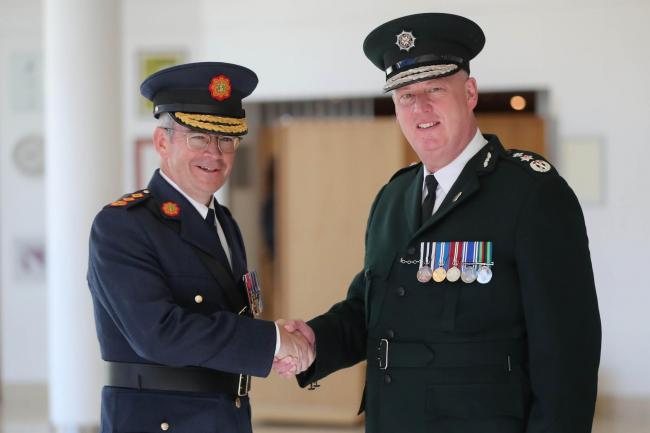
But not only the British state and its colony are put into the dock by the Supreme Court judgement – Drew Harris, formerly Deputy Chief Constable of the PSNI is currently in charge of the police force of the Irish State, where he was appointed Chief Commissioner of the Gardaí in September 2018 on a yearly salary of €250,000.

Drew Harris (Left) as Garda Commissioner with his former boss, George Hamilton, Chief Constable of the colonial police, the PSNI, on the occasion they both received an honour from the British Monarch. (Photo sourced: Internet)

APPENDIX — BACKGROUND

Creation of “Northern Ireland”:

The statelet of “Northern Ireland”9 was created in 1922 after Ireland was partitioned by the British Government at the end of 1921. Ireland had been invaded from Britain in 1169 and gradually entirely occupied and colonised by the invaders, albeit with its own semi-autonomous parliament which had been abolished in 1801, after the United Irish uprisings of 179810. Subsequently Members of Parliament elected in Ireland were required to attend the Westminster Parliament.

Following the rise of Irish nationalist sentiment after the suppression of the 1916 Rising, the 1918 UK General Election returned a huge majority of MPs in Ireland sworn to establish an independent Irish Republic. These formed their own parliament in Dublin, at first ignored but then later banned by the British. The guerrilla War of Independence of 1919-1921 convinced the British rulers to offer Ireland autonomy as a “Dominion” within the British system and under the Crown. However, at the same time, the British conceded to the demand of the unionist minority in Ireland to secede from the new Irish state and to remain a colony of Britain and in the UK. The Irish Free State was set up in December 1921 on 26 counties and the Northern Ireland statelet of six counties in January 192211.

From the outset the colonial statelet had been marked by the religious sectarianism of its local rulers, Presbyterians and Anglicans by religion and of unionist ideology, against a very large nationalist minority of mostly Catholics, representing the majority in Ireland as a whole. A raft of special powers empowered the statelet in repression of the nationalist minority; the colonial gendarmerie, abolished in the Irish state, continued in existence, with a part-time wing and even unofficial Loyalist militia in support and de facto anti-nationalist discrimination existed in every sphere: law, housing allocation, education.

In 1968 a campaign for civil rights for the nationalist minority began, to be met by truncheons, water-cannon, tear gas and bullets which however, merely drove parts of the minority into open insurrection. The colonial gendarmerie (the Royal Ulster Constabulary), even with the active support of the part-time B-Specials and Loyalist paramilitaries, was unable to suppress the uprising primarily in Derry but also in West Belfast and in August 1969 the British Government sent in the British Army to take control.

Initially the soldiers were represented to the nationalist population as being present to protect them from the sectarian colonial police and from the Loyalists but it soon became clear that their primary focus was to repress the risen nationalist population and the IRA began to take action against them.

Introduction of Internment Without Trial:

The Prime Minister of the “Northern Ireland” statelet, Brian Faulkner, recommended to his colonial masters that internment without trial be introduced against the nationalist population; this was agreed and “Operation Demetrius” began on 9th August and continuing over the 10th 1971 with British Army raids into nationalist areas, forcing their way into homes and dragging their captives away to be interrogated by RUC Special Branch, after which they were jailed. In the initial sweep the occupation forces arrested 342 men, sparking four days of violence in which 20 civilians, two IRA members and two British soldiers were killed and 7,000 people fled their homes. All of those interned were from the nationalist community.

Poster by the Anti-Internment League of Ireland – the internees in the photo are handcuffed together. (Photo sourced: Internet)

The detentions without charge continued until December 1975 and by that time 1,981 people had been interned, of which 1,874 were from the nationalist community. Only 107 were Loyalists and none of those had been interned until February 1973. Resistance to internment continued after the initial sweep and from 9th to 11th August, British Paratroopers caused the death of 11 unarmed people in the Ballymurphy area of Belfast. In January the following year the Paras and other units attacked people marching against internment in Derry, killing 14 and injuring 12.

Internment was protested in the rest of Ireland and in other countries, including Britain. The Men Behind the Wire, an anti-internment song composed in 1971 by Paddy McGuigan and recorded by the Barleycorn group in Belfast, was pressed into disc in Dublin and shot to the top of the Irish charts, greatly exceeding in numbers of sales any record previously released in Ireland.

Excerpt:

Through the little streets of Belfast,
In the dark of early mo
rn,
British soldiers came marauding
Wrecking little homes with scorn.

Heedless of the crying children,
Dragging fathers from their beds;
Beating sons while helpless mothers
Watched the blood flow from their heads.

Armoured cars and tanks and guns
Came to take away our sons
But every man will stand behind
The Men Behind the Wire.

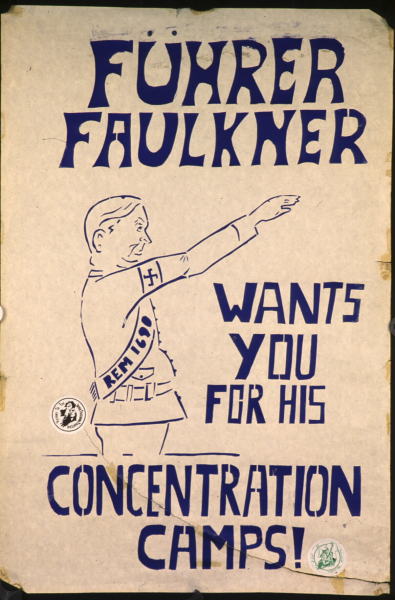
Poster by People”s Democracy, believed in 1970, prior to introduction of internment. (Photo sourced: Internet)

Brian Faulkner, unionist Prime Minister of the statelet, who had asked the British to introduce internment, was hated by a great many people. When he died in March 1977 following an accident during a stag hunt, thrown by his horse Cannonball, an English communist composed a short song he named “Cannonball”.

Excerpt:

Lord Faulkner was a hunter of men and of deer

And both have good reason to laugh and to cheer

At the death of a tyrant whose interests were clear

Those of imperialism that have cost Ireland dear.

Cannonball, Cannonball has many a friend,

From the top of old Ireland right down to its end,

Where the brave people struggle

In one resolute bid

To throw off their oppressors —

Just as Cannonball did!

End.

FOOTNOTES

  1. The colonial gendarmerie formerly known as the Royal Ulster Constabulary.

2 (see “Background” section).

3. The Court’s ruling that the five techniques did not amount to torture was later cited by the United States and Israel to justify their own interrogation methods, which included the five techniques. British agents also taught the five techniques to the forces of Brazil’s military dictatorship. During the Iraq War, the illegal use of the five techniques by British soldiers contributed to the death of at least one detainee, Baha Mousa.

4 “The Government of the United Kingdom have considered the question of the use of the ‘five techniques’ with very great care and with particular regard to Article 3 (art. 3) of the Convention. They now give this unqualified undertaking, that the ‘five techniques’ will not in any circumstances be reintroduced as an aid to interrogation.”

5 Unusually, because during the three decades of ill-treatment by a foreign power of people who were, according to the Irish Constitution its citizens, only in one other case did the Irish State bring a complaint against the UK to an international arena.

6 I admit that I fail completely to understand the distinction.

7. Rita O’Reilly, the journalist who led that program, also commented extremely well on the UK Supreme Court decision and the whole case on Prime Time on RTÉ this week (see Links).

8. Martxelo Otamendi, along with others detained, was tortured by his Guardia Civil captors when the Basque newspaper of which he was manager was closed by the Spanish State, alleging that it had been cooperating with terrorists. He was freed eventually and even later in 2010 the Spanish Supreme Court admitted that there had been no evidence against him or the newspaper – but neither admitted the torture nor ordered his allegations be investigated. Otamendi filed a complaint with the European Court of Human Rights in 2012 and in 2014 the ECHR found the Spanish State guilty of not having investigated Otamendi’s allegation of being tortured and awarded him €24,000 in damages and expenses from the Spanish state.

9. A misnomer since the British colony is not the northernmost part of Ireland, which is in County Donegal, inside the Irish state. “Ulster”, a name given by the Unionists to the statelet and frequently repeated in the British media, is also a misnomer since the Province of Ulster contains nine counties, six of which are in the colonial statelet but three of which are within the Irish state.

10. There were many uprisings prior to 1798, which was the first Republican one and there were many of that kind afterwards too.

11. Shortly after that the Free State, supplied with weapons and transport by the British, attacked the Republicans, who had been demonstrating their dissatisfaction with the Anglo-Irish Treaty. This precipitated a Civil War in which the Republicans were defeated.

USEFUL LINKS FOR MORE INFORMATION

Unusually excellent (for RTÉ) report by Rita O’Reilly: https://www.rte.ie/news/primetime/2021/1217/1267343-uk-supreme-court-decision-on-hooded-men/

https://www.irishtimes.com/news/ireland/irish-news/hooded-men-uk-court-finds-psni-decision-not-to-investigate-case-unlawful-1.4755885

https://en.wikipedia.org/wiki/Operation_Demetrius

“BRITAIN OUT OF IRELAND!” ON ANNIVERSARY OF THE ANGLO-IRISH TREATY

Clive Sulish

(Reading time: 3 mins.)

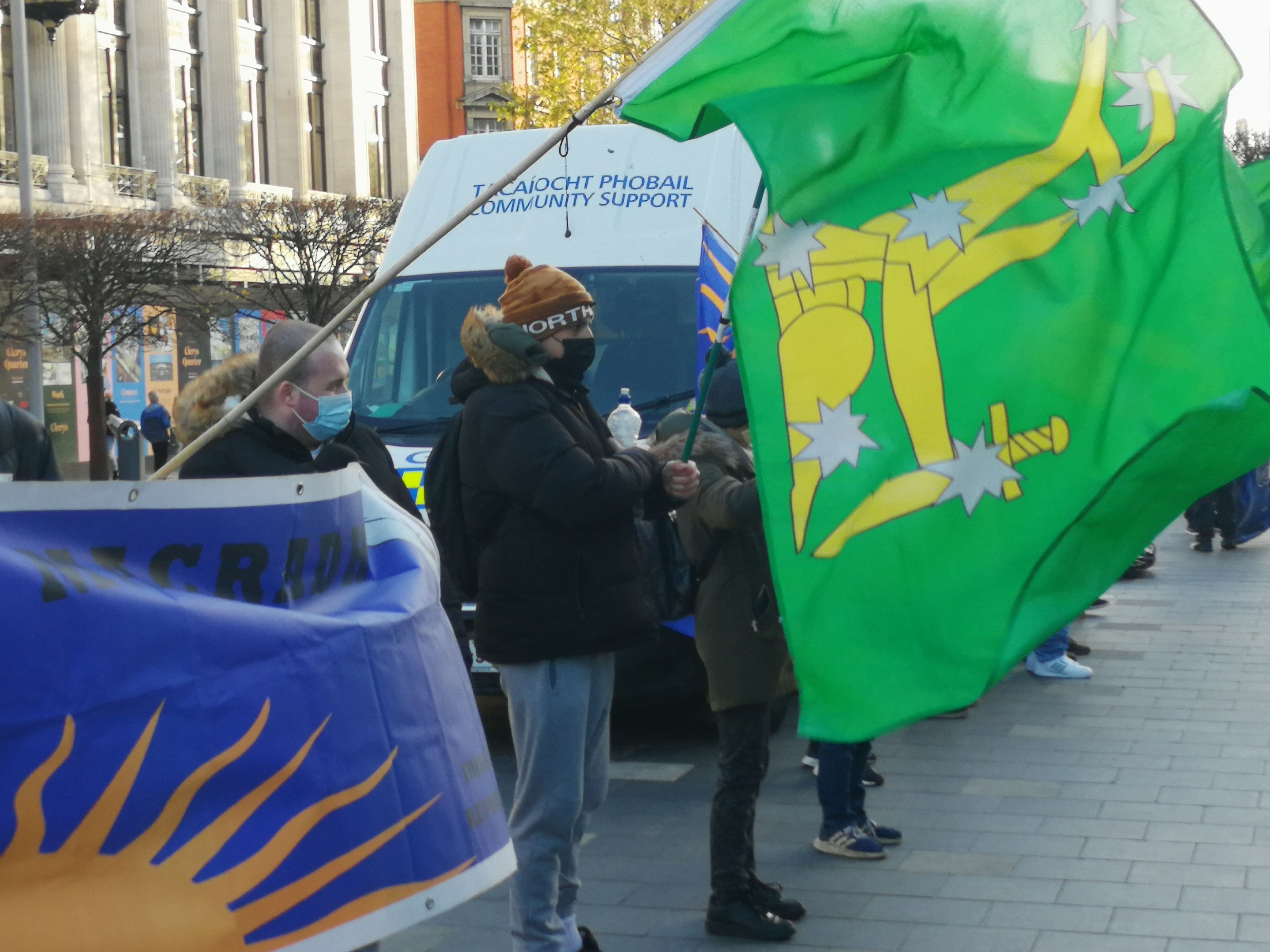
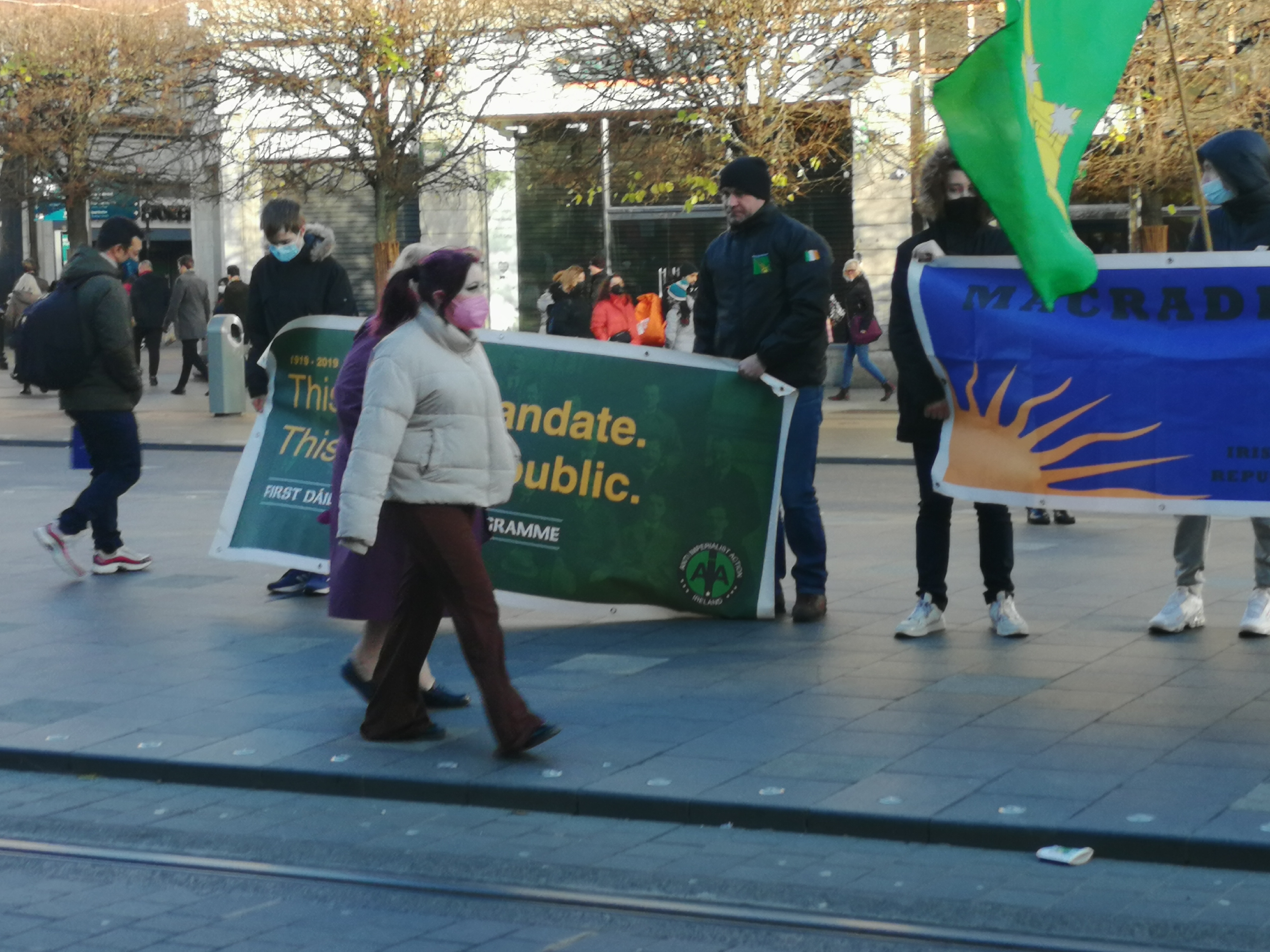
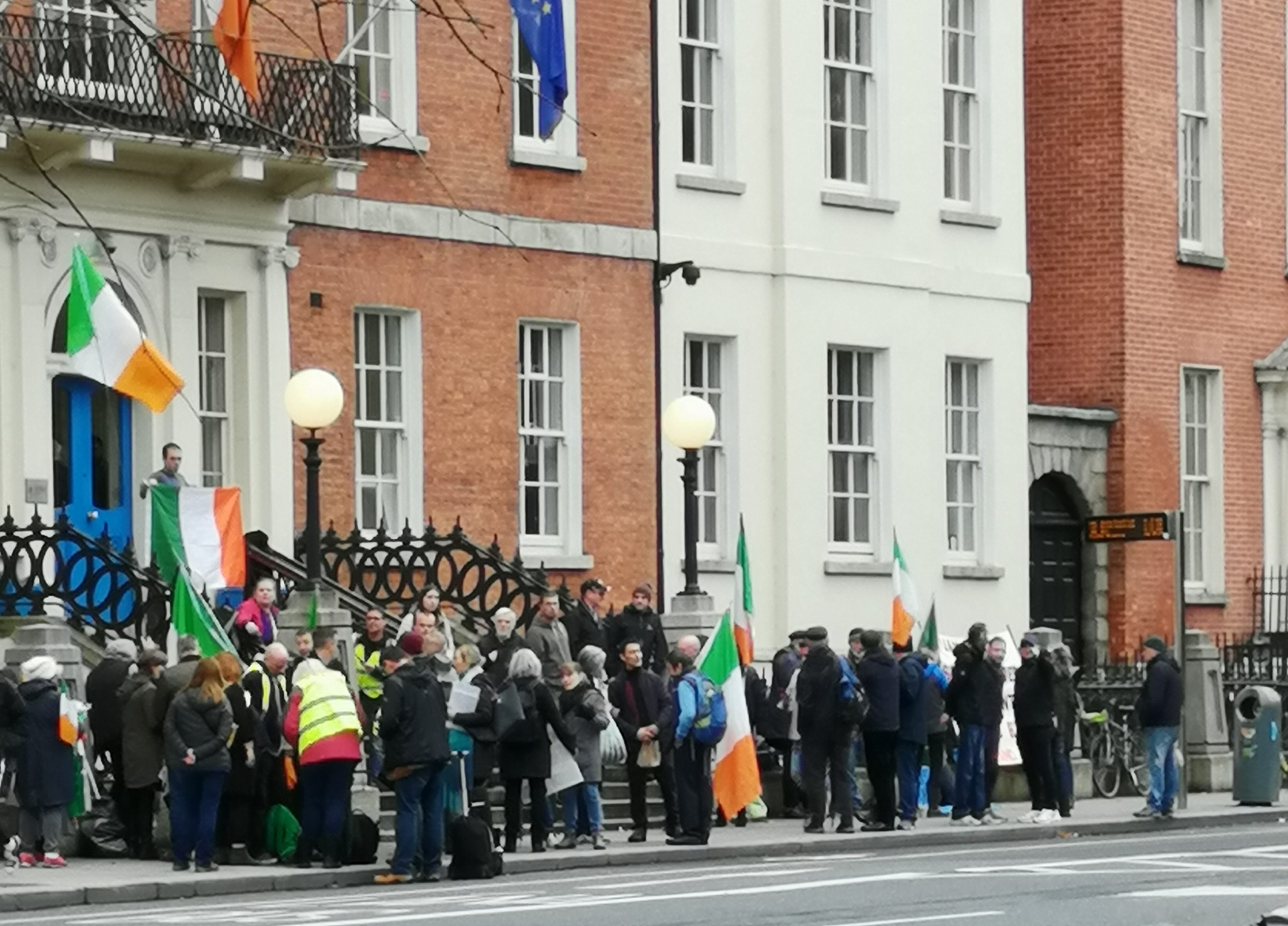
Socialist Republicans gathered in Dublin’s main O’Connell Street on Saturday 4th December to reaffirm their commitment that Britain has no right to be in Ireland. The event, taking place on the nearest weekend to the centenary of the signing of the Anglo-Irish Treaty, was organised by the Anti-Imperialist Action Ireland organisation and supported by other socialist Republicans including the Anti-Internment Group of Ireland.

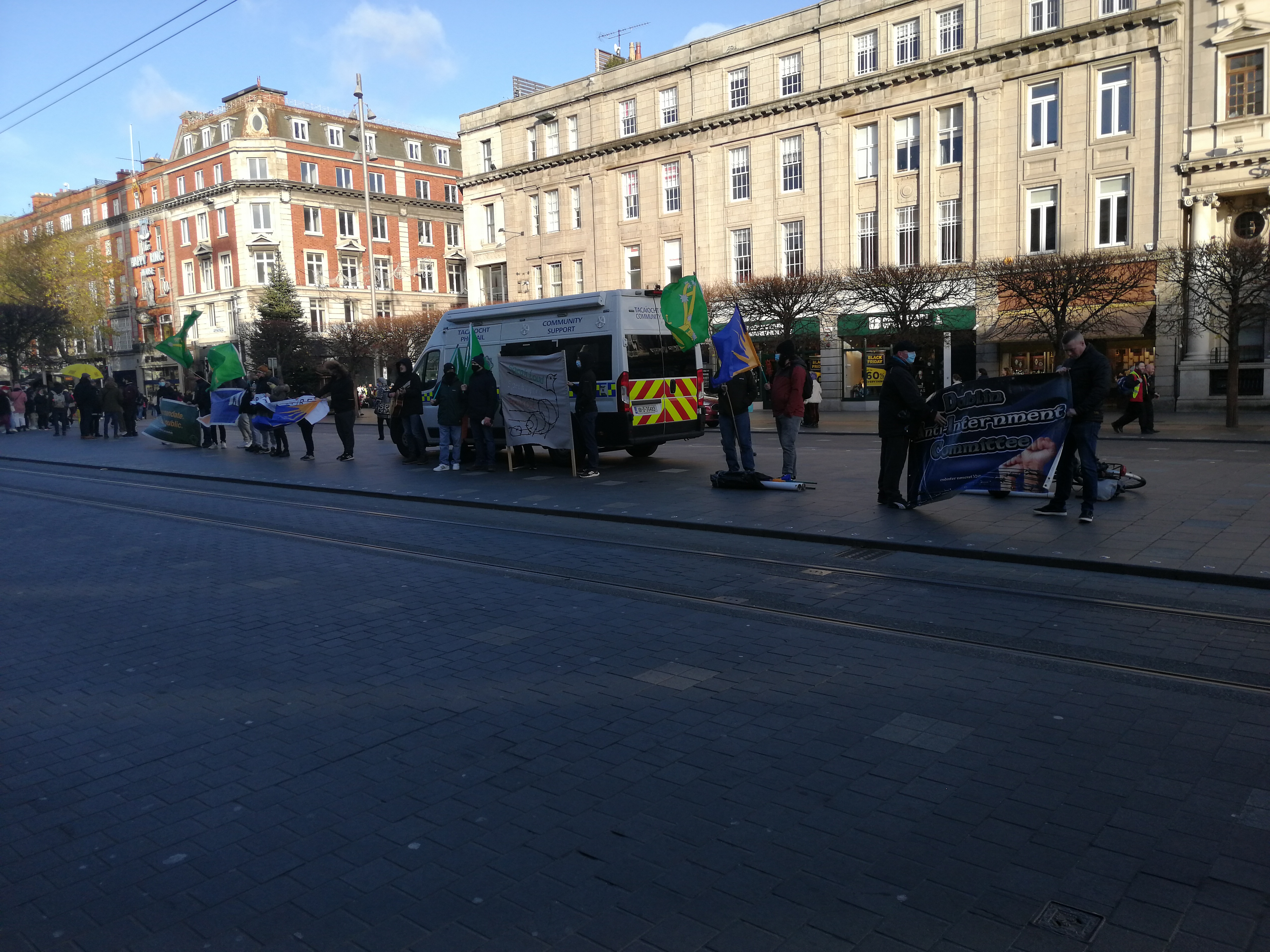
View of the picket with the GPO at the back of the photographer (Photo: Rebel Breeze)

One of the participants sang Irish revolutionary songs, accompanying himself by guitar, his unamplified voice ringing across the street and bouncing off the General Post Office opposite, location of the headquarters of the 1916 Rising. Another singer’s voice accompanied him in some of the songs.

Despite the cold, people passing on the street stopped to look, to take photos or video and, in some cases, to applaud. Some individuals also approached the participants to talk, while gestures of approval were being made from some passing public and private transport.

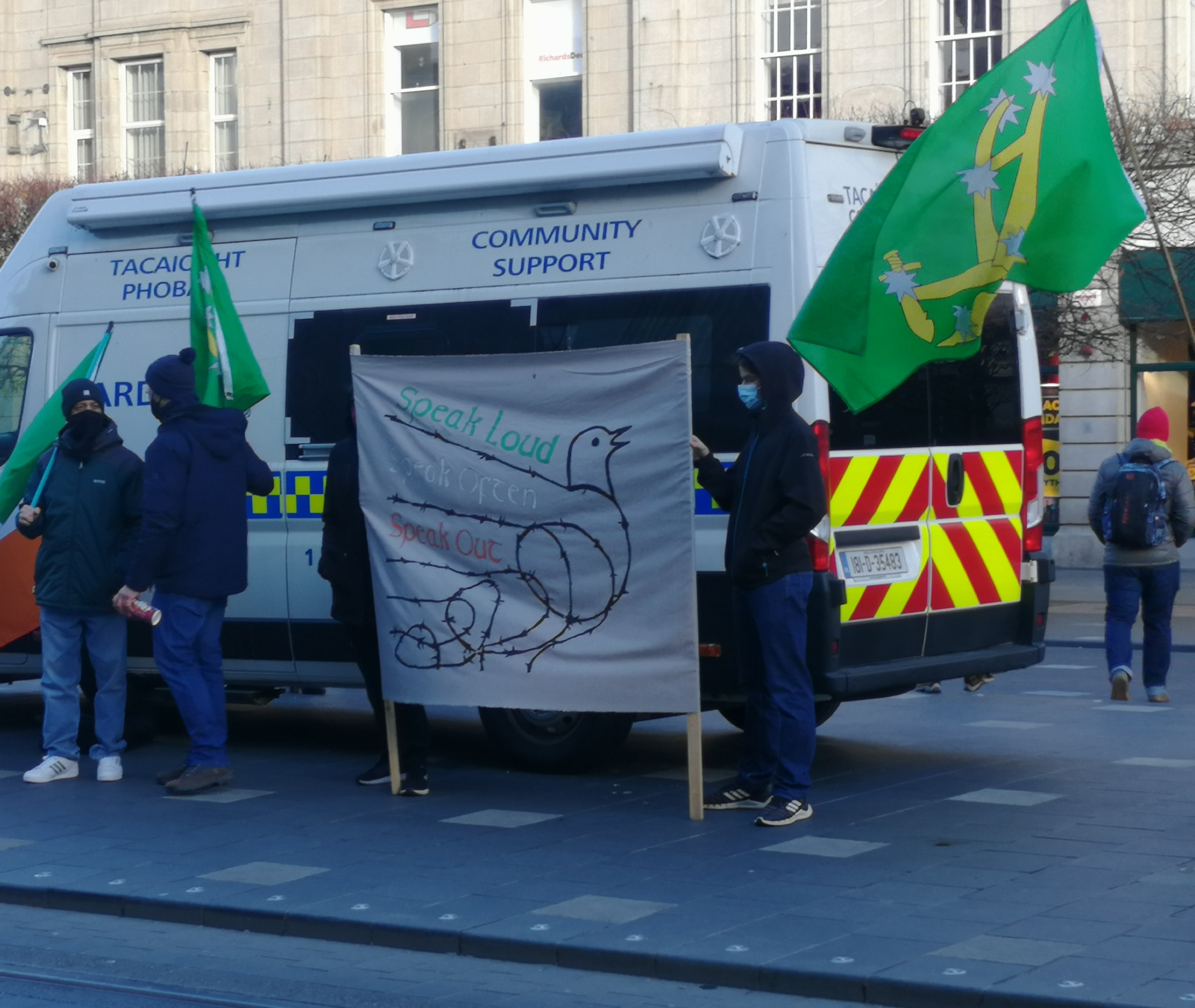
(Photo: Rebel Breeze)

The event concluded with the singing in Irish of the first verse and chorus of The Soldiers’ Song, a patriotic fighting song, the air of the chorus of which was adopted as the national anthem of the Irish state (but regarded by many as the property of the unfinished national liberation struggle).

The Anglo-Irish Agreement was signed on 6th December 1921 in London by negotiators of the Irish resistance movement. What was conceded by the British ruling class fell far short of what the armed movement had been fighting for since January 1919 and led soon afterwards to civil war (1922-1923). Clearly the negotiators should have brought back the terms for approval or rejection by the Dáil (the banned Irish parliament), instead of first signing the document, which is what they did.

The Treaty offered Dominion status for Ireland as a member of the Commonwealth under the British Crown, i.e akin to that of the “white”-governed colonies such as Australia, Canada and South Africa. It also offered the British Unionists in the north of Ireland the right to secede.

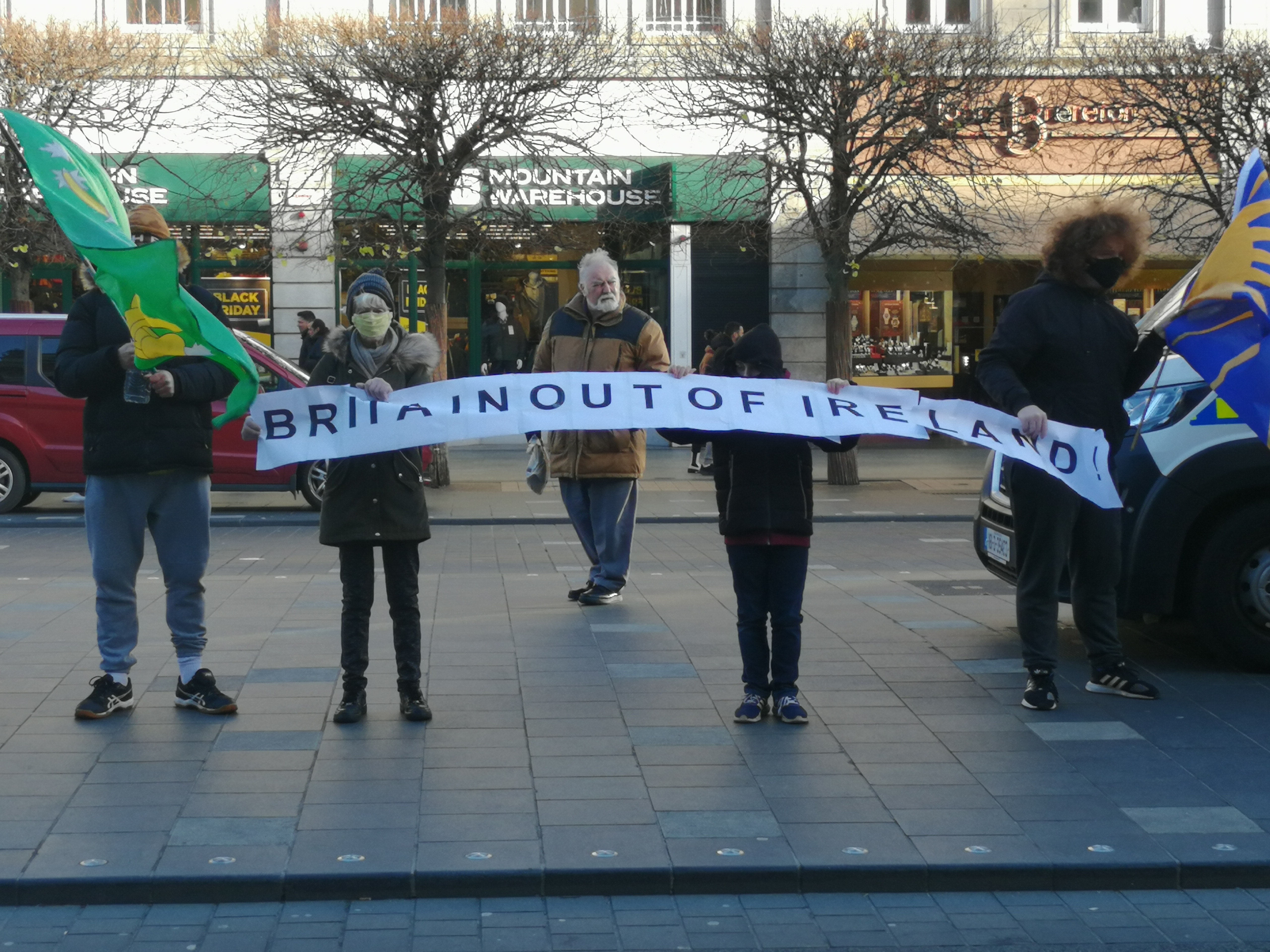
(Photo: Rebel Breeze)

The subsequent debate on whether to ratify the Treaty was at times bitter. Some felt the terms were the best they were likely to get, other that they offered a base on which to build for greater gains while others still felt they were a betrayal of Ireland’s long struggle for independence and the sacrifices of two years of guerrilla struggle against state repression. The vast majority of the military organisations of the movement, the IRA and Cumann na mBan, were opposed to the Treaty terms but those in favour of signing gained a slim majority in the Dáil (64 in favour and 57 against).

The British unionists swiftly availed themselves of the terms, leading to the partition of Ireland early in 1922, six of the 32 Counties becoming a permanent British colony.

(Photo: Rebel Breeze)

Some have seen the positioning around the Treaty in most of Ireland as signifying a trend led by the native Irish capitalist class and supported by the Irish Catholic Church hierarchy of putting the brakes on the national liberation movement and elements of its social content. From that perspective, the signing of the document in London signalled the first overt move of the counterrevolution which was sealed with armed force by the new neo-colonialist state through war, repression, imprisonment, kidnappings, torture and executions, both official and unofficial.

Both states in Ireland henceforth would be socially conservative, the colonial one religiously sectarian and the Irish one with the Catholic Church hierarchy as the regime’s arm of social control. The Irish state remained for decades under-industrialised and generally under-developed with constant emigration maintaining the population at its post-Great Hunger low point until near the close of the Century (and even today has not fully recovered).

(Photo: Rebel Breeze)

Since the Anglo-Irish Treaty was signed there have been armed challenges by Irish Republicans during the Civil War of 1922-1923, during the 1930s, WWII, the “Border Campaign” of 1959-1962 and of course the more recent war of thirty years.

In addition there have strong struggles for social rights against censorship and around gender and sexuality: the right to purchase prophylactics, divorce, female equality, homosexuality, pregnancy termination and gay marriage. Struggles have also taken place around housing, wages and workers’ rights, in defence of natural resources, infrastructures and the environment.

The Six County colonial statelet remains socially conservative and sectarian religiously. Both administrations maintain no-jury special courts for dealing with some political cases.

Clearly, the Treaty left much unfinished business.

End.

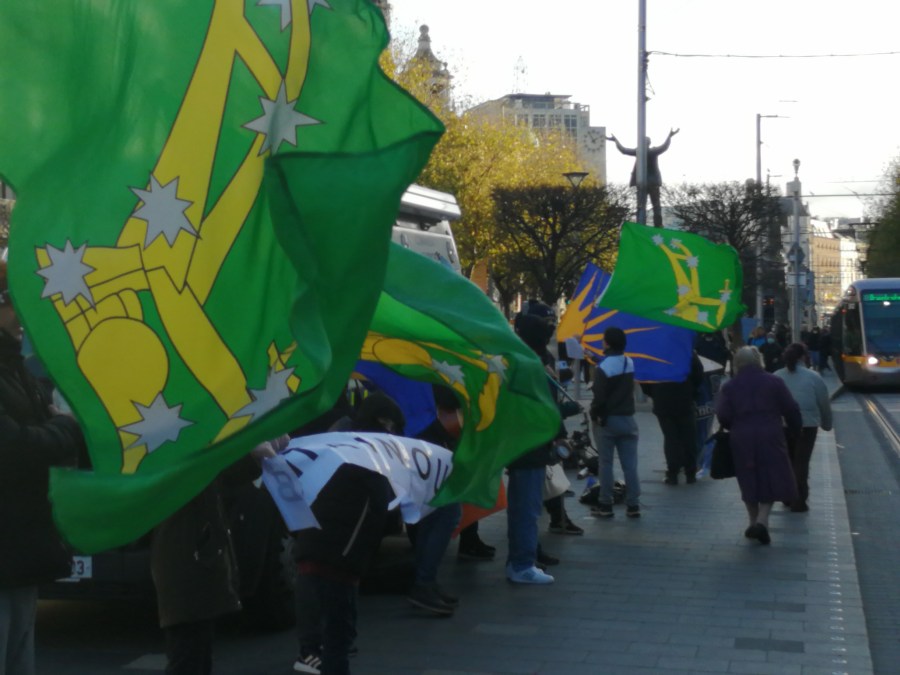
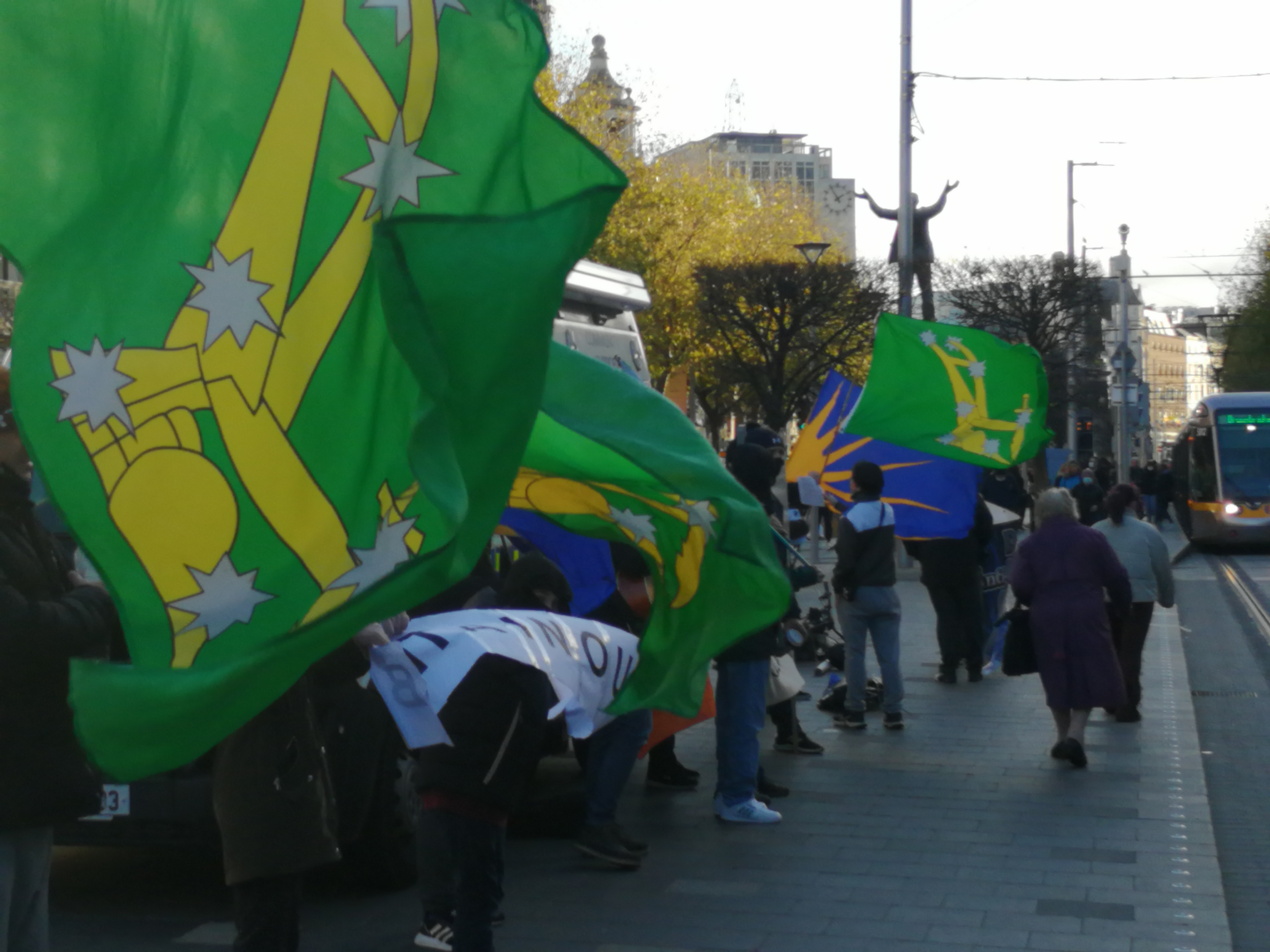
A southward view of the banner and flags on the picket, the Starry Plough of the Irish Citizen Army and the Sunburst of the Fianna Éireann, with the Jim Larkin monument in the background. A LUAS tram is approaching to right of photo. (Photo: Rebel Breeze)

USEFUL LINKS

https://www.facebook.com/AIAI-For-National-Liberation-and-Socialist-Revolution-101829345633677

https://www.facebook.com/End-Internment-581232915354743

Witch-Hunting in the imperialist British Labour Party

Diarmuid Breatnach

(Reading time comment: 2 mins; and article: 5 minutes)

People who’ve been following the witch-hunts in the British Labour Party — or even just generally aware of them — have seen left-wingers like Jeremy Corbyn, the party’s elected leader, actually expelled. Though Corbett has now been allowed back in with his electoral wings clipped, others have been expelled, including left-wing film-maker Ken Loach. It is witch-hunting, a type of McCarthyist hounding in which victims must prove themselves innocent of anti-semitism, which turns out to be impossible. This is because the Zionists and their supporters have succeeded in making any attack on Israel or Zionism, a political target, correspond to anti-semitism, a religious-racist view. That is all wrong certainly but it is not the job of socialists nor of anti-imperialists to “save” or “democratise” the British Labour Party.

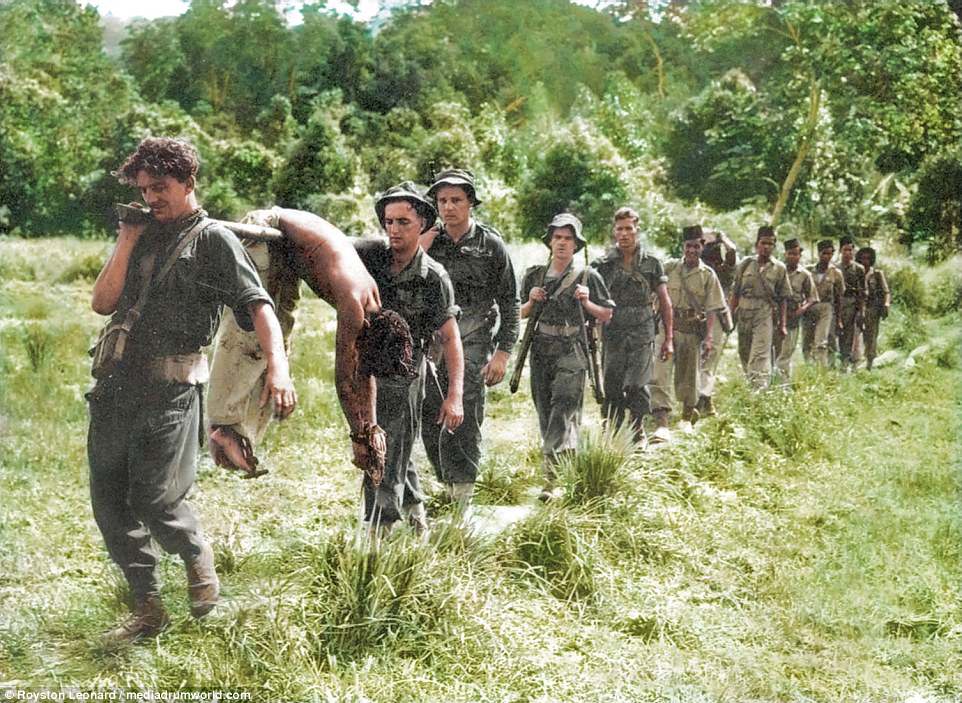
British troops suppressing anti-colonial struggle in Malaya 1948-1960, (then a part of what is now Malaysia), carrying a bloodied Malayan prisoner (Photo sourced: Daily Mail)

Lenin famously once advised British socialists to support the Labour Party “as a rope supports a hanging man”. He was saying that as Labour had never yet been in sole government, it was bound to carry the idealised hopes of many working people — therefore give them the opportunity to see it in action. Whether Lenin was correct in his advice to help get Labour into government or not (and not all revolutionary socialists agreed with him), Labour was in the coalition War Government in 1915-1918 and subsequently in the periods 1924, 1929, 1945-1950, 1964-1970, 1974-1977, 1997-2010. It has had plenty of opportunities to show its real nature and has done so.

However, over the years, radical social democrats and various Trotskyist trends, along with the old Communist Party of Great Britain, have sought to support the Labour Party, not by pulling the rope, kicking the chair or unlocking the scaffold trapdoor, but by desperately getting underneath the body and propping it up. General elections were replete with slogans from the Left exhorting us to elect Labour “under a socialist program”, “under Left pressure” and “with socialist demands” or even “internal democracy” (to give the entrists room to move).

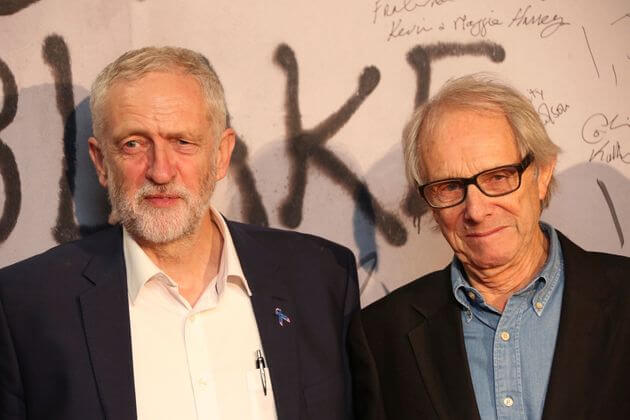
Ken Loach (right) and Jeremy Corbyn at premier of the film “I, Daniel Blake in 2016. (Photo credit: Joel Ryan, AP via Getty Images).

Such demands and manoeuvrings are in complete contradiction to history or a basic socialist class analysis. Lenin was certainly correct when he analysed the Labour Party as fundamentally capitalist and imperialist and the party has obligingly gone on to vindicate that analysis both in and out of government. But how could it be otherwise? It is a capitalist imperialist class that runs the UK and a party truly representing the working class will not be permitted to take over except if the ruling class is overthrown in revolution.

And such attempts will be met with whatever force the ruling class has at its disposal. In the Hebrew-Christian creation myth, the originators of humanity are driven from Paradise by an angel with a flaming sword and apparently never try to get back in (not in this life anyway). It will certainly take a flaming sword to drive capitalism from its Paradise of exploitation of labour power but in fact its predicament then is worse than Adam and Eve’s — for to be barred from entry forever means its very extinction as a class.

This is all Basic Socialist Theory 101 and proven time and again by Modern Class History 101. And yet, people on the Left who can quote volumes of Marx, Lenin, Trotsky and even sometimes Bakunin, have somehow come out of those 101 courses with an entirely different understanding. And so time and time again, the hunt for the Left Messiah to lead the Labour Party and within, the gatherings of radical Leftists cliques, conspiring like the Christians in the Catacombs beneath Rome.

British troops and detainees in Kenya; the record of tortures inflicted on many is truly horrific. Although the Conservatives were in government throughout the period, it was never seriously challenged by the Labour Party on the actions of the troops. (Photo sourced: Internet)

Just a moment’s review will show that at its first opportunity, Labour participated in management of the imperialist WWI which, by the way, included the murder of surrendered Irish insurgent leaders in 1916. The review will also reveal the agreement in the partition of Ireland in 1921, undermining of the 1926 UK General Strike, complicity in the anti-liberation wars in Persia (now Iraq), Egypt, Greece, Korea, Malaya, Cyprus, Kenya, Aden (now Yemen), Oman …. and participation in joint invasion or attacks on Libya, Iraq, Syria, Afghanistan. Not to mention being the party actually in Government when in 1969 it sent the troops in to quell the large oppressed Catholic minority in the Six Counties seeking civil rights.

Well, actually yes, let us mention it because that and its collusion with the Conservative government’s introduction of internment without trial in 1971 and subsequent massacres of protesters that year and in 1972 ratcheted up a cycle of violence that lasted three decades, with huge loss of human life among civilians, liberation fighters and its own soldiery and Loyalist auxiliaries.

The first anti-fascist fighter killed in Britain by police, by the way, Kevin Gately, was killed by mounted police in 1974 — under a Labour Government.

Those who really want an end to capitalism and imperialism — and the attendant racism — in Britain need to find a solution that does not involve electing a “Left Labour Government” or anything of that kind. We can argue and discuss what that solution might involve but one thing we should insist upon is that a “Left Labour Government” is not one of the options on the table for discussion.

End.

SOURCES:

UK Labour Party pro-Israel purge continues: celebrated film maker Ken Loach latest member to be expelled

https://en.wikipedia.org/wiki/List_of_British_governments

DUBLIN PICKET AGAINST ONGOING INTERNMENT MARKS 50th ANNIVERSARY OF BRITISH INTERNMENT IN THE SIX COUNTIES

Clive Sulish

(Reading time: 5 mins.)

As Limerick and Waterford county teams prepared to face one another in the GAA hurling semi-final at Croke Park stadium, anti-internment protesters and campaigners lined up outside Dublin’s General Post Office, in the city centre, to mark the 50th Anniversary on the introduction of internment without trial in the British colony of the Six Counties. Their placards, leaflets and speakers denounced the continuing practice of interning political activists in Ireland today.

Seen at the anti-internment event in Dublin today (Photo crdt: Sean Hogan)

The event was organised by the Anti-Internment Group of Ireland, an independent and non-affiliated campaigning organisation and the supporters included a mixture of socialist Irish Republicans and anarchists. The heavy and persistent rain of the morning held off and Dublin city centre was thronged as GAA hurling supporters added to the usual shoppers. The banners and placards of the picketers drew considerable interest from those passing and here and there people stopped to discuss with them.

Some young Basque girls were curious but also delighted to see their nation’s flag, the ikurrina, being flown at the event and stopped to engage one of the picketers in discussion. Also in evidence was the flag of Amnistia, Basque organisation around solidarity with its political prisoners and against repression, along with the flag of Palestine.

Flag of the Amnistia organisation (solidarity with their political prisoners) in the Basque Country seen on the anti-internment event in Dublin today (Photo crdt: Sean Hogan)

Around 200 leaflets were distributed to passers-by, discussions were held and contacts were made with people interested in supporting the work of the Anti-Internment Group Ireland.

After some time in a picket line and distributing leaflets, a representative of the organisers, speaking in Irish and in English, welcomed the attendance and introduced a speaker from the Anti-Imperialist Action organisation.

One of the leafleters outside the GPO at the anti-internment event in Dublin today (Photo: C.Sulish)

SPEAKERS

Speaking in Irish as some passers-by stopped to listen, the young man said they were there to commemorate the introduction of internment and mindful of the existence of political prisoners all over the world. The were also protesting the extradition to Lithuania of Liam Campbell to face trial in a country in which he had never previously set foot.

The organisers’ representative then spoke in English about the history of repression in the Six Counties colony, how from the moment the nationalist community there stood up to demand equal rights and justice the State had responded with violence. Since the people raised the level of their resistance in response, the State in turn raised the level of its violence higher again, in a rising spiral of violence.

The nationalist community in the Six Counties had marched for civil rights and had been met with the violence of the colonial police and of the Loyalists — the speaker said — but they had continued to resist. Internment without trial was introduced to break that resistance but, knowing that would also lead to increased resistance, the State had prepared the Paratroopers to shoot unarmed civilians dead. They had done that in Ballymurphy on the very day that internment had been introduced1, he reminded his audience and later had shot dead two unarmed Cumann na mBan Volunteers (Republican women’s organisation) who were alerting people to the raiding parties of the British Army. At the start of the following year, the British Army murdered unarmed civilians again, this time in Derry2.

That year 1972, the speaker stated, had the highest death toll of any year during the three decades of the war3 and Loyalists were also bombing streets nearby in Dublin, again in 1973, killing workers. In 1974 Loyalists and British intelligence bombed the Dublin city centre again and Monaghan, killing the highest number of people killed in one day during the war4. That year too, the IRA bombed pubs in England and killed people and the State brought in the repressive Prevention of Terrorism Act against the Irish community. They jailed a score of innocent people on extremely serious charges5 and one of them, Giuseppe Conlon, died in jail6.

The speaker went on to say that although there had been hard repression before, the introduction of internment without trial and the follow-up massacres by the British Army had lit a fuse to a chain-reaction of violence for decades to follow.

Pointing out that internment consists of jailing people without trial, the speaker stated that the practice continues today, by refusing bail to political activists awaiting trial in the non-jury courts on both sides of the British Border. The Anti-Internment Group of Ireland will continue striving to expose this reality and he called on people to support the monthly pickets in the city centre and to follow the End Internment page on Facebook.

ONGOING AGITATING AGAINST INTERNMENT

As the applause died down people began to pack away flags, banners, placards and leaflets and to catch up socially among themselves or to engage with passers-by who had stopped to listen and/ or to ask questions.

Organisers of the event said they hope to hold another picket at some venue in the city centre in a month’s time – when scheduled, the event will be announced on the End Internment FB page.

End.

Leafleter right foreground, person reading leaflet left foreground, picket line of the anti-internment event in Dublin today. ( Photo: C.Sulish)
(Photo: S.Hogan)


(Photo: S.Hogan)
View of the picket with a passer-by expressing solidarity with the picketers (far right of photo). (Photo: C.Sulish)

FOOTNOTES

1Between 9-11 August, British paratroopers caused the deaths of 11 unarmed civilians in Ballymurphy.

213 people were shot dead by British paratroopers on Bloody Sunday in Derry as they protested against internment and a 14th died later of his wounds.

3The period from August 1971 to the end of the year saw a huge jump to 136 violent deaths (including British and colonial armed forces) and the following year, 1972 is counted the most violent year of the conflict overall with 479 people killed (including 130 British soldiers) and 4,876 injured.

434 people were killed that day, all civilians.

5The Birmingham Six, Guildford Four, Maguire Seven, Giuseppe Conlon and Judith Ward. All were eventually cleared after long years of campaigning around them and failed court appeals.

6Giuseppe Conlon, hearing that his son Gerry had been arrested for the Guildford Pub Bombings, came to London to help him in 1974 and was swept up into the police net to become one of the innocent framed victims. Giuseppe Conlon was not a healthy man and died in his 7th year in jail, before the verdicts on the other framed prisoners were finally overturned. His son Gerry, also an innocent man in jail, was not permitted to attend his father’s funeral.

FAKE PATRIOTS DON’T WANT A UNITED IRELAND

Diarmuid Breatnach

(Reading time main text: 5 mins.)

The anti-maskers, racists and outright fascists strutting around under the Irish Tricolour or the “Irish Republic” flag habitually claim not only to be patriots but to be more patriotic than anyone else – in fact the only true patriots. They refer to Ireland’s past struggles against the British colonialists (up to 19211, not after!) and to Irish patriotic martyrs, totally ignoring or even denying the kind of democratic and inclusive Republic for which those people fought. As all that were not bad enough, they display no interest in the Six Counties nor in what is going on there and that was demonstrated again during the past week when there was hardly a word of comment on their social media about events there.

Fascist group shot: Irish Freedom Party faithful, 2nd from right founder Herman Kelly with Croft to his right again (behind them the 1916 Proclamation, the actual words of which they work against). (Photo sourced: Internet)
The Far-Right like to portray themselves as patriots and usually a number of tricolours will be in evidence, as in this Gemma O’Doherty solidarity protest in Stephen’s Green, Dublin, November 2019 (Photo D.Breatnach)

BELFAST RIOTS: REASONS, FAKE AND REAL

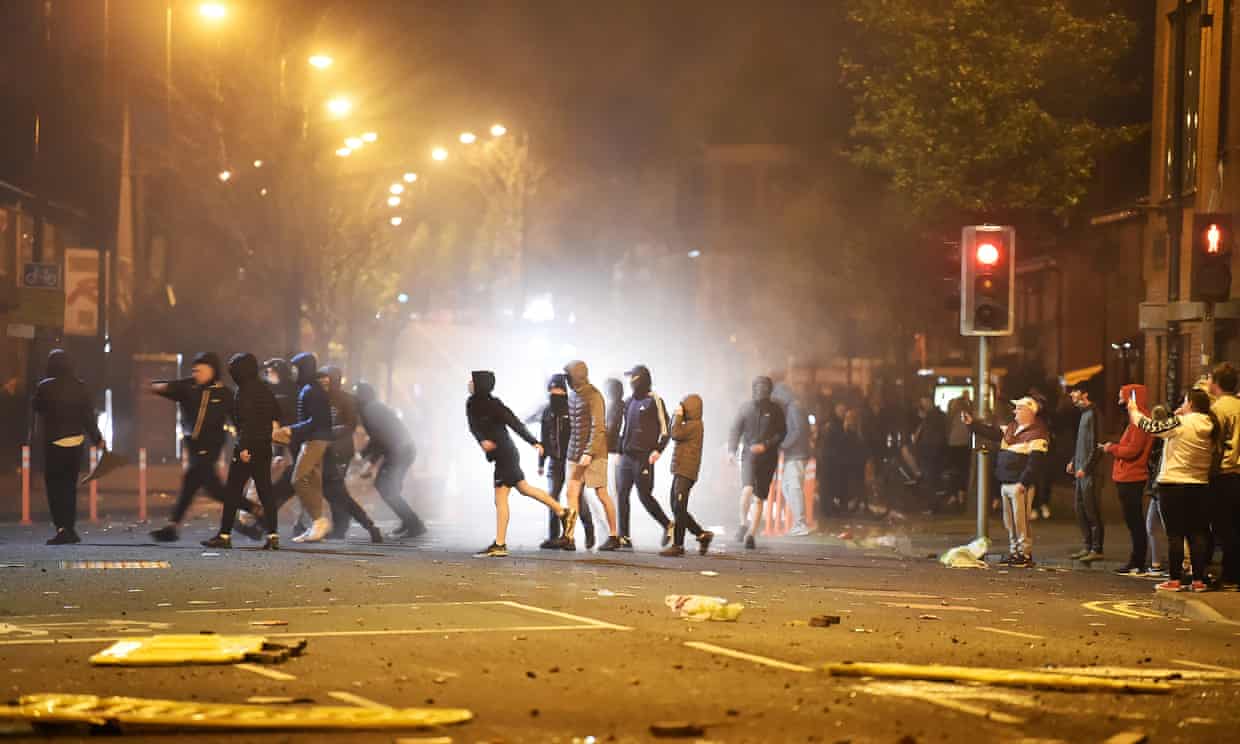
Riots broke out in Belfast last week and have been ongoing, firstly by Loyalists against the colonial police, then by ‘Nationalists’ against the police and Loyalists trying to attack their area. Since Brexit, Unionists have been unhappy with the decision of their masters in England to pull out of the EU and complain that they are being left with obstructions to trade as a result. Whatever their own wishes, they are bound by the decisions taken at Westminster and they have been complaining of those. Of course the whole situation has exposed the unnatural existence of the colony, the Six Counties, since most of Ireland continues to be a member of the EU.

Rioters on the (Loyalist) Sandy Row on 9th April (Photo sourced: Internet)

Next, Sinn Féin carried out a massive public funeral in Belfast for a prominent Republican veteran, Bobby Storey, in which large crowds of mourners and viewers could be seen flouting the pandemic restrictions and Michelle O’Neill, Vice-President of SF and Deputy Prime Minister of the colony’s government, was present. This was apparently intended in part as a demonstration of the strength of the party’s hegemony of ‘Nationalist’2 voters in Belfast.

Although unrelated to the Unionists’ problems with their over the sea masters and Brexit, the Unionists pounced on this violation of pandemic regulations to attack SF. When it emerged that the colonial police had held some discussions with SF prior to the funeral and that no-one had been arrested, the Loyalists, the more extreme wing of the Unionists3, jumped on the issue.

Coincidentally, the colonial police had very recently seized yet another consignment of drugs bound for a Loyalist gang, the South East Antrim UDA4 who then got youth to riot against the police pretending it was about the latter’s alleged deal with SF around the funeral event. Unionist politicians opportunistically stoked the whole event up as a distraction from their own helplessness over Brexit and possibly as an attempt to pressurise the British Government (to give them what it has no power to do, to effectively remain inside the EU market).

Loyalists would also be aware of the recent hyping of the question of a “Border Poll” and the possibility of a united Ireland in the near future – “hyping” because there seems little likelihood of such a poll, not to speak of a such a result, anytime soon. Such talk would increase their paranoia and anxiety and the usual result of that would be riots and attacks on Catholics.

Whenever the Loyalists feel unhappy with how they perceive themselves treated by the British or Unionist leaders, not long afterwards they will attack the “Taigues” or “Fenians”, i.e the large ‘Catholic’ or ‘Nationalist’ minority and at the weekend that is what happened. Loyalists stole a car and rammed it against a gate in a wall separating the two communities in Belfast and also gathered at the Springfield Road interface with the ‘Nationalist’ area of the Falls Road.

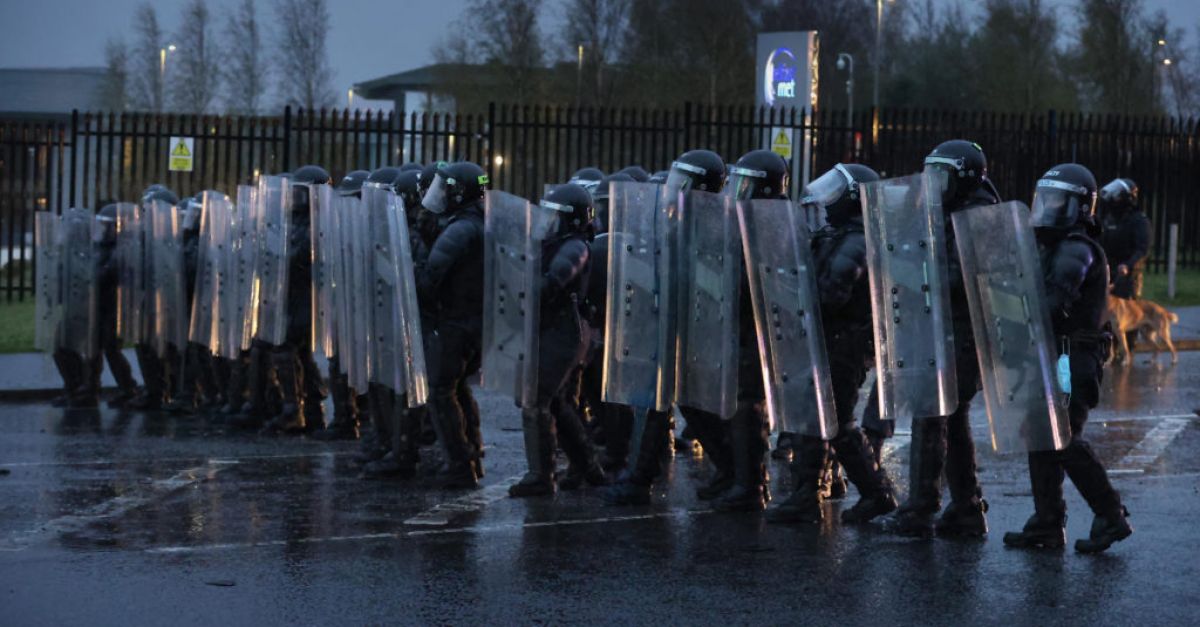
The youth and some older residents of the ‘Nationalist’ area naturally assembled at the Springfield Road junction to defend their area and naturally also the colonial police, the PSNI, appeared too. But these were not facing the invading Loyalists or trying to drive them back – instead, in riot gear, they faced the defending residents. The latter, having long experience with the sectarian and brutal colonial police saw this as a provocation and responded forcefully and so there was now a ‘nationalist’ riot against the colonial police who through the rest of the week had been attacked by the Loyalists, the latter now cheering on the police attacking the ‘Nationalist’ youth.

Colonial riot police on the Springfield Road 10th April, facing not the invading Loyalist mob but the ‘nationalist’ youth defending their area (Photo sourced: Internet)

FAKE PATRIOTS AND THE SIX COUNTIES

All of this was a prominent issue in the news in Ireland (though the drugs find issue quickly faded to be replaced by a solely sectarian narrative), clearly of relevance to the nation but somehow escaped any degree of discussion among the fake patriots who make up the ranks of organised fascists, racists, and anti-maskers.

Of course, if this Far-Right rag-bag were to evince an interest in the Six Counties, what could they say? They could not ally with Republicans, whom they sometimes call “terrorists” and who they know are antifascist. One might think the Far-Right would support the ‘Catholic’ minority, since most of those Far-Rightists are militant Catholics of one kind or another and all the fascist parties say they want a Catholic state. However, supporting ‘nationalist’ resistance rather than their usual nonsense about opposing masks and vaccinations could bring them up against both states in a real way. But it’s even worse than that, because fascists Rowan Croft (aka Gran Torino) and Herman Kelly of the Irish Freedom Party are recorded on a video sharing a platform in friendly discussion with Loyalist and British Fascist (formerly BNP and Britain First parties) Jim Dowson (who also posted a comment congratulating the National Party on their armed attack on unarmed counter-protestors in August last year in Dublin).

A patriot is a person who loves their country and its people and the Irish far-Right are constantly telling us how patriotic they are. But their patriotism, fake though it is for the rest of Ireland, stops completely at the British Border. Only the fascist Irish Freedom Party (under the cover of Irish Yellow Vests) has tried to set up in the Six Counties, where it has been resolutely opposed by Irish Republicans, after which it enlisted the help of the colonial police for protection.

Irish Freedom Party stall being disassembled by Republicans in Belfast July 2020. The next time the IFP set up they did so with colonial police protection. (Photo sourced: Belfast Telegraph)

The fake patriots will not be found supporting Republican prisoners nor protesting about the prisoners’ treatment under administrations both sides of the British Border, nor confronting the colonial police to oppose harassment on the streets nor their raids on the homes of Irish Republicans. The Irish fascists who hide among the anti-maskers, anti-lockdown protesters and flaunt their alleged “patriotism” represent nothing but a more repressive and vicious version of more of the same: capitalist neo-colonialism in the 26 Counties and capitalist British colonialism in the Six Counties. And should they get into power we’d hear a lot less about “freedom of speech and of movement” and a lot more about the need for “strong government” and “law and and order”.

End.

FOOTNOTES

1i.e the point at which the British divided Ireland; those subsequently fighting for Irish freedom were being hunted down by the new Irish State and, in the Six Counties, by the colonial authorities.

2Alternatively described as ‘Catholic’ or ‘Nationalist, the large minority within the British colony has been subjected to sectarian discrimination, cultural oppression and physical repression since the inception of the colony and before. The majority faith was Catholic and the majority political aspirations for a united and independent Ireland but it is not fundamentally a religious issue, nor is every resident in those areas a Catholic in religious faith or even necessarily a nationalist.

3The Loyalists as a sector tend to be working or lower middle-class while the Unionists tend to be upper middle-class or top of the pile and to manage the system, using the generally right-wing and virulently sectarian Loyalists in a similar way to that in which the racist Southern USA authorities used the Klan in the past – to repress the minority in ways which would look bad for the Unionists were they to do so. However, there are ups and downs and the Democratic Unionist Party, currently in power representing the Unionists, is a former Loyalist party that, under the leadership of Ian Paisley, overtook the Official Unionist Party decades ago.

4A “dissident” group within the Loyalist ‘family’; the Ulster Defence Association is a sectarian paramilitary association with connections to State’s repressive forces and controls the drugs traffic in Belfast; Antrim is the county in the NE of Ireland in which Belfast is located.

SOURCES & FURTHER READING:

Loyalist gang’s drug consignment seized: https://news.sky.com/story/criminal-gangs-encouraging-children-into-violence-on-northern-irelands-streets-say-police-12267276

and: https://www.belfasttelegraph.co.uk/news/northern-ireland/police-seize-12-million-worth-of-suspected-class-a-and-b-drugs-40262655.html

Other recent Loyalist drug losses:

Cocaine for Loyalists 18 March 2021: https://www.irishmirror.ie/news/irish-news/crime/dumb-criminals-lose-28-million-23748676

Three drugs shipments due for 6 Counties seized: https://www.irishexaminer.com/news/courtandcrime/arid-40192683.html

Irish Freedom Party chased in Belfast: https://www.belfasttelegraph.co.uk/news/northern-ireland/activists-evict-far-right-irish-party-as-it-sets-up-stall-in-centre-of-belfast-39398940.html

SWORD, PIKE, GUN – STRUGGLE FOR IRISH INDEPENDENCE

Diarmuid Breatnach

(Reading time: 8 mins.)

A debate is currently taking place about whether armed struggle is appropriate in the context of achieving national liberation in Ireland. The debate is hardly new — traditionally some sections of the polity have opposed armed struggle and some have advocated, even embraced it. However tiresome it may be for some, revolutionaries need to address questions as they emerge and re-emerge but there is another reason to enter this debate, which is that in my opinion both sections in the main are basing themselves on a false premise.

The composition of the sections opposed to or in favour of armed struggle has varied but in general and hardly surprisingly, the social democratic and liberal sections have opposed its use, while the revolutionary Republicans have defended it. But sections of the Republican movement at various times have also moved out of the armed struggle camp and into the ‘constitutionalist’ quarter. As to the revolutionary Left (or that claiming to be revolutionary), the main parties1 have opposed it not only in terms of Irish national liberation (with which they hardly concern themselves as a rule2) but also in the class struggle, while smaller parties and groups have at different times endorsed it as a legitimate or even necessary mode of struggle.

Before going deeper into this question it would be as well to look at the current situation in general and also to review the usual relevant scientific rules, which is to say those tested in the laboratory of Irish and world history.

OVERVIEW OF IRISH ANTI-COLONIAL HISTORY

Ireland is a small country in size and population but historically has had an effect on the history of large parts of the world out of all proportion to its size. Currently this is not the case which is perhaps not surprising since it is partitioned with one-sixth of its land mass under British colonial rule and the rest ruled by a neo-colonial capitalist class that came from under direct colonial domination a little over a century ago. The process of that colonial domination began eight and a half centuries ago3 and the decades and centuries since that time have seen Ireland colonised, most of its land appropriated, cultural, economic and political domination, famines and mass emigration, all of which the Irish have resisted and against which they and sections of the settler population have risen time and time again. The resistance has taken many forms but in general has always included armed struggle: sword, pike or gun.

Monument in Dublin to the 1798 Rising but equally so to the repression suffered before, after and during it — the site is Croppies’ Acre, the location of a mass grave of insurgents. The grey stone buildings in the background are part of the former British Army barracks in Dublin, subsequently barracks of the army of the Irish State, now a military history and clothing state museum. (Photo: D.Breatnach)

The phase of the national liberation struggle in the early decades of the last century resulted in the granting of nominal independence to five-sixths of the country and the retention of the remaining portion as a direct British colony, formally part of the United Kingdom but with a number of administrative and legislative elements peculiar to itself4. This was followed almost immediately by a civil war in which the Republican movement was defeated and all governments of the Irish state since then, regardless of their political party composition, have been of the “Gombeen” neo-colonialist class.

Elements of the Irish Republican movement have never reconciled themselves to this situation and surges of armed struggle took place in the 1930s and 1940s, after that usually restricted to the Six County colony in the mid 1950s to early 1960s and again from the beginning of the 1970s to the end of the 1990s, since when there have been what could best be described as sporadic armed incidents.

During the course of those years sections of the Irish Republican movement have abandoned armed struggle for national liberation, denouncing their erstwhile comrades and even participating in repression against them, whilst those who continue to support armed struggle accuse those who have left the fold of treason.

HISTORICAL EXPERIENCE

The history of Irish resistance to colonial domination and expropriation has been replete with armed instances which should surprise no-one, since that colonial domination was achieved in the first place by force of arms, a force employed again and again in repression also. Whenever other means of repressing Irish resistance were employed, e.g by legislation or cultural imposition, the arms of the conqueror were never far from view. “Dieu et mon droit” is the historical motto of the English monarch5, meaning “God and my right”; however “my right” in English at least has the other meaning of “my right hand”, which can also be understood as the hand used to strike a blow, whether as a fist or holding a weapon. And neither monarchs, feudal or capitalist classes of England have been historically reticent in employing force, including armed violence, in pursuit of their “right” to rule – their own country or others’.

Some of the damage to Dublin city centre from British artillery and subsequent fires in order to suppress the 1916 Rising. The shell to the right of photo is that of the GPO which was the HQ of the insurgents. To the left is the corner of Moore Street, an old market street still in existence today, to which most of the GPO garrison relocated. Centre background is “Nelson’s Pillar” which survived the Rising almost intact but was later demolished by dissident Republican explosion. (Photo source: Internet)

Indeed, it took an armed rising in 1916 followed by three years of guerrilla war (1919-1921) to convince the rulers of Britain that they should grant even limited autonomy to Ireland, albeit with partition as part of the deal. The intervening peaceful gain of 73 out a total of 105 Irish seats in the 1918 British General Election, every seat won on a public commitment to Irish independence and a rejection of the British Parliament, did not at all sway the British ruling class.

Furthermore, around the world the history of nations that have liberated themselves from colonial occupation or incorporation has been, almost without exception, that of armed repression overcome eventually by armed resistance.

AGAINST ARMED STRUGGLE IN IRELAND

Those who oppose the right and indeed necessity to resist armed occupation with armed resistance are opposing a law of history. Granted that in theory, Ireland may be an exception or that the historical rule may no longer apply in this historical period and if that is the claim, then it is incumbent on those who oppose armed struggle to explain why they believe one of those to be the case.

In general, they do not even try to do so but rely instead on emotional appeal and moral argument. These are irrelevant in this context: yes, people get killed and otherwise suffer in armed struggle but the deaths and suffering imposed by imperialism and colonialism world-wide are hundreds of times greater. If we want to apply emotional and moral rules to the question then logically we should support the most widescale and energetic struggle everywhere to overthrow imperialism in the shortest possible time.

Those who argue that the current historical situation provides an exception to the general rule of history usually rely on two issues:

1) The gaining of the most seats in the parliament of the Irish state by the Sinn Féin political party in the 2020 General Election6 and 2) the discussion current in society about the holding of a “Border poll” at some point in the near future.

Neither of these is valid for positing that Ireland is currently — or about to enter – a historical phase that will nullify the general historical rule.

1) The Sinn Féin political party has done much more than abandon armed struggle – it has accepted the partition of the country and joined the administration of the British colony, accepting its legal system and repressive apparatus, in particular its police force. Its party within the Irish state is striving to become the dominant party of the Gombeen capitalist class, as first step towards which it seeks to join a coalition government of one or more of the parties of that class, manoeuvring to appeal to the Gombeen class while at the same time keeping its popular base. Nor is this the first time this has happened in Ireland, for what became the foremost party of the Gombeen class, Fianna Fáil, followed that trajectory after splitting from Sinn Féin in 1926.

2) The question of a “Border poll” does not change the historical rule because it is not the expression of the desire of the colonised that governs the decisions of the coloniser, as evidenced from 1918 to 1921 in Ireland for example. Indeed, even during the most recent war in Ireland, opinion polls repeatedly showed a majority of the British population wishing to have their governments pull out of the colony, those wishes never acted upon or even tested in referendum. On a purely legalistic level, even if (and it is by no means certain) a majority of the population of the colony should favour formal unification with the rest of Ireland, the question of how large that majority should be remains uncertain, as does whether – despite the words of some politicians of the British State – the wishes of such a majority would find a majority in the British Parliament and, in the final analysis, the endorsement of the British monarch.

Nor is there any guarantee that such a poll would even be held. And in the final analysis the right to self-determination of a nation in its entirety is not to be decided by a minority made into an artificial majority by colonialism and backed up by its repressive apparatus.

THOSE IN FAVOUR OF ARMED STRUGGLE

The section of our polity supporting the right to armed struggle therefore has a well-established international historical rule and the nation’s historical experience to vindicate its position. But neither factor necessarily dictates the form or the timing for such struggle. And our history has had many occasions when armed struggle was not the most appropriate form of resistance, either because the subjective or objective conditions did not favour it or because we had suffered a recent crushing defeat in arms.

Taking up the option of armed struggle usually occurs in a revolutionary situation but can also be in others, for example against a fascist takeover or other repression, or in defence of some gains (both were present in the case of the Popular Front Government of Spain in 1936 and the second in the case of the Civil War in Ireland). It does not seem to me that any of the periods of armed struggle in Ireland since 1922 fit into any of those categories except perhaps in the recent war in the Six Counties which in part might be categorised as defensive armed struggle against repression.

To wage war against a superior armed and experienced enemy is a serious undertaking. To do so with the struggle largely confined to one-sixth of one’s country and in a part in which almost two-thirds of the population is ideologically opposed to one’s forces has to be considered madness. Extremely courageous but madness nevertheless. How could those leading that armed struggle ever expect to win? Only by basing themselves on a flawed analysis or a reformist one – never on a revolutionary one.

The flawed analysis was that the British ruling class had no great interest in holding on to the colony and could therefore be encouraged to leave if only they could be made to suffer enough. The theory that the British ruling class places no great importance in maintaining its grip on the Six Counties has been amply debunked by its actions since 1921 and even more so since 1968. Of course, that does not prevent liberals, social democrats, unionists and other defenders of British imperialism from peddling that theory but revolutionaries at the very least should be able to see through it.

The reformist analysis was that if only the struggle became serious enough then sections of the Irish capitalist class would oppose British colonial rule in Ireland and move towards the reunification of the country. This analysis is deeply mistaken in that it fails to take account of the nature of the native Irish capitalist class, which is weak and foreign-dependent and has never been anything else. The last time the Irish capitalist class or a substantial section of it was revolutionary was in the time of the United Irishmen and they were led and in some areas largely constituted by descendants of planters and settlers. The development of the native Irish capitalist class under British colonialism was hampered by Penal anti-Catholic laws, destruction of native industry and the influence of a large section of its intelligencia, viz. the conservative Catholic Church hierarchy and much of the priesthood. In 1921, this native capitalist class, raised in huckstering, clientism and corruption, preferred to murder and jail its own national fighters than to carry the struggle for independence through to the end. Since then it has largely allowed foreign capitalists to exploit its labour force and other natural resources on land and sea, along with large parts of its infrastructure. It was never going to take a serious stand for independence and national reunification.

Irish Free State Army firing cannon loaned by the British at Republican resistance centre in the Four Courts, SW Dublin city centre. This action was the beginning of the Civil War (1922-1923). (Photo source: Internet)

If both those analyses are mistaken, what other rational basis can there be for waging an armed struggle confined to the Six Counties? And if there be no such rational basis, how can the sacrificing of idealistic and courageous young people to years of prison and negligible employment prospects be justified, to say nothing of loss of life and serious injury?

IN CONCLUSION: THE URGENT TASKS OF REVOLUTIONARY STRUGGLE

If an armed struggle confined to the Six Counties is unwinnable, it does not follow that the time is therefore right for armed struggle across the whole of Ireland.

The task for revolutionaries in Ireland, i.e people who are determined to work for a revolution, is to analyse objective and subjective conditions and work in accordance with them in order to advance the struggle to the point of insurrection, at which point there will be no choice but to take up arms, since foreign imperialism and native capitalism will both send their armed forces against us. While it is true that an effective resistance to armed attack requires certain preparations in advance of that crisis, concentration on armed struggle at this stage will not bring us to that point. The mass of the population, including our potential mass base, does not require armed struggle at this point and therefore would not support it. In these conditions and at this time, different forms of struggle are called for.

Nevertheless there are many struggles which working people undertake now and will do in future and revolutionaries need to participate in them and also to use them to help the working people to see their potential. If people must go to jail — and historical experience tells us that they must — would it not be better for them and even more so for the overall struggle, if they did so for taking part in a social or economic struggle of wide sympathy, for example around housing, rather than for “membership of an illegal organisation” or possession of firearms? This would be so even if the immediate objective were the reformist one of forcing the Irish Government to release funds to the local authorities for a construction program of public housing for rent.7

While at times we fight for reforms, we should not advocate any faith in a reform of the system, nor in organisations or leaders who advocate such faith but we rather use the struggles to educate the working people in struggle, showing their strengths and of what they are capable but also the need to go further, to take power into their own hands. It also means that we have to organise against oppression and repression in all their forms – political, economic, religious/cultural, sexual, intellectual ….. And that we have to find ways to participate in all those struggles, putting forward a revolutionary analysis.

This approach calls for both temporary and long-term alliances, both of which have to be managed with care and never by surrendering our revolutionary direction.

We need to build fighting organisations and revolutionary media. We lack broad fighting organisations of any size on any one of the fronts on which we have to fight, including (crucially) fighting trade unions or grassroots trade union organisations. We do not even have a mass revolutionary weekly newspaper.8 Nor a wide political education program. Without those things, it does not seem a realistic proposition to overthrow the ruling classes in Ireland. Towards the building of those elements is where the energies of revolutionaries in Ireland should be directed, whether they be Irish Republicans, Socialists, Communists, Anarchists (or any combination of the above).

In the face of such tasks, does it really matter much why at this time this or that individual speaks out for or against armed actions by relatively small organisations?

End

Gaelic society pattern sword with ring pommel of a type wielded against the Norman invaders of the 12th Century and later (Photo source: Internet)
Typical pike head with hook, popular in the 1798 United Irish uprising in Wexford (Photo source: Internet)
Armalite semi-automatic rifle popular with the IRA in the war in the Six Counties 1970s to 1990s. (Photo source: Internet)

FOOTNOTES

1These are two, both of Trotskyist ideology: the Socialist Party and the Socialist Workers Party (both now part of the Anti-Austerity Alliance — People Before Profit parliamentary coalition).

2While usually supporting it in areas of the underdeveloped world.

3The British occupation of Ireland is normally dated from 1169.

4These included permanent emergency repressive powers and a number of blatantly sectarian discriminatory provisions.

5It is also displayed on the coat of arms above and behind judges in British courts, which should alert people to the nature of the justice dispensed there.

6However they fell short of the absolute majority required to form a government and would have needed others to form a coalition government which instead, was formed by parties (of previous governments) that had won less support: Fianna Fáil, Fine Gael and the Green Party.

7The housing crisis within the territory of the Irish State is acute but no local authority is building housing for rent — they do not have the funds to do so. Successive governments are starving local authorities of that funding in order to benefit the property speculators and private landlords, which in turn the State funds through a number of measures including social welfare payment for the homeless converted to rent. Funding construction of public housing could also be used to expand public employment and training in construction, thereby pulling away from neo-liberal domination of the capitalist economy and strengthening workers’ rights. Meanwhile some fascists are using the housing need to push their “house the Irish first” propaganda against migrants and asylum-seekers.

8Ireland has two ruling classes: the native Irish neo-colonial one and the colonial unionist class ruling in the colony.

BERNADETTE TAKES ON THREE AND WINS

Introduction by Diarmuid Breatnach

The right-wing patrician UStater William F Buckley (despite the Irish surname) and two dogs, one of them the imminently slappable racist Tory Roger Evans, take Bernadette Devlin (now Devlin-McAlliskey) on and she wipes the floor with them. She was a month short of 25 years of age when she sat this interview in late March 1972, without any notes to hand, keeping up with the arguments, never losing her temper, reeling off historical facts and financial figures. It was a stellar performance.

Even more remarkable, not two months had passed since the Paras had shot 26 unarmed marchers in Derry, murdering 14 men at a march she had herself attended and, though then an MP, she had been refused permission to speak on it in the House of Commons, while lies were being stated by people who had not been there. Also, her interview took place only a month after the travesty of an inquiry into the murder by Lord Widgery who completely exonerated the gunmen and their officers, maintaining they were acting in self-defence against all evidence except the soldiers’ and Widgery even claimed a march of at least 30,000 was at most around 3,000! It seems that there must’ve been an agreement not to mention Bloody Sunday, perhaps as a condition for the interview, otherwise what else can explain its omission?

Bernadette Devlin, Member of Parliament for Mid-Ulster, speaking at a rally in Trafalgar Square, London, on June 1, 1971. (AP Photo) (Note: Trafalgar Square was later banned to Irish solidarity demonstrations for decades).

Bernadette came out against the Good Friday Agreement when it was born, not pushing armed struggle as an alternative but stating that the GFA institutionalised sectarianism and because she accused the Provos of seeking alliances with the Right and capitalism rather than with the Left and the working class. She would have been a powerful voice against the GFA and could not be accused of being in a ‘dissident’ armed group but the British State held her daughter Roisin, who was pregnant, hostage and Bernadette stepped back from that issue. She was marginalised by the Republican movement in the 1970s and 80s, along with being shot 14 times in front of her children (her husband shot too) in 1981 and lost to us as a national leader again in the first decade of the GFA.

Watching this discussion brings back to mind all the economic and political issues that were around at the time, especially as Bernadette reels them off, many of them largely forgotten. All the fudges and lies of British governments avoiding doing anything fundamental to improve things even within an illegitimate colonial context.

End.

Bernadette Devlin McAliskey Versus William F. Buckley Jr