The media informs us of the visit on the 22nd July of Mícheál Martin, Prime Minister of the Irish state, to the concentration camp where his uncle was a prisoner of the Japanese after the fall of Singapore in World War II.
Many Irish fought in the UK and British Commonwealth armies against Nazi Germany, Fascist Italy and Imperial Japan.
But there is another strong and ironic Irish connection to the fall of Singapore. The Lieut.-General Arthur Percival who surrendered the Singapore fortress to the Japanese Army in 942 had been Intelligence Officer (and torturer) for the Essex Rifles against the IRA in West Cork 1920-’21.
Major (then) Arthur Percival, C/O 1st Company Essex Regiment (later Intelligence Officer) in Ireland with senior officer of the colonial gendarmerie, the Royal Irish Constabulary, c.1920/21. (Image sourced: British Imperial War Museum)
PERCIVAL IN IRELAND
Percival served first as a company commander then as Intelligence Officer of the Essex Rifles in Kinsale, Co. Cork, where he “stood out for his violent, sadistic behaviour towards IRA prisoners, suspects and innocent civilians……
“He also participated in reprisals, burning farms and businesses in response to IRA attacks,” according to a USA historian. General Tom Barry, IRA commander in West Cork, said that Percival was “easily the most vicious anti-Irish of all serving British officers”1.
Two victims in particular were IRA Brigade Commander Tom Hales and Quatermaster Patrick Harte. Both reported being beaten and tortured with pliers to private parts and extraction of nails. Percival got an OBE for their capture; Harte died in a mental hospital in 1925.
Tom Barry recorded that after a number of ignored warnings, the IRA in Cork placed the Essex Rifles on the same status as the Black ‘n Tans and the Auxilliaries – they could depend on no mercy if captured.
Percival was also the man who unconditionally surrendered Singapore to a much smaller invading force of Japanese in 1942, thereby condemning thousands of soldiers and civilians to a terrible fate.
British Army prisoners of the Japanese after the surrender of Singapore (Image sourced: Internet)
LARGEST BRITISH SURRENDER IN HISTORY — AND TO LESSER NUMBERS
Singapore had been a British colonial possession since 18262. At the time of WWII the British considered it a strong fortress, a thick jungle and hills on the landward side and with huge 15” cannon facing out to sea against a possible naval invasion.
The British High Command considered no navy in the world could survive an assault on the island and no army capable of penetrating the thick jungle. Apparently no-one told the Imperial Japanese that for come through the jungle they did, marching or riding on bicycles.
The UK and Commonwealth troops on the landward side fought but were outgunned and badly commanded. After seven days of fighting, Percival decided to surrender unconditionally, with most of the 85,000 troops on the island not yet having engaged the 36,000 of the enemy.
The surrender of Singapore delivered 80,000 UK and Commonwealth troops, along with a million civilians, into captivity in the hands of the Imperial Japanese Army. Three days after the British surrender, the Japanese began the “Sook Ching” purge, killing thousands of civilians3.
The day before the surrender, Japanese soldiers also invaded the Victoria Hospital and murdered over 250 soldiers, doctors, male staff and patients.
Most of the soldiers taken captive had not been given a chance by Percival to even fire a shot at the advancing Japanese Army, to the contempt of their captors, led by officers with a strong military tradition and pride (not to say arrogance).
Whether that fact contributed to the cruel and inhumane treatment of the prisoners by their captors and guards is not certain but it seems to have done. In any case, many who died day by day and month by month building the Burma Railway would no doubt have preferred to die fighting.
Most of the civilians massacred would probably also have preferred to die fighting.
Around 30,000 Allied Prisoners of War of the Japanese died in captivity of cruel treatment including inadequate food, disease and overwork; working from statistics R.J. Rummel estimates a death rate of around 29% for POWs4. Huge numbers of civilians died similarly also.
Australian Russell Braddon, who wrote about his experiences in the Japanese concentration camp at Changi and on the slave-labour construction of the Burma railroad5, was extremely bitter about the surrender and the general Allied High Command management of the war in Malaya.
Many no doubt did so out of a desire to fight fascism — surely an admirable motivation6.
But once the War ended, any Irish remaining in the British armed forces anywhere could not claim to be doing anything else than helping the domination of many nations and millions of people by what was at the time the world’s biggest imperialist power (though soon to be eclipsed by the USA).
Mícheál Martin at Changi concentration camp where his uncle was a POW, now a museum (Photo: RTÉ)
If anti-fascism motivated his uncle and that is what Mícheál Martin appreciates about him, one would wonder why the police of the state which he leads protected fascists in Ireland and attacked antifascists on a number of occasions in recent years.
Of course there may be a more sinister aspect to Martin’s publicised visit. It may be a public expression of the desire among the Irish elite to be part of a western military alliance, either the US-NATO or an EU such, which would in the end amount to much the same thing.
And such an alliance in these times would not be fighting — even in part – against fascism but rather alongside it.
End.
FOOTNOTES
1Guerrilla Days in Ireland (1949 and many reprints since) by Tom Barry.
2Singapore became an independent republic on 9 August 1965.
3People from all ethnic groups were massacred but the Chinese most of all. Though the Japanese government years later paid some compensation to relatives of victims, it has never accepted responsibility for the events. Nor has the UK. “Since 1998, Singapore has observed Total Defence Day on 15 February each year, marking the anniversary of the surrender of Singapore. The concept of Total Defence as a national defence strategy was first introduced in 1984, which serves as a significant reminder that only Singaporeans with a stake in the country can effectively defend Singapore from future threats.” (Wikipedia)
5The Naked Island (1952) sold over a million copies. Russel Braddon (1921-1925) had a breakdown soon after the war and felt suicidal but, once recovered, became a successful writer of novels, articles and TV scripts. https://en.wikipedia.org/wiki/Russell_Braddon
6I met one of those, curiously enough a Corkman in a lodging house in London. Denis was a decent man, very big, who rarely talked about the war except sometimes when he had drink taken. Strangely, he never had a bad word to say against the Japanese – even the concentration camp guards.
The above would have been the headline 100 years ago1. Well, not the main one, perhaps, which would have been MASSACRE AT BACHELOR’S WALK – TROOPS OPEN FIRE ON CIVILIANS – 4 DEAD, MANY WOUNDED2.
Then, probably, GUNS LANDED AT HOWTH! POLICE AND SCOTTISH OWN BORDERERS FACED DOWN — REPORTS OF 1,500 GERMAN RIFLES LANDED FROM AMERICAN YACHT.
JOINT OPERATION OF IRISH VOLUNTEERS, IRISH CITIZEN ARMY, CUMANN NA MBAN AND FIANNA ÉIREANN — DUBLIN CASTLE FURIOUS.
MAYOR SHOCKED AT CIVILIAN DEAD AND WOUNDED — DEMANDS INQUIRY.
Speakers at a commemoration on the West Pier, Howth on Saturday 23rd July commented on all those features of the landing of 1,500 German rifles, single-shot Mauser Model 71 (M1871), their collection by the organisations of the broad revolutionary movement — and the army massacre that followed.
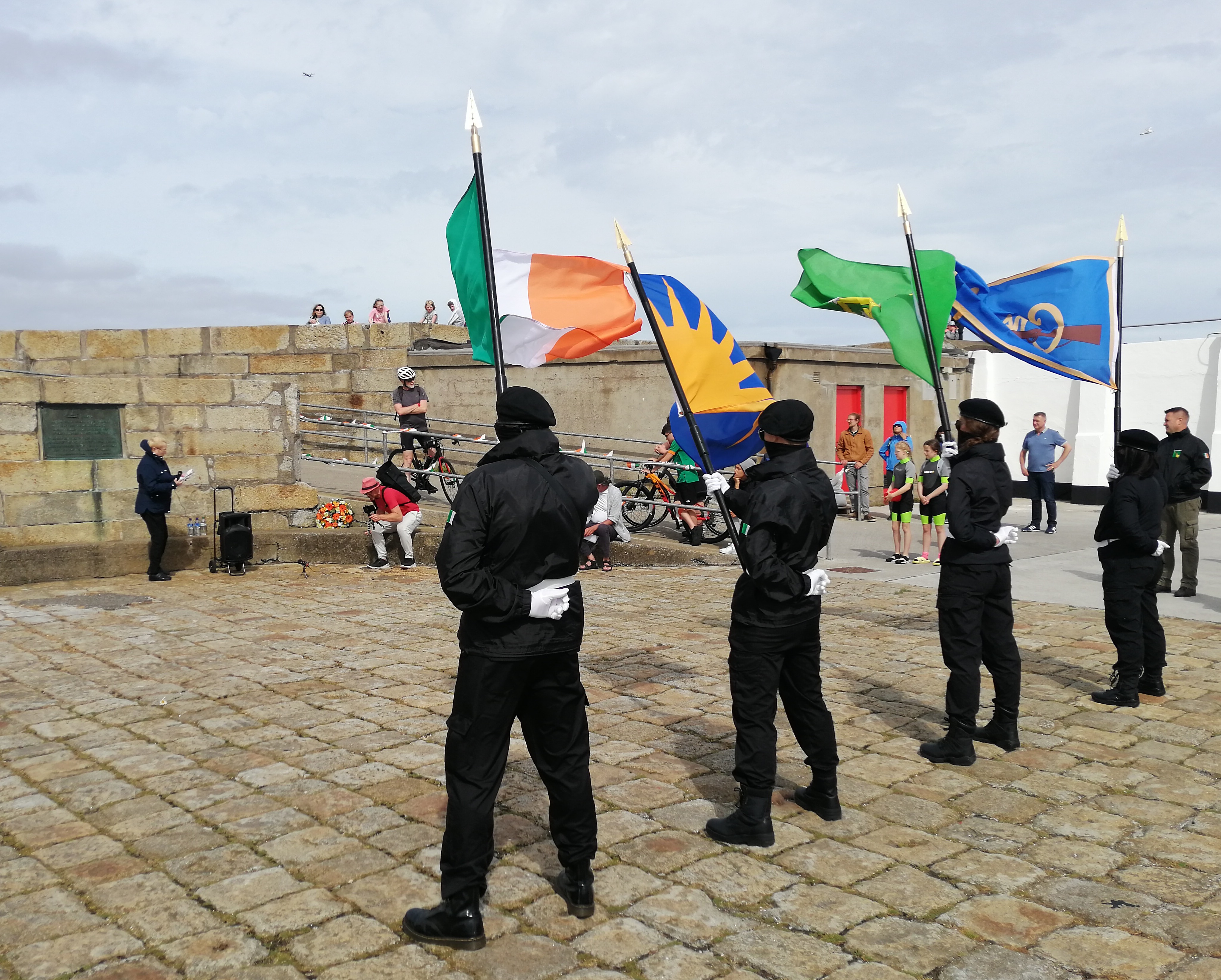
The event was organised by Irish Socialist Republicans and Anti-Imperialist Action organisations. A colour party of two men and two women led the march up to the pierhead where the event was held.
The Save Moore Street From Demolition campaign banner was displayed along the way.
Event about to begin, Margaret McKearney in distance, colour party in foreground, mostly bystanders to the right, attendance out of shot behind and to right of camera person. (Photo: Rebel Breeze)
The event was chaired by Margaret McKearney, a veteran Republican from Tyrone once described by Scotland Yard as “the most dangerous woman in Britain” and who lost three brothers in the struggle (one in SAS ambush at Loughgall and another murdered by UVF).
McKearney recalled the need of Irish nationalists for weapons when the Loyalists were arming to prevent Home Rule3 being granted to Ireland and the Loyalists with British elite complicity had received a huge shipment at Larne.
Speakers, songs and a laying of a floral wreath were the main content of the event.
THREE SPEECHES – DETAILED, DIRECT AND DEFIANT
McKearney called Phillip O’Connor to speak, a historian and local resident with a particular interest in the revolutionary period in Howth4.
O’Connor began with a quotation from C.J. O’Connell in his Lordship of the World (1924) that “Every Nation, if it is to survive as a nation, must study its own history and have a foreign policy”.
Phillip O’Connor speaking at the event — the plaque at the pier head behind him. (Photo: Rebel Breeze)
The speaker went on to relate how our rulers demote and distort our nation’s history and how for various reasons even families and communities neglect to pass on that history to following generations.
O’Connor went on to relate the extensive instances of local people’s participation in our nation’s revolutionary history. He brought out names of local people who had been active in Cumann na mBan and the Irish Volunteers and the Sinn Féin party of the time.
The speaker also drew attention to the Irish Citizen Army unit in the locality – the only one outside Dublin – that went on to participate in the 1916 Rising in Dublin and in Fingal. Of course many of that spread of revolutionary organisations had participated in the Howth guns landing.
O’Connor concluded by repeating the quotation: “Every Nation, if it is to survive as a nation, must study its own history and have a foreign policy”.5
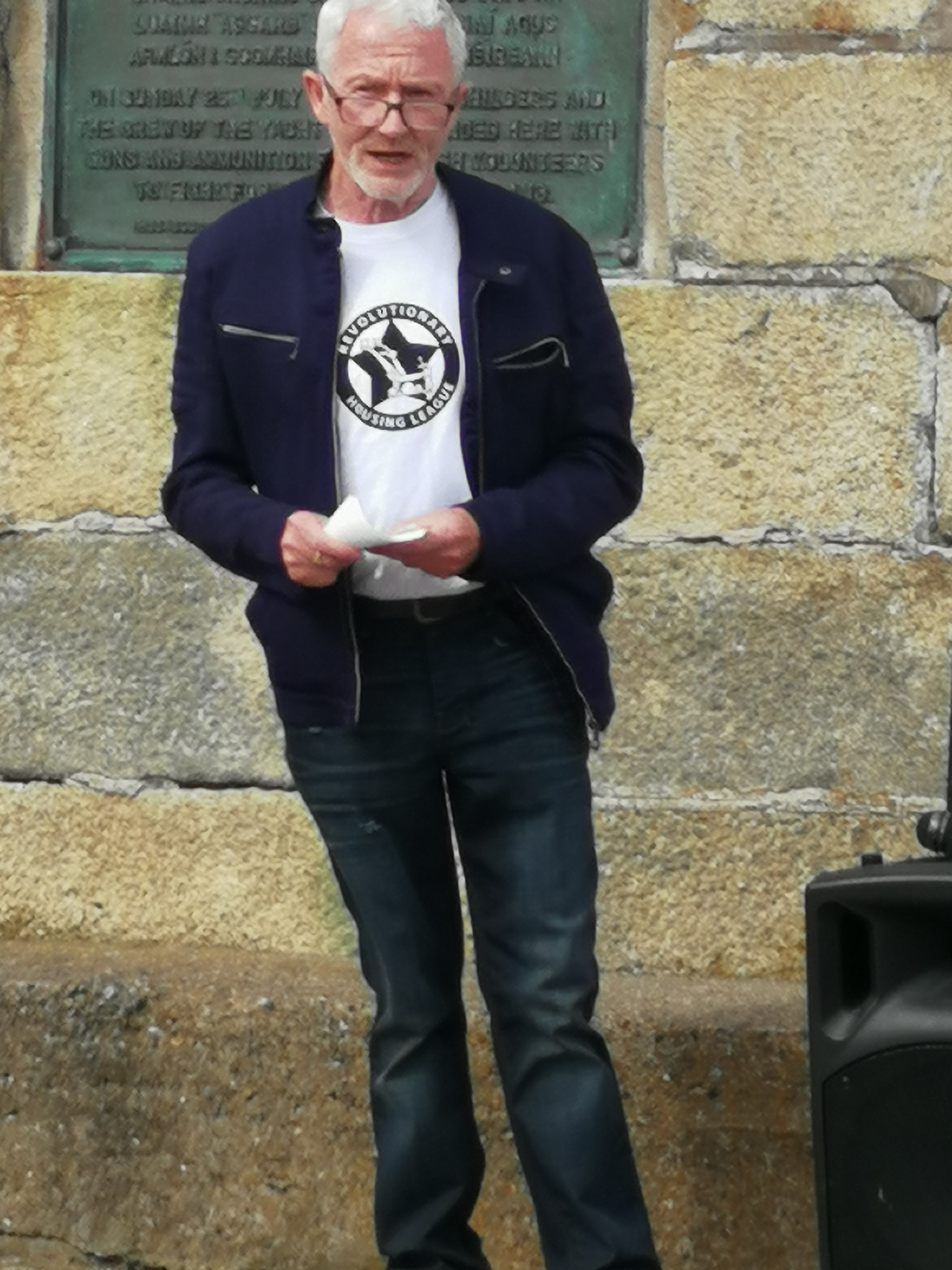
McKearney then called on Seán Doyle, a veteran socialist Republican who spoke on behalf of the Revolutionary Housing League, focusing on the housing crisis in Ireland and quoted Roger Casement1 at his trial in London in 1916:
Where all your rights become only an accumulated wrong; where men must beg with bated breath for leave to subsist in their own land, to think their own thoughts, to sing their own songs, to garner the fruits of their own labours…
then surely it is a braver, a saner and a truer thing, to be a rebel in act and deed against such circumstances as these than tamely to accept it as the natural lot of men. Doyle went on to recall James Connolly’s admiration for the struggle of the Land League and for Michael Davitt2.
However, Connolly, the speaker reminded his audience, had excoriated those who were outraged by the eviction of a tenant farmer but with “the working person locked out from his workplace or evicted from his home”, remained “at best silent if not critical.”
“We need to engender the same passion ourselves because the system does not care or share the plight of working people,” Doyle asserted and lashed “anyone who says he loves Ireland and can witness people dying on the street homeless while 180,000 houses are boarded up vacant”.
The speaker declared that the RHL would no longer remain silent, confined or recognise the ruling class’ self-serving laws or allow them to prosper, would no longer accept homelessness, nor “see our children rent an mortgage slaves for the rest of their lives”.
“We in the RHL believe that a roof over your head is not a commodity but an essential of life like water or oxygen. Houses make homes, make communities and a society we aspire to”. Doyle went on to call for a realisation “that pleading and appealing to a non-caring ruling class is futile.”
Seán Doyle speaking on behalf of the Revolutionary Housing League (Photo: Rebel Breeze)
Concluding, Doyle called on people to join the Socialist Republicans in action and quoted James Connolly6:We believe in constitutional action in normal times; we believe in revolutionary action in exceptional times. These are exceptional times, and called on people to “Build the Revolution!”
Cáit Trainor, an independent Republican activist from Armagh was called and stepped forward to give a rousing speech.
Reviewing as others had done the impelling of the arming of the Irish Volunteers by the arming of the Unionists against the prospective Irish “Home Rule”, Trainor went on to recall some of the other participants in the revolutionary movement of the time.
“Cumann na mBan with upwards of 1500 members was formed to assist the Volunteers, though some of the most radical women republicans, such as Helena Moloney and Constance Markievicz, elected to join the socialist Citizen Army instead, where they were given equal standing with the men.
“The Volunteers also had a ready-made youth wing, the Fianna Éireann, founded by Constance Markievicz7 in 1903 as an alternative to the ‘imperialist’ Boy Scouts. The Fianna were in fact to provide many of the most militant Volunteer activists.
“All of these groups would work together in the lead up to and including the 1916 rising, working together while maintaining their own autonomy with a unity of purpose.” “The Irish Volunteers had the men, the women and the youth, the next move was to secure the arms.”
Trainor referred to the arduous journey of guns-carrying yacht which included a stop in Holyhead to repair damaged sales after the Boat was hit with one of the worst storms to hit the area for decades.
The speaker attributed the success of the Howth landing to “the working together of various sections of Irish society.” “They came from varying religious backgrounds, not all were even Irish born and — even more surprising for the time — women took a leading role.”
Cáit Trainor speaking at the event on the Howth pier (Photo: Rebel Breeze)
Taking the 1916 Proclamation as an example, with its address to “Irishmen and Irish Women”, Trainor maintained that “Irish Republicanism has always been and remains to be a modern forward-thinking ideology in comparison with the outdated imperialist mindset of unionism.”
Cáit Trainor compared that address with the opening line of the unionist Ulster proclamation of 1913 that opens with “Whereas Ulstermen” and continued without any reference to women anywhere in the document.
Trainor stated that today Irish Republicanism needed to “get every section of society more involved in the struggle” and that “anyone who makes their home in Ireland must be encouraged to make their contribution and to be as passionate about Ireland and its success as an independent nation as anyone else.”
The speaker recalled Thomas Davis’ words: “It is not blood that makes you Irishbut a willingness to be part of the Irish Nation.8”
“Irish Republicanism”, stated Trainor “stands in stark contrast to the archaic outlook of British imperialists and Irish reactionaries by boasting of a diverse membership” bringing “fresh and original insights, talent and ingenuity” unlike the paradigm of “Christian, male and white”.
Trainor remarked that “Revolutions are a dirty business and revolutionaries must be armed to meet the might of their opponent” and that “the revolutionaries of today … come from the same tradition”, that “the cause and goal has not changed for any true Irish Republican.”
“Republicans in the early part of the last century did not set out to simply smash an orange state, or replace one flag for another; they were out for the Republic, an independent state for all the people, Republicans and the political prisoners who currently reside in prisons both north and South are out for the same thing9.
“It is an absolute travesty that the Republican prisoners are widely ignored by greater society, indeed most people would not even know they exist, believing falsely that with the signing of the GFA all prisoners were released and that political prisoners in Ireland were consigned to history.
“The media and constitutional nationalists along with pseudo socialist groupings like to skirt over the truth of the matter, they are more concerned with political prisoners in far-flung places around the world than political prisoners on their own doorstep.
“…. we understand that while Ireland remains occupied there will always be men and women willing to resist it, that this inevitably will ensure that political prisoners remain a reality in Ireland, and these prisoners will always have the decided and unfaltering support of Irish Republicans.
“Surrendering for seats in the enemies parliament isn’t a victory of any kind,” said Trainor, “it’s an utter defeat, the idea is to pacify with false power and notions of equality with your overlords, imperialists have used this strategy for centuries to quell rebellion and unbelievably it still works.”
Trainor dismissed the “alternatives to the Irish Republic” and condemned “reformism or British and Free State parliaments.”
(Photo: Rebel Breeze)
Pointing out that it was not an easy road for revolutionaries in the past no more than in the present, Trainor declared that “Revolutions are not won in the halls of parliaments but on the streets with the ordinary people”.
Coming back to the Howth landing of guns 100 years earlier, she said that “there is again an increase in militarism internationally and also nationally with unionist paramilitaries evidently armed and threatening violence.”
While constitutional nationalists sit on their laurels begging for British concessions unionist paramilitaries supported by unionist parties are organising again to secure their dominance and Irelands submission.
Cáit Trainor concluded with another quotation from Pádraig Pearse10: “The Orangeman11 with a gun is not as laughable as the nationalist12 without one”.
Living flowers in a pot are laid in remembrance of those who have given their lives in the struggle. (Photo: Rebel Breeze)
SONGS
Diarmuid Breatnach sang the ballad Me Old Howth Gun, written by James Doherty under the name of ‘Séamas McGallowgly’ and collected in 1921, with words that seemed extremely prescient for its time, with the civil war to come the following year:
…… There was glorious hope that we Would set old Ireland free But now you’re parted far from me, oh me old Howth gun.
Oh, the day will surely come, Oh me old Howth gun, When I’ll join the fighting men, Oh me old Howth gun; In some brave determined band I will surely take my stand For the freedom of my land, Oh me old Howth gun.
Diarmuid Breatnach singing at the Howth event (Photo: Rebel Breeze)
Afterwards many people commented that they had not heard the song before and Breatnach replied that Pádraig Drummond had sent him the lyrics to learn for the event (which he had half-managed to do, he commented ruefully).
The event ended with the lowering of the colour party’s flags in honour of those who died for Irish freedom and, introducing it as “a fighting song, sung during the Rising”, Breatnach sang the first verse and chorus of Amhrán na bhFiann (The Soldiers’ Song).
End.
View of colour party with the harbour behind them (Photo: Rebel Breeze)
FOOTNOTES
1The guns were landed in Howth Harbour on 26th July 2014 by Erskine Childers and crew in his yacht The Asgard (which has its own room with the original yacht in the National Museum at Collins Barracks, Dublin).
2On their return from Howth, the revolutionary forces were confronted by a force of Dublin Metropolitan police but they were unsuccessful in having the rifles surrendered, as were also a unit of the British Army, the King’s Own Scottish Borderers. The latter were jeered by a Dublin crowd on their empty-handed return and at Bachelor’s Walk on the quays they opened fire on the crowd and bayoneted at least one victim. A woman and three men were killed and many wounded.
3A kind of partial autonomy that was on offer but within the British Commonwealth.
4See ROAD TO INDEPENDENCE – Howth, Sutton and Baldoyle play their part (2016) by Phillip O’Connor.
5The point about studying our history is often made at Irish Republican events but the one about having a foreign policy, though so important, is rarely if ever mentioned. Having a sound revolutionary foreign policy would have militated against the Provisional organisation’s seeking an accommodation with the leaders of US Imperialism 1970-1999 or expecting better of the World imperialist leaders at the “Paris Peace Conference” in 1919. Today the broad Republican movement has no coherent foreign policy except currently for Irish State neutrality.
6Roger Casement (1864-1916), of Anglo-Irish background, British diplomat (CMG) then Irish nationalist, member of the Gaelic League, poet, important role in organising the purchase of rifles that were transported to Howth and Wicklow. He was hanged in Pentonville Jail 3rd August, the last of the 1916 executions by the British.
7Thomas Davis (1814-1845), foremost among the Young Irelanders, publisher and contributor to The Nation, composer of A Nation Once Again, The West’s Awake and other notable songs and poems; his father was Welsh.
8James Connolly (1868-1916), revolutionary socialist, trade union organiser, journalist, historian, songwriter), Commandant of the insurrectionary forces in the 1916 Rising, executed by British firing squad.
9Constance Markievicz (nee Gore-Booth), (1868-1927), socialist Republican revolutionary, suffragist, founder member of the Irish Citizen Army and Cumann na mBan, fought as officer of the Irish Citizen Army in the 1916 Rising, sentenced to death (commuted), joined Sinn Féin, took the Republican side in the Civil War, founder member of Fianna Fáil. She was the first woman elected to Westminster Parliament (on abstentionist ticket), first Cabinet Minister in Europe (in the First Dáil) and first Minister of Labour in the world.
10There are currently around 60 Irish Republican prisoners in prisons on both sides of the British border.
11Pádraig Mac Piarais/ Patrick Pearse (1879-1916), writer, poet and journalist in English and Irish, educationalist, revolutionary Republican, Commander-in-chief of the 1916 insurrectionary forces, executed by British firing squad.
12British loyalists, followers of the anti-Catholic sectarian ideology of the Orange Order (founded 1796).
13At the time most Irish Republicans, despite the long existence of the Irish Republican Brotherhood, were seen as part of the broad nationalist spectrum but at its most militant end and were described as ‘advanced nationalists’.
Different view of colour party, against the lighthouse at the East Pierhead (Photo: Rebel Breeze)
Tá Rebel Breeze fíor-bhuíoch do Kerron Ó Luain as cead foillsithe a óráid ag comóradh scaoileadh marfach an tSaor Stát le Chathal Brugha a thabhairt dúinn. Rebel Breeze is most grateful to Kerron Ó Luain for permission to publish his oration on the occasion of the fatal shooting by the Free State of Cathal Brugha.
(Reading time: 11 mins.)
Óráid a tugadh ag Comóradh Chathail Uí Bhrugha, 7ú Iúil 2022, Baile Átha Cliath
Oration given at a Commemoration for Cathal Brugha, 7 July 2022, Dublin
Buíochas leis an gcoiste as an gcuireadh a thabhairt dom labhairt ag an ócáid stairiúil seo. Tá tábhacht ar leith go líonfar an bhearna maidir le stair an Chogaidh Chathartha, óir tá an stát tar éis na maidí a ligeadh le sruth.
Ba mhaith liom an chaint ghairid seo a thabhairt in ómós do Mhícheál Ó Doibhilin, an staraí a bhásaigh an tseachtain seo.
Rinne Mícheál neart oibre ar leithéidí Anne Devlin agus d’fhoilsigh sé neart saothair tríd Kilmainham Tales, a thug léargas ar ghnéithe den stair poblachtach a ligeadh i ndearmad.
Le linn 2016, agus comóradh céad bhliain ar Éirí Amach 1916 faoi lán seoil tháinig sé chuig mo bhaile dúchais, Ráth Cúil, áit ar thug sé caint ar Josie McGowan, a bhí mar bhall de Chumann na mBan, agus a mharaigh na póilíní in 1918.
Micheál Ó Doibhlin giving a talk on Irish women in the struggle, 1918 (Photo: D. Breatnach)
Thanks to the committee for the invitation to give this short talk. It’s important to mark events such as these to do with the Civil War since the State has not seen fit to do so.
I’d like to dedicate this talk to Mícheál Ó Doibhlin, the historian who died just this week.
Mícheál carried out a great deal of work on the likes of Anne Devlin and he published numerous works through Kilmainham Tales which provided an insight into lesser known aspects of republican history.
During 2016, with the hundredth anniversary of the 1916 Rising in full swing, he came to my hometown of Rathcoole, where he have a talk on Josie McGowan, who was the first member of Cumann na mBan to be martyred when she was killed by police in 1918.
I’d like to speak about Cathal Brugha first and then the impact of the Civil War/Counter-Revolution.
CATHAL BRUGHA – EARLY YEARS
In terms of the historical sources, it is not easy to find a wealth of material on Cathal Brugha online. Unlike Michael Collins, for example, there is not an abundance of accessible sources online pertaining to Brugha.
He is referred to in the Bureau of Military History sources such as the Witness Statements, and these have been digitised, but his private papers, held in UCD, await digitisation.
The recently published biography of Brugha by Daithí Ó Corráin and Gerard Hanley, entitled Cathal Brugha: “An Indomitable Spirit”, will hopefully go some way to popularising a fuller and more nuanced account of his life and politics.
Kerron Ó Luain ag caint ag an comóradh i Sr. an Ard-Eaglais, 7ú Iúil 2022 (Photo: D.Breatnach)
Cathal Brugha was born as Charles Burgess in Dublin in 1874. He was born into a middle-class family, his father a cabinet maker. Brugha was born into a large family, which was not unusual at the time. Perhaps less common, was that he came from a mixed Protestant and Catholic marriage.
There is a good chance his father was a Protestant Fenian during the 1860s and 70s.
The crucial politicising force of this mid-twenties was Conradh na Gaeilge. He joined Craobh an Chéitinnigh in Dublin in 1899. And it was through the Conradh he met his wife Kathleen Kingston whom he married in 1909.
It was in this Gaelic revivalist and republican milieu that he met the likes of Seán Mac Diarmada, Tom Clarke and Piaras Béaslaí, and this influenced his move towards militant republicanism.
It is worth noting, at this point, that six of the seven signatories of the 1916 Proclamation were members of Conradh na Gaeilge, as were fourteen of the sixteen men executed in the wake of the Rising.
Photo-portrait of Cathal Brugha in IRA uniform. (Photo sourced: Internet)
PREPARATION FOR RISING, PREPARATION FOR WAR — AND FURTHER
In 1908, Brugha joined the IRB. He was employed as a travelling salesman with a candlestick company during those years and so, like many within Fenianism before him, was able to disguise his organising and recruitment under the cloak of his business activities.
Brugha was later instrumental in the setting up of the Irish Volunteers and then the Howth Gun Running. He was second in command to Éamon Ceannt at the South Dublin Union (now James’s Street Hospital) during the 1916 Rising.
He held a detachment of the British Army at bay singlehandedly with his ‘Peter the Painter’ revolver and nearly died from the wounds, including a lacerated nerve, he sustained in the feat. For the remainder of his life he walked with a limp and had to have a special boot made so that he could walk.
In the wake of the 1916 Rising Brugha was central to the re-organisation of the Irish Volunteers, which during these years, along with the Irish Citizen Army, began to coalesce into the Irish Republican Army.
In terms of his rejection of the Treaty in 1921 and death during 1922, we get a snapshot of the trajectory of his politics in 1917.
He was central to the debates over the formation of the Sinn Féin constitution in 1917, and he clashed with the dual-monarchist Arthur Griffith over the insertion of the word “Republic” into the document, which Brugha ardently supported.
Later, at the outbreak of the Black and Tan War in 1918 another indication of his politics can be seen. Brugha, as President of the Dáil, and later as Minister of Defence, was anxious that the IRA would do nothing that might effect Ireland’s case at the Peace Conference underway in Paris.
These were not the actions of a militarist fanatic, as state and revisionist historians have often portrayed him, but the strategic calculations of a principled political republican.
His dedication to the cultural and linguistic revolution is a feature of his activities during 1919 — particularly during the reading of the 1919 Democratic Programme.
Rinneadh gach rud trí Ghaeilge an lá sin agus ba é Brugha a bhí chun cinn.
During that day all the business was conducted through Irish and Brugha was very forthright about that. He understood not only the political importance of announcing the advent of the Dáil at an international level, but in doing so through Irish.
Another indication of his desire to advance the Irish language was that his plan for Conradh na Gaeilge be given sanction by the newly emergent state. “It was essential”, he said “that the authority of Dáil Éireann should be placed behind the Gaelic League”.
Plaque over the spot where Cathal Brugha was fatally shot at the junction of Cathedral and O’Connell Streets. (Photo: D.Breatnach)
LESSONS OF HISTORY
It is our duty as historians and as republicans who want to learn from the mistakes of the past to analyse things as they were and not gloss over them.
Brugha was less advanced when it came to other social questions, such as that of the land.
When a loan scheme was set up by the Dáil in 1919-1920 Brugha viewed it as “a scheme that would be a perfectly sound business proposition, and offer a good field to Irishmen who desire to invest their money”.
This speaks to the class composition of much of that era’s Irish Republicanism – with over-representation from the lower-middle and middle classes and under-representation from the urban and rural working-class.
There was a consequent lack of a radical social programme that might have attracted the masses, particularly during 1922.
Liam Mellows, according to a recent publication by Conor McNamara, only really came towards socialism late in the day whilst imprisoned in Mountjoy Jail.
In a similar vein, the great socialist-republican Peadar O’Donnell, remarked that during the occupation of the Four Courts in July 1922 there existed a gulf between the republicans inside and the workers outside.
Hammam Hotel after Free State attack. (Photo sourced: Internet)
We can also point to a lack of militancy within the leadership of the labour movement, as we can to a lack of socialism within the republican movement.
However, and despite a climate of soviets springing up, land agitation and general strikes over the course of several years, socialism and republicanism failed to fully synthesise into an organised and militant socialist and anti-imperialist movement.
Nevertheless, this is not to take away from Brugha, Mellows or any of his comrades. The picture that emerges of Brugha is one of a dedicated and political Irish Republican. A man of principle, honour and integrity.
It isn’t the picture of a mindless militarist, or “a fanatic”, as a recent review of the above-mentioned book Indomitable Spirit in the Irish Independent characterised Brugha. Likewise, some historians have derided Brugha essentially as a man of “no politics”.
However, as JJ O’Kelly, better known as Sceilg, said of Brugha, he was “showered with intellectual gifts of a high order, coupled with an exquisite literary taste; was a good linguist, a powerful writer, a fluent and convincing speaker, a pleasing singer and exquisitely fond of good music”.
Previously, during a potential split in Craobh an Chéitinnigh in 1908 Brugha was seen as a force for reconciliation, rather than as an apolitical “splitter”.
At its core, the realisation that the Treaty represented a half-way house between Empire and Republic that was doomed to failure informed Brugha’s actions during 1921 and 1922.
The mainstream historical narrative is that the “militarists” couldn’t see sense and get behind the so-called “empty formulas” of the oath. But, harking back to his dispute with Griffith in 1917, I think Brugha knew the importance of the term “Republic”.
Brugha understood that the wording and principles laid down in such documents would influence the character of any Irish state which might emerge. Thuig sé, creidim, go gcuireadh na prionsabail a leagfaí síos ag an bpointe criticiúil cruth ar an stát a bhí le tíocht.
Brugha had also pushed for an Oath to the Republic to be adopted by the IRA in 1919. The context for him doing so was the long tradition of oaths stretching back through Fenianism and other oathbound secret societies.
Oathbound secret societies were common throughout Europe in opposition to feudal and absolutist monarchies from the Enlightenment era onwards.
But in Ireland such secret societies, whether agrarian, nationalist or republican, or an admixture of each, represented an opposition to colonialism and their oaths were a necessary offering of allegiance to the community and the Irish body politic rather than to the invader.
Brugha’s dedication to the Republic and rejection of imperialism was shown again during the Treaty debates of 1921 when he spoke thusly:
“if …. instead of being so strong, our last cartridge had been fired our last thinking had been spent and our last man was lying on the ground and his enemies howling around him and their bayonets raised, ready to plunge them into his body, that man should say – true to the traditions handed down – if they said ‘will you come into the Empire?’ he should say and he would say : ‘No, I will not!’
That is the spirit which has lasted the centuries and you people in favour of the Treaty know that the British Government and the British Empire will have gone down before that spirit dies in Ireland”.
CIVIL WAR/ COUNTERREVOLUTION
Civil War eventually began in 1922 with the shelling of the Four Courts with British guns by Free State forces. Again, busting the myth that he was only out for war, Brugha had actually been reluctant to enter the Republican garrison with Mellows, Rory O’Connor, and Joe McKelvey.
Likewise, Oscar Traynor; he and Brugha occupied Hamman Hotel and Buildings on Upper O’Connell street as a secondary garrison. As the Battle of Dublin raged the buildings occupied by Brugha went ablaze.
Free State soldiers shouted at him to surrender, to which he replied “níl aon chuimhneamh agam ar a leithéid a dhéanamh” (I have no notion of doing so). After asking his own garrison to surrender Brugha approached the Free State soldiers and was shot dead.
The Civil War has often been over-simplified into a cartoonish clash of “brother against brother” and “the Big Fellow” (Collins) versus “the Long Fellow” (De Valera). This negates the aspects of it which were clearly counter-revolutionary in nature, and it can just as easily be labelled the Counter-Revolution of 1922-23.
The results of the Counter-Revolution in which Brugha died and which deepened in the years after, especially during the 1920s, speak for themselves.
Free State troops preparing artillery emplacement for British field-gun at Nelson’s Pillar (now location of the Spire) in the Battle of Dublin, Civil War/ Counterrevolution July 1922. (Photo sourced: Internet)
Republican men carry the coffin of Cathal Brugha with an honour guard of Cumann na mBan. (Photo sourced: Internet)
The Counter-Revolution:
Sided with Empire over Republic. The acceptance of the Treaty meant the acceptance of White Dominion status along with Canada, Australia and New Zealand.
In doing so the counter-revolutionaries severed the nascent anti-colonial links with the Third World which had existed throughout the nineteenth and early twentieth centuries.
This move, according to Bill Rollston and Robbie McVeigh in their recent publication Anois ar Theacht an tSamhraidh: Ireland, Colonialism and the Unfinished Revolution, informs the nature and perseverance of Irish racism today.
It sided with Rich over Poor. The infamous quote from the good Catholic and Christian W.T. Cosgrave about “people being reared in work houses taking it in their minds to emigrate”, resonates here.
This is the mentality which laid the blueprint for how the State facilitated and turned a blind eye to the horrors of the industrial schools and laundries – horrors which were inflicted against women and children mainly from the urban and rural working class.
It sided with Partition over Unity. The nationalists of the North were abandoned to the mercy of the Orange state, despite knowledge among the emergent conservative republican elite like Cosgrave and Kevin O’Higgins of the pogroms which had been going on in Belfast between 1920-22.
The lame duck Border Commission of 1925 was never going to challenge the economic or political viability of the Six Counties
It sided with Anglophone Ireland over what was left of Irish speaking Ireland. There was over half a million, or 543,511 to be precise, native Irish speakers in the state in 1926. Today there are less than 10% of that, roughly 20,000.
The Free State in the 1920s implemented a symbolic cultural programme – state departments used the cúpla focail, schools were superficially Gaelicized, post boxes were painted green.
This was also a means of shoring up support for the State against republicans and other “subversives” in the 1920s and 30s by capturing and channelling one ideological aspect of the revolutionary years. But no radical social programme was devised.
Rather than re-distribute wealth and local power to the West, a symbolic and centralised pseudo-revival was implemented, while Conradh na Gaeilge, which Brugha had been so loyal to, went into rapid decline naively thinking that the conservative state would somehow act as a genuine custodian of the language revival.
Tá go leor leor samplaí den leanúnachas seo leis an impiriúlachas le fáil.
Other examples of a continuity and no real break with imperialism abound. In law, the Free State remained wedded to British common law over a potential new system.
Brehon Law had been mooted as having communal benefits different from the individualist and property focussed British law by cultural nationalists and by Marxists such as James Connolly. But this mode of thought was not considered.
In administration, according to historian J.J. Lee, 98% of civil servants from the old British colonial administration were kept on during the years of the early Free State.
In finance, Ernest Blyth’s conservative fiscal policies were carbon copies of Westminster’s and the punt was shackled to the sterling.
Even down to seemingly innocuous cultural traits such as dress – W.T. Cosgrave and his ilk adopted the top hat and coat-tails of the British once in office – there were continuities.
While this last point may seem minor, it was a signifier of the whole ideology and culture of the state – Conservative, Catholic, Anglophone, with only a veneer of Gaelic symbology.
Little wonder then that the State lurched from dependence on one empire from the 1920s into dependence on others in the 1960s and 70s in the form of the US empire and the emergent EU empire — via the policies of Foreign Direct Investment and the Common Agricultural Policy.
The legacy then of the counter-revolution still weighs heavily on our people.
It is our duty to analyse the different forces – be they political, class or cultural – which defeated the Republic in 1922-23 and to work towards defeating them and breaking fully with Empire, as Cathal Brugha sought to do.
An Phoblacht Abú!
Kerron Ó Luain, staraí, Ráth Cúil, Co. Átha Cliath.
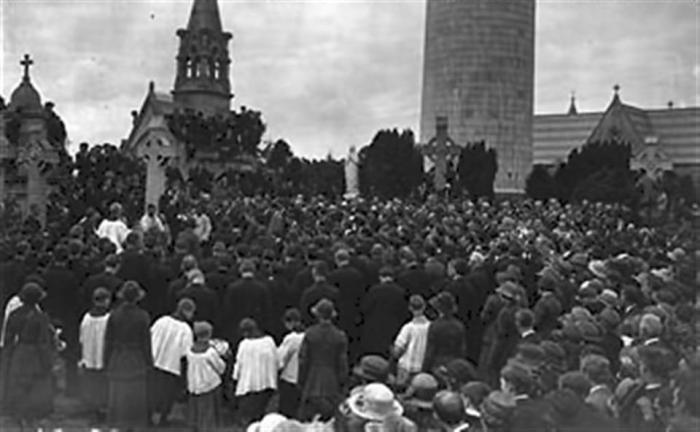
Section of the crowd at Cathal Brugha’s funeral in Glasnevin Cemetery. (Photo sourced: Internet)
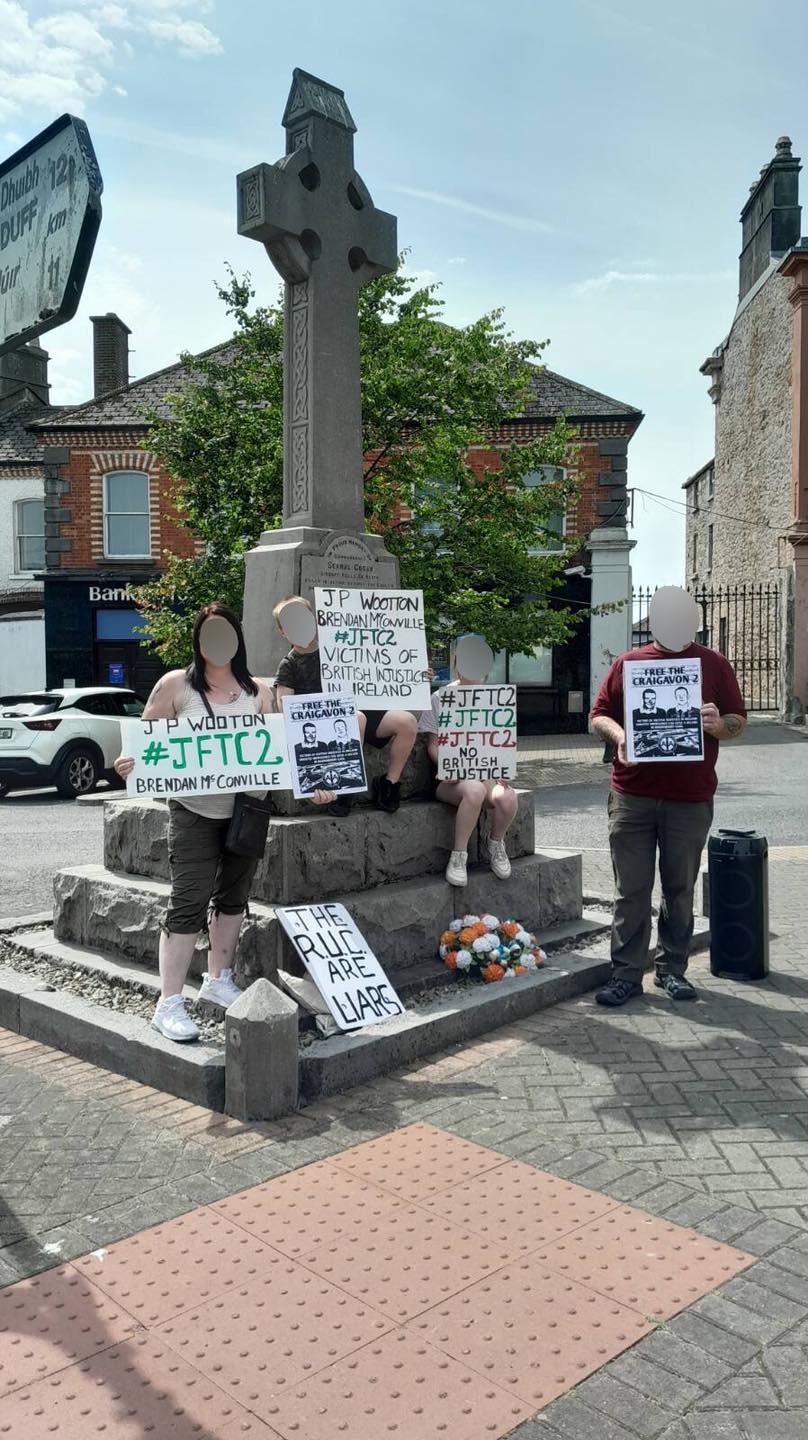
On 16th July 2022 the frame-up of the Craigavon Two was highlighted in public events in locations across all four provinces of Ireland. John Paul Wooton and Brendan McConville were framed and convicted in 2012 of the killing of colonial police officer Stephen Carroll in 2009.
The agency that framed them is the colonial police force of the Six Counties statelet but then they were railroaded through the non-jury Diblock Courts. As a result the two men have spent 14 years in jail for something they did not do.
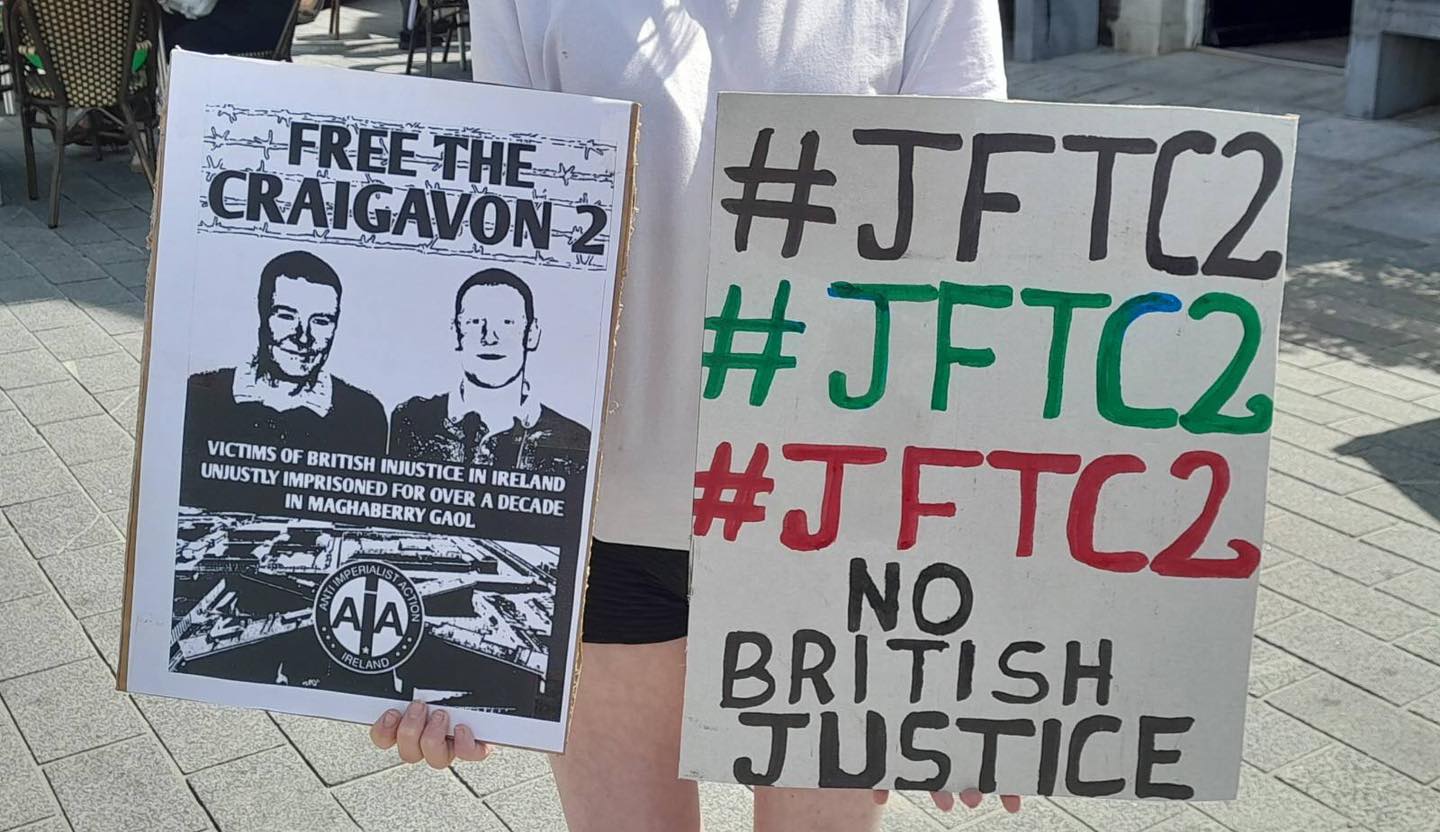
A young woman participating in the protest on the 16th in Mulingar, Co. Westmeath displaying two placards, one home-made, to passers-by. (Photo sourced: AIA)
EVENTS
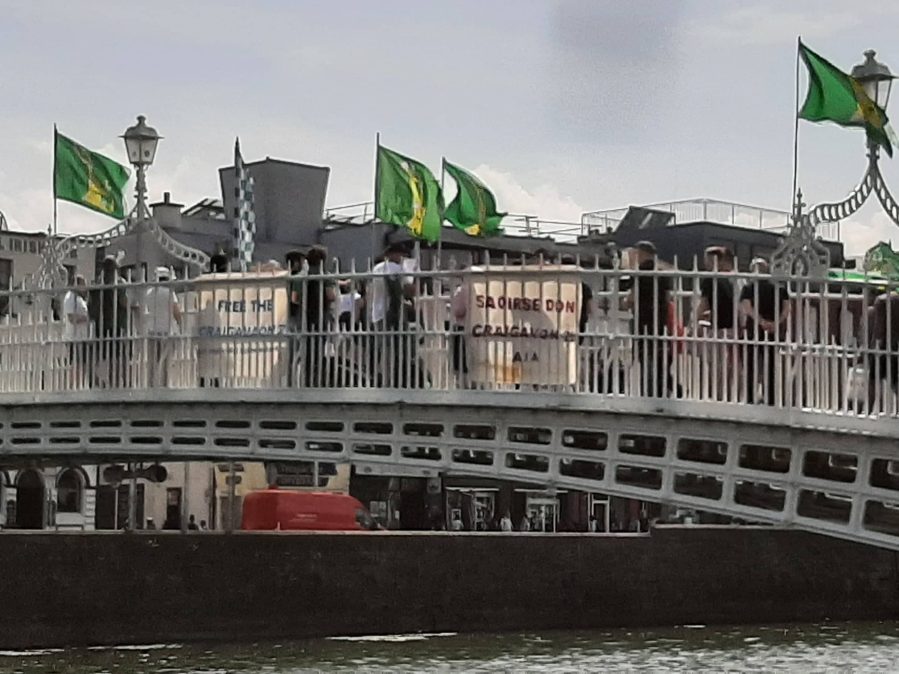
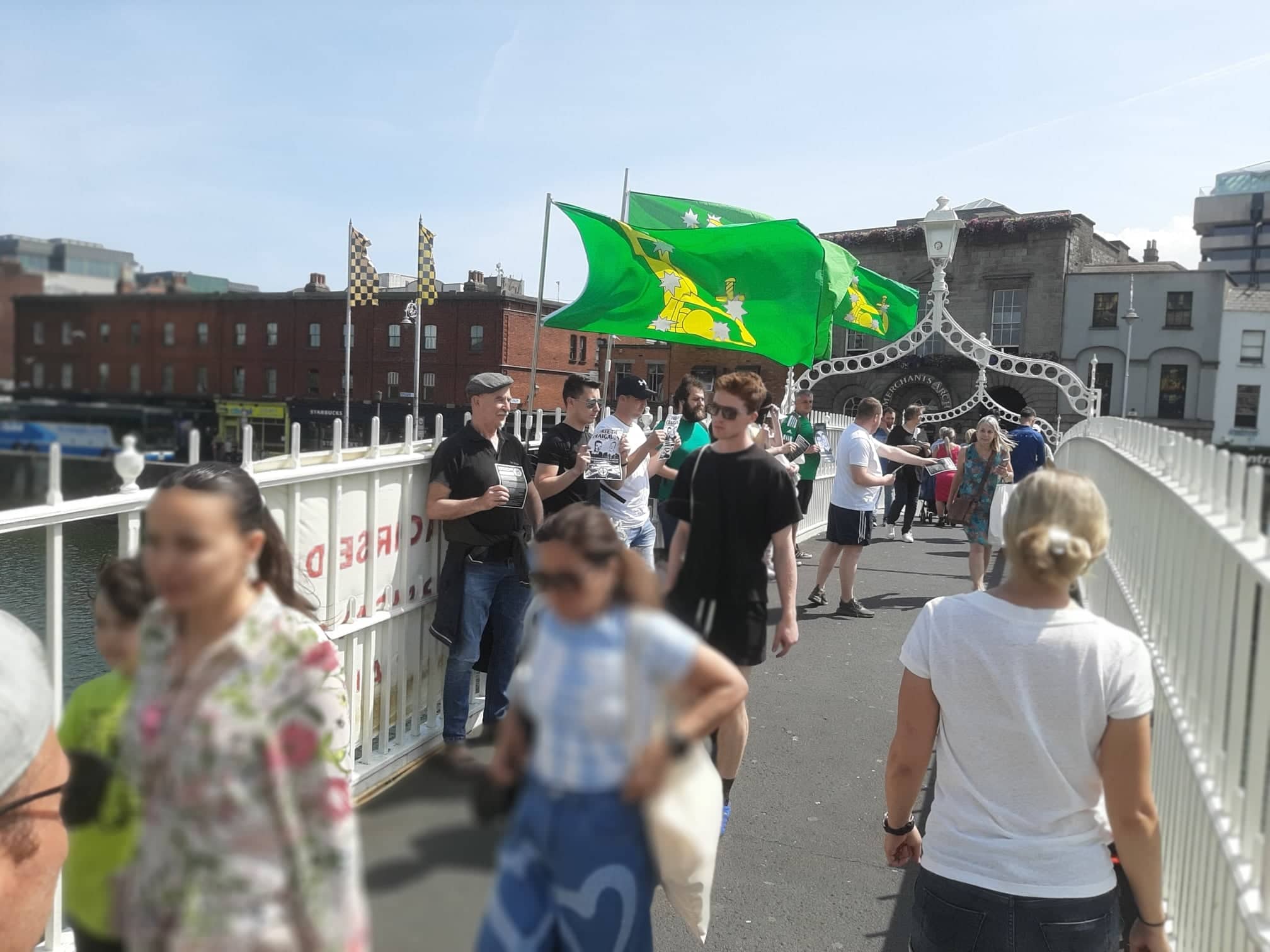
In Dublin city centre banners in Irish and in English calling for the freeing of the Craigavon Two were hung from the iconic curved pedestrian Ha’penny Bridge. Green and gold Starry Plough flags streamed in the breeze from the sea as leaflets were distributed to passers-by.
Hand-held Placards called for the men’s release and regular calls could be heard of “Justice for the Craigavon Two!” followed by “14 years in jail for something they didn’t do”. In addition there were calls to “Smash the Specials”1 and comments about “British justice”.
Strangely no artist(s) name was posted on line with the video
All the leaflets brought to the event were distributed and a number of conversations with interested people took place.
Leaflets being distributed and placards displayed on the Ha’penny Bridge, Dublin on the 16th. (Photo sourced: AIA)
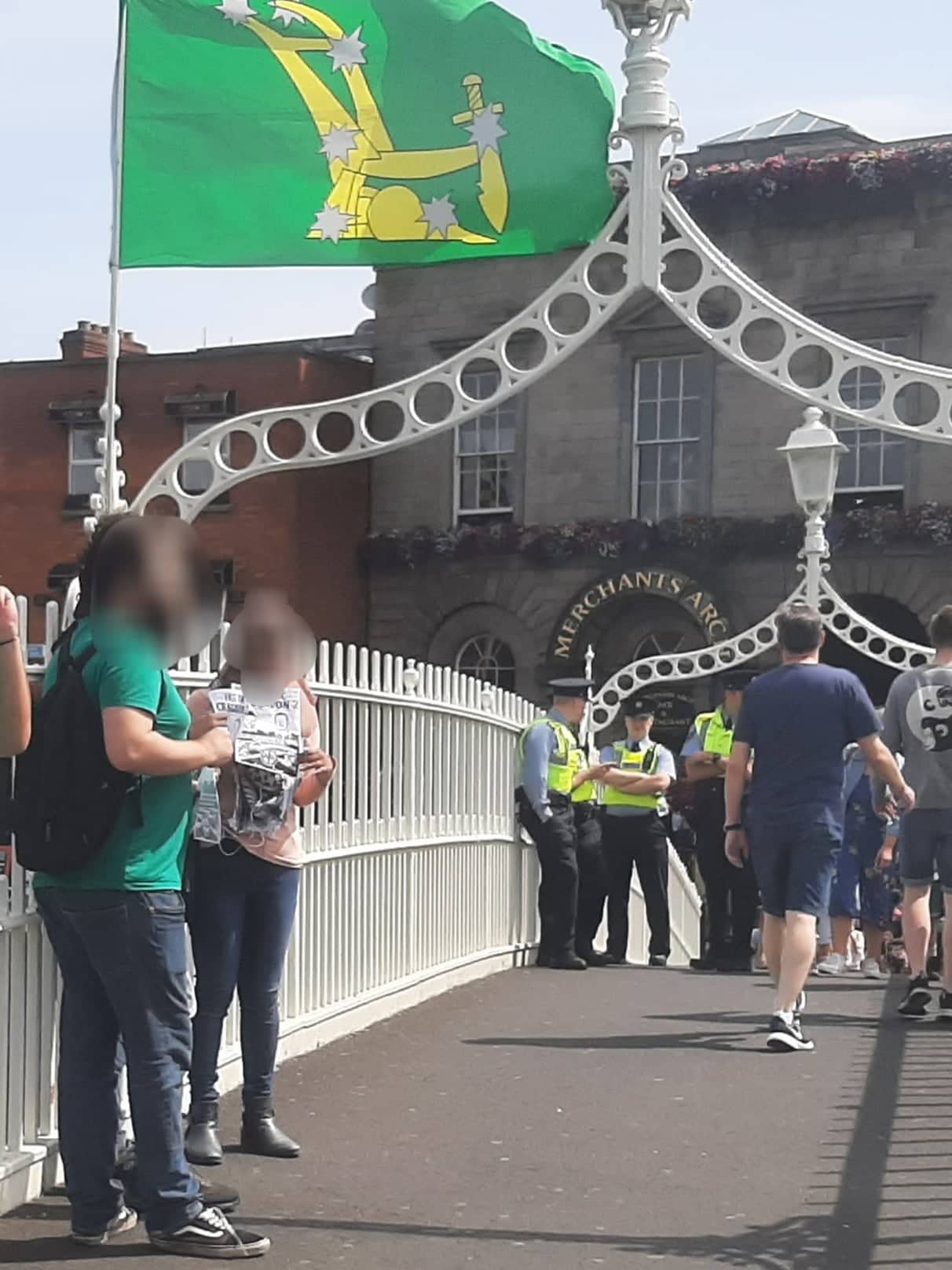
At one point four members of the State’s police force, the Gardaí, walked past the picketers and gathered at the far end of the bridge, watching them. However, the picketers were not intimidated and the police took no further action.
The events in respect of the Craigavon Two were organised by the Anti-Imperialist Action Ireland organisation and took place in Waterford, Oldcastle (Meath), Naas (Kildare), Mullingar (Westmeath), Kerry, Galway, Dublin, South Derry, Armagh and Arklow (Wicklow.)
Gardaí watching the awareness-raising picket on the Ha’penny Bridge on the 16th. (Photo sourced: AIA)
A CROOKED CASE
To say that the case against the men was flimsy would be to give it too much credit. The killing weapon was recovered and the fingerprints on the weapon and magazine did not match either of the men’s. No eyewitness was found except one who claimed to have seen one of the men in the area.
The alleged eyewitness who identified one of the men, “Witness M” only came forward 11 months after the killing and long after the arrest of both men. Witness M’s inability to have identified anyone at night at the distance he claimed to have done was exposed in court.
Awareness-raising event on the 16th in Oldcastle, Co. Meath (Photo sourced: AIA)
That man’s father described him as “a Walter Mitty character” who was chronically untruthful and his own partner refused to corroborate the witness’ account of his movements on the night of the killing.
The ‘evidence’ against the second man of being in the area came from an MI5 agent who testified from behind a screen about a tracking device they claimed to have planted in the accused’s car which had unexplained gaps in its recording.
The agent declined to answer a number of questions under “public immunity” certificate related to “national security”.
The colonial police went further and detained Witness M’s father to intimidate him into not giving evidence about his son’s veracity (or lack of it) — and the witness was also paid a sum of money.
One can say that the no-jury Diplock Court was crucial in convicting the men of murder but even when they were eventually granted leave to appeal in 2014, their convictions were not overturned. The normal judicial system is bad but the no-jury courts are worse.
Another victim of being framed in the British ‘justice’ system, Gerry Conlon, 15 years in jail in the famous case of the “Guildford Four”, joined the campaign for the men and was proclaiming their innocence until a mere few days before his premature death in June 2014 (aged 60).
End.
In Naas, Co. Kildare. (Photo sourced: AIA)
Mulingar, Co. Westmeath. (Photo sourced: AIA)
A woman leafletting in Co. Waterford on Saturday talking to people in the town centre. (Photo sourced: AIA)
FOOTNOTES
1A reference to the political no-jury courts of the colony and of the Irish State, the Diplock Courts and the Irish State’s Special Criminal Courts.
Irish Republicans and revolutionary Socialists have traditionally been opposed to the commemoration of the dead in the “Great War”, WWI. Recently Michelle O’Neill, top Minister in the British colonial political regime in Ireland with the Lord Mayor of Belfast, both members of the Sinn Féin party, laid a wreath at the WWI memorial in Belfast, to the bewilderment of some and the disgust of others. But actually those emotions are misplaced, since the leadership of the Sinn Féin party were never Socialist and are no longer Republican.
The long-held position of Irish Republicans and Socialists that WWI should not be commemorated is however illogical and runs against history. The conflict was a hugely-important event in such areas as military, social conditions and mores, medicine, politics and economics.
The toll of WWI is around 40 million military and civilian casualties of which 20 million died. Of those, around 10 million were civilian dead. How can an event of such historical magnitude not deserve commemoration?
We should certainly commemorate the fact that a small group of monopoly capitalists, aristocracies and monarchies, in the course of an argument about how to divide up the world among themselves, sent millions of ordinary people, mostly workers, to kill one another to settle the argument. People who had no quarrel with one another and nothing to gain from killing one another; people whose real verifiable enemies were those very people who were mobilising and arming them before sending them forth to kill or be killed.
The conditions of the working classes at the time they were thrown into the killing arena should be commemorated. The lies that the war was fought for democracy and freedom of small nations should be exposed. The disciplinary court-martials and executions within the armies should be revealed, along with the treatment of conscientious objectors. The propaganda used for recruitment and to keep the home populations happy should be deconstructed and exposed. The fact that capitalism ends up as imperialism, which in turn causes war, should be made clear to all.
That wars are not alone fought for profits but that huge profits are made in the course of war is a grotesque fact that should become widely known.
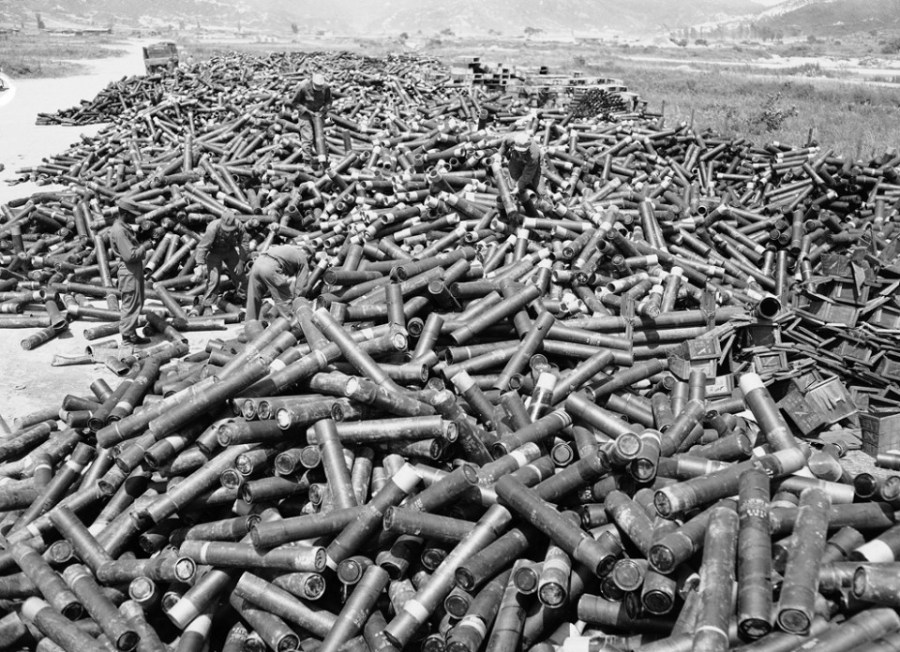
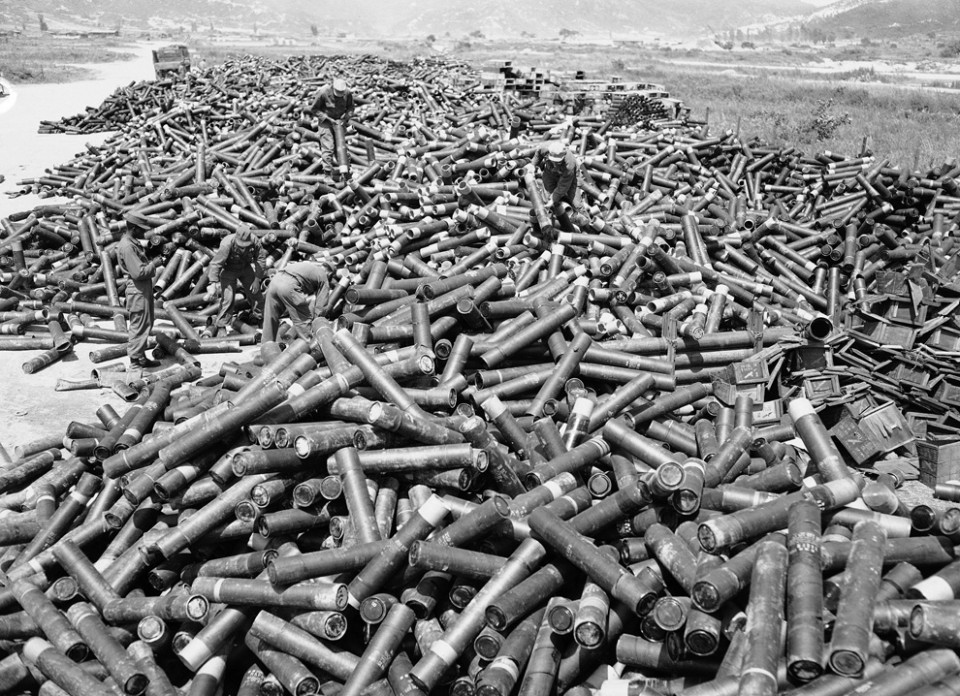
A pile of used artillery shells used in WWI — all manufactured and paid for, exploded, more ordered, paid for, fired ….. Part of the huge profits made during imperialist wars. (Photo sourced: Internet)
All of this was true of WWI and is true (to one extent or another) of the wars caused by imperialism today, whether in Somalia, Western Sahara, Palestine or Ukraine. But now, in addition to the huge death toll of WWI, we have the possibility of the destruction of human cities around the world — and even of ecological disaster — in yet another war.
We should expose the fact that far from encouraging us away from war, WWI commemorations are for the most part about concealing those salient facts and encouraging us to be proud of how our forebears were conned into killing one another. By whipping up reactionary nationalism1, their commemorations make us vulnerable to being conned into fighting further wars, to agree to be sent to other countries to kill or maim people like us in other countries – or to be maimed or killed by them.
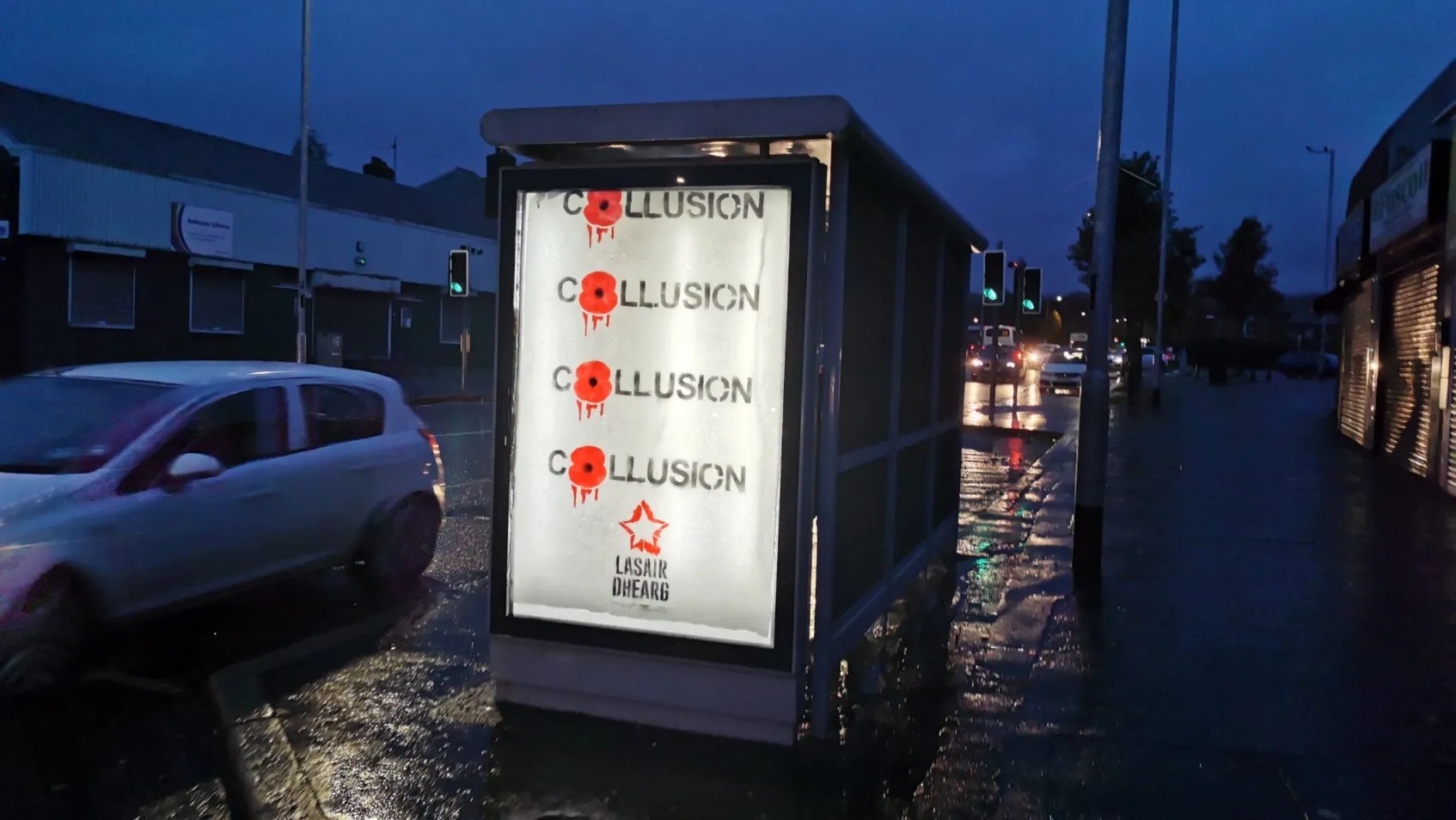
An innovative protest by the socialist Republican group Lasair Dhearg which however confines itself to pointing to the occupying British Army’s collusion with Loyalist murder gangs. (Photo sourced: Internet)
Commemorating the truth about imperialist wars past and present mean rejecting the wearing of the Poppy symbol. The Poppy is not about commemorating the dead in wars, as it is sold. This promotional emblem of the British Legion only commemorates the British soldiers who have been killed in wars – it does not commemorate all the soldiers of the colonies (for example Ireland) or the Commonwealth who died in the wars, not to mention all the civilian auxiliaries helping cook, clean, carry, dig, build etc for the British armed forces. The Poppy does not commemorate the dead soldiers of Britain’s allies, for example France, USA or Russia in the case of WWI. It does not commemorate the soldiers or auxiliaries of the hostile states who were killed, which might seem natural, until we ask ourselves why not, if the idea really is just to commemorate the dead soldiers in war. Most tellingly, the Poppy does not commemorate the millions of civilians who have been killed in wars – actually more than the total number of soldiers and a percentage of war deaths that is growing with every war.
The real role of the Poppy is to build social support for the imperialist British armed forces, including helping recruitment — so in other words, the emblem and its publicity is actually helping to build support for future armed conflicts.
The WWI soldier sculpture made from scrap metal, pictured in Stephens Green, Dublin. Republicans protested its siting in a 1916 battleground, (Photo sourced: Internet)
Not addressing the nature of imperialist war and just boycotting any idea of commemoration leads to missed opportunities. A few years ago a sculpture of a WW1 British soldier constructed out of scrap metal was installed in Stephen’s Green, a recreational park in Dublin’s city centre. Some Irish Republicans staged a protest around it in which they castigated it being located there in what had been a 1916 Rising battleground. They were correct in the historical reference but was that all that could be said about that war? Would most of the tourists passing by relate to that 1916 reference or would the whole international horror of imperialist war not have engaged them more?
A small protest emphasising the nature of WWI commemorations at one such attended by SF representatives (the commemoration) in the Irish National (sic) War Memorial Gardens 10th July 2021 (Photo: RTÉ)
We should indeed commemorate WWI but we should do it in the framework laid out, of exposing what the wars are about, who they benefit, what class contains the main victims – and not just the dead but also the injured, many of them crippled for life.
That is not how the ruling elites commemorate war and it is not how Michelle O’Neill and Tina Black did it. Michelle O’Neill said that she did this symbolic act in order to demonstrate that she is going to be “a First Minister for everyone” – clearly meaning Nationalist and Unionist. Liberals may laud O’Neill for that but one cannot represent national liberation simultaneously with colonialism, republicanism at the same time as loyalism, democracy at the same time as reactionary sectarianism. Making a war wreath green does not change its nature. Sinn Féin will often seem to try to present themselves as all things to different groups of people but essentially they are serving Irish Gombeenism2 in the 26 Counties and English colonialism in the Six.
Sinn Féin members Tina Black and First Minister-in-waiting Michelle O’Neill as they approach the WWI memorial in Belfast to lay a wreath. (Photo sourced: Internet)
In addition, workers and lower middle-class people from the Protestant or Unionist community were also killed and maimed in imperialist war. How does concealing the reality of war help those people?
End.
FOOTNOTES
1I use the term in the sense that not all nationalism is reactionary.
Historians and political activists gave talks in Dublin presenting a review of the conduct of what is more usually called the Irish Civil and its effect since on life in Ireland. All the speakers described that conflict as “a counterrevolution”, to overturn many of the gains made in the period of struggle immediately before it and to head off any possibility of yet further gains in Irish political, economical and social life, having a braking effect on such progress up to this very moment.
Liz Gillis speaking (Photo: D.Breatnach)
L-R: Fearghal Mac Bloscaidh, Mags Glennon, Ciaran Perry (Photo: D.Breatnach)
BACKGROUND
The event on 26th June, held in the function room of The Cobblestone, was organised by the Peadar O’Donnell Socialist Republican Forum, itself established in early 2013, the result of a number of meetings and seminars organised over the course of 2012. It combined communists and socialist Republicans to organise discussions on a number of issues, such as Irish state neutrality, Irish national independence, working-class programs in struggle etc.
(Photo: D.Breatnach)
SPEAKERS
Ciaran Perry, a socialist Republican and Independent Dublin City Councillor, also a local history activist, introduced the event. He talked about the importance of history and in particular local history, the traditions of struggle and how some of those had been weakened in the trade unions and communities over the years.
Reading the account of the Ballysheedy Massacre (Photo: D.Breatnach)
Perry introduced the MC for the meeting, Mags Glennon who is also a socialist Republican activist and history enthusiast.
Glennon introduced historian Fearghal MacBhloscaidh from Tyrone who began in Irish and then continued in English, his presentation laying out clearly his position that the Civil War was a planned counterrevolution, quoting Cabinet papers and correspondence and supplying figures on the arms and equipment supplied to the Free State ruling elite by the British. MacBhloscaidh also maintained that the De Valera Government, though supported by the wider Republican movement at the time, was also a counterrevolutionary measure when subjected to a class analysis.
Sorry, slightly out of focus Jimmy Doran (Photo: D.Breatnach)
A woman (whose name I did not catch) was called to stage. In a clear voice she read an account of of the horrific Ballyseedy Massacre. Free State soldiers, after torturing their Republican prisoners, brought nine of them out to a road barricade, in which they had placed a landmine which they exploded. One survived by some miracle but spent the rest of his life needing frequent medical intervention.
At intervals between speakers, Pól MacAdaim performed his music, singing accompanied by guitar. Among the songs he sang were Tipperary So Far Away and Take It Down From the Mast (in the chorus of which some members of the audience could be heard joining).
Pól Mac Adaim performing at the event (Photo: D.Breatnach)
Mags Glennon then introduced historian Liz Gillis from Dublin who talked about the reaction of women to the Treaty and to the Civil War. The vast majority of Cumann na mBan members rejected the Treaty and many actively supported the Republicans in the following conflict. Gillis also spoke about how the women, who had been active in the struggle in 1916 and briefly to the fore in public life with the elections of 1918 and the War of Independence, were driven back to almost invisibility by the Free State Government and also the De Valera government and the 1937 Constitution. Gillis lauded Kathleen Clarke whom she said continued to fight the struggle for the rights of women in representational politics and criticised the De Valera Constitution of 1937.
Mags next introduced Jimmy Doran, a communist and long-time trade union activist, who talked about the contribution of the organised Irish workers to the struggle against British colonialism and for the advance of the working class. Doran went on to comment on the trade unions’ history and current situation in the Irish state. I had to go to the toilet and when I returned stayed near the entrance so as not to distract the audience by retaking my seat near the front and unfortunately, due to the lack of a PA system and the acoustics of that location, I was unable to hear the rest of his presentation.
Poster for the event.Supporters and organisers (Photo: D.Breatnach)
Although the meeting was thrown open to questions or contributions, little was forthcoming although there was a short debate on whether the Irish bourgeoisie prepare well into the future and whether they prepare better than their opponents in the Republican movement.
The proceedings ended with announcements of forthcoming events, thanks from Mags to the speakers, audience and to Pol Mac Adaim who ended the day on a musical note.
The 1974 British Intelligence and Loyalist bombing of Dublin and Monaghan towns, with the highest number of people killed in one day during the 30 Years’ War, was commemorated in Dublin today at the Memorial in Talbot Street, near the corner with Amiens Street. The commemoration, organised by the perennial Justice for the Forgotten campaign, was addressed by the Taoiseach (Irish Prime Minister) and elected representatives of Dublin and Monaghan municipalities. A poet and two musicians performed, wreaths were laid and one former politician gave a strong oration highly critical of the Irish, British colonial and British authorities.
On 17th May 1974, around the work-leaving and shopping-ending busy time of 5.30pm, three car bombs exploded within minutes of each other in the centre of Dublin. The car bombs had been parked in the mainly working and lower-middle class sParnell Street, Talbot Street, and South Leinster Street (as distinct from such streets as Henry, Grafton or Dawson streets, for example). Twenty-six people were killed in Dublin. To cover their way back across the British border, another car-bomb was set off in Monaghan Town, killing another seven. Even excluding a full-term unborn child, the total death toll was 33, the highest number killed in any one day of the three decades of conflict. Around 300 were injured.
Suspicion should naturally fall in the first place on the British Loyalists, since they had been planting bombs in Dublin since 1969 and in 1972 and 1973 their bombs had killed Dublin public transport workers. But the authorities had pretended to believe that the IRA was responsible for the 1972 bombing and used the panic around it to steamroll repressive political legislation through the Dáil, thereby setting up the no-jury Special Criminal Courts to sent Irish Republicans to jail.
However, it is believed that Irish Army Intelligence and Garda Intelligence were quickly aware that the Dublin and Monaghan bombers had in fact been Loyalists of the Ulster Volunteer Force and even knew the names of a number of them.
“No one has ever been charged with the bombings. A campaign by the victims’ families led to an Irish government inquiry under Justice Henry Barron. His 2003 report criticised the Garda Síochána‘s investigation and said the investigators stopped their work prematurely. It also criticised the Fine Gael/Labourgovernment of the time for its inaction and lack of interest in the bombings. The report said it was likely that British security force personnel or MI5 intelligence was involved but had insufficient evidence of higher-level involvement.” (Wikipedia)
Incredibly, despite long-standing allegations of collusion between the colonial police, the RUC (now the PSNI) and Loyalists, the Gardaí sent the car-bomb remnants to the RUC for analysis. Shortly after that, Ned Garvey rose from the Deputy position to Gárda Commissioner and met with a British secret agent in his office – without informing his superiors. When the agent began to blow the whistle on his past activities he exposed Garvey as a British “asset” – Garvey of course denied it but had to admit he had indeed met clandestinely with the agent in his office. When the Fianna Fáil goverment came in, they sacked Garvey as “not having confidence” in him but did it so baldly and outside established procedures that Garvey was able to take the Government to court, have his pension secured and have damages awarded to him!
BRITISH POLICY OF COLLUSION WITH LOYALIST MURDER GANGS
Most experts have been clear that construction of the type of bomb used was beyond the capability of the Loyalists at that time and, in any case, it is clear that British Intelligence and military were working with Loyalist gangs, as were the RUC (some of whom were members of the gangs) and RUC Special Branch. In addition there were reports of British accents in connection with suspects.
Collusion of that type had been openly advocated by a British military expert on counter-insurgency, Major (later Brigadier) Frank Kitson, for example in his “Gangs and Counter-gangs” (1960), based on his experiences in fighting the Kenyan insurgency for national liberation.
Frank Kitson (now Brigadier) in 1971 (Photo source: Internet)
Brigadier Frank Kitson was operational commander of the occupation forces in the British colony from 1970-’72 and left a substantial legacy of military assassinations and collusion with Loyalist murder gangs, along with other “dirty war” operations before he went on to lecture at British military training college.
“….. the de Silva Report (2013) on collusion with loyalist paramilitaries led to two further ‘unconditional’ British apologies for the behaviour of its security forces in Northern Ireland. In November 2013, a BBC ‘Panorama’ investigation into British counterinsurgency in Northern Ireland in the early 1970s revealed that members of a special covert operations unit known as the Military Reaction Force (MRF) admitted to the murder of suspects and unarmed Catholic civilians. These admissions by the state or its agents confirm previous claims by critics dating back many decades. Such abuses were not merely low-level tactical excesses by undisciplined and racist troops but were institutional, systematic, and approved or covered up at the highest levels ….”1
The British State has admitted it has secret papers relating to this atrocity but has refused to hand over copies to successive Irish goverments.
“THE LARGEST MASS MURDER IN THE HISTORY OF THE STATE”
Maureen O’Sullivan, ex-TD (Member of Irish Parliament) for the local area gave the main oration for the Justice for the Forgotten Campaign and called the bombing “the largest mass murder in the history of the State”. She went on to castigate successive governments and most of the political class for their lack of interest in pursuing the planners and perpetrators of the massacre over the years. In her repeated reference to their “ignorance”, O’Sullivan inferred that the legislators’ lack of interest was such that they could not even be bothered to inform themselves of the known facts.
Maureen O’Sullivan castigating the authorities (Photo: Rebel Breeze)
In addition to the Taoiseach, the Ard-Mhaora of Dublin and Cathaoirleach of Monaghan Council spoke and a Catholic priest delivered a short blessing. The event was chaired throughout by a representative of the Justice for the Forgotten campaign group.
Rachael O’Hegarty introduced and recited one of her collection of poems about the victims, this one about Maureen Shields who was 44 years of age when she was killed in Talbot Street.
Rachael O’Hegarty speaking and reciting her poem (Photo: Rebel Breeze)
Cormac Breatnach and Eoin Dillon on whistles played Sí Beag, Sí Mór and later Dillon playing the lament known as Táimse I Mo Chodhladh (I Am Asleep), accompanied by Breatnach on whistle, concluded the event.
Cormac Breatnach and Eoin Dillon on whistles (Photo: Rebel Breeze)
Eoin Dillon on uileann pipes and Cormac Breatnach on whistle (Photo: Rebel Breeze)
THE BOMBINGS EXPOSED THE NEO-COLONIAL NATURE OF THE IRISH CAPITALIST CLASS
In summary, a foreign power — which is also occupying by force one-sixth of Ireland — carried out a number of terrorist attacks in the capital city of the Irish State culminating in a massacre intended to cause maximum loss of life and limb – “the largest mass murder in the history of the Irish State”, as Maureen O’Sullivan correctly characterised it.
The Irish ruling elite failed to stop the escalating attacks and turned the investigation of the massacre into a farce. The Irish ruling elite failed to prevent the foreign power subverting the highest rank of its police force (and no doubt other levels in other areas).
Section of the crowd at the commemoration, the Taoiseach, Mícheál Martin speaking (Photo: Rebel Breeze)
The Irish ruling elite failed to take a full range of diplomatic and legal action to condemn the UK, the foreign power over its actions and failure to respond to requests for release of relevant secret papers. The ruling elite continues in that failure today as can be read into the weak speeches of Government Ministers at this ceremony – this time by the Taoiseach and last time the Minister for Justice.
No self-respecting elite or ruling class of any independent state would permit such violations of the security of its capital city and citizens without taking resolute and persistent action. The Irish ruling class is a neo-colonial capitalist class, undeserving even within capitalist terms to be in charge of any Irish state.
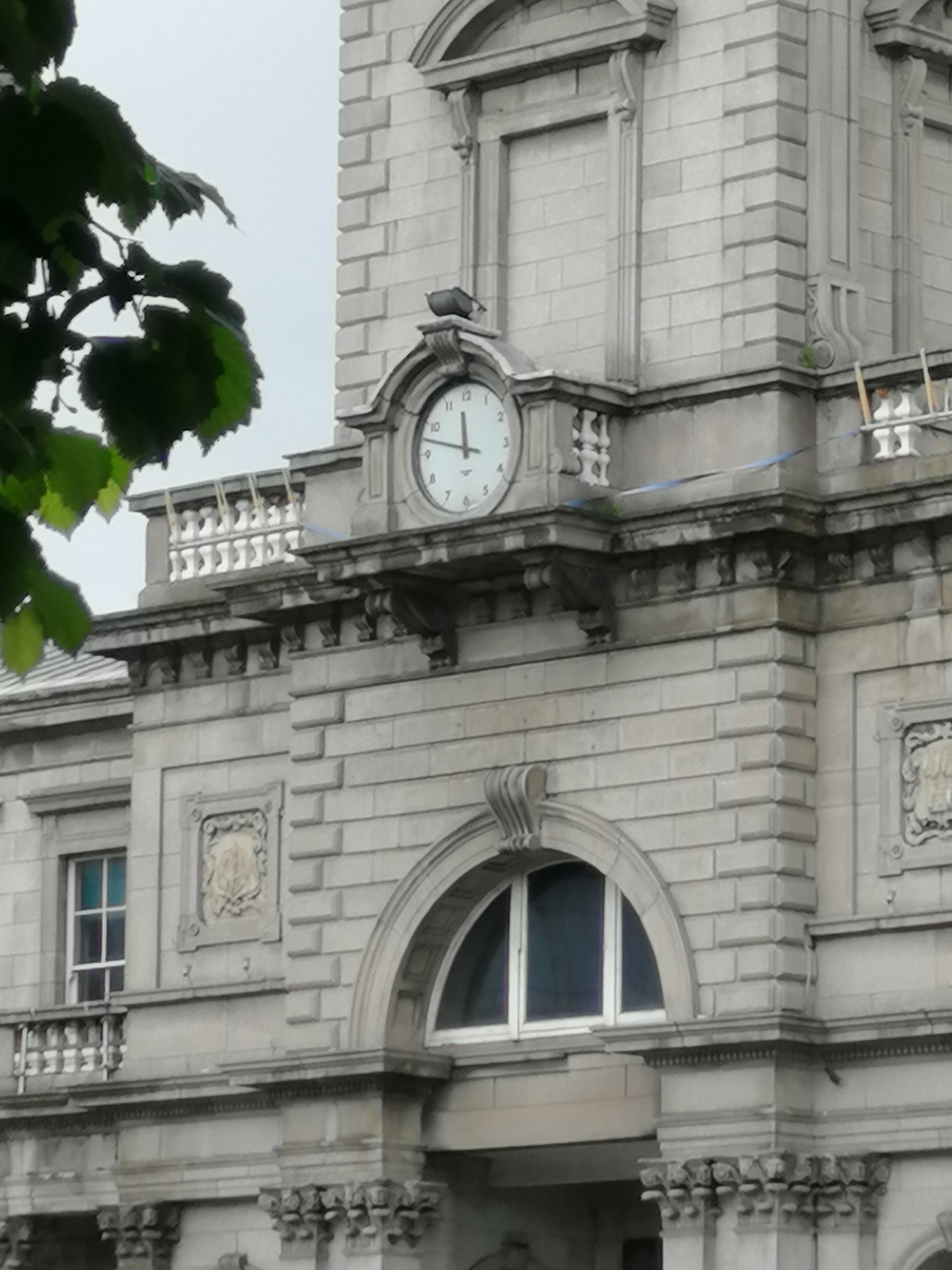
The north side of the Memorial (Photo: Rebel Breeze)The south side of the Memorial (Photo: Rebel Breeze)The clock on the tower of Connolly (formerly Amiens Street) Station — British soldiers fired a machine gun from that tower at Irish insurgents in 1916. (Photo: Rebel Breeze)
He planned the spectacular helicopter escape from Dublin’s Mountjoy Jail and, a year later, planned another escape from there, blasting their way out with smuggled-in explosives. Before he began planning escapes, he operated early in his IRA career as commander of an armed robbery unit, ‘fund-raising’ for the Movement. But when he began robbing banks for himself and his family, the Movement sent assassins to kill him. Up Like a Bird is the story of that man, Brendan Hughes, nowhere near as celebrated as his other IRA namesake but certainly deserving of much more fame than he has received to date.
Brendan Hughes with his book outside Mountjoy Jail (Image sourced: Phoenix Magazine)
Douglas Dalby’s handling of Hughes’ reminiscences, told in Hughes’ voice, is masterly. The book reads like a thriller, hard to put down; we are driven to turn the next page to see what will happen – even when, through history, we know the eventual outcome. We know, for example, that the helicopter escape was carried out and yet, as readers, we tense as Hughes does his investigations, tense tighter as he identifies the components of the plan, moan with frustration at a delay or last-minute hitch, hold our breaths as the action takes place.
The helicopter escape was carried out on 31st October 1973 and from the prison exercise yard three high-level IRA officers were flown to freedom: Chief of Staff Séamus Twomey and senior Volunteers JB O’Hagan and Kevin Mallon. The following year, on 18th August 1974, 19 prisoners escaped, blasting their way through a gate with a small amount of smuggled gelignite. Not only had Hughes planned that operation – he himself was leading the escapers.
INSIGHTS
Apart from the excitement in reading, the book gives us an insight into the world of IRA volunteers active in Dublin and surrounding areas in the 1970s – the ‘safe-houses’ and network of active supporters, the ‘fund-raising’, stolen getaway cars, false identification documents, high-level awareness of the hunted, carrying concealed weapons, the even better-armed police ….
The Mountjoy helicopter escape revealed something even more important and enduring – the cultural bedrock within the Irish state, the sharp division between the elite and the mass. Although the majority of politicians had voted in 1972 for repressive legislation against Republicans and special no-jury courts to sentence them, a song celebrating the escape reached No.1 in the Irish singles disc charts, selling 12,000 copies in the first week despite being banned by the national broadcaster, RTÉ! Composed by Sean McGinley from Castlefin, Co. Donegal and performed by the folk and ‘rebel song’ band The Wolfe Tones1, Up and Away (the Helicopter Song) became the most-played and most-purchased disc for four weeks until nudged out by Slade’s Merry Christmas Everybody. It is tempting to think that if the escape had taken place a longer period before the approach of the festive season, that the recording might have remained at the top of the charts for months on end. The counterposing of the anger and embarrassment in elite circles, reflected in ranting of politicians, Garda sweeps and raids and media outrage on the one hand, with the delight and empathy at the lower levels revealed much of the tensions in Irish society and the opposing sympathies of different social classes.
The single that sold 12,000 copies in its first week, containing a jocular song celebrating the helicopter escape. (Image sourced: Internet)
Hughes was a maverick, revelling in the description and though for much of his career that was of value to the Provos, there came a time when it ceased to be so. A guerrilla army must have discipline, of course but it also needs volunteers who can quickly assess a situation and seize the initiative, without referring back to the command structure. The balance between both requirements must be very hard to strike — for individuals as well as for the organisation.
When he and other such activists fell out with their leaderships or “went solo”, they were shunned or worse. In Hughes’ final spell in Mountjoy jail, he was on the “non-aligned” wing of the jail, a Republican prisoner but not under Republican leadership control.
ISOLATION
Hughes says that assassins were sent to kill him – he stayed low and carried a loaded .44 Magnum. The leadership of the Republican movement does not always shoot or beat up its dissidents – more usually, it seeks to isolate them. Friends, neighbours, former comrades and even relatives will be advised to shun those no longer welcome, they and their families.
The family feeling, the communal solidarity in the movement becomes its opposite when the leadership brands its pariahs.
Cover of the book (Image credit: Siopa Gaeilge)
Hughes feels he was betrayed to the political police, the Special Branch of the Irish State. But what he says he felt the worst was the treatment of his family while he was in jail. No space on a Republican prison visitor communal transport was made available to his wife and children and cars containing former friends and acquaintances would pass them at the side of the road, even in the rain.
It seems Hughes finds that unforgivable — and no wonder.
As a postscript, Hughes surprisingly declares his support for the Good Friday Agreement, the pacification process. He had been a man of action and, as he said himself, not one for thinking through ideology or politics. But it doesn’t take any great grasp of ideology or politics to see that today it’s more or less business as before in a partitioned Ireland occupied by a foreign power.
End.
UP LIKE A BIRD, Hughes, Brendan; Dalby, Douglas (2022)
FOOTNOTES
1Named after Theobald Wolfe Tone, a leader of Irish republican revolutionary organisation the United Irishmen, died in prison in 1798.
Speakers on Sunday 17th April 2022 at a 1916 Rising commemoration in Dublin called for defence of Irish neutrality between contending imperialist and capitalist states but also for revolution to end British colonial occupation and partition, in addition to general imperialist domination of Ireland. They called for a working class socialist republic and a revolution necessary to achieve it. The Proclamation of the Irish Republic (1916) was read to those assembled, as was the message of Patrick Pearse during the Rising and a dedication by James Connolly to the Irish Citizen Army (1915)1 and floral tributes of lilies were laid. The event also included the singing viva voce of songs relevant to the occasion.
Part of horizontal plaque at the location
MARCH, FLAGS, BANNERS
The event was organised by the Anti-Imperialist Action organisation and commenced with a march up a section of the Finglas Road which runs between both parts of the famous Glasnevin cemetery, before turning into the “St. Paul’s” section.2 The march was led by a colour party of two, dressed in black with white gloves bearing the Irish Tricolour and the green and gold Starry Plough.
Following behind in two columns were others with a variety of flags flying among them: Starry Plough3, Basque Ikurrina, Red Flag with golden hammer and sickle, flag of the Popular Front for the Liberation of Palestine. As they marched the short section of road, passing traffic beeped them in appreciation. The police of the Irish State, the Gardaí, were in attendance but did not interfere with the participants.
The procession in the road on the way to the Glasnevin St. Paul’s cemetery (part of the main Glasnevin Cemetery’s wall can be seen on the right with the top of O’Connell Tower visible behind it).
Two banners were also carried by participants, a No to NATO one of the AIA and another of the Dublin Committee of the Anti-Internment Committee of Ireland.
SPEECHES
Beginning in Irish and then changing to English, the Chairperson welcomed those in attendance and spoke of the reason for holding such commemorations but also putting this one, the sixth Easter Rising Commemoration organised by the young organisation, in the context of current events in Ireland and in the world.
Colour party and speaker
James Connolly in Ireland and Lenin in Russia had been quite clear about the correct attitude to imperialist war, the Chairperson said, which was to oppose it and if it went ahead to turn it into revolution; on Liberty Hall4 the banner had been hung declaring that “We serve neither King nor Kaiser”.
In the current war situation, some politicians in Ireland are trying to abandon the State’s official traditional stance of neutrality, which is why the AIA thought it important to promote the “No to NATO” message depicted on one of the banners present at the event. It is important for people to realise that, with the UK occupying a part of Ireland, a part of Ireland is already in NATO. Opinion polls have shown a majority in the state against joining NATO, he pointed out.
During this speech a helicopter passed by overhead.
The main speaker had been delayed in arriving and, putting aside his notes, spoke about the need for sacrifice, pointing out that those who took part in the Rising and in subsequent struggles had jobs or small businesses as well as families but they put themselves forward and made sacrifices. Although today we may not face death here, nevertheless sacrifices are called for, he said and though there is not a rising here today, it will come.
INTERNATIONALISM
The Chairperson of the event also pointed to the importance of relations of internationalist solidarity and alluded to the struggle of the Palestinian people with particular reference to the Popular Front for the Liberation of Palestine, also to the Basque people’s struggle. The AIA had sent a solidarity message to be read out at the Jardun organisation’s celebration of the Basque country’s national day, Aberri Eguna, noting that Easter Sunday had been chosen in emulation of the Easter Rising by Elias Gallestegi. The event had been first celebrated on Easter Sunday 27 March 1932 in Bilbo, supported by a demonstration of some 65,000 which included the Basque Nationalist Women’s organisation, inspired by the Republican Irish women’s organisation Cumann na mBan, which had fought in the 1916 Rising.
Also mentioned by the Chairperson were the struggles of organisations in Peru and the Philippines and by the Communist Party of Brazil.
MUSIC AND READINGS
As part of the program of the event, Seán Óg accompanied himself on guitar to sing Charles O’Neill’s The Foggy Dew and the Larry Kirwan’s James Connolly/ Citizen Army Song. Diarmuid Breatnach sang acapella his version of Patrick Galvin’s Where Is Our James Connolly? with some small alterations, though none Breatnach said to alter the fundamental meaning of the lyrics.
Seán Óg performing at the eventDiarmuid Breatnach singing Where is Our James Connolly? at the event
A young woman read out Pearse’s message and a young man, Connolly’s 1915 praise of the Irish Citizen Army.
To conclude the event Seán Óg sang the chorus of Amhrán na bhFiann5, the Irish National Anthem and the participants exited the cemetery to pass the uniformed police and Special Branch surveillance without incident.
End.
Section of the attendance marching to the monument.
FOOTNOTES
1Patrick Pearse, journalist, poet, educator and Irish Volunteer, was overall commander of the insurrectionary forces in 1916; James Connolly, trade union and socialist organiser, historian, journalist, writer and Irish Citizen Army, was Commandant of the Dublin fighters. Both men were signatories of the Proclamation and, along with the other five Signatories and another seven volunteers in Dublin, were executed by British Army firing squads.
2Although a newer and less famous section of the cemetery it too includes the graves of a number of important political leaders as well as the largest monument to Irish insurrections, containing the dates 1798, 1803, 1848, 1867, 1881 and 1916.
3Flag of the Irish Citizen Army, believed to be the first workers’ army in the world (and the first to recruit women, some of whom were officers), formed in 1913 to defend striking and locked-out workers from the attacks of the Dublin Metropolitan Police and that also participated in the 1916 Rising.
4Liberty Hall was the HQ of the Irish Transport & General Workers’ Union and of the Irish Citizen Army; in addition to the Citizen Army members, many of the Irish Volunteers and of Cumann na mBan mustered there on the first morning of the Rising. It was destroyed by British shelling and the tall building now on that site, also called Liberty Hall, is the HQ of SIPTU (largest trade union in Ireland).
5Originally composed in English as The Soldier’s Song by Peadar Kearney and Patrick Heeney and sung during the Rising, it was later translated into Irish by Liam Ó Rinn and in 1926 adopted by the partitioned Irish State as its official anthem (usually the air of the chorus alone). When sung at events it is usually the Irish language version of the chorus that is sung only.
Yes, indeed, we have been. Let us look back over the campaign of misinformation about conflict in Ireland for it has much to teach us about the mass media, about human credulity. We don’t need to go back over 800 years – just to the recent the 30-Year War.
In 1968 a civil rights campaign1 took off in the British Six-County colony in Ireland to include a number of marches and sit-ins, which was regularly met with violence from Loyalist2 mobs and the State. As part of the campaign, in 1969 a march from Belfast to Dublin was organised under the slogan “Civil Rights – North and South”. One of that march’s stops was in Lurgan, Co. Armagh, where the marchers sat at a crossroads and were instantly attacked by the armed British colonial police (then the RUC3, now the PSNI).
Some of the marchers had come from Britain to support the campaign and after being attacked in Lurgan, they bought an English newspaper to see whether the incident had been reported. An occurrence in the town had been reported alright but not what had occurred – the report told their readers that a fight between Catholics and Protestants had been broken up by the RUC, keeping the two sides apart. “There wasn’t a Protestant in sight,” commented a marcher angrily, “except those in RUC uniform …. or unless he was one of us4.”
Later that year, in August, the RUC killed four civilians, including a child, in the Divis Flats area of Belfast by firing at the area with a machine-gun mounted on an armoured car. Their claim they were returning fire from the area was widely refuted by local people but repeated in the media. The incident was not investigated until decades later when the claims of family and local witnesses were vindicated in an Ombudsman’s report.
The representation of the RUC as a force for peace between two groups in a sectarian conflict was to be a repeated media disinformation line through the ongoing conflict, as the struggle became an armed one — although to a large degree the honest broker ‘peacemaker’ cloak shifted from the colonial police on to the British Army.
British troops were sent in to the colony (by a Labour Government, in case we had illusions) in August 1969 and were initially greeted by many people in the ‘nationalist’5 community as saviours, sent to keep the sectarian RUC and Loyalist mobs (often enough amounting to the same thing) away from them. Most politicians and the media represented them as peace-keepers. For most nationalists the illusions did not last long as the Army turned their guns on them.
Although no British soldier had been killed in the Six Counties by the IRA as yet6, on 3rd July 1970 the British Army invaded the staunchly nationalist area of the Lower Falls and forced their way into homes, saying they were searching for arms. Local youths mobilised and attacked the soldiers with stones and petrol bombs7. The soldiers responded by pumping CS gas into the area and soon gun-battles between the IRA and the British Army broke out.
‘After four hours of continuous clashes, the British commander sealed off the area, which comprised 3,000 homes, and imposed a curfew which would last for 36 hours. Thousands of British troops moved into the curfew zone and carried out house-to-house searches for weapons, while coming under intermittent attack from the IRA and rioters. The searches caused much destruction, and a large amount of CS gas was fired into the area. Many residents complained of suffering abuse at the hands of the soldiers. On 5 July, the curfew was brought to an end when thousands of women and children from Anderstonstown8 marched into the curfew zone with food and other supplies for the locals.
‘During the operation, four civilians were killed by the British Army, at least 78 people were wounded and 337 were arrested. Eighteen soldiers were also wounded. Large quantities of weapons and ammunition were (allegedly – DB) captured. The British Army admitted afterwards that some of its soldiers had been involved in looting.’9
Mural on the Falls Road depicting Andersonstown women breaking the British cordon, Falls Curfew, 1970 (Source photo: Wikipedia)Cutting of unknown newspaper report displaying misrepresentation of the struggle, despite being friendly towards the women who broke the British Army siege of the Falls Road, July 1970. (Source photo: Step Back Ireland)
At the time, most of the media reported the clashes as unruly elements irrationally attacking the Army who were there to protect them and were only doing their job. However, the opinion of the nationalist community, though ignored by the media had undergone a huge shift and the first serving British soldier (of many to follow) was killed by the IRA the following year.10
Later in 1970, during riots in Derry, the Army shot two men from the nationalist area, Seamus Cusack and Desmond Beattie, claiming afterwards that they were armed, a claim local people denied. There was no investigation by the authorities, obliging the constitutionalist SDLP11 to withdraw from the colony’s parliament in protest.
On 4th December 1971, an explosion in the Catholic-owned McGurk’s Bar in Belfast killed 15 people and injured 16. Due to the bar’s ownership and location, the most logical attribution would be to Loyalists or British forces. It would be hard to pin it on the IRA – unless it could be said to have been an accidental explosion of an IRA bomb during storage or transportation. That was what the “security forces” came up with, which of course was repeated by the media. An alternative media theory was that in some manner it was a result of a feud between the Official and Provisional IRA. In order to construct that theory, the denials of the IRA had to be discounted12, despite the organisations’ track record of taking public responsibility for its actions.
The explosion had occurred in the pub’s doorway, which would have thrown doubt on the “IRA bomb in transit” story but somehow, the RUC’s forensic examination did not determine that. But even worse, the evidence of an eyewitness had to be dismissed.
‘On 6 December, however, the RUC took a witness statement from an 8-year-old boy. He said that a car had stopped outside the pub with four men inside and “a wee Union Jack stuck in the back window”. He said one left a package in the Great George’s Street doorway and ran back to the car, which sped off just moments before the package exploded. A man and a woman backed up his story, although they did not witness as much as the boy.’13
‘In March 1976 the RUC received intelligence that linked UVF member Robert Campbell and four others to the McGurk’s bombing. Campbell was arrested on 27 July 1977 and held at Castlereagh RUC base. He was interviewed seven times during 27 and 28 July. He admitted his part in the bombing but refused to name the others.Campbell’s story matches that given by the young boy witness.’14
On 29 July 1977, Campbell was charged with the 15 murders and 17 attempted murders and in September 1978 pleaded guilty to all charges (he also had a separate conviction for the murder of a Protestant delivery driver in 1976). He eventually served fifteen years in prison, being released on 9th September 1993.15
Local people searching in the rubble of McGurk’s Bar after the bombing by Loyalists killing 15 but which was blamed on the Republican armed organisations. (Photo credit: AP)
Despite the 1978 convictions and even Campbell’s confessions, the “own goal bomb” theory of responsibility lingered and relatives sought for years to have the case properly investigated, some also alleging that the RUC had colluded in helping the killers get away out of the area and in the false atrributions later, possibly even with the intention of setting the two IRA organisations at one another’s throats.
In what has become a depressingly familiar story, the relatives campaigned on in the face of police inaction and media disinterest for years, during which many of the directly-affected died through natural causes, to receive partial vindication at last in an Ombudsman’s report which laid the blame squarely on a Loyalist gang and castigated the RUC for a biased and inadequate investigation. The report was published in February 2011– it had taken the campaigners only 40 years16.
The introduction of internment without trial in August 1971 was, according to the media, a necessary measure to deal with political violence from all sides. Not one Loyalist was arrested that year, or the next and it was not until 1973 that a single Loyalist had been interned, the total by December 1975, when the measure was ended, having been 107 against 1,874 from the Nationalist community.17
The Paratroop Regiment, British Army shocktroops, were sent into the colony that year too18. Between 9th and 11th August in the Belfast area of Ballymurphy, the Paratroopers caused the deaths of 10 men and a woman and wounded many19. The Paratroopers claimed they had been shot at and were returning fire and that all their targets had been “terrorists”20. The media repeated these lies and, if reporters interviewed wounded and other witnesses, their accounts were not published. There was no investigation and, as with the deaths of many victims of RUC and British Army, there was no inquest concluded until decades later (2021 for these victims21).
The nationalist community called a demonstration in Derry for 30th January the following year to protest the massacres and against the introduction of internment. The Paratroopers were there again and they and other British Army soldiers shot down unarmed demonstrators, causing the deaths of 14 and injuring at least another 15. The Army claimed they had been returning fire from Irish Republicans and had shot only gunmen and bombers and on the whole, the media parroted their claims.
The British put their top judge, Lord Chief Justice Widgery, to hold an inquiry and in April that year his verdict upheld the Army’s version and also blamed the organisers of the march. The media of course promoted that verdict too. It was not until the extraordinarilyy long and hugely expensive Bloody Sunday Inquiry set up 1998 22 produced the Saville Report in 2010 that the British officially (and then of course also the media) accepted what all of Derry and much of Ireland already knew, that the Paras had opened fire in a non-threatening situation and selectively targeted and killed unarmed civilians23.
British soldiers shot another five unarmed people dead in the Springhill area of Belfast on July 9th, yet again as in Ballymurphy the previous year, including a priest administering the last rites but this time their tally was also an thirteen-year-old girl24. The original ‘official’ account of the shootings— that those shot were ‘gunmen’ — was almost immediately discredited, and was changed shortly after; the claim then became that those murdered were simply caught in the crossfire. Again the media covered the Army story without investigation or challenge.
In 1988 on Sunday 6th March British SAS soldiers shot dead three unarmed IRA volunteers in Gibraltar. When it was revealed that the three had been unarmed, firstly the media claimed that they had been about to trigger an explosion but some time later the British found the explosives in a car in a Spanish carpark across the border without any electronic link to the dead volunteers. When the British claimed that the Volunteers had made threatening moves, eyewitnessed testified that not only had they been unarmed when shot but had been extra-judicially executed as they lay on the ground with their hands up in surrender position. One of the eye-witnesses was Gibraltar resident Carmen Proetta, who then became a target for British media slurs, even going to the extent of suggesting that she was a sex-worker.
On Monday 7 March all eleven British national daily newspapers reported the story that a bomb had been found. Many gave detailed information about the size (mostly 500 pounds), purpose and type of the bomb as well as how it was defused. The Daily Mail suggested that the bomb might have a ‘video timing device’, while Today and the Independent mentioned ‘remote control’. The Daily Mirror told us that ‘a controlIed explosion failed to set off the bomb’ whilst the Daily Mail added ‘RAF disposal men defused it later’.25
On 28 April 1988, almost two months after the Gibraltar shootings, the ITV television channel defied British Government pressure and threats of legal action to broadcast “Death on the Rock” an episode of its current affairs series This Week, produced by Thames Television, based on investigations of three journalists and many interviews. This led to a ferocious media attack on the documentary, its programers and the IBA, the governing watchdog authority.
Documentary program maker Roger Bolton’s account of his hounding by government and media about an accurate documentary of the 1988 SAS murders of three unarmed IRA Volunteers in Gibraltar. (Image sourced: Internet).
‘Over the following weeks, newspapers repeatedly printed stories about the documentary’s witnesses, in particular Carmen Proetta, who gave an account of seeing McCann and Farrell shot without warning by soldiers who arrived in a Gibraltar Police car. Proetta subsequently sued several newspapers for libel and won substantial damages. The Sunday Times conducted its own investigation and reported that “Death on the Rock” had misrepresented the views of its witnesses; those involved later complained to other newspapers that The Sunday Times had distorted their comments.’26
A great number of situations arose during the 30 Years War in the British colony that were either unreported or misrepresented by the mass media, including “confessions” obtained through torture, RUC and British Army collusion with Loyalist murder gangs, inhumane treatment of political prisoners, Army shooting of unarmed civilians, extra-judicial executions of Republican Volunteers and blackmailing individuals for information or to carry out agent-provocateur actions.
WITHIN THE IRISH STATE
In 1969 the grave of Wolfe Tone in Bodenstown was blown up by Loyalists27 and between 1971 and 1974 there was a series of bombings in Dublin by Loyalists and British Intelligence. The bombing campaign began by aiming at symbolic structures and went on to target civilians which cost the lives of 36 civilians (and a full-term unborn child) and injured around 490, presumably to pressurise the Irish Government into increased repression of Republican paramilitaries.
In January 1971 the O’Connell Tower in Glasnevin Cemetery was damaged (not repaired finally until 2019, 47 years later)28, presumably as an attack on a prominent Irish Catholic29 icon. But in February 1971 the Wolfe Tone30 monument in Stephen’s Green was also blown up, like the blowing up of the grave, an attack on Irish Republicanism and its rebellious Protestant origins31. Bombings now aimed at civilians in Dublin followed and between 26 November 1972 and 20 January 1973, there were four paramilitary bombings in the centre of Dublin, claiming the lives of three public transport workers and injuring 185.
The first suspicion of responsibility for those bombings should naturally have fallen on the Loyalists and perhaps, by extension, on a British intelligence agency. It didn’t though; in the media and political circles, it was projected on to the IRA.
That could not have made logical sense, since such explosions could only have harmed the IRA among the Irish population. However there was another specific reason why it made even less sense, (if possible): in 1972 Leinster House32 was about to debate repressive legislation that would set up special no-jury courts to convict Republicans with the word of a police officer (at the rank of Superintendent or above) sufficient to convict of “membership of an illegal organisation”, with an automatic two-year jail sentence. The proposed legislation was being put forward by Fianna Fáil but Fine Gael and the Labour Party were mustering to vote against it and if they did, the new legislation would fall.
Scene of 1973 bombing in Sackville Place, Dublin city centre. The bombing the previous year was irrationally blamed on the IRA and the panic was used to collapse the opposition to proposed undemocratic repressive legislation, which was passed and is with us to this day. (Photo sourced: Stair na hÉireann Facebookpage)
In the midst of the horror about the bombing, the opposition crumbled and the bill went through, against protests of many human and civil rights agencies33; it became law, has sent many people to jail on dubious ‘evidence’ and is in force to this day.
The illogical focus on the IRA as the source of the 1972 and ‘73 bombings and the consequent failure to investigate them and follow up on the likely perpetrators had a horrific result in 1974: three bombs in Dublin city centre and one in Monaghan town centre killed 34 and injured around 30034, the highest number of people killed in any one day during the 30 Years War (often conveniently forgotten by the media, as for example in this report https://www.belfasttelegraph.co.uk/news/northern-ireland/army-knew-mcgurks-bar-bomb-was-placed-in-doorway-solicitor-says-35516460.html.)
Not only that, but the failure to energetically investigate the 1974 bombing meant that some of the Loyalist perpetrators were free to murder many civilians in the following years – some of the bombers were members of the infamous Glennane Gang, a Loyalist-RUC-British Intelligence group of killers responsible for up to 120 murders of civilians35.
WITHIN BRITAIN
The events in Ireland were of course being felt by the Irish diaspora in England too. Marches, pickets and public meetings protesting the RUC’s repression of marches for civil rights were held in many British cities, as they were against sending the British Army into the Six Counties, introduction of internment without trial and shooting protesters dead. Some groups on the British Left were also attending these events and occasionally organising their own. Irish solidarity was becoming a major issue for anti-imperialist solidarity in Britain and abroad, in addition to being in a sense a major domestic issue in Britain too.
The IRA began to extend Britain’s war to their homeland in a bombing campaign in 1971, at first targeting property. However, in 1974 bombs in two pubs in Birmingham killed 21 people which was difficult to understand but according to an alleged perpetrator, the warning intended by the bombers was frustrated through out-of-order public telephone boxes. The Guildford and Woolwich bombs, aimed at pubs frequented by British soldiers, killed five soldiers and two civilians overall and injured 101 people.
The horror and outrage resulting from that carnage gave the British State the environment in which they could launch a wholesale clampdown on the Irish diaspora. The Prevention of Terrorism Act was rushed through the Westminster Parliament in 1974, specifically targeting the Irish community. The Act empowered the police to raid homes, to hold suspects without access to a solicitor for up to five days and longer on special application and to summarily deport Irish people from Britain – even to their own colony. It also empowered the police to stop and question Irish people without warrant or having to show cause and thousands were stopped and questioned at ports and airports as they travelled from Ireland to Britain or vice versa, sometimes missing their flights or boat as a result. People were questioned on the street too and on Irish solidarity demonstrations.
In that atmosphere, of which the media was the main facilitator in British society, it was fairly easy for the State to frame nearly a score of innocent people on bombing charges and to sentence them to many years in jail on the flimsiest of “evidence”, later to refuse their right to appeal, later still, granting that right but denying the justice of their cases.
Judith Ward was arrested in February 1974, sentenced to life imprisonment plus 30 years in October 1974 and her conviction overturned in May 1992.
The Birmingham Six were arrested in November 1974, sentenced to jail for life in August 1975, their convictions finally overturned in March 1991.
The Guildford Four were arrested in December 1974, sentenced to imprisonment for life in October 1975, their convictions finally overturned in October 1989.
Giuseppe Conlon and the Maguire Six were arrested in December 1974, sentenced to 4, 51, 12 and 14 years in 1976, their convictions overturned in 1991. By that time Vincent and Patrick had already served their sentences and Giuseppe Conlon, father of Gerry Conlon of the Guildford Four, had died in jail.
1Patrick Maguire was only 14 at the time and Vincent only 17.
The innocent Birmingham Six at their appearance in court after being beaten up by prison warders as they arrived at the jail falsely charged with the bombings in Birmingham. The mass media played a major role in their being found guilty and in frustrating campaigns to free them which only succeeded 17 years later. (Image sourced: Internet)
The UK media in particular played a huge part in setting the atmosphere in which these unjust convictions could take place and in making the struggle of the innocent for justice difficult. Even after their acquittal, some of the media insinuated that they had been guilty and had got free through some kind of legal loopholes.
Could the media have known differently? Yes, certainly, not one of the cases would stand up to reasonable inspection. The Guildford Four were hippies living in a squat, the Birmingham Six were escorting the body of a deceased IRA man to Ireland when the bombs exploded, the Maguires were a Tory-voting woman with teenage children, Giuseppe was only in London to help his son after the latter’s arrest and Judith Ward was mentally ill, homeless and penniless37. Their ‘confessions’, obtained through torture and intimidation38, were admitted as evidence against them, although they all retracted them and declared how they had been obtained. The forensic evidence was faulty and besides recording a false positive and even though the defence team had a forensic expert to refute it during their trial, the Prosecution’s expert was the one accepted.
The February 1977 confession by an IRA unit to the Woolwich and Guildford bombing after their capture in the Balcome Street siege was not accepted, although they were able to give details of the bombing. So tortured and retracted ‘confessions’ were acceptable whereas one voluntarily given was not.
Apart from the logical doubts that should have arisen in even a light examination of the cases, the media also had access to detailed refutation of the case against the Birmingham Six. Although much has been made recently of the investigation of the case by Chris Mullin, the publication of his book Error of Judgment: The Truth About the Birmingham Pub Bombings (1985), the research for which went into the earlier 1984 ITV World in Action documentary, a detailed challenge to the convictions had been published much earlier. Only two years after the arrest of the Birmingham Six, Fathers Murray and Faul had published The Birmingham Framework39, which they had sent to British politicians and media agents. In 1982 the Irish in Britain Representation Group40 also publicly called for the freeing of the framed prisoners and continued to do so for every year thereafter. Other organisations such as the Troops Out Movement41 called for their release also and trade union branches began to support such calls.
Exposure of the case against the Birmingham Six published by Frs. Murray and Faul as early as one year after the convictions of the innocent men. (Source image: Internet)
It suited the State that the British public think the prisoners guilty and the British media played their part in that purpose. In a way, it also suited the State if the Irish community knew the prisoners were innocent since, if even the innocent could be jailed so easily, how could any Irish person be safe except by keeping his or her head down low? Irish solidarity activities declined in occurrence and in numbers attending. With few exceptions, the Irish community in Britain was cowed from 1974 until the Hunger Strikes of 1981 brought them out on the streets again, the terror broken by the spirit of solidarity and outrage.
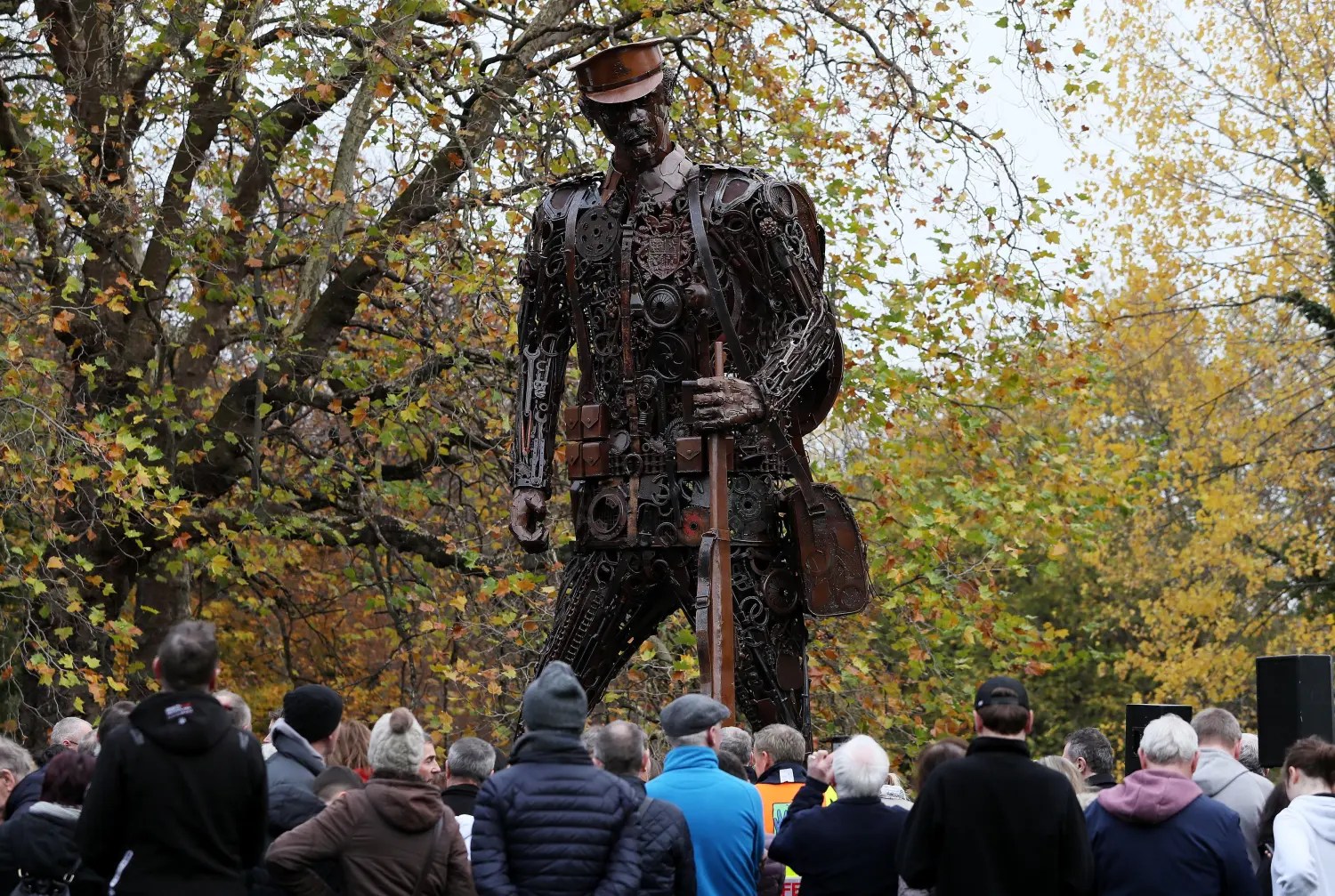
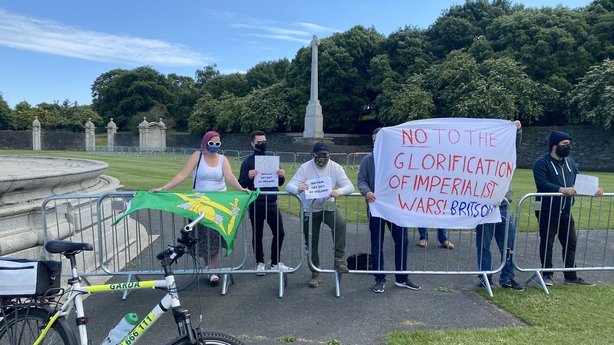
WHY?
The above examples are only a selection of situations in Ireland during the period under discussion about which we and the world were misinformed or censored. Throughout the 30 Years’ War so many accusations against the British armed forces, including their armed colonial police, have been ignored or recorded disbelievingly by the media – in particular the British section but within the Irish state also – and repeated by media services abroad, to be picked up by other media …. and so on, and on. And likewise with accusations against British intelligence services and their domestic police force.
Why then are the current claims of the Ukrainian government published through the mass media being accepted without question on every count? Why is everything the Russian government says discounted or ignored without checking? Why are we not concerned at banning of alternative media and censorship of commentators who are not repeating the party line? Why are we not outraged at the agreed delivery of Julian Assange by the UK to the USA on charges of “spying” because he exposed their lies and murderous activities in Iraq and Afghanistan? Given our own experience over 30 years of the UK media’s dismal record of reporting on the conflict in Ireland – and its equally dismal repetition in the western media – why are we now believing without critical examination the western media reporting on the war in the Ukraine?
End.
FOOTNOTES
1The civil rights campaign in the Six Counties was in pursuance of equal rights for the Catholic minority with the Protestant majority there, in the electoral franchise, in housing and employment, along with the repeal of the repressive Special Powers Act.
2‘Loyalists’ is a term describing militants – always of Protestant community background – in various organisations — who insist on remaining within the UK. The first armed actions in the 30 Years War were by Loyalists.
3Although the Royal Ulster Constabulary was created in 1922, when Ireland was partitioned, it was in effect a continuation of the Royal Irish Constabulary, the British occupation’s gendarmerie (nation-wide semi-military police force, such as exists in Spain, Turkey, Italy, France, etc) in existence throughout all of Ireland since 1822. Although the personnel of the RIC had been mostly Catholic in background (usually with Protestant senior officers), the RUC was determinedly Protestant from the start, both in its full-time and part-time membership. However, a minority of the civil rights campaigners were also from Protestant backgrounds.
4As part of the control structures in the Six Counties, the authorities had recruited only non-Catholics into the colonial police force, which helped unionist politicians and media represent an attack on the police as a sectarian attack. Though a few Catholics have been recruited since the 1990s and Sinn Féin has been supporting recruitment drives in nationalist areas, the PSNI personnel remain overwhelmingly of Protestant background.
5A convenient term used to describe the large minority community, mostly of Catholic background, mostly of the original population but with some earlier intermarriage into the majority community, which is of mostly colonist/ settler origin.
6Ironically, the first serving British soldier killed in the Six Counties was killed by indescriminate firing by the RUC into the nationalist area of Divis Flats in Belfast. Trooper Hugh McCabe of the Queen’s Royal Irish Hussars was home on leave, staying with his family when the RUC opened fire with machine-gun on the nationalist area (this was one of the incidents that led to the barricading of “no go” areas excluding the RUC and later also the British Army). Three others were also killed by RUC bullets, including a nine-year-old boy. It took over 50 years for the families to get an acknowledgement and apology after an Ombudsman’s report. https://www.theguardian.com/uk-news/2021/may/06/ruc-erred-at-troubles-dawn-by-firing-on-flats-from-armoured-cars#:~:text=Patrick%20Rooney%2C%20nine%2C%20Hugh%20McCabe,the%20Divis%20and%20Ardoyne%20areas.
7People had learned to make those in defence against RUC and Loyalist attacks during the earlier Civil Rights period.
8A large Belfast nationalist area separated from the Falls area by unionist areas and the city centre.
11The Social and Democratic Labour Party, advocating reform through legal and constitutional methods.
12Two days after the explosion, on December 6th, both the Official and Provisional IRAs issued statements condemning the bombing and denying any involvement. Local people also denied any association between the pub and either of the armed organisations.
18Despite some time searching online I have not come across the exact date they were there by May 1971 and it may be that they had been sent there as part of plan that included the introduction of internment without trial later that year.
20The fact that one fatal victim was a mother of eight children and another, a local priest, should have alerted media to the fact that the Paras were likely lying and local people likely telling the truth.
22Likely initiated as as a payoff to the Provisionals for buying into the Peace/ Pacification Process, the other being the early release on licence of their members in jail, the inquiry lasted twelve years and cost £195 million.
23No senior Army officer or senior politician of the time has even been charged for those murders. One lower-ranking soldier was eventually charged but in July 2021, the Public Prosecution Service decided it would no longer prosecute him either.
29Daniel O’Connell, a constitutional Irish nationalist politician and Catholic, campaigned for the repeal of the anti-Catholic Penal Laws in which he was largely successful in 1869 and unsuccessfully for repeal of the Act of Union, which had transferred the internal legislation of Ireland through its Parliament to Westminster instead in 1801.
30Theobald ‘Wolfe’ Tone was an Anglican campaigner for reform of anti-Catholic legislation (only Anglicans could be elected to the Irish Parliament) who became a revolutionary Irish Republican when those attempts failed. He was a founder of the revolutionary republican United Irishmen organisation. He was captured by the British after surrender of the French naval ship on which he was travelling on 12th October 1978. Although an officer in the Army of France he was tried for treason and sentenced to be executed; on 19th September 1798 he died in prison of wounds, apparently self-inflicted to deny the State his public execution.
40The IBRG was formed late in 1981 as an independent community organisation, among the issues it took up were those of anti-Irish racism, access to resources for the community, an end to strip-searching of prisoners, freedom for the framed prisoners and British withdrawal from Ireland.
41The Troops Out Movement was founded in 1973 as a broad organisation to mobilise the British public for withdrawal of British troops from Ireland; with branches in many parts of Britain, it organised marches, pickets, public meetings and published pamphlets. The relevant Wikipedia incorrectly claims it was “an Irish Republican organisation” — though it naturally did contain Irish Republicans, it also contained British revolutionary left and social-democratic elements. Though maintaining its independence for decades, it did towards the end of the 1990s become closely linked to Provisional Sinn Féin.