In late November last year the UK’s Home Secretary1 referred to refugees and migrants entering Britain as “an invasion”, for which a Hollocaust survivor, 83-year-old Joan Salter, challenged her, likening her speech to that of the Nazis.
An NGO working with refugees, Freedom From Torture, posted some of the exchange on Twitter. In turn, the NGO came under pressure from the Home Office to retract the video.
This month, not only did the charity refuse but did so publicly, fully endorsing the content of the video.
Anyone would well understand the difference between invading a country and entering it as a refugee, asylum seeker or even economic migrant. Those come unarmed, fleeing to safety or trying to make a living for themselves and their family.
A minister of a British Government should be extremely well-placed to understand the distinction. After all, there is no continent and very few countries, including its near neighbours, which the British ruling class has not caused to be invaded at some time or other.2
Map of areas of the world ‘owned’ by Britain or the UK at one time (Source: Internet)
From the time the descendants of the Anglo-Saxon invaders of Celtic England merged with the descendants of the later Norman invaders, England has gone from being a major invading and colonising military and naval power to being a major imperialist one.
Imperialist action did not always end in invasion; pressure could be applied in other ways, through bribery — or open threat. The term “gunboat diplomacy” was coined to describe imperialist actions short of actual invasion and Britain was renowned for actions of that type.
The ruling class of Britain has waged war against people to take over trade routes, to colonise land and extract resources, in competition with other colonial powers, to quash resistance and even for the right to sell opium in China.
In the course of those colonial and imperialist activities, Britain has carried out many invasions. In fact, Suella’s parents themselves come from former colonies.
Braverman is a child of migrants
Suella Braverman is the daughter of parents of Indian origin who emigrated to Britain in the 1960s: Uma (née Mootien-Pillay) from Mauritius and Christie Fernandes, from Kenya. Both those countries have indeed been invaded by Britain.
Kenya in particular from 1952-1960 had one of the worst experiences of colonial treatment by the British military, including wide-scale murder, torture and rape. India and Pakistan had their infrastructure and manufacture undermined by Britain leading to regular country-wide famines.
Suella Braverman, MP, currently UK Home Secretary. (Sourced: Internet)
Suella should know about invasions, refugees and migrants but is on record as saying that the British Empire was on the whole a beneficial experience for its conquered. This is a prime example of the “slave mind” that apes the invader and wants to collaborate with it.3
Such “slave-minded” people can be even more vicious and callous in their attitudes than the conquerors themselves and Braverman certainly fills that bill. And it’s not just in occasional choice of words that Braverman nears Nazi appearance.
During Braverman’s unsuccessful campaign for selection as leader of the Conservative Party last July, she said her priorities would have included to “solve the problem of boats crossing the Channel” and “to withdraw the UK from the European Convention of Human Rights.”
In October 2022, Braverman said that she would love to see a front page of The Daily Telegraph sending asylum seekers to Rwanda4 and described it as her “dream” and “obsession.” No doubt she includes human rights and legality concerns as “all of this woke rubbish.5”
A courageous NGO
Holocaust survivor Joan Salter, the woman who accused Braverman of Nazi-like speech, is the daughter of refugees from Nazi persecution who survived but endured imprisonment and hazardous journeys. She has an MBE for her work on Holocaust education.
Joan Salter, Holocaust survivor who challenged the Home Secretary. (Sourced: Internet)
In response to a Home Office accusation that the clip is only partial and therefore misleading, the NGO’s CEO Sonya Sceats pointed out the full exchange is available in video on its website and said the charity will not remove the Twitter clip.
“As an organisation providing therapy to torture survivors who feel targeted by her language and who know first-hand where such dehumanising language can lead, we will not do so. She has used language she should be ashamed of, and we won’t be pressured into helping her hide it.”
Non-Governmental Organisations nearly always rely on government funding, whether directly or indirectly and as a result tend not to rock the boat too much, in case they find their boat getting smaller or their team even being tossed overboard.
Sony Sceats, CEO of Freedom From Torture charity who stood up to the Home Secretary.
As a result, in public the CEOs of those organisations tend to vary from generally totally compliant6 to cautiously critical on certain occasions. In that context, the actions of Salter in the initial video and of the Freedom From Torture NGO in militantly backing her can only be admired.
1This is the UK’s equivalent to Minister for Home Affairs, these days normally restricted to Britain (i.e excluding the colony in Ireland) and in particular England and Wales (i.e often excluding even Scotland).
3The concept of the ‘slave mind’ or ‘colonised mind’ has been addressed by a number of writers on national liberation, notably Patrick Pearse (1879-1916) from Ireland and Franz Fanon (1925-1961) from Martinique.
4That plan has been condemned by many human and civil rights organisations and also denounced as illegal.
5A quote dating from her attempt at Leader of the Conservative Party.
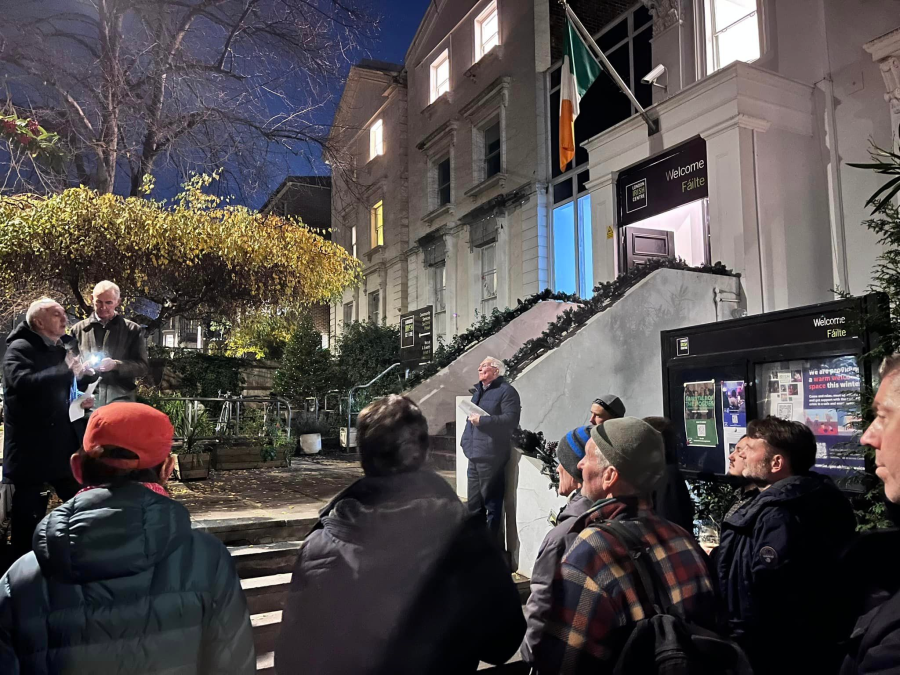
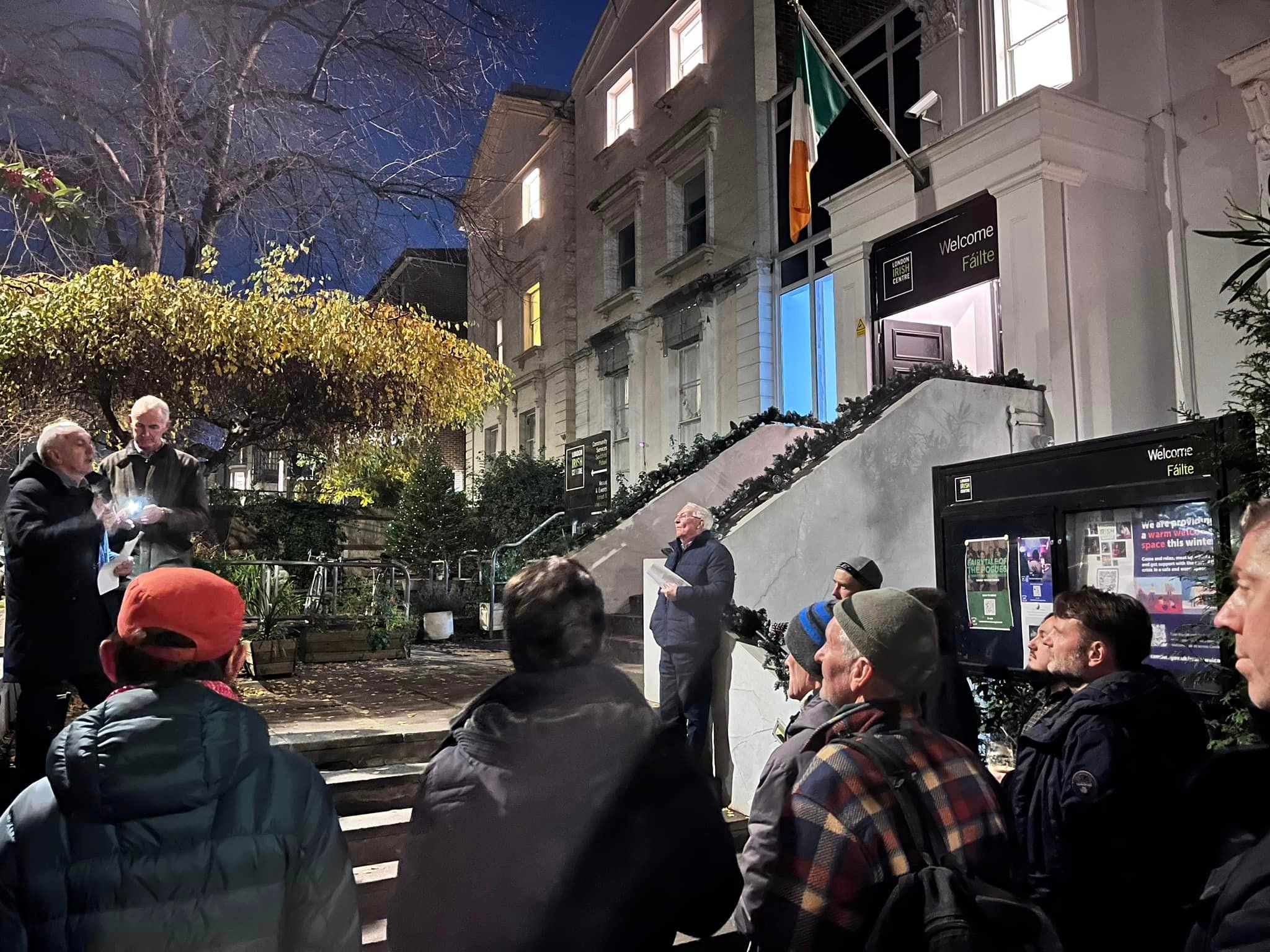
Speech by Pat Reynolds2 in Commemoration of Irish Civil Wars 1920-1923 on a sub-zero evening outside Camden Irish Centre, London on 8th Dec 2022
(Reading time: 15 mins.)
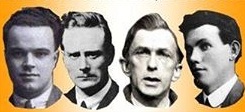
A Chairde Ghaeil agus a Chomrádaithe, tonight we are gathered here to remember and celebrate the lives of Liam Mellows, Rory O’Connor, Dick Barrett and Joe McKelvey, four great Irish patriots.
We also call out the neo-colonial Irish Free State for those unlawful murders and all other executions carried out by this British Imperialism-backed Dublin regime, acting on orders to attack the Irish Republic and its army and people.
In remembering this time and the setting up of the Irish Free State and the Northern Ireland government 1920 -1923 we take the Republican view of history in an All-Ireland context and avoid the narrow structures of the Free State 26-County centenaries.
These ignore the Six Counties and the heroic role played by the people there in defence of the Republic and a United Ireland.
In looking at this time in history we consider the two proxy wars waged in Ireland by British guns and on behalf of imperialistic interest to put down the Republican fight for a 32-county Irish Republic declared in Dublin at Easter 1916.
That was voted by a very large majority in 1918 for the same All-Ireland Republic, fought for in a war of independence from 1919 -1920 by an undefeated IRA.
The revisionists try to partition the Irish struggle to backdate some kind of imaginary Loyalist/Unionist state which never existed, was never fought for or voted on to create a colonial divide-and-rule in what was always even — under colonial rule — one country.
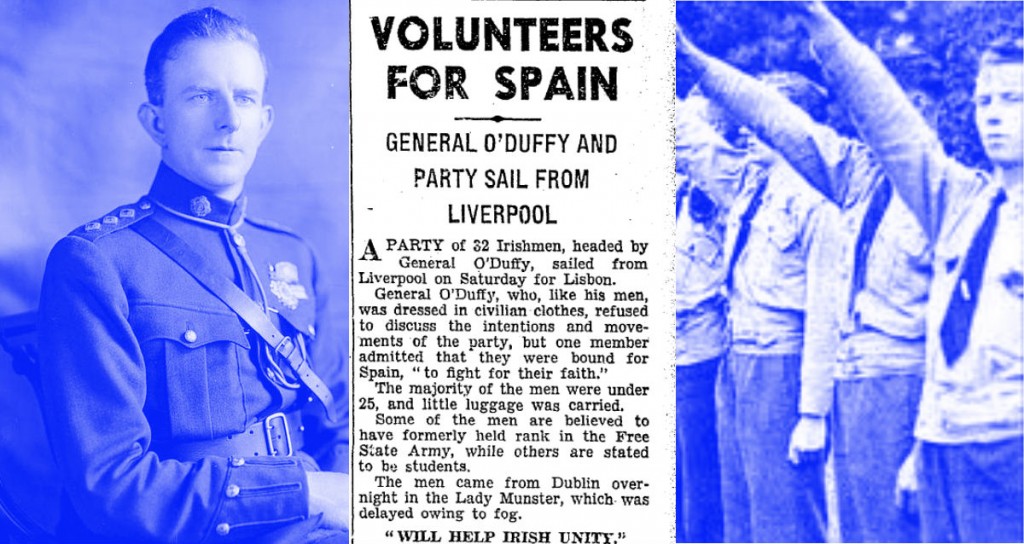
As Republicans we reject the 1948 Republic declared by the Blueshirts3 and fascist Franco ally Costello.
Those who want to read about this heroic struggle by the Irish people should read the two books by Ernie O’Malley TheSinging Flame on the War of Independence and On Another’s Man’s Wound on the Civil War.
In looking at the history of this time we see two wars being fought against the Republic, the first in what became Northern Ireland from June 1920 to June 1922, a two-year war to put down the Republican people in the North East of Ireland.
The second war was within the newly created 26 Counties Free State from November 1922 to May 1923, a nine-month war by British guns against the Republic.
It is sad to state here tonight that the only war ever fought by the Free State Army was to put down the Irish Republic and its own people.
James Joyce in the Dubliners short story collection has this wonderful story The Dead where at the end he looks out the window and sees it is snowing, in his words “it is snowing all over Ireland, snowing, on the living and the dead.”
At that time in history, we see British guns firing down all over Ireland, leaving us the heroic dead and the living nightmare that became the Irish Free State and the Six Counties, seen years earlier by James Connolly as “a carnival of reaction”.
What we see happening at this time of history is that Imperialism tried and won by negotiation what they had failed to do in war, to defeat the undefeatable IRA and the undefeated people.
The imposition of Partition upon the Irish people required the breaking up of the Republic declared in 1916 in rebellion, by democratic vote in 1918, and fought for in the War of Independence from 1919-1921.
The Imperialists moved first to break the Republicans and Nationalists in the North East of Ireland.
We see from Churchill’s father playing “the Orange card”4 to benefit the Tory party in the late 1800 to the Curragh Mutiny in 1913, and the arming of the Unionists their intentions on retaining the wealthiest part of Ireland and the Belfast manufacturing base of shipbuilding.
We see the hand of Sir Henry Wilson at play from the aftermath of the Curragh Mutiny, where he protected senior army officers, to his role in being political and military advisor to the emerging Northern Ireland government, and the arming of the new Unionist state.
We see his hand in diverting the body of Terence MacSwiney from Holyhead to Cork, the hanging of young Kevin Barry and the Orange led anti-Catholic pogroms of Belfast and Banbridge.
We see it in other links too with the Orange murder gangs which, led by Orangemen were involved in murders in Cork, and in the murder of Thomas MacCurtain Lord Major of Cork.
District Inspector Swanzy5 was believed to be responsible for the gang who murdered Thomas MacCurtain who was then moved to Lisburn, Co. Antrim. He was tracked there and executed by the IRA.
Sir Edward Carson in the House of Commons supported the Amritsar Massacre6 as did Churchill who falsely claimed that the protesters were armed and stated, ‘Men who take up arms against the State must expect at any moment to be fired on.
Men who take up arms unlawfully cannot expect that troops will wait until they are quite ready to begin the conflict. When asked What about Ireland?, Churchill stated, I agree and it is in regard to Ireland that I am specially making this remark.
We can see this in the murder of Thomas Mac Curtain7 and other Republicans
Also when another Orangeman from Banbridge, Colonel Smyth stated this policy that suspects could be shot on sight if the RUC had good reason to believe they might be carrying weapons or did not put up their hands.
Smyth’s new shoot-to-kill policy was published and he was recalled to London to meet Lloyd George. Michael Collins ordered that Smyth be executed before he could implement his shoot to kill policy.
Later on, Smyth’s brother,8 also in special forces was shot dead in a shoot-out with Dan Breen in Dublin. After Smyth’s funeral in Banbridge there was organised large scale anti-Catholic attacks on businesses and houses.
The anti-Catholic pogroms lasted for two years from June 1920-June 1922 in the North-East of Ireland in Belfast, Banbridge and other areas. There were over 500 deaths in these pogroms but only 13% (65) were army/police or IRA while the other 87% were civilians.
Here civilians are the main targets, with 58% of these being Catholic and 42% being Protestant. But based on the population of Belfast at the time, 76% Protestant and 24% Catholic, Catholics were four times more likely to be killed than Protestants.
The British government stood largely idly by while these pogroms went on and did absolutely nothing about it.
We see this clearly in how Catholic workers and Protestant socialists were driven out of the shipyards, some ten thousand Catholic workers driven out of their jobs for being Irish and Catholic and we see one thousand homes and business burned out.
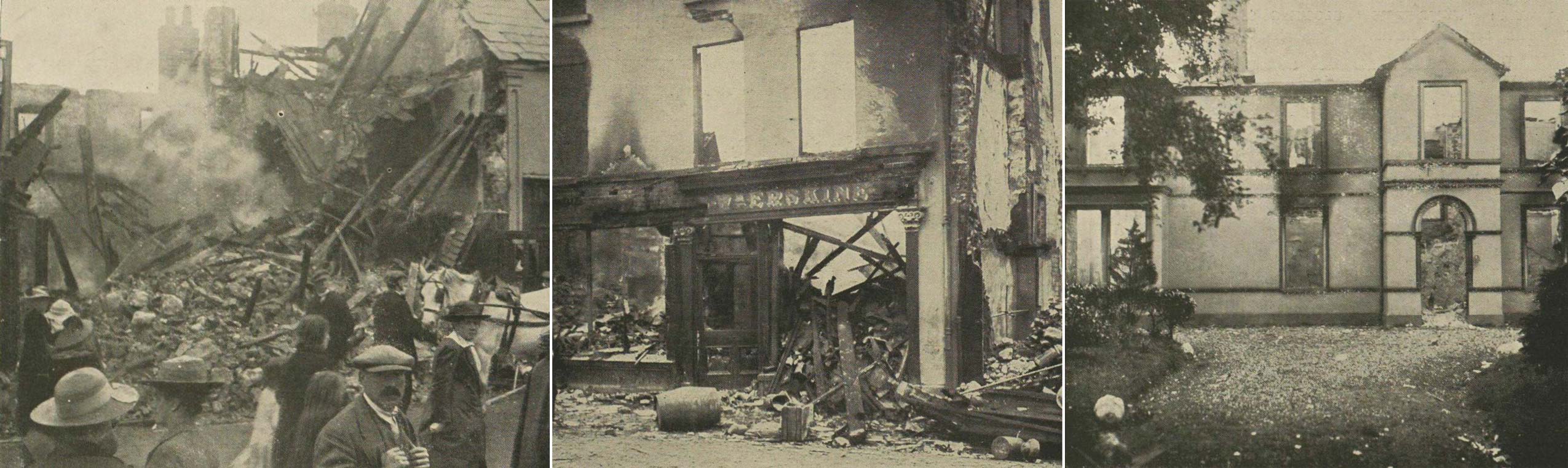
Damaged buildings in Lisburn due to sectarian riots. Note parochial hall gutted on far right.
Some 80%of the places burned out were Catholic-occupied or owned and 80% of the refugees were Catholic. Considering Catholics only made up one quarter of the Belfast population we can see what happened here.
This was the putting down of the Republican nationalist community to enforce the partition in Ireland and to prepare for a one-party neo-fascist apartheid Protestant statelet.
The impact of the ten thousand job losses and the burning of houses and businesses led to large scale migration of Catholics from the North east to Britain and to Dublin.
We also see at this time the use of British death squads to murder Catholic as they did in Cork City with McCurtain and now in Belfast with the McMahon family and others. These death squads were operating within the RUC9.
In the 1970-1995 period we see the emergence again of these British death squads in Northern Ireland linked to British intelligence, army and police with often open collusion and sharing of agents and information.
Collins had asked a Catholic priest and a university professor to record and write up each of the deaths during the pogroms, but when it was at the printers the Free State government after Collins death decided to pulp the whole print run.
This was in order to cover up what had happened to the Republican/nationalist community around Belfast in the pogroms, probably because of their own shame with the own war crimes of executions of prisoners and atrocities during the war.
It was to add to their shameful record. The story of the Orange pogrom was not published until the 1990s. Those who want to can read it under the title Orange Terror. Equally The Orange State or Arming the Protestants by Michael Farrell cover this time.
The execution of Sir Henry Wilson in London in June 1922 put an end to these pogroms against Catholics in that the head of the serpent, the rabid anti-Catholic Orange Bigot was gone.
He was a political and military advisor to the new Northern Ireland government and was largely responsible for the arming of the new Protestant state, including the B Specials10.
Tonight, we honour those brave Irish volunteers and community activists who tried to stop the pogroms and defend isolated Catholic areas in Belfast where most of the killings took place, those who stood for an All-Ireland Republic and against the imposition of Partition.
We must never separate their fight from the fight in the rest of Ireland to defend the Republic. The partitionist mind has no place in Republican history.
The war in Ireland to smash the Republic now turned to the rest of Ireland when under Churchill’s orders and Churchill-supplied weapons, Collins attacked the Republican army in the Four Courts starting a second proxy war on behalf of British imperialism in Ireland.
The Truce between the undefeated IRA and the British government started on 6th July 1921 and ended with the Treaty of 5/6 December 1921. The Treaty was signed under threats by Lloyd George of immediate and terrible war.
The Treaty today would be seen as unconstitutional under international law given the violent threats made by Lloyd George. The Treaty was for the Partition of Ireland with a British Governor General in Dublin and an oath of loyalty to the English King.
Two of the big lies around the Treaty were when Collins stated it was a stepping stone towards a united Ireland, in fact it was a millstone around the necks of the Irish people since then.
The second lie to justify this surrender was that the IRA was weak and low in arms. This was nonsense as evidenced by the Civil war fight.
The Dáil on 7th January 1922 voted 64-57 in favour of the Treaty, once again the Dáil11 voted under the duress of immediate and terrible war.
All the women deputies voted against it, as did the female relatives of the 1916 leaders Pearse, Connolly, the MacSwineys and Cumann na mBan
The Catholic Bishops fully supported the Treaty as they did with the Act of Union in 1800, and every priest in Maynooth took an oath of loyalty to the English Crown on ordination.
The Press in Dublin, TheIrish Times, Independent and The Freema ns Journal all supported the Treaty as did big businesses, big farmers and the Unionist community which included four Unionist TDs.
From January to May 1922 Collins rebuilt the new Irish army up to some 58,000 men. These included some 30,000 ex-British Army men, some 3,000 deserters from the IRA and some 25,000 new recruits.
The British Army allowed any serving Irishman to transfer into the new Irish army without any loss of pay or rank.
Collins was running to London on a regular basis to see Churchill who wanted to see the new army attack the IRA. In May 1922 Churchill stated that ‘there is a general reluctance to kill each other’.
There was a General Election on 16th June 1922 when Pro-Treaty group won 58 seats with 35 going to anti-Treaty, four to Unionists, 17 Labour, seven to a Farmers’ party and 17 others.
Collins broke the Pact with De Valera under orders from Britain and by June 1922 there were two armies in Ireland, the IRA and the new army set up by Collins and Mulcahy.
The IRA held an Army Convention in Dublin with over 200 delegates representing about 75% of the IRA and they voted to stand by the Republic.
They took over the Four Courts under the leadership of Rory O’Connor and Liam Mellows with Liam Lynch as Chief of Staff.
After the execution of Sir Henry Wilson on Collins’ command, the British government blamed the Four Courts garrison and Lloyd George openly called for the Four Courts to be attacked or the Treaty would be declared void.
On 28th June 1922 Collins ordered the Four Courts to be attacked using borrowed British big guns, but even the uniforms boots and the Lee Enfield rifles had been supplied by Churchill.
A big explosion of ammunition inside the Four Courts led to their surrender, while fighting continued around O’Connell Stree and Cathal Burgha died emerging from one building. The IRA retreated from Dublin towards their new Munster Republic.
Griffiths and Collins were to die in August 1922 and the war against the Republic entered a new and ugly phase. Mulcahy set up a semi-dictatorship, fascist in outlook and in practise. On 15th October he introduced the new Bill labelled “the Murder Bill” into Dáil Éireann.
The new government’s links with fascists can be clearly seen later on in the 1930s with their linking up with Blueshirts, their support for Franco and we saw against in the 1970s, with their police Heavy Gangs, press censorship and emergency courts12.
The Emergency Powers Act aka the Murder Bill is a shameful chapter of history which that party and the people involved including the church by its silence needs to be held accountable.
In November 1922 Ernie O Malley was arrested lucky for him he was badly wounded so escaped being executed, but on 17th November 1922 four young Republicans were executed by their State to get the public ready for bigger executions.
The Mountjoy Four executions by the Irish Free State in 1922 of one IRA Volunteer from each province.
The later execution of Erskine Childers a patriotic Irish man was most shameful. Griffiths’ mocking of Childers was racist and shocking as all the Irish abroad and at home would be offended by Griffiths. Childers with an Irish mother was as Irish as De Valera, Pearse, Cathal Brugha or Terence MacSwiney.
The Free state was formally up on 6th December 1922, on 7th Sean Hayes TD was shot dead by the IRA and the following morning the Free state executed Rory O’Connor, Liam Mellows Dick Barrett and Joe McKelvey from Belfast one from each province.
While the Free State made a big issue of a TD being killed, they themselves killed in cold blood Cathal Brugha, Harry Boland and Liam Mellows, all TDs.
The song composed after the executions,
Take it down from the mast Irish traitors, It’s the flag we Republicans claim. You murdered brave Liam and Rory You have taken young Richard and Joe.13
The Free State went on to commit further war crimes against the Republic and Republicans; in all they murdered over 80 men without proper trial and in cold blood.
They executed four young IRA men in Donegal and Sean McKeown was responsible for the cold-blooded murder of the Noble Six Republican prisoners in Sligo.
Co Kerry was the worst for Free State atrocities, in one case nine IRA prisoners were tied to a land mine and blown to pieces, along with four more executed in Kerry and more again executed by land mine in Cahirciveen.
In total 17 were murdered in cold blood by the Free State army in Kerry. There had been over 400 sentenced to death over 80 state executions, but we must also add in the number of surrendered prisoners who were executed.
Tod Andrews in his Book Dublin Made Me suggested the total figure of State and army executions during this time to be 153.
After the death of Liam Lynch, the IRA decided to dump arms at the end of April 1922.
In a general election in August 1922 the Free State got 63 seats with Sinn Féin getting 44 despite the loss of the Civil War. In 1926 DeValera14 broke with Sinn Féin and in 1927 won 44 seats with Fianna Fáil, thus taking the Sinn Féin vote.
In 1932 De Valera came to power and he in turn after using the IRA in the 1930s to defeat the Blueshirts turned against them and was cruel in his jailing and treatment of Republicans.
To finish, we are here tonight in Camden to honour all those who stood with the Republic in the War of Independence and in the battle to prevent the Partition of Ireland.
Those who died in the pogroms in the North East as much as the young soldiers who died defending the Republic in the Civil War.
In the Republic too the Free State used the same tool as the Unionists in using a form of ethnic cleansing to push out their opponents out by emigration.
Just as the Catholics in the North East were driven out of Harland and Wolf and driven abroad, so too were the defeated Republicans in the rest of Ireland who could not get a job in the army, police or civil service, in teaching or in any other public service.
We see in Sean Sexton’s book of Irish Photos15 whole IRA battalions in New York and in Chicago at their annual dinner dances driven out of |Ireland by the new Free state.
By 1923 the Irish Republican Army had been defeated in the battle for the Republic but their spirit was still alive among the Irish people. In every generation the Republican movement would attempt to fight on towards that original dream of a United Irish republic.
More so the Spirit of the Republic came alive in the 30-year war in Northern Ireland from 1969 -1998, and it came alive in the 1981 Hunger strike of Bobby Sands MP and his nine comrades.
As we approach another crucial stage in Irish history, we need to be wary of the dying embers of British imperialism, they will again try and dilute that Republican dream with offers of NATO, Commonwealth, and a role for British monarchy.
We can see the Tory Right again use the Orange card with the Protocol where they are prepared to break an international agreement.
And we see in the Legacy Bill how the Tory Party has contempt for all the people of Northern Ireland, Unionist and Nationalist, when it comes to protecting British imperial interest there.
We see it in unionist Keir Starmer16 when he stated that he would campaign for Northern Ireland to stay in the Union, contrary to another agreed international treaty to remain neutral on this issue. Let us as Republicans remain eternally vigilant against British deceit.
Pat Reynolds (extreme left of photo) speaking outside the Camden Irish Centre on the Free State executions.
Tonight, as we honour the men and women who stood by the Republic and against the Partition of Ireland, we should stand by the same Republic declared by the 1916 Proclamation free from any British interference and the pledge to treat all our children equally17.
We stand here too in the spirit of Tone and Connolly.
We stand proudly in honour of four brave Irish patriots here tonight, in honour of the workers driven from the shipyards of Belfast, the people who perished in the pogroms, the men and women in the North East and in the whole of Ireland who stood with the Republic, all those who gave their lives for the Republic, and those who down the long years have fought and kept that flame alive.
The view of Joyce that it is snowing all over Ireland stays with me on this cold night, but it moves on to a vision of Ireland of Easter lilies growing in freedom all over Ireland and dancing freely in the breeze.
It is there in the struggle of those who fought and died for the Republic. That we remember tonight. It is there in the words of Bobby Sands in his Rhythm of Time18 when he shouts that they, the Republicans, were Right.
End.
FOOTNOTES
1The title was chosen be Rebel Breeze as this take on the Irish Civil War consisting of two wars (or campaigns?) is unusual and worthy of consideration. The editing for publication and footnotes are Rebel Breeze’s also. The text was supplied thanks to Pat Reynolds.
2Pat Reynolds, from Longford, is a long-time Irish community activist settled in London. He was co-founder of the campaigning Irish in Britain Representation Group and is co-founder of the Terence McSwiney Commemoration Committee.
3Irish fascist organisation of the 1930s led by former Free State Commissioner of Police and former IRA officer Eoin O’Duffy.
4A reference to the 1886 quotation of the senior Churchill with regard to whipping up members of the unionist Orange Order in Ireland to defeat British Government proposals on Ireland.
5Of the Royal Irish Constabulary, the British colonial gendarmerie in Ireland.
6In India, 1919 when over 1,000 unarmed people were shot dead by British Army soldiers.
7IRA Volunteer and elected Lord Mayor of Cork in January 1920, murdered by Royal Irish Constabulary in March 1920.
8Major George Osbert Smyth, one of the British Army killed during an escape from a raid on a house in Drumcondra, Dublin of IRA Volunteers Dan Breen and Sean Tracy during raid to capture them.
9Royal Ulster Constabulary, British colonial gendarmerie, currently renamed Police Service of Northern Ireland.
10A part-time reserve of the RUC which had weapons at home or at work, greatly detested and feared among the nationalist community. The reserve was disbanded in May 1970 with many members incorporated into the Ulster Defence Regiment of the British Army.
11Dáil Éireann, an all-Ireland Parliament prior to Partition, now of the Irish State and excluding the six counties of the British colony.
12Reference to a special political police force tasked with repression of Republicans and gaining confessions under torture (see for example framing of The Sallins accused and Joanne Hayes case), the censorship under Section 31 of the Broadcasting Act and the Special no-jury Courts set up under the Amendment to the Offences Against the State Act.
13Two couplets from different verses of the Soldiers of Twenty-Two Irish Republican song.
14Éamonn De Valera, a 1916 commandant, later anti-Treaty leader, later still founder of the Fianna Fáil party after splitting from Sinn Féin, Taoiseach (Prime Minister) and later President of the Irish State.
The founding of the Irish Citizen Army, the first workers’ army in the world1, was commemorated in Dublin at the site of Wolfe Tone monument in Stephens Greeen, in song and speech on 23rd November 2022.
Organised by the Connolly Youth Movement, the other participating organisations represented were the Irish Communist Party, Independent Workers Union, Lasair Dhearg2 and Welsh Socialist Republican Solidarity (Ireland) – the Irish branch of the Welsh Underground Network.
In addition, a number of independent activists were also present.
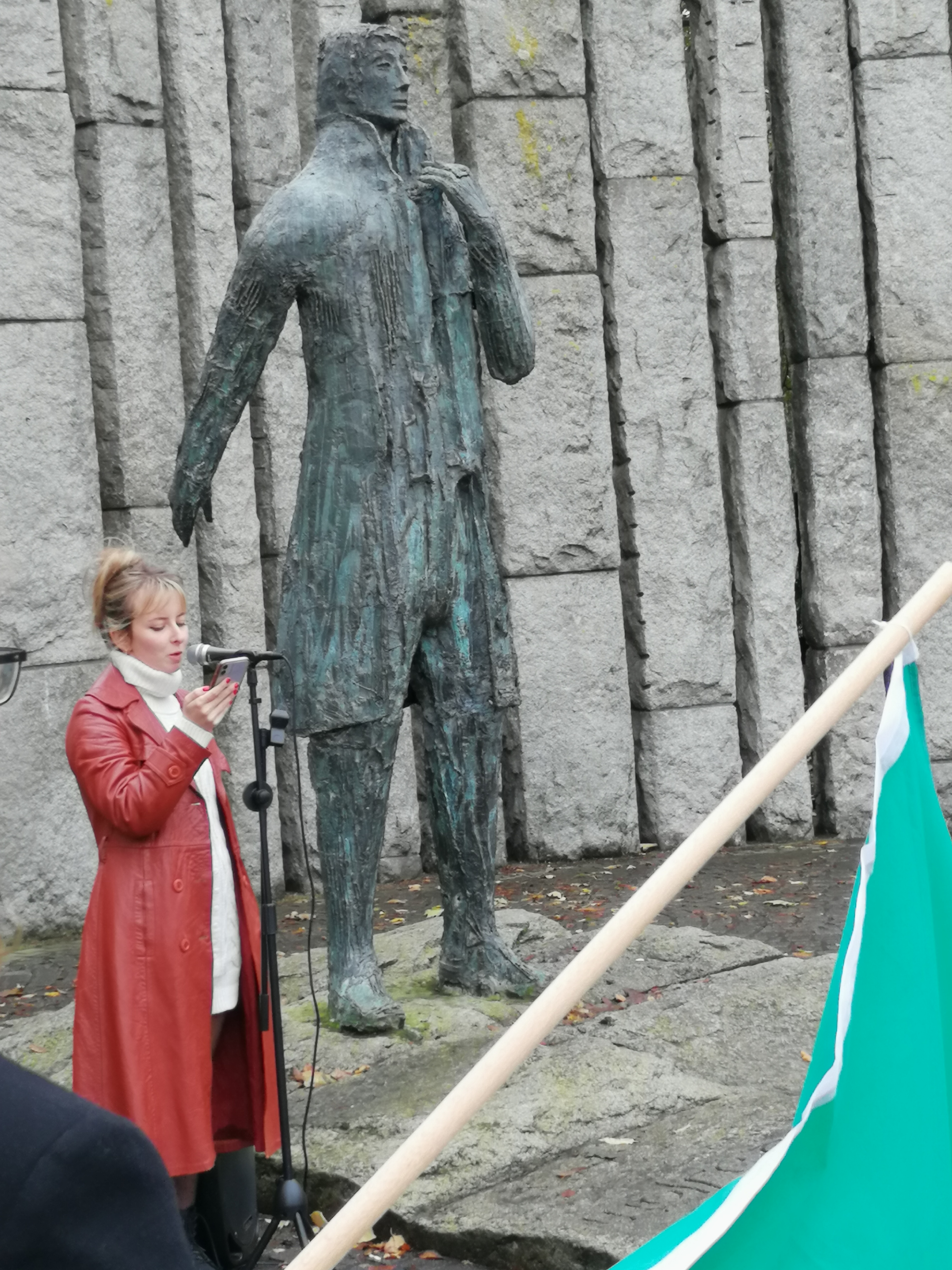
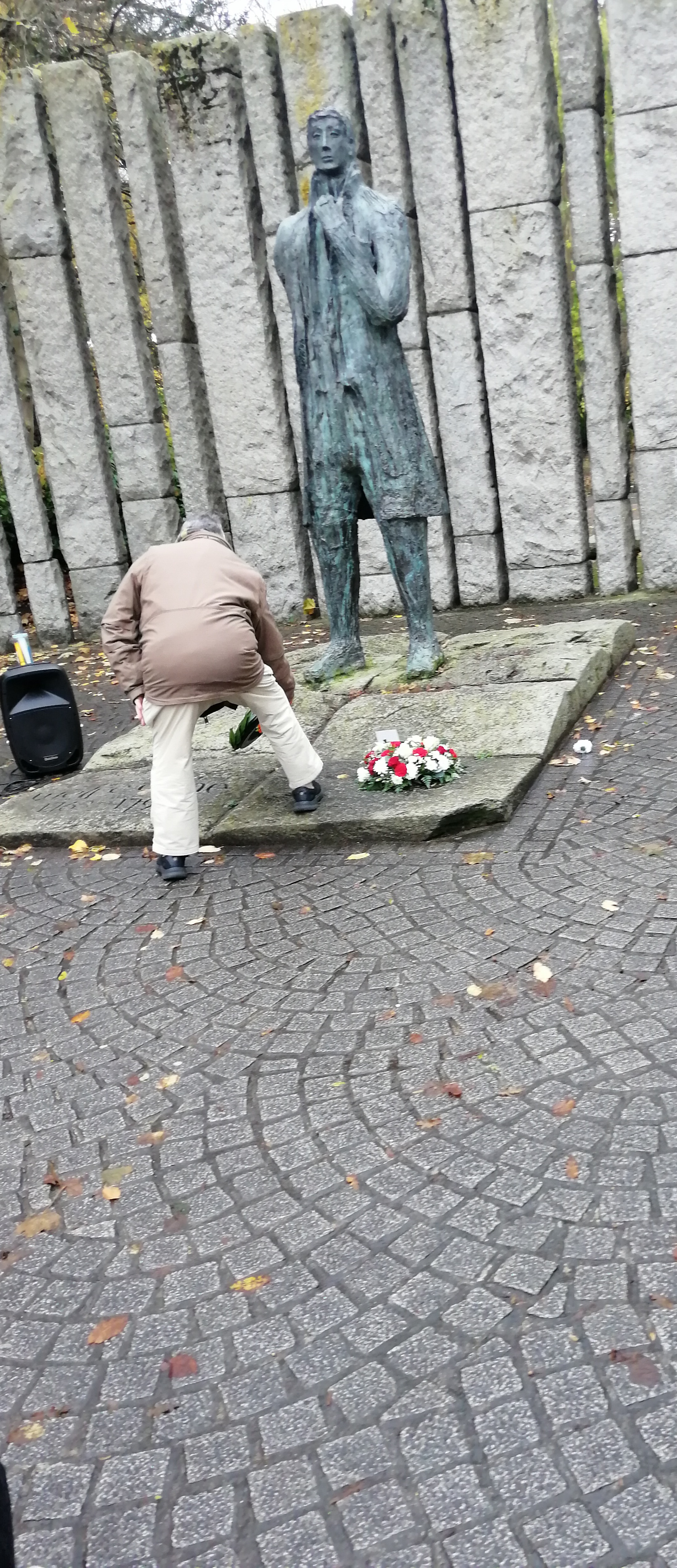
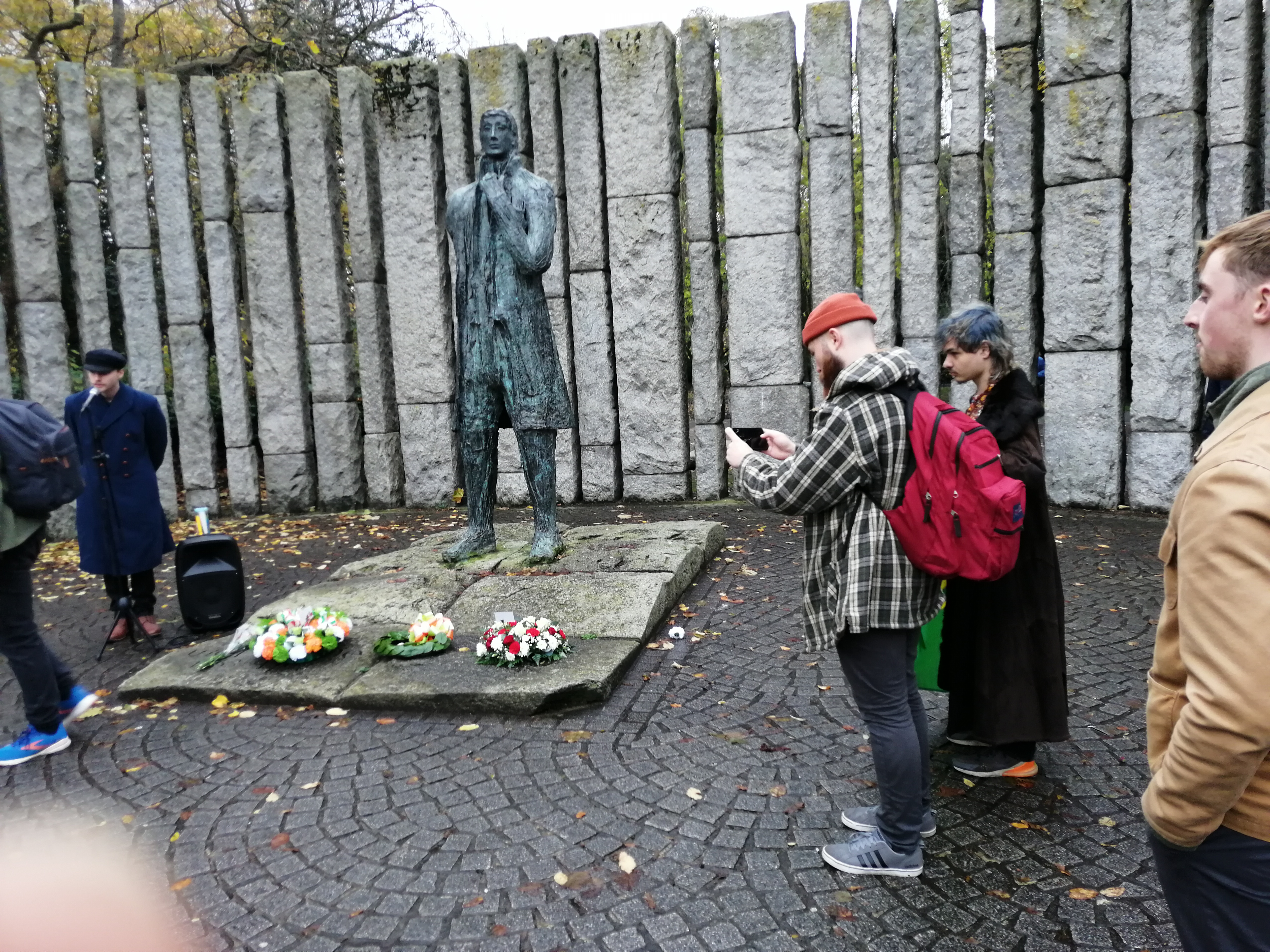
CYM speaker beside the Wolf Tone Monument (by Edward Delaney) which was blown up by Loyalists in 1969; it was recast and the surviving head incorporated. (Photo: Rebel Breeze)
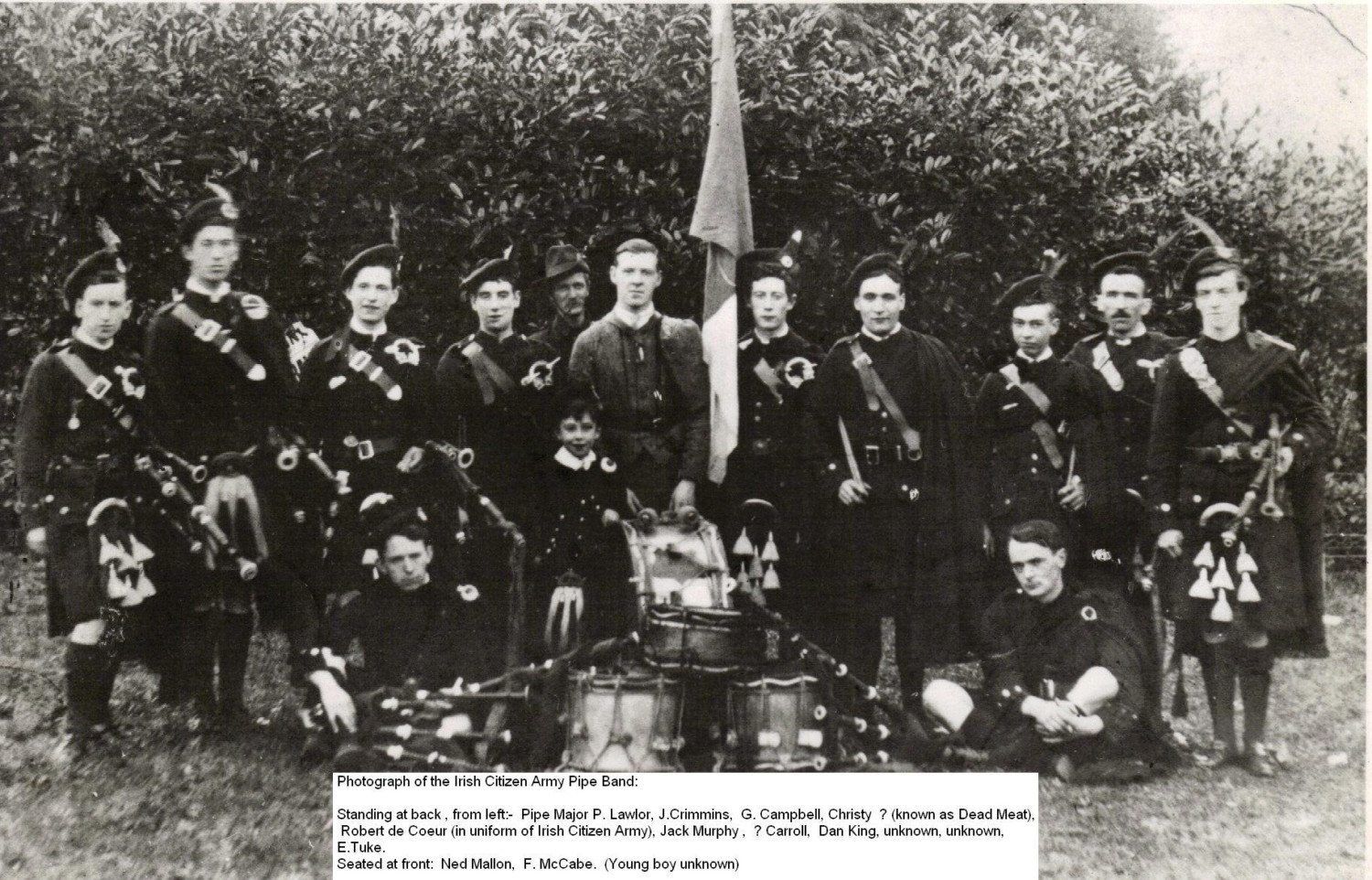
THE IRISH CITIZEN ARMY
The Irish Citizen Army was founded on 23rd November 1913 on a call from Jim Larkin and James Connolly, both leading the Irish Transport and General Workers’ Union in its titanic struggle against the federation of Dublin Employers’ plan to break and disperse the union.
The call for the formation of the ICA arose due to the attacks of the Dublin Metropolitan Police on the workers and their supporters; already in August 1913 the DMP had killed two workers by truncheon blows and injured many, including a youth who would die later as a result.
The ICA’s initial organiser was the writer and dramatist Seán O’Casey, later succeeded by Boer War veteran Jack White.3 In addition to requiring its recruits to be union members, the ICA enrolled women as well as men and some of the former were officers commanding both genders4.
While the ITGWU was defeated in the eight months of the Lockout, it was not smashed and came back stronger in a relatively short period. The ICA faded away then but was reorganised over following years and approximately 120 took part as a unit in the 1916 Rising, alongside other units.5
SPEECHES AND SONG
A small crowd had gathered at the advertised location, the Wolfe Tone Monument in Stephen’s Green and the chairperson of the event called people to order.
Diarmuid Breatnach, an independent activist, was asked to sing one of Connolly’s compositions, ironically titled Be Moderate, often referred to instead by its refrain, “We only Want the Earth”.
An older man with a Dublin accent, Breatnach told his audience that Connolly published the lyrics in New York in 1907, going on to sing the five verses to the air of Thomas Davis’ A Nation Once Again6, using the chorus part to repeat the refrain that “ … we only want the Earth!”7
A representative of the Independent Workers’ Union, a young man with an Ulster accent, spoke about the need for workers to have a trade union and for that union not to align itself with employers or with the State.
In order to truly represent the interests of the workers, the union needs to be independent, he maintained and also democratic in its decision-making.
In conclusion, the speaker said that the IWU is the union that is needed and called on people present to join it and to support it.
“MAKE THE VISION A REALITY”
Amy Margaret, a young woman, also with an Ulster accent, delivered a speech on behalf of the organisers of the event, the Connolly Youth Movement.
“The Citizen Army was a direct response to the brutality carried out by the RIC and Dublin Metropolitan Police during the Dublin Lockout” she said; “the police killed two workers, injured hundreds more with baton charges, and frequently ransacked the tenements where strikers lived.”
“The Citizen Army fought back with some succes” she continued “and as one pointed out, a hurley has a longer reach than a baton. It was in the Citizen Army that the working-class stood up to the RIC and employers,” she continued.
“The same RIC that torched farmer’s homes during the Land war, the same employers who often owned the slums where workers lived; it was here at Stephen’s Green (and elsewhere in the city) that the Citizen Army stood up to the British Empire, alongside comrades in the Irish Volunteers.”
She told her audience that when, during a dockers’ strike in 1915, scabs were imported and police harassed picketers, Connolly sent a squad of the ICA with fixed bayonets to the scene, resulting in the dispute’s resolution with “a considerable increase in wages to the dockers concerned”.
“The Citizen Army was not simply workers armed with guns,” the speaker said, “but also armed with culture” and referred to weekly concerts in Liberty Hall (the ITGWU’s HQ) and to the dramatic acting history of Seán Connolly and whistle-playing of Michael Malin, both 1916 martyrs
“What the ICA stood and fought for in their own words, “… is but one ideal – an Ireland ruled and owned by Irish men and women, sovereign and independent, from the centre to the sea.”
“Connolly was clear however that such a Republic would have no place for the “rack-renting, slum-owning landlord” or the “profit-grinding capitalist”, but should rather be a “beacon-light to the oppressed of every land”.
“The most fitting tribute for the ICA then is to make that Republic a reality. To do so we must learn from the past and their examples. We can learn from them to never be cowed by the odds against us, we can learn from their comradeship to each other.
We can learn from how they combined political, economic and cultural methods to advance the cause of a worker’s republic. But more importantly we must be able to learn from their shortcomings.
After the Rising and the loss of its leadership the ICA began to devolve into a social club and whilst some members played an important role during the Tan War, the ICA was not the revolutionary workers’ army it once was.
Therefore we must build a truly mass movement – not just a committed core of activists, and we must build a movement not reliant upon key personalities so that it can function no matter what.
We all know that things must change in Ireland, and so we reaffirm the principle that the Citizen Army stood by; only the Irish working class is capable of waging the revolutionary struggle necessary to change things; not capitalists and landlords.
Helena Molony of the ICA, said, “We saw a vision of Ireland, free, pure and happy. We did not realise that vision. But we saw it.”
As the socialist-republican youth of today, we commit ourselves to make that vision a reality and to build a Republic that the men and women of the Citizen Army would gladly call their own.”
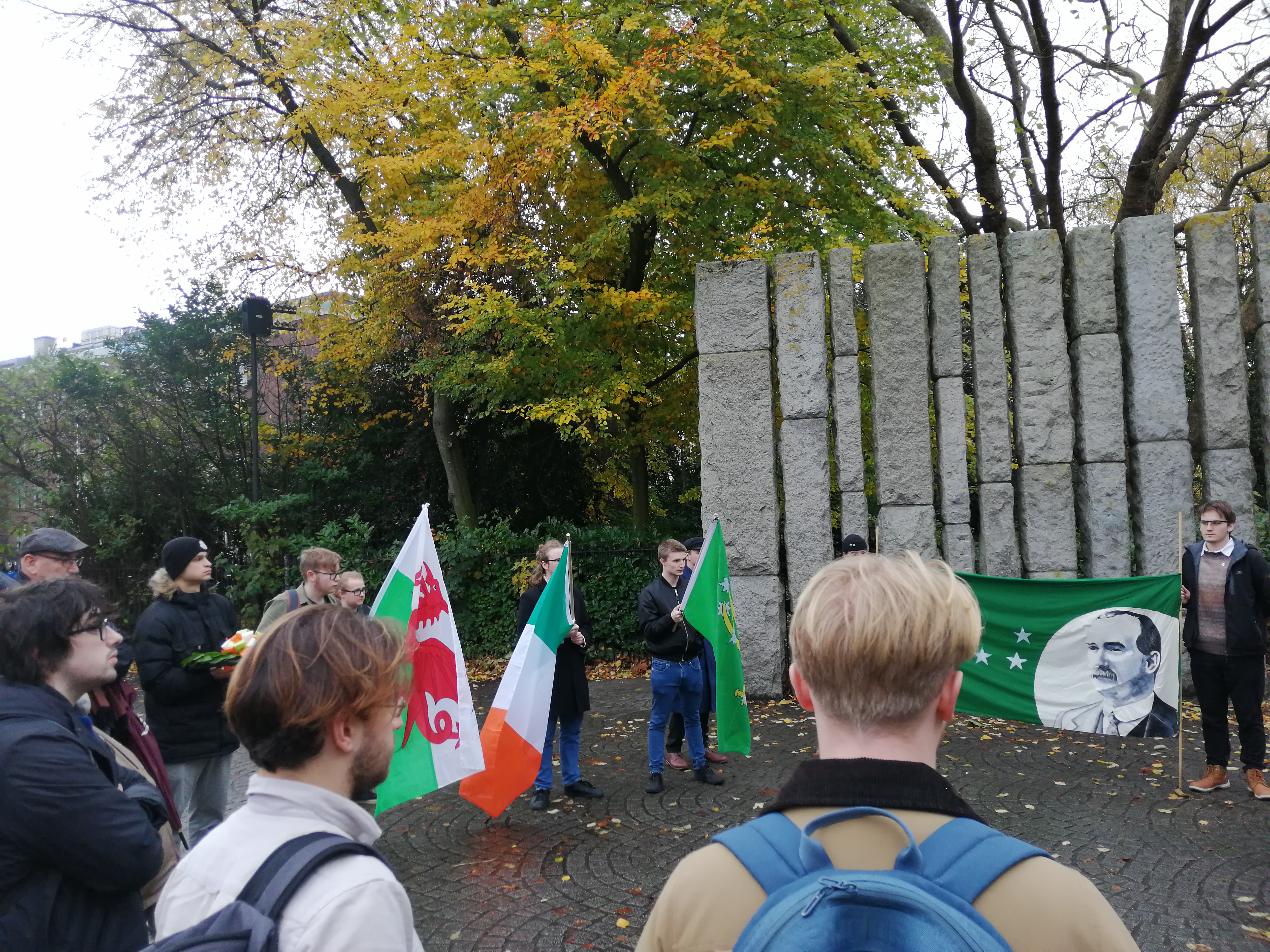
Some of the gathering at the Wolfe Tone Monument (out of shot to the right) to commemorate the creation of Irish Citizen Army (Photo: Rebel Breeze)
MARKIEVICZ: “RESOLUTION, COURAGE AND COMMITMENT“
Breatnach was called back to the microphone and talked about the lessons to be learned from Constance Markievicz, co-founder of Na Fianna Éireann, the Irish Citizen Army and of Cumann na mBan, born in Britain “as were a number of our national and class heroes”, he said.
“Constance was born into a settler landlord family, the Gore-Booths”, he told the audience and her experience of witnessing deprivation, along with her sister Eva, during the Great Hunger, had a strong effect on both, inclining them to social reform and they became also suffragettes.
The speaker said that in that latter aspect and as a poet Eva became well-known particularly in England but Constance was better known as a revolutionary and for her allegiance to the working class and to the Irish nation.
He reminded his listeners that Markievicz was artistic and apt to strike poses; O’Casey, founder of the ICA had been hostile to her and co-founder of Cumann na mBan and wife of Tom Clarke of the IRB, Kathleen Clarke, had found her irritating.
Breatnach said that Markievicz was 3rd in 1916 garrison command at Stephen Green and had been accused not only shooting dead there a member of the DMP but of exulting in it; however according to witness accounts she had not even been present when the officer was killed.8
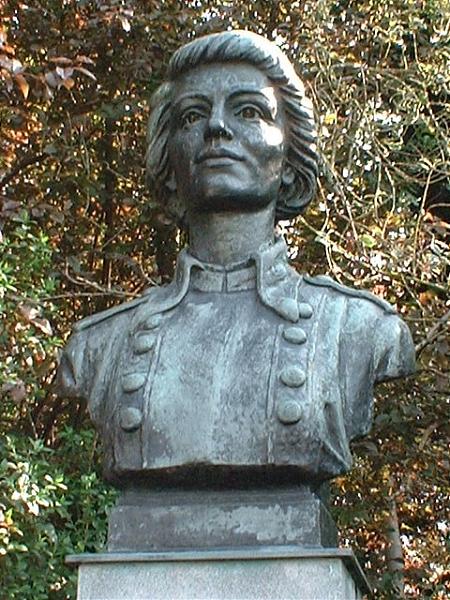
Bust of Volunteer Markievicz in Stephen’s Green (Photo: Rebel Breeze).
A British officer at her court-martial after the surrender of the 1916 Rising had claimed that she begged for her life at the court-martial but the official British records published later gave the lie to that and her own account that she demanded equal treatment with the executed leaders rings true.
“Her life as an example,” Breatnach continued, “teaches us not to judge people only by their background or indeed by their idiosyncrasies but primarily by their resolution, courage and commitment, all of which Constance Markievicz had by the bucket-load.”
The speaker also reminded those present that the very Wolfe Tone monument beside which he stood had been blown up in a number of British Loyalist bombings of the city during the 1970s, a number of which would soon be commemorated on the December anniversary of one of them.
The Irish State had prosecuted not a single one of the perpetrators, not even for the Dublin and Monaghan bombings, with the highest death toll9 of any one day during the recent 30 Years War. Instead, they had used the 1972 bombing to pass emergency legislation to attack Irish Republicans!10
Speaking briefly as a historical memory conservation activist, primarily active in the campaign to save the Moore Street market and 1916 battleground from speculators, Breatnach remarked that it was fortunate that the area behind him was a public park.
Otherwise it would all have been a prime target for property speculators. People sometimes express surprise that Irish governments do so little to protect areas of insurrectionary history. He stated however that this was natural since it was not their history but that of the struggling people.
“The history of the Irish ruling class is of a foreign-dependent one”, Breatnach stated, “rather than that of a national bourgeoisie willing to fight for independence. The last time Ireland had such a bourgeoisie was in 1798, mostly led by descendants of settlers and planters.”
“This is why Connolly pointed out that the Irish working class are the true inheritors of the Irish struggle for freedom. National independence and socialism are two different objectives but interdependent in Ireland and for the struggles to succeed they must be led by the working class.”
CONCLUDING
Wreaths were laid on behalf of a number of organisations, including Lasair Dhearg and the chairperson thanked all for their attendance, leaving people to their various ways into the mild autumn-like afternoon.
End.
(Cropped photo: Rebel Breeze)
(Photo: Rebel Breeze)
FOOTNOTES
SOURCES
1Clearly not the first army composed of workers, since these are the members of most armies; nor the first to fight for the workers, as did some for the Paris Commune in 18th March-28th May1871. However, the ICA was founded specifically for the defence of workers, the first in the world to be so, though its constitution was largely Irish nationalist.
2Socialist and anti-fascist Irish Republican organisation mostly represented in Belfast. The name means “Red Flame”.
3A number of Irish were veterans of the Boer War, the British against Dutch colonists in South Africa, most like White were on the British side but some fought for the Boers, to the extent of forming an Irish Brigade for the purpose. Later, a number from both groups ended up fighting alongside one another in the 1916 Rising (and no doubt against others who remained in the British Army).
5The Irish Volunteers, Cumann na mBan, Na Fianna Éireann, the Hibernian Rifles and of course the Irish Republican Brotherhood, the chief architects of the Rising, its members fighting as members of other units, chiefly the Volunteers and the Fianna (the membership of both those organisations was exclusively male though its couriers were often female but Tom Clarke’s wife, Kathleen Clarke, was the IRB’s liaison from Dublin with the sister organisation in the USA.
6James Connolly (1868-1916) did not prescribe any air for the lyrics and they have been sung to several. A Nation Once Again was composed by leading member of the Young Irelanders, Thomas Davis (1814–1845) and published in 1844, for many years considered a candidate for Irish national anthem.
7“For our demands most moderate are: we only want the Earth!”
8Breatnach also said that least two and probably three members of the DMP were killed during the Rising, each one in an area under the control of the ICA, who no doubt remembered well the force’s actions during the 1913 Lockout.
91974: 33 male and female civilians and a full-term unborn baby.
10The Amendment to the Offences Against the State Act, including the introduction of the no-jury Special Courts, essentially for trying Irish Republicans with a much lower quality of evidence required to convict, including the unsupported word of a senior Garda officer.
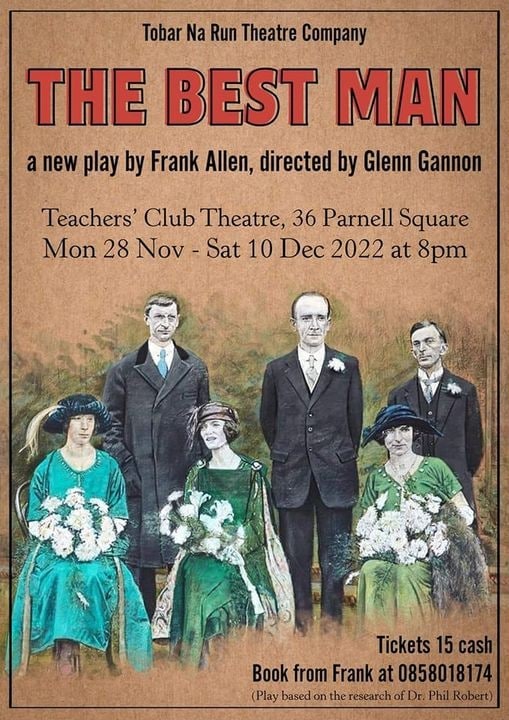
Kevin O’Higgins, Minister of the Free State, signed the execution order of his former close friend and the Best Man at his wedding, Rory O’Connor, who led Irish Republicans in the occupation of the Four Courts in 1922 in opposition to the Anglo-Irish Treaty.
The historical and ironical reality is the basis for Frank Allen’s play The Best Man, showing until the 10th in the theatre in the Teachers Club, Dublin.
BRENDAN AS BORSTAL BOY
Before the play begins the audience is treated to a short performance by Brendan O’Neill of his portrayal of Brendan Behan from Borstal Boy and the Republican’s return to Ireland after his release from jail. O’Neill has family connections to his subject and has researched him too.
It’s an enjoyable performance and an interesting peek into what is or will become a full play, set already to tour Canada. One wonders whether Canadian society, reputed to be somewhat staid, is ready for Behan on stage.
THE BEST MAN PLAY
Glen Gannon’s direction makes best use of the small stage, adapting it with minimal changes to serve different scenes, while a piano recording of two well-known airs are employed for the same purpose. Elaine sings verses of The Foggy Dew beautifully.
There are four characters who take to the stage: Rory O’Connor (Alan O’Brien), Kevin O’Higgins (Kevin Brennan), ‘Birdie’ (Elaine O’Dea) and Lady Lavery (Niamh Large).
All of the parts are well-written and acted. For dramatic impact however, it is those of Rory O’Connor and Lady Lavery which are the strongest and both O’Brien and Large make the most of them, each dominating their respective scenes.
Searching for information online about ‘Birdy’, O’Higgins’ wife, for this review has been frustrating, with numerous commentaries on O’Higgins not even mentioning her name.
From information supplied by Frank Allen, Birdie was called Brigid Cole and she was an English teacher who taught in Knockbeg College in Carlow. Gearóid O’Sullivan taught there too.
“Birdy”, is brought to life in this play and given expression in moments of humanitarian passion in conflict with her husband Kevin, whose own most powerful moments are expressed in anger and angst during the Civil War, though his interactions with Lavery display passion of a different kind.
HISTORY
In history, Lady Lavery has been associated with Irish cultural interests and romantically with Collins but letters to her from O’Higgins reveal that Michael was not the only Irish fish in her net. Her image, in an Irish shawl, was to grace the Irish Sterling pound note. Suspicions that she was an MI5 agent are unproven but remain..
There may be some legal argument about some of the execution orders of Republicans signed by O’Higgins, though all are regarded by Republicans today as judicial murder.
There can be no argument however about the criminal nature of the executions of O’Connor, McKelvey, Barrett and Mellowes, executed by cabinet executive order in reprisal for a killing that took place while they were in jail and in which they played no part.
It hardly seems possible to view the ideological conflict around the Anglo-Irish Treaty without thinking about another Agreement closer to us in time; as we come up to the 25th anniversary of the Good Friday Agreement we can reflect on the lack of closure of each.
I have no hesitation in recommending a viewing but haste – only three nights remain.
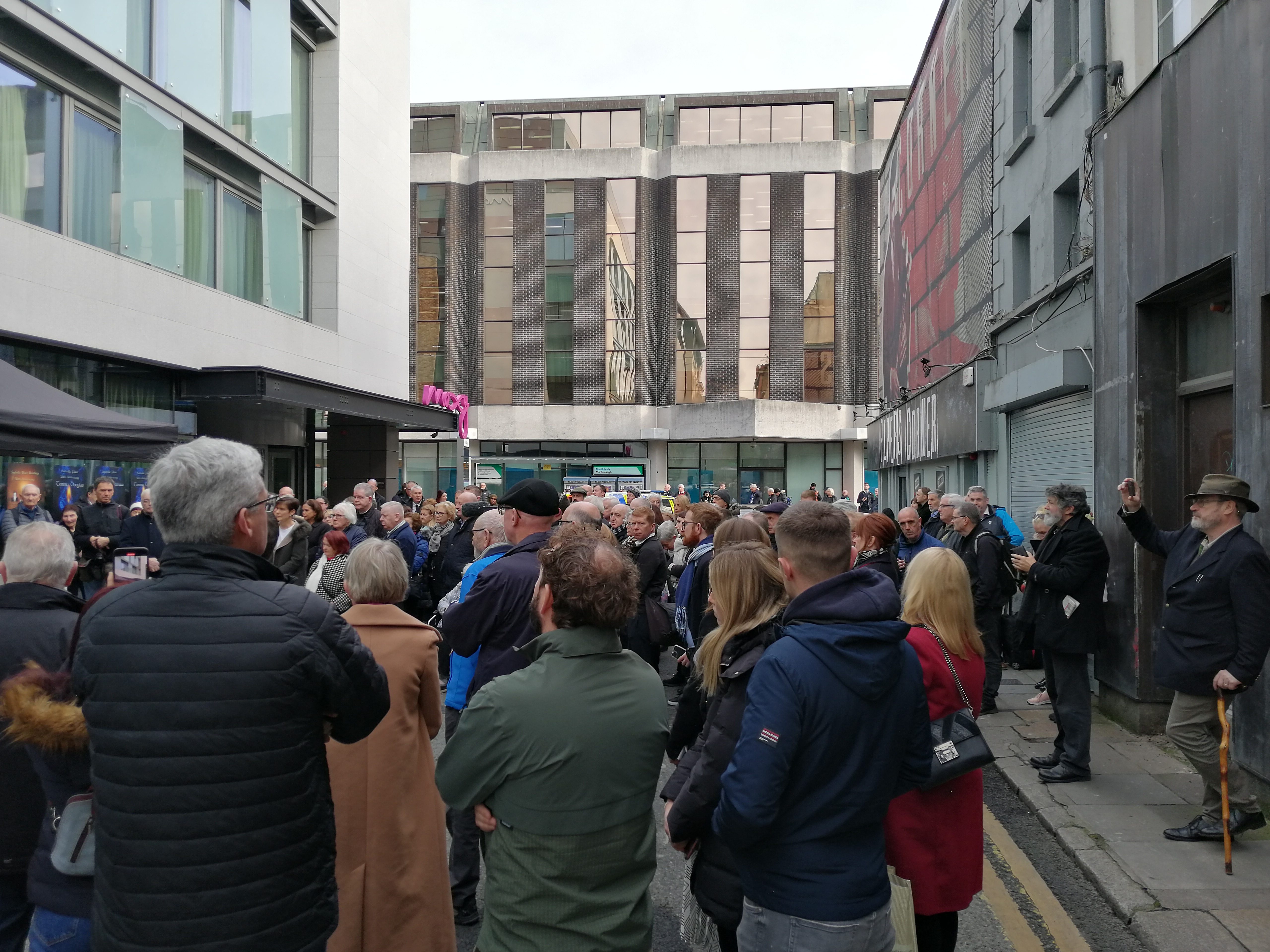
At noon on Thursday 1st December around a hundred people gathered in a side street off Dublin city’s main street to commemorate the killing of three public transport workers1 by British Loyalist bombs in 1972 and 1973.
The event was organised by the Justice for the Forgotten group that grew out of relatives seeking accountability for the Dublin and Monaghan bombings in 1974. However, the campaign group might well consider replacing the word “Forgotten” with “Ignored”.
In the early 1970s, as people – mostly but not all of of nationalist background – were marching for equal civil rights in the British colony of the Six Counties, British Loyalists began exploding bombs, not all but mostly in Dublin.
Some were aimed at symbolic Irish monuments such as the O’Connell Tower in Glasnevin cemetery (17 January 1971)and the Wolfe Tone monument in Stephens Greeen (8th February)2but the bombings of 1972, ‘73, ‘74 and ‘75 were clearly intended to kill civilians.
British Intelligence Services have been implicated in collusion with Loyalists and, along with agents within the Irish State3 have been implicated at least with regard to the 1974 bombing of Dublin and Monaghan, resulting in the largest loss of life in any one day during the 30 Years War.4
Posters of the names of three public transport workers killed in two bombings by British Loyalists (Photo: Rebel Breeze)Wreaths and the plaque commemorating the atrocity (Photo: Rebel Breeze)
THE COMMEMORATION PROCEEDINGS
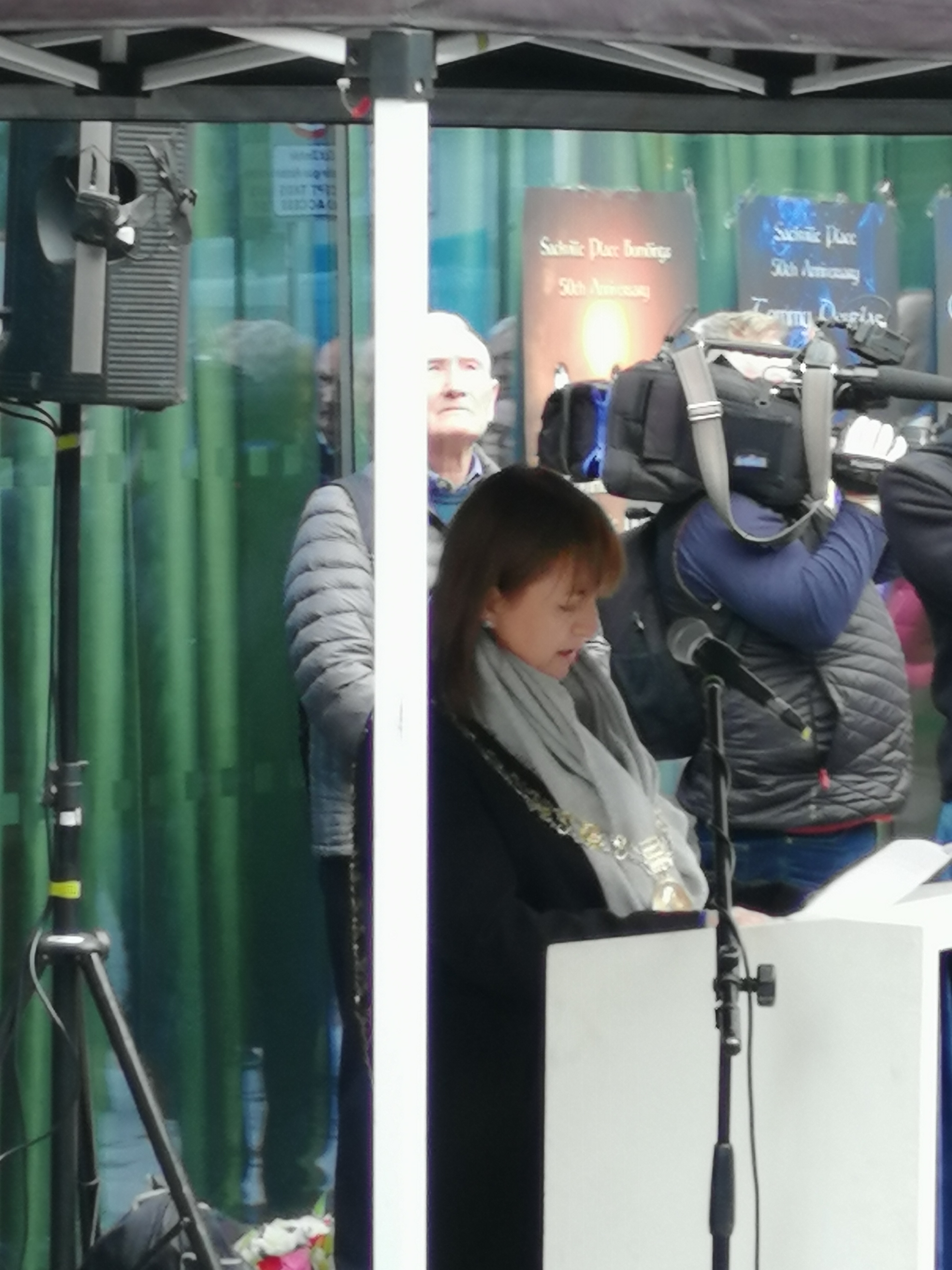
A temporary canopy had been erected with a lectern and amplification in Sackville Lane, between busy O’Connell and Marlborough Streets, next to a plaque set in the pavement commemorating the bombing and its victims there. More than a hundred had gathered around to witness the event.
Tom Duffy, son of Tommy Duffy, one of the victims of the 1972 bombs chaired the event. He is also the designer of the commemorative sculpture ‘A Fallen Bouquet’, inlaid into the pavement which was unveiled in 20045.
Chairing the event, Tom Duffy, son of the murdered Tommy Duffy (Photo: Rebel Breeze)
Tom never met his father; Tom had four months to go before birth in his mother’s womb when his father was killed; his sister does not remember her father either.
Margaret Urwin, of Justice for the Forgotten campaigning group, read out biographies of Bradshaw, Tommy Duffy and Tom Douglas (seeAppendix), detailing their origins and recollections of their bereaved loved ones.
Margaret Urwin of Justice for the Forgotten campaign, organisers of the commemoration event (Photo: Rebel Breeze)
The origins of the victims and partners showed that as well as being a tragedy for Dublin the bombings were also that for other parts of the country and the diaspora, in particular Achill (Mayo), Belfast, Castlebar (Mayo), Fethard (Tipperary), Kilkenny and Stirling in Scotland.
Urwin said they also wished to remember John Hayes, whose 47th anniversary had occurred two days previously and she read a short biography of him too. John was employed at Dublin Airport and was killed by a bomb placed in a toilet on the Arrivals floor on 29 November 1975.
Current Lord Mayor of Dublin (Photo: Rebel Breeze)
The Lord Mayor of Dublin6 gave a short speech in which she underlined the need for remembrance while also decrying that the guilty had escaped so far and that proposed legislation, currently going through the Westminster Parliament, sought to prevent such perpetrators being brought to book.
Finance Manager of Dublin Bus (Photo: Rebel Breeze)
The Finance Manager of Dublin Bus spoke also, saying among other things that the company would never forget and that it was like one big family. However the absence of employees of the company present in uniform and the lack of awareness of many gave the lie to her words (workers tell us that the event had not been advertised internally by the company).
The Education Minister Norma Foley,TD spoke at length about the atrocity and need for all actions to take place within “the rule of law”, in the context of which she went on to castigate the British Government for its proposed 30 Years War legacy legislation to limit inquests and litigation.
Foley went on to state the opposition of the Irish Government’s to the proposed legislation, along with that of the opposition parties, with united faith leaders, all parties in the British colony and the US Government.
Somehow she and other speakers however managed to avoid mentioning the British Loyalist origin of the bombers or that these were chronologically leading up to the 1974 Dublin and Monaghan bombings, with a death-toll of 33 in one day.
Minister of Education (Photo: Rebel Breeze)
Or of the fact that the 1973 bombings had been used to push repressive legislation through Leinster House, including the founding of a no-jury Special Criminal Court, targeted not at British Loyalists but instead specifically at Irish Republicans!7
The omission of this important and relevant information, referred to in Ronan McGreevy’s report for the Irish Times (see link in Sources), though not unexpected on past Government performance, was indeed ironic coming from the Minister with responsibility for education.
Wreaths were laid, including some by relatives of the murdered. A priest also recited a prayer.
MUSIC AND POETRY
Poet Rachael Hegarty, who has also composed and performed a longer poem about the Dublin & Monaghan bombing, performed her composition for this event about the loss of husbands and fathers in the killing of public transport workers.
In between some of the speeches, musicians from the Shillelagh Northside Ukelele Group8 performed Simon & Garfunkle’s The Sound of Silence and Bobby Darin’s Things (including the lines “memories are all I have to cling to”).
During another speeches interval, Cormac Breatnach on high whistle & Eoin Dillon on uileann pipes performed Táimse I Mo Chodhladh and later to conclude the event, The Lark in the Morning. The first piece, no doubt chosen for its lament nature, would do well also as political commentary9.
Large group of Northside ukulele players in foreground (Photo: Rebel Breeze)
IGNORING AND FORGETTING
The age profile of the vast majority of those present meant that the atrocities had occurred within their lifetimes, which is natural; however the near absence of representation of the following two or three generations is not.
It might be observed that this absence is a natural part of passing time but one could also comment that the ignoring of this atrocity is causing an unnatural fracture in the historical memory of a people and a workforce, a result of a conscious decision to prevent the transmission of that memory.
The titles of three of the musical pieces may be seen as comment on that.
Cormac Breatnach playing low whistle (Photo: Rebel Breeze)
Eoin Dillon playing the uilleann pipes (Photo: Rebel Breeze)
Yes, the JFTF organisation continues to hold events to mark the bombings and the Lord Mayor and a Government Minister attend. But not only will nothing serious be done to bring the perpetrators to light – never mind justice – but the memory will be allowed to die out among the living.
The Clery’s building site near the commemoration was at work throughout the event with noise of drilling, banging and shouting, the workers no doubt in ignorance of the event or of its significance. Workers in Dublin Bus uniform passed by regularly from their nearby canteen building.
Two of the latter who stopped in curiosity on the outskirts of the crowd and were engaged in conversation, stated that they had no knowledge of the commemoration or of the atrocity. They opined that their union should have informed and mobilised them to attend.
TARGETING WORKING-CLASS PEOPLE
The bus workers’ canteen is in Sackville Street and it is noticeable that other fatal bombings were targeted at areas more associated with working-class shopping and away from the more affluent ones such as the Grafton or Henry streets. That could be have been due to class prejudice but also to hurt those with less political power.
This made it all the more important for the organisations and parties that have been built by the working class to respond to them. The Labour party, founded by James Connolly, is complicit with the Irish Government in this forgetting and ignoring.
The trade unions, even those of the specifically targeted public transport workers are also colluding with this silencing and forgetting.
From a ‘national’ perspective, the Irish State has permitted a foreign (and occupying) power and its proxies to bomb its capital city on a number of occasions, including the massacre of its civilians. Nothing could more clearly point to the neo-colonial foreign-dependent nature of the Irish elite.
Back in the 1960s and ‘70s, when the Irish trade unions were less compromised than they have allowed themselves to become, perhaps it would have been possible to shut down the building site near to the commemoration for the duration of the ceremony.
Perhaps city bus drivers could at least have stopped everywhere at a given time for an announced minute of silence. Ranks of bus workers could have attended the commemoration event in uniform, supported perhaps by the city’s municipal workers.
Are such gestures still possible? Can we make them so? The working class, far from tolerating this occlusion and deletion of historical memory, needs to mark the atrocity and to mark it strongly, in solidarity and for its own dignity as a class.
End.
Section of the crowd in attendance (Marlborough Street in the distance) (Photo: Rebel Breeze)
APPENDIX – THE BRIEF BIOGRAPHIES OF FOUR VICTIMS
GEORGE BRADSHAW
George, a native of Fethard, Co. Tipperary, was a young man of 30 when he was so brutally murdered in this street 50 years ago. He had married Kathleen, a nurse from Belfast and they had two small children, Lynn and Rory. He had met Kathleen when she was visiting relatives in Fethard and she was the light of his life.
George was employed as a bus driver with CIE and the family had moved from Tipperary to Dublin less than two years before tragedy struck on 1 st December 1972. He had worked previously in South Tipperary Farmers’ Co-op for 10 years.
George had big plans for the future – he was an ambitious man and was attending night-classes in business studies at the time of his death. His favourite hobby was dancing and he also loved to play darts. He was cheerful, fun-loving and an extrovert and is greatly missed by all his family.
TOMMY DUFFY
Tommy, a native of Castlebar, Co. Mayo was almost 24 years old when he was killed on 1 st December 1972. He was married to Monica, who was pregnant with their second child, Tom. They already had a small daughter, Caroline. They had met on the 29A bus when Monica was 17 and Tommy 19. Monica quickly fell in love with this witty young man so full of life and mischief.
Tommy worked as a bus conductor and had several hobbies. He loved to play traditional Irish music on the mouth-organ and spent lots of his free time tinkering with cars. He would buy old wrecks, repair them and re-sell them to make some extra money. He had a Yamaha motor-bike which he loved and also had a flair for carpentry. During the summer months, he liked nothing better than to return home to Mayo to help on the farm, especially with saving the hay.
On the day he died, he was due to work an early shift but had changed to facilitate a co-worker. Monica remembers him as a generous, kind and hard-working young man. She is pleased that their son, Tom, was the designer of the commemorative sculpture ‘A Fallen Bouquet’, which was unveiled in 2004.
TOMMY DOUGLAS
Tommy, a native of Stirling in Scotland was only 21 when his life was so cruelly taken from him in this street on 20 th January 1973. He, along with his brothers and sister, was raised in a Scottish mining community. He was an intelligent, fun-loving, outgoing person with a positive outlook on life. He liked swimming and was a fervent supporter of Celtic soccer team. He had a love of nature and enjoyed hill-walking. He also loved music and attending live concerts.
The family had strong leanings towards Ireland and had spent their childhood summers in Achill Island, the native place of their mother. Tommy loved all things Irish and most of the songs he knew were Irish songs.
When he left school, he served his apprenticeship as an electrician and, after he qualified, decided to move to Dublin. He had been living in Dublin only a few short months and had taken a job as a bus conductor while he hoped eventually to find work as an electrician. His fiancée had joined him a very short time before his death.
After his death, his family learned of his many acts of kindness to those less fortunate than himself. He was a devout Catholic but had many Protestant friends, indeed his fiancée was of the Presbyterian faith. His siblings are proud of him as a brother and thank God they had the pleasure of having him with them for 21 years. They only wish he was with them still.
JOHN HAYES
John Hayes’ 47th anniversary occurred two days ago. John was employed at Dublin Airport and was killed by a bomb placed in a toilet on the Arrivals floor on 29 November 1975. John was a hard-working family man with a wife and three children – twins Brian and Karen (aged 11) and Brendan (aged 3). In his free time he enjoyed a pint of Smithwick’s and was an avid Kilkenny fan. He was an ordinary man, devoted to his family.
The gathering breaking up at end of event, with portrait of famed uilleann pipes player Séamus Ennis in the background above the Pipers Corner pub at the end of Sackville Place and glimpse of LUAS tram to the left. (Photo: Rebel Breeze)
FOOTNOTES
1The State public transport system was called CIE (Córas Iompair Éireann) prior to breaking up into sections for easy privatisation in the ruling neo-liberalism of the 1980s onwards. The Dublin Bus company is one of the carved-up parts, competing with other privately-owned bus companies around Dublin.
2While the targeting of a monument to Daniel O’Connell “The Liberator” (his monument in O’Connell Street was also bombed), a campaigner for the repeal of the anti-Catholic Penal Laws might seem as an act of pure religious sectarianism by Protestant bigots, the blowing up of the Wolfe Tone monument was essentially political. Theobald Wolfe Tone was a leader of the revolutionary United Irishmen, a Protestant as were most of his leadership colleagues and is often described as “The Father of Irish Republicanism”. Only the head survived the explosion but it was attached to the recasting of the statue.
3See the Wikipedia entries on the 1972, ‘73 and ‘74 Dublin bombings.
433 people and a full-term unborn child were killed in that day’s bombings.
6 Caroline Conroy of the Green Party holds the position in annual rotation this year.
7The proposed Amendment to the Offences Against the State Act in 1973 was heading for trouble in Leinster House until the bombings apparently stampeded some of its opposition into supporting it. As a result the no-jury Special Criminal Court was established which until very recently, with one exception, tried exclusively Irish Republicans, able to jail them mostly on the word of a senior Garda officer. This undemocratic piece of legislation has been thoroughly condemned by the Irish Council for Civil Liberties; Sinn Féin regularly opposed its renewal until a few years ago when it began abstaining and this year at its congress voted that such legislation is required “in some circumstances”.
8The name of the group was collected from participants but searching on FB and Google has failed to find a link for them.
9“I am asleep and do not wake me”, an Aisling poem/ music in Irish, origin contested between Ireland and Scotland, played in the 18th Century but date of composition unknown.
Delighted to repost with thanks another contribution to recent discussion of the British monarchy — delayed by technological difficulties.
Gearóid Ó Loingsigh
11 September 2022
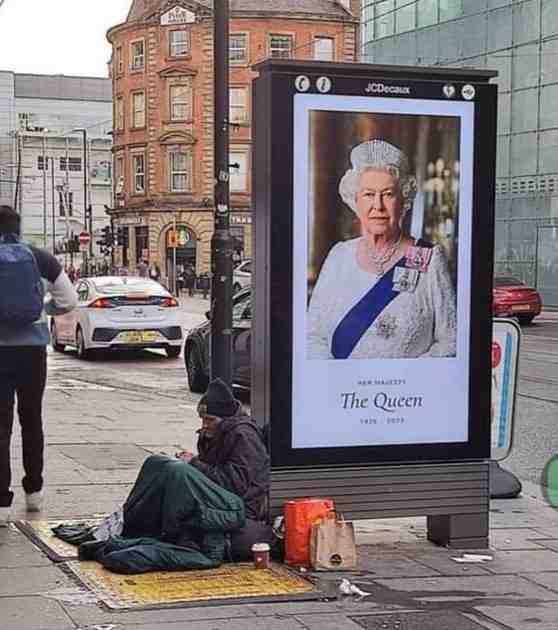
The British monarch Elizabeth Windsor, formerly Saxe Coburg Gotha, has died at the grand old age of 96, thanks in no small part to the subsidised lifestyle and medical care she enjoyed throughout her long life. Her death has produced the usual outpouring of manufactured grief from the media and also “genuine” grief from a sector of that population groomed by that same media.
But what is to be said of her passing? There has been some reaction to her death that concentrated on her being a mother and grandmother. But we were not invited to mourn the passing of mothers or grandmothers, but the death of a monarch and all that monarchy represented. So, before we look at the legacy of Elizabeth Windsor we should ask ourselves what is monarchy. The Irish revolutionary James Connolly, executed by the British state under the reign of George V, stated in relation to that same king’s visit to Ireland.
What is monarchy? From whence does it derive its sanction? What has been its gift to humanity? Monarchy is a survival of the tyranny imposed by the hand of greed and treachery upon the human race in the darkest and most ignorant days of our history. It derives its only sanction from the sword of the marauder, and the helplessness of the producer, and its gifts to humanity are unknown, save as they can be measured in the pernicious examples of triumphant and shameless iniquities.(1)
In this, Connolly only described monarchies in general as the most ignorant and backward manifestations of humanity. It is a point that bourgeois revolutionaries such as Rousseau and Voltaire would not have disagreed with. In fact, it was a standard capitalist argument for much of history. However, various capitalist nations hung on to their royal households, either as symbolic figures or as propaganda figures for their campaigns and conquests.
Much is now made of the contribution of Mrs Windsor to society, the arts, and even peace through her now celebrated handshake with Martin McGuinness, though who gave more in that handshake is not questioned. Connolly was very clear about the contribution of monarchies to the progress of society.
Every class in society save royalty, and especially British royalty, has through some of its members contributed something to the elevation of the species. But neither in science, nor in art, nor in literature, nor in exploration, nor in mechanical invention, nor in humanizing of laws, nor in any sphere of human activity has a representative of British royalty helped forward the moral, intellectual or material improvement of mankind. But that royal family has opposed every forward move, fought every reform, persecuted every patriot, and intrigued against every good cause. Slandering every friend of the people, it has befriended every oppressor. Eulogized today by misguided clerics, it has been notorious in history for the revolting nature of its crimes.(2)
Connolly had no truck with royalty. No time for tales of cute old grannies who shook the hands of erstwhile enemies. Any evaluation of the queen of the British state has to go beyond her supposed personal qualities. Criticisms of royals are not well received. When the then British diplomat and future Irish revolutionary, Roger Casement, exposed the atrocities of the Belgium king Leopold II in Congo and his mass murder of over ten million Congolese, the report was not well received initially and the descendants of the man who murdered more than Hitler are the actual monarchs in Belgium and are apparently a lovely couple and third cousins of Mrs. Windsor. Discussions about royalty are not about the individual qualities of the monarchs but the system as such. Though even on this point Mrs. Windsor comes a cropper.
In 1972 the British army murdered 14 civilians in Derry on what was to be the last Civil Rights march in the country. The British quickly engaged in a cover up which basically blamed those murdered as having been armed members of the IRA. Everyone now accepts that this was not true. Even the Saville Inquiry which stopped short of blaming the British state directly for the murders accepted they were all unarmed civilians. But Elizabeth Windsor nonetheless decorated Lt Colonel Derek Wilford, the man in charge on the day and has never apologised for that. Her role in this is often forgotten.
So, any question of looking at the death of Elizabeth Windsor cannot be ahistorical. Though Sinn Féin have issued statements that are breath taking in their servility. The Sinn Féin leader Mary Lou McDonald tweeted.
To the Royal Family and all who mourn the death of Queen Elizabeth, especially Irish Unionists, I extend sincere sympathy. She lived a long, full life. In her lifetime relationships between our countries were changed and changing. I salute her contribution to this transformation.(3)
She is of course, referring to the Peace Process and her handshake with Martin McGuinness. This says more about Sinn Féin than it does about Elizabeth Windsor. As a monarch she never had a problem dealing with people she saw as her inferiors, or those bowed in deference to her. Michele O’ Neill was equally effusive about the queen acknowledging the apparently profound sorrow of Unionists. And added that.
Having met Queen Elizabeth on a number of occasions alongside my colleague, the late Martin McGuinness, I appreciated both her warmth and courtesy.(4)
Her courtesy is a diplomatic ploy, as for her warmth that is not the image given in any of her public engagements, not even when greeting her son Charles after a long trip. The poor kid did not get a hug, he was made genuflect. But we can take O’Neill’s word for it. It is not important. Neither her courtesy or alleged warmth are political evaluations. Whether we should mourn a monarch does not depend on such personal qualities. Henry Kissinger the Butcher of Cambodia and Chile comes across as an affable, even charming old man, and he may well be in real life, but that is not how we judge him. Likewise, George Bush the Lesser (as Arundhati Roy dubbed him) also comes across as likeable, though it would be hard to convince the dead of Iraq that this mattered one jot: it doesn’t.
The press coverage of her death and much of the commentaries indicate that there is clear obfuscation on the part of the press and ignorance on the part of the population about the nature of the English royal family and the role of Elizabeth Windsor as queen. One of the myths is that she is just a mere figurehead, with little or no power. It is true that most power rests with Parliament and the Prime Minister and the Cabinet. But she has powers that she has exercised from time to time. She has instructed governors of overseas territories not to sign laws. In 1975, through John Kerr, her governor general in Australia, she dismissed the then prime minister Gough Whitlam.(5) It was a rarely used power, but it exists as do other powers she never had to invoke, like her control over the military. She has invoked the Queen’s Consent more frequently to prevent parliament discussing Bills she was not happy with. She also was the last port of call for those sentenced to death, when capital punishment was still on the statute book.
In the 1950s three Greek Cypriots were sentenced to death, Michalaki Karaolis, Andreas Dimitriou and Evagora Pallikaridis. The last of these was a particularly notable case. Pallikardis confessed under torture to carrying weapons. His lawyers pleaded to Elizabeth Windsor for clemency. She refused. The warmth that Sinn Féin leader O’ Neill felt was not on display for the 18-year-old, nor was she the loveable old grandmother that others have referred to. Likewise, the other two were also hanged. On the rare occasions that she has had to exercise power she has shown herself to be of the same pedigree as her blood thirsty forebears who raped and pillaged their way across the planet.
She never spoke out about the situation in Kenya and the Mau Mau rebellion, which kicked off early in her reign. The Pipeline, as it was known, that the British set up in Kenya was a camp system in which prisoners were moved up and down it according to the degree of torture that was required to break them. That matter was raised in Parliament at the time by some Labour MPs. The prisoners even managed to smuggle out letters to MPs and other officials, amongst them Elizabeth Windsor.(6) She knew what was happening. She was fully aware. She exercised no powers to bring an end to it. She just didn’t talk about it publicly, ever. It was not the only situation that she kept quiet about. Her relationship with the issue of race has never been a good one. She negotiated exemptions to racial and sexual discrimination laws and employs very few non-whites.
In 1990 the journalist Andrew Morton reported in the Sunday Times that “a black face has never graced the executive echelons of royal service – the household and officials” and “even among clerical and domestic staff, there is only a handful of recruits from ethnic minorities”.
The following year, the royal researcher Philip Hall published a book, Royal Fortune, in which he cited a source close to the Queen confirming that there were no non-white courtiers in the palace’s most senior ranks.(7)
In her Christmas speeches she tended to talk of banal matters and family. However, she did wade into politics some times and these speeches, unlike the speeches when she opens Parliament, are hers.
In her Christmas speech of 1972, she referred to various situations around the world and also the North of Ireland. Her take on it was simple.
We know only too well that a selfish insistence upon our rights and our own point of view leads to disaster. We all ought to know by now that a civilised and peaceful existence is only possible when people make the effort to understand each other.(8)
Exactly who was selfishly insisting on their rights was not explicitly spelt out, but it was obvious that she didn’t mean the British state, but uppity Paddies and others around the world. This was made clear when in 1973 she awarded an OBE to Lt Col Wilford, the officer in charge of the Bloody Sunday massacre in Derry in 1972. The families of those murdered and injured on that day called upon her to apologise.(9) She did not do so. The nearest she came to it was a banal statement on history during a visit to Ireland in 2011 when she stated “It is a sad and regrettable reality that through history our islands have experienced more than their fair share of heartache, turbulence and loss… with the benefit of historical hindsight we can all see things which we wish had been done differently, or not at all.”(10) She did not accept Britain’s actual role in that and there was no specific reference to the Bloody Sunday massacre.
There is no shortage of sycophants and royalists who claim she had no powers, when in fact, she did as her son Charles now has. Others have preferred to go the route of she didn’t do it, it was others. Not quite true. She did preside over the dying days of Empire and gave succour to the troops busy murdering and torturing people in places she liked to visit on the Royal Yacht. But the many atrocities committed before she acceded to the throne are also hers. The Irish revolutionary James Connolly said of the visit to Ireland of one of her predecessors in the role.
We will not blame him for the crimes of his ancestors if he relinquishes the royal rights of his ancestors; but as long as he claims their rights, by virtue of descent, then, by virtue of descent, he must shoulder the responsibility for their crimes.(11)
And she did claim them. One of her other forays into matters of Empire was her Christmas speech of 1982.
Earlier this year in the South Atlantic the Royal Navy and the Merchant Navy enabled our sailors, soldiers and airmen to go to the rescue of the Falkland Islanders 8,000 miles across the ocean; and to reveal the professional skills and courage that could be called on in defence of basic freedoms.(12)
It should be remembered that Britain gained control of the Malvinas in a colonial war, in 1833, against the newly independent Argentina. In 1982, what was at stake was mineral wealth in the sea. She, like Thatcher, rejoiced at the sinking of the General Belgrano ship, lest we forget that those who now joke about her death are not that far removed from her own sense of mourning people she sees as enemies of her dwindling Empire. She had no sense of shame. In 1990, following Saddam Hussein’s invasion of Iraq she stated without any sense of irony that
The invasion of Kuwait was an example on an international scale of an evil which has beset us at different levels in recent years – attempts by ruthless people to impose their will on the peaceable majority.(13)
This was the queen of a country that had imposed itself on more of humanity than any other previous empire had ever done. Of course, Hussein had been a friend of Britain. In 1953, the CIA and the British overthrew the democratically elected government of Iran, which had nationalised the oil industry dealing a blow to the Anglo Persian Oil Company, now known as B.P. This set in motion a chain of events that would see Britain install another royal, the Shah of Iran, Reza Pahlavi whose despotic rule would lead to the Islamic Revolution of 1979. Enter Saddam. He launched a brutal and bloody war against Iran, invading it in 1980. The war lasted 8 years and cost 500,000 lives. It was bankrolled by the west through the Saudis. There was no one claiming that he had imposed his will, nor were British troops sent to attack this important ally.
Part of her role is that of cheerleader for empire and war. British troops serve under her, not Parliament. They are called upon to serve Queen/King and country and a major part of her role is to encourage young men (and lately women) to throw their lives away in places like Iraq as part of imperial exercises in power and the theft of natural resources.
It is also laughable that the English monarch talks of the peaceable majority when Britain is one of the major arms manufacturers and exporters in the world, supplying despots around the world with the necessary wherewithal to keep local populations in line. Her own son Andrew was appointed Special Representative for International Trade and Investment for the UK Trade & Investment (UKTI) in 2001 and in that role he promoted arms sales. When he was forced by circumstances surrounding his role in the abuse of young girls alongside Jeffrey Epstein to step back from a public role, Andrew Smith of the Campaign Against the Arms Trade commented that:
The news that Prince Andrew will step back from Royal duties is unlikely to provoke feelings of sorrow or regret for most British citizens – but for despots, dictatorships and arms dealers around the world it will be a sad day. They have lost one of their most high profile and influential supporters.(14)
During Mrs. Windsor’s reign Britain exported almost 135 billion (in current prices for each year) of arms and is the fourth largest exporter of arms in the world.(15) Some British companies with operations outside of Britain also export arms. These figures do not include what Britain manufactures for its own armed forces or what it buys from other countries.
Remarkably even feminists in Britain and Ireland have publicly lamented the death of Mrs. Windsor ignoring her role in her son’s abuse of young girls. What little action she took against him was due to public outcry and pressure helped along by a disastrous interview in which his sense of entitlement oozed out of the pores he claims not to sweat from. She also forked out part of the money that was paid as part of the settlement with Virginia Guiffre, one of his and Epstein’s victims, though her part could not be used directly to pay the victim but only for the part that went to charities.(16) Not a minor point for feminists, you would have thought. Nonetheless, they lament the death of the loving mother and grandmother. One who showed none of the warmth Sinn Féin claim she shows.
Monarchies are inherently reactionary, even without the atrocities committed by them or in their name. They are hereditary positions occupied by parasites living off the public purse. A lavish funeral and later coronation of Charles will be held, costing millions of pounds. Other old grandmothers will go hungry this winter or die of hypothermia as energy prices soar, a fate Elizabeth did not face and neither will Charles. The old grandmothers around England, who will die of hypothermia this year, through their taxes ensure that Charles will see the winter through, unless a horse-riding accident upsets his plans. Monarchy is all that is rotten in society, the sycophantic outpouring of fake grief is of a people who do not seek a better society, who are enthralled to their masters and their betters, those who bow down to the great and the good. But it was again James Connolly who had said “the great appear great because we are on our knees, let us rise!”
The idea of rising off our knees has been abandoned by most. Sinn Féin is lavish in its praise for her, one of the political and cultural shifts that results from the Good Friday Agreement. The rot has even spread to their friends in Colombia. Timochenko the former FARC guerrilla leader tweeted his condolences to the people of Great Britain and also mentioned that handshake with McGuinness.(17) Britain’s trade unions through the TUC have also bowed down to the royals. The ideological role of the Windsors in class conflict is ignored. Even the otherwise militant RMT has called off strikes planned for September 15th and 17th. There was a time calling for the abolishment of the monarchy was a no brainer for progressives. In the 1980s Arthur Scargill made just that call and when questioned as to what the royals would do then, he replied, “they can work in Sainsburys”. Though some of them have pilots licences, maybe they can do the Gatwick – Dublin route with Ryanair.
Those who mourn Elizabeth Windsor are complicit in what she represents: privilege, war, torture, racism. There are no ifs or buts to that. It is as Robespierre said, “The King must die so the country can live”. It is time to abolish the monarchy and throw onto the putrid rubbish pile of history all that it represents and Charles and William can, as Scargill suggested, get a job and sycophants can go back to worrying about Madonna or Beyoncé.
The intensively mediated death of Elizabeth Windsor, accompanied by the relentlessly maudlin and invasive coverage of official mourning and her funeral, had an intensity that can only be described as imperial. Forced as it was into every corner of public discourse, this coercive atmosphere of state sorrow had a distinctly colonising thrust and meaning. Unleashed during a moment of total class warfare within her very disunited kingdom, it also marked an endpoint in the trajectory of her most obedient servants: the formerly Irish but now thoroughly British political party, Sinn Féin. During Windsor’s reign colonial chickens came home to roost as the woman who presided over British forces while they rampaged across the six counties of British-occupied Ireland then became over the past decade and a half the queen of foodbanks in her own country. (1) Her reign spanned a long period during which overt political violence in Ireland was…
(Edited from a longer in-depth piece published in 2014 and divided into parts).
(Reading time main text: 8 mins.)
The dominant class in the UK and in some of the British Commonwealth will shortly be calling people to join in a cultural festival which they call “Remembrance” – but that’s not at all what it’s really about.
The organisation fronting this festival in the ‘UK’ is the Royal British Legion and their symbol for it (and registered trademark) is the Red Poppy, paper or fabric representations of which people are encouraged to buy and wear.
And in some places, such as the BBC for personnel in front of the camera, or civil servants in public, or sports people representing the UK, forced or bullied into wearing.1
In many schools and churches throughout the ‘UK’, Poppies are sold and wreaths are laid at monuments to the dead soldiers in many different places. The pressure to wear and display one of the symbols is intense and public figures declining to do so are metaphorically pilloried2.
Prominent individuals, politicians and the media take part in a campaign to encourage the wearing of the Poppy and observance of the day of remembrance generally and for a decade now, to extend the Festival for a yet longer period.
This alleged “Festival of Remembrance” includes concerts at the Royal Albert Hall and the military and veterans’ parades to the Cenotaph memorial in Whitehall, London, on “Remembrance Sunday”.
The Royal Albert Hall concert is replete with military uniforms, British Royals’ presence and “Poppy” symbols everywhere. The big Saturday evening concert starts and ends with the UK state’s anthem, God Save the Queen/ King played by military bands.
Tickets for the big event are restricted to members of the Legion and their families, and senior members of the British Royal Family (the reigning monarch, royal consort, Prince of Wales, the Duke of York and the Earl of Wessex). The event is televised.3
BUT WHAT IS IT ALL FOR?
We are told it’s for charitable purposes – the money raised from the sale of the “Poppies” and associated merchandise is to be used to support former military service people in need and the families of those killed in conflict.
We surely can’t object to that, can we? And isn’t putting up with the military and royal pomp a small price to pay for such charitable and worthwhile purposes?
Yet the main purpose of this festival and the symbol is neither remembrance nor charity but rather the exact opposite: to gloss over the realities of organised deadly violence on a massive scale, to make us forget the experience of the world’s people of war.
Worse, its purpose is to prepare the ground for recruitment of more people for the next war or armed imperialist venture – and of course more premature deaths and injuries, including those of soldiers taking part.
Video and song by Vincent Burke, “On Remembrance Day” from Veterans for Peace lists British conflicts (including Ireland) and condemns the Church of England for supporting the wars, calling also on people to wear the White Poppy.
The Veterans for Peace at the Cenotaph in London’s Whitehall in 2014. Jim Radford, singer and D-Day veteran had been there for the first of the VfP Remembrance Day events and every year since until Covid-19 got him. He was a friend and comrade of mine and I marched with the civilian supporters of VfP contingent in
PARTIAL REMEMBRANCE – obscuring the perpetrators and the realities of war
The Royal British Legion is the overall organiser of the Festival of Remembrance and has the sole legal ‘UK’ rights to use the Poppy trademark and to distribute the fabric or paper poppies in the ‘UK’.
According to the organisation’s website, “As Custodian of Remembrance” one of the Legion’s two main purposes is to “ensure the memories of those who have fought and sacrificed in the British Armed Forces live on through the generations.”4
By their own admission, the purpose of the Legion’s festival is to perpetuate the memories only of those who fought and sacrificed in the British Armed Forces – it is therefore only a very partial (in both senses of the word) remembrance.
It is left to others to commemorate the dead in the armies of the British Empire and colonies which the British ruling class called to its support: in WWI, over 230,500 non-‘UK’ dead soldiers from the Empire and, of course, the ‘UK’ figure of 888,246 includes the upper figure of 49,400 Irish dead.5
Cossack soldier volunteers WWI. Imperial Russia was an ally of Britain and France; the war was one of the causes of the Russian Socialist Revolution 1917. The following year, the war ended. (Photo sourced: Internet)
The Festival of Remembrance excludes not only the dead soldiers of the British Empire and of its colonies but also those of Britain’s allies: France, Belgium, Imperial Russia, Japan, USA – and their colonies.
Not to mention thousands of Chinese, African, Arab and Indian labourers, mule drivers, porters and food preparation workers employed by the army.
No question seems to arise of the Festival of Remembrance commemorating the fallen of the “enemy” but if the festival were really about full “remembrance”, it would commemorate the dead on each side of conflicts.
German soldiers playing cards during WWI. Photos of Germans in WWI more readily available show them wearing masks and looking like monsters. (Photo sourced: Internet)
That would particularly be appropriate in WWI, an imperialist war in every aspect. But of course they don’t commemorate both sides; if we feel equally sorry for the people of other nations, it will be difficult to get us to kill them in some future conflict.
CIVILIAN CASUALTIES IN WAR
A real festival of remembrance would commemorate too those civilians killed in war (seven million in WWI), the percentage of which in overall war casualty statistics has been steadily rising through the century with increasingly long-range means of warfare.
Civilian war refugees in Salonika, NW Greece, WWI
Civilians in the First World War died prematurely in epidemics and munitions factory explosions as well as in artillery and air bombardments, also in sunk shipping and killed in auxiliary logistical labour complements in battle areas.
They died through hunger too, as feeding the military became the priority in food production and distribution and as farmhands became soldiers.
In WWII 50-55,000,000 civilians died in extermination camps or forced labour units, targeting of ethnic and social groups, air bombardments, as well as in hunger and disease arising from the destruction of harvests and infrastructure.6
Air bombardments, landmines, ethnic targeting and destruction of infrastructures continue to exact a high casualty rate among civilians in war areas: a Reuters study gave over one million killed by the war in Iraq and another study gave between 184,382 and 207,156 civilians killed in Iraq during the war and aftermath.7
That figure for Iraq does not include dead from pre-US invasion western trade sanctions (yes, economic sanctions frequently kill) or the 46,319 dead civilians in Afghanistan8.
The number of civilians injured, many of them permanently disabled, is of course higher than the numbers killed. Most of those will bring an additional cost to health and social services where these are provided by the state and of course to families, whether state provision exists or not.
Real and impartial “remembrance” would include civilians but not even British civilians killed and injured are included in the Festival of Remembrance, revealing that the real purpose of the Festival is to support the armed forces and their activities.
The 2014 slogan “shoulder to shoulder with our armed forces” underlines that purpose9 while contributing at the same time to a certain militarisation of society and of the dominant national culture.
The propaganda is more sophisticated this year: “Our red poppy is a symbol of both Remembrance and hope for a peaceful future” but “Poppies are worn as a show of support for the Armed Forces Community.”10
WEAPONS AND INJURIES
If the Festival were really about “remembrance”, they would commemorate the numbers of injuries and detail the various types of weapons that caused them.
But that might reflect unfavourably on the armaments manufacturers, who run a multi-trillion industry11 in whatever currency one cares to name, so of course they don’t. And if really concerned about death and injury in war, they would campaign to end imperialist war.
Gassed Australian soldiers awaiting hospitalisation 1916
But then how else would the various imperial states sort out among themselves which one could extract which resources from which countries in the world and upon the markets of which country each imperial state could dump its produce?
So of course the Royal British Legion doesn’t campaign against war.
SANITISED HISTORY, MILITARY PROPAGANDA AND PUBLIC RELATIONS
Partial remembrance was indeed embodied in the song chosen by the British Legion to promote its Festival in the WWI centenary festival in 2014.
No Man’s Land, sung by Joss Stone, is actually a truncated version of the song of the same title (better known in Ireland as the Furey’s The Green Fields of France), composed by Scottish-raised and Australian-based singer-songwriter Eric Bogle.
The Joss Stone version contains the lyrics of the chorus as well as of one verse and one-half of another, omitting two and-a-half verses of Bogle’s song.
Some of the British media created a kind of controversy, at the behest of who knows whom, to have the British Legion’s song included top of BBC’s Radio One playlist. The song is reproduced in entirety below, with the lines sung by Joss Stone in italics and those she omitted in normal type.
I. Well, how do you do, young Willie McBride?
Do you mind if I sit here down by your graveside?
And rest for a while in the warm summer sun,
I’ve been walking all day, and I’m nearly done.
I see by your gravestone you were only 19
When you joined the great fallen in 1916,
I hope you died well and I hope you died clean
Or, Willie McBride, was it slow and obscene?
(Chorus) Did they beat the drum slowly, did they play the fife lowly?
Did they sound the death march as they lowered you down?
Did the band play The Last Post in chorus?
And did the pipes play the Flowers of the Forest?
II. Did you leave a wife or a sweetheart behind
In some faithful heart is your memory enshrined?
Although, you died back in 1916,
In that faithful heart are you forever 19?
Or are you a stranger without even a name,
Enclosed forever behind the glass frame,
In an old photograph, torn, battered and stained,
And faded to yellow in a brown leather frame?
(Chorus)
III. The sun now it shines on the green fields of France;
There’s a warm summer breeze that makes the red poppies dance.
And look how the sun shines from under the clouds
There’s no gas, no barbed wire, there’s no guns firing now.
But here in this graveyard it’s still No Man’s Land
The countless white crosses stand mute in the sand
To man’s blind indifference to his fellow man.
To a whole generation that were butchered and damned.
(Chorus)
IV. Ah young Willie McBride, I can’t help wonder why,
Do those that lie here know why did they die?
And did they believe when they answered the cause,
Did they really believe that this war would end wars?
Well the sorrow, the suffering, the glory, the pain,
The killing and dying, were all done in vain.
For Willie McBride, it all happened again,
And again, and again, and again, and again.
(Chorus)
It’s easy to see why the Royal British Legion might shy away from the omitted lyrics, which would hardly encourage recruitment or support for war.
Interviewed on video, Joss Stone herself said how important it was to be “true to the lyrics” and that “the last thing one would want to do would be to disrespect the lyric”.
Incredibly, she and John Cohen, the record producer, both separately claimed that they had captured the essence of the song lyrics in the British Legion’s version.12
Although Bogle stated that he did not think the Joss Stone version glorifies war, he did say that it did not condemn it and was ultimately a sentimentalised version that went against the intention and central drive of the lyrics.
“Believe it or not I wrote the song intending for the four verses of the original song to gradually build up to what I hoped would be a climactic and strong anti-war statement,” Bogle said.
“Missing out two and a half verses from the original four verses very much negates that intention.” (apparently in a reply from Bogle to a blogger’s email and quoted in a number of newspaper reports).13
The truncation of the song and the removal in particular of the anti-war lyrics epitomises partial “remembrance” and stands as a metaphor for it, the production of a lie by omission and obscuration.
Sanitised history, military recruitment propaganda and public relations is what this “Remembrance” is about.
12Videos containing quotations from Joss Stone and John Cohen about how they have stayed “true to the song” or “lyric” of No Man’s Land by Eric Bogle https://www.youtube.com/watch?v=ez1WBJaZZ7U#t=10and
Videos containing quotations from Joss Stone and John Cohen about how they have stayed “true to the song” or “lyric” of No Man’s Land by Eric Bogle were accessed at the following in 2014 but now appear to have been taken down: https://www.youtube.com/watch?v=ez1WBJaZZ7U#t=10and
On Monday, as the remains of Queen Elizabeth II were being conducted in State funeral in London, Socialist Republicans rallied against monarchy in front of the James Connolly1 monument in Dublin.
They displayed flags and placards, heard speeches and burned the flag of the UK.
They then marched to O’Connell Bridge carrying a “coffin” bearing the words “British Empire RIP”, dumped it into the Liffey and marched on to the General Post Office building, where a large force of Irish state police prevented their entry.
Bob Marley’s lyrics applied to the situation on a home-made placard at the event (Photo: Rebel Breeze)
The actions occurred as the royal funeral was taking place in London. In a move that drew public criticism from presenter of independent program Newstalk, national broadcaster RTÉ sent a crew to cover the funeral in London to film it in realtime for Irish national television.
Taoiseach (equivalent of Prime Minister) Mícheál Martin and President Michael D. Higgins in persons represented the Irish State at the British royal funeral.
Many Irish politicians (including leaders of the Sinn Féin political party) and public figures had sent fulsome messages of condolence and praise of the late British Queen.
“DOWN WITH THE MONARCHY!”
The chairperson of the event and speakers lambasted the “sycophancy” of Irish Government figures and other politicians and public figures. They drew attention of the past record of British Royalty and to the ongoing British occupation of Ireland.
The “RIP British Empire” ‘coffin’ parked temporarily next to James Connolly Monument (Photo: Rebel Breeze)
The event had been publicised on social media under the slogan of “Down with the Monarchy!” and that was very much the tone of the event as occupants in a police van watched from across the street.
The chairperson opened proceedings by reminding the attendance of Connolly’s slogan at the outbreak of WWI that “We serve neither King nor Kaiser but Ireland.” Passing vehicles occasionally tooted their horns in approval.
Police van surveilling events across street at James Connolly Monument (Photo: Rebel Breeze)
A young socialist Republican read out Connolly’s article in The Workers’ Republic of March 1902 on the occasion of the coronation of Edward VIII.
Connolly stated that to Socialists the replacement of one exploiter by another hardly mattered and would excite little comment.
“But although we would rather treat the matter thus philosophically, we find that the machinations of those in power do not leave us that possibility; with them, and because of them, the festivities attending the Coronation have taken on the aspect not merely of a huge parade of pomp and magnificence – cloaking the festering sores of that slave society on which it is built – but have also become an elaborately contrived and astutely worked piece of Royalist and Capitalist propaganda, designed to captivate the imagination of the unthinking multitude, and thus lead them to look askance upon every movement which would set up as an ideal to work for something less gorgeously spectacular, even if more solidly real.
The evil effects of private ownership of industries is thus illustrated once more in a manner that ought to appeal to those patriots in our midst who still dread the innovating effects of Socialism on the National spirit of the Irish people2.”
A home-made banner carried by participants at the event (Photo: Rebel Breeze)
DIVINE RIGHT AND WORKERS’ RIGHT
Diarmuid Breatnach quoted John Ball, a leader of the English Peasant’s Revolt of 1381 who, addressing the crowd in reference to the Christian Bible story of Adam and Eve, enquired: “When Adam delved (dug) and Eve span, who then was the gentleman?”
For that challenge to divine right to rule or right by birth, Breatnach related, King Richard II had John Ball hanged, drawn and quartered, his head stuck on a pike on London Bridge and a quarter of his body displayed at each of four different towns in England.
Breatnach contrasted this to the right of workers, who he said produce all things, to the ownership of all things and called on working people to take their place in history as conscious beings.
(Photo: Rebel Breeze)
Another speaker, on behalf of Spirit of Irish Freedom Republican Society and the Michael Fagan Fenian Society based in Westmeath also spoke and included the Sinn Féin leadership in his denunciation of Irish politicians who had accepted and praised British Royalty.
Seán Doyle spoke about the attitude of servility which works its way into many different aspects of life, for example into accepting the laws of the capitalist system and the housing crisis.
Doyle likened the acceptance of this right of capitalism to acceptance of the divine right to rule and stated that workers had to break from this acceptance, which is what the Revolutionary Housing League was advocating and practicing in action.
UNION JACK IN FLAMES AND COFFIN INTO THE RIVER
After the speeches a copy of the “Union Jack” flag was set on fire to symbolise the future of the forced union of nations — including a part of Ireland — under England rule.
(Photo: Rebel Breeze)
(Photo: Rebel Breeze)
Participants formed up into two columns flying flags, headed by four persons carrying a large pseudo-coffin. Taking to the road, they crossed Butt Bridge, turned right along the quay until they reached O’Connell Bridge.
There Gardaí and three Public Order Vehicles awaited them. Undeterred, the marchers cheered a short speech and chanted some slogans. Then at the count of “a h-aon, a dó, a trí” the “coffin” was heaved over the parapet into the Liffey river.
Marchers led by four carrying the “British Empire” ‘coffin’ crossing Butt Bridge (Photo: Rebel Breeze)
This action emulated a similar one carried out by James Connolly and revolutionary socialists in 1897 during Queen Victoria’s visit to Dublin.
It is worth recording too that Queen Victoria visited again in 1900 to affirm Ireland as part of the UK and to help recruit more Irish to go and fight the Boers in South Africa.
In response to that occasion, Iníní na hÉireann (Daughters of Ireland) led over 50 women in organising a Children’s Patriotic Party on the Sunday after the Wolf Tone Commemoration in July of that year.
Over 30,000 children had paraded from Beresford Place to Clonturk Park in north Dublin where they were served picnic lunches and listened to anti-recruitment speeches.
The marchers on O’Connell Bridge just before the “British Empire” ‘coffin’ is thrown into the Liffey (Photo: Rebel Breeze)
After disposing of the “coffin” of the “British Empire” on Monday, the marchers proceeded to the General Post Office where the building had been closed and a strong force of Gardaí also prevented access.
The GPO was the HQ of the insurrectionary forces during the 1916 Rising and many considered it insulting to their memory that the Irish tricolour above the building was lowered to half-mast in respect for the British monarchy.
March concluding at the GPO in Dublin’s main street — the police are blocking the doorway to the left of photo (Photo: Rebel Breeze)
The event concluded with cheers from passers-by and without any arrests.
End.
“British Empire RIP” ‘coffin’ immediately after being thrown over the bridge into the Liffey. (Photo: Rebel Breeze) The ‘coffin’ emerging on the east side of the Bridge on its journey seaward. (Photo: Rebel Breeze)
FOOTNOTES
1The James Connolly monument in Dublin is located in Beresford Place, across the street from what was the old Liberty Hall, the HQ of the Irish Transport and General Workers’ union (now replaced by SIPTU).
2See Sources & Further Information for a link to the full text.
Irish newscaster slams Irish broadcasting team sent to cover royal funeral: teahttps://economictimes.indiatimes.com/news/international/uk/elizabeth-is-not-our-queen-irish-presenter-slams-tv-coverage-of-monarchs-funeral/articleshow/94281107.cms
Propaganda is employed in wars and finds its most widescale application through the mass media. The belligerents want their own populations to support their war effort and to have other states support them.
IRISH REPORTING ON THE SPANISH CIVIL WAR
The hierarchy of the Catholic Church infamously mirrored the propaganda of their corresponding religious officials in the Spanish State in backing the fascist-military uprising against the elected Popular Front Government in 1936.
Irish newspapers and radio reporting on the whole followed the line of the Church hierarchy. The resulting conflict gave the Spanish state the greatest number of known mass graves in Europe and anywhere in the world, in fact, outside of Cambodia.
Clipping from Irish Press, not a fascist sympathising editorial line, November 1936 (Image sourced: Irish Newspaper Archives, Irish Press)
The Catholic hierarchy declared the fascist-military to be fighting a religious crusade against “Godless communism”, repeated propaganda of the fascist side, denounced real and imagined crimes of the Republican side.
They denied or ignored news of crimes of the fascists, which occurred from the first days and for years after Franco’s victory, in the course of which they denounced even priests who spoke out about the fascist crimes.
Whether the Spanish Republican Government had its own propaganda (I’m sure it did) or whether all its supporters were squeaky clean or not is besides the point. The overwhelmingly pro-fascist forces propagandaaffectedusin Ireland and most of it was fallacious.
Even the Irish Press, paper of De Valera who had banned the Blueshirts earlier: …. “These idealistic young men also saw their participation in the Spanish Civil War as helping to solve political divisions in Ireland and ultimately Irish unity. Interviewed in Dublin prior to his departure for Spain, Capt. P. Quinn from county Kilkenny, made the following statement: I believe that if an Irish Brigade succeed in reaching Spain, and there fights against Communism and all its terrors ….”
This had a practical effect in Ireland at the time and later, assisting religious and other fascists to attack socialists, communists and other progressives.
It helped create the atmosphere in which alternative writers were censored and hounded and the Irish State could actually expel an Irish citizen – Jimmy Grailton – for the crime of being a socialist community activist.
In turn, this anti-socialist, anti-communist atmosphere created a poisonous environment for social progress, whether championed by revolutionaries or social democrats.
It also helped create a wall shielding the ongoing endemic mental and physical – including sexual — abuse of women and children which seemed impermeable to control or even criticism for decades.
BRITISH WWI PROPAGANDA
The British imperial cant of “defence of small nations” or of “defending civilisation” in its war against Germany during WW1 while simultaneously suppressing the 1916 Rising and repressing many peoples around the world is well known.
The media related invented German atrocities, gave one-sided reporting, censored or demonised alternative views (I know, beginning to sound familiar).
That is the general, well-established picture. However, I’d like to focus on a specific incident and how it was treated: the sinking by German submarine (U-Boat) of the Howth fishing trawlers St. Michan and Geraldine on 31st of March 1918, with the loss of five Irish lives.
A Howth fishing vessel in past years (Photo sourced: Internet)
No question of who’s in the wrong there, you’d think. The Irish unionist media (admittedly under war powers control) jumped to accuse the German Uboat crew of a “Howth atrocity”, an “Act of Murder” and that they “Shelled without warning”1.
I am grateful to Phillip O’Connor for his exploration of the incident) in his Road to Independence (2016) [Howth Free Press] on the involvement of Howth, Sutton and Baldoyle communities in the struggle for independence and social progress (and his source on the incident, Seán T. Rickard’s MA).
WAR CONTEXT OF INCIDENT
WWI was fought on land, air (even then) and sea. The British Navy was the most powerful in the world and imposed a naval blockade on Germany, bottling up the latter’s navy but also preventing supplies of any kind entering by sea. Unusually, the blockade included foods.
Germany took the position that Britain was trying to starve the German population and responded with its submarines attacking UK shipping which at the time included Ireland’s.
The British responded by concealing guns on merchant ships so that a German submarine surfacing and demanding surrender could in turn by sunk by the merchant ship in question. Indeed the British used fishing boats as mine-sweepers and even armed some too.
This had the effect of encouraging German Uboat captains on occasion to sink merchant ships without warning rather than run the risk of being sunk themselves.
However the U90, the submarine in question concerning the Irish trawlers in March 1918, appeared not to have been doing that and O’Connor quotes the case of the Greek ship SS Salaminia, of which the entire crew had been given time to get into lifeboats before being sunk.
Indeed, the eight captain and crew of the Michan all got into their “punt” and were picked up alive by a British Navy patrol. Tragically, the Geraldine had no additional boat, having set some of its crew ashore on Lambay Island to gather whelk for long-line hook-baiting.
Whether Captain Jess of the U90 believed the Geraldine was being defiant, playing for time or anything else is not known but his Uboat sank the vessel and there were no survivors.
The dominant newspapers in Ireland at the time condemned the German Uboat along the lines outlined above but also went further to make political capital out of it against the Republican movement.
They – and politicians they quoted – used the incident to attack Irish Republicanism, one going so far as to refer sarcastically to the Republicans’ “gallant allies”, lifting the quotation from the 1916 Proclamation of Independence.
There were rules of war agreed at the Hague Convention of 1907. Attacks on civilians are ruled as a war crime by the Geneva Convention but that was not composed and agreed until 1949.
However, its applicability to all the situations of conflict at sea were not codified until much later and, even then, are not binding on the signatories2.
It needs also to be noted that violations of humanitarian regulations and laws by most states have been documented during their wars with other states and in suppressing uprisings. The British did arm merchant ships during WW1 and also used them in a mine-sweeping capacity.
Also the Leinster, for example, sunk by German Uboat torpedoes on 10th October the same year as the Howth fishing boats, was carrying military personnel and armament and therefore in war terms a legitimate target.3
However, it is difficult to see how the fishing boats could be suspected of being armed merchantmen or even as ships supplying Britain and therefore equal to any ships attacked for breaching the Royal Navy blockade of Germany.
I am grateful to O’Connor for supplying me with the reference4 to the UK’s war-time restrictions obliging fishermen to ply their trade at 15 miles or further from its main ports, which included Dún Laoghaire and Dublin and therefore affected the Howth fishing fleet.
The U90’s captain may have suspected the British were using them as “spotters” for submarines in the area but even so, it is difficult to justify sinking without verifying radio equipment on board and especially without a dinghy to take the crew to safety ….!
German UC-1 class submarine surfaced with crew (Photo sourced: Internet)
In that respect it seems the U90 might have been in violation of agreed measures for the protection of civilians at sea in time of war by destroying civilian fishing vessels.
On the question of warning, although there were no survivors of the Geraldine, the available evidence is that the Captain of the U90 did warn before sinking shipping and had done so in a number of cases including another fishing boat on the same day.
But all was grist to the British war propaganda media and even, especially in the case of Ireland, to its colonial purposes in attacking its main anti-colonial opponents of the time, Irish Republicans.
Of course too, left unmentioned was the fact that the UK was attacking German civilians through blockading food imports5 and threatening and impounding any blockade-breaking ships (except those of the USA6).
Blockades and sanctions have cost many lives over the years – the UK blockaded the Spanish Republic during the Anti-Fascist War which did not impede Nazi Germany and Fascist Italy hugely supplying arms, aircraft and men to the military-fascist troops.
The USA imposed sanctions on Cuba for decades and Iraq for some years; in the latter case, by 1996 an estimated half million children had died as a result, a figure justified by Madeleine Albright, then USA Ambassador to the UN7.
Israel is permanently blockading Gaza in Palestine by land, air and sea – Egypt is participating too with its control over one gate. NATO sanctioned Russia which is now retaliating with some measures also.
Interestingly, O’Connor records that British war propaganda had little effect in 1918 on majority Irish opinion and even the Howth fishermen’s representative condemned the UK Admiralty for the mortal danger in obliging fishermen to ply their trade beyond 15 miles from shore8.
The UK General Election results in Ireland six weeks later would be a convincing illustration of how the vast majority of the population was thinking.
End.
FOOTNOTES
1It would be interesting to know whether it entered the heads of any editors that the British military had bombarded the city centre of Dublin with a number of land and sea-born artillery pieces just two years earlier, without any attempt of warning to the civilian population whatsoever.
3The Wikipedia entry on the sinking of the the Leinster, while acknowledging the nearly 500 military personnel on board, does not common on this negation of the ship’s civilian status. It does not mention the gun mounted on it either, which is noted in this record https://www.rmsleinster.com/sinking/sinking.htm
4See Appendix for details on this (thanks to Phillip O’Connor).
102. The declaration or establishment of a blockade is prohibited if: a) it has the sole purpose of starving the civilian population or denying it other objects essential for its survival.…
103. If the civilian population of the blockaded territory is inadequately provided with food and other objects essential for its survival, the blockading party must provide for free passage of such foodstuffs and other essential supplies.
6Vide O’Connor The Road to Independence (2016) [Howth Free Press]
To regulate the security risk of fishing around Ireland during the war the Admiralty thought it necessary to divide the coasts into security zones. These zones had various levels of regulation and protection. Areas were either licensed by special permit, which allowed fishermen to fish these areas under restriction or were simply designated as areas where fishing was prohibited. Orders directly issued by the Admiralty were passed on to the fishermen through the D.A.T.I. via Notices to Mariners (NA G/12 (1917) & G/20/5 (1918).
Fishing was generally prohibited several miles from headlands, as it was a favourite spot for lurking U-boats. It was also prohibited around minefields, which were used to protect the coast and divert traffic into safer zones for escorts. It was also prohibited around naval bases and near convoy meeting points. And traditionally it was always prohibited in sea-lanes where there was heavy sea traffic. It was prohibited in many areas between sunset and sunrise, (a term still used in modern Rules Of the Road) and also known as “dark hours”. If any security measure presented itself, fishing could also be prohibited at short notice for whatever reason by word of mouth on the local naval authority shoreside or naval authority at sea. The Admiralty also had the right to commandeer vessels and/or cargo space also at short notice. The Admiralty later ordered that if the fishermen sighted enemy submarines they were to stop their fishing activity and go immediately to inform the closest naval authority whether at sea or ashore. This made fishing more difficult, costly and dangerous and particularly annoying to Irish fishermen with national sentiments.
The Admiralty even warned that a failure to comply might lead them to be fired on by naval vessels. Immediately affecting Howth fishermen was the prohibition of fishing within fifteen miles of Kingstown. This area roughly to the NW of Kingstown and roughly a few miles off Howth Head was a favourite bait procurement ground for Howth fishermen but also fell within range of most of their local fishing grounds.
In March 1917 the following rules affected fishermen fishing the East coast of Ireland but in particular Howth fishermen were as follows:
All decked and motorboats fishing anywhere between Ballywalter, Co. Down, and Howth, or anywhere between Wicklow Head and Loop Head, must carry official permits to fish. Between Ballywalter, the Isle of Man, and Howth, such boats may fish by day and by night at any distance from land within the limits of their permits.
They are forbidden to be stopped in or to pass during dark hours through waters where no fishing is allowed.
Moored nets may be left out at night, provided that the head ropes are kept five feet or more below the surface.
(Department of Agriculture and Technical Instruction for Ireland. Notice to Fishermen. Effective 1 March 1917. Wt.-865. 250. 2/17)
Later rules came into effect in 1918 for the locality, one of which was fishing could only be conducted within daylight hours in this area.