MARXISM 2016 AND STATE REPRESSION OF IRISH REPUBLICANS


Diarmuid Breatnach

The Sunday November 6th meeting of Marxism 20161 on the theme “When Governments Lie” hosted as speakers four women campaigners and Eamon McCann, a male campaigner, addressing the packed downstairs hall of the Club na Múinteoirí. A number of cancellations of speakers had taken place, including Gareth Pierce who sent a message which was read out to the meeting.
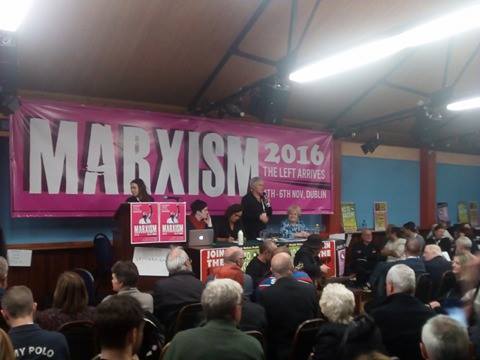
hillsborough-speaker-when-gvts-lie-marxism-2016
Brid Smith of the SWP (centre photo) chairing the meeting When Governments Lie public meeting at Marxism 2016 weekend (Photo: I.O’Kelly)

On the podium, taking turns to speak, were Sheila Coleman of the Hilsborough Justice Campaign, Kate Nash of the Bloody Sunday Justice Campaign, Joanne Donnelly of the Justice for the Craigavon Two Campaign, and Antoinette Keegan of the Justice for Stardust/ 48 Never Came Home Campaign (summary of these campaigns below).

After being introduced by Bríd Smith, chairing the event, Joe Black with guitar, accompanied wonderfully by a musician on bazouki (if I can get his name will insert it here), launched the evening with Black’s powerful song about Giuseppe Conlon, father of Gerry Conlon of the Guildford Four. The Guildford Four were wrongly convicted in 1975 of IRA bombings and served fourteen years before they were cleared. Giuseppe Conlon, who went to England to clear his son, was also jailed, as were his relatives the Maguire family. The Maguire1 Seven were cleared in 1991 but by that time Giuseppe had died in prison, an event that, along with his own imprisonment, devastated his son and affected him for his remaining years until he died in 2004 at the age of only sixty years.

All of the speakers emphasised that the State’s officials lied with regard to their respective cases and concealed evidence and most speakers also accused the media of complicity. In the cases of Bloody Sunday, the Craigavon Two and Hillsborough, the British state was placed in the dock by the speakers while the Stardust fire cover-up was laid at the feet of the Irish state.

Most of the speakers also warned people in similar circumstances to beware of establishment party politicians who try to flatter campaigners and decide which are the “reasonable” ones to deal with, always at the price of reducing the objectives being sought. The speakers for the Bloody Sunday and Hillsborough campaigns in particular warned against this element, Kate Nash singling out Sinn Féin as the party that acted that way with regard to Bloody Sunday (Kate Nash’s brother was killed that day and her father shot and injured) and how they tried to bring the campaign to an end with an apology from the then British Prime Minister, while no senior officer or government official was held to account and while one of the unarmed dead remained accused of carrying a nail bomb.
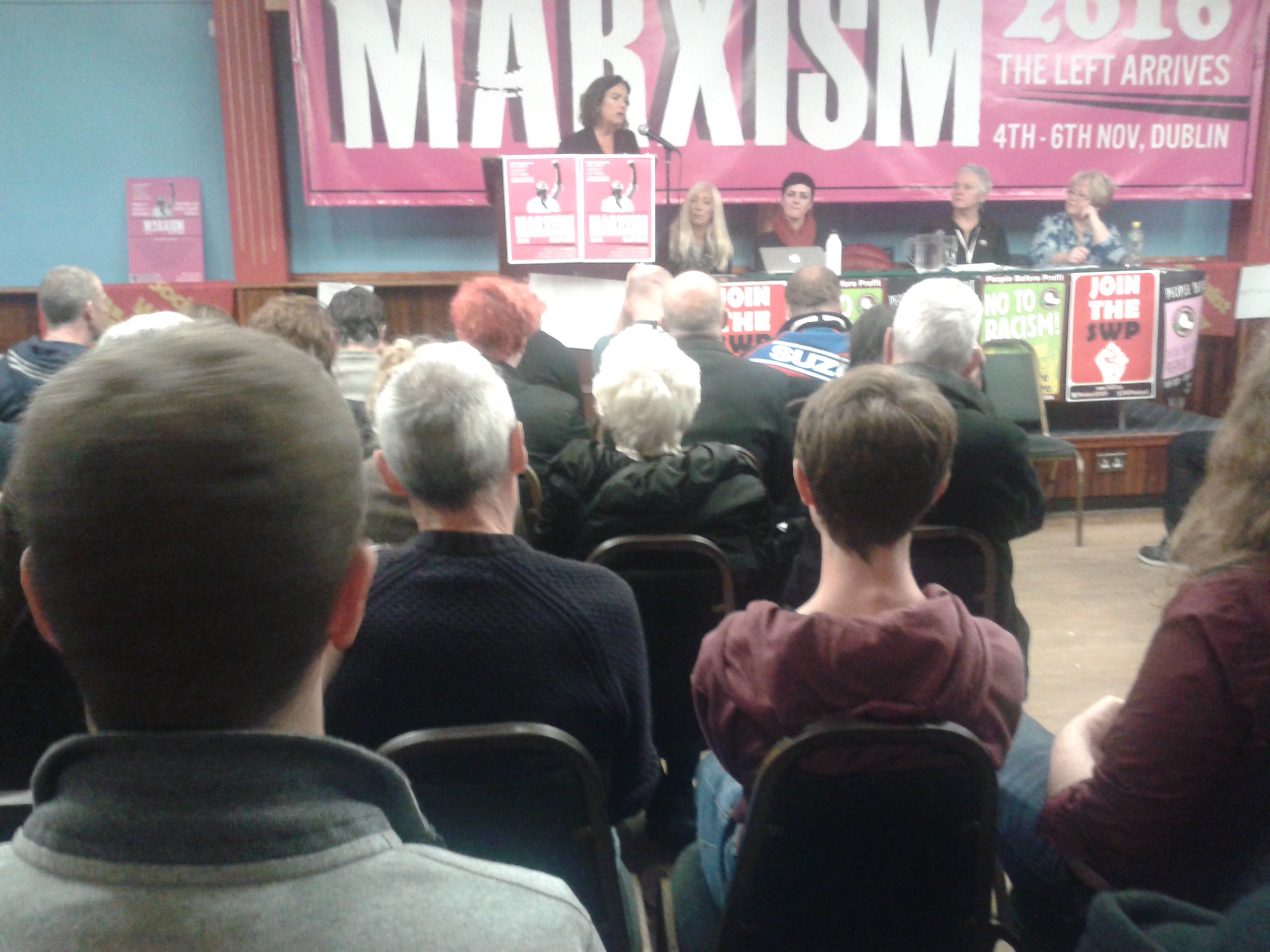
Brid Smith of the SWP (also SWP/AAA) addressing When Governments Lie public meeting at Marxism 2016 weekend (Photo D.Breatnach)
Sheila Coleman of the Hillsborough Justice Campaign addressing When Governments Lie public meeting at Marxism 2016 weekend (Photo D.Breatnach)

Eamon McCann, who was on the march in Derry on Bloody Sunday 1972, finished the evening with one of the rants for which he is famous, going beyond his allocated time by a fair bit and despite the Chairperson’s frequent reminders. McCann located the similarities of the cases within the class system – most of those injustices represented were about repression of working class communities, or ignoring the damage done to them and the lies were told to protect the system and its supporters – big businessmen, politicians, the police, the Army.

The meeting ended to sustained applause but without any opportunity to ask questions or to make contributions, to the regret certainly of a number of Republicans and campaigners against what they consider to be ongoing internment without trial. All however seemed agreed that the talks had been interesting and educating in at least some aspect of the issues and events covered.

WHY SO LONG?

It is good that this meeting about State injustice and lies was held by an Irish socialist organisation. It is the duty of socialist organisations to point out the injustice of the State even when the victims are not socialists – or not socialists in the way that socialist organisations think they should be. Prominent socialists Karl Marx and Frederick Engels were not Fenians but they campaigned for the release of Fenian prisoners being held in English jails (where, by the way, it said that one third of them died and one third went insane).

It is said that we learn more from our mistakes than we do from our successes and certainly, if we are to bring about a revolution and the society we want, we must learn from our failures. And in that spirit, I must ask: why has it taken so long for Irish socialist organisations, particularly in Dublin, to wake up to the repression being exercised against Irish Republicans?

Five years ago Marian Price, a former Republican prisoner released under licence as part of the Good Friday Agreement, had her licence revoked and was taken to Maghaberry jail, kept for months without charge or bail, eventually charged and kept in jail without bail, sick, until her mental and physical health was broken. In Dublin the socialist organisations sent a couple of representatives to one demonstration for her freedom and never attended a picket about her case afterwards.

After the Marian Price campaign ended with her release in 2013 on “compassionate (sic) grounds”, some of those involved in Dublin launched a campaign against “internment by other names”, a process by which ex-prisoners released on licence are returned to jail without even a trial in the no-jury courts of the Six Counties2 and other Republican political activists are harassed and arrested and refused bail on spurious charges which eventually collapse after the accused have been held for months or years in jail3.

I must ask again: why has it taken so long for Irish socialist organisations, particularly in Dublin where the major part of their organisation is located and most of their activities organised, to wake up to the repression being exercised against Irish Republicans?

Is it perhaps because the socialists feared to be painted with the nationalist brush? But did they not fear being daubed with complicity with imperialism instead? It is a strange kind of socialist organisation that can’t make common cause with Republicans against the tyranny of the colonial statelet and capitalist State! In that failure, it misses the opportunity to unite forces against its enemies’ state and also to disseminate its ideas among Republican activists. One might also remark that a failure of people who are prepared at times to unite with social democrats for reforms, to unite with Irish Republicans against a capitalist state is a strange indication of revolutionary socialism!

Or is it purely because they didn’t care – it wasn’t happening to them – that Irish socialist organisations haven’tt campaigned against State repression of Irish Republicans, or even protested in solidarity with them? If so, they will by the seed of their inactivity one day certainly reap a harvest of repression for themselves too. Solidarity against State attacks is not only a noble thing with a long tradition; it is a necessity for revolutionaries.

So now that this “Marxism” weekend is over, when its organisers are taking a deserved rest, or writing it up for the British and Irish version of their newspaper, or compiling their recruitment slips to see how many new members or at least mailing list contacts they have gained – will they do anything different?

Will we see the highlighting, from time to time, of the almost everyday harassment of Irish Republicans in the leaflets and newspaper of the SWP and PBP? Will their TDs in the Dáil raise these issues where they might get some bourgeois media coverage? Are we going to see PBP and SWP militants on the regular pickets organised by the Anti-Internment Group of Ireland anywhere and, in particular on those called by the Dublin Anti-Internment Committee?

We can hope, I suppose.

Diarmuid Breatnach

APPENDIX: THE CAMPAIGNS

Hillsborough Justice Campaign seeks vindication that the original disaster was due to crowd mismanagement by the South Yorkshire Police and that some of the subsequent deaths were also due to their mismanagement of some still-breathing victims and lack of coordination of the emergency services. The disaster took place at Hillsborough football stadium in Sheffield, England, UK, on 15 April 1989, during the 1988–89 FA Cup semi-final game between Liverpool and Nottingham Forest. With 96 fatalities and 766 injured it is the worst disaster in British sporting history. Originally, the Liverpool football fans were blamed for the disaster but subsequently it became clear that the blame lay elsewhere.

Bloody Sunday Justice Campaign seeks a proper accounting of the deaths of 14 and injury of at least 14 after British troops opened fire on unarmed people demonstrating in Derry on 30th January 1972 against Internment. Originally, the British Army and Government claimed that they had shot “terrorists” in “returning fire” after being first fired on and a British enquiry backed them on this and claimed to have evidence that some of the dead had been handling weapons.

The campaign organises a march every year on the Sunday nearest to the date of the massacre https://www.facebook.com/BloodySundayMarch/?fref=ts.

Justice for the Craigavon Two Campaign https://www.facebook.com/JFTC2

Founded in 2012, a campaign to overturn the clearly unjust convictions in May 2012 of John Paul Wooton and Brendan McConville for the killing of a member of the British colonial police force, the PSNI, in March 2009.

The forensic evidence was contradictory and in a number of cases even pointed to the innocence of the accused, electronic surveillance equipment had been interfered with by the British Army; the State produced no witnesses to the incident and only one who placed one of the accused at the scene – this witness came forward a year after the arrests of the two, his account of his movements that evening were not supported by his wife; a close family relative called him a habitual liar and then this family member was arrested and subjected to intimidation by the colonial police after he had given a statement to the accused’s legal team..

(see also forthcoming fundraiser in Dublin https://www.facebook.com/events/705695282938993/)

Justice for Stardust/ 48 Never Came Home Campaign https://www.facebook.com/JusticefortheStardust48/?fref=ts

In the early hours of 14 February 48 young people died in a fire at a disco at the Stardust nightclub in Artane, Dublin and 214 were injured.

The campaign seeks to shift the blame from alleged “arsonists” to a fault in the premises wiring and other factors within the responsibility of the club’s management and owners, including blocked emergency exits. The allegation is that there has been a cover-up connived at by the Irish Government to exonerate businessmen friends, who to add insult to injury, received substantial financial compensation for the loss of the building. An ongoing controversy over inquiry findings and ignoring of important pieces of evidence have lent increasing credence to the version of the campaigners.

1This is organised annually in Dublin, Ireland by the Socialist Workers’ Party

2A prominent example in the past has been Martin Corey of Republican Sinn Féin; a current example is Tony Taylor

3For example Stephen Murney of the éirigí political party and the independent activist Colin Duffy and members of his family
THE DIFFERENCES BETWEEN FIVE USA VISITORS IN ONE DAY

Diarmuid Breatnach

On Sunday in Dublin on my travels I conversed (about more than directions) on three different occasions with visitors from the United States and found a wide range of attitudes.

BOSTON, LARKIN AND THE COPS

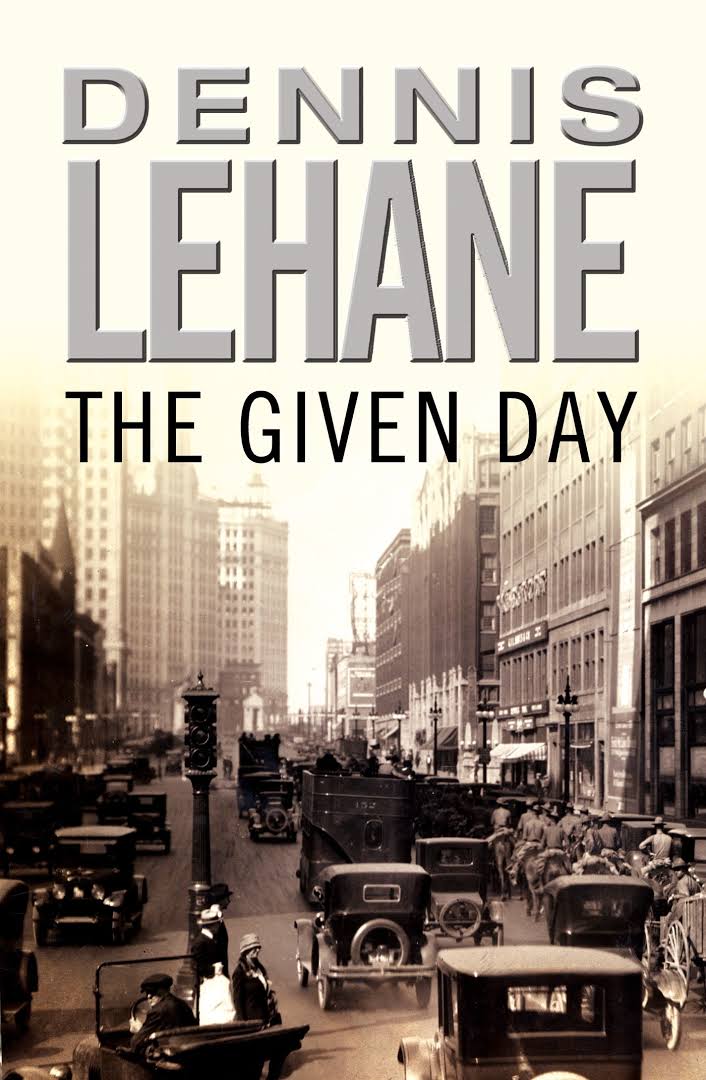
The first of these was with an elderly couple outside Kilmainham Gaol Museum. The man had “Boston” displayed on his T-shirt and I started talking about Dennis Lehane’s novel “The Given Day”, which is set in Boston and which I had just finished reading. They had read it, really liked it and told me it was the first of a trilogy to which I responded that I would certainly be looking for the follow-ups.

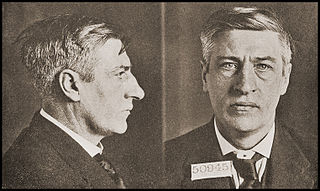
Jim Larkin's "mug shots" when charged with "criminal anarchism" in New York 1919 (he served time in Sing Sing penitentiary). (Photo sourced Internet)
Jim Larkin’s “mug shots” when charged with “criminal anarchism” in New York 1919 (he served time in Sing Sing penitentiary).
(Photo sourced Internet)

I talked about Lehane’s slant towards the cops as opposed to the revolutionaries and how of course my slant would be the other way but that in any case Lehane had not done his research on Larkin, who figures in the novel with other revolutionaries and radicals. Lehane refers to Larkin’s “gin-breath” but Big Jim was well known as a teetotaler, which I explained to them.

Then I talked a bit about the Irish Citizen Army that Larkin had founded with James Connolly and others, how they grew up out of the 1913 Lockout/ Strike and that Larkin had served time in Sing Sing prison later as a punishment for his revolutionary oratory in the USA.

I didn’t get the feeling that I and the two Bostonians were in agreement with my revolutionary sympathies but certainly did when it came to the workers fighting the Lockout in 1913. We parted amicably as they went off to enjoy some more of their holiday.

(Photo sourced Internet)
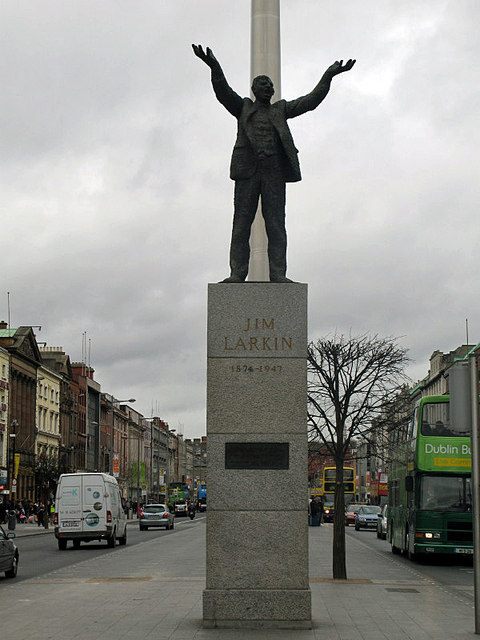
The Jim Larkin monument in O'Connell Street today/ El monumento de Jim Larkin in la Calle O'Connell hoy en día
The Jim Larkin monument in O’Connell Street today (Photo: D.Breatnach)

Encounter No.2 took place in Cornucopia, into which I had dropped for a cup of coffee.

I took my ‘Americano’ to a vacant table. The one next to me became vacant for awhile and was then occupied by an elderly lady who left her handbag open next to me. I advised her that was an unwise thing to do in Dublin and she remarked. in US accent upon the Leonard Peltier badge that I had been unconsciously wearing all day, so we talked about his case for awhile. She didn’t seem sympathetic to the FBI and expressed horror at the treatment of Peltier, now approaching his 40th year in prison for an act of which he was unjustly convicted.

The lady asked me for advice about literary events in Dublin and as she was, sadly, leaving the day before Culture Night, all I could suggest was a visit to Books Upstairs, where someone might be able to advise her. After I jotted down the address and a rough map for her, I left.

THE DEVIL AND THE TRUMPETTES

It was my intention to attend later that evening the Song Central session, on their first night back after their summer break. Song Central is a monthly gathering of singers and listeners upstairs in Chaplin’s pub, across from the Screen cinema. But I needed to eat first and so headed for a burrito in Pablo Picante, a small place serving Mexican food in Temple Bar (well, at the western end of Fleet Street).

Sitting eating my burrito and facing out into the street, I noticed passers-by pointing at the window and laughing. I could have become paranoid except it was clear that they were pointing to an image painted on the window further to my left. Then a late 30s or early 40s couple who in their style looked kind of to the Left maybe laughed at the image and took photos. The female whipped out a lipstick and wrote something over the painting, then had the man take a photo of her next to what she had written.

Curiosity had me now and after they wandered off, I went outside and saw that the painting on the window was a caricature of US Presidential candidate Donald Trump and underneath it the artist had written in big letters “DIABLO”. Of course, that would be because Trump wants to build a wall along the border with Mexico due to the negative impact he accuses Mexican migrants of having on the US, which Trump wants to “make great again”.  And he has also impugned a US Judge’s ability to rule impartially on his case, due to the judge’s Mexican heritage.

The painting in the window of the Pablo Picante burrito restaurant in Fleet St. (Photo: D.Breatnach)
The painting in the window of the Pablo Picante burrito restaurant in Fleet St.
(Photo: D.Breatnach)

The woman had scrawled something along the lines of “He’s not, we love him” with a heart sign on a part of the painting – clearly far from being Lefties!

I went back inside, got a serviette, came outside and rubbed off her comment, then back inside to continue my assault on the burrito.

Not long after, I was not a little surprised to see the woman and the man standing outside again. She noticed the removal of her comment and commenced to write again. I went to the counter to tell the staff what was going on and returned to find the woman inside, leaning on my jacket on the window shelf and working on rubbing out the painting from the inside!

My challenge on what did she think she was doing elicited the response that Donald Trump was going to be (or might be?) their next President and that the painting was disrespectful. I stood between her and the painting, telling her that we have free speech in this country (which is not strictly true but as the nearest weapon I could reach ….) and just kept repeating it. Then the guy came in and told me I had “no idea”. He kept repeating that and I kept repeating the “free speech” stuff, alert in case he took his case into the physical arena (and he looked fit, too). I also wondered what I would do if instead, it was the woman who attacked me. But they left soon afterwards.

Soon after, a member of staff (Mexican, presumably) went outside and rubbed off her comment, returning with a wry smile.

SINGING THE USA

At the Song Central session later that evening, post-burrito and post Trumpettes, the theme happened to be about the USA, songs from there or about travelling there etc, it being the anniversary of the “9/11” attack on the Twin Towers. If I’d remembered about the theme, I’d have learned the Allende song recorded by Moving Hearts, or brushed up on the lyrics of “Hey Ronnie Reagan” by Christie Moore. Because “9/11” ( in 1973) is also the anniversary of the CIA-instigated military coup in Chile, which over time claimed the lives of 32,000 people.

Interestingly, most of the song contributions during the night that referred to the USA (and most of them did, though people are not obliged to follow the theme), were critical of the US state, whether because of its endemic racism towards blacks and Latinos or its genocide towards the First People, or because of its wars. One song I felt pretty sure would be sung – and it was — was about the firemen on 9/11 running up the stairs of the doomed building while occupants ran down – a powerful song about the heroism of a section of public service emergency workers.

Luckily I could remember some US song material and sang “The Ludlow Massacre” and “How Can I Keep From Singing”, both composed in the US: one written by a revolutionary and the other adapted in the US by a progressive singer.

I had set out that day without remembering the significance of the date for the USA and yet throughout the day had a significant level of engagement with people from the US and, at the end of the day, with the terrible event itself.

End.

Postscript:

On Tuesday, while taking a photo of the Trump caricature in the window to accompany this piece, another US couple began to talk to me.  The man opened with: “The man IS a devil” (referring to Trump).  

I remarked that Trump was not going to get elected but his role would be to make Clinton look good, then she could carry on bombing and invading countries if she got elected, no problem.

The woman told me they didn’t like Clinton either.  They were from Boston and the man and his father before him had been union organisers.  He was complained about the weakness of the unions nowadays.  

We talked about cops breaking strikes in the USA in the 1930s and how the cops themselves went on strike in Boston during that period.  He talked about what the cops are like nowadays against pickets and demonstrations, militarised ….

The Ministry of Heritage is taking care of Moore Street


The irish state's Ministry of Arts, Heritage, Rural, Regional and Gaeltacht Affairs is facilitating speculators' plans to demolish the Moore Street 1916 Historical Quarte (with the exception of four houses) in order that they may build a giant shopping centre (mall). (Non-revenue copying welcome but acknowledgement expected)
The Irish state’s Ministry of Arts, Heritage, Rural, Regional and Gaeltacht Affairs is facilitating speculators’ plans to demolish the Moore Street 1916 Historical Quarte (with the exception of four houses) in order that they may build a giant shopping centre (mall).
(Non-revenue copying and distribution welcome but acknowledgement of source expected)

“SLASH AND BURN” IN MOORE STREET

Diarmuid Breatnach

“Almost slash and burn,” is how one of the people I am talking with describes the procedures they expect from Lisadell, the construction company employed by the Department of Heritage in Moore Street, to work on where the GPO Garrison retreated in the last days of the Easter Rising.

“The roof doesn’t need replacing,” says another. “It needs the hole in the roof fixed and the timbers carefully repaired, not replaced.” I remark that I’ve known people who’ve had water damage or dry rot and just had the timbers replaced. “Yes, of course, when conservation is not an issue. But when it is, the work is slow and painstaking, bit by bit, to conserve everything that can be conserved, putting in extra supports when needed.”

I am talking to people with expertise in the area of conservation of buildings of historical and/ or architectural value. They know what should be done to conserve the historic buildings in the Moore Street quarter and they feel certain that it will not be done. They feel impotent – they have the expertise, they care about conservation but they fear the combined powers of the State and big property speculators such as Hammerson, who plan to build a huge shopping centre over the whole Moore Street quarter. They will advise but if they go “too far”, they feel their professional lives will be seriously impaired. Perhaps they fear even more than that – who knows?

In 2007, just before Nos.14-17 Moore Street were made a national monument, TG4 in the their Iniúchadh Oidhreacht na Cásca program broadcast a remarkably in-depth exposure of the battle between Chartered Land and another firm of property speculators for control of the quarter and how Joe O’Reilly of Chartered Land, coming from behind, had been given an incredible advantage over his competitors with a preferential deal with the Planning Department of Dublin City Council.  This took place among more than a whiff of corruption and of complaints by elected Councillors who were excluded from a secret meeting and at another, threatened with financial penalties. Joe O’Reilly of Chartered Land (and also joint owner with Irish Life of the ILAC shopping centre) gobbled up most of Moore Street and only a fierce campaign in the autumn of 2014 prevented the Planning Department getting authorisation to swap him two Council properties in the Street, thereby clearing the way for him to begin demolition of the terrace.


“THESE TIMBERS HEARD …. MACHINE GUNS … SCREAMS … THE PAINFUL DECISION TO SURRENDER …”

Another of the experts intervenes. “These timbers they are going to rip out are the ones that heard the discussion around whether to surrender or to go on fighting,” she says. I am a little surprised at such poetic imagery from a person whose work is in bricks and mortar, plaster, timbers and slates – but there is no denying the passion and there is more to come.

“Those timbers heard the chatter of British machine guns, the crack of their rifles, screams in the street, the occasional crack of a Volunteers’ rifle, perhaps an occasional groan from the wounded Connolly. They heard Elizabeth O’Farrell volunteering to go out under a white flag although civilians had already been shot down under such a flag. They heard the discussions upon her return, the painful decision to surrender, Pearse’s decision to go out with O’Farrell, Seán Mac Lochlainn’s orders to march out in military order ….”

Can damaged timbers and bricks be conserved? I ask. “Oh yes, they do it in England on historic buildings, even genuine Tudor ones. All kinds of damaged timbers can be conserved. But if at all possible you do it in place, in situ – removing timbers causes further damage.”

And bricks? And slates? “Well,” breaks in another, “you’d photograph everything carefully in advance or as you uncovered sections. Anything to be temporarily removed would be numbered, slates or bricks. Then the supporting timbers or brickwork is slowly treated, then everything put back in the same order.”

What about missing or broken bricks or slates? “Broken bricks can sometimes be repaired but otherwise you’d source bricks from the same brickyard. Or if the brickyard is no longer in business, you’d look for other buildings of the same bricks being demolished and buy the material. The same with slates.” I think of the descriptions by campaigners occupying the buildings of how they found timbers just thrown into a set-aside room, and all kinds of objects left leaning against plasterwork that was probably in need of conservation.

A woman shows me on her Ipad a section on restoration procedures on the website of Historic England, a body sponsored by the British Department of Media, Culture and Sports. I quickly record three paragraphs (I will look up the rest later).
A conservative approach is fundamental to good conservation – so retaining as much of the significant historic fabric and keeping changes to a minimum are of key importance when carrying out repair work to historic buildings.

The unnecessary replacement of historic fabric, no matter how carefully the work is carried out, can in most situations have an adverse effect on character and significance.

“The detailed design of repairs should be preceded by a survey of the building’s structure and an investigation of the nature and condition of its materials and the causes and processes of decay.”

I remark that doesn’t seem to be what is going to happen to Nos.14-17 Moore Street. They nod – they agree.

“It’s just a building site to them,” says one. “What they have already done in defacing a national monument is criminal – but who will prosecute them?”

“They put more holes in the front of those buildings than British soldiers did in 1916,” says another man angrily. “Then they just ripped out their Hilti bolts and filled up the holes with an epoxy resin, instead of pointing material.”

This is a reference to the drilling of holes for the erection of a banner without planning permission, across Nos. 14-17 Moore Street, officially a national monument since 2007. Judge Barrett agreed it was illegal in the case taken by Colm Moore, the nominee of some 1916 fighters’ relatives. Although she is appealing that and other decisions of Barrett’s, the Minister had it taken down recently — but again using questionable methods.

“No wonder Humphreys doesn’t want independent inspection and monitoring”, says another, a reference to the Minister of Heritage’s consistent refusal to allow any independent conservation experts in, or indeed the Lord Mayor of last year, or a number of TDs and Councillors, always under the guise of “Health & Safety requirements” that no-one not of the workforce should enter. Yet when they had their media exercise after the Government’s purchase late last year, RTÉ camera crews were in there as was Caitriona Crowe of Trinity College, praising the purchase of the buildings and the Department’s alleged intentions. It later emerged that the demolition of three adjoining buildings was part of that plan but a five-day occupation of the building by concerned citizens put a stop to that, before an injunction was granted by Judge Barret preventing further demolition until the case taken against the State had been decided.

While the rest of the buildings in the quarter and the streets themselves, uncared for and subject to constant assault of weather and with broken drainpipes, heavy traffic and so on accelerate in deterioration, and the Minister’s appeal against the Barret Judgement will not even open until December next year, an assault is imminent on the roof and parapets of four of the buildings of the historic 1916 terrace, those with the best-preserved original frontages and among those with the highest specific historic importance within that terrace. If this were a case of some greedy or careless private owner or company, a complaint could be made to the National Monuments Service. Many such cases have ended in heavy fines for the perpetrators.

But Terry Allen, the Principal Officer of that very Service baldly said in his evidence to Judge Barrett that Moore Street was not a 1916 battlefield. His office comes under the Department of Arts, Heritage, Regional, Rural and Gaeltacht Affairs, of which Minister Heather Humphreys is the boss. And the Government’s Cabinet stands behind her, if not actually pushing her forward. We tend to look to the State to protect national monuments from people damaging them. But who can protect them from the State itself?


End.

NB: These conversations happened but not with all of the people present at the one time. I have put them together for the sake of a condensed narrative and for the protection of identities.


Further information:

Principles of Repair for Historic Buildings from Historic England website:

https://historicengland.org.uk/advice/technical-advice/buildings/maintenance-and-repair-of-older-buildings/principles-of-repair-for-historic-buildings/

The Facebook pages of the following campaigns:
Save Moore Street From Demolition

Save Moore Street 2016

Save Moore Street Dublin

The TG4 program Iniúchadh Oidhreacht na Cásca https://www.youtube.com/watch?v=Cx0Kah7dE80

And some of the Easter Rising Stories series of videos by Marcus Howard on Youtube

Description of Terry Allen’s responsibilities as Prinicpal Officer at the National Monuments Service http://whodoeswhat.gov.ie/branch/ahg/Monuments/terry-allen/641/


THREE EVENTS IN ONE ON HOWTH PIER

Clive Sulish

Foreign tourists and Irish-based visitors looked on with curious interest at a gathering at the foot of the East Pier, Howth on Sunday 24th – the group contained a number in military-type uniform, some were carrying flags, each one of a different design and a number of people in ordinary civilian clothes were carrying floral wreaths.

The Asgard, Molly Childers and Mary Spring-Rice on board at Howth
The Asgard, Molly Childers and Mary Spring-Rice on board at Howth (photos from Internet)

Participants, Tourists and Visitors
Participants, Tourists and Visitors (photo D.Breatnach)

Most onlookers at that point would not have known that those gathered there had a threefold purpose:

  • to commemorate the landing of Mauser rifles for the Irish Volunteers

  • to commemorate the massacre of civilians by enraged soldiers later that same day on Bachelors Walk and to

  • launch the Asgard 1916 Society.


The men and women in uniform formed up with the flags as a colour party and led the procession the full length of the pier to its end. There the procession came to a halt in front of a plaque on the wall commemorating the landing of 900 Mauser M1871 single-shot rifles and 29,000 rounds of ammunition in 1914 by a crew skippered by Erskine Childers with his wife Molly and friend Mary Spring Rice. The arms were taken ashore and whisked away in an operation planned by Bulmer Hobson of the IRB and carried out by the Irish Volunteers and Na Fianna Éireann.

Colour Party Marching
Colour Party marching along the pier towards the ceremony (photo D.Breatnach)

The Dublin Metropolitan Police and British Army were mobilised by Dublin Castle authorities to seize the guns (unlike at the previous much larger operation by the Loyalist UVF at Larne) but only managed to get a few. As the disgruntled Scottish Borderers marched back into town, they were jeered by Dublin crowds and some cabbage stalks were thrown at them. On Bachelors Walk, very near the Ha’penny Bridge, an officer brought them to a halt and they faced the crowd with guns pointed, then opened fire. Three men and a woman were killed and 38 wounded, including the father of singer Luke Kelly of the Dubliners ballad group (also called Luke). One of the victims died of bayonet wounds.

Margaret McKearney speaking and chairing the occasion on the pier
Margaret McKearney speaking and chairing the occasion on the pier (photo D.Breatnach)

Margaret McKearney, who has had three brothers killed in the Six Counties during the 30-years war, stepped forward to address the crowd as tourists and visitors took photos or watched and listened. After giving a brief account of the Howth landing and of the massacre on the Dublin quays, also of the smaller landing at Kilcoole, McKearney called forward Pól Ó Scanaill of the 1916 Societies to read the 1916 Proclamation of Independence. After he had finished, McKearney called for the young bearers of two floral wreaths to make their presentations:
Ellen O’Neill, with a wreath in memory of those killed and injured by the British soldiers at Bachelors’ Walk;

Roibeard Drummond, whose uncle Michael Moore was a crew member of the Nugget, landing rifles at Kilcoole, laying a wreath for the Asgard 1916 Society to commemorate the landing of the rifles and those who carried them in battle in 1916.

Last of the wreath-layers was Denise Ní Chanain on behalf of the Anti-Internment Group of Ireland.

Ellie after laying wreath in memory of the dead and injured in the Bachelors' Walk massacre
Ellie O’Neill after laying wreath in memory of the dead and injured in the Bachelors’ Walk massacre (photo D.Breatnach)


MOORE STREET SPEECH

Roibeard Drummond, after laying wreath on behalf of the Asgard 1916 Society
Roibeard Drummond, after laying wreath on behalf of the Asgard 1916 Society (photo D.Breatnach)

Niamh McDonald gave a short speech on the current situation in the struggle to save the revolutionary quarter of Moore Street. She informed her audience that NAMA had sold the debt of the Irish speculator company Chartered Land (Joe O’Reilly) to Hammerson, a British-based vulture capitalist company, who are continuing with the plan to build a huge shopping centre over the whole historic quarter. Meanwhile, the Minister for Heritage, Heather Humphreys, is appealing the High Court judgement that the whole quarter is a national monument. McDonald asked people to keep an eye on the campaign’s

Denise Ní Chatháin bringing forth the wreath from the Anti-Internment Group of Ireland
Denise Ní Chanain bringing forth the wreath from the Anti-Internment Group of Ireland (photo D.Breatnach)

Facebook page for updates and for calls to support actions.

McKearney then called on Diarmuid Breatnach to sing Me Old Howth Gun, pointing out that guns landed at Howth had been the first to fire on the Lancers in O’Connell Street on Easter Monday 1916. Breatnach introduced the song as having been written apparently in 1921, that is a year before the outbreak of the Civil War, by James Doherty, who also used the pseudonym Seamas Mac Gallogly.

Niamh McDonald speaking on behalf of the Moore Street 2016 campaign
Niamh McDonald speaking on behalf of the Moore Street 2016 campaign (photo D.Breatnach)

MAIN SPEAKER — JOHN CRAWLEY FROM THE MARITA ANN
The next speaker to be introduced by McKearney was John Crawley who was arrested on board the Marita Ann trawler, intercepted off the Kerry coast by the Irish Naval Service on September 29, 1984, when seven tonnes of arms were seized. The US heavy machine guns recovered on the Marita Ann had special mountings allowing them to be used as anti-aircraft weapons. Another of those detained on board – and later jailed for 10 years – was Martin Ferris who went on to become a Kerry TD for Sinn Fein, while John Crawley has taken a line of opposition to the Good Friday Agreement.

John Crawley giving his oration with the plaque commemorating the landing of the Howth guns behind him
John Crawley giving his oration with the plaque commemorating the landing of the Howth guns behind him (photo D.Breatnach)

John Crawley gave the main speech at Howth, in which he traced the history of the struggle for the Irish Republic from the Volunteers onwards, pointing out that many who fought the British in 1916 had different aspirations for the country, which explained why they parted ways in 1921. Crawley stated that the British have always been able to pick out those whose primary intention was to survive the struggle from those whose intention was if necessary to give their lives for the objective of the Irish Republic.

Pól Ó Scanaill reading the 1916 Proclamation
Pól Ó Scanaill reading the 1916 Proclamation at the head of the East Pier, Howth (photo D.Breatnach)

Crawley pointed out that some people had led a section of the Republican movement in accepting the right of a foreign country to decide the future of a part of our country; they had joined in the colonial administration and had accepted the colonial police force.

After the applause for the speech died down, McKearney thanked those who had participated and asked Diarmuid Breatnach again to step forward to sing the national anthem. Breatnach sang it in Irish, first verse and chorus (and noticeably sang “Sinne Laochra Fáil” instead of “Sinne Fianna Fáil”). Participants joined in with the chorus and then all made their way along the pier towards a local pub where refreshments had been made available by the new 1916 Society.

Diarmuid Breatnach singing Amhrán na bhFiann at end of the ceremony. Earlier he had sung "Me Old Howth Gun".
Diarmuid Breatnach singing Amhrán na bhFiann at end of the ceremony. Earlier he had sung “Me Old Howth Gun”. (Photo: Des Keane from Sean Heuston 1916 Society page)

end

Video of the event by John Rooney and put on Youtube by him, posted on FB by Mick O’Riordan (see below)
https://www.youtube.com/watch?v=RrG_7VLytfw

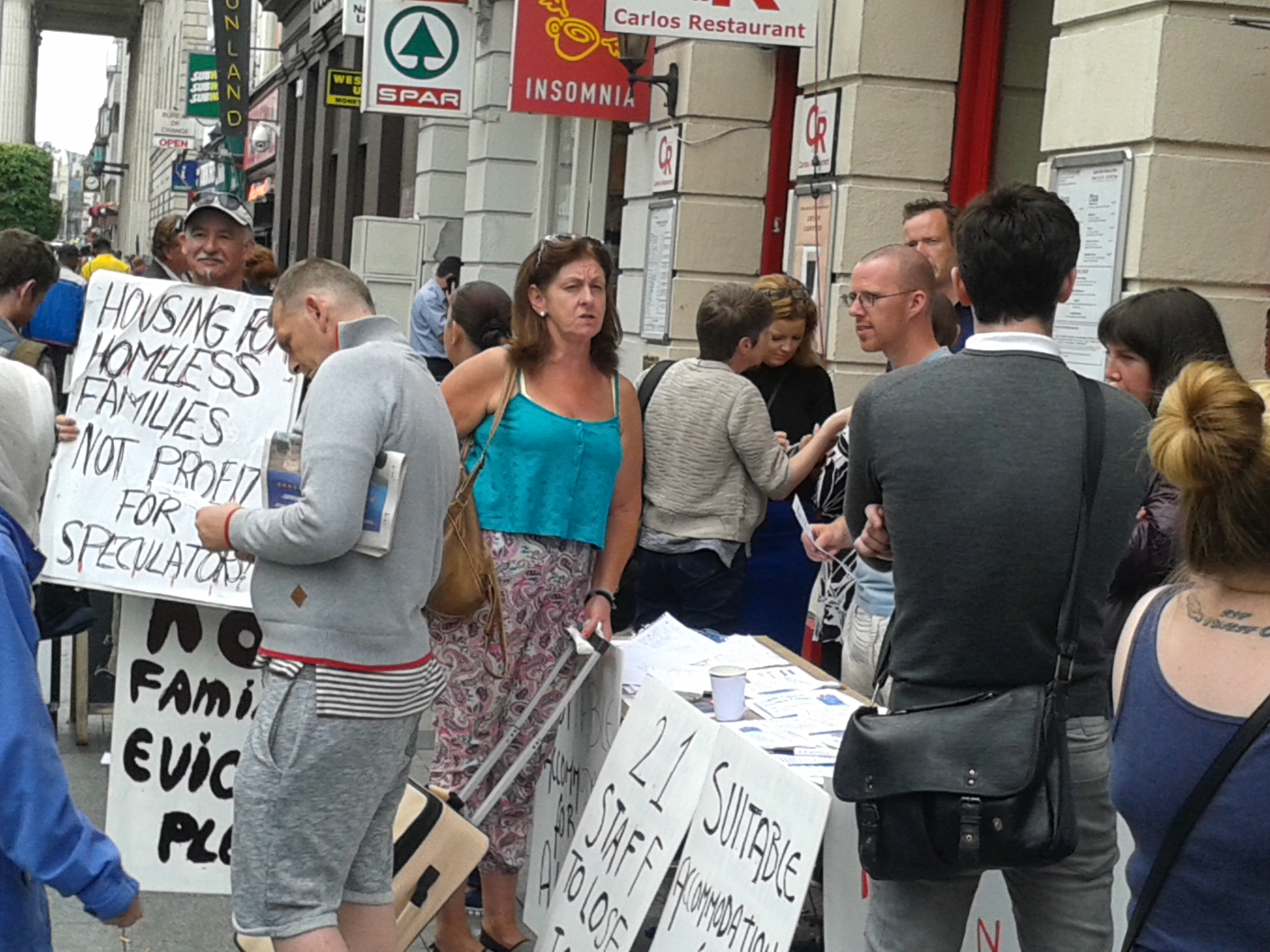
FAMILIES BEING EVICTED ON CITY’S MAIN STREET

Diarmuid Breatnach

Five families with a combined total of ten children are resisting eviction from a building on Dublin’s O’Connell Street where they have been placed in emergency accommodation by Dublin City Council. The building in question, Lynam’s Hotel, has been taken over from its owner by NAMA and the families have been told that they must leave so that it can be turned into temporary accommodation for tourists.  Already there are many tourists renting the rest of the 43 suites.

Lynham's Hotel, O'Connell Street, Dublin on Wednesday
Lynham’s Hotel, O’Connell Street, Dublin on Wednesday

The families however have decided that they are not going to leave and Irish Housing Network has organised support for them. Volunteers were outside on Wednesday as one of the parents had been told that day to leave with her child, which she was refusing to do. She was then given an extension until Friday but on Thursday, another family were told to move and they too were holding out with supporters nearby. Towards the end of the day that family too was given an extension.

Some of the families in question attended the Dáil late on Thursday afternoon, where Thomas Pringle, Independent TD, asked a question regarding the situation of a junior Government Minister for Housing. Clare Daly TD reportedly had been trying to get a question asked since Monday. Presumably this question has as part of its purpose to draw media attention to the issue and to put pressure on the landlord not to evict the families.

Some supporters of the five families on Wednesday

NAMA was set up allegedly to recoup money from speculators who had overextended their credit and could not clear their debts. The idea presented to the public was that, as the Government had bailed out with public money the banks who had lent out to speculators sums far in excess of what was commercially justifiable, the State would take the properties and sell them, putting the money gained back into the public purse. What has in fact been happening is that NAMA has been selling these properties off to vulture speculators, who are snapping them up at prices well below their market value. One of these vulture speculators is Hammerson, a British-based property speculator company, which is rumoured to be looking to buy the hotel. Hammerson also has bought Chartered Land’s (Joe Reilly) property empire and with it, planning permission to demolish all but four buildings of the Moore Street quarter and to build a huge shopping centre over the historic battleground and national monument.

Many acknowledge that there is a housing crisis currently in Ireland and in particular in Dublin.  The Irish State that was created in 1922 has been since its inception in support of capitalists, including speculators, but against workers and lower-middle class people. Nevertheless in the past local authorities did build some social housing to rent but these days, Dublin City Council does not want the role of managing housing and has sold off most of its stock and not built any new houses for decades.

One of the people who fought against the State we have inherited was killed by Free State soldiers in O’Connell Street and a small plaque commemorates him on the corner of the building there now. Cathal Brugha had been wounded 25 times in the Easter Rising and beat the odds to survive, though he walked with a limp thereafter. In 1919 he organised the IRA from the Volunteers and Irish Citizen Army who were willing to join.  In 1921 he voted against the Treaty and in 1922 led a force of IRA against the new Free State in order to ease the pressure on the Republican forces who were being shelled at the Four Courts.  He was shot down in the street this month, 94 years ago, across the street from Lynam’s Hotel.

Cathal Brugha
Cathal Brugha
The plaque to Cathal Brugha across from Lynam's Hotel. Brugha was shot by Free State troops in the street there on 5th July1922 and died on the 7th.
The plaque to Cathal Brugha across from Lynam’s Hotel. Brugha was shot by Free State troops in the street there on 5th July1922 and died on the 7th.

On Friday 22nd, the IHN called a public protest outside the hotel.  Although at short notice and called for 1pm, therefore during office hours, up to 30 people supported the protest.  The event attracted considerable media and public attention.

Irish Housing Network is set to continue to support the families in resisting eviction and volunteers may wish to get in touch with the organisation to help maintain a support rota for the families https://www.facebook.com/irishhousingnetwork/.

IHN demonstration outside Lynam and the fundamental message on placard

20160722_135113

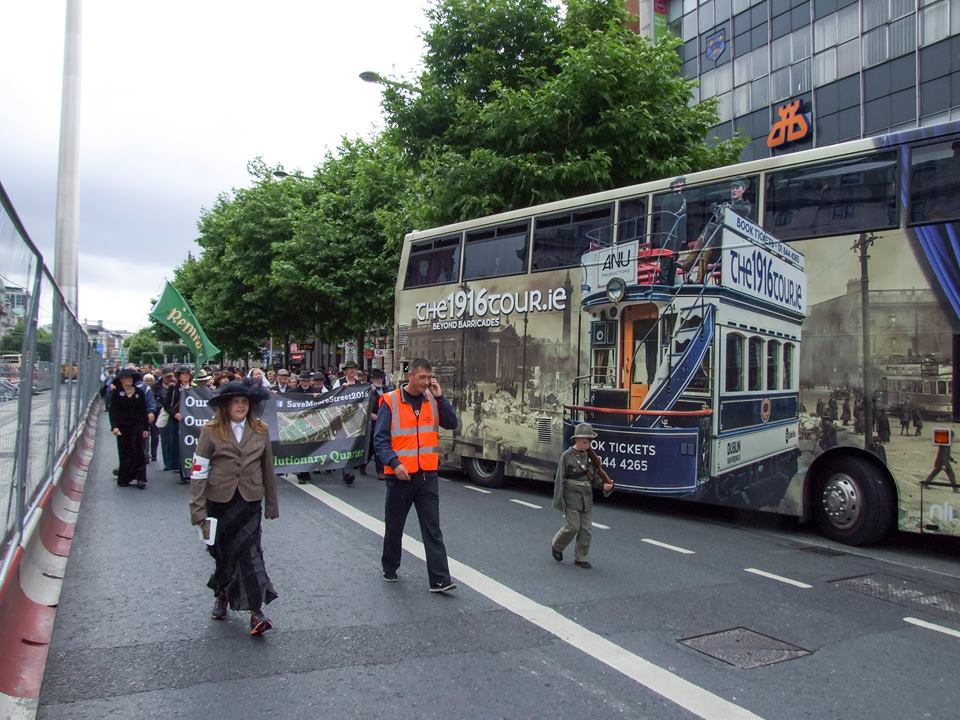
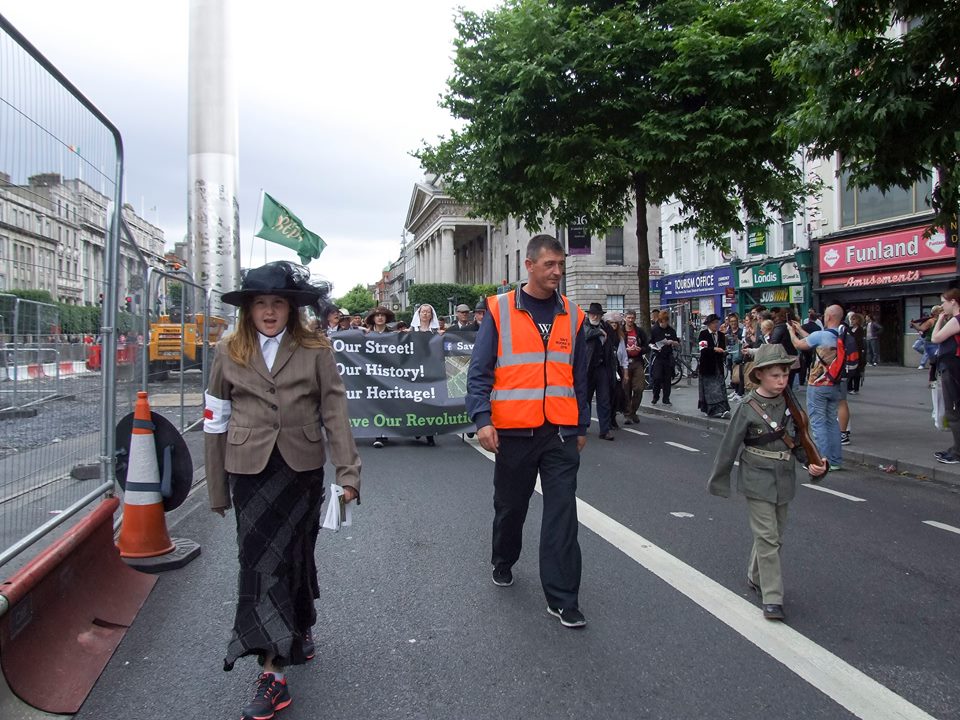
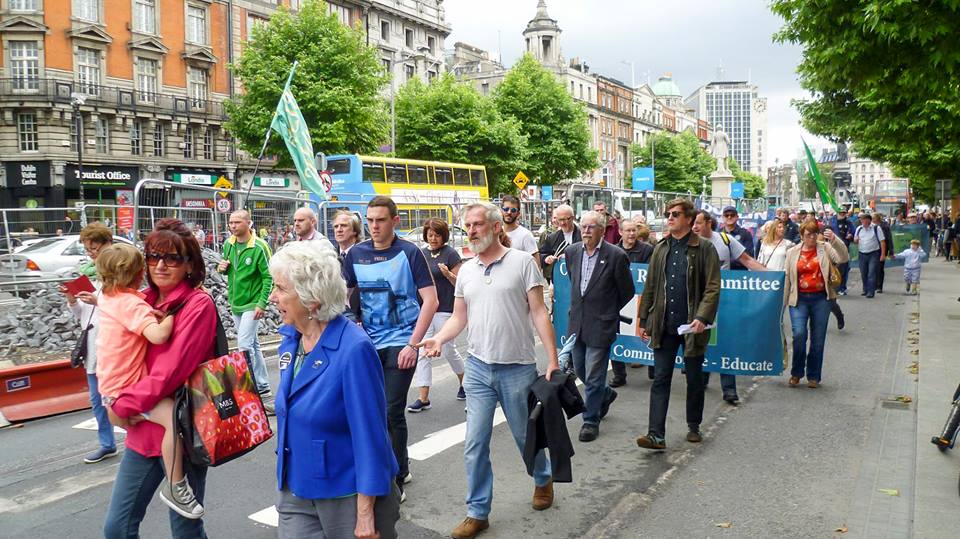
MARCH FOR MOORE STREET CONSERVATION FOLLOWS FOOTSTEPS OF 1916 RISING

The march called to save “the Revolutionary Quarter” of Moore Street followed the footsteps of the GPO garrison on Easter Monday but, upon reaching the GPO, continued on along the that week’s Saturday surrender route up to the Rotunda.  Wheeling left then, the march proceeded on to the junction with Moore Street, where the British Army had their barricade and machine gun on Friday Easter Week — the cause, along with the sniper in the Rotunda tower, of many deaths and injuries in Moore Street.  The march wheeled left again into Moore Street and proceeded to the rally outside the GPO, where speakers were to address them and artists to perform.

from Save Moore Street 2016 campaign

https://www.facebook.com/SaveMooreStreet2016/photos/?tab=album&album_id=1260539983971351

The Save Moore Street 2016 campaigners and supporters gathered well over an hour before the advertised time outside Liberty Hall where their wardrobe department was busy outfitting people while a steward organised people for photo shoots, leafleting and kept the crowd informed.

By the time the march set off from Liberty Hall it had gathered many, quite a few in period costume and some others joined it along the way. Many had come already dressed in period costume or were decked out by the wardrobe department of the Save Moore Street 2016 campaign and a solid group of them marched behind the new campaign banner.

Longish View March Abbey St Xroads DB megaphone
Section of march crossing to west side O’Connell Street in foreground; section of march in background passing Wynne’s Hotel in Lower Abbey Street. (Photo: )

Others marched behind the original Save Moore Street (from demolition) 2016 banner while others carried banners of some organisations supporting the march: the Cabra 1916 Society, O’Hanrahan Car1ow 1916 Society, Dublin Says No, Munster Anti-Internment Committee, Republican Sinn Féin, Dublin IRSP …..

Led by two people with megaphones and, at times, spontaneously, they shouted: “Save Moore Street from demolition!”

With reference to the Chartered Land and now Hammerson’s huge shopping centre plan for the area, the marchers shouted:

Do we need another shopping centre? No! Do we need our heritage? Yes! Do we need our street market? Yes!” Also, “What do we want? Hammerson out! When do we want it? Now!”

Other slogans included: “Our history! Our heritage! Our street! Our Rising!”

Moor St March passing 1916 Bus Tour.jpeg
Amy and Josh youth supporters flank a march steward as the march passes one of the many kinds of 1916 tours being run in the city this year. (Photo: B.Hoppenbrouwers)

Amy Alan Josh leading OConnell StUp Lower Abbey Street the marchers went, in the footsteps of the GPO Garrison on that Easter Monday morning, past Wynne’s Hotel where Cumann na mBan had been formed in 1913, past the former Hibernia Bank on the corner of Abbey and O’Connell Street, where Volunteers fought and where Irish Volunteer Captain Thomas Weafer, from Enniscorthy was killed and his body consumed by the flames caused along the street by British shelling.

Turning into O’Connell Street, the marchers passed the location of Bloody Sunday 1913 when, after Jim Larkin defied a court ban to speak, the Dublin Metropolitan Police ran riot beating Lockout strikers and onlookers down to the ground with their truncheons.

COUNCILLORS, TDs, PROMINENT CAMPAIGNERS, ARTISTS AND HISTORIANS MARCHING

A number of elected representatives supported the march: seen in the crowd were Dublin City Councillors Cieran Perry, Pat Dunne, Anthony Conaghy and former Mayor Críona Ní Dhálaigh, also TDs Joan Collins and Maureen O’Sullivan.

OSullivan Johnsons Ballagh Cooney
Section of the march in upper O’Connell Street, heading northwards, showing prominent supporters TD Maureen O’Sullivan in foreground and Robert Ballagh in middle section, flanked by Patrick Cooney, one of the founders of the 1916 relatives’ campaign Save Moore Street.

Among the artistic and dramatic sector whose participation was noted were artist and activist Robert Ballagh, drama director Frank Allen (who also organised the first Arms Around Moore Street event in 2009 — and has the T-shirt to prove it!), Brendan O’Neill — also an actor and long-time campaigner — and actor Ger O’Leary.

Relatives of prominent fighters in 1916 also participated and Jim Connolly Heron, great-grandson of James Connolly and among the earliest campaigners for Moore Street and Donna Cooney, great-grandniece of Elizabeth O’Farrell, who went out into the killing zone to organise the surrender, were both noted marching. Patrick Cooney, also of the specific 1916 relatives’ group that brought the legal challenge to the High Court marched along too and spoke from the platform at the rally. Gabriel Brady, grand-nephew of the printer of the 1916 Proclamation, Christopher Brady, was there too, as was Eoin Mac Lochlainn, a relative of the Pearse brothers and a relative of Seán Mac Diarmada was also present and in fact helped carry one of the SMS2016 banners.

A number of historians walked among the marchers, including Ruan O’Donnell, Dónal Fallon, Ray Bateson, Hugo McGuinness, along with local history activists such as Joe Mooney (of East Wall History Group) and Terry Fagan (of North Dublin Inner City Folklore Project). Ciarán Murphy, joint blogger and joint author with Dónal Fallon of the Come Here To Me publication marched along too. From the non-history world of academia, Paul Horan, lecturer of Trinity College (and who wrote the letter published in the Irish Independent on July 2nd denouncing the Minister of Heritage appealing the Barrett High Court judgement that the whole Moore Street quarter is a national monument) marched in period costume too.

THE SURRENDER ROUTE

Passing the General Post Office, the marchers continued along the route of the GPO/ Moore Street Garrison as they surrendered on the Saturday of Easter Week, up to the Gresham, where they laid down their weapons and on to the Rotunda, in the garden of which many had been kept for two days without food or water, while detectives of G Division from Dublin Castle came down to identify prisoners for execution. On the way the marchers passed the Parnell Monument, where British officers had displayed the battle-damaged “Irish Republic” flag upside down as a trophy for a photographer.

On this Saturday in 2016, volunteers (some in costume) accompanied the marchers along the route, handing out leaflets, which were eagerly taken by onlookers, while others – all in costume — collected donations along the way, distributing stickers in exchange. Well in excess of five hundred leaflets were distributed in the period of the short march.

SILENCE IN MOORE STREET

Minute Silence Moore St 9 July2016 T Byrne
The march stopped in Moore Street for a minute’s silence. (The building to the left is a section of the ILAC shopping centre; to the right may be seen a section of the hoarding in front of five buildings in the ‘1916 Terrace’ and the banner illegally placed on four of those houses (declared a ‘national monument’ since 2007) by the Department of Arts, Gaeltacht and Heritage.

Turning into and a little along Moore Street, the marchers were called to stop for a minute’s silence out of respect for the Irish Volunteers, Citizen Army and civilians who had been shot down in that street by British Army guns, for the six who had been shot by firing squad after they surrendered and for those who had risked their lives in an uprising against the biggest empire the world has ever seen.

All sound in the street died: marchers, street traders, bystanders, shoppers — all stood silent in a street which would otherwise be filled with the noise of a street market and busy shopping thoroughfare on a Saturday afternoon.

At the conclusion of the minute’s silence, the march recommenced, calling its demands with renewed vigour, out into Henry Street, right to O’Connell Street to form up for the rally by the stage in front of the GPO.

SPEAKERS AND PERFORMERS

The rapper Temper-Mental MissElayneous (Elaine Harrington) from Finglas was the first on the stage and performed her “Fakes and Manners” and “Buachaillí Dána” raps but continuous problems with the sound amplification at this stage of the rally meant much of what she was saying could not reach the audience (fortunately this was amended later).

Elayne Harrington torso stage
Rapper Temper-Mental MissElayneous (Elayne Harrington) from Finglas performing with bodhrán

Niamh McDonald, chairing the rally, welcomed the crowd and said that the campaign to save the Moore Street quarter was at a crossroads; developments had brought Irish property developers and the State into opposition to the appropriate conservation of the quarter but also now foreign vulture capitalists. “Save Moore Street 2016 will do what it takes to defend this historic quarter” she said, reiterating three basic demands of the campaign:

  • That a full independent expert assessment be carried out of the battlefield area

  • that all construction or remedial work be accessible to expert independent monitoring and

  • that the whole process by transparent to the public.

It was time for the campaign now to take the fight to the speculators and the next in a series of monthly events would be a demonstration against Hammerson themselves, McDonald told the rally.

Niamh Speaking, DB, Donal Fallon
Niamh McDonald, chairing the rally and speaking on behalf of Save Moore Street 2016 addressing the rally as one of the march stewards (in period costume) holds the megaphone for her. (Photo: )

The first speaker was then announced, historian and author Ruan O’Donnell, who reminded the rally that the Government of the time had been prepared to demolish Kilmainham Jail. The site had languished until volunteers took up the work of restoring it as a museum and now it is so successful that one has to queue to gain access to it.

Ruan O'Donnell speaking
Ruan O’Donnell, historian, lecturer and author addressing the rally. (Photo: )

O’Donnell castigated the attitude and thinking of successive Irish governments and pointed out that the GPO and Moore Street are sites of crucial importance in the struggle of the Irish people for nationhood.

O’Donnell’s speech, as did McDonald’s, received cheering and applause a number of times during their course as well as at the end.

Dónal Fallon, also author and historian, then stepped up to address the rally and also denounced the Gombeen state that had followed the struggle for independence, in which property speculators grew fat while the people suffer in a housing crisis.

Donal Fallon speaking
Donal Fallon, blogger, author & historian addressing the rally. (Photo: )

He reminded the rally of the struggle to save the Viking archaelogical site at Wood Quay and how, with Dublin City Council building over it, the writer and author of Strumpet City, James Plunkett, had said that Dublin had “shamed itself before the world.” Fallon said that Dublin needs to redeem itself and will do so in the struggle to save the Moore Street quarter.

Patrick Cooney (of the relatives’ group that took the High Court challenge against the Minister of Heritage) was then introduced and spoke of the recent Appeal Court appearance where the Minister’s team had been castigated by a Judge who insisted they had to specify against which part of Judge Barrett’s judgement they were appealing – her Department could not take a blanket position and say that they were against it all (SMS2016 comment: indeed, part of the judgement was that the banner erected on Nos.14-17 had been erected illegally, and the Minister has already stated that work would commence to remove it and to fill in the holes the builders put into the face of those buildings in order to fix the banner there). Cooney welcomed the announcement that the appeal would not be heard until December 2017, saying that this would give time for more pressure and perhaps a change of government.

Cooney also spoke of the long struggle to have the importance of the site acknowledged and to save it from property speculators and in passing also paid tribute to those who had occupied the building in January of this year.

Sean Doyle speaking
Sean Doyle, in period costume, addressing the rally. (Photo: )

Last to speak was Seán Doyle, speaking on behalf of the Save Moore Street 2016 campaign. Seán questioned whether we were worthy of the inheritance which had been bestowed upon us.

Referring to speculators and their facilitators, Doyle concluded by saying that “men in suits can be more dangerous than men in armour”.

All those speeches were enthusiastically applauded.

By this time the technical problems of the sound amplification had been overcome with the assistance of a member of the audience and Paul O’Toole stepped up to the microphone. He recalled that the best stage he had ever performed upon had been a couple of pallets drawn up in front of No.16 Moore Street in order to play at a rallying event there.

Paul O'Toole performing
Paul O’Toole playing and singing during the rally. (Photo: )

He then sang and played “The Foggy Dew” and “The Cry of the Morning”, followed by his own composition “We Will Not Lie Down”. The event could not end without Temper-Mental MissElayneous being given an opportunity to perform with the sound amplification in full working order and she launched into her “Fakes and Manners” rap.

The crowd having applauded the performers, everyone was thanked for contributing to the event, banners were rolled up and costumes packed back into cases.  Some people stood around chatting while the lorry that had provided the stage pulled out into the traffic, one of the organisers gave a radio interview to Newstalk and MissElayneous, on a roll now, performed for a small audience and video camera with the GPO as a background.

Across the road, outside the GPO, to which it relocated after some of its activists went to participate in the march, having earlier completed its 94th Saturday on Moore Street through which it has collected more than 50,000 signatures in support of Moore Street, the Save Moore Street From Demolition campaign table was also wrapping up.

And, despite threatening sky and pessimistic forecasts – it hadn’t rained once.

end

SPEECH BY SAVE MOORE STREET FROM DEMOLITION REPRESENTATIVE AT RALLY AFTER MARCH 30th JANUARY 2016

Diarmuid Breatnach

Go raibh maith agat a Chathaoirligh agus a Choiste Eagraithe as an gcuireadh chun cainte ar son feachtas Shábhála Ó Leagaint Shráid an Mhúraigh. Go raibh maith agaibh freisin, a lucht tacaíochta, as a bheith i láthair agus as bhur néachtanna go dtí seo.

Thank you Chair and Organising Committee for the invitation to speak on behalf of the Save Moore Street From Demolition Group and to supporters of the campaign here today and for their deeds in the past.

The Save Moore Street From Demolition group began in September 2014, founded by a handful of people who had supported other Moore Street campaigners over the years and at times helped with organising events. Our call to do something different was the emergency looming when Chartered Land offered to hand over the houses of the national monument, No.14-17, to Dublin City Council in exchange for the ones owned by them, No.s 24-25. We knew that once O’Reilly got those two, he would have demolished them …. along with the rest of the 1916 Terrace all the way up and including No.18.

Brendan Viv man
Moore Street, November 2014, Vivienne Lee at the weekly campaign table while people sign the petition. Brendan O’Neill, an early supporter, signing.

The Council’s Chief Executive, Owen Keegan, was completely in favour but he had a problem: since this involved disposal of Council assets, the deal could not be agreed by officials but would have to be voted for by a majority of Councillors. So it was put to them and he recommended acceptance. And the SMSFD group was born to fight that.

We put up a table with a petition every Saturday in Moore Street. We lobbied Councillors on line and at Council meetings. We gave out leaflets in Moore St. We set up FB pages and kept them lively every week, slowly building up our support. Down in Moore Street, we interacted with the street traders, small shops and of course with passers-by.

Number of people signing the petition at the Moore Street stall in its early days
Number of people signing the petition at the Moore Street stall in its early days, Robbie Lawlor at the table.


I’d be lying if I said there were not times when we were tempted to stop. Maybe times when only three of us were there and when one of that three was off sick or away, or even two. But others did come by to help us from time to time.

And when we gave the emergency call about the planned demolition of the buildings, when we called the emergency demonstrations for two consecutive days in the street, the response was immediate. And it was active. The people who occupied those buildings saved them from being demolished.

And the campaign that we have now built together will hopefully ensure that the 1916 Terrace will be saved for the benefit of generations to come, both in Ireland and around the world.

TERRACE AND SITE

The experts employed by the State and the speculators tell us that one building or another in the terrace is not a 1916 building.  But the fact is that there has never been an independent survey of the site.  Can we trust experts employed by speculators who care nothing for history or heritage, whose only concern is making lots of money?  Can we trust experts employed by a State that has cared little throughout its history for heritage, culture or history but has been focused instead throughout on serving the Gombeens in our country and vultures from abroad?

I think we cannot. But regardless of what any expert may say, whether independent or not, no-one can deny that terrace is the site of the GPO garrison. The whole terrace. Sixteen houses. Not four.

Moore Stret December 2014, the weekly campaign stall in its early days -- Brónagh Ní Loing, Diarmuid Breatnach at table with Mel Mac Giobúin talking to an interested passer-by
Moore Stret December 2014, the weekly campaign stall in fourth month — Bróna Ní Loing, Diarmuid Breatnach at table with Mel Mac Giobúin talking to an interested passer-by

Sixteen – something of an important and recurring number in connection with the Rising. The year was 1916. The number of executions was sixteen. And there are sixteen houses.

That whole site is a historic site and by any rational, historically-minded appraisal, not only deserves preservation, but cries out for it. Cries out for preservation, Brothers and Sisters, in the midst of this historic quarter, this small area in the heart of Dublin, with its last remaining street of a whole market area, centuries old, now buried under the ILAC. A small historic quarter with artifacts, points of importance, buildings and sites of importance going back to the Land War, the 1913 Lockout, the 1916 Rising, the War of Independence, the Civil War ….

BRICKS AND MORTAR

It is just bricks and mortar,” some of our critics have said. “History is about people, not buildings.” Of course, history is about people. And not just leaders, but the mass of people who, in the midst of their daily struggles to live, to work, to raise families, dare to dream. And where do dreams happen? In the imagination.
And has psychology not taught us the importance of symbols? This building behind me has a symbolism of great potency. The faces of the our martyrs, our flags, the pictures of the starving people of the Great Hunger, the words of speeches and proclamations which we read in little symbols of written words, plaques and monuments …. the very letters on paper, also symbols to convey meaning …. even our spoken words ….

All these symbols give shape and expression to our dreams. Not only the dreams which we experience in our sleep but the great dreams of humanity, the waking and sleeping dream, of freedom, peace, in which to pursue our interests, in which to seek happiness.

SPECULATORS

These our dreams, our human dreams of progress for mankind, are not shared by all.  They are not shared by Joe O’Brien of Chartered Land.

They are not shared by the board of directors of Irish Life, who buried the rest of the centuries-old market under their architecturally-hideous ILAC shopping centre. And who seek to build further out into Moore Street and upwards and have been granted permission by Dublin City Council Planning Department to do so.

And so we must conclude, must we not, that our dreams are not shared by such senior officials in Dublin City Council as Owen Keegan and others running the Planning Department.

No. They do not share our dreams for the future, nor our respect for what was valuable in our past.

December 2014, crowd signing the petition in Moore Street, Brónagh at the table
December 2014, crowd signing the petition in Moore Street, Bróna at the table

An Bord Pleanála has approved the massive shopping centre plan to construct an architectural horror from O’Connell Street across to Moore Street, and from O’Rahilly Parade down to Henry Street, in the course of which they will destroy the 1916 Terrace and enclose a shoebox museum … next to a MacDonalds, perhaps, or a Starbucks …. Constructing a cathedral to Mammon, to the gods of chain stores and eatery franchises ….. So we must conclude that An Bord Pleanála does not share our dreams either.

Lobby of Dublin City Councillors against the 'Land Swap" in Moore Street, 4th October 2014
Lobby of Dublin City Councillors at City Hall 4th October 2014against the ‘Land Swap” in Moore Street, — picket organised by Save Moore Street From Demolition campaign. Signed petition sheets sellotaped together stretched — 2nd and 3rd participants from left are Paddy Cooney and Proinsias Ó Rathaile, of the Save Moore Street campaign.

But does an Bord Pleanála act independently? No it does not, as we well know and as been shown in many planning controversies in the past. It follows the dictates, nods and winks of its political masters, the political class and its nominees in the Dáil. And these do not belong to one political party only, but to several.

And Minister Heather Humphreys, their representative with special responsibility in this case, patently does not share our dreams nor our respect for heritage.

The board of directors of the giant property company Hammerson do not share our dreams either. They dream of big ugly buildings and giant car parks where chain stores and restaurants and franchise eateries can market their goods, depriving shops and goods of any individual regional or national character, making one city’s commercial centre look like any other, from Dublin to Dupont, from Cork to Caracas.

But behind all this array of servile public departments and officials and political representatives, aiding and abetting the clutch of home-grown speculators and foreign vultures, there are the final villains, the whole Irish class of neo-colonial, money-grabbing, huckstering, fumbling-in-a-greasy-til, greedy, incompetent, philistine shower that climbed up upon our backs in 1921 – the Irish gombeen class.

CAPITALIST CLASS

When we have viewed with dismay how little our native ruling class cares for our land, our history, our natural resources, or very PEOPLE ….. some among us have said: “But how can they treat with such disrespect the history and artifacts of the men and women who gave them independence?  Their own ancestors?”  But such commentators are mistaken, brothers and sisters.

The heroes of 1916 are not the political ancestors of the gombeen class – they are ours! A few who fought in 1916 and later became part of the gombeen class from the 1920s onwards, true …. but when they did so, they disowned their forebears.

WE have not disowned the heroes of 1913, nor of 1916, nor of struggles afterwards.

There has not been an independently-minded capitalist class in Ireland since the late 17th Century – and they were nearly all Protestants, of one sect or another. They sought national unity and independence and when they were denied it, rose in rebellion for political, economic and cultural independence in 1798 …. and again in 1803 … But they were defeated and their survivors changed their ideas or left the country.

This class of native capitalists that we have now in the 26 Co.s, mostly of Catholic religious background, grew up under foreign domination. They learned early on to doff the cap to the foreign master, ape him in clothes and manners, speak his language and carry out little deals behind his back.

They learned to be ‘cute hoors’ but they never learned to fight and risk life and limb for a principle. They scramble to get to the top of the dung-heap and crow from there. Or they push and jostle one another to get their snouts in the trough.

They never stood up on their two legs, with back straight and head up, and flew the flag of freedom. They could never stand straight on a gallows and cry “God Save Ireland!” before they were hung, or stand defiantly in front of a prison wall to receive the bullets of their executioners. They never faced the batons of the Dublin Metropolitan Police or the rifles and bayonets of the Royal Irish Constabulary.

And this is why James Connolly, who spent his last days in the building behind me and later in Moore Street, before he was taken away and they made sure to shoot him dead even when they realised that they were going too politically far with the executions …. And by the way the newspaper of Irish Catholic nationalist gombeen man William Martin Murphy, the Irish Independent, called for his execution …..
this is why James Connolly said:
“Only the working class remain as the incorruptible inheritors of the fight for Irish freedom.”

Connolly saw the foreign-dependent and internally corrupt nature of the native capitalist class even before they seized power over his body and the bodies of others who had fought for independence and a just society. And by the way, nor did they stop there – they added hundreds more bodies to ensure they kept the power they had grabbed. And out of our every generation, sent thousands of our youth into exile, rather than build a country that would keep them at home, give them work, housing.

THE CENTENARY & IDEALS

As I come to the end of what I have to say here, early in the centenary year of the 1916 Rising, and I thank you for your patience, I reflect that it appears to be a law of life that for everything we gain, there is a price to be paid.  We have learned that many, oh so many times throughout our history, have we not?

What we are asking for — no demanding — from our rulers, in the case of the campaign for the Moore Street historical quarter, is not much in the grand scheme of their plunder and exploitation.

It is in their power to give it and to pay the political price do so, without bringing down their house of cards.

But if they will not grant it, what then? Well, then we must fight for it. And we too must be ready to pay the price. And I think it is clear that there are many here, and not only here, prepared to pay that price.

And I can do no better than to quote the words of another one who spent his last few days in this building behind me and in the Moore Street 1916 Terrace, who also had some valuable words to say to us. Pádraig Mac Piarais, in his poem The Rebel:


And I say to my people’s masters:

Beware,

Beware of the thing that is coming,

beware of the risen people, 


Who shall take what ye would not give. 


Did ye think to conquer the people, 


Or that Law is stronger than Lfe and than men’s desire to be free?

We will try it out with you,

Ye that have harried and held, 


Ye that have bullied and bribed,

tyrants,

hypocrites,

liars!

End.

Diarmuid Breatnach, who gave the speech, earlier at the march, as it came down through Moore Street into Henry Street, heading for the GPO and the rally. Behind Diarmuid is the entrance to Henry Place, evacuation route of the GPO Garrison in 1916.
Diarmuid Breatnach, who gave the speech, earlier at the march, as it came down through Moore Street into Henry Street, heading for the GPO and the rally. Behind Diarmuid is the entrance to Henry Place, evacuation route of the GPO Garrison in 1916. (Photo: Save Moore Street 2016)

Two Water Meter Protesters Charged and Remanded in Custody

D. Breatnach

From Irish Collonic News:

Two Water-Privatisation protester activists were charged this week with criminal activities — refused bail as being a danger to the public, they were sent to Mountjoy Jail.

Sean Doyle head crop
Sean Doyle, one of the protesters charged and refused bail

The two, Eamon McGrath and Sean Doyle, both resident at addresses in Wicklow, were part of a group picketing the land of Mr. ‘Rowdy’ Nolan, who is renting his Rathcoole land out to GM Sierra to use as a local depot for the installation of Irish Water meters in the Wicklow area.  Both men are suffering from medical conditions and are reported to be pensioners.

Eamonn McGrath, one of the protesters charged and refused bail

On Monday 9th May, Mr. Nolan was incensed to find some protesters picketing outside his Rathcoole property and that some GM Sierra contractors were not driving through them. In order to demonstrate how things should be done, he backed his four-wheel drive vehicle into one of the protesters, Eamon McGrath, and left him limping away.

According to videos and photos taken at the scene, Mr. Nolan then quickly got out of his vehicle and approached a woman who was videoing him, and appeared to knock her and her phone camera to the ground. Not wasting a second, Mr. Nolan then turned on one of the demonstrators — Mr. Doyle — and seizing him around the head and neck, proceeded to bang his head against the rear of his vehicle.

A number of other protesters then intervened to restrain Mr. Rowdy Nolan, as did a number of Gardaí.

Subsequently, Messrs. McGrath and Doyle were arrested by Gardaí and charged under the BLIPP legislation (“Behaviour Likely to Interfere with Profits and Privatisation”) with “Failing sufficiently quickly to get out of the way of a reversing vehicle” (Mr. McGrath) and “Malicious damage with head to a vehicle” (Mr. Doyle).  They were refused bail and kept overnight in police cells.

Mr. 'Rowdy' Nolan leaving his car after backing into Mr. McGrath and just before his foray into the protesters.
Mr. ‘Rowdy’ Nolan leaving his car after backing into Mr. McGrath and just before his foray into the protesters.

The following day both men were taken to court by Gardaí, where Mr. Doyle had the effrontery to claim that he was not guilty and to make use of the opportunity to make derogatory statements about bankers, property speculators, the Government and to cast aspersions on their management of the country and to suggest it is all being done for the benefit of the rich.

The judge presiding considered the two to be too dangerous to release into the community and remanded them in custody in Mountjoy Jail until Thursday morning, when they were due to appear at Bray Magistrate’s Court.

Protesters claimed that the proceedings at Bray Magistrates’ were barred to members of the public which led to some controversy outside.  Speaking from behind a line of Public Order Unit Gardaí, a Court official, who declined to be named, addressed some people who had been refused admittance: “There is no barring of members of the public”, he said.  “It’s just that after we admitted the 25 members of the Gardaí, there was no room left for anyone else.”  Challenged to deny that refusal of admittance was abusing the civil rights of the accused and of the public, a Garda was heard to say: “You lot and your bloody civil rights!  Where do you think yez are?”  Another Court official responded: “We can’t be letting every Tom, Dick and Harry into court buildings.  We have work to be getting on with.”  A woman in the crowd was heard to respond: “Forget about Tom, Dick and Harry, it’s Joseph and Mary Public you should be letting in!”  The court official did not deign to reply.

Ms. Eva Blushyrt, Secretary of the lobbying group SLOBB (Speculators, Land Owners, Businessmen and Bankers), which has been supporting Mr. Nolan, said that it was outrageous that “decent, business people” are being “harried just for making profits any way they can.” Ms. Blushyrt added that “perhaps it is time to consider bringing back hanging for such dangerous enemies of the status quo”. In the meantime she called for “stiff, exemplary prison sentences” for both men.

Another member of SLOBB, who has interests in a central area of north Dublin inner city, alleged that both arrested men had also been campaigning for the preservation of a number of historical buildings there and blocking the development of a badly-needed quarter-mile square shopping mall in the city centre.

Mr. Nolan, with the backing of SLOBB’s legal representation, is reported to be considering legal action against the Gardaí for alleged assault. “They laid hands upon him,” said a representative of SLOBB, “and technically that’s an assault.” Mr. Nolan is said to be furious with the Gardaí and one of his SLOBB supporters was heard to say that “If the Gardaí can’t put manners on the mob with their truncheons, then at least they shouldn’t interfere when members of the public like him do so.”

One of Mr. Nolan’s neighbours commented about him that “He’s just a gentle giant.”  She appeared puzzled as to how he gained the nickname “Rowdy”.

Supporters of the men stated that a number of protests would take place at different locations at 6pm on Thursday evening.  A number of left-wing Councillors and 13 TDs, including a number representing Wicklow constituencies, have signed a statement calling for the release of Messrs. McGrath and Doyle. Ms. Blushyrt became quite angry when informed of this development and called for the public representatives’ disbarment from their elected positions for what she alleged was “blatant interference in the legal system and in its time-honoured role of defending the status quo”.

DEAR MINISTER

Heather Humhpreys, Minister for Arts, Heritage and the Gaeltacht
Heather Humhpreys, Minister for Arts, Heritage and the Gaeltacht (now of Arts, Regional Development & Rural Affairs)

Diarmuid Breatnach


Dear Minister Humphreys,

In response to your request that we sort out letters from the public supportive of your work addressed to you or to this Department and forward them to you, I attach them in Appendix below. I apologise for the delay but we have had to deal with quite a volume of correspondence in order to find letters of that nature.

With regard to your request that we categorise and enumerate the letters of a critical nature from the public, that has been easier in some respects but due to volume has unfortunately taken longer; nevertheless here follows the relevant report up to midday yesterday:

Letters disapproving by category and amount:

  • Criticising your plan on Moore Street (to save four buildings and demolish some others): 73
  • Questioning your appointment as Minister for a Department with responsibilities for the Gaeltacht: 9
  • Questioning your appointment of McHugh (non-Irish-speaker) as Minister for the Gaeltacht: 11
  • Questioning your fitness to be a Minister for Heritage: 67
  • Questioning your fitness to be a Minister for Arts: 8
  • Raising two or more of above issues in the same letter: 51
  • Total number of critical letters: 103 (There were in addition a score of critical letters which, while containing comments of a highly personal nature, were difficult to ascribe to a specific category within the ‘critical’ band although they were certainly critical).

May I respectfully enquire whether there has been any progress with the recruitment of additional clerical support, even if on a temporary basis?

Sincerely,

Ima Clarke

Secretarial and Statistical Support,
Department of Arts, Heritage & Gaeltacht.

Appendix
Letters approving
of Ministerial Action

Dear Heather,

Don’t let history stand in the way of more shopping centres.
We support you!

Mary Browne-Envelop.

Dear Heather,
History, who needs it! Money makes the world go around – we must grab it while we can.

Phyllis Stein.

Dear Heather,

You should bring out the Army and shoot these campaigners down like our forefathers did in 1922.

Hugh Javarice.


Dear Minister,

It’s not 1916 we should be commemorating but 1922. By God, we showed those Republicans then, didn’t we?

Eva Blushyrt.


Dear Heather,

Please don’t listen to the mob. We agree with you: shopping centres – the more the merrier – are more important than heritage.

Charles Gombeenson.


Dear Minister,

Please continue clearing history to make way for more shopping centres.

Cecilia Showneen.


Dear Heather,

Hold the line! Who runs this country, property speculators and bankers or the common mob?!

Rowena Fumblytill.