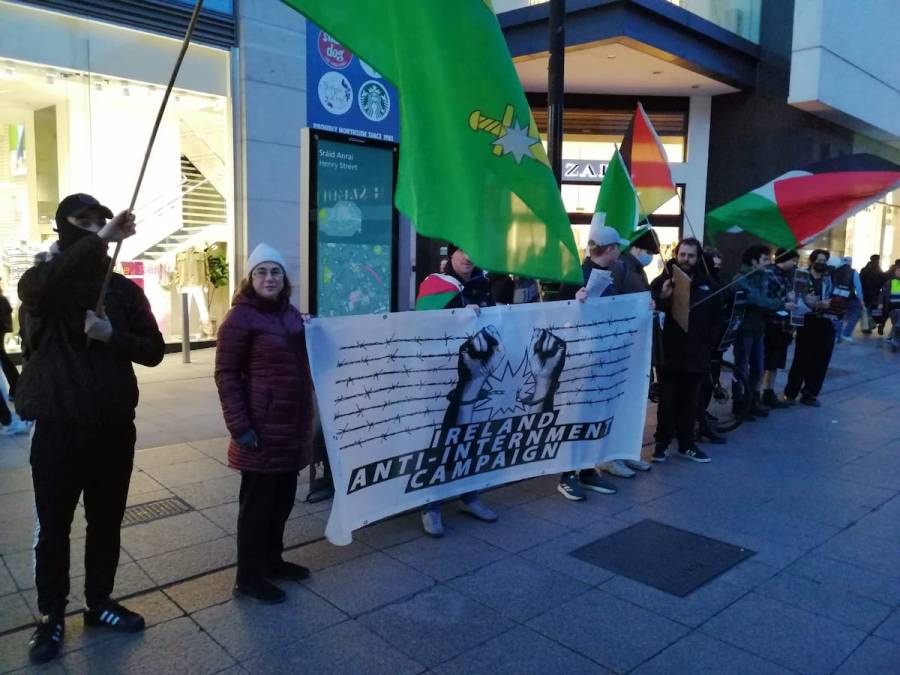
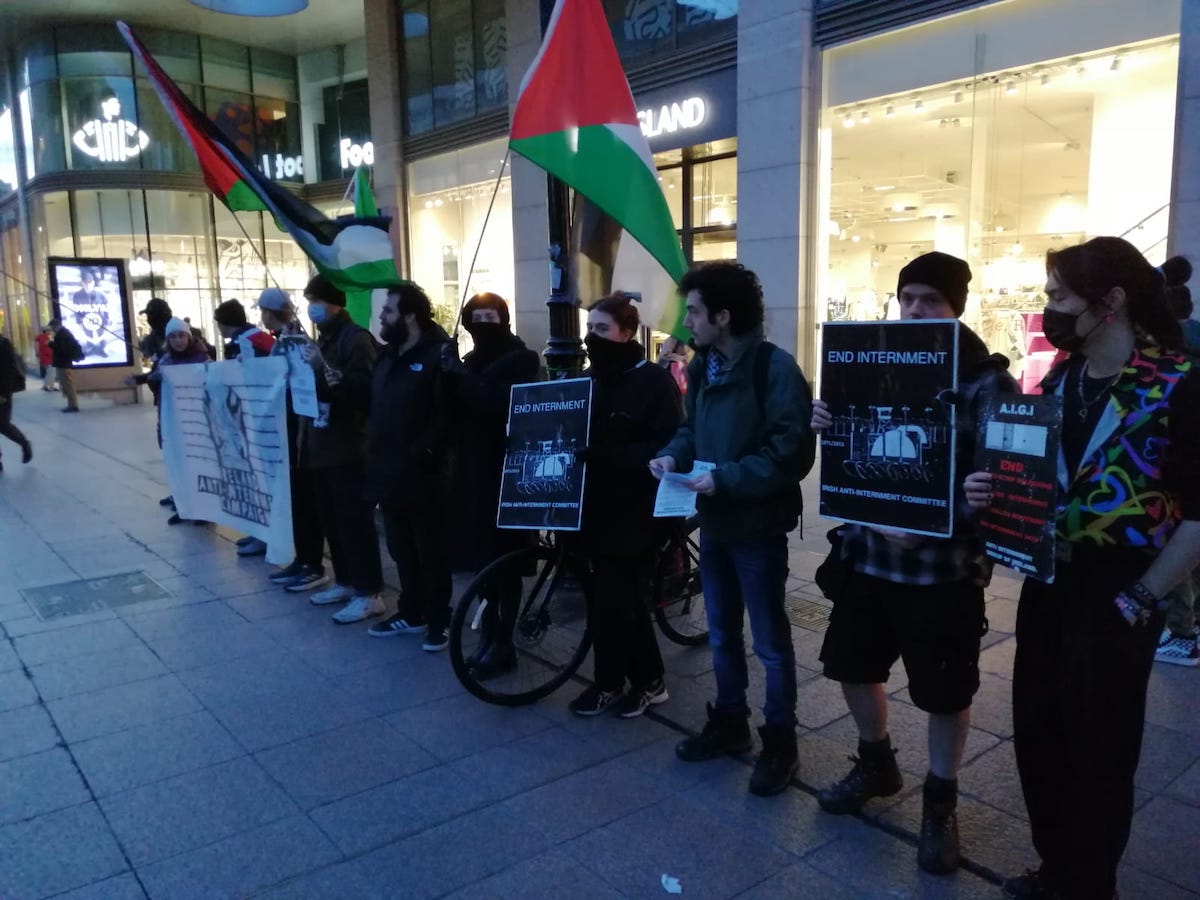
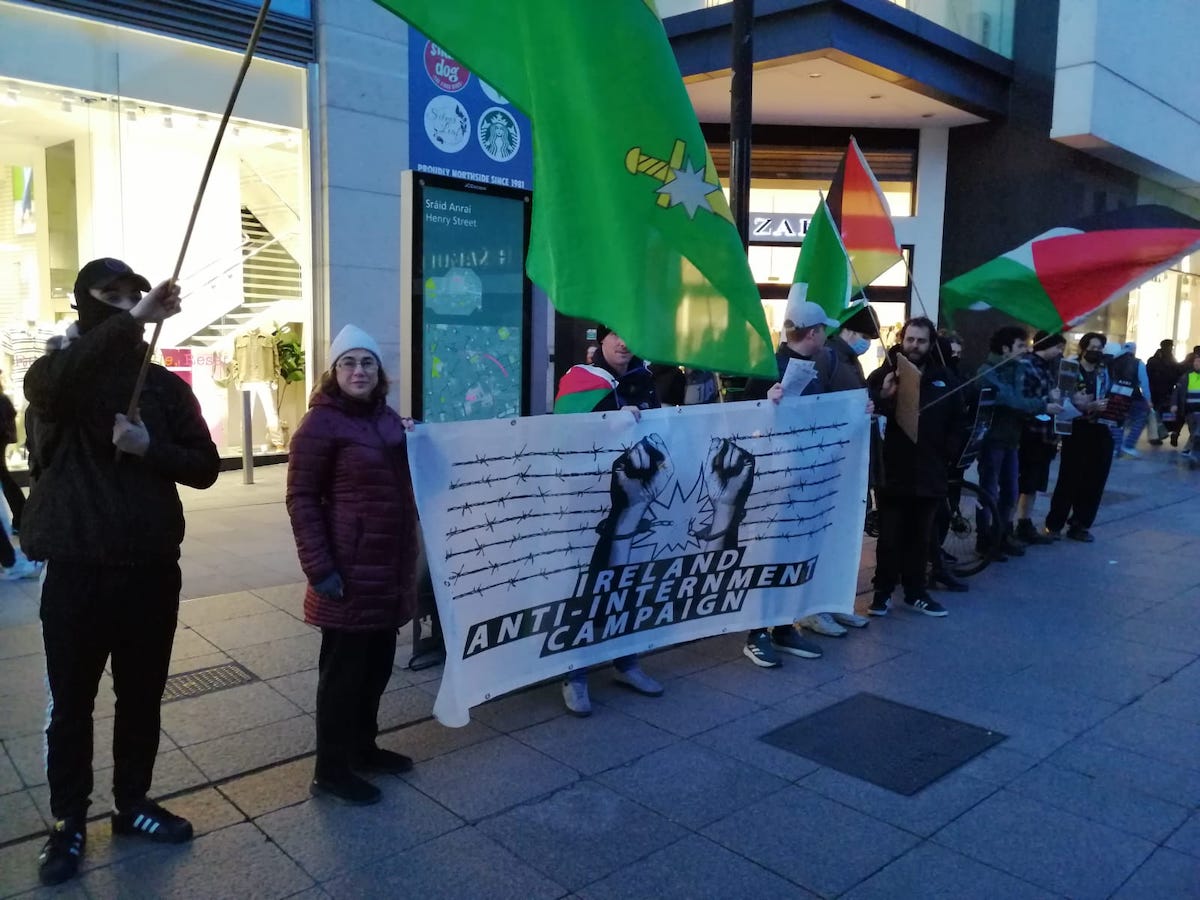
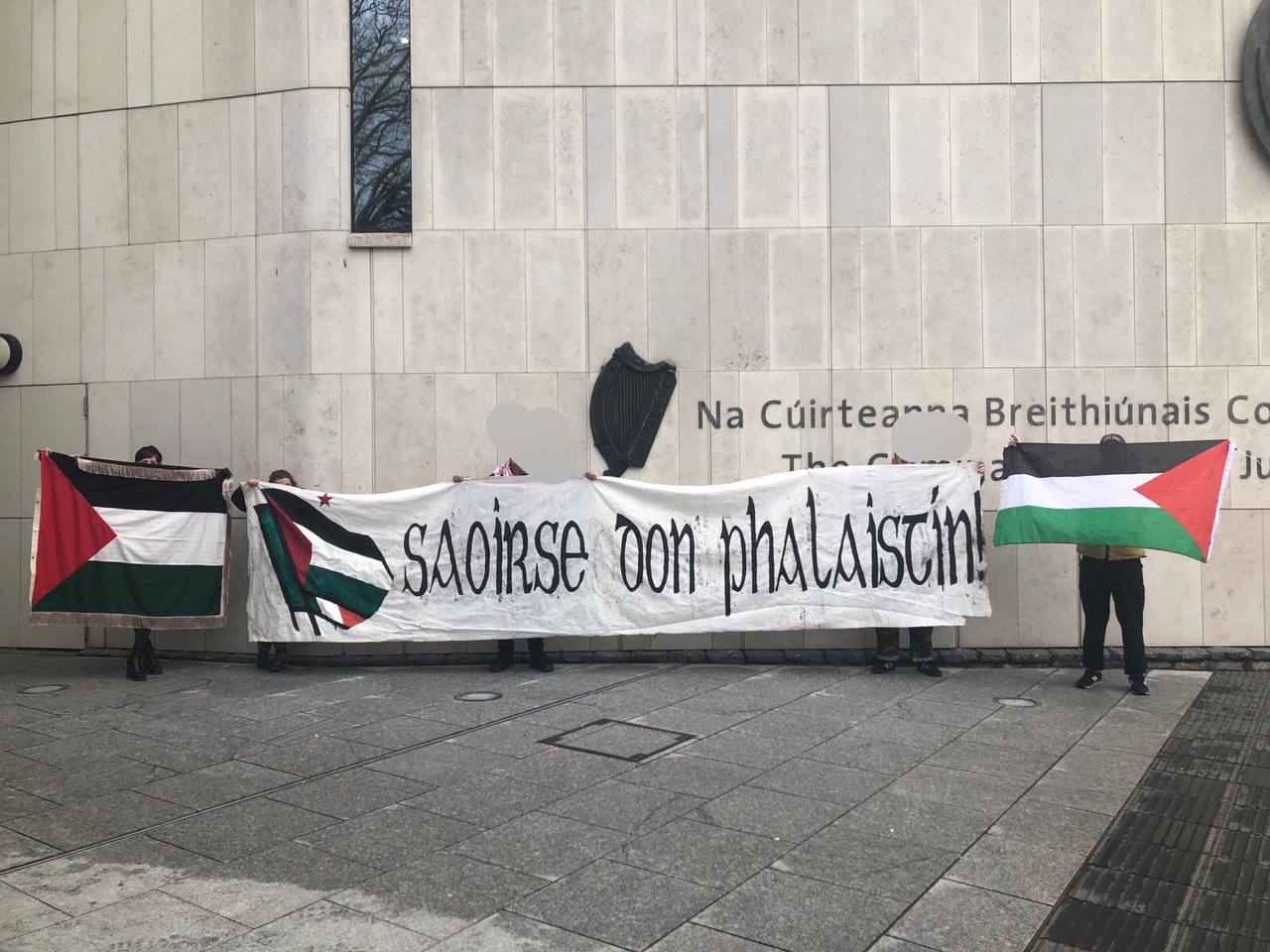
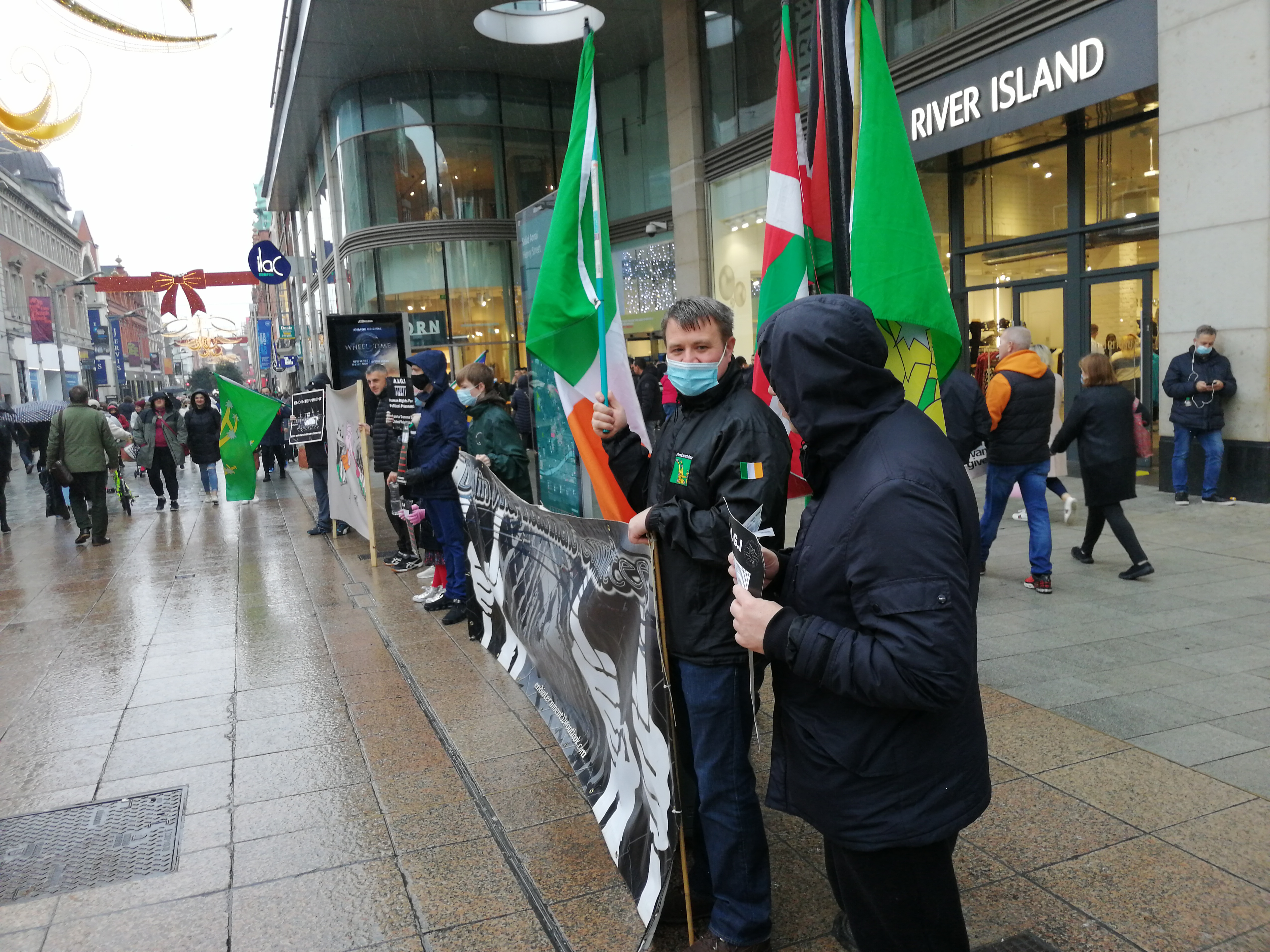
On Tuesday evening in one of Dublin city centre’s high-end shopping street picketers refuted colonial Minister for ‘Justice’ Naomi Long’s lie that “There are no political prisoners in Northern Ireland” (sic – she means the Six-County colony).
The Ireland Anti-Internment Campaign came on to the street to highlight that yes indeed, there ARE political prisoners in Ireland – over two score between both sides of the Border. And that furthermore, they are convicted in special political no-jury judicial processes.
View of the picket and the IAIC banner in Henry Street on Tuesday (Photo: Rebel Breeze)
The IAIC states that these judicial processes are called the “Diplock Court” in the occupied Six Counties and the “Special Criminal Courts” in the Irish state and were “specifically created in both cases for the easy conviction and jailing of Irish Republicans.”
The SCC has been labelled “a sentencing tribunal” rather than a court of law by human rights campaigners. IAIC states that the Diplock Court is “now being administered by former Republicans while the SCCs have now, after years of opposition, been approved by those same people.”
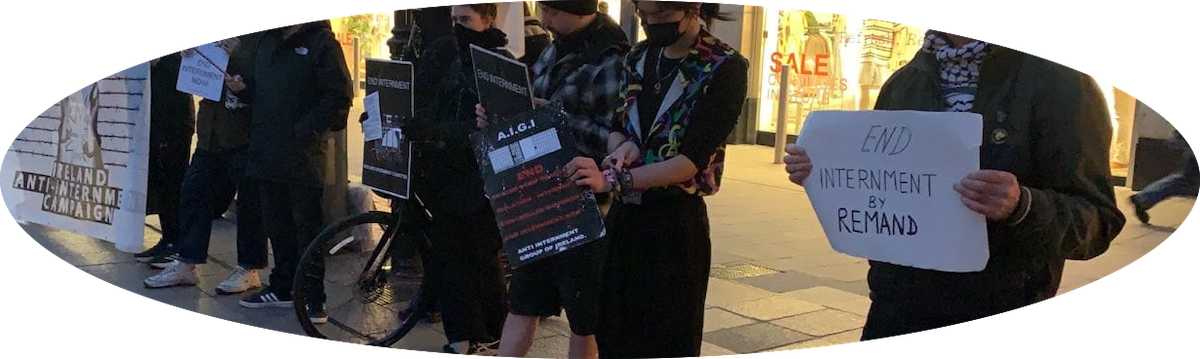
View of placards on the IAIC banner in Henry Street on Tuesday (Photo: Rebel Breeze)
However, as accused before these courts are also regularly refused bail, IAIC points out they are also effectively administrators of internment without trial, jailing activists for around two years before judicial process. If bail is granted, it is always under severe conditions preventing political activity.
The IAIC, an independent group campaigning for ten years, was supported in their picket yesterday by Irish Republicans and Socialists including from the Anti-Imperialist Action and Saoirse Don Phalaistín groups, in addition to some independent activists.
Although Henry Street is a high-end shopping street of Dublin city centre, lots of working class people use it also.
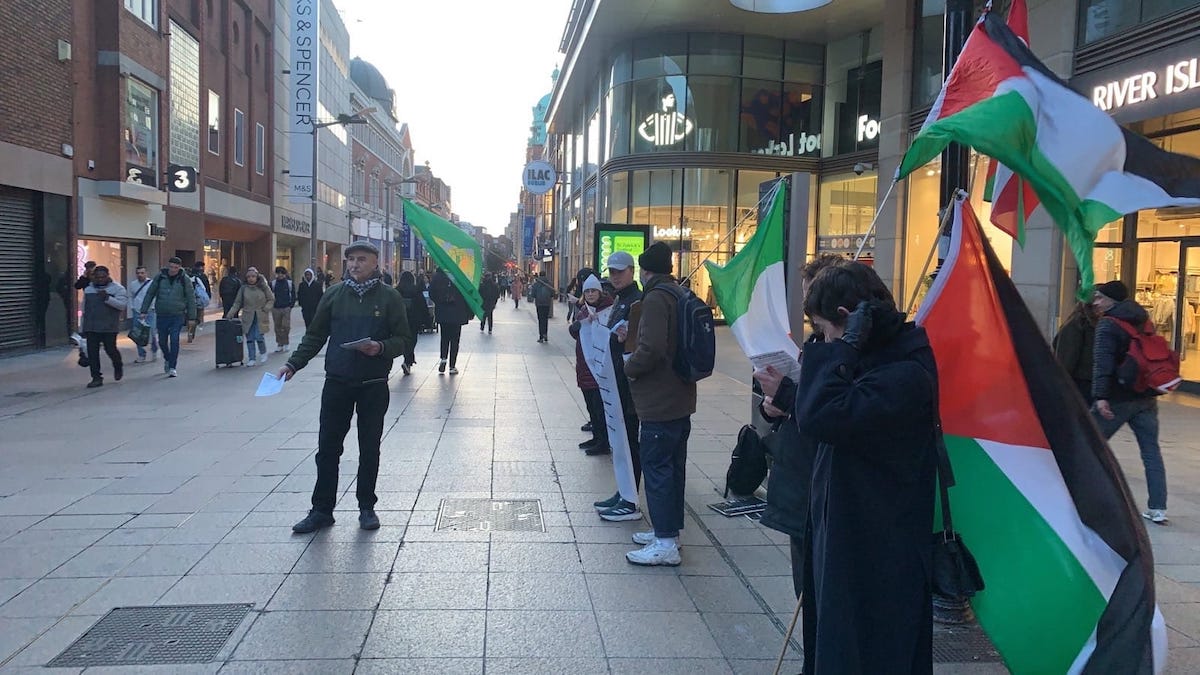
A member distributes leaflets to passers-by near the picket in Henry Street on Tuesday (Photo: Rebel Breeze)
Over 100 leaflets were distributed and a number of people stopped to discuss the issues. Some queried the mix of flags flown (Irish Starry Plough, Palestinian and Basque) and participants explained that these represented some of the struggles where repression has taken prisoners.
“We thought it particularly important to refute the colonial Minister’s lie today,” commented a spokesperson for the IAIC “and we’re glad for the support we received on the picket line and from interested people on the street. We hope to do it more often this year.”
“Internment continues in Ireland, just on a different scale and more selectively than for example in the Six Counties in the 1980s”, continued the spokesperson.
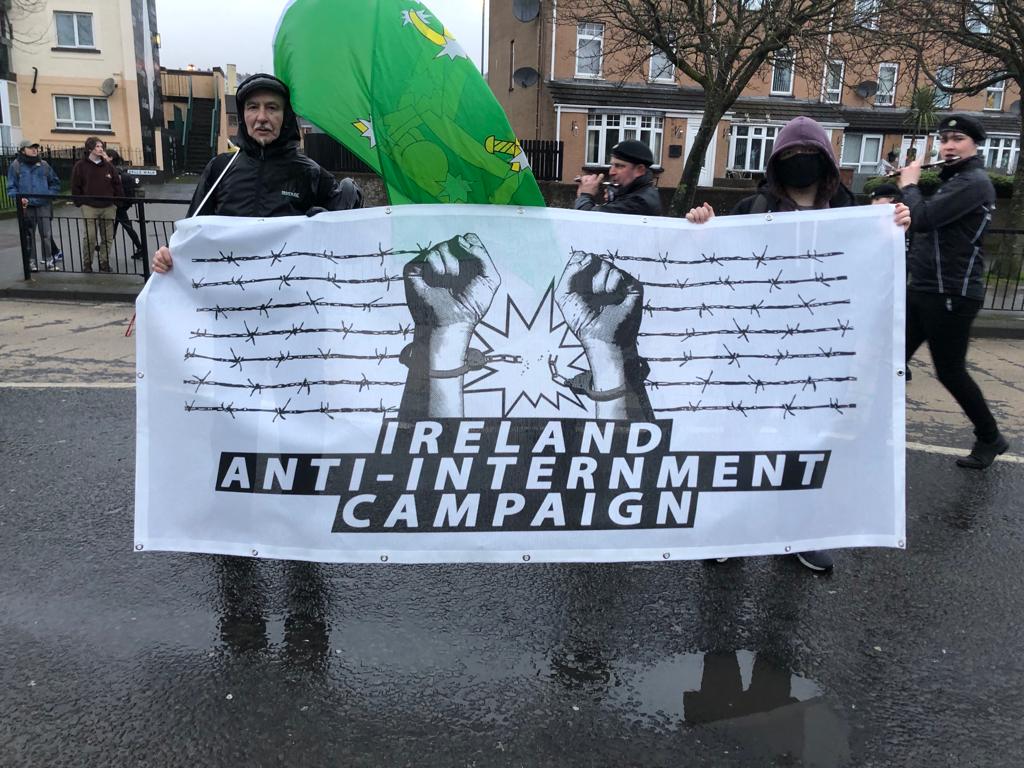
View of the picket and the IAIC banner in Henry Street on Tuesday (Photo: Rebel Breeze)
The IAIC states that it is “an independent campaigning group run on a participative democratic basis” and that it “welcomes democratic people” on their pickets. The Facebook page https://www.facebook.com/profile.php?id=100063166633467 is their usual public outlet for notification of events and highlighting of related issues.
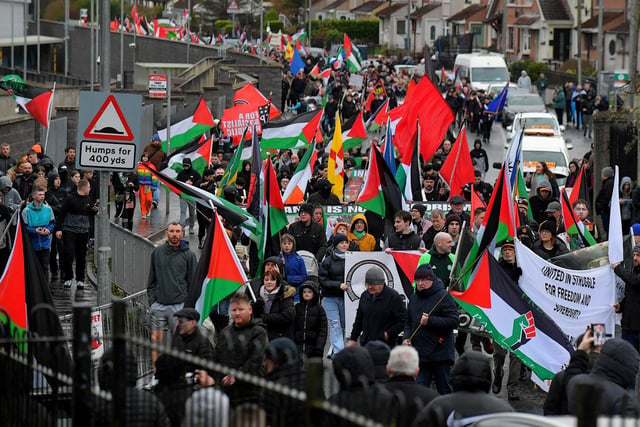
Led by four Republican marching bands and containing a number of organisations, around 6,000 people supported the annual march in Derry on Sunday commemorating the 1972 massacre by the British Parachute Regiment in the city.
This year a special focus on solidarity with Palestine had been called for by the organisers of the Bloody Sunday massacre commemoration and Palestinian flags mixed with ones of Irish Republican organisations decorated the march route.
The march begins at the Creggan Heights, overlooking Derry, a steep walk up from the Bogside, the city’s centre near the river and winds its way down (with a great view of the Foyle river and surrounding area) but then up Westland Street again and along Marlborough Terrace.
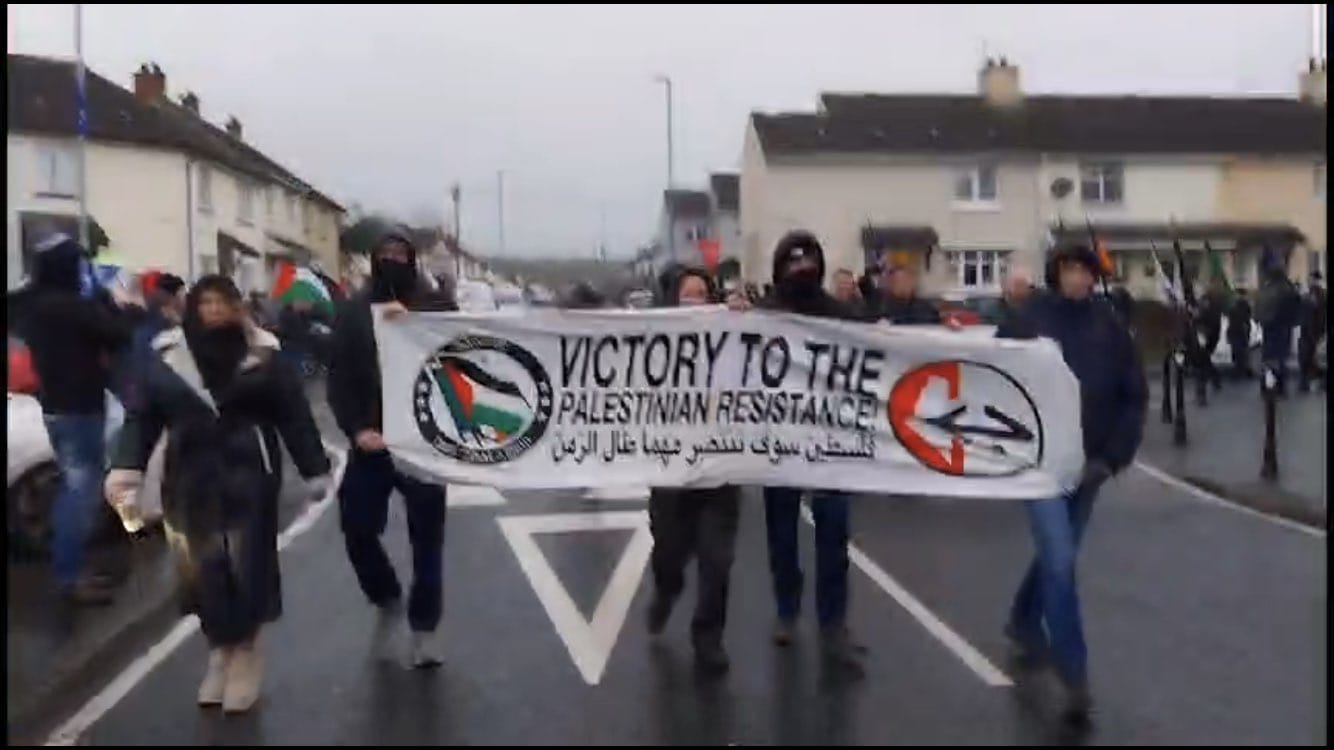
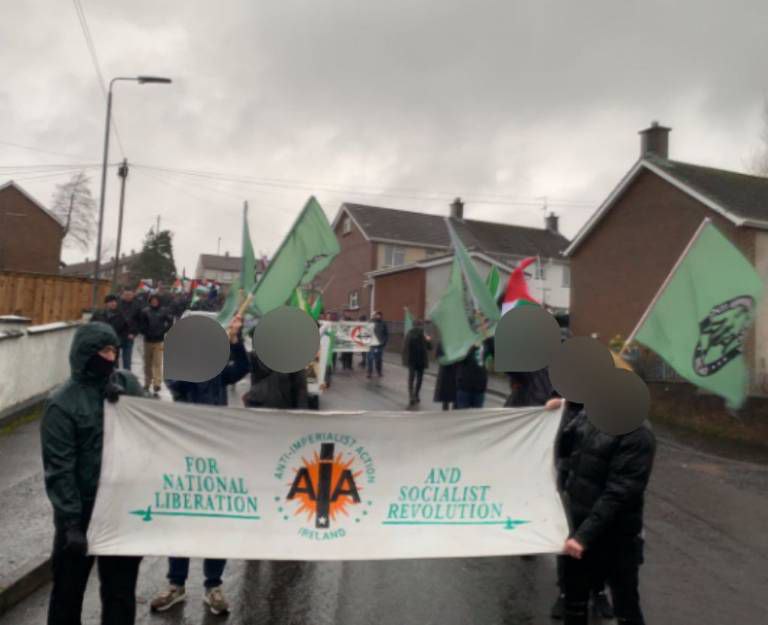
Rear banner of the AIA contingent on the Bloody Sunday commemoration march Sunday. (Photo source: AIA)
For a number of years this commemoration has taken place in heavy rain and high winds, or snow, or sleet but it was dry this year – until the march started! However after a short period of strong gusts driving rain it stopped for the rest of the march.
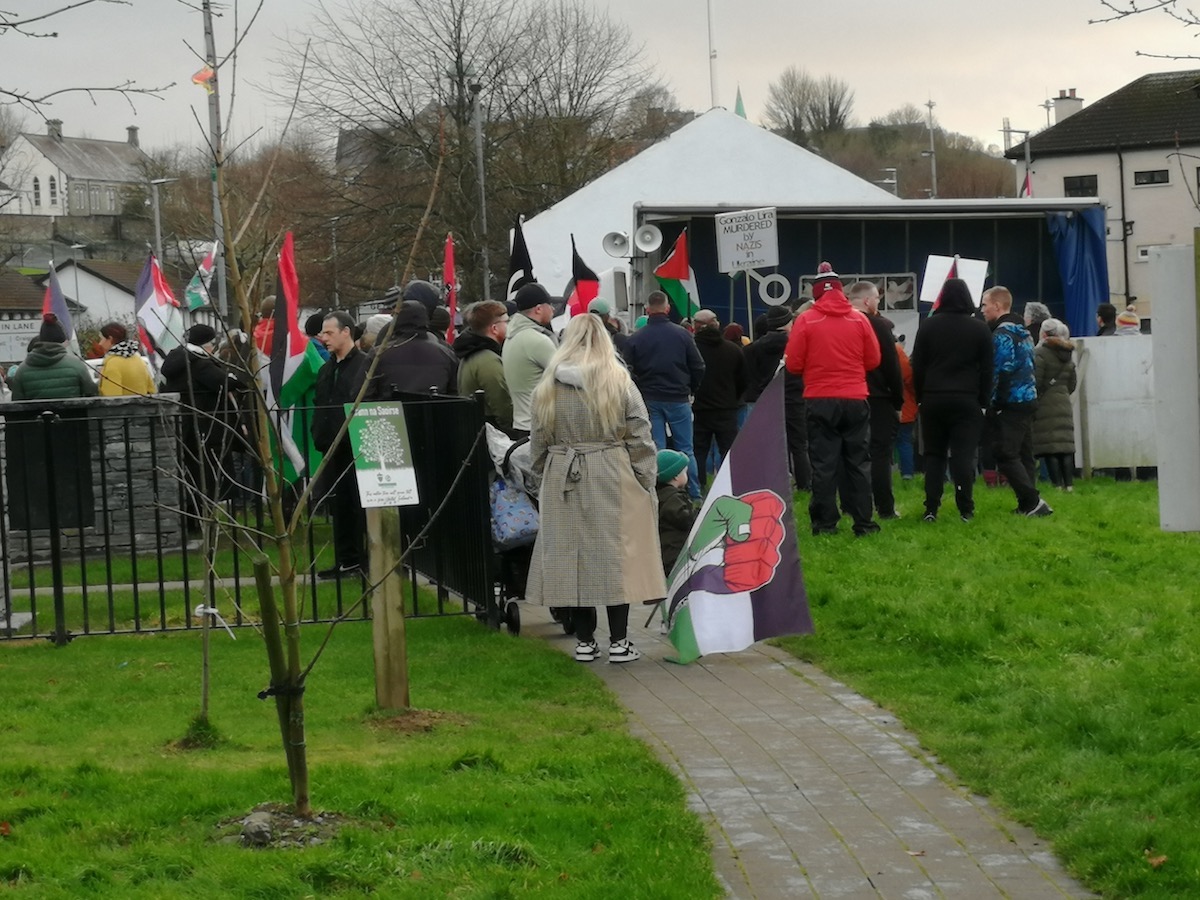
Down Creggan Road to the Bogside once more and past the Bloody Sunday and H-Block memorials to the rally at Free Derry Corner where Kate Nash, one of the main organisers of the march for years and a sister of one of those murdered in the massacre, welcomed the marchers.
The Bloody Sunday 52nd commemoration march makes it way along Lone Moor Road towards the Brandywell on Sunday afternoon. (Photo: George Sweeney via Derry News.)
RALLY AND SPEAKERS
Nash condemned the punitive EU/ UK/ USA cutting of funds to the UNRWA organisation carrying out relief and educational work in Gaza following an Israeli State intelligence allegation1 and also called for no Irish politicians to attend the annual US Presidential St. Patrick’s Day event.2
Kate Nash’s brother Willie was murdered by the Parachute Regiment during the massacre and her father was wounded by fire while trying to reach his fallen son. Kate called for a minute’s silence for the dead and wounded that day but also for those in Gaza, in particular the children.
Kate Nash also mentioned the Noah Donohoe case as being close to everyone’s heart.
The names of the dead and wounded by the Parachute Regiment were read out by Damian Donaghy,3 son of Damian Donaghy one of the survivors on that day. Paddy Nash performed the civil rights anthem “We Shall Overcome” which was popular among marchers of the time.
Section of the rally to the right as facing Free Derry Corner with a mural based on an iconic photograph from the massacre. (Photo: D.Breatnach)
Kate Nash introduced Huda Ammori, a Manchester-based Palestinian activist and one of the Elbit Eight,4 who said she felt at home in Derry because of the people’s solidarity with Palestine.5 The State in Britain failed to convict all but one of any charges arising out of direct action against the arms company.
Ammori drew parallels between the Irish and Palestinian struggles against colonialism and stated that her grandfather had been assassinated for rising up against the British colonisation of Palestine in 1936, when it was a British “Mandate”.
Mural on a wall in the Bogside, Derry; the words “don Phalaistín” are obscured by a vehicle. (Photo: D.Breatnach)
AIA Short Video with Music Bloody Sunday Derry 2024 AIA Video.MP4 (viewable on FaceBook)
“The British signed away the land of Palestine in 1917,” Amori told the rally, “they colonised our lands and then they armed and trained the Zionist militia to commit a Nakba, to displace over 750,000 Palestinians in 1948, over half the indigenous population.”
Huda Ammori said weapons were used on Palestinians in Gaza and then marketed as ‘battle-tested’. She also praised those who had taken direct action in Derry against arms firms (e.g Raytheon).
Section of crowd gathering in front of the stage for the rally. (Photo: D.Breatnach)
Geraldine Doherty, niece of Gerard Donaghy, youngest of the Bloody Sunday victims, also spoke from the platform, saying it was ‘sad’ but ‘heartwarming’ to see so many people attending the march.
“More than half a century since British troops committed this massacre on these streets, innocent children like my murdered uncle Gerard and hundreds of others as well are still being denied justice”, she said and denounced the British State attempting to prevent the trial of legacy cases being tried.
Doherty spoke of the remaining “trauma for Derry and for Ireland” from which many families have never recovered, with long-term post-traumatic damage such as depression, addiction and divided families.
“But while the people of Derry were battered and imprisoned, we were never broken,” she said to cheers from the rally participants. “Derry has rediscovered its … voice and we are using that voice to oppose the murder of children and women and men, and we stand with the people of Palestine.”
Section of crowd to the left of the stage at the rally.(Photo:D.Breatnach)
ON THE MARCH
Over the years since I returned to Ireland, I have marched in that commemoration many times, either as an individual or as a member of a solidarity committee and this year was glad to be welcomed as part of the Socialist Republican contingent, with Anti-Imperialist Action.
The bloc carried two banners: the one at the front was a new one in which the AIA called for anti-imperialist revolution and socialism, while at the rear the banner celebrated the Palestinian resistance. In between the banners marchers carried flags and placards.
New banner of the AIA in the organisation’s contingent on the march on Sunday. (Photo: D.Breatnach)
In the bloc men and women marched with a flags of the AIA, the Starry Plough, Palestine and Cumann na mBan. From the contingent on many occasions could be heard slogans of solidarity with Palestine and some equally applicable to that nation’s resistance or to Ireland’s.
“In the face of occupation – Resistance is an obligation!” and “No justice – No peace!” were in the latter category while “From the River to the Sea – Palestine will be free!”, “Free, free – Palestine!” and “Saoirse don – Phalaistín!” were specifically supporting the Palestinian struggle.
Most Republican organisations and some Irish socialist organisations attend the annual event, along with campaign groups and on occasion solidarity groups from abroad or Irish ones in solidarity with struggles abroad. Sinn Féin no longer attends but some supporters would as individuals.
Giant Palestinian flag displayed below the Derry Walls above the rally below. (Photo: D.Breatnach)
THE MARCH ROUTE AND HISTORY
The Bloody Sunday march covers the same route as the anti-internment march in January 1972 when the British Paratroopers murdered 14 unarmed marchers and injured so many others. Preceded by the Ballymurphy Massacre in August 1971, it was followed by another in Springhill in July ‘72.
The British military claimed that the Derry victims had been armed and fired first and an inquiry tribunal headed by Lord Justice Widgery exonerated the Army and blamed the victims although the Derry Coroner, an ex-British Army officer had called it “sheer unadulterated murder”.
In 1998, presumably as part of the Good Friday Agreement deal, the British State began a new inquiry which however did not deliver a published verdict until 2010,6 stopping short of accusing the Army of murder but exonerating all the victims except one about which it was equivocal.
At that point, Sinn Féin’s Martin McGuinness said that the march should not be continued; however not one British soldier had even been charged, to say nothing of the commanders and Government Ministers who had either given the orders or arranged the cover-up – or both.
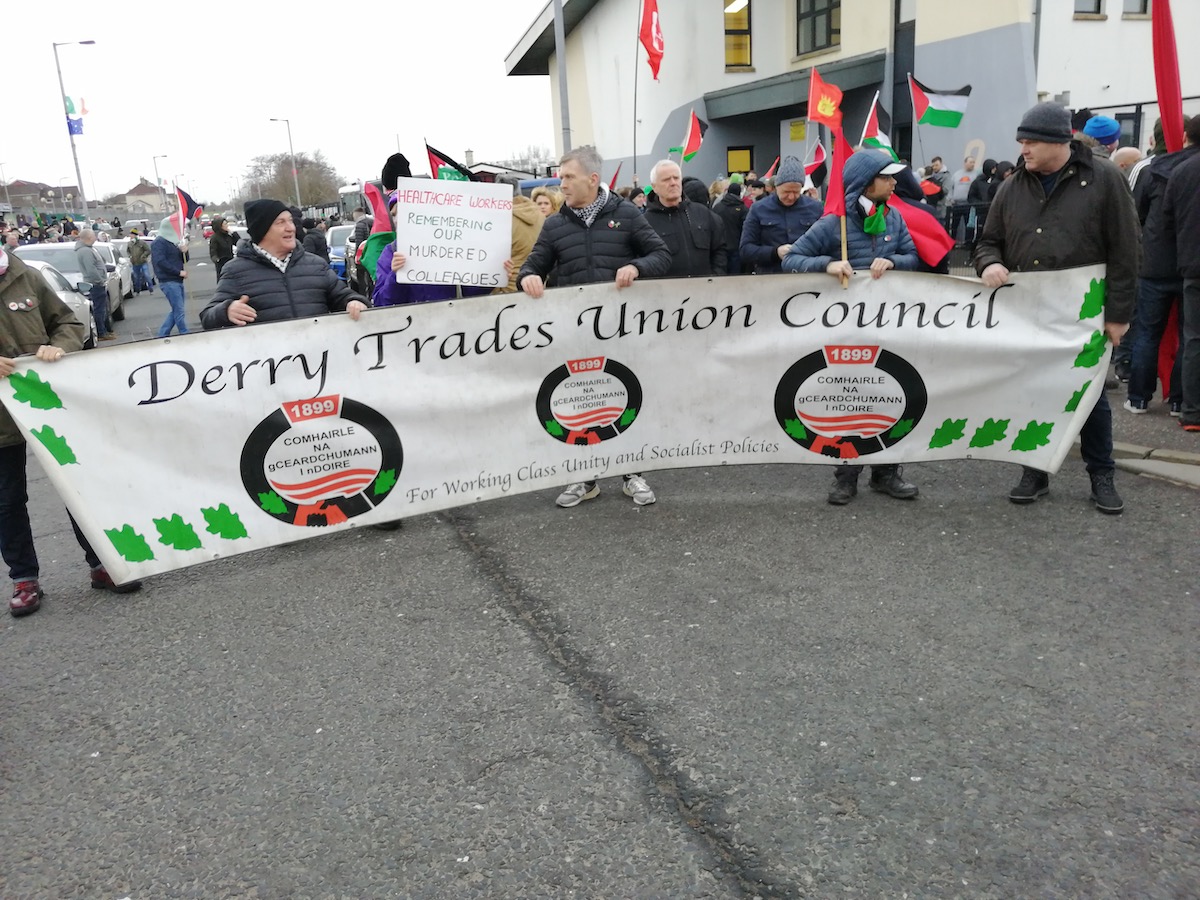
Banner of the organisation combining representation of trade unions in Derry. (Photo: D.Breatnach)
A small group of veterans of the original march and relatives, Kate Nash prominent among them, however decided to keep the march going and have done so every year, often in the face of accusations and disparaging remarks from supporters of Sinn Féin and others.
In 2022, the Massacre’s 50th anniversary, 20,000marched in it while the Bloody Sunday Trust, an institution and museum supported by the colonial state and Sinn Féin, organised a small “memorial walk” and indoors event in the Guild Hall – the only one reported by the mass media.7
An independent group, badly needed since the Coiste na nIarchimí is controlled by the Provisionals. (Photo: D.Breatnach)Display below Derry Walls created by the Saoradh Irish Republican organisation, according to their social media. (Photo: D.Breatnach)
Although veterans of the massacre and of the annual commemoration often meet one another only once a year at the commemoration, some having come from abroad, there are always new young people to be seen among them and hundreds come out to watch the march.
The march is an important commemoration of a massacre by British colonialism which still holds the colony of the Six Counties, a reminder no doubt inconvenient to unionists, neo-colonialists and those who have left the struggle, either through lack of will or for personal advancement.
In its championing and giving voice to other conflicts too, the commemoration march and other related events during the week are a strong expression of internationalist solidarity.
Wreath of the Bloody Sunday Commemoration Committee among others at the Bloody Sunday Monument. (Photo source:Bloody Sunday Commemoration Committee)
End.
FOOTNOTES
1The Israeli state intelligence agency reported that 12 out of 13,000 employees of UNRWA in Gaza had been implicated in the 7th October Palestinian raid following which at least some, possibly all, were sacked by UNRWA, apparently without any hearing or appeal process. The US, UK, Germany, Italy followed this up by suspending all funding to the relief organisation catering for 2 million people in dire circumstances.
2Traditionally, leading politicians of the main Irish political parties, both mainstream and Sinn Féin, have sent representatives to celebrate St. Patrick’s Day with US Presidents, many of whom are of Irish descent. This year a campaign has arisen calling on them not to do so but spokespersons of Fine Gael, Fianna Fáil and Sinn Féin have insisted they will attend, which the SDLP has declared it will not.
3Not to be confused with the family of Gerard V. Donaghy (20 February 1954 – 30 January 1972), sometimes transcribed as Gerald Donaghey, a native of the Bogside, Derry who was murdered by members of the 1st Battalion, Parachute Regiment on Bloody Sunday.
4Eight activists of British-based Palestine Action, a direct action organisation, who as a result of their actions against the Israeli-based military technology company Elbit in Britain, were charged with a total of 12 charges which included criminal damage, burglary and encouraging criminal damage. The trial, which commenced on November 13th, related to a series of actions taken during the first 6 months of Palestine Action’s existence from July 2020 to January 2021. In December last year, one activist was convicted on one charge by 10-2 majority, two were completely cleared and jury failed to reach a majority verdict on the rest of the charges on six remaining activists.
5That would be true of the majority ‘nationalist’ population of the city but not so much of the unionist minority, where support for Israel is more dominant, due in part to susceptibility to British propaganda and also simply out of sectarian hostility to anything favoured by the ‘nationalist’ community.
6At a cost of nearly £200m (€227.7m), half of which went in legal fees, a lawyer’s bonanza, to arrive at a decision that just about everyone in Ireland knew and many abroad knew already and which established no safeguards against a similar massacre being carried out by British military in future.
7Browser searches throw up report after media report, including Al Jazeera’s, of “hundreds” attending the early event, without a mention of the many THOUSANDS who marched later in the day.
The following is a compilation by Rebel Breeze of recent short communiqués from Anti-Imperialist Action on the confrontation with a British warship in Dublin and the raids on activists’ homes and arrests under the Gombeen State’s “terrorist” legislation (Offences Against the State Act).
Armed British Terrorists Confronted in Dublin.
On Sunday afternoon, members of Anti-Imperialist Action Ireland along with members of Saoirse Don Phalaistín, carried out a direct action against a British warship in Dublin port.
The protest was called to highlight the ongoing British Occupation of Ireland and to make clear the complicity of British Imperialism in the ongoing Zionist Occupation and Genocide in Palestine. The protest made clear the links between the National Liberation Struggles in Ireland and Palestine.
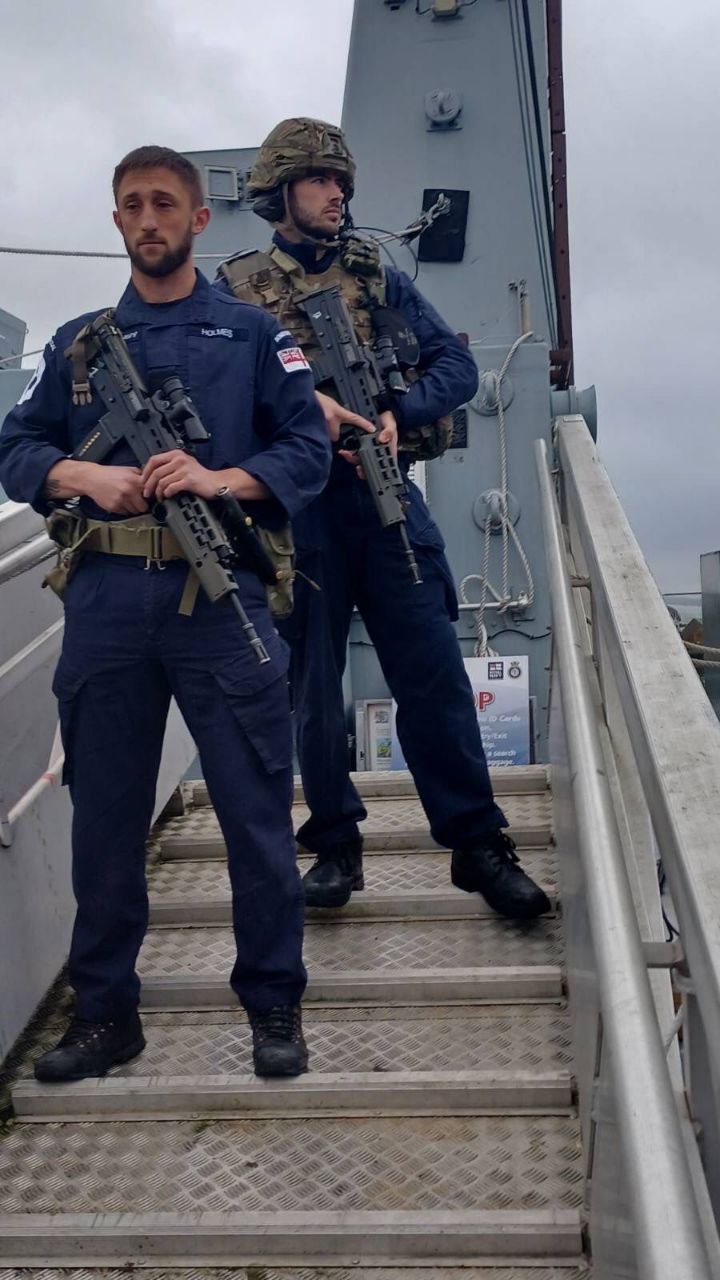
British Military confronting protesters in Dublin (Image sourced: AIA)
In a militant protest, the activists, chanted ‘From Ireland to Palestine, occupation is crime’ and Britain Out of Ireland and Palestine.’
During the course of the protest, the Republican Activists present confronted Armed British soldiers who appeared on the deck of the ship and a stand off ensued on the gangway.
End the occupation! End the genocide!
Free Palestine!
Free Ireland!
Solidarity picket outside the Dublin courts (Image sourced: AIA)
In a series of coordinated raids in Dublin this morning, a number of Republican Activists have been arrested and detained under section 30 of the Free States “Offenses against the state act”.
These arrests come as the state is increasingly fearful of the growth in Revolutionary Irish Socialist Republicanism and of Anti Imperialist Action Ireland in particular.
The arrests are timed to coincide with the leading role AIA has been playing in support of the Palestinian People and Resistance across the 32 counties and at a time when our members continue to confront and resist Imperialism across Ireland.
(Image sourced: AIA)
AIA condemn the raids and arrests by the Drew Harassers on Republican Community Activists and we call for these activists to be released back to their families and communities immediately.
Harassment, Raids, or Arrests will not stop AIA and Republican Activists from our work to rebuild the struggle for National Liberation and Socialist Revolution, resisting Imperialism or from taking a stand for Palestine.
The Republican Community Activists raided and arrested in Dublin yesterday have been released without charge.
The operation by the Drew Harassers, no doubt at significant cost, was designed to intimidate the growing membership and support base of AIA across Ireland, but it has failed, as all such operations will fail.
AIA welcome home these activists to their families and communities, where they belong. Republicans are not criminals. We will continue to promote the legitimate demand of rebuilding the Republic of 1916 at every opportunity. We will not be deterred and ultimately we will win.
Yesterday’s arrests are only further proof that the Free State fears the message of Revolutionary Socialist Republicanism, fears the growth and levels of support for AIA, fears our support for the Palestinian Resistance and fears our continued legitimate direct actions to confront and resist British, North American, European and Zionist Imperialism in Ireland.
We won’t be going away!
Free Ireland!
Free Palestine!
Also on Saturday, after the giant Palestine solidarity march in Dublin, according to another communiqué, members of AIA, Saoirse Don Phalaistín and Palestinian Solidarity Activists picketed the Leonardo Hotel on Parnell St.
The Leonardo Hotels are owned by Fatell Hotels the largest hotel group in ‘Israel’ and strong supporters of Zionist terrorism and genocide.
In response to the picket, the hotel has decided to enter lockdown, refusing to open the doors for guests.
November 17th is the anniversary of the date when a demonstration, mainly of Irish in solidarity with Fenian prisoners in British jails, saved the public Speakers’s Corner in Hyde Park from State control for everyone.
‘Frederick’ (Friedrich) Engels was there and reported on it (see below) with great admiration for the Irish diaspora. In his seminal The Condition of the Working Class in England (1845) he had not had that feeling for the Irish but had matured as a person and a revolutionary since.1
The Clerkenwell jail wall blown by Fenians (Photo sourced: Internet)
Frederick Engels and Karl Marx, both exiles from Germany, one by choice and the other as a refugee, came to form a strong corresponding, writing and organising partnership. Together they formed the International Working Men’s Association.
The First International, as it came to be called, took a position on many international questions but did not shirk the Irish one and indeed exposed and agitated about the terrible conditions under which Fenians were being held in British jails.
Jeremiah O’Donovan Rossa (1831-1915), a Fenian prisoner, wrote that he was for a period chained to the wall and had to eat his food from a bowl on the floor like a dog. It is also recorded that a third of the prisoners died in jail or went insane.
Frederick Engels as a young man (Photo sourced: Internet)
The Irish Republican Brotherhood had been founded in Dublin and in New York on St. Patrick’s Day, 1858 and in the USA quickly became better known as “the Fenian Brotherhood”. In Ireland they were frequently referred to as “the Fenians” or, by those on ‘the inside’ as ‘the IRB’.
Clearly from Engels’ description, “Fenians” was also the common description in Britain too. The Fenians took the war to Britain; the Crown responded by organising a specific police department, the Special Irish Branch of Scotland Yard, to spy on the Irish diaspora and to arrest suspects.
The “Special Branch” became known henceforth as the political department of the British police force but also of British colonial police forces in Ireland, Commonwealth countries such as Australia, and colonies such as Kenya, Uganda, Hong Kong …
We know that that the Fenian prisoners were not forgotten in Ireland, with campaigns for their freedom including articles, public events and even songs composed for them. But evidently they were not forgotten by the Irish diaspora in Britain nor by their socialist and democratic allies.
On November 17th 1872 the First International organised a march to Speakers’ Corner in London to protest the conditions under which those Fenian convicts were having to exist. Engels reported on the march and that he public speaking area was under threat of State control.
The Irish diaspora in Britain, the Irish-born migrants and descendants, contributed hugely to society and especially so to the working class in Britain, including presenting its anthem,2 its classic novel3 and two leaders4 of the Chartists, the working class’ first first genuinely mass movement.
In addition, members of the Irish diaspora helped build up the trade unions and were present in every movement against state repression, police violence, fascism, racism, colonialism and imperialism, fighting in organisations for housing, wages, free speech, political and civil rights.
Depiction of Speakers’ Corner meeting about the Fenian prisoners (Photo sourced: Internet)
Frederick Engels:
III Meeting in Hyde Park
London, November 14, 1872
The Liberal5English Government has at the moment no less than 42 Irish political prisoners in its prisons and treats them with quite exceptional cruelty, far worse than thieves and murderers.
In the good old days of King Bomba, the head of the present Liberal cabinet, Mr. Gladstone, travelled to Italy and visited political prisoners in Naples; on his return to England he published a pamphlet which disgraced the Neapolitan Government before Europe for its unworthy treatment of political prisoners.
This does not prevent this selfsame Mr. Gladstone from treating in the very same way the Irish political prisoners, whom he continues to keep under lock and key.
The Irish members of the International in London decided to organise a giant demonstration in Hyde Park (the largest public park in London, where all the big popular meetings take place during political campaigns) to demand a general amnesty.
They contacted all London’s democratic organisations and formed a committee which included MacDonnell (an Irishman), Murray (an Englishman) and Lessner (a German) — all members of the last General Council of the International.
A difficulty arose: at the last session of Parliament the government passed a law which gave it the right to regulate public meetings in London’s parks.
It made use of this and had the regulation posted up to warn those who wanted to hold such a public meeting that they must give a written notification to the police two days prior to calling it, indicating the names of the speakers.
This regulation carefully kept hidden from the London press destroyed with one stroke of the pen one of the most precious rights of London’s working people — the right to hold meetings in parks when and how they please.
To submit to this regulation would be to sacrifice one of the people’s rights.
The Irish, who represent the most revolutionary element of the population, were not men to display such weakness.
The committee unanimously decided to act as if it did not know of the existence of this regulation and to hold their meeting in defiance of the government’s decree.
Last Sunday at about three o’clock in the afternoon two enormous processions with bands and banners marched towards Hyde Park.
The bands played Irish songs and the Marseillaise6; almost all the banners were Irish (green with a gold harp in the middle) or red.
There were only a few police agents at the entrances to the park and the columns of demonstrators marched in without meeting with any resistance. They assembled at the appointed place and the speeches began.
The spectators numbered at least thirty thousand and at least half had a green ribbon or a green leaf in their buttonhole to show they were Irish; the rest were English, German and French.
The crowd was too large for all to be able to hear the speeches, and so a second meeting was organised nearby with other orators speaking on the same theme.
Forceful resolutions were adopted demanding a general amnesty and the repeal of the coercion laws which keep Ireland under a permanent state of siege.
At about five o’clock the demonstrators formed up into files again and left the park, thus having flouted the regulation of Gladstone’s Government.
This is the first time an Irish demonstration has been held in Hyde Park; it was very successful and even the London bourgeois press cannot deny this.
It is also the first time the English and Irish sections of our population have united in friendship.
These two elements of the working class, whose enmity towards each other was so much in the interests of the government and wealthy classes, are now offering one another the hand of friendship; this gratifying fact is due principally to the influence of the last General Council of the International,[307] which has always directed all its efforts to unite the workers of both peoples on a basis of complete equality.
This meeting, of the 3rd November, will usher in a new era in the history of London’s working-class movement.
You might ask: “What is the Government doing? Can it be that it is willing to reconcile itself to this slight? Will it allow its regulation to be flouted with impunity?”
Well, this is what it has done: it placed two police inspectors and two agents by the platforms in Hyde Park and they took down the names of the speakers.
On the following day, these two inspectors brought a suit against the speakers before the ustice of the Peace. The justice sent them a summons and they have to appear before him next Saturday.
This course of action makes it quite clear that they don’t intend to undertake extensive proceedings against them.
The government seems to have admitted that the Irish or, as they say here, the Fenians have beaten it and will be satisfied with a small fine. The debate in court will certainly be interesting and I shall inform you of it in my next letter.[308]
Of one thing there can be no doubt: the Irish, thanks to their energetic efforts, have saved the right of the people of London to hold meetings in parks when and how they please.
Notes
307 By the “last” General Council Engels means the London Council that existed before the Hague Congress of the International at which a decision was adopted to transfer the scat of the General Council to New York.
308 In the fourth article of the Letters from London series: “Meeting in Hyde Park. — The Position in Spain,” written on December 11, 1872, Engels reported that the Justice of the Peace could do no more than impose the smallest possible fine, and since his decision anyway ran contrary to the rules governing behaviour in Hyde Park the accused demanded that the case be brought before a court of appeal.
Engels’s Letters from Londonappeared in La Plebe, the newspaper of the International’s sections in Italy, early in April 1872, and continued throughout the year.
Early in 1873, Engels’s co-operation with La Plebewas temporarily interrupted due to government reprisals against the paper’s editors.
La Plebe was published under the editorship of E. Bignami in Lodi between 1868 and 1875, and in Milan between 1875 and 1883. Up to the early seventies the newspaper followed a bourgeois-democratic line, later it became socialist.
In 1872-73 La Plebeplayed an important role in the struggle against the anarchist influence in the Italian working-class movement. Engels’s contributions greatly promoted the paper’s success.
In 1882, the first independent party of the Italian proletariat the Workers’ Party — formed around La Plebe.
Source: Marx and Engels on Ireland, Progress Publishers, Moscow 1971; First Published: in Italian in La Plebe, November 17, 1872; Transcribed: by Andy Blunden.
1Aided by the Burns sisters Lizzie and Mary when he lived in Manchester, one of whom was his partner until she died and the other, subsequently his wife.
5The two main bourgeois political parties in Britain at the time were the Conservatives and Liberals; over time the latter declined and was replaced in its counterpoint to the Conservatives by the British Labour Party.
6French national anthem now but originally song of the French Republican uprising of 1789. In addition the air has been used for the lyrics other revolutionary songs.
“Six innocent men” … “Garda oppression and perjury’ … “Longest case in the history of the State”
Four leading human rights organisations this week delivered a petition to the Irish Government asking the Minister for Justice to establish an inquiry into the abuse suffered by six innocent men in the Sallins case almost half a century ago.
Not to do hold such an inquiry, maintained Liam Herrick of the Irish Council for Civil Liberties at a press conference on Tuesday, is to continue the abuse of the victims’ human rights and to fail to prevent such an abuse in the future.
Osgur Breatnach, Liam Herrick and Nicky Kelly at the petition launch press conference (Photo: Rebel Breeze)
Apart from the ICCL, the other three organisations pushing the petition are the Committee for the Administration of Justice (CAJ), the Pat Finucane Centre (PFC) and Fair Trials; the first three are Ireland-based organisations and Fair Trials is a global criminal justice watchdog.
The six innocent men were named as Osgur Breatnach, Michael Barrett, John Fitzpatrick, Nicky Kelly, Brian McNally and Michael Plunkett (deceased1).
At the time in 1976 all were members of a legal political party (the Irish Republican Socialist Party) but were tortured and some jailed in the Irish state.
In the longest series of trials in the history of the State, three of the men were sentenced at the end of 1978 to prison terms of between nine and twelve years each on the basis of no ‘evidence’ but their confessions obtained by torture and which in court they completely retracted.
Michael Plunkett, who had signed no confession walked free while Nicky Kelly absconded the day before the sentence, eventually reaching the USA where he remained until a strong campaign saw Breatnach and McNally freed, whereupon Kelly returned to Ireland and was immediately jailed.
Although the nature of the ‘evidence’ against Kelly was of the same kind as that which had been declared ‘unsafe’ for Breatnach and McNally, Kelly remained in jail forfour-and-a-half years, despite another strong campaign2 and was only freed eventually on ‘humanitarian grounds’3.
PRESS CONFERENCE
ICCL’s Liam Herrick chaired the conference in Buswell’s Hotel4 flanked by survivors Osgur Breatnach and Nicky Kelly, while Chris Stanley of KRW Law sat nearby, all facing the audience which included Sinn Féin’s Pa Daly TD5 and Fionna Crowley of Amnesty International.
Opening the proceedings, Herrick listed the four organisations backing the call for an inquiry and pointed out the present-day relevance of that call, both in terms of the survivors and their families and in terms of wider society.
Not to have that inquiry would be an ongoing violation of human rights, Herrick maintained and pointed out that the ICCL was founded arising out of concerns regarding the post-Sallins robbery arrests and the activities of the Garda CID unit colloquially known as the “Heavy Gang”.
The ICCL Director stated that they could not rest until the demand for an inquiry was met and referenced also “crucial legislation before the Oireachtas”6 and recognition of past injustices in a series of TV documentaries linking the cases, in particular through actual Garda individuals.
Introducing Osgur Breatnach, Herrick acknowledged the leading role he had played in keeping the demand for the inquiry going over the years.
Breatnach read from a prepared statement that there had been cases of torture, perjury and framing innocent people in England, Northern Ireland and the Republic.
It was wrong and hypocritical of the State raising concerns about cases elsewhere not to hold an inquiry into the Sallins case, of which there had been five trials, one the longest in the history of the State.
Breatnach said he went through the process expecting to be jailed but to expose the political nature of their persecution; his and McNally’s convictions were overturned, the ‘confessions’ having been obtained by oppression but despite that none were indicted for that oppression.
Breatnach concluded saying that the State’s refusal to hold an inquiry amounted to cruel and inhuman treatment of the victims and their families and that without the investigation of an inquiry a similar scenario could be repeated at some point ahead.
Nicky Kelly, introduced by Herrick thanked the ICCL for organising the events that day. Speaking apparently ex-tempore with perhaps reference to some bullet-points, he expressed the opinion that the State wanted the victims to die so that they had no need to hold an inquiry.
“Ireland has an impeccable reputation with regard to foreign relations,” Kelly said, but not so within the state. He believed that the Sallins case is “too big in its implications for politicians, judiciary and police force” and all attempts to investigate were obstructed by successive governments.
Liberal politicians in government have been “no different from the rest”, the Wicklow man said and referred to his own personal battle even to get out of jail after the ‘evidence’ to convict him had been discredited and how he had been obliged to undertake a hunger strike to be freed.
Now, rather than hold the inquiry into what went on, they were waiting for him “to be over and done with” Kelly said in conclusion.
Herrick introduced Chris Stanleyof KRW Law who said that cases such as the Birmingham pub bombings and the Dublin and Monaghan bombings, like the Sallins one, all related to the recent conflict and required investigation for the sake of the victims.
Chris Stanley of KRW Law speaking at the petition launch press conference (Photo: Rebel Breeze)
Stanley commented that perhaps the State had been too reliant on the Good Friday Agreement for resolution of these matters.
Commenting on the UK’s new legislation blocking much resolution of historic cases, all but become law, the solicitor regretted the UK had chosen to disengage from Europe but remarked that that they remained signed up to the European Commission of Human Rights.
From among the seated audience, Fionna Crowley of Amnesty International spoke to underline the importance of having an inquiry into the case and that her organisation had been in support of the victims’ campaigns and was fully in support of the current petition for an inquiry.
Breatnach acknowledged that within one week of the arrests, Amnesty had raised public concerns about them.
DELIVERY OF PETITION TO DEPARTMENT OF JUSTICE
After the conclusion of the press conference with Herrick’s summing-up and thanks to those in attendance, Herrick and ICCL staff along with Chris Stanley, Breatnach, Kelly and a couple of others walked to the Dept. of Justice’s offices on the south side of Stephens Green.
Delivering the petition to the Department of Justice: (from bottom up) Nicky Kelly, Osgur Breatnach, Chris Stanley, Liam Herrick. (Photo: Rebel Breeze)
Pausing for some photos to be taken, a delegation entered the building and presented the petition. Then some more photos were taken outside and Breatnach was interviewed by a TG4 reporter in Irish and Nicky Kelly in English while a light rain began to fall.
TG4 (Caoimhe Ní Laighin) interviews Osgur Breatnach outside the Department of Justice in Stephen’s Green (Diarmuid, brother of Osgur is centre photo and Nicky Kelly to the right). (Photo: Rebel Breeze)
The group split up into smaller groups then, the ICCL staff returning to their office to issue a press statement and others to hope, perhaps with further pushing, for positive developments further – but not too far – down the road. For all and for some much more than others, it’s been a long haul.
End.
Outside the Department of Justice with copies of the four-agency petition (right to left): Liam Herrick of ICCL, Chris Stanley of KRW Law, victims/ campaigners Osgur Breatnach and Nicky Kelly (Photo: Rebel Breeze)
APPENDIX (A): BACKGROUND
The IRSP was the result of a split from what had remained in Sinn Féin after an earlier split in 1969, the group leaving the party then calling themselves ‘Provisional Sinn Féin’.
Not all who had become unhappy with the direction of Sinn Féin departed into Provisional Sinn Féin because they perceived the new group as being much more nationalist than socialist and being also socially conservative.
After some internal struggle that section remaining within what became known as “Official Sinn Féin” left in 1974 under the leadership of Séamus Costello to form the IRSP.
The armed wing of the Republican movement had split along the same lines into Provisional IRA, Official IRA and the Irish National Liberation Army, the latter loyal to the perspective of the IRSP.7
Bernadette Devlin (now McAlliskey) and Tony Gregory (now deceased) were on the IRSP’s Executive but however departed soon afterwards from the party on what they perceived as the dominant relationship of the armed group INLA to the political party.
It appears that the Irish State at that time viewed the IRSP as more dangerous than the two Sinn Féin parties and determined to ensure its demise, framing them for the Sallins Mail Train Robbery in March 1976.8 And framing, rather than mistaking, it was.
The 40 arrested included IRSP members who, tortured by the SDU Garda unit known colloquially as the “Heavy Gang”, confessed to participating in the robbery but who could not possibly have been there. The State decided to put on trial those whose only alibis were with family.
The court chosen was the Special Criminal Court, set up under the Offences Against the State Act in the panic of the 1974 Loyalist and British Intelligence Bombing of Dublin and Monaghan which somehow got blamed on Irish Republicans. The SCC has three judges and no jury.
Until the SCC moved to the court building near the main gate to Phoenix Park, it was located in Green Street, in the very same building where Robert Emmet was tried in 1803 and sentenced to death, his sentence carried out in public in Thomas Street, in the Dublin Liberties area.
The Four IRSP eventually selected for the second of what became four trials included senior member of the party’s Executive and the Editor of its newspaper, The Starry Plough, Osgur Breatnach.9
In the second trial, one of the three judges hearing the case was regularly seen to be sleeping. Only after the judge died suddenly was there another retrial ordered.
In the fourth trial, Kelly being tried in his absence, the judges accepted as fact10 the Prosecution case that the injuries of the accused were due to beating one another up (in Breatnach’s case, that he’d beaten himself up) and that their withdrawn confessions were true.
Mick Plunkett, in the absence of a ‘confession’, was found not guilty but the other three were sentenced to 12 years in jail. In May 1980 Breatnach and McNally were freed by the Appeal Court on grounds that they had suffered ‘oppression’ and that their confessions could not be relied upon.
No investigation took place into who had carried out the ‘oppression’ or how the judiciary had jailed the victims purely on withdrawn confessions and Garda perjury or which political decisions by whom were behind it.
Nicky Kelly returned to Ireland in 1980 — but to jail.
He was only freed by a Minister of Justice on ‘humanitarian’ grounds after four-and-a-half years in jail, a strong campaign seeking his release and finally a hunger strike of 38 days which pushed the European Court of Human Rights to agree to hear his case.
He received a presidential pardon in 1992 from Mary Robinson and in 1993 Breatnach, McNally and Kelly were awarded compensation, allegedly a six-figure amount. But to get that, they had to forgo any litigation on torture or police brutality.
No official inquiry has ever been carried out in the whole set of State actions and in fact some of the Heavy Gang went on to force false confessions from others, most notably the Joanna Hayes and relatives case.11
APPENDIX (B): SUPPORTING STATEMENTS FROM OTHER ORGANISATIONS
Also speaking elsewhere on the day, Director Daniel Holder of the Campaign for the Administration of Justicesaid they support this call and that
“an inquiry into the case of the Sallins Men is long overdue.”
He went on to say that “Over the last few years inquests and other legacy mechanisms in the north have been finally delivering like never before for families who have had to wait decades.
“They are providing important historical clarification for victims and accountability for past human rights violations but now face being shut down by the notorious UK Legacy Bill.”
Pat Finucane Centre (PFC) Director Paul O’Connor said that
“PFC welcomes this demand to the Irish Government for a human rights compliant investigation into the miscarriage of justice that followed the Sallins Trains Robbery 1976.
For too long human rights violations that occurred in the Republic of Ireland during the Conflict have been at best marginalised or at worst ignored.
Successive Irish governments have either relied upon the British to address the investigatory deficit of the Conflict or deflected it as an inconvenient non-issue.
“Now the human rights deficit created by those successive Irish governments is clear – and will be clearer when the legislative effect of the British Legacy Act starts to bite.
The Irish Government was right to challenge the British about the use of torture suffered by the Hooded Men; now it must look to its own police and criminal justice system and acknowledge the torture suffered by the Sallins Men.”
Verónica Hinestroza, Senior Legal Advisor at Fair Trials said:
“According to international standards, States must investigate complaints and reports of torture or ill-treatment.
We call on the Minister for Justice to ensure that a prompt, impartial and independent investigation is conducted into the allegations made by Mr Osgur Breatnach, Mr Michael Barrett, Mr John Fitzpatrick, Mr Nicky Kelly, Mr Brian McNally and Mr Michael Plunkett (deceased), considering that torture and ill-treatment violations are not to be subject to any statutes of limitation.”
2 The campaign PRO was CaoilteBreatnach, a brother of Osgur’s and was supported by many people in the fields of politics and culture, including the band Moving Hearts who performed Christy Moore’s song about the Nicky Kelly case, The Wicklow Boy.
3 By Minister of Justice Michael Noonan after Kelly’s hunger strike of 36 days. According to law, Kelly had exceeded the time period after conviction permitted for registering an appeal and it was claimed that only a ‘pardon’ could set him free.
4 Buswell’s is across the road from Leinster House, the Irish Parliament building and is frequently host to political meetings and press conferences.
5 Recently appointed to Sinn Féin’s front bench as spokesperson on Justice, he is by profession a solicitor.
7 The history of the IRSP is a separate and contentious story but suffice it to say that of the ten hunger strike martyrs in 1981, three were INLA; at one point a number of INLA factions were feuding within it leading to a number of fraternal murders. After the Provisional prisoners embraced the Good Friday Agreement and left the jails renouncing armed resistance, the much smaller contingent of INLA prisoners did the same. The IRSP remains a legal though much reduced political party.
8 The robbery was carried out by a unit of the Provisional IRA which however did not acknowledge operations carried out within the Irish State, to which ion 27th April 1980 they made an exception in a public statement taking responsibility for the robbery. The Irish State chose to ignore their statement as had the British State when the Balcolme Street group ibn 1977 admitted in court their responsibility forthe Guildford Pub Bombingsfor which the UK had jailed the innocent Guildford Four and Maguire Seven.
9 Apart from anything else, the notion that prominent Executive members under constant police surveillance, including one regularly working on the newspaper in the Dublin office (in the days before this could be done from anywhere else), could carry out such an operation, was clearly ridiculous.
10 According to the Court of Criminal Appeal in the “Madden” Case in November 1976, Appeal Courts should usually accept as a finding of fact anything decided by the Special Criminal Court (SCC) to be a fact. Therefore although a court verdict of guilt or innocence can be overturned on appeal, a decision as to fact made in the non-jury Special Court cannot be overturned in any appeal court.
11 Three separate cases of false confessions obtained by Gardaí, including the Sallins and Joanna Hayes cases, were covered in the three-part documentary series Crimes and Confessions by the Irish TV channel RTÉ July 2022- January 2023: https://www.rte.ie/player/series/crimes-and-confessions/SI0000012595?
We are very sincere about defending democracy in the Ukrainian state and particularly so since the Russian invasion of February 2022. This is not easy since increasingly some people are doubting that there is democracy at all in Ukraine.
One of the acts of the Ukrainian Government being quoted as ‘anti-democratic’ was the banning of a dozen different political parties. However, surely being banned is no great problem when the due elections have been postponed indefinitely.
Some people have complained about the cancellation but after all, the country is under martial law, as Prime Minister Zelensky says, so it’s not a good time for elections.
(Martial Law is when all civil rights are suspended and the Government can make laws without parliament and jail people without trial if it needs to).
There have been some accusations about censorship and state control of media but some of those allegations are by journalists hostile to the Ukrainian regime, such as Gonzalo Lira who is in jail for posting material critical of the Ukrainian government.
And Natalie Sedletska reported on former premier Poroshenko holidaying in the Maldives with his family while our country was at war. Obviously he should not have done that but really is this the time to report on such things?
Naturally she got into trouble over that with state security, even when Zelensky took over.
So did her agency, the Ukrainian Service of Radio Free Europe/Radio Liberty. You’d think they’d know better, since the US State funds that radio network and everybody knows that the USA is thankfully supporting our fight against Russian occupation.
However, whilst it is true that all mass Ukrainian media is now under state control, not many Ukrainian journalists complain about censorship. And yes, it is illegal to criticise the memory of Ukrainian national heroes – unless they were communist, of course.
Stepan Banderas is a national hero of Ukraine with annual torchlit parades in his honour but he was definitely not Communist. It is true that Banderas killed many Poles and Jews but at the time he was working with German Nazi occupiers of the Ukraine during WWII against the Soviets.
One of the most frequent slanders on Ukrainian democracy is to suggest that the state is fascist, which is ridiculous. It is true that the Azov Battalion and Right Sector militias were – shall we say – extreme nationalists; but they have now been incorporated into the National armed forces.
Another propaganda attack on the Zelensky government regards recruitment for our valiant armed forces, with accusations of people being grabbed off the street – even sick and disabled people – and forced into the army. Well, not nice if true but the Russians have many more soldiers than us …
Thankfully, not many of these allegations reach the public in the West; if they did, it might lead to emotional demands to cease supplying us with weapons. We know we’re going to get a huge bill for aid at some time in the future but right now we desperately need it to keep fighting!
Of course, there are communists in the West (why are they permitted to even be there?) who spread these allegations, especially through social media, although some of the platforms like Face Book, Twitter and even Youtube do their best to block them.
It may be hard to believe, perhaps, but there are also some socialists in the West who work hard to discredit those communists, calling them “Putinistas”, supporting the social media platforms closing them down and even sometimes demanding they do so!
In fact, anyone who publicises those allegations, if not a communist, is surely some kind of fellow-traveller. Even though the Russian Federation is no longer communist.
Thank you for reading. We must all keep on working hard to continue defending democracy in Ukraine under President Zelensky.
According to media reports, Taoiseach Leo Varadkar said he expects to see a united Ireland in his lifetime. I think he’s wrong but he’s entitled to his opinion. However, some of his following remarks are objectionable and need to be challenged.
Varadkar claimed that in a united Ireland “there will be roughly a million people who are British.” That is false. There may – or may not – be a million IRISH PEOPLE who consider themselves British in a united Ireland, we’ll see. But they will be IRISH CITIZENS.
And they should have equal rights with all other citizens. They should have an equal right to vote, to housing, to their language, without any special restrictions, not to mention pogroms – in other words, nothing like the way their statelet treated its large Catholic minority.
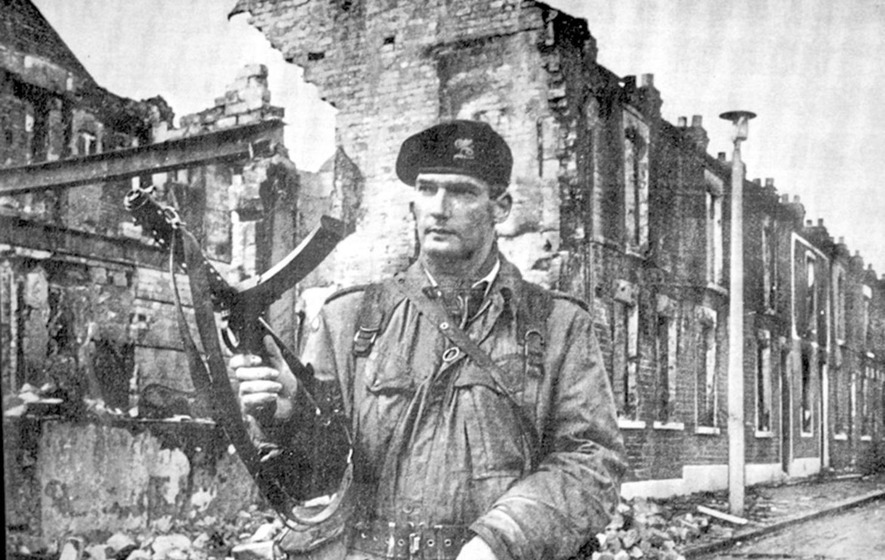
A British soldier stands in front of a section of the burned out houses of Catholics in Bombay Street, Belfast in 1969 (which the Army did not try to prevent Loyalists burning). The arson was the Loyalist response to demands of Catholics for civil rights (while the colonial police response was batons, bullets and gas). (Photo source: Clonard Residents’ Association)
I agree with Varadkar that the quality of a country should be judged “by the way it treats its minorities.” So Varadkar, how did and does your Gombeen State treat its probably oldest ethnic minority? You know, the Irish Travellers?
It is true that “a Republican ballad, a nice song to sing, easy words to learn for some people can be deeply offensive to some people.” Presumably he means to Unionists and Loyalists. Yes, and antifascist and anti-racist songs can be deeply offensive to fascists and racists.
It is also true that some people in the Southern States sing songs about the Confederacy and Robert E. Lee and call it their culture. And the comparison fits – but not with Republicans but with Loyalists!
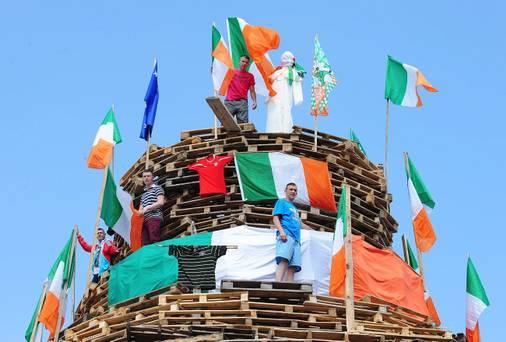
One of the charming annual expressions of Loyalist culture: a huge bonfire to burn Irish Tricoloursand representations of Catholicism. Palestinian flags and representations of Celtic FC are frequently burned too. Slogans such as KAT (‘Kill All Teagues [i.e Catholics]) are often displayed also. (Photo source: Wikipedia)
It’s not Irish Republicans who spread racism and sectarianism: the Republican creed came into existence precisely against sectarianism. And we know Varadkar actually knows that because not long ago he made some remarks about the wide embrace of the Irish Tricolour.
The Irish Tricolour: a flag presented to revolutionary Irish Republicans by revolutionary French Republican women in Paris in 1848. Not a flag of monarchism, sectarianism or collusion with imperialism or colonialism.
While we uphold Republican principles we don’t have to apologise to anyone, least of all in our own country, Varadkar. It’s you and your party (and the rest of them serving the Gombeen class who threw away independence and slaughtered Irish Republicans) who need to be ashamed.
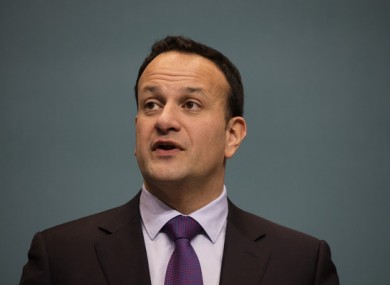
Leo Varadkar, Taoiseach (Prime Minister) of the current Coalition Government, who made the remarks this week. (Photo sourced: Internet)
People living in Ireland can think and feel what they like, good or bad. But in public, we will celebrate the valuable things in our history and culture. And we’ll do so proudly without apology to anyone.
On the other hand, public displays of Orange sectarianism, racism, homophobia, fascism and anti-LGBT targeting won’t be tolerated in an independent, reunited Ireland. Not for one minute.
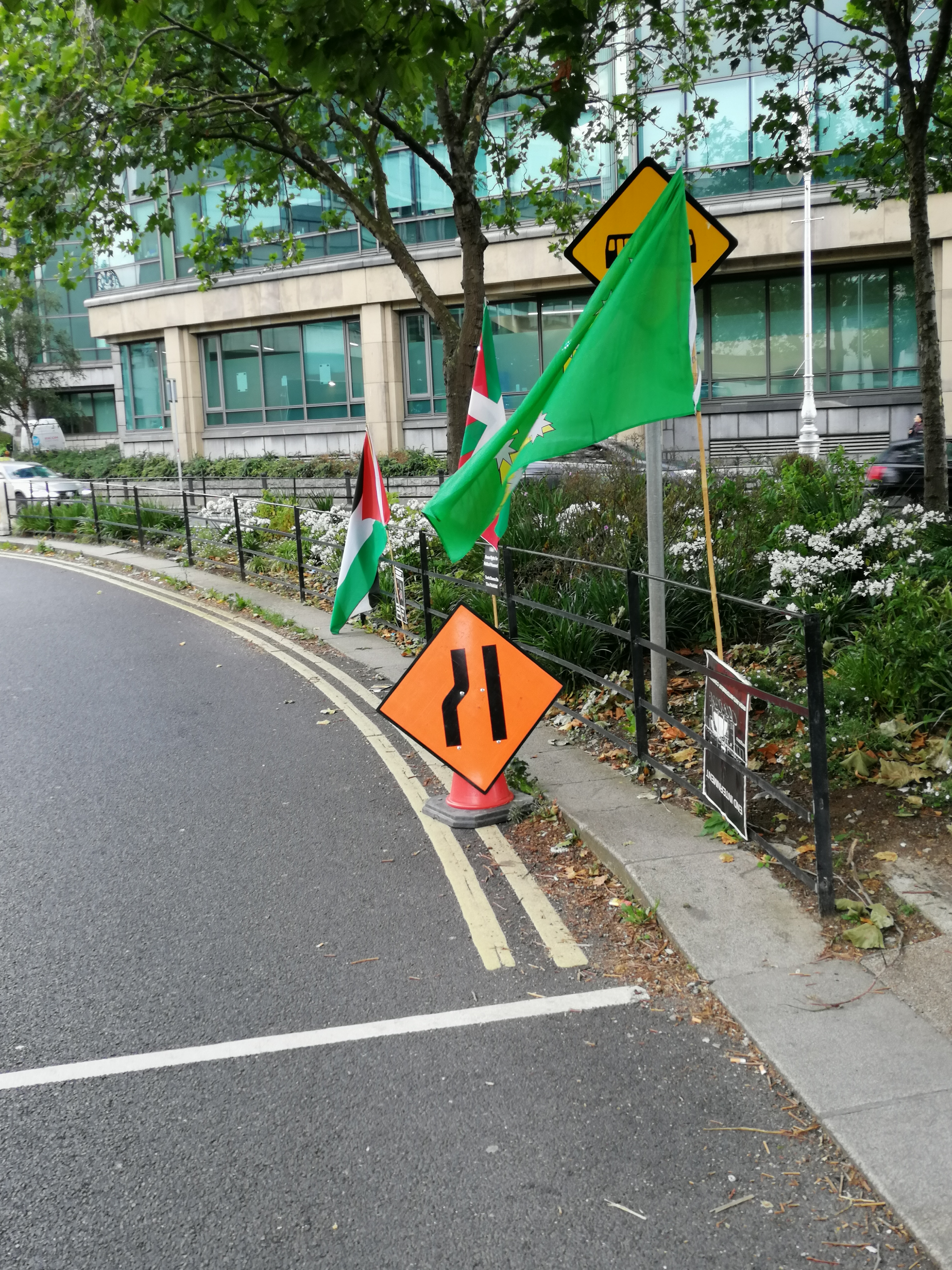
Socialist republicans and communists gathered on a traffic island in Dublin’s city centre to mark the International Day of the Prisoner. They flew flags to represent prisoners in Ireland (‘Starry Plough’), the Basque Country and Palestine.
They also displayed a number of placards.
(Photo: IAIC).
The choice of location, apart from being passed by road traffic in three directions, was because of the presence there of the Universal Links on Human Rights memorial sculpture with an eternal flame, commissioned by the Amnesty International organisation.
A plaque near the sculpture bears the following words: “The candle burns not for us but for all those whom we failed to rescue from prison. Who were tortured. Who were kidnapped. Who disappeared. That is what the candle is for.”
Plaque in the ground on the approach to the sculpture. (Photo: IAIC).
Somewhat ironically, one of the placards carried the words: “Amnesty International, do Irish Republican prisoners not have human rights too?” Irish Republicans have long complained that the organisation in question does not raise any issues with regard to Irish political prisoners.
Some have indicated as a possible reason or part-reason the location of the head office of Amnesty International being based in London, capital city of the occupying power. Its interventions on Ireland even during three decades of war in the colony have been very few indeed.
Other placards displayed referred to political prisoners from the liberation wars in India and in the Philippines, the innocent Craigavon Two still in jail and ongoing internment through refusal of bail to Republicansappearing before the no-jury special courts in both administrations.
Some leaflets were distributed about ongoing internment in Ireland through long remands in custody of Republican activists. Between convicted and awaiting trial there are close to 50 political prisoners in jails in Ireland between both administrations.
The Universal Links sculpture by Tony O’Malley (welding by Jim O’Connor) commissioned by Amnesty International. (Photo: IAIC)
The Zionist Israeli state holds 5,000 political prisoners (almost all Palestinian), of which over 1,132 are not even charged (‘administrative detention’). There are 33 female Palestinian political prisoners and 160 child prisoners. Philippines has 803 political prisoners.
The Spanish and French states hold between them around 170 Basque political prisoners.
The event to mark International Day of the Prisoner was organised by the Ireland Anti-Internment Campaign and a spokesperson gave a short explanation on video of the reason for the event with the human rights sculpture in the background.
End.
Some of the flags displayed (Photo: IAIC).Passer-by in conversation with a leafleter. (Photo: IAIC). (Photo: IAIC).
An organisation by the name of Anti-Imperialist Action yesterday held an anti-monarchist march and rally in Dublin, including a mock execution of royalty, where their speaker was arrested by Gardaí.
The protesters met first at the James Connolly monument in Beresford Place and after some words marched up Abbey Street to Dublin’s main street and to the General Post Office building to hold their anti-monarchy rally.
Royalty and guillotine beside James Connolly monument at start of event (Photo: AIA)
At the GPO the gathering of socialist republicans, socialists and anarchists had grown. As the mock-up guillotine carried out mock execution of the dummy representing royalty, a large force of Gardaí arrested the speaker. Participants then went to Store Street Garda station to demand his release.
At Store Street the protesters were met by a line of Gardaí1 drawn up in front of the entrance to the police station. In speeches and slogans, the protestors denounced the police for the arrest of the speaker at the GPO, also denouncing the monarchy and the State.
Line of Gardaí barring entrance to Store Street Garda Station (Photo:Rebel Breeze)View of protesters outside Store Street Garda Station (Photo: Rebel Breeze)
Some speakers criticised also the national broadcaster RTÉ which was devoting four hours to the coronation.
The most frequent chants were: When Republicans are under attack – stand up, fight back!2 One, Two, Three, Four – Occupation no more; Five, Six, Seven Eight – Smash the Free State!3 Brit King – Guillotine! No democracy – under a monarchy! No democracy – in the Free State4!
One of the protesters, accompanying himself on guitar, sang the Republican ballad popularly known as “Come Out Yez Black ‘n Tans”, the attendance joining in on the chorus. They displayed a banner with a slogan from Liberty Hall5 in WW1: We serve neither King nor Kaiser but Ireland.
Using a loudhailer, another protester read out James Connolly’s6 1911 denunciation of the monarchy. Yet another speaker quoted Garda Commissioner Drew Harris’ recent words saying the Gardaí were the “biggest gang”, the protester calling them “an MI5-directed gang”.
Eventually news of the release of the arrested man reached the protestors and they marched up Talbot Street with Starry Plough7 flags and a Basque Ikurrina flying, back to the GPO, outside of which they held an impromptu rally.
Along with portraits of Irish hunger-strike martyrs of 1981 there was a portrait of Palestinian martyr Khader Adnan carried also in recognition of the international role of British imperialism and its Head of State.
Many looked on in interest while some applauded them, both in Talbot Street, where a taxi driver enquired the reason for the protest and wished them well and also outside the GPO. Gardaí arrived and stood across from the building to watch the protesters but in smaller numbers than before.
The protestors return to the GPO for an impromptu rally in place of the planned one interrupted by the Garda attack and arrest of speaker (Photo: Rebel Breeze)
Another speaker said the protesters were “health workers, working to rid Ireland of a dangerous disease affecting politicians, media and State forces, a disease that makes them go to their knees in front of royalty and a foreign state, extending their tongues to lick a certain part of the anatomy.”
Interest from the pedestrian reservation in O’Connell Street across from the GPO, including much smaller number of uniformed Gardaí (Photo: Rebel Breeze)
The speaker said they were working “to rid Ireland of this dangerous disease, to enable the people to stand up straight once more, to claim their Republic, celebrate their history and speak out against foreign domination and monarchy”.
He drew attention also to arrest of a Republican speaker outside the iconic GPO, headquarters of the 1916 Rising8 and which still bears the scars of British bullets9.
Reference was also made a number of times by protesters to the arrests of English Republicans in London who were prevented by from holding a protest against the monarchy.
The victim of the police attack returned from police custody and briefly spoke thanking those who had demanded his release; people who had stopped to listen applauded and the group dispersed without further arrest.
End.
Photo taken at GPO before police attack (Photo: AIA)
2This seems adapted from a slogan often chanted by Irish socialist groups.
3This too seems an adaptation but from the Palestine solidarity movement.
4The new state of 26 Counties (missing six, which are in the British colony) and which fought a Civil War against the Republicans was called “the Free State” and though the name was changed (and to a ‘republic’) Irish Republicans and many nationalists in the British colony call it the “Free State” in irony and in negation of its legitimacy.
5Liberty Hall is a very tall building housing SIPTU but the trade union’s ancestor, the ITGWU had purchased the previous building on the same site which was destroyed by the British during the 1916 Rising. The slogan “We serve neither …” etc had been displayed across the front earlier during WWI.
6Revolutionary socialist leader, trade union organiser, writer and historian who brought the Irish Citizen Army to participate in the Rising, during which he was made Dublin Commandant, afterwards being shot by British firing squad.
7Originally flag of the Irish Citizen Army, the first workers’ Army in the world, formed to defend the workers in 1913 Lockout against police attacks and which also took part in the 1916 Rising.
8The rising 24-29 April 1916 was the first against world war and contained many other ‘firsts’ – six different organisations played a prominent part in it, including women. The Rising is regarded as leading to the War of Independence 1919-1922.
9One of many buildings in Dublin that bear the scars of conflict, this one is an imposing building in the city’s main thoroughfare, O’Connell Street. With the building in flames from British artillery on Easter Friday, the garrison, including five of the Seven Signatories of the Proclamation of Independence (which was read out at the start of the Rising) relocated to nearby Moore Street, where the decision was taken to surrender.
Useful link and Reference:
"We confess to having more respect and honour for the raggedest child of the poorest labourer in Ireland today than for any, even the most virtuous, descendant of the long array of murderers, adulterers and madmen who have sat upon the throne of England." – James Connolly pic.twitter.com/o8inKRr5Fi
— Anti Imperialist Action Ireland (@AIAIreland) May 6, 2023
2022 was a busy year for the anti-internment campaign organisation, involving, along with its public awareness-rising events, a reorganisation with a new constitution, a new name and expansion of membership.
Origins
The formation of an anti-internment campaign was sparked by the revoking of the licence of ex-political prisoner Marian Price in May 2011 for the “crime” of steadying the written speech of an IRA speaker during a windy Easter Rising commemoration in Milltown Cemetery, Belfast.
In addition to revocation of the licence under which Republican prisoners were released under the Good Friday Agreement, other activists were also being charged under “anti-terrorist” legislation and routinely being refused bail, if not granted it under severe restrictions.
The wait for a trial is often two years and regardless of the eventual outcome, the individuals had already spent two years in jail or at home, barred from travel or political activity and harassed by police visits to their homes.
Early banner-placard protesting the internment of Marian Price (Image sourced: Libcom.org)Front section of Anti-Internment March, coming into top part of Parnell Square, Dublin 2013. (Image sourced: IAIC archives)
These conditions were considered to be in effect the same as internment without trial and the campaign against internment was founded as an independent one, a status it maintained despite a number of attempts to take it over or to intimidate with threats and State harassment.
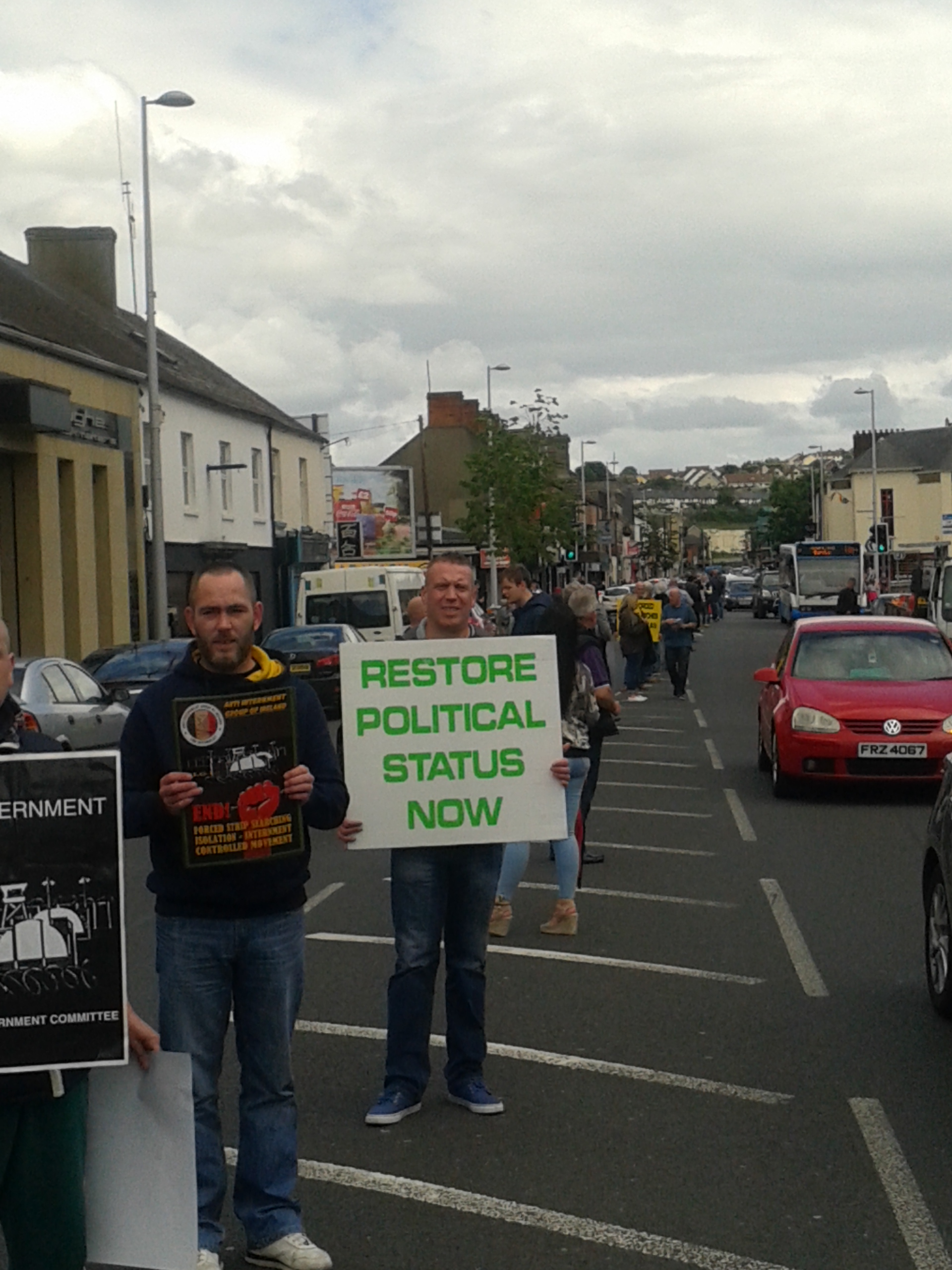
Throughout its history the Anti-Internment Campaign has organised the annual Newry event (not since 2021 unfortunately), many pickets (including in protest against Amnesty Ireland) and a march in Dublin, spoken at or participated in public events in Belfast, Cork, Derry, Glasgow and Wexford.
It has also organised and hosted conferences and public meetings, for example with speakers from the campaigns for the Craigavon Two, Munir Farooqi and Tony Taylor and about the Right to Protest with a speaker from the Irish Council for Civil Liberties.
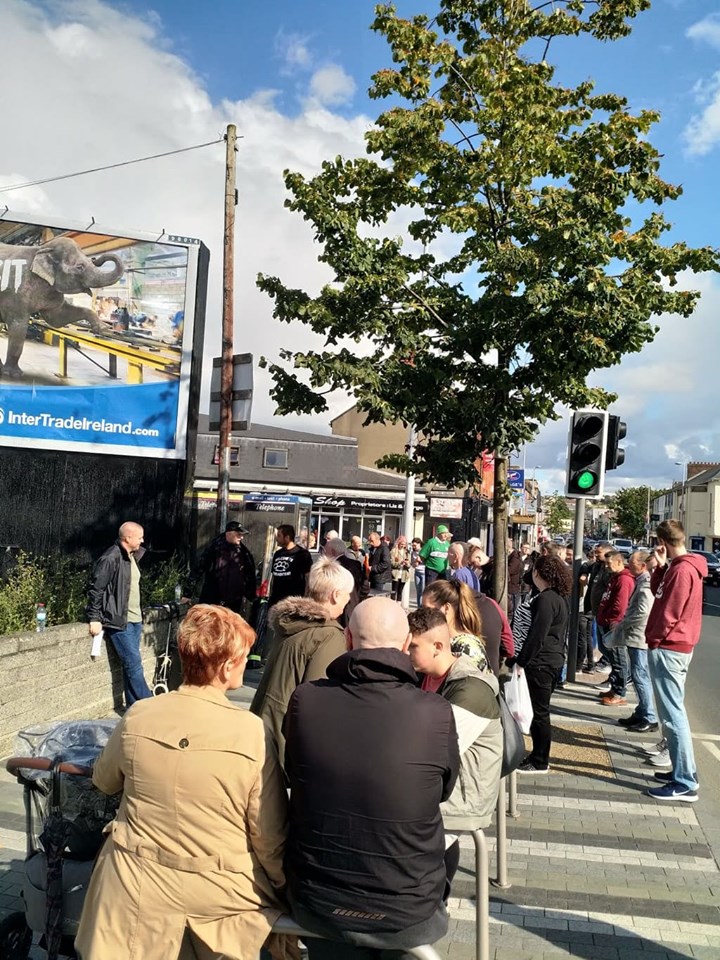
Section of the annual Anti-Internment white-line picket Newry, August 2016 (Image sourced: IAIC archives)
Annual Anti-Internment, Newry, rallying after white-line picket, August 2019 (Image sourced: IAIC archives)
A busy year
As stated in the introduction above, 2022 was a busy year for the anti-internment campaign group, involving, along with its public awareness-rising events a reorganisation with a new constitution and a new name. The campaign organised nine public events and participated in more.
Most of those public events were awareness-raising pickets with placards, banners, flags and leaflet distribution. Usually the pickets alternated between the Henry Street/ Liffey Street junction and at Crown Alley by the square in the Temple Bar area, both areas busy with shoppers and tourists.
Anti-Internment picket in Henry Street, November, Dublin 2022 (Photo: IAIC)
The campaign carried out pickets in Henry Street on 9th April, 6th August and 19th November and in Temple Bar on 5th March, 21st May, 2nd July and 27th August. On 22nd October, with a special focus on Palestinian prisoners, we were on the iconic Ha’penny Bridge.
It has always been of particular interest to the campaign group to reach working people and large numbers of that class of all ages pass through those areas. Of interest also are people from other lands and the Basque and Palestinian flags alongside the Irish ones often stimulate discussion.
In September the campaign attended the Peter Daly commemoration in Wexford and provided a speaker at the Dublin meeting to re-launch the End State Repression campaign which our group had supported in the past but which had waned over the Covid epidemic period since.
Our campaign group also took part in the planning of and participation in the joint prisoner’s solidarity picket in Dublin on 17th December 2022.
Reorganisation
It had been clear for some time that the organisation was in need of reorganisation to facilitate expansion but the process had been difficult.
Eventually in July the decision was taken to close down the Anti-Internment Group of Ireland and to reform under another name. This was done and, after democratic consultation process a new constitution was agreed, with the Ireland Anti-Internment Campaign as the new name.
According to agreed decisions, a new banner with the organisation’s new name was commissioned (though it would take some time to come to fruition). A new Facebook identity for the group was constructed with a statement explaining the development.
The new constitution, more explicitly democratically-based than had been previously the case, was published.
Anti-Internment picket in Temple Bar, Dublin, March 2022 (Photo: IAIC)
Year planning
In the reorganisation process, the IAIG lost one member but gained three new activists and the return of two lapsed members. With renewed energy, members began planning for the rest of the year, to conclude with participation in the annual Bloody Sunday March for Justice in Derry.
Issuing a statement to explain the reorganisation, commissioning a new banner, scheduling a number of pickets in Dublin and organising the annual Prisoners’ Solidarity Picket in Dublin December were part of the planning and most of the target actions were completed.
In December and in good time, the campaign’s members organised to purchase, sign and mail Christmas cards to all Irish Republican prisoners, also a number of non-complying Basque political prisoners and the Catalan jailed revolutionary Catalonian rapper Pablo Hasel.
The proposal to organise the annual Prisoners’ Solidarity picket in December jointly with the Irish Republican Prisoners’ Welfare Association and with Ireland Anti-Imperialist Action was agreed and the joint event went ahead on 17th December with around 40 participating.
Section of the joint AICI, AIA and IRPWA Republican Prisoners’ solidarity picket 17 December 2022, O’Connell Street, Dublin 2022 (Photo: IAIC)
The picket with placards and banners, including the illuminated words of the IAIC’s “SAOIRSE” (“Freedom”) attracted attention and passers-by, both Irish and from abroad engaged leafleters and other participants in discussion. A speaker from each group gave a short statement.
The year’s programming ended with the specific scheduling of participation with a new banner in the annual Bloody Sunday March for Justice in Derry.
New Banner Aired at Bloody Sunday March for Justice in Derry
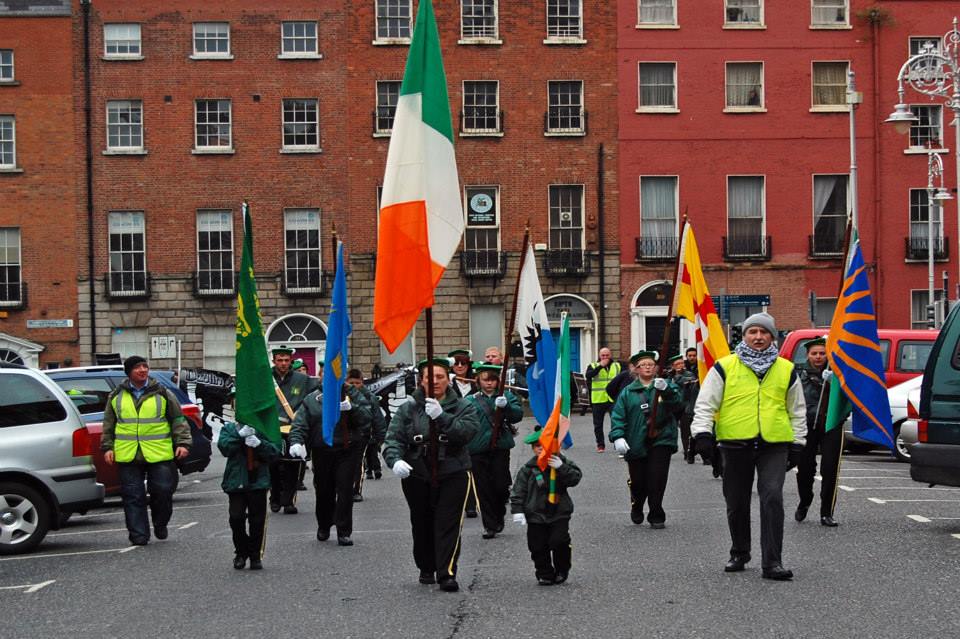
The new banner got its first public airing at the annual march in Derry, commemorating the massacre of unarmed civilians by the British Army in Derry in January 1972 and was carried as part of the march from the Creggan, through a large part of Derry and down to Free Derry Corner.
The marchers in different political parties, campaign organisations and independent individuals marched trough cold rain and strong wind-gusts through the nearly 5-kilometre walk. The members of four Republican Flute Bands played bravely throughout.
The new banner of the Ireland Anti-Internment Committee carried in the Bloody Sunday March for Justice in Derry in January 2023. (Photo: IAIC archives)
The IAIC will shortly begin its year-planning for the rest of the year, its calendar again probably ending at 2024’s Bloody Sunday March for Justice and meanwhile organising events to publicise the on-going undemocratic jailing of activists without trial both sides of the British Border.
The IAIC considers that the jailing of people without trial by both administrations is, in addition to political repression, a significant assault on civil rights and a threat to all opposition groups and that it is in the interests of all to unite in opposing the practice.
The Campaign welcomes the active support of all democratically-minded individuals at its public events.



















 rebelbreeze