Aistrithe ag D.Breatnach ó scéal ag Rebecca Black PA24/08/2023 (Achair léitheorachta 3 nóim.)
Tá caomhnóirí ag ceiliúradh tar éis dóibh teacht ar fhianaise gur phóraigh an t-iascaire coirneach in Éirinn don chéad uair le breis agus 200 bliain.
Bhí péire ag pórú ag láthair nead rúnda i gCo. Fear Manach, de réir Fiadhúlra Uladh.
Dúirt an eagras neamhrialtach go raibh an t-éan creiche sainiúil tar éis athchoilíniú go nádúrtha sa cheantar agus gur éirigh leis dhá scalltán ar a laghad a shaolú, b’fhéidir trí chinn – an chéad phéire scaltan fiáine den chineál in Éirinn sa lá atá inniu ann.
Ba é Giles Knight, comhairleoir scéime feirmeoireachta comhshaoil le Ulster Wildlife, a rinne an fionnachtain.
Tá sé ag breathnú ar an mbeirt phóraithe le trí shéasúr anuas le linn a chuairteanna feirme áitiúla sa cheantar.
“Tá an scéala seo á choinneáil gar do mo bhrollach agam le fada an lá chun sábháilteacht agus leas na n-éan iontach ach soghonta seo a chinntiú,” a dúirt sé.
“In éineacht le mo mhac Eoin, tá mé ag faire ar na héin fásta ag filleadh ar an suíomh céanna ó 2021, mar sin d’fhéadfá a shamhlú go raibh sceitimíní orm ar an nóiméad a chonaic mé trí scalltán agus dhá éan fásta i mbliana.
“Nóiméad cimil-do-shúile a bhí ann, ócáid eisceachtúil; an buaicphointe is mó de mo ghairm bheatha fiadhúlra 30 bliain – cosúil len a theacht ar thaisce atá caillte le fada.
“Le dhá scalltán ar a laghad ag teacht aníos an séasúr seo, is scéal an-rathúil caomhantais é seo agus léiríonn sé éiceachóras bogach sláintiúil le neart gnáthóg agus iasc oiriúnach chun an creachadóir géibhinn seo a thabhairt ar ais chuig ár spéartha agus ag tumadh ins na Locha Fhear Manach.
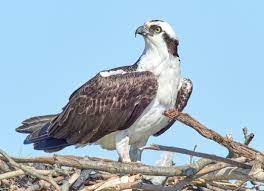
Iascaire Coirnech ar nead (íomhadh le: Wikipedia)
“Filleadh tuaithe beo i ndáiríre.”
Dúirt Fiadhúlra Uladh gur ceapadh go raibh na hiolair chreiche imithe in éag mar éan goir in Éirinn ag deireadh an 18ú haois mar gheall ar ghéarleanúint chórasach.
Cé gur minic a fheictear iad ar imirce chuig an Afraic Fho-Shahárach agus amach uaithi, ní raibh pórú deimhnithe in Éirinn do-ghlactha go dtí seo, agus Albain ina dhaingean pórúcháin sa RA.
Mhol an Dr Marc Ruddock, ó Northern Ireland Raptor Study Group, an “scéal iontach”.
“Tá na comharthaí agus na radharcanna go léir le blianta beaga anuas ag díriú air seo, ach anois tá fíor-rath póraithe dearbhaithe ar deireadh – nuacht iontach,” a dúirt sé.
Dúirt an tUasal Knight nach nochtfaí láthair an tsuímh le sábháilteacht na n-éan a chinntiú.
“Anois go bhfuil na héin seo ar ais in Éirinn agus ag pórú go rathúil, tá sé ríthábhachtach go bhfágfar faoi shíocháin iad ionas gur féidir leo leanúint ar aghaidh ag méadú trí phórú bliain i ndiaidh a chéile.
“Creidimid agus tá súil againn go bhféadfadh sé seo a bheith ina thús le ríshliocht éin chreiche,” a dúirt sé.
Iascaire Coirneach agus iasc gafa (Íomhádh le: Nick Brown)
“Ba ábhar misnigh agus croíúil é an t-úinéir talún, an pobal feirmeoireachta áitiúil agus ár gcomhpháirtithe a fheiceáil ag fáiltiú roimh fhilleadh na n-iolairí.
“Cuirfidh a dtacaíocht leanúnach ar chumas na nglún atá le teacht sult a bhaint as na héin iontacha seo i bhfad amach anseo.”
Ar fud na hÉireann, tá monatóireacht ag eolairí na n-éan creiche, tógáil ardáin neadaithe, agus pleanáil do chláir aistrithe agus athbhunaithe ar siúl le blianta anuas.
Friends and relations of Terence Wheelock and supporters of the campaign for justice for his family rallied outside the GPO Thursday afternoon before marching to Leinster House and on to the Department of Justice.
Terence Wheelock was 20 years of age when he was arrested by Gardaí following a car stealing by others in Dublin and taken to Store Street Garda Station. Subsequently he was removed to hospital in a coma from which he never recovered, dying three months later.
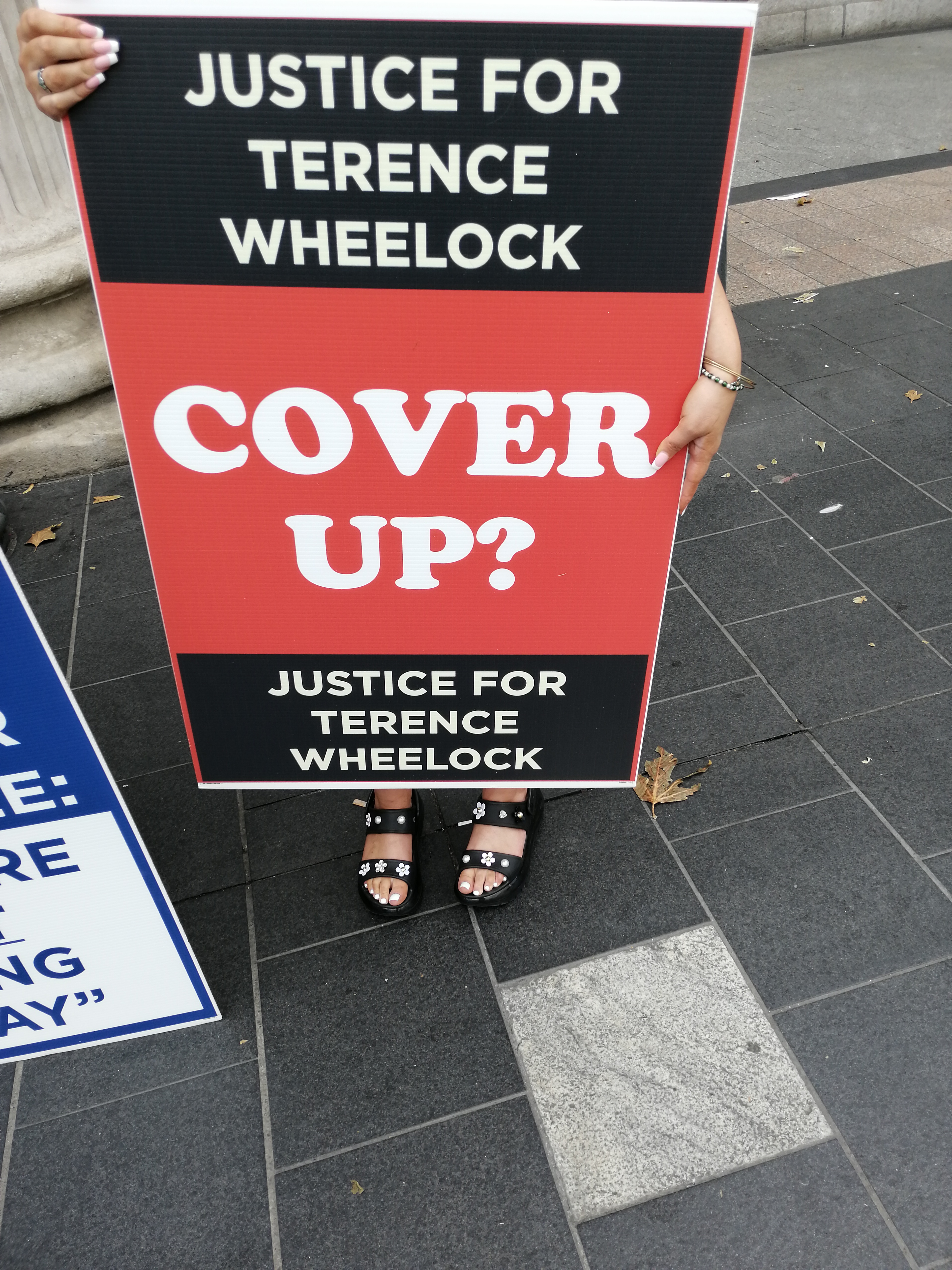
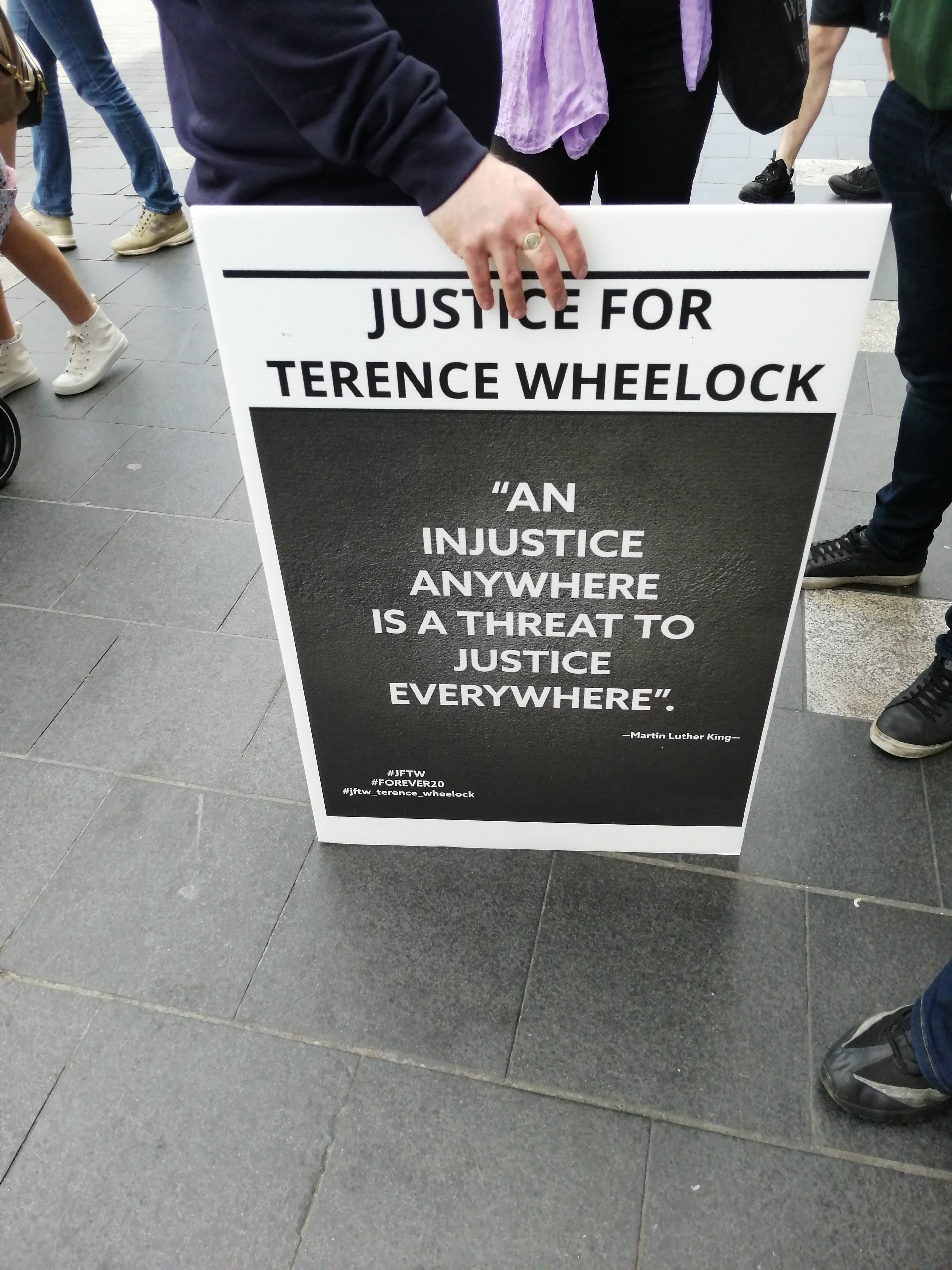
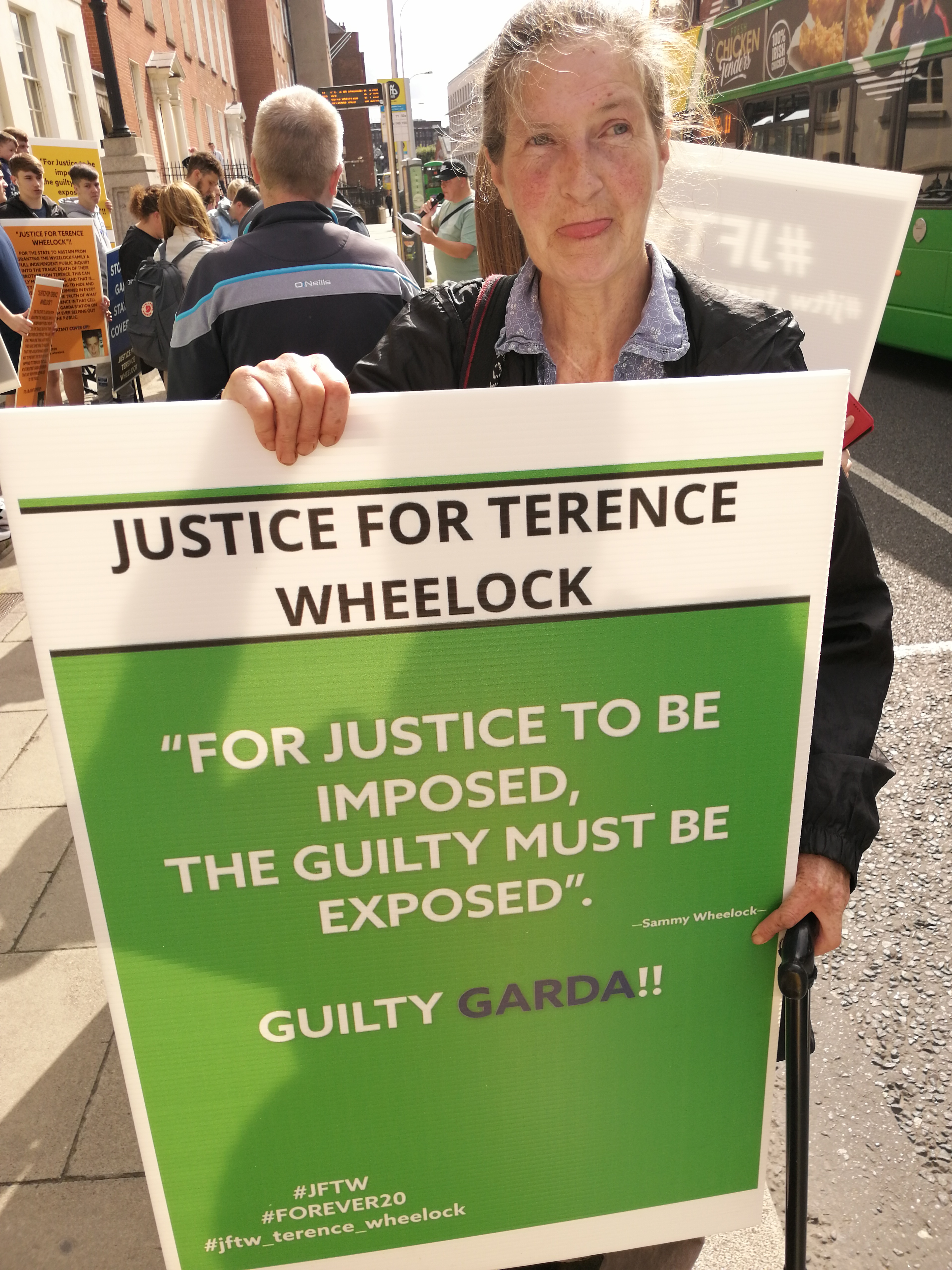
People gathering outside the GPO for the rally and march (Photo: D.Breatnach)Supporter of the campaign holds a placard (Photo: D. Breatnach)(Photo: D.Breatnach)
The cause of the coma? A severe beating. Not that it should be relevant but he had nothing to do with the car stealing and has been officially cleared of involvement. On the day of his arrest, Terrence was on his way to buy a paintbrush to decorate his room and stopped to talk to some youths he knew.
Though this occurred 18 years ago the family has not ceased seeking acknowledgement of the Garda crimes and are now insisting on an independent official enquiry.
(Photo: D.Breatnach)
MARCH THROUGH CITY CENTRE & THREE RALLIES
Wheelock family supporters, including people from Terence’s north inner city area, socialists, socialist republicans, anarchists and independent activists gathered at the advertised rally point outside the iconic building of the General Post Office on Dublin city centre’s main street.
James O’Toole of Rebel Telly briefly addressed the march supporters outside the GPO before the march set off, speaking about antisocial behaviour in the city and its connection to deprivation of working class areas, a fact admitted by the Gardaí in a report, a copy of which he held aloft.
James O’Toole addressing the rally outside the GPO (Photo: D.Breatnach)
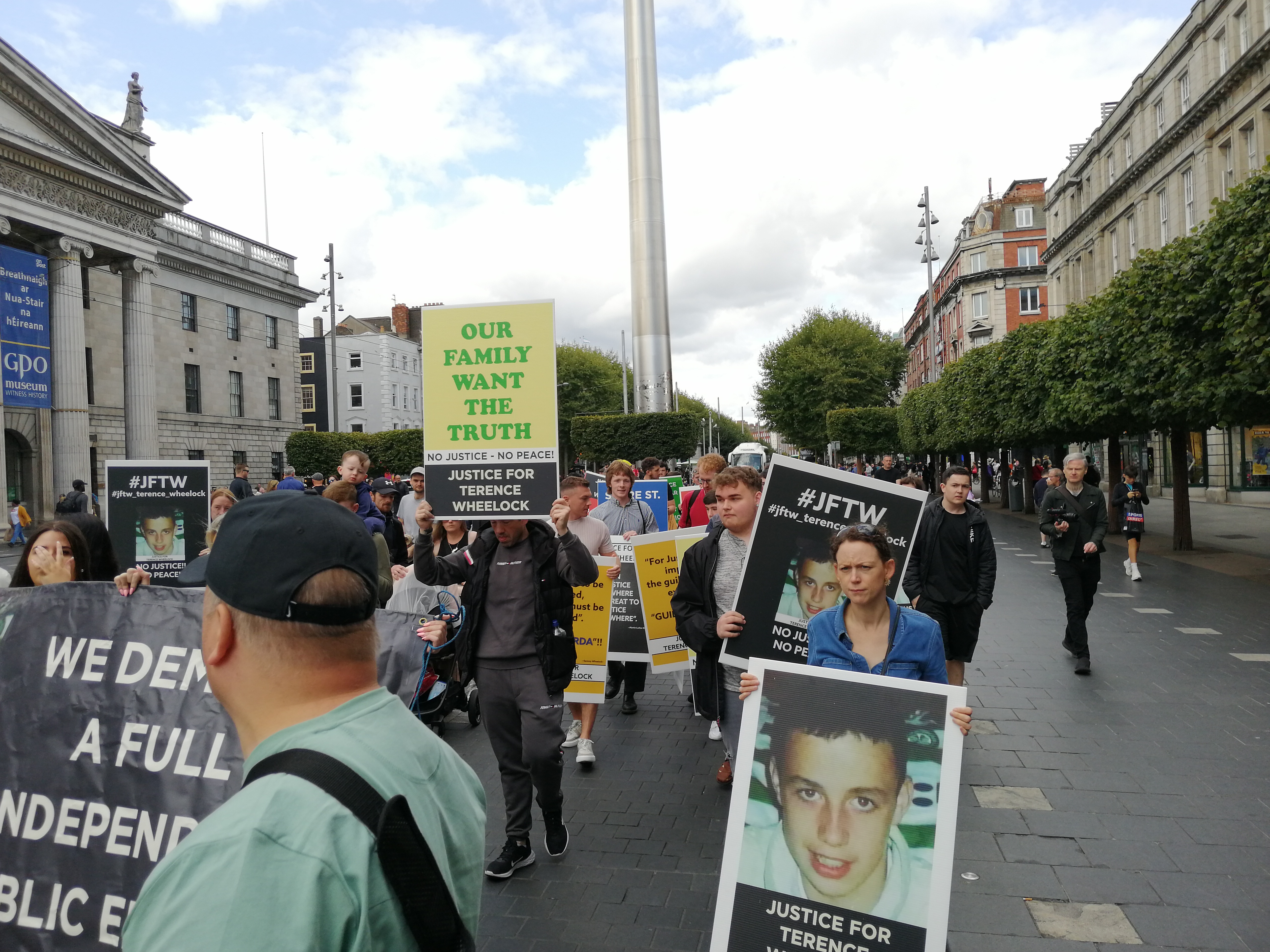
Large printed placards were provided with a variety of texts – one also carrying Terence’s image – and most participants carried one for a group photo and again as they crossed O’Connell Street to march southwards to Leinster House, seat of the Irish Parliament.
Many tourists and shoppers watched with interest, read the placards and listened to the chants of call and reply led by Sammy Wheelock, older brother of Terence: “Say his name!” “Terence Wheelock!” “For justice to be imposed, the guilty must be exposed!” “Guilty:” “Garda!”
“What do we want?” “Justice!” “When do we want it?” “Now!” “No justice!” “No peace!” “Say his name!” “Terence Wheelock!” The driver of an occasional passing car or taxi blew its horn in solidarity as the march crossed O’Connell Bridge and swung around Trinity College.
The march after leaving the GPO (Photo: D.Breatnach)
Outside Leinster House the marchers stopped for a second rally which was addressed by Sammy Wheelock and the slogans were repeated there too. Senator Marie Sherlock addressed the crowd also, promising her support for the campaign.
Cllr Madeleine Johansson, one of a group who recently fought a successful holding action against a mass eviction at Tathony House, also spoke at the rally outside the Dept. of Justice and quoted James Connolly as having stated that ‘an injury to one is an injury to all’.
Sammy Wheelock then led the crowd on again chanting slogans in a march up Kildare Street, left at the Shelbourne Hotel and right again, along the buildings facing Stephens Green to the Department of Justice building, where another rally took place.
Supporters of the campaign being addressed by Sammy Wheelock in front of Leinster House. (Photo: D.Breatnach)
GARDA HARASSMENT OF THE FAMILY
Larry Wheelock, another brother of Terence’s, had been the driver of the campaign but died in January last year. Outside the Department of Justice building Sammy read a letter from his widowed mother Esther, who felt unable in recent years to attend the protests.
“When this whole ordeal first happened it left a hole in my heart so big that for me it’s like a window … or a door that won’t close because as his mother I refuse to let it go, our family refuses … my son was stolen from me at such a young age …” Mrs. Wheelock had written.
(Photo: D.Breatnach)
For a long time during the campaign for justice, as Sammy told the rally outside the Dept. of Justice Thursday afternoon, the Gardaí harassed the family home by passing at night in vehicles blowing their horns and riding police horses on to the road outside their house.
In addition the Gardaí also stood in the family’s garden and shone lights on to the windows, raided the house and struck their pregnant sister in the stomach, knocking her to the ground, also stopping and searching Trevor’s brothers in the street.
The Gardaí also drove slowly in their vehicles past Trevor’s younger siblings, laughing as they made ‘hanging’ gestures at them through the windows. Despite the harassment and intimidation of the family, they “are not going away”, Sammy said.
Garda vehicles and personnel present while rally held outside the Dept. of Justice (Photo: D.Breatnach)
The initial ‘independent’ Garda investigation into Terence’s death, Sammy told his listeners, was headed by an officer who had spent 15 years of his career stationed at Store Street Garda station and it was no great surprise that he found that Gardaí had committed no wrong in the case.
Due to Terence’s case being in the public eye in 2006 when the Garda Síochána Ombudsman Commission (GSOC) was set up, it was the first case to be examined by them, Sammy Wheelock told the rally but once again the Gardaí were exonerated.
The Wheelock family believe such investigations, Sammy told the rally, are a case of “friends investigating friends”.
Announcing he was going to deliver a letter to Minister for Justice McEntee, Terence’s brother read its content out to the participants before mounting the steps to deliver the letter by hand to the Department of Justice, stepping inside for a period.
Sammy Wheelock delivering letter addressed to Minister for Justice McEntee to the Dept. of Justice (Photo: D.Breatnach)
Shortly thereafter, Sammy Wheelock once again thanked the participants for their solidarity on that day and in the past and assured them that the campaign for an independent public enquiry would continue.
(Photo: D.Breatnach)
DEATHS IN GARDA CUSTODY
There were 34 fatal incidents in 2001 in which people died either in or shortly after Garda custody, official figures show; this represents almost three per month. The statistics also reveal a steady increase in such deaths over the years.
The Garda Síochána Ombudsman Commission (GSOC) compiles a database of what are known as Section 102 referrals, which involve situations where the conduct of a member of the Gardaí may have resulted in the death of, or serious harm to, a person.
However, GSOC has not separated referrals for deaths from those of serious harm, meaning the number of people who have died in garda custody is not available.
Vicky Conway, Associate Professor at DCU School of Law and Government, who sadly died prematurely last year, attempted to compile the data on deaths in custody and expressed concern last year that this information is not readily available and broken down into categories.
Three youths from the area hold placards on the steps of the Dept. of Justice (Photo: D.Breatnach)
COMMENT:
The fatal treatment of Terence Wheelock by the Gardaí 18 years ago may or may not be an extreme case but the discriminatory treatment of working-class people is a pattern, of which violence often forms a part, followed by official collusion by ensuring impunity for the Gardaí.
The treatment of the family in their long campaign is a disgrace. It is said also that Terrence’s parents were told that he was in St. James’ hospital, which gave the Gardaí time to get to him first in the Mater and remove his clothes, which have never been produced for forensic tests.
It is of course of great importance to support campaigns to hold the repressive forces of the State to account, as pointed out by Conor Reddy (People Before Profit) to the rally at the Department of Justice building across from Stephens Green.
The message that revolutionaries give in such campaigns is of great importance in reflecting and strengthening the spirit of resistance of the working people, that it may serve them beyond overcoming individual injustices towards achieving justice for the class as a whole.
The reference at the rally outside the GPO by O’Toole to antisocial behaviour in the city, though a live subject at the moment, was inappropriate for the occasion since it could be understood to indicate that Terence had been engaged in such when he was arrested, which was not the case.
Conor Reddy addressing rally outside the Dept. of Justice (Photo: D.Breatnach)
Marie Sherlock, a Labour Party Senator, addressing the rally outside Leinster House, of course put forward the liberal positions of “Garda accountability” and the equivalent of the “few rotten apples in the barrel” analysis of the police force of the Irish State.
While the support of a senator in Leinster House is to be welcomed, revolutionaries have to ensure that social democrats are not permitted to steer campaigns towards unhealthy compromise and that the liberals’ view of the State is countered by the more realistic revolutionary one.
The Gardaí were founded to be a first-line repressive force of the Gombeen Irish State, replacing the repressive police forces of the British occupation, the Dublin Metropolitan Police Force, the Royal Irish Constabulary, Black and Tans and Auxiliary Division.
Their second Commissioner appointed , Eoin Duffy, was the founder of the Blueshirt Nazis in 1932 and the force has amply demonstrated its anti-working class and anti-Irish Republican bias repeatedly since; if the “apple” analogy is to be used, we’d have to say that the orchard itself is rotten!
The death of a teenager is a devastating experience for any family but the importance of this case goes far beyond that of one family as was pointed out by a number of speakers and as is clear from some of the statistics quoted earlier.
(Photo: D.Breatnach)
Garda violence towards sections of the community followed by impunity cannot be tolerated and must be combatted. In that respect it is sad to note the low number of Irish Republicans in the campaign, though they tend to be the chief political target of Garda repression.
The leaders of the Nigerien coup of 31st July, breaking the bondage of the country to its neo-colonial French masters, may be applying lessons from French history all the same.
Not from the Liberté, Egalité et Fraternité of the French Revolution of 17891, however.
No, instead they may be remembering the history of the Paris Commune on 18th March 1871, the first city in the world to come under a revolutionary socialist regime.2
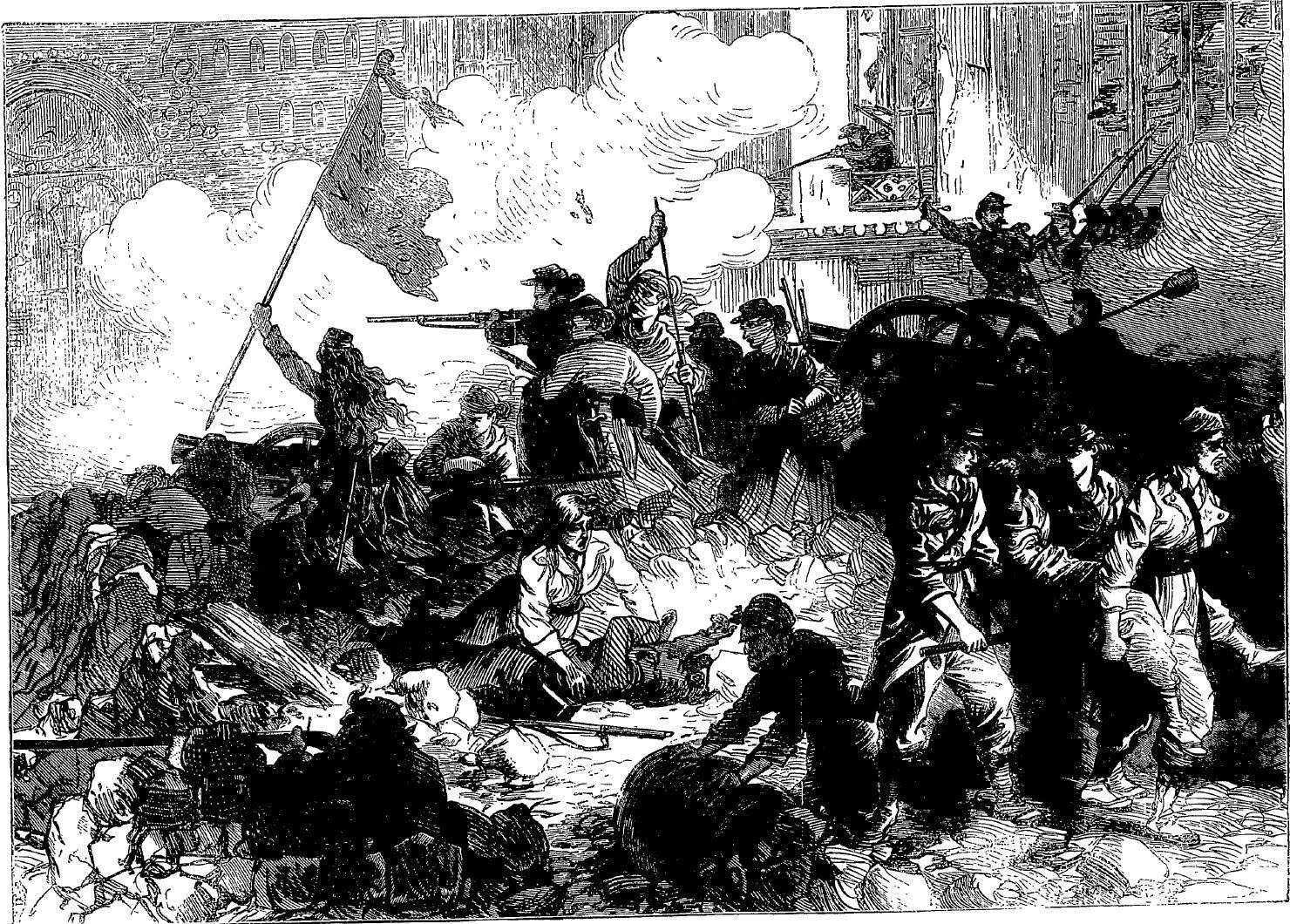
The final battle in defence of the Paris Commune 1871 (Image sourced: Internet)
In the midst of a crisis impelled by the defeat of France by Prussia under Bismark and Paris being under siege, along with crushing armistice terms for France accepted by Chief Executive Adolphe Thiers, Paris was experiencing much social and political unrest.
The authorities under the leadership of Thiers moved to disarm the people by removing canon that had been paid for by popular subscription. Crowds refused to allow this and protests grew into insurrection as soldiers of the National Guard3 joined the demonstrators.
The Communards overthrew the authorities in Paris but failed to prevent many of their enemies leaving the city.
Advised by General Vinoy, Thiers ordered the evacuation to Versailles of all the regular forces in Paris, some 40,000 soldiers, including those in the fortresses around the city; the regrouping of all the army units in Versailles; and the departure of all government ministries from the city.
Thiers set up his government in Versailles where he and his advisors plotted the retaking of Paris and the defeat of the Commune, which showed all the signs of becoming permanent.
However, Thiers lacked sufficient armed forces to fight through the Prussians. In the end he reaffirmed their crushing armistice terms in defeat and begged the Prussians to allow his armed forces (partly composed of released POWs) through the Prussian encirclement to attack Paris.
Bismark agreed and the French troops under Marshall Mahon4 (who had himself escaped from Paris) were given safe conduct towards Paris and through the besieging Prussians so that they could attack the city.
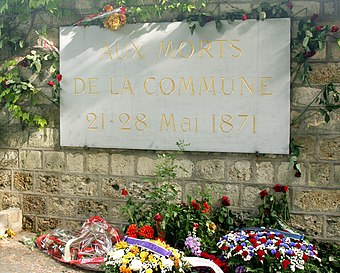
After fierce fighting but often under inefficient military leadership, the Commune was defeated by French troops on 28th May 1871, with wounded defenders bayoneted and prisoners executed en masse or, in the cases of some leaders, tried and executed or exiled.5
Plaque in Paris at the scene of many of the French executions of Communards (Image sourced: Internet)
NIGER TODAY
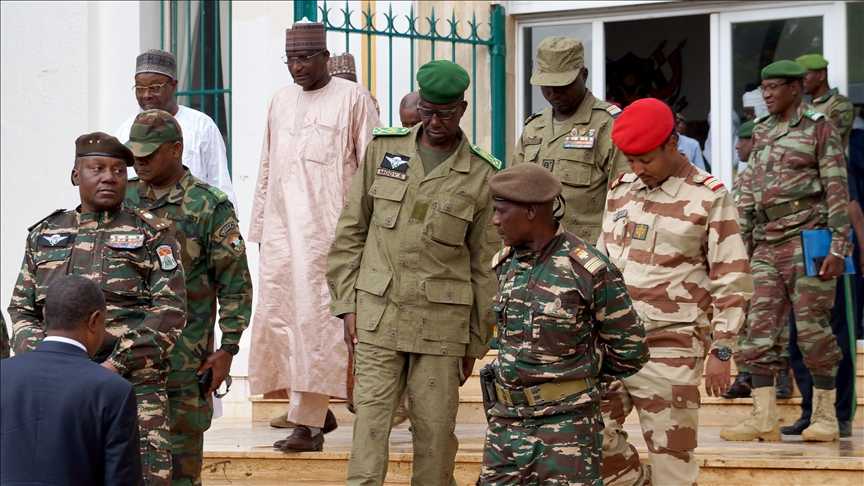
The Niger coup leaders today are holding the former elected President, Mohamed Bazoum, the neo-colonial puppet of the French, along with his family, under house arrest. Western leaders call for their release, which no doubt seems humanitarian, but the coup leaders refuse.
Nigerian military including coup leaders and civilian administrators (Photo sourced: Internet)
Certainly the coup leaders are treating their captives better than have been many leaders of former regimes overthrown by coup or invasion.
General Franco’s regime tortured and murdered around 200,000 civilians in his military-fascist coup 1936-1939, most of them after the war in Spain.
Nationalist elected President Patrice Lumumba of the Congo was murdered in 1961 by the Belgian-USA puppet Moise Tshombe’s forces.
When South Vietnam’s USA-friendly President Ngô Đình Diệm began to show tendencies towards independence in 1963, he was murdered in a coup by General Dương Văn Minh with CIA collusion. Salvador Allende was murdered in the 1976 CIA-masterminded coup in Chile.
National leader of Iraq Saddam Hussein6 (2006) and Muammar Ghadaffi of Libya (2011) were murdered by internal but USA-allied forces.
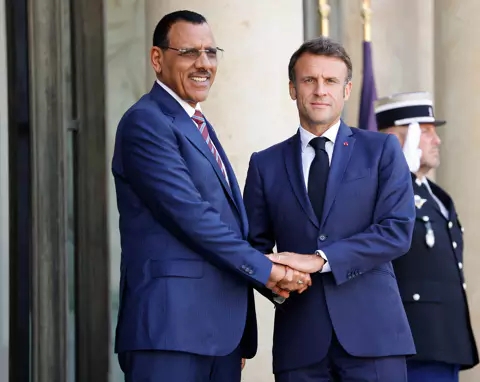
MohamedBazoum, deposed President of Niger and Emmanuel Macron, President of France, photographed in happier days for them both (Photo cred: Ludovic MARIN / AFP)
Mohamed Bazoum is alive and under house arrest with his wife and son, reportedly with canned food but without electricity and running water, though he is permitted regular contact with the West and recently met with the premier of Chad on 31st July.
Although Niger is a land extremely rich in natural resources including oil, gold and uranium being exploited by foreign companies, 80% of the population ruled under Bazoum’s presidency have never had electrity or domestic running water.
Despite demands from the Western powers, the coup leaders, perhaps remembering the history of the Paris Commune, refuse free Mohamed Bazoum, perhaps to act as a figurehead to lead a western-supported army back to ‘liberate’ Niger and to ‘restore democracy’.
End.
FOOTNOTES
1 These principles were of course not applied to France’s colonies, as the sad history of Haiti demonstrates. The African slaves there took the principles seriously but Napoleon waged war upon them and eventually, through the treachery of captains of Toussaint L’Ouverture, leader of the successful slave insurrection, delivered L’Ouverture and his family to end their days in French dungeons. Haiti was returned to French rule, where it remained until eventually overthrown again but under French neo-colonial, later USA neo-colonial dominion where it remains today.
prohibition of fines imposed by employers on their workmen.
3 The National Guard had defended Paris while the French Army was in the field and became the army of the Commune.
4 Patrice de Mac Mahon, of part of the Mac Mathúna/ Mac Mahon clan from Ireland emigrated to and settled in France (14 members of the family served in the army).
5 The national forces killed in battle or quickly executed between 10,000 and 15,000 Communards, though one unconfirmed estimate from 1876 put the toll as high as 20,000. Fifteen thousand were tried, 13,500 of whom were found guilty. Ninety-five were sentenced to death, 251 to forced labor, and 1,169 to deportation (Wikipedia).
6 Saddam Hussein at least had a trial and the question is not whether, if one agrees with a death penalty, he deserved to die but that it was the ‘justice of the victor’, in this case that being the USA, certainly guilty of many more murders and tortures than was Hussein. Ghadaffi was murdered most painfuly without any trial by his captors.
A post-Irish-Republican party prints a revisionist statement from a prominent British Republican at a festival it promotes.
Jeremy Corbyn spoke at the recent Féile an Phobail in West Belfast and Sinn Féin’s publication reported uncritically on his quoting of some words of James Connolly’s out of context:
“No Irish revolutionist worth his salt would refuse to lend a hand to the Social Democracy of England in the effort to uproot the social system of which the British Empire is the crown and apex.
And in like manner no English Social Democrat fails to recognise clearly that the crash which would betoken the fall of the ruling classes in Ireland would sound the tocsin for the revolt of the disinherited in England”.
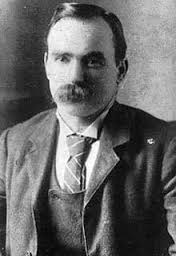
James Connolly, quoted out of context by opportunists who ignore the rest of his writing. (Photo sourced: Internet)
People often pick and choose from revolutionary writings to find what they want and then quote out of context.1 In 1909 Connolly wrote the words Corbyn quoted at the Féile, clearly thinking that the large organised workers’ movement in Britain might bring about a revolution.
And also of the opinion that the revolution there would open the gates to a revolution in Ireland – or vice versa. Those are of course still possible outcomes but it seems to me more likely to occur with the Irish revolution giving the impetus to a British one.
In 1920 Lenin too recommended British revolutionaries to vote for Labour “as a rope supports a hanging man”.
That quotation has been repeated by social-democrats and some Trotskyists out of context and ad nauseam too, right up to the present. Lenin at no time argued that people should support the government of an imperialist state.
I think Lenin was mistaken because the British Labour Party had confirmed the imperialist ideology of its leaders at least six years earlier.
In 1914 most social-democratic parties overturned their earlier agreed declarations against war and supported their own national capitalist classes who were sending hundreds of thousands of working people out to slaughter the working people of other countries.
Connolly in Ireland, John MacClean in Scotland and the Bolsheviks in Russia were among the few who stuck to the flags planted earlier.
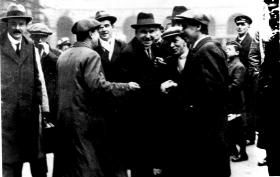
John MacLean photographed during a strike in 1919. The same year he visited Ireland which had a profound effect on the development of his revolutionary thinking. MacLean was one of the few European leaders of the social-democratic movement who, like Connolly and Lenin, stuck to the anti-war revolutionary stance during WWI. (Photo sourced: Internet)
THE BRITISH LABOUR PARTY’S ACTUAL RECORD
The British Labour Party leadership was represented in the WWI War Government and thus colluded in the suppression of the 1916 Rising in Ireland and the execution of 16 leaders, the news of which a number of Labour MP’s cheered in Parliament.
It might have been interesting to hear Corbyn commenting on that and on the subsequent history of the Labour Party. And has British social democracy uprooted “the social system of … the British Empire”? Not in the least, in fact propping it up time and again.
Since 1914 up to the present the party has shown itself, whenever it was not its actual executive, to be the social prop of the imperialist British bourgeoisie. But actually it has often been in government sending troops to suppress national liberation struggles in many parts of the world.
The struggles include those in Vietnam (recruiting Japanese POWs to fight the Viet Minh) so as to hand the country over to French colonialism, which they did. They rearmed Japanese POWs in the Dutch East Indies too in a bloody war against the national movement.
Because of how little-known this war is, I do not apologise from quoting extensively on it from socialist historian John Newsinger.2
Once again, British troops began arriving after Labour had taken office, and found themselves confronting a well-armed nationalist movement that had taken control of most of the country.
Fighting was so fierce that the British turned to the Japanese prisoners-of-war, rearming thousands of them and deploying them against the rebels.
The city of Semarang was taken by Japanese forces, using both tanks and artillery, killing over 2,000 rebel fighters and civilians, and driving the survivors out.
According to one account, ‘Truck loads of Indonesian prisoners with their hands tied behind their backs were driven into the countryside and never seen again.
When the Japanese handed over to the British on 20 October 1945, the British were so impressed that the Japanese commander, a Major Kido, was recommended for the Distinguished Service Order (DSO).
Such an award would, of course, have been political dynamite at a time when British prisoners were being liberated from Japanese camps and would have drawn unwelcome attention to the Labour government’s policy of imperial restoration.
Indeed, both Attlee and Ernest Bevin, the Foreign Secretary, lied to the House of Commons about the extent of the use of Japanese troops. The heaviest fighting took place in the port-city of Surabaya where some 4,000 British troops came under attack towards the end of October.
Over 200 British and Indian soldiers were killed, including their commander, Brigadier Mallaby. Reinforcements were poured into the city and on 9 November a full-scale assault, involving 24,000 troops supported by twenty-four tanks, was launched.
Surabaya was shelled by both land and sea and bombed from the air. On the first day of the assault, over 500 bombs were dropped on the city including 1,500 pounders. Two cruisers and three destroyers joined in pounding the city.
It was, according to one account, ‘one of the largest single engagements fought by British troops since the end of the Second World War’. Only after three weeks of heavy fighting were the nationalist forces driven from the city, suffering some 10,000 casualties in the process.
At the end of the fighting, ‘90 percent of the city’s population were now refugees’. Even today, this major battle is virtually unknown in Britain, although in Indonesia the first day of the British attack, 10 November, is still celebrated as ‘Heroes Day’ … (in) the Indonesian struggle for independence.
Although the Churchill Coalition sent troops and airforce to suppress the Greek Communist resistance after defeat of the Axis troops there, Labour in government continued the policy of restoring the discredited and largely unwanted Greek King against popular resistance.
In Malaya the British banning of strikes and opening fire on unarmed demonstrations of former allies led to armed resistance and war. In Kenya too, treatment of the people led to a war of resistance and British troops committed atrocities in both theatres, including rape and torture.
Later, the UK sent troops to fight in Korea, Cyprus, Aden, Oman, Afghanistan and Iraq and bombed Libya, always with Labour Party support whenever the party was not in the actual executive, i.e in government.
Now, perhaps the author of the article in SF’s publication is weak on international history (clearly the party has never spent any great effort in educating their membership in such areas).
But surely he would be familiar with the events of 1969 in Ireland and of the following three decades there?
Yes, it was a Labour Government that sent troops into the colony in 1969 to crush the struggle for civil rights there, civil rights by the way that were guaranteed by law in every part of Britain.
It was a Labour Government once again that brought in the Prevention (sic) of Terrorism Act in 1974, repressive legislation against the Irish community in Britain which led to intimidation and harassment of thousands of Irish people, raids on homes and deportations.
Under a Labour Government a score of innocent Irish people were framed on extremely serious charges in 1974 and the first antifascist on a demonstration was killed by police – coincidentally of Irish descent too (Kevin Gately, from Leeds, Red Lion Square, London).
In addition to the crimes abroad of British Labour while in government, it supported all the major crimes committed under a Conservative Government, including most definitely those in Ireland.
WHY DO THEY QUOTE THEM?
If social democrats and liberals politicians truly respect those revolutionaries they quote, why do they not follow their teachings? Because in reality, they fear revolution.
But why, in that case, do politicians quote revolutionaries in the first place, even if out of context? It’s because they know that the people love and honour the memory of those revolutionaries and they hope to use them to enlist the people in their reactionary projects.
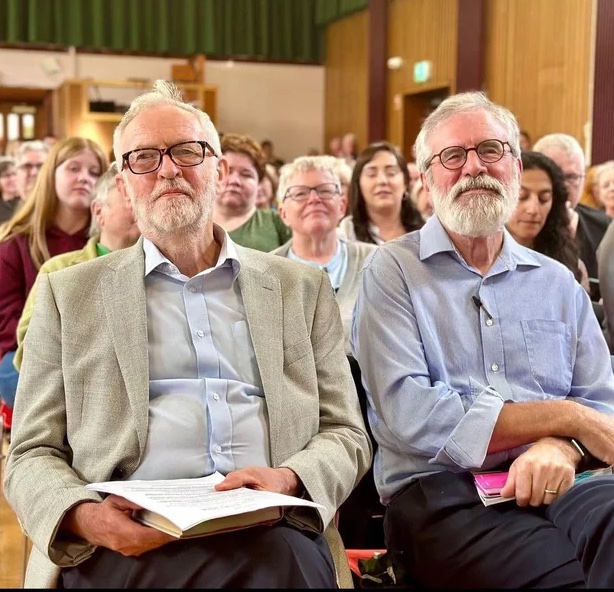
Jeremy Corbyn, former leader of the British Labour Party with Gerry Adams, former leader of Provisional Sinn Féin, photographed at Féile an Phobail in West Belfast this year. (Photo sourced: Internet)
It should not surprise us to see promotion of British social democracy by a party that shares in the administration of a British colony and which is itself dabbling in social democracy — but it is sickening to see them welcoming the use of James Connolly in the course of that.
Connolly was quite clear on his attitude which set it down in song lyrics in Songs of Freedom, published in 1907 in New York3:
Some men, faint-hearted, ever seek Our program to retouch; And will insist, whene’er they speak That we demand too much. ’Tis passing strange, yet I declare Such statements give me mirth For our demands most moderate are: “We only want the Earth.”
“Be moderate,” the trimmers cry Who dread the tyrants’ thunder; “You ask too much and people fly From you aghast in wonder.” ’Tis passing strange, for I declare Such statements give me mirth For our demands most moderate are: “We only want the Earth.”
Our masters all, a godly crew Whose hearts throb for the poor; Their sympathies assure us, too If our demands were fewer. Most generous souls! But please observe What they enjoy from birth Is all we ever had the nerve To ask, that is, the Earth.
The Labour fakir, full of guile Base doctrine ever teaches And whilst he bleeds the rank and file Tame moderation preaches4. Yet in his despite we’ll see the day When with sword in their girths Workers5 will march in war array To claim their own, the Earth.
For workers1 long with sighs and tears To their oppressors knelt; Yet never yet to aught save fears Did heart of tyrant melt. We need not kneel, our cause is high, Of true hearts there’s no dearth And our victorious rallying cry Shall be: ‘We want the Earth!’
End.
FOOTNOTES
1It is even said that “the Devil can quote Scripture”.
2 Newsinger: War, Empire and the Attlee government 1945–1951 65
3No air was indicated for the song; in England I heard it sung to the air of A Nation Once Again, which gives the opportunity for a chorus of “We only want the Earth” etc and of all the airs to which I have heard it sung I believe that one suits it best.
4In my singing, I have reversed the order of ‘preaches’ and ‘teaches’ which to me seems more appropriate, particularly in this era.
5I inserted ‘workers’ rather than ‘labour’ for what should be obvious reasons.
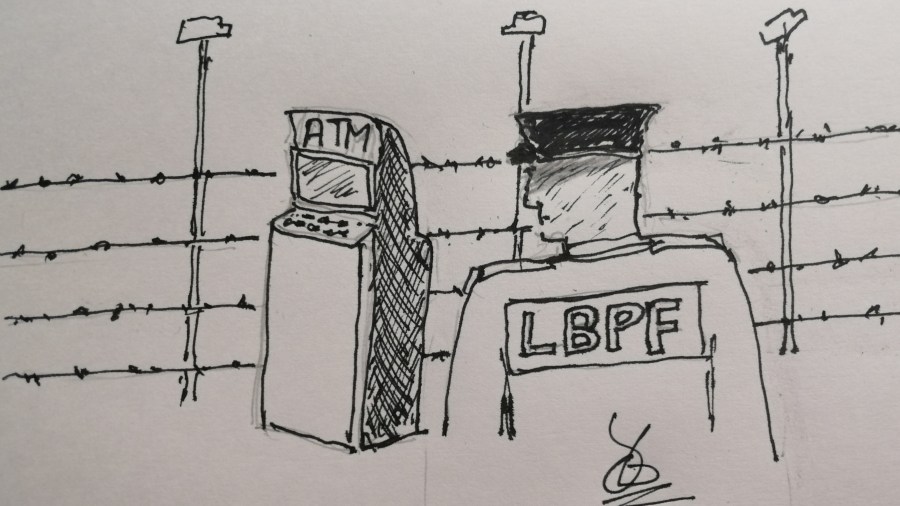
The Chief Commissioner of the police force of the Irish state is reputedly “quietly pleased” with the change of name for the force he commands. “It describes the work we actually do” he commented at a press conference earlier today.
There were suggestions that the widely-supported name-change might be held up by bitterness at a recent vote of no-confidence by members of the force against the Commissioner, formerly senior officer in a colonial police force and of MI5 membership but this was not to be.
“He’s used to changes in the names of forces where he comes from,” commented a senior officer. “Besides the new one fits better than the earlier name for the force” he continued but seemed flustered when asked was he referring to the Royal Irish Constabulary.
Others have remarked that the new name gives a much more rounded perspective than the earlier suggestion of Landlord’s Protection Force. “The excellent mobilisation to guard ATMs in the recent Bank of Ireland give-away crisis has justified the new name,” commented the Justice Minister.
“The mobilisation was even more remarkable given that no crime was actually being committed”, said the Minister.
The force will henceforth be known as The Landlords and Bankers Protection Force (with apostrophes ruled out of order). The new insignia or emblem will resemble a tall apartment block with a bank on the ground floor, carrying also the acronym LBPF.
Far-Travelling Rightists
The reported words of a Clare TD this week struck a chord among some far-Rightists. Cathal Crowe TD complained that tourists arrive by coach at the Cliffs of Moher, take selfies against the sights, climb back in and are driven off to Dublin, with no benefit all to the local economy.
“Why not flip the model?” he asked, suggesting that tours could be based in the West and set out from there to take in the sights elsewhere.
“We’ve been doing the kind of tourism recommended by Crowe for a long time”, exclaimed far-Right activist Dara O’Flaherty, “organising protest trips up to Dublin from Galway instead of tours the other way around. But of course we don’t get credit for it,” he concluded bitterly.
O’Flaherty blamed “freemasonry in the travel industry” for the lack of acknowledgement they receive.
Andy Heaseman, from Dublin but currently based in Mayo, stated that he has travelled on his own and with others to Dublin, down to Limerick and Cork “and not only by public transport and shared car”, he claimed “but also by boat – until it crashed,” he concluded with a sad face.
Niall McConnell has also visited Dublin as well as other spots with Farright Protest Tours, while Herman (‘Monster’) Kelly has been to Dublin, Limerick and Ballyjamesduff, though being obliged to leave each town shortly after his arrival.
Niall Nine Lies McConnell used to descend from his Donegal fastness to pray the Catholic Rosary on streets in Dublin and elsewhere, in close proximity to Muslims or people whose lives violate his ideas of gender and sexuality but who somehow continue to defy him.
McConnell was baptised “Nine Lies” for among other things, informing a European gathering of fascists that immigrants outnumbered the Irish-born in Ireland. He’s been taking a break and, “as a devout Christian, most emphatically not a Black Sabbatical” as he pointed out to our reporter.
The title “most travelled Farrighter” must surely go to Dublin-based Phil Dwyer, who claims to have been to every protest against migrants, Muslims, mask-wearing during Covid epidemic, Covid vaccines and anyone not 100% male or female-orientated according to genitalia.
Phil, also known affectionately as “Kick the Dog” gained the nickname “Lederhosen” for recruiting ‘real Irish men’ for hill-walking together, organising such activities to counter the feminising effect he believes female primary school teachers are having on Irish boys.
Phil “Kick the Dog” Dwyer was a recruiter of “heavies” for attacks on antifascists until expelled from the National Party for publicly violating the grave of a female victim of male violence. Dwyer is capable of carrying on his noble crusade even in a taxi home after having a skinful.
Farright Protest Tours (Ireland) on their website recently challenged anyone to name a place to which their service had not travelled or a democratic right which they had not opposed.
The successful respondent will be presented with a copy of the 1930s My Struggle, translated from the original into English and signed by the Austrian author.
The Petro government has reached the end of its first year in which it promised a lot, came through on some things and changed a lot of other things, particularly its position on certain issues.
Before taking a look at it, it should be pointed out that the Historic Pact (PH) is not the first left-wing government in Colombia. The country is still waiting for that. It is a remould of liberalism in the style of Ernesto Samper.
Even so, it is worth looking at its proposals and what it did in this year, as unlike Samper, it did give a lot of hope to the people.
It is generally accepted that Petro would not have been elected President if it were not for the big popular revolt that began on April 28th 2021, an uprising that cost the life of over 80 youths.
We don’t know the exact number of dead and disappeared and less still of the number of young women who were raped and sexually abused by the Police as part of the repression. Even the number of political prisoners is a matter of dispute.
Not due to the absence of the number of people detained but because the amongst Prosecutor’s Office, the press and sections of the PH there are those who seek to divest the detained youths of any political motivations.
They simply paint them as criminals and vandals, the last of these words having been covered in glory during those protests.1
The heroic ‘vandals’:Demonstrators clash with riot police during a protest against a tax reform bill launched by Colombian President Ivan Duque, in Bogota, on April 28, 2021. (Photo cred: Juan Barreto/ AFP). (Photo choice and caption by Rebel Breeze)
So, it comes as no surprise that Petro, like Boric in Chile, did not free the political prisoners from the revolt. He made a few lukewarm attempts to get a handful of them out, but a long way from all of them.
They are still in prison, despite his electoral victory being thanks to their struggle and actions that led them to prison.
It is perhaps the most symbolic transgression as it says sacrifice yourselves but don’t expect anything from me, not even when I owe you everything. Petro has defended himself by saying that it is not his decision to free or imprison anyone.
Recently he stated:
There are still many youths in prison and I get blamed, as if it were up to me to imprison or free them. State bodies and people inside them have decided that these youths should not be freed.
Not because they are terrorists, who would think protesting is terrorism? If not a dictator or Fascist. No, but because they want to punish the youths who rebel.2
Some may feel that he is right in a technical sense, i.e. that it is the Prosecution and the judges who imprison them. But that is to ignore reality.
He himself denigrated them when he referred to them as ‘vandals’ during the protests and since taking office, neither Petro nor the PH have been the visible heads of any initiative to free the prisoners. They washed their hands of the issue.
He didn’t even disband the specialised riot squad, the ESMAD. Unlike other proposals he didn’t even try to.
He changed its name and promised a couple of human rights courses for its members, as if the problem was their lack of attendance at a course or two given by some NGO and not a deep-rooted problem. The ESMAD is a unit that murdered many youths.
It is a body whose name is synonymous with violence, torture, sexual abuse and murder. A name change won’t wash away the blood.
… the promise to put an end to the ESMD was just lip service during the presidential campaign.It wasn’t carried out and the government will fail to carry through on its commitment to the youths who brought the president to power, through the existence of a repressive violent force like this one.
The temptations to infiltrate the marches in order to justify confrontations with the kids will continue to be part of the landscape.3
Petro gives his voters a clenched fist on his inauguration as President in August last year but many remain in jail and the rest get little or nothing. (Photo sourced: Internet) (Photo choice and caption by Rebel Breeze)
In economic terms the government promised a lot during the campaign, but once in power, it quickly softened its proposals and in some other cases they didn’t get a majority of votes in Congress.
The lack of votes in Congress is not a simple one of not coming through, nor is it due to betrayals by the PH nor manoeuvres by other forces that Petro can’t control.
The PH is a coalition of sectors of the right with sectors of what passes for social democracy in Colombia. It was not inevitable, but rather Petro actively advocated that it be like that.
It is worth recalling that at first, he wasn’t going to choose Francia Márquez as his vice-president but rather a right winger like Roy Barreras.
However there are economic aspects that are under his control, but for the moment they remain as just proposals, rather than real policies that have gone through Congress. On the land question, Petro proposes monocultures and agribusiness.
This was clearly to be seen in the proposal to buy three million hectares from the cattle ranchers.
Petro’s vision of the countryside is one of it being at the service of big money and the promotion of cash crops, despite some references to the production of foodstuffs for internal consumption and the so-called bio-economy.
Something similar can be seen with his proposals for clean energy. He spoke a great deal about it during the electoral campaign and some of his proposals, or outlines as they stand, look good.
That Colombia no longer depend on oil and coal is not a bad idea and that it be replaced with alternative energy sources such as solar and wind power looks good, until we actually examine the details.
One of his first stumbles, in that sense, was with the Indigenous people, as La Guajira is a poor area that has suffered the consequences of coal mining.
He did not take them into account and they reminded him that what is proposed for their territory should have their support, though legally it is not quite the case, and that it should also benefit them.
He partially rectified the case, but the big question is, if he wants an energy transition why does he have to seek out French and other foreign capital to finance it. Does he want to hand over the wind and solar power as they are still doing with oil and coal?
It would seem so. According to Petro:
We need investments that help us carry this out: we would have a matrix of foreign investment centred on the construction of clean energies in South America, with a guaranteed market, if we have direct link to the United States and by sea with the rest of the world.4
If you substitute oil and coal for clean energy, you begin to see the problem: the resources of Colombia in the service of big money and the countries of the North.
If we are to have a real change and energy transition, we must end the idea of Northern energy consumption regardless of where it comes from as sustainable and that countries such as Colombia must supply energy for a planet-destroying consumption model.
Neither have there been great advances on the issue of peace. He did reactivate the dialogue with the ELN, but stumbled with something that is still an integral part of his policy, the so-called Total Peace.
In his proposal he compared the insurgent group, the ELN to the drug gangs and paramilitary groups such as the Clan de Golfo. It was not a mistake, Petro really does see the ELN as a criminal gang.
He made it clear in his speech to the military and he reaffirmed it when he named the blood thirsty Mafia boss and former Murderer-in-Chief of the paramilitaries, Salvatore Mancuso as a Peace Promoter.
With that he placed the ELN leadership on the same plane as the paramilitaries. And they have implicitly accepted it for the moment.
In Petro’s discourse Colombia is a violent country and there is no way to understand it and peace has to be made with everyone as they are all the same, the insurgency and the narcos. Not even Santos was that creative in delegitimising the guerrillas.
Mancuso took on his role and once again spoke of the land they had stolen, the disappeared etc. He has been telling us for two decades now that tomorrow he will reveal all, but tomorrow never comes.
When Uribe invited Mancuso to the Congress of the Republic, Petro had a different attitude.
His response was blunt and he described Uribe as a president that was captured by the paramilitaries and that Mancuso manipulated the Congress stating that “if under this flag of peace, dirtied by cocaine what is essentially being proposed is an alliance with genocidal drug traffickers and political leaders… then we are not contributing to any sort of peace.”5
And we end the year with a scandal. I have on many occasions compared Petro and the PH to Samper and the Liberal Party of the 90s. But not in my most fertile delirium could I imagine that Petro and his son would give us another Process 8000.
Samper managed to reinvent himself as a statesman and human rights defender, despite his government’s dreadful record, following the outcry over drug money in his election campaign. He has publicly supported Petro and the PH.
Now he can advise them on how to deny what is as plain as day. Illicit funds went into the PH’s campaign as has happened with all election campaigns.
Petro finds himself in the eye of the storm due to the manoeuvres of his son in asking for and receiving money. His ambassador in Caracas has boasted about obtaining 15,000 million pesos [3.3 million euros] that were not reported to the authorities.
Those on the “left” who gave Petro unconditional support defend him, saying that it all happened behind his back.
The only thing left to say about that is, a little bit of respect for Samper please! He established his copyright, authorship of that expression in relation to dirty money. They will have to come up with another one.
For the moment Petro says, I didn’t raise him, which is true. But his son is the beneficiary of a type of political nepotism. As was the case with Samper, the only doubt is whether Petro knew or not.
That a government which is supposedly progressive has found itself entangled in such a storm is revealing of a government in which politics is a family business.
Something similar happened to the FARC commander Iván Márquez with his nephew who turned out to be a DEA informant.
On the drugs issue it is clear that the discourse and reality do not match at any point. Petro went to the UN to announce a new drugs policy. He put forward various aims for his government and criticised the war on drugs.6
It seems like a bad joke that the said policy has not yet been published. What we have seen is that the fumigations continue, the Yanks smile on and occasionally there is talk of going after the big fish, without saying who they are.
We know that he is not talking about the banks, and less still of the European companies that supply the precursor chemicals. The big fish will turn out to be middle ranking thugs in the cities of Colombia, at best.
So, it has been a year that wasn’t that different to others. Yes, there were changes, some proposal or other that was half interesting, but even the right wing does that occasionally.
The vote of confidence cast in the ballot box is still waiting to see the promised changes. But we increasingly see a government without a clear aim and reinventing old policies as new ones, with the same results as before.
End.
FOOTNOTES
1 See Ó Loingsigh’s article Long Live the Vandals – R.B.
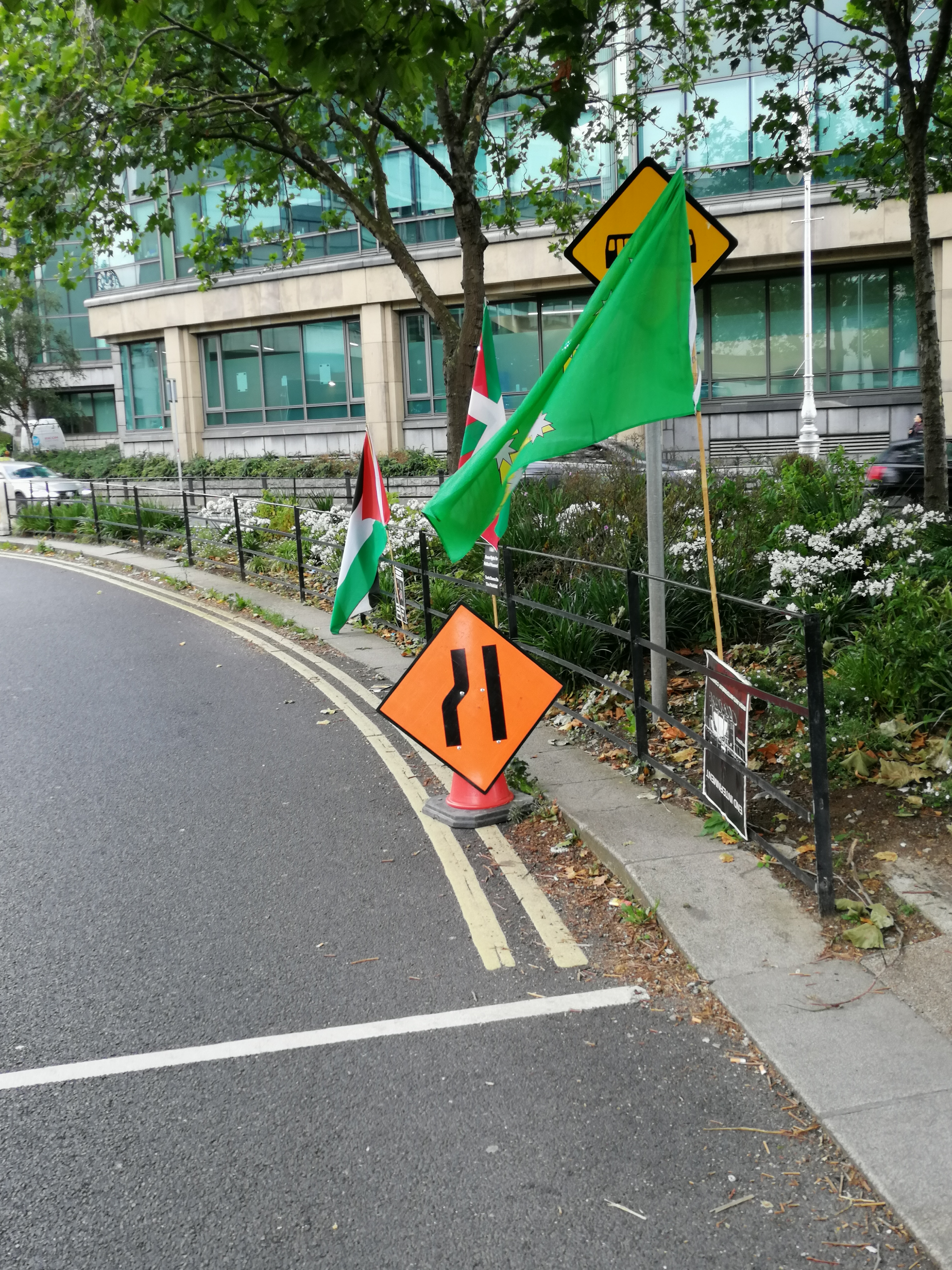
Socialist republicans and communists gathered on a traffic island in Dublin’s city centre to mark the International Day of the Prisoner. They flew flags to represent prisoners in Ireland (‘Starry Plough’), the Basque Country and Palestine.
They also displayed a number of placards.
(Photo: IAIC).
The choice of location, apart from being passed by road traffic in three directions, was because of the presence there of the Universal Links on Human Rights memorial sculpture with an eternal flame, commissioned by the Amnesty International organisation.
A plaque near the sculpture bears the following words: “The candle burns not for us but for all those whom we failed to rescue from prison. Who were tortured. Who were kidnapped. Who disappeared. That is what the candle is for.”
Plaque in the ground on the approach to the sculpture. (Photo: IAIC).
Somewhat ironically, one of the placards carried the words: “Amnesty International, do Irish Republican prisoners not have human rights too?” Irish Republicans have long complained that the organisation in question does not raise any issues with regard to Irish political prisoners.
Some have indicated as a possible reason or part-reason the location of the head office of Amnesty International being based in London, capital city of the occupying power. Its interventions on Ireland even during three decades of war in the colony have been very few indeed.
Other placards displayed referred to political prisoners from the liberation wars in India and in the Philippines, the innocent Craigavon Two still in jail and ongoing internment through refusal of bail to Republicansappearing before the no-jury special courts in both administrations.
Some leaflets were distributed about ongoing internment in Ireland through long remands in custody of Republican activists. Between convicted and awaiting trial there are close to 50 political prisoners in jails in Ireland between both administrations.
The Universal Links sculpture by Tony O’Malley (welding by Jim O’Connor) commissioned by Amnesty International. (Photo: IAIC)
The Zionist Israeli state holds 5,000 political prisoners (almost all Palestinian), of which over 1,132 are not even charged (‘administrative detention’). There are 33 female Palestinian political prisoners and 160 child prisoners. Philippines has 803 political prisoners.
The Spanish and French states hold between them around 170 Basque political prisoners.
The event to mark International Day of the Prisoner was organised by the Ireland Anti-Internment Campaign and a spokesperson gave a short explanation on video of the reason for the event with the human rights sculpture in the background.
End.
Some of the flags displayed (Photo: IAIC).Passer-by in conversation with a leafleter. (Photo: IAIC). (Photo: IAIC).
The media has alerted us to a military coup taking place in an African country most of us won’t even have heard of: Niger.
Apparently Niger had a democratically-elected leader overthrown by the coup and many states, including France and the US, are very concerned about this. Naturally so. Military juntas are surely no fit replacement for democracy.
Map of much of Africa showing Niger in green and surrounding states (Source: Wikipedia)
But it turns out that the USA and France have other reasons to be concerned apart from questions of democracy: both states have military stationed there, the USA including in fact a major military installation producing and operating drones, some of which are armed.
But why are they there? Well, to defend Niger against fundamentalist Muslim jihadists. That’s good, right? Helping the Nigerien people. It’s true that some unkind (and possibly ungrateful) people accuse the US of having given birth to the islamist fundamentalists originally, but, well …
We learned just recently two very strange facts, side by side: 1) Niger is one of the poorest countries in the world and 2) it is the seventh-largest exporter of a highly-valuable material: uranium.
Niger also has gold mines (two years ago 18 people were killed in a mine collapse) but curiously, Niger has no gold reserves at all. France, on the other hand, which has no gold mines whatsoever had 2,437 tonnes of the metal in their reserves at the end of the second quarter of this year.
Uranium is valuable because it is used in the production of nuclear power which, in turn, in many parts of the world, is used to generate electricity. France being one of those countries, where 80% of its uranium comes from … Niger. And 20% of the EU’s electricity likewise.
Hmm. So there might be reasons apart from restoring democracy for France being so upset at the coup, especially when the coup leaders say they want to break with France.
Urban scene in Niger, exact location and date unknown (Source: Internet)
But going back to this country being one of the poorest in the world, at least they must have plenty of generated power, right? Well, no. It turns out that 80% of the people have no electricity supply whatsoever. Democratic government or not, that can’t be right, can it?
Anyway, France has ordered the coup leaders to reinstate the deposed president with a deadline of last Sunday or it would take stern action. The deadline has passed quietly without an invasion or other attack.
Niger was a colony of France and became independent in 1960 so it’s kind of strange that France has such a grip on the country still.
Another five states border Niger including Mali and Burkina Faso, also ex-French colonies, also under recent military coup juntas. Their leaders have said any attack on Niger would be considered an attack on them.
Algeria was also a French colony and fought a very hard liberation struggle for independence, since when it has friendly relations with Russia. Algerian armoured vehicles have moved to the border with Niger, in what will be understood as a warning to other states not to invade.
Chad is another ex-French colony in the region but it made some threatening noises against the military coup leaders in Niger; Senegal too is an ex-French colony loyal to France.
Senegal’s political opposition leader Ousmane Sonko is on hunger strike in jail and his lawyer Juan Branco, extradited from Mauritania is in jail too for defending Sonko but nobody seems to be shouting about Senegal’s lack of democracy – not that we can hear, at least.
The west-friendly (some say neo-colonial) state of Nigeria, the leading state in the pro-western African alliance COWAS has imposed sanctions and threatened to invade Niger if the previous regime is not reinstated. Nigeria is huge and with extremely valuable resources, including oil.
In 1995, in defence of British Petroleum’s operations, Nigeria hanged peaceful environmental activists in the Delta region, the Ogoni Nine. As many as 4 in 10 Nigerians live below the national poverty line with 133 million living in poverty, according to its own national statistics.
Regarding Africa and coups, we Irish have cause to remember the Congo where Irish UN peacekeeping soldiers were killed, after a military uprising in a province against the elected patriot Patrice Lumumba was carried out in support of Belgian mining interests, supported by the USA.
And Uganda’s military rule under Idi Amin was generally OK with the western powers until he began to throw his weight around against the British, who had trained and supported him, so they had to bring him down.
Supporters in Niger of the military coup there demonstrating. (Photo sourced: Internet)
Elsewhere, for example in Latin America, military coups in many countries including Brazil, Chile and Argentina have been supported by the western powers or indeed instigated by them. As in what is now Iran, when the British overthrew the Shah in 1941 to replace him with his son.
Dictatorship from 1965 in Indonesia was widely seen by the western powers as necessary to stop the spread of socialist and national liberation ideas and, as in most such coups, the toll in massacres and torture by the new regime was huge. None such in Niger though, at least so far.
If we were citizens of Niger would we think ourselves better off under a military junta rather than a democratically-elected President? We might initially be more concerned as to whether the riches of our country were to be used to lift us from such poverty.
To give us education, hospitals, medicines, food, work, clean water, refuge from heat, power … or instead extracted and shipped out to some other country.
And what would we think of France, possibly backed by other NATO countries and their client states, coming to invade our land and bring back the old state of affairs?
End.
Niger’s National Council for the Safeguard of the Homeland Colonel-Major Amadou Abdramane, center, is greeted by supporters as he arrives for rally at the Stade General Seyni Kountche in Niger’s capital city Niamey, on August 6, 2023.(Photo cred.: Rebecca Blackwell, AP)
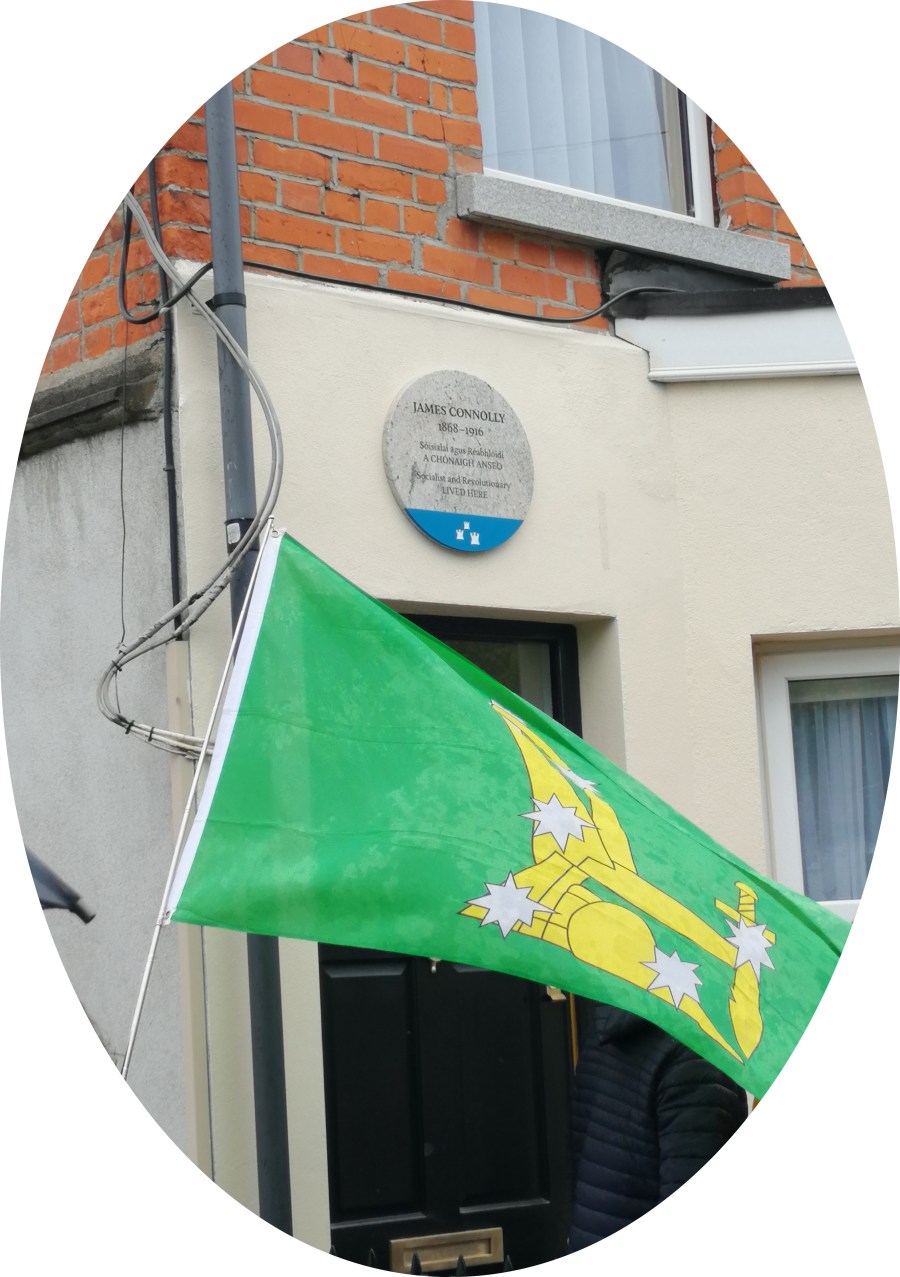
A new plaque commemorating James Connolly was unveiled on the morning of 31st July on 70 South Lotts, the house to which he returned from New York with his wife Lillie and children in 1910 and lived there until May 1911.
(Photo: D.Breatnach)
Connolly was born and reared in Edinburgh, left school at 10 and worked with his older brother John for the local authority as a carter, lied about his age and name to join the British Army, in which he first saw Ireland and where he met Lillie Reynolds; they were married soon afterwards.
Like his brother, Connolly became a militant socialist and trade unionist and returned to Ireland at the request of socialists to form the Irish Socialist Republican Party, the first socialist party in Ireland but left for the USA when the party failed to recruit significant numbers.
The ISRP’s office was in Middle Abbey Street, across the road from the premises of the Irish Independent, owned by Irish nationalist William Martin Murphy who was to become an arch-enemy from the Lockout and strikes of 1913 onwards1.
Connolly was a historian and journalist as well as a socialist, trade union organiser and a revolutionary. A report in Breaking News on the unveiling infers that he reluctantly committed to the Rising with the Volunteers; in fact, he had been pushing them to rise for months!
Unveiling speeches
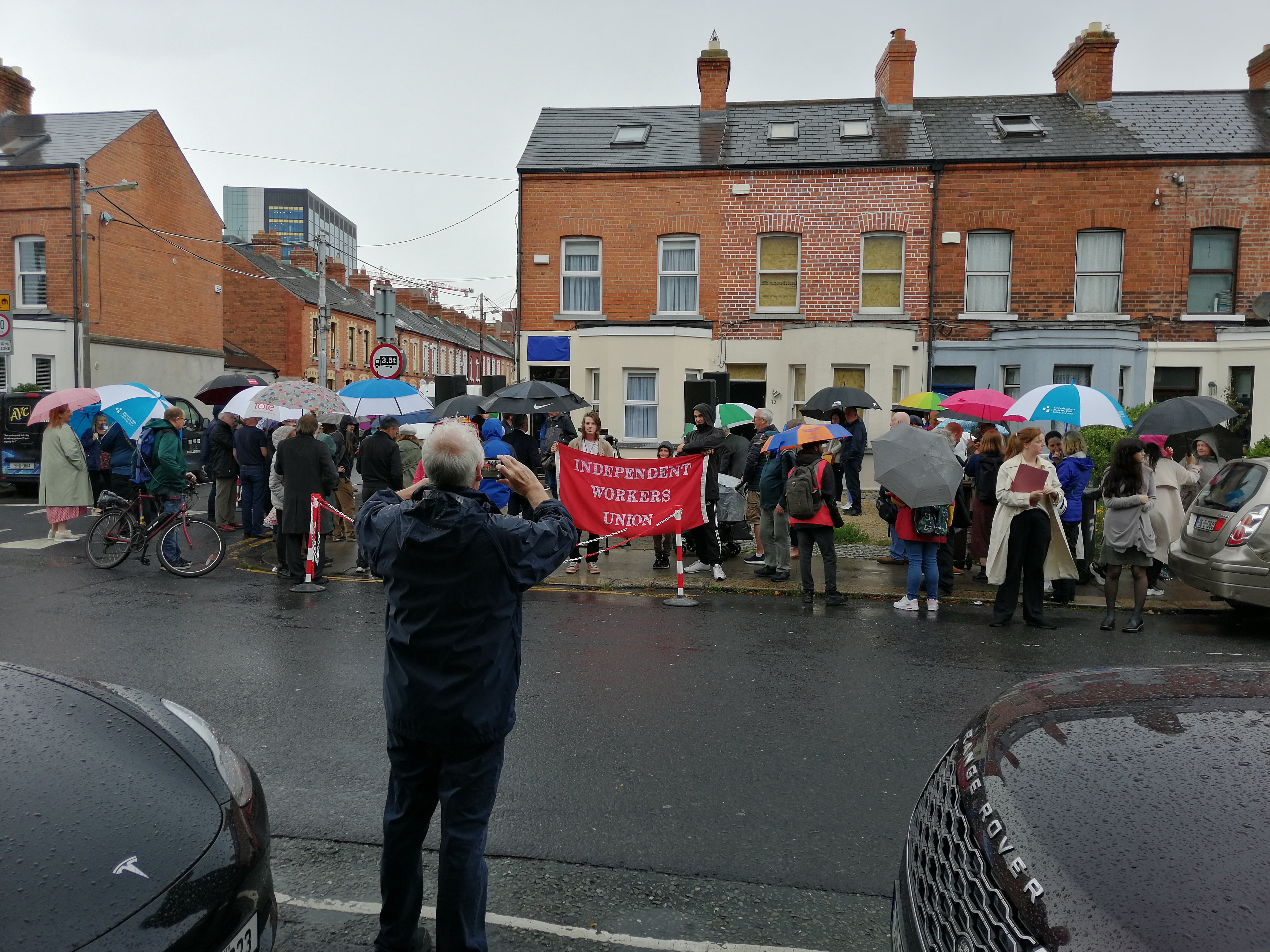
The event started late and in rain. Dáithí De Róiste2, Dublin’s current Lord Mayor, opened the proceedings and commented that the plaque on the house was a reminder that Connolly lived a life in some ways like many ordinary Dubliners, living in a Dublin house and walking city streets.
Dublin Mayor Dáithí De Róiste speaking at the event. (Photo: D.Breatnach)Historian Conor McCabe, who did the research for the plaque, speaking outside No.70. (Photo: D.Breatnach)
Historian Dr Conor McCabe, of Queen’s University Belfast, proposed the plaque as his research established the background that Connolly was living at the address around the time that his most famous work, Labour In Irish History, was first published in book form.
In deference to those in attendance standing in the persistent rain, Conor McCabe kept his speech very short. This was not the case with every speaker.
Joe Cunningham, General Secretary of Siptu3, an amalgamation with other unions of Jim Larkin’s ITGWU which Connolly had led for six years, commented in his speech that it was Connolly who ensured that the interests of working people were incorporated in the 1916 Proclamation4.
Also that, at the ceremony of raising an Irish flag over Liberty Hall5 in April 1916, had declared that “The cause of labour is the cause of Ireland, the cause of Ireland is the cause of labour.”6
Section of crowd in front of No.70 waiting for event to begin. (Photo: D.Breatnach)
Dublin City Council Commemorations & Naming Committee was responsible for the placing of the plaque, in consultation with the house occupants and its chairman, Councillor Mícheál Mac Donncha7 welcomed suggestions from the public for commemoration of people and events.
Sinn Féin Councillor Mac Donncha also commented that James Connolly was a personal hero of his.
Jim Connolly Heron, great-grandson of James Connolly, was called to say a few words and invited family members present to join him in front of the house while he spoke and commented also on the importance of commemorative plaques in protecting historical sites.
He did so in reference to the plaque on a house in Moore Street that had disappeared and come to light in a property developer’s office, raising concerns that had led to the long Moore Street conservation struggle.8
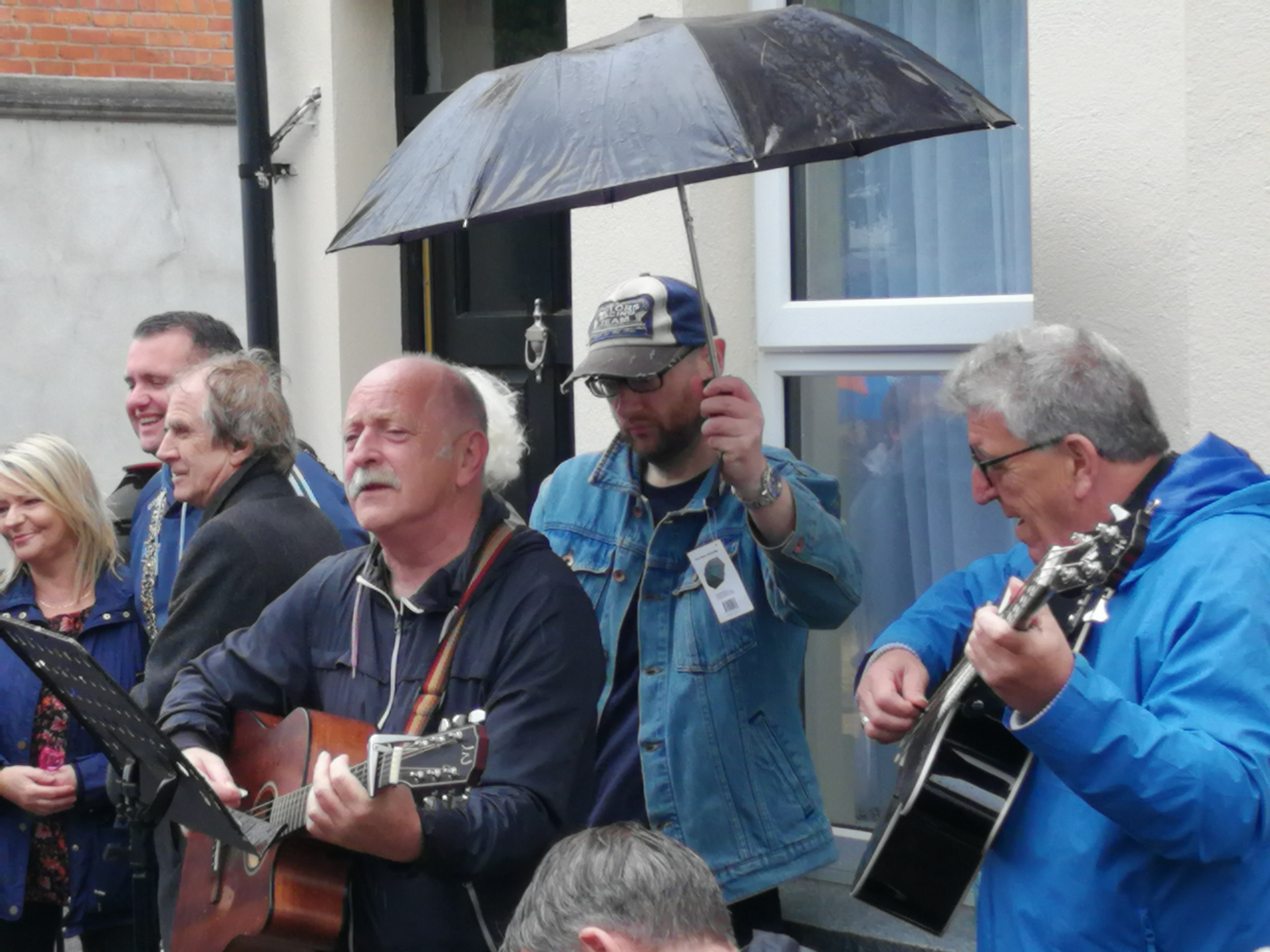
Music and song for the event was performed by The Pullovers ballad group but the amplification system had been removed by then which was a pity as it was needed for the music.
Ballads were performed at the event by The Pullovers band. (Photo: D.Breatnach)
The 1913 Lockout
James Connolly and family returned to Dublin when Jim Larkin9 offered Connolly a post in the young breakaway Irish Transport and General Workers’ Trade Union, which he took up in 1910. Three years later the union was in a fight for its life.
It is sometimes wrongly claimed that the 1913 Lockout was an attempt by employers in Dublin to prevent workers from joining a trade union but there were other unions operating in Dublin during the period and they were accepted by most of the employers.
Apart from the ITGWU recruiting large numbers of ‘unskilled’10 manual workers, it pursued its objectives militantly, using sympathetic solidarity action by other workers to increase the effectiveness of the workers who were in industrial dispute with their employer.
In August 1913 a combination of around 200 employers presented their workforce with a declaration to sign which committed them to having nothing to do with the ITGWU. En masse, the workers refused to sign, were locked out while others struck work and were locked out too.
Right from the beginning the Dublin Metropolitan Police11 attacked the workers on behalf of the employers and in a baton charge on Eden Quay on 30th August fatally wounded two workers, also beating strikers and onlookers the following day in O’Connell Street (‘Bloody Sunday 1913’)12.
As a direct response, Connolly and Larkin set up the Irish Citizen Army as militant response to police attacks, dedicated also to Irish independence and their flag was the gold Starry Plough on a green background,13 which they flew over the Clery’s building in 1916.14
The only Starry Plough flag unfurled at the event, brought by a member of the attendance. (Photo: D.Breatnach)
Comment
The only Starry Plough to be seen at the event was one unfurled during the event independently of the organisers and speakers.
Many who claim to admire Connolly or even to follow his teachings do so on occasion in words but never in action and if Connolly were alive and acting as he did when he was, most of the speakers at the unveiling event would call, if not for his shooting, certainly for his jailing.
SIPTU is much larger than the ITGWU was but it and other unions are much less effective; as a result of the lack of active resistance by the leadership, union membership in Ireland is at an all-time low in modern times. Nor would Connolly have ever agreed to the partition of Ireland.
The Irish Labour Party, which Connolly and Larkin formed in order to give the working class a voice in municipal affairs, has been in coalition government a few times, always capitalist and most often with the right-wing Fine Gael, when they have joined in attacks on the working class.
Joan Burton, while Tánaiste15 of the Labour-Fine Gael coalition government in 2014, complained about working class people being able to afford video-phones and tried to get people jailed for organising an effective protest against her in Jobstown.16 She too attended the unveiling today.
Joan Burton, who attended the event. (Photo: D.Breatnach)
Fianna Fáil is a party of the Gombeen client class and has been in government more often than any other, whereas Sinn Féin in its current incarnation is seeking to replace it with more of the same.
It is a tribute to the memory of James Connolly held so dearly among the working people that these types, so far from Connolly in their reality, are obliged to pay public homage to the man and to his principles while their daily practice is in opposition to all that he stood for.
End.
FOOTNOTES
1An editorial in his newspaper, The Irish Independent (still one of two main newspapers of the state), after a number of British executions of a number of 1916 leaders, called for continued executions of leaders prior to the execution of Connolly and Mac Diarmada, the last of the 14 to be executed in Dublin (Kent was shot in Cork and Casement hanged in London).
3The largest union in Ireland, owner of the current Liberty Hall which stands on the ground of the original union building.
4There is no record that this is the case but it is a natural and widely-held assumption. It is a fact that the Proclamation was printed in Liberty Hall.
5Cunningham said it was “the Irish flag” which most would think a reference to the Tricolour. However that flag had not yet been accepted by the majority as the primary flag of the nation, which really occurred after the 1916 Rising. The flag raised instead by teenager Molly O’Reilly at Connolly’s request had the golden harp on a green background, the essential flag of Irish Republicans from the 1790s until the 1916 Rising.
6This was not a random statement by Connolly but rather a strategic one; on an earlier occasion he had observed that of all social classes in Ireland, the working class remained “the incorruptible inheritors of the fight for Irish freedom”. Connolly wrote that in his foreword to his work Labour in Irish History, clearly indicating that only the working class could be trusted to lead the national struggle through to successful conclusion.
7A prominent member of one of the groups campaigning for Moore Street Battlefield conservation, the Save Moore Street Trust, of which Mac Donncha is Secretary.
8That occurred at the beginning of this century and the struggle has been ongoing since.
9Like Connolly, also a migrant and member of the Irish diaspora but from Liverpool. He founded the Irish Transport & General Workers’ Union after his departure from the British-based National Union of Dock Labourers, for which for a time he had been chief organiser in Ireland. Most of the NUDL’s members in Ireland left to join the ITGWU but in Belfast there was a division along sectarian lines.
10This is the general appelation for work not requiring long periods of training. However, anybody who has been employed in work of this category soon learns that such work requires skill to achieve the objectives set, to pace oneself and to guard against injury. This is the reason those recruiting for such ‘unskilled’ work prefer ‘experienced workers’, a code for ‘skilled’.
11A police force of the period for Dublin City, most of its members being without firearms, unlike the armed all-Ireland colonial gendarmerie of the Royal Irish Constabulary (of which the Police Service of Northern Ireland is a descendant body). DMP minimum height requirements were 5ft 9” in a city where many working people were of low stature; this disparity gave substantial momentum to the swing of a truncheon.
12The event wrongly named as leading to the death of two workers, whose deaths were caused by the previous day’s police attack on Eden Quay, just by Liberty Hall. However, a previously healthy Fianna Éireann boy, Patsy O’Connor, who was clubbed in the O’Connell Street police riot while he administered first aid to a victim, suffered frequent headaches thereafter and died in 1915 at the age of 18.
13The design has seven stars in the Ursa Mayor configuration, with the design of a plough following the stars and a sword as the ploughshare. There is also a plainer version flown by the Republican Congress of the 1930s, the outline of the Ursa Mayor constellation in white or silver stars alone on a blue background.
14The flag survived the shell explosions and raging fires along the southern half of O’Connell Street and is currently in the Military History Museum, Collins Barracks, Dublin, along with a number of other flags flown by the insurgents during the Rising.
15Title of the Deputy Prime Minister in the Irish government.
16A number of activists from different organisations, including Paul Murphy TD (member of the Irish parliament) were arrested in raids some time later and among the charges was “kidnapping” Burton. The untruthfulness of a number of witnesses for the Prosecution including a senior Garda officer were exposed (ironically by video taken by protesters) and the jury acquitted all the defendants of all charges.
Opposition leader Elly Schlein accused the prime minister of “historical revisionism” over her ambiguous language.
08/03/2023 PUBLICO / EFE (Translated by D.Breatnach)
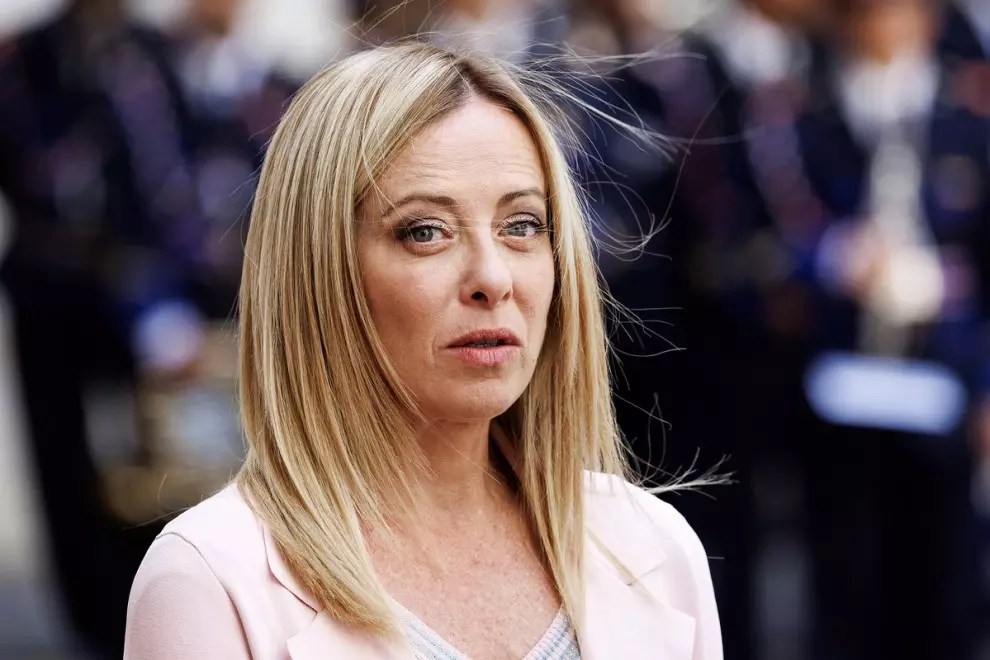
Italian Prime Minister Giorgia Meloni completely avoided using the word ‘neofascist’ in her message marking the 43rd anniversary of the Bologna Massacre, a terrorist attack by a far-Right organization that killed 85 people.
Meloni did not go to Bologna to participate in the commemoration.
“43 years have passed but, in the heart and conscience of the nation, the violence of that terrible explosion still resonates with all its force,” said the leader of the Executive and the ultra-right party Brothers of Italy.
Giorgia Meloni, the Prime Minister of Italy. (Photo: Fabio Frustaci / EFE)
In her message, she asked to “get to the truth about the massacres that marked Italy in the postwar period,” an ambiguous phrase that makes no direct reference to the far-right groups that carried out the massacre on 2nd August 1980.
The absence of specific terms in Meloni’s speech to refer to the attack has prompted opposition leader Elly Schlein, a progressive, to accuse Meloni of promoting “historical revisionism.”
“We are here in Bologna together with the families of the victims of the massacre to reiterate that we do not accept any further attempts to rewrite history. The judicial evidence already makes it clear that it was a neo-fascist massacre and also with subversive intent,” Schlein said.
In the message shared by the president, Sergio Mattarella, to commemorate the date, he did refer to “the neo-fascist matrix of the massacre.” Likewise, he recalled that in the subsequent trials “ignoble deviations, in which secret associations and treasonous agents of the state apparatus participated,” came to light.
Meloni has ruled out any anti-democratic nuance of her formation, but she maintains as a symbol of the Brothers of Italy the so-called “tricolor flame”, emblem of the youth organisation of the old and post-fascist Italian Social Movement (MSI) in which she was a member of her youth.
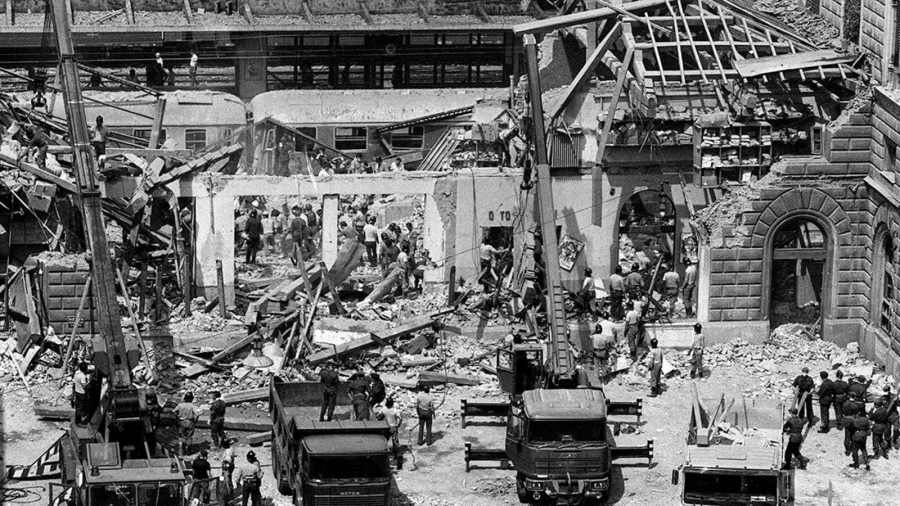
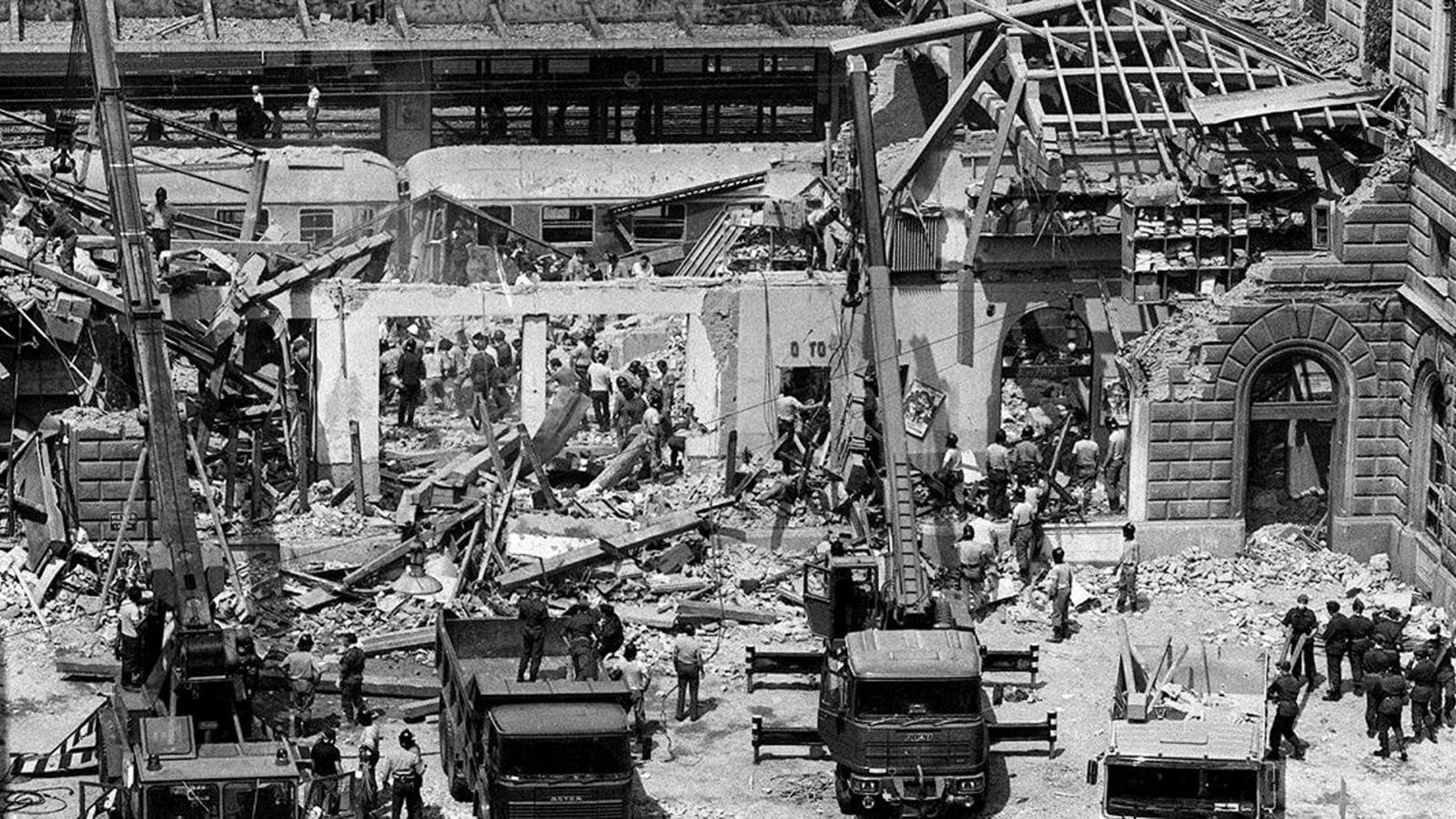
The Bologna Train Station, Italy, following the fascist explosion on 2nd August 1980 (Photo sourced: Internet)
The Bologna Massacre
The Bologna massacre was the most serious terrorist attack in Italy after World War II, in which 85 people died and more than 200 were injured and extreme right-wing militants belonging to the organization Armed Revolucionary Nuclei were convicted for it.
Comment by D.Breatnach: However, parts of the Italian State were implicated in the bombing and/or coverup too, with elements in the Italian police, judiciary and secret service but also with suspicions of CIA/NATO involvement. It seemed that the purpose of that bombing and others in the period was to create fear and confusion in which the State could return to fascism.

















 rebelbreeze