USA’s ambitions bring danger of war

Diarmuid Breatnach

(Reading time: 13 mins.)

“Wars and rumours of wars …”1 The sabres are rattling around Eastern Europe. The mass media in our latitudes largely takes the position of the USA under the guise of democracy; however with some text and the use of a few maps I hope to show that Russia’s position is essentially defensive in this regard and that the USA is the main aggressor. I hope to do that without expressing any support for the Russian regime.

WHAT IS ACTUALLY HAPPENING?

The USA sees Russia as its main opponent or competitor in Europe and has been working since the post-WWII decades to neutralise it, earlier under the guise of stopping the spread of “communism” and defending “democracy”. Since the fall of the USSR system the talk is no longer about defeating “communism” but “defending democracy” continues to used in anti-Russian rhetoric. Russia is no democracy but the notion that the US, the world superpower, the biggest imperialist power on the planet since WWII, cares about democracy should make us laugh. It would perhaps, except that the mass media keeps feeding us the USA’s rhetoric and shaping us to support it in war.

The USA is actually squeezing Russia from two directions — from Europe and from the Middle East. NATO, the North Atlantic Treaty Organisation is a US-led military alliance which now has the membership of most states in the EU, along with the UK and nearly every state of the former USSR to the west of Russia. A look at the map of NATO states will demonstrate that2. Nearly every state in the Middle East is also formally or informally in the sphere of influence of US imperialism3.

“Russia says it wants Western guarantees that Nato will not allow Ukraine and other former Soviet countries to join as members. Moscow has also demanded the alliance halt weapons deployments to Ukraine and roll back its forces from eastern Europe – demands flatly rejected by the West.4

Map NATO & non-NATO countries in Europe, showing also periodic expansion (Source: The Economist)

So the Russian ruling class is naturally worried and feeling besieged. On or near their European borders they only have Sweden, Finland, Moldova, Belarus and Ukraine which are not formally part of NATO and Ukraine has clearly indicated an interest in that direction. Beyond those last three aforementioned, all the states through central Europe are NATO members right through to the UK: Poland, Slovakia, Hungary and Romania actually bordering on Russia, with – heading generally westward and south-westward– Czech Republic, Croatia, Slovenia, Bulgaria, Albania, Greece, Germany, Netherlands, Belgium, Italy, Spain, Portugal, France and UK. In addition, some of those states have highly-developed military power such as Germany and two of them have nuclear armament of their own — UK and France – while the US has ready-to-launch nuclear missiles on the lands of many of the NATO states — Belgium, Germany, Italy, the Netherlands and Turkey5.

Sweden, Austria and Switzerland may remain nominally neutral but are in general politically aligned with the EU and the USA rather than with Russia, while non-NATO Finland is definitely, for historical and geographical reasons, extremely wary of its Russian neighbour.

The smaller non-NATO states of the former Yugoslavia – Bosnia & Herzegovina, Serbia, Montenegro, Montenegro and Kosovo are in some cases friendly towards Russia (or not overly-friendly towards NATO) but they are completely surrounded by NATO states.

On its borders with the Middle East, Russia is also being squeezed. Turkey has long been a major NATO state in the region and only Georgia is located between it an Russia to the latter’s south-west, with Armenia and Azerbaijan to its south-east. Nearly all of the states in the Middle East are in formal or informal alliance with the West and therefore with the US: Cyprus, Lebanon, Iraq, Israel, Jordan, Egypt, Sudan, Libya, Saudi Arabia, Kuwait, Oman, Bahrain, Qatar and United Arab Emirates. Yemen is embroiled in its own Saudi and West-proxy war, while Syria is threatened by Israel, Turkey and NATO. Only Iran is fairly safe for the moment on that part of Russia’s border, which is why Russia will take its side in any conflict with the West, despite the Russian ruling class’ dislike of and vulnerability in some regions, as in Chechnya, to militant fundamentalist Islam.
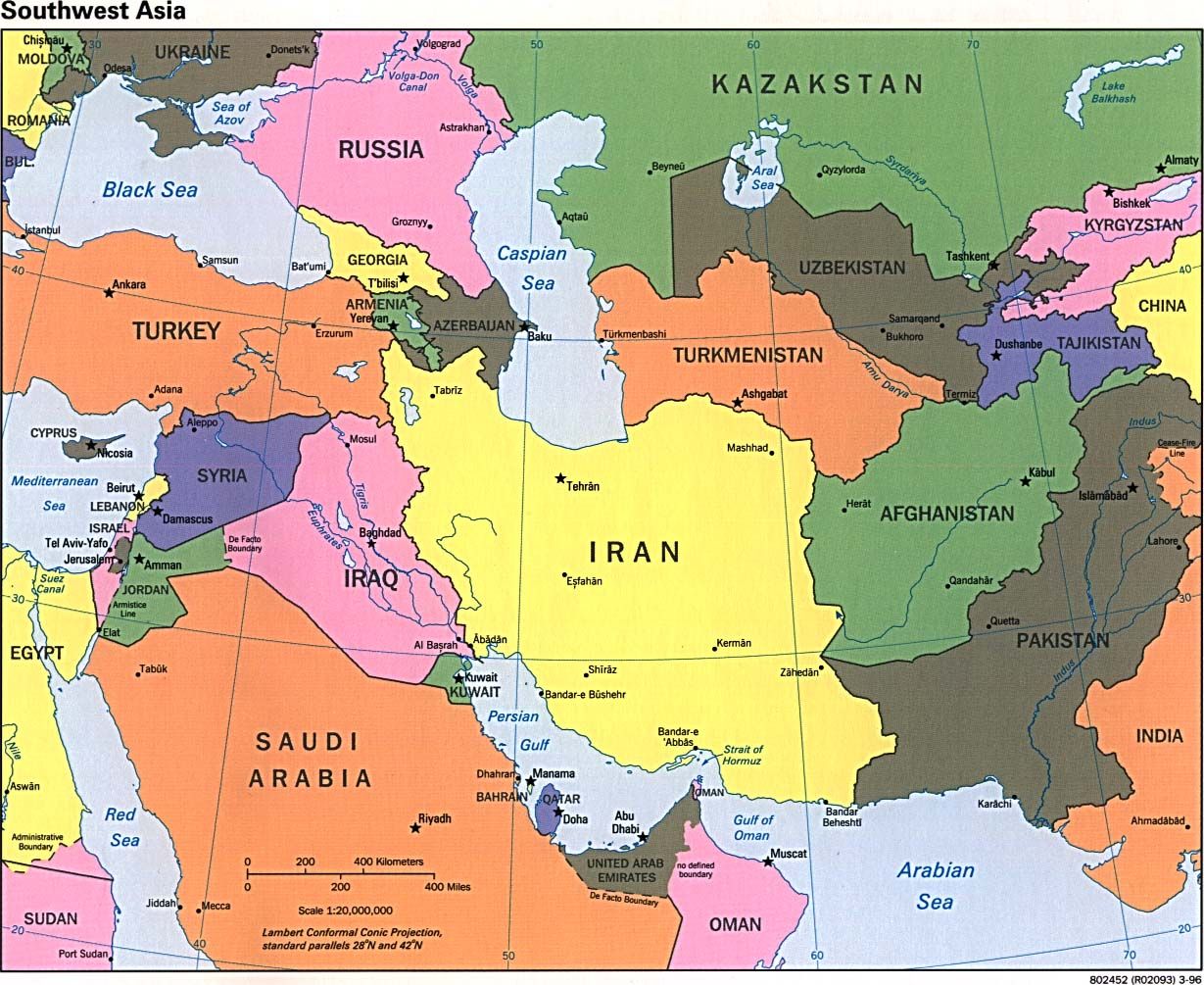
Middle East states and Russia (Source: Internet)

Syria is next to Iran which is also why Russia has been supporting the Assad regime and why, during the past week, it has warned Israel about its bombing raids into Syria as the latter attacks Hizbollah bases there. In fact we may see the invasions by western alliances of Iraq and Libya as part of huge US/NATO ‘domino’ plan to attack Syria with Iran next; then the pressure on Azerbaijan and Georgia on Russia’s doorstep. While on the eastern side of Iran, Afghanistan and Pakistan are also allies of the West ….

Further east, there is India which has long been friendly to Russia and in tussles with Pakistan — and China, which is not openly hostile to Russia as a rule but which is not a real friend either, though its competition and contention with the US keeps it friendly enough towards Russia for the moment.

What the Russian ruling class is doing is attempting to bring a halt to its encirclement by NATO at the point of Ukraine. And the US-NATO and EU are issuing a counter-threat – an open one of sanctions and a more veiled one, in the case of US-NATO, of armed action.

This week it appears that some parts of Ukraine have sought to break away from the main part, probably instigated by Russia or at least promised support if they did – which has materialised in Russian diplomatic recognition and in troop movements. This may amount to an annexation or may not but what is clear is that Russia, in the face of what it considers a threat to its existence and NATO intransigence, has decided to take some decisive action.

WHAT IS REPORTED

The western mass media reports the situation painting a picture of big powerful Russia threatening its much smaller neighbour, by threat of invasion seeking to force it into submission to Russia’s regime, in denial of the small nation’s democratic rights. And the democratic West, through NATO, is moving troops to support the Ukraine, warning Russia of consequences.

Russian Tanks and Troops Reportedly entering part of Ukraine (Photo source: The Telegraph)

The picture contains much truth but overall it is a lie. Russia is much bigger than the Ukraine and it is threatening it with troop movements. And NATO is moving troops up to counter-threaten. But to evaluate a situation properly, we need to know its antecedents, what led up to it. We also need to see the situation through the eyes of the participants, whether we agree with them or not. The mass media, apart from a couple of honest analysts tucked away inside a newspaper, far from the headlines, does not supply us with that information.

The Irish Times, one of Ireland’s main daily newspapers, on 12 February reported that “Russia’s military build-up near Ukraine and a surge of Russia’s military activity has fueled fears that Russia could invade the country. Russia denies having any such plans. However a US official has said that the US had picked up intelligence that Russia is looking at Wednesday as a target date for an incursion.”

So on the basis of the quoted paragraph, we were to draw the conclusion that Russia was threatening to invade Ukraine. OK, Russia denied it but then why the military buildup near Ukraine? Finally, the authority voice of the USA, quoting what we are supposed to see as excellent intelligence sources (which we cannot of course question), predicting a probable Russian invasion four days away. So which state are most people in this part of the world likely to believe, the Russians or the US?

Some weeks earlier, on 25th January, another Irish daily newspaper, the Examiner, reported on reactions to a Russian naval fleet exercise in the Atlantic. The Irish Government told the Russians the exercise was not welcome although not illegal6, because the area of the exercise is regarded as international waters. This from the same government that facilitates US military flights via Shannon airport, i.e on its own national territory. And NATO carries out at least one major exercise in European waters annualy, with the UK doing so twice yearly without complaint from the Irish Government.7

The Ukrainian Ambassador to Ireland, Ms Gerasko moved to take advantage of the situation “A plan to hold a major exercise by the Russian navy and air force in the Atlantic off the southwest coast of Ireland is yet another demonstration of the threat that Russia poses for the world,” she said, in a statement to the Irish Examiner.” 8

Attempts were made at the same time to whip up Irish offshore fishermen against the Russians and to whip up the Irish public in defence of “our fishermen”. The latter project failed miserably since the Russian Ambassador to Ireland met and negotiated with the fishermen, leading one of their leaders to comment that the Russians had treated his members better than their own (Irish) government.

We might expect an alternative discourse about the Ukraine crisis from Al Jazeera but its report on the 24th of January, although emphasising US military movements in the area, attached a number of articles which were generally relaying the western line. The Irish Independent carried a much more in-depth explanation, though based on the position of the UK through its premier, Boris Johnson; however it did list the Russian demand that NATO cease pushing towards them and that Russia considered Ukraine joining NATO “an existential threat” while in general still following the general anti-Russian pattern9.

Closing ceremony of Sea Breeze, NATO-Ukraine joint naval exercises in the Black Sea 12 July 2019 (Photo by US Naval Officer)

POSITION OF THE IRISH STATE

An analysis piece in its business section by the Irish State’s national broadcaster, RTÉ, concentrated on the possible economic impact of loss or drastic reduction in gas and oil exports from Russia, either as a direct consequence of conflict or through imposition of sanctions by the West. “Russia produces 11% of global oil supplies and according to David Horgan, managing director of Petrel Resources, any significant loss of Russian energy exports would result in a further spike in prices.”10

Russia is the biggest supplier of gas in the world and the largest to Europe with a third of of its gas pipeline supply to Europe crossing Ukraine. Ireland’s electricity supply is highly dependent on gas for its generating stations so any disruption will impact heavily of prices which “have already gone from $2 to about $30 per million BTU”, according to the Petrel managing director.11

It is clear that while the USA is driving the agenda through its dominance of NATO and the the threat of sanctions on Russia, which the USA regularly insists upon when teaching other countries a lesson, its own economy would suffer little as a result. However, it is a different question for the European states, which would be obliged to bear the weight of economic impact. Mícheál Martin, the Taoiseach (Prime Minister) of the Irish State felt obliged to comment on this possibility but, rather than criticise the USA and NATO’s expansionism, spoke about the need to break from their dependence on Russian energy supplies.

Micheál Martin said the EU is unified in responding “very strongly” to any Russian invasion of Ukraine and stated that in Europe’s view the huge build-up of troops by Russia on the Ukraine border is “not justifiable” in any circumstances. While calling for “diplomacy and de-escalation” he clearly sided with the USA in the conflict as both the Irish ruling class and the EU’s would expect of him.12

Despite many criticisms to the contrary, the policy of the Irish state during WWII was essentially one of neutrality in favour of the Allied forces while the government of the Six Counties was of course wholly aligned with the UK. Nevertheless Irish commercial shipping was sunk by Nazi German action and cost many Irish seamen their lives.

So far the Irish state has remained outside NATO but over the past decade there has been discussion envisaging the creation of an EU rapid deployment force made up of personnel contributed from all member states. It would hardly be surprising if such a move appealed to some within the career personnel in the Irish armed forces, envisaging taking part in wider military action, alongside varied forces, employing advanced weapons and systems and with possibly better promotion prospects. Additionally in recent weeks there has been media discussion of greater funding for those forces.

Ireland – and not only the UK’s colony here – can be dragged into war more easily than we perhaps imagine and also into being targeted for retaliatory action. Indeed, the facilitation of US military personnel and materiel through Ireland’s airport at Shannon, along with CIA transport of secret prisoners (“rendition”) has already exposed the State (and succeeding governments) to accusations of military partisanship.

Contrary to popular belief, the Irish State’s ‘neutrality’ is in general a matter of government policy rather than a requirement of the Constitution or Statute law.13 

The principal statute governing the Irish Defence Forces is the Defence Act 1954, which did not oblige members of the Irish Army to serve outside the state (members of the Air Corps and Naval Service are not so excused). A 1960 amendment intended to allow deployment in United Nations Peacekeeping missions requires three forms of authorisation, since the 1990s often described as the “triple lock”:

  1. A UN Security Council Resolution or UN General Assembly Resolution;
  2. A formal decision by the Irish government;
  3. Approval by a resolution of Dáil Éireann (the lower house of the Oireachtas, to which the government is responsible).

From those last two it is clear that the 26 Counties can be put on a war footing by a decision of the Irish Government or even a majority vote in favour in the Dáil. Anyone who believes that the party with most TDs would necessarily vote against such a motion is fooling themselves since the SF party has been at pains to portray itself as a safe pair of hands for Irish capitalism and recently called for greater funding for the armed forces of the Irish state; in addition it has long had an uncritically friendly relationship with the USA, in particular – though not only – with its Democratic Party.

A resolution from the UN Security Council obliging the Irish state to go to war against Russia is impossible and though such from the General Council might be possible, albeit unlikely.14

These provisions were modified in 1993 to allow for UN Chapter VII missions and again in 2006 to allow for regionally organised UN missions.
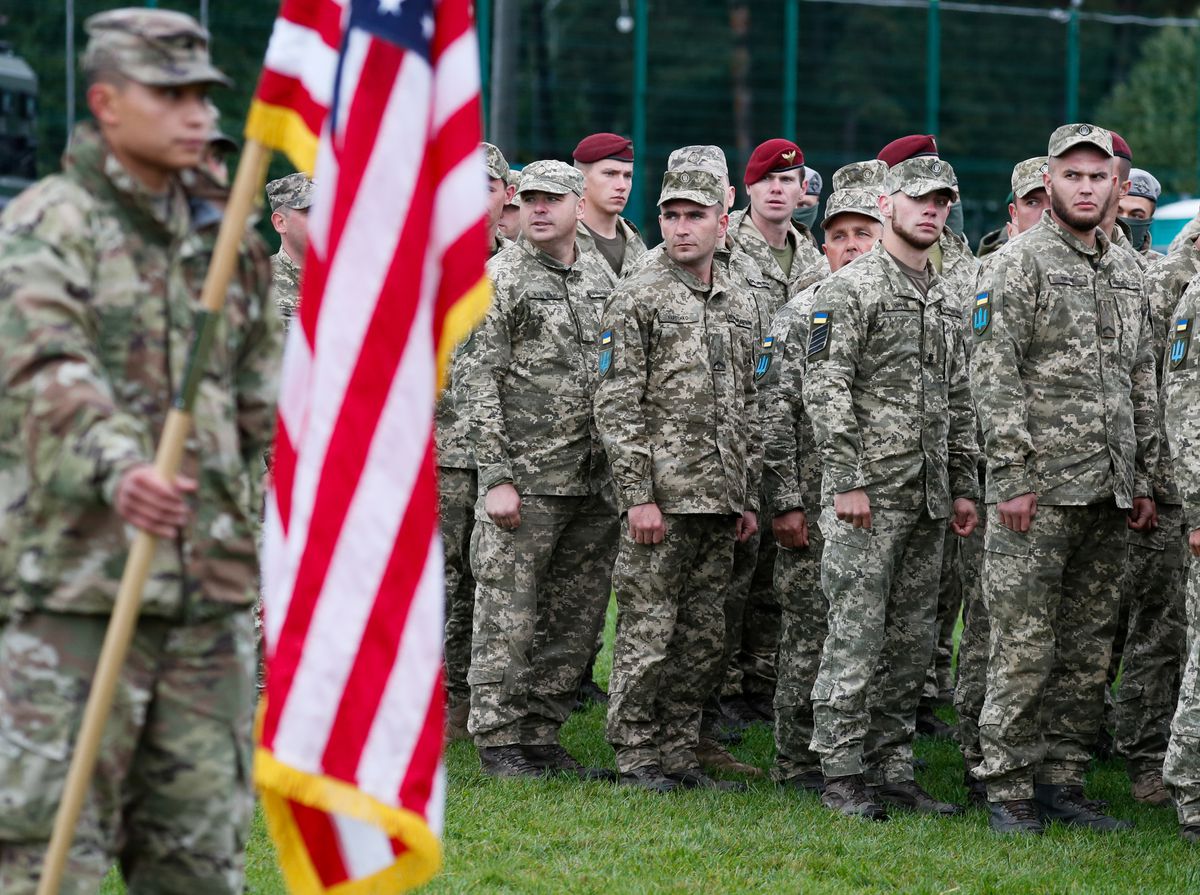
Joint NATO-Ukraine military exercise September 2021 (Photo sourced: Internet)

WHAT WE CAN DO

There seems no middle way — either NATO will back down or Russia will. No doubt the Western powers think it reasonable that Russia be the one to blink but as commented earlier, for the latter NATO creep to their borders is seen as a threat to their very existence. The same people who thought it reasonable for John Kennedy as President of the US to threaten war on the Soviet Union for the location of some missiles on the Caribbean island of Cuba think Russia should accept the advance of NATO to its borders.

In practical terms there seems little we can do in Ireland except struggle to resist the state and colony in which we live being dragged into war – for which we need to mobilise the opposition we can on the street. Sadly the anti-imperialist war movement in Ireland of years ago was allowed to deteriorate — but we should work to rebuild it.

In order to assist in this it is essential that we expose the reality of what is going on in the world. Some will say that because the USA is the main aggressor in this case and the biggest bully, we should support Russia but to do so would be a big mistake. Not long ago, while joining others in anti-fascist solidarity with people in the Donbas region in SE Ukraine, I found us being increasingly nudged towards support for Russia which I did not view as being the same thing at all.

Russia has its own crimes against people and workers and calling for support for it now will cause confusion when in future we will need to condemn it. Our position should be that while neither the USA’s regime or Russia’s is to be supported, the biggest danger of war comes from the USA and therefore it will be the main target of our hostility – besides which it is the power with which the ruling classes of Ireland and the UK are aligned. It is the biggest imperialist power in the world by far along with being the biggest military power in most of the world.

Most Irish people have no wish to be dragged into an armed conflict anywhere where they do not feel threatened. On the other hand our society is conditioned not only by decades of strong cultural influences from the USA, in particular through film but also by media reporting that is biased towards the dominant western European view and that of the USA. In that paradigm, the Russians are the bad guys, the gunfighters in the black hats, while the US and the West in general are on the side of the angels.

With the 1916 Rising in the middle of WWI, Ireland became the first country to carry out an uprising against world war15, against the dominant trend throughout Europe at the time — a tradition worth upholding. As long as imperialism exists, the world will continue to suffer smaller wars and the danger of another major war. It is necessary to overthrow imperialism and we can best contribute towards that aim by coordinating our struggles with the aim of carrying out a revolution in Ireland, thereby depriving imperialism of one of its supporters in Europe.

End.

FOOTNOTES
1
“And you will begin to hear of wars and rumors of wars. Behold, do not be alarmed; for it is necessary to take place, but the end is not yet” — Christian New Testament Bible, Matthew, Chapter 24:6.

2See map NATO states

3See appropriate map for this also

4https://www.breakingnews.ie/world/white-house-calls-russian-moves-on-ukraine-an-invasion-1262219.html

5https://armscontrolcenter.org/fact-sheet-u-s-nuclear-weapons-in-europe/

6https://www.irishexaminer.com/news/arid-40792923.html

7https://www.royalnavy.mod.uk/news-and-latest-activity/operations/united-kingdom/exercise-joint-warrior

8Ibid.

9https://www.independent.ie/world-news/europe/ukraine-crisis-why-russia-might-invade-and-what-could-happen-next-41279592.html

10https://www.rte.ie/news/business/2022/0128/1276522-ukraine-ireland-analysis/

11Ibid.

12https://www.irishexaminer.com/news/arid-40811598.html

13According to Wikipedia: “One exception is Article 29, section 4, subsection 9° of the Irish constitution:

The State shall not adopt a decision taken by the European Council to establish a common defence pursuant to Article 42 of the Treaty on European Union where that common defence would include the State.

This was originally inserted by the 2002 amendment ratifying the Treaty of Nice,and updated by the 2009 amendment ratifying the Treaty of Lisbon. An earlier bill intended to ratify the Treaty of Nice did not include a common defence opt-out, and was rejected in the first Nice referendum, in 2001.”

14Resolutions of the UN Security Council, the only ones binding on all member states, require unanimous agreement by all five Permanent Members: UK, France, USA, Russia and China. Forcing a vote such as this in the UN General Assembly would likely lead to the fracture of the organisation.

15The following year there were two in Russia and in 1918 another in Germany.

SOURCES

Matthew 24:6 https://biblehub.com › matthew

https://www.dw.com/en/thousands-of-russian-troops-leave-ukraine-border/a-60257452

https://www.breakingnews.ie/world/putin-orders-forces-to-maintain-peace-in-eastern-ukraine-1261744.html

https://www.breakingnews.ie/world/emergency-meeting-called-by-un-security-council-over-ukraine-crisis-1261794.html

Map Middle-East towards Russia: https://www.pinterest.com/pin/291678513336896419/

European states holding US nuclear weapons: https://armscontrolcenter.org/fact-sheet-u-s-nuclear-weapons-in-europe/

Map NATO states towards Russia: https://www.businessinsider.com/map-europe-divided-nato-russia-2016-7?r=US&IR=T

UK bi-annual military including naval exercises: https://www.royalnavy.mod.uk/news-and-latest-activity/operations/united-kingdom/exercise-joint-warrior

NATO exercise 2021: https://mc.nato.int/media-centre/news/2021/nato-exercise-dynamic-mariner-and-joint-warrior-begins-in-the-atlantic#:~:text=It%20runs%20between%2018%20and,Kingdom%20and%20the%20United%20States.

Mass media:

Ireland, on Russian Naval fleet in the Atlantic and Ukraine Ambassador: https://www.irishexaminer.com/news/arid-40792923.html

Al Jazeera on the Ukraine confrontation: https://www.aljazeera.com/news/2022/1/24/uk-pulls-staff-from-ukraine-as-fears-of-war-rise-liveblog

Much more in-depth coverage with emphasis on the UK position: https://www.independent.ie/world-news/europe/ukraine-crisis-why-russia-might-invade-and-what-could-happen-next-41279592.html

Irish Government position: https://www.irishexaminer.com/news/arid-40811598.html

Irish neutrality — facts: https://en.wikipedia.org/wiki/Irish_neutrality

Calls for a joint EU countries armed force: https://www.france24.com/en/europe/20210902-proposals-for-an-eu-army-re-emerge-after-afghan-pullout-%E2%80%93-but-many-remain-hard-to-convince

BRITISH QUEEN’S LONG SERVICE TO COLONIAL & IMPERIALIST WAR

Diarmuid Breatnach

(Reading time main text: 5 mins)

Recently the Queen of the UK and Commonwealth regions reached the 70th year of her reign, called by convention the “platinum jubilee” and has received congratulations from the heads of imperialist, colonial and neo-colonial states around the world. In Ireland, she has also received the congratulations of the head of a formerly Republican party now aspiring to neo-colonial government. When Mary Lou MacDonald, President of Sinn Féin praised Elizabeth II for her “long service” we should ask: service to whom and to what? We are also entitled to compare her words to those of James Connolly, Irish revolutionary socialist and republican, in reference to the British Monarchy.

WHAT THE PRESIDENT OF SINN FÉIN SAID

Mary Lou McDonald, President of Sinn Féin was widely reported reacting to the news that a tree is to be planted in the grounds of Parliament Buildings at Stormont to mark the anniversary.

“I think it is important that we are respectful of the identity of our citizens who are British,” she said on Thursday.

“I think that is entirely appropriate and I welcome that decision.

She was reported wishing well to those who will celebrate the jubilee, and said she believes those who won’t “are now big enough, bold enough, generous enough to acknowledge the identity of others.”

“Can I also extend to the British Queen a word of congratulations because 70 years is quite some record,” she added.

“That is what you call a lifetime of service.”

Any logical consideration of those words should quickly find some problems with them. What does “respecting the identity of our (Irish) citizens who are British” or “acknowledging the identity of others” actually mean? One would imagine that respecting the identity of others would involve primarily not subjecting them to discrimination, racism or religious sectarianism. Does respecting the national identity of any people give them the right to seize with armed force and occupy a part of the nation? Because that is what constitutes the basis for the British colony of the Six Counties in Ireland and the administration of that colony is the purpose of the Stormont Parliament and Executive. Furthermore, discrimination and sectarianism is precisely what is suffered by a huge part of the population of that colony – from the very institutions being upheld by SF and by its President.

Stripped down to its essentials, we are only “big enough, bold enough, generous enough” if we accept the partition of our small nation, the forcible retention of a colony and pay our respects to the Head of that state and the Commander-in-Chief of its armed forces.

This is a monarch who has presided over her armed forces’ participation in at least 24 wars or interventions since her inauguration, two of them in our national territory. Her armed forces invaded foreign lands, bombed and shot down those who resisted, carried out massacres, tortured prisoners and she has personally decorated the leaders of those armed forces, including those who murdered Irish people. The very least one could expect from an Irish politician with any dignity would have been silence or “no comment” on the occasion.

A poster calling for retired Army officer General Sir Mike Jackson to be jailed and advertising a march commemorating Bloody Sunday, on display in the Bogside area of Derry, Six Counties. Jackson was one of many military murderers to be decorated by the British Queen. (Photo by Niall Carson/PA Images via Getty Images).

This is far from the worst thing that the Sinn Féin leadership has done with regard to the British Monarch, for in May 2011 they called for no protests against her while she desecrated the Garden of Remembrance in Dublin and while the Gardaí attacked “dissident” Republican protesters nearby and outside her state reception in Dublin Castle, the old seat of her royal enforcers in Ireland. The following year, Martin McGuinness, prominent in the leaderships of both the IRA and Sinn Féin, welcomed her to her colony and shook her hand.

Martin McGuinness, in leadership of Sinn Féin and the IRA, welcomes the British Queen to visit her colony in 2012 (Photo sourced: Internet)

WHAT JAMES CONNOLLY SAID

James Connolly on occasions too referred to contemporary British monarchs – but in markedly different terms to those from the leadership of Sinn Féin in recent decades.

“What is monarchy? From whence does it derive its sanction? What has been its gift to humanity? Monarchy is a survival of the tyranny imposed by the hand of greed and treachery upon the human race in the darkest and most ignorant days of our history. It derives its only sanction from the sword of the marauder, and the helplessness of the producer, and its gifts to humanity are unknown, save as they can be measured in the pernicious examples of triumphant and shameless iniquities.

“Every class in society save royalty, and especially British royalty, has through some of its members contributed something to the elevation of the race. But neither in science, nor in art, nor in literature, nor in exploration, nor in mechanical invention, nor in humanising of laws, nor in any sphere of human activity has a representative of British royalty helped forward the moral, intellectual or material improvement of mankind. But that royal family has opposed every forward move, fought every reform, persecuted every patriot, and intrigued against every good cause. Slandering every friend of the people, it has befriended every oppressor. Eulogised today by misguided clerics, it has been notorious in history for the revolting nature of its crimes. Murder, treachery, adultery, incest, theft, perjury – every crime known to man has been committed by some one or other of the race of monarchs from whom King George is proud to trace his descent.

…………………….

Two completely opposite attitudes to British Monarchy: Mary Lou McDonald (L) and James Connolly (R)

“Fellow-workers, stand by the dignity of your class. All these parading royalties, all this insolent aristocracy, all these grovelling, dirt-eating capitalist traitors, all these are but signs of disease in any social state – diseases which a royal visit brings to a head and spews in all its nastiness before our horrified eyes. But as the recognition of the disease is the first stage towards its cure, so that we may rid our social state of its political and social diseases, we must recognise the elements of corruption. Hence, in bringing them all together and exposing their unity, even a royal visit may help us to understand and understanding, help us to know how to destroy the royal, aristocratic and capitalistic classes who live upon our labour. Their workshops, their lands, their mills, their factories, their ships, their railways must be voted into our hands who alone use them, public ownership must take the place of capitalist ownership, social democracy1 replace political and social inequality, the sovereignty of labour must supersede and destroy the sovereignty of birth and the monarchy of capitalism.

“Ours be the task to enlighten the ignorant among our class, to dissipate and destroy the political and social superstitions of the enslaved masses and to hasten the coming day when, in the words of Joseph Brenan, the fearless patriot of ’48, all the world will maintain

The Right Divine of Labour
To be first of earthly things;
That the Thinker and the Worker
Are Manhood’s only Kings.”2

SUPPORT FOR SINN FÉIN

Most followers of the Sinn Féin party, who are by long tradition anti-monarchist and desire a reunified and independent Ireland, tend to regard those kinds of heretical statements by the party leaders as no more than some kind of camouflage to get them into power. Once there, they imagine, their party will lead them to the hallowed objectives of Irish independence and unity. In fact, the same kind of attitude that was that of the early followers of Fianna Fáil, “the Republican party”3.

The blindness, or more accurately the ability of self-deception exhibited by these followers is amazing. The majority continued to believe the leadership when it publicly abandoned armed struggle against British colonialism and declared it would never return to that (believing that to be a fake position) and even when it had most of its arms decommissioned. Then the party not only fielded candidates in elections in the partitioned Irish state but also in the colonial one and, in arguably its greatest betrayal of its previous position, participated in the running of the colonial state which it continues to do. Since then its leaders have sought support for and even assisted in recruitment for the sectarian and colonial gendarmerie4 and, more recently, declared its acceptance of non-jury special courts, a clear reference in particular to the no-jury Special Criminal Courts of the Irish state5, condemned by a number of civil rights organisations6 and of which the party’s own supporters have been frequent victims.

The attitude of the larger mass of instinctively pro-independence people, mostly working-class or lower middle-class is that they might as well give Sinn Féin a turn in government – after all they can hardly treat them worse than the other gombeen7 parties that have been in government since the creation of the Irish State. Such attitudes account for the rapid growth in the party’s electoral base in recent years when it became the first party in terms of elected representatives so that two other neo-colonial parties, with a long history of hatred for one another, were obliged to join and form a coalition with a third8 in order to form a government excluding the new kid on the block.

General Jackson with Prince Charles, heir apparent to the throne of England and Commander-in-Chief of the Paratroop Regiment (Photo sourced: Internet)

The attitude expressed by the President of the SF party runs not only completely contrary to the traditions of Irish Republicanism but even to its own history. It is more than that, it is an expression of the lack of dignity and craven forelock-tugging attitude of the neo-colonial Gombeen class that has ruled the Irish state since its inception.

While socialists and republicans rightly condemn that mentality and its practical applications, we should place our hopes in another outlook, as outlined by Connolly over a century earlier, and in the practical expression of that outlook today and in the near future. It is surely appropriate then to end this commentary with Connolly’s own words on another British royal jubilee, Queen Victoria’s in 1897:

“….. It is time then that some organised party in Ireland — other than those in whose mouths Patriotism means Compromise, and Freedom, High Dividends — should speak out bravely and honestly the sentiments awakened in the breast of every lover of freedom by this ghastly farce now being played out before our eyes. Hence the Irish Socialist Republican Party — which, from its inception, has never hesitated to proclaim its unswerving hostility to the British Crown, and to the political and social order of which in these islands that Crown is but the symbol — takes this opportunity of hurling at the heads of all the courtly mummers who grovel at the shrine of royalty the contempt and hatred of the Irish Revolutionary Democracy. We, at least, are not loyal men; we confess to having more respect and honour for the raggedest child of the poorest labourer in Ireland to-day than for any, even the most virtuous, descendant of the long array of murderers, adulterers and madmen who have sat upon the throne of England ….

“The working class alone have nothing to hope for save in a revolutionary reconstruction of society; they, and they alone, are capable of that revolutionary initiative which, with all the political and economic development of the time to aid it, can carry us forward into the promised land of perfect Freedom, the reward of the age-long travail of the people.”9

End.

APPENDIX:

List of armed interventions and wars by British Armed forces under Queen Elizabeth II:

Mau Mau Uprising(1952–1960)

Jebel Akhdar War
(1954–1959)

Cyprus Emergency
(1955–1959)

Suez Crisis(1956–1957)

Border Campaign
(1956–1962)

First Cod War
(1958–1961)

Upper Yafa disturbances[22](1959)

Dhofar Rebellion
(1962–1975)

Indonesia–Malaysia confrontation
(1963–1966)

Aden Emergency(1963–1967)

The Troubles(1968–1998)

Invasion of Anguila, Caribbean
(1969)

Second Cod War
(1972–1973)

Third Cod War
(1975–1976)

Falklands War
(1982)

Multinational Force in Lebanon
(1982–1984)

Gulf War
(1990–1991)

Bosnian War
(1992–1995)

Operation Desert Fox
(1998)

Kosovo War
(1998–1999)

Sierra Leone Civil War(2000–2002)

War in Afghanistan
(2001–2021)

Iraq War
(2003–2009)

First Libyan Civil War(2011)

2019–2021 Persian Gulf crisis(2019–present)

FOOTNOTES:

1In Connolly’s time, the term “social democrats” covered most revolutionaries in Europe in addition to reformists whereas today it is confined to describing only the latter.

2Commenting in 1910 on the announced visit of King George V to Ireland https://www.marxists.org/archive/connolly/1911/xx/visitkng.htm

3Fianna Fáil was a 1926 split from Sinn Féin led be De Valera, based on participating in elections within the Irish State, initially supported by many Irish Republicans in elections and when voted into Government in 1932 released Republican political prisoners jailed by the Government of pro-Treaty forces. Subsequently however a FF Government banned the IRA and jailed and even executed some Republicans.

4A gendarmerie is an armed state-wide military-like police force, such as for example the ones in the Spanish, Italian and Turkish states, typical of a State endeavouring to impose central rule on subject nations or regions where recurrent resistance may be expected. In Ireland the English occupation had the Royal Irish Constabulary which after 1922 in the colonial statelet became the Royal Ulster Constabulary, later changing its name to the Police Force of Northern Ireland. It has always been a sectarian (anti-Catholic) and repressive force.

5Both the Irish State and the colonial statelet have no-jury courts to jail political dissidents on low evidential requirements and under emergency legislation. The position SF’s elected representatives since 1972 has been to vote against the existence of the Special Criminal Court until two years ago, when it began to abstain and finally this year at its Ard-Fheis (annual general meeting), after an extremely poor debate, the party voted to accept such a court.

6Including the Irish Council for Civil Liberties and Amnesty International.

7A term of contempt dating from the years of the Great Hunger to describe capitalists who are happy to use the colonial system to amass personal wealth at the expense of their compatriots; its source is in the Irish language (an gaimbín/ gaimbíneachas — https://www.dictionary.com/browse/gombeen)

8Fianna Fáil, Fine Gael and the Green Party. The first two have been the major parties of the State almost since its inception, with the Greens being a smaller and more recent phenomenon. Fine Gael are the political representatives of the neo-colonial class that supported the partition of the country in the Anglo-Irish Agreement of 1921 for which they fought a Civil War (1922-1923) against the Irish Republicans (chiefly the IRA and Sinn Féin). Fianna Fáil led a major split in the Republican movement to form an Irish Government and soon attracted support (and later domination) by a section of native capitalists, soon becoming the favoured choice of the neo-colonial Irish capitalist class, alternating in government from time to time with Fine Gael (the latter in coalition, several times with the social-democratic Labour Party). However, since 1981 no Irish political party has commanded an absolute majority in elected representatives and all governments of the State since then have been coalitions of one kind or another.

9https://www.marxists.org/archive/connolly/1897/xx/qundimnd.htm Queen Victoria’s Jubilee Day, 22 June 1897, was marked by Connolly and Maud Gonne with protests on the streets of Dublin. Connolly dumped a symbolic coffin into the River Liffey and shouted “to hell with the British Empire”, for which ‘crime’ he spent the night in jail.

SOURCES:

James Connolly on visit of King George in 1911: https://www.marxists.org/archive/connolly/1911/xx/visitkng.htm

and on Queen Victoria’s Diamond Jubilee: https://www.marxists.org/archive/connolly/1897/xx/qundimnd.htm

For list of armed conflicts in which the UK has led or participated since coronation date of Elizabeth Windsor in 1953: https://en.wikipedia.org/wiki/List_of_wars_involving_the_United_Kingdom

Invasion of Anguila (missing from above list): https://en.wikipedia.org/wiki/Operation_Sheepskin#:~:text=Operation%20Sheepskin%20was%20a%20British,itself%20as%20an%20independent%20Republic.

UK Armed forces officially recorded in the Middle East: https://commonslibrary.parliament.uk/research-briefings/cbp-8794/

British military bases around the world: https://en.wikipedia.org/wiki/Overseas_military_bases_of_the_United_Kingdom

The Queen’s Service To ….

Gearóid Ó Loingsigh

(Reading time: one minute)


Queen Elizabeth II / Sinn Fein president Mary Lou McDonald

Mary Lou McDonald, the current president of Sinn Féin, surprised a few, just a few, with her recent comments thanking the English queen, Elizabeth, for her service.  She stated that “Can I also extend to the British Queen a word of congratulations because 70 years is quite some record.  That is what you call a lifetime of service.”(1)

Why someone who describes herself as a republican would want to heap praise on a monarch and refer to the reign of the monarch as service is bewildering.  However, it is not that strange in the context of the Irish peace process.  It is part of the long road of Sinn Féin’s accommodation to the British state that was laid out in the Good Friday Agreement.  Sinn Féin at that time abandoned any pretence of having a critique of imperialism and capitalism.

The agreement signed basically stated that the British had no selfish interest in Ireland and the conflict was a communal one.  Putting it in blunt terms, two savage tribes agreed to settle their differences, the British state was not one of those savage agents in the conflict.(2)

Exactly what service has the English queen given and to whom?  As a monarch she has blessed every British military adventure since her coronation in 1953, including the savagery of the British repression of the Mau Mau rebellion in Kenya, various other colonial wars, not to mention her awarding of an OBE to Lt. Colonel Derek Wilford the man responsible for Bloody Sunday in Derry in 1972.  In 2019 she stood over her behaviour when she stated that the British government would “bring forward proposals to tackle vexatious claims that undermine our armed forces, and will continue to seek better ways of dealing with legacy issues that provide better outcomes for victims and survivors”.(3)  The massacre of Bloody Sunday was placed in the category of vexatious claims.

Part of the service that McDonald now lauds includes this and many more such incidents.  Though it is not unexpected.  It can only surprise those who pay no attention to the outcomes of peace processes around the world.  Yasser Arafat spent more time repressing Palestinians than he did fighting the Israelis after the Oslo Accords.  In South Africa, the former mining trade union leader Cyril Ramphosa became a mining magnate, whose company was involved in the massacre of 34 striking miners at Marikana in 2012.(4)  He and the ANC made their peace with white capitalists and obtained a share of the wealth, in Ramphosa’s case a very substantial amount which some estimates place around $780 million dollars.  In El Salvador, the FMLN eventually gained power, but did not implement a single thing they had ever fought for and their former commander Joaquín Villalobos is now a consultant to right wing forces on how to defeat left wing movements and contributes to the right-wing think tank The Inter-American Dialogue, which includes such illustrious figures as Violetta Chamorro from Nicaragua and former head of the World Bank, Robert Zoellick, to name just two unsavoury characters.(5)  In Colombia, the ink hadn’t even dried on the agreement and the FARC commander Timochenko declared that the Colombian armed forces would be allies of the FARC in building a new country.  The murder of just over 300 members of the FARC since the signing of the peace agreement has not caused him to change his evaluation of the Colombian armed forces, in fact he has doubled down on his position.

It is in the nature of the beast.  In every peace process that has happened, the former enemies of the state reconciled themselves to the regime and the system, without exception.  McDonald’s declarations are just a confirmation of that and also a sign that it is a bottomless pit and there is no level of political depravity that Sinn Féin will not sink to.

Notes

(1)  Belfast Telegraph (10/02/2022) Sinn Féin leader congratulates Queen on ‘lifetime of service’ https://www.belfasttelegraph.co.uk/news/northern-ireland/sinn-fein-leader-congratulates-queen-on-lifetime-of-service-41334673.html

(2)  The agreement can be consulted at https://www.dfa.ie/media/dfa/alldfawebsitemedia/ourrolesandpolicies/northernireland/good-friday-agreement.pdf

(3)  The Irish Post (20/12/2019) Anger as Queen’s speech appears to dismiss fight for justice for Bloody Sunday victim’s as ‘vexatious claims’ https://www.irishpost.com/news/anger-queens-speech-appears-dismiss-fight-justice-bloody-sunday-victims-vexatious-claims-175999

(4)  The Guardian (19/05/2015) Marikana massacre: the untold story of the strike leader who died for workers’ rights https://www.theguardian.com/world/2015/may/19/marikana-massacre-untold-story-strike-leader-died-workers-rights
 
(5) See https://www.thedialogue.org

MOORE STREET SEES BROAD RALLY FOR CONSERVATION AND AGAINST DEMOLITION

Clive Sulish

(Reading time: 3 mins.)

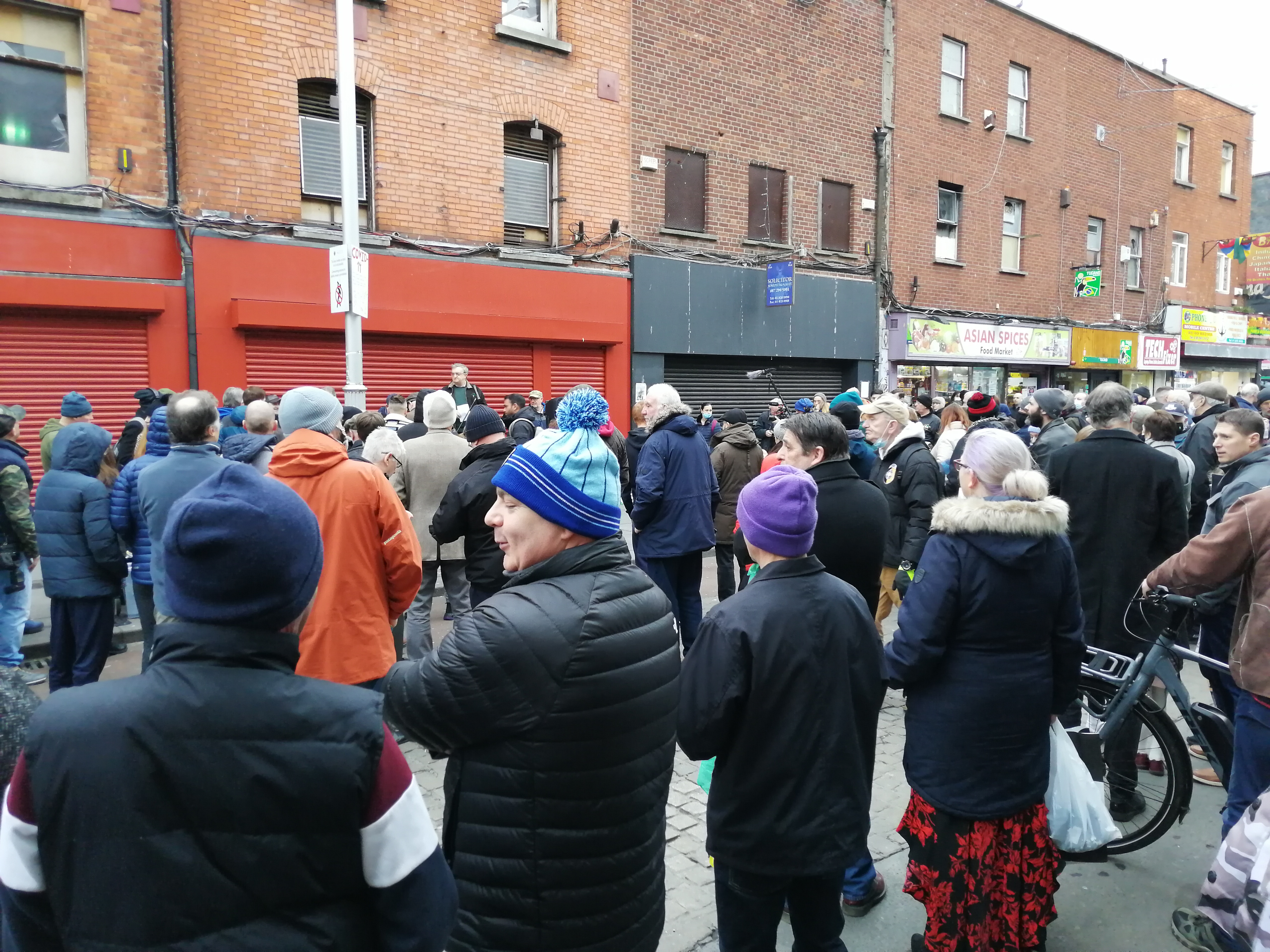
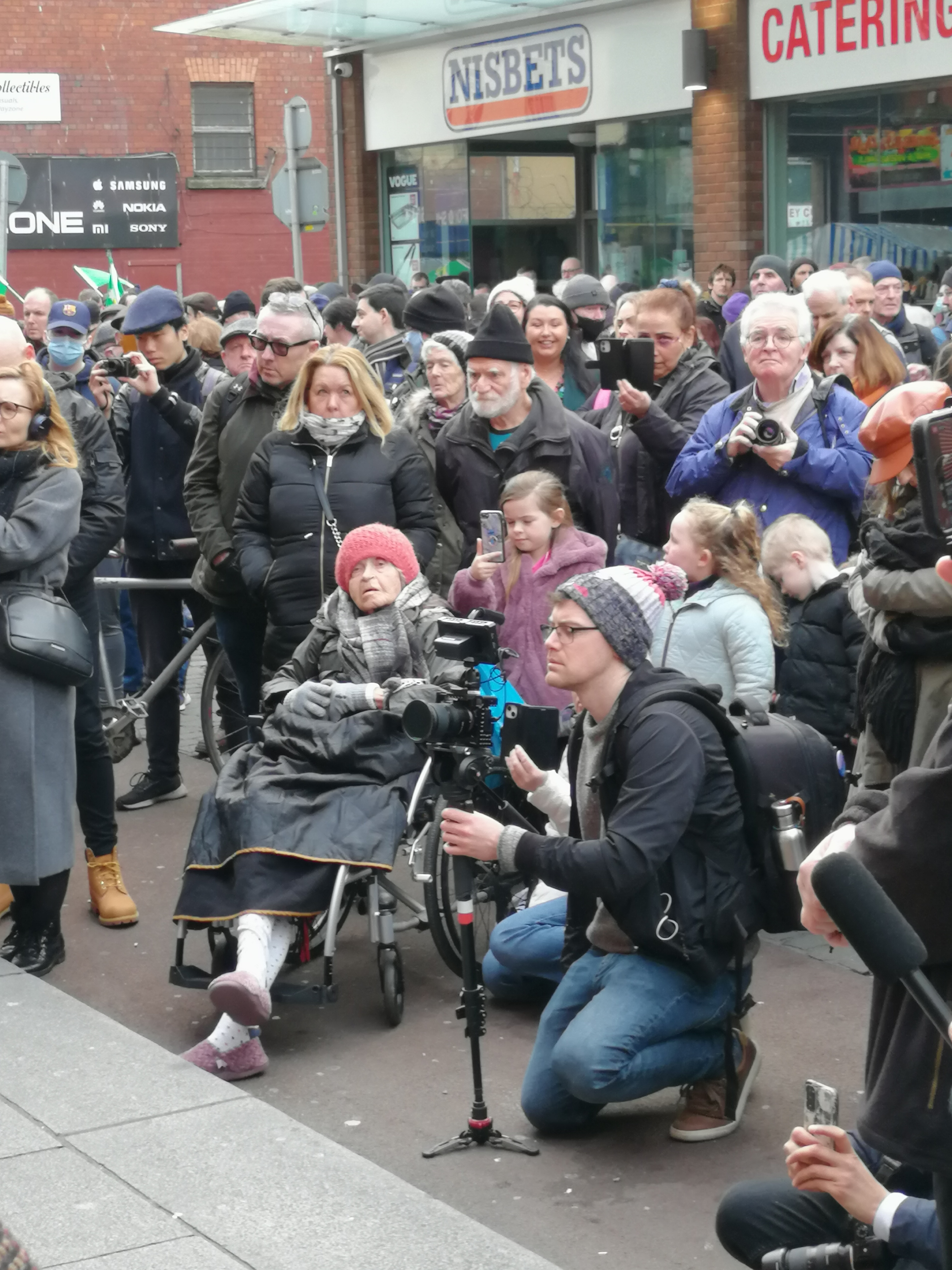
Between 400 and 500 people gathered in Moore Street on Saturday 22nd January 2022 to hear a number of speakers declare their complete opposition to the plans of the Hammerson property group, most of which had been approved by the chief officer of Dublin City Council’s Planning Department, in the face of a great many formal and informal objections and against even decisions of the elected councillors. Musicians also played and sang a number of songs at the event.

Section of the crowd at the rally. (Photo: Rebel Breeze)

SPEAKERS AND SPEECHES

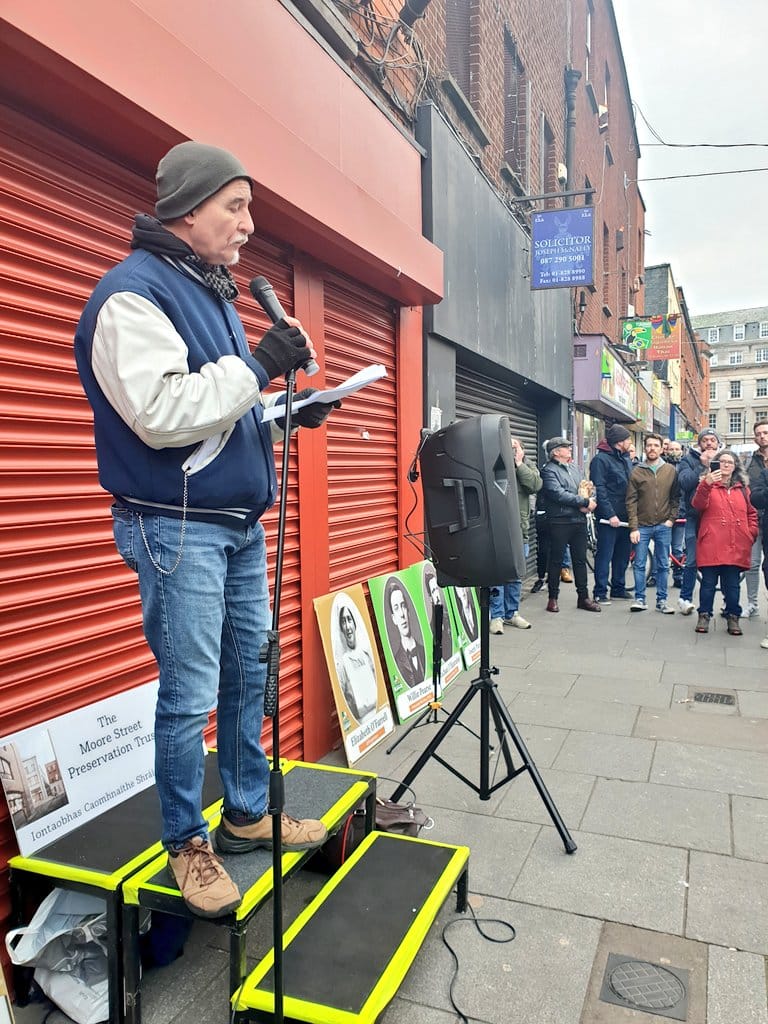
Chaired by the Secretary of the Moore Street Preservation Trust, Mícheál Mac Donncha (Sinn Féin Councillor), the crowd listened to a range of speakers: dramatist and campaigner for decades Frank Allen, 1916 relatives Brendan Mulvihill and Donna Cooney (latter a long-time campaigner and also Green Party Councillor), Diarmuid Breatnach for the Save Moore Street From Demolition campaign group (with a campaign stall every Saturday), Carolyn Alright (fourth-generation street trader), Stephen Troy (2nd generation local butcher) and Aengus Ó Snodaigh (Sinn Féin TD [member of the Irish Parliament]).

Micheál Mac Donncha, Secretary of the Moore Street Preservation Trust (also SF Dublin Councillor) chairing the event. (Photo: Rebel Breeze)

Each speech was different but of course sharing such themes as the struggle for Irish independence, historical memory and conservation but also closely linked to issues very much of the day: lack of justice in economic and social policy, lack of democracy in decision-making, reference to the housing crisis, property speculators, vulture funds, the banks ….. A number also made reference to the recent deaths of two homeless people in the vicinity.

Diarmuid Breatnach, of the Save Moore Street From Demolition campaign group, speaking at the rally (Photo sourced: Internet).
Independent businessman in Moore Street Stephen Troy speaking during the rally (Photo: Rebel Breeze)

There were some additional points made, for example Frank Allen called on people to tell the Fianna Fáil party they’d never get a vote in Dublin again if they didn’t act to save the area from demolition; Donna Cooney pointed out that demolition of buildings had a much worse effect on the environment than restoration; Diarmuid Breatnach stated that the area was of international historical importance and merited world heritage status; Stephen Troy spoke about the disaster for small businesses next to a 15-year building site; Caroline Alright pleaded for the future of the street to be taken out of the hands of the developers and Ó Snodaigh expected a more supportive attitude from the next Government (widely predicted to be a coalition with Sinn Féin as the larger partner).

Pat Waters, performing at the rally. (Photo: Rebel Breeze)
Donna Cooney, long-time campaigner for Moore Street and relative of Volunteer Elizabeth O’Farrell (see her portrait next to Donna) speaking at the rally. (Photo: Rebel Breeze)

Live music for the event was provided by Pat Waters, performing his own compositions, including a song about the O’Rahilly who was fatally wounded in 1916 in Moore Street leading a charge against a British Army barricade; also two musicians from the Cobblestone Pub, including the son of the owner, Tom Mulligan who performed Pete St. John’s Dublin in the Rare Aul’ Times.

Musicians of the Cobblestone performing (note Frank Allen in left background, who was a passionate speaker at the event). (Photo: Rebel Breeze)

There was speculation in some quarters as to why the rally had been called at such short notice; with prominent members of the Moore Street Preservation Trust absent1 and having an incorrect Irish name of the street2 on the event poster and promotional merchandise did seem to indicate a rushed event.

For some too, the Trust is being increasingly seen as closely linked to Sinn Féin, which for some is a positive factor but for others is not. The closeness has been evident on a number of occasions: a SF public meeting some years ago at which Jim Connolly Heron, prominent member of the Trust was the only speaker representing campaigners and more recently the promotion of the Trust’s Alternative Moore Street plan by SF, including the party President, Mary Lou Mac Donald, speaking at its launch a few months ago. At the rally on Saturday, the speaker for the Save Moore Street From Demolition campaign group made a point of saying that their group is independent of any political party.

Aengus Ó Snodaigh, SF TD and sponsor of Bill on Moore Street in the Dáil, speaking at the rally (Photo: Rebel Breeze)

However, the Bill to make the area a cultural quarter, currently proceeding with glacial slowness through the Dáil (Irish Parliament) is sponsored by a Sinn Féin TD, Aengus Ó Snodaigh, who spoke at the rally. Others counter by pointing out that Darragh O’Brien, a Minister of a party now in Government, Fianna Fáil, had sponsored a very similar bill back in 2015; however, with that party now the leading member of the current coalition Government, their leaders have welcomed the speculator’s plan for Moore Street.

A view of the crowd at the very start of the rally (Photo: Rebel Breeze)

GOVERNMENT

The Government department most concerned with the Moore Street issues is the Department of Heritage, part of the Department of Housing, Local Government and Heritage3. When Heather Humphries was the Minister responsible for Heritage she championed the bid of property speculator Joe O’Reilly to get control of Nos. 24-25 (owned by DCC) at the end of the central Moore Street terrace in exchange for the four buildings the State had declared a National Monument (Nos.14-17).

When Dublin City councillors voted not to allow that “land-swap”, against the recommendation of the City Managers, she castigated them publicly. She also instructed her legal team to appeal the High Court Judgement of March 2016 that the whole area is a National Historical Monument and in February was successful in having the judgement set aside.4 When Humphries attended Moore Street during the Easter 2016 events she was picketed and booed when she spoke. However, the current Minister for Housing, Local Government and Heritage Darragh O’Brien actually put in a submission against the proposed demolition of a building at the south end of Moore Street; however the Planning Department of Dublin City Council approved it.

Section of the crowd in front of the rally (Photo: Rebel Breeze)

As Minister 1n 2016, Humphries set up a Consultative Group on Moore Street on which all the Dáil political parties had a seat, along with a couple of councillors. From the campaigners, only the Jim Connolly Heron group had representation on it. The Minister’s group (latterly “Advisory”) has been in operation from 2016 until late last year but seems to have achieved nothing. The Hammerson Plan was welcomed by its Chairperson and by some of its members, including Brian O’Neill, Chairperson of the 1916 Relatives Association which seems a volte-face of that organisation, which had the conservation of the Moore Street battlefield as a central point of the Association’s constitution. However, the Hammerson plan was strongly opposed by others in the Minister’s Group, including Jim Connolly Heron. Outside the Minister’s Group, the opposition is even more widescale.

Street traders and independent businessman in Moore Street chatting at the rally. Photo: Rebel Breeze)

THE FUTURE

The planning permission given to Hammerson will be appealed to An Bord Pleanála but the Bord has a bad reputation with conservation campaigners, who see it as generally favouring the property developers5. Scheduling the appeal would take at least two months and possibly much longer. Should the campaigners not succeed at that stage, a legal challenge is also a possibility. Alongside the exploring of these options, street activities such as the rally on Saturday are likely. In 2016 conservation campaigners occupied the buildings for six days, blockaded them for six weeks, organised marches, rallies, pickets, re-enactments, concerts, history tours and public meetings.

Moore Street might be in for a hot summer. Or, given how long some processes have taken to date, even a hot Autumn.

End item.

FOOTNOTES

1 Including Jim Connolly Heron

2 The name they used was Sráid Uí Mhórdha, which is also the one on DCC’s street nameplate. However, it has been widely accepted in recent years that the correct name in Irish is Sráid an Mhúraigh, which is the one recorded in the State’s database for place-names, logainm.ie and furthermore is the version used in Sinn Féin’s own Bill currently proceeding through the Dáil.

3 Over the years it has had different names.

4 The Appeal Court verdict did not discuss whether it was or was not but instead declared that a High Court Judge was not empowered to declare a National Monument.

5 In fact, the Bord approved the O’Reilly plan for a giant “shopping mall” in the area (forerunner to the current Hammerson Plan) even though the Bord’s own officer recommended rejecting it.

SOURCES

https://www.fiannafail.ie/blog/fianna-fail-publishes-bill-to-redevelop-moore-street-area

https://www.gov.ie/en/organisation/department-of-housing-local-government-and-heritage/

BRITISH SUPREME COURT VINDICATES TORTURED “HOODED MEN” – CRITICISES POLICE CHIEF

Diarmuid Breatnach

(Reading time up to ‘Background’: 4 mins.)

A group of Irish people were jubilant in London’s Little George Street on 15th December. The location was that of the UK’s Supreme Court and it was unusual for Irish people to be happy at a judgement of a British court. But the judges inside had quashed an appeal by the Police Service of Northern Ireland1 against a judgement of the High Court in Belfast, that the colonial police force had been wrong not to investigate the claims of fourteen men of being tortured in the British colony in 19712.

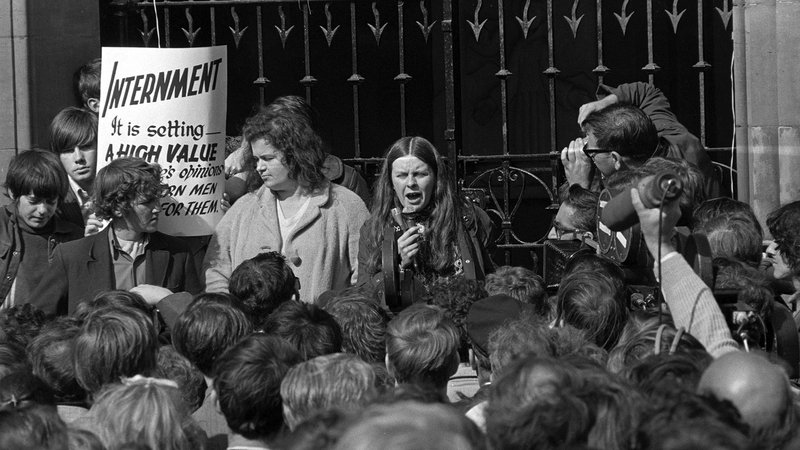
Bernadette Devlin (now McAlliskey) addressing an anti-internment rally in Derry in August 1971 (Photo cred: Popperfoto, Getty Images)

The claims related to what happened during the introduction of internment without trial in the occupied Six Counties in August 1971. What many internees experienced ranged from brutal treatment to torture: “Many of those arrested reported that they and their families were assaulted, verbally abused and threatened by the soldiers. There were claims of soldiers smashing their way into houses without warning and firing rubber baton rounds through doors and windows. Many of those arrested also reported being ill-treated during their three-day detention at the holding centres. They complained of being beaten, verbally abused, threatened, harassed by dogs, denied sleep, and starved. Some reported being forced to run a gauntlet of baton-wielding soldiers, being forced to run an ‘obstacle course’, having their heads forcefully shaved, being kept naked, being burnt with cigarettes, having a sack placed over their heads for long periods, having a rope kept around their necks, having the barrel of a gun pressed against their heads, being dragged by the hair, being trailed behind armoured vehicles while barefoot, and being tied to armoured trucks as a human shield” (for the soldiers against attack by the IRA). (Wikipedia)

(Photo sourced: Internet)

Some were hooded, beaten and, having been told they were hundreds of feet in the air, were then thrown from a helicopter — but were actually only a few feet from the ground. In addition, they were subjected to disorientating “white noise”, forced to remain in stress positions for long periods and deprived of food, water and sleep. Fourteen men who endured this for seven days became known as the “Hooded Men” and have been campaigning for over 50 years to have the British State admit that in its Irish colony, it had tortured them. Interestingly, some of those techniques have also been complained of more recently – by prisoners of the British military in Iraq3 — and this despite a statement by the UK’s Attorney General in 1977 that the techniques would not be used by them again.4

(Photo sourced: Internet)

Unusually, the Irish State5 took the case of the Fourteen to the European Court of Human Rights in Strasbourg and in 1976 obtained a judgement that “the five interrogation techniques” were torture.

The British State appealed the ECHR judgement and in 1978 won a judgement that although the treatment of the Hooded Men amounted to “inhuman and degrading treatment” and breached Article 3 of the European Convention of Human Rights it nevertheless fell short of torture6.

When documentation came to light proving that British Government Ministers had approved the treatment, the Irish State appealed the revised judgement of the ECHR but in 2018 was unsuccessful.

Meanwhile, the legal team of the Hooded Men pursued their case through the legal system of the UK’s Irish colony. In October 2014 the PSNI formally decided not to investigate the allegations, following which in 2015 judicial review proceedings against the PSNI, Secretary of State for Northern Ireland and Department of Justice were initiated by Francis McGuigan, one of the ‘Hooded Men’. A co-appellant was Mary McKenna, the daughter of Sean McKenna, another of the Hooded Men, who died in 1975, never having fully recovered from his mistreatment. The proceedings followed the discovery of additional documentary materials relevant to the mistreatment of the men, which were featured in a 2014 RTÉ Documentary, The Torture Files.7

Following this Documentary, the Chief Constable stated that the PSNI would assess “any allegation or emerging evidence of criminal behaviour, from whatever quarter” concerning the ill-treatment of the Hooded Men “with a view to substantiating such an allegation and identifying sufficient evidence to justify a prosecution and bring people to court’”. However in October 2014 the PSNI took the decision not to investigate. In late 2017, the High Court ruled that the failure by the Police Service of Northern Ireland (PSNI) to investigate the allegations of torture was unlawful.

Some of the Hooded Men in London for the Supreme Court judgement. (Photo sourced: Internet)

Instead of accepting the judgement however the PSNI sought to appeal the High Court decision but in September 2019 the Court of Appeal ruled that the decision should stand. One would have to contrast the determination of the colonial police in the courts to their appalling record in investigating collusion between their own force and Loyalist murder gangs, for the PSNI then appealed to the UK Supreme Court. In November 2019 the UK Supreme Court upheld the decision of the colony’s Court of Appeal and the PSNI appealed that judgement too. The decision last week in London marks the end of the legal options of the colonial gendarmerie.

The very month the decision not to investigate the allegations of the Hooded Men was taken by the colonial police force, October 2014, Drew Harris had been appointed Deputy Chief Constable of the PSNI.

IMPLICATIONS OF JUDGEMENT

The implications of the High Court judgement for Britain and its colonial administration are that once again they have been shown to have deployed barbarous methods in their repression of resistance by the nationalist minority in the colony and that they have exceeded or ignored even their own laws.

As has been the case throughout the recent 30 Years’ War, with the system lying and trying to cover up the reality of its actions, then delaying by all available means, the judgement comes too late for a number of the victims, as only nine of the 14 are still alive.

Nevertheless, the judgement adds to a number of other judgements and admissions over the years, such as those surrounding the Bloody Sunday Massacre in Derry in 1972 and the Ballymurphy Massacre in 1971. On 13 December this year, the British Ministry of Defence and PSNI agreed to a £1.5m out-of-court settlement to compensate victims of the Miami Showband Massacre over suspected state collusion with loyalist terrorists.

Three members of the band died from explosions and bullets after they were forced to get out of their bus at a fake police checkpoint on their return to Dublin from the Six Counties. Stephen Travers, who was injured in the attack, said he was convinced he would have won his civil action to prove that there was collaboration between the State and terrorists but that the Government’s decision to “dispense with justice rather than to dispense justice” had motivated the out-of court settlement.

Had the UK’s Supreme Court rejected the Hooded Men’s case, the latter would have been free to take the case to the European Court of Human Rights – not that they had been tortured but that the police should have investigated their claims that they were. And, based on a similar case by the manager of a Basque newspaper against the Spanish State8, they would probably have won their case with damages awarded against the UK.

On the other hand, the Supreme Court decision puts the onus of investigating the accusations of the Hooded Men on to the PSNI, the very organisation deeply implicated in the treatment of the victims, the organisation which declined to investigate them previously and which justified its decision through the courts in the Six Counties and then in the Supreme Court of the UK.

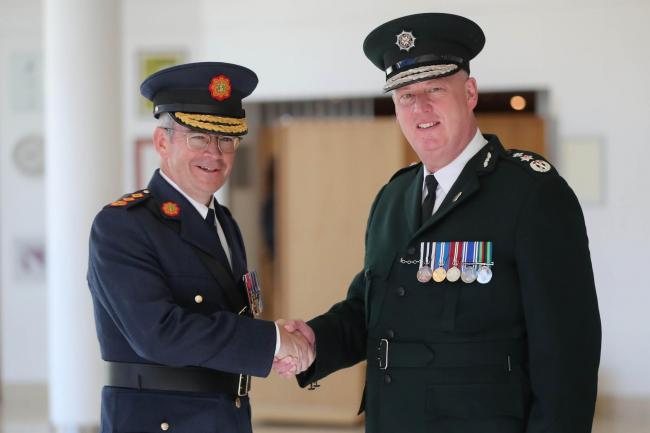
But not only the British state and its colony are put into the dock by the Supreme Court judgement – Drew Harris, formerly Deputy Chief Constable of the PSNI is currently in charge of the police force of the Irish State, where he was appointed Chief Commissioner of the Gardaí in September 2018 on a yearly salary of €250,000.

Drew Harris (Left) as Garda Commissioner with his former boss, George Hamilton, Chief Constable of the colonial police, the PSNI, on the occasion they both received an honour from the British Monarch. (Photo sourced: Internet)

APPENDIX — BACKGROUND

Creation of “Northern Ireland”:

The statelet of “Northern Ireland”9 was created in 1922 after Ireland was partitioned by the British Government at the end of 1921. Ireland had been invaded from Britain in 1169 and gradually entirely occupied and colonised by the invaders, albeit with its own semi-autonomous parliament which had been abolished in 1801, after the United Irish uprisings of 179810. Subsequently Members of Parliament elected in Ireland were required to attend the Westminster Parliament.

Following the rise of Irish nationalist sentiment after the suppression of the 1916 Rising, the 1918 UK General Election returned a huge majority of MPs in Ireland sworn to establish an independent Irish Republic. These formed their own parliament in Dublin, at first ignored but then later banned by the British. The guerrilla War of Independence of 1919-1921 convinced the British rulers to offer Ireland autonomy as a “Dominion” within the British system and under the Crown. However, at the same time, the British conceded to the demand of the unionist minority in Ireland to secede from the new Irish state and to remain a colony of Britain and in the UK. The Irish Free State was set up in December 1921 on 26 counties and the Northern Ireland statelet of six counties in January 192211.

From the outset the colonial statelet had been marked by the religious sectarianism of its local rulers, Presbyterians and Anglicans by religion and of unionist ideology, against a very large nationalist minority of mostly Catholics, representing the majority in Ireland as a whole. A raft of special powers empowered the statelet in repression of the nationalist minority; the colonial gendarmerie, abolished in the Irish state, continued in existence, with a part-time wing and even unofficial Loyalist militia in support and de facto anti-nationalist discrimination existed in every sphere: law, housing allocation, education.

In 1968 a campaign for civil rights for the nationalist minority began, to be met by truncheons, water-cannon, tear gas and bullets which however, merely drove parts of the minority into open insurrection. The colonial gendarmerie (the Royal Ulster Constabulary), even with the active support of the part-time B-Specials and Loyalist paramilitaries, was unable to suppress the uprising primarily in Derry but also in West Belfast and in August 1969 the British Government sent in the British Army to take control.

Initially the soldiers were represented to the nationalist population as being present to protect them from the sectarian colonial police and from the Loyalists but it soon became clear that their primary focus was to repress the risen nationalist population and the IRA began to take action against them.

Introduction of Internment Without Trial:

The Prime Minister of the “Northern Ireland” statelet, Brian Faulkner, recommended to his colonial masters that internment without trial be introduced against the nationalist population; this was agreed and “Operation Demetrius” began on 9th August and continuing over the 10th 1971 with British Army raids into nationalist areas, forcing their way into homes and dragging their captives away to be interrogated by RUC Special Branch, after which they were jailed. In the initial sweep the occupation forces arrested 342 men, sparking four days of violence in which 20 civilians, two IRA members and two British soldiers were killed and 7,000 people fled their homes. All of those interned were from the nationalist community.

Poster by the Anti-Internment League of Ireland – the internees in the photo are handcuffed together. (Photo sourced: Internet)

The detentions without charge continued until December 1975 and by that time 1,981 people had been interned, of which 1,874 were from the nationalist community. Only 107 were Loyalists and none of those had been interned until February 1973. Resistance to internment continued after the initial sweep and from 9th to 11th August, British Paratroopers caused the death of 11 unarmed people in the Ballymurphy area of Belfast. In January the following year the Paras and other units attacked people marching against internment in Derry, killing 14 and injuring 12.

Internment was protested in the rest of Ireland and in other countries, including Britain. The Men Behind the Wire, an anti-internment song composed in 1971 by Paddy McGuigan and recorded by the Barleycorn group in Belfast, was pressed into disc in Dublin and shot to the top of the Irish charts, greatly exceeding in numbers of sales any record previously released in Ireland.

Excerpt:

Through the little streets of Belfast,
In the dark of early mo
rn,
British soldiers came marauding
Wrecking little homes with scorn.

Heedless of the crying children,
Dragging fathers from their beds;
Beating sons while helpless mothers
Watched the blood flow from their heads.

Armoured cars and tanks and guns
Came to take away our sons
But every man will stand behind
The Men Behind the Wire.

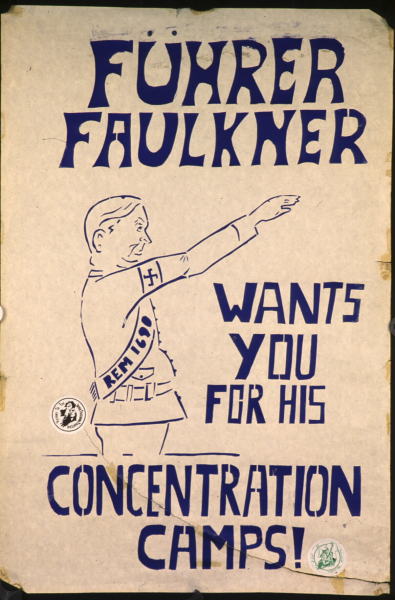
Poster by People”s Democracy, believed in 1970, prior to introduction of internment. (Photo sourced: Internet)

Brian Faulkner, unionist Prime Minister of the statelet, who had asked the British to introduce internment, was hated by a great many people. When he died in March 1977 following an accident during a stag hunt, thrown by his horse Cannonball, an English communist composed a short song he named “Cannonball”.

Excerpt:

Lord Faulkner was a hunter of men and of deer

And both have good reason to laugh and to cheer

At the death of a tyrant whose interests were clear

Those of imperialism that have cost Ireland dear.

Cannonball, Cannonball has many a friend,

From the top of old Ireland right down to its end,

Where the brave people struggle

In one resolute bid

To throw off their oppressors —

Just as Cannonball did!

End.

FOOTNOTES

  1. The colonial gendarmerie formerly known as the Royal Ulster Constabulary.

2 (see “Background” section).

3. The Court’s ruling that the five techniques did not amount to torture was later cited by the United States and Israel to justify their own interrogation methods, which included the five techniques. British agents also taught the five techniques to the forces of Brazil’s military dictatorship. During the Iraq War, the illegal use of the five techniques by British soldiers contributed to the death of at least one detainee, Baha Mousa.

4 “The Government of the United Kingdom have considered the question of the use of the ‘five techniques’ with very great care and with particular regard to Article 3 (art. 3) of the Convention. They now give this unqualified undertaking, that the ‘five techniques’ will not in any circumstances be reintroduced as an aid to interrogation.”

5 Unusually, because during the three decades of ill-treatment by a foreign power of people who were, according to the Irish Constitution its citizens, only in one other case did the Irish State bring a complaint against the UK to an international arena.

6 I admit that I fail completely to understand the distinction.

7. Rita O’Reilly, the journalist who led that program, also commented extremely well on the UK Supreme Court decision and the whole case on Prime Time on RTÉ this week (see Links).

8. Martxelo Otamendi, along with others detained, was tortured by his Guardia Civil captors when the Basque newspaper of which he was manager was closed by the Spanish State, alleging that it had been cooperating with terrorists. He was freed eventually and even later in 2010 the Spanish Supreme Court admitted that there had been no evidence against him or the newspaper – but neither admitted the torture nor ordered his allegations be investigated. Otamendi filed a complaint with the European Court of Human Rights in 2012 and in 2014 the ECHR found the Spanish State guilty of not having investigated Otamendi’s allegation of being tortured and awarded him €24,000 in damages and expenses from the Spanish state.

9. A misnomer since the British colony is not the northernmost part of Ireland, which is in County Donegal, inside the Irish state. “Ulster”, a name given by the Unionists to the statelet and frequently repeated in the British media, is also a misnomer since the Province of Ulster contains nine counties, six of which are in the colonial statelet but three of which are within the Irish state.

10. There were many uprisings prior to 1798, which was the first Republican one and there were many of that kind afterwards too.

11. Shortly after that the Free State, supplied with weapons and transport by the British, attacked the Republicans, who had been demonstrating their dissatisfaction with the Anglo-Irish Treaty. This precipitated a Civil War in which the Republicans were defeated.

USEFUL LINKS FOR MORE INFORMATION

Unusually excellent (for RTÉ) report by Rita O’Reilly: https://www.rte.ie/news/primetime/2021/1217/1267343-uk-supreme-court-decision-on-hooded-men/

https://www.irishtimes.com/news/ireland/irish-news/hooded-men-uk-court-finds-psni-decision-not-to-investigate-case-unlawful-1.4755885

https://en.wikipedia.org/wiki/Operation_Demetrius

OBJECTIONS TO SPECULATOR PLANS FOR MOORE STREET

Diarmuid Breatnach

(Reading time first section to “additional objections“: 10 minutes)

The big property speculator company Hammerson wishes, in addition to other demolitions, to demolish every building except five in the central terrace in Moore Street all the way out to O’Connell Street and the cutting through the area of two new roads. This is area is a centuries-old street market and the scene of a battle during the 1916 Rising as the HQ Garrison of the Rising occupied the central terrace of 16 buildings. The site is of huge historical and cultural importance not only for Ireland but for the world. Along with many others I submitted objections through Dublin City Council’s system which requires a payment of €20 for each application to which one is objecting. I wished to oppose the Hammerson planning applications 2861/21, 2862/21, 2863/21 on grounds historical and cultural, architectural, of city planning, of democracy, social amenity and on grounds of inner city regeneration and planning.

It is important to consider what the Moore Street area IS, what it can BECOME and what can be destroyed in the present and future by ill-considered approval of “development” plans proposed by property speculators.

NATIONAL HISTORY

The Moore Street area is one of great importance in what might be called our national history, as it contains the relocation/ evacuation route and last sites of the Headquarters of the 1916 Rising, an event that is widely accepted as being of seminal importance in our development as a nation. It was a battleground in which insurgents and civilians were injured by bullets of the Occupation and in which a number of both groups were killed. For this reason not only tourists from abroad but also from all parts of Ireland, including from the Six Counties are to be frequently seen on the street in walking history tours.

At the junction of Moore Lane and Henry Place Irish Volunteer Michael Mulvihill was killed and at the junction of Moore Street and Sampson Lane, Vol. Henry “Harry” Coyle of the Irish Citizen Army was also killed. At that latter junction a British soldier, shot and wounded by 18-year-old ICA Volunteer Tom Crimmins while in O’Rahilly’s charge, was collected by yet another Volunteer, George Plunkett, one of the brothers of Proclamation Signatory Joseph Plunkett and taken into No.10 Moore Street, where a field hospital was being managed by, among others, Volunteer Elizabeth O’Farrell. That building was the first HQ of the Rising after Moore Street and there the first council of war after the evacuation was held. Along with a number of other buildings in the central Moore Street, it holds the mark in its party wall of the tunnelling through the entire terrace that was accomplished by the Volunteers during the night of Easter Friday.

Representatives of all the groups that participated in the Rising were in the Moore Street area: Irish Republican Brotherhood, Irish Volunteers, Irish Citizen Army, Cumann na mBan, Fianna Éireann and Hibernian Rifles.

Moore Street itself held a barricade built by Volunteers the early days of Easter Week at the crossroads with Salmon Lane and Henry Place, as well as one constructed by the encircling British Army at the Parnell Street junction and there was another at the junction with Moore Lane. The charge on the British barricade led by the The O’Rahilly was along Moore Street too.

And of course, it is in Moore Street itself that the decision to surrender was taken, the site also of the last hours of freedom of six of those shot by British firing squads in Dublin, including Willy Pearse and five of the Seven Signatories: Tom Clarke, Patrick Pearse, James Connolly, Joseph Plunkett and Sean McDermott.

The plaque erected in 1966 on the 50th anniversary of the Rising, the first official mark in the street since the creation of the State to commemorate what happened there and still the only such on the street.

It is a remarkable fact that from the creation of the State no monument or plaque existed in Moore Street to commemorate the momentous events there until the small 1916 commemorative plaque was erected there, presumably by Dublin City Council, on the 50th anniversary of the Rising. That is all that remains there in visible commemoration to this day.

As an institution of civic society Dublin City Council should be doing its utmost to appropriately commemorate that history and at the very least safeguarding its location and artifacts from destruction.

On democratic grounds too, Dublin City Council should reflect the wishes of the residents of the city rather than those of property speculators – and the wishes of the residents of the city have been clearly outlined on many occasions, not only in the over 380,000 petition signatures collected by the Save Moore Street From Demolition campaign.

Some of the Save Moore Street From Demolition petition signature sheets sellotaped together and stretched out along Moore Street in January 2016 on the last day of a week-long occupation of buildings. Each sheet held 20 signatures at that time (later versions, double-sided, held 40 and the current version holds 25).

INTERNATIONAL HISTORY

It is not on grounds of our national history alone that the area should be conserved and developed sensitively, for it is also of world history significance and deserves recognition as a site of World Heritage importance.

From no less than the Imperial War Museum in London came the assessment that the area is “a WW1 urban battleground in prime condition” (a reference to surviving buildings and features including crucially the 1916 streetscape).

The 1916 Rising was indeed “a WW1 battleground” but it was also the site of a Rising against world war – the first of four that took place during the years of WW1 (the other three included Russia in February and October 1917 and another in Germany in 1918).

In the history of the human struggle against colonial domination, the 1916 Rising looms large, not only in its own right but in the huge encouragement the news of it gave to colonised people around the world.

As the 1916 Rising was the first to field a specifically workers’ revolutionary army, a revolutionary women’s military organisation and to address itself, in the 1916 Proclamation, to including women at a time when hardly a woman in the world enjoyed the right to vote, declaring itself also for equality, for “civil and religious freedom for all”, it was of huge world history importance in social and political terms.

Plans to sensitively develop and conserve the visible signs of history in the street should take account of the evacuation route of most of the GPO Garrison through Henry Place, across the dangerous junction with Moore Lane and into No.10 Moore street, then tunneling from house to house, progressing through buildings of the entire terrace to emerge in what is now O’Rahilly Parade. The planned construction of a lane from Henry Street into the evacuation route distracts from the historic route and a new road from O’Connell Street through the central terrace, as in the Hammerson application, no matter how high or low the planned arch, breaks that historical line of the progress of the Volunteers – forever.

An excellent monument to The O’Rahilly in O’Rahilly Parade, reproducing the very script of the farewell letter he wrote to his wife. However hundreds of thousands of people pass nearby annually without realising it is there because it is in a lane and not signposted (despite Dublin City Council undertakings on numerous occasions to the Save Moore Street From Demolition that they would signpost it).

The plans to construct a hotel in O’Rahilly Parade (and other future plans that have been mooted but not included yet in a Hammerson application), along with the back of the unfortunately-permitted Jury’s Hotel on the other side of the laneway, would create an undesirable narrow canyon effect and also completely overshadow the O’Rahilly monument there. In Dublin folklore the western end of that lane was known for generations as “Dead Man’s Corner” because it was where the O’Rahilly died after writing a farewell letter to his wife, having received five British bullets while leading a charge up Moore Street in 1916. The O’Rahilly was one of the founders of the Irish Volunteers.

It was in that laneway that the Volunteers were gathered to make a heroic assault on the British Army barricade at the Parnell/ Moore Street junction, to be cancelled when the decision to surrender was taken. Among those awaiting keyed up the order to charge, was a future Government Minister.

CULTURAL

Despite the incorrect name given to the street in Irish (check the national nameplace database logainm.ie which gives it as Sráid an Mhúraigh), it is noticeable that many of the participants in the 1916 Rising were Irish speakers, including in fact writers, poets and educationalists through the Irish language – these were also represented among the GPO Garrison in Moore Street. In particular Patrick Pearse was one of the founders of the modern school of Irish writing in journalism, polemics, poetry and fiction. Pearse also had very advanced theories about education which he sought to put into practice in St. Enda’s, the school he founded with his brother Willy. Willy himself, as well as learning to speak Irish was an accomplished sculptor.

Joseph Plunkett had written poetry in Arabic as well as English, learned Esperanto and was one of the founders of the Esperanto League. Plunkett joined the Gaelic League and studied Irish.

Sean McDermott was also active in the Gaelic League and a manager of the Irish Freedom radical newspaper.

The revolutionary fighters in Moore Street also contained many people prominent in other cultural fields, such as drama, literary arts and publishing.

These historical facts in the field of culture in relation to the Moore Street area provide an opportunity which should not be missed for the development of the area as a CULTURAL QUARTER – but it will be missed should the Hammerson application be agreed.

In fact, a more rational development of the Moore Street area as a cultural-historical quarter mixed with a vibrant street market provides the opportunity to connect the area to the nearby cultural and historical areas of the Rotunda (location of the first public meeting of the Irish Volunteers in 1913 and where in 1916, Volunteers from Moore Street were kept temporarily as prisoners); 37/38 O’Connell Street, the location of the office of the Irish Ladies’ Land League (now of the Allied Irish Banks) and, across the street, the location of Tom Clarke’s newsagent’s at 75 Parnell Street; between them both, the monument to Charles Stewart Parnell of the Land League. All this also connecting numerous buildings of historical and cultural importance scattered through Parnell Square, including the Gate Theatre, Scoil Mhuire Irish-language primary school, the Hugh Lane Gallery, the former head office of the Gaelic League at No.25 (where the decision to carry out insurrection in 1916 was taken) and the INTO Teacher’s Club at No.36.

Moore Street offers great potential if sensitively developed for integration into cultural-historical festivals in Dublin such as History Week, Culture Night, Open House, Bloomsday, Bram Stoker and Food Festival. It also offers potential for other street festivals and in addition a regular Sunday farmer’s market.

All of that would disappear at the stroke of a pen were the Planning Department to approve the Hammerson applications.

The seven Signatories of the 1916 Proclamation — only Ceannt and MacDonagh were in other garrisons and therefore not present in Moore Street. Pearse, Plunkett and MacDermott were all active in the Gaelic League.


ARCHITECTURAL

The Moore Street area was laid out by Henry Moore, 3rd Earl of Drogheda (as was also Drogheda Street [now Upper O’Connell Street], Henry Street and North Earl Street) in the 17th Century. The houses in Moore Street were designed in the style known as “Dutch Billy”, a style reminiscent of Dutch cities, with the gable end facing into the street, a style said to have been brought into the city by Huguenot asylum seekers in the late 17th Century and therefore of world and Irish socio-historical importance as well as architectural.

Photograph of the Moore Street market in better days, including original cobblestones. Note also the street-facing pointed gable of a building to the left, a typical “Dutch Billy” design (this building and another like it nearby are in a disgraceful state of disrepair). (Photo sourced: Internet)

Currently the most obvious examples of “Dutch Billy” construction are on the south-west side of Moore Street and in an obvious state of disrepair. In the central Moore Street terrace only the four buildings which the State names “the National Monument” preserve a distinctive Dutch Billy frontage. In the event of demolition of most of that terrace there will be no incentive to even preserve other buildings in the street and an opportunity to reconstruct the frontages in the central terrace in line with buildings on the southwest side of the street will have been lost.

In addition, the construction of a new road from O’Connell Street through the central terrace, as in the Hammerson application, will also destroy that opportunity forever. The applicant has stated that this new road is intended “to open up Moore Street” but this is patently false. Not only is Moore Street easily accessible to shoppers from the Parnell and Henry Street ends but the proposed new road leads straight to one of the main entrances of the ILAC shopping centre, of which Hammerson are half-owners.

The entrance to the ILAC shopping centre from Moore Street. Hammerson want to build a road from O’Connell Street straight through the 1916 Terrace and out to the ILAC entrance. Hammerson say this is to “open up Moore Street” but actually it is to deliver more traffic to the ILAC of which they own half. (Photo sourced: Internet)

Indeed in recent years Hammerson and their predecessor Chartered Land have squeezed the market on the west-central side by extending the ILAC into the street, evicting numerous independent businesses and thus destroyed the market character on that side of Moore Street. Sadly the property speculators have achieved this through approval of planning applications by DCC’s Planning Department in the face of numerous objections.

STREET MARKET

The Moore Street market is the oldest surviving in Dublin (perhaps in Ireland) and is composed of the stalls and the independent businesses on the street (the street is actually older than O’Connell Street and predates the Great Hunger). As well as having been an important part of the city’s social and cultural history and on the list of recommended Dublin places to visit for decades, it has been an important amenity for people shopping for fresh fruit and vegetables, fresh fish and meat. In addition it is a location of other services.

Neither the stalls nor the shops throughout the central terrace of Moore Street would of course survive since Hammerson seek permission to demolish eleven of the sixteen buildings. Even the southern end of the street would be severely adversely affected by its close proximity to a big building site and by the demolition/ construction plans for the building at the Moore Street/ Henry Street eastern junction.

When large developments are carried out in such areas the property speculators seek to have chain-stores renting in the area. Those types of businesses have no particular stake or loyalty to their area but rather to their head office, which is not in Moore Street and may not even be in Ireland. Indeed we have seen recently the desertion of one such chain, Debenham’s, which was itself involved in the 1970s construction of the ILAC centre on other streets and laneways of the area.

After years of enduring construction chaos on top of many previous years of neglect, that whole aspect of street market and small independent shop will be wiped out forever in Moore Street and the area will become a Henry Street spillover, full of characterless chain stores of foreign high street type – and a wasteland at night. What a legacy for the current City Managers to bequeath to Dublin!

SOCIAL AMENITY

As a street market, Moore Street of course has been also a social amenity, a place to meet and chat. This aspect has been eroded through the closing of pubs in the street along with the Paris Bakery and Anne’s Bakery and cafe. This is an amenity most needed in any city and, in particular in the north city centre. This aspect too will be destroyed by a conversion of the area into a shopping district of chain stores as envisaged and implicit in the Hammerson plan.

The development of Moore Street as a social amenity area with a vibrant street market opens up the potential of linking it to the Asian food quarter in Parnell Street east and also with cinemas in the Parnell Street and on O’Connell Street.

NORTH CITY CENTRE

An intelligent and longer-term city planning approach to development of the Moore Street and O’Connell Street area would provide the ingredients of a revitalisation of the north inner city, something that is badly needed. It would need envisaging something like the inner city on the south side which is lively by day and — apart from the Grafton Street shopping district — by night also. This could be achieved by combining a vibrant street market with cultural-historical-architectural promotion and with low-rent housing for city dwellers.

ALL VISIONS AND PLANS

A number of independent campaigning and other dgroups have developed visions and plans for the Moore Street area over the years. These have included a plan from the Lord Mayor’s Forum on Moore Street as well as that of the Market Expert Group, a sub-group of that Forum created at the instigation of the Minister for Heritage. More recently the Moore Street Preservation Trust has developed a plan for the area. Perhaps none have tied all possible aspects of historic, cultural, market and north inner city regeneration together as much as the submissions in 2016 to the Minister of Heritage of the Save Moore Street From Demolition and the Save Moore Street 2016 campaigning groups but it is noticeable that all of those can co-exist to a large extent but are absolute anathema to the Hammerson plans.

In addition, the Hammerson plan envisages decades of demolition and construction in this area, making it a wasteland and negatively impacting on the surrounding area and businesses. It also contains the possibility of “planning blight” remaining over the area for decades, as Hammerson run out of funds or sit on planning permission waiting to sell it on to yet further property speculators, as Chartered Land sold it on to them, with meanwhile further deterioration in the fabric of buildings.

Are the City Managers to endorse the poor vision of a property speculation company, preferring it to those of hundreds of thousands of petition signatures, along with a number of groups including those of the Council’s own organisations, in addition to the wishes expressed by elected representatives in Dublin City Council on a number of occasions over a number of years?

WHAT COULD BE

In considering a Planning Application, city planners should not only consider the plan itself on its merits but what an alternative might be – particularly when many alternatives have been mooted over the years. The question to consider is not only “is this a good plan for the area?” but also “what potential does this plan develop or, conversely, negate”?

As outlined above and will be listed below, the Hammerson plan is not only not suitable for the area but destroys the potential for rejuvenating the north inner city area in social, shopping, cultural, historical and city living terms. The Hammerson application should be refused on all those grounds and on the democratic basis also that it is in stark opposition to the wishes of the vast majority of people and to virtually all concerned organisations.

End first section

FURTHER GROUNDS OF OBJECTION TO THE HAMMERSON APPLICATIONS

*The Proposal contravenes The Dublin Development plan’s policy SC16 which states that Dublin is intrinsically a low-rise city (and confirmed in a recent response on another matter from the Tánaiste Leo Varadkar in a response to TD Paul Murphy in the Dáil).

*The Moore Street as a battlefield site is not a location identified for taller buildings.

*The Hammerson proposal contravenes development plan maximum height standard, and would greatly exceed the height of the Moore Street Terrace buildings.

*The Hammerson development plan goes against those of elected public representatives, i.e City Councillors and TDs which voted respectively to have for Moore Street listed as an architectural conservation area and read without opposition two cultural conservation bills for Moore Street (the most recent being the O’Snodaigh bill).

*The Hammerson proposal would be contrary to the purpose of Z5 designation by reducing the cultural space within the city centre, impacting on its night-time culture and facilitating an over -concentration of hotel/retail developments in the area despite the many existing hotels / shopping centres in close proximity.

*There are already over 40 hotels within 2km of the site, and more than 20 hotels and B&Bs within a 10-minute walk and no more hotels are needed in the environs of Moore Street (indeed throughout the city there is already opposition to the growing number of buildings of temporary accommodation being constructed in the shape of hotels and student accommodation).

*The city centre no further office space or chain retail outlets. The applicants themselves are struggling to find tenants for numerous retail units in the ILAC Centre (Debenhams and the old Jack & Jones stores are still vacant) and the applicants have recently commenced the process of “pop up shops” on Henry Street. It would be negligent to lose the historical & cultural elements which make this site unique by over-development. As outlined above, the site if sensitively restored has huge potential as a cultural destination for its citizens, visitors, and future generations. Let us not forget that surveys of tourists visiting Dublin have highlighted the interests of tourists in Culture and History rather than shopping.

*The current reduced demand for office and retail space due to Covid 19 this may become permanent as many companies have found it more cost-efficient for employees to work from home and the surge in online shopping has become the newest trend as a direct result of the pandemic.

*As outlined earlier in detail, the site is already a cultural destination for both locals and visitors, which will be reduced in scale and significance if planning permission is granted. The whole site should be sensitively restored.

* Despite the homeless crisis which is already being viewed as a scandal by many observers, there iso provisions for affordable housing within the site.

*Moore street needs more mixed usage in its current retail and street Market – Dublin City council should act accordingly by enforcing planning laws in the area and immediately implement the Market Expert group report revitalising its components.

*This Hammerson proposal is contrary to Dublin City Council’s own plan to revitalise the market, unless the powers that be at Dublin City council are deluded enough to believe a revitalised predominantly food market can be successful from a 5.5acre building site environment.

*Further retail and hotels put pressure on existent businesses in the vicinity that are already struggling in the city centre.

*The proposed design is not sympathetic to the local physical or cultural heritage and encroaches on the curtilage of the State-nominated National Monument and proposed protected structures in the area.

*The Hammerson design is nowhere near of sufficiently high quality to justify the adverse impacts on the entire north inner city for a 15yr period (possibly longer as other planning applications and extensions have been added to early granted applications in the past) and is completely out of context with the area.

*The Hamerson proposal does not strengthen, reinforce or integrate with the existing street traders or independent or independent businesses of the Moore Street Market. In fact the market and businesses will more than likely be lost FOREVER throughout the lengthy construction phase.

*The Hammerson plan entails the loss of fine urban grain in this historical part of Ireland, which supports a diversity of economic, historical and cultural life.

*The Hammerson proposal fails to address the wider urban context, the character of Moore Street Market and businesses or the many envisaged protected structures along the street and laneways , notably the iconic Moore Street terrace and the O’Connell Street Architectural conservation area.

*The proposed office block at site 5 will visually impact on the State-nominated National Monument and the iconic 1916 dTerrace. It will also overshadow residential and commercial units at Moore street north and Greeg Court apartment block including sun balconies of the owner/occupiers.

*The Hammerson proposal in short would result in overdevelopment which ignores the context of this unique site.

*The Hammerson proposal does not complement the built environment or contribute positively to the neighbourhood and streetscape.

*The impact on markets or independent businesses has not addressed or been resolved.

*The Hammerson proposed development would overwhelm Moore street and change its whole character for which it is known as far away as China.

*In order to maintain the skylines and character of the area the height should be limited to four storeys and, in places, to three. The visual impact on O’Connell street’s skyline will be horrendous post development.

*The Dublin development plan identifies that the city is a low-rise city and requires development to protect conservation areas and the architectural character of existing buildings, streets and spaces of artistic, civic or historic importance, and to ensure that any development is sensitive to the historic square and protects and enhances the skyline of the inner city.

*The Hammerson proposed development is too close to the site boundary, which is contrary to BRE advice and will severely impact food businesses and market traders in close vicinity.

*The risks and impacts of construction and demolition works for proposed archway on boundary wall of national monument are dramatically understated.

*The impact of construction noise and air pollution on local residents and businesses are understated and will turn the area into a “no-go area” for shoppers.

*The most environmentally sustainable buildings are the ones that already exist. The need is to reuse existing buildings for purposes to avoid carbon emission associated with demolition and construction works of a new large-scale development.

*The heritage impact assessment statement fails to adequately assess or record the surviving historic fabric in the entire Moore street terrace or take into account the curtilage of the State-designated National Monument. It also contradicts the previous developer’s Chartered Land heritage impact statement which said no.18 contained pre-1916 elements.

*The façade demolition planned to No.18 to make way for the hideous archway would erase the character of the terrace and visually impact on the historic nature of the area. The demolition will impact on built heritage around the story of 1916 regardless whether the buildings are pre 1916 or not.

*The Hammerson proposal would detract from the special character and distinctiveness of the Conservation Area, and will constitute a visually obtrusive and dominant form around Moore street and O’Connell street.

*Inadequate drawings and images of interfaces with protected structures, mean that the impact on immediate context and skyline is not fully explored, insufficient LVIA in respect of neighbouring heritage buildings.

*The Hammerson plan means dramatic and irreversible impact on surrounding protected structures, their setting and curtilage.

*Protected structures are protected not just for their physical significance, but also for other reasons including historical, archaeological, artistic, cultural or social interest.

*This largescale development proposal of Hammerson would be contrary to development plan policy of minimum intervention to protected structures.

*There is a need to implement Government policy of heritage-led regeneration of historic urban centres:

* The need to integrate cultural, social and built heritage objectives, this proposal destroys the same.

*A National monument and protected structures should be protected in context, but the buildings in this proposal will dwarf the designated National Monument and the many existing protected structures surrounding the site and therefore it would be more appropriate to restore the historic buildings.

*This Hammerson proposal is contrary to provisions of Section 11.1.5.3 of the Dublin Development plan in failing to complement the special character of the protected structures on and adjoining the site and/ or retaining the traditional proportionate relationship with returns, gardens, mews structures etc.

*The Hammerson proposal would result in negative and irreversible impact of the on the integrity and character of the protected structures on the site and their special significance as a surviving group of early structures facing the 300yr old Moore Street market.

*Approving the Hammerson plan would set a poor precedent for allowing protected structures to become dilapidated and derelict and then redeveloped for the foreseeable future.

*For years the applicants, DCC and the Department of Heritage have failed in their duty of care towards protected structures, the market, and independent store businesses and a 15-year construction project is not the way forward.

*The design, scale and massing of the Hammerson plan would seriously detract from the setting and character of both the O’Connell street conservation area and the protected structures on the site, and would have a significant adverse impact on the Conservation area, contrary to Section 11.1.5.3 of the development plan and policies C1, C2, C4 and C6.

*The Hammerson proposal without justification would contravene policy SC17 in relation to protection of the skyline.

*The Hammerson Proposal would contravene development plan policies CHC29, CHC37 and CHC43 in relation to protection of the cultural and artistic use of buildings in established cultural quarters, without any justification.

*The role of Moore Street as a major area of action during the 1916 Rising, areas including laneways and terrace buildings (as detailed to an extent earlier) is completely ignored in this proposal.

*The threat posed to the protected structures from the construction process as the proposed new development is a large, invasive project requiring aggressive excavations and structural work, which will be cantilevered over the existing buildings.

*Moore street has not developed as a cultural quarter in the way that was desired but the Moore street Terrace, laneways, and Market are the heart and soul of the area and integral to its role and potential development as a cultural quarter in the future.

*The Market traders and generational independent businesses have established themselves as an integral part of the cultural infrastructure of Dublin City.

*The importance of the site as a cultural hub is understated. There is no other site in Dublin and possibly in the country with more potential than this one.

*The role of culture in creating communities, which are the bedrock of cities, is unacknowledged in this proposal.

*Proposal would not protect or promote Moore Street’s distinct identity, in a way which acknowledges our past and secures our future, in accordance with the Council’s mission as set out in the Dublin City Development plan.

*Visitors come to Dublin to experience authentic culture and not new corporate developments or engineered cultural experiences.

*The Hammerson Proposal is an architectural and cultural travesty which is part of the commodification of the city by international capital and developments such as these are starving the city of its culture and heritage.

*The Hammerson Proposal would threaten a historic landmark site, while providing no benefit to residents of the city who already are surrounded by existing retail and office blocks.

*The Hammerson Proposal would set a precedent for loss of major historical sites and culture in the city. The Proposal is considered by many to be engaged in city planning, history, culture and community development to be nothing short of cultural vandalism.

*The Moore Street Market contributes to the cultural vibrancy of the city and is part of the city’s cultural infrastructure – any loss of the market would be contrary to development plan policies CHC24 and CHC33 and would severely impact remaining Independent businesses on Moore Street.

*The Hammerson Proposal would cause both temporary and permanent disruption and damage to the cultural and economic health of the city.

*External steel structures and hoardings, construction traffic, noise pollution, road closures, drainage works etc. would make it difficult for the Independent businesses to keep trading during the lengthy construction phase and will impact on the unique and welcoming atmosphere for which Moore Street has been famous worldwide.

*The Hammerson Heritage report does not consider the impact on the historical and social qualities of the site or the market.

*The Hammerson proposal states that loss of parking spaces for proposed development is compensated for by the Metro construction proposal. However many estimate that the Metro won’t be running for at least 20 years.

*Policy CEE12 should not apply if the means used to achieve it is counterproductive.

*The Hammerson Proposal is contrary to the aims of the Night-Time Economy Task Force as set out in the Dublin Development plan.

*The Hammerson Proposal is purely for the purpose of commercial gain and undermines the historical and cultural aspects surrounding the entire site.

Transportation:

The Hammerson Application has supplied no report in relation to traffic management considering the large construction traffic volumes accessing and regressing the proposed site compound that is literally surrounded by 3/4 commercial servicing bays, residential car parking at Greeg Court, delivery inwards and outwards for retailers, waste collections, Market Traders accessing their storage units etc. Clarity is required in relation to the nature of the proposed access and regress into Moore Street / Lane and the safety issues that will arise for shoppers at Moore Street north at the junction of Moore street and O’Rahilly Parade.

Environmental Health:

There has been no provision in the Hammerson proposal for dirt or debris falling from lorries accessing or regressing the site compound. This will severely impact traditional family butcher Troy’s fresh food store at the junction of Moore Street and O’Rahilly Parade where lorries will be stacking awaiting access to the site.

The noise pollution mitigation measures proposed won’t have any real impact on neighbouring retailers or the residents in Greeg court apartments considering the close proximity of the site compound entrance and site boundary.

The wide scale of demolition and piling will disrupt the habitat of rodents, not ideal on a predominantly food marketplace.

The 15-year construction phase will inevitably wipe out the Market and Independent businesses on Moore street. There are still 3 more planning applications for this site to be lodged, effectively putting the city centre on a building site for the next 20-25 years. NOT a very credible solution for an area that needs to be URGENTLY revived!!

The adverse impacts of this proposal on independent businesses and Market traders should be addressed by the Planning Department in conditions of Planning.

It’s very clear that on completion of this project Moore Street will effectively become a laneway which completely undermines the historical significance of the Street and the heritage of the Market.

The extent of demolition proposed completely contradicts the Hammerson applicant’s rationale of “sensitive development” and a less intrusive plan of restoration is the only viable way forward for Moore Street, for the immediate area and indeed for the north inner city.

The applicants negligently suggest this is a vacant site but this site is fully occupied by the history of 1916 and is a place of special importance in Ireland’s history that has suffered a decade of neglect by the applicants, Dublin City Council and the Government. The empty shop-fronts are being deliberately kept empty by Hammerson and shops running businesses deliberately kept on short leases. Hammerson should not be awarded for this area blighting process by agreeing that the site is “vacant”!

end.

ANTI-MASKERS NOT GOING FAR ENOUGH

Diarmuid Breatnach

(Reading time: 3 minutes)

For quite some time now certain people have been protesting inside shops and other spaces, along with marching up and down streets insisting on their right to enter places and to travel without wearing a mask or without displaying proof that they have been vaccinated. Those anti-maskers have been quite proud of what they see as their stand for personal freedom and against authoritarian rules. I on the other hand think they have been very tame and don’t go nearly far enough. So I’ve listed some other rules and regulations they should be rebelling against.

ADDITIONAL UTHORITARIAN RULES AND REGULATIONS TO REBEL AGAINST

Driving

  • Being obliged to have a driving licence
  • Being obliged to have motor insurance
  • Having to drive on one side of the road
  • Having to obey traffic lights and signs
  • Being obliged to have working lights on one’s vehicle and using them in dark conditions

Domestic(ated) animals

  • Having to clean up your dog’s excreta in a public place
  • Not importing pets without their vaccinations
  • Not importing wild animals without a licence
  • Not being allowed to keep animals in whatever condition one feels like

Children

  • Having to send children to school
  • Not being permitted to have children working full time
  • Not being permitted to serve underage children alcohol
  • Not being permitted to sell underage children tobacco and cigarettes
  • Having to take action in cases of bullying
  • Not being permitted to beat children in school

General social

  • Having to wear clothing covering sexual parts in public
  • Not being allowed to excrete in the street
  • Not being permitted to smoke in some areas
  • Not being permitted to drop trash wherever and whenever one feels like it
  • Being forbidden from playing loud music, operating power tools or creating noise in general in communities between certain hours
  • Being forbidden from emitting large amounts of smoke or other noxious gasses in a community
  • Not being able to say whatever one likes about anyone else without being subject to libel or slander laws (or a smack in the mouth)
  • Having to adhere to fire prevention and control regulations in communal or community living
  • Having to adhere to published standards in construction

Food hygiene

  • Not serving food past its advertised sell-by date
  • Food-preparation staff being required to be qualified in the practice
  • Food-serving premises being obliged to store food according to regulations
  • Food preparation and processing having to adhere to published standards
  • Being required to advertise the contents of products
  • Being required to advertise a safe “sell by” date on food products

Working Health & Safety

  • Workplaces having to adhere to Health & Safety regulations
  • Being required to wear safety helmet on construction sites
  • Being required to wear goggles or industrial spectacles and/or ear protectors for certain operations
  • Being required to clip on a safety line on boats in rough conditions
  • Being required to wear a flotation jacket on board boats
  • Not being permitted to smoke in some areas
  • Having to adhere to fire prevention and control regulations

Environmental

  • Having to avoid or control pollution from any procedures
  • Not being allowed to dump whatever material one wants to wherever one feels like it
  • Not being allowed to light open fires in certain areas at certain times of the year
  • Not being permitted to trim hedgerows during the bird nesting period
  • Being restricted in hunting or fishing during certain periods of the year

Hospital

  • Having to adhere to anti-contamination procedures in ICU and generally in hospital

DOWN WITH AUTHORITARIAN CONTROLS!

A CALL FROM PARIS TO VATICAN CITY

Paris: Ah, si. Hello? Buena tarde, your Holiness. Thank you for ….

Now former Archbishop of Paris Aupetit

Vatican: Bona sera, your Eminence. Or bonne après-midi, if you prefer. His Holiness regrets he cannot come to the telephone at this moment. He asked me to attend to you personally.

Paris: Oh. I see. The thing is …. I need to speak to His Holiness privately. The matter is …. personal … and private.

Vatican: I am aware of your situation, your Eminence. It is hardly private anymore, is it?

(strangled sound).

Vatican: Are you alright, your Eminence?

Paris: (Sigh) Yes. Please excuse me. It’s true, the matter is all over the French media.

Vatican: And no doubt on its way around the world by now.

Paris: Oui, je suis desolé. So ashamed.

Vatican: You wished to discuss the matter with his Holiness? He has been made aware of it even before he received your letter, offering your resignation. His Holiness has empowered me to respond to you – in confidence, of course.

Paris: Yes, I was wondering ….. whether a confession … public apology …. without needing to resign …

Vatican: I don’t think that would work, your Eminence.

Paris: Why not? Isn’t our faith centred on forgiveness?

Vatican: Well, forgive me, your Eminence but in your decades of service to the Church ..

Paris: Yes, decades! And this is in the past – nine years ago!

Vatican: As I was saying, your Eminence, in your decades of service to the Church …. how many public transgressions of a moral nature have you forgiven?

Paris: Is not the flesh weak? Am I to be punished for experiencing love? Is our faith not about love?

Vatican: Please, your eminence. We have all taken a vow of chastity, of celibacy. We can leave the Church anytime we wish if we feel that is too much. And besides, a great many of your priests have hardly been restraining themselves …..

Paris: My sin was not like theirs, this was a woman, adult and willing and not in an institution!

Vatican: Quite. But for all those clerics and religious orders to have got away with it for so long? Over 200,000 victims of 3,000 priests over the last 70 years in France, according to an investigation. They must have had some help at the top, don’t you think, your Eminence? I am sure the French public at least will be asking themselves that question. And last year His Holiness accepted the resignation of a French Cardinal! No, no, your Eminence. His Holiness accepts your resignation. And wishes you well, of course.

Paris: I …. all because I fell in love, like a human being.

Vatican: No, pardon me, your Eminence. Because you got caught.

(Click! – but somehow the connection remains unbroken. The ex-Archbishop hears, in Italian which he knows reasonably well:
“Well, Aupetit’s appetite …..”

and several sniggers. Then the line finally does go dead.)

REFERENCE:

https://www.washingtonpost.com/world/paris-archbishop-who-had-ambiguous-relationship-resigns/2021/12/02/d4340160-5363-11ec-83d2-d9dab0e23b7e_story.html

The International Criminal Court Has Gone — Who Will Save Us Now?

Gearóid Ó Loingsigh

(Reading time: 3 mins.)

There is a long tradition amongst NGOs, sectors of the reformist left, trade unionists and others in Colombia that someone outside the country will save us. The saviours are the North Americans (despite their role in the conflict), the European Union (despite their role as well and that of their companies), and international institutions such as the International Criminal Court, or the mechanisms set up in the peace accord (national ones but financed internationally). So, the decision by the ICC to shut down its preliminary investigation of Colombia was like a bucket of cold water to them. But it was to be expected.

Banner carrying faces and names of youth from Soacha and Bogotá murdered by the Colombian National Army. The banner was displayed in a march in Bogatá on the 6th March, the Day of Victims of State Violence. (Photo credit: GOL)

When Obama was elected as US president, various journalists and representatives of the left and NGOs announced that he would solve Colombia’s problems and now they have come back to say the same about Biden. A constant feature of this discourse of seeking a foreign saviour is the possibility of taking Uribe (not his Defence Minister, Juan Manuel Santos) to the ICC. They sold a false hope to the victims of the state that there they could obtain justice. They knew it was unlikely, as they knew what the ICC was like and its not very encouraging record in the matter.

To date the ICC has only convicted African leaders. It is not the case that these African leaders are saints or innocent, but rather that the ICC does not go after other criminals. It has procrastinated for many years on its case against Israel and has no authority to investigate the USA. The Court’s website currently indicates that it has 15 ongoing preliminary investigations, ten of them in African countries and five others in Georgia, Afghanistan, the Philippines, Bangladesh and the State of Palestine. This last case will not succeed, of that we can be certain. It has pursued a total of 30 individuals, resulting in 4 convictions.1 The ICC is the opium of the people, it has a soporific effect on people in the midst of their struggles and the NGOs promise Heaven and Divine Justice in a coming future.

A boy carries photos of victims in a march in Bogatá on the 6th March, the Day of Victims of State Violence. (Photo credit: GOL)

There were diverse reactions to the decision to shut down the preliminary investigation. Whilst the victims of the False Positives2 criticised the decision, others such as Senator Iván Cepeda and Eamon Gilmore, the EU envoy to the peace process celebrated it. The Movement of Victims of State Crimes (MOVICE) lamented the decision, though in a very confusing manner. It continued to praise the Special Jurisdiction for Peace (JEP), when it is precisely the existence of the JEP that the ICC used as an excuse to shut down the case.3

Iván Cepeda stated that:

A direct consequence of the agreement signed by Duque’s government with the International Criminal Court’s prosecutor is that once and for all the possibility of reforming the JEP has been discarded. It puts an end to that obsessive aim of the Uribistas. A victory for the peace process.4

A few years ago, he would have denounced the closure of the case as an act of impunity and now he claims it is a victory. As the Greek philosopher Plutarch put it, Another victory like this and all will be lost. Many of us denounced the impunity of the JEP, little did we think that not only would it guarantee impunity in the trials it deals with or excludes from its remit, but that its very existence would be the perfect excuse to shut down international cases against the regime. But the peace acolytes are determined to announce their defeat as a victory.

Protestors holding aloft photos of those murdered and disappeared in a march in Bogatá on the 6th March, the Day of Victims of State Violence. (Photo credit: GOL).

It seems that Senator Gustavo Petro didn’t have much to say about the matter and neither did Senator Alexander López. Piedad Córdoba, however, echoed the statements of Iván Cepeda and said:

They took issue with the JEP and tried to cut its budget, discredit it, dirty propaganda and all in order to cover their own backs. Today the ICC forced the government to strengthen it.5

A young woman carries photos of victims in a march in Bogatá on the 6th March, the Day of Victims of State Violence. (Photo credit: GOL)

It is clear that there are those who in the name of peace would justify any defeat, including a defeat of a proposal they themselves promoted. So, the ICC will not proceed against Colombia, but relax, we have the JEP where the military who, unlike the guerrillas, do not have to tell the whole truth about their crimes and where the businesspeople are excluded.

Of course, the president of the JEP, who once upon a time was the NGOs’ favourite said that he was very pleased with the ICC decision. According to Cifuentes the closure of the investigation against Colombia is a victory won by the JEP,6 i.e. those who for many years talked about how the ICC was going to put the Colombian State in its place, now tell us that the fact the ICC will not proceed against Colombia is a victory.

I really find it difficult to understand their logic, or better still I can’t understand their shamelessness. In the name of their pathetic peace accord, they justify everything and describe it as a victory. Poor Plutarch. If he had to deal with the leaders of the supposed left in Colombia today he would have been more vulgar, but he died many centuries ago, so allow me Plutarch: Another victory like this and the turncoats will be making money like never before.

So, to answer the question posed by this article, who will save us? The answer is no one, or rather, the Colombian people will save themselves, there are no international institutions, nor presidents in other countries who are going to fix the crisis that country has suffered for decades. The only ones who will put Uribe, Santos, Pastrana, Samper and the others in jail are the Colombian people.

“Forget them? That would be a crime against conscience” with images and names of the “disappeared” since 1998. The banner was carried on a march in Bogatá on the 6th March, the Day of Victims of State Violence. (Photo credit: GOL)

Next year is an electoral one and some of those who told us the ICC would do miracles and now celebrate the slap in the face it gave to the victims, will be candidates. They will promise a thousand miracles and when some foreign institution or president says no, they will celebrate it and try to convince us that the defeat was a victory. Changing the saying by Mao, they go from victory to victory to final defeat. Plutarch is as relevant today as ever.

End.

“NOT FORGOTTEN” banner carried on a march in Bogatá on the 6th March, the Day of Victims of State Violence. (Photo credit: GOL)

FOOTNOTES:

1 Information on cases can be consulted at https://www.icc-cpi.int/Pages/Home.aspx

2 People shot dead by Colombian state forces who were untruthfully claimed as “positives”, i.e guerrilla fighters.

3 RCN (29/10/2021) Falsos positivos: víctimas rechazan cierre del caso contra Colombia en Corte Penal Internacional https://www.rcnradio.com/judicial/falsos-positivos-victimas-rechazan-cierre-del-caso-contra-colombia-en-corte-penal

4 https://twitter.com/IvanCepedaCast/status/1453792170855604235?s=20

5 https://twitter.com/piedadcordoba/status/1454135519194005504?s=20

6 Wradrio (29/10/2021) Gracias la JEP cierran el examen preliminar de la CPI: Eduardo Cifuentes https://www.wradio.com.co/noticias/actualidad/justicia-de-la-jep-esta-dando-resultados-dice-su-presidente/20211029/nota/4174696.aspx

FURTHER INFORMATION:

https://en.wikipedia.org/wiki/International_Criminal_Court

Unapologetic Killers, Unrelenting Liars, And Their Uncaring Supporters

Brandon Sullivan ✒ (in The Pensive Quill)

From the window of the government building I worked in, I noticed a gathering of men.
Mostly dressed in motorcycle leathers, many of them very overweight, and bearded, the crowd grew to perhaps 70 or 80. Some of the men were wearing maroon berets. They were a comedic spectacle: imagine a few score of Ken Maginnis-types in motorcycle leathers. They lined up in military formation, their physical condition making this pretence pathetic rather than sinister, and unfurled a very small banner which read “WE SUPPORT SOLDIER F.”

I couldn’t help thinking of protests against the injustices visited upon the Guilford Four and the Birmingham Six, protests held in England. How society seems to have changed, and not for the better.

Douglas Murray, a neo-conservative thinker and writer much respected and admired by many on the right, had this to say about Soldier F in his peerless account of the Bloody Sunday Inquiry: Soldier F — who fired 13 rounds on the day — whose performance in 1972 and 2003 was most disturbing. It always seemed to me that if anyone was deserving of prosecution, then it was him.

Murray also had this to say about the killers of 14 civilians on Bloody Sunday: “The soldiers of 1 Para weren’t just unapologetic killers, but unrelenting liars.”

“Support the Paras (Parachute Regiment) and Soldier F” — i.e any British soldier who has murdered people from the Nationalist community. (Image sourced: Internet)

Recently, former British solider Dennis Hutchings faced trial for the killing of John Pat Cunningham. Hutchings received much support, including high profile political support, from those who objected to his prosecution. The circumstances of John Pat’s death could scarcely be more upsetting:

A Benburb doctor said the victim, who was his patient, had been born with an incomplete development of mind, and had been declared a person requiring special care. The doctor said that about a year earlier, near the scene of the shooting, he had come across soldiers pushing John Cunningham into a Saracen armoured car. He spoke to the soldiers who said he had been hiding in the bushes and acting suspiciously. The doctor said he had told the young man’s mother about the incident and advised her to keep a special watch on her son’s movements, in view of his apprehension towards soldiers and their uniforms.

Dennis Hutchings is alleged to have shot John Pat in the back as he ran away from an army patrol. There is simply no way that John Pat was a threat to them. British and Unionist politicians were outraged over a prosecution taking place. They were silent when the prosecution of Soldier F, a perjurer, multiple-killer, and perhaps the single greatest recruiting sergeant the PIRA ever had, fell apart.

From tragedy to farce, we can now look at the case of Donald MacNaughton, who was tried and acquitted of attempted murder in 1974. The case against him fell apart because of “inconsistencies” with the victim’s evidence, and the evidence of MacNaughton and his comrades “fitted together and was not mutually contradictory .” MacNaughton was a member of the Parachute Regiment, whose soldiers colluded with each other to lie to several British Government Inquiries, and indeed to British Army investigators. The farce in this case, I think, demonstrates something of the self-degradation of those on the English right: MacNaughton became a Brexit Party campaigner, and is widely believed to have thrown yogurt over himself to gain media attention.

Motorbike rally in Belfast in support of Soldier F, who admitted to firing 13 bullets during the 1972 massacre of unarmed protestors in Derry. (Image sourced: Internet)

Hutchings died before his trial, and will be given full military honours at his funeral. Soldier F was promoted and decorated several times in his military career. Just as their killings of Irish citizens did not unduly affect their lives for decades, was there any serious attempt at prosecuting them to the full extent of the law?

But their prosecution is not really the point. The level of support for them is.

What does it say about sections of society, and politicians, if they can support those suspected of murder, so long as it was committed by a uniformed killer, regardless of the status of the victim?

⏩ Brandon Sullivan is a middle aged, middle management, centre-left Belfast man. Would prefer people focused on the actual bad guys.