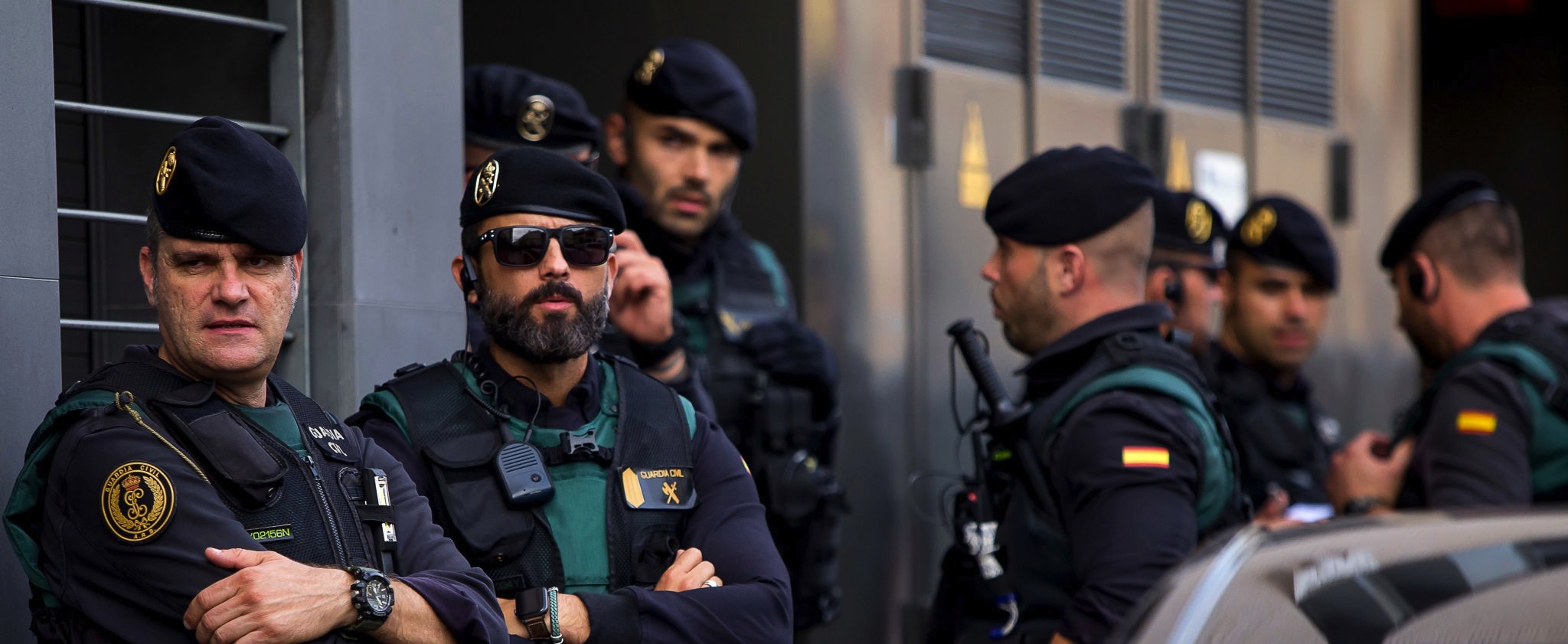
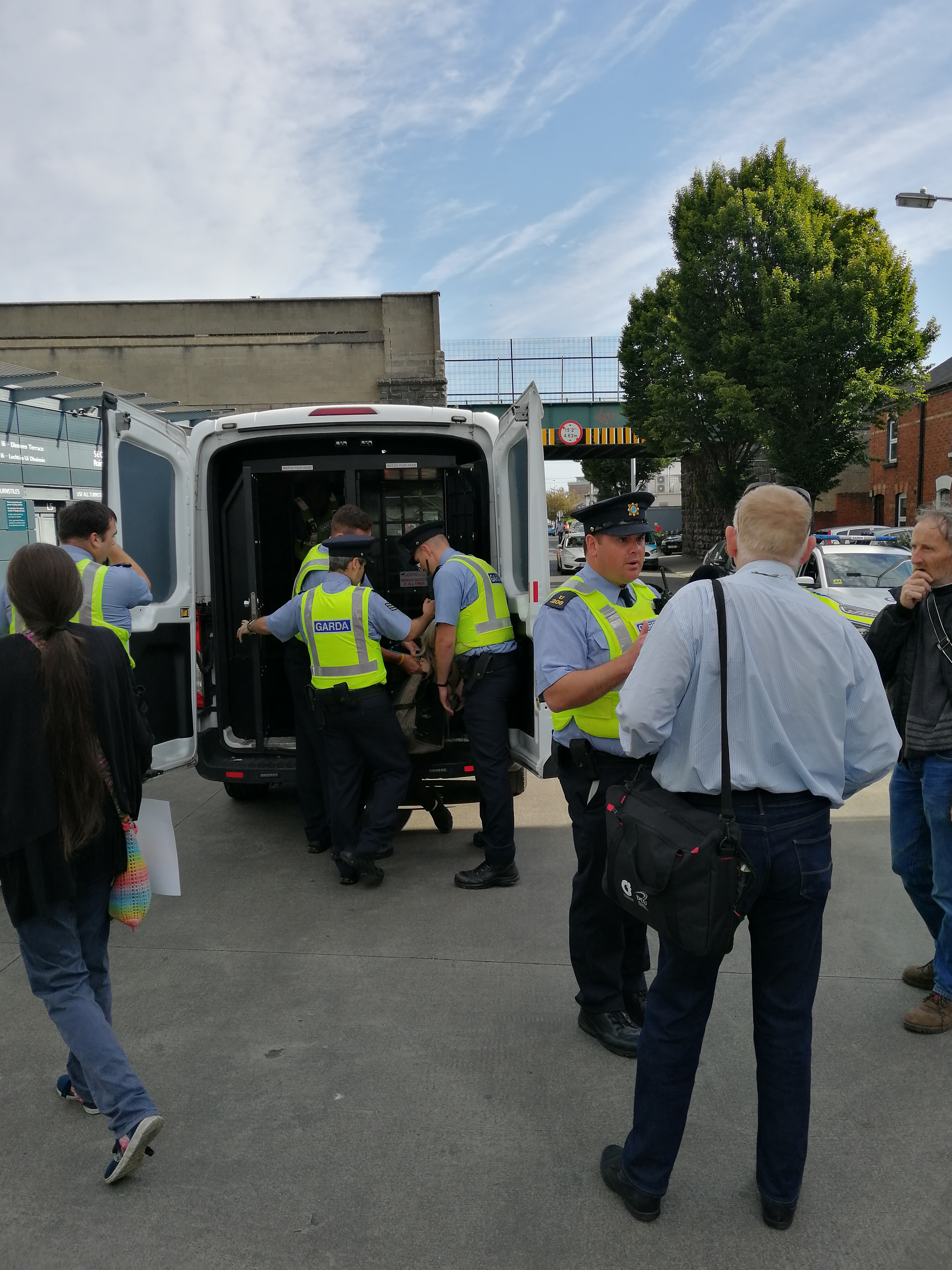
In the midst of an arrest operation on Wednesday of 21 people for alleged misuse of public funds to assist the Catalan independence movement, the Spanish State issued a statement alleging that Russia had offered the movement 10,000 Russian soldiers to aid their struggle. It wasn’t the only Russian connection to the Spanish police operation, which they had named Operación Volkhov.
The arrests this week form part of measures by the State against Catalan independence activists since 2017. That year, a coalition of pro-independence political parties and a huge grassroots movement in Catalonia pushed for a referendum to vote for or against an independent Catalan republic, which the pro-Spanish union opposition called on people to boycott. The Spanish State sent its police to raid Catalan regional government offices, confiscate ballot papers, search for ballot boxes (unsuccessfully) and, on the day of the Referendum itself on October 1st, to storm polling stations and beat up voters.
Since then, the Spanish State has jailed seven Catalan politicians and two leaders of grassroots movements on charges of sedition, charged senior Catalan police officers with disobedience (recently acquitted), charged activists with possession of explosives (turned out to be fireworks), other Catalan politicians – including the former President — are in exile, the current President of the regional government has been banned from holding office, 700 local town mayors are under investigation and others are facing charges arising out of strikes and acts of civil disobedience such as blocking streets and a motorway (for which one activist was charged with terrorism). The raid this week comes in addition to all those legal processes.
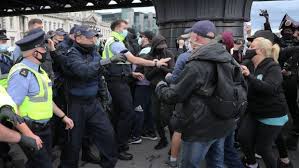
Members of the Guardia Civil (spanish militarized police) arrested pro Catalonia independence activists.
(Photo source: Internet)
There is something of an irony in charging Catalan activists with misuse of public funds in pursuance of independence, given that independence is what many of the Catalan public desire but even more ironic considering the rampant corruption endemic in Spanish political circles and the Monarchy itself, the former King Juan Carlos resigning amidst allegations of financial corruption and being allowed to flee the country ahead of an investigation.
Whatever about the charges of misuse of public funds it is unlikely that most political observers will take the allegations of an offer of Russian military intervention seriously and not only because it comes from Guardia Civil intelligence, a police force maintaining the fascist Franco dictatorship for four decades and, according to many, especially Basques and Catalans, not much changed since. The notion that Russia would risk a war with the EU and the US-dominated NATO, in order to help free a nation of 7.5 million people nowhere near its own territory, must be laughable.
For those facing charges, under investigation, in exile or already in jail, the situation is not humorous. And then there is the sinister name of the police operation. During WW2, General Franco, dictator of a neutral Spain sent fascist volunteers to aid the Axis in Europe, many of them fighting on the Russian front. Franco had quite recently led a successful military-fascist uprising against the Spanish left-wing Popular Front Government, for which he had been aided by Nazi German and Fascist Italian armament and men. His victory was followed by a repression that left Spain with more mass graves than anywhere else other than Cambodia. The Spanish volunteers to fight Soviet communism formed the Blue Division – blue, from the colour of the Falangist shirts and uniforms.
SPANISH FASCISTS ON THE VOLKHOV FRONT
Among the Nazi German forces in the Volkhov region were the men of the Blue Division and it seems they carried out a successful night crossing of the Volkhov River on 18th October 1941. A subsequent Red Army advance in January 1942 failed ultimately because not all the components of the operation had advanced according to plan. In August 1942 the Blue Division was transferred north to take part in the Siege of Leningrad, on the south-eastern flank of the German Army.
However in February of that 1943, operations on the Volkhov Front formed Part of the Red Army plan to first break the siege of Leningrad and then trap Nazi forces in encirclement. According to what seems a Spanish-sympathetic Wikipedia account of the battle at Krasny Bor, in the vicinity of Volkov, the Blue Division fought stubbornly from 10-13 February 1943. On February 15, the Blue Division reported casualties of 3,645 killed or wounded and 300 missing or taken prisoner, which amounted to a 70–75% casualty rate of the troops engaged in the battle. The remnants were relieved and moved back towards the rear.
Red Army casualties were much higher and, although forces attacking well-fortified positions backed by good artillery and tanks, all of which the Nazis had, can expect to lose three attackers for every one defender, Russian analysis later blamed bad leadership, ineffective use of artillery and clumsy use of tanks for their losses.
A Spanish police force evoking today the memory of Spain’s fascist troops in WW2 might seem ominous but to those who believe that the Spanish ruling class and their police force have never ceased to be fascist, the only surprise will be its effrontery. To the Guardia Civil, the fighting in the vicinity of Volkhov in October 1941 might seem the finest hour of the Blue Division but they might do well to remember that effectively it also met its end there in 1943: the Division ceased to exist and was reformed as the Blue Legion, soon afterwards to be disbanded, some soldiers absorbed into the Waffen SS and others withdrawn home.
RUSSIAN TROOPS FOR CATALONIA?
Fast forwarding to the present, the Russians, at least in their Embassy in Madrid, treated the allegation of their offering troops to support Catalan independence as a joke. The following post in Spanish appeared on their electronic notice and comment board (translated):
Note: The information that appeared in the Spanish media about the arrival of 10,000 Russian soldiers in Catalonia is incomplete. It is necessary to add a further two zeros to the number of soldiers and the most shocking thing of all this conspiracy: the troops were to be transported by “Mosca” and “Chato” planes assembled in Catalonia during the Civil War and hidden in a safe place in the Catalan Sierra (mountain range) until they received the encrypted order to act through these publications.
Russian Embassy Madrid, Main entrance (Photo source: Internet)
El 18 de agosto, se llevaron a cabo redadas contra partidarios del partido republicano irlandés Saoradh tanto en los Seis Condados ocupados como en el estado irlandés. Las redadas en los Seis Condados fueron coordinadas por el MI5 (Servicio de Inteligencia británica) y las de los 26 Condados (el Estado Irlandés) a instancias de los británicos o planificadas por ellos (el jefe de la Gardaí, Drew Harris, es un exdiputado jefe de de la policía colonial británica, el PSNI y sería un activo del MI5, por lo tanto).
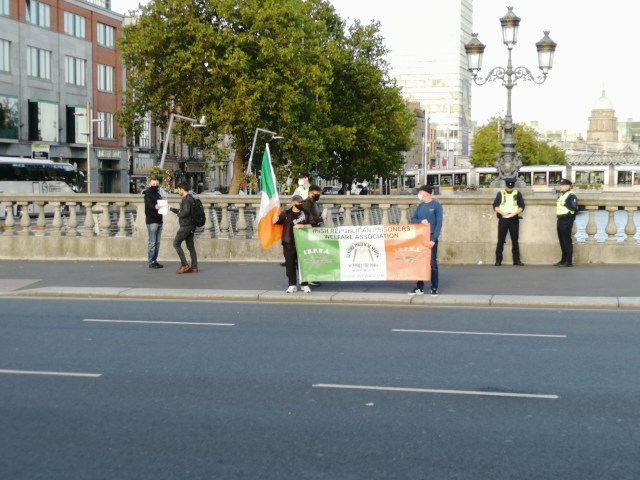
Patrula de Garda y policía política del Special Branch, los cuales habian anteriormente identificado a varios manifestantes, O’Connell Bridge (Photo: D.Breatnach) Concentración en la mitad el Puente O’Connell, Dublín, en solidaridad con los presos en Maghaberry (Photo: D.Breatnach)
Las redadas en los 26 condados, aunque derribaron violentamente las puertas de las casas y atemorizaron a las parejas y los niños, hasta la fecha no han dado lugar a cargos, pero las de los Seis Condados, facilitadas por un agente del MI5, resultaron en cargos graves y encarcelamiento de ocho. sin fianza en espera de juicio sin jurado en el Tribunal Diplock.
Todos los detenidos en los Seis Condados fueron encarcelados en la cárcel de Maghaberry, teniendo primero que pasar dos semanas en cuarentena en Foyle House. La instalación donde los presos fueron obligados a soportar este período ha sido descrita por los presos como “sucia y ruinosa” y con “cartones de leche pegados a la pared con heces” pero, habiéndolo soportado, fueron trasladados a la población general de presos políticos en Maghaberry.
Uno de los detenidos es el doctor Issam Hijjawi, que tiene problemas de salud por lo cual hace tiempo que buscaba hacerse una resonancia magnética. Finalmente se le concedió y fue trasladado bajo custodia al hospital donde se realizó el procedimiento. Sin embargo, a su regreso, fue nuevamente enviado a Foyle House para pasar otras dos semanas en esas condiciones insalubres, aunque fácilmente podría haber sido acomodado en la cárcel cerca de los otros presos para concluir otras dos semanas de cuarentena allí. Además, la naturaleza punitiva es clara cuando uno se entera de que los funcionarios de prisiones que acompañaron al doctor Issam Hijjawi no estaban obligados a ponerse en cuarentena y cuando la “focalización concertada de molestías que ha sufrido desde que entró en Maghaberry”, según los presos, se lleva a la cuenta.
HUELGAS DE HAMBRE
El doctor Issam Hijjawi se declaró en huelga de hambre en protesta y el 17 de septiembre 20 presos políticos en Roe House Maghaberry y 25 en E3 y E4 en las cárceles de Portloise se embarcaron en una huelga de hambre en solidaridad (tres presas políticas de Hydebank prisión también se incorporó la semana pasada). Se trata de prisioneros que están bajo el cuidado de la IRPWA (Asociación de Bienestar de Presxs Republicanxs de Irlanda), que tiene una estrecha relación con el partido Saoradh.
Saoradh y la IRPWA organizaron piquetes de protesta en varias partes de Irlanda, incluidas Dublín, Belfast, Derry, Tralee, Kilmainham Jail, que contaron con el apoyo de militantes del amplio movimiento republicano y antiimperialista.
Para el 26 de septiembre, el día 11 de la huelga de hambre, también organizaron una protesta frente a la cárcel de Maghaberry, con discursos, cánticos y fuegos artificiales. Más tarde ese mismo día, el PSNI (la policía colonial británica, antes RUC) detuvo a dos de los partidarios de Saoradh, incluido su presidente de la sucursal de Derry, por “comportamiento desenfrenado”, “comportamiento desordenado” y “posesión de fuegos artificiales ilegales”.
Cencentración de solidaridad con los presos Republicanos en la cárcel de Maghaberry, en los Seis Condados occupados. (Fuente: IRPWA)
Los participantes que iban al estacionamiento para apoyar a los detenidos fueron recibidos por policías coloniales con equipo antidisturbios que, según testigos republicanos, empujaron, golpearon, estrangularon y tiraron del cabello a los manifestantes.
Mientras que los dos republicanos de Derry fueron llevados por la policía colonial a la Unidad de Interrogatorios de Musgrave, más policías coloniales con equipo antidisturbios se trasladaron al campo de solidaridad frente a la cárcel de Maghaberry y detuvieron a dos partidarios del grupo juvenil republicano Éistigí, que también fueron llevados a la Unidad de Musgrave.
Policía colonial británica (PSNI) frente a la cárce de Maghaberry, enfrentando los solidarios con los presos republicanos en huelga de hambre (Fuente: IRPWA)
Dos días después, el lunes por la mañana, los cuatro comparecieron en el Tribunal de Lisburn a través de un enlace de video de la Unidad Musgrave, donde se les concedió la libertad bajo fianza en condiciones que violaban sus derechos civiles: no se les permite estar en compañía del otro ni en contacto; no deben estar a menos de 100 metros de una protesta o procesión notificada o no notificada; los cuatro hombres tienen que presentarse en un cuartel británico tres veces por semana.
La policía colonial quería aún más, que fueran etiquetados electrónicamente, en el toque de queda de 16.00 a 8.00 y no se les permitiera viajar en ningún “vehículo privado” — pero al final no se impusieron.
Luego, aunque les habían concedido la libertad bajo fianza, los cuatro fueron esposados y llevados a la cárcel, dos a Foyle House (anexo a la cárcel de Maghaberry) donde observaron lo sucias que estaban las celdas y posteriormente ambos fueron despojados a la fuerza y cacheados íntimamente por los guardias de la prisión. Los otros dos detenidos, ambos menores de 21 años, fueron trasladados a Hydebank.
Pancarta colgada frente puertas exteriores de la cárcel de Maghaberry, acusando a la policía colonial británica de ser contralado por servicios de inteligencia del Reino Unido y de ser respaldado por “Quislings” (es decir, traidores nacionales, se refiere a Vidkun Quisling, principal politico colaborador noruego con la ocupación Nazi).
Cuando finalmente fueron liberados, los cuatro detenidos tuvieron que viajar a casa en automóviles separados debido a las condiciones de fianza que se les impusieron, a pesar de que tres de ellos vivían en la misma ciudad. Un automóvil fue seguido por policía, detenido y expulsado a sus ocupantes y el automóvil registrado en Glenshane Pass. Otro fue detenido y registrado en la ciudad de Derry.
Los cuatro manifestantes ahora están recibiendo asesoramiento legal sobre su detención ilegal, cacheo desnudo y encarcelamiento por las fuerzas de la Corona británica.
El Dr. Hijjawi ha sido devuelto ahora a Roe House en Maghaberry y las protestas sobre ese tema han concluido. El carácter político vengativo del aislamiento en Foyle House se ha confirmado con la información de que once presos no republicanos, dos de ellos Lealistas, han estado de viaje fuera de la prisión sin que fueran puestos en cuarentena a su regreso en Foyle House.
PRISIONEROS POLÍTICOS EN IRLANDA HOY
En otro tema, las autoridades penitenciarias de los Veintiséis Condados (Estado de Irlanda), como consecuencia de la pandemia de Covid19, han reducido a la mitad el número de visitantes permitidos y han restringido los horarios de visita de los presos. El preso republicano Kevin Hannaway ha solicitado una revisión judicial de esta restricción alegando que viola sus derechos humanos. En su acción ante el Tribunal Superior, Hannaway afirma que según las reglas de la prisión, un preso tiene derecho a al menos una visita semanal de un familiar o amigo de no menos de 30 minutos de duración. Hannaway fue torturado en 1971 durante la introducción del internamiento sin juicio en los Seis Condados y es uno del grupo conocido como “los hombres encapuchados” porque les mantuvieron encapuchados durante sus días de tortura. Su caso fue dictaminado como tortura en el Tribunal Europeo de Derechos Humanos, pero luego fue modificado, en una apelación del Estado británico, a ser “trato inhumano y degradante”.
El Acuerdo del Viernes Santo de 1998 no vació las cárceles de los presos republicanos irlandeses, aunque los pertenecientes a los Provisionales fueron liberados con licencia y algunos otros aceptaron los términos y fueron liberados de manera similar. Sin embargo, se estaban realizando nuevos arrestos y encarcelamientos de republicanos que no apoyaban el Acuerdo (“disidentes”) y a algunos otros se les revocó la licencia y fueron devueltos a la cárcel sin cargos ni juicio.
Actualmente hay alrededor de 70 prisioneros republicanos irlandeses en cárceles de la autoridad colonial británica y del Estado irlandés. Aunque algunos están en espera de juicio (a veces hasta dos años), la mayoría está cumpliendo condenas, habiendo sido condenados en los Tribunales Especiales sin jurado utilizados para juicios políticos en ambas administraciones. Los problemas de los que se han quejado los presos republicanos incluyen el registro sin ropa, el acoso por parte de los funcionarios de prisiones, la ausencia o las restricciones en las instalaciones educativas y los largos períodos de aislamiento para algunas personas. Algunos presos también se enfrentan a la extradición del estado irlandés a los Seis Condados o al extranjero.
A leaflet from the Socialist Party of Ireland distributed at the antifascist rally in Dublin on Saturday 12th made a correct analysis of the source of the problems in Irish society of which the Far-Right are taking advantage in order to mislead people but also grow. But the leaflet text failed shamefully when it came to outlining the next steps to take.
Titled “OPPOSE RACIST DIVISION — Organise to stop the far right”, the leaflet correctly identified the haphazard Government restrictions as the cause of insecurity and confusion about the Covid19 virus, which fed the negationist movement. It also stated that the Far-Right was manipulating these people and working to infect them with racism and homophobia.
It was correct also to point to the need for socialists to expose the real issues and organise to resolve them.
However, the leaflet text went on to state: “Recent experiences have shown that small counter demonstrations with confrontational tactics have jeopardised the safety of anti-fascist protestors and can drive some some people further into the arms of the far right.”
Perhaps the Socialist Party can tell us what kind of counter demonstration would not be seen as having “confrontational tactics”. In fact since to their credit for the first time some of their comrades actually took part in one such counter-protest, on Custom House Quay on the 22nd August, they couldinform their party that the counter-protesters were attacked almost as soon as they stepped on to the Quay, before anything at all was said by them. Also, the Far-Right have been staging regular street protests since last year, many of them centred around the racist and conspiracy theorist Gemma O’Doherty, who recently unfurled a banner calling to “Make Ireland Catholic Again”. Should the Far-Right have been permitted to continue without public opposition?
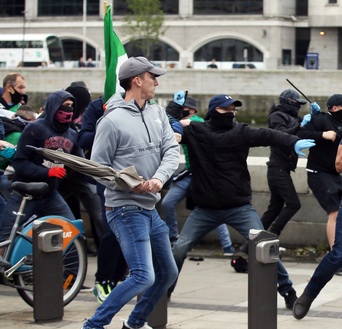
Some of the armed fascists that attacked a counter-protest on Custom House Quay on 22 August 2020. (Source Image: Internet, then cropped)
The counter-protests were small because the majority of the antifascist movement did not participate in them. It was independent anarchists, socialists and Irish Republicans who first took up that task and at that time the Far-Right protests were quite small. When the Far-Right called a larger one for Leinster House, in a coalition of fascist parties and organisations, a fairly large force of Irish Republicans and independent antifascists confronted them and a number of the Republicans were arrested. Following that event, on 14th December 2019 a larger combined force of antifascists including Irish Republicans, Antifascist Action and socialist parties occupied the protest ground planned by the Far-Right outside Leinster House and outnumberedthe latter by about ten to one.
The small ad-hoc antifascist coalition of various political and social threads has been left to confront all the other fascist gatherings on their own. A Far-Right group called QAnon occupied the GPO forecourt for Saturday rallies as soon as the Covid19 restrictions were introduced and were left largely unmolested by antifascists to establish themselves as a weekly event, supported by fascist activists who travelled from different parts of the country to attend it. They were left unmolested by the Gardaí too, who nevertheless used Covid19 powers to harass Debenhams picketers around the corner in Henry Street and also by the Special Branch, Ireland’s political police, who harassed pickets held in solidarity with Irish Republican and Basque political prisoners, demanding the names and addresses of the picketers.
All subsequent rallies, pickets and meetings of the Far-Right were left entirely to the small aforementioned coalitions to oppose but when the Debenhams workers staged their march and rally on 8th August, the QAnon group abandoned their Saturday spot and took to Phoenix Park instead, showing the antifascist potential of a large gathering of the Left.
HISTORY OF ANTIFASCIST STRUGGLE IN IRELAND
The rise of the fascist movement in Ireland in the 1930s was defeated by Irish Republicans, who confronted them physically on the streets to the extent that the ruling class feared revolution and mostly acquiesced with De Valera’s government banning a Blueshirt march, after which the Blueshirts became integrated into the Fine Gael party and ceased to have a separate existence.
Eoin O’Duffy exchanges fascist salute with Blueshirt rally in 1930s Ireland. (Photo source: Internet)
Every attempt to establish a fascist party since then has been promptly squashed by antifascists. In 2016 the European islamophobic fascist organisation Pegida tried to launch itself in Dublin and was driven off the street by massive mobilisation of both those advocating peaceful opposition as well as those favouring physical confrontation (by the way four Republicans still face serious charges arising out of those events). The tiny group of native Irish fascists was attacked on its way into the city centre and the East European contingent had to run or be brought to safety in Garda vans.
Attempted Pegida launch February 2016. After some short battles between antifascists and fascists with Gardaí moving in to protect the latter, they spirit them away in police vans while staging a diversion in O’Connell St. (Photo: D.Breatnach)
IN BRITAIN
The fascist movement of Sir Oswald Moseley’s Blackshirts was physically opposed in numerous battles on the streets of British cities throughout the 1930s and after WW2, Moseley himself being knocked to the ground in Manchester and hit by a flying brick in Liverpool. Numerous battles took place in London too of course, the most famous being at Cable Street, where a coalition of Irish and Jewish antifascists, along with local Communist Party activists, fought a battle of several hours on 4th October 1936, principally with 7,000 London Metropolitan Police and all the mounted police of the city. The police got through the first barricade but failed to penetrate the second and the Blackshirts had to turn away, many being ambushed at other points such as at Hyde Park Corner.
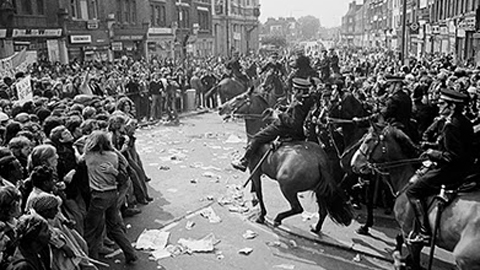
Scene from the antifascist Battle of Cable Street 1936, fought mainly against the police who were trying to clear the way through the Jewish migrant area for the fascists. (Source photo: Internet)
Section of mural near the scene presenting an artist’s impression of the Battle of Cable Street, East London 1936. (Photo source: Internet).
After WW2 all attempts of Moseley and other fascists to organise were suppressed by robust action on the streets, the most serious being in 1958 in London’s Notting Hill area. Many of the post-war migration of Afro-Caribbean people to London lived in that area. Moseley’s Union of Fascists and the White Defence League organised and whipped up gangs of white youths to attack first migrant Caribbean males, then the white wife of a Caribbean man and finally Caribbean families. The Caribbean migrants and Irish and British antifascists organised defence and battles went on for two weeks. According to Wikipedia: “The riots caused tension between theMetropolitan Police and the British African-Caribbean community, which claimed that the police had not taken their reports of racial attacks seriously. In 2002, files were released that revealed that senior police officers at the time had assured the Home Secretary, Rab Butler, that there was little or no racial motivation behind the disturbance, despite testimony from individual police officers to the contrary.” (That pattern of police denial of racism and neglect of targeted communities became a repeated pattern and has also been seen in many other countries).
When fascists began to organise again in Britain at the end of the 1960s, the parties of the Left first advocated ignoring them and when they did eventually mobilise counter-demonstrations, marched them away from confrontation with the fascists. Meanwhile fascists were attacking sellers of socialist papers, socialist meetings, migrants and ethnic minorities. Some elements of the Left after a while adopted the slogan of “no platform for fascists” which became popularised among students and some staff in institutions of third-level education, eventually becoming policy of the National Union of Students.
A coalition of antifascists of various political backgrounds, including some acting unofficially outside their party discipline, mainly in AFA (Anti-Fascist Action) and small groups of revolutionary communists, anarchists, Irish Republicans and antifascists expelled from their parties (e.g. Red Action) took on the National Front, the League of St. George and the British National Party in numerous battles and smashed the ability of the fascists to take possession of any significant physical space in order to organise. On September 13th we passed by the anniversary of one of those battles in Lewisham, SE London in 1977 and we are nearly at the the anniversary of another,on the 18th in 1992 at Waterloo (the London Underground and train station, not the site of the 1815 battle in Belgium).
Scene from the antifascist Battle of Lewisham 1977. Left groups and Afro-Caribbean youth successfully battled mainly against police to prevent the fascist National Front marching through the borough’s centre. (Photo source: Internet)
Throughout that period the main parties of the left (with the exception for a period of the SWP and the IMG) refused to confront the fascists physically and instead concentrated on organising events to attract youth away from fascism, principally through the Anti-Nazi League. It was however clearly the physical confrontations by antifascists on the streets, as had been the case in the 1930s that again defeated the rising fascist threat in Britain – for a time. Clearing the fascists from the street not only prevented the intimidation of Left activists and ethnic minorities and prevented the creation of fascist areas but also made it much more difficult for fascists to recruit and marshall forces.
LEARNING THE LESSONS?
Rather than draw on the lessons of those struggles in Ireland and in Britain, the leaflet text advocates repeating the mistakes. In effect, the leaflet advocates leaving the antifascist mobilisations for the moment and concentrating on the class struggle against the system. That strategy entails allowing the fascists to become established and grow unhindered, making it much harder to root them out later. But not only that – the Left in Ireland has a pretty poor record of taking on the capitalist system and is particularly weak at the moment, with the trade union movement largely supine. The leaflet points to the just struggle of the Debenhams workers, with which the SP is particularly closely connected, at least in Dublin; however it is well to note that those workers have been sacked, their workplaces closed and the struggle is a last-ditch defensive one for redundancy pay. In other words, we are nowhere near a situation where the overall struggle against the capitalist system is such as to cut the ground from under the Far-Right.
Because those loose antifascist networks currently active are not under the control of the SP and are hardly likely to heed their call, the effect of the leaflet text is to advocate a continuation of the current situation, where counter-protests will be outnumbered by mobilisations of the Far-Right, despite the fact that the fascist parties actually have tiny support, bussing in people to swell the numbers. Fascist attacks will continue and may well even escalate. Fascists will continue to arm with Garda impunity for their attacks but it is certain that when the antifascists arm likewise, they will be arrested for “possession of offensive weapons” and even jailed.
Finally, the leaflet failed to give any specific indication of a short or medium-term way forward except to “join the socialists”, i.e the Socialist Party. The leaflet could have advocated building a broad antifascist front and called on people to help in that work, to bring in people not currently active, to ensure large turnouts to counter mobilisations of the Far-Right. But it didn’t.
An antifascist and anti-racist march in Dublin on Saturday 12th September ended without any major incident. However a handful of counter-protesters who attended a negationist protest outside Leinster House were assaulted by a mob of fascists, a woman being struck on the head with a blunt object causing an injury requiring hospital treatment. Photographs and some video footage shocked many as the Gardaí were seen to take no action against the assailants and instead, to usher the counter-protesters further away from the fascists, with a woman bleeding copiously from her head.
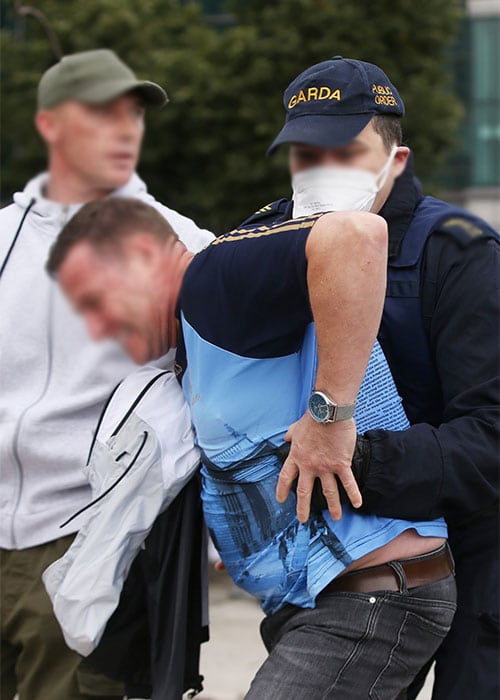
Left: Ms Izzy Kamikaze being pushed by Gardai down Kildare Street after being struck on the head with a club by a fascist. Right: Closeup (Photos sourced: Internet)
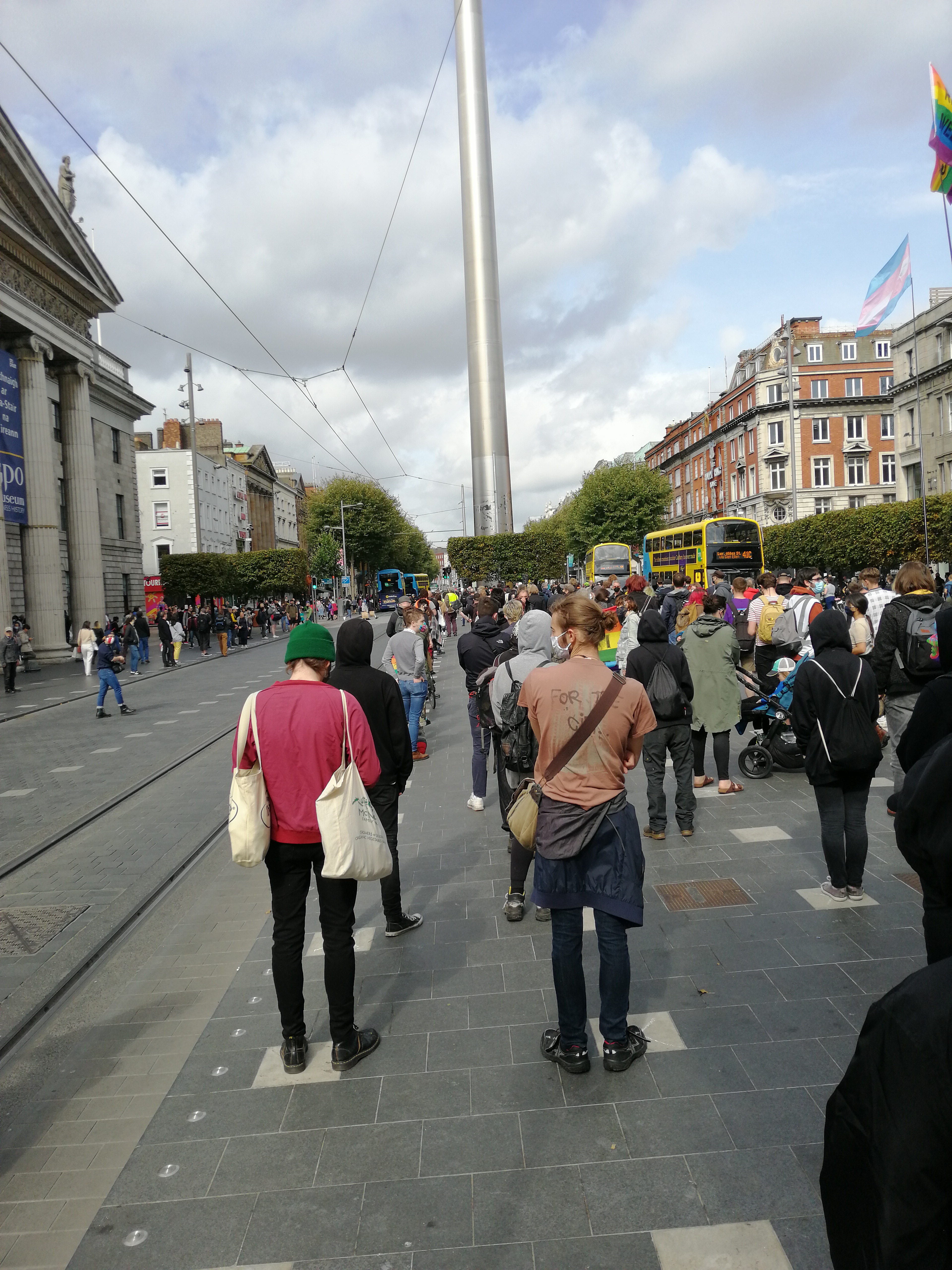
View of the antifascist rally northward (Photo: D.Breatnach)
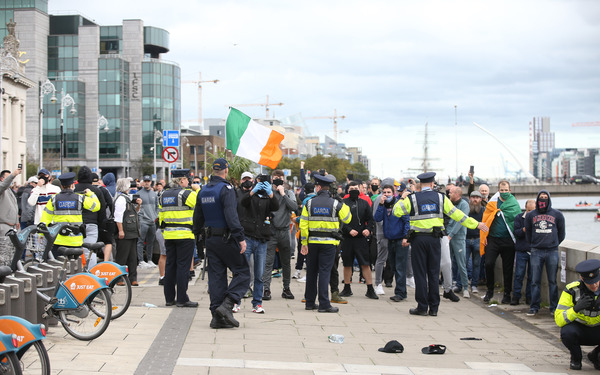
The Irish Yellow Vests, led by notorious islamophobe Glen Miller and the fascist Catholic fundamentalist and racist organisation Síol na hÉireann, led by Niall McConnell, cooperated in staging a rally and march from Custom House Quay to Government Buildings in Merrion Street. Custom House Quay was the scene of another IYV-organised event on 22nd August when a counter-protest of men and women was attacked by mob of masked and often gloved men (supporting an anti-mask rally!), many armed with clubs and metal bars. On that occasion too the Gardaí had arrested none of the attackers but pushed and shoved the counter-protesters away, threatening them with uplifted batons. On that occasion too a counter-protester had required hospital treatment, having been knocked unconscious.
The anti-fascist demonstration on O’Connell Street was called by the United Against Racism organisation and the People Before Profit/ Anti-Austerity Alliance and, since it had received threats of attack from fascists, it was supported too by independent antifascist activists from Anarchist, Republican and Socialist backgrounds.
(Photo: D.Breatnach)
(Photo: D.Breatnach)
A number of speakers addressed the rally though the sound did not carry very well towards the rear of the rally but also many were distracted by keeping an eye out for fascists. One IYV activist approached the rally to photograph participants and soon got into an altercation with them, whereupon Gardaí arrived and removed him to the side of the road. Another brandished a placard, which was promptly seized by antifascists and torn. Some fascists were seen passing by, presumably on their way to Custom House Quay or Leinster House – one was observed carrying a thick length of wood with the Irish Tricolour attached to it — but did not engage with the antifascists.
A view southward of the anti-fascist rally (Photo: D.Breatnach)
The “Refugees Welcome” flag accompanies the Irish Tricolour and Transgender flags with the GPO and its Tricolour in the background. The Proclamation read out in front of that building in 1916 included the words: “The Republic guarantees civil and religious freedom to all ….” (Photo: D.Breatnach)
Across on the other side of the road, at the corner with Princes Street, two or three older people had set up a couple of banners protesting about ill-treatment of the elderly in nursing homes — an entirely justified cause for protest however it is known to have been adopted by the Far-Right in Ireland. A very high proportion of Covid19 deaths in Ireland were in nursing homes and linked to Covid19 infection through lack of effective controls, which is a strange issue for the Far-Right to embrace since they variously claim that Covid19 is a hoax or that it is not at all a serious virus.
LED BY FAKE PATRIOTS BUT REAL FASCISTS
The rally on Merchants Quay, organised by the Irish Yellow Vest seemed somewhat larger than the one in O’Connell Street but a number were brought in from other parts of the country. Their promotional video showed the crowd being addressed in an energetic style by a man with a North American accent. His message was to refuse to wear masks, using exceptions permitted in the legislation, not to be afraid and to remain united. At one point he seemed to be arguing for anti-racism, which was somewhat bizarre while standing next to him was the mc of the event, Glen Miller, notorious racist and islamophobe.
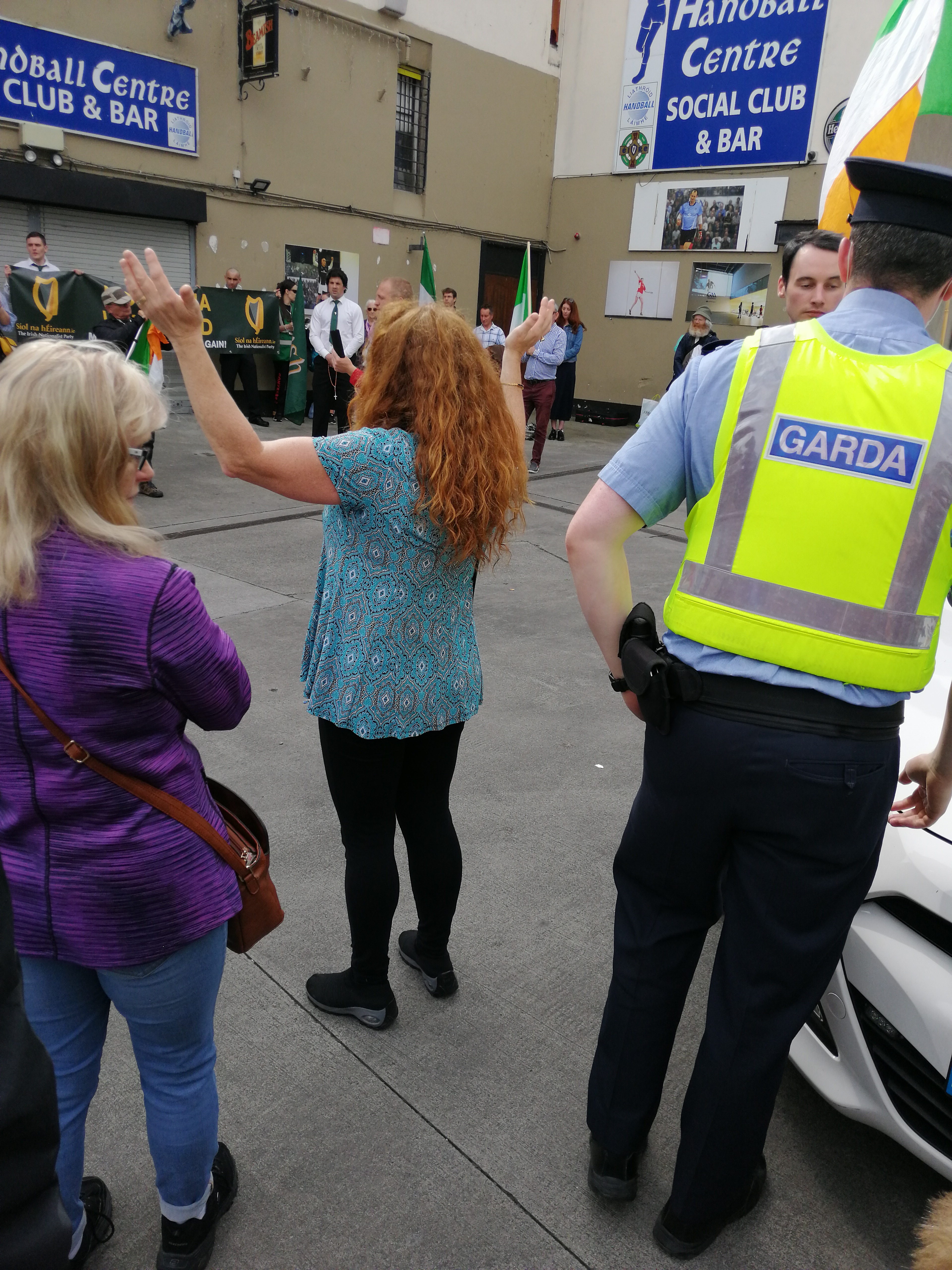
After a little, the crowd formed up behind the colour party of Síol na hÉireann, a tiny fascist, racist and fundamentalist Catholic party from Donegal led by Niall McConnell. Apparently without any sense of irony, the party flew the Irish Tricolour, the “Irish Republic” flag and the golden Harp on a green field flag, with “Erin go bragh” (sic) of the Fenians.
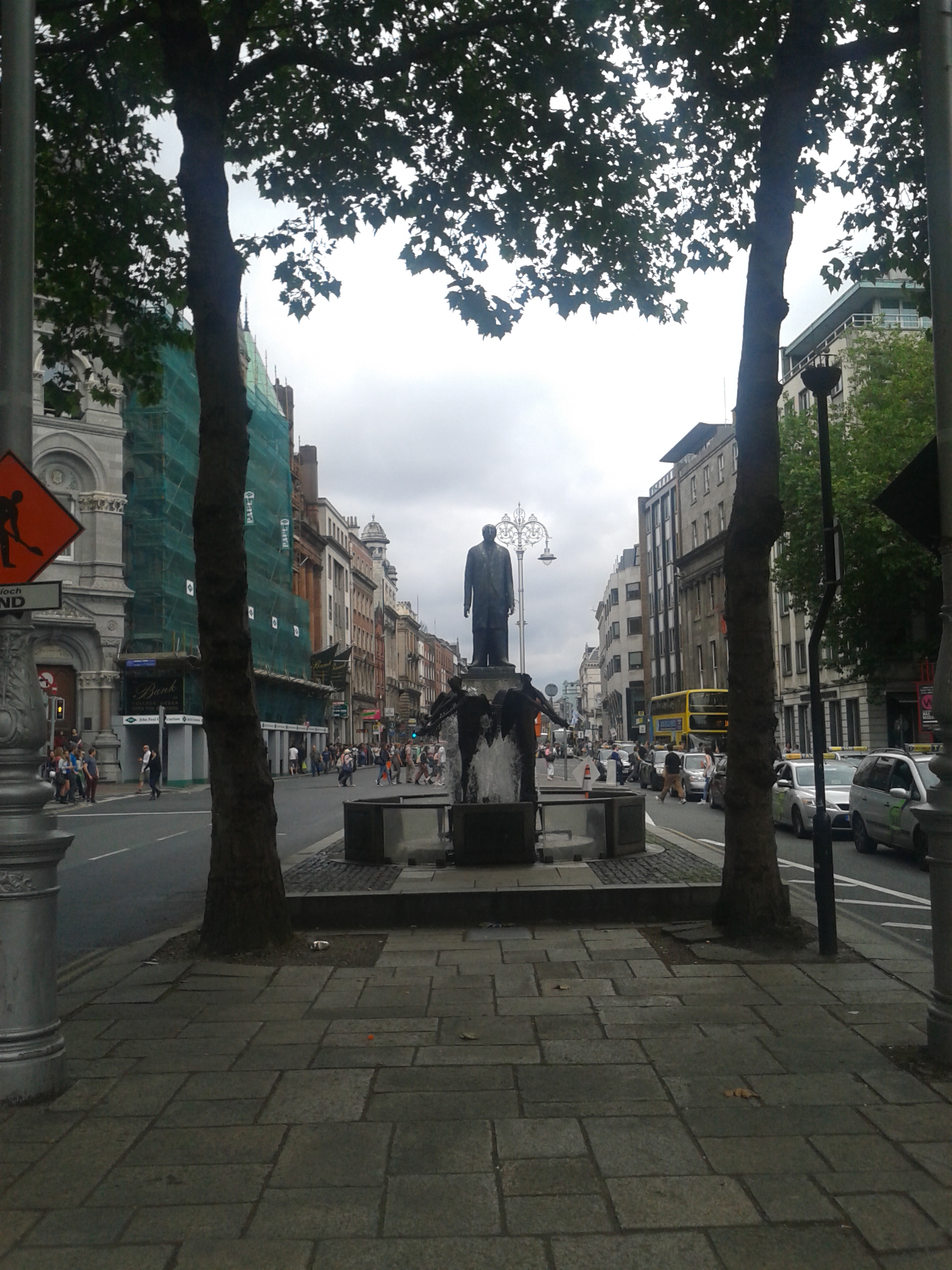
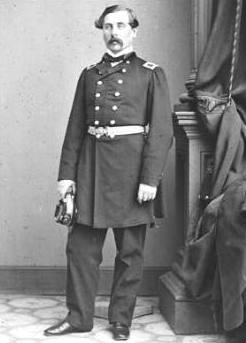
The Tricolour signifies cooperation between Irish of different religions which, as we will see, is something McConnell will have no truck with; in addition the original pattern was sewn by French revolutionary women and presented to Thomas Meagher in 1848. Meagher was a member of the “Young Irelanders”, composed of Irish nationalists of both Protestant and Catholic religious backgrounds and he himself led a Union Army brigade in the American Civil War.
The Harp on a green field was modelled on the flag of the United Irishmen who rose against the British in 1798 and 1803 – nearly every one of their leaders was Protestant. The Fenians were a mixture of religious backgrounds (and perhaps none) and were excommunicated by the Irish Catholic hierarchy. The Fenians in England were accepted into the First Socialist International, led by Marx and Engels.
The “Irish Republic” flag was prepared in the home of Constance Markievicz for display in the 1916 Rising; she was a Socialist Republican and fought in the Rising as an officer in the Irish Citizen Army, the first working class army in the world.
March organised by Far-Right in D’Olier Street Saturday. (Photo sourced: Internet)
COLOUR PARTY LEADER REVEALS HIS TRUE COLOURS
Approaching the four Gardaí standing by a couple of unsecured crowd barriers at the end of the Quay, a little farce was played out in which the Gardaí seemed unwilling to move and then were “forced” to do so by the crowd. Those who have participated in protests over the years and seen the Gardaí in action and their barriers, when they truly wished to stop a march, would laugh to see the video recorded by the Far-Right of the event.
At a junction the procession stopped for people to catch up (some participants even complaining at Miller’s exhortation to give consideration to the elderly and children) and were addressed by a number of speakers. The man with the North American accent was in action again in revivalist style and Ben Gilroy, Miller’s lieutenant, also spoke. In a video during the week, Gilroy had minimised the Covid19 deaths by stating that all but 100 of them had been of people with underlying health issues. Given that according to the HSE over 30% of Irish people suffer from underlying conditions of ill-health, it was a shockingly uncaring statement to make in support of the negationist cause.
Here Niall McConnell spoke too, announcing himself as the leader of “Síol na hÉireann, a hard-line Catholic Irish nationalist party”, having the effrontery to quote, completely out of context James Connolly, revolutionary socialist and Republican. McConnell insisted that Ireland is for the Irish and, attacking the EU, hinted at the “Replacement” conspiracy theory, in which the EU is allegedly trying to replace Irish people with migrants. He also accused it of spreading “LGBT ideology”. “Ireland is a Catholic country”, he insisted and, in total contradiction to at least 220 years of recent history, ascribed the Catholic faith to the motivation of our ancestors in fighting for freedom. Then he got down on his knees and recited The Lord’s Prayer in Irish!
It was noticeable that only a small number followed him on to their knees and also that a number of his statements drew uncertain responses. Following his speech, Lorraine Eglinton of the Irish Yellow Vests spoke, stressing the need for unity, which might be taken as an implied criticism of McConnell for introducing religion and race into the equation or perhaps just for stating his beliefs so baldly at a shared event.
FASCIST ATTACK ON WOMAN COUNTER-PROTESTER
While the major part of the Irish Yellow Vests march went to rally outside Government Buildings in Merrion Street, a smaller group of maybe 40 or 50 people went to protest a block away outside Leinster House, seat of the Irish state’s Parliament. This was apparently a split in the Far Right.
If this split was trying to attract less fascist and racist people what followed was truly bizarre. A couple of people who attended in a counter-protest but at some remove were approached by Far-Right supporters who appeared to argue with them, which is recorded on video. This soon attracted a mob, some masked (!) and one of which can be seen grasping a length of wood attached to an Irish Tricolour. They begin to push the couple of counter-protesters roughly and then one of them strikes the woman on the head, opening a wound with much blood running down her face and knocking her to the ground. She regains her feet and continues to stand as Gardaí move in and gently usher the fascists back, making no attempt to arrest any of them and soon pushing the counter-protesters down the road.
The woman received hospital treatment later, being released the following morning. In a press release following the event the Gardaí reported that no arrests or serious incidents had occurred! When they were contacted by journalists and shown video taken at the scene they changed their story to say that “some demonstrators had to be separated” and ultimately changing it again to say that “they are investigating the incident” and “had not received a complaint”. Are the Gardaí saying that although they witness an assault, or at least the immediate aftermath of one, they can take no action unless they receive a complaint?
Ms Izzy Kamikaze, an LGBT campaigner and writer, who had received the head injury, said that she intended to make a complaint, not just about the assault but also about the behaviour of the Gardaí. Some photos have appeared on social media allegedly identifying two of the attackers by name and as members of the fascist National Party. According to media journalists, the Gardaí have video camera footage tracing one of the assailants also which would be no surprise as the area around Leinster House is one of the most highly covered by CCTV video cameras in Dublin.
A PATTERN OF GARDA COLLUSION
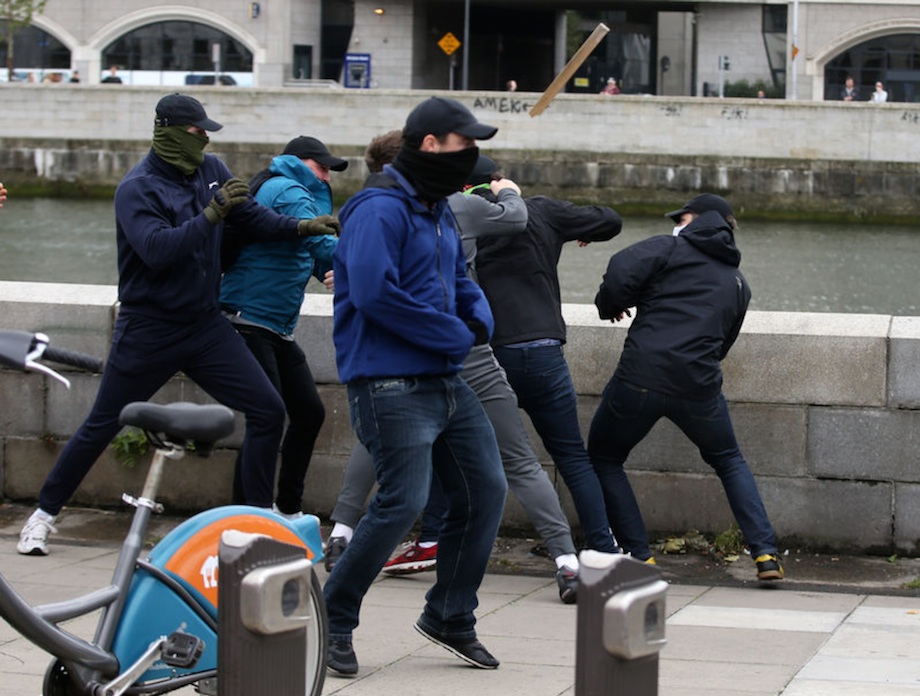
This is not the first occasion in recent times that the Gardaí have been accused of collusion with fascist violence. On July 11th a small counter-protest to the large homophobic rally outside Leinster House was physically attacked and their banners ripped without Garda interference for a period and, when they did intervene, arrested none of the assailants. On two different occasions fascists within the QAnon negationists outside the GPO attacked a peaceful counter-protester without being arrested by the Gardaí. However when, following these attacks, antifascists surged into the Qanon crowd, the Gardaí quickly intervened and arrested at least one of the antifascists. On August 22nd at Custom House Quay a mob of over 50 men, many of them masked and gloved (supporting an anti-masking rally!) and carrying wooden clubs and metal bars, attacked a peaceful smaller counter-protest and knocked one antifascist unconscious. A few Gardaí then gently shooed the fascists back while more, including the Public Order Unit, began to scream at the antifascists to get back, threatening them with raised batons and pushing them violently, knocking some over and preventing them from even assisting their unconscious comrade. Those scenes too were recorded on video and shared on social media, both by fascists glorying in their actions and by antifascists exposing the fascist violence and Garda collusion.
A Parliamentary Question about Garda behaviour to the Minister for Justice from Independents for Change TD Catherine Connolly was refused, she being told that this is an area within the competence of the Garda Commissioner.
A group of antifascists, broad in composition but not large in numbers, went to counter-protest a rally in Dublin last Saturday and were attacked by a much larger mob, some of them armed, leaving one of the counter-protesters unconscious.
The Gardaí then intervened, including members of the Public Order Unit, treating the assailants gently but pushing and shoving the anti-fascists and threatening them with drawn batons. What was all this about?
Section of the crowd at the anti-Covid19 restrictions rally at the Custom House, 22 August 2020. (Source photo: Internet)
The event had been called by a rarely–heard-of organisation called Health Freedom Irelandand was advertised as being a “Protest Against Oppressive Government Restrictions and Mandates”, in opposition to Government restrictions around the spread of Covid19, against social distancing and the wearing of masks requirements and against any notion of the implementation of a vaccination program.
According to the media, HFI is led by anti-vaccination campaigners Maeve Murran and Kelly Johnston, claiming that vaccination can cause autism.
So one might object to the stated purpose of the rally on health grounds, or intellectually reject the implied conspiracy theories, but why would antifascists specifically want to counter-protest this event?
The answer becomes clearer when we examine the organisers of the event, some of the speakers and some of the supporting groups.
Antifascists walking on to Custom House Quay a minute before they were attacked. 22 August 2020. (Source photo: Internet)
The event was to be officially co-hosted by the Irish Yellow Vests, a very small group led by the notorious Islamophobe Glen Miller.
He and Ben Gilroy, one of the featured speakers, had tried to bind together such disparate groups as campaigners around the right to housing, water, against the bailouts of the bankers and subsequent austerity measures, evictions, against corruption, State repression — but also those with strange conspiracy theories.
As a result the Yellow Vests had briefly enjoyed some support from a cross-section of forces opposed to the Government until Miller’s Islamophobia and the racist agenda of some of his supporters became clear, after which the group faded from the scene (though Miller could occasionally be seen supporting events of the Far-Right, such as in February outside Leinster House, against mooted “anti-hate speech laws”).
One of the speakers to be featured was Dolores Cahill, 2nd in the leadership of the Irish Freedom Party, another small anti-immigration and for a “Catholic Ireland” right-wing party and in attendance was its Chair Jim Corr and PRO Herman Kelly, the latter having in the past been PRO for Farrage’s UKIP and also taken part in a panel with Ulster Loyalist and British fascist Jim Dowson.
Numerous figures of the Far-Right were vociferous in their support for the rally, including activists of the QAnon group who have been taking advantage of the Government restrictions around Covid19 to regularly protest against them outside the GPO, apparently free from any Garda action (while sacked Debenhams workers and their supporters demonstrating around the corner in Henry Street, though masked and observing social distancing, were nevertheless victims of police intimidation and harassment).
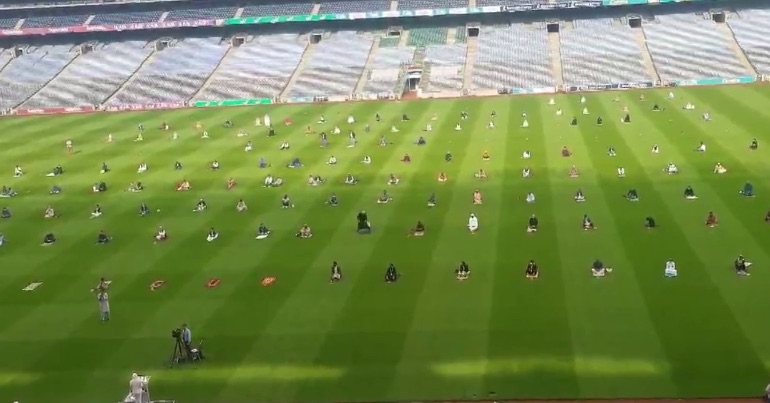
The QAnon group, including their chief spokesperson Dee Wall and others prominent in the group, also demonstrated recently against the letting of Croke Park to a group of Muslims to celebrate the Eid festival, supporting another Far-Right racist activist, Gemma O’Doherty, who declared her wish to “make Ireland Catholic again” (sic).
Of course, not all the hundreds who attended the rally on Custom House Quay were racists. Just days before, a member of the Irish Government, other politicians and business people, around 80 in total, had attended a parliamentary golf society dinner in Clifden, Galway, in apparent oblivion to all Government restrictions.
People who are subjected to those restrictions, unemployed as a result or losing their business, were understandably angry, some even questioning whether the restrictions were really necessary. After all, if prominent people , including a member of the very Government, don’t seem to think them important ….
One of the many strange conspiracy theories among supporters of the Far-Right, seen at the anti-mask etc rally 22 August 2020. (Source photo: Internet)
There are those who are not racists but who believe, contrary to overwhelming scientific evidence, that vaccinations do more harm than good. And there are believers in all kinds of conspiracy theories, other than the rational ones about capitalism and imperialism, who imagine a global conspiracy by dark forces encouraging homosexuality, immigration, etc, etc, allegedly pushed by the Communist Party of China through the UN and the EU!
Some of those conspiracy theorists are racist and some are not but all find a welcoming home in the ranks of the Far-Right, whose own official parties and organisations are tiny. Some hard-line fundamentalist Catholics like John Waters, along with strident racist Gemma O’Doherty, seem able to set aside the alleged message of love for humanity in the Christian New Testament and are also embraced by the Far-Right.
COUNTER-PROTESTS
Events of the Far-Right are often counter-protested by groups and individuals called together informally, without anyone exercising leadership. This has been the case with counter-protests to Gemma O’Doherty in Dublin, for example and to Niall McConnell, of the tiny fascist party Síol na hÉireann, who was expelled along with his propaganda stall from outside the GPO in an unannounced action some months ago.
Indeed, it has been a remarkable feature of most gatherings of the Far-Right in Dublin at least that no organisation or network has called publicly to oppose them (the one notable exception since 2016 has been the December 2019counter-rally outside Leinster House). None of the main parties of the Irish Left or Republican movement, although all opposed to racism and fascism, have made a public call for those mobilisations.
But in advance of the Custom House Quay event, this time there were two public calls for a counter-protest, one from the Belfast IWWU (International Workers of the World) trade union and the other from the Dublin Republicans Against Fascism network.
A small group of antifascist activists, gathered from such varied sectors as republicans, socialists, anarchists, anti-racism and animal rights met on Eden Quay with the intention of proceeding to mount a counter-protest to the rally.
A PREPLANNED ARMED ATTACK
At the advertised time of 1.30pm the relatively small group of counter-protesters came on to Custom House Quay, on the far side from where the invited speakers were standing. Further along the river wall, a mass of men was gathered, many wearing masks and gloves.
Given that the rally was called specifically against Covid19 restrictions and wearing of masks, one must assume a different reason for their wearing them – such as avoiding identification and gloves for concealing fingerprints (which in turn makes it likely that many have fingerprints on Garda records).
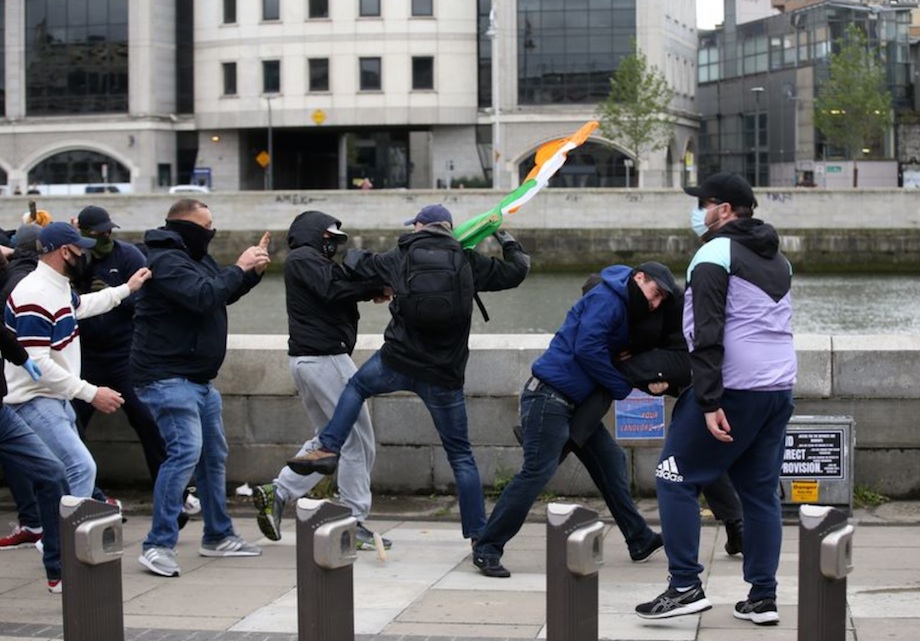
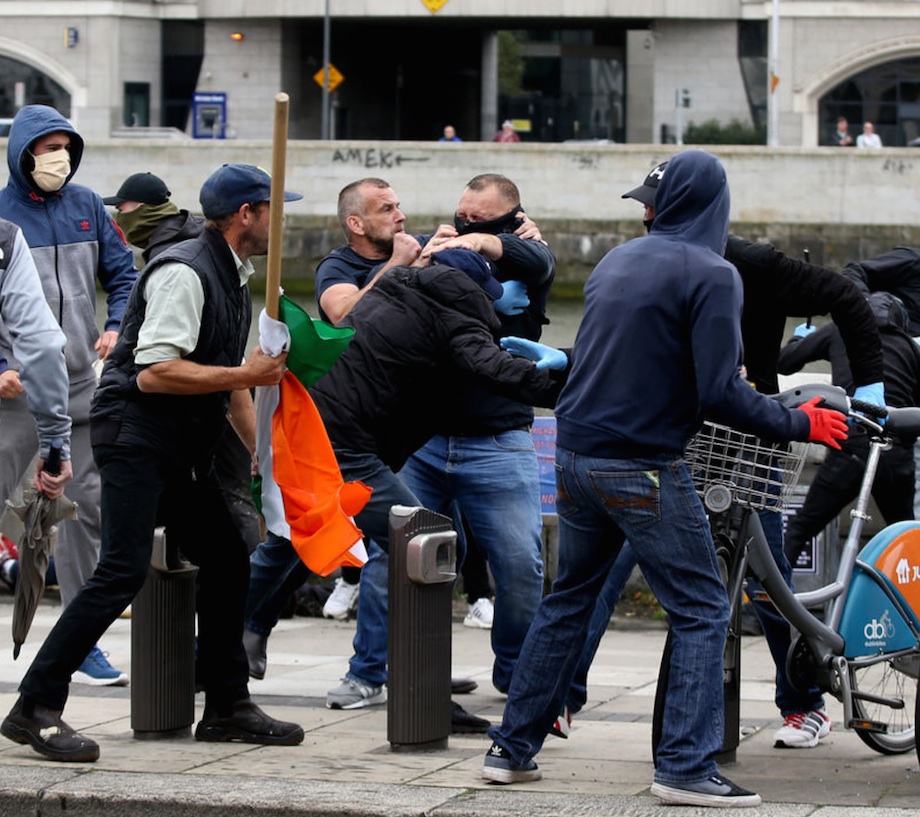
Armed fascists charge antifascist counter protesters, seen here striking antifascist with flagpole. 22 August 2020 (Photo source: Internet)
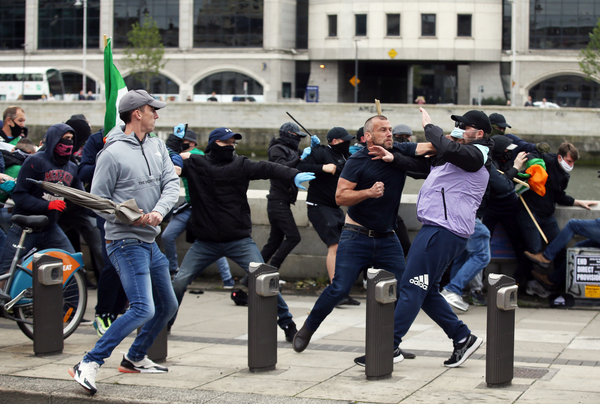
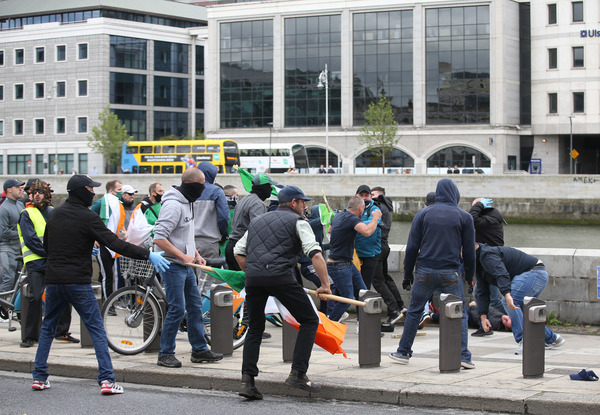
According to statements of some of the counter-protesters, they had hardly stepped out on the Custom House Quay from under the railway bridge when they were attacked by the mob. One of the antifascists in the lead was heard to shout “Stand fast!” and then the wave of fascists struck, howling, punching, many wielding metal bars and wooden clubs.
As soon as any antifascist went down many assailants joined in on kicking and stamping on him. The antifascists fought back but had no weapons.
Antifascists fight back, one trying to wrest flagpole from fascist 22 August 2020. (Source photo: Internet)
Shortly afterwards, the Gardaí – including members of the Public Order Unit — moved in and opened up a space between both groups. According to participant and video evidence, they concentrated their numbers and ferocity on the smaller, unarmed group, the victims of the attack, shouting at them to leave, threatening them with drawn batons and shoving them hard. One of the counter-protesters lay on the ground, apparently unconscious but the police prevented any of his group going to his aid.
The Gardaí ceased their pushing and threats only when they had got the counter-protesters about half way along Butt Bridge, by which time they had knocked a number to the ground, whereas their attackers were permitted to remain more or less where they had been, now taunting their victims.
Antifascists continue fighting back (note three assailants at least on antifascist by river wall. 22 August 2020 (Photo source: Internet)
Hyped-up and confused fascists attack one of their own (centre). 22 August 2020 (Photo source: Internet)
BIZARRE REPORTING
A bizarre aspect of the whole event was the media reporting, with earlier reports making no reference at all to the conflict. Later reports included vague references that in no way described the situation, with a general projection of the Gardaí as an impartial order-keeping force in minor disturbances.
An early photograph on the Irish Times website of the Public Order Unit and other Gardaí confronting antifascists on Butt Bridge quickly disappeared. When the conflict was finally described, in a report on Monday by Conor Lally of the Irish Times, allegedly from Garda sources, it was as though the antifascists had preplanned an attack!
A few days later, the item was quietly edited.
Some reports, for example of RTÉ and print media, briefly mentioned a “counter-protest” on Butt Bridge, without any mention of how that counter-protest ended up there.
22/8/2020 Plenty of fascist weapons in evidence. Antifascist pushed back by numbers, falls over junction box (legs only in view, far right of photo). (Photo source: Internet)
Given that the counter-protest had been promoted on the pages of the Belfast IWW and Dublin Republicans Against Fascism, had either organisation been approached by the media for comment? No, neither had, according to representatives of each.
Ógra Sinn Féin, one of whose members had been knocked unconscious by the armed fascists, posted a very short statement condemning the attack, along with a mention of the Gardaí making four arrests, one for possession of an offensive weapon. Taken in context, that too was bizarre – as though that Garda response was in any way an appropriate one in the circumstances.
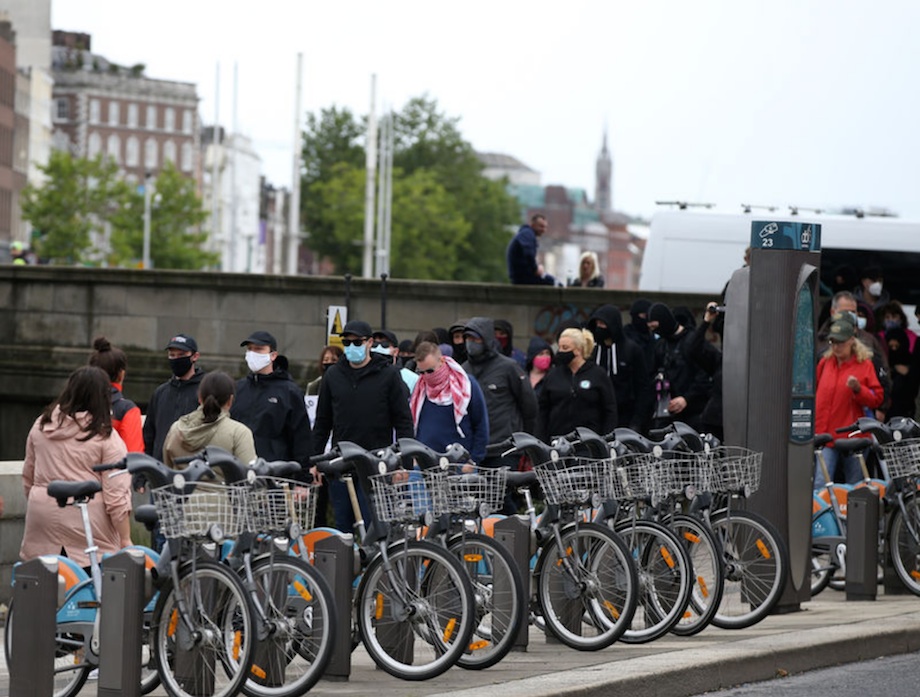
Behind the rental bicycles, a number of fascists are attacking an antifascist. 22 August 2020 (Photo source: Internet)
QUESTIONS AND ANSWERS
Did the antifascists expect what happened?
Perhaps not entirely on the scale of it but according to various individuals who were there, they had all been made aware of the threats on the day and of reports that the fascists were carrying weapons.
Possibly point at which Gardaí began to intervene — retreating fascists getting in some final blows on downed antifascist. 22 August 2020 (Photo source: Internet)
“They were informed that we expected to be attacked and that some at least of the fascists were armed,” said a DRAF participant. “They still chose to go ahead. About half of them were women and some very small in stature. Hardly any seemed to have much experience of street fighting. Nevertheless, they chose to go ahead.”
There were also indications prior to the day, as people claiming to be antifascists had engaged in threats and counter-threats with fascists on social media. “Most of those antifascists made threats they couldn’t back up and then didn’t even turn up themselves,” said a young woman who was there in obvious disgust.
“I can’t even begin to express the contempt I feel for that kind of behaviour,” said a Republican who was also there.
An attack on such a scale and preplanned is something new. If the Left had forgotten history and needed a warning about the potential for violence of fascism, they were certainly given a reminder on the 22nd August in Dublin.
Senior Garda officer screaming and threatening antifascists (who seem to have captured a tricolour from the fascists). 22 August 2020 (Photo source: Internet)
How to explain the action of the Gardaí? To threaten, push and shove the unarmed victims of the fascist attack? And their mild confrontation with the armed attackers?
“They knew exactly what they were doing,” according to one of the counter-protesters. “Even before we were attacked it was clear that was the intention of the fascists. They cops allowed the fascists to attack for a few minutes, then moved in, shooing the fascists away and shoving us, shouting and threatening us with waving batons.”
Viewing the video and hearing other accounts bears out her assertions.
What about the four arrests Gardaí made reported by media, one for “offensive weapon” and “three for public order offences”?
Counter-protesters are adamant none of their number were arrested. “There was one arrest at the east end of the bridge about half an hour after the fascist attack but none of that big armed mob that attacked us at the west end of the Quay were touched,” confirmed several.
Mild police restraint of armed fascists after attack (none arrested even for offensive weapons). 22 August 2020 (Photo source: Internet)
Was this something new in the behaviour of the Gardaí?
“In scale, yes,” replied a Republican, “but not in essence. “The Gardaí favoured the Far-Right every Saturday at the GPO while they harassed Debenhams pickets around the corner, using Covid19 legislation. They also harassed our pickets about political prisoners a few hundred metres away, quoting the Offences Against the State Act.”
OK, harassment, but toleration of violence?
“A few weeks ago, an antifascist was assaulted in plain view in front of the GPO, even attempting to push him out into the traffic. Four Gardaí rushed over and took him away, questioning him. His assailants? Nothing. A few weeks before that, the Gardaí permitted people from the same group to cross the road and confront antifascists standing in the middle pedestrian reservation.
Then one of the fascists walked in among the antifascists and assaulted a Republican who was sitting down; he retaliated and in a minute they were both rolling around in the southbound traffic lane. The Gardaí separated them, in the course of which one of them punched the Republican several times, then escorted the fascist safely back to his group. They didn’t even take his name, never mind charge him.”
A number of media reports mentioned “a counter-protest on Butt Bridge”, omitting the antifascists were pushed, shoved and threatened with drawn batons by Gardaí to there from the Quay after being attacked by fascists. 22 August 2020 (Photo source: Internet)
Testimony of some participants in a counter-protest to the 11th July Far-Right protest would have given a strong indication too.
The Far-Right had mounted a homophobic protest under the guise of being against pedophilia, using certain statements decades ago of the British-based activist Peter Thatchell and the fact that years ago, Roderic O’Gorman (who is gay), long before he became the current Irish Minister for Children, Disability, Equality and Integration, had appeared in a photograph with Thatchell at a Gay Pride parade.
The homophobic rally had gained most publicity due to the presence as a speaker of dramatist and TV actor John Connors, who later apologised for his appearance and his words, claiming he had allowed himself to be manipulated by the Far-Right.
A very small “March of Innocence” counter-protest had been organised and one of its participants said that even before they got around in view of Leinster House, the Gardaí told them they were not going to protect them. As they neared the rally, they were handled roughly with some blows and shoves by about 40 Far-Right “security”, without interference by the Gardaí, true to their word.
The Gardaí only intervened when the Far-Right “security” withdrew and the general mob came forward to attack.
But what could be the reason for such Garda partiality towards the Far Right and hostility towards the antifascists? It is almost as though they see the Far-Right as the legitimate group and the counter-protesters as the problem.
Could it be because the police are regularly confronted by some of the same people as are found among the antifascists on issues such as water meter protests, housing, austerity measures, republican prisoners, repression, etc? Or might it be even more sinister?
Could it be that the Irish ruling class and State are keeping the fascists handy as a backup, in case they are needed to help cope with resistance to forthcoming austerity measures? Fascists have played that role in a number of countries.
Person arrested at east end of Custom House Quay, possibly man charged with possession of a knife. By this time police had pushed antifascists on to Butt Bridge. 22 August 2020 (Photo source: Internet)
BEIDH LÁ EILE AG AN bPAORACH
The fascists and Far-Right, including a number of the actual participants are crowing about the outcome of this attack on their social media networks.
Was it wise to counter-protest a rally so large with so few? Were the fascists in effect handed a victory?
“It kinda makes me angry when we get criticised for our low numbers,” said one who was there. “Other times, people have complained they didn’t know, hadn’t been informed.
“This time there was a public call. If we are few it’s because all the other antifascists don’t join in, it’s as simple as that,” she said.
“Are we supposed to just stand by and let them build up and up and do nothing?” asked another. “I don’t want our children and grandchildren to grow up in a fascist or racist country.”
Another expressed the hope that the incident would wake up the wider antifascist, antiracist movement.
“They might be crowing about it now,” said an Irish Republican, referring to the Far-Right, “boasting about how with weapons and twice the numbers they beat a small force of unarmed antifascists, about half of which were women. Although they can’t deny that we didn’t run and it was the cops who pushed us out of there.
“And they had to work at it too.”
“Beidh lá eile ag an bPaorach”, said a member of Dublin Republicans Against Fascism. It’s a saying in the Irish language – its meaning in essence being ‘There will be another day.’
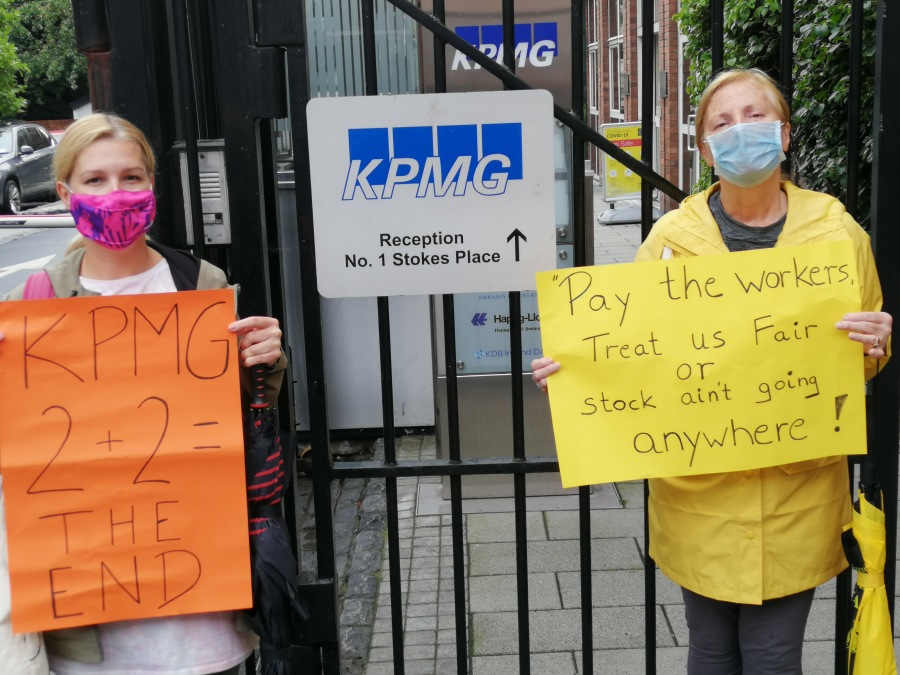
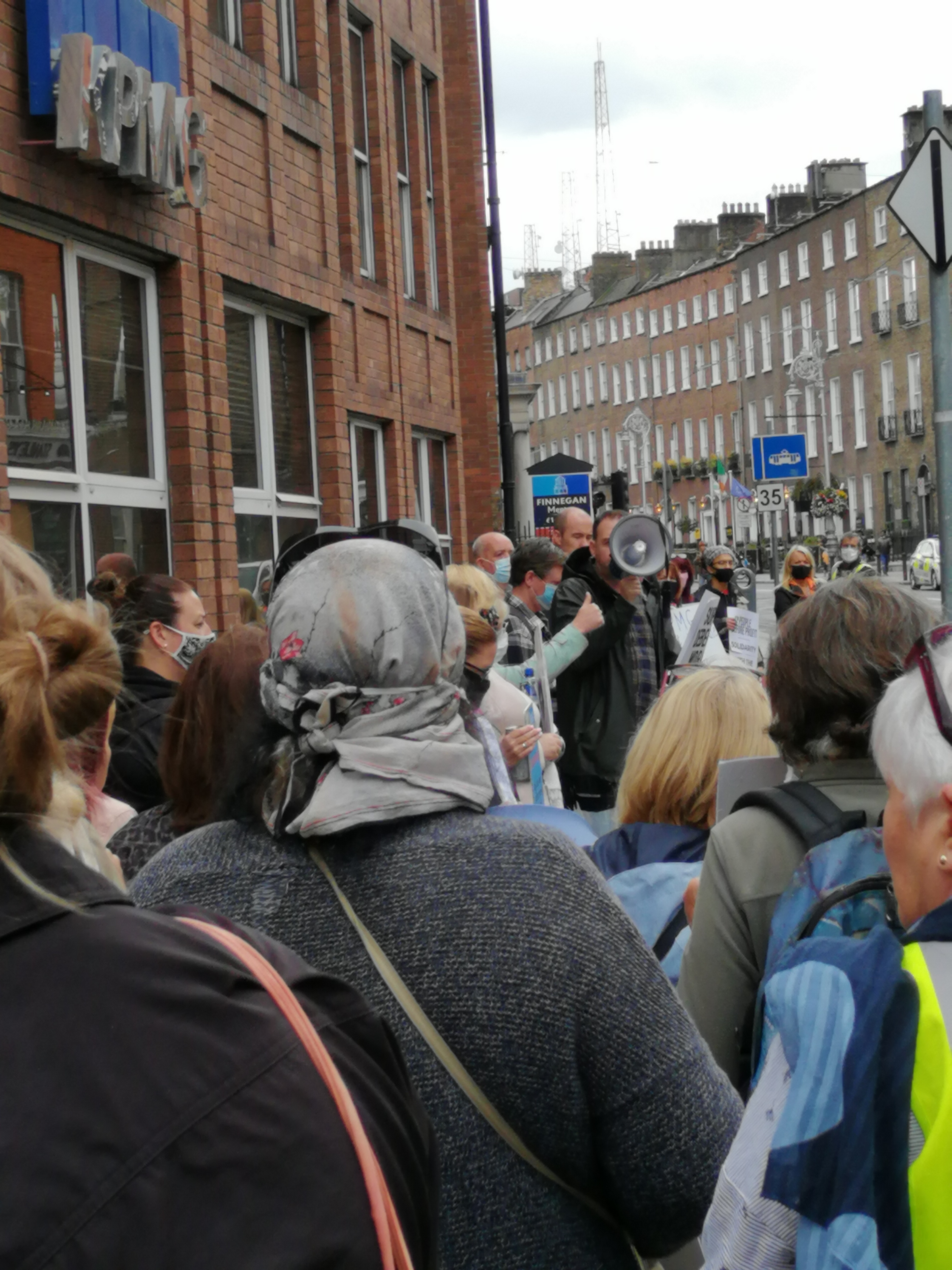
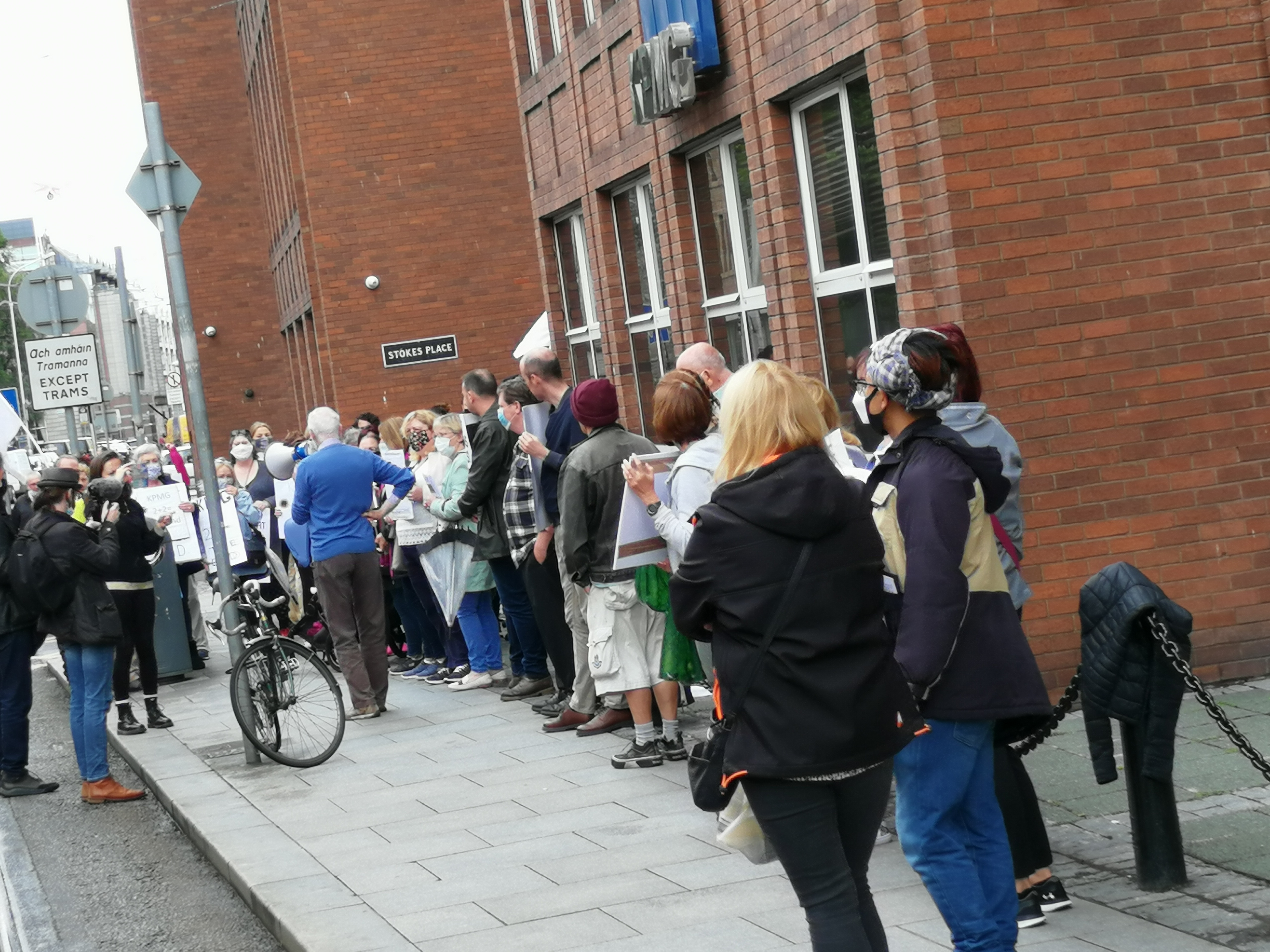
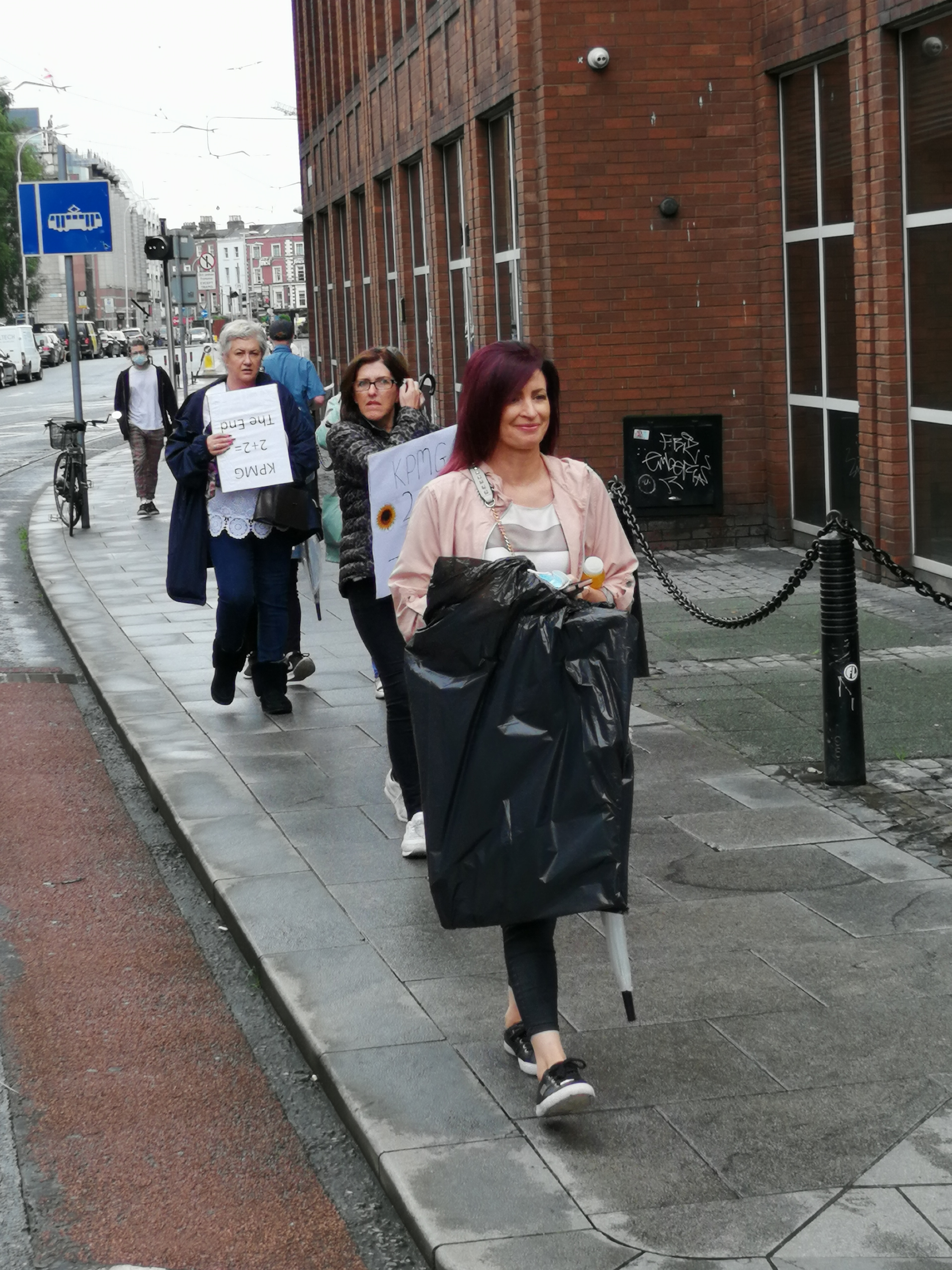
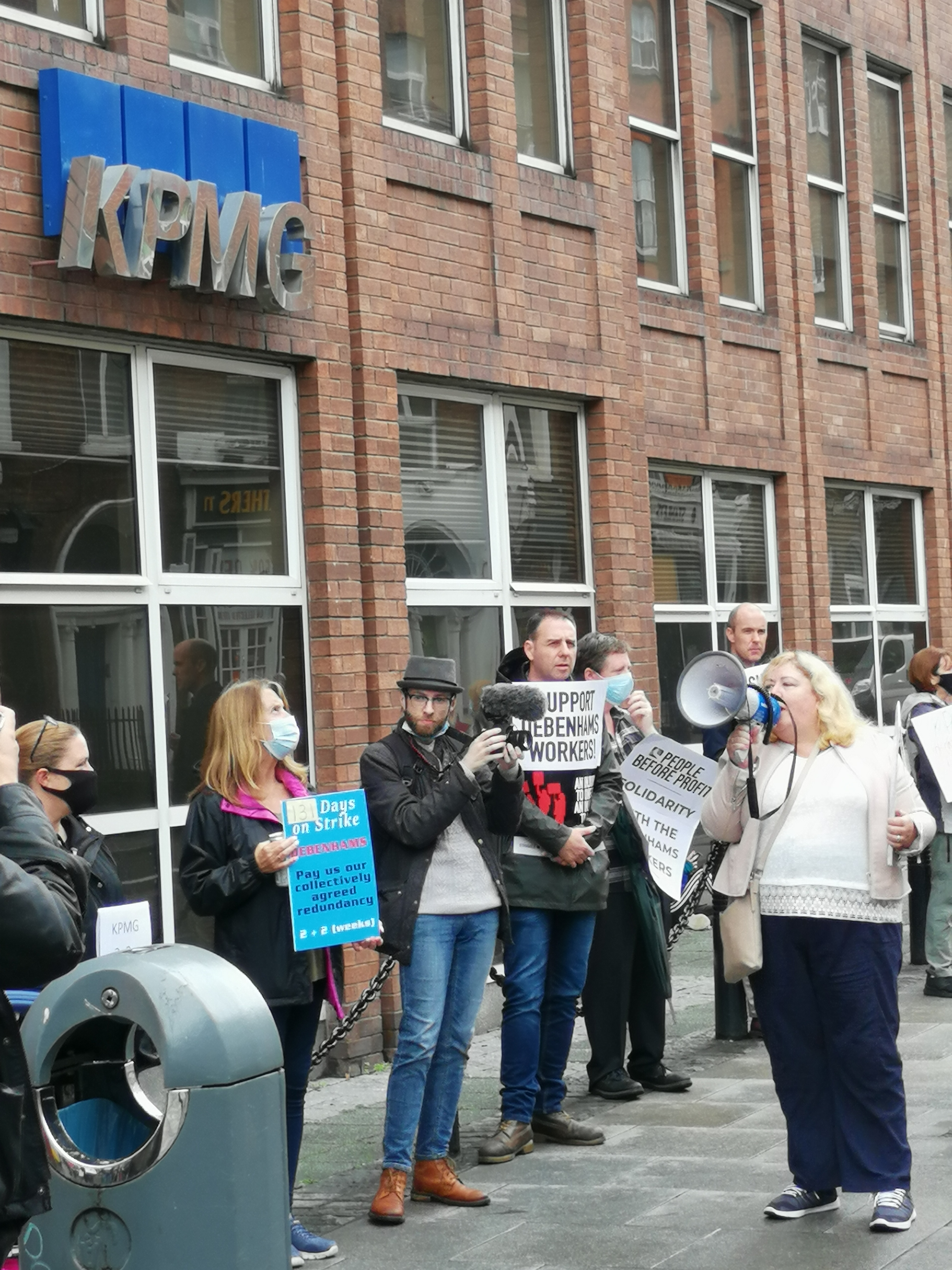
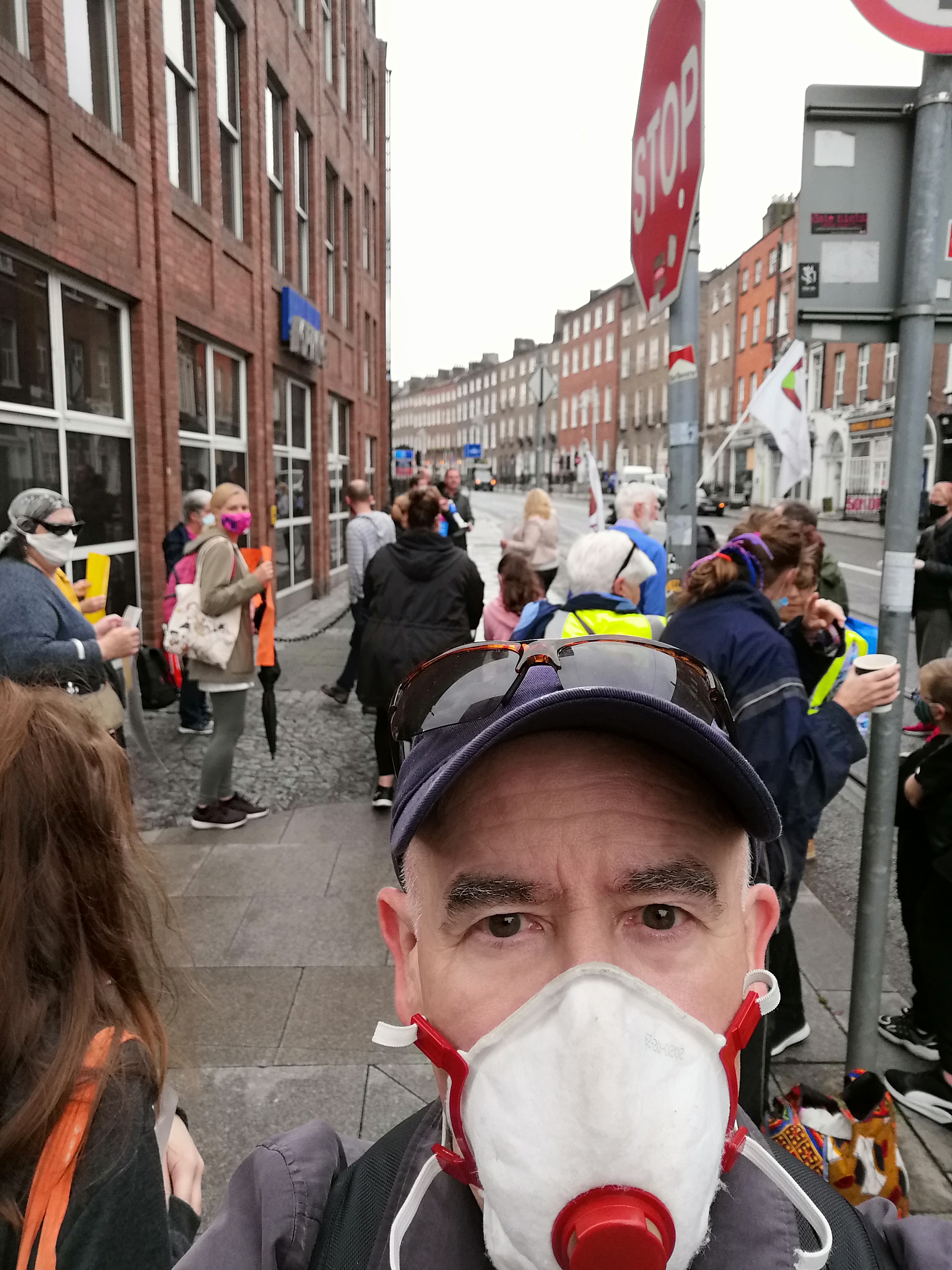
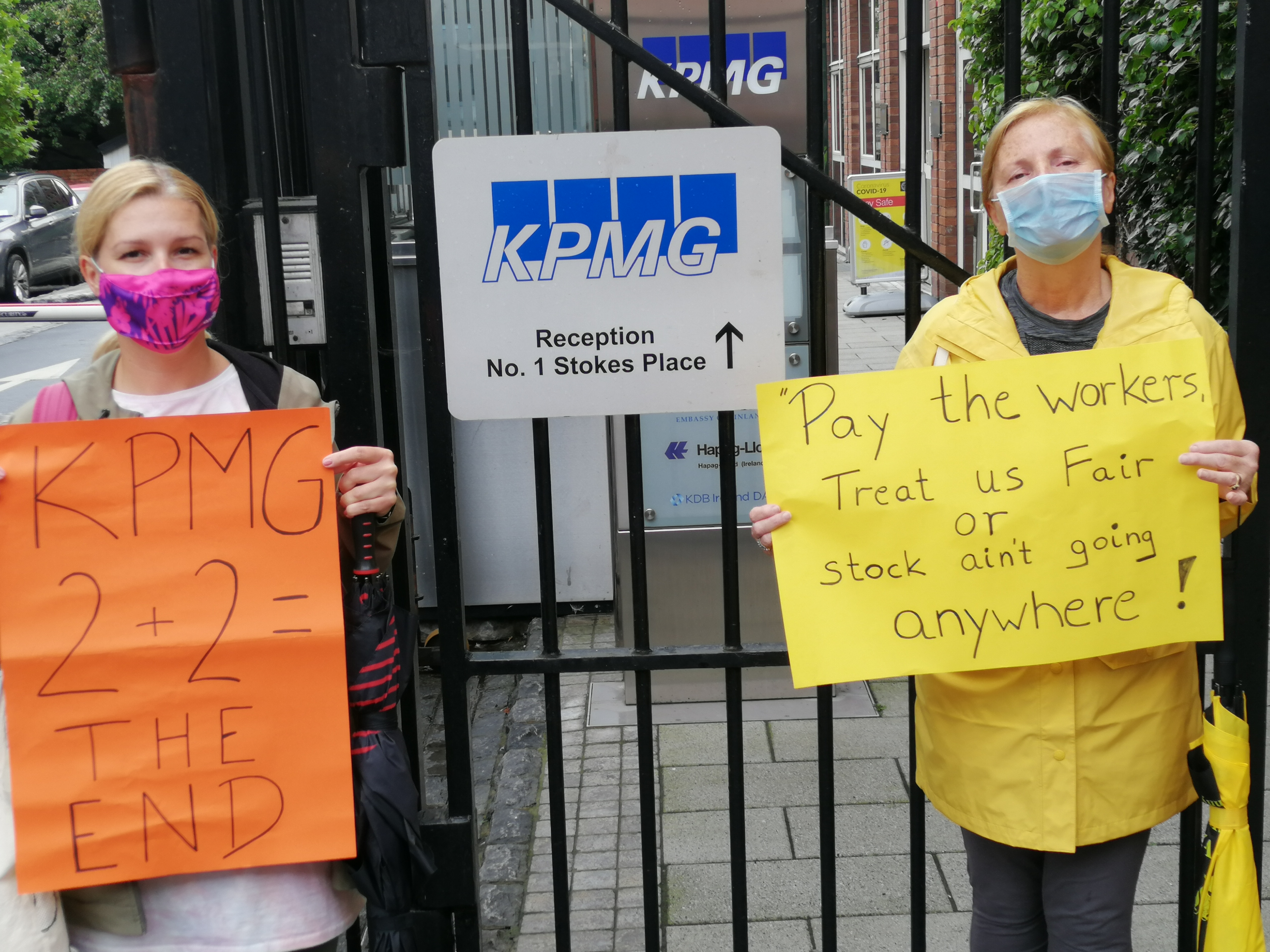
Sacked workers of Debenhams picketed offices of KPMG, the appointed liquidator of their former employer to protest threats of injunctions. The workers are demanding the statutory two weeks’ redundancy plus another two and that they be treated as the first creditors to be paid out, instead of being last, as is usually the case in receivership. Until they receive an agreed settlement, the workers are maintaining their 24-blockades on Debenhams stores, supported officially by their union Mandate, to prevent the company removing its stock.
(Photo: D.Breatnach)
Finding other means to keep themselves amused.
(Photo: D.Breatnach)
Section of picket crowd in Harcourt Street outside KPMG offices with the MC of the event with loudhailer. (Photo: D.Breatnach)
The British-based department store retailer Debenhams closed its Irish branches in Dublin, Limerick, Galway, Waterford and Cork during the Covid19 lockdown earlier this summer and has yet to pay the workers their redundancy pay. Picketers attended Harcourt Street yesterday to gather outside the offices of KPMG, the multinational financial audit services company. KPMG recently claimed it has a potential buyer for a number of the Debenhams sites and while declining to name it, threatened to apply for injunctions against the picketers in order to remove stock and allow the new buyer to move its own stock in. RTÉ reported the company also claiming the union leadership had agreed and said that pickets in Cork were unofficial, both claims which however were denied by the new General Secretary, Gerry Light. RTÉ quoted Mr. Light as saying that the continuing pickets are officially backed by the union and that if there is a new buyer, they’d be interested in talking to them.
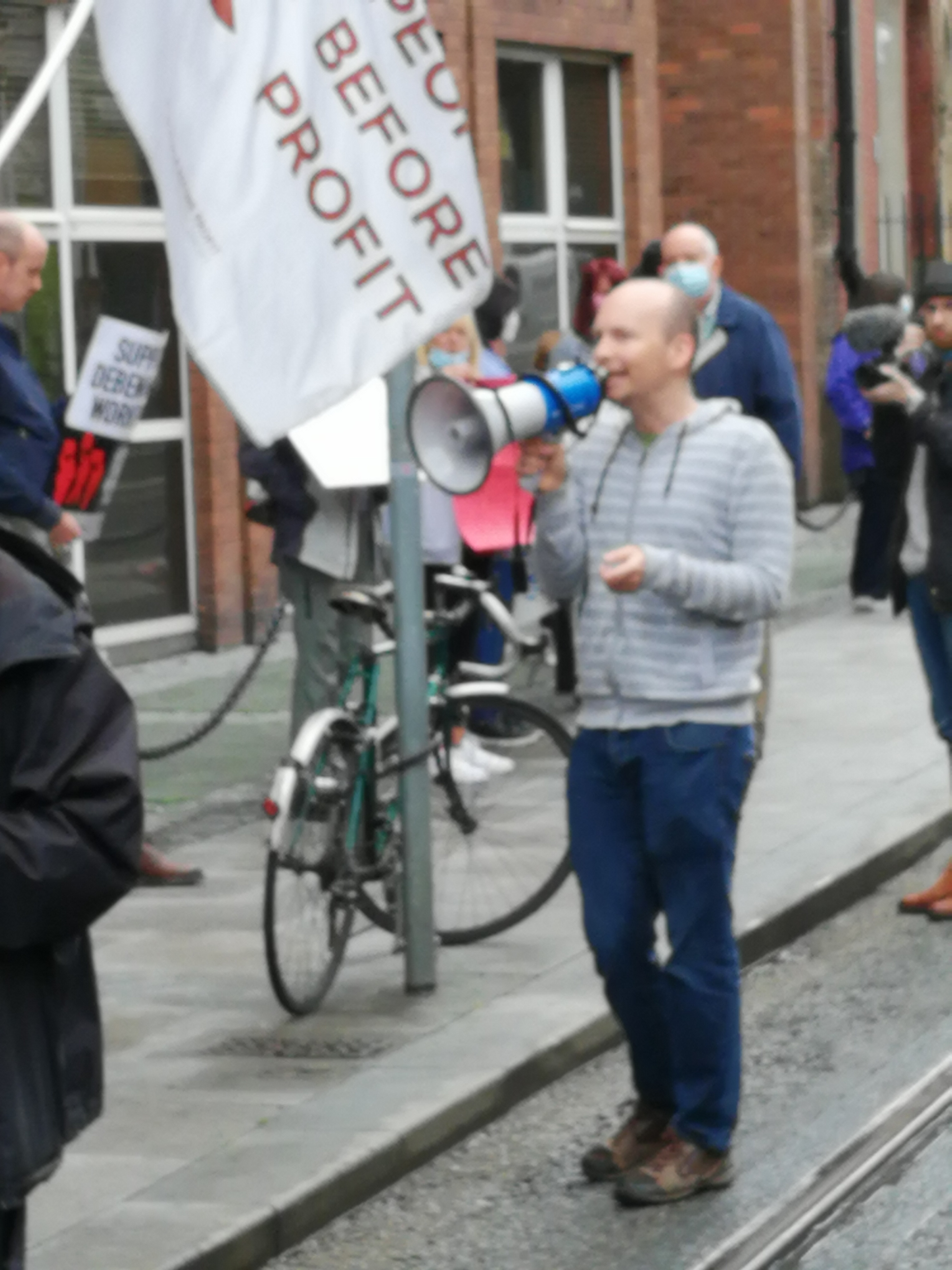
Paul Murphy, socialist TD, explaining the injunction threat is a sign of weakness of the liquidators. (Photo: D.Breatnach)
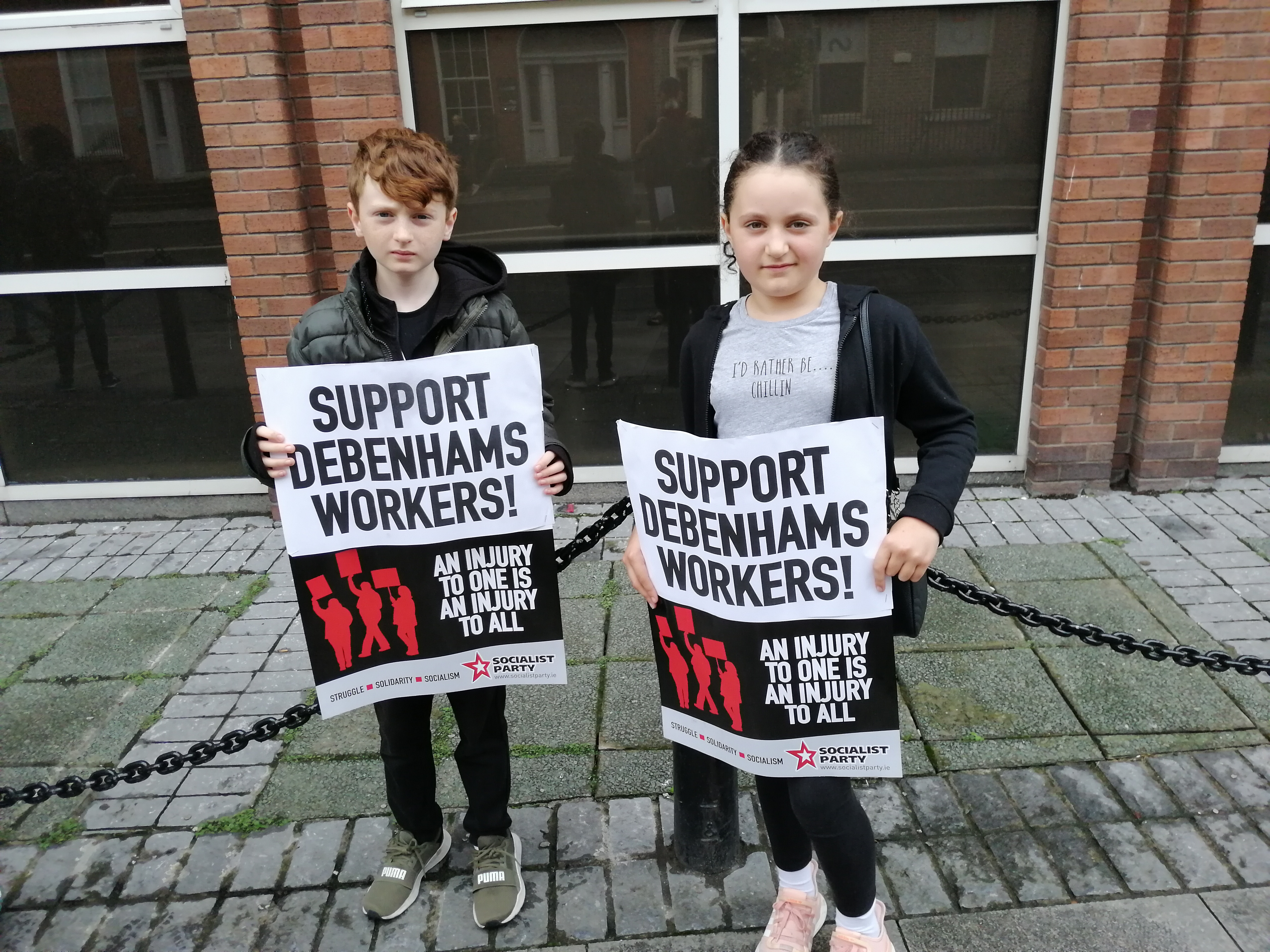
(Photo: D.Breatnach. with permission from parent)
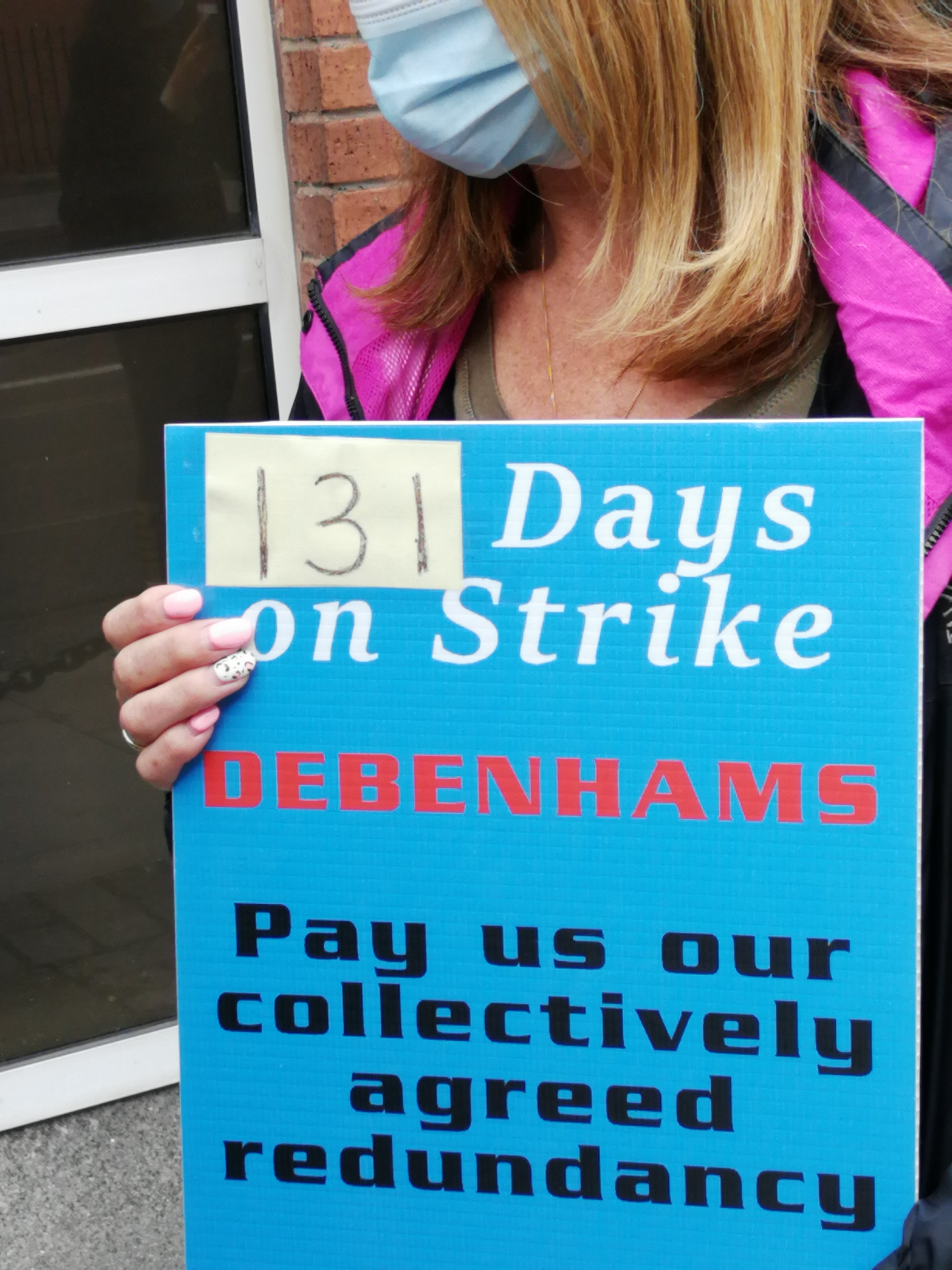
A placard displayed on the picket in Dublin pointed out that the workers have been blockading Debenhams sites for 131 days and one of the speakers at the picket acknowledged that keeping up an action over such an extended period of time is difficult. A number of speakers outlined the necessity to remain strong while Paul Murphy, socialist TD (member of the Irish Parliament) stated that the talk of injunctions was not a sign of strength of the liquidators’ position but rather one of weakness. Another speaker called for a strengthening of the pickets now and a number stated that any injunctions would need to be defied.
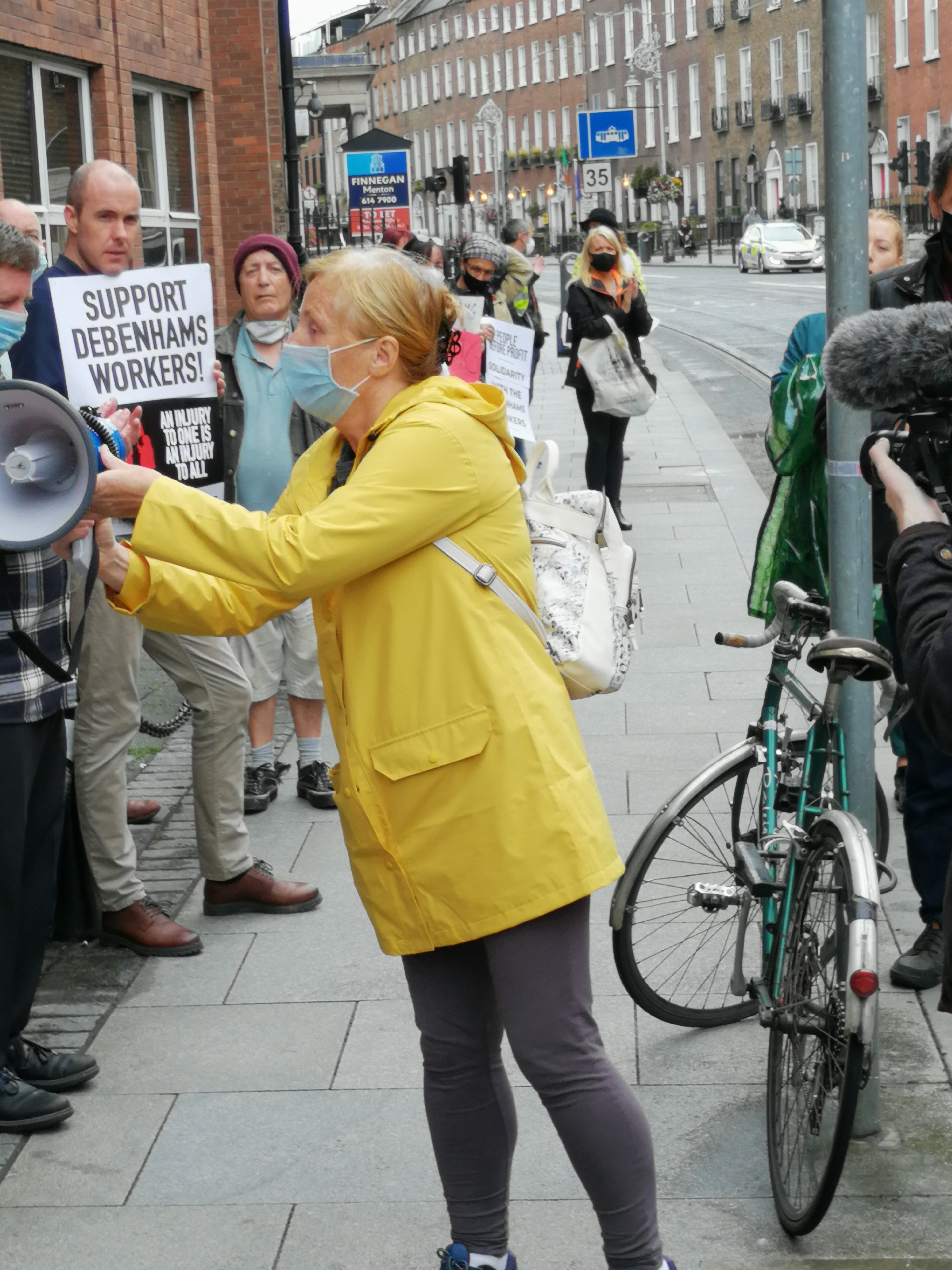
One of the sacked workers speaking to her sisters and brothers. (Photo: D.Breatnach)
Section of picketers, camera facing northwards. (Photo: D.Breatnach)
Workers from Blanchardstown arriving (Photo: D.Breatnach)
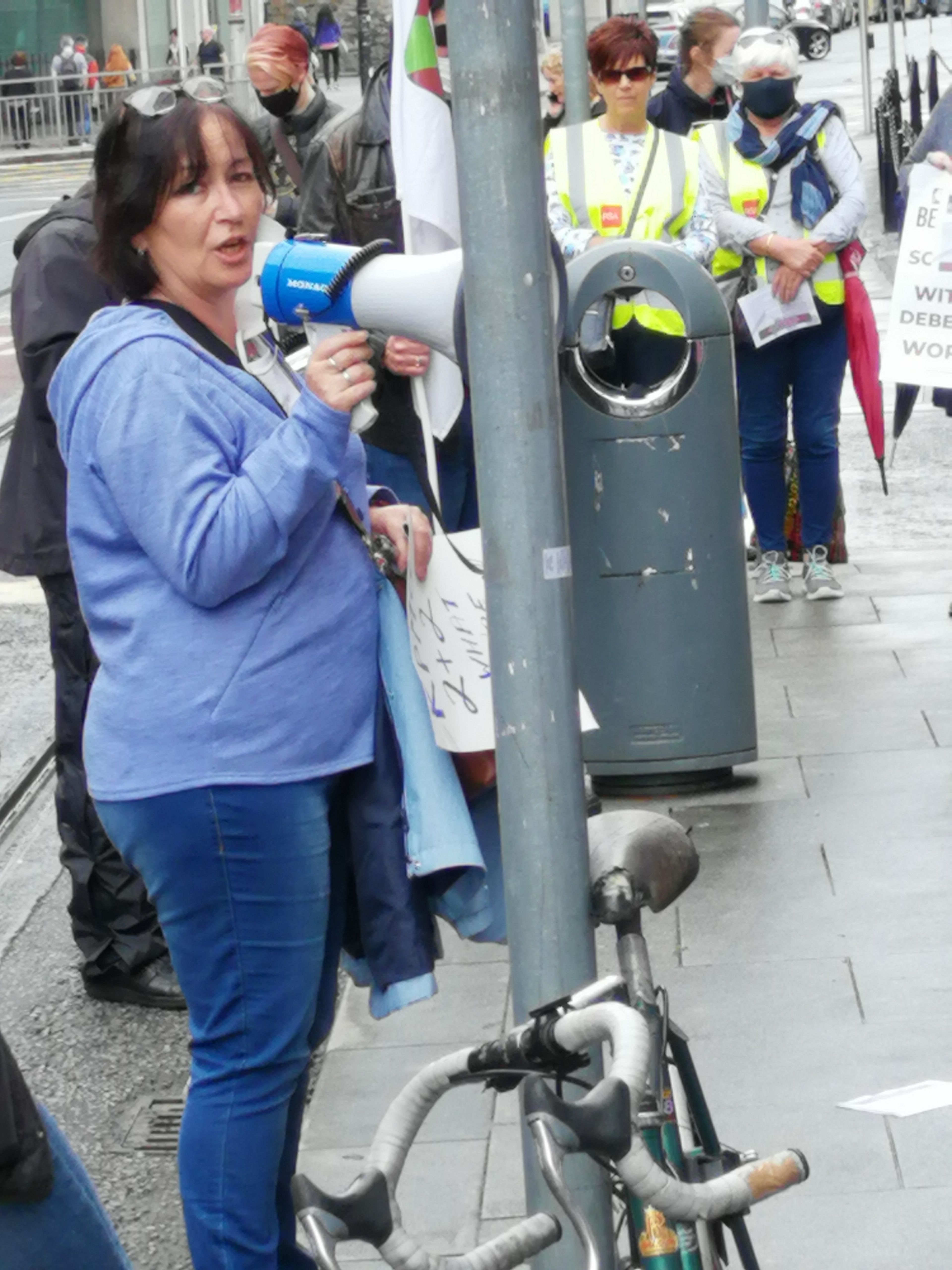
One of the leading shop stewards speaking. (Photo: D.Breatnach)
MESSAGE OF SOLIDARITY FROM THE FAMOUS ANTI-APARTHEID DUNNE’S STORES STRIKERS
Meanwhile, a message of solidarity came from some of the Dunne’s Stores Anti-Apartheid strikers, the famous strike 1984-1987 in pursuance of their union’s policy (then the IADTU, now incorporated into Mandate) not to handle good from South Africa (then under racist white minority regime).
Kate Gearon was shop steward (elected shop-floor workers’ representative) during the strike.
“What has happened the Debenhams workers is atrocious,” Ms. Gearon wrote. “Some workers have given decades of service to the company and then when it suits the company just abandons them.
“But what is inspirational is the fact the workers are trying to change legislation to protect all other workers from this terrible predicament.”
Ms Gearon added: “When we started our pickets on this day in 1984, people told us we couldn’t win. They said ordinary retail workers didn’t have the power to change legislation. Well 10 of us stuck to our guns and we forced the Irish Government to ban all South African goods.
“There were only 10 of us, there are 1,000 Debenhams workers. Imagine the changes they can force if they stick together in their trade union.”
Debenhams worker urging her sisters and brothers to stay strong. (Photo: D.Breatnach)
Picketers outside the KPMG offices in Dublin chanted slogans including: “What do we want? Two plus Two!” “When do we want it? Now!” “When under attack– Stand up, Fight back!”and “Treat us right, treat us fair, or your stock ain’t going anywhere!”. The MC of the event also raised cheers when he told those in attendance that pickets were taking place simultaneously at KPMG officers in Galway and Cork.
(Photo: D.Breatnach)
Sites of Debenhams stores are being picketed on a 24-hour basis and solidarity can be shown by attending in person.
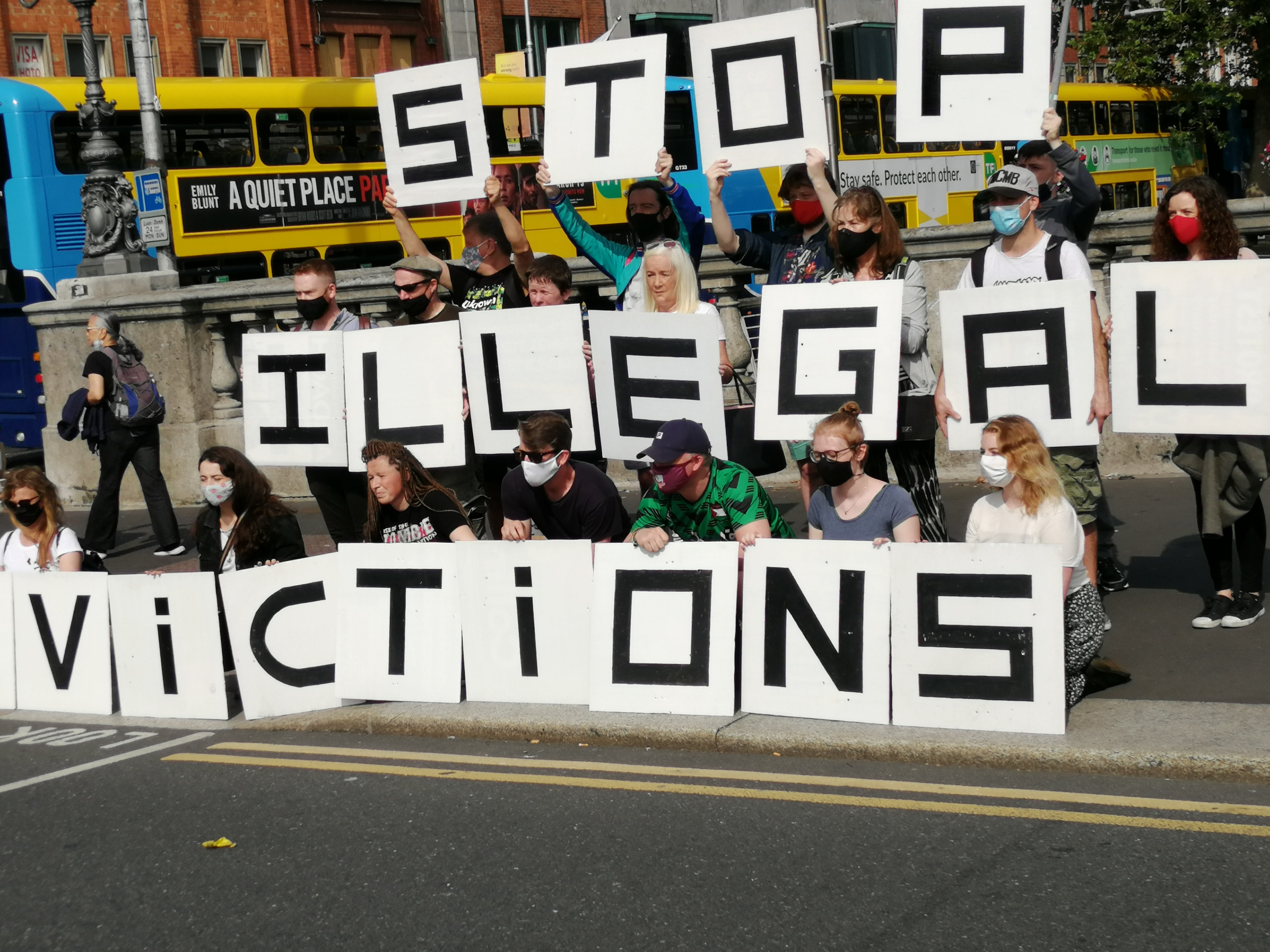
A rally on Custom House Quay on Saturday protesting the housing crisis was followed by a march through Dublin city centre, halting traffic at a number of points before ending with another rally outside Mountjoy Garda Station, from which station Gardaí (police force of the Irish State) had protected an illegal eviction in the Phibsboro area only days before. Speakers at various points denounced the Government parties current and past, the rendering of housing a commodity by the capitalist system and the police for protecting that system.
Section of the crowd at the rally before the march. (Photo: D.B)
(Photo: DB)
(Photo: DB)
(Photo: DB)
The demonstration had been advertised already for some weeks and the date set by the Ireland’s Housing Action campaign group. The Garda protest element had been added only days before the date set for the demonstration due to a shocking incident in the Phibsborough area of the city. Residents of a house had agents of a landlord smash through their door, frightening tenants and throwing their possession into the street. Two Gardaí in attendance who said they were there “to prevent a breach of the peace” were in fact assisting in the commission of a breach of the peace by protecting the landlord’s thugs and intimidating tenants and others from resisting.
No eviction notice was produced nor did the Gardaí require one from the thugs, who proceeded to smash fixtures in the house, including the toilets. One of the eviction team shouted that a note had been sent to a tenant – on their Facebook account!
A local activist passing by noted what was going on and summoned assistance which in turn ensured the arrival of more Gardaí, including an Armed Response Unit vehicle (these units carry firearms and live ammunition). Helpers found temporary accommodation that evening for the evicted tenants, who the following day were assisted in returning to their home, with repairs carried out to toilets and some other fixtures.
It transpired that the eviction had been illegal even within the current system and protesters were informed outside the Garda station that the thugs had not registered as bailiffs for two years past and that the company they purported to represent appeared non-existent.
It was this incident which had ensured the march would culminate in a rally outside the very police station involved (some years ago this station was the scene of protest due to the collusion of Gardaí stationed there with companies installing water meters and threatening water protesters).
Large letters assembled to spell out a message on O’Connell Bridge. (Photo: DB)
Since the eviction, the online Journal.ie published a report in which the Gardaí were quoted in what can only be seen as poor excuses and outright lies, including a claim that there had been no damage! The Irish Council for Civil Liberties has queried the role of the Gardaí and some TDs, including Green Party members of the Government have called for a ban on evictions during the Covid19 pandemic (the previous ban on evictions was very recently lifted by the Government). As is being increasingly the case, the property in question appears to have been acquired from the landlord by a vulture company (i.e finance companies that buy properties in debt from mortgage banks at low cost, to either sell them on again or to evict the tenants and sell the properties).
This is not the first occasion on which the Gardaí have been seen in support of landlords in recent times. The occupation of an empty house in the north inner city had been broken by bailiffs assisted by Gardaí in 2018, while an Armed Response Unit had turned up to an argument between a landlord and a tenant couple at another house in Dublin in the same period.
Section of march on O’Connell Bridge. (Photo: DB)
RALLY SPEAKERS DENOUNCE RACISM
Notable by their banners in supporting the rally and march yesterday were Dublin Housing Action Committee, Dublin Renters Union, Universal Public Housing campaign, United Against Racism (Home for All), the socialist Republican party Éirigí, and Countess Markievicz 1916 Society, some of which provided speakers.
The spokesperson of the organisers Patrick Nells along with nearly all the speakers emphasised the anti-racist nature of the protest, which was no doubt reassuring to many, given that Custom House Quay had been chosen a number of times as the venue for rallies by the racist and islamophobic Irish Yellow Vests leadership and also that some elements close to the housing protest organisers had colluded with the INV when they first emerged.
Speaker after speaker pointed out that dividing working people along lines of race or ethnicity would result in a weaker resistance to landlords and their Government supporters, and that the “house Irish first” slogan put forward by racists and fascists would benefit neither the migrants nor the Irish homeless. Contrary to propaganda of the Far-Right which pretends that migrants get better and quicker access to housing than do the indigenous population, some speakers also outlined how migrants were the most vulnerable to unscrupulous landlords and it was no accident that the adults subjected to a violent and illegal eviction recently had been migrants.
(Photo: DB)
(Photo: DB)
LONG WAIT, LONG MARCH AND DISAPPEARED FAR-RIGHT
I had rushed to the event from a conversation in Moore Street, worried I might miss the start of the march. I need not have worried, nor have hurried. It was advertised for 2pm and I got there around 10 minutes after that but it seemed nearer to 3pm before the event was officially started – and then it was with speeches, most of them very long. A musician concluded the rally with a performance of a composition of his in which the repeated line of “A hotel room is not a home” made an impact. He also introduced slogans which were shouted along the march: “Whose streets? Our streets! Whose homes? Our homes!”
Meanwhile the sun beat down and air felt heavy, even by the riverside. Some of the attendance were visibly wilting. By the time the march crossed to the south bank and turned west, a number of people had dropped out. On O’Connell Bridge, the leaders stopped the march, which now blocked it to north-south traffic and vice versa. Here there were some further speeches, also not short, a song of which it was difficult to make out the words and a spelling out of slogans on giant letter placards, which was a welcome distraction. But still the sun beat down and there was a substantial way to go yet. Some more people left the march here.
When eventually the march began to move again, taking the north-bound traffic lanes, it passed the GPO, where a group of the Far-Right have been holding their protests since the start of the Covid19 restrictions (which they neither obeyed nor were they compelled to do so by the Gardaí, who however harassed Debenham worker pickets around the corner in Henry Street during the same period).
Word had reached some on the housing protest much earlier that the Far-Right had decamped to Phoenix Park, the first time in weeks the Far-Right had abandoned their Saturday protest at the GPO. One could speculate that they feared the risk of another punitive surge into their ranks as had happened the previous Saturday when, after weeks of provocations including assaults, a mixed group including Republicans and Anarchists had finally burst in amongst them, in the course of which the Far-Right lost various items of sound amplification equipment. Or it might have been that the Far-Right organisers wished to avoid the public spectacle of being denounced by marchers against homelessness as they passed and, even worse, their supporters calling the marchers “paedos” as they regularly do to all antifascists.
Section of crowd sitting in North Circular Road outside Mountjoy Garda (Photo: DB)
Mountjoy Garda Station, on the NCR, next to Mountjoy Jail. (Photo: DB)
The marchers carried on, shouting the slogan about “whose streets” and “whose homes” and “homes for all” along with “Vultures out, out, out!”, calling also on people to “fight back”.
When the remainder of the marchers, having lost perhaps a third of the original numbers, finally reached Mountjoy Garda station, it was around 4.30 pm and they sank gratefully to the road, a sit-down protest but also a weary relief. Here there were also some more speeches and the Gardaí came in for some well-deserved harsh words.
As we approached the station a few minutes earlier, some Gardaí stood smiling in a friendly manner at the approaching marchers, no doubt wishing to soften their image after their recent role at the eviction. “How are you?” one Garda Sergeant greeted the marchers with a broad smile. “None the better for seeing you,” replied one of the marchers, walking past the Garda.
Mother of two evicted without warning or reason tells her story. (Photo: DB)
Gardaí clustered beyond the outskirts at both ends of the crowd, with some diverting traffic. But none interfered with the march organisers, who took up their position at the bottom of the steps leading up to the station’s front door. For the most part, those inside stayed away from the windows too.
One of the tenants illegally evicted tells his story and thanks Irish people (Photo: DB)
Patrick Nells, chairing each rally, speaks from the steps of Mountjoy Garda Station (Photo: DB)
Speaker from Dublin Renters Union (Photo: DB)
Apart from the speeches of some housing campaign and political activists, there were some also from one of the victims of the recent illegal eviction, an African woman who spoke of the terror of the invasion and the heartlessness of the authorities and how it impacted on her, with her two Irish-born children. A young African man who had also been evicted also spoke of the experience and of the situation in general. Both praised the Irish people in general (as distinct from the authorities) and those who had helped them in particular. A young homeless Dublin woman spoke also, criticising the provision for homeless people and for rough sleepers on the streets in particular. A young Irish woman read one of her poems against homelessness and the organisers thanked all for the attendance and brought the event to a close.
It was nearly 6pm and still fairly warm and heavy.
Gardaí blocking NCR west of the protestors (Photo: DB)
Garda car east side of protesters blocking North Circular Road (Photo: DB)
COMMENT
It was good to see people out in protest at the scandalous housing crisis throughout the Irish state and in particular in its capital city, especially following a period of State restrictions on large gatherings due to the Covid19 epidemic and when fears of infection have been keeping many at home.
It was not reassuring however in that respect to note those in attendance who wore no face covering whatsoever, probably as a result of the earlier statements of the Government health spokesperson dismissing the usefulness of wearing face-mask, countering the more recent requirements of public transport for passengers to wear such protection along with the current pressure in many shops to do likewise.
The numbers in attendance were lower than might have been expected, with the banners of a number of political parties and housing campaigns notably absent. I wondered too whether it might not be wiser to make less of an issue of illegal evictions, since most evictions are probably legal under the current system and eviction orders easily obtained, a point made by one of the speakers.
What the content of the activist speeches most reflected to me, apart from outrage at the situation and blaming of the State, along with the welcome rejection of racism (even though mostly from forces that are rarely, if ever seen in the mobilisations against the racist and islamophobic rallies of the Far-Right), was impotence.
The same calls for unity, the ritual invoking of the executed socialist James Connolly, the usual denunciations of the political parties of current or past governments and their facilitation of landlords and property speculators, the decades-old calls for the involvement of the trade unions ……… but no coherent strategy or tactics to take the housing movement further at this point.
And it is not difficult to see why. What makes the housing crisis possible is the lack of public housing and that in turn is made possible by successive governments not releasing funds to local authorities for public housing construction. All political parties thus far to take part in Government for decades have colluded in maintaining this situation: the two main parties of Fianna Fáil and Fine Gael, of course but also whenever in coalition government, the Labour Party, Greens and Progressive Democrats.
What then of a new party in government? Currently only Sinn Féin offers that prospect and the party did have the most members elected to the Dáil (Irish parliament) in the February elections this year. However, the signs of a radical break with the capitalist housing market from that party are not good, due to its general anxiety to please the more conservative elements in society, combined with what seems an unprincipled hunger to enter government. Which, furthermore, it would have to do in coalition with other political parties.
Nor is it long since the party’s councillors in Dublin agreed to hand over public land in the city to private developers.
The trade unions are if anything more compromised and less ready for tough social action and in fact seem unable even to protect their own members to any noticeable degree.
If it should not appear possible to overcome the crisis through reform, then revolution is the only viable option – or at least the imminence of revolution forcing sections of the ruling class into implementing radical reforms. That situation does not seem close at the moment, though of course future developments may accelerate its approach in a manner difficult to anticipate now.
It does seem clear that the housing movement cannot rely on changes in government party composition in the near future. It seems likely that only more radical housing action at grassroots level, quite possibly with some activists eventually going to jail, can force the pace and provide the necessary impetus for radical government reform – or for contribution to revolution.
End.
The marchers emerging from under the railway bridge at Tara St. Station. (Photo: ET)
This series of short pieces sets out to demonstrate not only that the “patriotism” claimed by the Far-Right in Ireland is profoundly fake but that so also are their chief symbols. It is not that the flags and songs are false in themselves – far from it — but that they are being employed falsely, i.e in disregard of their origins and in total contradiction to their historical context and meaning. The “patriots” displaying them are fake, not only in their use of the flags and songs but in the contexts in which they employ them, their discourse and the direction in which they wish to take the Irish nation.
OTHERS TO FOLLOW SEPARATELY:
Flag: The “Irish Republic” flag
Flag: The “Starry Plough”
Flag: The Harp on a green field flag
Patriotic song: Amhrán na bhFiann
Patriotic song: A Nation Once Again
The Far-Right creed of fake patriotism
The Irish Tricolour flag (Photo sourced: Internet)
1. THE IRISH TRICOLOUR
This is the flag design most commonly associated with Ireland and the official one of the Irish State, though it was not officially adopted by the State until the Constitution of 1937. The flag gained prominence during the 1916 Rising, when it was flown on the Henry Street corner of the GPO roof and was the flag of the Republic during the War of Independence (1919-1921). The Free State which came into being in 1922 controlling five-sixths of Ireland was not the Irish Republic most people had fought for and, in fact, it went to war against those who upheld that Republic. However, the neo-colonial State feared to leave all the symbols of Irish nationalism in the exclusive hands of its enemies and therefore eventually appropriated the flag, adopted the Irish language as its symbolic first language and the Soldiers’ Song to represent it.
On the other hand its display in public in the Six Counties colony was held to be illegal under the Flags and Emblems Act of 1954 until its repeal in 1987 and a number of street battles took place there when colonial police moved in on people to confiscate it.
Although the first use of the colours of green, white and orange as a tricolour arrangement (on cockades and rosettes) was in 1830, when Irish Republicans celebrated the French revolution of that year restoring the French Tricolour as the flag of France, their first recorded use on a flag was not until 1848.
On 28th July 1846 a group of progressive Irish nationalists had broken from Daniel O’Connell’s movement to Repeal the Union, i.e to give Ireland an Irish parliament again but under ultimate British rule. Meagher was one who led the breakaway, opposing the Repeal Association resolution to refuse the option of armed resistance in any and all circumstance, in a famous speech about the right to use weapons in the struggle for freedom, which earned him the nickname Meagher “of the Sword”.
The group became known disparagingly as The Young Irelanders but, like many mocking names, became fixed with respect in Irish history. One of its leaders was Thomas Davis, co-founder of The Irish Nation newspaper and composer of such iconic works as A Nation Once Again, The West’s Awake (songs) and Fontenoy (poem).
Monument in Dame Street to Thomas Davis, Republican, Young Irelander, author, composer, journalist. (Photo: D.Breatnach)
During what became known as “the Year of Revolutions:, 1848, Meagher went to Paris, which was in the hands of revolutionaries as an envoy to the Provisional Government and was there presented by revolutionary women with the Irish Tricolour, which they had sown in fine silk. They explained that its design was intended to reflect the revolutionary ideal of peace, represented by the colour white, between the Catholic Irish (indigenous and Norman descendants), represented by the colour green and the Protestants, descendants of planters and other colonists, represented by the colour orange. But an active peace, a collaboration in national liberation from English rule and the establishment of a secular Republic.
It would not be surprising had those women been aware of Les Irlandais Unis (the United Irishmen), who had risen less than fifty years earlier for a secular and independent republic and had sought military assistance from the French Republic.
Returning to Ireland with the flag, Meagher unfurled it in public for the first time on 7th March 1848 while speaking from an upper-floor window of the Wolfe Tone Club in Wexford to people celebrating the revolution in Paris. In Dublin it was unfurled in the Music Hall in Lwr. Abbey Street on 15th April 1848 but there was another Irish flag which at the time was more popular and the question of which flag was to represent an independent Ireland (or the movement to achieve such) was left undecided.
Plaque in Waterford recording the first public unfurling of the Irish Tricolour in Ireland. (Photo sourced: internet)
Plaque in Abbey Street recording the first public unfurling of the Irish Tricolour in Dublin. (Photo sourced: internet)
Illustration of the trial of Meagher, McManus and Donohoe. (Image sourced: internet)
Meagher was sentenced to transportation to Van Demien’s Land (now Tasmania), later freed on condition of not returning to Ireland and emigrated to the USA. He supported the Union in the American Civil War for the abolition of slavery and he and his wife actively recruited for the Union Army; he served as a Brigadier General in the Irish Brigade, of which one regiment, the 88th New York, became known as “Mrs. Meagher’s Own”. The Irish Brigade fought many important engagements against the Confederacy and suffered 4,000 dead in the course of the war; two of its commanding officers including Meagher were wounded and three killed. Meagher was believed drowned from a Missouri riverboat on a trip on 1st July 1867, leading some to suspect that he had been murdered, possibly by the nativist anti-migrant organisation known as the “Know Nothings”.1
Thomas Francis Meagher as Union Army officer and Governor of Montana. Plaque in Waterford recording the first public unfurling of the Irish Tricolour in Ireland. (Photo sourced: internet)
The Far-Right in Ireland, composed as it is of racists, fascists, Catholic conservatives and religious sectarians, seeks an Ireland far removed from the republican ethos of the flag, presented by French republican revolutionaries to their Irish republican counterparts. It is a flag symbolising inclusion rather than exclusion and explicitly, in its colours, rejecting religious sectarianism. It flies in declared opposition to those who seek an Ireland “made Catholic again”2, oppose immigration and seek an Ireland based on “Irish ethnicity” (meaning blood), a prescription that would have had no place for Thomas Davis’ Welsh father, nor for Meagher, who led thousands of Irish migrants who fought against slavery of Africans in the USA. Their Ireland would have had no place for the Young Irelanders who, like Thomas Davis, were mostly Protestant Republicans.
The Far-Right in Ireland wave the Tricolour flag outside Leinster House in this protest of theirs demanding “free speech” for racist diatribes in February 2020 in sharp contrast to the flag’s meaning and history. (Photo: D.Breatnach)
The irish Tricolour in Kilmainham Jail (now museum) in the execution yard of 14 patriots of the 1916 Rising (Photo source: Aitor Munoz Munoz, royalty-free).
FOOTNOTES:
1A nickname they earned through their habit of saying that they knew nothing in answer to questions by the police or in court.
2Slogan put forward by notorious racist and conspiracty theorist Gemma Doherty in preparation for an islamophobic rally outside Croke Park on 31st July, supported by fascist organisations Síol na hÉireann and the National Party, both parties opposed to immigration and promoting a racist concept of “Irishness” based on blood.
REPUBLICANS AND SOCIALISTS PICKET AUCTION OF IRISH HISTORICAL ARTIFACTS
Clive Sulish
(Reading time: 5 mins.)
On Saturday 25th July tourists and other passers-by were treated to the sight of people picketing the Freemason Hall in Molesworth Street, Dublin, where the Whyte’s company was holding an auction of Irish historical artifacts. The picketers flew the historical flags of the Sunrise of na Fianna Éireann and the Starry Plough of the Irish Citizen Army and a banner proclaimed OUR HISTORY IS NOT FOR SALE – is linne uilig í. Placards displayed by the picketers denounced, in Irish and English, the sale of artifacts of Irish history. Among their periodic chants were “Irish history is not for sale!” and “Shame on Whyte’s!”
Picketer inside the Freemason Hall (Photo: Rebel Breeze)
Very shortly before the event some people had learned of the forthcoming auction by the Whyte’s company, which has an office and shopfront in Molesworth Street (also the street in which the Freemason’s Hall is located), a couple of minutes’ walk from Leinster House, the location of the Oireachtas (the Irish Parliament). The glossy brochure for the event listed a huge amount of items, including an original copy of the 1916 Proclamation of which the Irish State has only one original copy and others have been sold in 2015, 2016, 2018 and 2019.
Also up for auction were writings of Thomas Ashe, who died from force-feeding while on hunger-strike in 1917 and a copy of Wolfe Tone’s speech – in his own handwriting — at the trial that condemned him to hang in 1798.
One of the Auctioneer company representatives tried to convince the picketers that he was carrying out a useful national historical service (though he admitted also at a tidy profit) by bringing some of those items for auction to Ireland. Wolfe Tone’s speech notes were a case in point, he claimed, since they had been in the family of a former English Army general. The picketers however were adamant that the item was “stolen property” and that the Irish Government should demand the return of that item and others like it, to which the auctioneer replied “That’s nonsense!”
Banner on display facing the location of the auction. (Photo: Rebel Breeze)
The Auctioneer soon shifted tack and asked the picketers whether they had permission to hold their protest. They responded that they did not need one and were in a public place; the auctioneer went inside the building calling out that the picketers were mistaken.
Shortly thereafter, a Garda patrol car drove into the street and stopped near the protesters, disgorging two serving Garda and a trainee. The picketers explained their presence and that it was a peaceful protest, also assuring the officer in charge that they had obstructed no-one from entering and that indeed a half-dozen or so had entered the building already, passing them on the way; the officer then collected her team, got back in the patrol car and drove away.
The protesters, who had arrived at around 12.30, a half-hour before the advertised start time for the auction, remained until 1.30pm and left. At intervals their chants echoed around the street, no doubt clearly audible to people staying at or using Buswell’s hotel about 50 yards away.
Diarmuid Breatnach, an independent revolutionary socialist, spoke at the event, as did Sean Doyle, of Anti-Imperialist Action and Ger Devereux of the Saoradh organisation.
NOT THE HISTORY OF THE GOMBEENS
Breatnach denounced the sale of historical artifacts in general but focused in particular on the speech notes of Wolfe Tone, going on to relate how Tone and other Republicans and liberals had tried to build a nation of equality between the various religions in Ireland. They supported the liberal Grattan’s bid to extend the franchise and representation in the Irish Parliament (in which only the tiny minority of Anglicans were permitted to enter) to Catholics and non-Anglican Protestants such as the Presbyterians). When the majority in Parliament rejected the bid by Grattan, Tone and Edward Fitzgerald and McCracken and others knew there was no way forward except revolution, explained the speaker.
In 1798 they had risen in three great uprisings in Wexford, Antrim and Mayo and many smaller ones and along with many others, Wolfe Tone had paid with his life. What kind of ghouls could take and sell the last words of such a man as Tone, Breatnach asked rhetorically? And what kind people could buy them?
Some people wonder how the Irish capitalist class were capable of selling their own history, commented the speaker and went on to say they could do so because it wasn’t their history. It was not the “Gombeen” class that risen to fight for freedom and equality in 1798 nor since but it was they who had “climbed up on our backs in 1921”. That was why the Gombeens could not only sell Irish history but also destroy our sugar beet industry, so that we had to buy sugar from the USA which subsides its industry, hand part of our country over to a foreign power, sell our public services to foreign companies and try to sell our water to one of their own.
Just as there was no way forward to build an Ireland of equality but revolution in 1798, Breatnach concluded, there was no way forward now without getting rid of the Gombeen rulers and the only way that could be done is by revolution.
(Photo: Rebel Breeze)
Speaking in a quiet voice, Sean Doyle introduced the piece he was going to read, which was an extract from the speech from the dock of another Irish Republican martyr, Roger Casement, hanged by the British in 1916 in Pentonville Prison, London.
Doyle alluded to the irony of Britain going to war allegedly to save Belgium, when Casement had reported on the the exploitation and mutilation of indigenous people in the Congo by forces operating under King Leopold of Belgium.
Casement’s speech also pointed out the fake independence that Ireland was being offered under Home Rule (which some might compare to the “independence” of the Irish state today in partitioned Ireland) and described the nature of true patriotism.
Some of the picketers inside the Freemason Hall. (Photo: Rebel Breeze)
WHOSE HISTORY AND HERITAGE?
Ger Devereux of the Saoradh organisation gave a short speech in which he pointed out that the items were of historical importance and belonged to the Irish nation alone, that they should not be sold to private collectors, nor should anyone be making a profit out of them.
The protesters concluded their protest with some more chants including “Whose history? OUR history! Whose heritage? OUR heritage! Irish history is not for sale!”
The Irish State has only three original copies of the Proclamation: one is in Leinster House and only two on regular view to the public, one in the GPO and another in the National Museum. Another copy is on display in the Long Room of Trinity College. Others have been sold by auction in 2015, 2016, 2018 and 2019.
Republicans and other local antifascists countered a Far-Right rally and “prayer circle” who were protesting a Croke Park letting on Friday to some Muslims to celebrate their religious festival of Eid. When confronted by a handful of antifascists, the early fascists folded up their banner and cowered behind police protection, unfolding it later when many more reinforcements arrived. Later still there were some scuffles and a number of arrests.
The first shot fired on social media against the Croke Park letting was by Niall McConnell, leader of the tiny “Síol na hÉireann” group calling for a protest at the venue, followed by Gemma O’Doherty of “Anti-Corruption Ireland”, with other Far-Right posters quickly getting on the bandwagon. The main claim was that they were going there to prevent “creeping Sharia law” but alsotacked on being against ritual animal slaughter, child brides, pedophilia etc. What they were really about however was Christian or even Catholic fundamentalism, racism and fascism and this became crystal clear during the morning.
Eid festival celebrants at prayer in Croke Park on Friday. (Photo source: Internet)
In the close foreground, an antifascist displays both languge versions of the quotation from the 1916 Proclamation. Behind him a number of Far-Right protesters. (Photo source: Dublin Republicans Against Fascism)
WHO THEY WERE AND WHAT THEY SAID
In contrast to many of the counter-protesters, none of the Far-Right seemed to be local and indeed many had travelled some distance to be there, some known to have come from Donegal and Mayo.
When calling out the responses of the Catholic prayer cycle of the Rosary1, Niall McConnell was roaring them out through a megaphone. McConnell, a founder of the tiny “Síol na hÉireann” group based in Donegal, believes in an Ireland built solely on Irish ethnicity (by which he means of Irish blood) and that its ethos should be Christian. How Irish blood “ethnicity” is to be judged is not explained, given that the Irish people are a mix of the Celtic population with many others, including Viking, Norman, Scottish, English, Welsh, possibly Basque, Italian, Polish etc. This is being “patriotic” according to McConnell, who is never seen campaigning for an end to the partition of Ireland nor of foreign occupation of one-sixth of the country.
Unloading rifles at Howth, 1915, Erskine and Molly Childers in foreground. Erskine was English but would later join the IRA and was executed by the Free State regime in 1922. (Source photo: Internet).
Patrick Pearse’s father being an English migrant did not prevent his two sons from being true patriots, promoting the Irish language, progressive education, national drama and literature and fighting for independence. Thomas Davis’ father being Welsh did not prevent his son from founding The Nation newspaper or from composing such songs as “A Nation Once Again” (a recording of which the Far-Right played!) and “The West’s Awake!” Erskine Childers being English did not prevent him sailing a yacht into Howth to deliver Mausers to the Irish Volunteers in 1914 nor in joining the IRA during the War of Independence and the Civil War and being executed by the Free State junta. And a missionary called Patricius being Welsh did not prevent him ending up as St. Patrick, a patron saint of Ireland!
Although billing himself as an “Irish Patriot”, McConnell calls for an alliance of “nationalists across Europe” and has posed for a photograph in a line-up of Far-Right European figures that included Nick Griffin, former leader of the fascist British National Party2. McConnell’s party’s website calls on people to join to “resist and turn back the new plantation”, a reference to a paranoid conspiracy in which the Far-Right claim to believe that the EU plans to replace Irish people with migrants.
A far-Right Lineup for meeting at the EU Parliament: Irish “patriot” Niall McConnell at the far right of photo (and in politics) with, among others, fascist Nick Griffin of the British National Party (fourth from left). (Photo source: Internet)
Apart from promising any new members of “Siol nah Eireann” (sic, no such words in Irish) the fantasy of joining “local cumans” (they have none and there is no such word in Irish either), they intend to provide them with “education” (i.e propaganda), “ideology” (fascism), “physical fitness and self-defence” (training in being bootboys) in Ireland and abroad …..!
Another who believes in an “ethnic Ireland” is Gemma O’Doherty who started off as an investigative journalist but turned into a proposer of illogical conspiracy theories and propagandist of racism. Protesting in a tweet against the recent election of Hazel Chu as Lord Mayor of Dublin, she ranted that Ms. Chu, born and raised in Ireland, is part of the Communist Party of China (!) takeover of Ireland. Parts of the Far-Right claim to believe that CPC is taking over the world through the UN (where China has ONE seat on the permanent Security Council out of FIVE!3) and on the other hand, President Trump is wonderful.4
One of the banners displayed by later Far-Right arrivals. The man in the foreground assaulted a Republican some weeks ago in full view of the Gardaí but was not arrested. He was involved in a scuffle here too while filming. (Photo source: Dublin Republicans Against Fascism)
Gemma O’Doherty has at times been caught out posting lying statistics to whip up racial fears and had two of her Youtube sites shut down by Google due to her continuous attempts to whip up race-hate. Since then she has been campaigning for “free speech” but for whom? Outside Croke Park she said that the country needs to become “a Catholic Ireland once again”. In this “Catholic Ireland” of her dreams, would there be “freedom of speech” for dissenting Catholics, Protestants, Jews, Muslims, atheists or agnostics? The “Catholic Ireland” State of the recent past censored films, banned books and newspapers and forbade not only abortion in all circumstances but also contraception and divorce, not to mention LGBT rights.
O’Doherty is another fake “patriot” who told her listeners that “our patriots died for a Catholic Ireland”, despite the fact that nearly every single leader of the United Irishmen was a Protestant, as were many of the Young Irelanders and not a few prominent members of the Irish Volunteers — and she totally ignored the words of the 1916 Proclamation.
Near the end of the event, some members of the National Party appeared, wearing green golf shirts with “NP” marked on them. Although their “Vision” for Ireland on their website claims to include “an Ireland united, Irish and free”, they have never been seen engaged in struggles against British colonialism and the partition of the country. The NP is against “replacement-level immigration”, i.e that racist conspiracy theory again and wants capital punishment for serious crimes, in which they include carrying out a pregnancy termination. Like most of the Far-Right, they oppose the “Black lives matter” campaign and the party’s founder, Justin Barrett (not there on Friday), tweeted that if he gets into government he will remove the Irish nationality of Hazel Chu, a woman who was born in the Mater Hospital in Dublin, was educated in Ireland and spent most of her life here.
The man on the right supports far-Right protests yet claims to be a Irish Republican. (Photo source: Dublin Republicans Against Fascism)
Praying in support of religious sectarianism and racism. (Photo source: Dublin Republicans Against Fascism)
Also missing were racist and islamophobe leaders of the “Irish Yellow Vests” Glen Miller and Ben Gilroy, also Herman Kelly, founder of the tiny Irish Freedom Party, another “patriot” who believes in a “Christian and ethnic Irish Ireland”. Kelly has shared a platform with British fascist and Loyalist Jim Dowson and Irish fascist Rowan Croft (aka “Gran Torino”).
Aside from all that, on Friday one woman ‘innoculated’ the ground around the Far-Right protesters with sprinkled salt, apparently proof against “witches” (anti-fascist women). A few of them shook their rosary beads at the protesters while another woman seemed to go into ecstasy, praying with arms alternately raised high or spread. “I don’t know anything about politics,” she said to one of the counter-protesters, “I just come here to pray.” Of course, the handball alley entrance to Croke Park is a well-know prayer venue! (Perhaps for fans of other county teams hoping Dublin won’t win the All-Ireland yet again ….)
“I am not interested in politics, I just come here to pray”! said this woman of the Far-Right ensemble. (Note the Síol organisation have unfurled their banner again with the arrival of more reactionaries). Photo source: Dublin Republicans Against Fascism
One of their leaders, Dee Wall frequently seen at their rallies at the GPO, claimed she supported religious liberty for all but failed to explain how that squared with protesting at Muslims celebrating Eid at Croke Park. Unless that is she was in agreement with those whose reply to the slogan of “religious and civil liberty for all” was “for the Irish” and meant not only that, for some Muslims ARE Irish, but rather “for Christian, Catholic, several generations Irish only”. Another woman called an antifascist a paedophile(the Far-Right regularly call antifascists “paedophiles”) and told him that the Coronavirus was only in his head, i.e in his imagination – many of them believe that the coronavirus is just a scare to bring about “a one-world government”, one woman commenting that mask-wearers are part of the plot.
One of the Far-Rightists shouted that he never saw the antifascists protesting against the Government, which brought a chorus of incredulous protests from his opponents, the most telling being: “You’ve never seen us because you weren’t there!”
After the Muslims had left by another exit and as the antifascists were leaving, one woman called out antifascists that they were being funded by the millionaire Soros – another fantasy they pretend to believe. One of the antifascists shouted ironically back at her: “I haven’t received my cheque yet – can you have a word with him for me?”
Calling antifascists “paedophiles” might be useful in demonising their opponents but if believed by some could cause people real problems in their community. It is also ironic, given that these ultra-Catholics defended the Church hierarchy and its paedophiles right to the last, some even still maintaining that the scandal institutions were innocent and the targets of malicious accusations. Herman Kelly of the INP was for a time Assistant Editor of the Catholic Herald and maintained that the allegations were ‘fake news’. Also many of the Far-Right in Ireland and in Britain have been convicted in court of …. guess what? Yes, pedophilia.
WHAT WAS THE FAR-RIGHT FUSS ABOUT?
There was never going to be ritual slaughter of any animals in Croke Park, of course, nor any of the other scares being thrown by racists and fascists.
Just as the venue has been let for other large gatherings, in particular pop concerts, a Muslim religious organisation obtained permission from the GAA to hold a celebration of their festival of Eid there in the stadium.
The feast Day of Eid is an important one in the Muslim religious calendar and its main features are obligatory acts of charity towards the poor, communal prayer followed by social feasting and visiting of relatives and friends. Areas of large capacity are usually required (and more so if observing social distancing), such as large mosques, community centres or hired halls. A sermon is preached by a religious leader, after which a prayer is recited asking for Allah’s forgiveness, mercy, peace and blessings for all living beings across the world.
As to “creeping Sharia law”, since Muslims account for less than 2% of the population of the Irish state, the fascists and other islamophobes have to talk them up into something bigger as a threat, hence the “creeping”. Nor is it the case that all Muslims would support fundamentalist Muslim law any more than all Christians support fundamentalist Christian law or all Jews support Jewish Orthodoxy.
With regard to “child brides”, an unfortunate feature of many civilisations, including past European ones and parts of the United States, there is an age of consent in Ireland maintained by law and, furthermore, a law supported by the vast majority of the population of all religions and of none.
The Catholic Arch-Bishop of Ireland and leading clerics of the Anglican and Jewish community attended the event, as did Government Minister O’Gorman whose car was surrounded by Far-Right protesters screaming at him and banging on the car despite a walking Garda escort. Among the speeches at the Croke Park event – in a mix of English, Arabic and Irish – was a talk by 21-year-old Abood Aljumaili, encouraging the attendees to try out the native Irish sport played at the stadium, like hurling.
Photograph taken from behind fascist lines. On the other side of the police line a home-made placard against racism is held up by some local people. Some other counter-protesters were also there but are out of the camera view. (photo sourced: Internet)
SCUFFLES AND ARRESTS
In a headline on a video posted on line by one of her supporters, Gemma O’Doherty exclaimed: “Antifa tried to attack me” but the video shows nothing of the sort. It does show a minor confrontation far from her between an antifascist and a fascist, the one doing the filming. In reply to a question, the fascist can be heard saying that Protestants will be admitted to their movement if they convert to Catholicism. It appears that the fascist pushes the antifascist, who pushes back and then the police are separating the two. The rest of the video records O’Doherty talking, talking ….
A month ago a Far-Right poster claimed that the homophobic rally outside Leinster House had been attacked by “Antifa”. However video footage showed a large crowd of rally participants, some of them threatening a tiny group of antifascist counter-protesters. A fortnight ago the leader of theFar-Right organisation the Irish Yellow Vests told a crowd on Custom House Quay that “the Antifa” had attacked the Far-Right with petrol bombs – another fantasy. But it was some of his supporters’ crowd of 500 that attacked the 40 or so counter-protestors. And McConnell of the tiny “Síol” group claimed at a Far-Right gathering in Europe recently that the Israeli secret services were threatening him due to his lip-service support for the Palestinians (in his case, based on anti-semitism rather than Palestinian solidarity).
While regularly practicing violence, fascists like to portray themselves as victims, especially on their way to taking power. A few weeks ago a fascist crossed the road from their rally at the GPO to attack a Republican while their speaker was shouting in her microphone that they would not be provoked by the violence of the antifascists! They also like to pretend that the police are on the side of the antifascists, while historically and in recent times, the reality is otherwise. After all, the police have been facing Republicans and Socialists in protests for decades, on issues as diverse as Republican prisoners, political repression in both administrations, gender and sexuality rights, the BP oil pipeline in Mayo, lack of housing, cuts in welfare …..
This was underlined when one of the Far-Rightists outside Croke Park shouted that he never saw the antifascists protesting against the Government, which brought a chorus of incredulous protests from his opponents, the most telling being: “You’ve never seen us because you weren’t there!”
There were a number of incidents, one when a Far-Rightist threw water at a video photographer and, after the latter complained to the Gardaí, was taken aside and eventually could be seen walking away from the scene.
Altogether there were three arrests: an antifascist woman who was attacked by a woman on the Far-Right fought back. The police dived in but the Far-Right woman did not want to let go of her opponent’s hair even when the police were trying to separate them. It took three police about five minutes to get her away and into a police van. The antifascist woman walked calmly with a police officer to a patrol car. Some time later a young lad who seemed to be a local person but had not been with the counter-protest, pulled the cord on the Far-Right’s amplifier, silencing it temporarily. The police pounced on him and took him away. According to information received, all were released without charges and a Garda report is being prepared for the Director of Public Prosecutions.
Gardaí struggle to get Far-Right woman attacker of antifascist woman into Garda van. Her victim who fought back, also arrested is out of view standing quietly beside a Garda. Two Far-Right men protest to the Gardaí. (Photo source: Dublin Republicans Against Fascism).
WHAT DOES THIS ALL MEAN AND WHAT NEXT?
All over Europe and the USA, the Far-Right is on the rise, as they sense an opportunity in ruling class austerity measures and popular dissatisfaction and disaffection. The latter is demonstrated in street mobilisations but also electorally, as votes for traditional political parties fall and the main parties in Government or otherwise are forced to abandon their false opposition and resort to ruling in coalitions of various forms.
Fascists attempt to mobilise the popular discontent against the established political class but to misdirect the popular anger and throw it against ethnic or social minorities, creating a false unity based on a notion of purity of blood and, in some cases, religion. If they can be seen to build a strong enough movement that seems capable of both mobilising people and attacking the resistance movements of the people to austerity and repression, the ruling class turn to them as they did in Europe in the 1930s and 1940s.
Aside from the difficult circumstances, it is generally accepted by historians that a number of errors were made by the antifascist forces in the past. The leaders of targeted communities often counseled not responding to the threat as that would draw further attention and hostility towards them, some even denouncingthose in their communities who were organising resistance to the police. Some sections of targeted groups did not mobilise until it was too late, others argued that the fascists were a diversion from the anti-capitalist struggle. The antifascists did not all unite across ideological barriers. The fascists were permitted to get a grip at street level and intimidate some areas of their opposition, eventually receiving the full support of the ruling class and their State.
Those errors must not be repeated.
End.
8.45 am, early fascists of Síol na hÉireann confronted by small group of antifascists fold up their banner and cower behind Garda lines until more fascists and racists arrive. (Photo source: Dublin Republicans Against Fascism).
APPENDIX
A HISTORY OF RELIGIOUS OPPRESSION
Ireland has suffered different religions imposed upon it but none of those have been Muslim.
Presumably Christianity was imposed on a pagan Ireland of many centuries, although that seems to have been a largely painless process (unlike in many other parts of Europe). Subsequently the Celtic Church was suppressed across Europe by Rome and in 1155 Pope Adrian IV authorised King Henry II to invade Ireland, allegedly to bring the Irish Christian Church into conformity with Rome.
When Henry VIII of England broke with Rome in 1532 he tried to impose his religion not only on England but also on Ireland, a project continued by his daughter Elizabeth I and most other English monarchs. The administration of the Plantations of Ireland by colonists tried to ensure English-speaking Protestants were given the land taken from the Irish and that no indigenous Irish were allowed to live or work there. For a time priests and bishops were outlawed and hunted.
The Penal Laws (1607 in some degree right up to the 1840s) robbed Catholics of most civil and religious freedom and penalised also non-Anglican Protestant sects. The colonist Irish Parliament excluded Catholics and Presbyterians even after some were permitted to vote. From the moment the Irish Catholic Church stopped being persecuted, it collaborated with the foreign occupation of Ireland and its leaders condemned the Republican uprisings of 1798 and 1803 and every Irish resistance organisation since.
After the Irish national capitalist class joined with the Catholic Church leadership to agree to the partition of the country and Irish membership of the British Commonwealth Dominions and slaughtered those who had fought against foreign occupation 1922-1923, a puritanical conservative Catholic Church dominated the 26-County State while a sectarian, puritanical Presbyterian ethos dominated the 6-County statelet. Elements of anti-semitism were observed in the Church during the 1930s and the hierarchy supported Franco’s military-fascist uprising in Spain and blessed the fascist Blueshirts as they went to support Franco but condemned the Irish Republicans and Socialists who went to support the elected Popular Front Government. The Civil Rights movement in the Six Counties began a fight-back against sectarian oppression there at the end of the 1960s, about the same time as a slower struggle was breaking out in the rest of Ireland against the social and political domination of the Catholic Church.
The Irish people overall have shown that they wish to be free to make their own choices and decisions in matters of faith and social practice without being dominated by any religious authorities. The 1916 Proclamation of Independence declared that “The Republic guarantees religious and civil liberties to all” and, though that has yet to be realised, it seems to be what most people agree with. But clearly not the “patriots” of the Far-Right.
FOOTNOTES
1The prayers that compose the Rosary cycle are arranged in sets of ten Hail Marys, called decades. Each decade is preceded by one Lord’s Prayer (“Our Father”) and traditionally followed by only one “Glory Be” and five decades are recited per rosary. Rosary beads are an aid towards saying these prayers in the proper sequence. There have been several Catholic devotional movements in Ireland that have emphasised praying the Rosary and, in modern times, most associated with Fr. Peyton’s “Rosary Crusade” beginning in the 1940s. In the 50’s and 60’s it was influential in Ireland and the phrase “The family that prays together, stays together” became well-known, which might be considered ironic at least in the physical sense, given the very high rate of emigration from Ireland, which included Fr.Peyton himself and his siblings. According to historian Hugh Wilford, “Peyton himself was deeply conscious of the political dimension of his mission, proudly proclaiming in a 1946 radio broadcast, ‘The rosary is the offensive weapon that will destroy Communism—the great evil that seeks to destroy the faith'” (Living memory and Wikipedia https://en.wikipedia.org/wiki/Patrick_Peyton).
2 In addition to being a racist organisation against immigration, the BNP cultivated links with Ulster Loyalists in the Six Counties, Scotland and elsewhere, also with Nazi groups in Europe. It supported white colonist regimes in Africa and organised attacks on Irish community organisations in Britain and on Irish solidarity demonstrations.
3 The Security Council is the only body of the EU that can decide policy and any one of the five Permanent Members can veto a decision. The Five are France, UK, USA, Russia and China; the UK and France tend to vote in line with the USA.
4 The other permanent seats are held by the UK and France, which normally vote with the USA and Russia.