The Far-Right, including racists like Gemma O’Doherty and fascists like Niall McConnell, have called for a protest against the hire of Croke Park for a celebration of the Muslim festival of Eid on Friday. These clowns posing as “patriots” who strut around waving the Tricolour and “Irish Republic” flags seem to have forgotten the words of the 1916 Proclamation of Independence (if indeed they ever bothered to read it): “The Republic guarantees religious and civil liberty, equal rights and equal opportunities to all …”.
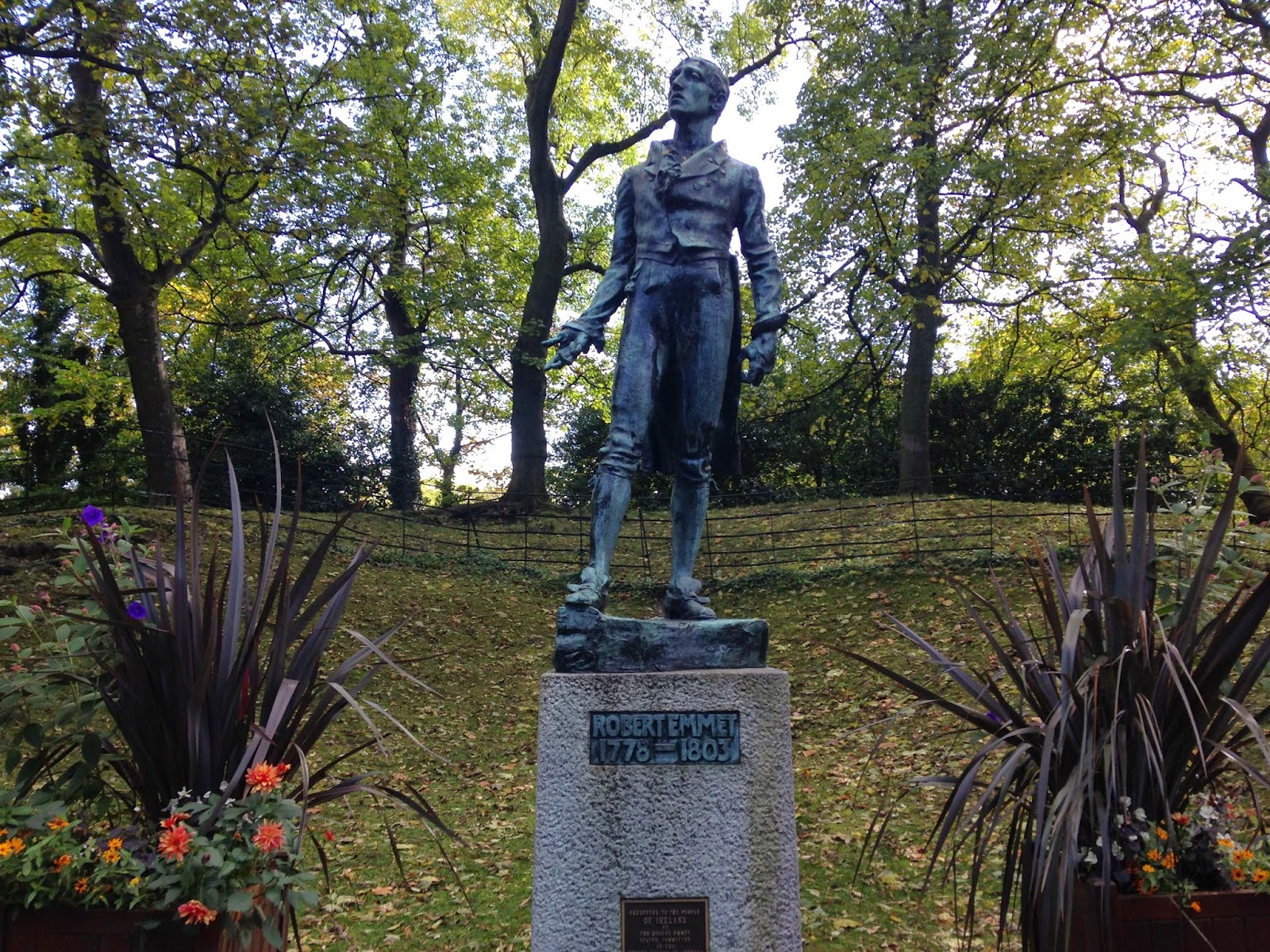
Monument Robert Emmett in Stephens Green (copy of another in Washington DC). Emmett gave his life not only for an independent ireland but for a republic, with separation of Church and State. (Photo source: D.Breatnach)
SEPARATION OF CHURCH AND STATE – A FUNDAMENTAL REPUBLICAN PRINCIPLE
A fundamental principle of republicanism is the separation of church and state – it is as fundamental as the elimination of monarchic rule. It is what the Anglicans Wolfe Tone, Edward Fitzgerald and Robert Emmet believed in, along with the Presbyterians Anne and Henry Joy McCracken – and what they died for, along with independence from England. Anne Devlin and Michael Dwyer were typical of the Catholics who supported the republican ideal. No government should be telling its people what religion they must or must not follow — nor indeed that they have to be religious at all.
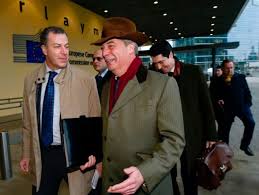
A far-Right Lineup for meeting at the EU Parliament: Irish “patriot” Niall McConnell at the far right of photo (and in politics) with, among others, fascist Nick Griffin of the British National Party (fourth from left). (Photo source: Internet)
Gemma O’Doherty is calling for “a Christian prayer circle” at Croke Park at 9am as a protest against the muslim celebration. Christian prayers for intolerance, racism and fascism? These “patriots” think they have the right to decide which religion is acceptable and which not. That they dislike Muslim religion is their privilege but what is outrageous is that they think they have the right to dictate to people what their religion should be. These are the same people, let us not forget, who have been so stridently shouting about the “right to free speech”!
They say that they are doing this to “prevent Sharia law in Ireland”. Apart from the fact that the only religious domination we’ve had in Ireland has been various forms of Christianity, what kind of paranoia makes them think that there are enough Moslems in Ireland to get a Sharia party elected, even if Moslems wanted that, which many of them don’t? Not all Moslems are supporters of Sharia law any more than all Christians are fundamentalists — or all Catholics support the right of religious orders and clerics to abuse people over which they have control.
It was the Christian Pope Adrian IV in the 12th Century who, with the Laudabiliter document ‘authorised’ the invasion of Ireland by King Henry II of England. From the 15th Century we had Protestantism forced on us by the English Crown by the sword and plantation. In the second half of the 18th Century, Irish Republicanism sought to separate Church and State and to unite Catholic, Protestant (i.e the dominant Anglicans) and Dissenter (i.e Presbyterians, Methodists, Unitarians, Quakers). They failed but gradually Presbyterians and then Catholics won their rights (although Catholics continued to suffer discrimination in the Six Counties). In the 1930s the Blueshirts in the 26 Counties scapegoated Jews in order to divert the people from their real enemies and to build a fascist state, until they were beaten off the streets by Irish Republicans and socialists.
None of that religious persecution or strife was inflicted on us by Muslims.
Gemma O’Doherty supporters demonstrating for “free speech” outside the Dept. of Justice in November. (Photo source: D.Breatnach)
TELLING US HOW TO LIVE OUR LIVES
In the 26 Counties from 1921 we had a Catholic State and the Church dominated public and secular life, dictating laws and social rules about marriage, birth control, sex and sexuality, dance and socialisation, controlling also the education, welfare and health system. That would have been unhealthy enough but they abused their trust, not only physically, mentally and sexually abusing children, adolescents and adults, and exporting orphans abroad – but denying the victims and covering up for the abusers.
They told us what books and newspapers we could read, what films we could watch and what political parties we must not support. This is the kind of “free speech” sought by the fascists.
A fascist tweeter called Rionach has threatened to burn Croke Park down with the Muslims inside it!
All democratic forces need to oppose these reactionary gatherings, whatever the cover story under which they are calling them but under which the fascists are trying to organise their future stormtroopers. Already there have been a number of attacks on antifascist individuals and small groups.
If you disagree with what this collection of the bad, mad and sad are doing, with what they want to do to our country, you know where to be early on Friday morning. Bailligí le chéile!
End.
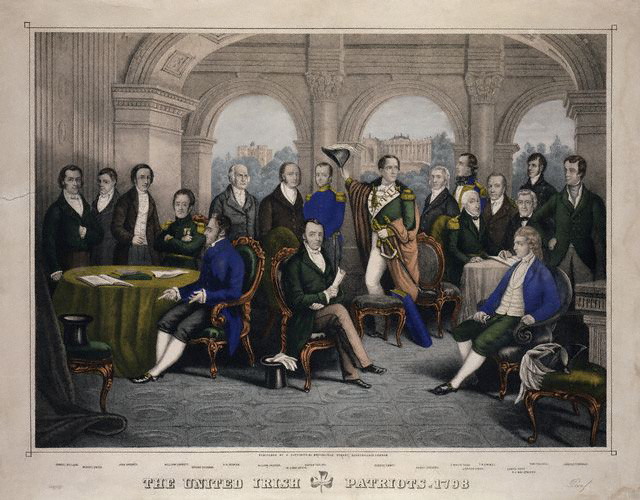
Prominent members of the United Irishmen, by unknown artist, print, 1798 or after (Image sourced on Internet)
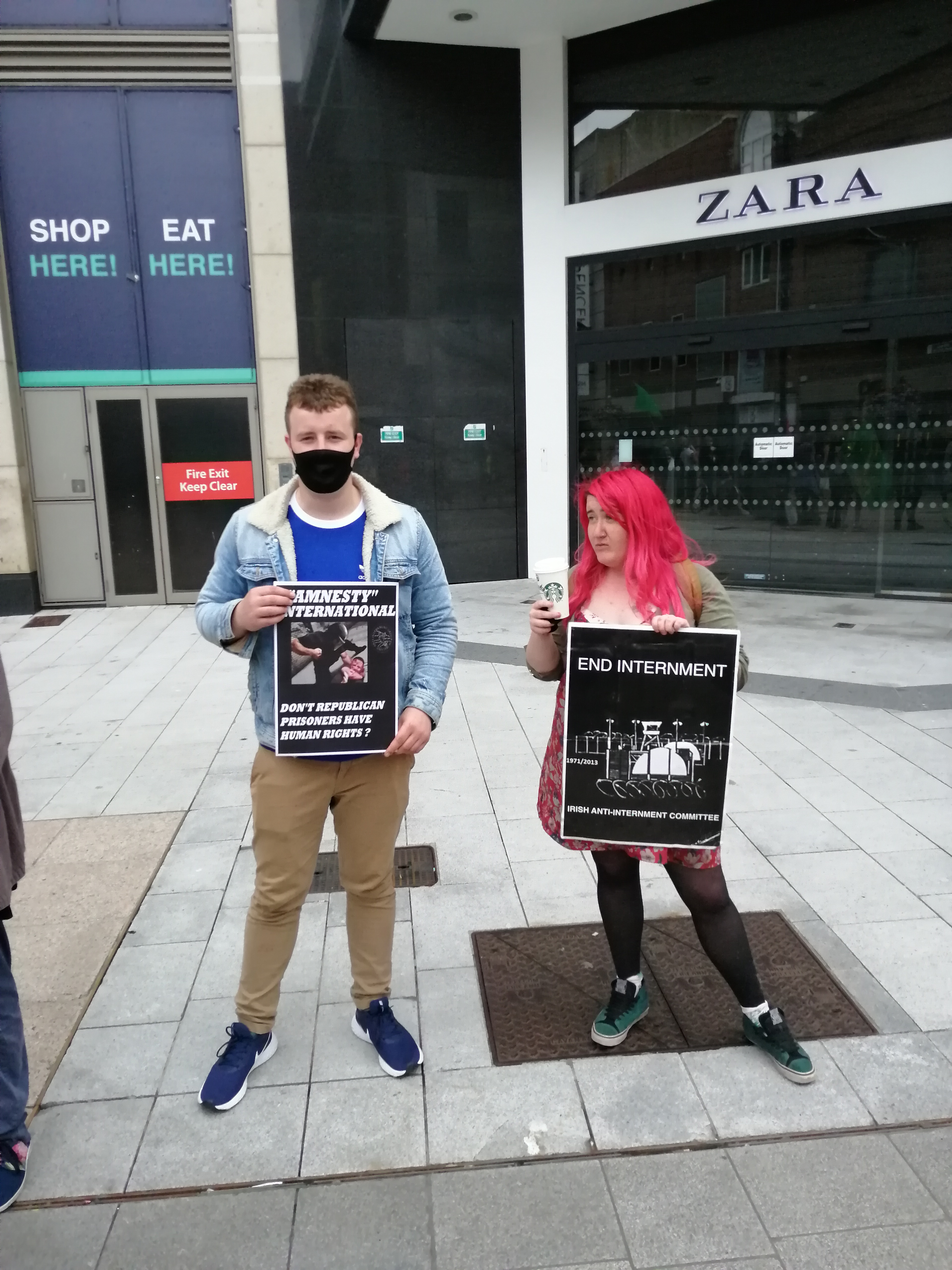
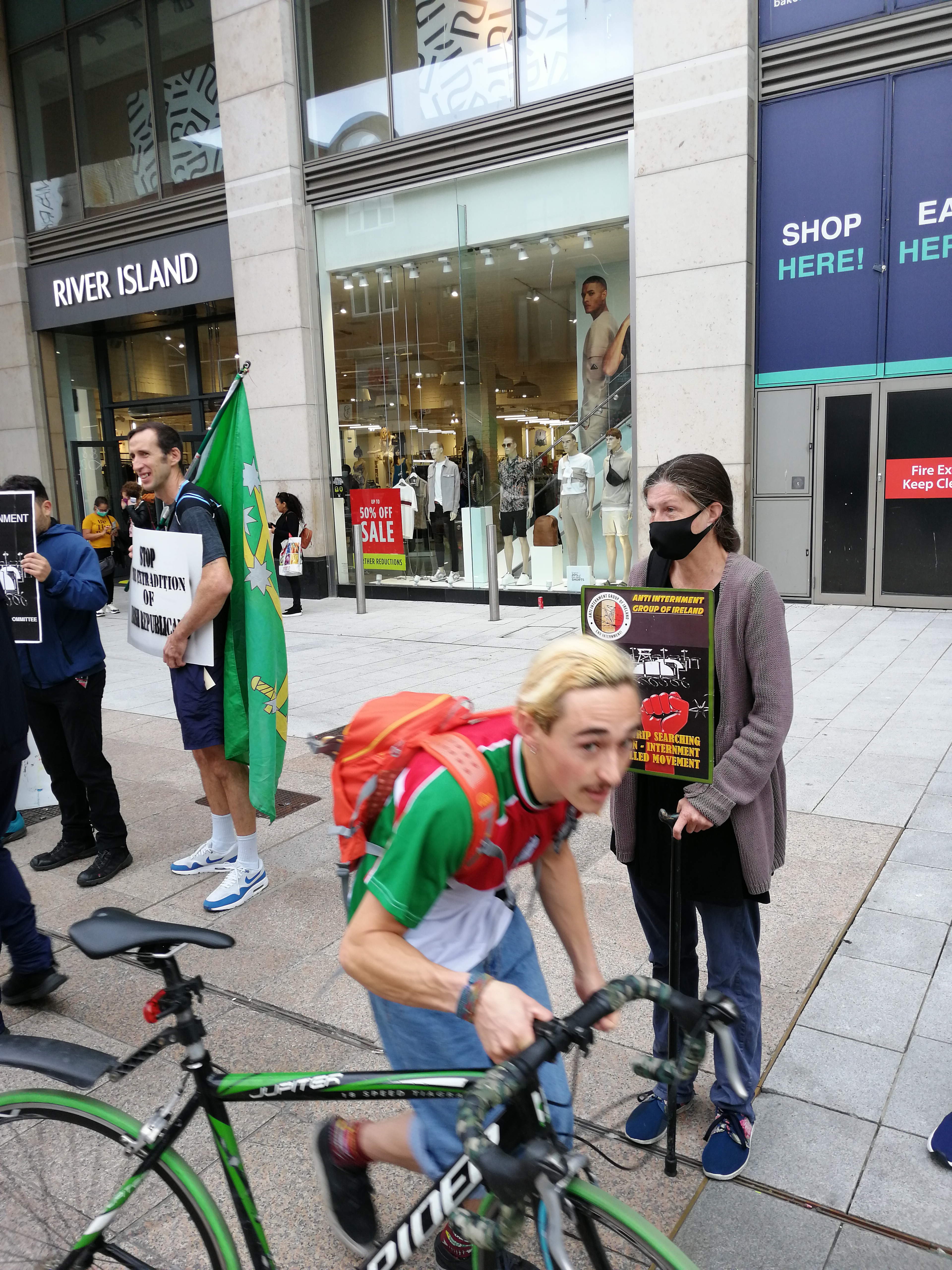
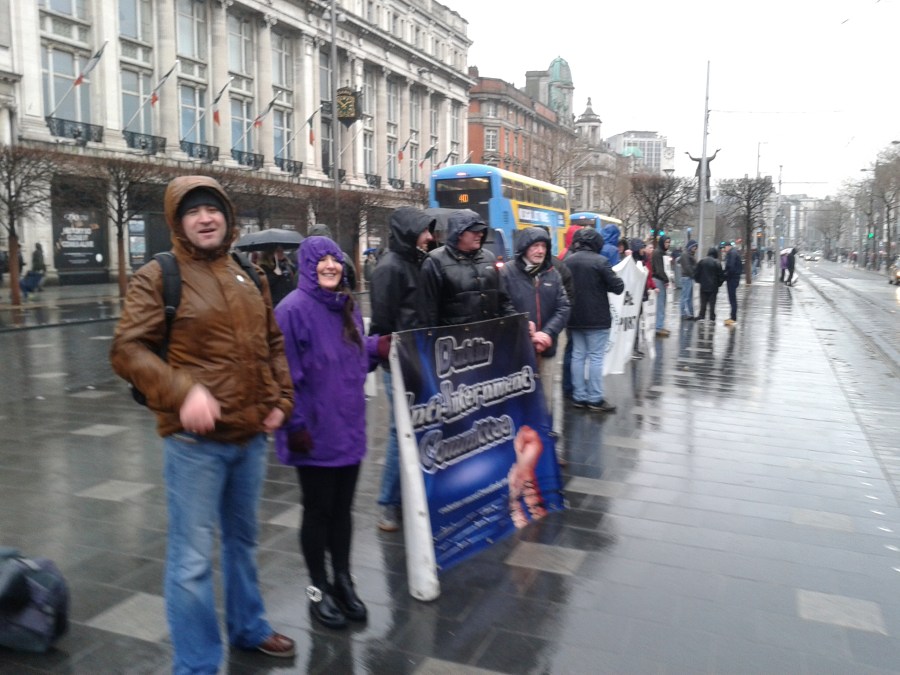
The monthly picket of the Dublin Anti-Internment Committee on Saturday attracted broad support across the spectrum from Irish Republican to Anarchist and revolutionary Socialist. Shoppers and passers-by on Dublin’s busy Henry Street observed the picket with interest, some stopping to engage the picketers in discussion. Several hundred leaflets were distributed explaining that, albeit under another name, internment without trial continues in Ireland on both sides of the British Border.
The anti-racist group on Henry St just before the anti-internment picket (Photo: D.Breatnach)
Just prior to that event, a mostly young Black Lives Matter campaign group had held a lively protest also in Henry Street and the Debenham’s sacked workers’ campaign were demonstrating outside the entrance to the store from which the staff were sacked while they were out due to the pandemic lockdown. The BLM group protest then moved to the Spire and apparently there had been a protest about political prisoners in Belarus outside the GPO, while the Far-Right and fascists gathered to support an Irish Yellow Vests demonstration outside the Custom House on the north quays. Earlier there had also been a protest in Molesworth Street at the auctioning by Whyte’s of a large number of artifacts of Irish history, including a Wolfe Tone’s handwritten notes for his address to the court that sentenced him to hang in 1798.
The two banners and a few of the protesters. (Photo: D.Breatnach)
AGAINST EXTRADITION
As well as about the practice of jailing Republican activists without jail, the picket today focused on the cases of three Irish people being extradited to other states and of Georges Ibrahim Abdallah, 36 years so far in a French jail.
A spokesperson on the issue of extradition pointed to, apart from Liam Campbell, another two Republicans: Ciaran Maguire, currently in Port Laoise jail fighting extradition to the Six Counties British colony and Sean Farrell, who was extradited there fairly recently from Scotland. The spokesperson conveyed solidarity greetings to their families and supporters and, in regard to Maguire and Farrell, to stated their attendance in order to “highlight injustice by the British and the the ineffectiveness of the ‘Free State’ Government” in allowing these.
video-1595691448.mp4
(Photo: D.Breatnach)
Liam Campbell is a veteran Irish Republican whom the Lithuanian state seek to extradite to face charges of arms smuggling but he has never been nor is he accused of ever having set foot in that country. For a state to be able to extradite a person who has never been in their country is a serious precedent to set — it would have permitted the USA for example to extradite Julian Assange to face trial there for what a number of their politicians have described as “spying” — i.e exposing many dark secrets of human rights violations through “Wikileaks” In fact the USA military brought prisoners to an illegal jail they ran in Lithuania for which they were heavily criticised. Nevertheless a judge in the Irish High Court has agreed to the extradition and Campbell, currently in custody, awaits to appear in court to be served with the warrant and flown abroad. During this week Donegal Council passed a motion condemning the extradition of Campbell and will be writing to the Government to ask that the extradition be not permitted.
(Photo: D.Breatnach)
36 YEARS IN JAIL, SEVEN YEARS PAST RELEASE DATE
According to the End Internment FB page, this month’s international focus was on Georges Ibrahim Abdallah, Lebanese but “in a French jail for 36 years now due to fighting in defence of Palestine during the 1982 Lebanon War. 14 January 2013 was the scheduled date for Abdallah to be released and deported to Lebanon after almost 30 years of imprisonment in France.”
Georges Ibrahim Abdallah. (Photo source: Internet)
BIG POWER INFLUENCE
There are allegations that both the extradition demands and the ongoing keeping in jail of Georges Ibrahim Abdallah are influenced by the interventions of other powerful states. It is claimed that Campbell’s extradition to Lithuania is influenced by the UK authorities, although similar charges against Campbell have already failed to have him convicted by a British court. In Abdallah’s case, after a number of legal cases his release date was set for six years ago but the USA objected, the French Minister of the Interior then refused to sign his release papers and Abdallah remains in a French jail.
Commenting on the picket today, a spokesperson for the Dublin Anti-Internment Committee indicated that the organisers were pleased with the numbers attending and the broad spread of political ideology represented there.
“The Starry Plough” flag of the Irish Citizen Army and two banners (Photo: D.Breatnach)
“We are an independent committee and we welcome the participation of all who are genuinely concerned with civil rights, in particular the right to organise and to protest to affect change” said the spokesperson. “Today there are Irish Republicans, Anarchists and revolutionary Socialists here, many of them independent activists and we view “that very positively. Indeed there are other bodies that we think should be represented here too – the protection of civil rights is a concern for all democratic people.”
The Dublin Anti-Internment Committee expects to organise another picket on similar issues next month, the details as usual to be announced on the End Internment FB page.
(Photo: D.Breatnach)
End.
The Palestinian flag was flown in solidarity with Georges Ibrahim Abdallah, a Lebanese but a fighter for the Palestinian cause. (Photo: D.Breatnach)
Basque independentist militant Itxaso Zaldua was arrested on Tuesday in Hernani, in the Basque province of Gipuzkoa and according to media is to be charged with complicity in the killing of a senior right-wing politician in 2001. She has spent only three years at liberty in the southern Basque Country after nearly twelve in a French jail and is now back in custody pending trial. Her arrest has been denounced by both wings of the Basque pro-independence movement but from different perspectives.
As according to the bilingual GARA newspaper Zaldua was not held incommunicado, i.e without access to friends and relations, lawyer or doctor of choice, it is not likely that she will be tortured. Until a few years ago the use of a variety of types of torture during the five-day incommunicado period under the “anti-terror” (sic) laws was the rule rather than the exception. However, all detainees charged under the terrorism laws of the Spanish State are always taken to Madrid for interrogation by the Guardia Civil and then for court appearance, the distance from their homes placing an additional burden on friends, relatives and supporters (it is 450 km from Hernani). Some of those will be given temporary accommodation and support by Madrid organisations in solidarity.
TWELVE YEARS IN JAIL
Back in April 2005 Itxaso Zaldua was arrested in the Lannemezan area of the Occitan region of the French state, along with her comrade José Segurola Querejeta. They were charged with membership of ATAKA (sub-structure of the armed Basque resistance organisation ETA), of which she was accused of leading and duly convicted and jailed in the French system (which also disperses political prisoners to jails throughout the territory).
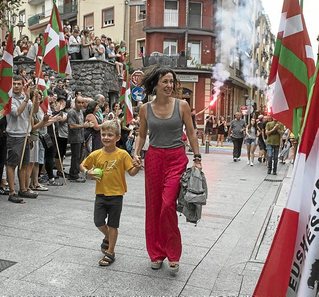
Zaldua was released in 2017 and right-wing Spanish unionist organisations including the “Association of Victims of Terrorism”, many of their members relatives of Spanish police or military, complained at the traditional honouring reception she received upon her return home from French jail. Zaldua walked hand-in-hand with her young daughter down a street with well-wishers on both sides cheering, was presented with a floral bouquet, two women danced the aurresku (honour dance) before here and another shouted the irrintzi, the high-pitched yodeling cry reputed to have been a battle-cry (see embedded video) and the Eusko Gudariak (“Basque Soldiers”, similar to the Irish “Soldiers’ Song”) was sung by all.
2017-08-23, Hernani. Itsaso, euskal preso politikoa aske, ongi etorria. 23-08-2017, Hernani. Itsaso, presa politica vasca libre, recibimiento.
“TIME TO BE EMPTYING THE JAILS, NOT FILLING THEM”
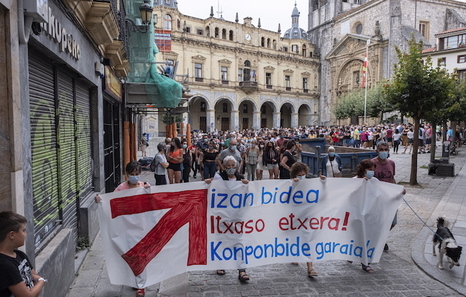
The “official” Basque independentist movement responded quickly to the ex-prisoner’s new arrest: the Sare organisation convened a demonstration in Hernani the same afternoon demanding Zaldua’s release and the trade union works committee of her place of employed also denounced her arrest. The official movement’s political party EH Bildu (headed by Arnaldo Otegi), issued a statement that “It is time to be emptying the jails, not filling them,” a reference to the nearly 250 Basque political prisoners still in jail.
2020-07-21, Demonstration Tuesday afternoon in Hernani in protest at arrest of Itxaso Zaldua in the town earlier that day. (Photo sourced: Naiz.info)
The party’s statement called the arrest “another obstacle in the path chosen by this nation towards peace, coexistence and freedom; a path which, cost whatever it may, we are determined to follow”.
However the ‘dissident’ organisation Amnistia (Movement for Amnesty and Against Repression), which also condemned the arrest, issued a statement declaring that “There will be no peace until the reasons that are at base of the conflict are resolved and until all the militants who are punished as a consequence of said conflict are free.
Both organisations called the people to action, with EH Bildu referring to “the participation and activation of Basque society” and Amnistia in contrast stating that “the working class need to organize”.
“THEY WANT TO HUMILIATE THE BASQUE COUNTRY”
The Basque organisation ETA ended its armed struggle in 2012 as part of a unilateral bid for a peace process of the movement under the leadership of Arnaldo Otegi. However, a peace process requires the participation of at least both antagonists and the Spanish State has shown no interest in negotiation. Whatever one may say about such processes in Ireland or in South Africa, the resistance organisations in those countries ensured the freedom of their imprisoned members before they signed up to the deal. This was not so in the Basque case.
It is no doubt difficult for observers to understand why the Spanish State is now pursuing an ex-prisoner for alleged complicity in an assassination nineteen years ago when State has gained not only the ETA’s abandonment of armed struggle but even its dissolution. Nor is there any sign that Zaldua is a sympathiser of the “dissident” movement; the statements in her support from across the “official” movement and the speed of response is in stark contrast to the “officials’” response to the hunger and thirst strike of political prisoner Patxi Ruiz in May. Ruiz had denounced the “official” leadership some years ago and been expelled from the collective that leadership controls (and which precipitated the resignations of another four Basque prisoners in solidarity).
Ironically, it is the assessment of the “dissident” Amnistia which seems correct: “This arrest, like other previous ones, shows that the States (i.e French and Spanish) want to humiliate the Basque Country. By means of life sentences against a specific against a specific model of resistance, they want to intimidate the new generations that join the struggle.”
Itxaso Zaldua, photographed a year after her release from 12 years in French jails. (Photo sourced: Internet)
DIFFERENT PATHS
Whatever the eventual outcome of the judicial process against Zaldua in the no-jury National Court in Madrid, it is clear that the struggle against the Spanish State is far from finished in the southern Basque Country, though its armed stage seems over at least for the present.
The “official” leadership has been following an electoral path and quoting the support of external political figures such as Bertie Ahern, Gerry Adams, Kofi Anan, Tony Blair and Brian Currin of South Africa.
In the Euskadi regional government elections on Sunday in the southern Basque Country, the “official” party led by Otegi, EH Bildu, as expected came in second. The PNV, the Basque Nationalist Party, came in first and the PSE, Basque version of the Spanish unionist PSOE, in third place. Despite periodic approaches by the EH Bildu leadership, the PNV will govern the three provinces either in coalition with the PSE or in “confidence and supply” agreement with the party.
Even if EH Bildu in years to come were able to reach first place in Euskadi regional elections, what of the other region, Nafarroa? And the three northern provinces of the Basque Country, under French rule? And, even with an eventual majority in all seven provinces, if the Spanish State were still to deny independence, as it does with an independentist majority in Catalonia, what then?
Over to the Amnistia movement, which advocates street power: “If we are to achieve peace, it will come from the full implementation of total amnesty, with the unconditional release of prisoners, refugees and political deportees, with the expulsion of the occupation forces and with the overcoming of the reasons that pushed so many people to fight. That will be the only guarantee to end arrests like today and other similar repressive actions.”
That seems a realistic enough assessment. But as to how to achieve their objectives against the opposition of the Spanish and French states, neither section of the Basque independentist movement seems to have an answer.
End.
Workmates of Itxaso Zaldua at company CAF Besain demand her release. (Photo sourced: Internet)
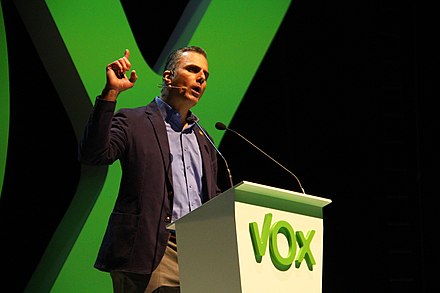
Javier Ortega Smith, No.2 in the leadership of the fascist Spanish party Vox recently attacked the Basque language, he did more than reveal the hatred of the core of Spanish unionism for the diversity of national cultures currently in existence within the Spanish state – he revealed his abysmal depth of ignorance about how languages, including his own are formed. And got lambasted and ridiculed in comment even in some conservative media as also social media, especially in tweets.
“Vox in the Battle for Spain” (uncertain whether this meme is intended in irony or not). (image source: social media)Javier Ortega Smith, No.2 in the leadership of Vox, speaking at a party rally. (Photo source: Internet)
Vox was on an expedition into what is for them electorally virgin territory in the run up to the elections in the Basque Country Autonomous Region this weekend, where they have no elected representation at all. Far from what might have been expected, their presence and speeches seemed calculated to arouse hostility and expose their few supporters there to embarrassment.
Gaining the prize for generating hostility was Javier Ortega Smith, No.2 of the Vox party, speaking in Vitoria/ Gastheiz in Alava, one of the three provinces of the “Basque Autonomous Region”. Calling the second party in electoral strength in the region “terrorists” would cause little surprise, since EH Bildu is descended from Herri Batasuna, which was once associated with the armed group ETA and considered by some to be terrorists (by others, freedom fighters). But to say of the party of main electoral strength, the Basque Nationalist Party, that they are only “four cats”, equivalent in English to “three men and a dog”, this in a region where Vox has failed to get even one delegate elected …. well!
But Ortega Smith really put his hoof in it when he blundered into linguistics. “Asturian (language) is invented and Euskera (Basque language) also,” he declared, going on to declare that Batua, the standarised form of the Basque language, was formed “from dialects” of communities “who would not even have understood one another.”
Asturias, to the north-west of the Spanish state, with a population of around 1.02 million, is in some cultural expressions a Celtic nation but their language is of the Romance group, like Castillian (Spanish), with contributions from the Iberian-Celtic of the Astures tribe and later Germanic languages of the conquering Visi-Goths and Suevi. Euskera, the Basque language, is of uncertain origin but certainly ancient and currently spoken over the seven provinces of the Basque nation, three under French and four under Spanish control (total population a little over 2.17 million). All languages in the Spanish Kingdom other than Castillian have come under suppression at one time or another and most widely and rigorously under the four decades of the Franco dictatorship, a period nostalgically recalled by fascists and by even many conservatives in the Spanish state. What language has rights where and at what level is a battleground of struggle with the central State and a preoccupation for Spanish unionists.
Anyone who understands even the basics of how languages and their vocabularies are formed and developed would not have dared make such a statement as did Ortega Smith.
One would not even need to know that English, belonging to the Germanic group and currently a dominant world language, has a vocabulary which is 60% from French, with heavy sprinklings of words of Greek and Latin origin. Latin, which was a ‘world language’ before English, French or Spanish, started life as a Romance language in small province of Italy called Latium. Latin influenced heavily the development of Castilian, which includes many words of Arabic origin as well as from other languages and yes, even from Euskera! Nearly all European languages are thought to have developed from an Asian ancestor something like Sanskrit, so that they are grouped together as ‘Indo-European’. And what language was spoken in Europe before the advent of those Asian-influenced tongues? None other than Euskera, probably the original language of the early early Neolithic settlers!
Still, who needs knowledge when prejudice is king!
Some of the social media comments are sarcastically amusing, reproduced here in translation:
“Asturian is invented and Euskera also. Unlike Spanish which already existed in the time of the dinosaurs” or
“unlike Spanish, which came out of the Big Bang” or
“unlike all the other languages, that only use words growing on trees” or
“Unlike Castillian (Spanish) which arrived in Noah’s Ark with all the words”.
“Do you know how to say Ortega Smith in the Valencian tongue? ‘IGNORANT’”
“Well now, Ortega Smith, the vocabulary of all the languages of the world are invented, like your patriotism.”
“Ortega Smith is sure that the Basque Language has been taken from The Lord of the Rings.”
The Vox party was formed in 2013 from an extremely right-wing political core that has contributed in turn to the creation of the Partido Popular, from former supporters of Franco and Ciudadanos before going on to the creation of Vox. It has campaigned for the abolition of the statutes of autonomy for regions, for the right of parents to withdraw their children from liberal sex and gender education, spoken against a focus on male violence against women. The party climbed in popularity in recent years, in particular in the more economically depressed regions and now has 52 deputies in the Spanish Parliament and four MEPs.
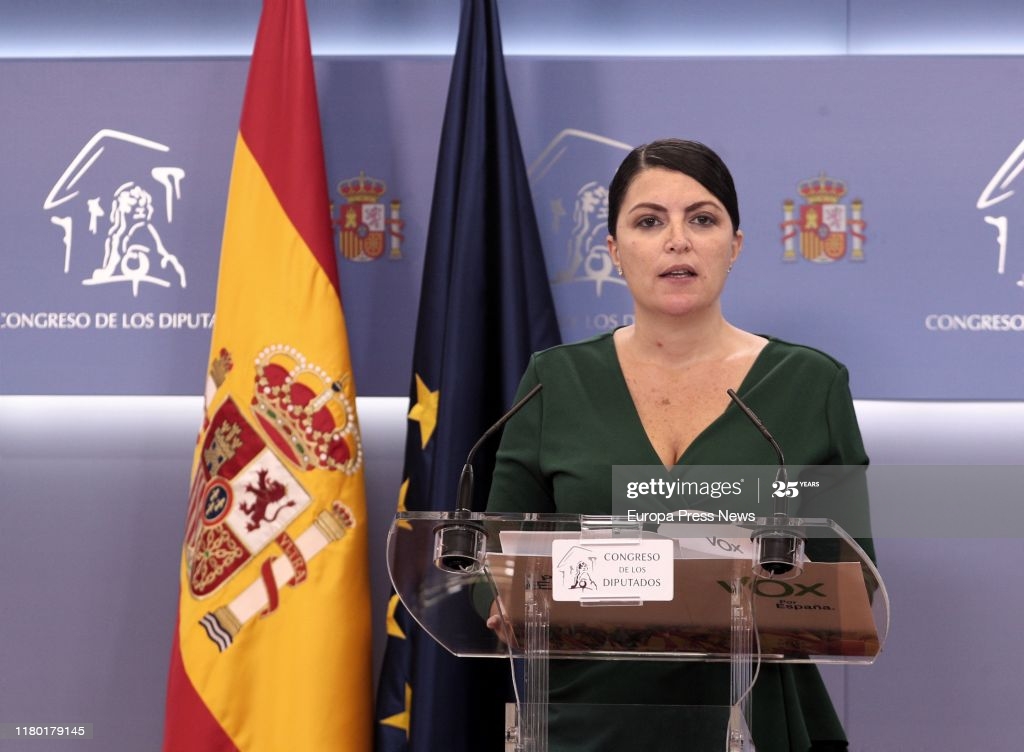
Spokeswoman of Vox party Macarena Olona, who also spoke in the Basque Country. (Photo source: Internet)
Still intent on their version of making friends and influencing people, on Wednesday in Oñati in Gipuzkoa province, where Vox carried out a ceremony to honour the militarised Spanish police force, the Guardia Civil, spokeswoman for the fascist party Macarena Olona screamed at protesters that “Oñate is in Spain, you crockful of ETA!Oñate is in Spain!” In this township of 11,000 people Vox received, in the last general election, a total of 21 votes.
Basque opposition to Vox back in June in Donosti/ San Sebastian when the party representatives left under police escort. (Photo source: Internet)Basque riot police confronting Basque crowd hostile to Vox. Later the police charged the crowd. (Photo source: Internet)
Throughout their visits to the Basque Country, Vox representatives were surrounded by Basque police and left quickly after their rallies.
According to a report by the left-wing Spanish on-line media Publico.es, the fascist Spanish Catholic Movement1 plans an event glorifying the fascist dictator Franco and the only restriction placed upon them by the city council of Madrid has been to “wear masks and maintain social distancing”. At the time of publication, the Council had yet to reply to enquiries from Publico.es.
José Luis Corral, leader of the fascist Spanish Catholic Movement says all is organised for this Saturday the 18th with a rally at the Arco de la Victoria (“Victory Arch”) to celebrate the “national uprising”: the first military attempted coup against the elected Spanish Government was on 18th July 1936 but was defeated.
Arco de la Victoria, Madrid, commemorating the victory of the military-fascist forces in 1939. (Photo source: Internet)
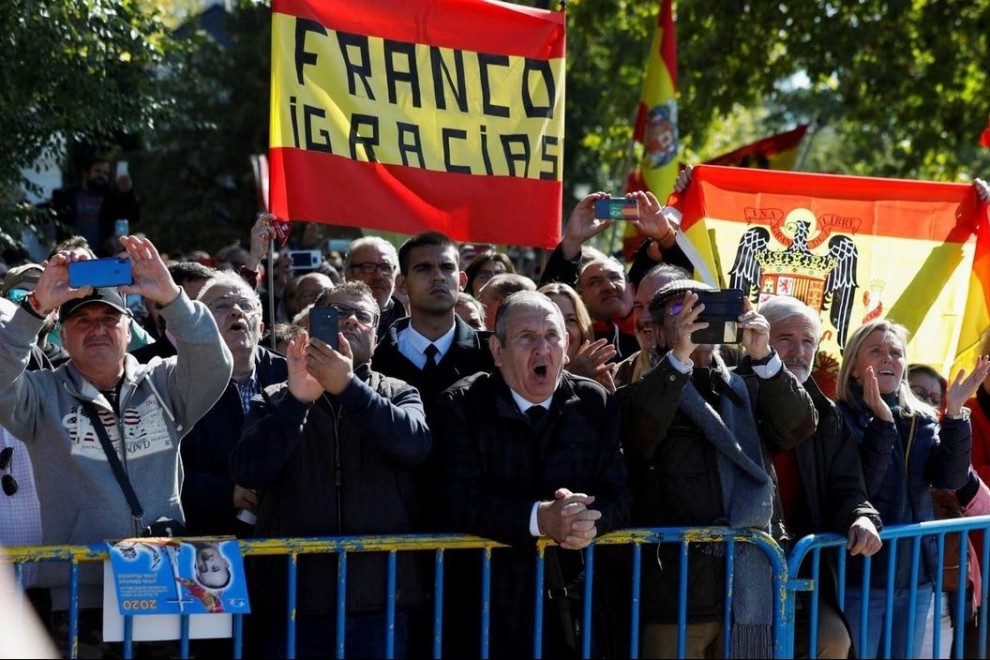
The rally is to be followed by a procession to where Franco’s remains now lie, at Mingorrubio Cemetery. The Movement also asked supporters to attend mass (Catholic religious service) at the church in the Valley of the Fallen, the monument and mausoleum to Franquism built by the labour of political prisoners from where finally, after many unfulfilled promises by the PSOE party, Franco’s remains were removed. This took place in October last year among protests by fascists and followed by national TV services in a style reminiscent of an act of national mourning.
General Franco, Dictator of Spain, giving the fascist salute probably 1960s. (Photo source: Internet)
Also planned to honour in the event at that cemetery is the memory of the fascist Admiral Carrero Blanco, whose body was also removed from the mausoleum in the Valley of the Fallen. Carrero Blanco was Franco’s nominated successor but he was assassinated in Madrid by the Basque armed group ETA in December 1973, two years before the death of the Dictator.
FASCISM IN SPAIN WAS NOT DEFEATED
In 1936 General Franco led a military-fascist uprising against the elected left-republican Popular Front Government which resulted in a war that did not end until 1939, causing an estimated 200,000 deaths by violence. Following the victory of his forces, which had been aided by Italian Fascist and Nazi German armament, transport and men, a fascist dictatorship was established in which thousands of men were imprisoned, shot out of hand, executed after summary court martial or sent to penal battalions. Women were jailed and shot too, many were raped and publicly humiliated. All of the above was with the full support of the Catholic hierarchy in Spain, in Ireland and in most of the world. Only Cambodia has more mass graves than the Spanish State.
After Franco died, the Transition to “democracy” deal with the social-democratic PSOE and Communist Party leaderships ensured impunity for the fascist perpetrators of tortures and murders and a curtain of silence drawn over the whole history, with mass graves remaining unexcavated or even unmarked for decades. Monuments to Franco and his followers remained throughout much of the state. The Transition also imposed a monarchy on the populace and a unionist Constitution which has been the cause of conflict with the Basque Country and Catalonia for decades.
The display of fascist Franco symbols or glorification of fascism has been forbidden by law in the Spanish State for years but fascists regularly hold events, display fascist symbols, sing fascist songs and shout fascist slogans without any police intervention, to say nothing of facing charges in court. This is certain to be repeated on Saturday.
November 2018, Spanish fascists in Madrid displaying fascist symbols and giving fascist salutes with impunity. (Photo source: Internet)
The Fascist leader admitted to Publico’s reporter that he had not applied for permission to hold an event celebrating a military-fascist coup but rather “as a protest against the Historical Memory Law2 and a demand that they care for the Victory Arch3, which is very neglected.”
Also on the same day as the Franco glorification event in Madrid, the ultra-conservative Traditionalist Carlist Communion also plans a commemoration of their own. The ultra-Catholic Carlists took the Basque province of Nafarroa into alliance with the Franco military-fascist forces in 1936, massacring around 3,000 Republicans, Socialists, Communists, Anti-Fascists and Basque Nationalists in the province.
The organisers claim that they are commemorating the 111th anniversary of the death in exile of Carlos VII Borbonne and East Austria (their choice for Monarch of Spain, which was part of the cause of the Carlist Wars) and that the only flags or banners permitted will be the those of the “Cross of St. Andrew”, with or without “the Sacred Hearts” and the “Spanish Flag with the Sacred Heart”. However, the organisers have also let it be known that there are “additional reasons” for the event.
Fascism in the Spanish State was never defeated but instead an accommodation was reached with it. Now, in common with much of the world, the fascist movement is rising again but incensed at the national independentist claims of the Basques and Catalans and also at what they perceive as defilement of the memory of their fascist heroes. The Spanish State, even under a Left-Social Democratic government, at the very least exhibits a tolerance towards the fascist movements and their activities which is far from its response to the independentist movements or to the militant Left.
End.
Followers of fascist dictator Franco protesting the long overdue removal of his remains from the Valley of the Fallen fascist monument in October 2019. (Photo source: Publico.es)
FOOTNOTES:
1This is but one of the organisations in the Spanish state that reveres the memory of Franco. I call them “fascists” because that is what they are but Publico calls them “far-Right”.
2 The Historical Memory Law seeks to remedy some of the silence and fear around the history of the Spanish Anti-Fascist War and of the Dictatorship and is one of the regular targets of fascist diatribes
3The Victory Arch monument celebrates the victory of the military-fascist forces over those of the elected government in 1939.
On June 24th, as the repressive Offences Against the State Act was up for debate in the Dáil, it was voted for renewal by TDs of the Fianna Fáil, Fine Gael and Green parties, along with Labour, while only a Solidarity/People Before Profit and two Independent TDs voted against. For the first time since Sinn Féin had TDs present in the Dáil in 1997, they abstained in the vote. They failed to vote against an undemocratic Act that was brought into being precisely to repress their own political ancestors.
The Offences Against the State Act was made law by the De Valera Government (Fianna Fáil) in 1939 and 1940 to nullify the writ of habeas corpus served by Seán McBride (Irish Republican, former IRA officer and later one of the founders of Amnesty International) which gained the release of IRA prisoners interned without trial under the previous Emergency Powers Act 1939. The Act established the Special Criminal Court which processed the rearrested internees and sent them back to prison and concentration camp in the Curragh.
BRITISH INTELLIGENCE FATAL BOMBING HELPED TOUGHEN LAW AGAINST REPUBLICANS
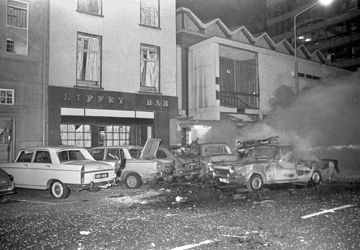
In 1972 the Fianna Fáil Government sought to strengthen the Act even further, among other attacks on civil liberties to permit an inference of guilt by the Special Criminal Court from refusal to answer questions by the Gardaí, along with the taking of a senior Garda officer’s word, unsupported by any substantial evidence, as the main “proof” of membership of an illegal organisation. However, the forecast looked bad for the Government since the Labour Party and Fine Gael were predicted to vote the Amendment down. During the debate, two bombs exploded in Dublin killing two Dublin public transport workers and injuring a number of others, some horrifically (two years later a similar bombing team was to kill 33 and injure around 260 in Dublin and Monaghan). The 1972 explosions, most likely the work of Loyalists working with British Intelligence, were blamed on the IRA and the opposition to the Amendment crumbled, ensuring it passed into law — and there it has remained.
A photo of the bombing adjacent to Liberty Hall (Photo source: Internet)
The Act empowers the Government to bring internment without trial into force by order (i.e without debate, even if the Government should be a minority one). Among its powers the OAS permits the State to ban organisations and subsequently (with its 1972 Amendment) jail people for membership of said organisation, the unsupported testimony of a Garda not below the rank of Chief Superintendent being considered prima facie evidence of said membership.
In a state where trials of all indictable offences under criminal law are by jury with a judge presiding, the Special Criminal Court is a non-jury court. Virtually all Irish Republicans serving time in prisons of the State have been convicted in the SCC, where even the unsupported word of a senior Garda officer is considered important proof and the standard of additional evidence required is very low. As one might expect in such conditions, the conviction rate is unusually high. On the charge of “membership of an illegal organisation” and largely on the word of senior Garda officer, conviction is almost certain and becomes an easy way to remove Irish Republican activists from circulation for the standard two years.
“GREATEST MISCARRIAGE OF JUSTICE IN THE IRISH STATE”
In two trials in 1978, the Special Criminal Court, in what has been called “the greatest miscarriage of justice of the Irish State”, tried and sentenced three Republicans to long terms of imprisonment for a mail train robbery at Sallins in which they had played no part. The judges in the Court chose to believe what 12 jurors would likely not have done: that the defendants had voluntarily confessed to actions they had not committed, that they had not been beaten by Gardaí and that the defendants’ bruising had been self-inflicted. The Garda “Heavy Gang” went on to obtain “voluntary confessions” from others, including Joanna Hayes and her relations in the “Kerry Babies” case, later also cleared and recipients of a Government apology in 2019. Those convicted of the Sallins mail train robbery were eventually cleared and released. The circumstances of those false “voluntary confessions” accepted by the SCC have never been investigated.
A poster from the campaign in support of four framed activists in the Special Criminal Court. All but the last one to the left were convicted and sentenced for up to 12 years, being eventually exonerated after long campaigning. The Gardaí involved were never even disciplined and some went on to frame others. (Image source: http://www.thewhistleblower.ie).Joanna Hayes, another who “confessed” to a crime she had not committed as did members of her family. Some of the Garda Heavy Gang, permitted by the SCC to get away with beating false confessions in the Sallins Train frameup, went on to be involved in the Hayes case. Even after the Government and Gardaí apologised to her years later, still no investigation. (Photo source: Internet)
In 2001 Colm Murphy was convicted in the Special Criminal Court of conspiracy to cause a bombing on the basis of Garda evidence which Murphy said was untrue — but the judges chose to believe the Gardaí. The Court of Appeal ordered a retrial when it was shown that the Gardaí’s notes had been fabricated and Murphy was cleared in the SCC in 2010.
In 2003 Michael McKevitt was convicted in the Special Court of leadership of the Real IRA on evidence widely believed not to have met the standard necessary for conviction, including that given by a paid informer. McKevitt is still serving his 20-year sentence.
Although the title of the Court includes the word “criminal” it was clearly created for political purposes and until 1998 all but one of its trials have been of Irish Republicans. That did not prevent the TDs of the Greens, a party with a record of previous opposition to the Act, using gang crime along with Labour as an excuse for voting for the Act’s renewal during the recent debate.
“THE SPECIAL BRANCH ACT”
The granting of wide powers to the State to use against their political opponents has resulted in even those powers being regularly exceeded. Without ever even charging anyone with any crime, the Act has been used by generations of the Special Branch, the political police renamed the Special Detective Unit, to harass and intimidate Republican activists and their supporters. People have been approached and their contact details demanded by these secret police when they have attended a protest picket or rally, public meeting, visited a Republican office or were observed talking to a Republican. People have been searched in the street, had their vehicles stopped and searched also.
Sellers and distributors of Republican newspapers have been harassed and threatened. Without any authorisation even by the Act, officers have approached parents of young activists and their school or college, as well as the place of employment of older activists, to express their concern at the activity or associations of the activists concerned. Officers of the special unit, all of which go armed, have displayed their weapons on occasion to intimidate Republicans (on one famous occasion discharging their firearm in a busy shop). They have filmed and photographed Republicans without any legal right to do so, followed them around, sat obtrusively outside their offices and even their homes, often day after day for months or even years. So widely have the secret police of the Irish State come to see the Act as entitling their intimidation and file-building that when, at a recent Dublin picket about political prisoners, a Republican asked what legal authority the officer had for harassing him, the man replied in all seriousness: “Special Branch Act.”
But on the 24th June, only three TDs voted against the Act’s renewal: Mick Barry (Solidarity/ People Before Profit), Michael MacNamara (Independent, formerly Labour) and Thomas Pringle (Independent). Two TD abstentions were recorded: Pa Daly and Martin Kenny (both Sinn Féin).
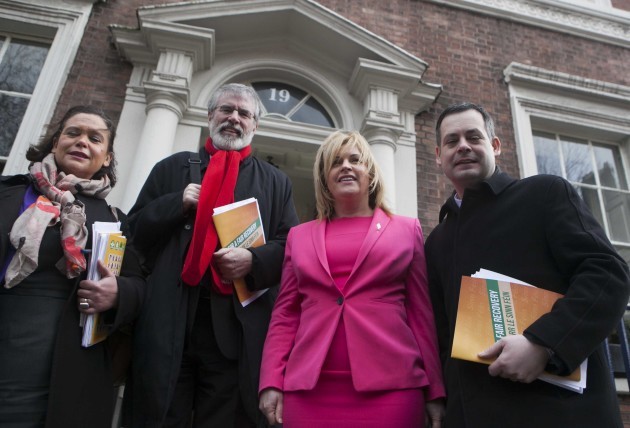
Leaders of Sinn Féin photographed in 2016 after announcing they would put their traditional opposition to the OAS in their election manifesto. (Photo source: Internet)
“UNTENABLE IN A DEMOCRACY”
Traditionally, Sinn Féin, along with other Irish Republicans, have opposed this undemocratic repressive legislation. But not just SF, also the Irish Council for Civil Liberties, Amnesty International, Irish and international jurists and UN Rapporteurs and Committees on democratic rights of the United Nations. And not just once but a number of times. The following statement was released by the ICCL in the week before the debate.
23 June 2020
The Irish Council for Civil Liberties (ICCL), ahead of the mooted renewal of the Offences Against the State Act next week and the Dáil debate tomorrow, renews our call for repeal of the Act and with it the abolition of the non-jury Special Criminal Court.
There is no jury at the Special Criminal Court and it accepts secret evidence from gardaí. This is in violation of our right to a fair trial, our right to trial by jury and our right to equality before the law. ICCL has opposed both the Act and the Court since their introduction to deal with a terrorist threat in 1972. We continue to strongly oppose these emergency measures which have now become the norm in dealing with organised crime.
ICCL’s Executive Director, Liam Herrick, said:
“It’s untenable that in a democracy like ours, which prides itself on its human rights record abroad, a law and court like these can exist.
The State contends that it needs the Special in order to protect juries but it has never considered alternatives to abandoning jury trial.”
The protection of jury members is of deep concern to ICCL. But the State has never demonstrated, as required by human rights law, that alternatives to a non-jury trial are ineffective. There are a number of obvious options for protecting juries such as anonymising juries, the use of video link for juries, or granting special protections for juries.
Last year at the Special Criminal Court, Judge Tara Burns acquitted two men of IRA membership after the head of the Garda Special Detective Unit refused to disclose underlying evidence pertaining to “belief evidence” to the prosecution. This meant gardaí were seeking a conviction without disclosing evidence to the defendant’s legal team, the Court or the DPP. ICCL welcomed the Judge’s decision but the case revealed some concerning attitudes and practices at the Court.
ICCL is not alone in our opposition to the Special Criminal Court. Various UN human rights independent experts and the UN Human Rights Committee have repeatedly declared the State to be in violation of its human rights obligations because of the continued use of the Court beyond the emergency it was designed to address. Eminent Irish legal experts, Mr. Justice Hederman, Professor Dermot Walsh and Professor William Binchy have also called for abolition of the Court.
At its introduction in 1972, the Special Criminal Court was considered a radical and purely temporary departure from the norm. Forty years have passed since then. It’s time for its abolition. Statement ends.
CONCLUSION
Defenders of Sinn Féin have said that dropping opposition to the OAS from their election program for government and even after their party won the highest number of elected TDs (delegates) in the February 2020 General Election, was purely a temporary tactical one. Presumably this decision was in response to Mícheál Martin’s statement last year that Sinn Féin was not a legitimate choice for government because they were against the Act.
Part of the sculpture outside the modern criminal courts building in Dublin, which also houses the Special Criminal Court. (Image sourced: Intenet)Special no-jury Criminal Court. Image sourced: internet)
Not a legitimate choice for whom? one might ask. Do the mass of working people in the country want this undemocratic Act in place? Not that they were ever asked by any Irish Government! Now there was an opportunity to put this before the electorate — but it is not the opinion of the mass of working people that Sinn Féin worries about but that of the ruling class and their media hounds.
When however the two main parties of the Irish Gombeen capitalist class went into coalition with the “alternative” Green Party in order to exclude Sinn Féin from government – and one might have thought SF had nothing now to lose by voting against the renewal of the OAS – even then they failed to oppose it. Some say SF’s tacticians expected the negotiations between the other parties to collapse and then to be able to put themselves forward as a credible alternative. But again, credible to whom?
For years now, Sinn Féin has been at pains to demonstrate that it is a safe pair of hands for Irish capitalism (which entails also being safe for foreign capitalism and British colonialism). It is not necessarily a question of supporting armed struggle or not but to enter into the administration of an invader, as SF did in 2007 when it became part of the British colony’s government, would for most patriots and anti-imperialists be considered a clear crossing of the line. After WW2 many liberated countries executed a number of those who had taken part in such administrations and from one example, a new adjective entered the English language: “quisling”.
Sinn Féin has gone even further now to show the Irish ruling classes and both states that their panoply of repression on both sides of the British Border is safe: undemocratic legislation granting special powers to the police, politicised police forces and special non-jury courts with low quality “proof” required for convictions.
It is understandable with so little viable alternative choice that so many voted for SF candidates in February and in fact, would probably have elected even more had the party fielded sufficient candidates. All the other main parties and even the Greens have been in Government previously, all have approved bank bailouts and austerity budgets.
Sinn Féin is the only major party who had not been in Government and those who wanted to see them in practice had a reasonable point. But seeing them in “opposition” is also instructive. A political party that is so afraid of the ruling class and its media that even in opposition it will not vote against undemocratic repressive legislation and instruments, that were brought in precisely against its own earlier members and supporters – is not going to be braver in government, when it will inevitably be in a coalition with a capitalist party or parties.
Protesters from a variety of Republican organisations and none protest the Special Courts in Dublin City Centre on a rainy afternoon in 2018. (Photo: D.Breatnach)
However, the undemocratic Offences Against the State Act and its non-jury Special Courts remain and must be opposed. The struggle against them will continue to be waged by its victims, currently the “dissident” Republicans and by people and bodies concerned with civil rights. As the State encounters increasing resistance to austerity measures it may well be that it will widen the list of targets of this Act to include social and economic campaigners, as it was rumoured considering against the Jobstown water protest defendants in 2017, all of whom were cleared by the jury who did not believe Garda witness lies (exposed by recordings).
It is essential to oppose this Act and a wider opposition to it needs to be built – one that does not depend on false friends.
With their cries and lies and lies and cries, haroo, haroo!
With their cries and lies and lies and cries, haroo, haroo!
With their cries and lies and lies and cries,
The enemy surely fooled ya …..
Ya looked so queer, I shed a tear —
John Connors I hardly knew ya!
Sad it was to see John Connors speaking at a Far-Right rally outside Leinster House yesterday; sad not only because he gained some fame as a dramatist and the fascists will use that to their advantage but sad because John also stood up for one of the most discriminated-against group in Ireland, the Travellers, of which he is himself a member.
Now I’d be far from saying that the Irish Republican or Socialist movement has a great record in combating anti-Traveller racism but surely their record is far better than that of the Far-Right? But the Far-Right calls all us Republicans and Socialists “pedophiles”, and claims we are paid by a foreign millionaire. These are the new friends of John Connors – at least as long as they can use him, because they are certainly no friends of Traveller rights.
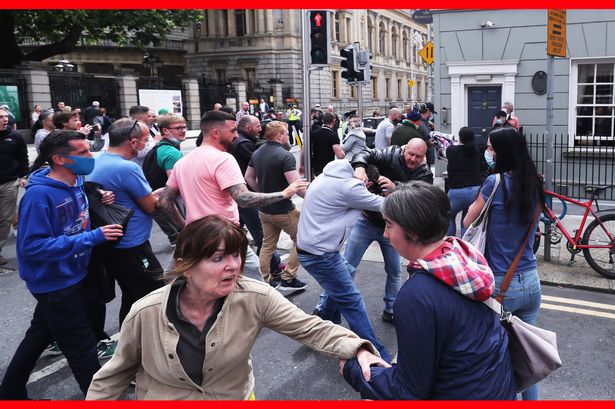
Supporters of the Far-Right rally give a practical demonstration of their belief in “free speech” as they attack the tiny number of counter-protesters. (Photo source: Internet)
I do not claim to have been hugely active against anti-Traveller racism but I have opposed pubs and shops with “No Travellers” notices and wrote against that discrimination during my brief sojourn at the University of Limerick. I don’t remember any right-wing people agreeing with me then – quite the contrary. When the IBRG took up a stance against anti-Traveller racism in Britain and supported the campaign for halting-sites, it was right-wing British (of the type of UKIP today and others – but more about later) and right-wing Irish who opposed us.
Among those at the Epsom Derby years ago to support Roma people being threatened with removal by police, I didn’t see any of the Right and most appeared to be more of the “Far-Left” (sic) – Anarchists, in fact.
I have never heard before yesterday of the Right, whether Far or more “moderate”, giving Travellers a platform to proclaim their cause. At one of the Connolly Festivals, I think it was two years ago, I and Paul O’Brien were glad to be a support act for John Connors at the New Theatre, as singers and musician (Paul) performing songs about (and by, in some cases) Travellers and against racism, before Connors gave his talk. Needless to say, no Far-Right there either.
Mention of singing reminds me that I have attended two festivals of Traveller culture where I also sang. I didn’t see any of the Far-Right there – all the non-Traveller people there were Republicans or Socialists, as far as I could see. John Connors sang a song there too. No great singer, as he has said himself, but far sweeter to listen to singing than to hear him speak at a rally organised by some of the most backward forces in Ireland.
I heard a recording of a little of John’s speech and at the beginning, he spoke against the refusal to two young women, who wanted to speak against sexual abuse, of speaking space by the organisers. Well they might! For these campaigners for “free speech” (another of the false flags of the Far-Right) try to stifle every voice with which they do not agree and, when they cannot stifle it, to smear it. And fair play to John for saying they should have been listened to. But who spoke from the platform after John Connors’ shameful appearance? Herman Kelly, former Assistant Editor of the Catholic Herald that for awhile defended the Catholic Church against accusations of sexual abuse, claimed they were “fake news” and helped to cover them up!
“Patriot” and ex-British Army Rowan Croft, rabid Loyalist and British fascist Jim Dowson and “Irish Patriot” Herman Kelly at a conference. (Photo source: Internet)
In institutions run by that organisation, the Catholic Church, there occurred the highest and most concentrated incidence of not only physical and emotional abuse but also specifically sexual abuse. And most of that sexual abuse was of minors, boys and girls – in other words, pedophilia.
When denunciations of that abuse began to surface, from where did the support of the survivors and demands for inquiry and restitution come? Not from the Right, who fought tooth and nail to defend the Church! No, it was from the Left and basic democratic people that call came and also support for the survivors. Oh but now that the defenders of pedophiles wish to attack us, they label us pedophiles! Like Herman Kelly, they can change their false flags when they wish.
One of those false flags is that of “patriotism”, strutting around under the Tricolour and the “Irish Republic” flag, ignorant and uncaring of the history of those specific flags and of those who fought under them. Herman Kelly is an “Irish Patriot”, he tells anyone who will listen, especially if they don’t remember that he managed publicity work for UKIP, the British Far-Right and full-of-fascists organisation run by Nigel Farrage. Kelly also shared a speaking platform with Jim Dowson, a rabid Ulster Loyalist and British fascist.
“Irish Patriot” Herman Kelly (left) with Nigel Farage, leader of British far-right party UKIP, for which Kelly worked as press officer. (Photo source: Internet)
As for the other “patriot” notables of the Far-Right, Gemma O’Doherty, John Waters, Ben Gilroy, Glen Miller, Justin Barrett, Rowan Croft and Niall McConnell, when have they campaigned to defend the Irish language? Or against the British Petroleum pipeline in Erris? No, that was Socialists and Republicans. Well then, for the unification of Ireland and expulsion of British imperialism? No, in fact some have openly colluded with Loyalists and another is a former British Army soldier, late of Afghanistan invasion. For the defence of our natural resources, against the privatisation of public services, often to foreign companies? Have we seen them defending Irish heritage sites against property speculators?
None of the above, these ‘patriots’. Ah, what a fine company John Connors has chosen to join!
Opportunist friendst: Ben Gilroy (left) and Herman Kelly (right) (but both on the Far-Right). (Photo source: Internet).
It would have been thought, coming from an ethnic group so badly treated, that John Connors would refuse to consort with racists, yet racism has been one of the main planks of the Far-Right. They spread the “Replacement Conspiracy” lie, that of “EU plans to replace Irish people with migrants”, which Herman Kelly is on video endorsing. They have campaigned against the admittance of migrants and asylum seekers. Gemma O’Doherty and Justin Barrett even objected to the election of the current Lord Mayor of Dublin on the basis that her parents come from China. Barrett said he would remove her citizenship if he got into power – to threaten that to a woman born in the Mater Hospital, raised and educated in Ireland goes even beyond racism and into straightforward nazism.
Of late, some of the Far-Right people, such as the regular speaker at the Stand Together rallies at the GPO during the height of the Covid19 pandemic (insisting the virus is all a hoax) have claimed to be anti-racists. Yet a number of their “peaceful” militants there strut up to their opponents demanding “Are you Irish?” and have been seen supporting Gemma O’Doherty rallies. One of these “peaceful” supporters recently attacked a Republican who was sitting down at the time before the aggressor was escorted by Gardaí (without arrest) back to his own lines. Some also tweeted that their rally on Sunday was attacked by opponents, while actually the truth is that the tiny band of counter-protesters were attacked by supporters of the rally, as can be seen from photos and videos of the event.
THE REAL TARGET
Now, to the nub of the matter, the real reason for that Far-Right rally (apart from recruiting fascists in secret): homophobia. Nothing less than fear and hatred of homosexuals under the guise of hatred of pedophiles. Pedophiles exist and I suppose can be of any sexuality, gay, heterosexual, bisexual and maybe transexual but somehow it is gay men that are mostly accused of it. I have no interest in supporting either Peter Thatchell or Roderic O’Gorman as politicians or political activists but that is not the reason they are being attacked. This is the background being used by the Far-Right: Over two decades ago, Thatchell wrote a letter to the Guardian in which he defended instances of sex between adults and minors in some societies, though he also said he did not advocate it. Thatchell is, among other issues, a prominent campaigner for rights of gay and lesbian women, chiefly active in Britain. Some years later he apologised for those remarks and repeated that pedophilia could not be condoned.
O’Gorman, who is a gay man, welcomed Thatchell to a Gay Pride march once and posed for a photograph with an arm around Thatchell.
That apparently makes O’Gorman a pedophile? No, in the eyes of the Far-Right, it makes him a useful target, for O’Gorman is a Minister in the new Coalition Government, and part of his portfolio is children. So now the Far-Right, who have not only consistently opposed equal rights for any of the LGBT community but even their decriminalisation, have the false flag of “defending our kids” to wave and to whip up a hysteria that has nothing to do with the real problem of pedophilia or the other real problems of our society.
They didn’t do much “defending our kids” from the Catholic Church, of course. Nor did the Loyalist friends of Kelly and others when the British were using Kincora House to entrap prominent Protestants, including politicians, for blackmail about the pedophilia there.
John Connors, dramatist and Traveller, speaking at the Far-Right rally outside Leinster House yesterday. (Source photo: Internet)
As a society, we have overcome a lot of misconception an prejudice about LBGT people but there is no reason for complacency. Dark forces continue to exist and to manipulate the opinions of the credulous whenever they can. Already they have raised the old slur of pedophilia against the LGBT community and also, a newer one, against all antifascists.
And LGBT people among Irish Travellers, who have suffered not only oppression in society at large but also within their own ethnic group, will find their lives now that much harder.
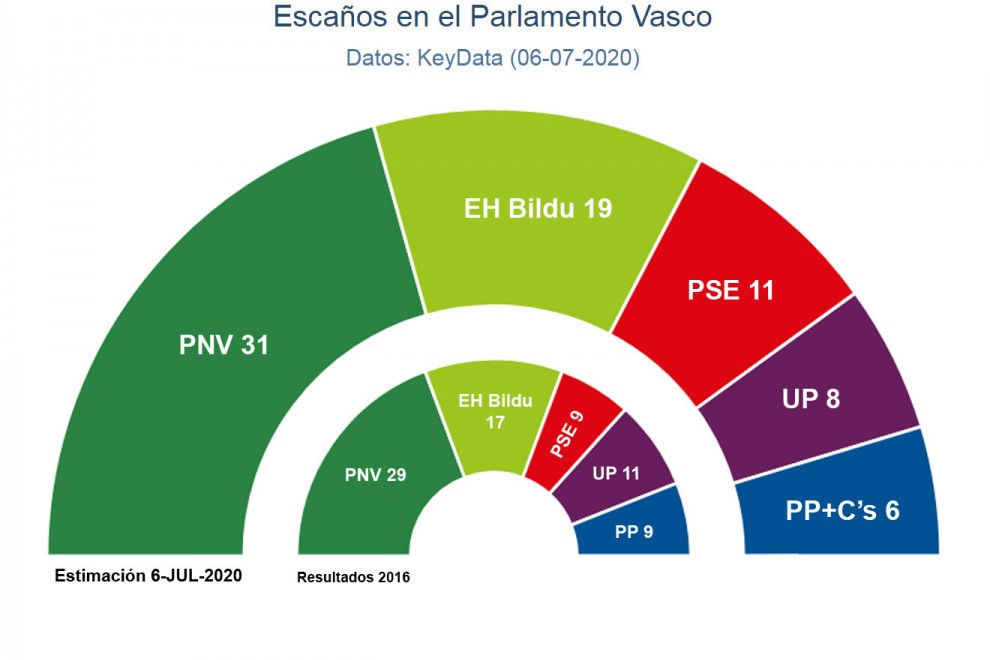
The results of opinion polls prior to the the elections for the government of Euskadi predict a majority for the Basque Nationalist Party. The predictions have EH Bildu, the party of the official Abertzale Left leadership, coming second with third place going to the social-democratic PSE, the Basque version of the PSOE, currently governing the Spanish State in coalition with Podemos Izquierda (whose Basque version will come a very poor fourth).
Maddalena Iriarte, EH Bildu’s candidate for Lehendakari (President) of the Euskadi regional government. (Photo source: Internet)
The elections on Sunday, although they usually described as for “the government of the Basque Country” are nothing of the sort. The are for the government of what is termed “the Basque Autonomous Region”, which covers only the Basque provinces of Bizkaia, Alava and Guipuzkoa – the fourth province within the Spanish state, Nafarroa (Navarra), has its own autonomous regional government. The remaining three provinces of Euskal Herria, the true Basque Country, are over the border in the territory controlled by the French State. And the Spanish State allows the Basque regions autonomy only to a point, as with all the “autonomous regions”, ultimately answerable to the Spanish State.
The PNV, Basque Nationalist Party, many of whose ancestors fought Franco in the Spanish Anti-Fascist War, have long accommodated themselves to this situation and given up the dream of Basque independence and the party has hardly any representation even in Nafarroa, to say nothing of the three northern provinces, across the Border. Since their fiefdom was granted autonomy after the death of Franco, they have dominated it electorally and used that domination to the commercial and financial advantage, both legal and illegal, of the Euskadi capitalist class (Irish readers will readily see a parallel with the Fianna Fáil party).
EH Bildu is the official party of the Abertzale Left, political descendants of the Herri Batasuna party, substantially changed and the main internal opposition to the PNV, at least on the electoral front. Herri Batasuna evolved as the political expression of ETA, the left-wing movement for Basque independance that in the 1960s developed an armed wing against the armed might of the Spanish State. Under the leadership of Arnaldo Otegi and others, ETA gave up armed struggle in 2012 and the EH Bildu and Sortu parties developed a theory of a “Basque Peace Process” which had no substance, since the Spanish State’s only interest was in surrender and never even ceased repression or released its around 900 Basque political prisoners (now around 700 as prisoners served their sentences – or died).
Prediction electoral distribution of seats in Euskadi elections 2020 based on opinion polls. (Image sourced: Publico.es)
Batasuna and its iterations over the years in the face of bannings by the Spanish State have at many times sought alliance on a nationalist basis with the PNV (the Irish parallel holds here again, as with periodic overtures of the leadership of the Provisional Sinn Féin party to the Fianna Fáil party), which on the whole have been rejected by the leadership of the PNV. The Basque Nationalist Party has preferred to rule in coalition with the PSE and even to allow the Spanish-unionist party to rule Euskadi on its own. Therefore the call from some Basque nationalist quarters for a PNV-EH Bildu coalition is very unlikely to bear fruit.
At least as unlikely is the raising by the electronic media Publico of the possibility in Euskadi of a “Government of the Left”, on the basis of the poll results. The left-wing Publico itself conceded it an unlikely eventuality, based on a coalition of EH Bildu/ PSE/ Unidas Podemos (the Basque version of Podemos Izquierda). Whatever one may say of the “Left” credentials of EH Bildu and of Unidas Podemos, one can hardly credit the PSOE or its Basque version with any. No doubt there are genuine people of the Left in that social-democratic party, as there are within the Irish and British Labour Parties too – but that does not affect the character of the parties in government, which have always been servants of capitalism and, in the cases of the UK and Spanish state, of their imperialist ruling classes.
On the poll results therefore it is certain that the PNV will be in government, whether in coalition with the PSE or with its tactical support. EH Bildu looks no nearer to achieving its dream of governing even Euskadi, not to mention all four southern provinces of the Basque Country.
MEANWHILE, ON THE STREETS
The Amnistia movement meanwhile has shown little interest in the elections, apart from chiding EH Bildu for its focus on elections and neglect of resistance anywhere else, including the jails. The Basque struggles for independence and against repression have paid a price in huge numbers of political prisoners and, though down to around 700 now from its height of 900, the Basque nation probably has the highest percentage of political prisoners of anywhere in the world. After all, the total population of the Basque Country is under 1.5 million and such a high concentration of political prisoners means that there is hardly a Basque who does not know a relation or friend of a prisoner, if not indeed the prisoner him or herself.
When Arnaldo Otegi and others led the majority of the Abertzale Left to the institutional road, they kept referring to the Good Friday Agreement in Ireland and the release of political prisoners. However, the Provisionals ensured that the release of political prisoners of their allegiance was delivered before finally decommissioning their weapons. The Otegi initiative went in reverse and their prisoners are still in jail. For some years now the leadership has been telling the prisoners that basically they are on their own and must negotiate with the prison authorities their reduction from Grade 1 down to Grades 2 and 3 and eventual release on parole. And telling the families that they have no hope of an amnesty so to stop asking for it and instead demand an end to the dispersal of political prisoners all over the jails of the Spanish (and French states), hundreds of kilometres from their families. There is no sign of even that basic human right being granted.
One of the Basque political prisoners, Patxi Ruiz, publicly denounced the new path of the movement and, after attempts to silence him were unsuccessful, he was expelled from the Basque Political Prisoners’ Collective. His treatment caused another four to break with the Otegi leadership too. Amnistia supported them and criticised the leadership of the movement which, in turn, accused them of using the prisoners for their own ends, since they did not agree with the new direction.
Persecution by the prison authorities including beatings by guards and refusal to allow him to attend his father’s funeral drove Ruiz last month to a hunger-and-thirst strike. After 8 days he abandoned the thirst strike but continued refusing food, ceasing that protest too after 31 days. His support movement led by Movement for Amnesty and Against Repression (to give Amnestia’s full title in English) brought Basque political prisoner solidarity back on to the streets, from which it had largely disappeared apart from the ritual demonstration each January and weekly pickets by families and friends, diminishing in attendance.
Solidarity actions were taken in the jails too, not only by the other four “dissidents” but by some of those still in the Collective and by a number of political prisoners from other struggles, GRAPO and PCE(r).
In a number of statements, Amnistia acknowledged that some of their support in street actions has come from progressive sectors not traditionally from within their own ranks. There is a substantial autonomous movement in the Basque country consisting of youth occupations of empty buildings, anarchists, feminists, LGBT campaigners, animal rights campaigners, environmental activists …..
On Saturday 4th July, in spite of a ban by the Spanish State’s Delegation in the city and a heavy police presence at an expected starting location, Amnistia led a fairly large demonstration through streets of Irunea/ Pamplona, capital city of Nafarroa, calling for complete amnesty for the prisoners and that “the struggle does not cease”.
Today, the 11th, they led a march to the Murcia jail (where Patxi Ruiz is held currently). In a brief report on the event and their reasons for undertaking it, they commented even more briefly on the elections due tomorrow:
“There will be elections tomorrow in a part of Euskal Herria (the Basque Country) but none of the political parties will propose any alternative to bring to an end the capitalism that tramples on and murders the working class or to destroy the imperialism that occupies peoples and makes them disappear but will instead debate different ways to manage the same system and the same misery.
“None of them will demand amnesty for those who endure repression for fighting for these goals. The strength and pressure exerted by the people on the street will be the key to reversing the situation. With the popular struggle amnesty, independence and socialism.”
End.
Amnistia picket on Murcia Jail in solidarity with Basque political prisoners. (Image source: Amnistia Garassi FB page).
After repeated claims from from a woman speaking through a loudhailer that their right-wing rally at the GPO was “peaceful” and would “not respond to your violence” (this addressed to their peaceful opponents on the other side of the road!), right-wingers crossed the road a number of times to insult and threaten their opponents, eventually assaulting one well-known Republican who defended himself vigorously. Gardaí separated assailant and victim but declined to take any action against the fascist.
BACKGROUND, BUILD-UP AND ATTACK
The above took place on Saturday 4th July. Earlier, at 1pm, the Ireland Palestine Solidarity Campaign had hosted at the Spire a very well-attended rally in solidarity with Palestine and against the recently-announced plans of Israel to annex the Palestinian West Bank.
Section of Palestine solidarity rally (Photo: D.Breatnach)View of crowd supporting Palestine southward (Photo: D.Breatnach)View of the Palestine supporters northwards towards the Spire (Photo: D.Breatnach)
Many of the Palestine supporters were still on the pedestrian reservation when the far-Rightists arrived to set up their weekly protest against social distancing, with claims that Covid19 is not real (or, a variation, that it is exaggerated) and that the restrictions are being used to bring in a “New World Order”.
As the Far-Right were setting up, two members of the Special Detective Unit (in the past called the “Special Branch” as they remain known by many, along with less kind names) were seen chatting to them. These political Gardaí in plainclothes were easily identified since some who had attended the earlier demonstration at the Lithuanian Embassy against the threatened extradition of Liam Campbell (see separate report by Clive Sulish on Rebel Breeze) had seen them there, standing near the uniformed Gardaí, watching the protesters. The nature of the conversation of these undercover political police with the Far-Rightists is not known but appeared cordial and certainly they were not asking them for their names and addresses as they had done recently to people protesting in solidarity with political prisoners.
Soon jeers and cat-calls were crossing the street in each direction. The Right-wingers had a loudspeaker advantage for awhile but then one appeared among their opponents too. Even before that, the speaker for the Far-Rightists was accusing their opponents, not one of whom had crossed the road towards them, of being “violent” and claiming that the Rightists were peaceful and were “not going to respond to the violence” of the other side.
It was not long however before some of the Far-Right militants were crossing the road to throw insults and threats at their opponents at closer quarters who of course responded verbally. Gardaí then arrived and gently asked the Far-Rightists to return to the GPO side and one of the Rightists, pointing at the their opponents, who were still on the pedestrian reservation, actually demanded of the cops “Why don’t youse tell them to go back?”
GPO distance: Early arrivals of the Far-Right group portraying themselves as “patriots” (Photo: D.Breatnach)
This went on a number of times with the Gardaí intervening less and less. At one point I had one unmasked ginger-haired thug a few inches from my face photographing me, repeatedly calling me a “scumbag” and a “terrorist” (interesting) but when he told me I was destroying his country (!) I couldn’t resist asking “How am I destroying the country?” He declined to reply to my repeated question, moving on to express his aggression to someone else.
At this point I had become distracted by one of their supporters who was trying to have a conversation with me. I obliged and it was quite revealing on the disparate nature of many of the elements in these right-wing rallies. She told me that she was not racist and was bisexual and not right-wing and her friend (also present) was half-German, so why were we calling them racists and fascists? I was engaging her on some of the things that have been said by some of the group she was with and pointing out some individuals I had seen in support of Gemma Doherty, explaining to her that if she attends rallies of those people, she is going to be subjected to calls against fascists and racists.
Shortly I became aware of a disturbance behind me which, on turning I could see was a fight that was moving towards the east side of O’Connell St. (southbound traffic) where both ended up fighting fiercely on the ground. Before I could see who they were, five or six Gardaí then intervened and separated them, at which point I could identify both combatants: one was a Republican whom I had seen a little earlier sitting on the base of the flagpole in the middle of the pedestrian reservation (apparently where he was when attacked) and his assailant was the very one who had earlier been venting aggression at me and trying to provoke me into physical retaliation.
Once they had separated them the Gardaí were treating this matter as one of equal blame on both sides and saying things like “Don’t be silly now” whereas it was clearly the case that a fascist had crossed the road with aggressive intent and had then taken that further into physical aggression.
Later, when I remonstrated with some of the Gardaí that if we had crossed the road and behaved in that way, they would have at least pulled us out, “Go over there if you want,” said one of them, “I can’t stop you.” I pointed out to him that an antifascist who had approached Gemma Doherty supporters at the Dept. of Justice some months earlier had been threatened by a Garda Sergeant with arrest under the Public Order Act. (On that occasion too, the Gardaí had allowed the Far-Rightists to walk among the counter-protesters).
It seems from recent cases that the line the Gardaí are following is that if it looks like being a serious all-out fight they will police it hard and keep the two sides apart but, if smaller scattered fights break out they will break them up without arrests, especially if Republicans are being attacked and possibly, in future, use these occasions to arrest antifascists who defend themselves or respond to provocation.
It is historically true that police forces in capitalist states favour fascist movements, a fact seen throughout Europe. In London, in the Battle of Cable Street in 1936, fought to prevent a march of the fascist “Blackshirts” through a largely Jewish East End, the main confrontation was between the antifascists on the barricades and the escort for the 2,000-3,000 fascists: 7,000 Metropolitan Police, along with the whole of the London mounted police force.
“WE ARE NOT RACISTS AND WE ARE FOR THE PALESTINIANS”
The above was one of the claims of the speaker of the Far-Rightists, made repeatedly. This is a new development in their rhetoric and they claimed to have some Polish and also a Palestinian among their number. This last at least appeared to be true and a big man of Middle-Eastern appearance was among them and was seen later chatting to some Gardaí. A man I know informed me that this man is a Palestinian but a member of the Muslim Brotherhood (right-wing Islamic fundamentalist group).
Gemma Doherty has posted much racist material (and outright lies), as has Justin Barrett of the National Party, both of them objecting to the election of Councillor Hazel Chu as Lord Mayor, Barrett going so far as to say that he would remove Ms.Chu’s nationality if he were in power, even though she was born in the Mater Hospital and raised and educated in Dublin.
The Far-Right, which is a mixed bag in any case, were happy to use O’Doherty’s notoriety to push their movement further but perhaps they are finding her a bit of a liability now and are remodeling themselves as some kind of inclusive alternative movement for civil freedoms etc. They are still promoting their opposition to the idea of legislation against “hate speech” discussed by the previous Government and demanding their right to “free speech”. This actually does hearken back to O’Doherty’s campaign against Google, who closed down her Youtube channels because of alleged racist abuse.
If they are going to drop the racist rhetoric and claim multi-culturalism, presumably they will have to abandon the “Replacement” conspiracy theory, whereby the EU allegedly has a plan to replace all the Irish with migrants! However the challenge with which their militants first approached their opponents on Sunday of “Are you Irish?”, just as they did at the O’Doherty rallies, hardly exudes multi-culturalism.
The other elements of Far-Right rhetoric and propaganda remain, however: that they are “Patriots” (sic – hence the strutting around with the Tricolour and “Irish Republic” flags); they are Christians (“walking in the steps of God” according to their speaker that day); that their opponents areall in an organisation called “Antifa” and funded by the millionaire Soros (also according to their speaker); and that governments are assisting in a coming to power of a “New World Order”.
CANNOT BE TOLERATED
It is not acceptable that Republicans or any kind of antifascist can be attacked on our streets and it must not be tolerated. Apart from anything else fascists will use incidents like that to promote themselves as some kind of “warriors” to build up their fascist thug forces while at the same time part of their movement will be playing the victim and proclaiming their “peacefulness”, as was amply demonstrated today. This is exactly the dual road of the advance of fascism historically.
The drop-down poster displays their paranoid vista. The woman to the right was their speaker, proclaiming their “peaceful demonstration” a little before participants in their rally crossed the road to insult, provoke, threaten and ultimately assault a Republican. (Photo: D.Breatnach)
There is something wrong with our organisation in the broad sense too, it seems to me, if our opponents, at least some of whom wish us harm, can walk among our ranks with impunity. In some places today they were blocked and one youth was even pursued until he returned to his group but in many places they just walked in and it was one of those who assaulted the Republican today.
On another issue, as I have pointed out in the past, these confrontations may tend to have the Far-Right appear as patriotic to onlookers, since it is they who are waving the Tricolour and “Irish Republic” flags and some wearing green tops too. For the sake of educating the public, the antifascists need to fly their flags too, whether these be tricolours as well and/or Starry Ploughs, Red, Red-and-Black or Black flags, including those with the Antifascist symbol, or that of the LGBT movement or indeed others. Placards countering the fascist and racist propaganda and exposing fake patriotism should also be visible.
The most crucial thing is that the Far-Right movement with its fascist core be not permitted to appear a viable option for the Irish ruling class to choose. We have had some successes, for example in preventing Pegida launching in Dublin in 2016 and some confrontations with the Far-Right – but it is clear that there remains a deal of work to be done.
Dublin has a Lord Mayor of Chinese descent. According to some, this is some kind of disaster. Apparently to them, she is a migrant (though born, bred and educated in Ireland) and even an advance scout for a takeover by Chinese Communists (because, of course, all Chinese are communists, even those from Hong Kong – but wait, didn’t Gemma O’Doherty also tweet approvingly that some Chinese Hong Kong businessman wants to have the Communist Party of China declared a terrorist organisation?).
Hazel Chu. wearing chain of mayoral office, poses for photo with her daughter and husband. (Photo source: Internet)
Speaking after her election (on 43 votes against the nine for the other candidate, according to RTÉ), Ms Chu said she wanted the Dublin Agreement parties who had backed her election) to tackle the housing and homeless crisis which has seemed like “filling a hole in a sinking ship”.
Her other priorities are making Dublin a liveable city, fighting discrimination and protecting the vulnerable. In her speech, she said she wondered if her mother – who had worked washing dishes in a restaurant off O’Connell Street – dreamed that her daughter would one day become Lord Mayor.
Since being elected a public representative on to Dublin City Council in 2019, on the highest first-preference count of any Irish local authority councillor (perhaps Pembroke constituency is a Chinese Communist base?), also receiving the highest percentage vote of any first-time candidate, Hazel Chu has reportedly been subject to racist harassment, vilification and even threats, both on social media and by telephone calls to her home. Not because of her views or her political party – purely because her parents are Chinese who met and settled in Dublin in the 1970s.
When Hazel Chu was nominated for the position and before her election, racist and right-wing conspiracy theorist Gemma O’Doherty recorded herself on video attacking her and claiming that Chu is a supporter of pedophilia (because she allegedly supported the closure by Google of O’Doherty’s Youtube channels) and in Gemma-World apparently a Chairperson of the Green Party can also be “a hard-core Communist”.
After Chu’s election, O’Doherty tweeted, above a highly dubious “news” item claiming that a property developer plans to build a new city in Ireland for Hong Kong refugees (!): It’s fitting Dublin now has a Chinese Mayor when millions more are to be planted in our home in the coming years. You wanted Communism. You’ve got it. Don’t say we didn’t warn you! But the Reds know it will only make the patriot movement grow and grow.
O’Doherty has become notorious not only for her anti-immigrant rhetoric but also for claiming that the the whole Covid19 pandemic was fake and part of a plan to put in place a New World Order (apparently the existing Order is not bad enough) and that the EU has a plan to replace Irish people with migrants. One of her heroes is Donald Trump and her opponents she claims are all “Reds” who are “funded by Soros”, as is the Black Lives Matter movement, “Antifa” etc. Along with the Right in the USA she defends the statues of racists and conquistadors (even though the latter were armed immigrants and definitely dangerous to the locals!).
Hazel Chu studied and qualified as a barrister in Ireland. (Photo source: Internet)
Justin Barrett, founder of the National Party (sic) and former member of far-Right organisation Youth Defence has said that if he were to get into power he would strip Hazel Chu of her citizenship. It is hardly surprising to see a proposal straight out of Nazi Germany coming from this former campaigner against divorce and abortion and for a “Catholic Ireland” that would ban muslims from entering the country because apparently muslims are a serious threat to our lives and Irish liberty (Henry VIII, Elizabeth I, Oliver Cromwell, William of Orange, Lord Castlereagh, King George III and Lloyd George must’ve all been muslims!). Barrett is on record as being an admirer of the anti-semitic Fr. Denis Fahey and writer Hilaire Beloc (a French immigrant to Britain!).
Dublin City Hall, seen looking eastward. (Photo source: Wikipedia)
BEYOND THE CRAZY PARANOIA – FASCISM
Beyond the craziness, the paranoia and ludicrous theories of conspiracy (as distinct from the real conspiracies in the world), what we have here is virulent racism and lurking in among those sad and mad people and raving racists …. are the handful of organised fascists. Those who dare not at the moment come out and declare their wish to have a corporate state in Ireland, one to outlaw oppositional organisations and demonstrations and suppress the resistance of the working class. A REAL conspiracy. A kind of State that becomes increasingly attractive to the capitalist ruling class as it finds itself in difficulty to keep up its profit levels and feels it needs to squeeze the working people harder. A REAL possibility.
Which is why we need to take these matters seriously. Such organisations as Anti-Corruption Ireland (sic), Yellow Vests Ireland and the National Party are the means by which the fascists mobilise a stream in which they can swim – and collect others to swim with them.
They must not be given an inch.
That the ruling Gombeen class would turn to them if they looked like a viable option is entirely possible if viewed historically. The State was set up by that ruling class in a vicious Civil War in which it not only repressed its opposition and the population but executed 80 Republicans with barely a court martial, shot prisoners and exploded them on landmines, kidnapped and murdered activists.
A large part of the opposition to that State at the time became coopted by the ruling class and that process has come into full development with the current Fianna Fáil/ Fine Gael coalition Government. And we can already see the straws in the wind in the behavior of the Gardaí, who appear in and out of uniform to harass peaceful Republican pickets and Debenham’s worker picketers while on the other hand, weekly demonstrations of the far-Right, violating in every way pandemic precautions, remain untouched by those same Gardaí.
The far-Right in Ireland have been trying for some time to present themselves as “patriots”, flying the Irish Tricolour, playing the Soldiers’ Song, etc. They do not have a history of promoting the Irish language or fighting for the rights of Irish speakers, nor of campaigning against English colonialism in the Six Counties, nor for Reunification of the country. Nor have they a track record of even defending areas of historical importance from rapacious Gombeen and foreign property speculators. They were not active in the struggle against British Petroleum in the Erris area nor in preventing the selloff of Irish forestry. So what actually is this “patriotism” of theirs? Nothing. Nothing but racism.
It is not even enough apparently for these racists that a person be born in Ireland – they have to be “ethnically Irish”. Would that be like the Pearse brothers, shot by British firing squads, whose father was English? Like Constance Markievicz, founder of the Na Fianna and officer in the 1916 Rising, one of the Gore-Booth planter family? Like Thomas Davis, Young Irelander author of A Nation Once Again and other songs, whose father was Welsh? Like Theobald Wolfe Tone, founder of the United Irishmen, a descendant of planters? Like Erskine Childers, fourth President of Ireland and son of an Englishman who died for Ireland, executed by this very State?
And while we are about discussing things “ethnically Irish”, should these “patriots” not return that flag they keep waving, the Tricolour, to the descendants of the Parisian revolutionary women who first presented it to Thomas Meagher in 1848?
end.
Coat of Arms of Lord Mayorality of Dublin. (Photo source: Internet)