Gárdaí ‘can’t’ enforce social distancing on visitors from the Six Counties…!
Diarmuid Breatnach
(Reading time text: 5 minutes)
Irish Republicans looking at the sub-headline could be forgiven for bursting into laughter, for the Gárdaí, in particular the Special Branch, the political police, have never had any reluctance in harassing, arresting and even refusing bail to Republicans from the Six Counties.
And likewise with their counterparts on the other side of the British Border, who have never had much problem enforcing and even exceeding their laws with regard to Republicans from the Twenty-Six counties.
However, according to a news report in today’s breakingnews.ie, day-trippers from the Six Counties are flooding into the picturesque coastal areas of County Donegal and ignoring Coronavirus-19 legislation. The report says that the day-trippers are from “Northern Ireland” which is nonsense of course, since Donegal is the real Northern Ireland, i.e the northernmost geographical point of the country. And it is in Ulster too, though not under British occupation.
Anyway, back to the main issue in the report, which is that Donegal residents have been complaining that the Gardaí there are not enforcing social distancing on day-trippers from across the Border.
Garda Checkpoint Donegal (Photo source: Internet)
It appears that the Gárdaí were applying the Coronavirus-19 restrictions but were told that they could not. Why would this be? The laws against theft, assault and public disorder apply not only to residents in Ireland but also to visitors – why would laws intended to control a pandemic be any different? Indeed, one would think they’d be, if anything, more enforceable.
Meanwhile, “a Gárda statement” quoted in the report states that “anyone visiting the State even temporarily is amenable to such criminal laws of this State while visiting here.”
So it’s the law, applies to everyone including visitors, so … what’s the problem?
There is a saying that states that “where there’s a will, there’s a way” and it is difficult to see an explanation in this case other than that for some reason there is no political will to enforce the law on visitors from the Six Counties. Of course, if they were Republicans attending some Republican event, well in that case ……
“THE VIRUS DOESN’T RESPECT THE BORDER”
According to a number of Donegal public representatives, local people have been bombarding them with complaints about the incursions and the lack of Gárda action. Councillor Jack Murray, from the Inishowen area, saying he had been “inundated” with complaints about Gárda failure to apply the legislation to people from the Six Counties, said that “the virus does not respect the Border and tackling it should recognise that.” Pádraig Mac Lochlainn, a TD (member of the Irish Parliament, the Dáil) for Donegal, lives in Buncrana, a popular destination in the holiday season. “This error is unacceptable,” he said, “considering that all government legislation goes through the Attorney General’s office.”
Clearly, a rational response to the pandemic would require either an Ireland-wide approach or a strict closing of the Border between the two administrations. The authorities on each side have done neither.
At the end of February, the first person recorded positive for the virus arrived in Dublin from Italy aboard an Aer Lingus plane and was permitted to travel on to Belfast – she is/was a resident of the Six Counties. No quarantine was ordered for the rest of the passengers. And so on.
Ineptitude of Governments apart, it has never made sense to partition Ireland on economic, geographical or human rights grounds. Now we see that it doesn’t make sense on grounds of pandemic control either. How does it make sense? Well, on the wish of the rulers of Britain to keep a foothold in Ireland and of their loyal subjects in the Six Counties to remain in domination of that foothold.
Cartoon DB
GENERAL PROBLEMS WITH 2Km LIMITS
To be honest, I have never seen the point of the 2km limit. Is it the case that you can infect or be infected by someone outside the 2km limit but not inside? Of course that does not make sense but how does this limit make any sense otherwise?
I don’t drive a car but if I did and were to get in my car in my garage, drive out to a secluded spot on the mountains, get out and walk, then return to my car and drive home, how would I have endangered myself or anyone else? If I went to a park or beach outside the 2km limit from my home and, while there, kept my distance from other walkers, how would I be endangering anyone?
The danger in general, we are told, comes from physical contact with people or being within two metres of them, when droplets from an infected person may reach us. Would that danger be reduced if everyone were obliged to wear a face-mask of any kind? Clearly. Yet not only are we not obliged to wear such masks in public but we are being actuallydiscouraged from doing so by statements from the HSE (and also from the WHO). Would the danger be reduced if, in addition to wearing masks, we wore gloves in public and had a safe procedure for removing them at home? Obviously – yet we are not being informed, never mind encouraged, in this regard either.
We hear talk from time to time about essential frontline workers, a discussion the origins of which can be traced to the call on the Government to shut down all non-essential work. That of course raised the issue of what is essential work and therefore, who are the essential workers. High among the category considered essential were health practitioners and their rate of infection, when statistics were published, was exceeding 25%. But there is another group of workers who are essential and vulnerable and although most members of the public are in contact with them on a weekly basis at least, nevertheless they are given little protection and rarely mentioned.
Essential workers include, apart from healthcare workers, those maintaining our supplies of clean water, electricity and gas, sanitation, agriculture, production of necessary equipment, public transport, transport of essential supplies, fire-fighting, telecommunication (but not commercial call centres), postal services …. All of these should be in the first rank of consideration for protection from the Coronavirus-19, because they are vulnerable and for the selfish reason that we need them. But much more exposed on a daily basis to a greater number of people are the shop and supermarket workers.
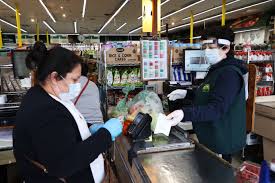
Customer and staff both wearing mask and gloves in a foreign supermarket (Photo source: Internet)
They are the most numerous of the essential workers in daily contact with the public, which puts them at risk and, if they become infected, puts the general public, the shopping customers at risk too. And yet, their levels of protection organised by their employers are very poor overall. Despite this, we rarely hear them mentioned in public discourse, they do not receive particular attention from the Left and even their own trade unions are inactive on the issue.
WHAT SHOULD HAVE BEEN DONE
Let us take a moment to consider what should have been the measures put in place for these workers and for the public coming into contact with them:
Immediate training program in prevention for all staff, with regular refresher or reinforcement measures
Immediate supply of protective clothing, disposed/ washed after each break and shift, this to include face-mask and gloves
Hand-sanitiser at every work station
Wrap-around screens at all checkout points
Disinfection routines for all work stations at shift changes
No shelf-filling during hours open to the public or non-essential interaction between public and staff inside of six feet distance
Staff in necessary close proximity to members of the public, including security staff, to be given special protection in clothing and in shift arrangements and testing
Safe social distances enforced by restrictions on numbers of customers in store at one time
Safe social distances marked for queues and enforced
Regular disinfection of automatic checkout machines
Supply of hand-sanitiser at all entrances/ exits and checkout machines for the public
Prevention informational visual and audio prompts for public and staff
All companies obliged by Government to publish their protocols so as to educate staff and public and also give a point of correction if either feel that the protocols are not being adhered to.
Some readers may protest that management had no previous experience of a pandemic, that some of these measures were implemented but a delay was inevitable and some measures are too extreme. I would respond that any group of reasonably intelligent people, knowing the danger and typical transmission routes, sitting down to think of precautions, would come up with a similar list. Companies are supposed to carry out risk assessments of their procedures. Trade union officials and representatives would be trained in how to assess levels of risk and how to employ measures to eliminate or reduce the level of risk as much as practicable.
Should anyone consider any of those measures excessive, they should be able to point out which and to say why. Or likewise justify the claim that late implementation was unavoidable.
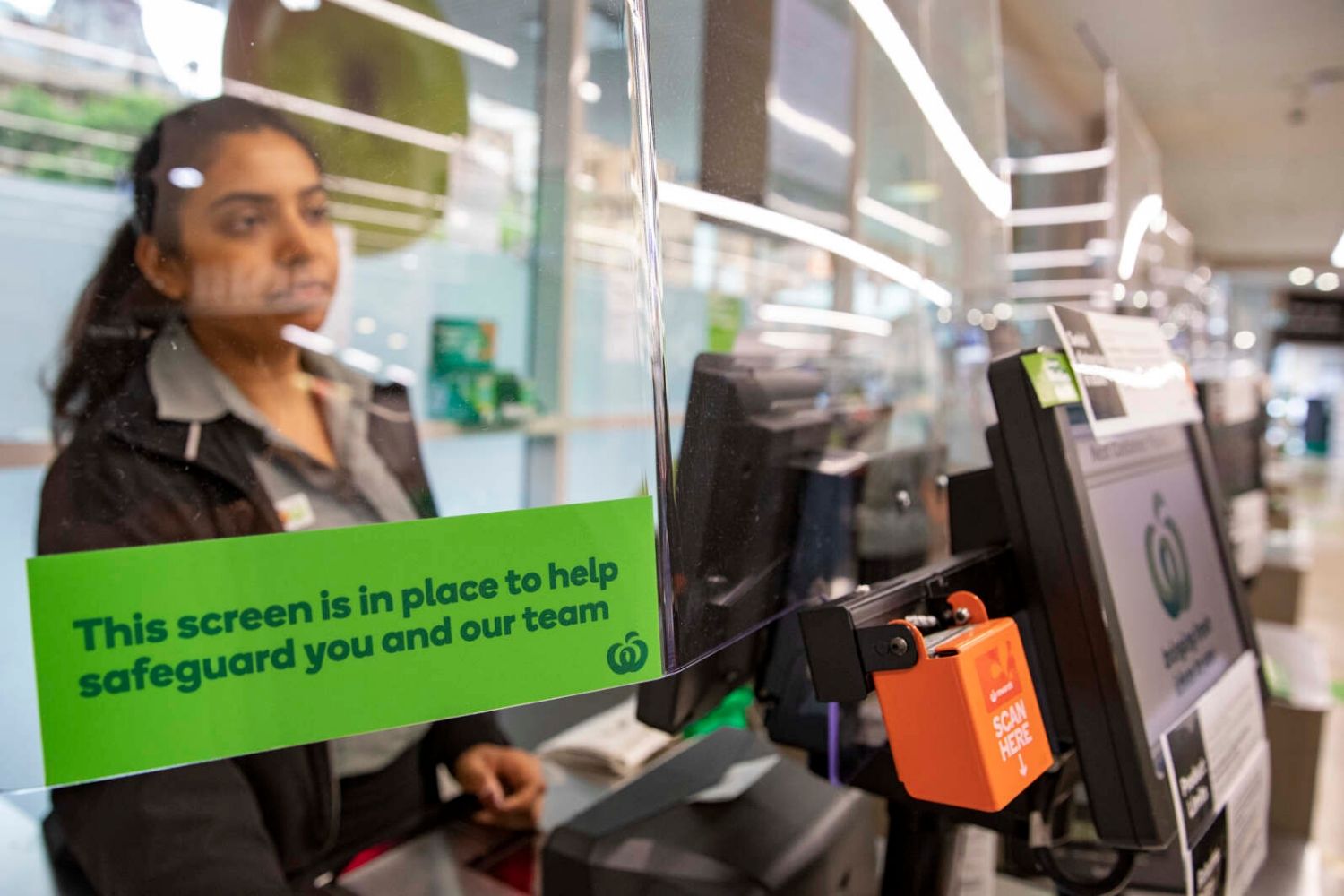
Notice on screen in one shopping chain. (Photo source: Internet)
WHAT WAS DONE
Let us now take a moment to review which of those measure have been implemented, how and when.
I am not in a position to give a definite answer on whether staff were given intensive training in avoiding infection or not but from my observation while shopping of staff in a number of supermarkets I would feel confident in saying that they had not or, if they had, that the required practice was not being monitored by management.
Even to the day of writing this piece, in only one workplace, Eurospar in Fairview, have I seen all the staff wearing face masks. Workers in a number of other companies have told me that they are not supplied with them.
Hand-sanitiser was supplied to work-stations in some supermarkets (possibly all) but weeks after the pandemic hit Ireland (though it had been raging abroad for many weeks before that and covered in news reports).
No screens were in place at work-stations until weeks after the arrival of the virus and even now are rudimentary in many places. Single screens with spaces between permit staff and customers to position themselves in the open spaces, which I have seen both do at times. A number of cashier screens with an open section for customers to receive and load their checked-out purchases are well inside six feet of the staff member.
Whether there are any such shift-change disinfection routines at any supermarket I cannot say but in some supermarkets I have seen staff leave or take up work at a station without any evidence of its disinfection.
I have seen frequent shelf-filling during-open-to the-public hours in Dunnes, Tesco, Centra and Aldi (I have not been in a Lidl since the virus arrived) and even without gloves; also unprotected staff moving among customers on other pieces of work, including stacking and removing empty baskets. Even this evening in a Tesco outlet, although at least they were wearing orange (?) gloves, staff were attending to shelves (and without face-masks, as was the staff member stationed near the automatic machines).
In addition to the above, staff maintaining queue lines, including security staff: every single one without masks and all being passed by customers at distances inside of six feet. The most shocking case was of a security guard in Tesco Drumcondra being passed by customers at distances of between one and three feet – he had no mask and only his company uniform, which he probably takes home to his family and puts on again next day. As to testing, given the long waiting times reported for testing and even longer for results, along with the general level of care for employees shown by the companies, how likely is any are being regularly tested?
Yes but in at least one case, I saw that the security guard on the door monitoring numbers was absent for awhile. Of course, there are calls of nature but shouldn’t the protocols require the temporary replacement of the person at this post? Would we wish to be the ones who were infected because this probability had not been foreseen and provided for?
The safe social distances for queueing customers – but not among staff — are now being enforced in most supermarkets, weeks after the arrival of the virus (but I noticed today that the separation is actually less than the advertised two metres).
I have very rarely seen disinfection of automatic machines.
In a local Centra, the first I saw to erect perspex screens, there was a sanitiser dispenser at the entrance with instructions. On at least one occasion it was empty and I have seen customers pass it without using it or having it called to their attention. I saw none in any other chain supermarket, although in Aldi a spray was provided by the baskets with instructions to use it on the basket handles.
Prevention information posters may be seen but usually of the most generalised kind (like those from the HSE) and asking forstaff to be treated with patience; graphic posters very rarely, film and audio prompts never. In other words, the means supermarkets use when they really want something, like mood enhancement, customers aware of bargains or special promotions, urgent attention to a checkpoint machine or stores about to close – are precisely those that they are not using for promotion of infection prevention.
The Government has not obliged companies to publish their protocols (not even suggested that they should do so) and the companies have not done so themselves.
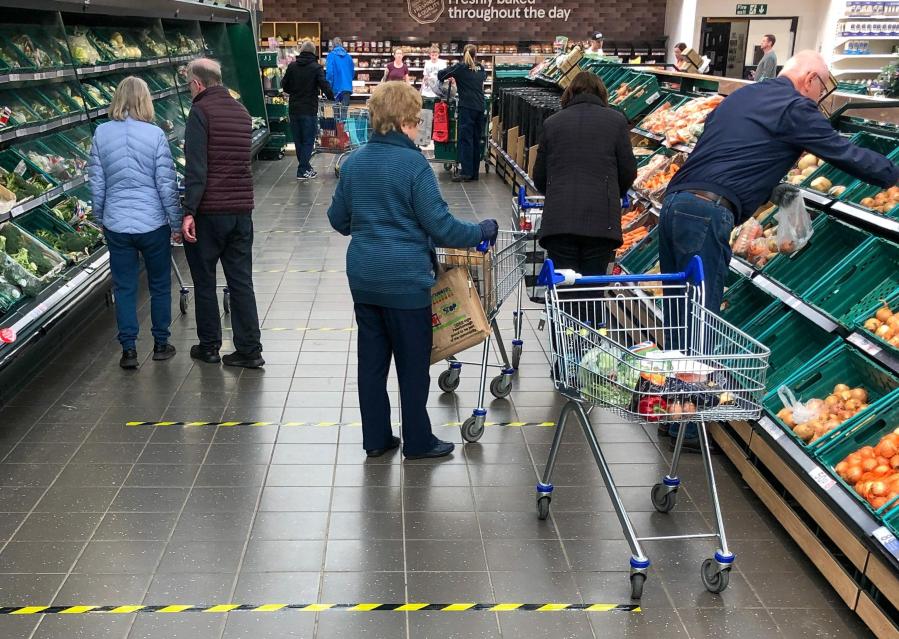
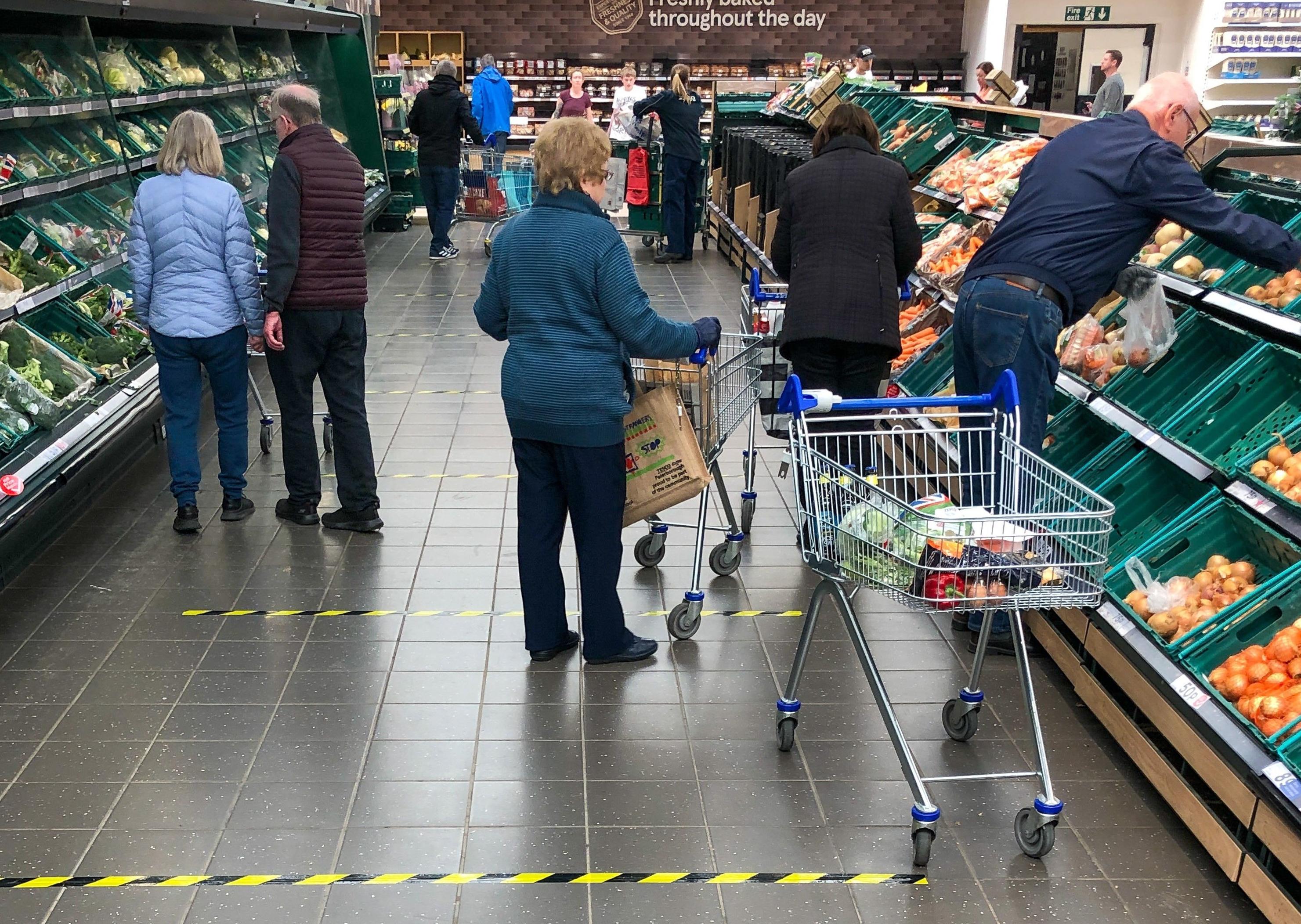
Customers in a supermarket (none seem to be taking any precautions other than perhaps social distancing. (Photo source: Internet)
CONCLUSION
This is a serious lack of care provision for a large section of essential workers and with a potential collateral effect on most of the public. First in line of responsibility for this failure must beof course the companies but their main motive has always been profit. Next in line must be the Government, which has the power to implement emergency measures (and used it recently with giving extra power to Gardaí an courts to employ against individuals) but our governments have always been primarily in the service of capital. Who do I personally blame most for this area of neglect? Those whose very publicised reason for existence is the protection of workers and the promotion of a just society – the trade unions and the Left.
Among the statistics that are published on rates of testing positive and deaths attributed to the virus, there are breakdowns into age and gender groups and, at least in the earlier days, of healthcare workers. We never see, among those statistics, any for shop workers. Or for those who might in turn have been infected by them. The largest statistic given for route of infection is that of “social contact” and presumably that’s where they are, hidden. We remain uninformed and the low level of protection continues, with no real effort being made to change the situation.
End.
PS: Readers may wonder at the absence of information directly from the workers themselves. The reason is that personally I am unaware of anyone in my acquaintance working in this sector and did not wish to cause the workers more stress than they have to deal with already.
ADDITIONAL INFORMATION:
For focus on steps trade unions and the Left failed to take, see article titled WHAT DID NOT HAPPEN in Rebel Breeze.
To wear a face-mask or not? This article seeks to clarify some of the issues of conflicting advice around the advisability or otherwise of people who are not healthcare frontline staff wearing face-masks.
There has been some discussion around this on social media and in my sphere some of it particularly tense and even illogical. I have observed at a number of times throughout my life that the reaction of some people to a stressful situation is to create more stress around it – as human behaviour one assumes it must have a function, though I find it difficult to see what it might be. However, the question, with possible repercussions to general safety from the Coronavirus-19 is a serious one.
It is worth remarking that some bad advice and information about the Coronavirus-19 has circulated on social media and even been given by Governments. I myself have seen advice on drinking hot drinks as an effective remedy and I am aware that the President of an East European country claimed that drinking vodka killed the virus or prevented one contracting it. Why anyone should wish to put out unscientific advice about such a serious matter is beyond me but it has happened a number of times from different sources.
FACT AND ARGUMENT
There is general agreement that the primary method of contamination by the virus, especially in the case of no physical contact with an infected person, is by droplets from a person who has the virus passing it on to us. The method of passing these droplets might be sneezing, coughing, spitting (for example unintentionally, during speech). The virus then lingers on our face until we convey it to our mouths by touch from the infected area, or by inhalation etc, from whence it proceeds to infect our lungs.
That being so, it is completely counter-intuitive and appears to contradict logic to say that masks would be of no preventive use whatsoever. However, intuition is sometime wrong and many times what has been promoted as “common sense” has turned out to be merely an expression of prejudice or ignorance – or belief in an individual or institution. So maybe a face-mask provides no protection, right? Well no, because frontline health practitioners are wearing them and in fact there is some agitation about their not being available in sufficient numbers for their use.
A SCIENTIFIC ARGUMENT AGAINST EFFICACY OF FACE-MASKS?
OK, so what is being said by the main group of face-mask-usefulness deniers, from my observation, is that the particular face masks used by those health professionals, with a filter, is a good defence against contracting the virus from direct contact with infected droplets to the face. But only those. OK, that might be so, in which case we’d expect to be given a rational scientific reason. However, no-one arguing with me has supplied such an explanation nor have I seen scientific argument justifying it. In fact, I have seen, quite apart from my “common sense”, scientific evidence that seems to show that other types of face-mask do indeed help to prevent direct droplet infection.
So why are some authorities arguing against it? A conspiracy theorist might suggest those who rule us don’t want the expense of supplying us with those masks but, considering the effect this pandemic is having on our economy, I would be inclined to dismiss that explanation. What I tend to believe instead is that the authorities fear that wearing such masks will give us a false sense of security, leading to incautious behaviour and a greater chance of contracting and spreading the virus.
If that were so, why don’t they give us the best advice all around about face-masks but still strongly advise us about the other precautions, such as wearing gloves, washing hands with soap, keeping a distance of six feet etc? I would assume they don’t do that because they don’t trust us, they think most of us are stupid. The behaviour of some during this pandemic would indeed seem to prove their point which in some ways might not be surprising; if you deprive people of responsibility for most things that regulate their lives, it’s somewhat contradictory to then expect them to act responsibly. But in fact, most people have been acting responsibly – and caringly. And neither the Government, the HSE or the capitalist concerns are in a great position to be lecturing us on our lack of responsibility – but I leave that for another day’s discussion.
I am not a scientist and I have not done a huge amount of research but I think I have done enough to convince me that wearing of most kinds of face-mask in public does indeed provide some protection against direct contaminated droplet contact. And in fact, even many of those who say it would not give the wearer any protection do admit that it would give other people some protection from an infected person. And since one can be carrying the virus for some days without exhibiting signs of it, surely everyone should be wearing a face-mask in public? EVERYONE!
When I was employed managing teams working with homeless people and/ or substance misusers, our health safety advice was to assume that anyone we worked with was HIV positive. Because you can never know for sure.
The advice being put out from the HSE is that in the case of this virus no face-masks except the special ones work. However, the World Health Organisation began in the early days by saying it would help but lately says only that it would only help to prevent its spread. Well, well …. only help to prevent its spread? ONLY?
COUNTRIES ENCOURAGING OR ENFORCING GENERAL FACE-MASK WEARING
A number of Asian countries insist that the level of transmission in their countries is much lower than in some European countries and they ascribe that to the universal wearing of face-masks. Czech Republic says the same. I have not seen statistics to confirm those claim but nor have I seen a statistical refutation. The US Centre for Disease Control recommends everyone wear face-masks.
I have seen reported an experiment which seems to prove that the droplets do not pass through a cotton-and-paper barrier (see the accompanying video for the experiment and also practical demonstration on how to construct such a reusable face-mask from a T-shirt). I have also read an article in the well-respected medical journal The Lancet, discussing the scientific merits of the arguments for and against.
I think the evidence tends to support the case that wearing most kinds of face-mask does help protect the wearer but the fact that they help in preventing the spread to others should be enough on its own to encourage us all to wear them.
There are some social issues with wearing the masks that have emerged in some parts of the world and I list the ones I have come across:
STIGMA: People may shun someone wearing a mask as they consider the wearers to be infected. So what, if they have an effective role? And isn’t countering this a job for the responsible authorities, community organisations etc?
EXCLUSION: Some facilities may refuse to permit entry to people not wearing face-masks, as is apparently the case in Hong Kong. But the exclusion has a fairly simple solution.
EXPENSE & RACKETEERING: Yes, we saw some examples of that here in Ireland with some suppliers of latex etc. gloves and hand sanitiser gel. If we learn how to make effective ones we can overcome this problem but, in any case, the benefits of wearing the mask outweigh the negative aspects involved in supply.
Image sourced: Internet
WHO SHOULD WEAR THE MOST EFFECTIVE FACE-MASKS?
Some people have put forward the argument that no-one but the front-line health professionals should wear the most effective models and I have even seen posters on the internet telling people not to wear one unless they are infected. Their reasoning is that there are not enough of these available to supply those who need them most. Well that seems to make sense except that their condemnation is often directed at the occasional non-healthworker person wearing such a mask rather than at the Government and HSE which have not laid in sufficient stocks.
Is it an issue that many people are wearing the special face-masks and that is the reason health-workers are not being supplied with them? Certainly there has been no evidence of this in Ireland.
Some concede that certain high-risk groups are entitled to wear the special face-masks also, which is very gracious of them.
On a personal note, my special mask was given to me as a gift, I did not seek it nor was I aware of its special nature when I received it. In addition, on a number of counts I do belong to a high-risk group; readers are free to believe or disbelieve me but I do not intend to explain that or to justify it.
On this and other general questions I would encourage people to concentrate on the overall issue and to be a part of the solution rather than add to the problem.
Feel free to comment on the scientific and practical points made in this article but please do not respond with purely personal opinions or those substantiated by restricted sources (e.g “HSE professionals have told me”) and without dealing with sources and points listed here.
A number of people have commented on Nature proceeding unaffected by the crisis of humans faced with the current Coronavirus pandemic. Although not entirely unaffected, it certainly seems that is so but it is a reflection of our generally subjective view of the natural world around us that we should be surprised at all.
The grass does not grow for us though we may have sown some of it, the leaves do not open nor flowers bloom to please our eyes, the birds do not sing to bring us pleasure through our ears, nor do blossoms and flowers pump out fragrances to please our nostrils. They are engaged in the deadly serious business of alimentation and procreation.
Here in early April the leaves unfurling and already unfurled from their winter sleep inside their branches of willow, sycamore, birch, rowan, elder, lime, alder, oak and chestnut will not notice much difference this year as they spread their catchers to collect the rays of the sun, the chlorophyll working to feed a new year’s growth. The ash is a little behind, its hard black protective bud-covers about to break open. Flower racemes are already well advanced on the invasive and poisonous cherry laurel and making a good start on the horse chestnut tree. If they are aware of anything, it is probably that suddenly the air has become much cleaner, as the volume of industrial and vehicle air-pollutants has suddenly dropped dramatically.
Weeping willows (saileach shilte) along the Tulcadh (Tolka), Griffith Park, Dublin. early April. (Photo source: D.Breatnach)
Not that it’s all peaceful out there – they all have their own struggles, competing for light and moisture, resisting attacks by insects, fungi and even other plants like ivy.
The robin (spideog), blackbird (londubh) and finch (glasán) are not singing for us nor even “merrily”, as the poets would have it – it’s a serious business, attracting a mate, fighting off competitors, then building a nest and raising young in safety from predators. The lowering of the air pollution level might bring a bloom in some invertebrate populations, animals without backbones like insects and snails, which would be welcomed to feed the birds’ young.
Birds (éanlaith) that will probably miss our usual level of activity will be those heavily dependent on human activity and some of its waste products, i.e the city pigeons (colúir) and seagulls (faoileáin), while the latter at sea might well do well from less commercial fishing and pollution. The fish will certainly benefit from a reduction in human activity.
In the streams and rivers the finger-length three-spined stickleback male will soon be establishing and defending his territory, where he will build a nest into which to entice an egg-filled female, there to lay her many eggs for him to fertilise. She’ll be off then, thank you ma’am and dad will raise the young until they are capable of free-swimming and feeding themselves, though still tiny. These are those that in parts of Ireland are called “pinkeens”, an interesting combination of two languages: the English “pink” and the diminutive ending “ín” in Irish (however the Irish name is completely different: “garmachán”). Look at the female and you’ll see no hint of the “pink” but the male in full breeding colour is something to see alright: throat and chest in bright red, an almost luminous green upper body and head with bright blue eyes.
Male Three-spined Stickleback in mating colours showing bright red belly and blue eyes. This is a sub-species from British Columbia — the Irish version has a green head and body. (Source photo: Internet)
In the city, with less waste on the street, the population of rats (francaigh) and mice (lucha) might be in for some tougher times, as might the foxes (sionnaigh). Developing a life-style as a scavenger on the refuse of other life-forms can be very beneficial but such populations are vulnerable to the fate of their unconscious benefactors.
Much animal and plant life benefits from the activity of humans, it is true – but a lot more suffers from it and would not be harmed at all by our disappearance.
A stand of different species of trees with cherry in blossom, Griffith Park, early April. (Photo source: D.Breatnach)
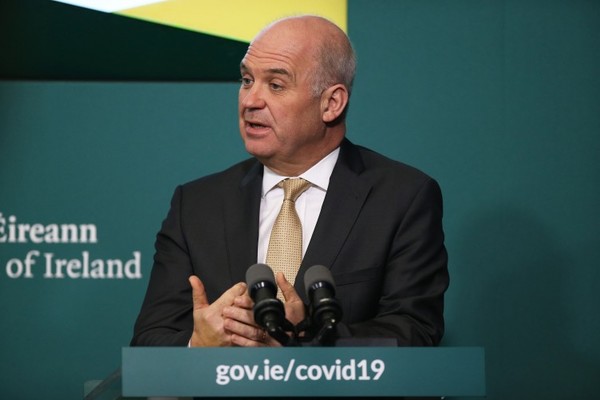
On a day when it is claimed the rate of infection is dropping (but with the highest number of infected and dead yet in Ireland), the social distancing and lockdown measures are said to be working. But Chief Medical Officer Dr. Tony Holohan denies that doing this earlier would have lowered the infection rate! And Eoghan Harris tweets a pat on the back for his Government that private health facilities are to be made available in the public health interest, a measure socialist TDs were calling for weeks ago. But Varadkar rushes to reassure that it’s not nationalisation – neo-liberalism will continue as before.
THE HOLOHAN PUBLIC FATIGUE SYNDROME
Tweeting, Professor Philip Nolan, Chair of National Public Health Emergency Team’s IEMAG: “The model reveals that before restrictions were in place, daily growth rate of confirmed cases was at 33%. This has fallen in recent days to around 15%. But it is still growing and needs to fall further.”
To a person of average intelligence, this means that had these measures been introduced earlier, the graph curve would have begun to flatten out much before now. But Chief medical officer Dr. Tony Holohan is much more intelligent than that – way beyond the rest of us. Because that would have risked “public fatigue” and now is “the right time.” Well it must be the “right time”, mustn’t it, because that’s when he ordered it. He couldn’t have recommended it late, could he?
If “public fatigue” is the danger, that can come in at any time once the restrictions are in place, getting worse as time goes on – one would think. So if introduced say at the beginning of March, we’d be “fatigued” by now, wouldn’t we? So is he telling us that in a number of week’s time, with restrictions still in place, we won’t be “fatigued”? The logic is that we will just as fatigued whenever the crisis is over as if the measures had been put in place earlier – just that it would have been over more quickly and with less fatalities.
Of course, it won’t be over anything like that quickly. They have not even closed the borders, airports or sea-ports! And it’s not that I am in favour of the British colony’s Border, by the way, but this State and Government have no control over the colony’s airports and seaports. And how did the virus arrive in Ireland in the first place? Yep, by plane. But it’s ok, Holohan is going to “discuss” those options. And if they do – finally – close those ports and Border, it will of course be exactly “the right time” to do it.
Let’s return to this “fatigue” notion. What we are experiencing is a pandemic, a national emergency. The people of Leningrad withstood a hard fascist siege, running out of supplies, constantly bombarded, for 852 days. And the battle in defence of Moscow for three months and five days.
But of course, they were Russians (mostly). Alright, the people in Britain (quite a few of them Irish) withstood the Battle of Britain — with almost daily air-raids — for three-and-a-half months!
But the Irish, in Ireland, cannot stand a few extra weeks without becoming “fatigued” and – what? Flood the streets in civil disobedience? Start running up to people and brushing against them? Go back to jobs the Government has closed?
Could it be, just possibly, nothing at all to do with early “fatigue” syndrome but rather late actions reluctantly taken by a Government? Reluctant because it would deplete the capitalist coffers? The thing is, reprehensible as that motivation would be, if action had been taken earlier, capitalism would have suffered less and recovered more quickly!
NEO-LIBERAL POLICY BUSINESS AS USUAL
Which brings us neatly on to Eoghan Harris patting the Government on the back for roping in the private healthcare facilities – weeks after being asked by Socialist TDs to do so. No, you’re right, he didn’t mention that bit. Well, you can’t get everything in a tweet, can you?
And Varadkar rushed to reassure the Gombeen capitalists he represents and the foreign capitalists his party facilitates – along with Fianna Fáil, Labour and the Greens – that this is not nationalisation.
“This is a public private partnership, expanding our public health service in response to this emergency but also cooperation with the private sector.”
“This is private and public sectors to (sic) learning and growing together and working together in the common good.”
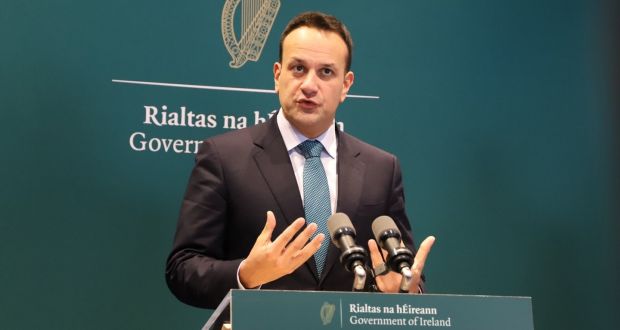
Leo Varadkar, Taoiseach (Irish Prime Minister) of a defeated Government but has yet to step down. (Photo sourced: Internet)
The private healthcare system has parasitised on the public health service, here and in Britain. It has used existing public structures, services, contracts, buildings, personnel, training facilities, government grants and tax cuts. It has no right to exist, least of all when the public body on which it has been feeding is staggering on its feet, in which state it has been long before this pandemic struck.
And Leo’s government, one of the leading proponents of the system that has caused this situation, let us not forget, was given a massive shove recently by the electorate! With the state of the public health service being one of the main issues on which they were shown the road.
You could never accuse Varadkar of not having a hard neck!
One of the clerical staff knocked on the door of Patrick, the boss of the Irish health worker’s union. “Come in!” called out the latter.
“Eh, Boss, lookit this here,” he said, waving a computer printout.
“Why don’t you summarise it for me,” suggested Patrick.
“It’s about that epidemic in China.”
“Coronavirus-19,” replied Patrick, who prided himself on keeping up with world news. “What about it?”
“It’s coming here,” replied the clerical worker.
“What! Who says? Where does it say that?”
“Boss, it’s spreading all over Italy and ….”
“Yes, well but Italy is far away from here!”
“Not as far as China is from Italy.”
Patrick thought about that but the clerical worker continued: “And the Ireland rugby team is playing there and nobody stopped Irish fans going there …. or coming back.”
Patrick sat silently, the enormity of the situation dawning upon him, then reached out for the computer printout. Among other things, it showed the steep climbing graph of confirmed cases of the virus in Italy.
Badge design of the FÓRSA union, the largest public service union in Ireland. (image sourced: Internet)
After the clerical worker had gone, Patrick rang Michael, the President of the Irish Congress of Trade Unions. Then he rang a number of union general secretaries: Brigid, of the shop and distributive workers, Barry of public transport, Jim of post and telecommunications, Josie of the clerical municipal workers, Colm of the manual municipal workers, Jan of construction ….
Two days later they all met in Liberty Hall, Dublin – thirty people, including chiefs of all the main trade unions in Ireland and of a few sub-divisions, along with their note-takers or advisers. By the end of three hours they had a position statement, including demands of the Irish Government, ready to go the moment the first case of the virus was confirmed in Ireland. They had ruled out issuing it until then because they feared it would not have enough effect.
A delegation was chosen to meet the Ministers of Health and of Industry. And pieces of work including research and requirements specific to some branches of the workforce had been distributed, with those responsible noted in the minutes and deadlines given. It was nearing the end of February.
The following day, the first case was notified in Ireland, a person returning from Italy.
Logo of the Irish Congress of Trade Unions, to which most Irish trade unions are affiliated (image sourced: Internet)
ICTU PUBLIC STATEMENT
That afternoon, the President of the ICTU phoned the Taoiseach (Prime Minister) of the Irish Government to alert him to the joint trade union statement and to push for an early meeting with the Ministers of Health and of Industry.
By midday four days later, the 1st of March, the updated statement had been emailed and faxed to all union branches, newspaper, radio and television news media and to a number of bloggers, most of which displayed it prominently, especially as that day the second case in Ireland had been diagnosed:
“The Coronavirus-19 epidemic in Italy has now reached 1,694 confirmed cases of contagion with 34 deaths and only four months ago the first case of this virus was diagnosed in China. It has now reached Ireland and more cases will soon be reported here. As trade unions representing workers including those in front-line services of healthcare, food sales and distribution, public transport, post and communications, municipal services …. We call on employers and Government to ensure the following steps are taken as a matter of great urgency.
All front-line workers in essential services be issued with HSE information on the known dangers of the Coronavirus-19 and be updated regularly
Those workers to be issued with hand-sanitiser gel, gloves and face-masks
The term “essential services” to be applied to the following (the list is not exclusive):
general health workers and auxiliary services with special emphasis on those to the elderly, disabled etc
emergency services in health, fire-fighting, public order, rescue services
workers in production and maintenance of power supplies for heating, lighting and cooking
workers in water purification and supply
workers in food production
workers in outlets providing food and essential supplies
delivery workers to the above and of these to homes
public sanitation workers
postal and essential telecommunications workers (i.e not commercial call centres)
Those workers to be where possible isolated from members of the public by appropriate measures such as withdrawal from duties requiring contact with the public, placing of transparent screens between staff and the public, recourse to audio and video communication, etc.
All covered public spaces, in particular those supplying essential services such as food shops, to be supplied with hand-sanitiser dispensers and notices exhorting the public to use them to prevent or restrict the spread of the virus
All companies to publicly display the measures they have taken to protect staff and the public
The closure of borders, airports and ports to travel to or from abroad, quarantine measures being enforced wherever arrivals are currently taking place
Should the virus continue to spread, all non-essential services should cease. This measure is not only for the protection of staff and public at the place of work but also in the travelling of workers from their homes to the place of work and back again
The above measure to be announced by the Government through public statements and to be enforced strictly wherever non-compliance should be observed
The Government to urge the public through repeated public announcements to self-isolate and to remain indoors where possible, urging responsible adults to ensure the same with children
The Government to freeze by decree all evictions, all actions for non-payment or arrears of rent or mortgages
likewise with actions pursuing non-payment of bills for utility services
The Government to oblige all companies that can afford it to pay workers they lay off
and to supply all smaller companies and businesses that cannot afford in full such payments, the necessary assistance to meet their obligations to the workers
The Government to set aside an adequate sum to pay all unemployed or on pensions a weekly sum sufficient to meet normal weekly expenses
The Government to propose for Oireachtas approval an emergency law authorising the appropriation of any buildings, private facilities, companies and property necessary for healthcare, production of prevention materials, production and distribution of food etc.
“Wherever we find the necessary measures are not being taken, we will instruct our members to take appropriate action, including withdrawal of their labour, picketing of the offending company or service along with providing comprehensive information to the public on the reasons for our actions and the risks to which they are being exposed through failure of the companies or services to take the appropriate action. We will not be negligent in the face of danger to our members and to the general public.”
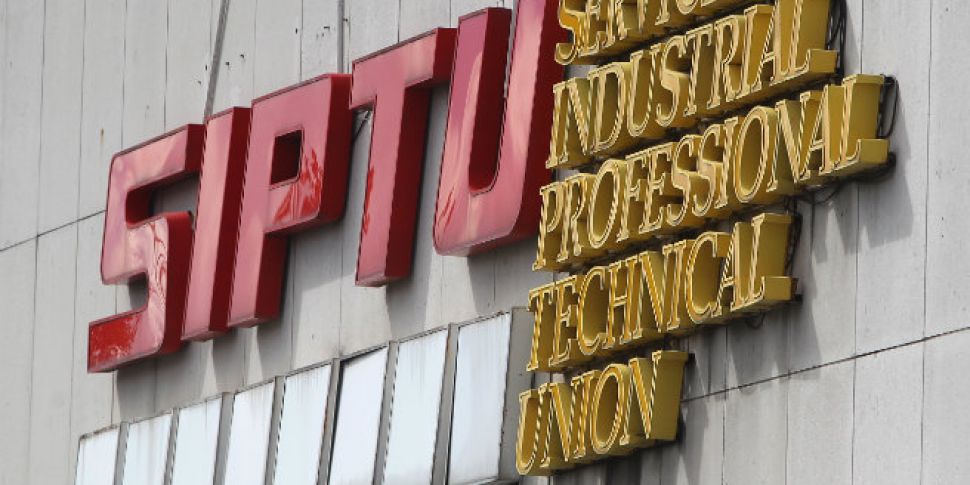
View of the title of SIPTU, the largest union in Ireland, on its Liberty Hall HQ. (image sourced: Internet)
ACTION
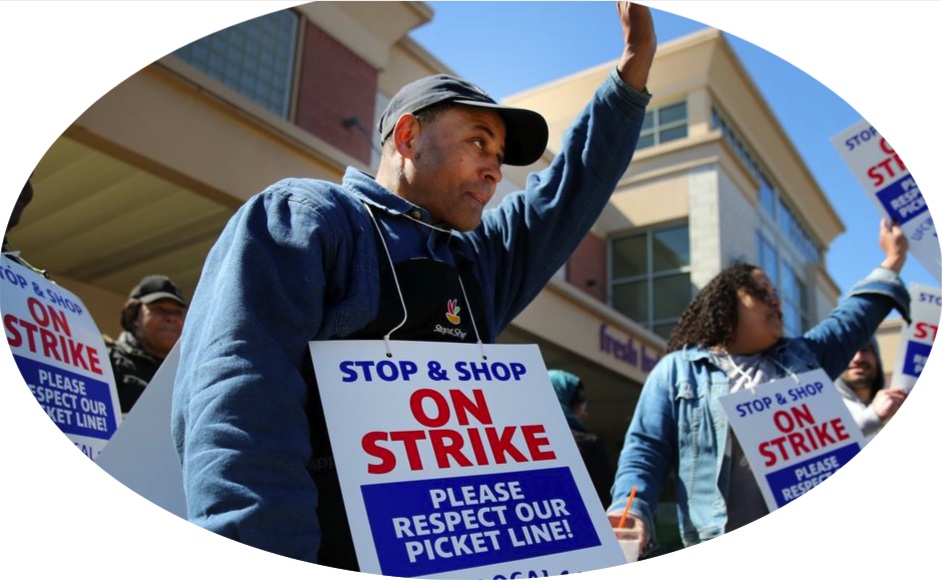
Two days later, after the employers and Government had failed to respond in the manner considered necessary by the trade unions, strikes, walkouts and pickets were called at many branches of all supermarkets, postal service depots and public outlets, call centres, public transport depots, construction sites, local authority manual and clerical services, pubs and hotels. The unions of the health service workers, a workforce under-staffed, under-funded and under huge pressure already, maintained a rota picket with placards and leaflets in front of major hospitals and the Department of Health in Dublin. Lawyers and barristers picketed the courts, calling for them to close. All pickets wore surgical-type face masks and disposable gloves, and had with them a mobile stand with a hand-sanitiser dispenser.
Workers on successful 10-day strike against the Stop & Shop supermarket chain in the USA last year. (image sourced: Internet)(image sourced on Internet and cropped)
By the end of that week, the public pressure on the supermarket chains was such that all had provided sanitiser dispensers for staff at work stations and for customers at entrances and exits, glass screens separated all staff work-stations from customers, staff needing to work in the public area were all wearing face-masks and gloves and a big badge asking people to keep a safe distance. Shelf-filling and price-tagging duties were confined to hours when no public were present. Queue lines were marked out with spacing between customers and periodic announcements instructed
(image sourced: Internet)
customers on safety precautions. Numbers of shoppers inside were restricted at any one time and lines outside marked required spacing for people queuing outside. All staff were being given health precautionary instructions for a half-hour daily through interactive screens.
Furthermore, all main employers had published a list of their precautionary measures and were updating them in response to representations from unions, the general public and Government instructions or recommendations.
Workers in all main public services had been issued precautionary instructions, face-masks, disposable gloves and hand-sanitiser and workers in some particular conditions had protective suits.
CONCLUSION
That is what could have happened and would have had an early restrictive impact on the spread of the virus to the public and to workers who provided a public service. The unions had the organisational and communication capacity to to do that. They didn’t do it – it didn’t happen.
Many of the measures indicated above – but by no means all – were taken but weeks later — and none at trade union initiative: unofficial workers’ action, voluntary company action and government order were the means by which they came into being. By that time, many front-line workers and members of the public had been infected.
The trade unions in Ireland, having already failed their members and the working class in general through two decades of “social partnership” (when a healthy “social distancing” would have been more appropriate!), followed by failure to resist (and collusion with) austerity measures, failed once again in anti-virus protection of their members and of the public.
Some left-wingers say we should not mention these shortcomings since average trade union membership is low and this kind of discourse will hardly help union membership recruitment. But if unions cannot or will not respond adequately and in timely fashion to the needs of their members in particular and to working people in general, why should people be expected to join them? Trade union membership is falling for a reason.
Perhaps these left-wingers feel that the current unions should not be criticised, without a viable alternative having being put in place first. But what are they doing to provide that viable alternative? The answer is clearly nothing, or as near to that as makes no effective difference.
Logo of Unite the Union, operating in Ireland and in Britain. (image sourced: Internet)
THE FORBIDDEN DISCUSSION
There is silence on this question from the broad Left, including those parties claiming to be revolutionary. When individuals raise the issue, it is not addressed or the individual is censored.
It is time to end this self-censorship on the Left and to proclaim loud and high that the trade unions in Ireland, despite the presence of many genuine activists, are generally not fit for purpose. What do we do instead? First, admit the problem and its scale – then we can discuss possible remedies. The patient cannot be cured if we refuse to admit the illness and the stage it has reached.
(image sourced: Internet)
Some of the left-wingers are now saying that this crisis has exposed the unsuitability for society of the capitalist system and that when it is over, that lesson must be put into practice and essential services become national public services. Apart from the weaknesses in this solution, one must ask: who is going to make this happen? If the capitalist system opposes this change, how will the capitalists and their State be overcome? A social revolution without a mass working class organisational base is not possible.
End.
APPENDIX
Irish Congress of Trade Unions (ICTU)
There are currently 55 trade unions with membership of Congress, representing about 600,000 members in the …. (Irish state). Trade union members represent 35.1% of the Republic’s workforce. This is a significant decline since the 55.3% recorded in 1980 and the 38.5% reported in 2003. In the Republic, roughly 50% of union members are in the public sector. The ICTU represents trade unions in negotiations with employers and the government with regard to pay and working conditions (from Wikipedia)
Main trade unions
SIPTU: “… is the largest Union in Ireland with over 180,000 members.
SIPTU represents workers in both the public and private sector in almost every industry in Ireland and at virtually every level. SIPTU caters for full-time, part-time, permanent, contract and temporary workers, as well as retired and unemployed members.” (from SIPTU website)
“Fórsa is Ireland’s newest trade union with over 80,000 members. …. represents members in the public service, as well as the commercial sector, state agencies, some private companies and in the community and voluntary sector.
“Fórsa is the second largest union on the island of Ireland and by far the largest trade union voice in the Irish civil and public service.” (quoted from Forsa’s website)
The Connect Trade Union is the largest Engineering Union in Ireland and the second largest in manufacturing representing up to 40,000 workers.
The Irish National Teachers’ Organisation (INTO), founded in 1868, is the oldest and largest teachers’ trade union in Ireland. It represents 40,633 teachers at primary level in the Republic of Ireland and 7,086 teachers at primary and post-primary level in Northern Ireland. Total membershipis 47,719 (August 2019).
The Teachers’ Union of Ireland represents over 17,000 teachers and lecturers in Ireland engaged in Post-Primary, Higher and Further Education. The Union is made up of 62 branches in 19 areas. (quoted from TUI website).
The International Transport Workers’ Federation (ITF) is a democratic, affiliate-led federation recognised as the world’s leading transport authority. ….. connecting trade unions from 147 countries …. We are the voice for 18.5 million working men and women across the world” (ITF website).
“Mandate is a union of over 40,000 workers across Ireland.”(Wikipedia)
Unite the Union, commonly known as Unite, is a British and Irish trade union, formed on 1 May2007, by the merger of Amicus and the Transport and General Workers’ Union. With just over 1.2 million members, it is the second largest trade unionin the UK (Wikipedia).
One of the consumables most regularly needed in households is bread. In the present circumstances it may not be so easy to purchase some and also going to shops and bakers entails a certain amount of health risk. However, we can make soda bread at home easily enough and have fresh, healthy bread daily.
Soda bread, brown, white, with and without dried fruit, is a traditional Irish bread and for decades was the daily bread in the rural areas. This is not a traditional recipe.
Apart from a source of sufficient heat, we will need
flour,
bicarbonate of soda,
a little salt,
milk
and a little edible acid like lemon juice or vinegar.
Source image: Internet
And since milk is another consumable that needs replenishing regularly, we can use it when it is ‘going off’ or dried milk powder instead.
We will need also some kind of mixing bowl, a strong metal fork and a heat-resistant receptacle.
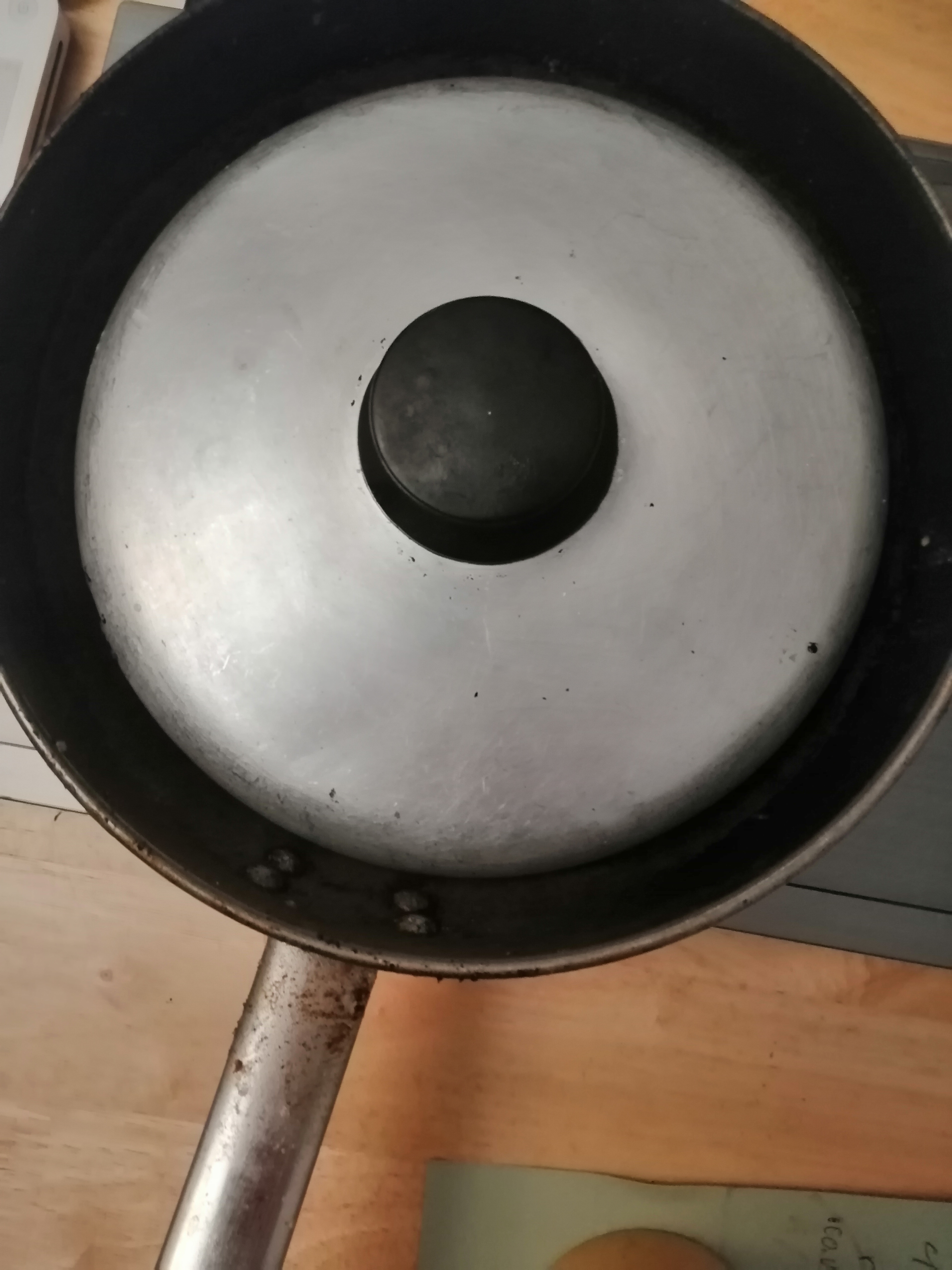
The following directions are for making small amounts of bread at a time, not in ovens but on top of hot plates or gas rings. The heat-resistant receptacle will be a frying pan or wok. In order to contain the heat sufficiently for long enough, we will also need something like a curved lid (the dough will rise or expand).
Frying pan for baking bread with a curved lid from a pan to contain heat and allow bread expansion. (Photo: D.Breatnach)
I am going to describe two variations in preparing the dough, one needing a board to work it on and another straight from the mixing bowl to the heat.
Both variations:
In the mixing-bowl
pour the flour (for quantities and recommendations see further below)
a level teaspoonful of bicarbonate of soda
a few pinches of salt
soured milk (either gone sour already or soured with a squirt of lemon juice, a few drops of vinegar etc.)
Mix with fork, not only round and round but folding over and over
Put frying pan or wok on to heat high with little oil or butter (to prevent the dough sticking)
Drop the dough into the pan or wok, turning it often
Turn the heat down low within a minute of turning the dough
Cover with a curved lid in which you have sprinkled some water (for steam for the bread)
It is useful to turn the dough a few times while baking to prevent a very hard crust forming
After about five minutes, take the bread out and tap it sharply with your fingers
When the bread gives a hollow sound on both sides when tapped, it is ready
Leave out to cool
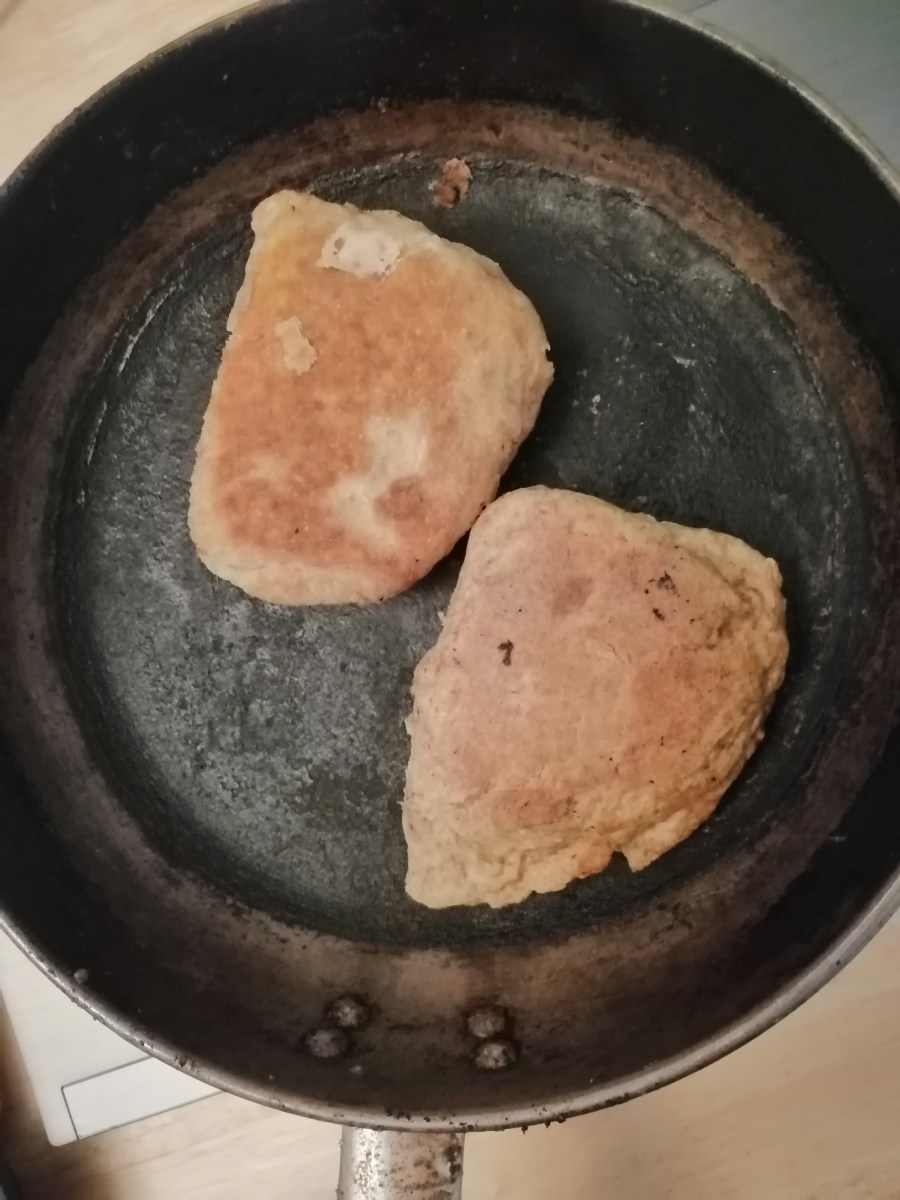
Bread “rolls” baked in frying pan (Photo: D.Breatnach)
1. Type without working the dough:
Mix it quite wet, adding a little water from time to time if necessary
Divide the mix into two or three lumps
Drop into the heated receptacle
You may want to smooth it with a damp spatula, back of a spoon, etc
Turn not only front to back but on all sides too
Lower heat, cover etc.
This will tend to produce round or oval shapes of bread
2. Type working the dough:
Mix it as dry as you can (but still mixed thoroughly into one mass)
Lay out your board, lightly sprinkled with flour
Tip the dough onto the board
Dip your hands in nearby flour, getting it all over palms and fingers
Sprinkle a little flour on top of the dough mass
Press down on the mass, flattening it
Turn it and press down again
Keep dusting your hands with flour as often as necessary (and the board, if the dough sticks)
When the mixture is totally flat, fold it half over and press down again
Continue doing this a number of times (you may notice a tendency for the shape to become triangular or even square through the folding)
Place on the heated receptacle (or, before doing so, press down the edges particularly all around the mass and cut in half)
Turn a few times while lowering the heat
Cover and test in about five minutes, etc.
FLOUR TYPES AND APPROXIMATE QUANTITIES
Wholemeal flour and oatmeal (as for porridge) are healthier than white flour (which should be plain, not self-raising) but white gives a lighter bread and is cheaper than wholemeal, because it is easier to keep. I mix one half mug of wholemeal to one mug-and-one-half of white plain, with a quarter of oatmeal.
Source image: Internet
Add a little milk at a time as necessary until you get used to knowing how much is needed. When using dried milk, we can mix it in the flour dry and add water as we mix or mix it in advance to make liquid milk; in this case every single ingredient can be a dry food with a preserve (if using vinegar).
Source image: Internet
ADDITIONAL NOTES
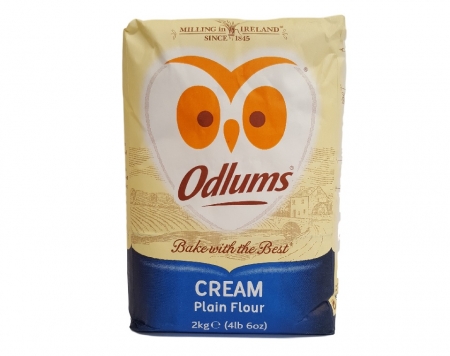
In Ireland, I prefer to use established brands like Odlums or Flavahan’s, rather than supermarket brands, even though the latter are usually cheaper.
The bread tastes better if made daily but to keep fresh, place inside a paper bag inside another of polythene and slice as needed. Making smaller amounts at a time, it is easier to judge the heat and time, otherwise one may find that the bread sounds hollow when tapped, as though cooked through, but at the centre there is still a mushy part.
The most taxing part of the process is the mixing the dough which is wearing on the wrists and men, known to generally have stronger wrists (no bawdy comments please) can at least carry out this part of the process and, having done so, sure might as well see the whole thing through.
From Workers’ Republic, 18 March 1916.
Transcribed by The James Connolly Society in 1997.
Proofread by Chris Clayton, August 2007.
James Connolly poster by Jim Fitzpatrick. (Image sourced: Internet)
The question often arises: Why do Irishmen celebrate the festival of their national saint, in view of the recently re-discovered truth that he was by no means the first missionary to preach Christianity to the people of Ireland? It is known now beyond the shadow of a doubt that the Christian religion had been preached and practised in Ireland long before St. Patrick, that Christian churches had been established, and it is probable that the legend about the shamrock was invented in some later generation than that of the saint. Certainly the shamrock bears no place of any importance in early Celtic literature, and the first time we read of it as having any reference to or bearing on religion in Ireland occurs in the work of a foreigner – an English monk.
But all that notwithstanding there is good reason why Irish men and women should celebrate St. Patrick’s Day. They should celebrate it for the same reason as they should honour the green flag of Ireland, despite the fact that there is no historical proof that the Irish, in the days of Ireland’s freedom from foreign rule, ever had a green flag as a national standard, or indeed ever had a national flag at all
Shamrock for sale in Moore Street last year, one of the few times in the year they are permitted to sell something outside the vegetable-fruit permit. They were not finding many buyers during the past week. Photo: D.Breatnach
The claim of the 17th of March to be Ireland’s national festival, the claim of St. Patrick to be Ireland’s national saint, the claim of the shamrock to be Ireland’s national plant, the claim of the green flag to be Ireland’s national flag rests not on the musty pages of half-forgotten history but on the affections and will of the Irish people.
Sentiment it may be. But the man or woman who scoffs at sentiment is a fool. We on this paper respect facts, and have a holy hatred of all movements and causes not built upon truth. But sentiment is often greater than facts, because it is an idealised expression of fact – a mind picture of truth as it is seen by the soul, unhampered by the grosser dirt of the world and the flesh.
The Irish people, denied comfort in the present, seek solace in the past of their country; the Irish mind, unable because of the serfdom or bondage of the Irish race to give body and material existence to its noblest thoughts, creates an emblem to typify that spiritual conception for which the Irish race laboured in vain. If that spiritual conception of religion, of freedom, of nationality exists or existed nowhere save in the Irish mind, it is nevertheless as much a great historical reality as if it were embodied in a statute book, or had a material existence vouched for by all the pages of history.
It is not the will of the majority which ultimately prevails; that which ultimately prevails is the ideal of the noblest of each generation. Happy indeed that race and generation in which the ideal of the noblest and the will of the majority unite.
In this hour of her trial Ireland cannot afford to sacrifice any one of the things the world has accepted as peculiarly Irish. She must hold to her highest thoughts, and cleave to her noblest sentiments. Her sons and daughters must hold life itself as of little value when weighed against the preservation of even the least important work of her separate individuality as a nation.
Therefore we honour St. Patrick’s Day (and its allied legend of the shamrock) because in it we see the spiritual conception of the separate identity of the Irish race – an ideal of unity in diversity, of diversity not conflicting with unity.
Magnificent must have been the intellect that conceived such a thought; great must have been the genius of the people that received such a conception and made it their own.
On this Festival then our prayer is: Honour to St. Patrick the Irish Apostle, and Freedom to his people.
James Connolly monument, Beresford Place, Dublin.
COMMENT:
I seem to recall that Connolly wrote something else about celebrating St. Patrick’s Day, perhaps when he was living and working in the USA but can’t find it now. For similar reasons to what he lays out here, I supported and indeed organised public celebration of the feast day in London.
And I might have agreed with Connolly in the case of Ireland at the time he wrote it: the whole country under British occupation, in the middle of the First World War with thousands of Irish casualties in the British armed forces and coming up to the 1916 Rising.
But now? I don’t think so, neither with what it celebrates nor how it is celebrated, which always makes me want to get out of Dublin. Republic Day, which Connolly was party to creating but could perhaps not have anticipated being a national festival day, is what we should be focusing on now, I think.
Staff wearing gloves (at last) but no masks. Distance instructions for shoppers at staffed checkouts but no masks — and what about floor staff, tending shelves, collecting empty baskets, ANSWERING QUERIES FROM CUSTOMERS AT CLOSE RANGE? !!
“Every little helps”? TOO LITTLE!
Criminal neglect by big employers of their staff and also, in the long run, of the wider public. And the unions?!!
Lots of empty spaces on shelves by the way. And I remembered the toilet paper!
I went shopping tonight. No, not a stock-up raid — actual shopping. Of course, I forgot the actual thing I went to get — toilet paper. No shit! (well, not until I buy some, anyway). So I got some other stuff I would need soon.
Irritated customer at self-checkout machine. (Source photo: Internet)
I was glad for once, especially for the safety of the staff, to see the self-checkout machines there and happy, for a change, to use them. Even though the machine could not understand why my bag was “too heavy” (a small-medium backpack!). So a member of staff had to keep approaching to tell the machine I was all right and to carry on, which kind of negated the whole safety aspect.
Of course safety has nothing to do with why these machines were installed, nor even customer satisfaction but to reduce the number of employed staff (who still have to keep attending to machines that misunderstand the shoppers or vice versa).
One of the many models of hand-sanitiser available commercially. (Source photo: Internet)
But NOT ONE OF THE STAFF WAS WEARING DISPOSABLE LATEX GLOVES OR FACE MASKS.
NOR DID I SEE A HAND SANITISER DISPENSER.
THEIR EMPLOYERS SHOULD BE OBLIGED TO PROVIDE THESE BY LAW IF THEY DO NOT DO SO VOLUNTARILY.