Alberto Sicilia in Publico.es, translated by D.Breatnach
Alberto Sicilia in Publico.es, translated by D.Breatnach (Reading time: 3 minutes)
For original version in Castillian (Spanish) click on link.
Greece today suspended the right to asylum. An unprecedented measure in the history of Europe.
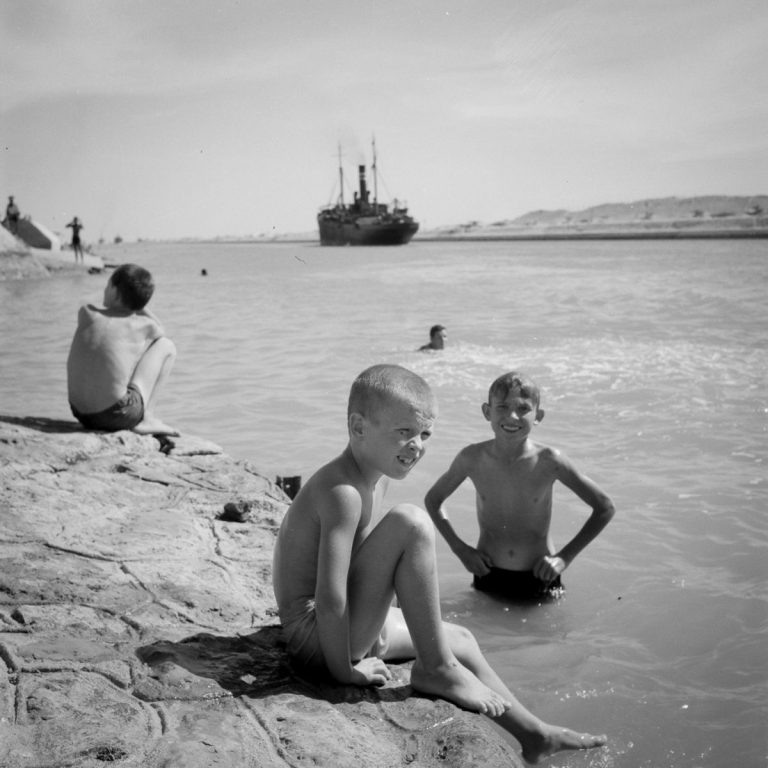
How soon we forget. During World War II, thousands of Greeks crossed the Mediterranean in the opposite direction and sought refuge in Middle Eastern countries. That was the most accessible route of escape from Nazi troops.
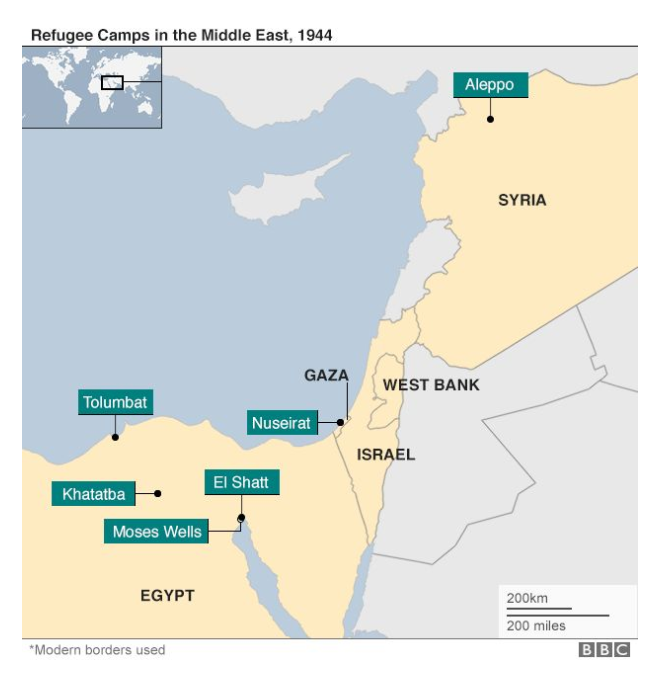
Map of camp sites for European Refugees WW2 (Image source: Publico.blogs. es)
A program called “Organization for Refugees in the Middle East”, launched in 1942 and led by the United Kingdom, helped tens of thousands of Greeks, Poles and Yugoslavs escape eastbound.
The refugees were taken to camps located in Syria, Egypt and Palestine. The city of Aleppo, (yes, you have not misread, Aleppo) became one of the main reception centers.
A number of official reports on the state of the camps were written in March 1944. A study conducted by Public International Radio includes the protocol for the entry of refugees and their daily lives:
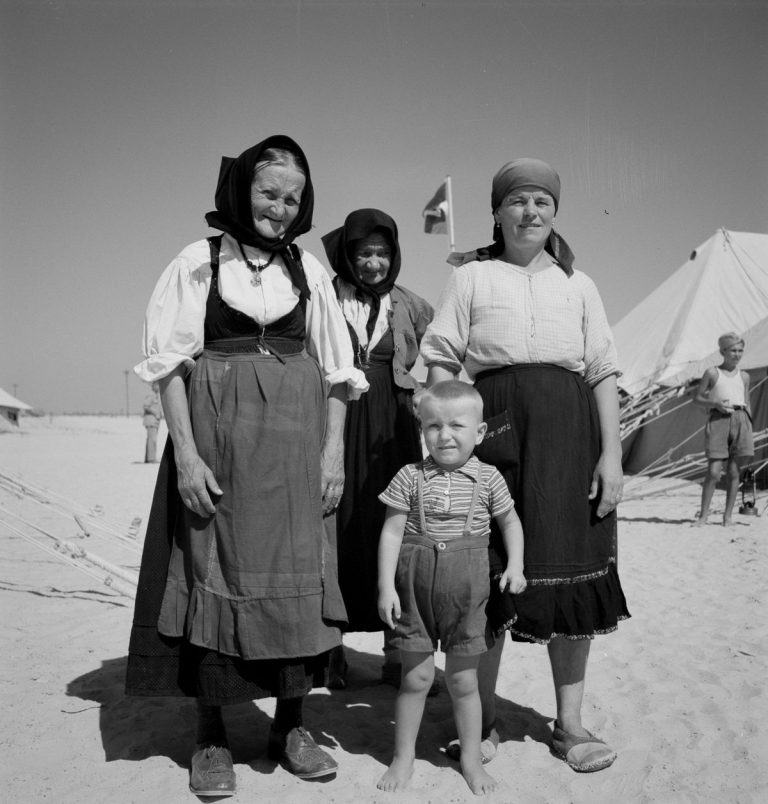
Photo source: Publico.blogs. es
“Once registered, newcomers made their way through a thorough medical inspection. The refugees were heading to what were often makeshift hospital facilities, usually tents, but occasionally empty buildings reused for medical care, where clothes and shoes were removed and they were washed until the authorities believed they were sufficiently disinfected.
“Some refugees, such as the Greeks who arrived at the Aleppo camp from the Dodecanese islands in 1944, could expect medical inspections to become part of their daily routine.
Photo source: Publico.blogs. es
“After medical officials were satisfied that they were healthy enough to join the rest of the camp, refugees were divided into homes for families, unaccompanied children, single men and single women. Once assigned to a particular section of the camp, refugees enjoyed few opportunities to venture outside. From time to time they could leave under the supervision of camp officials.
“When refugees in the Aleppo camp made the multi-mile trip to the city, for example, they could visit shops to buy basic supplies, watch a movie at the local cinema, or simply distract themselves from the monotony of country life.
“Although the camp at Moses Wells [in Egypt], located on more than 100 acres of desert, was not within walking distance of a city, refugees were allowed to spend time each day bathing in the nearby Red Sea. “
Photo source: Publico.blogs. es
The “Organization for Refugees in the Middle East” was part of a network of refugee camps around the world that were administered by governments and international NGOs.
And refugees arrived not only in the Arab region: Iran received 200,000 Poles between 1939 and 1941.
Have we forgotten so quickly?
Photo source: Publico.blogs. esPhoto source: Publico.blogs. es
Garda Armed Support Unit patrol car, one of a great many seen driving around many parts of Dublin including the city centre. (Image source: Internet)
Last year, a Garda shot dead a man sitting inside a car who was harming himself with a Stanley knife. In June 2019 the Department of Public Prosecution decided not to even charge the Garda who fired the shot. What does this mean?
Since the evidence from witnesses (including his own colleagues) is that Garda A fired a deliberate shot at close range that killed Mark Hennessy through a closed window and that the man was not at that moment posing a threat to anyone (apart from himself), never mind a lethal one — how can we view this as anything but an on-the-spot execution by a Garda? Since we are told that Gardaí are not authorised to carry out executions (and the State has abolished the death penalty), what can this be but MURDER?
It is useful to remember too that the founders of the Irish State deliberately resolved to set up the Garda Síochána as an primarily unarmed police force (in direct opposition to the armed colonial police forces that had suppressed Irish people in the past and continued to do so in the Six occupied Counties).
Not even charged? For the moment, we need to forget about the fact that all the evidence points to the victim having murdered a child and hidden her body. Killing the man could not bring her back (in fact might even have prevented her body being found but luckily the location was written on a piece of paper inside the car).
How can this killing be justified? What possible legal reason can be given? Dubious though it may be, the Gardaí who shot Mac Lochlainn (see below) at least claimed he had pointed a gun at them (interestingly, the officer who fired the fatal shot was himself killed a few years later in what was described as a firearm accident involving a colleague). Well, in fact, in the Mark Hennessy killing NO REASON WHATSOEVER WAS GIVEN. The DPP just “decided not to prosecute”.
Garda of the Armed Response Unit with machine gun. (Image source: Internet)
If a Gardaí can decide when someone needs to die and act upon that decision, anyone might be a victim in future: political activist, whistleblower, personal enemy, mistaken identity ….
Unlikely? Why?
There have been a number of questionable killings by Gardaí, including the shooting dead of Real IRA Volunteer Ronan Mac Lochlainn on May 1st 1988. Mac Lochlainn was driving away from a Garda Special Branch ambush of a robbery team when he was shot dead by the Gardaí. The matter was not seriously investigated until 20 years later when the investigators decided for whatever reason to clear all the Gardaí involved, leaving many important questions unanswered.
Another incident that might have ended fatally occurred in 2005 between two drunken senior Gardai who got into a fight and pulled guns on one another! A personal quarrell ….
Armed Gardaí Detectives after a raid. (Image source: Internet)
One can see on any day in Dublin the vehicles of the Garda Armed Response Unit driving around the city. Nor do they restrict themselves to the duties for which one might imagine Gardaí would need to carry arms. They have been seen stopping cars in traffic incidents, driving through busy streets, surveilling political demonstrations and even on one occasion last year stopping to caution people demonstrating against internment in Temple Bar.
In 2014 they turned up at a protest against Irish Water in Clonmell. On another occasion last year they turned up to dispute between a private landlord and two of his tenants in Dublin and at a separate housing occupation action in Cork. Last year also they attended a farmers’ protest in Limerick.
Is the Irish public being subjected to an armed Gardaí normalisation process? Why are the DPP not being made to justify their decisions not to prosecute Garda perpetrators of homicide? How long before another unjustifiable killing?
On 15 February Ferriter’s column in the Irish Times expressed the opinion that comparison of Sinn Féin with Fianna Fáil in the 1930s only takes us so far. After looking at less of the overall history of the main Irish parties than I had in my article of 11 February in Rebel Breeze but adding some pieces I had not, what was his conclusion that differed so widely from mine? Well, that the military past was too new with SF!
Diarmaid Ferriter in Thinker pose (Source: Internet)
But, actually, not true of Provisional SF with regard to FF, which came into government in 1932, less than two decades after the end of the Civil War and only six years after its split from Sinn Féin. De Valera, President of Fianna Fáil, had been a leader of the Republican side in the Civil War, from which side came the majority of Fianna Fáil’s supporters. By the time PSF gets into Government, it will be LONGER than two decades since Provisional IRA gave up its armed struggle!
On 11 February I posted an article of mine on Rebel Breeze and from there on to Facebook, making the point that, despite hostile media and politician claims to the contrary, Sinn Féin is very like the main Irish political parties – and that that is not a good thing. I traced the main elements of the parties’ history, how they had changed their positions and I elaborated the point that the main difference in their trajectories is that SF’s arrival on the neo-colonial capitalist political field was just more recent.
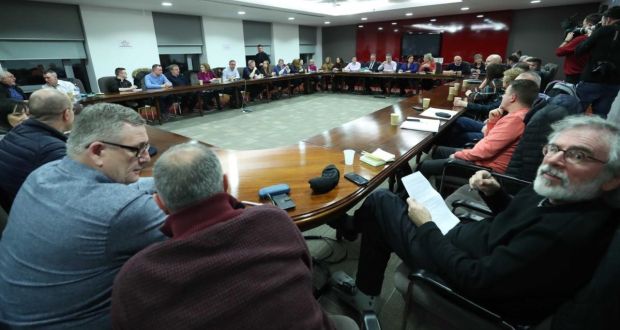
Meeting of Provisional Sinn Féin’s Ard-Choiste (national executive) in February 2020. (Source photo: Niall Carson, AP, Internet)
It is worth noting (a point I had omitted in my piece) that nearly the entire Fianna Fáil government Cabinet in 1932 was composed of Civil War IRA men and that most of the remainder had been in Free State prison during that war.
It is said that imitation is the sincerest form of flattery but I can easily avoid being pleased by Ferriter substantially following my line of historical analysis. This is the man who, during the 2016 High Court hearing about the Government and property speculator plans for Moore Street, wrote a nasty attack on the demonstrators who had occupied the buildings and subsequently blockaded them against demolition. If he had been hoping to influence the High Court’s decision he failed – and spectacularly, because the judgement was that not only the buildings but the whole quarter is a 1916 historical monument.
Frank McDonald had also written an opinion piece during the trial against conservation and the demonstrators in the same newspaper (what WAS the Irish Times up to?) but after the judgement, he had the grace to apologise (sort of: he wrote that he had been in error).
Why doesn’t SF just step back and wait for whatever government is formed, hammer them from the opposition benches and wait for the next General election (which might well be in the Autumn)?
Sinn Fein President Mary Lou McDonald and Micheál Martin, leader of Fianna Fáil. (Images source: Internet)
There are 160 seats in the Dáil, the Lower House of the Irish Parliament. Mícheál Martin, leader of the Fianna Fáil party (38 seats), tells Mary Lou McDonald that he won’t go into coalition with her party Sinn Féin (37 seats) and she rages at him. Fine Gael (35 seats) wants to go into coalition with Fianna Fáil – but at a price. Eoin Ó Broin of SF admits the numbers don’t add up for a coalition of the Left (couple of surviving TDs from Left parties and independents led by SF) which was clear before Sinn Féin (and some on the Left) even started talking about it.
The main reason for the weakness of the Left in the Dáil is that the Irish Labour Party, founded by Connolly, Larkin and others, has degenerated to a remarkable degree. Another reason is that as a result of centuries fighting colonialism and concentration on the national question, there has never been a substantial nationwide party or grouping of the Left in Ireland. Also some left-wing TDs (members of the Dáil) actually lost seats in the general election this month.
On Monday I think it was, the Guardian published and I shared what I thought was a brief and fair analysis of the results and of the possible coalition governments and even suggested that SF would be wise to let the established parties flounder in government and beat them in the next election. After all, most commentators seem to agree that if SF had fielded more candidates, they would have got even more seats, an error they can remedy next time.
A LEFT COALITION NEXT TIME?
Of course, that might not be anywhere near 81 seats, the number for an overall clear majority – but a Left coalition majority would be more possible then. Besides, they could form a Left platform to go intothe next election, which would give a lot more transfers of votes and possibly get more people elected from the Left too.
But instead, Sinn Féin are chomping at the bit and their eagerness to get into Government right now, even in coalition with neo-liberal capitalist and neo-colonialist parties, is disturbing.
Why do I care? After all, I am not a SF supporter, nor even of any of the Left parties – a revolutionary, in fact, not a reformist. But that doesn’t mean I would not welcome some reforms nor, more to the point, that I don’t see how the people are crying out for them. Like an immediate building program of public housing and an effective overhaul of the health system (both linked to youth training and employment). A defence and development of our natural resources and services. Saving Moore Street from “development” by vultures. Abolition of the no-Jury Special Criminal Courts (which SF seems to be retreating from already before they even got a Government coalition offer).
I could list many more but what’s the point?
If what we get is a coalition government led by Fianna Fáil or even containing Fine Gael – forget it! And if SF is not prepared to play a longer game and the Left is not prepared to put together a platform package, then the longer-term hope of revolution becomes the only viable one for the shorter term.
End.
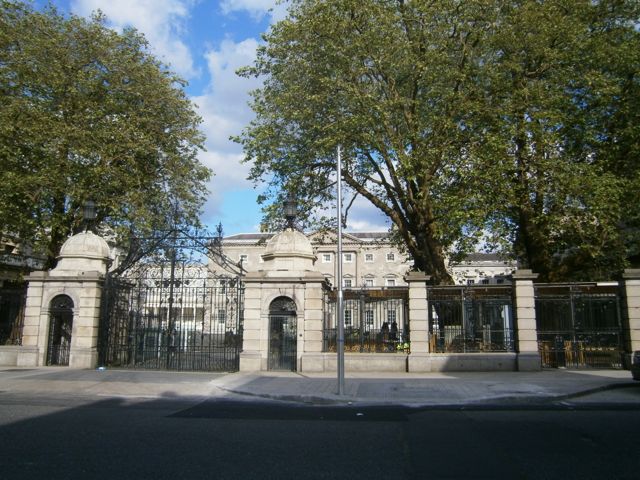
Leinster House, location of the Oireachtas (Irish Parliament). (Photo source: Internet)
“Sinn Féin is not like other Irish political parties” goes the propaganda campaign against the party by media commentators and rival mainstream politiciansduring the elections. What nonsense! It is exactly like the other main Irish political parties – and that’s the problem.
Their opponents’ main objection seems to be that Provisional Sinn Féin was widely seen as the political wing of the armed resistance group Provisional IRA and, although the IRA have dissolved and decommissioned their weapons, the party still carries that mark in the eyes of its detractors (and, it must be said, fondly in the eyes of some of its supporters).
This propaganda campaign is acutely unhistorical. A few short lessons in Irish history might be of use here.
The Irish Labour Party was founded by, among others, the revolutionary socialist James Connolly and anarcho-sindicalist Jim Larkin. In 1913 both advocated arming union workers to resist armed police attacks. In 1916, the Irish Citizen Army they founded was part of the armed Rising and two of their leaders were among the 16 executed by British firing squads.
The party stayed neutral during the Civil War and was an opposition party to the Cumann na nGaedheal government. Since then, the Labour Party has been in Government only as a coalition partner – most times with the right-wing Fine Gael party. Except for it links with trade unions, the party has little claim to having “Labour” in its name and has turned away from everything if which its founders believed.
Fine Gael was formedin 1933 when two smaller groups joined Cumann na nGaedheal, which had been the governing party of the partitioned Free State from 1923 up until the merger. Michael Collins and his followers were the kind of people The founders of Cumann na nGaedheal were among the pro-Treaty and Free State supporters, i.e people who until then had been active in leading or supporting a campaign of armed resistance to the occupying British forces, including assassinations, ambushes and robberies. The Free State began the Civil War in 1922 by an artillery bombardment of Republican positions in Dublinand over the next few years carried out repression on the civilian population, torture, summary executions of prisoners of war as well as State executions – and assassinations. The victors handed the reins over to Cumann na nGaedheal in 1923.
The parties that joined Cumann na nGaedheal in 1933 were 1) the National Centre Party, essentially a big farmers’ quasi-fascist party and 2) the Army Comrades Association (the fascist “Blueshirts”). Of the mainstream Irish political parties, Fine Gael has stayed truest to its founders and base.
Fianna Fáil emerged from a split from Sinn Féin in 1926; interestingly, much of what is being said against Sinn Féin by establishment political commentators now – and worse — was said then about Fianna Fáil: “murderers”, “revolutionaries” (and even “Communists”!). The party first entered power in 1932, its leader De Valera having been — little more than a decade previously — a leader of the Republicans during the Civil War, opponents of the Treaty and of the Irish Government of the time. It freed the Republican prisoners locked up by the Cumann na nGaedheal government, also having a special police force (“Broy’s Harriers”) to persecute the Blueshirts, who aspired to taking power as had Fascists in Europe.
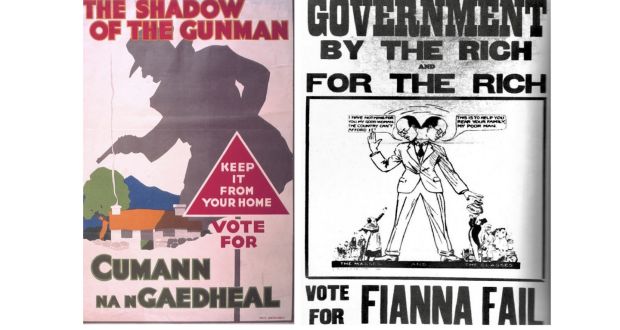
Cumann na nGaedheal (forerunner of Fine Gael) poster against Fianna Fáil during 1930s. (Image sourced: Internet)
By 1939, the Fianna Fáil government had introduced the savage repressive legislation of the Emergency Powers Act to intern republicans without trial and after a successful habeas corpus challenge by Seán McBride (one of the founders of Amnesty International), the Government brought in the Offences Against the State Act, was re-arresting Republicans and interning them without trial again (around 2,000). Two Republicans died on a hunger strike protest in Mountjoy Jail. Under Fianna Fáil the State executed six Republicans and some more are alleged to have died as a result of their treatment in the concentration camp.
In 1957, a Fianna Fáil government once again brought internment without trial into force, the colonial administration of the Six Counties having done the same the year previously. The last prisoner was released by FF in 1959.
Left: Cumann na nGaedheal poster urging votes against FF because of the party’s history. Right: Fianna Fáil poster appealing to the working class and small farmers. (Image sourced: Internet)
From having been seen as the main political party of Irish Republicanism, Fianna Fáil became in a short time the preferred party of the Irish capitalists (the “Gombeen” class) and has been in government more than any other party, more often indeed than the party that won the Civil War and set up the State.
JUST LIKE ANY OTHER IRISH PARTY
There is no historical basis for saying that Sinn Féin is very different from the other Irish mainstream political parties. It has traversed a similar path to all those others, perhaps most similarly to Fianna Fáil – it’s just a more recent arrival on the mainstream scene. It is already very like other main Irish political parties and is getting to be exactly like them.
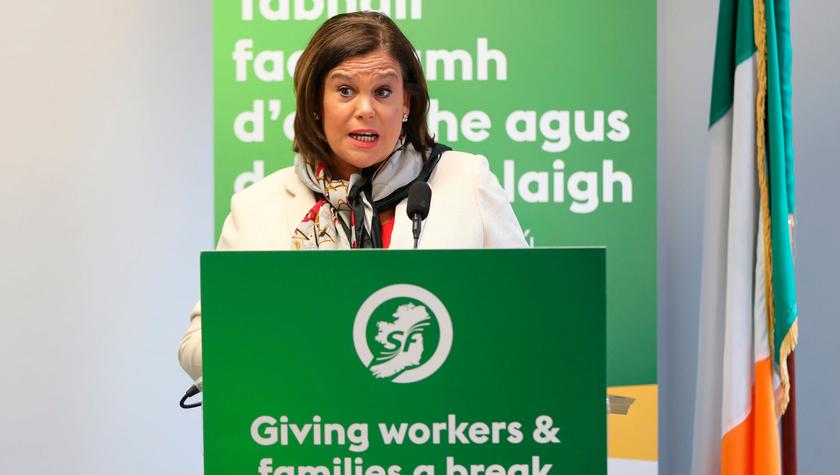
Leader of the Sinn Féin party, Mary Lou McDonald, at the launch of the party’s manifesto. With no intention of overthrowing capitalism it promised reforms for working people. (Photo source: Internet)
That is not a compliment.
This is a party that, in recent decades, had a revolutionary Irish republican – or at least nationalist – position. It strongly opposed the partition of the country and the colonial occupation of one-sixth of the nation’s territory. With the latter came — naturally enough — opposition to the colonial police force, the Royal Ulster Constabulary but this was much more than an ideological opposition: the RUC was an armed force created specifically for the repression of Irish Republicans and acted consistently against the Catholic minority in the Six Counties, which SF sought to represent and among which it organised.
The colonial Statelet itself, with its gerrymandering of electoral boundaries, sectarian allocation of housing and employment and its Special Powers Act, was the sworn enemy of the Sinn Féin party. And when British troops were sent in 1969 to repress the civil rights uprising, of course Provisional Sinn Féin and Provisional IRA fought them too.
The Provisional IRA gave up armed struggle against the British in 1998 and, although it maintained its armed force for control of its community for some time afterwards, eventually dissolved its organisation. By then it had already decommissioned its weapons.
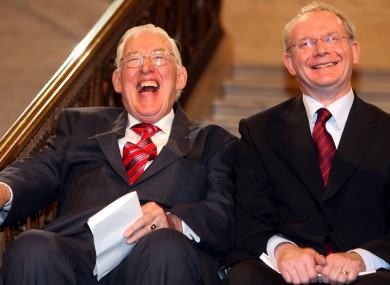
Martin McGuinness (right) of SF, formerly of the IRA, as Deputy Prime Minister of the British colony of the Six Counties. He partnered the Prime Minister Ian Paisley (left), a rabid religious sectarian, Christian fundamentalist and homophobe. They were dubbed “the Chuckle Brothers”. (Photo sourced: Internet)
In 2007 the SF party became part of the British colony’s administration in Stormont, with Martin McGuinness, former chief of the IRA in Derry, partnering Ian Paisley, notorious Loyalist religious sectarian and social bigot.
That same year the party agreed to support the armed and sectarian police force and in the reorganisation of the RUC had the name changed to “the Police Service of Northern Ireland”. The essence of the force, naturally, remains the same.
All the austerity measures inflicted on the working class by the administration since the party entered joint government of the colony have been approved by Sinn Féin MLAs.
Martin McGuinness publicly shaking hand of British colonial Queen when SF officially opposed the visit. However SF did not demonstrate against her visit and Gerry Adams later approved of it. (Photo sourced: Internet)
In 2011, despite an official SF policy of opposition to the visit of the Queen of England, Commander-in-Chief of the British Armed Forces, to the 26 Counties (the Irish state), leaders greeted her (one in person) and urged no protests be made against her visit.
In 2019, SF welcomed Prince Charles on a two-day visit to the colony and to the State; this man is not only son of the English Monarch but ceremonial commander-in-chief of the Parachute Regiment, authors of the massacres of Derry’s Bloody Sunday (14 dead) and Ballymurphy (11 dead) for which not a single soldier or commander has ever been tried. The SF Mayor of Derry, however, refused to meet him.
Gerry Adams shakes hands with Prince Phillip, titular head of the Parachute Regiment (the SF Mayor of Derry refused to meet him). (Photo sourced: Internet)
This year, 2020, the Six-County part of the leadership of Sinn Féin joined others in publicly seeking recruits for the PSNI, while the 26-County leadership withdrew from its previous position of seeking abolition of the repressive emergency powers of the Offences Against the State Act.
In the 26 Counties, SF long ago indicated its willingness to join in a governing coalition with some one of the other mainstream political parties: i.e capitalist, neo-colonial political parties.
On so many occasions, it has shown itself to be like the other parties and prepared to ditch formerly-declared principles for what it considered a political advantage, proving itself a “safe pair of hands” to the rulers of the system.
Yes, Sinn Féin is indeed a party like any other Irish mainstream political party: capitalist, neo-colonial, undemocratic and supporting State repression. As to the latter, why not? It won’t be SF that the State will be repressing — it’ll be Irish Republicans. And if SF ever get where they want to, into majority control of government – they’ll have plenty of opponents themselves to drag before those non-jury courts.
End.
L-R: PSNI Chief Constable Simon Byrne, Anne Connolly, Chairperson of the NI Policing Board, Gerry Kelly MLA, Deputy First Minister Michelle O’Neill and Deputy Chief Constable elect, Mark Hamilton at recruitment launch for the colonial police force.
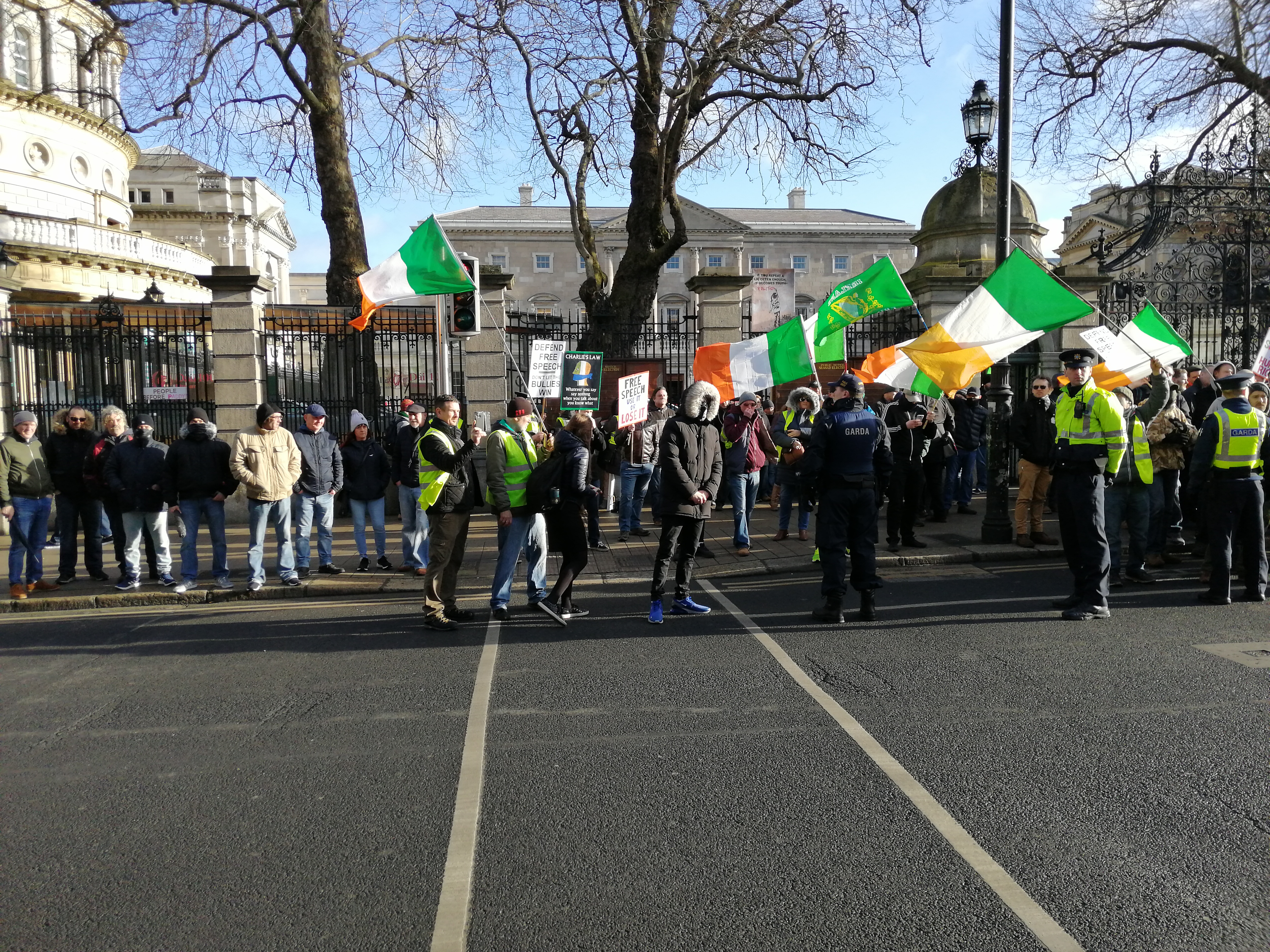
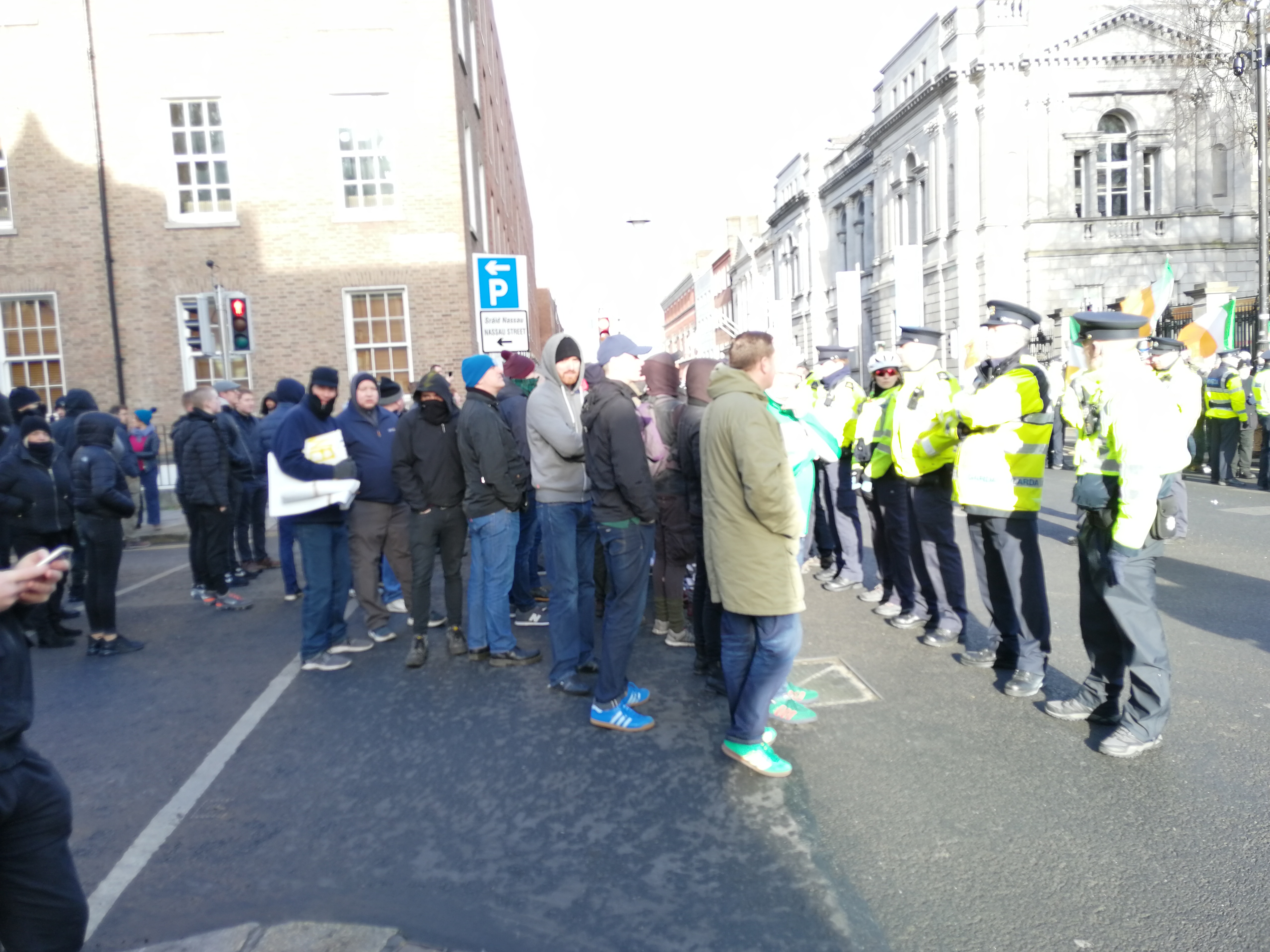
After weeks of propaganda and whipping up their support, a much-reduced turnout of the Irish far-Right lined up in front of Leinster House on Saturday 1st February and were confronted by an anti-fascist, anti-racist opposition a little smaller in size but which had been convened by word of mouth alone. There were some scuffles and a couple of arrests and the far-Rightists begged for a Garda escort to leave their protest after little more than one hour.
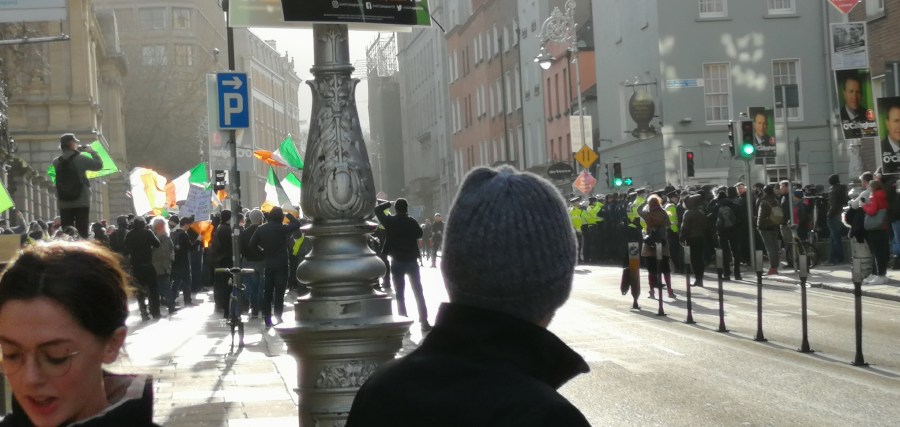
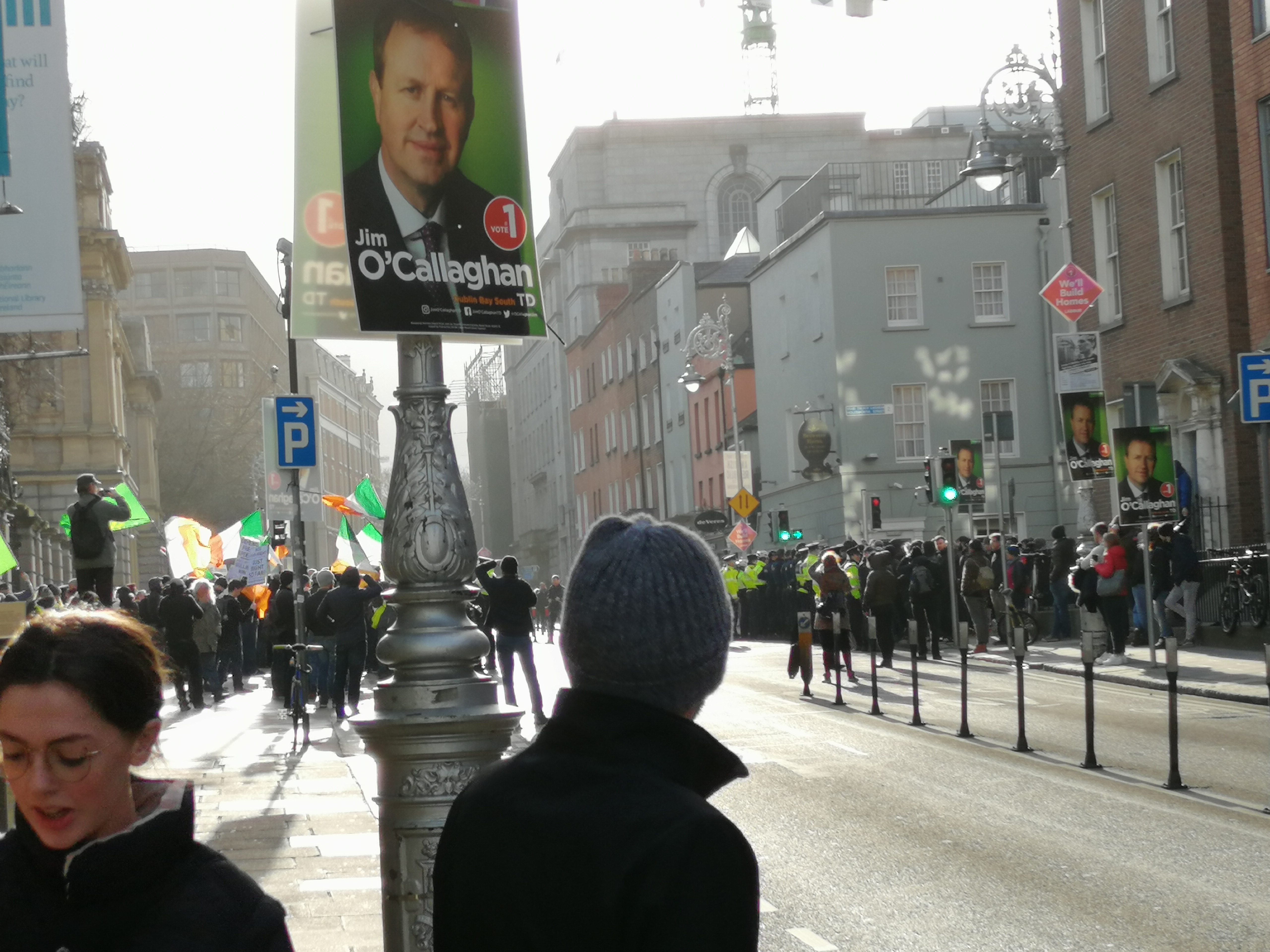
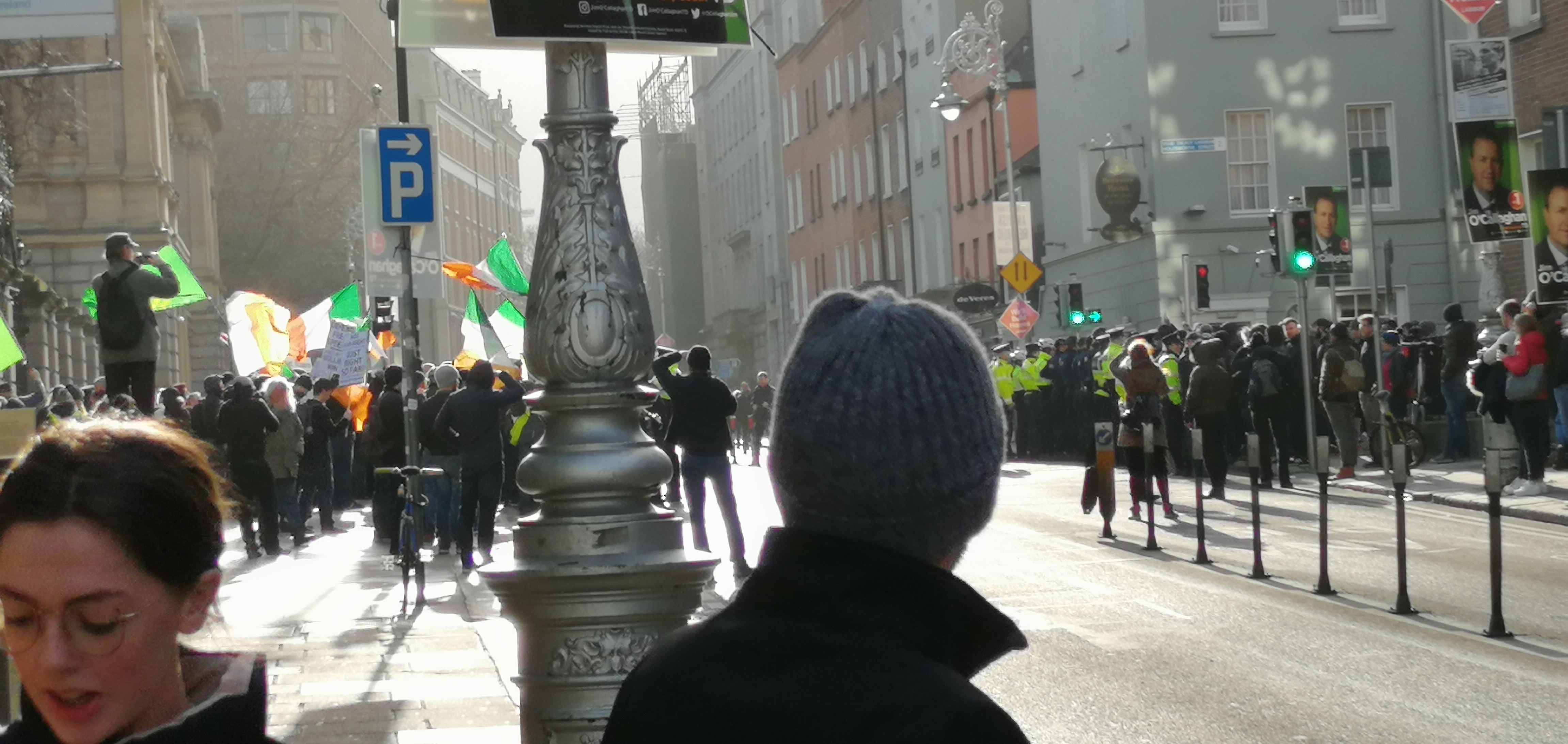
Confronting one another across Kildare St, far-Right and anti-fascists, seen from a little distance (Photo: D.Breatnach)
“FREE SPEECH”?
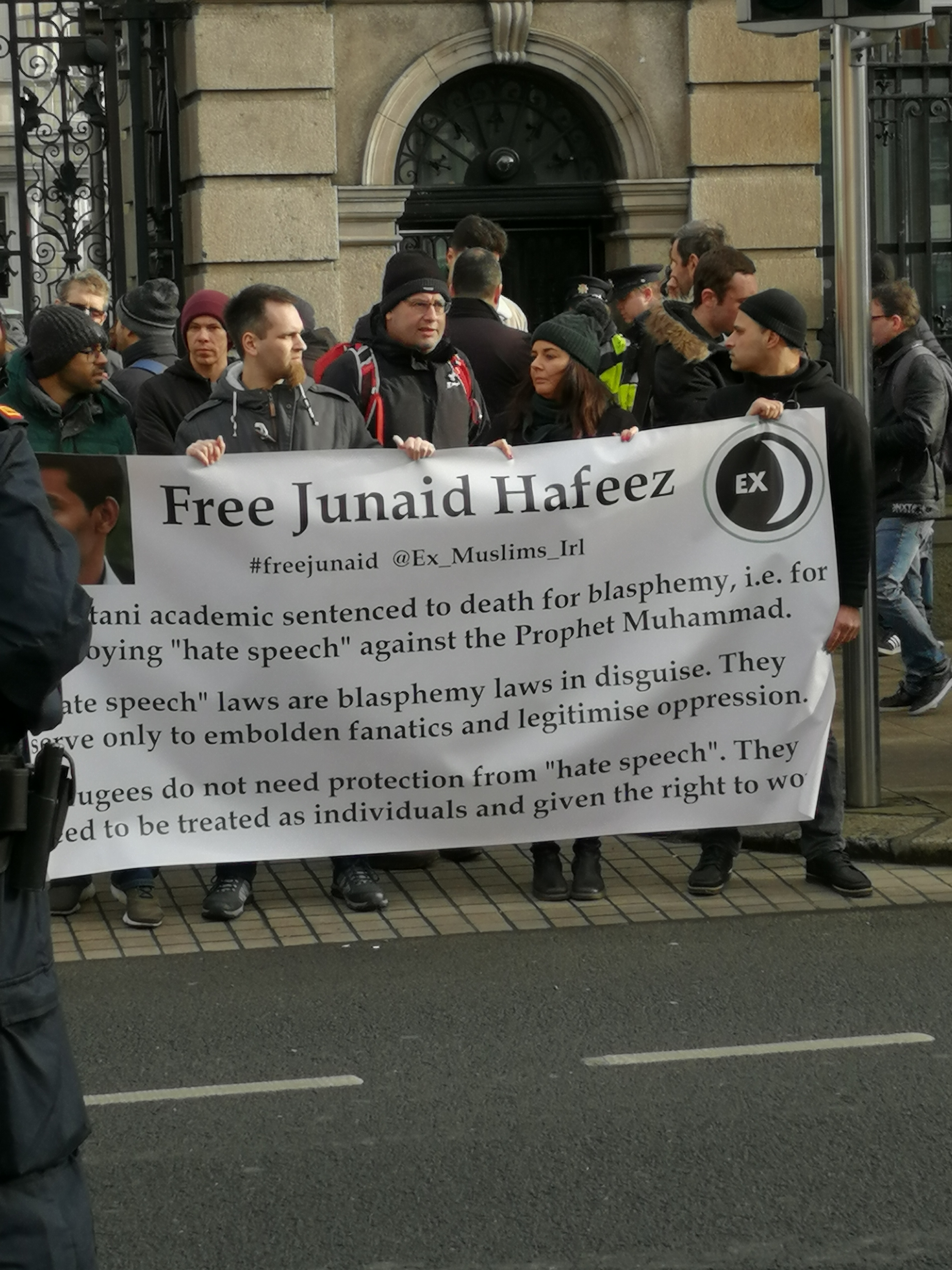
The far-Rightists had called the demonstration allegedly in defence of “free speech”, protesting legislation proposed recently by Fine Gael against “hate speech”. Apart from the fact that the detail of the legislation has not been published yet, most on the non-institutional Left in Ireland and perhaps especially Irish Republicans, would be extremely wary of such widely-framed legislation, known to have been used in other administrations primarily against people denouncing the police, political parties, politicians and even royalty.
However, most Republicans and the non-institutional Left would not agree with the “right to free speech” which the far-Right is seeking, which is the “right” to spout virulent and lying material in the course of their racism, islamophobia, LBGTphobia, attacks on women seeking pregnancy termination or campaigning for the right to choose. In fact, we can trace the public start of the far-Right concern with “free speech” in Ireland to July 2019 when Gemma O’Doherty had her Youtube account suspended and then closed by Google, due to complaints that her racist rants were violating Google’s own standards. A similar case occurred in January in Spain when the relatively new far-Right Spanish party Vox had their Twitter account suspended, after they had accused a municipal education program on equality of “using public funds to promote paedophilia”. (see also FAR RIGHT CHANTS OF “PAEDOS” below for more on this issue).
The far-Right demonstrators with Leinster House in the background. They fly a lot of Tricolour flags in an attempt to convey themselves as ‘patriotic’. (Photo: D.Breatnach)
Even thinking about the issue for a few seconds will make it clear that there is not and never has been an unfettered right to say whatever one wants in public. Long before there were modern laws against defamation of an individual based on lies, it was forbidden by the Brehon laws (the oldest surviving codified legal systemin Europe) which laid down punishment for the offence. Judaic and Christian traditions have it forbidden in the Ten Commandments as have those of many other cultures. The issue is not that all speech should be free but what kind of discourse should be permitted and which should not. And it is precisely that racist discourse, LBGTphobia, Islamophobia and attacks on the rights of women that the Republicans and non-institutional Left oppose, partly for its own sake and partly because it is along those lines that fascism seeks to build itself and split the working people in order to come to rule — in a dictatorship that will soon ban any criticism whatsoever of those in power.
Some confused or misguided Asian anti-blasphemy laws protesters among the far-Rightists, despite the common anti-migration and racist discourse of the far-Right. (Photo: D.Breatnach)
FAR-RIGHT CHANTS OF “PAEDOS”
Among the exchange of insults between both sides, at one point the far-Rightists were heard to chant “paedos” at their opposition. The word is an abbreviation of the word “paedophiles”, which describes people who sexually abuse children for their own twisted gratification.
Imagine if some of these far-Rightists were in one’s neighbourhood and began to accuse an anti-fascist of being a paedophile! This is one of the ways in which they abuse any right to free speech.
But in any case, what is the basis for this chant? Do they really believe that their opponents are all paedophiles? No, like the Spanish far-Right party Vox referred to earlier, they count LGBT people as equal to paedophiles, i.e people who sexually abuse children. That is how sick their thinking is. Nor do they believe that all their opponents are LGBT themselves but according to the far-Right, the fact that we uphold the right of people to decide their own sexuality and for consenting adults to choose their relationships, makes us the equivalent of those who sexually abuse children!
View of the anti-fascist, anti-racist demonstrators, at the Molesworth St. intersection, viewed northward down Kildare St. (Photo: D.Breatnach)
SURGE, SCUFFLES AND ARRESTS
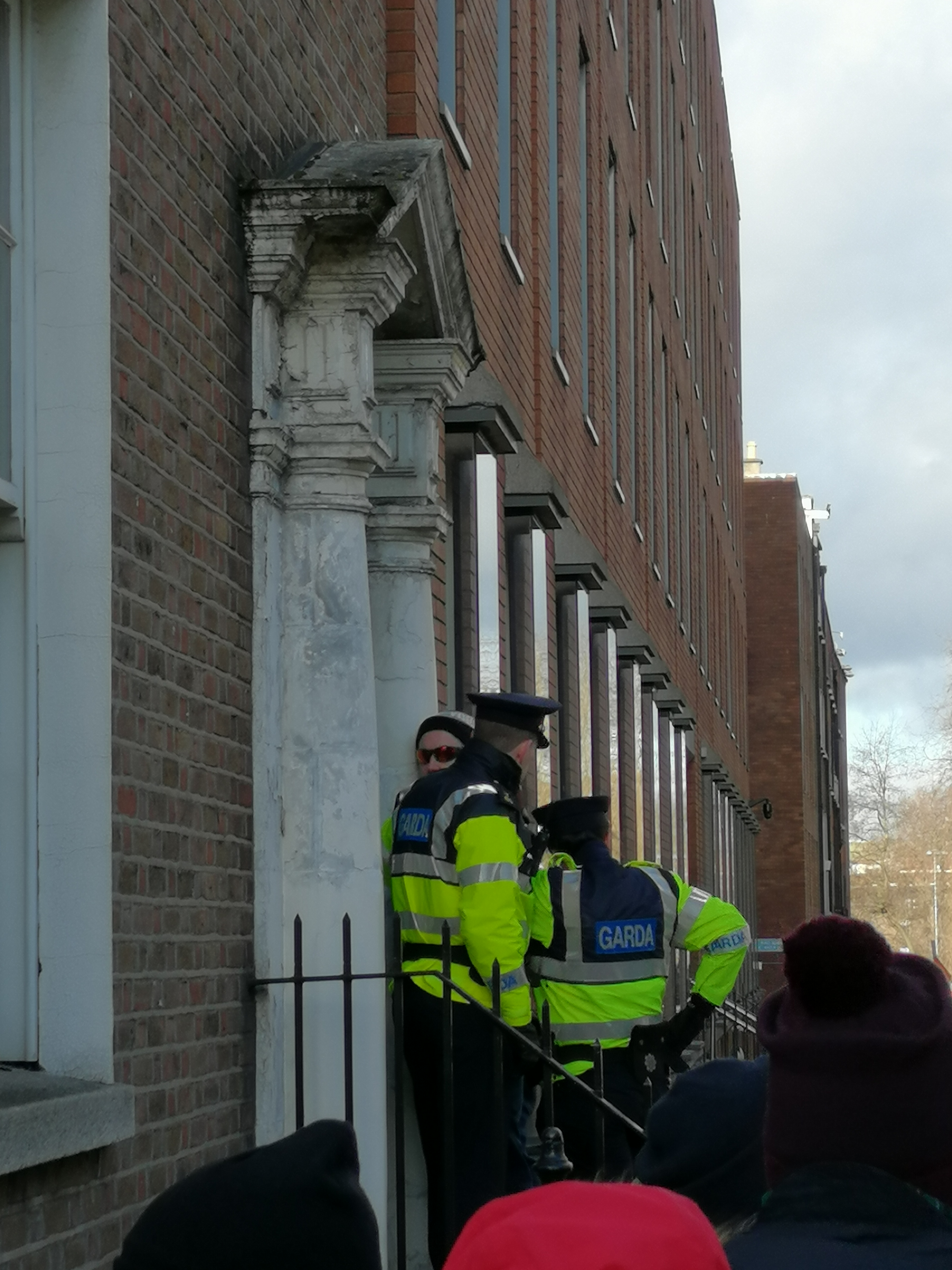
At one point, a surge developed among the anti-fascists towards the south of their numbers and the general Gardaí and Public Order unit (the Gardaí are the police force of the Irish state) charged the anti-fascists with batons drawn, with which they struck a number of antifascists. A man reported to be a fascist, on the steps outside a building on the same side of the street as the antifascists, was seen lashing out downwards, presumably at antifascists, with a pair of crutches. At that point the Gardaí restrained him and later it seems arrested him but apparently they had already arrested an anti-fascist. Most of the police dived at the anti-fascists during this brief episode and a few activists were rescued from police hands. However, a fascist who crossed the road from the Leinster House side with a stick, who took a number of swings at anti-fascists, was escorted back across the road by Gardaí, apparently without any attempt to arrest him.
The man seeing striking out at anti-fascists with crutches before being restrained by Gardaí. An antifascist was arrested during this incident. (Photo: D.Breatnach)
The far-Right rally had been scheduled for 1.00pm and at 2.15 pm they left, having begged the Gardaí for an escort, with which they were provided. Meanwhile, the riot police prevented the anti-fascists from following them.
However, a brief encounter on the quays a little later between small numbers of both groups necessitated the Gardaí once again to protect these “nationalist” warriors.
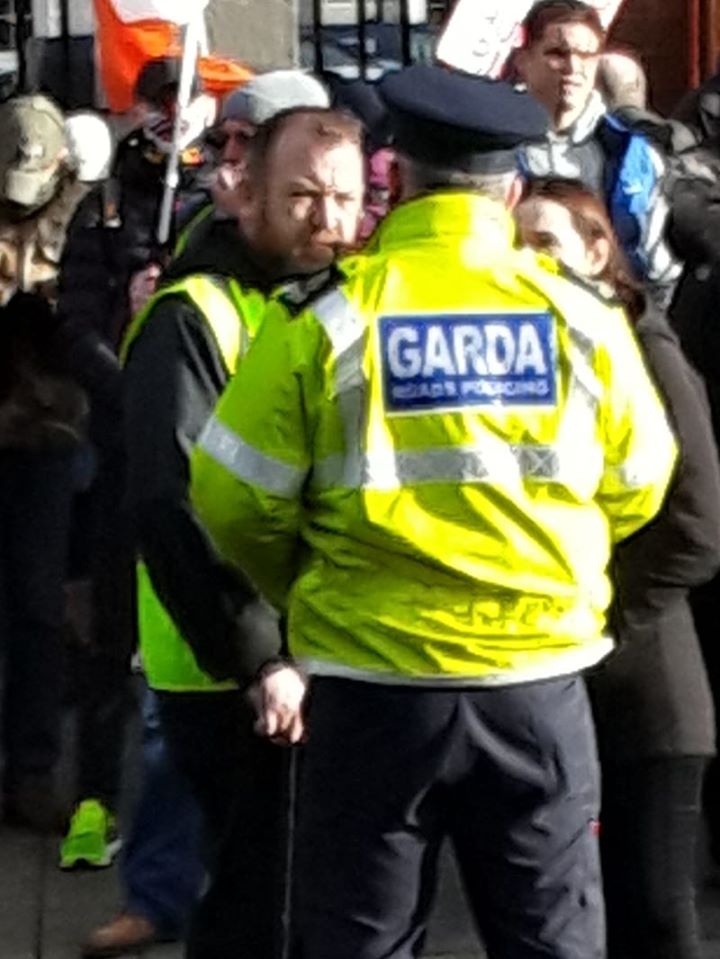
Yellow Vest Ireland fuhrer Glen Miller seeking escort from senior Garda officer. (Photo source: antifascist participant)
DIMINISHING AND DESERTED BY LEADERS?
Those who fancy themselves as the public leaders of the motley crew of the far-Rightists left their acolytes deserted, for apart from Yellow Vest leader and islamophobe Glen Miller, they did not attend. Neither Gemma O’Doherty nor Justin Barrett were to be seen there and the ex-British Army soldier Rowan Croft made only a brief appearance before vanishing.
As mentioned earlier, although extensively publicised in advance, the numbers of the far-Right were significantly down on previous events outside Leinster House, which may point to a limited reservoir of activists in the far-Right in Ireland, also to some inability to sustain an extended program of public events (after all, keyboard activism has been their main activity until recently).
On the other hand, their opponents, using personal contact only to mobilise from among Irish Republicans, Socialists, Anarchists and general Anti-Fascists of different organisations and none, were able to put together a counter-demonstration of a size approaching that of the far-Rightists.
However, it would be unwise to relax. The far-Right is on the rise across most of Europe; the capitalist system world-wide is heading for crisis and at such times turns to fascism to force the working people to pay for the crisis through austerity. In addition, in Ireland we are already in part of an austerity program with the bank bailout draining our taxes, our health service in crisis and no public housing program to counter spiraling homelessness and mortgage debt.
The Gombeens and foreign capitalists who feed on our sweat and blood will hesitate before taking on the working people in this country in an open fight. But with fascists and racists splitting the working people and diverting them from the cause of our woes, that would be a different matter. Continuing vigilance is required, along with mobilisation to counter their public events. But also, education of the people and giving genuine leadership in fighting for a decent life for working people of all ethnic backgrounds in Ireland.
Anti-Fascist Action Ireland (they published a report from which I took some of the information here, the rest being based on my observation): https://www.facebook.com/afaireland/?
Thank you for taking our Government satisfaction survey. Your opinion is important to us.
Please bear with us while we give you an opportunity to recheck your answers.
You indicated a satisfaction level of 0% with the current Government. Yes/ No
You indicated a satisfaction level of 0% with the previous Government. Yes/ No
To the question “Which past or current government did you approve of to a level of 50% or over?”
you entered “None.” Yes/ No
To the question “What, if any solution do you propose?” you entered “Revolution.” Yes/ No
In the event of having indicated “No” to any the questions above, please repeat the questionnaire again with more care.
In the event of instead having answered “Yes” to all, you need do nothing more. Our Satisfaction Team will shortly be with you to discuss matters further. Please do not leave the location at which you currently find yourself. Please do not switch off your phone or Satnav.
Thank you for taking the time to complete our questionnaire. Your opinion is important to us.
Deliveroo riders, treated as self-employed workers responsible for their own insurance, without sickness or holiday pay — but in reality employees. (Photo source: Internet)
Yet another repeat: the nth judicial victory of the riders against Deliveroo. On this occasion, the Superior Court of Justice of Madrid (TSJM) ratified the ruling in favor of 532 deliverers of the digital platform by recognizing them as employees and not as freelancers, as the Labor Inspection of the capital had ruled.
The TSJM dismissed the appeal filed by Roodfoods Spain S.L.U., the holding company of Deliveroo, against the ruling pronounced on July 22nd last year by Madrid’s Social Court No.19. Back then, the court had concluded that the distributors were workers of the company.
“In the provision of services by the deliverers affected by the process, during the period to which the liquidation act refers, labor conditions prevailed, which leads to the judgement of the demand”, states the text accessed by this media. (Trans: ??)
FIRST GREAT COLLECTIVE VICTORY OF THE RIDERS AGAINST DELIVEROO
Therefore, the TSJM insists on the relationship between the home delivery company and the riders: “The details or characteristics of an employment relationship concur when assessing the existence of habituality, periodic retribution, dependency and subject to orders and business instructions, alienation of benefits and risks and very personal nature of the provision of service”.
A Labor Inspection report estimated that the deliverers were false self-employed and that Deliveroo “covered up” an ordinary labor relationship with them. The General Treasury of Social Security took up the challenge and filed a lawsuit, which was decided by the judge. The oral hearing, held on May 2019, had the testimony of more than 500 riders.
Deliveroo Riders received judgement in their favour in Valencia, Spanish State, last year, displaying placards saying “WE WON” in Catalan on Deliveroo-type background. (Photo source: Publico.es)
The workers’ lawyer, Esther Comas, highlights the “importance” of the sentence. Not only because it affects 532 workers, “but because it makes a very exhaustive examination of the conditions of employees who, in turn, can be extrapolated to other colleagues in the same company and even from other platforms [Glovo and Uber Eats]”, the member of the Madrid Ronda Collective pointed out to Publico.
Also, the UGT union welcomed the decision of this court: “We consider this judgement very important since it summarises everything that we have been fighting for and which coincides, in its conclusions, with another ruling by the Madrid TSJ on Glovo’s working model,” UGT explained in a press release.
The collective fight of the riders adds another victory. In June 2019, Social Court No.5 of Valencia also ruled in favor of the delivery riders. Delivery riders in cities like Barcelona or Zaragoza await an oral hearing for the law to recognize them as employees, based on the judgements pronounced against Deliveroo and Glovo.
A rider for Just Eat, on similar arrangements to Deliveroo riders, treated as self-employed workers responsible for their own insurance, without sickness or holiday pay — but in reality employees. (Photo source: Internet)
And, despite the infinity of reports prepared by the Labor Inspectorate in different provinces, digital distribution platforms continue to operate without a regulation that guarantees the rights of their workers. Also, taking into account that the number of employees in the sector is around 14,337 people, UGT estimates that Social Security lose up to 76 million euros, according to the report on digital distribution platforms by Work, presented last September 6th.
I write to say how much I admired your attempt to have the Royal Irish Constabulary and the Dublin Metropolitan Police honoured in Ireland. It was never going to be easy to propose such a ceremony in a country that was occupied by les Anglais for nearly eight centuries and a part of which it is still occupying. But you did not flinch! It took real courage and I empathise with you on its failure (temporary, I hope).
Royal Irish Constabulary assisting landlord in relocation of a tenant in Co. Clare. (Photo sourcede: Internet)
Perhaps it was a little too soon. But as you know, I’m sure, once the unthinkable has been proposed, it is no longer unthinkable; then some day ….
It must be particularly galling for you to see the response of the “swinish multitude”, as your own orator Edmund Burke would have had it, result in the pushing into No.1 slot in the ITunes charts of that odious song of Dominic Behan’s, performed by that rabble-rousing folk group, the Wolfe Tones. To see that disgusting song enter the current Irish charts at No.33 –- and from there reach the No.1 played in the British and Irish charts! But go straight to No.1 in Scotland! Not to mention doing well in the USA and in Canada …..
How hurtful also to see the proliferation of mocking cartoons, videos and memes (all over social media, it seems). And coming up to the anniversary of the introduction of that great band of public servants, too: the RIC Special Reserve and the Auxiliaries.
But as I said earlier, it took courage to attempt what you did – something lacking in your silent partners in government, Fianna Fáil, who remained silent until they could see how the public wind would blow. Someone could get hurt in the rush to disassociate! It is the fate of courageous individuals such as yourself, if I may borrow a phrase from a popular science fiction series, “to boldly go where no-one has gone before.” Even if it looks like no-one follows.
Crowd gathering around gallant RIC Inspector felled by a hurley stick in Dublin 1917. (Photo sourcede: Internet)
Would that we had men of your calibre here in France! The legitimacy of the Vichy Government (1940-1945) was denied by ‘Free France‘ during WWII and by all subsequent French governments after that. They maintained that the Vichy government was an illegal one run by traitors – hard to believe, I know but look it up on Wikipedia! A group of us have been trying to get German soldiers and the Vichy police honoured for some time now but can we find even one politician of any stature who would risk his reputation in the attempt? No, we seem to have no Monsieur Flanagans here in France, c’est dommage!
We have a network of people with similar interests in a number of other countries, including Russia, Poland, Vietnam and Algeria – you may smile when you see the network’s acronym: RIC! Of course the letters stand for other words in our case: Rehabilitation of Invader Collaborators. Whether it was the Russians or Poles who aided the German invaders, or the Algerians who aided our French occupation or the Vietnamese who aided the US invaders, they all have something in common: they did a difficult job, hated by most of their compatriots.
Bandying around words like “concentration camps”, “torture”, “massacres”, “rape” and “executions” does not conceal the truth that ultimately these men (and women, it must be said) were obeying orders. Some of those words I hear have been bandied around about the RIC and DMP too, including those of “spies”, “informers”, “shoneens” and “Castle Catholics”. One must admit that the Irish have a capacity for les bon mots, however one might disdain what they mean – while not mincing words they certainly know how to weave them, if you’ll pardon the mixed metaphors.
Perhaps some day when you can be spared from your Ministerial duties (or when you have retired, far away be the day!), you could come and address the annual general meeting of our RIC – it would be a great honour for us.
DMP teaching people respect for the law, Dublin 31 August 1913. Note some agitators are continuing to cause trouble even lying down. (Photo sourced: Internet)
When, some day in the future, the Irish public recognises how deserving the RIC and DMP are of State honouring, the logical consequence will be of course to honour the Black and Tans and the Auxilliaries, who were sent specifically by Churchill to work in support of – and closely with – those two bodies of fine men. And once that has been accepted it should not be difficult to have the successors of the RIC in Northern Ireland honoured too: the Royal Ulster Constabulary and the B-Specials. Of course, there will be some die-hards who will mutter “sectarianism”, “brutality” and “Loyalist murder gang collusion” but one can never quite get rid of those bitter people, can one? God knows, the English tried!
Speaking of bitter words, I hear some Irish people are saying that as Minister for Justice, rather than honouring “traitors” and “murderers” (sic) you should be pursuing the English to disclose their secret papers regarding the murder of 33 people in the Dublin and Monaghan Bombing by alleged British agents in 1974. How unkind! Some people just can’t forget and move on, can they? Do they not realise that those bombers, whoever they were, were just obeying orders too?
And even bitterer! Some have been heard to say that if Michael Collins were alive he’d have had you shot, given that he had enough RIC, ‘Tans and Auxiliaries shot himself. One can understand some bitterness but that is really nasty, given that Collins can be said to be one of the founders of your own party. And who can truthfully say what Collins would or would not have done? He certainly surprised a lot of Republicans in 1922 when he borrowed British cannon to open fire on Republican positions in Dublin!
When the day comes in the future for Irish rehabilitation for those noble collaborators of foreign occupation, the Royal Ulster Constabulary and Dublin Metropolitan Police, then hopefully the Blueshirts, that fine body of men, co-founders of your own party Fine Gael, can be rehabilitated too. And who knows, some day even reconstituted and formally brought into government? It is not beyond the bounds of possibility, even though the sympathisers of those kinds of politics are very few at the moment ….
And then there’s the man they called “Lord Haw Haw”, William Joyce, of similar ideology — was he not an Irishman also? Did he not carry out his orders too? Of course, that might not go down too well with les Anglais due to his broadcasts in English from Nazi Germany — even though he was an informer against the IRA for the British during the War of Independence. Or perhaps precisely because of it: the English can never quite forgive one they consider theirs, once he turns against them, can they? One must be careful sometimes – after all, les Anglais still have quite some influence in the world, especially in your own country, n’est ce pas?
(A talk given at a recent session of the monthly 1916 Performing Arts Club, published by permission of the author)
I want to say a few words on the subject of ‘Equality’ in particular as it pertains to racism. It is a word that is bandied about quite a bit lately and it is in danger of being misappropriated by some factions with their own agenda.
Now when we speak of equality, one of the most important points to remember is that true equality recognises difference but it apportions an equal value to all difference. Understanding equality therefore is an acceptance that we are not homogenous or in other words we are not all the same.
Also, Equality is not finite so granting rights to one group does not erode the rights of another or reduce their entitlements.
To achieve an egalitarian society is most likely a myth, as society itself, applies a hierarchy to almost every facet of our lives. However, it is the struggle for equality that is important. That struggle has enabled conditions to be put in place that level the playing field and assist the least advantaged to achieve better outcomes.
The introduction of relatively free access to education and the introduction of employment regulations and human rights laws are but some changes that have lessened disadvantage. By striving for equality, and there is a long way to go, we are creating an active democracy by attempting to give equal voice to those from all walks of life regardless of colour, class or creed.
Left photo background: Mixed far-right demonstration outside Dept. Justice, Dublin, early Nov. 2019 — note presence of Irish Tricolour flags to indicate exclusive ‘Irish nationalism’. Left foreground and right of photo: counter-demonstrators. (Source photo: D.Breatnach)
The antithesis of Republicanism
Now the last number of years has seen a rise in a type of neo- nationalism across the West and Ireland is not immune. This type of nationalism is the antithesis of Republicanism as it seeks to exclude. Republicanism on the other hand seeks to embrace and is inclusive regardless of colour or class.
Far right extremists attempts to engender a sense of unity and nationhood through demonising the ‘other’ and are utilising equality as a weapon.
They ignore the part the West played and continues to play in the perpetuation of poverty and war in Africa, Asia etc and how the consequences of their actions have a direct link to the numbers of refugees seeking asylum.
Instead they purport to speak for the disenfranchised ‘true national’ implying that their taxes are paying for the less deserving and they are ending up with an unequal share as a consequence.
There is a new narrative that promotes the idea that ‘equality and charity begins at home’ and ‘let’s look after our own first’. It hijacks the word ‘equality’ to engender a belief that the rights of the stereotypical national are being diminished.
Anti-Irish migrants racist cartoon, USA, 19th Century. (Source image: Internet)
Think of our recent presidential election. Peter Casey was trailing in the polls until his vitriolic tirade against Travellers. His support swelled, because he appealed to those who believe they are paying more than their fair share of tax but are still receiving less than, in their minds, an undeserving group such as Travellers. The implication being that there is an inequitable division and they have to wait longer for what is rightly their due.
Brexit is similar in that it developed a narrative around who is the true British person. Why should they allow ‘others’ into their country and use British taxes to house and feed the stranger resulting in longer waiting lists for housing, health etc for the indigenous population. And I emphasise again, the part the West has played in ravaging the countries from which many people now flee is ignored.
I just ask that when someone comes looking for your vote and is spouting the word ‘equality’, just pause a moment and consider how they are using that word. Instead of seeing the richness that our interaction with people of all shades of colour has given to our society, that was once so insular, are some candidates utilising the word equality as a form of discrimination and exclusion?
Fascism and ‘free speech’
The right to free speech is not without restraint and carries a duty of care. Implicit in any egalitarian society, which gives voice to diverse groups, is respect and tolerance. Fascism and racism therefore have no place in any society struggling for equality as their invective generates hate and creates division and discrimination. Unfortunately the rise in authoritarian leaders such as Trump, Bolsonaro, Orban has given licence (under the guise of freedom) to those who only spout hate.
Leaders of Italian and German fascism in the 1930s — their parties insisted on the right to free speech for them but once in power, imprisoned, tortured and killed their political opponents. (Source photo: Internet)
Racism
A comment I have often heard, by mainly white people, is that they never see colour, only the person. This is supposedly well meaning and a display of openness. However, the question has to be asked that if they don’t see black what do they see? In a perverse way they are actually racist as our colour is a signifier of who we are. To refuse to see a person’s colour be it black or any shade is a denial of a fundamental part of identity. Black people are some of the most disadvantaged carrying centuries of oppression and discrimination. If we refuse to see ‘black’ then how can we put conditions in place to alleviate the disadvantage that has accompanied colour?