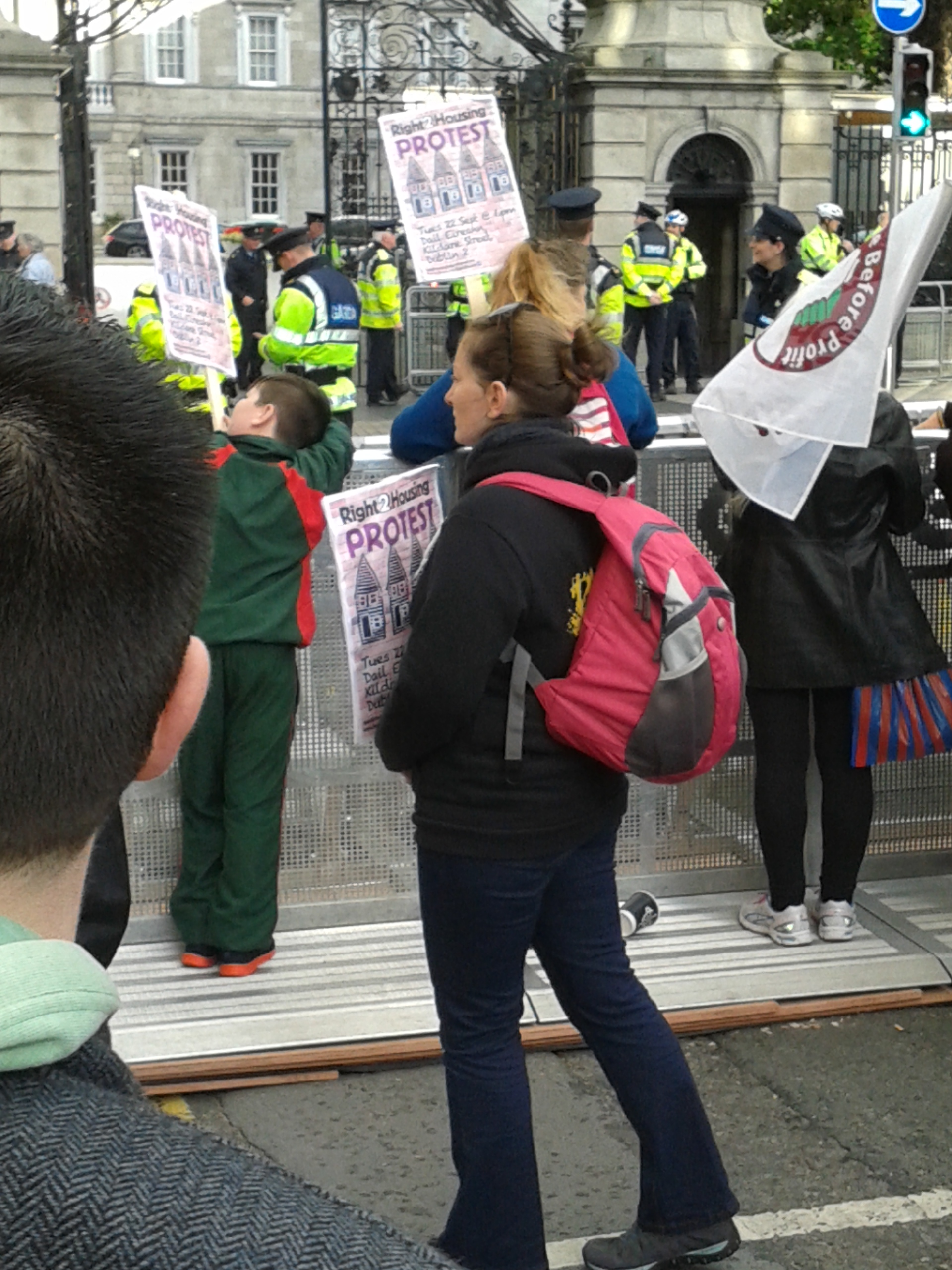
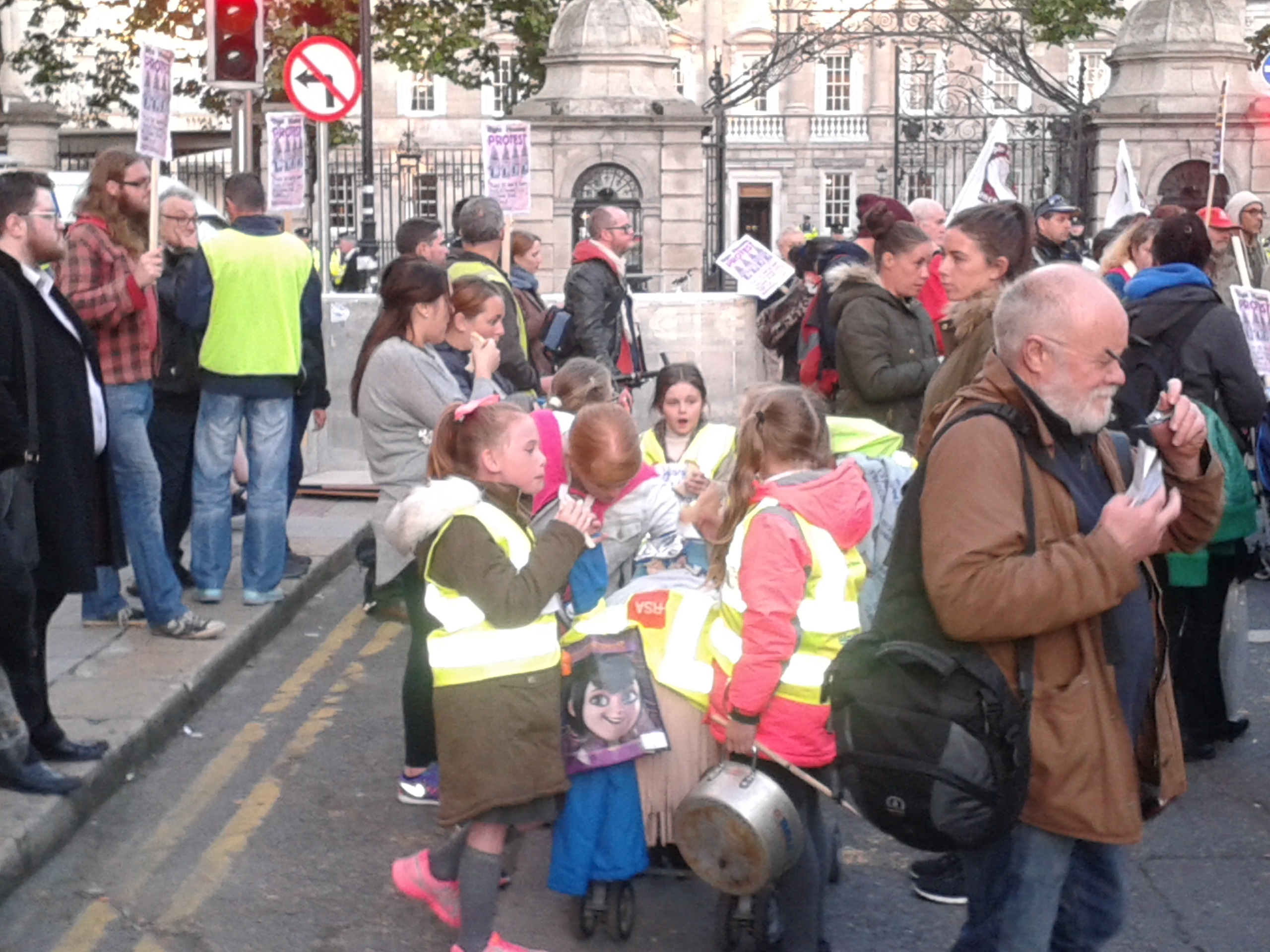
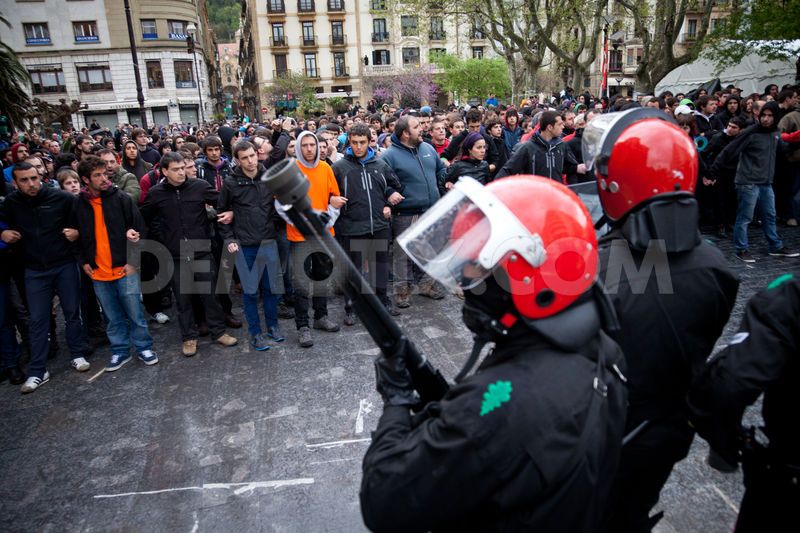
A few hundred people turned out to “welcome” the Irish Government Ministers and supporting TDs (elected members) back to the Dáil after the summer recess of the Irish parliament. The protesters were not allowed within fifty yards of the main gates, with lines of Gardaí, the Irish national police force, standing behind the special new double barriers which they now employ here. Kildare Street, the address of the Dáil, was closed by Gardaí to pedestrian and motor traffic and public transport buses using that street as part of their regular routes had to be re-routed.
There was a special focus among many of the protesters on the housing crisis in Dublin with a number of organisations working with or campaigning for the homeless present and a number of placards drawing attention to the issue.
Some protesters had met at 4pm at the GPO in Dublin’s O’Connell Street and had marched to the Dáil from there, while others had arrived at the Dáil itself from 5pm onwards. There were others demonstrating too in Merrion Street, on the other side of the Dáil complex.
Around the other side, in Merrion Street, I met some protesters coming away from the protest there and stopped to talk to them. They informed me that it was ending there and I returned along Nasseau Street to Molesworth Street.
Among others, schoolchildren lean on the barrier which facing the Dáil, the Irish Parlia
When I started up Dawson Street I saw a small march coming down towards me. These were clearly the remainder of those who had been in Merrion Street earlier. Among this section were young mothers and some of their children had notes attached to their chests, for example “I am five and I am homeless”. I joined this group for the short walk remaining in Dawson Street and into Molesworth Street.
Speeches were still going on there and it seemed a musician or singer would have made a nice change – or even a comedian, or a juggler. After a short while the speeches ended and the crowd began to disperse, at which point I approached the women I had been told were homeless and spoke to one. Shortly after, I left to buy a cup of coffee and start an article about that homeless woman and her children.
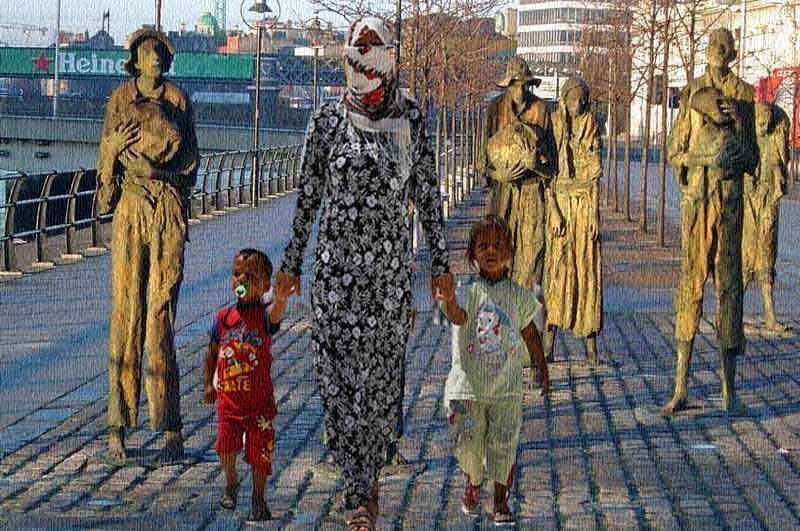
The Great Hunger (1845-1849) emigrants’ monument on the north quays of the river Liffey, Dublin, with superimposed image of African woman and children (image from Memet Uludag on Facebook).
The Spanish state is set to close 107 Basque social centres, confiscate their funds and sell off their assets, including property. With allegiance to the Basque Patriotic Left, the “Izquierda Abertzale” as it terms itself in Spanish, the Herriko Tabernak (“Peoples’ Taverns”) function as centres for social, cultural and political activity. The sale of coffee, alcohol and pintxos (a variety of home-produced small items of food, mostly eaten cold) also generates income with which to employ some activists within the movement and also to fund some of its political activities.
Outside the Errondabide street Herriko Taberna in the Casco Viejo part of Bilbao
Those are the socially-useful functions of the Herriko Tabernak and precisely the reasons the Spanish state plans to close them down. Not that they say that openly, of course – the official line is that the taverns “fund terrorism”. Never mind that the police have never furnished any evidence of that, never mind too that the alleged recipient, the armed organisation ETA, has been in uninterrupted ceasefire since 5th September 2011, confirmed as “permanent” in a statement the following January and again as a “permanent cessation of armed activity” in October 2012.
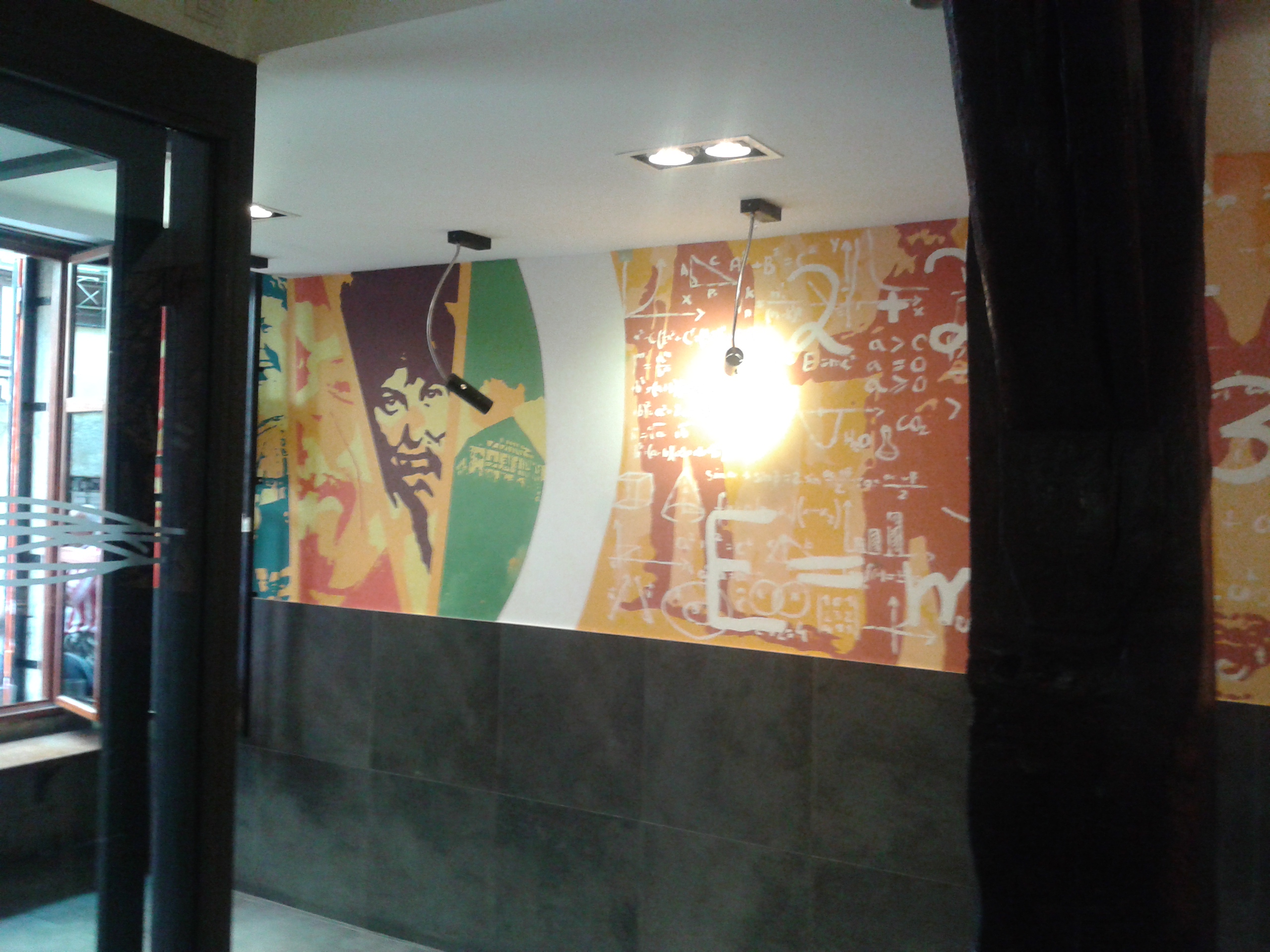
Entrance wall mural
There is an herriko taberna in many vilages and in every town throughout much of the southern Basque Country (i.e the part under Spanish state rule) and Bilbao, for example, has several. They vary from one another but typically have a front bar area and a rear or upstairs function room which may be used for political, cultural,
Section of the function room at the back of the Herriko.
educational or social event, or hired for personal social functions such as celebrating a birthday, successful conclusion of studies, an engagement or wedding, a return for a migrant. Social functions of a more political nature such as welcoming a recently-released political prisoner or a commemoration of some figure of the resistance are also held there.
Inside the Herriko, the bar area and some afternoon customers
Although people hostile to the ‘herrikos’ would not usually enter one, anyone can do so and order coffee, beer or soft drink, perhaps buy some pintxos – no-one will bother them. The language of conversation inside may be Euskera (Basque) or Castellano (Spanish) but all the staff have at least enough Euskera for the customers’ needs and many are fluent.
On the walls notices and posters carry political, cultural or social messages or advertise an event, either specific to the Basque Country or perhaps in solidarity with the Palestinians, the Saharaui (Western Sahara people), or to do with gender and sexuality-social issues, workers’ and migrants’ rights, animal rights ….
Some pintxos in the Herriko, home-made Basque ‘fast food’Banners and Basque flag propped against wall in the function area
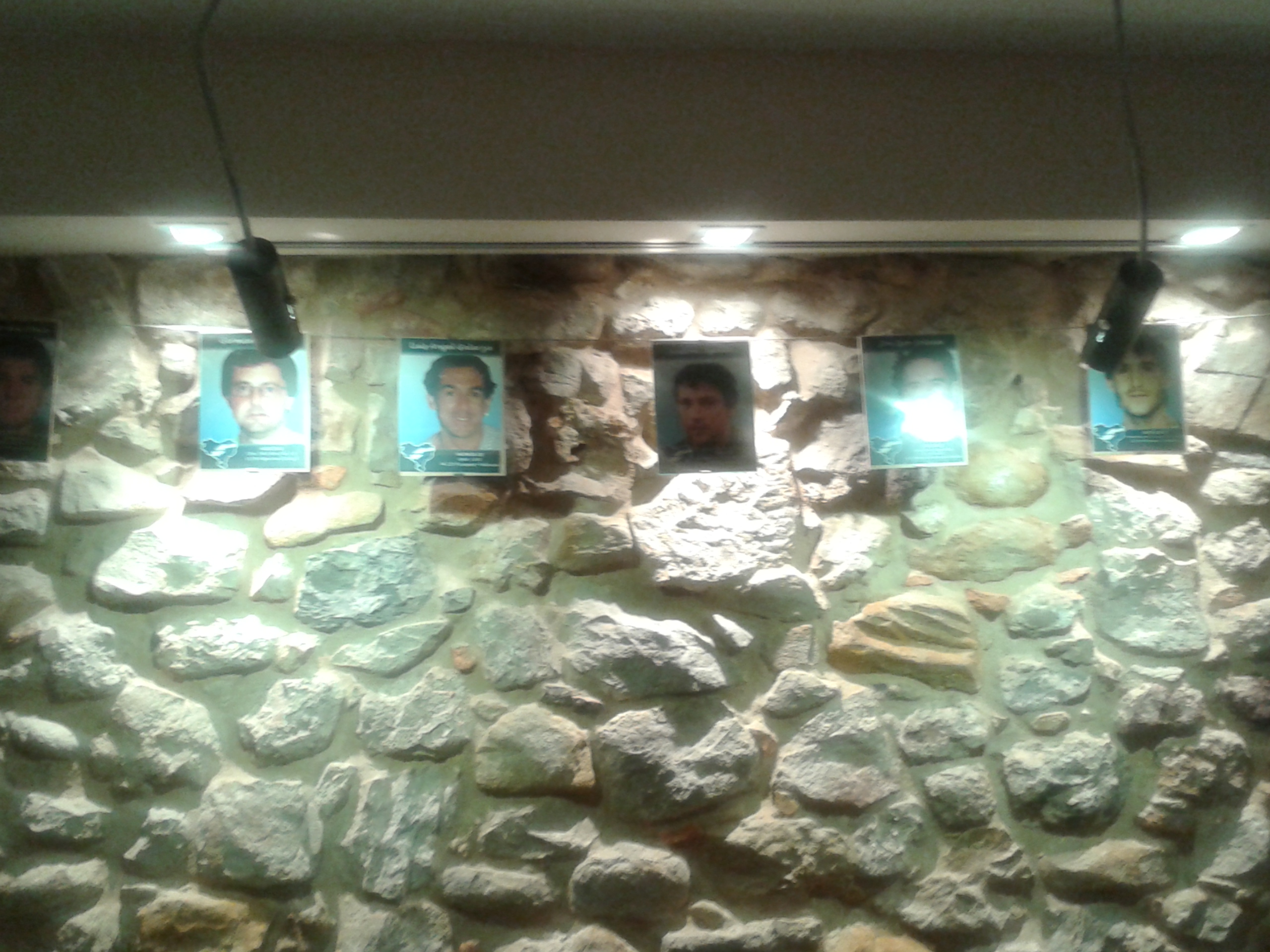
Photo portraits of prisoners are “glorification of terrorism”
Recently, the walls carried photo portraits of political prisoners from the area. After the Spanish National Court decreed, a few years ago, that these were expressions of “glorification of terrorism”, the police raided many herriko tabernak (and also sympathetic bars) and arrested those who refused to take them down. The herrikos and bars affected then removed the portraits but replaced them with black silhouettes. Despite a widespread expectation that those arrested would face prison terms, nothing happened and the pictures are back up on the walls of the herrikos.
Portraits of local activists in jail prominently displayed on the wall in the bar area of the Herriko
The herriko closures are expected after the Spanish state’s General Elections, which must be held before December and are expected in October or November. According to opinion polls, both traditional governing parties, the PP and the PSOE, are ahead of all others and even Podemos, with its meteoric rise to December 2014, did not overtake them and continues to show a decline in the voting intentions of those polled. In the southern Basque Country itself, the christian democratic Basque Nationalist Party continues to dominate and, even if they wished to help the party to their left (and they don’t), could not stand up against the Spanish state. A political solution therefore is out of reach.
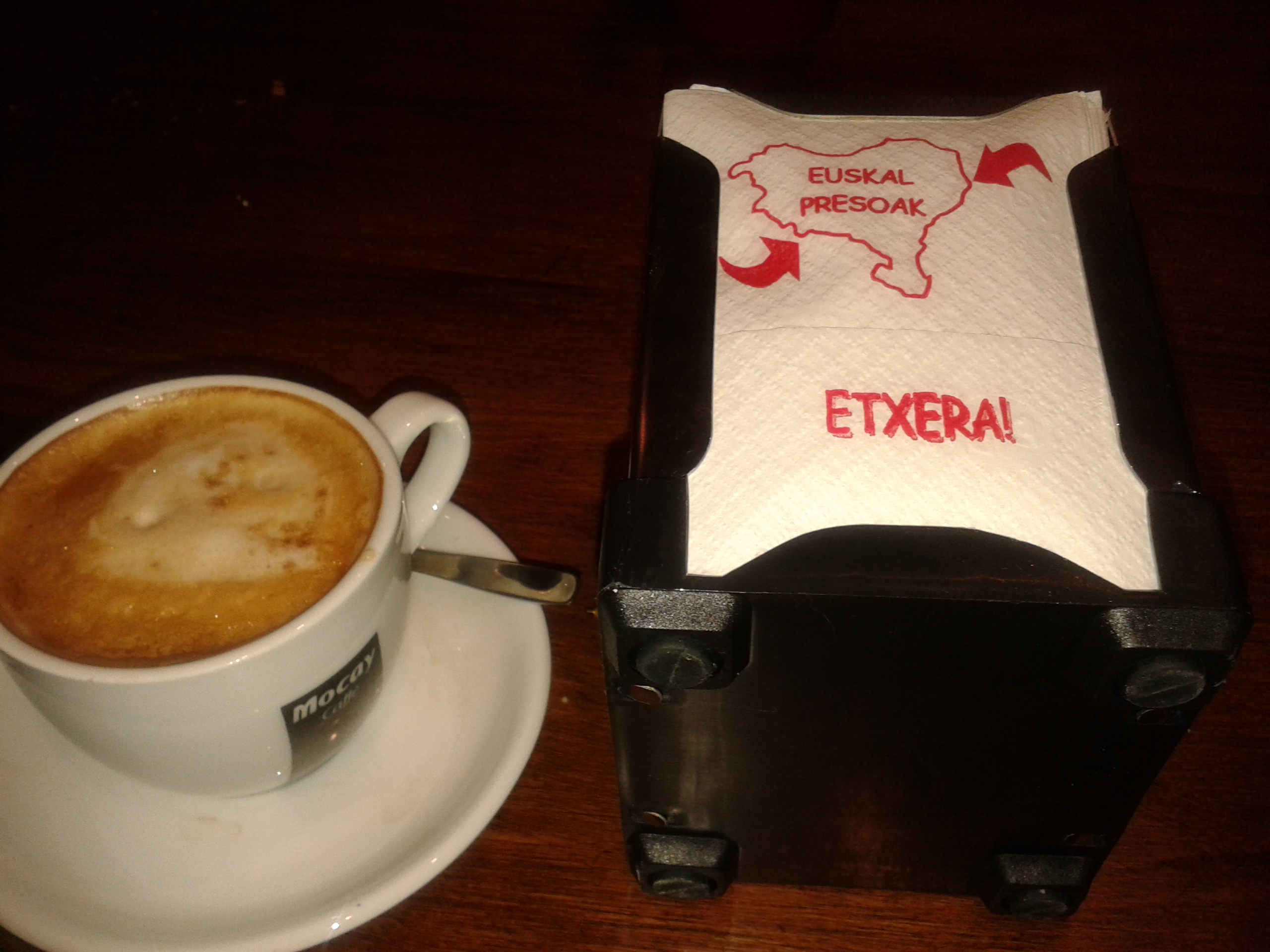
Cafesnea (coffee and milk) with the standard Herriko tissues, stamped with the slogan calling for the Basque prisoners to be sent home from dispersal (and also to be freed).
When the herrikos close, the loss will be enormous: the organised movement will suffer politically, culturally and financially and the social and cultural life of thousands will suffer. There seems little that the Abertzale Left movement can do within the Spanish state – its legal challenge in the Supreme Court has failed. It can apply to the Constitutional Court but decisions there usually concur with those of the Supreme. After the Constitutional, it can apply to Europe, to either the Court of Human Rights at Strasbourg or the Court of International Justice at the Hague but the delay in cases being heard there can take years and by the time they are heard, the herrikos will have been closed and properties auctioned off. Nor are the European Courts’ decisions necessarily to the benefit of the Basques – although a number of times Strasbourg has found against the Spanish state for failing to investigate a claim of torture by a political prisoner, it has never actually found the state guilty of the torture itself. And when the Abertzale Left’s political party, Herri Batasuna, was banned by the Spanish Supreme Court (and confirmed by the Constitutional) in 2003, the movement took the case to Strasbourg. Eventually, in 2009, the Court delivered its judgement – incredibly, it decided that banning a political party with electoral support varying from 15% to nearly 25% in the southern Basque Country was not an abuse of the human rights of the people concerned.
This Herriko is mainly patronised by youth but the age range is complete, from babies brought by their parents to the elderly
Considering the options and Spanish democracy
Now the people are considering their options in action outside the courts. Should they occupy the buildings and resist their takeover by the Spanish state? Maybe that would make sense where their location is a fairly high-profile one. But others are in back streets and laneways; the “Zipayos” (pejorative name for the Euskadi police, the Ertzaintza) can swarm those places, assault the occupants and evict them in a matter of hours. That they can do the same in the more high-profile locations is without doubt but at least the community and passers-by will see the resistance there. In the smaller villages, herrikos may change their name and perhaps replace the buildings’ renters or lessees. Whatever course they take, the disruption overall will be huge.
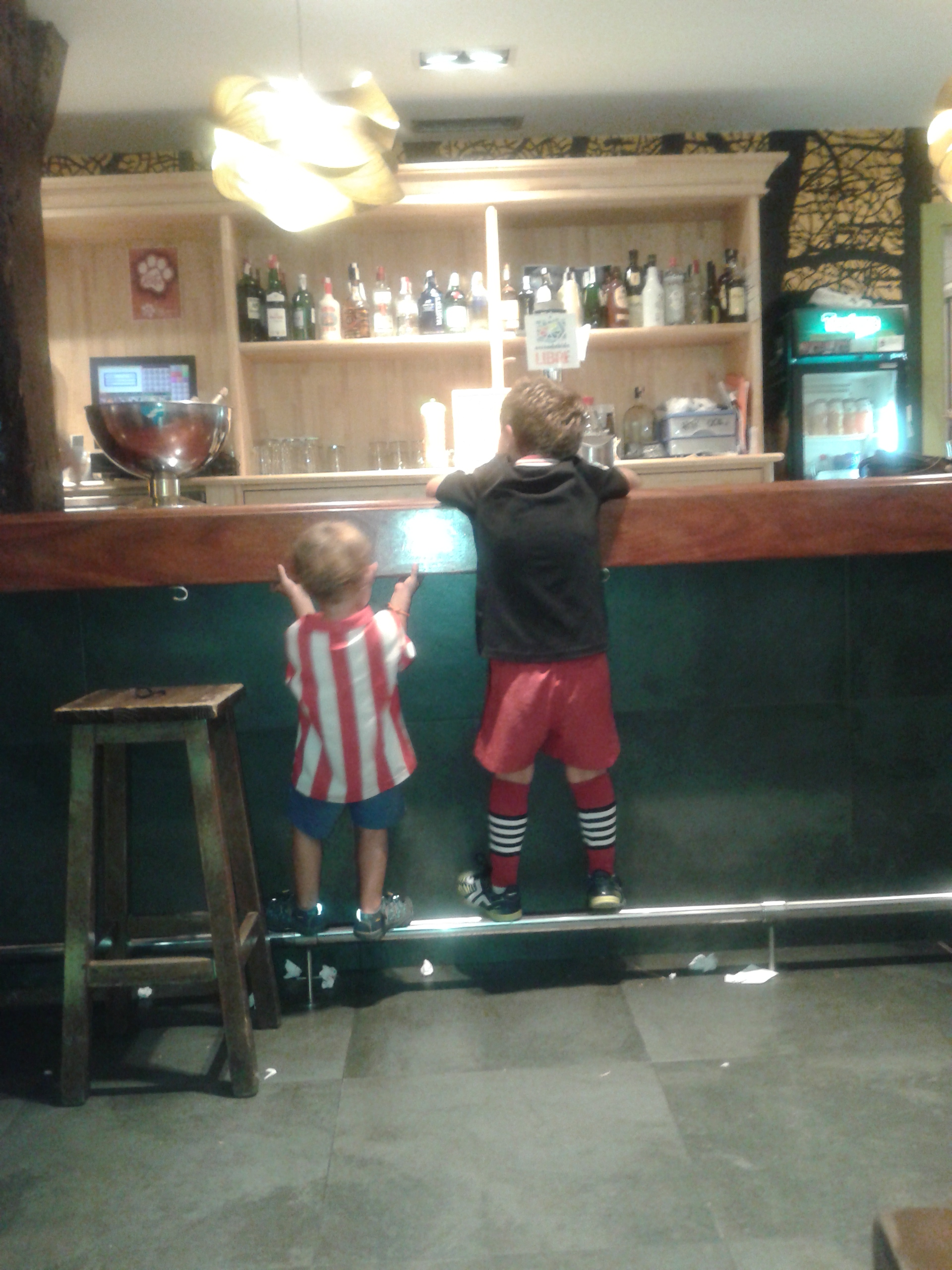
The upcoming generation, one wearing an Athletic Bilbao shirt
In 1998, the Spanish National Court judge Balthazar Garzon (beloved of many liberals around the world) closed down the Basque-language newspaper Egin, a bilingual daily in Euskera and Castellano first published 20 years earlier. Over a year later, a judge ruled that the newspaper could reopen but by then its machinery had been dismantled or left unusable and its owners left without funds as they were using them in court proceedings. In 2009, a Spanish court finally decided that there had been no grounds for closing it in the first place. A year later, there was a similar decision in the case of Egunkaria, the first-ever daily in the Basque language, closed down by the Spanish state in 2003. In 2010, the National Court decided that there had been no reason to close the newspaper and that the accused were innocent, hinting that the accusation of torture was true. But no formal apology followed, nor was there any compensation paid and Otamendi, the newspaper’s manager, had to take his torture case to Strasbourg, where in 2012 he was awarded compensation of €20,000 (and €4,000 legal costs) against the Spanish state because (as usual) they had not bothered to investigate his claims of torture. No compensation has yet been paid for Egunkaria‘s closure and its successor, Berria, reportedly struggles financially today.
Posters and information on the Herriko wall near the front of the bar area
Basques smile ruefully when students of recent Spanish history talk about the “democratisation” of the State through the “Transition” from General Franco’s dictatorship. Apart from the killing by Spanish police and state-supported fascist gangs during that Transition, the southern Basque Country has seen state-organised assassination squads, bannings of newspapers and radio stations, bannings of political parties, youth and cultural organisations and arrests, torture and jailing of political activists. This is the reality behind the words of “Spanish state democracy”.
A Derry schoolboy has been subjected to emotional blackmail and pressure by his school to sign a “peace scroll” and, arising out of an altercation over his refusal in which it was alleged he was being “sectarian”, was sentenced to two after-school detentions. Why is he being treated in this way, what is this “peace scroll” about and who is promoting it?
According to Pauline Mellon, writing about it in her blog, a boy in her Derry community in September last year was pressured by a teacher in his school to sign a “Peace scroll” with which a Reverend David Latimer is trying to create a world record with the number of signatures. “The child was told by a teacher that he would be ‘the only child in the North not to have signed’ and was further questioned as to whether his refusal was sectarian in nature.” Not surprisingly, the child reacted to this suggestion and used a word for which the school seeks to discipline him.
“The school has a policy (on “abusive language”) which makes no provision for contributing factors,” says Pauline Mellon. However, although the school Board is sticking to the letter of their policy in this regard, they seem not quite so rigorous in upholding their own procedures in other respects.
“When the parents questioned the School Principal over his decision to impose two detentions and what circumstances if any he had taken into consideration, the Principal immediately cut off communication with them and escalated the issue to stage 4 of the school’s complaints procedure. Stage 4 of the school’s complaints procedure requires a written submission to the Chair of the school board from parents.”
Although the parents at this stage had made no such written submission, a sub-committee of the School Board declared that they had investigated the complaint (from whom?!) and upheld the Principal’s decision.The sub-committee had decided to use as “a written submission” some letters written by the parents to the Principal after he refused meet them, thereby violating the parents’ rights to prepare their own submission if they wished to go to Stage 4 of the Complaints Procedure and, indeed, violating the terms of the Procedure itself.
As if to underline their casual attitude to their own procedures, the School Board wrote to the parents to outline their “findings” without even using the school’s headed paper. When this was pointed out to them, the Board apologised for sending the decision on plain paper and said it would not happen again. However, there was a much more significant breach of their procedures, in that the sub-committee had kept no minutes of their meeting, about which the parents have learned only recently. Then when the parents did actually submit a level 4 submission, it was totally ignored.
As Pauline Mellon observed, the Chairman of the Board was in breach of his duties according to “Department of Education guidelines which state that the chairperson has responsibility for all meetings and must ensure that minutes of ALL meetings are retained.”
One can imagine the impact of a comparable chain of events on any individual, let alone a child studying for his GCEs. The parents took him to a counsellor, after which they wished to discuss the counsellors’ report with the boy’s form teacher. The Board prevented this meeting, confusing the counsellors’ report with the parents’ “ongoing issues with the Board”.
Nine months after the first incident in this chain of events, the Board invited the parents to meet with them. The parents brought along an observer and the Board refused to allow the meeting to go ahead with the observer present and when the parents protested, they were escorted off the premises, witnessed by an Independent local authority councillor. The Board in this case is the authority and has the power and the school is also their territory. There are a number of people on the Board. In summary, they held the advantages of power, territory and numbers – yet they refused to allow two parents to be accompanied by an observer to support them (and at a later date to bear witness to what went on, should that become necessary). One must wonder what they had to fear in allowing this one additional person …. and why.
The School Board has a Parent’s Representative on it – the parents of the child sought a meeting with this person, not once but a number of times, but the person concerned has so far failed to meet with them. This is indeed extraordinary – how can anybodfy discharge their duties as a Parents’ Representative to the Board if they refuse to meet with parents who are in dispute with the Board?
There is a body which governs Catholic schools, of which the school in question is one – the Catholic Council for Maintained Schools (CCMS). This is an organisation of the Catholic Church but receives public funding through the Northern Ireland Executive. The parents took the issue to that Council. The CCMS admitted that headed paper should have been used in writing to the parents and commented that the school’s Board had not fulfilled their role; they also noted the parents’ attempt to discuss their child’s counsellor’s report with his form teacher but would not comment on whether the refusal would be normal practice. All in all, the CCMS considered that the Board’s actions of using a letter to the Principal as a submission and refusing the parents the right to submit their own Level 4 submission were “reasonable” and “in accordance with School policy”.
Presumably in their deliberations, the CCMS had discovered that the Board’s sub-committee had failed to keep any minutes but left the parents to discover this through other means at a later date. At a later complaint to the CCMS, the Council refused to acknowledge the failure of the School Board’s Chairperson in ensuring minutes were kept, as laid out in the Department of Education’s guidelines. Finally, the CCMS denied that any breach of the child’s rights took place.
The Chairperson of the CCMS is Bishop John McAreavey, who according to Pauline Mellon, has not even had the decency to acknowledge or respond to two separate letters the parents of the child in question sent to him. This was in contrast to the Bishop of Derry, Rev. McKeown who replied to the parents after they wrote to him. “Bishop McKeown who has knowledge in these matters agreed with the parents that a common sense approach should have been taken and expressed concern that such a small matter had used up so much time and energy.”
Pauline Mellon takes a similar line in concluding her article: “… a matter that should have never made it outside of the school assembly hall from the outset has exposed the School Board in question as being ineffective, unprofessional, non-transparent and unaccountable. It has exposed CCMS, a group acting under the wing of the Catholic Church, as not having learned from previous incidents when the Church has closed ranks and has attempted to silence people.”
As to the Rev. Latimer himself, the promoter of the “Scroll” signatures, although he promised the parents to look into the matter, they have heard nothing from him since.
Who is the Rev. David Latimer?
According to the Department of Education of Northern Ireland, Rev. Latimer is “a visionary”, for which term they offer no explanation apart from his Guinness Book of Records bid for “most signatures on a scroll” and his promotion of it in the schools. http://www.welbni.org/index.cfm/go/news/date/0/key/922:1 Indeed, it is amazing that 84 schools have signed up to the project, as the article says on their website – even more so if none of those saw any wording to endorse and to which to encourage their children to subscribe (see further below).
The Rev. David Latimer, photographed in church
David Latimer was a systems analyst with the Northern Ireland Electricity Board and married before he decided to become a cleric. He did so in 1988 and is now Minister of two churches, the First Presbyterian in Derry’s Magazine Street and the Monreagh Presbyterian, established in 1644 across what is now the British Border in Donegal.
In 2011, David Latimer was invited to address Sinn Féin’s Ard-Fheis and did so. On that occasion he said, referring to Martin McGuinness, that they had “… been journeying together for the last five years and during that time we have become very firm friends, able to easily relax in each other’s company.”
Rev. Latimer went on to say that “The seeds of division and enmity that have long characterised Catholic and Protestant relations were neither sown in 1968 or 1921 but during the 1609 Settlement of Ulster. Mistrust and bad feelings resulting from the colonisation of Ireland by Protestant settlers were followed by centuries of political and social segregation. Partitioning Ireland did little to ease sectarian mistrust and separateness between Protestants and Catholics left in the 6 counties as each community continued to be defined by its particular religious affiliation with little mixture between the two groups.”
The impression given there is of some peaceful colony of Protestants arriving in Ireland around 1609 which led to “bad feelings” and “mistrust”. No mention of the seizure of land from the Irish and their expulsion to the hills or abroad. No mention of the suppression of the religious faith of the majority and the imposition of that of the minority, centuries of discrimination, theft of land, genocide. One can see that this might quite rationally give rise to “bad feelings” and “mistrust”. No mention of the actual promotion by the British of sectarianism and the creation of the Orange order, with the intention of breaking up the unity between “Protestant, Catholic and Dissenter” of the United Irishmen at the end of the 18th Century.
It was again reasons of “little mixture between the two groups” which Rev. Latimer went on to blame for the recent 30 Years War:
“Little wonder this part of Ireland descended into a spiral of communal disorder and violence that was to last for decades. Victims of differences, extending back across trackless centuries that have isolated us from one another it is, with the benefit of historical hindsight, not surprising that our two communities should view each other with suspicion and regard one another as ‘the enemy.’”
Dr David Latimer, First Derry Presbyterian Church, conducts a redediication ceremony on the City’s fortifications, “Derry’s Walls”. Photo: Stephen Latimer
Did the Catholics and Protestants go to war with one another in the late 1960s or at any time during the 30 Years War? No, what happened was that Catholics demanded civil and human rights of which they had been denied in that British colony-statelet since 1921; the state forces tried to suppress their peaceful campaign with batons, tear gas and bullets; right wing and sectarian forces among the Loyalists were mobilised and burned Catholics out of their homes and murdered some. The British Army were sent in to support the “Northern Ireland” sectarian police and the IRA came into limited action to counter them, after which hundreds of “nationalists” were interned without trial, followed by escalation of IRA action, the Paratroopers’ massacres in Derry and in Ballymurphy, and so on.
In fact, Latimer’s false account of history has been the standard British ruling class’ version to justify their war in Ireland for foreign consumption and to the British population throughout those years: the reasonable British with the thankless task of keeping the two tribes apart.
I found the content of the Latimer’s speech on SF’s website without an account of the audience’s reaction but according to the Irish Echo, an Australian on-line newspaper, it “received a rapturous reception from the republican audience”.
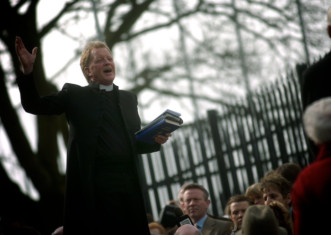
Reverend David Latimer and the British Army
Pauline Mellon says that according to the parents, “the child based his decision not to sign the scroll on Rev Latimer’s service in the British Army and with him being stationed in Afghanistan. The child also raised concerns over what he views as Reverend Latimer’s “selective” approach to local human rights issues.”
Surely the boy is mistaken? At least about him having served with the British Army? Well, actually no. In June 2008 Rev. Latimer gave an interview to the Derry Journal to explain why he felt justified in going with the British Army to Afghanistan although he had to “wrestle with his conscience”. Presumably he is an accomplished conscience-wrestler by now since he also admitted to having participated in other British Army missions for more than 20 years.
“It would be against my nature to be part of something that is creating destruction or generating pain or grief within any community”, he was quoted as saying. “The only way I can reassure myself in being part of this is that I am involved with a unit that is going out to provide resources to people who have no choice but to be there because they are under orders.”
Who are they “who have no choice …. because they are under orders”? Ah, yes, the soldiers, pilots and drone technicians who have invaded another country, killing those who resist and generally intimidating the population. Leaving aside the spurious question of “choice”, does one help justice by administering spiritual comfort to an invading army? To whom does one have a greater moral duty? The answer is clear I think and if one lacks the courage to stand up for the population the least one could do is not to offer comfort to their invaders.
Put perhaps Rev. Latimer intends to be some kind of Camillo Torres, preaching for the poor and castigating the wrongdoer? No, of course not. Well then, perhaps subtly undermining Army propaganda? He invites us to think so: “In the quieter times, I will be around for people who will have questions about what they are doing there and about God. I might not have all the answers but I am there to give a view different to the Army view.”
In what way his view might be different to that of the Army he once again fails to explain, or to inform us whether his views were also different on the other more than twenty occasions in which he served with the British Army previously. Surely if he were intending to undermine Army propaganda, he’d hardly be telling us and the Army in a newspaper interview!
He tells us the hospital he’ll be working in over there will be treating Afghanis as well as British servicemen. Hopefully, they will be treating Afghani victims of torture in British and US Army prisons as well as children given a beating in the barracks. He won’t be trying to convert the Muslims to Christianity, he tells us. And I think we can believe that, since abusing people’s religion, their culture, customs, raiding their houses and generally intimidating them is hardly likely to incline them towards one’s religion.
Going on to discuss the possible dangers he would face, Rev. Latimer informs the readers of the Derry Journal that “We know the (military) base is likely to be attacked and we will undergo training in how to deal with chemical, biological and nuclear attacks.” He need not worry, the Afghans don’t have any of those weapons. However, he should exercise caution should he ever have cause to pass through the special arms stores of the British or US military, who do indeed have precisely those weapons and, furthermore, have used most of them in warfare at some point.
“I will receive some weapons training, although this will be limited on how to disable a gun and make it safe.” Useful, just in case any member of the Afghani resistance accidentally drops a gun …. perhaps when calling on the Reverend to make enquiries about the philosophy of the Christian religion.
“Peace” and “Peace” Treaties and Agreements
The vast majority of people would say that Peace is a good thing; despite that, “peace” remains a problematic concept and not one upon everyone can agree. And “peace” is also frequently being promoted in some part of the world by some of the most warlike states with the most horrifying armaments. For those in power, the invoking of the word “Peace” can be a powerful way of invalidating resistance, silencing dissent and of justifying the status quo which has been achieved through vanquishing the enemy in battle or by the recruitment of collaborators in the enemy’s leadership.
During WWI, the British and the French concluded the secret Asia Minor Agreement (also known as the Sykes-Picot Agreement), with the endorsement of Imperial Russia; the Agreement divided the Arab world between the French and the British should they succeed in beating the Ottoman Empire. To the shock and embarrassment of the imperialists, the Bolsheviks published the terms when they took power in 1917. Although this Agreement was intended to bring “peace” between the competing British, French and Russians, it has been in part the source of many wars with others, as well as coups and uprisings in the Middle East since then.
“Peace” does not mean the same to all: many of the British and French public during WWI would have said that “peace” meant defeating the Germans and Turks, conversely many Germans and Turks would have thought the direct opposite. The Russians mostly wanted an end to the War so “Peace” was one of the most popular of the Bolsheviks’ slogans for their October Revolution, after which they pulled Russian troops out of the War; it was one of the reasons so many soldiers and sailors sided with them.
The end of the First World War brought “peace” and “peace treaties”; among these was the Treaty of Versailles between Britain and France on one side and Germany on the other. In effect, the principal victors screwed Germany for war reparations, occupying the industrial Ruhr Valley. Many historians agree that the Versailles Treaty was a contributory factor to the later rise of the National Socialist Party (the “Nazis”) in Germany and also to the Second World War.
After WWII, the “peace” treaties divided the world largely between the USA, the British, the French and the USSR. Some aspects of that division led to two big wars — the Korean and Vietnam Wars – and a host of smaller ones. The USA has fought 20 military engagements since WWII; the British have fought 28 and the French have been directly involved in 15 military actions or wars (these figures do not of course include the wars and coups fought by the many proxies of these powers). Furthermore, not one of those wars was fought on the territories of those states and, in most cases, took place far from them.
To look for a moment further than the three world powers above, Sri Lanka had a war going on inside it since 1983 and had peace talks a number of times. The origin of the war was the communal differences and inequalities promoted by the British when they ruled Ceylon as a colony and continued by the Sinhalese majority Government afterwards. In 2008, the ruling Sinhalese Government decided on all-out war and, abandoning the mutually-agreed ceasefire, surrounded the Tamil Tigers’ “liberated areas” with a ring of steel through which no-one could pass. They then subjected the areas to indiscriminate continuous shelling and air bombardment before sending in their troops, wiping out most of the opposing guerrillas but also thousands of civilians. According to UN estimates, 6,500 civilians were killed and another 14,000 injured between mid-January 2009. The Times, the British daily, estimates the death toll for the final four months of the war (from mid-January to mid-May) at 20,000.
There’s peace in Sri Lanka now, all right — the peace of the grave.
Sri Lanka’s “peace” is similar to the one that followed the 1798 Rebellion in Ireland – that was “peace” after a defeat of the Irish Republican forces by bloody suppression and rabid sectarianism. Of course that “peace” was temporary only (as Sri Lanka’s will no doubt prove to be too) and was followed by other brief uprisings in 1803, 1848, 1867, the Land War 1879-’82, 1916 Rising, the War of Independence 1919-1921, the Civil War 1922-’23, the IRA campaign during WWII …. The partition of Ireland as part of the 1921 Agreement was supposed to bring peace to both parts of the country but again it proved to be a temporary one.
Despite the sectarian riots burning Catholics out of their homes and the wave of terror and repression by the Six Counties statelet in the early 1920s, conflict broke out again with the IRA’s Border Campaign of 1956-’62. In 1967 the Civil Rights campaign in the Six Counties began; the repression with which it was met by State and Loyalists caused the uprising of the Catholic ghettoes of Derry and Belfast afterwards. Then more repression, more resistance, then troops, then 30 years of war with the British Army and colonial police against the Republican guerrilla forces. The Good Friday Agreement claims to be bringing peace but history – and the ongoing repression of dissent by the statelet’s forces — indicates otherwise.
One of the reasons that peace is not necessarily brought by treaties and agreements is that they are themselves intended as temporary measures: by both parties, as in agreements between competing imperialist and colonialist powers, or by one of the parties, for example by the US Government in the case of the Native American Indians. Or they are violated by succeeding governments, as in the case of William of Orange’s promises in the Treaty of Limerick. Or they don’t deal comprehensively with the underlying causes of conflict, as with treaties and agreements between Britain and Ireland in general.
In fact, when a colonial or imperialist power seeks an agreement or treaty with a people or a weaker nation, what it is seeking is not usually peace but pacification – it wants an absence of conflict, or of resistance, so that it can continue extracting the benefits which it was doing before the people began to resist.
Or sometimes, the stronger power wants merely to delay things, to “buy time” until it is expects to be in a better position (and its opponent perhaps in a weaker one) than that which it was at the time. In 1925 the British Government intervened in a conflict between the mine-owners and the miners in Britain, paying a subsidy for nine months to prevent the miners’ pay from dropping. During that period, the Government laid in stocks of coal and bought up newsprint to prepare for a big battle with the miners’ union in particular. In 1926 they took on the British trade union movement and succeeded in forcing the TUC to call it off the General Strike within nine days of its beginning, leaving the miners to fight on alone for eight months until they were defeated.
So what kind of “peace” is being promoted by the Reverend Latimer? Some detailed plan, or some wishy-washy generalisation? That is not an easy question to answer. It is known to be an attempt to get into the Guinness Book of Records by having the most schoolchildren sign it which many have done, including in Donegal and Derry. Is it just a publicity stunt, where people sign up to some vague notion of “peace” which can mean one thing to one person and something completely different to another? What is the context for this “scroll”? “Peace” between whom and on what terms? Or is there a political agenda, as there was in the campaign around the Good Friday Agreement?
The Scroll’s FB page does not explain and the parents have not managed to find out; in addition a number of Google searches of mine failed to turn it up either. What is known about its origins, perhaps the only thing apart from it aiming at a world record, is that it is being energetically promoted by Rev. David Latimer. And as we have seen, he goes on British Army missions and his role in all this is far from clear.
Schools in our society
Coming back to where we began, the pressure and attempted intimidation of a schoolboy is wrong and should not have been inflicted on this boy (and on who knows on how many others). It should not have been but it was and, when the parents objected, the agents of that blackmail, intimidation and repression should have backed down. And if they refused to back down, the managing agents, the School Board should have upheld the parents’ objections. And if they did not, the Catholic Council for Maintained Schools should have done so. All of them failed to do what was right.
As adults, we tend to see schools as neutral institutions, some with good standards, some not so good, with a continuum of teachers ranging from great to abysmal. Schools however do play a role in socialising children to accept authority and discipline outside the home and also into accepting ideas dominant in the society in which the school is located. Seen in that light, we should perhaps be less shocked at this treatment of a boy and his parents.
However this Guinness Book of Records project is not even part of the school’s official program nor of the State’s curriculum and it was the boy’s resistance to the undue pressure brought to bear on him that sparked the verbal response for which he is now being ‘disciplined’ and which he and his parents are resisting.
If the school were an institution dedicated to real learning, it would encourage questioning, even though its teachers and managers might find that uncomfortable at times. It would value courage and principle and instead of persecuting this boy, would encourage him and value his principled stand, his courage and his persistence. But instead it does the opposite and because the boy’s parents do value their child’s principles and courage and want to support him, they also find themselves in conflict with the school.
Such small-scale battles go on constantly everywhere in our society, in institutes of education, in workplaces, in other organisations and associations, in communities. People fight those battles, often on their own or in little groups, or they fail to resist; whichever they do will affect their individual character and their social and political attitudes thereafter, one way or the other. Drawing on those lessons can lead to understanding more general truths about society and can also help to develop the strength of character to withstand psychological and other bullying and pressure at other times in life. Fair play to the boy for his principles and the courage to stand up for them against authority figures and fair play too to his parents who are supporting him.
Anti-Water Tax protester leaves Dublin court today at liberty after two months but Gardaí arrest three Pro-Choice campaigners this evening, pepper-spraying at least one of them while held immobile on the ground.
Arrested impeding Irish Water vehicles
Stephen Bennet was brought from Mountjoy Prison this morning to Dublin Criminal Court to face “Public Order” charges relating to “obstructing” Irish Water vehicles in Dún Laoghaire and Dalkey and refusing to comply with Gárda instructions to desist. The Dún Laoghaire court had imposed conditions for releasing Bennet on bail which included a curfew, staying away from Irish Water vehicles and a large financial surety. Declaring the conditions unreasonable and a restriction on his civil rights to protest, Bennet had refused to agree to the conditions and the judge had taken to jail.
Some of the crowd of supporters welcome Bennet as he emerges into the court ground floor lobby. His daughter Saoirse can be seen to the left holding Bennet’s grandson. Unfortunately, Bennet is hidden as he moved forward as photo was taken.
Up to 30 supporters crowded into the court this morning to hear Bennet’s case being tried. There was also a large number of Special Branch Gardaí (political police in plain clothes) and a smaller number of uniformed police. A Garda Sergeant Gilmore from Dun Laoghaire station gave evidence of having confronted Bennet at York Road in Dún Laoghaire, where the accused had been sitting in the road and at Dalkey, where he had been “marching extremely slowly”. Sgt. Gilmore quoted the Public Order Act to Bennet and ordered him to desist but Bennet had declined to comply. Defence Counsel maintained that there was “a reasonable doubt” as to whether Bennet had been in violation of laws initially which would have rendered his subsequent refusal to comply with Garda instructions not an offence. Since there was no question of accusation of breaches of the peace, assault or criminal damage, the point at issue was whether the Public Order Act was applicable. State Prosecution Counsel argued that blocking or slowing traffic was creating “a nuisance”, to which Defence Counsel replied that causing a nuisance was part of the purpose of a protest, in order to make it effective. Sit-down and marching slowly protests had not been tested in Irish law, said Defence Counsel but quoted a number of cases from the European Court of Human Rights at Strasbourg where the Court had ruled in favour of applicants’ rights to protest even when the applicants’ states had found them in violation of their laws and penalised them.
Some of the supporters outside the Dublin Court today
The Judge retired to consider the case and when he returned he found Bennet guilty on all charges and sentenced him to a total of around €800 in fines, in default of which a total of 11 days in jail. One one charge, he sentence Bennet to two months’ imprisonment but, since that was time already served awaiting trial, Bennet was freed to cheers from his supporters, including his daughter Saoirse and his grandson, who had been born while he was in jail.
Belfast mother charged with giving her daughter an abortion-inducing pill
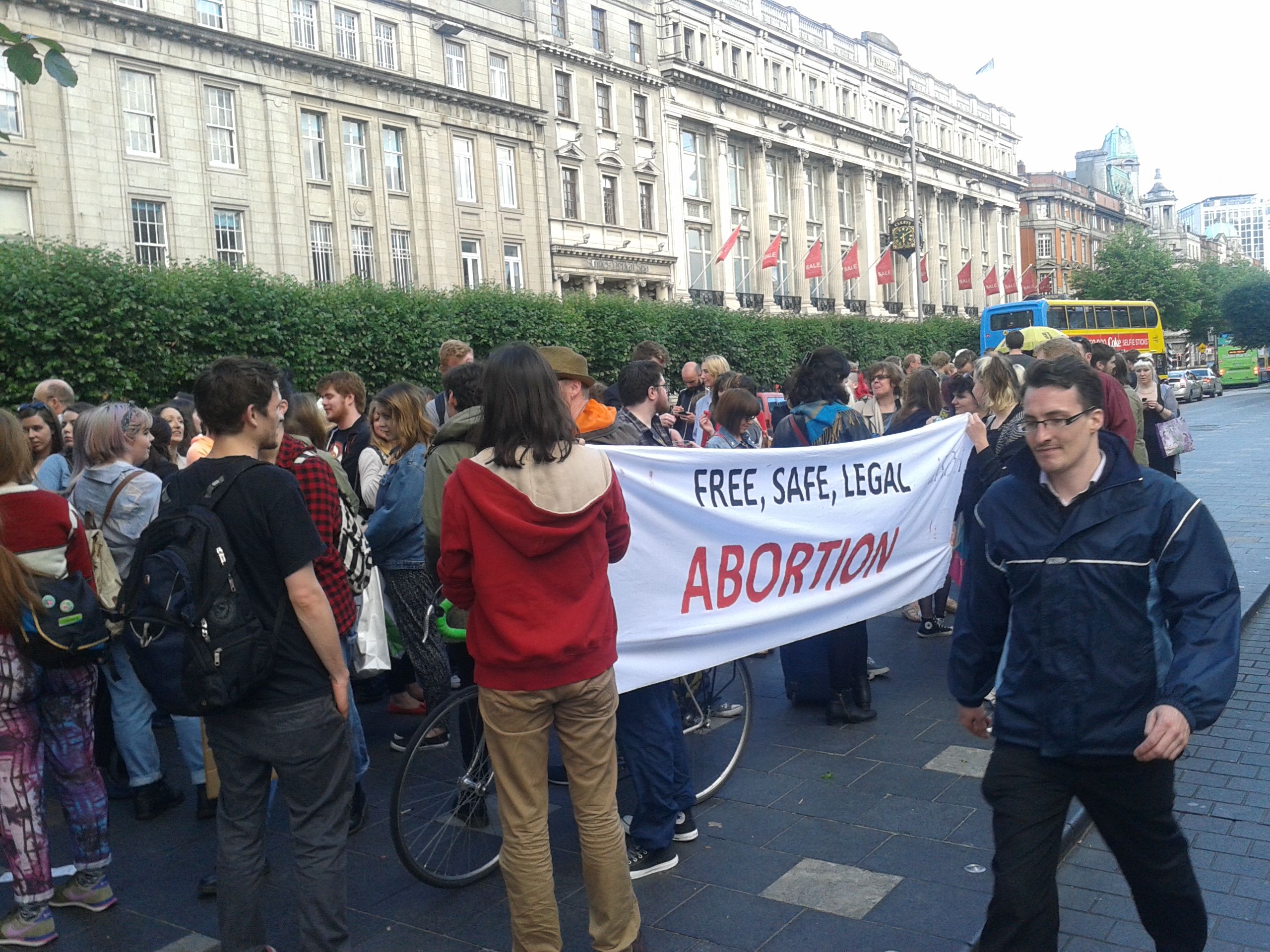
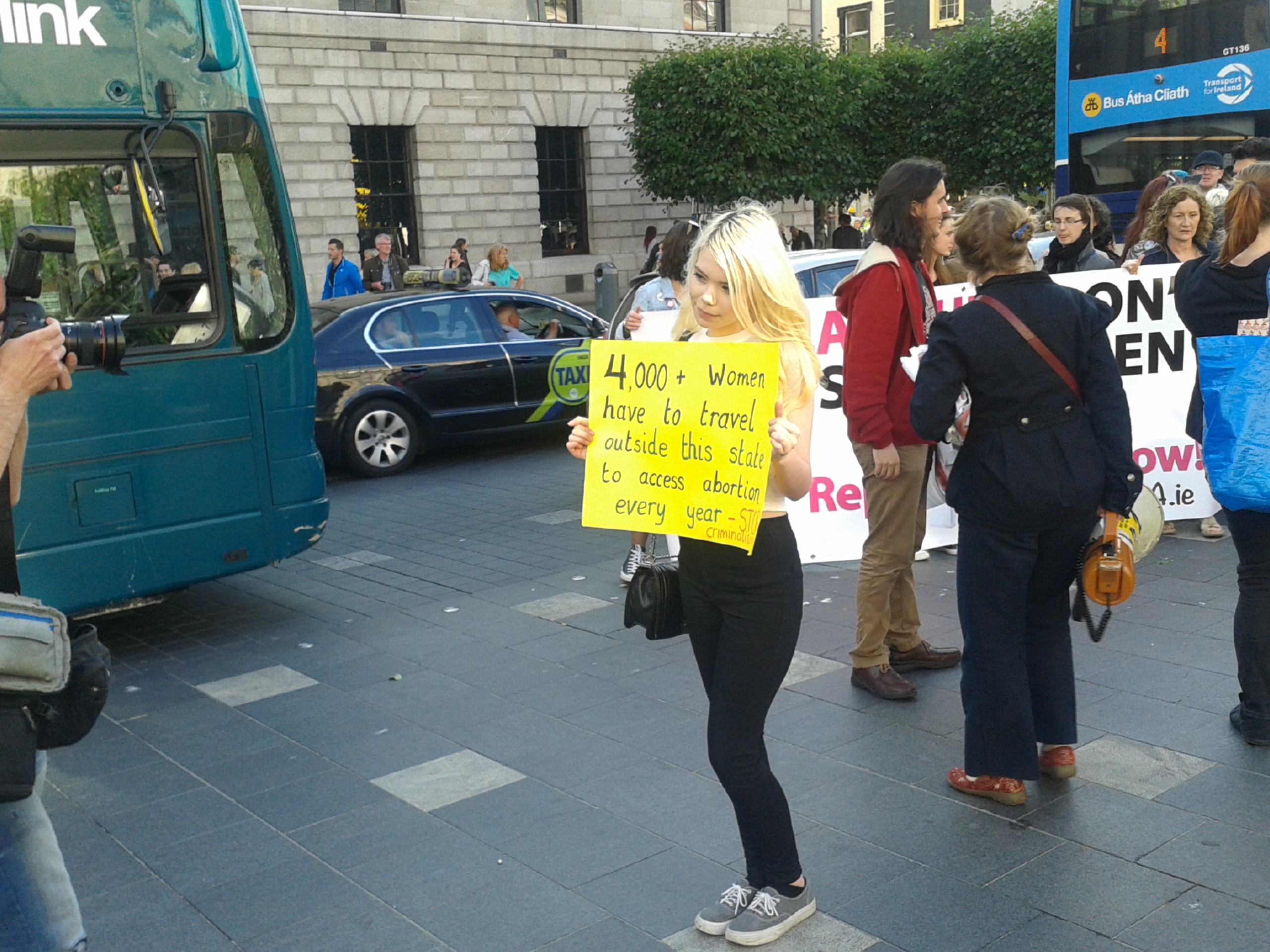
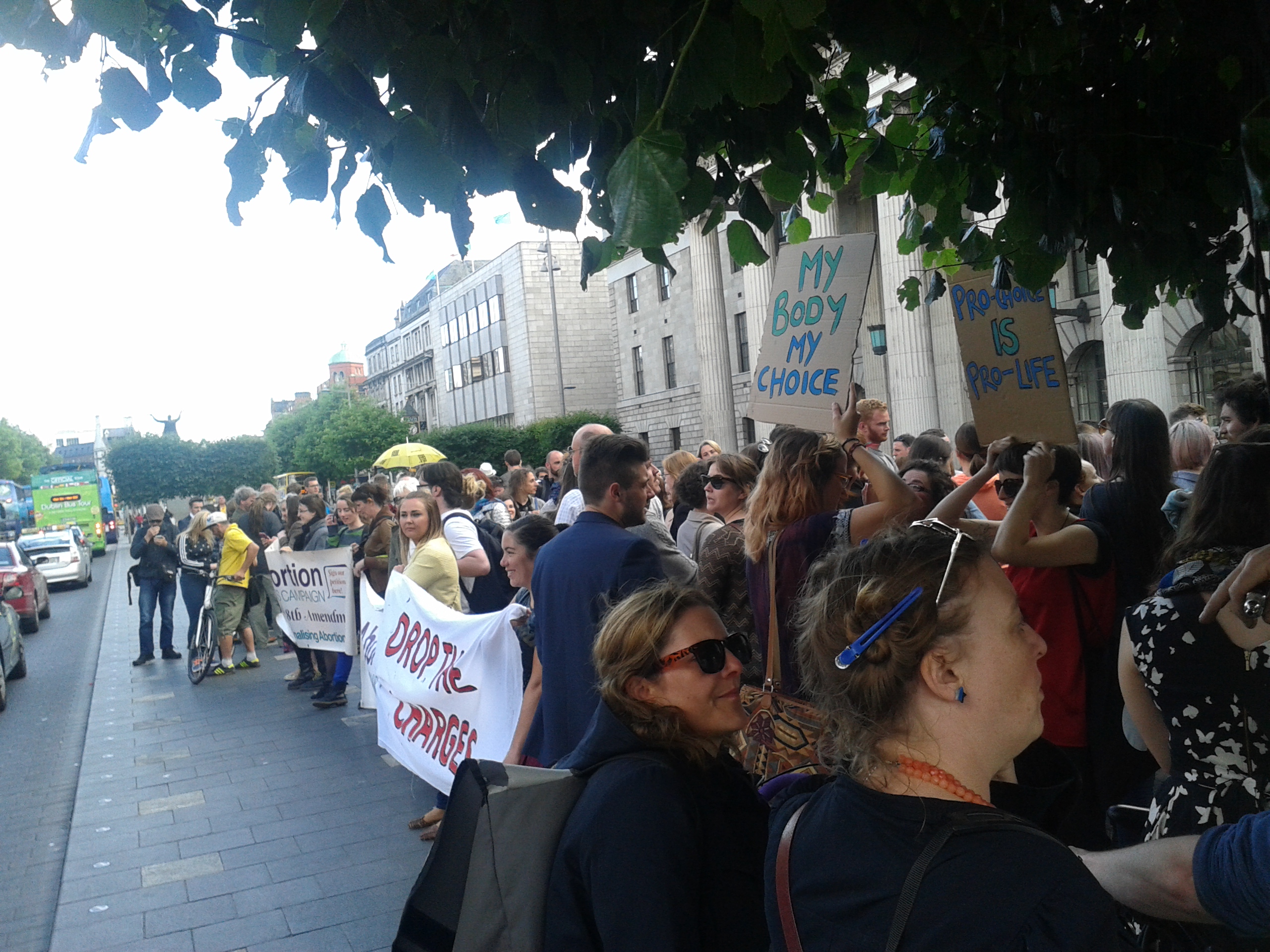
At 6pm this evening a protest took place at the Spire in Dublin in solidarity with a Belfast mother who facing criminal charged for having given her daughter a pill which induces abortion in very early pregnancies. The pill is freely available in Britain and legal there but the 1967 Act which legalised abortion in Britain has not been enacted in the Six Counties.
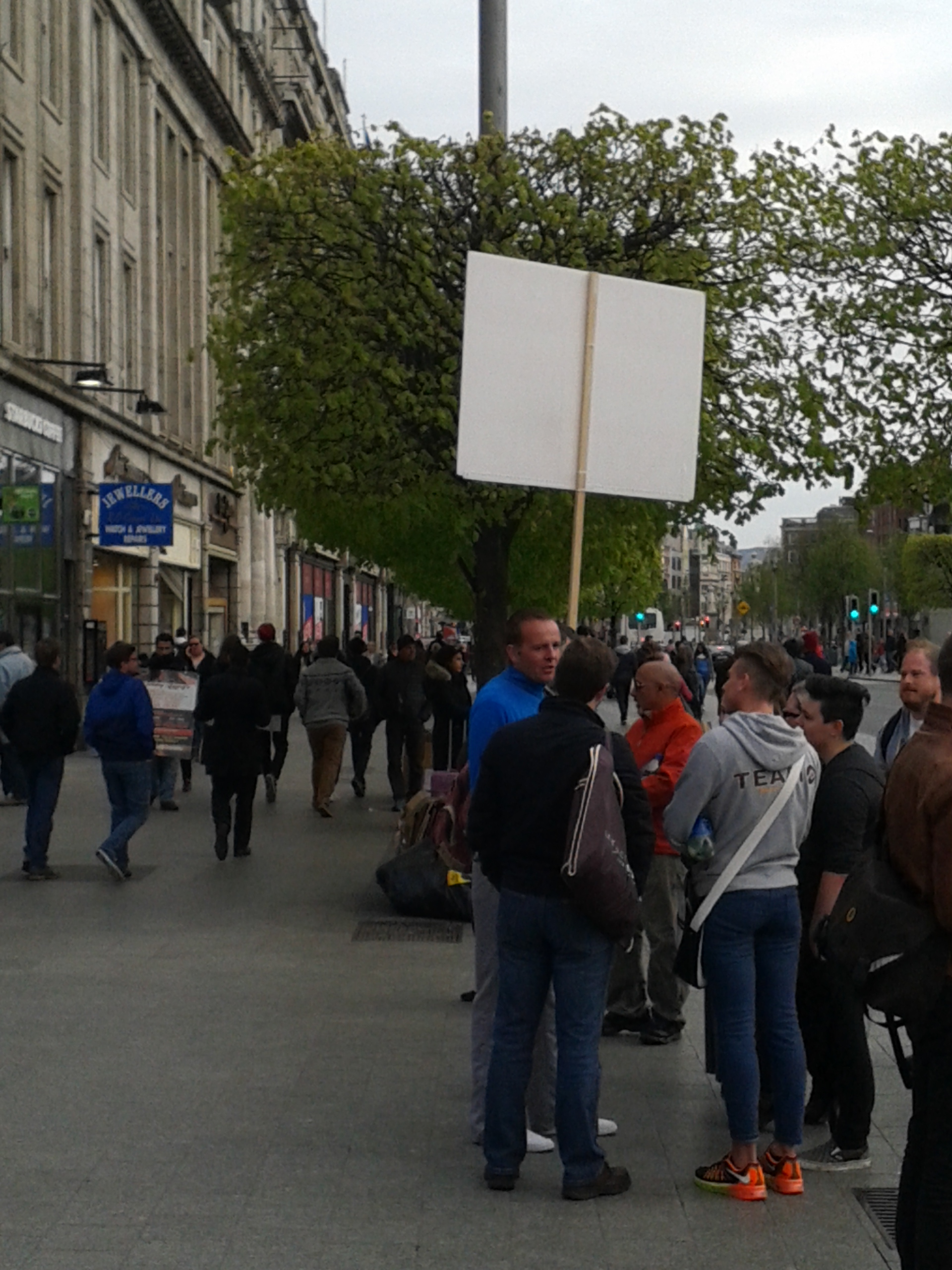
West side, O’Connell Street central pedestrian reservation, Dublin, just near Spire
The event had been organised by the Workers’ Solidarity Movement and Real Productive Health organisation in order to express solidarity with the mother and also to link the struggle of women in the 26 Counties with those in the Six, women in both parts of Ireland having to travel to another country, Britain, to avail of abortions and similar protests took place in Belfast and in Galway.
East side O’Connell Street, Dublin, just near the Spire
A number of people spoke and soon afterwards some excitement stirred through the crowd and they began to examine the roof of the GPO where something was going on. Very shortly after that a Garda squad car with siren blaring and blue lights flashing tore along O’Connell Street and turned into Henry Street.
Another group at the protestSitters and Standers mid-way through the demonstration
Violent Garda arrest scenes
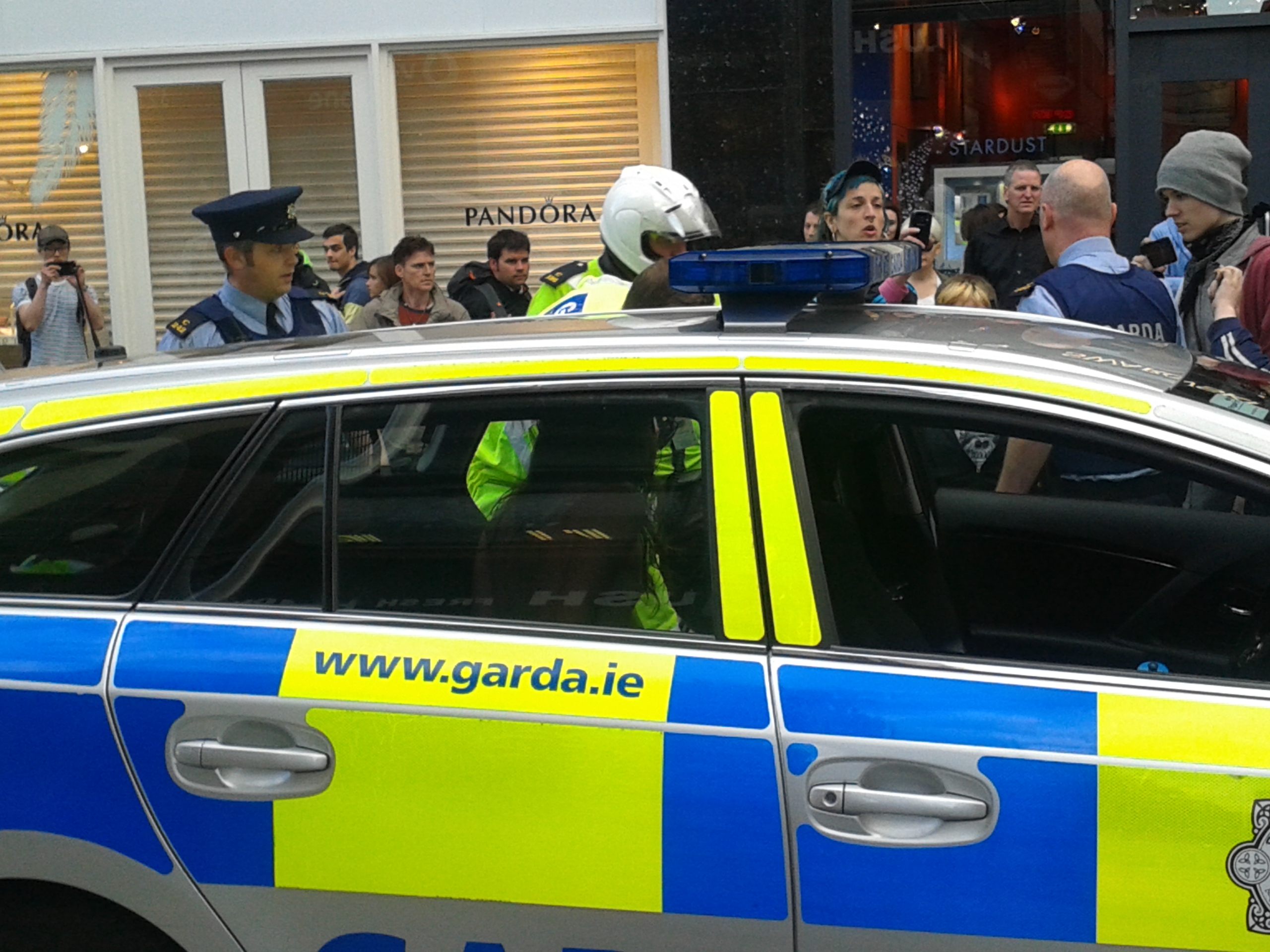
People broke away from the pro-choice demonstration and gathered in Henry Street as other Garda squad cars, a motorbike, a cycle Garda and a number uniformed and Special Branch Gardaí on foot poured into the street. The scene was was somewhat confusing for many but what was clear was that the Gardaí had torn the shirt off one one young man, handcuffed him and put him, stripped to the waist, in a squad car. Another young man was also handcuffed and ended up on the ground with a number of police on top, one of whom pepper-sprayed him while in that position. This action provoked shouts from onlookers and uncertain physical intervention. As a third was arrested and bundled into a police car, the word went around that these were pro-choice demonstrators who had got on to the GPO roof (presumably using the scaffolding to the side of the building) and that they had attempted to display a banner up there.
Man arrested after shirt torn off in squad car in Henry Street can just be discerned in the back seat of the squad carAnother of those arrested in Henry Street; he ended up on the ground with a number of police on top before being put in the car.
People gathered around the Gardaí, some of whom threatened to arrest those arguing with them. The Gardaí were then seen to be picking up a banner to put in the back of one of their vehicles when a woman cried sarcastically: “A banner! Oh, thank you for saving us from a banner!” Others joined in shouting: “Bad banner! Bad banner!” amidst other calls from protesters and passers-by generally expressing an opinion that the police action had been unnecessary, repressive and over the top in violence and in numbers. Indeed, the numbers of Gardaí present who had suddenly appeared did suggest to many that they had been kept in readiness to move on the pro-choice demonstration at some point or were aware that some publicity action had been planned. Protesters who attended Store Street Garda station soon afterwards were told that the accused would be charged and released on bail “in a couple of hours”. The wording on the banner apparently had been “ABORTION CHARGES ARE BOLLIX”.
WSM video of scenes at the arrests: https://www.youtube.com/watch?v=iPwZlWYW3kE
WSM Video of the rally just prior to the arrests: https://www.youtube.com/watch?v=cFp_AzsFIa0
Workers’ Solidarity Movement statement on the arrests http://www.wsm.ie/c/wsm-statement-garda-arrest-pro-choice-campaigners-july2015
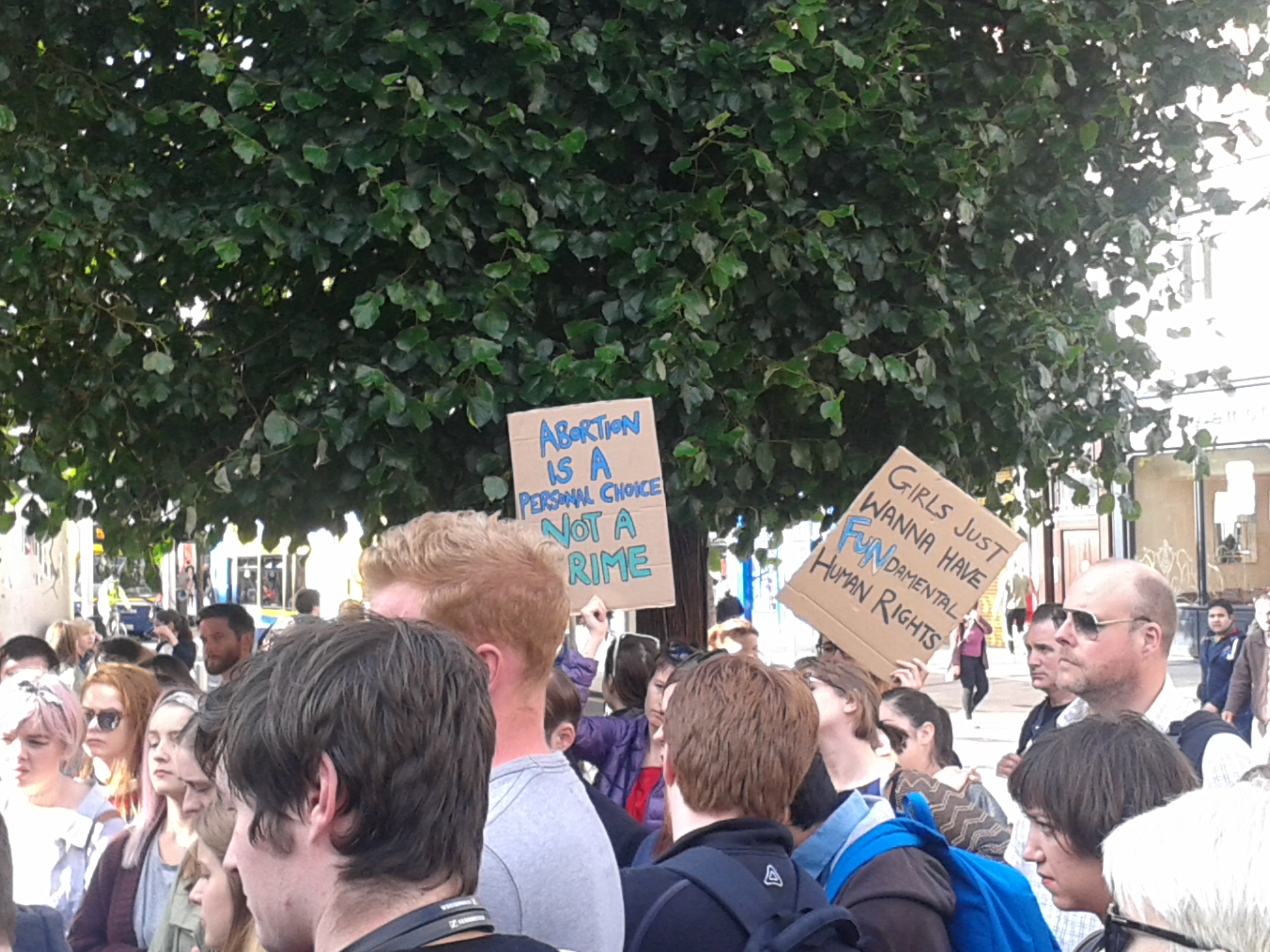
Some in crowd beginning to argue with Gardaí as others look on amazedTwo placards in the crowd earlier, a reminder of what it was about
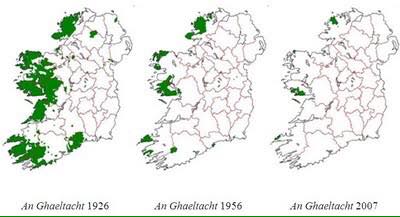
Maps showing the decline in the Irish-speaking areas, the Gaeltacht, during the life of the Irish state
“Irish is nearly dead as a spoken language.” A shock ran through the Irish-speaking community at the news…. but although the after-shocks reached linguists afar …. the news caused but a small ripple in Irish society at large.
It should have been big news. In only nine decades of the existence of the Irish state, the Irish-speaking areas had shrunk by 90%. This seemed to herald the imminent death of Irish as a spoken language – a language that, albeit shrunk to being the mother-tongue of small minority of the Irish population, had survived almost a millennium of colonial occupation and a consistent policy to replace it with English.
The loss would be greater than Ireland’s alone – this is an early Indo-European Celtic language of more than four thousand years of development, the language of the earliest vernacular literature of Western Europe, an extremely rich literature of pagan mythology and folklore containing epics which did not suffer the extent of moralistic destruction which either the Reformation or the Inquisition visited upon so many others across Europe. The language is probably unique on the Continent in being that of a state and which is also that of the first recorded settlers of the land. It was (perhaps still is) the Celtic language with the largest number of speakers. It is the mother of Scots Gaelic and Manx Gaelic too.
It seemed almost too difficult to grasp that this had occurred in a state that claims to be independent, which also claimed the language as the first in status in the State, according to its Constitution. And this has, seemingly contradictorily, occurred at a time when there are more Irish-medium schools, Gaelscoileanna, than ever before in the history of the State.
How did it come to pass? Emigration, some might say. Certainly emigration on a large scale has been a feature of Ireland’s demographics since at least the Great Hunger (although it was in the years after that disaster that the outlying western areas began to hemorrhage). Even so, although emigration has been a constant, so also has been the population – in other words, the birth-and-survival-rate kept up with the emigration. Did the Gaeltacht areas experience higher emigration rates than elsewhere then? Certainly – not just to go overseas but also to Irish cities, especially to Dublin. Industry was scarce in the Irish-speaking areas, despite the efforts of cooperatives and Gael-Linn and the land in most places is rocky and poor.
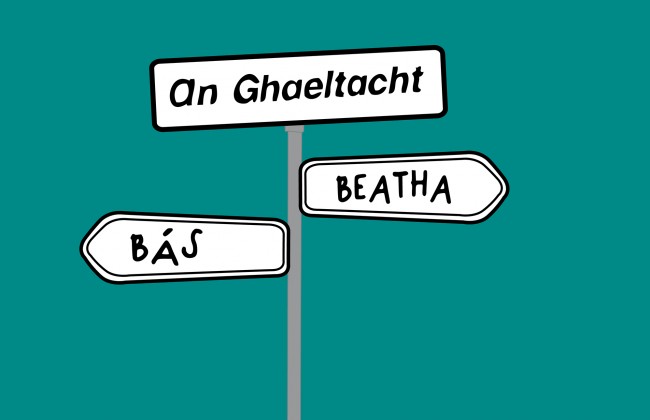
The Gaeltacht Death or Life (image downloaded from the Internet)
Yet, the reality appears to be that the Gaeltacht population reached a level at which it stayed – so how can there be a continual reduction reaching 90% in the Irish-speaking areas? If the population has not decreased, certainly not to that extent – then the Irish-speakers must have. Have many ceased to speak the language then, losing it over a generation, or two, or three? Or has an inward migration of English-language-only speakers replaced Irish-speakers? Yes to the first and yes, to an extent, to the second.
The Basques have a saying: “No language was ever lost because people didn’t learn it but rather because those who had it, stopped speaking it.” (As an aside, I find myself wanting to say “her”, because in Irish the word “language” is of feminine gender: “Beatha teanga í a labhairt” — literally “the life of a language is to speak her”). Observers speak of children raised in Irish-speaking families, or in a mixed-language household, even in the Gaeltacht, speaking English with their peers as they leave the primary school where the subjects are taught through Irish.
So, the people make a choice and some people of other mother-tongues move in – that’s democracy, isn’t it? Freedom to move, freedom to speak the language you want. But is it really so? Certainly one can assume that the people moving in are making a free choice (unless one takes into account dearer house prices in the cities). But are the ones moving out making a free choice? If the absence of industry and therefore employment is a constant in the Gaeltacht then it is not an entirely free choice to leave. If the work were there, one can assume many of the people would stay.
Ok, but the ones who stop speaking Irish – surely that is a free choice? One suspects cultural factors at play there. The attractive world for pre-teenager – which is what most childhood years have become — and teenager, is a world dominated by and represented through the English language. It is transmitted in English through so many media …. all with very little competition in Irish. The Irish-language TV channel, TG4 is in practice a bilingual one. Publishers find only a small market for books aimed at children and young adults in Irish, whereas the English-language market stretches not only throughout Ireland but abroad — Britain, the USA, Canada, Australia, New Zealand … All of this without mentioning TV, pop-song lyrics, video games, Internet, films ….
But one must also take into account the fact that when those Gaeltacht children visit their nearby towns and cities – Letterkenny, Dublin, Waterford, Cork, Tralee, Galway, Ballina – they hear English all around them. Worse … they hear only English around them – unless they hear other languages from tourists or perhaps an Eastern European language from migrants. What they are practically guaranteed NOT to hear is Irish.
So, hardly anyone speaks her – sorry, it – and it’s not cool and most people of your age around the country don’t speak the language and what do you need it for anyway? It’s not surprising Irish-speaking is in decline.
“You can’t blame the State – they tried their best, didn’t they? Sure Irish is still a compulsory subject in the schools.” “The national broadcaster has provided a radio station and TV channel for Irish-language use, too! And they give some grants to families speaking Irish in the Gaeltacht, right?”
Ní mar a shíltear a bhítear (loosely translated as “not all is as it seems”. Yes, Irish is taught in the schools but no attempt has ever been made to make it a language of daily use – for work, public transport, banking, shopping, post office, health service, education … Radió na Gaeltachta was won through a civil rights campaign – Feachtas Cearta Sibhialta Muintir na Gaeltachta – and people refused to pay their radio and TV licenses, were dragged to court, fined, refused and some even went to jail before TG4’s precursor, Teilifís na Gaeilge, was supplied. The Irish-speaking grants were a help to households but were not properly administered so that houses that were not Irish-speaking, or had lapsed, continued to receive them. This gave rise to false statistics that helped to conceal the decline in the Irish-speaking areas.
The Gaelscoileanna outside the Gaeltacht, at 143 in the 26 Counties, though an impressive success story, are not State initiatives — they were started by local groups who then battled for state support. Many are still in temporary buildings or in need of repair while others are awaiting the funding that will allow them to employ teachers. As for the other services – nothing. Oh, yes, some of them are supposed to have one designated member of staff who can provide a service in Irish – you can avail of him or her if she or he is not off sick, on holiday, on training or relocated. And if you can wait ….. and put up with the embarrassment while you hold up the queue. Even having one’s address used in the Irish form requires a battle, sometimes drawn out and one still finds one’s letters, from time to time, forwarded from someone else’s address or disappearing somewhere forever. Or discovering that one’s address, which one gave in Irish, has been converted back to English in some office.
A couple of years ago a Dublin court ruled that a man did not have a right to have the case against him heard through Irish. Gardaí are not subject to even the notional obligations to carry out their tasks through Irish or answerable to the Language Ombudsman and, although citizens have a right to have any legally-required procedure in Irish, cases regularly arise of people detained and threatened for insisting on being dealt with through Irish by the Gardaí (police).
Ó Glíosáin showed in research published in the 1980s the decline in Irish-speaking competency among people who had learned Irish at school and who had considered themselves competent speakers upon leaving secondary education. The rate of decline was in the order of a third for every decade passing since they left school. For all its faults, the blame cannot be placed on the educational system, the usual scapegoat. Ó Glíosáin spoke about the absence of “domains of language” for Irish outside the Gaeltacht. In Dublin, with a population of over a million, there is only one social space where everything should happen through Irish. One social space, in the capital of the State, to serve a population of over a million, more than one-fifth of the entire population of the State!
The lack of Irish services obtains even in the Gaeltacht, believe it or not. A man wrote recently of a bank branch in Connemara unable to deal with him making a withdrawal through Irish that asked him to make an appointment. Some years ago, I went to an AIB branch in the Donegal Gaeltacht area and, among a staff of five who were serving customers, could find not one able to give me a service in Irish. People in the Gaeltacht cannot get a decent service in Irish from their local authority, their health service nor, in many cases, their GP. This was so even when, decades ago, many Gaeltacht people hardly knew English.
Anyway, it’s all over now ….
So beat the drum slowly and play the fife lowly ….
Cnag go mall ar an druma is séid ar an fhíf go híseal …
Or is it? Irish has been in difficult situations before and still managed to survive. But this may be its greatest emergency. Can Irish-speaking survive if the Gaeltacht dies? Some say not, some say yes. But it will be without a doubt another great blow to the language and a great fall in its status. We should say NO — we will not suffer that to happen! We will not bequeath a headstone to future generations.
But what can we do?
What can be done – what must be done – must be done by us, each an every one of us, and also by the State. We must accustom the public to hear Irish spoken. Some will respond and some will not. Some will be hostile. But it must be done and WE must do it. And the more it is heard, the more it will be acknowledged, the more people will think it worthwhile to speak what they know, to learn more, to demand services through Irish, to keep speaking the Irish they know. Spreagan Gaeilge Gaeilge – “Irish inspires/ generates Irish”.
We can greet the bus or taxi driver or shop assistant or post office official in Irish and thank them, saying goodbye in the same language. In pubs and cafes we can ask for our drinks, tea, coffee in Irish (we can repeat the request in English if the response seems uncertain; our purpose here is not to embarrass or shame or be superior, only to have the language heard). I know all of this can be done because a few people have been doing it for years. We can ensure our greetings are always in Irish – “the first word in Irish” is a transposition of a slogan from the Basque Country. We can ensure wherever signs, slogans and banners may be, that we provide these in Irish too. Sure, this is the cúpla focal, tokenistic …. but tokens are not to be disparaged; we do not disparage tokens of love and affection. Of course the tokens must be followed by the real practice, just as needs be the case with tokens of love.
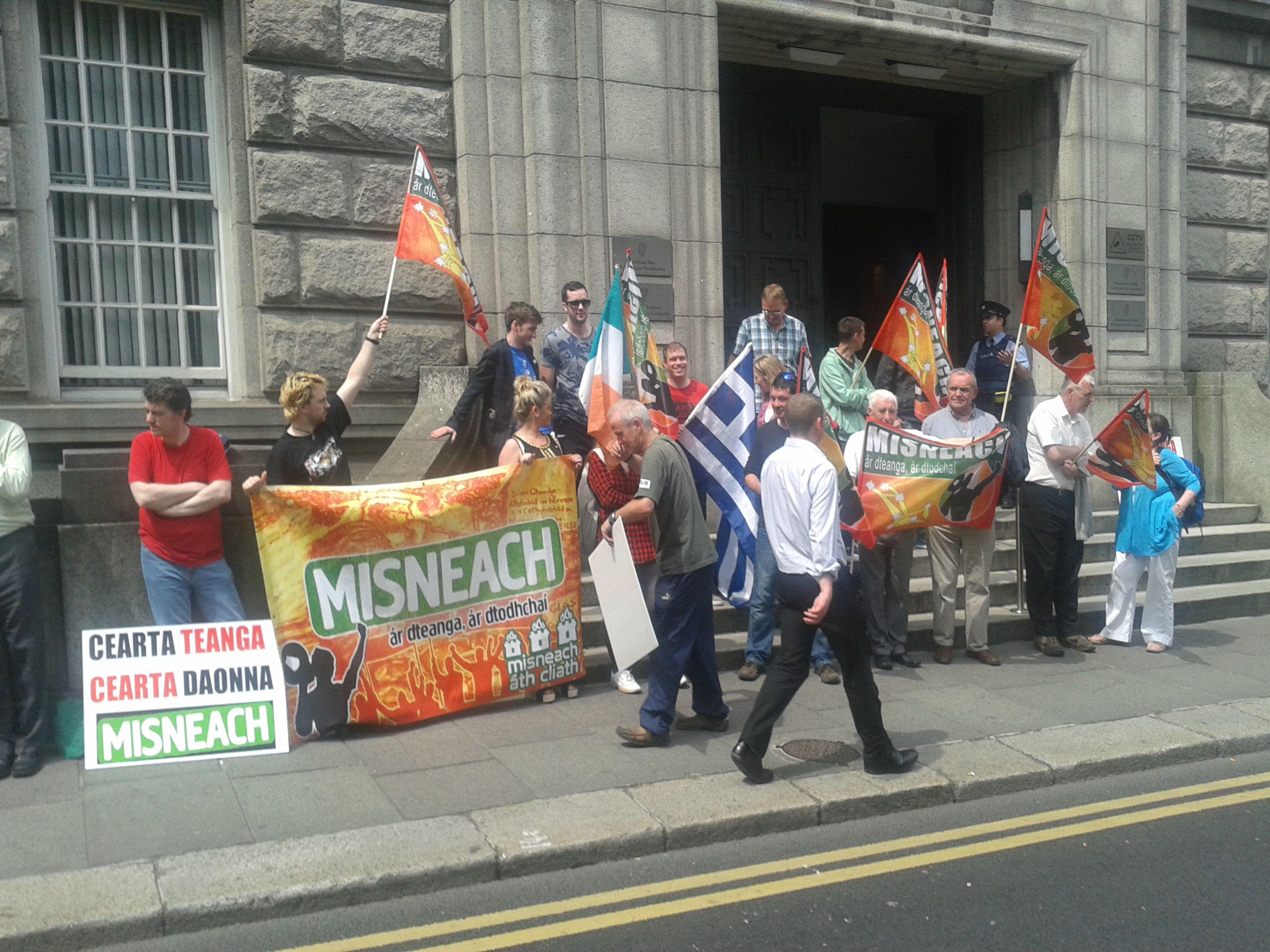
Part of a recent lunchtime demonstration outside the office of the Department responsible for the Gaeltacht. It was called by a new incarnation of Misneach, an organisation active in the mid-1960s. (Photo D. Breatnach)
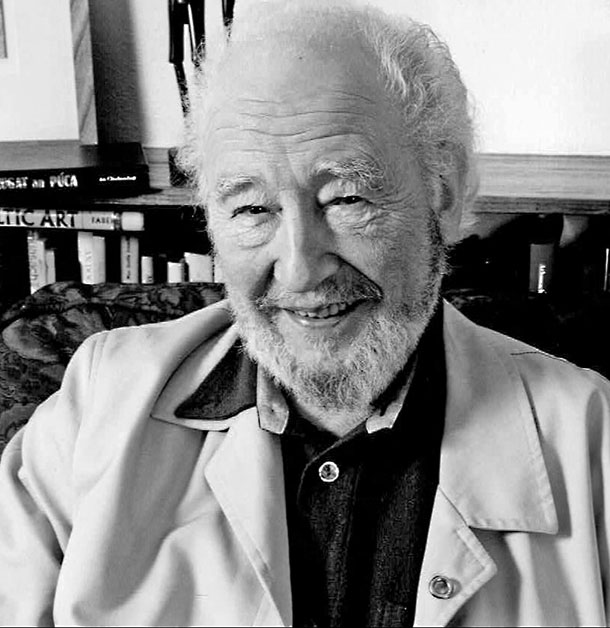
Deasún Breatnach (1921-2007), a founder member of the language-campaigning organisation Misneach, who went to jail in the 1960s to win the right to have his car insurance documentation in Irish or bilingual.
And there are battles that must be fought with the State, with local authorities, with utilities and service providers including private companies. Both logic and history make it clear that this is so. I have already alluded to the civil rights campaign in the Gaeltacht areas and the refusals to pay radio and TV licenses. In the 1960s a Dublin man asked Norwich Union to supply him a bilingual vehicle insurance document or one in Irish. The company declined. The man bought the insurance but refused to display an English-only document on his car. The State’s laws require that every driver display a document showing that they had insurance but no law required a private company to provide that documentation in Irish. The Gardaí regularly stopped the man who explained his stance and they noted his details and allowed him to proceed. For about a year nothing else happened until one day he was summoned to go to court and, despite his explanation and his reference to his right under the Constitution, he was fined. He refused to pay the fine and went to prison. Demonstrations followed with a friend of his playing the bagpipes outside Mountjoy Jail. In less than a fortnight, “an anonymous cleric paid the fine” and subsequently the law was changed. Every vehicle insurance company wishing to practice in Ireland subsequently has to provide Irish documentation or a bilingual version.
Some policies will have to be put in place in the Gaeltacht and closely followed. Policies relating to housing, employment and service delivery will be among them. Some will be welcome and some controversial … but needs must.
The State has already shown by its attitude and by the sad statistics that it does not wish to save Irish as a spoken language. Nor is it only the record of the Gaeltacht decline which speaks volumes. Recently this Government showcased in a video its plan for the centenary commemoration of the 1916 Rising. Among the many criticisms the video attracted was that the Irish in it was of a terrible quality – the Government had employed a translator who had used Google Translate. The video was withdrawn.
Small section of crowd in large “Dearg le Fearg” (Red with Rage) demonstration March 2014 about lack of support for the irish language. (image downloaded from the Internet)
Towards the end of 2013, the Irish Language Commissioner, a public servant, accusing the State of “lip-service” towards Irish and actual obstruction, announced that he would not seek reappointment at the end of his term – an announcement that led to a number of big demonstrations in 2014 under the slogan “Dearg le Fearg” (Red with Rage). In July 2014, the Government appointed a Minister for the Department of Arts, Heritage and Gaeltacht who does not speak Irish – Heather Humphreys. She has, in turn, a Minister of State with specific responsibility for the Gaeltacht, Joe McHugh, appointed in the same month … and, although apparently he is learning it, he does not speak Irish either. And note that responsibility for “Culture” is longer in the same Department as Irish – it has been moved to the much more prestigious Department of Tourism, Culture and Sport.
The State is being challenged from many diverse directions – on issues of services, state finances, centennial commemoration of the fight for independence, conservation, social housing, social welfare, employment and employment rights, health service, gender and sexuality equality, natural resources, Traveller rights, migrant rights … Irish must be seen and heard in these battles and the civil rights of Irish speakers inside and outside the Gaeltacht must also be presented separately, as an issue in itself. These are battles to be fought in campaigns to be planned and time is short. But we can start today, with ourselves. Beatha teanga í a labhairt.
The returning officer, Ríona Ní Fhlanghaile, has declared that the 26-County state has voted in the Referedum IN FAVOUR OF INSERTING A CLAUSE IN THE CONSTITUTION THAT PERMITS COUPLES OF EITHER GENDER TO MARRY by 1,201,607 votes to 734,300. That’s 62.1% yes to 37.9% no. The total turnout was 60.5% which is higher than in some other Irish referenda. The “Yes” vote exceeded the “No” in every county in the state except in Roscommon, where the vote was close. The “Yes” vote was significantly higher in all other counties and generally across rural and urban areas too.
The vote in favour is not surprising given that all the main political parties, as well as Sinn Fein and Left parties were all advocating a “Yes” vote. However, on its own that does not explain the wide gap between the two positions and the high turnout, especially in the face of the Irish Catholic Church hierarchy’s position against legalisation of same-sex marriage. It is hard not to see this as to some extent a conscious decision to oppose or ignore the Church’s position and to take a stand in favour of equality and civil rights.
When the votes are counted after today, we will either have a new clause inserted into our Bunreacht (Constitution) or we will not. If we do not, many of the “Vote Yes” campaign and opinion will be despondent. The revolutionaries among them should not be so but should instead reflect on their weakness as a force and on how to make that force stronger.
Should the vote result in a change in the Constitution, it will be probably the biggest blow so far to the power of the Catholic Church in lay society, a power it has enjoyed and abused even before 1921 but certainly since. Some, on both sides of the question, will see it as a blow against the Catholic religion itself but that is not necessarily so. Christianity and its Catholic variant survived and even thrived without State support in the past – indeed when its followers were discriminated against in every conceivable way by State power, a situation its faithful endured for centuries in Ireland as a whole and continue to do today, to a lesser extent, in the Six Counties.
What is the issue upon which we were being called to vote today? Although the NO campaign has tried to make us think it is, it is clearly not about whether two-gender households are better for raising children, whether surrogate birthing is right or wrong. It is not about whether we approve or homosexuality or not – although I suspect that is the real issue at base with many of the NO campaigners. In fact, it seems to me that it would be quite possible to disapprove of homosexuality and still to vote “Tá”, a question I will return to later. This might seem illogical, until we examine the actual issue upon which we are voting: do we agree with inserting a clause into the Bunreacht (Constitution) which states that a couple has a right to marryregardless of gender.
Presented with this question, which is a legal and Constitutional one, a number of issues arise, I think.
What does the Bunreacht say at the moment about this question?
What right has the State to define anything about sexual relationships?
Are we in favour of equal civil rights for people?
1. It may come as a surprise to people that our Bunreacht, our Constitution, currently says nothing about the gender issue in marriage. There is nothing actually in our Bunreacht to prevent same-sex marriage. But the prohibition does exist in law. In other words, legislators at some point decided to propose and pass a law which confined the right (and rite) of marriage to heterosexual couples alone. Why did they do so if it was not an issue at that time? It seems to me that they were aware that same sex relationships did exist and strove to exclude those people from the rights enjoyed by others. This was the point of a number of other pieces of legislation against homosexuality which were not finally overturned until 1993 in this State (1982 in the Six Counties, 1980 in Scotland, 1967 in England and Wales) – five years after the European Court of Human Rights ruled that this state’s laws against male homosexual acts violated human rights.
According to the Catholic Church (and most other churches), despite the current legal situation with regard to homosexuality at the moment, it is still wrong. Well, the Catholic Church – and before them the established Anglican Church of Ireland – can have their views but they are not entitled, nor is any other church, to impose those on lay society, neither by legislation nor by other means. They are, of course, entitled to express their opinion – just like any other organisation.
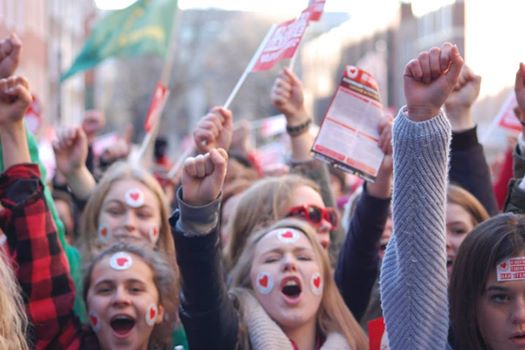
“God and Nature say NO” was the caption on this placard paraded in O’Connell St. near the Spire, some weeks prior to the Referendum. Some young people are arguing with the placard-holder.One of the many badges worn in support of a vote to insert the clause into the Irish Constitution. There was also an English-language one and each were to be seen nearly everywhere in public in the weeks prior to the Referendum.
So, going back to the beginning of the legal status of heterosexual marriage within our current legal system, it was introduced as an excluding measure, at a time when male homosexuality was illegal and subject to heavy punishment and when lesbianism was frowned upon (though not actually illegal for complicated reasons). In other words, a law excluding a group of people was passed at a time when any man who declared himself to be one of those people was subject to prison sentence and any woman who did so was subject to extreme opprobrium in society. What chance was there for their point of view to be represented? In the absence of such representation and informed opinion-making, how can any democrat defend the laws passed at that time?
2. Turning now to the question of what right the State has to make a ruling of any kind upon a sexual relationship between any two people, of either gender, it must be difficult indeed for anyone to justify that without recourse to church canon or prejudice. Those who do so tend to bring up questions of childcare, inheritance and taxation – in fact just about the same questions that were brought up in the Irish referendum on divorce in 1995. But childcare, or at least the financial aspect of it, can be regulated by the State without any interference whatsoever in the sexual relationship between the parents. Whether it does so fairly at the moment is another question which has no bearing on the concept. And inheritance – ignoring for a moment whether we agree with a political economy where land and other wealth may be appropriated by individuals or families and then legally handed on through their following generations — can also be managed without recourse to State regulation of marriage. Taxation, similarly. Were we to have a socialist society, one based on other principles than that which we now have, even those current excuses for state interference should no longer be even a consideration. In fact, it is difficult to see any reason why even now the State continues to have a role in the formalisation of a sexual contract between two individuals or, indeed, in its dissolution, except perhaps in ensuring fair divisions of belongings.
3. Those opposed to insertion of the new clause into the Bunreacht have done so from a number of perspectives of opposition: to lesbianism and homosexuality on religious or other grounds; to formalising same sex relationships; to the alleged undermining of the “sanctity of marriage” or of “romance”; in opposition to surrogate child-bearing and raising of children by gay and lesbian parents ….
Those supporting the new clause have defended the naturally-occurring continuum of sexual preference; maintained that the “sanctity of marriage” will be the same between same-sex couples, as will “romance”; denied that it opens the way to or encourages surrogate child-bearing and raising of children within a gay or lesbian household ….
Who is right and who is wrong? There is no doubt that as long as cultural beliefs and practices have been recorded, homosexuality and lesbianism have existed within societies — sometimes tolerated, often repressed, on rare occasions celebrated. We see homosexuality occurring too among animals. If there is such a thing as “sanctity of marriage” and “romance”, why should same-sex couples have any less of it than heterosexuals? Surrogate child-bearing is already possible and the hugely unequal distribution of wealth in our society – and between even our society and many others – ensures it can and will continue while the rewards are financial. Raising of children within a same-sex household is already happening, even without surrogacy. It is more difficult for gay men at present, but in the case of a gay man having custody of his children through widowhood (yes, some gay men do marry women), or the mother deserting the children or being deemed unfit by a court to have custody, a gay man may bring up his children within a homosexual parent household.
But will this change in the Constitution (and therefore also in the law) make surrogacy and child-rearing by gay couples more likely to happen? Will it increase the frequency of its occurrence? I think the answer to that, logically, must be yes – despite all the denials of the “Vote Yes” camp. And I think some of them must know that. Slowly perhaps and who knows by how much – but logically it must tend to increase the chances. But is that so awful? I find the idea of surrogacy in general distasteful but isn’t that just a prejudiced reaction? Probably. Will children reared by same-sex parents experience uncertainty about their own sexuality? Some will probably and some won’t. And if they do, why should they not be able to resolve that in time – as children reared in heterosexual relationships also find themselves having to do? Is uncertainty about sexuality such a terrible thing? In a judgmental, prohibitive and penalising society, it can be – so let’s create a society that is the opposite.
However, I have to say that I think all those questions and considerations are beside the point. If marriage is to be a legal status, then it is a civil right for everyone who is at the age of consent (and of sufficient mental ability to know to what they are consenting — in so much as any one of us was or does!). The right to same-sex marriage, as a civil right, should be supported even by people who do not approve of homosexuality, or marriage, or surrogacy, of child-rearing in a homosexual household. As for myself, someone who seeks revolutionary social, economic and political change, who wishes to see the overthrow of this State, a revolutionary as opposed to a reformist, I must nevertheless support reforms that extend civil rights, even when not led from below …. and so I voted “TÁ”.
INIGO CABACAS KILLED BY RUBBER BULLET FIRED BY BASQUE POLICE IN 2012 — STILL NO JUSTICE FOR FAMILY OR FRIENDS
Diarmuid Breatnach
Most Basques and especially supporters of their most popular football team, Athletic Bilbao1, were very happy in the early evening of 5th April 2012 .
Inigo Cabacas, photographed with the Basque hermitage Gaztalugatxe, on the Biscay coast, in the background.
Their team had beaten a football giant in the UEFA cup twice and another premier European team once. The fans were expecting Athletic to win or at least draw again that evening, in which case Athletic Bilbao were through to the second leg of the quarter-finals. They had no idea that the evening would end with a police riot squad firing rubber bullets into a festive crowd, causing the death of a young fan.
The high expectations of that evening in Bilbao were the result of a run of wins for the Athletic team. On March 8th 2012, Athletic Bilbao beat Manchester United 3-2 on their own ground, at Old Trafford.
One needs to know a few population statistics to understand what an achievement that was. Manchester United is a football team on the world stage, based in a city with a population of 2.55 million – that is not far from the population figure for the entire Basque Country. In addition, Manchester United’s players are drawn from around the world; Athletic recruits only Basque players from a total population of the Basque Country of less than 3 million.
A week after their win in the northern England city, on March 13th, Athletic faced Manchester United again, this time on the Basque team’s home ground, San Mames, in Bilbao. Manchester Utd. were beaten 2-1 and it seemed that the Basque lions2 were unstoppable.
These wins created a huge interest in the next game, which was with FC Schalke 04 on March 29th at the German team’s home ground. Schalke plays in the top tier of the German football league and have won many championships including one UEFA League. With around 130,000 members, Schalke 04 is the third-largest sports club in the world in terms of membership, behind their compatriot rival FC Bayern Munich and Portuguese club SL Benfica.
Athletic Bilbao is not a sports conglomerate – it is a football club which is owned by its 40,000 members (remember, this is a small country – that’s nearly 1.5% of the whole population! It’s also around 11% of the population of their home base, Bilbao). The management board is elected by the membership.
At Schalke 04’s home ground on March 29th, the Bilbaino team beat them 2-4. The interest was therefore at fever-pitch for Athletic’s return match with the German team at Athletic’s home ground, San Mames on 5th April. The result was a 2-2 draw but Athletic were ahead 6-4 on aggregate and the fans were delighted. Bilbao was, as they say, buzzing.
After matches, young fans especially go to different pubs around town. Inigo Cabacas and many others went to an Herriko Taberna (a “Peoples’ Tavern”, i.e. one managed by the Abertzale [Basque pro-Independence] Left) which is located in an small “square” with planters, connected by alley with Licenciado Poza street. This small “square” is off the María Díaz de Haro street near the stadium; it runs parallell with the San Mames street itself, an area of bars well-known as a destination for fans after a game at the stadium.
The Herriko is too small to accommodate all those who gathered there but that was no problem for the area outside took the overspill. Early in the evening a few people were seen scuffling there and the rest of the crowd around them told them to knock it off, this was a time for celebration, etc. The scuffle ended and the festivities continued.
Some time later, a van load of police arrived. These were the Ertzaintza, a Basque Police force of 7,500 created in 1982 which has had numerous clashes with Basque strike pickets and with the Abertzale (pro-Independence) Left. Supporters of the Abertzale Left and many others refer to the Ertzaintza as “zipayos” (i.e. “sepoys”, local soldiers recruited by colonial occupiers). The Ertzaintza are responsible to the Basque Autonomous Region Government (CAV), a semi-autonomous entity covering three of the four southern Basque provinces.
Basque Police, the Ertzaintza, face a youth Solidarity Wall built to defend Basque comrades the police have come to arrest in Donosti/San Sebastian some years ago.
Some of the youth perceive the arrival of the masked and helmeted police as a provocation and begin to throw bottles at the van.
The police officer in charge of those in the van asks for reinforcements and these are sent. The police emerge from their vans and begin to fire rubber bullets3 at the crowd at quite close range (the “square” is less than 45 metres at its furthest from the street) and everyone scatters except for a small group who are throwing bottles at the police but even they eventually dive for cover. People are sheltering in doorways, huddled up against the walls on each side of the “square”. Some are inside the pub wondering what is going on. A local shop-manager has raised the shutter over his doorway and people crowd in there. Some people are sheltering behind the wooden planters that are in a line down the centre of the narrow square.
After some time three young men walk towards the police with their hands in the air, asking them to stop firing rubber bullets; the police strike them with batons. Meanwhile it comes to the attention of some in the crowd nearby that a person is lying on the ground, apparently unconscious with blood coming from his ear and the rear of his head. People go to his aid and one of his friends recognises Inigo Cabacas. He gets his mobile phone and rushes towards the police telling them that someone has been seriously injured and to call an ambulance. A police officer tells him to drop the mobile. Inigo’s friend repeats his urgent request and the police officer tells him again to drop the mobile and hits him with a truncheon. The man drops his mobile and retreats from the police.
The police advance into the area and reach the injured man who has some people around him; a women is rendering first aid. A policeman tells her to move away. She tells him the man needs and ambulance and that she is applying pressure to stop the bleeding. He says he wants to see for himself and pulls at her arm but after awhile desists and goes away.
Eventually an ambulance arrives and takes Inigo Cabacas, still unconscious, to hospital, where he lies in a coma.
(video of the scene of the incident and interviews with friends and witnesses with English subtitles)
The news runs through a city, a shock in the midst of its celebrations and soon afterwards throughout the Basque Country. The first official reaction is given by the Interior Minister of the Basque Autonomous Regional Government, who declares to the press that the Ertzaintza acted properly and in line with their procedures, although he regrets the unfortunate death of they young man. He also repeats the first line of defence given by the Ertzaintza, that they were called to help someone injured in a fight and that the crowd was preventing the ambulance in attendance from rendering assistance to the injured.
When eye-witnesses give their version and the reporters of some newpapers begin to gather information, it becomes clear that the Minister could not possibly have investigated the incident in the time available. Furthermore, it emerges that no ambulance attended until after the incident with the police and that it appears that no call for one had been made earlier. Furthermore, according to the woman who attended to Inigo at the scene, the ambulance paramedic told her, when she complained at their delay in arriving, that the police had delayed their entrance. Under a storm of criticism from civil society and from the Abertzale Left party, EH Bildu, the Minister promises a full investigation.
Inigo Cabacas dies after three days without having recovered consciousness.
Some time later, a recording of the police communications on the night is made available by GARA, a pro-Independence Basque daily newspaper. The following becomes clear from the recording:
The Controller at Ertzaintza HQ calls a police van leader and directs him to attend the Herriko, saying that a fight has occurred there and that someone is injured.
The van leader reports that they have arrived and that some are throwing bottles at them, that they require reinforcements. No mention of ambulance.
The Controller confirms reinforcements are being sent.
Reinforcements arrive. One of the van leaders now reports that nothing is happening, everything is ok.
The Controller replies that he wants the police to go in and take possession of the area and make any arrests necessary. He emphasises that he wants to be understood clearly, that they are to “go into the Herriko with everything we have”, to take control of the area “and then everything will be ok.”
The van leader replies that the order is understood and soon shots are heard (the firing of rubber bullets).
The family employs a solicitor. A judge is appointed to carry out the investigation but is required to do so along with her other duties. Immediately, the police investigation ceases (according to the family’s lawyer, ithe file contains just three pages), using the excuse of the judicial investigation.
A number of legal applications are made, e.g. for all the police at the incident to be obliged to make a statement, for all police who fired a rubber bullet gun to be identified, for the Controller to be obliged to make a statement, but all are refused by a judge, giving a number of reasons4. Little is established over the following three years, except that threepolice voluntarily admit to having fired rubber bullets and the identity of the Controller on the evening becomes widely known. There is widespread outrage when the senior officer on duty the day of Inigo’s death is appointed Chief of the Ertzaintza.At a recent press conference, the Cabacas family’s lawyer, Jone Goirizelaia, announced that they had possibly identified the officer who had fired the fatal shot.
It emerged during the campaign by supporters of the Cabacas family that no recognised procedure was followed by the police with regard to the incident: debriefing statements were not taken from each of the police participants, guns were not examined to identify which had been fired, no inventory was taken of the number of rubber bullets fired. No attempt was made to contact witnesses after the event to gain a picture of what had occurred. Indeed, some witnesses who approached the police station to give statements were told to go away (see video link posted earlier in this article). It further appears that the Ertzaintza have been issued with no specific operational instructions with regard to the firing of rubber bullets.
According to some sources, the rubber bullets should only be fired at knee-height and at no less than 50 metres from the target. The “square” is, according to locals, less than 45 metres at its furthest from the street and therefore the police from the moment they began firing, were in serious breach of the minimum distance requirements. In addition, the Ertzaintza have frequently been seen aiming their rubber bullet guns at protesters’ faces from as little as a metre or two and also firing from the shoulder with the muzzle parallel to the ground, i.e. directed at head or chest-height of the target. Also, the rubber-coated steel balls bounce uncontrollably.
Rubber bullets against Palestinians
Rubber bullets are regularly fired by the Israeli army at Palestinians. A Palestinian source reports: “Israeli professor Michael Krausz and colleagues at the Rambam Medical Centre in Haifa analysed the medical records of 595 casualties admitted to hospital during the October 2000 protests by Palestinians living inside Israel (typically described as “Israeli Arabs” by the media). Of those, 152 were found to have been injured by rubber-coated metal bullets. Injuries were distributed randomly across their bodies but were most common on the patients’ arms and legs, and on their head, neck and face.
“The doctors said their findings dismissed the theory that “rubber bullets” were safe. Rubber-coated metal bullets with some of their rubber coating removed, revealing their hard steel core. Fired at speeds of what must be several hundred feet a second, these are munitions that cause enough damage that their manufacturers feel compelled to describe them as only ‘less lethal’.
“Writing in the Lancet, they said firing the bullets at civilians made it ‘impossible to avoid severe injuries to vulnerable body regions such as the head, neck and upper torso, leading to substantial mortality, morbidity and disability.’ They added: ‘We reported a substantial number of severe injuries and fatalities inflicted by use of rubber bullets ….. This type of ammunition should therefore not be considered a safe method of crowd control. “The study, ‘Blunt and penetrating injuries caused by rubber bullets during the Israeli-Arab conflict in October, 2000: a retrospective study’ (The Lancet, Volume 359, Issue 9320, Page 1795), also highlighted previous research which suggested that even plastic bullets may not be safe and may cause more severe head injuries.” (Sourced at http://electronicintifada.net/content/misleading-terminology-rubber-bullets/4000)
Rubber bullets against the Irish
Seventeen people were killed in the Six Counties (“Northern Ireland”) by rubber and plastic bullets fired by British soldiers (11) and colonial police (6) during the 30 Years War. A number of people were also blinded. http://cain.ulst.ac.uk/issues/violence/rubberplasticbullet.htm
It emerged in 2013 during a compensation case taken by a Derry man blinded in 1972 that the authorities knew that the missiles were potentially lethal even before they issued them. (http://www.theguardian.com/uk/2013/jun/11/mod-rubber-bullets-lethal-records) It is clear also from a wealth of evidence that the missiles were regularly fired by soldiers and police not only at close range but also aimed at chest or head. In addition, a deadly ‘game’ was played by some British soldiers. Knowing that rubber and plastic bullets were collected by children as mementoes and objects to sell to tourists, soldiers would fire some into an open area and wait for children to run forward to collect them, then see if they could hit the children with subsequent rounds.
Rubber bullets in the Spanish state
The Spanish state continues to allow its police forces to carry and to fire rubber-coated metal bullets, in particular at protesting Basques and Catalans (see video link at bottom below article). Recently, the EU expressed concern at Spanish police firing at migrants attempting to swim into the Spanish state from Morocco, an occasion when 11 of the migrants drowned. But no international protest criticises them for firing potentially lethal missiles at their own citizens. Police in the Spanish state enjoy impunity and none more so than in the Basque and Catalan countries as well as with regard to African migrants.This week, a motion was put to the Basque Parliament to ban the use of rubber bullets in the area under its control (CAV). Instead a proposal was accepted to “restrict” the use of the missiles to “situations of grave danger” to the police, and to “definitely seek a replacement” for them. The Spanish right-wing PP, the liberal Spanish unionist UPyD, along with the PNV (Basque Nationalists), currently in power, voted for it, along with the Basque version of the Spanish social-democrats, the PSE. The only party to vote against the amendment was EH Bildu, party of the Abertzale (pro-Independence) Left; they had proposed the original motion, seeking a total ban and the removal of the missiles.
Parent and friends of Inigo Cabacas confront spokesperson of the Basque Nationalist Party after attempt to ban rubber bullets fails
Among those in the public gallery at the discussion were the parents of Inigo Cabacas. Afterwards, in the corridor outside, they confronted the spokesperson of the PNV, Joseba Egibar. During the exchange, another PNV parliamentarian, Luke Uribe-Etxebarria, tried to prevent its filming by the Basque TV station ETB. That attempt will be the subject of a complaint to the President of the Parliament by EH Bildu; they view it as particularly serious since Uribe-Etxebarria is also on the management board of the TV station and the filming was taking place in areas open to the public.
“I’m never coming to this Parliament again …. I feel cheated,” said Manuel Cabacas, father of the deceased, speaking about the majority decision. “My son is dead …. I only wanted to ensure that it would never happen to anyone else ….”
On the third anniversary of the killing of Inigo “Pitu” Cabacas, among many commemorative vents in the Basque Country, 10 minutes’ silence was observed in the San Mames stadium. Alongside Inigo Cabacas; many are also remembering Aitor Zabaleta, fan of the Real Sociedad team, murdered in Madrid in 1998 by fascist ultras of Club Atletico Madrid. Many Basques around the world will be conscious of the three years that have passed since Inigo’s killing without anyone being even charged in connection with his death or any noticeable change, whether in Basque police behaviour, procedure or their use of rubber-coated steel projectiles. A change of political control of the Basque Regional Government from the social-democratice party of Patxi Lopez to the Basque Nationalist Party .(PNV) of Urkullu has had no effect.
It is true that for ordinary people, in capitalist society, the wheels of justice move very slowly; in this case it is hard to see that they are moving at all.
End.
NB:DUBLIN: A group of Basques plan to hold a commemorative event on Tuesday 28th April, on the day of a Basque derby, Bilbao Athletic v. Real Sociedad. They plan to hold a protest picket at the O’Connell Monument in Dublin’s O’Connell Street at 7pm for a short while and afterwards to go to watch the Basque derby (kick-off at 9pm) at the Living Room bar, Cathal Brugha St. Some Dublin-based Irish people have undertaken to support the Basques by participation in both events. Poster for event: https://www.facebook.com/photo.php?fbid=10153291310864390&set=gm.1624681737767253&type=1&theater
Short but shocking Guardian video of Catalan police using rubber bullets and the testimonies of victims who have lost an eye to the missiles:
1 Based in Bilbao, it is the most popular and most successful (two things that often go together) but not the only football team; there are also Real Sociedad, based in Donosti/San Sebastian and Osasuna, based in Iruña/ Pamplona.
2 A roaring lion is the emblem of the team, arising from the legend of St. Mames, to whom the local church is dedicated and which gives its name to the area, street and stadium. English-language football commentators persisted in calling the team “the Spanish lions” or “the Spanish cavaliers” (??!), in total ignorance, one hopes, of quite how insulting that would be perceived by the players and their fans. The Basque Country is not even politico-geographically Spain, it is divided between the Spanish and French states. And Bilbao Athletic is most certainly not, nor has it ever been, a Spanish team. When the Spanish King attends finals or semi-finals between Barcelona and Athletic in, yes, a Spanish football league, and the Spanish national anthem is played, the stadium fills with howls of derision, hoots and whistles from the supporters of both teams.
3 These are about the size of a tennis ball, perhaps a little smaller, of steel and coated in rubber.
4 E.g., the Controller could not be held responsible for the shooting by the police; individual police would have to be accused of firing the fatal shot if they were to be obliged to make a statement …
An 18-year old woman of the Kurdish diaspora in London, Silhan Ozcelik, has been sent for trial at London’s Central Criminal Court (the “Old Bailey”) accused of trying to join the Kurdish-led resistance against ISIS (“Islamic State”). A British journalist called the trial “disgusting” and said it left him “almost without words” to describe the travesty of justice. (article below)
A different kind of face paint: female fighter of the Kurdish guerrilla YPG checks another female comrade as they prepare to go into action with their male comrades on the front line against ISIS in Syria.
This post contains:
An article about the trial by J0nathan Owen in yesterday’s British newsaper The Independent (see above)
A short article from pro-Kurdish PUK Media containing a discussion on the role of Kurdish women fighters in Syria, with quotes from a wide variety of sources (right at end of this post)
A video of an Australian documentary, “60 Minutes”, from the war zone, with war footage, interviews with women fighters and commanders, victims of ISIS (see further down)
Background comment or introduction from me (immediately below)
Background Comment:
The Kurds in the region, numbering around 28 million, have the right to self-determination. They are divided by borders of states set up in the past by the colonial imperialists of Britain, France and the Ottoman Empire and also by ambitions of the states subsequently created: Turkey, Syria, Iraq, Iran and Azerbaijan (there is also a huge Kurdish diaspora in parts of Europe, the USA, Canada). The Kurds in the region also face differences in political leadership, dialect and religious influence as well as containing among them other ethnic groups (many of these also oppressed): Arabs, Armenians, Azeris, Turkmen, Yazidis …. The whole Kurdish region extends across an area of great strategic importance (the gateway to Europe and to the East) and also of considerable natural resources, including water. It is envisaged that an oil pipeline will cross this area and a number of dams have already been built there.
The Kurds in Turkey (the largest population of Kurds) has been mostly led by the PKK (and various political organisations friendly to it), a communist-type national liberation organisation, largely secular (though some of their areas can be religiously conservative) and with a very large guerrilla force which has included many women fighters. They have fought the Turkish armed forces for decades and remain undefeated. Turkey’s nationalism under Kemal Attaturk declared that Kurds did not exist — they were just “mountain Turks”. Kurdish has been forbidden, the flying of Kurdish national colours a crime, and state repression has included bannings of parties and newspapers, jailings of political and human rights activists, kidnapping, torture, assassination squads, creation of strategic villages, aerial bombardment, etc. The imprisoned leader of the PKK, Abdullah Ocalan, last week from prison called on his followers to lay down their arms and to engage in a “peace process” in which however the Turkish Government shows no interest. Ocalan enjoys an adulation among the PKK and its supporters somewhat as Chairman Mao did among Chinese communists and his portrait can be seen on demonstrations, in pickets and in their secure areas.
The Kurds in Iraq have mostly come under the political dominance of two political leaders with tribal following, Barzani and Talibani. Iraqi Kurds are mostly Sunni Muslim with a minority Shia population (Fayli) in central and and SE Iraq. The Kurds were oppressed by the Iraq regime and rose up against them a number of times only to be massacred, including when the US called on them to rise during the Kuwait war but left them on their own. Their fighters, “peshmergas” are mostly male and during the Iraq Invasion by the US-led coalition, they fought the Iraqi Armed forces but entered Baghdad like bandits and set up various areas of control under different war lords, occasionally fighting even one another. In the past on one occasion the peshmergas were also deployed against the PKK in conjunction with a Turkish attack on them.
The Syrian Kurds have their own fighters but have not been as prominent in the past as those of the Kurds in Turkey and Iraq. The Syrian regime does not favour declarations of different ethnicity coupled to aspirations of self-determination and has suppressed expressions of Kurdish nationalism, including jailing singers and musicians whose work includes those expressions. In recent months, the Syrian Kurds and their fighting organisation, the YPG, have had the most success in halting and in places forcing back ISIS — the “Islamic State”. The YPG rescued a large population of mostly Yazidis (including also some other ethnic groups) after ISIS swept aside the army of the NATO-client Iraqi regime, massacred tens of hundreds of civilians and kidnapped tens of hundreds more, including women which they took or sold as concubines.
The Kurds in Iran have been in recent times the most suppressed perhaps of all the Kurdish populations. Under the Islamic clerical regime a number of Kurdish political activists have been executed for “crimes against God” (i.e. being atheists and socialists and sharing their political beliefs). Under the Shah the repression was also heavy and Savak, the secret police, along with their informers, were almost everywhere. Torture was endemic under the Shah and almost certainly continues under the present regime.
Although the NATO powers fear ISIS, they have also had a hand in its creation in the drive to overthrow regimes resisting NATO’s penetration of the area (and encirclement of Russia) by direct assault or by proxy: Libya and Iraq (already overthrown), Syria (under attack), Iran (constantly being threatened). They are trying to bring the YPG into the fold but Turkey, an important member of NATO, would rather see the Kurdish fighters wiped out and seals its border to prevent fighters and supplies reaching the YPG. The USA therefore confined itself to some bombings of ISIS positions around Rojava and diplomatic overtures to the Kurds. They have not committed ground troops (which the YPG have not asked for) or supplied arms (which the YPG have asked for — repeatedly) and continue to support forces attempting to overthrow the Syrian state. The YPG rarely fight alongside the state’s Syrian Army but at times both forces are simultaneously in action against ISIS, though seemingly not in coordination
.
The Kurds, as the largest force in their region of Syria and one of the largest ethnic group in the whole region, form a focus of resistance to assimilation and to repressive regimes of states but may be seen by other ethnic groups as themselves posing a threat of assimilating them.
Video documentary “60 Minutes” by Australian television containing Syrian war area footage of Kurdish women fighters and commanders and interviews (and also occasionally irritating comment by the interviewer)
Less photogenic perhaps than the images we are currently being shown of Kurdish female guerrilla fighters, this photo is probably of a female guerrilla unit of the PKK in Turkish Kurdistan taken perhaps a couple of decades ago. In order to counter accusations by the Turkish state of female guerrilla “immoral” behaviour, the PKK kept the genders in separate fighting units.Two female guerrillas of the YPG resting but ready to go into action. They are on the front line against ISIS in Syria.
A discussion on women in Kurdistan and Kurdish women fighters (note that there are two parts of Kurdistan under discussion here – Iraqi and Syrian; however there is also Turkey, where the majority of the Kurds live and Iran):
Female fighters of the guerrilla YPG with a heavy machine gun (light cannon?) in the front line against ISISKurdish female guerrilla fighters opposing the Free Syrian Army, sponsored by NATO against the Syrian state, in 2011. The FSA has since been overcome or incorporated into ISIS.