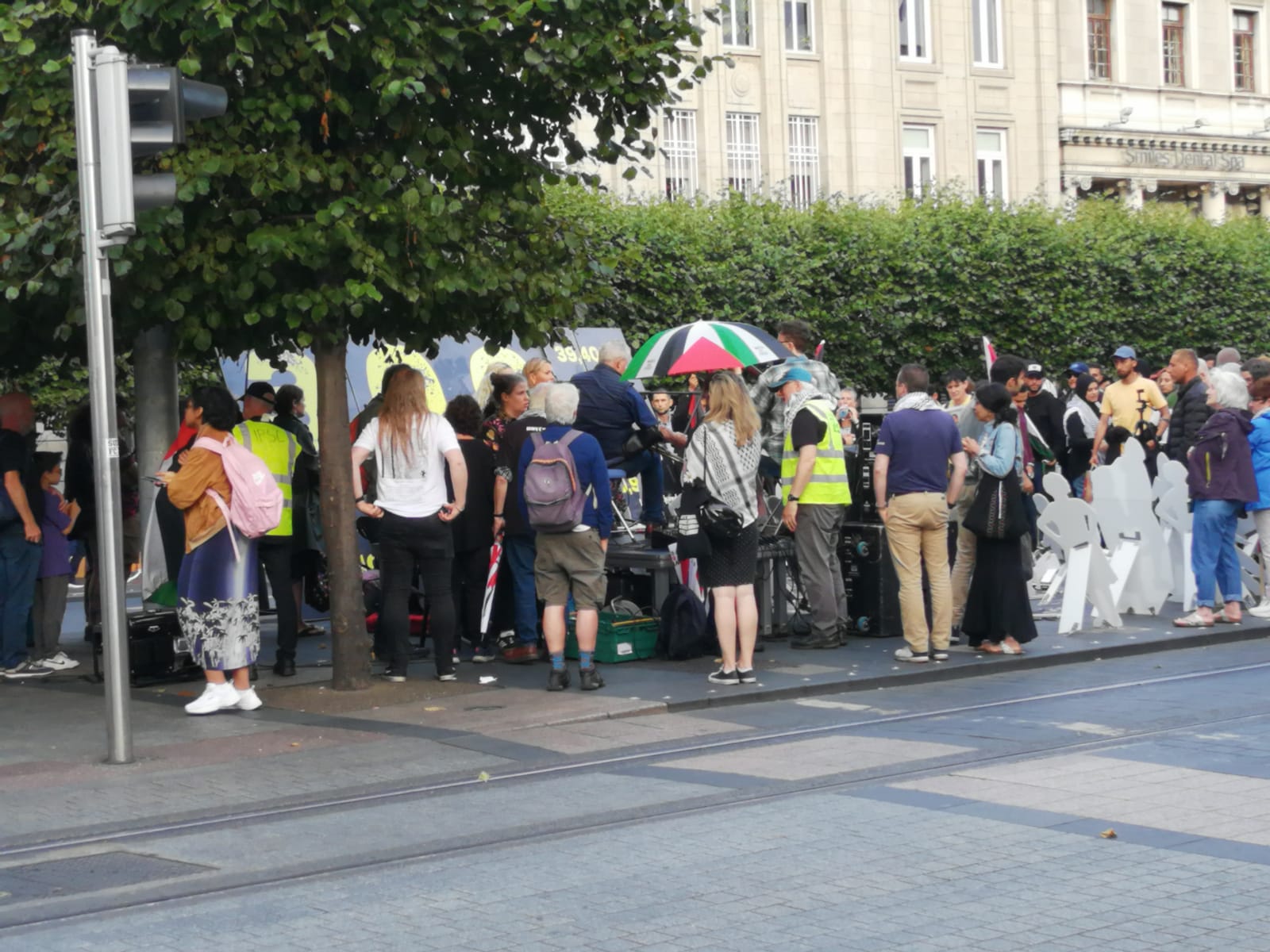
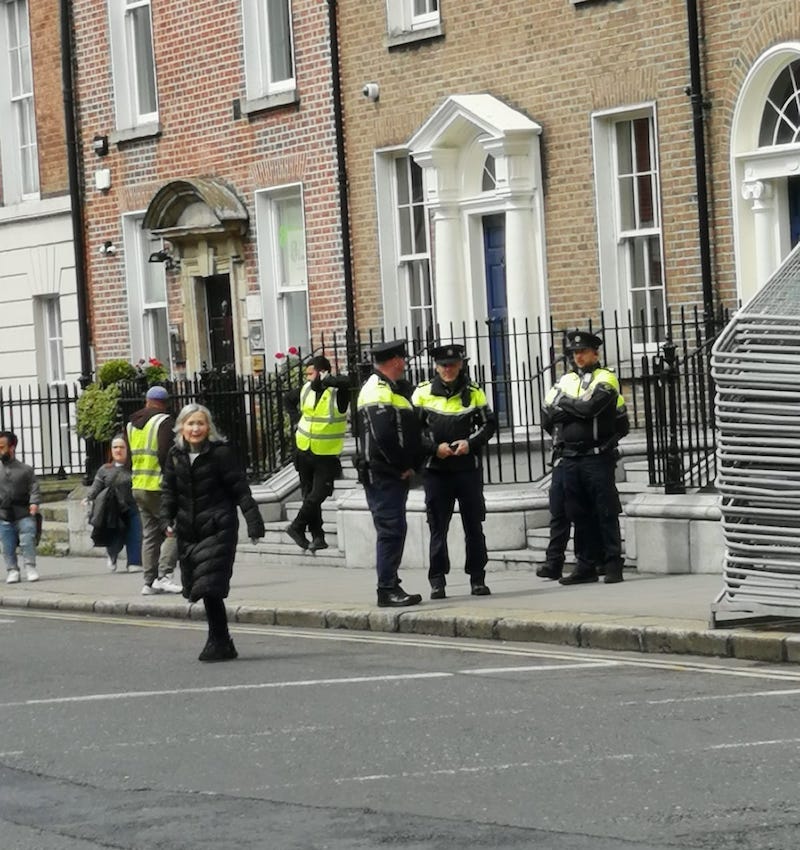
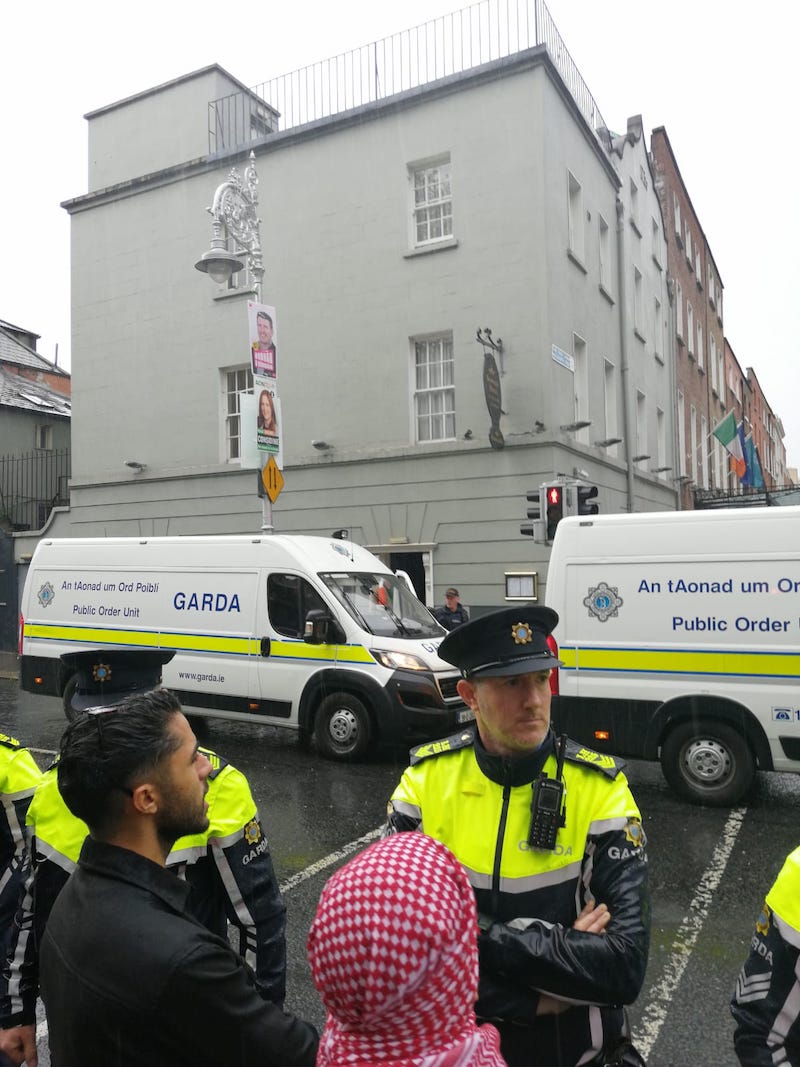
The Palestinian Authority had a small protest against it in Dublin on the afternoon of Friday 23rd August 2024. This seems to be the first protest that has taken place outside the Palestinian Embassy at 66 Lower Leeson Street.
It would perhaps have been the first protest against the PA in Ireland, were it not for the Palestinian solidarity activists who attempted to convey the Palestinian reality in contrast to the Ambassador’s speech at a public meeting in Belfast in February, before being evicted by Sinn Féin supporters.
Palestinian solidarity activists protesting the Palestinian Authority and Embassy?
At first sight that seems bizarre but as some solidarity activists and most people of Middle Eastern origin know, the PA is not only widely considered unrepresentative and corrupt – and in fact has not held elections since 2006 – but also represses protests in the West Bank against ‘Israel’.
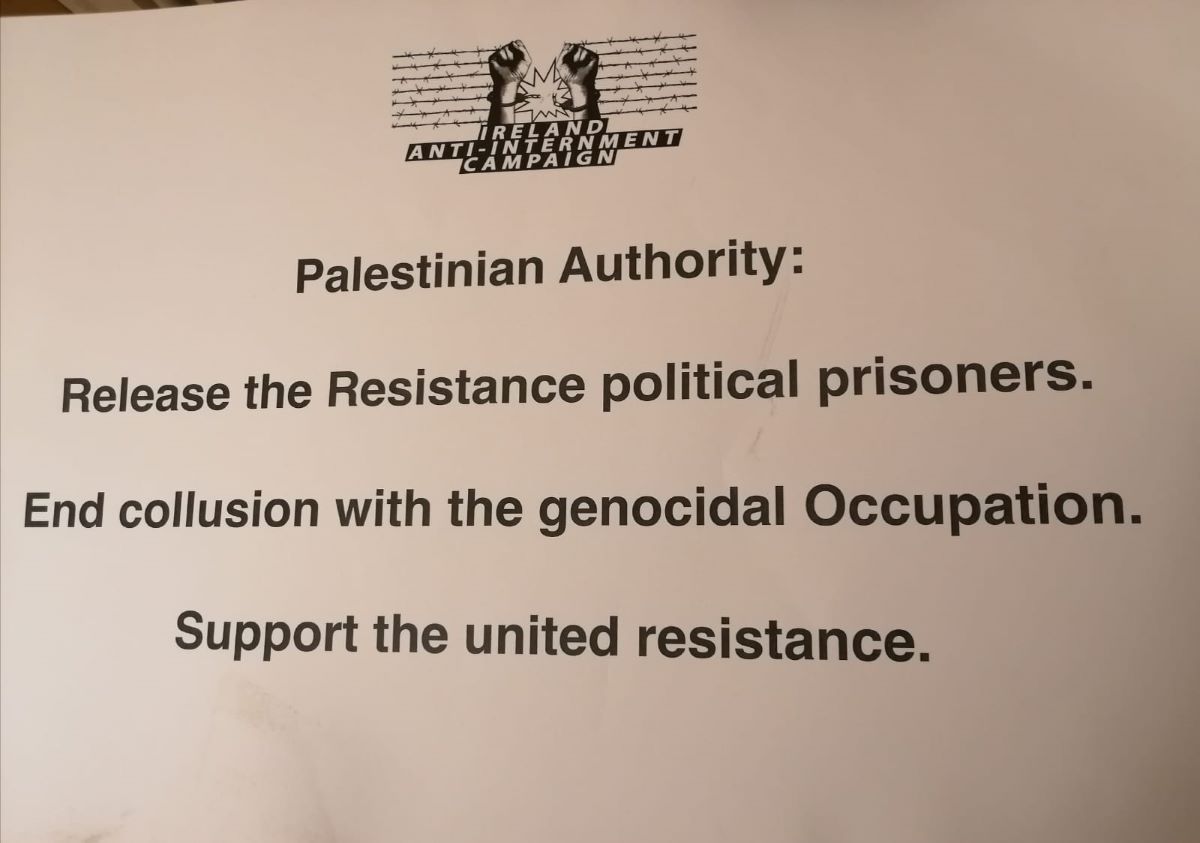
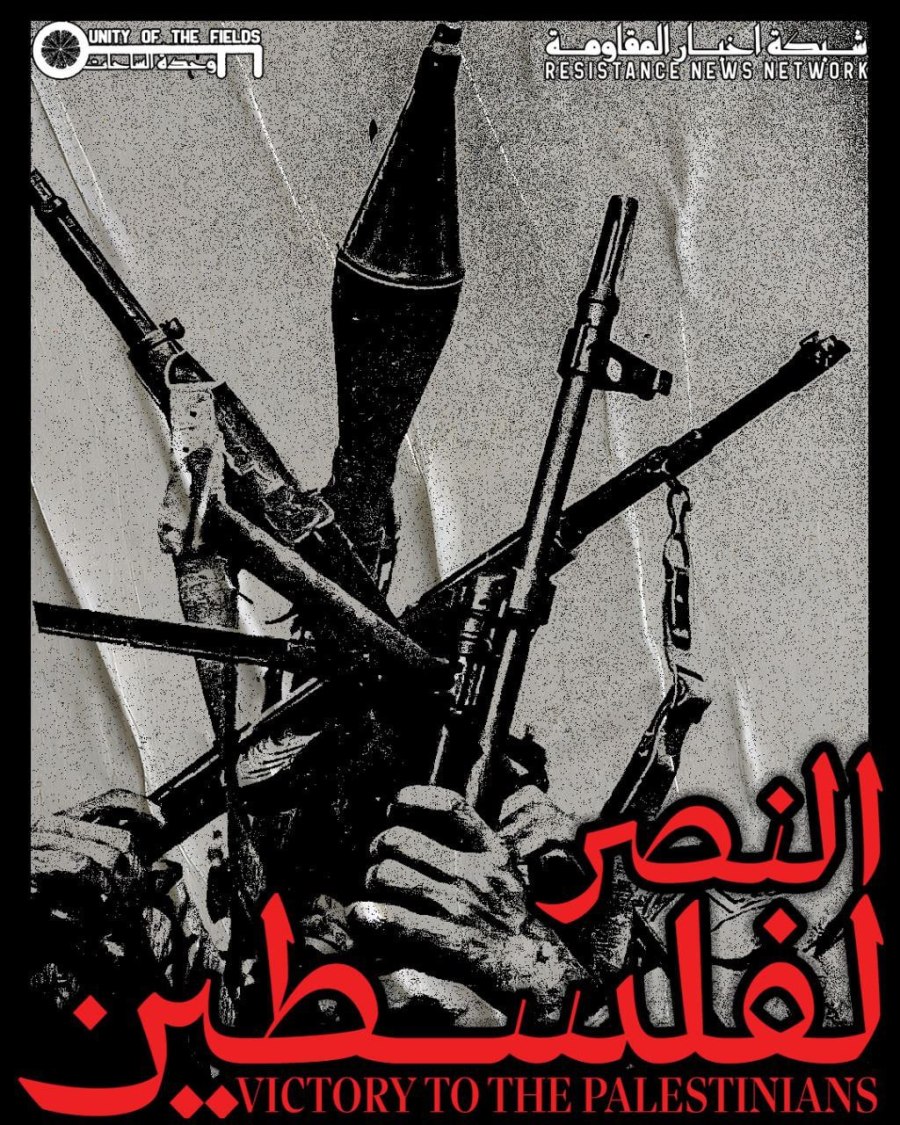
However, the Ireland Anti-Internment Campaign says that its main purpose in calling the protest was to raise awareness of the harm the PA is doing to the Palestinian Resistance, in arresting Resistance fighters and disrupting resistance defence against ‘Israeli’ army incursions.
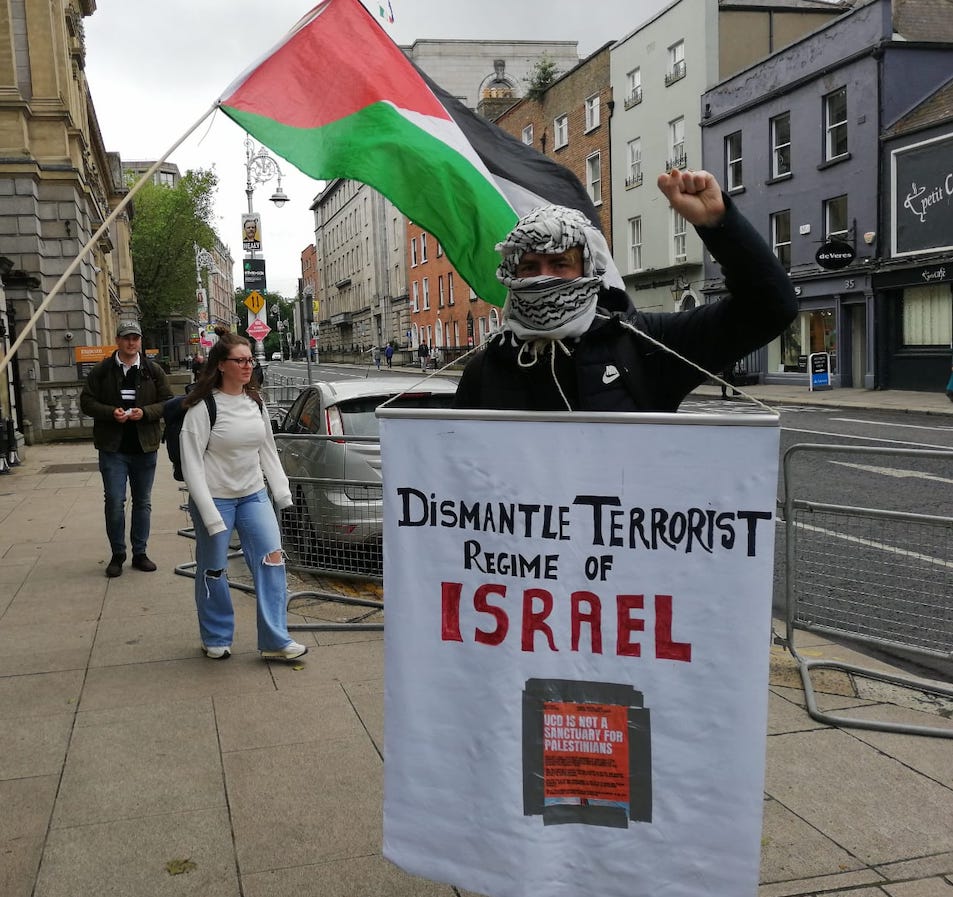
Photo of placard being displayed outside the Palestine Embassy today. (Photo: R.Breeze)
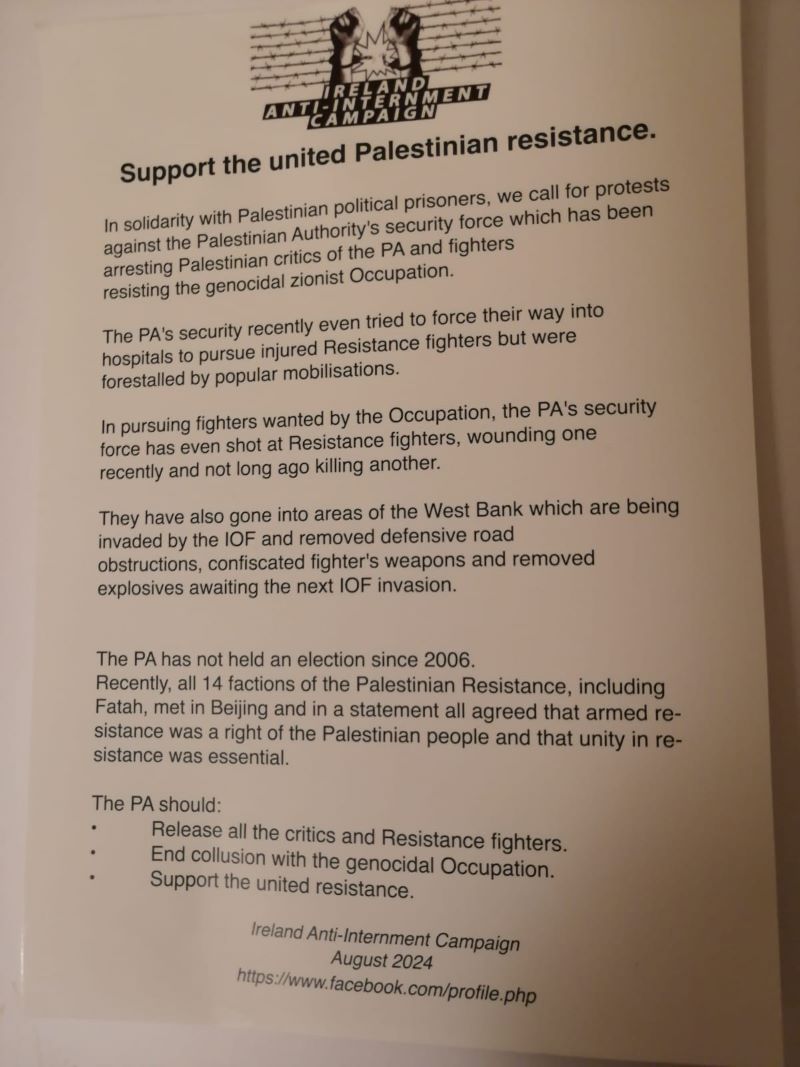
The IAIC’s leaflet handed out at the event points out that the PA’s security force shot and wounded and even killed Resistance fighters, also attempting to enter hospital in force to arrest fighters on two occasions recently, their attempts being frustrated by large mobilisations.
Could a picket on the Palestinian Authority and its Embassy be considered divisive? “Not with justification,” replied an IAIC spokesperson. “It’s the actions of the PA that are divisive. We are supporting the broad resistance there, not one faction or another.”
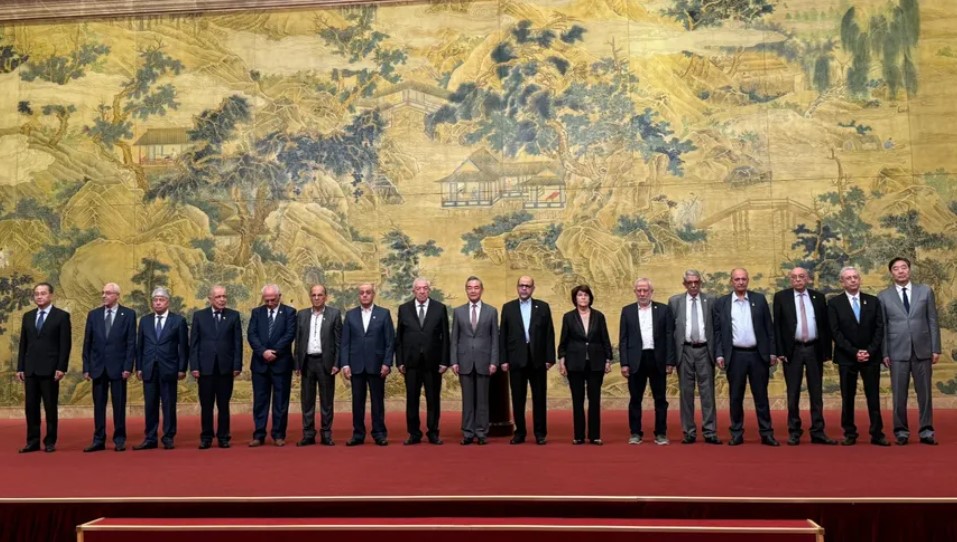
He points out – as did their leaflet – that 14 Resistance factions including Fatah met in Beijing recently and agreed that the Palestinians have a right to resist, including with weapons and called for unity of all the resistance organisations. “The PA is acting against that unity”, he said.
But why is it that the IAIC called this protest and not one of the Palestinian solidarity organisations? “You’d need to ask them that,” says the spokesperson. “We regularly fly a Palestinian flag on our anti-internment in Ireland pickets; the PA was overdue to be done but nobody else was doing it.”
(Photo: R.Breeze)
The IAIC was founded a decade ago to raise awareness about ongoing internment of Irish Republican activists by revoking ex-prisoners’ licence and through refusal of bail by special no-jury courts. In those cases it can take two years for a case to come to trial.
However the IAIC has organised or participated in other events also, such as those around framed prisoners like the Craigavon Two in the Six Counties and the Munir family in England. It has also called two of its pickets since October 2024 to specifically highlight Palestinian prisoners.
Will the group be regularly picketing the Palestinian Authority now? “Probably not. It’s not what we were set up for but we felt the ice needed breaking on this. Others need to step forward now,” replied their spokesperson, though signalling that they would support others in doing it.
Photo of copy of the leaflet being distributed outside the Palestine Embassy today. (Photo: R.Breeze)
It is probable that a representative of the PA will be welcomed soon by the Irish Government as part of its recognition of the ‘Palestinian State’. One wonders how this reception of a corrupt and Occupation-collusive organisation will be mediated in the Palestinian solidarity sector in Ireland.
The Governments of the EU, including Ireland’s, formally recognise the PA but not only that – so does Sinn Féin in Ireland, EH Bildu in the Basque Country and Esquerra Republicana in Catalonia. This corresponds across the board also to support for ‘the Two-State Solution’ (sic).
What that entails is allocating the Palestinians less than 20% of their homeland weaving around illegal zionist settlements, with least water and some of the worst land, under the permanent watchtowers and guns of their genocidal neighbour.
Organisations and individuals within the broad Palestinian solidarity movement will need to decide exactly what their solidarity with Palestine actually means, especially for the Palestinians themselves.
(Reading time:3 mins. Note: Apologies for delay in publishing this report)
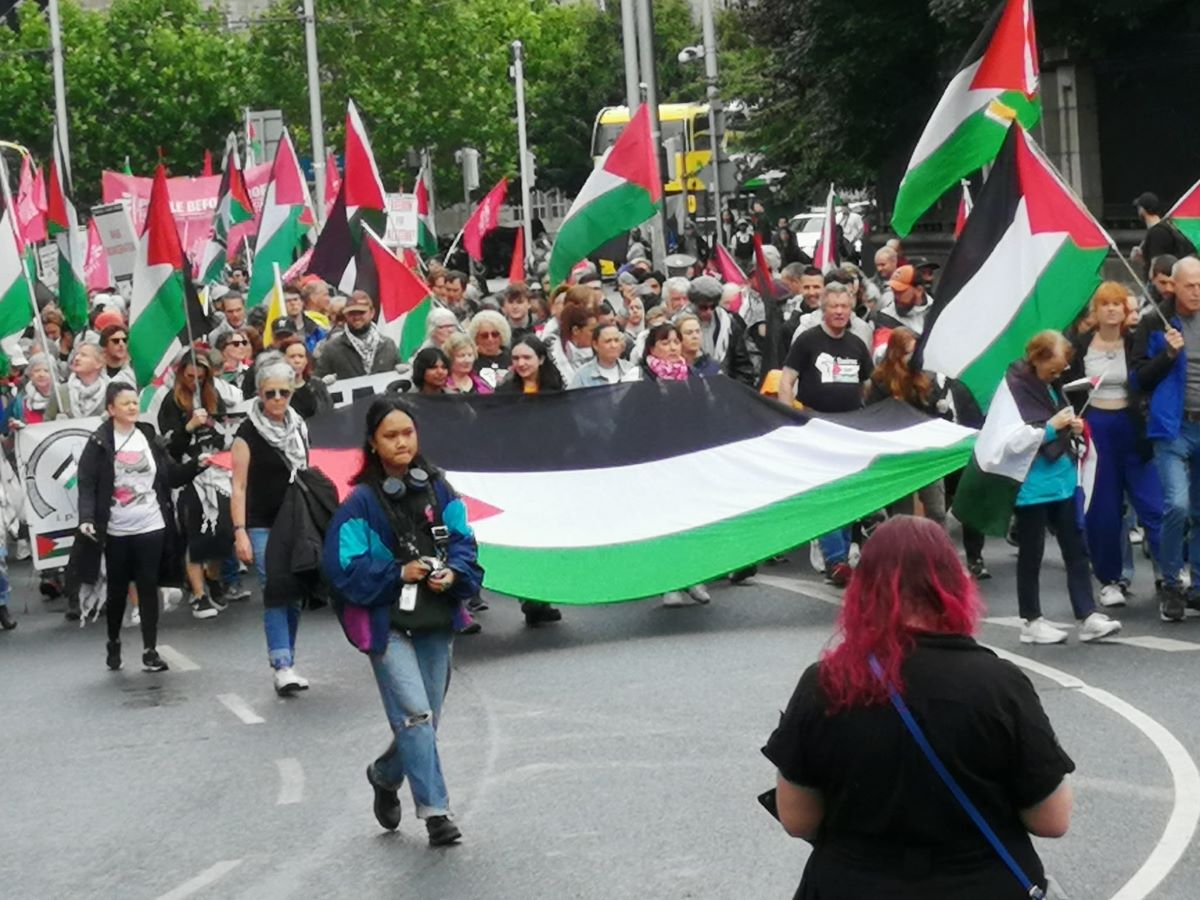
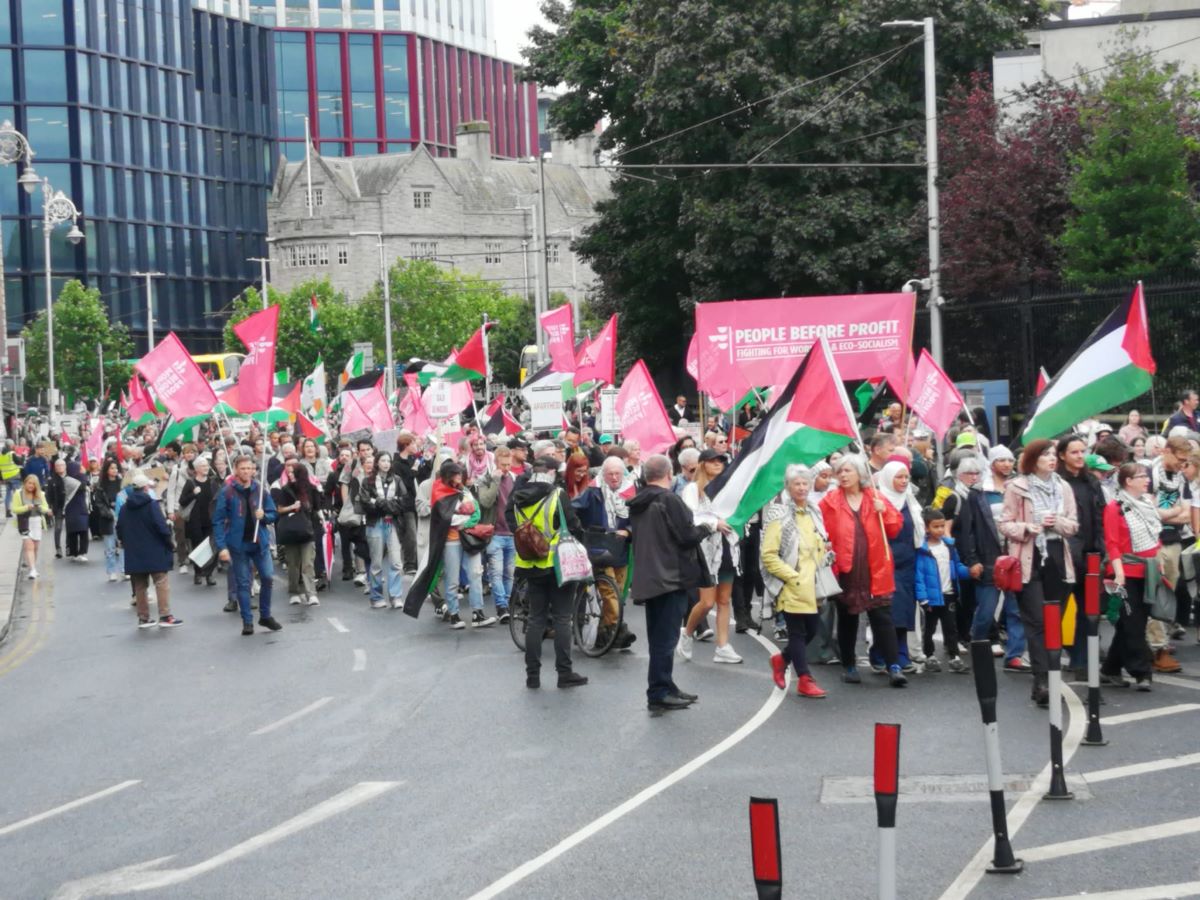
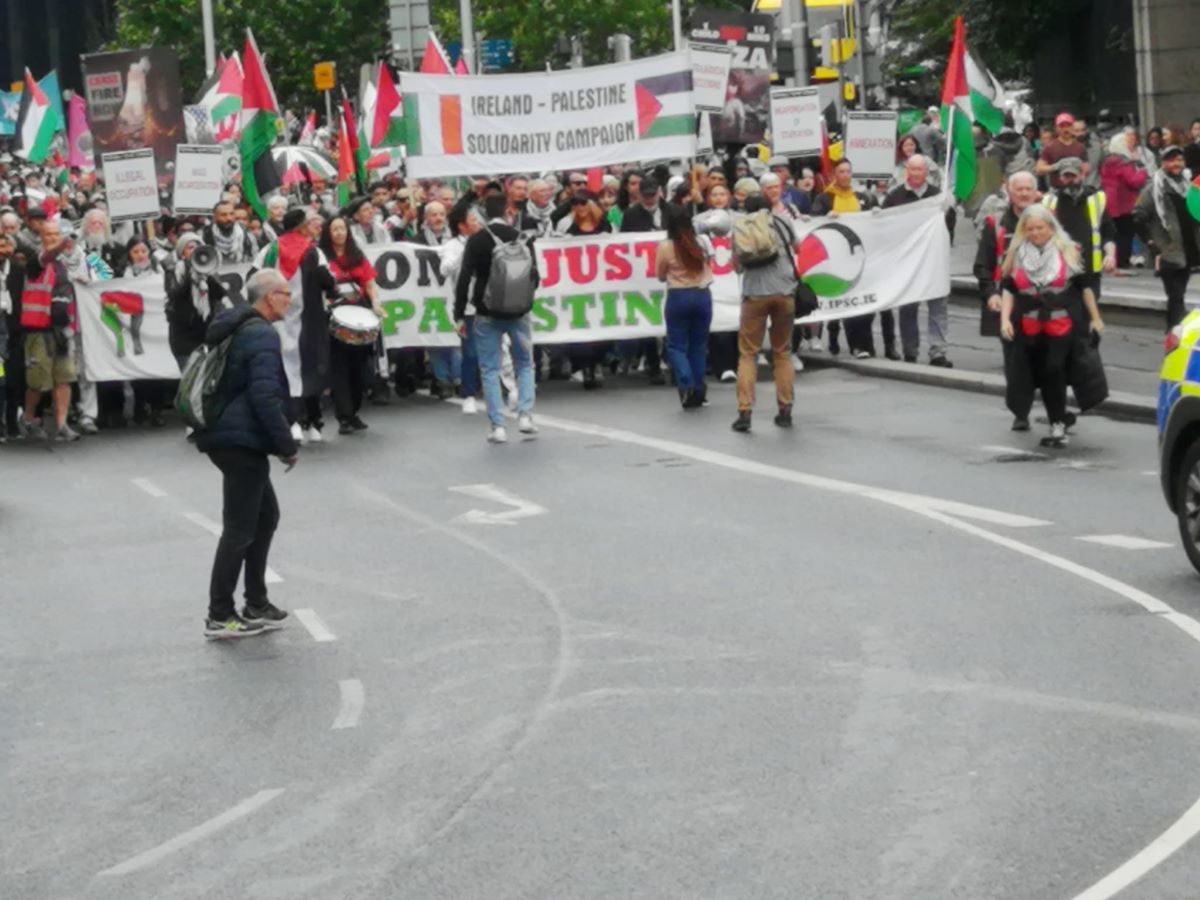
On Saturday 20th June the Irish people, despite their Governments once again marched in a national demonstration to show the Irish majority solidarity with Palestine and horror at their continuing genocide by the ‘Israeli’ armed forces.
The march had been convened by the long-standing Ireland Palestine Solidarity Campaign which has branches across Ireland from Cork to Donegal, including in some parts of the British colony (where however the Loyalists are anti-Palestinian).1
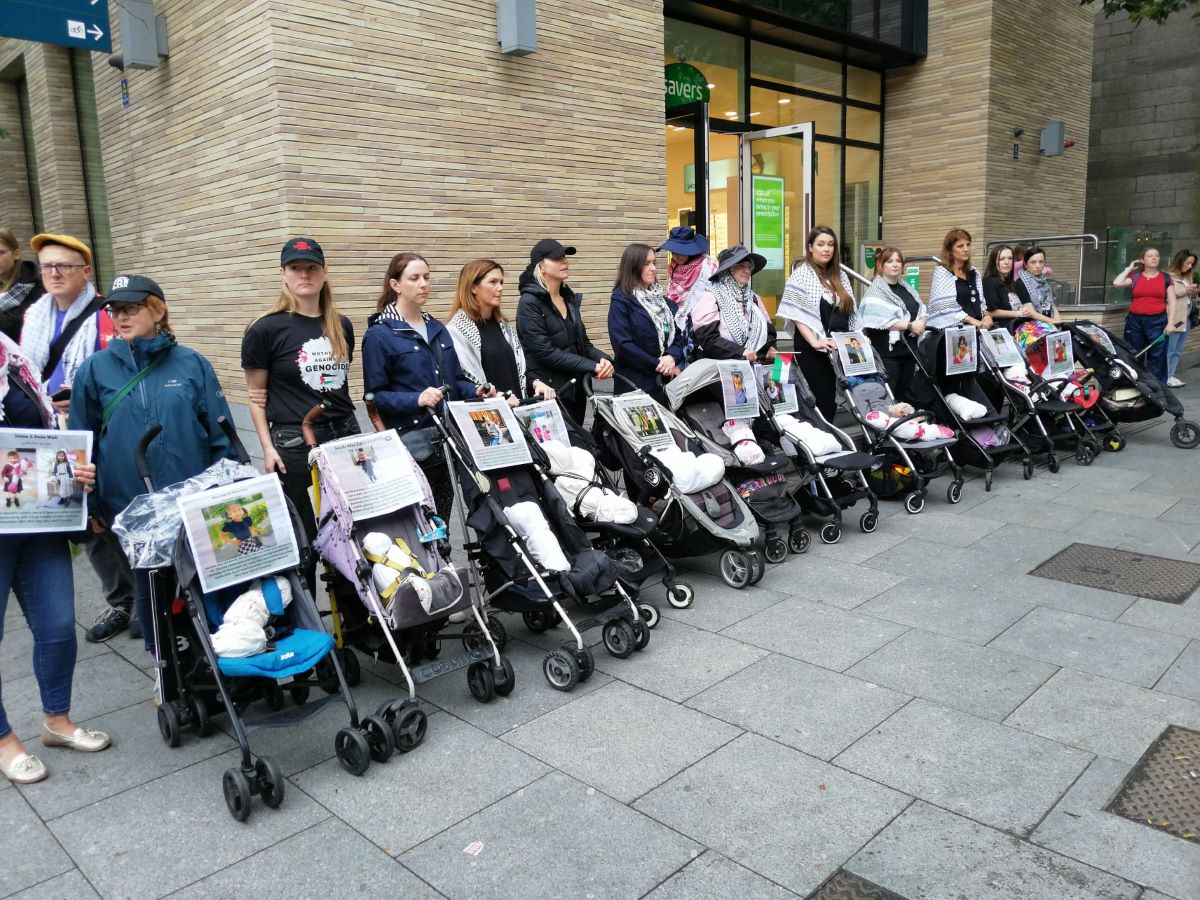
Mothers Against Genocide group in Dawson St. (around corner from Molesworth St.) evoking individual children murdered by ‘Israel’. (Photo: D.Breatnach)Dublin community group that holds Thursday evening vigils in four areas of North Dublin. (Photo: D.Breatnach)(Photo: D.Breatnach)
The assassinations of resistance leaders were still to come2 but it had been business as usual in Palestine with daily massacres of civilians by the ‘Israeli’ Occupation forces, ongoing starvation, destroyed health service, impending epidemics, prisoners released as ghosts of their former selves.
Also IOF raids and kidnappings3 in the West Bank, at times with Palestinian Authority4 collusion in arrests of activists, confiscation or destruction of Resistance weapons …
To all this the Palestinians in general have responded by helping one another trying to survive, digging people out of bombed rubble, documenting atrocities, burying their dead, trying to feed their children and elderly …
And their Resistance in all factions (and none) threw stones, fired bullets, launched anti-tank rockets, mortars, missiles and blew up bombs against Occupation armour and soldiers. And of course, contributed new names to the long list of martyred resistance fighters and commanders.
The ECJ,5 to howls of protest from the regime had pronounced its verdict that Israel was indeed, as has long been evident, guilty of practising apartheid against the Palestinians. However not one state ceased giving political or financial cover to the Occupation or supplying it with arms as a result.
Irish Healthcare Workers for Palestine. (Photo: D.Breatnach) (Photo: D.Breatnach)(Photo: D.Breatnach)
IPSC Police?
Only a few Irish Tricolours were displayed on the march which is visually a political mistake, as I’ve observed earlier and the organisers should state that such are welcome. Not one Starry Plough flag, that of socialist Republicans, could be seen either, despite no doubt there being many such participating.
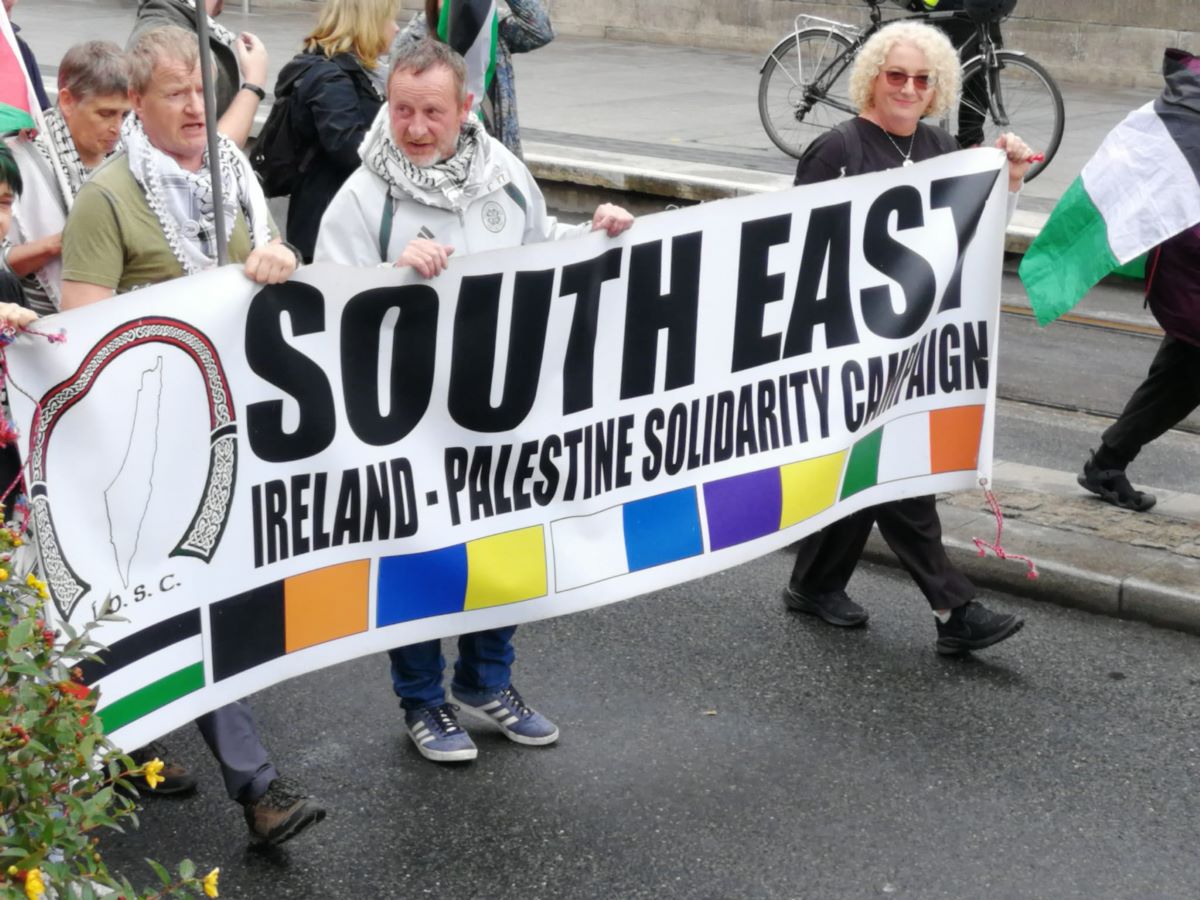
Irish language placards and banners have been getting rarer, despite a previous welcome upsurge upon which I’ve commented in the past. However there were some to be seen, including a number of Saoirse Don Phalaistín flags and the banner of a Newry group, from Co. Down, under British occupation.
As they filled Molesworth Street towards the IPSC stage and police barriers at the end, facing the Leinster House Irish Parliament building, some marchers already began to leave, having heard speeches before and perhaps heading for their transport back to their earlier points of departure.
The company that erects crowd barriers were ready to install them to cut off a section of Molesworth Street at the intersection of narrow lanes and the Gardaí wanted to cram the crowd in beyond the barriers. IPSC stewards began to usher marchers further into Molesworth street.
One approached a group of marchers telling them what the police wanted to which one of the group replied: “I don’t give a f..k what the police want!” and after the steward’s persistence, accused him of doing the job of the police.
The IPSC stewards have helped the police pack marchers into the stretch of Molesworth Street beyond the intersection (and incidentally leaving any demonstrating in Dawson Street cut off from the main group). (Photo: D.Breatnach)
Aside from the rough language, what were the IPSC stewards doing passing on police orders?
People in the group said that the IPSC stewards have done this before and that furthermore there was no important-through way being cleared,6 the exercise serving no real purpose other than getting the public used to being corralled and that at the least the police should do their own job.
(Photo: D.Breatnach)(Photo: D.Breatnach)
The main purpose of stewards is to keep the march moving and safely from traffic. The route has been agreed beforehand by the IPSC with the Gardaí which is not a legal requirement in Ireland. Even in that case the stewards should keep a strict separation in functions from the police.
The IPSC does an important job, publishing information and organising events, especially nationally but back in October delayed in even calling for the Zionist Ambassador’s expulsion. Some other groups also organise events and it appears that the IPSC supports some and not others.
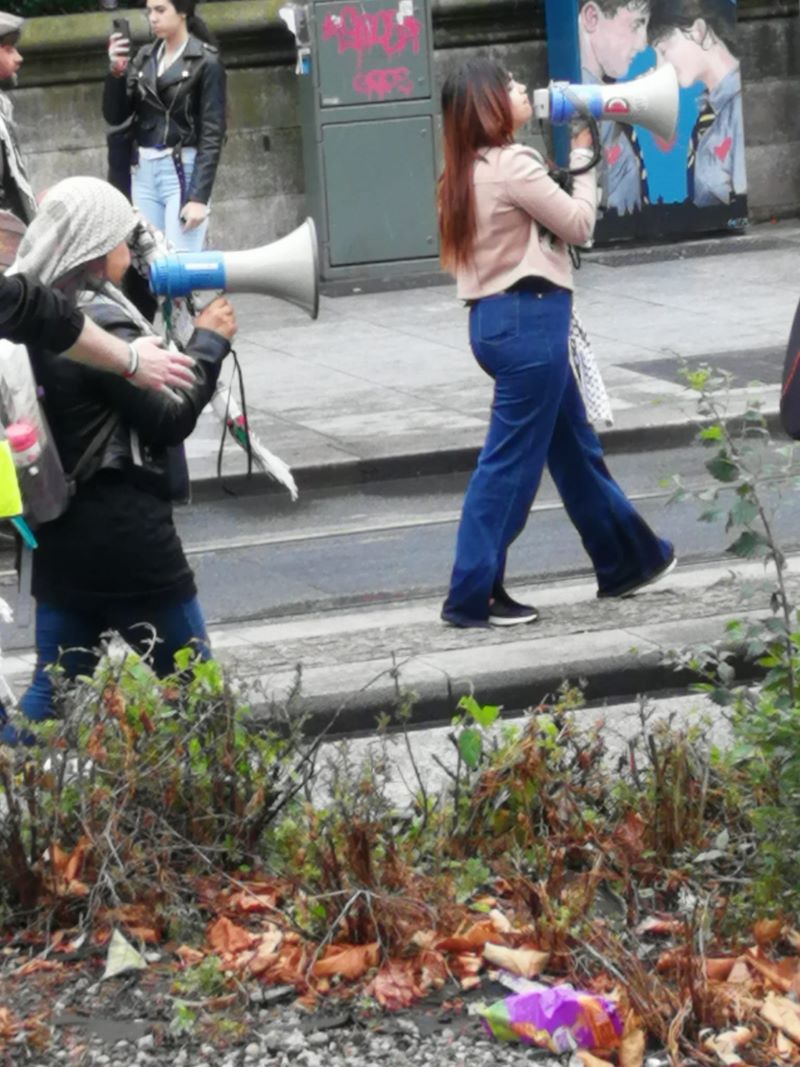
Young Palestinian women leading the slogans call-out. (Photo: D.Breatnach)(Photo: D.Breatnach)
Going forward it seems that the solidarity movement, including of course the IPSC, will need to take into account their meagre effect on the Irish Government, not to speak of upon the genocidal state itself and on its supporting states in the West, in particular the USA, Germany, UK …
Such recognition will call for escalation, for direct action, for different kinds of solidarity action … whether some organisations want to participate or not.
(Photo: D.Breatnach)(Photo: D.Breatnach)Some trade union banners on the march (though the unions do little to mobilise support, much less take action against ‘Israeli’ products etc.). (Photo: D.Breatnach)Front of the march turning into College Street. (Photo: D.Breatnach)
FOOTNOTES
1This could be because they see themselves as ‘British’ settlers, while the ‘Israelis’ are European settlers too but is more likely a knee-jerk reaction to the Palestine solidarity exhibited by Irish nationalists (something like “If they’re for them, we must be against them”.
2Assassinations of leaders of Hamas, Hezbolah and senior officers of Islamic Resistance Iraq.
3The IOF and the Zionist State may call them “arrests” or “detentions” but typically they are random or working off a list without warrants or due process. Former prisoners are re-arrested constantly; family of ‘wanted’ individuals are detained in order to pressure the ‘wanted’ to give themselves up. Typically the detained are served ‘administrative detention’ orders, jailing them for months without trial or evidence. Prisoners are underfed, overcrowded, beaten by guards, have dogs set upon them and medically neglected.
4Unelected, undemocratic, corrupt and zionist-colluding body financed by some Western powers and some colluding Arab states.
6Furthermore, with no side-streets available in that section beyond the intersection, the police could close that west end of the street should they wish to, ‘kettling’ all the demonstrators between two Garda barriers.
On Friday 2nd August two events of Palestine solidarity advertised at short notice took place a couple of hundred metres apart in Dublin City centre, attracting up to a couple of thousand participants overall.
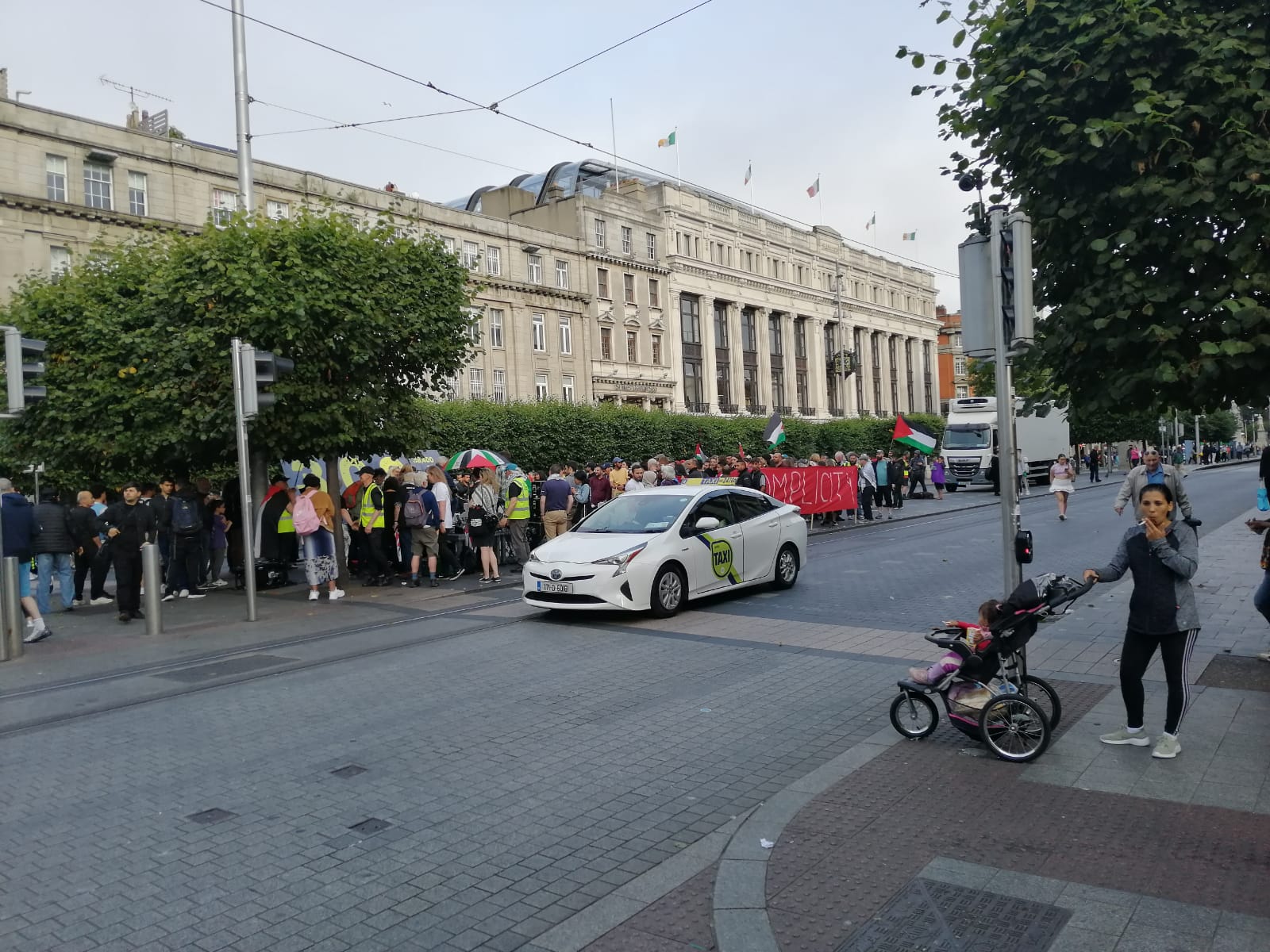
The larger event by far was organised by the Ireland Palestine Solidarity Campaign and focused on the 300th day of the Genocidal war on the people of Gaza by the Israeli state. The smaller, approaching a hundred participants, concentrated on the assassination of leaders of the Resistance.
The IPSC-organised vigil on O’Connell Street (Source photo: R.Breeze)
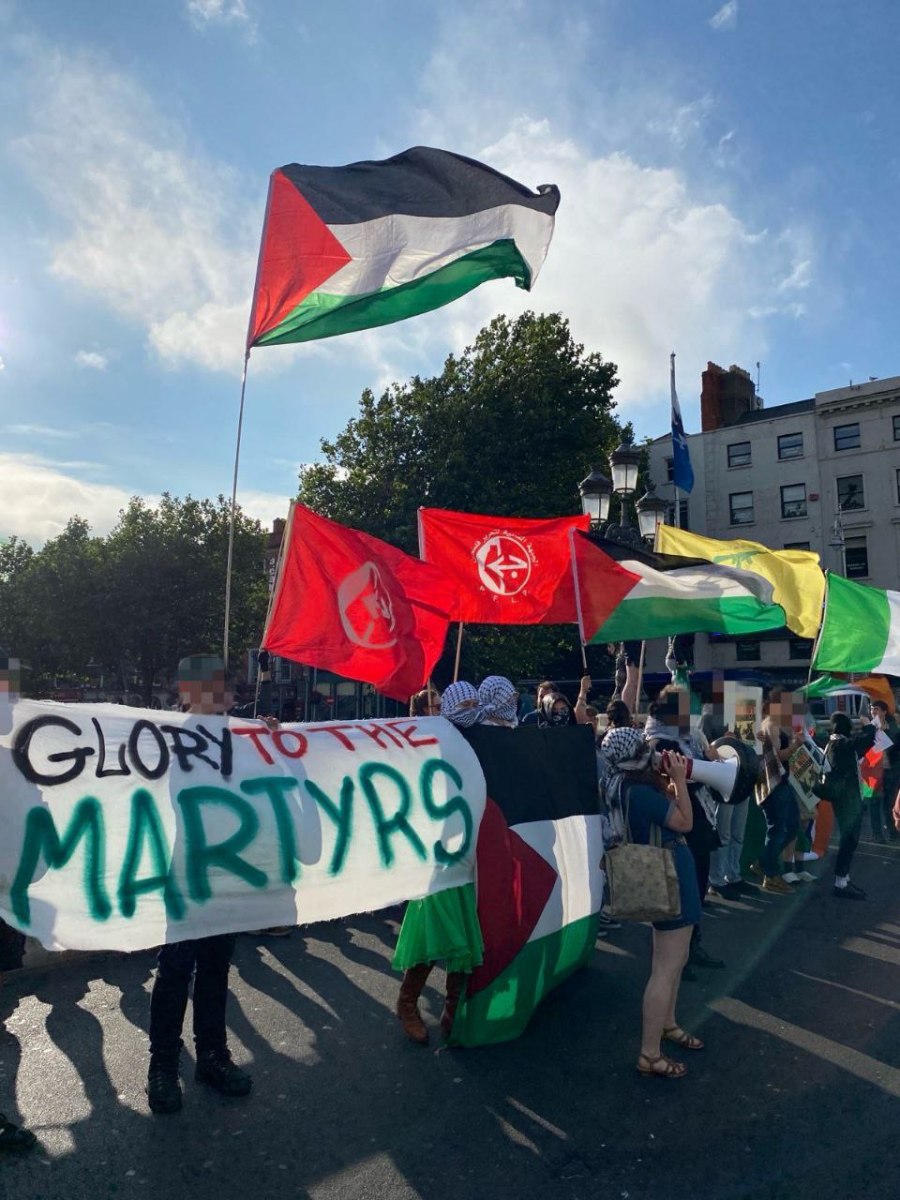
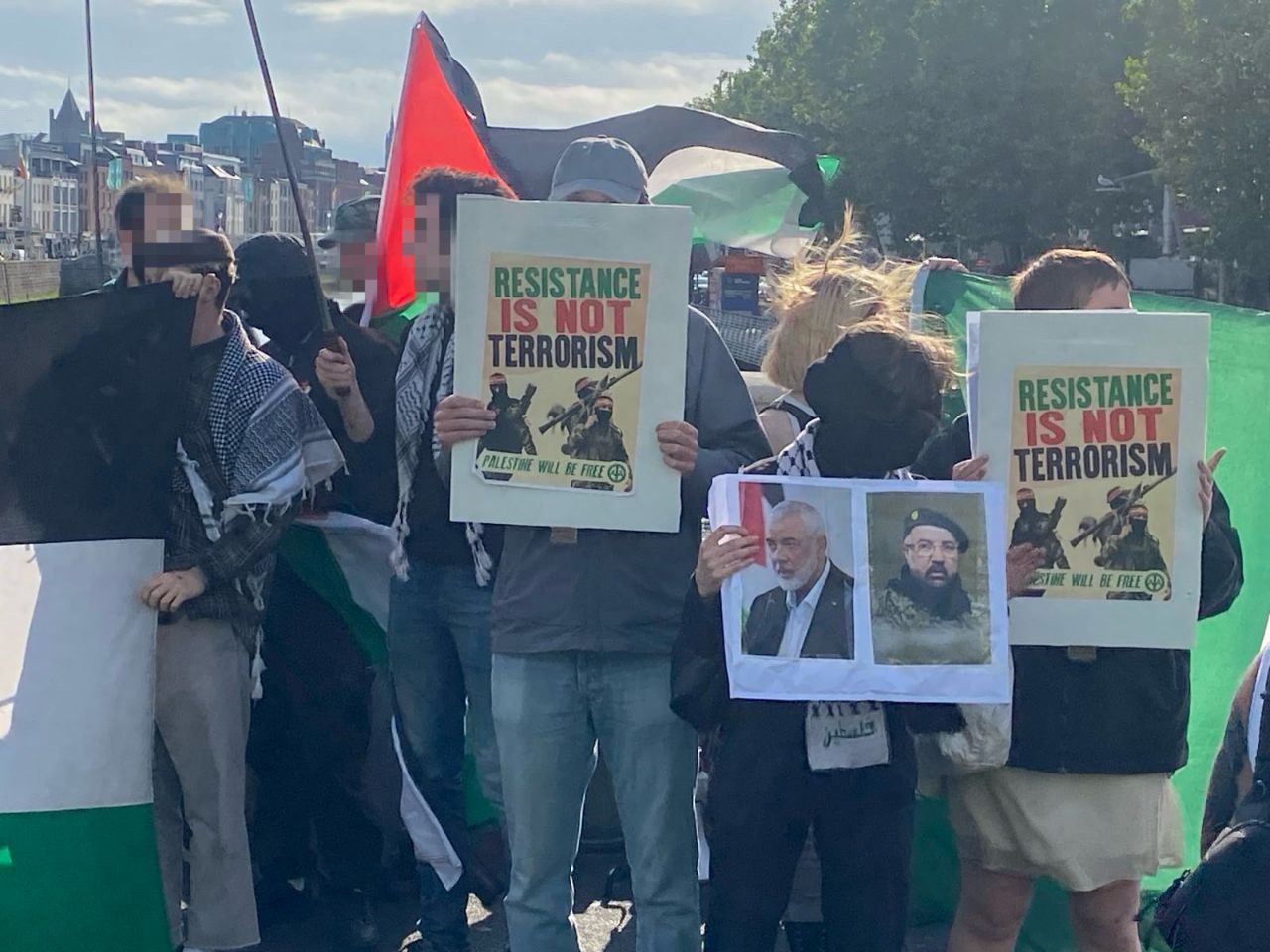
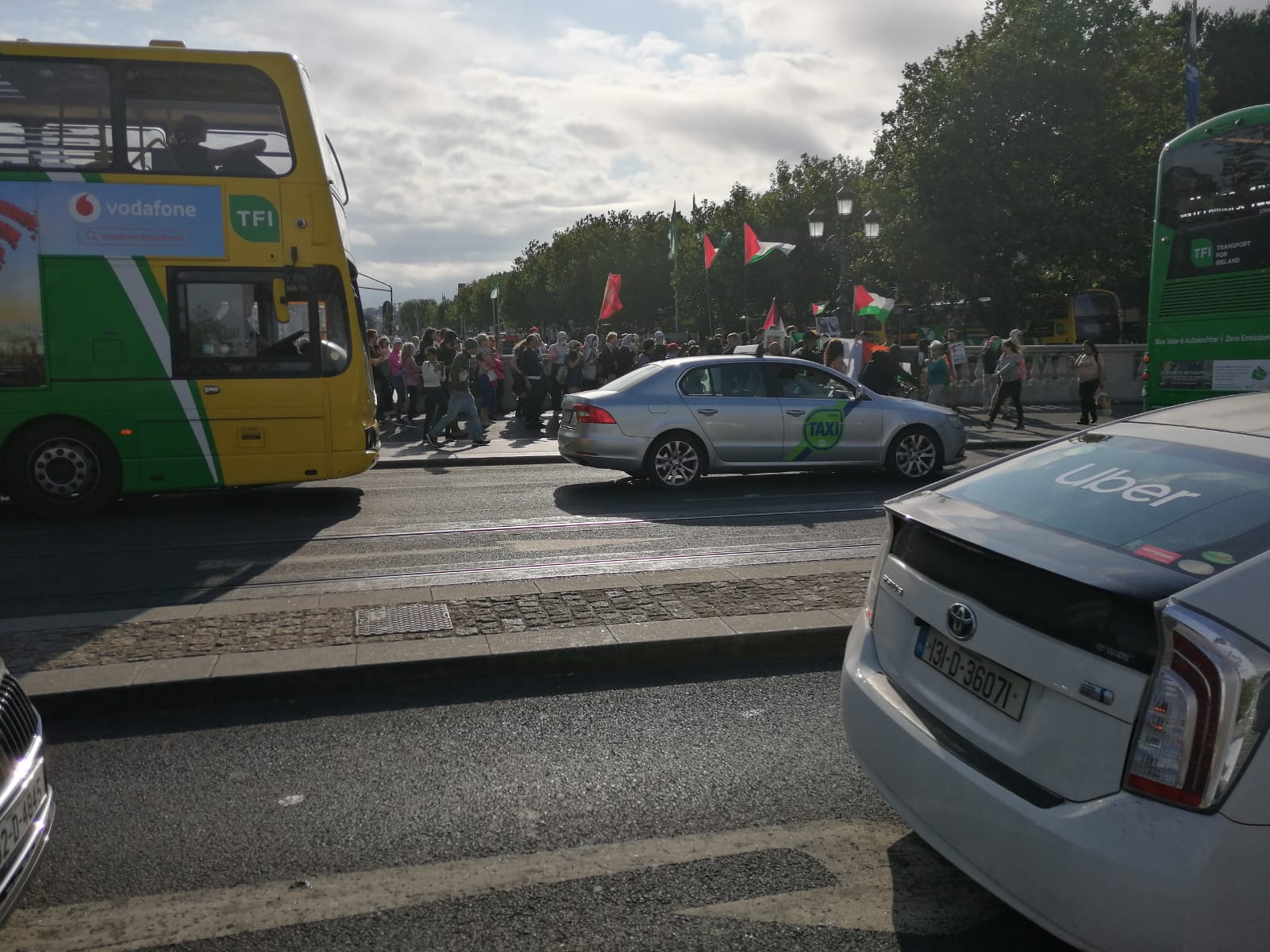
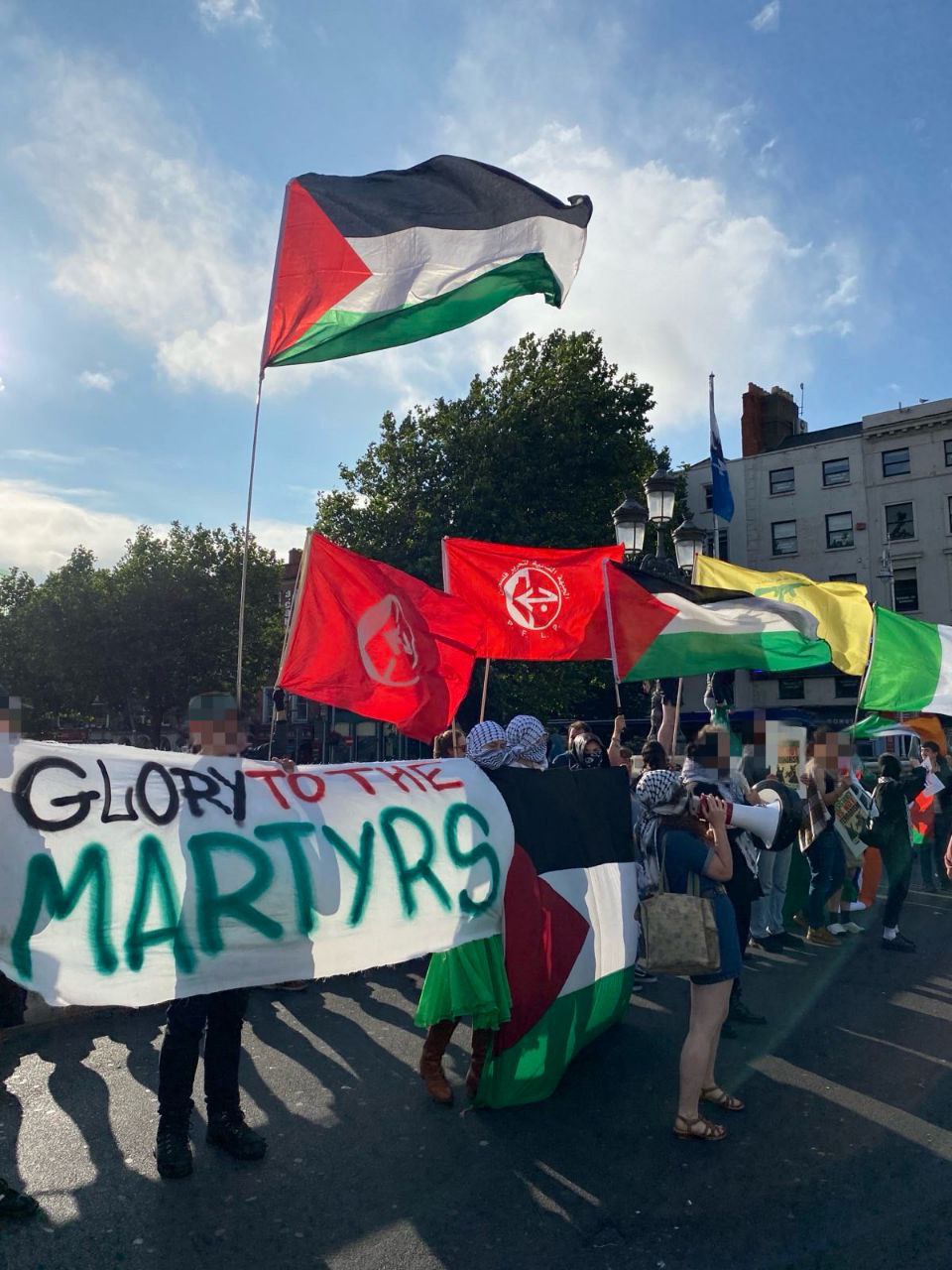
The IPSC occupied the space to which they have become accustomed in front of the GPO, the other, organised by Anti-Imperialism Action and the Saoirse Don Phalaistín coalition, took up position on the west side of O’Connell Bridge, where flags of the PFLP, Hamas and Hezbollah could be seen.
Some carried portraits of martyred Resistance leaders Haniyeh and Fouad; among the usual Palestinian national flags and resistance faction flags, a number of Irish Tricolours could also be seen, along with a green-and-gold Starry Plough.
Close-up section of the AIA-SDP protest on O’Connell Bridge (Source photo: AIA)
Some printed placards stated that Resistance Is Not Terrorism, while a couple of home-made placards stated that ‘Israel’ and US/NATO are the real terrorists! and a home-made banner declared Glory to the Resistance!
An almost constant stream of slogans were called by young people taking turns (one male and two females) and answered by the crowd, “Long live the Intifada” and “In the face of occupation, resistance is an obligation” in particular leaving no doubt where their sympathies lay.
Shot taken early as protest was getting started (Source photo: R.Breeze)
The crowds passing by were either openly supportive or non-committal but a few hostile comments were thrown and one middle-aged man shoved the loudhailer into the mouth of a young Palestinian woman who was calling out slogans for the crowd’s response.
She reacted immediately to the hostile act and was quickly supported by a group of young women who pushed the man away. Three Gardaí who were watching from the central reservation then came across to the group and took the man to one side but also demanded the Palestinian woman’s ID.
One of two placards with the same message displayed on the AIA-SDP protest on O’Connell Bridge. (Source photo: R.Breeze)
Unaware of her rights, she gave them that information. The Gardaí said they had not seen the man’s action, only that of the women pushing him along the Bridge. He claimed that the megaphone had been blaring in his ears but the suspicion is that he had been expressing his hostility to the cause.
The opinion of some people was that there would be no subsequent police action against the woman but some others gave her precautionary advice and also contact numbers for witnesses.
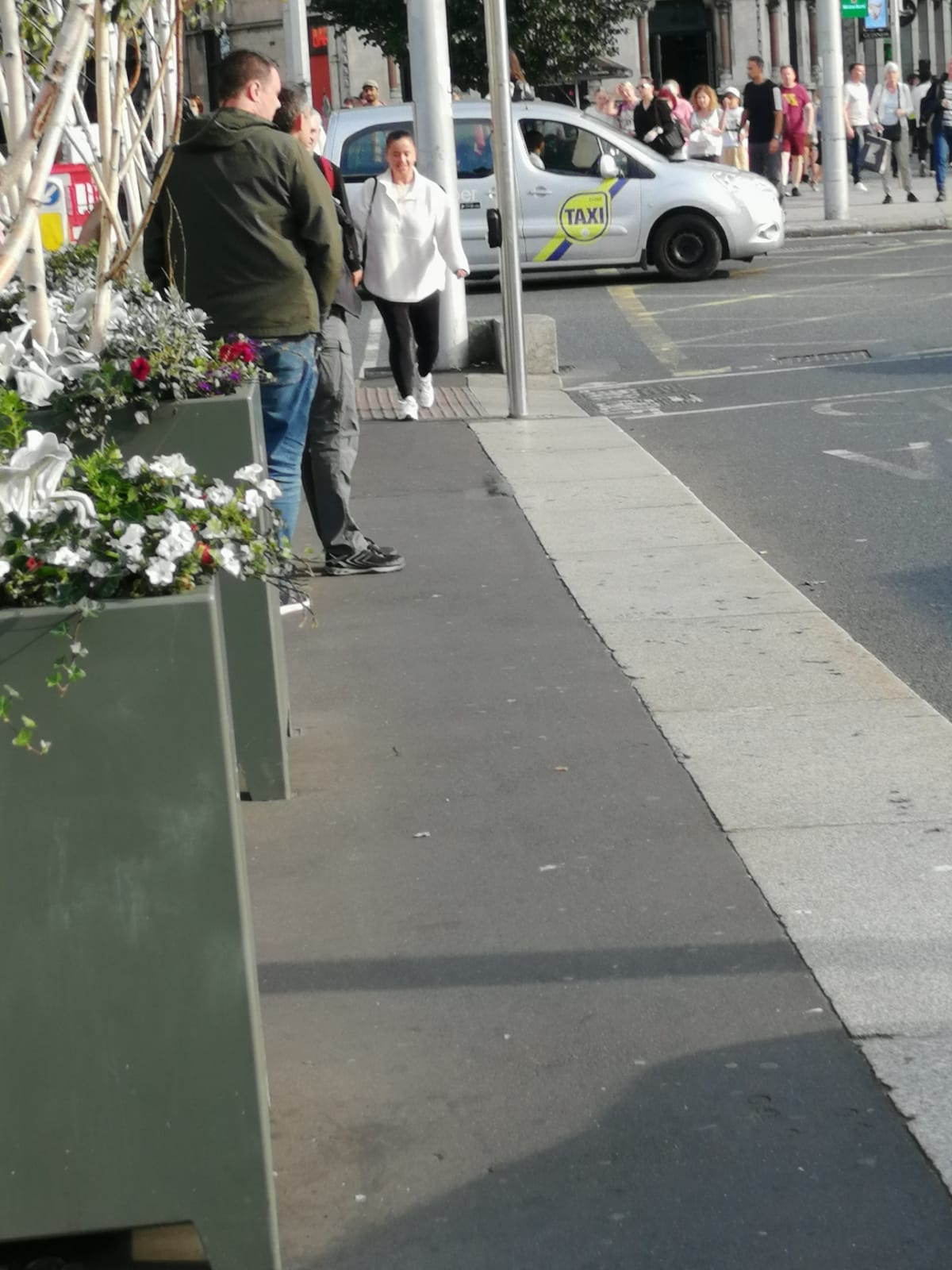
A Garda jeep and number of uniformed Gardaí had taken up station on the east side of the Bridge and a couple of Special Branch (plain-clothes political police) were also noted observing and videoing from the central reservation but none approached the demonstrators.
Two Special Branch officers immediately after their arrival on the central pedestrian reservation on O’Connell Bridge. (Source photo: R.Breeze)
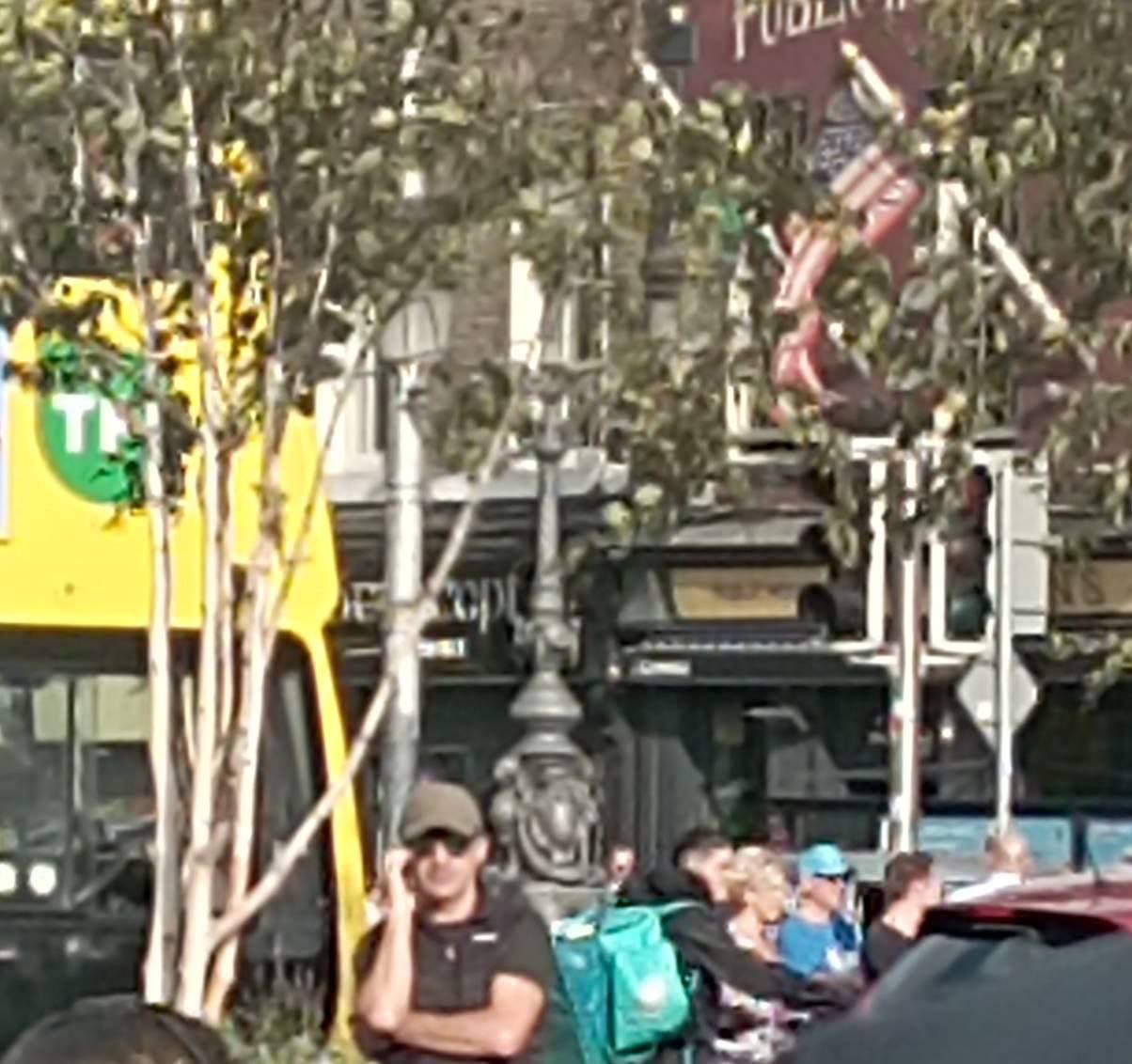
A sinister individual who met the SB men on the central reservation, constantly on his phone and at times directing the SB where to film, may have been Mossad, the ‘Israeli’ foreign secret service, well-known for assassinations such as that of Palestinian Mahmoud Al-Mabhouh in Dubai in 2010.
Possible Zionist agent seen here near the SB officers on the central pedestrian reservation on O’Connell Bridge. (Source photo: AIA)
The photographs of 26 of his suspected assassins and their aliases were circulated by Interpol and Dubai police found that 12 of the suspects used British passports, along with six Irish, four French, one German, and three Australian passports; this causing some diplomatic storm at the time.
Approximately an hour after the start of the event on the Bridge, it was concluded while in front of the GPO, the other event was still continuing.
Section of the IPSC-organised vigil in O’Connell St. (Source photo: R.Breeze)Close-up of section of the AIA-SDP organised protest on O’Connell Bridge. (Source photo: AIA)
Conflict with security forces of the Palestinian Authority broke out in Tulkarm city in the West Bank today as they tried to seize Palestinian Resistance commander Abu Sujaa (Mohamed Jaber), who was receiving treatment in Thabet Thabet Hospital.
According to reports the PA fired tear gas and used pepper spray inside the Hospital grounds, also striking with batons at protesters including women. Shots were fired at the PA’s HQ and protesters are calling the PA “traitors” and “collaborators”.
After a tense stand-off the PA forces eventually had to leave empty-handed.
Abu Sujaa is a commander of the Tulkarm Brigade, Soraya Al-Quds (Islamic Jihad), one of the main organisations of the Resistance. It is reported that he was injured while handling explosives and taken to hospital; when the PA learned of his presence there they sent forces to capture him.
The arrest attempt by the PA and treatment of protesters has been condemned Soraya Al-Quds and by a number of other Palestinian Resistance organisations including the Al Aqsa Martyrs Brigade coalition, Mujahadeen Movement, PFLP, Hamas and Popular Resistance Committees.
A statement also condemning the PA’s action by students at Birzeit University was signed off by the student movements of Hamas, PFLP, DFLP, PPSF, and PPP.
The point was also made that Abdul Nasser, one of the own PA’s employees, a security officer in uniform, was filmed executed by the IOF recently in cold blood in front of their headquarters in Tubas “without any action, condemnation, or denunciation” by the PA’s leaders.
Abu Sujaa is far from being the first Palestinian Resistance fighter targeted by the PA which holds many prisoners but has also killed fighters, including Ahmed Abu Al-Ful in early May1 and Motasim Al-Arif a month later, on that occasion also while trying to capture Abu Shujaa.2
Two Palestinian civil society activists recently went on hunger strike in protest at their detention by the PA, Fakri Jaradat being released after a week of hunger strike (but 16 days detention) but Ghassan Al-Saadi was transferred to Al-Razi Hospital in Jenin in deteriorated health condition.
This evening, according to local sources quoted on Resistance News Network, PA Security Forces stormed the city of Tubas, apparently in order to assassinate the resistance fighter Omar Meselmani who is wanted by the Occupation, since they shot at him directly.
Palestinian unity?
The Palestinian representative bodies recognised internationally are the PA and the PLO,3 both dominated by the Fatah leadership. The latter were represented at the Beijing Palestinian Unity conference last weekend at which all 14 factions agreed on the need for a unity government.
The PLO excludes Islamist organisations from membership, though both the PFLP and the DFLP delegates stated at the conference that they wished to admit those resistance organisations to the PLO, no such decision was recorded (presumably blocked by Fatah) in the conference decisions.
One might have thought that in the circumstances of the Beijing Agreement, the PA would be keeping a low profile or at least certainly steering clear of conflict with Resistance organisations. On the contrary however, the PA seems to be intent on exacerbating divisions.
Islamic Jihad, possibly divining the PA’s intentions, has declared it will not be drawn into a civil war with the organisation, despite its actions and collusion with the Occupation. But can that posture be maintained if the PA continues persecuting and even shooting its fighters?
Perhaps the PA is doing its best, in order to avoid its being sidelined and as an aid to the beleaguered Israeli occupation, to ensure that civil war breaks out among the Palestinians.
The historic exclusion from the Palestine Liberation Organisation of Islamist resistance organisation is ending. In a conference taking place currently in Beijing, two secular resistance organisations called for the Islamists’ inclusion in the PLO.
That news came earlier in the day from Resistance News Network (on Telegram) and much later, from the same source, the news of an agreement (see Appendix) of all on forming a consensus resistance government – but no mention of opening the PLO to the Islamist groups.
Participants in the Palestine Resistance Unity Conference in Beijing days ago. (Photo sourced: Internet)
The PLO has been internationally recognised as the sole legitimate representative of the Palestinian people but it was dominated by Arafat’s Fatah, which became a corrupt organisation colluding with the Occupation and with US Imperialism.
This morning some of the published contents of the agreement1 leaked to the media, were disputed in statements from Palestinian Islamic Jihad’s Ihsan Ataya2 and Hussam Badran of Hamas,3 in particular in reference to UN resolutions which contained a recognition of the state of ‘Israel’.
Reading between the lines one suspects an attempt to bring in false elements of agreement with elements of collusion with the entity and/or undermining and sabotaging any agreement at all. In any such manoeuvres, due to past behaviour first suspicion must fall on the Fatah leadership.4
If no agreement was reached on enlarged PLO membership, then given the statements of the PFLP and the DFLP, one must assume that the Fatah leadership vetoed that decision. In agreeing to a consensus government then one must also suspect the Fatah leadership of playing for time.
The Western Left and the Palestinian Resistance
A decision on opening the PLO has been coming for some time but will not be welcomed by some groups in the West. Islamist resistance organisations hold a number of socio-political ideological positions that are in opposition to the socialist or even secular positions held in Left circles.
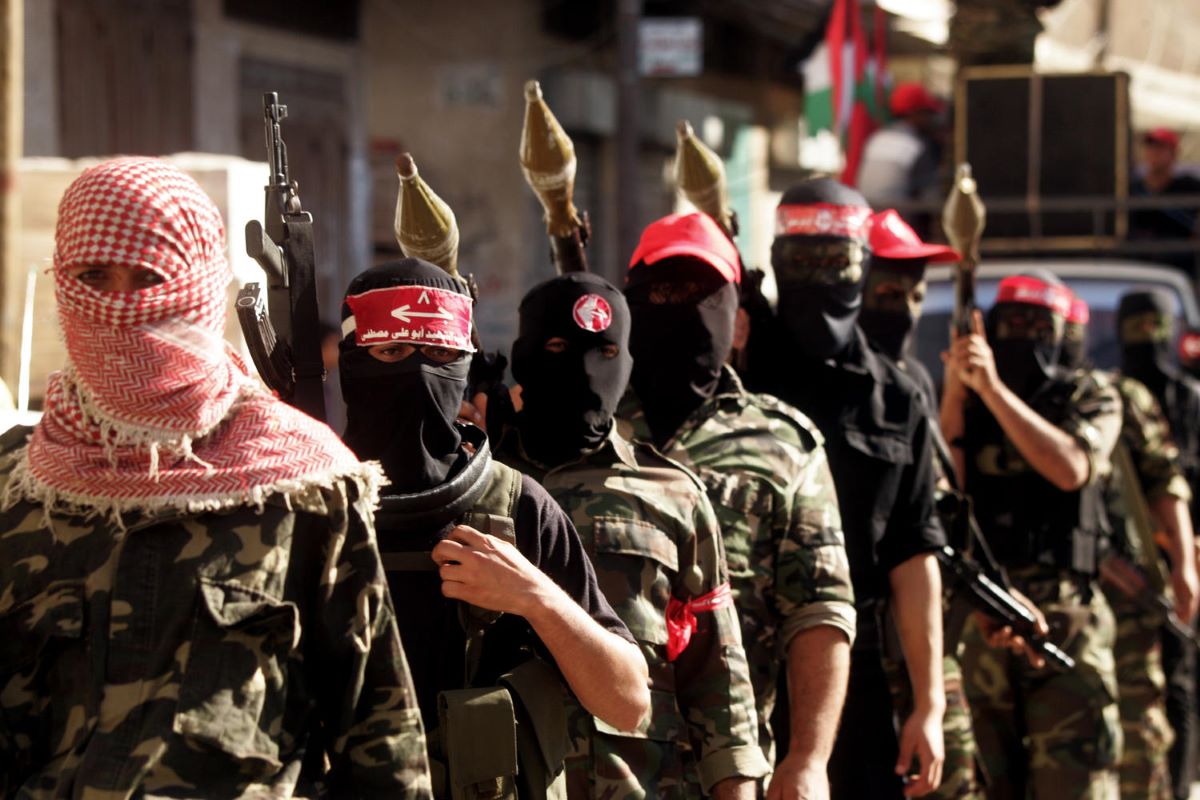
Palestinian militants from the Popular Front for the Liberation of Palestine (PFLP) in parade in Khan Yunis in the southern Gaza Strip on April 29, 2014. (Photo cred: Abed Deb /Pacific Press Credit: PACIFIC PRESS/Alamy Live News)
In those sectors of the Western Left, most support was divided among Fatah, the leading faction in the PLO, or for the Peoples Front for the Liberation of Palestine, its second organisation in size there, with some supporting the Democratic Front for the Liberation of Palestine.
With regard to the first, the ability of organisations claiming to be revolutionary or even just democratically socialist to support a leadership founding the Palestine Authority as a Vichy-type government run by the corrupt Quisling Abbas has been astonishing and also revolting.
While the PA and Fatah leadership engage in active collusion, a military section of Fatah has broken away and is part of the active armed resistance to the Occupation,5 though overshadowed in quantity and effect by the operations of the Islamist groups.
Two Islamic Jihad fighters (Photo sourced: Internet)
Need for Unity but Not a Simple Thing to Achieve
There is clearly a need for a unified resistance in terms of military operations but also with regard to political position. How far is the resistance to go? What are to be its objectives beyond defeating the current genocidal campaign? Who will run the territory and how will that be decided?
And of course, what is the national territory to be claimed: historic Palestine? Or the territory as it stood prior to the 1967 War? Into that question comes the other: a unitary secular state of the whole of Palestine, or 20% of the national territory under sight and guns of the larger Occupation state?
According to reports from Resistance News Network two secular organisations, PFLP and DFLP have already laid out their initial positions and both called for the inclusion in the PLO of the Islamist organisations Hamas and ICJ, along with the formation of an interim unity government.
This is a demand made in the past by Hamas and the ICJ also. Should all 14 organisations participating agree, there will remain a long road ahead of them. The Fatah leadership is wedded to Western imperialism and is likely to face rejection in elections, even more than it did in 2006.
Western imperialism and of course the Israeli settler regime don’t want a united Palestinian national resistance.
The fact is that not only are the Islamist organisations doing most of the fighting against the ‘Israeli’ Occupation’s genocidal campaign but there are more of them and they generally acknowledge the leadership of Hamas and Islamic Jihad, who have also been careful to consult them.
It was the latter two that organised and led the October 7th breakout from the Gaza ‘concentration camp’ into Palestinian territory seized and occupied by the settler regime, though resistance operations immediately afterwards were coordinated by the Joint Operations Room.
Hamas is not only the major leader in terms of military resistance, it is also a political organisation and was the electoral choice of the Palestinian people in the 2006 elections, the result of which was repudiated by the Fatah leadership and by the Western powers.
In addition, while the Palestinian secular Leftists have few external allies, those of the Islamist Palestinian resistance are active and powerful: Hizbollah in Lebanon and Syria, Islamic Resistancein Iraq,6 Ansar Allah in Yemen7 and the leadership of the Islamic Republic of Iran.
All of those with the exception of Iran are in constant action against the ‘Israeli’ Occupation and Iran has shown its capacity to flood ‘Israel’s’ air defence systems and, despite Western allies’ air force operations, to strike three military bases of its choice in occupied territory.
Yemen, in addition to its effective interdiction in three seas of shipping allied to the genocidal entity, last week slipped an explosive drone into Tel Aviv without even setting off alarms. The IOF bombed its oil tanks and electricity generator in revenge but this contest is far from over.
Hizbollah developed missiles capable of striking anywhere inside territory occupied by ‘Israel’ and has displayed detailed footage captured by their undetected drone over ‘Israel’s’ claimed territory comprehensively detailing military, industrial and civilian infrastructure.
In the event of the creation of a genuine national independent Palestinian state, it will not be socialist, at least initially — but will it be secular or Islamic in law? In the case of the latter, what will be the fate of the secular resistance sector?
In 2007 Hamas dealt harshly with Fatah forces in Gaza but that was after months of the Fatah administration refusing to relinquish control in line with the 2006 election results and also, no doubt, in recognition of the PA’s collusion with imperialism and the Occupation.
And will Shia and Sunni sections of the Islamist sector find a long-lasting accommodation? Come to that, will the secular organisations agree with one another? Apart from the collusive role of Fatah, in their statement the DFLP supported a two-State solution which the PFLP does not.
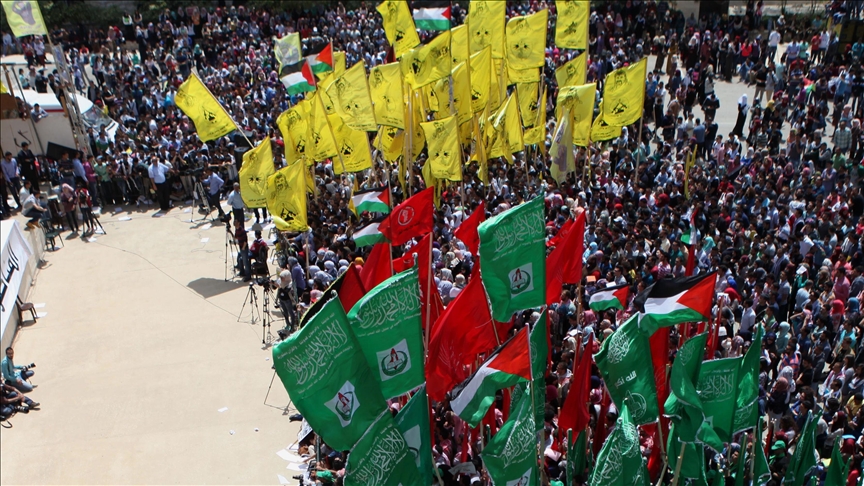
Mass demonstration of unity of different Palestinian resistance organisations (Source photo: Internet)
These questions will be answered by events yet to come and of course the right to decide on them belongs to the Palestinians. The Left in Palestine and outside will need to find a way to accommodate themselves to the results and continue to oppose imperialism and Zionism.
The defeat of the genocidal state of ‘Israel’ will be a huge boon to humanity, a significant damage to western imperialism (in that also a huge great boon to the world) and a huge achievement of the heroic resistance, armed and unarmed, of the Palestinian people.
2Head of Arab and International Relations, statement to Al Mayadeen, summarised in Resistance News Network. Excerpt:
3Head of the National Relations Office in the Hamas movement and a member of its political bureau, in press statement summarised in Resistance News Network. Excerpt: Some points that implicitly and explicitly recognize the naming of UN resolutions that include recognition of “israel” have been amended. The Palestinian political leadership must realize that all negotiations with the occupation forces have failed. The guarantee of implementing the clauses of the “Beijing Declaration” lies in the hands of the Palestinians themselves. The dialogue in Beijing took place in two sessions, and after drafting the statement, there were objections to a number of its contents, and our position was clear. The final reading of the statement was supposed to take place before its approval, but due to the limited time, it was based on what the committee drafted. We passed the statement with our implicit reservations to thwart those who wanted to sabotage this meeting.
4The possibility of collusion in such manoeuvres by the DFLP cannot be excluded, given its position (reiterated in its opening statement to the Beijing Conference, as published by RNN) of claiming Palestinian land on the basis of pre-1967 War only, thereby accepting the State of Israel and its occupation of most of Palestine.
5I have not seen a full list of the represented organisations at the Beijing conference and therefore am unable to say whether they were there. They have been mostly fighting the Occupation in the West Bank and two of their field commanders were martyred yesterday in Tulkarem alongside a commander of Hamas forces by an IOF drone strike during the battle there.
6This coalition recently decided to end its truce in attack on US military bases in Iraq as a result of the long delay by the US in carrying out their agreed departure.
7In effect the government of Yemen, though the Western powers recognise only their proxy, a government in exile.
REFERENCES & SOURCES
Number of postings by Resistance News Network (on Telegram platform) yesterday and today.
🚨🇵🇸 “The Beijing Declaration to End Palestinian National Division: To unify national efforts to confront aggression and stop the genocide war.”
The following was agreed upon by 14 Palestinian factions at the end of the reconciliation meeting in Beijing, China (https://t.me/PalestineResist/49595) today, including Hamas, PIJ, PFLP, DFLP, and Fatah:
– The Palestinian factions welcome the opinion (https://t.me/PalestineResist/49245) of the International Court of Justice, which confirmed the illegality of presence, occupation, and settlement.
– Continuing to follow up on the implementation of the agreements to end the division that took place with the help of Egypt, Algeria, China, and Russia.
– Commitment to the establishment of an independent Palestinian state with its capital in Al-Quds in accordance with international resolutions, especially 181 and 2334, and ensuring the right of return.
– We affirm the right of the Palestinian people to resist occupation and end it in accordance with international laws, the UN Charter, and the right of peoples to self-determination.
– To form a temporary national unity government with the consensus of Palestinian factions and by a decision of the president based on the Palestinian Basic Law.
– The formed government exercises its powers and authorities over all Palestinian territories, confirming the unity of the West Bank, Al-Quds, and the Gaza Strip.
– To resist and thwart attempts to displace our people from their homeland, especially from the Gaza Strip, the West Bank, and Al-Quds.
– Working to lift the barbaric siege on our people in the Gaza Strip and the West Bank and deliver humanitarian and medial aid without restriction or condition.
Earlier this month there was an oration delivered at the grave of Wolfe Tone1 which contained some important elements which deserve inspection and discussion.
– The path to rebuild our struggle is the development of an Anti Imperialist Broad Front – said the speaker. – A United Front of Revolutionary republicans, working in cooperation to advance our common republican objectives and to achieve a common republican programme.
Looking around us at the parties and groups in the socialist and republican spectrum, the ostensibly revolutionary varieties, we see that for many of them, building up their own organisation takes precedence over anything else, including revolution – for them the revolution IS their party.
Speaker giving oration at Wolfe Tone’s grave in front of the monument, faced by colour party. (Photo: RSM)
The call given in this oration runs counter to that kind of thinking. “But we’ve heard all that about ‘unity’ before,” a reader might say. Yes we have and often “unity” meant only “unity” around that particular party or, even more often, around this or that leadership.
There is nothing of that to be found in this address “recognising and respectful of the autonomy and independence of the groups and independents involved”. “Hmmm,” the reader might say “but is it a genuine intention?” Given our experience, it’s a valid and important question.
The most dependable test is in the practice. The speaker of the oration at its annual Wolfe Town Commemoration2 was representing the Socialist Republican Movement organisation (more often manifested publicy in recent years in the form of the Anti-Imperialist Action broad group3)
As an independent revolutionary activist for many years I have often participated in AIA’s actions and at times they have supported actions of which I had been part of organising. I have found that their practice matches their words and there is no truer test.
The speaker followed with practical suggestions for the implementation of the broad front: Trust and co-operation must be developed … through activism and the development of National Republican Campaigns that can be taken up by all Republican groups and independents …
There are many campaigns that could be developed from support for POWs to opposing internment and extradition, environmental campaigns such as (overcoming) the unacceptable situation at Lough Neagh, to campaigns thatoppose the British and NATO presence in Ireland.
One of the banners in the crowd at the event in Bodenstown. (Photo: RSM)
Such a Republican Broad Front would be a fitting tribute to our Patriot Dead, the speaker added, to martyrs like Cathal Brugha,4 who gave his all in fighting for the sovereign, Independent Irish Republic and gave his life on this day in 1922 as a hero in the war in defence of the Republic.
In many of the pleas for unity of the fragmented resistance in Ireland, individuals have called for a conference to form a united front, others called for a unity document of principles around which to unite while in at least one case, two distinct organisations merged.
I have for years spoken out against such endeavours and advocated as a first step unity in practice. If organisations and individuals are not capable of that step, what kind of unity can they achieve around discussion of documents? Unity in practice also helps to break down distrust.
The speaker at the Wolfe Tone commemoration takes the same line, presumably speaking for the SRM when he does so and one supposes that this will continue to be the approach of the AIA in campaigns such as against internment, in solidarity with political prisoners5 or with Palestine.6
The above piece discussed two elements of the oration given by the SRM earlier this month which I believe to be of great revolutionary importance and in need of application in Ireland, one in advocating a principle and the other in suggesting avenues for practical application.
Later I will be taking a look at some other elements in that talk (the text of which, as published by the SRM, I attach as an appendix).
Beirimís bua.
(Image sourced: Internet)
End.
FOOTNOTES
1Wolfe Tone, born into settler stock and of the Establishment Anglican congregation, was a leading figure in the formation of the revolutionary republican organisation The Society of United Irishmen, seeking “to unite Catholic, Protestant (i.e Anglican) and Dissenter” (i.e the other sects, Presbyterian, Methodist, Unitarian, Quaker etc.) to “break the connection with England. In 1798, the year of the Unitedmen uprising, the first of many Irish Republican uprisings and campaigns, Tone was captured by the British Navy on a French warship and, despite his French officer rank, tried and sentenced to death.
Tone died in jail some months before his brother Matthew was taken prisoner during the surrender at Ballinamuck (Baile na Muc) in Co. Longford of another French expedition to Ireland, late and too small, at the tail end of the Rising that year. Also ignoring his officer POW status, he was hanged in Dublin and his body reputedly thrown into the mass grave at Croppies’ Acre in Dublin city.
2Since even earlier than Thomas Davis’ (1814-1845) song In Bodenstown Churchyard, Irish Republican organisations and individuals have been making the pilgrimage to that grave in County Meath, at times with thousands in attendance.
3Also for an intense time as the Revolutionary Housing League in its attempt to spark a movement of occupation of empty properties to overcome the widely-acknowledged housing crisis in Ireland.
4Cathal Brugha (nee Burgess), son of a mixed Catholic-Protestant marriage, was a leading figure in Irish nationalist movement and in Republican rebellion in the last decades of the 19th and early decades of the 20th Centuries, learned Irish as a member of the Gaelic League, member of the Irish Republican Brotherhood (which he later left, considering it undemocratic), officer in the Irish Volunteer, 2nd in command in the South Dublin Union in 1916 served as Minister for Defence in the revolutionary government from 1919 to 1922, Ceann Comhairle of Dáil Éireann in January 1919 and its first president from January 1to April 1919, Chief of Staff of the IRAfrom 1917 to 1918. He served as a TD (electe parliamentary representative) from 1918 to 1922. He was mortally wounded by Irish Government troops in the early days of the Irish Civil War.
5Both on their own and for example in support of the Ireland Anti-Internment Campaign.
6Both on their own and for example as part of the Saoirse Don Phalaistín broad front.
APPENDIX
The following is the text of the main oration of which some sections are discussed in the preceding article and more to be discussed anon. It was delivered at the annual Wolfe Tone Commemoration at Bodenstown, organised by the Revolutionary Irish Socialist Republican Movement on Sunday July 7, 2024 and published on its Telegram page.
A Chairde is a chomrádaithe,
Táimid anseo i relig bodenstown ag uaimh ár n-athair, Wolfe Tone agus táimid ag rá go bhfuil an gluaisteacht a bhunaigh sé fós beo, agus tá sé ag fás arís.
Wolfe Tone is the father of Irish Republicanism. We come here each year not just for commemoration, but like Pearse, Connolly, Mellows and Costello before us, we come because we believe that the ideas and the vision that Tone put forward of a free independent Ireland is as relevant today as they were in the 1790s and because we believe that by remaining true to the teachings of Wolfe Tone we can build a revolutionary movement that will successfully free our country. Maybe not today, but our freedom is inevitable.
Tone’s most important belief was that we must ‘break the connection with England’ by any means necessary. It is for this reason that he established revolutionary military-political organisation the United Irishmen in 1791 and led a mass armed uprising in 1798 against British Rule in Ireland.
Tone was also clear that the revolutionary struggle could only be successful if it was based on the masses of the Irish People, stating that, ‘Our Strength shall come from that great and respectable class, the men of no property’.
And in these two simple quotes from Wolfe Tone, we have two of the most important teachings for the Revolutionary Republican Movement today. Firstly, that Republicans must work as a priority for National Liberation by any means we decide necessary.
That we must break the connection with England and defeat all forms of Imperialism in Ireland to establish a sovereign, Independent, Irish Republic.
And secondly, we learn from Tone that the fight for our Republic is a class struggle and that the driving force of that struggle will be the working class fighting for their own liberation.
These are two key teachings that when deviated from lead to compromise and the selling out of our revolution.
It is the duty of all of us here today and of all Republicans across Ireland, to ensure that the struggle for national liberation is kept at the fore of our revolutionary republican objectives and that we work tirelessly to achieve it and to ensure that our movement remains centred on and driven by the working class.
Some other key points laid down by Tone include that Republicanism is Anti Imperialist and it is Internationalist. Our struggle in Ireland is part of a wider international struggle of oppressed people against occupation, colonialism and imperialism.
Tone understood this when he looked to Revolutionary France to support the 1798 uprising. Today, Republicans must fight our struggle while also supporting Liberation struggles around the world in the belief that every blow struck against imperialism brings our victory closer.
So from Palestine to the Philippines and from India to the Basque Country, and everywhere people take a stand against NATO, the Revolutionary Republican movement must raise our cries in solidarity. The tide of revolution is rising in the world and there is much to be optimistic about.
But as revolutionaries we also have to be realistic. Since the time of Wolfe Tone the tide of revolutionary Republicanism has ebbed and flowed.
After the days of Tone and Emmet and the final defeat of the United Irishmen in 1805, Republicanism was reduced to an ember, spoken about in quiet corners until the birth of Young Ireland and the uprisings of 1848 and 1849 when revolutionaries such as Thomas Davis, Fintan Lalor, James Stephens and John O’Mahony would carry forward the vision of Tone, take up the hard work of rebuilding the Republican Movement and become the spark that would renew the Revolutionary fire, giving birth to Fenianism and the struggle that has carried us until today.
And today, we are 26 years on from the surrender of 1998, a surrender that had a devastating effect on the movement. Later this month it will be 19 years since the Provisionals ended their armed campaign.
These two great betrayals have led to the situation where the movement is fractured and split.
The revolutionary forces, though active, are scattered and there is mistrust between Republicans, whether in different groups or independents across Ireland, and this mistrust and division is exploited by our enemies.
It is a situation that all Republicans want to reverse and one of the revolutionary priorities in this phase of our struggle to overcome.
Comrades, like the revolutionary republicans after the defeat of the United Irishmen and Young Ireland, we find ourselves with the hard and gruelling task of rebuilding and reasserting the revolutionary republican struggle.
And the path to rebuild our struggle is the development of an Anti Imperialist Broad Front. A United Front of Revolutionary republicans, recognising and respectful of the autonomy and independence of the groups and independents involved, working in cooperation to advance our common republican objectives and to achieve a common republican programme. This is what our enemies most fear.
But again, this will not just happen overnight.
Trust and co-operation must be developed and we assert that this will be best achieved through activism and the development of National Republican Campaigns that can be taken up by all Republican groups and independents in a unity of purpose, that shows the real and forgotten strength of the Republican Movement.
There are many campaigns that could be developed from support for POWs to opposing internment and extradition, environmental campaigns such as the unacceptable situation at Lough Neagh, to campaigns that oppose the British and NATO presence in Ireland.
Such a Republican Broad Front would be a fitting tribute to our Patriot Dead, to martyrs like Cathal Brugha, who gave his all in fighting for the sovereign, Independent Irish Republic and gave his life on this day in 1922 as a hero in the war in defence of the Republic.
Over the last seven years we have put down a solid foundation as a movement. We have reasserted Irish Socialist Republicanism as the driving force of Revolution in Ireland.
We have recruited a new generation of republicans not damaged by the 1998 surrender who are now working with more experienced republicans to drive the struggle on.
While we can be happy with these achievements, the Republic needs more from each and every one of us and we all need to ask what we as individuals can do to carry the struggle forward.
Now is the time to move to the next phase of development in our revolutionary struggle, unsurprisingly by taking it back to Tone. Now is the time to strengthen and embed ourselves in the people of no property and to engage in systematic Republican Community work across the country.
In doing so, we would do well to return to Seamus Costello and the oration that he delivered from this spot in 1966, signalling the rise of Socialist Republicanism within the Movement. Costello outlined how it was the duty of all republicans to be active in our community.
How we should be involved in community groups, trade unions, tenants and residents associations, sporting, cultural and educational organisations and how we must take and assert our revolutionary republican position within them.
This is a task for all revolutionary republicans. Look at the groups in your area and see which ones your involvement in would advance the strengthening of Socialist Republicanism in your community.
Where no such groups exist, establish them. Where help is needed reach out to us as we have experienced comrades who excel in this area that would be happy to help in this work.
To conclude the comrades, this is a brief outline of our tasks in the time ahead.
While these plans will be deepened with discussion and debate within the movement, no one should leave this graveyard thinking there is no work for them to do, and the responsibility is on you to come forward and volunteer instead of waiting for others to come and ask you.
Our work is to free Ireland and our people by any means necessary to establish the 32 county All Ireland Socialist Republic, sovereign, independent, Gaelic and free, and we will not be stopped.
Redouble your efforts comrades, onwards to the Republic of 1916.
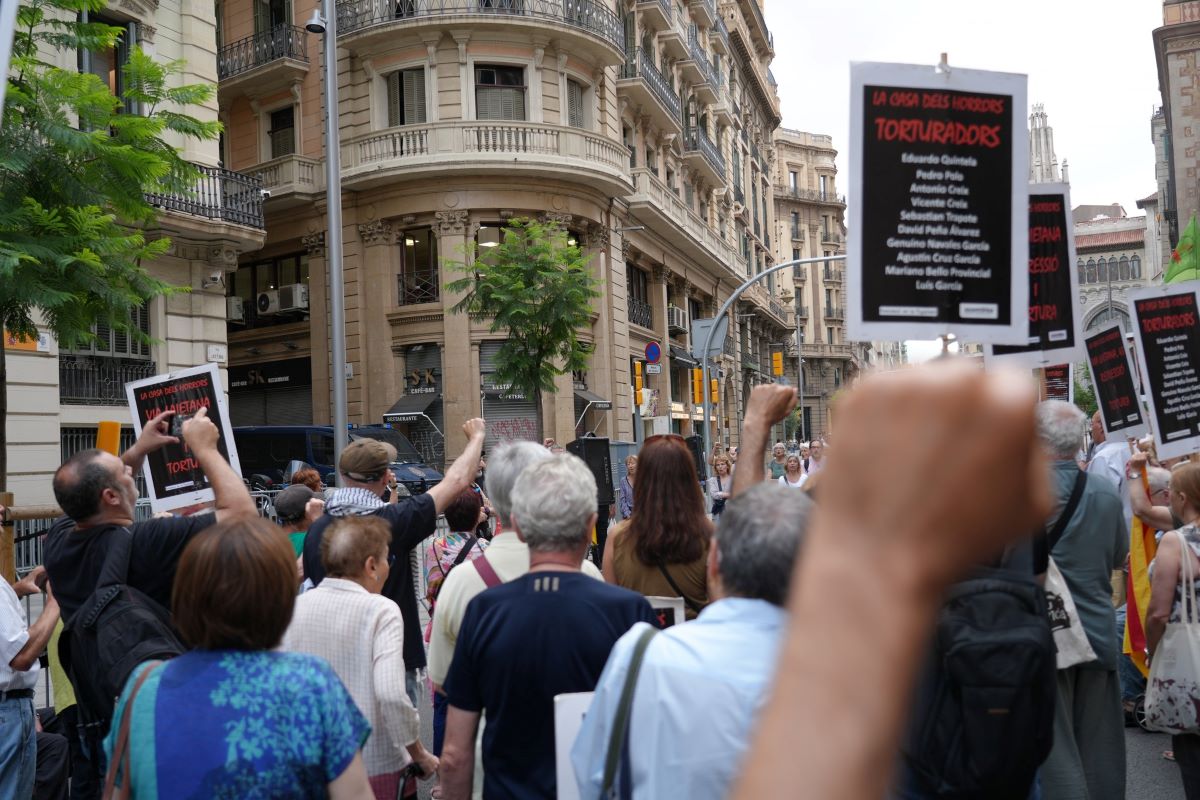
On July Tuesday evening, a number of uniformed police officers watch the people in the road outside their police station on Via Laietana in Barcelona, the Catalan capital, many in the crowd holding placards protesting torture and impunity and a number carrying a banner.
The MC, a slim elderly woman, approaches the microphone stand, her back to the police station. Speaking in Catalan she reviews the reason for their rally which is to renew the historical memory of the Spanish State’s repression of dissent through torture with impunity.
The MC at the event speaking briefly (Photo cred: D.Breatnach)
A number of torture survivors address the crowd, sometimes experiencing difficulty in reading some passages of their notes. The crowd, mostly middle-aged or elderly, listen in silence. Some of them were victims too, many knew victims personally, many of the latter now dead.
For the past three years, the campaigners have been coming here every two weeks, renewing the historical memory and campaigning for a change of use in this building on one of the main roads of their city.
One of the torture survivors displaying the Vermella, the socialist version of the Catalan independence flag. (Photo cred: Albert Bergadá Corso)Torture survivor speaking (Photo cred: Albert Bergadá Corso)Another torture survivor speaking, Catalan independence flag visible in the crowd. (Photo cred: D.Breatnach)
REPRESSION AND TORTURE HEADQUARTERS
During the Franco fascist Dictatorship (1936-1975), this police station was the Barcelona HQ of repression and torture, its victims ranging from democrats to anarchists, republicans and communists. The Resistance methods were also varied: unarmed, industrial or armed.
The crowd takes to the street in front of the police station
After Franco’s death, repression continued through the period known as the Transition with torture as a standard police practice continuing for decades afterwards. Claims of torture were routinely ignored by judges who sentenced activists on the basis of their retracted admissions.1
On the few occasions when torture claims were investigated, it was done cursorily and on the much rarer occasions of trial and conviction for torture, the perpetrators as a rule saw no jail time.
The police station with a history of torture on Via Laietana, Barcelona, as demonstrators begin to gather in front. (Photo cred: D.Breatnach)Commemorative plaque near the police station, regularly defaced and regularly repaired. (Photo cred: D.Breatnach)
The methods are known by police and military torturers across the world: punches, slaps and baton blows through towels (causing pain but leaving no marks), forced stress positions, electrical shocks of particularly sensitive areas, simulated asphyxiation through plastic bags, simulated drowning …
In the past these included suspending victims upside down by their ankles or upright balanced on toes. Of course all tortures are also accompanied by threats to the victims and their families, humiliation (including nakedness), sometimes sexual threats and even actual penetrations.2
Crowd gathering to begin their event. (Photo cred: D.Breatnach)
IRISH SONG IN THE STREET
The MC returns to the microphone at the conclusion of the witness testimonies and asks the crowd to welcome an activist, writer and singer from Ireland. The Irishman says he is honoured to speak at a location of struggle and even more so to bring solidarity from one nation’s struggle to another.
Though the fact is routinely overlooked or even denied, he says there are political prisoners in Ireland and because of the recent mistreatment of one of those in a prison in the British colony, all his comrades protested and were in turn supported by political prisoners in the Irish state jail.
Wearing a Palestinian scarf, speaking in Spanish, having apologised for his lack of anything but a few words in Catalan, the Irishman highlights the role of police stations as local centres of repression on behalf of the bourgeoisie, the repression all too often including torture.
The Irishman applauds the protesters’ upholding of historical memory and also their campaign to have the building reappointed as a social centre, before continuing to introduce his choice of two short songs of resistance from his homeland, one in English and the other in Irish.
The Irishman singing (Photo cred: Albert Bergadá Corso)
The first song he sings is Four Green Fields,3 which he has explained symbolises the four provinces of Ireland, the nation represented by an elderly woman. This is followed by Gráinne Mhaol,4 the nation again represented by a woman but younger, a warrior and pirate clan chieftain.
Following the applause, the MC returns and begins to read out a long list of known police and military individuals, after each one the crowd roaring “Torturadors!”
Crowd singing L’Estaca (Photo cred: Albert Bergadá Corso)
The event concludes with the singing of L’Estaca (The Stake – a song of resistance composed by Catalan Lluis Llach during the Franco dictatorship), many doing so with clenched fists raised. Soon afterwards, the crowd begins to break up, the road open to traffic once more, shoppers and tourists going by.
Section of the crowd at the anti-police-torture event with the Cathedral of Barcelona, destination of many tourists, visible in the background. (Photo cred: Albert Bergadá Corso)(Photo cred: Albert Bergadá Corso)
End.
FOOTNOTES 1A number of cases alleging torture found their way to the European Court of Human Rights but the Spanish State has never been found guilty of torture there (although in the case of one Basque woman, awarding her damages payment for failure of the State to investigate her allegations, the judges concluded almost in an aside that she had probably been tortured). It seems that the Strasbourg Court required the kind of evidence that could not reasonably be produced by the alleged victims. A number of judgements and payments have been recorded against the Spanish State on failure to investigate allegations of torture against political activists.
2 In the latter category two cases are well known, each suffered by Basques, one a woman and the other a man.
3 Composed by Tommy Makem who regularly performed with the Clancy Brothers folk group.
4 Composed by Pádraig Mac Piarais/ Patrick Pearse but structurally based on a much older Irish traditional song welcoming a bride to her new home. The heroine of his song is Gráinne Ní Mháille, a 17C clan chief in Co. Mayo.
SOURCES AND USEFUL LINKS
The campaigners may be followed on X (Twitter) @comissdignitat @p_represaliades
Around 30 people demonstrated outside Dublin’s Criminal Court on Thursday, many of them displaying Irish flags (Tricolour and Starry Plough) along with those of Palestine in solidarity with three activists before the court.
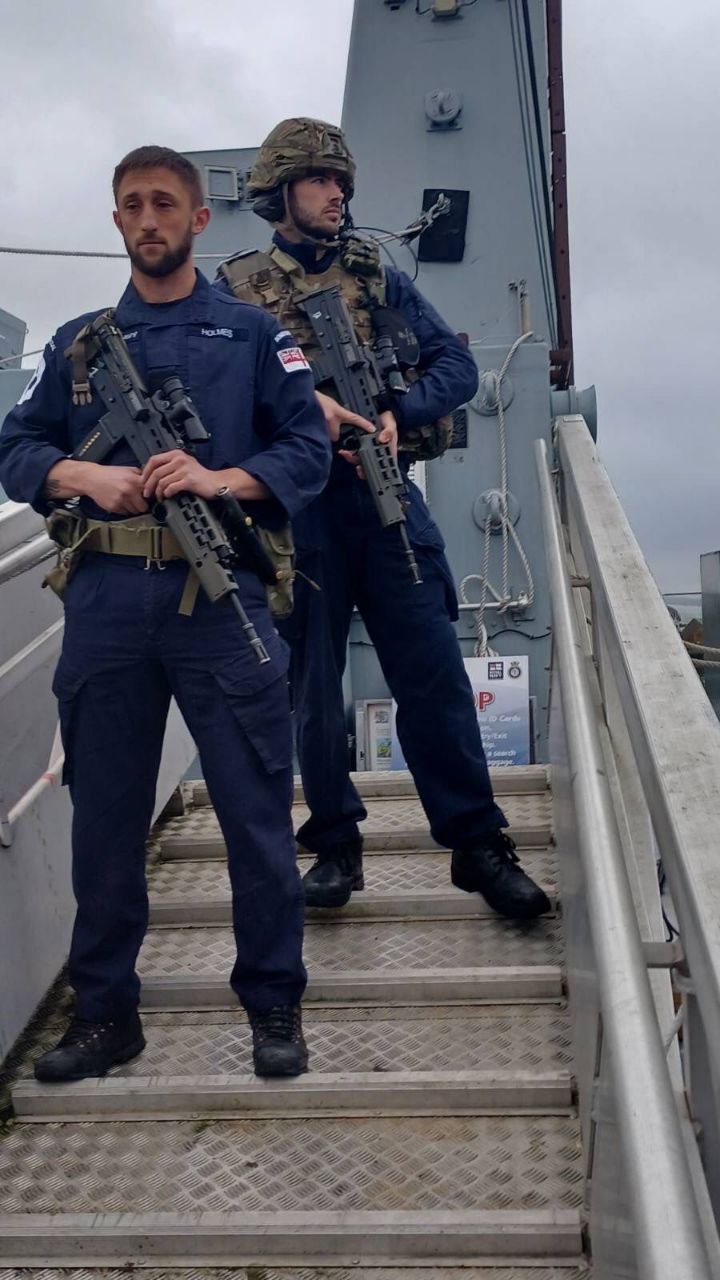
The activists were charged under Public Order legislation arising out of protesting a British war ship at Dublin docks in November last year, in solidarity with Palestine and against NATO’s support for the Israeli state’s slaughter in Gaza.
It was alleged that the activists (variously from Saoirse Don Phalaistín and Anti-Imperialist Action organisations) had entered a restricted part of the Dublin Docks and, holding a Palestine flag, had approached a British warship docked there and then occupied the gangway.
British military displaying firearms on Irish state soilin November last year. (Photo: Anti-Imperialist Action)
Gardaí had been called and the activists had refused their instruction to leave under the Public Order legislation and they had then been arrested. No act of violence, physical or verbal, took place on either side other than the refusal to leave and the arrests.
The activists appeared in the Parkgate Street building before Justice John Hughes and all three were defended by Damien Coffey of Sheehan Partners, a law firm which often handles political and human rights cases. Three Gardaí from Store Street acted in the role of the Prosecution.
The Garda in charge of the prosecution and his two colleagues gave evidence as to the arrests. Questioned by Coffey for the Defence, all confirmed that although the protesters had refused to leave, there had been no violence offered by them during their arrests.
Strangely, as shall become evident and relevant, one did not recall the British military presence on the gangway to be armed, whereas another did and confirmed that a photo of the armed men was of those who had been present.
One of the Garda offered his opinion that whereas the vessel was regarded in law as “British soil”, the gangplank was legally “Irish soil” and, if the protesters had actually set foot on the ship, they might have been charged with piracy. This piece of evidence also had unintended consequences.
One of the placards displayed by supporters outside the courthouse (Photo: Rebel Breeze)
According to this evidence, the British in a foreign military uniform had been present on Irish state soil and all replied to the defence lawyer that they were unaware of any Ministerial permission to do so — or that this could have constituted an offence under Section 317 of the Defence Act 1954.1
Furthermore, none were aware of any special permission granted to them to carry firearms on Irish state ground. The British military personnel themselves were not present as witnesses as their superiors had not replied to the Garda request to discuss giving evidence in the case.
Port security camera footage was shown as evidence by which protesters could be seen at the gates of a fenced-off section of the docks and some time later proceeding through a gate. A port security employee had been summoned by the Gardaí as a witness.
After he had been taken through his evidence (and failed to respond to what seemed an attempted prompt) by the Garda in charge the only relevance of his evidence was that a) the area was restricted and b) that he was worried for the safety of the protesters.
This (and the reason for the possible attempted prompt) was of importance when Coffey developed his defence summary on the legal grounds that Section 14 (1) of the Public Order Act required there to be an element of fear arising from the actions of those to be charged under the Act.
None of the evidence for the Prosecution had shown the presence of fear of anyone from the defendants and, furthermore, he submitted, any element of fear was much more likely to arise from the presence of two men holding firearms, to whit, the British military personnel.
The second part of the Defence summary dealt with right to protest, Coffey quoting a number of legal sources, also referencing the Irish Government’s recognition of a Palestinian state and statistics of people killed by the Israeli state against which the activists had been protesting.
Judge Hughes announced that a recess was due for lunch and that he wished to consult legal authority (case law etc) so they would recess and reconvene in an hours’ time.
A number of supporters who had taken time off from other commitments left at this point while a few arrived instead.
THE JUDGEMENT
After reconvening Judge Hughes began his long drawn out summing up and it gradually became clear that he intended to find the accused guilty. However people awaited with varying degrees of patience for the details of the sentence.
The Judge referred to the right to protest but also to the restrictions upon it (usually limiting its effectiveness) though he did not say that, nor that powers exist to abolish those rights when the State feels it necessary.
With regard to the ‘element of fear’ required for conviction under the Public Order Act Hughes quoted a judgement as a reference that seemed neither relevant nor reasonable, involving a woman experiencing fear of being broken into and even fear of children playing outside her home.
Despite repeating the standard claim of capitalist law that judges cannot adjudicate emotionally nor be swayed by what was occurring in Palestine, John Hughes revealed his own political bias when he bizarrely claimed that a British fleet had been welcomed into an Irish port in 1820.
He revealed his political naivety also when he expressed surprise that the British had not replied to the Garda communication regarding the incident.
On submission by Coffey regarding the lack of previous convictions and effect of criminal convictions on the lives of the three, Johnson, again drawing out the moment, gave them what amounts to a conditional discharge with a provisional forfeit of 500 euro.2
No doubt the desire not to create martyrs around whom solidarity campaigns might intensify played at least as much a part as any concern for the lives of the activists.
The defendants and their supporters left; outside the court they were embraced by a number of supporters before the gathering broke up, some attending to other solidarity activities elsewhere. The show of support was a good sign of solidarity against state repression.3
View of some of the people outside the courthouse on Thursday in solidarity with the three activists (Photo: Rebel Breeze)
SERIOUS ISSUES AMONG ELEMENTS OF COMEDY
The name of the British naval vessel being The Penzance and the mention of a possible piracy charge brings to mind of course the Gilbert & Sullivan opera The Pirates of Penzance (1879).
The focus of the Gardaí on arresting peaceful protesters in preference to unauthorised people in foreign military uniform carrying unlicensed firearms on Irish soil and also trying to suggest that not they but the protesters would give rise to fear is not without its comedic elements.
However overall the whole matter is extremely serious, with regard to the zionist genocide in Palestine, the active collusion of the UK/NATO, the active collusion of the Irish ruling class4despite its verbal positions – and the repression of its State on more active and directed solidarity actions.
End.
FOOTNOTES
1 317. — (1) No person shall, save with the consent in writing of a Minister of State, enter or land in the State while wearing any foreign uniform. (2) No person shall, save with the consent in writing of a Minister of State, go into any public place in the State while wearing any foreign uniform.
2 It will not appear as a criminal record but in the event of a subsequent conviction, the 500 euro can be levied as a fine in addition to any other punishment in court sentence.
3 Though the absence of a number of political organisations and trends was also marked.
4 “Dual-use”exports to the zionist state which can be adapted to military use; failure to press for any economic, academic or cultural sanctions against the zionist state; shelving of the Occupied Territories Bill; failure to impose diplomatic sanctions of any kind.
On 25 May, a video surfaced on Israeli social networks in which an armed and masked man in an Israeli army uniform stood in front of a camera and threatened mutiny to Prime Minister Benjamin Netanyahu.
The message was also directed to Israeli Defense Minister Yoav Gallant and Chief of Staff Herzi Halevi, the reserve soldier said Gallant should resign.
He warned that 100,000 reservists in Gaza are not willing to “hand over the keys of Gaza to any Palestinian Authority” or other “Arab entity,” and said these soldiers would only take orders from Netanyahu.
Among the many that shared the video was Yair Netanyahu, son of the Israeli prime minister, who later deleted it following the resulting controversy.
Despite being masked, the rifle in the video appears to carry the name “Luzon,” which helped eventually identify the man a few days later as Ofir Luzon, a right-wing activist from Herzliya, a town north of Tel Aviv.
He is a supporter of the local Likud party, which is also the party of Netanyahu.
Luzon is a reserve soldier serving in Gaza, but the video probably wasn’t shot in Gaza but rather in an abandoned building in the Tel Aviv area. He was likely acting alone.
Israeli media have since published many of his social media posts in which he expresses right-wing views, is seen alongside Likud ministers and city council members in Herzliya, threatens leftists and Israeli protesters against the judicial overhaul and opposes Gallant.
He expresses enthusiasm about the approaching attack on Rafah.
Day after
The immediate context of the video was a recent ultimatum issued by Benny Gantz, a member of the Israeli war cabinet, to Netanyahu, in which Gantz demanded that his concerns over the management of Israel’s assault on Gaza and its aftermath be answered by 8 June.
And threatening to resign from government if they aren’t.
The “day-after” scenario is a heated subject of debate within the war cabinet. Gantz wants clarity around a “governing alternative” to Hamas to rule over Gaza, envisaging an international, Arab and Palestinian administration to handle civilian affairs in Gaza.
Netanyahu, however, is insisting there be no discussion of post-war scenarios or who should govern Gaza, arguing that as long as Hamas is not defeated, such discussions are “meaningless.”
Netanyahu has expressed strong opposition to the Palestinian Authority taking over, and maintains that Israel must keep “security control over the entire territory to the west of Jordan,” meaning Israel, the West Bank and the Gaza Strip, or all the area from the river to the sea.
This is in direct contrast to Gallant, who is pressuring Netanyahu to declare that Israel will not take over civil rule or maintain a military occupation in Gaza.
Disintegrating army
The wider context, however, is a bit different, and has to do with dynamics that some Israeli analysts describe as part of the “disintegration” of the military.
Luzon’s video may be the first time that an open expression of mutiny has been voiced from within the ranks of the Israeli military, but Israeli reservists in Gaza during the current genocide have regularly disobeyed orders right from the outset in October.
The Israeli military has admitted to disciplinary problems and difficulty in controlling the rank and file. So far, these issues have been seen on social media, especially TikTok, where soldiers have filmed themselves giving political speeches, trashing homes and vandalizing shops.
Or blowing up universities and committing other war crimes.
These disciplinary problems have also surfaced over nationalist graffiti on houses and properties in Gaza, some calling for revenge and some for the rebuilding of Jewish settlements in the territory.
The military has not investigated most of these incidents, perhaps out of fear of pressure from right-wing politicians or protest from within the military, borne out of experience.
In November, an order to soldiers in Gaza to erase their own graffiti led to a public outcry from right-wing politicians, including from minister of national security Itamar Ben-Gvir, who called on Gallant to rescind the order.
Some soldiers openly refused to obey the order.
Chain of command
In addition to disciplinary issues with reservists, problems in the chain of command have also been exposed, notably between the chief of staff and division commanders on the ground.
Infamous, of course, is Barak Hiram, who gave orders to bomb an Israeli settlement near Gaza during the 7 October attack, and also gave the order to bomb a university in Gaza, without, the army says, prior approval.
Brigadier General Dan Goldfuss, meanwhile, was reprimanded following a statement to the media in which he said that national leaders must be “worthy of the soldiers.”
Whether from division commanders or rank and file reserve soldiers, it is clear that the Israeli military has a growing problem with discipline.
It is a problem that stems not only from deepening political divisions within Israeli society, but also from class and identity conflicts. Many reservists and regular soldiers are traditionally drawn from marginalized areas, and are often from religious and right-wing backgrounds.
It’s difficult to predict whether 100,000 soldiers will actually disobey orders to withdraw from Gaza, should such an order eventually come down.
But Luzon’s video does not come in a vacuum. It is rather the latest expression of a growing rift within the Israeli military, and in Israeli society more generally.
End.
Mati Yanikov is a Haifa-based anti-colonial activist.
This version of the original is very slightly edited organisationally with no matter changed or removed.
A Zionist march and rally was organised for Dublin today as an “Israel solidarity” event by the Ireland Israel Alliance. Despite prior publicity and drawing from around the country the attendance numbered only a few hundred.
Around a hundred anti-zionists with flags, banners, amplifier and loudhailer occupied the announced destination of the Zionist rally an hour prior to the scheduled arrival of the IIA march and had to wait even longer as the Zionist groups arrived at Stephens Green.
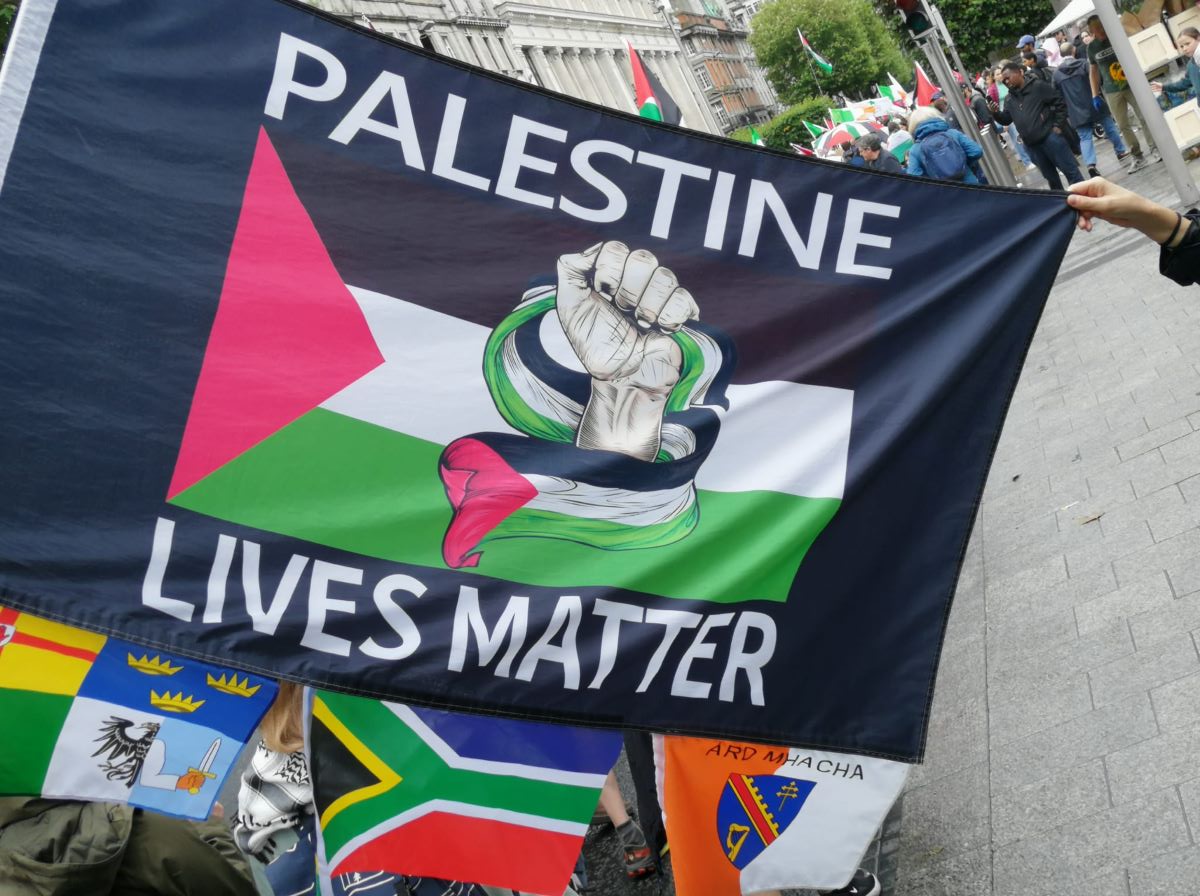
One of the banners displayed by among the anti-zionists outside Leinster House on Sunday (Photo: Rebel Breeze)(Photo: Rebel Breeze)
During the week the IIA issued a statement in line with the Israeli state’s Foreign Minister that “Ireland rewards Palestinian terrorism with a State”1 in response to the announcement by the Irish, Spanish and Norwegian states that they intended to formally recognise the Palestinian state.
Palestinian solidarity supporters in Dublin organised at short notice a counter-rally. “It’s a bit rich for Zionists who set up their settler state with terrorism”, said one in Dublin today, “claiming that Palestinian statehood rewards Palestinian ‘terrorism’!”2
One of the banners displayed by among the anti-zionists outside Leinster House on Sunday (Photo: Rebel Breeze)
Although Palestinian Christians are suppressed and killed by Israeli armed forces, the IIA were supported by right-wing Christian Zionists, among them the All Nations Church, the Irish branch of the International Christian Embassy Jerusalem and the TJCII.
According to advance releases to the press, the newly inaugurated Chief Rabbi of Ireland, Yoni Wieder was to speak at the zionist rally.3
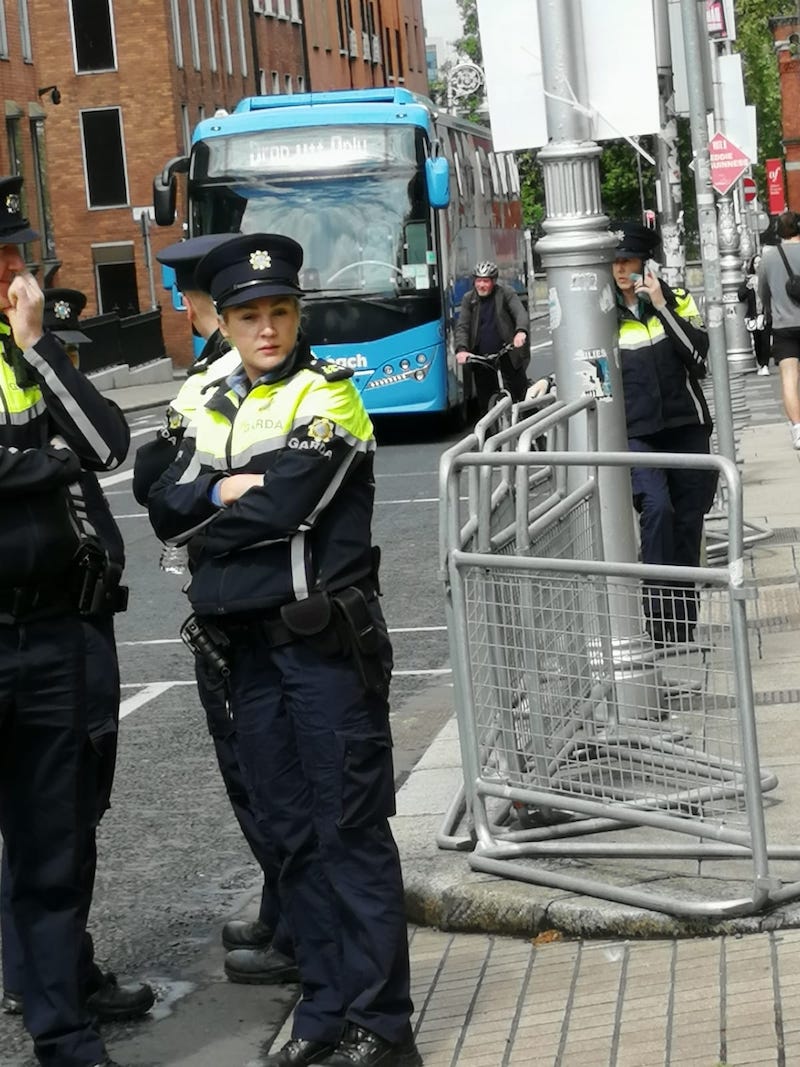
Some Gardaí in Molesworth Street, stacked crowd barriers not yet erected at that point and contractor staff awaiting instructions. (Photo: Rebel Breeze)
The anti-zionists organised their event at a day or two’s notice and according to some sources the IPSC4 had called on its branches not to counter protest the Zionist event but around a hundred Palestinian supporters attended, mainly Irish but also with Palestinians and a sprinkling of others.
In their prior publicity the Zionists trotted out their usual claims that Palestinian solidarity is based on anti-Semitism and that Jews are being victimised,5 ignoring the fact that zionism does not equal judaism and that in fact a substantial number of Jews have opposed zionism.6
The population of Ireland went from being largely supportive of ‘Israel’ in 1948 to being mostly pro-Palestinian from the 1970s onwards because of their observation of the genocidal and ethnic cleansing actions of the Israeli state.
Placard displayed among the Palestine supporters (Photo: Rebel Breeze)
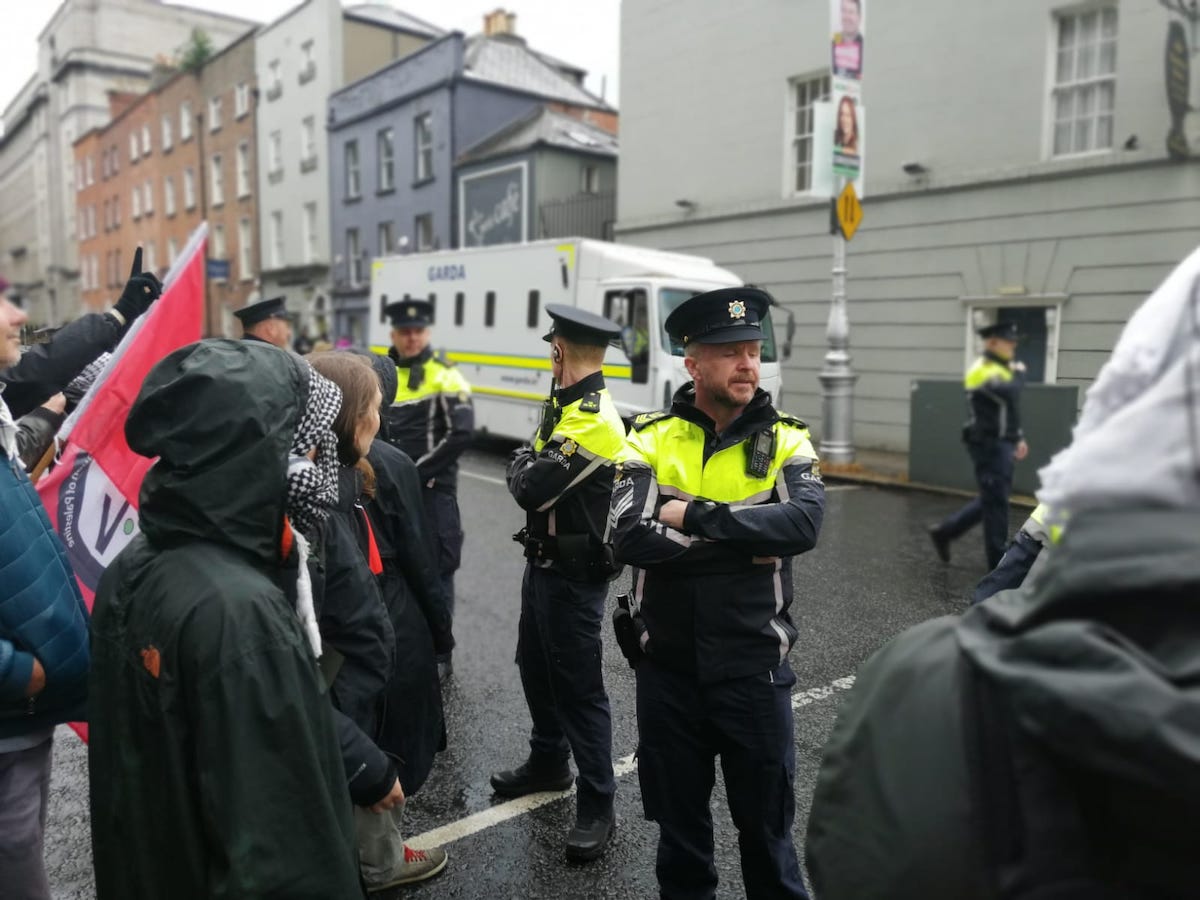
There was a fairly high Garda presence at the events and after some delay crowd barriers were erected across the east end of Molesworth Street with a second line of barriers a little further west beyond which the Zionists were setting up a stage.
The anti-Zionists in front of Leinster House awaited the arrival of the pro-Israel march which when it got going could be seen passing the Stephens Green end of Kildare Street, eventually coming down Dawson Street and turning into Molesworth Street.
View in distance of the zionist rally location before the arrival of their march from Stephens Green (Photo: Rebel Breeze)
As they arrived the Palestinian solidarity people attempted to move across the road but the Gardaí pushed back, individual Gardaí at times viciously shoving and being resisted; here and there an arrest seemed threatened but was evaded by solidarity action around the targeted person.
With the Palestinian supporters pushed to a couple of feet in front of the pedestrian pavement of Leinster House, the Gardaí stopped and by then two vans of the Public Order Unit had arrived and were deployed but some time later stood down, got in their vans and were driven off.
(Photo: Rebel Breeze)View northward in Kildare Street outside Leinster House on Sunday (Photo: Rebel Breeze)View southward in Kildare Street outside Leinster House on Sunday (Photo: Rebel Breeze)The arrival of a Garda prisoner transport van in Kildare Street outside Leinster House on Sunday raised tensions among some of the anti-zionist demonstrators (Photo: Rebel Breeze)
There could have been some confused impulses among the Gardaí given the public symbolic positions of the Government in recognition of the Palestinian state and the sharp and public diplomatic language flying between the Irish and Israeli states.
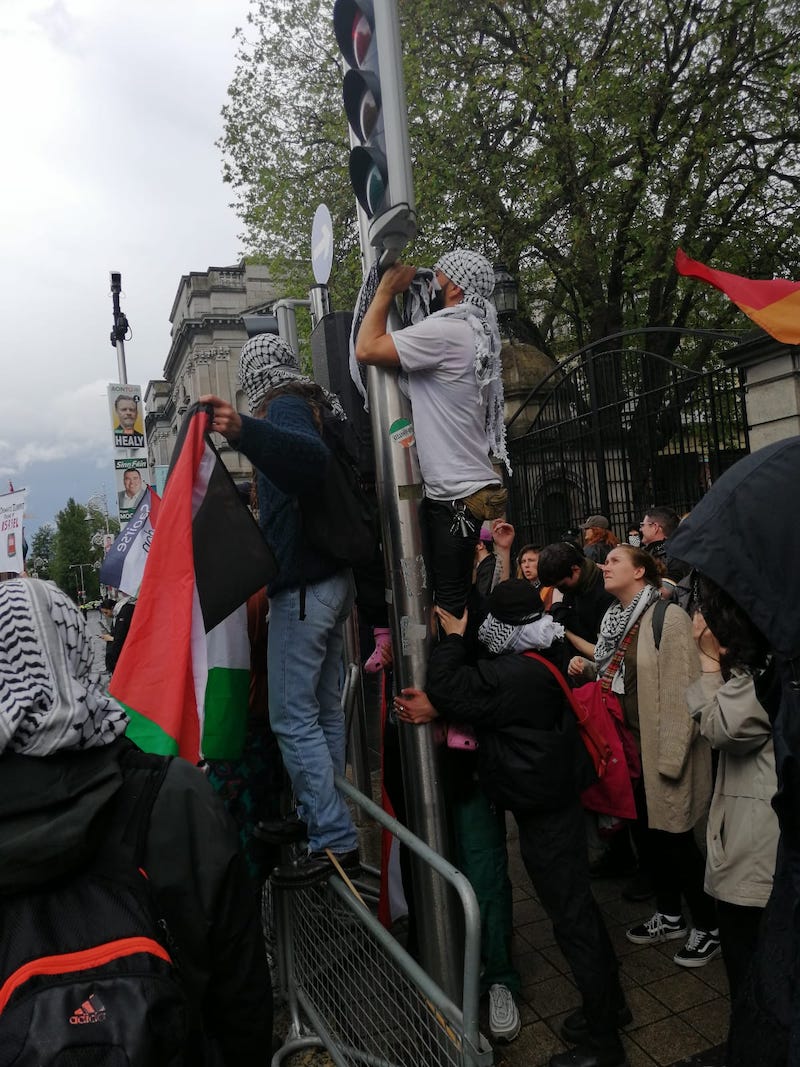
Two Garda vans were parked in front of the entrance to Molesworth St, partially blocking the views of the zionists and their opponents. The latter however stood with banners and flags on top of barriers and an amplifier was also strapped to a pole to better carry the message to the Zionists.
Palestinian supporters attaching an amplifier speaker to a pole outside Leinster House, directed at the Zionist rally in Molesworth Street (Photo: Rebel Breeze)
Despite the IIA having recommended its supporters to bring Israeli and Irish flags, only one Tricolour could be seen among their blue-and-white Israeli flags. One placard depicted the whole of Ireland covered with a menora, the traditional Jewish multi-candlestick.
Some of the Zionists’ placards repeated the debunked accusations of programmed mass rapes by the Palestinian resistance on October 7th last year, for which no evidence whatsoever or known victim exists despite Israeli state propaganda parroted by some of its western media supporters.
Zionist marchers arrive at their rally point in Molesworth Street, with two sets of barriers placed between them and the Palestine supporters (Photo: Rebel Breeze)
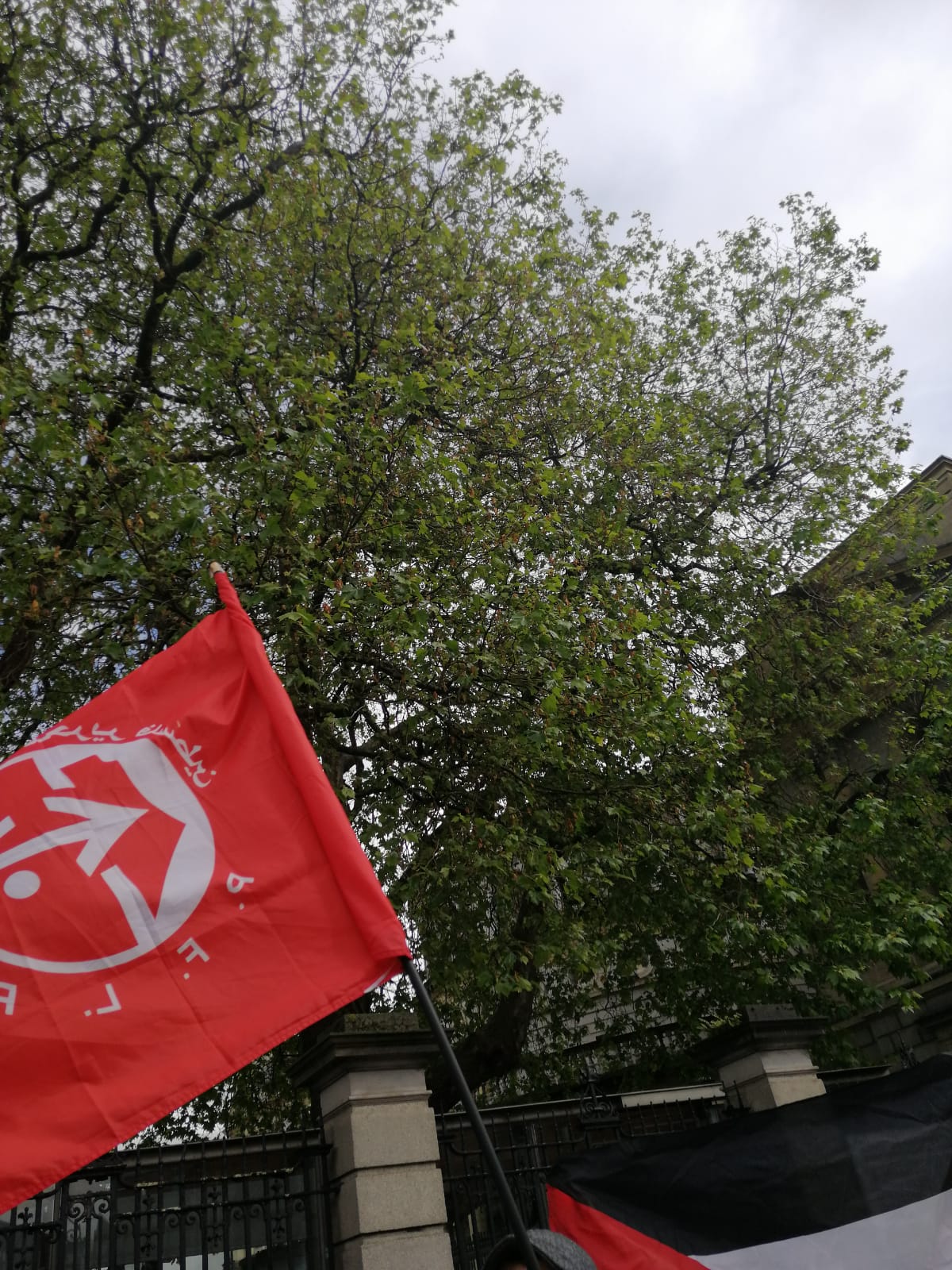
Among the Palestinian supporters the Palestine national flag was very much in evidence, also a couple of the PFLP7 and one in the colours of the anti-fascist Popular Front Government of 1930s Spain bearing the words “Connolly Column”, honouring the Irish who fought fascism there.
Here too there was only one Tricolour to be seen.
Flag of the PFLP seen against the trees (Photo: Rebel Breeze)
There were intermittent rain showers during the events, often persistent and somewhat heavy, streams running northwards along the road and pavement edge down Kildare Street but the demonstrators remained without shelter, many also without specific rain gear or umbrellas.
Women (mostly) speaking through amplification led the slogans that have become common on Palestine solidarity demonstrations in English, Irish and Arabic but with a few additions, including “Zionist scum – Off our streets!” Also “West-Brit Blueshirt scum – Off our streets!”
View of the rain’s ‘river’ running down between the Leinster House pedestrian pavement and the road. (Photo: Rebel Breeze)View of small section of Palestinian supporters’ line with police line in front and the rainwater swirling around their feet. The Zionist rally is taking place behind the police line and beyond two lines of metal crowd barriers. (Photo: Rebel Breeze)
At intervals Arabic resistance music was played and sections of the Palestine solidarity crowd began to sway or even dance, including one young woman from Gaza who seemed accomplished in traditional dance. Irish patriotic songs were played for a period also.
Among the Palestinian supporters the Zionist chants or speakers could not be heard, nor can one know how much of the Palestinian solidarity chants could be heard by the Zionists. Eventually the Zionists left to jeers from their opposition, a Garda helicopter watching over them in the sky.
The Gardaí left and the Palestinian supporters did too, mostly leaving together in a group.
(Photo: Rebel Breeze)
AFTERMATH – FIGHT IN PARNELL/ O’CONNELL STREET
That was not all however for perhaps an hour later a fight developed between what seemed to be a far-Right man against a group of Palestinian supporters in Parnell Street. According to some people, the man had approached them aggressively about their Palestine solidarity activism.
Disliking their response, he punched one of the Palestine solidarity demonstrators in the face and when the women in the group protested, struck a couple of them too. Another male in the group then launched at the Far-Right man and gave him a bloody face.
When observed by this reporter, the man was covered in tattoos, stripped to the waist and shouting about being “for the Irish” (which for some reason the Far-Right assume Palestinian supporters are not — though many have a far better track record in that respect than do Far-Right activists).
In Palestine that same day the zionist air force bombed a tent town of displaced people in northwest Gaza, which they had declared a safe area, murdering over 30 and injuring many more, some of whom will die. They also bombed 10 UNRWA displacement centres.
2The zionists had a number of terrorist organisation pushing the formation of the Israel State: Haganah, Irgun, Palmach … Haganah became the core of the Israeli armed forces.
























 rebelbreeze