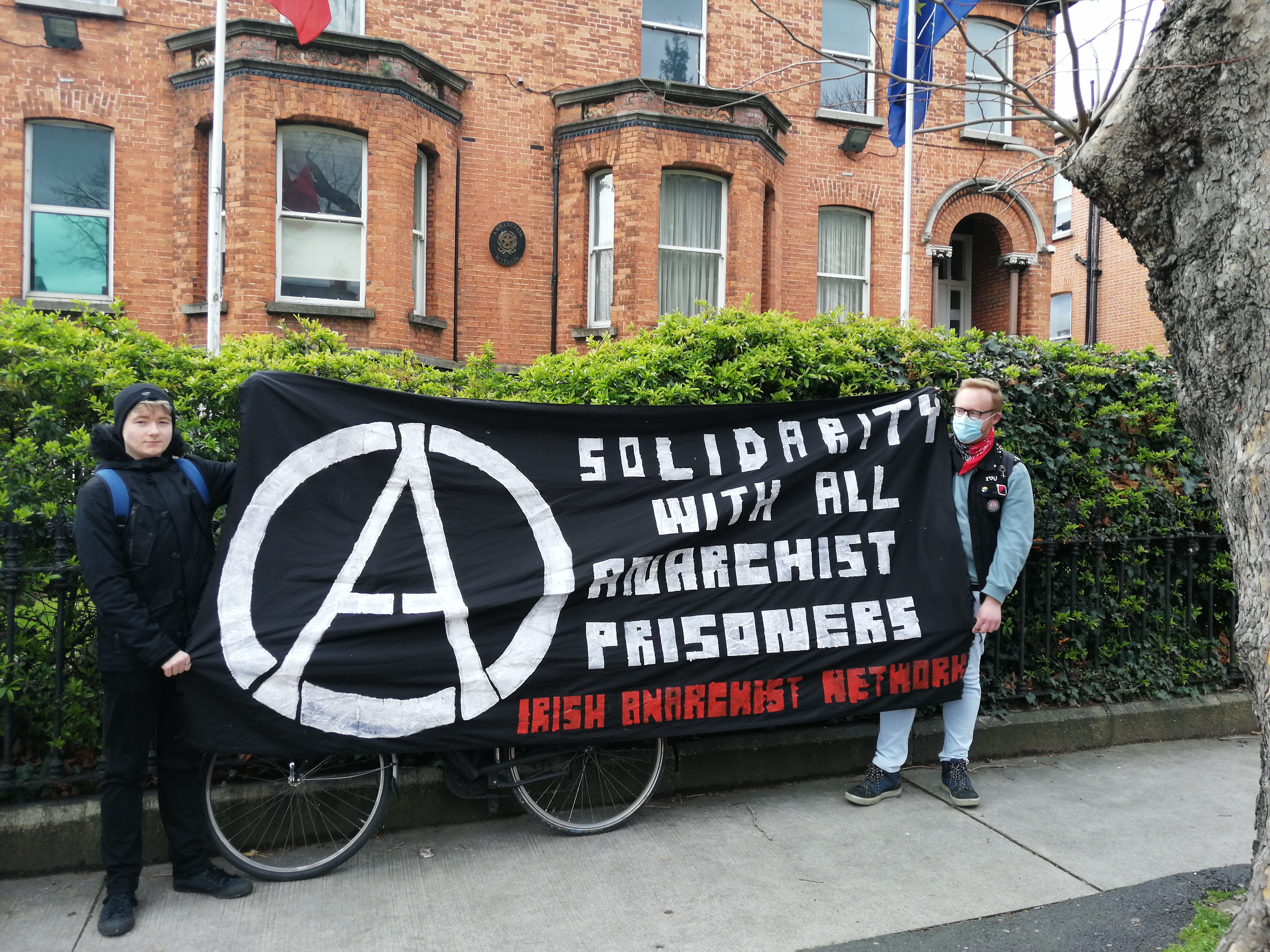
A picket outside the Italian Embassy in Dublin on Thursday (23rd) was part of a day of action across Europe in solidarity with an Anarchist prisoner on hunger strike since October in a struggle for more humane prison conditions.
The picket, organised at short notice, included Irish Republicans, Anarchists and revolutionary Socialists. Banners and placards indicated the presence of Saoradh, Irish Anarchist Network and Ireland Anti-Internment Campaign.
At one point five uniformed Gardaí stood near the Embassy’s gate while three plain-clothes Special Branch (i.e. political police) watched from a car across the road. The police numbers may have been due to a request from the Embassy in the midst of attacks on some Italian Embassies in Europe.
Despite the presence of Gardaí, Embassy staff appeared nervous, meeting one visitor at the gate to check her reason for attendance after speaking to her on her mobile phone, rather than first allowing her to enter the garden and approach the main entrance.
Some of the uniformed Gardaí attending the solidarity picket and some of the protesters. (Photo: IAIC)
Three Special Branch Gardaí (political police) parked across from the picketers, surveilling them (Photo: IAIC)
THE HARSHEST ITALIAN PRISON CONDITIONS
Alfredo Cospito is an Italian political prisoner kept under the harshest Italian prison conditions, “41-bis”, which include solitary confinement for most of the day, family visit once a month through glass, no reading matter sent from outside and no phone calls in either direction or lawyer privacy.
According to information on the Internet, these inhumane conditions were developed for Mafiosa leaders, in order to prevent them running their organisations from inside jail and also to pressure them into breaking ranks and informing on their colleagues.
Whatever we may say about that, what can be the intention of subjecting a political prisoner to those conditions, except to break him or to destabilise him mentally? EU recommended rules on prisoner management don’t recommend more than three weeks in solitary confinement.
Lawyers for political prisoner Nadia Lioce, who has been living under the 41-bis regime for two decades, have said due to limited hours permitted contact, she has effectively only interacted with people for a total of 15 hours in the space of a year.
Italian media reported Lioce’s lawyers as saying she is now so “psychologically isolated” that, when her mother and sister visit, she is unable to speak to them for more than a few minutes.
Some of the picketers, the Italian Embassy in the background (Photo: IAIC)
Amnesty International and the European Court of Human Rights have both criticised several aspects of the 41-bis, and in 2007 a US court refused to extradite a convicted Mafia drug trafficker on the grounds that the 41-bis regime he would face in Italy would have “constituted torture”.
The Anti-Imperialist Front gave a call for an international solidarity day of action which found an active response in many countries.
Alfredo Cospito’s case is up for review by the Italian prison system this month and pickets and other actions have been organised around Europe to exert pressure on the Italian penal authorities to release Cospito into house arrest in his sister’s home.
The picket displayed not only internationalist solidarity but exemplary broad unity of disparate political forces in solidarity with an Anarchist political prisoner. Hopefully this unity will continue to be built upon as time goes on, for the unfolding struggles of class and nation demand it.
Hopefully the international actions will cause the Italian authorities to relax the inhumane conditions of Alfredo Cospito’s incarceration but now Italian authorities are claiming that Cospito is somehow coordinating violent actions from within his extreme isolation.
Another two of the picketers (Photo: IAIC)
A side trip into history
The Italian Embassy is in Northumberland Road, on the south side of the Grand Canal (near the Israeli and US Embassies).
As they were leaving, some of the picketers took time to look at a plaque and monument to the Mount Street Bridge Battle between Irish Volunteers and British soldiers in 1916. Four Volunteers were killed and between 26 and 30 Sherwood Foresters, with 134 more wounded.
Mount Street Battle Monument, on the Bridge over the Grand Canal itself. The English explanation is on the reverse. (Photo: IAIC)
A number of Volunteers were captured but a number got away also. Two of the buildings from which the Volunteers fought remain, bearing the marks of bullet strikes. The third, Clanwilliam House was set on fire by the British and was replaced by a 1960s-type office building later.
2022 was a busy year for the anti-internment campaign organisation, involving, along with its public awareness-rising events, a reorganisation with a new constitution, a new name and expansion of membership.
Origins
The formation of an anti-internment campaign was sparked by the revoking of the licence of ex-political prisoner Marian Price in May 2011 for the “crime” of steadying the written speech of an IRA speaker during a windy Easter Rising commemoration in Milltown Cemetery, Belfast.
In addition to revocation of the licence under which Republican prisoners were released under the Good Friday Agreement, other activists were also being charged under “anti-terrorist” legislation and routinely being refused bail, if not granted it under severe restrictions.
The wait for a trial is often two years and regardless of the eventual outcome, the individuals had already spent two years in jail or at home, barred from travel or political activity and harassed by police visits to their homes.
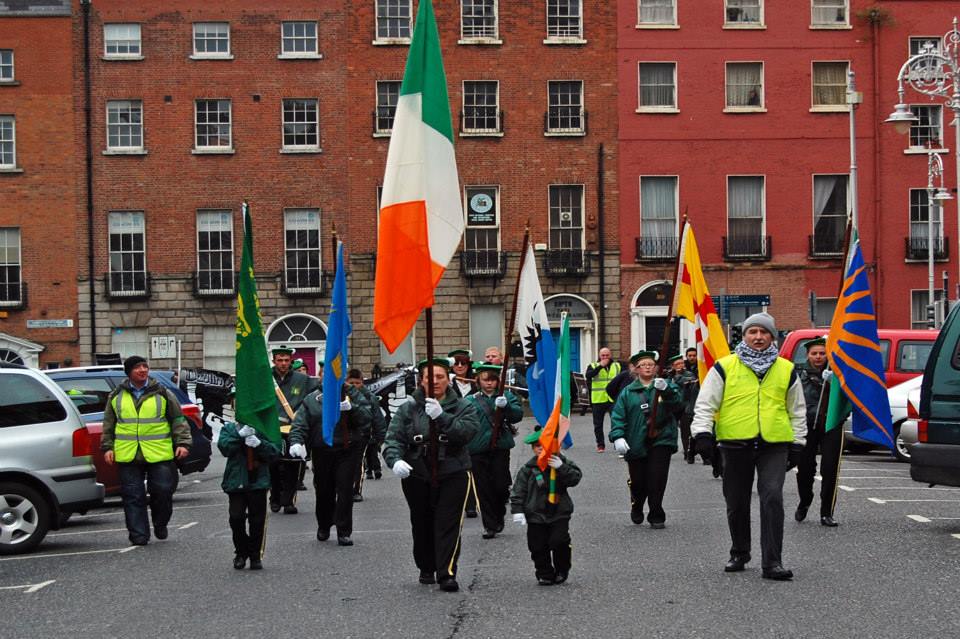
Early banner-placard protesting the internment of Marian Price (Image sourced: Libcom.org)Front section of Anti-Internment March, coming into top part of Parnell Square, Dublin 2013. (Image sourced: IAIC archives)
These conditions were considered to be in effect the same as internment without trial and the campaign against internment was founded as an independent one, a status it maintained despite a number of attempts to take it over or to intimidate with threats and State harassment.
Throughout its history the Anti-Internment Campaign has organised the annual Newry event (not since 2021 unfortunately), many pickets (including in protest against Amnesty Ireland) and a march in Dublin, spoken at or participated in public events in Belfast, Cork, Derry, Glasgow and Wexford.
It has also organised and hosted conferences and public meetings, for example with speakers from the campaigns for the Craigavon Two, Munir Farooqi and Tony Taylor and about the Right to Protest with a speaker from the Irish Council for Civil Liberties.
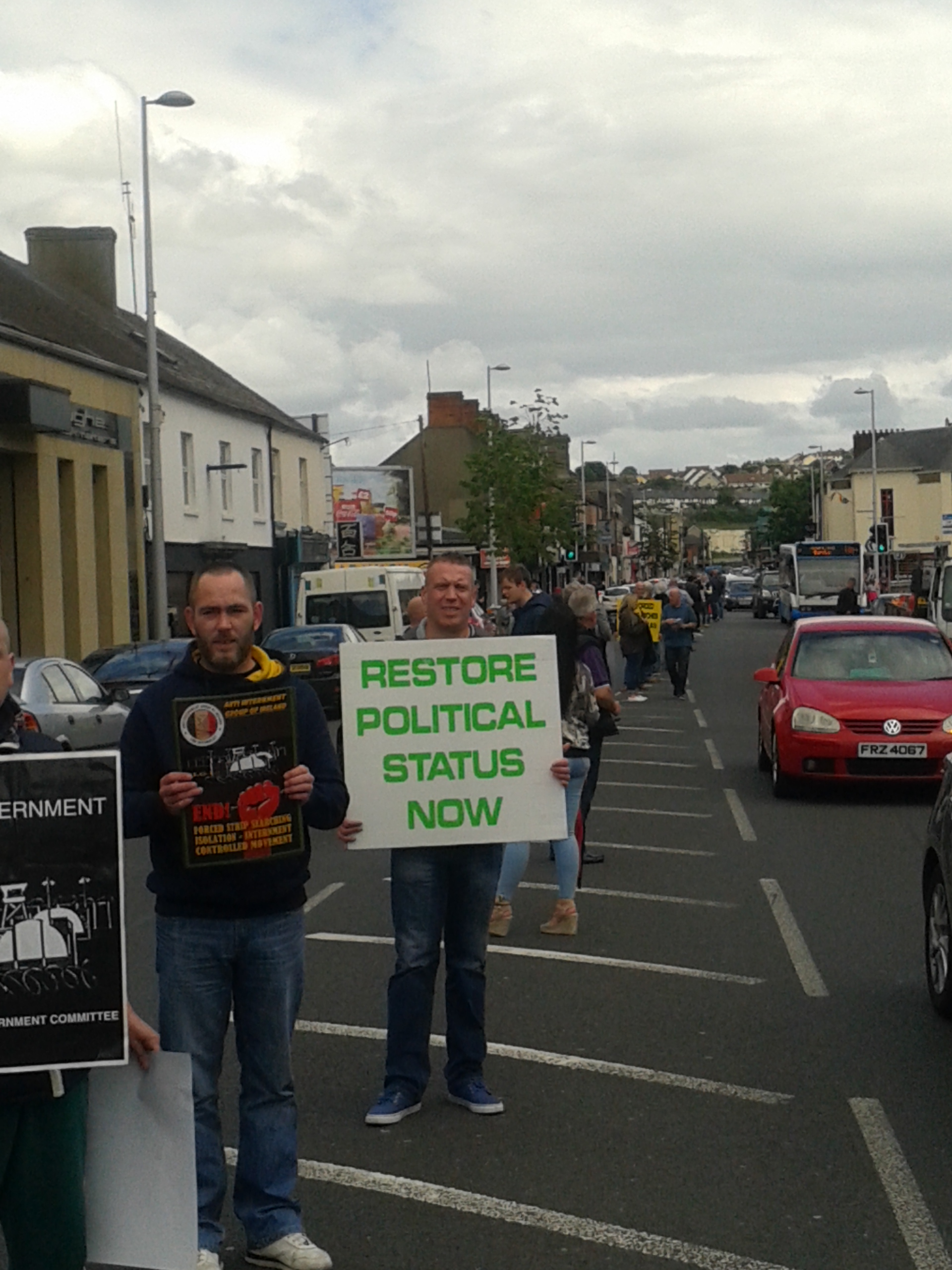
Section of the annual Anti-Internment white-line picket Newry, August 2016 (Image sourced: IAIC archives)
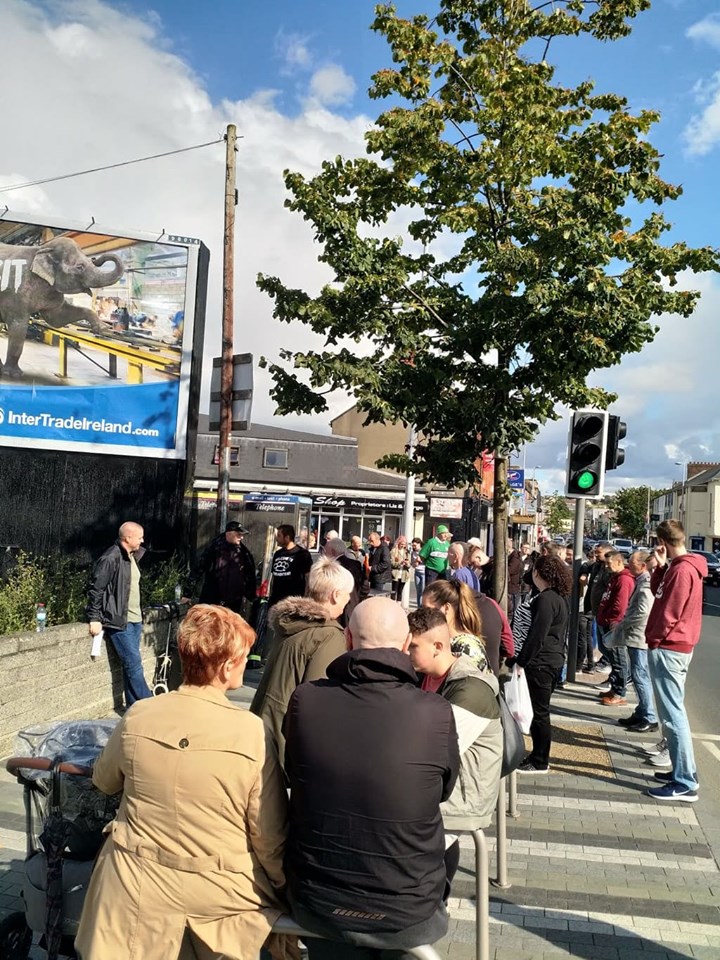
Annual Anti-Internment, Newry, rallying after white-line picket, August 2019 (Image sourced: IAIC archives)
A busy year
As stated in the introduction above, 2022 was a busy year for the anti-internment campaign group, involving, along with its public awareness-rising events a reorganisation with a new constitution and a new name. The campaign organised nine public events and participated in more.
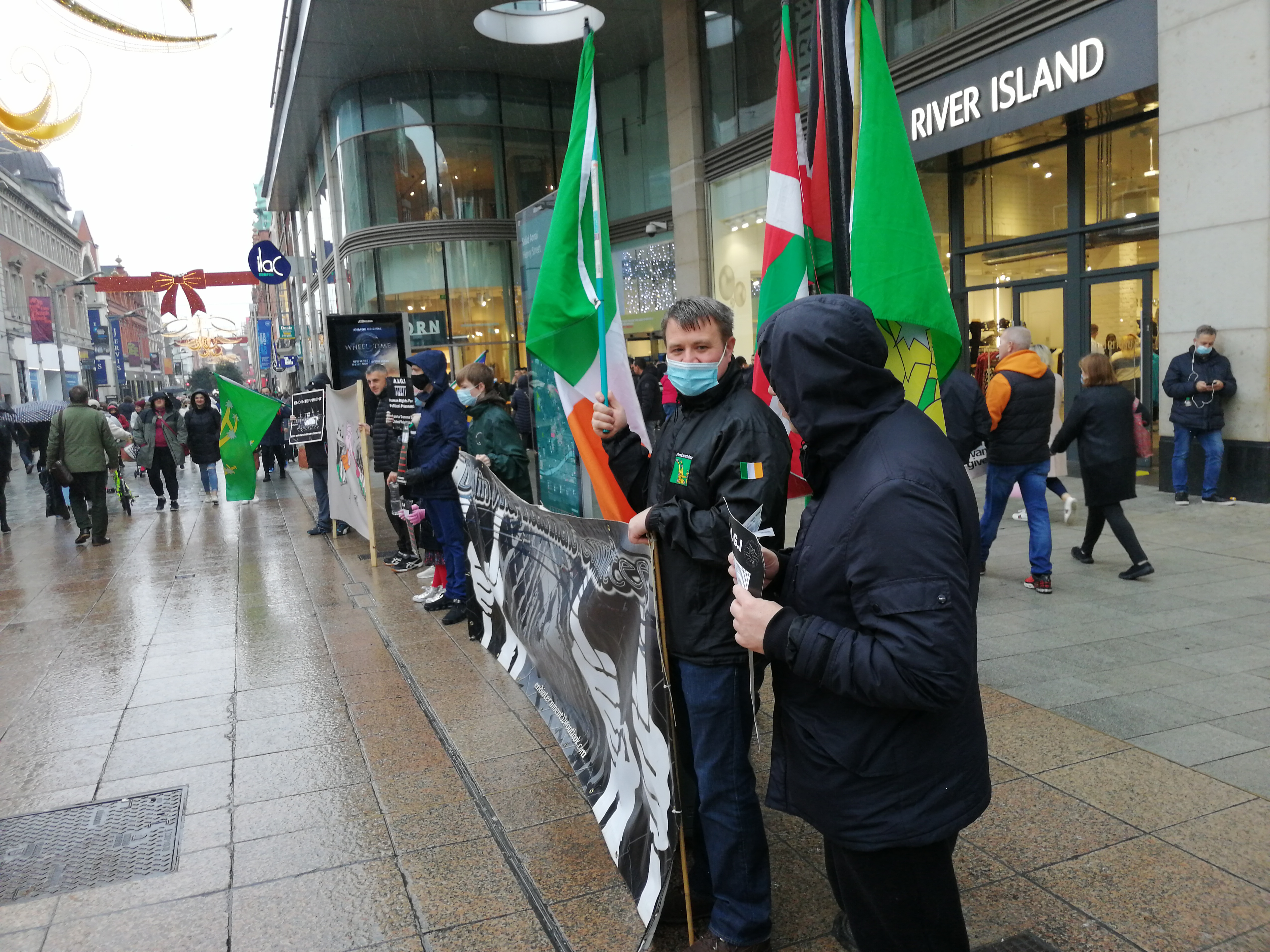
Most of those public events were awareness-raising pickets with placards, banners, flags and leaflet distribution. Usually the pickets alternated between the Henry Street/ Liffey Street junction and at Crown Alley by the square in the Temple Bar area, both areas busy with shoppers and tourists.
Anti-Internment picket in Henry Street, November, Dublin 2022 (Photo: IAIC)
The campaign carried out pickets in Henry Street on 9th April, 6th August and 19th November and in Temple Bar on 5th March, 21st May, 2nd July and 27th August. On 22nd October, with a special focus on Palestinian prisoners, we were on the iconic Ha’penny Bridge.
It has always been of particular interest to the campaign group to reach working people and large numbers of that class of all ages pass through those areas. Of interest also are people from other lands and the Basque and Palestinian flags alongside the Irish ones often stimulate discussion.
In September the campaign attended the Peter Daly commemoration in Wexford and provided a speaker at the Dublin meeting to re-launch the End State Repression campaign which our group had supported in the past but which had waned over the Covid epidemic period since.
Our campaign group also took part in the planning of and participation in the joint prisoner’s solidarity picket in Dublin on 17th December 2022.
Reorganisation
It had been clear for some time that the organisation was in need of reorganisation to facilitate expansion but the process had been difficult.
Eventually in July the decision was taken to close down the Anti-Internment Group of Ireland and to reform under another name. This was done and, after democratic consultation process a new constitution was agreed, with the Ireland Anti-Internment Campaign as the new name.
According to agreed decisions, a new banner with the organisation’s new name was commissioned (though it would take some time to come to fruition). A new Facebook identity for the group was constructed with a statement explaining the development.
The new constitution, more explicitly democratically-based than had been previously the case, was published.
Anti-Internment picket in Temple Bar, Dublin, March 2022 (Photo: IAIC)
Year planning
In the reorganisation process, the IAIG lost one member but gained three new activists and the return of two lapsed members. With renewed energy, members began planning for the rest of the year, to conclude with participation in the annual Bloody Sunday March for Justice in Derry.
Issuing a statement to explain the reorganisation, commissioning a new banner, scheduling a number of pickets in Dublin and organising the annual Prisoners’ Solidarity Picket in Dublin December were part of the planning and most of the target actions were completed.
In December and in good time, the campaign’s members organised to purchase, sign and mail Christmas cards to all Irish Republican prisoners, also a number of non-complying Basque political prisoners and the Catalan jailed revolutionary Catalonian rapper Pablo Hasel.
The proposal to organise the annual Prisoners’ Solidarity picket in December jointly with the Irish Republican Prisoners’ Welfare Association and with Ireland Anti-Imperialist Action was agreed and the joint event went ahead on 17th December with around 40 participating.
Section of the joint AICI, AIA and IRPWA Republican Prisoners’ solidarity picket 17 December 2022, O’Connell Street, Dublin 2022 (Photo: IAIC)
The picket with placards and banners, including the illuminated words of the IAIC’s “SAOIRSE” (“Freedom”) attracted attention and passers-by, both Irish and from abroad engaged leafleters and other participants in discussion. A speaker from each group gave a short statement.
The year’s programming ended with the specific scheduling of participation with a new banner in the annual Bloody Sunday March for Justice in Derry.
New Banner Aired at Bloody Sunday March for Justice in Derry
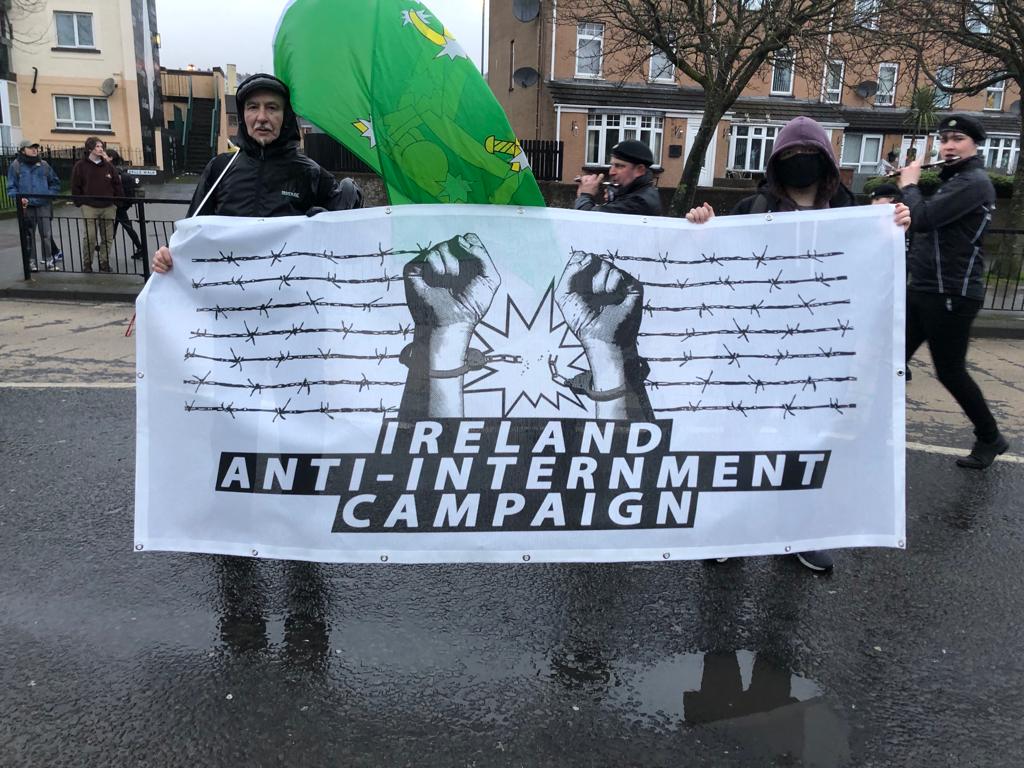
The new banner got its first public airing at the annual march in Derry, commemorating the massacre of unarmed civilians by the British Army in Derry in January 1972 and was carried as part of the march from the Creggan, through a large part of Derry and down to Free Derry Corner.
The marchers in different political parties, campaign organisations and independent individuals marched trough cold rain and strong wind-gusts through the nearly 5-kilometre walk. The members of four Republican Flute Bands played bravely throughout.
The new banner of the Ireland Anti-Internment Committee carried in the Bloody Sunday March for Justice in Derry in January 2023. (Photo: IAIC archives)
The IAIC will shortly begin its year-planning for the rest of the year, its calendar again probably ending at 2024’s Bloody Sunday March for Justice and meanwhile organising events to publicise the on-going undemocratic jailing of activists without trial both sides of the British Border.
The IAIC considers that the jailing of people without trial by both administrations is, in addition to political repression, a significant assault on civil rights and a threat to all opposition groups and that it is in the interests of all to unite in opposing the practice.
The Campaign welcomes the active support of all democratically-minded individuals at its public events.
The mass media is not great for accuracy or wide coverage and even less so for trustworthy analysis but it does often provide entertainment. Not always even intentionally.
Like when the western mass media reported one day that the Russians were shelling the nuclear reactor in the Russian-held sector of the Donbas area and, within hours, that the Russians were shelling from there.
We’ve all seen examples of the unreliability of the mass media (run by capitalists for the capitalist system so what can we expect, after all?) in our own country but hard to imagine more consistently unreliable and biased than its coverage of the war in the Ukraine.
Take for example the bombing of the Nord Stream pipeline on 26 September last year. The undersea pipeline was delivering Russian gas to Germany; its owners are Russian in financing partnership with European companies and it cost around $9.5 Billion euros to build.
It’s a twin pipeline stretching 1,230 km through the Baltic Sea. Each line comprises around 100,000 individual pipes, each 12 m in length.
So who did the wmm (western mass media) line up to blame, or at least to suggest might have carried out this sabotage? Yep, Russia, major shareholders in the pipeline and major route for exporting of their gas for sale to Europe!
Made no sense at all but to a public marinated in msm propaganda for months …
Now, if you were a reasonable detective, you’d be asking yourself: “Who stands to gain from this?” And you’d have to conclude “enemies of Russia”. Next, who would have the capability and opportunity to do it?
Well, states near the sea there who are not friendly to Russia, obviously. Like Sweden and Norway, whose states have reportedly been investigating for months without any apparent results..
But not just them, also US NATO, who has ships nearby and who carried out the BALTOPS 22 major naval exercise not long before the explosions – including underwater exercises. Sweden and Norway had both participated in the BALTOPS 22 joint NATO exercise.
Ships participating in NATO’s BALTOPS 22 exercise last year. (Images sourced: Internet)
Who would point the finger of suspicion at them? Not the western mass media, that’s for sure.
However a big fly has very recently landed in the ointment. Seymour Hersh, a long-established USA journalist, who has in his CV a Pullitzer Prize for the exposure of the 1968 US massacre of the Mai Lai village in Vietnam, published a report pointing the finger at the USA.
Of course Russia jumps on that – it’s their pipeline and they consider that the US is fighting a proxy war against them in Ukraine. The US and its allies in turn accuse Russia of just using the accusation to divert attention away from their continued invasion of Ukraine and war there.
Sure, that’s possible. But the blowing of the pipeline is an acknowledged fact and it was blown up by somebody – and the US are looking more and more like the most likely suspects. But don’t expect much help in clearing this up from the wsm.
A naval diver surfaces during NATO’s BALTOP 22 exercise last year. (Images sourced: Internet)
Apparently Hersch’s report is not reliable because he didn’t name his inside sources. Really? He didn’t burn his whistleblowing sources on whom, apart from any considerations of decency, he might need to use in future? Or for reason to be trusted by future whistleblowers?!
Now we have a new version. No, not Russia in the frame any more but some “pro-Ukrainian group” or “anti-Putin Russian group”. And the source for this? An unnamed (but suddenly that’s not a problem any more) US Intelligence agency. Yeah, sure.
Neither wsm massaging nor US laundering is going to clean this story up. In pursuance of its drive for world hegemony, the ruling class of the US has been pushing Russia, its main obstacle in Europe, into war.
Well, despite the dangers, the European allies of the USA can go along with that, some (e.g. Poland) more enthusiastically than others, but ok overall. But to sabotage the pipeline delivering gas to Germany, the big power in the EU?
Reckless, US ruling class, reckless. And not just environmentally.
SOURCES
Spare a thought for a family being tortured by the Irish State, which has jailed one of its sons already and went and jailed another one more recently. Yes, you’ve heard of them, the Burke family.
First of all, their son Enoch who was a teacher, objected to a pupil identifying themselves by another gender.
The school required him to refer to this person not as ‘he’ or ‘she’ but as ‘they’. Oh, you can imagine the torment suffered by poor Enoch!
The Burke family leaving from one of Enoch Burke’s court appearances. Enoch is on the far left (not politically) and Simeon in the centre (not politically either). (Images sourced: Internet)
True, he might only have to refer to this person a dozen times in the year but … being forced to say “they”. This is a sin against Enoch’s religion! His religious rights are at stake here!
So naturally Enoch had to take a stand and naturally too had to do it in a public situation in the school, for which he got suspended while awaiting a disciplinary hearing.
Enoch’s religious principles required him to refuse the suspension and keep attending the school and to disobey a court order, for which (and for his stalwart protests in court) he was sent to prison in contempt of court.
Eventually, of course, he was sacked but he applied to the High Court to prevent that, during which attendance he and his family antagonised the judge by their interruptions and manner.
Then the younger son, Simeon, emulating his older brother, refused to be silent and accused the judge of “forcing the people of Ireland to accept transgender”, obviously an attack on his religion too.
The judge was “shoving transgenderism down the throats of the people of Ireland, not only in the schools but in the universities”, cried out the younger Burke. The judge ordered him to leave the court and when he declined, the Gardaí were called.
Young Simeon was removed, during which he was, he told the Judge, “shocked and shaken to the core” and had “been treated in a brutal fashion” by a “mob of Gardaí”. And charged with breach of the Public Order.
Left: Enoch Burke; right: Simeon Burke leaving the High Court. (Images sourced: Internet)
This raised unkind comments on social media from people alleging that they knew Garda “brutal treatment” in Dublin and in Rossport and that Simeon simply had no idea (some going so far as to cruelly dub him “Simple Simeon”, a reference to a similar-sounding children’s game).
Simeon was offered bail in his own name for a paltry sum and with no conditions except to stay away from the High Court but the brave young Burke refused to sign his bail form. So he went to jail too.
Simeon Burke should know something about the law, having studied it at University of Ireland, Galway. He ran for Student Union President there against the Left in general, where, according to Isaac Burke’s media, out of 2,500 votes cast, he received 482 first preference votes.
The legalisation of contraception, divorce and gay marriage are all presumably “crimes against God” too in the eyes of the Burke family and the High Court judges are sworn to protect those decisions.
Some unkind people are pointing out that if the Burkes consider the High Court to be wrong and its operation against their religion, why take their case there for adjudication? Yes, that is puzzling.
But the substantive and original issue remains: should a man of religious conviction be forced to use the third person plural pronoun to refer to any person?
And, come to think of it, did the Burkes object when Christianity was being “shoved down the throats of the people of Ireland, not only in the schools but in the universities”?
Monday was a new bank holiday in Ireland and two demonstrations of about equal size took place at the same time in Dublin that afternoon, one anti-racist and welcoming refugees, the other anti-refugee and with substantial racist and even fascist elements.
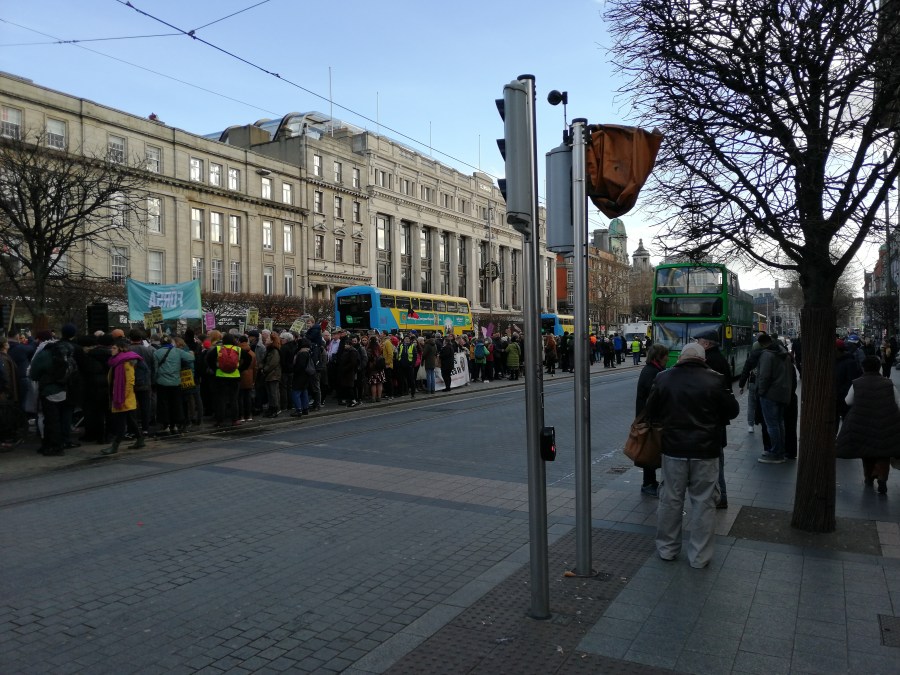
The pro-refugee event gathered on the central pedestrian strip on Dublin City centre’s main street, O’Connell Street, across the road from the iconic General Post Office, the building which served as the HQ of the 1916 Rising. Numerous placards and banners could be seen there.
Section of the Le Chéile pro-refugee demonstration in O’Connell Street (Photo: D.Breatnach)
The tightly-packed crowd stretched from the Spire southward almost to the Jim Larkin monument and were addressed by speakers. I knew the event had been organised by Le Chéile, a broad anti-fascist coalition of essentially pacifist nature with regard to fascism.
Closer view of section of the Le Chéile pro-refugee demonstration in O’Connell Street (Photo: D.Breatnach)
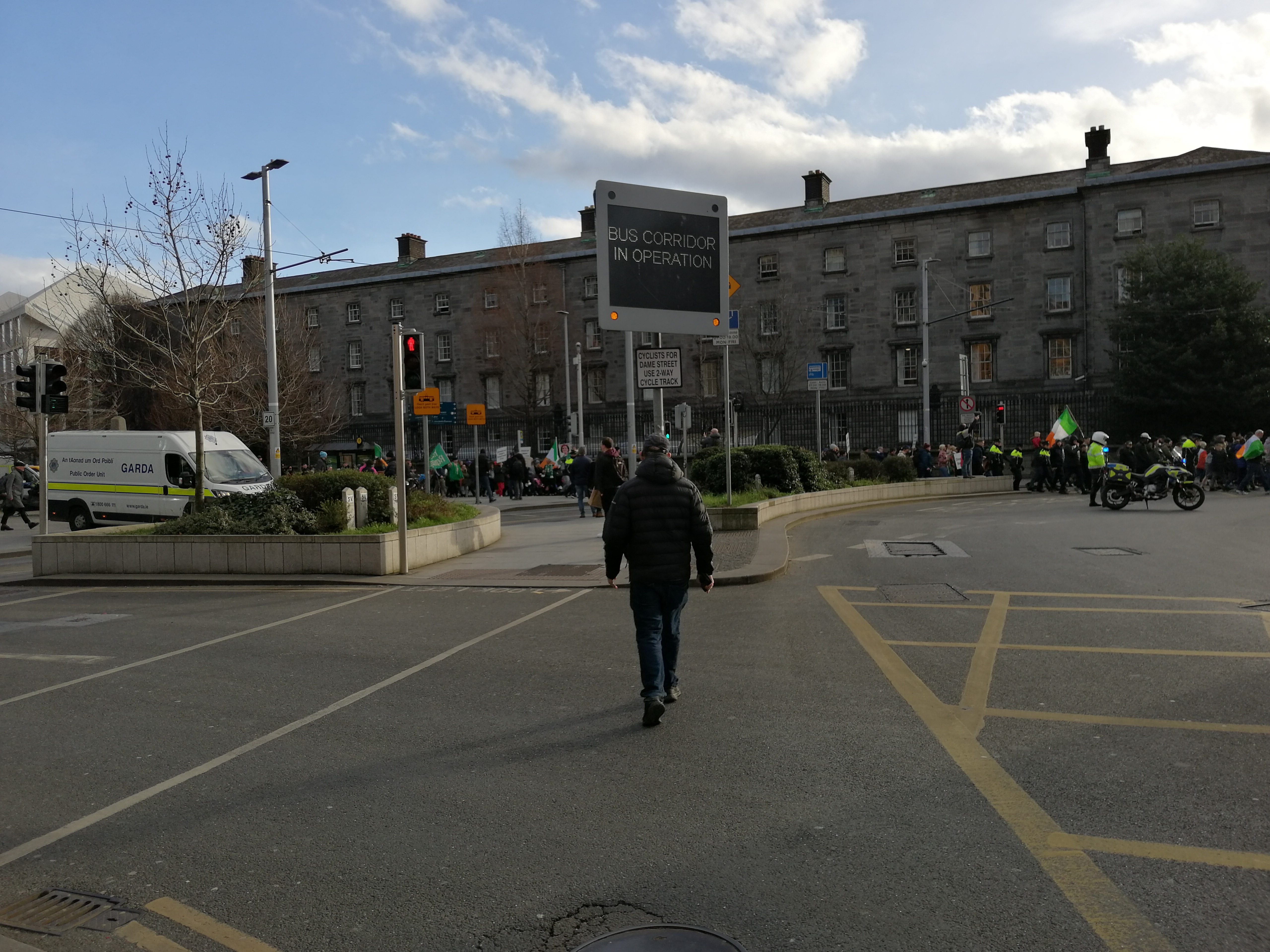
I passed them by in a hurry on my way to attend to a family commitment. While waiting to catch a bus in D’Olier Street, a number of Garda vans and motorcycles drawing up attracted my attention and soon afterwards the anti-refugee demonstration came from Pearse Street.
Cops arriving at Pearse Street/ D’Olier Street intersection just prior to arrival of the anti-refugee march. (Photo: D.Breatnach)
They passed along by Trinity College’s wall and soon after they had gone from my view, my bus arrived. I surmised the anti-refugee march had gone to demonstrate in front of Leinster House, the building that holds the parliament of the Irish State.
Front of the anti-refugee demonstration marching through the intersection (Photo: D.Breatnach)
As I was in a hurry and one group was tightly-packed and the other in extended line walking, it was difficult to compare the numbers but I made them both to be somewhat the same — between 500 and 700 each.
end.
Middle of the anti-refugee demonstration marching through the intersection (Photo: D.Breatnach)End of the anti-refugee demonstration marching through the intersection (Photo: D.Breatnach)Longer view of the Le Chéile-organised pro-refugee demonstration on O’Connell Street (Photo: D.Breatnach)
In late November last year the UK’s Home Secretary1 referred to refugees and migrants entering Britain as “an invasion”, for which a Hollocaust survivor, 83-year-old Joan Salter, challenged her, likening her speech to that of the Nazis.
An NGO working with refugees, Freedom From Torture, posted some of the exchange on Twitter. In turn, the NGO came under pressure from the Home Office to retract the video.
This month, not only did the charity refuse but did so publicly, fully endorsing the content of the video.
Anyone would well understand the difference between invading a country and entering it as a refugee, asylum seeker or even economic migrant. Those come unarmed, fleeing to safety or trying to make a living for themselves and their family.
A minister of a British Government should be extremely well-placed to understand the distinction. After all, there is no continent and very few countries, including its near neighbours, which the British ruling class has not caused to be invaded at some time or other.2
Map of areas of the world ‘owned’ by Britain or the UK at one time (Source: Internet)
From the time the descendants of the Anglo-Saxon invaders of Celtic England merged with the descendants of the later Norman invaders, England has gone from being a major invading and colonising military and naval power to being a major imperialist one.
Imperialist action did not always end in invasion; pressure could be applied in other ways, through bribery — or open threat. The term “gunboat diplomacy” was coined to describe imperialist actions short of actual invasion and Britain was renowned for actions of that type.
The ruling class of Britain has waged war against people to take over trade routes, to colonise land and extract resources, in competition with other colonial powers, to quash resistance and even for the right to sell opium in China.
In the course of those colonial and imperialist activities, Britain has carried out many invasions. In fact, Suella’s parents themselves come from former colonies.
Braverman is a child of migrants
Suella Braverman is the daughter of parents of Indian origin who emigrated to Britain in the 1960s: Uma (née Mootien-Pillay) from Mauritius and Christie Fernandes, from Kenya. Both those countries have indeed been invaded by Britain.
Kenya in particular from 1952-1960 had one of the worst experiences of colonial treatment by the British military, including wide-scale murder, torture and rape. India and Pakistan had their infrastructure and manufacture undermined by Britain leading to regular country-wide famines.
Suella Braverman, MP, currently UK Home Secretary. (Sourced: Internet)
Suella should know about invasions, refugees and migrants but is on record as saying that the British Empire was on the whole a beneficial experience for its conquered. This is a prime example of the “slave mind” that apes the invader and wants to collaborate with it.3
Such “slave-minded” people can be even more vicious and callous in their attitudes than the conquerors themselves and Braverman certainly fills that bill. And it’s not just in occasional choice of words that Braverman nears Nazi appearance.
During Braverman’s unsuccessful campaign for selection as leader of the Conservative Party last July, she said her priorities would have included to “solve the problem of boats crossing the Channel” and “to withdraw the UK from the European Convention of Human Rights.”
In October 2022, Braverman said that she would love to see a front page of The Daily Telegraph sending asylum seekers to Rwanda4 and described it as her “dream” and “obsession.” No doubt she includes human rights and legality concerns as “all of this woke rubbish.5”
A courageous NGO
Holocaust survivor Joan Salter, the woman who accused Braverman of Nazi-like speech, is the daughter of refugees from Nazi persecution who survived but endured imprisonment and hazardous journeys. She has an MBE for her work on Holocaust education.
Joan Salter, Holocaust survivor who challenged the Home Secretary. (Sourced: Internet)
In response to a Home Office accusation that the clip is only partial and therefore misleading, the NGO’s CEO Sonya Sceats pointed out the full exchange is available in video on its website and said the charity will not remove the Twitter clip.
“As an organisation providing therapy to torture survivors who feel targeted by her language and who know first-hand where such dehumanising language can lead, we will not do so. She has used language she should be ashamed of, and we won’t be pressured into helping her hide it.”
Non-Governmental Organisations nearly always rely on government funding, whether directly or indirectly and as a result tend not to rock the boat too much, in case they find their boat getting smaller or their team even being tossed overboard.
Sony Sceats, CEO of Freedom From Torture charity who stood up to the Home Secretary.
As a result, in public the CEOs of those organisations tend to vary from generally totally compliant6 to cautiously critical on certain occasions. In that context, the actions of Salter in the initial video and of the Freedom From Torture NGO in militantly backing her can only be admired.
1This is the UK’s equivalent to Minister for Home Affairs, these days normally restricted to Britain (i.e excluding the colony in Ireland) and in particular England and Wales (i.e often excluding even Scotland).
3The concept of the ‘slave mind’ or ‘colonised mind’ has been addressed by a number of writers on national liberation, notably Patrick Pearse (1879-1916) from Ireland and Franz Fanon (1925-1961) from Martinique.
4That plan has been condemned by many human and civil rights organisations and also denounced as illegal.
5A quote dating from her attempt at Leader of the Conservative Party.
Eamon McGrath (31 October 1955 – 11 January 1923) singer and song lyrics-writer, activist in areas of housing, water and national sovereignty, historical memory and anti-fascism.
He was getting buried on Saturday and I wasn’t able to be at the service nor at the celebration of his life with comrades afterwards.
I hope this eulogy, if that’s the right word for this, will make up for my absence to his family, comrades and friends and, of course, to me.
Eamon came into my life through the Moore Street occupation in January of 2016. The property speculator Joe O’Reilly (Chartered Land) and the State were about to collude in the demolition of three buildings in the 1916 Terrace.
The State had declared only four buildings in the 16-building terrace, after a long struggle, to be a historical monument and even later, purchased – but around 300 men and women hadn’t occupied just four buildings in 1916.
The Save Moore Street From Demolition campaign group had called emergency demonstrations on to the street following which the buildings had been occupied by protesting conservationists.
The weather was bitterly cold but the occupiers held firm for a week until a stay of demolition had been imposed by the High Court. Despite his health status and challenged mobility, Eamon was there throughout, with humour and song.
Eamon McGrath to far right of photo while Dave Swift (centre) in Irish Volunteer uniform reads a historical document April 2017 in Moore Street, during historical commemoration event (the hoarding behind is covering the extension of the ILAC further into Moore Street, killing the market appearance for that side of the street for the block).
Subsequently, to prevent internal damage by contractors, a six-weeks’ blockade was imposed on the building by conservationists from 6.30am to 4.30pm each weekday. Eamon was very much a part of that too, driving himself and his close comrade Sean Doyle up from Wicklow every day.
Eamon was intensely loyal to close friends and comrades. On occasion I found him prickly or grumpy (especially at 6.30 am) but throughout any disagreements he never lost sight of who were his comrades and other people he respected.
Though a proud man, when he recognised himself in error, he didn’t hesitate to apologise.
A new broader group came out of the occupation and blockade, called Save Moore Street 2016 and Eamon attended and contributed to internal organising meetings and events we called on to the street – re-enactments, fake funerals of history, pickets, demonstrations and rallies.
As others drifted or were called away from the group by other commitments, Eamon remained with the active core.
(L-R) Paddy Reilly and Eamon McGrath in period costumes having a conversation during a history education event and anniversary commemoration of the founding of the Save Moore Street From Demolition campaign group. (Photo from Save Moore Street From Demolition FB page)
Of course, Eamon had been active before 2016: certainly very much so in the general awareness-raising and mass campaign against planned privatisation of our water and the installation of water meters.
He was to continue that activism, which resulted in assaults by a water contractor on him and Seán Doyle, court appearances for both and in May 2016 both of them went to jail for a period but remained unbowed.
Eamon was one of the original occupiers of Apollo House in December 2016 in protest against homelessness and as a co-founder of the Anti Eviction Flying Column, Eamon was to the fore in resisting evictions across the country and also a co-founder of the Bring It to Their Doors campaign.
The State authorities were making things awkward for Eamon by then, both in terms of working as a taxi driver and claiming benefit when he was not. His ability to reach events in Dublin declined but he still got there often enough on public transport, while remaining active nearer to home.
As his physical mobility declined further, comrades in Carlow started an on-line collection to buy him an electric wheelchair. Even as I made enquiries to contribute, the fund had already reached its target, so quickly did people support it.
Later still, his family installed a new chairlift for his home so he could access the room where he recorded his songs with lyrics commenting on the ongoing political struggles, adapted to popular airs.
Though our voices didn’t go well together, we sang together a couple of times – outside the GPO and outside Dublin City Hall.
Eamon McGrath, centre right after April 2016 event in Moore Street after which we brought it to in front of the General Post Office in Moore Street for awhile. Myself near centre, Glenda further to the left of photo, Sean Doyle nearly out of shot.
He remained active on social media but in particular in keeping an eye on the activities of right-wing people, covid-deniers, racists, fascists …. Eamon was a handy source for a quick update on the status of many of them.
Eamon arranged an interview for us both with the Dublin Near FM radio station, the interviewer being then a former drug addict who sadly returned later to his addiction and died on the street. It was on the way back from the interview that Eamon told me a little about his earlier years.
He had a difficult time in his childhood, including institutional confinement and his formal education suffered as a result. However, he educated himself about many things by reading, listening, discussing and viewing on line.
I think the last time I saw Eamon was at a commemoration at the Peter Daly monument in Wexford inSeptember 2022, in his electric wheelchair and attached oxygen cylinder for his lung condition and all in good cheer, asking me for Moore Street campaign updates in detail.
Eamon McGrath, centre in wheelchair, at Peter Daly commemoration in Wexford, September 2022 (Photo from Peter Daly FB page)
His comrades in Anti-Imperialist Action Ireland, which he had joined at its foundation in 2017 correctly called him “one ot the most dedicated political activists of the last decade” and no-one who knew him could argue with that.
I knew little of Eamon’s family life but he often emphasised how important family was, not just to him but in general. Though I do not know them tá mé i gcomhbhrón leo, offering them my condolences along with the many they have received and are no doubt still arriving.
A partner, father, grandfather, great-grandfather, extended family member and friend to many.
Eamon McGrath of Kenmare Heights, Greystones & formerly Wolfe Tone Square, Bray, Co. Wicklow, was buried in Radford Cemetery, Greystones Saturday after a service in the Holy Rosary Church, Bray, attended by family, comrades and friends.
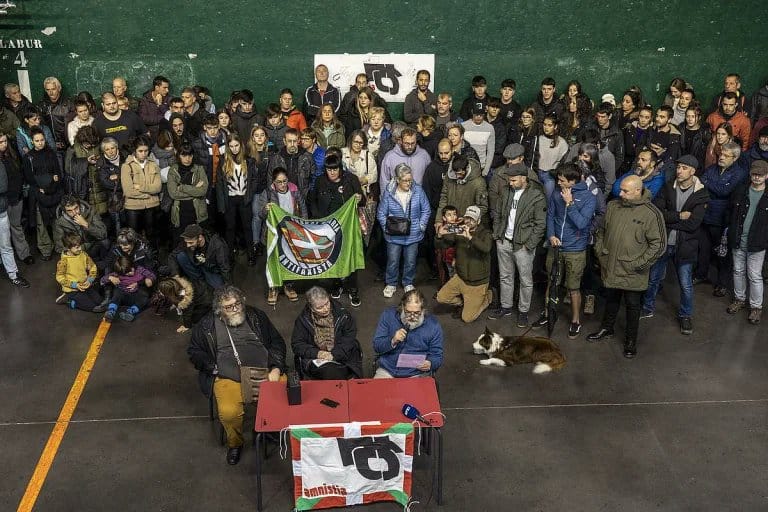
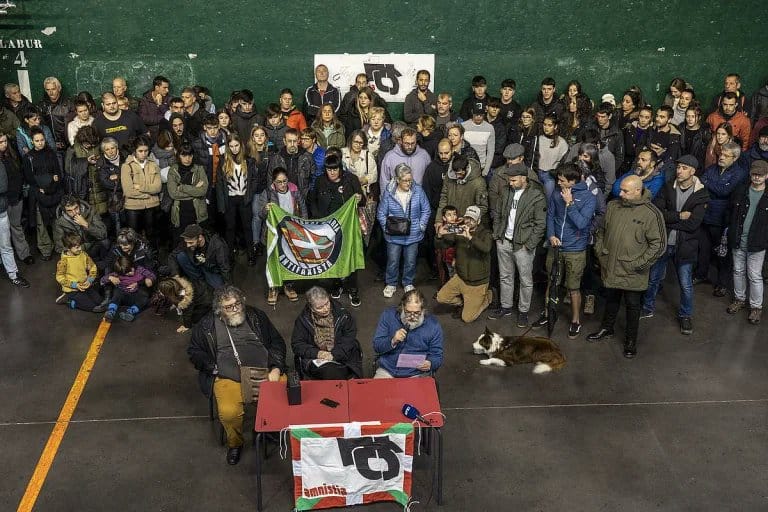
TINKO is an independent organization created to work for COMPLETE AMNESTY. As an amnesty organization, it intends to create the necessary means to fight against repression with its scope of work being the Basque Country.
As its name indicates2, it intends to reflect the attitude of determination and commitment of some political prisoners3 in these difficult times. Along with the dignity and toughness that is being maintained, there must be constant struggle in the streets.
It is our responsibility to keep the flame of the struggle burning; for this reason, we see it more necessary than ever to organise ourselves.
Drop-banners against repression in different locations in the southern Basque Country/ Spanish state (Photo: Tinko)
TINKO’s understanding of repression goes beyond reporting each case in isolation, since each of these cases responds to a general repressive situation.
The states are the ones that speak of the individualised treatment of prisoners, denying their political nature and hindering solidarity. Therefore, our duty in this regard is to promote unity and solidarity.
It is the slogan of COMPLETE AMNESTY that offers this overview of the aforementioned repression, as well as the political solution that opposes this repression.
Full amnesty includes freedom from all political repression without exclusion, as well as overcoming the underlying causes of repression, such as national and social oppression.
Therefore, TINKO is an organization made up of ideologically-conscious activists, who want to make their contribution in the field of anti-repression towards a Basque Socialist State.
If the intensity of the struggle is met with repression, it will be our task to counter that repression, to try to facilitate the conditions for the struggle.
It is necessary to take a broader reading of repression, paying attention to reality with the intention of joining our forces.
We aim to create a broad movement against the repression that upholds the interests of the political victims of the struggle cycles of yesterday, today and tomorrow, that will always be in accord with the declaration of complete amnesty and not establish differences according to the struggles carried out.
It is necessary to underline the enormous generosity of the militants who suffered the repression of the previous phase. They have been our compass even in the bleakest times and they continue to be so today.
Total amnesty is our strategic objective and we do not define it in a purely legal way but instead in a political way.
Amnesty includes the unconditional release and freedom of prisoners, fugitives, refugees and political deportees and also the resolution of the reasons that motivated these people to fight for their fundamental rights, in the case of the Basque Country, against national and social oppression by the Spanish and French states.
Only ending the denial of our rights can ensure that prisons do not fill up anew after they have been emptied. These are the other measures that a full amnesty should include, along with the aforementioned freedom from political repression:
The right to self-determination
Abolition of repressive laws against the working class. Repeal the labour reform laws, the muzzle law, the party law and the anti-terrorism law4.
Dismantle and expel the repressive and occupying forces from the Basque Country.
Press conference in November in solidarity with 18 people from Berango accused of “glorification of terrorism” (sic) for organising an “ongi etorri” (welcome) event for a released political prisoner. (Photo: Tinko)
ANTI-REPRESSION NETWORK
As we said at the beginning, TINKO intends to create the necessary means to combat repression.
We consider it necessary to create useful tools to organise in cases of repression, which allow the creation of effective solidarity networks for the protection of those who suffer repression for being active in different fields.
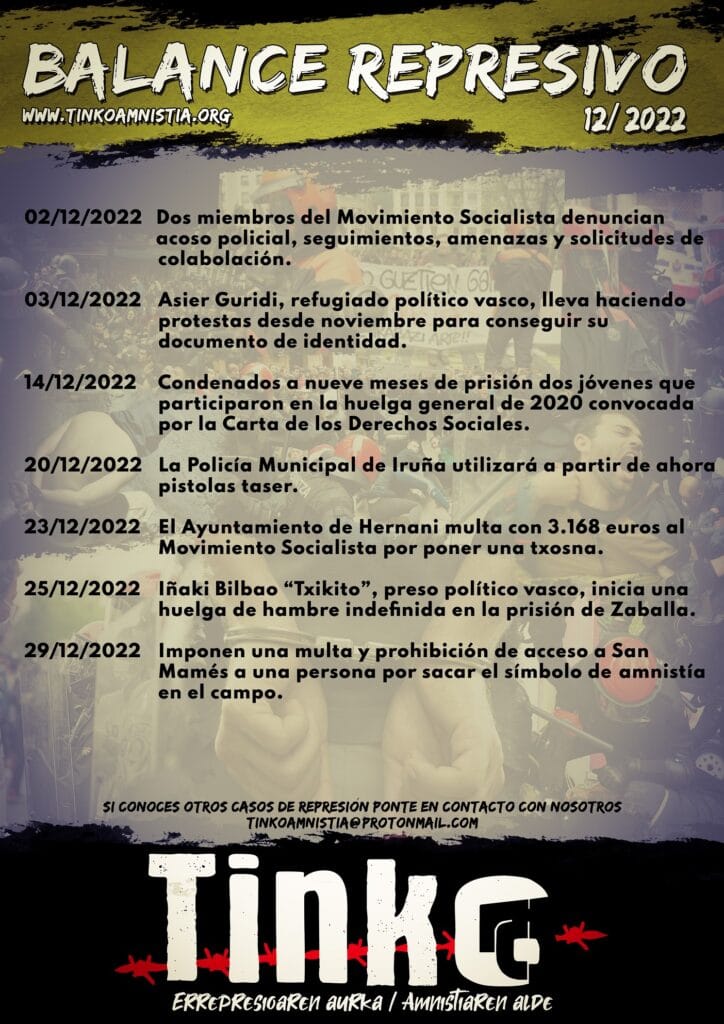
Monthly summary of repression (Castilian language version) December 2022, including: 9 months jail for two youth participants in the 2020 General Strike; municipal police in Irunea/ Pamplona are to get taser pistols; the municipal council in Hernani fine Socialist Movement 3,168 euro for running a street stall; Basque political prisoner initiates indefinite hunger strike in the Zabala prison. (Source: Tingo)
In addition to organising instruments for protection in the courts, insisting on repression as being general and calling for total amnesty. While the net would be politically wide, victims of repression would receive protection according to the following minimum essentials:
Joining the call for total amnesty.
Feeding the network itself, that is, strengthening the network against other cases of repression.
Putting the collective before the individual.
Not denying access to basic political rights in a possible trial: the right to political organization, the right to demonstrate, the right to assembly and the right to freedom of expression.5
End.
FOOTNOTES
1Tinko was founded some months after an internal dispute inside the Amnistia organisation in the autumn of 2020 about whether to support a demonstration in Madrid or not. Amnistia itself, as with Tinko, grew out of the perceived necessity to resist repression in order to move forward in struggle, while the official leadership of the left-nationalist movement was adapting itself to the requirements of the Spanish State.
2“Tinko” means ‘firmness’ in the sense of ‘resolved/ standing firm’.
3Note the qualification “some”: the leadership of the Basque prisoners’ organisation and of the relatives’ support group, Etxerat, followed the abandonment of the revolutionary path by the leadership of the Basque Izquierda Abertzale mass movement. Most of the prisoners followed the leaders’ line, which entailed prisoners not calling themselves “political” prisoners, not joining any protests and seeking parole as individuals, including apologising for their previous actions. The leadership dropped the call for Amnesty and confined their demands to an end to the dispersal of prisoners away from their home areas.
4In brief, laws restricting the right to strike and to record and disseminate police violence, along with laws permitting repression of political activists.
5There is a practical reason for the inclusion of this requirement: The Spanish State demands the political activists it arrests apologise for their resistance and undertake not to repeat it. Shamefully and to the shock of many, in September 2019, 47 activists in three organisations engaged in prisoner solidarity work, including officials of the Basque Left Movement, in exchange for non-custodial sentences on all but two (who received relatively light sentences) pleaded “guilty” to ‘anti-terrorism’ charges. Doing so endorsed the criminalisation by the Spanish State of prisoner solidarity work and was a great shock to many Basques, including the 50,000 who had demonstrated in Bilbao in solidarity with the accused only days before the trial and had been kept in ignorance of the deal. (SeeEuskal Herria. Iñaki Gil de San Vicente: “Es inadmisible engañar a 50.000 personas, pactando a sus espaldas” – Resumen Latinoamericano)
On February 28, Pablo González was detained by the Polish secret services on the border with Ukraine while he was covering the migratory crisis caused by the war. 1
Since then, 10 months have passed without the authorities of that country having publicly presented evidence, detailing accusations against him or bringing him to trial.
This length of time in pretrial detention is generating significant expenses for the people around the journalist who pay for the defence and send money to him in prison.
For this reason, friends and colleagues of the reporter with Spanish and Russian nationality have founded the #FreePabloGonzález Association to raise funds to pay for legal coverage, launch initiatives to support the journalist and channel the fight for his rights.
One of the main problems in the case is that, a few hours after his arrest and just before being sent to prison, he was interrogated without legal assistance.
This, together with the fact that Poland accuses him of spying for Moscow — a very serious crime punished by the Polish penal code with up to 10 years in prison — explains why it has been necessary to strengthen the defence of Pablo González throughout the process.
At times, the journalist has had three legal teams, due to the complexity of the case and the impediments that the Polish courts have placed in his defence process. From the day of his arrest, Pablo González has been assisted by Gonzalo Boye, the lawyer who announced his arrest.
In April, thanks to collaboration in the journalist’s location, Polish lawyer Bartosz Rogala was hired, after the two lawyers assigned ex officio by the authorities of that country resigned from the case.
Since October, González also has, according to the family, a group of Polish criminal lawyers experienced in complex processes.
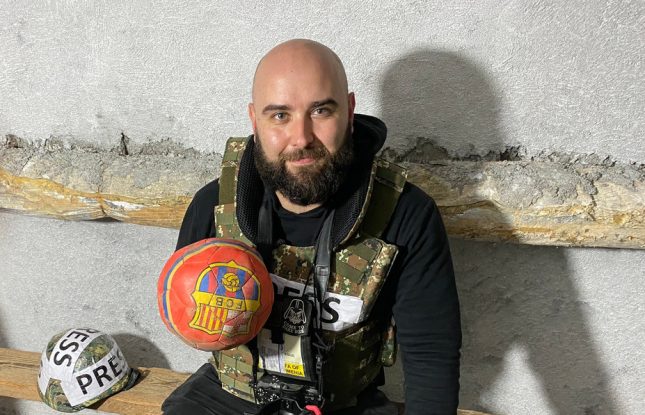
Pablo González holding a football displaying the logo of the Athletic Bilbao football team, photographed during on-line interview prior to his arrest (Photo sourced: Internet)
The financial burden of the process on the family
“Until now we have drawn on savings and the help of relatives and close people, but the situation has reached such a point that we are forced to request help from society.”
These are the words of Oihana Goiriena, mother of Pablo González’s three children,2 who stresses that part of the income will also go towards improving the conditions of the journalist in prison.
Faced with this situation, the friends who make up the #FreePabloGonzález collective have promoted the creation of the association, which is registered in the General Register of Associations of the Basque Country.
The association is chaired by Oihana Goiriena. She is accompanied on the management team by Maribel Martínez and Gabino Martínez Terán, friends from Bilbao and Elantxobe, respectively.
For his part, Juan Teixeira, a photojournalist and friend of Pablo’s with whom he has been working for more than a decade, is the spokesperson. The others of the platform are friends from different backgrounds of the Basque journalist.
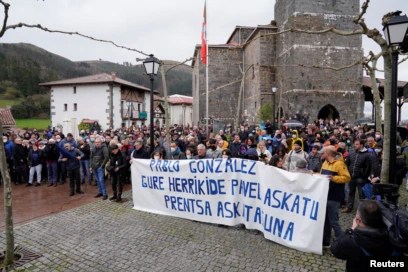
Demonstration months past in González’ family area in the Basque Country demanding his release (Photo sourced: Internet)
Legal expenses beyond attorneys’ fees
As explained by the journalist’s circle, most of the contributions received will be used to cover the cost of González’s legal defence. In addition to paying the different legal teams, it is necessary to cover the daily and travel expenses of their representatives and necessary bureaucratic procedures.
Radom prison is located 100 km from Warsaw and the representatives travel there regularly.
Funds collected will be used also to pay for Pablo González’ maintenance in prison.
As he has detailed in letters to his family and friends and in complaint he filed before the Strasbourg Court, the food he is provided in prison is quite deficient and he needs food and vitamin supplements. “They cost around 300-400 euros per month,” says Goiriena.
The #FreePabloGonzález platform members request that contributors send an email to the address freepablogonzalez@gmail.com, with the basic contact information so that in the coming weeks all those people who helped the journalist can be personally thanked.
COMMENT
Diarmuid Breatnach
González had been covering the war in Ukraine apparently without difficulty for some time prior to his address but was named in a hostile published list, along with over a hundred other public commentators in the Spanish State, as “pro-Russian”.3
It seems suspicion was aroused when a broadcast of one of his La Sexta (TV) reporting pieces experienced a transmission breakdown and he was left facing a blank camera with Ukrainian troops in the background for half an hour while attempts were made to reconnect.
His detention by Ukrainian state security followed soon afterwards and among the issues for his interrogators, he reported after release, were his holding of two passports, one Russian with a Russian surname, the other Spanish with a Spanish surname.
González’s Russian passport names him as Pavel Rubtsov, using his father’s surname; his Spanish document identifies him as Pablo González Yagüe, using his mother’s two surnames4. Pablo is the Hispanicised version of the Russian name Pavel (Paul in English).
The reporter is the grandson of a Spanish Civil/ Antifascist War refugee who sought asylum in Russia, where his daughter married Gonzaléz’ father. Subsequently Pablo’s parents divorced and his mother went to live in the Basque Country in the Spanish state, taking Pablo with her.
According to his reports, among other sources of suspicion for Ukranian state security against him were that his employers include the Spanish left-wing on-line publication Publico.es and the Basque newspaper GARA– and that he had a bank card from Caja Laboral, a Basque workers’ cooperative bank.
While the passports issue might raise an eyebrow, dual nationality is legal in many state administrations and even the use of two versions of a name are known — no doubt a Russian passport and Russian surname smooths Gonzaléz’ periodic visits to his father.
The other issues raised by his early Ukrainian interrogators however are indicative of right-wing paranoia. Publico.es and GARA are moderately left-wing but have hardly departed far from the wsm’s (western mainstream media) line on the war in the Ukraine.
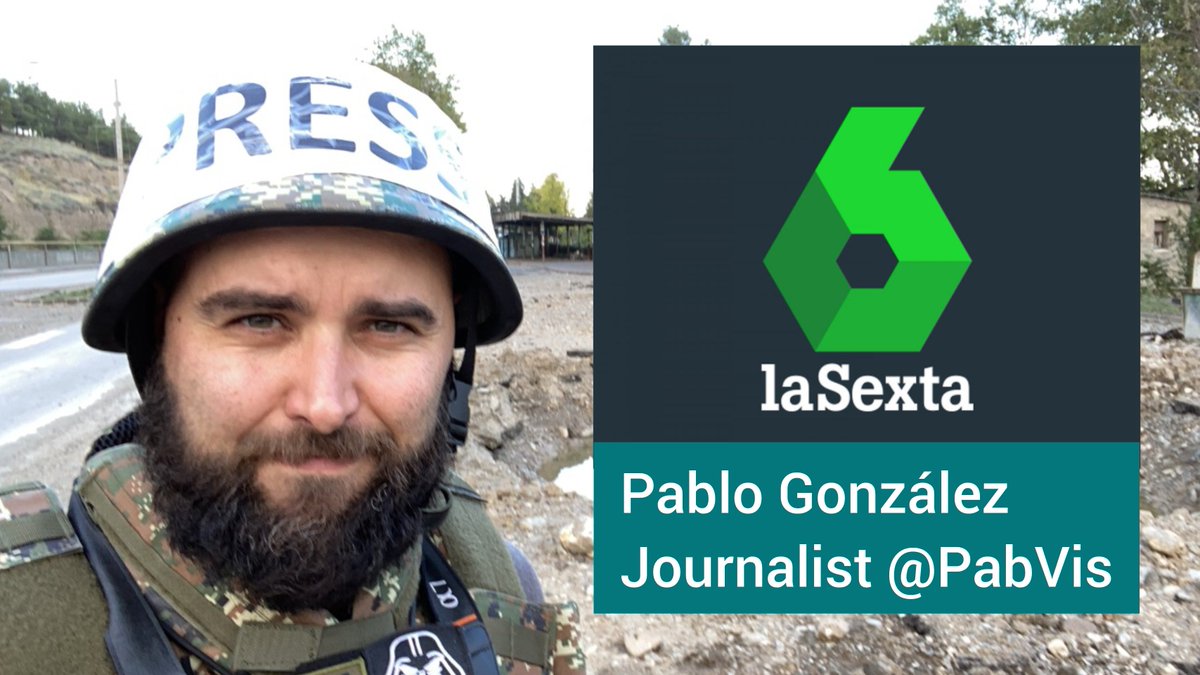
Pablo González photographed in Ukraine while reporting for La Sexta Spanish TV channel (Photo sourced: Internet)
It is of course possible that this reporter has not sufficiently toed that wms line in his reporting or that right-wing state security paranoia was sufficient; in any case he reported that his interrogators made it clear he was not welcome to continue in Ukraine.
González left but seemed determined to continue his reporting and went to Poland from where he was about to enter Ukraine again with a group of reporters when he was arrested by the Polish state security service, accusing him of spying for Russia but to date having produced no evidence.
Shortly after his Ukrainian detention, the reporter’s friends and family in the Basque Country were visited by Spanish State security also.
This latter provided grounds for WSWS5 to accuse the Spanish Government coalition of PSOE-Podemos of collusion but its report neglected to mention that Podemos’ co-founder Pablo Iglesias6 wrote publicly in defence of González and ridiculing the accusation against him.
The Polish state is entitled to charge González with any crime for which they have evidence but no administration is entitled to lock up someone because they don’t like him or what he writes — or because of some vague suspicion.
A number of journalist defence organisations have raised concerns but strangely, in its annual report for 2022, the Reporters Without Frontiers organisation has not listed him among last year’s victims of attacks or threats to journalists — because he has not yet been tried.7
This seems extraordinary, that a 10-month detention without trial does not count as an attack on a journalist. However the International Press Institute and other press freedom organisations have called for his release and application of due legal process.
The Guardian reported in May that a spokesperson for Polish state security claimed to have amassed “vast evidence”8 and yet seven months later, there are still no specific charges or evidence produced with which to confront González or his lawyers.
1Although González has been a reporter for Spanish printed and TV media, his is a case of detention and harassment of journalists that has received little attention in the mainstream western media. His detention by the Polish state security services follows interrogation by state intelligence services in Ukraine, where he had been based for some time reporting on the war there.
2In the Basque Country, to where his mother emigrated from Russia and where Gonzaléz and his family are domiciled.
3As we have learned during this conflict, such a designation can mean anything from what it says to “not wholly convinced by the Ukrainian authorities or NATO” and the reporting and censorship aspect of the war has been as prominent as the military aspect.
6Also former Minister in the Spanish coalition Government and former leader of the Podemos party from which he resigned last year after the poor electoral results of the Podemos-Unidas Left-coalition.
First published in “Socialist Democracy” December 2022, republished here with kind permission of author.
The death of Vicky Phelan on November 14th was announced by the media. They were full of praise for a woman who was a victim in the cervical smear scandal.
She was one of over 200 women whose cervical smear tests were outsourced to a private US company, which gave back erroneous results.
Women who could have received treatment went on to develop cancer and in the case of Vicky Phelan die. But she didn’t just die. She was murdered.
Engels in his famous tract The Condition of the Working Class in England stated that
When one individual inflicts bodily injury upon another such that death results, we call the deed manslaughter; when the assailant knew in advance that the injury would be fatal, we call his deed murder.
But when society places hundreds of proletarians in such a position that they inevitably meet a too early and an unnatural death, one which is quite as much a death by violence as that by the sword or bullet; when it deprives thousands of the necessaries of life, places them under conditions in which they cannot live – forces them, through the strong arm of the law, to remain in such conditions until that death ensues which is the inevitable consequence – knows that these thousands of victims must perish, and yet permits these conditions to remain, its deed is murder just as surely as the deed of the single individual; disguised, malicious murder, murder against which none can defend himself, which does not seem what it is, because no man sees the murderer, because the death of the victim seems a natural one, since the offence is more one of omission than of commission.(1)
The Irish state has for a long time deprived its population of the necessaries, as Engels put it, of life in relation to health care. One of the first politicians to wreak havoc in the health system in pursuit of her ideology and profit was Mary Harney.
Mary Harney, former Health Minister who set up the Irish health service for privatisation – guilty of murder through neglect. (Photo sourced: Internet)
She and her party the Progressive Democrats were ideological in their commitment to the privatisation of health care. Under her rule and that of successive governments, the health service was privatised.
First, they ran it down, closing hospital wards and reducing the number of beds in the health service, paying Consultant Doctors extravagant salaries, allowing them to moonlight as private consultants, whilst there are now around one million people on public waiting lists.
The system is a shambles and compares poorly in terms of speed and quality of care to even Third World countries.
At the same time a private health care sector has arisen and expanded, all the time promoted by the state through tax breaks and discounts for the companies with affiliates being able to write off part of their private health insurance against tax.
In other words, a public subsidy to the health companies paid for through the taxes of many people who cannot afford to use these services. The Irish health service does not exist to provide health care but rather to generate profit. It is important to understand what this means in practice.
If profit is the motive, then the law of supply and demand takes over and prices and the quantity of services are calculated on the same or similar basis to the sale of a car. It also means that in order for some to be treated and live, others must die.
It is an intrinsic part of the system and they know it. For health care to be profitable some must not have full access to it, some must die in order for others to make profits. If everyone can access cancer treatment without problems then there is no need for private medicine.
This is not the situation in Ireland. Public services are run down in order to encourage private medicine and profit.
It is in this context that the Health Service Executive outsourced the testing of cervical smear tests not only to a private company, but to one in another jurisdiction. Money was to be made, and to hell with the consequences.
Dr David Gibbons, a former member of the screening programme, said he expressed concerns about the outsourcing of smear tests to the US in 2008 but they were dismissed.
Tony O’Brien, former head of the National Cancer Screening Service and Director General of the HSE until 2018 — another one of the guilty (Photo sourced: Internet)
Gibbons, chair of the cytology/histology group within the programme’s quality assurance committee, brought up his worries with Tony O’Brien, then chief executive of the National Cancer Screening Service and director general of the HSE until 2018, but they were not listened to.
Dr Gibbons resigned as a result. O’Brien defended the decision to outsource the testing saying that tests would have otherwise been left idle for a year or been examined by doctors “on their kitchen table”.(2)
Why would they lie idle for a year? Because they had decided not to spend money on it. Why would doctors end up examining them on their kitchen table? Because the facilities weren’t there.
When it all went wrong, they dragged their heels on informing the women, and this is where Vicky Phelan comes in.
She was diagnosed with cancer in 2014, but only informed of the false negative from the unapproved labs used by the HSE in 2011 and sued the US company and the HSE, but her case against the HSE was struck out.
The cat was out of the bag, however, but they continued to drag their heels on informing women that they may in fact have cancer and they stuck by their accountancy guns and continued to outsource the tests.
As Engels stated they know these victims will perish and yet permit the conditions to continue.
When she died, the great and good in Irish society expressed their praise for her. The murderers came back to the crime scene in a perverse act to say “It wasn’t me, I didn’t do it”. The Taoiseach, Micheál Martin stated on Twitter
Very saddened at the passing of Vicky Phelan, a woman of great courage, integrity, honesty & generosity of spirit. She will be long remembered as someone who stood up for the women of Ireland, & globally.(3)
The Tánaiste Leo Varadkar, for his part, was brazen in his Janus-like abilities.
Today Ireland has lost a woman of limitless courage, compassion and strength. I want to extend my deepest sympathies to Vicky’s family, particularly to her children on the loss of their incredible mother.
Vicky was a shining example of the power of the human spirit. Her fight to uncover the truth and the courage with which she faced her illness made her an inspiration to us all. We mourn her as a nation, as a society, and as individuals.(4)
Both of these men bear responsibility for what happened. To listen to them you would swear they were talking about some social justice warrior in a far-off land who stood up to a government that the Irish state is not on good terms with.
Condolences from murderers by neglect, Taoiseach Mícheál Martin and Tánaiste Leo Varadkar, presiding over the privatisation and degradation of the Irish health service. (Photo sourced: Internet)
Varadkar was a government minister in 2011 when Vicky Phelan was tested. He was Minister for Health when she was diagnosed with cancer and he was Minister for Social Protection when she was eventually informed about the mess up with her results.
Martin has been a T.D. in the Irish parliament (Dáil) since 1989 and has served as a minister on and off since 1997 and is the current Taoiseach.
They oversaw the dismantling of the health system, they made up the rules and implemented them. What happened to Vicky Phelan was on their watch. In other jurisdictions functionaries can be held liable for decisions they take, but not in Ireland.
They took decisions on the health service which affect the lives of millions, not just Vicky Phelan. Every year countless patients die in Ireland due to a lack of access to proper healthcare; Varadkar and Martin know this and yet they proceed with their actions.
In a criminal court case where a person carries out an act knowing it could result in the death of a person and decides to proceed nonetheless, they would be liable for that person’s death through recklessness.
Yet, politicians take decisions that kill people knowing that this is the likely outcome. They are guilty of what Engels termed social murder.
Vicky Phelan didn’t just die, Fine Gael and Fianna Fáil along with the Greens murdered her. No amount of praise from Vlad the Impaler a.k.a Leo Varadkar can hide the fact that he bears responsibility for death.
Vicky Phelan, cervical cancer campaigner, 1974-2022.
At noon on Thursday 1st December around a hundred people gathered in a side street off Dublin city’s main street to commemorate the killing of three public transport workers1 by British Loyalist bombs in 1972 and 1973.
The event was organised by the Justice for the Forgotten group that grew out of relatives seeking accountability for the Dublin and Monaghan bombings in 1974. However, the campaign group might well consider replacing the word “Forgotten” with “Ignored”.
In the early 1970s, as people – mostly but not all of of nationalist background – were marching for equal civil rights in the British colony of the Six Counties, British Loyalists began exploding bombs, not all but mostly in Dublin.
Some were aimed at symbolic Irish monuments such as the O’Connell Tower in Glasnevin cemetery (17 January 1971)and the Wolfe Tone monument in Stephens Greeen (8th February)2but the bombings of 1972, ‘73, ‘74 and ‘75 were clearly intended to kill civilians.
British Intelligence Services have been implicated in collusion with Loyalists and, along with agents within the Irish State3 have been implicated at least with regard to the 1974 bombing of Dublin and Monaghan, resulting in the largest loss of life in any one day during the 30 Years War.4
Posters of the names of three public transport workers killed in two bombings by British Loyalists (Photo: Rebel Breeze)Wreaths and the plaque commemorating the atrocity (Photo: Rebel Breeze)
THE COMMEMORATION PROCEEDINGS
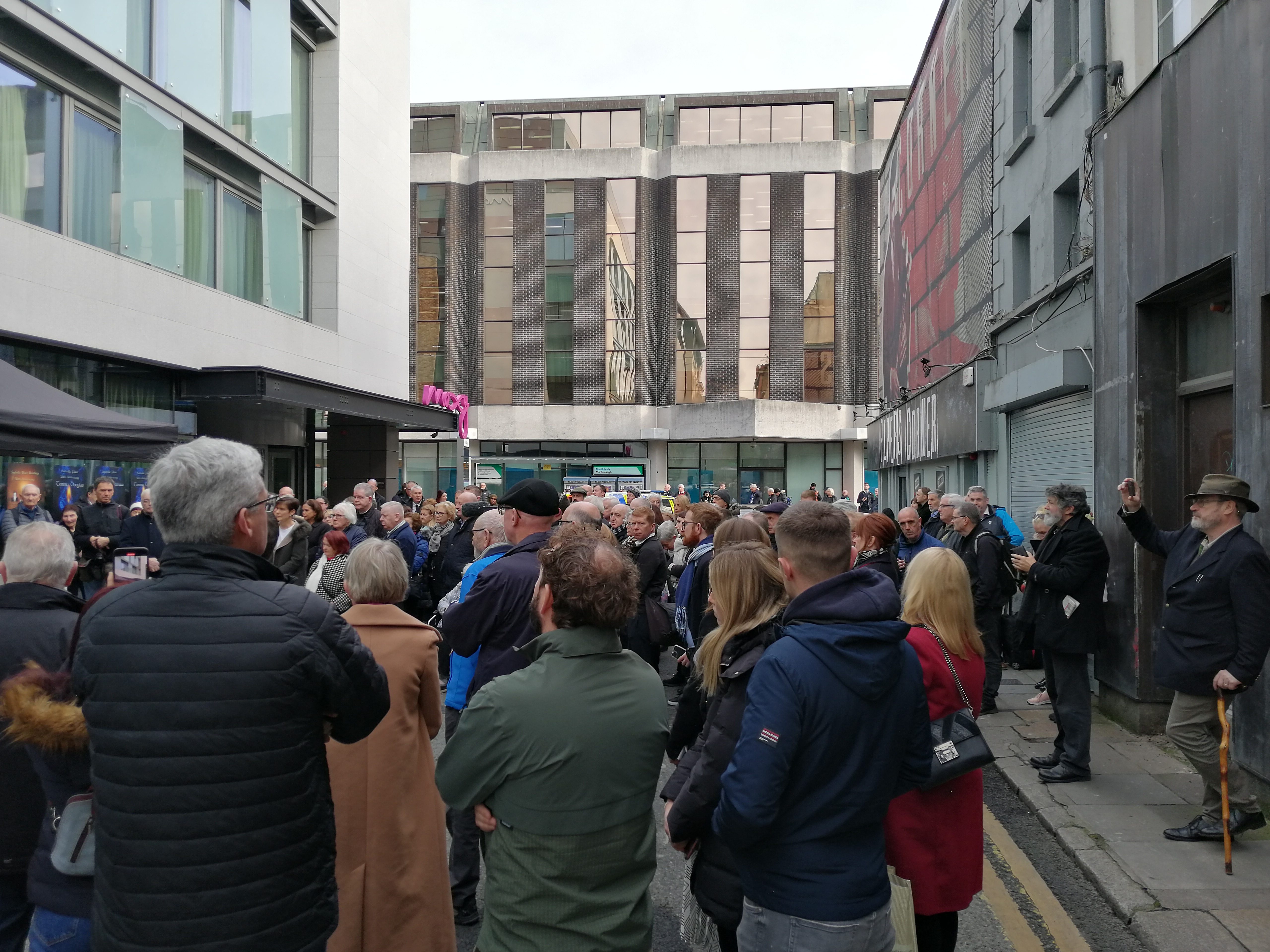
A temporary canopy had been erected with a lectern and amplification in Sackville Lane, between busy O’Connell and Marlborough Streets, next to a plaque set in the pavement commemorating the bombing and its victims there. More than a hundred had gathered around to witness the event.
Tom Duffy, son of Tommy Duffy, one of the victims of the 1972 bombs chaired the event. He is also the designer of the commemorative sculpture ‘A Fallen Bouquet’, inlaid into the pavement which was unveiled in 20045.
Chairing the event, Tom Duffy, son of the murdered Tommy Duffy (Photo: Rebel Breeze)
Tom never met his father; Tom had four months to go before birth in his mother’s womb when his father was killed; his sister does not remember her father either.
Margaret Urwin, of Justice for the Forgotten campaigning group, read out biographies of Bradshaw, Tommy Duffy and Tom Douglas (seeAppendix), detailing their origins and recollections of their bereaved loved ones.
Margaret Urwin of Justice for the Forgotten campaign, organisers of the commemoration event (Photo: Rebel Breeze)
The origins of the victims and partners showed that as well as being a tragedy for Dublin the bombings were also that for other parts of the country and the diaspora, in particular Achill (Mayo), Belfast, Castlebar (Mayo), Fethard (Tipperary), Kilkenny and Stirling in Scotland.
Urwin said they also wished to remember John Hayes, whose 47th anniversary had occurred two days previously and she read a short biography of him too. John was employed at Dublin Airport and was killed by a bomb placed in a toilet on the Arrivals floor on 29 November 1975.
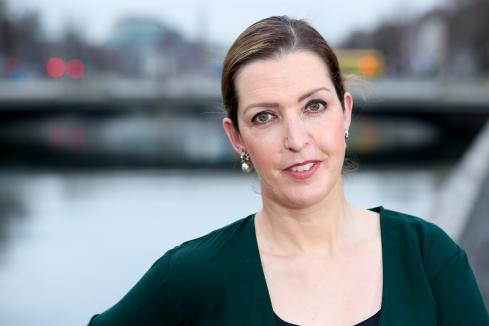
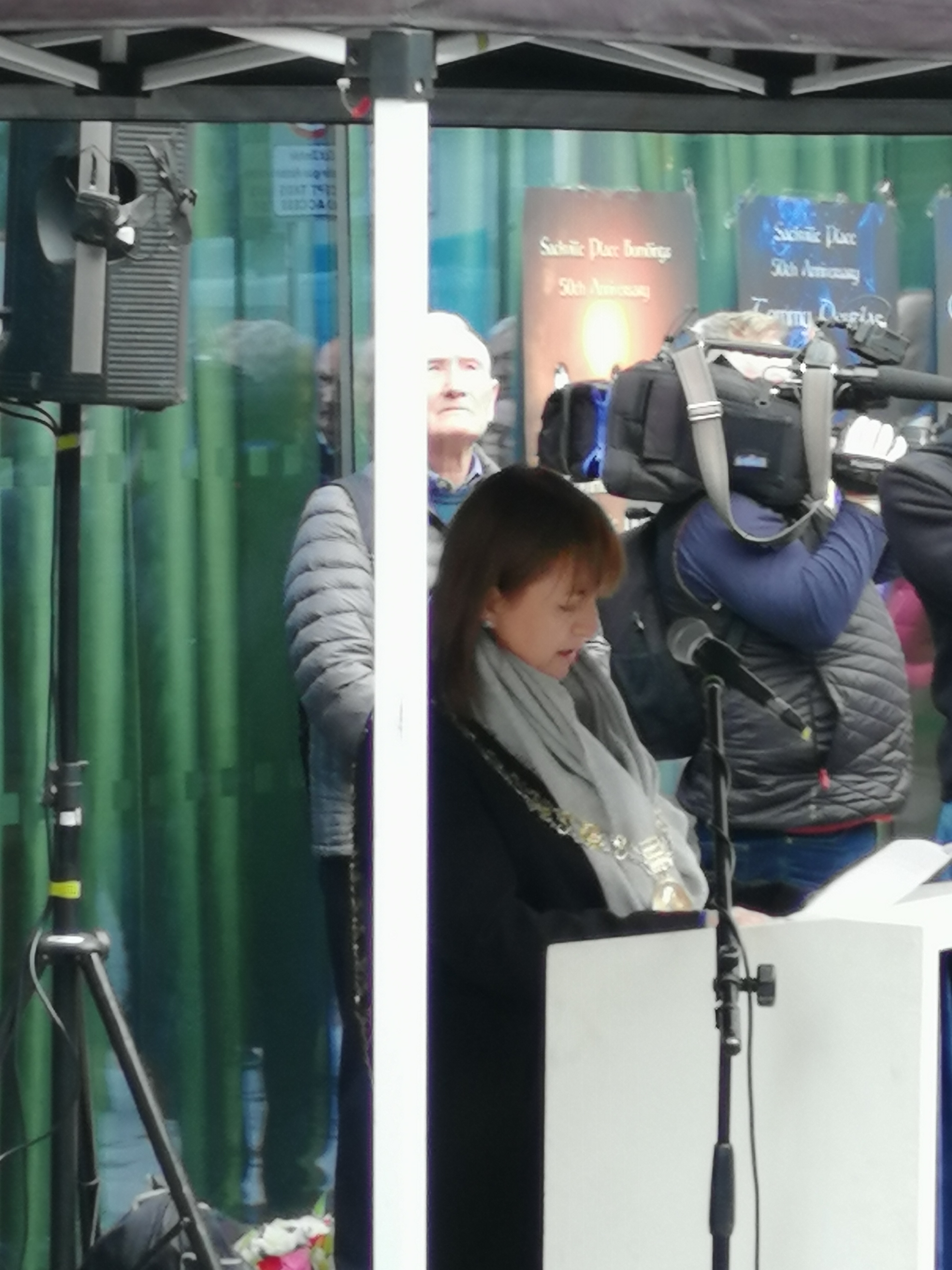
Current Lord Mayor of Dublin (Photo: Rebel Breeze)
The Lord Mayor of Dublin6 gave a short speech in which she underlined the need for remembrance while also decrying that the guilty had escaped so far and that proposed legislation, currently going through the Westminster Parliament, sought to prevent such perpetrators being brought to book.
Finance Manager of Dublin Bus (Photo: Rebel Breeze)
The Finance Manager of Dublin Bus spoke also, saying among other things that the company would never forget and that it was like one big family. However the absence of employees of the company present in uniform and the lack of awareness of many gave the lie to her words (workers tell us that the event had not been advertised internally by the company).
The Education Minister Norma Foley,TD spoke at length about the atrocity and need for all actions to take place within “the rule of law”, in the context of which she went on to castigate the British Government for its proposed 30 Years War legacy legislation to limit inquests and litigation.
Foley went on to state the opposition of the Irish Government’s to the proposed legislation, along with that of the opposition parties, with united faith leaders, all parties in the British colony and the US Government.
Somehow she and other speakers however managed to avoid mentioning the British Loyalist origin of the bombers or that these were chronologically leading up to the 1974 Dublin and Monaghan bombings, with a death-toll of 33 in one day.
Minister of Education (Photo: Rebel Breeze)
Or of the fact that the 1973 bombings had been used to push repressive legislation through Leinster House, including the founding of a no-jury Special Criminal Court, targeted not at British Loyalists but instead specifically at Irish Republicans!7
The omission of this important and relevant information, referred to in Ronan McGreevy’s report for the Irish Times (see link in Sources), though not unexpected on past Government performance, was indeed ironic coming from the Minister with responsibility for education.
Wreaths were laid, including some by relatives of the murdered. A priest also recited a prayer.
MUSIC AND POETRY
Poet Rachael Hegarty, who has also composed and performed a longer poem about the Dublin & Monaghan bombing, performed her composition for this event about the loss of husbands and fathers in the killing of public transport workers.
In between some of the speeches, musicians from the Shillelagh Northside Ukelele Group8 performed Simon & Garfunkle’s The Sound of Silence and Bobby Darin’s Things (including the lines “memories are all I have to cling to”).
During another speeches interval, Cormac Breatnach on high whistle & Eoin Dillon on uileann pipes performed Táimse I Mo Chodhladh and later to conclude the event, The Lark in the Morning. The first piece, no doubt chosen for its lament nature, would do well also as political commentary9.
Large group of Northside ukulele players in foreground (Photo: Rebel Breeze)
IGNORING AND FORGETTING
The age profile of the vast majority of those present meant that the atrocities had occurred within their lifetimes, which is natural; however the near absence of representation of the following two or three generations is not.
It might be observed that this absence is a natural part of passing time but one could also comment that the ignoring of this atrocity is causing an unnatural fracture in the historical memory of a people and a workforce, a result of a conscious decision to prevent the transmission of that memory.
The titles of three of the musical pieces may be seen as comment on that.
Cormac Breatnach playing low whistle (Photo: Rebel Breeze)
Eoin Dillon playing the uilleann pipes (Photo: Rebel Breeze)
Yes, the JFTF organisation continues to hold events to mark the bombings and the Lord Mayor and a Government Minister attend. But not only will nothing serious be done to bring the perpetrators to light – never mind justice – but the memory will be allowed to die out among the living.
The Clery’s building site near the commemoration was at work throughout the event with noise of drilling, banging and shouting, the workers no doubt in ignorance of the event or of its significance. Workers in Dublin Bus uniform passed by regularly from their nearby canteen building.
Two of the latter who stopped in curiosity on the outskirts of the crowd and were engaged in conversation, stated that they had no knowledge of the commemoration or of the atrocity. They opined that their union should have informed and mobilised them to attend.
TARGETING WORKING-CLASS PEOPLE
The bus workers’ canteen is in Sackville Street and it is noticeable that other fatal bombings were targeted at areas more associated with working-class shopping and away from the more affluent ones such as the Grafton or Henry streets. That could be have been due to class prejudice but also to hurt those with less political power.
This made it all the more important for the organisations and parties that have been built by the working class to respond to them. The Labour party, founded by James Connolly, is complicit with the Irish Government in this forgetting and ignoring.
The trade unions, even those of the specifically targeted public transport workers are also colluding with this silencing and forgetting.
From a ‘national’ perspective, the Irish State has permitted a foreign (and occupying) power and its proxies to bomb its capital city on a number of occasions, including the massacre of its civilians. Nothing could more clearly point to the neo-colonial foreign-dependent nature of the Irish elite.
Back in the 1960s and ‘70s, when the Irish trade unions were less compromised than they have allowed themselves to become, perhaps it would have been possible to shut down the building site near to the commemoration for the duration of the ceremony.
Perhaps city bus drivers could at least have stopped everywhere at a given time for an announced minute of silence. Ranks of bus workers could have attended the commemoration event in uniform, supported perhaps by the city’s municipal workers.
Are such gestures still possible? Can we make them so? The working class, far from tolerating this occlusion and deletion of historical memory, needs to mark the atrocity and to mark it strongly, in solidarity and for its own dignity as a class.
End.
Section of the crowd in attendance (Marlborough Street in the distance) (Photo: Rebel Breeze)
APPENDIX – THE BRIEF BIOGRAPHIES OF FOUR VICTIMS
GEORGE BRADSHAW
George, a native of Fethard, Co. Tipperary, was a young man of 30 when he was so brutally murdered in this street 50 years ago. He had married Kathleen, a nurse from Belfast and they had two small children, Lynn and Rory. He had met Kathleen when she was visiting relatives in Fethard and she was the light of his life.
George was employed as a bus driver with CIE and the family had moved from Tipperary to Dublin less than two years before tragedy struck on 1 st December 1972. He had worked previously in South Tipperary Farmers’ Co-op for 10 years.
George had big plans for the future – he was an ambitious man and was attending night-classes in business studies at the time of his death. His favourite hobby was dancing and he also loved to play darts. He was cheerful, fun-loving and an extrovert and is greatly missed by all his family.
TOMMY DUFFY
Tommy, a native of Castlebar, Co. Mayo was almost 24 years old when he was killed on 1 st December 1972. He was married to Monica, who was pregnant with their second child, Tom. They already had a small daughter, Caroline. They had met on the 29A bus when Monica was 17 and Tommy 19. Monica quickly fell in love with this witty young man so full of life and mischief.
Tommy worked as a bus conductor and had several hobbies. He loved to play traditional Irish music on the mouth-organ and spent lots of his free time tinkering with cars. He would buy old wrecks, repair them and re-sell them to make some extra money. He had a Yamaha motor-bike which he loved and also had a flair for carpentry. During the summer months, he liked nothing better than to return home to Mayo to help on the farm, especially with saving the hay.
On the day he died, he was due to work an early shift but had changed to facilitate a co-worker. Monica remembers him as a generous, kind and hard-working young man. She is pleased that their son, Tom, was the designer of the commemorative sculpture ‘A Fallen Bouquet’, which was unveiled in 2004.
TOMMY DOUGLAS
Tommy, a native of Stirling in Scotland was only 21 when his life was so cruelly taken from him in this street on 20 th January 1973. He, along with his brothers and sister, was raised in a Scottish mining community. He was an intelligent, fun-loving, outgoing person with a positive outlook on life. He liked swimming and was a fervent supporter of Celtic soccer team. He had a love of nature and enjoyed hill-walking. He also loved music and attending live concerts.
The family had strong leanings towards Ireland and had spent their childhood summers in Achill Island, the native place of their mother. Tommy loved all things Irish and most of the songs he knew were Irish songs.
When he left school, he served his apprenticeship as an electrician and, after he qualified, decided to move to Dublin. He had been living in Dublin only a few short months and had taken a job as a bus conductor while he hoped eventually to find work as an electrician. His fiancée had joined him a very short time before his death.
After his death, his family learned of his many acts of kindness to those less fortunate than himself. He was a devout Catholic but had many Protestant friends, indeed his fiancée was of the Presbyterian faith. His siblings are proud of him as a brother and thank God they had the pleasure of having him with them for 21 years. They only wish he was with them still.
JOHN HAYES
John Hayes’ 47th anniversary occurred two days ago. John was employed at Dublin Airport and was killed by a bomb placed in a toilet on the Arrivals floor on 29 November 1975. John was a hard-working family man with a wife and three children – twins Brian and Karen (aged 11) and Brendan (aged 3). In his free time he enjoyed a pint of Smithwick’s and was an avid Kilkenny fan. He was an ordinary man, devoted to his family.
The gathering breaking up at end of event, with portrait of famed uilleann pipes player Séamus Ennis in the background above the Pipers Corner pub at the end of Sackville Place and glimpse of LUAS tram to the left. (Photo: Rebel Breeze)
FOOTNOTES
1The State public transport system was called CIE (Córas Iompair Éireann) prior to breaking up into sections for easy privatisation in the ruling neo-liberalism of the 1980s onwards. The Dublin Bus company is one of the carved-up parts, competing with other privately-owned bus companies around Dublin.
2While the targeting of a monument to Daniel O’Connell “The Liberator” (his monument in O’Connell Street was also bombed), a campaigner for the repeal of the anti-Catholic Penal Laws might seem as an act of pure religious sectarianism by Protestant bigots, the blowing up of the Wolfe Tone monument was essentially political. Theobald Wolfe Tone was a leader of the revolutionary United Irishmen, a Protestant as were most of his leadership colleagues and is often described as “The Father of Irish Republicanism”. Only the head survived the explosion but it was attached to the recasting of the statue.
3See the Wikipedia entries on the 1972, ‘73 and ‘74 Dublin bombings.
433 people and a full-term unborn child were killed in that day’s bombings.
6 Caroline Conroy of the Green Party holds the position in annual rotation this year.
7The proposed Amendment to the Offences Against the State Act in 1973 was heading for trouble in Leinster House until the bombings apparently stampeded some of its opposition into supporting it. As a result the no-jury Special Criminal Court was established which until very recently, with one exception, tried exclusively Irish Republicans, able to jail them mostly on the word of a senior Garda officer. This undemocratic piece of legislation has been thoroughly condemned by the Irish Council for Civil Liberties; Sinn Féin regularly opposed its renewal until a few years ago when it began abstaining and this year at its congress voted that such legislation is required “in some circumstances”.
8The name of the group was collected from participants but searching on FB and Google has failed to find a link for them.
9“I am asleep and do not wake me”, an Aisling poem/ music in Irish, origin contested between Ireland and Scotland, played in the 18th Century but date of composition unknown.






















 rebelbreeze