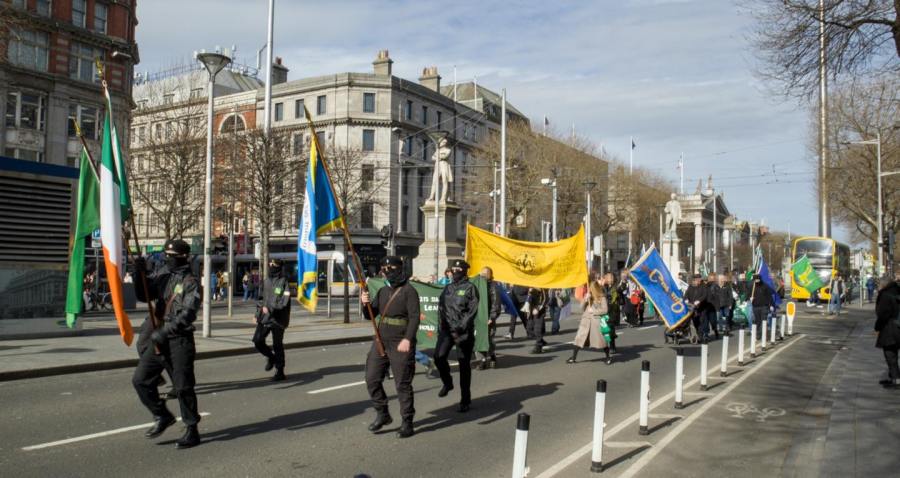
The recognised date known as International Working Women’s Day is March 8th and it was commemorated on that date with a march and revolutionary words and symbolism organised by Irish Socialist Republicans in Dublin.
The marchers gathered outside Wynn’s Hotel in Lower Abbey Street, to mark the founding there of the revolutionary Republican military women’s organisation, Cumann na mBan, on 2 April 1914. The organisation, with its own officers, was possibly the first of its kind for women in the world.1
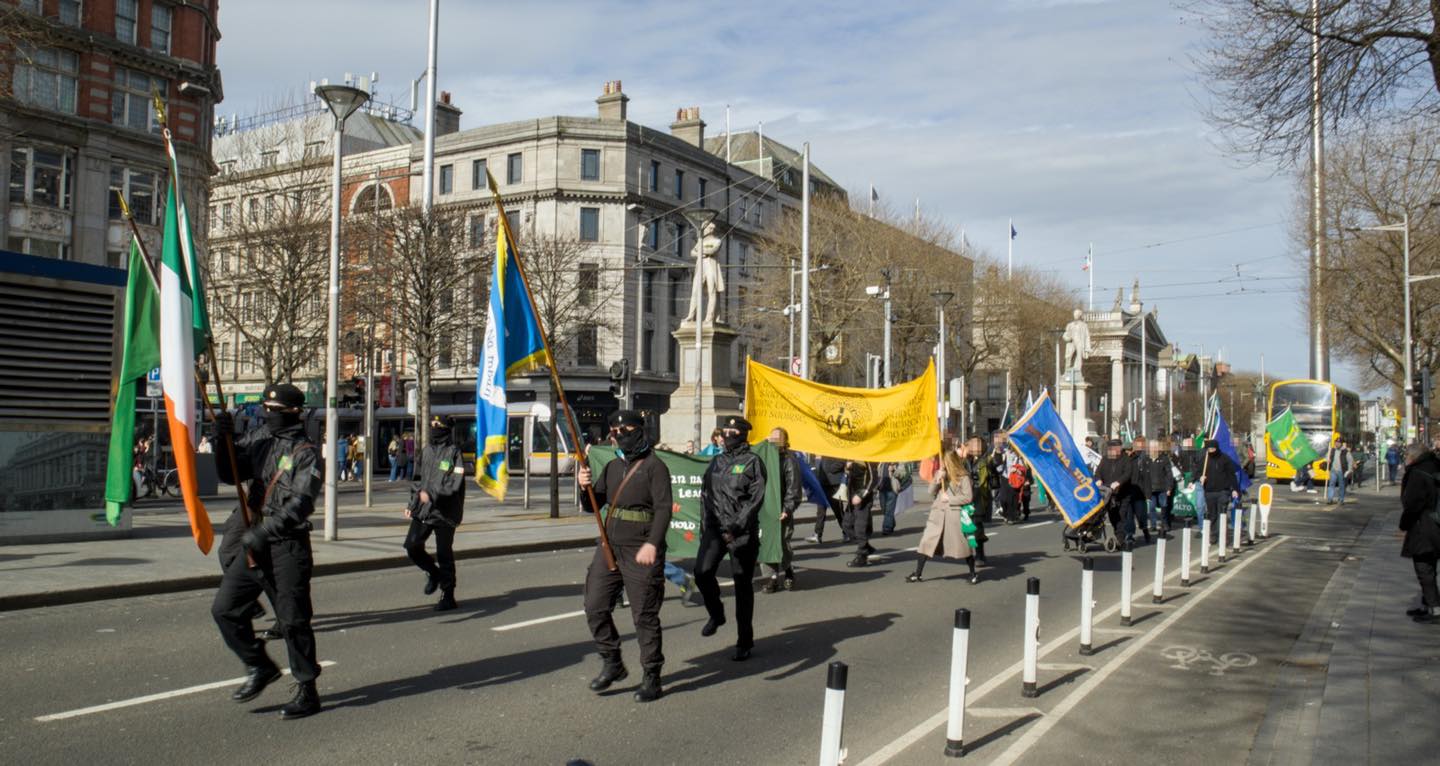
From there the march set off into O’Connell Street, then marching southward to cross the Liffey into D’Olier Street before turning left into Townsend Street, continuing to the statue of Constance Markievicz where the colour party’s flags were lowered in respect.
The march near the start in O’Connell St (photo credit: An Pobal Abú FB page)
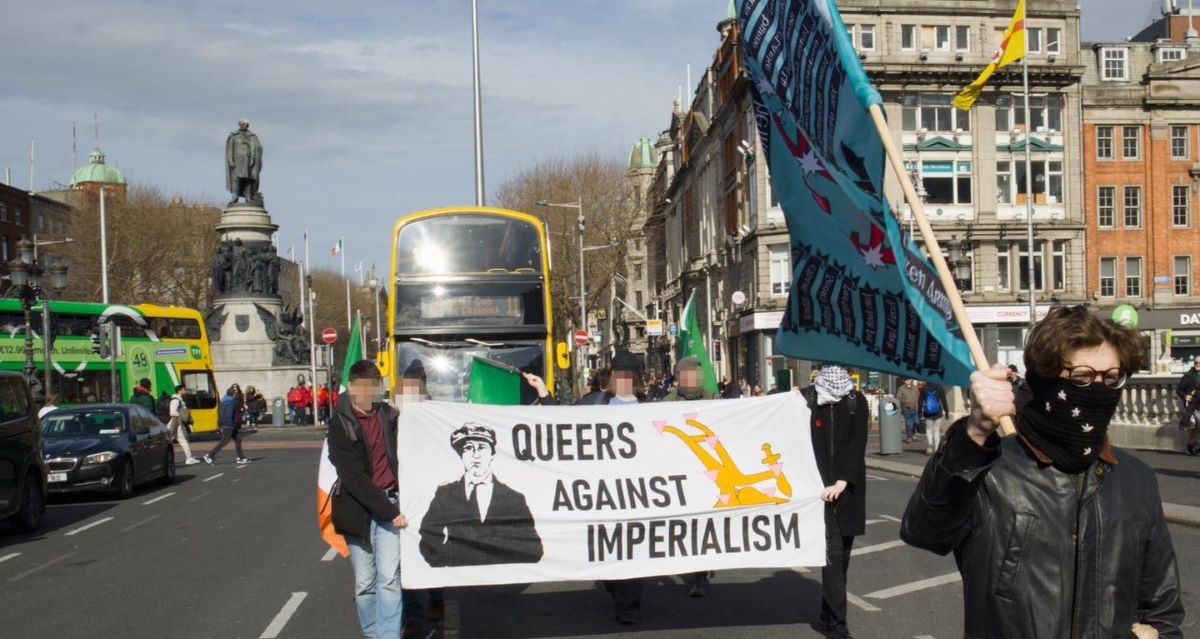
Throughout, chants of “Ní Saoirse go Saoirse na mBan”2 and “Britain out of Ireland” reverberated through the streets of Dublin as banners displayed the slogans “coinníonn na mná suas leath na spéire / women hold up half the sky” and “Queers Against Imperialism”.
Markievicz was an active member of Iníní na hÉireann, the Irish Citizen Army and of Cumann na mBan. She was part of the command of the Stephens Green/ College of Surgeons garrison in 1916 and elected MP on an abstentionist ticket in 1918 and Minister of Labour in the First Dáil in 1919.
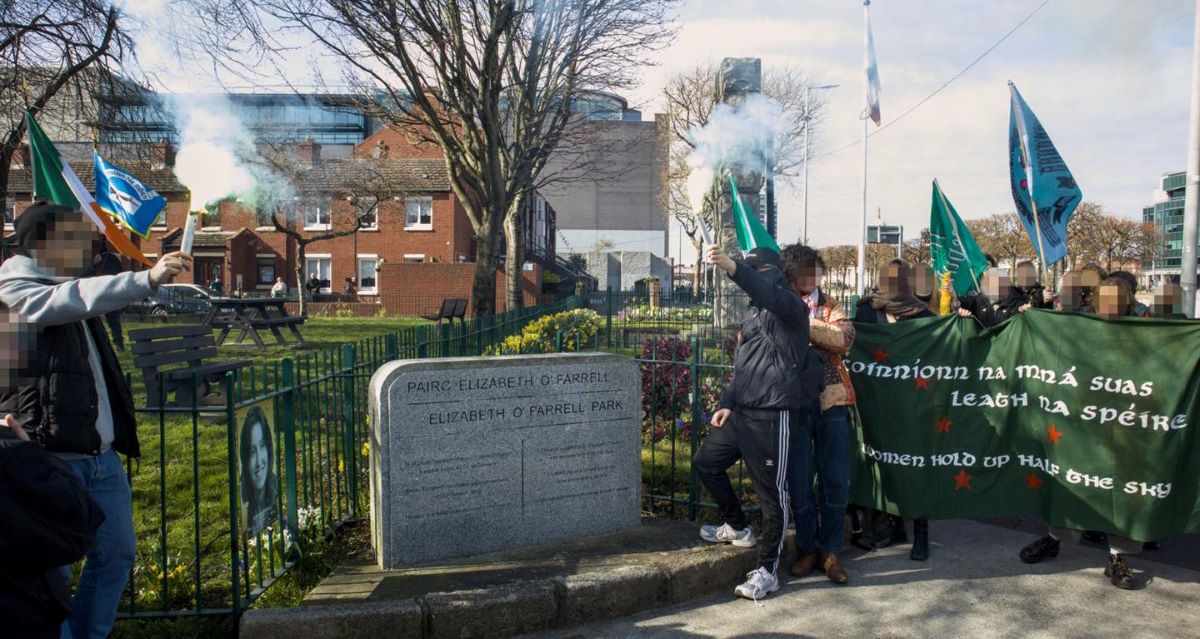
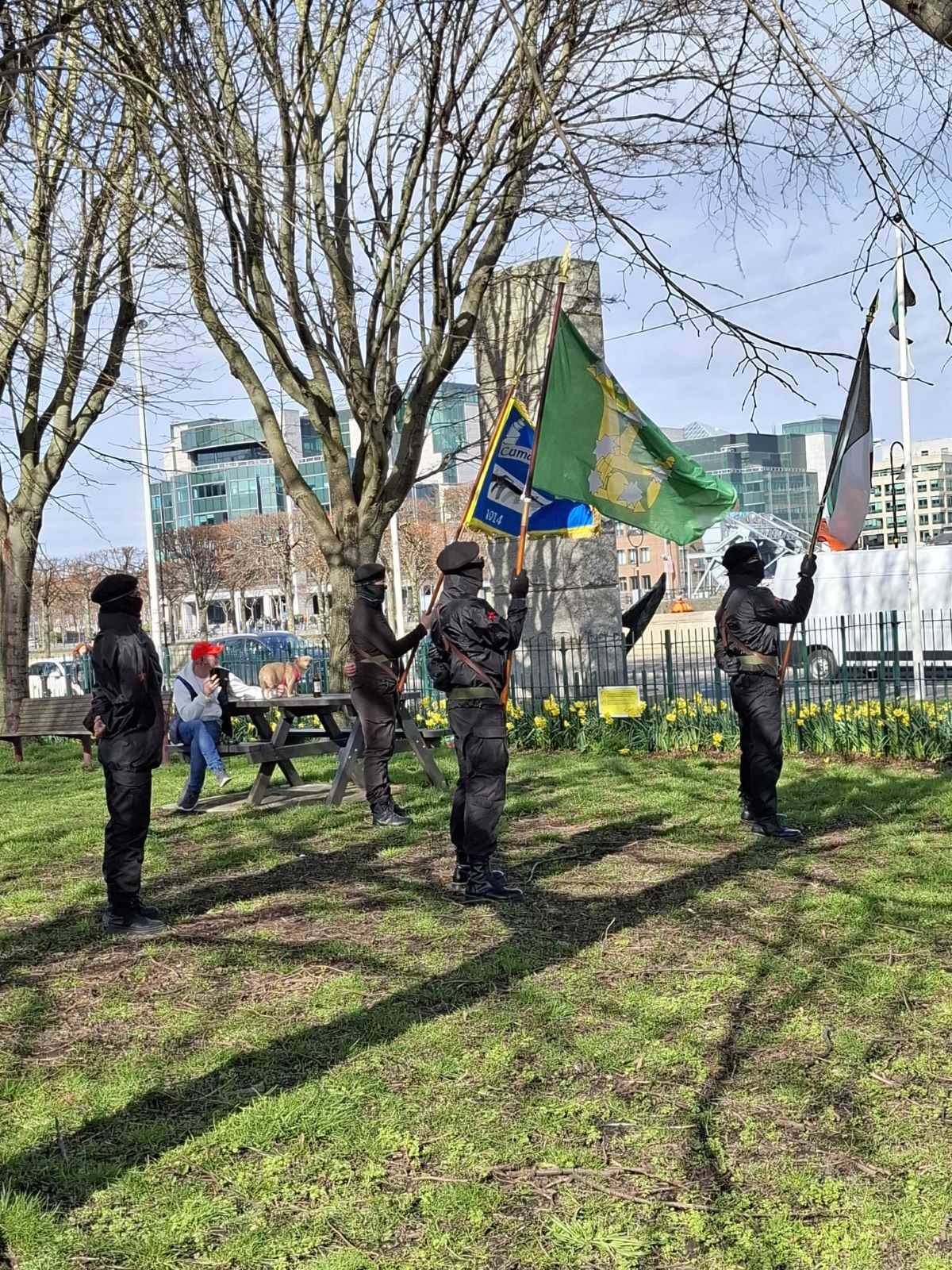
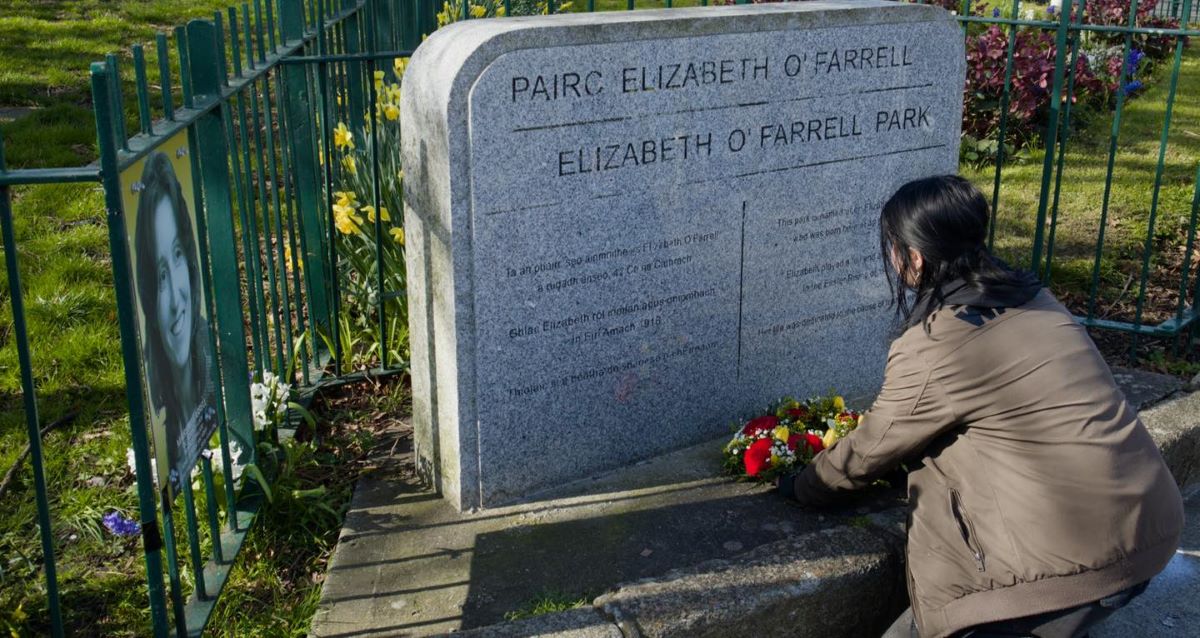
Continuing along Townsend Street and ending at Elizabeth O’Farrell park where a commemoration was held outside in honour of the role of women in the struggle for national liberation while the colour party took up position inside the park.
(Photo credit: An Pobal Abú FB page)
A woman read a speech on behalf of the AIA, tracing founding of International Women’s Day from when women in Russia in 1917 had led strikes and marches against the Tsar and WW1, later becoming known as the February Revolution, leading later to the October Socialist Revolution.
The speaker went on to speak of the role of women in the Republican struggle, from Cumann na mBan, the Irish Citizen Army and Armagh Gaol Republican prisoners, followed by a woman reading the 1916 Proclamation of Independence and the burning of two green flares.
(photo credit: An Pobal Abú FB page)
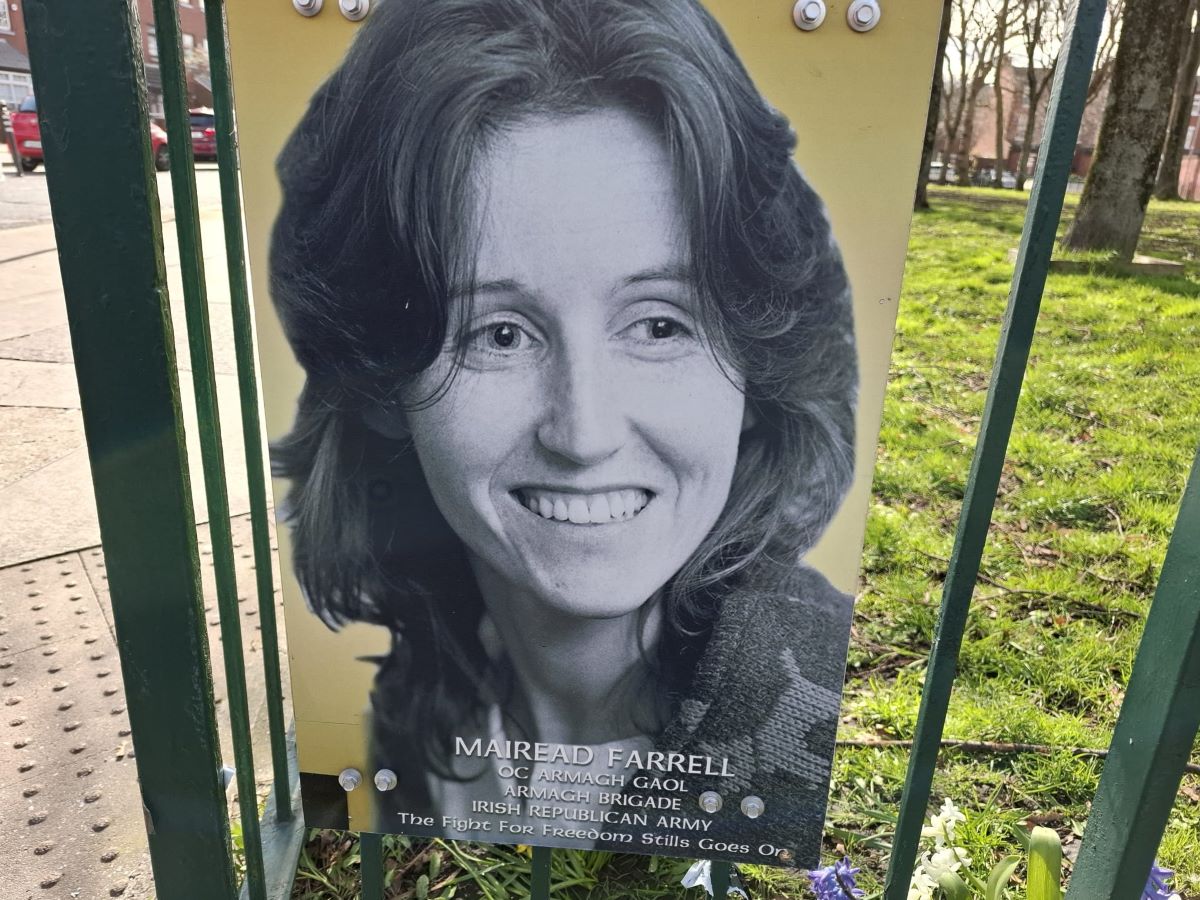
A new plaque of the Socialist Republican Mairéad Farrell was unveiled with the laying also of a commemorative wreath during a minute’s silence observed for all revolutionary women and gender oppressed people who gave their lives for national liberation and anti-imperialist struggle.
The Colour Party in Elizabeth O’Farrell Park (Photo: R.Breeze)
At the same time the colour party lowered their flags in respect, during which the command calls in Irish rang out in the area through the silence.
The area in which the Elizabeth O’Farrell and her life-long friend Julia Grenan3 grew up is a south Dublin docklands still largely working class area. It was in a yard in Lombard Street nearby, actually within sight of the park, that the IRB (Fenians) was founded on March 17th 1858.
Laying of the wreath (photo credit: An Pobal Abú FB page)
Elizabeth O’Farrell and Julia Grenan both participated in the 1916 Rising and, along with Winifred Carney, refused to join the earlier evacuation from the burning GPO building on the Friday, later participating in the final evacuation which ended in the central terrace in Moore Street.
When the leadership took the decision to surrender, O’Farrell went out to negotiate under a white flag even though a man had been killed under such a flag earlier in the very street. In 1922, along with almost the entirety of Cumann na mBan and the ICA, she rejected the Anglo-Irish Agreement.
(Photo: R.Breeze)
Many women were interned by the nascent neo-colonial Irish Government.
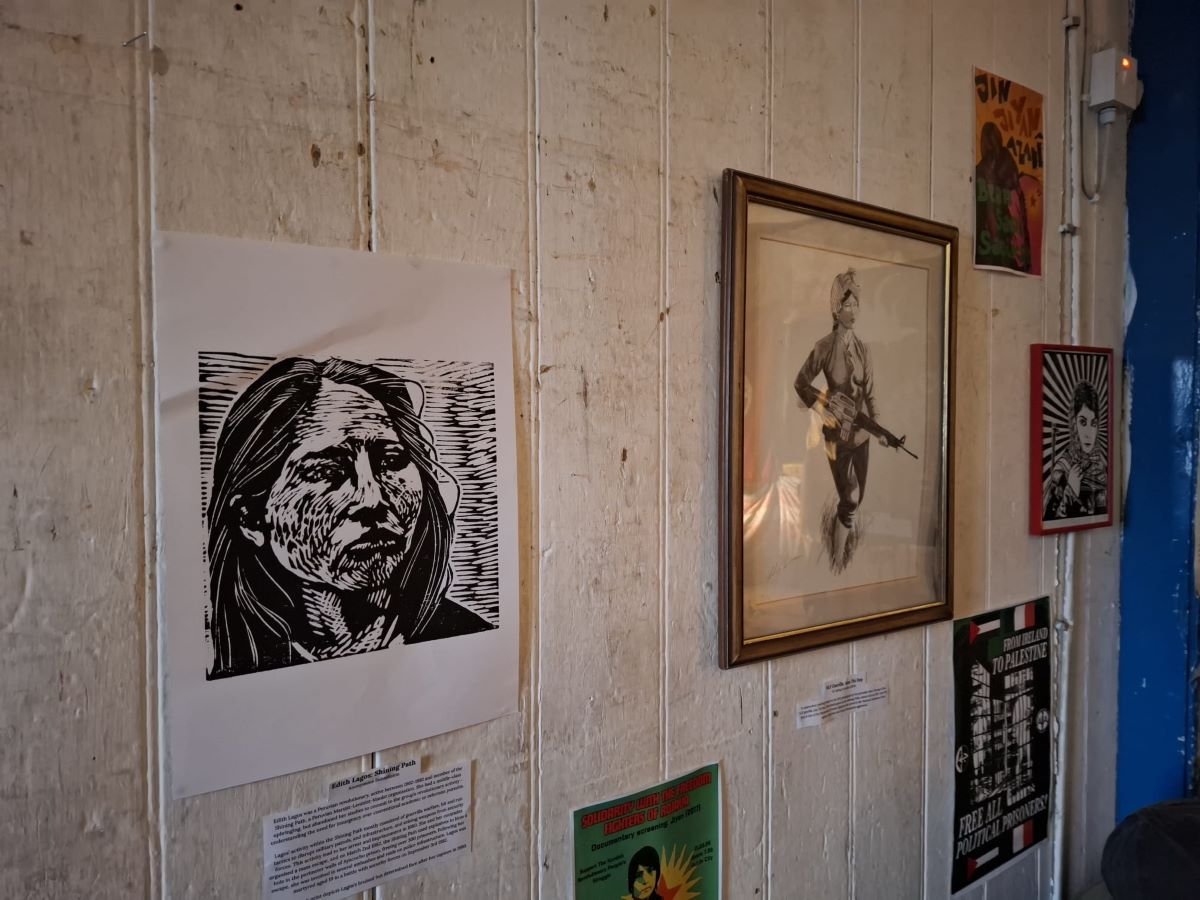
After the Elizabeth O’Farrell Park event, people gathered again at a recently-occupied social centre in Dublin, to view an exhibition of images in honour of the day and to watch an English-subtitled French-language film about women and the Omani Resistance, followed by a music session.4
Part of exhibition for International Working Women’s Day in the social centre (Photo: R.Breeze)
End.
Note: If you found this article of interest, why not register with Rebel Breeze for free, so that you will be notified by email of subsequent articles. You can de-register any time you wish.
Footnotes
1In its early years the organisation worked mainly as an auxiliary to the Irish Volunteers but asserted greater independence at a later stage. It coincided in time with the women in the Irish Citizen Army who shared equal status with male members and indeed in the case of some of them, such as Markievicz and Lynn, actually commanded men. Wynne’s Hotel was also where the decision to found the Irish Volunteers had been taken in 1913.
2Translated as ‘There can be no freedom until women are free.’
3And life partner, many have speculated – certainly they lived together until the end.
4The Hour of Liberation Has Arrived by Heiny Srour
(Reprinted from author’s substack on 01/03/2026 and reformatted for WordPress. All graphic images created or chosen by R. Breezeeditor)
The English band Chumbawamba recorded a song called The Day The Nazi Died about how the Nazis never really went away.1
The song references the Nazi leader Rudolf Hess, who was not executed following WWII but was instead held a prisoner in Spandau Prison until he took his own life at the age of 93.
The song asks why when we were told that the Nazis had died did they all come out on the day Hess died and points to the boardrooms of companies as maggots getting fat on the decaying flesh of capitalist society.
The band were not wrong. Some of the Nazis and boards of companies that did not go away are now involved in the genocide in Palestine.
Goosestepping as a military parade practice has gone out of fashion in most Western countries, but stomping on the peoples of the world is very much in fashion.
Many companies such as Porsche, Mercedes, Volkswagen and even IG Farben – the manufacturers of the gas used to murder millions in the camps – went unpunished after WWII. Some companies were even compensated for the damage to their factories.
Lots of other German companies passed under the radar.
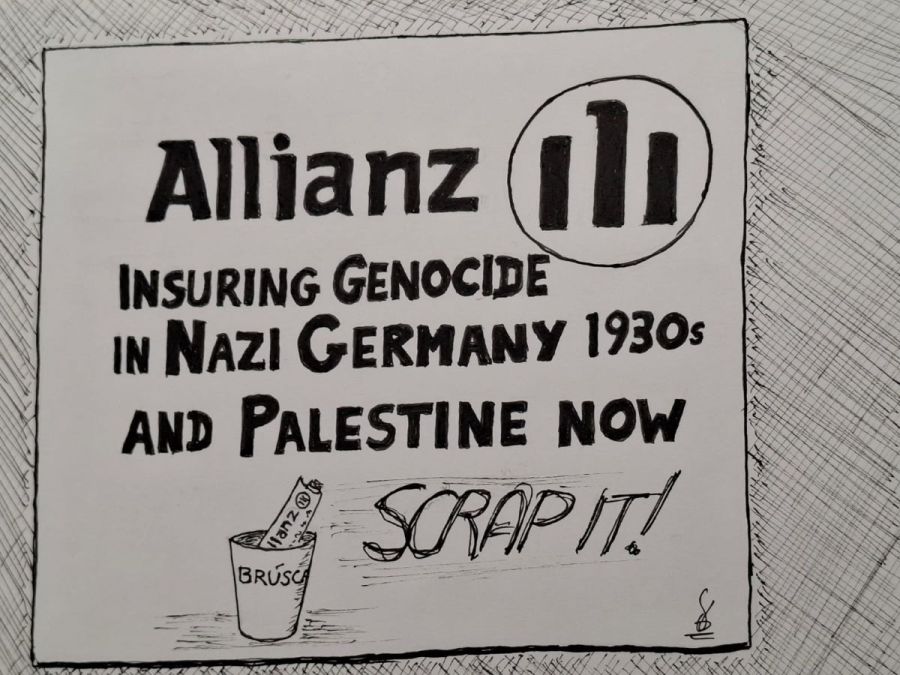
Hugo Boss was never taken to task for making the Nazis look so sexy in their murderous swagger and Allianz the German insurance company that insured parts of the camps and the ghettos against fire and damage to their installations survived intact.
Apparently, they didn’t specifically insure the ovens or gas chambers, but the camps were a whole unit. Any part insured contributed to all of it running smoothly.
Of course those who died in the gas chambers and were pushed like peat brickettes through the ovens were not covered, just the Nazi property.
Hugo Boss can make no claims to being pressured, he was a member of the Nazi party before Hitler ever took power. He wasn’t betting on which horse won the race, he was the horse in the race.
Allianz likes to present itself as just another company that did business with the Nazis in order to continue functioning and that they had no choice, Krupps makes similar claims about its use of slave labour, saying they had to.
Cartoon by D.Breatnach
That is a dubious claim, when you look at their history. But also morally there is no basis to it. You always have the choice, some Germans lost their lives fighting the Nazis, not losing your money is hardly an excuse.
What companies such as Allianz did is make a cost benefit analysis. They calculated that not doing business with the Nazis would affect their profits, so they insured the camps but not the people pushed through the ovens.
The company claims a certain naivety on its part about what was happening.
But you can only take that at face value if you ignore that the director general of the company the antisemite Dr Kurt Schmitt resigned his post with Allianz in 1933 to become Hitler’s first Reich Minister of Economic Affairs.
He had previously turned down the post when it was offered to him by the Von Papen government before the Nazis took over.
He had to step down for health reasons, but when he recovered he went back to Allianz to administer it. It also claims it made no money from the camps contract.
This does not mean there was no money to be made, it means it wasn’t as profitable a contract as it thought, but it managed to get other contracts from the Nazis.
If you read the company’s website you come away with the distinct impression that they would like us to think they were a victim of the Nazis and we should pity them.
It turns out because they were on the losing side and because the war didn’t go ahead as planned with Hitler steamrollering his way to Moscow, the war was not as profitable as it should have been for insurance companies.
In the following quote it is clear that 1943, following the Nazi defeat at Stalingrad, the tide turned not only in the war but in the accounts ledgers.
After Germany overran Poland in 1939, the business of the insurance sector became characterized by the risks associated with the war.
Doing business in wartime meant obeying the principle of “minimizing new dangers and taking maximum advantage of new business opportunities.”
The repercussions of the war were detrimental to business as a whole and at the end of the war, Allianz was on the brink of ruin. Even so, until 1943 the company had managed to increase its profits by a considerable margin.2
Even today the company whitewashes its record and states in glowing language that:
Kurt Schmitt’s energetic course of expansion in the 1920s had made Allianz the largest insurance company in Germany. In 1933, Schmitt became Minister of Economic Affairs in Adolf Hitler’s government.
In 1935, he resigned from this post as he was unable to implement his political ideas and his health was failing. After his recovery, he returned to Allianz and in 1938 became General Director of Munich Re.3
No, not true, the Nazi stepped down because he had a heart attack, not over disagreements about economic policy and though it is not stated, there is a sleight of hand which leaves you wondering whether he had disagreements over the treatment of Jews.
This antisemite had no such disagreements with the Nazis at all. He was well known to them before they ever took power. He knew who and what they were.
The company’s site is not that detailed about the period and there are lots of sleights of hands in how it presents information. For example, it is mentioned that the company opposed Nazi attempts to nationalise the insurance industry.
But not because they opposed the Nazis, but because it might affect their profit margins.
But not even Allianz can completely deny reality. Their site does acknowledge that it began to come clean about its role following a lawsuit in the US against insurance companies and set up a study into its activities.4
It did it, because it was forced to. Had they really been forced to insure the Nazis against their will they wouldn’t have waited till 1997 to start publicly owning up.
They commissioned Dr Feldman a Jewish historian to look at their history. He quotes Schmitt as talking about the Nazi position on Jews as explained to him by Göring that:
I must honestly say, that I had no reservations about this line, for it cannot objectively be contested that in our public and intellectual life, beginning with the Reichstag, in the press, and also in many scientific faculties, in the legal field and above all in the Berlin banking business, the Jews had too strong and too loud and also an unhealthy influence.5
Feldman goes on to say of this that:
…it is important to recognize that the responsibility for the evils that he [Schmitt] and his organization [Allianz] were to experience and perpetrate during the coming years lay to an important extent in the fact that he (and others like him) shared a political culture and an anti-Semitic posture that made the coming and installation of the Third Reich possible.6
Of Schmitt he says that:
Schmitt was rather more enthusiastic and active than his colleagues in pandering to the new order at this time.
Not only was he prominently on display at the aforementioned Hitler birthday festivities, he also catered to the “socialistic” side of the regime while playing the public defender of employer interests with the new rulers as well.7
Now we have come full circle. The people who tried to profit from the Third Reich and the camps are once again involved in a genocide, not only as an insurance company but also as a direct investor.
Allianz has invested USD 960 million in Israeli war bonds, or genocide bonds as they are more accurately known. I
n 50 years’ time, they might hire some Palestinian historian to write the history of collaboration in yet another genocide and their website might just say they had no choice but to maximise profits in line with their legal duty to their shareholders or some such rubbish.
Last time, none of the Allianz board were sent to the gallows. They all did very well out of the war and the company went on to become not just Germany’s largest insurance company but a major player in the global insurance industry.
It is as the Chumbawamba song says:
The world is riddled with maggots; the maggots are getting fat They’re making a tasty meal of all the bosses and bureaucrats They’re taking over the boardrooms, and they’re fat and full of pride.
This time, should we ever get a day of reckoning to cite the much abused quote from Karl Marx we should make no excuses for the terror. They should have all their assets confiscated and they should meet their end hanging from a rope.
So if you meet with these historians, I’ll tell you what to say Tell them that the Nazis never really went away. They’re out there burning houses down and peddling racist lies And we’ll never rest again until every Nazi dies.
Note: If you found this article of interest, why not register with Rebel Breeze for free, so that you will be notified by email of subsequent articles. You can de-register any time you wish.
The quisling Palestine Authority killed a three-year-old girl and her teenage brother Ali in an ambush to capture their father, Amer Samara, whom they also shot in both legs. The reason? Amer was wanted by ‘Israel’.
If the PA represents the Palestinian people, why would they even try to arrest someone for the Occupation, never mind open fire on the family car? But this is not out of character – Samara is not the first member of the Resistance wanted by ‘Israel’ that the PA have hunted or even killed.
In May 2024, the PA forces shot dead Ahmed Abed-Foul in his car in Tulkarem and in December of that year also killed Yazeed Jayasa’a, a senior member of the Jenin Brigade of Islamic Jihad. In January 2025 they killed father and son Mahmoud and Qasem al-Jalqamousi, also in Jenin.
In March 2025, again in Jenin refugee camp, they added Abdul Rahman Abu al-Muna of Islamic Jihad to their toll, the PA calling him ‘an outlaw’. There are others who were captured alive and fill the PA’s prison while others, after highlighting by the PA, are arrested by the IOF.
Some escaped for awhile, like the wounded Abu Sujaa(Mohamed Jaber), when the community packed the hospital and prevented the PA from arresting him. The PA fired tear gas inside the hospital, pepper-sprayed and batoned people, including women but had to leave empty-handed.1
Photos of Rozan Samara before and in hospital after being shot by PA armed forces. She died shortly afterwards, as had her teenage brother, also shot by the PA. (Photo sourced: Palestine Chronicle)
And not just resistance fighters but also dissenters, critics of Fatah, the PA and its repression like activist Nizar Banat in June 2021, beaten to death.2 Palestinians in the West Bank have to be careful what they post about the PA on social media because people get arrested or beaten up for that too.
The creation of the PA is part of the Oslo pacification process of 1993-2000.3 The secular then-resistance organisation Fatah got elected in the West Bank and Gaza to run it, run by their man Mahmoud Abbas but in the next elections, people overwhelmingly voted for Hamas instead.
The western imperialists couldn’t manipulate Hamas and refused to recognise the people’s wish and so cut their finances. Fatah tried to ignore the election results in Gaza which led to a short civil war which Hamas won, then taking the positions to which they had been elected there.
In the West Bank, Hamas also had the majority of votes but pulled back from civil war, so Abbas held on to his and Fatah’s corrupt and repressive fiefdom, never holding elections again because they would lose them. Even the western imperialists admit that PA needs radical reform.
But they do so for the same reason that they support the two-state solution (sic), as a Quisling neo-colonial administration to buy off while it divides, spies upon and controls the Palestinian people on 20% of Palestinian land under the guns and eyes of the Israeli Zionists.
The Zionists however no longer desire even this, wanting now only the elimination of any idea of Palestine, hence the genocide and holocaust they are committing in Gaza and the further takeover of the West Bank, settler attacks on Palestinians and further expansion of Jewish settlements.
Reluctance to picket or denounce them?
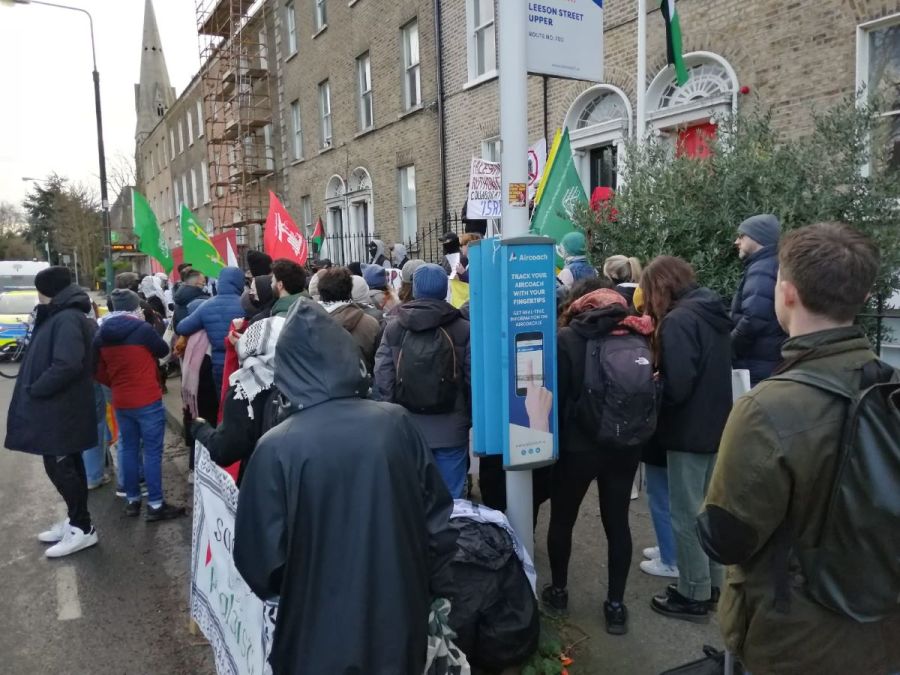
To my knowledge the representative of the PA in Ireland has been confronted publicly and accused of working for a quisling organisation only once and their official residence in Dublin picketed only twice. I am glad to say I was able to attend on those two occasions.4
View of Palestine solidarity marchers picketing the PA’s Palestine Dublin Embassy (building on the top right of photo) in January 2025 (Photo sourced: R.Breeze)
The public denunciation of the PA Ambassador was by a small group of Palestinians at a Belfast Sinn Féin meeting she was addressing a very little over two years ago5. The Palestinians6 were quickly silenced and evicted to cheers from many in the attendance.
Meanwhile, the PA continues to work against the majority of Palestinian society, both inside Israel-occupied territories and in the diaspora, continues its corruption and nepotism and repression against Palestinian dissent with active operations against those wanted by the occupying Zionists.
The PA is getting a relatively free from criticism ride in Ireland and some may say this is in order not to split the solidarity movement. But the split between the people and their traitors is already there and is marked by the actions of the collaborators.
View of section of the crowd protesting the Palestine Authority’s Dublin Embassy (in photo background) in January 2025. (Photo sourced: R.Breeze)
Some may object that exposing the PA will distract from the movement of solidarity with Palestine. How so, do they claim? Collaborators are an important part of occupation and repression and exposing them is an integral part of resistance and solidarity work.
Epstein, Trump, Mandelson etc are all part of the same evil and exposing them, far from being a distraction, shows us the linkages between them, amplifies the call for solidarity with the Palestinian people and educates us in the struggle for a just world.
The representatives of the PA should be shunned by all who are in genuine solidarity with the Palestinian people but furthermore their representatives and offices should be picketed frequently in order to expose them and what they represent.
We need to ask ourselves whether we really support the Palestinian people or do so while somehow also tolerating its quislings and traitors. Have we learned nothing from our own history and our cultural hatred, expressed in song and story, of collaborators, traitors, agents and informers?
End.
Note: If you found this article of interest, why not register with Rebel Breeze for free, so that you will be notified by email of subsequent articles. You can de-register any time you wish.
6The protesters were also calling on SF not to attend the US Presidential St. Patrick’s Day party; SF did so that year (as in all years previously invited) but felt obliged to skip it in 2025.
There is an unfortunate trend in the socialist movement in Ireland to underplay or even to completely ignore the continuing colonial occupation of Ireland, while at the same time raising the other evils of imperialism and capitalism.
This harmful trend is epitomised by an article from Paul Murphy in the current issue of the ecosocialist Rupture magazine1 (of RISE, a network of the People Before Profit political party) – without conscious irony entitled THE MAIN ENEMY IS AT HOME – TODAY.
In the piece under discussion, Murphy discusses the blocs forming up in contention and for world war, with the US leading the western bloc and China-Russia the Eastern,2 with the ruling classes of the EU and Ireland lined up with the USA, though the Irish State is not yet a part of NATO.
Rupture Magazine generic image
This is a correct analysis by Murphy and he is right to call for defence of the Triple Lock3 as far as we can in order to prevent or at least impede the Irish ruling class from dragging the population of the Irish state into imperialist war.
Invoking the threat of NATO as a war-making alliance and danger to the limited neutrality of the Irish state is of course absolutely correct. But how can the actual NATO membership of the Occupied Six Counties be ignored in that analysis? Yet Murphy does so, completely.
Murphy is neither blind nor stupid and one must suspect that he does not mention Britain’s Irish colony because his former and current parties both fear to mix their ‘class politics’ with any kind of Irish nationalism – even anti-colonialism – or to find common cause with Irish Republicans.
Those parties took a sudden interest in the potential politics of a united Ireland only when discussion of that possibility was being thrown around in the media and by some political actors.4 But before and afterwards, they ignored them (except on occasion to castigate Irish Republicans).
The ‘enemy at home’ is indeed, as Murphy states, Irish capitalism – however not also British colonialism? But it cannot be ignored that Irish capitalism is subservient to British colonialism, US and EU imperialism. Well, can’t be ignored by revolutionaries that is, whether Marxist or not.
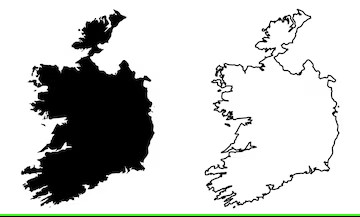
Ireland as treated in the Rupture analysis – but something’s missing! (Image sourced: Internet)
It was through analysis of the subservience of the Irish capitalist class that Connolly wrote that “Only the Irish working class remains as the only incorruptible inheritors of the fight for freedom in Ireland”5 – and that was even before the bourgeois counter-revolution/ Civil War of 1922-’23.
Murphy, PBP and the Socialist Party are all fond of quoting James Connolly but only selectively and never on the question of overthrowing British rule in Ireland.6
A TIMELY WARNING
Before ending let us note that Paul Murphy’s words are not those of some green novitiate; aside from being a TD,7 he is a long-standing member of the Irish Trotskyist movement, formerly a leading member of the Irish Socialist Party before he left it to join PBP-Solidarity.8
Furthermore he has been active at times in street events and was one of the Jobstown Five who were arrested in early-morning raids by the Gardaí and tried but found ‘not guilty’ on charges of ‘kidnapping’ Joan Burton, Tánaiste9 of the Fine Gael-Labour Party coalition government.10
We are entitled to assume, given his prominence and the article’s publication, that Murphy’s political position outlined here is one with which PBP-Solidarity and Rise find no serious disagreement, to the disgrace of any party claiming to be Marxist and revolutionary in Ireland.
Furthermore, their position gives activists timely warning once again that although we may well join with PBP on certain issues, including opposition to US imperialism, they will not be found to the serious side against British colonialism in Ireland or in any fully-committed struggle against NATO.
While upholding principles of a broad front, in any struggle we need to be fairly sure of which forces will stand with us to the end and which may drop us, perhaps even at the worst and most dangerous moment.
End.
Note: If you found this article of interest, why not register with Rebel Breeze for free, so that you will be notified by email of subsequent articles. You can de-register any time you wish.
2In the course of which Murphy states that Russia is an imperialist country but neglects to show any evidence of that. Capitalist and undemocratic does not equal imperialist, which Marxists today understand as the export of finance capital to extract super-profits from under-developed lands through exploitation of the labour there and plunder of their natural resources.
3Ireland’s “Triple Lock” is a policy requiring UN mandate, Government approval, and Parliamentary approval before more than 12 Irish troops may be deployed in overseas support operations.
4Though never taken seriously by some, including myself. I commented that British colonialism/imperialism had many opportunities to end their colonial rule in Ireland and on each occasion had dug their heels in harder, most recently by fighting a vicious war of three decades. In addition, if it were ever even half-considered, it is the British who would decide what the proper majority percentage would be, after which it would need to be agreed in Westminster and then approved by the British Monarch.
6Sadly it is also true that many Irish Republicans quote Connolly only in the reverse, i.e. only about Ireland’s national liberation struggle.
7Teachta Dála, elected member of the lower house of the parliament of the Irish State.
8People Before Profit is now what used to be called the Socialist Workers’ Party, an iteration of a British-based Trotskyist party, as is the Irish Socialist Party similarly of the British-based Socialist Party.
9The Tánaiste is equivalent to Deputy Prime Minister in the UK and many other parliamentary systems.
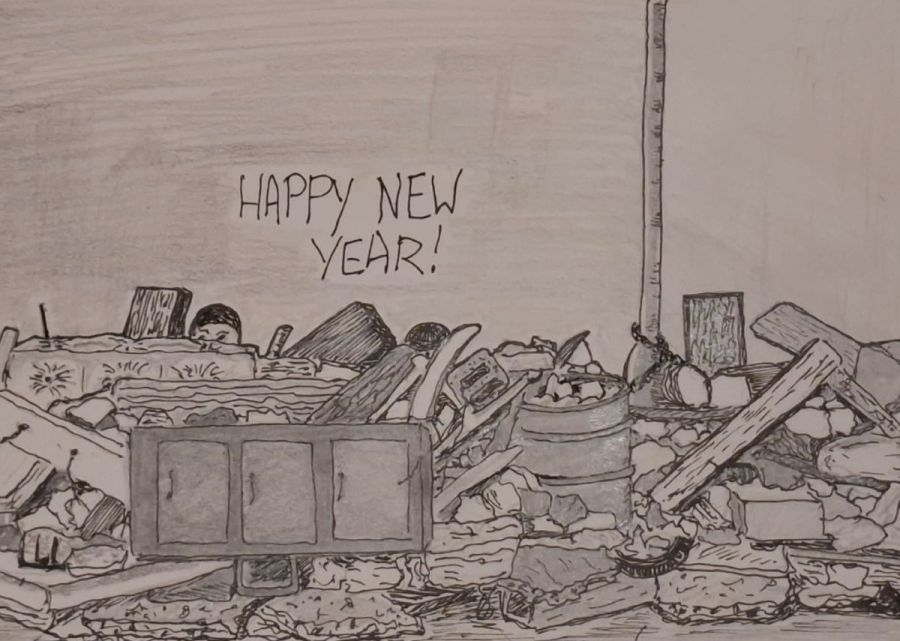
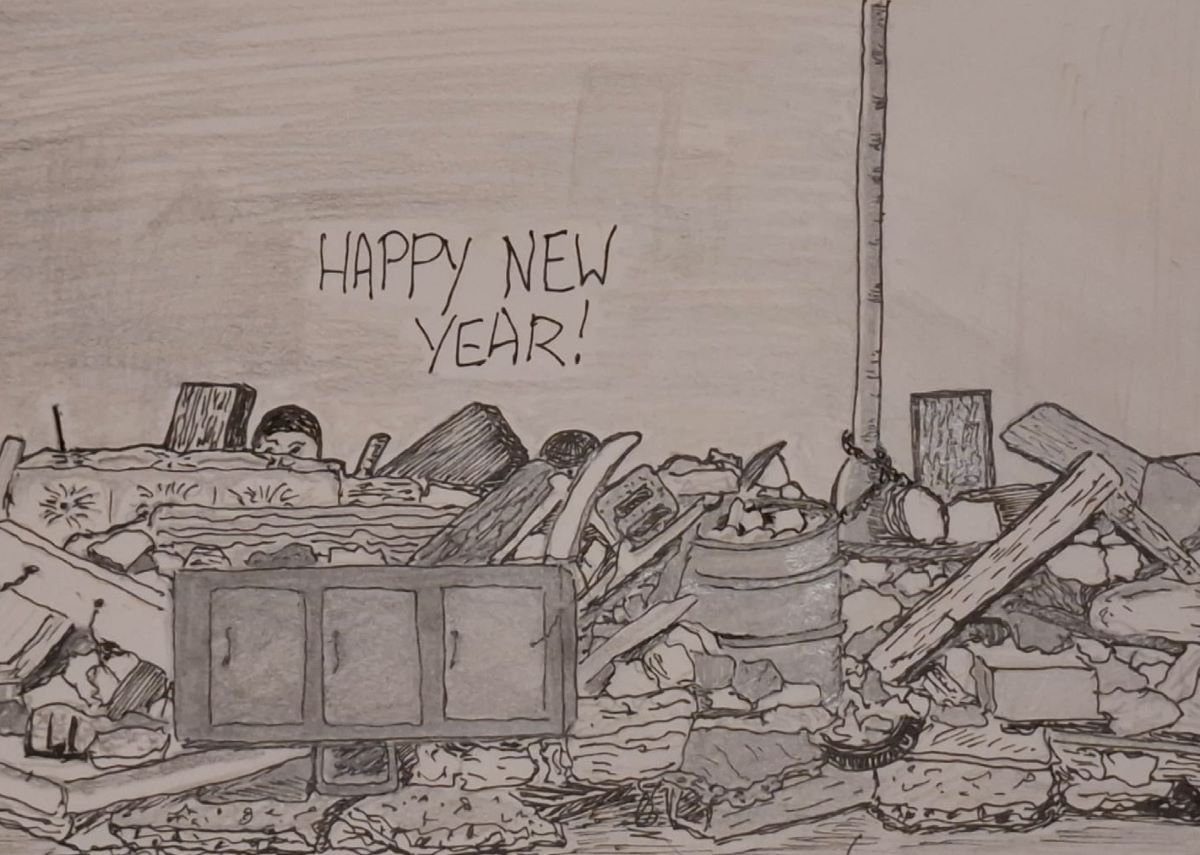
As the northern hemisphere turned eastwards and the majority western calendar turned to a new year, it has been customary for people to wish one another a ‘Happy New Year’, not just for the first day of January but for the twelve months to come.
Although the Celtic New Year will not begin until the first of February, and the new year begins with “teacht an Earraigh … tar éis na Féile Brighde”, I have done likewise but with deep feelings of ambivalence.
Because facing us as 2026 progresses is genocide in some parts of the world, growing fascism in some other parts, tighter squeezes on working people, smaller proxy wars and, almost certainly, a larger war, with desperate migrations of people, if surviving death to find racism and exploitation.
Faced with armed occupation and genocide, armed resistance is justified and arguably necessary, even were it not established as a right within the Geneva Convention. But even unarmed and peaceful resistance is being penalised and repressed, including in the ‘Western democracies.’
Support and solidarity organisations are being outlawed, people expressing legitimate opinions against genocide, racism, ethnic cleansing and armed occupation supported by those ‘democracies’ are being hounded in their jobs and private lives, beaten and arrested by police and even shot dead.
But where there is oppression there is also resistance. The struggles against the racist and genocidal entity, though supported in arms, finance and politically by the Western ‘democracies’ have awoken people in those countries to solidarity action in the face of their governments’ opposition.
(Cartoon by D.Breatnach)
Hugely important lessons have been learned: about the nature of the Zionist state, about the collusion of the ‘democracies’ in colonial occupation and genocide, about ‘the independence of the judiciary’ and the ‘free press’, along with the partiality and ineffectiveness of ‘international law’.
And also about the ineffectiveness of liberal opinion and organisations, even in their heartlands of the ‘democracies’, to achieve meaningful change or even stop the repression. And about how the State knows this and reacts most violently against direct solidarity action.
Organic links have become clear between war in Yemen and Somalia, the spread of Islamist jihadism and imperialism, between prison struggles in Palestine, Britain and Ireland, between the troubles of the world and much of their origins among the colonial and imperial powers.
Yes, where there is repression, there is also resistance and our duty lies in feeding that resistance in all the ways that we can, including being visible in protests at their trials and supporting them in jail. And impeding our ruling class’ attempts to tie us to NATO or other military alliance.
So what I wish for is an increase in the militant resistance of the masses and greater unity in struggle, simultaneously with greater disunity among the imperialist states and ruling classes, bringing us closer to the kind of world we need.
I wish that for us all throughout 2026.
End.
Note: If you found this article of interest, why not register with Rebel Breeze for free, so that you will be notified by email of subsequent articles. You can de-register any time you wish.
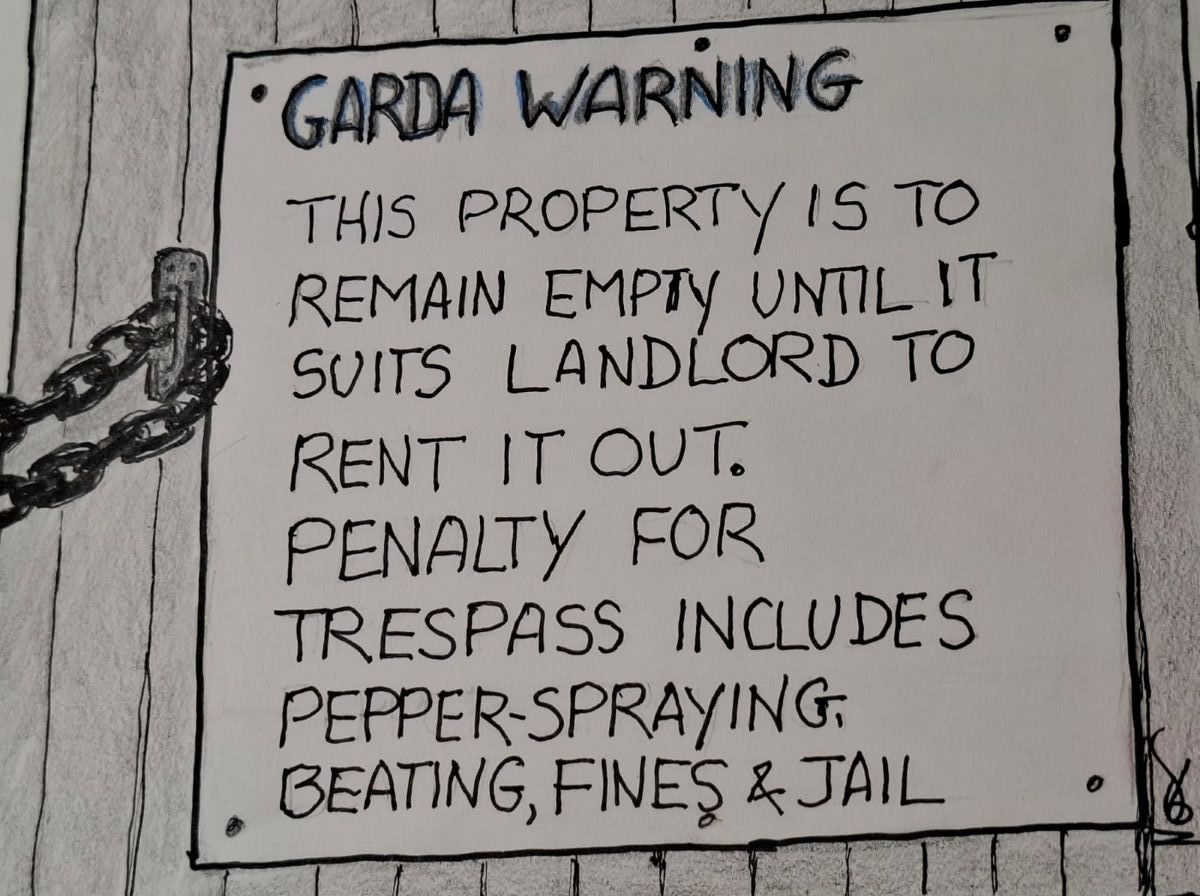
Five people sitting down to a meal were surprised by a knock on the door of their residence. What followed amounted to an hours-long Garda siege ending in arrests and the residents and supporters gathering outside being pepper-sprayed and beaten.
A housing activist who has witnessed many evictions said it was the most violent eviction they had ever seen.
A house empty for many years in the Phibsboro area had been occupied by around four people who invited a fifth to share a meal on Monday 15 December. As they were about to sit down to eat the Gardaí arrived and told the occupants that they were criminally trespassing.
The occupants explained that they had been living in the building for some time and had keys, so any accusation of trespass would be of a civil kind requiring court orders and not at all a criminal one on which Gardaí are empowered to act. The Gardaí however remained and more arrived.
Local people responding to a call for support against an illegal eviction began to arrive as did more Gardaí until there were around 13 Garda vehicles present, including the Public Order Unit; a number of attempts to batter the door down were made which were however unsuccessful.
People protesting what appeared to be an illegal eviction were pushed and shoved by Gardaí and after a while also pepper-sprayed and batoned. After some hours had elapsed the police succeeded in smashing a back window and battering down an internal door, gaining access to the building.
The people inside raised their hands to indicate no resistance being offered (some were reportedly even sitting down) but allege that they were nevertheless pepper sprayed and beaten. Four were dragged out to Garda vehicles and the remaining person was violently assaulted again.
The road outside had by this time been cleared by the Gardaí. The five arrested were taken to a police station where at least some, male and female, allege they were stripped and cavity searched, measures totally inappropriate in this kind of arrest or similar.
It will be recalled that a number of Mothers Against Genocide group protesting outside Leinster House complained of the same during their detentions in Dublin in June although the Government’s spokesperson denied to some TDs that this had occurred.
That same week anti-NATO peaceful protesters had also been pepper-sprayed and the ankle of one broken by Gardaí while a Palestine solidarity activist at DCU was dragged to the ground, with allegations of strip-searching among those too.
Video by Anti-Imperialist Action outlining the source of Dublin’s housing crisis.
All five residents of the house were charged with offences including causing fear (!) and criminal damage, kept in custody overnight and brought to court, where they were released on bail to return to court at a date in the New Year.
GARDAÍ HELPING MAINTAIN HOMELESSNESS
This Garda operation and abuse of legal powers took place in the context of the highest recorded number of homeless to that date, with 16,600 people in emergency accommodation, including morethan 5,200 children and over 4,600 women,1not counting those sleeping on the street.
And with well over a hundred thousand buildings lying empty,2 a situation constituting a paradise for property speculators, vulture funds, banks and big landlords – but misery for thousands renting, struggling with a mortgage, in unsuitable accommodation, sofa-surfing or on the street.
Indeed, the property at which the Garda violent eviction took place was reportedly empty for many years before its occupation.
A couple of years ago a group called the Revolutionary Housing League occupied empty Dublin buildings and called for people across Ireland to do the same. Sadly, their call was not followed and Gardaí mobilised huge operations including helicopters to evict a handful of occupants.
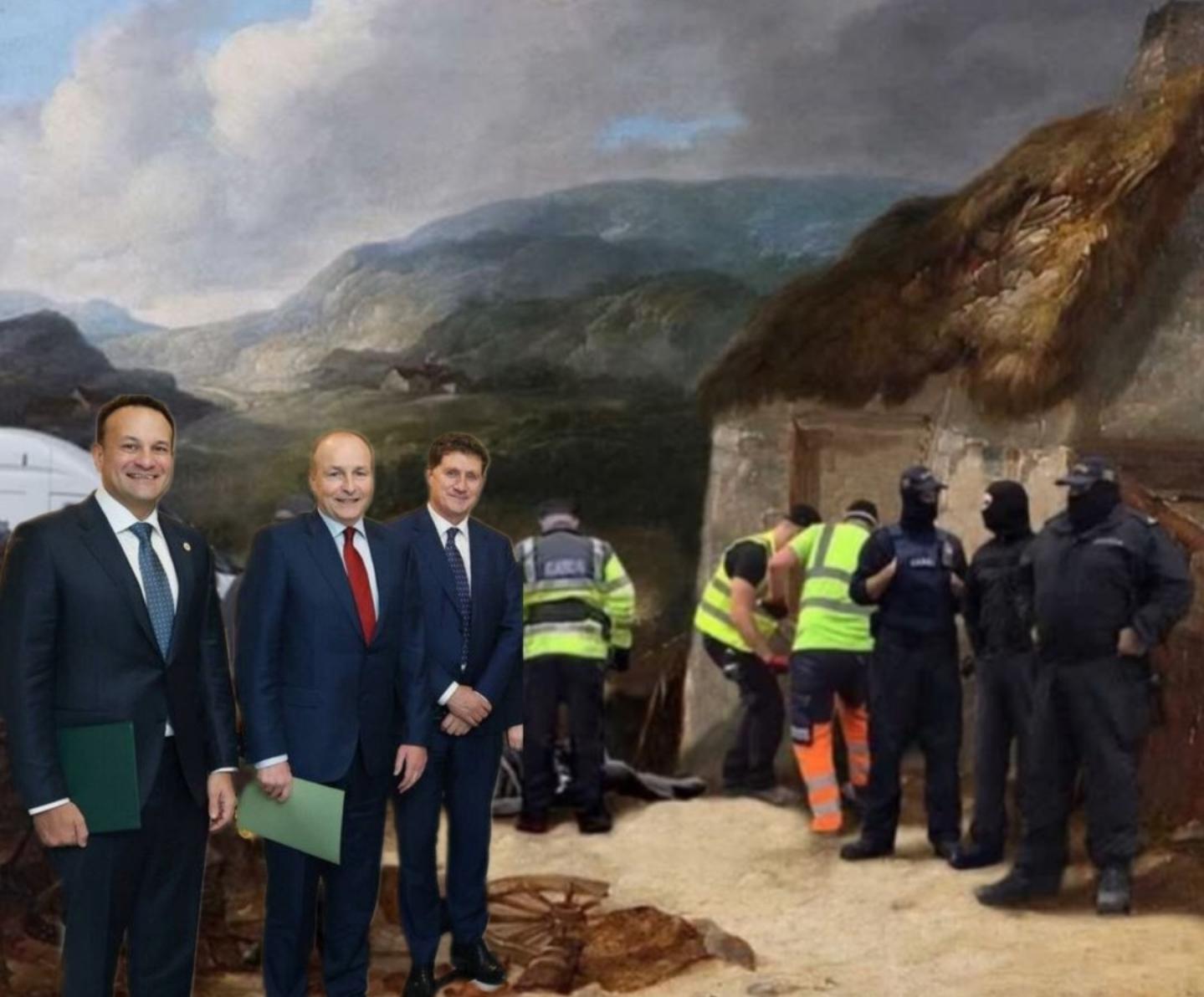
Three chief Irish Government Ministers some years past (one still in place) and Gardaí photoshopped on to 18th Century eviction scene in Ireland (original photoshopping of Gardaí by Spice Bag). (Image sourced: Internet)
HUMILIATION AND VIOLENCE
Strip and cavity-searching are demeaning psychological and physical invasions and should have no place in most policing actions. Even in jail, an x-ray chair is available. However strip-searching has been a constant over the years in use against political prisoners.
As violent and degrading actions become normalised in political repression they will be extended further, spreading to all kinds of policing operations.
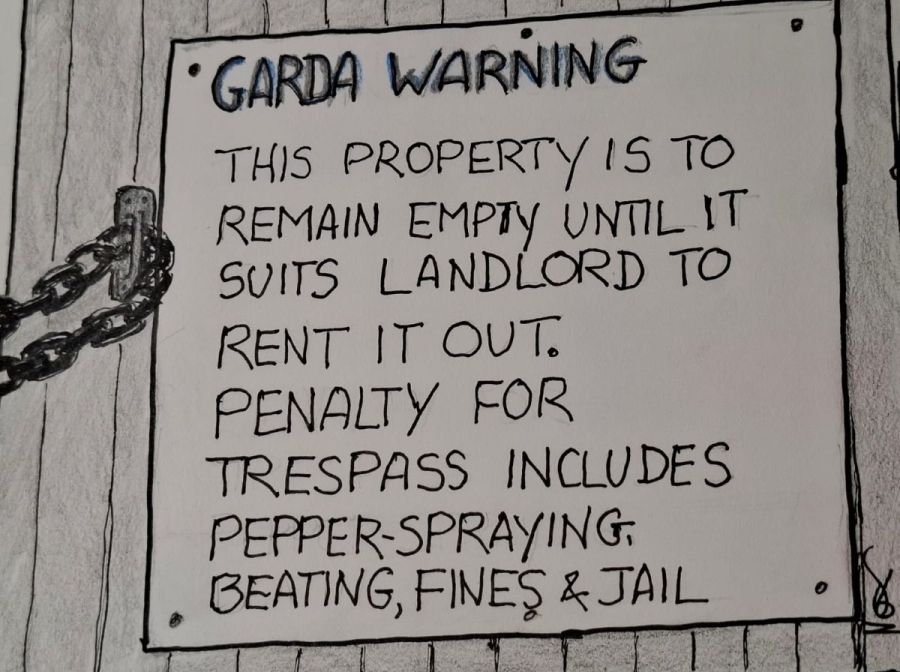
Cartoon by D.Breatnach
Gardaí normalising the use of pepper-spraying against Palestine solidarity and anti-NATO direct action activities are now extending this to other types of activities of which they disapprove, even those in the sphere of civil law and outside criminal law.
As the State increases its repression, the democratic and revolutionary movements will need to increase their resistance, calling also for the active solidarity of wider society with the victims and in condemnation of the State and its police force.
End.
Note: If you found this article of interest, why not register with Rebel Breeze for free, so that you will be notified by email of subsequent articles. You can de-register any time you wish.
The Save Moore Street from Demolition campaign group gratefully accepted an invitation to participate in the Comrade Corner on Sunday 3rd January in order to spread the word about the campaign and to make further contacts.
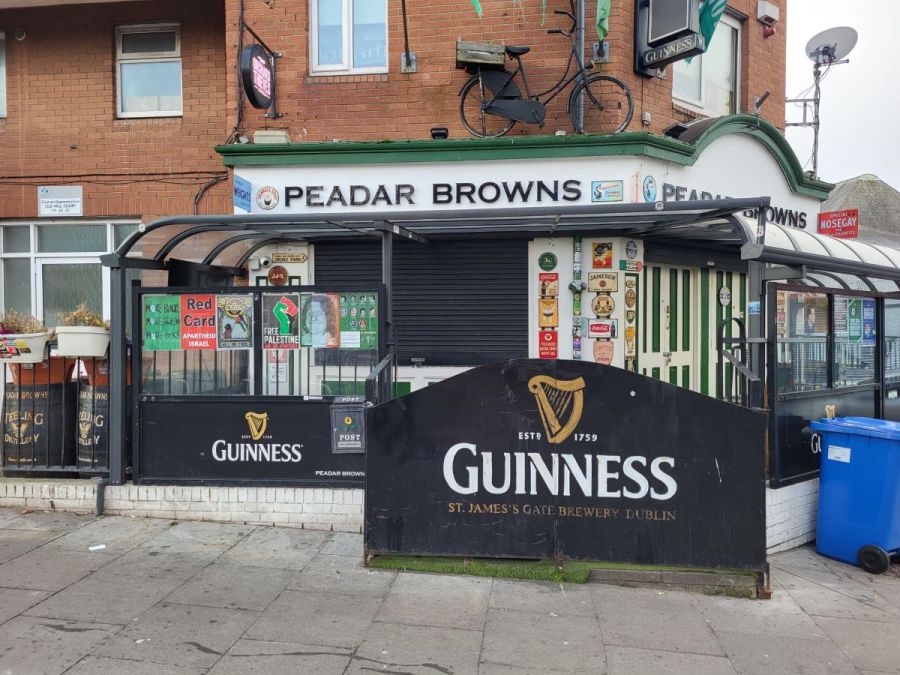
The Comrade Corner is part of the Libertine Market Crawl that takes place on the first Sunday of each month 12-5pm and is spread through a number of pubs, mostly in the Liberties area of north Dublin city: The 4th Corner, Dudley’s, Lucky’s, Molly’s Barand Peadar Brown’s.
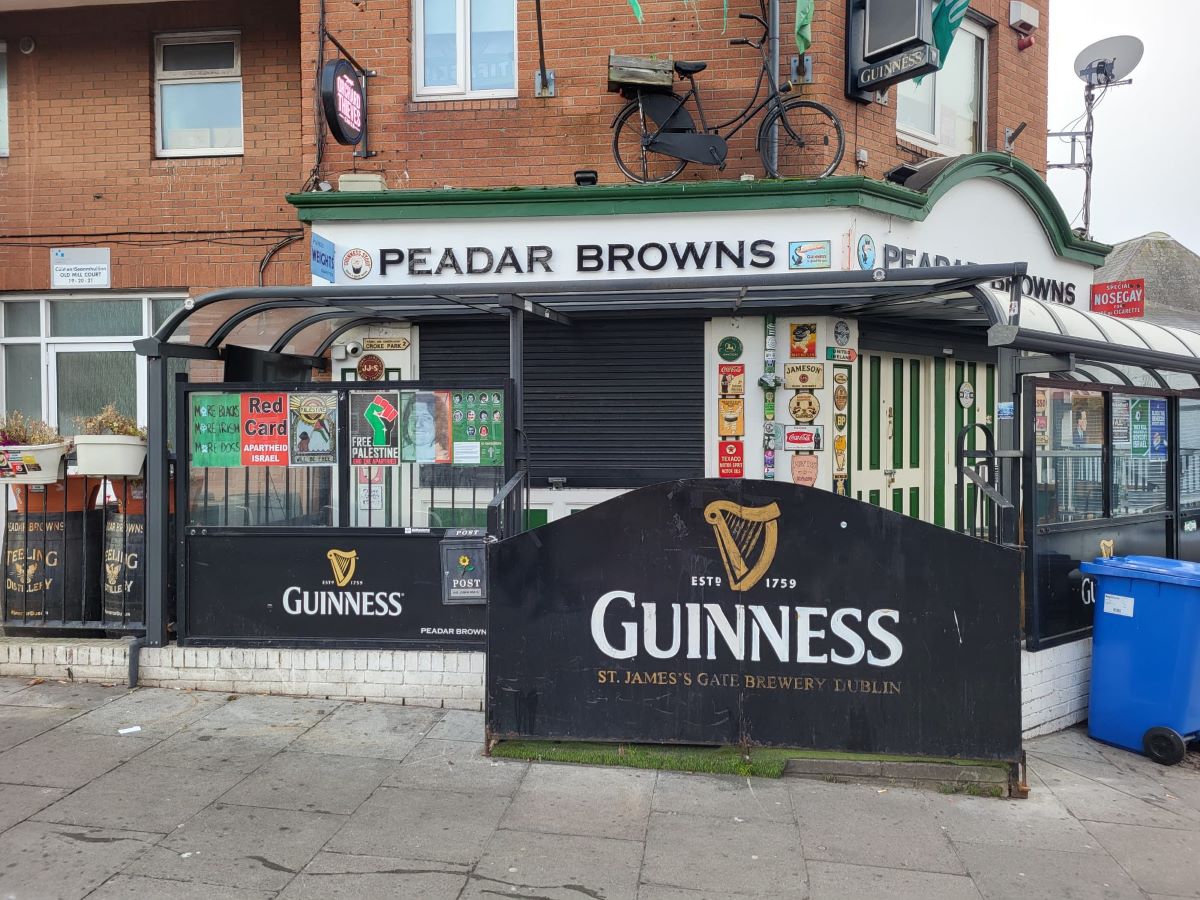
Front of the Peadar Brown’s pub building, Clanbrassil Street. (Photo: R. Breeze)
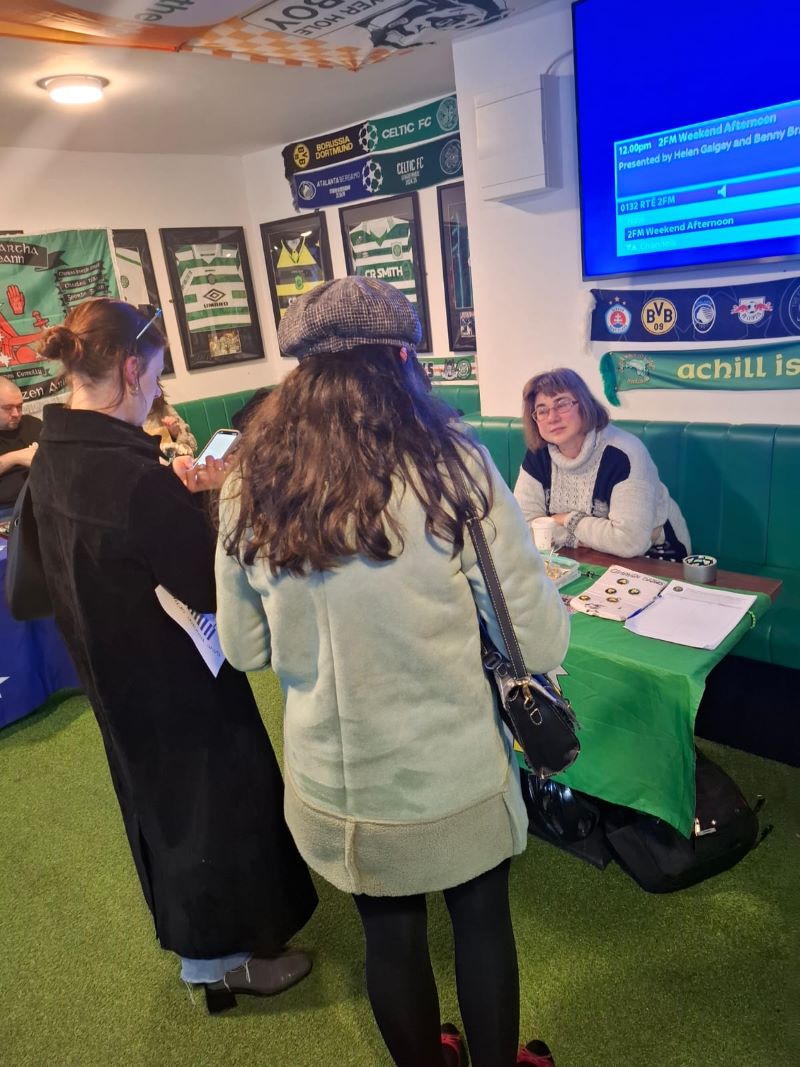
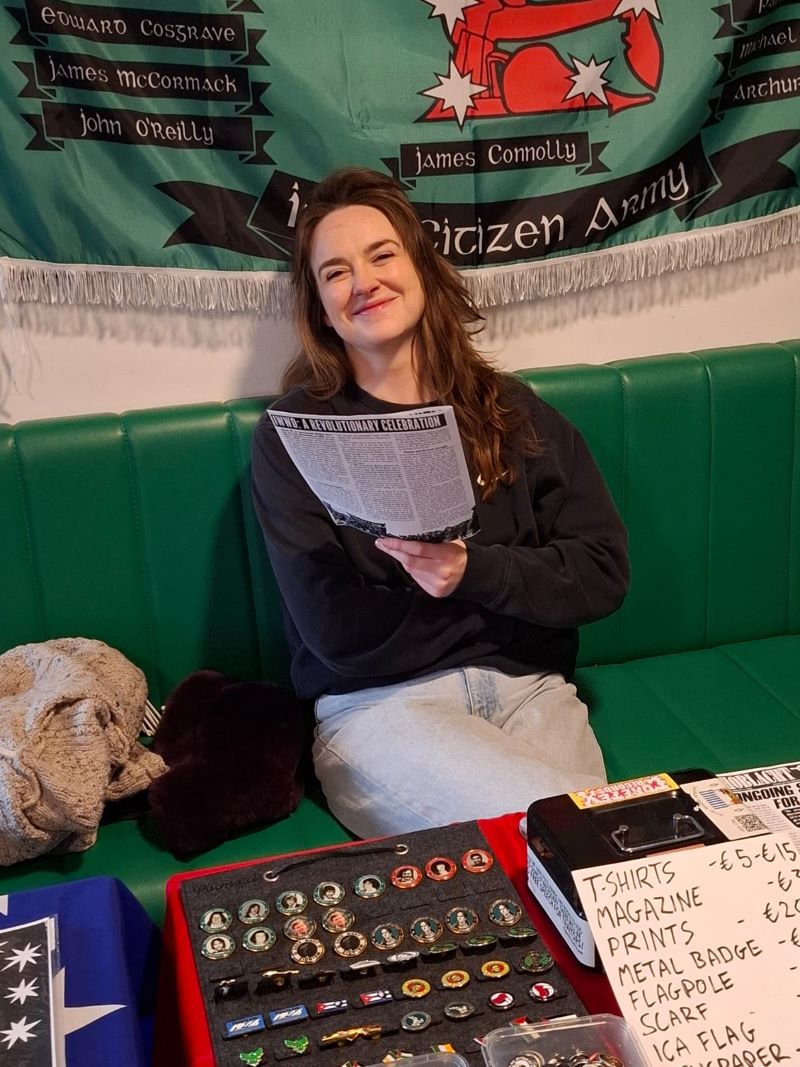
The Comrade Corner’s section of the monthly market take place upstairs in the Peadar Brown’s pub, open to campaigning and community groups to book a table to promote their campaign or group on which they had campaign leaflets, a QR to sign on line and campaign badges.
The latter represented a grotesque on the roof of No.55 Moore Street, missing wingtips shot off by a British bullet during the battle there in 1916.
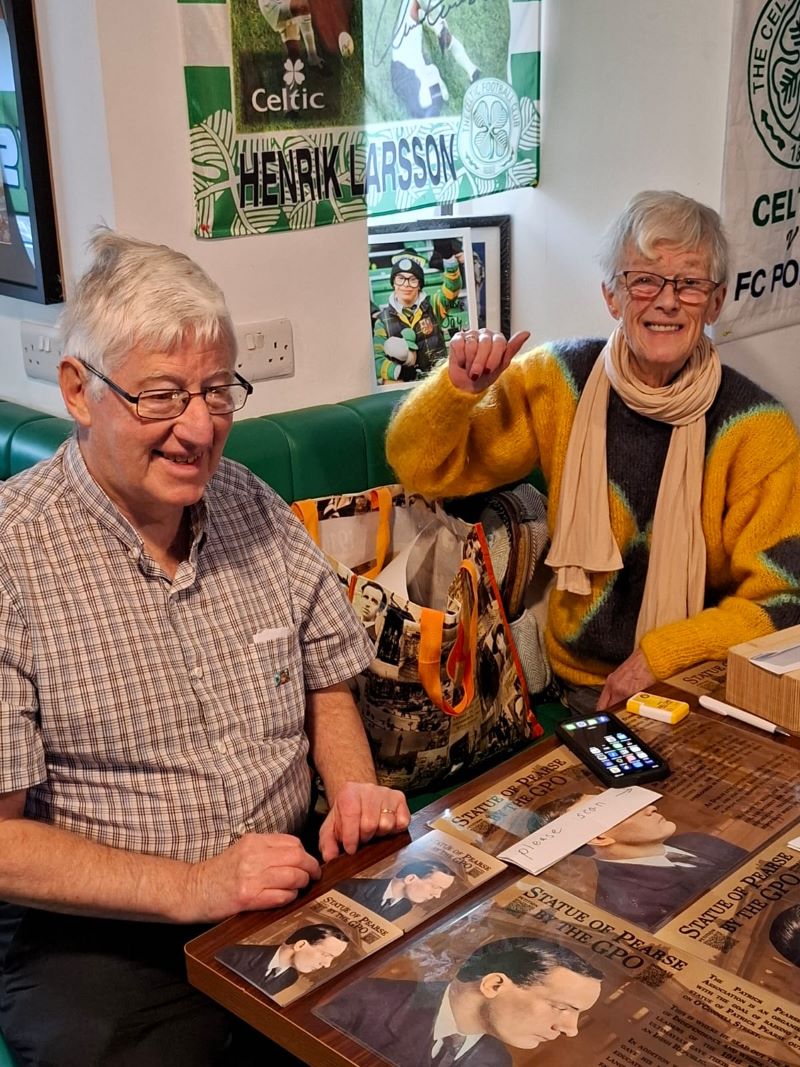
Two of a number of visitors tothe Comrade Corner engaging with the Save Moore Street From Demolition campaign stall at which campaign activist Orla Dunne is seated. (Photo: R. Breeze)
“Over the 12 years of our group’s existence campaigning on the street we have engaged in outreach work often enough,” said one of the two staffing their table in Peadar Brown’s, “including taking our banner to protest marches, giving talks, interviews and conducting history tours.”
The group has been campaigning with a weekly Saturday table for conservation and against demolition in Moore Street since September 2014. “We want to see a busy street market with small independent shops, not chain stores,” said Orla Dunne, also staffing their table in Peadar Brown’s.”
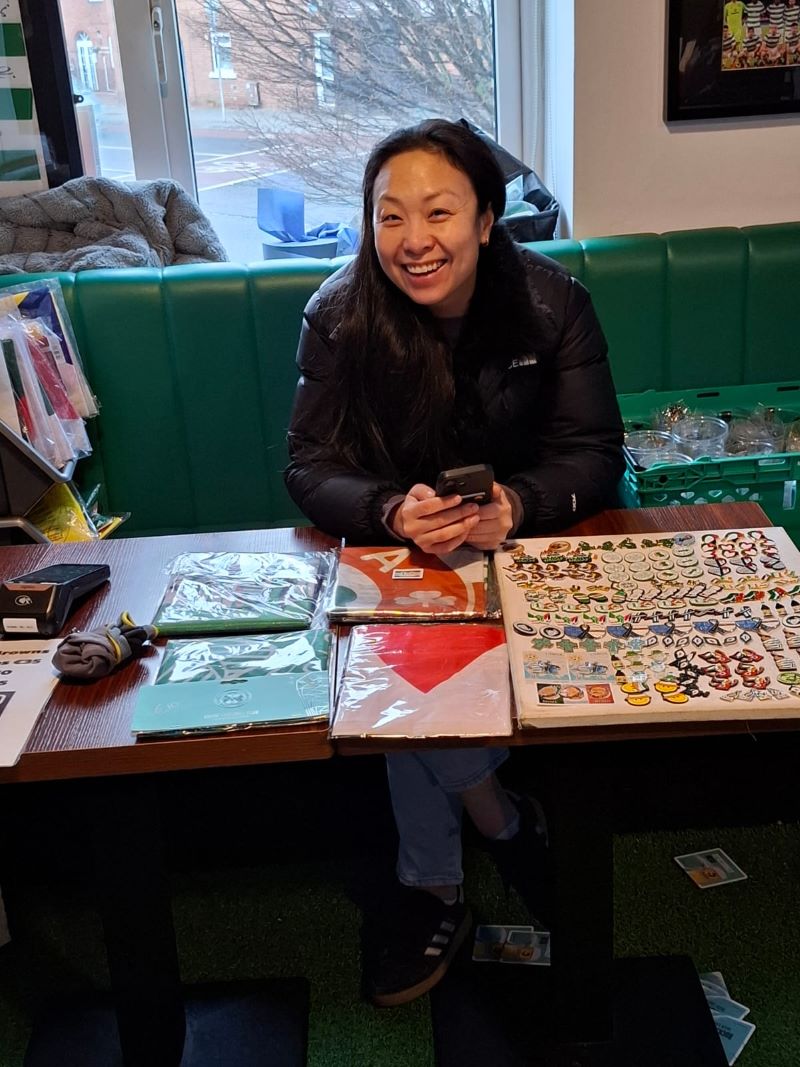
One of the team staffing the Darragh Ó Faoláin stall in Comrade Corner. (Photo: R. Breeze)
“And the history of the 1916 Battleground properly commemorated,” she went on to say, alluding to the fact that of the Seven Signatories of the Proclamation, no less than five spent their last hours of freedom in the Moore Street houses before taking the painful decision to surrender.
Those were Patrick Pearse, James Connolly, Tom Clarke, Seán Mac Diarmada and Joseph Plunkett, all shot by firing squad, along with Willie Pearse, also late of Moore Street as were another ten prominent figures, including Roger Casement, though hanged in Pentonville Jail somewhat later.
The team staffing the Statue of Pearse by the GPO campaign stall in Comrade Corner. (Photo: R. Breeze)
The GPO Garrison had left the burning building on the Friday of Easter Week and, heading to relocate at the Williams and Woods factory, got only as far as Moore Street before they came under intense machine-gun and rifle fire from the encircling British forces in Parnell Street.
Pausing to take a breath and plan their next moves, around 300 men and women occupied the whole central terrace (Nos.12-25), tunnelling through the walls, along with some other buildings. The leader of a failed charge on the British barricade died in a lane now named O’Rahilly Parade.
As he lay dying he wrote a farewell letter to his wife and children, the magnified script reproduced on an impressive monument in the lane-way.
The current Hammerson plan includes at least seven years of construction on the site (with no food stalls possible meanwhile), a new street cut through the 1916 Terrace to O’Connell Street, a hotel in Moore Lane and a Metro entrance in O’Rahilly Parade additional to the O’Connell Street one.
INSIDE PEADAR BROWN’S
The Peadar Brown’s stall in Comrade Corner. (Photo: R. Breeze)
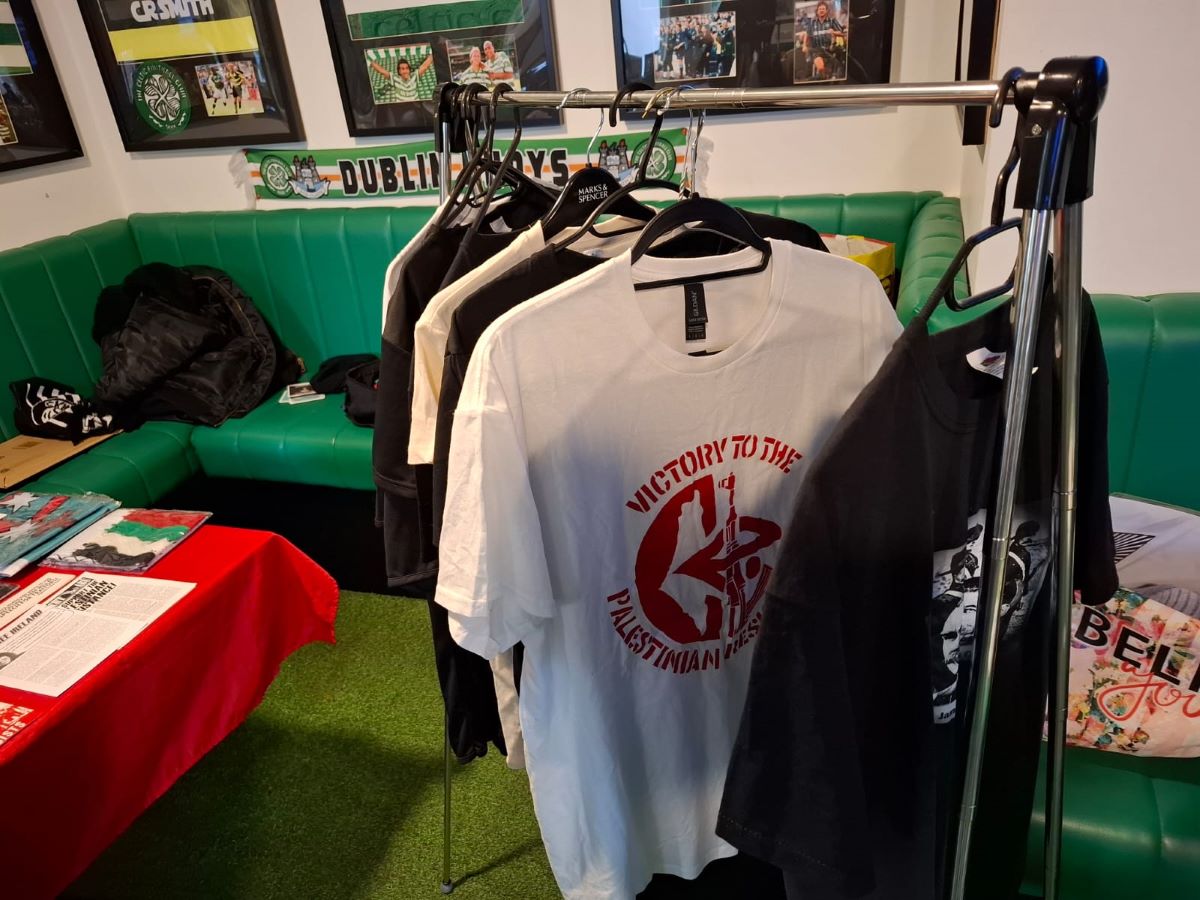
People drifted into the upstairs room in twos and threes, stopping at some or all of the stalls to examine the literature or merchandise on display and to chat to some of the groups. In addition to SMSFD’s, Peadar Brown’s had their own merchandise of badges and T-shirts.
Also selling merchandise within that range was a revolutionary anti-fascist stall, while another table was held by a group campaigning for the erection of a monument to Patrick Pearse in O’Connell Street, near to the GPO where he was located in 1916 before evacuation to Moore Street.
T-shirts merchandise near the Darragh Ó Faoláin Stall in Comrade Corner. (Photo: R. Breeze)
It was notable that the latter group also directed people to the SMSFD group’s table. Many of the visitors had origins outside Ireland, a sector for which perhaps this kind of event would be more usual. How did the SMSFD team feel their table had done for their hours there?
“We did alright,” said Dunne, “though it wasn’t very busy today.” “If we had boosted our online petition signatures alone, which we did, it would have been worth it,” said Breatnach. “Besides, I always wanted to see the famous Pub,” added Dunne, smiling.
Mural on the side of the Peadar Brown’s building. (Photo: R. Breeze)
Much artwork of an Irish Republican nature decorates the inside of the pub downstairs, including a mural along the wall behind the small stage area. The Irish Tricolour, Starry Plough and ‘Irish Republic’ flags hang from the exterior along with anti-racist posters in the outside drinking area.
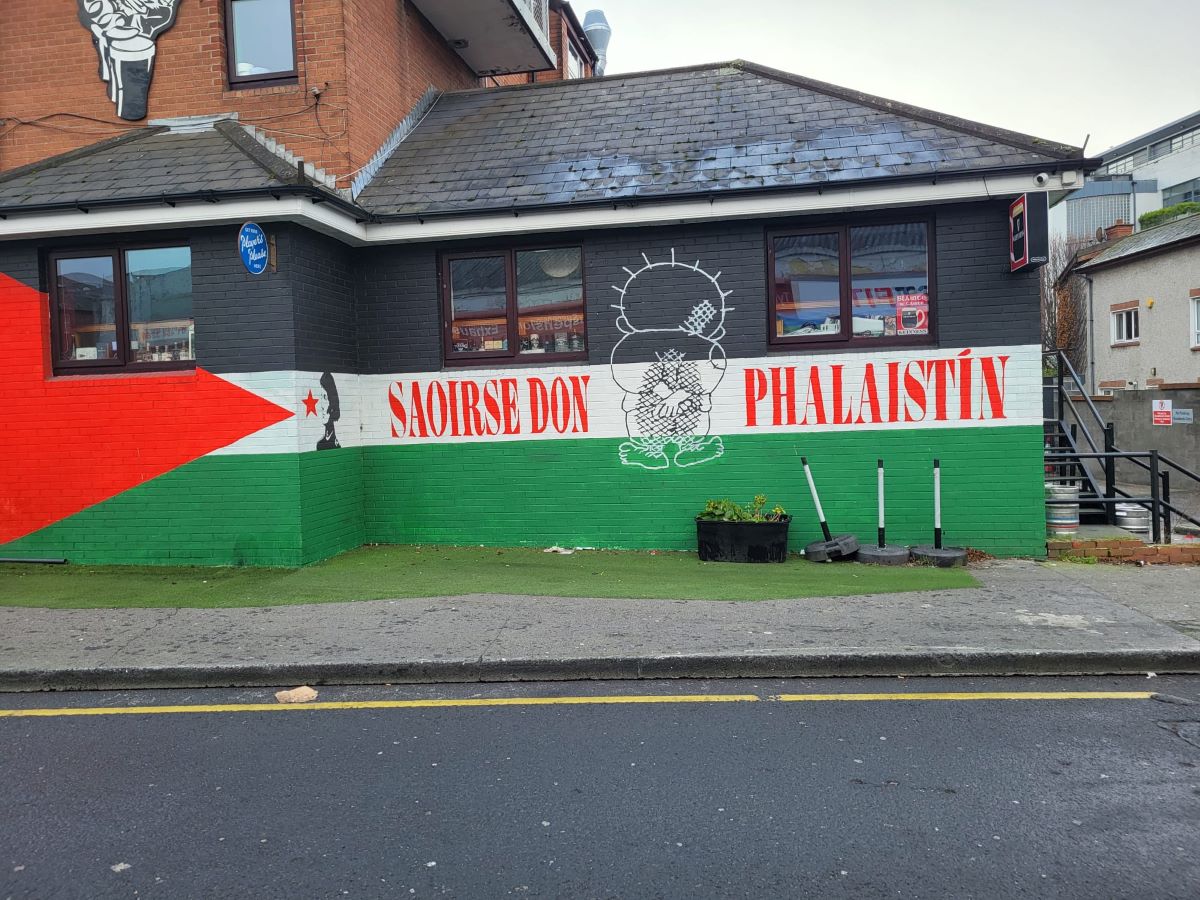
Last year officials in Dublin City Council sought unsuccessfully to have Peadar Dunne’s remove the large Palestine flag painted on the side of their building. It has a reputation not only as an Irish Republican pub but also of decidedly internationalist solidarity and antifascist character.
Also last year, some fascist and far-Right elements threatened the pub with a demonstration which failed to materialise, to counter which antifascists had packed the pub to overflowing. The far-Right’s anger was aroused by the banning of a musician for allegedly uttering racist comments.
The Peadar Brown’s T-Shirt rack by their stall in Comrade Corner. (Photo: R. Breeze)
End.
Note: If you found this article of interest, why not register with Rebel Breeze for free, so that you will be notified by email of subsequent articles. You can de-register any time you wish.
A lesson today: an important truth was demonstrated to a number of us protesting by visible presence and song outside the US Embassy (at the weekly Wednesday afternoon Palestine solidarity event there organised by Jimi Cullen).
We were accosted by a woman who said she was Palestinian, didn’t agree that we were supporting Palestine and insisted we should be pushing for peace.
‘Peace with Zionism?’ someone asked.
‘What is Zionism – do you know?’ she responded.
‘Yes, it’s a belief that Jewish religion gives them the right to occupy someone else’s land and kick the indigenous out.’
‘No, that’s not what it is!’ (but failed to elucidate for us what she claims it is).
Then: ‘That flag is not for freedom for Palestine! Do you know when it was created?’
We were saying ‘Yes’ when she started running down Hamas (which didn’t even exist when the flag was designed and popularised).
She kept saying: ‘I’m a Palestinian!’ (as though that meant she must be right and also that we had no right to contradict her).
Just in case we were confused about her wider ideology, she began to attack Venezuela under ‘communist rule’ (sic).
Most of those attending on 7th January, some time after our encounter with the person under discussion. (Photo source: J.Cullen)
THE LESSON
Her intervention and her manner were annoying but she underlined an important point in political discourse: Nobody’s nationality, ethnicity or residency status gives them guaranteed possession of the truth, nor the right to assert that other opinions must for that reason be wrong.
In every country there is a variety of people, including social classes and a range of opinions on important political and social questions. It is likely that some will have very progressive ideological positions, some less so but still progressive, some conservative and some others, reactionary.
It is more complicated even that that, for some might be progressive on some issues but conservative or reactionary on others – and vice versa.
Of course we fight for the right of Palestinian voices to be seen in print and heard on mass media, as a question of justice and also as the voices of witnesses, those who have experienced the genocide at first hand, or at close second hand through family and community.
We disagreed with silencing Palestinian voices objecting to the Palestinian Ambassador (she was a Palestinian too!) addressing a Belfast meeting organised by Sinn Féin in February ‘24 not because they had to be correct as Palestinians but because their objection was an important one to be heard.
The Ambassador does not represent Palestine but rather the Palestine Authority, which in turn cannot claim to represent the Palestinian people, if for no other reason than that it has not held elections for its Presidency in twenty years.
In fact there are many other reasons including financial corruption, nepotism, repression of any kind of criticism, collusion with the Zionist Occupation, jailing Resistance fighters and actually killing some. Those critics – even had they not been Palestinian – should have been heard instead of being ejected.
It would have been instructive, educational even, to listen to the condemnation by Palestinians of an official who claimed to represent them. But of course, the Sinn Féin party, like nearly all states and all western political parties of any size, supports the Palestinian Authority and its Embassy.1
In this case, it appears from what they were saying and what we can verify, that the Palestinian critics were correct and we know too that the Ambassador is wrong and in fact illegitimate, both in representation status and also in terms of national sovereignty.
But when people claim possession of the truth and immunity from criticism solely on the basis of where they are from or to what ethnic or other group they belong, we need to oppose that undemocratic cloak very resolutely as they use it to close down debate and education.
It’s not only the person claiming a kind of ethnic certainty we must beware of but often also the one who claims to speak for them, who takes a position as their defender and therefore their spokesperson for the truth. Apart from being patronising, such a position is wrong in principle.
And usually opportunist in essence.
This general principle holds true with regard to individuals or groups from any social or ethnic group or community, whether Palestinian, West Asian, Muslim, Six-County, 32-County, homeless, Traveller, working class, disabled, migrant, Irish speaker … etc.
end.
Note: If you found this article of interest, why not register with Rebel Breeze for free, so that you will be notified by email of subsequent articles. You can de-register any time you wish.
On Saturday morning, Dubliners checking messages or news on their phones or laptops, or listening to or watching news on TV or radio – or even reading a newspaper, learned that the USA had bombed Venezuela and abducted its President.
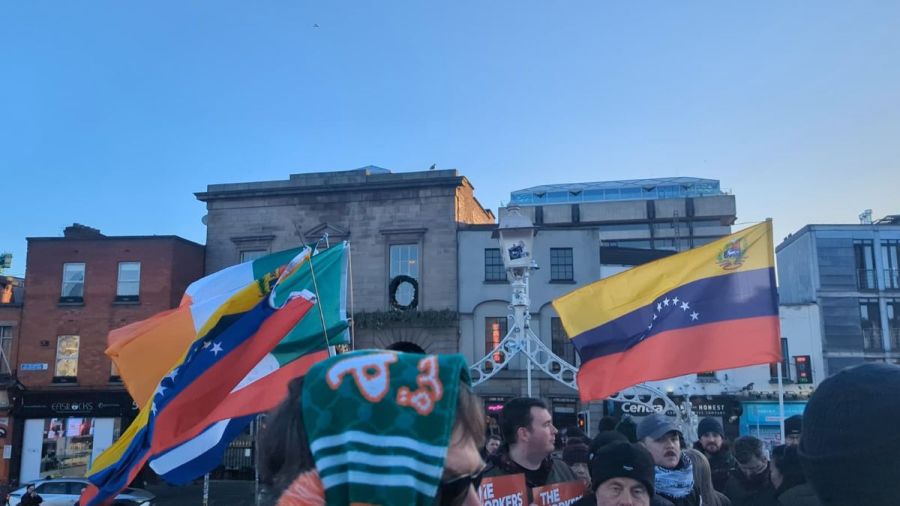
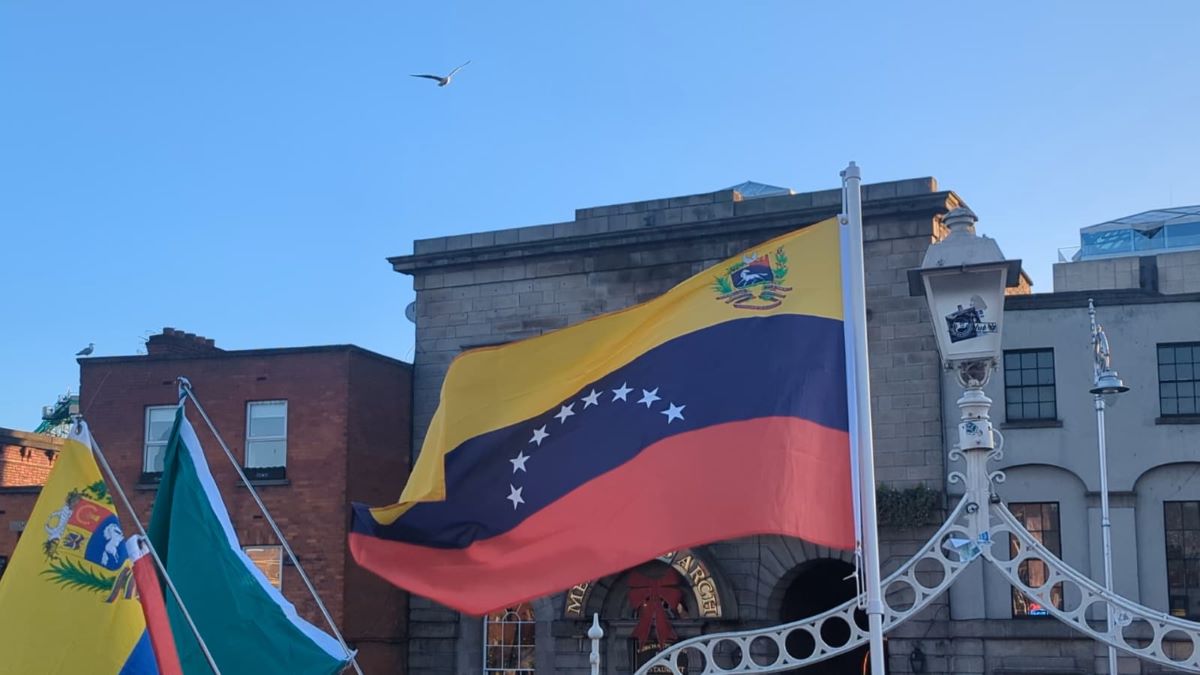
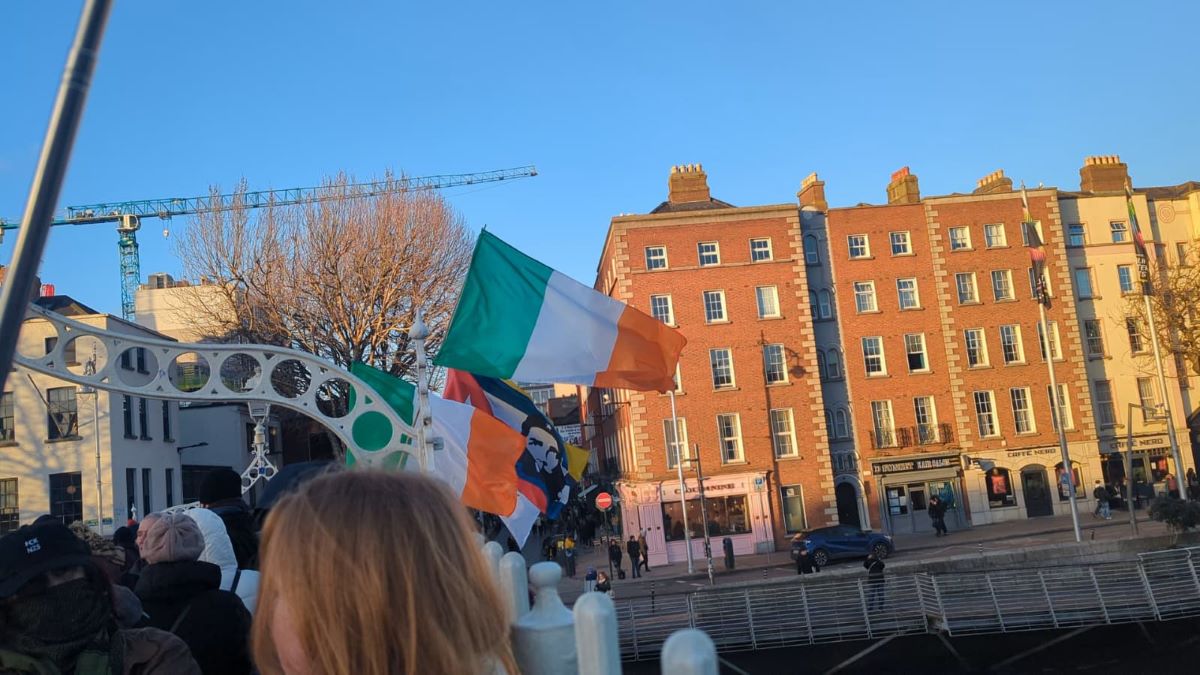
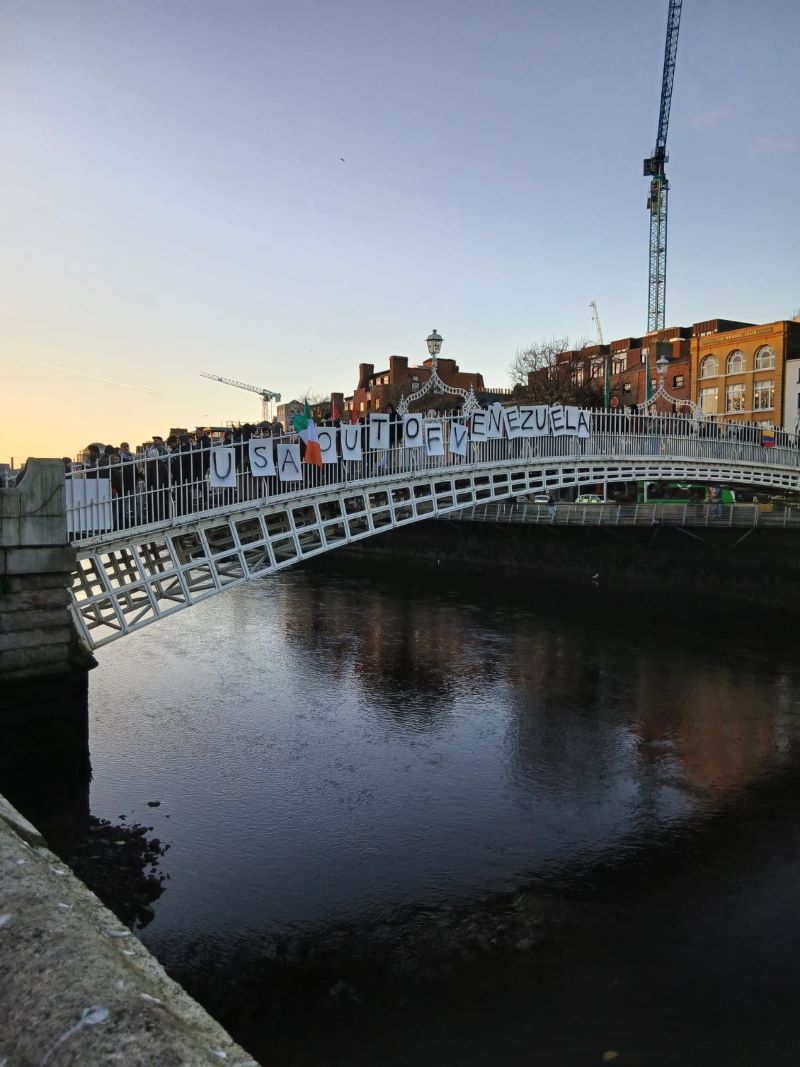
Venezuelan national flags on Ha’penny Bridge during Venezuela solidarity portrait, seen here against sky and south Liffey riverside buildings. (Photo cred: Participant)
An emergency protest and solidarity demonstration was called for 3pm in the city centre and under a clear blue sky but in bitter cold, many attended to line the iconic Ha’penny Bridge, which only a week ago had hosted a New Year’s Eve demonstration in solidarity with Palestine.
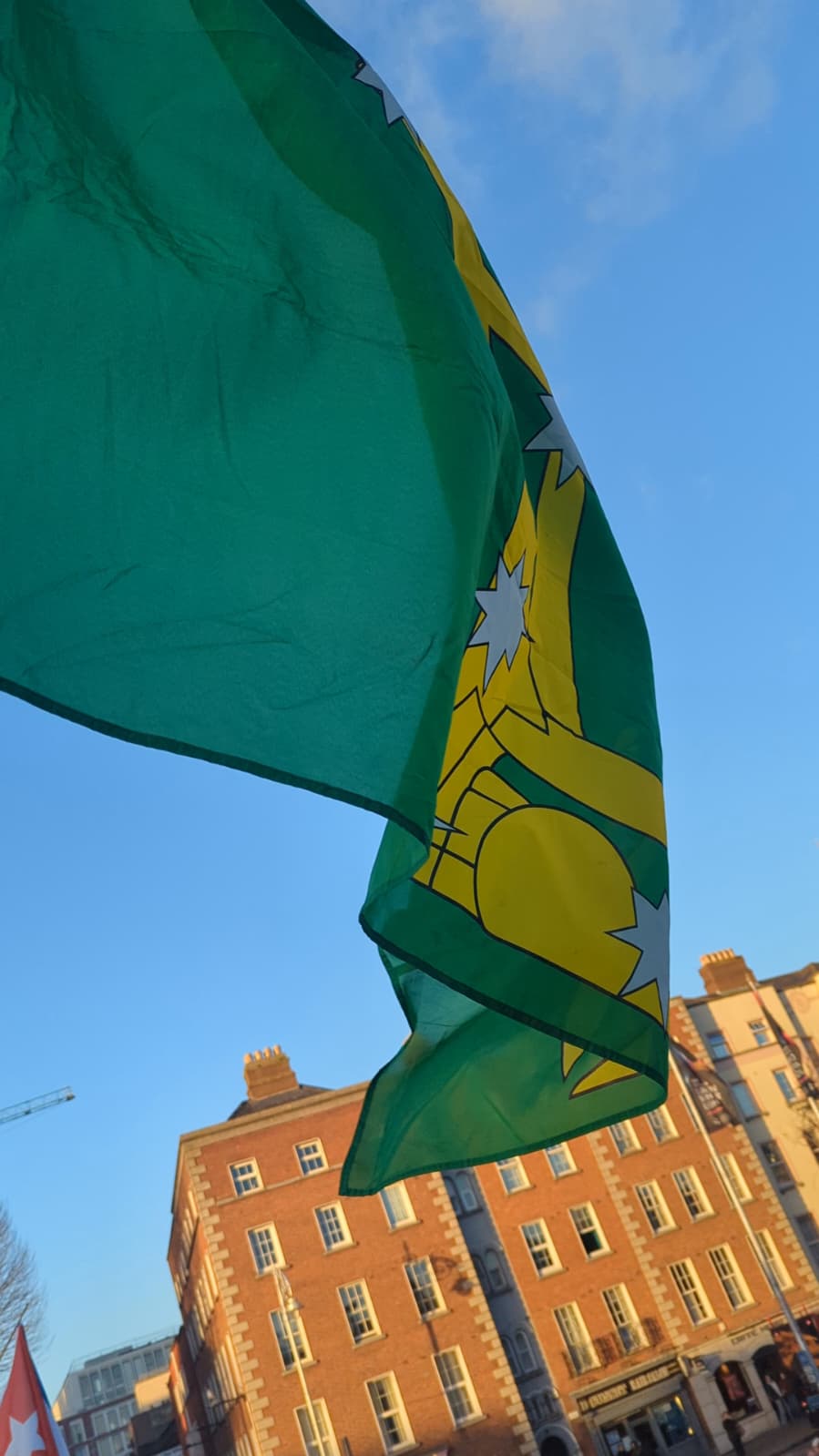
Among the crowd on the Bridge, a few Venezuelan national flags fluttered against the sky or the riverside buildings, along with a number of Irish Tricolours and one green and gold Starry Plough,1 while placards were attached to the railings along the sides of the Bridge.
The well-known slogan of US military – Out of Shannon! was among the call-and-answer chants of course, along with the easily-imagined Hands off Venezuela! But there were some innovative ones too, such as the Irish-language/ English mix of Deirimís go léir le chéile – Hands off Venezuela!
Starry Plough flag on Ha’penny Bridge during Venezuela solidarity protest, seen here against sky and north Liffey riverside buildings. (Photo cred: Participant)Irish Tricolour flags and probably Cuban national flag on Ha’penny Bridge during Venezuela solidarity protest, seen here against sky and north Liffey riverside buildings. (Photo cred: Participant)
Entirely in Castilian Spanish there was also Viva, viva – La Resistencia! Another was USA – Nothing but thieves! – a specific reference to Trump’s nakedly-declared wish to grab the country’s oilwells.
People from a number of different political parties participated as did a large number of independent activists, constituting an ad-hoc and informal anti-imperialist broad front.
Among the crowd were veteran activists but also too many of the younger ones, grown in political awareness and action in recent years of Palestine solidarity, a deep educational experience, including some facing charges from actions in Dublin or Shannon to be tried in the coming months.
It is to be hoped that their support and solidarity will also be broad.
The Ha’penny Bridge during Venezuela solidarity protest. (Photo cred: Eddie O’Reilly)
The latest news is that the kidnapped President Maduro has been charged in the US on counts including drug trafficking and possession of weapon. As the President of Venezuela and titular head of its armed forces, presumably he does indeed hold weapons.
The very existence of the drug cartel of which Trump and his cabal claim Maduro is head is very doubtful, including even to views leaked from US intelligence departments and of course, not one iota of evidence has been produced to date of the alleged drug trafficking.
Mixture of flags and people on Ha’penny Bridge during Venezuela solidarity portrait, seen here against sky and south Liffey riverside buildings. (Photo cred: Participant)
In the lead-up of months of bullying to this invasion, US forces sank many boats, killing at least 115, including one survivor of a bombing in the water. No evidence of their alleged drug-running has been produced in a single case and even so would not merit death penalty under US law.
Following the US attack on Venezuela, Defence Minister Vladimir Padrino López, reportedly from his control bunker, broadcast in military uniform to the nation condemning the imperialist attack and promising resolute resistance.
Diosdado Cabello, Venezuela’s Minister of Interior, Justice, and Peace, was videoed in the street wearing helmet and body protection equipment, calling on citizens to place their trust in the political and military leadership and to give no assistance to invading forces.
Vice-President Celcy, now Acting President made her first ever broadcast demanding the release of the Presidential couple, affirming that “there is only one president in this country, and his name is Nicolás Maduro,” and insisting that Venezuela “will never be a colony of any nation.”
Earlier, mainstream media had reported that Celcy had fled to Russia and that Lopez had been killed, such errors perhaps being caused by the ‘fog of war’ but recalling also the part played by the mainstream media in preparing the ground for the US-instigated Chilean coup of 1973.
The US attack and kidnapping was condemned today by Russia and by President Petro of Colombia. Kallas, on behalf of the EU, while condemning Maduro’s rule, voiced some weak platitudes about the EU Charter but voiced no condemnation of this attack upon a sovereign nation.
President of the USA Trump boasted publicly about how viewing the attack and kidnapping operation had been like watching a TV show and proclaiming that the US are now “going to run” Venezuela for a while “and get the oil flowing.”2
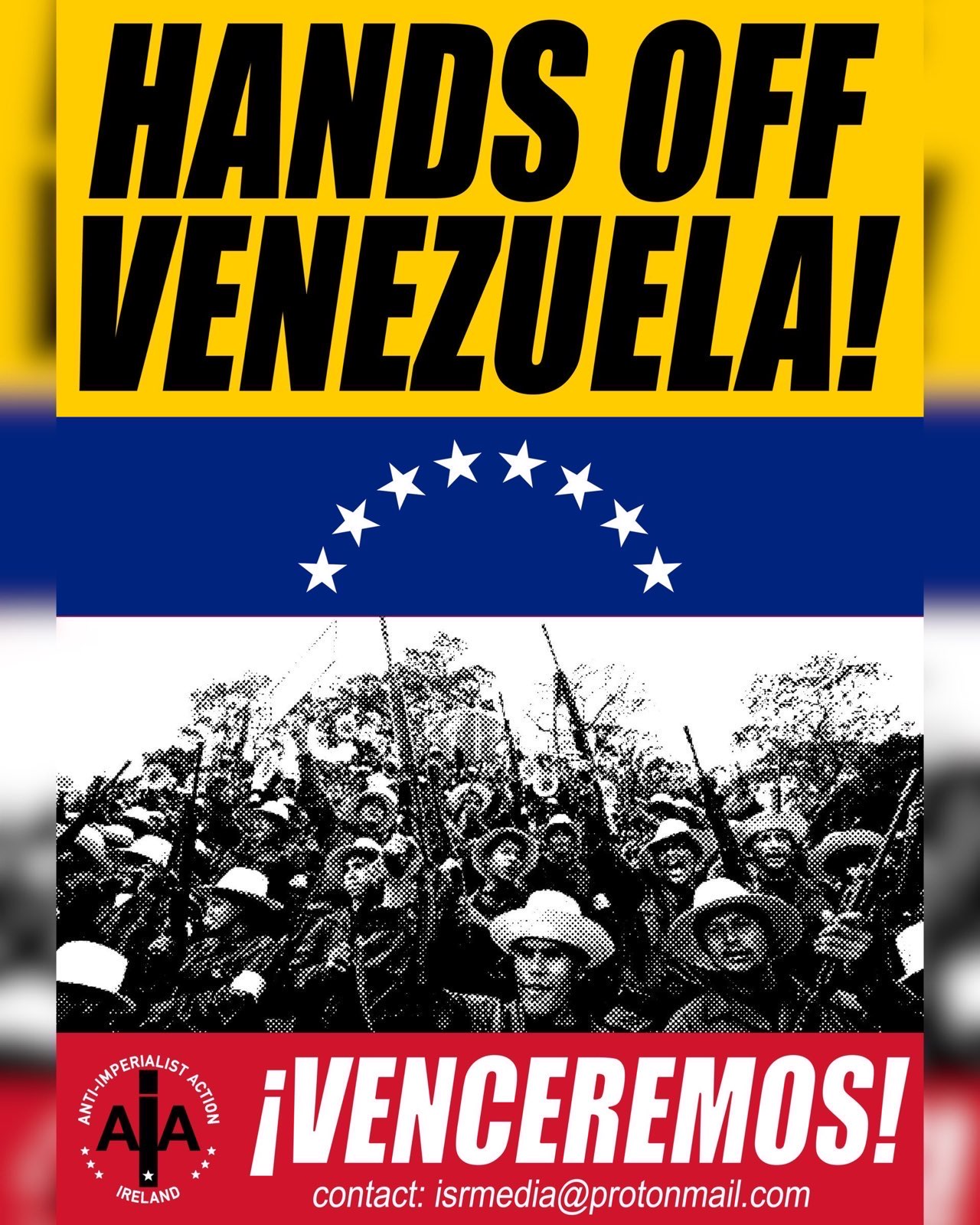
Tomorrow, Sunday, the Anti-Imperialist Action organisation has called a protest demonstration to take place at the US Embassy in Ballsbridge, Dublin for 1pm, in defence of sovereignty and in opposition to imperialism.
End.
Note: If you found this article of interest, why not register with Rebel Breeze for free, so that you will be notified by email of subsequent articles. You can de-register any time you wish. Footnotes:
1The design of the flag of the Irish Citizen Army, a workers’ defence militia against police during the Lockout/ Strike of 1913 and that also fought in the 1916 Rising.
Through three events on Saturday, New Year’s Eve in the city centre, Dublin sent a solidarity message to the Palestinian people and also to the solidarity activists on hunger strike in British jails, referencing also those of the Irish Resistance in 1981.
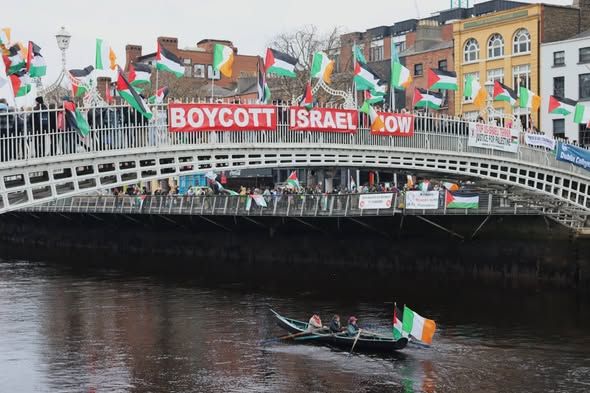
The Millennium Bridge on New Year’s Eve. (Photo: IPSC)
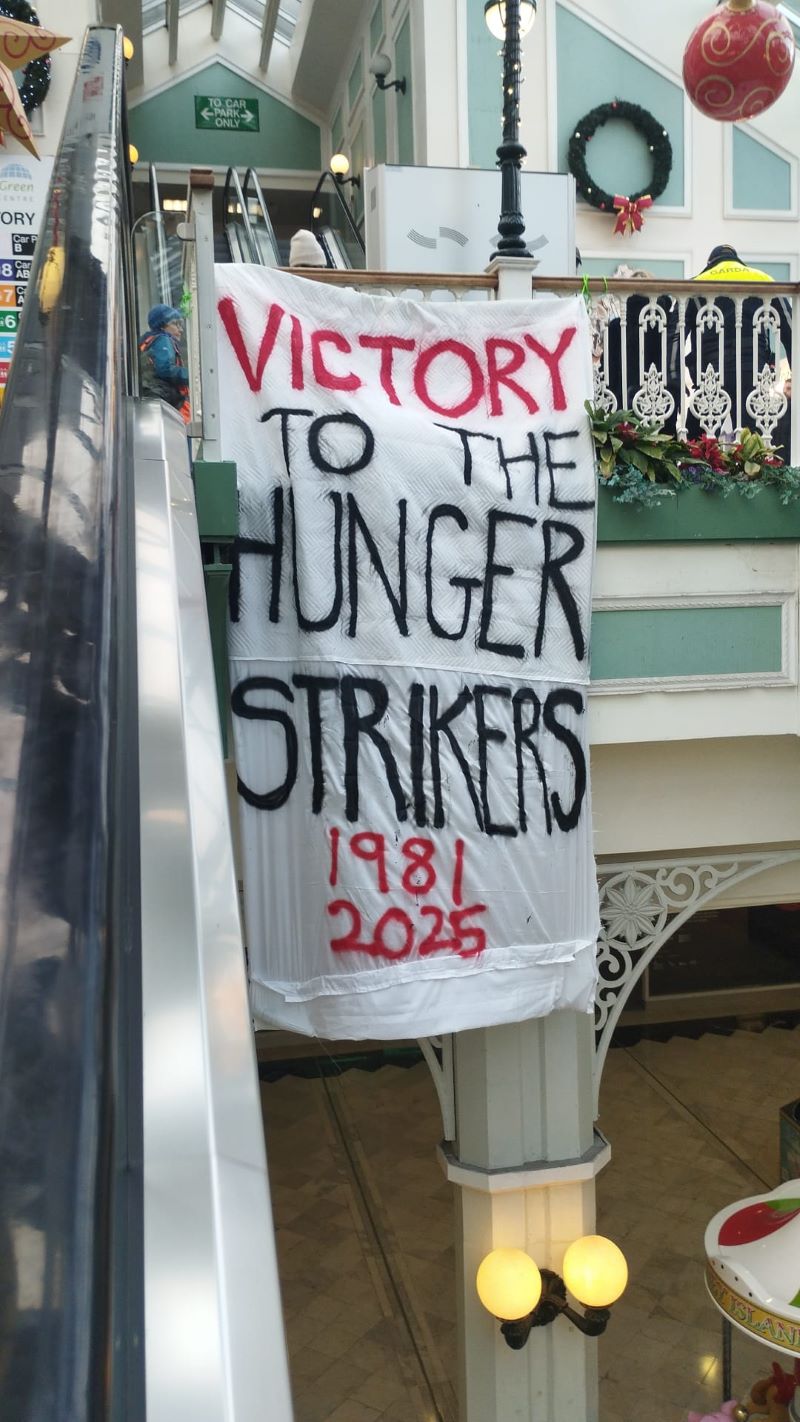
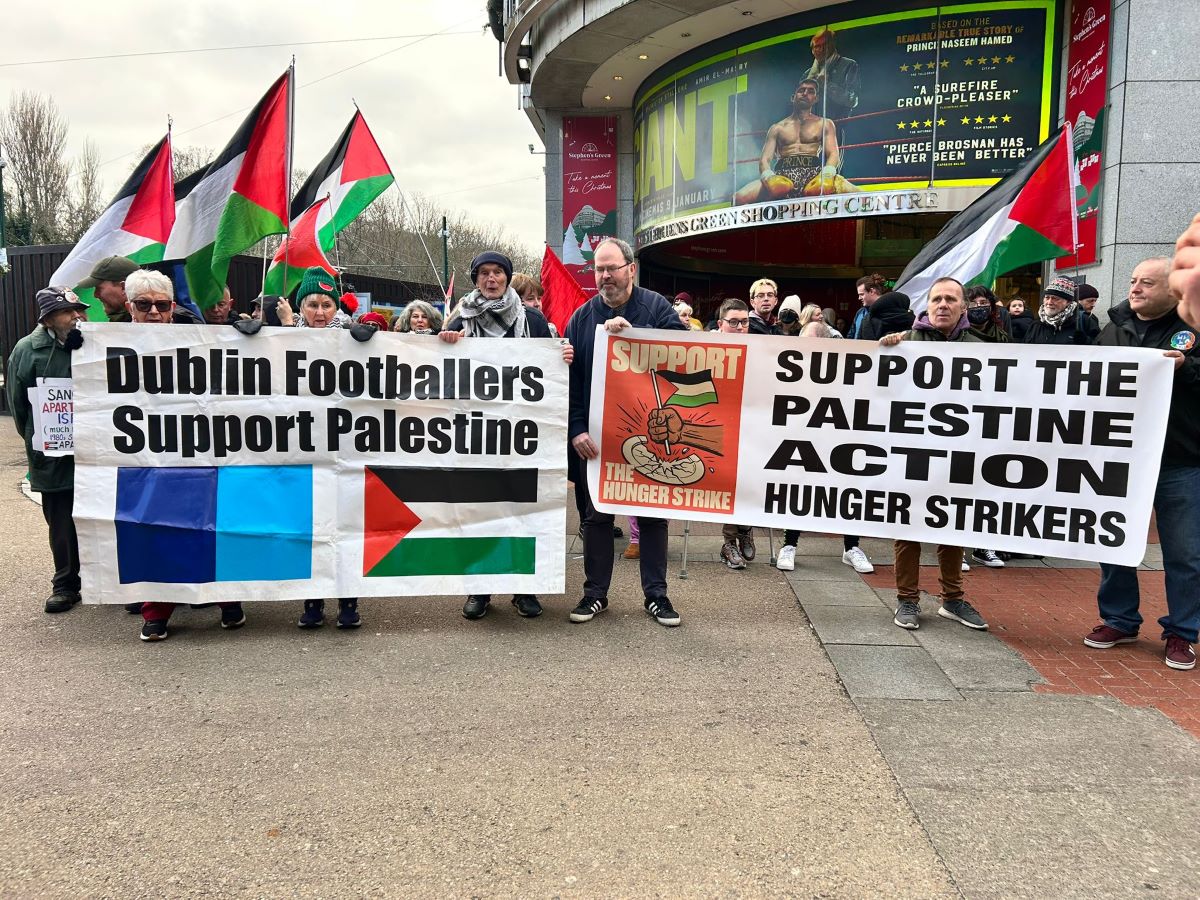
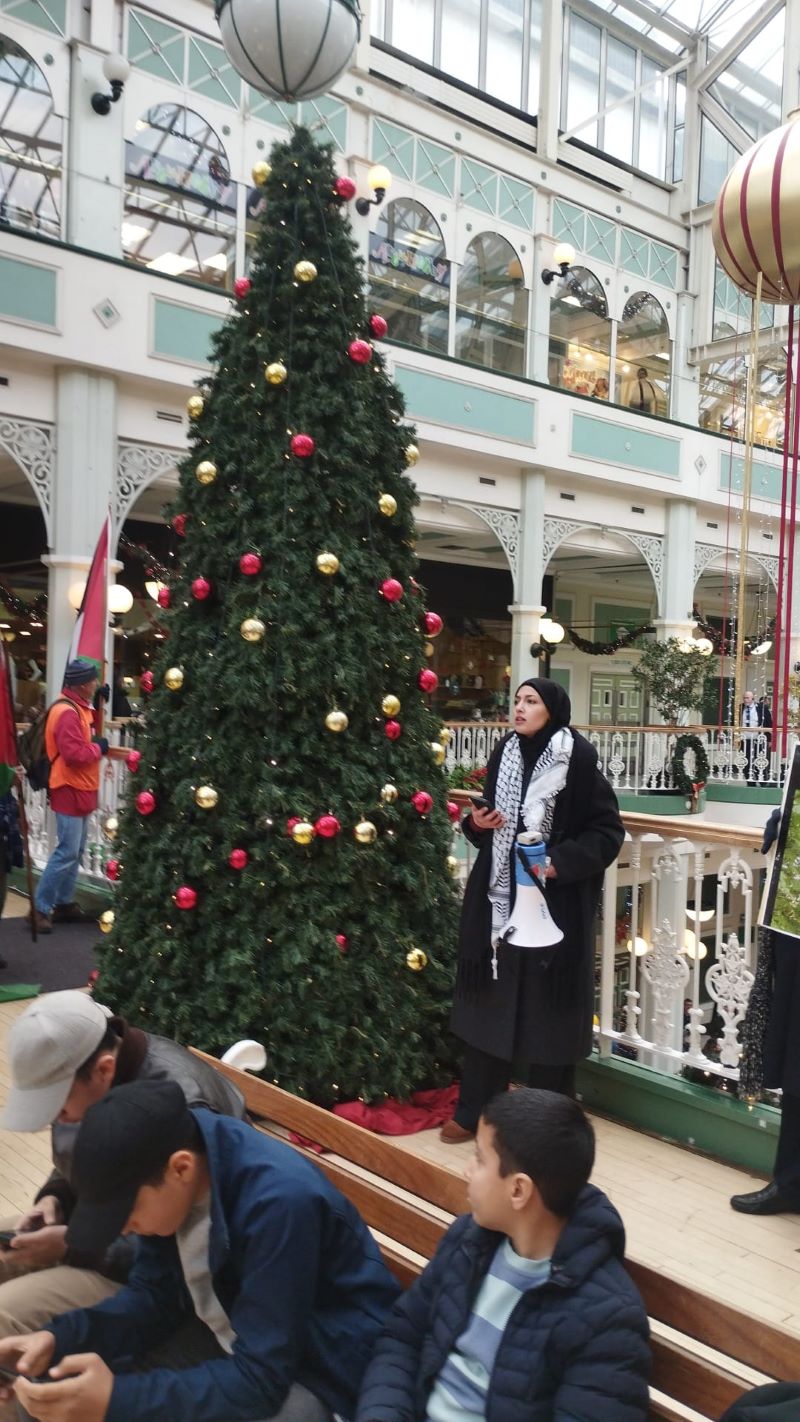
Chronologically first was a protest in the Starbucks café1 in Stephen’s Green Shopping Centre obliging the management to close for hours and a balcony walkway banner drop calling for solidarity with the Elbit accused on hunger strike, referencing also the Irish hunger-strikes of 1981.2
I had not read the poster carefully and arrived at the Starbucks at the north end of Grafton Street, where there were a few other confused people also. By the time I made my way up to the southern end of Grafton Street, the protest there was about to leave and I was about to head elsewhere.
Two main banners present at protest outside the Stephen’s Green Centre on New Year’s Eve, after closing down the Starbucks café inside. (Photo: Bas)
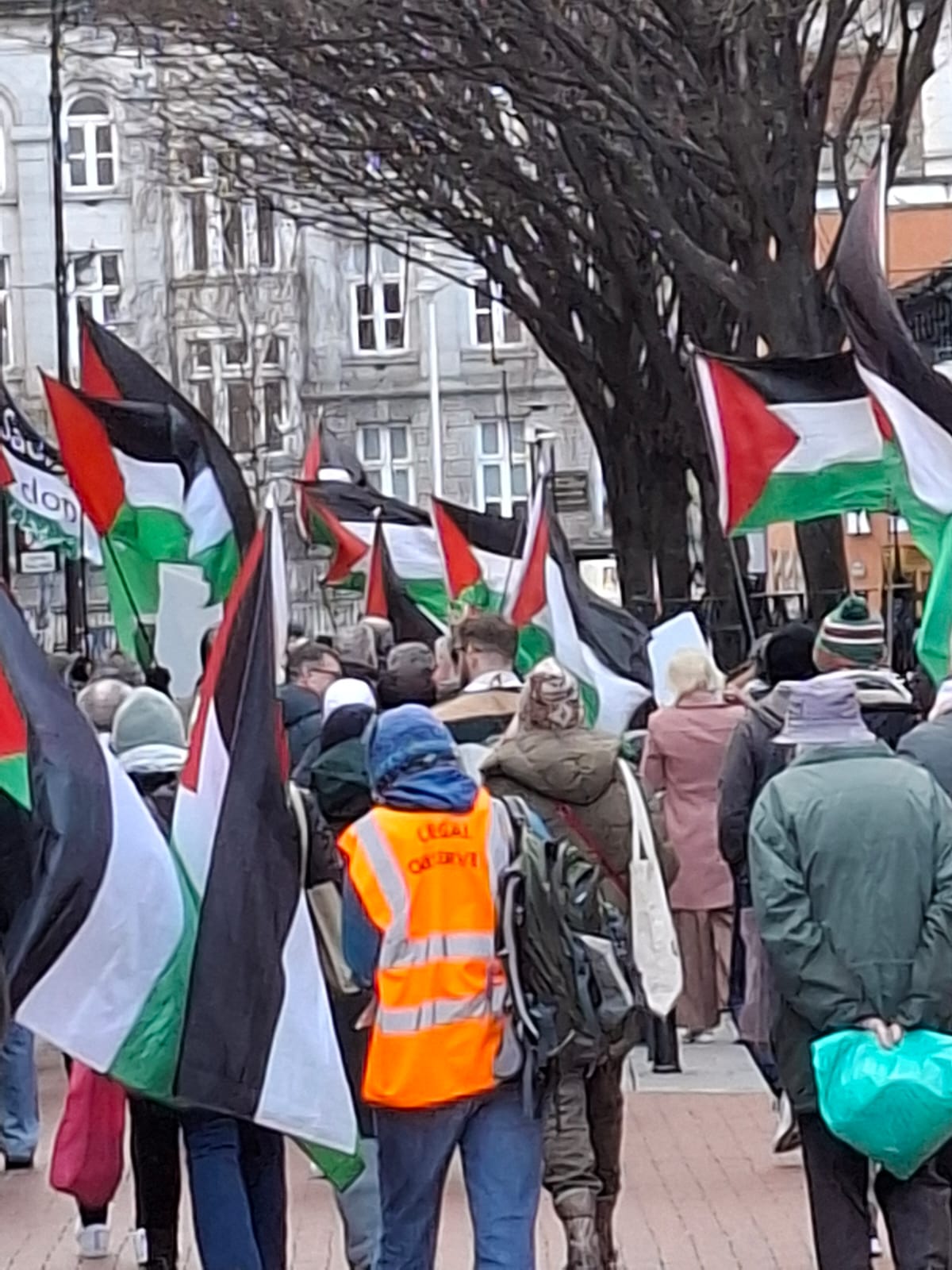
The solidarity crowd continued to demonstrate in the shopping centre’s main doorway before marching away, then went into the Zara3 big shop and demonstrated there awhile before heading on to MacDonald’s in Grafton Street where the Gardaí began to let their nasty side show a little.
Palestine solidarity protesters leaving the Stephen’s Green Centre on New Year’s Eve, heading down to Zara to protest there (Photo: D.Breatnach)
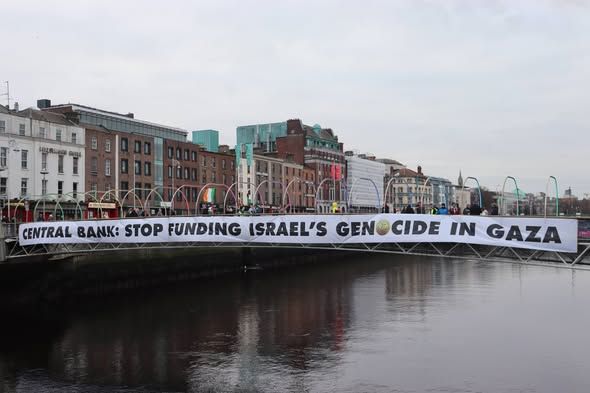
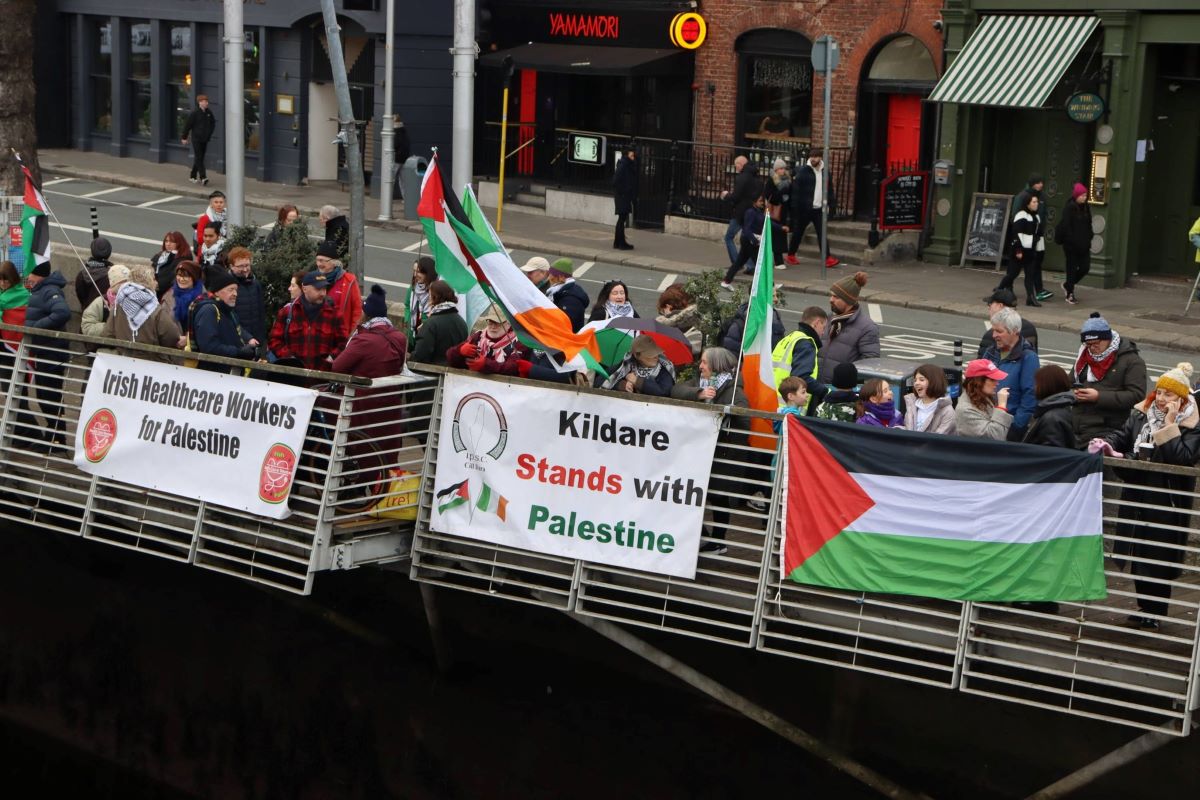
Then another Starbucks, this one on Dame Street got a Palestine solidarity visit before the demonstrators went on to the iconic pedestrian Ha’penny Bridge, where the Ireland Palestine Solidarity Campaign holds a Palestine solidarity protest every New Year’s Eve.
Closeup of banner-drop inside the Stephen’s Green Centre on New Year’s Eve, during protest after closing down the Starbucks café inside. (Photo: G.O.L)
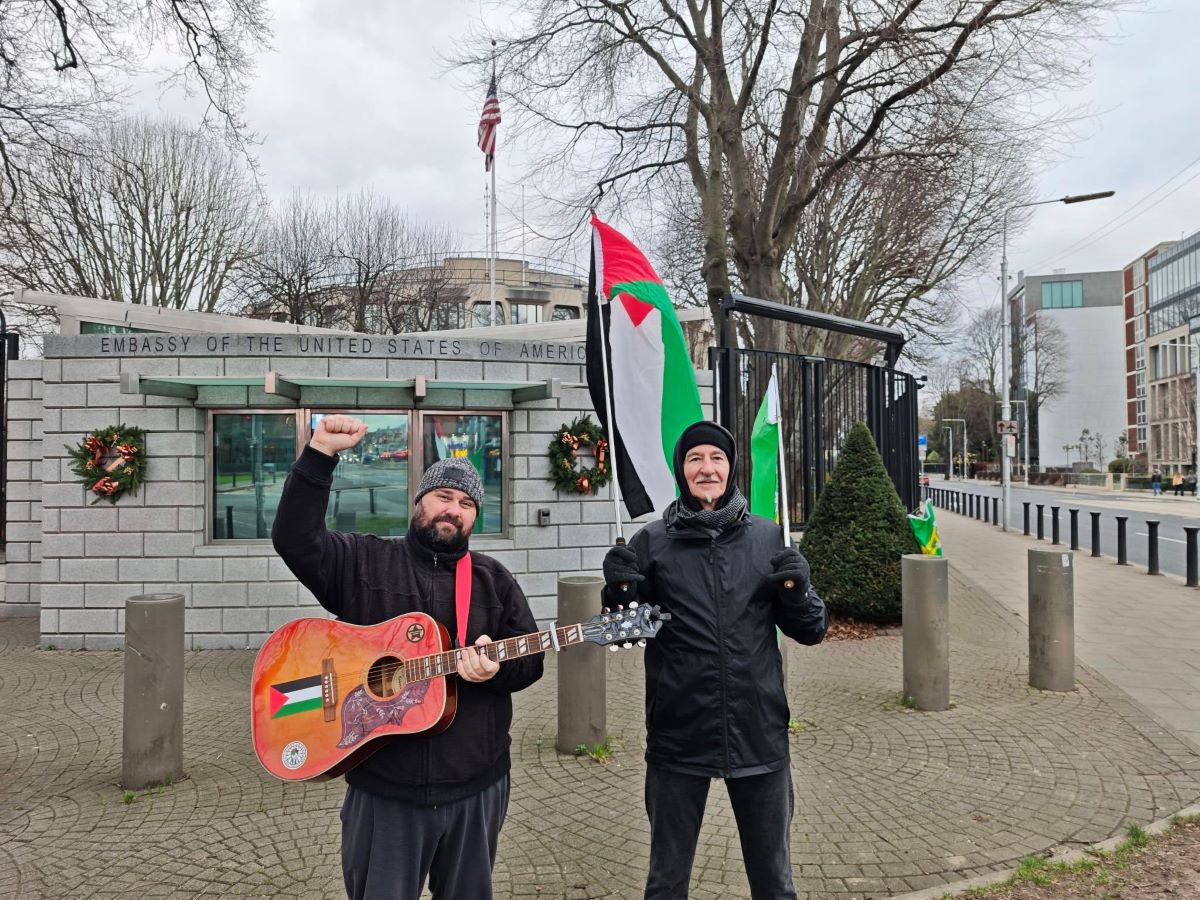
There the demonstrators thronged the Ha’penny and Millennium Bridges and spilled out along the quays. I was elsewherefor the first time in years as it was a Wednesday and therefore Jimi Cullen’s weekly protest with songs at the US Embassy in Ballsbridge, this one to be his 97th straight.
As usual there were police on guard there and one in uniform approached myself and Jimi as we were talking and asked Jimi how long the event would be, how many attending etc. Then she suggested I removed my bike which was leaning against a bollard.
Conducting the protest inside the Stephen’s Green Centre on New Year’s Eve which obliged management to close down for some hours the Starbucks café inside. (Photo: G.O.L)
I told her I was happy with where it was, thank you. Then she said that it might fall on someone (but not, of course, if across the road!), then that someone might steal it, all of which was nonsense of course then said: ‘I am asking you to remove it’ to which I replied ‘And I am declining.’
She was getting quite angry but decided to walk it off. I have attended supporting Jimi’s protest perhaps a score of times and in the early days had a similar approach from a Special Branch4 officer who accused me of causing ‘a security risk’ to the Embassy’s ‘curtilage’ (on a public footpath)!
The Ha’penny Bridge on New Year’s Eve. (Photo: IPSC)
Some police just like to throw their weight around even with regard to things that have nothing to do with the law or causing harm to anyone and over which they have no legal power.
Anyway we unfurled the flags, Jimi had a placard displayed, got out his guitar and we sang through week 97 to frequent waves, clapping, thumbs up, clenched fists, shouts and horn blowing of appreciation and solidarity from passing motorists, pedestrians and cyclists.
Section of northern quays/ Boardwalk on New Year’s Eve, during protest after closing down the Starbucks café inside. (Photo: IPSC)
Jimi began this weekly protest outside the Israeli Embassy but when they left Ireland he moved up the road to the nearby US Embassy, representative of the world leader in terrorism and biggest supporter, politically, financially and militarily of the world’s leading genocider entity.
Usually there are more supporters present. Jimi has a fine stock of protest and solidarity songs, some of which he composed himself and performs them well. Today we did mostly Irish songs of struggle but also one from the black civil rights struggle and Jimi’s own about Palestine.
Jimi Cullen and myself at Jimi’s weekly event outside the US Embassy on New Year’s Eve. (Photo: J.Cullen)
We had a number of Palestinian flags there but also two Starry Plough flags and there were some Irish Tricolours to be seen on the other protests among the many Palestinian ones. It is from our own struggle that we stand in solidarity with Palestine.
End.
Note: If you found this article of interest, why not register with Rebel Breeze for free, so that you will be notified by email of subsequent articles. You can de-register any time you wish.
2Ten Irish Republican prisoners, seven IRA and three INLA died on hunger-strike in a British jail in 1981 in a struggle against criminalisation and for political status










 rebelbreeze