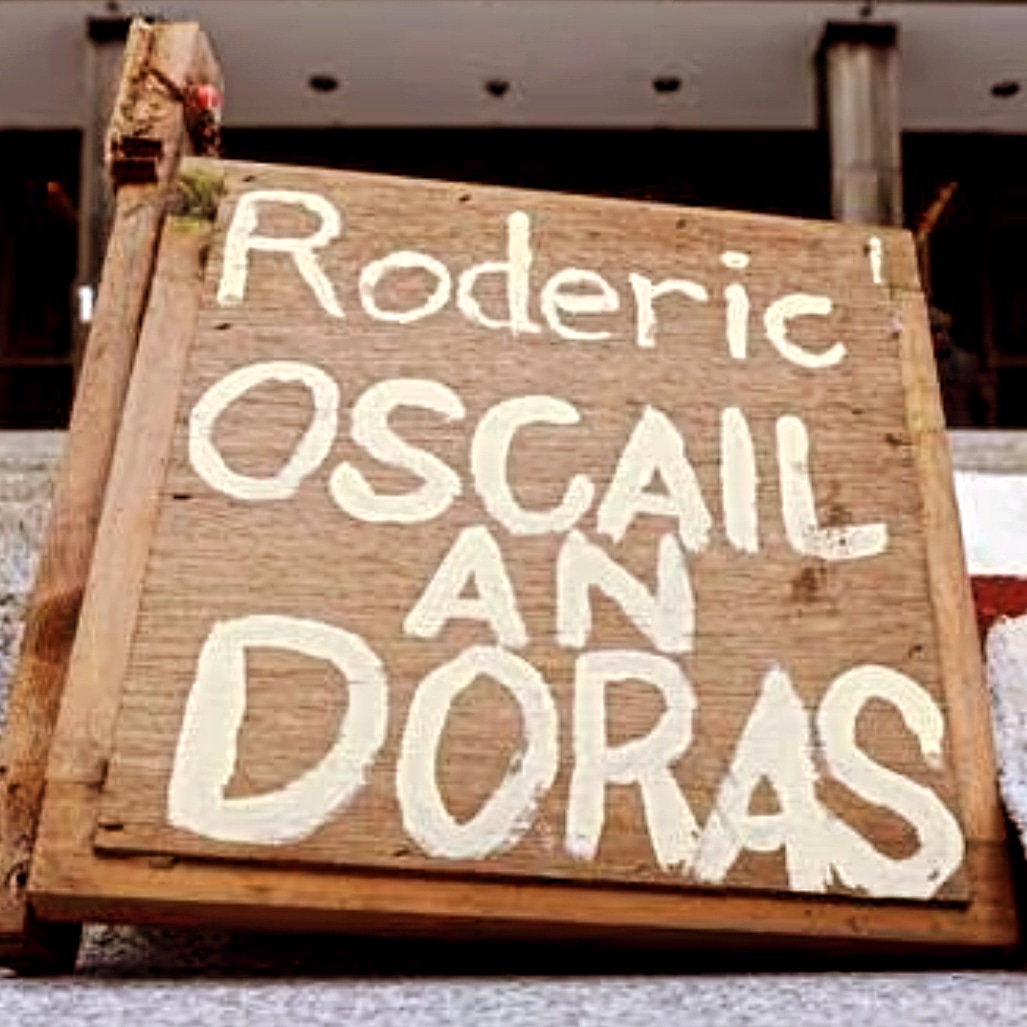
THAT FLAG IS NOT THEIRS – BUT IT’S NOT YOURS EITHER!

Diarmuid Breatnach

(Reading time: 6 mins.)

The Irish Tricolour has been in the news recently in an unhappy circumstance. The flag was featured borne in a group of anti-immigration racists carrying a banner declaring Coolock Says No,1 next to Union Jacks2 and Loyalist flags at a Belfast riot.

This was a bizarre juxtaposition given that Loyalists are hostile to any signs of Irish Republicanism, of which the Tricolour is chief among its historical symbols. Furthermore, the Unionist state banned its public display in most situations between 1954 and 1987 leading to resistance and arrests.3

In the sectarian society created by the British in its occupied Six County colony, the Tricolour is burned annually on British Loyalist bonfires and is reviled by Unionism and its more extreme progeny, Loyalism, which in turn is associated with state-sanctioned sectarian murder gangs.4

The strange juxtaposition was remarked upon in mass media not only in Ireland (both sides of the Border) but even in Britain — and Irish State Taoiseach (prime minister) Simon Harris remarked that he found the flag in association with racism to be “repugnant”.5

But does Harris have the moral right to make that comment?

Origin and History of the Irish Tricolour

The Tricolour as we know it and its use dates from its sewing in silk by revolutionary women in Paris in 1848 and presentation to a delegation of the Young Irelanders, a revolutionary Irish Republican group of that period and its subsequent unfurling in Ireland by Thomas Meagher.

Thomas Francis Meagher as captain in the Union Army (Source: Drawing in Library of Congress, USA)

Irish revolutionary Thomas Francis Meagher was convicted by the English Occupation of sedition during trials around the planning and carrying out of the Irish Rising of 1848 and, with death sentence commuted, transported to Australia as a felon, from which he escaped to the USA in 1852.

As the American Civil War approached, Meagher, along with most of the Irish in the USA took the side of the Union, leaving only a rump following Mitchell, formerly a comrade of the Young Irelanders, to side with the slave-owning Confederacy in the conflict.

Meagher not only fought in the Union Army in the American Civil War against the slave-owning Confederacy, gaining the rank of Brigadier but he and his wife raised a regiment, the 69th New York Infantry, unofficially called The Irish Brigade or even Mrs. Meagher’s Own.
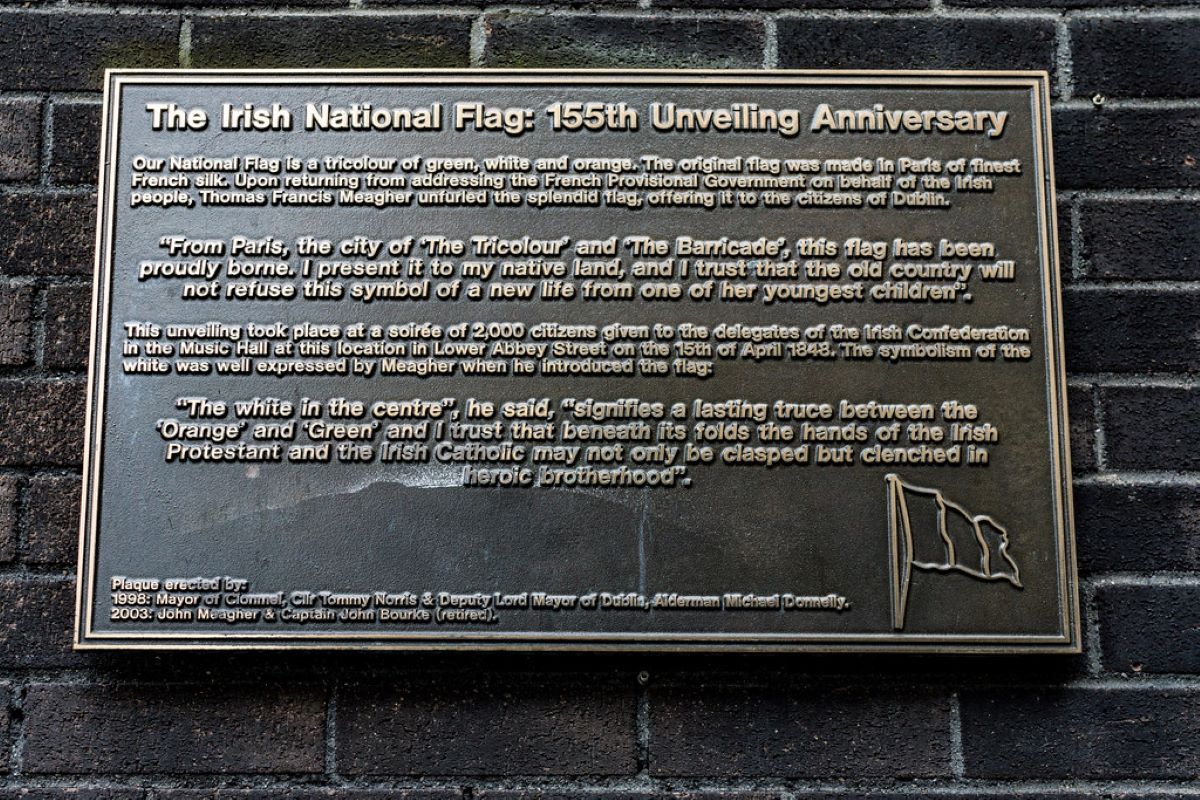
Plaque in Lower Abbey Street (opp. side of Abbey Theatre) to the first unveiling of the Irish Tricolour in Dublin, 1848. (Source: Internet)

The Young Irelanders were Republicans and the Tricolour was always seen not only as embodying the unity of all in Ireland, regardless of origin, against the British occupation but also for national liberation, against Monarchy and for complete separation of Church and State.

In addition, it had a strong internationalist element in that it was associated with revolution throughout Europe, presented to us in solidarity by French revolutionary women and flown alongside French Tricolours in Ireland at celebrations of the French revolution of 1848.

It was the principal flag of Irish anti-fascism too in the 1930s when Irish Republicans fought the fascist Blueshirts on Irish streets and a number of them went to fight in defence of the Spanish Republic against the fascist military coup of Franco and his Nazi German and Italian Fascist allies.

More recently when Irish Republicans and socialists mobilised against the attempts of the Irish ruling class to promote NATO and to ease cooperation with that alliance of Western imperialism, Harris also ranted against supporters of Anti-Imperialist Action flying of the Irish Tricolour.

The Tricolour among Loyalists was of course newsworthy and was covered by Irish mainstream media and Unionist mouthpiece The Belfast Telegraph along with photos by The Guardian on line. But all without comment on its presence in Palestine solidarity events in London.

Irish Tricolours have been flown at every current Palestine solidarity march in London (ten of them at the most recent London march) and, along with Saoirse Don Phalaistín printed on the Palastinian flag, have been seen also at university solidarity encampments and at events to free Julian Assange.

Section of Palestine solidarity protest at Barclays Bank, Tottenham Road, London on 24th April this year, showing Irish Tricolour and Saoirse Don Phalaistín flags. Zionists and British fascists are united in opposition to them across the road. (Photo cred: Northern Times)

The Tricolour Flown by Racists and Fascists?

Given its origins and history, why is the Tricolour being flown by fascists?

In recent years it seemed that whenever one saw a crowd with Tricolours among them, it was most likely a fascist or at least racist-led event. One reason for this is that the fascists historically try to portray themselves as nationalists, i.e organising ‘for the nation’.

In all cases historically, the “nation” represented by the fascists turned out to be that of the ruling class, the financial and industrial elite – never that of the working people, not even of those sections of the lower middle class that supported the rise of fascist movements.

Fascists however have also frequently colluded with the invader of their nation, for example with the Nazis in Europe, particularly in France, Greece, Yugoslavia, Ukraine.6 The fascists in Ireland today represent the neo-colonial,7 colonial and imperialist financial-industrial interests in Ireland.

Racist group from Dublin suburb finds common cause with British Loyalists in Belfast anti-immigration demonstration and riots 3 August 2024 (Photo cred: Irish News)

In that context, the unity of fascists from the Twenty-Six Counties with Loyalists from the Six Counties is not surprising, nor even with notorious English fascist Tommy Robinson. Prominent Irish fascists have had friendly interactions with Loyalist Jim Dowson and British fascist Farrage.

Portraying themselves as saviours of the nation, as moral guardians etc., just as the German Nazis did in the 1930s is hypocritical but absolutely necessary for them. If they revealed the class interests they represent and the kind of regime they really want, where would they get supporters?

The fascists are few and need those supporters, their easily-led mobs and stormtroopers. It is among sections of the down-trodden in society that they will find them, the ignorant, marginalised, abandoned by the capitalist system but all too often by the liberals and the Left also.

Substance addiction, mental illness, crime and cultural poverty is rife in these communities and it is sections of those who are presented with false enemies – migrants, LGBT people, muslims – by false saviours masquerading as patriots. Many in those communities are ripe for manipulation.

But the attempted takeover of the Tricolour and subversion has not occurred by Fascist manipulation and through historical and political ignorance alone.

When antifascists mobilise, rarely is the Tricolour seen amongst them, assisting the impression that it is the racists and fascists that are representing the nation. Understandably, Anarchists may not wish to fly the flag of a state and socialists may feel that the flag is representing a capitalist state.

Often too in the past, Republicans have been absent from antifascist mobilisations but on occasion too went to them ready for physical confrontation and therefore without flags. But what message do antifascists think is presented by Palestinian flags among them and Tricolours on the other side?8

Invited to speak at a conference on anti-fascism in Dublin some years ago, I raised the question of the appropriation of the Tricolour by fascists and how it was necessary for the antifascists to show it among themselves also but my recommendation did not win approval9.

It is depressing to see that the situation has not noticeably improved in this regard some years later.

A welcome recent exception to the rule: a number of Irish flags including the Tricolour among antifascists outnumbering fascists and racists in Dundalk, Co. Louth on 4 August 2024 (the day following the Belfast racist riots). The fascists and racists had to be escorted out of town by the Public Order Unit of the Gardaí (Source photo: Anti-Imperialist Action FB site)

The Irish state and the Tricolour

It took some time for the Tricolour to be adopted as the national flag in the Republican movement until its fluttering above the GPO at the Henry Street Corner during the 1916 Rising.10 Thereafter it represented the forces of national liberation in the War of Independence (1991-’21).

The Irish Tricolour (Photo cred.: Getty Images)

Facing treason and counter-revolution in 1922, it was the flag of the Anti-Treaty forces, the neo-colonial traitors only flying it in order to deny it to the Irish Republicans. Despite that fact it has remained the flag of Irish Republicanism, irreconcilable with neo-colonialism, racism or fascism.

Republican women activists of Cumann na mBan designed ‘Easter Lilly’ paper lapel pins to raise funds for dependants of Republicans imprisoned or killed during the Civil War and they did so in the colours of the Irish Tricolour: Green, White and Orange. The emblem is worn to this day.

The counter-revolutionary faction that spawned the fascist Blueshhirts11 did not formally adopt the Tricolour as the State flag in law, that was done by the next wave of counter-revolution, Fianna Fáil,12 while in government, situating it in the 1937 Constitution.

The Tricolour is in a sense the flag of everyone in Ireland who does not reject it or defile it but evidently too, in its origins and among those who bore it forward, it is anathema to racism.

Furthermore, it is symbolically anathema to colonialism, loyalism, neo-colonialism and monarchy. Clearly the Tricolour is not legitimately the flag of racists and fascists but neither is it of the gombeen regime that flies it; Harris and the neo-colonial State claiming it is also repugnant.

Effigy of Simon Harris showing the bloody hands of collusion in the ‘Israeli’ genocide against Palestinians at a Palestine solidarity protest last weekend (organised by Mothers Against Genocide, North Wicklow Against Genocide, Arklow Against Zionism) at the annual Bray Air Show which features UK Military fliers. (Photo cred: Aisling Hudson)

End.

FOOTNOTES

1Coolock (from the Irish place-name An Chúlóg) is a Dublin city suburban district that has seen riots and arson recently against plans to house refugees in a disused factory building there.

2Common name for the flag of the United Kingdom, more derogatorily known as ‘The Butcher’s Apron’, featuring heraldic cross and salterres of the nations of England, Scotland and Ireland (Wales had already been conquered and incorporated into the Kingdom of England).

3https://en.wikipedia.org/wiki/Flags_and_Emblems_(Display)_Act_(Northern_Ireland)_1954

4Such as the Ulster Defence Association and the Ulster Volunteer Force (see also ‘the Glennane Gang’) which targeted most of their victims on the assumption of their being of the Catholic faith but also occasionally those from the Protestant community they considered disloyal (see ‘the Shankill Butchers’) or with which they were in competition around gang crime. All operated with colonial police and British Army assistance.

5https://www.irishtimes.com/ireland/2024/08/04/cafe-and-supermarket-burnt-out-after-anti-immigration-protests-in-belfast/

6These fascist groups supplied police and auxiliary units to the Nazi occupation, collecting information on the antifascist Resistance and on fugitive Jews and Roma. In some cases, as in Ukraine, they also acted as prison and concentration camp guards (but their chief leader, Stepan Bandera, was nominated as a national hero by the current Kiyv regime).

7Sometimes called ‘comprador capitalist’ or ‘client regime’, a term describing a state that is nominally independent but is under the actual domination of an external state or states. The Irish state has been in turn dominated by Britain, the USA and the EU imperialists.

8This is an issue on Palestine solidarity marches and pickets upon which I have also commented before.

9A speaker from a very sectarian migrant group ridiculed the idea but no-one else spoke up in support.

10Incidentally, at the other corner of the GPO above Princes Street in 1916 flew the green flag with the words “Irish Republic” inscribed upon it in white and gold letters, which had been created for the occasion in the home of Constance Markievicz, socialist revolutionary of a settler landowning family and born in London. And the man who erected it was Argentinian-born-and-raised Eamon Bulfin. It is ironical in the extreme that this flag also is sometimes brandished by Irish racists opposing immigration.

11Irish fascist organisation officially called the Army Comrades Association (later The National Guard), led by former Gárda Commissioner Eoin O’ Duffy which later joined with two conservative parties to form the current Fine Gael, currently in the Coalition Government with its erstwhile opposition Fianna Fáil and the Green Party.

12A major split from Sinn Féin in the early 1930s, currently in the Coalition Government with its erstwhile opposition Fine Gael and the Green Party.

SOURCES

https://en.wikipedia.org/wiki/Flags_and_Emblems_(Display)_Act_(Northern_Ireland)_1954

https://en.wikipedia.org/wiki/Shankill_Butchers

References to the Tricolour at Belfast racist riots: https://www.irishtimes.com/ireland/2024/08/04/cafe-and-supermarket-burnt-out-after-anti-immigration-protests-in-belfast/

https://www.belfasttelegraph.co.uk/news/northern-ireland/far-right-irish-thugs-spent-night-drinking-with-uda-in-belfast-loyalist-bar/a1541636214.html

Origin & History of the Irish Tricolour: https://www.1916rising.com/cms/history/leaders-soldiers-and-poets/history-of-the-irish-flag/

THOUSANDS MARCH THROUGH DUBLIN CITY CENTRE IN SUPPORT OF PALESTINE

Diarmuid Breatnach

(Reading time: 3 mins. Note: Apologies for delay in publishing this report)

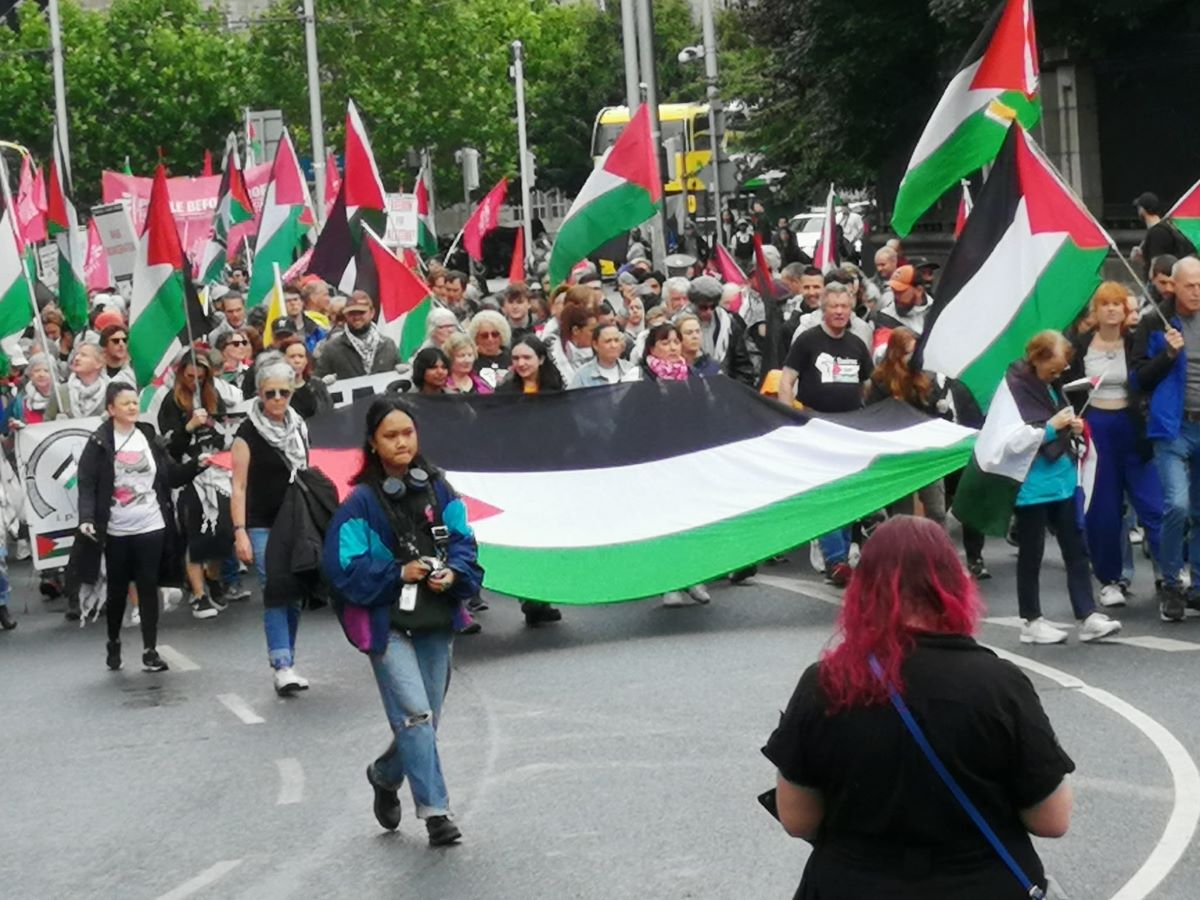
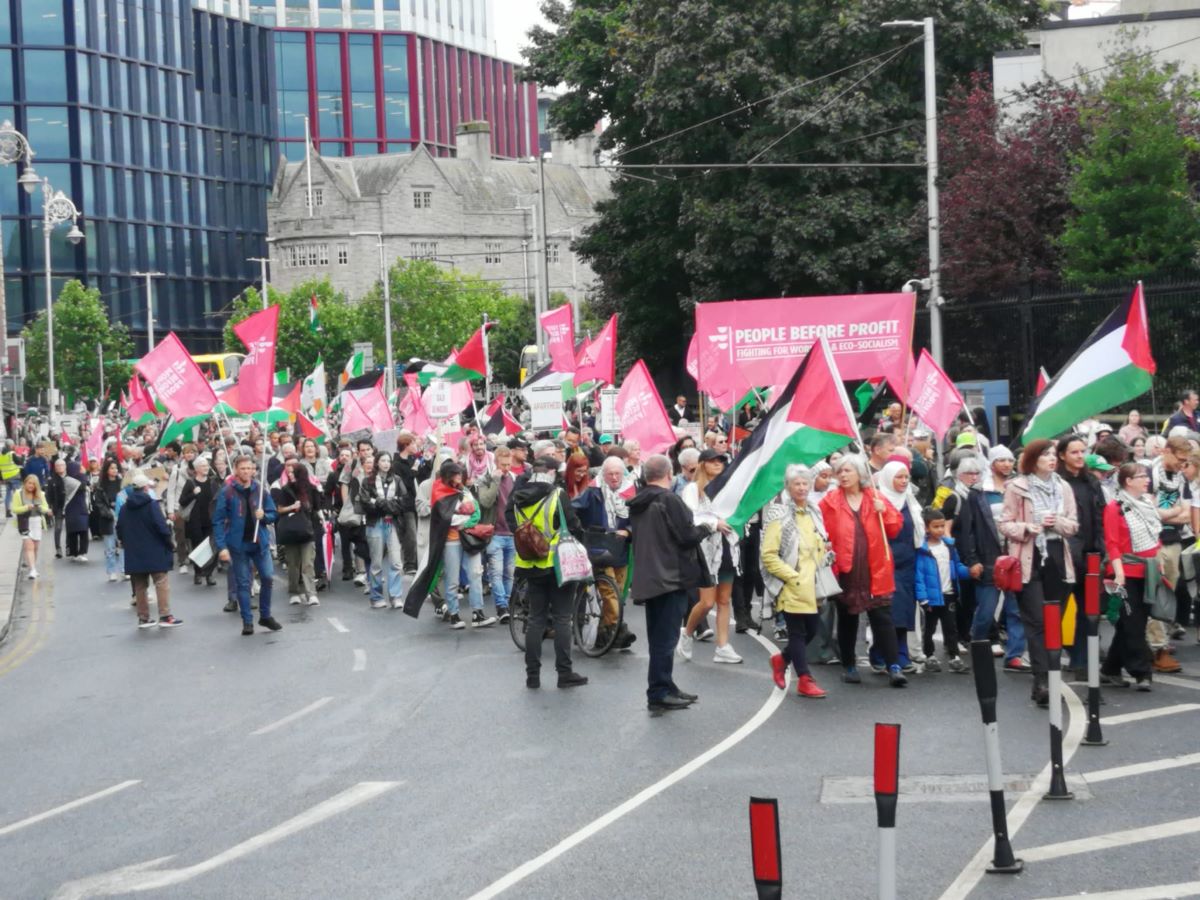
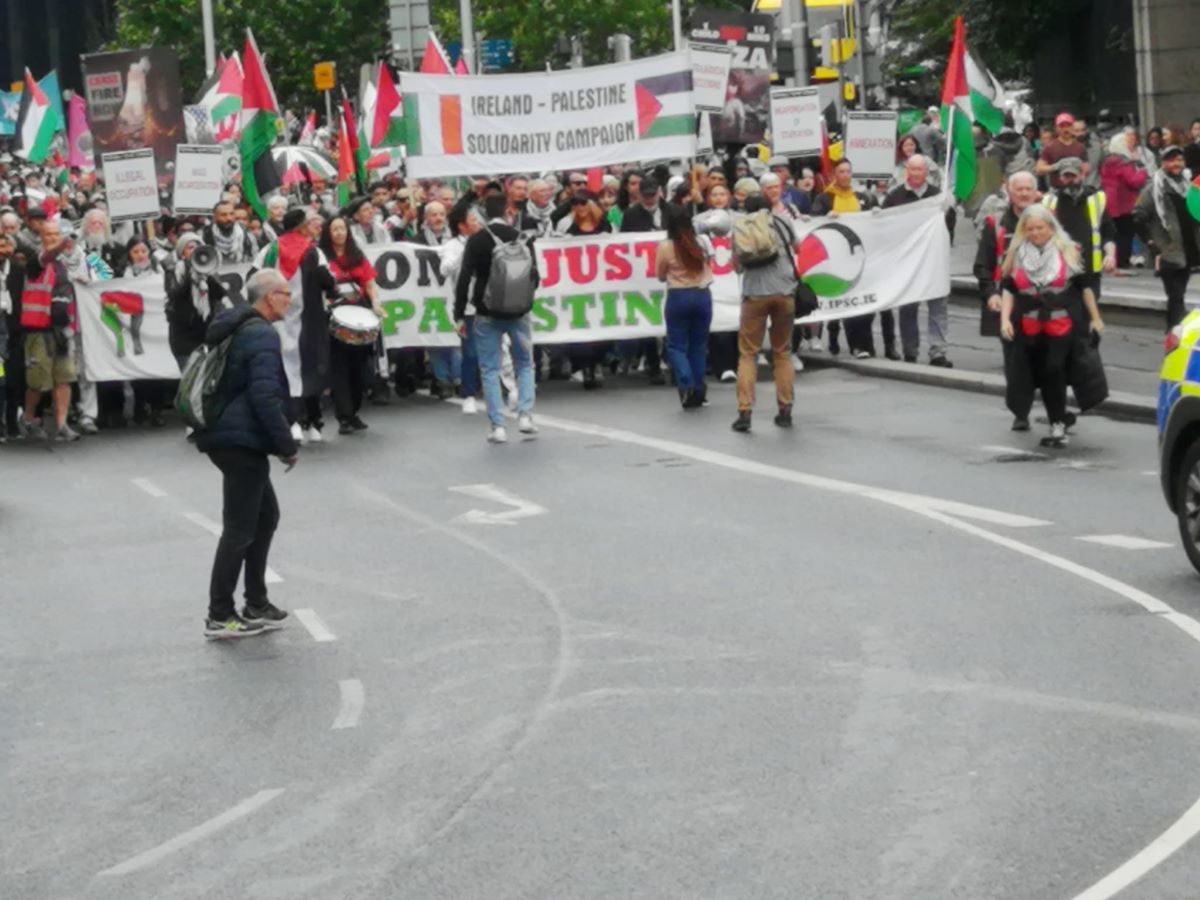
On Saturday 20th June the Irish people, despite their Governments once again marched in a national demonstration to show the Irish majority solidarity with Palestine and horror at their continuing genocide by the ‘Israeli’ armed forces.

The march had been convened by the long-standing Ireland Palestine Solidarity Campaign which has branches across Ireland from Cork to Donegal, including in some parts of the British colony (where however the Loyalists are anti-Palestinian).1

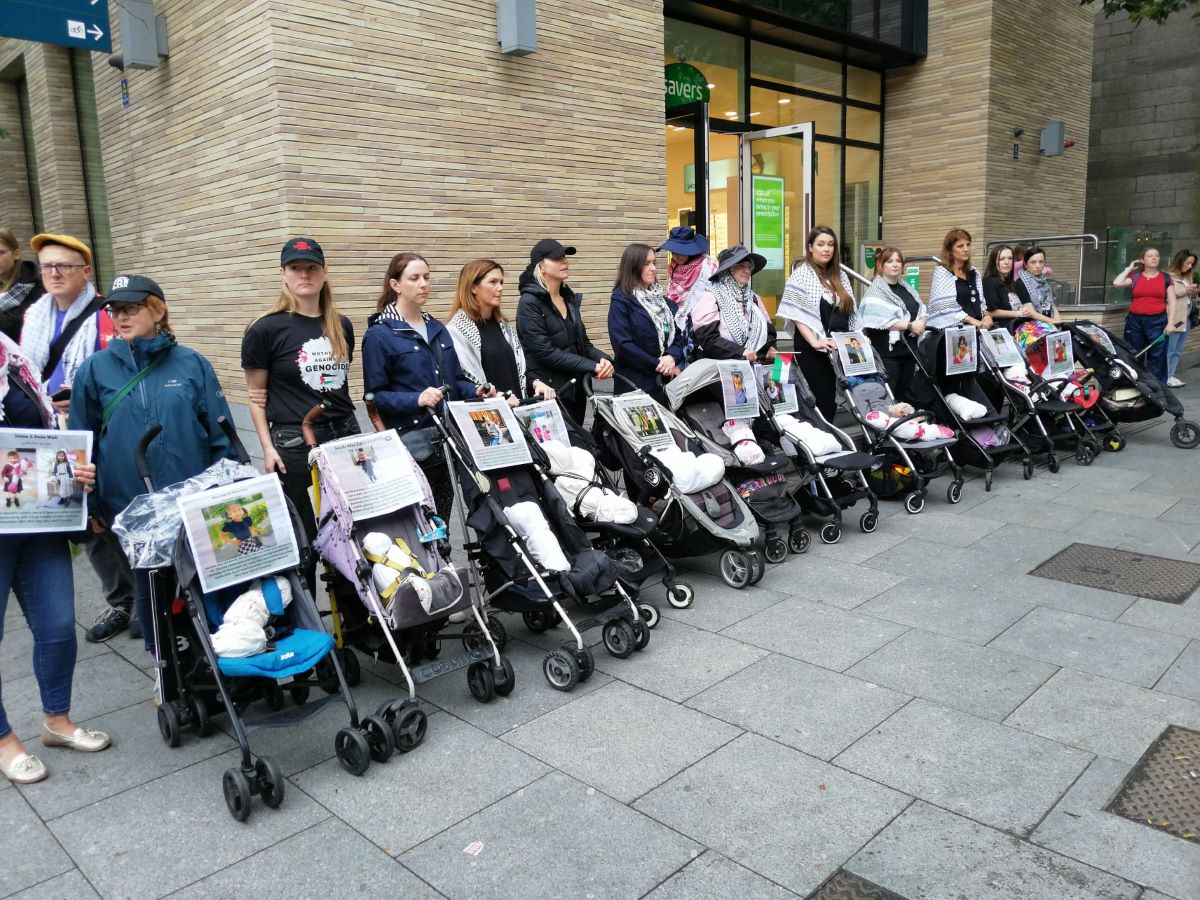
Mothers Against Genocide group in Dawson St. (around corner from Molesworth St.) evoking individual children murdered by ‘Israel’. (Photo: D.Breatnach)
Dublin community group that holds Thursday evening vigils in four areas of North Dublin. (Photo: D.Breatnach)
(Photo: D.Breatnach)

The assassinations of resistance leaders were still to come2 but it had been business as usual in Palestine with daily massacres of civilians by the ‘Israeli’ Occupation forces, ongoing starvation, destroyed health service, impending epidemics, prisoners released as ghosts of their former selves.

Also IOF raids and kidnappings3 in the West Bank, at times with Palestinian Authority4 collusion in arrests of activists, confiscation or destruction of Resistance weapons …

(Photo: D.Breatnach)

To all this the Palestinians in general have responded by helping one another trying to survive, digging people out of bombed rubble, documenting atrocities, burying their dead, trying to feed their children and elderly …

And their Resistance in all factions (and none) threw stones, fired bullets, launched anti-tank rockets, mortars, missiles and blew up bombs against Occupation armour and soldiers. And of course, contributed new names to the long list of martyred resistance fighters and commanders.

The ECJ,5 to howls of protest from the regime had pronounced its verdict that Israel was indeed, as has long been evident, guilty of practising apartheid against the Palestinians. However not one state ceased giving political or financial cover to the Occupation or supplying it with arms as a result.

Irish Healthcare Workers for Palestine. (Photo: D.Breatnach)

(Photo: D.Breatnach)

IPSC Police?

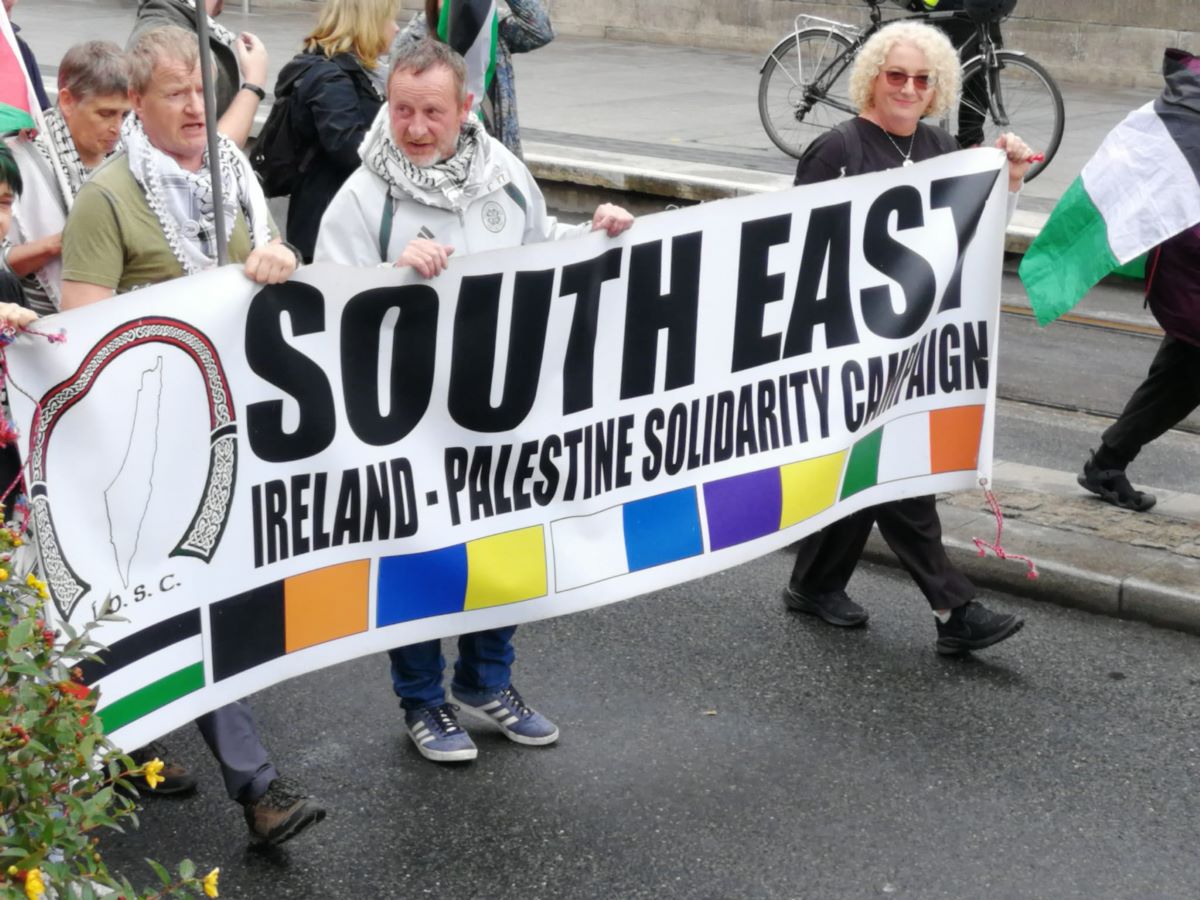
Only a few Irish Tricolours were displayed on the march which is visually a political mistake, as I’ve observed earlier and the organisers should state that such are welcome. Not one Starry Plough flag, that of socialist Republicans, could be seen either, despite no doubt there being many such participating.

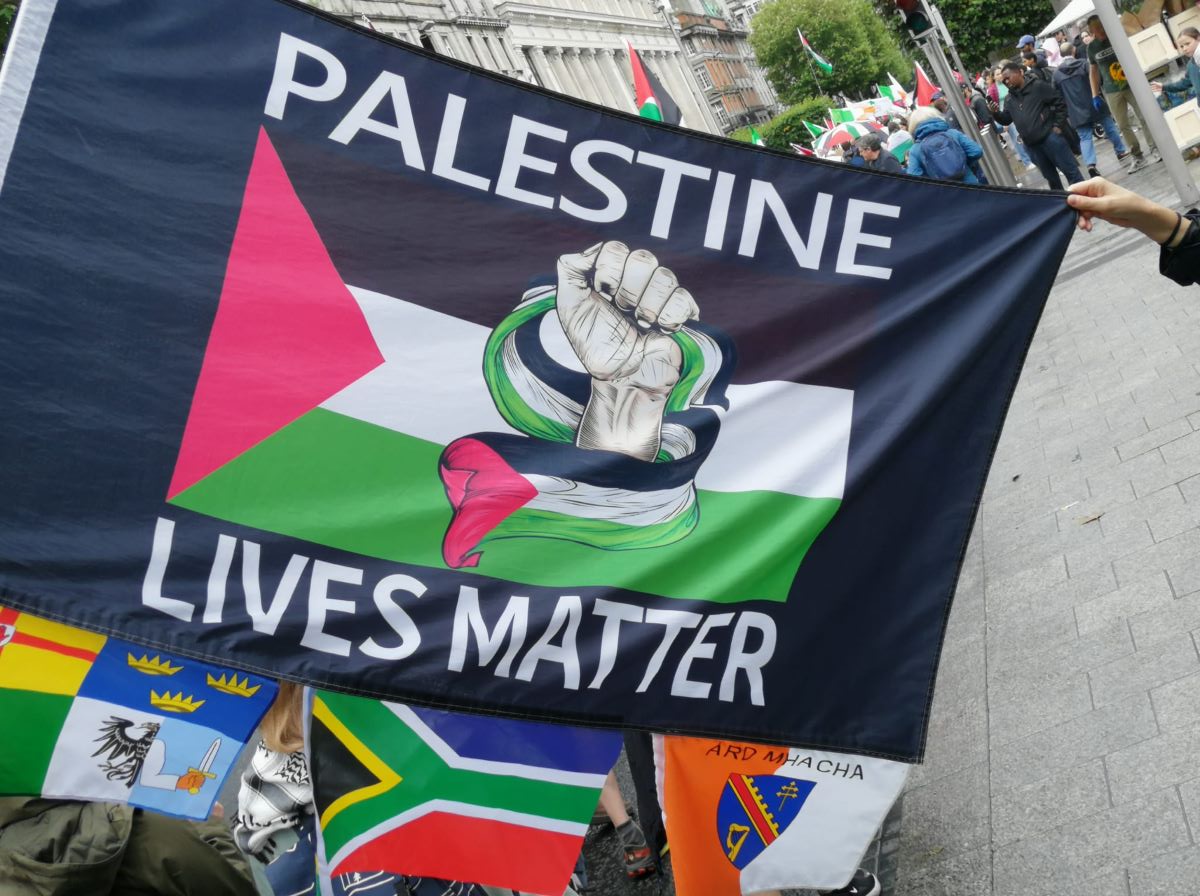
Irish language placards and banners have been getting rarer, despite a previous welcome upsurge upon which I’ve commented in the past. However there were some to be seen, including a number of Saoirse Don Phalaistín flags and the banner of a Newry group, from Co. Down, under British occupation.

(Photo: D.Breatnach)

As they filled Molesworth Street towards the IPSC stage and police barriers at the end, facing the Leinster House Irish Parliament building, some marchers already began to leave, having heard speeches before and perhaps heading for their transport back to their earlier points of departure.

The company that erects crowd barriers were ready to install them to cut off a section of Molesworth Street at the intersection of narrow lanes and the Gardaí wanted to cram the crowd in beyond the barriers. IPSC stewards began to usher marchers further into Molesworth street.

One approached a group of marchers telling them what the police wanted to which one of the group replied: “I don’t give a f..k what the police want!” and after the steward’s persistence, accused him of doing the job of the police.

The IPSC stewards have helped the police pack marchers into the stretch of Molesworth Street beyond the intersection (and incidentally leaving any demonstrating in Dawson Street cut off from the main group). (Photo: D.Breatnach)

Aside from the rough language, what were the IPSC stewards doing passing on police orders?

People in the group said that the IPSC stewards have done this before and that furthermore there was no important-through way being cleared,6 the exercise serving no real purpose other than getting the public used to being corralled and that at the least the police should do their own job.

(Photo: D.Breatnach)

The main purpose of stewards is to keep the march moving and safely from traffic. The route has been agreed beforehand by the IPSC with the Gardaí which is not a legal requirement in Ireland. Even in that case the stewards should keep a strict separation in functions from the police.

The IPSC does an important job, publishing information and organising events, especially nationally but back in October delayed in even calling for the Zionist Ambassador’s expulsion. Some other groups also organise events and it appears that the IPSC supports some and not others.

Young Palestinian women leading the slogans call-out. (Photo: D.Breatnach)
(Photo: D.Breatnach)

Going forward it seems that the solidarity movement, including of course the IPSC, will need to take into account their meagre effect on the Irish Government, not to speak of upon the genocidal state itself and on its supporting states in the West, in particular the USA, Germany, UK …

Such recognition will call for escalation, for direct action, for different kinds of solidarity action … whether some organisations want to participate or not.

(Photo: D.Breatnach)
Some trade union banners on the march (though the unions do little to mobilise support, much less take action against ‘Israeli’ products etc.). (Photo: D.Breatnach)
Front of the march turning into College Street. (Photo: D.Breatnach)

FOOTNOTES

1This could be because they see themselves as ‘British’ settlers, while the ‘Israelis’ are European settlers too but is more likely a knee-jerk reaction to the Palestine solidarity exhibited by Irish nationalists (something like “If they’re for them, we must be against them”.

2Assassinations of leaders of Hamas, Hezbolah and senior officers of Islamic Resistance Iraq.

3The IOF and the Zionist State may call them “arrests” or “detentions” but typically they are random or working off a list without warrants or due process. Former prisoners are re-arrested constantly; family of ‘wanted’ individuals are detained in order to pressure the ‘wanted’ to give themselves up. Typically the detained are served ‘administrative detention’ orders, jailing them for months without trial or evidence. Prisoners are underfed, overcrowded, beaten by guards, have dogs set upon them and medically neglected.

4Unelected, undemocratic, corrupt and zionist-colluding body financed by some Western powers and some colluding Arab states.

5https://palestinecampaign.org/icj-ruling-finds-israel-guilty-of-unlawful-occupation-and-apartheid/

6Furthermore, with no side-streets available in that section beyond the intersection, the police could close that west end of the street should they wish to, ‘kettling’ all the demonstrators between two Garda barriers.

“Long live the Intifada!” in Dublin as ‘Israel’s’ Genocidal War Reaches 300 Days

Clive Sulish

(Reading time:4 mins.)

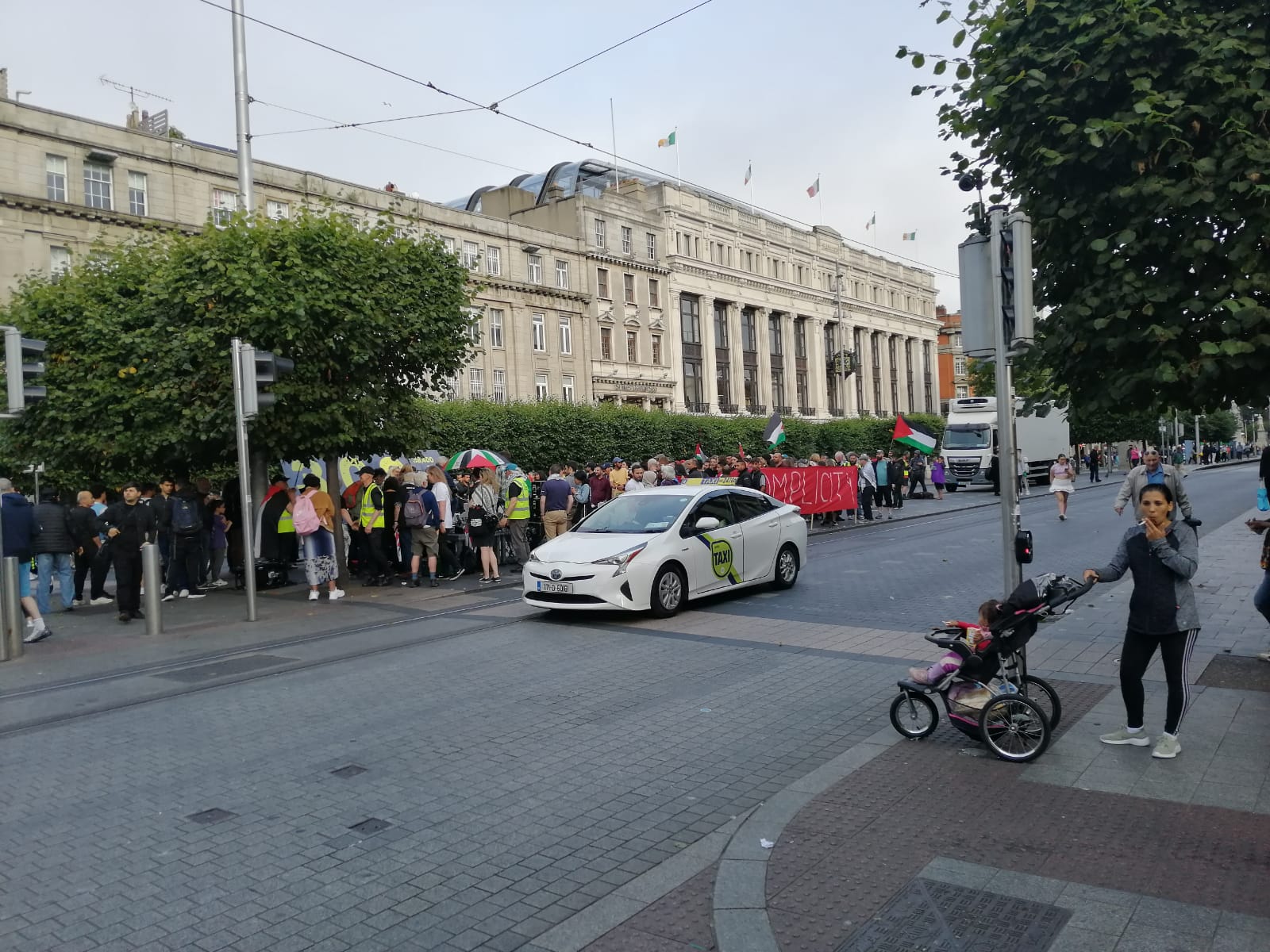
On Friday 2nd August two events of Palestine solidarity advertised at short notice took place a couple of hundred metres apart in Dublin City centre, attracting up to a couple of thousand participants overall.

The larger event by far was organised by the Ireland Palestine Solidarity Campaign and focused on the 300th day of the Genocidal war on the people of Gaza by the Israeli state. The smaller, approaching a hundred participants, concentrated on the assassination of leaders of the Resistance.

The IPSC-organised vigil on O’Connell Street (Source photo: R.Breeze)

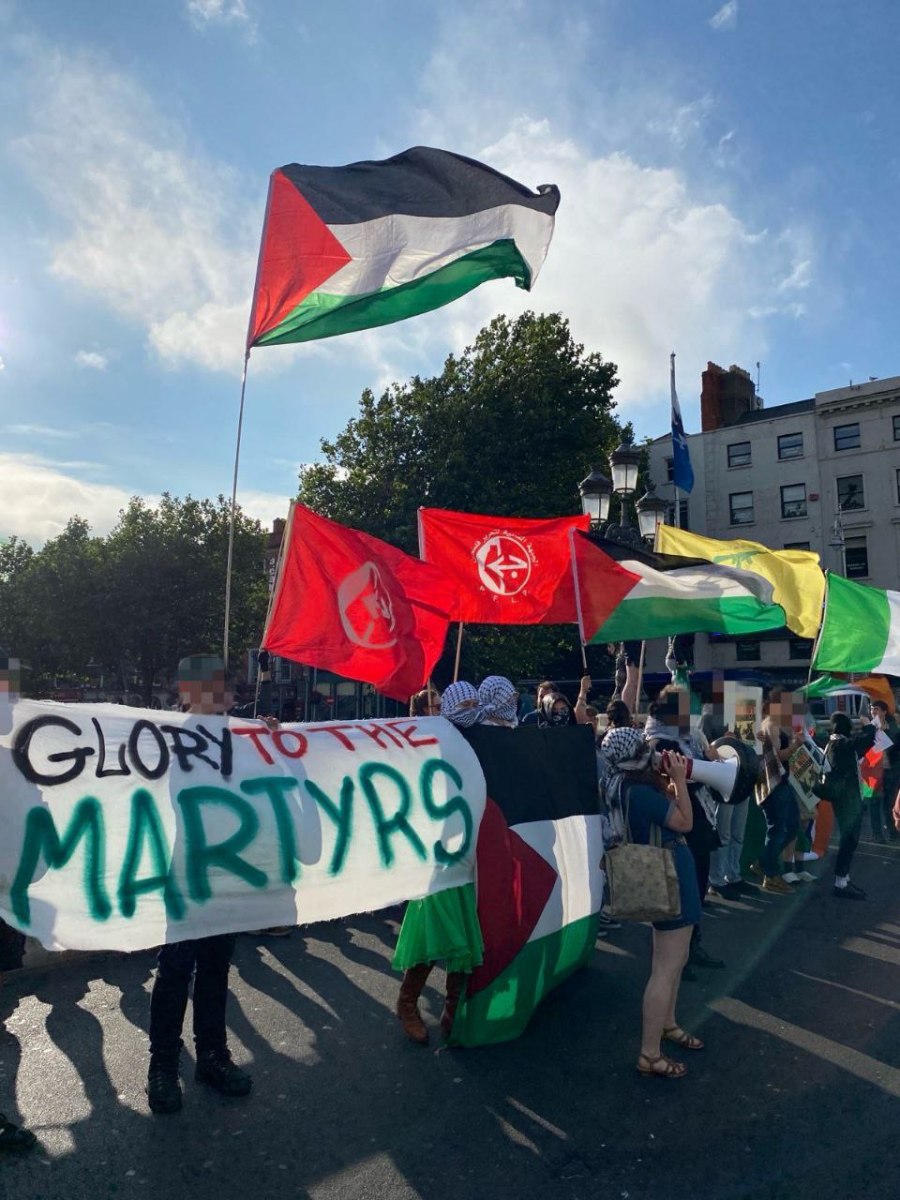
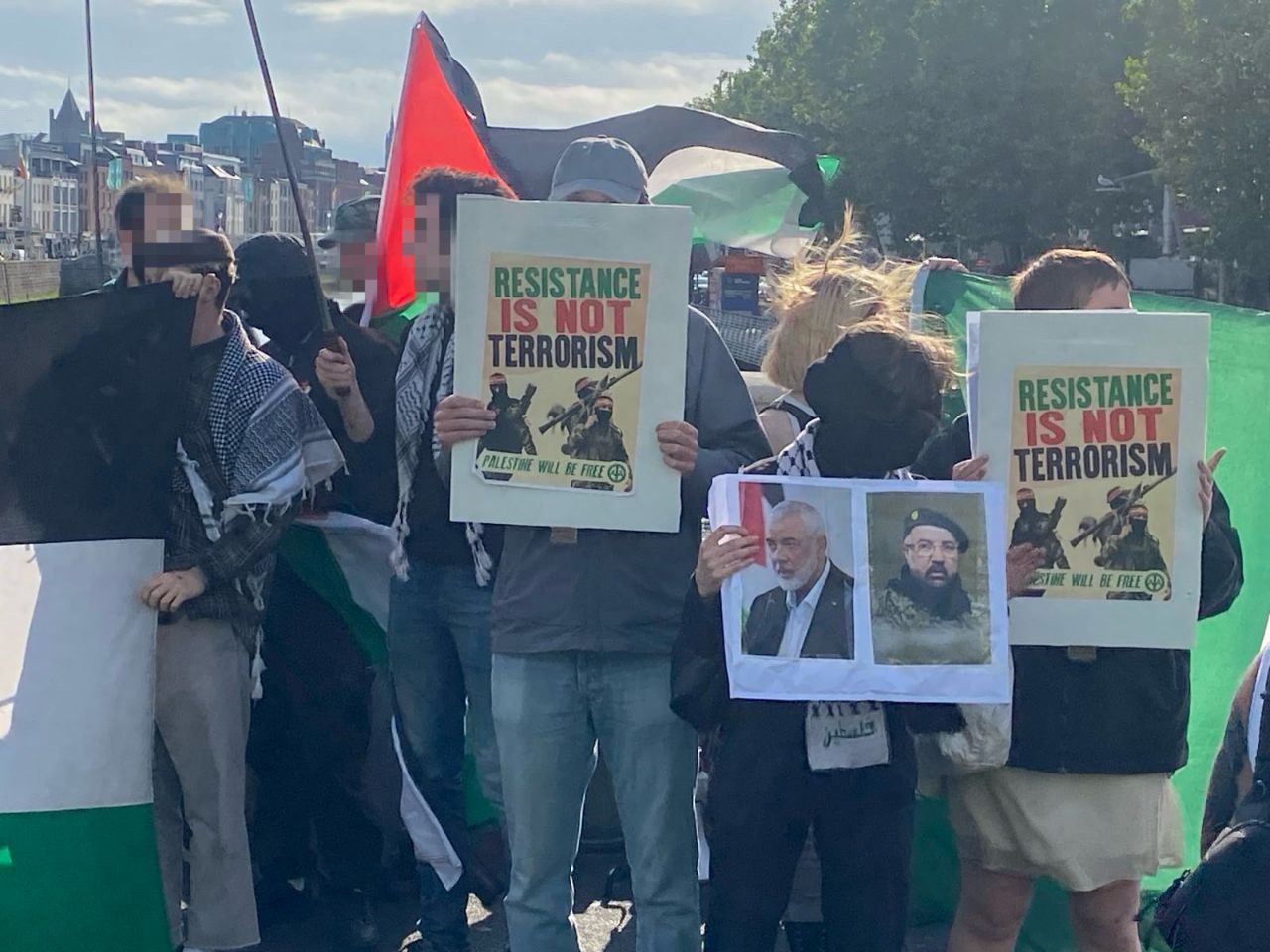
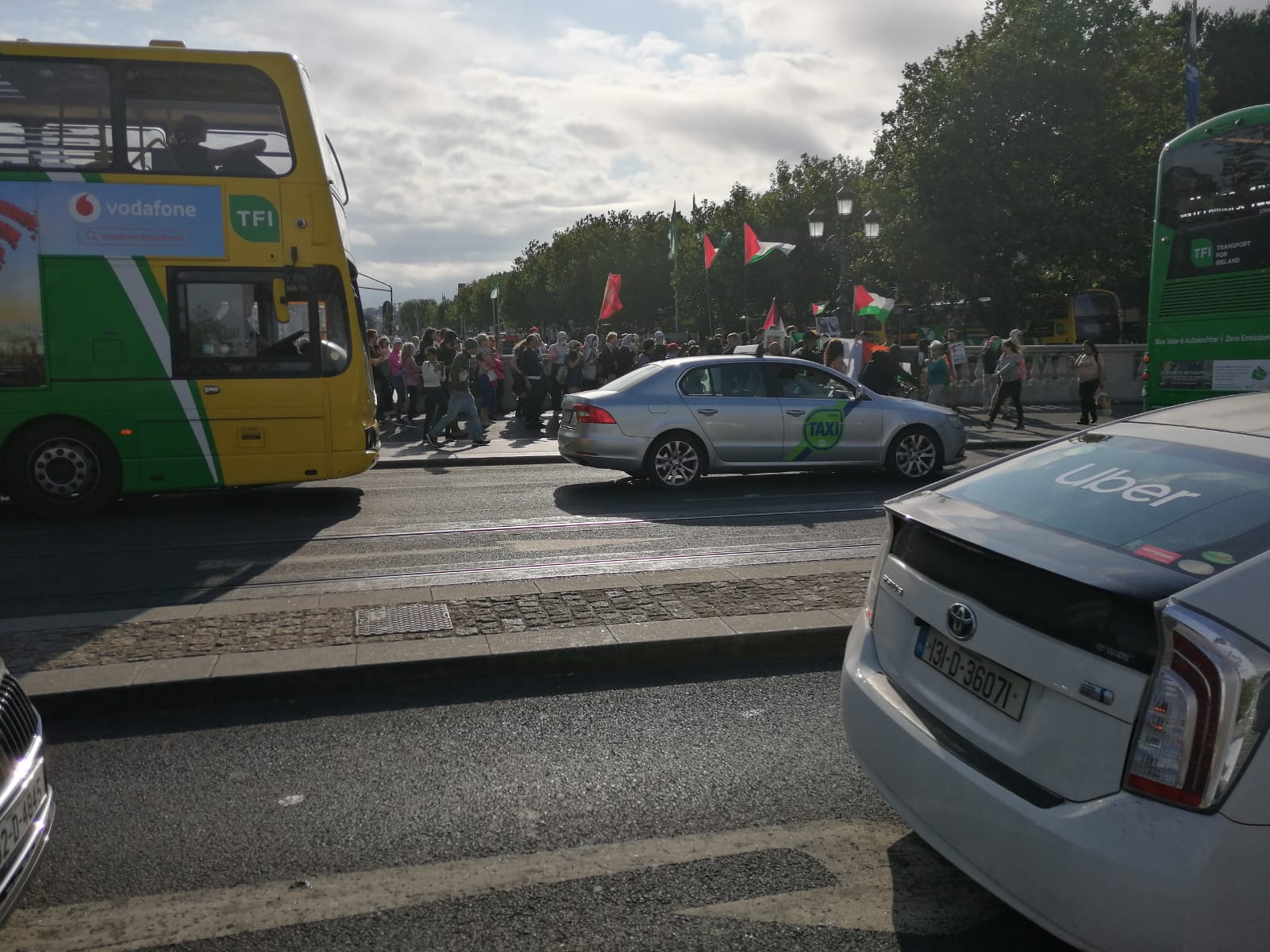
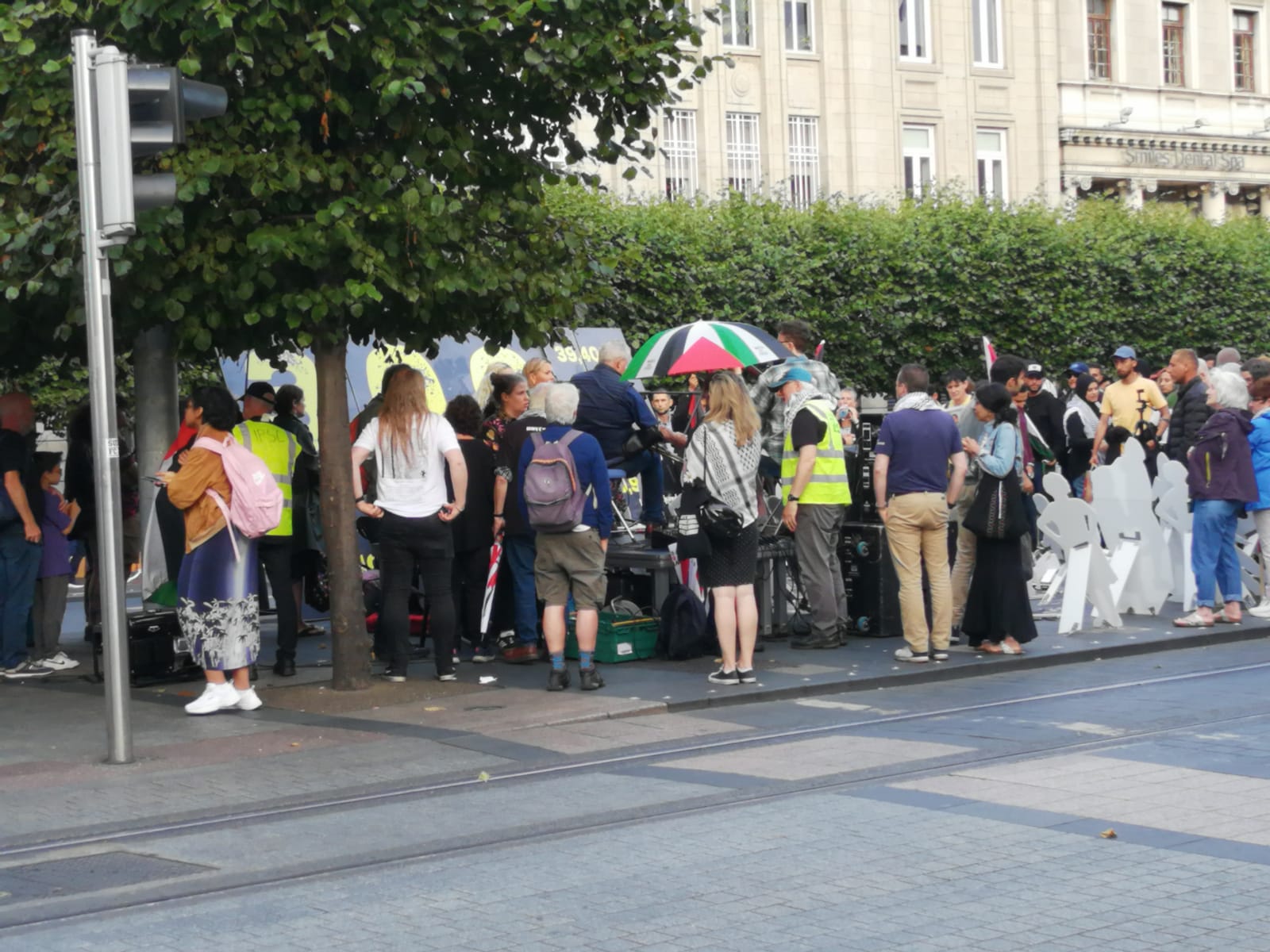
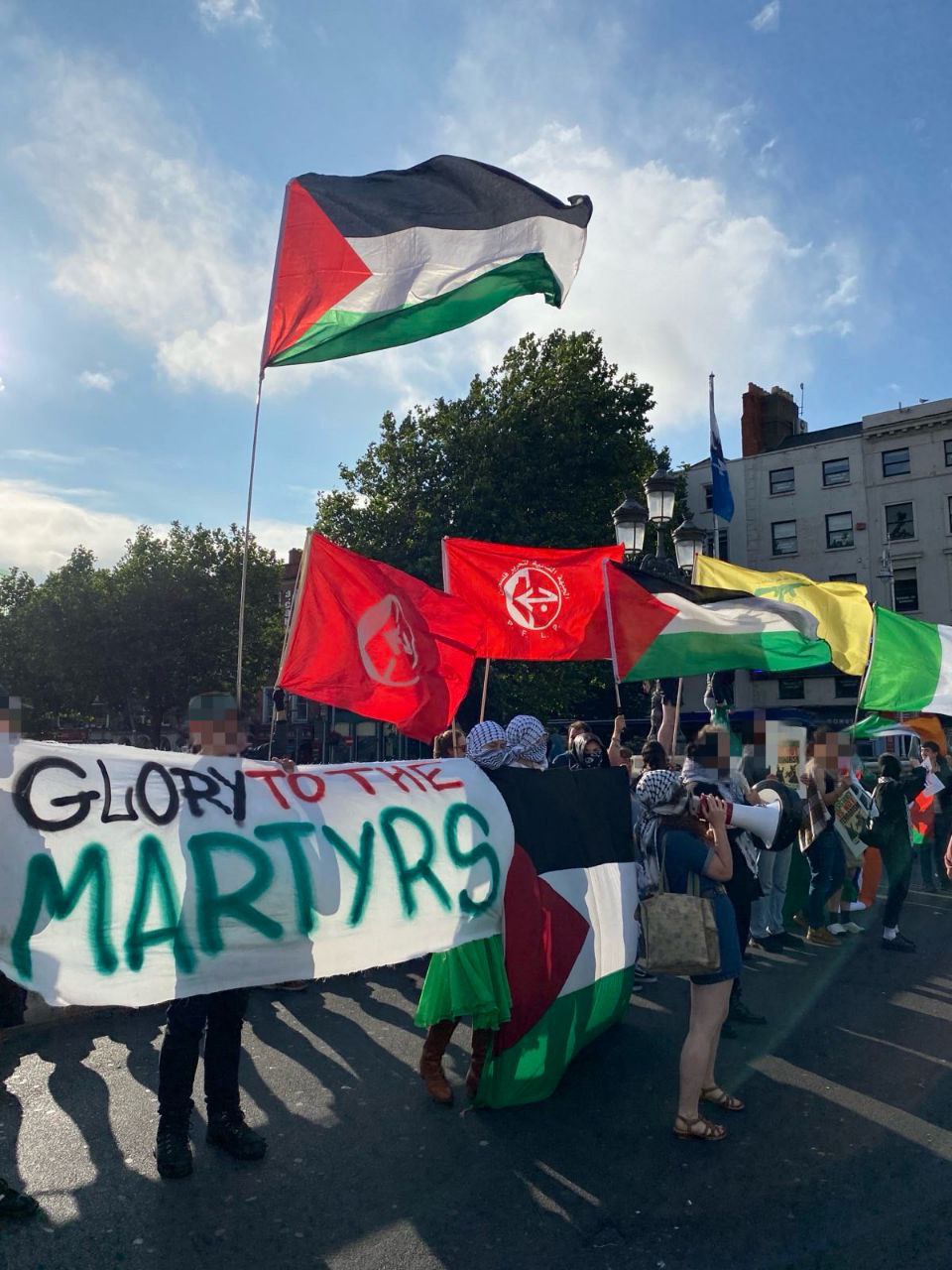
The IPSC occupied the space to which they have become accustomed in front of the GPO, the other, organised by Anti-Imperialism Action and the Saoirse Don Phalaistín coalition, took up position on the west side of O’Connell Bridge, where flags of the PFLP, Hamas and Hezbollah could be seen.

Some carried portraits of martyred Resistance leaders Haniyeh and Fouad; among the usual Palestinian national flags and resistance faction flags, a number of Irish Tricolours could also be seen, along with a green-and-gold Starry Plough.

Close-up section of the AIA-SDP protest on O’Connell Bridge (Source photo: AIA)

Some printed placards stated that Resistance Is Not Terrorism, while a couple of home-made placards stated that ‘Israel’ and US/NATO are the real terrorists! and a home-made banner declared Glory to the Resistance!

An almost constant stream of slogans were called by young people taking turns (one male and two females) and answered by the crowd, “Long live the Intifada” and “In the face of occupation, resistance is an obligation” in particular leaving no doubt where their sympathies lay.

Shot taken early as protest was getting started (Source photo: R.Breeze)

The crowds passing by were either openly supportive or non-committal but a few hostile comments were thrown and one middle-aged man shoved the loudhailer into the mouth of a young Palestinian woman who was calling out slogans for the crowd’s response.

She reacted immediately to the hostile act and was quickly supported by a group of young women who pushed the man away. Three Gardaí who were watching from the central reservation then came across to the group and took the man to one side but also demanded the Palestinian woman’s ID.

One of two placards with the same message displayed on the AIA-SDP protest on O’Connell Bridge. (Source photo: R.Breeze)

Unaware of her rights, she gave them that information. The Gardaí said they had not seen the man’s action, only that of the women pushing him along the Bridge. He claimed that the megaphone had been blaring in his ears but the suspicion is that he had been expressing his hostility to the cause.

The opinion of some people was that there would be no subsequent police action against the woman but some others gave her precautionary advice and also contact numbers for witnesses.

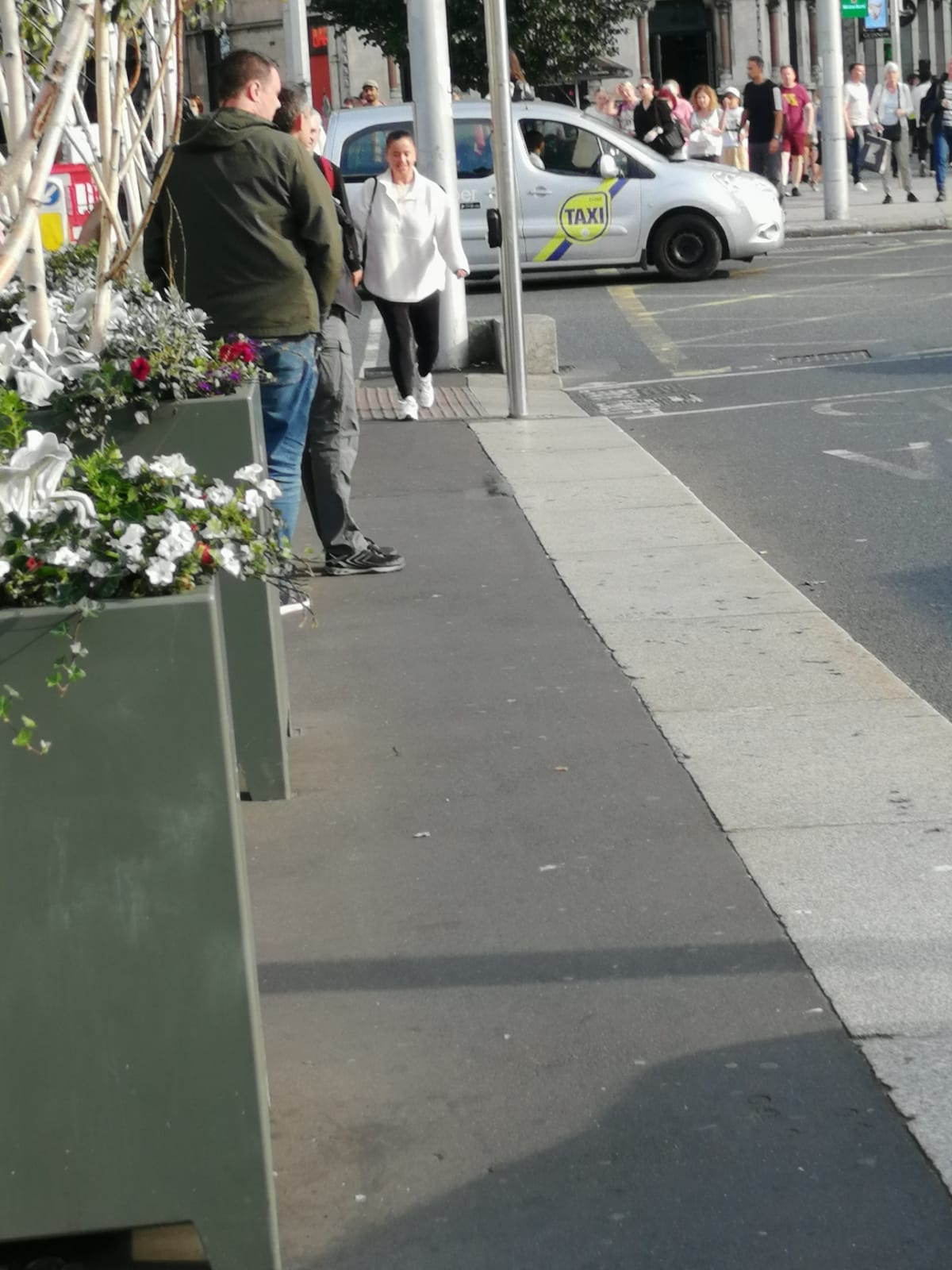
A Garda jeep and number of uniformed Gardaí had taken up station on the east side of the Bridge and a couple of Special Branch (plain-clothes political police) were also noted observing and videoing from the central reservation but none approached the demonstrators.

Two Special Branch officers immediately after their arrival on the central pedestrian reservation on O’Connell Bridge. (Source photo: R.Breeze)

A sinister individual who met the SB men on the central reservation, constantly on his phone and at times directing the SB where to film, may have been Mossad, the ‘Israeli’ foreign secret service, well-known for assassinations such as that of Palestinian Mahmoud Al-Mabhouh in Dubai in 2010.

Possible Zionist agent seen here near the SB officers on the central pedestrian reservation on O’Connell Bridge. (Source photo: AIA)

The photographs of 26 of his suspected assassins and their aliases were circulated by Interpol and Dubai police found that 12 of the suspects used British passports, along with six Irish, four French, one German, and three Australian passports; this causing some diplomatic storm at the time.

Approximately an hour after the start of the event on the Bridge, it was concluded while in front of the GPO, the other event was still continuing.

Section of the IPSC-organised vigil in O’Connell St. (Source photo: R.Breeze)
Close-up of section of the AIA-SDP organised protest on O’Connell Bridge. (Source photo: AIA)

End.

Important Call for a United Resistance Front

Diarmuid Breatnach

(Reading time article: 3 mins.)

Earlier this month there was an oration delivered at the grave of Wolfe Tone1 which contained some important elements which deserve inspection and discussion.

– The path to rebuild our struggle is the development of an Anti Imperialist Broad Front – said the speaker. – A United Front of Revolutionary republicans, working in cooperation to advance our common republican objectives and to achieve a common republican programme.

Looking around us at the parties and groups in the socialist and republican spectrum, the ostensibly revolutionary varieties, we see that for many of them, building up their own organisation takes precedence over anything else, including revolution – for them the revolution IS their party.

Speaker giving oration at Wolfe Tone’s grave in front of the monument, faced by colour party. (Photo: RSM)

The call given in this oration runs counter to that kind of thinking. “But we’ve heard all that about ‘unity’ before,” a reader might say. Yes we have and often “unity” meant only “unity” around that particular party or, even more often, around this or that leadership.

There is nothing of that to be found in this address “recognising and respectful of the autonomy and independence of the groups and independents involved”. “Hmmm,” the reader might say “but is it a genuine intention?” Given our experience, it’s a valid and important question.

The most dependable test is in the practice. The speaker of the oration at its annual Wolfe Town Commemoration2 was representing the Socialist Republican Movement organisation (more often manifested publicy in recent years in the form of the Anti-Imperialist Action broad group3)

As an independent revolutionary activist for many years I have often participated in AIA’s actions and at times they have supported actions of which I had been part of organising. I have found that their practice matches their words and there is no truer test.

The speaker followed with practical suggestions for the implementation of the broad front: Trust and co-operation must be developed … through activism and the development of National Republican Campaigns that can be taken up by all Republican groups and independents …

There are many campaigns that could be developed from support for POWs to opposing internment and extradition, environmental campaigns such as (overcoming) the unacceptable situation at Lough Neagh, to campaigns that oppose the British and NATO presence in Ireland.

One of the banners in the crowd at the event in Bodenstown. (Photo: RSM)

Such a Republican Broad Front would be a fitting tribute to our Patriot Dead, the speaker added, to martyrs like Cathal Brugha,4 who gave his all in fighting for the sovereign, Independent Irish Republic and gave his life on this day in 1922 as a hero in the war in defence of the Republic.

In many of the pleas for unity of the fragmented resistance in Ireland, individuals have called for a conference to form a united front, others called for a unity document of principles around which to unite while in at least one case, two distinct organisations merged.

I have for years spoken out against such endeavours and advocated as a first step unity in practice. If organisations and individuals are not capable of that step, what kind of unity can they achieve around discussion of documents? Unity in practice also helps to break down distrust.

The speaker at the Wolfe Tone commemoration takes the same line, presumably speaking for the SRM when he does so and one supposes that this will continue to be the approach of the AIA in campaigns such as against internment, in solidarity with political prisoners5 or with Palestine.6

The above piece discussed two elements of the oration given by the SRM earlier this month which I believe to be of great revolutionary importance and in need of application in Ireland, one in advocating a principle and the other in suggesting avenues for practical application.

Later I will be taking a look at some other elements in that talk (the text of which, as published by the SRM, I attach as an appendix).

Beirimís bua.

(Image sourced: Internet)

End.

FOOTNOTES

1Wolfe Tone, born into settler stock and of the Establishment Anglican congregation, was a leading figure in the formation of the revolutionary republican organisation The Society of United Irishmen, seeking “to unite Catholic, Protestant (i.e Anglican) and Dissenter” (i.e the other sects, Presbyterian, Methodist, Unitarian, Quaker etc.) to “break the connection with England. In 1798, the year of the Unitedmen uprising, the first of many Irish Republican uprisings and campaigns, Tone was captured by the British Navy on a French warship and, despite his French officer rank, tried and sentenced to death.

Tone died in jail some months before his brother Matthew was taken prisoner during the surrender at Ballinamuck (Baile na Muc) in Co. Longford of another French expedition to Ireland, late and too small, at the tail end of the Rising that year. Also ignoring his officer POW status, he was hanged in Dublin and his body reputedly thrown into the mass grave at Croppies’ Acre in Dublin city.

2Since even earlier than Thomas Davis’ (1814-1845) song In Bodenstown Churchyard, Irish Republican organisations and individuals have been making the pilgrimage to that grave in County Meath, at times with thousands in attendance.

3Also for an intense time as the Revolutionary Housing League in its attempt to spark a movement of occupation of empty properties to overcome the widely-acknowledged housing crisis in Ireland.

4Cathal Brugha (nee Burgess), son of a mixed Catholic-Protestant marriage, was a leading figure in Irish nationalist movement and in Republican rebellion in the last decades of the 19th and early decades of the 20th Centuries, learned Irish as a member of the Gaelic League, member of the Irish Republican Brotherhood (which he later left, considering it undemocratic), officer in the Irish Volunteer, 2nd in command in the South Dublin Union in 1916 served as Minister for Defence in the revolutionary government from 1919 to 1922, Ceann Comhairle of Dáil Éireann in January 1919 and its first president from January 1to April 1919, Chief of Staff of the IRAfrom 1917 to 1918. He served as a TD (electe parliamentary representative) from 1918 to 1922. He was mortally wounded by Irish Government troops in the early days of the Irish Civil War.

5Both on their own and for example in support of the Ireland Anti-Internment Campaign.

6Both on their own and for example as part of the Saoirse Don Phalaistín broad front.

APPENDIX

The following is the text of the main oration of which some sections are discussed in the preceding article and more to be discussed anon. It was delivered at the annual Wolfe Tone Commemoration at Bodenstown, organised by the Revolutionary Irish Socialist Republican Movement on Sunday July 7, 2024 and published on its Telegram page.

A Chairde is a chomrádaithe,

Táimid anseo i relig bodenstown ag uaimh ár n-athair, Wolfe Tone agus táimid ag rá go bhfuil an gluaisteacht a bhunaigh sé fós beo, agus tá sé ag fás arís.

Wolfe Tone is the father of Irish Republicanism. We come here each year not just for commemoration, but like Pearse, Connolly, Mellows and Costello before us, we come because we believe that the ideas and the vision that Tone put forward of a free independent Ireland is as relevant today as they were in the 1790s and because we believe that by remaining true to the teachings of Wolfe Tone we can build a revolutionary movement that will successfully free our country. Maybe not today, but our freedom is inevitable.

Tone’s most important belief was that we must ‘break the connection with England’ by any means necessary. It is for this reason that he established revolutionary military-political organisation the United Irishmen in 1791 and led a mass armed uprising in 1798 against British Rule in Ireland.

Tone was also clear that the revolutionary struggle could only be successful if it was based on the masses of the Irish People, stating that, ‘Our Strength shall come from that great and respectable class, the men of no property’.

And in these two simple quotes from Wolfe Tone, we have two of the most important teachings for the Revolutionary Republican Movement today. Firstly, that Republicans must work as a priority for National Liberation by any means we decide necessary.

That we must break the connection with England and defeat all forms of Imperialism in Ireland to establish a sovereign, Independent, Irish Republic.

And secondly, we learn from Tone that the fight for our Republic is a class struggle and that the driving force of that struggle will be the working class fighting for their own liberation.

These are two key teachings that when deviated from lead to compromise and the selling out of our revolution.

It is the duty of all of us here today and of all Republicans across Ireland, to ensure that the struggle for national liberation is kept at the fore of our revolutionary republican objectives and that we work tirelessly to achieve it and to ensure that our movement remains centred on and driven by the working class.

Some other key points laid down by Tone include that Republicanism is Anti Imperialist and it is Internationalist. Our struggle in Ireland is part of a wider international struggle of oppressed people against occupation, colonialism and imperialism.

Tone understood this when he looked to Revolutionary France to support the 1798 uprising. Today, Republicans must fight our struggle while also supporting Liberation struggles around the world in the belief that every blow struck against imperialism brings our victory closer.

So from Palestine to the Philippines and from India to the Basque Country, and everywhere people take a stand against NATO, the Revolutionary Republican movement must raise our cries in solidarity. The tide of revolution is rising in the world and there is much to be optimistic about.

But as revolutionaries we also have to be realistic. Since the time of Wolfe Tone the tide of revolutionary Republicanism has ebbed and flowed.

After the days of Tone and Emmet and the final defeat of the United Irishmen in 1805, Republicanism was reduced to an ember, spoken about in quiet corners until the birth of Young Ireland and the uprisings of 1848 and 1849 when revolutionaries such as Thomas Davis, Fintan Lalor, James Stephens and John O’Mahony would carry forward the vision of Tone, take up the hard work of rebuilding the Republican Movement and become the spark that would renew the Revolutionary fire, giving birth to Fenianism and the struggle that has carried us until today.

And today, we are 26 years on from the surrender of 1998, a surrender that had a devastating effect on the movement. Later this month it will be 19 years since the Provisionals ended their armed campaign.

These two great betrayals have led to the situation where the movement is fractured and split.

The revolutionary forces, though active, are scattered and there is mistrust between Republicans, whether in different groups or independents across Ireland, and this mistrust and division is exploited by our enemies.

It is a situation that all Republicans want to reverse and one of the revolutionary priorities in this phase of our struggle to overcome.

Comrades, like the revolutionary republicans after the defeat of the United Irishmen and Young Ireland, we find ourselves with the hard and gruelling task of rebuilding and reasserting the revolutionary republican struggle.

And the path to rebuild our struggle is the development of an Anti Imperialist Broad Front. A United Front of Revolutionary republicans, recognising and respectful of the autonomy and independence of the groups and independents involved, working in cooperation to advance our common republican objectives and to achieve a common republican programme. This is what our enemies most fear.

But again, this will not just happen overnight.

Trust and co-operation must be developed and we assert that this will be best achieved through activism and the development of National Republican Campaigns that can be taken up by all Republican groups and independents in a unity of purpose, that shows the real and forgotten strength of the Republican Movement.

There are many campaigns that could be developed from support for POWs to opposing internment and extradition, environmental campaigns such as the unacceptable situation at Lough Neagh, to campaigns that oppose the British and NATO presence in Ireland.

Such a Republican Broad Front would be a fitting tribute to our Patriot Dead, to martyrs like Cathal Brugha, who gave his all in fighting for the sovereign, Independent Irish Republic and gave his life on this day in 1922 as a hero in the war in defence of the Republic.

Over the last seven years we have put down a solid foundation as a movement. We have reasserted Irish Socialist Republicanism as the driving force of Revolution in Ireland.

We have recruited a new generation of republicans not damaged by the 1998 surrender who are now working with more experienced republicans to drive the struggle on.

While we can be happy with these achievements, the Republic needs more from each and every one of us and we all need to ask what we as individuals can do to carry the struggle forward.

Now is the time to move to the next phase of development in our revolutionary struggle, unsurprisingly by taking it back to Tone. Now is the time to strengthen and embed ourselves in the people of no property and to engage in systematic Republican Community work across the country.

In doing so, we would do well to return to Seamus Costello and the oration that he delivered from this spot in 1966, signalling the rise of Socialist Republicanism within the Movement. Costello outlined how it was the duty of all republicans to be active in our community.

How we should be involved in community groups, trade unions, tenants and residents associations, sporting, cultural and educational organisations and how we must take and assert our revolutionary republican position within them.

This is a task for all revolutionary republicans. Look at the groups in your area and see which ones your involvement in would advance the strengthening of Socialist Republicanism in your community.

Where no such groups exist, establish them. Where help is needed reach out to us as we have experienced comrades who excel in this area that would be happy to help in this work.

To conclude the comrades, this is a brief outline of our tasks in the time ahead.

While these plans will be deepened with discussion and debate within the movement, no one should leave this graveyard thinking there is no work for them to do, and the responsibility is on you to come forward and volunteer instead of waiting for others to come and ask you.

Our work is to free Ireland and our people by any means necessary to establish the 32 county All Ireland Socialist Republic, sovereign, independent, Gaelic and free, and we will not be stopped.

Redouble your efforts comrades, onwards to the Republic of 1916.

Beir Bua,

Tiocfaidh Ár Lá

AN APPROPRIATE WELCOME FOR HIM OR HER

Diarmuid Breatnach

(Reading time: 4 mins.)

It is reported that at some point in the near future a representative of the Palestine Authority will be officially received in Leinster House as part of the recognition of the Palestinian State by the Irish Government (and presumably by the Irish State).

This will be an important occasion and all who support the Palestinian people should get ready to give this representative of the Palestine Authority an appropriate welcome.

The PA is an unelected, unrepresentative, corrupt, repressive and occasionally murderous organisation colluding with the ‘Israeli’ occupation, feeding its Occupation master (and their master’s masters) with information on the activities and persons of the Palestinian Resistance.

In the course of the current genocidal offensive of the Occupation, operatives of the PA have seized weapons of the Resistance, dismantled explosives1 and for years have arrested and jailed activists. They also arrest Resistance activists to hand over to the Occupation.

In carrying out this dirty ‘duty’ for their masters, the PA encounter natural resistance and in overcoming that resistance the PA has executed and killed under interrogation dissidents and members of the Resistance, including since October last year.2

Palestinians objecting to repression face the security force of the Palestinian Authority. (Image sourced: Internet)

Elected once, then widely rejected

Since it was created in 1994 arising out of the Palestine Pacification (wrongly named ‘Peace’) Process,3 elections were held by the PA just twice. The Fatah political (and military) party under Yasser Arafat won the first ones in 1996 but Hamas overwhelmingly won the next, in 2006.

The largely secular-voting Palestinian society rejected Fatah in favour of an Islamist party largely because of Fatah’s corruption and nepotism in the PA and also due to its collusion with the Israeli state, formally and informally in fact.4

The Hamas electoral victory of 2006 was not accepted by the Western powers, nor by Fatah, who refused to vacate their administrative control. Eventually, after a short, sharp struggle in June 2007 Hamas evicted them from the positions in Gaza to which the electorate had voted Hamas.

However, Hamas refrained from doing the same in the West Bank, presumably to avoid all-out civil war and so Fatah remains in control of that section of Palestinian governance, which is the one universally known as “the Palestinian Authority” (and, since 2013, as “The State of Palestine”).

Since 2006, the PA has held no elections though it was supposed to do so every four years.5 The reason is clear: Hamas would win again and the Fatah leadership want to hold on to their corruption opportunities and are decidedly opposed to having their funding streams6 cut.

Currently Hamas runs the government of Gaza and is the leading element in the Palestine armed Resistance, a coalition of Islamist and secular organisations that are united in fighting the Israeli occupation and in the negotiation position of the Resistance.

Fatah had been invited to participate in talks in Beijing in April to present a united Palestinian front but at the last minute declined to attend. Nevertheless, in recent days they have been invited again; it is not known at present whether their representatives will attend or not.7

Hamas and others have called for a unified position on Palestinian self-determination and for participation in a broad united Palestinian government.

Netanyahu, with the support of his internal allies and with the US and Western powers externally, refuses to accept the verdict of the Palestinian electoral process and wants a pro-Israeli administration there which, for the Western powers, means a “revitalised”8 Palestine Authority.

US Middle East would-be ‘fixer’ Blinken, already mooted that9 and Mahmoud Abbas, sitting grossly at the head of the PA in the West Bank, indicated his willingness for the job.

Palestinian Authority President Mahmoud Abbas reads a statement as he meets French President Emmanuel Macron, in Ramallah, West Bank, October 24, 2023. Christophe Ena/Pool via REUTERS/File Photo. Note: The key on his jacket lapel is a symbol of the right of return of Palestinian refugees for which the PA has done nothing at all and which Fatah agreed to exclude from the Oslo Accords under which the PA was founded.

The USA also proposed a coalition of their Arab regime clients for that job but the Resistance has made it quite clear that managing Palestinian society and resources is for Palestinians elected democratically only and anyone else will be a usurper for the Occupation and treated accordingly.

The real purpose of Palestinian State ‘recognition’ by the Three

Sadly, it is in this context that we should see the Irish, Spanish and Norwegian recognition of the Palestinian State. It does not represent a break from the EU’s imperialist position of support for Israel in principle but rather only in tactical approach.

These states are giving the imperialists “good advice”. What they are saying in effect is this: “You have to make the Palestinians thing that they are gaining something and use Palestinians to control Palestinians. Otherwise they’ll continue resisting and you could lose the whole thing.”

Coat of arms of the Palestinian Authority (Image sourced: Internet)

They know of what they speak. This was what the British colonialists imposed on Ireland in 1922 and what the Spanish ruling class imposed on the southern Basque Country, Catalonia and Galicia after the Franco Dictatorship, granting them limited autonomy under Spanish control.

And cultivating “independent” locals to run these for them.

The program these states desire for the Palestinian people is one in which they will have their local autonomy in a Palestinian state on approximately 20% of their nation, with worst land and least water and under the guns and watchtowers of their expansionist and dominating neighbours.

The reality of Israeli genocidal colonisation and the “two-state solution” beloved of imperialists and liberals. (Image sourced: Internet)

The decision on what the Palestinian people accept or reject is ultimately theirs, of course. Equally, how we decide to receive representatives of this undemocratic, corrupt, treasonous and violent PA is ours.

Let us not fail to make it a hot welcome, both in solidarity with the Palestinian people and in apology for the neo-colonial proposals of this Gombeen state.

Let those Irish political parties that support the PA answer for their position. Ours should be clear, from which too our actions should flow.

End.

FOOTNOTES

142 times in the West Bank since October 7th and most recently this week as I was writing this piece, blowing some up at 3am on the morning of the 17thJuly.

2https://www.jpost.com/breaking-news/article-799496

3Arising out of the 1993-1995 Oslo Accords.

4e.g. in concluding a deal that excluded the Palestinians still in “Israel” and any right of return for the millions of Palestinian refugees around the world.

5https://www.aljazeera.com/opinions/2021/1/27/palestinian-elections-democracy-for-no-one

6Mainly from the EU and USA but also from Arab and Russian sources.

7An anti-Hamas reference https://www.al-monitor.com/originals/2024/07/guarded-optimism-palestinian-reconciliation-ahead-fatah-hamas-meeting-china Hamas has indicated they want them to attend and at least some of the other Resistance groups are likely to do so.

8i.e, cleaned up a bit.

9https://www.washingtonpost.com/politics/2023/11/01/blinken-envisions-revitalized-palestinian-authority-charge-post-war-gaza/

SOURCES & ADDITIONAL INFORMATION

https://en.wikipedia.org/wiki/Palestinian_Authority

I do not endorse some of the opinions in this: https://www.fdd.org/analysis/2024/03/06/10-things-to-know-about-the-palestinian-authority/

https://www.irishtimes.com/world/middle-east/2024/07/14/the-palestinian-authoritys-shrinking-influence-in-the-west-bank/

Repression of dissent by the Palestinian Authority: https://www.amnesty.org/en/latest/news/2021/07/palestinian-security-forces-escalate-brutal-campaign-of-repression-2/

https://www.aljazeera.com/features/2022/1/25/analysis-palestinian-authority-cracking-down-on-opposition

ELECTORAL DYSFUNCTION ANXIETY

Diarmuid Breatnach

(Reading time: 5 mins.)

Like that similar-sounding ailment affecting some males, most of us are not rising, at least not to the expectations of the electoral commission. Furthermore the problem appears to be no respecter of gender.

The issue, according to the Independent Electoral Commission, is that not enough of us are voting in elections. Only 49% turned out to vote in the Irish local (municipal) and European Parliament elections which means that more than half of registered voting age didn’t bother.

Well, so what? Why is that is troubling the IEC? It seems that generally, the authorities like to see a good turnout because it appears to signify that people believe that they really have a democratic choice through the electoral system and are actually exercising it.

If they don’t believe that they have a choice – or if the appearance of choice is not matched by the reality they perceive, the people might turn to other methods of deciding how the country should be run. And that might result in an outcome unwelcome to the ruling elite.

THE TWEEDLES

The Tweedledum and Tweedledee parties appear to give the electorate alternatives and though whichever party wins the capitalist system remains, it appears to give a choice – but a bet choosing between two horses of the same owner in a two-horse race.

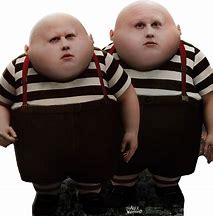
Like both Tweedles in the folk nursery rhyme and in Lewis Carroll’s Alice Through the Looking Glass (1871), Tweedledum and Tweedledee are brothers and though they appear to be preparing for war with one another, they don’t actually fight, not in Western ‘democracies’.

Tweedledum and Tweedledee (or is it the other way around?). (Image sourced: Internet)

There are, after all, plenty of spoils to share between their masters. The creators of that wealth need to be controlled, fooled and, if necessary from time to time, repressed. “Red” social democrats and “Blue” conservatives have alternated to share power in the Western world for over a century.

In Ireland, the only European state which is a neo-colony and part of its land a direct colony, its national liberation unfinished, the Tweedles have been blue or green.

But for decades now the illusion of choice has been crumbling. There has not been a majority party government in Ireland since 1981, when Irish Republicans were elected during the hunger-strike campaign. All Irish governments since have been a coalition of one kind or another.

The Irish Labour Party, founded by Connolly and Larkin and far from their thinking for many a long year, has been in government a number of times but always in coalition – usually with the conservative Fine Gael, itself the product of a coalition that included the fascist Blueshirts.

Those years of government participation for Labour have thoroughly rubbed off the red paint of socialist opposition from the party. The Green Party, mixing a brand of concerns for the environment with those for society, has met a similar fate in coalitions.

Since 2020 the Irish state has had what is essentially a ‘national government’, a coalition of opposing parties normally only seen in times of war or under a fascist regime. The alleged political poles have joined in order to run the system for the Gombeen ruling class.

Though this gives stability for the Gombeen’s system their problem is that it has removed the illusion of choice. They might restore that illusion through the promotion of a third major party in opposition and the formerly revolutionary Sinn Féin has worked hard to fill that space.

In the 2019 General Election SF got the most representatives elected but insufficient to form a majority government, after which the Tweedles united, along with the Greens to make up the numbers to manage the State. But the Gombeens will hold SF in reserve, I’m thinking.

Harris of Fine Gael and Taoiseach (equivalent of Prime Minister) of the Coalition Government, commented on the closeness of his party and former Opposition party Fianna Fáil in votes, predicting “a Government of equals”1– but it’s not just in votes that they resemble one another.

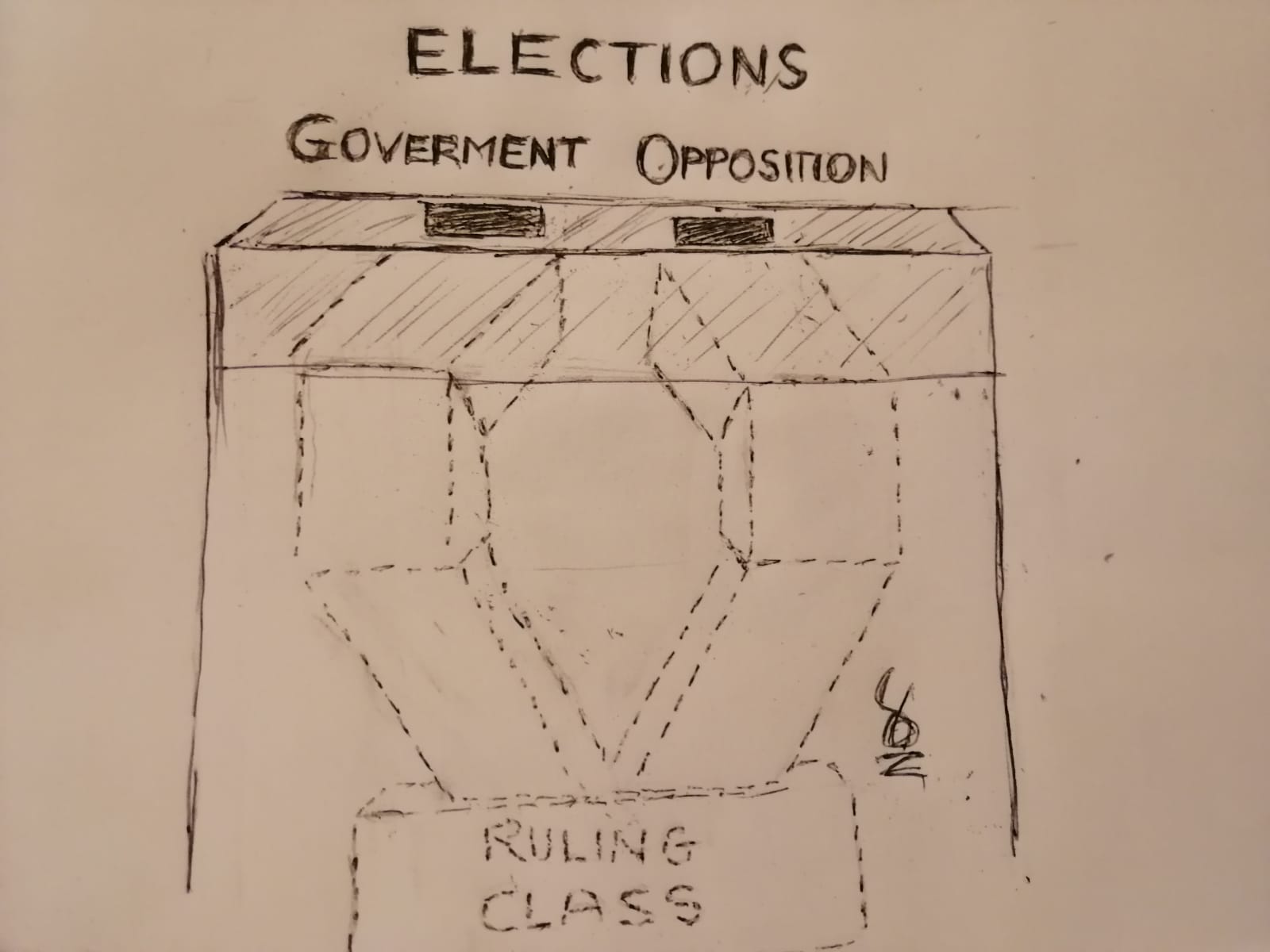
Yes, I know I misspelled Government but I want to get this article out of the way. I’ll redo the cartoon sometime later and replace it.

RESULTS

I don’t think there is a great deal to be said about the actual results of the recent local and EU Parliamentary elections in Ireland but no doubt some commentators will be saying it anyway.

Of unwelcome interest is that five fascists of different groups got elected, three of them to Dublin City Council. The electoral Left lost some and gained some without big changes.

Independent socialists (and couple) Clare Daly and Mick Wallace both lost their EU seats but perhaps they and in particular Daly in Ireland would be more of an asset to the Left. Luke ‘Ming’ Flanagan in Midlands North West, another left Independent, kept his EU seat comparatively easily.

Sinn Féin had what was for them a disappointing run but had some new people elected to local councils and two seats in the EU Parliament, losing an existing one. Many of their enemies in the Republican ambit, often former comrades, rejoiced in their misfortunes.

Understandable though that may be one wonders how those who have some faith in the party at the moment are to be disabused of their illusions without having seen them in government. On the other hand their twists and turns on the road there may have disenchanted many already.

IT’S NOT A CHANGE OF PARTIES IN GOVERNMENT WE NEED

For most of my life I have been aware that it is not a change between political parties but between socio-political systems that is the issue. But I do vote sometimes in order to help keep a useful and decent voice in a parliament or a local authority.

An Irish community activist pensioner years ago in London, Co. Galway Teresa Burke, was a member of the British Labour Party. After a General Election, she asked me had I voted. I replied that I hadn’t; I’d not seen a candidate that stood anywhere close to that in which I believed.

“Well then, you must take responsibility for everything the Tories do if they get in!” Teresa remarked angrily.

“I’ll do that, Teresa,” I replied, “if you’ll take responsibility for everything Labour does in Ireland if they get in!”

Teresa’s lips twitched slightly. She knew as well as did I that the British Labour Party had sent the troops into the Irish colony to quell the struggle for civil rights in 1969 and supported the Tories in introducing internment in 1971 and massacres that year and in 1972.

In 1974 police under a Labour Government had killed the first anti-fascist on a demonstration,2 framed a score of Irish people in four separate cases for heavy jail sentences3 and had passed the fascist Prevention of Terrorism (sic) Act.

Whichever party is in government, the social-political-economic system is run by the capitalist class which it benefits and they will fight tooth and nail to maintain that system.

The alternative-party-within-the-system idea, so dear to social democrats, has failed time and time again. It betrayed its supporters by becoming like what it opposed, or consistently failed to get elected or was undermined, betrayed and destroyed, like Syriza in Greece, for example.

But in the unlikely event that route should ever show signs of being successful, for the ruling class there remains the military coup.4

end.

FOOTNOTES

1https://www.breakingnews.ie/ireland/election-results-raise-prospect-of-another-coalition-of-equals-varadkar-1638692.html

2Kevin Gately, son of Irish immigrants, a student at Leeds University, died from injuries received from a mounted police baton during an antifascist demonstration in Red Lion Square, London on 15th June 1974.

3The Guildford Four, Birmingham Six, Maguire Seven, Judith Ward.

4The serialised for TV A Very British Coup (1988) with Irish actor Ray McAnally from the Chris Mullins novel (1982) is well worth watching for this scenario.

SOURCES

https://www.thejournal.ie/irelands-voter-turnout-is-below-eu-averages-6299507-Feb2024/

https://www.thejournal.ie/readme/election-turnout-6409113-Jun2024/

https://en.wikipedia.org/wiki/Tweedledum_and_Tweedledee

https://www.breakingnews.ie/ireland/election-results-raise-prospect-of-another-coalition-of-equals-varadkar-1638692.html

SOLIDARITY BRIDGES

Diarmuid Breatnach

(Reading time: 3 mins.)

In the western world we observe the manifestation of solidarity with Palestine in giant marches and in college solidarity encampments and building occupations. But there are many other manifestations to be seen every week and on specific occasions.

These other smaller actions take place of special occasions or on a regular weekly, monthly or even daily basis. The Bridges of Solidarity event was organised as a specific one-off but others are organised weekly, for example in Dublin where one of them, by coincidence is also on a bridge.

These solidarity events are seen by passing people away from the routes of the big marches and locations of encampments and allow those people at minimums to express their approval and, for a few seconds at least, to be part of that solidarity expression.

This contributes to the popular public opinion. Smaller or special events sometimes also pull in people who might not normally participate in marches for a variety of reasons.

The Solidarity Bridges protest day was set for Friday 31st May and Palestine solidarity flags were waved and banners hung from bridges over motorways and rivers across the nation, disregarding the foreign-imposed border.

In Dublin, motorway and main road bridges, over river and stream showed the Palestinian colours and were greeted every few seconds by motor horns sounding in support.

One of the Bridges of Solidarity with Palestine events that took place across different parts of Ireland on 31 May 2024, this one on the Dublin Fairview pedestrian bridge across the road.

On the “RTÉ Bridge”1 the numbers were small with Palestinian flags and a drop banner bearing the message “RTÉ LIES”. However the horns of passing traffic blowing in approval sounded every ten seconds or so, sometimes individually and sometimes in a chorus, accompanied by thumbs up.

Irish and Arabic recorded resistance music sounded out from an amplifier. On the UCD Bridge, chanted slogans replaced recorded music with a couple of songs too, sung accapella; the numbers here were boosted with students from the ongoing solidarity encampment there.

A huge “Ireland Stands With Palestine” banner figuring the watermelon slice2 hung off the southern side of the bridge with flags and a text banner facing north.

According to media reports and its FB on 28th June, the IPSC called for those bridge protests but none of the Dublin ones were listed and today there were no photos of any such events on its FB page; however its website lists nineteen such protests for next Friday 7th June.

Every Thursday evening in Dublin a solidarity picket takes place from six to seven o’clock in four areas in prominent locations passed by much motorised traffic: Annesley Bridge Fairview/ East Wall (alternating between them weekly); Ballymun; Cabra and Donnycarney.

One of weekly Palestine solidarity picket every Thursday in four Dublin city areas – this one on Annesley Bridge, Fairview, 30 May 2024.

The Ireland Palestine Solidarity Committee does not for some unexplained reason promote these events. In its weekly list of activities for participants around the country, it does not list the Thursday events.

The IPSC is long-established and the main organisation promoting Palestine solidarity across Ireland but this kind of censorship, for that is what it amounts to, is harmful to that solidarity. These initiatives are not even radical3 nor organised by people hostile to Palestinian solidarity in any way.

Bernadette McAlliskey joined the weekly protest on Annesley Bridge on 22nd May.

Of course in themselves these actions do not stop the genocide but nor do big marches, while the college encampments may force some limited divestments and academic boycotts. But all together form part of the political ambience of the country upon which yet other actions may be based.

End.

FOOTNOTES

1So called because of its proximity to the headquarters of Radio Teilifís Éireann, the national broadcasting service.

2The Palestinian Flag is forbidden in “Israel” and wherever else they exercise control in Palestine and, because the colours of the watermelon slice are those of their flag, the Palestinians have used it as a “legal” substitute (green and white in the rind, red in the flesh and black in the seeds). An interested 6th Year student cycling past asking the reason for the design had it explained to him and told participants, whom he thanked, that he’ll be taking Politics as a subject in university.

3 Not that there is anything wrong with radical protests and in fact they are needed but one might think that the IPSC was not supporting certain types of protest because it was concerned that they might be perceived as being too radical.

SOURCES

https://www.facebook.com/IrelandPSC/

ipsc.ie

https://www.irishnews.com/news/northern-ireland/bridgils-for-palestine-to-take-place-throughout-ireland-7EA3NUQXINAIFMZTXGQSY3TXLA/

SPEAK HER, CÚPLA FOCAL

Diarmuid Breatnach – Talk given at 1916 Performing Arts Club, May 2024.

(Reading time: 6 mins.)

There was a time when from Dublin to Galway, from Kerry to Donegal, the dominant language was Irish. There was a time too when it was widespread in Scotland, in parts of Wales and the main language on the Isle of Man.

Now however one can travel through all of those places and not hear it.

Irish was the first vernacular language to be written down in Europe and though island people, its speakers were not “insular”. The educated spoke Greek and Latin too and when the Dark Ages fell upon Europe it was the Irish intellectuals, the monks who revived and spread literacy there.

Some Irish-established monasteries in Europe (https://www.daviddarling.info/encyclopedia_of_history/C/Celts_and_Christianity.html)

But here we are, you and I, speaking English – which did not even exist until at least the 12th Century.

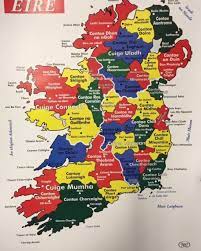
She (I say ‘she’ because language in Irish is a feminine noun and in many other languages too) – she is all around us in place names, though we may know them only through their corrupted forms into English.

Árd/ Ard, a height; Baile/ Bally, a town or village; Béal/ Bel, the mouth of; Bun, the bottom of; Carraig/ Carrig, a rock; Cnoc/ Knock, a hill; Cluain/ Clon, a meadow; Dún/ Dun, a fort or castle; Inis/ Inis or Ennis, an island or a raised mound surrounded by flat land; Loch/ a lake …
The English-language names of twenty-nine of our counties are corruptions of words in Irish: from Ciarraí to Dún na nGall, from Átha Cliath Duibhlinne to Gaillimh. This includes all six counties in the colony: Aontroim, Árd Mhacha, Doire Cholmcille, An Dún, Tír Eoghain, Fear Manach.

Just over half the States of Stáit Aontaithe Meiriceá on Turtle Island have names in the indigenous native languages, so we’re doing well with placenames and also of course have survived the colonial genocidal campaigns and wars much better.

By the way we also have Irish names for some places in Britain: Glaschú, Dún Éidin, Manchuin, Leabharpholl, Brom agus Lúndain. In fact probably none of the names of those cities are originally English anyway.

Irish has left only a small imprint on the general English language for example with “a pair of brogues, whiskey and slogan” (from slua-ghairm, a call to or by a multitude), banshee, carn and smithereeens. And shebeen, in parts of the USA, the Caribbean and in South Africa.

But its influence on the way we speak English in Ireland is clear.

We might say, instead of complaining that we are thirsty, that we have a thirst on us – a direct translation from Tá tart orainn. Or that the humour is on us – Tá fonn orainn. We might “have a head on us”, as in a headache. “The day that’s in it” – an lá atá ann.

We pronounce “film” with a vowel between the L and the M, as it would be in Irish – take the name for a dove and also a personal male name, Colm. We get that with R and M and R and N too, in some areas “a carun of stones” or “down at the farrum”.

We often indicate the absence of ‘Yes’ or ‘No’ in Irish by replying in English to the verb in the question: ‘Will you be there?’ ‘I will surely’ (Beidh, cinnte). ‘Will you do it?’ ‘I will not’ (Ní dhéanfad).

We have an extra tense in Irish, the very recent past tense, which we translate into English as spoken in Ireland: ‘I’m just after cleaning that floor!’ Táim díreach thréis an urlár sin a ghlanadh!

Renaissance of language and culture has often preceded periods of heightened national struggle: the Harp Festival of 1792 was followed soon by the uprising of the United Irish; the cultural work of The Nation newspaper was followed by the rising of the Young Irelanders.

The Nation newspaper of the Young Irelanders sought to create and encourage a nationalist republican culture and was followed by an unsuccessful rising in 1848, during the Great Hunger. (Source image: Internet)

LANGUAGE AND NATIONAL STRUGGLE

The Fenians too had their cultural precursors and the great revivals of the Irish language, Irish sport, speaking and writing in Irish and Irish theatre were not long in finding expression of another kind in the 1916 Rising and the War of Independence.

And campaigns of civil disobedience in the 1960s secured for us Irish-language broadcasting in Radió na Gaeltachta and TG4. Not to mention motor insurance documentation in Irish which Deasún Breatnach won only after going to jail for refusing to display the documentation in English.

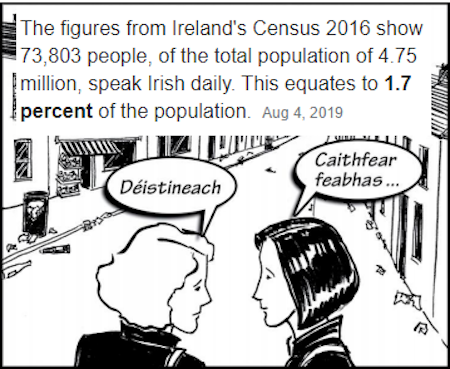
Though we can hear the influence of the indigenous language upon our speaking Sacs-Bhéarla, or English, the Irish language itself at this point is in retreat. In fact some might say that it’s in a rout.

Yes, the Gaelscoil movement is broader and deeper than ever before but outside the schools? The Gaeltacht areas are receding, receding … and where can the language be heard outside of those?

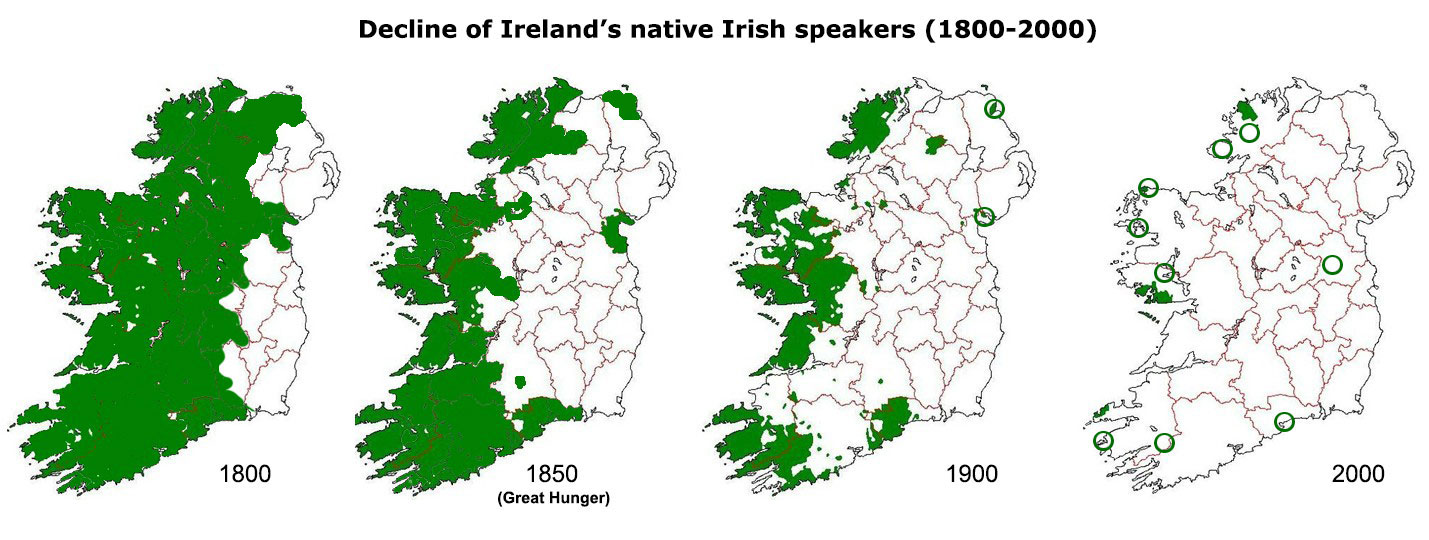
Though the Great Hunger caused the most impressive loss of Irish-speaking modern Ireland on the map, the percentage lost during the period of the Irish State is greater.
(Image source: Internet)

I had an experience recently that illustrates the problem. In a pub with some friends, I observed a man wearing a silver fáinne, the ring that many people wore to show a proficiency in Irish. It identified the wearer to other Irish-language speakers (my father wore a gold one).

The man had overheard me bidding farewell to friends in Irish and asked me: “Are you an Irishman?” I thought the question strange and said so. Then he asked me was I an Irish speaker, to which I replied in Irish language.

Eventually he came over and said that he didn’t speak Irish himself.

The fáinne was a family heirloom and he had been wearing it, he said, for six months in Dublin, wanting to come across an Irish speaker to whom he would give the ring. Since I had been somewhat abrupt with him, he gave the ring to one in the company who can speak Irish.

Badge inviting people to speak Irish to the wearer (Image sourced: Internet)

LABHAIR Í

Six months in Dublin without hearing Irish spoken or recognition of the fáinne! That illustrates one aspect of the linguistic problem in Ireland. But it is one that we can resolve, fairly easily too. And that brings me to the kernel, the poinnte or point of this talk here today.

I am asking you to speak a cúpla focal, regularly, go rialta, so that she may be heard. Labhair í ionnas go gcloisfear í. Imagine if everywhere in Dublin, on every side, one heard just a few words in Irish – imagine the social and psychological effect over time!

Those who know some Irish would speak her more often. Many who don’t, would feel it worthwhile to learn at least some phrases and some responses. Some might take it further and learn Irish well. Public services might regularly facilitate services through Irish.

Dia dhuit. Dia’s Muire dhuit. Or the non-religious form: Sé do bheatha. Go mba hé duit.

Má sé do thoill é or le do thoill.

Go raibh maith agat in many situations, including to the driver of the bus.

Tá fáilte romhat.

Gabh mo leithscéil.

Would you like a bag? Ní bheidh, go raibh maith agat.

Cash or card? Íoch le cárta, le do thoill as you wave your bank card. Or Airgead thirm, as you take out your wallet or purse.

Go léir, as you indicate that you wish to pay the full amount.

Isteach, le do thoill, when returning a book to the library. Amach, le do thoill, when borrowing one.

Slán, as you leave.

Easy enough, yes? Yes? But though a part of the mind is willing, another part is afraid.

“What if I get a big load of Irish in response and not even understand it? Won’t I look like a right eejit!” Well, there are risks in anything worth doing as was demonstrated in a short play here some time back when two fellas were debating whether and when to chat up a certain woman.

She was not uninterested but they took so long about it she walked out and left them, like fish brought up by fishing line, gasping on the dry quay.

So you could prepare a small survival kit: “Gabh mo leithscéil. I only have a few words/ níl agam ach cúpla focal.”

“Níl agam ach beagán ach tá mé ag iarraidh í a úsáid/ I only have a little but I want to use it. Is foghlaimeor mé/ I am a learner.”

I am not asking for any of us to campaign, to agitate for services to be provided through Irish though that is certainly a linguistic civil right and, as far as state or semi-state services go, a constitutional one.

I am only asking that you contribute to the audibility of the language, to use a few standard greetings and responses and to use them not only to people you know to be Irish speakers, not only to friends and relations … but everywhere in public.

Everywhere

in public.

Go ye out among the people and spread the word – or rather the few words. Scapaigí an cúpla focal.

End.

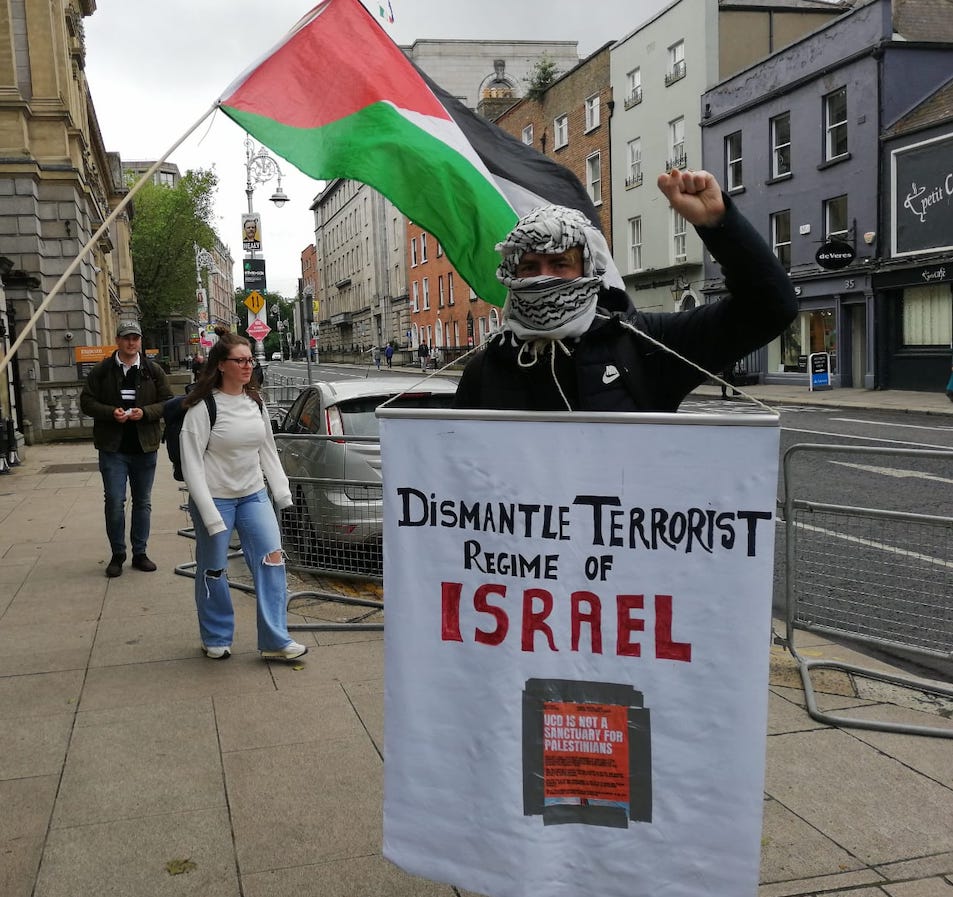
“ZIONISTS OFF OUR STREETS! IRELAND STANDS WITH PALESTINE!”

Clive Sulish

(Reading time: 5 mins.)

A Zionist march and rally was organised for Dublin today as an “Israel solidarity” event by the Ireland Israel Alliance. Despite prior publicity and drawing from around the country the attendance numbered only a few hundred.

Around a hundred anti-zionists with flags, banners, amplifier and loudhailer occupied the announced destination of the Zionist rally an hour prior to the scheduled arrival of the IIA march and had to wait even longer as the Zionist groups arrived at Stephens Green.

One of the banners displayed by among the anti-zionists outside Leinster House on Sunday (Photo: Rebel Breeze)(Photo: Rebel Breeze)

During the week the IIA issued a statement in line with the Israeli state’s Foreign Minister that “Ireland rewards Palestinian terrorism with a State”1 in response to the announcement by the Irish, Spanish and Norwegian states that they intended to formally recognise the Palestinian state.

Palestinian solidarity supporters in Dublin organised at short notice a counter-rally. “It’s a bit rich for Zionists who set up their settler state with terrorism”, said one in Dublin today, “claiming that Palestinian statehood rewards Palestinian ‘terrorism’!”2

One of the banners displayed by among the anti-zionists outside Leinster House on Sunday (Photo: Rebel Breeze)

Although Palestinian Christians are suppressed and killed by Israeli armed forces, the IIA were supported by right-wing Christian Zionists, among them the All Nations Church, the Irish branch of the International Christian Embassy Jerusalem and the TJCII.

According to advance releases to the press, the newly inaugurated Chief Rabbi of Ireland, Yoni Wieder was to speak at the zionist rally.3

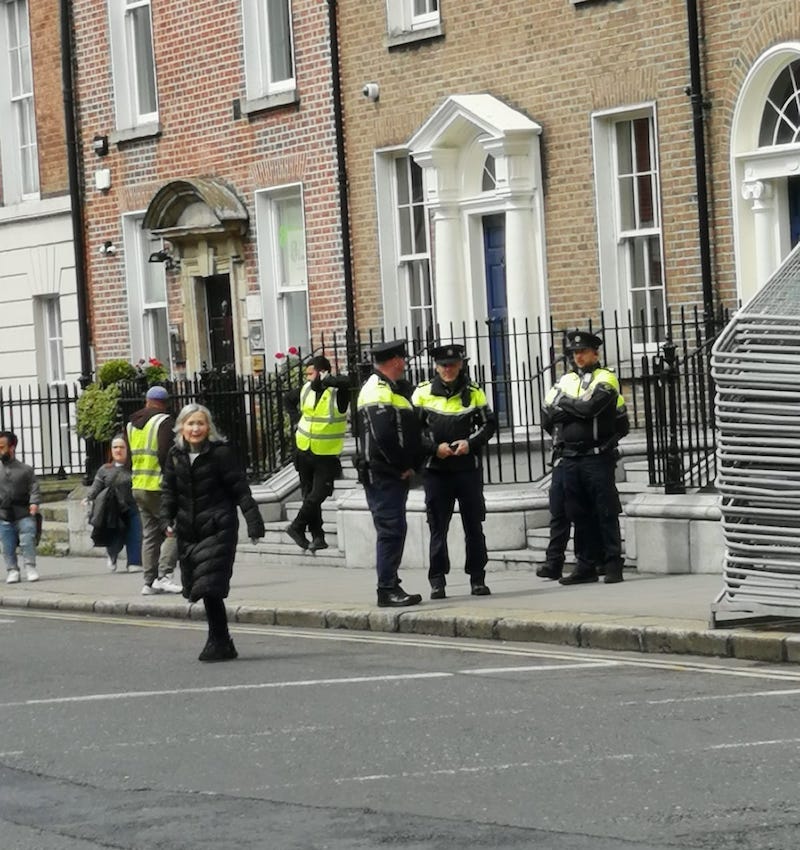
Some Gardaí in Molesworth Street, stacked crowd barriers not yet erected at that point and contractor staff awaiting instructions. (Photo: Rebel Breeze)

The anti-zionists organised their event at a day or two’s notice and according to some sources the IPSC4 had called on its branches not to counter protest the Zionist event but around a hundred Palestinian supporters attended, mainly Irish but also with Palestinians and a sprinkling of others.

In their prior publicity the Zionists trotted out their usual claims that Palestinian solidarity is based on anti-Semitism and that Jews are being victimised,5 ignoring the fact that zionism does not equal judaism and that in fact a substantial number of Jews have opposed zionism.6

The population of Ireland went from being largely supportive of ‘Israel’ in 1948 to being mostly pro-Palestinian from the 1970s onwards because of their observation of the genocidal and ethnic cleansing actions of the Israeli state.

Placard displayed among the Palestine supporters (Photo: Rebel Breeze)

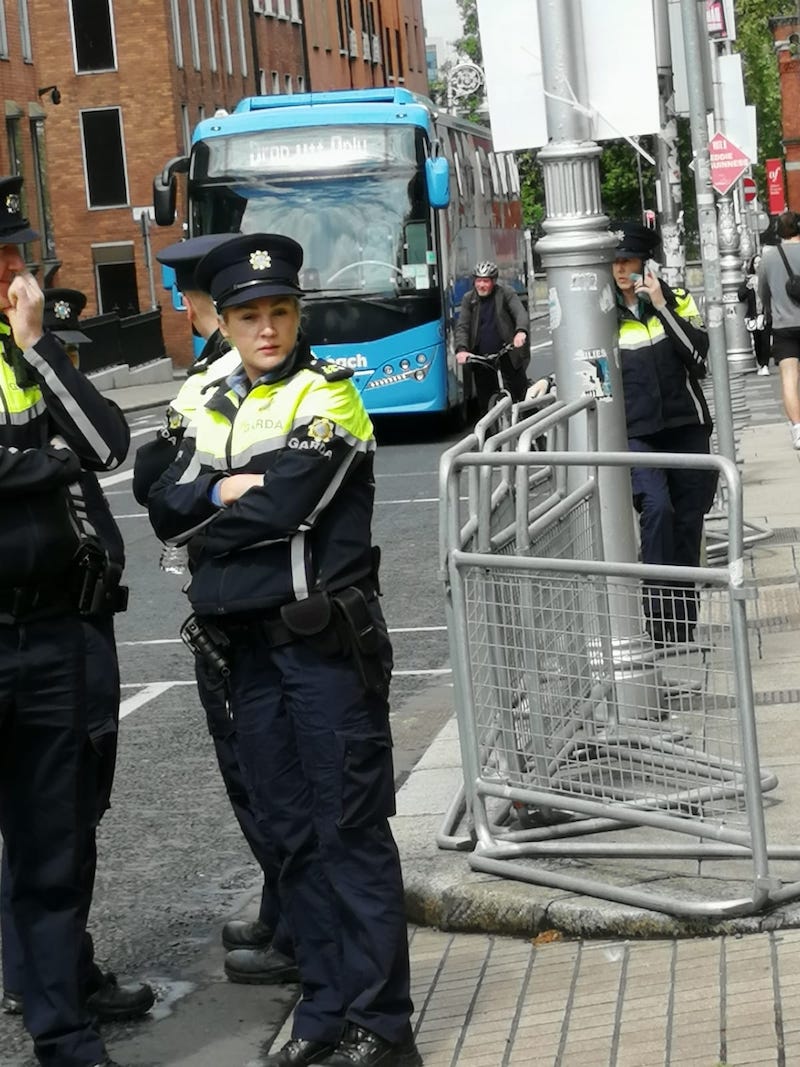
There was a fairly high Garda presence at the events and after some delay crowd barriers were erected across the east end of Molesworth Street with a second line of barriers a little further west beyond which the Zionists were setting up a stage.

The anti-Zionists in front of Leinster House awaited the arrival of the pro-Israel march which when it got going could be seen passing the Stephens Green end of Kildare Street, eventually coming down Dawson Street and turning into Molesworth Street.

View in distance of the zionist rally location before the arrival of their march from Stephens Green (Photo: Rebel Breeze)

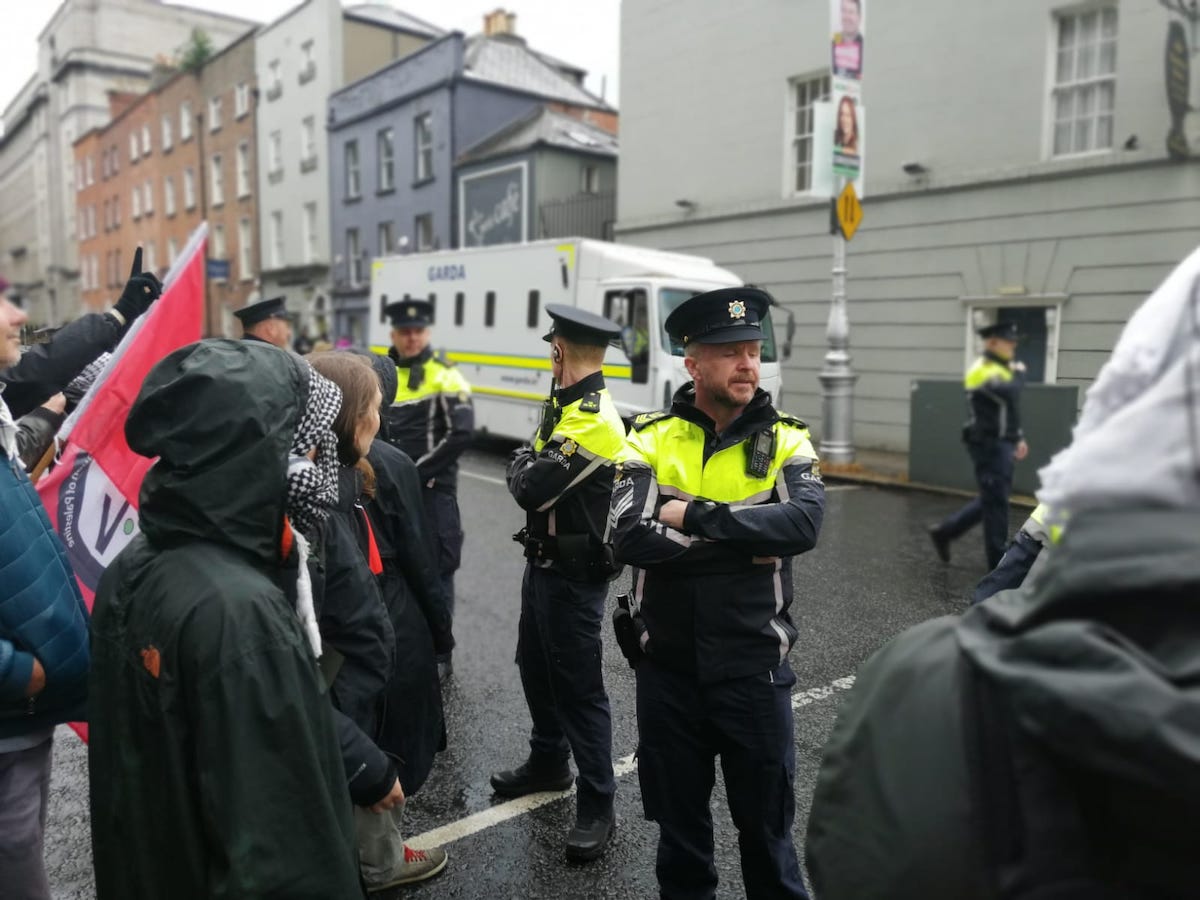
As they arrived the Palestinian solidarity people attempted to move across the road but the Gardaí pushed back, individual Gardaí at times viciously shoving and being resisted; here and there an arrest seemed threatened but was evaded by solidarity action around the targeted person.

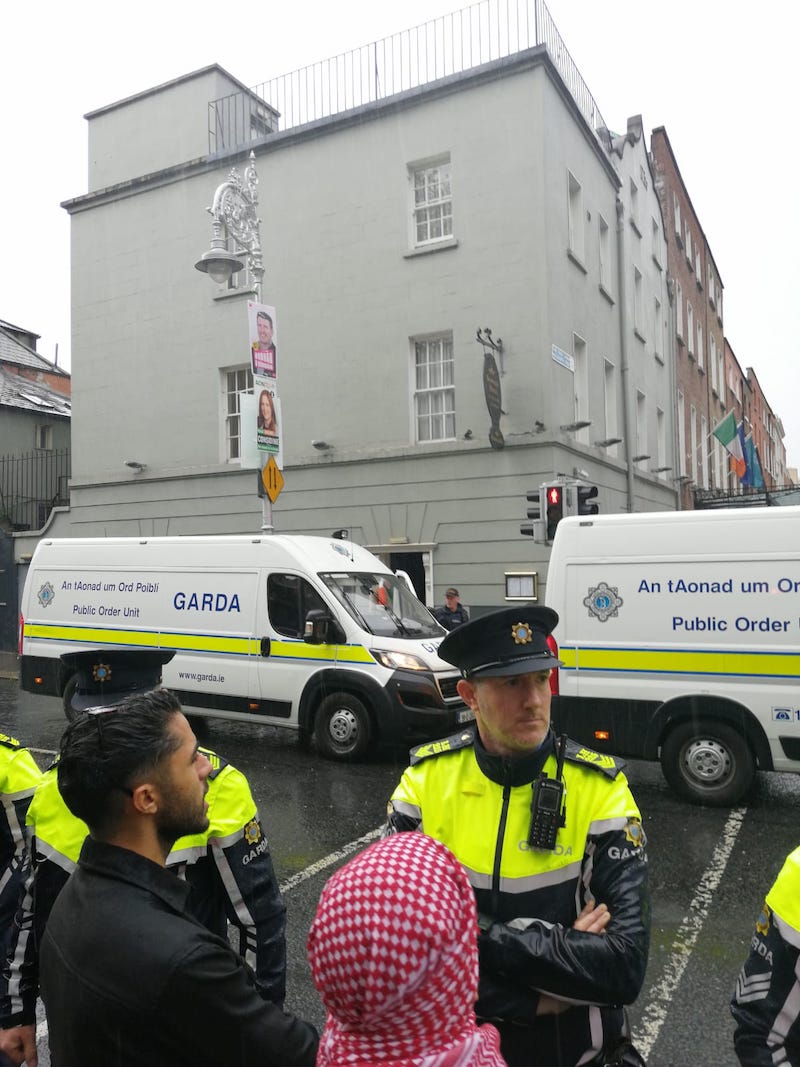
With the Palestinian supporters pushed to a couple of feet in front of the pedestrian pavement of Leinster House, the Gardaí stopped and by then two vans of the Public Order Unit had arrived and were deployed but some time later stood down, got in their vans and were driven off.

(Photo: Rebel Breeze)
View northward in Kildare Street outside Leinster House on Sunday (Photo: Rebel Breeze)
View southward in Kildare Street outside Leinster House on Sunday (Photo: Rebel Breeze)
The arrival of a Garda prisoner transport van in Kildare Street outside Leinster House on Sunday raised tensions among some of the anti-zionist demonstrators (Photo: Rebel Breeze)

There could have been some confused impulses among the Gardaí given the public symbolic positions of the Government in recognition of the Palestinian state and the sharp and public diplomatic language flying between the Irish and Israeli states.

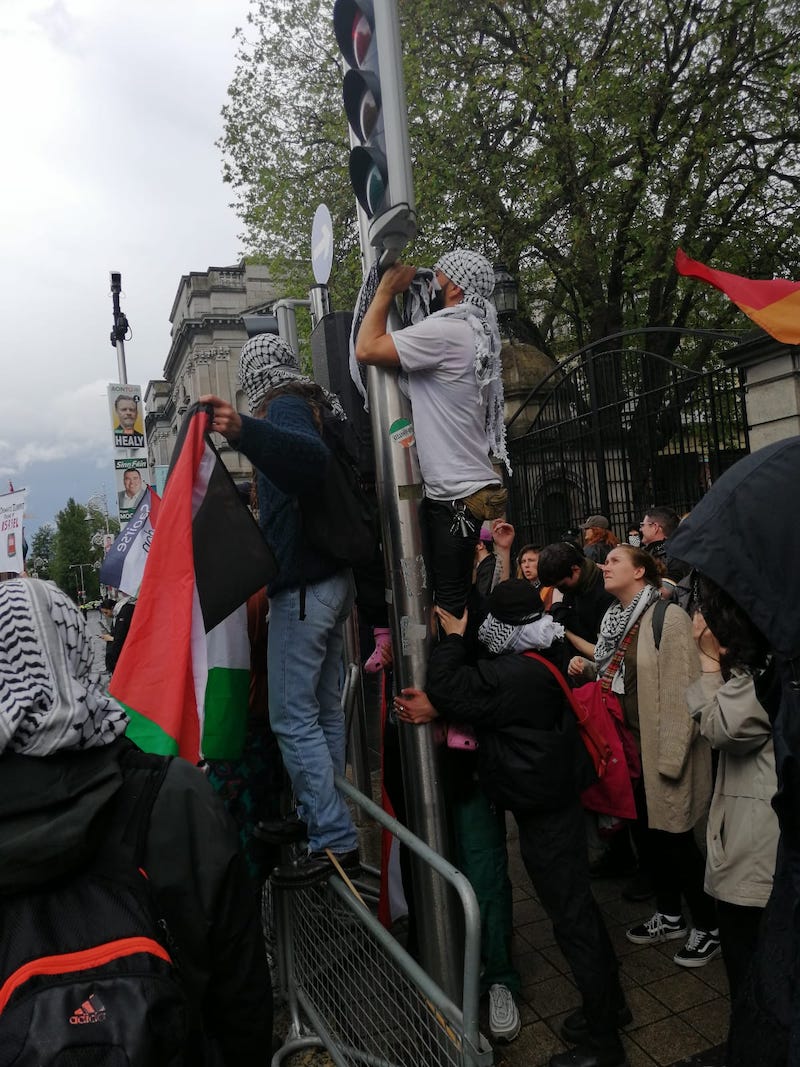
Two Garda vans were parked in front of the entrance to Molesworth St, partially blocking the views of the zionists and their opponents. The latter however stood with banners and flags on top of barriers and an amplifier was also strapped to a pole to better carry the message to the Zionists.

Palestinian supporters attaching an amplifier speaker to a pole outside Leinster House, directed at the Zionist rally in Molesworth Street (Photo: Rebel Breeze)

Despite the IIA having recommended its supporters to bring Israeli and Irish flags, only one Tricolour could be seen among their blue-and-white Israeli flags. One placard depicted the whole of Ireland covered with a menora, the traditional Jewish multi-candlestick.

Some of the Zionists’ placards repeated the debunked accusations of programmed mass rapes by the Palestinian resistance on October 7th last year, for which no evidence whatsoever or known victim exists despite Israeli state propaganda parroted by some of its western media supporters.

Zionist marchers arrive at their rally point in Molesworth Street, with two sets of barriers placed between them and the Palestine supporters (Photo: Rebel Breeze)

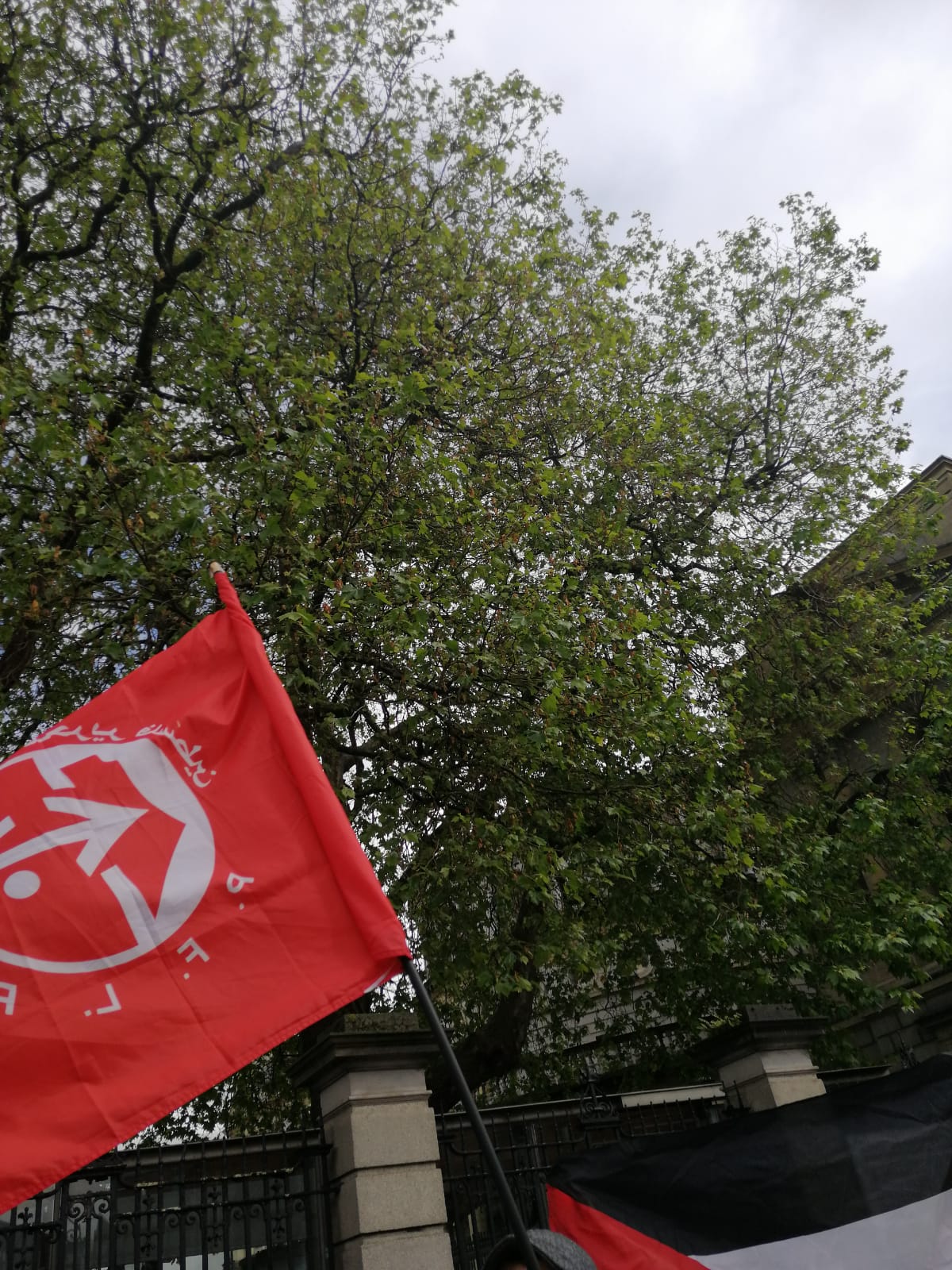
Among the Palestinian supporters the Palestine national flag was very much in evidence, also a couple of the PFLP7 and one in the colours of the anti-fascist Popular Front Government of 1930s Spain bearing the words “Connolly Column”, honouring the Irish who fought fascism there.

Here too there was only one Tricolour to be seen.

Flag of the PFLP seen against the trees (Photo: Rebel Breeze)

There were intermittent rain showers during the events, often persistent and somewhat heavy, streams running northwards along the road and pavement edge down Kildare Street but the demonstrators remained without shelter, many also without specific rain gear or umbrellas.

Women (mostly) speaking through amplification led the slogans that have become common on Palestine solidarity demonstrations in English, Irish and Arabic but with a few additions, including “Zionist scum – Off our streets!” Also “West-Brit Blueshirt scum – Off our streets!”

View of the rain’s ‘river’ running down between the Leinster House pedestrian pavement and the road. (Photo: Rebel Breeze)
View of small section of Palestinian supporters’ line with police line in front and the rainwater swirling around their feet. The Zionist rally is taking place behind the police line and beyond two lines of metal crowd barriers. (Photo: Rebel Breeze)

At intervals Arabic resistance music was played and sections of the Palestine solidarity crowd began to sway or even dance, including one young woman from Gaza who seemed accomplished in traditional dance. Irish patriotic songs were played for a period also.

Among the Palestinian supporters the Zionist chants or speakers could not be heard, nor can one know how much of the Palestinian solidarity chants could be heard by the Zionists. Eventually the Zionists left to jeers from their opposition, a Garda helicopter watching over them in the sky.

The Gardaí left and the Palestinian supporters did too, mostly leaving together in a group.

(Photo: Rebel Breeze)

AFTERMATH – FIGHT IN PARNELL/ O’CONNELL STREET

That was not all however for perhaps an hour later a fight developed between what seemed to be a far-Right man against a group of Palestinian supporters in Parnell Street. According to some people, the man had approached them aggressively about their Palestine solidarity activism.

Disliking their response, he punched one of the Palestine solidarity demonstrators in the face and when the women in the group protested, struck a couple of them too. Another male in the group then launched at the Far-Right man and gave him a bloody face.

When observed by this reporter, the man was covered in tattoos, stripped to the waist and shouting about being “for the Irish” (which for some reason the Far-Right assume Palestinian supporters are not — though many have a far better track record in that respect than do Far-Right activists).

In Palestine that same day the zionist air force bombed a tent town of displaced people in northwest Gaza, which they had declared a safe area, murdering over 30 and injuring many more, some of whom will die. They also bombed 10 UNRWA displacement centres.

End.

FOOTNOTES

SOURCES & USEFUL LINKS

https://www.limerickleader.ie/news/national-news/1508465/take-a-stand-pro-israel-march-to-dail-eireann-planned-this-weekend.html

1https://www.limerickleader.ie/news/national-news/1508465/take-a-stand-pro-israel-march-to-dail-eireann-planned-this-weekend.html

2The zionists had a number of terrorist organisation pushing the formation of the Israel State: Haganah, Irgun, Palmach … Haganah became the core of the Israeli armed forces.

3https://www.limerickleader.ie/news/national-news/1508465/take-a-stand-pro-israel-march-to-dail-eireann-planned-this-weekend.html

4Ireland Palestine Solidarity Campaign, the largest and longest-lived Palestine solidarity organisation in Ireland.

5Ditto.

6It is truly remarkable to observe how a racist occupying genocidal bully simultaneously paints itself as the victim.

7People’s Front for the Liberation of Palestine, a secular Palestinian resistance organisation.

MIGRANTS & REFUGEES LIKE US

Diarmuid Breatnach

(Reading time: 10 mins.)

Irish media on Thursday 9th reported that the authorities removed the tents of refugees and asylum-seekers from along the banks of the Grand Canal. These had set up there after being removed from the vicinity of the IPO1. Where could they go?

Apparently they are dispersed to Newmount Kennedy (where we’ve seen – if not fascist mobs, certainly mobs containing some fascists), Dundrum, Crooksling and City West. Hopefully they will get a roof, showers and food, though thrown out to outskirts without any plan of integration.

The tents were dismantled when Harris said they were unacceptable and that accommodation was now available. However, despite four dismantling actions by government, on each occasion many asylum seekers were not provided with accommodation, thus causing a new camp to be established each time.(Photo: SRI)

In the four months since January a thousand have applied to the International Protection Office. They get issued with a Temporary Residence Card2 (known as the “Blue book”) and not much else; if they lose that documentation (e.g during eviction) they are in trouble.

Photo ID is issued to them when they make their application for asylum at IPO. Finger prints are taken, statements recorded etc. All evidence is cross-checked with relevant authorities including Interpol. Hence, the notion that men are “unvetted” or “undocumented” is inaccurate.

They are told there is no accommodation available which is why they end up in tents, since clearly they cannot afford to rent, much less take out a mortgage to buy a property. But Róisín McAleer of Social Rights Ireland questions whether the IPO have been telling applicants the truth.

“We’ve got video showing empty beds inside Direct Provision Centres at City West and Dundrum” the activist says. The IPO admits that they have 5,000 empty beds but says that they have to keep those empty beds available in case they have to cater for women and children.

The response of the Irish Government has been to blame the refugees and remove their tents from their locations, while simultaneously funding NGOs who have recently supplied them with identical-type tents and “may provide access to meals, access to showers during the day.”3

“Taoiseach Simon Harris said that neither he, nor the Government, would accept tented encampments in the city” and “hundreds of tents were destroyed when two encampments were removed … in the capital in multi agency operations in the past week.”4

A slogan attacking the Green Party’s role in the Irish Coalition Government (Photo: SRI)
(Photo: SRI)

A common line in discourse is that the refugees and asylum-seekers are “undocumented” apart from whatever documentation they are issued here, which they often are, of course.

What documentation would one expect to have when fleeing war, persecution or natural disaster, always on the move, crossing mountains, deserts, rivers, seas, national boundaries?

In some places, the ‘wrong’ documentation can get you killed, marking you as the ‘wrong’ religion, nationality, tribal group … Thousands of us emigrated undocumented too and what’s more, worked undocumented as well.

Yet Helen McEntee, Justice Minister of this Government, who will never have had anything like the experiences of refugees and asylum seekers, throws around the “undocumented” word, straight from the playbook of the Far-Right, whipping up fears, hinting at some kind of menace.

“Everyone fleeing persecution or serious harm in their own country has the right to ask for international protection. Asylum is a fundamental right and granting it to people who comply with the criteria set in the 1951 Geneva Convention relating to the status of refugees.”5 

It “is an international obligation for States parties, which include EU Member States.”6 While applicants are waiting for a decision on their application for international protection, according to EU legislation the Irish State is required to supply accommodation, food and medical care.7

Róisín McAleer for Social Rights Ireland stated that the Irish Government was in breach of its EU obligations which oblige all states to provide seekers of asylum with accommodation at the point of presentation. A number of agencies have pointed out this serious breach.

Protest outside Dublin City Council’s main offices. (Photo: SRI)

McAleer states that SRI had been trying to get solicitors to take a case against the Irish Government under EU law but had found difficulty in doing so, some saying that immigration law was not their forte. “This is a case of human rights, not immigration law,” stated the interviewee.

What about Lawyers for Palestine, have they contacted them? “Yes,” is the answer “but no reply.”

THE FAR-RIGHT’S CAMPAIGN AGAINST REFUGEES

Not only the Irish Government but the Far-Right also have been working to mobilise public opinion against these refugees and asylum seekers. And at times actually physically attacking them also, going as far as to burn an encampment area in South Dublin dockland not far from the IPO.

Masquerading as “patriots” who “want to put the Irish first”, they repeat foreign-origin racist stories and false conspiracy tales,8 spread lies, false news and misinformation. Chief among those is that “Ireland is full”, which is untrue as even a little knowledge of our history will show.

In fact, being far from “full”, Ireland is UNDER-populated. The population of the whole of Ireland in the mid 1800s was 8 million but now hovers just over 7 million.9 Do those pushing that false story care about the real facts? If they don’t, then what is their real agenda?

One of the nastiest calls to action has been to “get them out” – no, not the Government, nor the ruling Gombeen class, not the British colonial occupiers. No, not any of the justifiable targets (but which might involve risk). No, they mean refugees, asylum seekers and really any migrants at all.

And why? Who are these groups harming? Well, apparently it’s because the Government should “house the Irish first”. But … how would evicting refugees from tents, repurposed buildings or Direct Provision Centres get any Irish person housed any quicker?

It wouldn’t of course, nor be of even the slightest help to people struggling to pay high rents to landlord companies, or to pay their mortgages to banks, or about to be evicted by vulture funds.

(Photo: SRI)

But the fascists and racists manipulating their followers don’t care, that’s not what they are there for. If they really did want to get ‘the Irish’ housed, they could occupy empty buildings to pressure the system, like the Revolutionary Housing League have been doing and calling on others to do.

No, the Far-Right prefer to torch buildings, including one in the south docklands that was earmarked for general homeless people.

Ironically, near the tents’ location a national liberation battle was fought around Mount Street Bridge in 1916 and the Commandant of that garrison was a migrant, as were many others, including two of the 1916 Proclamation’s Seven Signatories — of which another two were sons of migrants.

Mount Street Battle Monument on the Bridge over the Grand Canal. (Photo: D.Breatnach)

In April, according to the Department of Housing, 13,866 people were in emergency accommodation in the Irish state, including 4,147 children, with many others sleeping on the streets, others in hotel rooms, hostels or sofa-surfing with friends and relations.10

But of course, the Far-Right don’t occupy empty buildings, having no intention of taking on the powerful financial interests that are making money out of all this misery. In fact, the Far-Right are helping those parasites, by diverting attention from them on to refugees and asylum seekers.

“SINGLE, MILITARY-AGE MEN”

Yes, the men are alone, whether they left a partner and children behind to find a way out for them or indeed are single. And yes, they are “military age” – 18-45 years of age, just like most male migrants that left Ireland for work in the UK, USA, Australia, New Zealand, Canada …

That is the usual profile when the migrant is male. Because they can work and then send money back to family. And because in a risky endeavour they are generally less at risk and more willing to take the chance than females.11

(Photo: SRI)

But we never used that kind of description of our own emigrants, did we? We just said “young men” mostly. Where did that terminology come from, with its implied threat? From the USA, the hatchery of most Far-Right religious fundamentalism, conspiracy and racist theories and memes.12

We do have our own home-grown fascists of course with quite a high concentration of them among the Loyalists in the Six County colony. But also a few small crews this side of the British Border, well-linked to Loyalists and British fascists like Tommy “Robinson” and Nigel Farage.

The threat of sexual attack from foreigners is a version of that US fear propaganda, especially fear of black rape of white women — which is ironic since it was white slavers, slave-owners and plantation managers who raped black slaves and their children.

If we go through the media reports of court cases concerning rape, sexual assault and child sexual abuse, we find that by and large it’s the “indigenous Irish” who are the culprits. A minority of the population of course but Irish nevertheless.

How do volunteers working with the tent-living refugees experience them? “Respectful …. grateful” says one volunteer. “Quiet …. modest” is another description. “Some have high hopes of the values of western society but find themselves in shock and incomprehension at some of their treatment.”

Where have they come from? “Mostly Nigeria, Afghanistan, Jordan, Syria, Palestine …” Interestingly from an Irish point of view, all countries that the British have invaded at one time or another.

What causes waves of emigration from one area of the world and immigration to another? High on the list of causes are domestic unemployment, wars and natural disasters. Irish people have left Ireland pushed by all those factors.

Wars of occupation and ethnic cleansing, i.e plantations by England along with domestic resistance have sent Irish people outward from the 17th century onwards. In the mid-19th Century the natural disaster of the potato blight amongst imposed impoverishment flung out millions of migrants.

Throughout most of the decades of the Irish State’s existence, unemployment was the main driving force of emigration, so much so that until the years of the “Tiger economy”,13 Ireland remained underpopulated but with stable population figures despite a high birth and survival rate.

The factors that drive migrants to our shores are no different. When it comes to foreign wars of imperialism however, ironically the Far-Right deride socialist Republicans and socialists for protesting against those wars, going so far as to call them “traitors” for doing so.

When people are neglected, they often resent any focus on others. “What about me?” is their cry, whether voiced out loud or not. There is no doubt that many communities in Ireland have suffered government neglect, even been devastated by substance misuse and social crime.

Resolution of those social problems can only come about through organising against the culpable authorities and their pandering to the banks, property speculators and big landlords who benefit from the current situation – never by “punching down” on even more vulnerable people.

Homeless refugee tents along the Grand Canal, Dublin, before they were removed by the authorities. Simon Harris, Taoiseach (equivalent to Prime Minister) said that homeless tents in Dublin are not acceptable – however, homelessness apparently is. (Photo: SRI)

LIKE US

I called this article “emigrants and refugees like us” to make a number of points. One is that we too have been emigrants and refugees for centuries (and many still are). We went to Britain for seasonal work in the harvests and later for work on canals, roads and in factories.

We went to the USA too, Canada, Australia, New Zealand …

That’s about economic emigration. But we went as refugees too, fleeing religious and political persecution, fleeing ethnic cleansing, genocide and famine. Gaelic clans found asylum in Spain, Italy, France, Austria … Republicans found asylum in France and the USA …

Message in Irish to Roderic O’Gorman, Minister of Integration (and other social responsibilities). (Photo: SRI)

It wasn’t always easy. We faced racism, yes real anti-Irish racism14, slurs that we were dangerous, dirty, carrying disease, taking jobs of locals … And we had the cheek to organise ourselves and to make alliances with a number of other discriminated-against groups to win some power!

We fought racists like the “Know Nothings” and the Ku Kux Klan,15 Blackshirts and National Front16 on the streets. We fought rich mine, factory and railroad-owners, formed trade unions and associations and we were clubbed, shot, jailed and executed. And we clubbed and shot back too.17

There’s another reason I called this article “emigrants and refugees like us”: We are ALL descended from migrants or refugees. The Irish nation is composed, apart from the “native Irish”, of Viking, Norman, Scottish, English, Flemish, Dutch and Italian blood (remember, fish and chip shops, ice cream and cafés) before others came from further away.

And the “native indigenous Irish”? The Celts? Yes, migrants too, from central Europe, with iron tools and weapons. Before them? The bronze-metal people. And before them again? The Neolithic people who built the likes of Newgrange, Knowth and Dowth in the Boyne Valley.

The human race did not evolve in Ireland. We are all descended from migrants.

The third reason I called this article “emigrants and refugees like us” is because, like us, they are human. The feel hunger and fear just like we do. They need safety and warmth just like we do. If we deny them those things we diminish our own humanity in doing so.

That might seem a bit wishy-washy but to me, our humanity in its best sense is worth everything and if need be, it’s worth fighting for.

End.

FOOTNOTES

1 International Protection Agency, the Irish State’s agency with responsibility for processing refugees and people seeking asylum in the state.

2 This is photo ID issued to them when they make their application for asylum at IPO. Fingerprints are taken, statements recorded etc. All evidence is cross-checked with relevant authorities including Interpol. Hence, the notion that men are “unvetted” or “undocumented” is inaccurate.

3 https://www.breakingnews.ie/ireland/government-paying-for-tents-provided-to-asylum-seekers-says-ogorman-1624336.html

4 Ditto.

5 https://www.europarl.europa.eu/about-parliament/en/democracy-and-human-rights/fundamental-rights-in-the-eu/guaranteeing-the-right-to-asylum

6 Ditto.

7 https://www.citizensinformation.ie/en/moving-country/asylum-seekers-and-refugees/the-asylum-process-in-ireland/international-protection-terms

8 Such as the “white replacement” conspiracy theory from settler colonies like South Africa and Rhodesia, then via white supremacist groups in the USA and through social media to Ireland.

9 https://en.wikipedia.org/wiki/Ireland

10 https://www.irishtimes.com/ireland/social-affairs/2024/04/26/number-of-people-in-emergency-accommodation-reaches-new-high-of-13866-including-over-4000-children

11 https://reason.com/volokh/2024/05/03/migration-and-the-military-age-male-fallacy/#:~:text=The%20definition%20of%20%22military%2Dage,disproportionately%20drawn%20from%20this%20category.

12 This has been known for years but a recent study of social media protests against a propose housing of migants in Newmount Kennedy Co. Wicklow found the source of around 80% to originate outside Ireland with more than half being from the USA. https://www.independent.ie/irish-news/more-than-half-of-social-media-posts-about-wicklow-anti-asylum-protest-were-from-us-analysis-finds/a1068312180.html

13 1995 to 2007

14 Not the rubbish “racism” of which the Far-Right claim they are the “victims” whenever anyone calls out their racism or homophobia.

15 The “Know Nothings” were mostly white, Anglo-Saxon and Protestant settled nativists in the USA who organised against other European migrants such as the Irish and when brought to court for murder or riot, they would claim to “know nothing”. The Ku Klux Klan was set up primarily to suppress freed slaves and other black people in the USA but they also organised against the Irish. British fascist groups: Blackshirts (British Union of Fascists) in the 1930s and after WW2 and National Front in the 1960s and 1970s, later replaced by the British Movement.

16 Both British fascist organisations: the first from the 1930s and resurrected after WWII for a period; the second from the 1960s, later superseded by others (British Movement, EDL etc).

17 Not just in the Molly Maguires but also in the IWW and the Knights of Labor.

SOURCES & FURTHER READING

https://home-affairs.ec.europa.eu/policies/migration-and-asylum/common-european-asylum-system/reception-conditions_en

The “single military age male” propaganda: https://reason.com/volokh/2024/05/03/migration-and-the-military-age-male fallacy

US origin of much racist social media posts: https://www.independent.ie/irish-news/more-than-half-of-social-media-posts-about-wicklow-anti-asylum-protest-were-from-us-analysis-finds/a1068312180.html

Eviction of refugees and asylum-seekers: https://www.breakingnews.ie/ireland/government-paying-for-tents-provided-to-asylum-seekers-says-ogorman-1624336.html

Súil Chlé video about Asylum Seekers Abandoned on the street: https://www.youtube.com/watch?v=dSl_bbGTUUc

SRI video on Rough Reception of Asylum Seekers in the Irish state: https://youtu.be/uOYT9CtjU90?si=gCanAaimLvmbcc0f