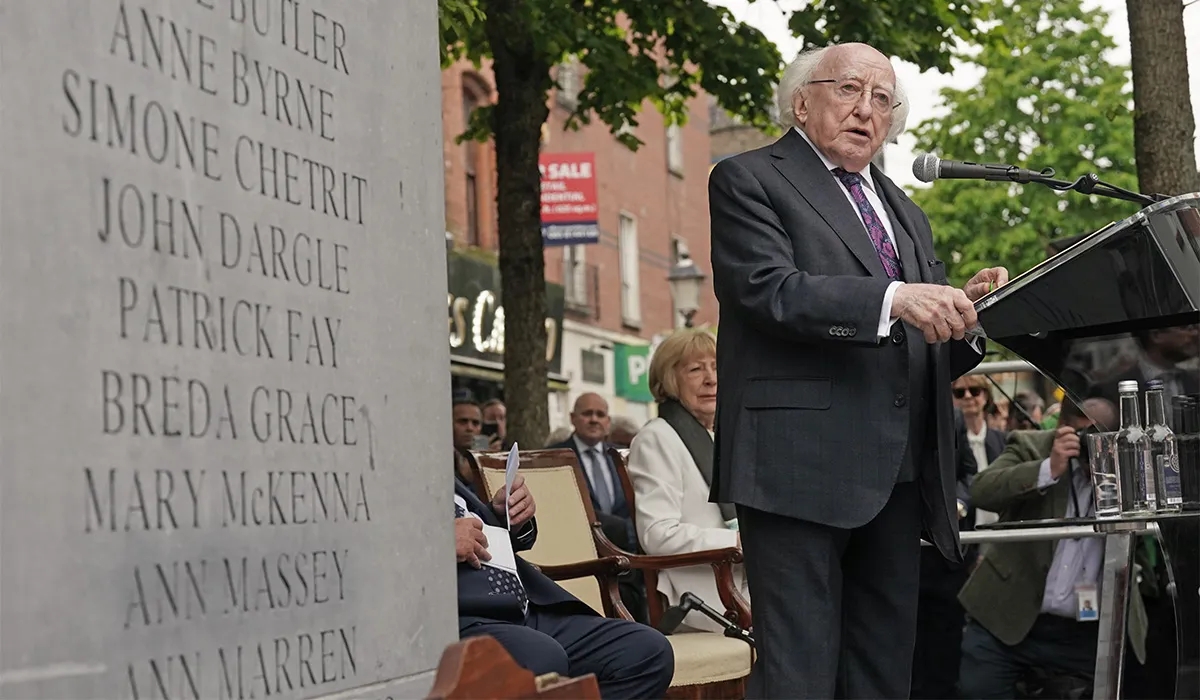
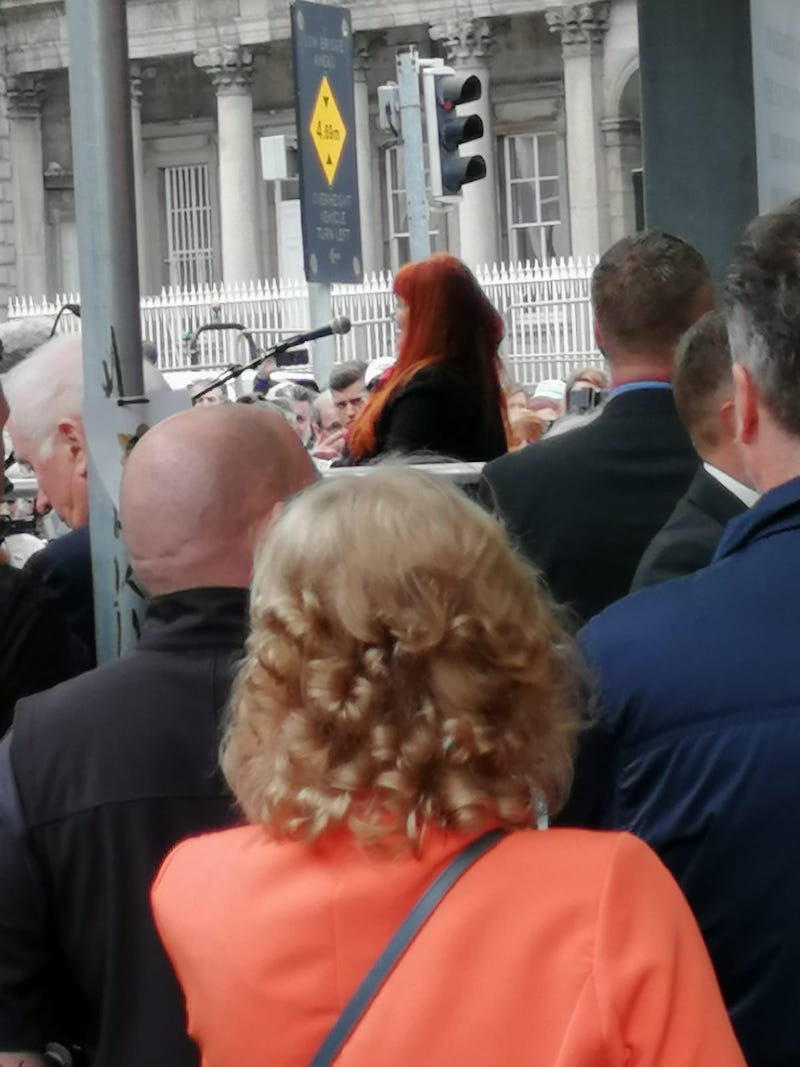
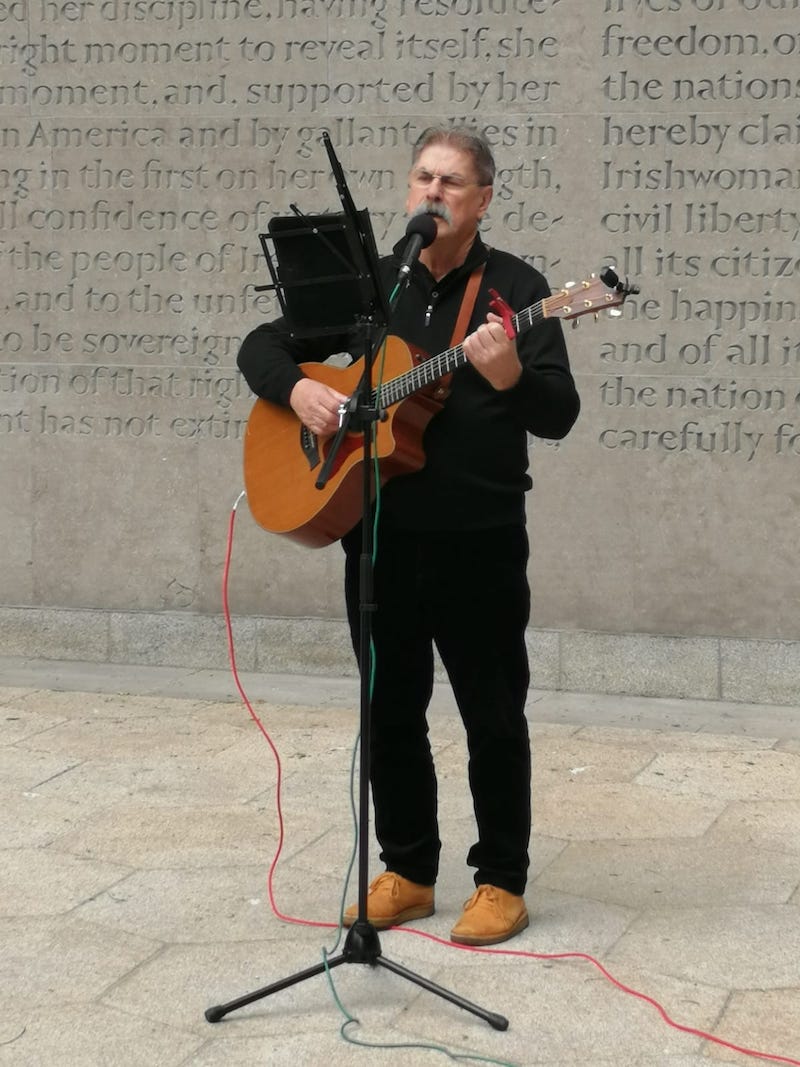
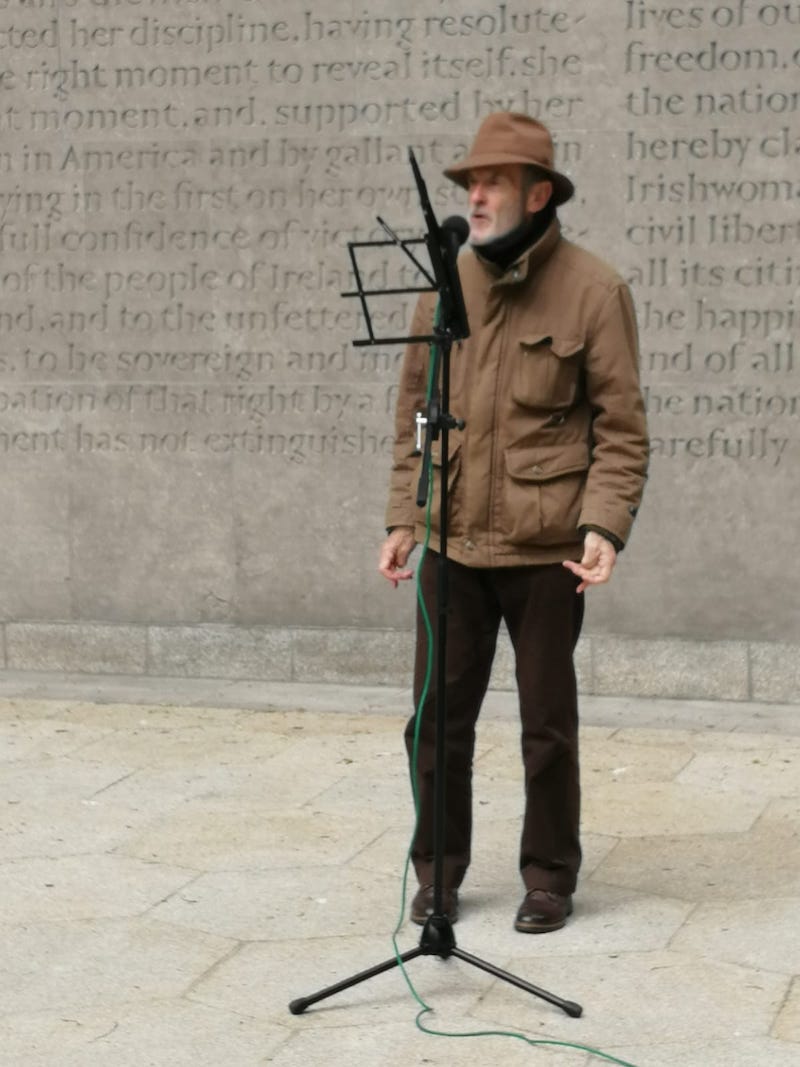
President Michael D Higgins speaks during a wreath-laying ceremony at the Memorial to the victims of the Dublin and Monaghan bombings on Talbot Street in Dublin, to mark the 50th anniversary of the Dublin and Monaghan bombings. (Photo cred: Brian Lawless/PA Wire)
Fifty years ago, on May 17th bombs exploded in Dublin and Monaghan killing 34 people. The anniversary was marked in Talbot St. Dublin beside the monument erected in memory of those murdered on that day.
The attendance at the anniversary was addressed by Michael D. Higgins, the southern president.(1)
He made a number of points in his speech, mixing his praise for the Good Friday Agreement and Elizabeth Windsor’s visit to Ireland with calls for the rights of the victims to know the full truth, oblivious to the inherent contradictions in his statement.
He did acknowledge that there were huge problems with the subsequent investigations and cited the Barron Report.
The report compiled by the late Judge Henry Barron, published 10th December 2003, provided some of the answers, pointing as it did to systemic failures at State level, one that included possible collusion between the security forces and loyalist paramilitaries.
Also featured was the disappearance of important forensic evidence and files, the slow-motion conduct of the investigation, a reluctance to make original documents available, and the refusal to supply other information on security grounds.(2)
There is nothing surprising about this. The dust had barely settled in Dublin and Monaghan and the Irish Government and the Opposition rushed out to deflect and suppress any debate.
Both the Taoiseach at the time, Cosgrave (Fine Gael) and the Opposition leader Jack Lynch (Fianna Fáil) both issued statements that were remarkably similar.
In them they broadened out responsibility for the attacks to anyone who had been involved in any violent act; i.e. they blamed the IRA by implication and failed to mention loyalists at all. This was not accidental. It was deliberate.
The nature of the bombings, the coordination, technology used all indicated the involvement of the British secret services, coupled with the fact that the loyalists never again showed the same capability ever.
Under no circumstances was the southern establishment going to accuse the British of anything.
Just over two years earlier, following the murder of 14 people on the streets of Derry by the Parachute Regiment in full view of TV cameras, an angry nation protested and burned the British Embassy in Dublin to the ground. Cosgrave and Lynch sought to avoid a repetition of that.
As the Barron Report pointed out the Garda investigation was poor, forensic evidence was destroyed, the team set up to investigate it was wound down after just two months and the murder inquiry itself was closed after seven months.
All of this shows clearly that they had no interest in getting to the bottom of it. So much so, when the RUC informed them that they had arrested some suspects in relation to the bombing, the Gardaí did not follow it up.
Years later when Judge Barron carried out his investigation, it was not just the British who were uncooperative. The Gardaí and the Department of Justice didn’t provide him with any information, their files were “missing”.
So, any call for truth means demanding the southern government reveal what it knows and also who shut down the inquiry, why, what happened to the files etc.
It was ironic that the Taoiseach, Simon Harris, the former Taoisigh, Micheál Martin (Fianna Fáil) and Leo Varadkar (Fine Gael) who were present and laid wreaths represent those who covered up the bombings.
If we are going to talk about truth, then a starting point should be that Fine Gael and Fianna Fáil covered it up and bear part of the blame for the failure to prosecute anyone.
But when Higgins and others demand the British hand over files and information, including the information offered at the time but not sought by the Gardaí, a question arises. Why would you ask the British government for information and files on a bombing that took place in Dublin?
There is only one possible answer: the British were involved in the bombing.
So, a good starting point would be not so much to talk euphemistically of full disclosure, but rather for them to admit their guilt and tell us all what they did and how and provide all the documentation relevant to their admission of guilt.
No Irish politician has ever demanded that the British own up for it. The demand is they give over information on those who carried it out, as if they were not serving members, at the time, of the British security forces.
The Irish state deliberately failed the victims of the bombings and continues to do so, to this day.
It is telling that the Barron Report on the bombings in not available on Irish government sites but rather on a site set up by victims of the bombings, Justice for the Forgotten (http://www.dublinmonaghanbombings.org/home/).
The Irish state has little interest in talking about the issue or of informing the Irish public, most of whom were born after the bombings.
Though Higgins criticised the Legacy Act, which puts a time limit on prosecutions, the Good Friday Agreement was always about drawing a line under what had happened. The GFA rewrote history to portray the British as honest brokers in a tribal sectarian conflict and not as an imperial power.
Acknowledging their role in the Dublin and Monaghan bombings would undermine that carefully crafted and now universally accepted lie about the British role in Ireland. The British will not release the files as to do so would be an admission of what their role in Ireland is.
The southern establishment despite its occasional calls for clarity and truth, dreads the British even considering such a move, as again it would undermine their role in the conflict as well and their responsibility for the ensuing cover up.
Resistance to colonialism and imperialism takes many forms but there are those who try to downgrade, deny or even condemn its armed aspect and this has been happening recently in the case of the Palestinian struggle.
Historically, resistance has taken the form of strikes, sabotage, protest pickets, marches, rallies, placards, hunger strikes, songs, poetry, visual arts, arson, petitions, articles, books, leaflets, speeches, graffiti, clothing, language promotion, riots … and armed action up to and including revolution.
All have proved useful and the question of whether the prevailing circumstance favour some more than others is a tactical one, never one of principle. Those who seek to forbid some tactics to the movement in all circumstances are they who cannot be trusted in leadership of the struggle.
The facet of resistance that temporisers and outright opponents of the resistance movement most often seek to outlaw and remove from the struggle is the armed one, presumably because it is one of the least amenable to sidetracking into cosmetic reform.
Ruling classes of states regularly outlaw armed resistance activity including the organisations that espouse that, usually dubbing them “terrorists”, while of course ensuring they themselves have military forces which, even when aggressive invaders, they dub “defence forces”.
Indeed, those elites usually arm even their civil security forces, i.e their police. But arms and their use in the hands of working people or the invaded populations? No, that would be terrorism!
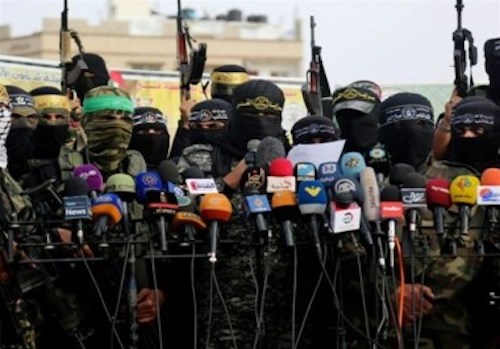
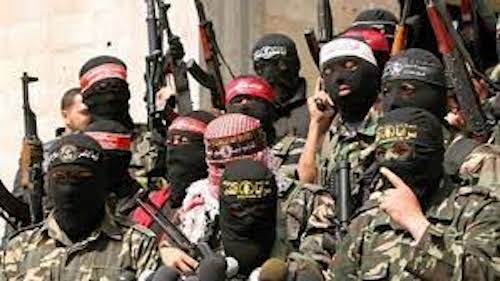
Joint press conference with representatives of different resistance organisations. (Photo sourced: Internet)
THREE-PRONGED ATTACK ON ARMED RESISTANCE
Recently a three-pronged ideological and propaganda attack was carried out on the Palestinian armed resistance from sources that are seen by some as friends of the Palestinian people: The Palestine BDS National Committee, the President of the Palestinian Authority and the Arab League.
The National Committee made their attack through a document advising on tactics and principles in presentation of BDS demands, in particular of the student campus encampments or occupations, advising activists that upholding the armed resistance was not advisable.1
Around the same time, the Arab League was having its summit meeting and, though not stupid enough to advocate giving up the armed struggle, long upheld by the Palestinian people, recommended the resistance to place themselves under the leadership of the PLO2 and the PA.
The PLO is controlled by the leadership of Fatah; their nominee, President of the PA Mahmoud Abbas, who was also at the Arab League summit, accused the October 7th attack by the Palestinian resistance of providing the Israelis the excuse for their genocidal war on Palestine.
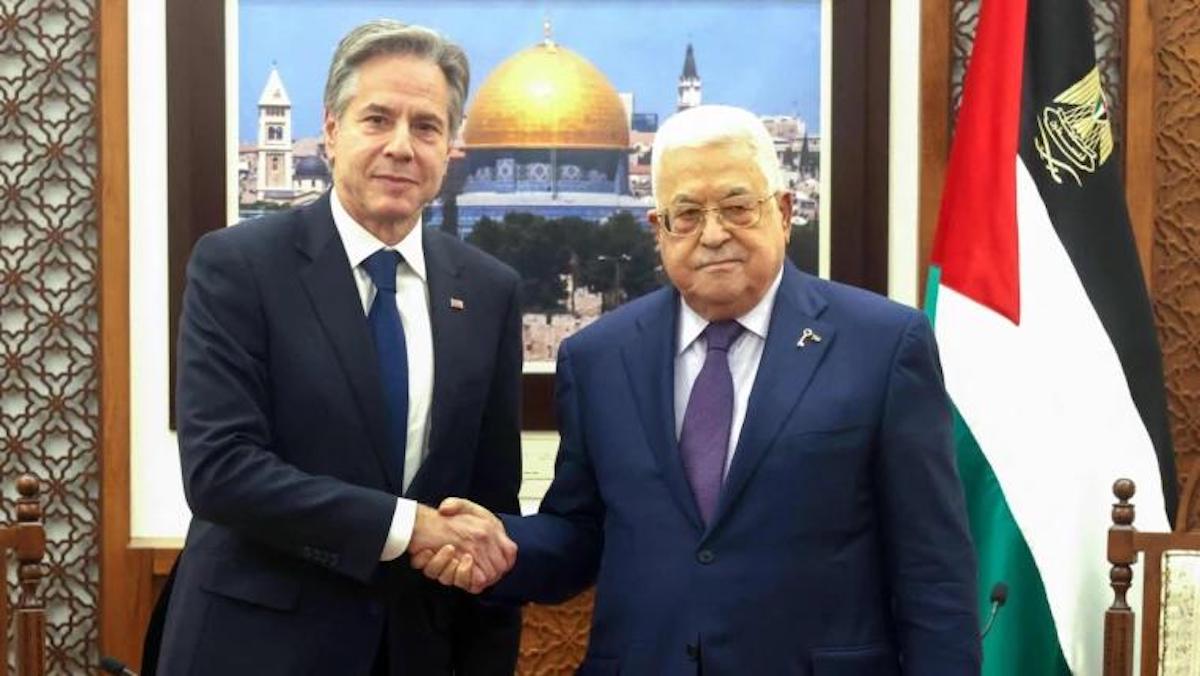
In October 2023, during the genocidal war by “Israel”, Anthony Blinken, US Secretary of State and envoy to the Middle East, shakes hands with Mahmoud Abbas, “President” of the Palestinian Authority, who remains in office despite his term having concluded in 2009. (Photo sourced: Internet)
The Arab League is composed of the current 22 Arab states, i.e those for which the dominant language is Arabic.3 But the elites of the majority of those states are clients of imperialism, chiefly of the United States. In the case of Yemen, it is the overthrown ‘government’ that is a member.4
Apart from their weakness against imperialism, one must wonder at their impertinence in telling the Palestinian armed resistance, which they do not at all assist, who should be their leadership5 and that the “two-state solution” (sic) is the only option available and recommended.6
The leadership of Fatah under Arafat betrayed the struggle for an independent Palestine and the right of return of the millions of Palestinian refugees when they agreed to the Oslo Accords in 1993/’95, for which they received limited autonomy through a “Palestine Authority”.
The corruption of Fatah in the PA and their betrayal of fundamental objectives of the Palestinian struggle led to their ousting in the elections of 2006, which were won instead by Hamas, who then had to fight Fatah who were refusing to hand over administration in Gaza.
Fatah refused to recognise the electorally-expressed wish of the people in the West Bank too but Hamas chose not to enter into a civil war with them there. From that point onwards, Gaza was besieged by the zionist authorities and periodically bombarded.
Meanwhile the PA continued in their corruption, Abbas continued to be unelected President, occupying the office and sharing the funds coming in among his clique but using their security force primarily to control and repress the Palestinians of the West Bank.
During this week alone, Resistance News Network reported that the PA’s forces dismantled explosives prepared by the resistance in the home of Tamer Fugaha which was planned for demolition by the Israeli occupation forces, where the explosives would target them.
The zionist forces regularly demolish the homes of Palestinian fighters and Tamer Fugaha was killed, along with another four Palestinian comrades, in an epic 15-hour battle with the IOF early this month in Tulkarem.
The PA has Palestinian political prisoners and also identifies these for the IOF to arrest later. Naturally (as even admitted by western mass media) the PA is hated by Palestinians, yet the Arab League wants the armed resistance to place themselves under its rule!
The armed resistance movement, which is composed of a number of distinct organisations7 fighting in unity, has of course rejected any such move and instead continued its calls for the support of the Arab people and to break the zionist blockade at the Rafah gate of desperately-needed aid convoys.
Palestinian fighters from different resistance organisations. (Photo sourced: Internet)
The Palestine BDS National Committee headquarters is also, like that of the PA, in Ramallah (West Bank). A recent statement of theirs also advised organisations working for Boycott, Divestment and Sanctions with regard to the Israeli State to drop mention of armed resistance.
Furthermore, they did so in the name of a host of organisations that sponsor Palestine BDS but the Boycott and Anti-Normalization Campaign, condemning the advice given,8 established that those organisations had not been consulted at all and if they had, would not have given approval.
The BANC criticised the offending committee not only for the original statement but also for acting as though they commanded the BDS movement.9 The statement in question was quickly withdrawn and replaced with another with the offending section on armed struggle removed.
Among the Palestinian groups that criticised the statement was the PFLP’s Haitham Abdo, head of the organisation in Lebanon, at the Popular Women’s Committees festival in Beirut on the occasion of Nakba Day, celebrating also the memory of a group of women fighters:
“Holding the resistance responsible for what happened after October 7 serves the zionist narrative and harms our people’s struggle and national fight. This statement is rejected, regardless of who says it.”10
In Yemen, the weekly “million-men march”11 sent a solidarity message to the Palestinians12 but also rebuked the participants in the Arab League summit with a non-too subtle hint as to where lie their allegiances:
“to the rulers of the Arab regimes meeting in Manama, near the embassy of the enemy entity: We regret to inform you that the enemy has committed more than 3,000 massacres to date, and even one massacre should have stirred your consciences.”13
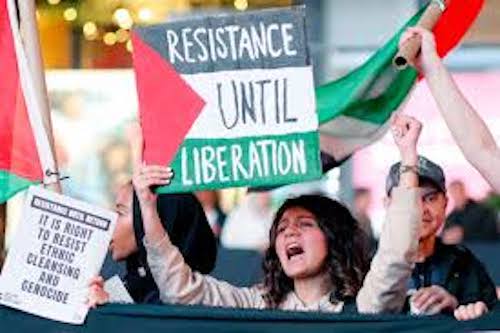
Scene from Palestine solidarity demonstration in Vancouver, Canada. (Photo sourced: Internet)
OPPOSITION TO ARMED RESISTANCE IN IRELAND
The dislike of or even hostility to promoting the armed Palestinian resistance can be seen in Ireland. A Garda confiscated a demonstrator’s a flag of one of the resistance groups, the secular Peoples Front for the Liberation of Palestine, while another was asked by IPSC stewards not to fly it.
In one of the student encampments, the PFLP flag was taken down too. The PFLP is a secular resistance organisation while others are Islamist but all are fighting in unity.
In some cases this opposition could be seen as a reluctance to have the solidarity movement associated with one specific liberation organisation which would be understandable but then a compromise would allow the flags of all groups — or one non-specific one of armed resistance.
To restrict the solidarity movement to the Palestinian national flag only is the imposition of an undemocratic “unity” and removes one of the most salient features of the Palestinian resistance – its armed aspect, fighting now amid the ruins and alleys of Gaza and in the West Bank.
Every week RNN posts photos of fighter martyrs of different resistance organisations, killed as they fought tanks, IOF bulldozers and, more rarely, IOF troops on the ground. The fighters too have been killed by aerial bombardment as of course there is no Palestinian air force or air defences.
Yet every week RNN also lists IOF tanks, bulldozers, troop carriers and IOF ground troops hit by the resistance at close quarters or at remove by mortars and rockets. The IOF dead and wounded are evacuated by helicopters which – unlike Palestinian ambulances – are never fired on.
The western mass media is not reporting these engagements and Al Jazeera reports only some of them.14
Our internationalist duty to support the Palestinians means also supporting their right to resist and that means in effect to support the armed resistance, whether we elevate one organisation or more, or just the broad principle of the right to armed resistance.
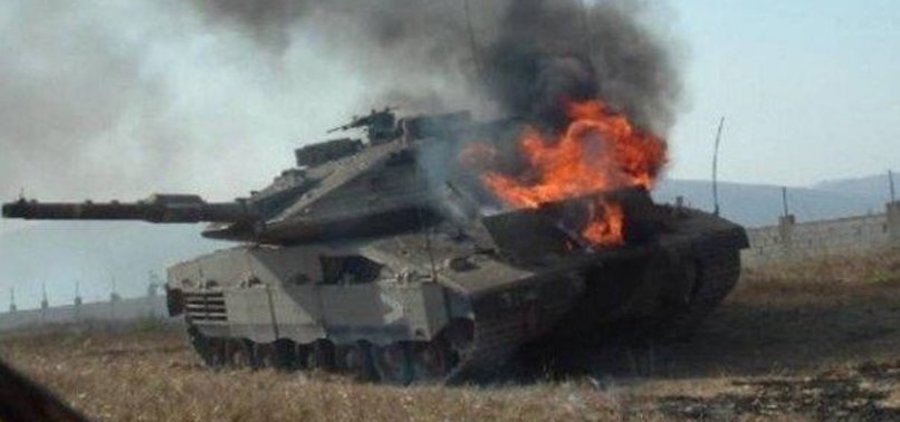
An Israeli tank hit by Palestinian fire. (Photo sourced: Internet)
THE IRISH EXPERIENCE
In the struggle for Irish liberation we have used – in different combinations – all the forms of resistance listed in the second paragraph at the beginning of this article ; indeed one of those forms during the Land War gave the word “boycott’ to the world!15
But the armed aspect has been a part of that struggle from the time of the clans right down through eight hundred centuries, against even internal opposition. In July 1846, John O’Connell’s proposal to have the Union Repeal Association renounce the use of armed force split the organisation.16
At the meeting, Thomas Meagher, said that “There are times when arms will alone suffice, and when political ameliorations call for a drop of blood, and many thousand drops of blood. Opinion, I admit, will operate against opinion. But … force must be used against force.
“The soldier is proof against an argument, but he is not proof against a bullet. The man that will listen to reason, let him be reasoned with; but it is the weaponed arm of the patriot that can alone avail against battalioned despotism.”17
LONG LIVE THE RESISTANCE – IN ALL ITS FORMS!
End.
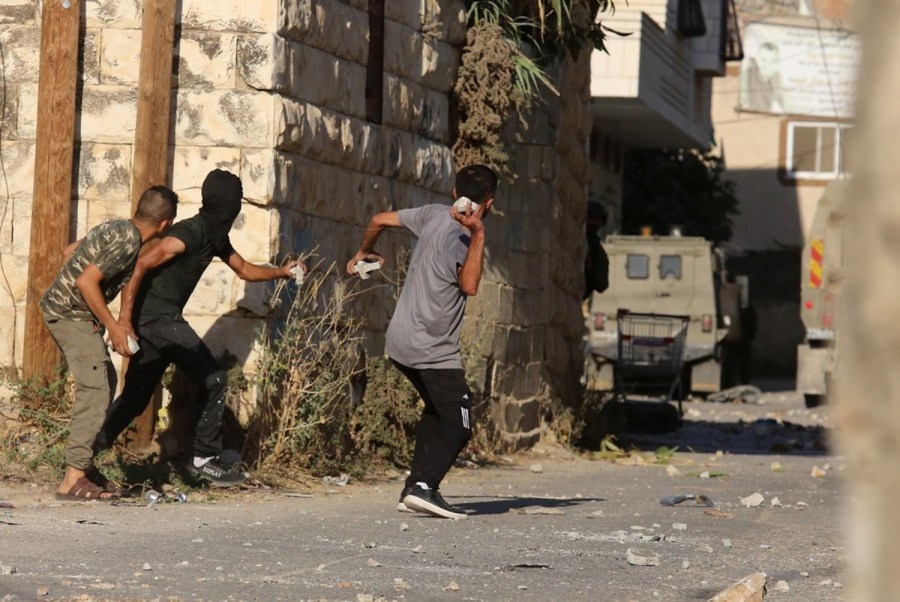
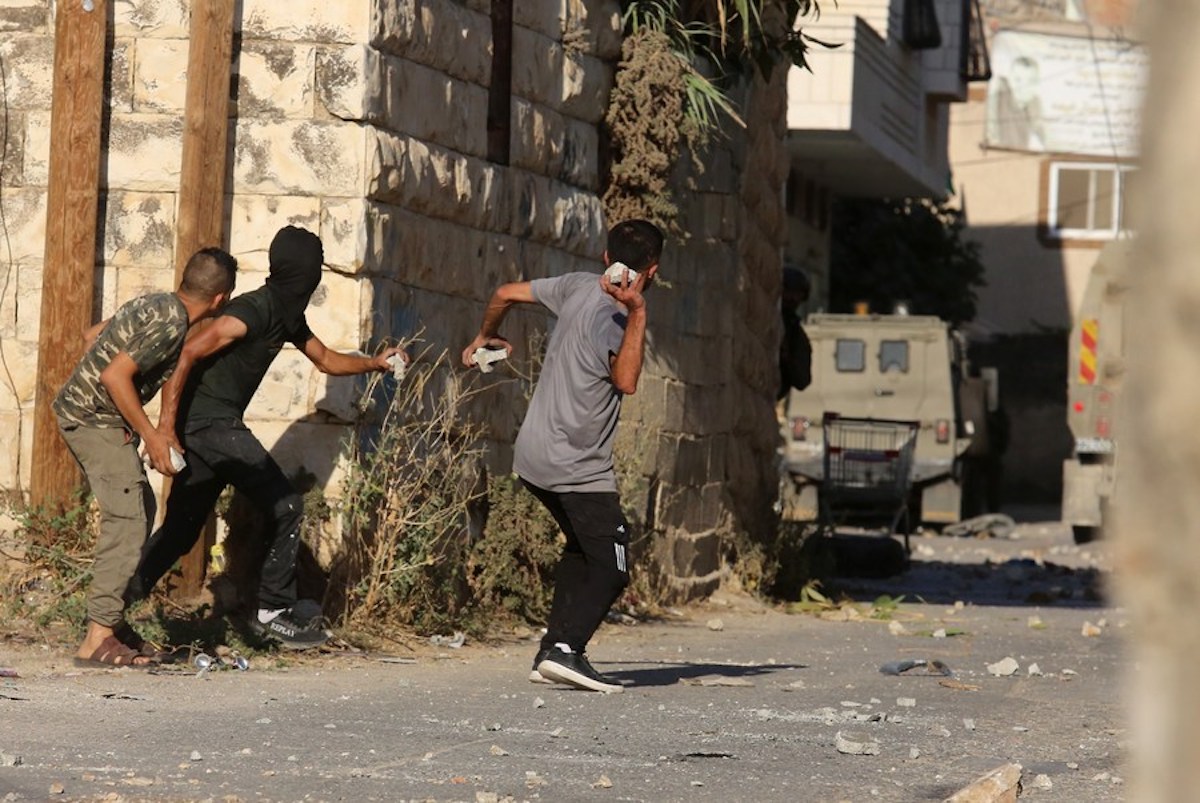
Palestinian youth respond to an Israeli raid on Beita in the West Bank Aug 2023 (Photo cred: Nidal Esthayeh/ Xinhua)
FOOTNOTES
1 We reiterate our firm position and call for a just and comprehensive peaceful settlement of the Palestinian issue, and we support the call of His Excellency President Mahmoud Abbas, President of the State of Palestine, to convene an international peace conference and to take irreversible steps to implement the two-state solution in accordance with the Arab Peace Initiative and resolutions of international legitimacy to establish an independent and sovereign Palestinian state on the lines of 4 June 1967 with East Jerusalem as its capital, and to accept its membership in the United Nations as an independent and fully sovereign state in common with other countries in the world, and to ensure the restoration of all legitimate rights of the Palestinian people, in particular, the right to return and self-determination, empowerment and support.
2At its first summit meeting in Cairo in 1964, the Arab League initiated the creation of an organization representing the Palestinian people. The Palestinian National Council convened in Jerusalem on 28 May 1964. After concluding the meeting, the PLO was founded on 2 June 1964. Its stated “complementary goals” were Arab unity and the liberation of Palestine. (Wikipedia) Under Fatah domination it banned Islamist groups from membership.
3 Algeria, Bahrain, Comoros, Djibouti, Egypt, Iraq, Jordon, Kuwait, Lebanon, Libya, Mauritania, Morocco, Oman, Palestinian Authority, Qatar, Saudi Arabia, Somalia, Sudan, Syria, Tunisia, United Arab Emirates and Yemen.
4 Rather than those in power, the Ansar Allah (“Houthis”) government, preferred by the vast majority of Yemenis to the western-recognised exiled government.
5We call on all Palestinian factions to join together under the umbrella of the Palestine Liberation Organization (PLO), the sole legitimate representative of the Palestinian people, and to agree on a comprehensive national project and a unified strategic vision to focus efforts towards achieving the aspirations of the Palestinian people to achieve their legitimate rights and establish their independent national State on their national soil, on the basis of the two state solution, and in accordance with the resolutions of international legitimacy and established references.
6 The 2-state option, supported by the imperialist powers, is of a much smaller Palestine state alongside an Israeli state at least the size of its current dimensions. However even this has arguably been made impossible by the spread of Israeli settlements and is rejected by most Palestinians and many Israelis. The 1-state option envisages the whole of historic Palestine under a democratic regime.
7 Iz al-Din al-Qassam Brigades (QQB) – Hamas; Al-Quds Brigades (AQB) – Islamic Jihad; Abu Ali Mustafa Brigades (PFLP) – People’s Front for the Liberation of Palestine; National Resistance Brigades (DFLB) – Democratic Front for the Liberation of Palestine; Al Aqsa Martyrs Brigade – Fatah (not under Fatah political control); Al-Nasser Salah al-Deen Brigades (PRC) – Popular Resistance Committees; Lion’s Den; Mujahideen Brigades.
8The Boycott Campaign – Palestine condemns the statement issued by the Boycott National Committee, in Ramallah, which asserts the danger of supporting the Palestinian resistance on their work and the necessity to distance themselves from any positions that support the resistance, especially armed resistance.
This disgraceful stance comes at a time when the zionist enemy is committing the crime of genocide against our people in the Gaza Strip for over seven months, resulting in the killing and injury of more than 120,000 innocent Palestinians and the destruction of 70% of Gaza’s buildings.
Such dangerous statements provide cover and legitimacy for the enemy to continue its aggression.
What is more dangerous is that the BNC claims it issued the statement in consultation with a large number of national entities and organizations.
However, through our communications with several entities mentioned in the statement, it is certain that they were not presented with this statement nor consulted about it, and they would certainly refuse to sign such statements that promote non-national positions.
All struggles for freedom around the world have seen various forms of struggle side by side, with armed resistance at their core. Therefore, our Palestinian struggle strategy should reinforce different forms towards the major goal of dismantling this zionist project on our land.
Accordingly, we call on the BNC to revise its position and align with the authentic national stance that glorifies resistance in all its forms.
We also urge it to stop this approach that attempts to monopolize the legitimacy of international work for Palestine and issue top-down orders to everyone. Palestine is greater than all, and the global revolution today to support our people is greater than something that can be monopolized by anyone.
Boycott Committee — Palestine / Boycott and Anti-Normalization Campaign
11 For the 31st week, the Yemeni people turned out in massive crowds across various cities in Yemen in support of Gaza under the slogan: “With Gaza: Holy Jihad and No Red Lines.” A million-man flood took place in the capital Sana’a, a massive rally occurred in the city of Ibb, and marches were reported across 23 locations in Rima, among other cities. (RNN)
12 “The statement at the weekly turn out reiterated the legendary steadfastness of the fighting Palestinian people and the perseverance of its fighters in this critical phase. The people assured the American and British enemies that they will not be deterred from maintaining a steadfast stance.” (RNN)
14Electronic Intifada updates reports a number with analysis and RNN posts the reports of the groups themselves.
15 The word comes from the National Land League successful campaign of withdrawal of labour along with isolation of services (or even social contact) with Captain Charles Boycott, the agent of an absentee settler landlord who was planning to evict some tenants in 1886. https://en.wikipedia.org/wiki/Boycott Boycott is a non-violent tactic but the fact of the use of violence during the Land War by the Occupation and in response by the peasantry is often overlooked. The Fenians supported the campaign and landlord’s agents were shot at, police and bailiffs stoned and scab labour attacked.
16 The Repeal organisation’s leadership became dominated by the rising Catholic Irish bourgeoisie of which John and his father Daniel were leading members. The “split” became known as the Young Irelanders and contributed nationalist culture and journalism, in particular through The Nation newspaper and some long-lasting songs such as A Nation Once Again. The Irish Tricolour was first presented to Meagher by French women during the revolution in Paris in 1848; the Young Irelanders also staged an ill-fated uprising that same year.
Thirty-five people were killed by bombings on 17th May 1974, the most in one day during the recent 30 Years War but outside of Ireland and even within it, most people are unaware of that fact. That’s because the perpetrators were not the IRA.
And probably also because the victims were killed not just in Ireland but within the Irish state. Also no doubt because the perpetrators were Loyalists led by British Intelligence.
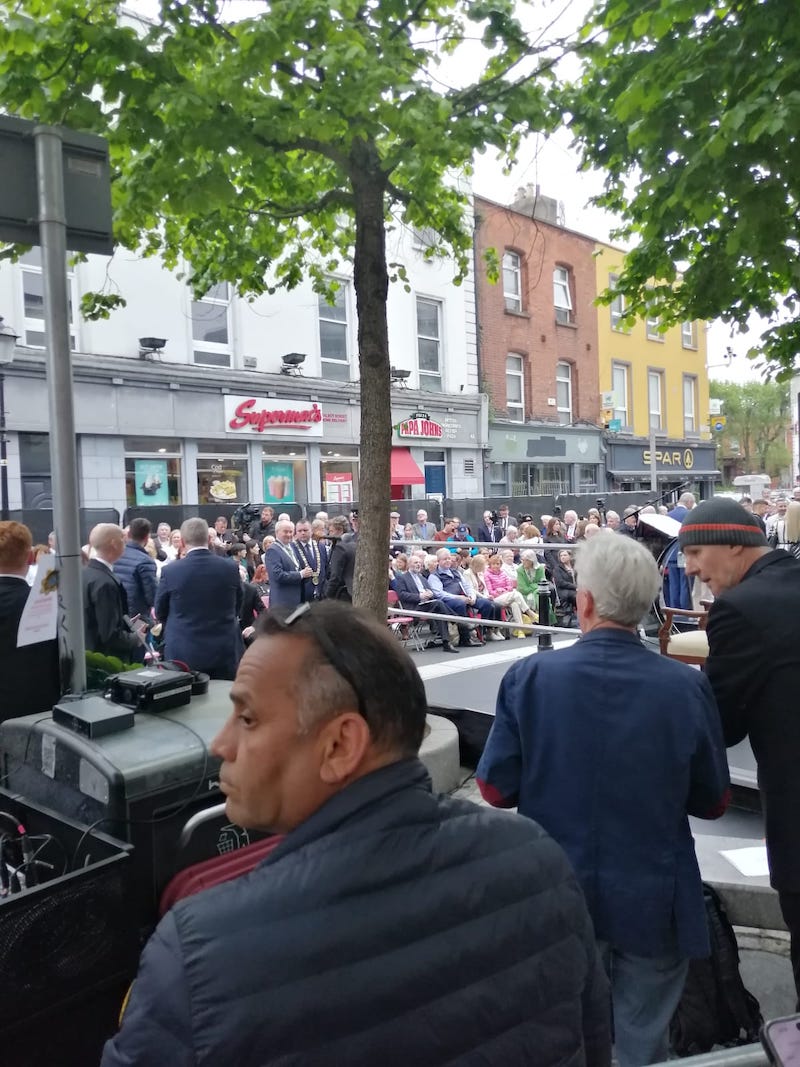
Section of westward end of attendance at event as President Michael D Higgins approaches (just out of view)(Photo: D.Breatnach)
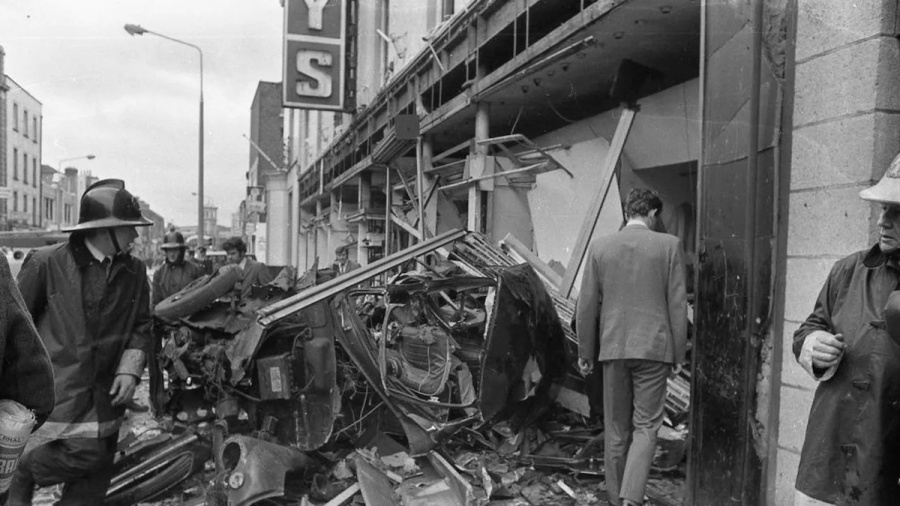
Three bombs exploded on that day in the middle of a rush hour in Dublin City Centre: Talbot Street, Parnell Street and South Leinster Street. Somewhat later, a bomb exploded also in Monaghan Town. Altogether 35 were killed1 and “about 300”2 injured, some permanently.
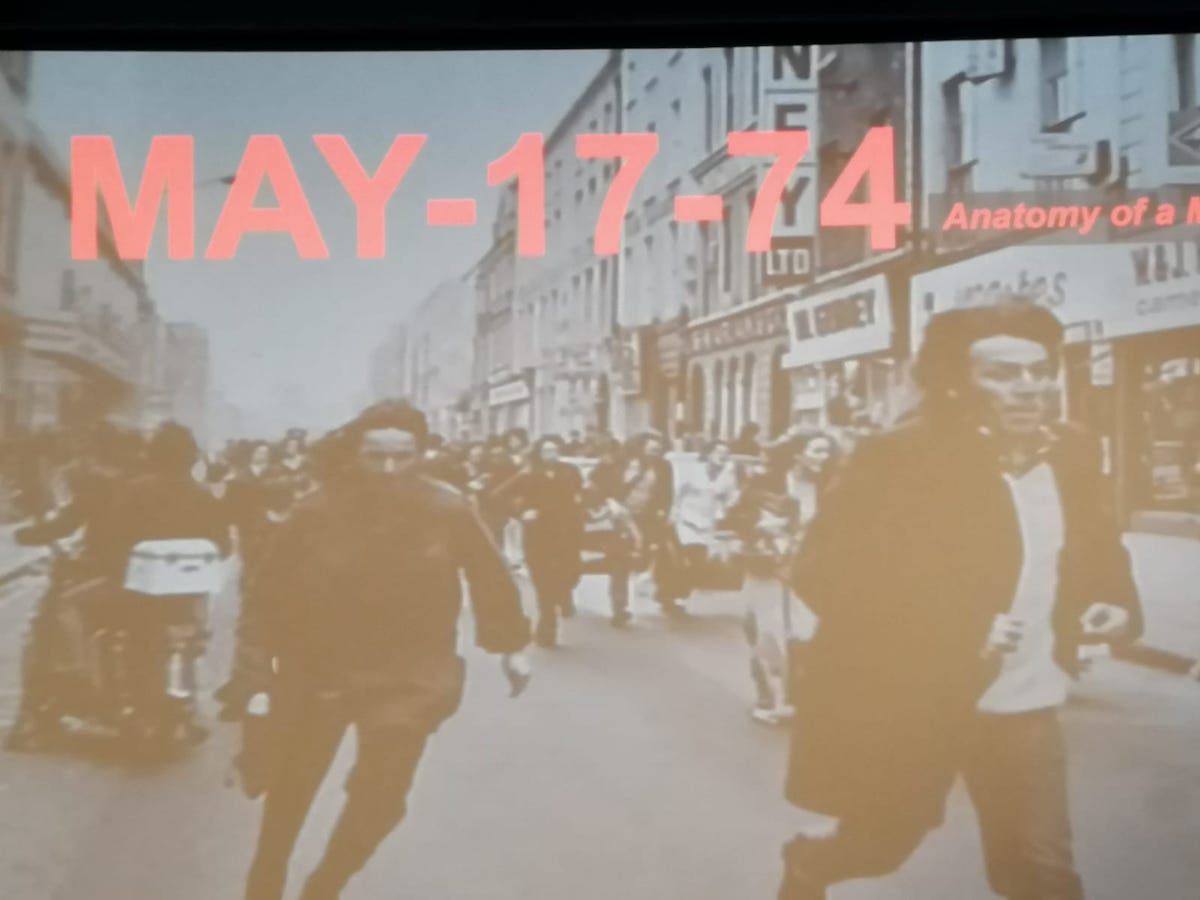
The names of some of the victims being displayed at the premiere of the Anatomy of a Massacre documentary. (Photo: D.Breatnach)
Within days and perhaps hours a number of suspects among Loyalist murder gangs had been identified but they were not arrested or even questioned about the atrocity – no-one ever was. Despite that, the Gardaí closed the case investigation seven months afterwards that same year.
A new documentary on the atrocities by Fergus Dowd was premiered in Dublin on Friday to two full screen auditoria in the Lighthouse Cinema, Smithfield, featuring interviews with witnesses, victims and relatives of victims, a former Taoiseach and a former State forensic scientist.
May-17-74 Anatomy of a Massacre is directed by Joe Lee and produced by Fergus Dowd.
The forensic expert had been given very little of the remains of cars containing the bombs since most had been sent to the RUC (colonial police) for their analysis (!) from which nothing useful emerged but he was able to determine that a high amount of amatol had been used.
At that time only the IRA among “paramilitary organisations” had the expertise to develop that explosive material which leads commentators to believe that the Loyalists received the necessary quantities from those seized from the IRA and held by the British armed forces.3
Given that many of the Loyalists involved were members of the Ulster Defence Regiment, a British Army unit, on the face of it the explosives could have been directly supplied by the British Army or indirectly obtained through the UDR as members of the British Army.
Nothing adverse is known about the Garda Commissioner who sent the exploded car remains to the colonial police but his Deputy and successor was Ned Garvey and whistle-blowing British spook Fred Holroyd claimed Garvey was a British Intelligence “asset” and to have met him in Dublin.
Confronted with this exposé years later Garvey admitted having met Holroyd but not to being a British spy – though he had not informed his superiors of his meeting with a foreign secret service agent. 4 Sadly this is not alluded to in the documentary.
As documented in Anatomy there had been a Loyalist bombing campaign of Dublin since 1969,5 with those in 1972 and 1973 killing between them three transport workers and no-one had been arrested by Gardaí or extradition sought in connection with even those fatal explosions.
No documentary about the bombing was made by RTÉ, the Irish broadcaster until 2004, thirty years after the atrocity.
However a much earlier documentary was by British company Yorkshire Television on ITV in 19936. RTÉ had declined the offer of joint screening and many people in Ireland who did not have access to ITV at the time missed it or had to go to a friend or relative to view it.
The British documentary was mentioned only in passing by one of the interviewees in Anatomy but without reference to RTÉ’s declining of the offer of joint screening.
British spook whistleblower Colin Wallace states that he was obliged to report on every meeting he had with Loyalists or others and his erstwhile bosses would have kept those papers, as they would have for the MI5 operatives who steered the bombing gang for Dublin and Monaghan.
The existence of MI5 documents that would throw much light on the bombings was referred to a number of times in Anatomy and the Justice for the Forgotten campaign keeps seeking them. Irish Government ministers regularly state that they have requested them but are always refused.
Missing from the documentary was what is now known of the secret contemporary memos of Arthur Galsworthy, British Ambassador to the Irish state: It is only now that the South has experienced violence that they are reacting in the way that the North has sought for so long …
… I think the Irish have taken the point.
Galsworthy also noted that the Irish Foreign Affairs Minister Garret FitzGerald told him that “the government’s view was that popular hostility appeared to be directed more against the IRA“.
In the immediate aftermath of the bombing, both Liam Cosgrave for the Government and Jack Lynch for the Opposition sought to widen the blame to include Irish Republicans.7
VIEWING THE DOCUMENTARY
Two screens at the Lighthouse cinema were fully booked to view the premiere.
The documentary is fascinating and some of the witnesses and relatives really excellent in their descriptions and commentary. Others interviewed pulled no punches in castigating successive Irish governments for closing the investigation and allowing it to remain closed.
Some, too, alleged a conjunction of interests between the Irish and UK states in ensuring the truth about the perpetrators and the Irish State’s reaction never surfaced.
Many people prominent in Irish political circles at different ends were present to see the premiere and after a few words from Margaret Unwin, Coordinator of the Justice for the Forgotten campaign, along with filmaker Dowd, the Resistance Choir sang their song composed about the bombing.
The Resistance Choir performing their song about the bombing massacre (Photo: D.Breatnach)Section of crowd from the Monument eastward (Photo: D.Breatnach)
Justice for the Forgotten organise a commemoration of the atrocity every year at which some music and poetry is performed, along with speeches by politicians representing the Irish State, and the local authority Councils of Dublin City and Monaghan and another individual or two.
Some of what is said there I have welcomed and some disliked but most of all I detest Ministers in the Irish Government coming there to tell us how they want the British State to release their secret documents regarding the event but never have any action to pressurise its Ministers in mind.
Cormac Breatnach playing low whistle at event (Photo: D.Breatnach)
This year, the 50th anniversary, the event took place after noon on Friday 17th May with a large crowd but only one speaker listed, President of the Irish State Michael D. Higgins, with traditional Irish music from Cormac Breatnach and Eoin Ó Dillon, a duo performing at the event for years.
Eoin Ó Ceannabháin sang The Parting Glass and poet Rachel Hegarty performed her poem about the bombing. But there was a surprise speaker also, an Italian from Breschia who also referred to state collusion in a bombing against an anti-fascist rally in his home town the same year, a few weeks later.
Poet Rachel Hegarty performing her poem about the event (Photo: D.Breatnach)
The MC of the event, Aidan Shields, son of fatal victim Maureen, told the audience to applause that Justice for the Forgotten would be sending a delegation to Breschia for the 50th commemoration of the atrocity in their town.
At left, Aidan Shields, son of fatal victim and MC at event, with Monument to the victims centre (Photo: D.Breatnach)
WHY THE BOMBING?
Trainee journalists are told to answer the ‘Five Ws’ in their reports: who, what, where, when and why.
The answers to four of those questions have been known for decades: Dublin and Monaghan is where; 17 May 1974 was the when; the bombing atrocity was the what. The who were the Loyalists and British Intelligence. But nobody seems to attempt to answer the why – or even to ask that question.
For the earlier 1972 bombing, the “why” is clear: to get the Irish parliament to vote for the Amendment to the Offences Against the State Act.
And they were successful in that since, all logic to the contrary, some of the Opposition decided to believe that the bombing was the work of Irish Republicans. So we now have that no-jury political court and senior Gardaí can give ‘evidence’ unseen by the accused from Garda “secret files”.
Apart from the guidelines of journalism, there are also those with regard to criminal investigations, which outline the importance of motive and opportunity. The British secret service certainly had opportunity – but what was their motive?
A bombing such as that in Dublin on 1974, in the Irish State’s capital city, is a message to the Irish ruling class (though the victims be different) were the. And from the British state through their intelligence service, which would hardly dare to carry out such an attack without at least the endorsement of their masters.
So the message was … what? “We will bomb your capital city if you don’t do what we want or if you do what we don’t want”? But the Irish ruling class was already cooperating about as fully as possible with the occupation in the Six Counties and repressing resistance in the Twenty-Six.
A similar campaign occurred in the 1980s, in the Basque Country within the French state (mostly). The Spanish Government waged a terrorist campaign8 of bombings, kidnappings and assassinations against suspected activists of the armed Basque liberation group ETA.
It seemed that what the Spanish authorities wanted was for the French to turn over Basque activists who were on the “French” side of the Border to the Spanish authorities, something the French had been unhappy to do, the Guardia Civil believed to be torturers even after Franco’s death.
After some of those bombings, the social-democratic French Government led by Mitterand began to hand over Basque activists to the authorities across the border, sometimes without even going through the official extradition procedures.
The Irish State did also permit extradition of Irish Republicans to the Six Counties (and later to Britain too) after the Dublin and Monaghan bombings, but not until ten years later, with Dominic McGlinchy, which hardly looks like the effect following its cause.
The Sunningdale Agreement had been signed in December 1973 which proposed some kind of power-sharing between nationalists and unionists with a role for the Government of the Irish state against which the Loyalists of the Ulster Workers’ Council had organised a general strike.
A British whistleblower, Colin Wallace claims that the bombing was a warning to the Irish ruling class to keep their fingers out of the colony.
VICTIMS AND RULING CLASS
Apart from not answering or even seeking the motivation for MI5 to arrange and oversee the bombing, I have not seen any discussion of the class nature of the locations. The bombings of 1972 and 1973 targeted transport workers.
But the bombings on the north side of the river in areas to the east of O’Connell Street also took place in areas where working and lower middle-class people worked, shopped and got on to the public transport buses. This hardly seems accidental.
Aftermath in Talbot Street facing westward with Connolly Station tower in far background (Photo: PA)
A part of MI5’s message could have been: “This time it was mostly the kind of people nobody (who are in power) cares about, so be thankful. Next time we might hit the north-east centre around Henry Street, or areas around Trinity College, Dame Street and Grafton Street on the south side.”
One other point that is rarely made is that the bombing and the State’s reaction to it showed the totally craven and foreign-dependent nature of the Irish ruling class, to allow their capital city to be bombed by another state without seeking revenge or even restitution.
The French state made a deal with the Spanish after some bombs exploded in territory to which it laid claim but does anyone believe the result would have been the same if the Spanish terrorist groups had bombed Paris?
End.
FOOTNOTES
1 Some accounts give a total of 34 or 35 dead from the four bombings: 34 by including the full-term unborn child of victim Colette Doherty, who was nine months pregnant; and 35 by including the later still-born child of Edward and Martha O’Neill. Edward was killed outright in Parnell Street.
4 When Fianna Fáil came into government, they sacked Garvey but presumably not wanting to expose British Intelligence penetration of the Irish State’s management upper echelons, gave as a reason only that they had no confidence in him. This opened the way for Garvey to claim wrongful dismissal and win, giving him a payout and retaining his pension. Garvey was also important in running the notorious “Heavy Gang” within the Special Branch.
5 The Wolfe Tone Monument in Stephens Green had been blown up and the O’Connell monument, the Glasnevin ‘Round Tower’ had also been bombed.
6 “Yorkshire Television broadcast a documentary entitled ‘Hidden Hand – the Forgotten Massacre‘ made as part of its ‘First Tuesday‘ series. The programme dealt with the Dublin and Monaghan bombings of 17 May 1974. [The programme came to the conclusion that the Ulster Volunteer Force (UVF) would have required assistance to carry out the bomb attacks. There was speculation as to where such assistance might have come from. While no firm conclusions were reached, it was suggested that the security forces in Northern Ireland were the most likely source of help. Allegations concerning the existence of a covert British Army unit based at Castledillon were considered; as well as alleged links between that unit and Loyalist paramilitaries. It was shown that Merlyn Rees, the former Secretary of Sate, had known of the unit’s existence. On 15 July 1993 the UVF issued a statement in which it claimed sole responsibility for the Dublin and Monaghan Bombings.]” https://cain.ulster.ac.uk/events/dublin/chron.htm
University students in the USA protesting, setting up encampments, occupying university buildings; threats from administrators; police invasions, assaults on students, resistance, arrests …
Step forward, Youth and shake the towers
Those ivory towers stand on sweat and blood
Make those lies fall in showers —
Become the earthquake and the rushing flood.
Step forward youth
For solidarity and truth!
Academic freedom and investigation
and principles too of democracy
Have taken now academic vacation
Revealing true base in hypocrisy.
Step forward youth
For solidarity and truth!
Look down below your feet
Reach out to workplace and street
Stretch out solidarity’s hand
to the struggling in another land.
Step forward youth
For solidarity and truth!
only thus can you also be
in a better world, at peace and free.
(Dublin, May 2023)
It seems as though we’ve been here before, a sense of dejá vu … Ah, yes! During the Vietnam War (1955-1975). University students in the US were in conflict with the authorities about lifestyle, content and style of the curriculum, racism, sexism, sexuality and .. yes, the US’s war in Indochina.
Students lost their study and work plans, got hit by truncheons, were sickened by teargas and some were shot dead, as in Kent State University, Ohio by the National Guard and in Jackson, Mississippi 11 days later.1
Which is why the suggestion of House Speaker Mike Johnson to send that same body in against the students last week was a vicious act of intimidation.
In the 1960s Trinity College Dublin, the academic bastion of the British-unionist Ascendancy, was a hotbed of protest and even revolutionary organisation along many fronts – including gay rights, contraception rights, Irish socialism and national liberation.2
The Ulster University in Belfast, in the British Six-County colony saw protests for Catholic civil equality, a struggle that faced armed repression and developed into a responding armed struggle of three decades.
In the USA those years coincided too with marches for black civil rights and also the rise of militant revolutionary groups such as the Black Panthers, the Young Lords, Weathermen, SLA and later the American Indian Movement.
Women’s liberation and Gay & Lesbian liberation movements3 also moved more to the fore.
The responses of the US State to many of those movements were even more vicious than they had been against the students, with trials, jailings,4 shootings5 and downright unofficial executions.6 As the campus protests now draw in wider communities, are we heading for something similar?
In the USA, the authorities seem terrified of that conjunction — or how else can we understand the violence of their reaction which has even horrified some university senates?
DIFFERENCES BETWEEN THEN AND NOW
When the students in the USA fought the institutional authorities, it was partly in solidarity with the people of Vietnam (and later of Laos and Cambodia). Yes, but many also feared being sent to the Vietnamese War meat grinder and being airlifted home from there in body bags.
The draft had been introduced in 19647 and though middle-class students had a better chance of avoiding conscription, they were far from immune.8 Being an officer might make one safer from the enemy than being a grunt but not from the grunts themselves as “fragging” incidents soared.9
The students now protesting in US Universities are doing so in solidarity with Palestinians, in horror at their state’s support of Israeli genocide. They may have other issues with their universities’ management and society at large but in general we can rule out the motive of self-preservation.
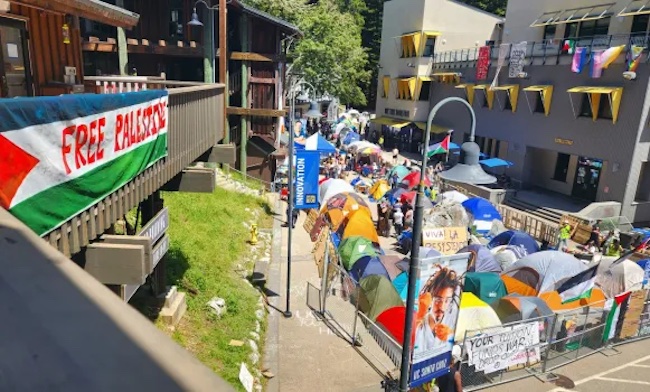
Encampment Palestine solidarity Vera Cruz University California Thursday (Photo cred: Aric Sleeper Santa Cruz Sentinel)
The drug culture was very much seen as part of the protest movement back then, though opposed by some such as Panthers and viewed with suspicion by other revolutionaries. Pacifist trends were strong and Timothy Leary’s “turn on, tune in and drop out” mantra attracted many.
Much of the revolutionary potential of the movement was lost under that influence, nowhere near as powerful now and revolutionaries who know their history will be aware that such arch-opponents of the system as Leary became an FBI informant to get out of jail.10
Many may argue as to degree but the power of patriarchy and oppression of LBG sexuality, though certainly present, are nowhere near as strong today in the “western world” as they were in the 1960s.
The power of the Catholic Church hierarchy in Irish society has been greatly weakened by struggles, Church scandals and society’s evolution. Discrimination against Catholics in the Six Counties is also less than it was in the previous era.
The armed struggle is not currently being waged.
However, Ireland remains divided between a 26-County neo-colony and a Six-County colonial statelet. The economies are hugely penetrated by foreign multinationals, the health services tottering and a huge housing crisis due to turning housing over to big landlords and property speculators.
The main parties of the ruling classes have been exposed to such degree that they no longer act in the charade of opposition: Sinn Féin and the DUP share political administration of the British colony while Fine Gael and Fianna Fáil share it for the neo-colony, prepared to admit SF there too.
Fascists gather some of the disenchanted, marginalised and disinherited to try to mould them into a fascist movement against migrants and refugees, against LGBT rights, against socialism. The State facilitates that development while it grows more repressive in both the administrations.
The ruling class will be aware of the potential of a rise in student protest coinciding with a feeling of Palestine solidarity and frustration at Irish state complicity very widely spread throughout Ireland. But then the Irish state is not imperialist, it’s just complicit in imperialism.
UNIVERSITY PROTESTS NOW
Students in universities across the USA have staged occupations or built encampments in explicit solidarity with Palestine against their own government and against the collusion of their academic institutions with zionist genocide of Palestinians and the destruction of every university in Gaza.
The response of the academic authorities has been denunciation, threat, eviction and false characterisation of the high motives of the students as “anti-semitism”.11
Municipal, county and state police forces have responded violently to peaceful protest, including bodily assault, pepper spray, tear gas, rubber bullets and arrests. The Government has drafted a change of the legal meaning of anti-semitism to include opposition to the Israeli zionist State.12
Rutgers students tents 29 April 2024 (Photo cred: Sophie Nieto-Munoz/ New Jersey Monitor)
The violence of the authorities has not been confined to the protesting youth but has been extended to staff who stood with them. During the week Dr. Steve Tamari, professor at the University of Southern Illinois got nine ribs fractured by cops – for filming what was going on.
Chair of Jewish Studies at Dartmouth University, New Hampshire, Annelise Orleck (senior citizen) was violently arrested and banned from campus for six months.
In some cases not only have the protesters resisted valiantly but actually drove the cops into retreat and in Portland, Oregon, police cars were set alight. Also a fascist who drove at protestors and pepper-sprayed them was, according to reports, identified and his car destroyed.
On the other hand, Zionists (and suspected fascists) have mobilised against the students in many universities, with the tired old propaganda of “anti-semitism” and in one case attacked an encampment with sticks and fireworks, also playing a “crying child” Israeli drone recording.13
Irish Republicans and other anti-fascists will not be surprised to learn that a) the police disappeared shortly before the violent attack and b) none of the attackers were arrested when the cops returned.
More than 2,100 people have been arrested at US campuses since April 1814 and students have been barred from their own campuses which, for many, means also their own accommodation.
Police Attack Palestine solidarity UCLA campus Thursday 2 May 2024 LA (Photo cred: Ethan Swope/ AP)
The university protests have spread beyond the USA and have broken out in Canada (McGill), Australia (Brisbane and Sydney) and even Humbold in Germany, main Israel arms supplying country after the US, where state repression of Palestine solidarity has been particularly heavy.15
In France, where there has also been much repression of Palestinian solidarity activity, there have been occupations at the Sorbonne and Sciences Po in Paris) and in England, Newcastle and London, while an encampment was set up in Edinburgh in front of the Scottish Parliament.16
“SHAMEFUL SILENCE”
In Ireland, the universities have been relatively quiet until now but the Trinity College Dublin administration fined their Students Union €214k for a one-day Palestine solidarity picket outside the building housing the Book of Kells exhibition, citing loss of visitor revenue in justification.
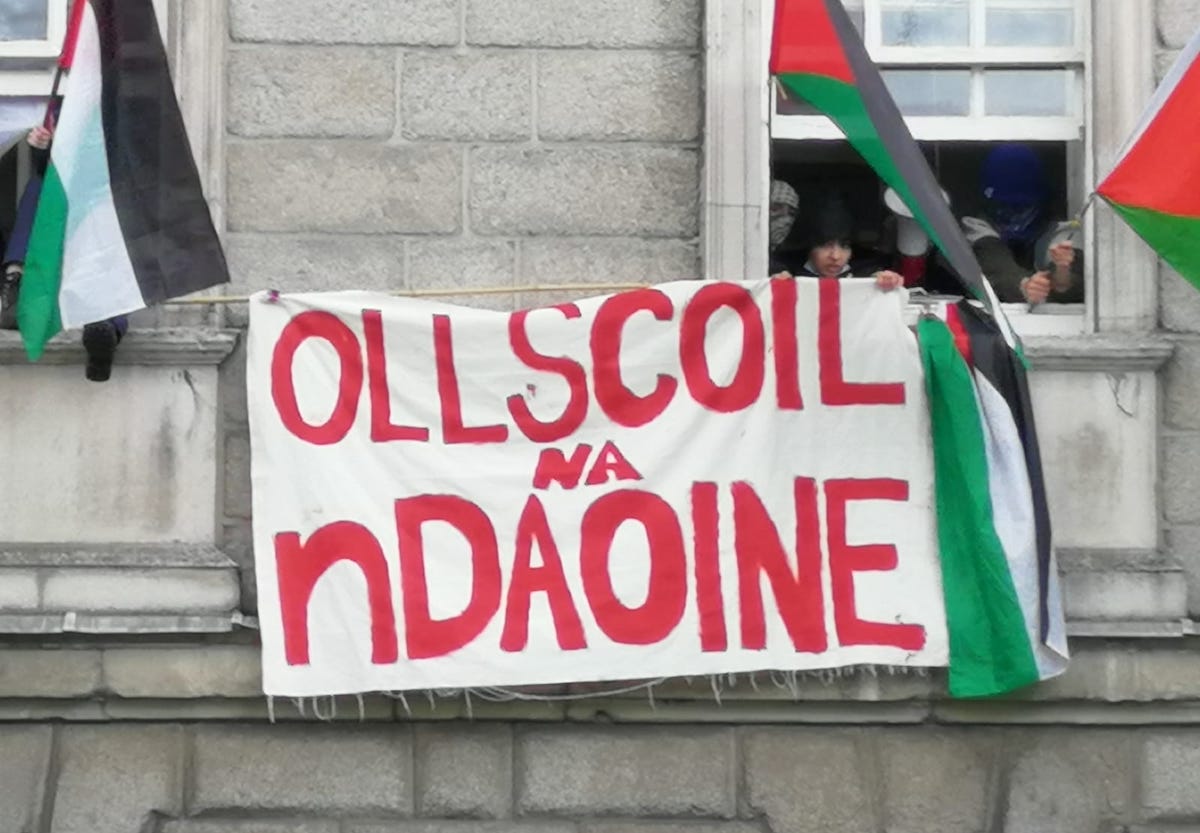
“The People’s University” banner hanging from windows in Trinity College Saturday (Photo: D.Breatnach)
But repression leads to resistance; now there is a Palestine solidarity encampment on the green in front of the Kells exhibition. People are mobilising to support the student resistance in Trinity and today saw a march there from the Spire with the administration locking the gates shut.
“We plan on staying here indefinitely, our message is there is no ‘business as usual’ during a genocide,” outgoing students’ union president Laszlo Molnarfi said.17
(Photo: Social Rights Ireland)
“When our academic institution, Trinity College Dublin, has ties to Israeli companies, entities and universities that are complicit in the war industry, we must speak up. That is why we are doing this.
“And we must speak up in this disruptive, powerful way. Because when we tried to engage with the authorities, with petitions and letters and meetings, we were met with shameful silence.”18
Inside Trinity College grounds Friday night/ Saturday morning (Photo: Social Rights Ireland)
In the wider ‘global South’, Palestine solidarity protests have been seen in India at Jawaharlal Nehru University in New Delhi against a visit from the US Ambassador to the country, Eric Garcett, which had to be cancelled.
More dangerous by far to the US ruling class and Israeli-colluding King of Lebanon, so geographically close to Palestine and with a strong Hizbollah guerrilla presence, are the student demonstrations at the university of Beirut.
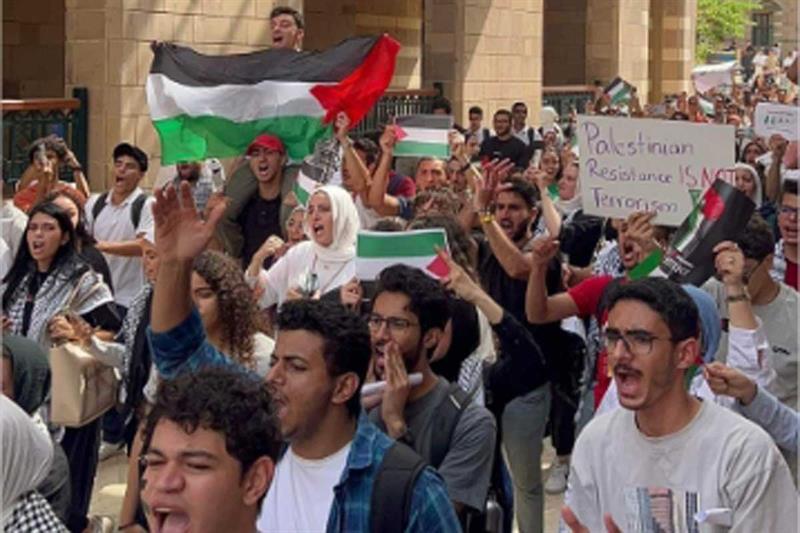
Students at American University in Cairo (AUC) Demonstrating Monday in Solidarity Palestinians (Photo source: X Twitter)
Whether overall these actions of students, who comprise a large and influential section of youth, will significantly deepen, widen and energise the growing Palestine solidarity movement, and simultaneously the wider anti-imperialist movement, remains to be seen.
End.
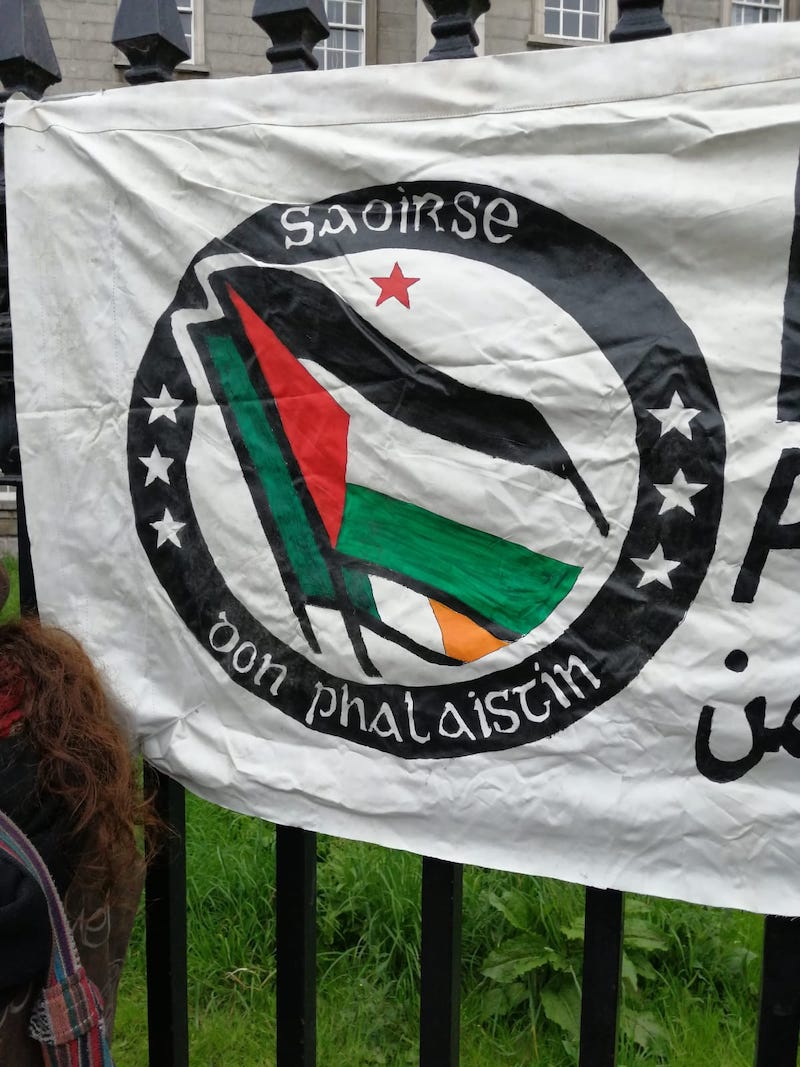
“Victory to the Palestinian Resistance” banner on Trinity College railings Saturday (Photo: D.Breatnach)
FOOTNOTES
14th May 1970, killed by the Ohio Kent National Guard during a protest against the Vietnam War. The Jackson killings occurred 11 days later on Friday, May 15, 1970, at Jackson State College (now Jackson State University) in Jackson, Mississippi. On May 14, 1970, city and state police confronted a group of students outside a campus dormitory. Shortly after midnight, the police opened fire, killing two students and injuring twelve.
2Ironically, precisely because it was free of the major socially controlling agency in Ireland at the time, the Catholic Church hierarchy.
3See the Stonewall Riots of 1969 in the US against homophobic police harassment.
4Including many frame-ups, some of which were only exposed decades later. Leonard Peltier was jailed on dubious evidence in 1977 which had already collapsed against a co-accused but is still in jail, 79 years of age with diabetes and other health problems.
11Thereby also devaluing the meaning of that particular form of racism which was a basic ideological aspect of Nazism and Fascism and continues to be a strong trend in European fascism today.
13One of the latest horrors from the Israeli Zionist cabinet, killer drones playing sounds of a crying baby or a woman needing help in order to bring would-be helpers out where they can then be shot dead, being played in this case mockingly.
Although the 1916 Rising had been planned to take place on Easter Sunday, April 23rd, it was publicly cancelled by the titular head of the Irish Volunteers, Eoin Mac Néill and it went ahead instead on the 24th, the following day.
The 1916 Rising was unsuccessful but is considered the birth event of the Irish Republic and for some therefore Republic Day is on April 24th, the first day of that Rising and when Patrick Pearse, with James Connolly by his side, read out that remarkable Proclamation of Independence.
Banner of the Republic Day event organisers in Arbour Hill (Photo: R.Breeze)
Tom Stokes, an independent Irish Republican campaigned for some years for April 24th to be recognised as Ireland’s national day, replacing St. Patrick’s Day which is religious festival and now an excuse for excessive drinking and pseudo-Irishness.
Replacing too Easter Sunday and Monday, these being religious dates that move around on the calendar, never being on the same dates in any consecutive year.
Tom Stokes died in December 2018 and a small group of disparate independent Republicans have striven to keep his campaign going.
Stokes always held his Republic Day event at noon on the 24th in front of the GPO, the location of the first public reading of the Proclamation (as did also the Save Moore Street From Demolition one year) but this group carrying on his campaign have been holding their event in Arbour Hill.
This is the location of an old British prison containing the location of a mass grave into which had been put the bodies of 14 of those executed by British firing squads after the surrender of the leadership and majority of the fighters, their bodies covered in quicklime and earth.
The mass grave of 14 of the sixteen executed in 1916, with their names in Irish one side and in English on the other. (Photo: R.Breeze)
CEREMONY IN ‘ARBOUR HILL’
The name Arbour Hill is a corruption of the original Irish name for the location which meant something distinct from “arbour”: Cnoc (hill) an (of the) Arbhair (cereal crop). Today it is a quiet spot tastefully laid out, the names of the dead etched around the mass grave-site in both languages.
A little distance away is a tall flagpole bearing the Irish Tricolour in front of a high wall on which are chiselled the words of the Proclamation in their original English and also in Irish translation.
Dramatist Frank Allen welcomed those present, in particular members of Limerick Men’s Shed who had travelled a distance to be present at the event. He also referred to descendants who were present of martyrs of the struggle Cathal Brugha, Thomas McDonagh and Harry Boland.
Frank Allen as MC for the event (Photo: R.Breeze)
Allen also reviewed the history of Tom Stokes’ campaign for the marking of the date as Republic Day and a national holiday, outlining also the man’s background and his family connections to the struggle for Irish independence, along with his support for Palestine..
First to be called to perform was Pat Waters, professional musician and a regular contributor to the 1916 Performing Arts Club who accompanied himself singing his own composition Where Is Our Republic Day? composed at request from Tom Stokes.
Pat Waters performing his composition Where Is Our Republic? (Photo: R.Breeze)
Allen called on Glen Gannon also of the 1916 PAC to read the Proclamation and then on Shane Stokes to read one of his father’s articles which clearly outlined the man’s socialist Republican principles and their distance from the reality of the current national society and polity.
In succession Fergus Russell of the Goleen Singers organising committee was called to sing The Foggy Dew, a song about the 1916 Rising which he performs every year and Shannon Pritzel to read Patrick Pearse’s famous oration on the grave of Ó Donnabháin Rosa.
Aidan recited the eulogy poem to the 1916 fighters composed by an ex-British Army officer living in Ireland. Anne Waters of the 1916 PAC was asked to present red roses to a number of those present to lay on the named dead on the stonework surrounding the mass gravesite.
Larry Yorell (best known as a long-time activist of the National Graves Association)1, made an appeal for support for an initiative to build a monument to Patrick Pearse.
Aidan reciting a eulogy poem for the 1916 Rising fighters (Photo: R.Breeze)
Frank Allen declared total opposition to a trend seeking to eliminate Amhrán na bhFiann as the “National Anthem” for being thought too war-like.
The Anti-Imperialist Action group called a picket against imperialism to take place in the evening of the 24th outside the General Post Office, which had been the HQ of the Rising forces in 1916.
(Photo: R.Breeze)
While a number distributed leaflets, others lined out carrying a number of national flags of Palestine and one of the PFLP, in addition to a large Irish Tricolour, smaller Starry Plough and flags of the New Philippines Army.
Along with some of the standard Palestine solidarity slogans heard everywhere in Ireland on demonstrations, they called out “From Ireland to Palestine – Occupation is a crime!”; “There is only one solution – Intifada revolution!” and “Saoirse – don Phalaistín!”
Flag of the New People’s Army of the Phillippines displayed alongside other flags of anti-imperialist struggle. (Photo: R.Breeze)
A number of passers-by congratulated the picketers while some stopped to discuss. A representative of the organisers gave a short address regarding the background to Republic Day and the current situation in Ireland, commenting also on the zionist genocide in Palestine.
The event concluded with a youth reading the 1916 Proclamation out loud, followed by an acapella singer performing The Larkin Ballad which relates a compressed history of the 1913 Dublin Lockout but concludes with verses about the 1916 Rising.
A youth reads the text of the Proclamation of Independence near where Patrick Pearse read it out on 24th April 1916 (Photo: R.Breeze)
End.
Southward view of part of the group marking Republic Day with a statement against imperialism today. (Photo: R.Breeze)
FOOTNOTES
1The main organisation throughout Ireland maintaining and renovating and erecting monuments, graves, plaques in memory of Irish patriot men and women and battle sites; the NGA remains independent of political parties and declines to be in receipt of funding from government or political party.
2Kearney wrote the lyrics in 1907 in cooperation with musical composer Patrick Heeney. The music for the chorus was adopted by the Irish Free State as its national anthem. The lyrics were translated into Irish in the 1930s and unusually it is the Irish version that one most often hears, first verse and chorus. The opening sentence of the chorus “Sinne fianna fáil” (‘we are soldiers of destiny’) have been changed by some to “Sinne laochra fáil” (‘warriors of destiny) in order to avoid reference to a specific political party that called itself Fianna Fáil.
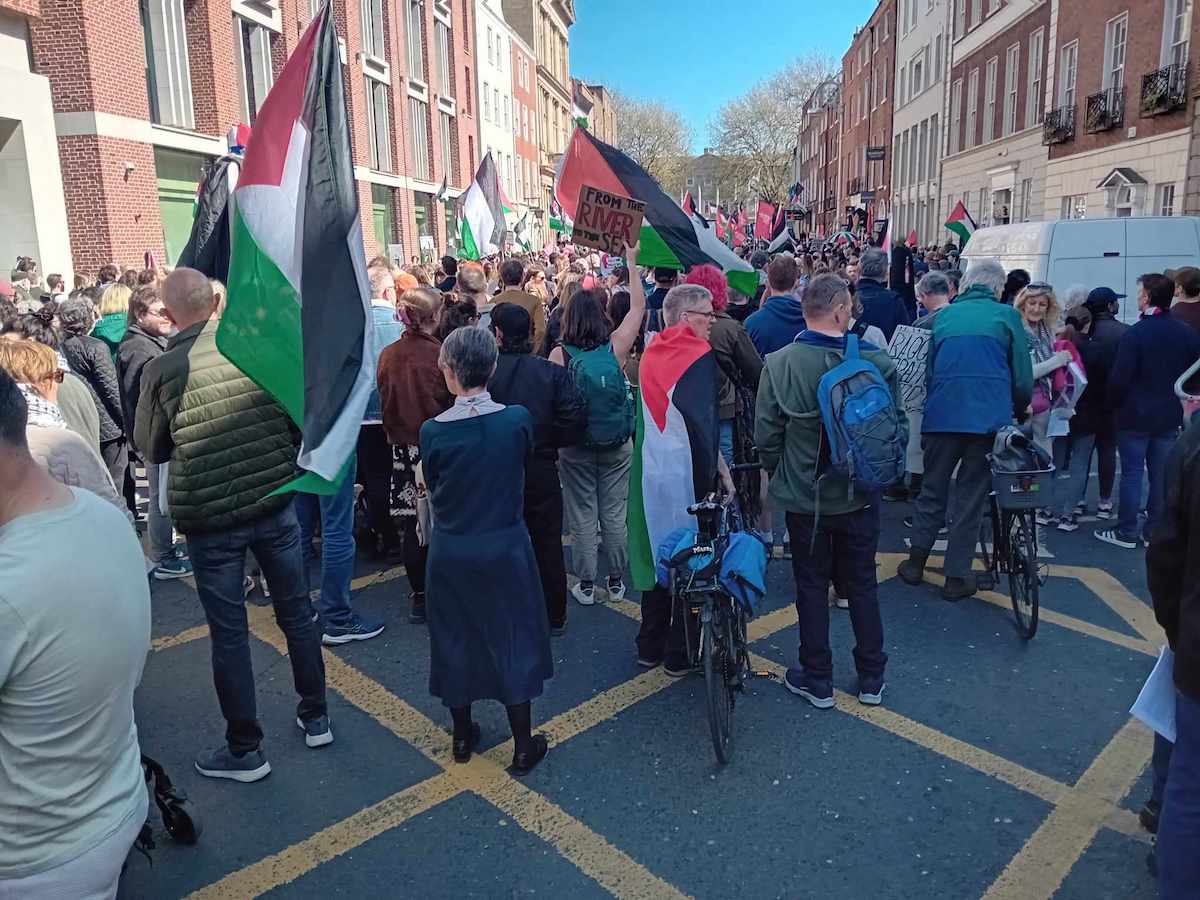
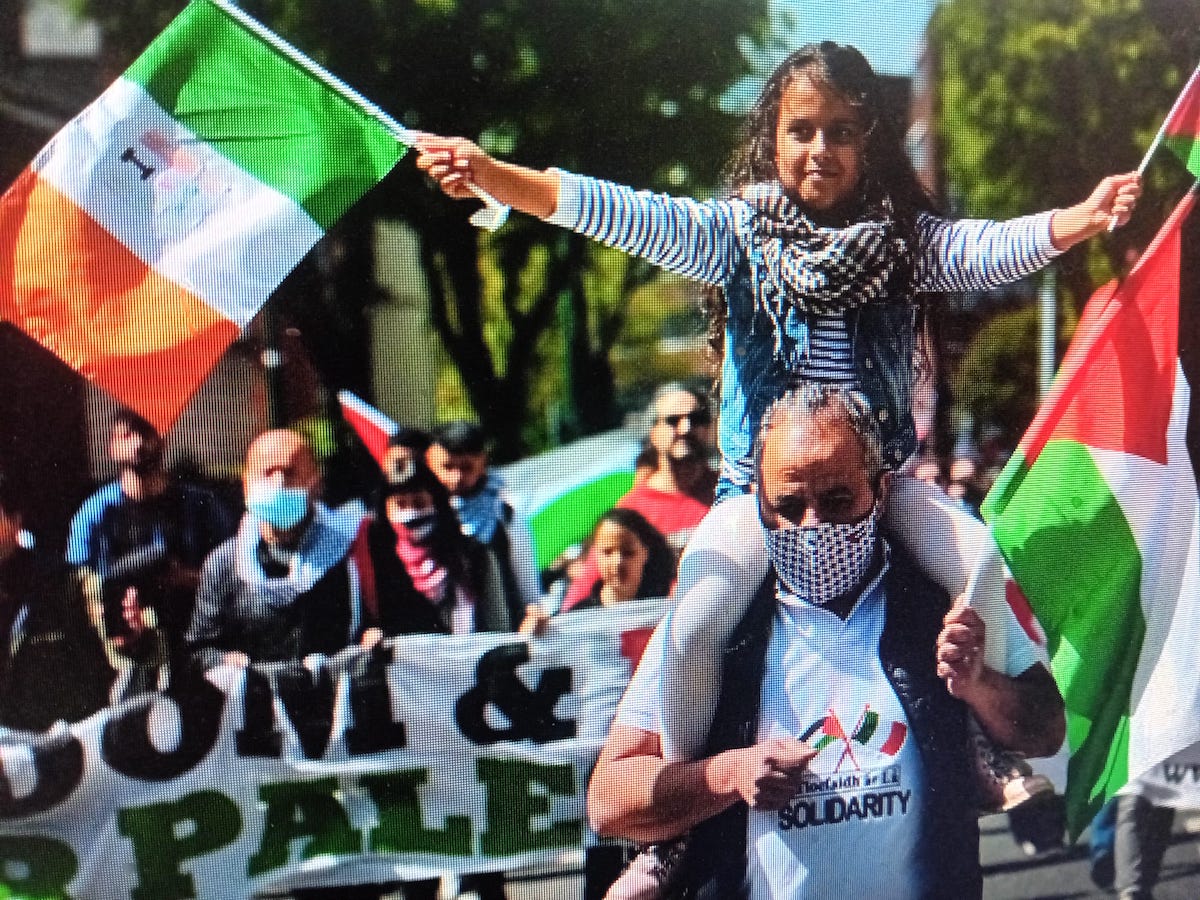
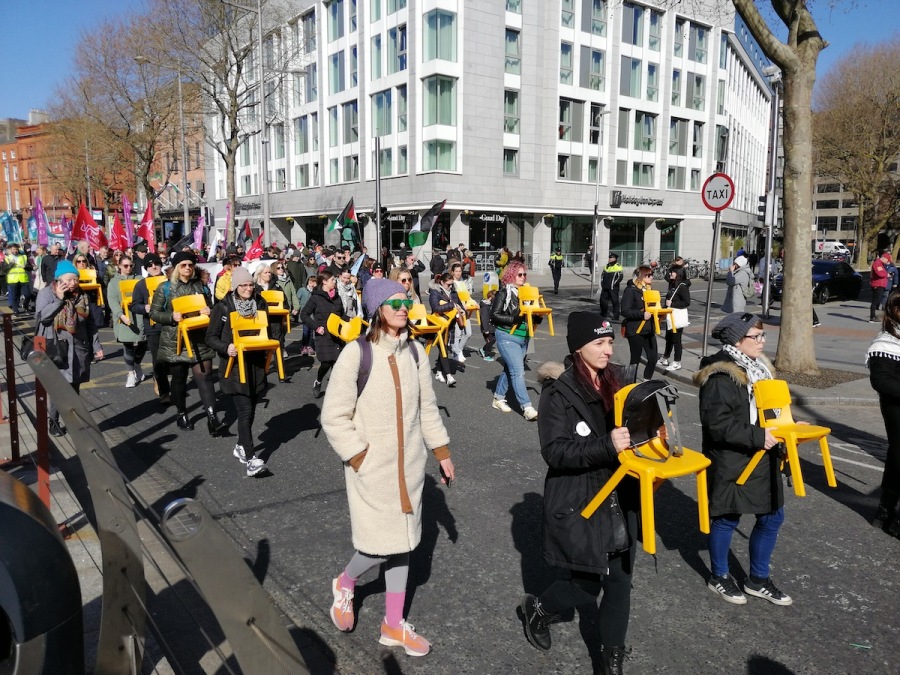
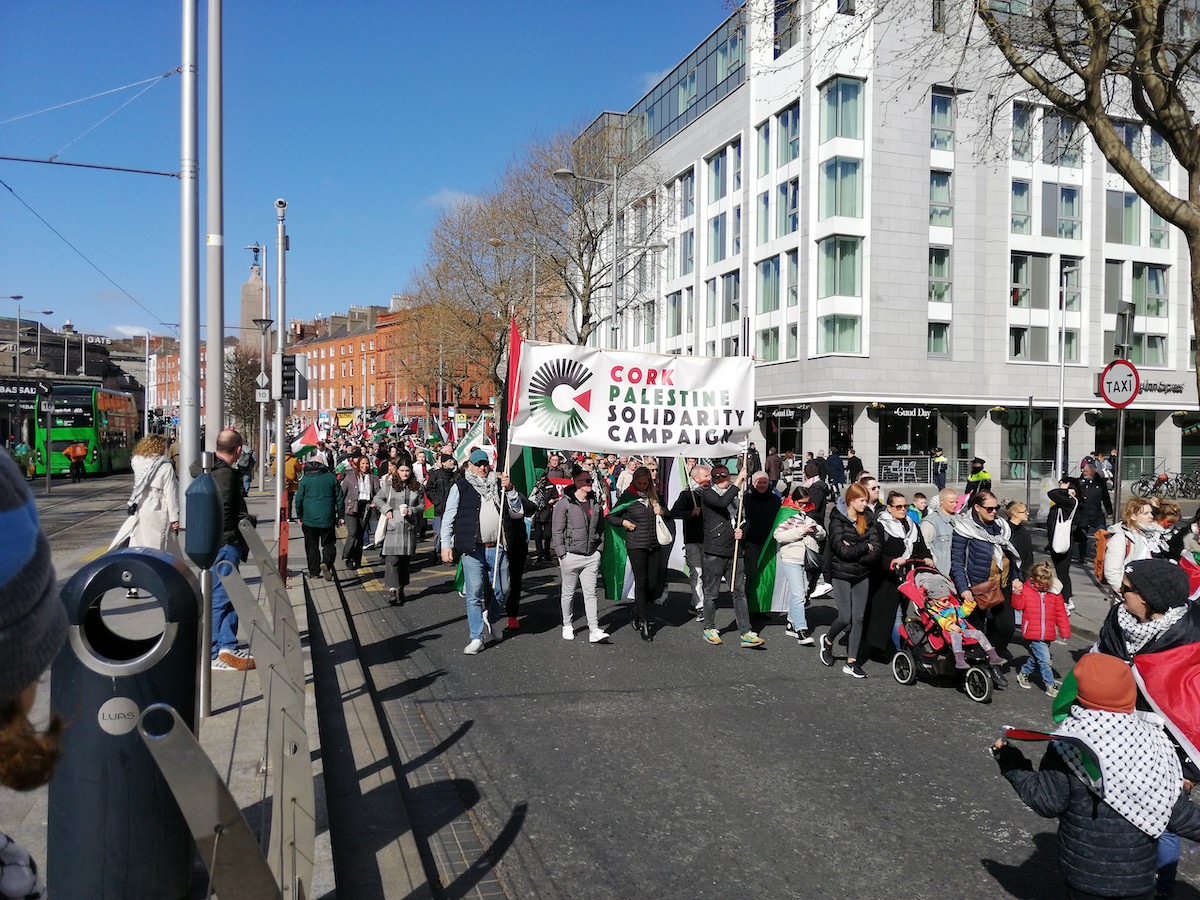
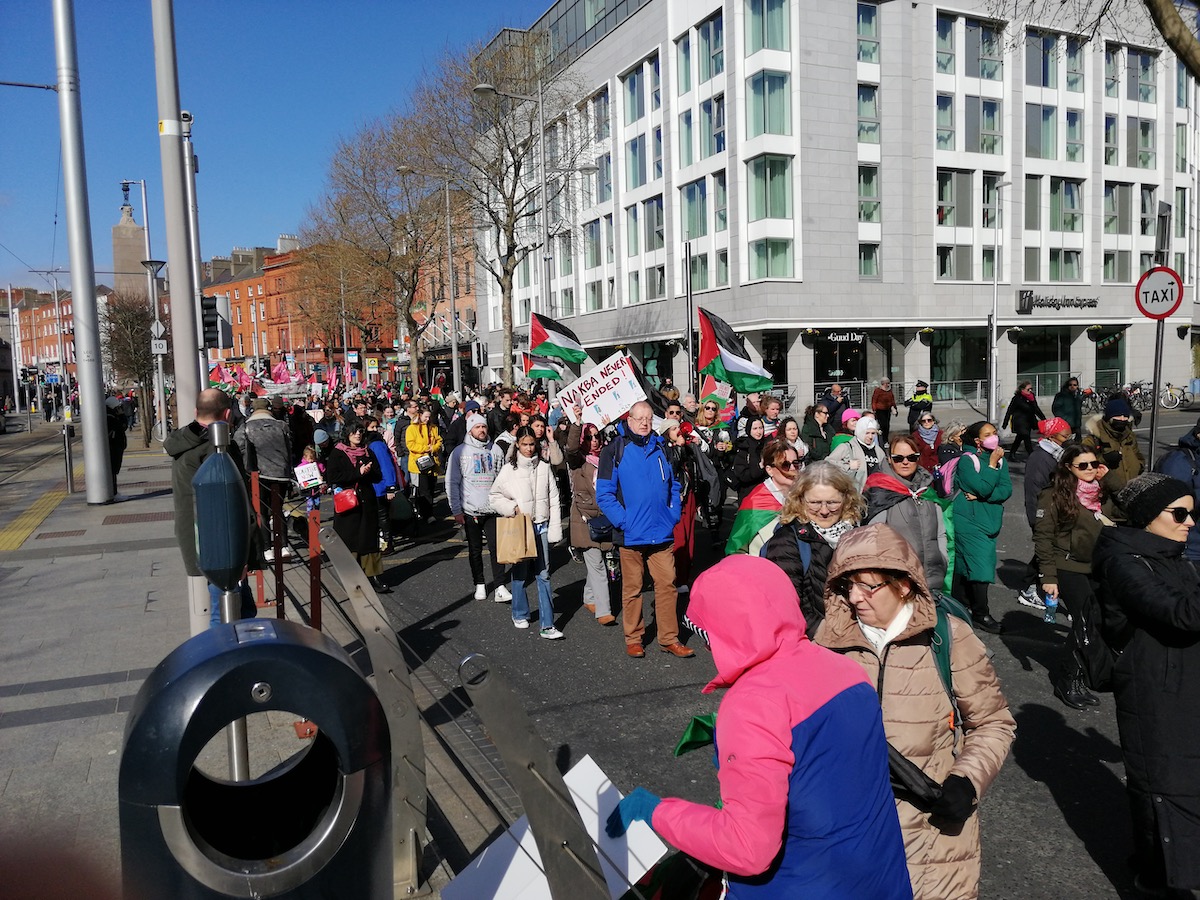
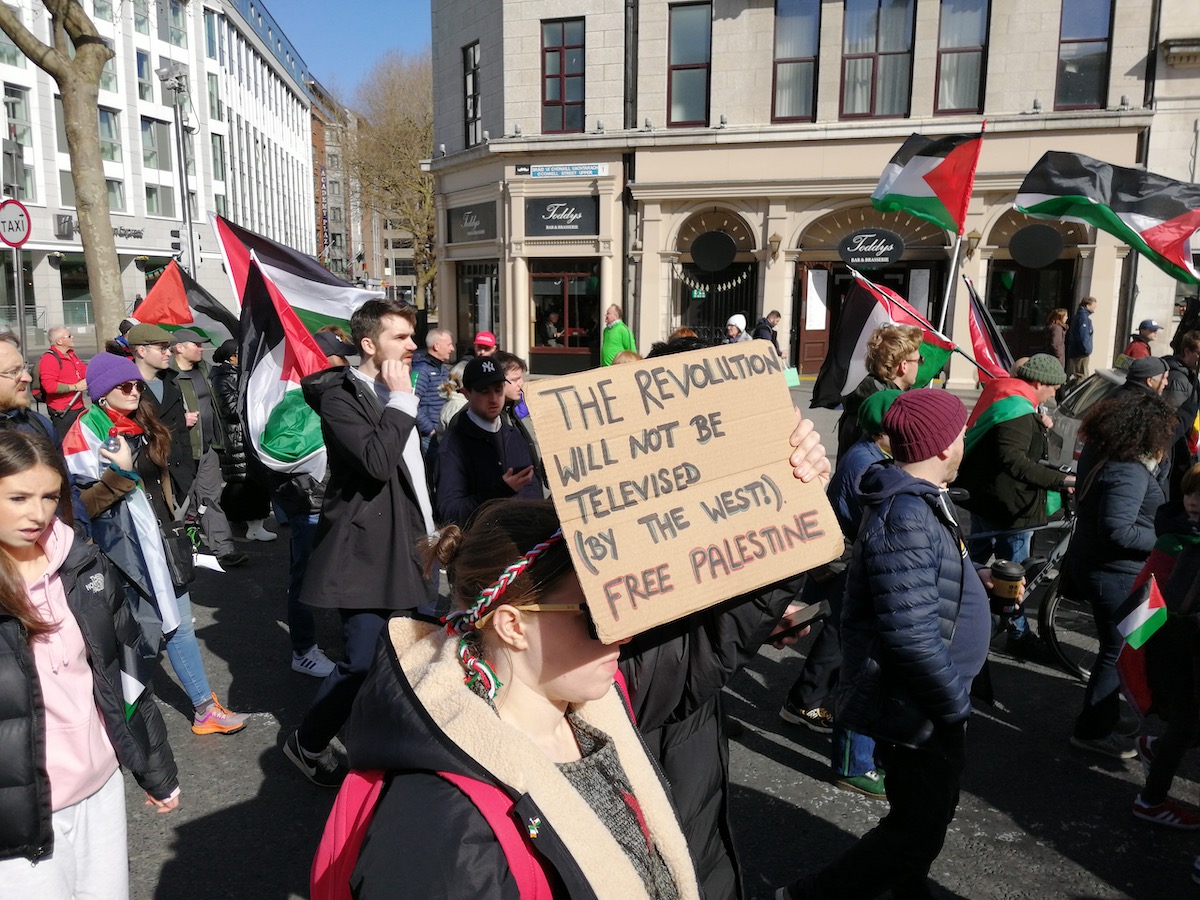
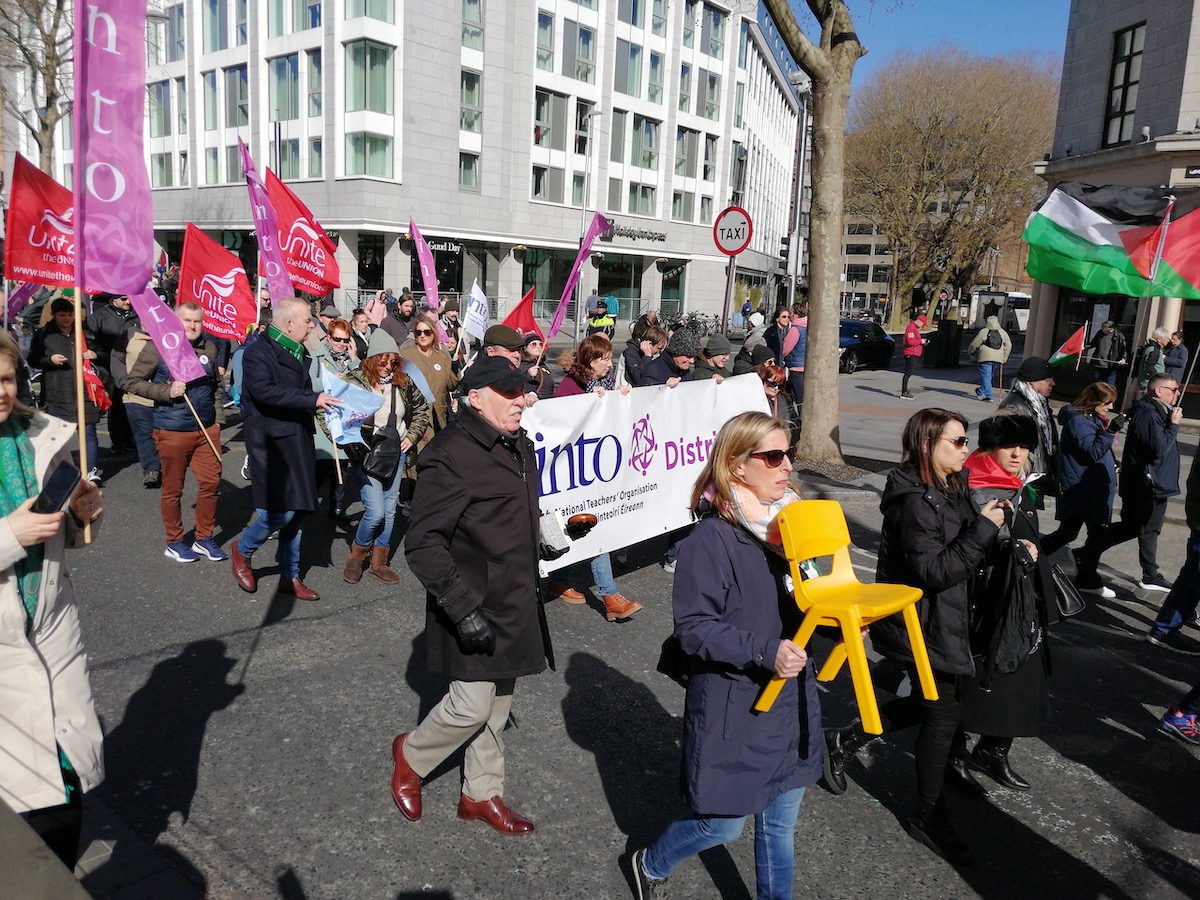
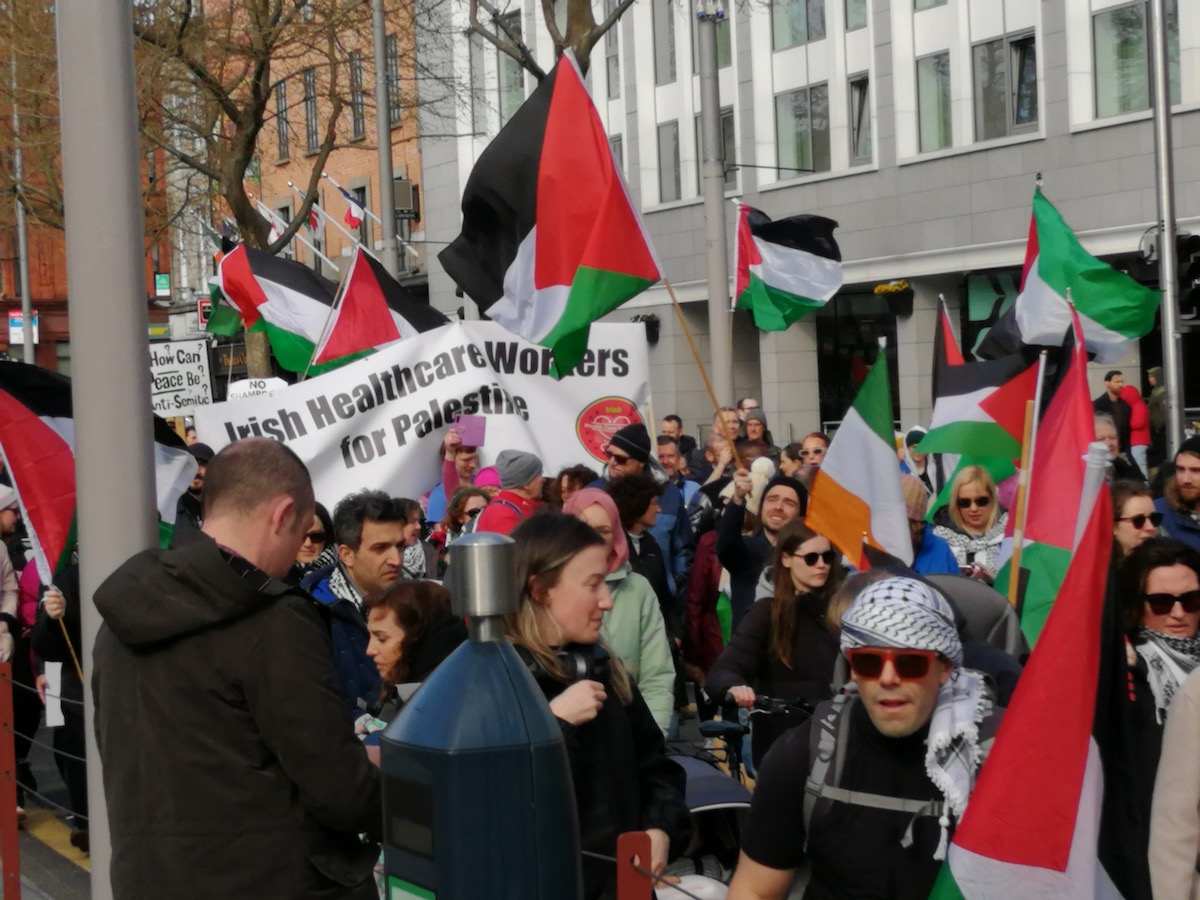
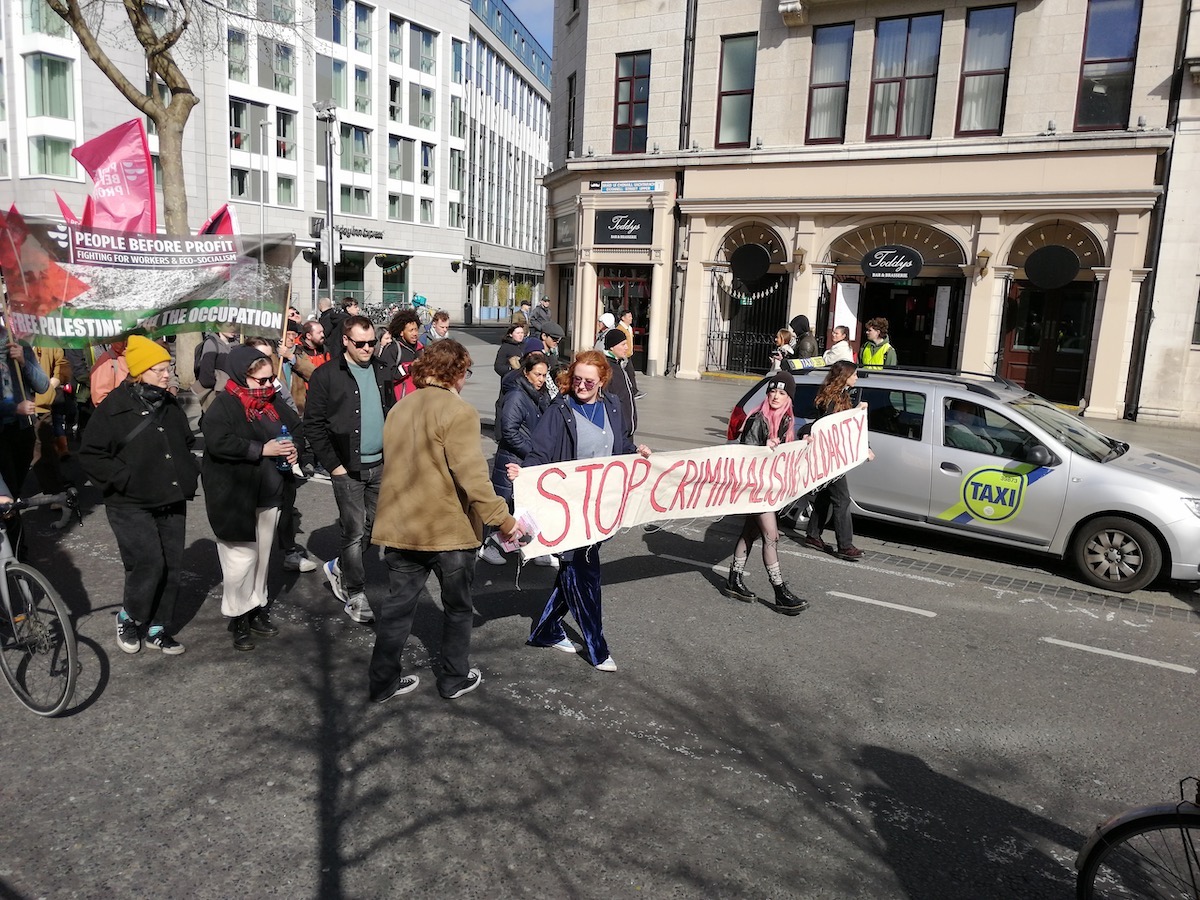
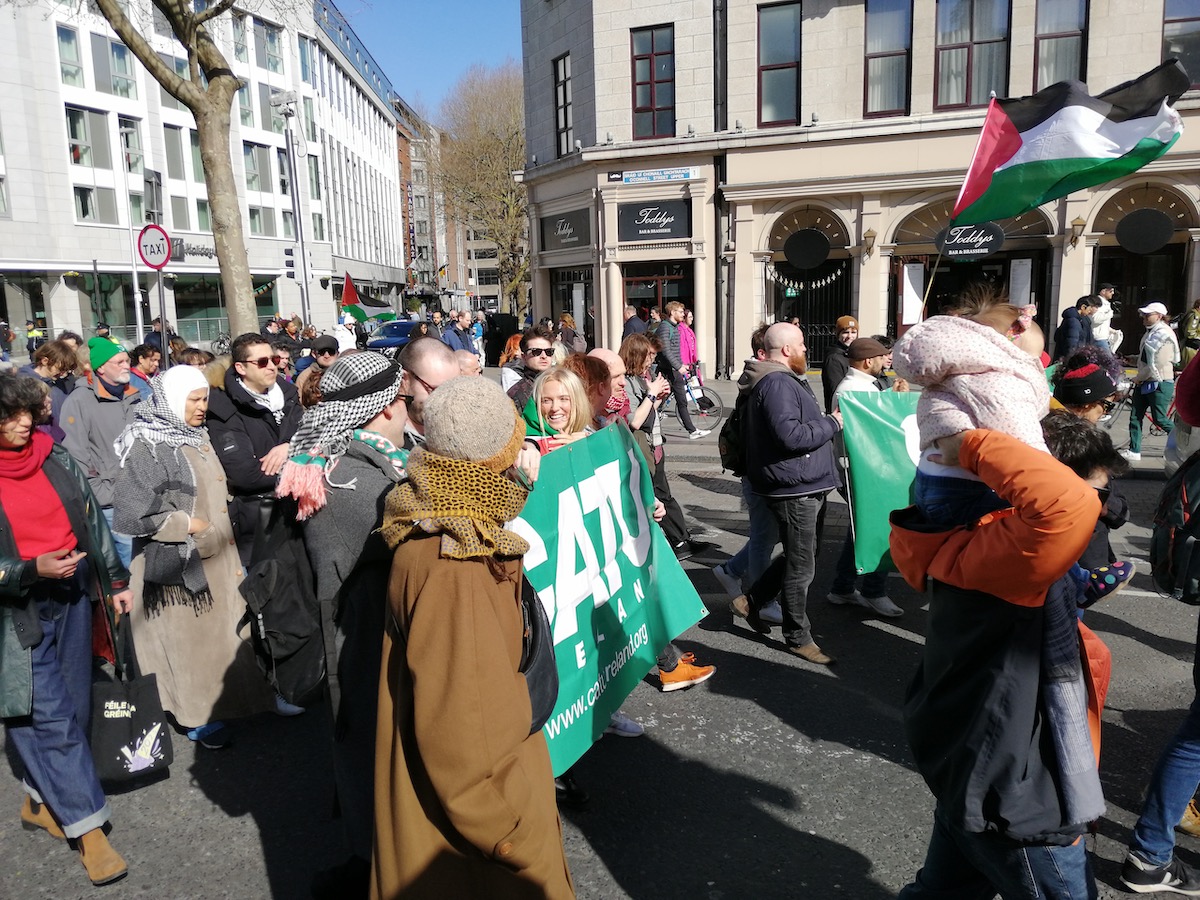
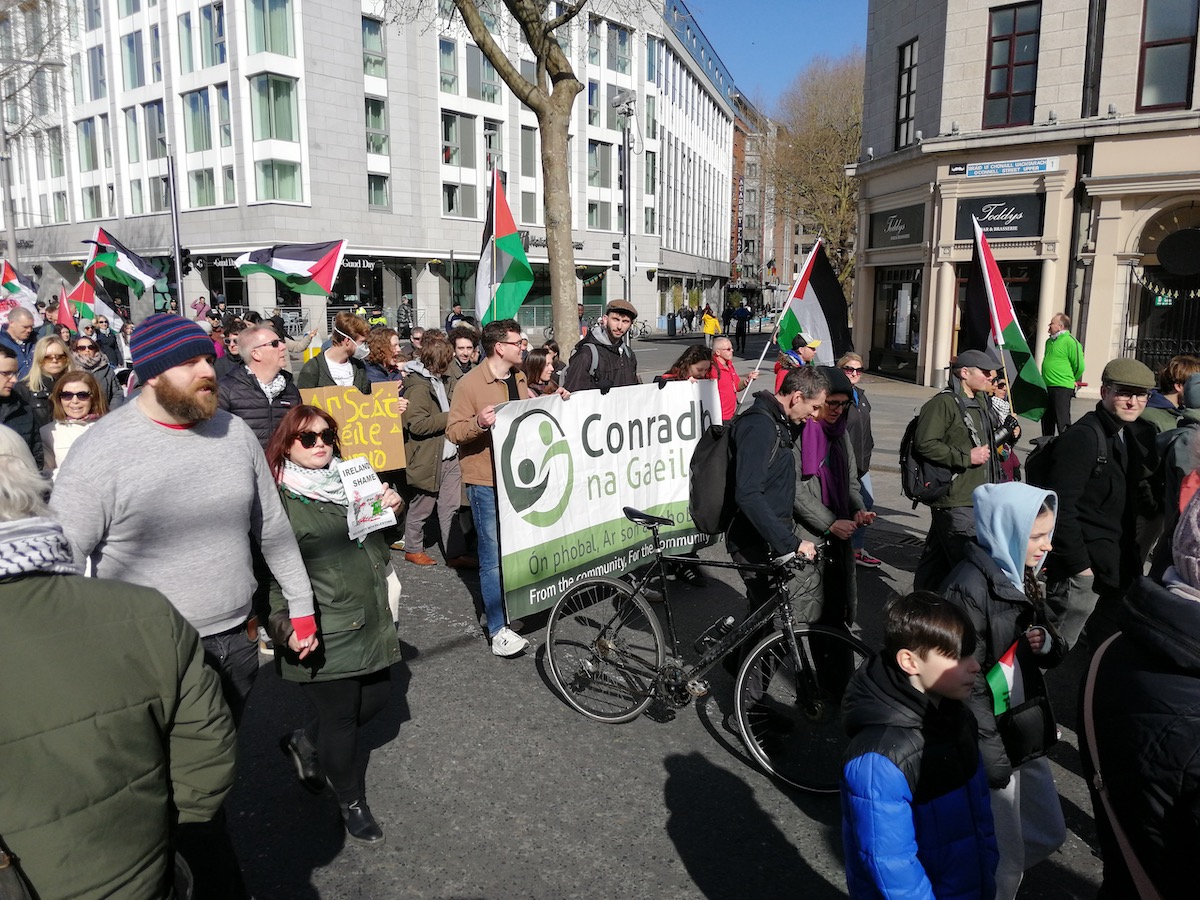
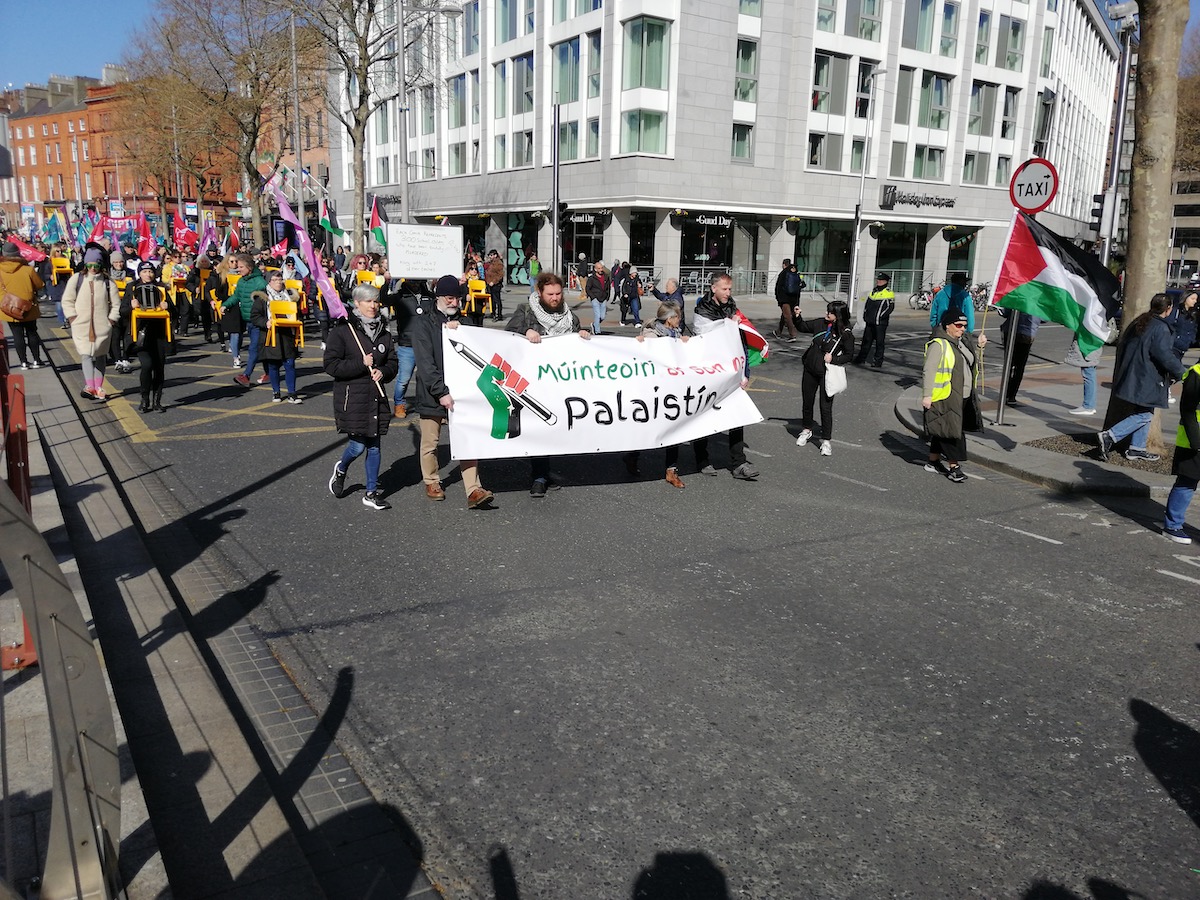
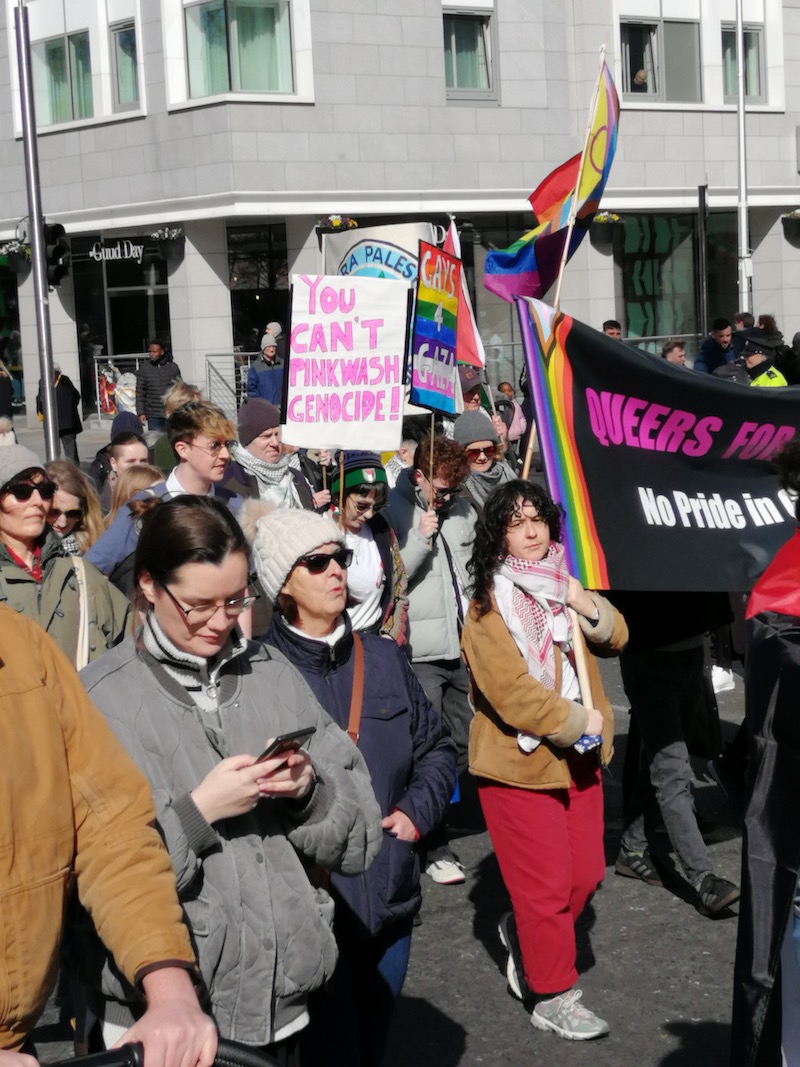
A huge Palestine solidarity march proceeded from the north Dublin city centre on Saturday 20th, passing down O’Connell Street, over the Bridge, around by Trinity College and on towards Leinster House, the parliament of the Irish State.
Detained by an earlier activity I hurried to join it, catching up with it near the Larkin Monument. From there I could see sections of the march across the river and another section wending around Trinity College in the distance, its leaders out of sight.
(Photo: D.Breatnach)
“Over a thousand”, reported our “newspaper of record”, the Irish Times. In other words, less than 2,000. Really?!
The march was organised by the Ireland Palestine Solidarity organisation, the main Irish nationwide Palestine solidarity organisation, sponsored by a multitude of organisations and was supported in marching by many organisations and individuals, the latter being the capacity or most participants.
The usual slogans could be heard as I hurried past marchers, such as “Free, Free – Palestine” and including the one that Suella Braverman tried to ban when she was a Minister in the UK Government: “From the river to the sea – Palestine will be free!”
I paused by the Thomas Moore monument waiting to meet up with friends in order to march with them. One group passed calling out that what is occurring in Palestine is “Not a conflict, not a war”. I understand them to mean it is genocide instead but I can’t agree with them.
It IS a conflict, the old one of the European colonial settler against the indigenous people, fought for centuries on all the continents of the world except in Antartica. And the zionist State IS waging a war, a genocidal war against the Palestinian people.
(Photo: D.Breatnach)
Another group went by with a chant leader calling out a list of categories of victims of the zionist genocide such as medical workers, journalists, ambulance crews, refugees etc, to which the group replied “Not a target”. Perhaps they meant “not a legitimate target” but targets they certainly are.
I was flying the Palestinian flag but also the Starry Plough, flag of the risen Irish working class in 1913 and 1916, the only one I saw on the march and which was how my friends found me. A woman I mistook for a visitor asked to take my photo, to which I agreed.
Near the rear of the march one could hear the usual call-and-response slogans drifting back towards us but people in our section marched silently or chatted with one another. Then a voice called out: “From the river to the sea!” and the reply was instantaneous: “PALESTINE WILL BE FREE!”
Chanting takes energy but also seems to supply it and from then our section joined in with gusto: “In our thousands, in our millions – We are all Palestinians!” “In our millions and our billions – We are all Palestinians!” “In our TRILLIONS and our billions – We are all Palestinians!”
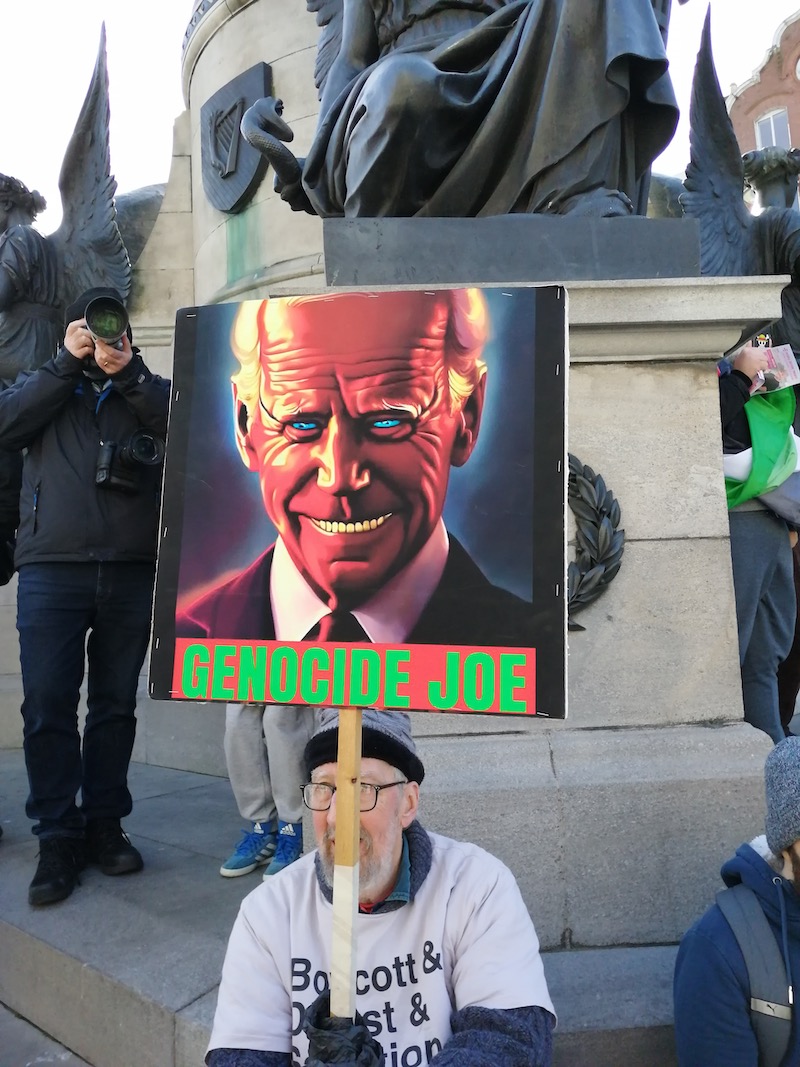
“Netanyahu, what do you say? How many kids have you killed today?” “Joe Biden, what do you say? How many kids have you killed today?” “EU, you can’t hide – You’re supporting genocide!” “Irish Government, you can’t hide – You’re supporting genocide!”
“Saoirse – Don Phalaistín!” was the only slogan1 in Irish. There was no doubt about what people wanted for the Israeli Ambassador or the zionist Embassy, which was “Out, out, out!”
(Photo: D.Breatnach)
As we turned from Dawson into Molesworth Street, the rest of the march was packed ahead of us all the way up to the presumed police barriers at Kildare Street, across from the main gate of Leinster House. Here the IPSC stewards were urging us to move in still closer ahead.
What was the reason? Apparently the Gardaí wanted us past the intersections with South Frederick Street and with Molesworth Place. But for what purpose? Those were southward traffic only streets which should have been blocked anyway and Dawson Street was open in both directions.
(Photo: D.Breatnach)Molesworth Street from the Junction with Molesworth Place, already packed and with more arriving, yet we were expected to pack in closer and have barriers moved up against us! (Photo: D.Breatnach)
Then a private company began to erect barriers across the north-eastern section of Molesworth street which looked to me like kettling, a view which seemed born out as the barriers were moved once more further eastward with instructions to keep moving – with which I declined to cooperate.
This whole exercise seemed to me of dubious traffic easement validity and more about getting people used to obeying order and to being kettled by police if required by them. In the Irish state we do not have to gain police permission for a march or approval for its route.
There’s nothing fundamentally wrong with the IPSC leaders informing the police of their march routes for traffic easement. But our rights have to be protected and not easily surrendered, much less for no visible valid reason. It is not good for stewards to automatically comply with police wishes.
I have seen (and resisted) Garda attempts to push demonstrators from the front of the GPO into the pedestrian reservation in the middle of O’Connell Street, while they told people that “It’s what your organisers (IPSC) want.”
Declining to be kettled.
The police of a state are not neutral forces for the public good and have drawn and used their batons through the decades against people protesting partition of their nation, imperialist war, water privatisation, growth of fascist and racist attacks, against imperialism and colonialism …
Not to mention torturing and framing people to have them jailed.
CHRISTY MOORE AND REPRESSION
In the distance, we could hear that Ireland’s chief living balladeer, Christy Moore, had got on stage and was speaking, then singing, though I could make out only snatches of the lyrics. Moore gained fame both as a member of Moving Hearts band and Planxty but also as a solo performer.
Moore had been litigated against for his song about the young 48 Stardust Fire victims but was vindicated during the week by a long-delayed second inquest into the deaths.2 On the other hand he’s received no apology for the police raid on his H-Block album launch back in 1972.3
Pro-Palestinian demonstrators are facing repression throughout the western world, in some places much worse than others. The German State is behaving like Nazis in banning demonstrations and raiding a conference, apparently in twisted expiation of its sins under the Adolf Hitler regime.
This impacted also on an Irish language group in Berlin during the week while they attempted to have a small gathering speaking and singing in Irish in a park in front of the German Parliament. The police told them that only German and English languages were permitted in that area.4
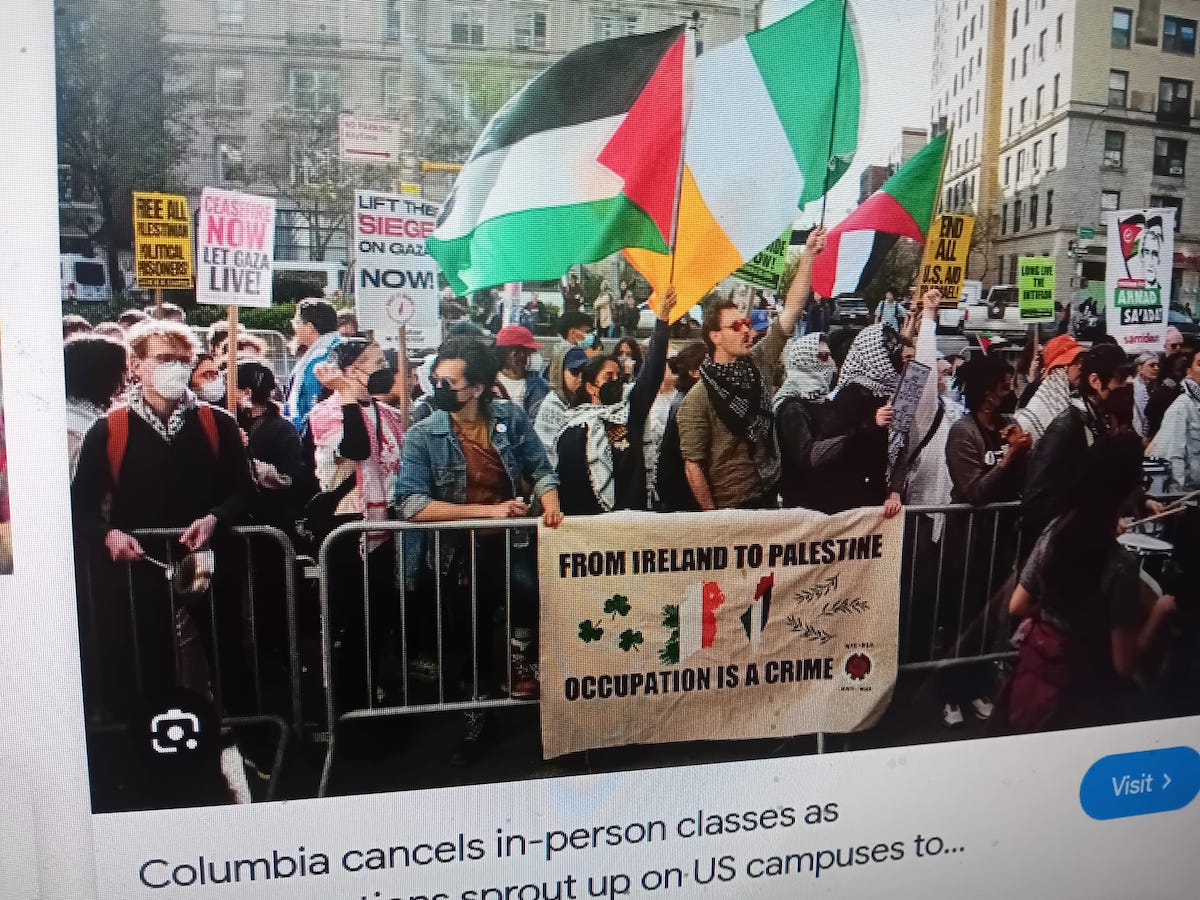
The Irish Tricolour has been seen on many London demonstrations in solidarity with the Palestinians, on its own or flying below the Palestinian flag inscribed with “Saoirse don Phalaistín”. The Tricolour turned up too as university students and staff faced down the New York Police.
Columbia University, New York, Monday.St. Patrick’s Day, New York, March 2024.London, November 2023.London, clearly.
In Palestine itself new horrors are being revealed with the recovery of bodies in mass graves in the areas of destroyed Gaza hospitals recently occupied by the Israeli military. Their remains testify to their being patients and medical staff in addition to refugees.5
A totally new horror are the Israeli killer drones emitting the wailing of a baby or a woman’s cry for help, waiting to gun down would-be rescuers. Palestinians in Gaza have been accustomed to responding to those cries in reality for months and often enough shot or bombed as they did so.6
This however is a new depth for the zionist military.
Under danger of Israeli bombardment, digging bodies out of a mass grave at the destroyed Nasser Hospital site April 2024. (Photo cred: Ramadan Abed/Reuters)
During the week also the independent investigation commissioned by the UN has found no basis to the Israeli claim that many staff of its aid agency for Palestinians, UNWRA, were members of Hamas or Islamic Jihad, much less involved in the October 7th Palestinian resistance operation.7
That investigation result has UNRWA vindicated of the false Israeli claims but also commended on its procedures to comply with the impartiality requirements of the UN and of its funders, many of which however now stand condemned for withdrawal of their funding from starving people.
But UNRWA chiefs should share the condemnation for appearing to give the accusations credibility in firing some of their Palestinian staff, not to mention sacking appallingly and reducing to poverty a number without hearing or appeal, on the basis of unsubstantiated accusations.
And from a source known for lying for decades and long hostile to the UNWRA organisation. True to type, the Israeli government has rejected the findings, despite having provided no verification of its accusations to date.
Few official actors of states or of the UN come out well in evaluation over the last six months of this daily broadcast genocide.
End.
FOOTNOTES
1Interestingly the word “slogan” is itself from the Irish language, or at least Scottish Gaedhlig, meaning a “call to/from the multitude/ troop”.
A solidarity rally in Dublin to mark 17th April Palestinian Prisoners’ Day was staged by the IPSC outside the iconic General Post Office building on Dublin’s main street and was supported by the Ireland Anti-Internment Campaign.
At a public meeting about Palestinian prisoners after the event Tala Nasir, a lawyer working with the prisoner support group Adameer, stated that there are 8,000 Palestinians currently held by the zionist state of which 275 are women and 500 are children.
Ms. Nasir was on a round-Ireland speaking tour organised by the Ireland Palestine Solidarity Campaign, the main Palestine solidarity organisation in Ireland but which has not been prominent in highlighting the situation of the Palestinian political prisoners.
On the other hand, at its street information pickets, although primarily working for Irish political prisoners, the Ireland Anti-Internment Campaign has regularly flown a Palestinian flag in support of political prisoners from that nation also.
An IAIC spokesperson recalled that at their traditional annual prisoner solidarity rally in December, their speaker stated: “Wherever there is oppression, there will be resistance; but also wherever there is resistance there will be political prisoners and in Ireland we have centuries of that experience.”
The organisation maintains that although large-scale official internment last used in the occupied Six Counties ended in 1795, it continues on a smaller scale under another name: “Remand in custody”, in which Republicans regularly wait two years before their case comes to court.
The decision to deny bail is taken by the special no-jury political courts: Diplock Court in the Six Counties and Special Criminal Courts within the Irish state, all of which have been condemned by civil liberties organisations in Ireland and abroad.
Israel also has a form of internment without trial which they call “administrative detention”, under which Palestinians can be detained for up to six months at a time as a preventive measure without any kind of trial or evidence shown against them.
PALESTINIAN POLITICAL PRISONERS
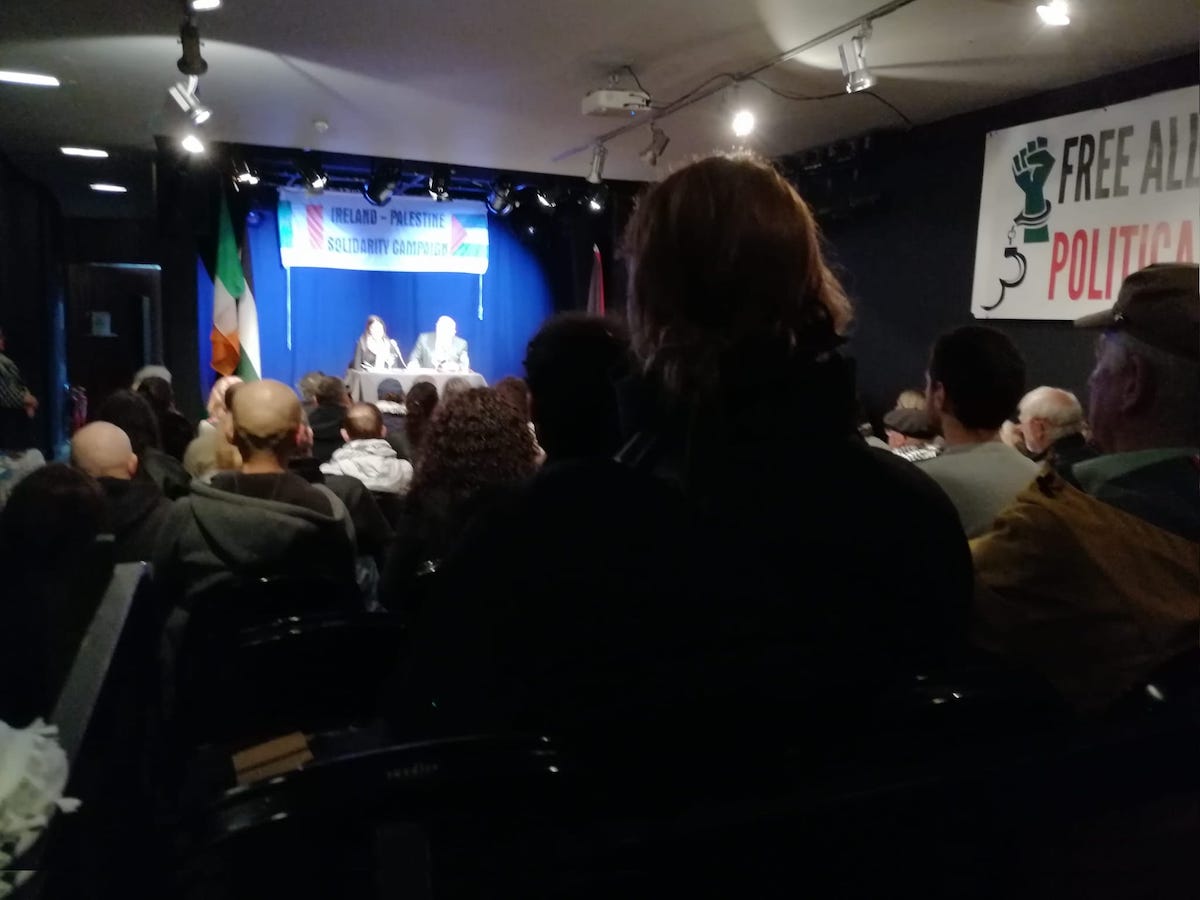
Tala Nasir, a lawyer of the Adameer organisation was introduced by Gary Daly (of Lawyers for Palestine group) to the audience in the theatre of Pearse House, formerly the home of Patrick and Willie Pearse and sculpture business address of their English father (and of Willie).
Ms. Nasir informed the packed audience that Israel has declared her organisation of Palestinian prisoner support and advocacy to be a “terrorist” on “evidence” they declare “secret” but the absence of which results in no other state accepting that designation in the case of Adameer.
“Once you’re a prisoner you will always be a prisoner,” stated Ms. Nasir, illustrating that in raids the Israeli military frequently detain former prisoners, often repeatedly. “Crimes” can include a comment on social media, “Liking” or sharing a comment against Israel.
Even the posting of a “green heart” symbol may be interpreted as a sign of support for Hamas and may become the reason for a person’s arrest. Children are most often accused of throwing stones, statements written for them in Hebrew, told to sign them, sufficient “evidence” for jail.
Ms Nasir said that 80% of the prisoners are held under “Administrative Detention” without trial and no defence is possible since the “reason” for it is secret and neither the accused nor their lawyer may see the allegations. The six months detention is automatic and can renewed repeatedly.
Prisoners must buy their own food from the canteen but after October 7th it was closed for periods. Child prisoners told Adameer: “We wake up hungry and go to sleep hungry”. Typically adult prisoners have lost 15-20 kg from their previous weight when released.
The prisoners were prevented from going out of their cells which also meant they were unable to shower for many days and also had to wear the same clothes every day. They were also humiliated through being blindfolded and strip-searching, sometimes by male, sometimes female soldiers.
Beatings are common and prisoners have commented on their transport vehicles not only smelling awful but seeing the floor covered in blood. Sixteen prisoners have been killed in the last 6 months and though autopsies have recorded bruises and broken bones, Israeli investigations are closed.
All but one of the Israeli prisons are in the “Israel” area and the lawyer is not permitted to visit the prisoners there without special permission, which is why, she said, so many of the Palestinians are transferred to those prisons, which she maintains is a war crime.
Declaring her greater trust in and dependence on the solidarity of the people of the world, “in particular the global South” who have had similar experiences to those of the Palestinians, the Palestinian lawyer nevertheless said that she has to practice diplomacy at times.
Tala Nasir called for the widest possible support for Adameer’s Call For Action, which is the simple task of sending text supplied emails to two specified officials responsible for prisons and prisoners telling them they will be held answerable for war crimes.
The Ireland Palestine Solidarity Campaign have a march booked in Dublin for this coming Saturday 23rd April, commencing at the Garden of Remembrance at 1pm.
A spokesperson for IAIC stated they would be on the streets again in order to proclaim the continue existence of political prisoners in Ireland and that Republican activists are essentially being interned without trial from no-jury political courts to spend two years or more in jail awaiting trial.
“The IAIC is a democratic non-sectarian independent organisation,” the spokesperson said “and welcomes support from concerned democratic people and we’ll continue to fly the Palestinian flag. If people follow our page they should receive adequate advance notice in order to attend.”
Easter is the time of year in Ireland for Easter Egg hunts and/or for attendance at religious services but for the Republican movement it is one of commemoration of the Easter Rising and its martyrs, with parades and speeches.
The commemoration parade proceeding along Phibsboro and approaching the Cross Guns canal bridge. (Photo: Rebel Breeze)
Easter Monday in Dublin saw one of those commemorations organised by the Socialist Republican organisation Anti-Imperialist Action at the Citizen Army plot in the St. Paul’s section of the famous Glasnevin Cemetery at the Republican Struggle Monument1.
Participants rallied near the Phibsboro Shopping Centre to march from there to the Cemetery, a distance of around two kilometres, over the “Cross Guns” bridge over the Royal Canal, then passing the main entrance to the Glasnevin Cemetery on the right before turning left for St. Paul’s.
Garda POU van parked extremely dangerously, hiding left turn from view of eastbound traffic, as they chat with other Gardaí and a ‘Branch man.As is said, “one rule for the people …!” In the laneway between houses visible in the background, a cameraman lurked taking photos. (Photo: Rebel Breeze)
In a marked departure from the previous year, the State’s political police, plainclothes Gardaí of the “Special Branch”2 did not approach the participants to attempt to intimidate them and gather intelligence, demanding their names and addresses under the Offences Against the State Act.3
That had been followed up by a raid on the home of one of the leading activists. Sunday’s police behaviour was an even greater difference from Saturday’s, when a different Republican group, Saoradh, had their Easter Rising commemoration in Dublin’s city centre.
Around 300 police, including many in riot cop uniform (Public Order Unit) had harassed the participants demanding names, addresses and other information, attempting to intimidate them. At least seven police vans had been in attendance also to the bemusement of onlookers.4
(Photo: Rebel Breeze)
LOCAL 1916 HISTORY
The Phibsboro/ Glasnevin area also figured in the 1916 Rising, with an insurgent barricade in Phibsboro and a Fianna youth, Sean Healy, mortally wounded at the crossroads by a British artillery shell fragment (a plaque on the ground at the SW corner commemorates his death.
Earlier, Irish Volunteers had guarded the canal bridge briefly; these were seen by the dozen Volunteers that marched along the canal from Maynooth, slept in Glasnevin Cemetery and got into the headquarters garrison at the General Post Office on Tuesday.
Later British soldiers set up a barricade on the Bridge preventing even foot traffic across and shooting dead a deaf and dumb man who could not hear their challenge.
EYE IN THE SKY? (Photo: Rebel Breeze)
PARADE THROUGH STREETS TO CEMETERY
The parade from Phibsboro on Sunday was led by the Glasgow Republican Flute band (formerly the Garngad RFB, which is where most of them are based) playing the airs of known Republican ballads, muted to regular tocks on their drums as they entered the housing estate.
(Photo: Rebel Breeze)
Also leading was the colour party dressed in white shirts, black trousers, jackets, berets and sunglasses, carrying the traditional flags for Republican colour parties: the Tricolour, Starry Plough, Sunburst, followed by the flags of the four provinces of Ireland: Connacht, Leinster, Munster and Ulster.
Over the marchers the flags of the Tricolour and the Starry Plough, flag of the Irish Citizen Army flew in the breeze while those of the Basque nation, Palestine and of the People’s Front for the Liberation of Palestine lent an international flavour to the commemoration of the Irish Rising.
There was some beeping of passing traffic and cheering from bystanders at the entrance to the laneway that leads to the bridge across the railway tracks to the St. Paul’s section of the graveyard. The marchers filed in and proceeded to the monument.
The Chair of the proceedings welcomed the attendance before reading from the 1916 Proclamation of Independence and calling a singer to step forward. Revolutionary activist Diarmuid Breatnach introduced the two songs he was going to sing as emphasising the role of the working class in the Rising.
(Photo: Rebel Breeze)
“The decision to go ahead with the Rising on Easter Monday was taken in Liberty Hall, the headquarters of the working class at the time,” he reminded the gathering, “which is also where the Proclamation of Independence was printed.”
He sang the “JimLarkin Ballad”: In Dublin City in 1913, the boss was rich and the poor were slaves; The women working, the children hungry, till on came Larkin like a might wave …
Diarmuid Breatnach singing(Photo: Donated by participant)
Pausing to focus on a different key, the singer followed the ballad with Patrick Galvin’s Where Is Our James Connolly?
After applause, floral tributes were laid on behalf of Anti-Imperialism Action Ireland and of Dublin Republicans Against Fascism.
(Photo: Rebel Breeze)(Photo: Donated by participant)
The chairperson asked for a minute’s silence in honour of those men and women who had given their lives in the struggle for freedom in Ireland. The colour party lowered their flags slowly in homage to the fallen, raising them again slowly to signify the continuation of the struggle.
(Photo: Rebel Breeze)
John Heaney, Republican ex-prisoner from Armagh was called to give the oration for the event, which he dedicated to all those men and women who had opened their doors and their homes to fighters in the struggle, whether the latter were in hiding or just resting – his audience applauded.
The speaker also congratulated on those who came forward to carry on the struggle, youth, women and stated he was proud to see the traditions of struggle being upheld in the process to achieve the Republic for which so many gave their lives.
The speaker, John Heaney delivering his oration. (Photo: Rebel Breeze)
The marching band then played the air of Amhrán na bhFiann/ The Soldiers’ Song, verse and chorus and the formal part of the event came to an end. Band members lined up in front of the Monument for photos and a little later played the air of “Black Is the Colour” on whistles, to general applause.
SECOND 1916 COMMEMORATION FOR AIA THIS EASTER
This was the second 1916 Rising Commemoration to be attended by Anti-Imperialist Action as they had also participated in another organised by the Seamus Costello Memorial Committee in Bray on the previous day.
AIA is a young organisation, founded by socialist Republicans unhappy with the direction of the Republican organisation of which they had been members but now containing many young people.
AIA gave rise to the Revolutionary Housing League that occupied empty buildings in a campaign against homelessness and called for a general occupation campaign across the state. A number of court cases against them followed but sadly their lead was not followed.
(Photo: Rebel Breeze)
AIA have also been very active against NATO, picketing promotional meetings and a number have been charged following a demonstration against a visiting British Navy ship in Dublin last November.5 They have also been active as part of the Saoirse don Phalaistín activist group.
Following the event in Glasnevin, many of the participants relaxed at a social evening in a different part of the city where many songs of struggle were sung.
(Photo: Rebel Breeze)
OTHER EASTER COMMEMORATIONS
Other Easter Rising commemorations have been held around this time, for example: Lasair Dhearg held one in Belfast on Easter Monday, while Independent Dublin Republicans held theirs in the capital, marching from Liberty Hall to the GPO, then to Moore Street to lay a floral tribute.
On Monday too the Derry 1916 Memorial Committee held an event in its city.6
Former revolutionary Republican party Sinn Féin held theirs in Arbour Hill7 cemetery on Sunday; a large part of their President’s address was devoted to justification of support for the EU and a plea to support the party whenever the state’s general elections are held (this year or next)8.
1My name for the Monument in the St. Paul’s part of Glasnevin Cemetery which stands in recognition of six periods of Irish Republican-led insurrectionary activity in Ireland: 1798-1916.
2Now officially the Special Detective Unit, they were previously known as the “Special Branch”, a name they inherited from the British occupation which had set up a political intelligence unit, the Irish Special Branch, to spy on and disrupt the Fenian movement among the Irish diaspora in British cities. Most political activists in Ireland continue to call them “the Special Branch” or simply “the Branch”. Their equivalent in Britain today and in a number of its colonies and former colonies continues to officially bear the name “Special Branch”.
3As amended in 1972 after a British Intelligence bombing killing two public transport workers in Dublin but blamed on the IRA; the amendment also permitted the setting up of no-jury Special Courts which are in existence to this day.
4In the context of assaults on persons in the city centre there have been regular complaints in the media and in the Parliament about the lack of Gardaí visibly patrolling the area.
7Where the 14 Dublin 1916 executed were buried, now a national monument in a former prison and church graveyard around the back of the former military barracks and now National Museum of Collins Barracks
There is a belief around that the reason that Israel is being supported by the US and getting away with genocide as far as the Western powers are concerned, is because the Palestinians are dark-skinned and that it wouldn’t happen to ‘whites’.
Those who believe that are mistaken: it would and it did. It is only marginally about skin colour but rather about where the Palestinians are.
Palestine sits in a strategic spot in the heart of the Middle East, with borders to Egypt, Lebanon and Syria, with the Red Sea to the South-east and a Mediterranean coastline to the west, connecting by sea to Europe, Africa and Asia. That made it important to old and to new empires.
The historic land known as “Palestine” in the 19th and early 20th Century was that which up until 1917 was ruled by the Ottoman Empire, now occupied by the zionist Israeli State and those areas recognised as Palestinian by international law including Gaza, the West Bank and Jerusalem.
After WWI, during which the Ottoman Empire, along with Germany had been on the losing side, in the divvying up of the colonial spoils, Palestine (occupied by the British since 1917) was given by the League of Nations in 1922 to one of the War’s victors, the UK.
The UK began to invite Ashkenazi Jews to settle there as part of a European colonial and partly anti-semitic1 project. Of course in those days “semitic” was understood to apply to the Arabs as well as to the Jews and the latter were often referred to by Europeans as “oriental”.
The British, as is the wont of colonisers in general and of them in particular, played the settlers off against the Arab majority.
And of course broke promises about restricting the number of settlers. But after WWII, a high influx of Holocaust survivors organised by Zionists began to head for Palestine and the British, fearing the destabilisation of their colony, tried to prevent unapproved Jews from landing.
The zionist terrorist militias (Irgun, Haganah, Stern Gang) began to attack the British colonial forces and Arab villages. In July 1946, Zionist group Irgun killed 91 people and injured 46 in an explosion at the King David Hotel, location of the British administrative and occupation army HQ.
Damage to the King David Hotel after bomb planted by Zionist terrorist group Irgun in 1946. (Photo sourced: Wikipedia)
The British pulled out in 1947, reneging on all their promises to the native Palestinians. The Zionists began their genocidal settler project with threats to and massacres of Palestinians and the expulsion of 700,000, mostly Muslims — and declared a Jewish State in 1948.
Thereafter the Israeli State began a program of repression and oppression of Palestinians and of colonial expansion. Naturally, this project required ethnic cleansing and genocide of the Palestinians and aggression against Israel’s neighbours.
The USA and the USSR quickly recognised the Zionist State, the USA increasingly funding the state and supplying it with weapons while the USSR permitted its Ashkenazi Jewish citizens to emigrate to the settler colony.
In October 1956, eight years after the founding of the Zionist state, in response to Egyptian nationalisation of the Suez Canal, the Israeli air force attacked Egyptian airfields without warning while British and French Army and Naval forces invaded the country.
The invaders were forced to retreat and the USA admonished France and the UK for, in effect, not realising that the USA and not the old European colonial powers was now the boss of most of the world.
The zionist lobby (both Jewish and Christian) in the USA is often blamed for that imperialist state’s continual support for Israel’s genocidal attacks on the Palestinians.
But the US imperialists have their own reasons for supporting the only state in the Middle East that is susceptible to neither internal national liberation struggle or muslim fundamentalist uprising. It gives the US a safe foothold and also a guard dog to watch the neighbours (e.g Syria and Iran).
RACISM
The Nazis had a racist view of the Ashkenazi Jews, who were mostly fair-skinned. But they also considered the Slavic people (the majority European and light-skinned) as “untermenschen” (i.e ‘subhuman’). It’s estimated they killed at least 1.9 million Polish non-Jewish civilians.2
The Nazis also murdered millions of Russian non-Jewish civilians in genocidal ethnic cleansing of territory, in labour concentration camps, near sensitive battle formations and in reprisals for partisan resistance.
Fair-skinned and even blonde children victims of Nazi racism and genocide. (Source: New Zealand Holocaust Centre “Button project”)
The South African settler racist regime discriminated against all non-European people, in their official categories of “Native”, “Coloured” (mixed race) and “Asian” (mostly from the Indian sub-continent). Nevertheless, they also made some groups “honorary whites”.3
Racism isn’t primarily about skin colour anyway: It is a discriminatory social ideology based on ethnicity and the marker for ‘difference’ can be ‘racial’, national or religious. The Anglo-Norman invaders of Ireland in the mid-12th Century racialised the Irish, who were generally fair-skinned.4
The rational reason behind the racism is to unite in opposition to the targeted groups, whether in order to wage war against them or so as to repress their resistance as slaves or as occupied people. The racists colonise their own minds and attempt to colonise the minds of their targets also.
Not quite two centuries after the initial invasion and part-occupation of Ireland, the British-based Anglo-Normans, now describing themselves as “English”, criticised most of their people settled in Ireland for ‘going native’ and passed laws against their social acclimatisation.
The Statutes of Kilkenny in 1366 attempted to prevent “the degenerate English” from speaking Irish, adopting Irish customs and laws, dressing in Irish style, patronising Irish cultural performance, intermarrying with the Irish and becoming “more Irish than the Irish themselves.”
The main purpose for the Anglo-Norman invasion of Ireland had been occupation by feudal lords to gather rents from the natives but it soon became a question of replacing the natives with settlers. This was not always successful since the Irish people and many clan chiefs resisted.
The cities became fortified centres of colonial occupation, administration and garrison, the colonial city of Dublin known as “the Pale” in reference to the original earthworks surmounted by a palisade; hence “beyond the Pale” signified the native Irish and barbarism to the colonists.
The earlier occupation settlements were in or around fortified constructions, castles and ‘keeps’. Later, town and villages were established with a central square or diamond, i.e in a good defensive shape and entry by natives forbidden. Settler churches were also built as defensive structures5.
Pseudo-scientific racism from white Anglo-Saxon Harper’s Weekly magazine 1899 in the USA. (Sourced: Nothing But the Same Old Story, Liz Curtis).
With the creation of Irish Republican Brotherhood (or the ‘Fenians’) in the 19th Century and their activities in Ireland, the USA and in Britain, the British elite combined anti-Irish racism with pseudo-evolutionary ‘science’ representing the Irish as not quite human or childlike – but violent.
Cartoons in some British popular periodicals, in particular Punch, Fun, Judy(and Puck in the USA) represented the Fenians as monsters, in particular ape-like creatures and racist jibes and ‘humour’ were popularised, a practice which sprouted new variants during the recent 30 Years War.
Updated British anti-Irish racism by cartoonist Cummings, Daily Express, London, 12 August 1970, depicting the colonial British Army as “keeping the peace” between the colonised Catholic/ Nationalist population and the British Loyalists. (Sourced: CAIN)
ETHNIC CLEANSING AND GENOCIDE
All European settler projects imply ethnic cleansing accompanied by genocide to one degree or another: in Africa, Latin America, North America, Australia, New Zealand … but this was practiced by a European power against a European nation also: Ireland.
The British elite used atrocity stories from the 1641 uprising of the Irish to justify and encourage the genocide by Oliver Cromwell’s campaign in Ireland in 1649. Through ethnic cleansing, battle and starvation, Cromwell killed nearing 40% of the Irish population.6
British atrocity propaganda image about the Irish uprising of 1641 to justify Cromwell’s campaign of ethnic cleansing, genocide and enslavement. (Sourced: online).
These figures do not include those he had sent to British colonies in the Americas as slaves.7
The Great Hunger (1845-1848) wiped out, through starvation, well over 2 million of the Irish population of around 8 million and during that and the following decade, probably another 2 million emigrated (many of those too dying on the way or on arrival8).
Monument on the Liffey quays in Dublin to the Great Hunger (1845-1852) genocide of the Irish by the British ruling class. (Photo: D.Breatnach)
DOES IT MATTER WHETHER IT’S DRIVEN BY RACISM OR BY COLONIAL EXPANSION?
Yes, it does. The difference between the two does not change the situation of the Palestinians but it does affect how the genocide may be understood and what the targets of our actions may be.
Liberals would probably prefer the issue to be primarily of racism. If that were the source of the problem we could still be pushing for economic and isolation pressure as was the focus with the anti-apartheid campaign against the South African racist regime.
That is being done now and that’s fine. But the assumption would be that with enough pressure, Israel would be obliged to change its ways and the US leaders would feel pressured to advise it to end its racist discrimination (as they did in the case of white South Africa).
But if the project is colonial expansion, presupposing ethnic clearing and genocide, it is a different situation completely.
No arguing with Israeli zionists, boycott or isolation culturally and in sport is going to change that or get ‘liberal’ Zionism to act against their Right; as Finkelstein recently pointed out, the Nakba and all the settler expansions were carried out under ruling periods of the ‘Left’ side of zionism.
Also, if this settler expansion (or supporting such at least) is part of a US imperialism project, then no amount of campaigning to expose the behaviour of the Zionists is going to be effective in persuading the ruling class of the USA to apply corrective pressure to the zionist regime.
The fact that the basic source of the problem is zionist settler expansion means that genocide and ethnic cleansing will continue as long as the Israeli zionist state exists. And US and Western imperialism will continue to support that as long as they believe it benefits their regional interests.
This makes it clear that the long-term solutions can only consist of ending the zionist project or the ending of imperialism which supports it. The former is of course a smaller objective but at the moment western imperialism is energetically defending the zionists.
A whole neighbourhood in Gaza wiped out by Israeli bombardment months ago (Photo cred: WAFA agency)
It is doings so politically and culturally, with armaments, also with propaganda from its mass media, by repression of its own populations where these are protesting in solidarity with the Palestinians – and in the course of that it is endangering all its facades of justice and objectivity.
In the longer term that is probably a good thing, helping to create the subjective conditions for the overthrow of imperialism and monopoly capitalism.
But we need to help that process along in our own struggles while also making their continued support for zionist genocide of Palestinians as costly for them as we possibly can. While we act in solidarity with the Palestinians we are acting also against our own immediate enemies.
End.
FOOTNOTES
1This may surprise some but the British ruling class was deeply anti-semitic even before Shakespeare wrote his Merchant of Venice script. Not only that, but Balfour, infamous for his eponymous Declaration that Palestine was suitable for Jewish settlement, was personally strongly anti-semitic (I am thankful to Ali Abunimah for pointing that out in one of the youtube discussions of the Electronic Intifada)
4I keep telling people struggling against colonialism and imperialism that they should study Irish history. It’s practically all there: racism, invasion, division, settlers, plantations and ethnic cleansing, recruitment of native enforcers, undermining of native culture, religious oppression, genocide (twice), partition, recruitment of sections of the elite and nationalist political parties.
5Though this also had a history in medieval Europe. The administrators of the Ulster Plantation at the start of the 17th Century allocating grants of land specified that those who got parcels of land had to be English-speaking, be Protestant, build defensive structures and not employ Catholics.
7This has become something of a controversy, with racists of Irish diaspora background claiming parity with the slavery experience of Africans in the southern USA and some anti-racists denying it, saying the Irish were indentured servants. Both are mistaken: Irish were sent in slavery by Cromwell but subsequent Irish were sent in indentured servitude which, bad as it is, is not chattel slavery and the historical slavery period of the Irish in the USA was nowhere near as long as it was for the Africans.
8Over 3,000 are buried on Grosse Isle alone, an island in the St. Lawrence River in Quebec, Canada.
Numbers approaching 100 thousand marched in Palestine solidarity in Dublin on Saturday as the Ireland Palestine Solidarity Campaign held its 5th national march since October, attended by people from Donegal to Cork and from the 6-County British colony.
It took place in a week in which the genocidal zionist settler state exercised its “right to defence” by its fourth attack on the Al-Shifa Hospital, massacring over 170 unarmed civilians including women and children and using others as human shields.
(Photo: D.Breatnach)(Photo: D.Breatnach)
In addition the zionists executed the Chief of the Gaza police and a Deputy (along with the latter’s family), claiming them to be guerrillas but apparently in retaliation for their successful organisation of a recent flour delivery without riots or any civilians murdered by the Occupation Forces.
Meanwhile, the response of the colonial and zionist collaborator, the Palestine Authority, was to continue its repression of Palestinians in parts of the West Bank and to open fire on the funeral of three martyrs1 of the heroic latest battle of Jenin, a scene of many past battles.
The front of the march begins to enter Dublin’s main street, O’Connell Street (Photo:D.Breatnach)
The official figure for Palestinians killed in this latest genocide on screens and before the eyes of the world is now nearing 33,000 dead with well over 74,000 injured and an estimated 8,000 buried under rubble from Israeli bombing in the zionist state’s “right to defence”.
None of the leaders of the Western imperialist states seem to ask themselves whether, if this is truly the necessary cost to Israel’s ‘defence’, does that state deserve to exist at all?
“Nakba never ended” placard seen in this section of the march in O’Connell Street (Photo: D.Breatnach)
MARCH AND ZIONIST PROVOCATION
The march began as has become customary at the Garden of Remembrance2 in the north side of the capital city from where it eventually began to make its way down through the city’s main street, its end taking nearly half an hour to pass through and to cross the river to the south side.
From there, chanting slogans that have since become well-known in solidarity of the Palestinians and their right to self-determination, in outrage at the actions of the zionist state and its imperialist supporters, the marchers made their way to rally outside the Department of Foreign Affairs.
(Photo: D.Breatnach)
Here many listened to speeches and performances but significant numbers shortly peeled away to make their ways back home or to relax in the city’s cafes and restaurants (after all, what were they going to hear that they had not heard and read before?).
Irish Republican organisations were not noticeably present, even those few that had been visibly present on recent demonstrations; difficult to guess at the reason, even with preparations for 1916 commemorations no doubt being undergone for next weekend and afterwards.
As usual on large demonstrations, the marchers had not experienced the insults and bizarre shouts of “Traitors!”3 by far-Rightists and racists to which smaller solidarity pickets are often subjected but, as part of the march neared Cuffe Street, a man with a large Israeli flag passed them.
From near me shouts of “Zionist! Baby-killers!” arose but he passed. Later he was seen being escorted by a Garda from the rally with his Zionist flag but also a Palestinian flag which people speculated he had taken from a demonstrator.4 Some more Gardaí gathered around the Zionist.
Shortly thereafter, he was permitted/ encouraged to leave the area with at least his flag pole5. Many commented that the outcome would have been very different if it had been a case of a Palestinian supporter provoking a Zionist rally and, indeed, I have witnessed such some years ago.
(Photo: D.Breatnach)
When I lived in London I regularly saw Zionists provoking Palestinian supporters and dancing Israeli dances near them. Whenever outraged demonstrators drew near to challenge them, the Palestine supporters were attacked by the London Metropolitan Police.
At a parallel Palestine solidarity march on Saturday in London, a small group of Zionists waved Israeli and Union Jack flags but were soon swamped by Palestinian and Irish – yes Irish! – flags. In London at least there have been Irish flags on every Palestinian solidarity march since October 8th.
(Photo: D.Breatnach)
TRADE UNIONS
Banners and flags of Irish-based trade unions were well-represented on the march but with at most a couple of dozen marching behind them. Specific worker groups such as “Health Workers for Palestine” replied to my enquiry that they had organised the group without support from their unions.
Banners of INTO, the largest teaching union in Ireland (primary level in the state and primary and post levels in the colony) precedes some flags of the UNITE union. (Photo: D.Breatnach)(Photo: D.Breatnach)
Where are the militant actions by the trade union brothers and sisters of murdered Palestinian medical staff including paramedics, journalists (for which job Palestine is the most dangerous place in the world), food distribution workers, poets and writers?
It is well past the time when it was sufficient for Irish trade unions to bring banners and flags on to the street every couple of weeks with a dozen members or so marching behind them. In October they should have been leading their members to the marches in at least their hundreds.
By November last year at least, the trade unions should have been planning actions to take in physical solidarity, moving beyond marches and pickets to sit-downs and other kinds of solidarity action. How do Israeli goods come into Ireland and how are they sold?
(Photo: D.Breatnach)(Photo: D.Breatnach)
Clearly they are handled and administered by workers and some of those at least6 are unionised. Union-backed boycott actions would put pressure not only on the Israeli economy but also on other companies colluding with them, as with the supermarkets who stock their products.
Pressure on the latter would translate into pressure not only on the Israeli state but on the political management of the economic bases of states and also on the political management of the countries where they are operating, for example in Ireland.
Who knows, the unions might even boost their recruitment with such action, in a country where once most would not dream of crossing a picket line but where now many youth do not even comprehend the nature or purpose of a trade union.
(Photo: D.Breatnach)
REPRESSION
Meanwhile, those who ARE taking action in solidarity with Palestine are experiencing repression, not yet to the extent that is occurring in the French and German states, but repression nevertheless. Some marchers on Saturday carried a banner protesting the criminalisation of solidarity.
(Photo: D.Breatnach)
In recent months a number of people have experienced dawn house raids by the police, in addition to arrests in the course of demonstrations or pickets. Defence of people victimised for solidarity actions has always been an important part of solidarity movements.
Most of the political parties nor the IPSC will be organising or even calling for such defence and it is up to the ordinary people in the solidarity movement to mobilise to attend and protest the court cases and attend pickets in solidarity with victimised activists.
(Photo: D.Breatnach)
In the months ahead, those victimised up to now and quite possibly more still will be attending court on separate dates as their cases are scheduled to be heard. It is also important as a general principle that activists refuse to agree to refrain from solidarity actions as a condition of bail.
A number of Palestine solidarity activists recently had a private meeting with officials of the Irish Council for Civil Liberties and the organisation also held a recent day of sessions and workshops on civil rights for protesters.
Campaigning organisation for housing and against evictions (Photo: D.Breatnach)
SHAMEFUL SHAMROCKS
Saturday’s march took place a week after St. Patrick’s Day when to the disgust of many people in Ireland, representatives of the Irish Government and even of a number of Opposition political parties attended in Washington to celebrate the day with President Biden and others.
As a result, no doubt, the presence of the Sinn Féin party on the march was small and muted and the flags of the Social Democrats absent, a party recently prominent in pressure on the Irish Government to join the ICJ case against the Israeli State and even to expel their Ambassador.
One supposes that those who are in a queue to manage the Gombeen state have to show their fitness for doing so by bowing before the leader of western imperialism; whatever their private feelings may be, they need to show that they have the stomach to do what the system requires of its servants.
“No shamrocks for Genocide Joe” placard in this section of the march (Photo: D.Breatnach)
LESS SLOGANS and LESS IRISH?
It seemed to me that there were in general less slogans being chanted on this demonstration and that that their range was less than usual. Possibly this reflects a feeling that the demonstrations are becoming more routine and less capable of stirring emotion.
Possibly too, the sheer daily weight of zionist atrocities is oppressing people and wearing down their capacity for outrage. In either case it would seem that in addition to giant demonstrations, other actions are needed to release the latent emotional energy of the people.
(Photo: D.Breatnach)
On this demonstration there was much less Irish language seen in placards, flags or banners than has been the case recently and which had been growing over the months, as I’ve been commenting upon in previous reports. This is regrettable and hopefully will be remedied.
The Irish language NGO Connradh na Gaeilge had a group and banner on the march as has been the case for months, shouting among other slogans “Saoirse don Phalaistín!” A small group also had a banner in Irish declaring that they were Múinteoirí (teachers) ar son na Palestíne.
(Photo: D.Breatnach)
ART AGAINST GENOCIDE
(Photo: D.Breatnach)
The lines of baby romper suits or baby-grows made their appearance on the march again as did the bloody butcher image of Prime Minister Netanyahu, with a diabolical Biden on the reverse of the placard. A large ‘puppet’ of Biden with bloody hands was carried riding above the march.
Tail end of Mothers Against Genocide followed by puppet of bloody-hands US President Joe Biden (Photo: D.Breatnach)LGBT section denounces Israeli state’s attempt to paint itself as liberal through decriminalising the LGBT community (Photo: D.Breatnach)
The A2-size beautiful coloured image of Palestinian resistance solidarity was seen again but however overall the variety and ingenuity of home-made placards seen previously had diminished.
The Mothers Against Genocide group carried their white bundles depicting the slaughter of Palestinian children and sang sentences in Arabic and Irish from Róisín Elsafty and Sharon Shannon’s song “An Phalaistín”, effectively interspersed with slogans.
(Photo: D.Breatnach)
The sight that brought a hush over all witnessing it was the section carrying many yellow infant school chairs, a grim reminder of the huge daily ongoing Zionist genocide inflicted on the Palestinian children in Gaza.
End.
FOOTNOTES
1Mohammed Al-Fayed, Ahmed Barakat, Mahmoud Al-Fayeed (Resistance News Network on Telegram, 20/3/’24)
2Originally dedicated to those who fought for Irish freedom since the first Republican uprising in 1798 it has since been recognised as commemorating all those who gave their lives in the nation’s struggle for self-determination (though certainly officialdom would disagree with honouring those who fought that struggle since the founding of the current Irish state in 1921).
3These elements claim it is ‘treason’ for Irish people to support any other struggle than the Irish national one, which they conceive of as attacking immigrants and LBGT people. Their concept of “national struggle” has never included struggling against foreign occupation, supporting Republican prisoners, opposing multinationals’ exploitation of national resources and infrastructure or fighting for universal affordable housing.
4He might also have carried it concealed all along, with the intention of destroying it in front of the marchers; how it came into his possession is unknown to me at this point. He may have departed carrying both flags in his coat etc.
5It did not seem from a distance that the Gardaí had confiscated his Israeli flag but more likely he had been told to remove it from the pole while leaving the area.
6Despite the huge drop in the percentage of unionised workers in Ireland over recent decades.