The following is a compilation by Rebel Breeze of recent short communiqués from Anti-Imperialist Action on the confrontation with a British warship in Dublin and the raids on activists’ homes and arrests under the Gombeen State’s “terrorist” legislation (Offences Against the State Act).
Armed British Terrorists Confronted in Dublin.
On Sunday afternoon, members of Anti-Imperialist Action Ireland along with members of Saoirse Don Phalaistín, carried out a direct action against a British warship in Dublin port.
The protest was called to highlight the ongoing British Occupation of Ireland and to make clear the complicity of British Imperialism in the ongoing Zionist Occupation and Genocide in Palestine. The protest made clear the links between the National Liberation Struggles in Ireland and Palestine.
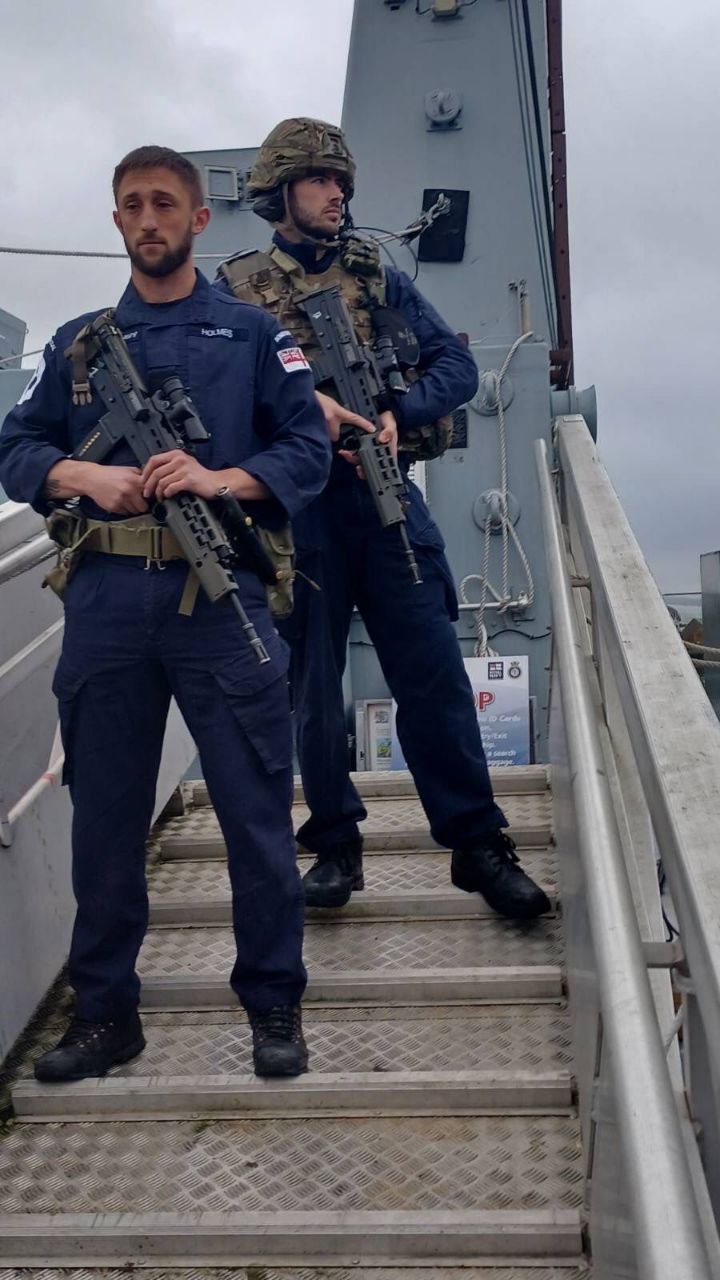
British Military confronting protesters in Dublin (Image sourced: AIA)
In a militant protest, the activists, chanted ‘From Ireland to Palestine, occupation is crime’ and Britain Out of Ireland and Palestine.’
During the course of the protest, the Republican Activists present confronted Armed British soldiers who appeared on the deck of the ship and a stand off ensued on the gangway.
End the occupation! End the genocide!
Free Palestine!
Free Ireland!
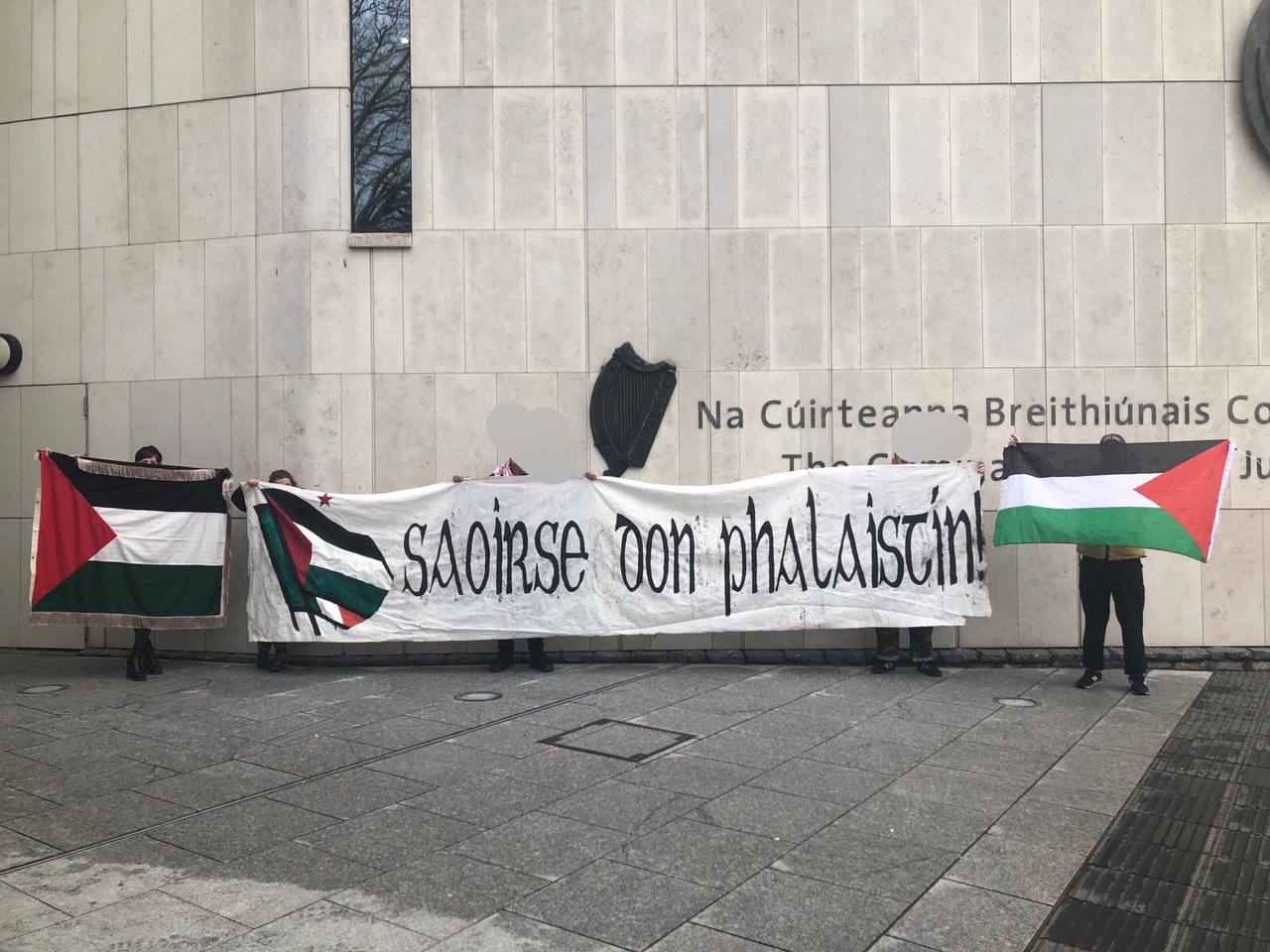
Solidarity picket outside the Dublin courts (Image sourced: AIA)
In a series of coordinated raids in Dublin this morning, a number of Republican Activists have been arrested and detained under section 30 of the Free States “Offenses against the state act”.
These arrests come as the state is increasingly fearful of the growth in Revolutionary Irish Socialist Republicanism and of Anti Imperialist Action Ireland in particular.
The arrests are timed to coincide with the leading role AIA has been playing in support of the Palestinian People and Resistance across the 32 counties and at a time when our members continue to confront and resist Imperialism across Ireland.
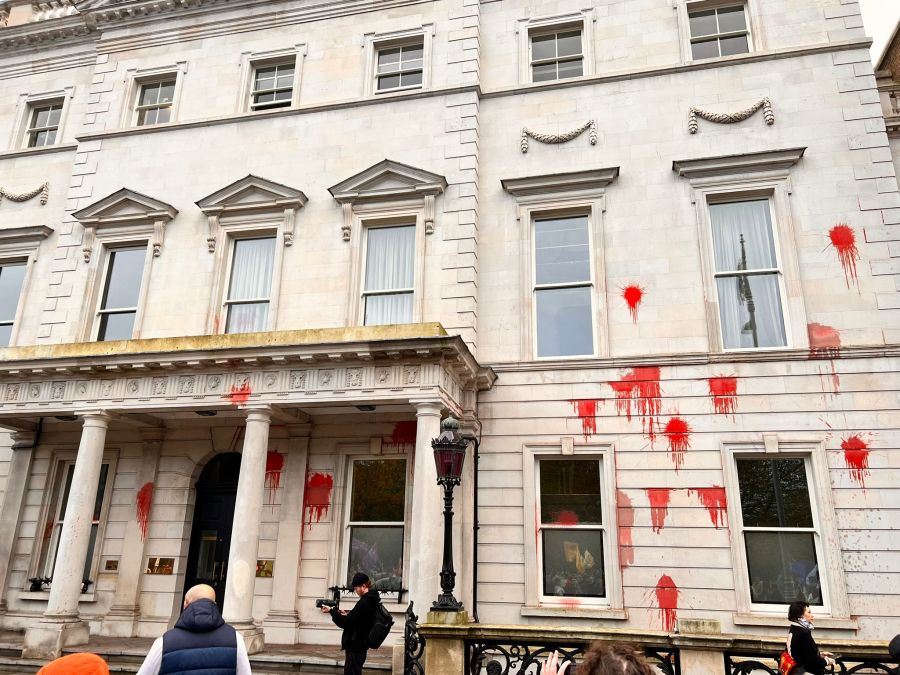
(Image sourced: AIA)
AIA condemn the raids and arrests by the Drew Harassers on Republican Community Activists and we call for these activists to be released back to their families and communities immediately.
Harassment, Raids, or Arrests will not stop AIA and Republican Activists from our work to rebuild the struggle for National Liberation and Socialist Revolution, resisting Imperialism or from taking a stand for Palestine.
The Republican Community Activists raided and arrested in Dublin yesterday have been released without charge.
The operation by the Drew Harassers, no doubt at significant cost, was designed to intimidate the growing membership and support base of AIA across Ireland, but it has failed, as all such operations will fail.
AIA welcome home these activists to their families and communities, where they belong. Republicans are not criminals. We will continue to promote the legitimate demand of rebuilding the Republic of 1916 at every opportunity. We will not be deterred and ultimately we will win.
Yesterday’s arrests are only further proof that the Free State fears the message of Revolutionary Socialist Republicanism, fears the growth and levels of support for AIA, fears our support for the Palestinian Resistance and fears our continued legitimate direct actions to confront and resist British, North American, European and Zionist Imperialism in Ireland.
We won’t be going away!
Free Ireland!
Free Palestine!
Also on Saturday, after the giant Palestine solidarity march in Dublin, according to another communiqué, members of AIA, Saoirse Don Phalaistín and Palestinian Solidarity Activists picketed the Leonardo Hotel on Parnell St.
The Leonardo Hotels are owned by Fatell Hotels the largest hotel group in ‘Israel’ and strong supporters of Zionist terrorism and genocide.
In response to the picket, the hotel has decided to enter lockdown, refusing to open the doors for guests.
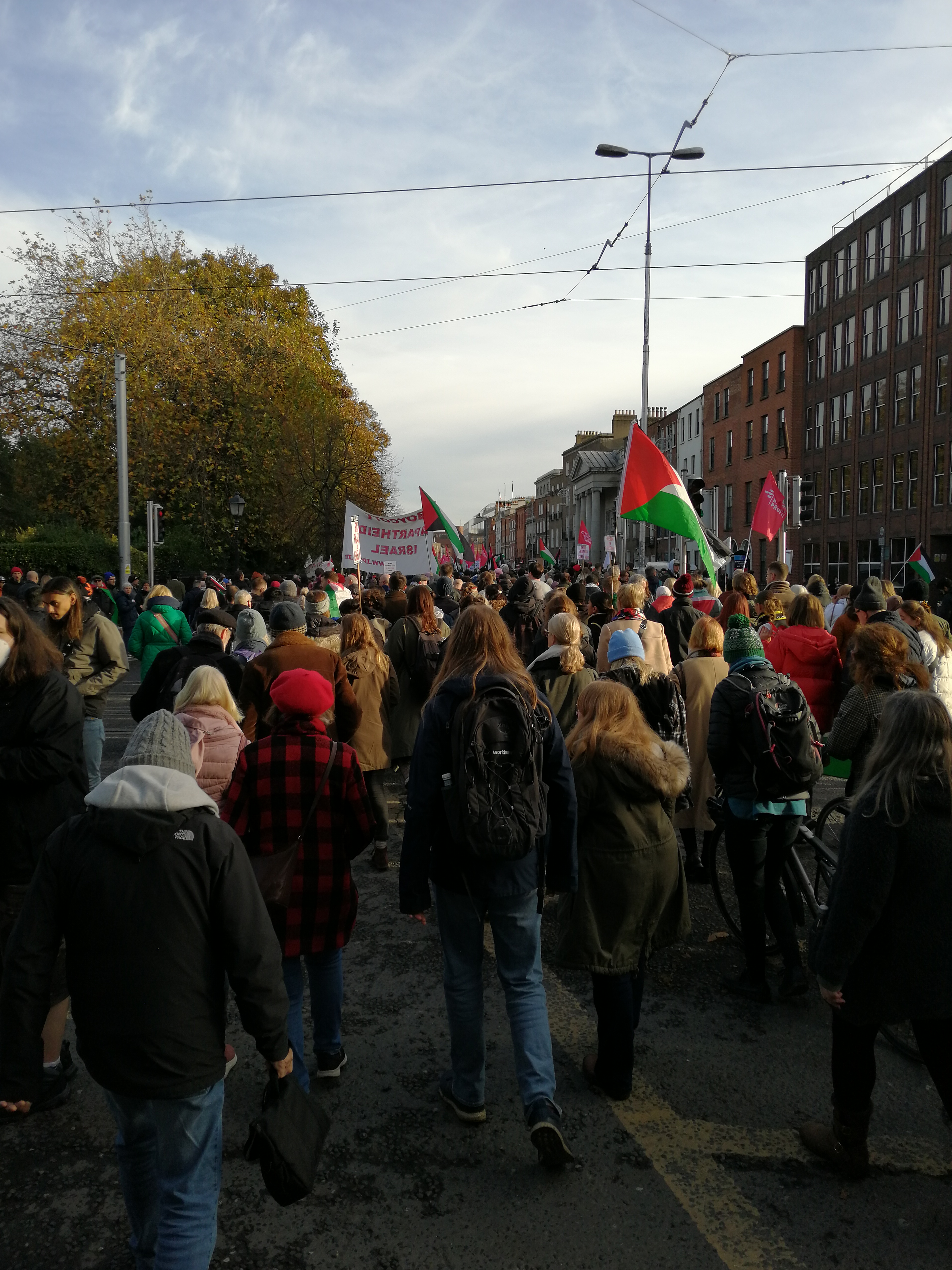
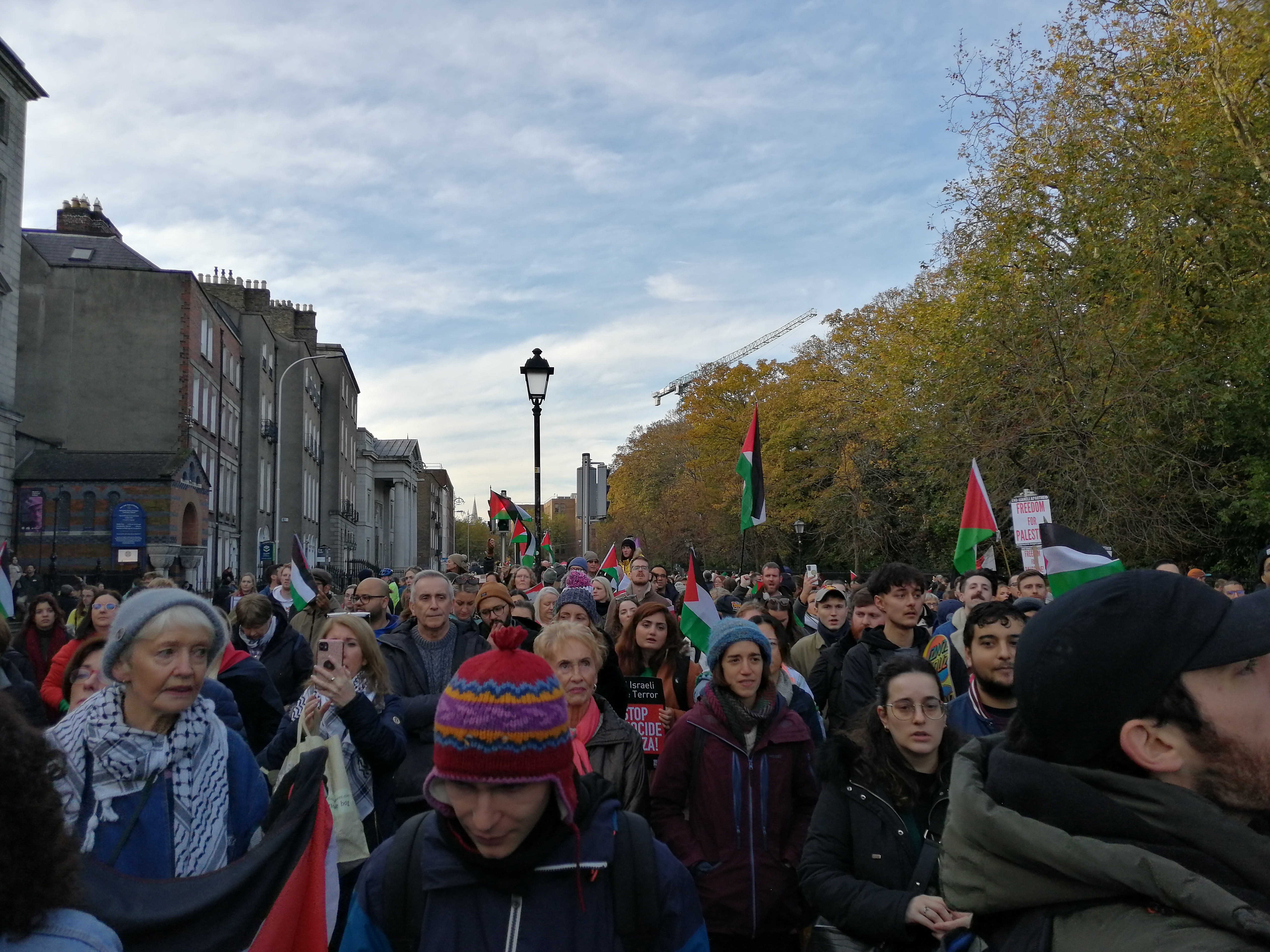
Many thousands wound their way in Palestine solidarity on Saturday through the streets of Dublin City centre, crossing from north to south of the river, filling the streets with solidarity slogans that have now become very familiar.
Section of the march in O’Connell Street crossing the river, the rest behind not having left Garden of Remembrance/ Hugh Lane Gallery area. (Photo: D.Breatnach)
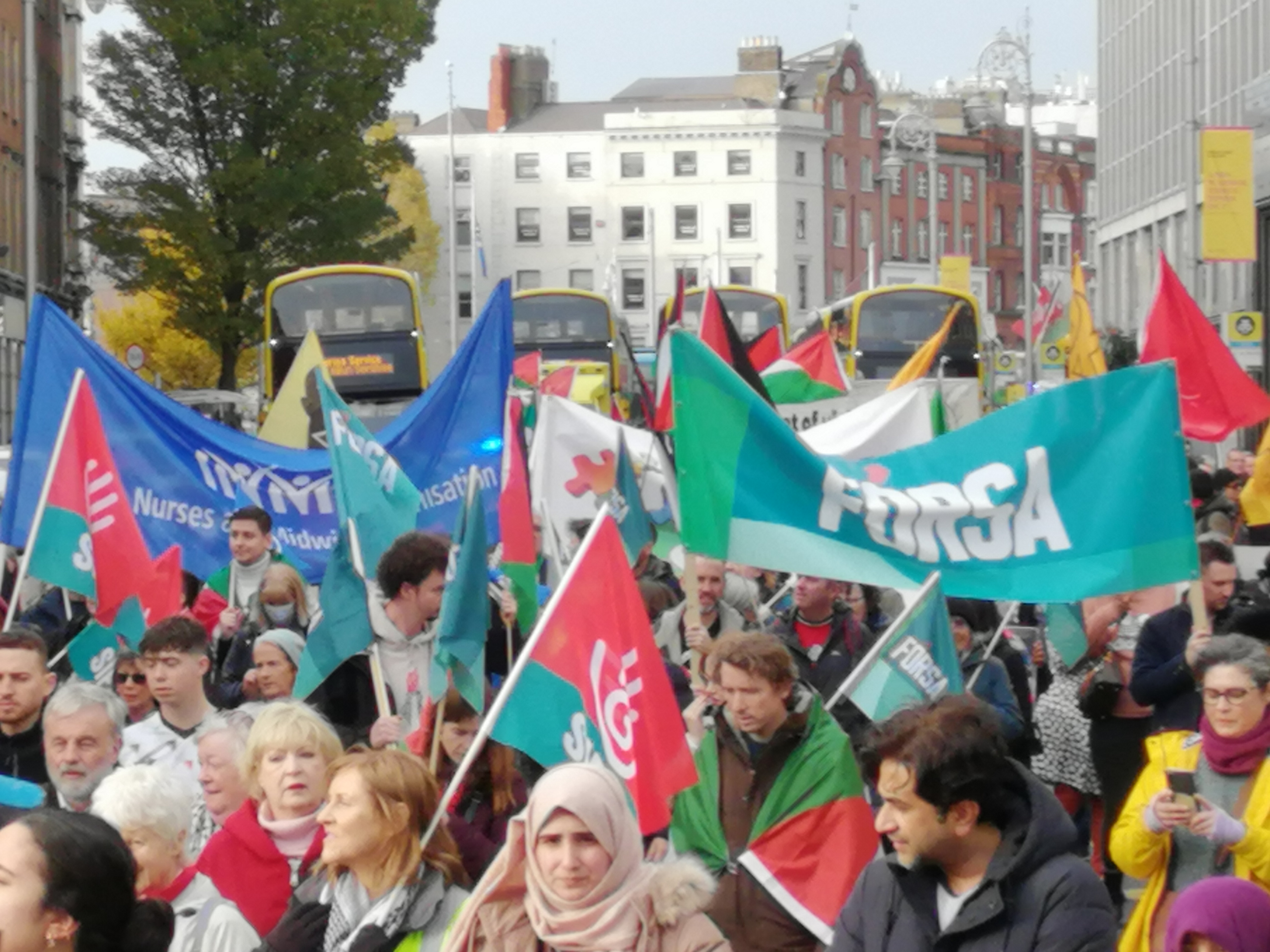
The national march called by the Ireland Palestine Solidarity campaign took nearly an hour to pass through Dublin’s O’Connell Street, Palestinian colours mixing with those of political party or group and some education trade union flags and banners – and the green and gold Starry Plough.1
And still they are coming (Photo: D.Breatnach)Graffiti on the Spire in O’Connell Street (Photo: D.Breatnach)
The weather was a welcome change from the heavy rain of the night before and, in contrast to recent cold days, was mild and autumnal. The trees by roadside and in parks, except for the berry-laden hollies, were losing their leaves but those remaining shone russet and gold.
Those political parties whose TDs2 voted for sanctions against Israel on Wednesday3 were present: Social Democrats, that had sought the expulsion of the Israeli Embassy and Sinn Féin, who wanted the Government to refer the Israeli Government to the International Criminal Court.4
That included also the People Before Profit/ Solidarity, which for weeks had been calling for the Ambassador’s expulsion and the Labour Party.
Left-wing, feminist and animal liberation groups participated, along with local Palestine solidarity groups. In a change from recent marches, Irish Republican groups could be observed participating but were very few.5
(Photo: D.Breatnach)
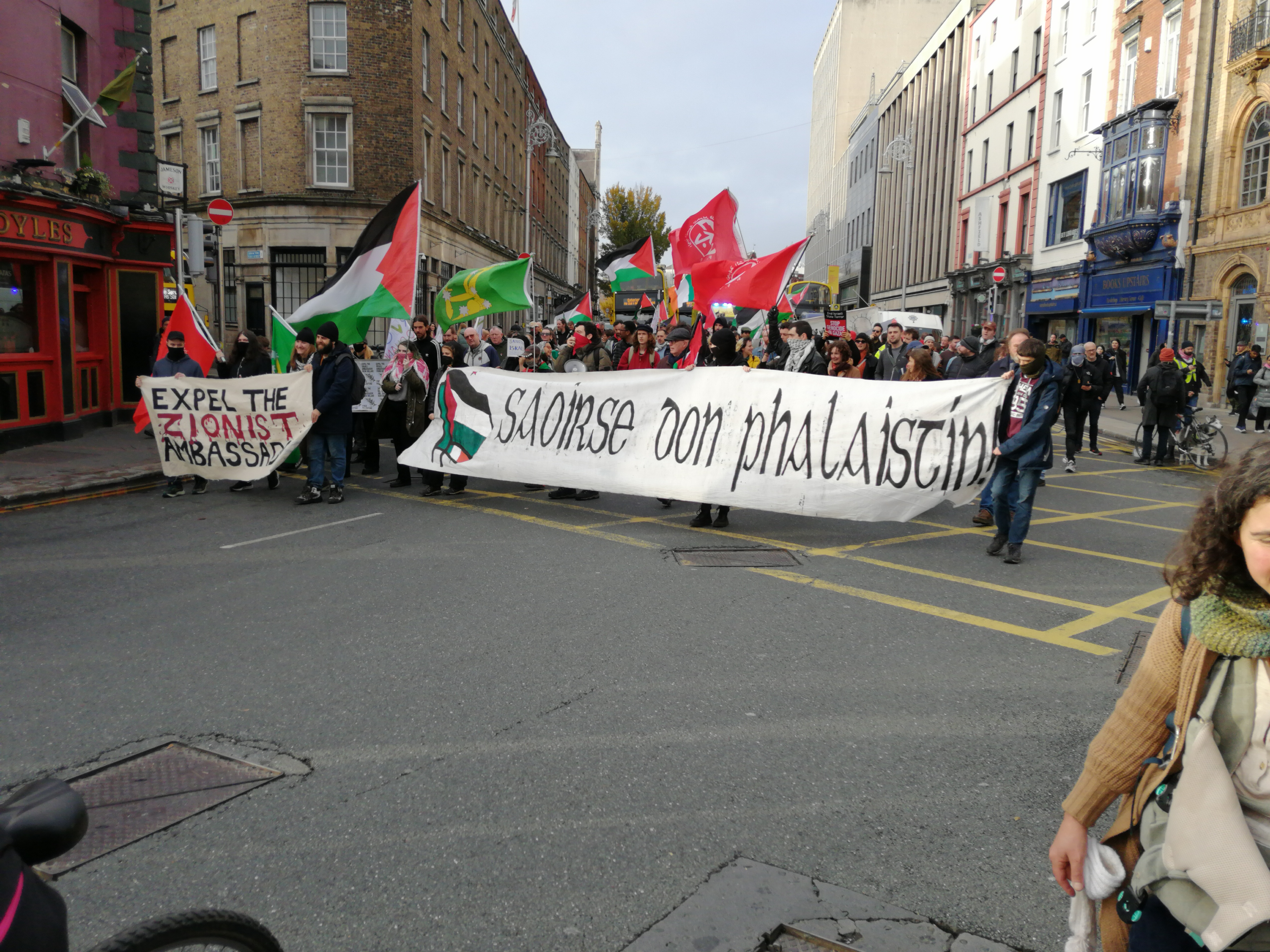
An Ghaeilge, the Irish language, had a presence on the march in a small number of placards and a big banner proclaiming Saoirse don Phalaistín,6 the latter also shouted as a call-and-answer slogan, to merge with the now-familiar ones of Palestine solidarity, along with denunciation of genocide.
Other slogans included: 1, 2, 3, 4 – Occupation no more! 5, 6, 7, 8 – Israel is a terrorist7 state! Netanyahu, you can’t hide – We can see your genocide! There is only one solution – Intifada revolution!In our thousands and our millions8 – We are all Palestinians!
(Photo: D.Breatnach)
The “Ceasefire Now!” demand could be seen on some placards and heard on occasion but not as much as before. This slogan has come under some criticism as theoretically binding the Palestinians to cease resistance and leaving the Israeli army in possession wherever they are.
Despite the necessary problems caused to vehicular traffic, a horn blowing from a passing car or van called out often in solidarity to a cheer from the marchers in reply. In contrast to the early decades of the Irish state, the population has become overwhelmingly pro-Palestinian.
Some appropriate decoration of the Irish Dept. of Foreign Affairs (Photo: D.Breatnach)
A LONG MARCH
The route of the march followed the same as the previous Saturday’s but instead of stopping at the Dept. of Foreign Affairs, continued on eastwards and then into Merrion Square south where the rally was to be held but significant numbers had left without waiting for the speeches.
Eastward of there, many Garda vehicles could be seen in Merrion Street lower, probablyin case people decided to bring to the Fine Gael party HQ their disgust at State collusion with Zionist genocide. Of course nowadays, Fianna Fáil and the Green Party HQs might feel the need for the same protection.
(Photo: D.Breatnach)
As people turned towards various destinations in the City Centre, to pick up their vehicles or to connect with public transport, most entered to proceed through the Merrion Square Park and, finding gates locked on to Merrion Square West road, headed for the next exit – but in vain.
All gates were locked until one, several hundred metres along Merrion Square North, finally allowed weary marchers to exit the park and turn west again towards the city centre. There was much much muttering about this deliberate inconveniencing of people in a public park.
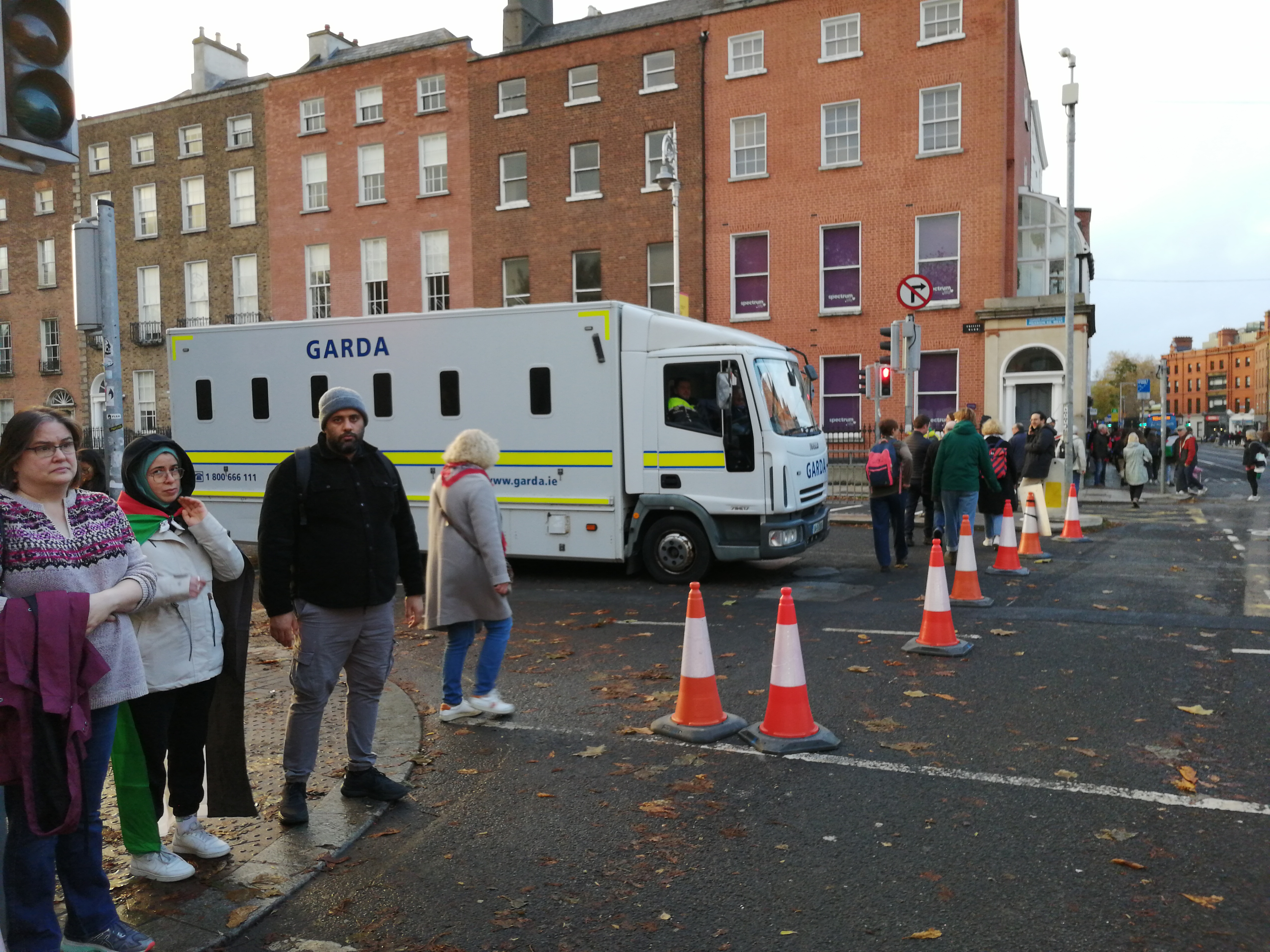
Passing the corner of Merrion Square West, with the former home of the Wilde family on the right, a large Garda prisoner transport was parked at the corner with other police vehicles around and some Public Order Unit police standing around.
(Photo: D.Breatnach)
This march had been the 5thweekend one in Dublin since the Israeli offensive, with a rally in the middle of each week also. And still the Israeli death-toll rises not just daily but by the hour. And still neither the UN Security Council nor EU will call for an end to the bombing.
And still the Israeli Embassy sits in Dublin with its staff free to spy and report on the population of the Irish State, even to insult the national feeling of solidarity and the President of the State for his comparatively mild demands thatinternational lawstatutes be followed.
Indeed, those same rules, often violated by the western superpowers, lie now exposed in shreds and tatters in Palestine. If there ever was reason to believe in imperialist states ruling the world in common humanity, that belief too lies in tatters that cannot be stitched together again.
End.
Front of march in O’Connell Street (Photo: D.Breatnach)Some trade union banners on the march (Photo: D.Breatnach)(Photo: D.Breatnach)
FOOTNOTES
1 The flag of the Irish Citizen Army, the first workers’ army in the world, formed to defend the workers from the attacks of the Dublin Metropolitan Police during the 1913 Lockout, who later fought in the 1916 Rising too.
2Teachta Dála, Irish State equivalent to MPs (plural Teachtaí Dála).
3 The motions in Leinster House (seat of the Irish parliament) were defeated through the Coalition Government’s TDs voting for an amendment that pulled all the teeth from the original motions.
4 The SF party flags were absent from earlier demonstrations after their leadership stated they would not be calling for the expulsion of the Israeli Ambassador but once the leadership, no doubt facing a revolt of their members changed that position, they were out in force, some of them even stewarding the march. One wonders whether those members understand that the ICC has in a decade only tried 30 cases and convicted onlyten, not one a state or an individual close allied with the Western powers.
5 Undoubtedly, more Irish Republicans participated as individuals or as members of local solidarity groups.
In their shameful votes last night, the Irish Government Coalition parties nevertheless taught people of social-democratic or liberal persuasion a valuable lesson. They won’t learn it of course, since it violates their world-view – but we should.
Social democrats in general, beyond the Irish political party of that name, essentially believe, despite all lessons of history, that capitalist society can be reformed through pressure of the organised labour movement and by appealing to the capitalists’ “better sense”.
Liberals believe something similar, without the trade union movement being essential. Their mantras echo through our political and philosophical culture: “Everything can be resolved through talking”, “Force solves nothing” and “The rule of law is paramount’.1
Despite the genocidal attacks continuing and even intensifying, despite the Gombeen class’ view that the ferocious bombing would have long-term adverse effects on the Middle East and perhaps on the world, the Government parties declined to break with the imperialist bloc.
Section of crowd, perhaps half-way, facing westward, away from Leinster House (Photo: D.Breatnach)
And why should we have expected anything different from them and the class they represent? This is not even an independent class but rather a native capitalist class that grew up under foreign occupation and never resolved to overthrow its masters.2
Rendering each Caesar his due, in turn and all together, this class has kissed the feet of British colonialism and imperialism, then US imperialism and finally EU imperialism. Whatever their own view of what the wise moves might be, they always obey their masters’ wishes.
And any party that enters government here as currently constituted will act likewise to get there and even more so after arriving there.
ROAR OF SOLIDARITY OUTSIDE LEINSTER HOUSE
Knowing that a vote was imminent on motions critical of Israel, including one for the expulsion of the Israeli Ambassador, thousands gathered last night in Molesworth Street, opposite the metal-barricaded Leinster House, home of the parliament of the Irish State.
Packed tightly together outside Leinster House, the crowd replied with a roar to slogans led by callers: From the river to the sea – Palestine will be free! In our thousands and our millions – We are all Palestinians! Free, free – Palestine! And, yes, Israeli Ambassador – Out, out, out!
The rally had been organised by the Ireland Palestine Solidarity Campaign, the main organisation for decades engaged in Ireland in Palestine solidarity campaigning. Yet, calling for the expulsion of the Zionist State’s representative had, until now, been strangely absent from its discourse.
Not always in the past, true but so it had been until now during these five weeks of genocidal bombing by the Zionist state. In fact, it seems they had previously even asked speakers not to make that call from their platform. They were however clearly making it now and rightly so.3
And clearly, so were the speakers lined up on the IPSC platform.
Independent Sen. Frances Black whose motion on the bill to ban products from the Israeli later settlements4 has been held up for two years by the Government, spoke also and challenged the Government TDs to make the right choice between party and principle, to “have the balls” to vote for justice.
Matt Carthy TD, Shadow Foreign Affairs spokesperson for the Sinn Féin party, was introduced from the IPSC platform to muted applause (perhaps because of the party leaders’ earlier refusal to call for the expulsion of the Ambassador.
Carthy addressed the crowd in Molesworth Street and apart from denouncing the ongoing Israeli genocide in Gaza, concentrated on his party’s motion for Israel’s referral to the International Criminal Court and disputed the Government’s view that additional referrals5 were unnecessary.
While there may be some propaganda value in such a referral, a quick check will establish the following about this institution:
The ICC has never tried a state, only individuals
The ICC has never tried a main actor or close friend of western imperialism, regardless of obvious war crimes (e.g. the USA, UK in Iraq and Afghanistan)
In its 11 years of existence, the ICC has had only 30 cases before it of which ten resulted in convictions and four in acquittals.6
However, the SF party spokesperson was now also calling for the expulsion of the Ambassador, since the recent turnaround of the party’s leaders on the question when Mary Lou MacDonald found her position untenable in the face of the party’s own voters and closer supporters.
Richard Boyd Barrett TD spoke as usual at such events for the People Before Profit party7 and excoriated the Government for their failure to apply sanctions against Israel, exclaiming: “My God, they were quick enough to do it against Russia, weren’t they?”8
Boyd Barrett said that if the Government won’t take the sanctions then the people must do so, the closest he came to listing how they might do so was in mentioning “occupations”, a number of which have taken place recently without any PBP involvement whatsoever.
The PBP speaker also denied that a state such as Israel, based on occupation, racism and genocide, has any right to self-defence but insisted that the targets of its attacks, the Palestinians, had every right to defence and resistance.
Holly Cairns TD, leader of the Social Democrats political party,9 proposer of the parliamentary motion to expel the Ambassador spoke clearly and convincingly, her speech more militant and direct than the that of the speaker from the former revolutionary Republican party.
I believe it was Cairns who asked the pointed questions with regard to taking strong sanctions against Israel with the current death toll and list of atrocities: If not now – when?
(Photo: D.Breatnach)
In reply to fears that the expulsion measure would make the Irish State an “outlier” in the EU, she commented to media that she would have no regrets at being “an outlier” of the current EU consensus.
Ruth Coppinger for the Socialist Party10 began by addressing the meaning of “the international community”, identifying not with the imperialist states but with solidarity demonstrations around the world including trade union blockades against shipments to Israel.
She called for such actions in Ireland today but also criticised the Palestinian assault through the apartheid Wall on October 7th. I think it was she who called for a national walkout on World Palestinian Solidarity Day, 29th of November.11
Given the supine state and collusion of the Irish trade union movement, which neither the SP nor the PBP party have made serious efforts to challenge, a union-led walkout is unlikely and, though people may do so anyway this is likely to be difficult without organisation and leadership.
All of the speakers congratulated those in attendance and asked them to continue their solidarity actions. Many (notably not the SF speaker) also criticised the USA in general and its President, Joe Biden, in particular. The USA is the chief and financial backer of the Israeli State.
One of the Irish language placards at the rally: “Joe of the Slaughter.” (Photo: D.Breatnach)
Although there were a number of Irish-language placards and one banner in evidence, I recall hearing not one word of Irish from the platform.
IN PALESTINE TODAY
The Israeli siege and genocidal bombing continues as the Zionist state tries to sap the resistance of the Palestinians people, destroying even their medical facilities and endeavouring to starve and terrorise them into submission.
By yesterday the death toll from Israeli airstrikes on the Gaza Strip since Oct. 7 had risen to 11,500, including 4,710 children and 3,160 women. Israel has also killed 22 civil defence and 200 medical personnel and 51 journalists.12
The number of injured people has reached 29,800, with about 70% of them children and women.13
Wednesday’s statement from the Gaza Health Ministry said that 95 government buildings and 255 schools have been destroyed. Some 74 mosques were completely destroyed and 162 were partially damaged, in addition to three churches.14
‘It said that the Israeli army targeted 52 health centers and 55 ambulances, while 25 hospitals have run out of service.15
‘ “Israeli soldiers attacked many patients, wounded individuals, and displaced people, as well as several medical and nursing staff inside Al-Shifa Medical Complex, forcing them to undress and subjecting them to insults,” the statement added.’16
The Palestinian guerrilla movement organisations have struck back in Gaza and the West Bank and Hizbollah has entered the struggle to an extent from Lebanon. The collaborationist Arab states have become worried about their own populations, a worry shared by their imperialist masters.
But the rabid dog is loose and refuses to be restrained. What to do? Call it to heel now, or let it have its head to glut itself on blood? Difficult for the imperialist classes of the world to be certain which way to go and the divisions among them are becoming clear.
Both France and Germany EU states have banned Palestinian solidarity marches but while Germany refuses to call for any end to the bombing, President of France Macron in exclusive interview this week has called on Israel to stop killing Palestinian women and children.17
View perhaps half-way in crowd facing Leinster House in the far distance. (Photo: D.Breatnach)
Across the world, the imperialist-aligned ruling classes are in disarray. Eight states in Latin America, Middle East and Africa have now fractured diplomatic ties with Israel.
The British Labour party saw four party shadow spokespersons resign and 56 of its MPs break party discipline to vote with the Scottish National Party motion calling for an immediate ceasefire.18
The other “international community”, the one to which Coppinger referred, has been on the streets in their millions in cities across the world, on every continent, including in those of the partner states of the genocidal Israeli state.
THE GOVERNMENT AND THE PEOPLE
Mícheál Martin had visited Palestine before in 201019 as Minister for Foreign Affairs in the then Fianna Fáil government and was visibly affected by what he had seen. But a Minister serves the Government which in turn serves the ruling class, which in the end calls the tune.
Today Mr. Martin, as Tánaiste20 of the gombeen Coalition Government, is in ‘Israel’ accompanied by the very Zionist Ambassador which last night his party and coalition party representatives had stoutly defended and who had attended by invitation his own party’s annual congress.21
Mícheál Martin in ‘Israel’ today with the zionist state’s Ambassador to Ireland (centre, partially obscured) (Photo sourced: Internet)
With no illusions in the parliamentary road or perhaps less of them now, we are thrown back on what was always our only realistic resources – our own mobilisations, our own actions.
Short of a revolution, to be effective we can only continue to make life as uncomfortable as possible for the Zionist state and for its collaborators, native and foreign.
Above all and indeed as some of the speakers last night emphasised, we must not be discouraged and have to continue; we owe it not only to the Palestinians but also to ourselves, to our history and our future. Beidh lá eile ag an bPaorach – there will be another day.
(Photo: D.Breatnach)
End.
FOOTNOTES
1Of course the fact that laws are written (and changed) to suit the ruling class (or at least not threaten it) and backed up by a whole violent repressive state structure of police, courts, jails and armed forces is conveniently ignored.
2Indeed, it waged war on those who were determined to fight for independence.
3Nor did its FB page share occupation protets such as those carried out by the Anti-Imperialist Action or Saoirse Don Phalaistín groups, though today they shared a post on the occupation of the Dept. of Foreign Affairs by the Ireland for Gaza group.
7Formerly the Socialist Worker’s Movement, an Irish iteration of the (Trotskyist) Socialist Workers’ Party in Britain, much diminished from it days of greater glory but currently the largest Left party in Britain.
8Yes and Boyd Barrett was part of the condemnation of Russia and support of the Ukrainian state at the time.
9The party centre-left social democratic party was launched on 15 July 2015 by three independent TDs (members of parliament) and promotes the Nordic model and pro-European views.
10An Irish iteration of the Socialist Party in Britain, a Trotskyist party once very large there, with the Militant Tendency its entryist organisation in the UK’s Labour Party, from which it was expelled. The Irish party has had a number of members of the Irish parliament but all those still in such roles have either left to become Independents or joined the PBP-Solidarity coalition group.
20Equivalent to Deputy Prime Minister; he is also leader of the Fianna Fáil political party, the one with most elected members in the Coalition Government with Fine Gael and the Green Party.
A Palestine solidarity demonstration of around 10,000 in Dublin on Saturday the 11th included a bloc marching behind a banner bearing the legend Saoirse Don Phalaistín and another demanding the expulsion of the Israeli Ambassador.
Since the beginning of Israel’s bombardment of Gaza, Dublin has seen at least two large solidarity events every week, one mid-week and another on Saturdays, marching to the Israeli and USA Embassies or, like this one, to the Irish State’s Department of Foreign Affairs.
(Photo: Rebel Breeze)(Photo: Rebel Breeze)
In addition, there have been smaller more radical events, such as the 2-hour occupation of the offices of Qanta Capital, the landlord of the Israeli Embassy, also another of the Clarence Hotel, recently bought by an Irish company with a loan from an Israeli bank.1
Also the occupations of offices of the Irish Dept. of Transport and of the European Commission2 and a weekday evening rush-hour protest on the forecourt of Dublin’s Connolly Train Station, which hosts major east coast commuting and northern city destination lines.
Section of the march in Cuffe Street, many still behind in Aungier Street (Photo: Rebel Breeze)
On Saturday the march began as usual with a 1.00pm gathering in the city centre, the rear of the densely-packed marchers still in O’Connell Street as the rest had crossed the river into Westmoreland Street, swung into College Green and Dame Street underway to George’s Street.
At one point the march called by the IPSC3 stretched from George’s Street all along Aungier Street, the front had turned into Cuffe Street and was already marching towards Stephen’s Green. The Department of Foreign Affairs is located on the east side of the famous inner-city park.4
The front of the march marching along Stephen’s Green East while the rest is still in Cuffe Street and Aungier Street (Photo: Rebel Breeze)
The bloc marched along gathering people behind as it did so, shouting among others the slogan “Saoirse – don Phalaistín!” and “Zionist Ambassador – Out, out, out!” which was taken up by many, including those who seemed to be Palestinian or at least from the Middle East.
At a separate point, a few professionally-printed placards in Irish could be seen too, e.g “Stad an Slad” and a flag in Palestinian colours with “Saoirse don Phalaistín” printed upon it.
(Photo: Rebel Breeze)
The other slogans that have become standard were shouted also, including the one claimed to be ‘anti-semitic’, ‘terrorist’ and ‘against the law’ by the recently sacked UK Minister of Home Affairs, claimed to be “anti-semitic” and ‘against the law’: “From the river to sea, Palestine will be free!”
Mobbing and threats by British fascists to Palestine supporters5 on the gigantic solidarity march in London on Saturday6 that ended in scuffles with the police were linked by a number of senior politicians to Braverman’s extraordinary claims of police partiality to the demonstrators.
Braverman alleged that London Met police went softly on Palestinian solidarity demonstrations in allowing them to take place while some extreme right-wing mobilisations in the past had been sternly treated – a fantastic claim as any antifascist activist in London knows well.
Section of the crowd standing behind the Saoirse don Phalaistín banner (Photo: Rebel Breeze)
In Dublin on Saturday, upon reaching Stephens Green, the bloc stopped short of the rally outside the Dept. of Foreign Affairs where in any case the crowd was so large that the PA system of the organisers was of insufficient strength to convey to all the words of the scheduled speakers.
A large section of the march stopped behind them and a space cleared in front, at the fringes of which the people turned and joined in the bloc’s almost incessant slogans, at times applauding them. To the solidarity slogans that have become universal, those in the bloc added another two.
Section of the crowd who have turned to face the Saoirse don Phalaistín banner, many joining in the slogans. The speakers’ platform is further beyond outside the Dept. of Foreign Affairs building. (Photo: Rebel Breeze)
These were “There is only one solution – Intifada revolution!” and “Zionist Ambassador – Out, out, out!” Those slogans draw a line away from the liberal demands of “peace” and “negotiations” since the only “peace” that can exist in Israel is a pause before the next bombings.
(Photo: Rebel Breeze)
“Saoirse – Don Phalaistín” was repeated and “Stop the bombing – Now!” seemed at one point to be offered as an alternative to “Ceasefire Now!”7
They also called for serious political repercussions for Israel in the expulsion of its representative in the Irish state, its Ambassador. Currently seven states have expelled Israel’s ambassadors or recalled their own – but none of them are members of the European Union.
Section of the crowd outside the Department of Foreign Affairs (Photo: Rebel Breeze)
The Irish State IS a member of the EU and a symbolic act such as the expulsion of the representative of the Zionist state would have huge reverberations. On Wednesday motions on expulsion of the Ambassador will be debated in the parliament of the Irish State.8
Also, the Sinn Féin party, whose leadership recently reversed their opposition to the expulsion of the Zionist representative, will be calling on the Government to refer Israel to the International Criminal Court for investigation of war crimes.
While this might be of some use as a propaganda move, that Institution has never judged a state nor indeed anyone for war crimes who is part of the western imperialist coalition – which Israel most evidently is.9 The proceedings also tend to be very slow.
All in all, not only will such an action not be effective even if agreed, it will likely serve as a distraction from actions much more likely to be effective, such as expulsion of the Zionist Ambassador, along with arms and other trade sanctions.
(Photo: Rebel Breeze)
A rally has been called to take place outside the home of the Irish parliament, Leinster House, Kildare Street at 6pm on Wednesday10 and a national demonstration on Saturday, starting at 1pm from the Garden of Remembrance.
End.
Some demonstrators walk through Stephens Green after the march. (Photo: Rebel Breeze)
FOOTNOTES
1By activists of the Irish Anti-Imperialist Action group.
3The Ireland Palestine Solidarity Campaign, for decades the main Palestine solidarity organisation in Ireland.
4Which is coincidentally, a 1916 Rising battleground.
5One of the irritants to British fascist mentality was that the Palestine solidarity march was taking place on Armistice Weekend, an annual event including ceremonies commemorating the dead in battles of the UK’s armed forces, one major period which was ironically as part of the Allied forces in the War Against Fascism 1939-’45.
7A ceasefire usually means everyone stops firing where they are, which could be interpreted as binding the Palestinian resistance to leave the Israeli military in occupation of Gaza without retaliation, which some have criticised as favouring the Israeli Zionists.
8The Social Democrats party have tabled the motion, which will be supported by the Sinn Féin party and by People Before Profit party, along with a number of Independents. The Coalition Government of Fianna Fáil, Fine Gael and the Green Party have stated they will oppose it. At this moment the leadership of the IPSC continues to abstain from making such a call
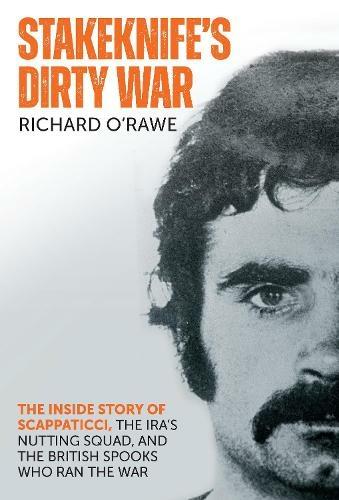
Richard O’ Rawe’s Stakeknife’s Dirty War is a timely book, coming as it does after the death, or supposed death of Stakeknife in England and what looks like a thwarting of the intent and findings of Boutcher’s Kenova Inquiry into the affair.
It is now accepted by all that IRA Volunteer Scappaticci was also the British agent known as Stakeknife.
O’Rawe had access to IRA volunteers and former intelligence operatives and weaves together aspects of Scappaticci’s life and role into a narrative that is convincing and despite the nature of the subject matter, torture, murder and betrayal it is an easy read.
O’Rawe also introduces us to Scappaticci the person. The person however, isn’t any more likeable than the British agent, torturer and murderer. In fact, it would seem they are flip sides of the same coin. Scappaticci was an industrious character, always on the make, running private tax scams.
He was used to money long before he became a paid British agent. His fortune earned from murders on behalf of the British and the IRA, though the IRA weren’t giving him anything like the sum the British did, is estimated to be in the region of a million pounds in pay-outs.
He also had various properties. Scappaticci was also a lowlife thug long before the British and the IRA gave him carte blanche to murder and torture his way through republican ranks. Some of things he did, had he not been in the IRA would have led to him being kneecapped by the IRA.
A man called Collins made the mistake of publicly calling the area in Twinbrook in which Scappaticci lived ‘Provie Corner’. Scappaticci did not like that and decided that Collins had to pay for his transgression.
He knocked on Collins’ door and, when it was answered, the informer battered the older man multiple times over the head with a sock containing a brick. Only when Collins collapsed did Scappaticci walk away.
This is the type of low life thuggish behaviour that the IRA was willing to tolerate and perhaps even encourage from people like Scappaticci. In a genuinely political movement, a thug like Scappaticci would have been out on his ear. But not in the IRA nor in Sinn Féin.
He was, to paraphrase the Yanks when talking about the Nicaraguan dictator Somoza, “he may be a son of a bitch, but he is our son of a bitch”, though in this case it would seem that not only was he theirs he had just the qualities that both the IRA and the British valued, ruthless thuggish qualities.
Scappaticci the person and agent are intimately related it would seem though O’Rawe doesn’t explicitly say so. He does however, give us ample material with which to draw that conclusion.
One of the issues never dealt with it in the press and not really fully covered here is what type of organisation recruits, tolerates and promotes such people. He was a reprobate who should never have graced the ranks of the IRA. That he did so, is down to Adams and co.
That is also clear from the book. It is not an aspersion on Adams or on McGuinness either to question their role.
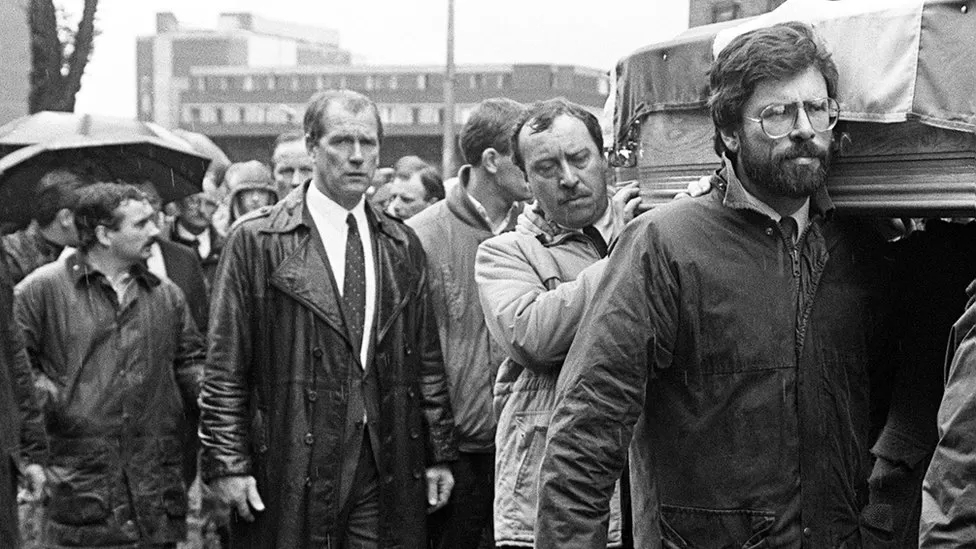
Republican funeral, Scappaticci on left photo, Adams on right (Photo cred: Pacemakers)
The latter of the two comes in for some questioning in the book regarding his role and O’Rawe goes into some detail and also explains in the epilogue that before beginning his research he was unaware of the level of unease amongst republicans about McGuinness’ trustworthiness.
Though he does point out earlier that if McGuinness was a tout, why was it necessary for the British to have a spy such as Willie Carlin get close to him. The same could also be said of Adams.
The British had an agent, Denis Donaldson, whispering sweet nothings in Adam’s ear over many years, shaping Adam’s view of the world and reporting back to the British how successful he had been in his endeavours.
The Peace Process, in that regard, was partially the result of what ideas the British planted in Adam’s and McGuinness’ minds through their various agents. However, it does seem unlikely either of them were touts in the classical sense of the word.
They didn’t need to be, they were at a different level. They were both on the same side as Scappaticci in winding down the war, they just had different methods of going about it.
It is possible that at some stage they had dealings with the British security services in pursuit of common aims. O’ Rawe is not the first to question McGuinness either.
Ed Moloney has put forward the idea that the reprehensible proxy bombs that provoked so much revulsion were signed off on, precisely because they would strengthen the hands of those who sought to wind up the war.
O’Rawe gives many examples of what Scappaticci and the other British agents in the Internal Security Unit did. It wasn’t limited to executing alleged informers or those the British thought should be removed for various reasons under the guise of them being informers.
They were also in a position to give information on operations which led to the British either arresting or killing the Volunteers involved. The book opens with an account of one such operation, where fortunately they were able to pull back from it without the planned British ambush going ahead.
There were of course other incidents, one of them being Loughall where the British ambushed an entire unit of the IRA. Scappaticci and his ilk did great harm to the IRA, but they were not the reason the IRA lost the war, and O’Rawe doesn’t argue it was either.
However, others have made this point. But the IRA was never going to win the war, they weren’t going to outgun the Brits ever.
Another part of the problem of course, is related to Scappaticci. A movement so highly infiltrated would always have problems, but it is telling of the political weakness of the IRA and Sinn Féin that a thug like Scappaticci could rise through the ranks and remain at the top for so long.
That says more about their weaknesses, than anything else.
That Denis Donaldson, a British agent was the chief advisor to the IRA and Sinn Féin on strategy, for so long, shaping policy, whilst Scappaticci weeded out of the ranks anyone who would oppose it, says more about the weakness of republican politics than whether operations went ahead or not.
O’Rawe, however, is more interested in what happened and who bears responsibility for it.
He is quite clear that the IRA are to blame and is equally clear that those in the intelligence services who allowed Scappaticci and other British agents in the ISU to murder their way through republican ranks are also to blame.
He is not wrong in that, Danny Morrison described Scappaticci as Number 10’s murderer(1) and that he was, he was also the IRA and Sinn Féin’s murderer.
Adam’s infamously justified in a blasé fashion the IRA murder of alleged informer Charles McIlmurray in 1987 when he said that “like anyone else living in West Belfast [he] knows the consequence for informing is death.”(2)
Neither the British, the IRA, Sinn Féin and Gerry Adams in particular, get to wash their hands of the affair.
This book is an important contribution to uncovering the truth of Troubles, one which will neither please Sinn Féin nor the British and Irish governments written from the perspective of a former IRA volunteer.
It deserves to be read and kept on the book shelf as the issue is not going away any time soon.
Bill O’Brien, text of speech delivered at Athens conference in 2014; first published in The Pensive Quill blog and sent to Rebel Breeze.
(Reading time main text:4 mins.)
In May 2014, the week following the Odessa massacre, a small group of mostly non-aligned antifascists in Ireland organized through word of mouth and through social media a successful demonstration in Dublin.
We rallied against the fascist atrocity and described it as part of an imperialist anti-Russian agenda in the EU and we called for support in Ireland for the struggle against the Ukrainian army in Donbas.
There was very little reporting on the atrocity in the mainstream media.
Unfortunately, it was complemented by virtual silence from nominally anti-imperialist, socialist organizations in the country, despite the fact that a massacre had occurred the day after Mayday, the historical day of workers’ solidarity and that it was committed by openly fascist groups inside a trade union hall.
Fascists and far-right Ukrainian nationalists besieged anti-fascists in Odessa trade union building on May 2nd 2014 and set fire to the building. Nearly 40 were confirmed killed, often by the mob as they jumped to escape the flames and a great many were injured. (Photo cred: Reuters)
What seemed surprising to us at the time was the fact that the Irish trade unions had issued no statements at all on the tragic event of May 2nd.
There were no messages sympathising with the loss of life or condolences to grieving families sent by the union hierarchy, no expression of solidarity as one would have expected.
There was no condemnation, or even any acknowledgement from the trades union movement that a horrendous crime had been committed against young anti-fascists who had sought refuge from an armed fascist mob in the Odessa House of Trade Unions.
When we raised the question of this silence with members of groups associated with the Left in Ireland, we found that most were hardly interested in addressing a threat that even some right-wing commentators had been drawing attention to – i.e. the re-appearance of Nazism and the support fascism was receiving from the Ukraine government – in a part of Europe that was aspiring to join the EU.
To the extent that these leftists mentioned Odesa at all, they argued that the massacre took place in the context of a war in Ukraine between forces aligned with two equally regressive imperialist regimes.
That is between supporters of the EU / NATO on the one hand and supporters of a paramilitary Russian nationalism aligned to Russian “imperialism”, which was attempting to redraw the Ukrainian borders.
Those who died or suffered injury in the Odessa massacre were portrayed, when they were mentioned at all, as unfortunate victims of inter-imperialist rivalry.
The successful resistance and defeat of fascist brigades in Donbas earlier this year – by “tractor drivers and miners” as Putin put it – halted a march to the right that was taking place across the whole of Europe. That defence gave the world time to face reality.
Social media and non-Western media sources have allowed us the space to counter much of the propaganda. We have received support from trades unionists as well as from those political groups that are not tied to the pro-UK line followed by most of the official Irish media.
But we have found that attempts to oppose a pro-imperialist narrative are too often treated as affronts to the unity of the Left political project in Ireland. Political discourse of the sort that insists on a precise understanding of the meaning of words is too often dismissed as sectarian or divisive.
In the lexicon of much of the Left, the concretely understood word “imperialism” has been replaced by words taken from the language of “humanitarian” intervention that has been promoted by groups such as Amnesty.
When we say that Russia is not an imperialist country for instance we get accused of introducing what are termed “sectarian ideological squabblings.” Bono’s latest political musings seem to outdate Lenin’s formulation on any matter!
According to the humanitarian Left words like ” imperialism” get in the way of a united strategy that should be aimed at electing progressive left-wing representatives to the Irish parliament institution that is largely powerless in the face of austerity measures dictated by international finance.
Left unity that is based on the abandonment of principles can only weaken the fight against imperialism. This has been demonstrated in the Irish “humanitarian” Left’s responses to the present conflict in Syria and the current refugee crisis.
The influential Washington-based Foreign Policy magazine wrote correctly this month about how Russian involvement in Syria is inextricably linked to the ongoing conflict in Ukraine.
Such links have to be understood and taken fully into account in the building of a genuine internationalist movement against imperialism.
The Odessa massacre, as we know, occurred on May 2, 2014. Sightly over a month later, the Zionist onslaught against Gaza began – on 7 July 2014.
The responses in Ireland to the two events were totally different – almost as if two tragedies were simultaneously taking place on different stages on different planets.
In response to Gaza, a pro-Palestine demonstration was called in Ireland’s capital city, Dublin, for Gaza; it was attended by something in the order of 10,000 people. Those ordinary citizens at the march had undoubtedly been moved by an act of incredible brutality by a Western-backed regime on a defenceless Palestinian people.
Those speaking on the Save Gaza platform did not ever mention the Ukraine bombardment of civilian areas – supported by the US and its allies – that was taking place in Donbas at exactly the same time as the Israeli military strikes on Gaza were occurring.
The same people had supported the Maidan coup. The bombardment of Donbas was also supported by the US and its allies so wouldn’t it have been sensible for the Gaza rally organizers to mention Donbas?
At exactly the same time as Gaza and East Ukraine were under attack, the US and its allies were organizing proxy “rebel” forces in Syria aimed at the destruction of the nation’s secular state and its replacement by a pliant regime.
The Syrian crisis did not get mentioned at the Gaza rally either on account of the opportunist alliances between leftists who dominate the anti-war movement in Ireland and the Muslim Brotherhood.
We have been working since 2014 with members of the Ukraine and Russian communities in Ireland and called demos in support of Donbas.
We visited trades union headquarters in Ireland and helped Russian and Ukrainian leftists in Ireland bring the Odesa massacre photo exhibition to the country’s major cities – Dublin, Cork and Belfast.
We have held events to coincide with the showing of the photos, which have been attended by sympathetic trades union leaders, members of the Russian and Ukrainian communities and Irish republicans and socialists.
We were very pleased that our limited endeavours in Ireland have been well-matched across Europe and beyond and we draw strength from this international solidarity.
End.
Rebel Breeze COMMENT:
The events in Ukraine were well known at the time, following a US-instigated coup in 2014 (the true date of the start of the armed conflict, not February 2022).
The USA wanted Ukraine to join NATO, its bloc against Russia but the Ukraine government was more interested in staying connected to the East and in particular to Russia, having lots of linguistic and other cultural connections there.
The coup launched not only a change of government but a wide-scale attack on supporters of the previous government and on Russian-speaking communities across Ukraine, particularly in Eastern Ukraine (Donbas and Crimea).
Monuments of the War Against Fascism were torn down wherever the fascists got control.
Communities in most of the threatened areas mobilised to defend themselves against the armed attacks of the Right Sektor and the Azov Battalion (now incorporated into the Ukraine’s National Army), some with more success than others .
Mariupol fell to fascist forces but was retaken by Russian forces last year.
Anti-fascist mobilisation in Eastern Ukraine, 2014 (Image sourced: Internet)
Crimea defended itself successfully, called an early referendum and as a result joined Russia. Other areas that were not overrun remained in defensive fighting for the next eight years, mostly with no running water or electricity, under artillery bombardment until the Russian invasion.
The demonstrations, public meetings and exhibitions to raise awareness in Ireland of the Ukrainian fascist attacks in 2014 were successful to a degree but not enough to move the major part of the Irish Left, in particular the PBP and the SP – or the trade union leaderships.
Their inability to see the true nature of events there has intensified since the Russian invasion.
A national hero of the Ukrainian state now, which Right Sektor and Azov were promoting even before 2014 is not one of the Ukrainian partisans who fought the Nazi invasion and occupation.
No, it is Stepan Bandera, not only an anti-semitic anti-gypsy fascist but a Nazi collaborator during WW2, an allied organisation of his responsible for massacres which peaked in July and August 1943.
“The massacres were exceptionally brutal and affected primarily women and children.[7][2] The UPA’s actions resulted in up to 100,000 deaths.[8][9][1]
“Other victims of the massacres included several hundred Armenians, Jews, Russians, Czechs, Georgians, and Ukrainians who were part of Polish families or opposed the UPA and sabotaged the massacres by hiding Polish escapees.” (Wikipedia).
The following reference is posted to show that the attacks and their fascist connections were well known across the West but also to show how the report twists what happened to make the victims appear as the causes of the attacks.
On a wet Tuesday night in the large lobby of Windmill Lane Recording Studios, local community representatives met with representatives of political parties, Dublin City Council and the Gardaí to press for their community’s needs to be met.
The meeting on 24th October 2023 was convened by the City Quay Committee and its organiser, Patrick (“Paddy”) Bray raised concerns about the unmet needs of the local communities currently and for following generations.
Apart from the City Quay Committee, also represented were representatives of housing areas Markievicz House and Conway House, along with volunteer-managed youth service Talk About Youth.
Also in attendance were representation from political parties Fianna Fáil, Labour and Sinn Féin, all of which have TDs (members of Irish parliament) elected in the area. Dublin City Council was represented as the local municipal authority and Pearse Street as the nearest Garda station.
Presumably the presence of a Garda representative was in relation to discussion around a recent period of violent confrontations between opposing gangs of youth on the Samuel Beckett Bridge (but also Sean O’Casey Bridge) connecting South and North Liffey docklands.
It was striking that nearly all the community representatives were female, while most of the political representatives and each of DCC and the Gardaí were of male gender.
Paddy Bray opened the meeting outlining the local concerns about the area’s youth and the lack of constructive activities for them, the local youth service being underfunded, under-staffed and with no permanent base.
Bray went on to outline a dire absence of any kind of community facility for the local community, while property development went on around them, including four hotels in recent times, with no sites designated for affordable housing or community needs.
Looking across from the north quay, central background, the 8-storey Clayton Hotel, along with other buildings dwarfing even the four-storey reconstructed The Ferryman, the last of the original pubs along the South Docks between Tara St. Station and the East Link Bridge. (Photo sourced: Internet)
Other community representatives also pressed their needs hard and raised issues of applications for building on existing sites without consideration of the community’s needs in housing, parking, child and young person development, mental health or green space.
A number raised concerns about rat infestation in a housing area, emanating from a derelict site, followed by some discussion about where responsibility lay to address the problem as the site is in private ownership (though there was a suggestion of an enforceable abatement order).
The responses of the political party representatives and the Dublin City Council Area 2 officer were generally supportive, though a disagreement did emerge as to whether the City Council were doing enough to control the rat infestation.
Evoking a medieval or early 1900s scenario, a community representative reported that a man visited their housing area on a voluntary basis to kill rats and at a recent visit, had killed seven. Photos of live and dead rats on a phone were handed around (to shudders from some of the men).
The meeting concluded with an agreement to form a campaigning committee for the resources and sites needed, for the political representatives to support its aims and for the Area 2 DCC Manager to report back to his own management.
Paddy Bray asked all present to spread the word among their contacts to enlist further support.
THE COMMUNITY: LOSS, NEEDS AND HISTORY
The name of the building in which the meeting was held is famous in Irish recording events though most probably associate it in particular with the previous recording studio on the site and the rock group U2.
A plan for a six-storey block on the site was defeated by local protests in 2008 but the original studios were demolished with the exception of the U2 fans’ graffiti wall, which was later sold and proceeds donated to a charity fundraising for awareness of men’s health and treatment needs.
The new building is owned by the formerly investment trust company, now Hibernia property development company which, despite the name, as is now common in Ireland, is owned by a foreign corporation.1
Property speculators plan to demolish the City Arts Centre, a resource for the community but derelict and empty for two decades on Moss Street on the South docks, in order to build a 24-storey office block.
City Arts Centre building, derelict for years, property speculator high-rise plan appealed by many including Dublin City Council to An Bord Pleanála, now speculator taking DCC to court. (Photo sourced: Internet)
Unusually perhaps, the demolition application is being opposed by Dublin City Council2 which has appealed it to an Bord Pleanála3 and the speculator has taken the case to court.
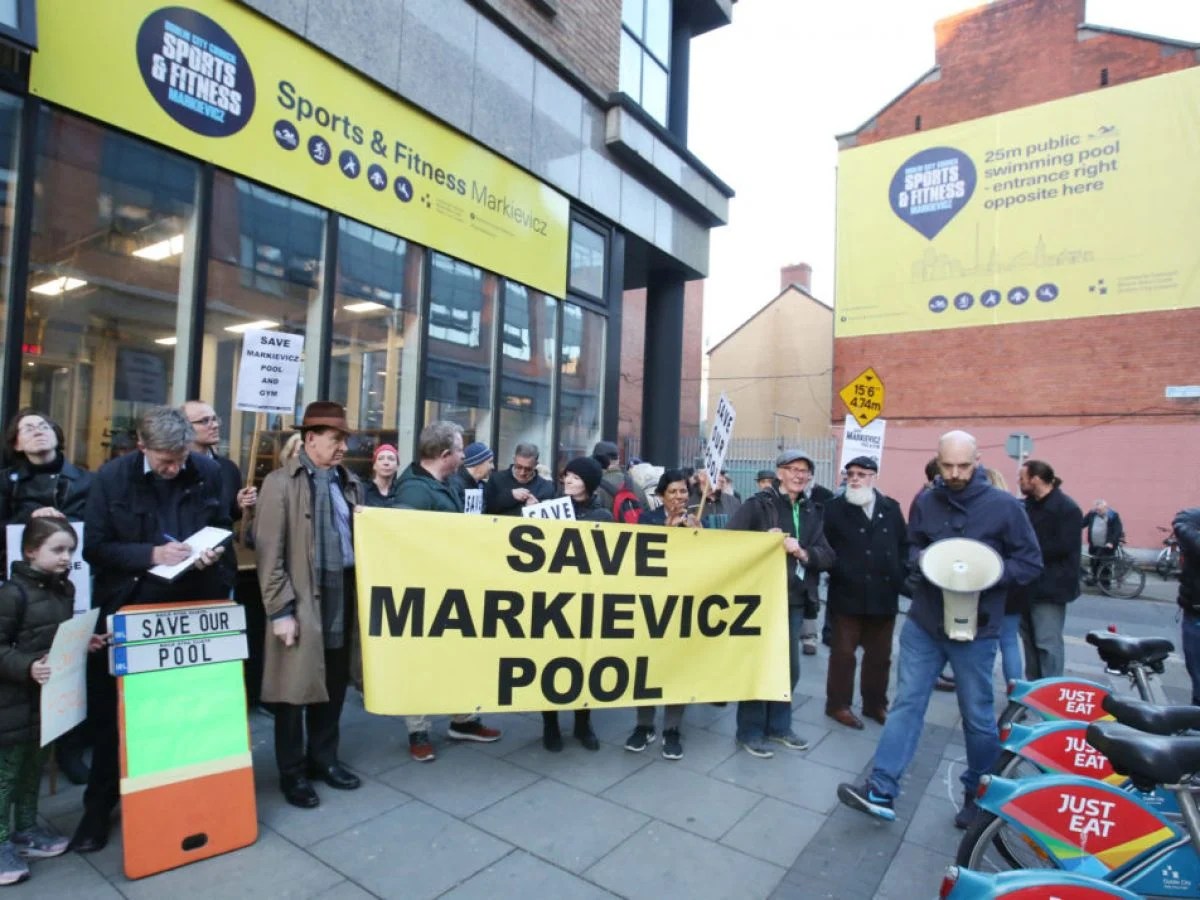
As mentioned in the meeting, an existing facility for the community, the Markievicz swimming pool, despite 1,600 signatures to save it, is to close for the construction of a station for the projected underground Metrolink, another infrastructure planned for private or part-private ownership.4
As one of the community representatives commented, there is already a train station nearby; not only that but the tracks of that station are several storeys above ground, making an underground connection with Metrolink quite feasible.
A rally to promote saving the swimming pool in 2019 (Photo sourced: Internet)
The swimming pool facilities are now to be located at a site 3 km away in Ringsend, a housing district at the end of the docks and partly on the seafront, which has football pitches and green space very close nearby. 5
It is indeed late in the day as indicated by the huge property development on the South Quays but the communities are getting organised as can be seen from this meeting, a commemoration of a fatal 1960s housing collapse and protests about local church neglect by the Diocese.6
Some may think it is too late or that the speculative property and financial forces ranged against them, with their multiple political and other connections, are too strong. But their community’s needs now and for generations to come are powerful incentives for which to struggle too.
The south and north quays communities, neglected by the authorities and rode over roughshod in the past, with their remnants now under threat, are essentially working and lower-middle class communities which have never been given the resources they earned and deserved.
As in many other parts of Dublin, working class communities were ravaged by the heroin epidemic in the 1980s and regarded in the main by the authorities as a policing problem, with anti-drug campaigners ironically targeted more than drug lords.
In the course of that social crisis, many developments of physical and political nature took place which the working class was not well-placed to resist.
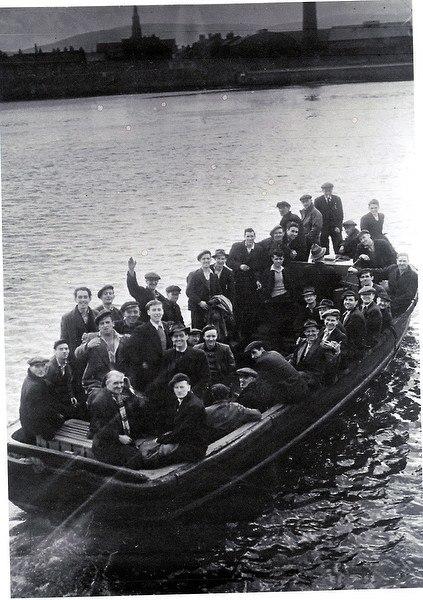
An outing on the old Liffey ferry boat, in regular use when there was no bridge crossing the Liffey eastward and downriver past Butt Bridge (Photo sourced: Dublin Dockers’ Preservation Society)
However, the people of the docklands were an important part of the working class movement in the early 1900s, winning many union battles against the employers until defeated by the latter’s alliance with police, magistrates, churches and media after eight months of struggle 1913-1914.
They rose out of that defeat and rebuilt their fighting organisations, including the first workers’ army in the world (and which recruited women, some of them appointed officers),7 fought again in the 1916 Rising and after that in Dockland areas during the War of Independence.
Indeed, during the 1916 Rising it is remarkable that despite British shelling from naval units in the Liffey, they did not attempt to land soldiers on any of the Dublin quays at that time, disembarking British reinforcements into Dun Laoghaire instead and marching 8 miles8 in from there.
If the working class of the south Dublin dockland is stirring it may still achieve more than many may expect.
End.
The Travelodge Hotel, corner of Townsend and Moss Street (Photo sourced: Internet)
FOOTNOTES
1Purchased by Brookfield Asset Management, a Canadian company, in 2022
3Many applications agreed by DCC Planning Department have also been appealed to An Bord Pleanála and that organisation has been immersed in controversy over criminality in management and low staff morale leading to a high backlog of appeals awaiting judgements.
5One could form the suspicion that the ultimate plan is to move south docks working class facilities to Ringsend and Irish Town, with the communities themselves to follow or to fade away, leaving the whole area free for property speculators.
6The diocese protest was not reported on in Rebel Breeze but the housing collapse commemoration, at which the lack of local affordable housing was raised, was.
7The Irish Citizen Army, founded after calls by both James Connolly and Jim Larkin.
The roar of Palestinian solidarity slogans outside the Irish Parliament, Leinster House on Wednesday night must surely have reached the ears of the elected representatives as they debated a motion that “Israel has a right to defend itself”.
The motion is widely seen as part of a narrative, under the cover of self-defence, endorsing the Israeli State in its decades of racism, apartheid, genocide and war crimes and takes place during the Zionist state’s genocidal bombardment of Gaza.
Solidarity colours in the rain (Photo: D.Breatnach)
The rally, the third since last Saturday week1 organised by the Ireland Palestine Solidarity Campaign, attracted many hundreds willing to stand in persistent rain, listen to contributions from speakers and chant slogans, these led by voices in both Irish and Middle Eastern accents.
In fact, a strong trend increasing over recent years has been the presence of Palestinian voices at such rallies, both in speaking and in leading slogan chants, which the rally organisers have not hesitated to facilitate.
View late in the rally (Photo: D.Breatnach)
SLOGANS, SONG AND POEM
On Wednesday evening, some slogans were in Arabic also, such as I think “Tahya Filistina!” (long live Palestine) but sadly not the equivalent in Irish, such as “An Phalaistín abú!” or an alternative, for example: “Saoirse don Phalaistín!” However, one placard in Irish was present (see photos).
(Photo: D.Breatnach)
The slogans in English ran the usual range of call and answer: “Free, free – Palestine! From the river to the sea – Palestine will be free! One, two, three, four – occupation no more; five, six, seven, eight – Israel is a terrorist state! (I prefer “Israel is a fascist state!” myself).
In our thousands, in our millions – we are ALL Palestinians! Boycott — Israel! Irish Government – shame on you!
In 2009, as yet another Gaza bombardment came to an end, I had composed a poem I called The New Wailing Wall. On Wednesday I got it printed in a photocopying shop on my way to the event, by which time it was raining fairly heavily but I was glad to be permitted to read it out at the rally.2
A Palestinian woman sang in Arabic a “song of sadness”, i.e a lament the rhythm of which a lot of people got into, clapping in time. In Irish singing we often don’t like this, as it tends to drown out the words and the musical detail but it seemed to work well enough there.
Later she told me that she very rarely sings but felt she had to give voice to her feelings – and I know some of what she means.
Seen from behind, Palestinian woman singing a lament in Arabic at the rally (Photo: D.Breatnach)
MOTION DEBATED
Inside the home of the Irish Parliament,“the Dáil”3 a motion of support for the Zionist state proposed by the Government had run into problems even before Israel’s bombing of the hospital in Gaza, after which they intensified; the Government insists it will not condemn Israel to any degree.
It is likely that a majority-agreed motion amendment will pass but however will neither assert the right of the Palestinians to their land nor to resistance, nor to the return of refugees, much less condemn Zionism; it should be a cause of shame to all parties and individuals who support it.4
Section of the rally crowed after an hour (some had gone home) in front of the gates of Leinster House (Photo: D.Breatnach)
“Expel the Israeli Ambassador!”
In the street outside Leinster House, there were many calls for the expulsion of the Israeli Ambassador (Out! Out! Out!)
Truly that seems the most effective solidarity move of which we are capable currently.5 Sadly there seems no chance that the Government would even consider doing so.
Even among the Opposition, Sinn Féin these days looks unlikely to support such a move. This is so even though the party’s President, Mary Lou called for the expulsion of the Russian Ambassador in April last year6 and a decade ago, Gerry Adams, for the expulsion of the Israeli Ambassador.7
Some solidarity demonstrators as far back as Molesworth Street while most are in front of Leinster House (Photo: D.Breatnach)Rally supporters refuse to be squashed up on the pavements and spill over into the road. Once again the Gardaí have failed to close a road to avoid accidents and Dublin Bus has failed to instruct drivers to take alternate routes; the roof of a trapped bus may be seen in the far background. (Photo: D.Breatnach)
Colombia threatened to expel8 the Israeli Ambassador but the leaderships of the EU and the UK are securely tied to the war-chariot of the USA and there’s never any doubt about what the US wants, which is total support for its safe9 Middle Eastern foothold – Israel.
Colombia told the ambassador to behave himself or leave, after the Zionist publicly criticised Colombia’s President comparing the Israeli state’s discourse about and treatment of the Palestinians to that of the Nazis towards the Jews10 (but Israel is Colombia’s main weapons supplier).
A sentiment increasingly finding favour (Photo: D.Breatnach)
OUTLOOK FOR THE FUTURE
In the immediate future, the Zionist authorities have said they intend to invade Gaza to clear out “Hamas”, in which they will of course include all Palestinian armed resistance. Of course, solidarity demonstrations will continue or even intensify.
If Israel invades, it is difficult to imagine that the Palestinian guerrilla resistance movement, including Hamas, Islamic Jihad and PFLP11, will allow that without putting up a fierce struggle.
(Photo: D.Breatnach)
Israel has the tanks and planes but fighting on the ground in ruined urban landscapes, when every pile of rubble may hide a tunnel, a bomb or a rocket-launcher, is a different game.The 5-months-long Battle of Stalingrad comes to mind and an Al Jazeera contributor came to the same conclusion.12
Also, other elements such a Hizbollah may open up new fronts, in particular in the Golan Heights and Lebannon, as the PFLP has urged. Imperialism and complicit Arab regimes are extremely worried about a flame reaching their combustible possessions in the region.
Massive solidarity demonstrations marched through Yemen, Lebanon and Jordan and even the collaborator military regime in Egypt was obliged to open the Rafah crossing gates for humanitarian aid to reach Gaza (with which the Zionists and the US had to reluctantly agree).
Huge solidarity and protest demonstrations have also taken place in Athens, London and other European cities, while the French government banned any such demonstrations. Texas in the USA also saw a huge demonstration and 500 Israeli protesters were arrested demonstrating in Israel.
However the regimes have weathered such storms before and may do so this time again.
Possibly the West Bank will rise up too, although Al Fatah still has a lot of influence there, despite its discrediting by corruption, nepotism and signing the Oslo Accords and with its leadership deeply compromised as a result.13
The Palestinian Authority goons (there are 80,000 of them) fired on demonstrations demanding action in solidarity with Gaza, and in Jenin killed a 12-year-old girl and seriously wounded a first-year university student. 14
The military command of Al Fatah told collaborator Abbas to step down15 but their objective is still the discredited and impossible two-state “solution”.
The 2-State idea was bad in 1993 but …
… even worse in 2019 (Source image: Carnegie Council)
This “solution”, which the US and the rest of the Western states support, proposed to give the Palestinians less than 40% of their territory, the worst and least-watered, chopped into sections with narrow corridors through the Israeli lands and always under the guns of Israel.16
A Palestinian state would have neither true environmental, population, political nor civil control. Never a good choice instead of a secular state of Palestine for all, even this colonial option is clearly unworkable, sabotaged by the Zionists themselves with their settlements dotted all over it.
It is shameful to even propose it as any kind of solution.17
In the longer term, Israel’s consolidation of partnerships with a number of Arab states may have been harmed by the Zionists’ savagery and racist discourse towards the Palestinians but how deeply is difficult to predict.
Whether the Palestinian resistance and particularly Hamas is strengthened or weakened in the eyes of the Palestinian mass likewise remains to be seen.
The mostly imperialist western states of Europe and America show no sign of weakening their allegiance to the world imperialist leader, the USA and therefore, once they get over their weak criticisms of Israel’s genocide, will continue to support the Zionist state into the future.
Like many other problems on this Earth, workable solutions depend on changing some fundamental features in the world order.
end.
A historical reference to the Balfour Declaration of the Imperial Conference of British Empire leaders in 1926 giving European Jews rights to the British Mandate territory of Palestine, where approximately 10% of the population were Middle Eastern Jews at the time, the rest being Palestinian Muslims and Christians. (Photo: D.Breatnach)The rally, though thinning, is still ongoing behind photographer after perhaps two hours. Gardaí have FINALLY closed Kildare Street and a Dublin Bus has managed to turn around and exit. This has been the pattern in a number of Palestine solidarity rallies so far, when the Gardaí must have known the attendance would be large and the street should be closed for safety and traveler convenience sake. (Photo: D.Breatnach)
FOOTNOTES
1Another, last Monday week, had been organised by the Irish Anti-War Movement (effectively the People Before Profit political party).
3That is its name but there are those who refuse to call it that, saying that only an all-Ireland parliament deserves that title, such as the one founded during the War of Independence 1919-1921.
8It was reported that Colombia HAD expelled him and that was repeated at the rally but according to reports from there reaching now, he was only threatened with expulsion if he didn’t shut up.
9Probably the only state in the Middle East, because of its colonialist nature, that is safe from either national liberation uprising or Muslim fundamentalist revolution.
10This is a parallel so obvious that it occurs to a great many people across the globe but it is one that the Israeli authorities rejects and which it condemns as “anti-semitic” with the backing of many different authorities in the West.
17And the history of the Zionist colonisers shows that even with that, they would be forever pushing further, grabbing more land, killing more Palestinians in flare-ups (think the history of the European colonisation of the indigenous Americans in what is now the USA).
People who have lived for generations in the Dublin dockyards have been getting the feeling for some time that the city planners don’t want them there and that as in Ewan McColl’s song they’d “better get born somewhere else” and “go, move, shift!”1
Recently I met with a small group of people, men and women from the Dublin docklands area south of the Liffey2 as they discussed their difficulties and what they might do about them. They wanted an article written on the issues for circulation among their communities.
Artist’s impression of the “Two Fingers” tower blocks planned by property speculator Johnny Ronan amidst existing “glass cages”. The tower blocks were ultimately denied planning permission but many others got the go-ahead. (Image sourced: Internet)
They observe their areas being taken over by high-tech and service industries, accommodation blocks built for those who can work for the high-tech corporations and pay the high rents but their own class largely employable only in low-earning service work for the corporations.
They see in this a process being facilitated by the State, the municipal authority, the banks and of generally little concern to the political class, who either benefit from the process direct or indirectly or at best, view it as regrettable but inevitable.
Wallace’s coal depot, Ringsend Road, Great Canal Basin circa 1950s perhaps. Imported coal was unloaded mechanically or by physical labour and stored here to be delivered to smaller depots and large establishments in lorry loads, or to houses and more modest commercial establishments by physical labour (coal-heavers) working from horse and cart or, later, lorries. (Photo: Toírdhealach Ó Braoin)
One only has to consult living memory or to compare photographs of some scenes in the past with “the new glass cages that spring up along the quay”3 in the same locations today to see that they are not imagining things or unduly exaggerating them.
Contemporary photo: This is the only traditional pub left and one of the few traditional-type buildings on the South Dublin Docks once Butt Bridge is passed. (Source photo: Dublin Dock Workers Preservation Society)
FURTHER BACK
Previously the docklands both sides of the river were, for the most part working class areas. The employment available for men was labouring on the docks, unloading and loading ships and delivering or distributing those loads by horse and cart.
There were also small industries and warehouses and even small animal enclosures or yards, including even a couple of tiny dairies.
The major work for women was in the home, raising large families but with some outside work available in food processing such as in bakeries, factories such as Boland’s Mill, clothes-making, mending and laundry. Second-hand clothes were sold too and fresh farm food, fish and shellfish.
Another coal importing company with an unloading and storage space on the south Dublin quays, circa 1950s. (Source photo: Dublin Dock Workers Preservation Society)
It was in these areas that Jim Larkin and James Connolly mostly made their mark in the first decade of the last century, forming the largely unorganised ‘unskilled’4 workers into the Irish Transport & General Workers’ Union, winning wage rises and improvements in working conditions.
It was surely no accident that the ITGWU’s headquarters, the original “Liberty Hall”, was located in dockland, just off Eden Quay in Beresford Place and across the road from the Custom House.
When the union began to impinge on William Martin Murphy’s commercial empire in 1913, Murphy began to build a union of employers determined to break the workers’ union.
The working class of Dublin, whether ITGWU members or not, … Stood by Larkin and told the Boss man We’d fight or die but we would not shirk.”
For eight months we fought And eight months we starved – We stood by Larkin through thick and thin; But foodless homes and the cry of children, They broke our hearts and we could not win.”5
In the 1913 Lockout the employers had the main mass media on their side: the anglophile Irish Times, the nationalist Irish Independent and Freemans Journal. The church hierarchies, Catholic and Protestant, stood with the employers; the Legion of Mary refused help to strikers’ dependents.
Mass meeting of workers and children (some of the children also workers, e.g the newsboys) on a Dublin quayside during the 1913 Lockout. “Murphy” refers to William Martin Murphy, prominent capitalist, owner of the Dublin Tram Company, Irish Independent and the Imperial Hotel in the Clery’s building. (Photo sourced: Internet)
The magistrates fined and jailed strikers and supporters, while the Dublin Metropolitan Police clubbed them. After two workers were fatally injured by police batons on Eden Quay,6 the ITGWU formed the Irish Citizen Army, the first army in the world of workers for the working class.
People with few economic and financial resources find it difficult to sustain long struggles and eight months would be a very long industrial struggle even today.
In the Dublin of 1916 and with the living conditions of the working class of the time, and mostly with previously unorganised workers, it was a heroic effort.
The ITGWU was temporarily defeated – Connolly called it “a draw” – but the working class remained. Those that were not sucked into the butchery of WWI continued living in the area and tried to find work where they could.
Despite that defeat and emigration or British Army WWI recruitment, the Irish Citizen Army was able to field 120 disciplined fighters, male and female, in the 1916 Rising and fought in a number of engagements. By 1919 the union’s recruitment surpassed that of 1913.
Over years the docks area saw slow decline as shipping traffic decreased. Emigration soared and, despite large families, the Irish population remained stable7. The working class population of Dublin city centre’s tenements was cleared and moved to large housing schemes on the city’s outskirts.
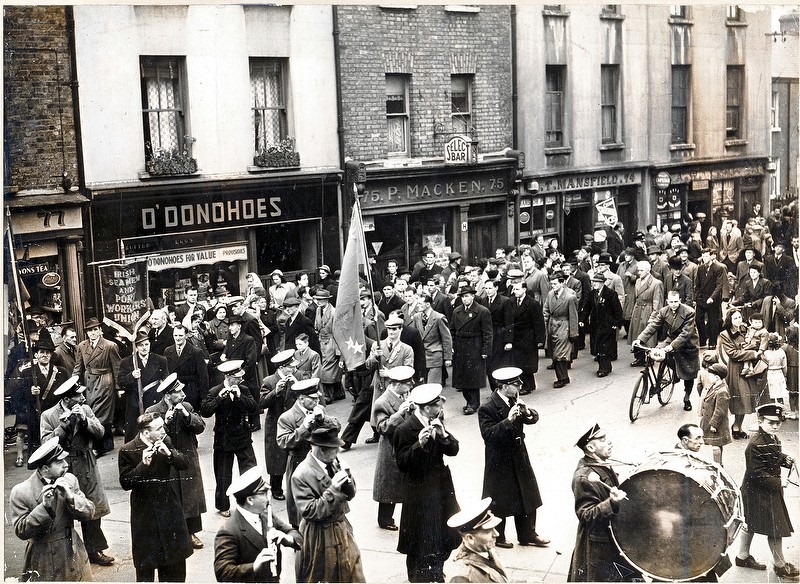
Men, women and children in a march of the Irish Seamen & Port Workers’ Union (now amalgamated into others) along south Liffey dockland some time before 1955. Note the medals on elderly man front left, possibly IRA medals from the the 1916 Rising and/ or War of Independence. (Source photo: Dublin Dock Workers Preservation Society).Another view including the flute and drum band, Starry Plough Flag (the Tricolour is being carried on the far right of photo) and trade union standard. (Source photo: Dublin Dock Workers Preservation Society).
Those who remained received some municipal housing in pockets, often neglected by the municipality, their children educated but very rarely to university8 level, their traditional work largely disappearing. And a significant minority turning from lack of hope to substance misuse.9
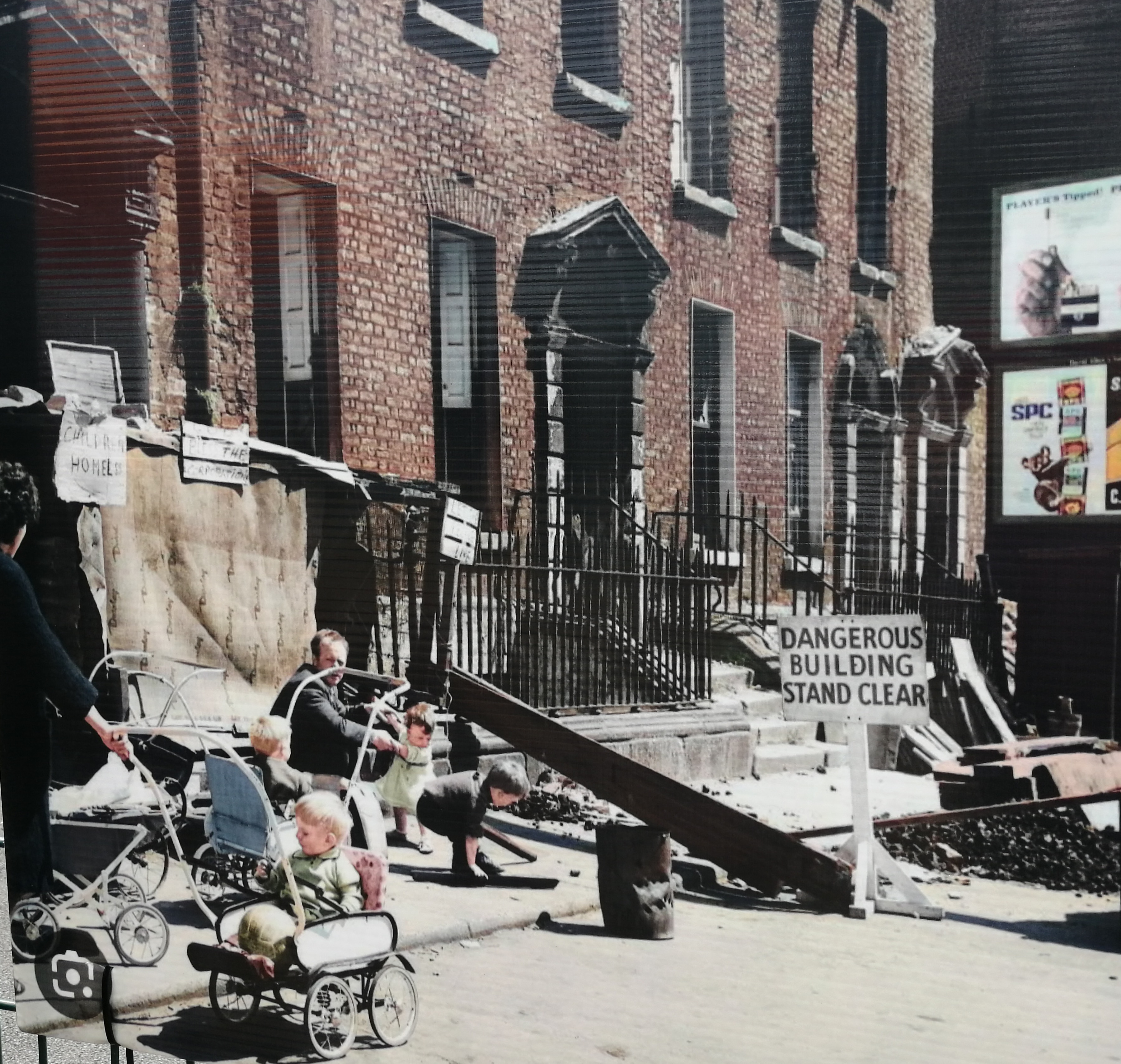
Houses in danger of collapse after an already collapse, Fenian Street, south Liffey dockland, 1963 (Photo source: Display at Andrew’s Court commemorative event of 1963 building collapse that killed two girls).
SOLUTIONS
Inclusion was a key word brought to the discussion I was invited to hear, with a number saying that “social inclusion” had been listed among objectives of a number of plans for the area but which failed to be achieved despite its listing.
The character of the area is of course changing with a certain amount of gentrification and some people even feeling they were looked at as though not welcome in the park they had played in as children and teenagers, or not welcome in local pubs under new management or new cafes.
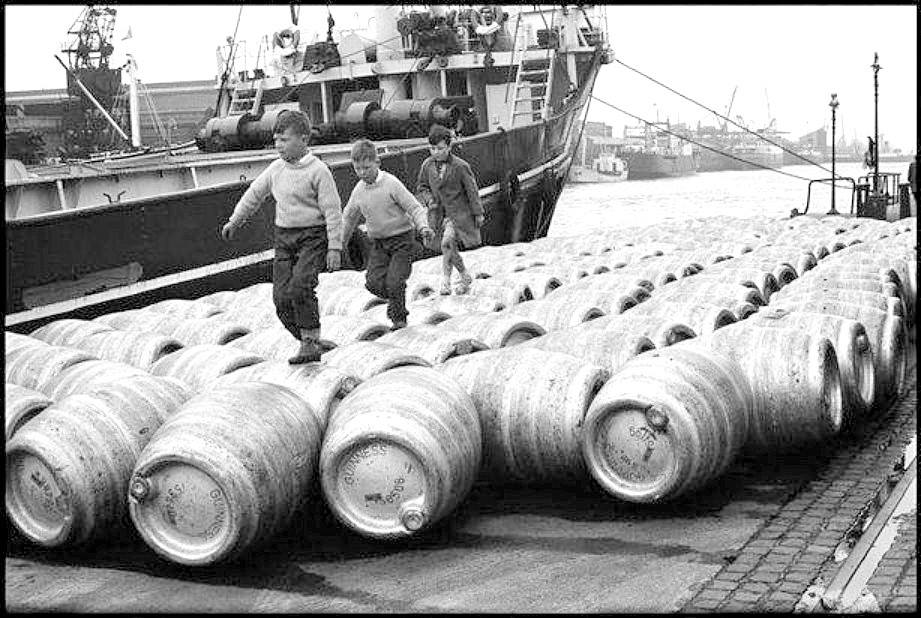
Children balancing on Guinness aluminium kegs beside docked ship on south Dublin quay with ships docked on the north quays also, circa 1950s. (Source photo: Dublin Dock Workers Preservation Society)
The kind of education working class people receive was discussed as an important factor with the mention of STEM, an educational program to prepare primary and secondary students for college, graduate study and careers in the fields of science, technology, engineering and mathematics.
Without that kind of preparation and qualifications, the group felt that children from their area had no chance of employment with the corporations now basing themselves in the docklands.
One of the group stated there is an annual special STEM seminar run at the RDS; however none of the others had heard of the seminar.
Another described a “Speed-date-type” careers advice session attended once, where students could spend a short time at one career table and move on to another. Another talked about career-planning advice for parents with which to to help their children.
Circa 1950s, family group, Gasometer in background [note also the old gas street lamppost behind man on the right]. (Source photo: Dublin Dock Workers Preservation Society)
The feeling of a lack of corporate responsibility for the people of the area in which the corporations have set up was clear.
The Ballybofey urban regeneration project was mentioned as a possible model along with Our Town urban centre projects.
If education is the key for integrating the local working class into most of the employment available locally, I wondered aloud, how would that work without housing? One of the group has already had to move out of the area for an affordable home and is intending to move further out still.
Already this means use of private transport and hours added to the working week, increasing the further out is the next home. Another said a survey found that the employment of 88% of the community was outside the area, while only 12% was local (with the carbon footprint involved).
Two-storey housing in good condition on South Lotts in south Liffey docklands – photo shows July commemoration of socialist revolutionary James Connolly and his family living there 1910-1911 (Photo: D.Breatnach)
COMMENT
My own feeling is that the first requirement is that homes need to be available for working class people in their area and that, I also feel, has to entail a local construction program of affordable public housing, ideally by a State or municipal building company.
But if people are not to have to travel outside their areas to work, as 88% are doing currently (according to the aforementioned survey figures), then they must have local employment and in turn that, in the main means with the hi-tech corporations, for which they need to be trained.
The group was very clear and in agreement on this point, whether the training is to be delivered by the corporations, by the State or by a mixture of the two.
When area developments or redevelopments are being undertaken, it is essential that the local communities are part of the process; otherwise tree-planting, city squares and delicatessen-cafes become not so much an addition to the people’s lives, as markers for their class’ replacement.
Whether in the end I agree with the way the group sees the solutions or don’t is not I feel the most important thing, which IS that they are wanting to organise and to take their future into their own hands. It is in that act alone that there can be hope for the future.
End.
FOOTNOTES
1A song about the persecution of the nomadic people, e.g Romany Gypsies and Travellers.
2Basically from the Pearse Street and Ringsend areas.
3Line from Dublin In the Rare Aul’ Times song by Pete St.John.
4A term often applied but rarely understood – labourers quickly become skilled in their work or they lose employment or become injured or killed at work. What the term really means is “manual worker who does not have a recognised qualification in at least one manual trade”. I have worked at both ends of that spectrum.
5 The Larkin Ballad by Donagh Mac Donagh, son of executed 1916 commander Tomás Mac Donagh, executed after the surrender of the 1916 Rising by British firing squad.
630th August, the first month of the dispute by DMP baton-charge on mass meeting around Liberty Hall. The following day (Bloody Sunday 1913, wrongly accounting for the two fatalities in many on-line sources), the DMP rioted again in O’Connell Street but most of the ITGWU had avoided it by rallying at their Fairview premises.
7The Irish population – though habitually of large families – remained largely stable for roughly a century after the Great Hunger’s death toll and mass emigration had reduced the island’s population by three million – until the upswing of the ‘Celtic Tiger’ economy began to increase it through immigration and reduction in emigration.
8Indeed, until 1966 most working class children left school at fourteen years of age, since secondary-level schooling was only ‘free’ (not for books, equipment, uniforms) up to that age.
9Middle and ruling class people misuse substances too – indeed some drugs, such as cocaine are much more used by “professional” classes – but they have living conditions varying from comfortable to luxurious and a range of choices for themselves and their children – not to mention expensive rescue services when they fall.
As I locked my bike up in Dublin City centre today, about to take a longish bus journey, two worlds connected around me.
Seeing a young woman collecting rubbish from the pavement to put in a litter bin, I became aware that she was the user of a nearby tent. I have to admit I was impressed with the focus on clearing of rubbish and noted an older van driver looking too.
Taking out my wallet I gave her some money with a brief word of encouragement and thought I heard the van driver giving out to me for doing so. Ignoring him, I got ready to cross the street to the bus stop. “Hey!” he shouted at me.
I turned back to him, ready for an argument.
“Did you just give that girl some money?” he asked.
“Yes,” I replied, (restraining myself from adding “and what of it?”). I was ready to meet aggression if it was coming but didn’t feel the need to start it.
He stretched out his hand to me, holding out a ten-euro note: “You dropped this.”
“Oh, thanks,” sez I, accepting the note, “I thought you were going to tell me off.”
He looked taken aback. “Not at all, sure I sometimes give her some money too.”
We shook hands and I crossed the road, reflecting that mine and the van driver’s world had briefly and in a small way intersected with the young woman’s world.
Outside, in yet another world, a state is carrying out genocide against a people in full view of the World, not just with western states’ compliance, as occurred with the genocide against the Jews in the 1930s and ‘40s, but this time with the actual encouragement and active collusion of the western states.