INTERNATIONALIST SOLIDARITY – THE DIVIDING LINE BETWEEN THE PEOPLE AND OUR RULERS

Diarmuid Breatnach

(Reading time: 12 mins.)

The oppression of the Palestinians led to an outbreak of active resistance recently in Jerusalem, to which the Israeli Army reacted with increased repression, timed to harass Palestinian Muslims during the period of Ramadan.

At the height of devotees attending the Al-Aqsa mosque, this escalated into attacks on worshippers within the temple itself. At the same time, Israeli Zionist settlers threatened dozens of Palestinian families with eviction from their homes in East Jerusalem.

Reacting to these events, one of the Palestinian organisations fired home-made rockets into officially Israeli territory, to which the Israeli armed forces responded in turn with drone missiles and missiles from its air force jets on Gaza.

The Zionist military fired on protesting Palestinians in the West Bank with live ammunition. The death toll has climbed to 200 Palestinians, according to Gaza’s Health Ministry, including 59 children and 35 women, with 1,305 people wounded. Ten Israelis have been killed, two of them children.

The casualty figures once again show the gross disproportion between what the Palestinians and their Zionist masters experience: in civil and human rights, citizenship, in land ownership, electricity and clean water supply, heating, fishing, education facilities, building materials …

… in freedom to travel inside and outside the state, in depth and breadth of surveillance, in arms and defence capability, in states that support them.

And in city structural damage: despite the many home-made rockets launched against the zionists, there has yet been no significant damage in Israeli towns, while their armed forces have effected large-scale structural damage in Gaza and bodies are still being pulled from the rubble.

In only one area perhaps do the Palestinians have the advantage over the Israeli Zionists: in support among the people around the world.


Israeli Zionist missiles strike the tower housing many media services, including Associated Press and Al Jazeera, which drew broad criticism from the mass media for a change. But families also lived here. Everyone was given ten minutes to get out. The Israeli Occupation Force has not yet bothered to explain its rationale for targeting this building. (Photo source: Internet)

PALESTINIAN SOLIDARITY MARCH DEFIES POLICE THREATS

Responding to these attacks on Palestinians, the Ireland Palestine Solidarity Campaign, the main organiser of Palestinian solidarity action in Ireland, called for solidarity demonstrations and in particular advertised a solidarity rally to take place in Dublin’s city centre for 2pm on Saturday 15th May.

The organisation asked those in attendance to comply with measures against Covid19 infection, to wear masks, maintain social distancing and comply with stewards’ instructions.

However the IPSC was contacted by the Irish police force, the Gardaí, who told them not to go ahead with the event, that if they did they would intervene to stop it and also made threats of €5,000 fines and prison against the organisers.

In a later public statement the Gardaí declared that they “have no role in permitting or authorising marches or gatherings. There is no permit/ authorisation required for such events”!

But there is apparently an ability and power to intimidate and threaten progressive organisations to deter them from organising solidarity events.

Or to kettle socialist and socialist republican Mayday marchers and demand all their names, addresses and dates of birth before threatening them with arrest if they did not disperse.

Or to threaten Debenham workers and their supporters, assaulting some of them while escorting KPMG forces in to evaluate stocks during pandemic restrictions.

A Palestinian policeman stands among the rubble of the tower in Gaza recently occupied by families and media agencies. (Photo source: Internet)

The predicament of the IPSC exposed the vulnerability to this kind of intimidation of a broad organisation that seeks to win friends in ruling circles. The leaders and organisers are placed in a position of not only personal but also of organisational vulnerability.

Even should they be prepared to defy the State to fine and/or imprison them, would they also be prepared to damage their organisation or to lose some friends they are cultivating in the circles of political influence?

What was one of the strengths of a broad organisation thus becomes a weakness; a more radical or even revolutionary organisation, with less influence in influential circles can decide on defiance, risk fines and jail with however perhaps less possibility of influencing official opinion and ultimately, action.

Fortunately in this case one such organisation did step forward and took up the baton: the Trinity College BDS group expressed its solidarity with the IPSC on its treatment by the Gardaí and called their own rally for the exact same place and time as the original one called by the IPSC.

https://www.irishtimes.com/news/ireland/irish-news/thousands-attend-rallies-in-irish-cities-in-solidarity-with-palestine-1.4566435

Video of rally at end of demonstration, near Israeli Embassy

Despite concern over Covid19 transmission and Garda threats – and the extremely short notice and much smaller circle of contacts of the TC BDS group — the response was magnificent, both in internationalist solidarity and in maintenance of the right to organise such progressive events.

Before the appointed hour, people began to gather in large numbers at the Spire in O’Connell Street, Dublin’s main street and north city centre.

After being addressed by a number of speakers, they set off in a march towards the Israeli Zionist Embassy near Ballsbridge, beyond the south city centre. As they marched their numbers grew until, approaching the Embassy, they numbered several thousand.

Along the way, bystanders applauded the marchers and passing vehicles blew their horns in solidarity.

A section of the Dublin rally in solidarity with Palestine photographed outside the GPO in the city’s main street before they set off on the 5.5km march to the Israeli Embassy (Photo credit: PA, Breaking News)

Marchers shouted slogans of solidarity with the Palestinians, calling for the freedom of Palestine and the expulsion of the Israeli Ambassador as a mark of the Irish people’s objection to what is being done to the Palestinians.

Near the Embassy, a number of speakers addressed the crowd and after dispersing, a number of demonstrators boarding public transport to return home were congratulated by the drivers.

LESSONS FOR US

The situation regarding calling and holding the demonstration in Dublin outlined some of the weaknesses of a broad organisation when it faces repression from the State and the greater resilience of a smaller organisation in being able to defy the State.

It may be necessary in future to maintain support for both types of organisation, each being appropriate for particular situations.

Also demonstrated was the necessity to openly defy unjust laws and prohibitions at times and particularly around the right to organise, to protest and to show solidarity, which the demonstrators did so well on Saturday.

Such situations also reveal the difficulty for the Gardaí in carrying out repressive actions and they are reduced to threatening individuals.

THE FAR-RIGHT MARCHES TOO – FOR WHAT?

Meanwhile, a couple of hundred of the far-Right also marched in Dublin, allegedly in defence of civil liberty. Not in solidarity with the Palestinians’ civil liberties and not in defence of our civil liberty to organise to show solidarity with people in other struggles.

No, they marched in defence of the right to defy health protection regulations, in proclaiming the Covid19 pandemic to be a) a hoax or b) greatly exaggerated and in claiming that wearing masks damages one’s health and even intelligence(!).

They were insisting that vaccinations are a) dangerous to one’s health or b) means of injecting nano-machines into people’s bloodstream in order to control them.

A clip posted by Ireland Against Fascism showed one of the QAnon Saturday screechers for months outside the GPO, Dolores Webster, aka Dee Wall, lately self-declared “digital journalist” (don’t laugh) posting her reactionary propaganda.

In apparent total ignorance of the actual reality (but when has that mattered?), she broadcasted a claim by video from her studio (her car), accompanied by the strains of Abba from the headphones of her head-bobbing passenger.

She claimed that the “scum in the Dawl” had allowed the Palestinian solidarity march to go ahead to distract from the alleged general removal of freedom and in particular from the far-Right group Irish Yellow Vests to hold their rally on May 1st!

When all the Covid19 precautionary restrictions are removed, what will these elements have to march about? The will need to return to the topics that engaged many of them in the recent past: racism, anti-immigrants, islamophobia, homophobia and anti-socialism, along with their false patriotism.

None of that is welcome of course but at least it will be without this false concern for “civil rights and freedom” and closer to the reality of what the far-Right in general – and fascists in particular — stand for.

SUPERPOWER BACKING AND IMPUNITY

The current atrocities of the Zionist State, which it carries out with impunity, along with its history, starkly reveals the effect of its main backing power, the USA, and the imperialist alliance dominated by that Power.

The USA backs Israel with military aid to the tune of $10 Million daily, which is aside from other direct and indirect aid. Israel is the only state in the Middle East which is not only very friendly to the USA but totally dependent on the support of that superpower.

For the ruling class of the USA, Israel is the only state in the Middle East which is totally safe forever from fundamentalist Muslim revolution or from left-wing anti-imperialist revolution and is therefore an extremely important factor in the USA’s plans to totally dominate the Middle East.

Solidarity marcher in Dublin on Friday with a home-made placard (Photo Credit: PA, Breaking News.ie)

This imperialist alliance finds reflection not only in the action/ inaction of governments in Europe, for example but also in the reporting of the mass media.

One of the latter’s tropes is the constant emphasis on the numbers of Palestinian missiles fired, without revealing their general ineffectiveness in delivering destruction, in total contrast to the Israeli missiles. Another is their constant repetition of a lie, that “Hamas seized power in Gaza”.

The truth is that Hamas swept the board in the 2006 elections for the Palestinian Authority. The “seizing” that was done was by Al Fatah, which usurped the results in the West Bank and installed themselves there; they tried to do the same in Gaza and, in a short fierce struggle, were beaten.

But the Western powers decided that Hamas was illegitimately in power, seized funds due to it and supported its blockading – by both Israel and Egypt.

No explanation is offered in the general mass media as to how a generally politically-secular Palestinian public would turn from its decades of allegiance to Fatah to vote for the fundamentalist Muslim Hamas.

The main reason was Fatah’s surrender of the goals of Palestinian independence and freedom and the return of the refugees, in exchange for running a colonial administration with opportunities for living off bribery and corruption and Fatah’s settling down to that status quo.

CASTING A GIANT DARK SHADOW

It was not only in Dublin and in towns across Ireland that Palestine solidarity demonstrations were held on May 15th but by people across much of the world, generally in opposition to the wishes of their governments and ruling elites.

It is worth thinking about how this has come about, in particular in contradiction to a mass media hostile to the Palestinians.
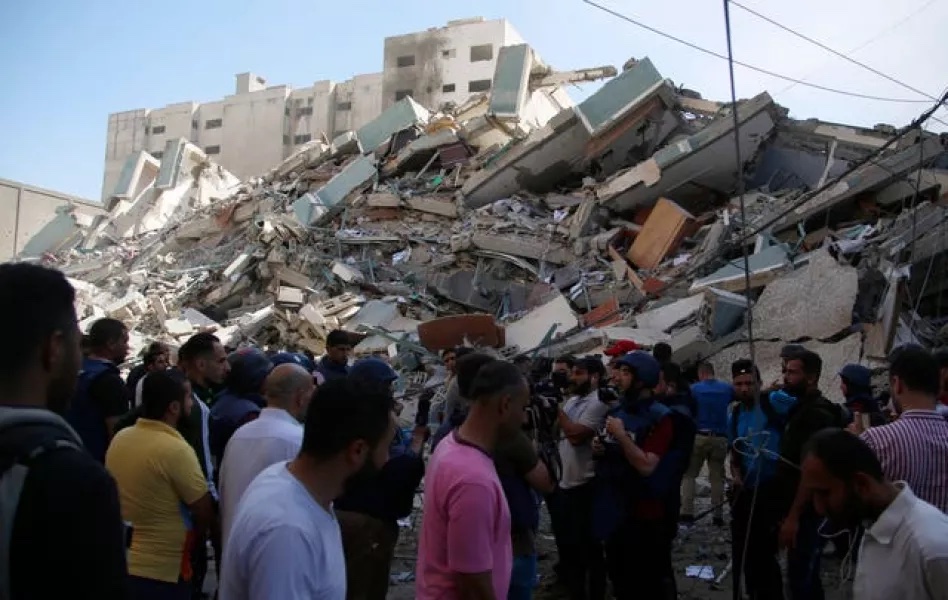
Palestinians come to view the remains of the tower block that was home to families and that housed a number of media agencies. (Photo source: Internet)

The Zionist state of Israel was declared in 1948, its anniversary actually only three days ago – May 14th, the first states to recognise it being the USA and the USSR. In Ireland at the time, there was general support for the new state which continued to the “June War” of 1967 and somewhat beyond.

The general Irish population were horrified by the history of the Nazi-organised Holocaust and sympathised with the Jewish survivors.

Irish nationalists and even Republicans empathised with the Zionist civil and armed struggle against the British (who, ironically, had begun the process of Zionisisation of Palestine).

The 1966 film Cast a Giant Shadow purporting to show that struggle, starring Kirk Douglas and a cameo appearance by Frank Sinatra, was widely enjoyed and cheered in cinemas across Ireland.

Though some of the film’s characters were based on real-life counterparts, the general narrative was a grotesque distortion, hiding the massacres of Palestinians and the expulsion of thousands as the Zionist state was created.

Many Irish language supporters admired how the new state had brought the Hebrew language, for centuries only spoken in religious contexts, back into everyday usage.

Solidarity marcher in Dublin on Friday with a home-made placard and a thought-provoking message (Photo Credit: Sam Boal, The Journal)

Yet, by a few years ago, general pro-Palestinian sympathy across Ireland had become so strong that Israel’s Ambassador to Ireland declared the country “the most anti-semitic in Europe”. That of course is the Zionists term for anyone who supports the Palestinians or criticises the Israeli state harshly.

Only a few days ago, the current Ambassador accused some politicians of spewing hate towards Israel. He was responding not only to Left and Sinn Féin TDs who criticised the actions of Israel towards the Palestinians, but also to the Tánaiste (Deputy Prime Minister equivalent) Leo Varadkar!

Varadkar had commented that Israel’s actions are “indefensible” and Government Minister for Foreign Affairs Simon Coveney said at an EU conference that the EU had “fallen short” and failed to project its influence in agreeing a position in against illegal activity by the Israelis against Palestinians.
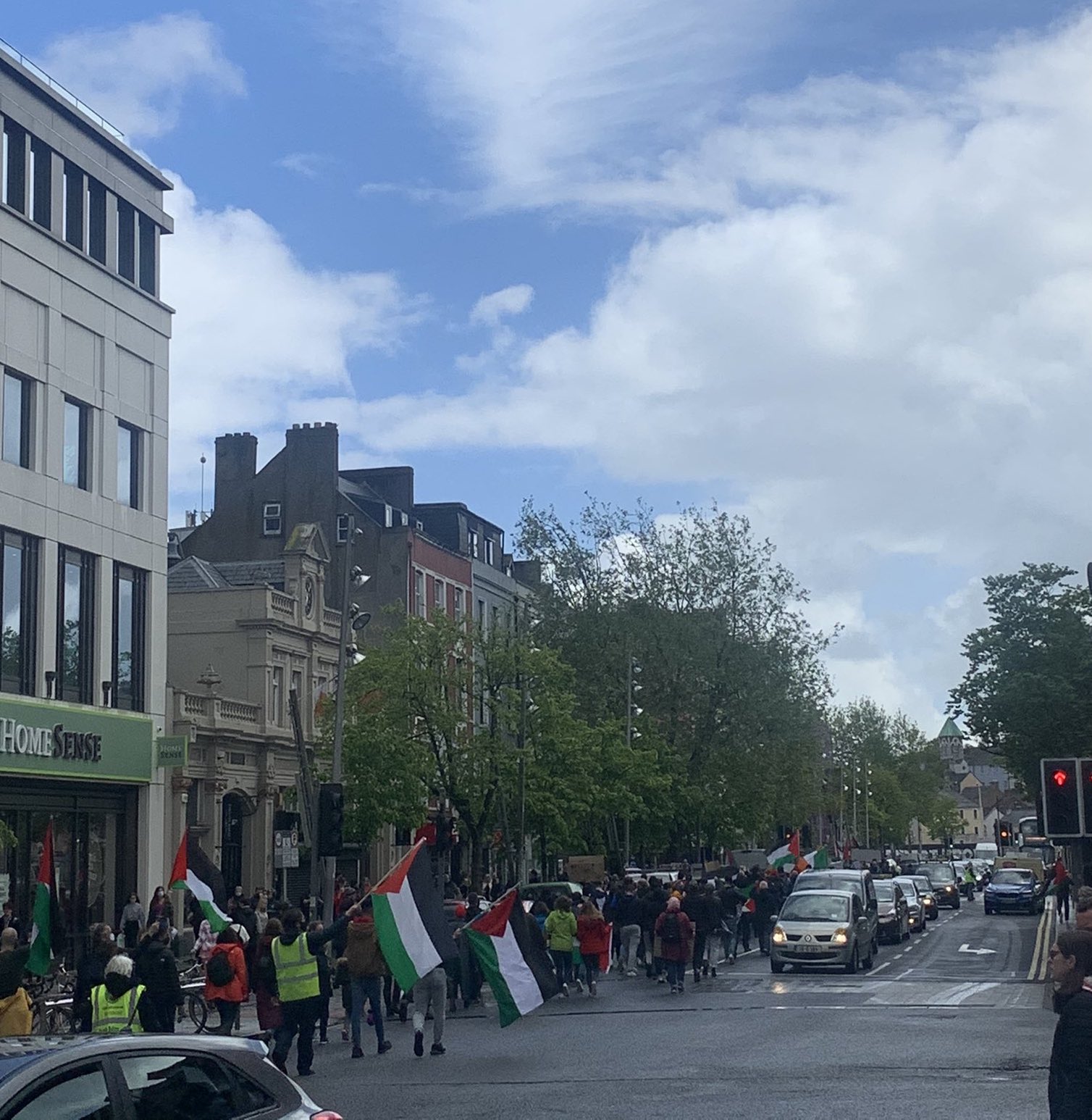
Palestinian solidarity march in Cork on Saturday (Photo source: Internet)

The fact that establishment right-wing/ conservative politicians feel obliged to take a public stand, however ineffectively, against actions of the Israeli Zionists is a strong indication of how much Irish public opinion has changed over decades.

Implicitly such stands reflect against the Zionists’ biggest international backer and world superpower, the USA. Since the Cast a Giant Shadow film, the state’s shadow of which we are aware now is indeed frighteningly giant and very dark.

In response, the natural cultural and historical feelings of the Irish people have stirred in sympathy with the oppressed Palestinians – and in defiance of threatened police repression at home.

end.

SOURCES

Coverage of events in Ireland: https://www.thejournal.ie/peacful-protests-solidarity-with-palestine-5438356-May2021/

https://www.irishtimes.com/news/ireland/irish-news/thousands-attend-rallies-in-irish-cities-in-solidarity-with-palestine-1.4566435

https://www.breakingnews.ie/ireland/protests-held-around-the-country-in-support-of-palestine-1127787.html

Recent reports on the conflict: https://www.nbcphiladelphia.com/news/national-international/weary-gaza-marks-muslim-feast-as-violence-spreads-in-israel/2812715/

https://www.bbc.com/news/world-middle-east-57138996

Israeli Ambasador to Ireland clashing with politicians: https://www.irishtimes.com/news/politics/israeli-ambassador-accuses-some-tds-of-spewing-hate-towards-jewish-state-1.4564184

Dawdling in Dalkey & Dún Laoire

Diarmuid Breatnach

(Reading time text: 5 mins.)

Farewell, sweet Dublin’s hills and braes
To Killiney’s Hill and silvery seas,
Where many’s the fine long summer’s day
We loitered hours of joy away.

(The lyrics I see have “silvery streams” whereas I somehow learned “silvery seas” but in any case the latter lines seem more appropriate to me).

Near Killiney is Dalkey in south County Dublin and above both is Killiney Hill, a mostly public hilly woodland with some great views of the Mediterranean-like bay below. Dalkey might be a Viking translation of an Irish place-name, Deilg-Inis, meaning “Thorn Island”. Of course it is just possible too that the Irish translated the Viking name but not likely. The Vikings were here of course, a place of small coves between their towns of Wicklow and Dyflin.

VIEWS FROM THE HILL

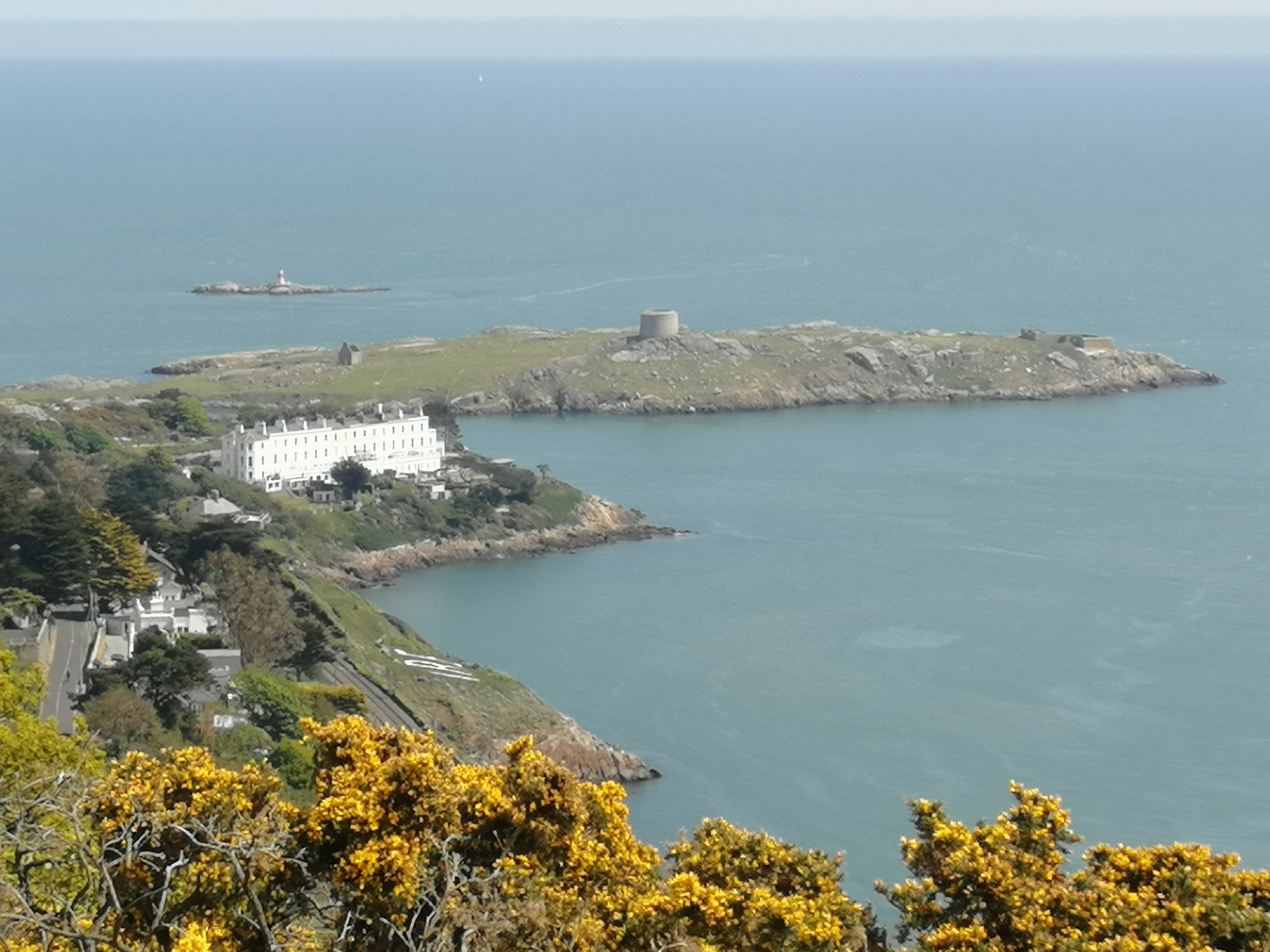
Dalkey Island (Deilg Inis) in the distance from Killiney Hill, gorse (furze – aiteann) in bloom in the foreground (Photo: D. Breatnach)
Closer view, showing the Martello Tower in the centre of the island. Ireland has a number of these, built to give warning of Napoleonic invasion or raid on the UK (in which all of Ireland was at the time). (Photo: D.Breatnach)
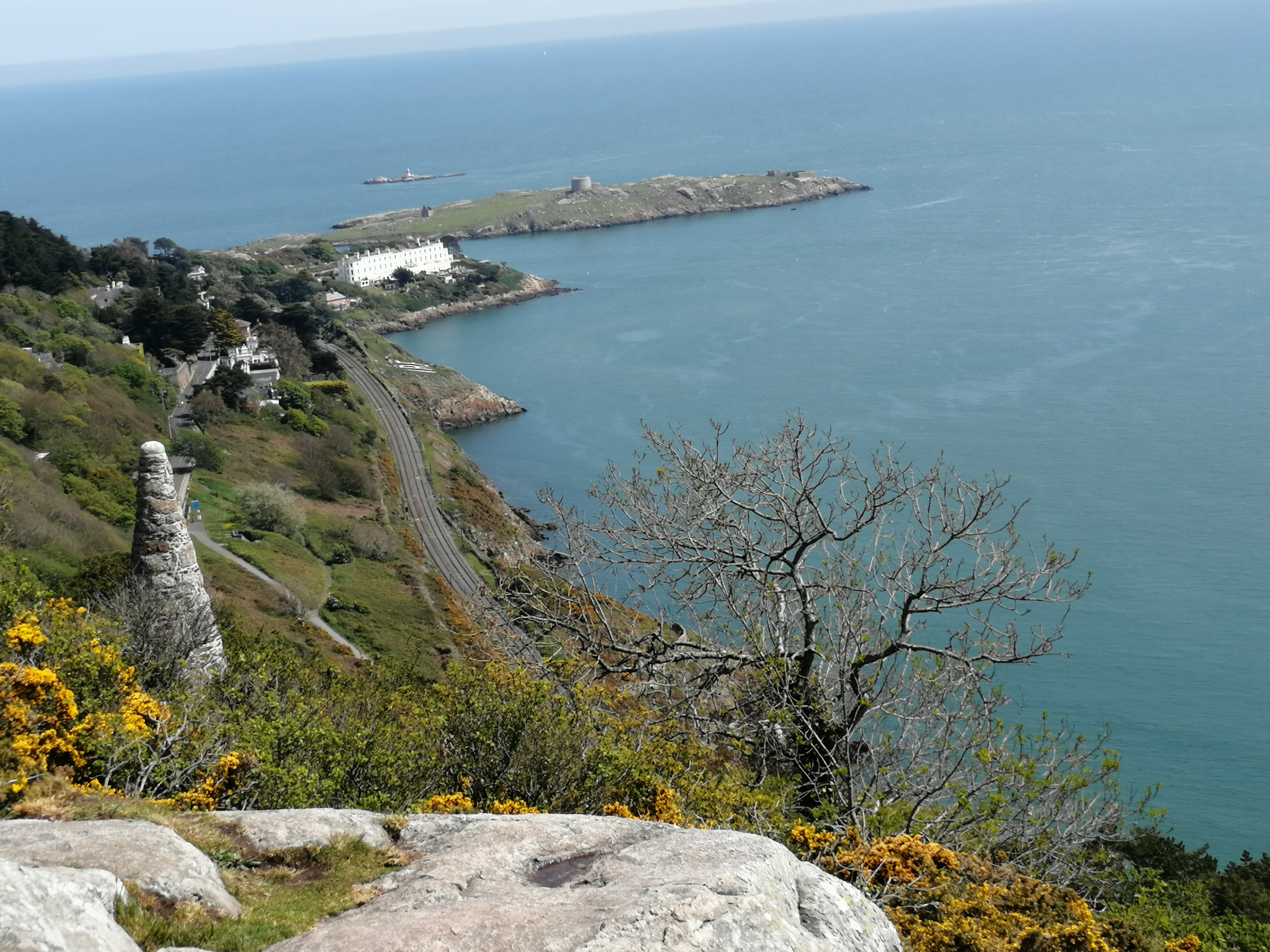
A view from a somewhat different point, showing also a strange stone tor to the left (which I don’t recall from before) and the stone underneath me of which much of the Hill is made. On a hot day in late summer in my teens, I heard small pistol-like shots erupting over the hillside — the pods of the gorse were exploding and shooting out their seeds. (Photo: D.Breatnach)
The path and slope up to the woodland and hilltop. For a few weeks I used to meet lads from the ‘Noggin (Sallynoggin) and we’d go hunting rabbits with our dogs, through common and private land, up to Killiney Hill (where the dogs always claimed they could smell rabbits but all we could see was their shit), then down to the sea and encourage the dogs to go for a swim to clean them. And throw in the ones who declined. Of course, they got their revenge shake-drying themselves all over us. (Photo: D.Breatnach)
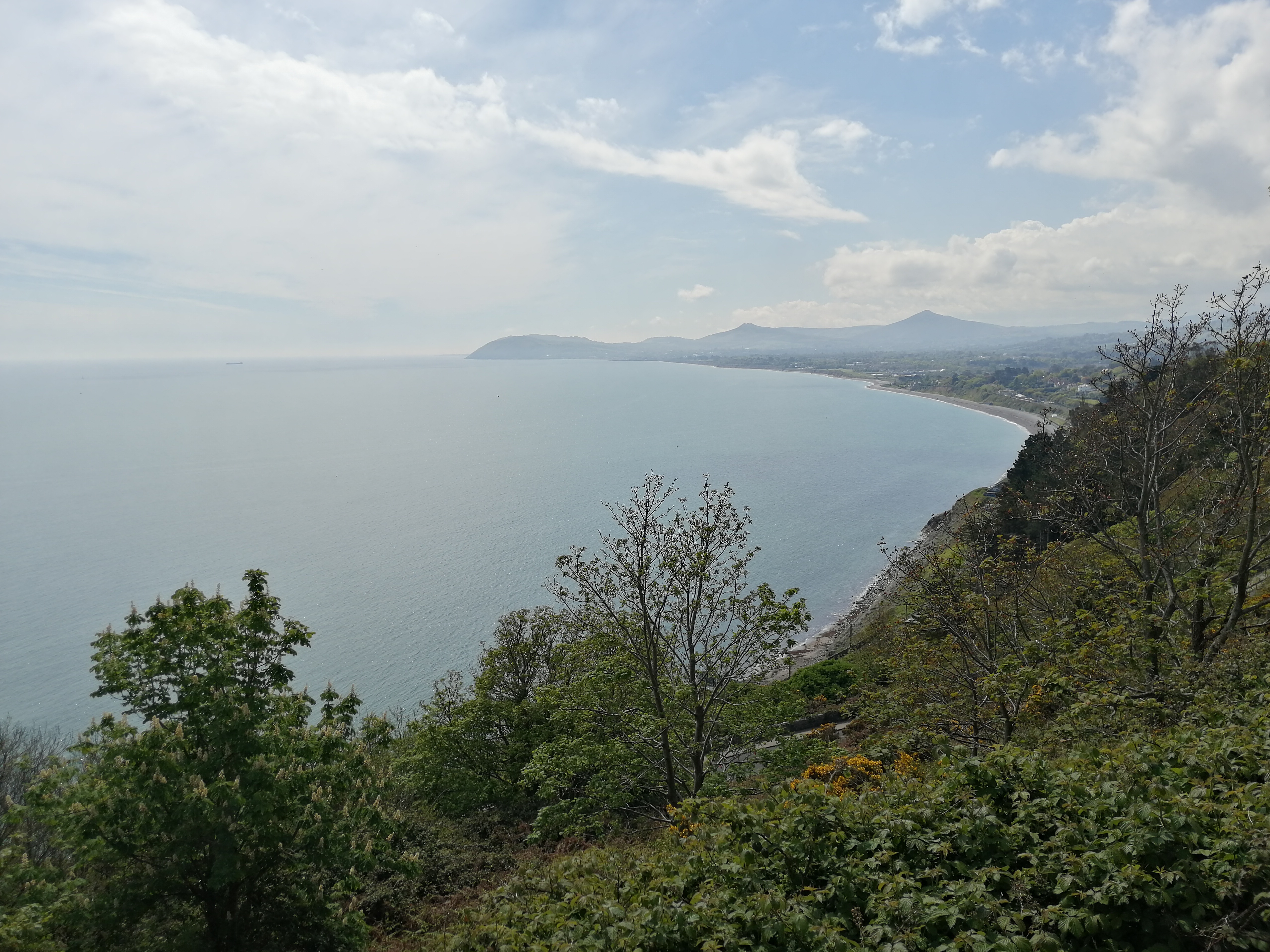
A great view of the bay from the path, the pronounced peak of the Sugarloaf in the distance. County Wicklow begins just a little down below to the right. (Photo: D.Breatnach)

It’s now I must bid a long adieu
To Wicklow and its beauties, too …..

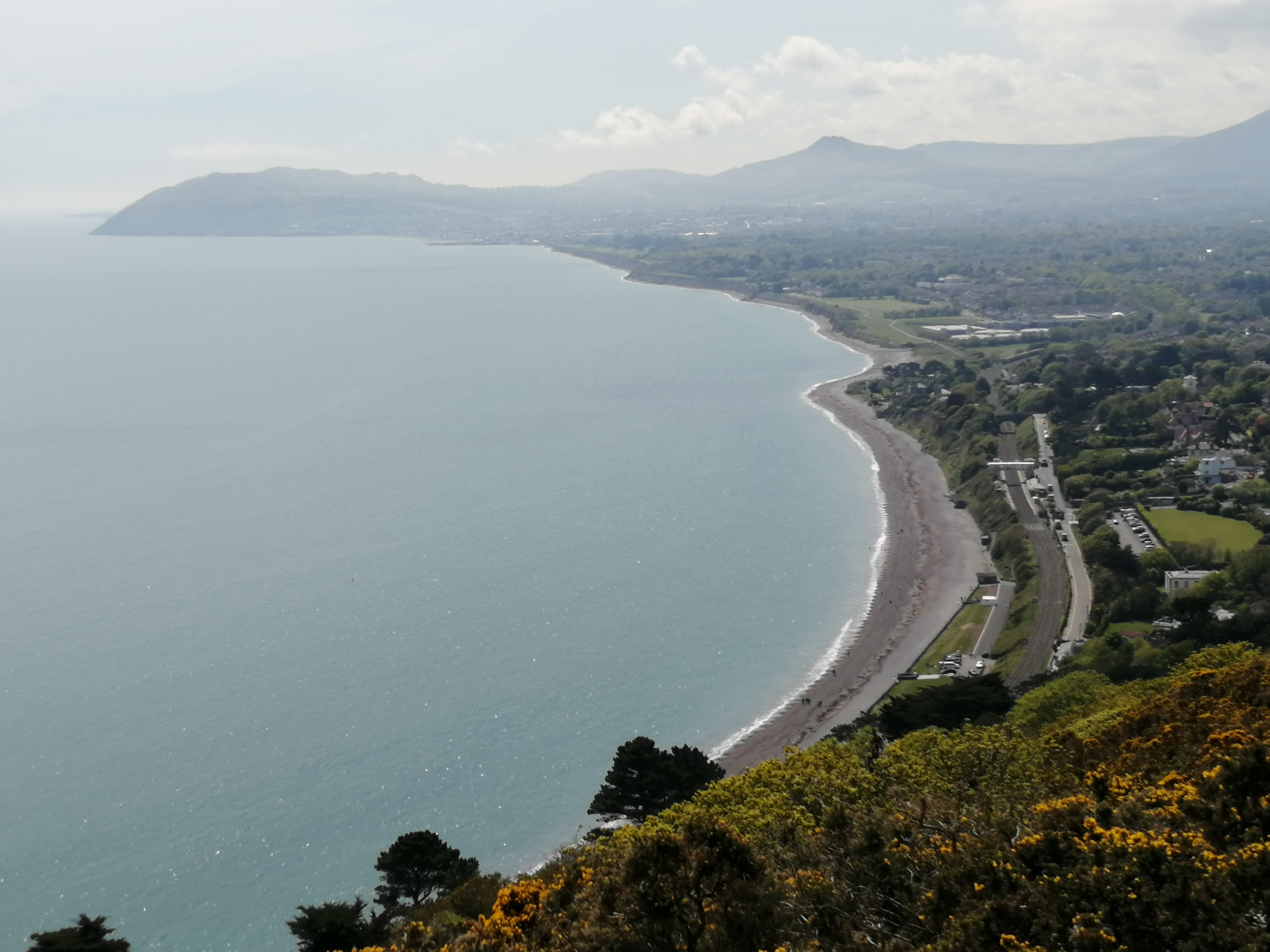
Not the Mediterranean, Killiney in south County Dublin and the rest of the coast line on towards Wicklow: Bray, Greystones and beyond, seen from the open space at the top of Killiney Hill. The obelisk at the summit was behind me as I took the photo. (Photo: D.Breatnach)

IN THE WOODLAND

The woodland is above the path beyond where a stone wall runs along part of it and the woodland continue curving around the northern slope of the Hill. Here one takes the left fork to follow the tarmacadamed bath with steps at intervals. One winter I mitched (truanted) school up here for a few weeks in a little “camp” we had made of branches and we cooked potatoes and fried bread over a managed fire. It was cold, though. Had to face the music eventually of course ….

This tree is just tensing before it takes off running! (Photo: D.Breatnach)
Hard to say whether the steep downward path here was carved out by rain streams or whether the excess rain just flows down here off the path, widening an existing fault or dip. (Photo: D.Breatnach)
The top of the steep path/ rainwater runoff channel, with a tree growing rampant at the lip of the slope. (Photo: D.Breatnach)
On the way down the other side of Killiney Hill, a view westward towards where the Dublin Hills run southward into the Wicklow Mountains. (Photo: D.Breatnach)
“Thus Daedelus flew” says the inscription on the bronze statue on the way down, which I do not recall from boyhood, nor the cafe it is facing. (Photo: D.Breatnach)

DÚN LAOIRE — THE WEST PIER

Dún Laoire Harbour was surveyed by a team led by Lieutenant Bligh, before he set off in command of the Bounty, where he fell foul of Fletcher Christian and a mutiny. Bligh might not have been a great people manager but he was an excellent seaman — he navigated a launch 3,500 nautical miles (6,500 km; 4,000 mi) to safety, leading his 18 loyal crew members.

Both piers of the harbour are built from granite quarried from the side of the Killiney Hill next to Dalkey and from the top of Killiney Hill itself, so that it is now lower than it was before. A lot of the Hill is also limestone, the most common stone in Ireland (and indeed in Europe) and that has been quarried too, for road and house-building.

As a boy and teenager I spent hours fishing from the West Pier, losing more weights and line than I caught fish. One time I fished the incoming tide, the outgoing tide and the incoming tide again (a full tide cycle takes a little over 12 hours). Beyond the level crossing at the start of the West Pier is where it is thought the original Irish fishing village was, where there was a small inlet, the only storm shelter for boats between Dublin river-mouth and Wicklow, someone told me once. About 100 meters south-eastward along the harbour there is a plaque marking some stones believed to be all that remains of King Laoghaire’s fort, which is what the name of the place means in Irish.

Common Tern, one of a mated pair, perched on the pier’s edge. These normally nest in sand-dunes and that type of terrain on the coast, so not sure what they were doing here. They have very forked tails and hover before diving into the water to catch small fish or sprats. Wherever they were diving I would expect to find mackerel below, forcing the sprats up to the surface to catch them there. Terns dive at people or animals approaching near their nests and can be quite disconcerting even is one is not stabbed by a beak, which is said to occur on occasion. (Photo: D.Breatnach)

The East Pier is the one that decades ago had deckchairs for hire by day and a bandstand where brass bands would play in the evening, a place where many like to promenade still today. The ship from Britain was alighted here, or boarded with the next stop being Holyhead (Caergybi) in Wales, to catch the train to other cities or all the way to London, which I did myself at 19 years of age, like many before and after me.

But after the English colonist town of “Kingstown” grew up around the constructed harbour, the Young Irelander captives were sent to prisoner exile in Tasmania; Queen Victoria came through here on her two visits to Ireland; most of the troops brought in to suppress the 1916 Rising came in here too. Some of those, the Sherwood Foresters, had little idea of the slaughter that was awaiting them at Mount Street Bridge from much less than a score of Irish Volunteers, without even a machine-gun between them but extremely well-placed. Blind, arrogant British officers persisted in sending their men in waves against the insurgent positions, although there were much safer ways to reach the Dublin city centre, since only about one-third of expected insurgent forces were in the field, due to confusions and countermanding; 240 dead or wounded was the toll they paid to pass.

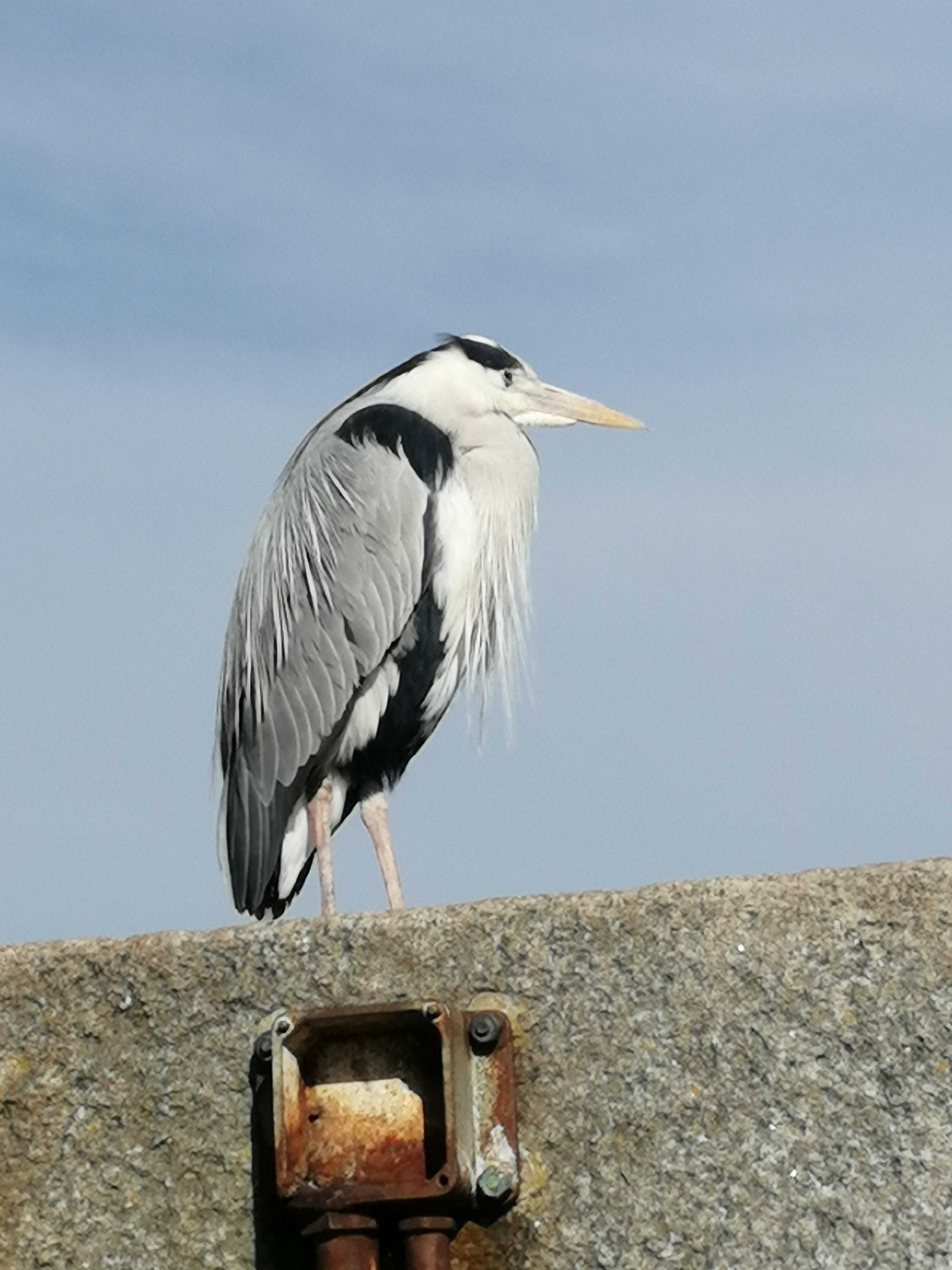
Grey Heron (Corr éisc) on top of the wall at the end of the West Pier — first time I have ever seen one there. He wasn’t too worried about me but was keeping an eye on a couple of dogs wandering around below. (Photo: D.Breatnach)

REFERENCES:

The Emigrant’s Farewell song lyrics: https://www.norbeck.nu/abc/lyrics.asp?rhythm=song&ref=109

IN DUBLIN HONOURING THE SIXTEEN MARTYRS

Clive Sulish

(Reading time: 5 mins)

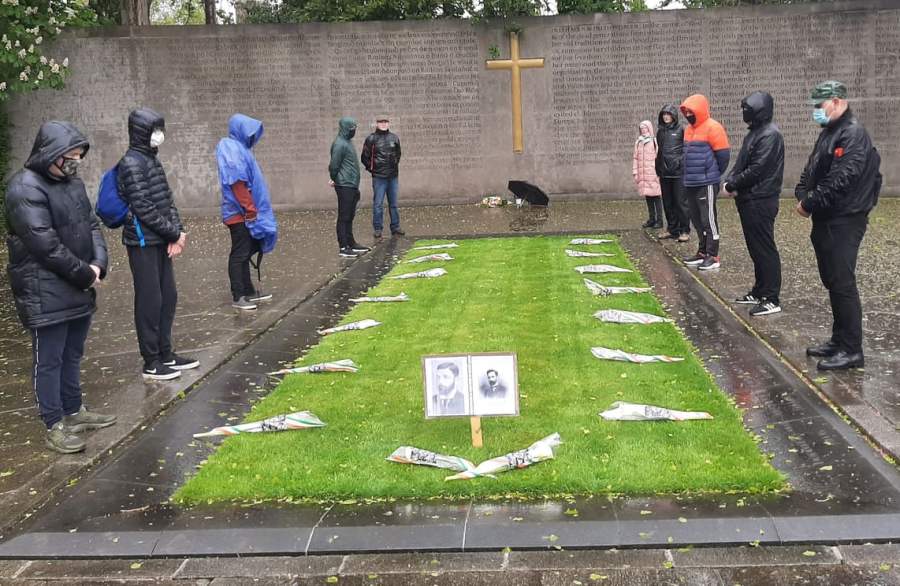
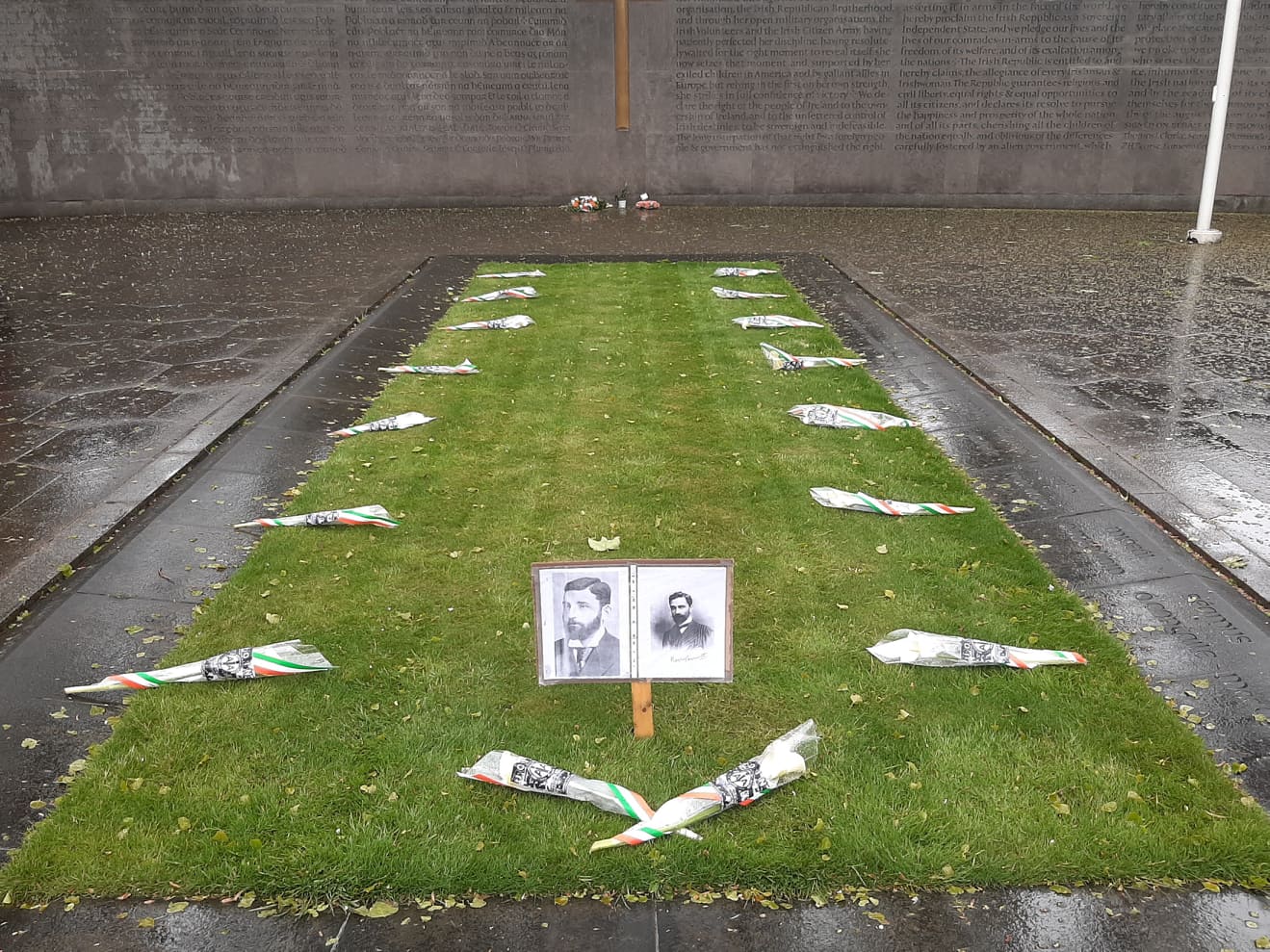
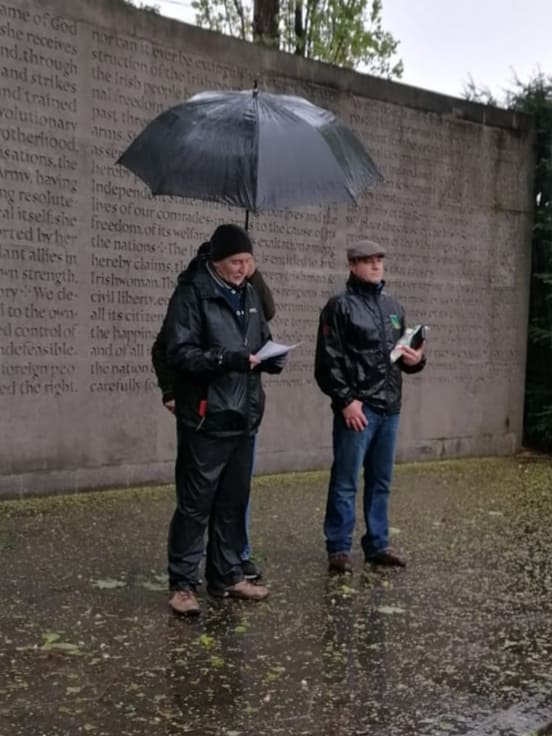
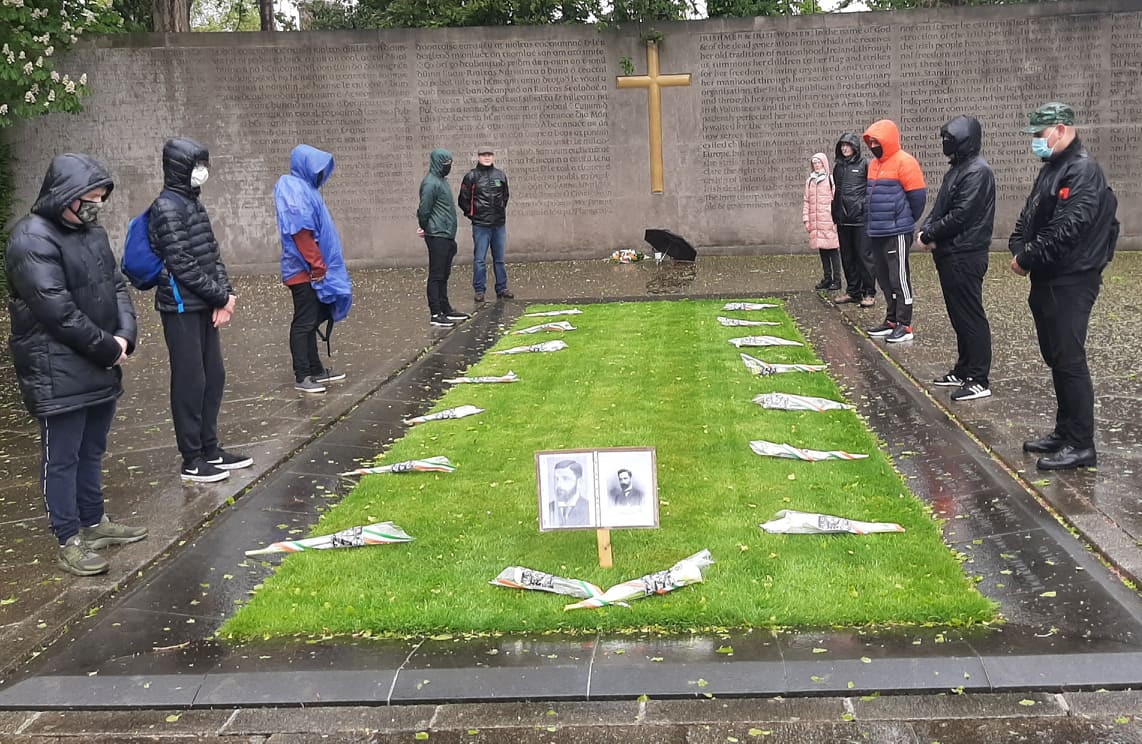
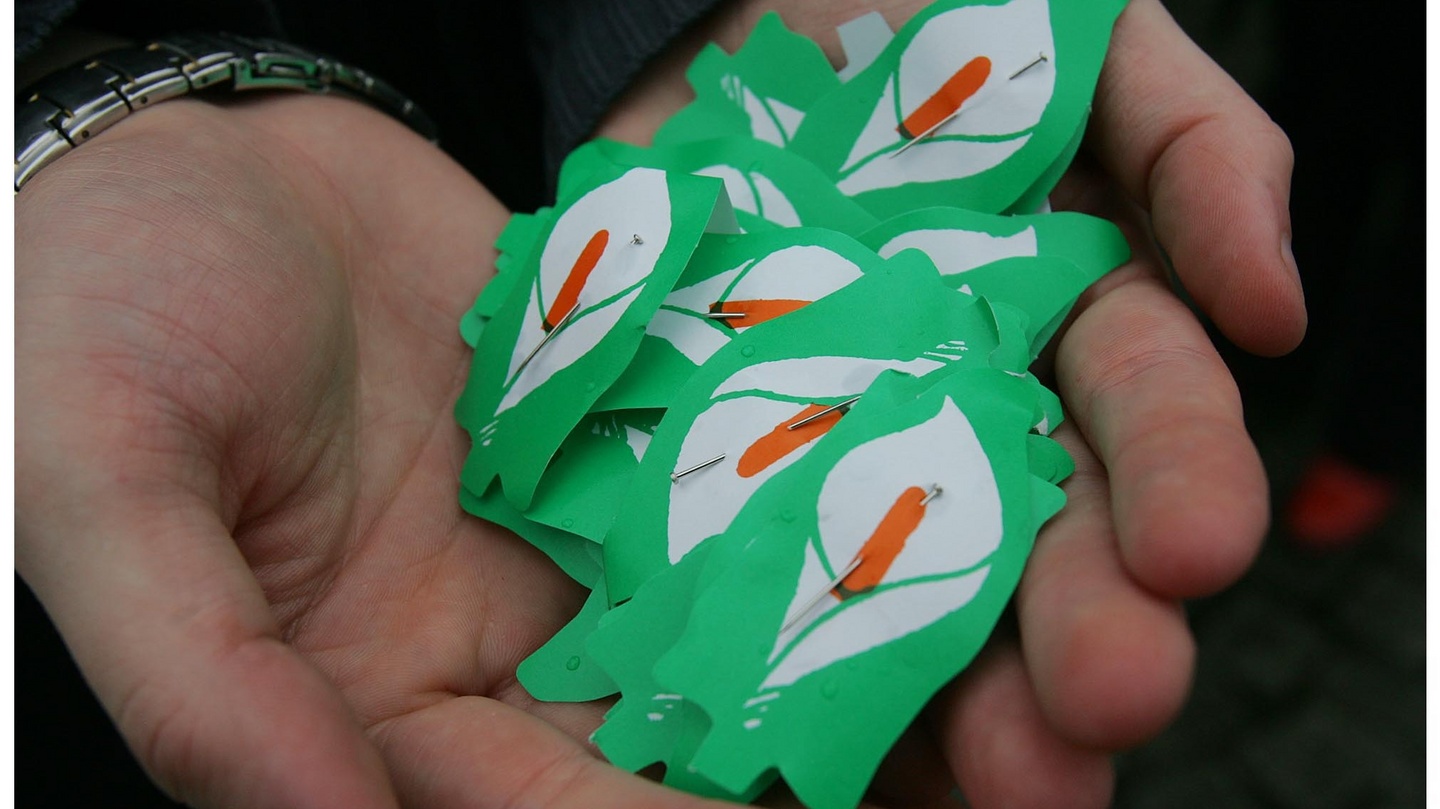
On a gloomy wet and windy day today, Republicans and other anti-imperialists held a commemoration in Dublin’s Arbour Hill of the 14 executed martyrs in Dublin and the remaining two: Thomas Kent shot in Cork and Roger Casement hanged in Pentonville Jail, London. A heavy downpour interrupted the speaker but the event resumed after the cloudburst eased off though it was still raining. Sixteen lilies were laid on the grave patch and a song was sung that named seven of the martyrs, the signatories of the Proclamation.

The event was organised by Irish Socialist Republicans and Anti-Imperialist Action Ireland. In addressing the attendance Pádraig Drummond, chairing the event, pointed out that they were commemorating the Sixteen executed Martyrs of the 1916 Rising but that 15 of them had been murdered. Those had been tried by military court and even the British reviewing the actions later had agreed that the executions had been illegal; therefore Drummond said those 15 had been murdered and General Maxwell1 was a war criminal.

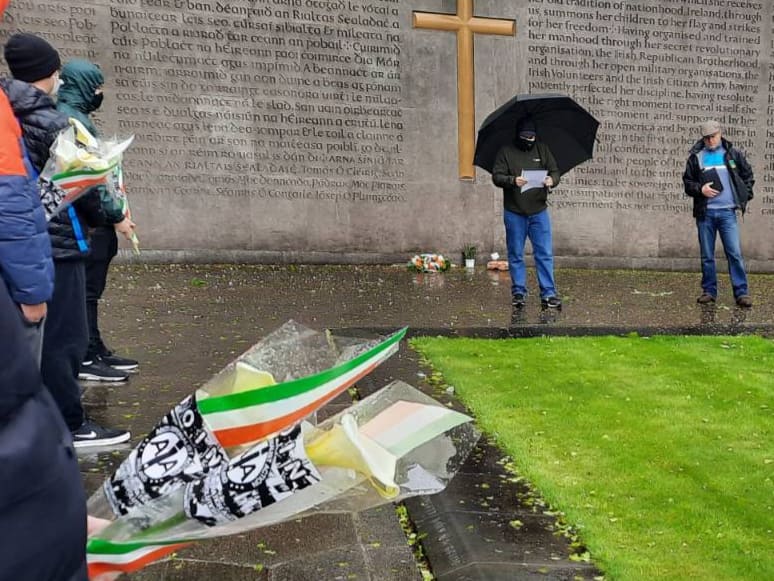
The 1916 Proclamation being read in Arbour Hill, 3rd May 2021. (Photos from AIA with thanks)

In addition, the chairperson continued, Maxwell had refused the relatives access to the bodies and had them buried without coffins in a quicklime pit in order to prevent their graves becoming martyrs’ shrines2.

When it came to the executions, Drummond said, Maxwell gave firing party duties to soldiers of the Sherwood Foresters, who had been decimated by Irish Volunteers at the battle of Mount Street Bridge on 26th April, seemingly to encourage them to avenge themselves for their regiment’s dead on unarmed prisoners condemned to die.

Pádraig Drummond called on one of the attendance to read out the Proclamation and, after he had done so, sixteen single Cala Lillies were laid on the plot above the quicklime pit.

Single lillies for each of the 14 martyrs buried here in Arbour Hill, 3rd May 2021. And two beneath the photos of the other two 1916 executed martyrs, Thomas Kent, shot by British firing squad in Cork and Roger Casement, sentenced to hang by British judge with sentence carried out by British hangman in Pentonville Jail. (Photos from AIA with thanks)

Diarmuid Breatnach was then called forward to address the attendance; speaking first in Irish and then in English, Breatnach said that he had been asked to make some remarks on the history of Irish uprisings in relation to assistance given from abroad but in doing so, he was not laying down any dictates or anything of the sort, only some reflections. “We should learn from our successes,” Breatnach said but also from our failures and perhaps to focus even more closely on the latter.

Breatnach had not been speaking long when the rainfall intensified. He was protected by umbrella but others in attendance were not; he faltered and looked for guidance to the chairperson of the event when the heavens seemed to burst open and with a nod, the whole ensemble headed for the shelter of a nearby horse-chestnut tree.

ALLIES

When the rain had eased off somewhat Breatnach returned to his theme, recounting how (Hugh) Aodh Ó Néill and Aodh Rua Ó Domhnaill (Hugh Roe O’Donnell) had waged a guerrilla campaign in Ulster but relied on help from imperial Spain to free the whole country from England. Later the Irish resistance had sided with English monarchs against the English Parliament in the mid and late 17th Century, when they believed the monarchs would give them religious freedom and perhaps some of their lands back. The Papacy had supported the Irish in opposition to Cromwell and Imperial France gave military assistance against William of Orange later in the same century.

Diarmuid Breatnach addressing the gathering in Arbour Hill, 3rd May 2021; Pádraig Drummond, who chaired the event, standing to his left. (Photo from AIA with thanks)

The United Irishmen in the 1790s had looked for help to Republican France, Breatnach recalled but the flotilla under Hoche failed to land in 1796 and after the Rising was provoked prematurely by the British, by the time General Humbert landed in Mayo with not enough troops, the rising was nearly finished. In 1803, Emmet’s rising took place without the expectation of foreign assistance but was quickly over.

The Young Irelanders apparently believed in 1848, the Year of Revolutions all over Europe that an insurrectionary mobilisation could be achieved peacefully in Ireland and did not look for help from abroad — but were quickly suppressed, the speaker said.

On St. Patrick’s Day 1858 the Irish Republican Brotherhood was founded simultaneously in Ireland and in the United States. In 1866 the Fenians invaded Canada and in 1867 carried out a campaign in Britain, then had a brief unsuccessful rising in Ireland. They had not asked for troops from outside but in their Provisional Proclamation called on the English working class to rise against their exploiters.

The IRB was reformed and re-energised at the beginning of the last century and intended to lead a rising when England was in a war, which was expected soon. WW1 began in 1914 and in 1916 the Irish rose expecting help from Imperial Germany (which they received in armaments but nothing else) and from the USA in political support of which they received little.

The speaker remarked that looking back on all these instances in Irish history, those risings which had not had help from abroad, as with Emmet’s and the Young Irelanders, had lasted the least time.

It would be unrealistic, Breatnach continued, to expect to defeat a powerful enemy such as the UK with its army, navy and air force, without help from an external force. Unless of course the rulers of the UK were struggling with insurrectionary struggles from their own working class.

SOLIDARITY

Looking ahead, the closest areas from which help could come to an Irish insurrection are Britain and the European mainland. In looking for allies it would be necessary to evaluate the benefits and costs of particular alliances. Breatnach felt that when a part of the Irish leadership accepted the deal they were offered in 1921, they had an alternative option of linking with the struggles of the working class in Britain. In 1926 there was a general strike throughout Britain and earlier, in 1921 there had been strike struggles including one in Glasgow, where the local military unit was under lock and key by their own officers in fear that they would join the resistance. Large numbers of British soldiers who wanted to be demobbed after the War were being held back because their rulers knew they would need them to suppress liberation struggles throughout the world. These soldiers were rioting in some areas in Britain. Breatnach remarked that it is difficult to be certain but that if the Irish resistance had combined with the British workers in that period our whole history might have turned out very differently.

Some of the attendance in Arbour Hill, 3rd May 2021, standing in homage to the 16 executed 1916 Martyrs, 14 of whose bodies were buried in a quicklime pit (located underneath the green stretch. (Photo from AIA with thanks)

In conclusion Breatnach went on to talk briefly about internationalist solidarity, which can be a different issue than alliances; solidarity can be a moral issue but it can also be a practical one, as it is workers that would be required to produce material and load ships being sent against us. He had also noted, he remarked, that often internationalist solidarity would be the first thing dropped by those intending to abandon the revolutionary path; Breatnach exhorted the attendance to treat internationalist solidarity as a duty, a pleasure and a practical help.

Pádraig Drummond thanked Breatnach for his remarks and asked him to sing the Larkin Ballad as a conclusion to the event, which Diarmuid did.

“In Dublin City in 1913,

The boss was rich and the poor were slaves ….”

The lyrics were written by Donagh Mac Donagh, orphan son of one of the executed Signatories of the Proclamation. The narrative begins with the union militancy under Larkin’s leadership, followed by the Dublin Lockout of 1913 and ends with the execution of the Signatories. The participation in the Rising of the workers’ defence militia, the Irish Citizen Army, along with James Connolly being one of the Seven Signatories of the Proclamation, provided an organic link between the Lockout and the Rising.

After the event people took photos and socialised briefly before heading for their homes through persistent rain.

FOOTNOTES

1. General John Maxwell, a veteran of colonial wars, was the officer charged with the suppression of the Rising; he set up the martial tribunals that handed down nearly 100 death sentence to participants, of which 15 leading revolutionaries were actually put to death, the others having their death sentences commuted to prison sentences.

Wikipedia: “Maxwell arrived in Ireland on Friday 28 April as “military governor” with “plenary powers” under Martial law, replacing Lovick Friend as the primary British military commander in Ireland. He set about dealing with the rebellion under his understanding of Martial law. During the week of 2–9 May, Maxwell was in sole charge of trials and sentences by “field general court martial”, in which trials were conducted in camera, without defence counsel or jury. He had 3,400 people arrested and 183 civilians tried, 90 of whom were sentenced to death. Fifteen were shot between 3rd and 12th May. H.H Asquith and his government became concerned with the speed and secrecy of events, and intervened in order to stop more executions. In particular, there was concern that DORA (Defence of the Realm Act, wartime legislation –CS) regulations for general courts martial were not being applied. These regulations called for a full court of thirteen members, a professional judge, a legal advocate, and for the proceedings to be held in public, provisions which could have prevented some of the executions. Maxwell admitted in a report to Asquith in June that the impression that the leaders were killed in cold blood and without a trial had resulted in a “revulsion of feeling” that had emerged in favour of the rebels, and was the result of the confusion between applying DORA as opposed to Martial law (which Maxwell had actually pressed for from the beginning). As a result, Maxwell had the remaining death sentences commuted to penal servitude. Although Asquith had promised to publish the court martial proceedings, the transcripts were not made public until 1999.”


However, it is known that Maxwell insisted on executing two more after Asquith’s caution and these were Sean Mac Diarmada (McDermot) and James Connolly, to which Asquith agreed.

2 In that, Maxwell was signally unsuccessful and between 1955 and 1966 the Arbour Hill site was developed as an important Irish historical monument and at this time of year will be visited by organisations and individuals, precisely in commemoration of the 1916 Rising.

MAYDAY DUBLIN – PICKET ON KPMG — GARDA HARASSMENT AND ARRESTS

Clive Sulish

(Reading time: 5 mins.)

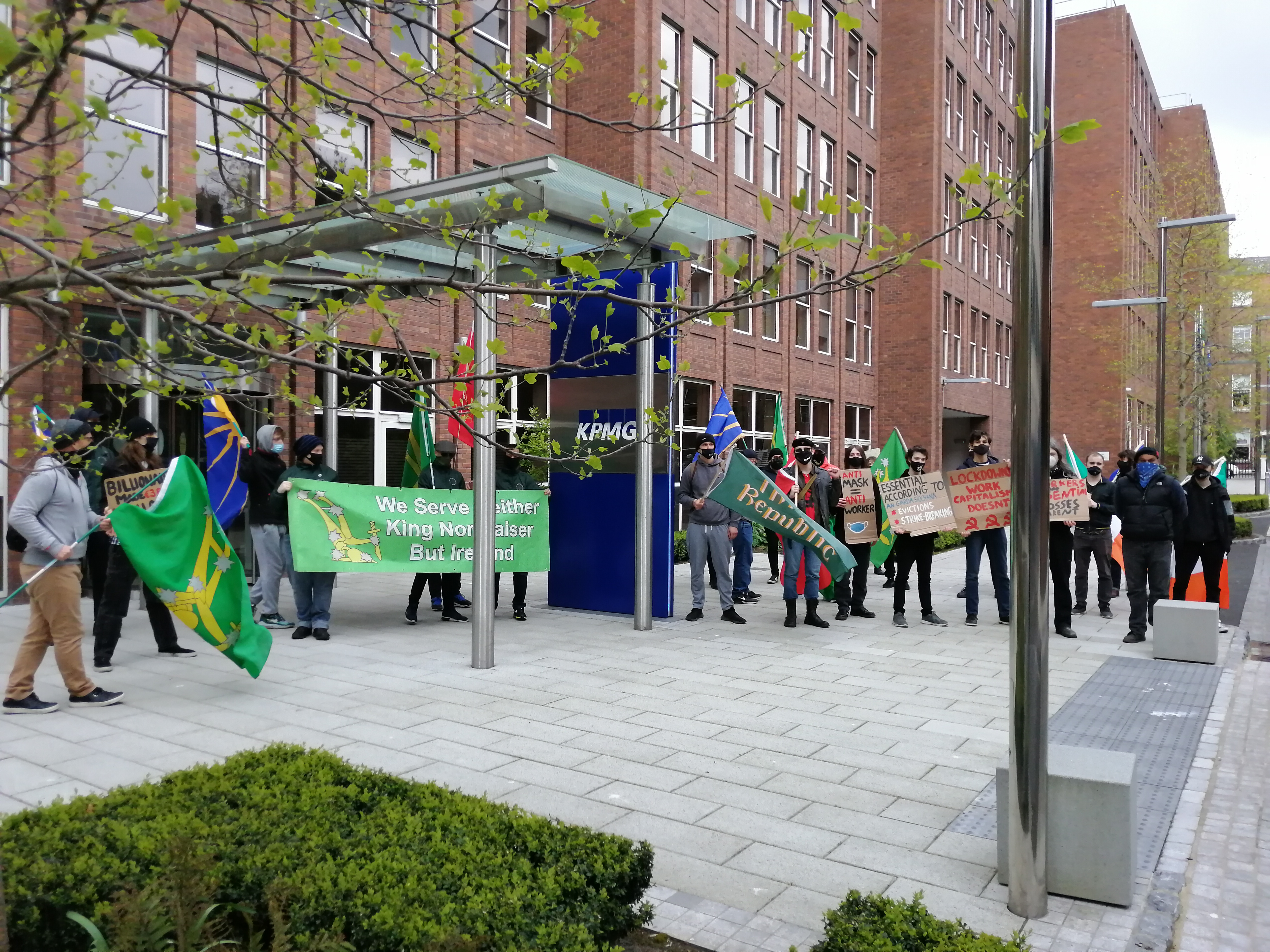
A cross-section of mostly independent activists from across the Communist, Republican and Anarchist continuum held a small march today to celebrate May 1st, International Workers’ Day. All wearing masks against spreading the virus and marching from the north city centre to the south, they held a momentary picket outside the HQ of the KPMG financial group which has carried out evictions of people from their homes as well as raids on Debenham’s stores to inventory stock, led by Gardaí attacking Debenham workers’ pickets and their supporters. At the close of the march the participants were surrounded by a large force of Gardaí and all had their names and addresses recorded under Covid19 legislation while a number were arrested and others were threatened with arrest under the Public Order Act.

May 1st was agreed as the international day of the working class after the police massacre of demonstrators in Chicago in 1886 on a demonstration for the 8-hour day and the subsequent framing of anarchists leading to the judicial martyrdom of five activists.

Gathering outside the Garden of Remembrance (Photo: R.Breeze)

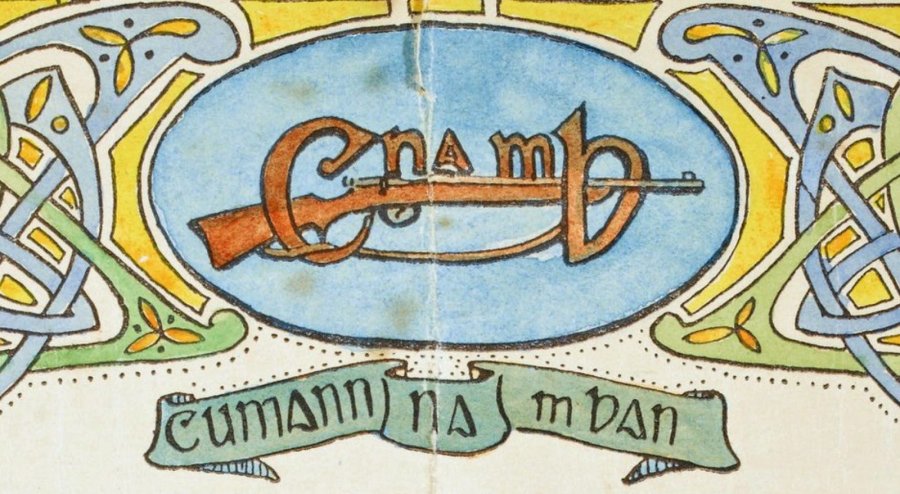
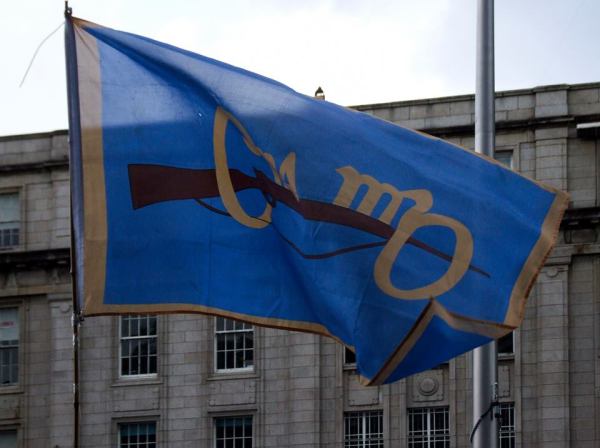
Just after noon today the march set off in two columns from outside the Garden of Remembrance and proceeded down O’Connell Street (Dublin’s main street). The leading banner recalled that on Liberty Hall prior to the 1916 Rising: “We serve neither King nor Kaiser but Ireland”. Many of the marchers were young and led by a banner with a red flag showing the design of the hammer and sickle, followed by a number of Fianna Éireann flags (orange sunburst on a blue field) and Starry Ploughs (gold ursa mayor and plough on a green field) of the Irish Citizen Army. There were also some other red flags and flags of Antifascist, Cumann na mBan flag (name in peach with brown rifle on a blue background), “Irish Republic”, the Irish Tricolour and the Starry Plough (ursa mayor in white on a blue background).

“WE ONLY WANT THE EARTH”

Initially a lone voice on the march sang verses of James Connolly’s satirical song Be Moderate1 to the air of Davis’ A Nation Once Again with other voices joining in on the chorus:

We only want the Earth,

We only want the Earth

And our demands most moderate are:

We only want the Earth!

View of marchers being addressed across the road from the GPO, Dublin city centre (in the far distance, figure with arms raised is part of the Larkin monument). (Photo: R.Breeze)
Placards and two of the flags outside the GPO in Dublin city centre (Photo: R.Breeze)
Beside James Connolly Monument (to the left, out of shot; the HQ of Ireland’s biggest union SIPTU is visible to the right). Gardaí may be seen gathering also plainclothes ‘Special Branch’ officer turned away (dark jacket, blue jeans). (Photo: R.Breeze)

The marchers gathered briefly outside the GPO, where a couple of speakers addressed them before re-forming to march again, turning into Abbey Street and gathering again at the James Connolly monument in Beresford Place, where they were briefly addressed again, then marching on past the Bus Áras and across the river, a heavy screen of Gardaí between the marchers and Custom House Quay, where a far-Right “May Day” rally has been advertised by the Irish Yellow Vests2, opportunistically and hypocritically using the image of Martin Luther King!

The Mayday marchers proceeded to Pearse Street, around by Trinity College and into Grafton Street. There were a number of shouts and slogans, including:

Happy May 1st, International Workers’ Day! Up the workers!

The workers, united, will never be defeated!

Whose streets? Our streets! Whose history? Our history!

When under attack, stand up, fight back!

Housing for need, not for profit! Housing for all, not for profit!

There were also a number of slogans shouted against the two main Coalition parties, Fine Gael and Fianna Fáil, who were accused of being robbers. A number of shouts also pointed out that the workers are the creators of all wealth.

Proceeding along the west side of Stephens’ Green, a voice called out that this area had been held under the Irish Citizen Army in 1916 and called attention to the marks of bullet impact on the exterior of the College of Surgeons building. In Harcourt Street the march turned into Stokes Place and, as the security guard at the barrier challenged them with “Excuse me!” a marcher replied: “You’re excused!” Outside the KPMG building the marchers paused briefly before leaving again and retracing their steps, folding up their banner and rolling up flags.

Inside the complex where the KPMG has their Dublin HQ. (Photo: R.Breeze)

GARDA HARASSMENT, THREATS AND ARRESTS

At the bottom of Grafton Street the leading group of marchers, all flags and banner now folded, turned left into Dame Street prior to dispersing and were there halted by a large group of Gardaí with a number of Garda vans and cars in attendance.

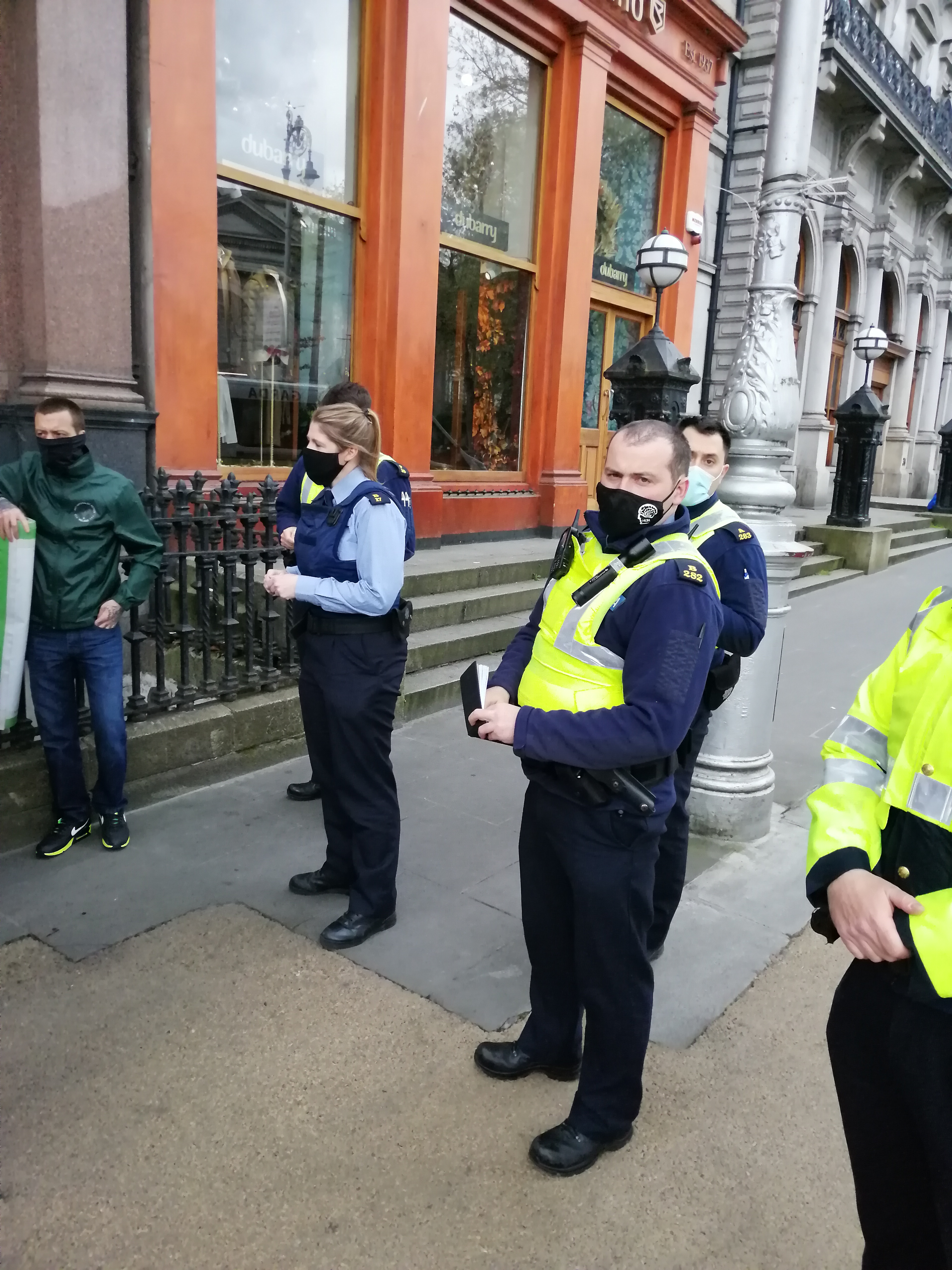
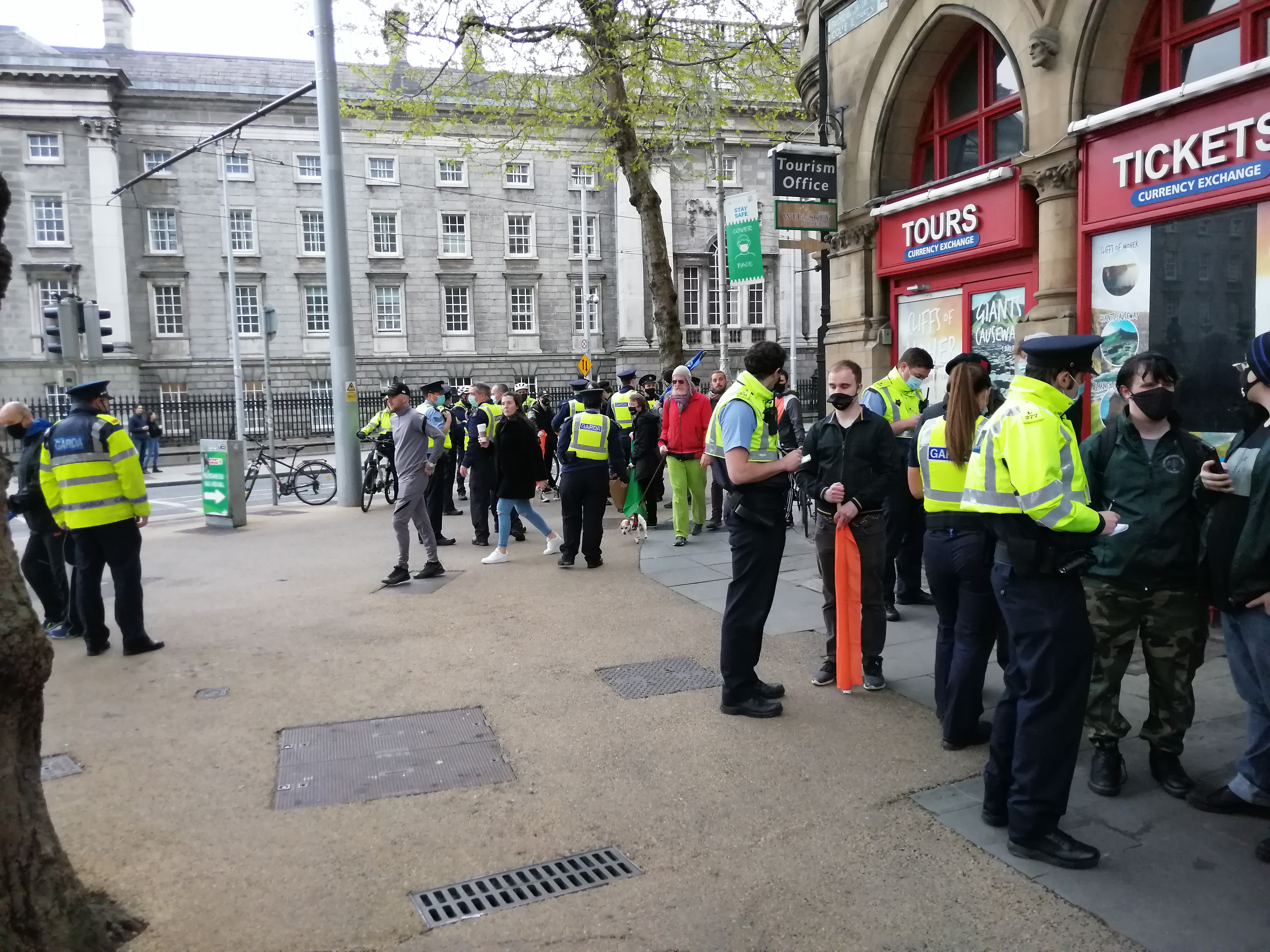
Garda officers proceeded to harass the marchers, asking them their purpose in being in the city, requiring replies under Covid19 regulations, along with names, addresses and dates of birth. When a man shouted “Shame on you! Shame!” at the Gardaí as they were arresting a young man, a Sergeant threatened him with arrest under the Public Order Act. “For what?” asked the man, denying that he had used threatening or abusive words, the Garda insisting he had and cautioning him.

Some of the Gardaí harassing marchers in Dame Street (Photo: R.Breeze)
More Gardaí harassing May Day marchers at end of march in Dame Street (Photo: R.Breeze)
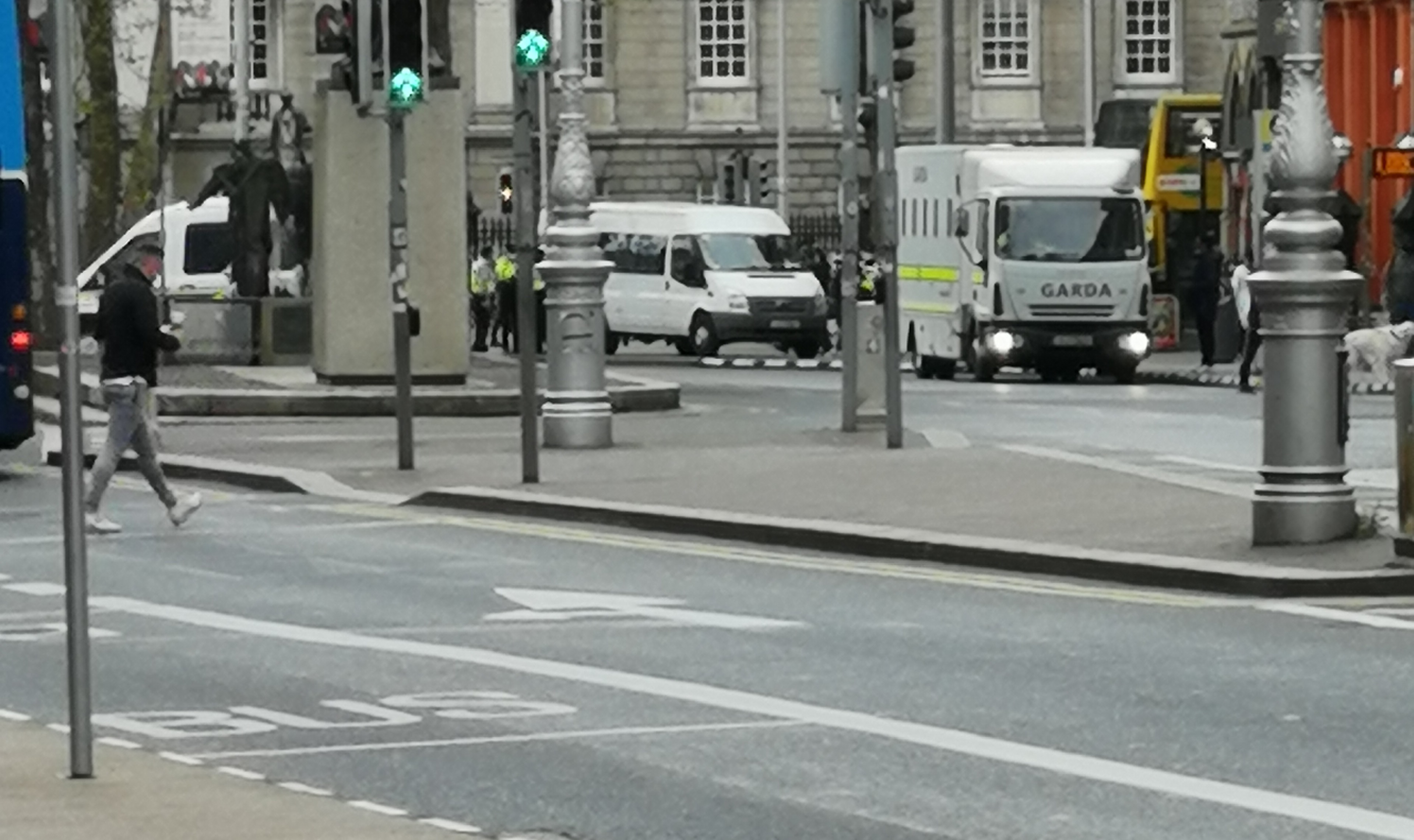
Some of the Garda vehicles used in harassment of the May Day marchers at the end of their march in Dame Street (Photo: R.Breeze)

Four Gardaí were around another marcher accusing him of having an offensive weapon (a pair of scissors to cut the cable ties on the groups’ flags!). When another marcher pointed out to them that they were just using excuses to harass the marchers and asked were they going to do the same to the Irish Yellow Vest crowd on Custom House Quay, he too was threatened for using “threatening and abusive words” and ordered to disperse.

It is believed that three were arrested but difficult to confirm due to Gardaí ordering others to disperse under threat of further arrests.

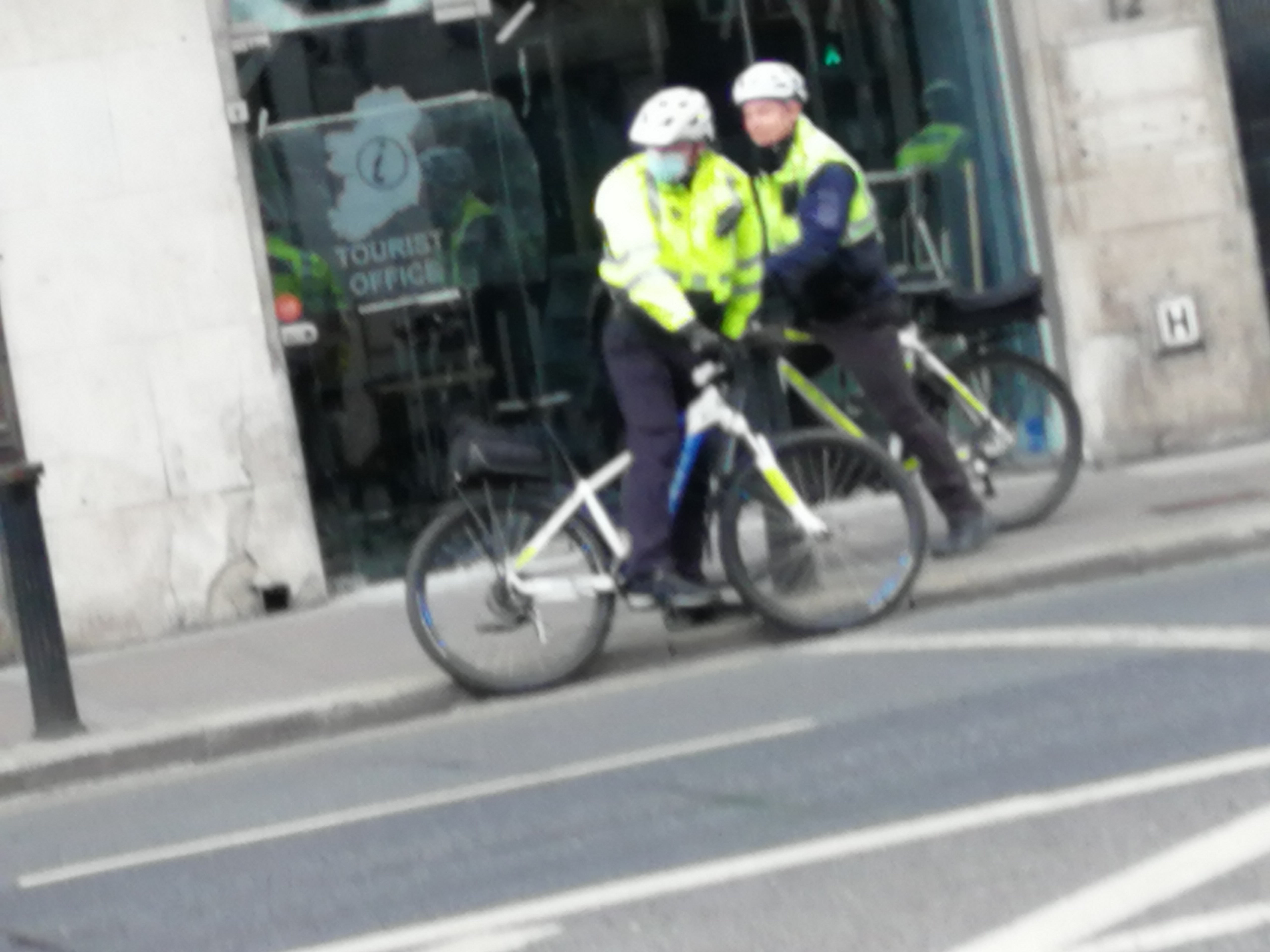
Two of the bicycle Gardaí who were keeping tabs on the marchers, seen here in Dame Street, looking back towards the concentration of Gardaí harrassing May Day marchers. (Photo: R.Breeze)

DEMOCRATIC RIGHT TO PROTEST AND PICKET UNDER ATTACK

Despite Covid19 legislation under Level Five forbidding non-essential work, last week KPMG employees entered Debenham’s stores in cities of the Irish state while Gardaí forcibly removed Debenham workers and supporters’ pickets.

On Thursday this week, taxi drivers in Dublin were intimidated by Gardaí from holding a protest although they would have been isolated within their taxis and perforce practicing social distancing. According to information given in the Dáil by some TDs (members of the Irish Parliament), the taxi drivers were threatened with hefty fines and impact upon their license renewals (a department of the Gardaí manages the verification and renewal of taxi drivers’ licenses).

Yet all throughout the Level Five restrictions, Far-Right groups have held marches and rallies protesting against the Lockdown, without wearing masks or practicing social distancing, without enduring Garda threats and without mass taking of names and addresses. It remains to be seen what action if any the Gardaí took or will be taking on Custom House Quay today3. What the charges against the May Day marchers arrested today might be remain to be seen too and how long they are (or were) detained.

The Garda actions against legitimate and peaceful protests and pickets seem to harbinger more attacks on rights to protest as the Gombeen capitalist class and their government endeavour to make the workers pay for the financial cost of the Covid19 crisis and ‘recovery’.

End.

FOOTNOTES

1One of the songs published in Connolly’s songbook “Songs of Freedom” in 1907 in New York.

2A Far-Right organisation led by an Islamophobe that has joined with openly fascist organisations in the past.

3According to reports received, in Dublin Gardaí prevented the IYV entering on to Custom House Quay and moved them on a number of times after that. However in Cork the Gardaí facilitated the Far-Right (around 350, according to the Irish Times) in holding a march and rally in which they were addressed bty former Aontú Councillor Anne McCloskey from Derry (despite travel restrictions) and Dolores Cahill, 2nd-in-command of the fascist Irish Freedom Party. Cahill has been withdrawn by UCD from her lecture course after petition by 133 students and debunking of her theories but is still receiving her salary from the institution. On St. Patrick’s Day she told a rally the wearing of masks would mean that children would “never reach their IQ and job potential because their brains are starved of oxygen,” adding that the reason “globalists” are “putting down the masks” is due to the fact “oxygen-deprived people are easier to manipulate”. McCloskey told the crowd in Cork that people were dying of other illnesses untreated because the authorities wanted to to ascribe the deaths to the “mild” Covid19 virus so their freedom could be restricted. She said that people should take off their masks and embrace.

SOURCES

Origins of International Workers’ Day: https://libcom.org/history/1886-haymarket-martyrs-mayday

Debenhams pickets attacked by Gardaí: https://www.irishtimes.com/news/social-affairs/former-debenhams-workers-in-shock-after-removal-from-picket-1.4546092

https://www.dublinlive.ie/news/dublin-news/ex-debenhams-workers-forcibly-removed-20305262

https://www.limerickleader.ie/news/home/625500/gardai-intervene-following-protest-outside-former-limerick-store.html

Taxi protest stopped by Gardaí: https://www.thejournal.ie/taxi-driver-protest-called-off-5423729-Apr2021/

DUBLIN BOTANIC AFTERNOON – NATURE AND HISTORY

Diarmuid Breatnach

(Reading time main text: 8 mins.)

Garraithe na Lus/ Botanic Gardens is one of the jewels in Dublin, either in the city centre or just beyond, depending on how one calculates it.1 It is free to enter and open all days of the week, though there have been closures and reduced hours during the current Covid19 pandemic. It contains over 5,000 living species and cultivars2 and also accidental fauna, most but not all of which is indigenous and the Tolka, one of the few uncovered rivers of Dublin, flows along its border and through part of it. Walking through the garden is relaxing but one is walking not only through nature but history too.

Text on the official website proclaims truthfully that “the National Botanic Gardens are an oasis of calm and beauty” and goes to state that the whole is “A premier scientific institution … and that “the gardens also contain the National Herbarium and several historic wrought iron glasshouses.” All of the glasshouses are closed currently as an infection protection measure but one that had fallen into disrepair will hopefully be restored to working order and will be available when the rest can be safely reopened.

In defence of its status as a “scientific institution” the website states that“we do not allow dogs, picnics, bicycles, fishing, ball games, jogging or running, nor the playing of musical instruments or recorded music”, however this prohibition adds considerably to its calmness and the ability for visitors to take in the natural atmosphere, sound, views and smells without being jarred by those other features so common in many public spaces.

The gardens, at 19.5 hectares are not very large and certainly nowhere near the size of those at Kew, London, which are over 132 hectares in size but the smaller acreage of the Dublin site is arguably part of its charm. It is bordered on the west and south by Glasnevin Cemetery (well worth visiting too) and connected by a gate, while the Tolka (an Tulcadh) borders it to the north and cuts off the rose garden, which can be accessed by a short bridge. A road called Glasnevin Hill borders the eastern side of the Gardens and the Tolka runs under a bridge there on its way to the sea.

A bluebell glade (with a white variant) in Dublin’s Botanical Gardens, April 2021 (Photo: D.Breatnach)

The Gardens were a project of the Dublin Society (later the Royal Dublin Society), founded in 1731, the Gardens themselves being opened in their current location in 17953 and are now owned and managed by the Office of Public Works, a State body.

WALK LATE APRIL

IRISH YEW AND NORTH AMERICAN SQUIRRELS

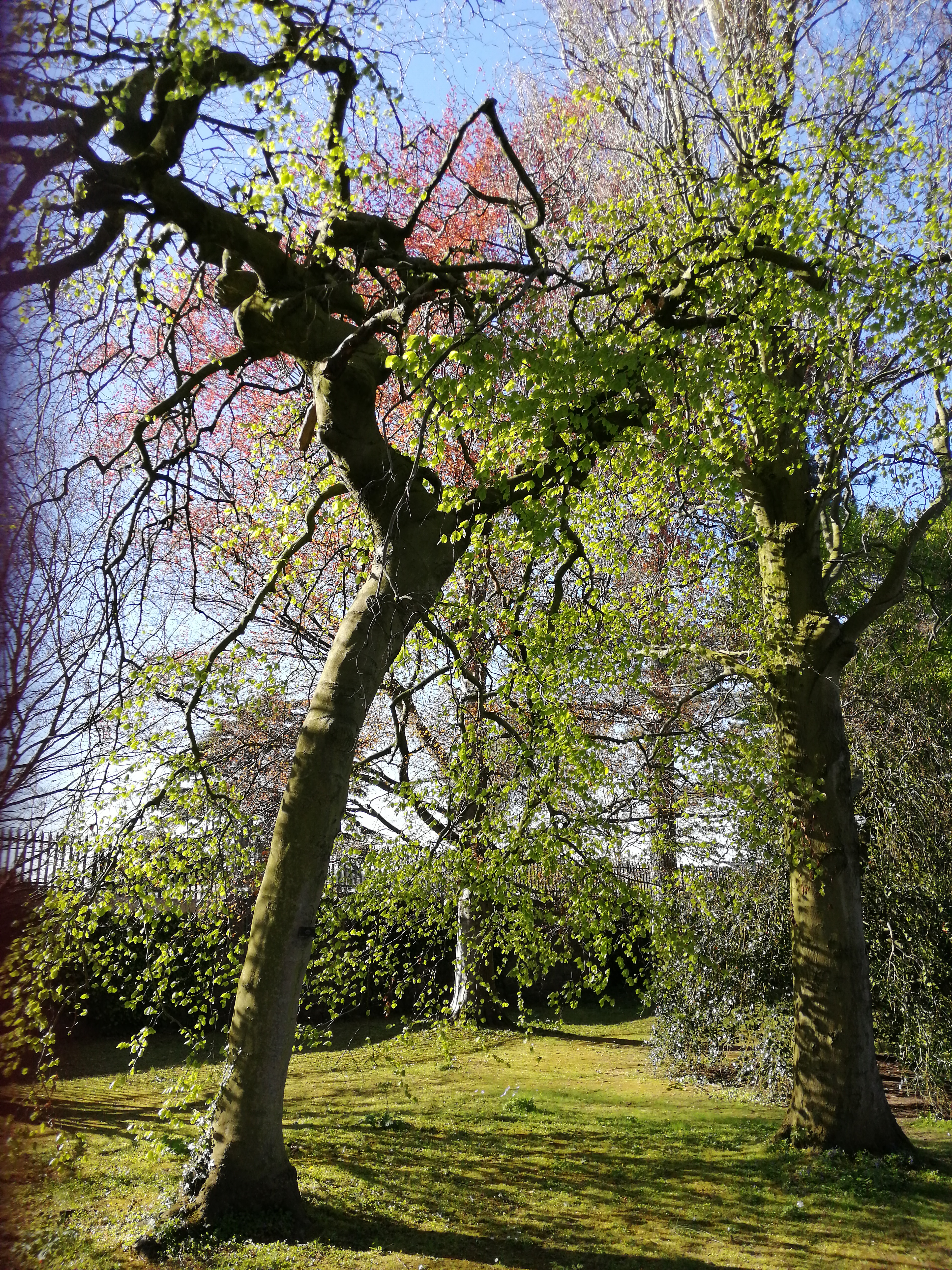
At this time of year, some of the trees are in full leaf, some in early stages and some still bare or just in bud. It is a good time to note the shapes of branches, some seemingly fantastic and also the effect of the emerging leaves against them. The clumps of the parasitic mistletoe (Sú darach) can be seen high in the branches of many species in the Gardens and having spread also to some trees in the Cemetery.

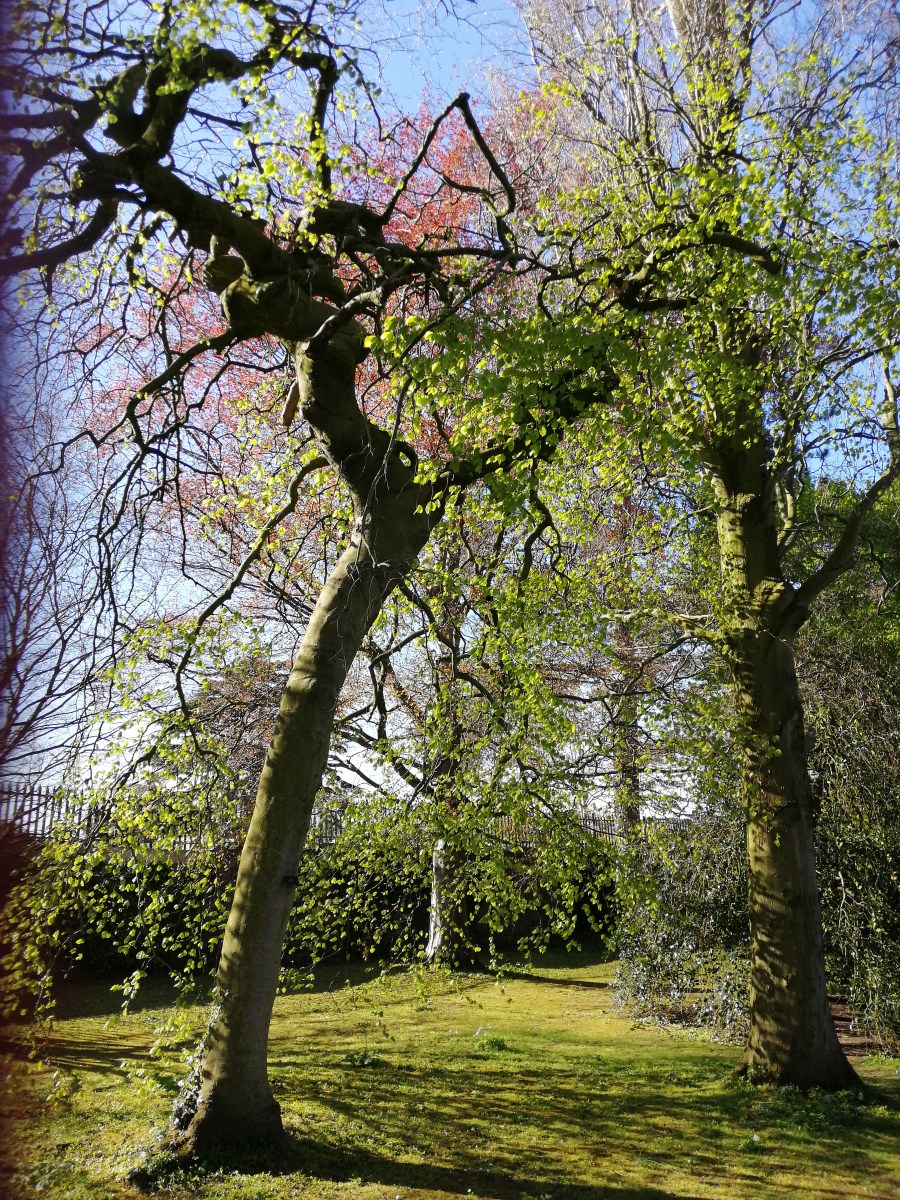
Some strange branch shapes seen here surrounded (and contrasted) by early leaf and sky, April 2021 (Photo: D.Breatnach)
Close-up of the contorted shapes, with some of the contrasts lost but more play on shadow. (Photo: D.Breatnach)
The dark clumps are mistletoe, a photo taken in June (2020), when they are less obvious among the leaves of the tree. (Photo: D.Breatnach)

We would not expect the Gardens to be restricted to native species and although there are examples of those present, there are species of plants present from at least six continents, varying from tall trees to low cacti or succulents. But among the native flora there is a surprise for many: the Irish (compact) yew.

Many places in Ireland are named in connection with trees and the yew (Iúir) figures in a number of those, the most prominent perhaps being Iúr Chinn Trá or its more modern name An tIúir (Newry). The heartwood of yew was used to make the English longbow, from which the “cloth yard” (about 37 inches, or 94 cm) arrows played such a decisive role in the defeat of the flower of the French knighthood and cavalry at Agincourt in 1415. Because the yew is slow-growing it was policy in England to plant them in order to ensure a supply and yeomanry were required to practice at weekends. No doubt the English took their toll on the yew in Ireland as they did on other trees such as the oak.

The European Yew typically had a spreading growth but in County Fermanagh in 1767 George Willis, a local farmer, discovered two freak seedling specimens that grew in a tight, compact shape. Of those original two, one is still living4 in the grounds of Florence Court Estate demesne and it estimated that over five million offspring have been propagated from that one tree, typically seen in churchyards, graveyards and parks, not only in Ireland but in many parts of the world.

Four Irish Yew in the Dublin Botanical Gardens early April 2021 (Photo: D.Breatnach)
An Irish Yew specimen at close quarters in Dublin’s Botanic Gardens. Millions of these around the world were propagated from two ‘freak’ types found in Fermanagh, Ireland in 1767. (Photo: D.Breatnach)

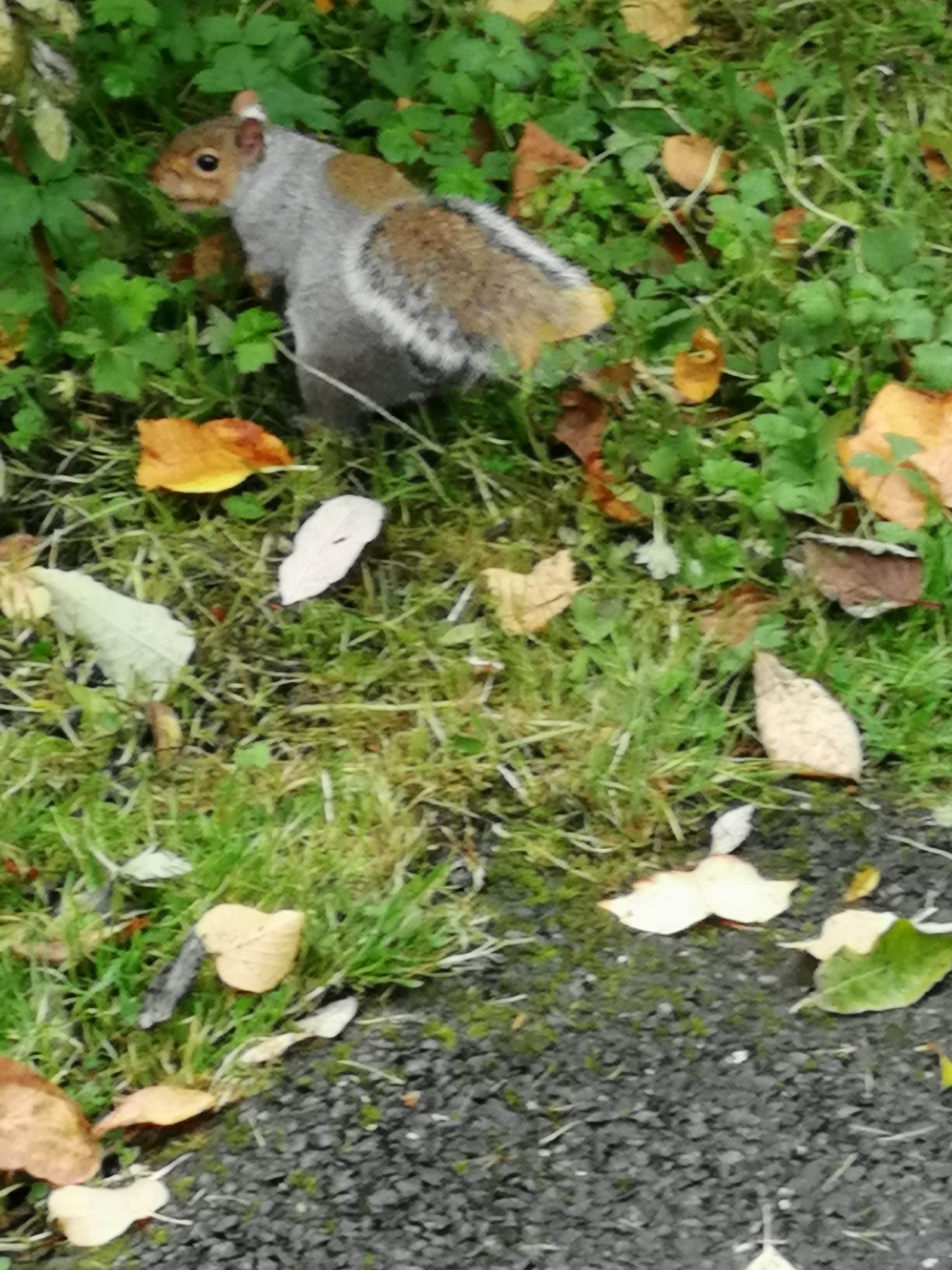
From export to the world let’s turn to an import ubiquitous in the Gardens – the grey squirrel (Iora liath). This is an invasive species to Ireland originally from North America and is blamed for helping to greatly reduce our own native species, the red squirrel (Iora rua) which, to my mind, is a much more attractive animal.

Research on Irish wildlife a few years ago showed the red squirrel making a comeback in some areas and that is associated with the slow increase in the presence of the pine marten (I prefer its traditional if inaccurate name “Cat chrainn” to “Marten péine”) which had been recently nearing extinction in Ireland. It is a predator on squirrels but apparently finds the grey species easier to catch since the latter spends longer on the ground.

Strangely, I have not noted grey squirrels in the nearby Griffiths Park so they do not seem to be expanding in that direction – at least, not yet.

Grey Squirrel (Iora Liath) in Dublin’s Botanical Gardens (Photo: D.Breatnach))

HISTORY

BATTLE OF CLONTARF

The Battle of Clontarf, which was fought in this area on 23rd April 1014, was between Brian Boróimhe’s (Boru) forces of mainly Munster and Connacht forces, along with some Viking allies, against the forces of the Viking King of Dublin and the King of Leinster, aided by a substantial force of Viking mercenaries from the Orkneys and Manx. It was of great consequence since the High King of Ireland and many petty kings were killed in it but it also put a definitive stop to any further expansion of Viking power in Ireland (though their Dublin kingdom was tolerated but required to pay tribute).

The available history tells us that Brian’s headquarters camp for the Battle of Clontarf (Cluain Tairbh) was in Glasnevin (Glas Naíonn). Brian’s camp may have been where the Cemetery is now, since the highest point there is higher than the Gardens’, or even a little further north around where St. Mobhi’s Church is today, higher still. Wherever it was is where he was slain too, in a sneak attack by one of the Viking mercenaries from the Isle of Man, according to one of the accounts.

The Battle was certainly not fought at Clontarf but is where one part of it ended, as defeated Viking mercenaries ran for their ships there, many being killed at a bottleneck at a salmon weir (round about where Ballybough is now), only some surviving to reach their longships.

Some boys brave a small weir on the Tolka just east of the Botanical Gardens. There is little sign on this day in late April 2021 of the surging flood of which the river is capable and from which it takes its name. (Photo: D.Breatnach)

The name of the river is an old Irish word for “flood” and had there been heavy rains in the Dublin hills, the river level might have been high generally but would certainly be so anyway in the estuary at high tide. Since the record tells us that the battle started at high tide and was still high tide when it finished, it means the battle lasted 12 hours. Twelve hours of fighting in any kind of battle is hard enough but with hand-operated kinetic weapons, along with shields and armour, impossible without taking rest breaks. So the fighting waned at times by agreement or by mutual exhaustion but was engaged again. The actual battle site has never been found5 but was probably fought along the Tolka (Tulcadh) for some of its length.

Unlike battles today, all the commanders of high rank in it on both sides were killed, including Brian (though not in the actual battle) and the King of Leinster, Maél (‘Maol’ in modern Irish) Mórda Mac Murchada, the latter killed along with many of his troops and Dublin Vikings at the other bottle-neck, the only bridge then in existence across an Life (the Liffey), perhaps around Islandbridge (Droichead na hInse). This was probably at the delayed intervention in the battle of the forces of the King of Meath, Maél Sechneill Mac Domnaill (though one of the annals has his actual death at the hands of a relative of Brian’s who himself received mortal wounds from Maél Mórda).

1916 RISING

The cancellation of the Rising by Mac Néill for Easter Sunday (23rd April that year) and its reinstatement by the IRB’s Military Council was resolved by going ahead on Easter Monday (24th April). When news of that reached the area around Maynooth, a group of Irish Volunteers who had gathered the day before but stood down, set off for Dublin along the banks of the Royal Canal, arriving in Dublin city late on Easter Monday. They found two Volunteers guarding the Cross Guns Bridge over the canal and were advised that proceeding into Dublin city centre might not be advisable in that evening.

The men spent the night in Glasnevin cemetery and set off again the following morning, crossing the now unguarded bridge and making their way, hungry and footsore, down to the very centre and the GPO on the Tuesday of Easter Week, where they remained in action until the evacuation of the burning building on the 28th. One of their number, Tom “Boer” O’Byrne, who had served in the Irish Brigade against the English in the Boer War, had his sore feet bathed there by Cumann na mBan Volunteer Lucy Agnes Smyth, whom he escorted with most of the other women Volunteers from the GPO and wounded prisoners to Jervis Street Hospital on Friday 28th and whom he would later marry.

End.

Missel Thrush (Smólach Mór), if I’m not mistaken. This one seemed quite unafraid, going about its hunting a few yards from me. The caterpillar-seeming forms on the ground are catkins from the poplars in Griffiths Park, which follows the Tolka eastward from the Botanical Gardens (Photo: D.Breatnach)
Hooded Crow (Caróg Liath), the Irish (also Scottish, Icelandic) species closely related to the all-black carrion crow, seen here on a field of grass and daisies, late April 2021, Dublin Botanical Gardens. They are wary and difficult to get close-ups of without a tele-lens. (Photo: D.Breatnach)
Mostly dandelion (caisearbhán) on a grassy slope above a stretch of the Tolka between Botanical Gardens and Griffiths Park. The dandelion is a plant with a cheery flower which would be highly prized were it not so common (it also has a startling nature which is not discussed here). (Photo: D.Breatnach)

FOOTNOTES

1One of the ways in which people locate Dublin’s city centre is “between the canals”, i.e between the Royal Canal on the south side (of the Liffey) and the Grand Canals on the north side. However, the location of the Botanic Gardens is only a little past the Royal Canal, a matter of five minutes’ walk.

2A cultivar is an artificially developed variety of a plant through selection or the result of cross-breeding (eg the Loganberry or the Nectarine). As to the numbers, Wikipedia claims “approximately 20,000 living plants” for the site while the figure given here is from the Botanical Gardens’ own web page.

3That century was one in which Dublin rose in status as a city of the British Empire and many of its prominent residents took civic pride in the city and strove for improvements in a number of fields for the city and for Ireland in general. The Botanical Gardens were opened three years before the United Irishmen uprising but when the organisation was already in existence and pushing, along with more liberal constitutional elements, for Catholics and Presbyterians to have the vote and to be permitted to stand for election for the Irish Parliament, which was being blocked by the Crown administration and some vested interests. After the Rising, the Irish Parliament was abolished and so began the decline in importance of Dublin from what had been considered the second city of the British Empire.

4The other was recorded as having died in Willis’ garden in 1865, almost a hundred years later.

5I did hear years ago that some artifacts had been found in excavations for the site of the current meteorological station building near Mobhi Road but I have not seen any documentation of that. There was mention in one account of the battle of tired fighters slaking their thirst at a well and the location of that was thought to be in Phibsboro/ Glasnevin, at the junction of the southward part of the one-way system. And a housing development I noted there is called “Danewell”.

SOURCES

https://en.wikipedia.org/wiki/National_Botanic_Gardens_(Ireland)

The Irish Yew: https://futureforests.ie/products/taxus-baccata-fastigiata

Grey & Red Squirrels in Ireland and the Pine Marten: https://www.rte.ie/brainstorm/2020/0616/1147681-red-squirrels-comback-ireland-pine-martens-grey-squirrels/

Battle of Clontarf: https://www.britannica.com/topic/Battle-of-Clontarf/Showdown-at-Clontarf

https://www.historyireland.com/medieval-history-pre-1500/the-battle-of-clontarf-in-irish-history-and-legend/


Maynooth Volunteers traveling to Dublin for the Easter Rising http://www.kildare2016.ie/history/maynooth-company-irish-volunteers-and-the-easter-rising/

Sheila O’Leary (b. 1921), her daughters Emer O’Leary and Maeve O’Leary

https://www.irishtimes.com/culture/heritage/love-and-war-one-family-s-incredible-connection-to-the-1916-rising-1.2281929

FLYING TURTLES, SF VOTER PROFILES AND POSSIBLY EXTENDED LOCKDOWN

Clive Sulish

(Reading time: 5 mins.)

Skimming through some of the material posted on the internet today as “breaking news”, I came across items under the categories listed above.

To take the first, a car driver on Interstate 95 highway in Florida was stunned by an object that flew through her windscreen and struck her on the head. Luckily for her and her mother who was a passenger, the woman managed to guide the car to the roadside where her mother summoned assistance.

A man who stopped to help was surprised to find a turtle among the broken glass inside the car but not as surprised as both women.

The media report speculated that the turtle was probably crossing the road and got knocked into the air by another vehicle.

Though there was a lot of blood as is often the case with a scalp wound, the woman was not badly injured. “I swear to God this lady has the worst luck of anything,” the daughter told the 911 operator as she tended to her injured mother, according to the report. Her daughter will no doubt remember those words of comfort for a long time.

What about the turtle? According to a Port Orange police officer, the turtle was uninjured apart from some scratches on its shell and was released into some local woods (where it has no doubt gained legendary status already among the local wildlife; hopefully the woods were in the direction in which it had been headed, so it did not have to cross the road once more).

In this part of the world we tend to think of turtles as those big marine animals or, for some, as little stripey shellback reptiles kept in aquaria. There are actually four species of native land turtles in Europe, which we call “tortoises”, found mostly around the Mediterranean and at one time it was not unusual to have one as a pet in Ireland, even at loose in the garden, where dogs, cats and other predators eventually learned the uselessness of attacking them. Sometimes they survived winters by hibernation and lived on for years, becoming quite accustomed to their owners, extending their heads out of their shell to accept bits of lettuce from people, etc. Perhaps the expression of a shy person “emerging from their shell” comes from such instances.

The cute little stripey ones in the aquarium if they lived could grow to a similar size as their land cousins but unlike European tortoises, were carnivorous. There are seven European species of which two have been introduced but none indigenous or large-scale colonisers here or in Britain (yet, at any rate – but see concern about the “Florida Turtle” invasion).

These animals in general on land or in water when fully grown are about a foot long at most but the shell adds considerable weight.

The United States is home to more species of tortoises and freshwater turtles (which we call “terrapins”), along with marine turtles than any other country in the world – 57 of the world’s 320 currently recognized species. A handful of the turtles of the Florida state are land-dwellers and like most land-dwellers, have on occasion to cross those avenues of death: roads and motorways. Which is why predators and scavengers regularly patrol these for the motor vehicle-impact corpses strewn along them.

In areas where deer might be expected to be encountered crossing the road, or even in areas near airports, traffic signs warn of the possible danger of accidental impact. Can we now expect flying turtle warning signs in Florida?

SINN FÉIN AND THEIR VOTER DATABASE

Shock and horror greeted the news that the Sinn Féin political party has a voter database. Really, how could they! Yes, they keep track of who voted for them so they can call them out for a repeat vote when they need to. Of course, most political parties do that but … but … this is different!

Actually, SF are probably emulating Dublin Fianna Fáil in this respect – it was said years ago that a Dublin FF Councillor could name his voters and that a FF T.D (parliamentary representative) could name the streets in their constituency where the majority voted for them. And since SF are emulating FF in so many other ways, why not? As one of the party’s policy advisors Éoin Ó Broin remarked also, they are “a professional party” – yes indeed.

Eoin Ó Broin TD, SF spokesperson on Housing answering press questions (photo: Gareth Chaney/ Collins)

The next horror revelation was not only that SF had such a database but that they had removed it from its usual location and lodged it somewhere else – Serbia! However this turned out to be a complete invention based on the fact that one SF member was married to a Serb. Really? A whole scandal was built on that?

So if not Serbia, where is that database now? In Germany, boss of the EU, it is rumoured, though Ó Broin declined to say. Well that’s alright then. But where was it before? In Britain, it turns out, from where SF moved it due to the UK’s Brexit. The state whose invaders Irish people have been fighting for eight-and-a-half centuries and which is still in military occupation of one-sixth of our land. Of course, no worry there for our political class and media – but Serbia! Thankfully it was never there.

POSSIBLY EXTENDED LOCKDOWN

It is reported that Leo Varadkar, the Tánaiste (like Prime Minister in Irish government) said publicly that he is not as confident as he was recently about the pace of relaxation of restrictions.

Those who are hostile to Varadkar and his party, or even the whole Government Coalition may let forth an expletive while the vast majority who are sick of restrictions on so many levels of normal life may groan in despair. But Varadkar is right to be cautious.

He has been made so, he says by the state’s experience in December, when the Government ignored their medical advisors and strong statements from left-wing TDs and, under pressure from commercial interests, relaxed the restrictions in the run-up to the Christmas period. A spike in rates of Covid19 infections and death rates a few weeks later was the result.

Currently infection rates in the state have fallen to the lowest level since October last year (i.e before the disastrous decision to relax restrictions) but even a composite table of a number of agencies’ predictions envisages a possible fall to 1,558 cases a week or 222 cases per day by May 15th. However that is still high enough and really the way to go is what has been advocated by left-wing TDs, which is a zero-level target. In a capitalist system that will not be the choice of the Government but rather one of managing the number of sick and tolerating the number of dead within “acceptable limits”. But hopefully the Government will at least wait until the vaccines are widely available and being administered, with testing stations throughout the state, before they risk any further relaxations of the restrictions.

We do not wish to return to the climbing rate of infection and hospital cases of earlier this year, nor do our hospital staff need any such repeat. And France and India have given graphic evidence of the penalties of too-early lifting of restrictions, if our own experience has not been enough.

End.

A US land turtle on a road (image sourced: Internet)

SOURCES:

(in case you don’t believe me): https://www.breakingnews.ie/world/flying-turtle-smashes-through-cars-windscreen-in-florida-1115824.html

https://www.floridamuseum.ufl.edu/discover-herps/florida-amphibians-reptiles/turtles/

Photos: https://www.gertjanverspui.com/eu-species-list/reptiles-of-europe/terrapins-tortoises/

European invasion of the Florida Turtle: https://www.nytimes.com/1994/07/05/science/europe-fights-invasion-of-aggressive-american-turtles.html

SF voter database controversy: https://www.breakingnews.ie/ireland/mary-lou-mcdonald-denies-wrongdoing-over-party-voter-database-1116020.html

Possibly extended lockdown: https://www.breakingnews.ie/ireland/covid-varadkar-not-as-confident-over-reopening-pace-as-some-days-ago-1115818.html

Covid19 crisis in France: https://www.bbc.com/news/world-europe-56622471

In India: https://www.theguardian.com/world/2021/apr/22/india-hits-global-record-of-315000-new-daily-cases-as-covid-wave-worsens

FAKE PATRIOTS DON’T WANT A UNITED IRELAND

Diarmuid Breatnach

(Reading time main text: 5 mins.)

The anti-maskers, racists and outright fascists strutting around under the Irish Tricolour or the “Irish Republic” flag habitually claim not only to be patriots but to be more patriotic than anyone else – in fact the only true patriots. They refer to Ireland’s past struggles against the British colonialists (up to 19211, not after!) and to Irish patriotic martyrs, totally ignoring or even denying the kind of democratic and inclusive Republic for which those people fought. As all that were not bad enough, they display no interest in the Six Counties nor in what is going on there and that was demonstrated again during the past week when there was hardly a word of comment on their social media about events there.

Fascist group shot: Irish Freedom Party faithful, 2nd from right founder Herman Kelly with Croft to his right again (behind them the 1916 Proclamation, the actual words of which they work against). (Photo sourced: Internet)
The Far-Right like to portray themselves as patriots and usually a number of tricolours will be in evidence, as in this Gemma O’Doherty solidarity protest in Stephen’s Green, Dublin, November 2019 (Photo D.Breatnach)

BELFAST RIOTS: REASONS, FAKE AND REAL

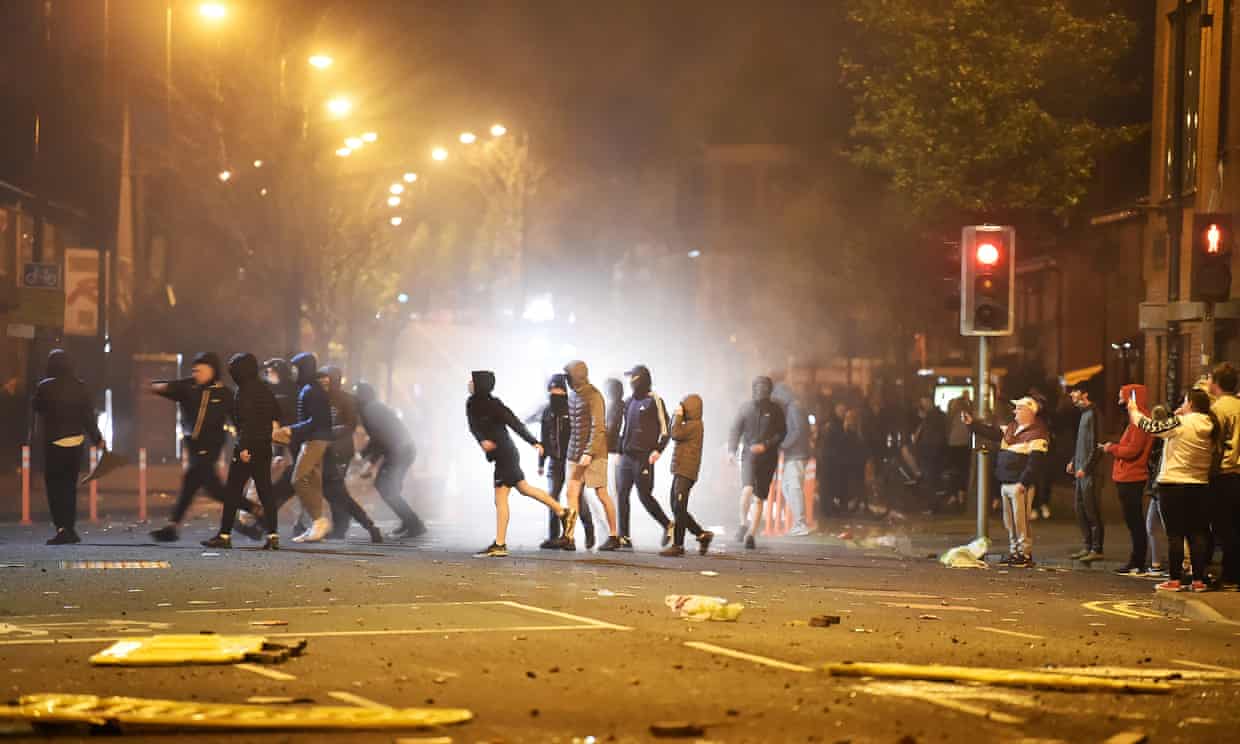
Riots broke out in Belfast last week and have been ongoing, firstly by Loyalists against the colonial police, then by ‘Nationalists’ against the police and Loyalists trying to attack their area. Since Brexit, Unionists have been unhappy with the decision of their masters in England to pull out of the EU and complain that they are being left with obstructions to trade as a result. Whatever their own wishes, they are bound by the decisions taken at Westminster and they have been complaining of those. Of course the whole situation has exposed the unnatural existence of the colony, the Six Counties, since most of Ireland continues to be a member of the EU.

Rioters on the (Loyalist) Sandy Row on 9th April (Photo sourced: Internet)

Next, Sinn Féin carried out a massive public funeral in Belfast for a prominent Republican veteran, Bobby Storey, in which large crowds of mourners and viewers could be seen flouting the pandemic restrictions and Michelle O’Neill, Vice-President of SF and Deputy Prime Minister of the colony’s government, was present. This was apparently intended in part as a demonstration of the strength of the party’s hegemony of ‘Nationalist’2 voters in Belfast.

Although unrelated to the Unionists’ problems with their over the sea masters and Brexit, the Unionists pounced on this violation of pandemic regulations to attack SF. When it emerged that the colonial police had held some discussions with SF prior to the funeral and that no-one had been arrested, the Loyalists, the more extreme wing of the Unionists3, jumped on the issue.

Coincidentally, the colonial police had very recently seized yet another consignment of drugs bound for a Loyalist gang, the South East Antrim UDA4 who then got youth to riot against the police pretending it was about the latter’s alleged deal with SF around the funeral event. Unionist politicians opportunistically stoked the whole event up as a distraction from their own helplessness over Brexit and possibly as an attempt to pressurise the British Government (to give them what it has no power to do, to effectively remain inside the EU market).

Loyalists would also be aware of the recent hyping of the question of a “Border Poll” and the possibility of a united Ireland in the near future – “hyping” because there seems little likelihood of such a poll, not to speak of a such a result, anytime soon. Such talk would increase their paranoia and anxiety and the usual result of that would be riots and attacks on Catholics.

Whenever the Loyalists feel unhappy with how they perceive themselves treated by the British or Unionist leaders, not long afterwards they will attack the “Taigues” or “Fenians”, i.e the large ‘Catholic’ or ‘Nationalist’ minority and at the weekend that is what happened. Loyalists stole a car and rammed it against a gate in a wall separating the two communities in Belfast and also gathered at the Springfield Road interface with the ‘Nationalist’ area of the Falls Road.

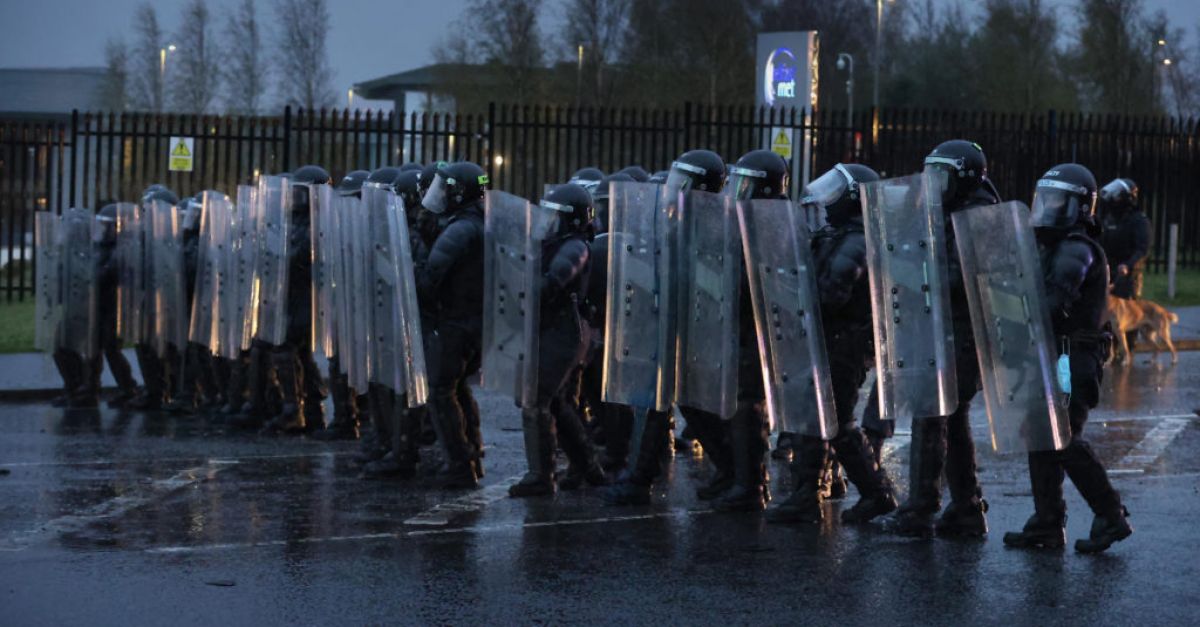
The youth and some older residents of the ‘Nationalist’ area naturally assembled at the Springfield Road junction to defend their area and naturally also the colonial police, the PSNI, appeared too. But these were not facing the invading Loyalists or trying to drive them back – instead, in riot gear, they faced the defending residents. The latter, having long experience with the sectarian and brutal colonial police saw this as a provocation and responded forcefully and so there was now a ‘nationalist’ riot against the colonial police who through the rest of the week had been attacked by the Loyalists, the latter now cheering on the police attacking the ‘Nationalist’ youth.

Colonial riot police on the Springfield Road 10th April, facing not the invading Loyalist mob but the ‘nationalist’ youth defending their area (Photo sourced: Internet)

FAKE PATRIOTS AND THE SIX COUNTIES

All of this was a prominent issue in the news in Ireland (though the drugs find issue quickly faded to be replaced by a solely sectarian narrative), clearly of relevance to the nation but somehow escaped any degree of discussion among the fake patriots who make up the ranks of organised fascists, racists, and anti-maskers.

Of course, if this Far-Right rag-bag were to evince an interest in the Six Counties, what could they say? They could not ally with Republicans, whom they sometimes call “terrorists” and who they know are antifascist. One might think the Far-Right would support the ‘Catholic’ minority, since most of those Far-Rightists are militant Catholics of one kind or another and all the fascist parties say they want a Catholic state. However, supporting ‘nationalist’ resistance rather than their usual nonsense about opposing masks and vaccinations could bring them up against both states in a real way. But it’s even worse than that, because fascists Rowan Croft (aka Gran Torino) and Herman Kelly of the Irish Freedom Party are recorded on a video sharing a platform in friendly discussion with Loyalist and British Fascist (formerly BNP and Britain First parties) Jim Dowson (who also posted a comment congratulating the National Party on their armed attack on unarmed counter-protestors in August last year in Dublin).

A patriot is a person who loves their country and its people and the Irish far-Right are constantly telling us how patriotic they are. But their patriotism, fake though it is for the rest of Ireland, stops completely at the British Border. Only the fascist Irish Freedom Party (under the cover of Irish Yellow Vests) has tried to set up in the Six Counties, where it has been resolutely opposed by Irish Republicans, after which it enlisted the help of the colonial police for protection.

Irish Freedom Party stall being disassembled by Republicans in Belfast July 2020. The next time the IFP set up they did so with colonial police protection. (Photo sourced: Belfast Telegraph)

The fake patriots will not be found supporting Republican prisoners nor protesting about the prisoners’ treatment under administrations both sides of the British Border, nor confronting the colonial police to oppose harassment on the streets nor their raids on the homes of Irish Republicans. The Irish fascists who hide among the anti-maskers, anti-lockdown protesters and flaunt their alleged “patriotism” represent nothing but a more repressive and vicious version of more of the same: capitalist neo-colonialism in the 26 Counties and capitalist British colonialism in the Six Counties. And should they get into power we’d hear a lot less about “freedom of speech and of movement” and a lot more about the need for “strong government” and “law and and order”.

End.

FOOTNOTES

1i.e the point at which the British divided Ireland; those subsequently fighting for Irish freedom were being hunted down by the new Irish State and, in the Six Counties, by the colonial authorities.

2Alternatively described as ‘Catholic’ or ‘Nationalist, the large minority within the British colony has been subjected to sectarian discrimination, cultural oppression and physical repression since the inception of the colony and before. The majority faith was Catholic and the majority political aspirations for a united and independent Ireland but it is not fundamentally a religious issue, nor is every resident in those areas a Catholic in religious faith or even necessarily a nationalist.

3The Loyalists as a sector tend to be working or lower middle-class while the Unionists tend to be upper middle-class or top of the pile and to manage the system, using the generally right-wing and virulently sectarian Loyalists in a similar way to that in which the racist Southern USA authorities used the Klan in the past – to repress the minority in ways which would look bad for the Unionists were they to do so. However, there are ups and downs and the Democratic Unionist Party, currently in power representing the Unionists, is a former Loyalist party that, under the leadership of Ian Paisley, overtook the Official Unionist Party decades ago.

4A “dissident” group within the Loyalist ‘family’; the Ulster Defence Association is a sectarian paramilitary association with connections to State’s repressive forces and controls the drugs traffic in Belfast; Antrim is the county in the NE of Ireland in which Belfast is located.

SOURCES & FURTHER READING:

Loyalist gang’s drug consignment seized: https://news.sky.com/story/criminal-gangs-encouraging-children-into-violence-on-northern-irelands-streets-say-police-12267276

and: https://www.belfasttelegraph.co.uk/news/northern-ireland/police-seize-12-million-worth-of-suspected-class-a-and-b-drugs-40262655.html

Other recent Loyalist drug losses:

Cocaine for Loyalists 18 March 2021: https://www.irishmirror.ie/news/irish-news/crime/dumb-criminals-lose-28-million-23748676

Three drugs shipments due for 6 Counties seized: https://www.irishexaminer.com/news/courtandcrime/arid-40192683.html

Irish Freedom Party chased in Belfast: https://www.belfasttelegraph.co.uk/news/northern-ireland/activists-evict-far-right-irish-party-as-it-sets-up-stall-in-centre-of-belfast-39398940.html

Michelle, you are a disgrace

Dear Michelle O’Neill, Deputy Prime Minister of the British Colony in Ireland, I write to tell you that you are a disgrace. In many ways and for many reasons but on this occasion in particular for your message to the Chief of the Royal Parasites, Monarch of the Occupying Power and Commander in Chief of the Colonial & Imperial Armed Forces by which power her State currently occupies six counties of our land.

Michelle O’Neill, Deputy First Minister Six County Colony and Vice-President Sinn Féin party. (Photo sourced: Internet)

“I wish to extend my sincere condolences to Queen Elizabeth and her family on the death of her husband Prince Phillip.
“Over the past two decades there have been significant interventions by the British Royal family to assist in the building of relationships between Britain and Ireland.
“It is appropriate that this contribution to the advancement of peace and reconciliation is rightly recognised.
“To all those of a unionist tradition and of British identity – those who value and cherish the Royal family – I wish to acknowledge the sense of loss felt.”

Had you confined yourself to a note expressing sympathy for the sorrow of another human being, even that one, that might have been forgivable. But you went further and made it political. “The building of relationships between Britain and Ireland” indeed! We’ve been having a relationship with the rulers of Britain for more than eight and a half centuries — a relationship of conquest, oppression and repression on their side and resistance on ours.

“Contribution to peace and reconciliation” indeed! The best contribution they could make to that — and probably the only one of any significance — would be to pull their forces and administration out of our country.

As for “those of …. British identity”, outside of the unionist sector in our country, most them had no great love for this racist and arrogant parasite whose exposure in the British media on a number of occasions has caused him to be given strong advice within the imperial administration to keep his mouth shut unless he is speaking off a script.

What does it matter what I think about the message you have sent? Not much to anyone except myself, one would assume. But Michelle, most self-respecting socialists, republicans or democrats will be thinking along similar lines. There must be hundreds of close supporters of your own party who are squirming in shame right now, trying to ignore your words or fumbling for rationalisations.

Michelle O’Neill last year taking part in recruitment for the sectarian colonial armed police. (Photo sourced: Internet)


I am not a supporter of your party and I do not approve, of course, of your participation in the administration of the occupiers’ colony, so I shouldn’t care perhaps. It’s strange though because in some way I feel you have tainted and diminished me.

Are these words going to make any difference? Not at all — except to make me feel a little better. To endure injury without protest is perhaps a worse option.

I would cry “for shame!” if it were not clear for some time now that you are completely shameless.

Diarmuid Breatnach

https://www.bbc.com/news/uk-northern-ireland-56689411BBC.COMNorthern Ireland pays tribute to Prince PhilipTributes are paid to the Duke of Edinburgh following his death at the age of 99.

Prince Phillip lying in state (Photo sourced: Internet)

SWORD, PIKE, GUN – STRUGGLE FOR IRISH INDEPENDENCE

Diarmuid Breatnach

(Reading time: 8 mins.)

A debate is currently taking place about whether armed struggle is appropriate in the context of achieving national liberation in Ireland. The debate is hardly new — traditionally some sections of the polity have opposed armed struggle and some have advocated, even embraced it. However tiresome it may be for some, revolutionaries need to address questions as they emerge and re-emerge but there is another reason to enter this debate, which is that in my opinion both sections in the main are basing themselves on a false premise.

The composition of the sections opposed to or in favour of armed struggle has varied but in general and hardly surprisingly, the social democratic and liberal sections have opposed its use, while the revolutionary Republicans have defended it. But sections of the Republican movement at various times have also moved out of the armed struggle camp and into the ‘constitutionalist’ quarter. As to the revolutionary Left (or that claiming to be revolutionary), the main parties1 have opposed it not only in terms of Irish national liberation (with which they hardly concern themselves as a rule2) but also in the class struggle, while smaller parties and groups have at different times endorsed it as a legitimate or even necessary mode of struggle.

Before going deeper into this question it would be as well to look at the current situation in general and also to review the usual relevant scientific rules, which is to say those tested in the laboratory of Irish and world history.

OVERVIEW OF IRISH ANTI-COLONIAL HISTORY

Ireland is a small country in size and population but historically has had an effect on the history of large parts of the world out of all proportion to its size. Currently this is not the case which is perhaps not surprising since it is partitioned with one-sixth of its land mass under British colonial rule and the rest ruled by a neo-colonial capitalist class that came from under direct colonial domination a little over a century ago. The process of that colonial domination began eight and a half centuries ago3 and the decades and centuries since that time have seen Ireland colonised, most of its land appropriated, cultural, economic and political domination, famines and mass emigration, all of which the Irish have resisted and against which they and sections of the settler population have risen time and time again. The resistance has taken many forms but in general has always included armed struggle: sword, pike or gun.

Monument in Dublin to the 1798 Rising but equally so to the repression suffered before, after and during it — the site is Croppies’ Acre, the location of a mass grave of insurgents. The grey stone buildings in the background are part of the former British Army barracks in Dublin, subsequently barracks of the army of the Irish State, now a military history and clothing state museum. (Photo: D.Breatnach)

The phase of the national liberation struggle in the early decades of the last century resulted in the granting of nominal independence to five-sixths of the country and the retention of the remaining portion as a direct British colony, formally part of the United Kingdom but with a number of administrative and legislative elements peculiar to itself4. This was followed almost immediately by a civil war in which the Republican movement was defeated and all governments of the Irish state since then, regardless of their political party composition, have been of the “Gombeen” neo-colonialist class.

Elements of the Irish Republican movement have never reconciled themselves to this situation and surges of armed struggle took place in the 1930s and 1940s, after that usually restricted to the Six County colony in the mid 1950s to early 1960s and again from the beginning of the 1970s to the end of the 1990s, since when there have been what could best be described as sporadic armed incidents.

During the course of those years sections of the Irish Republican movement have abandoned armed struggle for national liberation, denouncing their erstwhile comrades and even participating in repression against them, whilst those who continue to support armed struggle accuse those who have left the fold of treason.

HISTORICAL EXPERIENCE

The history of Irish resistance to colonial domination and expropriation has been replete with armed instances which should surprise no-one, since that colonial domination was achieved in the first place by force of arms, a force employed again and again in repression also. Whenever other means of repressing Irish resistance were employed, e.g by legislation or cultural imposition, the arms of the conqueror were never far from view. “Dieu et mon droit” is the historical motto of the English monarch5, meaning “God and my right”; however “my right” in English at least has the other meaning of “my right hand”, which can also be understood as the hand used to strike a blow, whether as a fist or holding a weapon. And neither monarchs, feudal or capitalist classes of England have been historically reticent in employing force, including armed violence, in pursuit of their “right” to rule – their own country or others’.

Some of the damage to Dublin city centre from British artillery and subsequent fires in order to suppress the 1916 Rising. The shell to the right of photo is that of the GPO which was the HQ of the insurgents. To the left is the corner of Moore Street, an old market street still in existence today, to which most of the GPO garrison relocated. Centre background is “Nelson’s Pillar” which survived the Rising almost intact but was later demolished by dissident Republican explosion. (Photo source: Internet)

Indeed, it took an armed rising in 1916 followed by three years of guerrilla war (1919-1921) to convince the rulers of Britain that they should grant even limited autonomy to Ireland, albeit with partition as part of the deal. The intervening peaceful gain of 73 out a total of 105 Irish seats in the 1918 British General Election, every seat won on a public commitment to Irish independence and a rejection of the British Parliament, did not at all sway the British ruling class.

Furthermore, around the world the history of nations that have liberated themselves from colonial occupation or incorporation has been, almost without exception, that of armed repression overcome eventually by armed resistance.

AGAINST ARMED STRUGGLE IN IRELAND

Those who oppose the right and indeed necessity to resist armed occupation with armed resistance are opposing a law of history. Granted that in theory, Ireland may be an exception or that the historical rule may no longer apply in this historical period and if that is the claim, then it is incumbent on those who oppose armed struggle to explain why they believe one of those to be the case.

In general, they do not even try to do so but rely instead on emotional appeal and moral argument. These are irrelevant in this context: yes, people get killed and otherwise suffer in armed struggle but the deaths and suffering imposed by imperialism and colonialism world-wide are hundreds of times greater. If we want to apply emotional and moral rules to the question then logically we should support the most widescale and energetic struggle everywhere to overthrow imperialism in the shortest possible time.

Those who argue that the current historical situation provides an exception to the general rule of history usually rely on two issues:

1) The gaining of the most seats in the parliament of the Irish state by the Sinn Féin political party in the 2020 General Election6 and 2) the discussion current in society about the holding of a “Border poll” at some point in the near future.

Neither of these is valid for positing that Ireland is currently — or about to enter – a historical phase that will nullify the general historical rule.

1) The Sinn Féin political party has done much more than abandon armed struggle – it has accepted the partition of the country and joined the administration of the British colony, accepting its legal system and repressive apparatus, in particular its police force. Its party within the Irish state is striving to become the dominant party of the Gombeen capitalist class, as first step towards which it seeks to join a coalition government of one or more of the parties of that class, manoeuvring to appeal to the Gombeen class while at the same time keeping its popular base. Nor is this the first time this has happened in Ireland, for what became the foremost party of the Gombeen class, Fianna Fáil, followed that trajectory after splitting from Sinn Féin in 1926.

2) The question of a “Border poll” does not change the historical rule because it is not the expression of the desire of the colonised that governs the decisions of the coloniser, as evidenced from 1918 to 1921 in Ireland for example. Indeed, even during the most recent war in Ireland, opinion polls repeatedly showed a majority of the British population wishing to have their governments pull out of the colony, those wishes never acted upon or even tested in referendum. On a purely legalistic level, even if (and it is by no means certain) a majority of the population of the colony should favour formal unification with the rest of Ireland, the question of how large that majority should be remains uncertain, as does whether – despite the words of some politicians of the British State – the wishes of such a majority would find a majority in the British Parliament and, in the final analysis, the endorsement of the British monarch.

Nor is there any guarantee that such a poll would even be held. And in the final analysis the right to self-determination of a nation in its entirety is not to be decided by a minority made into an artificial majority by colonialism and backed up by its repressive apparatus.

THOSE IN FAVOUR OF ARMED STRUGGLE

The section of our polity supporting the right to armed struggle therefore has a well-established international historical rule and the nation’s historical experience to vindicate its position. But neither factor necessarily dictates the form or the timing for such struggle. And our history has had many occasions when armed struggle was not the most appropriate form of resistance, either because the subjective or objective conditions did not favour it or because we had suffered a recent crushing defeat in arms.

Taking up the option of armed struggle usually occurs in a revolutionary situation but can also be in others, for example against a fascist takeover or other repression, or in defence of some gains (both were present in the case of the Popular Front Government of Spain in 1936 and the second in the case of the Civil War in Ireland). It does not seem to me that any of the periods of armed struggle in Ireland since 1922 fit into any of those categories except perhaps in the recent war in the Six Counties which in part might be categorised as defensive armed struggle against repression.

To wage war against a superior armed and experienced enemy is a serious undertaking. To do so with the struggle largely confined to one-sixth of one’s country and in a part in which almost two-thirds of the population is ideologically opposed to one’s forces has to be considered madness. Extremely courageous but madness nevertheless. How could those leading that armed struggle ever expect to win? Only by basing themselves on a flawed analysis or a reformist one – never on a revolutionary one.

The flawed analysis was that the British ruling class had no great interest in holding on to the colony and could therefore be encouraged to leave if only they could be made to suffer enough. The theory that the British ruling class places no great importance in maintaining its grip on the Six Counties has been amply debunked by its actions since 1921 and even more so since 1968. Of course, that does not prevent liberals, social democrats, unionists and other defenders of British imperialism from peddling that theory but revolutionaries at the very least should be able to see through it.

The reformist analysis was that if only the struggle became serious enough then sections of the Irish capitalist class would oppose British colonial rule in Ireland and move towards the reunification of the country. This analysis is deeply mistaken in that it fails to take account of the nature of the native Irish capitalist class, which is weak and foreign-dependent and has never been anything else. The last time the Irish capitalist class or a substantial section of it was revolutionary was in the time of the United Irishmen and they were led and in some areas largely constituted by descendants of planters and settlers. The development of the native Irish capitalist class under British colonialism was hampered by Penal anti-Catholic laws, destruction of native industry and the influence of a large section of its intelligencia, viz. the conservative Catholic Church hierarchy and much of the priesthood. In 1921, this native capitalist class, raised in huckstering, clientism and corruption, preferred to murder and jail its own national fighters than to carry the struggle for independence through to the end. Since then it has largely allowed foreign capitalists to exploit its labour force and other natural resources on land and sea, along with large parts of its infrastructure. It was never going to take a serious stand for independence and national reunification.

Irish Free State Army firing cannon loaned by the British at Republican resistance centre in the Four Courts, SW Dublin city centre. This action was the beginning of the Civil War (1922-1923). (Photo source: Internet)

If both those analyses are mistaken, what other rational basis can there be for waging an armed struggle confined to the Six Counties? And if there be no such rational basis, how can the sacrificing of idealistic and courageous young people to years of prison and negligible employment prospects be justified, to say nothing of loss of life and serious injury?

IN CONCLUSION: THE URGENT TASKS OF REVOLUTIONARY STRUGGLE

If an armed struggle confined to the Six Counties is unwinnable, it does not follow that the time is therefore right for armed struggle across the whole of Ireland.

The task for revolutionaries in Ireland, i.e people who are determined to work for a revolution, is to analyse objective and subjective conditions and work in accordance with them in order to advance the struggle to the point of insurrection, at which point there will be no choice but to take up arms, since foreign imperialism and native capitalism will both send their armed forces against us. While it is true that an effective resistance to armed attack requires certain preparations in advance of that crisis, concentration on armed struggle at this stage will not bring us to that point. The mass of the population, including our potential mass base, does not require armed struggle at this point and therefore would not support it. In these conditions and at this time, different forms of struggle are called for.

Nevertheless there are many struggles which working people undertake now and will do in future and revolutionaries need to participate in them and also to use them to help the working people to see their potential. If people must go to jail — and historical experience tells us that they must — would it not be better for them and even more so for the overall struggle, if they did so for taking part in a social or economic struggle of wide sympathy, for example around housing, rather than for “membership of an illegal organisation” or possession of firearms? This would be so even if the immediate objective were the reformist one of forcing the Irish Government to release funds to the local authorities for a construction program of public housing for rent.7

While at times we fight for reforms, we should not advocate any faith in a reform of the system, nor in organisations or leaders who advocate such faith but we rather use the struggles to educate the working people in struggle, showing their strengths and of what they are capable but also the need to go further, to take power into their own hands. It also means that we have to organise against oppression and repression in all their forms – political, economic, religious/cultural, sexual, intellectual ….. And that we have to find ways to participate in all those struggles, putting forward a revolutionary analysis.

This approach calls for both temporary and long-term alliances, both of which have to be managed with care and never by surrendering our revolutionary direction.

We need to build fighting organisations and revolutionary media. We lack broad fighting organisations of any size on any one of the fronts on which we have to fight, including (crucially) fighting trade unions or grassroots trade union organisations. We do not even have a mass revolutionary weekly newspaper.8 Nor a wide political education program. Without those things, it does not seem a realistic proposition to overthrow the ruling classes in Ireland. Towards the building of those elements is where the energies of revolutionaries in Ireland should be directed, whether they be Irish Republicans, Socialists, Communists, Anarchists (or any combination of the above).

In the face of such tasks, does it really matter much why at this time this or that individual speaks out for or against armed actions by relatively small organisations?

End

Gaelic society pattern sword with ring pommel of a type wielded against the Norman invaders of the 12th Century and later (Photo source: Internet)
Typical pike head with hook, popular in the 1798 United Irish uprising in Wexford (Photo source: Internet)
Armalite semi-automatic rifle popular with the IRA in the war in the Six Counties 1970s to 1990s. (Photo source: Internet)

FOOTNOTES

1These are two, both of Trotskyist ideology: the Socialist Party and the Socialist Workers Party (both now part of the Anti-Austerity Alliance — People Before Profit parliamentary coalition).

2While usually supporting it in areas of the underdeveloped world.

3The British occupation of Ireland is normally dated from 1169.

4These included permanent emergency repressive powers and a number of blatantly sectarian discriminatory provisions.

5It is also displayed on the coat of arms above and behind judges in British courts, which should alert people to the nature of the justice dispensed there.

6However they fell short of the absolute majority required to form a government and would have needed others to form a coalition government which instead, was formed by parties (of previous governments) that had won less support: Fianna Fáil, Fine Gael and the Green Party.

7The housing crisis within the territory of the Irish State is acute but no local authority is building housing for rent — they do not have the funds to do so. Successive governments are starving local authorities of that funding in order to benefit the property speculators and private landlords, which in turn the State funds through a number of measures including social welfare payment for the homeless converted to rent. Funding construction of public housing could also be used to expand public employment and training in construction, thereby pulling away from neo-liberal domination of the capitalist economy and strengthening workers’ rights. Meanwhile some fascists are using the housing need to push their “house the Irish first” propaganda against migrants and asylum-seekers.

8Ireland has two ruling classes: the native Irish neo-colonial one and the colonial unionist class ruling in the colony.

APRIL 2nd – ANNIVERSARY FOUNDING OF CUMANN NA MBAN

Diarmuid Breatnach

(Reading time: 4 mins.)

Cumann na mBan (“Women’s Association”), a female military auxiliary and counterpart to the Irish Volunteers, was founded on this day in 1914, one hundred and seven years ago. Its members took part in the 1916 Rising and perhaps even more importantly in keeping up the momentum of the militant movement for independence during martial law after the defeat of the Rising and for years afterwards. They were part of the War of Independence and the Civil War in military and political activities. Many were jailed. The Easter Lily emblem, which many will wear to commemorate the Rising, is their invention. The role of Cumann na mBan, along with that of other women in Irish history, is to this day still not sufficiently highlighted or valued.

Wynne’s Hotel, Lwr. Abbey Street, viewed almost from the junction with O’Connell Street, looking eastward. (Photo sourced: Internet)

Cumann na mBan was formed as a female counterpart and auxiliary to the Irish Volunteers, which had been formed the previous year (as had, separately, the Irish Citizen Army). The inaugural public meeting was held in Wynn’s Hotel, Thursday, 2 April 1914. It was presided over by Agnes O’Farrelly, who was elected President. The provisional executive unveiled at the meeting included Jennie Wyse Power, Nancy O’Rahilly, Agnes MacNeill, Margaret Dobbs, Mary Colum, Nurse McCoy, Louise Gavan Duffy and Elizabeth Bloxham. A constitution was adopted which stated that Cumann na mBan aimed: 1. To advance the cause of Irish liberty 2. To organise Irishwomen in the furtherance of this object 3. To assist in arming and equipping a body of Irishmen for the defence of Ireland 4. To form a fund for these purposes to be called the ‘Defence of Ireland Fund’.

Plaque constructed to be located in Wynne’s Hotel on the centenary of the founding of Cumann na mBan (Photo sourced: Internet)

It was not the first organisation of women to stand for Irish independence that century – Inghinidhe na hÉireann had been formed in 1900 as a cultural organisation and had developed a militant Irish independentist political outlook along with a suffragettist one. Inghinidhe formally dissolved itself and joined Cumann na mBan in 1914 but in effect formed one of its branches and continued to represent a trend for greater activism and female independence within Cumann.

Unlike the Volunteers, membership of the socialist Irish Citizen Army, founded in 1913, was open to both genders and the women who joined that tended to disdain the membership of Cumann na mBan because not only did they not have a social program but were, at that time, under the overall authority of the all-male Irish Volunteers.

Prior to 1916, Cumann na mBan took part in agitation and publicity actions, a number of which they organised themselves. Their marching in the procession to the grave of O’Donavan Rosa’s grave in 1915 was apparently what most impressed other women, in particular young women; they had never witnessed a self-organised women’s organisation on the streets before and the Cumann’s membership swelled thereafter. When Redmond promised Irish men to the rulers of Britain to fight in WW1 the minority part of the movement but the most active split in order to fight for independence from the UK. Cumann na mBan split also but in their case, the majority went for fighting against Britain.

The flag of Cumann na mBan, flying in Dublin (Photo sourced: Internet)

In preparation for the 1916 Rising all members of the main female organisation learned First Aid and prepared field dressings for wounds, which perhaps brought them to face the physical dangers of insurrection more than did the training schedules of the Volunteers. They also engaged in anti-British Army recruitment activities which, after Britain declared War in 1914, increasingly meant being assaulted and arrested by the Dublin Metropolitan Police and the Royal Irish Constabulary. Many also transported secret messages and weapons, often storing the latter. In an informal way, they also provided intelligence they were able to gather. Through their cultural and social activities they provided diversion for male activists as well as a cover for clandestine meetings and other activities. During the Rising, Cumann na mBan members helped deliver arms, ammunition and equipment, construct barricades, set up field hospitals, provided food and water/ tea to combatants, acted as messengers. ICA women did most of that but a number of them were snipers also and one of those, Vol. Margaret Skinnider was gunshot-wounded three times while sniping and in other military activity in the Stephen’s Green/ College of Surgeons garrison area. Most of the Dublin garrisons had Cumann na mBan in them and those in the GPO garrison were asked to leave with some wounded when the building was in danger of collapse. Three women refused to leave with them and were there at the final surrender in Moore Street: Vols. Elizabeth O’Farrell, Winifred Carney and Julia Grenan.

Around 300 women are known to have taken part in the Rising and from the relative numbers of women in CnmB and the ICA, most of those had to be Cumann members; only 157 womens’ names appear on the Roll of Honour for the Rising.

Cumann na mBan was the first organisation of its kind in the world, a point that is often lost sight of: an insurrectionary female military organisation with its own uniform and officers.

Highly decorative and artistic logo of Cumann na mBan — note the rifle fitted into the acronym in the centre. (Photo sourced: Internet)

The greater role of the women in general and in particular of members of Cumann na mBan however was after the Rising when, even under martial law, they organised fund-raising for relief for families who had lost a breadwinner to death or prison; organised also public commemorations, defying arrest to keep the flame and memories alive, helping to create the sea-change in attitude to the Rising and giving a fertile ground for them to plant the seeds of resistance, along with the male and female prisoners released under amnesty.

In 1918 members of the Cumann worked to help the landslide victory for Sinn Féin in the British General Election in Ireland and then helped in the War of Independence, this time greatly organised into intelligence work but also as before as couriers, carrying and hiding weapons, caring for the wounded, running safe houses and other actions, as well as in public demonstrations and pickets, for example outside prisons. They were assaulted on occasion and jailed, sometimes replying with a hunger strike. They could not easily go “on the run” and were subjected by British Army and colonial Police to invasions of their homes and ill-treatment which included shearing their hair.

In 1921, Cumann na mBan again split over the Treaty but once more with the majority against it and in 1922 took the Republican side in the Civil War, for which they suffered repression, home invasions and imprisonment anew, this time by the forces of the Free State.

In 1926 Cumann na mBan invented the Easter Lily emblem in order to raise funds for the dependents of prisoners and killed in action fighters, in addition to those officially and unofficially executed, abducted an murdered. It is purely as a result of their efforts at this time that the emblem is so widely worn and appreciated in the wide Irish Republican movement, especially around this time of year.

Easter lily emblems printed on paper, attached with a pin. (Photo credit: Bryan O’Brien, Irish Times)
Two Cumann na mBan members as part of a Republican commemoration in 1944 (Photo sourced: Internet)

Cumann na mBan ceased to exist soon after the split between the “Officials” and “Provisionals” in 1969 but women continued to be active in the political organisations and also to be recruited into the various military ones.

End.

REFERENCES & FURTHER INFORMATION

https://www.rte.ie/news/2014/0328/605079-cumann-na-mban-centenary/

https://www.rte.ie/history/the-ban/2020/0109/1105376-cumann-na-mban/

(note the omission of the Moore Street battlefield at the end, with a Winifred Carney, Elizabeth O’Farrell and Julia Grenan noted as staying on in the GPO but omitting to mention where they went soon afterwards, or Farrell’s important roles thereafter): https://www.richmondbarracks.ie/women-1916/cumann-na-mban/

https://www.irishtimes.com/culture/heritage/women-of-1916-1.2535291

157 women who took part in the Rising: https://microsites.museum.ie/rollofhonour1916/roleofwomen.aspx

The creation and popularisation of the Easter Lily by Cumann na mBan: https://rebelbreeze.com/2018/04/20/a-resistance-symbol-sown-and-grown-by-irish-republican-women/