A BLOC FOR WHAT?

Diarmuid Breatnach

From time to time people are asked to join a political bloc of some type. Should one join or not?

A political bloc is an arrangement of temporary unity, of as little as some hours of duration, for example on a demonstration, or of weeks, perhaps in a campaign to get an agreed list (i.e. “a slate”) of candidates elected or to vote a particular amendment to a resolution being proposed.

Blocs may be of longer duration, as for example with the Bolshevik bloc in the lead-up to the Russian socialist revolution. This last example is illustrative of the nature of blocs, which are generally not only for something but also against, or at least different to something else. There was a whole mass of political factions against Kerensky’s government in 1917 but the Bolshevik leadership sought to create a bloc not only against Kerensky and his followers’ maneuverings but also different to that of the Mensheviks and the Socialist Revolutionaries. What the Bolsheviks were for, apart from the slogan “All power to the Soviets” (the workers’, soldiers’ and sailors’ councils and assemblies), was a revolution as soon as possible, the overthrow of the capitalist-monarchist State and the creation of a socialist one (as well as pulling the Russian Army out of World War One).

Although the facts of the successful overthrow of the state and withdrawal from the War are not usually questioned by historians or political theorists, the fate of that state is. And the bloc itself had a very mixed history after the Revolution.

But what essentially is the purpose of blocs? Are they composed of like-minded people who don’t want to belong to a political party-type organisation, or perhaps of people of a variety of party political allegiances, but who want to join for the moment to promote a general idea? Or are they attempts by one group to create hegemony, to bring people of different perceptions together in temporary action, with the intention of building a more permanent organisation? Or perhaps crudely an attempt by one (or two) organisations to recruit members to their own organisations? I have over the years participated in blocs and it seems to me that different blocs have at different times been each one of those things. So I ask myself, is that ok? As political activists, should we consider blocs a legitimate type of temporary political organisation? Is each of those purposes outlined above of equal value?
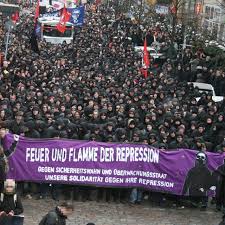
A Black Bloc against repression in Germany -- location and year uncertain
A Black Bloc against repression in Germany — location and year uncertain

Around this time of year in 2010, early on in the protests against austerity, although then called “Right to Work”, back in the last year of the Fianna Fáil/ Green Party coalition government, there was a bloc formed for participating in demonstrations against the bank bailouts and consequent cuts in social spending and wages being imposed or proposed by that Coalition Government. Called the “Anti-Capitalist Bloc”, it seemed composed in the main of the anarchist WSM and what would often be described as “dissident Republicans”, chief among which at the time was the Éirigí organisation. There was a fair sprinkling of non-aligned activists (i.e. not belonging to any party or particular organisation) whose politics could be described variously as socialist republican, anarchist or communist.
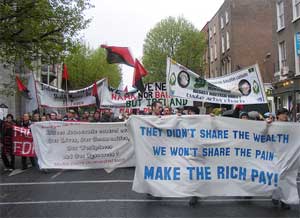
Anti-Capitalist Bloc in Dawson Street, Dublin, marching to join anti-austerity demonstration at Dáíl in 2010

This bloc gathered at a different rallying point to the rest of the Right to Work march but marched to meet it at the Dáil. In that role, it survived I think three demonstrations. The first one was attacked by police after the demonstrators refused to be prevented from marching to join the other demonstration.

What was the purpose of this bloc, at least in the eyes of its organisers? I have no documentation to hand but as I recall, it was to say something like: “the problem is not this or that economic measure or this or that party or government; the problem is capitalism itself.” It seemed to be implying that therefore we needed a revolution. I would and did agree with such a statement and with its implication. Not only did I agree with it
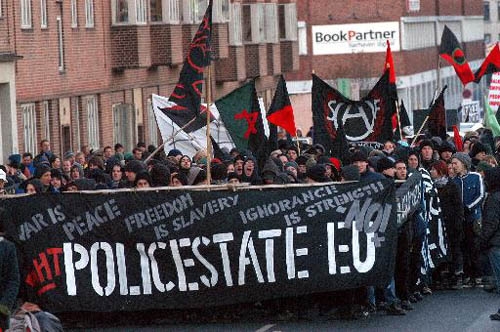
Black Bloc against the EU, possibly a section of the
Black Bloc against the EU, possibly a section of the “March for an Alternative” in London in March 2011.

but it seems to me a crucial point to make, if we are to end our vulnerability to the vagaries of the capitalist system’s fortunes and to its particular rapacity at various times.

This was a message clearly different from that of some sections of opposition to the Government: SIPTU and the ICTU were saying that there was a fairer way of sharing the burden, which was about what Sinn Féin was saying with “Tá bealach níos fearr/There is a better way”.
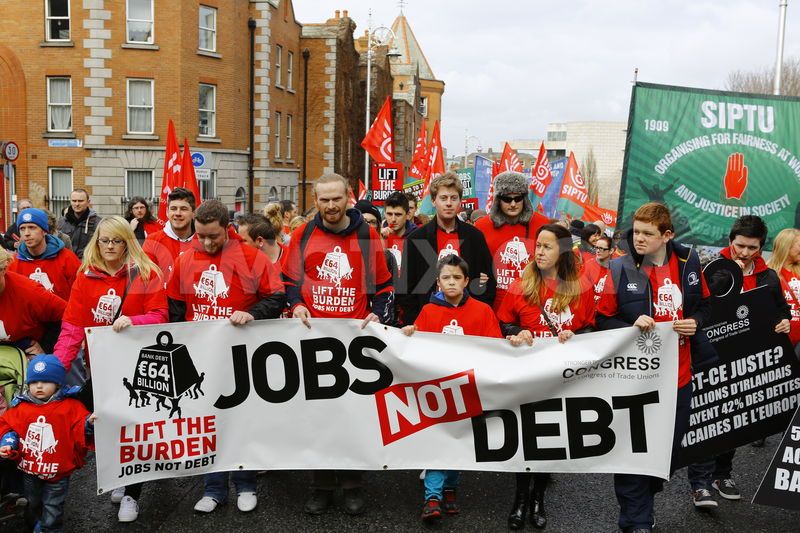
Reformist trade union slogan on anti-austerity march in 2010

But could those participants in the bloc not have presented that point of view while still joining the other demonstration at its rallying point and marching with it? Perhaps – by each person being given specific placards, for example, agreeing a joint leaflet or by having speakers to represent their point of view. But all of those present difficulties – the production of an agreed placard slogan to say nothing of the difficulties of agreeing a leaflet. And a speaker might not be permitted by the organisers of the rest of the demonstration or their message would get lost among the others being put forward, even if the speech itself could be agreed by the bloc in advance. All the bloc participants could dress in a similar colour (like the “Black Bloc” on some demonstrations overseas in the past). But a separate bloc, marching behind a banner with a slogan with which each bloc participant could agree, was surely the least complicated way to deliver that message – and very visible. The police who attacked it certainly must have thought so.
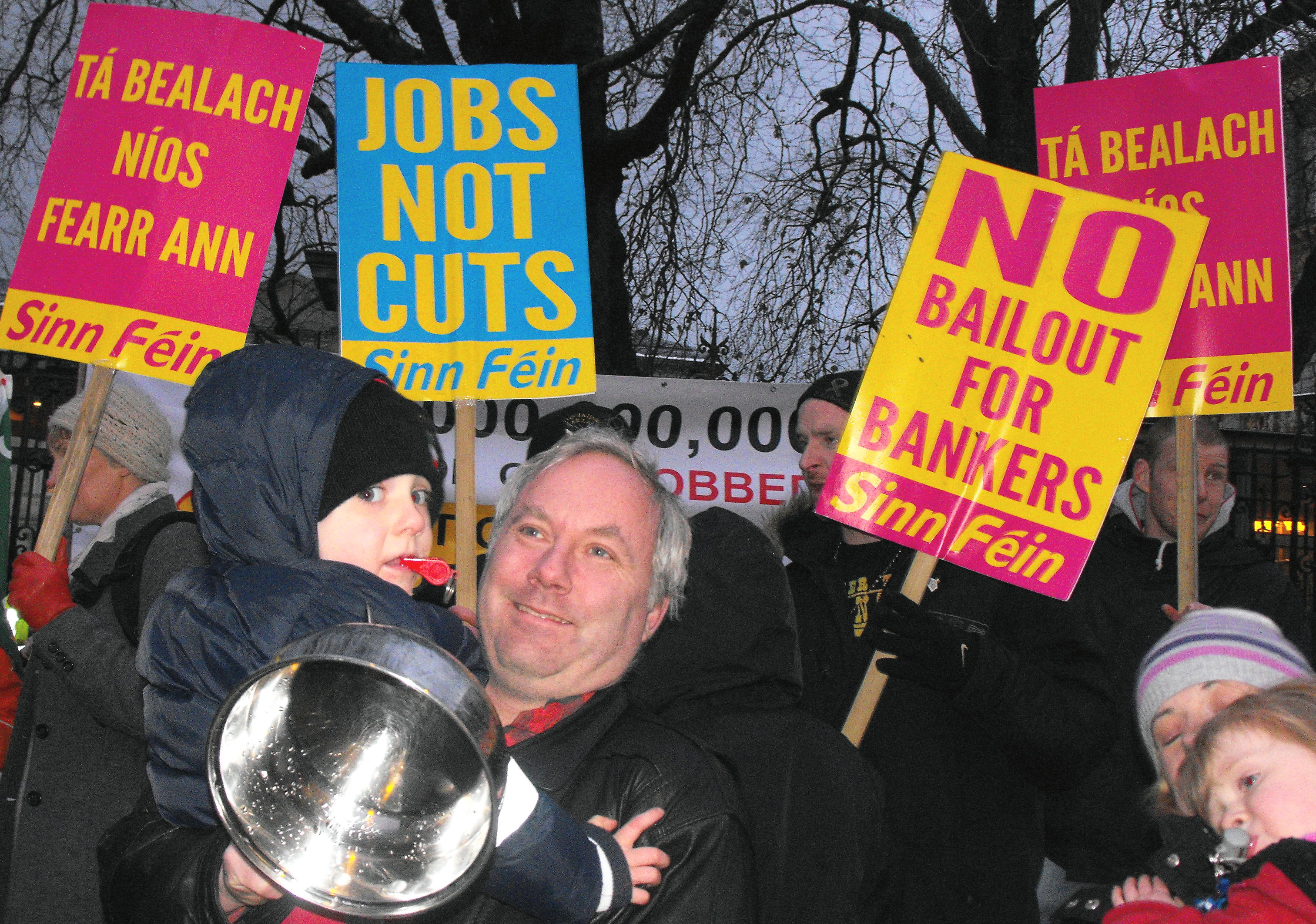
Sinn Féin demonstration at the Dail in 2010 -- all totally reformist slogans apart from possibly the "Don't Pay the Bankers" slogan
Sinn Féin demonstration at the Dail in 2010 — all totally reformist slogans apart from possibly the “Don’t Pay the Bankers” slogan

There is another factor in such a way of organising a bloc – it permits a visible assessment of its size, of the identities of its participants (unless they go masked, as many of the Black Blocs abroad did). Of course this has a down side also in that the state’s political police can take notes on the participants for the purpose of their files. But it has a positive effect too in terms of future progressive and revolutionary action. A mailing list can be compiled for calling to future events, individuals can be introduced to other like-minded individuals, organisations can get to cooperate – all factors militating against the fragmentation of the radical and revolutionary sector.

Some people on the other part of the march accused the Anti-Capitalist Bloc of being politically sectarian. Perhaps some even thought them elitist. These are of course dangers. But was it or was it not an important statement to make, that the problem was not the governing party but the system, and that a revolution was necessary? And if it was an important point to make, was such an eye-catching way of making it not justified?

Let’s consider what happened in the months and years afterwards and where we are now. In the face of a wide-scale howl of protest at the bank deals of the Government, their economic measures, and recent individual politician scandals, Fianna Fáil were deserted by their Green Party coalition partners. FF dumped their leader and elected a new one for their party and for the Government. It was all too little, too late and they were obliged to agree to a general election, the result of which was that FF’s number of TDs (elected representatives) was cut by nearly 80%, the greatest electoral defeat suffered by either of the main political parties in the history of the state. And the Green Party was wiped out as an electoral force, almost disappearing entirely off the political map.

The electoral verdict otherwise was mixed. The main rival of FF, Fine Gael, got the most votes with the social democratic Labour getting the next largest amount. Sinn Féin jumped from four to fourteen, a Trotskyist party and a different Trotskyist led-alliance got four between them for the first time, twenty Independents were elected, most of them left-wing. But whether socialist, republican, conservative or social-democratic, all candidates had been elected on platforms of opposition to the deals the previous government had made with the banks and with the EEC’s banking regulators.

Despite that, Fine Gael and Labour formed a coalition government and proceeded — in fact — to endorse what their predecessors had done and furthermore, to intensify a regime of austerity on working people, introducing three new taxes and supporting legislation to squeeze the people still further. The message of the Anti-Capitalist Bloc was vindicated.

Would the whole demonstration marching under a banner of “Overthrow Capitalism” have significantly changed that electoral result? Extremely unlikely. But it would have posed the question to the participants and to observers. It would have effected subsequent campaigns of resistance to austerity measures and additional taxes. And it would have built a much wider consensus eight or nine years later that the overthrow of capitalism was the only solution with perhaps a growing consensus that such an outcome was possible.

Because here we are now nine years after those three appearances of the Anti-Capitalist Bloc and once again it seems a general election is looming. Once again, we see other political parties pushing forward to be elected on programs without any perspective of overthrowing capitalism. Political alliances based on continuing the system are being mooted. On social media one sees calls for for kicking out Fine Gael or Labour or both, rather than capitalism. On demonstrations against the Water Tax we hear slogans against Enda Kenny, leader of Fine Gael, or against the Labour Party – but few against the capitalist system. Sinn Fein seek to cut down Labour as they court the social democratic vote which, in the past, they have largely ignored (for example, they have little history in the trade union movement). The Trotskyist groups will also attack Labour, also going for the social-democratic vote as they have traditionally done.

Most people feel that the Government will fall soon but when they pose alternatives they are doing so within the framework of capitalism. That means that same class that commanded the deal with the banks and with the EU will remain in power. Their representatives in government will change but the class will remain. And if they remain, their exploitation remains. Not only that but in the present economic climate, their austerity program will remain too – perhaps with some tweaks here and there but austerity still.

A determined campaign of political leadership over the past nine years giving a clear direction of the need to overthrow capitalism could have us in a very different political position now.

So, the next time we get a call to join a bloc for a demonstration, should we rush to it? Well, not necessarily. Let us question what the bloc is for and what it aims to do. Is the bloc in question a tactic, for example like the Black Bloc, where we identify a revolutionary opposition by colour and also, by masking, make it harder for the State to identify us? There may well be a time and place for such. Or is it to declare a revolutionary principle such as “capitalism is the problem; revolution is necessary’? Or “Non-Payment of the Water Charge is what is required”? Then it seems to me that the answer is that yes, we should.

But if it is to draw some particular lines of political affiliation, for example to say that although the participants may belong to separate organisations or none, “we are all communists” or “we are all republicans” or “we are all anarchists”, then I fail to see how that helps the popular resistance movement proceed forward at all, to say nothing of revolution. If that is the purpose of a bloc, it is fine for the followers of that particular ideology but they would be best fulfilling it by holding public meetings and conferences.

On the street, we need to be motivating observers for participation in resistance, and motivating participants for unity in effective actions, for revolution. Motivation has an emotional component but also an ideological one and in that regard the message has to be to overthrow capitalism. At the moment it is that idea that needs to gain hegemony rather than any particular political party or organisation.

End.

THE OTHER PATRICK

Diarmuid Breatnach


According to Sean O’Casey, generations of boys after 1690 were named “Patrick” or “Pádraig” in memory not of the Christian saint, patron saint of Ireland (whose position was often less than St. Bridget’s) but instead in memory of Patrick Sarsfield, First Earl of Lucan.


Patrick Sarsfield Earl Lucan
Portrait of Patrick Sarsfield

Sarsfield, as a younger son of an aristocratic Anglo-Irish (“Old English”) family became a soldier. He fought in the English Royalist Army in England and took part in the suppression of the Monmouth Rebellion. During the Civil War he fought again briefly for the Royalist cause and went to France after the victory of Parliament. He had come into his inheritance by then due to the death of his older brother. Sarsfield came to Ireland from France with James II to raise an Irish army to support James against the British Parliament and their Dutch King William of Orange.

Ballyneety Raid Painting
“Sarsfield’s the word and Sarsfield’s the man!” Depiction of the raid led by Sarsfield on William’s waggon train of equipment and supplies for the First Siege of Limerick. Ironically, the English password that evening for the sentries was “Sarsfield”.

Up to this point he had an unremarkable military career (though an eventful personal one). The raid he led on William’s siege train at Ballyneety led to the defeat of the first Siege of Limerick. The password of the sentries of William’s siege train was “Sarsfield” which, as well as being a great irony, also indicates that his name was of some import in the ranks of the enemy. He was also mentioned in enemy accounts of the Battle of the Boyne where they praised his management of a fighting retreat after that great disaster for the Irish cause.

THE TREATY OF LIMERICK

Sarsfield negotiated the very generous surrender terms at Limerick which ended the Second Siege and the war — terms which however were broken by the English side “‘ere the ink …. was dry”. The Irish soldiers went off the France to serve in the French royal army and from there also to other armies on the Continent. The ships that were supposed to bring the women after them were never supplied, giving us Irish Jacobite songs of great romantic loss.


Sarsfield Statue Limerick
Statue of Sarsfield, Limerick City

AFTER LIMERICK

The Penal Laws followed, institutionalising religious discrimination against Catholics but also all non-Anglican sections of the Protestant faith which, a century later, led to the forming of the United Irishmen and the uprisings of 1798 and 1803. And so on … and on.

Fighting in the French royal army in the Nine Years’ War, Patrick Sarsfield was wounded at the Battle of Landen 1693, fighting once again against the armies of William (and of his allies). His rank was Lieutenant-General at the time. Sarsfield died days later at Huy, Belgium, where he is buried in St. Martin’s Church grounds; he was around 33 years of age.

There are a number of songs remembering Patrick Sarsfield and one of the finest, in my opinion, is “The Jackets Green” by Michael Scanlan. I don’t sing it to the air as recorded by the Wolfe Tones but instead to the air of Seosamh Ó hÉanaigh’s way of singing McAlpine’s Fusiliers (which is also much nicer than the usual McAlpine’s Fusiliers, in my opinion).


THE JACKETS GREEN

Michael Scanlan

When I was a maiden fair and young,
On the pleasant banks of Lee,
No bird that in the greenwood sung,
Was half so blithe and free.
My heart ne’er beat with flying feet,
No love sang me his queen,
Till down the glen rode Sarsfield’s men,
And they wore the jackets green.

Young Dónal sat on his gallant grey
Like a king on a royal seat,
And my heart leaped out on his regal way
To worship at his feet.
O Love, had you come in those colours dressed,
And wooed with a soldier’s mein,
I’d have laid my head on your throbbing breast
For the sake of your jacket green.

No hoarded wealth did my love own,
Save the good sword that he bore;
But I loved him for himself alone
And the colour bright he wore.
For had he come in England’s red
To make me England’s Queen,
I’d have roved the high green hills instead
For the sake of the Irish green.

When William stormed with shot and shell
At the walls of Garryowen,
In the breach of death my Dónal fell,
And he sleeps near the Treaty Stone.
That breach the foeman never crossed
While he swung his broadsword keen;
But I do not weep my darling lost,
For he fell in his jacket green.

When Sarsfield sailed away I wept
As I heard the wild ochone.
I felt then dead as the men who slept
‘Neath the fields of Garryowen.
While Ireland held my Dónal blessed,
No wild sea rolled between,
Till I would fold him to my breast
All robed in his Irish green.

My soul has sobbed like waves of woe,
That sad o’er tombstones break,
For I buried my heart in his grave below,
For his and for Ireland’s sake.
And I cry. “Make way for the soldier’s bride
In your halls of death, sad queen
For I long to rest by my true love’s side
And wrapped in the folds of green.”

I saw the Shannon’s purple tide
Roll by the Irish town,
As I stood in the breach by Dónal’s side
When England’s flag went down.
And now it lowers when I seek the skies,
Like a blood red curse between.
I weep, but ’tis not women’s sighs
Will raise our Irish green.

Oh, Ireland, said is thy lonely soul,
And loud beats the winter sea,
But sadder and higher the wild waves roll
O’er the hearts that break for thee.
Yet grief shall come to our heartless foes,
And their thrones in the dust be seen,
So, Irish Maids, love none but those
Who wear the jackets green.


end.

“BELIEVE” — short poem by Donal O’Meadhra

From their homes stolen lives.
Injustice never new.
Not one crime done nor crime seen.
A sentence served undue.

Witness blind and judge astray.
Trial a kangaroo.
You want a reason to believe?
My friend, I’ll give you two.

Two sons of Craigavon Ireland,
Our voices now are due.
The cry should shout until it cracks
For justice to the two.

It happens time and time again,
Shadows of me and you.
Where once stood four and then the six,
The mirror shows the two.

Together we can make this right.
As one we’ll see it through.
You want a reason to believe?
My friend, I’ll give you two.

Believe poster J4C2


The poem is about the incarceration of the “Craigavon Two”, Brendan McConville and John Paul Wooton.  On the 30th of March 2012 both men were convicted and given life sentences.  They were accused of the fatal shooting of Constable Steven Carroll in Craigavon on the 9th of March 2010.  The evidence was a hotch-potch of questionable material including an “eyewitness” who only came forward a year later after both Republicans had been in jail for a considerable time, a man whose evidence was contested by that of his wife and of his own father.

The case against them was so riddled with inconsistencies and suspect material, alongside new evidence of police interference with witnesses for the Defence, that there were high hopes of both men being cleared and freed when the appeal concluded in October last year.  However, to the shock of many, including a number of Independent TDs (members of the Dáíl, the Irish parliament) and the late Gerry Conlon, their appeal was denied.

The campaign is on-going and supported by a number of organisations and individuals.  It was in support of the Two that Gerry Conlon, formerly of the Guildford Four (and a subject of the film In the Name of the Father), made his last public statement days before he died.

Their campaign website http://justiceforthecraigavontwo.com/we-are-innocent/

“Where once stood four and then the six” in the second-to-last stanza is a reference to the Guildford Four and to the Birmingham Six, ten people (all Irish save one) who in 1974 were wrongly convicted of bombings in Britain and were finally cleared only fifteen and sixteen years later.  Also wrongly convicted were the Maguire Seven (which included Giuseppe Conlon, Gerry’s father, and teenagers) and Judith Ward (a woman who was mentally ill at the time).

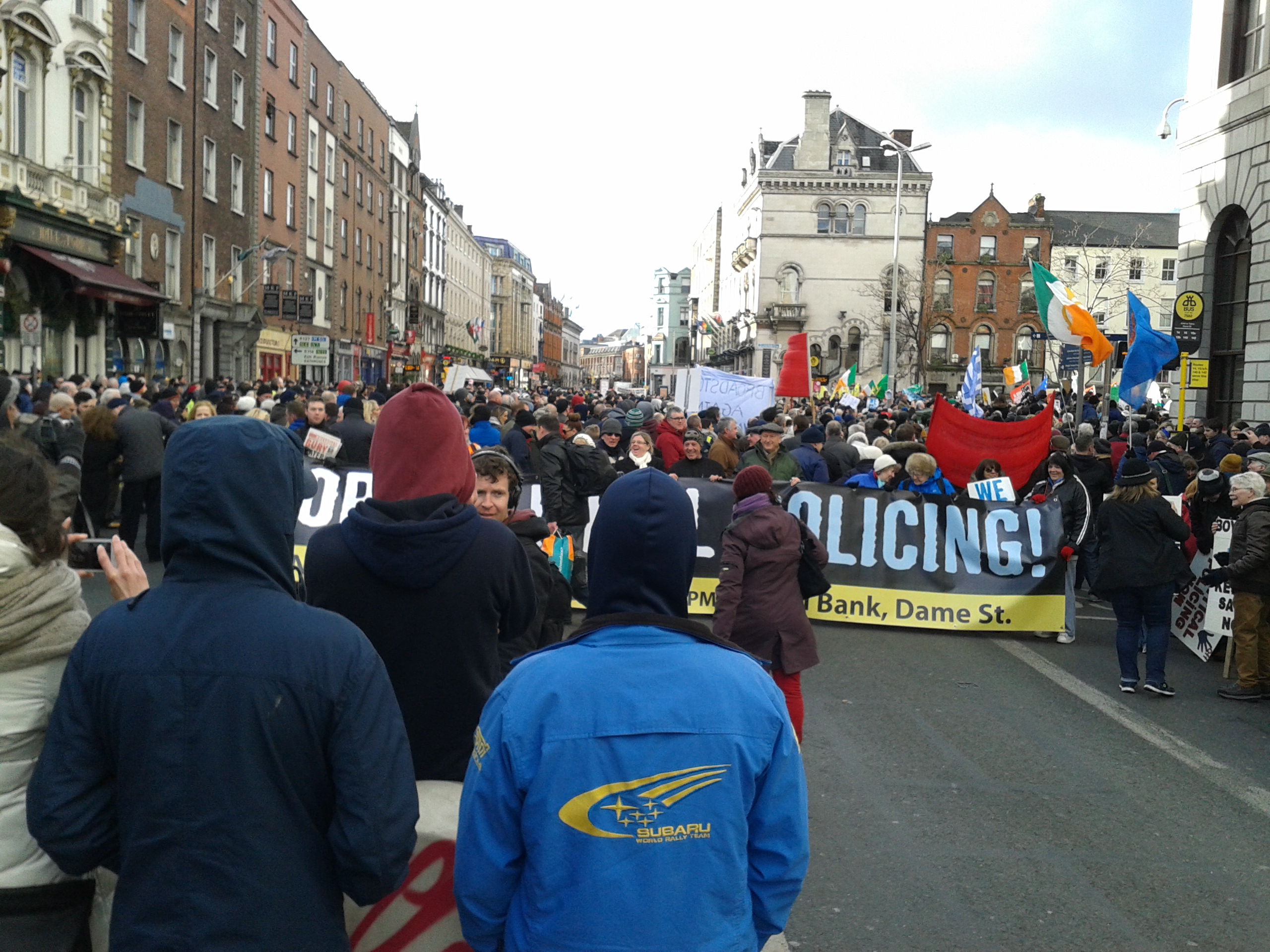
UP TO TEN THOUSAND MARCH IN SOLIDARITY WITH JAILED AND ARRESTED WATER TAX PROTESTERS

Start of the march in Dame Street after rally in Central Plaza

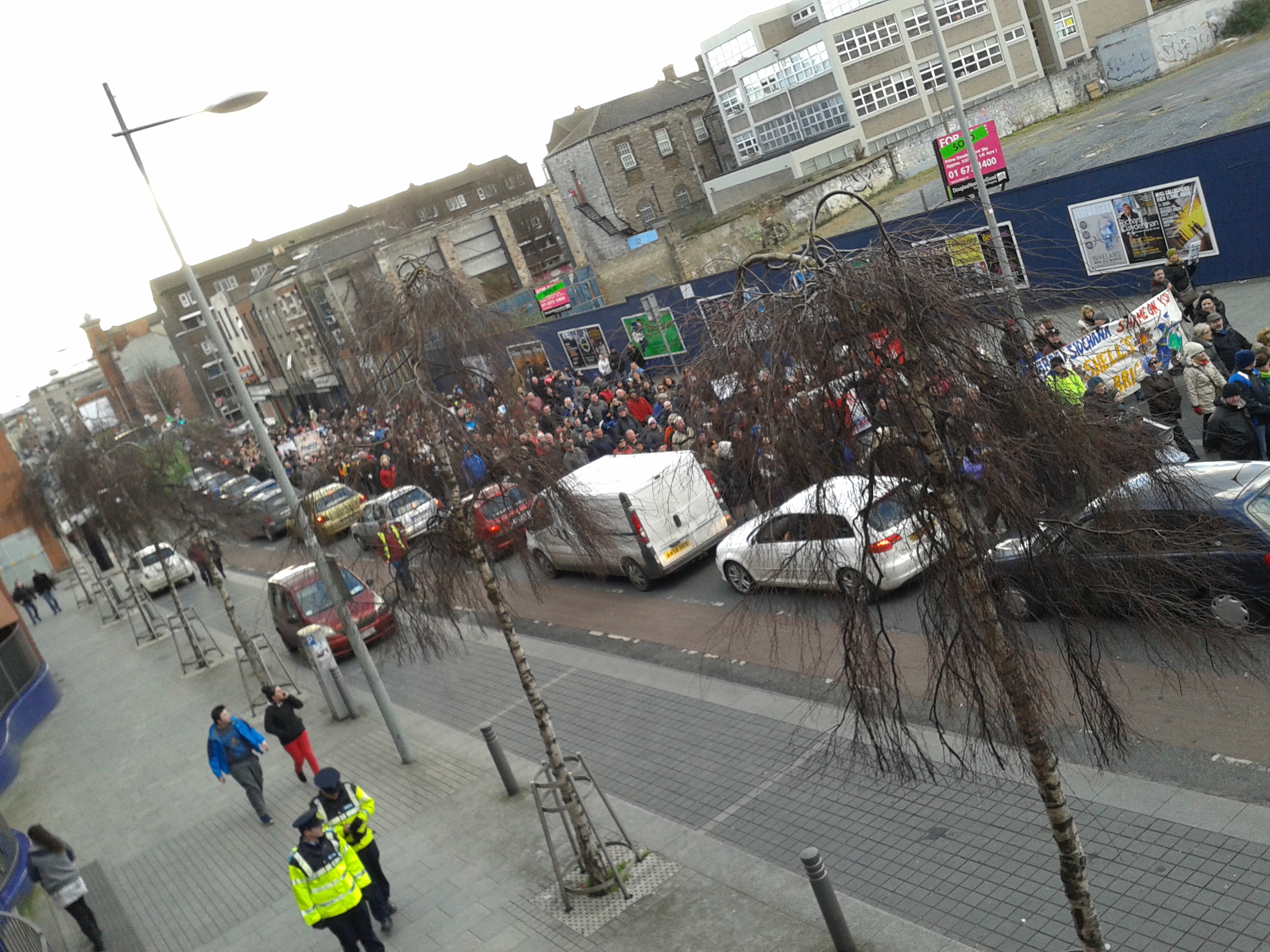
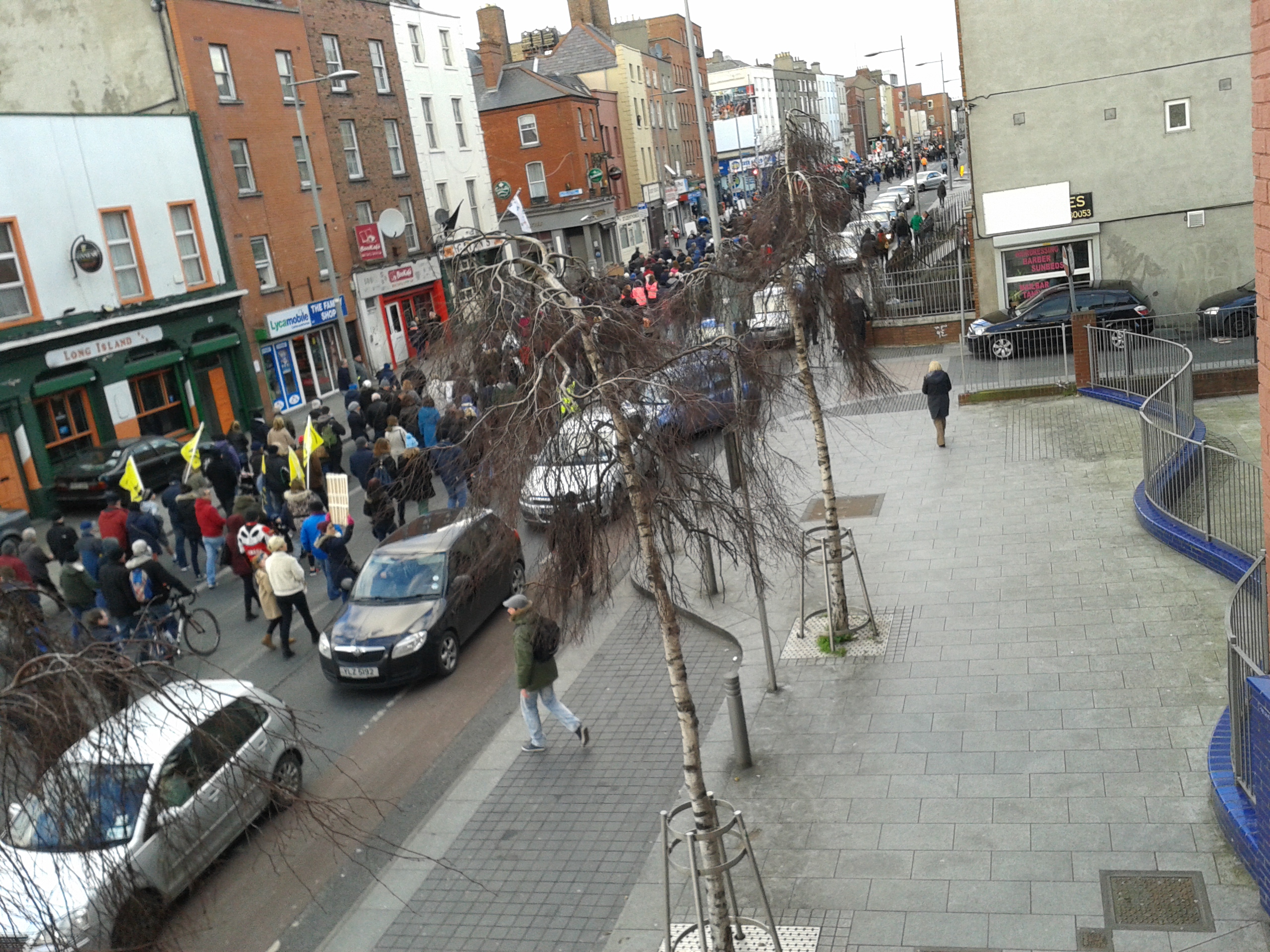
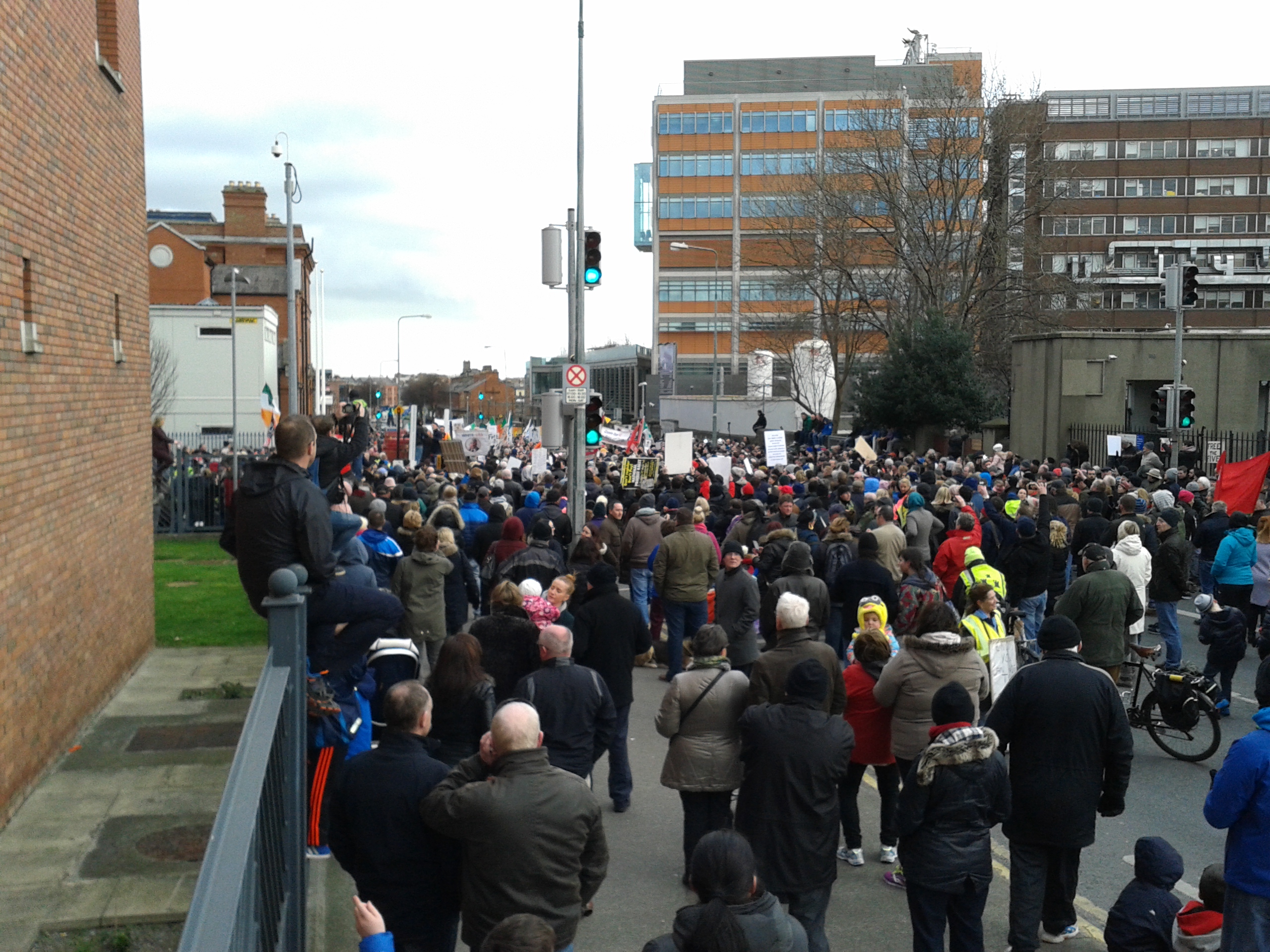
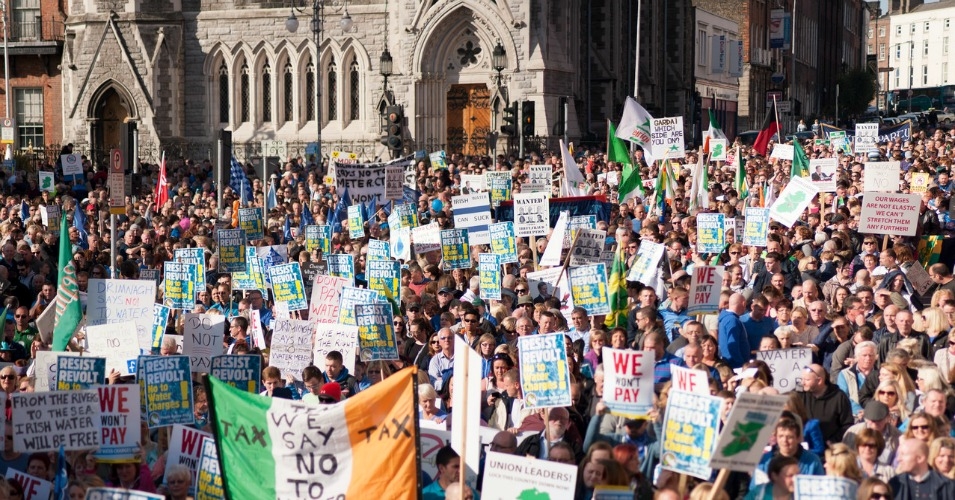
On Saturday 21 February, at two days’ notice, somewhere between eight and ten thousand people gathered in Dublin in solidarity with those water tax protesters jailed by the State and those recently arrested.  They marched to Mountjoy Prison and packed the road outside it and in front of the local Garda (police station).


Dame St Start March V Repression Water Tax Protesters 21 Feb2015
The march gets going in Dame Street. Photo shows only the front of the march.


Parnell Square West from Granby Place.  The front of the march has turned into Dorset Street and is marching there but the end has yet to come around the corner into the square from Parnell Street
Parnell Square West from Granby Place. The front of the march has turned into Dorset Street and is marching there but the end has yet to come around the corner into the square from Parnell Street

The crowd were addressed by relatives and friends of the jailed, anti-Water Tax campaigners as well as by Paul Murphy, Joan Collins and Clare Daly (both TDs of the United Left) and Dessie Ellis (TD of Sinn Fein).

All of the speakers denounced the politicians and the State for the jailing of the protesters while the bankers and politicians who created the crisis and colluded in the bank bailout went free. Most speakers called on the crowd not to pay the water tax and to build resistance on the streets. Dessie Ellis, in keeping with his party’s position, did not call for non-payment, though he did call for “unity of the Left”. The march was notable for the absence of SF banners and placards — apparerently they were having their own protest at Leinster House.

One of the protesters made an emotional appeal on behalf of two of the five who received jail sentences, who have gone on hunger strike, and on behalf of another, Derek Byrne, also on hunger strike, but who has declared his intention of refusing to take fluids from Monday if he is not released. (NB: Since posting that paragraph it has emerged that the demand of all three hunger-strikers is a return to Mountjoy [they had been separated and sent off to a prison facility near Clondalkin] and an end to 23-hour lockup in their cells. These are basic human rights.)

Large sections of the crowd seemed taken aback by this information and unsure how to react.

Paul Murphy pointed out that this use of the police to attack people protesting injustice has been a feature of the State since its creation and mentioned the threats of jail to striking workers, the jailing of the Rossport Five and of Margaretta D’Arcy. Clare Daly asked the Gardaí which side they were on, that of the polticians and bankers or of the people, saying that if they chose the former it is they who would become isolated, not the protesters. Joan Collins, Murphy and Daly all pointed to the need to create a socialist society. They also, along with most other speakers, called for a build up and huge turn out of support for the demonstration scheduled for March.  Many speakers declared that the increased repression is a sign of the Government’s or the system’s weakness, not of their strength and called on the movement not to falter now.

Robert Ballagh, who also spoke, called for the release of the five and pointed out that the class of people who rule and profit out of this society are not those who find themselves in jails.

Section of the march in Dorset Street, looking west
Section of the march in Dorset Street, looking west (another section is behind the camera — see next photo — but a large section of the march has yet to come around the corner from Parnell Square.)


The same road, photo taken a few seconds later but looking east.


The mood of the crowd in general was of good-humoured determination. The composition seemed to cross social groupings, ages and genders and a number had brought their children along. Some had come from other parts of the country.

Crowd outside Mountjoy.  some have left and many are still further down the north Circular Road
Crowd outside Mountjoy. some have left and many are still further down the north Circular Road (the Mater Hospital is to the right of photo).

CATHERINE BYRNE, DUBLIN FINE GAEL TD, SAID “WE SHOULD TAKE BACK OUR FLAG”. MAYBE SHE’S RIGHT ….

CATHERINE BYRNE, DUBLIN TD, SAID “WE SHOULD TAKE BACK OUR FLAG”. MAYBE SHE’S RIGHT ….


Dublin South-Central TD Catherine Byrne was warmly applauded when she said that they should ”take back our flag” from people who have been using it in protests against water charges and other issues.  She made the statement at the Fine Gael political party’s two-day conference in Castlebar, Co. Mayo, held under strict security.

Arts Minister Heather Humphreys supported that view and told delegates in a secret session on the 1916 commemorations (a session which exposed divisions in the party): ”Some have used our flag to portray a different message – it’s time to reclaim our flag.”

They are both right, in a way.

Listen to this:

WHAT SHOULD WE DO?

“What should I do?” The anguish reached out to me; I felt it empathically. The cry of a person who is prepared to act and wants to change things for the better, to resist what is wrong around us on so many fronts – and that’s the problem.

There so many issues: the Water Tax, the persecution of Republican activists including framing and jailing them, the harassment and torture of Republican prisoners, the threat of fracking, privatisation of resources and services, cuts in services, cuts in salaries, high cost of private accommodation and low social housing provision causing homelessness, the decline of the Irish language and of the Gaeltacht …. and others. And that’s without mentioning international solidarity – and not because I don’t consider that essential, either.

Of course, we can put all these problems down to capitalism and, in the case of repression of Republicans (and with regard to international solidarity), to imperialism …. so let’s just overthrow those systems and then we can sort out those problems! But that leads to the question of “How” which in turn brings one back again to that anguished question, or to its variant “Which problem should I prioritise?”

Indeed, it is a question that cuts to the heart of the matter. For the issues call to us to act and since we can’t be everywhere at once we have to make choices. It is a question as old as class society and speeches are always being made recommending this choice or that while books have been written attempting to answer it. Lenin wrote a series of articles in the revolutionary newspaper Iskra (“Spark”) and published later as a booklet under a title that echoes that very cry above: What Is to Be Done? It had a subtitle too: “Burning questions of our movement” (by which he meant the socialist movement in Russia at the time).

Whether we choose to believe that work was absolutely correct, partly correct or completely wrong is in some ways irrelevant, for it was written for the movement in Russia in 1902 and published in 1905. I happen to think that it contains many useful ideas, although I am aware that there is a view that it has been mistranslated but, even so, in many ways, all that is beside the point. The fact is that today we have no blueprint and nothing more than perhaps the equivalent of a trouble-shooting manual: “for this problem, try this; if that doesn’t work, try that; while doing so beware of that other.” And that manual is cobbled together from older and more recent history of struggles, of analyses of the capitalist system and of how it behaves.

Scary, surely, to go up against a system that has ruled for around four centuries, that has spread across the world, that controls education, mass media, the State with its police, judges, prison and armed forces – and all without us having a blueprint. Well, if it’s any consolation, the capitalists don’t have a blueprint either … or if they do, they keep having to ignore it and react to events which they have not been able to predict, as well as to the extent of resistance for which they were unprepared. And they clearly make mistakes. Still, 400 years is a long time … a long time for them to learn tactics and strategy and to get comfortable in control and a long time to make us think that we can’t defeat them.

We can defeat them, of course and the indications from history and the internal workings of capitalism — and of its offshoot imperialism — are that we will. But what to do to make that happen? Yes, back to that question. And to the one that logically follows it: which issue to prioritise? For none of us is capable of being everywhere at once and even stretching over a few issues at a time begins to tear at our fabric.

The Marxist-Leninist approach argues for the creation of a revolutionary party that will make decisions on prioritisation and allocate resources to those struggles it chooses as it does so. Of course, the party will make mistakes from time to time and it will learn from those, getting better as it goes along. That’s the theory anyway. In application, or in alleged application, the results have not vindicated the theory – not in the long run, or even in the medium-term. Sure, we have been at it for less than 200 years: the first time workers captured a city was in 1871 and the first successful overthrow of the State was in Russia in 1917, very nearly a century ago. Much less time to learn, to make mistakes and to correct them but still ….

Of course, the alternative method of organising has even less to recommend it on results: amorphous, disparate collectives have not ever successfully overthrown a State and even their success in capturing a city (Barcelona, 1936) is debatable.

So, what is to be done? How to decide which struggle to prioritise? This is not a question I think can be answered by pointing and saying “That one and no other” or even, except at rare junctures, “That one and no other for the moment”. Individuals, collectives and parties will need to choose from the selection as a painter chooses from a palette: “this colour now, then that, no, scrub that one, now mix this with that, no, a bit more light …” and so on, always working towards the desired result which, although in the head, is also taking place on the canvas and making its own demands as it does so.

The truth is that all of those issues I mentioned in passing at the start of this piece, all of those, need addressing. All of them need people to fight in them. That is because they are all part of the same problem and also because we can’t just allow a cancer to grow unchecked in one part of the body while we address the tumours in another. Some individuals and perhaps even collectives are better suited to fight on some issues than on others: for example, a factory shop committee is probably not best placed to lead the struggle against fracking in a rural area, while a rural environmental collective is probably not in the best position to lead the struggle against the Water Tax. Individuals will need to pick and choose according to their own situation, their locality, their own knowledge.

And that would be fine, if the resistance movement as a whole were integrated enough to make creative use of that disparity – for particular struggles to be able to call for temporary additional resources and to be heard by the whole resistance movement, so that it could try to allocate those resources to one or other sector as seemed appropriate. But the resistance movement is far from integrated – it is fragmented and, even worse, it suffers from something akin to schizophrenia.

There a number of ways to imagine schizophrenia and the most popular is to see it as the development of two or more personalities in the one individual. But another is to see it as a disintegration of the personality – where the various aspects in our minds break free and appear as distinct personalities in themselves. The voices that speak in our heads to say things like “You shouldn’t have done that” or “Please make that happen” break free and seem to become different personalities. At times they conflict with one another while the central core personality tries to make sense of what is going on. Something like that, anyway. It is in that sense that I think the resistance movement in Ireland suffers from schizophrenia.

The splitting off of aspects of the revolutionary movement in Ireland has been towards two major poles of attraction: the Socialist one and the Republican. Of course there are some elements who incorporate both to one degree or another but I think examining them as distant poles of attraction is useful and much closer to their concrete manifestation within the revolutionary movement.  In order to examine them as opposite poles I think it is also useful to imagine a stereotype individual inhabiting each pole. Let us then imagine a stereotypical Irish Republican and a stereotypical Irish Socialist.

The Irish Republican is probably working class or maybe lower middle class; he may or may not have done well at secondary education but in any case he is unlikely to have gone to university. He sees himself in a tradition of resistance to British Colonialism and Imperialism stretching back at least to the United Irishmen and perhaps even back to the Norman conquest which began in 1169. His priority is the removal of the British from Ireland. He experiences “political policing” (of which some socialists are now complaining) practically from the moment he becomes publicly active – he has had his name and address taken by Special Branch and/or RUC/PSNI and they have opened a file on him. The Republican’s recent predecessors have been jailed (as are some of his contemporaries now), beaten or even shot dead; they were engaged in armed struggle against the colonial and imperial armed forces in the Six Counties for 30 years and perhaps he looks forward to take the gun up again some day, to strike back at the colonial overlord. He will turn out on demonstrations and pickets against repression of Republican activists, in support of Republican prisoners, including framed ones. He will almost certainly attend mass demonstrations against the Water Tax and may participate in local direct action against it. The Republican’s idealogues are Wolf Tone, Patrick Pearse and Bobby Sands.

The Irish socialist is probably medium or lower middle class and has finished secondary education; she has almost certainly gone on to university. She sees herself as belonging to a tradition of only a couple of centuries, with an Irish tradition going back to the early part of the 20th Century, in particular to the 1913 Lockout and the Limerick Soviet of 1919. She may or may not give a high place in her history to the Irish Citizen Army in the 1916 Rising. Her priority is the defeat of the capitalist class, probably in Ireland first but will turn out in demonstrations against racism, gender discrimination and homophobia in Ireland. The Irish Socialist aspires to a general strike giving rise to a revolutionary take over of the State; in the interim she may or may not think electing left-wing TDs or trade union officials an important activity. She probably can’t conceive of taking up a gun. The Irish Socialist has never had her name taken by the Special Branch or been framed by the RUC/PSNI and may never even have been detained by the police, though she has probably been pushed around by them. She will almost certainly attend mass demonstrations against the Water Tax and may participate in local direct action against this Tax. Her idealogues are Karl Marx, Lenin, possibly Trotsky and James Connolly.

Granted these are stereotypes but they are not so far from reality as to be unhelpful in describing in turn many and perhaps most Irish Republicans and Socialists and therefore in identifying one of the principal fracture lines in the Irish movement of resistance.

If the Republican and the Socialist parts of the Irish resistance movement were to be combined, or at the very least to work on a more collaborative basis, the “What should I do?” question would be easier to answer. It would be simpler to be on a picket for prisoners one week and resisting water meters the next, even if one’s main sphere of activity were among Republicans. The socialist could attend a picket against cuts one week and one for the human rights of Republican prisoners on another, even if her main sphere of activity was among Socialists. But that is not the situation that exists at the moment and, though a number of attempts have been made to combine the two trends in one organisation, they have not met with any great success to date.

So, I have not yet answered the question, have I? Am I saying that what we should be doing is creating some kind of synthesis or at least a collaborative alliance between the the socialist and republican parts of the resistance movement? Well, yes, certainly. But also, and as a contribution to that, as individuals we should try and spread our activity between the areas of greatest concern of each of those sections of the resistance movement. We should, I think, take some time to support resistance to the water tax, demonstrations against cuts etc. in their own right but also find some time to support resistance to British colonialism and its repression of Republican political activists. “If we are not part of the solution, then we are part of the problem” may be a glib truism but it is particularly applicable in this case.

So, how will we find the time to spread ourselves around? How do we ever? We balance and juggle priorities between our politically active and our social lives, with employment thrown in when we have a job. Or upskilling or studying. And possibly cultural or sporting or other activities. But how to choose, how to prioritise? Each of us has to make those decisions herself and himself. Not a very helpful answer? Well, I did state earlier on that there wasn’t a blueprint, so I couldn’t have one myself, could I? This however I feel fairly confident in predicting: if we don’t find a way to support both those parts of the resistance movement to some degree, it will always be fractured. And while it is so, it cannot be successful in either ridding Ireland of our capitalist classes or in finally throwing off the colonial yoke.

end

New Song: They’re Stealing Our Water

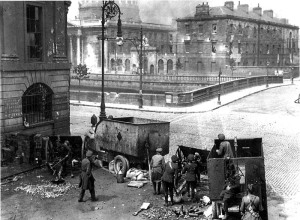
Black n Tans lorry plus RIC
British colonial police in Ireland, Auxilliaries and RIC in Dublin raid during War of Independence 1920 or 1921.
Cromwellian Massacre at Drogheda
Drawing depicting Cromwellian troops massacre at Drogheda 1649

A little bit rough in places but think I should get it out now and hopefully get people singing it ASAP.  I am surprised no-one seems to have used this tune, The Sea Around Us, and the mention of “water”, already.  Thanks to Ruairi O’Broin at the February session of Song Central for suggesting the “bank guarantee” line in the chorus, much better than what I had there originally.

Amended a little again since I wrote the above but still not sat down and really consistently worked at it.  Amended yet again slightly in 2020.

THEY’RE STEALING OUR WATER

Diarmuid Breatnach (To the air of “The Sea Around Us”, also known as “The sea, Oh the sea”)

Chorus:

The sea, oh the sea, a ghrá gheal mo chroí,

‘though long it may roll between England and me,

We’ve still got our gombeens* with a bank guarantee

and they’re trying to steal our own water!

(The chorus can go in after each verse, or each second, as people prefer).

1.

The Norse came to Ireland right outa’ the blue,

took us as slaves and plundered and slew;

But their days were all numbered from Clontarf they knew

— they never troubled us much for the after.

2.

Then the English came over our patience to try,

our land for to steal and our culture deny

And they took all that we had … I tell you no lie —

but at least they left us our water!

3.

‘Twas many a hard battle with the English we fought,

as used be our wont and indeed so we ought;

but as time went by, it all came to naught

and they put poor aul’ Éire in a halter.

4.

But we rose up once more and again and again —

we had stalwart youth and women and men;

We fought them in city and mountain and glen

and forced them their plans for to alter.

5.

Then those who at our struggle took fright

stepped in and took over the fruits of our fight;

The Gombeens and Church turned our dawn into night

and in a wink we were back under the halter!  

6.

The parasites live off our sweat and our blood — 

OLYMPUS DIGITAL CAMERA

they’d tax the very air that we breathe if they could;

But our media says to resist is not good …

and compliance would get us much further.

7.

Our resources are for the people to share in —

is linne ar fad é, uisce na hÉireann;

and it’s now the baton and prison we’re darin’ —

they’ll not steal from our sons and our daughters!

8.

The people are standing firm and steady —

they know that we’ve paid for the water already!

Our banners unfurled and more things ready:

You can be sure this time we won’t falter!

February 2015.

Dennis O Brien
Denis O’Brien, a billionaire widely believed to have plans to buy Irish Water if/when it becomes privatised. He is a major shareholder in Sierra Construction, the company installing water meters and also in Independent Newspapers. The Moriarty Tribunal found that he had benefited from information from the Irish Minister for telecommunications whom O’Brien had paid €50,000 through circuitous channels. The information had assisted him in bidding for the mobile phone contract, which he later sold at a personal profit of €317 a few years later.
Brian Cowen
Brian Cowen, former Taoiseach (equivalent to Prime Minister) in the Fianna Fáil-Green Party coalition Government 2011, which began the bank bailout.
Joan Burton angry maybe
Joan Burton (Labour), Minister for Social Protection in the Labour-Fine Gael coalition Government at time of writing


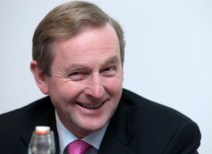
Enda Kenny winking
Enda Kenny (Fine Gael), Taoiseach (equivalent to Prime Minister) in the Labour-Fine Gael coalition Government at time of writing


!

Water Tax Demo crowd

* “Gombeen”, from the Irish “Gaimbíneach” is a profiteer, a venal person, a moneylender, a capitalist.

The Irish War of Independence and the retreat from stated objectives in spite of the precariousness of the British position

(This is reprinted with minimal editing from a section of a much longer piece of mine published in English and in Spanish a year ago https://rebelbreeze.wordpress.com/2014/01/30/how-can-a-people-defeat-a-stronger-invader-or-occupying-power-2/)


Diarmuid Breatnach

The War of Independence 1919-1921 and retreat from stated objectives

Three years later (after the 1916 Rising), the nationalist revolutionaries returned to the armed struggle, this time without a workers’ militia or an effective socialist leadership as allies, and began a political struggle which was combined a little later with a rural guerilla war which soon spread into some urban areas (particularly the cities of Dublin and Cork). The political struggle mobilised thousands and also resulted in the majority of those elected in Ireland during the General Election (in the United Kingdom, of which Ireland was part) being of their party.

The struggle in Ireland and the British response to it was generating much interest and critical comment around the world and even in political and intellectual and artistic circles within Britain itself. In addition, many nationalist and socialist revolutionaries around the world were drawing inspiration from that fierce anti-colonial struggle so near to England, within the United Kingdom itself.

The dismantling by the nationalist forces, by threats and by armed action, of much of the control network of the colonial police force, which consequently dismantled much of their counter-insurgency intelligence service, led the British to set up two new special armed police forces to counter the Irish insurgency. Both these forces gained a very bad reputation not only among the nationalists but also among many British loyalists. The special paramilitary police forces resorted more and more to torture, murder and arson but nevertheless, in some areas of Ireland such as Dublin, Kerry and Cork, they had to be reinforced by British soldiers as they were largely not able to deal effectively with the insurgents, who were growing more resolute, experienced and confident with each passing week.

However, two-and-a-half years after the beginning of the guerrilla war, a majority of the Irish political leadership of the nationalist revolutionary movement settled for the partition of their country with Irish independence for one part of it within the British Commonwealth.

Much discussion has taken part around the events that led to this development. We are told that British Prime Minister Lloyd George blackmailed the negotiating delegation with threats of “immediate and terrible war” if they did not agree to the terms. The delegation were forced to answer without being allowed to consult their comrades at home. Some say that the President of the nationalist political party, De Valera, sent an allegedly inexperienced politically Michael Collins to the negotiations, knowing that he would end up accepting a bad deal from which De Valera could then distance himself. Michael Collins, in charge of supplying the guerrillas with arms, stated afterwards that he had only a few rounds of ammunition left to supply each fighter and that the IRA, the guerrilla army, could not fight the war Lloyd George threatened. He also said that the deal would be a stepping stone towards the full independence of a united Ireland in the near future. None of those reasons appear convincing to me.

How could the leadership of a movement at the height of their successes cave in like that? Of course, the British were threatening a worse war, but they had made threats before and the Irish had met them without fear. If the IRA were truly in a difficult situation with regard to ammunition (and I’m not sure that there is any evidence for that apart from Collins’ own statement), that would be a valid reason for a reduction in their military operations, not for accepting a deal far short of what they had fought for. The IRA was, after all, a volunteer guerrilla army, much of it of a part-time nature. It could be withdrawn from offensive operations and most of the fighters could melt back into the population or, if necessary, go “on the run”.

If the military supply situation of the Irish nationalists was indeed dire in the face of the superior arms and military experience of Britain, was that the only factor to be taken into account? An army needs more than arms and experience in order to wage war – there are other factors which affect its ability and effectiveness.

The precariousness of the British situation

In 1919, at the end of the War, the British, although on the victorious side, were in a precarious position. During the war itself there had been a serious mutiny in the army (during which NCOs and officers had been killed by privates) and as the soldiers were demobbed into civilian life and into their old social conditions there was widespread dissatisfaction. Industrial strikes had been forbidden during the War (although some had taken place nonetheless) and a virtual strike movement was now under way.

In 1918 and again in 1919, police went on strike in Britain. Also during 1919, the railway workers went on strike and so did others in a wave that had been building up since the previous year. In 1918 strikes had already cost 6 million working days. This increased to nearly 35 million in 1919, with a daily average of 100,000 workers on strike. Glasgow in 1921 saw a strike with a picket of 60,000 and pitched battles with the police. The local unit of the British Army was detained in barracks by its officers and units from further away were sent in with machine guns, a howitzer and tanks.

James Wolfe in his work Mutiny in United States and British Armed forces in the Twentieth Century(http://www.mellenpress.com/mellenpress.cfm?bookid=8271&pc=9) includes the following chapter headings:

Workers pass an overturned tram in London during the 1926 British General Strike. In general, goods travelled through Britain with authorisation from the workers or under police and troop protection.

Workers pass an overturned tram in London during the 1926 British General Strike. In much of the country no transport operated unless authorised by the local trade union council or under police and army escort.

4.2 The Army Mutinies of January/February 1919
4.3 The Val de Lievre Mutiny
4.4 Three Royal Air Force Mutinies January 1919
4.5 Mutiny in the Royal Marines – Russia,
February to June 1919
4.6 Naval Mutinies of 1919
4.7 Demobilization Riots 1918/1919
4.8 The Kinmel Park Camp Riots 1919
4.9 No “Land Fit For Heroes” – the Ex-servicemen’s Riot in Luton
4 4.10 Ongoing Unrest – Mid-1919 to Year’s End

 The British Government feared their police force would be insufficient against the British workers and was concerned about the reliability of their army if used in this way. There had already been demonstrations, riots and mutinies in the armed forces about delays in demobilisation (and also in being used against the Russian Bolshevik Revolution).

Elsewhere in the British Empire things were unstable too. The Arabs were outraged at Britain’s reneging on their promise to give them their freedom in exchange for fighting the Turks and rebellions were breaking out which would continue over the next few years. The British were also facing unrest in Palestine as they began to settle Jewish immigrants who were buying up Arab land there. An uprising took place in Mesopotamia (Iraq) against the British in 1918 and again in 1919. The Third Afghan War took place in 1919; Ghandi and his followers began their campaign of civil disobedience in 1920 while in 1921 the Malabar region of India rose up in armed revolt against British rule. Secret communiques (but now accessible) between such as Winston Churchill, Lloyd George and the Chief of Staff of the British armed forces reveal concerns about the reliability of their soldiers in the future against insurrections and industrial action in Britain and even whether, as servicemen demanded demobilisation, they would have enough soldiers left for the tasks facing them throughout the Empire.

The Irish nationalist revolutionaries in 1921were in a very strong position to continue their struggle until they had won independence and quite possibly even to be the catalyst for socialist revolution in Britain and the death of the British Empire. But they backed down and gave the Empire the breathing space it needed to deal with the various hotspots of rebellion elsewhere and to prepare for the showdown with British militant trade unionists that came with the General Strike of 1926. Instead, the Treatyites turned their guns on their erstwhile comrades in the vicious Civil War that broke out in 1922. The new state executed IRA prisoners (often without recourse to a trial) and repression continued even after it had defeated the IRA in the Civil War.

If the revolutionary Irish nationalist leaders were not aware of all the problems confronting the British Empire, they were certainly aware of many of them. The 1920 hunger strike and death of McSwiney, Lord Mayor of Cork, had caught international attention and Indian nationalists had made contact with the McSwiney family. The presence of large Irish working class communities in Britain, from London to GlaSgow, provided ample opportunity for keeping abreast of industrial disputes, even if the Irish nationalists did not care to open links with British militant trade unionists. Sylvia Pankhurst, member of the famous English suffragette family and a revolutionary communist, had letters published in The Irish Worker, newspaper of the IT&GWU. The presence of large numbers of Irish still in the British Army was another source of ready information.

Anti-Treaty cartoon, 1921, depicts Ireland being coerced by Michael Collins, representing the Free State Army, along with the Catholic Church, in the service of British Imperialism

Anti-Treaty cartoon, 1921, depicts Ireland being coerced by Michael Collins, representing the Free State Army, along with the Catholic Church, in the service of British Imperialism

The revolutionary Irish nationalist leaders were mostly of petite bourgeois background and had no programme of the expropriation of the large landowners and industrialists. They did not seek to represent the interests of the Irish workers—indeed at times sections of them demonstrated a hostility to workers, preventing landless Irish rural poor seizing large estates and to divide them among themselves. Historically the petite bourgeoisie has shown itself incapable of sustaining a revolution in its own class interests and in Ireland it was inevitable that the Irish nationalists would come to follow the interests of the Irish national bourgeoisie. The Irish socialists were too few and weak to offer another pole of attraction to the petite bourgeoisie. The Irish national bourgeoisie had not been a revolutionary class since their defeat in 1798 and were not to be so now. Originally, along with the Catholic Church with which they shared many interests in common, they had declined to support the revolutionary nationalists but decided to join with them when they saw an opportunity to improve their position and also what appeared to be an imminent defeat of the British.

In the face of the evident possibilities it is difficult to avoid the conclusion that the section of revolutionary Irish nationalists who opted for the deal offered by Lloyd George did so because they preferred it to the alternatives. They preferred to settle for a slice rather than fight for the whole cake. And the Irish bourgeoisie would do well out of the deal, even if the majority of the population did not. The words of James Connolly that the working class were “the incorruptible heirs” of Ireland’s fight had a corollary – that the Irish bourgeoisie would always compromise the struggle. It is also possible that the alternative the nationalists feared was not so much “immediate and terrible war” but rather a possible Irish social revolution in which they would lose their privileges.

Irish Free State bombardment 4 Courts
Start of the Irish Civil War 1922: Irish Free State bombardment, with cannon on loan from the British Army, of the Republican HQ at the Four Courts, Dublin.


Another serious challenge to the Empire from Irish nationalist revolutionaries would not take place until nearly fifty years later, and it would be largely confined to the colony of the Six Counties.

end selected extract

TWO DARING DECEMBER AMBUSHES BY NATIONAL LIBERATION ARMIES

Diarmuid Breatnach

In the third week of the month of December two daring ambushes took place, one in Ireland and one in Spain. Both were carried out by national liberation organisations and both were very daring, aimed at extremely high-level military and state targets who were well-protected in cities controlled by the occupying state. The ambushes were one day on the calendar apart but 64 years separated them; the date of the Dublin one was December 19th 1919 and the the other took place on December 20th 1973 in Madrid.

BACKGROUND TO THE IRISH ASSASSINATION ATTEMPT

The target of the Irish ambush was Field Marshal John French. No-one resident in Ireland could rank higher in the British Empire; the British Queen and state’s representative in Ireland, French had been appointed Lord Lieutenant and Supreme Commander of the British Army in Ireland in 1918. Of course, it was not the first time that the Irish resistance had set its sights so high – in 1882 in Phoenix Park in Dublin, the Republican group The Invincibles had assassinated the Chief Secretary for Ireland, at that time the Queen’s representative, along with Thomas Burke, the Permanent Undersecretary and the Queen’s most senior civil servant in Ireland.

Field Marshal John French had previously held the positions of Commander-in-Chief of the British Home Forces and, at the start of the First World War, Commander-in-Chief of the British Expeditionary Force in France. Under General Maxwell, he oversaw the suppression of the 1916 Rising and subsequent executions. Had the British government imposed conscription in Ireland in 1918, as threatened, he would have been in charge of seeing it through and had in fact pressed for the measure to be introduced. In the event, the opposition to conscription in Ireland was so widescale, including from the Irish Catholic Church, usually so loyal to the British, that an insurrection was feared if they went ahead with it.

John French was from a Norman-English family settled in Wexford in the fourteenth century with large property in Roscommon and, though his family had gone to live in England in the eighteenth century and he himself was born in Kent, French always regarded himself as “Irish”. John’s father had been a Royal Navy Commander and John himself pursued a military career, first in the Royal Navy and later in the Army. His record in the Navy was below expectations, as was his initial Army career. However, he made his name on a number of military engagements in the Second Boer War and Second Morocco Crisis and with the help of some allies who had political and military clout, was appointed Chief of the Imperial Military Staff in 1912. He resigned his position over the Curragh ‘Mutiny’ incident in 1914 but was given command of the British Expeditionary Force in France and in Belgium during the First World War. He was later forced to resign over his handling of this command, particularly in regard to his difficult relations with high-level French officers, but was given command of the defence of Britain.

In May 1918, French was appointed Lord Lieutenant and Supreme Commander of the British Army in Ireland. The political situation in Ireland was unstable as the republican (or “advanced nationalist”) opposition was gaining ground against the old nationalist opposition. The latter had been embarrassed by the British failure to implement Home Rule, which was on the statute books but not enacted, while the former varied from those demanding Home Rule immediately to those who wanted complete national independence. The formerly Irish monarchist party Sinn Féin had been coopted by the Irish Republican Brotherhood after the 1916 Rising and it became a republican/nationalist hegemonising political force while at the same time being a coalition of different political viewpoints. Outside of this, Labour also had some sway, particularly in some areas and was also opposed to the Nationalist party; Sinn Féin and Labour Councillors cooperated with one another on many occasions. In the British General Elections of December 1918, in Ireland, the newly-changed Sinn Féin nearly wiped the Nationalist party off the electoral map and decided to set up their own parliament, or Dáil, in Ireland and not to attend the British Parliament in Westminster.

The Royal Irish Constabulary, the armed colonial police force in Ireland since 1822, was the subject of a boycott campaign and physical attacks on its members.

The Irish Republican Army, reorganised after the Rising, was in training in many areas. Some of its foremost soldiers and leaders, men like Dan Breen, Sean Treacey, Sean Hogan and Séamus Robinson were of the opinion that only through a liberation war could Ireland be freed from British rule; they were therefore eager for that war to start.

There was no indication that this was the dominant opinion among the elected representatives of Sinn Féin, the TDs (Teachtaí Dála) and, indeed, many were of the opinion that the British could be pressured into a negotiated settlement, without the need for any armed struggle. One of the latter was Arthur Griffiths himself, founder of the party.

On the same day as the setting up of the Dáil and its declaration of independence from Britain, 21st January 1919, Breen, Treacey, Hogan, Robinson and five other less famous IRA volunteers ambushed a Royal Irish Constabulary escort for a consignment of gelignite in Tipperary, during which they shot dead both of the police escort and took their weapons as well as the explosives. The shooting dead of the RIC in the Soloheadbeg Ambush was a calculated act and Dan Breen later wrote:

“ …we took the action deliberately, having thought over the matter and talked it over between us. Treacy had stated to me that the only way of starting a war was to kill someone, and we wanted to start a war, so we intended to kill some of the police whom we looked upon as the foremost and most important branch of the enemy forces … The only regret that we had following the ambush was that there were only two policemen in it, instead of the six we had expected.”

Nevertheless, they had begun the War of Independence, which was to last three years.

A number of times during 1919, the armed struggle advocates in the IRA carried out military operations through which they sought to provoke a response from the British that would launch the national liberation war and sweep the Dáil into going on a war footing too. Tens of RIC were killed along with a few British soldiers. The British responded by imposing martial law on particular areas and carrying out raids and arrests. The IRA however were moving towards a full war footing with the British and, in many areas, were already there.

As 1919 moved on the British outlawed Irish political and cultural organisations: the Dáil, Sinn Féin, Conradh na Gaeilge and other nationalist organisations and publications had been banned, along with the Freeman’s Journal and some other weeklies. In addition, cattle fairs and other gatherings had been forbidden and all car licences apart from those for lorries had to be applied for to the police, a requirement which had occasioned a chauffeurs’ strike. However, neither Sinn Féin nor the Dáil considered itself at war yet.

The planned ambush on Ashtown Road on 19th December 1921 was intended to change that irrevocably for the target was none other than Field Marshal John French, Lord Lieutenant and Supreme Commander of the British Army in Ireland.

THE ASHTOWN ROAD AMBUSH

According to some sources, the IRA had set out to kill French on 12 separate occasions but each time something had intervened. One of those occasions was on November 11th 1919. Expecting him to pass in minutes on Grattan Bridge on his way to a banquet at Trinity College, Seán Hogan had pulled and thrown away the pins on two grenades and was holding down the timers with his fingers. French did not show and Hogan had to walk all the way to a safe house with his fingers holding down the timers on the grenades in his pockets. Luckily they had spare pins in the house.

Lord John French and General Macready, probably 1920

In December, French had gone down to his family country estate at Frenchpark, Co. Roscommon, to host a reception there and was expected back in a couple of days. His movements were being monitored and the day he would set off by train for Dublin was reported to the ambush squad. He was expected to get out at Ashtown train station, the last one before the Broadstone terminus, and go from there with military escort to the Lord Lieutenant’s Residence (nowadays the US Ambassador’s) in Phoenix Park. An IRA party of 11, including Breen, Treacey, Robinson and Hogan set out to ambush the convoy and assassinate Lord Lieutenant French. The ambush party was already in place at Kelly’s pub (now called the Halfway House) on the Ashdown road as ‘chance customers’ when word reached them that French had alighted from the train. A Royal Irish Constabulary officer who had accosted them earlier had been knocked unconscious and dumped to one side. The information received was that French would be in the second car in the convoy.

A hay cart had been placed half-way across the road. As the first car and outrider passed it, the IRA Volunteers pushed the cart the rest of the way and engaged the second car with grenades, Mills bombs, rifles and pistols. However, French was in the first car and got away unhurt and the soldiers in the third car in the convoy arrived and began firing with machine guns and rifles at the Volunteers, along with the soldiers in the second car returning fire.

Martin Savage, a Volunteer who had met Breen and Hogan by chance the previous day and begged to be allowed to participate, was fatally wounded and his body had to be left near the scene. Several RIC and British soldiers were wounded with perhaps a fatality and the convoy withdrew towards Phoenix Park. The Volunteers knew that reinforcements would be sent soon so they dispersed to safe houses. Breen had been shot in the leg but managed to get away by bicycle.

Vol. Martin Savage
Volunteer Martin Savage

The next morning, the Irish Independent published an article which described the attackers as “assassins” and included other such terms as “criminal folly”, “outrage” and “murder.” Taking these terms as an insult to their dead comrade, on Sunday, at 9pm, between twenty and thirty Volunteers under Peadar Clancy entered the offices of the Independent and began to dismantle and smash the machinery.

REACTION OF THE DÁIL AND SOME OTHER REPUBLICANS

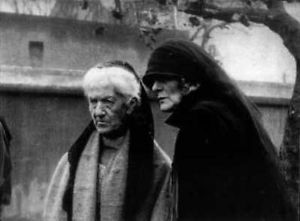
Many of the Dáil TDs were shocked by the assassination attempt and among Irish Republicans who severely criticised the IRA within the movement was Charlotte Despard.

Charlotte Despard and Maud Gonne at prisoners' solidarity protest outside Mountjoy Jail
Charlotte Despard and Maud Gonne at prisoners’ solidarity protest outside Mountjoy Jail

This might have been expected since she was sister to Field Marshal French, except that Charlotte had developed Republican sympathies and had settled in Dublin after the War. She had a background in social welfare and socialist political activity in Britain, including active membership in the Social Democratic Federation, the Independent Labour Party and the sufragette Women’s Social and Political Union and was a fierce critic of her brother. During the Irish War of Independence, Charlotte Despard, together with Maud Gonne, formed the Women’s Prisoners’ Defence League which organised support for republican prisoners. Later, as a member of Cumann na mBan, she was to oppose the Anglo-Irish Treaty and to be imprisoned by the Free State Government during the Civil War.

REACTION OF THE BRITISH

The British military and police, under orders from French, of course replied to the assassination attempt with intensified repression and harassment of the civilian population in an attempt to drive a wedge between them and the IRA. The ambush and attempt on the life of the Lord Lieutenant and Supreme Commander of the British Army in Ireland no doubt helped Churchill, Secretary of War and Minister of the Air, push his idea of special counter-insurgency forces to act as auxillary police in Ireland, i.e. forces of state terrorism, who were to become known as the “Black and Tans” (abbreviated to “Tans”). Recruitment began that very month in London and the first recruits were in the field in January 1920. In July, the Auxillary Division of the RIC was set up, a much more efficient terror force composed almost entirely of British ex-soldiers of former NCO and officer rank.

With the “Tans” and the “Auxies” in the field, along with the crumbling RIC and the British Army, a full guerrilla war raged in many counties and cities of Ireland from 1920 to 1921, with torture and shooting or imprisonment of prisoners by the British, along with the burning of non-combatants’ homes and cooperatives.  The IRA were carrying out ambushes and assassinations of RIC and their special auxiliary forces, British soldiers and Irish spies. Ironically 1921 was the year the Dáil finally declared war on the British and also the year of the Truce, negotiations and the controversial signing of the Treaty by the Dáil’s delegation in London, in which they accepted Dominion status for a partitioned Ireland.

Dominic Behan wrote a song about the ambush.  It has been sung in different versions and with some verses added and omitted.  Dominic Behan’s version is on here on 30.23 mins:   Wolfhound did their own version here which, on the whole, I prefer, though a little too drawn out and finishing on a climax (which traditional songs never do, anywhere in the world, apparently) .

BACKGROUND TO THE MADRID AMBUSH

Like John French, Don Luis Carrero Blanco, 1st Duke of Carrero Blanco, Spanish Grandee, was a military career man. He entered the Spanish naval academy in 1918, at the age of 14 and participated in the colonial Rif War of 1924-1926. When General Franco and the other Generals led the military uprising against the Popular Front Government in 1936, Carrero Blanco was behind the Republican line and took refuge in the Mexican and later French embassies before working his way across the front to reach the fascist side in June 1937 and serving in their navy.

Admiral Luis Blanco Carerro, Gen. Franco's chosen successor
Admiral Luis Blanco Carerro, Gen. Franco’s chosen successor

After the victory of the fascist forces in April 1939 and the instalation of General Franco as Dictator, Carerro Blanco became one of his closest collaborators; he was made vice-admiral (1963) and admiral (1966); he held the post of Vice-President of the state council from 1967 to 1973 and commanded the Navy. On 8th June 1973 Franco named Carerro Blanco Prime Minister of Spain.

Carrero Blanco was very much a supporter of the Spanish military-fascist dictatorship of Franco, a monarchist (Franco had himself installed Juan Carlos de Borbón, the present monarch, as King of Spain) and close to the secretive Opus Dei organisation of Catholic technocrats. Opus Dei, although in favour of authoritarian control of society, was opposed to the fascist Falange and favoured liberalisation of some laws and the penetration of foreign capital, particularly from the US and Europe, to which the Falange were opposed.

It is said that Carrero also opposed the state entering into World War II on the Axis side, for which the Falange were pushing. In the event, neither the Spanish state nor Portugal, both under fascist dictatorships, entered the War and as a result were the only two European fascist regimes which were not overthrown by invasion of one or various of the Allied forces or by popular resistance around the end of the War.

In the 1970s the Spanish ruling class was under pressure to relax its fascist grip and bring in the trappings of capitalist democracy: legalised opposition parties, legalised trade unions, a “free” press, etc. But Spain was ruled by a coalition of various interests, including the fascist Falange, the military caste, Spanish aristocracy, arriviste capitalists, Catholic Church hierarchy …. And they faced not only demands for democracy but also for socialism, including from the rank-and-file of the Communist Party of Spain and of the social-democratic party, the PSOE. Other groups specific to regions or nations within the Spanish state also had demands for democracy and socialism. The Basque Nationalist Party (PNV) and ETA had been raising demands for regional autonomy or independence and a similar desire was evident in Catalonia.

But most of the Spanish ruling class feared the breakup of the Spanish state and also feared socialism. Many opposed even social-democracy, from those who feared being held to account for their crimes against humanity during the Civil War to those afraid of a moral ‘loosening’ and loss of social control by the Church. But they were also increasingly aware that the military-fascist lid could not be kept on the pot forever – the pressure was building up and something would have to give. However, as Franco went into his old age and illness the Spanish ruling class also feared what would happen after his death. He had been such a central figure of authority, his face even on coinage and stamps, and a unifying force either through fear or loyalty. Although Carrero Blanco was not favourable towards the Falange they trusted him to keep the state going essentially the way it was and so Franco nominating the Admiral as his successor calmed a lot of fears.

ENTER ETA

Euskadi Ta Askatasuna, ETA, had been formed in the Basque Country in 1959 from socialist and Basque patriotic youth. A youth section of the Basque Nationalist Party, tired of the timidity and lack of action of the parent organisation, had been part of its forming and had accepted the socialist orientation of others graduating from the group EKIN. The young ETA organisation was subjected to the repression usual in the Spanish state after the Civil War and particularly harsh wherever the breakup of the State was threatened – and this was particularly so in the Basque Country. ETA’s supporters were watched and arrests and torture were a constant danger.

The ETA symbol: the axe for armed resistance and the snake for wisdom
The ETA symbol: the axe for armed resistance and the snake for wisdom (“bietan jarrai” = both always/ continuously)

In the late 1960s some ETA members began to carry arms. On 7th June 1968, ETA member Txabi Etxebarrieta faced a routine road check by the Guardia Civil. Txabi was armed and determined not to be arrested and tortured — he shot a Guardia Civil member dead and fled on foot; he was chased and himself shot dead. The next ETA armed action that year was however a planned operation. Chief of secret police Melitón Manzanas had a long record of torture inflicted on detainees and of hunting Jews escaping Occupied Europe over the French border and returning them to the Nazis. ETA killed him and from then on ETA was on a guerilla war footing.

In the summer of 1973, a group of Basques pretending to be sculptors rented a flat in Madrid to carry out Operación Ogro (Operation Ogre). Over five months they dug a tunnel under the street outside and filled it with 80 kgs of explosives which had been stolen from a government depot.

On December 20th, 1973, Carrero Blanco was being driven from attending mass to his home in Madrid and accompanied by his bodyguard. As it travelled down the road, a bomb exploded in a tunnel under it with such force that the vehicle was blown right over the roofs of nearby buildings and landed on a balcony on the other side. Both driver and bodyguard were killed immediately and Carrero Blanco died shortly after. One epitaph of macabre humour was that Carerro Blanco had lived a very complete life: he had been born on earth, had lived at sea and died in the air.

In an interview explaining their rationale for Operación Ogro, the ETA operation group said:

“The execution in itself had an order and some clear objectives. From the beginning of 1951 Carrero Blanco practically occupied the government headquarters in the regime. Carrero Blanco symbolized better than anyone else the figure of “pure Francoism” and without totally linking himself to any of the Francoist tendencies, he covertly attempted to push Opus Dei into power. A man without scruples conscientiously mounted his own State within the State: he created a network of informers within the Ministries, in the Army, in the Falange, and also in Opus Dei. His police managed to put themselves into all the Francoist apparatus. Thus he made himself the key element of the system and a fundamental piece of the oligarchy’s political game. On the other hand, he came to be irreplaceable for his experience and capacity to manoeuvre and because nobody managed as he did to maintain the internal equilibrium of Francoism.”

—Julen Agirre, Operation Ogro: The Execution of Admiral Luis Carrero Blanco (1975)

There was little criticism of the assassination from the Spanish opposition in exile or underground in the Spanish state. The Spanish ruling class of course condemned the action but it was thrown into disarray. In the confusion, the “modernising” and “liberalising” elements were able to take the initiative.

Franco & J.Carlos uniforms
Left to right: General Franco and his protege, King Juan Carlos de Borbón (who in June 2014 abdicated in favour of his son, Felipe)

Less than three months after Carrero Blanco’s assassination his successor, the new prime minister Carlos Arias Navarro, in his first speech to the Cortes (Parliament) on 12 February 1974, promised liberalizing reforms including the right to form political associations. He faced opposition from hardliners within the regime but the transition had begun (how much of a “transition” is another issue).

The assassination of Carrero Blanco was an action taken by ETA perhaps primarily for the Basque struggle for independence and socialism but it had a deep effect across the whole Spanish state. It hastened the “Transition” and turned out to be a Christmas present to the Spanish social democratic and reformist opposition. Later years were to witness how badly they were to repay the Basque resistance.

End.