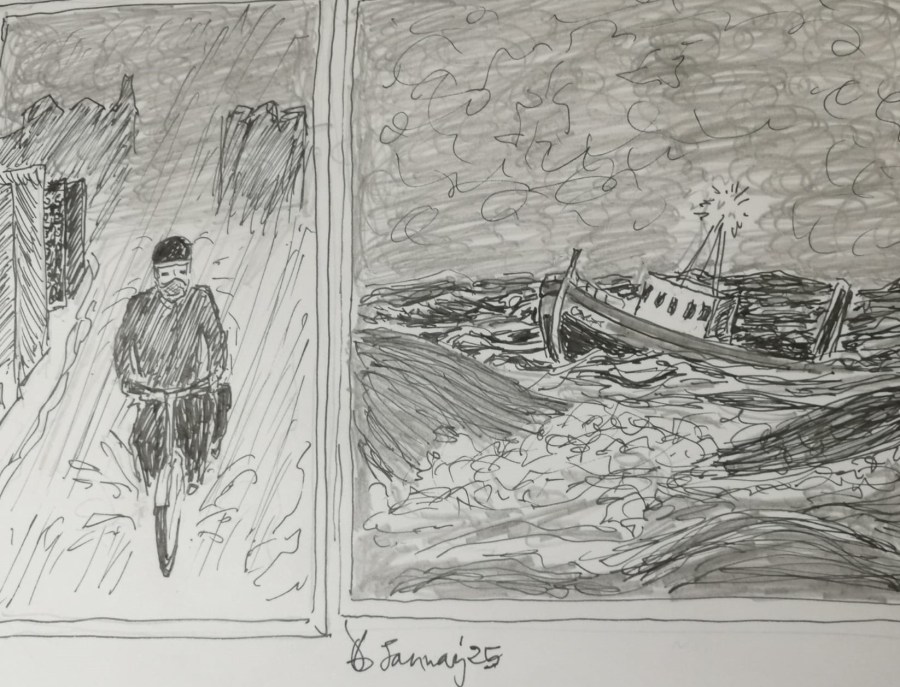
A LOAD OF ROWLOCKS ABOUT NO SHAMROCKS

Diarmuid Breatnach

(Reading time: 6 mins.)

Both Sinn Féin party leaders, Michelle O’Neill (First Minister of the British colony) and Mary-Lou Mac Donald, TD and party President, have publicly declared that they will not attend the White House on St. Patrick’s Day this year.

What made Michelle O’Neill decide not to to go to the White House shamrock fest, she tells us, were President Trump’s words about turning Gaza into a desirable beach-front property development once the Palestinians had been removed. This, she told us, was a question of principle.

“The decision not to travel to the White House has not been taken lightly, but it is taken conscious of the responsibility each of us as individuals have to call out injustice. We are all heartbroken as we witness the suffering of the Palestinian people and the recent comments of the US President around the mass expulsion of the Palestinian people from Gaza, something I cannot ignore.1

“… At moments like this, whenever our grandchildren ask us what do we do, whenever the Palestinian people were suffering in the way in which they are, I want to be able to say that I stood on the side of humanity so this decision for me is very much the position of principle and I think it’s the right thing to do.”2

In January, Trump made those statements about the intention of ethnically cleansing Gaza of its population and the relocation of Gazans to Jordan and Egypt (the regimes of both have clearly stated their opposition to such plans) for the creation of “a Middle Eastern Riviera”.3

Prior to that, Joe Biden’s US Presidency was not only backing Israel’s accelerated genocide for 15 months financially and politically but supplying the IOF with the very weapons to carry out that genocide. Without SF feeling the need to break with him. But a few words from Trump …!

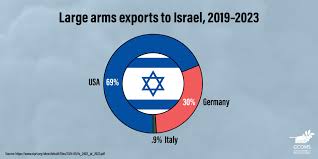
According to Brown University’s “Costs of War” project, the U.S. has spent at least 17.9 billion dollars in military assistance to Israel since October 7 2023, which is more than U.S. military assistance to Israel in any year since the U.S. began to assist Israel militarily. 4

And it vetoed a ceasefire resolution three times at the UN Security Council, against the will of a majority of member states. 5

In mid-March 2023 when O’Neill and MacDonald attended the White House shamrock fest, in spite of many calls not to go, including that of the Ireland Palestine Solidarity Campaign, Biden had been feeding the IOF’s accelerated genocide for over five months.

O’Neill’s reason for her intention not to attend this year (if indeed she were invited)6 clearly had nothing to do with opposition to genocide, solidarity with the Palestinian people, common humanity nor anything of the sort and we must look elsewhere to explore her possible motivation.

Mary-Lou Mac Donald also indicated she wouldn’t be going to browse the blood-soaked shamrock, including an acknowledgement of the degree of US imperialist penetration of the Irish state’s economy:

“I have followed with growing concern what is happening on the ground in Gaza and the West Bank and like many other Irish people have listened in horror to calls from the President of the United States for the mass expulsion of the Palestinian people from their homes and the permanent seizure of Palestinian land. Such an approach is a fundamental breach of international law, is deeply destabilising in the Middle East and a dangerous departure from the UN position of peace and security for Palestine and Israel and the right of Palestinians to self determination.

“… The US is a valued friend to Ireland.  Their work in helping to achieve the Good Friday Agreement stands as a clear example of successful U.S. foreign policy. They are an important partner for peace and play a strong role in Ireland’s economy.7

For genuine anti-imperialists, Irish Republicans and socialists, the correct attitude is clear. Indeed it should be so for any democratic people or even for people just opposed to genocide.

‘Israel’ is only able to commit genocide through the assistance of US Imperialism and therefore we should endeavour to isolate any of its governmental expressions and most of all any that lay claim to our special support, on one of our national days and with one of our national symbols.
The kind of action in the USA real Palestine supporters should be backing instead of backing the ruling class support for the Zionist genocide: Palestine Action activists taking action against Elbit arms manufacturer in Cambridge, Massachusetts USA. (Photo sourced: Internet)

“CAN’T WIN”?

There may well be a ‘damned if we do, damned if we don’t’ response from the SF faithful to the type of criticism in this article. They won’t actually analyse the reasons upon which the criticisms are based – no, of course not.

This party likes to claim credit for events that seem favourable, dodge criticism over errors or just nasty actions while at the same time whingeing that they can never win, that they will be criticised whatever they do, an eternal victim attitude from a party aspiring to government rule.

So, could SF have done anything in this regard of which their critics would have approved? Yes, they could. They could have admitted their error of last year, apologised for it and called for a St. Patrick’s Day White House boycott at least until the USA stops supporting genocide.

No need to worry about my sanity, they won’t, of course nor did I imagine for one minute that they would.

IMPERIALISM AND SF SUPPORT

The USA is a world imperialist power and still the one dominating the world, though it is under serious challenge and its days appear numbered. The ruling class of the USA, a European settler state, practised genocide and exploitation on the indigenous people and on imported slaves.

It also ruthlessly exploited the immigrant working class and its descendants, along with the emancipated slaves. It fought attempts to organise labour and legal trade unions with billy clubs, pistols, machine guns, arson, laws and regulations, jail and the hangman’s noose.

The fact that a section of the immigrant Irish in the US support Sinn Féin is in part due to the socially conservative background of both groups of people and also to SF’s never seriously challenging the imperialist nature of the USA.

And how does this obeisance supposedly benefit Ireland? Will the US support an Irish revolution against British colonial occupation? It refused to do so even at the time of its greatest hostility with the British, when the latter actively supported the Confederate states in the Civil War.8

No, for the major imperialists of the US, the lesser imperialists of the UK are occasional competition but much more fundamentally, allies and it is not going to undermine its fundamental external power base.

Mary-Lou Mac Donald stated very clearly that Mícheál Martin should attend the shamrock fest. What was that about? Possibly she was indicating to Ireland’s Tánaiste (Prime Minister), that she would not be taking political advantage of his attendance at the White House to denounce him.

But she was also clearly indicating that the Sinn Féin leadership are ‘responsible’ potential representatives of an imperialist-dependent Gombeen ruling class, who understand how there are times to put aside any principle in order to attend at the Court of King US Imperialism.9

Through her statement Mary-Lou MacDonald represented her party as a safe pair of hands to run the State for the Gombeen class in the future.

Should the current representatives of the Irish neo-colonial ruling class be invited, they will of course attend, bearing the shamrock tribute, knowing that they are safe at least from the criticism of SF, the largest opposition party in Leinster House (the parliament of the Irish State).

US and Zionist military flights can continue to stop over at Shannon and otherwise fly through Irish airspace. On the international stage, the Irish State will continue to align itself with the western imperialist bloc and continue to open its markets, resources and networks to imperialist plunder.

If O’Neill does indeed say what she claimed she would to her grandchildren about her reasons for not going, she will be lying to them. But then, at least the grandchildren will come to know they were not alone – the party’s supporters and the whole country were being lied to also.

If there was anything other than rank opportunism behind the statements of the SF (Stoop Further) party leaders, such as solidarity, it certainly wasn’t with the Palestinians; solidarity with EU imperialist elites and with the genocidal Democratic Party elite, perhaps.

End.

FOOTNOTES

1https://www.belfastlive.co.uk/news/northern-ireland/michelle-oneill-boycott-white-house-31050982

2https://www.bbc.com/news/articles/cy870w30q6qo

3https://www.reuters.com/world/palestinians-have-no-alternative-leaving-gaza-trump-says-2025-02-04/

4https://mondoweiss.net/2025/02/israel-is-stepping-up-its-military-aggression-across-the-region-but-is-it-out-of-strength-or-weakness/

5Ibid.

6There is every likelihood that she would not have been; SF is in government only in a colony of the UK and furthermore in the USA is strongly connected to Trump’s political rivals, the Democratic Party – and he is not known for kindness towards his political enemies.

7https://vote.sinnfein.ie/sinn-fein-leaders-announce-they-will-not-attend-white-house-events-this-year/

8The USA under General Ulysses Grant, who was of part Irish descent, arrested Fenians and in 1866 prevented the support forces from crossing the St. Lawrence River to support the advance invasion forces which had emerged victorious from two engagements against British forces in Canada.

9And O’Neill displayed her responsible credentials in managing the colonial occupation also, stating that she would not criticise the colony’s Second Minister, Unionist Emma Little-Pengelly, if she were to attend.

The St. Patrick’s Day Blood Fest Comes Round Again

Gearóid Ó Loingsigh Feb. 23
NB: Edited by Rebel Breeze for formatting purposes

(Reading time: 5 mins.)

When the genocide in Gaza began, no one thought it would go on for so long.

But it has, and along the road many challenges have come up for governments, social movements, Arab countries and political parties and nearly all of them have been found wanting on the issue.

In Ireland the annual cringe fest that is St. Patrick’s Day in Washington threw up a problem for Sinn Féin last year. Should they go or not go?

Last year the Irish Palestinian Solidarity Campaign issued a call for all political parties, including government parties, not to go.

Sinn Féin broke that call for a boycott and were swiftly pardoned by the IPSC which swiftly invited them to address a Palestinian solidarity rally in Belfast one day before Mary Lou McDonald and Michelle O’Neill First Minister of Northern Ireland set off for the USA.

There they swanned around with Biden, imbibing of whatever liquor was on offer on the day. Supping the devil’s buttermilk as some of their unionist colleagues might put it.

At the time Sinn Féin said it was going, as it was important and that they would raise the issue of Palestine with Biden. One month before flying out to Washington a Sinn Féin spokesperson stated:

We will use every political and diplomatic opportunity and influence that we have to be a voice for Palestine, to demand an end to the occupation of the West Bank and Gaza, for Palestinian statehood and for a permanent ceasefire now.[1]

In the end they did no such thing. In fact, the then Irish Taoiseach (Prime Minister) Leo Varadkar was more forceful than Mary Lou or Michelle who made even more tepid statements and quaffed what was put in front of them and enjoyed the jollies.

They could have been forgiven for thinking that it would be all over by 2025 and this situation would not arise again. Well, we should be gentle on them, many of us underestimated the Israeli bloodlust. But here we are again.

Trump continues with Biden’s genocide and announces his intention to commit two war crimes e.g. the mass expulsion of Palestinians from Gaza, a war crime under Article 49 of the Fourth Geneva Convention and profit from the looting of their assets a further war crime under Article 33 of the same convention.[2]

The SDLP was the first out of the hatches saying it would not go, reaffirming their position of the previous year.

It is ironic that Sinn Féin supporters used to refer to the SDLP as the Stoops, a play on their initials, Stoop Down Low Party, which probably means Sinn Féin (SF) should now be known as the Stoop Further.

As is common with the Stoop Further, they are fond of speaking out both sides of their mouths. They announced that they would not go this year, though not official invite has been issued to them, and at the same time urged the Irish government to go.

A case of wanting to have their cake and eat it too.

Mary Lou McDonald stated Trump’s plan “represents a marked escalation in the very complex conflict situation for the Palestinian people.”[3] Really? Expulsion is an escalation from genocide?

To be very clear, there is a specific genocide convention and genocide is a Crime Against Humanity, under that convention, and is so at all times and in all circumstances.[4] There are no ifs or buts to that.

Expulsion and profiteering are war crimes. In legal terms, they are egregious crimes but less so than genocide. There is no escalation here. Both Biden and Trump have been complicit in the genocide, Trump however has put the blood-soaked icing on the cake with his proposal.

Donald Trump US President in what is no doubt one of his favourite photos (Photo sourced: Internet)

Except it is not his proposal. It has been official US and Israeli policy since 2007.[5] 

In other words, a plan that began under Bush and continued during the eight years of Obama’s presidency when Biden was the Vice-President, Trump’s first presidency and of course Biden’s four demented years as President.

Mary Lou McDonald seeks to draw a line under her support for the US. There is some mythical line in the sand between the Democrats support for murder, genocide, torture and Trump’s.

In refusing to go to the Blood Fest in Washington she stated that Sinn Féin would not be in a position to challenge Trump’s statements at the Blood Fest (she doesn’t describe it as such, to be clear that is my accurate description).

This is surprising as last year, she said that they would challenge Biden on his support for Israel.

Before they went off on their junket last year, two days before the St Patrick’s Blood Fest they issued a tame communiqué asking Biden to play a more “constructive role” in Palestine,[6] whatever that is supposed to mean.

In fact, part of their public rationale for going was that they could influence US government policy. So, what is different now? Have they concluded that their junket last year did not produce the results they hoped for?

Well, they had no expectations that Biden would end US complicity in the genocide and as I already pointed out, when they went their statements were way weaker than the Irish government’s official statements. So, the answer is no.

This year they have said they won’t go, but have said the Taoiseach should go.

We absolutely believe that he needs to go and, furthermore, when there, set out unambiguously the Irish position in respect to all of these matters and to push back directly against any threat or goal for the mass expulsion of Palestinians from the Gaza Strip, the annexation of that land.[7]

If, as last year under Biden, they believed they could influence policy in the same way they now expect the southern Irish government to do, why don’t they go? The answer is one of political expediency.

They have calculated that this time round there is no political cost amongst their reactionary base in the USA to boycotting a Trump event and by calling on the Irish government to go, they continue to signal that they are a “reasonable partner” that the Irish state and Trump can do business with.

Michelle O’Neill stated that she couldn’t go this year because

I couldn’t in all conscience make that trip at this time. I just think that there are times whenever we’ll all reflect, and certainly whenever my grandchildren ask me, what did I do whenever the Palestinian people were suffering, I could say that I stood on the side of humanity.[8]

Except of course, she didn’t. Whilst Biden gladly and gaily supplied Israel with all the military hardware required to carry out a genocide, she did not nothing.

In the waning days of Biden’s support for genocide, on January 4th of this year he notified Congress of an additional US $8 billion arms sale to Israel.[9] Yeah, Michelle can tell her grandchildren what she likes, but she supped with the Devil.

She took part in a genocide through her endorsement of Biden. Her sudden hypocritical distancing from the same policies under Trump is meaningless.

It is not an ethical position; it is not one based on some internationalist concept of solidarity with the oppressed or even a liberal opposition to genocide and war crimes as they have previously shown no such solidarity or real opposition to such acts when Biden was the war criminal in charge.

No matter how low you think Sinn Féin can stoop, they will always surprise you and Stoop Further.

End.

NB: For more articles by Gearóid see https://gearoidloingsigh.substack.com

NOTES

[1] The Irish News (23/02/2024) Protests at east Belfast arms manufacturer as city council’s largest parties accused of ‘vetoing’ PBP Gaza ceasefire motion. John Manley. https://www.irishnews.com/news/northern-ireland/protests-at-east-belfast-arms-manufacturer-as-city-councils-largest-parties-accused-of-vetoing-pbp-gaza-ceasefire-motion-BO4VAMQCYVF37BOSCHVPPNLACY/

[2] The Geneva Conventions can be consulted at https://ihl-databases.icrc.org/en/ihl-treaties

[3] Irish Independent (22/02/2025) Sinn Féin may be boycotting White House for St Patrick’s Day, but Mary Lou McDonald is imploring Taoiseach to attend and confront Trump. Tabitha Monahan and Senan Molony. https://www.independent.ie/irish-news/sinn-fein-may-be-boycotting-white-house-for-st-patricks-day-but-mary-lou-mcdonald-is-imploring-taoiseach-to-attend-and-confront-trump/a52621936.html

[4] To consult the Genocide Convention see https://ihl-databases.icrc.org/en/ihl-treaties/genocide-conv-1948

[5] Jonathan Cook (14/02/2025) Trump didn’t invent the Gaza ethnic cleansing plan. It’s been US policy since 2007.

Jonathan Cook

Trump didn’t invent the Gaza ethnic cleansing plan. It’s been US policy since 2007

PALESTINE SOLIDARITY: NO PRESSURE ON AUTHORITIES FROM IPSC

Diarmuid Breatnach

(Reading time main text: 4 mins.)

Last Saturday’s IPSC “Hands Off Gaza” march, advertised as being to the US Embassy, reached a new low in compliance with the wishes of the Irish ruling class not to embarrass the USA, currently the world boss.

The IPSC led the march from Baggot Street through residential roads and streets to reach not the front of the US Embassy but near its side, far from the main road (where a small group of non-compliant people lifted Palestinian flags to the view and often beeps of support of passing traffic).

Section of the IPSC march – some of those carrying big printed placards joined a smaller group of protesters in front of the main entrance of the US Embassy. (Photo cred: IPSC)

The IPSC agree their march routes and rally locations with the Gardaí in advance, a different process than merely informing them in the interests of safe traffic management.1 The extent to which the IPSC leadership integrates with Gardaí wishes is not required by Irish State law.2

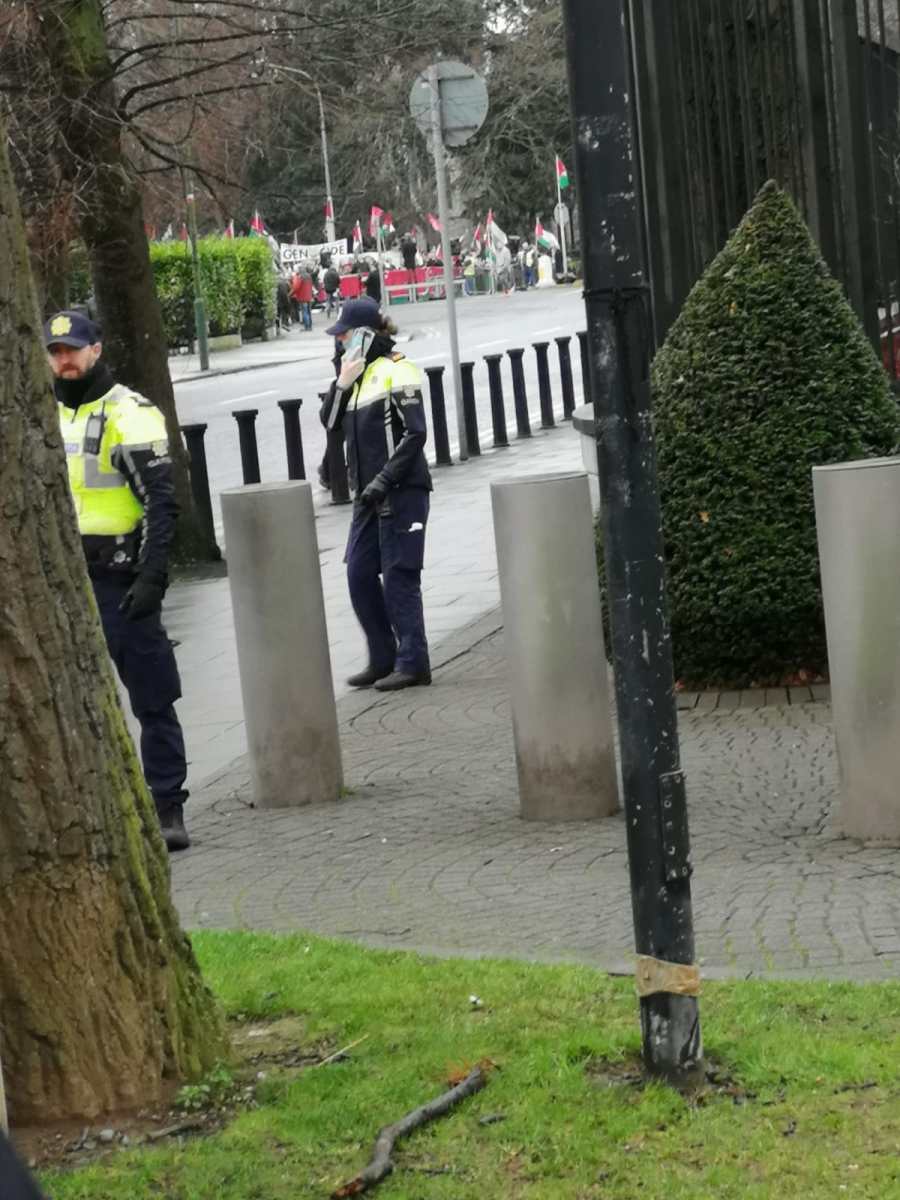
The understanding is that the Gardaí don’t want a large protest at the main entrance of the Embassy and beside the main road and those who did gather there were approached by Gardaí with the suggestion that they move down to the IPSC rally, which suggestion was declined.

No doubt the leadership of the IPSC considers that by compliance with the desires of the Gardaí, by not offending the authorities or frightening them, their organisation is regarded by the ruling circles as “responsible” and therefore placed in the best position to influence policy on Palestine.

Could they be right? Well, let’s check the actual concrete gains from their “responsible” leadership. Has the Irish Government barred Irish airspace to flights of US/Israeli munitions to fuel the Zionist genocide of Palestinians? Are US planes being checked at Shannon airport for military contents?

Has the Irish Government adopted a policy of Boycott, Disinvestment and Sanctions towards the genocidal state? Has the Occupied Territories Bill, a relatively mild piece of legislation entirely in line with international law and UN resolutions, though approved in 2018/ 2019 been enacted?3

The answer to all those questions is a resounding NO. Well then, what has this “responsible leadership” actually achieved in changing Government policy? The answer is simply Nothing. The IPSC however have brought thousands on to the streets to demonstrate solidarity with Palestine.

And that would be a great achievement if it were to employ those numbers in a way that exerted real pressure on the Government and the ruling class it represents. How far the IPSC leadership is from any such intention is demonstrated by their shameful capitulation around the US Embassy.

As most people in Ireland are aware, the USA is not only the biggest backer of the genocidal Zionist state but its essential backer, its very life-pump. Without the backing of the USA, the European colonist settler state of Israel could not have survived as long as it has.

Photo of the distant IPSC rally taken from in front of the US Embassy’s main entrance. (Photo cred: Rebel Breeze)

The IOF could not sustain its level of genocidal bombing of Palestinians for more than a week without USA supplies of bombs, shells and missiles. The ‘Israeli’ economy would long ago have collapsed without US financial support.

Politically the USA has used its veto in the UN Security Council, that undemocratic supreme ruler of the United Nations,4 against motions calling for a halt in the genocide. The US also employs its considerable economic pressure on other states not to oppose the Zionist genocidal state.

In view of the crucial role of the USA in maintaining not only the source of Zionist genocide but in its essential weekly supplies, one would imagine that US institutions and businesses in Ireland would be subjected to strong pressure from the Palestine solidarity movement.

That has not largely been the case and its symbolic representation, the US Embassy in Dublin, has been the target of large demonstrations led by the IPSC only twice in over fifteen months of genocide. And on each occasion in a side street, away from the main road.5

Rear view of the IPSC rally stage facing the marchers, photo taken with the US Embassy main entrance some distance up the residential street behind the photographer. (Photo cred: IPSC)

All of the main Irish political parties, those in coalition government and those aspiring to government, maintain cordial relations with the ruling circles of the USA and even formally celebrate the Irish national day with them in the USA on US Government premises.

Do the thousands up and down the country who march every couple of weeks or demonstrate weekly do so in order merely to feel good about themselves? I would submit that the majority desperately want to give real assistance to the Palestinians – to make a difference.

Those people are not getting any leadership from the IPSC. And though even at this late stage the IPSC could supply that, the indications are that it won’t.

The general attitude of the public within the Irish state is in solidarity with Palestine to a huge extent bemoaned by a number of ‘Israeli’ Zionist Ambassadors and Government ministers but that Irish feeling of Palestine solidarity does not generally translate into practical measures.

There have been some practical results in Palestine solidarity in divestment and boycott but these have been achieved, for the most part, by direct actions in occupations of college and commercial buildings not led by the IPSC and in most cases not even supported by them,.

Meanwhile, the State employs its repression on those who do dare to step beyond the “responsible leadership” of the IPSC, for example arrested in demonstrations at Shannon Airport and in actions in Dublin. The compliance of the IPSC leadership makes that repression easier for the State.

End.

Section of small crowd that gathered in front of the US Embassy main gate and by the side of the main road (instead of at the IPSC rally); around four people at first and then more joined them. (Photo cred: Rebel Breeze)

APPENDIX

Now Irishmen, forget the past!
And think of the time that’s coming fast.
When we shall all be civilized,
Neat and clean and well-advised.
And won’t Mother England be surprised?
Whack fol the diddle all the di do day. 6

In May 2021 the Gardaí rewarded IPSC’s consultative approach with a ban on a march to the Israeli Embassy, quoting Covid-19 legislation, with which the IPSC complied under protest. It fell to another organisation to announce the march and to ahead with it, in the event without arrests.7

In October 2003 the IPSC pulled back from calling for the expulsion of the Israeli Ambassador to Ireland (which in fact they had called for years earlier) and at the same time the Sinn Féin leadership was also pulling back from similar calls of the past.

The party was abstaining from such motions in councils and voting along with the Irish Government in Leinster House.

A speaker at the IPSC rally in the side street to the US Embassy in October 2023 (the only other IPSC one there in the current genocide phase) was asked by the IPSC not to call for the expulsion of the Israeli Ambassador in order not to embarrass a SF speaker. She correctly declined.8

Some IPSC stewards on that march were positioned near people calling for that expulsion in order to drown them out with non-stop leading of the more ‘acceptable’ slogans.

Shortly thereafter a rebellion of SF’s rank-and-file obliged the SF leadership to restore their original position of calling for the expulsion and the IPSC leadership returned to endorsing it too.9

Footnotes

1Some of their arrangements can actually cause higher risk of mischance, as when they pack large numbers tightly on the central pedestrian reservation in O’Connell Street, with a Luas tram line on one side and passing traffic on both sides. On one occasion I and some others with banners and flags on the west side, with the GPO behind us, were informed by Gardaí that we should join the packed crowd on the pedestrian reservation as that was what “our leaders” had agreed with the Gardaí. We had to insist that we were breaking no law and within our rights before they reluctantly went away.

2The Constitution guarantees the right to demonstrate, picket etc and the role of the police is supposedly essentially to facilitate that. Giving the police the power to decide on routes and even a veto on a destination not required by law is to collude in undermining civil rights and even encouraging further undemocratic restrictions. See also Appendix.

3An effort coordinated by Sadaka, passed by the Seanad in 2018 and voted with large majority in the lower house in 2019 https://www.sadaka.ie/the-occupied-territories-bill/

4Only votes of the UN Security Council are binding. It has a revolving membership but only five permanent members, any one of which can veto a proposal even if supported by the majority. The five Permanent Members are UK, France, USA, Russia and China.

5https://rebelbreeze.com/2023/10/29/as-dublin-marches-again-for-palestine-where-are-the-protests-going/

6Whack Fol the Diddle by Peader Kearney, published 1917 (according to NLI). I don’t think Mother England would be surprised, nor yet father Gombeen Ireland – for are not the likes of these their very creations?

7https://www.thejournal.ie/rally-palestine-dublin-5435406-May2021/

8https://rebelbreeze.com/2023/10/29/as-dublin-marches-again-for-palestine-where-are-the-protests-going/

9Ibid.

Sources & Further Reading

PALESTINE SUPPORTERS SCORN SIDE STREET TO DENOUNCE US EMBASSY AT ITS FRONT

Clive Sulish

(Reading time: 2 mins.)

Many who supported Saturday’s march of the Ireland Palestine Solidarity Campaign advertised as going to protest at the US Embassy found themselves led to a rally in a residential street bordering the Embassy and far from the main road.

The IPSC march had gathered at the Department of Foreign Affairs on Stephens Green and proceeded from there to Ballsbridge, the last section passing through quiet residential streets to hold the rally in Elgin Road, some distance from and hardly visible from the main road.

Section of the IPSC march on Saturday (Photo cred: IPSC)

Before the arrival of the IPSC march a handful of people gathered near the main road, displaying Palestine national colours to acclamation from passing motorists. As the IPSC march arrived nearby some others with flags, banner and placards joined them near the front entrance of the Embassy.

From that position one could see the IPSC rally taking place quite some distance down the quiet street, distant enough that speeches could not be heard, though chants from the crowd were audible.

Earlier in the day the Palestinian resistance had released three of their prisoners in good health while the Palestinian prisoners of ‘Israel’ were beaten and insulted as they were leaving and made to wear special demeaning clothes (which they burned). Four had to be rushed to hospital after release.

Long before Trump’s proposal of ethnically cleansing Gaza of Palestinians, it is important to understand that Israel’s genocide could not have been sustained for more than a week without funding and munitions supply by the USA, which also supported them politically.

In the sixteen-plus months of the current phase of Israeli genocide, the IPSC has led a march to the ‘Israeli’ Embassy only a few times and to the US Embassy exactly twice, each time to the side road (though the stage of the first one was closer to the Embassy’s main entrance than was today’s).

The front of the IPSC march at its destination at the rally on Saturday. (Photo cred: IPSC).
The IPSC rally in the distance, taken from in front of the US Embassy main entrance. (Credit photo: Rebel Breeze)

A police officer approached the early demonstrators near the Embassy main entrance to encourage them to move down to the location of the IPSC rally but they politely declined. One of the IPSC’s committee members also wandered by to see who these mavericks could be.

A Zionist passing by claimed the demonstrators should be ashamed but they told him it was he who should feel shame, supporting genocide. Anger soared when he called for killing more Palestinians – including children– until some began to suspect he was provoking an assault leading to arrest.

Certainly he felt safe enough with Gardaí close by.

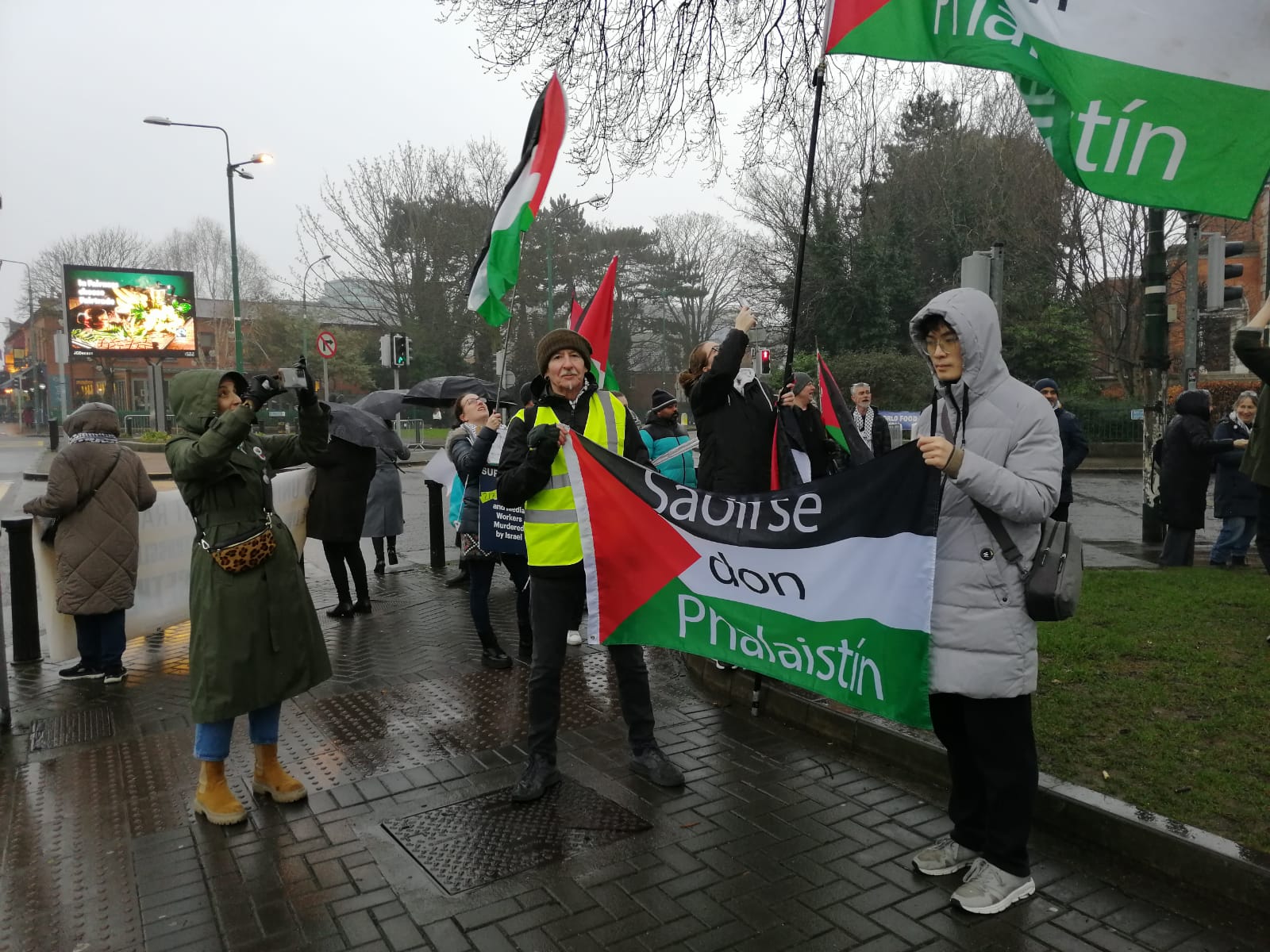
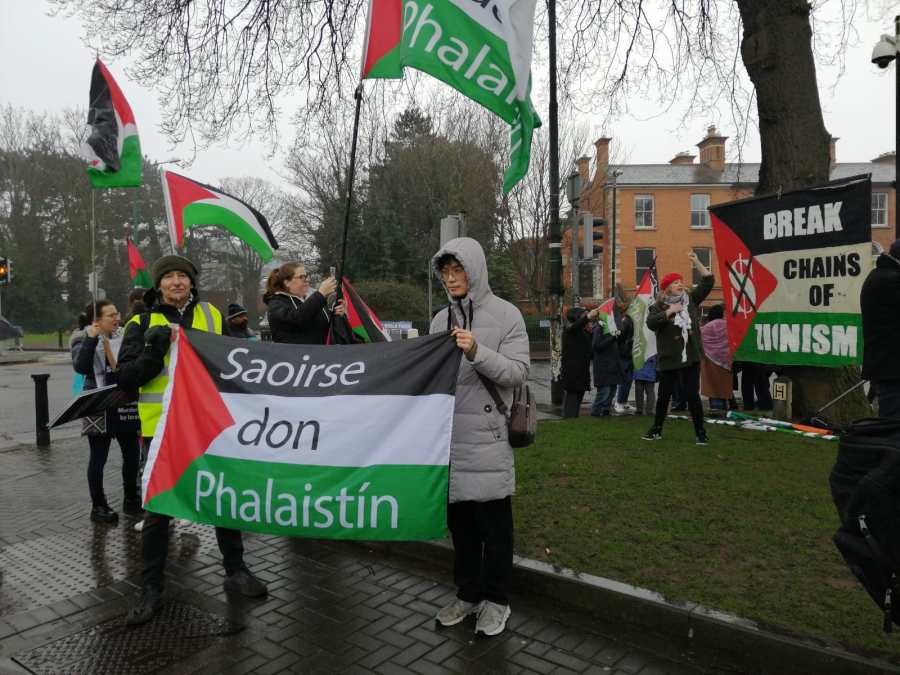
As the group consolidated a woman began to lead call-and-answer chants which were taken up: Saoirse – don Phalaistín! Resistance is an obligation- in the face of occupation! 1, 2, 3, 4 – Occupation no more! 5, 6, 7, 8 – Israel is a terrorist state! Free, free – Palestine!

Section of those who chose to stand near the US Embassy main entrance (out of shot to the right of photo) and in full view of passing traffic on the main road (just out of view to left of photo). (Photo credit: Rebel Breeze)

Also From the river to the sea – Palestine will be free! From Ireland to Palestine – Occupation is a crime! Car horns of passing motorists joined in, beeping in solidarity.

It began to rain heavily and the protesters endured it for a while before heading for shelter.

End.

NO NATIONS, NO BORDERS?

Diarmuid Breatnach

(Reading time main text: 4 mins.)

No Nations No Borders was the title of a meeting I saw advertised recently and also a slogan I had heard chanted some years ago1 on a counter protest to fascists and other racists. I wondered then and wonder now: Have they thought this through?

Clearly the utterers and followers of such a slogan see many negative things emanating from nations, probably war, oppression, repression, racism, even genocide. But are those things fundamentally attributes of nations – or even of states that are founded upon nations?

The definition of a nation is not universally shared among historians, philosophers and sociologists but they are generally agreed that it is applied to a people who share a territory and common history, along with a language and culture, incorporating customs and law.

Some argue that nations only came into existence historically in the 18th century, others maintain that they existed long before that, in the Middle Ages and even further back. In Ireland, Thomas Davis published the lyrics of A Nation Once Again in 1844, nearly half-way into the 19th Century.2

Davis, whose father was Welsh, drew on the classical Romano-Greek education of the British ruling class as inspiring his awakening nationalism:

When boyhood’s fire was in my blood/ I read of ancient freemen/ Of Greece and Rome who bravely stood/ Three hundred men and three men3/ And then I hoped I yet might see/ Her fetters rent in twain/ And Ireland long a province be/ A nation once again!

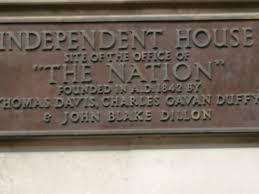
Plaque in Middle Abbey Street to mark the site of The Nation, a patriotic newspaper founded in Dublin in 1842 by leaders of a group that became known as The Young Irelanders. (Photo sourced: Internet)

However, the United Irishmen who rose in revolt in 1798,4 the first Republican uprising in Ireland, certainly conceived of their nation, the French too in their 17895 revolution and the 13 Colonies, the precursor of the United States of America, in the American Revolution 1765–1783.6

The leaders of the United Irishmen were mostly English-speaking while the majority of the population, indigenous clans and Gaelicised descendants of Normans and Vikings, were all Irish-speaking and they had earlier appealed to Rome in terms of an oppressed nation.7

It can be argued that in passing the Statutes of Kilkenny in 13668 the English occupation recognised Irish nationhood, albeit in the form of a malignant influence upon the Norman invaders who were ‘going native’, “the degenerate English” having become “more Irish than the Irish themselves”.

An Irish nation-building process may be perceived over three centuries earlier, with Brian Boróimhe trying to unify Ireland under his kingship and defeat the Dublin Viking colony. As Brian was killed9 at the Battle of Clontarf (sic),10 this remains unproven.

All the attempts to achieve national independence starting with the United Irishmen until at least 1923 were built upon democratic formulations according to their time and – in the case of the 1916 Proclamation – in actual advance of it in terms equality of women and of civil and religious liberty.

Monument to Thomas Davis (1814-1845), writer, publisher (founder of The Nation newspaper) and composer, erected in Dublin’s Dame Street 1966. (Photo sourced: Internet)

NO NATIONS?

If nations are to be abolished, how might this be achieved? Presumably their languages, cultures and customs would need to be eradicated … and replaced with what? Actually, there have been ongoing attempts at that eradication for centuries – by colonialism and imperialism!

In those cases, the conquering power would seek to replace the language, culture and history of the conquered with their own – or with an allegedly ‘cosmopolitan’ culture (i.e allegedly independent of any national culture). It might be unpleasant for the “no nations” people to reflect upon that.

It was fashionable in the 1980s among certain intellectuals to claim that nationalism was moribund (and history too), quickly refuted even in Europe by the Balkan wars, not to mention by the Irish and Basque anti-colonial struggles.

A German movement among the Left known as anti-nationalismus in opposition to the nationalism of the German State, because of fears of return to nazism, extended its application of that to opposing national liberation struggles (e.g in Ireland, Basque, Palestine) and to support for Zionism.

I have heard John Hume quoted as saying that “We are all Europeans now”, understood to indicate the end of the various national entities in Europe – or at least their importance as nations.

I failed to find that quotation but he said something similar in his acceptance speech for the 1998 Nobel Peace Prize (shared with Loyalist leader Trimble)11 — a speech either hugely naive or reflective of imperialism at a time of its rampant reign and proxy wars across the world.

The eradication of nationalism, even were it possible, would entail the elimination of a huge reservoir of different languages and cultures around the world, the different ways of expressing being human as we understand that concept.

The replacement, if achievable, would be a sterile mono-culture. Or possibly even that culture might fragment over time into different forms of expression in parts of the world.

NO BORDERS?

Let us suppose that the people of a nation are not to be removed nor their culture eliminated but that it’s merely proposed that its borders be removed. If we do not agree – or it should prove impossible to – eliminate the nation as a political-cultural construct, what about just removing borders?

It would be wonderful to be able to travel around the world without ever encountering customs posts or border guards – wouldn’t it?

The monument to Charles Stewart Parnell (184 -1891), political party and Land League campaign leader, erected in Dublin at the junction of Sackville (now O’Connell) and Parnell Street in 1911. An inscription on the monument opposes borders or boundaries but in another sense, as a limit to the nation’s independence: “No man has a right to fix the boundary to the march of a nation. No man has a right to say to his country thus far shalt thou go and no further.” (Source photo: Wikipedia)

Of course it would and hopefully one day that will be a reality, without having eliminated nations. But in the era of imperialism and colonialism, nations that free themselves will need to maintain borders as part of the defences against their invasion by their former masters or prospective ones.

During that period, those borders will need to be defended and monitored in terms of financial, scientific and commercial exchanges, imports and exports and – yes — passport control. Not very libertarian, for sure but some idea of entrances and exits will be needed for a number of reasons.

This is the era of imperialism and colonialism on the one hand and national liberation on the other. To attack the idea of the nation at this time is to objectively side with the projects of those reactionary forces and progressive forces need to oppose projects against nationalism.

However, inside the nations, there are also necessary struggles to be fought: of class, of democratic rights and freedoms and these can and should be fought, while at the same time defending the rights of nations to exist and develop.

End.

FOOTNOTES

1This was by a small politically sectarian group which seems to have left the active stage for some years now.

2https://en.wikipedia.org/wiki/A_Nation_Once_Again

3The ‘three hundred men’ men refers to the Spartans (who actually had other allies there too) led by Leonidas I at the battle at the Pass of Thermopylae to delay the Persian army’s invasion of Greece led by Xerxes I in 480 BCE; the “three men” is a reference to Horatio’s stand with two comrades on the bridge in 509 BCE in an attempt to deny an invading Etruscan army access to the city of Rome. Coincidentally or not, the story was published in McCauley Lays of Ancient Rome in1842, two years before the publication of Davis’ A Nation Once Again.

4Although the leadership was nearly all descended from settlers, they did seek a democracy enfranchising the indigenous Irish.

5The French Republic could justifiably claim to represent the French nation but what of the Breton and Corsican nations, along with parts of the Basque and Catalan nations over which La Republique claimed domination? Or the French colonies in Africa, Asia, America and the Caribbean?

6This is a most problematic concept of a nation, being entirely constructed of a minority of settlers imposed on the Indigenous population and the imported slave population, both of which were totally excluded from the polity.

7I have seen a copy of the appeal but now cannot find it, however at the time of post-WWI Paris Peace Conference Seán T. Ó Ceallaigh seeking Vatican support for Irish independence declared: Ireland’s righteous and time-honoured claims have been frequently recognised by Your Holiness’s Predecessors and even actively assisted by them as far back as the sixteenth century. https://www.difp.ie/volume-1/1920/appeal-to-vatican/35/#section-document page.

8Quotations from the preamble to The Statutes of Kilkenny 1366 legislation: “In essence its purpose was to codify laws passed over the previous decades which had sought to halt and reverse the Gaelicisation of English settlers in Ireland. For instance the use of Irish language, dress, and customs by all English and Irish subjects who had sworn loyalty to the king was forbidden.” https://cain.ulster.ac.uk/othelem/chron/ch1169-1799.htm

9Along with all commanders of both sides.

101014, the Battle lasting around 12 hours could not have been fought at present-day Clontarf, which did not exist then and that site is not mentioned in any of the early accounts of the Battle. The site has never been indentified but was likely around the Glasnevin/Drumcondra area.

11Awarded for his work in helping to create the imperialist pacification process in Britain’s colonial conflict in Ireland: If I had stood on this bridge 30 years ago after the end of the second world war when 25 million people lay dead across our continent for the second time in this century and if I had said: “Don’t worry. In 30 years’ time we will all be together in a new Europe, our conflicts and wars will be ended and we will be working together in our common interests”, I would have been sent to a psychiatrist. But it has happened and it is now clear that European Union is the best example in the history of the world of conflict resolution and it is the duty of everyone, particularly those who live in areas of conflict to study how it was done and to apply its principles to their own conflict resolution. https://www.nobelprize.org/prizes/peace/1998/hume/lecture/

FURTHER READING

A discussion on the composition of nations and nationalism: https://en.wikipedia.org/wiki/Nation

THE REBEL WOMEN’S TOUR

Orla Dunne

(Reading time: 3 mins.)

Myself and my sister, Brenda went on the Rebel Women’s Tour in the General Post Office on Saturday, 1st February 2025. Our Guide was Kim.

Two women’s groups were highlighted: Inghinidhe na hÉireann which was founded by Maud Gonne in 1900 and inspired Cumann na mBan. Inghinide na hÉireann is Irish for “Daughters of Ireland”. It was founded solely for women and adopted Saint Brigid as their patron saint.

Cumann na mBan:

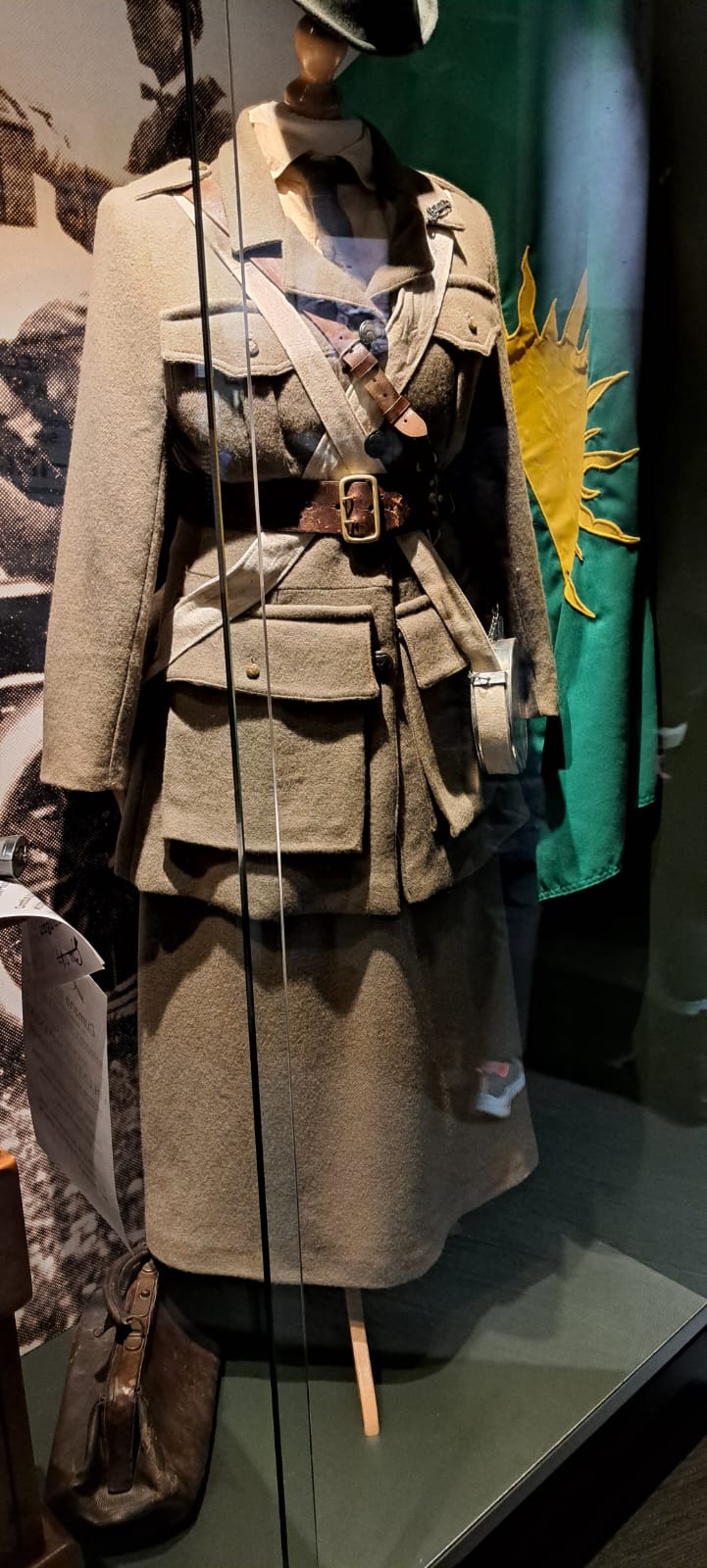
In 1914, Inghinide (modern spelling ‘Iníní’) na hÉireann was merged with Cumann na mBan (abbreviated C na mBan, translated in English as the “Women’s League”). It was formed in Wynn’s Hotel on Lower Abbey Street on the 2nd of April 1914.

Brenda’s husband’s grandmother, Christina Caffrey, was a member. Our Grand Aunt, Theresa Rudkins nee Byrne was also a member as was also an old neighbour of our sister Eileen, Mary Breslin. Cumann na mBan was then led by Kathleen Lane O’Kelley.

One key member whom we are all familiar with is Countess Constance Markiewicz who took an active role in the 1916 Easter Rising which I will come to later.

Cumann na mBan uniform on display in the GPO Museum (Photo: O. Dunne)

1913 Lockout:

During the 1913 Lockout by an employers’ consortium, women including Dr Kathleen Lynn, Helena Moloney, Delia Larkin (sister of Jim Larkin) and Rosie Hackett opened soup kitchens at Liberty Hall to assist struggling workers and families.

The 1916 Easter Rising:

It is estimated that approximately 200 women took part in the Rising and 77 were imprisoned.
The only woman sentenced to death was Countess Markiewicz who was second-in-command to Commandant Michael Mallin in St. Stephen’s Green.

Constance Markievicz (colourised) in ICA uniform (Source photo: Internet)

However due to her being female, it was then changed to life imprisonment. She subsequently served 13 months in prison in both Ireland and England. She was outraged that she would not be executed.

Winifred Carney:

Winifred Carney was named as the first woman to enter the GPO on Easter Monday 1916. It is thought that she entered the building wielding a typewriter and revolver.

Winifred Carney (Source photo: Internet)

Elizabeth O’Farrell:

Elizabeth O’Farrell was one of the last three women to remain with the GPO garrison along with Julia Grennan and Winifred Carney and all three spent their last days of freedom in Moore Street. Ms O’Farrell accompanied Patrick Pearse on his journey of surrender to the British forces.

Elizabeth O’Farrell(colourised) after release from jail (Source photo: Internet)

There is a photograph of this and all that can be seen of her are her feet and the end of her dress, as she stood at the far end of Pearse from the photographer.

Julia Grennan (Source photo: Internet)

WOMEN DURING THE WAR OF INDEPENDENCE:

Women also played a significant part during the War of Independence. Over 300 women are believed to have assisted by smuggling weapons and ammunition into Ireland and relaying messages from area to area.

WOMEN DURING THE IRISH CIVIL WAR:

The Irish Civil War lasted for almost one year from June 1922 to May 1923 and again women participated in the struggle, believed to have been mainly on the Anti-Treaty side. Female members of the Irish Citizen Army were armed.

Grace Gifford (colourised) with paintbrush and easel (Source photo: Internet)

One such example is Grace Gifford Plunkett who married her beloved fiance, Joseph Mary Plunkett in May 1916 just hours before his execution. She herself was incarcerated in February 1923 in Kilmainham Gaol for her part in the Civil War.

While there she painted a copy of Mary and Child on the wall of the cell.

End.

COURT LIFTS CURFEW ON PALESTINE SUPPORTER

Diarmuid Breatnach

(Reading time: 2 mins.)

One of a number of Palestine struggle supporters appeared in court again on Wednesday and, though the case was postponed for hearing until 26 February, was successful in having one of the conditions of his bail, his daily curfew, removed.

Jack Brasil raises a clenched fist outside the Dublin Court on Wednesday. (Photo: D.Breatnach)

Palestine struggle supporters sat in Dublin’s Central Criminal Court with Jack Brasil, New Zealander of Irish descent, through many other case applications until his own was dealt with, before accompanying him out of the intimidating building.

Another of the bail-related restrictions, that Brasil not present stationary in the Dublin 1 or 2 areas (i.e in the Dublin City centre) remains, at least for the moment. This restriction has also been imposed on a number of other Palestine solidarity activists in a clear restriction of their civil rights.

As in many other Western states, Palestine solidarity activists have been charged with offences under Ireland’s criminal code but, when released on bail, remain under restrictions for months at a time after their arrest, interfering with their normal routines.

It also hampers or even prevents their participation in solidarity activities.

Palestine struggle supporters outside the Dublin court on Wednesday after Jack Brasil had the curfew removed from the conditions of bail. (Photo: D.Breatnach)

To date it seems that none of the Irish civil rights NGOs have challenged the State on the wide-scale use of those undemocratic bail restrictions from participation in lawful solidarity protests on people who are, even according to the criminal code, innocent, unless convicted in a court of law.

During the 2014-2015 mass-popular protests against the imposition of a third water tax in preparation for the privatisation of water supply in the Irish state, similar restrictions were imposed on protesters. Two however refused to accept the conditions and were jailed.

Protests outside Mountjoy Jail followed and, under the threat of hunger strike by the detained, they were released and the restrictions removed. It may be that this option will need to be explored by Palestine supporters if charged in Ireland in the future.

end.

“SOLIDARITY WITH THE RESISTANCE” AND “DOWN WITH COLLABORATION OF THE PALESTINIAN AUTHORITY!”

Clive Sulish

(Reading time: 5 mins.)

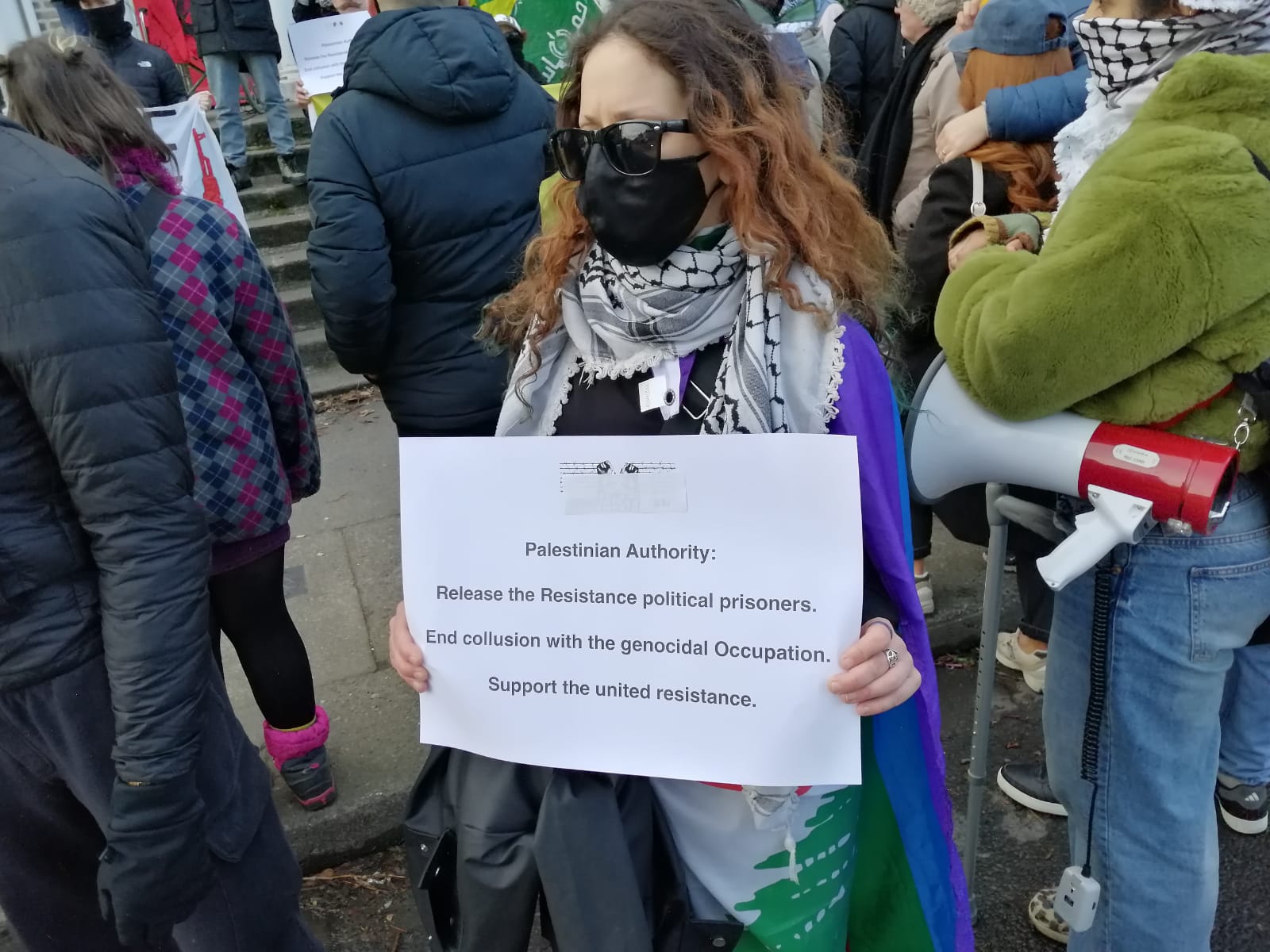
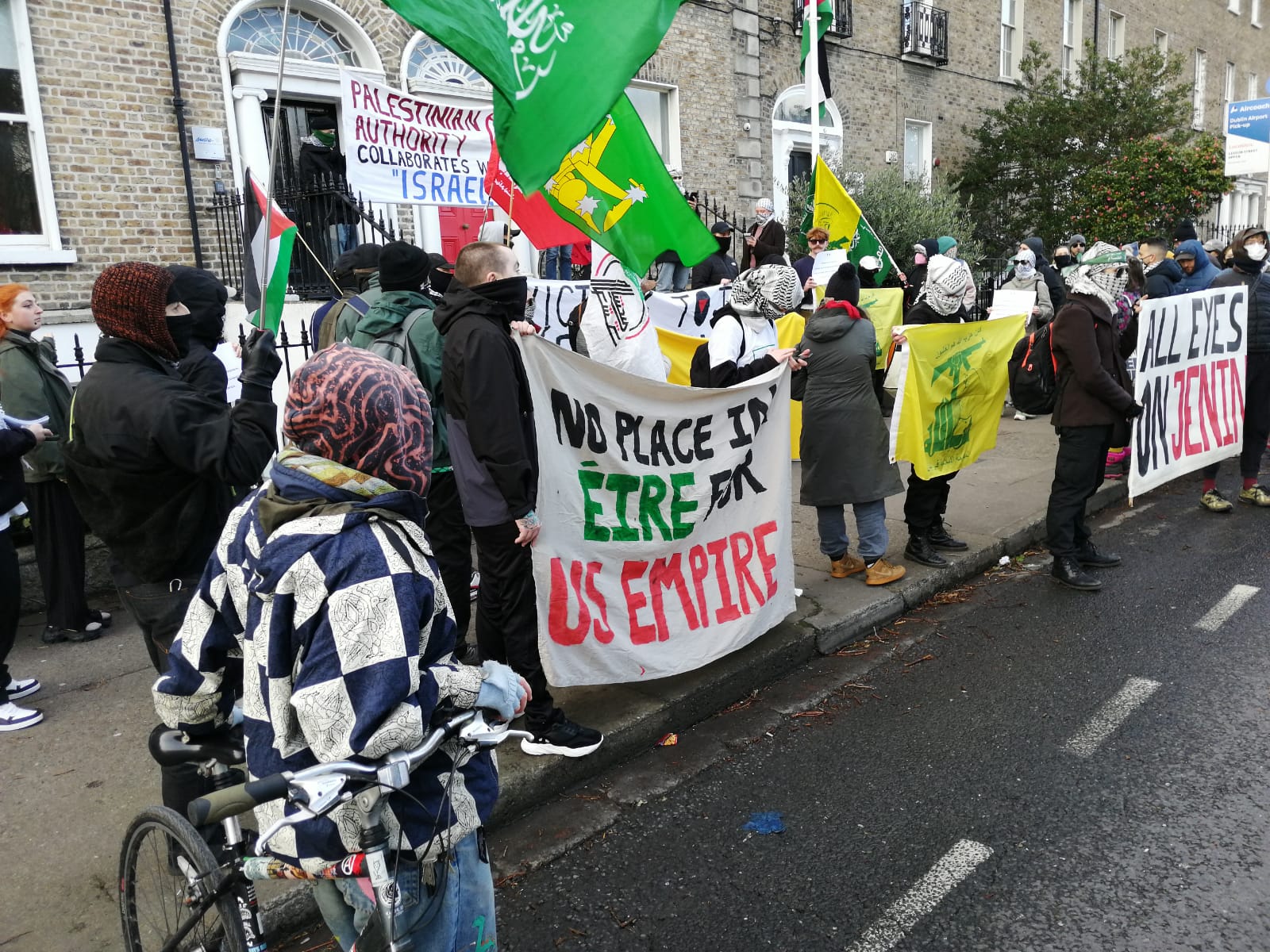
A large Palestine solidarity march once again in Dublin included a Resistance Bloc, part of which also broke away to picket the Palestinian Authority’s Embassy, where collaboration and collusion were denounced in three languages.1

A section of the march has arrived in Molesworth Street in view of Leinster House but others are still arriving. (Photo: R.Breeze)

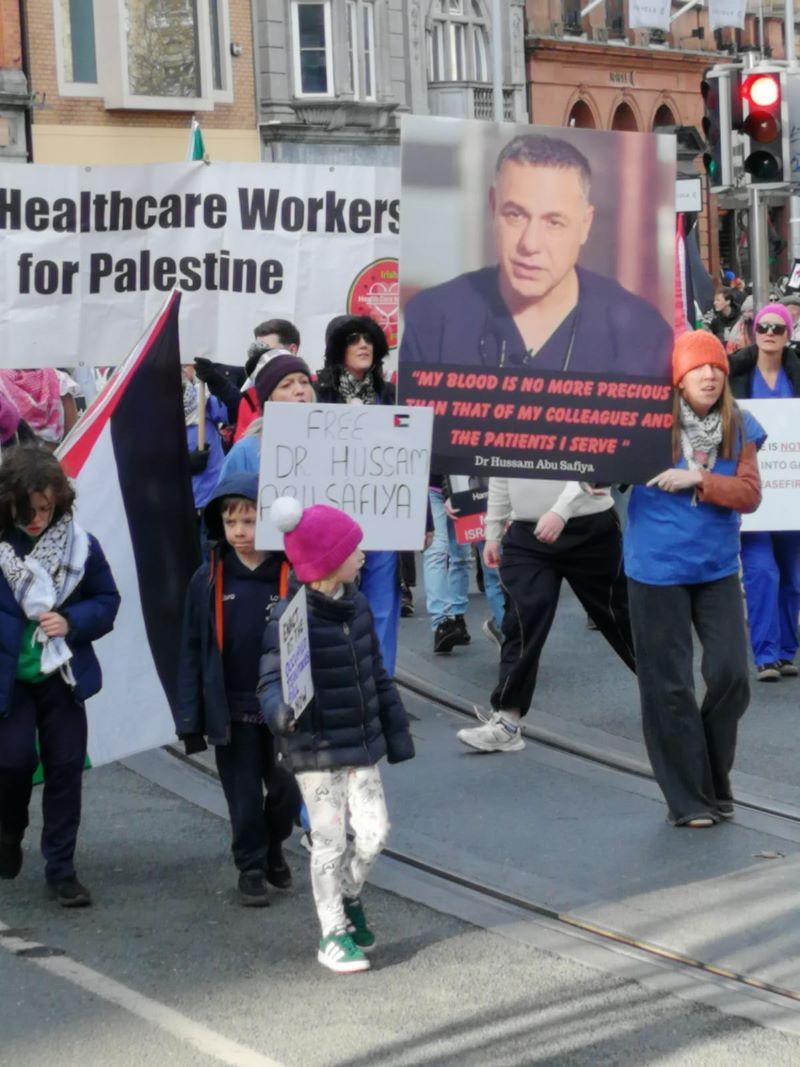
As Israel freed 200 of their Palestinian prisoners Saturday in exchange for four female Israeli Occupation Army soldiers, Dublin City Centre rang again to shouts of Palestinian solidarity and some banners of the Resistance Bloc saluted the Resistance and denounced the Palestine Authority.

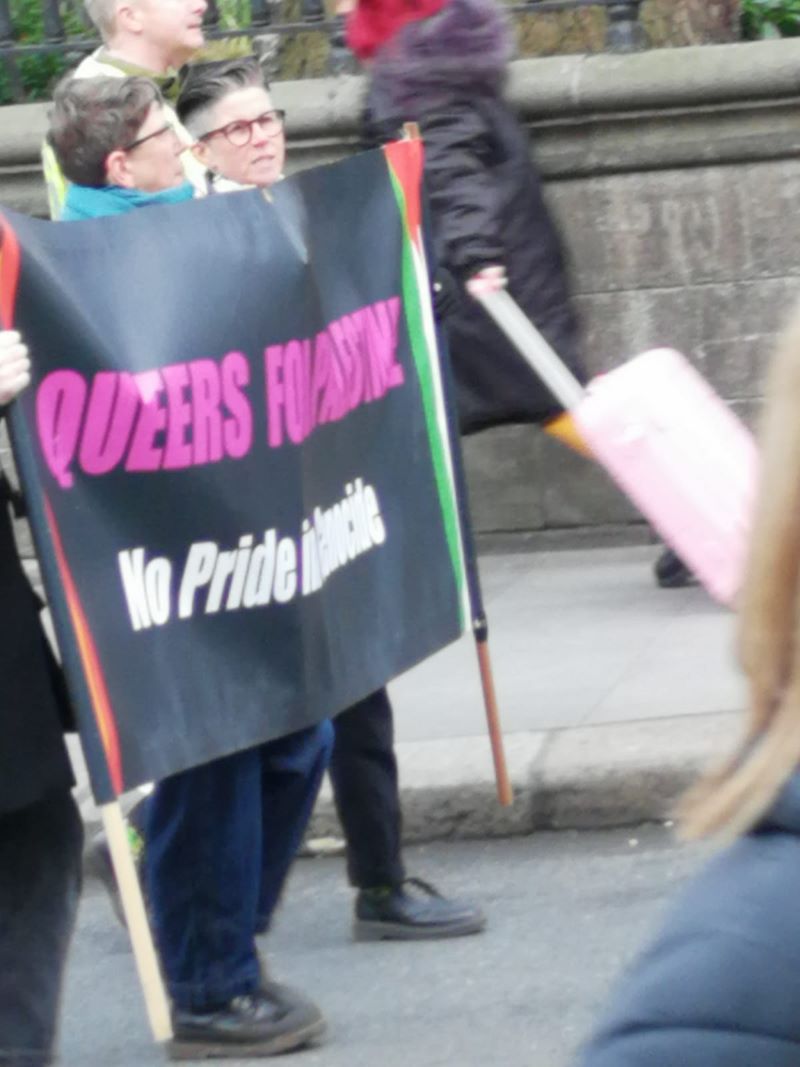
The Resistance Bloc was organised by a broad front of organisations: Action on Palestine, Saoirse Don Phalaistín and Queer Intifada and was also supported by independent activists.

(Photo: R.Breeze)
(Photo: R.Breeze)

There had not been a major Palestine solidarity march in Dublin since 7th December, though they had been held pretty regularly every two or three weeks throughout the previous year. On Saturday, as Netanyahu stopped blocking it, the ceasefire and prisoners transfer agreement finally went ahead.

The Agreement is in three phases, each including prisoners of each side to be exchanged but also the removal of the IOF from Gaza in matched stages and the return of Gaza residents to the South also including the delivery of food, fuel and medicine. But they return to a rubble wasteland.
(Photo: R.Breeze)
(Photo: R.Breeze)

THE PA AND OSLO

The PA is a product of what was called the Palestinian Peace (more correctly called Pacification) Process and since it failed spectacularly to pacify the Palestinian people is more usually now called the Oslo Accords, from which the PA was established in 1994.

Reading a statement in Arabic outside the PA Embassy (Photo: R.Breeze)

The Oslo Accords is one of a wave of imperialist pacification processes or agreements of the last decade of the 20th Century and in particular one of interrelated processes in three distinct regions: in chronological order South Africa, Palestine and Ireland.
The ANC2 of South Africa recommended it to the Fatah3 of the Palestinians; then Fatah and the ANC recommended to the Provisionals4 in Ireland. In no case was what they had fought for achieved, with the exception of universal suffrage in South Africa.5

Banner Dublin Footballers for Gaza on the main march to Leinster House (Photo: R.Breeze) (Photo: R.Breeze)
On the main march to Leinster House (Photo: R.Breeze)

Later, the ANC and Sinn Féin would also recommend it to the liberation movements of the Basque Country, Colombia and the Kurds of Turkey, always with disastrous results for the movements in fragmentation, confusion, collusion with imperialism and disarming in the face of repression.

The Palestinian Embassies represent in fact the PA and this is the case in Ireland too. Despite th. PA’s long history of treachery to the Palestinian people and their struggle, including repression of the Resistance, it is being officially “recognised” as the representation of the Palestine people.

On the main march to Leinster House (Photo: R.Breeze)

Not only the traditional State Government parties of Fine Gael and Fianna Fáil uphold the PA but so also does the major oppositional party, the former Republican party of Sinn Féin. This is also the case with the major political parties in the EU, UK and US.

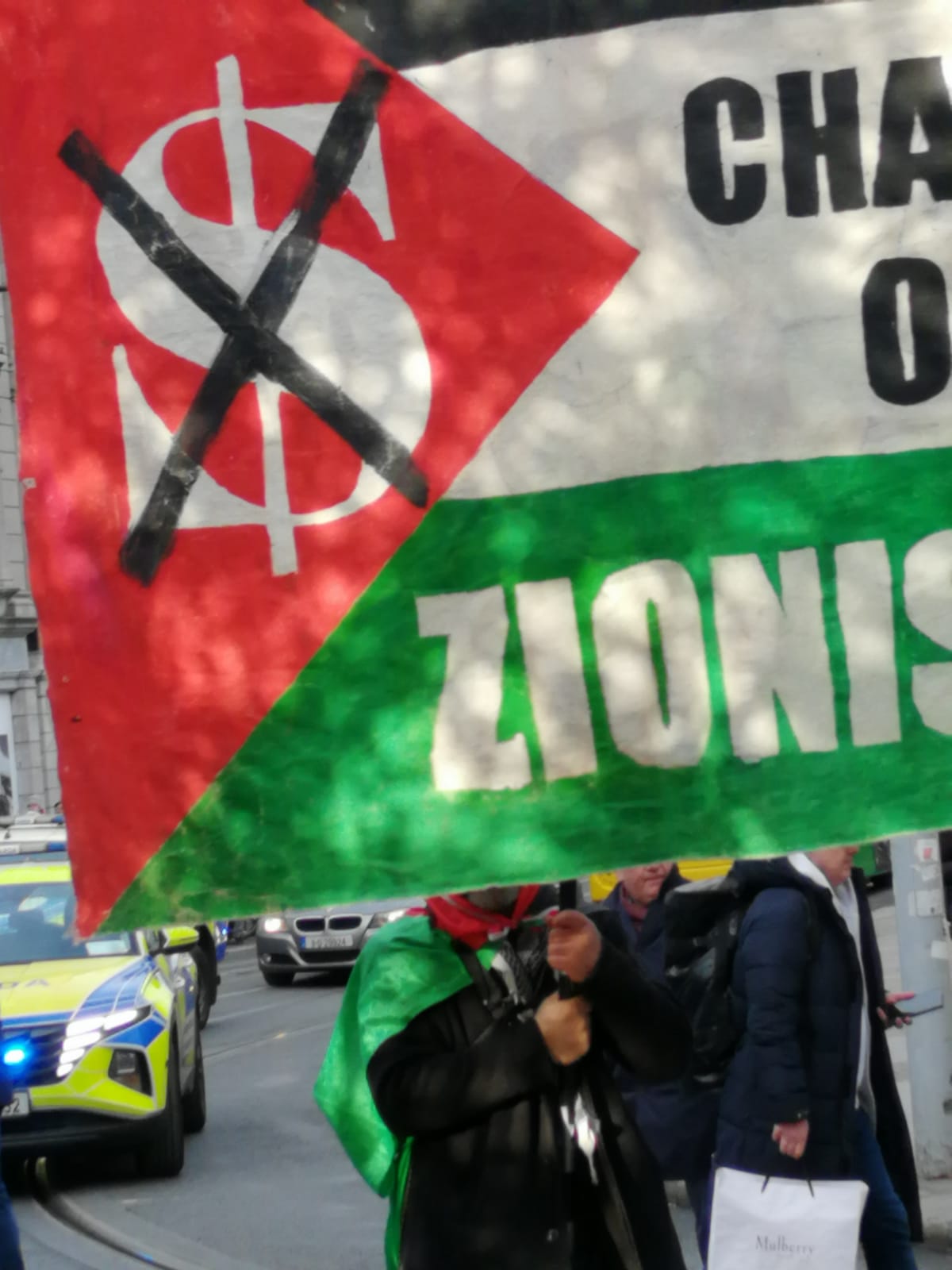
These also support the ‘two-state solution’ (sic) which would see the indigenous Palestinian people get less than 20% of their country, with the least water resources under the eyes and guns of the Israeli State. In any case it is considered unworkable by most experts and serious commentators.

“Smash the chains of Zionism” banner on the main march to Leinster House (Photo: R.Breeze)
Howth Stands With Palestine banner on the main march to Leinster House (Photo: R.Breeze)

In a recent statement on the ceasefire agreement in Gaza, the Secretary-General of the United Nations, Antonio Guterrez, also promoted the ‘solution’ of splitting Palestine into two states as a way towards peace. The PA too upholds that same plan.

Major Palestine solidarity organisations like the IPSC in Ireland have no formal position on the PA or the Two-State plan. Standing on the base of Palestine solidarity, ‘neutrality’ on the question is not excusable, even on a kind of basis of ‘it’s up to the Palestinians and not for us to intervene’.

On the main march to Leinster House (Photo: R.Breeze)

The PA is an imperialist creation against the Palestine struggle; for years it has been periodically attacking the Resistance and has now stepped up that aspect in its 6-week siege of Jenin in the West Bank and even military assaults on the Resistance groups in collusion with the IOF.

True solidarity with the struggle of a people also entails solidarity with their resistance, whether in non-violent or violent form and it also entails opposition to individuals and organisations that are colluding with the enemy; the PA should be publicly denounced by the solidarity movement.

On the main march to Leinster House (Photo: R.Breeze)

THE MARCH IN DUBLIN

In Dublin on Saturday any fears that much support would have dropped away6 disappeared as large numbers marched through the city centre, some having come from Kerry or Limerick. Not far from the front marched the Resistance Bloc which had assembled earlier outside the Rotunda.

Flying the national flag of Palestine, the Starry Plough and flags of Palestinian Resistance factions Hamas and Islamic Jihad, along with the national flag of Syria, the bloc marched behind banners upholding the Resistance and denouncing the PA.

Placard and flags outside the PA Embassy (Photo: R.Breeze)
Banners, flags and statement reading outside the PA Embassy (Photo: R.Breeze)

The usual chants of Palestine solidarity marches could be heard from the Bloc in call-and-answer but also included From Ireland to Palestine – Occupation is a crime! Saoirse don – Phalaistín! Resistance is an obligation – In the face of occupation!

Soon after the main march reached its destination, much of the Resistance Bloc marched away to Leeson Street Lower and soon after crossing the bridge over the Grand Canal into Leeson Street Upper, crossed the road to assemble in front of the “Palestine Embassy”.

One of the placards outside the PA Embassy (Photo: R.Breeze)
Reading translation of the statement in English outside the PA Embassy (Photo: R.Breeze)

The breakaway march was closely followed by a number of Irish police patrol cars and a Public Order Unit Van which remained at the PA Embassy until the event concluded.

One of the organisers then presented a man to read a statement in Arabic, the translation of which she followed to read in English, which pointed to happiness at the freeing of Palestinian prisoners in the exchange with the Resistance – but sadness at the collusion of the PA with the Occupier.

A protester holds a placard denouncing the PA outside their Embassy (Photo: R.Breeze)
Section of the crowd outside the PA Embassy (Photo: R.Breeze)

The speech declared that Palestinians have been striving for over a century to achieve their independence and freedom in their struggle against Israeli occupation. This has cost hundreds of thousands of Palestinian lives and displaced nearly nine million Palestinians around the world.

Later: Given the current circumstances, Palestinians must resist the Israeli occupation and simultaneously confront the Palestinian Authority, which acts as an agent in killing and besieging Palestinians to defend Israel. The speech concluded in thanking the Irish people for their solidarity.

One of the banners outside the PA Embassy bears a slogan but also the name of one of the organising groups (Photo: R.Breeze)
Another view of the crowd outside the PA Embassy (Photo: R.Breeze)

Another man spoke in part-Irish and part-English, congratulating people on having publicly confronted the PA with its collusion. This had only been done twice before in Ireland, once in Belfast when the “Palestinian Ambassador” had been addressing a Sinn Féin meeting.

There had been another outside the “Embassy” in Dublin some months earlier by a small gathering supporting a picket called by the Ireland Anti-Internment Campaign. He drew parallels between the PA and the treason to the Irish resistance that had led to Partition and a subservient state.

Next to the PA Embassy (Photo: R.Breeze)

Underlining the parallel in song, he sang verses of the Take It7 Down From the Mast ballad (against the Irish State during the Civil War 1922-1923), adapting a verse to call on the PA to Take it down from the mast Palestinian traitors ….. for you’ve (they’ve) brought on it nothing but shame.”

The picket concluded with thanks to the attendance and after a period of shouting slogans including There is only one solution – Intifada Revolution! From the river to the sea – Palestine will be free! Shame on you PA – Shame, shame, shame!

End.


Note: If you found this article of interest, why not register with Rebel Breeze for free, so that you will be notified by email of subsequent articles. You can de-register any time you wish.

On the main march to Leinster House (Photo: R.Breeze)

FOOTNOTES

1Arabic, English and Irish.

2African National Congress

3The major secular Palestinian national liberation organisation at the time.

4Provisional IRA with its corresponding party, Sinn Féin, the major Irish national liberation organisation at the time.

5But no other social or economic progress; in addition, fragmentation of the movement and enlisting of the former liberation fighters as ‘enforcers’ of the imperialist agreement.

6Due to a possible but mistaken attitude of “the war’s over”.

7A reference to the Irish Tricolour: Take it down from the mast Irish traitors/ It’s the flag we Republicans claim/ It can never belong to Free Staters/ For you’ve brought on it nothing but shame. “The Free State” was the name adopted by those who agreed to the Anglo-Irish Treaty, including Partition.

USEFUL LINKS

@actionforpalireland

@saoirsephalastin

@queerintifada.ireland

Who are the political prisoners in Colombia?

(Article originally written for the Political Prisoners Collective Asociación Arrakala)

Gearóid Ó Loingsigh January 19 2025 (Reading time: 6 mins.)

NB: Edited by RB from original article for formatting purposes

Who and what is a political prisoner is controversial, though it shouldn’t be. Once upon a time we all knew or recognised a political prisoner. It was obvious, evident.

But two centuries of legislative changes, the work of the press and more than one NGO seeking to please its master i.e. those who finance it, has disfigured the political prisoner and its corollary outside, the rebel, the dissident, the activist.

Before trying to vindicate the figure of the political prisoner we should be clear that the prison itself has not been a constant in history.

There have always been places of reclusion, but they were transitory, provisional, where the prisoner was held whilst they awaited their sentence, be it execution, or exile, the confiscation of assets or in the case to debtors’ prison, the payment of the debt or the taxes owed.

The idea of a prison as somewhere you serve a term of a number of years as a prisoner according to the gravity of the crime is novel. It is about 250 years old.

The seriousness of the crime and the proportionality of the sentence are not obvious. In many jurisdictions a bank robbery is more serious than the rape of a woman.

Historically, crimes against property were more severely punished than crimes against the person. There are exceptions to that but in general, in all judicial systems crimes against property are more severely punished.

Of course, murder usually carries a stiff sentence, but countries with long sentences or even life sentences usually consider such sentences for crimes against property and other crimes. In the USA that possibility exists in various states.

In a number of countries the crimes punishable by death include, blasphemy, adultery, prostitution, spying, bribery, corruption, drug trafficking, homosexuality.

Political crimes are also severely punished with harsh sentences and the death penalty, depending on the country. Such punishment for political crimes only disappeared where it was abolished for all crimes.

Political crimes

Margaret Thatcher the British prime minister (1979-1990) once declared that there was no political crime, only criminal offences. She said in relation to IRA and INLA militants in prison in Ireland that political murder, political attacks nor any political violence existed.

With this she aimed to ignore not just the long history of such crimes in national laws in many countries but also International Humanitarian Law.

The preamble to the UN Universal Declaration of Human Rights recognizes rebellion as the last legitimate resort in the face of human rights abuses.

“Whereas disregard and contempt for human rights have resulted in barbarous acts which have outraged the conscience of mankind… if man is not to be compelled to have recourse, as a last resort, to rebellion against tyranny and oppression, that human rights should be protected by the rule of law.”[1]

The Geneva Conventions, the basis of IHL in common article 3 to the four conventions reads “In the case of armed conflict not of an international character occurring in the territory of one of the High Contracting Parties, each Party to the conflict shall be bound to apply, as a minimum, the following provisions…”[2] 

And goes on to explain the provisions that apply. With this the Geneva Conventions acknowledge the existence of organised and armed rebellion against a state as something more than criminality. Otherwise, it wouldn’t attempt to govern the behaviour of the parties to the conflict.

Though it is worth pointing out that the IHL never clearly defined what was an internal armed conflict nor a war of national liberation. However, it is clear that it can’t be reduced to mere violence.

There are those that raise high the figure of Prisoner of Conscience, not just as the highest expression of a political prisoner but as the only one. According to Amnesty International such a prisoner is in jail for their ideas without having used or advocated violence.

It is an absurd definition. For years they praised Mandela as a prisoner of conscience, but Nelson Mandela led an organisation with an armed wing and ended up in jail for conspiracy to overthrow the state. He was no pacifist.

The definition Amnesty uses can be summarised as They who opine but do not act are political prisoners, those who think but do not apply their thinking are political prisoners.

This excludes great figures from Colombian history such as Policarpa or José Antonio Galán who were executed following their capture. According to this definition José Martí was a political prisoner when he wrote, but a criminal when he returned to Cuba to free it.

But this is not correct, a political prisoner may be a person who never even raised a rock, not to mention a rifle. They may even be pacifists. It is not necessarily a person linked to armed groups, though neither does it exclude them.

There are various types of political prisoners in Colombia.

· There are the militants of guerrilla groups, the majority of them in prison for armed actions, though there are those who played a political role in such groups, what the courts refer to as ideologues.

· There are also those who are victims of frame ups, the majority of them militants of one or other unarmed Left group, social organisation, trade union etc. The state imprisons them through frame-ups in order to limit their political work.

· Then there are those who are prisoners for things related to their political activity i.e. people who in the midst of protests, strikes, occupations of buildings break some law and are arrested, such as those who carry out pickets that are not permitted.

Amongst this group there are also the youths of the Frontline of the National Strike. Yes, throwing a stone is a crime in and of itself but these youths threw stones in response to state violence during the protests.

But, what distinguishes political prisoner from a common prisoner? Brandishing weapons or throwing stones is done by lots of people from narcos to drunks on a Saturday night. Pablo Escobar attacked the state with weapons and car bombs, but he was never a political prisoner.

He was always a criminal.

The first point is the political prisoner is captured in the struggle for a better world.

They seek changes in society that benefit a broad section of the population when their struggle is national in character or large group when the struggle is local or in the neighbourhood with specific demands.

So, a right-wing paramilitary could never be a political prisoner because they seek the status quo, or even a worsening of the conditions of the people.

A political prisoner acts altruistically, seeking no personal benefit though they may end up benefiting from the changes they seek for peasants, youths or neighbours because they are from that community.

But they never seek personal benefit for themselves but rather for society or a particular group in society. Once again neither the paramilitaries, nor the narcos or the Uribistas could ever be political prisoners because what they seek is always for their own personal benefit or small powerful group.

So a guerrilla may be a political prisoner, as may be the youths from the National Strike and similar protests. The environmentalist that blocks the entry of a mining company’s machinery is also one, even if they commit a crime such as damaging or destroying the company’s installations.

In 1976 eighty intellectuals and figures from the world of culture met in Algiers and proclaimed the Algiers Declaration – Universal Declaration of the Rights of Peoples. The document is entirely political and does not have the force of law but was and continues to be a moral reference point.

In Article 28 it states:

Any people whose fundamental rights are seriously disregarded has the right to enforce them, specially by political or trade union struggle and even, in the last resort by the use the force.[3]

Political prisoners are those who comply with this article.

Though the methods used, whether they are violent or pacific may have some influence, they do not determine who are political prisoners.

Of course, in the case of guerrillas, a war crime may wrest credibility from their status as a political prisoner, but in general the use or not of violence is not what determines who is a political prisoner.

It is the demands and the selfless commitment of the militant to the cause that defines whether they are political prisoners or not. Those who deny this are the ones who benefit from the capitalist system.

Their denial is nothing more than publicity and public relations for Julio Mario Santodomingo, Juan Manuel Santos, Gustavo Petro and the large NGOs. Colombia is full of political prisoners and those who deny this also deny the reality of capitalism in the country.

End.
NB: For more articles by Gearóid see https://gearoidloingsigh.substack.com

NOTES

[1] UN (1948) Universal Declaration of Human Rights. https://www.ohchr.org/sites/default/files/eng.pdf

[2] See https://ihl-databases.icrc.org/en/ihl-treaties/gci-1949/article-3?activeTab=1949GCs-APs-and-commentaries

[3] See Declaration of Algiers https://permanentpeoplestribunal.org/algiers-charter/?lang=en