BASQUE PIRATES ON THE WAVES

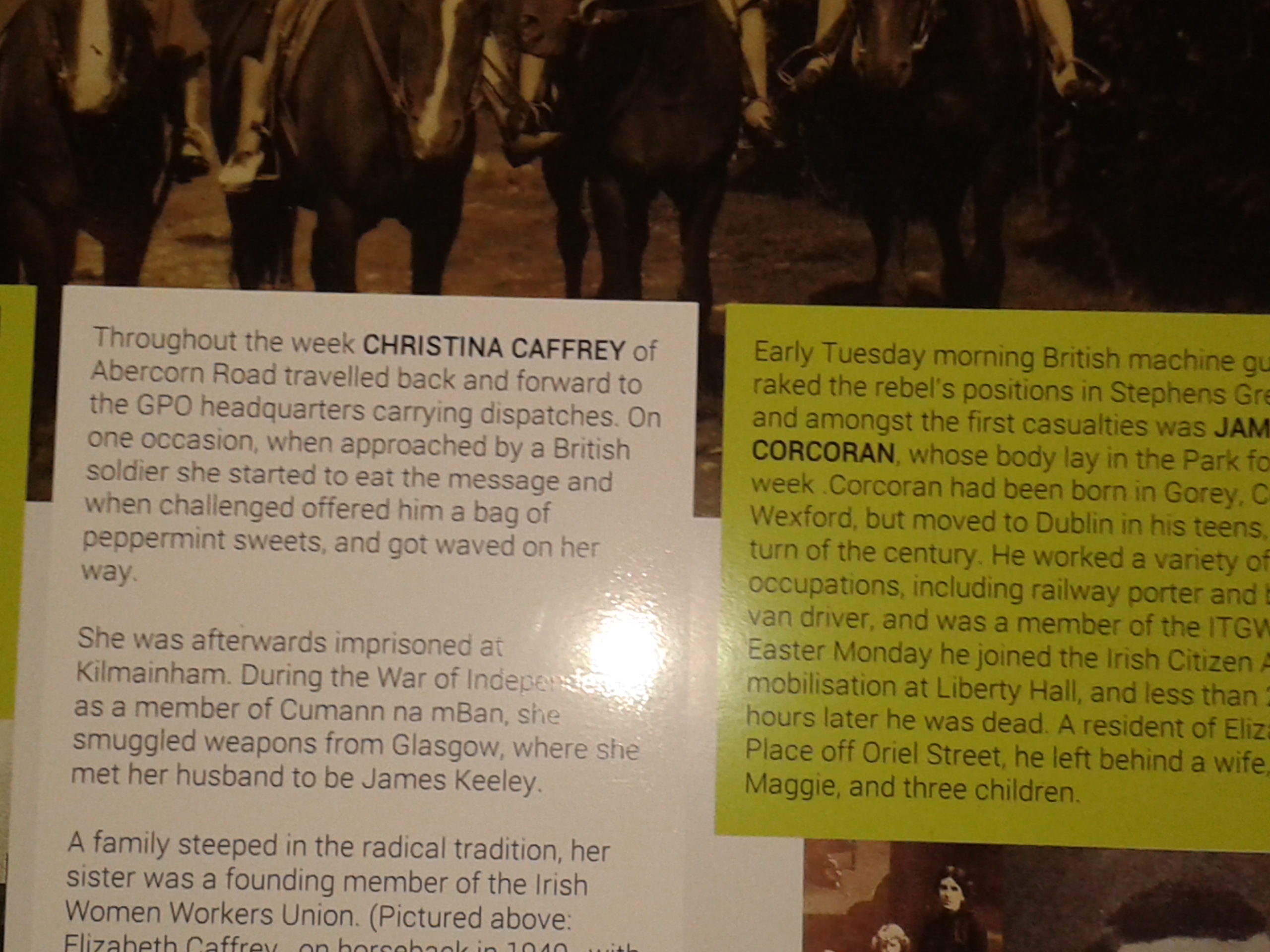
Diarmuid Breatnach

One of my appointments on a recent trip to Euskal Herria, the Basque Country, was with a “free radio station”, with a dual purpose: to learn about their operation and to give them an interview about my thinking on the political phenomena known to most people as “peace processes”. The radio station in question is Zintilik and located in the Orereta area of Errenteria town, not far north from Donosti/ San Sebastian, in the souther Basque province of Gipuzkoa and my hosts were Hektor Gartzia and Julen Etxegarai. 

View of side of building which houses Zintilik. Photo D.Breatnach
Julen and Hektor setting up for the interview Photo D.Breatnach
Julen and Hektor setting up for the interview
Photo D.Breatnach

Not long after I arrived, one of my hosts related his memory of events in the area after a local ETA fighter had been killed. The Guardia Civil had swamped the area to prevent an “homenaje” (an event honouring the dead) taking place, guns pointing at men and women; the children, of which he had been one, gathered into their grandparents’ house ….. He showed me where the police vehicle had parked at the end of the street, his sweeping hand indicating the places where the armed police had stood.

THE “FREE RADIO”

The “free radio station”, also known as “pirate radio” has been broadcasting for 32 years, which I find amazing. It began broadcasting from an “okupa”, an occupation of a private empty building, turning it into an alternative social and political centre. Under popular pressure, the local authority, under the control at the time of the PSE, i.e. (Spanish unionist social democratic party), granted them the building they currently use.

Front of Zintilik building. Photo D.Breatnach
Front of Zintilik building from the street.
Photo D.Breatnach

Originally built to house a smithy, for some reason the building never saw service in that capacity. It is in my estimation an attractive building in a traditional-enough local style, of thick stone, compact without being squat. It has an attractive back yard, no doubt intended at one time to receive the horses with hooves in need of iron shoes, fitted and nailed. The roof is tiled in what seems the usual way for the Basque Country.

Zintilik broadcasts 24 hours a day, which it is able to do using repeats.  The Zintilik collective owns its equipment and funds itself through fund-raising concerts, txosnak (stalls/ marquees) at festivals and occasional donations. They run advertisements for

Julen and Hektor again. Photo D.Breatnach
Julen and Hektor again.
Photo D.Breatnach

local community groups and announce events but accept no commercial sponsorship – nor does their wish for independence stop there. “We don’t receive any funding from the local authority or from the Basque Autonomous Government,” declares Julen, “nor do we wish to.”

Funding from such sources comes with strings attached”, adds Hektor.

Or one becomes dependent on it and unable to function without it”, further explains Julen.

Partial scenic view from the back of the building. A block of flats to right just out of shot does restrict it however. (Photo D.Breatnach}
Partial scenic view from the back of the building. A block of flats to right just out of shot does restrict it however.
(Photo D.Breatnach}

As a further illustration of self-reliance, they tell me how they climbed on to the roof of their building to repair a leak, rather than ask the municipal authorities to do it. And it was the same when branches of a nearby plane tree needed cutting to prevent them knocking against the radio aerial on windy days.

We know it’s work that the local authority owes us and that we and the rest of the community pay their salaries but we prefer not to depend on them,” they explain.

As an example of how dependency – although of a different sort – can undermine a community resource, they relate the story of building which was occupied in order to be used as a community resource. As time passed, many were using it as a social resource but less people were volunteering for the work involved in maintenance at any level. Appeals of the four or so committed people who ended up doing everything fell on the deaf ears of the clientele until one day the four locked the centre doors after the last user had left for the evening and, the next day, handed the keys over to the local authority.
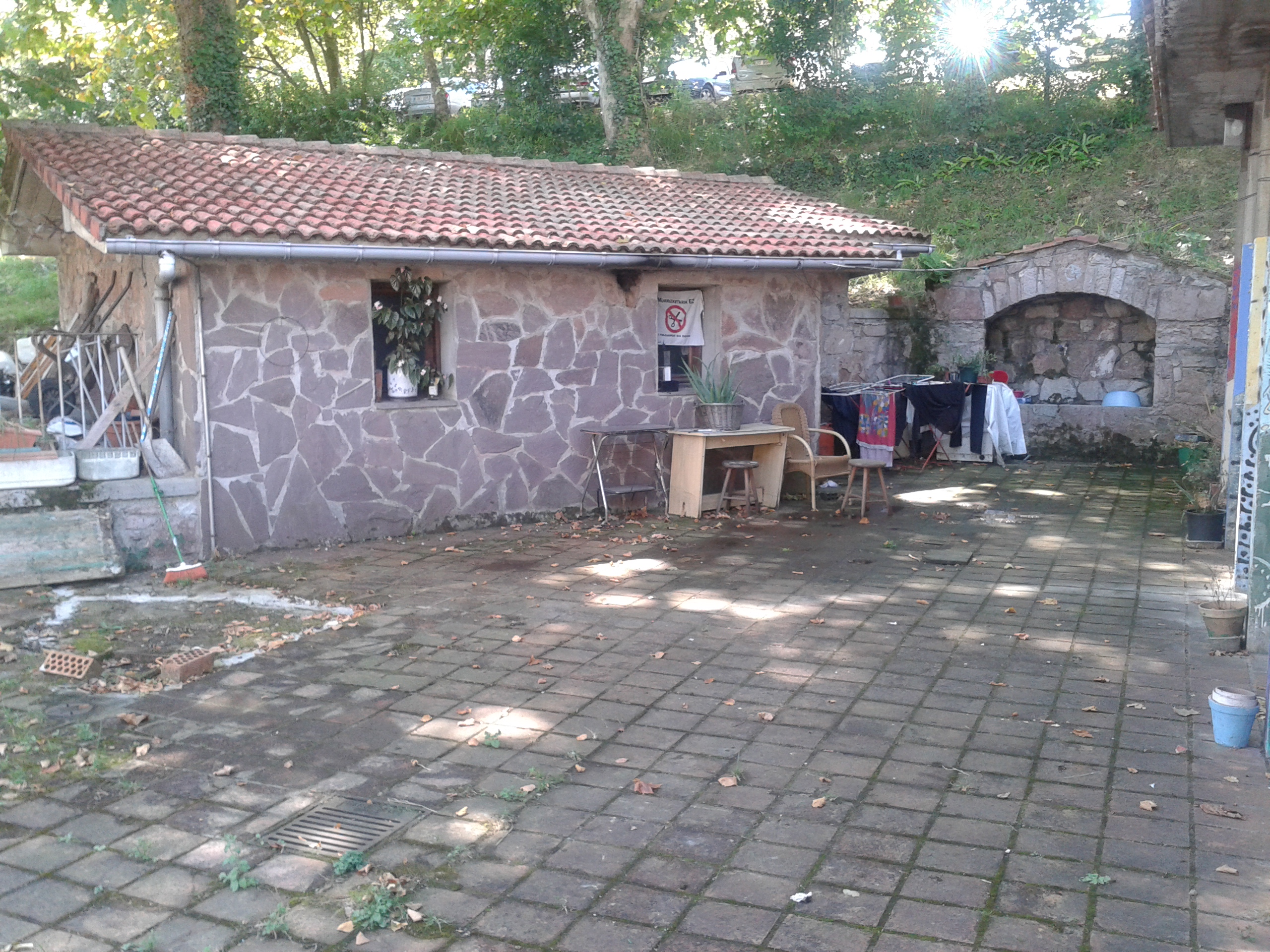
The back yard to the building where we ate a meal after the interview. Photo D.Breatnach
The back yard to the building where we ate a meal after the interview.  The structure there is an outhouse.  (Photo D.Breatnach)

As you imagine, this was a great shock to the clientele,” they tell me, “but it was the result of their own lack of commitment to the project.”

I reflect that many activists will identify in one way or another with that sad experience.

RECORDING THE INTERVIEW

Julen and Hektor discuss the format and general content of the interview with me and map it out, do sound checks and then we go to it. Hektor, who knows quite a bit about the more recent Irish history and about the current situation in the Six Counties, is my interviewer, while Julen monitors from the control room and occasionally joins in with comment or question.

Interview room. Photo D.Breatnach
Interview room.
Photo D.Breatnach

For music in between sections of interview, Irish Ways and Irish Laws (John Gibbs) and Where Is Our James Connolly? (Patrick Galvin) have been chosen, both sung by Christy Moore and Joe McDonnell (Brian Warfield), by the Wolfe Tones.

They also invited me to sing Back Home in Derry, Christy Moore’s lyrics arrangement of Bobby Sands’ poem – but to the air I composed for it. I am happy to oblige – I enjoy singing but it is more than that: I want the air I composed to get a hearing. Christy Moore used Gordon Lightfoot’s air to The Wreck of the Edmund Fitzgerald for Sands’ poem and, excellent though that fit is, especially with Moore’s chorus, I think that the poem (and its author) deserves an air of its own.

Recording room. Photo D.Breatnach
Recording room.
Photo D.Breatnach

Although the main focus of the interview was the phenomenon of “peace (sic) processes”, we discussed aspects of Irish, Spanish, Palestinian and South African recent history, including the 1916 Rising in Ireland, along with the backgrounds to the songs chosen. For the most part, I left it to my interviewers to draw conclusions relating to their experience of political processes in their own country.

FESTIVALS AND STORMS

Upstairs in the broadcasting/ recording and interview rooms, all is in good order: equipment and facilities. After the interview, I note that downstairs, in the main space, things are a in a bit of a mess, for which Julen apologises (he has never seen the state of my flat).

Some of the community groups we support store their placards and banners here,” he says. “Besides, we’ve just finished our local festival and everyone relaxes, dumps their equipment and goes on holiday.” Throughout the Summer and early Autumn, each village, town, city and even area will have its own week-long festival for which the community groups and campaigns will organise and participate.

Down in Donostia (San Sebastian), to where Hektor and Julen accompanied me after we ate the food they had prepared, the city was in the midst of its own festival and was heaving with people – tourists from everywhere, it seemed, as well as Basques.

With that picturesque bay and its island in our background, they got a passing young woman to take our photo, the three of us – the conversation with her was in Euskara only. I held up the placards I had prepared for the photo in turn, one in Irish and another in English, supporting the Moore Street quarter in Dublin.
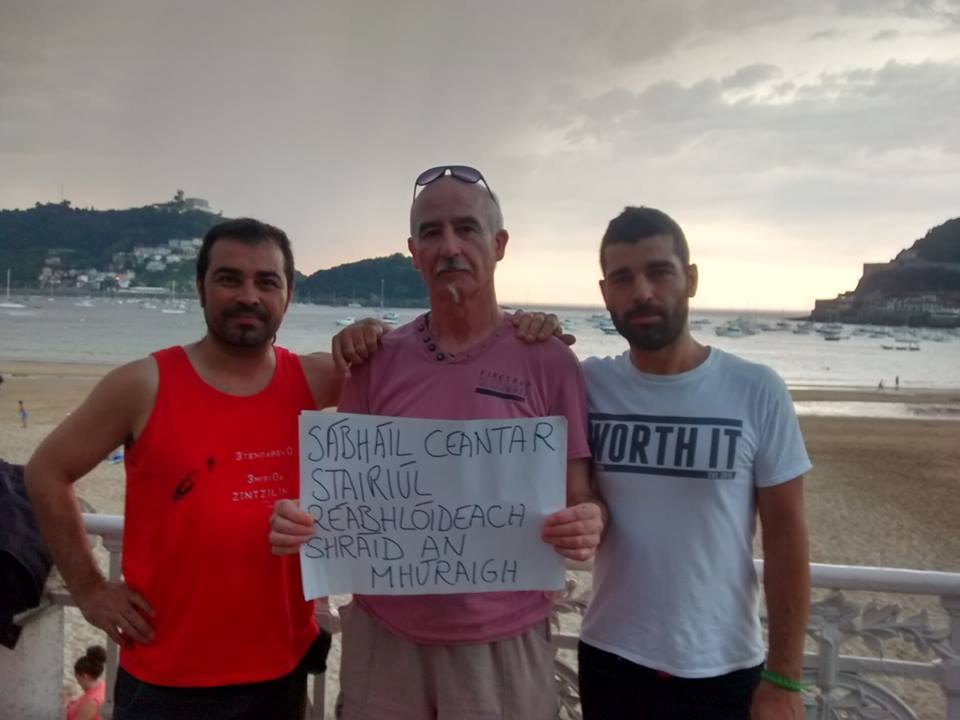
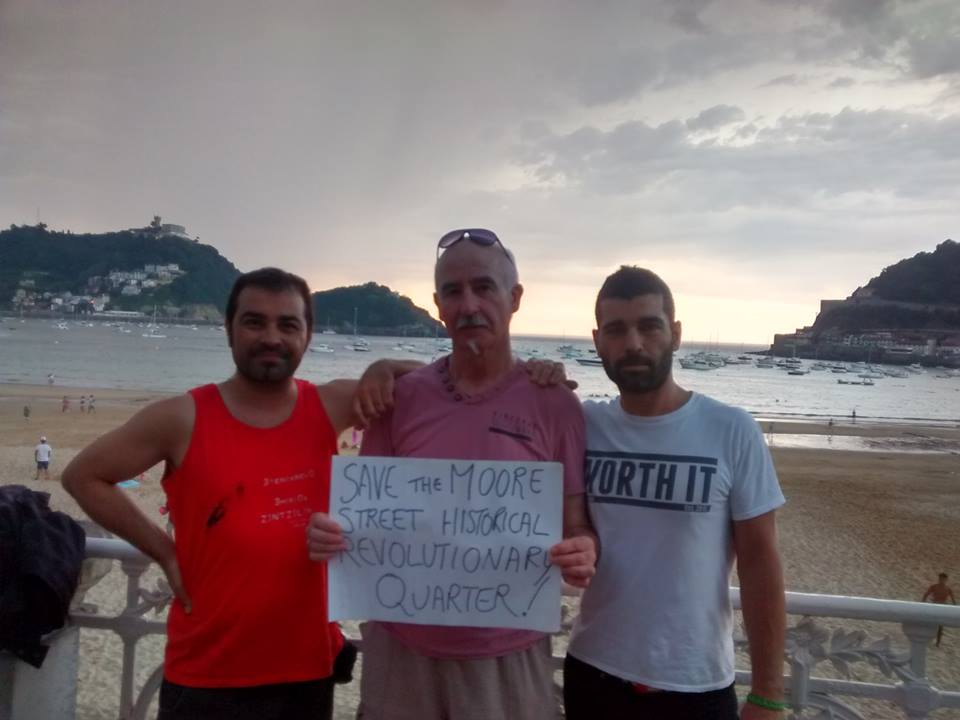
R-L: Julen, Diarmuid, Hektor. Donosti bay in the background with island partly visible. Storm building in the sky.

Save M St Quarter Donosti backgroundDark clouds were gathering overhead and on the horizon the sky was a baleful orange. A storm or at least a downpour was being promised and, as we turned back towards the bus station, the first drops began to fall. In the humid heat, the light rain was welcome for awhile but for part of my solitary journey back to Bilbo, it formed a silvery curtain in the coach’s headlights and streamed down the windows.

I remembered being told that one can frequently witness a violent storm in the Donosti bay while not so far away in Bilbao, as a result of local conditions, all is calm. As for winter storms in Donosti, the waves hitting and surging over the seafront and piers have to be seen to be believed; occasionally the sea reaches inland, floods cellars and converts parked cars into boats or semi-submarines.

The rain eased off and stopped about half-way through my journey and when I got into San Mames station in Bilbo, the streets were not even wet.

end
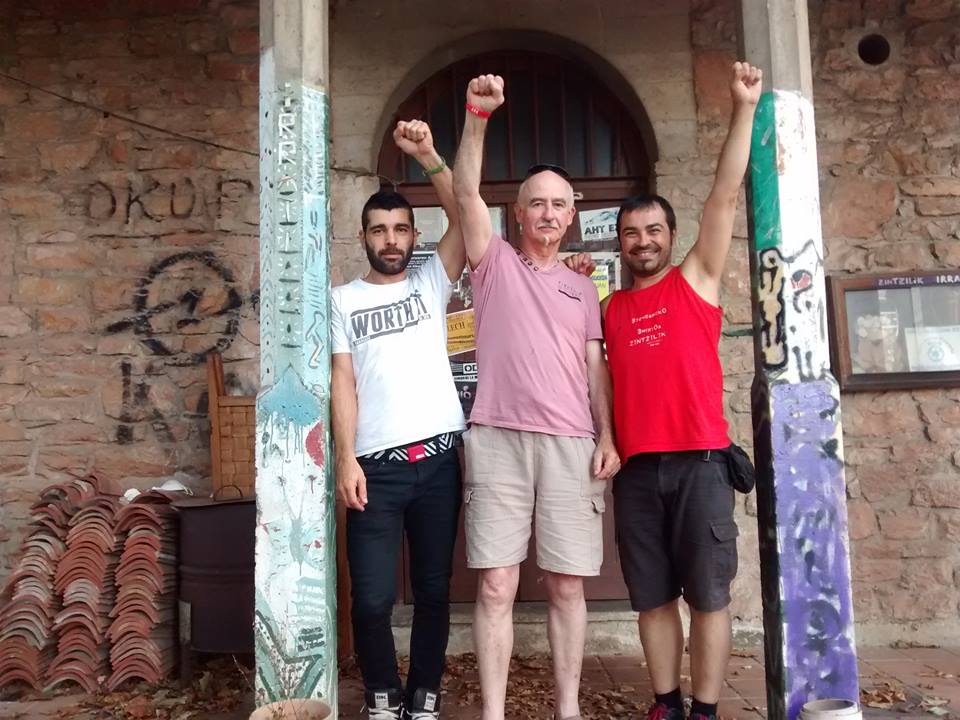
Clenched Fists 3 Tzintilik Irratia 2016

“SLASH AND BURN” IN MOORE STREET

Diarmuid Breatnach

“Almost slash and burn,” is how one of the people I am talking with describes the procedures they expect from Lisadell, the construction company employed by the Department of Heritage in Moore Street, to work on where the GPO Garrison retreated in the last days of the Easter Rising.

“The roof doesn’t need replacing,” says another. “It needs the hole in the roof fixed and the timbers carefully repaired, not replaced.” I remark that I’ve known people who’ve had water damage or dry rot and just had the timbers replaced. “Yes, of course, when conservation is not an issue. But when it is, the work is slow and painstaking, bit by bit, to conserve everything that can be conserved, putting in extra supports when needed.”

I am talking to people with expertise in the area of conservation of buildings of historical and/ or architectural value. They know what should be done to conserve the historic buildings in the Moore Street quarter and they feel certain that it will not be done. They feel impotent – they have the expertise, they care about conservation but they fear the combined powers of the State and big property speculators such as Hammerson, who plan to build a huge shopping centre over the whole Moore Street quarter. They will advise but if they go “too far”, they feel their professional lives will be seriously impaired. Perhaps they fear even more than that – who knows?

In 2007, just before Nos.14-17 Moore Street were made a national monument, TG4 in the their Iniúchadh Oidhreacht na Cásca program broadcast a remarkably in-depth exposure of the battle between Chartered Land and another firm of property speculators for control of the quarter and how Joe O’Reilly of Chartered Land, coming from behind, had been given an incredible advantage over his competitors with a preferential deal with the Planning Department of Dublin City Council.  This took place among more than a whiff of corruption and of complaints by elected Councillors who were excluded from a secret meeting and at another, threatened with financial penalties. Joe O’Reilly of Chartered Land (and also joint owner with Irish Life of the ILAC shopping centre) gobbled up most of Moore Street and only a fierce campaign in the autumn of 2014 prevented the Planning Department getting authorisation to swap him two Council properties in the Street, thereby clearing the way for him to begin demolition of the terrace.


“THESE TIMBERS HEARD …. MACHINE GUNS … SCREAMS … THE PAINFUL DECISION TO SURRENDER …”

Another of the experts intervenes. “These timbers they are going to rip out are the ones that heard the discussion around whether to surrender or to go on fighting,” she says. I am a little surprised at such poetic imagery from a person whose work is in bricks and mortar, plaster, timbers and slates – but there is no denying the passion and there is more to come.

“Those timbers heard the chatter of British machine guns, the crack of their rifles, screams in the street, the occasional crack of a Volunteers’ rifle, perhaps an occasional groan from the wounded Connolly. They heard Elizabeth O’Farrell volunteering to go out under a white flag although civilians had already been shot down under such a flag. They heard the discussions upon her return, the painful decision to surrender, Pearse’s decision to go out with O’Farrell, Seán Mac Lochlainn’s orders to march out in military order ….”

Can damaged timbers and bricks be conserved? I ask. “Oh yes, they do it in England on historic buildings, even genuine Tudor ones. All kinds of damaged timbers can be conserved. But if at all possible you do it in place, in situ – removing timbers causes further damage.”

And bricks? And slates? “Well,” breaks in another, “you’d photograph everything carefully in advance or as you uncovered sections. Anything to be temporarily removed would be numbered, slates or bricks. Then the supporting timbers or brickwork is slowly treated, then everything put back in the same order.”

What about missing or broken bricks or slates? “Broken bricks can sometimes be repaired but otherwise you’d source bricks from the same brickyard. Or if the brickyard is no longer in business, you’d look for other buildings of the same bricks being demolished and buy the material. The same with slates.” I think of the descriptions by campaigners occupying the buildings of how they found timbers just thrown into a set-aside room, and all kinds of objects left leaning against plasterwork that was probably in need of conservation.

A woman shows me on her Ipad a section on restoration procedures on the website of Historic England, a body sponsored by the British Department of Media, Culture and Sports. I quickly record three paragraphs (I will look up the rest later).
A conservative approach is fundamental to good conservation – so retaining as much of the significant historic fabric and keeping changes to a minimum are of key importance when carrying out repair work to historic buildings.

The unnecessary replacement of historic fabric, no matter how carefully the work is carried out, can in most situations have an adverse effect on character and significance.

“The detailed design of repairs should be preceded by a survey of the building’s structure and an investigation of the nature and condition of its materials and the causes and processes of decay.”

I remark that doesn’t seem to be what is going to happen to Nos.14-17 Moore Street. They nod – they agree.

“It’s just a building site to them,” says one. “What they have already done in defacing a national monument is criminal – but who will prosecute them?”

“They put more holes in the front of those buildings than British soldiers did in 1916,” says another man angrily. “Then they just ripped out their Hilti bolts and filled up the holes with an epoxy resin, instead of pointing material.”

This is a reference to the drilling of holes for the erection of a banner without planning permission, across Nos. 14-17 Moore Street, officially a national monument since 2007. Judge Barrett agreed it was illegal in the case taken by Colm Moore, the nominee of some 1916 fighters’ relatives. Although she is appealing that and other decisions of Barrett’s, the Minister had it taken down recently — but again using questionable methods.

“No wonder Humphreys doesn’t want independent inspection and monitoring”, says another, a reference to the Minister of Heritage’s consistent refusal to allow any independent conservation experts in, or indeed the Lord Mayor of last year, or a number of TDs and Councillors, always under the guise of “Health & Safety requirements” that no-one not of the workforce should enter. Yet when they had their media exercise after the Government’s purchase late last year, RTÉ camera crews were in there as was Caitriona Crowe of Trinity College, praising the purchase of the buildings and the Department’s alleged intentions. It later emerged that the demolition of three adjoining buildings was part of that plan but a five-day occupation of the building by concerned citizens put a stop to that, before an injunction was granted by Judge Barret preventing further demolition until the case taken against the State had been decided.

While the rest of the buildings in the quarter and the streets themselves, uncared for and subject to constant assault of weather and with broken drainpipes, heavy traffic and so on accelerate in deterioration, and the Minister’s appeal against the Barret Judgement will not even open until December next year, an assault is imminent on the roof and parapets of four of the buildings of the historic 1916 terrace, those with the best-preserved original frontages and among those with the highest specific historic importance within that terrace. If this were a case of some greedy or careless private owner or company, a complaint could be made to the National Monuments Service. Many such cases have ended in heavy fines for the perpetrators.

But Terry Allen, the Principal Officer of that very Service baldly said in his evidence to Judge Barrett that Moore Street was not a 1916 battlefield. His office comes under the Department of Arts, Heritage, Regional, Rural and Gaeltacht Affairs, of which Minister Heather Humphreys is the boss. And the Government’s Cabinet stands behind her, if not actually pushing her forward. We tend to look to the State to protect national monuments from people damaging them. But who can protect them from the State itself?


End.

NB: These conversations happened but not with all of the people present at the one time. I have put them together for the sake of a condensed narrative and for the protection of identities.


Further information:

Principles of Repair for Historic Buildings from Historic England website:

https://historicengland.org.uk/advice/technical-advice/buildings/maintenance-and-repair-of-older-buildings/principles-of-repair-for-historic-buildings/

The Facebook pages of the following campaigns:
Save Moore Street From Demolition

Save Moore Street 2016

Save Moore Street Dublin

The TG4 program Iniúchadh Oidhreacht na Cásca https://www.youtube.com/watch?v=Cx0Kah7dE80

And some of the Easter Rising Stories series of videos by Marcus Howard on Youtube

Description of Terry Allen’s responsibilities as Prinicpal Officer at the National Monuments Service http://whodoeswhat.gov.ie/branch/ahg/Monuments/terry-allen/641/


MASS CROPPIES’ BURIAL GROUND OPEN TO THE PUBLIC ONCE AGAIN

Clive Sulish

Croppies’* Acre, a piece of parkland believed to the site of a mass grave of United Irishmen insurgents and non-combatant victims, situated between the Liffey’s Wolfe Tone Quay and the Collins Barracks complex of the Irish National Museum, was some weeks ago reopened to the public for the first time in four years. Few if any of the campaigners for its saving or its reopening were invited to the event or given credit in the short newspaper report about the occasion.

This report seeks to correct that omission, to give a brief account of efforts made over the years and to comment on the care of the park today.

(* “Croppy” was a name given to supporters of the United Irishmen, apparently because of the males wearing their hair cut short and close to the scalp, in the style of the revolutionary French of the time.  “Crapaí” and “Cnapaí” were the versions of the word in the Irish language).

The Pedestrian Gate on Wolfe Tone Quay, Liffey side, open to the public again after four years (Photo C. Sulish)

HISTORY OF THE SITE AND OF THE CAMPAIGNS AROUND IT

In 2012, after the site had been closed for some time allegedly due to health and safety concerns for visitors due to drug-injecting paraphernalia left there by people using the site at night-time, Pádraig Drummond and Diarmuid Breatnach set up the Croppies Acre Rejuvenation project with a Facebook page to promote the importance of the site and to gather forces to pressure the authorities into reopening the site and maintaining it properly.

Prior to this, a number of visits had been made by Irish Republicans (the 1916 Societies on some occasions, independent Republicans on others) to the closed site to collect and dispose safely of drug-injecting paraphernalia and other waste and it was felt that a public campaign was needed.

Memorial stone about halfway along the the Liffeyside of the park. In the distance, the heaped earth of works in October last year which had caused concern (Photo: D. Breatnach)
Memorial stone about halfway along the the Liffeyside of the park. In the distance, the heaped earth and earth-moving machine in October last year which had caused concern (Photo: D. Breatnach)

As part of the campaign a letter to the media was composed by Drummond and Breatnach in consultation with the National Graves Association (a voluntary independent organisation that marks and maintains the graves of those who fought for Irish freedom and which also erects plaques to commemorate people and events). Although none of the main media published the letter it is reproduced here not only as a document of the history of campaigning for the site in its own right but also because it summarises well what had gone before.

Croppies Acre is remembered in Dublin folklore as the site of a mass grave in which the bodies of dead insurgents were thrown in 1798. Among those lying in Croppies’ Acre are reputedly the bones of Bartholomew Teeling and Matthew Tone (brother of Wolfe Tone — CS), both hanged at the Provost Prison on Arbour Hill after the Battle of Ballinamuck on 8 September 1798.


In 1898, the centenary of the United Irish uprisings, 100,000 marched to the site and placed a plaque there. As many people will be aware, the centenary commemoration of the United Irish played a significant part in the creation of a national pro-independence culture which fed into the Easter 1916 Rising, less than twenty years later, and which in turn fed into the War of Independence 1919-’21 and the creation of an Irish state.

Memorial stone placed during 1798 centenary commemoration which was attended by 100,000 (Photo: D. Breatnach)

Although a 1798 rising commemoration plaque was laid at the site by “soldiers of the Eastern Command” of the Irish Army in 1985, soldiers were sometimes to be seen playing football on the field until the mid-1990s, while Collins Barracks was still in use by the Irish Army. This practice ceased after a number of complaints from members of the public who felt the practice was not respectful to the dead insurgents. The Irish Army vacated Collins Barracks in 1996 or thereabouts and the National Museum moved into the buildings in 1997.

In 1997 a proposal to turn the graves of the Patriot Dead into a car and bus park was all the more stunning as the bi-centenary of the United Irishmen’s Rising of 1798 was imminent and groups everywhere were renovating monuments and graves, organising seminars and lectures and planning pike marches.

The then secretary of the National Graves Association, Tess Kearney (since deceased — SC), was in poor health, but decided that such an occasion required action regardless of her personal circumstances. Tess turned in a magnificent effort for the television cameras and organised a campaign to “Save the Croppies Acre”. Within days, various interested parties came together and, under the leadership of the NGA, the plan to build a coach park on the site was defeated and the Croppie’s Acre site was developed two years ago (i.e in 2010 — CS) as a national monument with an expenditure of some €35,000. The field layout is simple with `(some individual) flagstones throughout the site presumably symbolising the bodies lying below and a small open circular stone structure on which are reproduced parts of the text and facsimile typeface of the Droites del Homme (Rights of Man) document from the French Revolution (1789). Also featured is the text of Seamus Heaney’s poem “Croppies” and the motif of the barley seed head is reproduced on the stone in reference to the poem and Irish folk memory.

The enclosure monument, with National Museum, Collins Barracks in the background. (Photo: D.Breatnach)
The enclosure monument in Croppies’ Acre, with National Museum, Collins Barracks in the background.
(Photo: D.Breatnach)

The Drummond/ Breatnach letter, signed by a number of historians, history tour guides, authors and history enthusiasts, also noted that:

The Office of Public Works has closed the site because it considers it unsafe to permit public access due to some night-time activities there. Recently some of us went to inspect the site and were shocked at the condition into which it has sunk. Used syringes, discarded needles, bottles, cans and other rubbish were found at a number of locations but especially inside the stone structure.

Rubbish bags were filled and disposed of, with the hazardous waste disposed of in bio hazard containers that were then handed into the local authorities. A return visit found almost as much rubbish as had been disposed of previously. A third visit found even more. This is not acceptable and must change.

The letter concluded by stating that
“It may be that some will say that the expense, even though relatively small, of looking after a national monument, cannot be justified in the current climate of austerity. To those we would say that possibly, had we valued sufficiently our independence and the sacrifices made for it in the past, we would not have allowed foreign finance speculators to bring us to sad straits in which we find ourselves now. The image of our past locked away while we are plundered as a nation in the present is a stark contrast.

However about that, the Office of Public Works must take the appropriate action to look after this site properly and offer safe access to the park during the hours of daylight seven days a week. At night, the site needs to be well-lit and protected. Mr. Brian Hayes, TD, Minister of State responsible for the OPW since 2011, must take urgent action.”

At the time, the OPW probably seemed a much safer bet as custodians than Dublin City Council, especially with the Council’s Planning Department having granted property speculators planning permission to construct a giant shopping centre over the Moore Street battleground and market. However, it was eventually Dublin City Council that took responsibility for the maintenance and reopening of the site to the public.

But throughout the years after the setting up of that campaign, from 2012 to 2014, nothing seemed to be happening to put matters right. Groups of Republican volunteers paid visits from time to time to clean up the site, collecting horrifying amounts of used hypodermic needles and other paraphernalia and waste but the authorities appeared unmoved.

Twice in February 2014, questions were asked in the Dáil, the Irish Parliament, of Minister for Public Expenditure and Reform Brian Hayes. Pádraig Drummond had written to TDs (elected representatives) Clary Daly and Maureen O’Sullivan, who received replies to their questions, the former written and the latter an oral reply. Daly’s reply from Minister of State Hayes was that The Office of Public Works and Dublin City Council have agreed in principle that the management and maintenance of the Croppies Acre Memorial Park will be undertaken by the Council. OPW and Dublin City Council are reviewing the Council’s proposals regarding improved access to the park prior to formalising a licence arrangement, following which the park is expected to re-open to the public.”

The oral reply was much longer but the nub of it was the same.

We weren’t getting people signing up to form a campaigning group and we were running out of energy”, said one of the campaigners about those years.

In September 2015, soon after DCC staff were seen to have been cleaning up the site and cutting the grass, concerned Republicans visited the site and posted photos on the campaign FB page of drug paraphernalia and mess which had quickly accumulated again on the site.

In October of that year, Dublin City Council staff began work inside the park with earth removers. In the absence of any notice of what was intended and no public consultation, protesters including Éirigí mobilised and halted work. Dublin City Council gave a written guarantee (see photo) that the work was only to create or upgrade a circular pathway. The protests ceased but an eye was kept on proceedings.

However photographs taken during a visit by other concerned people that same month showed drug paraphernalia again accumulating at the site.

View from the west pedestrian gate to the east since the Acre opened (Photo: C. Sulish)
The letter guarantee which led to calling off the protests in October 2014

THE SITE REOPENS TO THE PUBLIC

By June this year, the site had been cleaned up, planted, a path put through part of it and finally reopened to the public, four years after the campaign to reopen it had begun. The Daily Herald reported on the opening ceremony (see link for their report below) on the 15th, presided over by Lord Mayor Críona Ní Dhálaigh in one of her last acts before her year as Mayor was up.

The Herald report alluded to the years of closure and “problems with drug users” but not once did it mention the National Graves Association, the Republican groups that repeatedly visited the site and those that mobilised to protect it in October last year, or the campaign set up in 2012 and the letter to the media of that year and TDs questions in the Dáil

A sleeping bag, perhaps, against the wall within the monument park weeks after reopening. (Photo: C.Sulish)
A sleeping bag, perhaps, against the wall within the monument park weeks after reopening.
(Photo: C.Sulish)

The report did mention Councillor Mannix Flynn who, it said, had been campaigning over the years for the site’s reopening. “Councillor Mannix Flynn, for all I know, may have been campaigning hard for the site’s reopening,” said Diarmuid Breatnach. “I can’t say he has and I can’t say he hasn’t. But I can say that not once in those years of agitation, campaigning and trying to raise the profile of the issue, did we ever hear from or about him in connection with Croppies’ Acre.”

This month, I visited the site again and found it open and being used by the public, reasonably clean and with some attractive plantings of flowers and grasses. But inside the circular monument, there was a small pile of excreta in one spot and, on the way out, I noted what seemed to be a sleeping bag against the eastern wall. The site will need continual watching.

End.

White Purple Flowers Grass close
(Photo: C. Sulish)
White Purple Grass
(Photo: C. Sulish)
Grass Blue Flowers Close
View southwards across the park (Photo: C. Sulish)
The Tricolour in this case would have been better replaced by the green flag of the United Irish with the harp in gold.
The Tricolour in this case would have been better replaced by the green flag of the United Irish with the harp in gold. (Photo: C. Sulish)

APPENDIX

LINKS TO QUOTED AND RELATED MATERIAL

Letter sent to mass media in 2012, after DCC had locked up the site:
http://www.politics.ie/…/221010-croppies-acre-rejuvenation.…

Daily Herald report on the reopening of Croppies’ Acre

http://www.herald.ie/news/drughit-city-park-is-reopened-after-120k-cleanup-34801856.html

Article about Bartholomew Teeling and Matthew Tone https://rebelbreeze.wordpress.com/2014/03/23/captain-bartholomew-teeling-united-irishmen-hero-believed-to-be-buried-in-croppies-acre/

THREE EVENTS IN ONE ON HOWTH PIER

Clive Sulish

Foreign tourists and Irish-based visitors looked on with curious interest at a gathering at the foot of the East Pier, Howth on Sunday 24th – the group contained a number in military-type uniform, some were carrying flags, each one of a different design and a number of people in ordinary civilian clothes were carrying floral wreaths.

The Asgard, Molly Childers and Mary Spring-Rice on board at Howth
The Asgard, Molly Childers and Mary Spring-Rice on board at Howth (photos from Internet)

Participants, Tourists and Visitors
Participants, Tourists and Visitors (photo D.Breatnach)

Most onlookers at that point would not have known that those gathered there had a threefold purpose:

  • to commemorate the landing of Mauser rifles for the Irish Volunteers

  • to commemorate the massacre of civilians by enraged soldiers later that same day on Bachelors Walk and to

  • launch the Asgard 1916 Society.


The men and women in uniform formed up with the flags as a colour party and led the procession the full length of the pier to its end. There the procession came to a halt in front of a plaque on the wall commemorating the landing of 900 Mauser M1871 single-shot rifles and 29,000 rounds of ammunition in 1914 by a crew skippered by Erskine Childers with his wife Molly and friend Mary Spring Rice. The arms were taken ashore and whisked away in an operation planned by Bulmer Hobson of the IRB and carried out by the Irish Volunteers and Na Fianna Éireann.

Colour Party Marching
Colour Party marching along the pier towards the ceremony (photo D.Breatnach)

The Dublin Metropolitan Police and British Army were mobilised by Dublin Castle authorities to seize the guns (unlike at the previous much larger operation by the Loyalist UVF at Larne) but only managed to get a few. As the disgruntled Scottish Borderers marched back into town, they were jeered by Dublin crowds and some cabbage stalks were thrown at them. On Bachelors Walk, very near the Ha’penny Bridge, an officer brought them to a halt and they faced the crowd with guns pointed, then opened fire. Three men and a woman were killed and 38 wounded, including the father of singer Luke Kelly of the Dubliners ballad group (also called Luke). One of the victims died of bayonet wounds.

Margaret McKearney speaking and chairing the occasion on the pier
Margaret McKearney speaking and chairing the occasion on the pier (photo D.Breatnach)

Margaret McKearney, who has had three brothers killed in the Six Counties during the 30-years war, stepped forward to address the crowd as tourists and visitors took photos or watched and listened. After giving a brief account of the Howth landing and of the massacre on the Dublin quays, also of the smaller landing at Kilcoole, McKearney called forward Pól Ó Scanaill of the 1916 Societies to read the 1916 Proclamation of Independence. After he had finished, McKearney called for the young bearers of two floral wreaths to make their presentations:
Ellen O’Neill, with a wreath in memory of those killed and injured by the British soldiers at Bachelors’ Walk;

Roibeard Drummond, whose uncle Michael Moore was a crew member of the Nugget, landing rifles at Kilcoole, laying a wreath for the Asgard 1916 Society to commemorate the landing of the rifles and those who carried them in battle in 1916.

Last of the wreath-layers was Denise Ní Chanain on behalf of the Anti-Internment Group of Ireland.

Ellie after laying wreath in memory of the dead and injured in the Bachelors' Walk massacre
Ellie O’Neill after laying wreath in memory of the dead and injured in the Bachelors’ Walk massacre (photo D.Breatnach)


MOORE STREET SPEECH

Roibeard Drummond, after laying wreath on behalf of the Asgard 1916 Society
Roibeard Drummond, after laying wreath on behalf of the Asgard 1916 Society (photo D.Breatnach)

Niamh McDonald gave a short speech on the current situation in the struggle to save the revolutionary quarter of Moore Street. She informed her audience that NAMA had sold the debt of the Irish speculator company Chartered Land (Joe O’Reilly) to Hammerson, a British-based vulture capitalist company, who are continuing with the plan to build a huge shopping centre over the whole historic quarter. Meanwhile, the Minister for Heritage, Heather Humphreys, is appealing the High Court judgement that the whole quarter is a national monument. McDonald asked people to keep an eye on the campaign’s

Denise Ní Chatháin bringing forth the wreath from the Anti-Internment Group of Ireland
Denise Ní Chanain bringing forth the wreath from the Anti-Internment Group of Ireland (photo D.Breatnach)

Facebook page for updates and for calls to support actions.

McKearney then called on Diarmuid Breatnach to sing Me Old Howth Gun, pointing out that guns landed at Howth had been the first to fire on the Lancers in O’Connell Street on Easter Monday 1916. Breatnach introduced the song as having been written apparently in 1921, that is a year before the outbreak of the Civil War, by James Doherty, who also used the pseudonym Seamas Mac Gallogly.

Niamh McDonald speaking on behalf of the Moore Street 2016 campaign
Niamh McDonald speaking on behalf of the Moore Street 2016 campaign (photo D.Breatnach)

MAIN SPEAKER — JOHN CRAWLEY FROM THE MARITA ANN
The next speaker to be introduced by McKearney was John Crawley who was arrested on board the Marita Ann trawler, intercepted off the Kerry coast by the Irish Naval Service on September 29, 1984, when seven tonnes of arms were seized. The US heavy machine guns recovered on the Marita Ann had special mountings allowing them to be used as anti-aircraft weapons. Another of those detained on board – and later jailed for 10 years – was Martin Ferris who went on to become a Kerry TD for Sinn Fein, while John Crawley has taken a line of opposition to the Good Friday Agreement.

John Crawley giving his oration with the plaque commemorating the landing of the Howth guns behind him
John Crawley giving his oration with the plaque commemorating the landing of the Howth guns behind him (photo D.Breatnach)

John Crawley gave the main speech at Howth, in which he traced the history of the struggle for the Irish Republic from the Volunteers onwards, pointing out that many who fought the British in 1916 had different aspirations for the country, which explained why they parted ways in 1921. Crawley stated that the British have always been able to pick out those whose primary intention was to survive the struggle from those whose intention was if necessary to give their lives for the objective of the Irish Republic.

Pól Ó Scanaill reading the 1916 Proclamation
Pól Ó Scanaill reading the 1916 Proclamation at the head of the East Pier, Howth (photo D.Breatnach)

Crawley pointed out that some people had led a section of the Republican movement in accepting the right of a foreign country to decide the future of a part of our country; they had joined in the colonial administration and had accepted the colonial police force.

After the applause for the speech died down, McKearney thanked those who had participated and asked Diarmuid Breatnach again to step forward to sing the national anthem. Breatnach sang it in Irish, first verse and chorus (and noticeably sang “Sinne Laochra Fáil” instead of “Sinne Fianna Fáil”). Participants joined in with the chorus and then all made their way along the pier towards a local pub where refreshments had been made available by the new 1916 Society.

Diarmuid Breatnach singing Amhrán na bhFiann at end of the ceremony. Earlier he had sung "Me Old Howth Gun".
Diarmuid Breatnach singing Amhrán na bhFiann at end of the ceremony. Earlier he had sung “Me Old Howth Gun”. (Photo: Des Keane from Sean Heuston 1916 Society page)

end

Video of the event by John Rooney and put on Youtube by him, posted on FB by Mick O’Riordan (see below)
https://www.youtube.com/watch?v=RrG_7VLytfw

MARCH FOR MOORE STREET CONSERVATION FOLLOWS FOOTSTEPS OF 1916 RISING

The march called to save “the Revolutionary Quarter” of Moore Street followed the footsteps of the GPO garrison on Easter Monday but, upon reaching the GPO, continued on along the that week’s Saturday surrender route up to the Rotunda.  Wheeling left then, the march proceeded on to the junction with Moore Street, where the British Army had their barricade and machine gun on Friday Easter Week — the cause, along with the sniper in the Rotunda tower, of many deaths and injuries in Moore Street.  The march wheeled left again into Moore Street and proceeded to the rally outside the GPO, where speakers were to address them and artists to perform.

from Save Moore Street 2016 campaign

https://www.facebook.com/SaveMooreStreet2016/photos/?tab=album&album_id=1260539983971351

The Save Moore Street 2016 campaigners and supporters gathered well over an hour before the advertised time outside Liberty Hall where their wardrobe department was busy outfitting people while a steward organised people for photo shoots, leafleting and kept the crowd informed.

By the time the march set off from Liberty Hall it had gathered many, quite a few in period costume and some others joined it along the way. Many had come already dressed in period costume or were decked out by the wardrobe department of the Save Moore Street 2016 campaign and a solid group of them marched behind the new campaign banner.

Longish View March Abbey St Xroads DB megaphone
Section of march crossing to west side O’Connell Street in foreground; section of march in background passing Wynne’s Hotel in Lower Abbey Street. (Photo: )

Others marched behind the original Save Moore Street (from demolition) 2016 banner while others carried banners of some organisations supporting the march: the Cabra 1916 Society, O’Hanrahan Car1ow 1916 Society, Dublin Says No, Munster Anti-Internment Committee, Republican Sinn Féin, Dublin IRSP …..

Led by two people with megaphones and, at times, spontaneously, they shouted: “Save Moore Street from demolition!”

With reference to the Chartered Land and now Hammerson’s huge shopping centre plan for the area, the marchers shouted:

Do we need another shopping centre? No! Do we need our heritage? Yes! Do we need our street market? Yes!” Also, “What do we want? Hammerson out! When do we want it? Now!”

Other slogans included: “Our history! Our heritage! Our street! Our Rising!”

Moor St March passing 1916 Bus Tour.jpeg
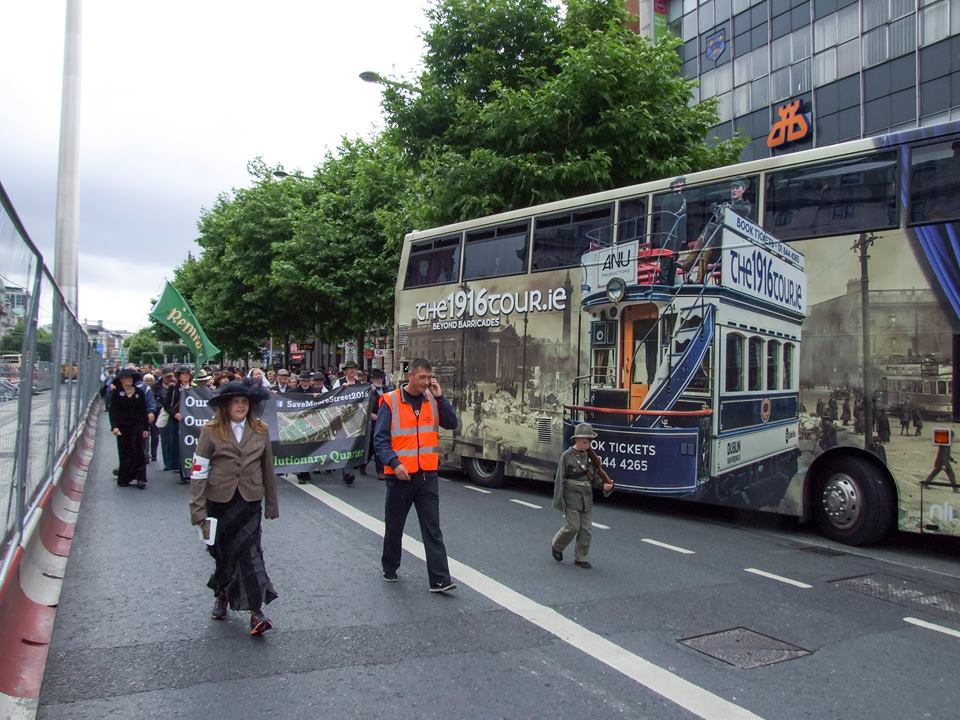
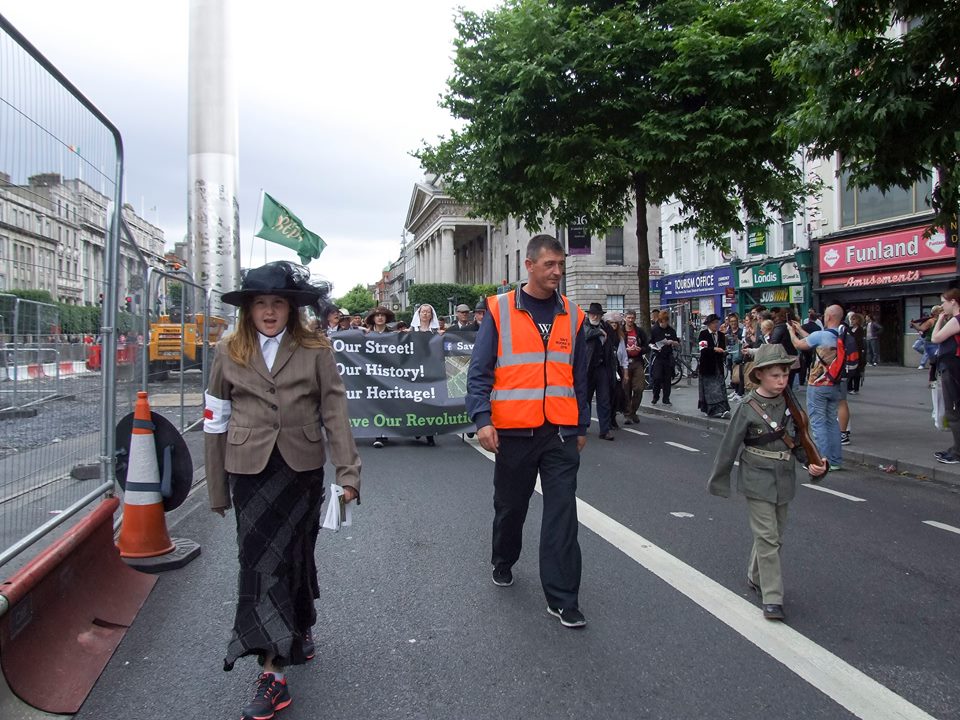
Amy and Josh youth supporters flank a march steward as the march passes one of the many kinds of 1916 tours being run in the city this year. (Photo: B.Hoppenbrouwers)

Amy Alan Josh leading OConnell StUp Lower Abbey Street the marchers went, in the footsteps of the GPO Garrison on that Easter Monday morning, past Wynne’s Hotel where Cumann na mBan had been formed in 1913, past the former Hibernia Bank on the corner of Abbey and O’Connell Street, where Volunteers fought and where Irish Volunteer Captain Thomas Weafer, from Enniscorthy was killed and his body consumed by the flames caused along the street by British shelling.

Turning into O’Connell Street, the marchers passed the location of Bloody Sunday 1913 when, after Jim Larkin defied a court ban to speak, the Dublin Metropolitan Police ran riot beating Lockout strikers and onlookers down to the ground with their truncheons.

COUNCILLORS, TDs, PROMINENT CAMPAIGNERS, ARTISTS AND HISTORIANS MARCHING

A number of elected representatives supported the march: seen in the crowd were Dublin City Councillors Cieran Perry, Pat Dunne, Anthony Conaghy and former Mayor Críona Ní Dhálaigh, also TDs Joan Collins and Maureen O’Sullivan.

OSullivan Johnsons Ballagh Cooney
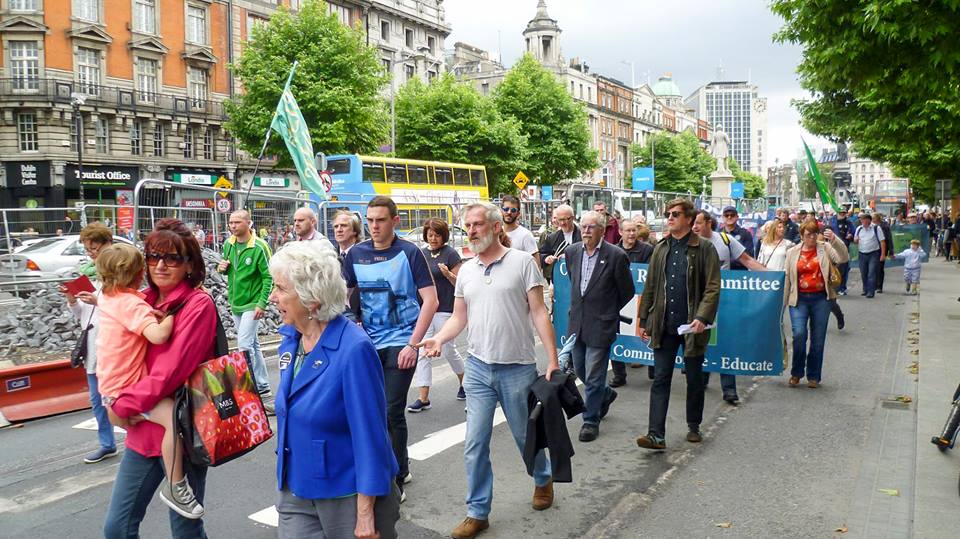
Section of the march in upper O’Connell Street, heading northwards, showing prominent supporters TD Maureen O’Sullivan in foreground and Robert Ballagh in middle section, flanked by Patrick Cooney, one of the founders of the 1916 relatives’ campaign Save Moore Street.

Among the artistic and dramatic sector whose participation was noted were artist and activist Robert Ballagh, drama director Frank Allen (who also organised the first Arms Around Moore Street event in 2009 — and has the T-shirt to prove it!), Brendan O’Neill — also an actor and long-time campaigner — and actor Ger O’Leary.

Relatives of prominent fighters in 1916 also participated and Jim Connolly Heron, great-grandson of James Connolly and among the earliest campaigners for Moore Street and Donna Cooney, great-grandniece of Elizabeth O’Farrell, who went out into the killing zone to organise the surrender, were both noted marching. Patrick Cooney, also of the specific 1916 relatives’ group that brought the legal challenge to the High Court marched along too and spoke from the platform at the rally. Gabriel Brady, grand-nephew of the printer of the 1916 Proclamation, Christopher Brady, was there too, as was Eoin Mac Lochlainn, a relative of the Pearse brothers and a relative of Seán Mac Diarmada was also present and in fact helped carry one of the SMS2016 banners.

A number of historians walked among the marchers, including Ruan O’Donnell, Dónal Fallon, Ray Bateson, Hugo McGuinness, along with local history activists such as Joe Mooney (of East Wall History Group) and Terry Fagan (of North Dublin Inner City Folklore Project). Ciarán Murphy, joint blogger and joint author with Dónal Fallon of the Come Here To Me publication marched along too. From the non-history world of academia, Paul Horan, lecturer of Trinity College (and who wrote the letter published in the Irish Independent on July 2nd denouncing the Minister of Heritage appealing the Barrett High Court judgement that the whole Moore Street quarter is a national monument) marched in period costume too.

THE SURRENDER ROUTE

Passing the General Post Office, the marchers continued along the route of the GPO/ Moore Street Garrison as they surrendered on the Saturday of Easter Week, up to the Gresham, where they laid down their weapons and on to the Rotunda, in the garden of which many had been kept for two days without food or water, while detectives of G Division from Dublin Castle came down to identify prisoners for execution. On the way the marchers passed the Parnell Monument, where British officers had displayed the battle-damaged “Irish Republic” flag upside down as a trophy for a photographer.

On this Saturday in 2016, volunteers (some in costume) accompanied the marchers along the route, handing out leaflets, which were eagerly taken by onlookers, while others – all in costume — collected donations along the way, distributing stickers in exchange. Well in excess of five hundred leaflets were distributed in the period of the short march.

SILENCE IN MOORE STREET

Minute Silence Moore St 9 July2016 T Byrne
The march stopped in Moore Street for a minute’s silence. (The building to the left is a section of the ILAC shopping centre; to the right may be seen a section of the hoarding in front of five buildings in the ‘1916 Terrace’ and the banner illegally placed on four of those houses (declared a ‘national monument’ since 2007) by the Department of Arts, Gaeltacht and Heritage.

Turning into and a little along Moore Street, the marchers were called to stop for a minute’s silence out of respect for the Irish Volunteers, Citizen Army and civilians who had been shot down in that street by British Army guns, for the six who had been shot by firing squad after they surrendered and for those who had risked their lives in an uprising against the biggest empire the world has ever seen.

All sound in the street died: marchers, street traders, bystanders, shoppers — all stood silent in a street which would otherwise be filled with the noise of a street market and busy shopping thoroughfare on a Saturday afternoon.

At the conclusion of the minute’s silence, the march recommenced, calling its demands with renewed vigour, out into Henry Street, right to O’Connell Street to form up for the rally by the stage in front of the GPO.

SPEAKERS AND PERFORMERS

The rapper Temper-Mental MissElayneous (Elaine Harrington) from Finglas was the first on the stage and performed her “Fakes and Manners” and “Buachaillí Dána” raps but continuous problems with the sound amplification at this stage of the rally meant much of what she was saying could not reach the audience (fortunately this was amended later).

Elayne Harrington torso stage
Rapper Temper-Mental MissElayneous (Elayne Harrington) from Finglas performing with bodhrán

Niamh McDonald, chairing the rally, welcomed the crowd and said that the campaign to save the Moore Street quarter was at a crossroads; developments had brought Irish property developers and the State into opposition to the appropriate conservation of the quarter but also now foreign vulture capitalists. “Save Moore Street 2016 will do what it takes to defend this historic quarter” she said, reiterating three basic demands of the campaign:

  • That a full independent expert assessment be carried out of the battlefield area

  • that all construction or remedial work be accessible to expert independent monitoring and

  • that the whole process by transparent to the public.

It was time for the campaign now to take the fight to the speculators and the next in a series of monthly events would be a demonstration against Hammerson themselves, McDonald told the rally.

Niamh Speaking, DB, Donal Fallon
Niamh McDonald, chairing the rally and speaking on behalf of Save Moore Street 2016 addressing the rally as one of the march stewards (in period costume) holds the megaphone for her. (Photo: )

The first speaker was then announced, historian and author Ruan O’Donnell, who reminded the rally that the Government of the time had been prepared to demolish Kilmainham Jail. The site had languished until volunteers took up the work of restoring it as a museum and now it is so successful that one has to queue to gain access to it.

Ruan O'Donnell speaking
Ruan O’Donnell, historian, lecturer and author addressing the rally. (Photo: )

O’Donnell castigated the attitude and thinking of successive Irish governments and pointed out that the GPO and Moore Street are sites of crucial importance in the struggle of the Irish people for nationhood.

O’Donnell’s speech, as did McDonald’s, received cheering and applause a number of times during their course as well as at the end.

Dónal Fallon, also author and historian, then stepped up to address the rally and also denounced the Gombeen state that had followed the struggle for independence, in which property speculators grew fat while the people suffer in a housing crisis.

Donal Fallon speaking
Donal Fallon, blogger, author & historian addressing the rally. (Photo: )

He reminded the rally of the struggle to save the Viking archaelogical site at Wood Quay and how, with Dublin City Council building over it, the writer and author of Strumpet City, James Plunkett, had said that Dublin had “shamed itself before the world.” Fallon said that Dublin needs to redeem itself and will do so in the struggle to save the Moore Street quarter.

Patrick Cooney (of the relatives’ group that took the High Court challenge against the Minister of Heritage) was then introduced and spoke of the recent Appeal Court appearance where the Minister’s team had been castigated by a Judge who insisted they had to specify against which part of Judge Barrett’s judgement they were appealing – her Department could not take a blanket position and say that they were against it all (SMS2016 comment: indeed, part of the judgement was that the banner erected on Nos.14-17 had been erected illegally, and the Minister has already stated that work would commence to remove it and to fill in the holes the builders put into the face of those buildings in order to fix the banner there). Cooney welcomed the announcement that the appeal would not be heard until December 2017, saying that this would give time for more pressure and perhaps a change of government.

Cooney also spoke of the long struggle to have the importance of the site acknowledged and to save it from property speculators and in passing also paid tribute to those who had occupied the building in January of this year.

Sean Doyle speaking
Sean Doyle, in period costume, addressing the rally. (Photo: )

Last to speak was Seán Doyle, speaking on behalf of the Save Moore Street 2016 campaign. Seán questioned whether we were worthy of the inheritance which had been bestowed upon us.

Referring to speculators and their facilitators, Doyle concluded by saying that “men in suits can be more dangerous than men in armour”.

All those speeches were enthusiastically applauded.

By this time the technical problems of the sound amplification had been overcome with the assistance of a member of the audience and Paul O’Toole stepped up to the microphone. He recalled that the best stage he had ever performed upon had been a couple of pallets drawn up in front of No.16 Moore Street in order to play at a rallying event there.

Paul O'Toole performing
Paul O’Toole playing and singing during the rally. (Photo: )

He then sang and played “The Foggy Dew” and “The Cry of the Morning”, followed by his own composition “We Will Not Lie Down”. The event could not end without Temper-Mental MissElayneous being given an opportunity to perform with the sound amplification in full working order and she launched into her “Fakes and Manners” rap.

The crowd having applauded the performers, everyone was thanked for contributing to the event, banners were rolled up and costumes packed back into cases.  Some people stood around chatting while the lorry that had provided the stage pulled out into the traffic, one of the organisers gave a radio interview to Newstalk and MissElayneous, on a roll now, performed for a small audience and video camera with the GPO as a background.

Across the road, outside the GPO, to which it relocated after some of its activists went to participate in the march, having earlier completed its 94th Saturday on Moore Street through which it has collected more than 50,000 signatures in support of Moore Street, the Save Moore Street From Demolition campaign table was also wrapping up.

And, despite threatening sky and pessimistic forecasts – it hadn’t rained once.

end

SPEECH BY REPRESENTATIVE OF CAMPAIGN TO SAVE MOORE STREET AT ANNUAL ANTI-INTERNMENT PICKET IN NEWRY 2nd July 2016.

A REPRESENTATIVE OF THE CAMPAIGN TO SAVE THE MOORE STREET HISTORIC QUARTER ADDRESSED THE ANTI-INTERMENT MEETING AFTER OTHER SPEAKERS, TO ASK FOR SUPPORT FOR THE FORTHCOMING CAMPAIGN MARCH IN DUBLIN.

Clive Sulish

Poster wall M St March 9 July 2016

A Chairde,

gabhaim buíochas libh as éisteacht a thabhairt dom agus buíochas freisin as cead cainte ag an ócáid seo ón Anti-Internment Group of Ireland.

A chairde, Níl saoirse gan stair. That is a saying in Irish which means “There is no freedom without history.” This is true in the sense that every struggle for freedom has a history but also in the sense that we cannot win freedom if we don’t know our history.

History is not dead; it is a living thing. We here today are all part of history, in our small way, part of the history of the struggle against the reintroduction of internment in our country, in particular in the Six Counties but creeping into the Twenty-Six as well.

DB speaking at Newry Annual AI 2016

History is not just about battles, although battles form an important part of the historical record. But more, history itself is a battleground! And there are historians who take their sides in that battle: some celebrate our struggles and relate the story of our heroes, while others lie about and twist our history, cast our heroes and martyrs as villains or even try to hide our history completely.

NÍL SAOIRSE GAN STAIR. Those who control the history of a people will find it much easier to control the people too.

On the Friday of Easter Week, as the GPO was in flames and the roof about to fall in, four evacuations from the GPO took place. There were two evacuations of Cumann na mBan, one of them taking the wounded under fire to Jervis Street Hospital. Then another two evacuations, one for a charge on the British barricade at the end of Moore Street, all of which were shot down, dead, dying or wounded. Another evacuation of more than 200 men and women occupied a terrace of houses, tunneling through the walls, from house to house and it was from there that they eventually surrendered on the Saturday.
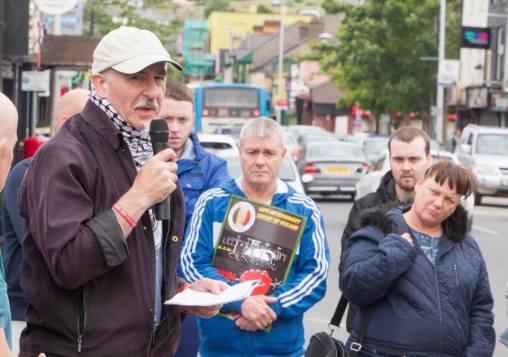
For some reason that history was kept from us. As depicted in the Michael Collins film, where the GPO garrison is shown coming out from the GPO with their hands up, we thought that’s how it was. But it didn’t happen like that. The Moore Street history was kept from from us.

Decades later, in the 1970s, as property speculators crawled over Dublin and ripped it apart for their own constructions, a strong financial reason was created to conceal the Moore Street history. Then after 16 years of campaigning, the State finally granted a concession and nominated just four buildings as a National Monument. But their plan involved pulling down neighbouring buildings. This would then have facilitated the property speculator’s plan to demolish the rest and to build a huge shopping centre over and around those four houses, all the way from O’Connell Street down to Moore Street and all the way from Parnell Street down to Henry Street. Into that shopping centre, the four houses would be a shoebox museum, with a cafe inside and perhaps a Mac Donald’s on one side and a Starbucks on the other.

But they were stopped. They were stopped by men and women who occupied those buildings, and who blockaded it for six weeks.

Then there came that decision of a High Court judge, that the whole quarter was a historic battleground. Not just four buildings, not just a terrace, but other houses too, the streets and back lanes. He declared the whole to be a National Monument.

So of course there were great celebrations among the campaigners. But what happened next? The Minister of Heritage, which had been her title, announced she was going to appeal the decision. And the speculators asked for a seven-year extension on their planning permission, which it seems Dublin City Council will grant them.

NÍL SAOIRSE GAN STAIR. We are all a part of history. We need to know it. We need to defend it. Not for the past – or at least, not only for the past. But for our present. And for our future. The future of our children and of generations to come. A future free from colonialism. Free from speculators. Free from vulture capitalists.

As an aspect of that resistance, that defence of our history, we will be marching next week on Saturday in Dublin. There are leaflets here beside me on the table for you to take, not just advertising the event but also explaining the situation.

We would hope that you would all stand and march with us, shoulder to shoulder, in Dublin next week, in defence of our history against State and speculators, in defense of our heritage, our past and our future.

Go raibh maith agaibh.

SPEECH BY SAVE MOORE STREET FROM DEMOLITION REPRESENTATIVE AT RALLY AFTER MARCH 30th JANUARY 2016

Diarmuid Breatnach

Go raibh maith agat a Chathaoirligh agus a Choiste Eagraithe as an gcuireadh chun cainte ar son feachtas Shábhála Ó Leagaint Shráid an Mhúraigh. Go raibh maith agaibh freisin, a lucht tacaíochta, as a bheith i láthair agus as bhur néachtanna go dtí seo.

Thank you Chair and Organising Committee for the invitation to speak on behalf of the Save Moore Street From Demolition Group and to supporters of the campaign here today and for their deeds in the past.

The Save Moore Street From Demolition group began in September 2014, founded by a handful of people who had supported other Moore Street campaigners over the years and at times helped with organising events. Our call to do something different was the emergency looming when Chartered Land offered to hand over the houses of the national monument, No.14-17, to Dublin City Council in exchange for the ones owned by them, No.s 24-25. We knew that once O’Reilly got those two, he would have demolished them …. along with the rest of the 1916 Terrace all the way up and including No.18.

Brendan Viv man
Moore Street, November 2014, Vivienne Lee at the weekly campaign table while people sign the petition. Brendan O’Neill, an early supporter, signing.

The Council’s Chief Executive, Owen Keegan, was completely in favour but he had a problem: since this involved disposal of Council assets, the deal could not be agreed by officials but would have to be voted for by a majority of Councillors. So it was put to them and he recommended acceptance. And the SMSFD group was born to fight that.

We put up a table with a petition every Saturday in Moore Street. We lobbied Councillors on line and at Council meetings. We gave out leaflets in Moore St. We set up FB pages and kept them lively every week, slowly building up our support. Down in Moore Street, we interacted with the street traders, small shops and of course with passers-by.

Number of people signing the petition at the Moore Street stall in its early days
Number of people signing the petition at the Moore Street stall in its early days, Robbie Lawlor at the table.


I’d be lying if I said there were not times when we were tempted to stop. Maybe times when only three of us were there and when one of that three was off sick or away, or even two. But others did come by to help us from time to time.

And when we gave the emergency call about the planned demolition of the buildings, when we called the emergency demonstrations for two consecutive days in the street, the response was immediate. And it was active. The people who occupied those buildings saved them from being demolished.

And the campaign that we have now built together will hopefully ensure that the 1916 Terrace will be saved for the benefit of generations to come, both in Ireland and around the world.

TERRACE AND SITE

The experts employed by the State and the speculators tell us that one building or another in the terrace is not a 1916 building.  But the fact is that there has never been an independent survey of the site.  Can we trust experts employed by speculators who care nothing for history or heritage, whose only concern is making lots of money?  Can we trust experts employed by a State that has cared little throughout its history for heritage, culture or history but has been focused instead throughout on serving the Gombeens in our country and vultures from abroad?

I think we cannot. But regardless of what any expert may say, whether independent or not, no-one can deny that terrace is the site of the GPO garrison. The whole terrace. Sixteen houses. Not four.

Moore Stret December 2014, the weekly campaign stall in its early days -- Brónagh Ní Loing, Diarmuid Breatnach at table with Mel Mac Giobúin talking to an interested passer-by
Moore Stret December 2014, the weekly campaign stall in fourth month — Bróna Ní Loing, Diarmuid Breatnach at table with Mel Mac Giobúin talking to an interested passer-by

Sixteen – something of an important and recurring number in connection with the Rising. The year was 1916. The number of executions was sixteen. And there are sixteen houses.

That whole site is a historic site and by any rational, historically-minded appraisal, not only deserves preservation, but cries out for it. Cries out for preservation, Brothers and Sisters, in the midst of this historic quarter, this small area in the heart of Dublin, with its last remaining street of a whole market area, centuries old, now buried under the ILAC. A small historic quarter with artifacts, points of importance, buildings and sites of importance going back to the Land War, the 1913 Lockout, the 1916 Rising, the War of Independence, the Civil War ….

BRICKS AND MORTAR

It is just bricks and mortar,” some of our critics have said. “History is about people, not buildings.” Of course, history is about people. And not just leaders, but the mass of people who, in the midst of their daily struggles to live, to work, to raise families, dare to dream. And where do dreams happen? In the imagination.

And has psychology not taught us the importance of symbols? This building behind me has a symbolism of great potency. The faces of the our martyrs, our flags, the pictures of the starving people of the Great Hunger, the words of speeches and proclamations which we read in little symbols of written words, plaques and monuments …. the very letters on paper, also symbols to convey meaning …. even our spoken words ….

All these symbols give shape and expression to our dreams. Not only the dreams which we experience in our sleep but the great dreams of humanity, the waking and sleeping dream, of freedom, peace, in which to pursue our interests, in which to seek happiness.

SPECULATORS

These our dreams, our human dreams of progress for mankind, are not shared by all.  They are not shared by Joe O’Brien of Chartered Land.

They are not shared by the board of directors of Irish Life, who buried the rest of the centuries-old market under their architecturally-hideous ILAC shopping centre. And who seek to build further out into Moore Street and upwards and have been granted permission by Dublin City Council Planning Department to do so.

And so we must conclude, must we not, that our dreams are not shared by such senior officials in Dublin City Council as Owen Keegan and others running the Planning Department.

No. They do not share our dreams for the future, nor our respect for what was valuable in our past.

December 2014, crowd signing the petition in Moore Street, Brónagh at the table
December 2014, crowd signing the petition in Moore Street, Bróna at the table

An Bord Pleanála has approved the massive shopping centre plan to construct an architectural horror from O’Connell Street across to Moore Street, and from O’Rahilly Parade down to Henry Street, in the course of which they will destroy the 1916 Terrace and enclose a shoebox museum … next to a MacDonalds, perhaps, or a Starbucks …. Constructing a cathedral to Mammon, to the gods of chain stores and eatery franchises ….. So we must conclude that An Bord Pleanála does not share our dreams either.

Lobby of Dublin City Councillors against the 'Land Swap" in Moore Street, 4th October 2014
Lobby of Dublin City Councillors at City Hall 4th October 2014against the ‘Land Swap” in Moore Street, — picket organised by Save Moore Street From Demolition campaign. Signed petition sheets sellotaped together stretched — 2nd and 3rd participants from left are Paddy Cooney and Proinsias Ó Rathaile, of the Save Moore Street campaign.

But does an Bord Pleanála act independently? No it does not, as we well know and as been shown in many planning controversies in the past. It follows the dictates, nods and winks of its political masters, the political class and its nominees in the Dáil. And these do not belong to one political party only, but to several.

And Minister Heather Humphreys, their representative with special responsibility in this case, patently does not share our dreams nor our respect for heritage.

The board of directors of the giant property company Hammerson do not share our dreams either. They dream of big ugly buildings and giant car parks where chain stores and restaurants and franchise eateries can market their goods, depriving shops and goods of any individual regional or national character, making one city’s commercial centre look like any other, from Dublin to Dupont, from Cork to Caracas.

But behind all this array of servile public departments and officials and political representatives, aiding and abetting the clutch of home-grown speculators and foreign vultures, there are the final villains, the whole Irish class of neo-colonial, money-grabbing, huckstering, fumbling-in-a-greasy-til, greedy, incompetent, philistine shower that climbed up upon our backs in 1921 – the Irish gombeen class.

CAPITALIST CLASS

When we have viewed with dismay how little our native ruling class cares for our land, our history, our natural resources, or very PEOPLE ….. some among us have said: “But how can they treat with such disrespect the history and artifacts of the men and women who gave them independence?  Their own ancestors?”  But such commentators are mistaken, brothers and sisters.

The heroes of 1916 are not the political ancestors of the gombeen class – they are ours! A few who fought in 1916 and later became part of the gombeen class from the 1920s onwards, true …. but when they did so, they disowned their forebears.

WE have not disowned the heroes of 1913, nor of 1916, nor of struggles afterwards.

There has not been an independently-minded capitalist class in Ireland since the late 17th Century – and they were nearly all Protestants, of one sect or another. They sought national unity and independence and when they were denied it, rose in rebellion for political, economic and cultural independence in 1798 …. and again in 1803 … But they were defeated and their survivors changed their ideas or left the country.

This class of native capitalists that we have now in the 26 Co.s, mostly of Catholic religious background, grew up under foreign domination. They learned early on to doff the cap to the foreign master, ape him in clothes and manners, speak his language and carry out little deals behind his back.

They learned to be ‘cute hoors’ but they never learned to fight and risk life and limb for a principle. They scramble to get to the top of the dung-heap and crow from there. Or they push and jostle one another to get their snouts in the trough.

They never stood up on their two legs, with back straight and head up, and flew the flag of freedom. They could never stand straight on a gallows and cry “God Save Ireland!” before they were hung, or stand defiantly in front of a prison wall to receive the bullets of their executioners. They never faced the batons of the Dublin Metropolitan Police or the rifles and bayonets of the Royal Irish Constabulary.

And this is why James Connolly, who spent his last days in the building behind me and later in Moore Street, before he was taken away and they made sure to shoot him dead even when they realised that they were going too politically far with the executions …. And by the way the newspaper of Irish Catholic nationalist gombeen man William Martin Murphy, the Irish Independent, called for his execution …..
this is why James Connolly said:
“Only the working class remain as the incorruptible inheritors of the fight for Irish freedom.”

Connolly saw the foreign-dependent and internally corrupt nature of the native capitalist class even before they seized power over his body and the bodies of others who had fought for independence and a just society. And by the way, nor did they stop there – they added hundreds more bodies to ensure they kept the power they had grabbed. And out of our every generation, sent thousands of our youth into exile, rather than build a country that would keep them at home, give them work, housing.

THE CENTENARY & IDEALS

As I come to the end of what I have to say here, early in the centenary year of the 1916 Rising, and I thank you for your patience, I reflect that it appears to be a law of life that for everything we gain, there is a price to be paid.  We have learned that many, oh so many times throughout our history, have we not?

What we are asking for — no demanding — from our rulers, in the case of the campaign for the Moore Street historical quarter, is not much in the grand scheme of their plunder and exploitation.

It is in their power to give it and to pay the political price do so, without bringing down their house of cards.

But if they will not grant it, what then? Well, then we must fight for it. And we too must be ready to pay the price. And I think it is clear that there are many here, and not only here, prepared to pay that price.

And I can do no better than to quote the words of another one who spent his last few days in this building behind me and in the Moore Street 1916 Terrace, who also had some valuable words to say to us. Pádraig Mac Piarais, in his poem The Rebel:


And I say to my people’s masters:

Beware,

Beware of the thing that is coming,

beware of the risen people, 


Who shall take what ye would not give. 


Did ye think to conquer the people, 


Or that Law is stronger than Lfe and than men’s desire to be free?

We will try it out with you,

Ye that have harried and held, 


Ye that have bullied and bribed,

tyrants,

hypocrites,

liars!

End.

Diarmuid Breatnach, who gave the speech, earlier at the march, as it came down through Moore Street into Henry Street, heading for the GPO and the rally. Behind Diarmuid is the entrance to Henry Place, evacuation route of the GPO Garrison in 1916.
Diarmuid Breatnach, who gave the speech, earlier at the march, as it came down through Moore Street into Henry Street, heading for the GPO and the rally. Behind Diarmuid is the entrance to Henry Place, evacuation route of the GPO Garrison in 1916. (Photo: Save Moore Street 2016)

WORKING CLASS HERO IS COMMEMORATED IN THE EAST WALL AREA WHERE HE LIVED

Diarmuid Breatnach

On Sunday 8th May a working-class hero was commemorated in the East Wall area in which he lived. Walter Carpenter was a native of Kent, in SE England and came to Ireland to help found the Socialist Party of Ireland 1 with James Connolly in 1909 in Dublin. Among other activities a campaigner around housing issues for the Dublin working class, he reared his sons in socialist belief so that it was no surprise that both Wally (Walter jnr) and Peter joined the Irish Citizen Army and fought in the 1916 Rising. As a result of the repression of the Rising, one son ended up in Frongoch concentration camp in Wales, while the other was in hiding. Later, both brothers also fought against the Free State in the Irish Civil War; Wally was interned and went on hunger strike.

Lining Up Outside SOCC
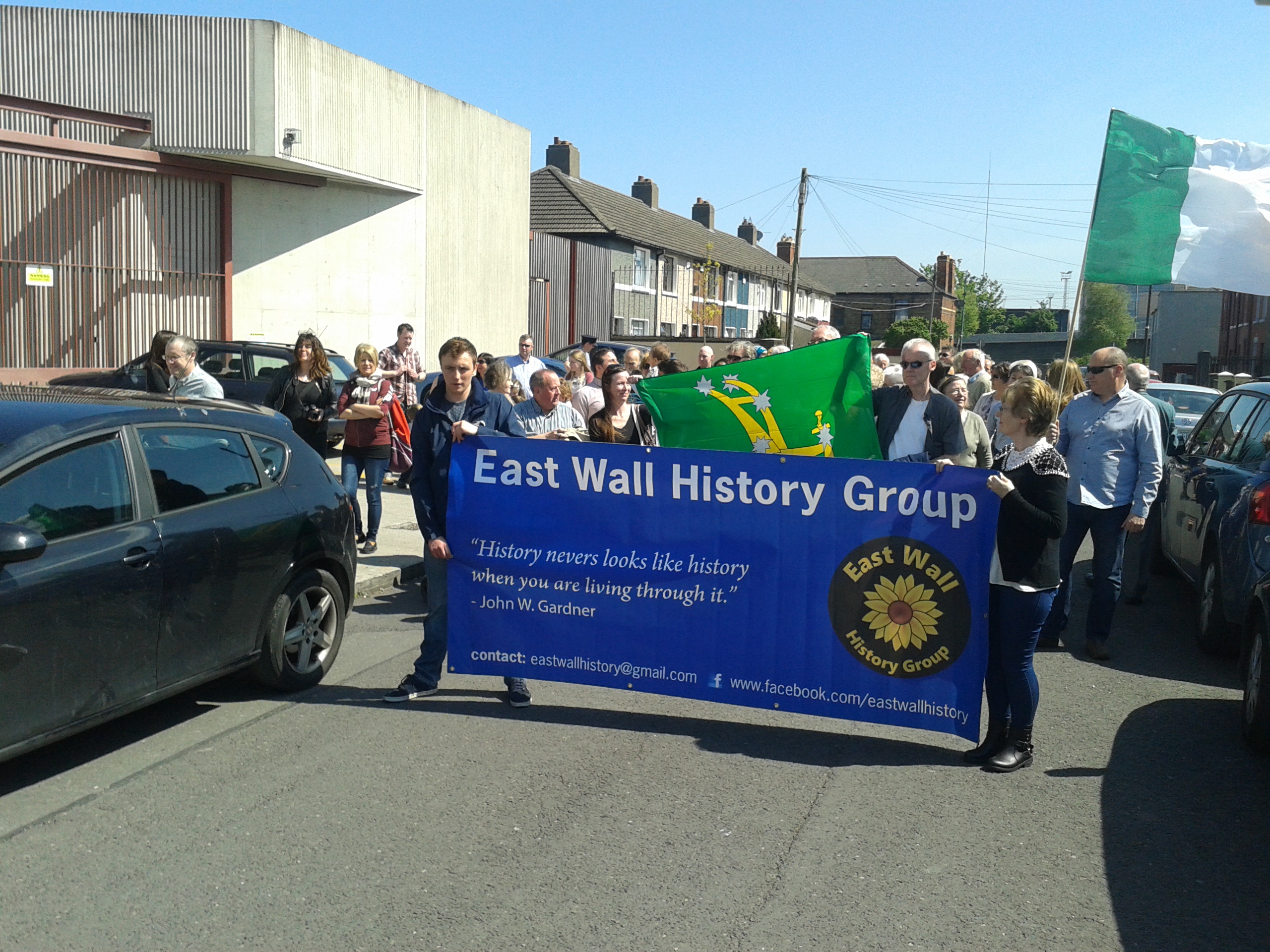
Assembling to march outside the Sean O’Casey Community Centre

Jailed for opposing British Royal visit to Dublin

Rising to be Secretary of the Dublin Branch of the SPI in 1911, Walter Carpenter was jailed for a month for the production while speaking on a public platform of Connolly’s leaflet attacking the Royal visit that same year. Soon afterwards he was an organiser for the newly-formed Irish & Transport Workers’ Union. During the Lockout, he was sent by Connolly to Britain to rally the support of trade unionists for the struggle of the Dublin workers and was apparently an effective speaker there. That same year Walter Carpenter was elected General Secretary of the Tailors, Machinists and Pressers’ trade union, generally known as “the Jewish Union” due to the preponderance of its members being from that background.

Two sections march
United in purpose but fragmented in marching

Walter also became active in municipal politics, striving to make Dublin City Council meet its housing regulation responsibilities in the terrible housing conditions of the city of that time. There were many other sides to this campaigner too, which a read of Ellen Galvin’s pamphlet will reveal.

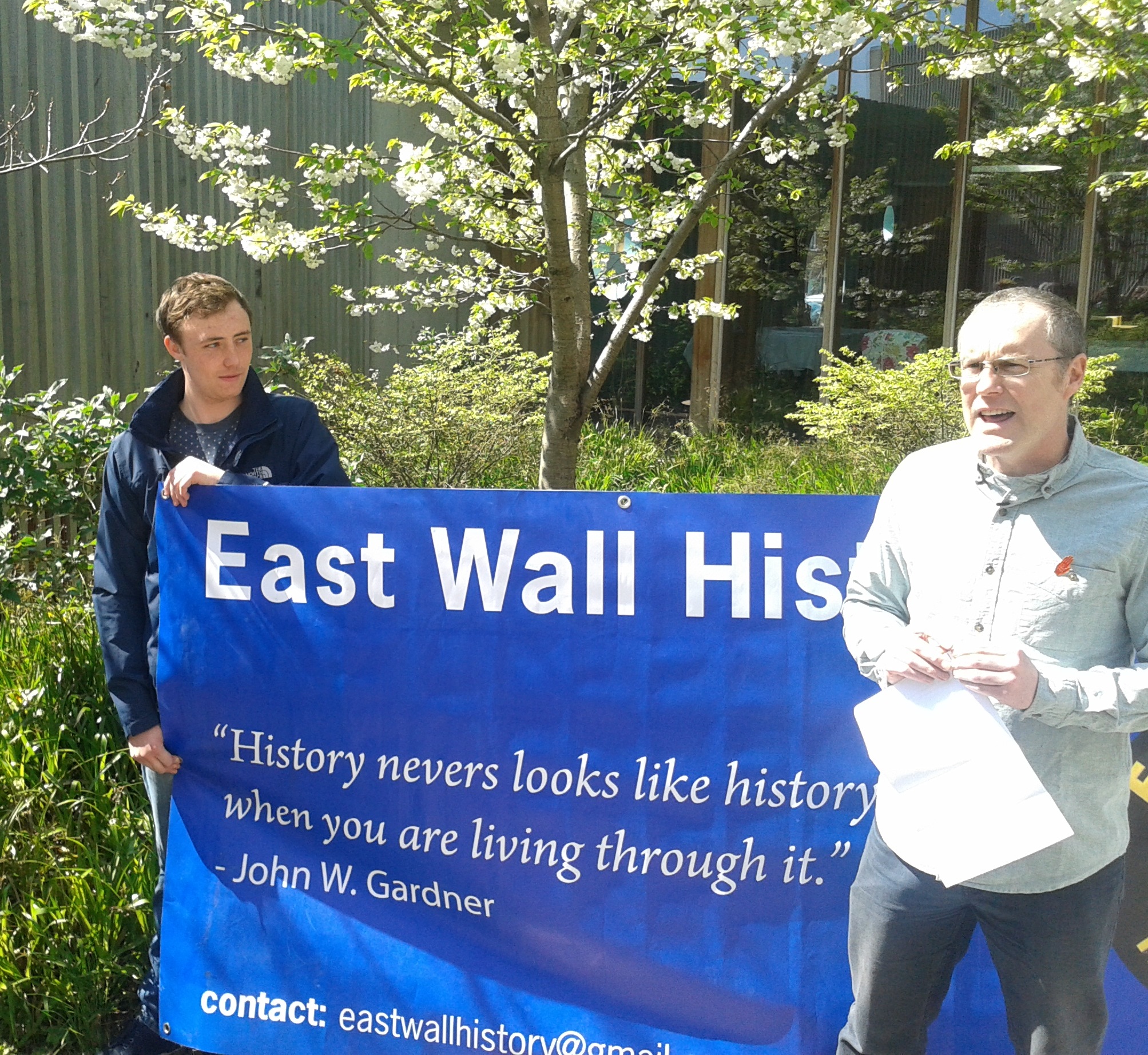
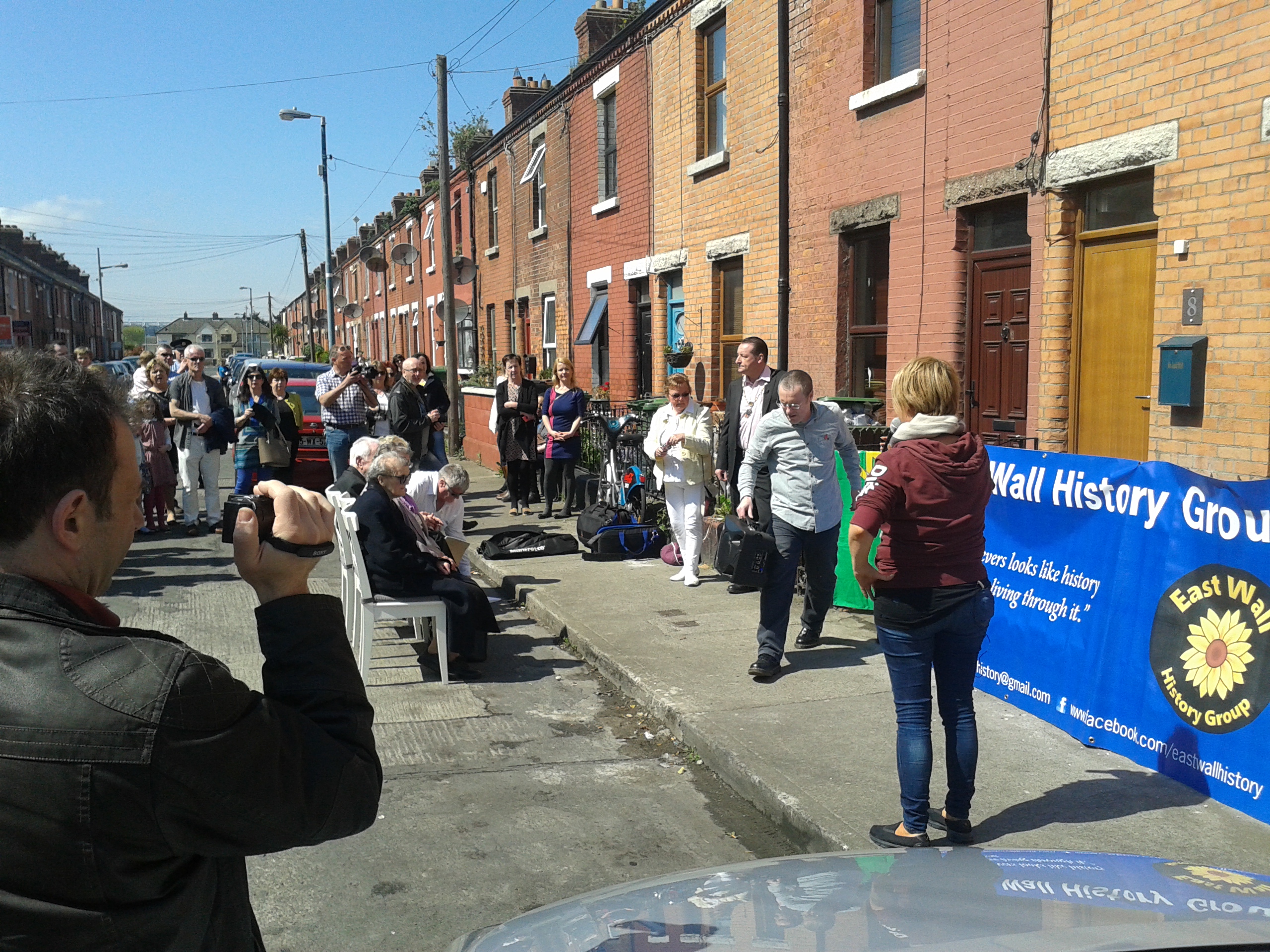
The East Wall History Group had earlier had a plaque erected on the wall of the house where he had lived, No.8 Caledon Road and organised an event around its unveiling on Sunday. The event began with a gathering at the Sean O’Casey Community Centre in East Wall, where an introduction to the event and to Walter Carpenter’s importance in the revolutionary and radical social history of Ireland was given by Joe Mooney, one of the organisers of the event. As well as local historians, socialists and Republicans, the event was attended by his surviving grandson, great-grandchildren and partners and their children. Also present was Ellen Galvin, who wrote a booklet on his life which was launched after the unveiling, back in the Sean O’Casey Centre.

Joe Mooney with a few preliminary words about Walter Carpenter and the history of the area

Misfortune struck the event before it had even begun, with the news that Christy O’Brien, the piper who was to lead a march to the unveiling, had his pipes stolen from his car that very morning. Christy gives his service as a piper to many commemorative events, funerals etc. and, with the announcement of the misfortune, Joe Mooney also called for the spreading of the news in order to aid the recovery of the instrument. A set of bagpipes will cost thousands to buy or have made but it would be a rare musician or pawnshop that would negotiate for a stolen set (one which furthermore might be recognised at a musical event in the future).
(see also https://www.facebook.com/eastwallhistory/photos/a.593335330735681.1073741828.580261572043057/1042532349149308/?type=3&theater)

March to plaque past previous addresses of Irish resistance fighters

The march set off from the Sean O’Casey Centre without the piper, led by supporters carrying the banner of the East Wall History Group, a Tricolour and a Starry Plough (original green and gold version). Walking alongside were two Gárdaí and one wit commented that not only were descendants of the Irish Citizen Army present but also of the Dublin Metropolitan Police! 2

Caitríona Ní Casaidthe presiding over the plaque unveiling
Deputy Dublin Mayor Cieran Perry in the march -- he also spoke at the unveiling.
Deputy Dublin Mayor Cieran Perry in the march — he also spoke at the unveiling.

Joe Mooney had told the crowd before the march began that they would pass a number of locations where fighters for Irish and working-class freedom had lived. These were: St Marys Road, Tim O’Neill at No.8 and father and daughter Patrick Kavanagh and May Kavanagh at No.24. Christy Byrne lived at No.45 and his brother Joseph Byrne was from Boland’s Cottages off Church Road, where also Christopher Carberry lived on Myrtle Terrace on Church Rd. All these were Irish Volunteers, while May was in Cumann na mBan. In Northcourt Avenue (now demolished, roughly where the Catholic Church stands), Patrick & William Chaney were in the Irish Citizen Army and in Hawthorn Terrace lived James Fox (Irish Volunteer) and Willie Halpin (ICA).

Joe added that at the junction of St. Mary’s Road and Church Street, the local Irish Volunteers had mustered to participate in the Rising, 100 years ago and also reminded the gathering that that very day, the 8th of May, was the centenary of the executions by British firing squad of Michael Mallin of the Irish Citizen Army and of Irish Volunteers Eamonn Ceannt, Sean Heuston and Con Colbert.

Eamon Carpenter, 94, grandson of Walter Carpenter (Photo D.Breatnach)

Upon reaching No. 8 Caledon Road, the former home of Walter Carpenter, Caitríona Ní Chasaide of the East Wall History Group introduced Eamon Carpenter, 94 years of age and a grandson of Walter Carpenter, who addressed the crowd in thanks and also about the life of his grandfather.

“The struggles of the past are not merely for commemoration”

Next Caitríona introduced the Deputy Mayor of Dublin, Cieran Perry, who pointed out the parallels between the dire housing situation in the early part of the last century, which Walter Carpenter had campaigned against, and the housing crisis in Dublin today. He castigated the officials of Dublin City Council who, despite the votes of elected Left Councillors, refused to use all the land available to them on a number of sites to build social housing and were instead preparing it for private development with a only fraction for social housing. For as little as 5% of the €4 billion of Minister Kelly’s oft-repeated proposed finance for social housing. i.e. €200 million, Dublin City Council could build over 1,300 homes. The struggles of the past are not merely for commemoration, Cieran went on to say, but are for celebration and for continuation, as he concluded to applause.

Caitríona then called on James Carpenter to unveil the plaque, which he did, to loud applause.Walter Carpenter plaque

After relatives and others had taken photos and been photographed in turn by the plaque and/or beside James Carpenter, Joe Mooney called on Diarmuid Breatnach to sing The Felons Of Our Land. Joe explained that Walter Carpenter had been fond of singing that son, that in the course of their participation in the struggle he and his son had also been felons, as had Larkin and many others. Joe also informed the gathering that Sean O’Casey related that during his childhood, there had been a tram conductor who had been fond of singing patriotic songs, including the Felons Of Our Land, of which Casey’s mother had disapproved. It had been an revelation for O’Casey that one could be a Protestant and an Irish patriot too.

Diarmuid, dressed in approximation of period clothing, stepped forward and sang the four verses, of which the final lines are:

Diarmuid Breatnach singing "Felons of Our Land" outside former home of Walter Carpenter. (Photo East Wall History Group)
Diarmuid Breatnach singing “Felons of Our Land” outside former home of Walter Carpenter.
(Photo East Wall History Group)

Let cowards sneer and tyrants frown
O! little do we care–
A felon’s cap’s the noblest crown
An Irish head can wear.
And every Gael in Innisfail
(Who scorns the serf’s vile brand)
From Lee to Boyne would gladly join
The felons of our land.

The crowd then marched back to the Sean O’Casey Centre to attend the launch of the booklet on Carpenter’s life.

Launch of book on Walter Carpenter by his granddaughter and grandson of his comrade

On the stage in the Centre’s theatre, were seated the author of the booklet, Ellen Galvin, alongside Michael O’Brien of O’Brien Press.

Ellen Galvin on stage at the Sean O'Casey Community Centre theatre and Michael O'Brien launching the book about Walter Carpenter. (Photo D.Breatnach)
Ellen Galvin on stage at the Sean O’Casey Community Centre theatre and Michael O’Brien launching the book about Walter Carpenter. (Photo D.Breatnach)

Michael O’Brien, addressing the audience, said he had wondered what qualification he might have to launch the book but on investigation discovered that he had not a few connections. His own grandfather, who was Jewish, had been a founder member of the Tailors, Machinists and Pressers’ Union, of which Carpenter had been the General Secretary until his retirement and so they must have known one another at least fairly well.

Also, Bill O’Brien’s father, Thomas, had been a communist and was active with Walter Carpenter in the Republican Congress in the 1930s. Walter Carpenter and Thomas O’Brien had both also been active in the Bacon Shops’ Strike of the early 1930s. Thomas O’Brien had been jailed during that strike along with Jack Nalty and Dinny Coady, both of whom had East Wall connections; subsequently Thomas went to fight Franco and fascism in Spain, where Nalty and Coady were both killed.

Joe Mooney called on Tommy Seery to sing The Bold Labour Men, a song about the 1913 Lockout written by a local man, which he did to strong applause. (Tommy is a member of the East Wall PEG Drama and Variety Group, in which he acts and also often sings – a recent performance, from which Tommy was unfortunately absent due to illness, may be seen here https://rebelbreeze.wordpress.com/2016/05/02/from-lockout-to-revolution-performance-of-east-wall-peg-drama-variety-group/).

Tommy Seery singing "The Bold Labour Men" about the 1913 Lockout (Photo D.Breatnach)
Tommy Seery singing “The Bold Labour Men” about the 1913 Lockout (Photo D.Breatnach)

Ellen Galvin spoke about Walter Carpenter’s life and his dedication to the advance of the working class and the struggle for justice.  Walter had been a supporter of equality for all, including gender, a man who read much and widely, who apparently learned Irish and campaigned for allotments for rent on Council-owned land while it was unused for housing.  He was against the consumption of alcohol but sympathised with people driven to its use by terrible housing conditions.

Joe then called on Diarmuid Breatnach to sing Be Moderate, written by James Connolly, to illustrate what it was that people like Connolly and those of the Irish Citizen Army fought for and for which some had given their lives. Diarmuid took the stage and explained that the song had been published in New York in 1910, the same year that he had returned to Ireland from the USA. There had been no indication of an air to accompany the lyrics, as a result of which it has been sung to a number of airs. Diarmuid heard it sung in London by an English communist to the air of a Nation Once Again 3 and at least one good thing about this is that it provides a chorus, with which he encouraged the audience to join in. He then sang the song, of which the final lines are:

For workers long, with sighs and tears,
To their oppressors knelt.
But never yet, to aught save fears,
Did heart of tyrant melt.
We need not kneel, our cause is high
Of true hearts 4 there’s no dearth
And our victorious rallying cry
Shall be “We want the Earth!”

Many in the audience joined in on the chorus:
We only want the Earth, 
We only want the Earth,
And our demands most moderate are:
We only want the Earth!

Eamon Carpenter delivered an impromptu tribute to Ellen Galvin, who he told the audience had lost her mother at the age of 13 years of age, from which time she had taken over the mother’s role for her younger siblings, ensuring the were fed, dressed and cared for. This tribute was warmly applauded while Ellen seemed embarrassed but also pleased.

This was another successful commemoration of the revolutionary history and, in particular, of the working class history of their area by the East Wall History Group. It is of great importance that the working class be appraised of their own history as distinct from the dominant historical narratives and that their revolutionary traditions be remembered, not as something dead and in the past but as part of a continuum of struggle for the emancipation of the class.

If there is a weakness in a number of such commemorations it is the lack of participation by local adolescent youth in these events – which may also imply a lack of engagement by this age-group. Nevertheless, should they go searching at some future date for the information and their connection to the history of place and class, they will find a treasure trove waiting for them in the work of this History Group.

Children & Parents left plaque

CONTACTS
The East Wall History Group may be contacted or viewed on FB at https://www.facebook.com/eastwallhistory/?fref=ts

Mother & 2 Daughters

Local Photographer Exhibition SOCC

FOOTNOTES

 There exists today an organisation called the Socialist Party of Ireland (which often organises under the banner of the Anti-Austerity Alliance) but it is not directly descended from the party founded in Ireland in 1909; rather it is closer to being an offshoot of the Socialist Party of England and Wales, with which it has close fraternal relations.

The Dublin Metropolitan Police gained particular notoriety for the violence against organised workers on behalf of Dublin employers, especially during the 1913 Lockout, during which they killed a number of workers with their truncheons. In later years, the force became a Dublin police force under the Free State, which was later subsumed into the Garda Síochána, a fact not generally known.

3  Written by Thomas Davis, first published in The Nation, Dublin, 1844.

4  “of true men there’s no dearth” in the original

DEAR MINISTER

Heather Humhpreys, Minister for Arts, Heritage and the Gaeltacht
Heather Humhpreys, Minister for Arts, Heritage and the Gaeltacht (now of Arts, Regional Development & Rural Affairs)

Diarmuid Breatnach


Dear Minister Humphreys,

In response to your request that we sort out letters from the public supportive of your work addressed to you or to this Department and forward them to you, I attach them in Appendix below. I apologise for the delay but we have had to deal with quite a volume of correspondence in order to find letters of that nature.

With regard to your request that we categorise and enumerate the letters of a critical nature from the public, that has been easier in some respects but due to volume has unfortunately taken longer; nevertheless here follows the relevant report up to midday yesterday:

Letters disapproving by category and amount:

  • Criticising your plan on Moore Street (to save four buildings and demolish some others): 73
  • Questioning your appointment as Minister for a Department with responsibilities for the Gaeltacht: 9
  • Questioning your appointment of McHugh (non-Irish-speaker) as Minister for the Gaeltacht: 11
  • Questioning your fitness to be a Minister for Heritage: 67
  • Questioning your fitness to be a Minister for Arts: 8
  • Raising two or more of above issues in the same letter: 51
  • Total number of critical letters: 103 (There were in addition a score of critical letters which, while containing comments of a highly personal nature, were difficult to ascribe to a specific category within the ‘critical’ band although they were certainly critical).

May I respectfully enquire whether there has been any progress with the recruitment of additional clerical support, even if on a temporary basis?

Sincerely,

Ima Clarke

Secretarial and Statistical Support,
Department of Arts, Heritage & Gaeltacht.

Appendix
Letters approving
of Ministerial Action

Dear Heather,

Don’t let history stand in the way of more shopping centres.
We support you!

Mary Browne-Envelop.

Dear Heather,
History, who needs it! Money makes the world go around – we must grab it while we can.

Phyllis Stein.

Dear Heather,

You should bring out the Army and shoot these campaigners down like our forefathers did in 1922.

Hugh Javarice.


Dear Minister,

It’s not 1916 we should be commemorating but 1922. By God, we showed those Republicans then, didn’t we?

Eva Blushyrt.


Dear Heather,

Please don’t listen to the mob. We agree with you: shopping centres – the more the merrier – are more important than heritage.

Charles Gombeenson.


Dear Minister,

Please continue clearing history to make way for more shopping centres.

Cecilia Showneen.


Dear Heather,

Hold the line! Who runs this country, property speculators and bankers or the common mob?!

Rowena Fumblytill.

THE 1916 RISING — THE FIGHT IN THE DUBLIN DOCKS

Diarmuid Breatnach

Many people know about the Battle of Mount Street and how 15 men fought a force of Sherwood Forresters 1,600 strong and, with the support of some rifle fire from the coastal railway line (and at very long range, from Jacobs Factory), kept them from crossing the Grand Canal for five hours. But what if the British soldiers had been landed at the Dublin docks instead? In fact, why did the British prefer to land them in Dun Laoghaire, seven miles away?

British Soldiers on roof of the Customs House, almost certainly after the 1916 Rising (source Internet)

THE FIGHTING IN THE NORTHSIDE DOCKLANDS

It has been historian Hugo McGuinness’ contention for some time that it was the resistance that British troops encountered around the docks and at Ballybough at the beginning of the Rising, coupled with a history of the workers’ resistance of the 1913 Lockout, that convinced the British that it would be a very bad idea to attempt to land troops in the Dublin docks. Hence the choice of Dún Laoghaire and bringing them from there into Dublin along the coast road. From there, unless they took a considerably roundabout route, they would pass by either the Volunteers in Bolands’ Mill or their comrades at the Mount Street and Northumberland Road outposts. And so, the Battle of Mount Street Bridge.

At the start  of the 1916 Rising on the outskirts of the northside Dublin area of Ballybough, the Volunteers and the Irish Citizen Army mobilised to prevent British troops approaching from the Musketry School in Fairview or from any other units approaching from that direction. For a number of recent years, the East Wall History Group and historian Hugo McGuinness have been working to acquaint people with the history of the 1916 resistance in this area.  See map of Annesley Bridge area today here: https://www.google.ie/maps/place/Annesley+Bridge,+Dublin/@53.3609037,-6.2409037,17z/data=!3m1!4b1!4m2!3m1!1s0x48670e5ee8f4dad1:0x9d9ebc34b28e0aa4

In 2014, the “1916 Rising: Battle at Annesley Bridge” walking tour organised by the East Wall History Group was a huge success. Led by Hugo McGuinness as guide, it was estimated that almost 200 people took part.

As the East Wall History Group commented in an introduction to eight videos they have put up from the walking tour ( http://eastwallforall.ie/?p=2376 ):

The events at Annesley Bridge in 1916 generally receive only a small mention in the history of the Rising. In fact, there was fierce fighting at the time, not only at the bridge but throughout the surrounding areas. There were a great number of casualties, including civilians, though an exact figure has been difficult to compile. Our walking tour, for the first time, attempted to tell the whole story – from the radicalisation of the local residents in the years previous, to the events on Easter Week 1916 and how sporadic sniper battles continued after the Rising had ‘officially’ ended.

That there was a military engagement at Annesley Bridge was known but it has been generally thought of as a minor skirmish. Hugo McGuinness’s original research along with compilation and examination of references has uncovered a much more important story, one containing a number of armed engagements – and with far-reaching consequences.


THE RECENT PRESENTATION

On 28th April, a full hall in the Gibson Hotel of mostly North Wall residents received a presentation from historian Hugo McGuinness on “The 1916 Rising: The Fight in the Docklands”, a talk organised by the East Wall History Group. Using an electronic slideshow of photos and maps to illustrate his talk, Hugo took the audience through an amazing story of Irish resistance courage, tragedy, comedy, bungling and initiative, with lots of little vignettes.

Front view of most of the audience at the talk
Front view of most of the audience at the talk (source D.Breatnach)

Of particular impressiveness was the group of Volunteers who ran down a street to engage a detachment of British soldiers from the Musketry School at Dollymount who were heading down East Wall Road towards the docks. The detachment of British soldiers had slipped out of an engagement with a blocking force facing Annesley Bridge. A small group of Volunteers ran down North Dock Road to cut them off and engaged them, stopping their progress. Then there was the Volunteer who put a British machine gun out of action with one shot when he hit the water-cooling mechanism.

Hugo McGuinness speaking beside screen
Hugo McGuinness speaking beside screen  (Photo: D.Breatnach)

(source Internet)

Hugo’s audience were told of the Irish sniper in the docks whom the British nicknamed the ‘trade unionist’ – he took up position around 8am and always finished at 5pm. There was the floating gun platform in the Liffey, not just the Helga. There were no feeding arrangements made for the soldiers sent into Dublin so they looted homes and warehouses.

Many local people were interned in a large goods shed.  Many houses were strafed by machine guns and a number of civilians shot dead – one man later put an empty picture frame on the wall in his hall to surround a pattern of bullet-holes there. A member of the Dublin Metropolitan Police was killed by British troops and his colleague pallbearers were held up for hours at a checkpoint manned by the Dublin Fusiliers – some residual hostility from the Lockout perhaps? Martial law here meant that if you were seen in the area, you were warned and, if seen again, you were shot! If you did not respond to a military challenge you would also be shot. Nevertheless, children hung around the troops and gathered intelligence for the insurgents – but one was killed too.

Just before concluding, Hugo mentioned the research of another historian (whose name I did not catch), showing a rise later in 1916 and in subsequent years of names give to children following some of the better-known participants in the Rising and also a rise in personal names in Irish.

Long Audience back
(source D.Breatnach)

As is often the case with those who are passionate about their subject, Hugo’s presentation was a little overlong, in my opinion and he had to rush the end. The projector threw the bottom part of the image frames, which often contained a separate photo or map, too low, so that one had to stand to see them over the heads of those in front. Those are the only two faults I felt in what was an engaging and engaged presentation of well-researched material about a fascinating but understated part of the history of the 1916 Rising, with a working class and lower middle class flavouring sprinkled throughout.

After the talk, a number of the audience joined the organisers in the bar of the Gibson Hotel where history continued to be discussed. In the foyer to the bar/restaurant, a small exhibition of panels entitled “Casualties and Prisoners” had been set up.

Part of the "Casualties and Prisoners" panel exhibition in the Gibson Hotel
Part of the “Casualties and Prisoners” panel exhibition in the Gibson Hotel (source D.Breatnach)
Part Exhibition 1916 Prisoners
(source D.Breatnach)
Christina Caffrey
(source D.Breatnach)

Inside the bar, the surroundings were plush and out of synch with the area. Although the bar was only moderately busy, the service was very slow; later we were harassed to leave as the bar was closing, although we had been served pints only ten minutes earlier. There was no arguing from the group but a number remarked that they would not be drinking there again.

The refreshments element apart, for which no responsibility lies with the group, this was another very successful event among a number organised by the East Wall History Group. Rumour has it Hugo may have a book coming out soon – I can hardly wait.


end