“THEY WANT US TO MOVE OUT – BUT WE’RE STAYING”

Diarmuid Breatnach

(Reading time: 6 mins.)

In Dublin’s south docklands the property developers and the corporations dominate city planning and therefore the landscape. And the working class community there feel that they’re being squeezed out.

I’ve met with some concerned people from parts of this community in the past to report on their situation and concerns for Rebel Breeze and did so again recently.

A view eastward of a section of the south Liffey riverfront, showing a very small amount of more traditional buildings squashed between or loomed over by the “glass cages that spring up along the quay”. (Photo 1 March 2024: D.Breatnach)

YOUNG PEOPLE – education, training, socialising

“There’s nothing here for our young people” said one, expressing concern over the attraction for teenagers of physical confrontations with other teens from across the river which have taken place on the Samuel Beckett Bridge over the Liffey.

A young man training as an apprentice in engineering attends a mixed martial arts club but has to go miles away to another area to attend there. Between his industrial training, travel and athletic training he has little time to spare for socialising.

I comment that those sporting activities tend to concentrate on male youth and only some of those also but he tells me that nearly half the regular membership of his club is female. A community centre could provide space and time for such training but they say they have no such centre.

St. Andrew’s Hall is a community centre in the area and there are mixed opinions in the group about it but I know from my own enquiries that the available rooms are committed to weekly booked activities (and our meeting had to take place in a quiet corner of an hotel bar).

As a former youth worker and in voluntary centre management, I know that a community centre can serve all ages across the community, from parents and toddlers through youth clubs to sessions for adults and elders.

Discussing youth brings the talk into education and training. As discussed in a previous report of mine, the youth are not being trained in information technology, which is the employment offered in most of the corporations in “the glass cages that spring up along the quay.”1

Section of the south Liffey docks showing some of the few remaining older buildings as they are swamped by the “glass cages”. The building on the far right of photo, very near to Tara Street DART station, once an arts centre, is already targeted for demolition and replacement with commercial building. (Photo sourced: Internet)

“If they’re lucky, they’ll get work in the buildings as cleaners or serving lattes and snack in the new cafes”. Some opined that the corporations in the area should be providing their youth with the training while others thought Trinity College should be doing so.

HOUSING – price and air quality

Universal municipal housing in the area has declined due to privatisation of housing stock and refusal to build more. A former municipal block in Fenian Street, empty for years is now to be replaced but the “affordable” allocation has been progressively reduced, ending now at zero.

Pearse House in south Liffey docklands, believed earmarked for demolition and site sold to property speculators. (Photo 1 March 2024: D.Breatnach)

Property speculators (sorry, “developers”) with banker support are building office blocks and apartment blocks in the areas, the latter units priced beyond the range of most local people. The average rent for a two-bed apartment in the area is €2,385;2 to buy a 3-bedroom house €615,000.3

The Joyce House site and attached ground area could provide housing and a community centre but appears planned to go to speculators.

Continuation of ‘Pearse House site’ in south Liffey docklands, believed earmarked for demolition and site sold to property speculators. (Photo 1 March 2024: D.Breatnach)

The Markievicz swimming pool near Tara Street has been closed and the local people are told they can go to Ringsend for swimming, an area which already has better community facilities than are available to the communities further west along docklands

A huge amount of traffic goes through the area and one person stated that Macken Street tested as having the worst air quality in Ireland. “I have to close my windows to keep out the noise and pollution,” said another; “the curtains would be black.”

Townsend Street side of ‘Pearse House site’ in south Liffey docklands, believed earmarked for demolition and site sold to property speculators (prospective property speculators must be salivating). The gambling advertisement coincidentally erected there seems to show the likely social types to benefit from these kinds of deals. (Photo 1 March 2024: D.Breatnach)

They want us out’

If some town planner were intending to establish a community somewhere, s/he would plan for housing, obviously, so the people would have somewhere to live. But a proper plan would provide also for education and training, along with social facilities — and employment.

But if someone were intending instead to get rid of a community, s/he would target exactly the same elements, whittling them down or removing them altogether. This what some local people feel is intended for their community.

“We feel we’re not wanted here,” said one and others agreed, “They want us to move out.” “But we’re not going! We’re staying,” said another, to grim nodding of heads around.

HISTORY of struggle … and of neglect

In the late 1800s and early 1900s, Dublin had the worst housing in the United Kingdom and many of its elected municipal representatives – including a number of Nationalists of Redmond’s party – were themselves slum landlords.

When the Irish Transport and General Workers Union was formed by Jim Larkin with assistance from James Connolly and the Irish Women Workers’ Union founded by Delia Larkin, many of the dockers, carters and Bolands Mill workers who joined them came from the south docklands.

And when the employers’ consortium led by William Martin Murphy set out to break the ITGWU in 1913, many of those workers

… Stood by Larkin and told the bossman
We’d fight
or die but we would not shirk.
For eight months we fought
And eight months we starved,
We stood by Larkin through thick and thin …4

And the women of Bolands’ Mill were the last to return to work, which they did singing, in February 1914.

They also formed part of the Irish Citizen Army, the first workers’ army in the world,5 to defend the striking and locked-out workers from the attacks of the Dublin Metropolitan Police and which later fought prominently in the 1916 Easter Rising.6

Many also joined the larger Irish Volunteers which later became the IRA, along with Cumann na mBan,7 fighting in the Rising, the War of Independence and the Civil War, supporting resistance of class and nation for decades after.

The Irish Republican Brotherhood (the Fenians) was founded in the area; Peadar Macken8 was from here and has a street named after him; Elizabeth O’Farrell9 is from the area too with a small park named after her and Constance Markievicz10 also lived locally.

The Pearse family lived in the area too and Willie Pearse and his father both worked on monumental sculpture at the same address; Connolly and his family for a while lived in South Lotts.

Home of the Pearse family and monumental sculpting business (Photo: Dublin Civic Trust)

The working class communities in urban Ireland suffered deprivation throughout the over a century of the existence of the Irish state and the colonial statelet. The communities in dockland suffered no less, traditional work gone, public and private housing in neglect in a post-industrial wasteland.

The population of Ireland remained static from the mid-1800s until the 1990s, despite traditionally large families — emigration in search of employment kept the numbers level. Married couples lived with parents and in-laws while waiting for a house or flat – or emigrated.

In the 1980s, like many parts of the world, Ireland fell prey to what has been described as the “heroin epidemic” and the neglected urban working class worst of all, with the State assigning resources to fight not so much the drug distributors as the anti-drug campaigners.

One of those in the meeting became outwardly emotional when he talked of “the squandered potential” of many people in the local community.

A workers’ day out trip on the Liffey ferry (Photo sourced: Dockers’ Preservation Trust)

The heirs of these then are the marginalised and abandoned that are targeted with disinformation and manipulated by the far-Right and fascists, to twist their anger and despair not against the causes of their situation but against harmless and vulnerable people.

But the Left has to take a share of the blame, for leaving them there in that situation, for not mobilising them in resistance. After all, issues like housing, education and employment are supposed to be standard concerns for socialists, of both the revolutionary and the reformist varieties.

Republicans cannot avoid the pointing finger either. These communities provided fighters and leaders not only in the early decades of the 20th Century but again from the late 1960s and throughout the 30 years war.

The Republicans led them in fighting for the occupied Six Counties but largely ignored their own economic, social and educational needs at home. Perhaps this is why the people are now organising themselves.

Protest placard by housing block in Macken Street protesting noise and dirt from nearby construction (Photo: Macken Street resident)

THEY DON’T VOTE”

A number of the local people to whom I spoke quote a local TD (Teachta Dála, elected representative to the Irish parliament) who commented that most of the local residents don’t vote in elections.

Whether he meant, as some have interpreted, that therefore they don’t matter or, that without voting, they cannot effect change, is uncertain. However, community activism is not necessarily tied to voting in elections.

Protest placard by housing block in Macken Street protesting noise and dirt from nearby construction. (Photo: Macken Street resident)

As we know from our history and that of others around the world, voting is not the only way to bring about change and, arguably, not even the most effective one.

Whatever about that question, people are getting organised in these communities and those who hold the power may find that they are in for a fight.

End.

The landscape (and airscape) viewed from a housing block in Macken Street (Photo: Macken Street resident).

FOOTNOTES

1From song by Pet St. John, Dublin in the Rare Aul’ Times.

2https://www.statista.com/

3https://www.dublinlive.ie/

4From The Larkin Ballad, about the Lockout and the Rising, by Donagh McDonagh, whose father was one of the fourteen shot by British firing squad after the 1916 Rising.

5Formed in Dublin in 1913 to defend strikers and locked-out workers from the Dublin Metropolitan Police; members were required to be trade union members. The ICA was unique for another reason in its time: it recruited women and some of them were officers, commanding men and women.

6Historian Hugo McGuinness based on the other side of the Liffey believes that the reason the British troops sent to suppress the Rising disembarked at Dún Laoghaire rather than in the Dublin docks was because they feared the landing being opposed by the Irish Citizen Army and its local supporting communities.

7Republican Female military organisation, formed 1914.

8Fenian, socialist, trade unionist, house painter who learned and taught Irish language, joined the Irish Volunteers, fought in the Rising and was tragically shot by one of the Bolands Mill Garrison who went homicidally insane (and was himself shot dead).

9Member of the GPO Garrison in the 1916 Rising, subsequently negotiator of the Surrender in Moore Street/ Parnell Street and courier for the 1916 leadership to other fighting posts.

10Member of multiple nationalist organisations, also ICA and in the command echelon of the Stephens Green/ College of Surgeons Garrison. Also first woman elected to the British Parliament and first female Labour Minister in the world.

SOURCES & FURTHER READING

Biography Peadar Macken: https://www.dib.ie/biography/macken-peter-paul-peadar-a5227

DUBLIN POLITICAL PRISONERS’ PICKET REFUTES MINISTER’S LIE

Clive Sulish

(Reading time: 2 mins.)

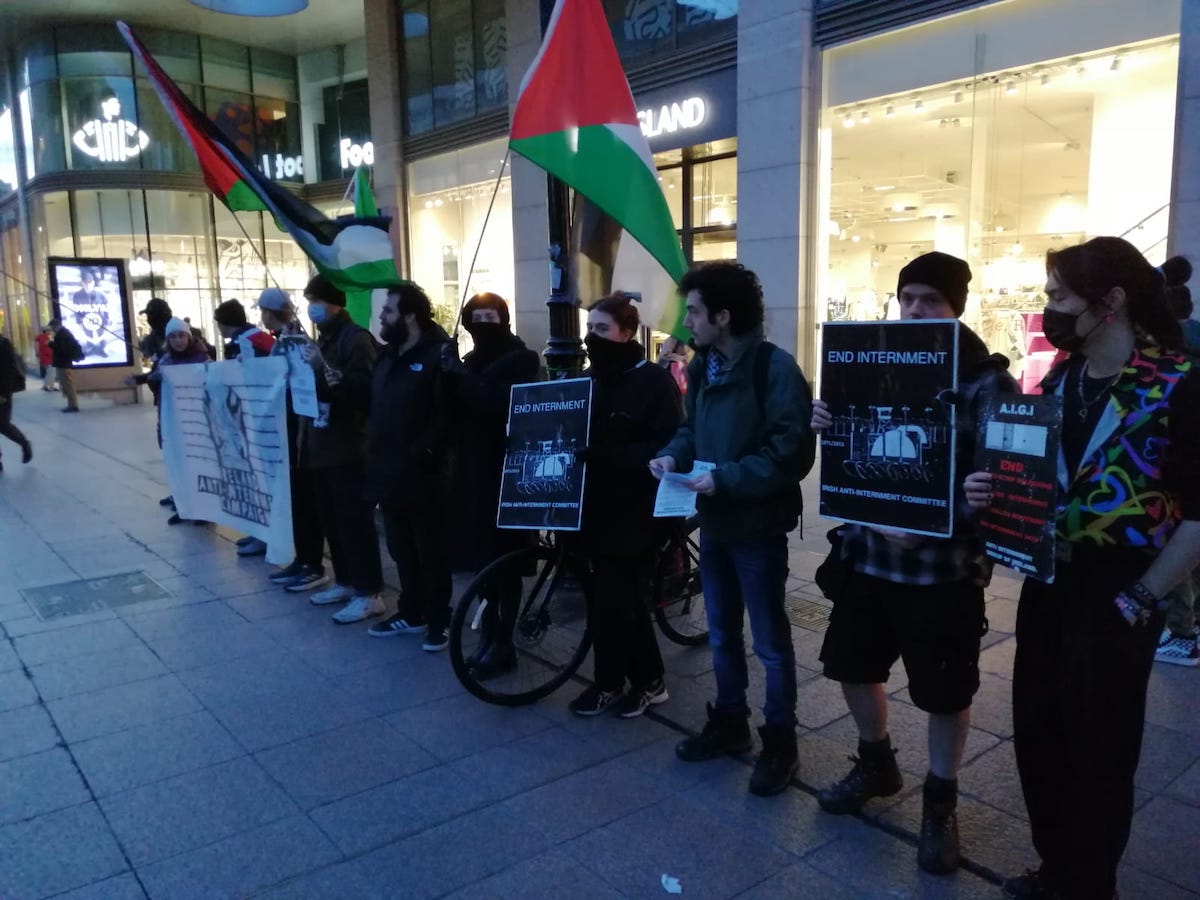
On Tuesday evening in one of Dublin city centre’s high-end shopping street picketers refuted colonial Minister for ‘Justice’ Naomi Long’s lie that “There are no political prisoners in Northern Ireland” (sic – she means the Six-County colony).

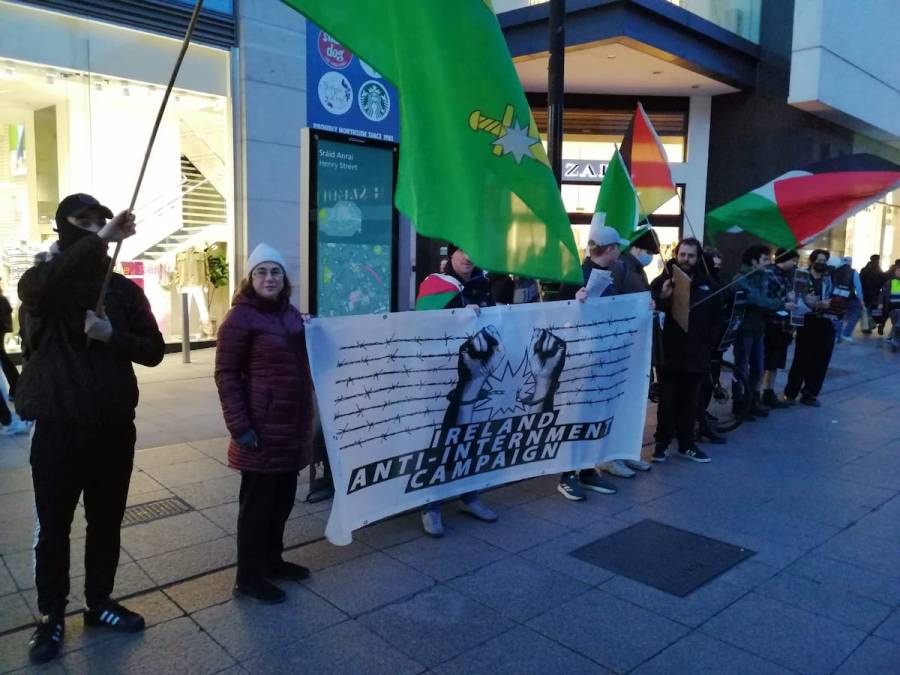
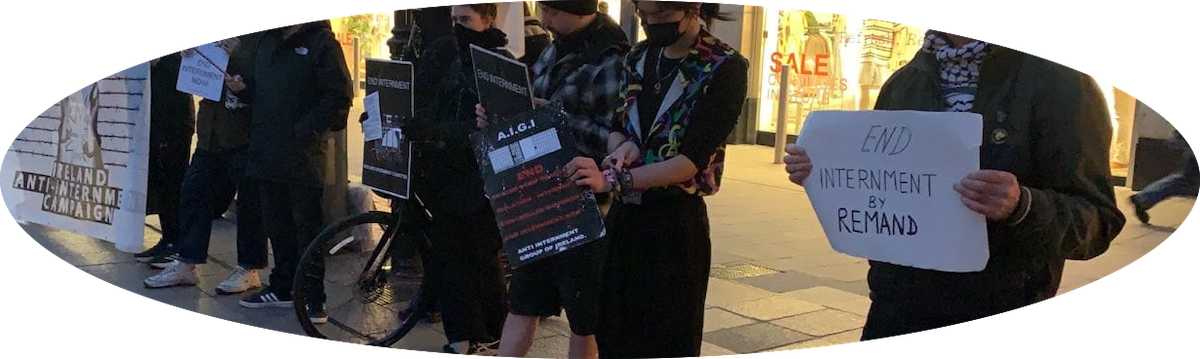
The Ireland Anti-Internment Campaign came on to the street to highlight that yes indeed, there ARE political prisoners in Ireland – over two score between both sides of the Border. And that furthermore, they are convicted in special political no-jury judicial processes.

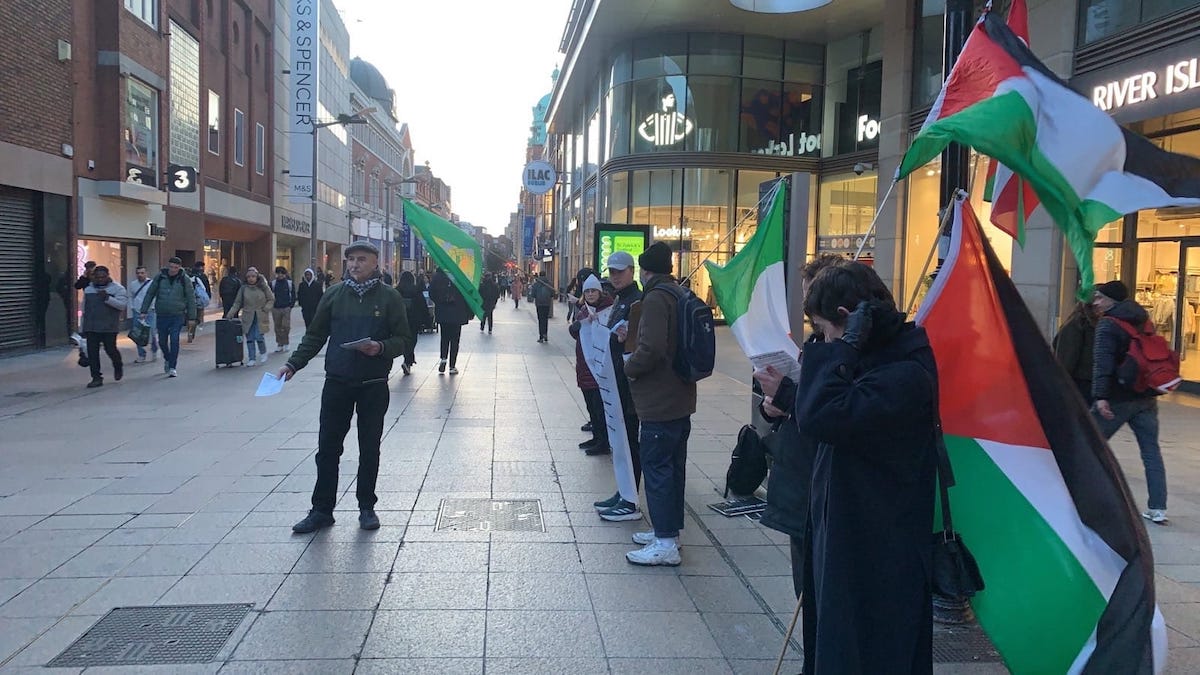
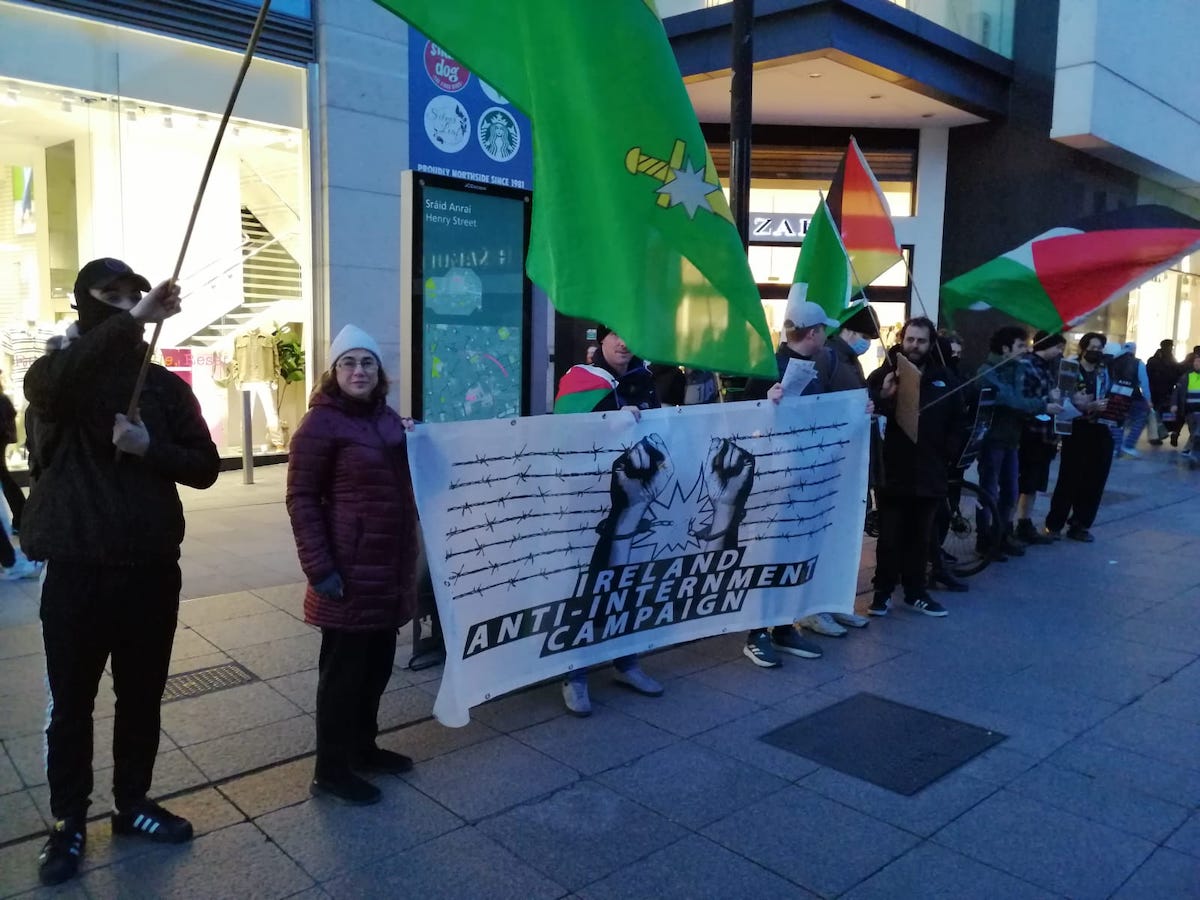
View of the picket and the IAIC banner in Henry Street on Tuesday (Photo: Rebel Breeze)

The IAIC states that these judicial processes are called the “Diplock Court” in the occupied Six Counties and the “Special Criminal Courts” in the Irish state and were “specifically created in both cases for the easy conviction and jailing of Irish Republicans.”

The SCC has been labelled “a sentencing tribunal” rather than a court of law by human rights campaigners. IAIC states that the Diplock Court is “now being administered by former Republicans while the SCCs have now, after years of opposition, been approved by those same people.”

View of placards on the IAIC banner in Henry Street on Tuesday (Photo: Rebel Breeze)

However, as accused before these courts are also regularly refused bail, IAIC points out they are also effectively administrators of internment without trial, jailing activists for around two years before judicial process. If bail is granted, it is always under severe conditions preventing political activity.

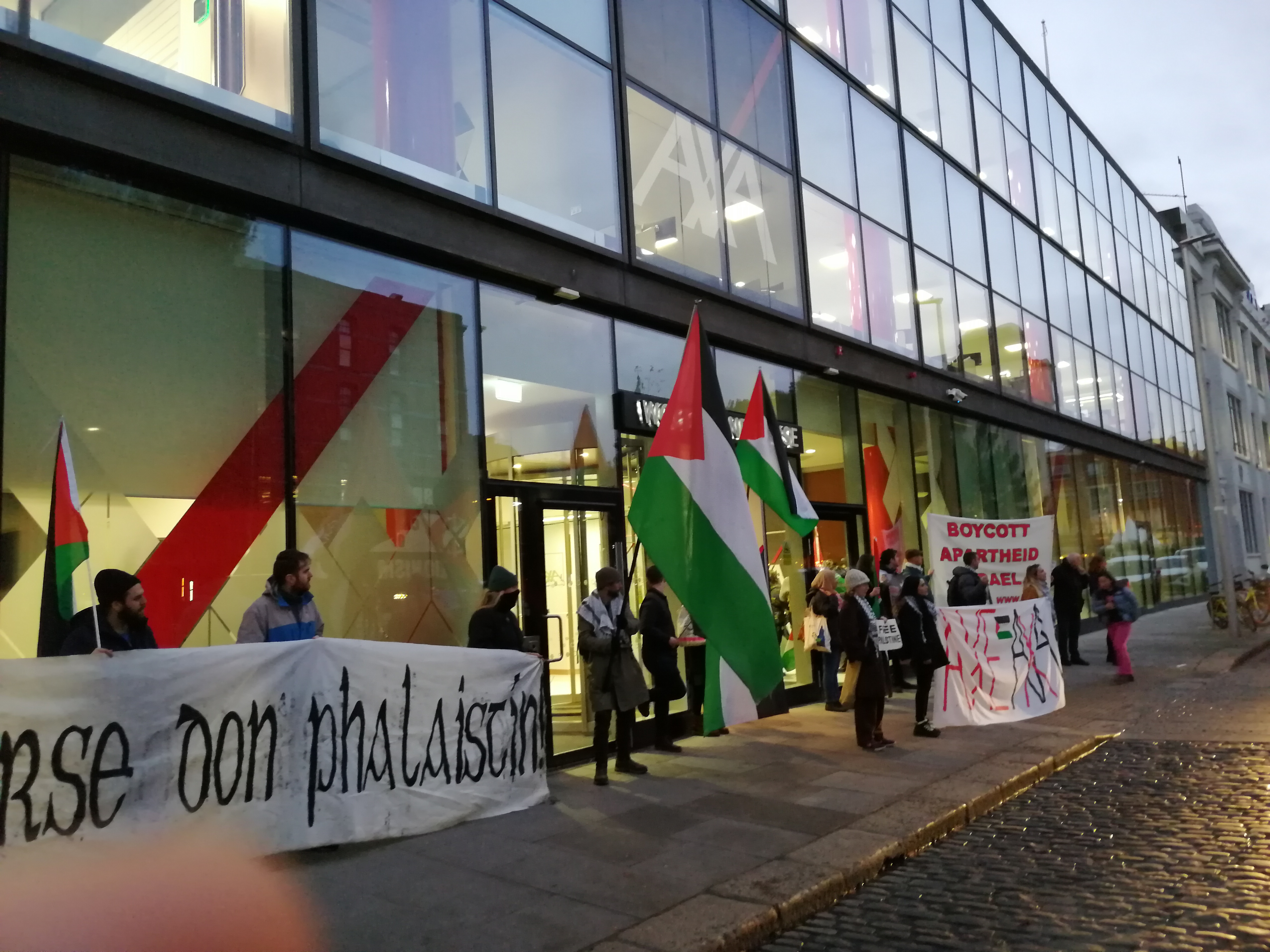
The IAIC, an independent group campaigning for ten years, was supported in their picket yesterday by Irish Republicans and Socialists including from the Anti-Imperialist Action and Saoirse Don Phalaistín groups, in addition to some independent activists.

Although Henry Street is a high-end shopping street of Dublin city centre, lots of working class people use it also.

A member distributes leaflets to passers-by near the picket in Henry Street on Tuesday (Photo: Rebel Breeze)

Over 100 leaflets were distributed and a number of people stopped to discuss the issues. Some queried the mix of flags flown (Irish Starry Plough, Palestinian and Basque) and participants explained that these represented some of the struggles where repression has taken prisoners.

“We thought it particularly important to refute the colonial Minister’s lie today,” commented a spokesperson for the IAIC “and we’re glad for the support we received on the picket line and from interested people on the street. We hope to do it more often this year.”

“Internment continues in Ireland, just on a different scale and more selectively than for example in the Six Counties in the 1980s”, continued the spokesperson.

View of the picket and the IAIC banner in Henry Street on Tuesday (Photo: Rebel Breeze)

The IAIC states that it is “an independent campaigning group run on a participative democratic basis” and that it “welcomes democratic people” on their pickets. The Facebook page https://www.facebook.com/profile.php?id=100063166633467 is their usual public outlet for notification of events and highlighting of related issues.

End.

DUBLIN STREETS RESOUND WITH “FREE PALESTINE!” AND AWASH IN PALESTINIAN NATIONAL COLOURS

Diarmuid Breatnach

(Reading time: 5 mins.)

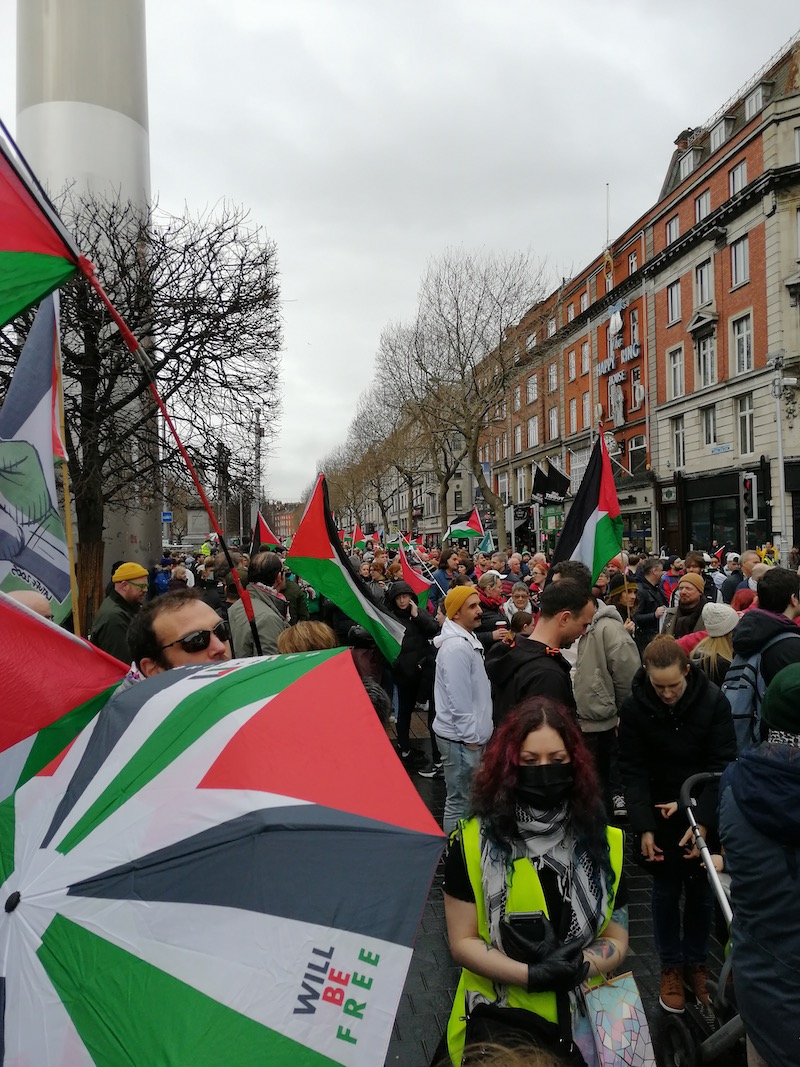
On a day when the Israeli military killed another 83 Palestinians, to bring the state’s death-tally since October 8th to almost 29,0001 known dead and thousands injured and missing,2over 50,000 people marched in solidarity through Dublin city centre.

The Israeli military is killing, on average, a Palestinian child every ten minutes.

Section of Mothers Against Genocide Ireland marching with bundles simulating children killed by Israel (Photo: D.Breatnach)

The national demonstration was convened by the Ireland Palestine Solidarity campaign and, though people came from all over the country and from many organisations, the numbers did not seem to quite match their last national demonstration, believed attended by 100,000.

As they marched from the Garden of Remembrance, the usual slogans were prompted and taken up in chanting responses: 1, 2, 3, 4 – Occupation no more! 5, 6, 7, 8 – Israel is a terrorist state!3 Gaza, Gaza, don’t you cry – Palestine will never die! Free, free – Palestine!

(Photo: D.Breatnach)

Taking over 20 minutes to pass through the north city centre’s O’Connell Street, they marched over O’Connell Bridge into D’Olier Street, through College Green and right into Dame Street, constantly chanting out the slogans4 of solidarity to which, by now, thousands have become accustomed.

From the River to the Sea – Palestine will be free! In our thousands and our millions – we are all Palestinians! Netanyahu (also Joe Biden, Western Powers etc) what do you say? – How many kids did you kill today? Zionist Ambassador – Out, out, out!

In some sections could also be heard: There is only one solution – Intifada revolution! Irish Government (also Western powers, USA), you can’t hide – You’re supporting genocide!

Section of the march about half-way through O’Connell Street, looking northwards. (Photo: D.Breatnach)
Section of the march about half-way through O’Connell Street, viewing southward. (Photo: D.Breatnach)

The Irish Government, the EU and the Genocidal Israeli State

Among EU states, the leaders of the Irish Government have been the most pressing on the EU to call for a ceasefire and have now teamed up with the Spanish state’s current government leadership to press the EU to revise its preferential trade agreement with the Israeli State.

They are not likely to succeed since Germany and France have led the strident pro-Israel position of the EU, rejecting even a call for a humanitarian pause to deliver food, fuel and shelter to starving Palestinian refugees or any attempt to restrain the Zionists’ leaders from their genocidal bombing.

But in addition the main concern of the Irish Government ministers (probably Spain’s also) is that the whole situation is going to escalate further in Palestine and further, across the Middle East; in other words they are offering ‘good advice’ and concerned that it’s being ignored by Israel.

Children on the march – a reminder that the Israeli state kills a Palestinian child on average every ten minutes. Also Irish language flag and placard in this photo employing the “Saoirse don Phalaistín” slogan. (Photo: D.Breatnach)

In any case, although the USA is the main supplier of finance and arms to Israeli Zionism, the EU is by far the Zionist state’s largest export market and could stop the genocide tomorrow with an ultimatum to stop bombing or face an embargo on Israeli products.

The International Court of Justice determined that the Israeli State is plausibly guilty of genocide but declined to order a ceasefire and again during the week rejected a South African application to order a cessation of genocidal actions though it did warn the zionists not to commit genocidal acts.5

Meanwhile the UN court is to begin hearings on Monday to determine whether the Israeli occupation is guilty of practising apartheid but the verdict is months away and the Israeli State continues its genocide unabatedly.

Palestinian solidarity in the Irish language

Small banner, group unknown with what has become a common slogan in Irish. (Photo: D.Breatnach)

At the junction with South Great George’s Street the marchers turned left and continued up into Aungier Street and then left again into Cuffe Street with people gathered on the pavements and at junctions, sometimes applauding but never expressing hostility.

A number of slogans and messages of solidarity in the Irish language could be seen on placards, flags and banners; two of the latter calling for Saoirse don Phalaistín. One of the banners had a large group behind it which included marchers calling out slogans in Irish.

Ón dtalamh go dtí an spéir – Beidh an Phalaistín saor! Stad an slad!

The Mothers Against Genocide group used Irish too, singing the chorus from Róisín Elsafty’s song and video with Irish and Arabic: A Phalaistín, a Phalaistín, hosni alaikum ya falastin. (Good luck to you, Palestine) and mixed the singing with chants of solidarity.

(Photo: D.Breatnach)

Once reaching the south side of Stephens’ Green,6 where the IPSC stage was set up near the Department of Foreign Affairs’ building,7 many marchers just stopped, began socialising, folding up banners or just going off for coffee etc (some also had long journeys ahead to return home).

Of course some stayed to hear speakers and performances but I didn’t.

Once again the thought struck me that this period could be used to advantage in small public meetings on the street but removed from the central stage; different currents in the solidarity movement could be discussed, along with basic principles and demands in our solidarity.

(Photo: D.Breatnach)

Collusion and Repression

As a Sinn Féin contingent self-identified by banners and placards marched in, some greeted them with Oh hey, oho! — No shamrocks for Genocide Joe! in a clear rebuke to the party’s leader’s intention to celebrate St. Patrick’s Day with the US President at the White House.8

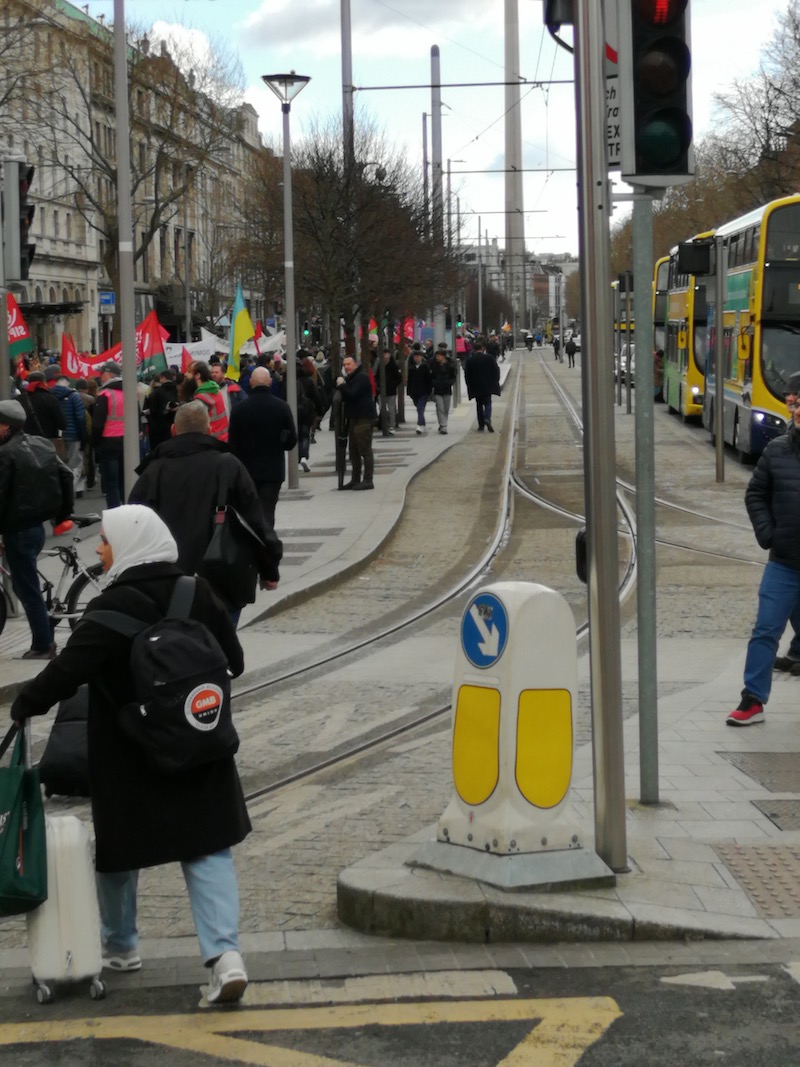
Passing through the southside’s city centre afterwards, people were frequently seen wearing Palestinian keffiyehs in various colours (black and white, red and white, green and white and the Irish green, white and orange version) as were people walking with furled Palestinian flags.

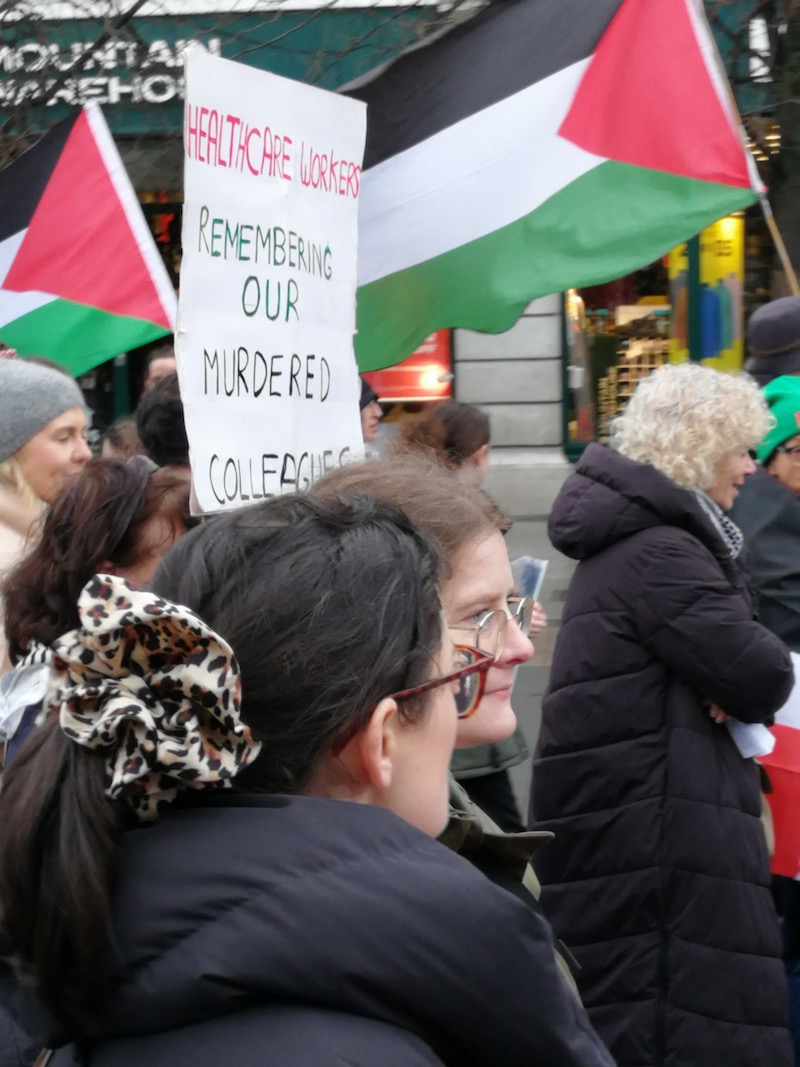
Indeed, action the health worker unions could have taken but failed to do so (Photo: D.Breatnach)

At least two people were arrested by Public Order Gardaí for demonstrating in the city centre outside Israeli-colluding businesses, to be bailed until their case in March, amid reports9 that activists have been threatened with charges and court for December’s Israeli Embassy occupation.

Although people came from many parts of Ireland, there were smaller solidarity demonstrations in many of those too.

End.

(Photo: D.Breatnach)

FOOTNOTES

1https://www.aljazeera.com/news/liveblog/2024/2/17/israels-war-on-gaza-live-icj-warns-of-perilous-situation-in-rafah

2Another 7,000 are believed buried under rubble of buildings bombed by the Israeli military. Palestinians had very little undamaged digging and earth-moving equipment and the pieces of masonry are often massive but they do try and dig through it, often with their bare hands.

3I think “israel is a fascist state!” would be entirely appropriate.

4“slogan” in English is of Irish-language origin, perhaps via Scottish Gaedhlig, from ‘slua/ slóga’ = “a host/ large gathering, troop” and ‘gairm’ to “call, address”. The original root is of Indo-European origin.

5Which the Israeli State has continued to do every single day since the ICJ initial judgement, killing thousands of civilians since then and bombing and invading hospitals.

6As in most parts of Dublin city the Green has been the scene of important historical events but this one perhaps more than most: it was a 1916 battleground, the location of a force of mostly Irish Citizen Army during the 1916 Rising before they were forced to relocate to the Royal College of Surgeons, where the garrison remained until the surrender. The Commandant Michael Malin and another senior officer, Constance Markievicz, were both sentenced to death by British Army military court. Michael Malin was shot dead by firing squad but Markivicz’s sentence was commuted to life imprisonment.

7A Palestine solidarity activist accused of ‘decorating’ the building with red paint in protest at the Government’s collusion with Israeli zionism was in court last week, having been raided at 7am, arrested and charged. The case has been deferred until next month.

8In a Belfast meeting organised by the party in Palestine solidarity recently a small group of Palestinians were ejected for pointing out that one of the speakers, the Palestine Ambassador is “a mouthpiece of the Palestine Authority” which is an undemocratic organisation working in collusion with the zionist occupation and has not held an election since 2006 (though supposed to do so every five years).

9Report from Anti-Imperialist Action.

AN PHOBLACHT ABÚ CALLS FOR BROAD UNITY IN STRUGGLE

Diarmuid Breatnach

(Reading time: 4 mins.)

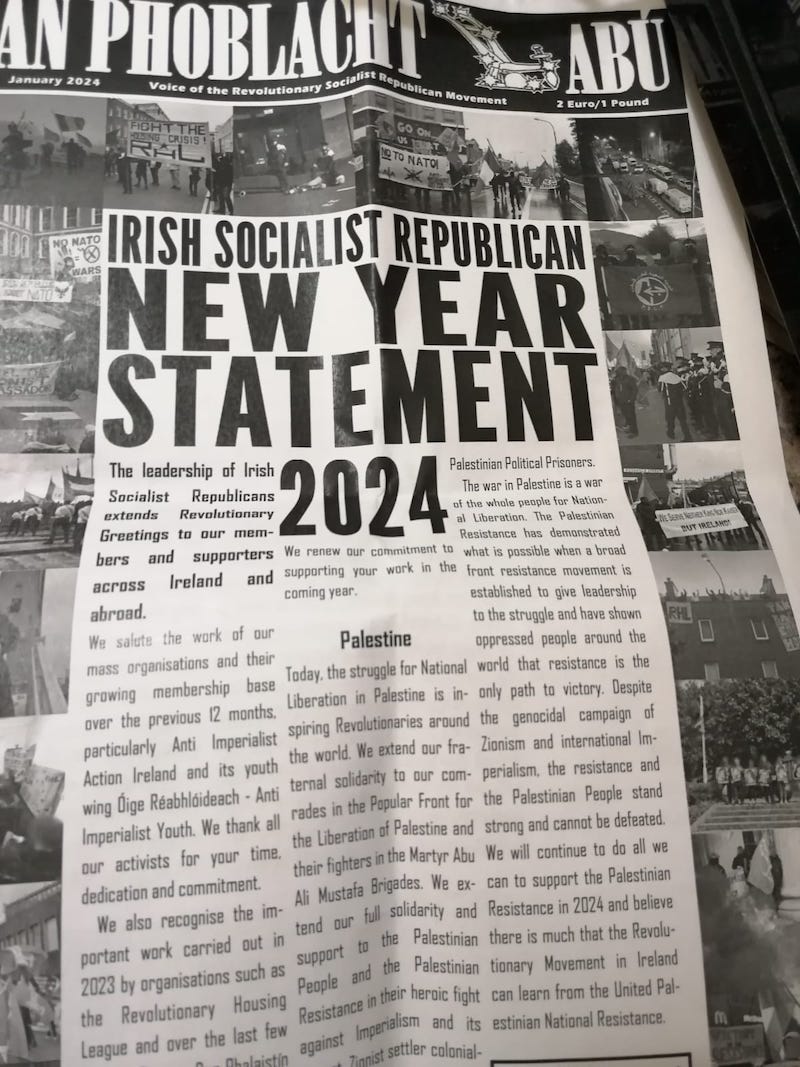
The first edition of the socialist republican weekly newspaper An Phoblacht Abú for 2024 has been available in hard copy from sellers now for several weeks; I am reviewing it here as I have done on occasion with another few issues during 2023.

APA is a hard-copy newspaper of usually 12 x A4 sides, produced monthly from I believe the last months of 2022, including articles on anti-imperialism, anti-fascism, recent Irish history, internationalist solidarity and sometimes on older history, culture and reports on events, selling at €2/£1 per issue.

Hard-copy revolutionary papers are important as a means of distribution to those who don’t wish – or are unlikely — to seek it online but more than that, they also provide the opportunity to make contact on a personal and organisational level with people with whom to discuss events.

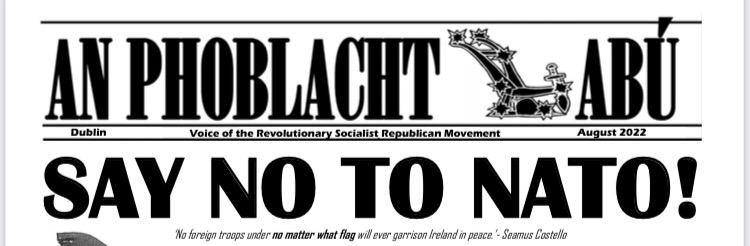
Masthead image taken from the An Phoblacht Abú Facebook page.

However, back issues are also available electronically, I’m told, from the producers.

This particular issue reports on the Palestinian struggle and the solidarity movement in Ireland, featuring a report of an occupation of the Israeli Embassy on 19th December with a following picket and blockade of the gates to the building which hosts it for many hours.

Another page carries a report on Palestine solidarity actions across the country and a “Hands Off Iran & Iraq” item, also an obituary on the death of a recent comrade of the organisers. Separately there is a report and comment on the death of an Irishman in the conflict in Ukraine.

Political prisoners in Ireland and the Basque Country are also covered, the latter focussing on the ‘non-compliant’ Basque prisoners and their support network, in contrast to the colluding “official leadership” and the great majority of prisoners who have come under their influence.

An article comments on the upcoming Referendum on Article 41 of the Constitution of the Irish State, condemns the treatment of women historically by the Irish ruling class and, without recommending how to vote, calls for the destruction of the State.

Commemorations of historical events, including martyrs, are an important part of the culture of all peoples in struggle and APA reports on some. A statement on the escape from justice by natural death of war criminal Brigadier Kitson was widely shared in appreciation on social media.

NEW YEAR CALL FOR BROAD FRONT UNITY

Organisations traditionally issue New Year statements, perhaps reflecting on the past year but always looking to the coming year. The ISR NY Statement covered three pages and called attention to all the struggles discussed in the reports, along with some others.

The one theme in the Statement dominating all others was the call for united action in developing a broad anti-imperialism united front to work for unity “around common Republican principles” while at the same time maintaining “the autonomy and independence of different groups.”

In furtherance, ISR proposes that a “Broad Front Congress” be organised before the end of this year and called on those interested to contact them “to turn the demand of the Republican base into action.”

COMMENT

The importance of revolutionary newspapers is underlined historically by the preparations of the British Government prior to the General Strike of 1926, when they purchased all stocks of newsprint paper to deny them to revolutionaries and other strikers.

Governments today can close down social media transmission and reception over an area and even nation-wide.

The APA editorial is undoubtedly correct in its call for a broad front while stipulating independence of organisations within that front. A congress may further this aim but I wonder if it will, without some advance agreement on working principles (about which I have written previously).

I find it striking that in the New Year’s message which mentions working class communities, there is nothing about workplace organisation, or trade unionism, to give it another name. Working class people do not live in communities alone – they also work many hours outside them.

And in the most commonly-imagined scenario for revolution in western countries, revolution is preceded by a general strike. To organise and carry out such a strike and maintain it against external repression and internal undermining, requires leadership deep and wide within the movement.

How this is to be achieved is an issue, the resolution of which can only follow of course from recognition of its necessity. Across the Left and Socialist Republican movement I see no sign of this recognition.

The founding of this newspaper for socialist republicanism and its monthly production and distribution is a great achievement and to their credit for a young and still relatively small organisation.

Some typographical errors persist in APA which could be removed by greater editorial checking. The reproduction of images might be improved substantially too, space made for enlargement possibly by reduction in the area covered by print, increasing the visual attractiveness of the page.

However, APA is right to concentrate on the written word and the spread of themes, the reporting of actions and the reasoning behind them. A regular revolutionary newspaper has long been needed but missing and monthly production at least is needed for its effectiveness.

Fáilte uaimse roimh an nuachtán míosúil réabhlóideach seo, An Phoblacht Abú!

end.

Note: Back copies of An Phoblacht Abú are available electronically from isrmedia@protonmail.com

PALESTINIANS EVICTED FROM PALESTINIAN SOLIDARITY MEETING

Diarmuid Breatnach

(Reading time main text: 7 mins.)

Videos doing the rounds of social media sites show a brief intervention by Palestinians at a Sinn Féin-organised meeting in Belfast about Palestine followed by the party’s heavies evicting them to applause from many in the audience.

The event at the Europa Hotel on Thursday evening was intended, according to the party’s National Chairperson, “… as an opportunity to demonstrate that Ireland stands with the people of Gaza and the West Bank and to reiterate calls for an immediate ceasefire, and an end to the occupation.”1

Actually Ireland is already – except for the Unionists — well behind the Palestinians as shown by attendance at marches and opinion surveys. What is needed is a) clarity on what we are calling for and b) direct action to put the States and companies under greater pressure.

The video of the intervention I’ve seen began with an apology for interrupting the Palestinian Ambassador, Dr. Jilan Wahba Abdalmajid, as “a mouthpieceof the Palestinian Authority” which, the challenger said, is an undemocratic organisation which has not had an election since 2006.

Boos and cries of objection followed from the audience as the Palestinian asked to be listened to, pointed out that those doing the intervention were all Palestinians but the party’s security men were soon hustling them out and periodically trying to block the phone camera.

When people don’t want to examine the issues or are feeling guilty about them, it’s always tempting to blame the critics, suggest they’re dissidents, trouble-makers, etc. That way the pointing finger is turned around and the actual issues don’t need to be thought about.

Of course this time some SF supporters commented along those lines, accusing their critics of being Loyalists, or as they have in the past outsiders, ultra-leftists, intelligence service agents, dissidents, malcontents, trouble-makers … or just plain Utopians.

MOUTHPIECE OF … AN UNDEMOCRATIC ORGANISATION”

The intervention from the floor was challenging but what of the content? Palestinian Ambassadors are appointed and employed by the Palestinian Authority which, though never intended as a government is acting like one. So “mouthpiece for the PA”? Blunt — but entirely accurate.

Palestinian Ambassador to Ireland of the undemocratic and corrupt Palestinian Authority at a Sinn Féin meeting (note SF President Mary Lou McDonald applauding in the background). (Sourced: Internet)

The PA “has not had an election in 18 years”? Accurate also – though they’re supposed to have one every five years. The last time there were elections in Palestine was 2006 and Hamas won overall throughout Palestine. However Fatah, the losers, refused to give up their seats.

In 2007 in Gaza, Hamas moved against Fatah and after a short struggle, took the seats to which the electorate had voted them. However, they chose not to do that in the West Bank, where the PA’s HQ is and where EU and USA money comes flowing in to Abbas and his unelected cronies.

The reason for not holding elections is that Hamas would almost certainly win again. Meanwhile, “democratic Israel” refused to recognise the Gaza administration or the elected representatives of the Palestinians while the US, EU and UK followed suit and ‘Israel’ blockaded Gaza.

The Palestinian Authority, as well as being undemocratic, deeply corrupt, unrepresentative and repressive2 is also actively colluding with the Zionist state and feeding its masters intelligence on the Palestinian opposition and resistance while it represses their supporters.

That’s what most Palestinians think about the PA and, as is widely known and even tacitly admitted by the USA3, whether in the West Bank or in Gaza, Palestinians have no confidence in the institution.4

Some of the comments on the circulating videos criticised SF’s bad management of the event, opining that the Palestinians should have been allowed to speak and then the meeting could have proceeded as the organisers planned and the challenge would have got little publicity.

True … but SF is used to throttling dissent inside its party or in the communities it controls and managing dissent – rather than crushing it — is just not its style.

In any case, is ‘bad management’ the main issue with regard to SF and Palestine? More important than supporting partition of Palestine, the institutionalisation of a Bantustan “Palestinian State” under the guns of the Zionists – and the PA’s collusion with those same Zionists?

The Provisionals weren’t always pro-Palestinian; though it might shock some people, they originally mirrored Irish society’s position of support for Israel, the perceived ‘underdog’ up to the mid-1960s, Hollocaust survivors (Zionists) who had fought the British police and army.5

THE PROVO LEADERSHIP AND PALESTINE

For a while pieces by a Fred Burns O’Brien apparently based in the USA were featured in the Provos’ newspaper but some time after he revealed himself as a Zionist he was ‘let go’, probably through internal pressure from those who thought the Palestinians were the natural ally.6

One of the problems with taking a political position, physically or ideologically, is that you might get called on it someday. This is why bourgeois politicians try to give themselves wriggle and even retreat room in their statements – lots of good-sounding bites with little content.

The Provisionals owe a debt to some Palestinians but it’s a very bad one. I don’t mean when they got some arms for the struggle7 but rather their following Fatah/PLO down the pacification process, for which Fatah and the ANC sent fraternal delegates to SF’s Ard-Fheiseanna (annual congresses).

Subsequently, Ireland and South Africa were used as promotional examples of the pacification process and their delegates travelled as kinds of sales representatives8 — but Palestine got dropped from 2000 onwards because of the Second Intifada, when Palestinians rejected Fatah’s deal.

You can’t sell a process as ‘working’ when the youth have overwhelmingly rejected it and are fighting the Occupation in the street.

ORGANISE YOUR OWN EVENT”

One prominent member of SF in the British colony told the Palestinian protesters they should have organised “their own event.” Er – was this event not advertised as being for solidarity with Palestine? But ‘Palestinians not welcome’? Or only zionist-collaborating Palestinians?

Imagine if back in the day some political party had been having a meeting about Ireland and were inviting an Irish State or British colonial minister as a speaker, would anyone have been shocked to see and hear SF activists challenging or even heckling the speakers during the meeting?

Would we not be reading statements from SF talking about ‘no right of colonialists to represent the Irish people’ and about ‘censorship of Irish voices’?

Cartoon by DB.

Gerry Adams, former President of the party was quoted as saying the calls are “inconsistent” because they are not making the same call with regard to the UK though “the Brits are up to their neck in this” and what is important for SF in the USA is Irish-America.

But SF long ago accommodated itself to the colonialist “Brits”, including its royalty. Irish politicians don’t flock to London for St. Patrick’s Day. Anyway the primary financial and military supplier – and political backer of the Zionist state in the UN Security Council — is the USA.

Why is the diaspora in the USA so important to Sinn Féin but not the diaspora in Britain or in Australia? It must be because the USA is the “boss of the world” and pathetic Irish gombeen politicians think their diaspora gives them them some kind of weight with the imperialists.

What would really help with the Irish diaspora would be if SF were to address the Irish-Americans and ask them to push their political representatives to call for the USA to stop supporting genocide in Palestine.

But of course there is no chance of them doing that because 1) some Irish Americans oppose imperialism from Britain but support it from the USA; also 2) because Irish gombeens, the political class to which SF aspire, are pro-western imperialism.

INTERNATIONALIST SOLIDARITY AND THE HOME STRUGGLE

I have commented in the past that the level of commitment to internationalist solidarity is one of the indicators as to whether an organisation is going to carry through its own revolution or instead is going to finish up in liberalism and abandon its struggle, ending in actual collusion.

It seems some others have the same idea.

As she was being evicted, the Palestinian woman called out for SF not to attend Washington on St. Patrick’s Day and also shouted, though she may have meant it the other way around: “There will not be a free Palestine without a united Ireland!”

Electronic Intifada co-founder Ali Abunimah put it quite succintly: “If you can’t say NO to the White House in the middle of a genocide, then you’d never be able to stand up, not even for Ireland.”

end.

FOOTNOTES

1https://vote.sinnfein.ie/solidarity-rally-for-palestine-to-take-place-in-belfast/

2“The PA has actively helped Israel to keep tight control over the Palestinian population. Many perceive the body as a tool of the Israeli security apparatus, its US-trained forces not only targeting those suspected of planning attacks on Israelis, but also arresting union figures, journalists and critics on social media.” (Al Jazeera – see Sources)

3Hence the USA’s post-war plan for Gaza, as expressed by Blinken, is to have it run by a “revamped PA”, i.e one that might have some credibility among Palestinians.

4“Today, a staggering 87 percent of Palestinians in the West Bank and Gaza believe that the PA is corrupt, 78 https://en.wikipedia.org/wiki/King_David_Hotel_bombingpercent want Abbas to resign, and 62 percent believe that the PA is a liability.” (Washington Institute — see Sources).

5On 22 July 1946, Zionist militias bombed the King David Hotel in Jerusalem, in which the British Mandate administration had offices including its police intelligence department, killing 91: “49 were second-rank clerks, typists and messengers, junior members of the Secretariat, employees of the hotel and canteen workers; 13 were soldiers; 3 policemen; and 5 were bystanders. By nationality, there were 41 Arabs, 28 British citizens ….” Forty-six were injured. https://en.wikipedia.org/wiki/King_David_Hotel_bombing

6The same kind of pressure from the support base that caused the SF leadership recently to reestablish their ‘expel the Israeli Ambassador’ position that Mary Lou had announced they were abandoning.

7In 1977 a consignment of arms allegedly from the PLO bound for Ireland was seized by the authorities at Antwerp.

8To the Basque Country, Kurdish Turkey, Colombia, Sri Lanka, Philippines etc.

SOURCES

https://m.belfasttelegraph.co.uk/news/politics/palestinian-activists-thrown-out-of-sinn-fein-solidarity-rally-in-belfast-hotel/a1343153914.html

Criticism of the PA’s corruption and unpopularity
a) from a pro-imperialist source: https://www.washingtoninstitute.org/policy-analysis/how-palestinian-authority-failed-its-people and
b) from Al Jazeera (pro-Palestinian but not pro-Hamas): https://www.aljazeera.com/news/2023/10/11/what-is-the-palestinian-authority-and-how-is-it-viewed-by-palestinians

ANTI-FASCISTS CONFRONT FAR-RIGHT & FASCISTS IN DUBLIN CITY CENTRE

Diarmuid Breatnach

(Reading time: 6 minutes)

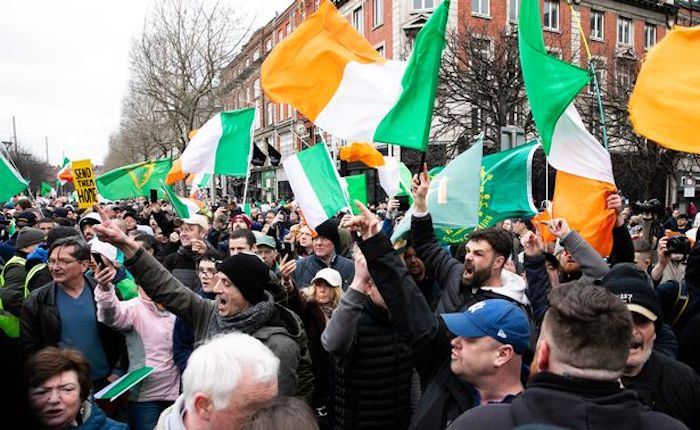
A far-right march containing known fascists and fascist organisations opposed to immigration or to providing housing for refugees confronted an antifascist counterprotest half its size in Dublin city centre’s main street on Monday.

The counter-protest was convened for 1pm by the United Against Racism organisation (a kind of liberal anti-racist and antifascist confederation set up by the People Before Profit party) in order to confront an advertised mobilisation of the far-Right on a broad racist platform.

The racists had been building for this ‘national’ march since early January.

A view of the west side of the anti-racist gathering some time before the arrival of the anti-immigration march. (Photo: D.Breatnach)

The antifascists gathered on the central pedestrian reservation while a group of less than 20 strutted in front of the GPO waving Tricolours,1 an Erin go Bragh flag2 and, most unusually, a Cumann na mBan3 flag. Did they know or care that one of the founders of that organisation was a migrant?4

Or that the Tricolour was presented to us in 1848 by women revolutionaries in Paris? The far-Right in Ireland is replete with ironies, whether ignorant of them or aware while manipulating their ignorant followers in neglected cross-generational families and communities.

Among the anti-racist gathering, at first there were red, rainbow and some Palestinian flags but not one specifically Irish one apart from a white Starry Plough on a red background, until a little later when a number of Irish Tricolours made their appearance among the anti-racists.

East side of the anti-racist gathering some time before the arrival of the anti-immigration march. (Photo: D.Breatnach)

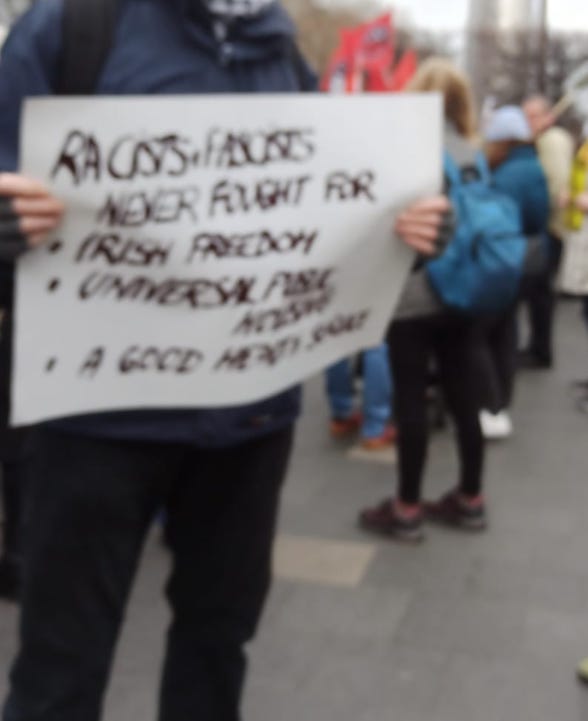
This gives the unfortunate appearance that it’s the far-Right that cares about the national struggle and not the antifascists, which is untrue since the fascists have never lifted a finger for Irish freedom and unity (as pointed out by one of the placards displayed by the anti-racists).

It seemed strange that the anti-racists had not occupied the space directly in front of the GPO, thereby not only denying it to the far-Right but also giving them a position with a safe rear and only exposed from the front and flanks, as distinct from the central reservation, open on all sides.

Many Garda Public Order Unit vehicles had been seen at the Garden of Remembrance where the far-Right were rallying along with two mounted Garda, with another two of those outside the GPO and many police in ordinary uniform, along with a few POU there also.5

A strong turnout of Gardaí lined up in front of the GPO with their backs to the fascists and facing the antifascists, a formation clearly anticipating antifascists moving against the far-Right. A number of shouts were traded between the opposing forces.

Early view of section of the anti-racist demonstrators showing in the background a section of the far-Right demonstrators outside the GPO before they left to join their rally at the Garden of Remembrance. (Photo: D.Breatnach)

A senior Garda officer approached an anti-fascist and obliged her to remove her mask, an action that exposed her not only to Garda photographers but also to media and far-Right snaps and video.

Unlike a number of other occasions prior to and during the Covid emergency, the police restrained the fascists from crossing the road or even engaging in sustained exchanges. After awhile, the latter departed to join the others at their rally at the Garden of Remembrance

The antifascist gathering listened to speeches (or ignored them and chatted among themselves) and a number of a cappella songs about Irish emigration and anti-racism, regularly joining in slogans of “Say it loud and say it clear – Refugees are welcome here!” and “Fáilte – roimh theifigh!”

Another slogan6 shouted was “When refugees are under attack – Stand up, fight back!”

THE FASCIST MARCH

Word reached the antifascists that the far-Right had finally got into their march and the whole anti-racist gathering moved to face the east side of O’Connell Street, where stewards packed them in tighter and tighter and Gardaí lined up facing them with arms linked.

Photo taken of section of anti-racist protesters on east side of central reservation shortly before arrival of anti-immigration marchers – note the Gardai linked arms against the anti-racists, possibly out of habit before they reversed their positions as the far-Right protesters approached. The flag centre photo is of the Second Spanish Republic during the Spanish Antifascist War. (Photo: D.Breatnach)

A little later, perhaps conscious of the size of the far-Right march, the Gardaí turned their backs to the anti-racists and faced the street upon which the racists were going to march. The POU also deployed around the area and both mounted police moved across on to the central reservation.

The far-Right began to proceed southward along the street a couple of feet only away from the anti-fascists, from which the slogans in support of refugees were chanted in unison but there were also individual comments flying back and forth, along with gestures, between both groups.

Their stewards were clearly keen to keep them moving, however. At one point a large group of the far-Right mounted the central reservation and approached the antifascists aggressively but between the Gardaí and their own stewards they soon resumed their march south.

The anti-immigration marchers pause in order to hurl abuse at the anti-racist counter-protesters, some of who respond in kind. (Photo sourced: Internet)

It became clear that the racist march outnumbered the counter-protest in the order of around two to one. When banners of the National Party and the Irish Freedom Movement were seen (and placards of Síol na hÉireann)7 a roar of “Nazi scum off our streets!” emerged from the anti-racists.

There were also some cries of “MI5!” at those. Some large placards bearing the legend “Ireland is full” drew the reply: “No it’s not – you don’t know your history or your geography!”8

A racist and a fascist trope side by side: The “Replacement” conspiracy theory originated in white European settler colonies in fear of being replaced by the indigenous people, while fascists regularly demand freedom of speech for racism and lies but shut down all freedoms when they get into power. (Photo sourced: Internet)

The march passed and according to information received made its way to Custom House Quay for a rally. The antifascists were then called on to the street to march to the Garden of Remembrance in a move that puzzled some (one suggestion was that it was to “disinfect” the site!).

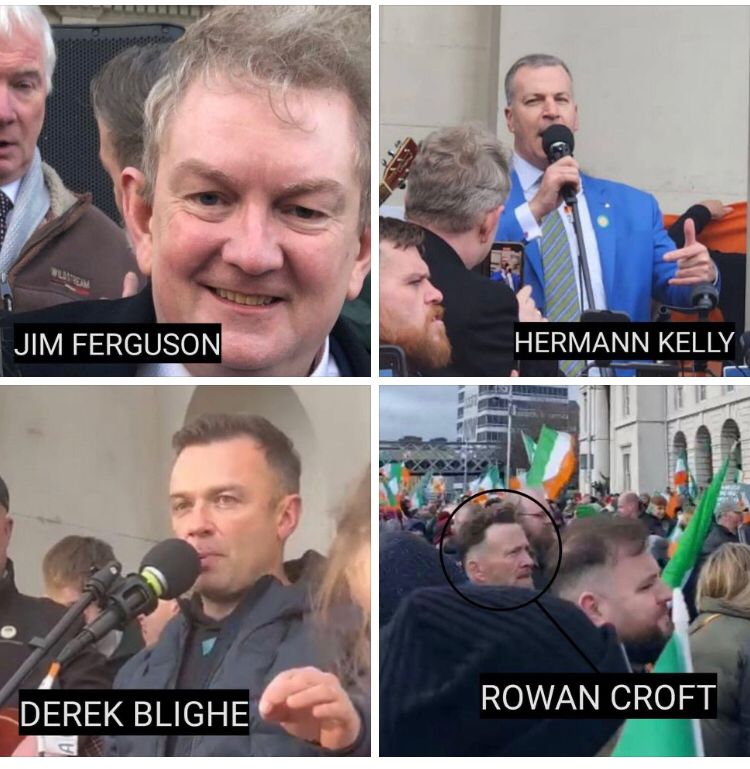
Later and photos from Anti-Imperialist Ireland confirmed the sighting of a number of known fascists at the racist rally, including Derek Bligh (IF), Jim Ferguson, Herman Kelly (IFM) and Rowan Croft, all with connections to British Loyalism and British Intelligence.

Four prominent fascists from different groups who were present (some as speakers) at the anti-refugee and immigration rally on Monday. (Photo source: AIA)

EVALUATION

The question must be asked how a minority of far-right and fascist parties in Ireland can outnumber the vastly numerically superior anti-fascist mass in the country at a public (and publicised) event? Clearly the counter-protest organisers failed to mobilise the wide anti-fascist masses.

View of section of the anti-immigration march. (Photo sourced: Internet)

Or the wide anti-fascist movement failed to respond to the call. Where were the Irish Republican forces, the specifically antifascist organisations, the anti-fascist trade unionists – and the broad masses that they can mobilise?

Some of those may say that they don’t trust the UAR group, that they’re not serious about confronting fascists, etc. That may be but it would be a poor and shameful excuse for allowing a successful fascist attack on an antifascist gathering.

On the other hand, when the UAR was being founded, it deliberately excluded those forces – Republicans, antifascist activists, anarchists – who had already been confronting the far-right in Dublin and had been in a number of clashes with the fascists.

A placard displayed by a migrant solidarity demonstrator. (Photo: D.Breatnach)

This is a most serious situation in which the democratic masses to be as the racists and fascists mobilise their thugs and feel the wind behind their sails while simultaneously the State surreptitiously encourages them and the capitalist system seeks to make the workers pay for its crisis.

The racist march took place in the context of a recent fascist mobilisation in the city centre burning cars and public transport and ongoing burning of buildings across the country earmarked – or just believed to be earmarked – for housing of refugees.

Government Ministers can claim shock and anger at such fascist mobilisations but how is it that the wave of arson attacks is being permitted? And how is it that communications of the culprits are not being monitored by the State’s intelligence services?

How is that there is not one case of Garda or property security being on hand and apprehending the arsonists?

We need not believe any nonsense about insufficient personnel because the private security industry employs over 30,000 people across a broad range of sectors9 and the Gardaí can mobilise 100 with helicopter back-up to evict a handful of housing activists occupying an empty building.10

The State is clearly allowing the fascists a loose rein whilst at the same time permitting an atmosphere favouring repression to build up – repression which as is usually the case will be used not against the fascists but against the antifascists and against the Left resistance in general.

We are being given warnings and it is up to all of us whether we act upon them. If we don’t not only we but our children will pay the price.

End.

FOOTNOTES

1The green, white and orange flag that became the ‘national’ flag of the Irish State.

2Anglicisation for pronunciation of Éirinn go Brách (Ireland for ever!), the slogan in gold on a green background, usually also bearing the emblem of the harp in gold was a common flag seen among gatherings of the Fenians (Irish Republican Brotherhood) in Ireland, Britain and the USA during the second half of the 19th and early 20th centuries.

3Possibly the world’s first female republican military organisation, it was founded in 1914 as an auxiliary to the male Irish Volunteers founded the year before; around 40 of them participated in the 1916 Rising. Later the organisation developed more independence.

4Constance Markievicz: A founding member of Fianna Éireann, Cumann na mBan and the Irish Citizen Army, she took part in the Easter Rising in 1916, when Irish republicans attempted to end British rule and establish an Irish Republic.

5And some in ordinary street clothes, clearly the political ‘undercover’ police (now officially the Special Detective Unit but still widely known among political activists (and some of its own officers) by their former name of “the Special Branch”).

6https://en.wikipedia.org/wiki/Slogan

7Three of the prominent fascist and racist organisations recently founded in Ireland, though not much of “Síol” has been seen for many months.

8Presumably a reference to the fact that in 1845 Ireland had a population of over 8 million and was not “full” even then while the population today is around 7 million.

9“and has an estimated annual turnover in excess of €960 million” https://www.cpsa.ie/en/organisation-information/8018a-the-private-security-authority

10On two occasions in Dublin alone, against the Revolutionary Housing League occupations of empty buildings on Eden Quay in June 2022 and on Berkeley Road in July last year. https://rebelbreeze.com/tag/revolutionary-housing-league/

SOURCES

March and counter-demonstration: https://www.irishtimes.com/ireland/social-affairs/2024/02/05/anti-immigrant-march-and-counter-protest-in-dublin-see-300-gardai-deployed/

https://www.thejournal.ie/anti-immigration-protest-dublin-6291088-Feb2024

Fascist speakers at Monday’s rally: https://anti-imperialist-action-ireland.com/blog/2024/02/06/dont-be-fooled-by-britains-far-right-in-ireland/

Far-Right arson of buildings and riots: https://www.dublinlive.ie/news/arsonists-burning-buildings-set-house-28568335

https://www.breakingnews.ie/ireland/dublin-riots-taoiseach-receives-mixed-messages-on-far-right-thugs-and-uncontrolled-immigration-1583306.html

https://www.breakingnews.ie/ireland/man-charged-in-connection-with-dublin-riots-1585211.html

Gardaí available in large numbers when evicting housing activists: https://rebelbreeze.com/tag/revolutionary-housing-league/

ISRAELI EMBASSY BLOCKADED AGAIN: “ZIONIST AMBASSADOR OUT!”

Clive Sulish
(Reading time: 2 mins.)

Palestinian solidarity supporters demonstrated outside the Israeli Embassy in Dublin again this afternoon, calling for the expulsion of the legation and the Israeli Ambassador. The protest was maintained from around 3pm to after 6pm today.

Organised by Saoirse Don Phalaistín and Action for Palestine, supported by Anti-Imperialist Action and independent activists, the protest kept up an almost endless chorus of slogans in English, Irish and Arabic languages, calling for a free Palestine and an end to genocide.

(Photo: Rebel Breeze)

Slogans were shouted denouncing the genocide being committed by the USA, the EU, the “Western Powers” and the “western media”, along with the collusion of the Irish Government. As large numbers of Gardaí arrived their collusion with zionism was called out also.

The latest figures of the Zionist genocide have now passed 27,000 dead in four months, more than two-thirds of them women and children, 66,287 injured, with 70% of Gaza housing destroyed and over 85% of its population displaced, a quarter starving and without clean drinking water.

(Photo: Rebel Breeze)

17,000 children are without parents or separated, according to UNICEF. And now evidence is mounting of Israeli ‘field executions’ and random sniper killing of Palestinian civilians and an Israeli military murder squad shooting three young Palestinian men sleeping in a hospital.

Meanwhile, outside the Zionist Embassy in Dublin …

(Photo: Rebel Breeze)

No less than three van-loads of the POU Gardaí (riot police) and many uniformed officers were there eventually. Later one of the latter threatened all those sitting in front of the entrance as a group with arrest under the Public Order Act, though no public disorder was taking place.

For the rest of their time there, the protesters separated to each side of the Embassy building entrance and the event concluded without any arrests.

(Photo: Rebel Breeze)

Every few minutes car horns could be heard as passing drivers indicated their support, often with a clenched fist or thumbs-up sign out the window. Only two objected: a man walking his dog who said he only cares about Ireland and a woman who shouted from across the road.

It has often been remarked by activists that those who “only care about Ireland” and object to Palestinian solidarity are not seen on the many demonstrations in Ireland protesting lack of housing, health service in tatters or British occupation of the Six Counties.

The Israeli Embassy is in an upper floor of a building rented to the zionist entity by a foreign property company with Irish directors, Quanta Capital at 15 Merrion Square North, a location which has also been the subject of protests.

Other tenants in the building say they have complained about the Embassy tenancy to the company but “they don’t care.”

No doubt protesters will return and the pressure on the Embassy (and on the Irish Government protecting it) will be maintained. Some TD should surely ask in Leinster House how much the taxpayers are being charged for maintaining an official zionist presence in Dublin.

End.

SOURCES

https://www.aljazeera.com/news/liveblog/2024/2/2/israels-war-on-gaza-live-israel-downplays-settler-violence-in-west-bank

6,000 March to Commemorate Derry’s Bloody Sunday and in Solidarity with Palestine

Diarmuid Breatnach

(Reading time: 7 mins.)

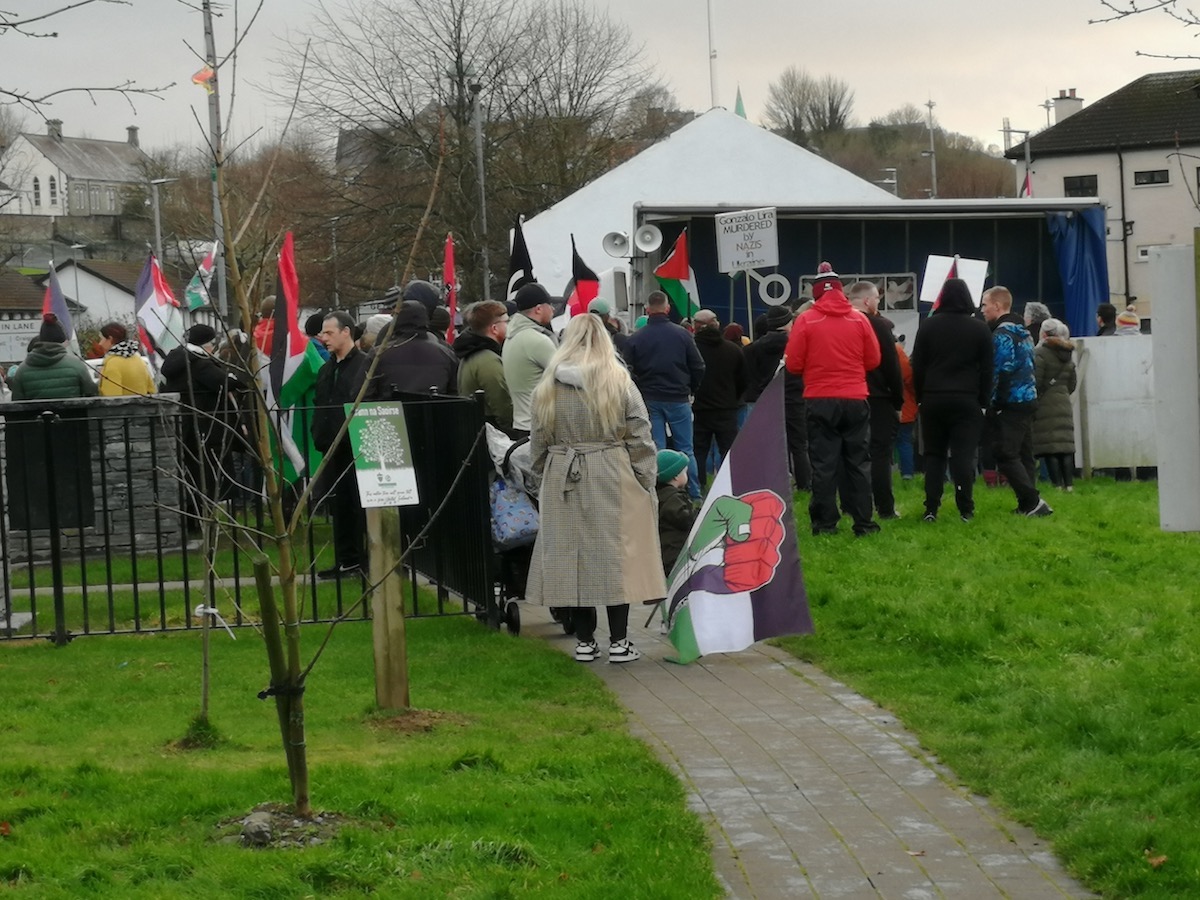
Led by four Republican marching bands and containing a number of organisations, around 6,000 people supported the annual march in Derry on Sunday commemorating the 1972 massacre by the British Parachute Regiment in the city.

This year a special focus on solidarity with Palestine had been called for by the organisers of the Bloody Sunday massacre commemoration and Palestinian flags mixed with ones of Irish Republican organisations decorated the march route.

The march begins at the Creggan Heights, overlooking Derry, a steep walk up from the Bogside, the city’s centre near the river and winds its way down (with a great view of the Foyle river and surrounding area) but then up Westland Street again and along Marlborough Terrace.

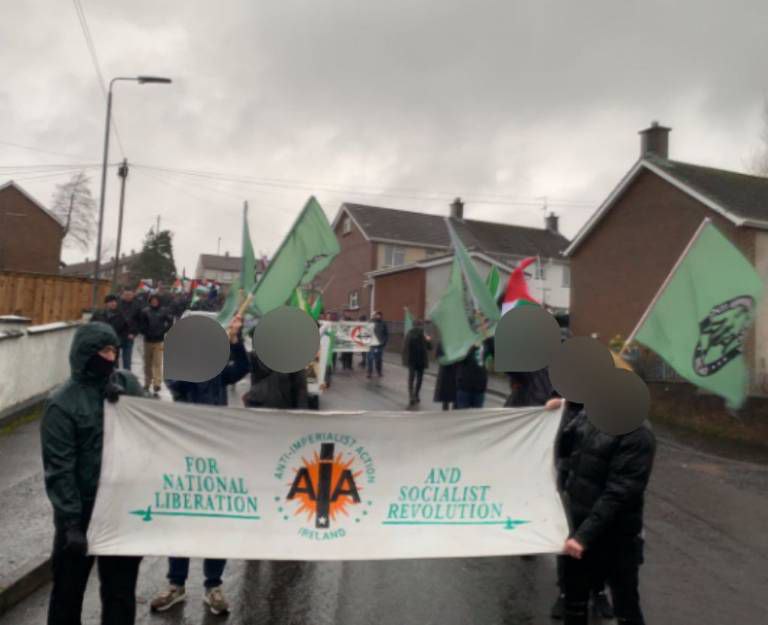
Rear banner of the AIA contingent on the Bloody Sunday commemoration march Sunday. (Photo source: AIA)

For a number of years this commemoration has taken place in heavy rain and high winds, or snow, or sleet but it was dry this year – until the march started! However after a short period of strong gusts driving rain it stopped for the rest of the march.

Down Creggan Road to the Bogside once more and past the Bloody Sunday and H-Block memorials to the rally at Free Derry Corner where Kate Nash, one of the main organisers of the march for years and a sister of one of those murdered in the massacre, welcomed the marchers.

The Bloody Sunday 52nd commemoration march makes it way along Lone Moor Road towards the Brandywell on Sunday afternoon. (Photo: George Sweeney via Derry News.)

RALLY AND SPEAKERS

Nash condemned the punitive EU/ UK/ USA cutting of funds to the UNRWA organisation carrying out relief and educational work in Gaza following an Israeli State intelligence allegation1 and also called for no Irish politicians to attend the annual US Presidential St. Patrick’s Day event.2

Kate Nash’s brother Willie was murdered by the Parachute Regiment during the massacre and her father was wounded by fire while trying to reach his fallen son. Kate called for a minute’s silence for the dead and wounded that day but also for those in Gaza, in particular the children.

Kate Nash also mentioned the Noah Donohoe case as being close to everyone’s heart.

The names of the dead and wounded by the Parachute Regiment were read out by Damian Donaghy,3 son of Damian Donaghy one of the survivors on that day. Paddy Nash performed the civil rights anthem “We Shall Overcome” which was popular among marchers of the time.

Section of the rally to the right as facing Free Derry Corner with a mural based on an iconic photograph from the massacre. (Photo: D.Breatnach)

Kate Nash introduced Huda Ammori, a Manchester-based Palestinian activist and one of the Elbit Eight,4 who said she felt at home in Derry because of the people’s solidarity with Palestine.5 The State in Britain failed to convict all but one of any charges arising out of direct action against the arms company.

Ammori drew parallels between the Irish and Palestinian struggles against colonialism and stated that her grandfather had been assassinated for rising up against the British colonisation of Palestine in 1936, when it was a British “Mandate”.

Mural on a wall in the Bogside, Derry; the words “don Phalaistín” are obscured by a vehicle. (Photo: D.Breatnach)

AIA Short Video with Music Bloody Sunday Derry 2024 AIA Video.MP4 (viewable on FaceBook)

“The British signed away the land of Palestine in 1917,” Amori told the rally, “they colonised our lands and then they armed and trained the Zionist militia to commit a Nakba, to displace over 750,000 Palestinians in 1948, over half the indigenous population.”

Huda Ammori said weapons were used on Palestinians in Gaza and then marketed as ‘battle-tested’. She also praised those who had taken direct action in Derry against arms firms (e.g Raytheon).

Section of crowd gathering in front of the stage for the rally. (Photo: D.Breatnach)

Geraldine Doherty, niece of Gerard Donaghy, youngest of the Bloody Sunday victims, also spoke from the platform, saying it was ‘sad’ but ‘heartwarming’ to see so many people attending the march.

“More than half a century since British troops committed this massacre on these streets, innocent children like my murdered uncle Gerard and hundreds of others as well are still being denied justice”, she said and denounced the British State attempting to prevent the trial of legacy cases being tried.

Doherty spoke of the remaining “trauma for Derry and for Ireland” from which many families have never recovered, with long-term post-traumatic damage such as depression, addiction and divided families.

“But while the people of Derry were battered and imprisoned, we were never broken,” she said to cheers from the rally participants. “Derry has rediscovered its … voice and we are using that voice to oppose the murder of children and women and men, and we stand with the people of Palestine.”

Section of crowd to the left of the stage at the rally. (Photo: D.Breatnach)

ON THE MARCH

Over the years since I returned to Ireland, I have marched in that commemoration many times, either as an individual or as a member of a solidarity committee and this year was glad to be welcomed as part of the Socialist Republican contingent, with Anti-Imperialist Action.

The bloc carried two banners: the one at the front was a new one in which the AIA called for anti-imperialist revolution and socialism, while at the rear the banner celebrated the Palestinian resistance. In between the banners marchers carried flags and placards.

New banner of the AIA in the organisation’s contingent on the march on Sunday. (Photo: D.Breatnach)

In the bloc men and women marched with a flags of the AIA, the Starry Plough, Palestine and Cumann na mBan. From the contingent on many occasions could be heard slogans of solidarity with Palestine and some equally applicable to that nation’s resistance or to Ireland’s.

In the face of occupation – Resistance is an obligation!” and “No justice – No peace!” were in the latter category while “From the River to the Sea – Palestine will be free!”, “Free, free – Palestine!” and “Saoirse don – Phalaistín!” were specifically supporting the Palestinian struggle.

Most Republican organisations and some Irish socialist organisations attend the annual event, along with campaign groups and on occasion solidarity groups from abroad or Irish ones in solidarity with struggles abroad. Sinn Féin no longer attends but some supporters would as individuals.

Giant Palestinian flag displayed below the Derry Walls above the rally below. (Photo: D.Breatnach)

THE MARCH ROUTE AND HISTORY

The Bloody Sunday march covers the same route as the anti-internment march in January 1972 when the British Paratroopers murdered 14 unarmed marchers and injured so many others. Preceded by the Ballymurphy Massacre in August 1971, it was followed by another in Springhill in July ‘72.

The British military claimed that the Derry victims had been armed and fired first and an inquiry tribunal headed by Lord Justice Widgery exonerated the Army and blamed the victims although the Derry Coroner, an ex-British Army officer had called it “sheer unadulterated murder”.

In 1998, presumably as part of the Good Friday Agreement deal, the British State began a new inquiry which however did not deliver a published verdict until 2010,6 stopping short of accusing the Army of murder but exonerating all the victims except one about which it was equivocal.

At that point, Sinn Féin’s Martin McGuinness said that the march should not be continued; however not one British soldier had even been charged, to say nothing of the commanders and Government Ministers who had either given the orders or arranged the cover-up – or both.

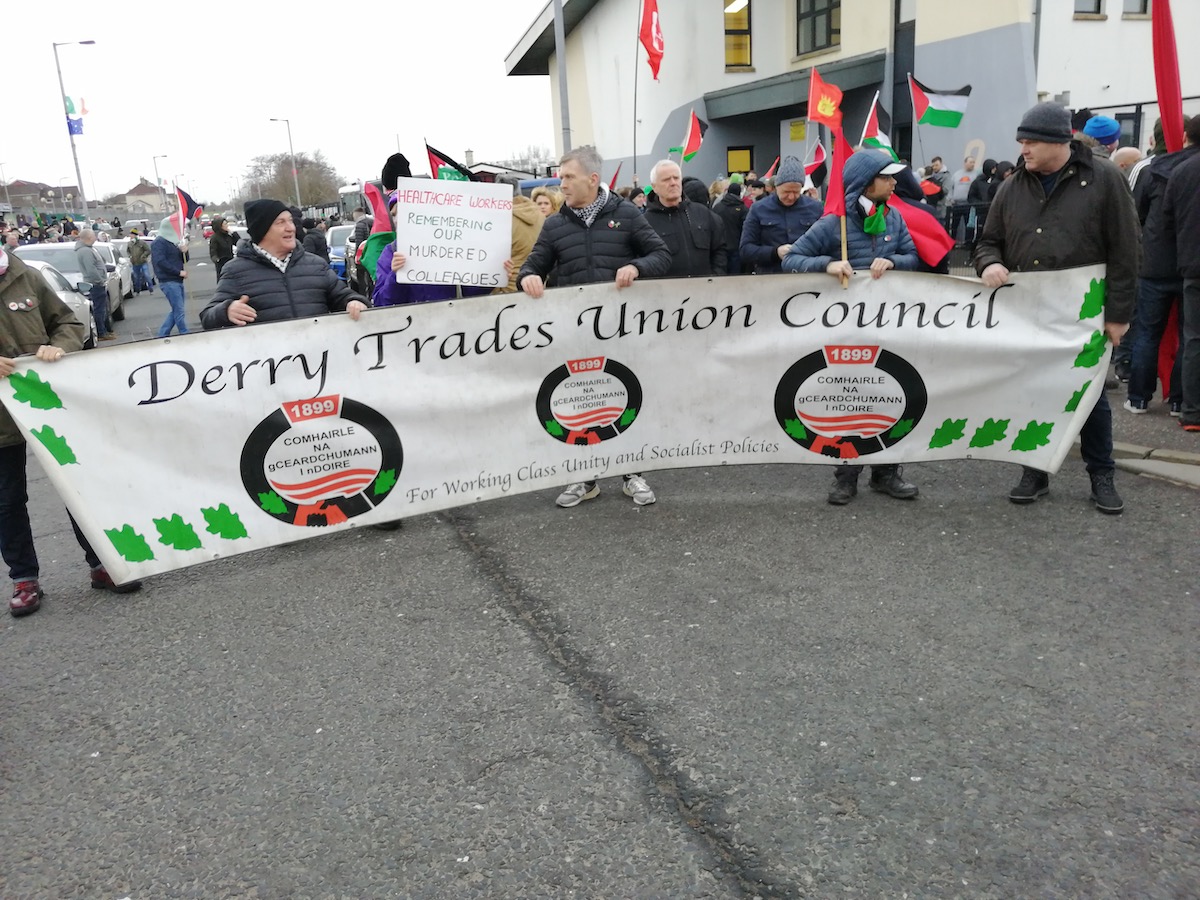
Banner of the organisation combining representation of trade unions in Derry. (Photo: D.Breatnach)

A small group of veterans of the original march and relatives, Kate Nash prominent among them, however decided to keep the march going and have done so every year, often in the face of accusations and disparaging remarks from supporters of Sinn Féin and others.

In 2022, the Massacre’s 50th anniversary, 20,000 marched in it while the Bloody Sunday Trust, an institution and museum supported by the colonial state and Sinn Féin, organised a small “memorial walk” and indoors event in the Guild Hall – the only one reported by the mass media.7

An independent group, badly needed since the Coiste na nIarchimí is controlled by the Provisionals. (Photo: D.Breatnach)
Display below Derry Walls created by the Saoradh Irish Republican organisation, according to their social media. (Photo: D.Breatnach)

Although veterans of the massacre and of the annual commemoration often meet one another only once a year at the commemoration, some having come from abroad, there are always new young people to be seen among them and hundreds come out to watch the march.

The march is an important commemoration of a massacre by British colonialism which still holds the colony of the Six Counties, a reminder no doubt inconvenient to unionists, neo-colonialists and those who have left the struggle, either through lack of will or for personal advancement.

In its championing and giving voice to other conflicts too, the commemoration march and other related events during the week are a strong expression of internationalist solidarity.

Wreath of the Bloody Sunday Commemoration Committee among others at the Bloody Sunday Monument. (Photo source: Bloody Sunday Commemoration Committee)

End.

FOOTNOTES

1The Israeli state intelligence agency reported that 12 out of 13,000 employees of UNRWA in Gaza had been implicated in the 7th October Palestinian raid following which at least some, possibly all, were sacked by UNRWA, apparently without any hearing or appeal process. The US, UK, Germany, Italy followed this up by suspending all funding to the relief organisation catering for 2 million people in dire circumstances. 

2Traditionally, leading politicians of the main Irish political parties, both mainstream and Sinn Féin, have sent representatives to celebrate St. Patrick’s Day with US Presidents, many of whom are of Irish descent. This year a campaign has arisen calling on them not to do so but spokespersons of Fine Gael, Fianna Fáil and Sinn Féin have insisted they will attend, which the SDLP has declared it will not. 

3Not to be confused with the family of Gerard V. Donaghy (20 February 1954 – 30 January 1972), sometimes transcribed as Gerald Donaghey, a native of the Bogside, Derry who was murdered by members of the 1st Battalion, Parachute Regiment on Bloody Sunday.

4Eight activists of British-based Palestine Action, a direct action organisation, who as a result of their actions against the Israeli-based military technology company Elbit in Britain, were charged with a total of 12 charges which included criminal damage, burglary and encouraging criminal damage. The trial, which commenced on November 13th, related to a series of actions taken during the first 6 months of Palestine Action’s existence from July 2020 to January 2021. In December last year, one activist was convicted on one charge by 10-2 majority, two were completely cleared and jury failed to reach a majority verdict on the rest of the charges on six remaining activists.

5That would be true of the majority ‘nationalist’ population of the city but not so much of the unionist minority, where support for Israel is more dominant, due in part to susceptibility to British propaganda and also simply out of sectarian hostility to anything favoured by the ‘nationalist’ community.

6At a cost of nearly £200m (€227.7m), half of which went in legal fees, a lawyer’s bonanza, to arrive at a decision that just about everyone in Ireland knew and many abroad knew already and which established no safeguards against a similar massacre being carried out by British military in future.

7Browser searches throw up report after media report, including Al Jazeera’s, of “hundreds” attending the early event, without a mention of the many THOUSANDS who marched later in the day.

SOURCES

https://www.derryjournal.com/news/people/when-im-in-derry-i-feel-like-i-am-home-palestinian-activist-tells-bloody-sunday-rally-4496030

Elbit Eight trial and verdict: https://www.palestineaction.org/elbit-eight-verdicts/

The Saville Bloody Sunday Inquiry: https://en.wikipedia.org/wiki/Bloody_Sunday_Inquiry

Cost of: https://www.irishexaminer.com/news/arid-30477561.html

THE PRINCIPLES AND PRICE OF UNITY

Diarmuid Breatnach

(Reading time: 5 mins.)

We often hear people talk of the need for unity in progressive and revolutionary movements, which is understandable since the movements are often weakened by divisions – in other words, by disunity.

We may often hear the plaintive cry from someone that “we all want the same thing so why don’t we all just unite”? Clearly the issue is more complicated than it seems at first glance; there are factors working in favour of disunity also.

It is clear that calls for unity alone have not achieved it and much less often do we hear any serious attempt to define the conditions for unity, its principles and the obstacles to overcome, nor at times, the pitfalls in unity for the revolutionary movement, for there are those too. 1

And it does not necessarily mean that if our organisations call for the same thing that what all actually want is the same. We know from experience the widely different meanings that are routinely understood by “democracy”, for example – or even “republic”.

(Image sourced: Internet)

Starting with practice

It has long seemed to me that not only the real test of unity but also its best starting point is in action. That can be in a joint decision to take some specific action (such as a picket or an occupation) or a range of actions but also in joining in an action or actions organised by others.

Not only is action the real test of the expressed desire for action but in the course of action unexpected problems and opportunities arise, posing further questions at the time and for discussion and reflection afterwards.

Practice shines a light on both the conscious intentions and the unconscious reactions to events of activists and organisations.

It is sometimes suggested that what we need is a conference of all those who are in struggle for an objective (or range of objectives), where we can hammer out an agreed statement of aims. I believe that stage should arise after those interested have taken joint action, not before.

For one thing, those who are not really interested in action can attend such a conference and play a disruptive or distracting role in the proceedings. Secondly, those who make great statements of desire for commitment to unity can only be tested in practice, so why not begin with that?

(Image sourced: Internet)

Practical rules

There are certain rules in united action that hardly need discussion but should be understood.

Each component organisation should promote the action either publicly or within close circles as agreed and maintain the agreed confidentiality both before and after the agreed action.

  1. Arrival and departure should be at place and time as agreed.
  2. No distracting event should be planned by any of the component organisations to take place in the vicinity or near the date of the agreed joint action.
  3. The choice of speakers should be agreed beforehand and adhered to.
  4. It is good practice for the action to be reviewed afterwards not only internally but jointly by the participants also, as far as is practicable, to agree on the lessons to be drawn and to be applied.
  5. Publicity before and reports afterwards should list the participating organisations and also mention the presence of independent activists.
  6. Criticism of participating organisations or of individual comrades of such should be taken up with the responsible organisations concerned through private channels before any response is publicised and careful thought given to alternatives and possible consequences of criticism in public.
  7. Revolutionaries should remember and constantly remind themselves that no matter how militant and ideologically correct an organisation may be thought to be, it is not infallible. Furthermore, it does not come at a value above that of the revolutionary and progressive movement.
  8. Consequently, it is not necessarily or always true that what benefits the party or organisation benefits the movement, nor will the reverse always be the case.

Explanation of or expansion on the above:

  1. Late arrival may disrupt the action planned or leave those who arrive on time unnecessarily exposed. On the other hand arrival too early so as to appear in photos or video to be the only ones participating is disrespectful and harmful to unity.
  2. It is not unknown for an organisation to plan its own publicised activity to take place a day or two before that agreed jointly with another organisation, thereby weakening the joint action, a shortsighted promotion of an organisation above the cause of revolutionary unity.
  3. This is often a difficult area in planning joint events as each organisation often wants its own representative speaking or an organisation may want an independent speaker or indeed may have reasons against a nominated speaker. 2
  4. If we do not review the action afterwards we are removing the possibility of learning positive and negative lessons from it.3 On the other hand, if we do not review jointly, we may draw different and even contradictory lessons from the experience.
  5. Listing the participating organisations and the presence of independent activists shares credit, which is good for unity.
  6. Premature publication of criticism will be poison to a united front.
  7. When an organisation takes an incorrect position as is practically unavoidable at some point, or fails to take a correct position that the situation calls for, the existence of those who can criticise it internally and externally is essential for the progress of the revolutionary movement.
  8. However, taking the party or organisation’s health as a measure of that of the movement overall is more likely to benefit the organisation’s leaders than that of the movement, something demonstrated time and again in history.

Possible negative aspects of united fronts

We can take it as read that the courses considered have not only possible positive outcomes (which is why we take them) but also possible negative ones, of which we should be aware and take into consideration, for example with a “Plan B” or with flexibility to adapt to the emerging situation.

  1. A partner organisation may fail to uphold its agreed contribution
  2. Having to consult others outside after internal discussion may delay intended actions
  3. Our plans may be intentionally or unintentionally (through bad security measures) betrayed
  4. An action or statement of a partner organisation may cause us embarrassment
  5. We may be exposed to greater attack by actions not agreed upon taken by a partner organisation or by lack of those upon which we agreed
  6. A part of the united front may attack us publicly or even physically, as has occurred a number of times in history.4
The start of the Irish Civil War/ Counterrevolution: Free State soldiers bombarding Republican stronghold in the Four Courts with British cannon under the orders of Michael Collins, 1922. The Republicans refused unity with the Free State government of a divided country under British dominion. (Image source: Internet)

In Conclusion

The enemies of the people, capitalism, colonialism and imperialism being everywhere strong,5 we need united fronts in order to succeed in overthrowing them. It is important for us to be aware that broad fronts are temporary and that unity is relative, so that we are prepared for eventualities.

For the creation of a broad front there needs to be agreement not only on objectives but also on the practical components, the principles and rules of operation. There may be an overall revolutionary united front but also smaller united fronts on disparate issues.6

Participation in a broad front does not necessarily entail agreement with all the people who are part of that front. We may join in a broad front (for example anti-imperialism) with one organisation that we may not find in another broad front (for example in demand of public housing).

Each component organisation or independent activist of the broad front needs to be able and permitted to retain a certain independence as a matter of democracy but also of diversity of experience in struggle from which we can all learn.

End.

FOOTNOTE

1All trends of the radical and revolutionary Left and a number of Irish Republican sources have written on the question of the formation of the broad front but I have refrained from quoting or listing them since, apart from difficulties of selection, I do not think it appropriate to do so in an article aimed at all elements that may combine in broad fronts. I would advise the reader to do their own research and not to rely on one source or even one tendency.

2The latter was the case for example with Hunger Strike commemorations in London when some political trends wanted a speaker from the Provisionals, which refused to speak at the event if the IRSP also had a speaker scheduled. More than one big planned event collapsed or was not repeated on that issue. Also an independent speaker may outline a position publicly to which a participating organisation may take severe exception.

3This is one of the purposes of exercises, not just the familiarisation of personnel with the practice. In a team in which I worked, the introduction of unannounced fire drills, particularly with an observer following the staff and noting factors, revealed unforeseen serious problems which we were then able to plan to overcome.

4The Communist Party of China had an alliance with the Chinese national movement which broke down twice, the first time resulting in the Shanghai Massacre of between 5,000-10,000 communists and leftists on 12th April 1927. In 1921, after two years of the War of Independence, the alliance of various forces in the Irish national liberation movement fractured and the national bourgeoisie and Catholic Church hierarchy opted for neo-colonial government and partition of Ireland, which in turn in 1922 led to civil war between the new State, supported by the UK, and the Republican forces, which ended in defeat for the latter in 1923.

5Relatively speaking, of course and only so long as they do not face the mobilised masses, resolutely led.

6In Ireland for example these might be for public housing, national independence, against military blocs, for revolutionary history commemoration, promotion of the language, against LGBT discrimination, for trade union democracy and against State restrictions, for urban or rural community planning needs, internationalist solidarity (at the moment particularly with the Palestinians), etc.

SOURCES & FURTHER READING

Breakdown of broad fronts between the Chinese nationalists of the Kuomintang and the Chinese Communist Party: https://www.khanacademy.org/humanities/whp-1750/xcabef9ed3fc7da7b:unit-8-end-of-empire-and-cold-war/xcabef9ed3fc7da7b:8-2-end-of-empire/a/chinese-communist-revolution-beta:

https://en.wikipedia.org/wiki/Shanghai_massacre:

.

CHRISTMAS LIGHTS AND POLITICAL PRISONER SOLIDARITY

Clive Sulish

(Reading time: 4 mins.)

Among Christmas shopping crowds in Dublin’s city centre, the calls for freedom of political prisoners rang out, while the Irish, Palestinian and Basque flags fluttered in the wind among festive lights and projected light-show.

The Ireland Anti-Internment Campaign was holding its annual political prisoner solidarity picket in the busy O’Connell street, supported by socialist Republican groups and independent activists.

View of picket line looking southward. (Photo: Rebel Breeze)

December is a traditional month in Ireland for focus on Republican prisoners. However, the IAIC campaign has always made a point of remembering political prisoners elsewhere too, with Palestinian and Basque flags erected on its regular pickets.

This year the Campaign had especially requested Palestinian flags and these were present, both the national flag and that of the Peoples Front for the Liberation Palestine, fluttering alongside Basque flags and the green-and-gold Starry Plough.1

In addition, one of the IAIC’s banner displayed a large copy of an image depicting a Palestinian’s arm extended through prison bars to grasp the hand of an Irish Republican prisoner’s hand also from nearby bars, from the original by political cartoonist Carlos Latuf,.

A black banner had been rigged with lights to spell “Saoirse”, the Irish word for “freedom” and the picketers set up in a line with other banners and flags facing the GPO building.2

Political prisoners sometimes have their family visits cancelled as a punishment and during the Covid pandemic prevention period it was used as an excuse to prevent Republican prisoners’ family visits. (Photo: Rebel Breeze)

SHOUTS

A speaker using a megaphone informed passers-by that internment without trial had not ceased in Ireland and that Republicans were being charged and then refused bail by non-jury courts on both sides of the British Border, spending two years in jail regardless of their trials’ outcomes.

All the Republican prisoners, the IAIC speaker said, had been convicted in non-jury special courts. Palestinians were also being convicted in special courts, he said, military courts and many were in jail – in “administrative detention”, i.e interned without ever having been convicted or tried.

Over 3,000 had been arrested in Israeli Army raids since October 7th,3 the speaker said through the megaphone, bringing the overall number of Palestinians in jail to over 7,000.4

(Photo: Rebel Breeze)

The recent exchange of prisoners between the Zionist state and the Palestinian resistance had resulted in liberty for 240 Palestinians, of which 1075 were children and 68 women.

There was regular chanting from the picket line including: “From Ireland to Palestine – Free all political prisoners!” “When there is occupation – Resistance is an obligation!” and “Free political prisoners – Free them now!”

At one point some kind of religious procession was briefly enacted in front of the GPO building and an elderly woman in apparent religious garb approached the picketers shouting something at them which they largely ignored, maintaining their solidarity slogans.

(Photo: Rebel Breeze)

In addition to interested people taking photos or filming video of the protest on their devices, some approached the participants to ask questions and to receive a leaflet, after which a number actually joined the protest line for a while (some until the end).

Occasional passing traffic also sounded their horns in solidarity.

The pavement in front of the GPO showing shoppers and people queuing for food distribution. (Photo: Rebel Breeze)

STATEMENT

As the end of the event’s allocated period approached, a representative of the IAIC asked the participants to gather around and spoke about how resistance brings repression and oppression brings resistance, resistance being the “crime” for which political activists are jailed.

The participants were thanked for their support, whether independents or activists of Ireland Anti-Imperialist Action and Saoirse Don Phalaistín organisations.

The event ended with the acapella singing of “The H-Block Song” by Diarmuid Breatnach, in an adaptation of the original air to the lyrics of what is “still a good song” he said, composed by a man who, along with his party, “no longer supported Republican prisoners”.6

(Photo: Rebel Breeze)

The lyrics recall the struggle of Republican prisoners in the late 1970s against the removal of their ‘Special Category’ political status, which began with refusal to wear prisoner uniform. The struggle escalated to the “no-wash protests” and to hunger strikes in 1980 with ten martyrs in 1981.

As the protesters collected their flags and wrapped up their banners, the nature of current Irish society was underlined by the queues forming up across the road for free food being distributed by charitable organisations.

Early view of picketers, looking northward. (Photo: Rebel Breeze)

INDEPENDENT AND OPEN DEMOCRATIC ORGANISATION

The IAIC is “an independent organisation and open democratic organisation” of ten years’ existence and although it has held events for specific cases such as the framed Craigavon Two,7 its main activity has been regular public pickets in Dublin to highlight ongoing internment in Ireland.

The Campaign group encourages participation by democratic people in its regular pickets, regardless of political organisation affiliation or none and, according to one of the organisers, expects to hold its next one in Dublin in January or February.

The IAIC expects also to take part again in the annual Bloody Sunday Commemoration march in Derry on Sunday 29th January 2024.

end.

Unintentionally impressionistic image, photo taken from the east side of O’Connell Street (Photo: Rebel Breeze)

APPENDIX: ANNIVERSARY OF HANGING OF IRISH REPUBLICAN

Though not mentioned in the discourse, the above event took place within days of the anniversary of the British colonial execution of an Irishman in revenge for his killing of an ex-Republican who had turned informer.

James Carey, in the midst of a ‘witness protection program’ provided as a reward for his betrayal of his comrades in giving evidence in court to ensure the jailing of some and hanging of five others, was killed in a gunfight with Pat O’Donnell.

Carey had been a leading member of the National Invincibles’ (a split from the Fenians) cell in Dublin, and had given the signal for the fatal stabbing of British Under-Secretary Burke and Chief Secretary Lord Frederick Cavendish in Phoenix Park on 6th May 1882.

However, Carey turned “Queen’s Evidence” to testify ensuring the conviction of his former colleagues and even gloated in court at their fate. His reward, but for O’Donnell, would have been a new life with pension under an assumed name with wife and children in the South African colony.

O’Donnell was an independent Republican from the Irish-speaking Gweedore area in Donegal but had been to the USA, where he had cousins who were prominent in the “Molly Maguires”, an Irish-led resistance organisation among miners in the USA.

O’Donnell was hanged on 17th December 1883 but is commemorated in the satirical song “Monto” and also in the serious “Ballad of Pat O’Donnell”. His home town of Gweedore also holds a monument in his honour.

end.

FOOTNOTES

1Flag of the Irish Citizen Army, the first workers’ army in the world, founded to protect workers from the police during the Dublin Lockout/ Strike of 1913.

2The General Post Office, iconic building on Dublin’s O’Connell Street, which was the HQ of the leadership of the 1916 Rising, left a shell by fire from British artillery bombardment but rebuilt later.

3https://en.wikipedia.org/wiki/Mass_detentions_in_the_2023_Israel%E2%80%93Hamas_war

4https://www.hrw.org/news/2023/11/29/why-does-israel-have-so-many-palestinians-detention-and-available-swap

575% had not been convicted of any crime https://en.wikipedia.org/wiki/2023_exchange_of_Israeli_hostages_for_Palestinian_prisoners

6Francis Brolly (1938-1920) of Provisional Sinn Féin, composed the song which was released in 1976. PSF abandoned the struggle in the imperialist-promoted pacification process towards the end of the last century and most of their prisoners were released under licence. However those who made public their disagreement with the colonial occupation and the pacification process were on occasion returned to jail while new “dissidents” were charged and refused bail in special no-jury courts, with tacit support of the PSF.

7Quoted from the FB page at https://www.facebook.com/profile.php?id=100063166633467