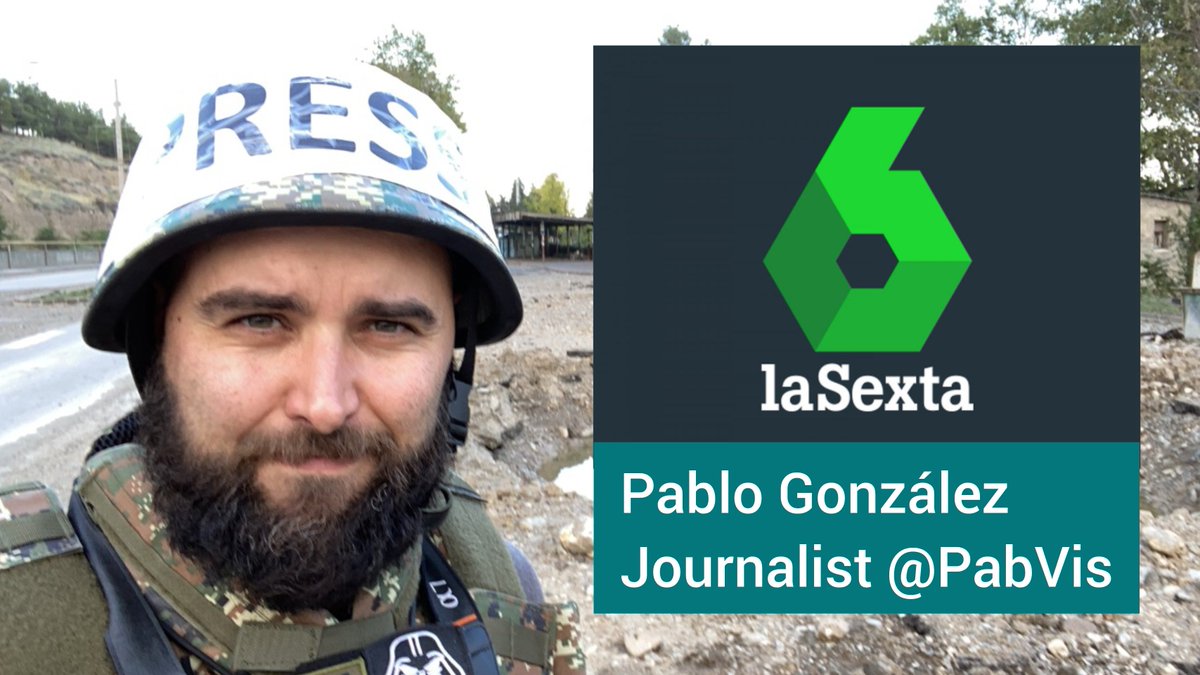
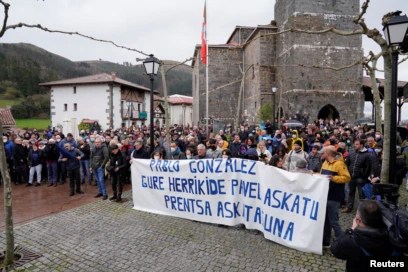
Pablo Gonzalez, a Basque journalist who includes working for Basque and Spanish left-wing media, was covering the war in Ukraine when he was interrogated by the Ukrainian authorities, the Spanish intelligence services approached his family and friends and he was subsequently arrested in Poland on 28th February and charged with spying against Poland. He has been denied access to his lawyer and no evidence has yet been presented to back up the charge but after his four-hour Ukrainian interrogation, Gonzalez reported that he had been accused of spying for Russia on the basis that he had been born in Russia1, that he reported for the mildly left-wing Basque nationalist newspaper GARA (he also reports for Publico.es) and that he had a bank card for a Basque cooperative bank. Journalist defence organisations have expressed concern at the detention.
I am not aware of having seen Gonzalez’s reporting but it may be that his material did not align with the dominant discourse as apparently the International Federation of Journalists reported that González had been accused of being pro-Russian in his coverage for a Spanish newspaper. On the other hand, several of his colleagues say that his reporting has been anti-Putin. Clearly the secret services of at least three pro-NATO countries, Ukraine, Spain and Poland have been in communication regarding Gonzalez. After his interrogation in Ukraine, he had been released but it seems awarned to leave Ukraine. He went to Poland and had been just about to re-enter Ukraine with a group of other reporters when arrested by the Polish authorities. “Legal threats and smear campaigns are a daily menace to outspoken journalists, and journalists covering the migration crisis on the Belarusian border have been detained and harassed,” the Europe representative of the Commitee to Protect Journalists, Atilla Mong told Voice Of America2.
I am no supporter of Pablo Iglesias or of his Podemos party3 but I offer my translation of his piece in Publico.es in the hope that it will a) encourage some to follow the case and perhaps lift their voices for Gonzalez’s release and b) become aware that censorship and misinformation is rampant in the media around this conflict.
On the 14th of this month, the photojournalist Juan Teixeira, a friend of Pablo González, wrote a column in Público entitled “About Pablo González and the diminishing freedom of the press.”4 There he talks about his relationship with Pablo, his work with him in the Ukraine and his arrest. I recommend, in fact, that you read his entire column, but allow me to read you two paragraphs:
It was precisely in one of these connections with Ferreras that everything began to go wrong. Pablo decided to do the direct clip of him with the military in the background, which is always more televisable. From La Sexta they had him waiting for more than 45 minutes under snow and with the soldiers increasingly tense wondering what that bald man was doing standing in front of a mobile on a tripod.
Until the military got tired and invited us to leave, but not before erasing all the material and taking a photo of Pablo’s passport. That same night, he received a call from the SBU (Ukrainian intelligence services), telling him that he should report to their headquarters as soon as possible. Despite the fact that there was work to be done, we returned to Kyiv. There Pablo was interrogated for 4 long hours, and accused of being a Russian agent with such convincing evidence as writing for Gara and having a Caja Laboral Kutxa bank card, according to them both financed by Russia. All so crazy that Pablo didn’t take it too seriously. He thought that they were simply “tightening the nuts” so that he would be more cautious with his words.
Until he found out that at that very moment, CNI5 agents had appeared at his family home, at his mother’s and at that of a childhood friend to question them and inform them that Pablo was a Russian agent.
I’m sorry that Ferreras appears here, the poor man has no fault in this, beyond the time the duplex took6, but it seemed important to me that the arguments of the Ukrainian secret services be known. I find it amazing that being the son of a Russian, writing for Gara and having an account in the Kutxa7 is something that makes you a suspect of being a secret agent of Putin. By this rule of thumb, there would be more evidence that would determine that Minister Albares8 is, on the one hand, an agent of the Vatican (he studied at Deusto, the Jesuits rule there and Pope Francis is a Jesuit, put it all together) and, on the other, he is also Moroccan agent (he lived for a long time in France and is married to a French judge who advises Emmanuel Macron, put it together)… Albares may sympathize with the Jesuits and put forward a pro-Moroccan9 line but it would be delusional to present him as an agent. Well, González is an even more delusional case.
The problem is that the logic of war contaminates everything and it is destroying the quality of the already highly-reviled conventional journalism. At the same time that we hear multi-award-winning journalists like Antonio Papell calling for Russia to be attacked with nuclear bombs or the famous and “progressive” Elisa Beni losing her temper with a professor of international law who committed the terrible crime of saying on the radio that, in geopolitics, values do not operate, we see that a correspondent who provided training and knowledge of the field, is accused of being a secret agent. Crazy.
I can only tell you that here at La Base we are going to continue reporting and analyzing rigorously, dismantling propaganda wherever it comes from and defending the freedom to inform without simplifying the complex and always paying attention to the context. At La Base kapuscinski style: rigor and commitment.
end.
Protest in the Basque Country at Gonzalez’s arrest (Photo credit Reuters)
MY FOOTNOTES
1Gonzalez’s grandparents had sought asylum in the USSR from fascist dictator General Franco and Gonzalez had been born there. His parents split up and his mother took him to the Spanish state when he was seven (as a result of which he is fluent in several languages. He specialises in reporting on Eastern Europe but has been living in the Basque province of Bizkaia town of Nabarniz with his wife, Oihana Goiriena of sixteen years.
3Pablo Iglesias had been leader of the Podemos party and a minister in the Spanish coalition government but resigned and works as a journalist for La Base, a podcast of the Spanish left-wing on-line newspaper Publico.
6I am guessing that Ferreras was the contact for Sexta, the Spanish free-to-air TV channel and that the “duplex” is a reference to the electronic connection when they were trying to broadcast.
8 Albares is the Minister of Foreign Affairs in the current Spanish Government.
9Albares caused outrage recently by proposing that Western Sahara, a former Spanish colony, accept becoming a region of the Kingdom of Morrocco, which has been illegally and violently occupying it for decades.
We are surrounded by propaganda: to favour this or that political and economic system, those products, accept this way of life and to reject that other, to emulate or aspire to be like those people or to reject others …. The propaganda is constant but perhaps most evident in times of conflict: social conflict and wars in particular. We cannot be free of it but we can attempt to navigate it, to reach that fabled destination, the port of Truth.
Political propaganda by Cartoon: Left, Chancellor of the Exchequer Sunak shown as superhero, saving the economy and Right, former Leader of the Opposition Jeremy Corbyn shown as a Russian, suggesting he is a communist. (Images sourced: Internet)
OUR OWN PERSONAL BIAS
Firstly, we need to be aware of our own personal bias. Are we for reasons of culture, position, location or habit likely to incline to one side rather than to the other? Of course, that might be the right (or least bad) side but ….. are we being blinded by our own bias?
Our own personal biases are formed through our familial group, our schooling, training and experiences but some are engendered through the wider society, our culture.
Our cultural bias in the western world and, in particular in the English-speaking one, is towards the USA. We watch films in which the admired characters have UStater accents and even employ UStater turns of phrase and idioms1; their life-styles are recogniseably western. These cultural products cover a range from comedy to thriller or tragedy, their situations varying from urban to rural life, their genres from romance to crime to war to science fiction. In fact, both latter genres tend to present us with war-heroes who not only speak like UStaters but evoke the armed forces of the United States, whether in past real armed conflicts or in imagined ones to come. Earlier Irish generations were familiar with the dramatised plight of European settlers in the western regions of the USA being attacked by Indigenous people, only to be saved by the arrival of the US military – in that genre, the US Cavalry.2
Another major cultural influence on the English-speaking world is the UK and, to a lesser extent3, Australia. Although in Ireland there is a certain residual historical resistance to UK acculturation, some UK cultural products gained a large enough following, particularly the Coronation Street and EastEnders series4.
In comics the characters and often their environments are identifiably Western — usually of the USA5 — and even the popular Asian-based ones tend to have their facial features shaded towards European ones. Many of the electronic games also have a Western cultural bias.
And of course, we speak English. A high proportion of the Irish population is English-monoglot and even among Irish/English bilinguals, either the English is dominant or at least easily-accessible. From childhood to adulthood we see signs in English, hear it on the street, use it daily in most places, read it, are educated and instructed through it, access the Internet through it – in fact, we mostly think in English. All of which makes the pathways for accessing US and UK cultural products easy and our acceptance of the dominant discourse more probable.
Dominant discourse is of course a fact of life, some aspects of which are necessary for our social existence but other aspects of which are laden with unhelpful cultural and even political bias. We need to be alert to those aspects and prepared to investigate and analyse them.
Sometimes it looks like just about everyone is in agreement with a particular opinion and it is also the one that accords with our own inbuilt bias. Now we need to be REALLY careful, because those are two factors working together to put us at our ease on one side of a conflict and making it very difficult for us to even investigate the fact that the dominant discourse, on at least this occasion, might be mistaken. And clearly at times in history widely-accepted views HAVE been wrong – the literal seven-day creation belief, the sun going around the earth, the divine right of monarchs, the unsuitability of women for equality, the unnatural inclination of gay and lesbian people ……
OURSOURCES
In conjunction with being aware of and taking into account our own bias and prejudices, we need to the same with our sources of information, which in industrial and post-industrial cultures – apart from educational establishments — is mostly the mass media: television, newspapers and the Internet (in particular social media).
All the owners of non-State-owned mass media that we access (and that in turn accesses us) are capitalists and not only that but monopoly capitalist. Although he has recently exited his media empire6, this was the situation six years ago: “Denis O’Brien, reputedly Ireland’s richest man, is the largest shareholder in the country’s largest newspaper publisher, Independent News & Media (INM). That company has now agreed a deal to add seven more newspaper titles to its stable by acquiring the Celtic Media Group (CMG). They include the Anglo-Celt in Cavan, the Meath Chronicle and the Connaught Telegraph in Mayo. In all, it extends INM’s footprint to five more counties.
“INM is already the major player at national level. It publishes Ireland’s two largest-selling titles, the Irish Independent and Sunday Independent, plus the Sunday World and the Dublin Herald. It also has 50% of the Irish Daily Star. O’Brien’s other media company, Communicorp, owns Ireland’s two leading commercial radio talk stations: Newstalk and Today FM. In addition, it owns Dublin’s 98FM, SPIN 1038, TXFM and SPIN South West.”7
Media companies in the USA went from 50 1984 only six conglomerates controlling 90% of the United States’s in 2011: GE/Comcast (NBC, Universal), News Corp (Fox News, Wall Street Journal, New York Post), Disney (ABC, ESPN, Pixar), Viacom (MTV, BET, Paramount Pictures), Time Warner (CNN, HBO, Warner Bros.), and CBS (Showtime, NFL.com).8
“Take the UK’s newspaper industry: in a national market of 20 daily and Sunday newspaper titles, just three companies control 90 percent of newspaper circulation. Lord Rothermere’s DMG Media—publishers of the Daily Mail, the Mail on Sunday, the Metro, and the i—accounts for almost 40 percent of all national newspapers sold each week in the UK, while Rupert Murdoch’s News UK and Reach (which publishes the Mirror and Express titles) command one-third and one-fifth of the market, respectively.
“When online readers are included, the same companies control a four-fifths market share among the major newspaper groups, giving these publishers an unparalleled influence for setting the agenda across the rest of the news media.”9
“Most of the social media we use on our laptops, Iphones or tablets is owned by five conglomerates in the USA: Meta Platforms, Inc., doing business as Meta and formerly known as Facebook, Inc., …..is the parent organization of Faecebook, Instragram and WhatsApp among other subsidiaries. Meta is one of the world’s most valuable companies. It is one of the Big Five American companies, alongside Google, Amazon, Apple and Microsoft.”10
It should not surprise us if that media exhibits a strong bias towards capitalism, for example in praising businessmen (capitalists) and businesses (exploitation operations) and in criticising or slanted reporting on strikes (workers’ resistance) or on what they might term ‘terrorism’ (but is often oppressed people’s resistance).
The State-owned media, in the UK the BBC and RTÉ in Ireland, are not of course the property of capitalists, however the states in question are capitalist states. It would be surprising therefore if such media were to take a stance in opposition to that of their state and their dominant classes and, by an large they do not. If, in times of conflict elements within the program-making sections of the State-owned media veer significantly away from the State’s line, official reprimands, cuts in funding, sackings and outright censorship may follow.11
This mass media, as well as being orientated in defence of monopoly capitalism, is also orientated towards the expansion of monopoly capitalism beyond its origins, i.e imperialism. And imperialists have their alliances, by far the largest of which is the North Atlantic Treaty Organisation, or NATO in acronym. That alliance is led by what is still the largest imperialist superpower in the world, the USA.
We may note that the antithesis of capitalism is socialism but a capitalist or imperialist system of one state may be in contention with that of another such state which in fact often happens, even occasionally breaking out in war, as was the case with WWI, when the then-dominant imperialist alliance led by the UK and France was challenged by the weaker one of Germany and Turkey.
And mentioning socialism brings to a consideration of alternative media, including that of the Socialist and Irish Republican movements. Briefly we can note that just because they declare their opposition to the status quo does not mean necessarily a) that they are indeed so opposed, or b) that they have examined and challenged their own bias or c) therefore that their analysis is correct. Indeed both the Irish Socialist and Republican movements have made huge mistakes over the last hundred years or more and, in addition, during the height of the Covid19 pandemic we saw a plethora of misinformation ranging from the fascist and racist to the fantasticaly paranoid from sources opposed to the status quo12.
NAVIGATION
With the preparations and precautions entailed in the above completed, we are ready to sail, to navigate the propaganda ocean on board the MV Investigator. Let us take the stormy propaganda seas around the Ukraine conflict for our voyage.
According to the Russian Government, ethnic Russians were under attack in parts of the Ukraine after a coup overthrew the Ukrainian Government in 2014. Furthermore, it claims that US/NATO supported that coup and, in addition, has been gathering up states to its military alliance to encircle Russia, which it sees as a threat to the existence of the Russian state. In addition, Russia claims the Ukrainian government has fascist elements in its polity including a nazi battalion incorporated into its national military. Therefore it has invaded Ukraine in order to protect its own state and to “de-nazify” the Ukraine.
According to the Ukrainian Government and the USA, along with most Western governments, all of Russia’s claims are lies and just an excuse for it to grab land in the Ukraine, in order to extend its dominion further.
The Western media supports the Ukrainian Government and USA discourse on these issues and, on the rare occasion when it quotes the Russian one, negates it or casts doubt upon it.
So, to the navigation. The first thing is that we cannot trust the Western discourse but on the other hand can we totally discount it? We cannot trust it because it is part of a capitalist and imperialist bloc centred around the USA and NATO. On the other hand, Russia might be lying and the Western media might be correct on this occasion. After all, Russian troops HAVE invaded the sovereign state (something we usually see from the USA or NATO) of Ukraine.
Map showing Nato states in Europe (Image sourced: Internet)
So, let’s investigate! A look at the map will in fact show a large number of states in East Europe that have progressively become part of NATO and Ukraine, which shares a border with Russia, was heading that way, according to even non-Russian analysis.13 And Russia has been complaining about this for years. In addition, the elected neutral Ukrainian government WAS overthrown by a violent coup in 2014, one which was welcomed by western media. And fascists WERE active in that coup and the Azov Battalion IS full of fascists and nazis (even according to US and Canadian government circles along with human rights groups, including in Israel, only a few years ago).
But the Russian regime anti-fascist? That is something else. Far-Right groups including openly Nazi ones have proliferated across Russia since the collapse of the USSR and there is little evidence that the Russian regime has been trying to eliminate them. De-nazification should start in your own territory first, right?
So a reasonable conclusion on the available evidence is that Putin’s statement about de-nazification is mere propaganda for international and domestic consumption but his real and primary motive for the invasion is the security of Russia and the withdrawal of NATO from its borders.
Might there be an element of acquiring some more Ukrainian territory and stragic locations there? Of course there might. So how to test that? What about if NATO agrees to withdraw, Ukraine declares its neutrality but demands withdrawal from its recently-conquered territory? Russia would have to comply or to expose its supposed territorial ambitions.
However, NATO is currently refusing to withdraw from Russia’s borders and the Western media is supporting it ideologically as well as pouring arms into Ukraine; NATO denies Russia’s declared motivation but declines to put it to the test.
Mentioning “land-grabbing” also raises the issues of the Crimea, Donetsk and Luhansk regions. Those regions had a high proportion of ethnic Russians — the Crimea in particular nearly totally Russian-speaking — and according to numerous sources, came under attack from Ukrainian nationalist forces from 2014. The Western media says that Russia “annexed” the Crimea; however Crimea had an autonomous parliament and voted to secede from the Ukraine – it was not overthrown in a violent coup as was the neutral Ukrainian one. Subsequently Crimea asked for Russian protection from attack by the Ukrainian military (including in particular those Azov fascist fighters). Donetsk and Luhansk regions also asked for protection, according to the Russians while, according to the West, they were also annexed by Russia.
Ethnic map of the region (however not including Gypsies, Jews and Poles). The brown peninsula bottom centre is the Crimea; two top right regions are Donestk and Luhansk. (Image sourced: Internet)
CONTINUING THE NAVIGATION
Those are the fundamental points to think about during the conflict but we will be presented with reports of “kidnapping” of thousands of civilians by the Russians from the battle-zones on the one hand, with the “rescue” of thousands by the Ukrainian military on the other. Of course, any war impacts severely upon civilians in the war zones, as we have seen in conflicts from Vietnam to ireland to the Balkans, from Palestine to Yemen. What is happening in the Ukraine is a war, with bullets and missiles being fired by both sides and, furthermore, most of the fighting is taking place in and around heavily-populated areas. But are civilians and civilian buildings really being targeted by the Russians? They may or may not be but certainly the damage and casualties would be much higher if, as a matter of course, that were the case. Are civilians being used as hostages and shields by the Ukrainian military as some have alleged? They may be but it is difficult to prove or disprove that when the battle is taking place in an urban area.
We have to seek the actual causes of the war, rather than its features, to seek a workable and hopefully long-lasting solution.
WHAT ABOUT CENSORSHIP?
The fact is that all sides are practicing censorship. While the western media was quick to tell us that Russia had banned the BBC’s news service, it took a bit of searching to find out that had occurred after the UK banned RT, the Russian broadcasting service. We now learn that China has also banned Facebook and the BBC – the latter perhaps in response to the banning of RT but Facebook perhaps for lifting its ban and Tier 1 classification14 of Azov, the neo-nazi fighters incorporated into the Ukrainian military.
Currently, as an example of Western censorship, the Oliver Stone documentary Ukraine On Fire (2016) has been taken down off Youtube and according to users, rarely lasts more than a day if posted up anew.
And Naom Chomsky, veteran US-based anti-imperialist, who would normally be widely quoted in the Socialist media, is hardly ever heard or seen. Oh, he’s talking and writing alright but his discourse does not match the dominant one in the West — nor currently in the Western Left — and therefore he is excluded from their media.
Naom Chomsky, linguist and critic of imperialism often quoted by the Western Left but mostly silenced by them during the Ukrainian conflict. (Photo sourced: Internet)
CAN WE MOVE, PROCEED, ACT?
Obviously we cannot proceed through life in a permanent doubt – that would paralyse us, make us incapable of movement in any direction. We must come to a decision, at least for the time being, to allow us to act. But while we proceed on the basis of our certainties or at least assumptions, we need to be able to keep a part of our mind alert, questioning, challenging and – at some point – ready to dissent from the ideological environment in which we find ourselves and ready to consider taking a different – even oppositional – opinion and path.
This is the way we can navigate through the sea and storms of propaganda to a the desired landing on Truth. However, we need to remember that “truth” is an approximation, that it changes shape and what was true yesterday may not be true tomorrow. It is a floating land, not necessarily where it was when last charted, even when the most recent cartographers were not dishonest. Nevertheless, we are required to act, to act in the real world and therefore must reject paralysis. We find the nearest we can to the truth, test it and act upon it – but ready to amend our understanding if necessary.
We set sail.
End.
Chart for navigating the Propaganda Seas (Image: D.Breatnach)
FOOTNOTES
1The interjection of irrelevant “like” in conversations (e.g “I was like just leaving …”), the grammatically incorrect “I’m good” response to query-greetings, ‘hip’ interjections such as “dude” and even the “OK” for positive confirmation (in our lexicon since the 1950s), have all reached us from the USA.
2That film trope has led to a popular saying regarding last-minute deliveration, probably even employed by people who are unaware of its origin: “Saved by the Cavalry”. Of course, the Indigenous, who are having their lands stolen, their way of life and other parts of their culture destroyed and their resistance massacred, never have a last-minute salvation, neither in fiction nor in reality.
3Though we still hear “No worries” in reassurance, a phrase introduced by Australian soap-operas such as “Neighbours” screened on UK television channels in the 1980s and ‘90s.
4These two in particular propagated a very biased view of working class and lower-middle class people in Britain. The Coronation Street (note the monarchical tone of even the title) series, based on the Salford area near Birmingham, despite being an area settled by successive waves of migrants such as Irish (Engels even referred to them in his 1845 Condition of the Working Class in England), Caribbean and South Asian, did not include characters of migrant background for decades and it was not until 2019 that it introduced its first Black family characters. When the British soaps first provided characters of Irish background, both Coronation Street and EastEnders produced negative types without positive Irish characters to balance them.
5In the 1950s, ‘60s and ‘70s the majority of the comics bought in Ireland were English, from the younger age-orientated Dandy, Beano to the older-orientated range of Bunty, Judy and June for girls and, for boys, Eagle,Hotspur, Victor and the exclusively military Commando and War Picture Library series along with the Amazing Fantasy series. The US contributed super-hero series Marvel Comics and a range of both cartoon and realistic characters in Dell Comics. There was no competition from any Irish-focused publisher (nor is there yet to any real degree).
12It is also worth noting that censorship, misrepresentation of different views and verbal abuse towards those who challenge the views of the alternative media make using them to arrive at the truth more than problematic and this has been nowhere more evident than in the coverage and discussion of the conflict in Ukraine.
13In fact we can see a similar US-led encirclement of Russia in the Middle East too.
14 A classification that included ISIS and bars users from engaging in “praise, support, or representation” of blacklisted entities across the company’s platforms.
“Wars and rumours of wars …”1 The sabres are rattling around Eastern Europe. The mass media in our latitudes largely takes the position of the USA under the guise of democracy; however with some text and the use of a few maps I hope to show that Russia’s position is essentially defensive in this regard and that the USA is the main aggressor. I hope to do that without expressing any support for the Russian regime.
WHAT IS ACTUALLY HAPPENING?
The USA sees Russia as its main opponent or competitor in Europe and has been working since the post-WWII decades to neutralise it, earlier under the guise of stopping the spread of “communism” and defending “democracy”. Since the fall of the USSR system the talk is no longer about defeating “communism” but “defending democracy” continues to used in anti-Russian rhetoric. Russia is no democracy but the notion that the US, the world superpower, the biggest imperialist power on the planet since WWII, cares about democracy should make us laugh. It would perhaps, except that the mass media keeps feeding us the USA’s rhetoric and shaping us to support it in war.
The USA is actually squeezing Russia from two directions — from Europe and from the Middle East. NATO, the North Atlantic Treaty Organisation is a US-led military alliance which now has the membership of most states in the EU, along with the UK and nearly every state of the former USSR to the west of Russia. A look at the map of NATO states will demonstrate that2. Nearly every state in the Middle East is also formally or informally in the sphere of influence of US imperialism3.
“Russia says it wants Western guarantees that Nato will not allow Ukraine and other former Soviet countries to join as members. Moscow has also demanded the alliance halt weapons deployments to Ukraine and roll back its forces from eastern Europe – demands flatly rejected by the West.4”
Map NATO & non-NATO countries in Europe, showing also periodic expansion (Source: The Economist)
So the Russian ruling class is naturally worried and feeling besieged. On or near their European borders they only have Sweden, Finland, Moldova, Belarus and Ukraine which are not formally part of NATO and Ukraine has clearly indicated an interest in that direction. Beyond those last three aforementioned, all the states through central Europe are NATO members right through to the UK: Poland, Slovakia, Hungary and Romania actually bordering on Russia, with – heading generally westward and south-westward– Czech Republic, Croatia, Slovenia, Bulgaria, Albania, Greece, Germany, Netherlands, Belgium, Italy, Spain, Portugal, France and UK. In addition, some of those states have highly-developed military power such as Germany and two of them have nuclear armament of their own — UK and France – while the US has ready-to-launch nuclear missiles on the lands of many of the NATO states — Belgium, Germany, Italy, the Netherlands and Turkey5.
Sweden, Austria and Switzerland may remain nominally neutral but are in general politically aligned with the EU and the USA rather than with Russia, while non-NATO Finland is definitely, for historical and geographical reasons, extremely wary of its Russian neighbour.
The smaller non-NATO states of the former Yugoslavia – Bosnia & Herzegovina, Serbia, Montenegro, Montenegro and Kosovo are in some cases friendly towards Russia (or not overly-friendly towards NATO) but they are completely surrounded by NATO states.
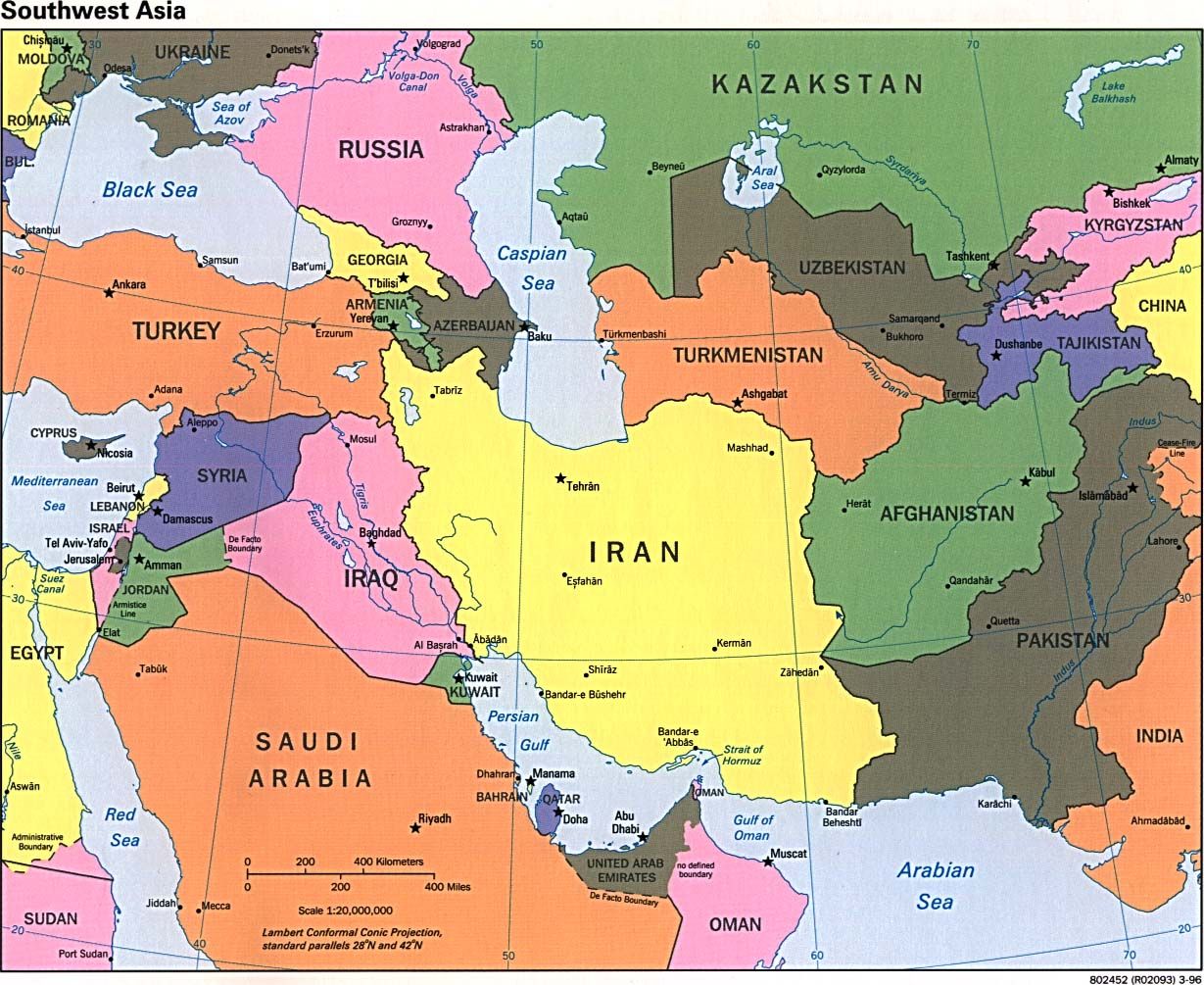
On its borders with the Middle East, Russia is also being squeezed. Turkey has long been a major NATO state in the region and only Georgia is located between it an Russia to the latter’s south-west, with Armenia and Azerbaijan to its south-east. Nearly all of the states in the Middle East are in formal or informal alliance with the West and therefore with the US: Cyprus, Lebanon, Iraq, Israel, Jordan, Egypt, Sudan, Libya, Saudi Arabia, Kuwait, Oman, Bahrain, Qatar and United Arab Emirates. Yemen is embroiled in its own Saudi and West-proxy war, while Syria is threatened by Israel, Turkey and NATO. Only Iran is fairly safe for the moment on that part of Russia’s border, which is why Russia will take its side in any conflict with the West, despite the Russian ruling class’ dislike of and vulnerability in some regions, as in Chechnya, to militant fundamentalist Islam.
Middle East states and Russia (Source: Internet)
Syria is next to Iran which is also why Russia has been supporting the Assad regime and why, during the past week, it has warned Israel about its bombing raids into Syria as the latter attacks Hizbollah bases there. In fact we may see the invasions by western alliances of Iraq and Libya as part of huge US/NATO ‘domino’ plan to attack Syria with Iran next; then the pressure on Azerbaijan and Georgia on Russia’s doorstep. While on the eastern side of Iran, Afghanistan and Pakistan are also allies of the West ….
Further east, there is India which has long been friendly to Russia and in tussles with Pakistan — and China, which is not openly hostile to Russia as a rule but which is not a real friend either, though its competition and contention with the US keeps it friendly enough towards Russia for the moment.
What the Russian ruling class is doing is attempting to bring a halt to its encirclement by NATO at the point of Ukraine. And the US-NATO and EU are issuing a counter-threat – an open one of sanctions and a more veiled one, in the case of US-NATO, of armed action.
This week it appears that some parts of Ukraine have sought to break away from the main part, probably instigated by Russia or at least promised support if they did – which has materialised in Russian diplomatic recognition and in troop movements. This may amount to an annexation or may not but what is clear is that Russia, in the face of what it considers a threat to its existence and NATO intransigence, has decided to take some decisive action.
WHAT IS REPORTED
The western mass media reports the situation painting a picture of big powerful Russia threatening its much smaller neighbour, by threat of invasion seeking to force it into submission to Russia’s regime, in denial of the small nation’s democratic rights. And the democratic West, through NATO, is moving troops to support the Ukraine, warning Russia of consequences.
Russian Tanks and Troops Reportedly entering part of Ukraine (Photo source: The Telegraph)
The picture contains much truth but overall it is a lie. Russia is much bigger than the Ukraine and it is threatening it with troop movements. And NATO is moving troops up to counter-threaten. But to evaluate a situation properly, we need to know its antecedents, what led up to it. We also need to see the situation through the eyes of the participants, whether we agree with them or not. The mass media, apart from a couple of honest analysts tucked away inside a newspaper, far from the headlines, does not supply us with that information.
The Irish Times, one of Ireland’s main daily newspapers, on 12 February reported that “Russia’s military build-up near Ukraine and a surge of Russia’s military activity has fueled fears that Russia could invade the country. Russia denies having any such plans. However a US official has said that the US had picked up intelligence that Russia is looking at Wednesday as a target date for an incursion.”
So on the basis of the quoted paragraph, we were to draw the conclusion that Russia was threatening to invade Ukraine. OK, Russia denied it but then why the military buildup near Ukraine? Finally, the authority voice of the USA, quoting what we are supposed to see as excellent intelligence sources (which we cannot of course question), predicting a probable Russian invasion four days away. So which state are most people in this part of the world likely to believe, the Russians or the US?
Some weeks earlier, on 25th January, another Irish daily newspaper, the Examiner, reported on reactions to a Russian naval fleet exercise in the Atlantic. The Irish Government told the Russians the exercise was not welcome although not illegal6, because the area of the exercise is regarded as international waters. This from the same government that facilitates US military flights via Shannon airport, i.e on its own national territory. And NATO carries out at least one major exercise in European waters annualy, with the UK doing so twice yearly without complaint from the Irish Government.7
The Ukrainian Ambassador to Ireland, Ms Gerasko moved to take advantage of the situation “A plan to hold a major exercise by the Russian navy and air force in the Atlantic off the southwest coast of Ireland is yet another demonstration of the threat that Russia poses for the world,” she said, in a statement to the Irish Examiner.” 8
Attempts were made at the same time to whip up Irish offshore fishermen against the Russians and to whip up the Irish public in defence of “our fishermen”. The latter project failed miserably since the Russian Ambassador to Ireland met and negotiated with the fishermen, leading one of their leaders to comment that the Russians had treated his members better than their own (Irish) government.
We might expect an alternative discourse about the Ukraine crisis from Al Jazeera but its report on the 24th of January, although emphasising US military movements in the area, attached a number of articles which were generally relaying the western line. The Irish Independent carried a much more in-depth explanation, though based on the position of the UK through its premier, Boris Johnson; however it did list the Russian demand that NATO cease pushing towards them and that Russia considered Ukraine joining NATO “an existential threat” while in general still following the general anti-Russian pattern9.
Closing ceremony of Sea Breeze, NATO-Ukraine joint naval exercises in the Black Sea 12 July 2019 (Photo by US Naval Officer)
POSITION OF THE IRISH STATE
An analysis piece in its business section by the Irish State’s national broadcaster, RTÉ, concentrated on the possible economic impact of loss or drastic reduction in gas and oil exports from Russia, either as a direct consequence of conflict or through imposition of sanctions by the West. “Russia produces 11% of global oil supplies and according to David Horgan, managing director of Petrel Resources, any significant loss of Russian energy exports would result in a further spike in prices.”10
Russia is the biggest supplier of gas in the world and the largest to Europe with a third of of its gas pipeline supply to Europe crossing Ukraine. Ireland’s electricity supply is highly dependent on gas for its generating stations so any disruption will impact heavily of prices which “have already gone from $2 to about $30 per million BTU”, according to the Petrel managing director.11
It is clear that while the USA is driving the agenda through its dominance of NATO and the the threat of sanctions on Russia, which the USA regularly insists upon when teaching other countries a lesson, its own economy would suffer little as a result. However, it is a different question for the European states, which would be obliged to bear the weight of economic impact. Mícheál Martin, the Taoiseach (Prime Minister) of the Irish State felt obliged to comment on this possibility but, rather than criticise the USA and NATO’s expansionism, spoke about the need to break from their dependence on Russian energy supplies.
Micheál Martin said the EU is unified in responding “very strongly” to any Russian invasion of Ukraine and stated that in Europe’s view the huge build-up of troops by Russia on the Ukraine border is “not justifiable” in any circumstances. While calling for “diplomacy and de-escalation” he clearly sided with the USA in the conflict as both the Irish ruling class and the EU’s would expect of him.12
Despite many criticisms to the contrary, the policy of the Irish state during WWII was essentially one of neutrality in favour of the Allied forces while the government of the Six Counties was of course wholly aligned with the UK. Nevertheless Irish commercial shipping was sunk by Nazi German action and cost many Irish seamen their lives.
So far the Irish state has remained outside NATO but over the past decade there has been discussion envisaging the creation of an EU rapid deployment force made up of personnel contributed from all member states. It would hardly be surprising if such a move appealed to some within the career personnel in the Irish armed forces, envisaging taking part in wider military action, alongside varied forces, employing advanced weapons and systems and with possibly better promotion prospects. Additionally in recent weeks there has been media discussion of greater funding for those forces.
Ireland – and not only the UK’s colony here – can be dragged into war more easily than we perhaps imagine and also into being targeted for retaliatory action. Indeed, the facilitation of US military personnel and materiel through Ireland’s airport at Shannon, along with CIA transport of secret prisoners (“rendition”) has already exposed the State (and succeeding governments) to accusations of military partisanship.
Contrary to popular belief, the Irish State’s ‘neutrality’ is in general a matter of government policy rather than a requirement of the Constitution or Statute law.13
The principal statute governing the Irish Defence Forces is the Defence Act 1954, which did not oblige members of the Irish Army to serve outside the state (members of the Air Corps and Naval Service are not so excused). A 1960 amendment intended to allow deployment in United Nations Peacekeeping missions requires three forms of authorisation, since the 1990s often described as the “triple lock”:
A UN Security Council Resolution or UN General Assembly Resolution;
A formal decision by the Irish government;
Approval by a resolution of Dáil Éireann (the lower house of the Oireachtas, to which the government is responsible).
From those last two it is clear that the 26 Counties can be put on a war footing by a decision of the Irish Government or even a majority vote in favour in the Dáil. Anyone who believes that the party with most TDs would necessarily vote against such a motion is fooling themselves since the SF party has been at pains to portray itself as a safe pair of hands for Irish capitalism and recently called for greater funding for the armed forces of the Irish state; in addition it has long had an uncritically friendly relationship with the USA, in particular – though not only – with its Democratic Party.
A resolution from the UN Security Council obliging the Irish state to go to war against Russia is impossible and though such from the General Council might be possible, albeit unlikely.14
These provisions were modified in 1993 to allow for UN Chapter VII missions and again in 2006 to allow for regionally organised UN missions.
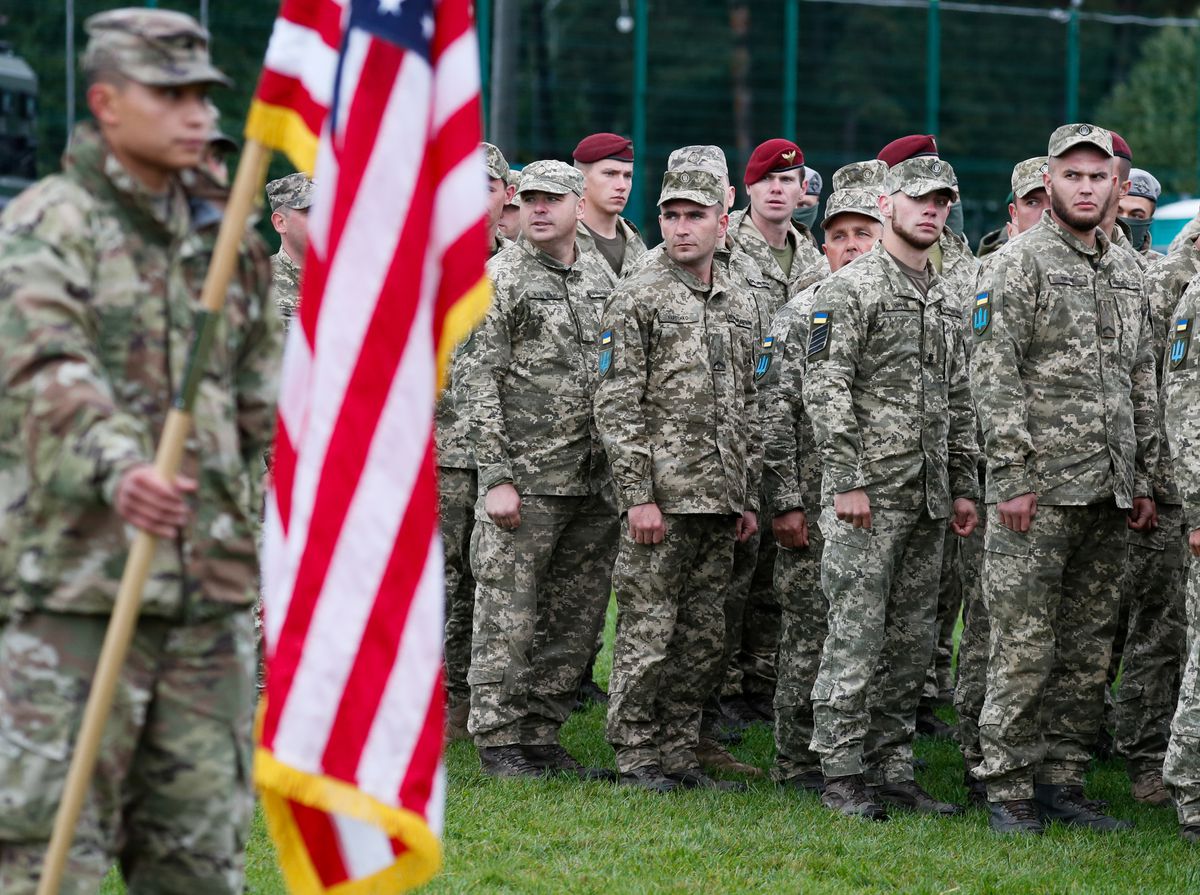
Joint NATO-Ukraine military exercise September 2021 (Photo sourced: Internet)
WHAT WE CAN DO
There seems no middle way — either NATO will back down or Russia will. No doubt the Western powers think it reasonable that Russia be the one to blink but as commented earlier, for the latter NATO creep to their borders is seen as a threat to their very existence. The same people who thought it reasonable for John Kennedy as President of the US to threaten war on the Soviet Union for the location of some missiles on the Caribbean island of Cuba think Russia should accept the advance of NATO to its borders.
In practical terms there seems little we can do in Ireland except struggle to resist the state and colony in which we live being dragged into war – for which we need to mobilise the opposition we can on the street. Sadly the anti-imperialist war movement in Ireland of years ago was allowed to deteriorate — but we should work to rebuild it.
In order to assist in this it is essential that we expose the reality of what is going on in the world. Some will say that because the USA is the main aggressor in this case and the biggest bully, we should support Russia but to do so would be a big mistake. Not long ago, while joining others in anti-fascist solidarity with people in the Donbas region in SE Ukraine, I found us being increasingly nudged towards support for Russia which I did not view as being the same thing at all.
Russia has its own crimes against people and workers and calling for support for it now will cause confusion when in future we will need to condemn it. Our position should be that while neither the USA’s regime or Russia’s is to be supported, the biggest danger of war comes from the USA and therefore it will be the main target of our hostility – besides which it is the power with which the ruling classes of Ireland and the UK are aligned. It is the biggest imperialist power in the world by far along with being the biggest military power in most of the world.
Most Irish people have no wish to be dragged into an armed conflict anywhere where they do not feel threatened. On the other hand our society is conditioned not only by decades of strong cultural influences from the USA, in particular through film but also by media reporting that is biased towards the dominant western European view and that of the USA. In that paradigm, the Russians are the bad guys, the gunfighters in the black hats, while the US and the West in general are on the side of the angels.
With the 1916 Rising in the middle of WWI, Ireland became the first country to carry out an uprising against world war15, against the dominant trend throughout Europe at the time — a tradition worth upholding. As long as imperialism exists, the world will continue to suffer smaller wars and the danger of another major war. It is necessary to overthrow imperialism and we can best contribute towards that aim by coordinating our struggles with the aim of carrying out a revolution in Ireland, thereby depriving imperialism of one of its supporters in Europe.
End.
FOOTNOTES 1“And you will begin to hear of wars and rumors of wars. Behold, do not be alarmed; for it is necessary to take place, but the end is not yet” — Christian New Testament Bible, Matthew, Chapter 24:6.
14Resolutions of the UN Security Council, the only ones binding on all member states, require unanimous agreement by all five Permanent Members: UK, France, USA, Russia and China. Forcing a vote such as this in the UN General Assembly would likely lead to the fracture of the organisation.
15The following year there were two in Russia and in 1918 another in Germany.
In the midst the protests in Colombia the press can be heard denouncing the vandals and various politicians from the left and right have echoed these criticisms in one way or another. The headlines speak of the destruction of private property and in some cases they try to mark a distinction between what they say is legitimate protest and vandalism.
The word “vandal”, means someone who commits acts pertaining to savage and destructive people and is who destroys a public asset or installation. Other definitions speak of destroying or damaging what is beautiful. It should be said that the Transmilenio mass transport system stations are not one bit beautiful. But should the youths be ashamed or proud of being called vandals?
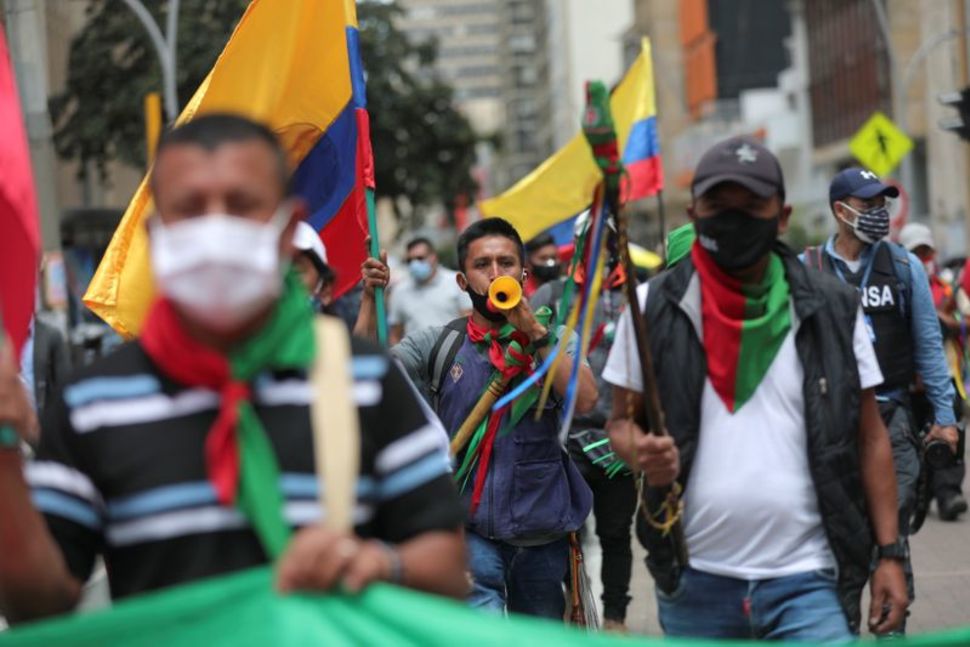
Resisters in Colombian city of Madrid shelter behind makeshift shields as they are bombarded with water canon in May 2021 (Photocrdt. Juan Pablo Pino, AFP/Getty)
We should look at the origin of the word. The first vandals were Germanic tribes that in 455 A.D. attacked and sacked Rome carrying away great riches and also destroying buildings, amongst them the Temple of Jupiter, though there is some dispute about the severity of the destruction of the city. However, they went down in history as the vandals who destroyed that city. The more modern use of the person who destroys public assets or private property or damages what is beautiful dates from the middle ages and its use is widespread nowadays.
Of course when Vicky Dávila and other right wing journalists speak of vandals they are not talking about Germanic tribes, or at least that is what we believe, though with Vicky even drug traffickers, paramilitaries and corrupt politicians are decent folk, so one is never sure about the meaning of the words that fall from her lips like the Police stun grenades.
“The Police rape and murder” (Photo: G.O.L)
But words and their meanings are not set in stone. Some words enter a language and in short time fall into disuse, others last for centuries and some come back to life when least we expect like when Kim Jong-un’s translator used the word “Dotard” to describe Trump. That word hadn’t seen the light of day since the US Civil War in the 19th Century. Other words simply change their meaning, sometimes slowly and on other occasions they do so more abruptly.
The press has used this word so often to describe and disparage the social protests that we may be witnesses to another change in meaning. The bourgeois press has emptied the word of any meaning and now in the marches people can be seen with placards that say Vandal’s Honour and in social media there are memes doing the rounds on the subject. One of them says “The country turned upside down and this one says, what are you and I? Well, vandals my love.” They used the word so often to describe any act of rebellion, nonconformity or to and try and shut down and discredit the demonstrators that it has lost its power, its meaning. Now it is a badge of honour for many. Vandal no longer means a savage destructive person but rather a person who fights to be heard, for justice. A vandal is whoever fights against Duque, neoliberalism and poverty.
The word is changing its connotation and once again it is closer to its original meaning, a tribe that defied an Empire, although in this case the Colombian emperor seems more like the Emperor Nero (54-68 A.D.) who played on his Lyre whilst Rome burned than the poor Petronius Maximus who only lasted a few weeks in power. Duque doesn’t play the Lyre but rather the Guitar, but there he is and Nero’s regime was one of extravagance, waste and tyranny and Nero in the middle of it all playing on his Lyre.
The sacking of Rome in 455 A.D. was the third sacking that the city suffered. There were a further five sackings after the Vandals. It should be remembered that the Vandals sacked the capital of a decadent Empire that deserved to be extinguished.
Burnt out bank from 2006 (G.O.L)
So as the meme puts it, ask the question, what are you and I? And answer:
We are Vandals my love, we damage the hated system of mass transport built with public funds legally stolen to set up a private transport business which to top it all takes 94% of the profits of a business and barely contributes a penny to its own maintenance.
We are Vandals my love, we destroy banks that receive more subsidies from the state than the poor who are denied loans by these banks, which don’t hesitate for a single moment to confiscate the houses of the poor.
We are Vandals my love, who in the face of the lives and censorship of the bourgeois press make our smothered voices reverberate on the walls of the city. Who needs Twitter when you even the poorest can see the walls?
We are Vandals my love, who in the face of the attacks by the Police throw rocks at them that are found all about the place in the poorly built public infrastructural projects, in a country where the thieves don’t know how to build a pavement and where half the bricks are badly placed.
We are Vandals my love, we fight against a decadent government and system.
We are Vandals my love, and our favourite letter is V:
V for Vengeance on the rich that kill us, rob us and lie to us.
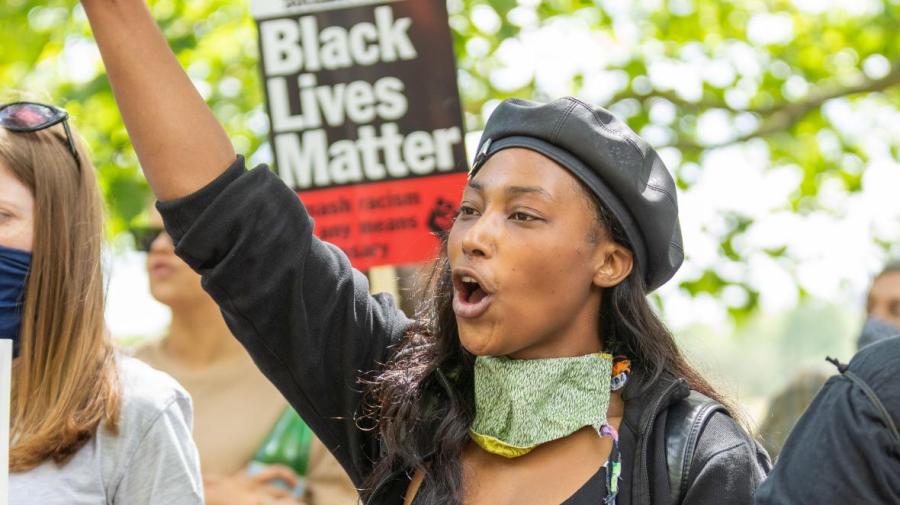
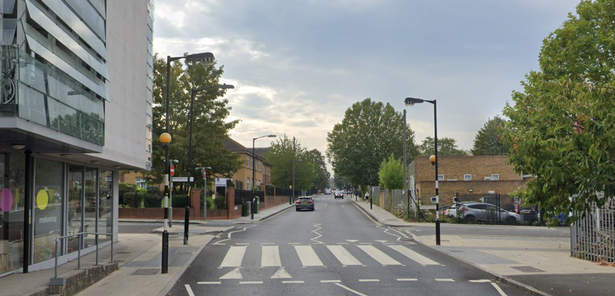
In the early hours of May 23rd, according to reports, four men gained uninvited access to a social event in Consort Road, a residential street in the Peckham area in SE London’s Borough of Southwark. One of them fired one shot from a gun and the bullet struck prominent BLM activist Sacha Johnson in the head. She remains in critical condition in hospital. There are unresolved questions about this incident and about the subsequent actions and statement by the London Metropolitan Police.
Sasha Johnson and others in London recently protesting about racism and inequality (Photo sourced: Internet)
THE AREA
Peckham is mostly a residential and shopping area in a SE London suburb, in a mix of predominantly pre-war terraced housing and post-war blocks of flats. It is well off the London Underground network but served by an overground train station and bus depot with a number of bus routes traversing it. There is a medium-sized park area called Peckham Rye and a branch of the canal network ran through a part of Peckham but no longer does so (filled in during the time I lived there). I lived in Peckham on two different occasions during my decades working in England (nearly all of which were spent based in SE London) in one period of which my daughter was born. I was politically active there and for a time worked not far away from Peckham variously in furniture removal, factories and in a number of foundries.
Consort Road, Peckham, SE London, where the shooting took place (Photo sourced: Internet)
Peckham and many nearby areas of SE London are mixed ethnically having been settled by successive waves of Irish migrants, Afro-Caribbeans, then some South Asians, followed by Africans. Throughout its history there have been frequent conflicts between people living there and the police and also between communities and fascist organisations.
Irish Socialist and Republican activist and journalist Jim Connell wrote a draft of the Red Flag in 1989 on a train journey from London Bridge to his home in the SE London Borough of Lewisham, a 15-minute bicycle ride from Peckham. During the 1926 General Strike a scab tram was overturned in nearby Camberwell by strikers and a policeman reputedly pushed down a manhole. Clashes occurred between Mosley’s Blackshirts and antifascists, with one of the big battles of the 1930s taking place in Long Lane, at the further limits of SE London, approaching the Thames river.
Much nearer to Peckham, after WW2, Blackshirts attempting to set up public speaking in East Street outdoor market (“East Lane” as it was known locally) were attacked by antifascists and clashes occurred there again in the 1970s between antifascists and the National Front. The early post-War migrants from the Caribbean in New Cross, very close on the other side of Peckham, had frequent clashes with racists and with the police. In the 1970s clashes occurred often in New Cross and nearby Deptford between antifascists and the National Front, while not far away again was the scene of the famous 1977 Battle of Lewisham, in which antifascists denied the National Front passage through and fought also, in particular, the London Metropolitan Police.
During the 1970s, ‘80s and ‘90s there were public meetings organised in various parts of SE London in solidarity with Irish struggles and with Irish political prisoners, including the framed prisoners such as the Birmingham Six. There are predominantly Irish pubs dotted throughout the whole area and weekly traditional music sessions have been held in some of them, while New Cross had an Irish dance hall and Lewisham still has an Irish community centre, founded by a local branch of the Irish in Britain Representation Group. Individuals from the Irish community were active in trade union and left-wing activism and in particular in antifascism.
QUESTIONS
There are a number of questions arising out of the Metropolitan Police investigation into the shooting of Sasha Johnson and their public statement.
The Met said they did not believe Sasha Johnson was the target. In a statement made before even an arrest of suspects, this would seem to be at least premature. It would also be a substantially suspect coincidence for the only firearm discharge to hit Johnson and, in addition, in the head.
Sasha Johnson supporters say she had received death threats and another activist, interviewed by an ABC reporter (see video in CNN link) on a demonstration a few weeks before the shooting, said that she had received a number of threats. However the Met statement said Sasha Johnson had not received credible death threats. What is “a credible death threat”? Antifascists and left-wing activists all over the world regularly receive death threats and, in Ireland, the targets would include Irish Republicans. Some of those threats have been carried out historically and fascists have gone on shooting or bombing sprees against ethnic and LGBT minorities, often after issuing threats on social media, without police prevention.
The TTIP statement (see Sources) said that according to their information the Met had not carried out house-to-house enquiries in the area of the shooting.
The arrest of five individuals and their charging with conspiracy to murder (two) and affray and attempted murder (all five), along with drug possession with intent to supply etc would serve to support an narrative of black-on-black crime related to drugs supplying. But how does that narrative fit with an invasion of a social event and the shooting in the head of a prominent black lives matter activist?
If the Met maintains that Johnson was not the intended target, how can they charge someone with conspiracy to murder her (unless they allege that some other person was the intended victim, which they have not said)?
And if the shooting of Sasha Johnson was by black individuals and she was the target, does that raise the possibility of politically-motivated action through proxies, as has occurred a number of times in the USA (and in the Six Counties of Ireland)?
HISTORICAL USA CONTEXT
Regarding the last question above, the TTIP has reached nowhere near the political impact where it seems likely the UK State would arrange such an action — but it remains a possibility.
In the USA the city and state police departments have a history of surveillance and repression of Black militant organisations and at times their actions have been more extreme. In 1985 Philadelphia police in an operation approved by its black Mayor, bombed the radical black MOVE organisation with a C4 explosive satchel from a helicopter, resulting in the deaths of 11 people including five children, aged 7 to 13. The police bombing and subsequent fire destroyed 61 homes and made 250 Philadelphia residents homeless.
The Federal State itself, in particular through the FBI, set out to infiltrate the left-wing Black Panthers and Black nationalist organisations with agents not only for surveillance but also to cause dissension and feuds.
The FBI also with direct homicidal intent targeted militant black activists as in the case of Fred Hampton, a prominent Black Panther activist and public speaker: in December 1969, (Fred) Hampton was drugged, shot and killed in his bed during a predawn raid at his Chicago apartment by a tactical unit of the Cook County State’s Attorney’s Office in conjunction with the Chicago Police Department and the FBI. Law enforcement sprayed more than 90 gunshots throughout the apartment; the occupants fired once. (Wikipedia). Though incredibly a Cook County Coroners’ Court ruled his killing and that of another victim to be “justifiable homicide”, a civil suit on behalf of nine plaintiffs was settled in 1982 with a payment of $1.85 million, the City of Chicago, Cook County and the Federal Government each paying one-third.
In addition the FBI monitored the activities of the Nation of Islam organisation of Black muslims in the USA and, through its agents in the organisation was well aware of hostilities towards Malcolm X, who had left the organisation. As Malcolm X began to develop a thesis that black people in the USA needed to unite with oppressed people of any colour anywhere, he was assassinated by gunmen of the Black Muslims with FBI collusion (if not outright organisation) on 21st February 1965.
Martin Luther King Jnr. was a world-famous black civil rights campaigner. However in later years he also sought to unite the concerns of poor whites with the cause of black civil rights and also opposed the USA’s War in Vietnam. The FBI and the State itself (through Robert F. Kennedy, the former Attorney General) were recruiting agents in his movement and electronically bugging his hotel rooms during campaigns. King was murdered by a sniper’s bullet on April 4th 1968 and the white man arrested who confessed to the murder, James Earl Ray, later recanted and alleged his solicitors had advised him to plead guilty. King’s family supported Ray in seeking a retrial and clearly suspected the US State of having arranged the killing but Ray died before any such retrial took place.
IN CONCLUSION
The London Metropolitan Police have a long history of racism towards Irish and Black people, which was known long before the Stephen Lawrence murder case but officially admitted regarding black people in the McPherson report into the Met’s handling of that murder investigation. There had long been complaints of discriminatory policing and racial profiling, harassment of Irish and Black people in police stop-and-question actions and house raids and there were also incidents where the Met had killed black and Irish people during arrests (many deaths also in police station custody).
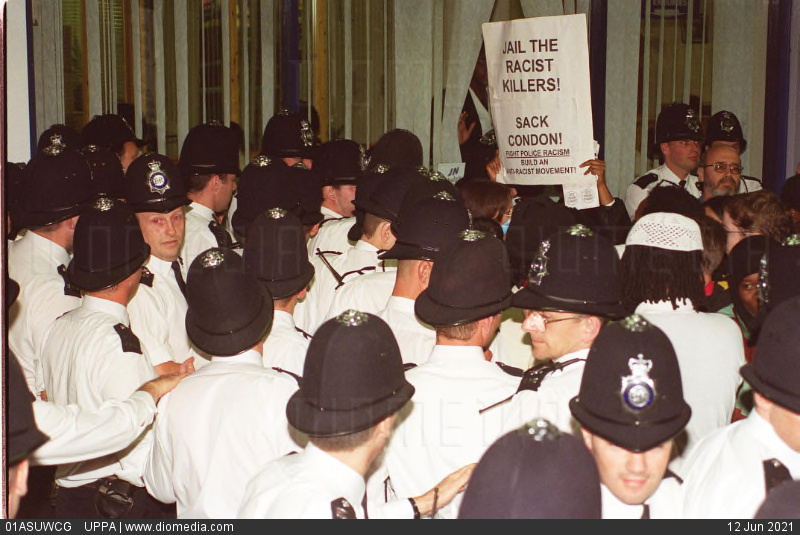
Stephen Lawrence Murder Inquiry in 1998 was attended by protesters against the handling of the case by the Metropolitan Police. Sir Paul Condon, named on the placard, was knighted 1994, Commissioner of the Met 1993-2000 and was made a life peer in 2001, Baron Condon. (Photo credit: Diomedia)
In addition, the Met have a long history of collusion with fascist organisations, from Sir Oswald Moseley’s “Blackshirt” (British Union of Fascists) to the more recent National Front, British Movement and others. In just one event in 1936, over 7,000 Met officers, including all their mounted police, attempted to force a Blackshirt march through a part of East London where there was a high occupation rate of East European migrant Jewish people. The result was a pitched battle against a defensive mobilisation of ethnic Jews and Irish, along with communists and anarchists. The fascists did not get through but most of the fighting was actually with the police.
The Mangrove restaurant in Notting Hill, West London, opened in 1968 serving Caribbean cuisine and became a meeting place for black activists and intellectuals. It was frequently raided by the Metropolitan police. In 1970 the community organised a protest march to the local police station and violence broke out between police and the protesters, after which the Met charged nine activists with inciting a riot. The trial of the Mangrove Nine lasted 55 days, included a number of challenges to court, exposed the racism of the police and ended in the acquittal of all nine on the more serious charges.
In 1974, an attempt to disrupt a National Front meeting in London ended with many antifascists injured by the Met and Kevin Gately, a student from Leeds of Irish background clubbed to death by police. In a successful large-scale mobilisation to prevent a fascist invasion by the National Front of the SE London Lewisham town centre in 1977, an area of relatively high Afro-Caribbean ethnic settlement (also of significant Irish), the main battles were with Met who were determined to bring the fascists through. In another defensive mobilisation in 1979 in the West London town centre of Southall, an area of high South Asian settlement, Australian antifascist Blair Peach, working in London was also killed by Met police baton.
We do not need to jump to conspiracy assassination attempt theories but we should keep an open mind in this case, consider the possibilities and question the Metropolitan Police handling of the case and their public statements. We also need to treat media handling with suspicion, particularly their non-critical acceptance of Metropolitan Police statements and even suggestions of “drive-by shooting” in US gang-banger tradition.
And to wish the victim a full and timely recovery.
End.
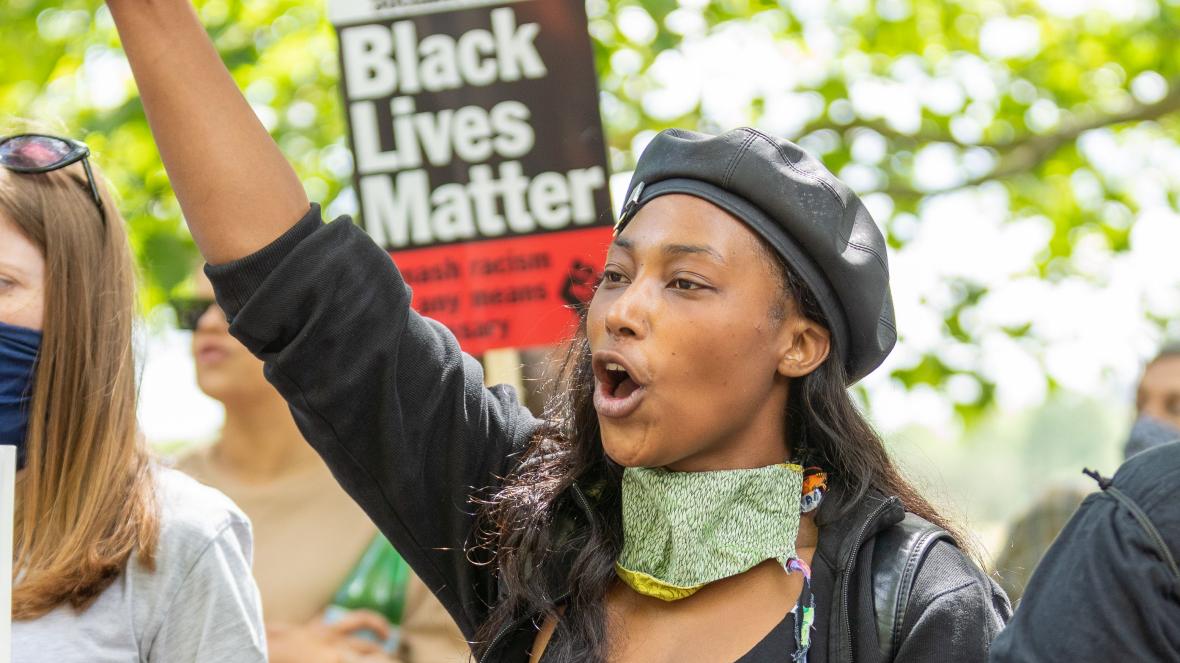
Sasha Johnson on a recent protest March in London (Credit photo: Times UK)
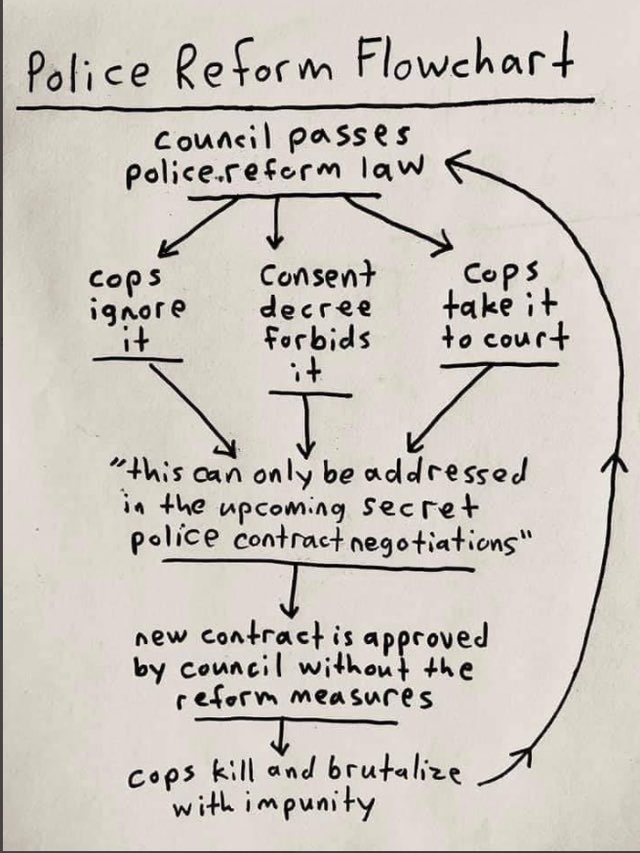
“20-year old Daunte Wright was killed on April 11th, 2021 in Brooklyn Center, a suburb of Minneapolis, Minnesota by a cop (26 year veteran) who allegedly mistook their own gun for a taser. On March 3rd, 2021, Daisha Smalls’ 1 year old child was shot in the head by cops in Houston, Texas while they were chasing a robbery suspect. On March 29th, 13 year old Adam Toledo was shot and killed in Chicago after being chased down by a cop. The Atlanta, Georgia mass shooter who targeted Asian women in massage parlours was said to have “had a bad day” in a statement from Captain Jay Baker, a cop with a history of anti-Asian social media posts. Capitol police were caught taking pictures with domestic terrorists and QAnon fuckwits (oh sorry… “protestors”) in January as they stormed the Capitol Building to protest Biden’s inevitable presidency. These are just some examples from 2021.”
According to Mapping Police Violence, 319 people have been killed by police in the USA alone since January 1st, 2021. Hell, there were only 18 days in 2020 when cops didn’t kill somebody. Lots of people aren’t going home to their families, their spouses, or their friends because of run-ins with the “thin blue line” and we’re supposed to accept it. We’ve been conditioned to believe that cops are always making the best call and actively keeping communities safe from bad guys and miscreants. Anyone who dies at their hands probably had a good reason to be shot, tased, beaten, or otherwise neglected. “They should have complied” we hear. “They shouldn’t have run” they argue. “Just be polite” they claim again and again.
Image with thanks from Order & Anarchy (see link for article)
The oppression of the Palestinians led to an outbreak of active resistance recently in Jerusalem, to which the Israeli Army reacted with increased repression, timed to harass Palestinian Muslims during the period of Ramadan.
At the height of devotees attending the Al-Aqsa mosque, this escalated into attacks on worshippers within the temple itself. At the same time, Israeli Zionist settlers threatened dozens of Palestinian families with eviction from their homes in East Jerusalem.
Reacting to these events, one of the Palestinian organisations fired home-made rockets into officially Israeli territory, to which the Israeli armed forces responded in turn with drone missiles and missiles from its air force jets on Gaza.
The Zionist military fired on protesting Palestinians in the West Bank with live ammunition. The death toll has climbed to 200 Palestinians, according to Gaza’s Health Ministry, including 59 children and 35 women, with 1,305 people wounded. Ten Israelis have been killed, two of them children.
The casualty figures once again show the gross disproportion between what the Palestinians and their Zionist masters experience: in civil and human rights, citizenship, in land ownership, electricity and clean water supply, heating, fishing, education facilities, building materials …
… in freedom to travel inside and outside the state, in depth and breadth of surveillance, in arms and defence capability, in states that support them.
And in city structural damage: despite the many home-made rockets launched against the zionists, there has yet been no significant damage in Israeli towns, while their armed forces have effected large-scale structural damage in Gaza and bodies are still being pulled from the rubble.
In only one area perhaps do the Palestinians have the advantage over the Israeli Zionists: in support among the people around the world.
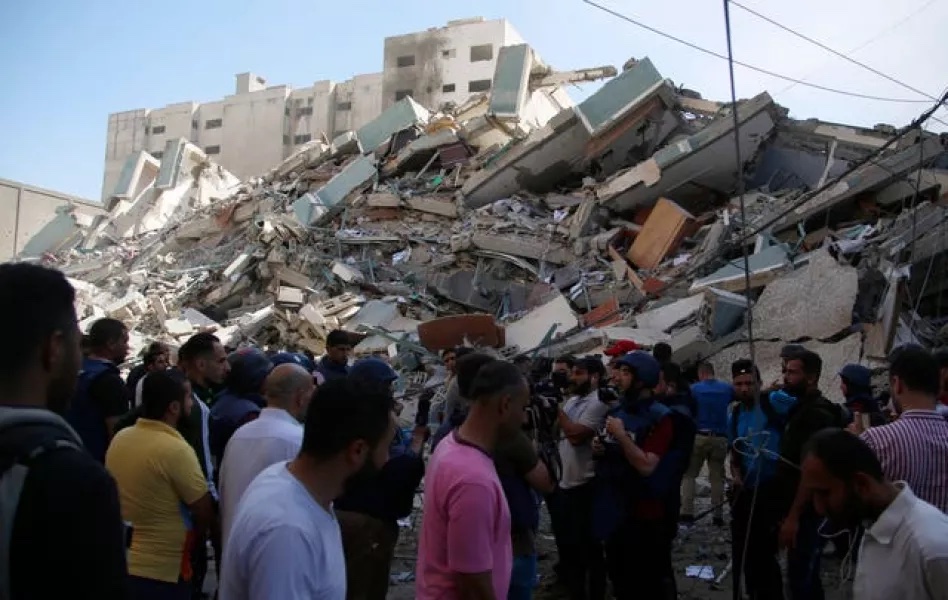
Israeli Zionist missiles strike the tower housing many media services, including Associated Press and Al Jazeera, which drew broad criticism from the mass media for a change. But families also lived here. Everyone was given ten minutes to get out. The Israeli Occupation Force has not yet bothered to explain its rationale for targeting this building. (Photo source: Internet)
PALESTINIAN SOLIDARITY MARCH DEFIES POLICE THREATS
Responding to these attacks on Palestinians, the Ireland Palestine Solidarity Campaign, the main organiser of Palestinian solidarity action in Ireland, called for solidarity demonstrations and in particular advertised a solidarity rally to take place in Dublin’s city centre for 2pm on Saturday 15th May.
The organisation asked those in attendance to comply with measures against Covid19 infection, to wear masks, maintain social distancing and comply with stewards’ instructions.
However the IPSC was contacted by the Irish police force, the Gardaí, who told them not to go ahead with the event, that if they did they would intervene to stop it and also made threats of €5,000 fines and prison against the organisers.
In a later public statement the Gardaí declared that they “have no role in permitting or authorising marches or gatherings. There is no permit/ authorisation required for such events”!
But there is apparently an ability and power to intimidate and threaten progressive organisations to deter them from organising solidarity events.
Or to kettle socialist and socialist republican Mayday marchers and demand all their names, addresses and dates of birth before threatening them with arrest if they did not disperse.
Or to threaten Debenham workers and their supporters, assaulting some of them while escorting KPMG forces in to evaluate stocks during pandemic restrictions.
A Palestinian policeman stands among the rubble of the tower in Gaza recently occupied by families and media agencies. (Photo source: Internet)
The predicament of the IPSC exposed the vulnerability to this kind of intimidation of a broad organisation that seeks to win friends in ruling circles. The leaders and organisers are placed in a position of not only personal but also of organisational vulnerability.
Even should they be prepared to defy the State to fine and/or imprison them, would they also be prepared to damage their organisation or to lose some friends they are cultivating in the circles of political influence?
What was one of the strengths of a broad organisation thus becomes a weakness; a more radical or even revolutionary organisation, with less influence in influential circles can decide on defiance, risk fines and jail with however perhaps less possibility of influencing official opinion and ultimately, action.
Fortunately in this case one such organisation did step forward and took up the baton: the Trinity College BDS group expressed its solidarity with the IPSC on its treatment by the Gardaí and called their own rally for the exact same place and time as the original one called by the IPSC.
Video of rally at end of demonstration, near Israeli Embassy
Despite concern over Covid19 transmission and Garda threats – and the extremely short notice and much smaller circle of contacts of the TC BDS group — the response was magnificent, both in internationalist solidarity and in maintenance of the right to organise such progressive events.
Before the appointed hour, people began to gather in large numbers at the Spire in O’Connell Street, Dublin’s main street and north city centre.
After being addressed by a number of speakers, they set off in a march towards the Israeli Zionist Embassy near Ballsbridge, beyond the south city centre. As they marched their numbers grew until, approaching the Embassy, they numbered several thousand.
Along the way, bystanders applauded the marchers and passing vehicles blew their horns in solidarity.
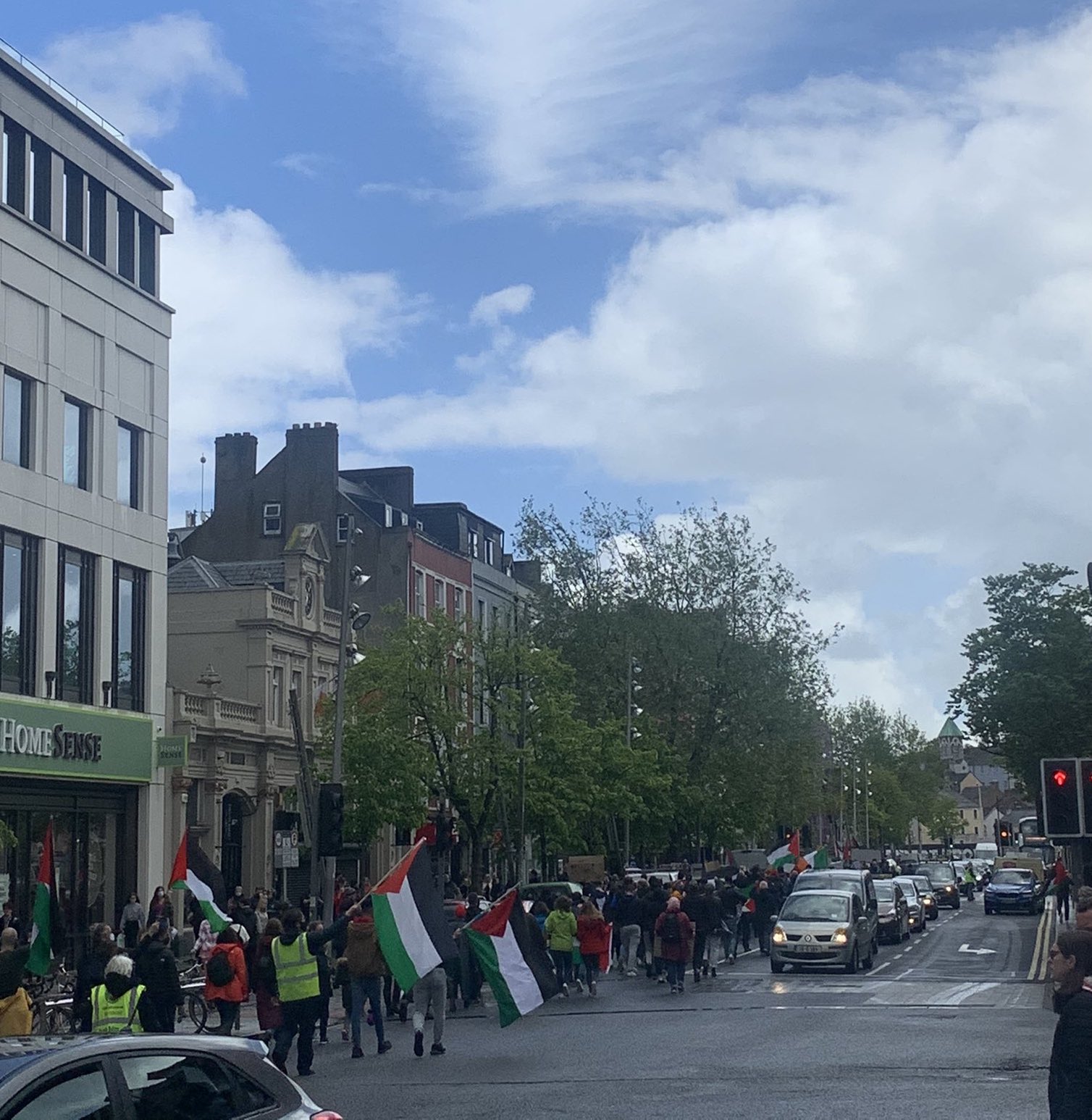
A section of the Dublin rally in solidarity with Palestine photographed outside the GPO in the city’s main street before they set off on the 5.5km march to the Israeli Embassy (Photo credit: PA, Breaking News)
Marchers shouted slogans of solidarity with the Palestinians, calling for the freedom of Palestine and the expulsion of the Israeli Ambassador as a mark of the Irish people’s objection to what is being done to the Palestinians.
Near the Embassy, a number of speakers addressed the crowd and after dispersing, a number of demonstrators boarding public transport to return home were congratulated by the drivers.
LESSONS FOR US
The situation regarding calling and holding the demonstration in Dublin outlined some of the weaknesses of a broad organisation when it faces repression from the State and the greater resilience of a smaller organisation in being able to defy the State.
It may be necessary in future to maintain support for both types of organisation, each being appropriate for particular situations.
Also demonstrated was the necessity to openly defy unjust laws and prohibitions at times and particularly around the right to organise, to protest and to show solidarity, which the demonstrators did so well on Saturday.
Such situations also reveal the difficulty for the Gardaí in carrying out repressive actions and they are reduced to threatening individuals.
THE FAR-RIGHT MARCHES TOO – FOR WHAT?
Meanwhile, a couple of hundred of the far-Right also marched in Dublin, allegedly in defence of civil liberty. Not in solidarity with the Palestinians’ civil liberties and not in defence of our civil liberty to organise to show solidarity with people in other struggles.
No, they marched in defence of the right to defy health protection regulations, in proclaiming the Covid19 pandemic to be a) a hoax or b) greatly exaggerated and in claiming that wearing masks damages one’s health and even intelligence(!).
They were insisting that vaccinations are a) dangerous to one’s health or b) means of injecting nano-machines into people’s bloodstream in order to control them.
A clip posted by Ireland Against Fascism showed one of the QAnon Saturday screechers for months outside the GPO, Dolores Webster, aka Dee Wall, lately self-declared “digital journalist” (don’t laugh) posting her reactionary propaganda.
In apparent total ignorance of the actual reality (but when has that mattered?), she broadcasted a claim by video from her studio (her car), accompanied by the strains of Abba from the headphones of her head-bobbing passenger.
She claimed that the “scum in the Dawl” had allowed the Palestinian solidarity march to go ahead to distract from the alleged general removal of freedom and in particular from the far-Right group Irish Yellow Vests to hold their rally on May 1st!
When all the Covid19 precautionary restrictions are removed, what will these elements have to march about? The will need to return to the topics that engaged many of them in the recent past: racism, anti-immigrants, islamophobia, homophobia and anti-socialism, along with their false patriotism.
None of that is welcome of course but at least it will be without this false concern for “civil rights and freedom” and closer to the reality of what the far-Right in general – and fascists in particular — stand for.
SUPERPOWER BACKING AND IMPUNITY
The current atrocities of the Zionist State, which it carries out with impunity, along with its history, starkly reveals the effect of its main backing power, the USA, and the imperialist alliance dominated by that Power.
The USA backs Israel with military aid to the tune of $10 Million daily, which is aside from other direct and indirect aid. Israel is the only state in the Middle East which is not only very friendly to the USA but totally dependent on the support of that superpower.
For the ruling class of the USA, Israel is the only state in the Middle East which is totally safe forever from fundamentalist Muslim revolution or from left-wing anti-imperialist revolution and is therefore an extremely important factor in the USA’s plans to totally dominate the Middle East.
Solidarity marcher in Dublin on Friday with a home-made placard (Photo Credit: PA, Breaking News.ie)
This imperialist alliance finds reflection not only in the action/ inaction of governments in Europe, for example but also in the reporting of the mass media.
One of the latter’s tropes is the constant emphasis on the numbers of Palestinian missiles fired, without revealing their general ineffectiveness in delivering destruction, in total contrast to the Israeli missiles. Another is their constant repetition of a lie, that “Hamas seized power in Gaza”.
The truth is that Hamas swept the board in the 2006 elections for the Palestinian Authority. The “seizing” that was done was by Al Fatah, which usurped the results in the West Bank and installed themselves there; they tried to do the same in Gaza and, in a short fierce struggle, were beaten.
But the Western powers decided that Hamas was illegitimately in power, seized funds due to it and supported its blockading – by both Israel and Egypt.
No explanation is offered in the general mass media as to how a generally politically-secular Palestinian public would turn from its decades of allegiance to Fatah to vote for the fundamentalist Muslim Hamas.
The main reason was Fatah’s surrender of the goals of Palestinian independence and freedom and the return of the refugees, in exchange for running a colonial administration with opportunities for living off bribery and corruption and Fatah’s settling down to that status quo.
CASTING A GIANT DARK SHADOW
It was not only in Dublin and in towns across Ireland that Palestine solidarity demonstrations were held on May 15th but by people across much of the world, generally in opposition to the wishes of their governments and ruling elites.
It is worth thinking about how this has come about, in particular in contradiction to a mass media hostile to the Palestinians.
Palestinians come to view the remains of the tower block that was home to families and that housed a number of media agencies. (Photo source: Internet)
The Zionist state of Israel was declared in 1948, its anniversary actually only three days ago – May 14th, the first states to recognise it being the USA and the USSR. In Ireland at the time, there was general support for the new state which continued to the “June War” of 1967 and somewhat beyond.
The general Irish population were horrified by the history of the Nazi-organised Holocaust and sympathised with the Jewish survivors.
Irish nationalists and even Republicans empathised with the Zionist civil and armed struggle against the British (who, ironically, had begun the process of Zionisisation of Palestine).
The 1966 film Cast a Giant Shadow purporting to show that struggle, starring Kirk Douglas and a cameo appearance by Frank Sinatra, was widely enjoyed and cheered in cinemas across Ireland.
Though some of the film’s characters were based on real-life counterparts, the general narrative was a grotesque distortion, hiding the massacres of Palestinians and the expulsion of thousands as the Zionist state was created.
Many Irish language supporters admired how the new state had brought the Hebrew language, for centuries only spoken in religious contexts, back into everyday usage.
Solidarity marcher in Dublin on Friday with a home-made placard and a thought-provoking message (Photo Credit: Sam Boal, The Journal)
Yet, by a few years ago, general pro-Palestinian sympathy across Ireland had become so strong that Israel’s Ambassador to Ireland declared the country “the most anti-semitic in Europe”. That of course is the Zionists term for anyone who supports the Palestinians or criticises the Israeli state harshly.
Only a few days ago, the current Ambassador accused some politicians of spewing hate towards Israel. He was responding not only to Left and Sinn Féin TDs who criticised the actions of Israel towards the Palestinians, but also to the Tánaiste (Deputy Prime Minister equivalent) Leo Varadkar!
Varadkar had commented that Israel’s actions are “indefensible” and Government Minister for Foreign Affairs Simon Coveney said at an EU conference that the EU had “fallen short” and failed to project its influence in agreeing a position in against illegal activity by the Israelis against Palestinians.
Palestinian solidarity march in Cork on Saturday (Photo source: Internet)
The fact that establishment right-wing/ conservative politicians feel obliged to take a public stand, however ineffectively, against actions of the Israeli Zionists is a strong indication of how much Irish public opinion has changed over decades.
Implicitly such stands reflect against the Zionists’ biggest international backer and world superpower, the USA. Since the Cast a Giant Shadow film, the state’s shadow of which we are aware now is indeed frighteningly giant and very dark.
In response, the natural cultural and historical feelings of the Irish people have stirred in sympathy with the oppressed Palestinians – and in defiance of threatened police repression at home.
Current media news reports quote James McClean, a player for the English Football League club Stoke City and for the soccer team of the Irish State1, protesting against being subjected to anti-Irish racism and his wife Erin also, not so much on her own behalf but in consideration of her three children. McClean points out that while other kinds of discrimination are rightly opposed, anti-Irish racism goes largely ignored by British society and by the football profession. Despite its existence for 800 years and its persistence today, anti-Irish racism has long been neglected in the study of racism and the struggle against it.
James MacClean, who comes from Derry, has been made a controversial figure by his refusal to comply with the expectation that he wear a Remembrance Poppy, which he correctly sees as a promotional emblem for the British Army. As a result he has been subjected to sectarian Loyalist abuse and anti-Irish abuse targeting him and his family.
Erin and husband and footballer James MacClean, enjoying a social occasion. They have been harassed by anti-Irish racism and threats to them and to their children. (Photo source: Internet)
The origins of anti-Irish racism can be traced back to the writings of Anglo-Norman Gerald of Wales (Giraldus Cambrensis) in the latter half of the 12th Century. Coming from a background of Norman feudal culture and a comparatively recent history of conquest of large parts of Celtic and Saxon Britain2, Gerald found little to admire in Gaelic culture3 or society and much to deride. The feudal Norman visitors were encountering a culture of clan ownership of land, of election of clan leaders and greater kings who might not be first-born, of a Christian clergy that was not celibate and in which women could own their own property before, during and after marriage with the right to divorce. A culture shock indeed.
The writings of Gerald helped justify the 1169 opportunistic invasion of Ireland at the invitation of a resentful overthrown Irish king. With that beachhead well-established and the Irish Vikings of Dublin evicted by Richard de Clare, “Strongbow” in 1170, anti-Irish racism served to justify the official invasion of Henry in 1171 backed up by the authorisation of Pope Adrian IV with the Papal Bull Laudabiliter, a 1155 letter of ecclesiastic authorisation, to bring the semi-independent Irish church to the Gregorian Reforms.4
Despite the early scorn and distaste of the Norman invaders for Irish culture, within less than two centuries they were becoming integrated with it to such an extent as to cause alarm among the English Normans. The latter drafted a number of laws forbidding elements of that integration, the most infamous being the Statutes of Kilkenny in 1366, forbidding the Irish Normans from adopting native Irish customs, forms of dress and use of the Irish language; they had become “more Irish than the Irish themselves”, their critics in England complained. Inside the “Pale”, the central enclosures of the occupiers’ power, the Statutes could be enforced but not outside and so Ireland remained essentially Gaelic in culture, with some cultural transference from the Normans.
Control of Irish territory breakdown 1450 (Image sourced: Internet)
For the conquest to be secure, Ireland needed to be conquered entirely and plantations of people seemed the way to achieve this: send in settlers, give them expropriated land which they they would have to defend. This was the approach of the Tudor monarchs of England and to a requirement that the settlers would be English-speaking they added the new religion, that of the Protestant Reformation. Settlements had to be capable of defence5 and no “mere Irish” should be employed.
Dispossession, plantation and oppression continued through the 17th Century under Cromwell and King William and through the Penal Laws thereafter up to the 19th.
Land distribution in ireland after the Cromwellian Resettlement Act 1652 (Image sourced: Internet)
The native Irish (Gael) and now also the Norman Irish (Gall-Ghael) were the enemy surrounding these settlements outside the Pale, they had been dispossessed and would no doubt recover their lands and their sovereignty if given the chance. And they were by far the majority. Justification for conquest and dispossession required an appropriate ideology and this was found in the assumed superiority of the occupiers’ religions, language, culture and polities. And the natural corollary to that was an ascribed inferiority to everything among the natives: language, religion, cultural habits and mores, dress … Naturally practical physical measures were required also: oppression, discrimination and repression of resistance.
The Irish were characterised as savage, child-like, emotional, untrustworthy (they agreed to treaties when beaten but broke them later6), superstitious, violent (they kept resisting the lawful authority or even uprising), drunkards, dirty ….
Following the scientific breakthrough of Darwinism came “Social Darwinism” and some Victorian pseudo-anthropologists placed the Irish as a Celtic Iberian race below the Teutonic (with which of course they identified the English) but above the “African Hottentot”. The Irish and Latin “races” were described as of “feminine” nature: emotional, weak, charming at times, unintelligent, needing to be controlled; while the “masculine” Anglo-Teutonic “races” were strong, measured, logical and obviously the right ones to be in control.
Éire struggling with Famine, which was in reality an imposed holocaust — while the irish starved, due to a blight on their staple food of potato, their other products were collected for rent and left Ireland in ships for Britain. (Image sourced: Internet)
Irish uprisings increased the sense of insecurity of the conquerors and occupiers and intensified their efforts to justify their oppression and repression of the Irish so that Victorian Britain during Fenian campaigns churned out jokes against the Irish, along with nasty tales and horrible caricatures in popular newspapers. But not just popular newspapers: as the Irish starved in the Great Hunger of the mid-19th Century while their produce fed the British industrial revolution, the London Times, newspaper of record for the British ruling class, exulted in an editorial that the the Irish (survivors) were leaving and that soon an Irishman would be as rare in Ireland as the American Indians on the North-East Coast of the USA.
“The Irish Frankenstein” (sic) 1882, popular Punch magazine (Image sourced: Wikipedia)
Anti-Eviction Rally in they Land War, 1850 (Image sourced: Internet)
EXPORTING ANTI-IRISH RACISM
Not surprisingly, a central ideology such as anti-Irish racism accompanied the British wherever they went, despite the number of Irish in their armies and administrative layers. Boston, Massachusetts was particularly known for ant-Irish prejudice and discrimination and that may explain why the Irish community there was reportedly so clannish and defending its hard-won turf against all comers, including unfortunately competition from those considered even lower than the Irish, African Americans7. The anti-Irish ideology made itself felt in the white-ruled colonies, later Dominions of Australia, New Zealand and Canada too.
A common enough sign in Britain and white settler British dominions during certain periods (Image sourced: Internet)
A strange case of the dissemination of this virus was its export to Scotland, a nation although of Celtic origin, heavily settled by Normans and Saxons, and incorporated into the United Kingdom in 1707. This was in particular of Ulster origin and took the form of anti-Catholicism. The English occupation had consciously stirred up religious sectarianism in the 1790s in order to break up the growing unity of Protestant Irish of various backgrounds with the Catholic vast majority which was framed in a republican project for greater independence. An important part of that subversion was the creation of the Orange Order in Loughgall in 1795, which became active in helping to suppress the United Irishmen uprising of 1798 and especially in repression afterwards, both against Republican Protestants and Catholics in general. As the Republican element among the Protestants decreased dramatically due to repression and emigration, the Order concentrated almost exclusively on oppression of Catholics and repression of resistance, a role it plays to this day.
But with the decline of the Ulster weaving industry in particular due to Ireland entering the UK in 1801 and British preferential treatment of their own production, many Ulster emigrants came to Scotland and were in competition for work, with the Orange Order being used to infect the already widely Protestant Scottish society against the Catholics which meant essentially, against the Irish. That has continued to this day (see References) and finds its expression in an often violent rivalry for example between soccer football teams of “Catholic” and “Protestant” background8, in Orange marches celebrating the victories of King William in Ireland and in discrimination in other areas such as policing too.
ANTI-IRISH RACISM IN THE 20th AND 21st CENTURIES
Anti-Irish racism was whipped up again during the 1916 Easter Rising and Irish war of Independence (1919-1921), and not just against the Irish in Ireland but against the Irish in Britain, in the USA9 and in Australia10. It raised its ugly head (and bared its teeth) again during WW2 (inflamed by the IRA campaign in Britain and Irish state neutrality) and again during the recent 30 years’ war.
An allegedly common lodging house sign in Britain, the existence of which is now disputed. What is beyond doubt is that those three exclusions (and of children) were advertised though not all necessarily all together. (Image sourced: Internet)
In the 1970s anti-Irish articles, jokes and cartoons abounded in the British press and to this ideological offensive was added the 1971 weekly program of The Comedians (“stand up comedians”), of which a huge proportion of their material was anti-Irish racism, depicting the Irish in particular as stupid. I was London myself during that period and remember that a “comedian” only had to say “There was this Paddy on a building site” and the audience would be already laughing. Bernard Manning was the most infamous of those but there were many, many others.
Bernard Manning, perhaps chief among a long line of British racist comedians. (Image sourced: Internet)
Perhaps a better aspect of Bernard Manning (Image sourced: Find a Grave)
Those jokes and others were repeated not only by comperes and club comedians but of course also at work, in school, at college and in universities. They represented a deeply degrading ideological offensive on a cultural level against the whole Irish community.
Apart from the Comedians TV program, a number of media personalities made racist jokes about or references to the Irish without any apology from the media or repercussions from their employers. Angus Deaton, for a long time presenter of Have I Got News For You, the popular British TV comedy news and current affairs commentary show, made a joke about the Irish (although participant Paul Merton, who said his mother was Irish, riposted brilliantly). Caroline Aherne, a comedienne who brilliantly played the biting chat-show character “Mrs. Merton”, was one of the few to speak out publicly against the racist “humour” but both her parents were Irish. Billy Connolly, Scottish comedian of Catholic Irish background, while discussing comedy, admitted to having told an anti-irish joke once when feeling lonely on stage, which he regretted. To the urbane Irish presenter Terry Wogan’s great credit while judging a popular British TV talent show, he declared anti-Irish jokes were not funny.
1974 saw the introduction of the Prevention of Terrorism (sic) Act and the framing and incarceration of two score innocent Irish people. Apart from raids on homes, spurious arrests without warrants, detention without charge and oppressive interrogations, thousands were questioned at ports and airports, often made to miss their flights at the latter. Though the charges falsely alleged involvement in “terrorist acts” the basis was Irishness, in a way very reminiscent to “Muslim” being considered sufficient justification today.
James MacClean playing for his club, Stoke City. (Photo credit: Northern Echo)
“INVISIBLE” RACISM
If a good working definition of racism is “discrimination against and disparaging of another ethnic group from a position of power”, then the Irish should have had no problems in gaining recognition as being racially oppressed and discriminated against. However, so many insisted that the Irish could not qualify because they were “white”. But in fact there already existed a “white” ethnic group which was widely acknowledge as having been discriminated against for centuries – the Jews. That however was explained by some as being a “religious discrimination” at root and not “racism”. The basic fact of the matter was and is that it did not suit the British ruling class or their intelligentsia to admit to anti-Irish racism – and not just because of guilt but for very practical reasons: they are still in conquest-occupation of nearly one-fifth of Irish territory. And the Irish diaspora is the oldest ethnic minority in Britain as well as, until recently perhaps, the largest11.
Cover of memoir by John Lydon, aka Johnny Rotten, lead singer of the punk band Sex Pistols. Lydon was of irish descent growing up in North London. (Image sourced: Internet)
The British Left, the leading parts of which have either gained access to management of the British State or aspire to do so, for the most part have denied or minimalised anti-Irish racism. It took Liz Curtis to put together a popular illustrated booklet on anti-Irish racism and the Irish in Britain Representation Group, founded in 1981 to campaign against it. The IBRG made official complaints to and about the media and picketed WH Smiths12 until they stopped selling “Irish mugs” with the handle inside. While supporting general equality, the IBRG made complaints to local authorities about racist measures that impacted upon the Irish and sought to have an Irish ethnicity identification choice in the British Census, which was eventually successful.13 An approach of theirs to the GLC convinced the Council, under the leadership of Ken Livingstone, to withdraw all their advertising from the London Evening Standard until the latter apologised for publishing an anti-Irish racist cartoon. The Editor refused to apologise and never again received any advertising from the GLC14, at a revenue loss to the newspaper estimated at £2 million.
Mostly the Irish community fought the racism on their own, without the support of most of the British Left or the liberal-social-democratic elements. Even after the 1965 Race Relations Act the widespread feeling was that whether one was for or against the Act, it did not apply to the Irish. The Act specifically excluded shops and boarding houses (i.e places where notices declaring “No Blacks, No Dogs, No Irish”) were widespread but they were included in the 1968 Act15. The 1976 Act was more comprehensive but the assumption of inapplicability to the Irish continued. It appears that it was not until the Killian case against the British pharmaceutical retail chain Boots in 1989 that an Irish person was successful in taking a case for discrimination16 under the 1976 Act.
James McClean for Ireland in International friendly match against Bulgaria at Aviva Stadium, Dublin, September 2019. (Photo credit: Seb Daly/Sportsfile via Getty Images)
The anti-Irish racist offensive mostly petered out at the end of the 1990s but flared up again in the British media during the whole Brexit saga. In 2015 Jeremy Clarkson flew into a rage with an Irish co-producer of the Top Gear show, abused him racially and punched him in the mouth. It is a virus or bacteria living deep in the British mainstream psyche; it recedes at times only to be reactivated whenever the British ruling class — or sections of the chattering class — perceive that the Irish are not acting in the best interests of Britain, whatever they perceive those to be.
End.
FOOTNOTES
1In the world of soccer football, there are two “national” teams competing for the championships: “Republic of Ireland” and “Northern Ireland”, a clear example of intrusion of politics into sport, for Ireland is one country and was recognised as such even by the English invaders (the inventors of soccer) from 1169 until they partitioned the country in 1921. Thus what is mostly recognised as the Irish national team has to compete against another team from a part of its own country in order to progress in championships!
2England suffered a Norman invasion in 1066 which gradually extended over the whole of Britain, the south-east of which had been already conquered by the Saxons.
3He admired Gaelic decorative art as expressed in illuminated manuscripts and harp-playing, describing them as “the work of angels”, almost expressing incredulity that they could have come from Gaelic culture. It is unlikely that he learned the Irish language, perhaps conversing with natives through the medium of Latin or an interpreter.
4The Gaels, who earlier had a pantheistic religion moderated by the druidic order, had been largely Christian by the 5th Century; furthermore the transition to Christianity in Ireland was not imposed by conquest and appears to have been largely voluntary; in addition the Christian monks recorded a great many of the pre-Christian myths and legends. During the Early Middle Ages the Irish Church sent out missionaries to many parts of Europe, establishing monasteries similar to universities as far away as Asia Minor.
5Hence the layout of triangle, square or diamond town centres of settler origin in Ireland, rather than native layout of lines of housing following road or river crossing and backing up behind, or congregating around harbour, fort or monastery. See also the design of even the small Protestant churches which look built to be used as forts, with strong doors and narrow windows, some even like arrow-slits.
6Compare this with the long history of conquerors, certainly including the English, repeatedly violating treaties they had made when victorious!
7Of course Boston was far from being the only US City where anti-black racism was the norm in Irish communities but it was perhaps the worst. Of course Irish anti-slavery, labour and civil rights workers also existed, some of them very prominent in their field.
8e.g supporters of Glasgow Celtic v. Rangers, of Hibernians v. Heart of Midlothian in Edinburgh.
9The British intelligence services were well aware that the Irish insurgency was receiving substantial concrete and moral assistance from the Irish diaspora in the USA.
10It had existed there before from in particular English settlers but reached hysterical proportions when two attempts to impose conscription in WW1 through referendum – because they feared to impose it otherwise – failed, a fact which was attributed by many to the Irish element in the (white) Australian electorate.
132001; the opposition did not come from the British establishment alone but also from middle-class black activists keen to keep anti-racism as their preserve solely.
14The GLC was abolished by the Thatcher Government in 1985.
15Which was not applicable in the Six Counties, despite being a part of the UK
16 As in the early successful cases where the complainant was Irish, it was about discrimination in employment; later there were many about abuse at point of service as well of as employee.
REFERENCES AND FURTHER READING
General history of Anti-Irish Racism Nothing But the Same Old Story: Roots of Anti-Irish Racism, Liz Curtis, (1984) GLC; 1996 Sásta reprint)
Apes and Angels: The Irishman in Victorian Caricature, L. Perry Curtis (1971, republished 1996 by Smithsonian DC
Ireland: The Propaganda War ; the British Media and the Battle for Hearts and Minds, Liz Curtis, (1984) Pluto Press; 1998 Sásta update and reprint)
Swift, Roger and Sheridan Gilley, The Irish in Britain, 1815-1939. London: Pinter, 1989.
Swift, Roger and Sheridan Gilley, The Irish in the Victorian City. London: Dover, 1985.
The use of the ‘cartoonist’s armoury’ in manipulating public opinion: anti-Irish imagery in 19th century British and American periodicals: https://www.jstor.org/stable/41932626?seq=1
— BOGOTA — The recent election of Joe Biden as president of the U.S. has been met with a round of applause from left reformist currents in Colombia, some even eager to claim Biden as one of their own. Underlying such praise is the notion that the Democrats are more progressive and will treat Colombia fairly, or at least better than the Republicans. There is no evidence on which to base such a claim.
Historically, some of the greatest blows to Colombia have come from Democratic administrations, starting with the smiling, handsome, charismatic JFK, whose policies left few smiling in the country. It was under JFK that two U.S military delegations visited the country and made recommendations that the Colombian state set up armed civilian groups, which are now commonly referred to as paramilitaries. By 1965, Colombia introduced legislation to give effect to those proposals and thus began a long sordid history of the state setting up death squads and providing them with legal status.
Of course, JFK was a long time ago, some would argue, though obviously no Democrat would countenance publicly criticizing him on such matters. Many of those who rushed to endorse Biden are unaware of this aspect of their history, but not so, the leading politicians such as Senator Gustavo Petro, a former mayor of Bogotá and the most successful left-wing candidate for the presidency ever. They are only too aware of the history of paramilitary violence in the country, yet prefer to ignore it on the altar of realpolitik.
The most recent embodiments of charming, handsome U.S. presidents also get a free pass now, just as they did when they were in power. Bill Clinton is perhaps the most notorious of recent U.S. presidents whose policies can be measured in bodies, forced displacement, and the mass destruction of the environment through the aerial fumigation of coca crops. Clinton was the architect of Plan Colombia, a massive supposed anti-drugs policy, which strengthened the Colombian military and under the guise of a concern for public health helped the Colombian military gain the technical and logistical capacity to wage war, including the expansion of paramilitary units throughout the country.
“Handsome US Presidents”, in particular Democratic ones, have helped Columbian ruling circles carry out a murderous reign of terror against social activists.
(Photo source: Internet)
Plan Colombia was of course, implemented by George W. Bush as Clinton finished his second term shortly after concluding the agreement, a sign that policy on Colombia has always been bipartisan. When Clinton announced the initiative he lied. He stated that the motives were public health ones and that cocaine was killing 50,000 people per year in the U.S., when at the time the CDC put the figure for all deaths from all drug abuse, excluding alcohol and tobacco, but including legal pharmaceuticals at just over 15,000. Alcohol alone doubled that figure. The ruse worked and Congress passed Plan Colombia, thanks in part to Biden, who fought for the plan in the Senate Foreign Relations Committee. Clinton finished his term with controversial presidential pardons, including Marc Rich, but in Colombia, he is remembered for his clemency deal with Harvey Weinig, a U.S. lawyer convicted of laundering $19 million for the Cali Cartel.[1] Whilst attacking impoverished farmers, he indulged the wealthy individuals higher up the chain.
Thanks to the Plan, paramilitaries swept through the country taking over, not only rural areas, but some major urban centers. The Colombian military was in a position to aid them in that and also hold on to those areas, once the dirty work had been done. Their first targets were areas of military and economic strategic importance, with gold and oil deposits and also areas that were earmarked for major transformations in the rural economy. As part of this drugs initiative, peasants were “encouraged” to switch crops. Plan Colombia financed major agribusiness projects, particularly African Palm, and in preparation for the Free Trade Agreement that would be signed under Bush but come into effect under Obama, the country geared its agricultural production toward export markets and opted for importing basic food staples such as rice, beans, and cereals. For example, corn imports from the U.S. began to decline notably from 2008 onwards, but once the FTA came into force in 2012 under the Obama administration, the year of the lowest amount of corn imports in a long time, they quickly increased and by 2016 almost doubled the figure for 2008. By 2018, 80% of all corn consumed in Colombia was imported and barely 20% was produced nationally.
Thanks to Bill Clinton and Obama, Colombia is now one of the major recipients of military aid. Between 2001 and 2019, it received $9 billion in aid, just over 66% of it under the guise of anti-narcotics aid.[1] All anti-narcotics operations in Colombia involve the deployment of ground troops following the strafing of farms by helicopters, displacement of peasant farmers, threats and not infrequently the murder of leaders in the areas. Furthermore, many of these soldiers involved in operations were trained by the U.S. In the same period, 107,486 Colombian military personnel received training from the U.S., making it the largest recipient of such training followed by Afghanistan.[2]Both the aid and training reached their peak under Bush, as part of Clinton’s Plan Colombia, but continued steadily under Obama, though government to government and private arms sales peaked under Obama.
Barak Obama when he was US President with Vice-President, now President Joe Biden. Obama’s presidency was a disaster for the Colombian people and his running mate then, now President too, looks set to follow in his footsteps. (Photo source: Internet)
Nothing could stop Biden and Obama from backing their murderous ally to the south, not even the False Positive scandal. The so called False Positives entailed the luring of young men to rural areas with the promise of work, who were then dressed up in military uniform and executed and presented to the media as guerrillas killed in combat. Amongst the victims were impoverished working-class men, children with cognitive impairments, and even included the kidnapping and murder of professional soldiers recovering from wounds received in combat. The scandal broke in 2008, following the murder of 22 young men from the city of Soacha.
In his preliminary report the UN Special Rapporteur Phillip Alston stated: “But there are two problems with the narrative focused on falsos positivos and Soacha. The first is that the term provides a sort of technical aura to describe a practice which is better characterized as cold-blooded, premeditated murder of innocent civilians for profit. The second is that the focus on Soacha encourages the perception that the phenomenon was limited both geographically and temporally. But while the Soacha killings were undeniably blatant and obscene, my investigations show that they were but the tip of the iceberg.”[3]
He did say they were widespread but not official state policy. However, every soldier who killed one of these young men was paid a bonus by the then Minister of Defense, Juan Manuel Santos, who would become president in 2010. Santos enjoyed the support of Biden and Obama during his tenure and although he began peace talks with the FARC guerrillas in 2012, his regime never stopped murdering social leaders. From 2012 to 2018, 606 social leaders were murdered; there were a further 3371 other acts committed against these leaders, including threats, displacements, and prosecutions. None of this caused Biden or Obama to express their concern. It was business as usual for them. The total number of False Positives is now calculated to be in the region of 10,000 youths, and despite Alston’s diplomatic statement that it was not official policy, no one buys that. We are not even sure whether Alston himself could stand by that statement, outside of his role as a UN diplomat.
It is true that the current regime in Colombia, under Duque, is but a mere remold of the Uribe governments (2002-2010), and the situation has deteriorated in the country. Duque openly backed Trump, and Colombian government officials illegally intervened in the U.S. elections, calling for votes for Trump in Florida. So brazen was their involvement, the U.S. ambassador to Colombia, Phillip S. Goldberg, publicly warned them against campaigning.[5] There may well be a reckoning of some sort with Duque on this point, but it is unlikely that there will be any major change in policy towards the country.
President Iv√°n Duque (L) of Colombia speaks during a meeting with US President Donald Trump at the United Nations in New York September 25, 2018. (Photo by Nicholas Kamm / AFP) (Photo credit should read NICHOLAS KAMM/AFP/Getty Images)
Duque may well be publicly chastised by Biden and given a few well-placed mediatic slaps across the face. It will be mere window dressing. Prior to the implementation of Plan Colombia, Clinton sought and obtained the disbandment of the Colombia’s notorious XX Brigade; charged with intelligence and counterintelligence, it was an exercise in public relations. It did not affect intelligence agencies’ role in the murders, torture, forced displacement, and disappearances, nor the spying on left-wing politicians and human rights organizations, which continues unabated to the present day. On Colombia, the Democrats are very media friendly and good at dressing things up.
The war on drugs is likely to continue in one form or another, and though some left reformists hope that Biden will pressure Duque to restart the stalled peace process with the ELN guerrillas, it is unlikely. During the talks with the FARC, Biden and Obama wouldn’t release from a U.S. jail the FARC commander Simon Trinidad, in jail for his supposed role in the capture and imprisonment of three U.S. Dyncorp mercenaries. The ELN do not represent the same military threat that the FARC did. They are less militarist and much more political, and any threat they may represent is in the political arena. But they have long attacked U.S. companies and oil pipelines, and such attacks may be used as an excuse for further increases in military aid and greater involvement in the conflict. U.S. troops are already involved in the protection of the Caño Limón-Coveñas pipeline as it passes through the ELN stronghold of the department of Arauca. It will be very much business as usual under Biden.
Top photo: Protesters march against President Iván Duque’s policies, including police brutality and disappearances of political activists, in October 2020 in Bogotá. (Louisa Gonzalez / Reuters)
As we in the SE London, Lewisham branch of the Irish in Britain Representation Group began to plan our Easter Rising commemoration locally in 2000, we could not have imagined the drama it would bring. It resulted in calls for the event’s cancellation, for the Lewisham Irish Community Centre to revoke our hire of the hall and even for the withdrawal of the Centre’s meagre funding from the local authority. And shortly afterwards an attempt was made to burn down the Centre.
Even in the general atmosphere of anti-Irish racism in Britain and context of the 30 Years’ War in Ireland, we could not have expected these developments. The Lewisham Branch of the IBRG, founded towards the end of 19861, had been hosting this annual event locally long before the Irish Centre had opened in 1992 and in fact the branch was instrumental in getting the disused building, which had belonged to the Cooperative Society, handed over to the Irish community and refurbished by the local authority. Furthermore, the 1916 Rising had been commemorated at the Lewisham Irish Centre by the local IBRG branch for a number of years running without any fuss.
As usual, whenever the event was to take place we naturally hoped others would promote it. In the days before Facebook and Twitter etc, email would would reach some contacts, a poster in the centre would be seen by users, some illegal street postering might be done and the Irish Post or Irish World might publicise the event. The rest would be by word of mouth.
“Beginning of the siege”, one of the GPO 1916 Rising series of ten paintings by Norman Teeling. (Image sourced: Internet)
It happened that in the week preceding the 1998 event, an activist of the 32 County Sovereignty Movement in London was in touch with the branch and he posted the event on the 32CSM site, intending it as a supportive advertisement. However, someone who hated that organisation took it to be an event of the 32 CSM themselves.
Victor Barker’s son James had been killed in the Omagh car bombing of 15th August 1998, carried out by the “Real IRA”, a group opposed to the Provisional IRA’s signup to the Good Friday Agreement and to the British colonial occupation of Ireland. Although the organisation responsible has always stated that it intended to kill no civilians2, with 29 fatalities the bombing took the highest death toll of a single incident (but not of a single day, which was the British intelligence bombing of Dublin and Monaghan in May 1974) during the 30 Years War.
Understandably Victor Barker had pursued a vendetta against the Real IRA since and, less understandably perhaps, against anything connected with it, including the 32CSM and even, in this case, the right of an unrelated Irish community organisation to commemorate its national history.
Barker contacted the Lewisham Irish Centre and expressed his outrage, demanding the event be cancelled. A nonplussed Brendan O’Rourke, Manager of the Centre, explained that the event was an annual one and booked by a local comunity organisation and affiliate of the Centre. Not in the least mollified, Barker then got to the local authority, an official of which rang Brendan, he repeated the explanation and the official seemed satisfied.
Logo of the Lár-Ionad na nGael/ Lewisham Irish Community Centre. (Design by D.Breatnach)
Program leaflet for the Lewisham Irish Festival (1998), founded by the Lewisham irish Centre with support from Lewisham IBRG. It ran for a few years before funding became unavailable.
(Photo source: Internet)
But Brendan was getting a bit worried and phoned me at work – I had been Chair of the Management Committee since the Centre opened and was at the same time Secretary of the local IBRG branch. We discussed the matter and agreed to cary on but his next phone call was to alert me that the matter was now national or at least London-wide news, with a report in an early edition of the Evening Standard headlining that we were running a “London fundraiser for the Omagh bombers”3. Furthermore, the cowardly local authority official was now saying – and quoted — that while they had no power to cancel the booking, they would be looking at the Irish Centre’s funding.
I hurried home to Lewisham as fast as I could – the SE London borough is about 90 minutes’ journey by underground line and overground train from King’s Cross, where I worked. With no time for a meal, I got some things ready and got down to the Centre, about 15 minutes’ walk from my flat.
By virtue of being Chairperson of the Irish Centre’s management committee, I had a key, opened the door, turned off the burglar alarm and locked the door again, then began to get things ready. The part-time Caretaker would lay out tables and chairs for events but I generally liked to change it to a less formal arrangement for our events and so I set to that. There was also “decoration” to be done: some posters and portraits of 1916 martyrs to put up in places, flags to hang etc.
Photo taken earlier this year showing the front of the irish Centre in Davenport Road, London SE6, more or less unchanged. The gathering in front is part of a Lockdown bicycle meals delivery service introduced by the Centre and facilitated by Inclusive Cycling volunteers. (Photo source: Lewisham Irish Centre website)
In the lobby I placed a chair by a table there and also some hidden short stout lengths of wood. This was a provision inherited from earlier days when Irish or British left-wing meetings might be attacked by fascists of the National Front or the British Movement but we hadn’t felt the need at the Irish Centre for some years now. However, with the current hysteria being whipped up by Barker and the Evening Standard and assisted by the wriggling of the Council officer, fascists might well decide the conditions favoured an attack.
Another possibility was a police raid. The “Prevention of Terrorism Act” in force since 1974 in Britain specifically targeted the Irish community and gave the police the power to detain someone for up to five days without access even to a lawyer.4
Early arrivals started to knock at the door and I was in a quandary – until I had some reliable able-bodied people to staff the door, I didn’t want to start letting people in. On the other hand if we were going to be attacked, I couldn’t leave them outside either. So it was open, let them in, lock the door again, open, let some more in …. until the arrival of some I could ask to mind the door (after I’d told them about the “extras” in case they were needed).
Then there were sound amplification checks and gradually the hall was filling up. I was to be MC and so on duty inside the hall but kept checking the lobby to see everything was ok. And of course people wanted to chat about the news so would stop me and ask me about it …
For the evening’s program, the MC was to welcome people, introduce the Irish ballad band and have them play for an hour. Then intermission, MC on again with a few words on behalf of the local organisation, introduce the featured speaker, get the band on again for an hour or so to finish. So, some time to kill, to worry before the hour for which the band was booked.
The time came but the band didn’t. At half an hour late I started to worry and the supporter who had booked the band on behalf of the branch couldn’t get any reply from them by phone. As MC I apologised to the attendance and asked for their patience. Over an hour late, the band’s manager finally phoned to say they would not be coming. Because of worry arising out of the media reporting.
A few of us in the organising group held a quick conference. Nothing for it but to face the music – or rather its absence – and so I got on the stage and told the audience that the band had pulled out and everyone was entitled to a refund of their ticket price without any hard feelings whatsoever or …
Before I could lay out the alternative, a guy sitting near the stage jumped up and shouted “We will NOT accept our money back!” to the applause of some others. A little taken aback, I thanked him for his spirit but said people should have the choice and laid out the alternative, which would be to hear the speaker and just socialise for the rest of the evening. Nobody made a move to get up and approach the door so ….. I introduced the speaker, who that year might have been from the IRSP (a previous speaker had been Michelle Gildernew, then representing Sinn Féin in Britain). He did his bit, I did mine, much of that not surprisingly being devoted to censorship, intimidation and repression of the Irish community as well as the commemoration of our history.
Then a guy approached and said he’d play guitar and sing, so he went up on stage, I followed with a few songs acapella, someone else sang a few …. Everyone seemed to be enjoying the evening, there was no trouble at the door …. and because there was no band to pay, we made more money than we had ever done for function organised by the local IBRG branch!
But there were to be two dramatic sequels to this controversy. And tensions between myself and the Centre Manager would follow.
THE “MAC CHICKEN BROTHERS”
The professional name of the Irish ballad band was The Mac Namara Brothers but Brian, a resilient Dublin comrade from a deprived background, that night baptised them the Mac Chicken Brothers (a play on the Mac Donald chain’s naming of items and a reference to the band members’ cowardice.
Our event had been on a Friday night and they were due to play Sunday afternoon at an Irish bar a five minutes’ drive from the Lewisham Irish Centre. We didn’t see how we could let them do that without confronting them. In discussion I suggested we present them with some white feathers and denounce them and Brian was all up for that; he was taking the kids to the seaside and would pick up some white feathers around the beach. But, unbelievably, he could find none. Nor could I in a local park. In the end, I opened a pillow and took out handfuls but they were all small.
The next day, we declined to invite anyone who might get hurt without being accustomed to defending themselves or who might not be sufficiently disciplined in behaviour and of the remainder, only myself and Brian were available. The pub, The Graduate, was under new management, one of three sisters from the Six Counties (perhaps Armagh), who lived in South-East London. I knew her from when she had been barmaid and perhaps manager at the Woodman, another Irish pub in the general area, where I attended Irish traditional music sessions (and sometimes a lock-in for an extra hour or so).
On Sunday we were a bit late in getting going but Brian drove us there and we entered the crowded area that would have been the public bar before the lounge and that area were combined. I bought us a round and we tried to act as relaxed and natural as possible, nodded to people we knew … It was certain that many of those present already knew what had happened but no-one came to ask us about it.
The “Mac Chicken Brothers” were playing and I was unsure whether we had perhaps missed their break. I got another round in but that was going to be my limit. To our relief, the band took a break but now my tension racked higher as I positioned myself nonchalantly near the stage and waited for the band to get ready for the second half of their act.
Finally, I saw them coming and with a small plastic bag in my hand I jumped up on to the low stage, Brian ready to handle any trouble from the floor.
“Ladies and gentlemen!” I called out loudly and got instant attention. “A few nights ago the British press ran a scare story about a 1916 Rising commemoration in Lewisham,” I continued. “This band here was booked to attend but didn’t turn up, leaving a couple of hundred people waiting. This is what we think of you,” I said, turning to the band members and threw a handful of the feathers from the bag in their direction.
“Hear, hear!” shouted someone in the crowd and I got down from the stage, glanced at Brian and made for the door, with him following closely behind. Incredibly I heard one of the band members say to me: “You might have told us you were going to do that!”
As we walked away outside, my heart thumping, the manager came rushing out.
“You had no right to do that,” she said, her eyes flashing fire. “Not in my pub!”
“Sorry, Bridget,” (not her real name), I replied, “It had to be done!”
“Not in my pub!”
“But that’s where the band was! It just had to be done.”
Now a customer came haring out looking for us and, from the look on his face, it wasn’t to offer congratulations. I felt Brian beside me change his stance to take him on but the manager took the guy by the arm and talked him back inside and we got in Brian’s van and car and drove off. “Bridge” wouldn’t talk to me for some years afterwards, though one of her sisters would.
The following day, I wrote a letter about the matter to the Irish Post5, attacking the Labour Council for its cowardice, the band for failing to comply with their booking and the Evening Standard for its felon-setting. Since I was Chairperson of the Management Committee of the Centre, which was already under some pressure, I wrote it under a pseudonym. The letter was published.
I felt that not only our branch of the IBRG but the Irish community had been attacked and we had responded appropriately and publicly, both locally and in the wider context. We would now face the next move, if one was to come, from the Council, as an Irish community with pride.
Part of IBRG Ard-Choiste delegation after lobbying Mo Mowlam in Westminster, London, 15 February 1995: (r-l) Laura Sullivan, Diarmuid Breatnach, Virginia Moyles, Pat Reynolds. (Photo source: Irish Post).
But at the next monthly meeting Management Committee, I was surprised to find that Brendan, the Centre Manager, believed that either Lewisham IBRG had organised the event jointly with 32CSM or that I had placed the advertisement. But worse, I was genuinely shocked to see that he believed my use of a pseudonym for the Irish Post letter was an attempt to distance the IBRG and myself from the controversy and leave him to face it alone. Brendan and I disagreed politically (he was a Sinn Féin supporter and I was by this time hostile to the party’s new trajectory with respect to the conflict in Ireland) but I supported him as Manager of the Centre while as Irishmen we stood together against oppression. But no matter what I said now, I seemed unable to convince him that the use of a pseudonym, far from being a device to have a say and protect myself at the same time, was to protect the Centre and himself as its Manager.
We got through the meeting and the Council officials seemed happy to let the matter rest, since the Standard lost interest and moved on to the next sensation.
But a more direct attack than that of Barker and the media was being planned somewhere.
Ard-Choiste meeting of the IBRG at the Working Class Library & Museum, Salford, 1992.
(Photo source: Bernadette Hyland)
ARSON ATTACK ON THE CENTRE
In the early hours of one morning a couple of weeks later, I received a phone call from the Fire Brigade, attending at the Lewisham Irish Centre. I was one of the emergency nominees. When I got down there, Pat Baczor6, another member of the Management Committee and also an emergency nominee, was there already. So were the Fire Brigade and the police.
There had been an arson attempt and a hole was burned in the wood of the front door. We opened up and let the Fire Brigade in, who came out a few minutes later, pronouncing the building safe. A container with some inflammable liquid had been set by the door and had burned a hole about the size of my fist but the floor inside was tile and had not caught.
In response to the police, I said while we had received no threats, there had been some controversy in the media about a history commemoration and though I would suspect local fascists, I had no specific individuals in mind.
If we hadn’t wire screens on all the external windows, it would have been easy to smash a glass pane and to throw in the container with a lit fuse. The flooring of the whole hall was wooden and the result would have been quite different. I was very glad that during discussion on the refurbishment of the Coop Hall for use as an Irish Centre more than many years earlier, as Chair of the Steering Group, I had made a point of insisting on the wire screens. An Irish Centre in Britain could expect to be the target of an attack some day.
Christmas lunch in the hall of the Lewisham Irish Community Centre, 2014. The photo is taken with back to the stage, facing the door to the lobby on the way to the front door of the Centre. (Photo source: Lewisham Irish Centre website)
AFTER ALL THAT
We weathered that storm and the following year’s 1916 Rising commemoration took place without incident.
The next crisis for the Irish Centre came some two years later when the Council’s Labour Party Leadership, which had been “Blairite before Blair” as one local Leftie commented, listed the Centre for cuts to our total staffing: one (underpaid) Manager and one part-time caretaker-handyman. There were heavy cuts planned to the whole Council-funded service sector across the Borough of Lewisham so, although in our case the cuts would have meant wiping out our entire staffing, it was difficult to say whether the controversy some years earlier had played a role or not.
But that was another day’s battle.
End.
Publication of the IBRG (Intended to be quarterly, it ran to perhaps four editions more widely spaced apart before it ceased publication.
(Photo source: Internet)
FOOTNOTES
1The wider IBRG had been founded in 1981 and consolidated in 1982. The Lewisham branch was founded from an initiative by a core of people who had taken over organising the 1985-1986 Irish Aspects course at Goldsmiths (then) Community College from its original organiser, Derry-born Peter Moloney, who was stepping down and invited them to run it in his place or that the course would come to an end. Peter was one of founding members of the branch and active within it for a few years.
2The intentions of this bombing are still the subject of dispute. The killing of civilians would have been against the interests of the organisation and in the event were strongly so; it strengthened the hands of the authorities in enacting further repressive legislation and also ideologically for the authorities and the Provisionals in gathering support for the Good Friday Agreement and in neutralising its opponents within the Irish Republican movement. Over the years the Wikipedia page on the bombing has changed substantially as cases against accused collapsed, including one in which the Gardaí were found to have concocted notes of an interview and revelation has followed revelation of intelligence services awareness of elements of the plans and failure to alert the RUC (colonial police) on the ground. Four defendants were found responsible in a controversial civil case and it seems clear that that Mickey Kevitt’s criminal conviction on questionable evidence in another case in 2003 was related to his believed involvement as was the refusal to apply all possible reductions which would have seen him released in 2016. McKevitt died of cancer on 2nd January 2021, still serving his sentence of 20 years. The full truth may never be known.
3Pat Reynolds, PRO of the IBRG throughout most of its existence, in his year-by-year review of the IBRG commented: “The London Evening Standard with a long history of anti-Irish racism came out with the headline London fundraiser for the Omagh Bombers alleging that the event was organised by supporters of the real IRA. The IBRG were seeking legal advice on the article as the event was organised by Lewisham IBRG.” Busy with more practical organising and without perhaps the right contacts, Lewisham IBRG never did take up the misreporting legally or with the Press Council.
4As Irish community activists warned the British public, it would lead to wider repressive legislation if permitted to stand, which it did. The 2006 Act allows for detention up to 28 days without charge.
5The Irish Post was founded in 1971 as a newspaper aimed at the Irish community in Britain and played a generally progressive role until its editor-owner, Brendan Mac Lua and Thomas Beattie sold the title and company to Thomas Crosbie Holdings (TCH) in 2003. In 1981 the founding of the Irish in Britain Representation Group was in part inspired by comment in the paper’s “Dolan” column (a pen-name of Mac Lua’s). In later years the newspaper suffered competition from other titles aiming at the same community, The Irish World and The London Irish News(?). More about the Post’s later history (but next to nothing about it earlier work including promoting the cases of the Birmingham Six, Guildford Four, Maguire Seven etc and also covering protests against anti-Irish racism and promoting new Irish writing) here https://en.wikipedia.org/wiki/The_Irish_Post
6Patricia Ellen Baczor owed her surname to having married a Polish man. There were many such marriages between Polish refugees and servicemen who met young Irish women at Catholic parish social events in Britain during WW2. Pat was a strong widow and supporter of the rights of the Irish community, progressive in her thinking, anti-racist but not one to push herself forward. She was generally very supportive of me as Chair of the Management Committee and appreciative of the other hat I wore in the local and ‘national’ IBRG and the tensions thereby I sometimes had to negotiate.