TRAD FOR CATALONIA SEES MIX OF INSTRUMENTS, LANGUAGE AND MUSIC STYLES
Clive Sulish
Ukelele, fiddle, guitars, cajón, gralla, flutes and uileann pipes, along with different voices in various styles filled performances at the Trad for Catalonia night in the Back Room, at the Cobblestone pub, Smithfield Dublin on 14th June (2018). Despite the wide variety, the quality of sound production was excellent and much appreciated by the audience.
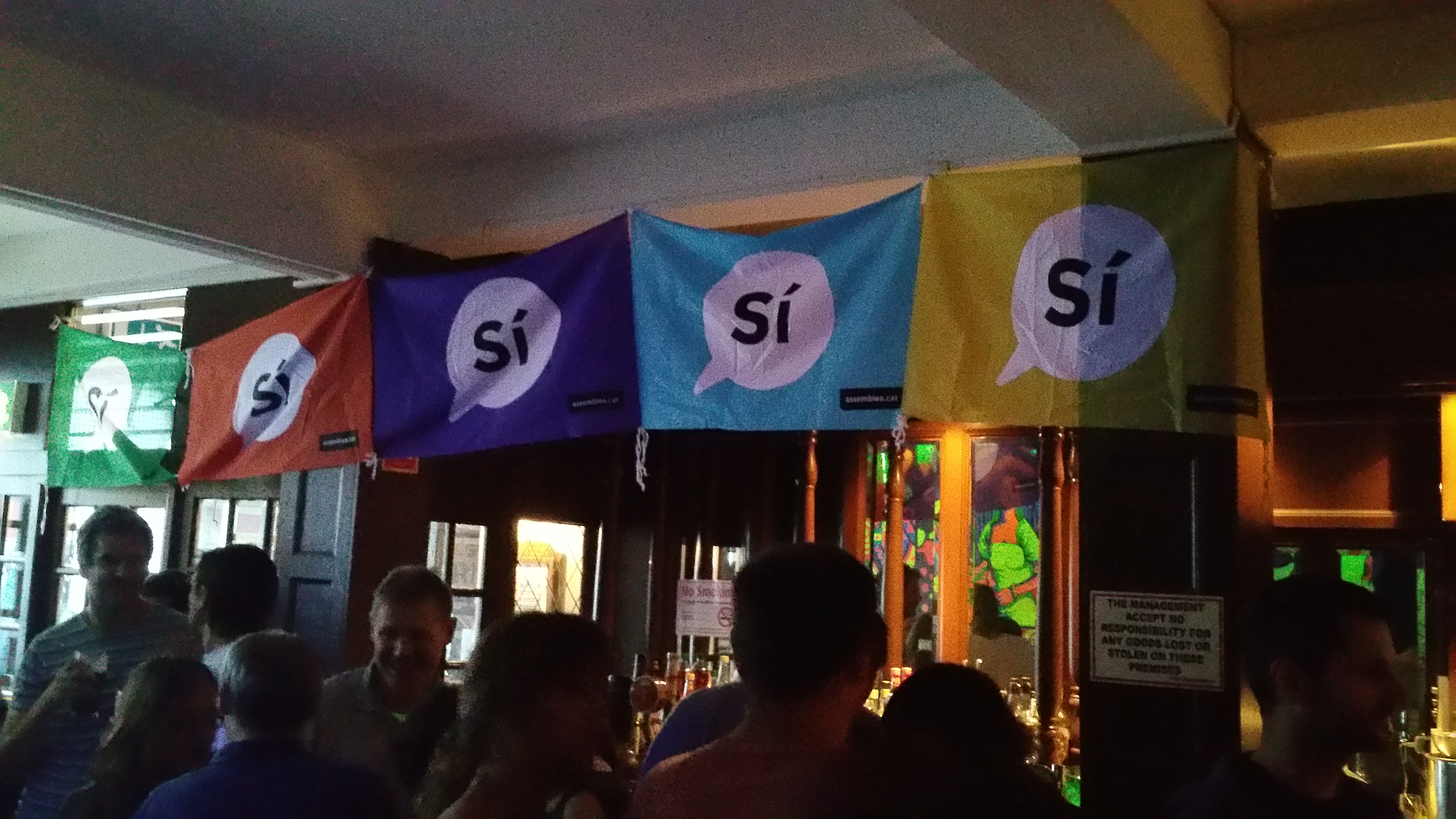
“Sí” bunting from the October Referendum on Catalan Independence (Photo: D.Breatnach)
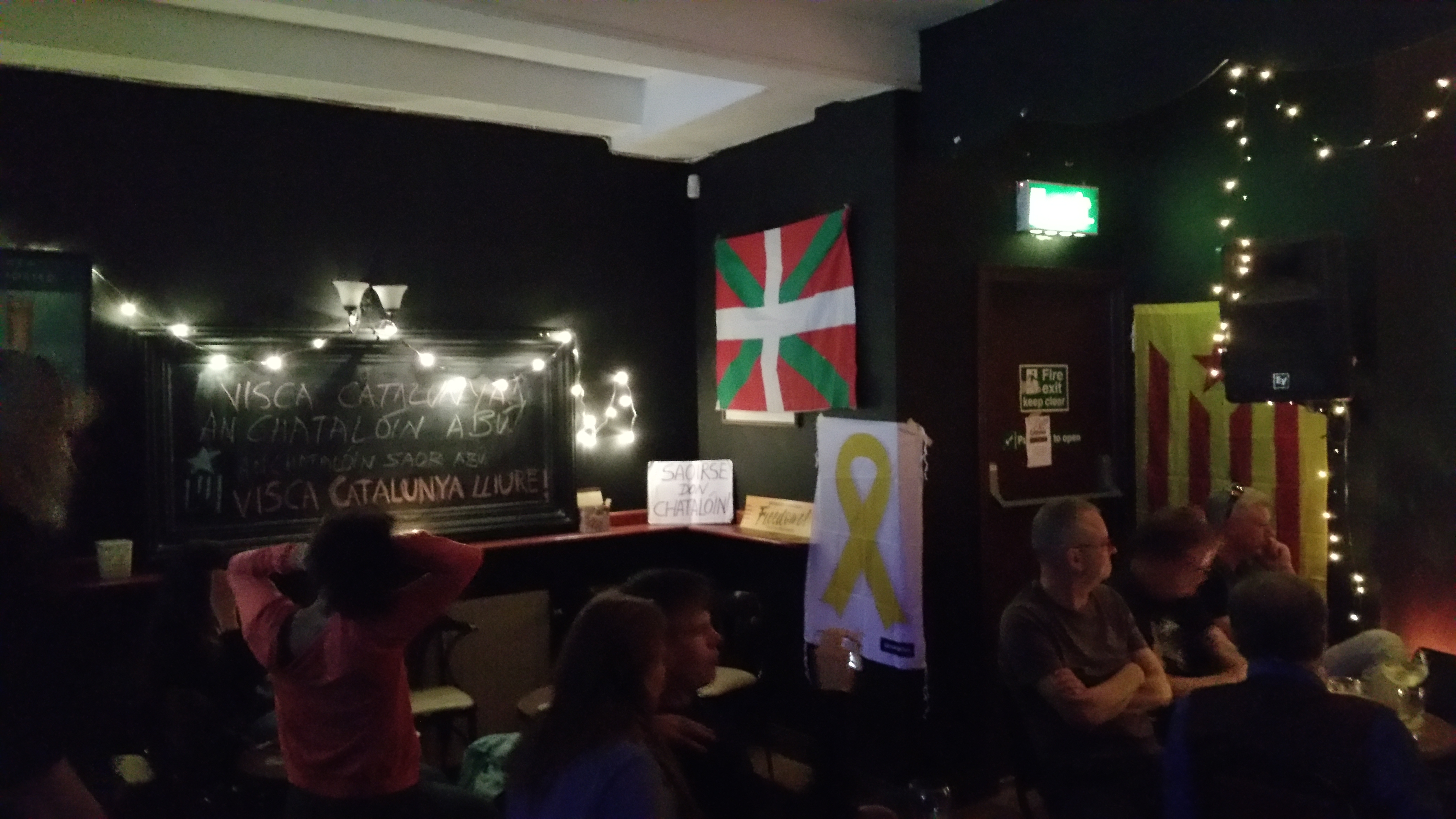
Eight different acts took to the stage in a crowded function room at the Cobblestone, which was decorated in the three varieties of the Catalan national flags (Senyera, Estelada and Vermella), and flags from the Referendum period declaring Sí, along withthe Basque Ikurrina and the Irish Starry Plough.
The Basque Ikurrina, the Catalan Vermella and the Yellow Ribbon for the prisoners. (Photo: D.Breatnach)
Diarmuid Breatnach, on behalf of With Catalonia/ Leis an Chatalóin welcomed the people attending in Irish and in English. A group called Whistle went first, playing lively Old-Time American songs, followed by Eoghan Ó Ceannabháin and John Flynn playing Irish tunes on flutes and also singing sean-nós songs in Irish, including Sadhbh Ní Bhruinneallaigh.
The band “Whistle” playing (Photo: D.Breatnach)
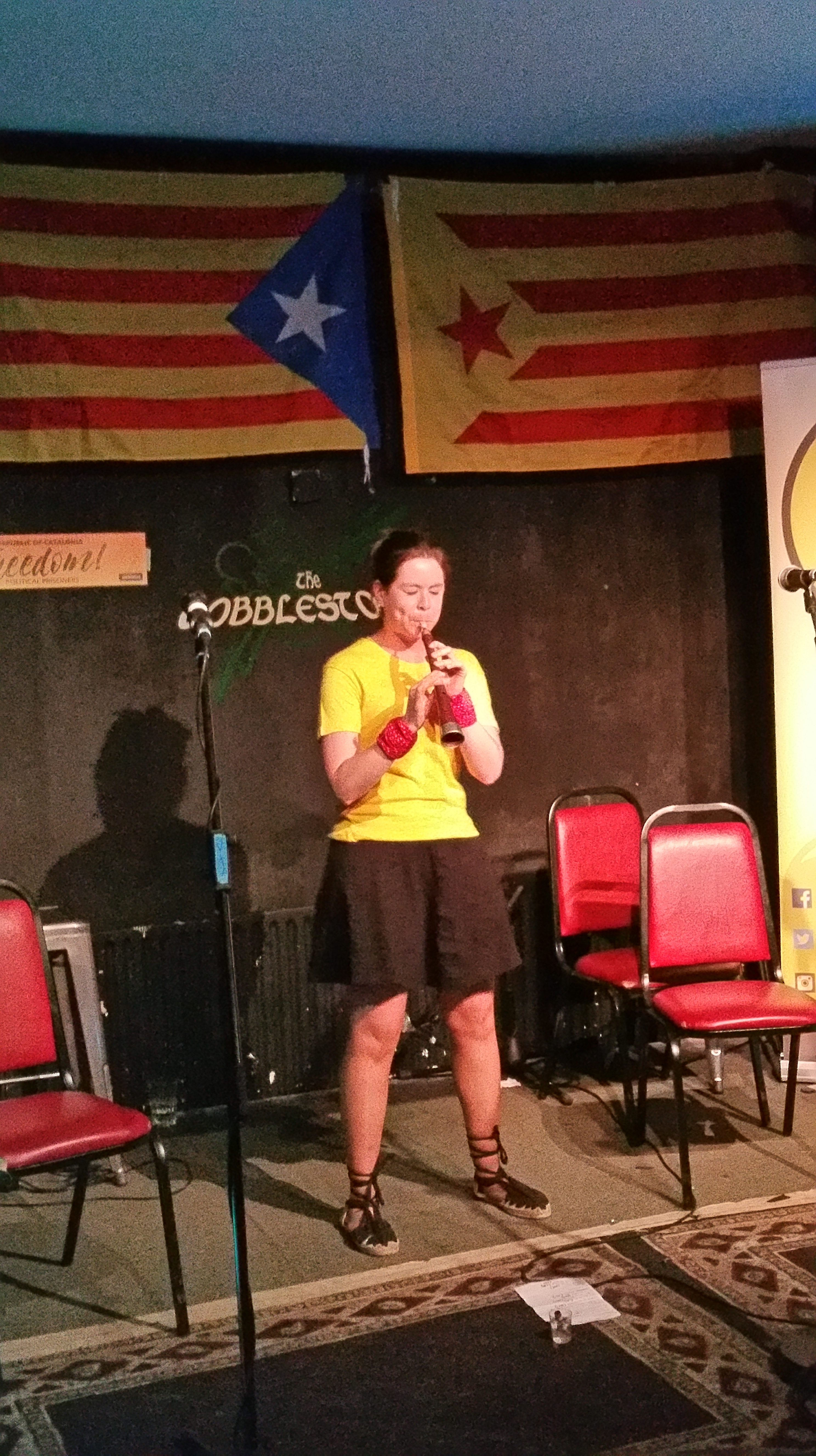
Ó Ceannabháin then introduced Berta Freixas Ylla-catalá, who played some Catalan tunes on the Gralla, a traditional Catalan instrument after which Paul O’Toole followed with some of his own songs, including the quasi-satirical “I Saw Jesus on a Bus”.
Breatnach, accompanied on guitar by O’Toole, sang two songs relating to prisoners, both from the latter half of the 19th Century, one from Ireland and another from the USA. The
John Flynn & Eoghan Ó Ceannabháin playing flutes (Photo: D.Breatnach)
Felons of Our Land was almost certainly written with regard to the suppression of the Fenians (Irish Republican Brotherhood) he said, while How Can I Keep from Singing began life as a Christian hymn but was worked over somewhat in the 1960s to make it a song of political resistance. The two emotions which the repressive forces seek to employ by taking political prisoners as hostages, said Breatnach, are shame and fear; these songs counter those with the emotions of pride and courage. Breatnach invited the attendance to support a picket in solidarity with Catalan political prisoners the following Thursday, 6pm at the GPO building in the city centre.
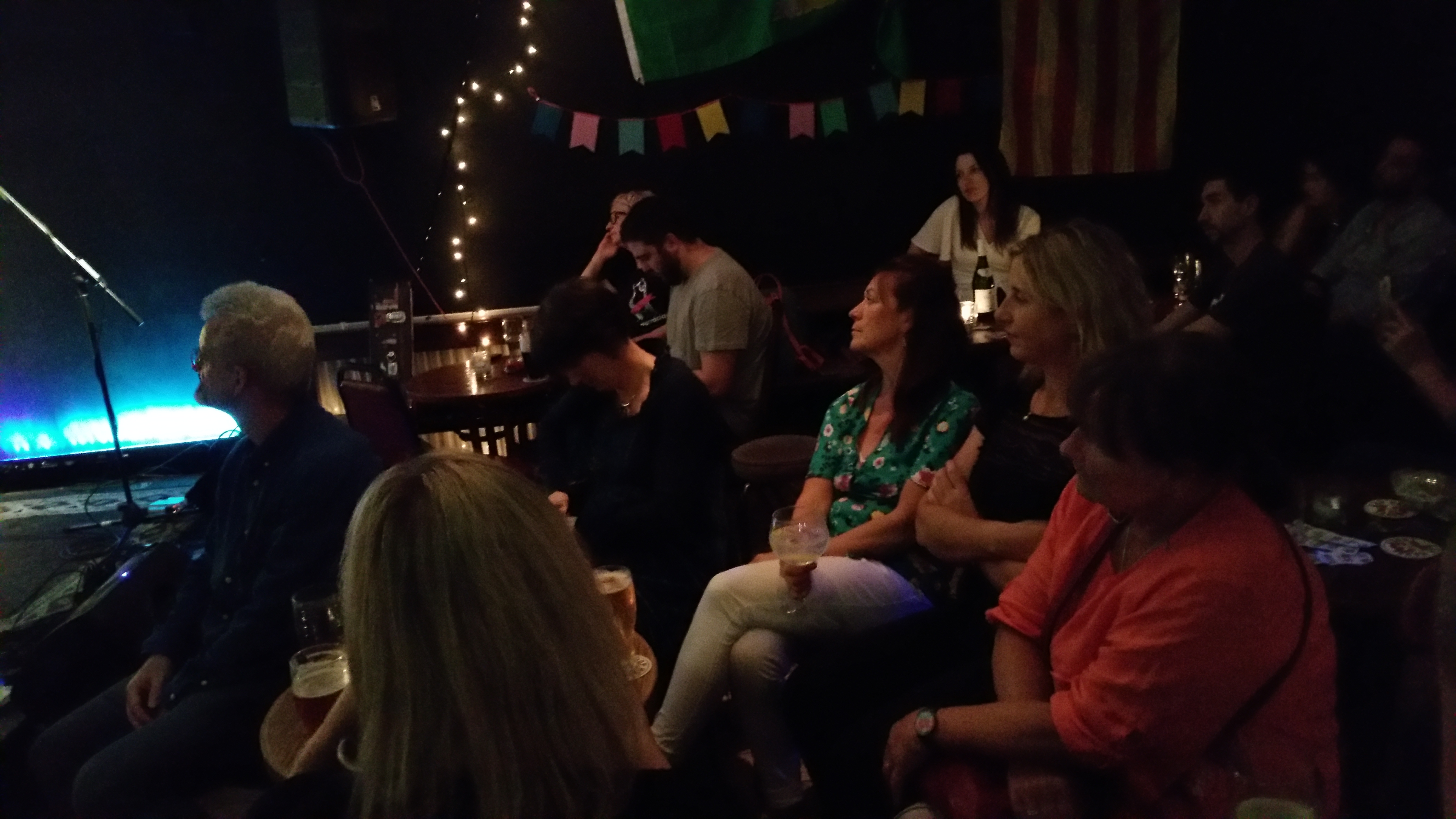
Visitors from the USA and Canada enjoying the evening (Photo: D.Breatnach)Paul O’Toole performing (Photo: D.Breatnach)
After the break and the holding of the raffle, which raised further funds in addition to the low entrance fee of 5 euro, Síomha Nic Aonghusa sang voice-only the sean-nós song Dónal Óg in Irish, then, all in English and accompanying herself on guitar, sang in turn an Irish Republican ballad and different songs, on themes of love, loss and addiction. Fionn Ó hAllmhain brought his uileann pipes on to the stage and, after explaining something of how they work, played a number of tunes, including a polka which had a couple up dancing set-dance polka moves. Ó hAllmhain also sang an Irish sean-nós song.
(Photo: D.Breatnach)Síomha Nic Aonghusa performing (Photo: D.Breatnach)
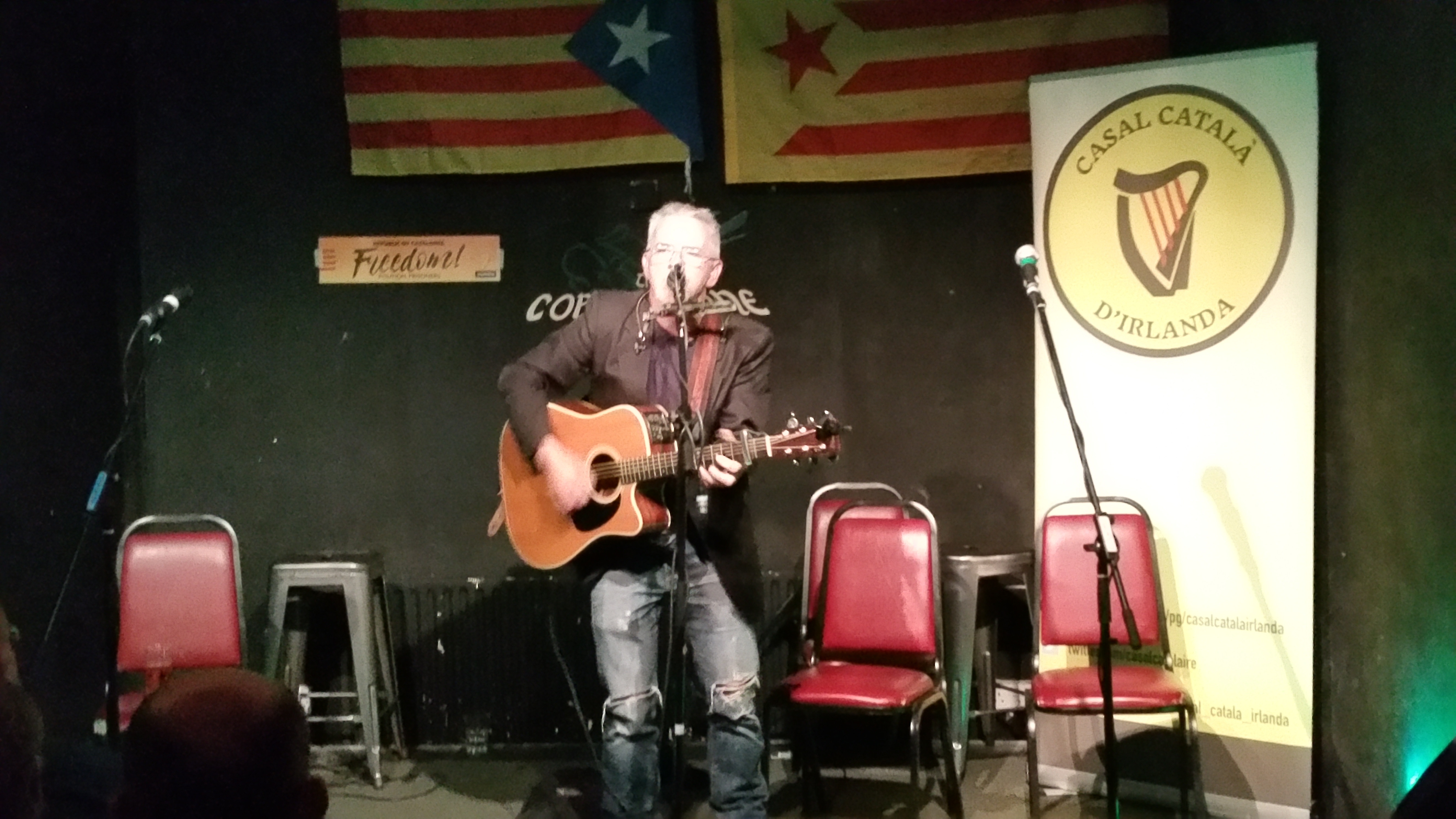
Oncle Pau of Casal Catalan, accompanying himself on ukelele, performed some Catalan songs which had many Catalans in the audience singing along, finishing his set with Somewhere Over the Rainbow.
Oncle Pau performing (Photo: D.Breatnach)
Concluding the evening, Ó Ceannabháin thanked all for attending, also the singers and musicians who performed free of charge, the Cobblestone for providing the venue, Shane the sound engineer and Aoife behind the bar.
Aoife, Cobblestone staff and very helpful (Photo: D.Breatnach)
The event was organised by With Catalonia/ Leis an Chatalóin, with strong support from the cultural Catalan organisation, Casal Catalana d’Irlanda and promoted also by CDR (Comité de Defensa de la República) Dublin.
Tina McVeigh, busy on the night (Photo: D.Breatnach)Michael Grange, active during the night. (Photo: D.Breatnach)Berta Freixas playing the Gralla, traditional Cataln instrument. (Photo: D.Breatnach)
History can and should be researched, interpreted, discussed, argued and used for lessons on current questions and projections into the future. It can also be used in fiction: as the backdrop for a novel; as a way of bringing historical events to life; as a what-if speculative story.
James Plunkett (21 May 1920 – 28 May 2003) used the Dublin Lockout as a backdrop for his Strumpet City and did it wonderfully well; Walter Macken (3 May 1915 – 22 April 1967) wrote a fictionalised account of brothers in the War of Independence and the Civil War in The Scorching Wind and also did it well1. Roddy Doyle did NOT do it well at all in his historical novel (A Star Called Henry) and sadly nor did Darran McCann in “After the Lockout”. Interestingly, the central characters in both latter books were what one might call “Left critics” of the leaders of the struggle and one is tempted to conclude that the attitudes of the central characters mirror those of their creators.
(Image sourced: Internet)
It seems fair enough that we can play with history in fiction but, when using it as a backdrop for a story, it should be accurately represented – otherwise, surely one should invent something else entirely?
Doyle did some reading on the GPO garrison’s struggle for the background of his “A Star Called Henry” but seemed to have done none for the War of Independence, in which he had his hero and heroine like a kind of Republican Bonny and Clyde living in ditches and shooting up the Free State forces. McCann seems to have done hardly any reading on the Lockout (and not that much on the GPO garrison’s fight either). Having Jim Larkin give a speech from the restaurant in Murphy’s Imperial Hotel restaurant window is bad enough – when we know he only got to say a few sentences before the Dublin Metropolitan Police ran in to arrest him – but having him then shin down a rope and get away is absolutely ridiculous.
McCann set the story of his central character, Victor Lennon, in between the 1916 Rising and the War of Independence and it has many of the elements of the story of James Gralton (17 April 1886 – 29 December 1945), the only Irish person to have been officially exiled from Ireland by an Irish government (in 1933).
The arrest of Jim Larkin after he spoke briefly from the Imperial Hotel in 1913. He did not shin down a rope! (Image sourced: Internet)
McCann’s Victor Lennon, a communist and member of the Irish Citizen Army, gets people in his home town to build a dance hall in opposition to the local Bishop, which a mob then burns down. Gralton, a communist also, did that too, in Leitrim; however, he ran dances there and also gave talks – it was a success, to a considerable degree. The Irish Catholic Church vehemently opposed Gralton and in McCann’s novel the Bishop and local supporters also mobilise against Victor: the hall is burned down before any dance is held in it. Like Gralton’s story, there is a shooting incident around the dance hall too – a fatal one, in which Victor’s father and two IRA men are killed. But instead of being deported from Ireland, as Gralton was (illegally) by an Irish Government, which in McCann’s story had not yet come into existence, Victor heads off for Dublin to join the Volunteers in what will become the IRA and the War of Independence.
Newspaper photograph of James Gralton in the process of his deportation in 1933 (note he is described as “Irish-American” as though to justify his deportation, though in fact he was born in Ireland and did not leave for the USA until 23 years of age, subsequently returning to fight in the 1916 Rising and the War of Independence. (Image sourced: Internet)What actually happened after Larkin spoke briefly from the Imperial Hotel — a vicious police baton charge and indiscriminate beating of all in the area. (Image sourced: Internet)
Roddy Doyle wrote very disrespectfully about Volunteers, Pearse and a number of other leaders and even salaciously about anonymous wives of martyred men. He did so by placing those words and thoughts in the mouth and mind of his central character, Henry Smart. McCann does somewhat the same but to nowhere near the same extent as did Doyle.
I admit to finding that lack of respect extremely distasteful but also from a historical point of view I see it as anachronistic. I find it hard to believe that those who took part in the Rising despised those who fought alongside them, no matter the difference in ideology – or that they spoke so contemptuously of their leaders, martyred or not. Disagreed, certainly – disagreed strongly, probably. But disrespect and contempt? No, that is attaching a post-Free State intellectual revisionist attitude on to participants in the Rising and in the War of Independence. Later, there would be fear and hatred, during the Civil War, but even then, none of that contemptuous and dismissive attitude.
I am not the only critic from a historical perspective, as I see from a quick Googling. Reviewing the book for the Irish Independent in 2012, Pat Hunt had this to say:
“The opening section set in Dublin reads more like a 1917 Thom’s Street Directory and a survey of political events and personalities of the time. The seediness of the red-light Monto district in the inner city does not ring true. The period feel of the city of Armagh is much better realised.
“The author’s editor has done him no favours. It was never possible to hop on a train at Amiens Street and hop off at Harcourt Street station (not unless one took a scenic route via Bray).
“The Big Wind of 1839 occurred on the Feast of the Epiphany, not Pentecost. Forecasts of wine lakes and butter mountains (concepts that emerged with the EEC and its common agricultural policy) could not have been envisioned by even the most ardent socialist in 1917.”
Hilary Mantel, who writes historical fiction, praised McCann’s book and I can only assume that she knows very little of Irish history, nor indeed should we expect that she should – her background is not Irish. Glen Patterson, novelist from the Six Counties, praised it highly too and I assume did so on the composition of the writing, turn of phrase, story-telling etc – but I sincerely hope he did not do so on a historical basis.
After the Lockout, Darran McCann, Harper Collins 2012.
End.
FOOTNOTE:
1 Though not perhaps as well as the other two books in the trilogy, those dealing with the Cromwellian war and Great Hunger periods: Seek the Fair Land and The Silent People)
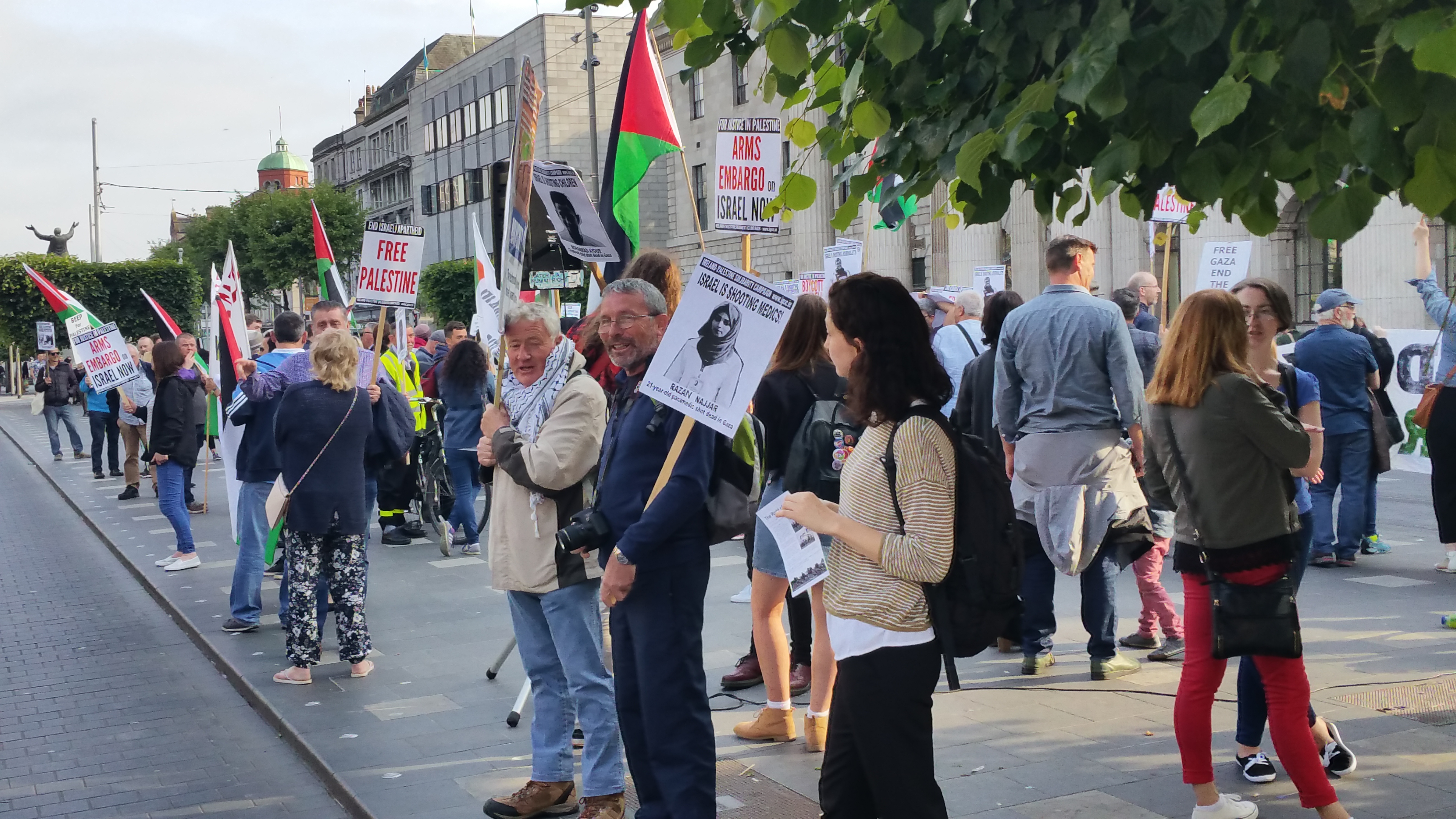
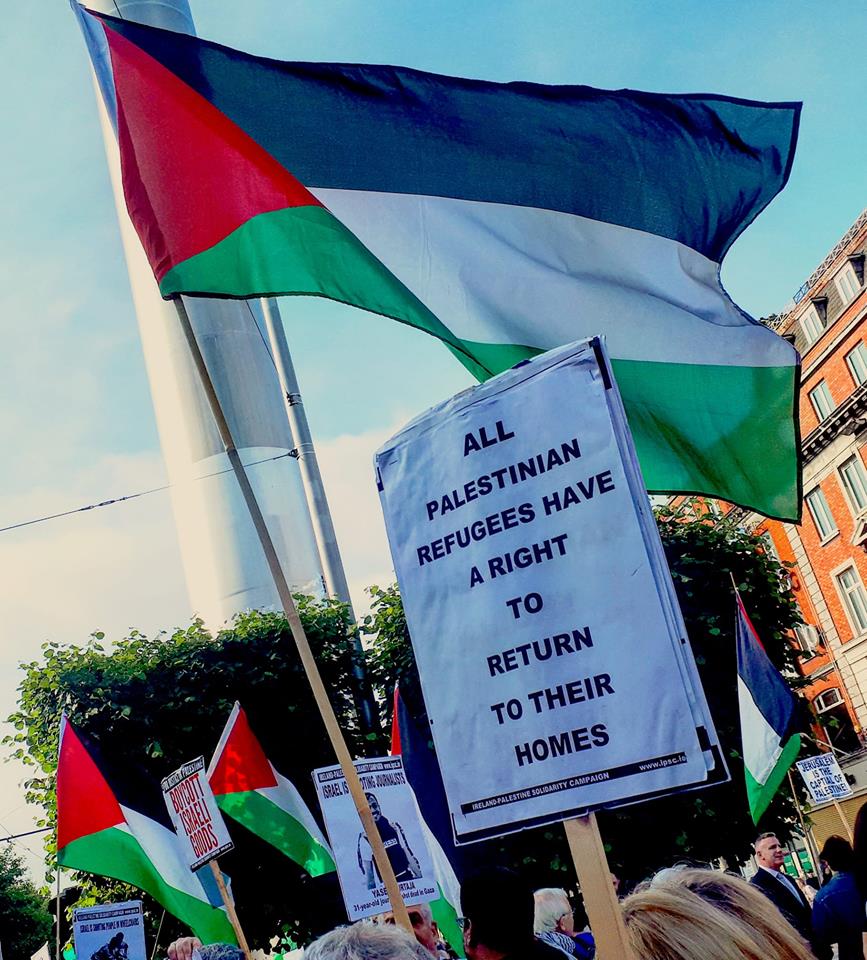
The regular blowing of horns by passing motorists, including taxis and buses, would have indicated that something of interest was happening in the city centre yesterday, Monday 5th June. As people came within sight of the centre of O’Connell Street, they could also see the Palestinian flags flying, the banners and the placards.
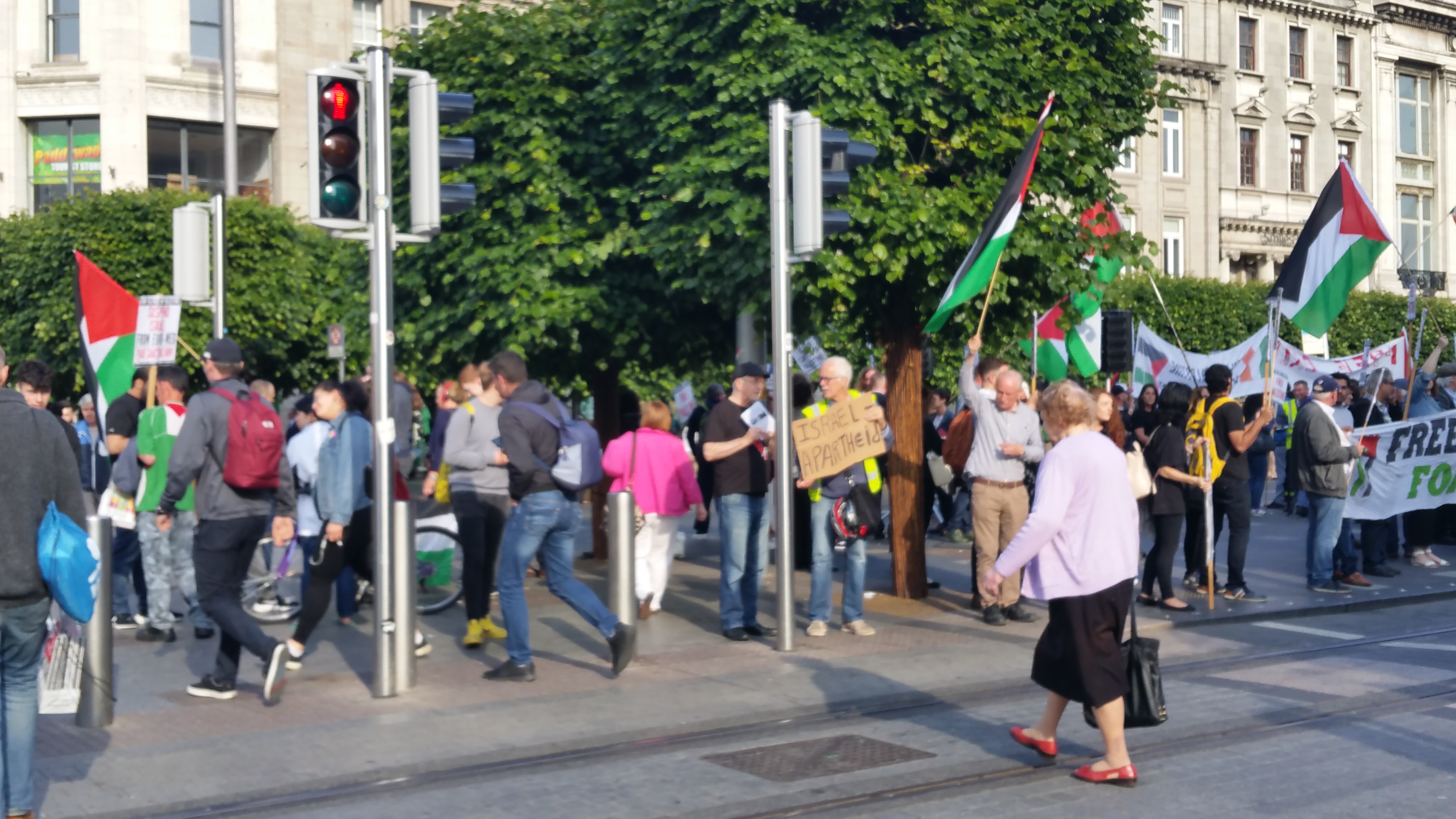
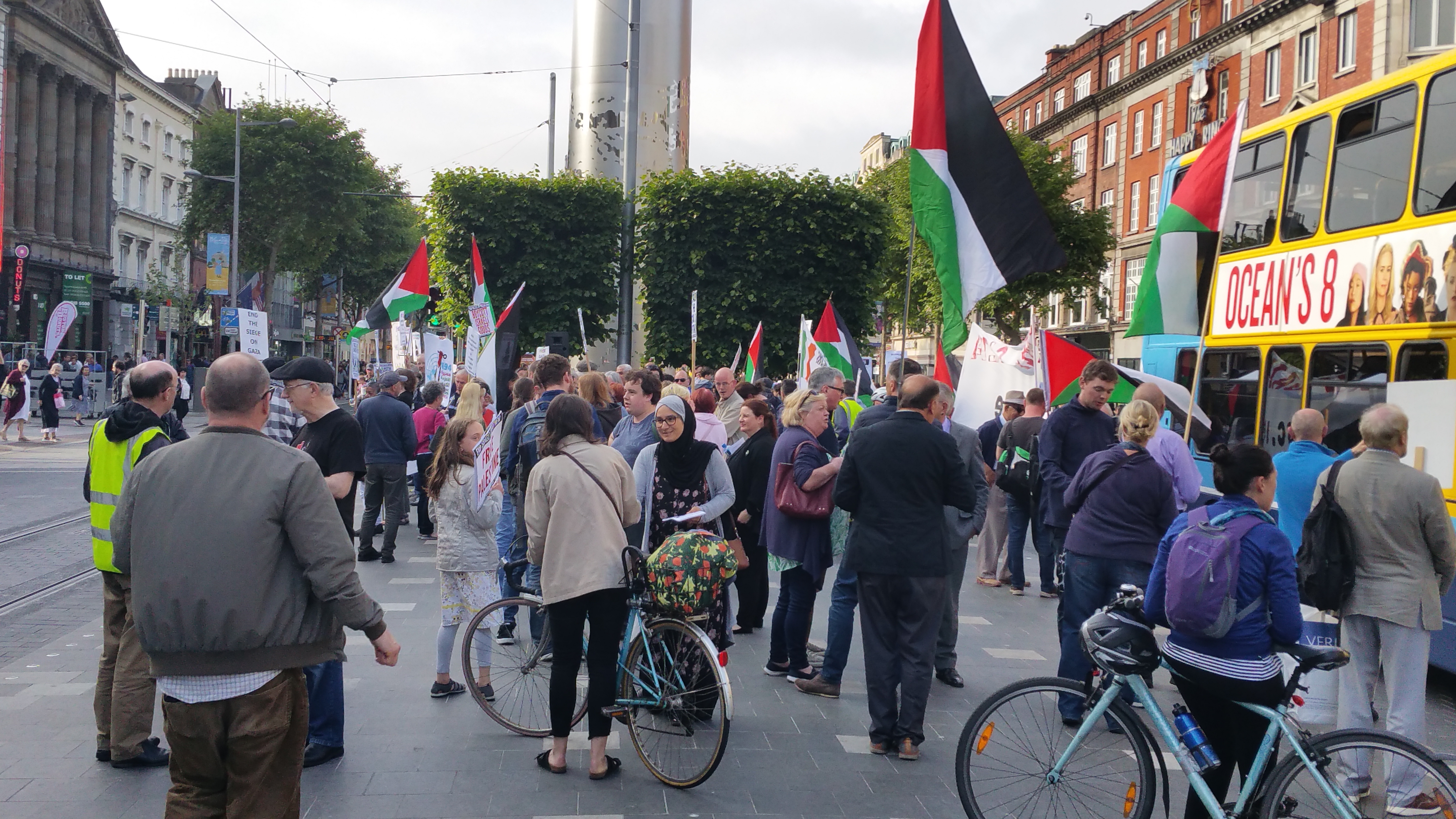
View of the rally on the east side of the central pedestrian reservation, looking southwards. (Photo: D. Breatnach)
The Great Return March
The Ireland Palestine Solidarity Campaign had convened a rally of hundreds in the central pedestrian reservation of O’Connell Street, main street of Ireland’s capital city, near to the Spire and opposite the historic and iconic building, the General Post Office. Billed as a rally in solidarity with the Great Return March of Palestinians, demonstrators carried placards denouncing the shooting dead by Israeli soldiers of demonstrators as well as of journalists and paramedics. The Palestinian death toll since March 30th has reached 120, with over 5,500 injured. Palestinians have also accused Israeli snipers, when they wish not to kill, of shooting young men through parts of their legs calculated to ensure permanent disability. The shooting dead of unarmed protesters, the killing of paramedics and journalists (who wear clearly identifiable clothing), are all crimes according to international law but, as Palestinians and their supporters repeatedly ask, who will hold Israel to account?
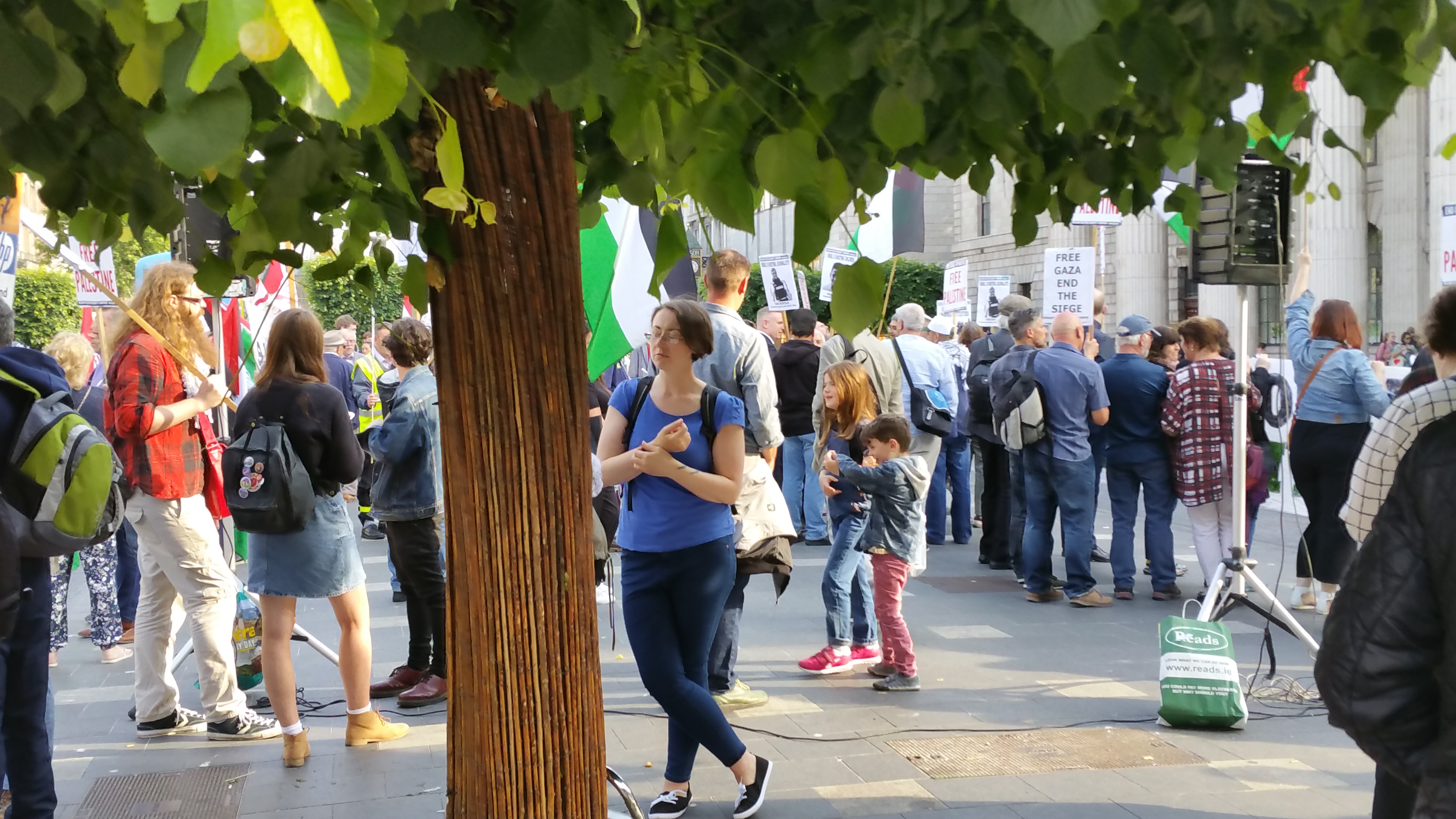
A view of part of the rally on the central pedestrian reservation, looking southwards. (Photo: D. Breatnach)
The demonstrators being targeted by Israeli military are protesting the expulsion by Israel of 700,000 of what was then the majority Arab population of Palestine in 1948, followed by their exclusion and that of their descendants from Israeli-controlled Palestine. There are an estimated four million Palestinians 1 barred from entry to Palestine, their lands or those of their grandparents, while anybody in the world who can prove his or her Jewishness, even though their families had not lived there for thousands of years2, can gain entry and claim Israeli citizenship.
Placards held by supporters in the rally yesterday upheld the right of the Palestinians to return to their homeland. It is ironic that the Zionists since 1924 at least have been upholding that demand for people who had never set foot in the land, nor whose ancestors had not for thousands of years but are denying that right to Palestinians driven out within living memory and their descendants.
View of the rally on the west side of the central pedestrian reservation, sretching southwards. (Photo: D. Breatnach)
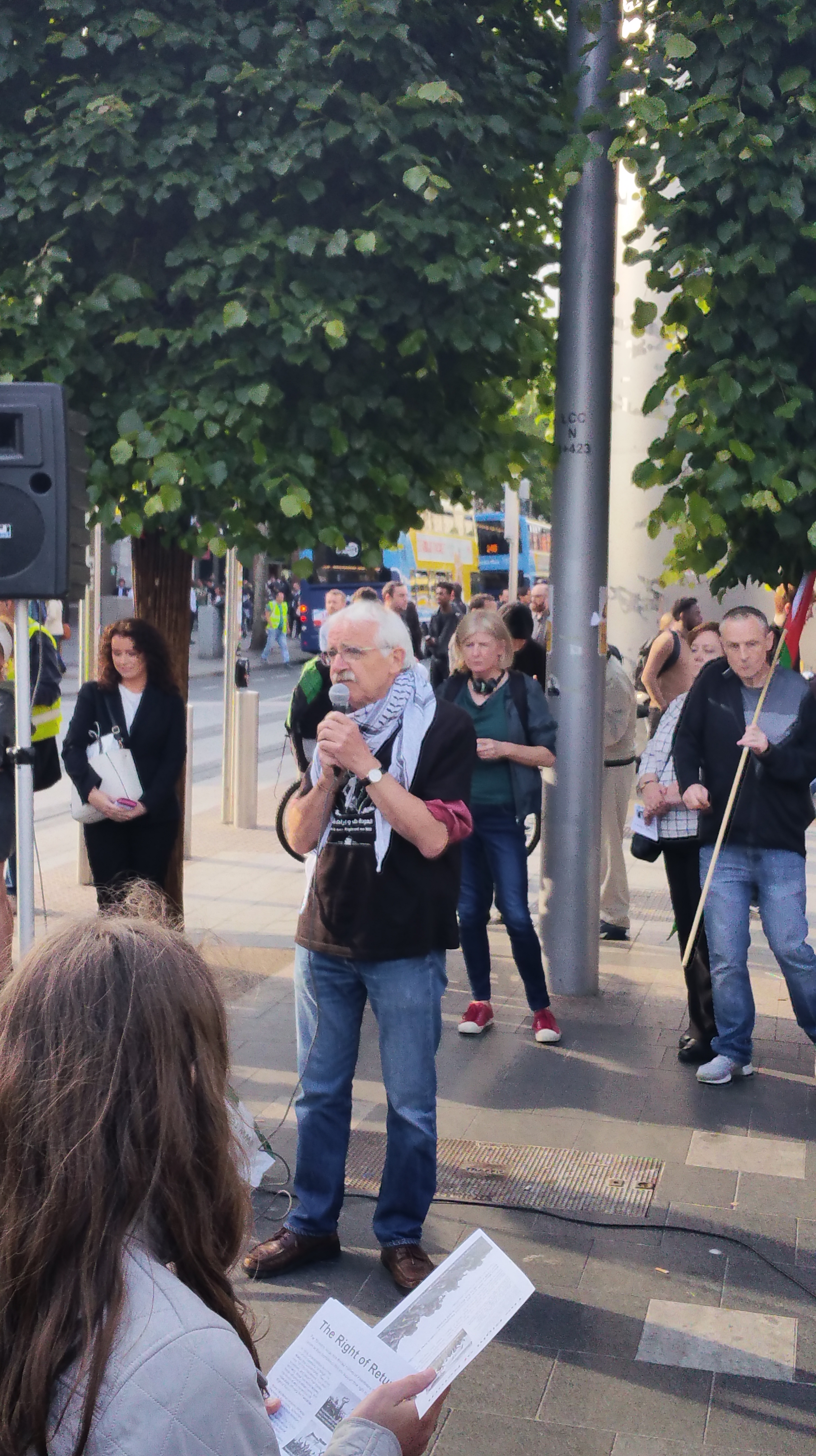
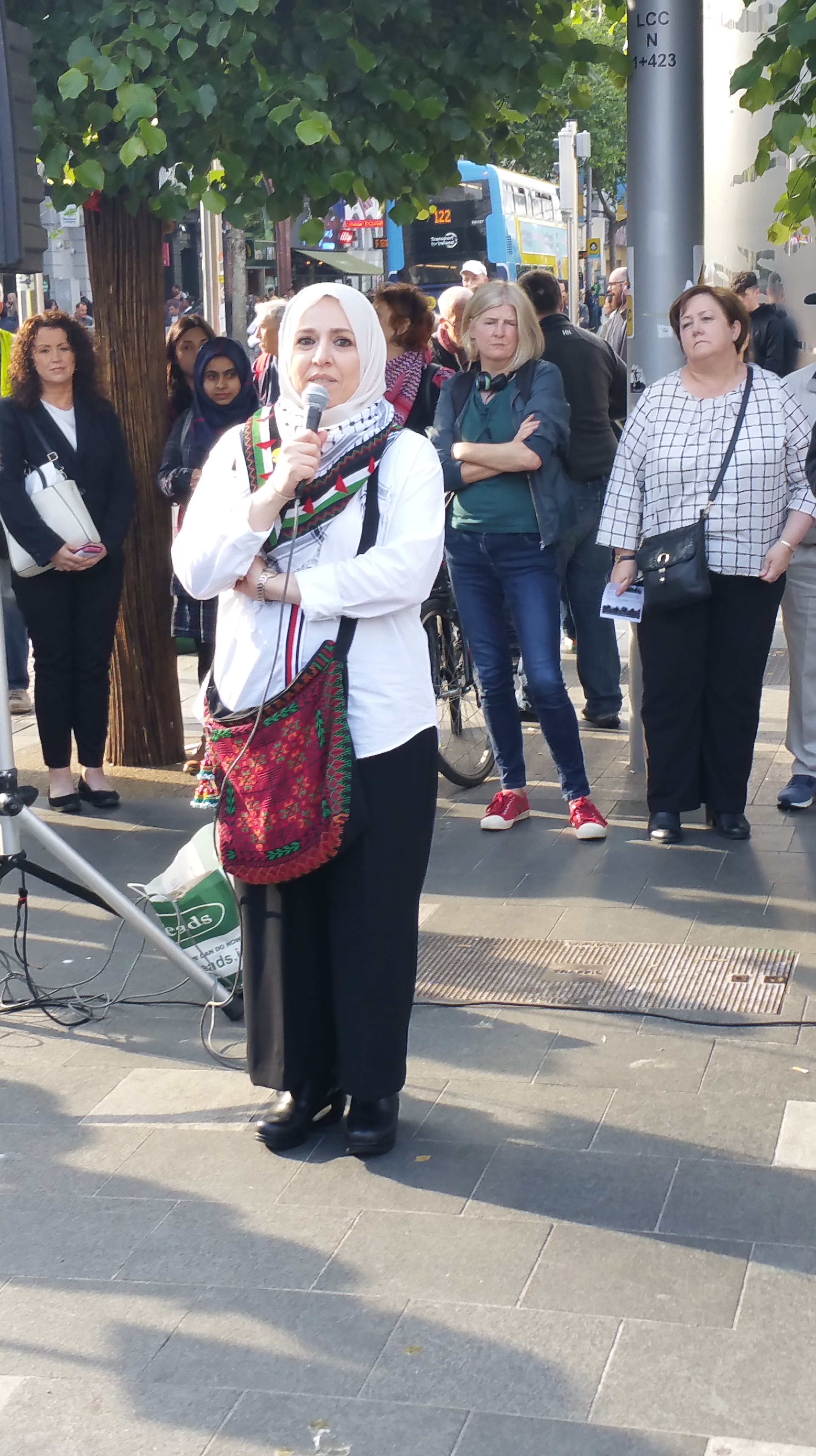
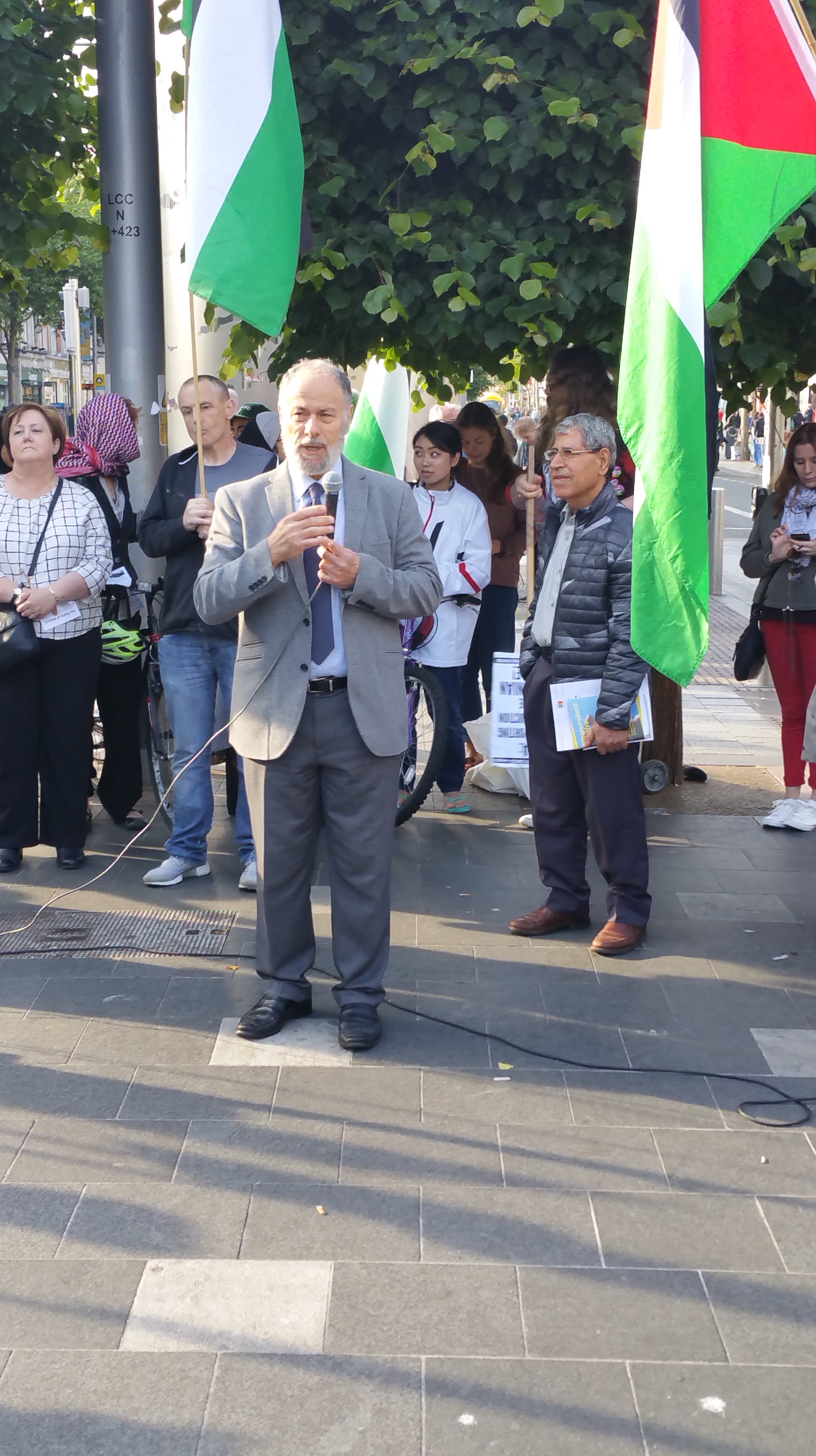
Speaking through a microphone, Martin Quigley thanked those attending the rally and after some remarks, introduced the Chairperson of the IPSC, Fatin Al Tamimi. Speaking about the right of return of Palestinians, Tamimi also said that she had relatives in both Hebron (West Bank) and in the Gaza strip and spoke about the privations of the people there blockaded by Israel, including contaminated water and lack of electricity. However not only is Israel guilty but also Egypt, as Tamimi alluded to when she said that Egypt had only temporarily opened the Rafah Crossing Gate, which Egypt maintains, for the feast of Ramadan, as a result of which she was expecting to be able to see her sister for the first time in seven years (the crowd cheered and applauded this news).
Marting Quigley for IPSC. (Photo: D. Breatnach)
“Expel the Israeli Ambassador and close down the Embassy!”
Two other Palestinian speakers addressed the rally, including one who had come out through that very Rafah crossing, Asad abu Shark who was introduced as from the Great March of Return and Ahmad El Habbash, introduced as representing the Palestinian Community in All Ireland3. All speakers drew attention to the Nakba (from Yawm an-Nakba, meaning “Day of the Catastrophe”, referring to the expulsion of thousands of Palestinians in 1948 –), to the right of return, the terrible conditions within the Gaza strip (which place, they said, would become uninhabitable by 2020 — see link), the impunity of the Israeli authorities and the inactivity of “the international community”.
Fatin Al Tamimi, Chairperson of IPSC, addressing the rally. (Photo: D. Breatnach)
Al Tamimi was cheered loudly when she called for the expulsion of the Israeli Ambassador to Ireland and the closure of the Israeli Embassy, a call repeated by other speakers.
Ronit Lenten, who introduced herself as “an Israeli Jew” and representing Academics For Palestine (Ireland), also spoke briefly.
Last to speak was John Lyons, a Dublin City Councillor for the People Before Profit party, who made similar points. Referring to visit of his own to Palestine he referred to the courage and persistence of the Palestinians in merely trying to live their daily lives under the conditions of Israeli military occupation, apartheid and harassment and called on the Irish people to match that determination in taking action in solidarity with the Palestinians.
An Ireland-based Palestinian speaker addressing the rally. (Photo: D. Breatnach)
Throughout the speeches, the solidarity beeping of horns of passing car and bus drivers could be heard and occasionally shouts of encouragement from open bus or car windows.
Bill to ban imports from Occupied Territories
All speaker highlighted the importance of the BDS campaign (Boycott, Divestment and Sanctions) and the need for Irish people to contact their elected public representatives to ask them for concrete action in support of Israel, including for a Bill to be introduced in the Seanad by Senator Francis Black, (well-known singer, also campaigner for human rights and for support for recovery from alcohol addiction). The Bill in question is the Occupied Territories Bill, the intention of which is to place a national ban on any products shown to be exported from territories under illegal occupation. The Bill, a draft of which has already been approved in committee (see link), is expected to go before the Seanad in July, though that may change and, if passed twice there, will go on to the Oireachtas for debate and, if passed there, into Irish law.
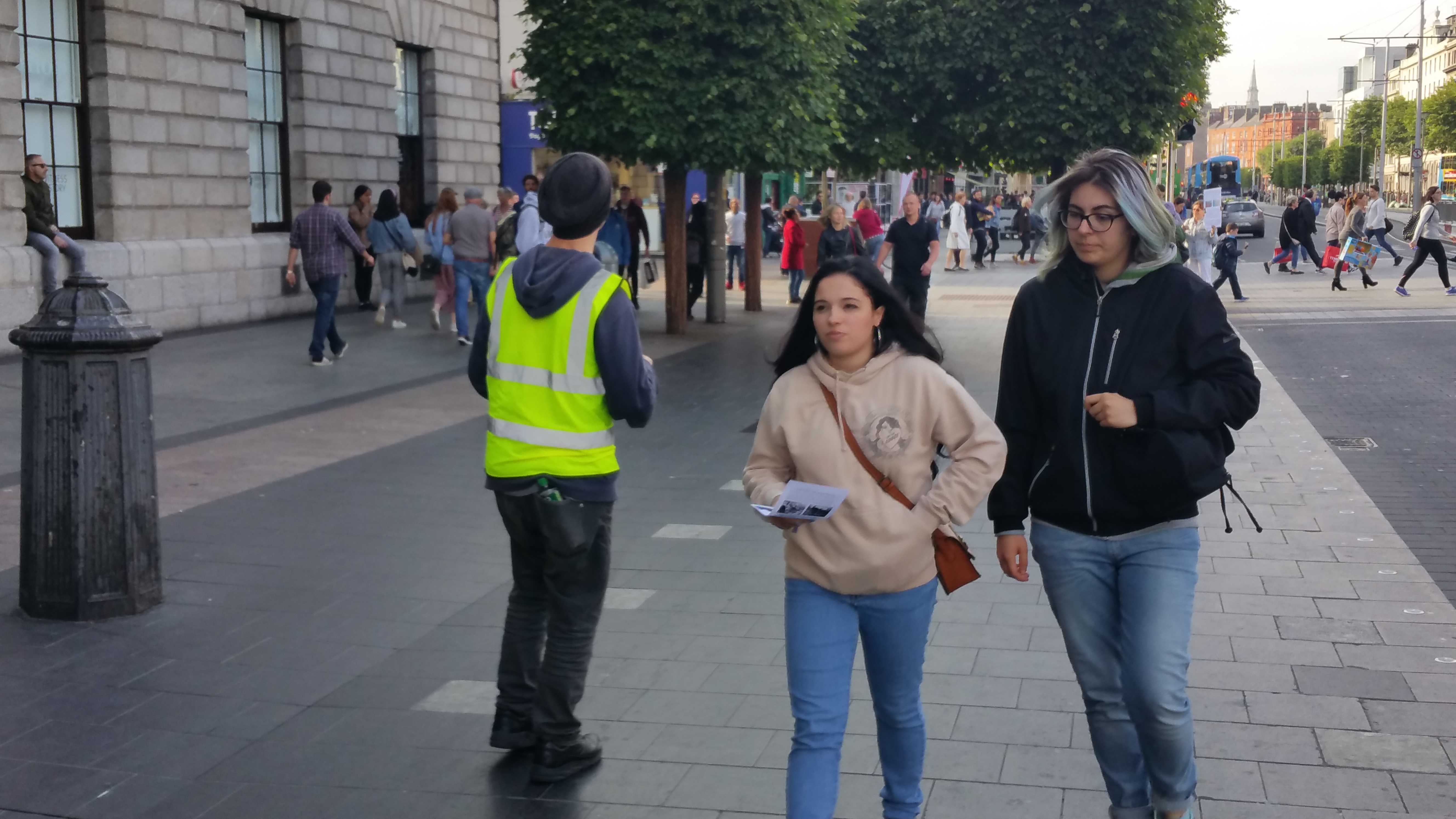
One of the IPSC’s leafleters and passers-by who have just accepted a leaflet. (Photo: D. Breatnach)
Calling on all present to stay in touch with the IPSC or with other Palestine solidarity organisation, Martin Quigley brought the event to an end by leading the rally in leading a number of chants: “From the river to the sea, Palestine will be free!” “Free, free Palestine!” “One, two, three, four – occupation no more!” “Five, six, seven, eight – Israel is a fascist state!”
Early moments as Palestinian supporters gather, view northwards. (Photo: D. Breatnach)
Argentina cancels scheduled football match with Israel. Dozens of Palestine flags defy GAA ban.
In a separate but related development, the national soccer team of Argentina yielded to calls to abandon its scheduled ‘friendly’ match with the Israeli national soccer team (see relevant link). Strong advocacy for the cancellation had been brought about by the movement for BDS both within and outside Argentina but statements of team officials to the media made it appear that members of the team had been threatened (but without producing any evidence of such).
And on Sunday, dozens of Palestinian flags were flown during a match at Omagh between Senior Gaelic Football teams Tyrone and Monaghan. The actions seemed not only to represent solidarity with the Palestinians at this time but also defiance of GAA officials who had removed flags and a banner at a previous match (see relevant link).
End.
POSTSCRIPT:
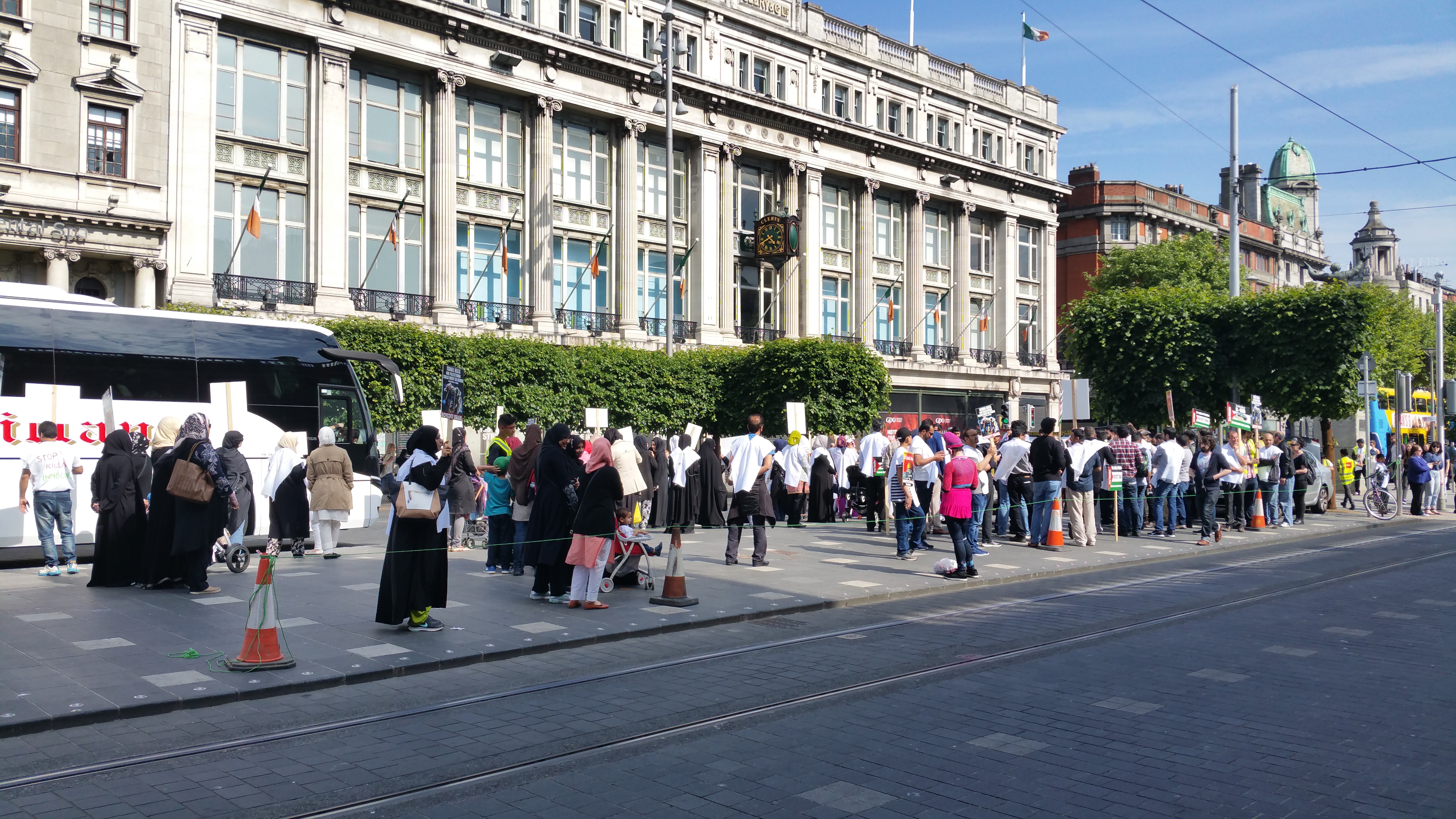
Palestinian solidarity demonstration in Dublin Friday 8th June (not organised by IPSC). (Photo: D.Breatnach)
Footnotes:
1“Today the number who qualify for UNRWA’s (United Nations Refugee and Welfare Agency) services has grown to over 4 million. One third of whom live in the West Bank and Gaza; slightly less than one third in Jordan; 17% in Syria and Lebanon (Bowker, 2003, p. 72) and around 15% in other Arab and Western countries. Approximately 1 million refugees have no form of identification other than an UNRWA identification card.”
2Or the many Jewish converts who never had any contact whatsoever with Palestine.
3 Actually no individual or separate organisation can claim legitimately to “represent the Palestine community in Ireland or anywhere” but there does exist a Palestinian organisation in Ireland which has appropriated that title as its organisational name. A number of different organisations (and none) find support among the general expatriate Palestinian community, including Hamas, Al Fatah and perhaps the PFLP.
The minority right-wing government of Rajoy’s Partido Popular fell on a motion of no confidence proposed by Sanchez, leader of the second Spanish party in terms of electoral strength, the social-democratic PSOE. The ostensible reason for the motion was the recent court decision implicating officials of the PP in a massive financial corruption case. But will the change make any basic difference?
In order to be successful, in addition to his own party’s votes, Sanchez had to call on the support of the elected representatives of Podemos, the Basque Nationalist Party (PNV) and the Catalan representatives in the Spanish Parliament.
In proposing the vote, dedicating two seconds of his speech to the Catalans, he said that he would talk to them. He almost certainly promised the PNV beforehand that he would honour Rajoy’s recent budgetary sweetener for them. He may not have made Podemos any promises but with the PP having 137 seats out of the 350 in the Cortes (Spanish Parliament) and Sanches only having90, with other right-wing parties having 48 between them, the social democrat is going to need all of Podemos’ 71 and all the rest of the help he can get for his party to stay in government.
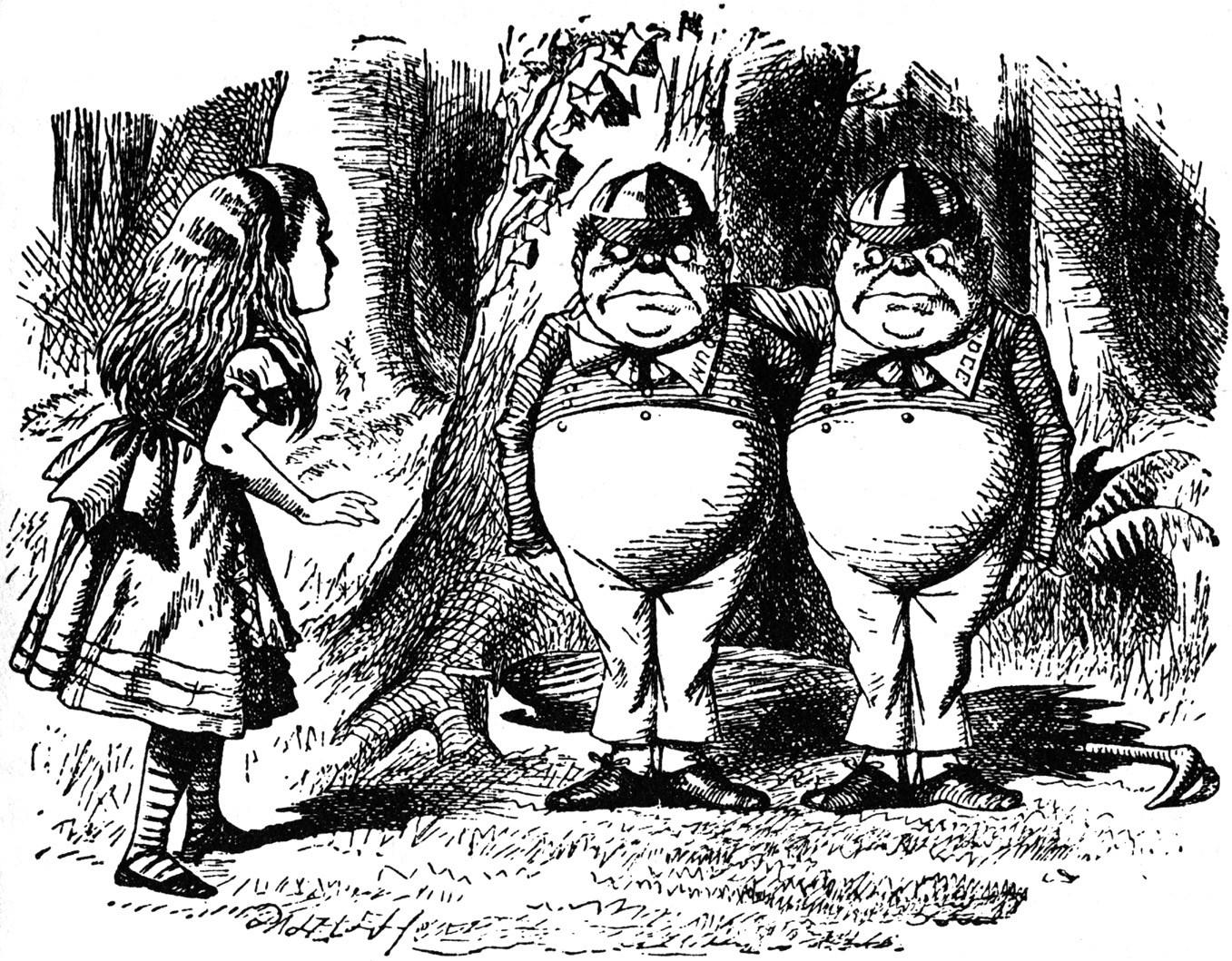
Alice: “Excuse me, one of you is the new Government of Spain, right? But which one, please?” (image from Alice Through the Looking Glass)
The PSOE (Partido Socialista Obrera de Espana) was outlawed during Franco’s dictatorship but after Franco’s death was brought inout of the cold, along with the Communist Party of Spain (PCE) by a deal done during the Transición to the new way of running the Spanish state.
The PSOE has been in government before and collaborated with the monarchy which was imposed on the Spanish people by Franco and his successors. In addition, the PSOE was the party reputedly responsible for the creation of the GAL terrorist and assassination squads against the Basque national liberation movement during the 1980s; one of the PSOE Government’s Ministers went to jail over that and although it was widely believed that the Prime Minister was the main force behind the gangs he was never even questioned by the police.
During recent developments of the Catalan independence bid, Sanchez and the the PSOE’s Catalan version, PSC-PSOE (usually referred to simply as the PSC) were hardly less hostile to the Catalan independists than were the Spanish Government or Ciutadans (right-wing Catalan party with roots in the PP).
Nobody who understands history in general and that of the Spanish state in particular can believe that a PSOE Government is going to anything much else than fight tooth and nail against Catalan independence. But Sanchez might try the velvet glove before revealing the steel fist underneath. One thing he might do is to release on bail the Catalan elected representatives and cultural activists who have been in jail since October awaiting trial.
To discuss a thriller-writer who was in jail in the USA for one of the largest payroll heists in US history and who before that was in the H Blocks, an incarcerated IRA Volunteer, is to have most people thinking one is writing about a fictional character – but I’m not. The man exists and his name is Sam Millar.
WRITER
Millar has a number of novels and a memoir to his credit, all the most recent published by the O’Brien Press. Some of them are detective novels, centred around Karl Kane, a tough private investigator, back-talking cops and gangsters alike. Yes, we’re familiar with the type, from Chandler’ Philip Marlowe to Spillane’s Mike Hammer, Hammet’s Sam Spade or Towne’s Jake Gittes in Chinatown (1974). But if we’ve liked his type in print or film before, them then we tend to like him again. To be truthful, Kane is a bit different: I can’t recall or even imagine any of the others ever opening their front door dressed only in their lover’s short pink dressing gown and falling on their arse, accidentally flashing their tackle at passing schoolgirls. And Kane’s health problems are perhaps more reminiscent of some of the Scandinavian fictional police detective heroes (and heroines) than his fast riposting counterparts in the USA-based stories.
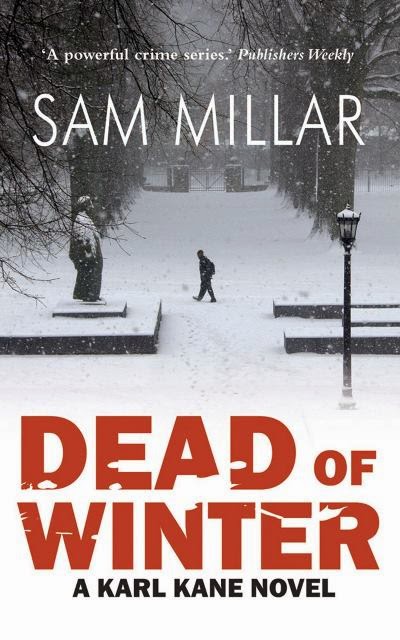
Cover Dead of Winter, a Karl Kane novel by Sam Millar.
The dialogue and commentary in the Karl Kane novels is good with some very funny lines, his plots interesting and he keeps the story moving along at a good pace, with a few twists along the way. Kane, like Marlowe has a conscience pushing through his hard exterior and though he’s tough he tends not to invite more slaps after the first few. And not every thread in the story is tidily tied up at the end of the book.
The dialogue is not so slick in some of his other novels (one set in the USA) but the conjuring of the ill-boding atmosphere is well done, as is the description of the thinking in the adolescent characters’ minds.
Belfast is where his writing is centred now:
“I have deliberately used (Belfast) as a backdrop for all my crime noir novels for a number of reasons”, he was quoted as saying in a Crime Review author profile “- mainly because I know it so well, but chiefly to bring the imaginary one-dimensional Belfast of badly written novels into the modern era.”
Sam Millar (Photo source: Democrat and Chronicle)
His stories are dark (which is part of the meaning of “noir”) but generally not without humour or redemption, at least for some of the characters. The Police Service of Northern Ireland are not presented as shining good guys and in that Millar fits in with the general attitude to the enforcers of law and order in the detective noir stories: the cast of cops usually includes the downright nasty (and often corrupt), the in-between and the good guy – the latter being the cop who feeds the private investigator information or warns him of trouble coming his way from the cop’s superiors. For the genre and for Millar’s stories it works, providing one doesn’t step back too much to think about the sectarian and often murderous RUC now transformed by name into the PSNI.
However, Millar doesn’t try and paint a rosy picture of a post-Good Friday Agreement society and has been quite open about his own views: “I hate bursting people’s bubbles, everybody wants to believe something like a fairytale has happened over here but it hasn’t”, he said in a 2014 interview with David Henessy in the Irish in Britain weekly The Irish World.
“It’s changed superficially but for working-class Protestants and working-class Catholics it hasn’t changed. There’s still a lot of people out of work, a lot of poverty and it seems the politicians are the only ones who seem to benefit out of this Good Friday Agreement which has been a terrible let down, to be honest with you, especially in nationalist communities.
“But for myself being a writer, of course, I have been able to move away and I felt guilty. You don’t want to turn your back on your neighbourhood but at the same time, I’ve young children. I want them to have a better life…”
SELLING WELL ABROAD
A number of Millar’s books have been translated and sold well in France (where he was won a number of literary awards), Italy, Germany and Poland and some as far as Turkey and Bulgaria. He is not without Irish awards either: the prestigious Aisling Award for Art and Culture; Martin Healy Short Story Award; Brian Moore Award and Cork Literary Review Award, et al.
“I could probably sell more books in Ireland if I kept my mouth shut about what I thought,” Millar commented more recently. Perhaps he’s right. I find it hard to believe I never heard about him until picking out a book by chance in the library, saw it was about a PI working in Belfast and with a sigh, felt obligated to read it. But without any great expectations, having come across some novels allegedly about the Six Counties that seemed to be about somewhere else in the world but also bearing Ulster place and family names. I was glad I chose it and am now working my way through his other published works.
Asking some Dublin Republicans about Millar and his writing, I was again surprised that they had not heard of him, particularly since they would share his view of the Six Counties today.
IRA VOLUNTEER AND HEIST
Millar was brought up a Catholic in Belfast (but with a Protestant grandfather), became politically active and went to jail in 1973, “the first nationalist put away under the Diplock court system. That’s a forgotten historical footnote, except for me”, he says. Released in 1975, his days of freedom were short, like many another in those days and a year later he was back inside after being caught with explosives in Belfast city centre. He joined the blanket protest against the British policy of criminalisation of Republican prisoners.
Released from the H-Blocks in 1982, he got acquainted with Bernadette, now his wife, whom he had known as a child, a few streets away from his family‘s home.
Photo source: New York Times
Moving to the USA, in 1993 Millar got involved in the New York Brinks Armoured Car Depot robbery, “the biggest in US history” (in which no-one was killed), for which he got caught a year later and served six years in a penitentiary, to be released by Clinton. Millar wrote about the heist in On the Brinks (2003) and apparently investigators believe that though Millar masterminded the robbery, he fictionalised some of the details in order to protect some accomplices.
Cover of extended version of the best-seller On the Brinks, Millar’s memoir of Republican activism, British colonial jail and the Brinks Heist of 1993.
Warner Bros. bought the rights to the book for a screenplay before backing out of making the film and a long “and draining” legal battle followed as Millar fought to win back the rights, so as to have some other company make the film.
THRILLER WRITER AND REVIEWER
Writing for the New York Journal of Books, Millar said he had “reviewed tons of books”, in reply to an accusation by Armagh author Stuart Neville that he had indulged in “sock puppeting”, i.e using fake identities to rate his own work highly and do down some others, including Neville’s.
“If you look at my books reviewed by people on Amazon,” said Millar to Nuala McCann for BBC News in September 2012, “you will see one stars and two stars, some by writers. I have never asked Amazon to remove them, nor complained on line about them.
“Ironically, the only book I’ve ever read by Mister Neville I reviewed for the influential website New York Journal of Books,” he added.
“I think if you read it, it wasn’t too bad a review. I get lousy reviews sometimes myself, but take it on the chin. I’ve reviewed ‘tons’ of fiction/crime books for writers, and never given a negative review of any of them.
“If I don’t like a book (after a few chapters) I will not review it, as I do not like to give bad reviews to fellow writers, as I know how difficult enough it is without adding grief.”
Cover of Millar’s next novel, with a new anti-hero, due out in June.
Sam Millar has another anti-hero novel (not Kane) novel due out in June, The Bespoke Hitman, as part of a three-book deal with O’Brien. I’m looking forward to reading it.
End.
BIBLIOGRAPHY:
Dark Souls (April 2003)
The Redemption Factory (July 2005)
The Darkness of Bones (2006)
Bloodstorm: A Karl Kane Book (2008)
The Dark Place: A Karl Kane Book (2009)
The Dead of Winter: A Karl Kane Book (2012)
Brothers In Arms (Stage play 2012)
Black’s Creek [originally Small Town Killing] (2014)
On The Brinks, O’Brien Press (April, 2014) [but originally by Wynkin de Worde (Sep. 2003) then bought by Millar’s present publisher, The O’Brien Press]
The prison experience and escape of IRA man Seán Murphy as related by himself in book form was launched on 31st March to a large audience in Wynne’s Hotel. Republicans of all shades not part of Sinn Féin (and perhaps some of those too) attended the event, bought copies of Having It Away and queued to have them signed by Seán’s widow, Betty Murphy. Seán O’Mahony, whose assistance with the publication of the book was acknowledged by Sean Murphy’s family, presided over the event.
Seamus Murphy (Photo source: Internet)
On 13th August 1955, a party of the IRA led by Ruairí Ó Brádaigh raided Arborfield British Army Depot and came away with many guns and ammunition; the party’s members were Seán Murphy, Donal Murphy (no relation), Frank Skuse, Jack Hick, Tom Fitzgerald, Joseph Doyle, Liam Walsh and Paddy Considine. One of the party’s vehicles was apprehended by British police and the weapons later recovered. Three IRA Volunteers of those ten who took part were captured and, after trial, sentenced to life imprisonment. Donal Murphy and Joseph Doyle were two of them, the third was Seán Murphy and the book is his story.
Section of crowd at book launch event in Wynne’s Hotel (Photo: D. Breatnach)
The book is what most people would call “a great read”. Murphy’s descriptions of the grim realities of prison life, his interactions with other prisoners political and non-political, as well as the screws (prison officers) and Governor, are pointed and yet often humorous.
Cathal Goulding was in the jail before Murphy arrived and after an attempted escape was obliged to wear “patches”, these being large and of a contrasting colour, sown on to a prison uniform. A prisoner wearing “patches” was under constant surveillance in the prison and was kept in solitary confinement when not on exercise. The prison Governor tried to get Goulding to promise not to escape, which Goulding felt unable to do, considering it his duty to escape whenever a decent opportunity presented itself.
(Photo: D. Breatnach)
Murphy’s opinion expressed in the book is that Goulding should have given his promise and then escape when possible, considering that one was not bound to honesty with one’s captors. Murphy’s position is not without rationality and even morality but it is in strange contrast to he and his two co-accused refusing to provide a defence against the charges, since that would have meant “recognising the British court”.
The Republican prisoners considered themselves political prisoners but they did not seek segregation from social prisoners as later generations of Republican prisoners have done. And in fact, Murpy made friends among a number of prisoners convicted of social rather than political offences, some of whom went to some lengths to help him and put their scheduled liberty at jeopardy in doing so. Murphy has this to say about them (and Sean O’Mahony quite rightly included that phrase too in his written introduction): “Taken all round, the circle of friends we had collected in this prison were made up of men, generous and decent almost beyond belief and one would be hard put to find their equals in any walk of life.”
On the other hand, interaction with other political prisoners also forms part of the narrative. These included Klaus Fuchs, a German Communist who had fled Nazi Germany and became naturalised in Britain. He was a physicist and after the War was hired as part of the team developing the Atomic Bomb at Los Alamos in the USA. From there he had passed information to the USSR to help them in their development of the their own atomic weapon. for which he was sentenced in 1950 to fourteen years imprisonment and had his British citizenship removed. Released not long after Murphy’s escape, having served nine years, we went to the GDR (East Germany) where he remained until his death in 1988 at the age of seventy-six.
Klaus Fuchs, German Communist, jailed for feeding information on the USA’s development of the atomic bomb to the USSR. He was in Wakefield Prison at the same time as Murphy. (Photo source: Internet)
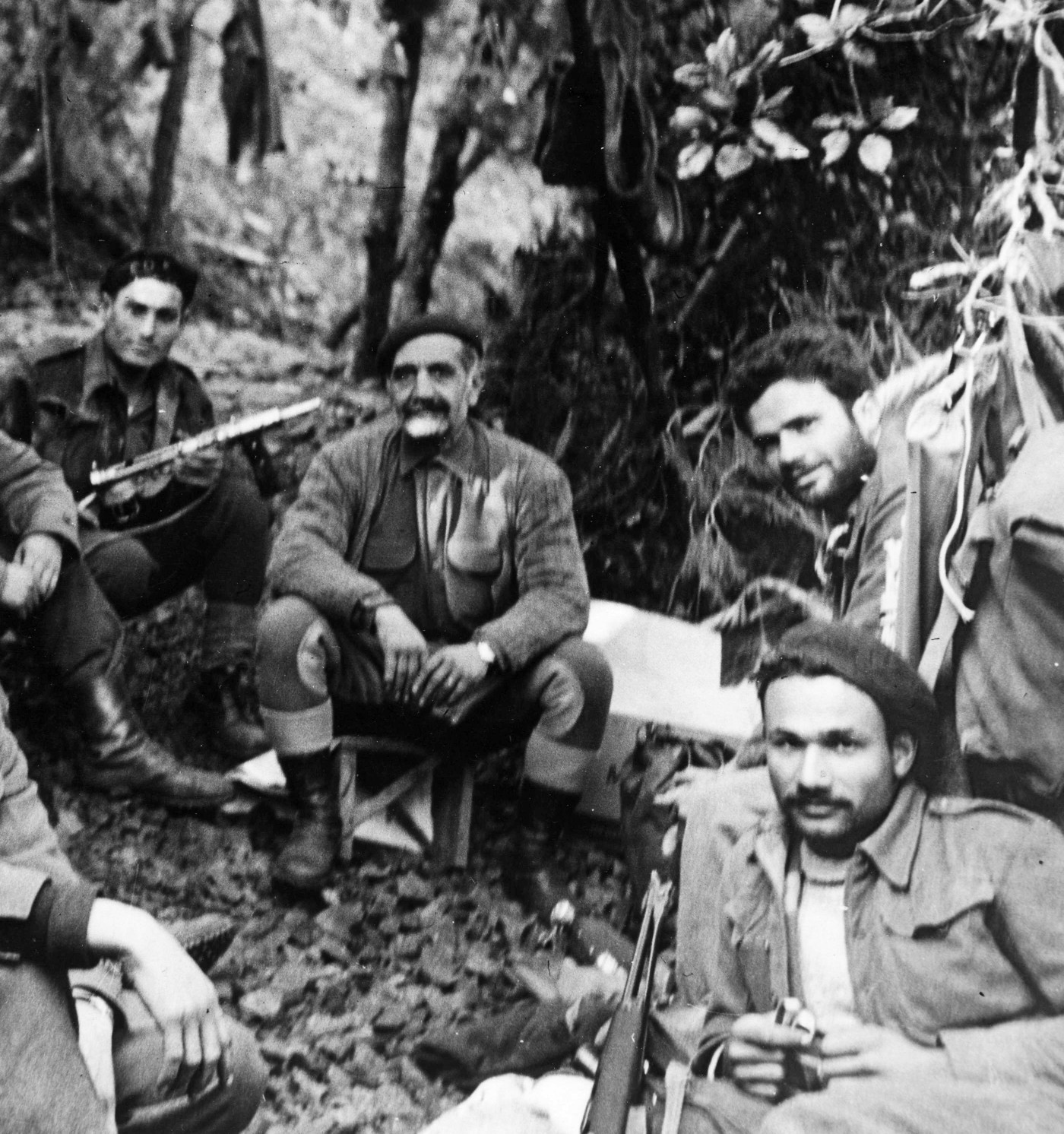
Although Fuchs was already there when Murphy arrived, other prisoners arrived afterwards from the struggle against the British in Cyprus. These were from EOKA, a Greek-Cypriot guerrilla organisation which from 1954-’59, fought to end British rule in Cyprus and for union with Greece (“enosis”). Many soldiers, guerillas and civilians were killed in the conflict, the British executed a number and also practiced torture on prisoners. In addition, the British recruited their colonial police force exclusively from among the Turkish minority on the island, which helped entrench and deepen communal tensions. Unlike EOKA B, which was considered right-wing, had links to fascist Greek colonels and was responsible for a massacre and rape of Turkish-Cypriot civilians, Eoka had socialist national liberation leanings and one of the prisoners in jail with Murphy went on to translate James Connolly’s writings into Greek. Some of EOKA supporters, like Bishop Makarios, later went on to advocate complete independence from either Greece or Turkey but an attempted EOKA B coup sparked a Turkish invasion and another massacre, this time of Greek-Cypriot civilians. Today the island is partioned between an independent Cyprus and the Turkish state, each area more or less abandoned by the other major ethnic group.
Eoka guerrilla fighters in camp (Photo source: Internet)
One of the EOKA prisoners sharing Wakefield Prison with Murphy was Nicos Sampson who had a dark history by then and which got no lighter as time went on.
Almost incredibly, one of the Eoka prisoners, serving five years in jail, was a member of the British Army who had deserted and fought alongside the Greek Cypriots – his name was Tony Martin.
The typography of the book leaves much to be desired – something seems to have gone amiss between editing, proofing and checking the galley copy. Punctuation has suffered and occasionally spelling too; sentences are broken up by large spaces and footnotes end up half-way down the the next page. Somehow however, though one is aware of those faults, the narrative grabs most of the attention.
More irritating than the faulty typography are the omissions: what went wrong that of the escape party of five, only one made it? How did those left behind fare? Did the British seek his extradition from the Irish state? What did Murphy make of the subsequent twists and turns in the Republican movement and of its various splits? Some information on the subsequent lives of some players in the prison and escape organisation is provided in two pages of Biographical Notes but I found it nowhere enough to satisfy my curiosity. For example, Murphy rates Cathal Goulding very highly in the book’s narrative yet I am given to understand that he did not support the line taken by what became Official Sinn Féin (and eventually The Workers’ Party) and the Official IRA, led by Goulding.
All that said, the book is very readable and also well worth reading.
Although Murphy’s writing reveals a strong leaning towards socialist republicanism and therefore the comment in the Irish Times obituary that “he did not embrace Goulding’s move to socialism” should be treated with caution. Nevertheless he did not by all accounts support the Official IRA after the 1969 split in the Republican movement; this may have been due to the failure of the IRA leadership to organise support for an escape, while most of those who did spring him seem to have come from the Saor Uladh or Christle faction groups. Murphy appears to have dropped out of active participation in politics after his escape but in recent years was known to be opposed to the Belfast Agreement.
Seán O’Mahony, who presided at launch of “Having It Away” and Betty, widow of Seamus Murphy, the author. (Photo: D. Breatnach)
Seamus Murphy was born 1935 and raised in Castledermot, Co.Kildare and joined the IRA while attending Terenure College, Dublin. In 1963, four years after his escape and return to Ireland, Murphy married Betty O’Donaghue from his home county in 1963; they settled down in Bray and had a son, Pearse. Murphy was writing his memoire unbeknownst to most people and though he received some assistance with it he died in 2015, three years before it was published.
Women’s Day and the approach of Easter again might be appropriate times to remind ourselves of the great role women in Ireland have played in the nation’s struggles. Most Irish people, including sadly some of those who wear it, will be unaware that the idea to create the Easter Lily was that of Republican women and that they were the first to produce and sell them.
The Easter Lily emblem, although in close relationship to the Easter Rising of 1916, represents to some all of those who have died for Irish freedom. Traditionally, some people will wear the emblem at Easter, whether in the paper form or enamelled metal, at Easter, while some wear the latter all year around.
THE WOMEN CONCEIVE OF THE EMBLEM IDEA
In 1926, three years after the defeat of the Republican forces by those of the Irish Free State (sic), the Republican women’s organisation Cumann na mBan1 produced the Lily badges and sold them. They used them to raise funds for the Republican prisoners of the Free State and for their dependents but it was also a way for them and others to declare visibly their support for the Republicans at a time when the new State had an iron grip on its opposition, many of its enemies in jails or in concentration camps, in hiding or had left the country. The formal executions of prisoners by the State had ceased in 1923 but the assassinations carried out by CID and Irish Army murder squads had continued afterwards (overall 80 formal executions and up to as many as 153 shooting of captured fighters and assassinations).
It may also have been intended as a visible counterpoint to the British Legion’s “Poppy”, which was worn by thousands in Ireland in those years (tens of thousands of Irish had been killed in the British Army and a great many maimed) .
The 12,000 Republican prisoners of the Free State included around 400 women, members of Cumann na mBan, Sinn Féin or of the Irish Citizen Army but towards the end of 1923 most of these were released. However, it was a brave person who publicly declared their support for the defeated Republic — the banned Cumann na mBan, most of whose members had opposed the Treaty, stepped forward to occupy that dangerous public space.
A SPLIT IN THE REPUBLICAN MOVEMENT
The same year that Cumann na mBan developed the Easter Lilly, De Valera and Aiken, formerly of the Republican forces, formed the Fianna Fáil (“Soldiers of Destiny”) political party to campaign within the Dáil (the Irish Parliament) for a Republic, their elected public representatives entering in 1927, having taken the Oath of Allegiance to the Free State and of fidelity to the English monarch in Ireland.
Meanwhile, the rest of the Republican movement, IRA, most of Cumann na mBan and Sinn Féin, remained opposed to participation in what they considered to be an endorsement of the partition of Ireland. During the early period thereafter Fianna Fáil continued to grow while Sinn Féin and the IRA declined in numbers and electoral votes but largely supported Fianna Fáil electorally at first, though the IRA prohibited its members from joining the party.
While Fianna Fáil was heading towards Constitutional methods, the IRA in November 1926 captured 11 Garda Síochánabarracks, in the course of which they shot dead two Gardaí. The Free State reacted immediately, interning 110 IRA men without trial the following day. The following year IRA Volunteers assassinated Free State minister Kevin O’Higgins for his responsibility in executions of Republican prisoners during the Civil War.
FROM PAPER FLOWER TO BADGE
Originally the Easter Lily was actually a three-dimensional paper flower rather than a badge. The flower on which it was modeled was the Easter Lily but now is more imagined as the Calla Lily (Zandeteschia aethiopica). Anne Matthews, who wrote a rather hostile history of Cumann na mBan, also wrote in her blog a good account of the origins of the Easter Lily emblem within the organisation.2
“In early 1926 the reformed (fourth) Sinn Féin party3 instigated the first Day of National Commemoration, to commemorate the tenth anniversary of the 1916 Easter Rebellion at Glasnevin Cemetery on Easter Sunday. Cumann na mBan planned to take part in this event, and early in February the Executive saw an opportunity to use the event to raise some funds and perhaps increase membership and they decided to hold a flag day at the cemetery.
“Over a series of meetings of the executive committee the women discussed the idea of the flag day, and decided instead to make it a ‘Flower Day’. Sighle Humphreys said they had considered flowers that bloomed in spring such as the crocus and the pansy, but eventually decided on a flower known generically as the Easter lily (botanical name is Lilium longiforum).
“Within weeks Fiona Plunkett sent a circular letter to all branches of Cumann na mBan to explain the purpose of the Flower Day.
“ ‘The flower we have decided upon is a lily (enclosed find sample) as we consider this would be the most suitable for Easter and it has also the Republican colours…You ought to call a meeting of all Republican women and young girls… and arrange for the collection at masses and at Commemoration Parades, football matches or fairs during the preceding week.‘
The Easter Lily flower, Lilium Longiflorum — this was reproduced as a paper flower, the first Easter Lily symbol by Cumann na mBan (Photo sourced: Internet)
“The first Republican Easter lily was a paper flower. Cumann na mBan ordered 45,000 and asked the IRA for support by issuing a joint proclamation and assisting them in selling the flower. The men refused the invitation. The first Easter lily ‘Flower Day’ made a profit of £34 (£1,453 at today’s rates — DB4) but despite their disappointment with lack of support from the IRA, they gave them half the profits. Undaunted, the women continued with the Flower Day campaign every Easter. In 1929 and Cumann na mBan in its circular proclaimed:
“Funds are needed to create an atmosphere favourable to our army… Funds are needed to educate people to resist the Free State and Northern “governments” …When you buy an Easter lily you are directly helping to overthrow foreign rule in Ireland.”
“By the early 1930s the membership of Cumann na mBan had shrunk to such small numbers they could not do it alone and an Easter lily committee was formed comprising members of Cumann na mBan, the IRA, and Sinn Féin, consequently Cumann an mBan lost control of the venture.
“In 1933, there was difficulty in sourcing Irish-made paper for the artificial flowers, and as Cumann na mBan were spearheading a ‘buy Irish’ campaign, a decision was taken to stop making the flowers and instead create a paper flag/badge, which could be worn on the lapel. However, the Lilium longiforum/ Easter Lily did not transfer well to the flag and the resulting image is more like the Calla Lily. The design they chose is the same design that is sold to this day.
The design of a typical (pinned) paper Easter Lily badge nowadays. (Image sourced: Internet)
“In 1937 Cumann na mBan made a statement about the money raised by the Easter lily campaign:
‘The men of Easter Week laid down a very definite road for the Irish people to travel towards freedom… All those who support the lily campaign can rest assured that the money raised is devoted to no other purpose than the propagation of these ideals and the securing of the necessary materials for their realisation.‘”
The Calla Lily (Zantedeschia aethiopica), which the paper badge image came mostly closely to represent. (Image sourced: Internet)
THE LILY EXTINGUISHES THE TORCH
Fianna Fáil continued its policy of participation in the Dáil in opposition until it was able to form the Government in 1932, abolished the Oath of Allegiance and brought in a new Constitution in 1937, and soon became the political party most often in Government of the Irish State. On coming into power in 1932 Fianna Fáil unbanned the IRA, released interned Republican prisoners and during the early years Republicans largely supported the party even if they didn’t join it.
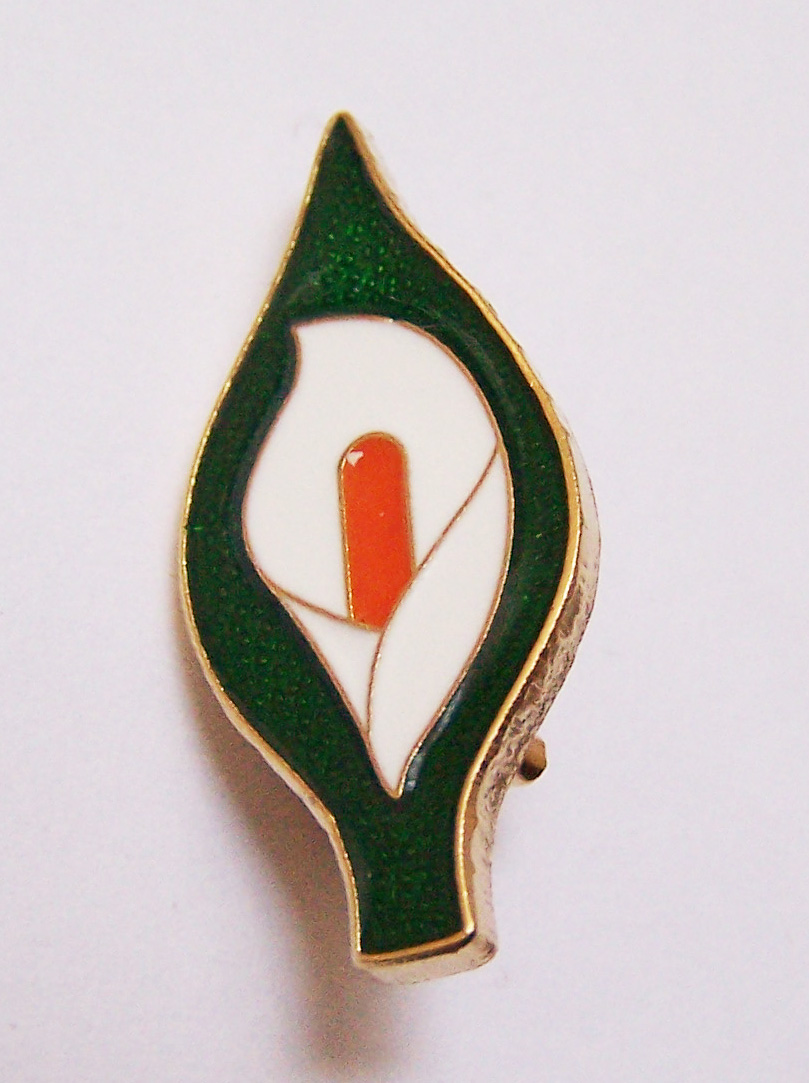
Another version of the Easter Lily enamelled badge. (Image source: Internet)
Cumann na mBan continued to sell the Easter Lily and not only they, Sinn Féin and IRA wore and sold it but many supporters of Fianna Fáil also. But in the mid-1930s the differences between Fianna Fáil and Republicans who contested the legitimacy of the Dáil sharpened and during this period too the IRA grew considerably in numbers. Agitation around social conditions within the new state was attracting more people to the IRA as was the struggle against the “Blueshirt” fascist movement and their supporters among the original Free Staters’ political party, Cumann na nGaedheal. In 1935 the Fianna Fáil Government again banned the IRA, along with the Blueshirts.
In February 1935, after the IRA killed Richard More O’Ferrall (due to his eviction of 11 families from his lands in 1934), the Fianna Fáil Government cracked down hard including introducing trial without jury in the Special Criminal Courts and Military Courts, against the sentences of which no appeal was permitted.
The FF party’s leadership instructed its members to stop selling the Lily. However, as many would no doubt at least continue to purchase and wear the emblem, the party attempted to introduce a replacement badge, the “Easter Torch”.
Advert for FF’s “Easter Torch” or “An Lóchrann” badge (supplied by Méabh O’Leary, grma)
It was abandoned after a number of years having failed to gain popularity and many FF members and supporters continuing to wear the Lily.
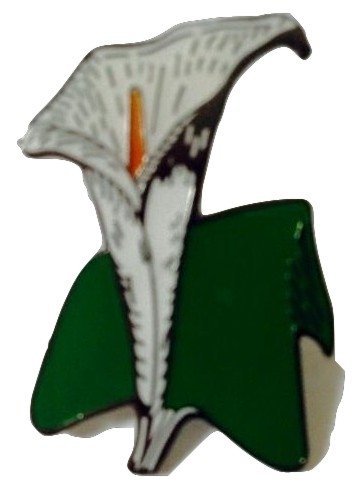
An Easter Lily enamelled pin — there are a number of versions, some with a legend inscribed and some without. (Image source: Internet)
‘STICKIES’
In 1967 Sinn Féin produced a version of the Easter Lily paper badge with a gummed surface on the reverse. This seemed an interesting innovation, doing away with the need for a pin but as the day wearing it progressed, the badge had a tendency to become unstuck at one end or another – and sometimes both – and to curl unattractively.
Sinn Féin and the IRA both experienced an acrimonious split over a number of issues in 1969 from which emerged “Official SF” (and OIRA) and Provisional Sinn Féin (and PIRA). For the annual traditional commemoration of the Easter Rising in 1970, the ‘Officials’ continued with the new gummed version while the “Provos”, less for aesthetical than for symbolic reasons perhaps, reverted to the older pin-secured version of the badge.
Whoever baptised the Official SF and OIRA “Stickies” as a result is unknown but the use of the term became so widespread as to gain almost official (forgive the pun) status. The party continued to be known by that nickname through a number of splits and incarnations and today, the Workers’ Party have not quite shaken it off.
An attempt to baptise the other Republicans as “Pinnies” or “Pinheads”never really gained ground.
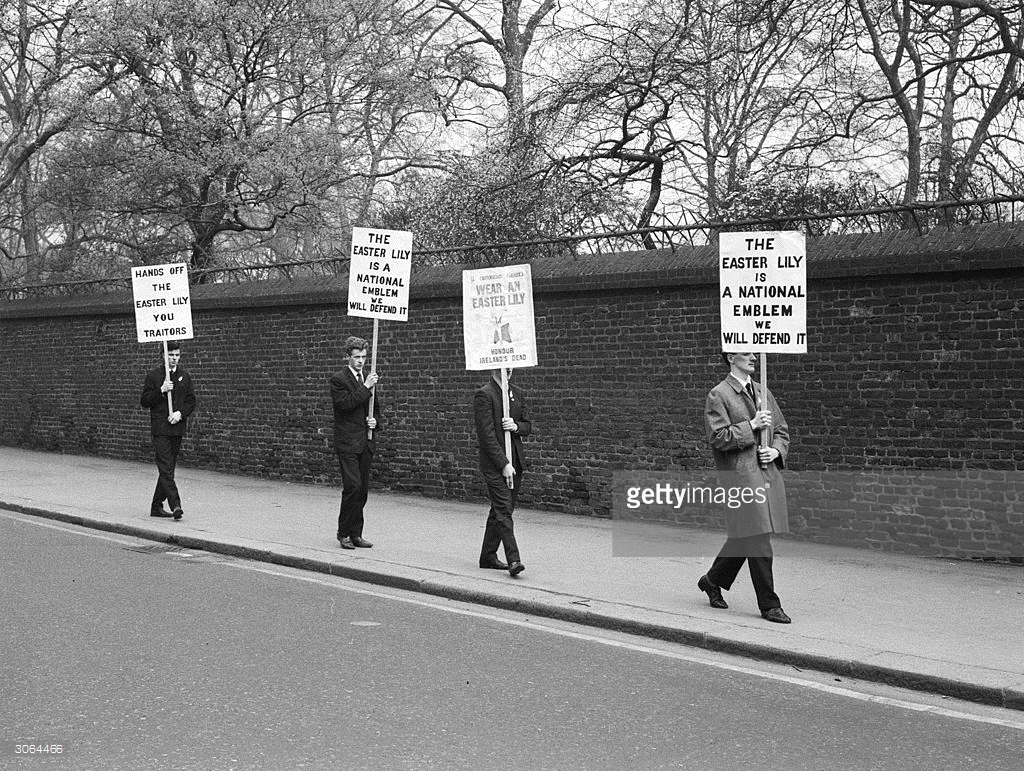
Those who sold the Easter Lily in the Six Counties or who wore it were liable to arrest under the colonial statelet’s Flags and Emblems (Display) Act (1954-1987). It was not formally illegal in the Twenty-Six Counties (the Irish State) but sellers were subject to Garda Special Branch harassment under the excuse that the sellers did not have a license to sell (they declined to ask the partitioned State for permission and perhaps they would not have been be granted one). Flags and donations were seized by Gardaí and sellers at times arrested.
“Whenever they tried grabbing the Lilies and money from me, I slung it all on the ground. Let them go picking it all up if they wanted it!” commented a veteran Republican to me a couple of years ago. One can imagine that in such a situation, onlookers might pick the money and badges up, some to return to the victim or his comrades and some perhaps to keep for themselves. In either case, the Special Branch would be presented with the difficulty of badges blowing in the wind and coins rolling in all directions.
Placard parade defending right to sell and wear the Easter Lily — late 1950s/ early 1960s? (Image source: Internet)
Today, the Easter Lily is visible much less than it was up to perhaps the 1980s. It is viewed by most people who know what it represents (many do not) largely as a Republican emblem (either SF or “dissident”). That is a pity. It should be viewed, I would submit, as a badge of national resistance, of anti-imperialism and as a commemoration honouring generations of men and women who have fought the colonial occupation and exploitation of their land. But let us also remember that it was the women who created the emblem and braved non-cooperation and repression to popularise it.
1 Cumann na mBan (“The Women’s Association”) was an Irish Republican organisation formed in 1914 in Wynne’s Hotel in response to the formation of the Irish Volunteers in 1913. It was organised, as were the Volunteers, along military lines and although set up originally as an auxiliary to the men’s organisation, it had its own uniform, structures and commanders. In that respect and in its insurrectionary intentions, it was the first women’s organisation of its kind in the world. Other revolutionary women at the time joined the Irish Citizen Army, also the first of its kind in the world, where women and men were accorded equal status. Both organisations played prominent roles in the 1916 Rising along with a number of other organisations. Cumann na mBan survived the ICA by a number of decades.
2 See url in References and Further Information at end of article
3 The word “fourth” is a reference by Matthews to the various incarnations of the party which started off as a nationalist one seeking a dual Irish and English monarchy for Ireland, with limited autonomy. The current party to which people normally refer when they say “Sinn Féin” may be seen as the party’s fifth or even sixth version, although the current party claims its origin in the first incarnation.
Narrated by Roger Waters of the Pink Floyd band, a useful documented discussion on how the population of the USA, the main political and financial supporter of the Israeli Zionist State, is conned into supporting Israel.
NB: “The US mind” is the subject, not “the American mind” — there is no reference to Latin American or Canadian thinking on the issue.
The film exposes the use of the US media combined with Israeli propaganda, pressure on politicians and media figures and demonisation of opponents.
Interestingly, at least one prominent commentator argues that the USA agrees with Israeli policy largely because it agrees with its own — but doesn’t tell us what that US policy is, much less explain it. Perhaps that’s beyond the film’s scope or the film is aimed at liberal opinion and exposing naked imperialism would be going too far — but in places, the narrative does hint at it.
Interestingly too that line of argument undermines the narrative that the Israel lobby (incorrectly termed “the Jewish lobby”) is the dominant factor is US policy towards Israel. A USA Jew also points out that most of his co-religionists in the US do not agree with the hard, right-wing, neo-liberal politics of the Israeli leaders.
Worryingly, in reference to a strand of fundamentalist Christianity in the US which supports Israeli policy, a commentator tells us that one in three US citizens believes that the Bible is factual.
But very encouragingly, the film argues that Israel is at last — finally — losing its propaganda grip on US youth in the colleges and in black communities.
Worth watching to understand the history of US public support for Israel but also to learn how untruthful propaganda works with regard to words.
I’m sick of seeing foreigners everywhere. I mean, don’t get me wrong, I’m not racist or anything …. but they’re just everywhere. And as for Muslims building mosques! Here, in Ireland!
What’s wrong with that? We’ve got hundreds, maybe thousands of churches in Ireland.
Yeah, but we’re a Catholic country.
Do you object to Presbyterian, Anglican, Methodist and Unitarian churches too?
Er … no, they’re Christian religions. Muslim is completely different. We’re a Christian country – always have been.
Actually, no.
What do you mean?
We were pagans once. Before Christian missionaries came in.
OK, before St. Patrick. And yes, I do know he was a foreigner. But since then, we’ve been a Christian country, right?
Yes, I grant you that.
That’s what we need to go back to – Christian Gaelic Ireland.
An bhfuil Gaeilge agat?
No, I don’t speak it. No need to be smart. That’s another thing that was taken from us!
They teach it at school, though.
Not very well. And they force it, which turns people off.
They force maths on people too. And other subjects.
Yes …. well. Anyway, this is getting away from the subject. I was talking about … Getting back to the old Christian Ireland. The Ireland we fought against the British for. Which so many people died for.
James Connolly Monument, across from Liberty Hall, Beresford Place. (Photo: D.Breatnach)
Like James Connolly, Patrick Pearse, Tom Clarke ….
Yes, exactly!
James Connolly was born in Scotland, Tom Clarke in England.
Well I knew about Connolly, but Clarke … are you sure?
Yep, Isle of Wight, SE England.
OK …. but …. they were still Irish, weren’t they …. like our soccer team?
Yes, I agree with you there. And about Constance Markievicz ….
Listen, don’t try that one on me! She married a Polish count – but she was Irish.
She was born in England too.
Was she? Well ok, but of Irish stock too.
Gore-Booth – not exactly a Gaelic name, is it?
Look, let’s go back to Pearse – he was Irish through and through. He wrote in Irish – articles, stories and poems, didn’t he?
He most certainly did.
Well then!
His father was English, though.
What? You’re codding me!
No, seriously. James Pearse was English. And had married previously in England.
Now you’re telling me Patrick Pearse’s father was a BIGAMIST?
No, no, calm down. She died – he was a widower. Thomas Davis’ father was Welsh, by the way.
Thomas Davis Statue monument and fountain, Dame Street, Dublin, Irealand (Photo: D.Breatnach)
Who wrote A Nation Once Again? That Thomas Davis?
Yes. And The West’s Awake.
OK, OK but Thomas himself was born in Ireland, wasn’t he?
Yes. Eamon Bulfin wasn’t though.
Bulfin? Who was he?
He hoisted the tricolour up on the GPO on Easter Monday 1916.
Did he? Was he born in England too?
No – in Argentina.
WHAT?
Yep. And De Valera’s da was apparently Cuban. Dev was born in the USA.
OK, OK, OK – but they were all part-Irish or wholly Irish …. in blood, I mean. Part of what they call the Irish diaspora.
True. But Erskine Childers wasn’t. Totally English.
Ah now you’re trying to wind me up. He was President of Ireland – of course he was born here.
That Erskine Childers was but his Da wasn’t.
OK, so what?
Well, he’s the one who brought the Mausers into Howth. In his yacht. And he was murdered by the Free Staters in the Civil War.
That was him?
The Irish tricolour flag — presented to the ‘Young Irelanders’ by Parisian revolutionary women in 1848. (Image source: Internet)
Yeah, and part of the crew were two women – one born in England and one in the USA. By the way, the Tricolour that Bulfin hoisted on the GPO? You know what it signifies?
Yes. Peace between the original Irish, the Catholics and the descendants of the planters, the Protestants.
OK. Well, that’s not originally Irish either.
What? The Tricolour? Not Irish?
Not originally, no.
Where is it from then? Please don’t say England!
No – Paris. During the Paris uprising of 1848, French female revolutionaries presented it to an Irish Republican delegation.
So the Irish flag before that was …. just Green?
Well, Green yes, often with a harp in gold ….
Yes, Green, forever green, always the Irish colour …
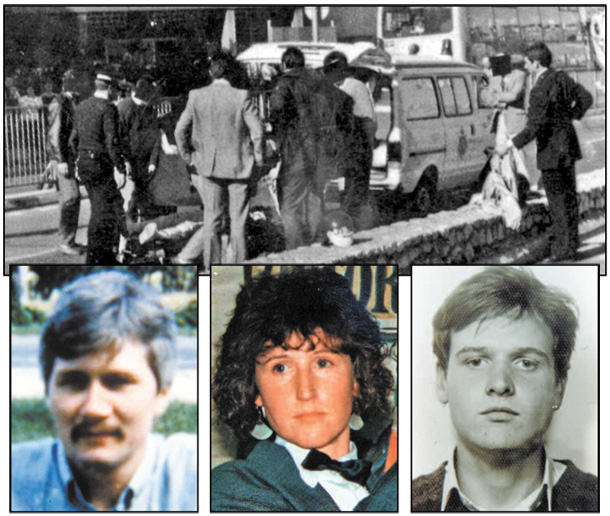
On the 6th of March 1988, an undercover unit of the IRA in the Spanish State was being tracked by Spanish police. As the unit headed in to Gibraltar, their surveillance was taken over by a British Army unit of the Special Air Service. Very soon afterwards, the SAS attacked the IRA unit and shot them down, shooting them again with execution shots on the street. The IRA unit were unarmed and there was no attempt made to arrest them. The SAS claimed that they had a bomb ready to detonate but no such bomb was ever found. The three Volunteers were Mairéad Farrell, Seán Savage and Daniel McCann.
Above: Gibraltar 3 murder scene. Below: Daniel McCann, Mairéad Farrell, Sean Savage. (Source: Stair na hÉireann)
A Gibraltar woman, Carmen Proetta, who witnessed the murders from her flat and testified to what she had seen was villified and libelled in the British media (she successfully sued a number of them later). A Gibraltar inquest judged the killings to have been unlawful. Amnesty International in Britain denounced the killings — one of the few occasions in which Amnesty criticised the British Government with regard to its conduct in relation to the 30 Years’ War in Ireland.
Almost two months after the shootings Margaret Thatcher and her Foreign Secretary Geoffrey Howe tried to prevent an independent British TV company’s documentary on the killings, Death On the Rock and the career of the lead Editor, Roger Bolton, suffered severely, although an independent investigation of the program vindicated the program.
Coffins of the Gibraltar Three being carried through West Belfast (Source image: The Irish News)
Streets of Gibraltar song
By The Irish Brigade (long version) + verse by DB*
Chorus
Oh, sad are three homes in Belfast Town,
all Ireland shares their sorrow;
as they walked in the sun, the Brits drew their guns
and they died on the streets of Gibraltar.
1
They flew out of Belfast with an ambitious plan
to carry the struggle to free Ireland –
Mairéad Farrell, Seán Savage and Daniel McCann –
and they died on the streets of Gibraltar.
Chorus
2
Hidden eyes had been watching, they followed each one They knew they weren’t armed, that none had a gun
They gave them no warning and no chance to run For the three must die on Gibraltar.
3
Each of them unarmed, without mercy gunned down, *
shot again in the head as they lay on the ground
by the Special Air Service, assassins of the Crown –
they were murdered on the streets of Gibraltar.
(Chorus)
4
The SAS stood there, so proud of their deed –
three more freedom fighters shot down in the street:
Mairéad Farrell, Seán Savage and Daniel McCann –
they died on the streets of Gibraltar.
5
Mairéad, while in prison we watched you with pride; True to all you believed in and for this you’ve died With two fine volunteers Dan and Sean by your side — A part of us died in Gibraltar.
(Chorus)
6
It happens each time that a Volunteer dies — They screen out the truth with a cover of lies; But we know what happened on that warm peaceful night The Brits planned their deaths on Gibraltar.


















 rebelbreeze