USA’s ambitions bring danger of war

Diarmuid Breatnach

(Reading time: 13 mins.)

“Wars and rumours of wars …”1 The sabres are rattling around Eastern Europe. The mass media in our latitudes largely takes the position of the USA under the guise of democracy; however with some text and the use of a few maps I hope to show that Russia’s position is essentially defensive in this regard and that the USA is the main aggressor. I hope to do that without expressing any support for the Russian regime.

WHAT IS ACTUALLY HAPPENING?

The USA sees Russia as its main opponent or competitor in Europe and has been working since the post-WWII decades to neutralise it, earlier under the guise of stopping the spread of “communism” and defending “democracy”. Since the fall of the USSR system the talk is no longer about defeating “communism” but “defending democracy” continues to used in anti-Russian rhetoric. Russia is no democracy but the notion that the US, the world superpower, the biggest imperialist power on the planet since WWII, cares about democracy should make us laugh. It would perhaps, except that the mass media keeps feeding us the USA’s rhetoric and shaping us to support it in war.

The USA is actually squeezing Russia from two directions — from Europe and from the Middle East. NATO, the North Atlantic Treaty Organisation is a US-led military alliance which now has the membership of most states in the EU, along with the UK and nearly every state of the former USSR to the west of Russia. A look at the map of NATO states will demonstrate that2. Nearly every state in the Middle East is also formally or informally in the sphere of influence of US imperialism3.

“Russia says it wants Western guarantees that Nato will not allow Ukraine and other former Soviet countries to join as members. Moscow has also demanded the alliance halt weapons deployments to Ukraine and roll back its forces from eastern Europe – demands flatly rejected by the West.4

Map NATO & non-NATO countries in Europe, showing also periodic expansion (Source: The Economist)

So the Russian ruling class is naturally worried and feeling besieged. On or near their European borders they only have Sweden, Finland, Moldova, Belarus and Ukraine which are not formally part of NATO and Ukraine has clearly indicated an interest in that direction. Beyond those last three aforementioned, all the states through central Europe are NATO members right through to the UK: Poland, Slovakia, Hungary and Romania actually bordering on Russia, with – heading generally westward and south-westward– Czech Republic, Croatia, Slovenia, Bulgaria, Albania, Greece, Germany, Netherlands, Belgium, Italy, Spain, Portugal, France and UK. In addition, some of those states have highly-developed military power such as Germany and two of them have nuclear armament of their own — UK and France – while the US has ready-to-launch nuclear missiles on the lands of many of the NATO states — Belgium, Germany, Italy, the Netherlands and Turkey5.

Sweden, Austria and Switzerland may remain nominally neutral but are in general politically aligned with the EU and the USA rather than with Russia, while non-NATO Finland is definitely, for historical and geographical reasons, extremely wary of its Russian neighbour.

The smaller non-NATO states of the former Yugoslavia – Bosnia & Herzegovina, Serbia, Montenegro, Montenegro and Kosovo are in some cases friendly towards Russia (or not overly-friendly towards NATO) but they are completely surrounded by NATO states.

On its borders with the Middle East, Russia is also being squeezed. Turkey has long been a major NATO state in the region and only Georgia is located between it an Russia to the latter’s south-west, with Armenia and Azerbaijan to its south-east. Nearly all of the states in the Middle East are in formal or informal alliance with the West and therefore with the US: Cyprus, Lebanon, Iraq, Israel, Jordan, Egypt, Sudan, Libya, Saudi Arabia, Kuwait, Oman, Bahrain, Qatar and United Arab Emirates. Yemen is embroiled in its own Saudi and West-proxy war, while Syria is threatened by Israel, Turkey and NATO. Only Iran is fairly safe for the moment on that part of Russia’s border, which is why Russia will take its side in any conflict with the West, despite the Russian ruling class’ dislike of and vulnerability in some regions, as in Chechnya, to militant fundamentalist Islam.
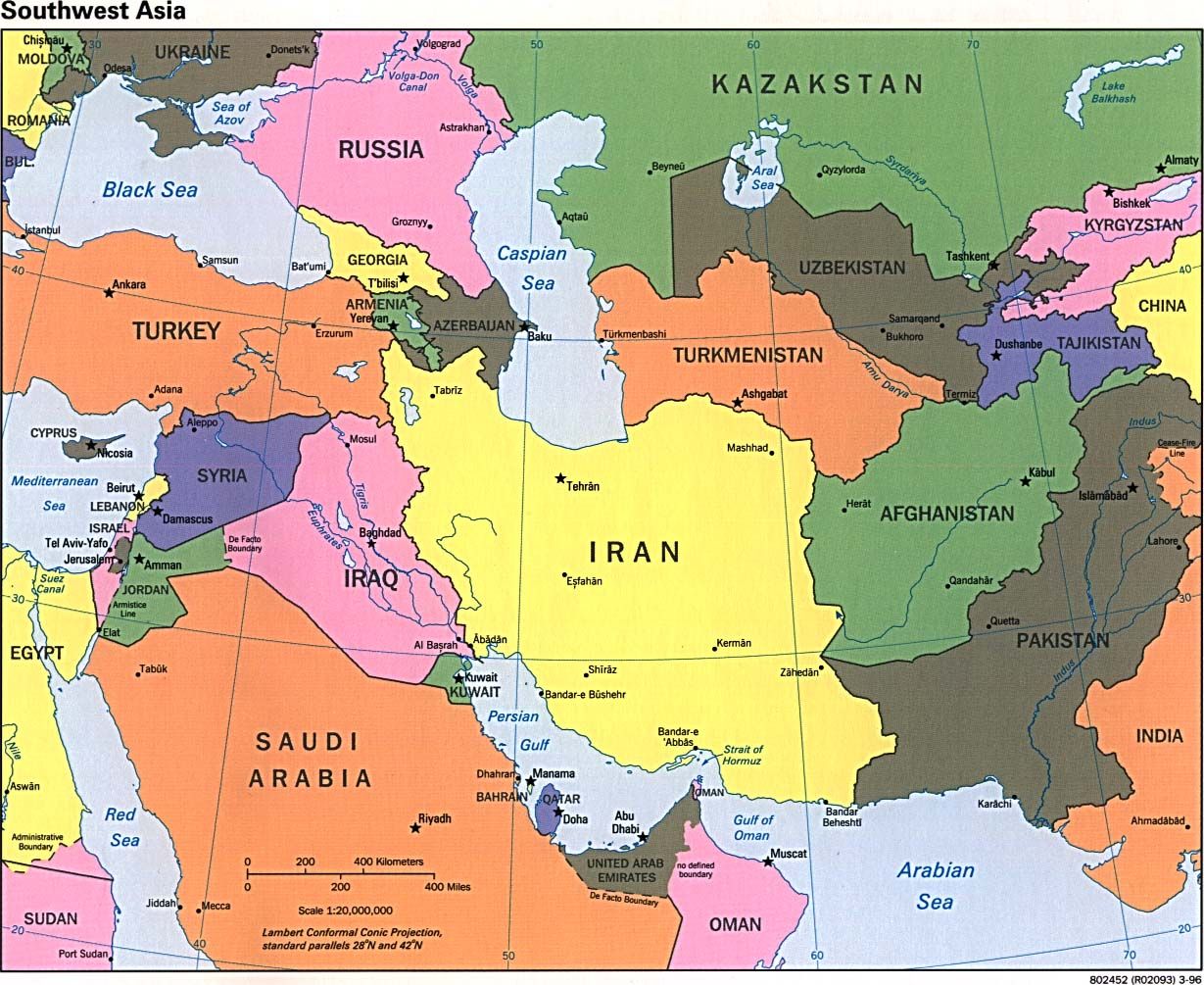
Middle East states and Russia (Source: Internet)

Syria is next to Iran which is also why Russia has been supporting the Assad regime and why, during the past week, it has warned Israel about its bombing raids into Syria as the latter attacks Hizbollah bases there. In fact we may see the invasions by western alliances of Iraq and Libya as part of huge US/NATO ‘domino’ plan to attack Syria with Iran next; then the pressure on Azerbaijan and Georgia on Russia’s doorstep. While on the eastern side of Iran, Afghanistan and Pakistan are also allies of the West ….

Further east, there is India which has long been friendly to Russia and in tussles with Pakistan — and China, which is not openly hostile to Russia as a rule but which is not a real friend either, though its competition and contention with the US keeps it friendly enough towards Russia for the moment.

What the Russian ruling class is doing is attempting to bring a halt to its encirclement by NATO at the point of Ukraine. And the US-NATO and EU are issuing a counter-threat – an open one of sanctions and a more veiled one, in the case of US-NATO, of armed action.

This week it appears that some parts of Ukraine have sought to break away from the main part, probably instigated by Russia or at least promised support if they did – which has materialised in Russian diplomatic recognition and in troop movements. This may amount to an annexation or may not but what is clear is that Russia, in the face of what it considers a threat to its existence and NATO intransigence, has decided to take some decisive action.

WHAT IS REPORTED

The western mass media reports the situation painting a picture of big powerful Russia threatening its much smaller neighbour, by threat of invasion seeking to force it into submission to Russia’s regime, in denial of the small nation’s democratic rights. And the democratic West, through NATO, is moving troops to support the Ukraine, warning Russia of consequences.

Russian Tanks and Troops Reportedly entering part of Ukraine (Photo source: The Telegraph)

The picture contains much truth but overall it is a lie. Russia is much bigger than the Ukraine and it is threatening it with troop movements. And NATO is moving troops up to counter-threaten. But to evaluate a situation properly, we need to know its antecedents, what led up to it. We also need to see the situation through the eyes of the participants, whether we agree with them or not. The mass media, apart from a couple of honest analysts tucked away inside a newspaper, far from the headlines, does not supply us with that information.

The Irish Times, one of Ireland’s main daily newspapers, on 12 February reported that “Russia’s military build-up near Ukraine and a surge of Russia’s military activity has fueled fears that Russia could invade the country. Russia denies having any such plans. However a US official has said that the US had picked up intelligence that Russia is looking at Wednesday as a target date for an incursion.”

So on the basis of the quoted paragraph, we were to draw the conclusion that Russia was threatening to invade Ukraine. OK, Russia denied it but then why the military buildup near Ukraine? Finally, the authority voice of the USA, quoting what we are supposed to see as excellent intelligence sources (which we cannot of course question), predicting a probable Russian invasion four days away. So which state are most people in this part of the world likely to believe, the Russians or the US?

Some weeks earlier, on 25th January, another Irish daily newspaper, the Examiner, reported on reactions to a Russian naval fleet exercise in the Atlantic. The Irish Government told the Russians the exercise was not welcome although not illegal6, because the area of the exercise is regarded as international waters. This from the same government that facilitates US military flights via Shannon airport, i.e on its own national territory. And NATO carries out at least one major exercise in European waters annualy, with the UK doing so twice yearly without complaint from the Irish Government.7

The Ukrainian Ambassador to Ireland, Ms Gerasko moved to take advantage of the situation “A plan to hold a major exercise by the Russian navy and air force in the Atlantic off the southwest coast of Ireland is yet another demonstration of the threat that Russia poses for the world,” she said, in a statement to the Irish Examiner.” 8

Attempts were made at the same time to whip up Irish offshore fishermen against the Russians and to whip up the Irish public in defence of “our fishermen”. The latter project failed miserably since the Russian Ambassador to Ireland met and negotiated with the fishermen, leading one of their leaders to comment that the Russians had treated his members better than their own (Irish) government.

We might expect an alternative discourse about the Ukraine crisis from Al Jazeera but its report on the 24th of January, although emphasising US military movements in the area, attached a number of articles which were generally relaying the western line. The Irish Independent carried a much more in-depth explanation, though based on the position of the UK through its premier, Boris Johnson; however it did list the Russian demand that NATO cease pushing towards them and that Russia considered Ukraine joining NATO “an existential threat” while in general still following the general anti-Russian pattern9.

Closing ceremony of Sea Breeze, NATO-Ukraine joint naval exercises in the Black Sea 12 July 2019 (Photo by US Naval Officer)

POSITION OF THE IRISH STATE

An analysis piece in its business section by the Irish State’s national broadcaster, RTÉ, concentrated on the possible economic impact of loss or drastic reduction in gas and oil exports from Russia, either as a direct consequence of conflict or through imposition of sanctions by the West. “Russia produces 11% of global oil supplies and according to David Horgan, managing director of Petrel Resources, any significant loss of Russian energy exports would result in a further spike in prices.”10

Russia is the biggest supplier of gas in the world and the largest to Europe with a third of of its gas pipeline supply to Europe crossing Ukraine. Ireland’s electricity supply is highly dependent on gas for its generating stations so any disruption will impact heavily of prices which “have already gone from $2 to about $30 per million BTU”, according to the Petrel managing director.11

It is clear that while the USA is driving the agenda through its dominance of NATO and the the threat of sanctions on Russia, which the USA regularly insists upon when teaching other countries a lesson, its own economy would suffer little as a result. However, it is a different question for the European states, which would be obliged to bear the weight of economic impact. Mícheál Martin, the Taoiseach (Prime Minister) of the Irish State felt obliged to comment on this possibility but, rather than criticise the USA and NATO’s expansionism, spoke about the need to break from their dependence on Russian energy supplies.

Micheál Martin said the EU is unified in responding “very strongly” to any Russian invasion of Ukraine and stated that in Europe’s view the huge build-up of troops by Russia on the Ukraine border is “not justifiable” in any circumstances. While calling for “diplomacy and de-escalation” he clearly sided with the USA in the conflict as both the Irish ruling class and the EU’s would expect of him.12

Despite many criticisms to the contrary, the policy of the Irish state during WWII was essentially one of neutrality in favour of the Allied forces while the government of the Six Counties was of course wholly aligned with the UK. Nevertheless Irish commercial shipping was sunk by Nazi German action and cost many Irish seamen their lives.

So far the Irish state has remained outside NATO but over the past decade there has been discussion envisaging the creation of an EU rapid deployment force made up of personnel contributed from all member states. It would hardly be surprising if such a move appealed to some within the career personnel in the Irish armed forces, envisaging taking part in wider military action, alongside varied forces, employing advanced weapons and systems and with possibly better promotion prospects. Additionally in recent weeks there has been media discussion of greater funding for those forces.

Ireland – and not only the UK’s colony here – can be dragged into war more easily than we perhaps imagine and also into being targeted for retaliatory action. Indeed, the facilitation of US military personnel and materiel through Ireland’s airport at Shannon, along with CIA transport of secret prisoners (“rendition”) has already exposed the State (and succeeding governments) to accusations of military partisanship.

Contrary to popular belief, the Irish State’s ‘neutrality’ is in general a matter of government policy rather than a requirement of the Constitution or Statute law.13 

The principal statute governing the Irish Defence Forces is the Defence Act 1954, which did not oblige members of the Irish Army to serve outside the state (members of the Air Corps and Naval Service are not so excused). A 1960 amendment intended to allow deployment in United Nations Peacekeeping missions requires three forms of authorisation, since the 1990s often described as the “triple lock”:

  1. A UN Security Council Resolution or UN General Assembly Resolution;
  2. A formal decision by the Irish government;
  3. Approval by a resolution of Dáil Éireann (the lower house of the Oireachtas, to which the government is responsible).

From those last two it is clear that the 26 Counties can be put on a war footing by a decision of the Irish Government or even a majority vote in favour in the Dáil. Anyone who believes that the party with most TDs would necessarily vote against such a motion is fooling themselves since the SF party has been at pains to portray itself as a safe pair of hands for Irish capitalism and recently called for greater funding for the armed forces of the Irish state; in addition it has long had an uncritically friendly relationship with the USA, in particular – though not only – with its Democratic Party.

A resolution from the UN Security Council obliging the Irish state to go to war against Russia is impossible and though such from the General Council might be possible, albeit unlikely.14

These provisions were modified in 1993 to allow for UN Chapter VII missions and again in 2006 to allow for regionally organised UN missions.
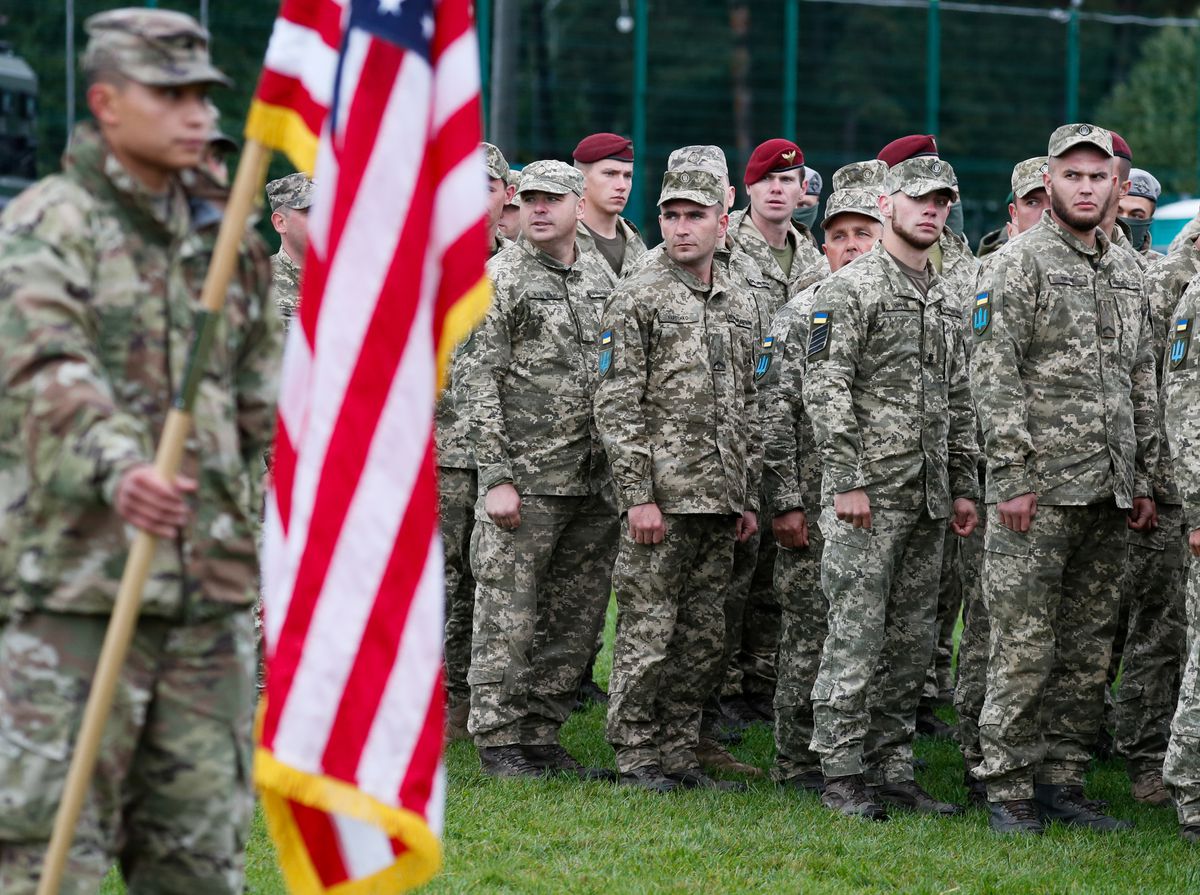
Joint NATO-Ukraine military exercise September 2021 (Photo sourced: Internet)

WHAT WE CAN DO

There seems no middle way — either NATO will back down or Russia will. No doubt the Western powers think it reasonable that Russia be the one to blink but as commented earlier, for the latter NATO creep to their borders is seen as a threat to their very existence. The same people who thought it reasonable for John Kennedy as President of the US to threaten war on the Soviet Union for the location of some missiles on the Caribbean island of Cuba think Russia should accept the advance of NATO to its borders.

In practical terms there seems little we can do in Ireland except struggle to resist the state and colony in which we live being dragged into war – for which we need to mobilise the opposition we can on the street. Sadly the anti-imperialist war movement in Ireland of years ago was allowed to deteriorate — but we should work to rebuild it.

In order to assist in this it is essential that we expose the reality of what is going on in the world. Some will say that because the USA is the main aggressor in this case and the biggest bully, we should support Russia but to do so would be a big mistake. Not long ago, while joining others in anti-fascist solidarity with people in the Donbas region in SE Ukraine, I found us being increasingly nudged towards support for Russia which I did not view as being the same thing at all.

Russia has its own crimes against people and workers and calling for support for it now will cause confusion when in future we will need to condemn it. Our position should be that while neither the USA’s regime or Russia’s is to be supported, the biggest danger of war comes from the USA and therefore it will be the main target of our hostility – besides which it is the power with which the ruling classes of Ireland and the UK are aligned. It is the biggest imperialist power in the world by far along with being the biggest military power in most of the world.

Most Irish people have no wish to be dragged into an armed conflict anywhere where they do not feel threatened. On the other hand our society is conditioned not only by decades of strong cultural influences from the USA, in particular through film but also by media reporting that is biased towards the dominant western European view and that of the USA. In that paradigm, the Russians are the bad guys, the gunfighters in the black hats, while the US and the West in general are on the side of the angels.

With the 1916 Rising in the middle of WWI, Ireland became the first country to carry out an uprising against world war15, against the dominant trend throughout Europe at the time — a tradition worth upholding. As long as imperialism exists, the world will continue to suffer smaller wars and the danger of another major war. It is necessary to overthrow imperialism and we can best contribute towards that aim by coordinating our struggles with the aim of carrying out a revolution in Ireland, thereby depriving imperialism of one of its supporters in Europe.

End.

FOOTNOTES
1
“And you will begin to hear of wars and rumors of wars. Behold, do not be alarmed; for it is necessary to take place, but the end is not yet” — Christian New Testament Bible, Matthew, Chapter 24:6.

2See map NATO states

3See appropriate map for this also

4https://www.breakingnews.ie/world/white-house-calls-russian-moves-on-ukraine-an-invasion-1262219.html

5https://armscontrolcenter.org/fact-sheet-u-s-nuclear-weapons-in-europe/

6https://www.irishexaminer.com/news/arid-40792923.html

7https://www.royalnavy.mod.uk/news-and-latest-activity/operations/united-kingdom/exercise-joint-warrior

8Ibid.

9https://www.independent.ie/world-news/europe/ukraine-crisis-why-russia-might-invade-and-what-could-happen-next-41279592.html

10https://www.rte.ie/news/business/2022/0128/1276522-ukraine-ireland-analysis/

11Ibid.

12https://www.irishexaminer.com/news/arid-40811598.html

13According to Wikipedia: “One exception is Article 29, section 4, subsection 9° of the Irish constitution:

The State shall not adopt a decision taken by the European Council to establish a common defence pursuant to Article 42 of the Treaty on European Union where that common defence would include the State.

This was originally inserted by the 2002 amendment ratifying the Treaty of Nice,and updated by the 2009 amendment ratifying the Treaty of Lisbon. An earlier bill intended to ratify the Treaty of Nice did not include a common defence opt-out, and was rejected in the first Nice referendum, in 2001.”

14Resolutions of the UN Security Council, the only ones binding on all member states, require unanimous agreement by all five Permanent Members: UK, France, USA, Russia and China. Forcing a vote such as this in the UN General Assembly would likely lead to the fracture of the organisation.

15The following year there were two in Russia and in 1918 another in Germany.

SOURCES

Matthew 24:6 https://biblehub.com › matthew

https://www.dw.com/en/thousands-of-russian-troops-leave-ukraine-border/a-60257452

https://www.breakingnews.ie/world/putin-orders-forces-to-maintain-peace-in-eastern-ukraine-1261744.html

https://www.breakingnews.ie/world/emergency-meeting-called-by-un-security-council-over-ukraine-crisis-1261794.html

Map Middle-East towards Russia: https://www.pinterest.com/pin/291678513336896419/

European states holding US nuclear weapons: https://armscontrolcenter.org/fact-sheet-u-s-nuclear-weapons-in-europe/

Map NATO states towards Russia: https://www.businessinsider.com/map-europe-divided-nato-russia-2016-7?r=US&IR=T

UK bi-annual military including naval exercises: https://www.royalnavy.mod.uk/news-and-latest-activity/operations/united-kingdom/exercise-joint-warrior

NATO exercise 2021: https://mc.nato.int/media-centre/news/2021/nato-exercise-dynamic-mariner-and-joint-warrior-begins-in-the-atlantic#:~:text=It%20runs%20between%2018%20and,Kingdom%20and%20the%20United%20States.

Mass media:

Ireland, on Russian Naval fleet in the Atlantic and Ukraine Ambassador: https://www.irishexaminer.com/news/arid-40792923.html

Al Jazeera on the Ukraine confrontation: https://www.aljazeera.com/news/2022/1/24/uk-pulls-staff-from-ukraine-as-fears-of-war-rise-liveblog

Much more in-depth coverage with emphasis on the UK position: https://www.independent.ie/world-news/europe/ukraine-crisis-why-russia-might-invade-and-what-could-happen-next-41279592.html

Irish Government position: https://www.irishexaminer.com/news/arid-40811598.html

Irish neutrality — facts: https://en.wikipedia.org/wiki/Irish_neutrality

Calls for a joint EU countries armed force: https://www.france24.com/en/europe/20210902-proposals-for-an-eu-army-re-emerge-after-afghan-pullout-%E2%80%93-but-many-remain-hard-to-convince

BRITISH QUEEN’S LONG SERVICE TO COLONIAL & IMPERIALIST WAR

Diarmuid Breatnach

(Reading time main text: 5 mins)

Recently the Queen of the UK and Commonwealth regions reached the 70th year of her reign, called by convention the “platinum jubilee” and has received congratulations from the heads of imperialist, colonial and neo-colonial states around the world. In Ireland, she has also received the congratulations of the head of a formerly Republican party now aspiring to neo-colonial government. When Mary Lou MacDonald, President of Sinn Féin praised Elizabeth II for her “long service” we should ask: service to whom and to what? We are also entitled to compare her words to those of James Connolly, Irish revolutionary socialist and republican, in reference to the British Monarchy.

WHAT THE PRESIDENT OF SINN FÉIN SAID

Mary Lou McDonald, President of Sinn Féin was widely reported reacting to the news that a tree is to be planted in the grounds of Parliament Buildings at Stormont to mark the anniversary.

“I think it is important that we are respectful of the identity of our citizens who are British,” she said on Thursday.

“I think that is entirely appropriate and I welcome that decision.

She was reported wishing well to those who will celebrate the jubilee, and said she believes those who won’t “are now big enough, bold enough, generous enough to acknowledge the identity of others.”

“Can I also extend to the British Queen a word of congratulations because 70 years is quite some record,” she added.

“That is what you call a lifetime of service.”

Any logical consideration of those words should quickly find some problems with them. What does “respecting the identity of our (Irish) citizens who are British” or “acknowledging the identity of others” actually mean? One would imagine that respecting the identity of others would involve primarily not subjecting them to discrimination, racism or religious sectarianism. Does respecting the national identity of any people give them the right to seize with armed force and occupy a part of the nation? Because that is what constitutes the basis for the British colony of the Six Counties in Ireland and the administration of that colony is the purpose of the Stormont Parliament and Executive. Furthermore, discrimination and sectarianism is precisely what is suffered by a huge part of the population of that colony – from the very institutions being upheld by SF and by its President.

Stripped down to its essentials, we are only “big enough, bold enough, generous enough” if we accept the partition of our small nation, the forcible retention of a colony and pay our respects to the Head of that state and the Commander-in-Chief of its armed forces.

This is a monarch who has presided over her armed forces’ participation in at least 24 wars or interventions since her inauguration, two of them in our national territory. Her armed forces invaded foreign lands, bombed and shot down those who resisted, carried out massacres, tortured prisoners and she has personally decorated the leaders of those armed forces, including those who murdered Irish people. The very least one could expect from an Irish politician with any dignity would have been silence or “no comment” on the occasion.

A poster calling for retired Army officer General Sir Mike Jackson to be jailed and advertising a march commemorating Bloody Sunday, on display in the Bogside area of Derry, Six Counties. Jackson was one of many military murderers to be decorated by the British Queen. (Photo by Niall Carson/PA Images via Getty Images).

This is far from the worst thing that the Sinn Féin leadership has done with regard to the British Monarch, for in May 2011 they called for no protests against her while she desecrated the Garden of Remembrance in Dublin and while the Gardaí attacked “dissident” Republican protesters nearby and outside her state reception in Dublin Castle, the old seat of her royal enforcers in Ireland. The following year, Martin McGuinness, prominent in the leaderships of both the IRA and Sinn Féin, welcomed her to her colony and shook her hand.

Martin McGuinness, in leadership of Sinn Féin and the IRA, welcomes the British Queen to visit her colony in 2012 (Photo sourced: Internet)

WHAT JAMES CONNOLLY SAID

James Connolly on occasions too referred to contemporary British monarchs – but in markedly different terms to those from the leadership of Sinn Féin in recent decades.

“What is monarchy? From whence does it derive its sanction? What has been its gift to humanity? Monarchy is a survival of the tyranny imposed by the hand of greed and treachery upon the human race in the darkest and most ignorant days of our history. It derives its only sanction from the sword of the marauder, and the helplessness of the producer, and its gifts to humanity are unknown, save as they can be measured in the pernicious examples of triumphant and shameless iniquities.

“Every class in society save royalty, and especially British royalty, has through some of its members contributed something to the elevation of the race. But neither in science, nor in art, nor in literature, nor in exploration, nor in mechanical invention, nor in humanising of laws, nor in any sphere of human activity has a representative of British royalty helped forward the moral, intellectual or material improvement of mankind. But that royal family has opposed every forward move, fought every reform, persecuted every patriot, and intrigued against every good cause. Slandering every friend of the people, it has befriended every oppressor. Eulogised today by misguided clerics, it has been notorious in history for the revolting nature of its crimes. Murder, treachery, adultery, incest, theft, perjury – every crime known to man has been committed by some one or other of the race of monarchs from whom King George is proud to trace his descent.

…………………….

Two completely opposite attitudes to British Monarchy: Mary Lou McDonald (L) and James Connolly (R)

“Fellow-workers, stand by the dignity of your class. All these parading royalties, all this insolent aristocracy, all these grovelling, dirt-eating capitalist traitors, all these are but signs of disease in any social state – diseases which a royal visit brings to a head and spews in all its nastiness before our horrified eyes. But as the recognition of the disease is the first stage towards its cure, so that we may rid our social state of its political and social diseases, we must recognise the elements of corruption. Hence, in bringing them all together and exposing their unity, even a royal visit may help us to understand and understanding, help us to know how to destroy the royal, aristocratic and capitalistic classes who live upon our labour. Their workshops, their lands, their mills, their factories, their ships, their railways must be voted into our hands who alone use them, public ownership must take the place of capitalist ownership, social democracy1 replace political and social inequality, the sovereignty of labour must supersede and destroy the sovereignty of birth and the monarchy of capitalism.

“Ours be the task to enlighten the ignorant among our class, to dissipate and destroy the political and social superstitions of the enslaved masses and to hasten the coming day when, in the words of Joseph Brenan, the fearless patriot of ’48, all the world will maintain

The Right Divine of Labour
To be first of earthly things;
That the Thinker and the Worker
Are Manhood’s only Kings.”2

SUPPORT FOR SINN FÉIN

Most followers of the Sinn Féin party, who are by long tradition anti-monarchist and desire a reunified and independent Ireland, tend to regard those kinds of heretical statements by the party leaders as no more than some kind of camouflage to get them into power. Once there, they imagine, their party will lead them to the hallowed objectives of Irish independence and unity. In fact, the same kind of attitude that was that of the early followers of Fianna Fáil, “the Republican party”3.

The blindness, or more accurately the ability of self-deception exhibited by these followers is amazing. The majority continued to believe the leadership when it publicly abandoned armed struggle against British colonialism and declared it would never return to that (believing that to be a fake position) and even when it had most of its arms decommissioned. Then the party not only fielded candidates in elections in the partitioned Irish state but also in the colonial one and, in arguably its greatest betrayal of its previous position, participated in the running of the colonial state which it continues to do. Since then its leaders have sought support for and even assisted in recruitment for the sectarian and colonial gendarmerie4 and, more recently, declared its acceptance of non-jury special courts, a clear reference in particular to the no-jury Special Criminal Courts of the Irish state5, condemned by a number of civil rights organisations6 and of which the party’s own supporters have been frequent victims.

The attitude of the larger mass of instinctively pro-independence people, mostly working-class or lower middle-class is that they might as well give Sinn Féin a turn in government – after all they can hardly treat them worse than the other gombeen7 parties that have been in government since the creation of the Irish State. Such attitudes account for the rapid growth in the party’s electoral base in recent years when it became the first party in terms of elected representatives so that two other neo-colonial parties, with a long history of hatred for one another, were obliged to join and form a coalition with a third8 in order to form a government excluding the new kid on the block.

General Jackson with Prince Charles, heir apparent to the throne of England and Commander-in-Chief of the Paratroop Regiment (Photo sourced: Internet)

The attitude expressed by the President of the SF party runs not only completely contrary to the traditions of Irish Republicanism but even to its own history. It is more than that, it is an expression of the lack of dignity and craven forelock-tugging attitude of the neo-colonial Gombeen class that has ruled the Irish state since its inception.

While socialists and republicans rightly condemn that mentality and its practical applications, we should place our hopes in another outlook, as outlined by Connolly over a century earlier, and in the practical expression of that outlook today and in the near future. It is surely appropriate then to end this commentary with Connolly’s own words on another British royal jubilee, Queen Victoria’s in 1897:

“….. It is time then that some organised party in Ireland — other than those in whose mouths Patriotism means Compromise, and Freedom, High Dividends — should speak out bravely and honestly the sentiments awakened in the breast of every lover of freedom by this ghastly farce now being played out before our eyes. Hence the Irish Socialist Republican Party — which, from its inception, has never hesitated to proclaim its unswerving hostility to the British Crown, and to the political and social order of which in these islands that Crown is but the symbol — takes this opportunity of hurling at the heads of all the courtly mummers who grovel at the shrine of royalty the contempt and hatred of the Irish Revolutionary Democracy. We, at least, are not loyal men; we confess to having more respect and honour for the raggedest child of the poorest labourer in Ireland to-day than for any, even the most virtuous, descendant of the long array of murderers, adulterers and madmen who have sat upon the throne of England ….

“The working class alone have nothing to hope for save in a revolutionary reconstruction of society; they, and they alone, are capable of that revolutionary initiative which, with all the political and economic development of the time to aid it, can carry us forward into the promised land of perfect Freedom, the reward of the age-long travail of the people.”9

End.

APPENDIX:

List of armed interventions and wars by British Armed forces under Queen Elizabeth II:

Mau Mau Uprising(1952–1960)

Jebel Akhdar War
(1954–1959)

Cyprus Emergency
(1955–1959)

Suez Crisis(1956–1957)

Border Campaign
(1956–1962)

First Cod War
(1958–1961)

Upper Yafa disturbances[22](1959)

Dhofar Rebellion
(1962–1975)

Indonesia–Malaysia confrontation
(1963–1966)

Aden Emergency(1963–1967)

The Troubles(1968–1998)

Invasion of Anguila, Caribbean
(1969)

Second Cod War
(1972–1973)

Third Cod War
(1975–1976)

Falklands War
(1982)

Multinational Force in Lebanon
(1982–1984)

Gulf War
(1990–1991)

Bosnian War
(1992–1995)

Operation Desert Fox
(1998)

Kosovo War
(1998–1999)

Sierra Leone Civil War(2000–2002)

War in Afghanistan
(2001–2021)

Iraq War
(2003–2009)

First Libyan Civil War(2011)

2019–2021 Persian Gulf crisis(2019–present)

FOOTNOTES:

1In Connolly’s time, the term “social democrats” covered most revolutionaries in Europe in addition to reformists whereas today it is confined to describing only the latter.

2Commenting in 1910 on the announced visit of King George V to Ireland https://www.marxists.org/archive/connolly/1911/xx/visitkng.htm

3Fianna Fáil was a 1926 split from Sinn Féin led be De Valera, based on participating in elections within the Irish State, initially supported by many Irish Republicans in elections and when voted into Government in 1932 released Republican political prisoners jailed by the Government of pro-Treaty forces. Subsequently however a FF Government banned the IRA and jailed and even executed some Republicans.

4A gendarmerie is an armed state-wide military-like police force, such as for example the ones in the Spanish, Italian and Turkish states, typical of a State endeavouring to impose central rule on subject nations or regions where recurrent resistance may be expected. In Ireland the English occupation had the Royal Irish Constabulary which after 1922 in the colonial statelet became the Royal Ulster Constabulary, later changing its name to the Police Force of Northern Ireland. It has always been a sectarian (anti-Catholic) and repressive force.

5Both the Irish State and the colonial statelet have no-jury courts to jail political dissidents on low evidential requirements and under emergency legislation. The position SF’s elected representatives since 1972 has been to vote against the existence of the Special Criminal Court until two years ago, when it began to abstain and finally this year at its Ard-Fheis (annual general meeting), after an extremely poor debate, the party voted to accept such a court.

6Including the Irish Council for Civil Liberties and Amnesty International.

7A term of contempt dating from the years of the Great Hunger to describe capitalists who are happy to use the colonial system to amass personal wealth at the expense of their compatriots; its source is in the Irish language (an gaimbín/ gaimbíneachas — https://www.dictionary.com/browse/gombeen)

8Fianna Fáil, Fine Gael and the Green Party. The first two have been the major parties of the State almost since its inception, with the Greens being a smaller and more recent phenomenon. Fine Gael are the political representatives of the neo-colonial class that supported the partition of the country in the Anglo-Irish Agreement of 1921 for which they fought a Civil War (1922-1923) against the Irish Republicans (chiefly the IRA and Sinn Féin). Fianna Fáil led a major split in the Republican movement to form an Irish Government and soon attracted support (and later domination) by a section of native capitalists, soon becoming the favoured choice of the neo-colonial Irish capitalist class, alternating in government from time to time with Fine Gael (the latter in coalition, several times with the social-democratic Labour Party). However, since 1981 no Irish political party has commanded an absolute majority in elected representatives and all governments of the State since then have been coalitions of one kind or another.

9https://www.marxists.org/archive/connolly/1897/xx/qundimnd.htm Queen Victoria’s Jubilee Day, 22 June 1897, was marked by Connolly and Maud Gonne with protests on the streets of Dublin. Connolly dumped a symbolic coffin into the River Liffey and shouted “to hell with the British Empire”, for which ‘crime’ he spent the night in jail.

SOURCES:

James Connolly on visit of King George in 1911: https://www.marxists.org/archive/connolly/1911/xx/visitkng.htm

and on Queen Victoria’s Diamond Jubilee: https://www.marxists.org/archive/connolly/1897/xx/qundimnd.htm

For list of armed conflicts in which the UK has led or participated since coronation date of Elizabeth Windsor in 1953: https://en.wikipedia.org/wiki/List_of_wars_involving_the_United_Kingdom

Invasion of Anguila (missing from above list): https://en.wikipedia.org/wiki/Operation_Sheepskin#:~:text=Operation%20Sheepskin%20was%20a%20British,itself%20as%20an%20independent%20Republic.

UK Armed forces officially recorded in the Middle East: https://commonslibrary.parliament.uk/research-briefings/cbp-8794/

British military bases around the world: https://en.wikipedia.org/wiki/Overseas_military_bases_of_the_United_Kingdom

The Queen’s Service To ….

Gearóid Ó Loingsigh

(Reading time: one minute)


Queen Elizabeth II / Sinn Fein president Mary Lou McDonald

Mary Lou McDonald, the current president of Sinn Féin, surprised a few, just a few, with her recent comments thanking the English queen, Elizabeth, for her service.  She stated that “Can I also extend to the British Queen a word of congratulations because 70 years is quite some record.  That is what you call a lifetime of service.”(1)

Why someone who describes herself as a republican would want to heap praise on a monarch and refer to the reign of the monarch as service is bewildering.  However, it is not that strange in the context of the Irish peace process.  It is part of the long road of Sinn Féin’s accommodation to the British state that was laid out in the Good Friday Agreement.  Sinn Féin at that time abandoned any pretence of having a critique of imperialism and capitalism.

The agreement signed basically stated that the British had no selfish interest in Ireland and the conflict was a communal one.  Putting it in blunt terms, two savage tribes agreed to settle their differences, the British state was not one of those savage agents in the conflict.(2)

Exactly what service has the English queen given and to whom?  As a monarch she has blessed every British military adventure since her coronation in 1953, including the savagery of the British repression of the Mau Mau rebellion in Kenya, various other colonial wars, not to mention her awarding of an OBE to Lt. Colonel Derek Wilford the man responsible for Bloody Sunday in Derry in 1972.  In 2019 she stood over her behaviour when she stated that the British government would “bring forward proposals to tackle vexatious claims that undermine our armed forces, and will continue to seek better ways of dealing with legacy issues that provide better outcomes for victims and survivors”.(3)  The massacre of Bloody Sunday was placed in the category of vexatious claims.

Part of the service that McDonald now lauds includes this and many more such incidents.  Though it is not unexpected.  It can only surprise those who pay no attention to the outcomes of peace processes around the world.  Yasser Arafat spent more time repressing Palestinians than he did fighting the Israelis after the Oslo Accords.  In South Africa, the former mining trade union leader Cyril Ramphosa became a mining magnate, whose company was involved in the massacre of 34 striking miners at Marikana in 2012.(4)  He and the ANC made their peace with white capitalists and obtained a share of the wealth, in Ramphosa’s case a very substantial amount which some estimates place around $780 million dollars.  In El Salvador, the FMLN eventually gained power, but did not implement a single thing they had ever fought for and their former commander Joaquín Villalobos is now a consultant to right wing forces on how to defeat left wing movements and contributes to the right-wing think tank The Inter-American Dialogue, which includes such illustrious figures as Violetta Chamorro from Nicaragua and former head of the World Bank, Robert Zoellick, to name just two unsavoury characters.(5)  In Colombia, the ink hadn’t even dried on the agreement and the FARC commander Timochenko declared that the Colombian armed forces would be allies of the FARC in building a new country.  The murder of just over 300 members of the FARC since the signing of the peace agreement has not caused him to change his evaluation of the Colombian armed forces, in fact he has doubled down on his position.

It is in the nature of the beast.  In every peace process that has happened, the former enemies of the state reconciled themselves to the regime and the system, without exception.  McDonald’s declarations are just a confirmation of that and also a sign that it is a bottomless pit and there is no level of political depravity that Sinn Féin will not sink to.

Notes

(1)  Belfast Telegraph (10/02/2022) Sinn Féin leader congratulates Queen on ‘lifetime of service’ https://www.belfasttelegraph.co.uk/news/northern-ireland/sinn-fein-leader-congratulates-queen-on-lifetime-of-service-41334673.html

(2)  The agreement can be consulted at https://www.dfa.ie/media/dfa/alldfawebsitemedia/ourrolesandpolicies/northernireland/good-friday-agreement.pdf

(3)  The Irish Post (20/12/2019) Anger as Queen’s speech appears to dismiss fight for justice for Bloody Sunday victim’s as ‘vexatious claims’ https://www.irishpost.com/news/anger-queens-speech-appears-dismiss-fight-justice-bloody-sunday-victims-vexatious-claims-175999

(4)  The Guardian (19/05/2015) Marikana massacre: the untold story of the strike leader who died for workers’ rights https://www.theguardian.com/world/2015/may/19/marikana-massacre-untold-story-strike-leader-died-workers-rights
 
(5) See https://www.thedialogue.org

Bombing children at play

(from The Treason Felony Blog le buíochas: The Weaver Street Bombing and not dealing with the past)

(Reading time: 3 mins.)

In Belfast, on 13th February 1922, some children playing in Milewater Street, at the corner of Weaver Street, off the York Road, were approached by two Special Constables and told to go and “play with their own” (Special Constables invariably being Protestant, the children were Catholics in a largely Protestant district). They joined other children in the mainly Catholic-occupied Weaver Street and played on a swing attached to a lamp-post. Ten minutes later, two men came to the North Derby Street end of Weaver Street (one eye witness claimed one Special Constable had just spoken to the same two men). They were about 20 metres away from where the children were playing. One of the men then threw a bomb into the middle of the children. As the bomb exploded, gunfire directed into Weaver Street from North Derby Street, covered the two men’s retreat.

Weaver St map
Map showing Weaver Street running from North Derby Street to Milewater Street (which isn’t named on the map)

The explosion killed or injured Mary Johnson (13), Catherine Kennedy (14), W.J. Dempsey (13), Annie Pimley (16), John O’Hanlon (16), Elizabeth O’Hanlon (11), Murtie O’Hanlon (16), Barney Kennedy (10), John McCluskey (12), Rose Ann McNeill (13), Mary McClinton (18), Mary Kerr (6), Susanne Lavery (14), George O’Connor (16), Joseph Conway (12), Patrick Maguire (14), Kate O’Neill (14), Robert McBirney (16) and William Connolly (13). All lived in Weaver Street. Adults standing in their doorways were also badly injured.

The force of the blast threw the children up into the air and caused catastrophic injuries, maiming many of those who survived. Mary Johnson and Catherine Kennedy died immediately. Eliza O’Hanlon died the next day. Statements made in the press and in Westminster indicate that three of those injured had died by the next day, the third being O’Hanlon. By the time the inquest was held on 3rd March, a fourth girl had died from the blast. Two adults were to succumb to their injuries. Margaret Smith died on the 23rd March, while Mary Owens (who lived in nearby Shore Street) died from injuries sustained in the blast on the 6th April.

This was not the first bombing of its kind. On September 25th the previous year, a bomb had been thrown into a group of Catholic children on Milewater Street, injuring nine, including four under six years of age. One man, George Barry, died from injuries he received. The bomb had such force that two houses were wrecked. A bomb had also been thrown by loyalists into a group of school children in Herbert Street on 12th January, injuring six (the Belfast Telegraph erroneously reported it as an IRA attack). The same month, a bomb had been thrown into Weaver Street from a passing taxi.

The Belfast Telegraph claimed the 13th February bomb was one of the largest ever used in the city. It also implausibly offered justification for the bomb attack, saying shots had earlier been fired at an armoured car in Weaver Street. In retrospect, the Belfast Telegraph’s link to an attack of an armoured car merely ties the Special Constabulary closer to the bombing (the ‘Specials’, created at roughly the same time, performed the Black and Tans roles in repression and reprisals in the north).

James Craig also included a reference to the bomb in a report sent to the Colonial Secretary, Winston Churchill and read in Westminster the next day. It stated that there had been…

..the indiscriminate throwing of bombs over a wall into Weaver Street, a Sinn Fein area, which resulted in the death of two children and the wounding of fourteen others. These outrages are greatly deplored by my Government, especially the latter dastardly deed, involving the lives of children.

Craig was more concerned about a gun battle in Clones between republican forces and Special Constables travelling to Enniskillen the day before the Weaver Street bombing. Joe Devlin fumed that Craigs wording was deliberately vague and that some international press had been led to believe that the bomb was thrown by republicans.

As sectarian attacks continued through 1921 and 1922, and even after the 13th February bomb, the (relatively) safe places for Catholic families to live in that part of the York Road had shrank to the area around Weaver Street. The attacks continued to intensify in early summer. On 18th May Thomas McCaffrey from Shore Street was killed. On the night of 20th May, Thomas McShane from Jennymount Street was killed. That same night the remaining Catholic residents of Weaver Street, Milewater Street, North Derby Street, Shore Street and Jennymount Street, some one hundred and forty-eight families, were forced from their homes at gunpoint. By the 21st May 1922 the Catholic community that had established itself around Weaver Street had fled. The 1924 street directory only shows one household remaining from the 1918 directory (in comparison, nearby Seaview Street had two thirds of the same households). Houses in Weaver Street remained occupied until the 1960s as Unilever and the Associated Feed Mills bought up property around Shore Street, Weaver Street and Milewater Street eventually enclosing all but the York Road end of Milewater Street.

The view today of where Weaver Street met North Derby Street. This is more or less where the bomb was thrown from.

Today, Shore Street and Weaver Street are gone, no longer visible on the streetscape of Belfast. Patiently neglected over the decades after 1922, their former occupants were dispersed around other districts of the city. Similarly, the detail of its own particular sadness, sectarianism and savagery are now, largely, long forgotten. The memory of the violence of 1920-22, mostly unarticulated, was indelibly etched into the psyche of the Catholic residents of Belfast.

Some 20-25% of those killed in the 1920-22 conflict died in Belfast but, with few notable exceptions, little was written or said about it over the decades that followed (even today only a handful of books have been written about it). So despite what has happened since 1969, few have considered how the memory of 1920-22 influenced communities. Even fewer have considered the role an absence of public discourse around the violence of 1920-22 may have had in later outbreaks of sectarian violence in the 1930s and 1960s.

Today, the very obliteration of Weaver Street from the streetscape of Belfast, somehow elevates it as an appropriate metaphor for the eclipse of public discourse on the violence of 1920-22.

end.

FURTHER READING

https://www.irishtimes.com/culture/heritage/why-don-t-we-remember-the-weaver-street-massacre-in-belfast-1.4797959?fbclid=IwAR2rDtvRV9j1bM8p9SnIxfAEl5ejHHAutwFJG7-U3XtKGiaYPbfwRsiMa38

BRITISH SUPREME COURT VINDICATES TORTURED “HOODED MEN” – CRITICISES POLICE CHIEF

Diarmuid Breatnach

(Reading time up to ‘Background’: 4 mins.)

A group of Irish people were jubilant in London’s Little George Street on 15th December. The location was that of the UK’s Supreme Court and it was unusual for Irish people to be happy at a judgement of a British court. But the judges inside had quashed an appeal by the Police Service of Northern Ireland1 against a judgement of the High Court in Belfast, that the colonial police force had been wrong not to investigate the claims of fourteen men of being tortured in the British colony in 19712.

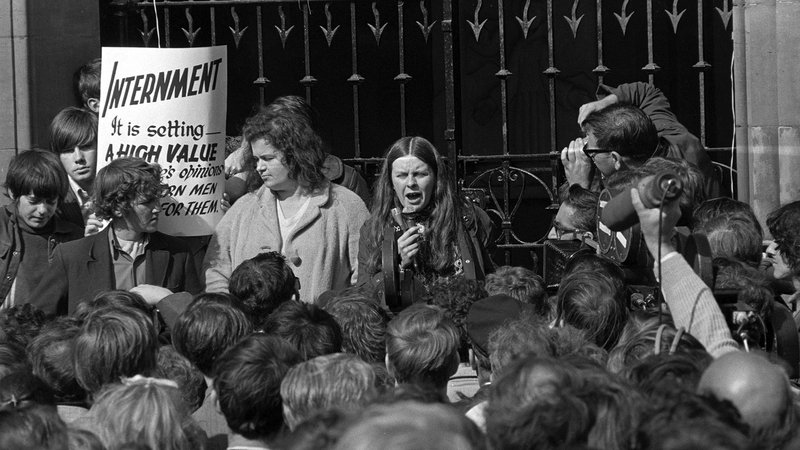
Bernadette Devlin (now McAlliskey) addressing an anti-internment rally in Derry in August 1971 (Photo cred: Popperfoto, Getty Images)

The claims related to what happened during the introduction of internment without trial in the occupied Six Counties in August 1971. What many internees experienced ranged from brutal treatment to torture: “Many of those arrested reported that they and their families were assaulted, verbally abused and threatened by the soldiers. There were claims of soldiers smashing their way into houses without warning and firing rubber baton rounds through doors and windows. Many of those arrested also reported being ill-treated during their three-day detention at the holding centres. They complained of being beaten, verbally abused, threatened, harassed by dogs, denied sleep, and starved. Some reported being forced to run a gauntlet of baton-wielding soldiers, being forced to run an ‘obstacle course’, having their heads forcefully shaved, being kept naked, being burnt with cigarettes, having a sack placed over their heads for long periods, having a rope kept around their necks, having the barrel of a gun pressed against their heads, being dragged by the hair, being trailed behind armoured vehicles while barefoot, and being tied to armoured trucks as a human shield” (for the soldiers against attack by the IRA). (Wikipedia)

(Photo sourced: Internet)

Some were hooded, beaten and, having been told they were hundreds of feet in the air, were then thrown from a helicopter — but were actually only a few feet from the ground. In addition, they were subjected to disorientating “white noise”, forced to remain in stress positions for long periods and deprived of food, water and sleep. Fourteen men who endured this for seven days became known as the “Hooded Men” and have been campaigning for over 50 years to have the British State admit that in its Irish colony, it had tortured them. Interestingly, some of those techniques have also been complained of more recently – by prisoners of the British military in Iraq3 — and this despite a statement by the UK’s Attorney General in 1977 that the techniques would not be used by them again.4

(Photo sourced: Internet)

Unusually, the Irish State5 took the case of the Fourteen to the European Court of Human Rights in Strasbourg and in 1976 obtained a judgement that “the five interrogation techniques” were torture.

The British State appealed the ECHR judgement and in 1978 won a judgement that although the treatment of the Hooded Men amounted to “inhuman and degrading treatment” and breached Article 3 of the European Convention of Human Rights it nevertheless fell short of torture6.

When documentation came to light proving that British Government Ministers had approved the treatment, the Irish State appealed the revised judgement of the ECHR but in 2018 was unsuccessful.

Meanwhile, the legal team of the Hooded Men pursued their case through the legal system of the UK’s Irish colony. In October 2014 the PSNI formally decided not to investigate the allegations, following which in 2015 judicial review proceedings against the PSNI, Secretary of State for Northern Ireland and Department of Justice were initiated by Francis McGuigan, one of the ‘Hooded Men’. A co-appellant was Mary McKenna, the daughter of Sean McKenna, another of the Hooded Men, who died in 1975, never having fully recovered from his mistreatment. The proceedings followed the discovery of additional documentary materials relevant to the mistreatment of the men, which were featured in a 2014 RTÉ Documentary, The Torture Files.7

Following this Documentary, the Chief Constable stated that the PSNI would assess “any allegation or emerging evidence of criminal behaviour, from whatever quarter” concerning the ill-treatment of the Hooded Men “with a view to substantiating such an allegation and identifying sufficient evidence to justify a prosecution and bring people to court’”. However in October 2014 the PSNI took the decision not to investigate. In late 2017, the High Court ruled that the failure by the Police Service of Northern Ireland (PSNI) to investigate the allegations of torture was unlawful.

Some of the Hooded Men in London for the Supreme Court judgement. (Photo sourced: Internet)

Instead of accepting the judgement however the PSNI sought to appeal the High Court decision but in September 2019 the Court of Appeal ruled that the decision should stand. One would have to contrast the determination of the colonial police in the courts to their appalling record in investigating collusion between their own force and Loyalist murder gangs, for the PSNI then appealed to the UK Supreme Court. In November 2019 the UK Supreme Court upheld the decision of the colony’s Court of Appeal and the PSNI appealed that judgement too. The decision last week in London marks the end of the legal options of the colonial gendarmerie.

The very month the decision not to investigate the allegations of the Hooded Men was taken by the colonial police force, October 2014, Drew Harris had been appointed Deputy Chief Constable of the PSNI.

IMPLICATIONS OF JUDGEMENT

The implications of the High Court judgement for Britain and its colonial administration are that once again they have been shown to have deployed barbarous methods in their repression of resistance by the nationalist minority in the colony and that they have exceeded or ignored even their own laws.

As has been the case throughout the recent 30 Years’ War, with the system lying and trying to cover up the reality of its actions, then delaying by all available means, the judgement comes too late for a number of the victims, as only nine of the 14 are still alive.

Nevertheless, the judgement adds to a number of other judgements and admissions over the years, such as those surrounding the Bloody Sunday Massacre in Derry in 1972 and the Ballymurphy Massacre in 1971. On 13 December this year, the British Ministry of Defence and PSNI agreed to a £1.5m out-of-court settlement to compensate victims of the Miami Showband Massacre over suspected state collusion with loyalist terrorists.

Three members of the band died from explosions and bullets after they were forced to get out of their bus at a fake police checkpoint on their return to Dublin from the Six Counties. Stephen Travers, who was injured in the attack, said he was convinced he would have won his civil action to prove that there was collaboration between the State and terrorists but that the Government’s decision to “dispense with justice rather than to dispense justice” had motivated the out-of court settlement.

Had the UK’s Supreme Court rejected the Hooded Men’s case, the latter would have been free to take the case to the European Court of Human Rights – not that they had been tortured but that the police should have investigated their claims that they were. And, based on a similar case by the manager of a Basque newspaper against the Spanish State8, they would probably have won their case with damages awarded against the UK.

On the other hand, the Supreme Court decision puts the onus of investigating the accusations of the Hooded Men on to the PSNI, the very organisation deeply implicated in the treatment of the victims, the organisation which declined to investigate them previously and which justified its decision through the courts in the Six Counties and then in the Supreme Court of the UK.

But not only the British state and its colony are put into the dock by the Supreme Court judgement – Drew Harris, formerly Deputy Chief Constable of the PSNI is currently in charge of the police force of the Irish State, where he was appointed Chief Commissioner of the Gardaí in September 2018 on a yearly salary of €250,000.

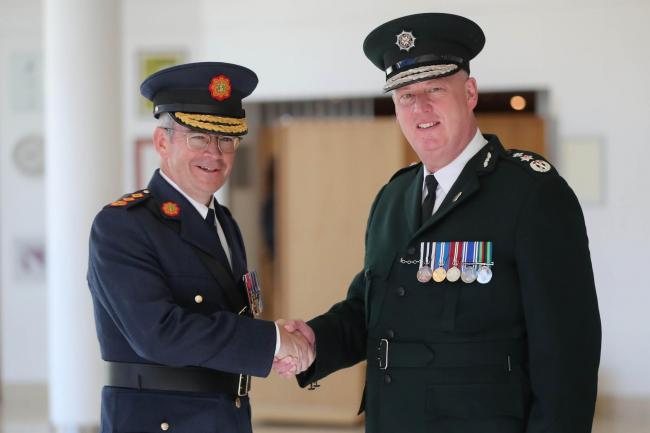
Drew Harris (Left) as Garda Commissioner with his former boss, George Hamilton, Chief Constable of the colonial police, the PSNI, on the occasion they both received an honour from the British Monarch. (Photo sourced: Internet)

APPENDIX — BACKGROUND

Creation of “Northern Ireland”:

The statelet of “Northern Ireland”9 was created in 1922 after Ireland was partitioned by the British Government at the end of 1921. Ireland had been invaded from Britain in 1169 and gradually entirely occupied and colonised by the invaders, albeit with its own semi-autonomous parliament which had been abolished in 1801, after the United Irish uprisings of 179810. Subsequently Members of Parliament elected in Ireland were required to attend the Westminster Parliament.

Following the rise of Irish nationalist sentiment after the suppression of the 1916 Rising, the 1918 UK General Election returned a huge majority of MPs in Ireland sworn to establish an independent Irish Republic. These formed their own parliament in Dublin, at first ignored but then later banned by the British. The guerrilla War of Independence of 1919-1921 convinced the British rulers to offer Ireland autonomy as a “Dominion” within the British system and under the Crown. However, at the same time, the British conceded to the demand of the unionist minority in Ireland to secede from the new Irish state and to remain a colony of Britain and in the UK. The Irish Free State was set up in December 1921 on 26 counties and the Northern Ireland statelet of six counties in January 192211.

From the outset the colonial statelet had been marked by the religious sectarianism of its local rulers, Presbyterians and Anglicans by religion and of unionist ideology, against a very large nationalist minority of mostly Catholics, representing the majority in Ireland as a whole. A raft of special powers empowered the statelet in repression of the nationalist minority; the colonial gendarmerie, abolished in the Irish state, continued in existence, with a part-time wing and even unofficial Loyalist militia in support and de facto anti-nationalist discrimination existed in every sphere: law, housing allocation, education.

In 1968 a campaign for civil rights for the nationalist minority began, to be met by truncheons, water-cannon, tear gas and bullets which however, merely drove parts of the minority into open insurrection. The colonial gendarmerie (the Royal Ulster Constabulary), even with the active support of the part-time B-Specials and Loyalist paramilitaries, was unable to suppress the uprising primarily in Derry but also in West Belfast and in August 1969 the British Government sent in the British Army to take control.

Initially the soldiers were represented to the nationalist population as being present to protect them from the sectarian colonial police and from the Loyalists but it soon became clear that their primary focus was to repress the risen nationalist population and the IRA began to take action against them.

Introduction of Internment Without Trial:

The Prime Minister of the “Northern Ireland” statelet, Brian Faulkner, recommended to his colonial masters that internment without trial be introduced against the nationalist population; this was agreed and “Operation Demetrius” began on 9th August and continuing over the 10th 1971 with British Army raids into nationalist areas, forcing their way into homes and dragging their captives away to be interrogated by RUC Special Branch, after which they were jailed. In the initial sweep the occupation forces arrested 342 men, sparking four days of violence in which 20 civilians, two IRA members and two British soldiers were killed and 7,000 people fled their homes. All of those interned were from the nationalist community.

Poster by the Anti-Internment League of Ireland – the internees in the photo are handcuffed together. (Photo sourced: Internet)

The detentions without charge continued until December 1975 and by that time 1,981 people had been interned, of which 1,874 were from the nationalist community. Only 107 were Loyalists and none of those had been interned until February 1973. Resistance to internment continued after the initial sweep and from 9th to 11th August, British Paratroopers caused the death of 11 unarmed people in the Ballymurphy area of Belfast. In January the following year the Paras and other units attacked people marching against internment in Derry, killing 14 and injuring 12.

Internment was protested in the rest of Ireland and in other countries, including Britain. The Men Behind the Wire, an anti-internment song composed in 1971 by Paddy McGuigan and recorded by the Barleycorn group in Belfast, was pressed into disc in Dublin and shot to the top of the Irish charts, greatly exceeding in numbers of sales any record previously released in Ireland.

Excerpt:

Through the little streets of Belfast,
In the dark of early mo
rn,
British soldiers came marauding
Wrecking little homes with scorn.

Heedless of the crying children,
Dragging fathers from their beds;
Beating sons while helpless mothers
Watched the blood flow from their heads.

Armoured cars and tanks and guns
Came to take away our sons
But every man will stand behind
The Men Behind the Wire.

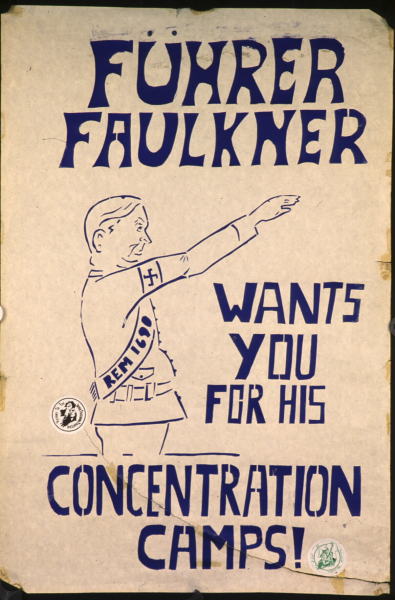
Poster by People”s Democracy, believed in 1970, prior to introduction of internment. (Photo sourced: Internet)

Brian Faulkner, unionist Prime Minister of the statelet, who had asked the British to introduce internment, was hated by a great many people. When he died in March 1977 following an accident during a stag hunt, thrown by his horse Cannonball, an English communist composed a short song he named “Cannonball”.

Excerpt:

Lord Faulkner was a hunter of men and of deer

And both have good reason to laugh and to cheer

At the death of a tyrant whose interests were clear

Those of imperialism that have cost Ireland dear.

Cannonball, Cannonball has many a friend,

From the top of old Ireland right down to its end,

Where the brave people struggle

In one resolute bid

To throw off their oppressors —

Just as Cannonball did!

End.

FOOTNOTES

  1. The colonial gendarmerie formerly known as the Royal Ulster Constabulary.

2 (see “Background” section).

3. The Court’s ruling that the five techniques did not amount to torture was later cited by the United States and Israel to justify their own interrogation methods, which included the five techniques. British agents also taught the five techniques to the forces of Brazil’s military dictatorship. During the Iraq War, the illegal use of the five techniques by British soldiers contributed to the death of at least one detainee, Baha Mousa.

4 “The Government of the United Kingdom have considered the question of the use of the ‘five techniques’ with very great care and with particular regard to Article 3 (art. 3) of the Convention. They now give this unqualified undertaking, that the ‘five techniques’ will not in any circumstances be reintroduced as an aid to interrogation.”

5 Unusually, because during the three decades of ill-treatment by a foreign power of people who were, according to the Irish Constitution its citizens, only in one other case did the Irish State bring a complaint against the UK to an international arena.

6 I admit that I fail completely to understand the distinction.

7. Rita O’Reilly, the journalist who led that program, also commented extremely well on the UK Supreme Court decision and the whole case on Prime Time on RTÉ this week (see Links).

8. Martxelo Otamendi, along with others detained, was tortured by his Guardia Civil captors when the Basque newspaper of which he was manager was closed by the Spanish State, alleging that it had been cooperating with terrorists. He was freed eventually and even later in 2010 the Spanish Supreme Court admitted that there had been no evidence against him or the newspaper – but neither admitted the torture nor ordered his allegations be investigated. Otamendi filed a complaint with the European Court of Human Rights in 2012 and in 2014 the ECHR found the Spanish State guilty of not having investigated Otamendi’s allegation of being tortured and awarded him €24,000 in damages and expenses from the Spanish state.

9. A misnomer since the British colony is not the northernmost part of Ireland, which is in County Donegal, inside the Irish state. “Ulster”, a name given by the Unionists to the statelet and frequently repeated in the British media, is also a misnomer since the Province of Ulster contains nine counties, six of which are in the colonial statelet but three of which are within the Irish state.

10. There were many uprisings prior to 1798, which was the first Republican one and there were many of that kind afterwards too.

11. Shortly after that the Free State, supplied with weapons and transport by the British, attacked the Republicans, who had been demonstrating their dissatisfaction with the Anglo-Irish Treaty. This precipitated a Civil War in which the Republicans were defeated.

USEFUL LINKS FOR MORE INFORMATION

Unusually excellent (for RTÉ) report by Rita O’Reilly: https://www.rte.ie/news/primetime/2021/1217/1267343-uk-supreme-court-decision-on-hooded-men/

https://www.irishtimes.com/news/ireland/irish-news/hooded-men-uk-court-finds-psni-decision-not-to-investigate-case-unlawful-1.4755885

https://en.wikipedia.org/wiki/Operation_Demetrius

Dublin City Council Threatens Charity Food Tables

Diarmuid Mac Dubhghlais

(Reading time: 5 mins.)

DRHE threaten to clamp down on food tables feeding the homeless

Diarmuid Mac Dubhghlais

(Reading time: mins.)

Rebel Breeze editorial introduction: Through its agency Dublin Regional Homeless Executive, Dublin City Council recently threatened to close down the charity services delivering food and bottled water to homeless and hungry people. On the back of scandal about the alleged sexual predation of the deceased founder of the Inner City Homeless organisation, the Council issued a press statement which implied the threat, supported also by indications of Garda cooperation. Diarmuid Mac Dubhghlais, founder and organiser of the Éire Nua Food Initiative, one of the many charity services engaged in the work, has responded in a detailed article, reprinted here with the author’s permission.

THE 26-County State released figures on September 24 showing that there are currently 8,212 people accessing emergency accommodation in the State, a total of 6,023 adults and 2,189 children who are homeless.

A homeless person’s bed outdoors, cardboard as insulation underneath sleeping bag, this one located under the arch of the GPO (the building that was the HQ of the 1916 Rising). (Photo: Éire Nua Initiative)

These figures of homelessness have long been disputed by many others who work within the homeless sector as the State refuses to count those who are couch-surfing, or otherwise sharing accommodation with friends/family. The vast majority of the nation’s homeless are in the capital with 4,220 people accessing accommodation. 953 families are homeless in Ireland, according to the report.

Homelessness charities have warned that more families face losing their homes in the coming months due to private rental market constricts and evictions rise. This has already been borne out with reports of new faces showing up at the many soup runs/food tables that are in the city centre.
Pat Doyle, CEO of Peter McVerry Trust, said “Any increase is disappointing because it means more people impacted by homelessness. However, we are now at the busiest time of year for social housing delivery and we would hope that the number of people getting access to housing will significantly increase in the coming months.”

Dublin Simon CEO Sam McGuiness cited the toll on the physical and mental health of people trapped in long-term homelessness. He said: “This population is desperate to exit homelessness and yet they are spending longer than ever before in emergency accommodation. This group deserves far better lives than the ones they are currently living. We see first-hand the toll this is taking in the increased demands for our treatment services, counselling services and the increase in crisis counselling interventions. Outcomes for people in emergency accommodation will not improve until they have a secure home of their own. Until this happens there is scant hope of a better future for this vulnerable group.”

MANY CHILDREN NOW SPEND THEIR FORMATIVE YEARS IN HOMELESSNESS”

Éire Nua food initiative founder Diarmuid Mac Dubhghlais pointed out at a homelessness protest that many children now spend their formative years in homelessness and have no real idea of what it is like to have a traditional “Sunday dinner” or their own bedroom/play area. This will severely impact their personalities far into the future.

A report published on September 14 by the Irish Human Rights and Equality Commission and the Economic and Social Research Institute (ESRI) found that lone parents and their children account for 53% of all homeless families. The report said that lone parents and their children are much more likely to experience poor housing than other household types. The report also highlights the disadvantages experienced by young people, migrants, people with disabilities and Travellers in the Irish housing system. Researchers looked at six dimensions of housing adequacy – accessibility, affordability, security of tenure, cultural adequacy, quality, and location. They found that less than 25% of lone parents reported home-ownership, compared with 70% of the total population.
Lone parents had higher rates of affordability issues (19%) when compared to the general population (5%) and were particularly vulnerable to housing quality problems such as damp and lack of central heating (32% compared to 22%).

Ethnic minority groups had a significantly higher risk of over-crowding, the research found. Over 35% of Asian/Asian Irish people, 39% of Travellers and over 40% of Black/Black Irish people live in over-crowded accommodation, compared to 6% of the total population. Almost half of all migrants in Ireland live in the private rental sector, compared to 9% of those born in Ireland. Migrants, specifically those from Eastern Europe (28%) and non-EU countries (27%), are more likely to live in over-crowded conditions.

One of the queues for free food and water at a charity food table outside the GPO building. (Photo: Éire Nua Initiative)

The research found that almost one third of persons living with a disability experience housing quality issues, compared to 21% of those without a disability. Researchers said there remains a real risk that levels of homelessness will worsen after the pandemic restrictions are lifted and they raised concern about rents increasing faster than mean earnings in Dublin and elsewhere. In 2020, mean monthly rent in Ireland was estimated to be 31% of mean monthly earnings. “Adequate housing allows people to not only survive but thrive and achieve their full potential, whilst leading to a more just, inclusive and sustainable society.”

Meanwhile, the Dublin Regional Homeless Executive (DRHE) said on September 28 that it is to seek greater regulation of organisations providing services for homeless people in the capital as soon as possible in the wake of the Inner City Helping Homeless (ICHH) controversy. Dublin City Council’s deputy chief executive Brendan Kenny, who has responsibility for the Dublin Regional Homeless Executive (DRHE) in his role, said that due to the high number of informal homeless organisations set up in recent years there is “currently no vetting, no controls, on many people who are actually interacting directly with homeless people”. Kenny said he doesn’t want “over-regulation” to lead to certain groups disbanding but added: “At the moment there’s nothing and that’s not good enough.”

In a statement, the DRHE said it is “strongly of the view that greater regulation, vetting, and scrutiny is required for organisations/charities that set themselves up as service providers for homeless persons, including the provision of on-street food services”. “Several such organisations not funded by the DRHE have come into existence in recent years and the DRHE and our partner agencies will be endeavouring in the coming months to bring the necessary expanded scrutiny and regulation to all such organisations.”

Garda Commissioner Drew Harris said there will be a review of Garda vetting procedures for the homelessness sector. Kenny said a report commissioned by Dublin City Council into the impact of unvetted charities is near completion and will provide further insight on the matter.
It has been pointed out several times over the past four months that the DRHE, DCC and others have long tried to close the soup runs/food tables in the city centre and many now fear that what has been revealed through the ICHH debacle will be used to close many of these down. The DRHE are ignoring the fact that it is their rules and the oversight bodies recognised by them that has let the homeless down, not the food tables. Much of the work done by the food tables is done in the open and in full public view.

The issues highlighted through the ongoing ICHH investigation show it is what went on behind closed doors that is the problem. Those in oversight positions didn’t do their jobs; people were put in positions of authority without relevant qualifications. The DRHE, DCC and the police should look to how they can improve safety within their “regulated” organisations before seeking to regulate the volunteers who serve a need without any remuneration.

Many of the volunteers at food tables would have difficulty meeting the requirements of police vetting as some would be former addicts, and many others have no desire to become registered charities.

Again, it was pointed out by Diarmuid that many of these “regulated” charities will have high overheads such as transport insurance, maintenance and fuel costs. Some will have CEO wages and petty cash expenses to cover before any donations can be spent on the service user, whereas the Éire Nua food initiative and some others do not seek cash donations. All is done voluntarily and any costs are borne by the volunteers themselves. He cited that many registered charities are little more than businesses operating within the homelessness sector.

Diarmuid has been quoted in the past citing that “there are now many businesses making huge money out of those who are in homelessness” and “that the volunteer ethos that surround many food tables is not to be found within some charities”.

IMPROVE THE STANDARD OF REGISTERED ACCOMMODATION, NOT SHUT DOWN THE VOLUNTARY ORGANISATIONS”

Kenny said the large number of pop-up soup runs mean some people are less likely to engage with the larger charities funded by the DRHE and in turn, less likely to engage with their support services. The DRHE views sleeping in a homeless hostel, rather than on the street, as a “much safer” option. However, he acknowledged that some homeless people don’t want to stay in a hostel, for a variety of reasons.

“We fully understand that but we’re strongly of the view that a hostel bed is absolutely safer and more hygienic than sleeping in a sleeping bag on the side or a street or in a tent. We know there are some people that just won’t go to a hostel – it may be that they have mental health issues.
“We are also aware that some people would prefer to stay in a tent in order to stay involved in drugs and be taking drugs because they may not be able to do it in the hostel.” Kenny added that while hostels provide shelter and food, they “wouldn’t be the nicest place to sleep” but are still “far safer” than being on the street.

He totally ignores the many testimonies from residents, former residents and former workers within these hostels of the theft of personal property, the numerous assaults on residents by other residents, the bullying of residents by some staff members, low hygiene standards, open drug and alcohol abuse and the arbitrary nature operating within some hostels where a resident can be denied access on the whim of staff.

It is incumbent of the State, DRHE and the various councils to bring the standard of these types of accommodation up to a better standard and NOT try to shut those organisations who look after the many who fear staying within State accommodation.

Kenny also noted that sometimes tourists or those who are not homeless queue up to get food from the soup runs. He said fights also break out sometimes. “We’ve come across situations of tourists maybe going up to a food van and getting food, and maybe other people that are not in need of services. And the reality is that anybody that’s sleeping in a hostel, food is provided for them so there is not a shortage of food in the hostel services.

“[Soup runs] do attract a lot of people. I know there are times when large numbers of vulnerable people congregate and you end up with disputes and fights as well.”

Éire Nua free food service workers with table, outside the GPO. (Photo: Éire Nua Initiative)

On the issue of tourists queuing for food, he may well be right, but as the Éire Nua group has pointed out, “we feed the homeless AND hungry, we will not discriminate or question anyone who stands waiting for some food”.

Also pointed out by many residents of various hostels is the small proportions of meals given; while enough to sustain it is often not enough to keep that empty stomach feeling at bay.
And for the five to six years that Diarmuid has volunteered alone, with the Éire Nua group or on another soup run, he or other volunteers have never had to call the police. On the few occasions where trouble has occurred, it is often rectified within seconds as the majority of people awaiting food know that: (1) the volunteers are their friends and out there to help them and (2) causing disruption to the smooth running of the tables can result in being denied food.
The final word to Kenny from the Éire Nua food initiative: “Let the DRHE look to itself and those under its umbrella before looking to those outside their group; let them ensure the regulations in force within are enforced. Do not blame those who volunteer out of the goodness of their hearts for the sins of those who worked for them.”

End.

EDITORIAL COMMENT:

It may be that the primary concerns of the Dublin municipal authorities and the Gardaí are to remove the visible signs of poverty and homelessness, rather than protection of the vulnerable among these. DCC Brendan Kenny’s comments in mid-August against the proliferation of homeless people living in tents may be seen as a concern that the charity food services constitute an unwelcome reflection on the performance of the Irish State and the municipal authorities of its capital city, visible not only to the city’s inhabitants — at all levels of society — but also to its visitors.

USEFUL LINKS

https://www.thejournal.ie/drhe-call-for-more-regulation-of-homeless-organisations-5560886-Sep2021/

Kenny previous comments against homeless in tents: https://www.joe.ie/news/dublin-city-council-ceo-criticised-following-comments-homeless-tents-dublin-728819

The Inner City Homeless scandal: https://www.irishtimes.com/news/ireland/irish-news/homeless-charity-faces-uncertain-future-following-death-of-co-founder-1.4688838

STATE MOVES TO BAN LEFT WING SPANISH PARTY

Political Statement against the new banning attempt: the Ministry of the Interior initiatates a procedure in the Spanish National Court for the “extinction” of Izquierda Castellana

(Translated by D.Breatnach from https://izca.net/2021/08/06/declaracion-politica-ante-el-nuevo-intento-de-ilegalizacion-el-ministerio-del-interior-impulsa-un-procedimiento-en-la-audiencia-nacional-para-la-extincion-de-izquierda-castellana/ )

The Central Contentious-Administrative Court No. 6 of the Spanish National Court has notified us on August 5th of the motion put forward by the Ministry of the Interior through the State Lawyers in which the “extinction” of Izquierda Castellana is sought, that is, its disappearance as a legal political organization.

Demonstration of Izquierda Castellana with their logo on banner declaring “Spanish State Prison of Peoples”.

On this occasion, the Ministry of the Interior resorts to administrative tricks, arguing that IzCa’s statutes do not comply with the changes introduced through the legislative reform of Organic Law 3/2015, of March 30, on the control of the financial-economic activity of Political Parties.

It is paradoxical that a political organization that, as is the case with Izquierda Castellana, never in its entire history requested or received any financial subsidy, is intended to be outlawed based on these kinds of reasons, especially when most of the political parties that ostensibly breach the legal regulations on such matters are not even warned of such a possibility.

In our opinion, the attempted extinction / banning of IzCa sponsored by the Ministry of the Interior has a political motivation: the intention of making disappear an organization whose essential activity is the denunciation of all the corrupt, antisocial, antidemocratic and antipatriotic activities of the current Regime of the 2nd Bourbon Restoration; and whose ultimate aim inevitably passes through the establishment of a democratic, republican and social rights system.

IzCa, as we pointed out, has not received or requested a single euro from the public treasury. Our activity is based solely and exclusively on our resources, especially on our human resources, that is, on the militants and activists who support us every day in one way or another. IzCa does not have as such – nor does it claim – representation in the institutions of this post-Franco regime. We do not despise this sphere of action, but it seems to us that the most important and useful thing in this historical moment is to promote the movement and popular organization in the various sectors, and we focus on this and we also believe with some success; that is what the Regime and its successive governments have not forgiven us.

IzCa has suffered permanent harassment from the constituted power since our founding; numerous media-police operations have been plotted against our organization. In 2008 there was already an attempt to ban IzCa, which was finally archived without action in the National Court itself. Last December the trial against our comrade Luis Ocampo was held – Doris Benegas was also on trial – with regard to the events that occurred in the Republican demonstration in Madrid in October 2014. In that trial, a year and a half in prison was requested by the Prosecution. Finally, our comrade was acquitted; in its judgment, the Madrid Provincial Court Court recorded that his version of events was fully credible.
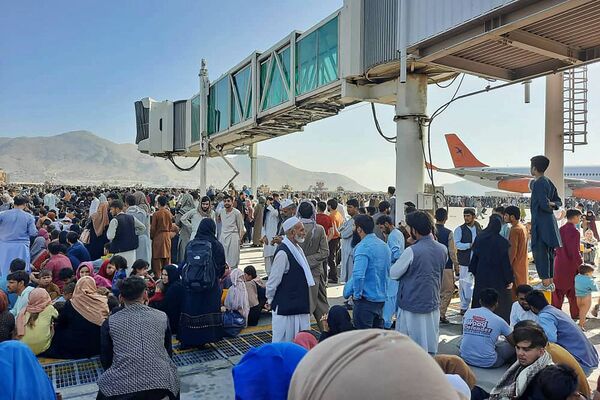
IzCa has been denouncing the repressive policy towards the popular movement and at the same time favourable to the extreme Right that has been carried out by the Ministry of the Interior and very especially by the Government Delegation in Madrid, intensified repression since the beginning of the Covid-19 pandemic. We accurately forecast the overwhelming defeat of the institutional Left in Madrid in the last regional elections on May 4; and we predict – we believe that without the slightest possibility of error – the defeat of the institutional Left in the next general elections if it continues on the current path. If you try to make activist organizations disappear, those that with more dedication and commitment defend the interests of the working classes, you are facilitating the path of access to the government by the Right. If the interests of the peoples of the Spanish State are subordinated to those of imperialism – certainly in a phase of full decline – one of the most significant expressions of which is the scheduled holding of the next NATO summit in Madrid in 2022, it is refusing to build its own project in solidarity with the peoples of the world and, once again, facilitating the advance of the right wing, militarism and warmongering.
We are going to fight against our outlawing at the National High Court and before all judicial bodies, including European ones, where it is necessary. In the National Court, that special court of which we do not recognize any democratic legitimacy, nor for the entire institutional framework of the ’78 Regime,starting with its Head of State, just as “exemplary” in its general terms as the rest of its institutions and whose legality is based on Franco’s legality. But above all, we will continue to fight in the streets.

Study and reflect; organize and mobilize; build popular power. That’s the only way.

Izquierda Castellana, August 6, 2021

COMMENT:


The Izquierda Castellana is a revolutionary socialist organisation basing itself on the territory of Castille (a central area of the Spanish state including Madrid) and claiming its right to self-determination, drawing its historical inspiration from the revolt of the Comuneros in the 1520s. The party or organisation seeks social justice internally, self-determination for its own territory and supports the struggles for self-determination of others (for example, the Basques and Catalans), is opposed to imperialism abroad and military alliances such as NATO. IzCa is anti-racist and anti-fascist and has suffered repression.

The potential for revolution in the Spanish State is not in the Basque Country and Catalonia alone, nor only in other areas such as Galiza and Asturies but in the heartland of the State also, in Madrid and in other parts of Castille. It seems clear that the struggles for independence of the Basque Country and Catalonia as in the past will be met with heavy Spanish repression and the only possibility for success in such circumstances would a situation in which the State was met with uprisings in other parts also. I have long advocated the building of the type of alliances that could make that possible.

Diarmuid Breatnach

USEFUL LINKS

Izquierda Castellana website: https://izca.net/

IzCa on Facebook: https://www.facebook.com/Izquierda-Castellana-IzCa-110789122300175/

Witch-Hunting in the imperialist British Labour Party

Diarmuid Breatnach

(Reading time comment: 2 mins; and article: 5 minutes)

People who’ve been following the witch-hunts in the British Labour Party — or even just generally aware of them — have seen left-wingers like Jeremy Corbyn, the party’s elected leader, actually expelled. Though Corbett has now been allowed back in with his electoral wings clipped, others have been expelled, including left-wing film-maker Ken Loach. It is witch-hunting, a type of McCarthyist hounding in which victims must prove themselves innocent of anti-semitism, which turns out to be impossible. This is because the Zionists and their supporters have succeeded in making any attack on Israel or Zionism, a political target, correspond to anti-semitism, a religious-racist view. That is all wrong certainly but it is not the job of socialists nor of anti-imperialists to “save” or “democratise” the British Labour Party.

British troops suppressing anti-colonial struggle in Malaya 1948-1960, (then a part of what is now Malaysia), carrying a bloodied Malayan prisoner (Photo sourced: Daily Mail)

Lenin famously once advised British socialists to support the Labour Party “as a rope supports a hanging man”. He was saying that as Labour had never yet been in sole government, it was bound to carry the idealised hopes of many working people — therefore give them the opportunity to see it in action. Whether Lenin was correct in his advice to help get Labour into government or not (and not all revolutionary socialists agreed with him), Labour was in the coalition War Government in 1915-1918 and subsequently in the periods 1924, 1929, 1945-1950, 1964-1970, 1974-1977, 1997-2010. It has had plenty of opportunities to show its real nature and has done so.

However, over the years, radical social democrats and various Trotskyist trends, along with the old Communist Party of Great Britain, have sought to support the Labour Party, not by pulling the rope, kicking the chair or unlocking the scaffold trapdoor, but by desperately getting underneath the body and propping it up. General elections were replete with slogans from the Left exhorting us to elect Labour “under a socialist program”, “under Left pressure” and “with socialist demands” or even “internal democracy” (to give the entrists room to move).

Ken Loach (right) and Jeremy Corbyn at premier of the film “I, Daniel Blake in 2016. (Photo credit: Joel Ryan, AP via Getty Images).

Such demands and manoeuvrings are in complete contradiction to history or a basic socialist class analysis. Lenin was certainly correct when he analysed the Labour Party as fundamentally capitalist and imperialist and the party has obligingly gone on to vindicate that analysis both in and out of government. But how could it be otherwise? It is a capitalist imperialist class that runs the UK and a party truly representing the working class will not be permitted to take over except if the ruling class is overthrown in revolution.

And such attempts will be met with whatever force the ruling class has at its disposal. In the Hebrew-Christian creation myth, the originators of humanity are driven from Paradise by an angel with a flaming sword and apparently never try to get back in (not in this life anyway). It will certainly take a flaming sword to drive capitalism from its Paradise of exploitation of labour power but in fact its predicament then is worse than Adam and Eve’s — for to be barred from entry forever means its very extinction as a class.

This is all Basic Socialist Theory 101 and proven time and again by Modern Class History 101. And yet, people on the Left who can quote volumes of Marx, Lenin, Trotsky and even sometimes Bakunin, have somehow come out of those 101 courses with an entirely different understanding. And so time and time again, the hunt for the Left Messiah to lead the Labour Party and within, the gatherings of radical Leftists cliques, conspiring like the Christians in the Catacombs beneath Rome.

British troops and detainees in Kenya; the record of tortures inflicted on many is truly horrific. Although the Conservatives were in government throughout the period, it was never seriously challenged by the Labour Party on the actions of the troops. (Photo sourced: Internet)

Just a moment’s review will show that at its first opportunity, Labour participated in management of the imperialist WWI which, by the way, included the murder of surrendered Irish insurgent leaders in 1916. The review will also reveal the agreement in the partition of Ireland in 1921, undermining of the 1926 UK General Strike, complicity in the anti-liberation wars in Persia (now Iraq), Egypt, Greece, Korea, Malaya, Cyprus, Kenya, Aden (now Yemen), Oman …. and participation in joint invasion or attacks on Libya, Iraq, Syria, Afghanistan. Not to mention being the party actually in Government when in 1969 it sent the troops in to quell the large oppressed Catholic minority in the Six Counties seeking civil rights.

Well, actually yes, let us mention it because that and its collusion with the Conservative government’s introduction of internment without trial in 1971 and subsequent massacres of protesters that year and in 1972 ratcheted up a cycle of violence that lasted three decades, with huge loss of human life among civilians, liberation fighters and its own soldiery and Loyalist auxiliaries.

The first anti-fascist fighter killed in Britain by police, by the way, Kevin Gately, was killed by mounted police in 1974 — under a Labour Government.

Those who really want an end to capitalism and imperialism — and the attendant racism — in Britain need to find a solution that does not involve electing a “Left Labour Government” or anything of that kind. We can argue and discuss what that solution might involve but one thing we should insist upon is that a “Left Labour Government” is not one of the options on the table for discussion.

End.

SOURCES:

UK Labour Party pro-Israel purge continues: celebrated film maker Ken Loach latest member to be expelled

https://en.wikipedia.org/wiki/List_of_British_governments

BULLFIGHTING ENDS IN GIJÓN AFTER BULLS NAMED BY RACISTS AND SEXISTS

Fascist supporters of bullfighting in Asturias thought they were having fun by naming two bulls due to be killed “Feminist” and “Nigerian” respectively. But their racist and sexist joke-jibes backfired on them in Gijón (Xixón), cultural centre and largest city of Asturias, the celtic nation in the north of the Spanish state.

Map of Asturias.

Bullfighting is generally supported by a traditionalist conservative constituency in Spain, including fascists, who often project it as integral to their image of Spain. On the other hand, the practice is opposed by large sections of the Left and those who want independence for their nations from Spain, such as Catalonia (banned some years ago) and three southern provinces of the Basque Country (where it was suspended for years but limited fights permitted again recently).

BULLFIGHTING IS ENDED IN GIJÓN

Translation by D.Breatnach from Publico.es report

The El Bibio de Gijón bullring will no longer host the traditional Begoña bullfighting fair, as the City Council will not renew the licence of the bullring because it considers that bulls cannot be used to “deploy an ideology contrary to the human rights”.

“The bullfighting festival is over,” said the mayor of Gijón, Ana González, in statements to journalists, after stating that what happened in the last running of the fair this year, where two of the bulls from Daniel Ruiz’s cattle ranch were named “Feminist” and “Nigerian”, has caused great discontent among feminist and animalist associations and has precipitated a decision that was already in the pipeline.

“A city that believes in the equality of women and men, that believes in integration, in doors open to all cannot allow this type of thing,” said the Councilor before stating that “several lines have been crossed”.

Bullfight in Las Ventas (Photo credit: EFE)

González explained that the idea was to end the licence of the El Bibio bullring and later put an end to it, as contemplated in the resolutions of the PSOE congresses but these events have advanced the decision. For this reason, the Consistory will not grant a third extension of the concession signed in 2016 nor will it issue a new call, despite the fact that the payment of the successful bidder represents 50,000 euros per year for the city council.

“The bullfighting fair is over because it seems that too many things were hidden,” explained the Councilor, who argued that if the world of bullfighting is what was seen in the last run of the fair “it does not contribute much to a city like Gijón “.

“The Mayor indicated that in recent years the bullfighting was “clearly challenged” and that there were more and more voices calling for an end to the bullfighting fair in Gijón, a demand that has now been met.

“The names given to these two bulls which were fought by Morante de la Puebla last Sunday, August 15, in Gijón, generated controversy on social networks and have aroused complaints from feminist and animalist associations.”

End.

SOURCE:

https://www.publico.es/sociedad/ayuntamiento-gijon-acaba-feria-taurina.html?

TEN SIMPLE STEPS IN INVASION VENTURE

Diarmuid Breatnach

Scene from Rambo film promoting USA-aided Islamic fundamentalist insurgency against Soviet puppet Afghanistan Government (Photo sourced: Internet)
  1. Foster Islamic fundamentalist groups and arm them to overthrow a competitor’s puppet government. Use a nearby ally as a conduit.
  2. Portray the fundamentalist insurgency as a liberation war and keep supplying them with weapons, training, through your nearby ally. This might cost as much as US$20 billion. Have a film made about it in which a former male porn film star is the USA hero with the local fundamentalist Islamic militias (underplay the Islamic part).
  3. When they’ve overthrown the competitor’s puppet, attempt to instal your own puppet instead.
  4. When your Islamic fundamentalist warlords don’t accept this and become a problem, invade the country. You have to get lots of your own soldiers killed because you armed and trained the opposition, they have grown more powerful and why should anyone fight them for you?
  5. Keep telling the relatives of your dead soldiers (and those not yet dead) that they are fighting for democracy and to protect their homes (although they are nowhere near their homes).
  6. Set up your own puppet regime, build a local army, let your investors back home in to gobble up what they can, dispense bribes (even to notorious warlords, torturers, murderers).
  7. Use airpower to bomb your previous allies, even though you will be killing a lot of uninvolved people (and even though airpower didn’t work in the end for the other’s puppet government).
  8. When it’s clear you are not going to win without an even more massive investment of money and your soldiers’ lives (which will make your politicians unpopular at home), pull out. Leave your puppets and local employees behind (shoot some as they try to get on your planes).
  9. Then blame your puppet government for running. Blame the puppet army soldiers for surrendering, ignoring the fact that thousands of them have been killed even when you gave them air cover and that was then withdrawn or that surrounded units fought on for days on promises of relieving columns that never came.
  10. You might lose some superpower status and get criticised at home. BUT your arms industry has increased its profits at least TEN TIMES since the invasion. After all, who really matters in all this?
  11. Get ready for your next adventure.
US troops in Afghanistan marching towards evacuation helicopter (Photo sourced: Internet)
Afghan people climb on plane Kabul Airport Photo- Wakil Kohsar / AFP 16 Aug 2021
Afghans crowd the tarmac of Kabul airport to flee the country. Photo- AFP
Taliban fighters take control of Afghan presidential palace in Kabul after Afghan President Ashraf Ghani fled the country. Photo- AP/Zabi Karimi
U.S soldiers take a position to guard along a perimeter at the international airport in Kabul, Afghanistan, Monday, Aug. 16, 2021. Picture- AP Photo/Shekib Rahmani
USA President justifying USA pullout of Afghanistan and blaming Afghan people (Photo sourced: Internet)

FURTHER READING

Quick overview of Afghanistan history (without listing USA support for Taliban: https://www.nationalgeographic.com/history/article/how-centuries-of-strife-shaped-modern-afghanistan

US support for Taliban: https://www.jstor.org/stable/29768089

https://www.democracynow.org/shows/2021/8/17# (For Afghanistan jump to Haran Rahoumi at 17.19 mins. on video to 31.4 mins; and again to from 37mins. with Azmat Khan to 46mins. In my opinion much more informative than ex-US Col. Amy Wright, now in Codepink, Vets for Peace.)

https://www.foxnews.com/world/taliban-fighters-execute-22-afghan-commandos