NATIONALISM AND FASCISM

Diarmuid Breatnach

(Reading time: 10 minutes )

All kinds of socialists deride nationalism, as do some republicans. It is often seen as a recruiting base for fascism, for imperialism and the cause or justification for war. Indeed it has been all those things. And yet …. Perhaps the way in which nationalism has been viewed by the Left and Republicans is one-sided and its progressive potential overlooked. And perhaps taking a look at Basque, Catalan and Irish nationalism can demonstrate this.

James Connolly (Photo sourced: Internet)

Was James Connolly1 being reactionary when he upheld the rights of the Irish nation to separation from the United Kingdom, to self-determination? Was Thomas Davis being reactionary when he composed the words

Oh can such hope be vain?

That Ireland, long a province be

a nation once again!”2

Thomas Davis monument, statue and fountain, College Green/ Dame St, Dublin.
(Photo: D.Breatnach)

Recently I began to question some of the criticisms of nationalism politically while at the same time I had struggled with them culturally for much longer. A few people may say that it matters nothing to them whether they are Irish, Italian or Iraqi. But most Irish people identify themselves quite strongly as “Irish”. I think that is primarily a cultural question. They have accents, sayings and history they share, character flaws and positive aspects, heroes, songs, poems, writers …. It is not the same for everyone but some of those aspects, in some kind of mix, are there for each person who identifies themselves as Irish. And of course, the sadly neglected Irish language. I don’t believe identifying oneself as Irish (or Icelandic, Iranian or Indonesian) makes one any less an internationalist.

OK,” the socialist and the republican might say, especially the socialist, “but what does that matter? You can have regional cultures too. They do not detract from the fact that we are all socialists, fighting for the working class everywhere.”

And I would agree.

But the socialist is not finished. “It’s a different matter entirely when you elevate that cultural distinction to a political one, which is nationalism. That creed puts your nation above others and is a breeding ground for fascism and war and, in powerful nations, for imperialism.”

He has a strong case – but we’ll see.

Fascism is on the rise all across Europe and many other parts of the world and we see signs of its resurgence here in Ireland, with discourses against migrants, moslems and social freedoms on the rise. The fascists and the racists working among those discourses are indeed using nationalism as a cover and at the same time as some kind of a base. Recently, supporting Gemma Doherty, they were playing the Soldiers’ Song and Irish Republican ballads and they were waving the Tricolour. Some of them approached the antifa opposing them, asking questions like “Are we not all Irish?” 3

Now, as it happens, the national flag, the Tricolour, is not only about inclusiveness, i.e of a unity (white) between the descendants of colonists (orange) with those of the indigenous (green), but was also made by foreigners and presented by them to the Irish. It was in fact republican women of Paris, which was then amid revolution, who presented it to Thomas Francis Meagher in 1848.

The Irish tricolour flag, design presented to the Irish nation by French women revolutionaries in 1848.
(Photo sourced: Internet)

Of the heroes and martyrs mentioned in the ballads, many were born outside of Ireland, including two of the signatories of the 1916 Proclamation of Independence: Tom Clarke and James Connolly. Constance Markievicz too was born in England, daughter of a colonist family in Ireland; Wolfe Tone and Henry Joy McCracken, Republican leaders and martyrs of the 1798 United Irish uprising, were descendants of French Protestants. Many too were the sons of a non-Irish parent, such as Thomas Davis, whose father was Welsh and Patrick and William Pearse, whose father was English., also Eamonn De Valera, son of a Cuban father. The man who organised the sea journey to Howth with German Mausers as illicit cargo for the Irish Volunteers in 1914, Erkine Childers, was English and his wife and one of his crew, Molly, was from the USA.

On the other hand, those who made the deal with the British ruling class after years of liberation struggle were Irish — in 1921 they paralysed the revolutionary struggle, agreed to the partition of the country and in 1922 set out, even using artillery on loan from the British, to slaughter their opposition, their former comrades who wished to continue the revolution. Childers, the English gun-runner to Howth, joined the IRA in the War of Independence and in the Civil War, during which the new Irish State executed him.

The conservative forces, political and religious, that were the base of the new state and gave rise to the Civil War, had a kind of nationalism but it was quite weak. Most of Ireland became part of the British Dominions4, owed allegiance to the British Crown and “God Save the King” continued to be played at state occasions even while the Tricolour waved overhead. And it was from that seedbed that Irish fascism sprung for the first time, in the form of the Army Comrades Association, popularly known as “The Blueshirts”.
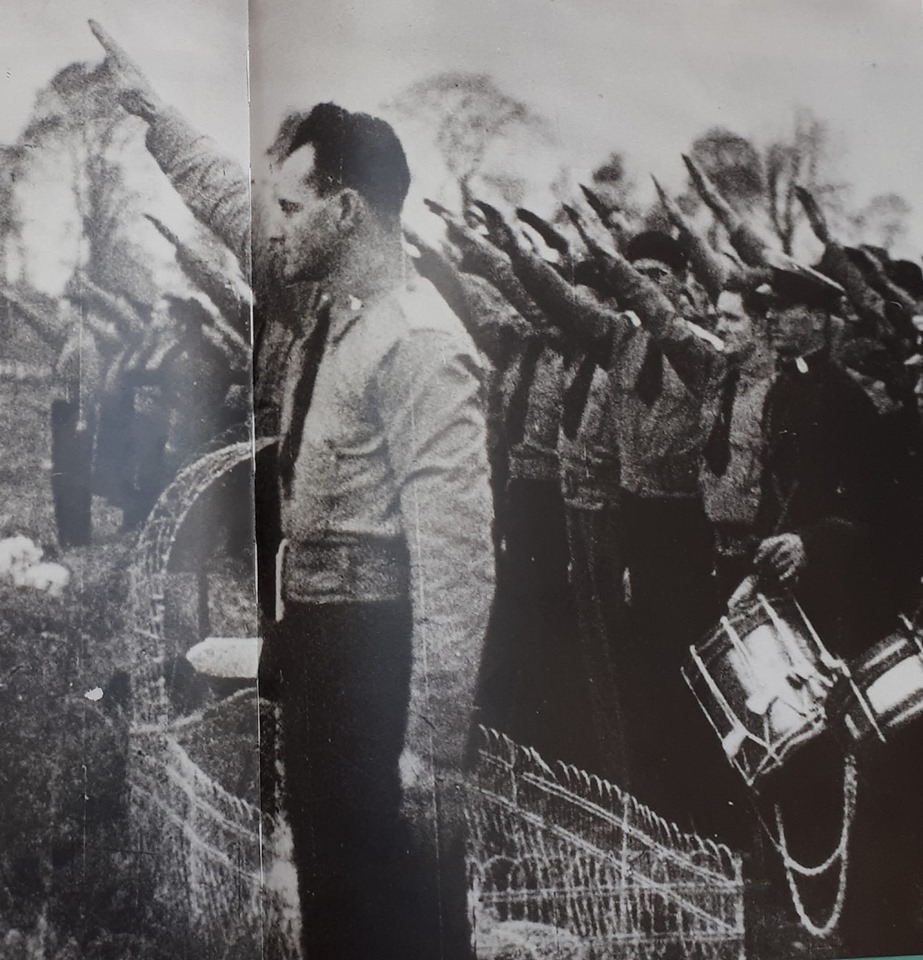
Irish fascists, the “Blueshirts”, at Bluebell Cemetery 1934.
(Photo sourced: Internet)

And because this fascism came from what was perceived as a State that had sold out the struggle to the foreign oppressing power, the Irish Republican movement found itself obliged to fight it and did so. From the most anti-communist right-wing Republicans to the most left-wing, they fought the fascists with publicity and physically, with fists and boots and, occasionally, with pistol shots. Socialists and democrats fought them too but it was the Republican-nationalist Government of Fianna Fáil5 that banned the Blueshirt march intended to lead to a coup and forced the organisation to back down, after which, despite enthusiastic support of the Catholic Church hierarchy, it did not again pose a serious threat of assuming state power.

Since those years and particularly since the end of WWII, Irish society has been on the whole anti-fascist in sentiment and the Irish Republican movement, with some exceptions, particularly so.

It seems to me, upon reflection, that although much of this sentiment is based on democratic and even socialist ideals, it is also, in part, a defence of Irish nationalism, a deep-seated wish for independence and self-determination, a memory that fascism in Ireland serves British domination.

And not only a memory but current reality: British Loyalism in Ireland, the militant force that garrisons and underpins colonial possession of the Six Counties (one-sixth of the area of Ireland) by Britain, is extremely reactionary. Apart from the numerous links with British (and even European) fascist groups over the years, Loyalism is deeply socially and politically reactionary. British Loyalism in Ireland is opposed to immigration, has been implicated in racist attacks on migrants, is opposed to any state recognition of the Irish language or civil rights for people of Catholic background, in addition to being against the struggles of the Palestinians, Basques, Catalans; also to gay rights and to the right to choose abortion.

SPAIN AND “THE RISE OF THE RIGHT”

          In another part of Europe, there is a state which had experienced a military-fascist coup and war, after which it suffered four decades of fascist repression. Spain, after the death of the dictator Franco, went through a supposed Transition to democracy but the fascists remained in their positions of power which they handed down to their sons and daughters, these making room for a few social-democratic climbers at the table.

The November 10th elections this year in the Spanish State saw the rise, it is being widely said, of the far-right. It would seem so on the surface but one needs to understand that all the parties of the Right in the Spanish state have their origins in the Dictatorship: the allegedly “conservative” Partido Popular was created by followers of Franco; the allegedly “centre-right” Ciudadanos was formed by deserters of the Partido Popular, while the “ultra-Right” Vox was formed by deserters of Partido Popular and of Ciudadanos. There is in fact little political difference between those who vote for different parties of the Right and certainly none between those who voted for Ciudadanos before and those who have now voted for Vox. Most of the trumpeted “rise of the Right” in the Spanish territory is in fact a re-allocation of votes from one right-wing quasi-fascist Spanish party to another, rather than an increase of votes for fascism. Of course, that does not at all mean that there is no danger to popular and democratic forces but still …..

Map of voting results in the November elections in the Spanish state.
(Image source: Wikipedia)

Viewing the rise of those votes for Vox and their pattern across the territory of the Spanish State, one can see that Catalonia and the Basque Country remain untouched, as any map of voting results will show. Basque and Catalan independentists tend to be proud of this, no doubt justifiably so but perhaps there is a danger here too. Do they think that at base, Basque and Catalan people are superior to those in the rest of the Spanish state? If so, they should think again …. and think deeply.

The Basque Country was, until the military-fascist coup, ruled by deeply conservative and Catholic elites. When Franco and the other Generals struck with German Nazi and Fascist Italian assistance in 1936, of the four Basque provinces within the territory, only two unequivocally decided to fight it: Bizkaia and Gipuzkoa. Alava’s resistance was half-hearted and in Nafarroa, the conservative Carlists wiped out three thousand socialists, anarchists and democrats and joined the fascist-military forces.

Until very recently, the Nafarroan regional government has been dominated by the UPN, a Basque version of the Partido Popular and, after a brief interval, they are in power again. The other three southern Basque provinces have a separate regional government which, for most of its existence, has been in the hands of the right-wing Basque Nationalist Party and the only time it has not, has been a brief period under the Basque version of the Spanish social-democratic party, the PSOE.

In 1936 the attempt to bring Catalonia into the fascist-military side was only prevented by a workers’ uprising and actual street battles. After the death of Franco Catalonia was also run, until very recently, by right-wing Catalan forces which, not so long ago, sent its regional police force, the Mossos d’Esquadra, to beat social and economic protesters off the streets and to shoot them at close range with rubber bullets, causing around a dozen young men and women to lose an eye.

On the other hand, the regional Government of Andalusia, now seen as a stronghold of the Vox party, has been ruled by the social-democratic PSOE from the moment the region had democratic elections after the Transition. However years of corruption and lack of concern for the fate of working people and high unemployment in the region has whittled away the electoral lead of the PSOE until this year, when Vox and Ciudadanos were able to combine and to take over the regional government.

FOR NATION, AGAINST FASCISM

          Within both Catalonia and the Basque Country, independentist forces, which is to say, those of a nationalist and republican motivation, have evolved to be led by groups espousing left-wing ideology. Generally, the young activists and supporters are atheist or agnostic, anti-racist, liberal socially and environmentally conscious. But they also defend their language, enjoy their cultural expressions and either support independence or at least the right to self-determination. The opposition of these forces to fascism seems to me to rest on two pillars: 1) left-democratic ideology and 2) defence of the nation.

Similarly to the case of Ireland, those of unionist ideology and opposed to self-determination in Catalonia and the Basque Country tend to be on the Right with a fascist core and the major support for those fascists and unionists comes directly from the Spanish State through its police, military and judicial systems, as well as from fascist groups mobilised from outside Basque and Catalan territories. English and English-colonist nationalism tends to be based on colonial and imperialist history and thinking, to be reactionary and even fascist, features which it shares with Spanish nationalism, with the added factor that the forces creating and managing the Spanish state in its current form have been actually fascist and fascist-collusive.
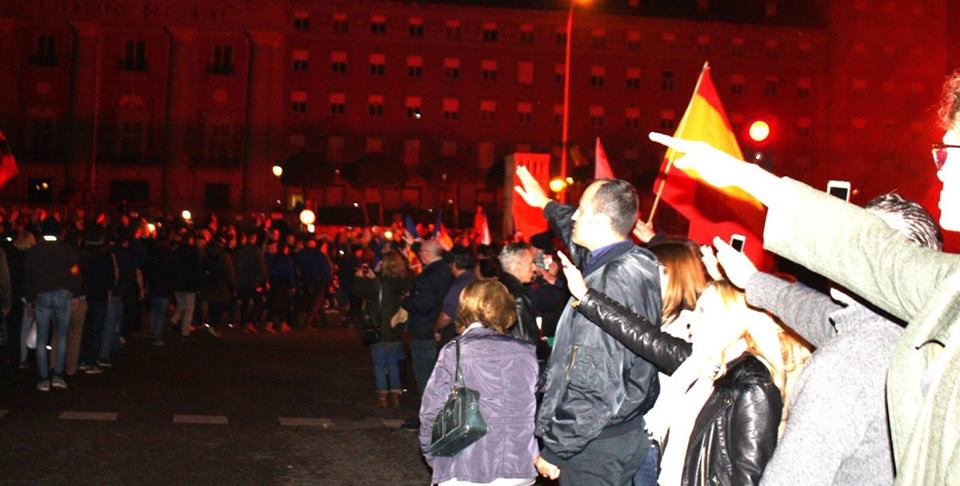
A fairly recent Spanish fascist commemoration in Madrid, including Spanish colours and fascist salutes.
(Photo sourced: Internet)

I have therefore come to the conclusion that Basque, Catalan and Irish people are no better than anyone else fundamentally, including the English and the Spanish, but that the conditions governing the development of their culture and their resistance to foreign occupation and domination have given rise to a different kind of nationalism. This nationalism tends to be progressive, democratic, inclusive and anti-fascist …. and is playing a progressive role in the world.

End.

FOOTNOTES

1James Connolly (1868-1916), born into the Irish diaspora in Edinburgh, is considered by many the foremost revolutionary socialist thinker in western Europe in his time but he was also a trade union organiser, founder of political parties, journalist, historian, author and song-writer. He was a co-founder of the Irish Citizen Army, the first worker’s army in the world, which also recruited women on an equal basis.

2A Nation Once Again, published in The Nation, by Thomas Davis (1814-1845), Irish Republican journalist and song-writer.

3Protest of racist campaigner Gemma Doherty against proposed restrictions on “hate speech” at the Irish Department of Justice, Stephens’ Green, Dublin at the beginning of November this year.

4This however changed in 1937 with De Valera’s new Bunreacht (Constitution) which declared the Irish State to be a Republic and the Articles 2 and 3 of which laid claim to the Six Counties (overturned in 1999).

5A 1926 split from Sinn Féin on the issue of occupying seats in the Dáil (the Irish Parliament), it grew quickly and was soon elected to government (1932) and, as the preferred party of the native Irish capitalist class, has been in government more years than any other Irish political party. Despite its Republican origins and rhetoric, it continued to support the capitalist-Catholic Church alliance of its predecessor until very recently, when it criticised abuses by the Church of those in its care and failure to pay adequate compensation.

THE LIBERAL AND THE REVOLUTIONARY

The Liberal and the Revolutionary both uphold struggle and dialogue — but disagree on emphasis and occasion, as this conversation illustrates.

Struggle
(Image source: Internet)

No, you don’t understand. Let me put it this way ….

I do understand. I just don’t agree.

If I could only explain …. I’m sure you would …..

No, we won’t agree because we have a different view of the world, what goes on there and especially what the reasons are.

But surely we can discuss it?

We have.

Don’t you believe in dialogue?

Of course, up to a point and depending on the circumstances.

What do you mean by that?

Well, when the enemy is about to attack your barricades, for example, I believe the time is right to place your defenders and your weapons – not an appropriate time for dialogue.

That’s so dramatic.

Discussion, argument, dialogue (Image source: Internet)

Well, drama happens too.

What if dialogue could prevent the attack on your barricades?

Well, then I’d be for it but I can’t see how that would happen.

That’s because you close your eyes to the possibilities of dialogue.

No, it’s because I open my eyes to the current reality and to history. Let’s look at the barricade situation. Most likely the barricades have gone up to defend an area where the people have seized power. Right?
Well, that’s one possibility.

OK, well let’s explore that possibility. The State sends police and/or troops to attack the barricades, in order to take back control of the area. Right?

Well, yes. They might be under pressure to do so. Concerns about property in the area, law and order and such.

So they want to take control back and we don’t want to give it to them. What’s to be gained by dialogue?

You could persuade them that their concerns about property, law and order and so on are unfounded. You could let a couple of them in to see for themselves. Or you could try to get an intermediary.

Someone like yourself?

Well, actually I have done a mediation course.

Hmmm. And then they’d let us run the area ourselves?

They might. They might not. But without dialogue, how would you know?

Listen, their main concern is to get back control. The better we run our area the more worrying it is for them because it shows another alternative to their capitalist model. And the longer they leave ours running, the more chance that other areas might take the example. So they have to crush us and we have to defend. No middle ground whatsoever. And letting some of them into our area would only give them additional intelligence to better plan their assault and target leaders afterwards, if they are successful.

God! You’re so negative and defensive. There’s no point in trying to persuade you.

Now, that last sentence is something we both agree on. See? No point in dialogue here.

End.

Murder of peasant leader Wat Tyler by King’s man during negotiations 1381, Smithfield
(Image source: unknown artist 20th Century, Internet)

CONSPIRACIES AND CONVERGENCE OF INTERESTS

(Reading time: 10 mins)

Diarmuid Breatnach

Conspiracy theorists get laughed at which, since some of the theories are indeed laughable, seems fair enough. Conspiracy deniers, on the other hand, get an easy time of it, which is a pity – because there are conspiracies going on. All of the time.

People wearing reptile masks — one of the more laughable conspiracy theories but believed by many in the US is that they are being ruled by lizard people.
(Image source: Internet)

Then there’s simple convergence of interests, which give rise to conspiracies but can also operate independently.

A current example of convergence of interests: The EU and all its constituent governments decide that the struggle between Catalonia and the Spanish State is an internal matter for the Spanish ruling class and can they please sort it out without dragging most of Europe into the mess? In fact, if they don’t sort it out, it endangers a number of key players in the EU and, inevitably, the EU itself.

As the current President of the EU Commission, Jean-Claude Junker reminded everyone on the question of Catalonian independence in 2017, there are member states of the EU other than the Spanish one that are vulnerable to the same kind of ‘problem’, i.e that of a bid for separation and independence of some part (or parts) of the state in question.
And if we look at Europe outside the Spanish State, we can see what he might have meant. There’s the French state, which contains within it three provinces out of the seven of the Basque Country, a part of Catalonia, also Brittany, Occitania and Corsica. Each of those regions was at one time an independent kingdom or part of a kingdom other than that of France; each also has its own language and each has struggled against French domination at some time or other.

Italy is a state with huge differences between its north and south, a composite of many different parts that did not come under one state rule even formally until 1871, at which time the spoken language of one region could hardly be understood in another. And there is Sardinia, still with its own language and currently engaged in another struggle for independence.

The UK is in the process of ceasing to become part of the EU now but it is still a part of the pattern of alliances (and hostilities) that forms part of modern Europe. And the UK contains the Six Counties of Northern Ireland, not long out of the three-decades guerrilla war, also Scotland with a strong popular movement for independence. In addition the Celtic nation of Wales was subjugated but still has a strong language movement and there are some stirrings of nationalism in the Celtic nation of Cornwall.

Belgium is a united state but containing the French-speaking Waloons and the Dutch-speaking Flemish and, although both languages are officially recognised, as polities, the two groups don’t get on very well together.

Even the separation of Catalonia from the Spanish State’s territory on its own would be bad enough from the point of view of EU leaders – but it could also precipitate the separation of the four southern Basque provinces, also of Galicia and Asturies. Which would certainly attract the interest of the southern regions of the French state.

In summary then, a successful bid for independence by Catalonia would start an “infection” (which is what Borrell, the Spanish Foreign Minister to the EU called Catalan independentism) which has the potential to cause the breakup of a number of major and medium states of the EU. And Junker also said that he didn’t want “an EU of ninety-nine states”. Of course not, such a union would be very difficult for the big European states to dominate and, in fact, those same European states would not be so big any more.

Conspiracy? Probably not – just convergence of interests. The ruling elites would have no need to get together, decide what they wanted their politicians to do, then have their various ministers sit down, formulate the policy of each state, have the foreign ministers of each get together and then inform the managers of the EU. The politicians have been trained and schooled, they know in general what their ruling elites want, without having to be told. They would react to Catalonian independence almost instinctively – with rejection. They view nationalism and independence, if it breaks up a rival power (such as the Eastern Bloc), as a good thing – but not in their own group!

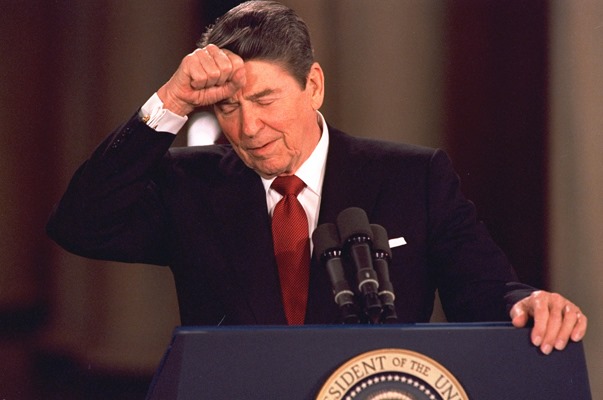
President Reagan of the USA lied when he denied any truth in the allegations of arms being sold to Iran to fund the Contra war against the Nicaraguan state. (Photo source: Internet)

THE USA IRAN-CONTRA CONSPIRACY

However, conspiracies do indeed happen, of course they do – and often. We have just passed by the anniversary of a key point in one huge one, the point when the “Iran-Contra” scandal began to break, in early November 1986. And President Reagan of the USA said that “the speculation that the US has sold arms to Iran has no foundation”, which was of course a lie. Basically, the US sold arms to the fundamentalist theocratic regime in Iran but, due to a US Congress embargo on such exports there, had to do it through Israel. They did so for two reasons, one for money to fund a military terrorist campaign against the government of Nicaragua which the US Congress would not approve, second in order to seduce the Iranian military (as they have done with the Egyptian military) and having them overthrow the Iranian regime. And the US wanted the Nicaraguan revolutionary government overthrown because it was not aligning itself with US foreign policy in what the USA considers its back yard (and a major source of raw materials) and also because a successful state of the type which Nicaragua was (then) would provide a ‘bad example’ to the other states of Latin America.

The Israeli Zionist ruling elite went for the deal because they too hoped the Iranian military would overthrow the theocratic regime and bring Iran back under the western-imperialist umbrella, as it once had been so secure that the CIA had its HQ for the whole Middle East located right there (and got caught with its pants down, or its secret documents in the process of shredding). And besides, the USA is the No.1 supporter of the Israeli Zionist regime in the world (another example of convergence of interests).

But despite the convergence of interests between the ruling elites of the USA and Israel, along with former Nicaraguan military, right-wing groups (for terrorist personnel) and US client regimes such as Honduras (for Contra bases) and Panama (for drug money to also fund the Contras, apparently through the CIA to sell in California – another conspiracy theory), a conspiracy was necessary to execute the operation. This was because of the unusual nature of the arms deal, its illegality according to US (and presumably Israeli) law and the number of partners involved. And the silent complicity of the US mass media was necessary, at least until a CIA plane delivering weapons was shot down by Nicaraguan forces over their territory and an operative, Eugene Hasenfus, captured alive.

A COMMON KIND OF CONSPIRACY

          Another example of conspiracy is that of price-fixing between big companies on given products. There have been a number of these exposed over the years. A conspiracy is necessary in this case because normally, the interest of big companies is to increase their share of the market over that of the competition. But at times, they perceive that it is in their joint interests to cease cutting one another’s throats and to regulate the prices of their products by agreement among themselves. Not only is this illegal in most administrations but it runs counter to the philosophy of capitalism, i.e that competition, instead of the cooperation advocated by socialists, is good for society. The fact that price-fixing is out of the norm of capitalism requires coming to formal agreement between the participants and the fact that it is illegal and undermines capitalist propaganda, requires secrecy – hence conspiracy.
However, most of what goes on in the world when government or other reactionary elements cooperate is probably just the result of convergence of interests, easily recognised by the participants.

(Image source: Internet)

A CONVERGENCE OF VERY DIFFERENT INTERESTS

Generally speaking, it is when their partnerships are put under pressure that the established convergence begins to crack; when one partner or another decides that the price of remaining in it is too high or that it’s time for sauve qui peut (everyone for himself). What can achieve that level of pressure is another kind of convergence of interests, that of the masses of wage-earners, small business people, peasants and indigenous people, recognising that by acting together, they can overthrow the existing system and set up an alternative that corresponds to their needs.

End.

REFERENCES:

Noam Chomsky short excerpt: https://libcom.org/history/the-iran-contra-affair

More detailed summary from Wikipedia: https://en.wikipedia.org/wiki/Contras

Concern about price-fixing in the insurance sector: https://www.independent.ie/irish-news/insurance-pricefixing-allegations-to-be-probed-by-watchdog-38405133.html

A case of price-fixing for contract bidding in Ireland: https://www.irishtimes.com/news/crime-and-law/sentencing-in-price-fixing-case-should-be-increased-to-encourage-whistleblowers-dpp-1.3515484

MARGARETTA D’ARCY SPEAKS IN THE BASQUE COUNTRY

Diarmuid Breatnach

(Reading time: 7 minutes)

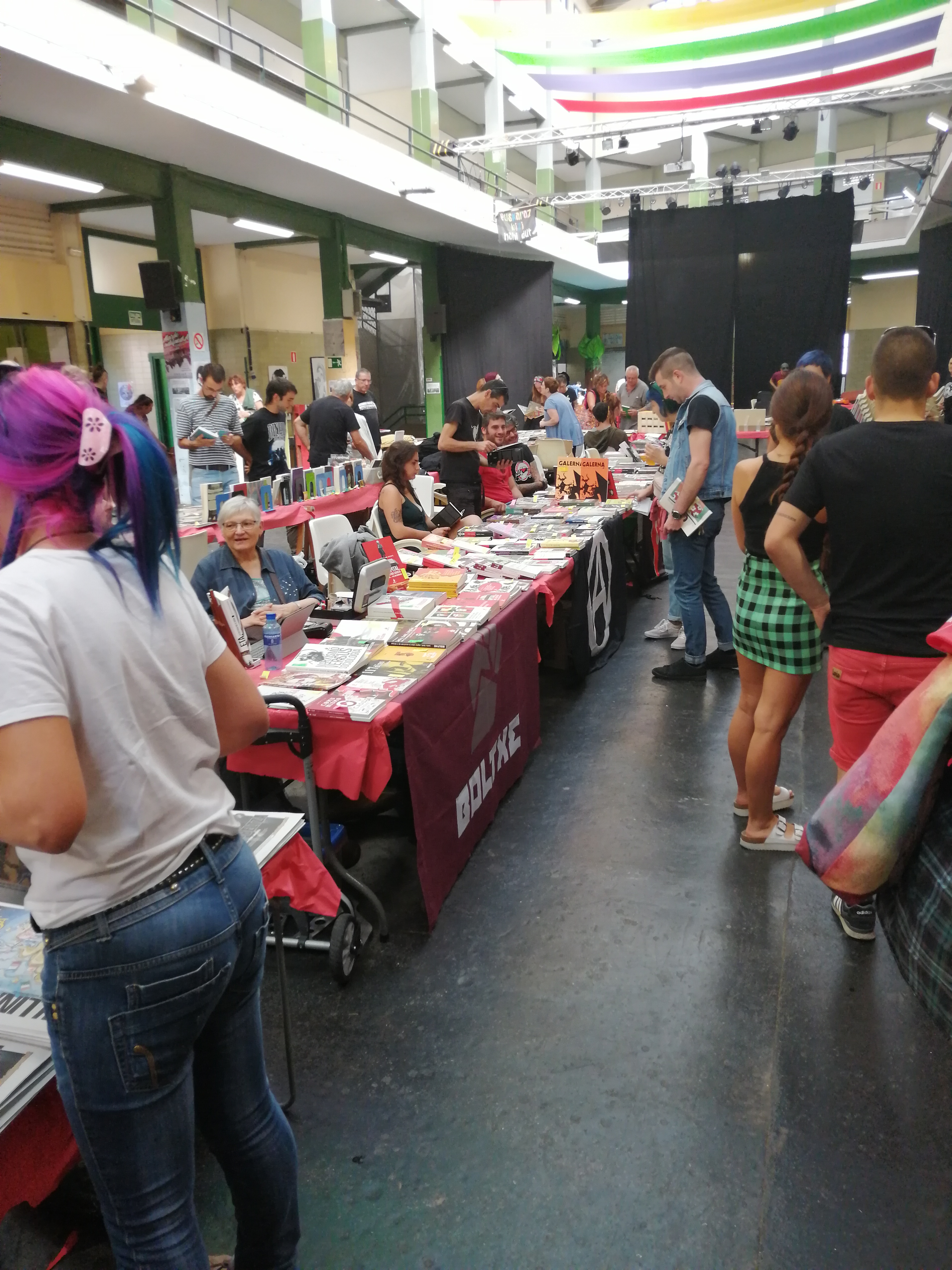
An anti-fascist bookfair was held in Portugalete1, not far from Bilbo (Bilbao) in the southern Basque Country on Saturday 29th and Sunday 30th September. There was ample room for the many stalls in the old disused indoor market in the town’s Casco Viejo (old town quarter), along with a curtained-off play area for children. One of the events in the two-day bookfair was a launch of the translation into Castillian (Spanish) of D’Arcy’s book “Tell Them Everything”(“Di Les Todo”). The translation was published by Sare Antifascista, one of the organisers of the bookfair and D’Arcy spoke in English at the launch, her talk translated into Castillian; also speaking was Basque ex-political prisoner Ziortza Fernandez Larrazabal. 

Section of the audience at the talk (Photo: D.Breatnach)

          Trembling from the illness that has affected her for a number of years (which she later commented resulted from attacks by fascists during the Greenham Common protest and later in Ireland by police) D’Arcy spoke clearly and coherently about her activism, the founding of Women Against Imperialism, the Greenham Common protest camp, her period in jail with Republican women and her activism against the USA’s military use of Ireland’s international airport at Shannon (despite the country’s constitutional neutrality).

Going on to speak about Ireland today, D’Arcy outlined some of the aspects of the notorious Direct Provision Centres for asylum seekers in the Irish state, the issues arising from the location of such centres and the opportunistic intervention of fascists against immigration. She went on to talk about the targeting on social media of those who spoke up welcoming asylum seekers or against racism and commented that the worrying thing about this development was that the fascists had a youth wing. Recalling the referendum on conditions of nationality in 2014 which had removed the rights of people born in Ireland to Irish citizenship unless they had an Irish citizen parent or grandparent, D’Arcy concluded by saying that Ireland is a racist country.

Referring to the Six Counties, D’Arcy criticised Sinn Féin for using the proposed Irish Language Act as a political football and as something with which to attack their political opposition, the Democratic Unionist Party2. Continuing, she said that “Scottish Irish”3 also existed in the Six Counties and asked why that could not be included in the Act, also quoting James Connolly that he didn’t care what language people spoke as long as they could communicate together.

Whatever about the issues in the Brexit question, the speaker said, Britain had used Ireland as a military training ground and had many bases in the Six Counties and these needed to be dismantled.

D’Arcy concluded by advising Basques to approach the Irish Consulate in the Basque Country to enquire whether it would be safe to travel to Ireland, given the US military use of Shannon Airport and the growth of fascism and racism in the country.

Ziortza Fernandez Larrazabal speaking. (Photo: D.Breatnach)

After the Irish speaker and speaking in Castillian, Ziortza Fernandez Larrazabal, ex-political prisoner from the locality, spoke first in tribute to D’Arcy’s record of activism. Moving on to her own activism in support of Basque independence and socialism and her five years in jail, Ziortza recounted being moved through a number of jails as part of the Spanish State’s policy and practice of dispersing political prisoners far from their homes and the strain this places on their friends and relations.

Commenting on the effects of imprisonment in Spanish jails, Ziortza said that some political prisoners had died through neglect, some had killed themselves but some had come out stronger, clearer in their minds and confirmed in their political views, which is what she felt had happened in her case. Ziortza said that some prisoners had 40 years of jail sentence and that they should be released.

After applause for the speakers, the Sare Antifaxista chairperson opened the meeting to questions from the audience. After a silence of some minutes, one man spoke in praise of the courage and commitment of both women and their record of activism. Speaking in Castillian with an Irish accent, he said he felt he had to distance himself from some of D’Arcy’s words. He felt it was important not to confuse government with people and that the Irish people were not, on the whole, racist and in fact racists and fascists had found it very difficult to organise within the territory of the Irish State.

Recounting the historical experience with the fascist Blueshirts in the 1930s, the Irishman said that they had been fought on the streets and defeated. When Pegida tried to launch their fascist and islamophobic group in the capitals of European states in 2016, they had failed in Ireland because firstly their gathering point had been occupied in advance by anti-fascists and anti-racists and, secondly the fascists themselves had been physically attacked and beaten. He talked also about a recent initiative to launch a “yellow vest” movement in Ireland but which fascists and racists had moved in to lead – that initiative had, as a result, been rejected and had faded away. Fascists are active on social media but find it difficult to hold events in public. The danger of racism and fascist organising should not be dismissed, the Irishman said but so far, in Ireland, racism and fascism was being repulsed among the people.

(Photo: D.Breatnach)

While it was true that the Government had proposed changing the nationality clause in the Constitution in 2014, he said, this had been part of a process across the whole of Europe. The referendum was held on that question along with another at the same time and only the social democrats and trotskyists had noticeably campaigned against the change. The vote in favour had to be seen in that context.

Moving on to the question of nation and language, he said that nations had a right to self-determination which, in many cases, was opposed by imperialism, which also damaged many languages. The loss of a language, he said, means the loss of a way of thinking and seeing, of literature, poetry and song; the loss of such is a loss for entire humanity.

A Basque woman also spoke from the floor, partly in Castillian and partly in Euskera (Basque), expressing her admiration for the record of both women speakers and referring to her own involvement in her youth in Greenham common. She went on to speak about the danger of nationalism but also in support of the rights of language and said that if there were no states in the world, she would not want one either but as long as there are, she wanted one for her own nation.

She also said that at this time it was important to support the struggles for self-determination not only of the Basques but also of the Catalans.

Poster advertising the book launch and talk

The event came to an end and people moved off for lunch in various bars, or to chat or to browse the bookstalls. The latter were run by a number of organisations: Inugorria Liburodenda (Gernika revolutionary and progressive bookshop), Sare Antifaxista; CNT, Mujeres Libres, IPEs, Baskale, FAI, DDT Banaketak, Periko Solabarria Elkartea, Komite Internazionalistak, Jazz Oi!, Templando el acero, Amnistía Ta Askatasuna, SRI.

FOOTNOTES

1 Portugalete has a Metro station, reachable from Bilbao. The Casco Viejo (old town) is a number of narrow streets lined by bars and shops heading steeply downwards from the Metro station towards the river front, where there are a number of restaurants and bars and a nearby port museum. The interesting Puente Colgante is nearby; a pedestrian bridge across the river worked something like a horizontal lift.

2 Given that Sinn Féin makes no effort to ensure its own membership is Irish-speaking, or even its leaders (despite some of them being very proficient in the language), also that all its internal and nearly all public meetings are conducted through English, this would seem to be a correct assessment by D’Arcy.

3 D’Arcy probably meant Ulster Scots or Ullans, which is not any kind of Irish but a variant of Scots, the Germanic-English dialect once prevalent in the Scottish Lowlands (often called “Lallands”), in which for example Robbie Burns wrote. It has Minority Language Status in the Six Counties and while Irish-speakers generally have no opposition to the promotion of that dialect, hardly anyone speaks it today and it was raised as an issue by Unionists purely as a counter to the rights of Irish-language speakers. Scotland does have Scottish Gaedhlig, with over 57,000 recorded speakers (2011 Census) but this is not spoken in the Six Counties.

Gernika bookshop stall in foreground
(Photo: D.Breatnach)
Other stalls
(Photo: D.Breatnach)


REFERENCES AND FURTHER INFORMATION

Sare Antixista: http://sareantifaxista.blogspot.com/

Dissidence in the Basque Country: https://rebelbreeze.wordpress.com/2019/09/27/dissidence-in-the-basque-pro-independence-movement/

Basque political prisoners:

Amnistia Garrasi: https://www.facebook.com/profile.php?id=100013870776872

Etxerat: https://www.facebook.com/Etxerat-Elkartea-255302801219340/

(Photo: D.Breatnach)

(Photo: D.Breatnach)
Buying at stall at the Bookfair
(Photo: D.Breatnach)
Nearby poster honouring “Argala”, an ETA leader assassinated by GAL, the Spanish State death squad.
(Photo: D.Breatnach)

THE DÁIL: IRISH ESTABLISHMENT SUPPORTS THE SPANISH STATE’S ATTACK ON CATALAN SELF-DETERMINATION

Clive Sulish

A representative of the Irish (Fine Gael) Government’s Minister for Foreign Affairs and Trade last night not only called for non-interference in the “internal affairs” of the Spanish State but defended the Spanish Constitution of 1978 and the “independent Spanish judiciary”. She was answering a question regarding the Spanish State and Catalan independence movement and her stance was supported by representatives of the two other traditional parties of Irish Government, Fianna Fáil and Labour. Five Teachtaí Dála, elected members of the Irish Parliament, argued passionately against them.

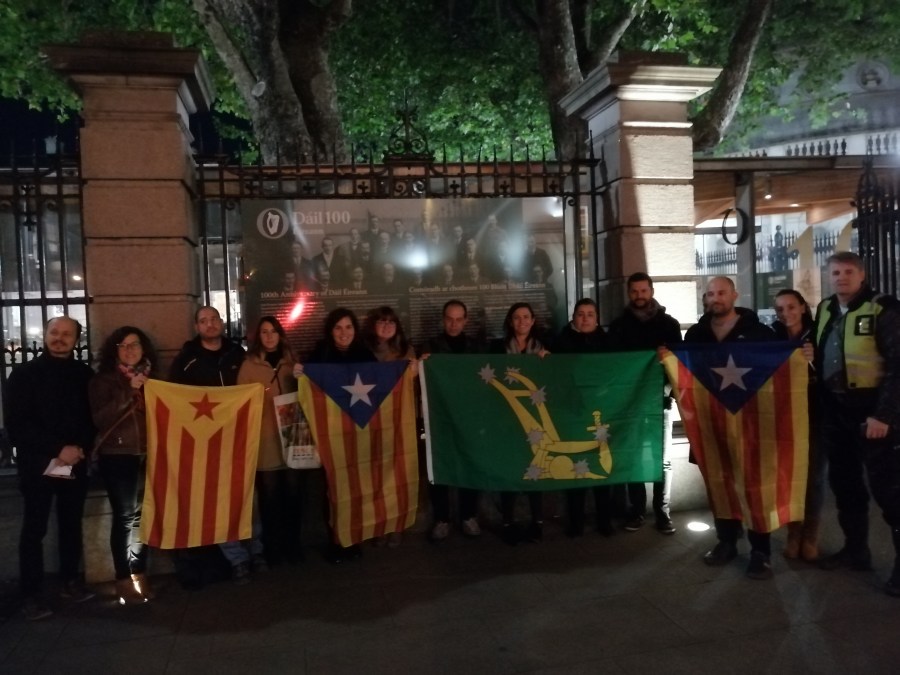
Section of Catalonia supporters in Kildare St. waiting to attend the Foreign Affairs Minister’s Question time.
(Photo: Rebel Breeze)

THE VOICES OF THE ESTABLISHMENT

This was Minister’s Question time, when Ministers (or their representatives) appear in the Chamber to answer questions about areas of the remit of their Departments and earlier, Ministers had been quizzed about areas of childcare, social care funding, local government funding ……

The Dáil chamber looked mostly deserted but in the public gallery sat a score of Catalans and some Irish, listening intently. Normally, these sessions are attended only by the TDs asking the questions and the relevant Ministerial spokesperson – and only for the question being asked. And of course also in attendance is the Ceann Comhairle, the presiding person acting as Chair – and secretaries. Sometimes by members of the media but by no means always, since reporters can monitor the televised broadcasts of the session.

The Minister’s reply on the question of Catalan self-determination delivered by Minister of State Helen McEntee TD followed a predictable pattern – predictable because it is so often trotted out: the Irish and Spanish Governments have a long history of good relations and friendly links, lots of Irish people go there on holidays, lots of people from there come to Ireland every year, Spain is a democracy, its constitution must be abided by, it would be wrong to interfere in its internal affairs. Inclusions to that in litany in recent times are that the question of Catalonia is emotive throughout the Spanish State and that Catalan society is divided over it, that the rule of law must be upheld and that violence has no place in politics.

The Fianna Fáil representative, Seán Haughey TD, echoed that line, adding also that the Spanish Constitution of 1978 is unitary and does not allow any part to become independent. He also quoted some survey results that he claimed indicated that support for independence was now in a minority among Catalans.

The Labour Party representative, Jan O’Sullivan TD, went further and specifically supported the present Government of her “sister party in Spain”, the PSOE and suggested that the “inflexible” previous government of Rajoy (of the PP) had helped to bring the current situation about and that Sanchez, the Prime Minister, would help calm the whole situation down. The only concessions she made were to suggest that the lengthy jail sentences were perhaps not the best way to deal with the issue and to include the police by mention in her call for “end to violence by all sides”. However, she went further than others in the Establishment parties with a specific condemnation of the jailed activists when she said that “it is not acceptable for politicians to lead citizens into conflict”.

Early arrivals for the Minister’s Question time
line up in Kildare St. below a photo of the First Dáil 1919.
(Photo: Rebel Breeze)

THE OPPOSITION

“Reactionary Spanish nationalism”

          The first TD to speak in reply to the Establishment politicians was Eoin Ó Broin, a comparatively recent Sinn Féin Deputy (2016) for Dublin Mid-West. Ó Broin was in Catalonia as one of the international observers of the Catalan Referendum on Independence on 1st October, which was attacked by Spanish police with around 1,000 Catalans injured.1

Speaking about his experiences there, Ó Broin related his meeting with 83-year-old Antonio, bruised and with his fractured arm in a sling, beaten while trying to vote earlier that day, queuing again at a polling station in Barceloneta. The SF TD spoke about what he had seen there and the “increasingly reactionary Spanish nationalism”, then went on to list the elected politicians and their jail sentences. Denying it was an internal matter for Spain, Ó Broin said it was about human rights and required international independent mediation. The Dáil would be implicitly in collusion with the Spanish Government if it left the matter to internal resolution only.

“The working class are the incorruptible heirs …”

          Paul Murphy TD, a socialist activist2 who has recently left the Socialist Party of Ireland to form a platform called Rise, shared speaking time with Eoin Ó Broin. Calling for a “reality check” he said that jailing politicians and activists for organising a peaceful ballot could hardly be the work of a normal democracy. Responding to the Labour Party spokesperson with regard to the Spanish PSOE Prime Minister, he said that “Sanchez is in Government” and that he was “sending thousands of troops and police” to suppress the Catalan independence movement and mounting “a publicity campaign” to blame the convicted leaders.

The Spanish Government would one day come to be haunted, Murphy said, by the words of James Connolly in 19143 when he said:

“If you strike at, imprison or kill us, out of our graves or prisons we will still evoke a spirit that will thwart you, and perhaps, create a force that will rise up and destroy you. We defy you! Do your worst.”

Murphy said that the Catalan popular movement was impressive with their demonstrations, marches and the recent general strike. Against that, the Spanish police and army were carrying out “a campaign of terror” injuring hundreds and anyone who didn’t believe it only had to go on line and see the videos. “Francoism is baring its ugly head”, Murphy said and pointed out that the Spanish legal systems is riddled with a contempt for democracy, echoed by those at the top in the European Union.

The recent Catalan General Strike, according to Murphy, “showed the way forward” and he quoted again from Connolly, that “the working class are the incorruptible heirs of Irish freedom”. The Spanish State had a long history of suppression of national self-determination, including those of the Basques, Murphy said and the way forward would be for a voluntary socialist federation.

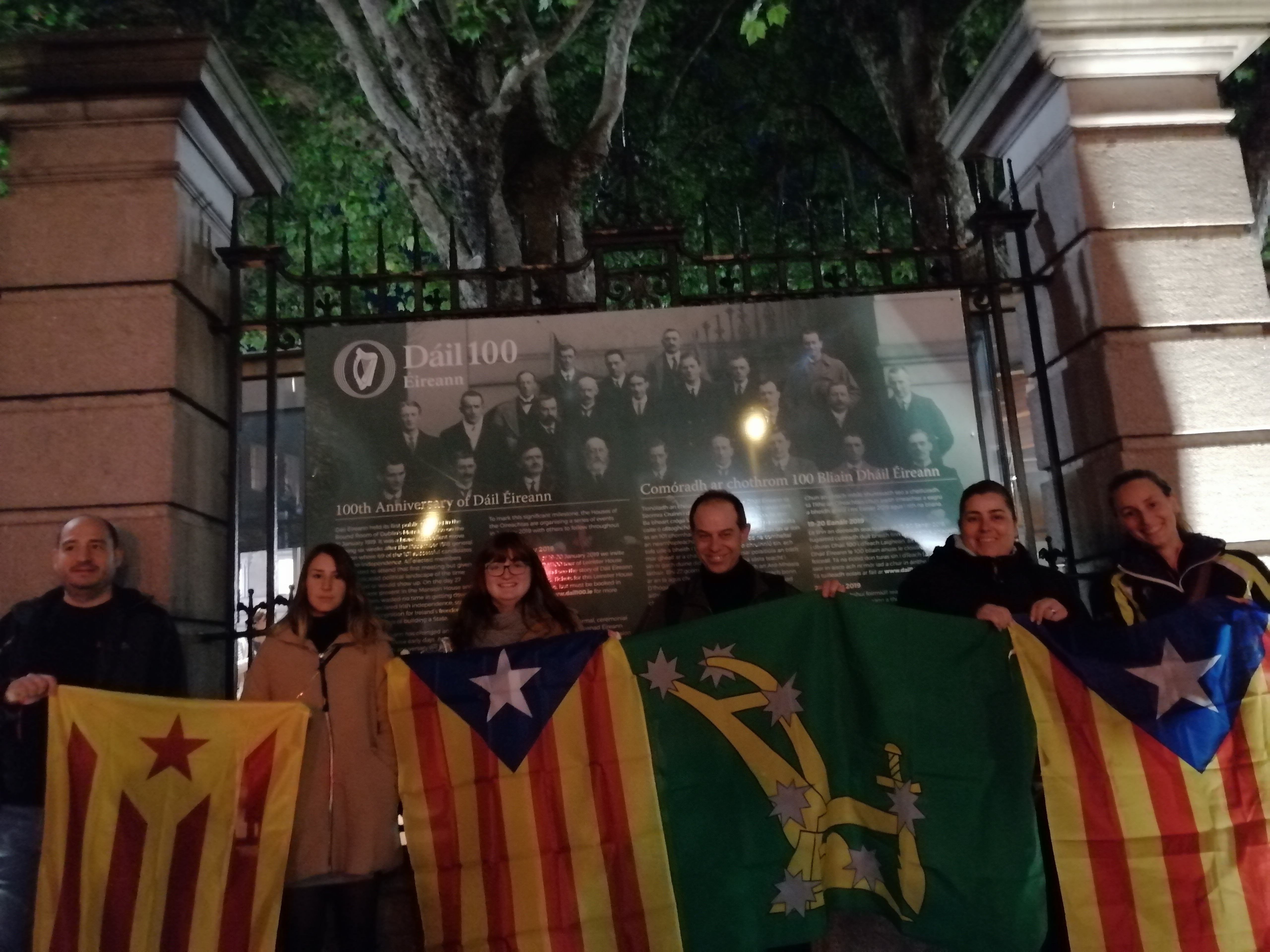
Catalan independence supporters gathering in Kildare St. waiting to attend the Foreign Affairs Minister’s Question time.
(Photo: Rebel Breeze)

“The judicialisation of politics”

          Next to speak was Thomas Pringle, Independent TD for Donegal since 2011, with a socialist Irish Republican background, a member of Sinn Féin for few years but who left the party in 2004. He opened his contribution by referring to “the judicialisation of politics” in the Spanish state and, in reference to the scale of the Spanish repression, mentioned the 700 Catalan town mayors who await judicial process due to their support for the Catalan Referendum in 2017.

Pringle said the Spanish Constitution purported to guarantee the rights of different people within the state, which would be a joke if the reality were not so grim. “The EU continues to ignore” what is going on in its member Spanish State, “as it did in the Six Counties,” he said.

“Catalonia in 2019 is Ireland  a century ago”

          “Self-determination is a human right,” said the next to speak: Peadar Tóibín, TD for Meath West since 2011, who left Sinn Féin in 2018 and went on to form Aontú in January 2019. Tóibín reminded all that the First Dáil had sent out a call to the world for recognition of Irish independence in 1919 and that most states had not done so then4.

“Catalonia in 2019 is Ireland a hundred years ago”, Tóibín said and went on to say that if the Irish Government remained silent on repression by the Spanish State then it shared culpability for it.

“ … a short memory in this House”

          “We sometimes have a short memory in this House” said Mattie McGrath when it was his turn to speak, a TD since 2007 who has been an Independent since he left the Fianna Fáil party in 2011. McGrath referred to the recent long war in the north-east of Ireland and said that conflict resolution process was the only way to resolve the issue.

McGrath referred to Clare Daly (elected MEP this year after being a socialist TD for some years) and her statements on the issue. “Self-determination is a fundamental human right”, McGrath said, and went on to speak about “the right of freedom of assembly”, which was under attack by the Spanish State.

“Ireland is a small island nation”, Mc Grath said, “very sympathetic to the rights of people” (apparently contrasting this to the attitude of the Establishment in the Dáil).

In the time allowed by procedure for final response from the Minister, her representative reiterated the position she had outlined earlier and, though she conceded that most of the Catalan demonstrations had been peaceful, said that some recent “scenes of violence” had been “of concern”.

Section of Catalonia supporters in Kildare St. waiting to attend the Foreign Affairs Minister’s Question time. Behind them, enlarged photo of the First Dáil, 1919.
(Photo: Rebel Breeze)

COMMENT

Fianna Fáil‘s origins are in the split with Sinn Féin led by De Valera in 1926 over the question of taking seats in the “partitionist” Irish parliament, the Dáil, and rapidly became the preferred party of the native Irish capitalist class, having been in government since more than any other Irish party.

The origins of Fine Gael, currently in minority Government at the tolerance of Fianna Fáil, has its origin in the setting up of the Irish State after the War of Independence and represents the victors of the Civil War against the Republicans. It was composed of a coalition of a right-wing Irish Republican party (followers of Michael Collins, Griffiths etc), a small right-wing farmer’s party and the fascist Blueshirts (a name by which FG are still often called by their enemies).

Hard to believe today, the Irish Labour Party was founded by, among others, James Connolly and is the oldest of the three parties. A progressive party in the early days, it was not a participant in the Civil War, during which its representatives criticised the Free State Government about its abuse of civil rights, repression, large-scale arrests, internment without trial, torture and murder. Over the years it lost more and more of its socialist credentials and has been in coalition government with the right-wing Fine Gael on two separate occasions. The main trade unions in Ireland retain connections to the Labour Party, with the possible exception of the rapidly-growing British-based UNITE.

(Photo: Rebel Breeze)

The supposed inviolability of the Spanish Constitution of 1798 is one of the questions at the heart of the matter. The boast of the Spanish Government and its supporters abroad is that the majority of the people within the Spanish State voted for it. Well, so they did, except in the Basque Country – but what of it? If in a wedding, one of the partners says “I do”, does that mean that person is forever forbidden from leaving? Do we not have the right to divorce acknowledged now in most states around the world and certainly in “the democracies”? If one agrees to join a club or organisation, does that mean one can never choose to leave? Well, maybe in the Mafia, or the Cosa Nostra ….

Furthermore, that monarchist Constitution was put forward to a population that had endured four decades of fascist dictatorship, with the collusion of the allegedly socialist and republican PSOE and the allegedly communist and republican Communist Party of Spain, restraining their trade union and party members in the wave of state repression and murders during the Transition to “democracy”. Isn’t there something about the invalidity of agreements made under duress?

The issue of non-interference in the internal affairs of another state is a bogus one, since all governments do that at one time and another and Irish governments and political parties are no exception. In 1936, the representatives of Fine Gael loudly supported the military-fascist uprising led by Franco against the democratically-elected Government of the Spanish State. The Irish Government of Fianna Fáil did nothing to prevent the Blueshirts going off to fight for Franco and the Bishops of the Irish Catholic Church blessed them as they sailed off. The reality is that states that agree with one another generally do not interfere in one another’s internal affairs.

The constant mantra of reference to “the rule of law” and the condemnation of “violence in politics” is not only an irrelevance but turning truth on its head. It was not illegal according to the Spanish Constitution or laws to hold a referendum on independence 5. It is also against the Spanish law to use violence against others and even the police are not legally empowered to do so except in self-defence or in defence of others. On October 1st the actions of the Spanish police had 1,000 people requiring treatment and another few hundred have been injured in recent days. The Internet is full of videos of different incidents of gratuitous Spanish police violence, often the perpetrators showing no fear of being filmed – clearly because Spanish (and more recently, Catalan) police know they have impunity. Recently, however, it seems that some Spanish police have become sensitive to being filmed during their violent acts and have begun to target photo-journalists, both with personal violence and with rubber bullets.

A total of five people have now lost an eye from the impact of the rubber bullets of the Spanish police. Apart from the fact that these are banned in Catalonia, the bullets are supposed to be fired to ricochet and not directly at people, nor are they supposed to be fired at close quarters. Clearly, the rules are not being adhered to and nobody is enforcing them, granting impunity to the Spanish police.

When the representative of the Minister for Foreign Affairs acknowledged the overall peaceful nature of Catalan independence demonstrations but expressed concern over some recent scenes of violence, what was she really saying? It was this: that the violence of the police against the peaceful demonstrators could continue but the victims using force in defence or in retaliation is a cause for concern!

End.

FOOTNOTES

1  Eoin Ó Broin, often described as on the (small) left wing of Sinn Féin (a wing badly needed by that party) has in the past had relations with the Abertzale Left in the Basque Country and wrote a book on the movement there in his time, Matxinada – Basque Nationalism and Radical Basque Youth Movements. He is also author of Sinn Féin and the Politics of Left Republicanism.

2  Paul Murphy has been, while a Socialist Party TD, dragged by police out of a housing protest and with others faced serious charges arising out of a protest about Irish water against a Labour Party Minister, of which he and the others were acquitted by the jury after an infamous trial. He remains in the PBP-Solidarity parliamentary coalition.

3  James Connolly (1868-1916) was at that time active in the Irish Labour Party and leader of the Irish Transport & General Workers’ Union, which was struggling to recover from an 8-month fight against a group of employers that had set out to crush the union (Dublin Lockout). Connolly was a revolutionary socialist, republican, journalist, historian, author and organiser and was horrified by the very idea of the First World War which began in 1914. He was shot dead by British firing squad, along with other leaders and some others of the 1916 Rising.

4  This reference seems particularly appropriate. In January 1919 the majority of MPs elected in Ireland in the UK General Elections of December 1918, carried out the “Sinn Féin” platform’s election promise not to go to Westminster and convened a parliament in Dublin. This is known as “The First Dáil” even by the Irish State, which numbers its parliaments from then onwards. The First Dáil declared independence and called on the states of the world to recognise Irish independence (see References) but only the young USSR did so. Ireland had no legal right under British law to break away from the UK unless it were agreed by majority in Westminster (where the Irish MPs would always be outnumbered by the British). The First Dáil was banned by the British in September of that year and its members were arrested if they could be found.

5  Though possibly the declaration of Republic was – but that was suspended in less than five minutes.

REFERENCES & FURTHER INFORMATION

Clip of Eoin Ó Broin TD reply: https://www.facebook.com/EoinOBroinTD/videos/1138199326378630/

Clip of Paul Murphy TD reply: https://www.facebook.com/paulmurphytd/videos/424540844872189/?t=11

Clip of Thomas Pringle TD reply: https://www.facebook.com/ThomasPringleTD/videos/416766079224197/

Clip of Peadar Tóibín TD reply: https://www.facebook.com/740004202875853/videos/738458029959798/?t=124

(currently seeking remaining TD, also footage of the whole debate)

Text of all contributions to the debate: https://www.oireachtas.ie/en/debates/debate/dail/2019-10-22/34/

First Dáil’s Message to the Free Nations of the World: https://en.wikipedia.org/wiki/Message_to_the_Free_Nations_of_the_World

Some organisations of Catalan solidarity in Ireland:

ANC Ireland: https://www.facebook.com/IrlandaPerLaIndependenciaDeCatalunya/

CDR Dublin: https://www.facebook.com/CDRDublin/

With Catalonia/ Leis an Chatalóin: https://www.facebook.com/WithCataloniaIreland/

“YOUR STRUGGLE IS OURS TOO!” — CATALONIA’S STRUGGLE IS WAKING SPAIN

Diarmuid Breatnach

(Reading time: 3 minutes (not including video))

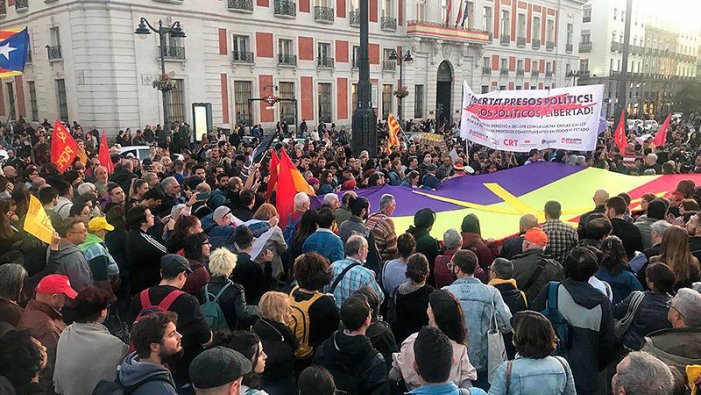
A Catalan solidarity demonstration of thousands in Madrid, in the big central square called Puerta Del Sol, shouted for “freedom for the political prisoners” and declared that Catalonia’s struggle was theirs too. A small crowd of Vox and smaller fascist groups tried to disrupt the rally but were repelled and the crowd turned towards them chanting: “Here are the antifascists!” (daring the fascists to come forward). Later, Spanish police charged the solidarity demonstrators and some running battles took place in the city’s streets.

There are two Spains – one of them is the Spain of an imperial and racist history, of expulsions, of plunder of colonies, of repression at home and abroad, the Inquisition, military-fascist uprising against an elected government, mass executions, rape and plunder, four decades of fascist dictatorship, followed by another four of a fake transition to democracy. That is the Spain that is in power now.

The other Spain is the one of popular resistance to exploitation of the Comuneros, the anti-feudal writing of Cervantes, the struggle against the military-fascist uprising supported by Nazi Germany and Fascist Italy, the mounting resistance to the Dictatorship that forced the ruling class to change their style of management, on the face of it ….. That Spain had largely been beaten, jailed or shot in to silence, crushed by treason and division and hopelessness. But there were always embers, embers that burst into little flames from time to time, not only in the nations of the Basque Country, where a fire burned for two decades, or in Catalonia, or Galicia …. but also in places like Asturias in the north, Andalucia in the south and in Madrid itself, in the centre.

The struggle of Catalonia for independence and against fascist police and judicial repression, is waking that other Spain and calling her to the fight. Waking her latent anti-fascists, her democrats; waking those who are unemployed, in precarious jobs, fighting to hold on to their homes or being evicted; waking its youth who want a better future.

It is the opposite of what was wanted by the Falangists, Vox, Ciudadanos, the Partido Popular, the Monarchy – all of them heirs of the fascist dictator Franco – and the PSOE, which climbed aboard with them. These have railed against the Catalan independence movement in order to distract the people from their real problems and real enemies. In Andalucia, Vox and Ciudadanos joined forces to oust the corrupt PSOE government and to progress towards a fascist regional government. In Extremadura they moved towards the same objectives but fell out among themselves.

Section of crowd in the Catalan solidarity demonstration in Madrid on Wednesday. The really large banner in the middle is the flag of the Second Spanish Republic with the yellow ribbon of freedom for the Catalan political prisoners across it. (Photo:see Source at end article)

But recently both those regions have seen courageous people take to the streets, proudly declaring solidarity with Catalunya. And Madrid on Wednesday saw another part of that awakening. A Catalan solidarity demonstration of thousands in Madrid, in the big central square called Puerta Del Sol, shouted for “freedom for the political prisoners” and declared that Catalonia’s struggle was theirs too. And chanted that “Monarchy is filth!”

The Spanish Government – and also other spokespersons of the parliamentary ambit – is calling for respect for the judgement (ie againts the Catalan activists – Trans.). The judgement is not respectable, neither in its genesis nor in its conclusions and therefore cannot be respected,” declared the conveners of the solidarity protest.

That is why this evening we are holding this assembly for freedoms, for democracy and against repression,” declared one of the speakers at the event. “And for that reason we salute and send all our internationalist solidarity to all the people who these days are coming out in various parts of Catalonia, especially to those who have suffered repression, with blows, arrests or in addition once again, a person has lost an eye through the brutal and illegal use of rubber bullets.”

A young woman spoke “on behalf of the youth of Spain to the youth of Catalunya”, saying that their struggle was waking up that of the Spanish, against unemployment, precarious employment, against fascism and the Monarchy.

She said that the democratic parties and trade unions needed to decide whether they were on their side in that struggle or on the others. The young woman read out a long list of organisations supporting the Madrid demonstration and ended with the call, in which all joined in: “Catalunya, listen: Your struggle is our struggle!”

end.

SOURCE (report on the Madrid demonstration and video):

http://www.izquierdadiario.es/El-Madrid-del-No-Pasaran-desborda-la-Puerta-del-Sol-en-solidaridad-con-Catalunya?fbclid=IwAR0i82WbXmmeU2V_IDRdLpVBBmcVConHYrSAcVuFbrW5RUAv_FNVPBGz4OQ

CATALONIA PREPARES FOR GENERAL STRIKE AGAINST REPRESSION AND FOR REFORMS

Diarmuid Breatnach

(Reading time: article 5 mins; strike manifesto 5 mins.)

Catalans have been preparing for a one-day general strike since Monday’s announcement of the Spanish National Court sentences against the nine Catalan independence activists, who between them received almost 100 years in jail. Today’s will be the fourth Catalan general strike since the Spanish police attacks on Catalans in October 2017. This strike, according to its main trade union organiser, is not only against repression but also demanding social, economic, political and legal reforms and promises to have massive participation. The trade union organising it is a relatively new one, Intersindical CSC, a class union, which has been growing rapidly.

Photos of faces of the nine sentenced Catalan independence political and grass-roots activists. Between them they have been condemned to virtually 100 years of jail.
(Photo source: Internet)

TSUNAMI OF PROTESTS

          On Monday the Spanish National Court announced the sentences on seven Catalan politicians and two leaders of grassroots organisations on charges of ‘sedition’ and ‘misuse’ of public funds. The ‘sedition’ charges relate to demanding Catalan independence from the Spanish State and the financial ‘misuse’ charge to allegedly funding the Referendum from Catalan Government funds. They were also charged with ‘rebellion’ but since that had already been ruled out of order in test extradition cases for Catalans in exile, the Court had no realistic choice other than to clear them of that charge. The Spanish State is now proceeding with extradition warrants against other Catalan activists known to be in exile in Europe.

In addition, two senior members of the Catalan police force are on trial, 700 town mayors are to be investigated for their role in the Referendum, along with schoolteachers for discussing with their pupils police damage to their school buildings (used as polling stations). Recently seven alleged activists of the Committees for the Defence of the Republic were arrested on “terrorism” charges and two remain incommunicado, long after the usual five days permitted in Spanish State legislation. And others have been arrested in protests against Spanish State repression.

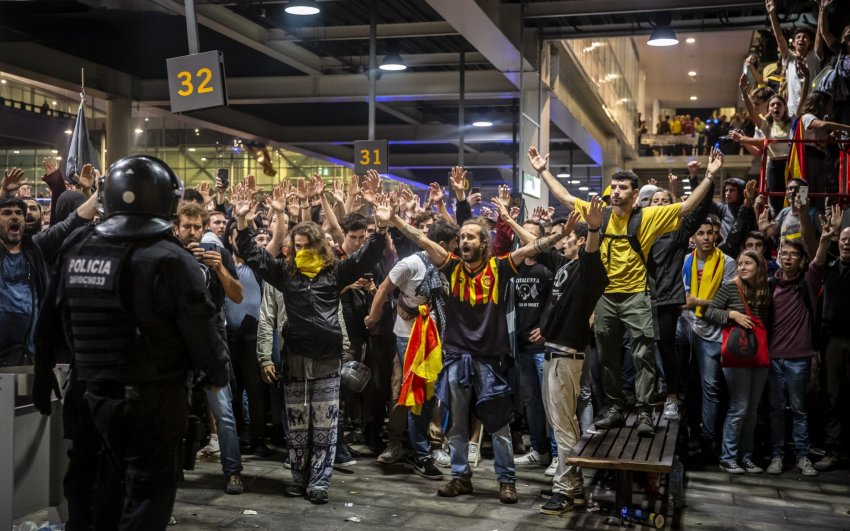
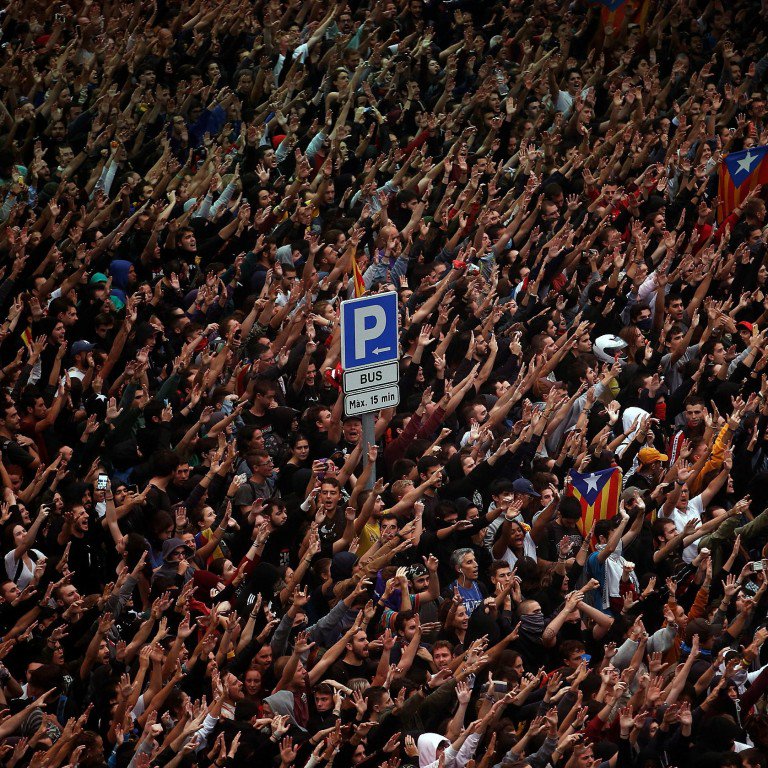
The self-styled “Tsunami” of protests began immediately the sentences were made public. Thousands walked, drove or rode bicycles to the El Prat Airport for Barcelona and effectively closed it down until they lifted the blockade at 10pm. Many others took to the streets of their cities to protest, particularly in front of institutions of the Spanish State, which had mobilised nearly 1,000 police in preparation against them. These were reinforced by the Catalan police, the Mossos D’Escuadra, who were seen as relatively benign during the Referendum and immediately afterwards but are now reverting to their past image — some years ago nearly a dozen of Catalan protesters lost eyes from rubber bullet impacts at close range, which led to a successful popular Catalan campaign to have them banned – but that ban does not apply to Spanish police. Already one young man lost an eye on Monday night while another appears to have lost one testicle and 150 were treated by paramedics. The toll grows and includes two youth run down by police vehicles and more arrests. These figures are certain to grow in the days ahead.

Riot police confront Catalan airport blockaders on Monday (Photo source: Internet)

Thousands are also walking along motorways to other towns in a protest procession, horns of cars, lorries and buses being sounded in solidarity, while different protests gather every night.

Section of the massive crowd of protesters that shut down Barcelona’s airport on Monday.
(Photo source: Internet)

PARALYSIS OF POLITICIANS

          This huge popular wave of resistance contrasts with the seeming paralysis of the pro-independence politicians, who are in three different political coalition parties: Junts X Cat (Together for Catalonia), Esquerra Republicana de Catalunya (Republican Left) and Candidatura de Unidad Popular (People’s Unity Candidacy). The three together form a narrow enough majority in the Catalan regional Parlament against the Spanish unionist delegates of the PP, Ciudadanos and the PSOE, as well as the ‘neutral’ “Communs”, a coalition around the Podemos party. Although the CUP delegates will defend any pro-independence motions etc in the Parlament, they are officially in opposition. JuntsXCat and ERC run the Government together on a slim majority but they disagreed on a number of important issues, including whether to give the minority Spanish PSOE Government qualified support without any concessions from the latter and also, about their resistance campaign being directed by ex-Catalan President Carles Puigdemont, in exile in Brussels, and the group he has collected there.

But their paralysis is more fundamental: despite the activity of some of them in popular movements before they became politicians, their focus has been on electoral strategies and campaigning, preparing legislation for the Parlament and running the Government. For a number of years now the power of the street has been growing and it is clearly in the ascendant now – and that is not where the politicians feel most comfortable. Not only that — but where else now has the Spanish State left any cards to play?

THE TRADE UNIONS

          The main trade unions in the Spanish State are the Unión General de Trabajadores (UGT) and the Commisiones Obreras (CCOO). After Franco’s death, their legalisation and incorporation into the system was felt essential for the smooth operation of the ‘Transition” and for that reason, the major political party of each was legalised too – the social democratic PSOE and the Communist Party of Spain – so that they could control their unions. They did and they have, despite a history of republicanism and antifascism, and in 1978 ensured votes in favour of a the new monarchical and unionist Constitution while their members and others were being clubbed and shot – or blown up — in the street.

The big SEAT factory in Catalonia has majority representation in the CCOO and UGT trade unions and neither union officially supported the previous recent general strikes. However, there was leeway for ‘allowing’ an early leaving of work to attend strike day demonstrations and UGT has already this week officially condemned the Spanish State repression. How they will react later today remains to be seen.

Intersindical CSC is a ‘class union’ (i.e does not recruit personnel from the repressive arms of the State nor from management) and is in favour of the right to self-determination. Its history is recent but it organised the previous general strikes in conjunction with grass-roots independentist organisations (like the ANC and Omnium) and will do so again. The growth of Intersindical is a a source of worry for the UGT and CCOO in Catalonia.

Catalans blocking railway lines in protest.
(Photo source: Internet)

Later today we can expect blockades of all major motorways and train lines passing through Catalonia, general closures of business, services and public transport of Catalonia’s cities and massive demonstrations in cities, not just Barcelona. What will happen at the docks, airport and the SEAT plant remains to be seen. There will almost certainly be confrontations between strike supporters and the police, both Spanish and Catalan. Whether that will escalate further cannot be forecast but is very possible.

Meanwhile, outside of Catalonia in the Spanish State, both Madrid and the Basque Country hosted massive shows of solidarity on the streets while other cities, for example Caceres in Extremadura and Granada in Andalucia (the two poorest regions of the Spanish state), have seen demonstrations on the streets in solidarity with Catalonia and against the repression of the Spanish State.

Catalan protesters on Tuesday use metal fences as protection against rubber bullets.
(Photo source: Internet)

GENERAL STRIKES — COMMENT

          General strikes, if successful in mobilisation, show the collective strength of the organised workers, ideally in conjunction with their communities (families, relatives, friends, local shops, churches, sport clubs etc).

While that is extremely important in the longer run, they are not always successful in the shorter run or, to be more precise, they often fail to achieve their stated objectives. The stated objectives of this strike cannot be achieved in the short run since they confront not only a capitalist but a neoliberal Spanish ruling class and, furthermore, one in which the majority are undefeated descendants of a fascist-military uprising, civil war and four decades of dictatorship.

The overcoming of these obstacles requires, arguably, a social and political revolution and Catalonia is not at that point yet. But it may be in time, especially if the Spanish State continues to pursue its path of repression (and it is sure to do so). One-day general strikes sometimes grow into longer and sometimes even indefinite ones. Such situations are almost pre-revolutionary situations, with workers’ committees having to organise vast forces and control, manage and defend large areas.

For a Catalonia to be successful in revolution or in secession from the Spanish State alone would require that the State faces challenges on a number of fronts, including internally, that severely restricts its ability to send sufficient repressive forces to Catalonia. Such an outcome would depend completely on mobilisations in other parts of the Spanish state, which is why Spanish State, media and fascist parties’ are practically racist in their hysterical condemnation of Catalan independentism and culture, trying to whip up anti-Catalan feeling to distract from the woeful economic, social and political mess to which most of the Spanish regions have been driven.

End.

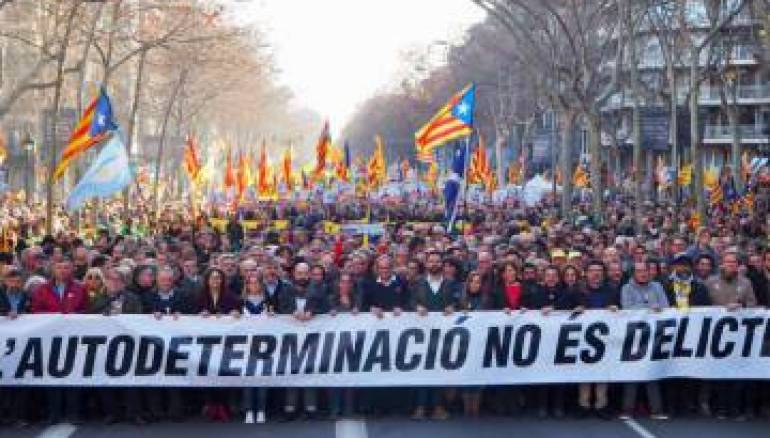
Demonstration Barcelona, part of general strike in February, protesting the start of the trial of the independence activists.
(Photo source: Internet)

APPENDIX:

GENERAL STRIKE MANIFESTO OCTOBER 18, 2019 (English language translation)

For rights and freedoms, general strike!

A new Spanish government and a new disappointment. Whether led by the PP or the PSOE, the

social gains never reach the workers. Neoliberal austerity policies persist whoever resides in the Moncloa (Spanish Government), while authoritarian repression against the common classes and, especially, against the Catalan people become the tools to curb any struggle for better living conditions and justice for the majority. As in popular times, state “socialism” now also wraps itself in the Spanish flag and patriotism to cover the miseries of a ’78 regime which strangled the bulk of the population and which is showing more and more cracks.

During election campaign times, certain parties declare limited progressive proposals, which, if they are elected to govern, will be stored again in a drawer to be sold again to the designs of an Ibex 35 (Spanish Stock Market benchmark) that does not tolerate any kind of agreement with forces that question minimally the foundations of the Spanish monarchy: the unalterable privileges of the elites and an indissoluble and centralist state model. Therefore, despite all the changes that the PSOE promised before grasping power, they faded to pass again from opposition to status quo, in another turn of the eternal Spanish political carousel so that nothing changes.

Minimum measures such as derogations from the PP’s labor reform or of the gag law, the withdrawal of vetoes against the social laws of Parliament, the already agreed reception of refugees, the imposition of rent ceilings, the setting up of a tax on banks, the renewal of the regional financing model or the publication of the list of evaders that were covered by the Montoro tax amnesty, all of those became elusive despite previously having been defended vehemently by Pedro Sánchez.

The Catalan working classes know that rights and freedoms are not only begged through voting. We learned that a century ago, after the “Canadian strike” allowed us to achieve the greatest of the victories of that era, the 8-hour working day and retirement at age 65 (The 44-day strike 1919 originating at the principal electricity company in Barcelona, Riesgos y Fuerzas del Ebro, popularly known as La Canadenca because its major shareholder was the Canadian Commercial Bank of Toronto). But not only then – history has stubbornly shown that social advances have only been achieved through struggle. Peaceful, massive and nonviolent, with the general strike as one of the clearest tools of the workers.

And on October 18 we have a new date, a new call for a general strike that should be massive to make it clear that we will not remain unresponsive to the continuing attacks upon us. The disappointment of Sánchez’s brief mandate at the head of the Government, unable to repeal the most damaging measures of Mariano Rajoy’s period, should receive a blunt response in the street, the popular masses need to empower themselves and to declare that they will not allow themselves to be stepped on again, despite the growing criminalization of protest and growing repression against anyone who dares to raise their voice.

Intersindical CSC is clear that the Catalan Republic is an essential tool to overthrow the regime of ’78 and to move towards a horizon of well-being, equality and social justice but even with this horizon always present, the struggle for rights and freedoms of the popular classes cannot cease before any institution. We will remain on our feet, once again on this October 18, to demand all rights and freedoms:

– For a minimum Catalan salary and pensions of at least 1,200 euros to be increased depending on the Catalan Consumer Price Index.

– For the repeal of the labor reforms of 2010 and 2012 and the recovery of all lost labor rights.

– For a Labor Inspection with adequate resources to deal effectively with rights violations.

– For the end of labor inequalities and the wage gap suffered by women, starting with the recovery of the annulled articles of the equality law and which referred to the world of work.

– For a Social Rescue Plan that guarantees free and universal public services, food and housing for the entire population, the comprehensive application of a guaranteed income for the citizenship and a plan for the internalising of public services which are now outsourced.

– For the application of a climate emergency agreement that reduces to zero as quickly as possible the net emissions of greenhouse gases, starting with the reinstatement of the law against climate change which was partially annulled by the Constitutional Court.

– For the approval of the scheduling of payment, unanimously agreed by Parliament, and the setting of a maximum rent level.

– For the reception of refugees, the closure of the Refugee Secure Centres and the repeal of the immigration law, to make Catalonia a truly host country and without second-class citizenship.

– For the recovery of all social laws and taxes approved by Parliament and nullified or suspended by the Spanish courts.

– For the repeal of the gag law

Intersindical-CSC http://www.intersindical-csc.cat G59792226

APOLOGIA FOR REPRESSION BY SPANISH STATE IN DUBLIN

Diarmuid Breatnach

(Reading time: 10 minutes)

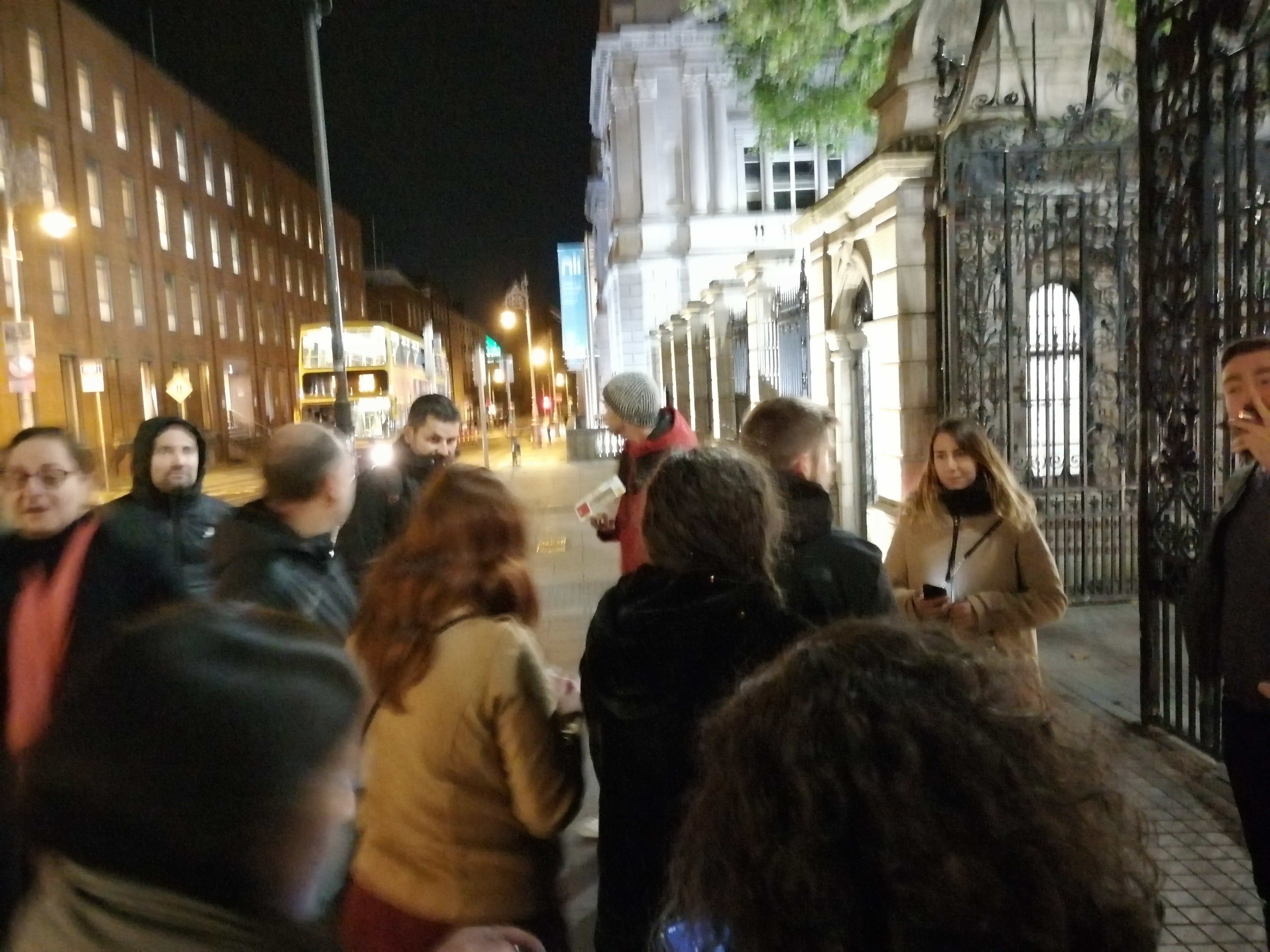
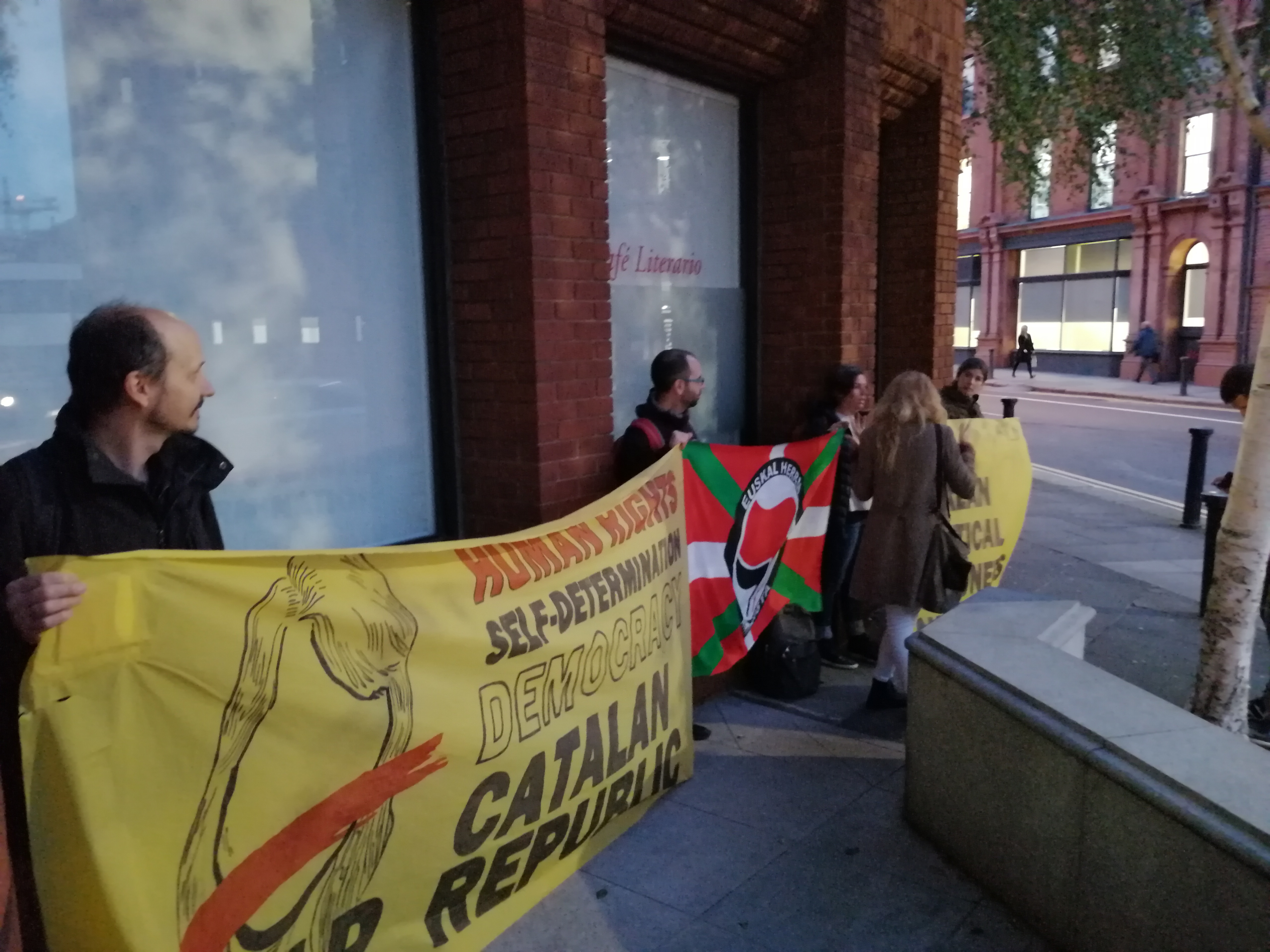
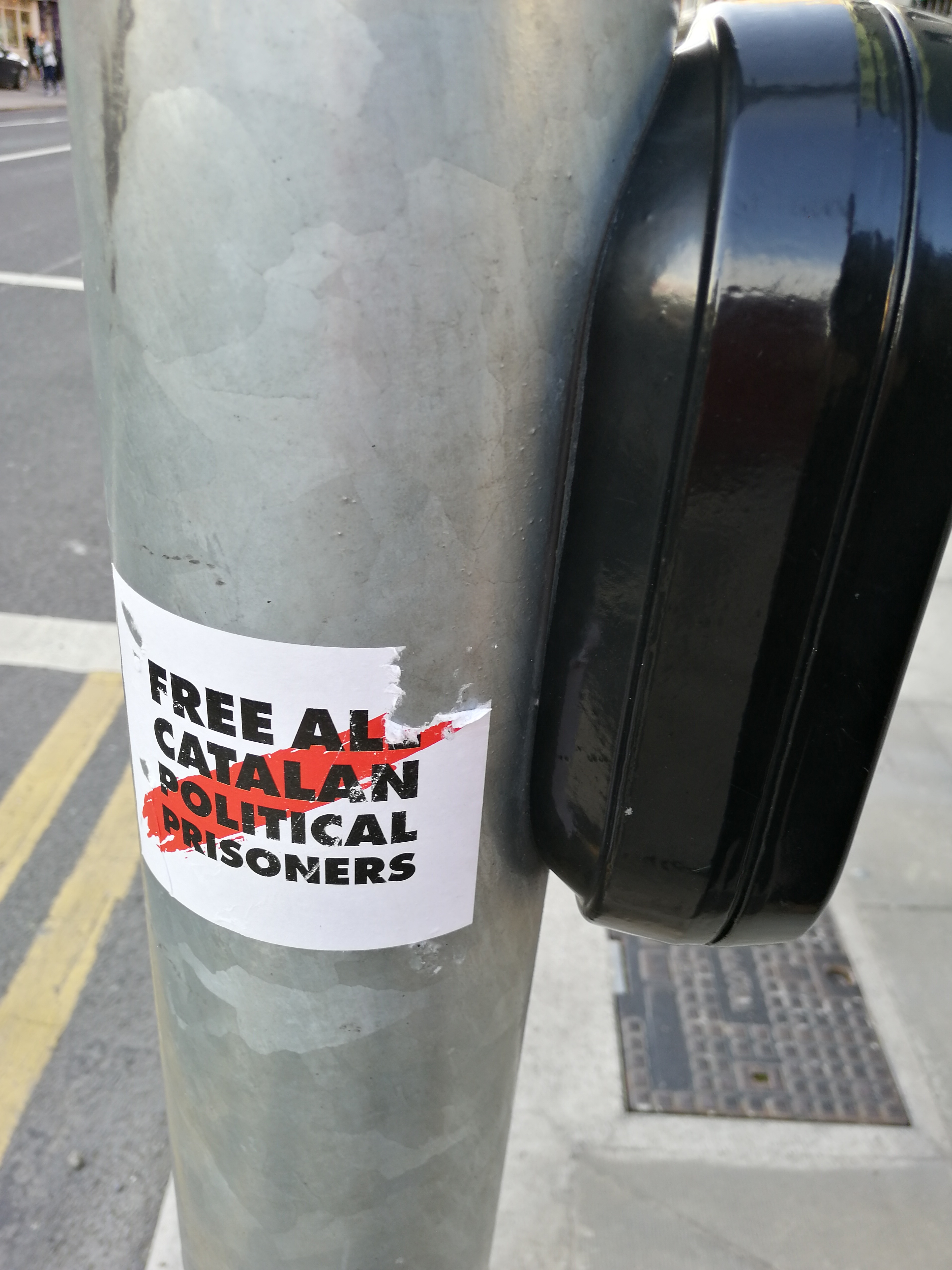
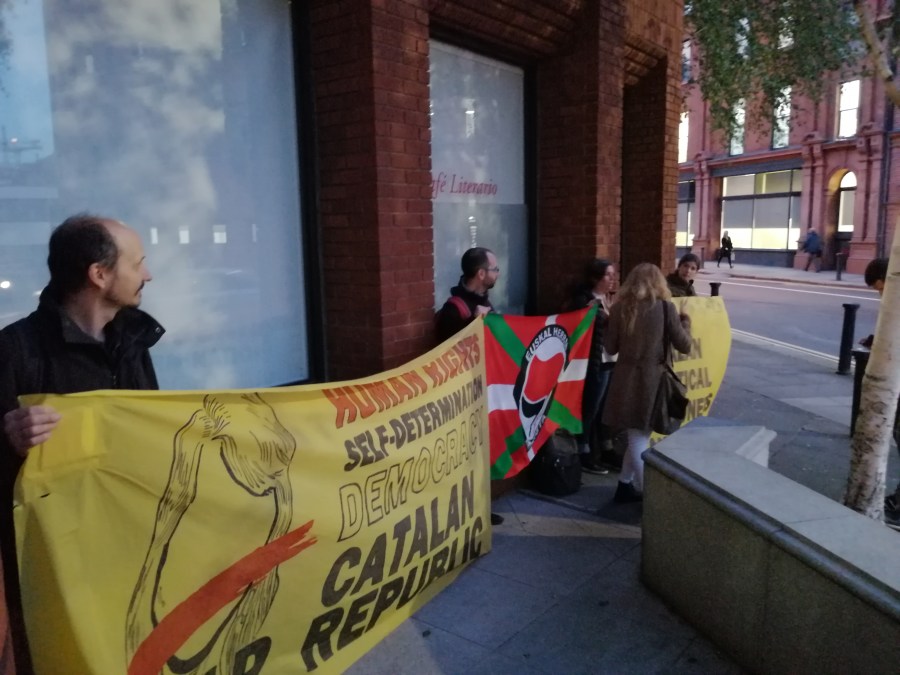
The “Global Spain” initiative of the Spanish State to 215 Spanish embassies and its sub-title “Touch Democracy” was presented to a small audience at the Instituto Cervantes in Dublin on Monday while Catalan and Basque solidarity demonstrators picketed outside.

While some people, perhaps in the know, were directed straight to the auditorium, a number of others, not regular users of the Instituto’s services, were asked to wait in another area but when the start time had been exceeded by 20 minutes without sign of the event, they went to make enquiries again at Reception and learned where the event was being held, entering to find it had already started.

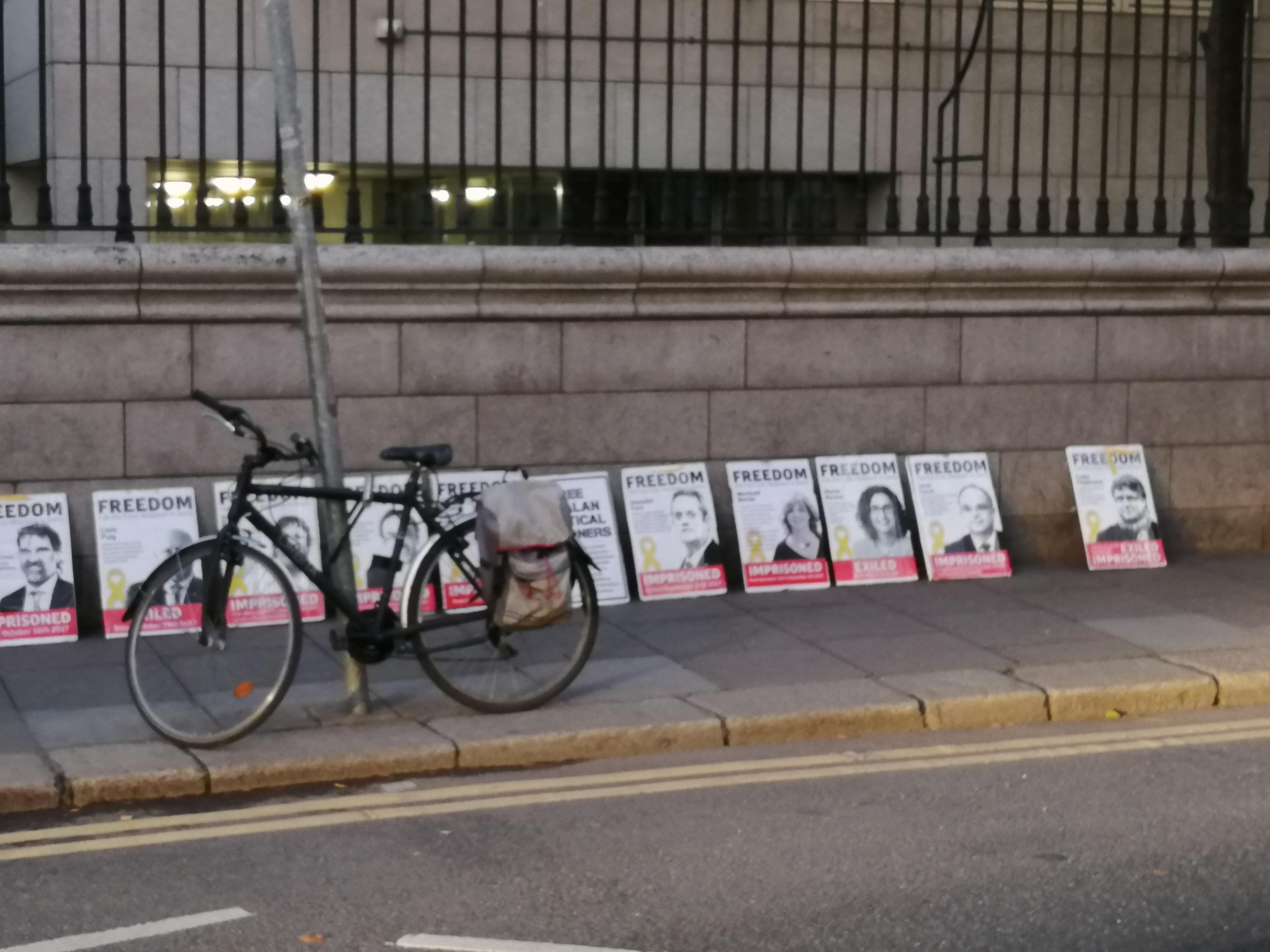
Portraits of Catalan political prisoners and exiles displayed across the street from the Instituto Cervantes on Monday.
(Photo: D.Breatnach).

PROPAGANDA VIDEO         

          Mr. Ildefonso Castro,the Spanish State’s Ambassador to Ireland was speaking and shortly launched the event with a showing of a short video which, he said, would bring out the main questions in the initiative. In this video, Lucía Mendez, journalist for the right-wing Spanish daily El Mundo seemed to be interviewing Gabriela Ybarra about the novel she had written (The Dinner Guest). But actually later in the film Mendez began a speech about how good was the Spanish democracy while her interviewee was left with little to say. The author had said earlier that though her grandfather (a Mayor of Bilbao who had fought in Franco’s Army and supported the Dictator regime, not mentioned in the video), had been killed by the Basque armed group ETA in 1973, this was not discussed in her family. She felt that the memory of “terrorism” was disappearing and that children in school were not being taught about it, which is why she wrote her book.

In fact, Spanish media constantly refers in negative terms to ETA and a 2016 case of a brawl between Basque youth and off-duty Spanish policemen in a late-night bar, in which no-one was seriously hurt and no weapons used, was being treated in the media and by the State Prosecutors as a case of terrorism! Although the judge rejected the accusation of “terrorism”, in 2018 the youth receive a range of sentences between two and 13 years jail. An important part of the silence and lack of teaching children history is in fact about the almost four decades of Franco dictatorship and the conduct of the victors in the military-fascist uprising against the democratically-elected government of the Spanish Popular Front in 1936. And of the State assassinations and torture of captured ETA fighters and arrested Basque activists. And of the continued legal battles to uncover mass graves of Franco’s victims and try to identify the remains for the relatives.

Considering that ETA ceased its armed activities in 2012 and has since dissolved itself, the relevance and intention of the film seems to be to show an embattled Spanish “democracy”, fighting against Basque independentist “terrorism” in the past as it is now embattled with the Catalan independentists (seven activists of which it has also accused of “terrorism” a couple of weeks ago).

Some demonstrators and banner by Trinity College exit across the street from Instituto Cervantes on Monday.
(Photo: D.Breatnach).

DISCUSSION BUT NO DEBATE

          There was no discussion on the content of the film and, after its end, Víctor Andresco Peralta, Director of the Instituto Cervantes, cultural body of the Spanish Embassy, took to the stage and invited five people by name to take chairs laid out around a table. Launching into a chatty monologue full of jokey self-deprecatory comments (so many that they were actually self-promotional), he eventually asked his questions of his picked panel.

Questions included what were their earliest memories of consciousness of being Spanish, what reactions they had received about Spain from people in Ireland, or in other countries (positive and negative), what they valued about Spain, what they thought about the coup attempt in 1981 (lots of jokes about that), etc.

Referring to his father’s recent stay in hospital, Peralta asked for comparison of the Spanish health service with the Irish one (apparently the former is far better, which would not be difficult) and for other comparisons.

The discussion was skillfully managed by the showmaster to bring his group to paint a picture of a wonderful pluralist Spanish State, of freedom of expression, and of a democracy which had been able to defeat the coup attempt without much difficulty but even so, some discourse arose at times to shake the equilibrium, as when one referred to a relative telling him about the horrors of the Francoist suppression as they entered Barcelona and when another referred to the perception (mistaken, of course!) of many people outside Spain that the State was undemocratic and had violent police.

One of the panel, who appears to be an employee of the Spanish State, said she was proud of the defeat of ETA by the “Spanish democracy”.  Another said she was proud of Spanish history and culture, without explaining further. She might have meant the foremost writer of Castillian-language literature, Cervantes himself, who was exiled from the Spanish kingdom because of his anti-feudal views. Or the Andalusian poet Federico Lorca, who was executed by Franco’s soldiers; or the Malagan artist in exile Picasso, who created the famous painting of the Nazi and Fascist aerial bombing of Gernika (most of the poets, writers and artists of the era were against the military-fascist coup and the four decades of dictatorship that followed). Or about the dramatist Alfonso Sastre, whose distaste for the Spanish State’s behaviour towards the Basques was such that he moved to the Basque Country.

Perhaps the woman was proud of the defeat of the learned and tolerant Moorish colony of Al Andalus and its replacement by the racist Spanish Christian Inquisition, along with the expulsion of Arabs and Jews? Or of the centuries-long suppression of the governments of the Basques, Galicians and Catalans, along with their languages? Or of the invasion, massacre, enslavement and plunder of the indigenous people of America, the Caribbean and the Philippines? Or the invasion and colonisation of the Rif in North Africa, when the French saved the Spanish colony after the Spanish army had been wiped out by lesser-armed (and often less numerous) Berber guerrillas.

Of course she might have been referring to the revolt of the Reapers in Catalonia or of the Comuneros in Castille; or of the resistance of Spanish, Catalans and Basques to the military-fascist coup and the four decades of dictatorship …. We don’t know because she did not say.

A view of some of the protesters outside the Instituto Cervantes on Monday.
(Photo: D.Breatnach).

WHAT ABOUT THE RIGHT TO SELF-DETERMINATION?

          The event had been advertised as a debate but no debate took place. Nor was there a question-and-answer session, nor engagement with the audience except to send them witty asides from Peralta and to thank them at the end.

This was too much for at least one of the small audience, an Irishman who interrupted the concluding remarks of the Director by saying, in Castillian (Spanish) that it was a pity that the question of self-determination had not been discussed. The event was taking place in Ireland, he commented, where another state had denied the people the right to self-determination on grounds of that state’s constitution also. Denied permission to exercise their right, the Irish people had to fight for it and eventually won part-independence.

Peralta commented that the Spanish people were cognizant of Irish history and appreciated it.

The Irishman replied that in the Spanish state things were the complete opposite.

Peralta commented that unfortunately there was no time left for that debate, thanked participants and audience and brought the event to a close.

Sticker on pole near the Instituto Cervantes on Monday.
(Photo: D.Breatnach).

WHAT WAS THE POINT?

          Outside the meeting up to dozen protesters had taken up positions on both sides of the street. On the Trinity College side a couple of protesters stood beside portraits of the Catalan grass-roots activists and politicians who are in jail awaiting sentence or in exile. On the Instituto side, a larger group of protesters held two banners and a Basque Antifa flag.

One of the Catalan supporters, an Irishwoman, addressed several of the panel participants as they exited. It emerged that they had not understood the nature of the event and that they thought it had to do with October 12th, which is a Spanish State celebration of its former empire and spreading of the Castillian language1 (and for which one of the panel, who seems to work for the Instituto, is organising an event in Rathmines). They said they had not seen the “Global Spain” publicity (81 pages of propaganda justifying the actions of the Spanish State and attacking the principle of Catalan self-determination and the pro-independence movement!).

There was in truth not much point in attending the event unless one wanted receive a smooth-talking patter about an imaginary State occupying most of the Iberian Peninsula. For the protesters, it was important to give a response to the paint-over job. For the producers of the show, the importance was to try to distract an Irish audience from the reality of what is an unreconstructed fascist state with a thin veneer of democracy that is constantly peeling away.

Poster seen on Dublin street near Instituto Cervantes on Monday.
(Photo: D.Breatnach).

End.

FOOTNOTES:

1 El Dia de la Hispanidad was formerly called “El Dia de la Raza Española” (Day of the Spanish Race). It is also the Spanish Armed Forces Day, obviously not inappropriately in context!

REFERENCES AND FURTHER INFORMATION

Article by El Nacional, independent and pro-independence Catalan newspaper: https://www.elnacional.cat/en/news/global-spain-advertising-campaign-democracy_426827_102.html

The Instituto Cervantes, Dublin: https://dublin.cervantes.es/en/about_us_spanish.htm

CDR Dublin: https://www.facebook.com/CDRDublin/

ANC Irlanda: https://www.facebook.com/IrlandaPerLaIndependenciaDeCatalunya/
With Catalonia/ Leis an Chatalóin: https://www.facebook.com/WithCataloniaIreland/

PAUL MURPHY, SPLITS, PARTIES AND ALLIANCES

Diarmuid Breatnach

(Reading time: 4 minutes)

Paul Murphy speaking at his trial and that of others after the famous water protest at Jobstown against Minister Joan Burton (which led to his arrest and long trial before he and others were found not guilty by a jury).       (Photo image: D.Breatnach)

Most people within the Irish state will now be aware that that socialist Paul Murphy, TD (member of Irish parliament, the Dáil), has left the Socialist Party and, with some others, intends to set up a new socialist organisation called RISE. His statement on his Facebook page was covered by a host of the capitalist media with little comment by most while left-wing chat room the Cedar Lounge had more comment than I found time or interest in reading.

A common reaction on the street was one of bewilderment at the splitting actions of left-wing parties. Elements of that were to be found in the relevant piece by Miriam Lord (see References), who comments on Dáil politics and politicians in her Irish Times column (though her sharpest treatment was of Brendan Ogle, who had mocked Murphy’s action).

I am myself, if a little surprised, not shocked nor indeed very engaged with the matter and consider it generally of little import on the prospect of a revolution in Ireland.

It strikes me, with little personal knowledge of him but based on material in the public domain, that Paul Murphy is in general a principled socialist politician and furthermore an activist who has not shirked from putting himself physically in the resistance line in Rossport, on the seas to Gaza, in Turkey against its government and in Dublin on water and housing protests. Furthermore, in the short period he was an MEP or supporting Joe Higgins when the latter had the seat, Murphy has had questions asked about the treatment of Basque political prisoners which few other politicians are willing to touch, lest they be associated with the armed liberation organisation ETA (now defunct).

However, I see no prospect of even one step towards revolution in the general conduct of any of the socialist organisations of any size in Ireland, splits or no. Of course it is helpful to have awkward questions asked of the Government in the Dáil and to gain media coverage of issues that would likely remain unmentioned, or to have their critical comments reported where yours or mine would never see the light of day. And Murphy remains in that ambit in Dáil, along with the Solidarity-PBP group — and Independents for Change are there also (now sadly missing Clare Daly and Mick Wallace, who have gone to the EU).

But that is not necessarily revolutionary work.

Meeting of the (First) International Workingmen’s Association. In Britain, the Fenians were accepted into the First International.

A TASK FOR SERIOUS REVOLUTIONARIES

Front page of the newspaper of the short-lived Republican Congress in 1934

Without a conjunction of revolutionary Socialists with revolutionary Republicans, I can see no hope for revolution in Ireland and, without revolution, no hope of a solution to many of the ills in our society, whether in culture, economy, environment or government. In other words, in anything really. That conjunction was a project attempted in part by British socialists and some of the Fenians of the 1840s, later by Connolly and the Irish Citizen Army (1913-’16), later still by the Republican Congress (1934-’36). It remains the unfinished task for serious revolutionaries.

Neither the Socialist Party/ AAA/ Solidarity nor the Socialist Worker/ People Before Profit/ Solidarity formations have made any effort to take up that task (nor have the Republicans, lest my criticism be thought of one part of the equation only). Nor did the anarchist Worker’s Solidarity when it was an active force. The Communist Party of Ireland does not do so nor does the Workers’ Party. So great is the disdain of these formations for revolutionary Republicans that they refuse to even challenge the daily civil rights violations of the Gardaí and PSNI upon active Republicans, or their treatment in the non-jury special courts or jails on both sides of the Border. Indeed, in case they should somehow be accused of siding with these elements, they rarely even allude to the unfinished national liberations struggle of Ireland, nor to the colonial occupation of one-sixth of its territory, while instead fully prepared to support the just national liberation struggles of nations far away.

Interestingly therefore, from public comment, it appears that Murphy wanted more cooperation with “other elements on the Left” or “Left-leaning”, in which context was mentioned Sinn Féin, while the majority in the Socialist Party refused such a project. Some people will view this aspiration of Murphy’s as a laudable attempt to mould a fragmented Left into at least some kind of united action for Irish social and political progress. I do not.

I am not against a temporary alliance of revolutionaries with social democratic forces at certain points for certain objectives. But that does not include Irish political parties who are or have been part of Irish governments or, if possible even less, so a party that is part of the administration of a colonial occupying power. In the latter category I clearly place Sinn Féin and, in the former, the Labour Party, Fianna Fáil and Fine Gael.1 In addition, SF has clearly marked a path for itself to a future coalition partnership with a capitalist, pro-imperialist party or parties in Government.

It says something about the Irish socialists that an important question for them is whether or not to ally with a constitutional capitalist and colonial collaborationst party such as Sinn Féin, whereas the question of whether to ally with revolutionary Republicans is not even on the agenda for discussion.

End.

FOOTNOTES:

1 One might make a temporary exception of the Greens, which have been in Government but once for a short while, admittedly shamefully so but with an honourable resignation.

REFERENCES:

Miriam Lord: https://www.irishtimes.com/news/politics/miriam-lord-brendan-ogle-eager-to-get-back-in-the-leftie-limelight-1.4033061

Paul Murphy TD Faeebook page: https://www.facebook.com/paulmurphytd/

“YOU BET – THEY DIE!”

Clive Sulish

(Reading time: 8 mins.)

The sight of more than a score of people standing in the rain at the top of Dublin’s Grafton Street drew a lot of attention. And it wasn’t just the dog masks that most of them were wearing. This wasn’t near enough to Hallowe’en, nor was it a carnivale, nor a masque as such: the message projected had nothing of the freedom and joy of carnivale, none of the sexual play and mystery of masque and was darker than the usual one of Hallowe’en. The grim message was on the banners, in the leaflets, in the slogans and the amplified speech.

One of the banners of protesters on Saturday at the top of Grafton St. (Photo: C.Sulish

“You bet – they die” was one of the slogans chanted, illustrating the grim reality of commercial greyhound racing. This slogan was developed for protests outside greyhound racing stadia, notably at Shelbourne Park, near the south Dublin docklands (and, incidentally, not far from the Aviva Rugby Stadium).

Public perception

          The reactions of passers-by seemed to vary between amusement, interest, support, surprise and even shock. People who tend to view animal welfare protesters as cranks who are likely to be middle-class might be somewhat amused or dismissive and it is no doubt to counter this perceived image that the group organising this event is called “Ordinary People Against Greyhound Exploitation”. The support likely came from those who had watched the RTÉ documentary in June, while other reactions might have been from Irish people as yet unaware of the treatment of greyhounds by the industry or by visitors to Ireland who are not only ignorant of the issues but even of the existence of the industry itself.

One onlooker seemed to be demonstrating to his companion the pole lassoo dragging of a dog and then shooting it with a pistol, probably recounting a secretly-filmed incident featured in the RTÉ film. Popular opposition to the greyhound racing industry has been gathering since the screening of the exposure program by the “RTÉ Investigates” team of the Irish television company in the last week of June. The revelations were a shock to people who understood the dogs racing to be a harmless spectator sport with not even a live hare being pursued, a relatively cheap night out (providing the betting was not too heavy) or gambling based on a mixture of luck and previous form knowledge, or even just the communal sport of a few rural people who owned a few hunting dogs.

View of a section of the protesters, viewer facing south. (Photo: C.Sulish)

The industry breeds many dogs in order to ensure a constant supply of fast-running animals and flow of profits and, as a result, bitches are put to breed litter after litter. Pups showing any disabilities will be “culled” and, as the survivors grow, those not considered fast enough will face the same fate. Later, as age begins to take its toll, they will be killed also except for some that might get a few more years as stud or breeder. Campaigners claim that over 6,000 dogs are killed annually and some animal welfare organisations believe the figure may be as high as 10,000. It is the commercial drive that brings these results and the support of the betting public that sustains it – but not that alone, since the Irish State supports the industry with an annual grant of 16.8 million euro.  This fact was also highlighted by campaigners in voice and leaflet, while pointing out other better uses for the funding, including relieving the homeless and housing crisis.

Few countries outside of Ireland an Britain have greyhound racing stadia but campaigners claim – and the RTÉ program revealed – that many Irish dogs are sent abroad in inhumane conditions, some at least of which will end up for human consumption.

Section of protesters facing south (Stephens Green Shopping Centre in background). (Photo: C.Sulish)

The campaigners call for the greyhound racing stadia to be closed and, in Dublin particular, the Shelbourne Park stadium, outside of which are held regular demonstrations. They call also for sponsorship by commercial enterprises to cease, a call heeded by a number of companies fearful of a negative commercial impact upon their reputations. This drive was clearly successful when, audibly fearful of a negative impact on the tourism industry, Irish Minister for Tourism Shane Ross called for a suspension of State support in advertising which was followed by Bord Fáilte and Tourism Ireland’s1 removal of greyhound racing from their promotions for visitors to Ireland.

Tourism and Greyhound Racing

     The tourist industry is of course vulnerable to the image of the country abroad, which is why campaigners for democratic rights often strive to alter precisely that image, in order to exert pressure on the ruling regimes. Tourists, as they concentrate on sun, sea and possibly Turkish or Iberian food, may be able to set aside images of Spanish police bashing Catalan voters or Turkish police jailing Kurdish campaigners. Ireland has little sun to sell and though plenty of sea, without the sun it can be too cold for most to bathe. What Ireland has for most tourists is an ambience of welcome, of traditional and folk culture and scenery – but the ill-treatment and slaughter of dogs in an Irish industry could quite possibly offset those positive points.

Ross might indeed have been, as he said he was, “shocked” by the revelations but it was clearly the financial rather than principled humanitarian objectives which forced his hand. Martin Ferris, Sinn Féin TD for Kerry, wasn’t motivated by humanitarian principles either when he confronted Ross in the Dáil (see Links below). Although his SF Dáil position is as Spokesperson for Marine and Fisheries, in his intervention he was clearly representing rural support for greyhound racing including, no doubt, commercial dog breeding and racing interests. He claimed the industry was being tarred with the brush of “the actions of a few individuals” and that he was speaking up for “the small boys and girls” (well done for getting that gender equality in, Ferris!) of the rural industry.

“A few individuals” may have been caught red-handed and exposed but the issues are clearly endemic to the industry, the governing board of which suppressed a critical report which it had itself commissioned. Ferris’ public support for that industry and criticism of the Minister’s actions in this case may win him some votes in some parts of Kerry but will hardly be a help to Sinn Féin, increasingly seeking to project itself in the Irish state as a social-democratic party leaning slightly to the Left.

Section of younger protesters facing west. (Photo: C.Sulish)

And the employment figures which Ferris quoted arising from the greyhound racing industry might well be offset by possible negative impact on the Kerry tourism economy.

The dogs in the streets will be talking about what he said ….

end.

FOOTNOTES:

1Bord Fáilte promotes tourism in throughout the Irish state, i.e the Twenty-Six Counties, while Tourism Ireland promotes the same but throughout “the island of Ireland”, i.e including the Six Counties. Tourism NI cooperates with the latter organisation, particularly with regard to tourism in the Six Counties and maintains an information office in Dublin city centre. The first two above are in receipt of funding from the Irish State while the third is funded by the British State.

View of section of protesters facing northwards, down Grafton St.
(Photo: C.Sulish)

LINKS FOR REFERENCES AND FURTHER INFORMATION:

Ordinary People Against Greyhound Exploitation: https://www.facebook.com/OrdinaryPeopleAgainstGreyhoundExploitation/

Irish Greyhound Board: https://www.igb.ie/

RTÉ documentary “Running for their Lives” (contains disturbing images): https://rebelbreeze.wordpress.com/wp-admin/post-new.php

Sponsors “horrified” by RTÉ exposure of greyhound racing industry: https://www.irishtimes.com/news/ireland/irish-news/sponsors-horrified-by-rt%C3%A9-programme-on-greyhound-racing-1.3942232

Irish Tourism Minister suspends promotion of greyhound racing; Sinn Fein TD objects: https://www.irishtimes.com/news/politics/oireachtas/greyhound-racing-promotion-stopped-due-to-disgusting-behaviour-in-sector-ross-1.4039470