Minister of the Interior for the PSOE-Podemos coalition, Fernando Grande-Marlaska, ex-judge of the National Court. (Photo source: Publico.es)
Newcomers to Spanish politics witnessing the recent sound and fury in the Spanish Parliament might conclude that there was a real battle going on between a reactionary Right and a progressive Left but they’d be right only about the existence of a reactionary Right. The same newcomers might then remark that well, the opponents of the reactionary Right must at least be liberals and they’d be wrong about that too.
Parliamentary delegates from the reactionary Right – and that is to call them much less than the reality – were sharply criticising the Spanish coalition Government. The senior partner in the coalition is the Partido Socialista Obrero which, as has on occasion been commented, is neither “socialista” nor “obrero” and while its junior partner Podemos has left-wing credentials coming from the mainly Trotskyist (and Communist Party-managed) Izquierda Unida, it has to keep up an accommodation with the PSOE.
The parties of the Right in this case were the Partido Popular, which was created to represent erstwhile supporters of the deceased fascist dictator General Franco, along with Ciudadanos, which was founded by former supporters of the PP. The fascist Vox party comes from the same stable but with less democratic pretence.
The criticisms of the Spanish coalition Government on this occasion were mostly with regard to the sacking on Monday of the chief of the Guardia Civil in Madrid, Colonel Diego Perez de los Cobos. The Guardia Civil is a paramilitary police force, which is to say it is organised along military lines and has been the main instrument of State repression during Franco’s dictatorship (1939-1975) and since. It was mainly they, for example that invaded Catalonia to beat up voters during the October 2017 Referendum on independence there and shot the banned rubber bullets at demonstrators and in fact the sacked officer led that operation.
The sacking occurred allegedly because on behalf of a Madrid magistrate, the Guardia Civil carried out an investigation of a number of political demonstrations in Madrid which it alleged had violated the pandemic restrictions and even contributed to the spread of virus, even though they had predated the Lockdown. The investigation, it is also being alleged, was in order to check whether the Health Minister’s actions regarding the pandemic had been appropriate or not.
In order to bolster their investigations, the Guardia Civil had claimed that the World Health Organisation had declared a pandemic in January whereas in fact it had only done so on March 11th (the Government ordered the lockdown on the 14th). The public events the Guardia Civil were investigating with a view to prosecution were mostly democratic or left-wing, including a march to celebrate International Women’s Day (March 8th) and to denounce male violence against women (and the State’s two-level crime of rape) but also included a cavalcade organised by the fascist Vox party.
The Right generally is no friend of women’s rights but more to the point feels duty-bound to defend the Guardia Civil, acting as though they own it (which is not that far from the truth). However the PSOE has had no difficulty in sending the Guardia Civil to attack the Basques or Catalans in the past. And while in government in the 1980s, the PSOE’s Minister of the Interior along with some senior police and Guardia Civil officers were exposed running the GAL terrorist group against the Basques and had to spend some time in jail. The person widely suspected of having set the whole thing up, the Prime Minister Felipe Gonzalez, was not even questioned by the investigators, no doubt for fear of what might come to light.
That Fernando Grande-Marlaska is the Minister of the Interior under current attack in Parliament for allegedly being unfair to the Guardia Civil points out in full the irony of the situation. This is one of the Judges of the Spanish National Court most denounced by Basques for attacking their democratic rights and of at least turning a blind eye to their torture, while sentencing them to long terms in prison on the basis of their “confessions” and Guardia Civil “evidence”. Another of those ex-judges considered infamous by many Basques is also of the PSOE, Baltazar Garzon, beloved of many left and liberal people because he agreed to process an international crimes against humanity accusation against Pinochet and also ordered the exhumation of a mass grave of victims of fascists and military (Spain has more mass graves than any other territory except Cambodia). Neither of those two cases came to fruition, unlike the violation of the civil and human rights of thousands of Basques and the torture of hundreds under his watch.
PUNCH AND JUDY PUPPET SHOW
In the Punch & Judy traditional dramas, Punch carries out a murder or two but, unlike some of the children watching it perhaps, we know that the puppet performance is not describing a real event. Of course, the Right in the Spanish state DID carry out murders – they have a list of 100,000-200,000 to their ‘credit’, most actually after the fighting of the Spanish Anti-Fascist War. And an additional number to force through the Transition to nominal democracy and more afterwards by ‘unofficial’ GAL and official Guardia Civil operations, mostly against Basques.
Punch & Judy puppets (Photo sourced: Internet)
The historic fact is that all left-wing organisations, even the social-democratic PSOE were banned during the Dictatorship. In order to stabilise the State and prevent its overthrow by the oppressed masses during the mid-1970s, it had to have the help of the Left. The Partido Comunista de España controlled a huge militant illegal trade union organisation, the Comisiones Obreras, while the PSOE controlled the smaller but substantial Unión General de Trabajadores (which it does still) – no setup would be safe unless they were brought on board. They were legalised and supported the new Constitution, even accepting the imposed monarchy and the “Pact of Amnesia”, under which all those guilty of tortures and murders under Franco walked free.
This is why there is some heat in the exchanges in the Spanish Parliament but no substance. The thinking of the Right goes something like this: “We had to legalise you and allow you into government but that doesn’t mean we have to even pretend to like you.” While the PSOE thinks: “You tortured and murdered our grandparents but we will share power with you and tolerate much of your antics. We all depend on one another. But sometimes you go too far and have to be restrained. For your own good as well as ours.”
And what does Podemos and Izquierda Unida think, while they share a government with the PSOE? And does any of this make any real difference to the situation of the mass of Spanish people or to those nations imprisoned within the state?
end.
Mariaon Rajoy, former Prime Minister and ex-leader of the right-wing PP, shakes hands with Sanchez of the PSOE in a pre-Pandemic Spanish Parliament. (Photo sourced: Internet)
The Basque pro-independence movement, the Abertzale Left, fought the Spanish State for over four decades. in 2012 its leadership renounced armed struggle without any reciprocal agreement with the Spanish State, declaring its faith in an imagined “Basque peace process”, sought alliances with social democratic and capitalist-nationalist parties and publicly apologised for its past actions of resistance. The movement sank into general inactivity except on the electoral front. But in recent weeks there have been signs of awakening, though under a different leadership – or is the giant merely muttering and twitching in its sleep?
Map of the Basque Country showing the provinces; the three to the north-east are inside the French state, while the other and larger four are in the Spanish state. (Image source: Internet)
THE GIANT
How does the description “Giant” fit a resistance movement in a total population of less than three million people? A nation divided between the Spanish and French states? Part of the answer is precisely in those features, also in its history during the Spanish Civil / Anti-Fascist War and “French” Maquis and earlier. Also in its long struggle in defence of its native language Euskera, almost certainly the oldest in Europe and perhaps the first to reach it in neolithic times.
This is a movement that carried out general strikes against the Franco dictatorship, ensured that three of its provinces rejected the 1978 Constitution of the Spanish State which, in atmosphere of fear and murderous repression and with the collusion of the newly-legalised social-democratic (PSOE) and communist (CPE) political parties, was voted in by a majority in every other region of the Spanish State (population another 35 million people).
The serpent of wisdom and the axe of armed struggle, symbol of ETA. (Image sourced: Internet)
Inspired by the examples of the Algerian independence struggle and socialist Cuba, the Abertzale Left movement rose from the defeat of the nation in the Spanish Civil/ Anti-Fascist War and the terrible repression under the fascist dictator General Franco and in 1959, formed the ETA (Land and Freedom) organisation. The youth wing of the conservative Basque Nationalist Party conceded the Left-inclination in order to join with them. Enduring arrests and torture of its supporters, it was not until 1968 that ETA took an armed action; halted at a police checkpoint and determined not to be arrested, Txabi Etxebarrieta shot a policeman dead and was in turn killed himself by pursuing police.
Mural honouring Txabi Etxebarrieta, first ETA martyr. (Image sourced: Internet)
The first planned armed action carried out was also that year when an ETA squad shot dead Meliton Manzanas, head of the political police in the Basque Country, a notorious torturer of prisoners and a Nazi sympathiser in the past.
A woman dressed in the Basque national colours dances the aurresku, ceremonial honour dance, in commemoration of ETA martyrs. Organising or participating in such an event could easily lead to torture and a prison sentence under the “anti-terrorism” laws of the Spanish State. (Image sourced: Internet)
A number of other actions were taken by ETA over the years, some of them spectacular but, like many armed resistance groups, some also questionable in value or even in justification from a revolutionary point of view. But in December 1973 an ETA squad in Madrid assassinated Admiral Carrero Blanco, General Franco’s nominated successor, an action which many credited with hastening the progress of the Transition of the Spanish State to nominal democracy. General Franco died without a strong agreed political replacement almost exactly two years later, in December 1975 and the Transition process ran from then until 1978.
Admiral Carrero Blanco, Franco’s intended replacement, assassinated by ETA in Madrid in December 1973. (Image sourced: Internet)
The struggle continued after the Transition, since the new Constitution declared any breakaway from the unity of the Spanish State a crime unless a majority in the Spanish Parliament voted in favour. The military and police repression in the Basque Country was huge. In the 1980s the social-democratic (PSOE) Spanish Government was exposed as heavily implicated in a number of terrorist groups operating against Basques through kidnapping, torture, gun and bomb attacks (see GAL) and eventually the Minister of the Interior and a number of high-ranking officers were given jail sentences.
In 1983 mass demonstrations and armed actions by ETA brought about the abandonment of the Spanish State’s nuclear reactor at the picturesque coastal spot at Lemoiz, followed by a new Spanish government declaring a moratorium on all building of nuclear reactors.
1975 mass demonstration against nuclear reactor being built by the Spanish State at Lemoiz. (Image sourced: Internet)
Another aspect of the struggle was against compulsory military service, which the Spanish State only ended in 2002. People not only evaded it but also protested publicly against it.
Many people in the Spanish state opposed being part of NATO in the 1986 referendum but the Basque Country was highly represented in the vote against, around double the vote of those in favour and along with Catalonia being the only regions with a majority voting “no”.1
Photo taken of me by my guide on my camera above the abandoned nuclear site at scenic Lemoiz, possiblt 2016. Not many people can claim to have halted a nuclear reactor building program.
The ideology of the movement which found expression in ETA was national liberationist and socialist and this was reflected to a greater or lesser degree in all its parts, whether military or civilian. The Abertzale Left during the period organised itself into one political party after another after each in turn was banned by the Spanish State and forbidden to field candidates in elections.
Women industrial workers in Basque anti-fascist armaments factory, Spanish Civil/ Anti-Fascist War, 1936. (Image sourced: Internet)
But the movement had a huge social following too, in youth movements, punk and heavy metal bands, social-cultural centres, pirate radio stations and promoters of Euskera as a spoken language (all leaders of the Abertzale Left were required to be able to speak the language and all public meetings were addressed in Euskera and Spanish or even Euskera alone). There was even a popular Abertzale style of haircut and dress. The Abertzale Left also had a sizeable trade union, LAB which, along with ELA, a union founded by the Basque Nationalist party, recruited the majority of unionised Basque workers2. Feminist, LBGT, linguistic, eco-friendly, anti-animal cruelty sectors all contained many people broadly in support of the Abertzale Left or at least of its stated objectives.
The movement also had newspapers, radio stations and internet sites and many of these were closed down by the Spanish State, alleging that they were “collaborating with terrorism”. Currently the Spanish State is moving towards the closure of the movement’s social-cultural centres, the Herriko Tabernak (People’s Taverns). This arises from a judgement by the National Court in 2011, a judgement corresponding to an infamous statement by Baltazar Garcón, at the time a prominent Judge of that Court, that “Everything is ETA”. The closures are to be carried out now although ETA ceased armed activity permanently in 2012 and disbanded itself a little later.
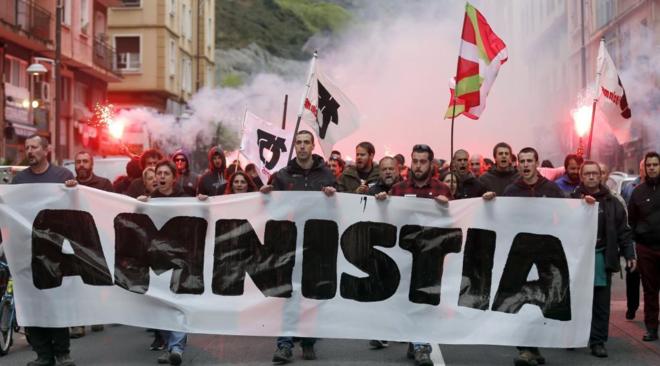
Annual January prisoners’ solidarity march, Bilbao, 2016. (Image sourced: Internet)
Repression by the Spanish State has included executions and clandestine assassinations and led to relatively huge numbers of Basque political prisoners, not all by any means military fighters and conviction with “confessions” extracted through torture during the five-day incommunicado period ensured a problem-free conveyor belt for the Spanish State. That conveyor belt delivered its victims to jails dispersed all over the Spanish state, nearly every one hundreds of kilometres and sometimes over a thousand from the prisoners’ homes. The financial, physical and mental strains on friends and relatives, including elderly and children having to travel such distances to visit their loved ones are hard to imagine, often facing abuse or harassment on the way or at their destination, apart from serious accidents on motorways (including fatalities). Many pickets and demonstrations are held in the Basque Country throughout the year and each January a monster march clogs the streets of Bilbao.
The issue of the prisoners has always been a big one for the Abertzale Left and despite dispersal the prisoners built an organisation within the jails, responding to their situation in a disciplined manner.
SLEEPING
During the first decade of this century it was clear that ETA was not doing well and the Abertzale Left in general was facing many more years of struggle against an unyielding state with repression everywhere and hundreds of political prisoners in jails.
The leadership was attracted to the much-advertised pacification/ peace processes of South Africa, Palestine and Ireland. By any estimation the Palestine process soon collapsed and its rejection by most of Palestinian society was clearly indicated first by the Intifada and secondly by the electoral gains of Hamas, pushing Al-Fatah into second place. To undiscerning eyes the Irish and South African3 processes seemed to be doing well and both the ANC and Sinn Féin lent strong support to the Abertzale Left’s imagined “peace process”. Despite that support and that of such prominent imperialist figures as Tony Blair and Kofi Annan, the Spanish ruling class was not interested in playing and eventually the Abertzale Left’s leadership was left with nowhere to go. However, they persisted in trying to build alliances with the majority Basque National Party and with smaller nationalist-social-democratic groups; they succeeded with the second sector but failed with the first and seem condemned to second-party status electorally in a Spanish colony, a nation divided by the French-Spanish border.
However, in their search for acceptance by the above-mentioned sectors, the Abertzale Left not only renounced armed struggle but apologised for past actions, ended street confrontations and called on the prisoners to negotiate their progress individually through prison system grades to eventual parole. Some of Abertzale Left public representatives even attended events commemorating Guardia Civil and Ertzaintza (Basque police) killed by ETA in the past.
EH Bildu Mayor of Errenteria participates in commemoration of a Guardia Civil killed by ETA. (Image sourced: Internet)
When the struggle for independence broke out again recently in Catalonia with the 2017 Referendum and the Spanish State responded with a violent Guardia Civil invasion and jailing of politicians and social activists, the Abertzale Left leadership noticeably declined to open up a second front of struggle.
STIRRING
There were early but sporadic signs that not all movement was happy with the Abertzale Left’s new path. Askapena, an organisation set up within the Abertzale Left to work on internationalist solidarity, which at one time could list affiliated groups in Ireland, Germany, Italy4, Paris, Brittany, Barcelona, Madrid, Switzerland, Denmark, Sweden and a number of Latin American countries, broke quietly with with the Abertzale Left over its change of policies5. Notably also, when four members of Askapena were accused of “assisting terrorism” in 2010, they refused to apologise for their work and fought the case, being eventually cleared of all charges in 2016.6
In addition, many Basques were critical of the process, feeling that even if they were prepared to go down the new road, it had been handled badly by the leadership.
A leading Marxist theoretician of the movement, Inaki Gil, resigned from the national leadership years ago, though not from the movement; however he may well be persona non-grata in it now due to a published interview in which he criticised the decision of the 47 on trial in September last year to apologise for past actions of the Basque liberation movement, even after 50,000 had marched through Bilbao streets in their support two days earlier.
When Arnaldo Otegi — generally seen as the architect of the new road for the Abertzale Left7 – was arrested with others in 2009 and, while on pre-trial detention began a hunger strike only to end it soon afterwards, it did not reflect well on him. While he beat a charge of “glorifying terrorism”, he was convicted in 2011 for allegedly reorganising Batasuna, banned political party of the Abertzale Left and sentenced to ten years, reduced on appeal to six and walked free in 2016. In the meantime a Free Otegi campaign (2015) attracted some notable foreign support (including Desmond Tutu) but was criticised in the Basque liberation movement for highlighting the case of one political prisoner above many others8 (including those who were serving much longer sentences).
Arnaldo Otegi, leader of the official Abertzale Left. (Image sourced: Internet)
Some years ago a new Basque political prisoner solidarity organisation came into being, calling itself ATA (Amnistia Eta Askatasuna – Amnesty and Freedom9). They enjoyed a good showing at their first demonstration but came under public attack not only by the Abertzale Left leadership but by a number of ETA members on trial in France. They were accused of using the prisoners as a stalking horse when what they really wanted was to attack the new line of the movement’s leadership. Censorship and condemnation in the Abertzale Left’s daily newspaper GARA followed.
Amnistia Ta Askatasuna demonstration Bilbo 2016. (Image sourced: Internet)
Although their public support waned for awhile, in 2018 a youth group of the Abertzale Left was expelled after they had publicly denounced their annual conference managers for refusing to put their position paper forward for discussion; this youth organisation now collaborates with ATA. Last year, a new Basque revolutionary group called Jarki was formed and drew a sizable crowd to their commemoration of the annual Gudari Eguna (Basque Soldier Day)10.
ATA demonstration Donosti/ San Sebastian, September 2019. (Photo: D.Breatnach)
However the issue of development remained in doubt and no-one could predict with confidence that the movement would be rebuilt along revolutionary lines under a new leadership.
WAKING
The week before last, Basque political prisoner Patxi Ruiz embarked upon a hunger and thirst strike and although he abandoned the thirst component after 11 days he continues on the hunger strike. He took this action in protest against harassment and beatings by the prison administration and jailers and highlighted the fact that prisoners
Patxi Ruiz, Basque political prisoner, now on hunger strike. (Image sourced: Internet)
were being refused virus-protection clothing or testing and that the jailers were not being tested either. He also wanted visits from his family to be permitted and prisoners allowed to attend funerals of family members (he had been refused permission to attend his father’s funeral). More recently he has demanded that prisoners be relocated to jails near their homes, a long-standing demand of the movement and which is entirely in accordance with model rules for prisons in the EU and the UN. Despite the official leadership of the Abertzale Left firstly ignoring the situation and then condemning his supporters, Ruiz’s struggle galvanised the mostly dormant Abertzale movement.
Every day has seen small actions across the Basque Country, including protest pickets on bridges, beaches, town squares etc; solidarity fasts; slogans painted … Large solidarity marches have been held in Irunea/ Pamplona (Nafarroa province), Donosti/ San Sebastian (Guipuzkoa), Baiona (Bayonne), Bilbao and Durango (Bizkaia). ATA’s web page is full of developing news and the facebook page, which had fallen into silence, is active again. Last Sunday in Pamplona/ Irunea, police attacked demonstrators with batons and fired rubber bullets at close quarters.Patxi Ruiz solidarity demonstration 24 May 2020 attacked by police with batons and rubber bullets
Patxi Ruiz solidarity march in Bayonne, northern Basque Country. (Image source: Internet)
Some of the Basque prisoners who are part of the “official list” have begun taking solidarity action, refusing food or to leave their cells for periods in Almería, Brevia-Ávila, Castelló I, Córdoba, Huelva, Murcia (where Patxi is), Puerto III, Rennes, Sevilla II, Topas-Salamanca …. refusal to leave one’s cell also means forgoing family phone calls. Patxi had been expelled from the Abertzale prisoners’ collective in 2017 for speaking out against the new line of the official leadership which another four prisoners have repudiated also11.
However the mass of Basque political prisoners have so far remained quiet, “concentrating on moving through their grades while Patxi lies dying”, in a quotation from an ATA commentary which blamed this new lack of unity on the fragmentation engendered by the official leadership.
A group of ex-prisoners has now also called for solidarity with Ruiz.
“COULD NOT SINK LOWER”
According to a public statement by ATA denouncing political parties Sortu and EH Bildu, the official Abertzale leadership made no comment until Patxi Ruiz was into his fifth day of hunger and thirst strike and then it was to mention him only in passing, while denouncing the spray-painting of political parties’ buildings by protesters and the burning of an ATM. On the 10th day the official leadership again released a statement, saying they were trying to organise one of their elected politicians to visit the prisoner but condemning the mobilisations across the Basque Country and accusing them of endangering Patxi Ruiz’s life. “They could not sink lower”, commented ATA, who also pointed out how late the official leadership had come to comment and that without the public-space protests, neither the media nor the official leadership would have taken any notice whatsoever.
What the future holds for Patxi Ruiz in the short-term is hard to predict, already weakened by ten days of thirst strike and now into his 16th day of hunger strike. What the near and medium-term future holds for the Basque movement is also an open question, depending to some extent on how ATA is able to capitalise on this upsurge and build an organisation or a network of coherence and unity, at least in action.
Patxi Ruiz solidarity march Bilbo 23 May 2020. (Source image: Boltxe)
The official Abertzale leadership will do what they can to destroy any such movement but they have already yielded the streets, one of the main arenas of the movement in the past. Both groups are mutually exclusive and the advance of one in the wider Basque movement can only be at the expense of the other.
The Spanish State too will be watching developments and no doubt considering its own options of repression, although not so easily done as before, without even an ETA existence to justify their response to the public.
Meanwhile the Catalan independence struggle simmers on and if both should link up in mutual solidarity …..
2The main unions in the Spanish state, Unión General de Trabajadores and Comisiones Obreras were founded respectively by the PSOE and the CPE. Both are Spanish unionist and have the majority of unionised workers in every region of the Spanish state except the southern Basque Country and Galicia.
3While the people in South Africa have the vote and the ANC political party has done well out of the deal, going almost straight into Government, the mass of people struggle on low level income, high level violent crime, unemployment and badly-delivered services, while an ANC clique wallow in riches gained through corruption. Sinn Féin went first into the British colony’s government and now has the most elected parliamentary delegates from the February 2020 General Election in the Irish State; however over two decades after the Good Friday agreement the country is no nearer unification or nation-wide independence and is run by neo-liberal capitalist classes selling out the natural resources and services of the nation.
4Germany and Italy had a number of these; in Ireland the cities of Belfast, Dublin and Cork each had one.
5This organisation effectively ceased to exist due to the new line of the Abertzale Left. Although a number of foreign committee delegates did not disagree with the new line (some certainly did) nevertheless it began to fade away from then on.
6In marked contrast to the apology in September last year for previous actions of the movement by 47 members of a number of Abertzale Left organisations, including those against repression and in solidarity with prisoners, before they had even been tried by the court. This shameful action was taken two days after 50,000 had taken to the streets to support them and left deep hurt, bewilderment and shame throughout the movement. https://www.theguardian.com/world/2019/sep/16/mass-trial-of-basque-activists-in-spain-ends-with-plea-deal
7He had come into the political leadership with Joseba Permach of the Abertzale Left in 1997 after 23 members of the Batasuna leadership were jailed for seven years by the Spanish State. He was elected General Secretary of the political party Sortu in 2013.
8The Abertzale Left had never previously endorsed any campaign focusing on individual prisoners except in the case of terminally and seriously-ill prisoners, of which at one time there were as many as 15 who, even under Spain’s own prison regulations, should have been paroled home or to hospital.
9Though now it gives the translation as “Amnesty and Against Repression”. An Amnistia organisation had existed earlier but dissolved or reformed after banning by the Spanish State and one of the accusations of the Abertzale Left is that dissidents misappropriated the name.
What makes leaders good or bad ones? How much power should a leader have? How should they conduct themselves? How do we know when they are no longer leading us well and what can we do about it? The following piece discusses these questions and seeks to answer them.
Most people think human beings need leaders and revolutionaries and insurgents in general are no exception. There are some political-social groups who state that they are autonomous and do not need leaders but it has been my experience even in some of those groups that they do indeed have leaders and that in general they act under that leadership. It seems to be a human trait for groups to accept leadership and to follow leaders and indeed all social animals we may observe have leaders. Nevertheless, the question of leadership historically has been fraught and that is as much the case for human society in its various stages as well as for revolutionary organisations.
Statue in the Louvre, Paris, of Spartacus, leader of the great slave uprising against Rome 73-71 BCE. He is here represented as a thinker. (Photo sourced: Internet)
RESPONSES TO LEADERS – HEALTHY & UNHEALTHY
RESPECT
If our leaders have proved their worth to our endeavours then of course we should respect them. We should not respect them because of their class or family background. It is what one does that makes one worthy of respect, not the social class in which one was raised. And if that class background gave certain advantages in education, in leisure time to study and learn, then those are advantages we value and seek for all, which is far from respecting someone merely because they were raised with those advantages.
As to family background, it seems to me that we are haunted with an old way of looking at human society. It might have seemed natural in ancient times to give the offspring of a valued leader special respect and even to choose the successor from among his/her offspring. It does seem to be the case that some talents and traits are inherited through genes and it is also true that such a family background can familiarise one with some principles of leadership. However, history has provided us with many examples of ineptitude, malice and even madness in leaders who have greatness in their family background. It has also provided us with examples of people who rose from obscurity and from a family background of no particular note to lead masses in historic deeds.
Since we speak of respect, we should talk now about what that means. Of course, when leaders seeks to lead us, to advocate some action or policy, we should listen for if we do not, how can we benefit from what they have to say to us? We listen with respect.
But respect is not the same as servility, nor blind acceptance. We should consider what we are being told and feel free to ask questions and to challenge what we may perceive as assumptions. Further, we should accept that others also have that right, even if we ourselves are convinced in the leaders’ words. Our leaders are not infallible and nor are we.
We said earlier that it is upon what we do that we earn respect and that is so for leaders too. Every judgement on what we do must inevitably be based to some extent on an action in the past, even if it as recent a past as earlier that week, the day before or an hour ago. But one’s past does not grant infallibility and one who took correct decisions in the past can all too easily take wrong ones today or tomorrow. History has also shown us many such examples. Therefore the expectation of any leaders or of their followers that we should accept what they say mainly on the basis of their having been correct in the past is completely unjustified — however emotionally satisfying it may be to some people — and we should resolutely reject the premise.
If we are entitled to question and even challenge leaders there also comes a time when that right should be put aside for awhile. At some point it is necessary to act and endless debate does not lead to action. Nor is the entitlement to question and challenge a justification for ceaseless exercise of that right and it is also the case that such practice will in time devalue future criticism and challenge, perhaps when they are valid and should be most needed. The point at which debate needs to come to an end and a decision made, by the accepted procedures of the group, is ruled by the necessities of the situation and not by simple declaration.
CONDUCT OF LEADERSHIP
Firstly, led us observe that while it is an impossibility for everyone to lead simultaneously, everybody is capable of leadership at some time in some circumstance. Every time one of us suggests a course of action or expresses a criticism in a group, we are in effect offering leadership to others. The one who says “I think we should …” or “Why don’t we …..?” or “Maybe we could ….” are all offering leadership at that moment. Whether it would have been effective leadership or in any case is accepted or not is beside this point.
Spartacus statue in Sandinski, Bulgaria. Here his military leadership is emphasised. (Photo sourced: Internet)
RESPONSIBILITY
We all of us should take responsibility for our actions and their effect. In practice that means weighing up positive and negative aspects before action (should we have time to do so) and afterwards evaluating once again its negative and positive aspects. Should we be constantly hesitant or paralysed by fear of failure we cannot be effective in anything worthwhile, therefore it is necessary that we are prepared to risk making mistakes. Then we have a responsibility to learn from our mistakes which implies a responsibility to admit to them.
Leaders at any level must take responsibility not only for their own actions but for those of their followers also. The leader too must be prepared to make mistakes but should endeavour to ensure that they are not too serious, that the consequences are not too disastrous. This is a heavy responsibility which implies the need to think things through in advance and not to merely react or act mainly out of emotion. And yet, the leader must be prepared to be decisive when that is what the situation requires.
Too many individuals accept leaders as a means of abrogating their own responsibilities. All of us have responsibilities in any endeavour we join together: responsibility in sharing work, risk, and thought. If we leave consideration of the negative and positive aspects of a proposal to others, not only are we shirking our responsibilities but we are hardly justified in complaining later about the actions of our leaders.
SHARING LEADERSHIP
Some leaders are seen to take on multiple responsibilities and many tasks. In capitalist endeavours this has been judged to be wasteful and ineffective in the long run, leading to inflexibility, slowness to react and “micro management”, among other faults. An insecure leader does not trust others and seeks to keep all tasks and initiatives under his/ her control. And yet, shit happens, as they say. Nothing can be completely controlled.
Louise Michel, life-long anarchist revolutionary and one of the leaders of the Paris Commune 1871 and other revolutionary initiatives later. (Photo sourced: Wikipedia)
In revolutionary leadership this tendency to try to control everything by an individual or individuals has also been seen, with harmful consequences that include stifling initiative and learning among the group or organisation. Once this becomes established, the absence of the leader(s) mean the paralysis of the organisation and a similar effect occurs while waiting for them to make a decision. In addition, if they enemy subverts the leadership, the whole organisation and struggle becomes destroyed or at least greatly damaged.
Good leadership encourages the development of different areas by different individuals within the group and spreads participation in — and responsibility for — the decision-making. This model is often called collective leadership but within that itself there are different models too.
It would be very damaging if every individual were to act within an organisation according to how they might feel at different times and to represent the organisation externally without consulting the group. After matters are discussed and collective agreement has taken place, members of an organisation should not represent the organisation in a contrary way to what has been agreed. This is a difficult area with tensions between the right of expression of the individual and of responsibility to the organisation, one which I am unsure has ever been completely resolved.
Collective leadership is usually exercised through a committee or temporary working group and allows for different individuals taking a lead in different areas. One might note that person A regularly calls people to the overall task in hand and pushes for a monitoring of progress, while person B concentrates on developing a specific area, person C looks to the recording of decisions and person D to some external relations. There are of course formal positions in organisations and committees such as Chair, Secretary, Treasurer etc but even without formal elections one finds that successful groups develop areas of responsibility for separate individuals even without the existence of such elected offices. Furthermore, a particular responsibility may fluctuate between individuals at different times. A good argument exists for not entrenching anyone in specific roles over long periods of time. Rotation of roles and encouragement to take up new responsibilities can help broaden the experience and capabilities of members of the group or organisation and also prevent the growth of cliques and controlling leaderships.
Monument under continuing instruction to Crazy Horse, a chief of the Lakota Oglala, who with Sitting Bull led the struggle against the USA’s expansion and confiscation of his people’s traditional lands, including the great defeat of General Custer’s military invasion at the Battle of the Little Big Horn. He was murdered on 5th September 1877 in US Military custody. The statue is finished but the monument on land in Dakota includes the carving of the rock bluff seen in the distant background. (Photo sourced: Internet)
WHAT TO WATCH OUT FOR
Their are certain traits which may be observed repeated in unhealthy leadership and it is well to be aware of them, both for those who follow them and for people put in positions of leadership themselves. The following list does not include timidity, hesitation and prevarication, which are also bad traits of leadership.
The leaders
clearly enjoy issuing orders
direct others to do tasks they would not undertake themselves
monopolise speaking time
push for an end to debate without demonstrable necessity for the organisation
dismiss out of hand opinions opposed to theirs
expect agreement with whatever they say and resent question or challenge
regard question and challenge as treasonous, mutinous
hold grudges against those who have disagreed with them and seek to have them ignored, ostracised or demoted
seek or accept control over multiple areas of work
lie outright to their following
or do not tell their following the whole truth
call upon their past record in order to justify their actions or direction in the present
call upon their family background to justify their actions or decisions
surround themselves with a group who support them without question
accept flattery
flatter particular people (as distinct from commending when appropriate)
never commend any of their followers when deserved or choose only some to commend
criticise others unfairly or out of proportion to what is deserved
consider themselves entitled to special consideration above others in physical and emotional comforts
believe that rules that apply to the majority do not apply to them by virtue of their position or imagined personal superiority
Also, among the group or organisation, those who:
Always agree with the leaders or
Constantly disagree to no apparent concrete purpose
Constantly praise the leaders in private or in public
Praise a leader or leaders while ignoring or downplaying the contribution of others
Deny leaders have committed errors or wrongdoing in the face of evidence to the contrary
Make excuses for wrongdoing or errors of the leaders
Use the past record or family background of the leaders to justify actions in the present
or to imply that the leaders should be followed without weighing up their actions or what they advocate
criticise anyone who criticises the leadership rather than dealing with the point of that criticism
try to justify leaders having special consideration above others in terms of physical and emotional comfort
CONCLUSION
The exploitation of working masses and their resistance to that has been going on since ancient slave societies and has led to outbreaks of revolt down through the centuries. The Paris Commune of 1871 was the first time that the working class succeeded in taking a city and holding it for a period, developing its own instruments of making decisions and carrying them out. At little over two months it was a short-lived experiment and fell to the bloody suppression of Prussian armed forces at the invitation of deposed royalty and dispossessed bourgeoisie.
It was not until 1917 that the working class was able once again to overthrow its oppressors and this time it did so not just in a city but in an entire state, also defeating invasions to overthrow its power. But where is that today? The Soviet Union collapsed in 1991 but had been crumbling within from long before that and, some would say, the working class had lost control in the early years immediately following the Revolution.
The question of leadership and how to handle it by everyone is an important one in an organisation but, for revolutionaries, is essential. It is essential not only for the conduct of the struggle but perhaps even more so for managing society after a revolution. The seeds of that management in the future must be sown in the present.
End.
POSTSCRIPT
I base the above on my personal experience of decades, my reflection upon them and on reading of history. My personal experience has been mostly in unpaid social-political struggles in trade unionism, housing, political groups on a number of fronts,solidarity committees, community and education groups but also employed in few NGOs for a shorter period. I have been either a follower or part of leaderships and have erred in both on occasions while on others acted correctly. I hope that I have learned from them all — and certainly from my mistakes.
In order to concentrate thinking on the general principles I have refrained from giving particular examples of recent leadership, which might have tended to give rise to discussion about individual cases rather than the principles as a whole.
According to news reports, the Government is considering a relaxation of restrictions and a return to work – but with people wearing masks1 and with monitoring of preventative measures. An obvious question is, if these measures are thought to be effective in future, why are they not being implemented now? And why not in the past? Will we be going back to work but also to contagion?
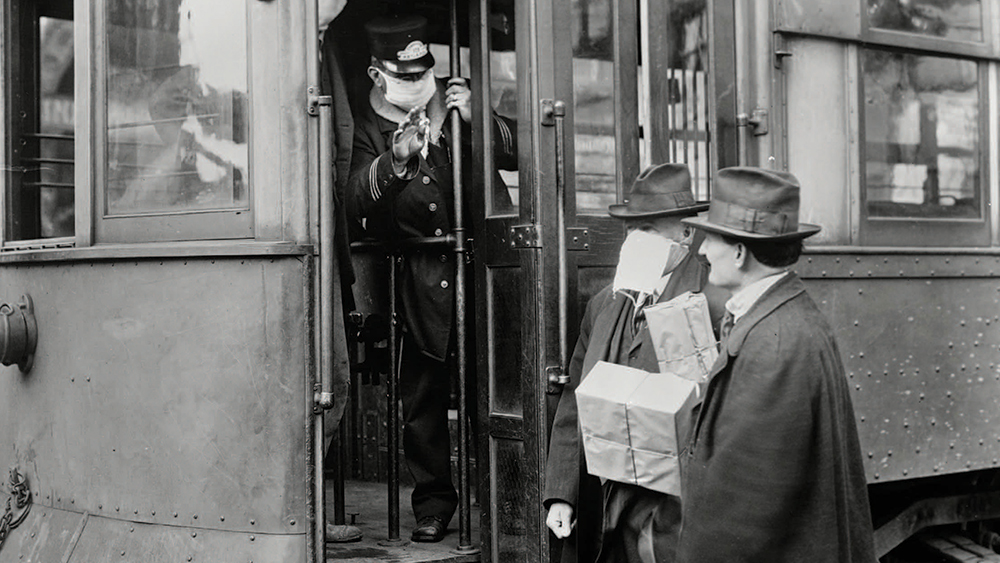
Conductor on Seattle trolley-bus, USA, masked against Spanish ‘Flu 1918. (Image sourced: Internet)
PRESSURE TO LIFT RESTRICTIONS
There is clearly some pressure to lift restrictions – many people want to be able to earn money and socialise as before. People want to go on holiday, get on with education and projects, visit relatives. Small businesses want to save themselves from bankruptcy or climb out of debt. And bankers and industrialists want to continue squeezing people for profits. The State too, in both its ‘national’2and municipal forms, wants to raise taxes to fund its essential services: power generation and supply, water purification and sewage treatment, health service, postal and electronic communications, public transport and road maintenance, fire-fighting, refuse collection and disposal …. To all of those pressures the Government seems to be bowing – but have they thought it through?
In Germany, which has lifted some restrictions, people have been obliged to wear masks in public but even so, the authorities are urging people to be cautious, that they “will have to live with the virus” for some time. In other words, “forget about going back to normal, probably for a long time”. Initial statistics show a rise in infection cases there after the lockdown easing. In Britain, especially England, trade unions have attacked the “mixed messages”from the Prime Minister, Boris Johnston, about returning to work as “potentially lethal”.3
Germany experienced a rise in numbers infected after relaxation of lockdown. (Image sourced: Internet)
So, about the pressure. Ordinary working people have bills, mortgages and rents to pay, small business people have the same and clearly a state needs to have money to fund essential services. Yes, and big companies and banks are pressurising too. And we all know how successful banks are at pressurising governments, don’t we? Especially our governments.
Apart from banks and building societies, the Government could ease the pressure on ordinary working people and small business people by declaring a moratorium on mortgages and rents for the duration of loss of earnings due to the pandemic. Yes, it would need to take powers to do that but wouldn’t most people support them in doing so?
The building societies, banks and big businesses wouldn’t support it however, all of which are interconnected. Well, when the banks and building societies messed up – and not for any reason like a pandemic, either – our governments forced US, the ordinary working people, to bail THEM out. In fact we’re still paying for that out of our national reserves and in cuts in all kinds of provision. A little bit of “comes around” would do them no real harm.
As to the finances to run the essential services of the State and of local authorities: end the tax write-offs, holidays and low taxation rates etc. And change the line on “We don’t want Apple to pay us the money which even the neo-liberal capitalist EU says they owe us!”. Yes, we DO want it – and we NEED it, ALL of it and NOW!
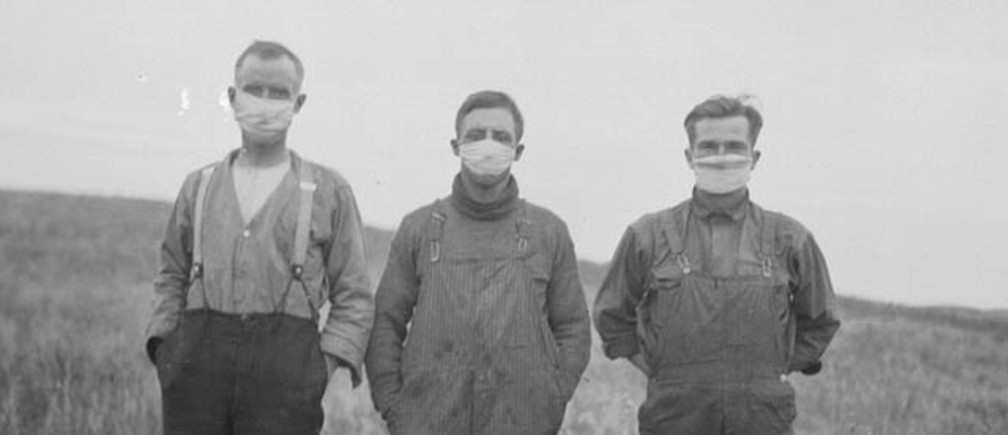
Industrial workers masked against the Spanish ‘Flu pandemic in Britain 1918. (Image sourced: Internet)
“FALSE CONFIDENCE”
The German authorities, with a much more efficient and better-funded health service and financial reserves, have been warning its public about false confidence. Now and again we see some indications of that here in Ireland too.
OK, so a section of the public is not properly educated or just willfully ignorant – stupid even. But if when you introduce a lockdown to deal with a pandemic you talk about it being for an initial two weeks ….. what kind of message are you giving out? And if you tell most people not to bother with masks or gloves? And if in the early days of the pandemic told them firstly that public events would not need canceling4 and then that to attend outdoor events of up to 500 and indoor events up to 100 people5 was basically safe? If the responsible authorities never seemed to be taking it all that seriously until late in the day and even then have managed it quite lightly – are some people to be blamed for having false confidence?
Another cluster of infections has just come to light, ten meat processing plants accounting for 566 cases so far. Prof. Catherine Motherway, President of the Intensive Care Society was reported as cautioning that a lot more needs to be done before restrictions are eased. “We need to know that our health system can cope … find and isolate the cases and treat them.”6
New York street cleaner masked against Spanish ‘Flu infection, 1918. (Photo sourced: Internet)
FACE-MASKS NOW – BUT NOT EARLIER
According to reports, the Government will want us to wear face-masks when they relax the restrictions. But ….. weren’t they telling us from the start that there was no point? Wasn’t even the World Health Organisation playing down their usefulness?
Well, either they know they don’t work, in which case they just want us to feel safe enough to start the wheels of industry turning and the money flowing into the big accounts …. Or they know they do work, and they’ve been advising us wrongly all along.
That’s where my bet is and I’ve written about this already, weeks ago7. It’s bloody obvious that face masks must help prevent spread the virus and depending on the type and procedures employed, would also help protect the wearer to some degree. Quite a number of countries made wearing them in public obligatory. And now the Government will be doing that here too.
Good. But I just wonder how many people got sick – or even died – because the authorities discouraged them from wearing them earlier?
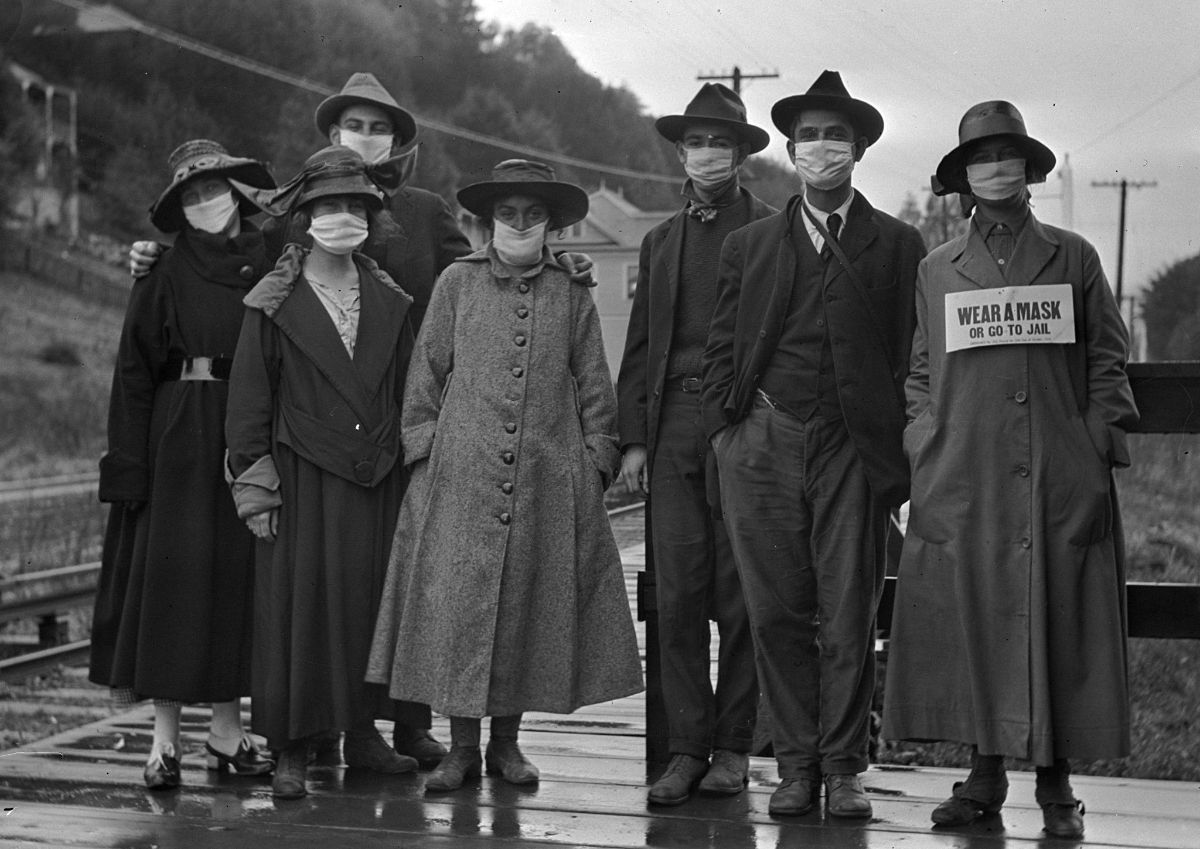
People wearing masks and “Wear a mask or go to jail” placard, 1918, during Spanish ‘Flu pandemic, probably USA. (Image sourced: Internet)
The Government has yet to specify where the masks are going to come from and, little respect as I have for any person prominent in the Labour Party, Alan Kelly TD is obviously correct when he says that the Government should be organising the production of those masks NOW!8
OTHER MEASURES AND MONITORING
Face-masks help you not to spread droplets on to other people – and you don’t know for sure whether you have the virus or not, because you can carry it for a few days before it starts to show. Good face-masks will help you not catch it from someone else too. But you really need gloves as well and a good procedure in removing the gloves and face-mask, combined with hand-washing. And of course, social distancing. To be honest, with all those being practiced, there should be no need for 2km distance from home limits on exercise or travel – or even for telling older people to stay indoors, vulnerable to depression and ill-health through lack of exercise and even to accidents in the home.
But, for effective measures, don’t they/ we need to know who is infected and who is not? And where the major infection points in society are to be found? Yes — and for that we need mass testing, which our Government has not been doing because of how the health service has been run down. Not even with sending test samples away (to Germany) for analysis!9
And then we need tracking, tracing where people think they may have got infected, who they may have infected in turn, testing them …. the proper pandemic scientific procedures. But our Government is hardly doing that either. We get the following estimates10 of infection sources based on people who tested positive: 34% close contact, 63% community contact, 3% travel abroad.11But what do these categories actually mean?
OK, “travel abroad” is reasonably clear. “Close contact” might mean family, close friends, lovers, elderly relatives in nursing homes (more about them further on). But “community contact”, which accounts for almost two-thirds of the total? Would these be neighbours, workmates? You know what I suspect? Shops and supermarkets – customers and staff – are a big section. Why? Because most people visit them at least weekly and the precautions taken there have been all along — and are still – inadequate. But the authorities don’t do the tracking to find out. Or if they have, they’re not telling us.
Customers in a supermarket (none seem to be taking any precautions other than perhaps social distancing). (Photo source: Internet)
The fact that it was only last week that a high cluster of infection around meat-processing plants was revealed shows the need for testing, tracking and testing again and how little work on that level is being done. Ten sites with 566 people infected12 so far is not something that should be coming to light over two months after the first case was identified in Ireland.
Who will carry out the monitoring, ensuring best practice and compliance? I’d like to believe that whichever body the Government sets up will do a good job but unfortunately I doubt it. It was left up to the supermarkets and shops to monitor their own provisions and they did it late and inadequately13. The Government at first even left it up to the pubs whether to remain open or not! Now this body appointed by them, aware of the lack of enthusiasm of the Government to interfere with the business of making money, will be supervising and monitoring every factory, shop, depot and farm? Really?
In this small relatively low-industry state of the 26 Counties, the Health & Safety Agency recorded 22,500 non-fatal workplace accidents reported to it for the year 2017-2018, along with 48 fatalities. Remember that all generic studies maintain that most and possibly all accidents at work are avoidable and result from lack of awareness or of appropriate training, or of fatigue as well as from bad practices, bad supervision and badly-maintained equipment.
The understaffed HSA is not adequate to the task of monitoring even a representative sample of workplaces and relies a lot on accidents and breaches of regulations being reported to it; the trade unions in general are not up to the job either, especially with the low percentage of union membership of recent decades.14 So whichever agency is set up for monitoring good working practices during the pandemic, even if such adequate practices have been identified and published, is not likely to be up to the job either.
Masked Clerical Female Workers during Spanish ‘Flu pandemic 1918, probably USA. (Image sourced: Internet)
But at the very least that agency should publish its general guidelines and insist each workplace publish the specific procedures in place along with the underlying rationale. Then at least employees and public can see what they are, complain if they are felt to be inadequate and report those that are not being practiced. And gloves and face-masks at least should be provided for all, with work practices adapted to allow for them.
THE DISPOSABLE PEOPLE
As soon as the pandemic took hold in other countries, a high percentage of infected people were known to be healthcare workers – around 10% as an average. Even if you didn’t realise straight away that nursing homes were going to have a high rate of infection, as soon as you thought about healthcare workers you’d be quick getting to that point (and one step away from thinking about homeless hostels and direct provision centres etc too). Once you thought of the high vulnerability of those facilities, you’d make special provisions for them, wouldn’t you?
But no. No provision at all until a few weeks ago. No special issuing of guidelines for staff and visitors, insufficient PPE (protective equipment etc), low admission rates to ICUs for the infected ….. According to stats published at the weekend, 855 coronavirus-19 deaths have been associated with care homes and 740 of those were residents. And since the total deaths recorded within the state at that point were 1,429, well over half the deaths have taken place in care homes.
A shocking rate of attrition out of ineptitude for which the Government and the National Public Health Emergency Team should be held responsible. Or …. was it even worse than that? These facilities contain, on the whole, people who are no longer economically active, people some might even consider a drain on society’s resources. And often low-paid migrant workers caring for them. Could it be that they were all just considered “disposable”?
2I use the term here to mean the whole of the State’s territory, well aware that a true national perspective would include not just the 26 Counties but also the Six County British colony.
11Yes and most intelligent people wonder why the Government allowed people to travel to an international rugby match in a country swamped with the virus and, even worse, not have them quarantined upon their return. And for heaven’s sake, why people can still leave and arrive at our air and marine ports and sit on planes next to one another with cabin crew having to bend close to attend to them during the flight, do a turnaround and bend close to another group of passengers on the flight back.
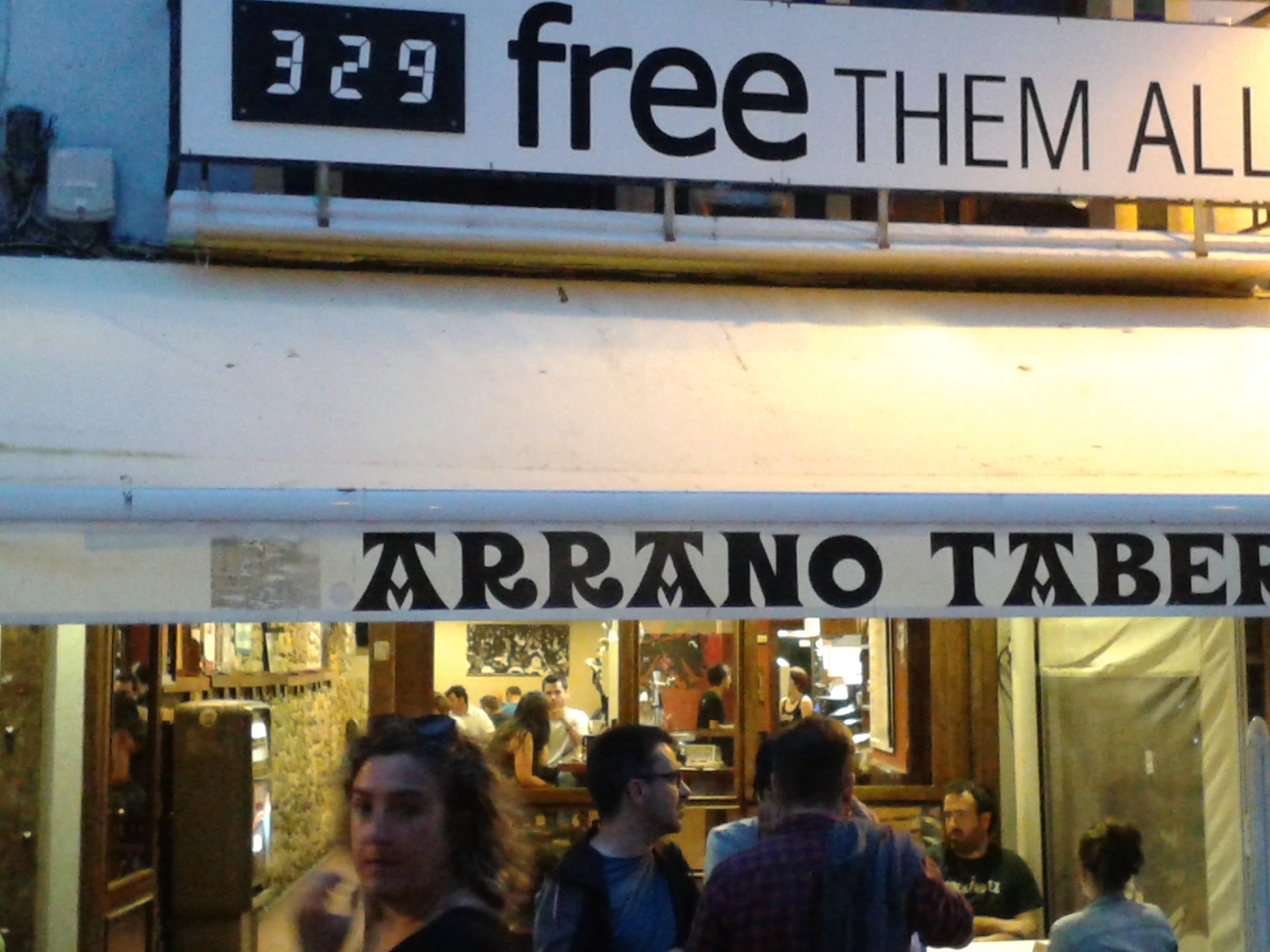
The Herriko Tabernak (People’s Taverns) are a feature of Basque Society, in particular in the Southern Basque Country, i.e the part under Spanish control. Founded by members of the Abertzale (pro-Independence) Left, run by supporters and frequented by sympathisers, they have been a place to have a drink and some pintxos, have a coffee and chat with friends, hold social events and large group meals, as well as occasional meetings. The Spanish State is now seizing their funds.
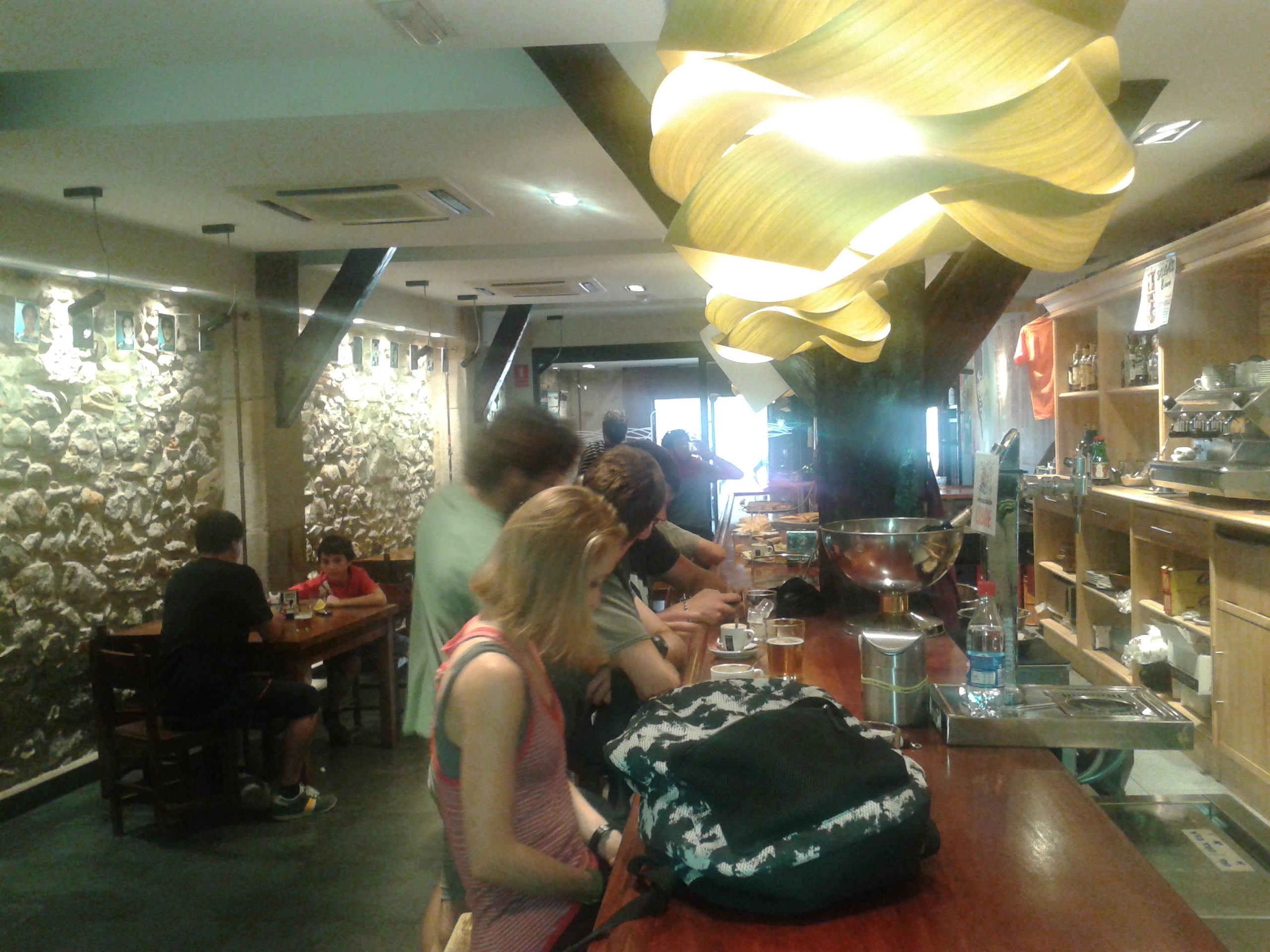
One of the Herriko Tabernak in Bilbo, this one in Errondabide, Casco Viejo; view from the back towards the entrance and street. Photo: D.Breatnach 2015)
In 2016 the Audencia Nacional, the Spanish National Court, handed down a judgement that the funds of these taverns are forfeit, in what the Abertzale Left party Sortu called “the greatest political and economic plunder since the Civil War”. This is a reference to the wide-scale misappropriation of funds, machinery and land of the losers of that war by the victors, General Franco and his supporters. The wealth of many individuals and families in the Spanish State today can be traced back to that theft.
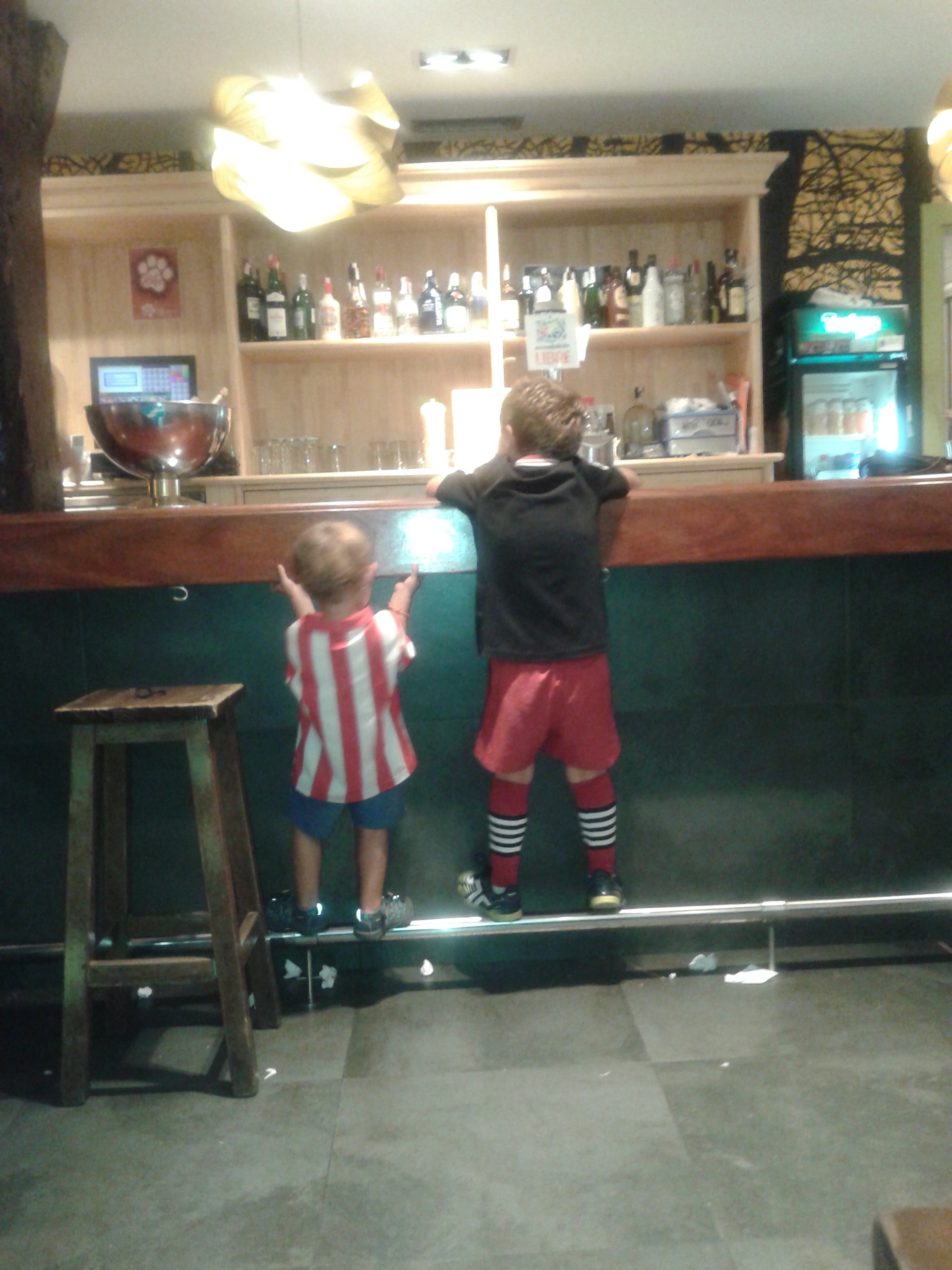
They will not be served alcohol! Parents often meet at the Herriko for a while after collecting their children from the Basque-language pre-schools. (Photo: D.Breatnach 2015)
While a number of these taverns were closed down in the past, most kept going, supported by their loyal clientele and local communities. Although the punitive judgement of the Audiencia against the Herrikos was in 2016, its origin dates back further to the reign of one of the Audencia’s ex-judges, Baltazar Garzon, who infamously claimed that every aspect of Basque independent expression was linked to the armed organisation ETA. Baltazar, loved by liberals, claimed that “everything is ETA”, under which dictum homes were raided, activists tortured and jailed on their “confessions”, political organisations banned, social and cultural centres closed, along with newspapers, radio stations and social media.
Arrano Herriko Taberna, Zarautz, Gipuzkoa province, southern Basque Country. Banner above it calls for freeing of the officially-recognised Abertzale Left political prisoners. (Photo: D.Breatnach, 2018)
Some modest afternoon pintxos available in the Errrondabide Herriko (Photo: D.Breatnach 2015)
EXPROPRIATION TAKES PLACE DURING A MILITARISED LOCKDOWN
This expropriation is taking place, as commented the left-wing media Izquierda Diario, in the midst of an emergency pandemic lockdown in which more than 7,000 sanctions in little over a month have been applied by the military and police who are in charge of and patrol the streets. (Unlike Ireland and many other countries, people in the Spanish State are not permitted to take exercise outside their homes, whether maintaining social distances or not).
“While the judicial apparatus cannot process the massive claims of illegal dismissals, unpaid wages, unpaid ERTEs” (temporary compensation for loss of earnings due to the pandemic) commented the Diario, “or thousands of resources for fines during these days for the restrictions of the pandemic, yes there is time to seize the money of more than 100 taverns.”
COMMENT
Cafe esnea and “Bring the prisoners home” serviettes, Herriko Taberna. (Photo: D.Breatnach 2015)
While it is true that in many areas there are privately-owned bars sympathetic to the movement and that also in many areas dissenters from the line of the Abertzale Left official leadership decline to use the Herrikos, nevertheless the disappearance of the latter must entail serious damage to the social and cultural base of the broad Basque independence movement.
end.
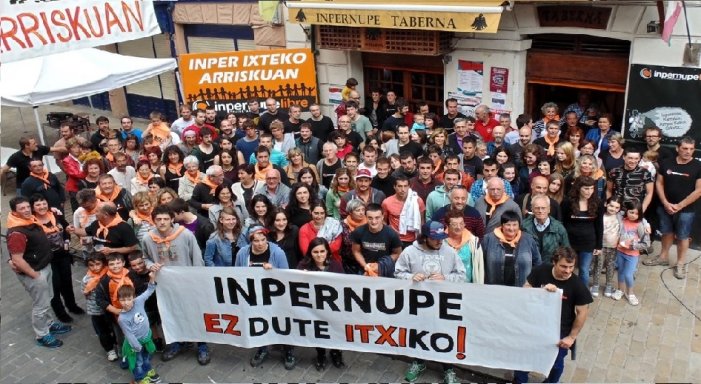
Protest against the original judgement by some supporters of the Herriko Taberna of Inpernupe, Zumaia (scene of some of the Game of Thrones footage), Guipuzkoa Province, Southern Basque Country. Banner declares “Ipernupe will not close!” while another in background declares it is in danger of closing. (Source photo: Izquierda Diario)
One of the clerical staff knocked on the door of Patrick, the boss of the Irish health worker’s union. “Come in!” called out the latter.
“Eh, Boss, lookit this here,” he said, waving a computer printout.
“Why don’t you summarise it for me,” suggested Patrick.
“It’s about that epidemic in China.”
“Coronavirus-19,” replied Patrick, who prided himself on keeping up with world news. “What about it?”
“It’s coming here,” replied the clerical worker.
“What! Who says? Where does it say that?”
“Boss, it’s spreading all over Italy and ….”
“Yes, well but Italy is far away from here!”
“Not as far as China is from Italy.”
Patrick thought about that but the clerical worker continued: “And the Ireland rugby team is playing there and nobody stopped Irish fans going there …. or coming back.”
Patrick sat silently, the enormity of the situation dawning upon him, then reached out for the computer printout. Among other things, it showed the steep climbing graph of confirmed cases of the virus in Italy.
Badge design of the FÓRSA union, the largest public service union in Ireland. (image sourced: Internet)
After the clerical worker had gone, Patrick rang Michael, the President of the Irish Congress of Trade Unions. Then he rang a number of union general secretaries: Brigid, of the shop and distributive workers, Barry of public transport, Jim of post and telecommunications, Josie of the clerical municipal workers, Colm of the manual municipal workers, Jan of construction ….
Two days later they all met in Liberty Hall, Dublin – thirty people, including chiefs of all the main trade unions in Ireland and of a few sub-divisions, along with their note-takers or advisers. By the end of three hours they had a position statement, including demands of the Irish Government, ready to go the moment the first case of the virus was confirmed in Ireland. They had ruled out issuing it until then because they feared it would not have enough effect.
A delegation was chosen to meet the Ministers of Health and of Industry. And pieces of work including research and requirements specific to some branches of the workforce had been distributed, with those responsible noted in the minutes and deadlines given. It was nearing the end of February.
The following day, the first case was notified in Ireland, a person returning from Italy.
Logo of the Irish Congress of Trade Unions, to which most Irish trade unions are affiliated (image sourced: Internet)
ICTU PUBLIC STATEMENT
That afternoon, the President of the ICTU phoned the Taoiseach (Prime Minister) of the Irish Government to alert him to the joint trade union statement and to push for an early meeting with the Ministers of Health and of Industry.
By midday four days later, the 1st of March, the updated statement had been emailed and faxed to all union branches, newspaper, radio and television news media and to a number of bloggers, most of which displayed it prominently, especially as that day the second case in Ireland had been diagnosed:
“The Coronavirus-19 epidemic in Italy has now reached 1,694 confirmed cases of contagion with 34 deaths and only four months ago the first case of this virus was diagnosed in China. It has now reached Ireland and more cases will soon be reported here. As trade unions representing workers including those in front-line services of healthcare, food sales and distribution, public transport, post and communications, municipal services …. We call on employers and Government to ensure the following steps are taken as a matter of great urgency.
All front-line workers in essential services be issued with HSE information on the known dangers of the Coronavirus-19 and be updated regularly
Those workers to be issued with hand-sanitiser gel, gloves and face-masks
The term “essential services” to be applied to the following (the list is not exclusive):
general health workers and auxiliary services with special emphasis on those to the elderly, disabled etc
emergency services in health, fire-fighting, public order, rescue services
workers in production and maintenance of power supplies for heating, lighting and cooking
workers in water purification and supply
workers in food production
workers in outlets providing food and essential supplies
delivery workers to the above and of these to homes
public sanitation workers
postal and essential telecommunications workers (i.e not commercial call centres)
Those workers to be where possible isolated from members of the public by appropriate measures such as withdrawal from duties requiring contact with the public, placing of transparent screens between staff and the public, recourse to audio and video communication, etc.
All covered public spaces, in particular those supplying essential services such as food shops, to be supplied with hand-sanitiser dispensers and notices exhorting the public to use them to prevent or restrict the spread of the virus
All companies to publicly display the measures they have taken to protect staff and the public
The closure of borders, airports and ports to travel to or from abroad, quarantine measures being enforced wherever arrivals are currently taking place
Should the virus continue to spread, all non-essential services should cease. This measure is not only for the protection of staff and public at the place of work but also in the travelling of workers from their homes to the place of work and back again
The above measure to be announced by the Government through public statements and to be enforced strictly wherever non-compliance should be observed
The Government to urge the public through repeated public announcements to self-isolate and to remain indoors where possible, urging responsible adults to ensure the same with children
The Government to freeze by decree all evictions, all actions for non-payment or arrears of rent or mortgages
likewise with actions pursuing non-payment of bills for utility services
The Government to oblige all companies that can afford it to pay workers they lay off
and to supply all smaller companies and businesses that cannot afford in full such payments, the necessary assistance to meet their obligations to the workers
The Government to set aside an adequate sum to pay all unemployed or on pensions a weekly sum sufficient to meet normal weekly expenses
The Government to propose for Oireachtas approval an emergency law authorising the appropriation of any buildings, private facilities, companies and property necessary for healthcare, production of prevention materials, production and distribution of food etc.
“Wherever we find the necessary measures are not being taken, we will instruct our members to take appropriate action, including withdrawal of their labour, picketing of the offending company or service along with providing comprehensive information to the public on the reasons for our actions and the risks to which they are being exposed through failure of the companies or services to take the appropriate action. We will not be negligent in the face of danger to our members and to the general public.”
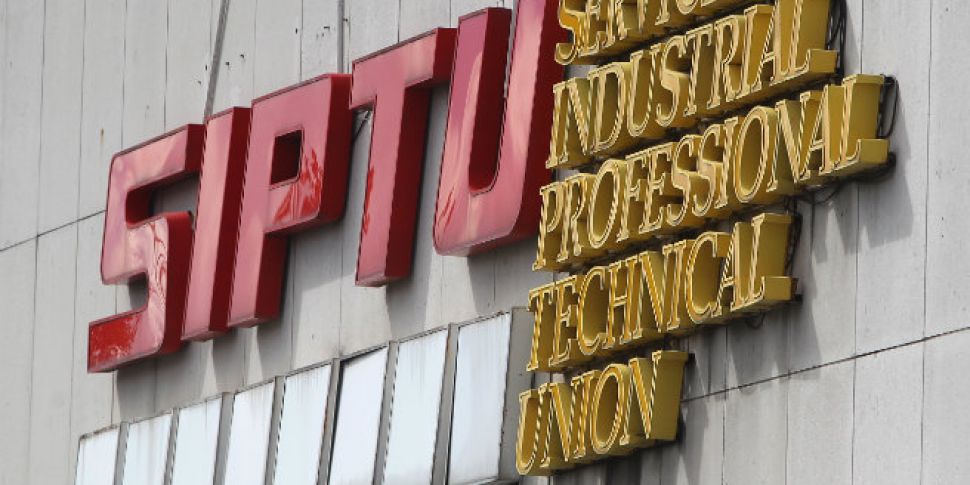
View of the title of SIPTU, the largest union in Ireland, on its Liberty Hall HQ. (image sourced: Internet)
ACTION
Two days later, after the employers and Government had failed to respond in the manner considered necessary by the trade unions, strikes, walkouts and pickets were called at many branches of all supermarkets, postal service depots and public outlets, call centres, public transport depots, construction sites, local authority manual and clerical services, pubs and hotels. The unions of the health service workers, a workforce under-staffed, under-funded and under huge pressure already, maintained a rota picket with placards and leaflets in front of major hospitals and the Department of Health in Dublin. Lawyers and barristers picketed the courts, calling for them to close. All pickets wore surgical-type face masks and disposable gloves, and had with them a mobile stand with a hand-sanitiser dispenser.
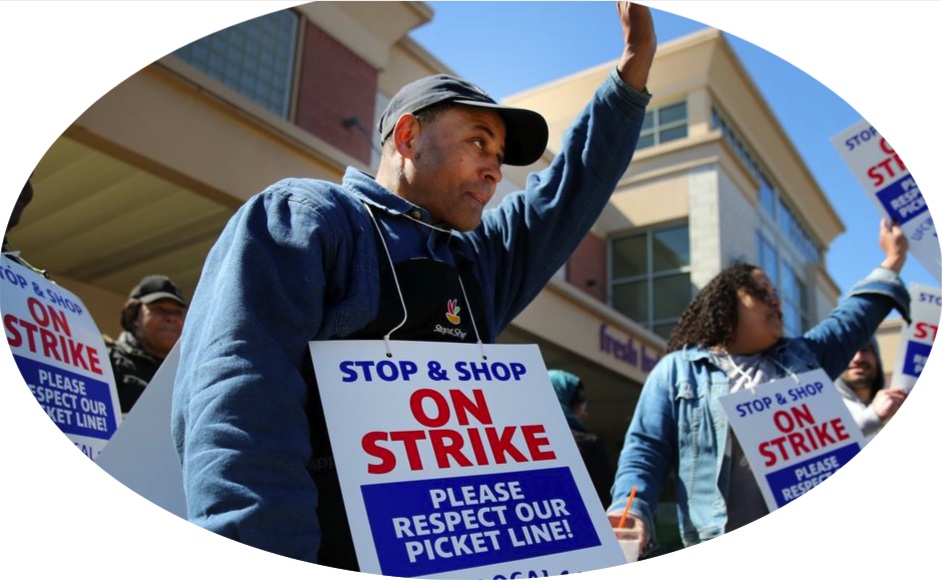
Workers on successful 10-day strike against the Stop & Shop supermarket chain in the USA last year. (image sourced: Internet)(image sourced on Internet and cropped)
By the end of that week, the public pressure on the supermarket chains was such that all had provided sanitiser dispensers for staff at work stations and for customers at entrances and exits, glass screens separated all staff work-stations from customers, staff needing to work in the public area were all wearing face-masks and gloves and a big badge asking people to keep a safe distance. Shelf-filling and price-tagging duties were confined to hours when no public were present. Queue lines were marked out with spacing between customers and periodic announcements instructed
(image sourced: Internet)
customers on safety precautions. Numbers of shoppers inside were restricted at any one time and lines outside marked required spacing for people queuing outside. All staff were being given health precautionary instructions for a half-hour daily through interactive screens.
Furthermore, all main employers had published a list of their precautionary measures and were updating them in response to representations from unions, the general public and Government instructions or recommendations.
Workers in all main public services had been issued precautionary instructions, face-masks, disposable gloves and hand-sanitiser and workers in some particular conditions had protective suits.
CONCLUSION
That is what could have happened and would have had an early restrictive impact on the spread of the virus to the public and to workers who provided a public service. The unions had the organisational and communication capacity to to do that. They didn’t do it – it didn’t happen.
Many of the measures indicated above – but by no means all – were taken but weeks later — and none at trade union initiative: unofficial workers’ action, voluntary company action and government order were the means by which they came into being. By that time, many front-line workers and members of the public had been infected.
The trade unions in Ireland, having already failed their members and the working class in general through two decades of “social partnership” (when a healthy “social distancing” would have been more appropriate!), followed by failure to resist (and collusion with) austerity measures, failed once again in anti-virus protection of their members and of the public.
Some left-wingers say we should not mention these shortcomings since average trade union membership is low and this kind of discourse will hardly help union membership recruitment. But if unions cannot or will not respond adequately and in timely fashion to the needs of their members in particular and to working people in general, why should people be expected to join them? Trade union membership is falling for a reason.
Perhaps these left-wingers feel that the current unions should not be criticised, without a viable alternative having being put in place first. But what are they doing to provide that viable alternative? The answer is clearly nothing, or as near to that as makes no effective difference.
Logo of Unite the Union, operating in Ireland and in Britain. (image sourced: Internet)
THE FORBIDDEN DISCUSSION
There is silence on this question from the broad Left, including those parties claiming to be revolutionary. When individuals raise the issue, it is not addressed or the individual is censored.
It is time to end this self-censorship on the Left and to proclaim loud and high that the trade unions in Ireland, despite the presence of many genuine activists, are generally not fit for purpose. What do we do instead? First, admit the problem and its scale – then we can discuss possible remedies. The patient cannot be cured if we refuse to admit the illness and the stage it has reached.
(image sourced: Internet)
Some of the left-wingers are now saying that this crisis has exposed the unsuitability for society of the capitalist system and that when it is over, that lesson must be put into practice and essential services become national public services. Apart from the weaknesses in this solution, one must ask: who is going to make this happen? If the capitalist system opposes this change, how will the capitalists and their State be overcome? A social revolution without a mass working class organisational base is not possible.
End.
APPENDIX
Irish Congress of Trade Unions (ICTU)
There are currently 55 trade unions with membership of Congress, representing about 600,000 members in the …. (Irish state). Trade union members represent 35.1% of the Republic’s workforce. This is a significant decline since the 55.3% recorded in 1980 and the 38.5% reported in 2003. In the Republic, roughly 50% of union members are in the public sector. The ICTU represents trade unions in negotiations with employers and the government with regard to pay and working conditions (from Wikipedia)
Main trade unions
SIPTU: “… is the largest Union in Ireland with over 180,000 members.
SIPTU represents workers in both the public and private sector in almost every industry in Ireland and at virtually every level. SIPTU caters for full-time, part-time, permanent, contract and temporary workers, as well as retired and unemployed members.” (from SIPTU website)
“Fórsa is Ireland’s newest trade union with over 80,000 members. …. represents members in the public service, as well as the commercial sector, state agencies, some private companies and in the community and voluntary sector.
“Fórsa is the second largest union on the island of Ireland and by far the largest trade union voice in the Irish civil and public service.” (quoted from Forsa’s website)
The Connect Trade Union is the largest Engineering Union in Ireland and the second largest in manufacturing representing up to 40,000 workers.
The Irish National Teachers’ Organisation (INTO), founded in 1868, is the oldest and largest teachers’ trade union in Ireland. It represents 40,633 teachers at primary level in the Republic of Ireland and 7,086 teachers at primary and post-primary level in Northern Ireland. Total membershipis 47,719 (August 2019).
The Teachers’ Union of Ireland represents over 17,000 teachers and lecturers in Ireland engaged in Post-Primary, Higher and Further Education. The Union is made up of 62 branches in 19 areas. (quoted from TUI website).
The International Transport Workers’ Federation (ITF) is a democratic, affiliate-led federation recognised as the world’s leading transport authority. ….. connecting trade unions from 147 countries …. We are the voice for 18.5 million working men and women across the world” (ITF website).
“Mandate is a union of over 40,000 workers across Ireland.”(Wikipedia)
Unite the Union, commonly known as Unite, is a British and Irish trade union, formed on 1 May2007, by the merger of Amicus and the Transport and General Workers’ Union. With just over 1.2 million members, it is the second largest trade unionin the UK (Wikipedia).
Garda Armed Support Unit patrol car, one of a great many seen driving around many parts of Dublin including the city centre. (Image source: Internet)
Last year, a Garda shot dead a man sitting inside a car who was harming himself with a Stanley knife. In June 2019 the Department of Public Prosecution decided not to even charge the Garda who fired the shot. What does this mean?
Since the evidence from witnesses (including his own colleagues) is that Garda A fired a deliberate shot at close range that killed Mark Hennessy through a closed window and that the man was not at that moment posing a threat to anyone (apart from himself), never mind a lethal one — how can we view this as anything but an on-the-spot execution by a Garda? Since we are told that Gardaí are not authorised to carry out executions (and the State has abolished the death penalty), what can this be but MURDER?
It is useful to remember too that the founders of the Irish State deliberately resolved to set up the Garda Síochána as an primarily unarmed police force (in direct opposition to the armed colonial police forces that had suppressed Irish people in the past and continued to do so in the Six occupied Counties).
Not even charged? For the moment, we need to forget about the fact that all the evidence points to the victim having murdered a child and hidden her body. Killing the man could not bring her back (in fact might even have prevented her body being found but luckily the location was written on a piece of paper inside the car).
How can this killing be justified? What possible legal reason can be given? Dubious though it may be, the Gardaí who shot Mac Lochlainn (see below) at least claimed he had pointed a gun at them (interestingly, the officer who fired the fatal shot was himself killed a few years later in what was described as a firearm accident involving a colleague). Well, in fact, in the Mark Hennessy killing NO REASON WHATSOEVER WAS GIVEN. The DPP just “decided not to prosecute”.
Garda of the Armed Response Unit with machine gun. (Image source: Internet)
If a Gardaí can decide when someone needs to die and act upon that decision, anyone might be a victim in future: political activist, whistleblower, personal enemy, mistaken identity ….
Unlikely? Why?
There have been a number of questionable killings by Gardaí, including the shooting dead of Real IRA Volunteer Ronan Mac Lochlainn on May 1st 1988. Mac Lochlainn was driving away from a Garda Special Branch ambush of a robbery team when he was shot dead by the Gardaí. The matter was not seriously investigated until 20 years later when the investigators decided for whatever reason to clear all the Gardaí involved, leaving many important questions unanswered.
Another incident that might have ended fatally occurred in 2005 between two drunken senior Gardai who got into a fight and pulled guns on one another! A personal quarrell ….
Armed Gardaí Detectives after a raid. (Image source: Internet)
One can see on any day in Dublin the vehicles of the Garda Armed Response Unit driving around the city. Nor do they restrict themselves to the duties for which one might imagine Gardaí would need to carry arms. They have been seen stopping cars in traffic incidents, driving through busy streets, surveilling political demonstrations and even on one occasion last year stopping to caution people demonstrating against internment in Temple Bar.
In 2014 they turned up at a protest against Irish Water in Clonmell. On another occasion last year they turned up to dispute between a private landlord and two of his tenants in Dublin and at a separate housing occupation action in Cork. Last year also they attended a farmers’ protest in Limerick.
Is the Irish public being subjected to an armed Gardaí normalisation process? Why are the DPP not being made to justify their decisions not to prosecute Garda perpetrators of homicide? How long before another unjustifiable killing?
On 15 February Ferriter’s column in the Irish Times expressed the opinion that comparison of Sinn Féin with Fianna Fáil in the 1930s only takes us so far. After looking at less of the overall history of the main Irish parties than I had in my article of 11 February in Rebel Breeze but adding some pieces I had not, what was his conclusion that differed so widely from mine? Well, that the military past was too new with SF!
Diarmaid Ferriter in Thinker pose (Source: Internet)
But, actually, not true of Provisional SF with regard to FF, which came into government in 1932, less than two decades after the end of the Civil War and only six years after its split from Sinn Féin. De Valera, President of Fianna Fáil, had been a leader of the Republican side in the Civil War, from which side came the majority of Fianna Fáil’s supporters. By the time PSF gets into Government, it will be LONGER than two decades since Provisional IRA gave up its armed struggle!
On 11 February I posted an article of mine on Rebel Breeze and from there on to Facebook, making the point that, despite hostile media and politician claims to the contrary, Sinn Féin is very like the main Irish political parties – and that that is not a good thing. I traced the main elements of the parties’ history, how they had changed their positions and I elaborated the point that the main difference in their trajectories is that SF’s arrival on the neo-colonial capitalist political field was just more recent.
Meeting of Provisional Sinn Féin’s Ard-Choiste (national executive) in February 2020. (Source photo: Niall Carson, AP, Internet)
It is worth noting (a point I had omitted in my piece) that nearly the entire Fianna Fáil government Cabinet in 1932 was composed of Civil War IRA men and that most of the remainder had been in Free State prison during that war.
It is said that imitation is the sincerest form of flattery but I can easily avoid being pleased by Ferriter substantially following my line of historical analysis. This is the man who, during the 2016 High Court hearing about the Government and property speculator plans for Moore Street, wrote a nasty attack on the demonstrators who had occupied the buildings and subsequently blockaded them against demolition. If he had been hoping to influence the High Court’s decision he failed – and spectacularly, because the judgement was that not only the buildings but the whole quarter is a 1916 historical monument.
Frank McDonald had also written an opinion piece during the trial against conservation and the demonstrators in the same newspaper (what WAS the Irish Times up to?) but after the judgement, he had the grace to apologise (sort of: he wrote that he had been in error).
Why doesn’t SF just step back and wait for whatever government is formed, hammer them from the opposition benches and wait for the next General election (which might well be in the Autumn)?
Sinn Fein President Mary Lou McDonald and Micheál Martin, leader of Fianna Fáil. (Images source: Internet)
There are 160 seats in the Dáil, the Lower House of the Irish Parliament. Mícheál Martin, leader of the Fianna Fáil party (38 seats), tells Mary Lou McDonald that he won’t go into coalition with her party Sinn Féin (37 seats) and she rages at him. Fine Gael (35 seats) wants to go into coalition with Fianna Fáil – but at a price. Eoin Ó Broin of SF admits the numbers don’t add up for a coalition of the Left (couple of surviving TDs from Left parties and independents led by SF) which was clear before Sinn Féin (and some on the Left) even started talking about it.
The main reason for the weakness of the Left in the Dáil is that the Irish Labour Party, founded by Connolly, Larkin and others, has degenerated to a remarkable degree. Another reason is that as a result of centuries fighting colonialism and concentration on the national question, there has never been a substantial nationwide party or grouping of the Left in Ireland. Also some left-wing TDs (members of the Dáil) actually lost seats in the general election this month.
On Monday I think it was, the Guardian published and I shared what I thought was a brief and fair analysis of the results and of the possible coalition governments and even suggested that SF would be wise to let the established parties flounder in government and beat them in the next election. After all, most commentators seem to agree that if SF had fielded more candidates, they would have got even more seats, an error they can remedy next time.
A LEFT COALITION NEXT TIME?
Of course, that might not be anywhere near 81 seats, the number for an overall clear majority – but a Left coalition majority would be more possible then. Besides, they could form a Left platform to go intothe next election, which would give a lot more transfers of votes and possibly get more people elected from the Left too.
But instead, Sinn Féin are chomping at the bit and their eagerness to get into Government right now, even in coalition with neo-liberal capitalist and neo-colonialist parties, is disturbing.
Why do I care? After all, I am not a SF supporter, nor even of any of the Left parties – a revolutionary, in fact, not a reformist. But that doesn’t mean I would not welcome some reforms nor, more to the point, that I don’t see how the people are crying out for them. Like an immediate building program of public housing and an effective overhaul of the health system (both linked to youth training and employment). A defence and development of our natural resources and services. Saving Moore Street from “development” by vultures. Abolition of the no-Jury Special Criminal Courts (which SF seems to be retreating from already before they even got a Government coalition offer).
I could list many more but what’s the point?
If what we get is a coalition government led by Fianna Fáil or even containing Fine Gael – forget it! And if SF is not prepared to play a longer game and the Left is not prepared to put together a platform package, then the longer-term hope of revolution becomes the only viable one for the shorter term.
End.
Leinster House, location of the Oireachtas (Irish Parliament). (Photo source: Internet)
“Sinn Féin is not like other Irish political parties” goes the propaganda campaign against the party by media commentators and rival mainstream politiciansduring the elections. What nonsense! It is exactly like the other main Irish political parties – and that’s the problem.
Their opponents’ main objection seems to be that Provisional Sinn Féin was widely seen as the political wing of the armed resistance group Provisional IRA and, although the IRA have dissolved and decommissioned their weapons, the party still carries that mark in the eyes of its detractors (and, it must be said, fondly in the eyes of some of its supporters).
This propaganda campaign is acutely unhistorical. A few short lessons in Irish history might be of use here.
The Irish Labour Party was founded by, among others, the revolutionary socialist James Connolly and anarcho-sindicalist Jim Larkin. In 1913 both advocated arming union workers to resist armed police attacks. In 1916, the Irish Citizen Army they founded was part of the armed Rising and two of their leaders were among the 16 executed by British firing squads.
The party stayed neutral during the Civil War and was an opposition party to the Cumann na nGaedheal government. Since then, the Labour Party has been in Government only as a coalition partner – most times with the right-wing Fine Gael party. Except for it links with trade unions, the party has little claim to having “Labour” in its name and has turned away from everything if which its founders believed.
Fine Gael was formedin 1933 when two smaller groups joined Cumann na nGaedheal, which had been the governing party of the partitioned Free State from 1923 up until the merger. Michael Collins and his followers were the kind of people The founders of Cumann na nGaedheal were among the pro-Treaty and Free State supporters, i.e people who until then had been active in leading or supporting a campaign of armed resistance to the occupying British forces, including assassinations, ambushes and robberies. The Free State began the Civil War in 1922 by an artillery bombardment of Republican positions in Dublinand over the next few years carried out repression on the civilian population, torture, summary executions of prisoners of war as well as State executions – and assassinations. The victors handed the reins over to Cumann na nGaedheal in 1923.
The parties that joined Cumann na nGaedheal in 1933 were 1) the National Centre Party, essentially a big farmers’ quasi-fascist party and 2) the Army Comrades Association (the fascist “Blueshirts”). Of the mainstream Irish political parties, Fine Gael has stayed truest to its founders and base.
Fianna Fáil emerged from a split from Sinn Féin in 1926; interestingly, much of what is being said against Sinn Féin by establishment political commentators now – and worse — was said then about Fianna Fáil: “murderers”, “revolutionaries” (and even “Communists”!). The party first entered power in 1932, its leader De Valera having been — little more than a decade previously — a leader of the Republicans during the Civil War, opponents of the Treaty and of the Irish Government of the time. It freed the Republican prisoners locked up by the Cumann na nGaedheal government, also having a special police force (“Broy’s Harriers”) to persecute the Blueshirts, who aspired to taking power as had Fascists in Europe.
Cumann na nGaedheal (forerunner of Fine Gael) poster against Fianna Fáil during 1930s. (Image sourced: Internet)
By 1939, the Fianna Fáil government had introduced the savage repressive legislation of the Emergency Powers Act to intern republicans without trial and after a successful habeas corpus challenge by Seán McBride (one of the founders of Amnesty International), the Government brought in the Offences Against the State Act, was re-arresting Republicans and interning them without trial again (around 2,000). Two Republicans died on a hunger strike protest in Mountjoy Jail. Under Fianna Fáil the State executed six Republicans and some more are alleged to have died as a result of their treatment in the concentration camp.
In 1957, a Fianna Fáil government once again brought internment without trial into force, the colonial administration of the Six Counties having done the same the year previously. The last prisoner was released by FF in 1959.
Left: Cumann na nGaedheal poster urging votes against FF because of the party’s history. Right: Fianna Fáil poster appealing to the working class and small farmers. (Image sourced: Internet)
From having been seen as the main political party of Irish Republicanism, Fianna Fáil became in a short time the preferred party of the Irish capitalists (the “Gombeen” class) and has been in government more than any other party, more often indeed than the party that won the Civil War and set up the State.
JUST LIKE ANY OTHER IRISH PARTY
There is no historical basis for saying that Sinn Féin is very different from the other Irish mainstream political parties. It has traversed a similar path to all those others, perhaps most similarly to Fianna Fáil – it’s just a more recent arrival on the mainstream scene. It is already very like other main Irish political parties and is getting to be exactly like them.
Leader of the Sinn Féin party, Mary Lou McDonald, at the launch of the party’s manifesto. With no intention of overthrowing capitalism it promised reforms for working people. (Photo source: Internet)
That is not a compliment.
This is a party that, in recent decades, had a revolutionary Irish republican – or at least nationalist – position. It strongly opposed the partition of the country and the colonial occupation of one-sixth of the nation’s territory. With the latter came — naturally enough — opposition to the colonial police force, the Royal Ulster Constabulary but this was much more than an ideological opposition: the RUC was an armed force created specifically for the repression of Irish Republicans and acted consistently against the Catholic minority in the Six Counties, which SF sought to represent and among which it organised.
The colonial Statelet itself, with its gerrymandering of electoral boundaries, sectarian allocation of housing and employment and its Special Powers Act, was the sworn enemy of the Sinn Féin party. And when British troops were sent in 1969 to repress the civil rights uprising, of course Provisional Sinn Féin and Provisional IRA fought them too.
The Provisional IRA gave up armed struggle against the British in 1998 and, although it maintained its armed force for control of its community for some time afterwards, eventually dissolved its organisation. By then it had already decommissioned its weapons.
Martin McGuinness (right) of SF, formerly of the IRA, as Deputy Prime Minister of the British colony of the Six Counties. He partnered the Prime Minister Ian Paisley (left), a rabid religious sectarian, Christian fundamentalist and homophobe. They were dubbed “the Chuckle Brothers”. (Photo sourced: Internet)
In 2007 the SF party became part of the British colony’s administration in Stormont, with Martin McGuinness, former chief of the IRA in Derry, partnering Ian Paisley, notorious Loyalist religious sectarian and social bigot.
That same year the party agreed to support the armed and sectarian police force and in the reorganisation of the RUC had the name changed to “the Police Service of Northern Ireland”. The essence of the force, naturally, remains the same.
All the austerity measures inflicted on the working class by the administration since the party entered joint government of the colony have been approved by Sinn Féin MLAs.
Martin McGuinness publicly shaking hand of British colonial Queen when SF officially opposed the visit. However SF did not demonstrate against her visit and Gerry Adams later approved of it. (Photo sourced: Internet)
In 2011, despite an official SF policy of opposition to the visit of the Queen of England, Commander-in-Chief of the British Armed Forces, to the 26 Counties (the Irish state), leaders greeted her (one in person) and urged no protests be made against her visit.
In 2019, SF welcomed Prince Charles on a two-day visit to the colony and to the State; this man is not only son of the English Monarch but ceremonial commander-in-chief of the Parachute Regiment, authors of the massacres of Derry’s Bloody Sunday (14 dead) and Ballymurphy (11 dead) for which not a single soldier or commander has ever been tried. The SF Mayor of Derry, however, refused to meet him.
Gerry Adams shakes hands with Prince Phillip, titular head of the Parachute Regiment (the SF Mayor of Derry refused to meet him). (Photo sourced: Internet)
This year, 2020, the Six-County part of the leadership of Sinn Féin joined others in publicly seeking recruits for the PSNI, while the 26-County leadership withdrew from its previous position of seeking abolition of the repressive emergency powers of the Offences Against the State Act.
In the 26 Counties, SF long ago indicated its willingness to join in a governing coalition with some one of the other mainstream political parties: i.e capitalist, neo-colonial political parties.
On so many occasions, it has shown itself to be like the other parties and prepared to ditch formerly-declared principles for what it considered a political advantage, proving itself a “safe pair of hands” to the rulers of the system.
Yes, Sinn Féin is indeed a party like any other Irish mainstream political party: capitalist, neo-colonial, undemocratic and supporting State repression. As to the latter, why not? It won’t be SF that the State will be repressing — it’ll be Irish Republicans. And if SF ever get where they want to, into majority control of government – they’ll have plenty of opponents themselves to drag before those non-jury courts.
End.
L-R: PSNI Chief Constable Simon Byrne, Anne Connolly, Chairperson of the NI Policing Board, Gerry Kelly MLA, Deputy First Minister Michelle O’Neill and Deputy Chief Constable elect, Mark Hamilton at recruitment launch for the colonial police force.