PART 2: COLLECTING THE FORCES FOR REVOLUTION

Diarmuid Breatnach

(Reading time this section: 2 minutes)

(Part of series “HOW TO WIN THE WAR  — GETTING INTO POSITION”.  See also INTRODUCTION; PART 1: THE THIRTY-YEARS’ WAR – DOOMED TO LOSE;                      PART 3: THE ABSOLUTE NEED FOR UNITY – BUT HOW AND WHAT KIND? WITH WHOM? PART 4: UNITY AGAINST REPRESSION

A successful revolution in Ireland, as in most places, would require the involvement of a mass movement. That mass movement would be unlikely to be one that had national self-determination as its only aim – certainly not in the 26 Counties (the Irish state). Mass movements arise at times around different issues and exist as long as the issue does or instead until the movement gets worn down or broken up. Such movements arose around the Household Tax and, later, around the additional Water Charges.

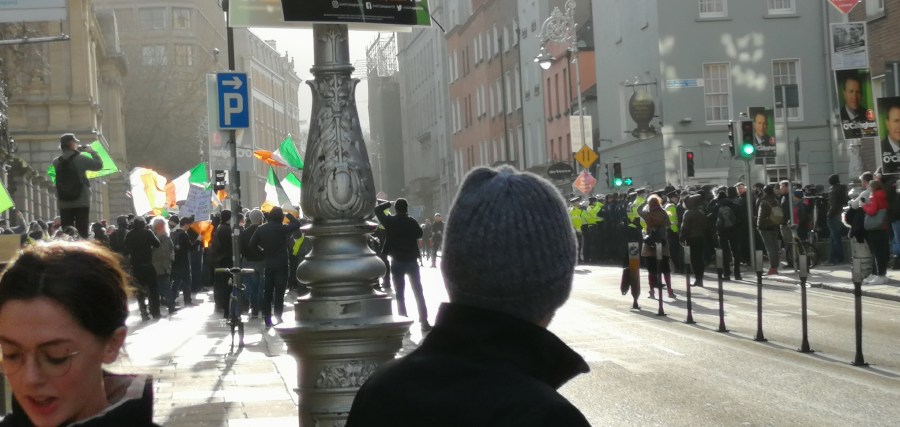
Water Protest Long View 29 Aug 2015
Section of protest against water charges, O’Connell Street, Dublin, 29 Aug. 2015 (Image source: Internet)

Even though the objectives of such movements are often not revolutionary, the participation in them by revolutionaries is necessary if, in the future, there is to be a revolution. Revolutionary activists can make contacts and prove themselves by the way they participate and also regularly point out that a revolution is necessary in order to resolve all these issues completely and permanently. Such activists can also influence the movement (or sections of it) to act in more revolutionary ways, so that the movement can be guided by – and imbued with — revolutionary spirit.

Working people in struggles come up against concrete problems which need to be resolved in order to move forward. Prior to 1913 in Ireland, workers learned the need for unity in struggle which was emphasised by the employers’ attempts to break the Irish Transport and General Workers’ Union in August 1913. The attacks on them by the Dublin Metropolitan Police illustrated the need for organised defence and Larkin and Connolly called for the formation of what became the Irish Citizen Army, which later also fought prominently in the 1916 Rising.

Packed Workers Liberty Hall 1913
Members and supporters of the Irish Transport & General Workers’ Union cheering outside the union’s HQ, Liberty Hall, August 1913. Later the union formed the ICA to defend themselves from the DMP; the ICA took a prominent part in the 1916 Rising. (Image source: Internet)

Trade unions are the only mass organisations of the working class in Ireland and it is necessary for revolutionaries to be active within them. Currently, other than social democrats, it is mainly members of both trotskyist parties and independent activists who engage politically with the trade unions. Those members are mostly in clerical work and their political work tends to concentrate on employment demands around wages and working conditions. When they introduce politics it is generally to get some motion passed by their branch. Also at times, they will campaign to get a perceived left-wing candidate elected to some position within the trade union bureaucracy.

None of the above are without value but they remain disjointed in terms of program and often confined to just one trade union. Not only that, but often the Left party involved will engage in order to recruit some new members and in order also to retain their own members by providing them with activity. When broad front trade union groups are formed, they tend to become an arena where the dominant trotskyist parties compete for dominance.

If we are to have a successful revolution – and in particular a socialist one – participation in the struggles of workers in the trade union movement is absolutely necessary. But participation should be primarily among the rank and file of the trade union and also across trade unions, focused on providing solidarity to members of whichever unions are in struggle – in addition to encouraging unorganised workers to organise and become active. The objective is not to help make one trade union or one section more militant but rather to create a militant workers solidarity movement within the whole trade union movement. It is essential to have members in the ‘blue-collar’ work unions or departments as well as in the clerical unions or sections. And the cross-union organisation I advocated should be independent — the preserve of no political party.

Participation in such struggles provides an opportunity for revolutionaries to make contact with people who are activists but not yet revolutionaries and to give those people an opportunity to evaluate the revolutionaries in terms of their actual practice. Revolutionaries can support the people struggling for worthwhile reforms while at the same time pointing to their partial and temporary nature. Revolutionary activists can play an educational role in the mass movements while at the same time becoming educated themselves by the daily reality faced by the masses in this system.

PART ONE: THE THIRTY-YEARS’ WAR – DOOMED TO LOSE

(Reading time this section: less than 5 minutes)

Part of the series HOW TO WIN THE WAR — GETTING INTO POSITION

See also:

INTRODUCTION: https://rebelbreeze.wordpress.com/2019/08/07/how-to-win-the-war-getting-into-position/

PART TWO: COLLECTING THE FORCES FOR REVOLUTION https://rebelbreeze.wordpress.com/2019/08/07/part-2-collecting-the-forces-for-revolution/

PART THREE: THE ABSOLUTE NEED FOR UNITY – BUT HOW AND WHAT KIND? WITH WHOM?

PART FOUR: UNITY AGAINST REPRESSION

The national liberation war that began in 1969 in the Six Counties and ended in 1998 (though some armed incidents continue from time to time) began as a civil rights struggle and changed into a war of communal defence and of national liberation. The military part of the struggle for the most part took place in the occupied Six Counties. The political element of the struggle was waged all over Ireland (and abroad) but in the main consisted of support for the struggle in the Six occupied Counties.

Free Derry Corner Gas Mask Images
Derry Monument and Mural of the Civil Rights struggle which preceded the armed struggle in the Six Counties. (Image sourced: Internet)

Fought in that way, the struggle was bound to lose. It could never win. How could anyone imagine that they could win a struggle fought against a world power in one-sixth of the country, where even the population there was divided against them? What could they have been thinking?

To my mind, there are only two possible sane replies to that question, which is that they believed: 1) that the British ruling class would get worn down by struggle and leave and/ or 2) that the Irish ruling class would intervene in some way to assist the struggle and make continued British occupation untenable.

1) ‘The British ruling class would get worn down and leave’: This theory must have depended on British repression being condemned abroad and being unpopular at home but had to rest fundamentally on the British having no great stake in continuing its possession of its colony there.

Anyone who thought that (and there were many who did and still many who do, not just Irish Republicans) made a fundamental error. Time and again the British ruling class has shown its determination to hang on to what might be considered its first colony, even as its ruling class’ composition changed from feudal-colonialist to capitalist-imperialist and as the world changed around it.

Collusion State Murder Mural
Mural in nationalist area in the Six Counties (Image sourced: Internet)

Even when the British ruling class, weakened by WW1 and facing an Irish guerrilla war with the support of the vast majority of Irish people, with national liberation uprisings breaking out across its Empire and with its repression in Ireland increasingly unpopular at home, entered into negotiations with the Irish resistance, it held on to a foothold, the Six Counties.

Subsequently, it had that colony managed in a permanent state of emergency laws, with institutionalised sectarian discrimination at all official levels and outbreaks of pogroms in the street and workplace.

That became even more exposed during the civil rights struggle and the national liberation war that followed when the British State compromised whatever good international reputation its Armed Forces had, its judiciary, its legal establishment, its media and its very legal framework.

Even now, when many believe that the Good Friday Agreement means that a 50% plus one vote in favour in the Six Counties will be sufficient to end Partition, they do not realise that such a decision will have to also obtain a majority in the British Parliament and be endorsed by the British Monarch. They are also forgetting the broken promises that surrounded Partition in the first place.

When analysing what holding on to the Six Counties has cost the British State in terms of reputation, military and financial contributions, one can only rationally assume that continuing to hold on to that foothold is of great importance to the British State. One may speculate as to the reasons underlying that but the central fact cannot be denied.

2) that the Irish ruling class would intervene in some way to assist the struggle and make continued British occupation untenable:

There was some basis for this belief in that a section of Fianna Fáil, a party that had emerged from a split in Sinn Féin in the 1930s and had become one of the mainstream parties in the Irish state, had retained some traditional commitment to seeking a united Ireland. However it was a thin enough basis on which to depend in a national liberation struggle since that section had no majority within the party itself, to say nothing of the foreign-dependent nature of the Irish native capitalist class, the Gombeens, as a whole.

British Soldiers Helmeted Belfast 1969
British Army in Belfast 1969 (bayonets and guns pointed towards nationalist area). (Image sourced: Internet)

The question came to a trial of strength in the Arms Crisis of 1970, in which at least two Fianna Fáil Government Ministers were involved in secretly buying arms for the defence of nationalist areas in the Six Counties (since the IRA had insufficient weapons at the time) from rampaging Loyalist mobs and the Royal Ulster Constabulary (including the part-time B-Specials). The Ministers alleged that they had acted in the full knowledge of the rest of the Government. By the time the whole affair was over, two Ministers had been sacked and another two resigned in protest.

If it had not been clear before that the Gombeens, the native Irish capitalist class was no patriotic capitalist class but rather a neo-colonial one, it should have been clear after that. But the armed struggle in the Six Counties intensified, especially after the massacres of unarmed civilians carried out by British Paratroopers the following year, 1971 in Belfast and again in Derry in 1972. And the war lasted until 1998.

If, as had been demonstrated to be the case that the British ruling class were determined to hold on to the Six Counties and the Irish ruling class was not going to seriously challenge that possession, did the Republican movement have any other option than to fight on a war that they could not possibly win?

I am clear that they did.  

Clearly, in order to have a chance of success, the war had to be extended to the other five-fifths of the country, which is to say into the territory under the control of the Irish native capitalist class. This class had seized power after the War of Independence 1919-1921 and had beaten and suppressed its opposition during the Civil War (1922-1923) and after and furthermore was supported by a powerful ally, the Irish Catholic Church. Since the founding of the first Irish Republican organisation, the United Irishmen of the late 1790s, the Catholic Church hierarchy had opposed Irish Republicanism; it had condemned four Irish priests who participated in the uprising of 1798, excommunicated the Fenians, had at first condemned the 1916 Rising and the War of Independence only to latch on to it at the end along with the Gombeen class.

The general Irish

population likely would not have supported or sustained an armed struggle in the 1970s against the Gombeen class but that class could have been fought politically, through agitation and mobilisation, on many social, political and economic fronts. Without going into the specific details of each, these were:

  1. against the huge wastage of Irish youth through emigration

  2. to remedy the shortage of affordable housing (which in part contributed to the above)

  3. to end unemployment (also contributing hugely to emigration)

  4. to raise the level of wages and lower wage earners’ taxation

  5. for the right to divorce

  6. for equality for women in law

  7. for the right to contraception devices and medication for men and women

  8. against decriminalisation and for equal rights for gay and lesbians

  9. to halt the decline of the Irish language, in particular of the rural Irish-speaking areas

  10. to improve services for the rural areas

  11. to oppose the open-door policy for foreign multinationals to exploit Irish natural and human resources

  12. to secularise the education service

  13. and the health service.

  14. to remove the privileged status of the Catholic Church within the state.

The Republican movement in general, with some exceptions, declined to take on any of those struggles. They did not organise in the trade union movement, left the social struggles to others and most of all, declined to take on the Catholic Church on any issue except its opposition to the national liberation struggle. Even there, it was happy to publicly avail of the services of members of the Church clergy who supported them. Republicanism was, from its very beginning, as well as anti-monarchist, about separation of Church and State but it was difficult to see that in the Irish Republican movement, particularly after the War of Independence.

Irish Womens Liberation Connolly Station
Irish women photographed at Connolly Station 1971, about to board train to Belfast to purchase contraceptives to bring back to the Irish state, illegal at the time. There was no right to abortion either or divorce and a husband’s signed permission was necessary to take out a hire purchase agreement. (Image sourced: Internet)

A full half of those fourteen points above (nos. 5,6, 7, 8, 12, 13 and 14) would have meant taking on the Church head-on and no doubt the hierarchy would have hindered the struggle over most of the others too, due to its strong links with the State and its ruling class.

Because of its tactical and no doubt ideological refusal to take up those struggles, the Republican movement could do little more in the 26-County state than to agitate for solidarity with the beleaguered nationalist population inside the British colony.

Though this could be effective for a time it could become a mass movement, nor survive a long struggle, without any remedy being sought to the issues facing the population within the state.

The wonder is not that the majority leadership of the Republican Movement threw in the towel on the military struggle in 1998 but that they had waited so long to do it. Of course, they never admitted the true nature of what they were doing: abandoning the armed struggle and revolution in total and instead, using their negotiating position to advance themselves politically – not in the economic, social and political struggle envisioned above but rather in a political struggle to find themselves a place among the Gombeen political class in the Irish state and as accomplices in the governing of the colonial state.

Diarmuid Breatnach is a veteran independent revolutionary activist, currently particularly active in committees against repression, in some areas of internationalist solidarity and in defence of historical memory.

HOW TO WIN THE WAR – GETTING INTO POSITION

(Reading time: Introduction, one minute; Part One: 5 mins; Part Two 2 mins: Part Three: 3 mins; Part Four: 2 mins; Total: 13 mins.)

Diarmuid Breatnach

INTRODUCTION:

Although I often think about the big questions – and am generally guided by my philosophy on them, my mind and energy are usually too occupied with specific struggles to focus on them for long. Recently however I had the opportunity and the need to think about the war, the one we have yet to win.

Storming Bastille Painting Jean-Pierre Houel
The Storming of the Bastille (translation), French Revolution, 1789 by Jean-Pierre Houel. (Image sourced: Internet)

But to which war am I referring? The Irish war of national liberation that has been flaring up for centuries, being lost each time before flaring up again? Or the class war, which has had a few sharp Irish episodes but has been, for the most part in Ireland, in abeyance? The answer is BOTH, though it may seem that my emphasis in the discussion, certainly in the early part, is on the national liberation war.

Communards Paris Barricade 1871
Communards at barricade, Paris Commune 1871. (Image source: Internet)

In order to imagine how we might win, it is helpful to examine past struggles and analyse what went wrong with them. Pessimists love to focus on those things I know – but in order to push us towards reformism or just surrender; my approach instead is from a revolutionary perspective.

Generally, Socialists analysing the class struggle don’t even ask themselves why we have not had a revolution yet.

From week to week, month to month, they tend to focus on this or that particular trade union or social struggle but without going into the big picture. It seems as though they can’t even imagine a socialist uprising in Ireland, it’s just too far away to think about, apparently. But if one can’t even imagine such a revolution, how could one consider the necessary steps to get there?

Defeat Rebels Vinegar Hill Drawing George Cruikshank
“Defeat of the Rebels at Vinegar Hill” by George Cruikshanks, i.e United Irishmen last major position in Wexdord overrun, 1798.

Irish Republicans on the other hand are often thinking in terms of revolutionary struggle, usually including armed struggle. However it seems to me that Irish Republicans don’t like analysing past failures of the movement but when they do, their verdicts tend to be that the leaders betrayed the struggle or that taking part in public elections corrupted the movement; or that infiltration, spies and informers was the problem. And some other reasons. The thing is, although all those things played a particular part, they are not the fundamental reason.

Sections to follow:

PART ONE: THE THIRTY-YEARS’ WAR – DOOMED TO LOSE 

PART TWO: COLLECTING THE FORCES FOR REVOLUTION 

PART THREE: THE ABSOLUTE NEED FOR UNITY – BUT HOW AND WHAT KIND? WITH WHOM?

PART FOUR: UNITY AGAINST REPRESSION

Diarmuid Breatnach is a veteran independent revolutionary activist, currently particularly active in committees against repression, in some areas of internationalist solidarity and in defence of historical memory.

SPANISH SECRET SERVICE AND TERROR CELL: INCOMPETENCE – OR SOMETHING ELSE?

Diarmuid Breatnach

Recently the left-wing Spanish on-line newspaper, Publico, got a scoop on other media when it broke the story of the Spanish secret service and the terrorist1 cell in Catalonia, the one that carried out the killing spree in La Rambla in Barcelona in October 2017. Publico revealed that the head of the cell had been recruited as an informant while in jail on drug smuggling charges and that the secret service had helped him become an imam, a Muslim priest, in the province of Girona. Not only that but that they had the photos and mobile phone numbers of a number of the Ramblas terrorists and had been following them up to days before the attack.

Aftermath Rambla Attack
Aftermath of terrorist attack in the Rambla, Barcelona in 2017. (Photo image sourced: Internet)

So why had the whole lot not been apprehended? It’s a question many people are asking, along with the Catalonian and many foreign newspapers – but, strangely, only one of the main Madrid newspapers.

THE LEADER OF THE TERRORISTS WAS WORKING FOR THE SPANISH SECRET POLICE

          Abdelbaki Es Satty came to the Spanish State in 2002 and was around 44 years of age when he died in an explosion in Catalonia. According to Wikipedia,

Es Satty was implicated in the 2006 Operation Chacal, in which five Islamists were arrested for sending jihadis to fight in Iraq. From 2003 he had shared an apartment with Islamists connected to the Moroccan Islamic Combatant Group (GICM) and the 2003 Casablanca bombings.

In 2012, (he) completed a four-year prison sentence for drug trafficking in Castellón. While in prison, he is reported to have established a “special friendship” with Rachid Aglif, who was serving an 18-year sentence for his role in the 2004 Madrid train bombings.

He was convicted of drug smuggling in 2014 and was to be deported from Spain, but …… A successful asylum application in November 2014 facilitated him moving freely in the 26 EU countries of the Schengen area.

catalonia-bomber-leader-es-satty.jpg
Es Sattty, believed leader of the terror cell that carried out the attacks in Catalonia in 2017. He was an informant of the Spanish Secret Service (CNI). (Photo image sourced: Internet)

The suggestion in the Publico articles is that Es Satty was recruited by the Spanish secret service (CNI) while in jail and that they ensured that he was not deported, also that they assisted him in getting employed as an imam (a Muslim priest) at the mosque in Ripol in 2015, a post he suddenly resigned in June of 2017. Ripol is a town in the province of Girona, Catalonia.

Publico now reports that the CNI file on Es Satty has been “wiped”!

THE EVENTS

          On the evening of 16 October 2017, El Satys and another man were killed, presumably by a premature explosion while handling the material. There were over 120 gas canisters which appeared stored for a number of terrorist bombs. The explosion occurred in the town of Alcanar, the southernmost of Catalonia and almost on the border with the province of Valencia.

When other in the cell heard that El Satys had been killed and another with him while handling the explosives, it seems they decided on a ‘revenge’ spree to honour their ‘martyr’ and carried out the attacks on innocent civilians in Catalonia.

La Rambla is in Barcelona city centre, a medium-length wide street heading towards the port, with a tree-shaded pedestrian reservation down the middle, where stalls sell all kinds of ware and coffees, snacks etc. It is a favourite destination of tourists (and pickpockets).

Barcelona Rambla Packed
La Rambla, Barcelona, on a happier day.

On the late afternoon of 17 October, a member of the terrorist cell driving a van zigzagged down the Rambla, running down pedestrians and cyclists. During his escape from the scene, he hijacked a car and fatally stabbed the driver, bringing his total death-toll to 15 and injuring 131.

Later that evening, five men, apparently of the same cell, purchased knives and an axe and, at 1.00 am, drove into the Catalonian coastal town of Cambrils (not far from the popular tourist destination of Salou) and into a crowd of pedestrians, where they fatally stabbed a 63-year old woman and injured another six, before being shot by Catalan police. Four died at the scene and the fifth later of his injuries.

On 21st August, five days after the Alcanar explosion and four after the Barcelona massacre, the Rambla killer was fatally shot by the Mossos, the Catalan police, in Subirats, about 25 miles (40 Km) from Barcelona.

Initially, Catalan police believed the first violent event, the Alcanar explosion, had been caused by an accidental gas leakage but once they discovered the explosions and other events had occurred, connected them. Not only did the Spanish secret service, the CNI, fail to inform the Catalan police about the existence of this cell prior to the Alcanar explosion but it seems that at no time during the subsequent operations of the Catalan police did the CNI give them any information whatsoever.

Publico On Line Image
The on-line newspaper that broke the story. (Photo image sourced: Internet)

THE DIRTY WORLD OF STATE SECRET SERVICES

          Secret services penetrate cells and movements opposed to the status quo as a matter of course, whether they have an armed agenda or not. But when they do have such an agenda, typically they try to recruit some inside people for information, building up a wider and more detailed picture as time goes on. This takes time and meanwhile the informants’ ‘handlers’ will typically give their insider ‘asset’ money, protect him or her from prosecution, feed the informant’s fear or ego – or both.

As not-so-distant history shows with the British and US secret services (and probably all others around the world), these informants are permitted to break the law, even to kill, in order to keep up their cover. Yes and even to kill another, less-valued or more exposed informant, as the British had at least one informant do inside the Provisional IRA.

But it goes even further and informants or deep-cover agents also often act as agents provocateurs. They actually incite people around them to carry out armed actions. This can vary from encouraging them to attack where, unknown to the victims, the state forces are ready and waiting to kill them, as is believed happened at Loughgall, in occupied Co. Armagh in 1987. The informant can also be used to incite a group of political activists to carry out armed actions to facilitate the breaking up of the organisation2. Or to set off bombs that will, intentionally or not, kill uninvolved civilians, thereby losing insurgents popular support. Or that might set off inter-communal violence in an occupied country.

And religion-based organisations have long been recognised by secret services as useful opposition to leftist national liberation movements. Or against the USSR, for example, when the latter were invited into Afghanistan by the ruling circles. They may also be used to incite inter-communal violence in a country occupied by a foreign power or to help overthrow a ruling group which a foreign power wishes to replace with another more amenable to the power concerned — or in a country it wishes to invade.

The role of the Phalangist militias, Christian, in Lebanon is well-known, in their war against the growing power of the Muslim community. The CIA and Israel3 armed the Phalangists and encouraged them in their attacks Lebanese Muslims and on Palestinian refugee camps, not only against fighters but also massacres of the elderly, women and children. The CIA funded, supplied and even often trained Islamic fundamentalist jihadists4 and warlord bands in Afghanistan, Al Qhaeda among them, as they did also in Iraq. They did it in Syria too but ended up having to fight one such jihadist group, ISIS, which threatened to take the whole cake and the commanders of which were unpredictable in terms of future policy. But many of the war bands in the NATO-led Alliance fighting Assad and ISIS were themselves Jihadists too.

SUSPICIONS AND SILENCE

          There are many people within the Spanish state territory that distrust the State and Catalans, due in particular to their recent experiences, would figure prominently among them. When Publico broke the story about the CNI and their close connection to the terrorist cell, it was inevitable that speculation would take off and that it would not stop at the secret service’s ineptitude.

Some thought that the original intention had been to discredit the Mossos, who were later accused by some Spanish politicians of not cooperating fully with the Spanish police operations against Catalan independence campaigners. Presumably the explosions planned by the terrorist cell would leave the Catalan police looking useless.

Another theory went that explosions would be blamed in some way on the Catalan independence movement, which has until the present been remarkably peaceful in the face of Spanish police violence. In fact Aznar, the Spanish Prime Minister at the time of the Madrid train bombing by another cell, immediately blamed the bombing on the Basque armed group ETA. When it was proven to be an Islamist fundamentalist cell, his false claim contributed to his party losing the elections soon afterwards.

No doubt there were other theories speculated also and the response from Madrid did not help to quell them.

Many commentators have wondered at the Spanish state’s silence on the matter but even more so at the silence of all but one of the Madrid main newspaper. Surely this is a really big story? If the Government says that “it’s not a big issue (for them) to investigate”, would one not expect the Spanish media to be hounding them? That media silence is, really, the most puzzling aspect. One can readily see that the Government might not want to expose the ineptitude and dirty work of their State’s secret service … but the media?

The only answer that makes any sense is its Catalonia connection, that all locations in which the events occurred are in Catalonia. And that the independence movement for Catalonia is locked in a struggle with the Spanish unionist State. Therefore reporting on Spanish secret service ineptitude in Catalonia could well go to justify separatist wishes in Catalonia.

Or have the editors been made aware that this terrorist cell had an important role to play in that independentist conflict and asked to keep quiet? What if a campaign of terrorist massacres in Catalonia gave a plausible excuse for the Spanish State to impose emergency legislation on Catalonia, an excuse that would be thought convincing not only within the Spanish state but abroad also?5 Of course, if that was the gameplan, it did not work out for the Spanish State since the cell messed up and it was finished off by the Catalan police, the Mossos d’Escuadra.6

So, to answer the question in the title of this piece: in my opinion it is incompetence – and something else. But probably not the various “something elses” that are being most widely speculated.

However, the Spanish media silence tells us something about the Spanish state too. In what other European state would its media remain silent about its secret service penetrating a terrorist cell but then failing to prevent attacks on its citizens by members of that cell?

End.

FOOTNOTES

1The word “terrorist” is frequently applied in the mass media to a wide range of organisations employing armed, from small cells to popular movements, of a wide variety of ideological motivation ranging from fascist to communist or just national liberationist. There can even be paid terrorists, such as the Contras run by the CIA against the Sandinista-run Nicaragua. Even some animal liberation organisations have come under this term and, indeed individuals without an organisation backing them (such as the Australian who carried out the massacre in New Zealand last year). In addition, some states have been labelled “terrorist” by others. Therefore the term cannot have a precise definition and I use it here only to describe small or larger organisations that target uninvolved civilians in order to cause terror among a population and instability among the rulers.

2British secret services did this in a case in England where they got a member of the local Sinn Féin branch (the party had branches in Britain at the time) to incite them to raise funds for the cause by carrying out a bank robbery, during which the robbers were arrested. Then he incited breaking them out of jail and that group got arrested too. After that he feared he was exposed and confessed to, strangely enough Jazz musician George Melly and then to the National Council for Civil Liberties (now Liberty). Very shortly after that he was killed, whether by the IRA or by his handlers is unclear. Though a famous case at the time several Google searches have failed to turn it up for me.

3The French may well have done so too as many of the Lebanon Christians had their origins in former French colonisation.

4From Jihad, a term meaning “struggle”, usually used in religious contexts. It can mean a moral struggle in society, within oneself or against “the enemies of Islam”, when it is sometimes characterised as a religious war, which may be defensive, or offensive (as with the Christian Crusades). In the political sense, especially when used in the West, it can be either defensive (e.g repelling or overthrowing a non-Islamic invader) or aggressive (e.g invading territories under non-Islamic rulers or under a different Islamic sect, or overthrowing such) but is always military and that is the sense in which I am employing it here.

5After the Twin Towers and other bombings by Al Qhaeda, US legislators were able to introduce the Patriot Act 2001 which gave the US State wide powers violating many civil rights.

6Whose Chief is currently on trial in Madrid, accused of undermining Spanish police operations against Catalan independentism through lack of cooperation.

REFERENCES

https://www.irishtimes.com/news/world/europe/spanish-intelligence-knew-of-terror-cell-ahead-of-barcelona-attack-say-reports-1.3959554

https://en.wikipedia.org/wiki/Abdelbaki_Es_Satty

PRAISE OF FRANCO IN ARCHIVE OF FORMER SPANISH KING’S SPEECHES

About Franco: “I pay homage to his memory; and I believe that the best way to interpret his legacy is to march without stopping towards social justice objectives, that give strength and unity to our people.”

Translation by Diarmuid Breatnach from article in Castillian by DANILO ALBIN @danialri BILBAO 06-30-2019 08:17 AM Updated: 06-30-2019 08:17

Franco with leading German Nazis. He was greatly admired by the former Spanish King, father of the current one.
(Photo source: Internet)

          There are things that time cannot erase. Words and phrases that seem forgotten but, nevertheless, are still there. Written and permanent. The Royal House offers the collection of speeches by Juan Carlos de Borbón in its digital archive. In those archives, available for those who wish to find them, are the Francoist statements that the now emeritus king pronounced in the first steps of his reign and about which, according to what different historians emphasise, he never made any self-criticism.

November 22, 1975. Two days after the death of the Dictator, Juan Carlos offers his message of remembrance: “An exceptional figure enters history. The name of Francisco Franco will be a milestone of Spanish events and a milestone to which it will be impossible not to refer in order to understand the key to our contemporary political life,” the King proclaimed.

There he showed his “respect and gratitude” towards he who “for so many years assumed the heavy responsibility of leading the government of the State”. “His memory will be for me a demand for behavior and loyalty to the functions I assume in the service of the country. It is a feature of great and noble peoples to know how to remember those who dedicated their lives to the service of an ideal. Spain will never be able to forget who, as a soldier and statesman, consecrated all his existence to its service,” he added.

Hitler and Franco reviewing invader Nazi troops in Hendaye, French Basque Country.
(Photo source: Internet)

The file on the website of Casa Real offers another speech by the King of that same day, in that case addressed to the Armed Forces. “I express my gratitude and gratitude to our Generalissimo Franco, who with so much dedication and commitment has led you until now, giving us a unique example of love for Spain and a sense of responsibility,” he said then.

Twenty-four hours later, Juan Carlos went to the National Brotherhood of Combatants, another self-declared Francoist entity. He promised them “to march forward with determination on the path traced, perfecting and complementing the work Franco did“. “Today, before you, who were his soldiers, I pay homage to his memory; and I believe that the best way to interpret his legacy is to march without stopping towards social justice objectives, that give strength and unity to our people,” he said.

For the historian and researcher Pablo Sánchez León, these speeches by the monarch “show a preconstitutional legitimacy (? Trans) of the Royal Household”. In any case, Sánchez León believes that if they are available in the digital archive, the monarchical institution “has an opportunity to tell a different story of itself”. How? “If they want to preserve those speeches there, something must be added,” he says.

In his opinion, these historical documents should be accompanied by a “furious criticism”. In that sense, he points out that there is a “repository” of Juan Carlos as former monarch, and that “the speeches that speak of Franco should be accompanied by a text in which he is allowed to say that it is abhorrent that there was been a king who once said those things”.

Juan Carlos, crowned by Franco, seen here with his mentor shortly before the latter’s demise.
(Photo source: Internet)

None of that is in the list of of the king’s speeches. “The year that ends has left us with a stamp of sadness, which has had as its centre the illness and the loss of what was our Generalissimo for so many years”, can be read in the Christmas speech of 1975, which also highlighted “the enormous human qualities and feelings full of patriotism” on which Franco “wanted to base all his performance at the head of our nation.”

For Emilio Silva, president of the Association for the Recovery of Historical Memory (ARMH), the Royal House should also include in its file “the video of King Juan Carlos swearing to uphold the principles of the Movement” (i.e the Spanish fascist Movement – Trans). “If there were an exercise in real transparency, it would be told where that (Head of State – Trans) succession comes from,” he told Público.

“The reality is that the king was installed as successor by Franco”.

“Surely it is not the best thing for a democratic system to see texts extolling Franco on the website of of the Head of State,” says Julián Sanz, professor of Contemporary History at the University of Valencia. In any case, he remarks that “the reality is that the King was installed as successor by Franco and Juan Carlos’s relationship with the dictatorship has never been officially reviewed, nor has he abjured it.”

“Generalissimo” and “Head of State”

          “My memory of the Generalissimo, who presided over this Military Passover for so many years and so much satisfaction when he met his comrades-in-arms,” reads the document “Words of His Majesty the King on the occasion of the Military Passover“, dated six January 1976. The following month, in Berga (Catalonia) he took advantage of the inauguration of the Baells Reservoir to argue that “the transformation that Spain has had in recent years of Franco’s mandate, cannot be stopped and all steps will be taken to allow this process to continue. “

The King kept referring to Franco as “Generalissimo” in July 1976, when he went to Santiago de Compostela to make the offering to the Apostle St. James. “Generalissimo Franco, who preceded me in the leadership of the State, personally presented this offering to you on several occasions,” he said then. Something similar happened that same month in Ferrol, where he recalled that this Galician town “was the birthplace of the Generalissimo, a great figure of our history, to whom I am honored to renew a public tribute in this city whose egregious name is forever linked to that of the most illustrious of his children. “

In February 1977 – just four months before the first democratic elections – the king took advantage of a visit to the General Military Academy to “pay tribute to the efforts of two great soldiers who had already gone down in history and who were the architects of the event that we celebrate: General Primo de Rivera, creator of the General Military Academy, and Generalissimo Franco, its first director”. (Primo de Rivera was also the founder of the fascist Falange organisation, which murdered unknown multitudes during and after the Anti-Fascist War, also known as the “Spanish Civil War” – Trans.)

In fact, the official biography of Juan Carlos de Borbón presented by the Royal House on its website also avoids referring to Franco as a dictator. “After the death of the former Head of State, Francisco Franco, Don Juan Carlos was proclaimed King on November 22, 1975, and delivered his first message to the nation in the Cortes, in which he expressed the basic ideas of his reign: democracy and to be the King of all Spaniards, without exception, “says the text.

“Reflects the past”

          For Sánchez León, the inclusion of these discourses without nuances is nothing more than “another example of the thin line of shadow that separates the absolutely abject and unconstitutional, typical of a criminal regime, from a constitutional order.”

The historian José Babiano does not object to the fact that “there is a set of discourses”, since “it reflects a past without twisting it”. In fact, he maintains that “it can help to contradict a sweetened version of the period, its role and of its transition”. “The first speeches are linked to the origin, and the origin is that it was Franco who appointed him. It would have been worse to remove them, because it would have been an attempt at a whitewash,” he said.

In this context, Babiano points out that while “he never repeated the praise (of Franco–Trans) of 1976, there was no self-criticism” about this type of discourse on the part of the King. “He did it when he had no choice in order to be the Head of State and once he gets there, all that is forgotten,” he said.

Público also contacted the Royal House to know if the possibility of contextualizing these speeches has ever been considered. To date we have received no response.

Franco with leading German Nazis. He was greatly admired by the former Spanish King, father of the current one.
(Photo source: Internet)

COMMENT — A SUPREME IRONY

Diarmuid Breatnach

Taking the history of the current Spanish monarchy into account (as referred to above) along with the judgement of the Supreme Court in June last, it is abundantly clear from the mouths of the executives of the State that the “Transition” to democracy, as many of its critics have said, was only ever the drawing of a veil over the fascist essence of the State. Of course, the actions of the State down through the years, whether under social-democratic government of the PSOE or right-wing of the PP, have given ample evidence of its nature.

In a judgement delivered last month (4th June), the Spanish Supreme Court halted the planned exhumation of Franco’s remains and their transfer from the mausoleum in the Monument to the Fallen built by prisoner labour during the Dictator’s regime. In justification of its halting the operation that was to take place on June 10th by order of Government, the Supreme Court declared that General Franco had been the Head of State since 1st October 1936, that is to say, two months after the date on which he and other Generals, with the aid of military transport, armaments and personnel from two foreign powers (i.e Nazi Germany and Fascist Italy), launched their military-fascist armed coup against a democratically-elected government of the Spanish State, resulting in a bitter war of over two years with huge loss of life.

General Franco on 1st October 1936, having just been made Generalissimo and Head of the Fascist coup forces. The Spanish Supreme Court in June 2019 claimed he was then the legitimate Head of the Spanish State!

This decision of the Supreme Court constitutes a supreme irony. A dozen Catalan social and political activists have been on trial for months and are now awaiting verdict – the main charge against them is of “Rebellion”, which entails an attempt to overthrow the State through violent uprising. The Catalans in question called, not for the overthrow of the Spanish State but rather for independence for Catalonia — and did so peacefully; nevertheless they were charged with rebellion, kept in jail awaiting trial and are still there, awaiting verdict. In answer to a legal challenge by the Catalans’ Defence team, the Supreme Court decided the Catalans did have a case to answer on “rebellion”. Now the same court, in the same year, decides that Franco, who DID lead a violent overthrow of the State, was the legitimate Head of State barely two months after the coup he led and while the the democratically-elected government he was rebelling against still had another two years to go before it was overthrown.

end. 

SOURCES REFERENCE:

Original article in Castillian: https://www.publico.es/politica/casa-real-ofrece-matices-discursos-franquistas-rey-juan-carlos.html

Decision of Supreme Court re Franco “Head of State”: https://www.publico.es/politica/supremo-reconoce-franco-jefe-1-octubre-1936-plena-guerra-civil.html

CASTLE TOUR – CASTLE IDEOLOGY

Diarmuid Breatnach

          Dublin Castle, located in the south city centre, has been the centre of the British occupation of Ireland since 1171 until 1921 (and even after that, some would say).The site offers one-hour guided tours to the public for much of the day, at approximately an hour apart, seven days a week and last year claimed a visitor total of nearly half a million. As a Dubliner interested in history and a walking tour guide, I was well overdue to take an official guided tour of the place, which I did recently.

          Overall the State Rooms Tour was interesting and I did learn some things but I was also aware of many gaps. Was this unavoidable in a tour of one hour covering more than eleven hundred years (given that Viking Dublin was also covered) of history? Of course – but in the choices of what to leave out, was there an ideology at play, one that sought to diminish the repressive history of the institution and the struggle against it?

An artist’s impression of Viking Dublin in 9th Century

The first presentation to us by the tour guide was of Viking Dublin, the settlement of which took place in the 7th Century. The Vikings had a confrontational occupation of England but this had not been the case here, we were told – the Vikings settled amongst us, intermarried, introduced personal and family names, place-names, etc.

Well, somehow the tour spiel had ignored the many battles between the Vikings and the natives in Ireland even after the settlement in Dublin (and other areas), leading up the famous Battle of Clontarf in 1014, fought on what is now the north side of Dublin city. The 12-hour battle was important enough to be recorded elsewhere in Europe and in a Viking saga. Yes, it had also been an inter-Irish battle, in particular between the King of Leinster and the High King of Ireland but Viking Dublin played an important part, as did Viking allies and mercenaries from Manx and the Orkneys – and its result had ended forever any possibility of a Viking takeover of Ireland.

A noticeable gap in Irish-Viking history of Dublin to omit it, one might say.

Nevertheless, the tour guide gave us interesting information about the Viking settlement and a map showed an artist’s impression of how it would have looked.

Down in the base of what had been the Powder Tower, it was interesting to see the stone work, to hear the guide talk about the foundation of the Viking wall below us and how the cement used to bind the stones was a mixture of sand, oxblood, horsehair and eggshells. To me it was also interesting to see the stone course lines of one pointed arch above a curved one but unsure what I was looking at — and we were a big group, the tour guide some distance away to ask.

Powder Tower base incorporating some of the original Viking wall.
Two separate arch stone courses, one above the other in the base of the Powder Tower.

Down below the walkway, where water lay on the ground a couple of inches deep, some green plant was growing in the lights illuminating the work. This was above the route of the Poddle, I supposed, which once fed the Linn Dubh (black pool) and which now runs underneath Castle and city before emptying into the Liffey.

“BEYOND THE PALE”

     The Normans reached Dublin in 1171 after landing in Wexford in 1169, our guide informed us but we were not told that in the process they defeated Irish resistance and the Dublin Vikings and, most curiously, there was no mention of the Pale. That would have been an interesting explanation to visitors of the origin of the expression “beyond the Pale” and what it implied1.

The guide did tell us later in the St. Patrick’s Hall (the State banquet room) that the paintings on the ceiling were to demonstrate to the Irish that all the civilising influences had come from the English to the Irish savages, that if the Irish were now civilised, their ranking was definitely below the English.

One of the ceiling paintings in St. Patrick’s Hall, where the Uachtarán is inaugurated and which is also the State’s banqueting hall

That might have been an appropriate time to mention of the Statutes of Killkenny 1366, nearly two centuries after the Norman invasion and how the Irish Normans had, outside Dublin, adopted ‘uncivilised’ Gaelic tongue, custom and even law, so that their cousins in England were now calling them “the degenerate English” who had become “more Irish than the Irish themselves”.

If the English Reformation got a mention I must have missed it but certainly there was nothing said about the imposition of the new religion on Ireland, colonists and natives alike and the many wars that resulted. Anglicanism had become the religion of the English State, with its monarch at the head of the Church but none of the Irish natives and most of the colonists did not wish to adopt that religion. So it led to many uprisings, first notably from the Irish Normans (Gall-Ghael), then by the Irish and a number of major wars, including the Cromwellian and Williamite ones, also to the Penal Laws. That State religion was the reason that Elizabeth I had founded Trinity College, so that the sons of the colonists would be educated in the “true faith”. Religion had been used by the coloniser to try to undermine unity among the inhabitants of Ireland and had been employed to physically divide the island in 1922, which had also led to a much more recent war of nearly three decades.

The Reformation and its effects seemed a quite significant portion to leave out of Irish history in general and of Dublin history in particular.

Apparently a Lord Lieutenant of Tudor times riding out of (or returning to) the Castle with his knights and soldiers to deal (or having dealt) with the troublesome Irish natives (a representation on display in the Castle).

As the Castle had briefly been acknowledged as being, among other things, a prison, it seemed strange to omit the escape after four years of captivity of Red Hugh O’Donnel and two O’Neill brothers in 1592 — particularly so since the whole experience had left O’Donnell with a seething hatred of the English occupation which only ended years later in a poisoned death in Spain at the hands of an English agent. Aodh Ruadh Ó Domhnaill, as he was known then to most of Ireland (and Scotland), fought the English occupation from 1591 to 1602. Apart from being an important part of the Castle’s history one would have thought it would make an exciting and interesting story for tourists.

Aodh Rua Ó Domhnaill monument
(Photo source: Internet)

However, the story was omitted – but then so were the tortures carried out in the Castle, the severed heads erected on spikes on Castle walls and, although it was said that it took the English 400 years to conquer the rest of Ireland, this was apparently because “there were no roads and there were lots of bogs”!

Commenting on later medieval Dublin city, the guide told us about the many diseases that were endemic, due to lack of sanitation in the city, along with blood-letting being the major medical treatment. It was strange that she did not mention the effects of the Black Death or Bubonic Plaque, which travelled through Ireland in 1634. The plague, carried by fleas on the black rat, affecting almost alone the city populations, almost wiped out the English colony in Ireland.

Artist’s impression of medieval Dublin City (perhaps 17th Century?). The guide told us it would have been pretty smelly.

IRISH WOOD, FAKE STONE COLUMNS

Chapel main stained glass window, looking east

     In the Chapel, the guide pointed out the names and coats of arms on each side as being those of Lord Lieutenants of Ireland, i.e the representatives of the English monarch in governing Ireland. There were of course no native Irish names among them and few even of the Gall-Ghael.

One that took my attention, near the doorway, was that of Cornwallis, dated 1798. Lord Cornwallis (“Cornwall’” in the traditional ballad The Croppy Boy) was in charge of the suppression of the United Irishmen uprising in 1798, at which he was successful but less so in the Thirteen Colonies of North America, which he lost to rebellious colonists, some of whom were relatives and friends of the beaten republicans in Ireland.

Among the other Lord Lieutenants of Ireland, Lord Cornwallis’ coat of arms; he was suppressor of the 1798 Rising in Ireland but lost the war against the 13 Colonies of North America.
The ‘fake stone’ columns and one line of coats of arms of former Lord Lieutenants of Ireland.

In response to an enquiry as to whether there were any questions, I asked who were represented by the sculpted heads along the chapel wall on the outside. Some represented Christian saints and some kings, such as Brian Boru2, she replied. Is there a list available of who they all are? No, I was told, only of some of them and I could consult that later.

Amazingly, only the floor and walls in the chapel were stone. The columns, she told us, were Irish oak plastered over to look like stone.

Section of ceiling and columns in the Chapel.

MONARCHS AND PRESIDENTS

     In her introduction to the tour, our guide had informed us that Lords, Kings, Queens and Presidents had visited the Castle. The creation of the role of President in the 1937 Constitution, she told us later, had been to replace that of the English Monarch. I had not been aware of that. She told us that he commanded the Army, which was news to me too (or I had forgotten) and it turns out to be true, though more so in form than in substance for, as she informed us, real power is vested in the Taoiseach (Prime Minister).

An extremely heavy chandelier in the Throne Room, mostly solid brass, with the emblems of the English Rose, the Scottish Thistle and the Irish Shamrock worked into it.
The ceremonial throne upon which Queen Victoria had to be lifted.

In the Throne Room we were told that Queen Victoria had visited Ireland 1n 1849 and had to be lifted up to the Throne, as she was so small (bit of a deflater for the lines in the “Monto” song!3).

In her visit to Ireland the guide told us, the Monarch had been shocked by the scenes of hunger during the “Famine” (the Great Hunger) and that aid to the starving improved after her visit. Well, perhaps but the effects of the Great Hunger were covered in newspapers and appeals long before 1849 and the worst of the holocaust was over before then, the statistics of which the guide gave us; in our folk history Victoria is referred to as “the Famine Queen”.

The guide made much of the fact that Queen Elizabeth II (who might be known in a republic as: “Ms. Elizabeth Windsor”), had visited the Castle, had spoken in Irish at the reception banquet and how this was the first time an English monarch had spoken English at a State occasion, though Elizabeth I she told us knew a few Irish phrases.4 The guide attached no little importance to Elizabeth I’s gesture and to the whole visit as an act of reconciliation and we know that no less than the Irish President at the time, Mary Mac Aleese, had looked around mouthing “Wow!” when the monarch spoke five words in Irish: “A Uachtaráin agus a chairde … (“President and friends” …).

Such is the sycophancy of the Castle Irish mentality, that five words in the native language of a country being visited by a head of a foreign state should evoke such wonder and gratitude in their hearts. Forgetting that the very colonial regime of that state had for centuries worked to stamp out that language, barring it from all public arenas and educational institutions. One must wonder that a monarch whose armed forces are in occupation of one-sixth of the nation’s territory should be so honoured by the head of this state and other dignitaries from the areas of politics and visual, written and performing arts!5

I could have commented that during the Monarch’s visit, huge areas of the city centre had been barred to traffic by the police force of this “republic” in a huge negation of civil liberties; that police had been taking down posters against the visit and ripping even Irish tricololour flags from the hands of protester to stuff them in rubbish bins and truck; that Dublin City Council workmen had been removing anti-Royal graffiti while workers’ housing estates had been waiting for years for a cleanup service.

Guiding a small Latin American tour through the Castle grounds a few days before the scheduled banquet-reception, we were accosted by secret police who required us to state and prove our identities, state our reasons for being there (!) and the tour group to hand over their cameras for the agents to scroll through their histories.  And the agents seemed surprised when I failed to agree with them that their actions had been reasonable.

I could have said that during Elizabeth Windsor’s reception banquet I had been with others in Thomas Street protesting her Castle reception and that at the corner with Patrick Street, we had been prevented by lines of riot Gardai from proceeding any further – not out of concern for her security but so that Her Majesty should not even hear any sound or see anything to disturb the serenity of her visit.

I did not say any of that – I still had a tour to finish and, besides, no doubt this is the Castle Tour Discourse, not to be blamed on one guide.

We were shown too the two banquet halls, the original and the one for state visits nowadays as the original was “too small”.6 And the sights of hunger outside the Castle walls in 1849 had not seemed to intrude on the guests enjoying the five-course meal served at Victoria’s welcoming banquet.

St. Patrick’s Hall, where the Uachtarán is inaugurated and which is also the State banquet room.

Seeming somewhat out of place, there was also an exhibition of Irish painting of the modernist school.

Portraits of the Presidents of the Irish State lined the corridor through which we passed to St. Patrick’s Hall (also the Irish State banquet room) and I could not help but contemplate that of the nine Presidents to date, one had been a founder of an organisation banned by the British occupation, another two had been soldiers against the British occupation but had since taken part in the suppression of their erstwhile comrades.

Portrait of Erskine Childers, one of the past Presidents of Ireland. His mother was a UStater, his father, also Erskine, was English and ran guns into Howth for the Irish Volunteers and later joined to fight for Ireland in the War of Independence. In the Irish Civil War he fought against the State, which captured and executed him.

Another was the son of an Englishman who became an Irish Republican and was executed by the Irish state and another had resigned after being insulted in the Dáil by a Minister of the Government.

Not surprisingly, perhaps, nothing was said about any of that, either.

NO CASTLE CATHOLICS OR COPS?

     Coming into more modern times, the I916 Rising got a reference, unsurprisingly as a detachment of the Irish Citizen Army had besieged the Castle for a couple of days, mostly from the nearby City Hall; the ICA’s leader, ironically, had been brought a wounded prisoner from Moore Street and treated in the Castle too. That was James Connolly and he was mentioned — though the ICA was not, nor were we informed that he was a revolutionary socialist. We were told we could visit the room named after him in which he had been held and treated on a bed there. After the end of the guided tour I went there and although it was an experience to enter the room of course the actual display was disappointingly sparse.

View of the Connolly Room with the supposed hospital bed on which he was treated for gangrene and also courtmartialed prior to being taken to Kilmainham Gaol and shot.
(Photo source: Internet)

As headquarters of the British occupation of Ireland and necessarily of repression of resistance, the Castle always had soldiers stationed or passing through there. But it also held a police force, the secret service of the Dublin Metropolitan Police. Usually unarmed with more than a truncheon up until 1916, the uniformed DMP maintained order and bourgeois public morality in Dublin but also repressed public resistance to the British occupation. Not only sex workers and drunks were arrested but so were singers of patriotic ballads, protesters and public speakers. During times of Fenian activity, the DMP also worked to counter the influence of Irish patriots in the city and the plain-clothes G Division was created in 1874 to recruit informers and hunt down active Fenians.

A section of the Fenians were however prepared to counter this with assassinations of informers, some DMP and attempts on the lives of senior DMP officials in the city7 during the mid 19th Century. In the early years of the 20th Century it was G Division which also spied on activists in the trade union and labour movement, nationalists, republicans, the Irish language movement and suffragettes and it was they who identified Irish insurgent prisoners captured by the British Army in 1916, ensuring the death sentence for many (though 14 were eventually executed in Dublin).

The DMP, mostly the uniformed officers, could in fact be credited with being the inspiration to form the Irish Citizen Army: the vicious and sometimes murderous attacks of the DMP on workers’ assemblies during the 1913 Dublin Lockout had decided James Connolly and Jim Larkin to call for the creation of the workers’ militia. During the Rising, it seems that three DMP were shot dead, all by members of the ICA, one of them being at the Dublin Castle entrance.

On Bloody Sunday 1920, during the War of Independence, two IRA officers and an Irish language enthusiast prisoners were tortured and killed in Dublin Castle by police, including the specially-recruited terrorists of the Auxiliary Division. In order to cover up their actions, the police staged photos which they claimed depicted the prisoners not properly guarded and then jumping their guards to seize their weapons, which is how they came by their deaths, according to the cover story.

Plaque commemorating the police murder of three prisoners on Bloody Sunday (erected by the independent National Graves Association).

Soon after that, G Division detectives were being killed in various parts of the city by Collins’ Squad and the Dublin IRA. In fact, a number of the officers and of British Army spies took up residence in the Castle itself, for protection.

After the creation of the Irish Free State in 1921, the independence movement split and in the following Civil War (1922-1923) the repression of the continuing resistance was mostly the work of the Irish National Army. However, when the Irish police force was established, the Gardaí Síochána, their Special Branch detectives were again based in Dublin Castle,8 though they are based elsewhere now.

First in the series of staged photos allegedly showing the three prisoners and their guards on Bloody Sunday
The second of the staged photos to cover up the police murders, even more ridiculous than the first.

Since there was no mention of any this on our tour, a significant part of Castle history was being omitted.

CASTLE CATHOLIC IDEOLOGY?

There existed during the British occupation a social group — or perhaps more than one — that in the commentary of most Irish, perhaps, were referred to as “Castle Catholics”. This was not a reference to Catholics who owned a castle but to those of the native and Norman-Irish stock, i.e nearly all Catholics who, while maintaining their religion, bowed to the English occupation in everything else. And particularly the more elevated echelons among that group, for whom attendance at functions in the Castle were the high point of their social calendars and indeed their lives. Ag sodar i ndiaidh na n-uaisle9, as the Irish have it in their native tongue.

With some exceptions, I thought the tour and commentary, although interesting and of course catering to the expectations of foreign tourists, had more than a little of “Castle Catholic” or, better said, “Castle Irish” to it.

And it therefore lost a lot in the telling.

End.

FOOTNOTES:

1Effectively an English anti-Irish racist term: “The Pale” referred at first to the areas enclosed by the Normans by an earthworks surmounted by a wooden palisade, i.e the area of colonist control. “Beyond the Pale” were the areas still under control of the Irish clans, uncivilised in the viewpoint of the colonists and the expression survives in English today to describe something as being a horror.

2A missed opportunity to mention the Battle of Clontarf and the defeat of the Dublin Viking and Irish Leinster forces!

3“The Queen she came to call on us,

She wanted to see all of us;

I’m glad she didn’t fall on us,

She’s eighteen stone! ….”

4Apparently Elizabeth I had a fair bit of linguistic ability, being fluent in English, Latin and French. It is believed by some that she knew more than a few phrases of Irish, having been taught by a tutor she recruited.

5Among them were the musicians The Chieftains and the poet laureate Heaney who had, some decades earlier written that “no glass was ever raised in our house to an English King or Queen”!

6There were 172 dinner guests at the banquet to welcome Elizabeth I of the UK.

7For a good atmospheric account of the struggle between the two forces, see The Shadow of the Brotherhood – the Temple Bar shootings by Barry Kennerc, Mercer (2010)

8An Irish Republican ballad of the early 1970s based on an earlier song had it thus:

“Oh the Special Branch in Dublin,
They’re something for to see:
They crawl out from the Castle
To inform on you and me.
But the day is coming soon me boys
And the rifles they will bark –

And the only snakes in Dublin

Will be up in Phoenix Park!”

(i.e in Dublin Zoo(

9“Trotting after the nobles.”

REFERENCES AND LINKS:

Dublin Castle OPW: http://www.dublincastle.ie/

Tour times and prices: http://www.dublincastle.ie/tickets-and-times/

Black Death in Ireland: https://www.historyireland.com/medieval-history-pre-1500/unheard-of-mortality-the-black-death-in-ireland/

What the British Queen said: https://www.thejournal.ie/%E2%80%9Ca-uachtarain-agus-a-chairde%E2%80%9D-%E2%80%93-queen-offers-%E2%80%9Csincere-sympathy%E2%80%9D-to-victims-of-anglo-irish-conflict-139244-May2011/

https://en.wikipedia.org/wiki/Dublin_Metropolitan_Police

EUROPEAN UNION TAKES A STEP TOWARDS FASCISM

Diarmuid Breatnach

The General Secretary of the EU prevented two newly-elected Catalan independentist MEPs from collecting their credentials.

Puigdemont & Comin, campaigning for one of the Catalan independentist parties, Junts per Catalunya.  (Image sourced: Internet)

https://www.elnacional.cat/en/news/puigdemont-european-parliament-mep-elect_389599_102.html?fbclid=IwAR1OttxCYNaubBYGGA9C8M0KIdkbUaCdldPQd6fXsBdP72ox6UszBumMfEE

The European Parliament this afternoon prevented former Catalan President Carles Puigdemont and former Minister Toni Comín from collecting their credentials as MEPs after Sunday’s election.

On Twitter, Puigdemont wrote: “The European Parliament’s Secretary General has given instructions that neither Toni Comín, Oriol Junqueras nor myself can go through any formalities as MEPs. No legal reason. Pure discrimination. All the other MEPs-elect have been able to do the processes they’ve blocked us from. Disgraceful!”.

El secretari general del Parlament Europeu ha donat instruccions que ni @toni_comin, ni @junqueras ni jo puguem fer cap tràmit com a eurodiputats. Cap raó legal. Discriminació pura. Tots els altres electes han pogut fer els tràmits que a nosaltres ens han impedit. Vergonya!” pic.twitter.com/xqwNWe2K0O
Carles Puigdemont (@KRLS) 29 de maig de 2019

Spain has not yet officially provided the Parliament with the names of the MEPs elected on Sunday. The successful candidates have, however, been called to appear in Spain’s Congress on 17th June to swear loyalty to the Spanish Constitution.

Speaking to media outside the Parliament, Puigdemont said they were told the reason they couldn’t complete the formalities was that Spain hadn’t yet furnished this list. Spain’s other MEPs-elect, however, did manage to do what they needed to today, for example Diana Riba, second behind Junqueras on ERC’s list, partner of prisoner Raül Romeva.

Also able to collect their credentials were Ciudadanos’ new MEPs, for example former president of the Balearic Islands José Ramón Bauzà: “Very happy after my first day in the European Parliament as an MEP,” he wrote on Twitter.

Contentísimo después de mi primer día en el Parlamento Europeo como Eurodiputado. @ALDEParty ya está en pleno funcionamiento y @CiudadanosCs será la clave para construir la mejor Europa que hayamos conocido nunca!?￰゚ヌᄌ?￰゚ヌᄎ pic.twitter.com/mThaEjlegG

José Ramón Bauzá ?￰゚ヌᄌ?￰゚ヌᄎ (@JRBauza) 29 de maig de 2019


Clare Daly and Mick Wallace campaigning for election as MEPs
(image sourced: Internet)


COMMENT:

The MEPs who were prevented by the Secretary General, Klaus Welle, from collecting their credentials at the EU Parliament, have three things in common (apart from being elected by hundreds of thousands of citizens of an EU member state):

§ They are Catalan

§ They are national independentists

§ They are or have been sought by the Spanish State in politically-inspired criminal proceedings

But other Catalan MEPs have been able to proceed without problems. That they are independentists, then? Well, no, because for example Diana Riba (partner of political detainee Raül Romeva), who came second behind Junqueras on ERC’s list, collected her credentials without difficulty. It seems to me that the last one of the three characteristics is the relevant one. Klaus Welle wants to prevent having MEPs in the EU Parliament who are being sought by their state for politically-inspired criminal proceedings.

It is extremely doubtful that Welle has taken this step without the ruling interests of the EU being in agreement – or at least, without him believing he was acting in accordance with their wishes. If he does not have their agreement or has misjudged it, he will soon be given cause to regret it. But if we assume for the moment that he is ‘on the same page’ as the EU leadership, we must ask ourselves: what does this barring of elected MEPs to the EU Parliament mean?

Some may see it as the President of the EU respecting the wishes of the government of a member state (in this case, of the Spanish state). But with regard to MEPs elected by hundreds of thousands of votes of citizens of an EU member state? Besides, since when have the EU rulers been so considerate of the wishes of a member state? Have they not time and time againpbut the interests of the collective, which is to say in effect of the EU ruling states, above those of an individual state?

It seems to me that the significance of this action is that the rulers of the EU do not want political prisoners or political “fugitives” elected as MEPs. Since they cannot at the moment prevent their election, they are blocking their access to the body to which they were elected.

They are looking ahead, to days when they may have to take similar action in other cases: MEPs elected by independentists from Sardinia, Corsica, Brittany, the Basque Country (either side of the Pyrenees), Galicia, Andalucia, Flemish Belgium, Scotland, Ireland – in cases where they are jailed or sought by their state’s government. After all, as EU President Jean-Claude Junker inferred, if Catalonia is allowed to secede against the wishes of the Spanish state, those in other European states might do the same. And as he actually said, he did not want “an EU of a hundred states”.

So much for independentist MEPs but the implication here goes much further with special dangers for socialists and all democrats. I take just one Irish example. Clare Daly is a left-wing member or Deputy (in Ireland called TD, “Teachta Dála”) of the Irish Parliament (the “Dáil”) and was successful in the EU elections in May, so that she is now an MEP.

Clare Daly, TD, shown in front of the Dáil — could Left-wing MEPs be barred also if avoiding detention of their Government?
(image sourced: Internet)

In 2014, Daly and her partner Mick Wallace (also by the way a TD and close to be elected MEP in a recount), carried out a protest trespass on to Shannon Airport land to call for the Irish State to take action in accordance with Irish constitutional neutrality and prevent use of the airport by the US military for refueling to transport soldiers, munitions, equipment and political prisoners.

Both Tds were tried and, in 2015, convicted and fined. They refused to pay the fines and after also declining to surrender to the court, were detained by police to be brought to jail (in the end, they were merely shunted around the country in police custody for a day).

Let us suppose that Daly, instead of allowing herself to be detained by the Gardaí (police of the Irish state) decided to take refuge in some European state and that the Irish State failed in extraditing her. And supposing further, that Daly were elected as MEP while this situation continued. Then the EU Secretary General could take exactly the same action with Daly as he has with the Catalan MEPs in question.

All genuinely socialist and/or democratic people should vigorously protest this barring of the Catalan MEPs.

End

45th ANNIVERSARY OF DUBLIN & MONAGHAN BOMBING — STILL NO JUSTICE

(Reading time main text: up to 15 minutes)

Diarmuid Breatnach

View of section of the crowd (Photo: D.Breatnach)

                    Forty-five years after the highest violent loss of life of any day in the Thirty-Years War in Ireland, survivors and relatives of victims of the Dublin and Monaghan bombing seem no nearer achieving justice. The identities of some of the Loyalist terrorists were known quite quickly after the bombing by Irish Army Intelligence and Garda Special Branch; British Intelligence penetration of some Irish State agencies had already been claimed by Irish Army intelligence and not long afterwards, Commissioner Ned Garvey was exposed as a British agent by a disgruntled British intelligence operative. Yet no arrests by the Royal Ulster Constabulary, no arrest warrants issued by the Irish Government and – incredibly – remains of bomb material were sent by Garvey’s superior to the British colony authorities for analysis. And consecutive British Governments refuse to hand over the relevant files or to disclose their contents.

View of section of the crowd at the commemoration.
(Photo: D.Breatnach)

45th ANNIVERSARY COMMEMORATION IN DUBLIN

          A crowd had gathered at the Dublin and Monaghan Bombings Monument in Talbot Street for some time before the event was due to start on the 17th May.  Aidan Shields, whose mother Maureen was killed in in Talbot Street, acted as the master of ceremonies and, after saying a few words about the bombings and the campaign, outlined the course the proceedings would follow, apologising also to those who had to stand in the rain. 

Irish Minister for Justice Charlie Flanagan spoke about the bombings and about the efforts he had made, on behalf of the Government, to have the British Government lift their embargo on the relevant files. He also used the opportunity to criticise by implication the armed Republican resistance in the British colony and to promote the Good Friday Agreement, seeking collaboration between different political parties in running the Six Counties, i.e the British colony. Although he said he shared the relatives’ frustration at the British Government still not disclosing the information about the bombing in their files, not once did he condemn them, nor criticise successive British governments, British Intelligence nor the administration of the colony and its police force.

Aidan Shields, MC of the event, whose mother Maureen was killed in the bombing.
(Photo: D.Breatnach)

The Mayor of Dublin Niall Ring and Cathaoirleach of Monaghan Council, David Maxwell, also spoke at the event.

It was left to Noel Hegarty, a survivor of the bombing, in a poem (see References) and Pat Savage in his Song for Derek (which I’ve been unable to find on line) to place the blame for the attack and the lack of progress where it belonged.

Noel Hegarty reading his poem (see link for the words). (Photo: D.Breatnach)
Pat Savage performing his Song for Derek
(Photo: D.Breatnach)

Julieann Campbell, author and Derry Bloody Sunday relative – her uncle John Duddy was the first fatal victim of the Paratroopers on that day in 1972 — gave the oration for the ceremony. She talked about the loss through sudden death, the effect on relatives and how it is exacerbated when official lies are told about the deaths with secrecy used to make it harder for the relatives and survivors to get at the truth. She referred to one British file on Bloody Sunday that is embargoed for decades yet and turned to Minister Flanagan, asking him publicly to press the British for the release of that file also, a request which was applauded by the crowd.

Rachel Hegarty read one of her sonnets from her collection, May Day 1974, which she composed based on witness testimonies about the deceased and Ciarán Warfield performed a song about the bombing and the lack of justice obtained. Fr. Tom Clowe led those who wished to respond in a Christian prayer (the Rev. Trevor Sargent had injured himself the day before and was unable to attend). Cormac Breatnach played low whistle while floral wreaths were laid and again at the conclusion of the event.

Rachel Hegarty reading one of her poems about the victims
(Photo: D.Breatnach)

THE BOMBING 45 YEARS AGO – THREE BOMBS IN DUBLIN AND ONE IN MONAGHAN

          What might be considered the official Dublin City centre is the area surrounding O’Connel Street, just north of the river Liffey. The street runs north-south and is bisected at its middle by a thoroughfare running east-west. The eastern part is mostly Talbot Street, with a short continuation named North Earl Street. Crossing over O’Connell Street one now passes by the Spire, where once stood Nelson’s Column (until blown up by dissident Republicans in 1966) and continuing westward, one enters Henry Street. This street contains big stores such as Debenhams and Arnotts and is a higher-class shopping street than are the streets chosen to place two bombs, Talbot Street; could it have been decided that predominantly working and lower-middle class victims were less likely to create pressure on the Irish Government to find those responsible? The other bomb’s target street, Parnell, is also not one of high-end shopping.

Cormac Breatnach, playing at the event.
(Photo: D.Breatnach)

There had been previous Loyalist bombings in Dublin, for example of the Wolfe Tone Monument in Stephens Green and the O’Connell Monument in Glasnevin Cemetery. None of those had caused deaths but a bombing in 1972 had killed a public transport worker and another, in 1973, had killed two and injured 185. No arrests were made in connection with either and in fact the Fianna Fáil government blamed Irish Republicans for the ’72 bombing, using the emotions engendered to push through more repressive legislation. That was an Amendment to the Offences Against the State Act, one which allowed the State to jail people on a charge of belonging to an illegal organisation, without any evidence other than the word of a Garda of Superintendent rank or higher and is regularly used to convict people today.

On the 17th May 1974 four bombs exploded in Dublin and Monaghan – killing 33 people including a woman who was nine months pregnant.

  • Three car bombs exploded without warning in the capital shortly before 5.30pm on Friday 17 May 1974.

  • Two of the bombs went off on Talbot and Parnell Streets before a third blast exploded on South Leinster Street near Trinity College, 27 people died.

  • Shortly afterwards another bomb exploded outside a pub in Monaghan, killing seven people. Hundreds more were injured.

Wreckage in East Parnell Street after the bomb there
(Photo source: Internet)

After the bombings, the most concrete result in Irish Government policy was that Irish Republicans being sought by the British began to be tried in the Irish State. The Criminal Law (Jurisdiction) Act 1976 allowed trial in the Republic for alleged crimes committed in the Six Counties, and vice versa, which facilitated Irish State cooperation with the British State against Republicans, overcoming the many failures in extradition cases up to that date.

This parallels somewhat the 1980s GAL terrorist campaign waged by the Spanish Government against Basque independentists in the northern Basque Country, part of the French State’s territory. After Spanish State-sponsored terrorist shootings and bombings of independentist Basques for some time on what it considers French soil, the French Government began to extradite refugees to the Spanish State. However it was 1984 before the Irish State actually extradited a Republican to the Six Counties, with the extradition of Dominic McGlinchey (who subsequently had his conviction overturned there). It is curious that this possible rationale for the Dublin/ Monaghan bombings does not seem to have been considered – after all, the 1972 bombings by British agents had resulted in a change in Irish law to the disadvantage of Republicans within the Irish State.

Juliann Campbell, niece of Derry Bloody Sunday fatal victim John Duddy, giving the oration at the commemoration.
(Photo: D.Breatnach)

The Justice for the Forgotten campaign organises an annual commemoration on the date of the bombings but internationally and perhaps even in Ireland, this massacre is the least-known of all that took place during the recent 30 Years War. Arguably this is because a) the bombs were not placed by the IRA and the massacre was not therefore of much use in propaganda against them; b) the victims were mostly Irish and/or c) the perpetrators were Loyalists and British Intelligence operatives working together.

Overlooking the Talbot Street Monument of the Bombings, the tower of Connolly Train Station (formerly Amiens St. Stn.), from which British machine-gun bullets were fired at Irish insurgents during the 1916 Rising.
(Photo: D.Breatnach)

SECRETS AND AVOIDANCE

          It is interesting how coyly the media treat the whole question of British collusion with Loyalist death squads, including the Glenanne Gang’s involvement in the Dublin-Monaghan bombings, along with Irish State‘s lack of energy in pursuing the matter, including possible collusion and certain secrecy. There are sometimes ‘suspicions’, ‘concerns’, ‘inferences’, ‘allegations’ ….

And yet most of these matters are beyond speculation, established as facts through a number of different sources. Contrast that with how happy the media are to label the tragic but accidental shooting dead of Lyra McKee as a “murder”, even though legally and in fact, murder can only be when someone intends to kill the victim – which not even the press in its greatest hysteria has tried to suggest was the case.

The Justice for the Forgotten campaign has taken a civil case against the British State which appears to be playing its usual delaying game in situations like this. On 17th April they were due to respond to questions of the campaign’s lawyers but did not do so until eight days later, which resulted in the campaign’s lawyers not being able to proceed at the Belfast High Court on May 1st ….. The relatives will now have to wait until September.

The lack of energy and firmness in pursuing the issues and the disclosure of British files is not the only evidence of the Irish State’s lack of interest. It is also the case that much of the funding for the Justice for the Forgotten campaign was removed by the Irish Government some years ago; the campaign was obliged to leave its Gardiner Street office and remove much of their equipment and files to a portakabin in a supporter’s back garden.

Margaret Urwin speaking, main administrator/organiser in JFF (Justice for the Forgotten), underfunded organisation campaigning for disclosure and justice with regard to the Dublin and Monaghan bombings.
(Photo: D.Breatnach)

The British are not the only ones sitting on secret files. Mrs. O’Neill had called on Leo Varadkar to release the files deposited by the McEntee Commission, which was charged with investigating the Garda inquiry of the time, an inquiry which has been heavily criticised over the years. “I personally ask the Taoiseach to consider this reasonable and fair request,” she had said. Martha O’Neill’s husband, Eddie, was killed in the bombing and her sons Billy, then aged seven and Eddie jnr. aged five, were badly injured but survived.

Last year, Fred Holroyd, a British Army Intelligence officer who was the liaison with the RUC for a number of years during part of the three decades of war in the Six Counties, offered to give evidence on British involvement in the bombings – but in a secret court. Holroyd is suing the British Ministry of Defence over sacking him and has spoken out about collusion between the British administration and Loyalist paramilitaries including those widely believed to be the Loyalist bombers responsible for the carnage on the 17th May 1974.

Another measure of the Irish Government’s lack of enthusiasm for going after the perpetrators of the bombings and their handlers can be seen in the fact that the first documentary to be made about the atrocity in the Irish capital city and Monaghan town, was made not by the State broadcaster, RTÉ but by the English company First Tuesday, Yorkshire TV. “Hidden Hand – The Forgotten Massacre” was broadcast on 6 July 1993. Not everyone who had TV in the state then had ITV – I believe it required a special aerial at the time – and if memory serves me correctly, Yorkshire TV offered simultaneous screening to RTÉ, which it declined. The program made a case that the British Army, the RUC and Loyalist paramilitaries could have been involved in a number of killings, including the Dublin-Monaghan bombings.

The failure of the Irish Government at the time to pursue the case energetically and in a correct manner was responsible for much more than leaving the injured and the the relatives of 33 murdered people without justice. It also left the Glenanne Gang, a Loyalist paramilitary Ulster Volunteer Force death squad that included serving members of the Royal Ulster Constabulary police force and the British Army’s Ulster Defence Force, free to carry out around another 120 sectarian murders in the Six Counties.

(Photo: D.Breatnach)

Year after year, the Dublin/ Monaghan commemoration is held and year after year, relatives call for truth and justice; the Irish politicians express regrets and say that they will ask the British Government for the files again, to be refused again. And there it is left, until the following anniversary.

End.

REFERENCES AND FURTHER INFORMATION:

Justice for the Forgotten campaign: http://www.dublinmonaghanbombings.org/home/

and https://www.facebook.com/Justice4theForgotten1974/

Holroyd: https://www.bbc.com/news/world-europe-48303360

Glenanne Gang: https://www.thejournal.ie/readme/dublinmonaghan-bombings-we-need-to-know-extent-of-british-involvement-with-this-loyalist-gang-3557141-Aug2017/

Coy Irish Times reporting: https://www.irishtimes.com/news/ireland/irish-news/government-presses-for-action-over-dublin-monaghan-bombings-1.3895839

1972 & 1973 Dublin bombings: https://en.wikipedia.org/wiki/1972_and_1973_Dublin_bombings

Hidden Hand TV documentary film: https://www.youtube.com/watch?v=Wr_wdPwipgQ

Noel Hegarty poem: http://www.dublinmonaghanbombings.org/poem6.html

GREENS ELECTED — MORE OF THE SAME


(Reading time: 3 minutes approximately)

Diarmuid Breatnach

I am rubbish at predicting broad election results.  But the mass media is predicting, on early returns, a huge electoral swing in Ireland towards the Green Party — at least in the municipal elections.

(image source: Internet)


As I type these words the other candidates who failed to get elected as municipal councillors in the Irish state — or barely scraped through — will be licking their wounds.  The Greens will be celebrating, of course, spouting their analysis of what this means, of a huge change in the Irish people, of climate change awareness ….


And the media will be parroting them.


MORE OF THE SAME

I don’t believe the voting results are because of any great change in the consciousness of the Irish electorate — in fact I think it’s basically more of the same.


Why then the electoral surge towards the Greens? I don’t think that climate change issues — or more accurately the public perception of them — are enough to explain it, though it will no doubt have influenced some voters. I think the fundamental reason is that the Greens are not Fianna Fáil, Fine Gael, Labour or Sinn Féin. True, they are tainted from partnership with FF in the past but that was only a couple of them and a lot of water has gone under the bridges of Irish rivers since then.

I wouldn’t trust the Greens in power as far as I could throw an iceberg but I think what I’ve said above is the reality.
The 26-County electorate has traditionally voted either FF or FG into power. The latter normally needed another partner to form a majority, which Labour opportunistically gave them and later the party always paid the price, while a few of its leaders got fat pensions out of it.

Apparently every Irish government since the intervention of Hunger Strike candidates in 1981 has been a coalition, which testifies to an electorate generally unconvinced by either main party. But since the bank bailout, the electorate seems to have been even more disenchanted, voting for outsiders in the race and hedging their bets between parties, like spreading the risk in investments.


In the 2011 General Election, the voters kicked out FF to the lowest vote in the party’s history along with wiping out its Green party partners and, apart from voting in a lot of independents (mostly left-wing ones), they gave most votes to the party most likely to dislodge FF, which of course was FG.  And they spread the risk by giving Labour a lot of votes. Despite the hopes of the electorate this coalition basically gave us more of the same — privatisation of lucrative state services, mismanagement of others, expanding housing crisis and austerity measures.

So they put in a lot of SF in another year and what do they get? A party that votes in Dublin to hand over Council land to speculators because SOME ‘social housing’ will be built on it. Resignations of elected representatives through alleged internal party shenanigans. A party that has long ago lost interest in organising a base for anything except voting — a mirror, in fact, of FF in the past. And which, while playing sectarian politics in the Six Counties has supported — and implemented — austerity measures of the British State.


Media commentators will search for many reasons for this change — youth vote, middle-class vote, climate change consciousness and general environmental awareness.  I think there is a more fundamental reason which the commentators would probably rather not acknowledge, since it questions, not the viability of this or that party, but the whole system.

I don’t believe the people have any great faith in the Green Party and this elections seems more of the same behaviour of the electorate. Change the faces every so often — and spread the risk.
Nor do I blame the electorate — for what visible and realistic alternative has presented itself?

End.


REFERENCE

TRAGEDY AND THE CONDEMNATION BANDWAGON

(Comment: Approximate reading time 5 minutes)

Diarmuid Breatnach

A woman dies; she was young, a tragedy. Where did this happen and when? In Derry on Thursday evening. How did she die? Apparently (and I say that advisedly, for I do not know the examining doctor‘s verdict nor has an inquest yet been held) by a gunshot to the head. And according to a number of witness statements, she did not have a gun herself and therefore the bullet came from someone else.

THE CONTEXT

          All this and more has been reported in unanimity. What was the context? Ah, there we have to do some digging.

There was a riot going on at the time – there were petrol bombs and stones thrown at the police. Oh, why? Well, some of the early reports didn’t even try to answer that. But later, we were told: the police were searching houses for IRA arms. The police had “a tip-off”, some papers reported.

OK, now we’re getting somewhere. Reading between the lines, if we know enough about the general situation, we can reconstruct a probable narrative: British armed colonial police were searching the homes of Irish Republicans in ‘nationalist’ areas, just before their Easter commemoration, a commemoration during which they attacked another Republican group in Newry last year and one which was for decades banned under the Special Powers Act in the Six Counties – a ban enforced violently by the forerunners of the very police force carrying out those house searches on Thursday.

And it turns out, as admitted by senior PSNI command and reported in only some media outlets, including the Irish Examiner, that the purpose of the police raid was harassment: PSNI officers were carrying out a search operation in the Creggan area of Derry aimed at disrupting dissident republicans ahead of this weekend’s commemoration of Irish independence.”

And we might know, though not from the general media, that the colonial police have been carrying out these raids on numerous occasions of late, as well as stopping cars of Republican activists and searching them, stopping people out walking and searching them too, as well as questioning them about where they are going and where they have been. Most people of course won’t know that – how could they?

So now that we have context, we might see the rioting as a justified response, even natural perhaps, of a colonised people to provocation and harassment by a militarised police force of a colonial occupation. And a colonial administration with a long history of atrocities by the occupying power. Or we might not – but context gives us the opportunity to interpret, while its absence leaves us bewildered or manipulated.

If we take the view that the people are justified in resistance, does that excuse the killing of the woman in question? No, not at all. But it does take us some way to understanding the situation and perhaps we wouldn’t want to see Irish Republicans as monsters then.

Lyra McKee’s death is a tragedy, as is the premature death of any innocent person and particularly a young person. The Six Counties too, that repressive backward statelet, can ill afford the loss of an LGBT campaigner.

Firing a gun in that situation was highly irresponsible and unnecessary. The shooter (or shooters) could not be sure of hitting a police officer and did, in fact, hit a totally innocent bystander. And if the police had fired back, the shooter(s) would have put everyone around them in mortal danger too.

CONDOLENCES AND CONDEMNATIONS

            Saoradh, an Irish Republican organisation active in the area who were involved in preparing for the Easter Rising commemoration in Derry felt they had to cancel the event after the death. They issued a statement providing context for the riot and also extended condolences to the bereaved family and friends. Most media didn’t quote the relevant parts of the statement and some never even mentioned it.

On Saturday, their representative at their Easter Commemoration outside the GPO building in Dublin repeated the statement and amplified it, saying also that the IRA was not always right and, when they erred, they should apologise for it. The media didn’t report that either.

The media rushed, not to report the shooting and its context, but to condemn Irish Republicans who don’t agree with the Good Friday Agreement, i.e the ‘dissidents’. The BBC, in its first report on line, along with some others, called it a “murder”. Were they justified in saying that?

In law, not all homicides can be called murders.  According to Wikipedia, Murder “…. is considered the most serious form of homicide, in which one person kills another with the intention to cause either death or serious injury unlawfully.” So there has to be intention to cause either death or serious injury to the victim. Are the BBC and other commentators really suggesting that the person or persons intended to kill a journalist? Apart from seriously inaccurate reporting, one might see those kind of claims as prejudicial to a fair trial for anyone arrested for the homicide.

THE CONDEMNATION BANDWAGON

          And then, of course, jumping on to the condemnation bandwagon, we have the usual collection of hypocrites and opportunists. What would we expect from Unionist politicians? They have been running that colony with regular pogroms and armed repression for nearly a century – Irish Republicans are their enemies to the marrow. Arlene Foster couldn’t resist using the opportunity to praise their colonial police and to take a swipe at SF: Those who brought guns onto our streets in the 70s, 80s & 90s were wrong. It is equally wrong in 2019.” Actually, at first it was usually the RUC with the guns on the street, wasn’t it? And then the British Army. But then after the Ballymurphy Massacre, Bloody Sunday …. well, you shoot at people long enough, they shoot back.

British Ministers and politicians had their condemnation to get in as well – well, the colony is theirs, isn’t it? The Republicans are their enemies too (and Theresa May must’ve been glad to be talking about something other than Brexit, for a change).

But then we had the Irish politicians also, including our own Taoiseach (Prime Minister), who presides over a State that is made secure for native and foreign capitalists by, among other things, persecution of Irish Republicans and sending them to jail through non-jury Special Courts. Mr. Varadkar is so supportive of the people of Derry, so sensitive to their needs, that whilst he condemns the Republicans, he praises the people of Derry for being “as strong as your walls.” Is he expressing Loyalist views or is he so ignorant of the people of Derry and their history?

Is Varadkar unaware that the Derry Walls belonged to the foreign occupation force? That the song that celebrates them is a triumphalist anti-Catholic sectarian and colonist song? That during the recent war in the Six Counties those walls were frequently a point of surveillance for the occupying military and that during the Bloody Sunday massacre, some British soldiers were up there with special rifles?

Oh yes and let’s not forget Nancy Pelosi, she too found a place on the bandwagon (well, to be fair, the others made room for her). This is long-standing career US Congresswoman who, although an outspoken opponent of the Iraq War and supporter of civil rights, blocked her party colleagues from going for impeachment of war criminal President Bush because “you never know what might come out”. She also voted for the Patriot Act, a huge attack on civil liberties in the USA and labeled Edward Snowdon “a criminal” for his whistle-blowing. And yes, after a briefing relating to a CIA agent destroying hundreds of hours of videotaping of torture in their US base in Guantanamo, she issued a statement saying that she eventually did protest the techniques (e.g “waterboarding”, euphemism for simulated drowning of prisoners under interrogation – DB) and that she concurred with objections raised by a Democratic colleague in a letter to the C.I.A. in early 2003. Yes you did, Nancy – but you waited four years to do so.

And what are we to say of Sinn Féin, they of association with the late Provisional IRA, putting their name to a joint statement of colony politicians? One would think that considering their past, they would hesitate to join the mob or to climb upon this particular bandwagon. One might think they would remember the innocent people the PIRA killed on occasion by accident, such as for example the Birmingham pub bombings where 21 people were killed and 182 injured or even, on some occasions, with intention.

Perhaps Michelle O’Neill did remember, perhaps she did hesitate, perhaps she wished to issue SF’s own statement. But climb aboard they did – and isn’t it all about climbing with them now?

The political parties that support the occupation said in joint statement: “Lyra’s murder (see that “murder” word again – DB) was also an attack on all the people of this community, an attack on the peace and democratic processes.

“It was a pointless and futile act to destroy the progress made over the last 20 years, which has the overwhelming support of people everywhere.” (Oh, that was its purpose, was it? And this progress has been what, exactly? And towards what?– DB).

O’Neill was herself quoted as saying that the “murder” (that word again !) was “an attack on our peace process and an attack on the Good Friday Agreement.”

And We will remain resolute in our opposition to the pointless actions of these people who care nothing for the people of Derry.

I can’t say whether those people putting up a resistance to the colonial police care for the people of Derry or not but presumably they care for the people of their own neighbourhoods who are being harassed by the PSNI. And I remember in another city, Belfast, how the Loyalists had been threatening the Ardoyne area for many months and that in 2015, the PSNI blocked the Anti-Internment League from marching down to the city centre. Although the march eventually dispersed without incident, the heavy police presence in the area provoked some residents to remonstrate with them and, when the police began to arrest a woman, the area erupted in a riot. Who did SF blame? The local youth and the anti-internment marchers! And when a meeting was convened soon afterwards in a local venue for the march organisers and SF to explain their views, it was the latter that failed to attend.

* * *

Well, it must have been getting tight up there on the bandwagon but there’s always room hanging off the sides and if that doesn’t work …. why, one can run behind. And if not, not to worry, there’ll be another one along soon.

End.

LINKS

BBC initial news on line: https://www.bbc.com/news/uk-northern-ireland-47985469

Irish Examiner (including intention of PSNI to disrupt Republicans): https://www.irishexaminer.com/breakingnews/ireland/a-senseless-loss-of-life-journalist-lyra-mckee-29-shot-dead-during-riots-in-derry-918754.html

The Saoradh statement: http://saoradh.ie/the-death-of-lyra-mckee-in-derry-saoradh-statement/?fbclid=IwAR2nH20ILtiGjgCyih2eo0HEpkK27_F89MRptEb_OIMfA0SbRz4YB8Fneiw