FASCIST PARAMILITARIES TRAINED & SUPPLIED BY ZIONISTS

Diarmuid Breatnach

(Reading time: 7 mins.)

No doubt the Russian ruling class had other motives than “de-nazification” for the invasion of the Ukraine – beating back NATO encirclement, according to some and land-grabbing according to others – but it cannot be said that the smoke is entirely without fire. Not when nine hundred paramilitary nazis are part of the official Ukranian Army and prominent boulevards of Kyiv are named after Ukrainian nazis.

The Azov Battalion is a far-Right paramilitary organisation that was incorporated into the Ukrainian military in 2015. The number of the unit’s fighters is generally estimated at 900 and the mildest description of their ideology is “far Right”. They are in fact nazi, homophobic, white supremacist, anti-Roma and anti-semitic – and they are an integral part of the Ukrainian Armed Forces.

Azov Battalion giving military instruction to civilians in Kyiv 30 Jan 2022 (Photo: Gleb Garanch/ Reuter)

Founded from far-Right Ukrainian nationalist groups in March 2014 as Azov, they were from the beginning engaged in actions against ethnic minorities including the Russian-speaking people of the Donbas region and Roma, as well as against socialists and LBGT groups. Then-President Petro Poroshenko said at an awards ceremony in 2014: “These are our best warriors …. Our best volunteers.”1

In 2014 Azov were active in overthrowing the elected Ukrainian government of President Yanukovych. That government was characterised as friendly towards Russia and for that reason unpopular with the West; however it was trying to negotiate with both Russia and the EU, with the latter for its agricultural sector and with the former for its industrial sector but the EU insisted on an exclusive agreement in total. When it did not get what it wished the EU, under its Irish President at the time, and the USA supported the overthrow of the government in a coup d’etat.

In that coup, Azoz also carried out attacks on socialists and communists and, despite a highly-politicised debate around the facts there is no doubt that 43 people who took refuge in a trade union building from anti-Russian elements were killed when the building was set on fire.

From November 2015 to February 2016, according to a 2016 Report by the Office of the Human Rights Commissioner of the UN, Azov was responsible for incidents in which they had embedded their weapons and forces in civilian-occupied buildings, displaced residents and looted civilian properties. The report also accused the battalion of raping and torturing detainees in the Donbas region.2

Also in 2015 the Simon Wiesenthal Center and the World Jewish Congress condemned the decision to name central boulevards in Kiev after Nazi collaborators and attempts to re-write the history of Nazi collaborators in Ukraine during WWII.34

Azoz Battalion celebration of new monument to medieval Ukrainian hero Svyatosla in Mariupul, Ukraine in 2015 (Photo credit: Pierre Crom, Getty Images)

In January 2018, Azov rolled out its street patrol unit called National Druzhyna to “restore” order in the capital, Kyiv. Instead, the unit carried out pogroms against the Roma community and attacked members of the LGBTQ community. In April of that year there was a march honoring Ukrainian Waffen SS units which massacred thousands of Jews during World War II.5 In May, Azov marched through Odessa claiming that the Ukraine belongs to Ukrainians, not to Jews and that they would be ridding the country of the latter.6 In June, Ukraine’s chief military prosecutor Anatoli Matios said in an interview that Jews want “to drown Slavs in blood.”7

Ukrainian International soccer player Roman Vyacheslavovych Zozulya had to be let go from Rayo Vallecano FC in 2017 because the anti-fascist and left-wing fan base of the team objected so strenuously to his being on contract. The reason for the uproar was because Zozulya has been on record as supporting Azov.

“In December 2019, a match between the Spanish teams Rayo Vallecano and Albacete (Roman Zozulya’s then-current club) was suspended, when his former club’s fans loudly accused the player of being a sympathizer of Nazi ideology, due to his known support of the Azov Battalion as well as other images he had posted on his Twitter account, which contained references to Nazi symbolism or organizations claimed to support Nazism.”8 Rayo Vallecano was fined and suspended for two games by the Spanish League (La Liga), a decision of at least questionable justice.9

WHITE RULER”, FUNDED BY OLIGARCHS

The Azov unit was led by Andriy Biletsky, who served as the leader of both the “Patriot of Ukraine” organisation (founded in 2005) and of the Social Nationalist Assembly, a nazi organisation founded in 200810. The SNA is known to have carried out attacks on minority groups in Ukraine.

In 2010, Biletsky declared that the national purpose of the Ukraine was to “lead the white races of the world in a final crusade … against Semite-led Untermenschen” [German Nazi term for ‘inferior races’].

Biletsky left Azov formally in order to stand for election to the Ukrainian Parliament, as elected officials must not be members of the military or police force. He was elected to parliament in 2014 and remained an MP until 2019; his nickname among his supporters is “Bely Vozd” (“White Ruler”). In October 2016 Biletsky founded the far-right National Corps party, the core base of which is Azov veterans.

It is not only Russia that has oligarchs but of course it is they alone the Western media is focusing upon. However the Ukrainian fascist forces were privately funded by oligarchs – the best-known being Igor Kolomoisky, an energy magnate billionaire and then-governor of the Dnipropetrovska region. In addition to Azov, Kolomoisky also funded other volunteer battalions such as the Dnipro 1 and Dnipro 2, Aidar and Donbas units11.

Azov also received early funding and assistance from another oligarch: Serhiy Taruta, the billionaire governor of Donetsk region12.

The presence of these nazis in the Ukrainian military is not as in many countries where individual right-wingers and fascists are attracted into the military and police but rather that an already far-Right paramilitary organisation led by nazis has been incorporated into the national armed forces. That argues for a high level of acceptance of fascism among the country’s ruling circles and indeed one finds other examples in certain statements by officials and in historical revisionism of past anti-semitism and nazi collaboration in the country’s history.13

CHANGING ATTITUDES OF THE WEST

In June 2015, both Canada and the United States announced that their own forces will not support or train the Azov regiment, citing its neo-Nazi connections and white supremacist ideology.

However the following year, under pressure from the Pentagon, Congress lifted the ban. In October 2019, 40 members of the US Congress led by Representative Max Rose signed a letter unsuccessfully calling for the US State Department to designate Azov as a “foreign terrorist organisation” (FTO). Last April, Representative Elissa Slotkin repeated the request – which included other white supremacist groups – to the Biden administration.

Azov Battalion members (Photo sourced: Internet)

Facebook About-Face

In 2016, Facebook first designated the Azov regiment a “dangerous organisation” and placed it under its Tier 1 designation, one which includes the Ku Klux Klan and ISIL (ISIS). Facebook users praising or otherwise supporting Tier 1 groups are also banned by the social media company.

However, on February 24 this year, the day Russia launched its invasion, Facebook reversed its ban, saying it would allow praise for Azov. “While Facebook users may now praise any future battlefield action by Azov soldiers against Russia, the new policy notes that ‘any praise of violence’ committed by the group is still forbidden; it’s unclear what sort of nonviolent warfare the company anticipates,” the social media and information technology magazine The Intercept commented14.

THE UKRAINE REGIME “FASCIST”?

Opponents of the Ukraine regime (not all supporters of Putin by any means) have called the regime itself fascist, a claim which its defenders (and some others) have dismissed, citing its President and its Prime Minister being Jewish as evidence to counter the accusation. Ukraine now has the world’s third- or fourth-largest Jewish community, but estimates of its size vary wildly, ranging from 120,000 to 400,000 people, depending on who is counting15.

That the President and Prime Minister are Jewish is far from being the conclusive rebuttal that it might seem, since Zionists are known to have colluded with the Nazis in the 1930s in order to gain settlers for Palestine16. As far back as 2018, the Israeli newspaper Haaretz reported that more than 40 human rights organisations had filed a case with Israel’s High Court of Justice to stop the Zionist state supplying the Ukrainian military because of the latter’s incorporation of anti-semitic fascists.

Azov Battalion on parade (Photo sourced: Internet)

The article also pointed out that past anti-semitic regimes had been supplied by Israel, quoting the Argentinian Generals and the Bolivian regime that included Klaus Barbie; also Israeli instructors are known to be supplying the Azov with training17.

There is certainly some fire beneath all the smoke.

Putin is no anti-fascist and, apart from the failure to tackle the growth of fascist anti-semitic groups in Russia, the Putin regime’s suppression of Muslim resistance in Chechnya contains most features of fascist repression of a population18. The irony now is that, if a video is to be believed, Azoz are dipping bullets in pig fat and telling Chechens who are part of the Russian Army that they will be barred from Muslim heaven when shot. Another irony is that Azov is attracting white fascists and militant right-wing Christians from other countries to swell its ranks, much like Muslim jihadist organisations have been attracting radical muslims from other parts of the world.

Putin has his own reasons for the invasion of the Ukraine which are to do with the interests of the Russian ruling class, whether defensive or aggressive, rather than “de-nazification” but the evidence of fascist elements in the Ukrainian military and ruling circles cannot legitimately be dismissed as supporters of the Ukrainian regime have been doing.

End.

FOOTNOTES

1https://www.aljazeera.com/news/2022/3/1/who-are-the-azov-regiment

2Quoted in https://www.aljazeera.com/news/2022/3/1/who-are-the-azov-regiment

3Ibid.

4Active collusion with the Nazi occupation to the extent of whole Ukrainian units fighting alongside the occupiers and wiping out Jews and civilian socialists was notable among Ukrainian nationalists of the time. However, there was also significant anti-Nazi activism, both in partisan activity and in membership of the Red Army. https://en.wikipedia.org/wiki/Collaboration_in_German-occupied_Ukraine

5Ibid

6Ibid

7Ibid

8https://en.wikipedia.org/wiki/Roman_Zozulya#Rayo_Vallecano

9https://www.football-espana.net/2020/01/16/explained-rayo-vallecano-roman-zozulya-and-nazi-chants-2

10https://en.wikipedia.org/wiki/Social-National_Assembly

11https://www.aljazeera.com/news/2022/3/1/who-are-the-azov-regiment

12Ibid

13https://www.haaretz.com/israel-news/rights-groups-demand-israel-stop-arming-neo-nazis-in-the-ukraine-1.6248727

14https://theintercept.com/2022/02/24/ukraine-facebook-azov-battalion-russia/

15https://www.nytimes.com/2019/04/24/world/europe/volodomyr-zelensky-ukraine-jewish-president.html

16And at times also to undermine left-wing Jewish activists.

17https://www.haaretz.com/israel-news/rights-groups-demand-israel-stop-arming-neo-nazis-in-the-ukraine-1.6248727

18First Chechen War (1994-1996) and Second Chechen War (1999-2009) https://en.wikipedia.org/wiki/First_Chechen_War

https://en.wikipedia.org/wiki/Second_Chechen_War

SOURCES

Azov: https://en.wikipedia.org/wiki/Azov_Battalion

https://www.publico.es/internacional/batallon-azov-grupo-paramilitar-nazi-integrado-ejercito-ucrania.html?

https://www.aljazeera.com/news/2022/3/1/who-are-the-azov-regiment

Social National Assembly: https://en.wikipedia.org/wiki/Social-National_Assembly

https://www.aljazeera.com/news/2022/2/28/ukrainian-fighters-grease-bullets-against-chechens-with-pig-fat

Maiden massacre allegation: https://www.europarl.europa.eu/doceo/document//E-8-2017-007088_EN.html

https://khpg.org/en/1407453894

Expulsion of Zozulya from club with antifascist ethos: https://www.publico.es/deportes/zozulya-no-jugara-rayo-evitar-le-recuerden-vallekas-no-lugar-nazis.html

Facebook about-face on Azov: https://theintercept.com/2022/02/24/ukraine-facebook-azov-battalion-russia/

Jewishness of Ukrainian President and Prime Minister and anti-semitism: https://www.nytimes.com/2019/04/24/world/europe/volodomyr-zelensky-ukraine-jewish-president.html

Israeli supplies to anti-semitic organisations and regimes: https://www.haaretz.com/israel-news/rights-groups-demand-israel-stop-arming-neo-nazis-in-the-ukraine-1.6248727

CATALAN PROMOTES NEW INDEPENDENCE STRATEGY IN DUBLIN MEETING

Clive Sulish

(Reading time: 3 mins.)

In Dublin on Friday, prominent Catalan journalist Vicent Partal departed from the advertised subject of his Irish tour to talk specifically about the struggle for Catalan1 independence and to propound a new tactical departure for the nation in conflict with the Spanish state. In three-night speaking tour organised by ANC Ireland, Partal spoke also in Belfast and Cork, in which venues he stuck reportedly more closely to the advertised subject.

ANC Ireland is an Irish-based iteration of Asamblea Nacional de Catalonia, a mass grassroots pro-independence Catalan organisation which has been primarily responsible for the massive demonstrations on the Diada, the Catalan national Day and for the organisation and promotion of the Referendum on 1st October 2017, when scenes of Spanish police attacking voters shocked many around the world. The President of the ANC at the time, Jordi Sanchez, was later jailed by a Spanish court along with Jordi Cuixart, the President of another Catalan grassroots organisation, Omnium Cultural2.

Carles Pujol of ANC Ireland (right) introducing Vicent Partal (left)

Vicent Partal, who began his tour in Queen’s University in Belfast on the 9th continuing on to Cork University on the 10th, spoke in Dublin on the 11th in the Teachers’ Club in the City centre. Partal has been a journalist since the early 1980s, in which career he has covered the Balkan War, the Demolition of the Berlin Wall, the Beijing Students’ Protests and other events of international prominence. His publishing ventures in Catalonia progressed to the founding in 1995 of the electronic newspaper Infopista catalana that later became VilaWeb, publishing mainly in Catalan but from time to time in English also. In 2007 VilaWeb TV opened as a web TV initiative and nowadays is available as a YouTube channel and on iTunes. Partal is also Chairperson of the European Journalism Centre.

THE NEW TACTIC

In Dublin, Carles Pujol, of ANC Ireland, introduced Vicent Partal to the 50 or so of mostly Catalans in attendance at the talk on Friday in the Teachers’ Club.

Vicent Partal addressing the audience in Dublin

Partal came out from behind the speakers’ table covered in Esteladas, independentist flags, and leaning informally against it behind him, faced his audience. Instead of covering the advertised subject of “minoritised languages” and their promotion through the Internet, he addressed recent features of the struggle for independence of the Catalan nation and proposed tactics which he believed would lead to success. His audience was no doubt surprised but seemed engaged and no-one objected. Partal remarked that he had a somewhat blunt habit of stating what he believed but wished to encourage debate. He stated that the “monster” that is “the real Spain” needed to be exposed to the Catalan people and, now that has been done, needs to be exposed to the EU. Catalonia had the credit of having exposed the Spanish State as none else had done, he maintained and had stood up to the regime as none else after the fake Transition from the fascist dictatorship of General Franco.

In essence, Partal stated, a further exposure would come when the exiled Catalan Members of the European Parliament returned to Catalonia and were arrested by the Spanish State. This violation of their immunity as MEPs under the laws of the EU would be condemned by the European Court of Justice which would order their release. The exposure of the true fascist nature of the Spanish State, in addition to mobilisations on the streets would bring about irresistible pressures for the independence of Catalonia.

After the applause for his presentation had died down, Carles Pujol called for questions or statements and approximately ten members of the audience obliged, with Partal replying to each. The first question related to censorship and pressures against publication which Partal may have faced, to which he replied that pressures only work if one gives in to them. With regard to State threats he had disobeyed an instruction to the media from the Spanish State and time would tell what would be the outcome in that regard.

Another question was whether it would not be better to keep building up the numbers of votes for pro-independence parties, currently represented by 52%, in order to win independence? Partal replied that once the Spanish State had attacked a Referendum, the question of numbers for validation ceased to exist – “after that, even 5,000 people on the street for independence would be enough!” Besides, the Catalans need to return to the position they had when Puigdemont declared a Republic on 10th October (but suspended it) and to follow it through.

A scenario of increasing repression and no advance towards independence was what another person saw and Vicent replied that freedom was not without cost and that the repression needed to be faced and defeated. The Catalan journalist also denied there was anything to be gained by participation in talks with the Spanish state when independence was ruled out in advance.

Another member of the audience disagreed with the statement that Catalonia was the first to stand up in rupture from the Spanish State since the Transition, pointing out that the only region to reject the monarchist and unitary state Constitution forced on to the people in Spanish State after the death of Franco had been the Basques3, to which Partal conceded. The man also asked whether with the two main trade unions in Catalonia4 being being in favour of union with the Spanish State, effective general strikes could be organised in Catalonia. Vicent replied that he did not see the traditional approach favouring trade union organisation and action in popular protests as useful any longer. The youth in the Battle of Urquinaona5 had proved that they were able to drive the Spanish Police out and they had done so without trade union organisation, perhaps even without ever having employment to become union members.

An Irishman asked how Partal would define or describe democracy. The Catalan journalist said that there are a number of ways of looking at that question but his most basic one would be that no-one lived in fear.

To the question of what the Catalan journalist saw as an effective organisational political approach to take the struggle for independence forward, he said that all three pro-independence parties6 are now in a position of not struggling for independence and a new formation is necessary. At a recent conference, the pro-independence party with most elected members of the Catalan Government was talking about progressing to independence in 40 years! It was unclear whether the new approach should be just a platform for independence or a new fourth party but he did not at present support the latter option. It was clear that the independence movement needs to be in opposition to the Catalan Government, Partal said.

One section of the crowd in the bar area before the talk

The meeting ended with thanks to the campaigning Catalan journalist and to the meeting’s participants, along with some notifications and a request for people to get involved in Catalan solidarity work. However discussions continued informally for hours afterwards in the bar area.

End.

A small section of the crowd in the bar area before the meeting

FOOTNOTES

1Catalonia is usually understood to comprise the territory of the autonomous region of that name (Catalunya in their own language) within the Spanish state. However the region of Pau within the French state territory is often included and the term Paisos Catalans (Catalan Countries) includes not only Paul but also the autonomous region of Valencia and the Balearic Islands.

2Tried after two years in jail without bail, they were convicted of the crime of sedition and in October 2019 sentenced to nine years in jail, arising out of their efforts to manage peacefully a large spontaneous protest at Spanish police invasion of Catalan Government offices. They were pardoned in June 2021 and released.

3He might also have mentioned the decades of struggle of the southern Basque Country on military and political levels, with a huge number of Basques as political prisoners.

4Comisiones Obreras formed by the Communist Party during the Franco dictatorship but no longer under the party’s control and UGT, very much allied to the social-democratic Partido Socialista Obrero, by far the main trade unions in the Spanish state. Far behind in membership in Catalonia but growing is Intersindical CSC, a class trade union.

5https://www.theguardian.com/world/2019/oct/18/catalonia-general-strike-protests-independence

6Esquerra Republicana (Republican Left), Junts per Cat (Together for Cat(alonia) and CUP (Popular Unity Candidacy); the first two made up the pro-independence majority in the Catalan parliament, with CUP in opposition but supporting them with their delegates votes in clashes with the Spanish unionist parties.

FURTHER INFORMATION & REFERENCES

Wiki on Partal (but “Spanish journalist”!): https://en.wikipedia.org/wiki/Vicent_Partal

ANC in Ireland: https://www.facebook.com/IrlandaPerLaIndependenciaDeCatalunya/

Other Irish-Catalan people solidarity groups: https://www.facebook.com/WithCataloniaIreland

https://www.facebook.com/profile.php?id=100066691386630

The “Two Jordis”: https://www.washingtonpost.com/world/europe/meet-the-two-jailed-activists-behind-catalonias-independence-movement/2017/10/20/a0a10e4a-b4e0-11e7-9b93-b97043e57a22_story.html

Vila Web: https://www.vilaweb.cat/

and in English: https://english.vilaweb.cat/

POLITICAL POLICE QUESTION AND FILM PEOPLE AT ANTI-INTERNMENT PICKET IN DUBLIN

(Reading time: 5 mins.)

Clive Sulish

The Dublin Anti-Internment Committee held a well-attended picket on Saturday (5th March) against the continuing practice of interning Irish Republicans without trial and also in support of human rights for political prisoners. At one point the picket was subjected to the unwelcome attention of the Irish political police.

(Photo: C.Sulish)

The event was in furtherance of the Committee’s advertised intention to hold monthly public events to highlight the deprivation of civil rights from Irish Republicans — on both sides of the British border — through the operation of special legislation and in particular of the no-jury political courts (Special Criminal Courts in the Irish state and Diplock Court in the British colony). The Committee has admitted that it does not always succeed in holding a public event every month and in fact its most recent public appearance was during the December festive season, in solidarity with Irish Republican prisoners, when it was supported by a number of organisations and independent activists.

(Photo: C.Sulish)

WHY THESE PUBLIC EVENTS?

The Dublin Committee holds these public events because it believes that most people are unaware of the abuse of civil rights in Ireland, the civil right to belong to an organisation that criticises the State and seeks profound change. The reaction of people receiving a leaflet at their public events would seem to bear this out.

(Photo: C.Sulish)

Choosing a couple of extracts from their current leaflet: ‘At various times in Ireland’s history, people have been rounded up and jailed without bothering with a trial – people whom the government found troublesome and wished removed. Today the same process carries on although they don’t call it “internment” now – other names such as “due process”, “remanded in custody” are used ….”

‘Even when Republican activists are granted bail, it is on outrageous conditions such as not being permitted to reside in their own home, having to observe a curfew and wear an electronic tag, not being permitted to attend meetings and demonstrations …..’

The leaflet text makes the point that one doesn’t have to agree with the politics of Irish Republicans to see that these injustices are profoundly undemocratic abuses of civil rights — and “are ultimately a danger to all oppositional movements, whether Republican or not”. One aspect of their protest was against the denial of open family visits to Republican prisoners in the jails of the British colony in the north-east of Ireland — a violation of human rights.

The surprise in learning the facts is not confined to Irish people because often it is expressed by tourists or migrants, even if they have encountered such practices in their own countries of origin.

INTERNATIONALIST DIMENSION

An example of the interest from abroad on Saturday was of a Basque man and, separately, of two young Basque women, reacting warmly to seeing the Basque flag among the picketers. The Dublin Committee objects not only to the incarceration of Irish Republicans but also of people seeking freedom in many other parts of the world, for which reason the Palestinian and Basque flags are frequently flown on their pickets, next to the revolutionary Irish workers’ flag of the Starry Plough.

A person who expressed support for the right to campaign without state repression was, interestingly, from Barcelona. However he did not wish for Catalan independence, wanting instead a unitary but democratic Spanish state – a position held by some communists and the main socia-democratic parties there. Although his position did not concur with that of the picketers, who tend to support the struggles for self-determination, the conversation was conducted without hostility.

Not so with another individual, who approached some picketers to argue for their support for the Ukrainian state in the current armed conflict there, a question that has deeply divided the Irish Left and Republican movements. He went further and announced his support for the Azov Battalion, an East European fascist organisation integrated into the Ukrainian state’s military, at which point the tolerance of the picketers for his intervention ended and he was urged to depart.

Starry Plough flags next to Palestinian and Basque Ikurrina flags at the picket in Temple Bar. (Photo: C.Sulish)

POLITICAL POLICE INTIMIDATION

Another temporary presence unwelcome to the picketers was of three members of the Irish State’s political police. These are members of what used to be called the Special Branch but are now officially called the Special Detective Unit, formerly C3 and successor to the CID when the Irish State was created. This type of political police force is modelled on the Irish Special Branch of Scotland Yard, the HQ of the British police, founded to spy on the influence and activities of the “Fenians” (i.e the Irish Republican Brotherhood) in the cities of Victorian-era Britain. However, in Dublin under British occupation, their parallel force was the G Division of the Dublin Metropolitan Police, known as “G-men”; it was they who identified many Republican and other prisoners of the British military after the 1916 Rising, ensuring death sentences for many (though most commuted to life imprisonment) and jail sentence for many others. During the War of Independence (1919-1921 they were identified as the intelligence service of the British occupation and many were selectively assassinated by the IRA of the time.

The Garda “Branch” (as they are known colloquially) of the Irish State have a long history of harassment of and spying on Irish Republicans, sometimes associated with violence and often with perjury in court. Their unsupported observations through the mouth of a Garda officer at the rank of Superintendent has been enough “evidence”, in the no-jury Special Criminal Court, to send many Irish Republicans to jail on a charge of “membership of an illegal organisation.”

Two picketers confront the plainclothes political police officer harassing a young leafletter on Saturday (Photo: C.Sulish)

One of these gentlemen on Saturday approached the youngest supporter of the picket, who was distributing leaflets to passers-by, identified himself as a Gárda officer in plain-clothes and demanded the young activist’s name. His accosting of the leafletter attracted the attention of others on the picket and two went quickly to support the subject of State harassment. The Branchman demanded no further information and sone moved away. However, when he had reached about half-way along the picketters, he stopped and began filming them.

At that point one of the picketers began to call out to passers-by, many of whom were tourists, that this man was a member of the secret political police, who was filming and attempting to intimidate people on a legal political protest, that this is the kind of ‘democracy’ that exists in the Irish state, etc, etc. Shortly thereafter, the Branchman departed, along with another two of his colleagues that had been observed further down towards Temple Bar.

A picketer loudly denounces the political policeman’s filming of the picketers. (Photo: C.Sulish)

According to picket participants this intervention of the political police represented an escalation of their attentions in recent times, though not in the least unusual in the past, when every picketer might have their name (and even their address) demanded and jotted down.

A spokesperson of the Dublin Anti-Internment Committee stated that it is independent of any political party or organisation and that it welcomes the participation at its public events of democratic individuals, whether independent activists or members of organisations and had distributed many of its leaflets. It regrets that a number of political activists — who should have an interest, even if only in self-preservation – in defending the democratic rights to organise and to protest, decline to support their events.

(Photo: C.Sulish)
(Photo: C.Sulish)
Picketers and leafletters (Photo: C.Sulish)

End.

FURTHER INFORMATION

Anti-Internment Group of Ireland: https://www.facebook.com/End-Internment-581232915354743

Azov Battallion: https://en.wikipedia.org/wiki/Azov_Battalion

CONFUSION IN THE IRISH LEFT ENDANGERS IRISH NEUTRALITY

Diarmuid Breatnach

(Reading time main text: 4 mins.)

As I sit down to write this there is an armed conflict occurring in eastern Europe, in the Ukraine, with the potential to escalate into a greater – and possibly even world – war. The mass media is quite clear on its position, which side it supports and which it opposes. Considering the antagonists involved and the conflict’s background, that is not surprising. What is surprising perhaps – and certainly concerning – is the confusion in the Irish Left1.

This may not have much practical effect on the conflict itself but it will indubitably affect the minds of the Irish general population and, in doing so, is highly likely to assist a move of the Irish ruling class to membership of US-led NATO (North Atlantic Treaty Organisation) or to contributing towards an imperialist EU military force. That would be an end to formal Irish state neutrality for the foreseeable future with Irish military in foreign conflicts and Ireland seen as a legitimate target.

Ukraine solidarity rally alongside the General Post Office building, Dublin City centre, 26 February 2022 (Photo: D.Breatnach)

The different positions on the current conflict2

One position, let’s call it position A, is totally or mostly condemning Russia. The invasion is seen as an attack on the national sovereignty and self-determination of a nation: Ukraine (which Putin has declared does not even exist as a nation). Furthermore it is being carried out on behalf of a capitalist Russian ruling class, is hurting ordinary working people and possibly endangering the world through war, as NATO moves to support Ukraine. Therefore Russia should withdraw from the Ukraine and we should mobilise in solidarity with the Ukrainian nation.3

(Image sourced: Internet)

Position B takes almost a diametrically opposite view: the invasion has been necessary because NATO is encircling Russia and doing so with the assistance of many former USSR states, in particular in this case, Ukraine, with which Russia shares a border. Furthermore a legitimate government in the Ukraine was overthrown by a NATO-supported coup in 2014, which led to attacks on – an protests by — ethnic Russians in the Donbas region and an armed conflict during which civilians were bombed, ethnic Russians targeted along with communists, at least 39 of which were burned to death in a trade union hall by organised fascists (a unit of which is integrated into Ukraine’s armed forces). Therefore we should call for an end to NATO encirclement of Russia.

Map showing NATO-aligned states in Europe and also the incremental increase over years. (Image sourced: The Economist journal)

Position C seeks to straddle the opposing views, condemning both the Russian invasion and NATO’s encirclement of Russia. It urges us to call for the withdrawal of Russian troops from the Ukraine and for diplomatic negotiations around resolving the conflict between NATO’s expansion and Russian national security.4

My position is different from all of the above, arrived at by seeking to identify the fundamental causes of the conflict and proceed from there while taking into account another serious danger (to be addressed in the section below).

US military aid to Ukraine in millions of $ (Source: Defence Priorities)

The specific fundamental cause of the conflict is NATO’s expansion against Russia in Eastern Europe (and not alone there but in the Middle East also) therefore calling both NATO and Russia out equally is not only incorrect but unhelpful. Not that the Russian ruling class would listen to us anyway but if it should for some reason pull out of the Ukraine now that would only bring the situation back to the previous status quo, i.e the very situation that led to this conflict in the first place. NATO would have no reason to agree to Russian demands for its withdrawal and, indeed, it and its allies are arming the Ukraine to the teeth. NATO would in fact press its advantage seeking the total defeat of Russia and to bring it under its control.

There is not only that to consider but on a world scale too, the expansion of US Imperialism in alliance with other imperialist states through NATO is by far the greatest culprit in terms of wars and suppression of liberation struggles in Africa, the Middle East and Latin America5 and therefore ridiculous to be viewed in equal terms with Russia.

On the other hand the Russian state is a capitalist state and a (smaller) big power with its own agenda of expansion and we cannot appear to be supporting it. Nevertheless, the first step towards peace in the region has to be a withdrawal of NATO.

Danger of the Irish State joining a military alliance

There are no doubt elements in the Irish armed forces that would welcome involvement with the armed forces of NATO – interesting military exercises, the chance to use more sophisticated weapons and systems, along with probably greater chance of promotion for officers. A part of Ireland is already in NATO – the British colony of the Six Counties.

There are also elements in the Irish capitalist ruling class (the Gombeens6) who are striving to get Ireland into an EU strike force and/ or NATO. The non-military status of Shannon Airport has been repeatedly violated by the US military with clear collusion from the Irish State. Just recently Leo Varadkar, Taoiseach (i.e Deputy Prime Minister) was quoted as saying, arising out of the conflict in the Ukraine, that Ireland’s independence status might need to be reconsidered. This is of course spurious reasoning, since Ireland is a long way from Russia across a NATO-full Europe, but joining a European military alliance has been a proposition of Fine Gael politicians for over a decade7.

A small anti-PESCO (proposed EU joint armed force) demonstration outside Leinster House (Irish parliament) on 15 January 2019) with unreasonably high level of Garda security behind them.

Then there is the section of the Gombeen class that has been muttering for years about joining the UK, promoting historical commemoration of the UK’s repressive forces in Ireland and particularly in earlier decades, along with the wave of revisionist historians seeking to undermine the national history of resistance to invasion and occupation. Jumping into a military alliance is no big step for the Gombeen class, having acted historically as a broker selling Irish resources, networks and labour to foreign capitalists as well as laundering their taxes for them.

Resistance among the general population to permitting the State to merge with the UK is probably at a fairly high level but is not necessarily so with regard to NATO, as a US-led military alliance. This is not because Irish people are fond of US imperialism as such but because we have been fed so much of its mass culture as to affect how we speak and even think. And not only general mass culture but specifically representations of the military, with films showing US military in action from WWII to Afghanistan and Iraq. Futuristic films depicting the military also often present us with an imagined future version of the US military or even worse, perhaps, a solar system or wider military which is run by the US or its future projection. Spy films and novels tend to give us the CIA or some similar force; crime fiction gives us US Police or FBI heroes while the tough private investigator is often not only ex-US military but from their special forces.

If the Irish state should join a military alliance, the countdown begins to the participation of Irish military personnel in conflict, against power blocs competing with NATO and even more likely in suppression of liberation struggles, insurrections etc, whether in other parts of the world or in Europe itself. In turn that also entails Ireland becoming a target for retaliation in destruction of bases or even simply in revenge.

Needed steps forward

If we are to avoid being sucked into wars, if we are to defeat any plans of the Irish ruling class to take us into a military alliance, we need to ensure the mass of people are prepared ideologically to oppose any such moves.

We urgently need to build (or rebuild) an anti-war movement in Ireland. Such a movement needs to be

  • Broad, encompassing as many as possible under basic principles (which presupposes not permitting itself to be ruled by any particular political party or clique)
  • anti-imperialist (i.e not against liberation struggles)
  • specifically targeting the imperialist powers nearest to us – in particular the UK and EU
  • targeting also the currently major imperialist power in the world, the USA
  • and upholding Irish state neutrality in opposition to the state joining NATO or an EU military force.

The movement needs to be as broad as possible to include all the viable forces for alliance and to do that must be free of manipulation by any one party, organisation or clique. It cannot be one that is simply against all armed struggle (though pacifists should be free to join it), since imperialist and colonialist aggression brings many people to justified resistance in arms.

It must target imperialism, the chief cause of war for over two centuries and in solidarity with the people oppressed by it around the world and by implication we must also oppose colonialism, even had we not our own reasons to oppose it here. In that regard, our chief targets both in terms of size of threat and practical application must be the UK, NATO and any EU military alliance. Therefore, logically, we must strenuously oppose the Irish ruling class taking us into alliance with any of the aforementioned.

The application of the above principles into organisational measures will need to be developed but once some initial agreement on the need to act along those lines is taken, unity is best built in practice, in action. The need to get to work on this initiative is urgent.

Nor is this only about keeping Ireland out of wars, urgent though that need is. In the event of a revolutionary regime in Ireland at some time in the future, do we have any need to fear invasion? I would say “Yes, certainly” — unless the whole world were in revolution at that time. Where is such danger of invasion most likely to come from? From a capitalist Russia, however repressive? Hardly. From places closer? Yes, obviously: from an unrevolutionised UK, from an unrevolutionised western Europe and from NATO – should it still be in existence.

Realistically, we can exercise little influence on the decisions of either NATO or Russia. We can have an effect on the decisions made on Ireland’s behalf and for that we need a strong and informed popular movement. We have two practical self-preservation reasons to get this right.

End.

FOOTNOTES:

1 I am including the Left Republicans in the “Irish Left”.

2I have consciously refrained from identifying these positions with particular organisations or individuals on the Irish Left. I am arguing with the positions rather than targeting those who hold them in a debate which is becoming increasingly acrimonious, making agreement even further unlikely.

3This is a major position on the Left or if not, certainly the most visible. It is also to one degree or another, the position of the political parties of the State (in which I include Sinn Féin) and of the mass media.

4This is another major position on the Irish Left.

5It is US imperialism that is the fundamental cause of the current armed conflict in Iraq and was the chief cause in the war in Afghanistan, where it funded Islamic Jihadists and has been arguably the cause of the rise of militant Islamic fundamentalism. The US is the chief supporter of the criminal Israel Zionist state; it overthrew the Libyan regime and tried to do the same in Syria, where another ally, Turkey, is also involved in armed action. Saudi Arabia, an ally of the US, is the chief cause of the ongoing war in Yemen. US imperialism instigated the coup in Chile to instal the Pinochet dictatorship with huge loss of life and misery for survivors; it instigated other coups and supported military dictatorships across South America and indeed Africa. Vietnam, Laos, Cambodia, Korea ….

6From Gaimbíneachaí, disparaging Irish term for a middleman strata under colonialism who profited on the misfortunes of their co-nationals and after colonialism constitute a foreign-dependent ruling class.

7https://www.irishtimes.com/news/fg-calls-for-ireland-to-end-neutrality-sham-1.479628

SOURCES:

NATO is the main aggressor (with maps showing NATO encirclement of Russia): https://rebelbreeze.com/2022/02/23/usas-ambitions-bring-danger-of-war/

Ditto: https://www.wsws.org/en/articles/2022/03/01/pers-m01.html

Active Nazis in Ukraine (pro-West report): https://www.reuters.com/article/us-cohen-ukraine-commentary-idUSKBN1GV2TY

Ukrainian coup (pro-West analysis): https://en.wikipedia.org/wiki/Revolution_of_Dignity

Ukrainian coup and Nazis (anti-NATO but not pro-Russia source): https://www.wsws.org/en/topics/event/2014-coup-ukraine

Varadkar on possible end of Irish neutrality: https://www.reuters.com/world/europe/neutral-ireland-likely-get-more-involved-eu-defence-policy-deputy-pm-2022-03-01/

Brian Hayes, MEP in 2017 on Ireland joining EU military alliance: https://www.thejournal.ie/irish-neutrality-brexit-3596044-Sep2017/

FG policy on ending neutrality (2003): https://www.irishtimes.com/news/fg-calls-for-ireland-to-end-neutrality-sham-1.479628

NATO arming Ukraine: https://www.nytimes.com/2022/03/02/world/europe/nato-weapons-ukraine-russia.html

Criticism of US military aid to Ukraine from a USA military think tank: https://www.defensepriorities.org/explainers/the-futility-of-us-military-aid-and-nato-aspirations-for-ukraine

USA’s ambitions bring danger of war

Diarmuid Breatnach

(Reading time: 13 mins.)

“Wars and rumours of wars …”1 The sabres are rattling around Eastern Europe. The mass media in our latitudes largely takes the position of the USA under the guise of democracy; however with some text and the use of a few maps I hope to show that Russia’s position is essentially defensive in this regard and that the USA is the main aggressor. I hope to do that without expressing any support for the Russian regime.

WHAT IS ACTUALLY HAPPENING?

The USA sees Russia as its main opponent or competitor in Europe and has been working since the post-WWII decades to neutralise it, earlier under the guise of stopping the spread of “communism” and defending “democracy”. Since the fall of the USSR system the talk is no longer about defeating “communism” but “defending democracy” continues to used in anti-Russian rhetoric. Russia is no democracy but the notion that the US, the world superpower, the biggest imperialist power on the planet since WWII, cares about democracy should make us laugh. It would perhaps, except that the mass media keeps feeding us the USA’s rhetoric and shaping us to support it in war.

The USA is actually squeezing Russia from two directions — from Europe and from the Middle East. NATO, the North Atlantic Treaty Organisation is a US-led military alliance which now has the membership of most states in the EU, along with the UK and nearly every state of the former USSR to the west of Russia. A look at the map of NATO states will demonstrate that2. Nearly every state in the Middle East is also formally or informally in the sphere of influence of US imperialism3.

“Russia says it wants Western guarantees that Nato will not allow Ukraine and other former Soviet countries to join as members. Moscow has also demanded the alliance halt weapons deployments to Ukraine and roll back its forces from eastern Europe – demands flatly rejected by the West.4

Map NATO & non-NATO countries in Europe, showing also periodic expansion (Source: The Economist)

So the Russian ruling class is naturally worried and feeling besieged. On or near their European borders they only have Sweden, Finland, Moldova, Belarus and Ukraine which are not formally part of NATO and Ukraine has clearly indicated an interest in that direction. Beyond those last three aforementioned, all the states through central Europe are NATO members right through to the UK: Poland, Slovakia, Hungary and Romania actually bordering on Russia, with – heading generally westward and south-westward– Czech Republic, Croatia, Slovenia, Bulgaria, Albania, Greece, Germany, Netherlands, Belgium, Italy, Spain, Portugal, France and UK. In addition, some of those states have highly-developed military power such as Germany and two of them have nuclear armament of their own — UK and France – while the US has ready-to-launch nuclear missiles on the lands of many of the NATO states — Belgium, Germany, Italy, the Netherlands and Turkey5.

Sweden, Austria and Switzerland may remain nominally neutral but are in general politically aligned with the EU and the USA rather than with Russia, while non-NATO Finland is definitely, for historical and geographical reasons, extremely wary of its Russian neighbour.

The smaller non-NATO states of the former Yugoslavia – Bosnia & Herzegovina, Serbia, Montenegro, Montenegro and Kosovo are in some cases friendly towards Russia (or not overly-friendly towards NATO) but they are completely surrounded by NATO states.

On its borders with the Middle East, Russia is also being squeezed. Turkey has long been a major NATO state in the region and only Georgia is located between it an Russia to the latter’s south-west, with Armenia and Azerbaijan to its south-east. Nearly all of the states in the Middle East are in formal or informal alliance with the West and therefore with the US: Cyprus, Lebanon, Iraq, Israel, Jordan, Egypt, Sudan, Libya, Saudi Arabia, Kuwait, Oman, Bahrain, Qatar and United Arab Emirates. Yemen is embroiled in its own Saudi and West-proxy war, while Syria is threatened by Israel, Turkey and NATO. Only Iran is fairly safe for the moment on that part of Russia’s border, which is why Russia will take its side in any conflict with the West, despite the Russian ruling class’ dislike of and vulnerability in some regions, as in Chechnya, to militant fundamentalist Islam.

Middle East states and Russia (Source: Internet)

Syria is next to Iran which is also why Russia has been supporting the Assad regime and why, during the past week, it has warned Israel about its bombing raids into Syria as the latter attacks Hizbollah bases there. In fact we may see the invasions by western alliances of Iraq and Libya as part of huge US/NATO ‘domino’ plan to attack Syria with Iran next; then the pressure on Azerbaijan and Georgia on Russia’s doorstep. While on the eastern side of Iran, Afghanistan and Pakistan are also allies of the West ….

Further east, there is India which has long been friendly to Russia and in tussles with Pakistan — and China, which is not openly hostile to Russia as a rule but which is not a real friend either, though its competition and contention with the US keeps it friendly enough towards Russia for the moment.

What the Russian ruling class is doing is attempting to bring a halt to its encirclement by NATO at the point of Ukraine. And the US-NATO and EU are issuing a counter-threat – an open one of sanctions and a more veiled one, in the case of US-NATO, of armed action.

This week it appears that some parts of Ukraine have sought to break away from the main part, probably instigated by Russia or at least promised support if they did – which has materialised in Russian diplomatic recognition and in troop movements. This may amount to an annexation or may not but what is clear is that Russia, in the face of what it considers a threat to its existence and NATO intransigence, has decided to take some decisive action.

WHAT IS REPORTED

The western mass media reports the situation painting a picture of big powerful Russia threatening its much smaller neighbour, by threat of invasion seeking to force it into submission to Russia’s regime, in denial of the small nation’s democratic rights. And the democratic West, through NATO, is moving troops to support the Ukraine, warning Russia of consequences.

Russian Tanks and Troops Reportedly entering part of Ukraine (Photo source: The Telegraph)

The picture contains much truth but overall it is a lie. Russia is much bigger than the Ukraine and it is threatening it with troop movements. And NATO is moving troops up to counter-threaten. But to evaluate a situation properly, we need to know its antecedents, what led up to it. We also need to see the situation through the eyes of the participants, whether we agree with them or not. The mass media, apart from a couple of honest analysts tucked away inside a newspaper, far from the headlines, does not supply us with that information.

The Irish Times, one of Ireland’s main daily newspapers, on 12 February reported that “Russia’s military build-up near Ukraine and a surge of Russia’s military activity has fueled fears that Russia could invade the country. Russia denies having any such plans. However a US official has said that the US had picked up intelligence that Russia is looking at Wednesday as a target date for an incursion.”

So on the basis of the quoted paragraph, we were to draw the conclusion that Russia was threatening to invade Ukraine. OK, Russia denied it but then why the military buildup near Ukraine? Finally, the authority voice of the USA, quoting what we are supposed to see as excellent intelligence sources (which we cannot of course question), predicting a probable Russian invasion four days away. So which state are most people in this part of the world likely to believe, the Russians or the US?

Some weeks earlier, on 25th January, another Irish daily newspaper, the Examiner, reported on reactions to a Russian naval fleet exercise in the Atlantic. The Irish Government told the Russians the exercise was not welcome although not illegal6, because the area of the exercise is regarded as international waters. This from the same government that facilitates US military flights via Shannon airport, i.e on its own national territory. And NATO carries out at least one major exercise in European waters annualy, with the UK doing so twice yearly without complaint from the Irish Government.7

The Ukrainian Ambassador to Ireland, Ms Gerasko moved to take advantage of the situation “A plan to hold a major exercise by the Russian navy and air force in the Atlantic off the southwest coast of Ireland is yet another demonstration of the threat that Russia poses for the world,” she said, in a statement to the Irish Examiner.” 8

Attempts were made at the same time to whip up Irish offshore fishermen against the Russians and to whip up the Irish public in defence of “our fishermen”. The latter project failed miserably since the Russian Ambassador to Ireland met and negotiated with the fishermen, leading one of their leaders to comment that the Russians had treated his members better than their own (Irish) government.

We might expect an alternative discourse about the Ukraine crisis from Al Jazeera but its report on the 24th of January, although emphasising US military movements in the area, attached a number of articles which were generally relaying the western line. The Irish Independent carried a much more in-depth explanation, though based on the position of the UK through its premier, Boris Johnson; however it did list the Russian demand that NATO cease pushing towards them and that Russia considered Ukraine joining NATO “an existential threat” while in general still following the general anti-Russian pattern9.

Closing ceremony of Sea Breeze, NATO-Ukraine joint naval exercises in the Black Sea 12 July 2019 (Photo by US Naval Officer)

POSITION OF THE IRISH STATE

An analysis piece in its business section by the Irish State’s national broadcaster, RTÉ, concentrated on the possible economic impact of loss or drastic reduction in gas and oil exports from Russia, either as a direct consequence of conflict or through imposition of sanctions by the West. “Russia produces 11% of global oil supplies and according to David Horgan, managing director of Petrel Resources, any significant loss of Russian energy exports would result in a further spike in prices.”10

Russia is the biggest supplier of gas in the world and the largest to Europe with a third of of its gas pipeline supply to Europe crossing Ukraine. Ireland’s electricity supply is highly dependent on gas for its generating stations so any disruption will impact heavily of prices which “have already gone from $2 to about $30 per million BTU”, according to the Petrel managing director.11

It is clear that while the USA is driving the agenda through its dominance of NATO and the the threat of sanctions on Russia, which the USA regularly insists upon when teaching other countries a lesson, its own economy would suffer little as a result. However, it is a different question for the European states, which would be obliged to bear the weight of economic impact. Mícheál Martin, the Taoiseach (Prime Minister) of the Irish State felt obliged to comment on this possibility but, rather than criticise the USA and NATO’s expansionism, spoke about the need to break from their dependence on Russian energy supplies.

Micheál Martin said the EU is unified in responding “very strongly” to any Russian invasion of Ukraine and stated that in Europe’s view the huge build-up of troops by Russia on the Ukraine border is “not justifiable” in any circumstances. While calling for “diplomacy and de-escalation” he clearly sided with the USA in the conflict as both the Irish ruling class and the EU’s would expect of him.12

Despite many criticisms to the contrary, the policy of the Irish state during WWII was essentially one of neutrality in favour of the Allied forces while the government of the Six Counties was of course wholly aligned with the UK. Nevertheless Irish commercial shipping was sunk by Nazi German action and cost many Irish seamen their lives.

So far the Irish state has remained outside NATO but over the past decade there has been discussion envisaging the creation of an EU rapid deployment force made up of personnel contributed from all member states. It would hardly be surprising if such a move appealed to some within the career personnel in the Irish armed forces, envisaging taking part in wider military action, alongside varied forces, employing advanced weapons and systems and with possibly better promotion prospects. Additionally in recent weeks there has been media discussion of greater funding for those forces.

Ireland – and not only the UK’s colony here – can be dragged into war more easily than we perhaps imagine and also into being targeted for retaliatory action. Indeed, the facilitation of US military personnel and materiel through Ireland’s airport at Shannon, along with CIA transport of secret prisoners (“rendition”) has already exposed the State (and succeeding governments) to accusations of military partisanship.

Contrary to popular belief, the Irish State’s ‘neutrality’ is in general a matter of government policy rather than a requirement of the Constitution or Statute law.13 

The principal statute governing the Irish Defence Forces is the Defence Act 1954, which did not oblige members of the Irish Army to serve outside the state (members of the Air Corps and Naval Service are not so excused). A 1960 amendment intended to allow deployment in United Nations Peacekeeping missions requires three forms of authorisation, since the 1990s often described as the “triple lock”:

  1. A UN Security Council Resolution or UN General Assembly Resolution;
  2. A formal decision by the Irish government;
  3. Approval by a resolution of Dáil Éireann (the lower house of the Oireachtas, to which the government is responsible).

From those last two it is clear that the 26 Counties can be put on a war footing by a decision of the Irish Government or even a majority vote in favour in the Dáil. Anyone who believes that the party with most TDs would necessarily vote against such a motion is fooling themselves since the SF party has been at pains to portray itself as a safe pair of hands for Irish capitalism and recently called for greater funding for the armed forces of the Irish state; in addition it has long had an uncritically friendly relationship with the USA, in particular – though not only – with its Democratic Party.

A resolution from the UN Security Council obliging the Irish state to go to war against Russia is impossible and though such from the General Council might be possible, albeit unlikely.14

These provisions were modified in 1993 to allow for UN Chapter VII missions and again in 2006 to allow for regionally organised UN missions.

Joint NATO-Ukraine military exercise September 2021 (Photo sourced: Internet)

WHAT WE CAN DO

There seems no middle way — either NATO will back down or Russia will. No doubt the Western powers think it reasonable that Russia be the one to blink but as commented earlier, for the latter NATO creep to their borders is seen as a threat to their very existence. The same people who thought it reasonable for John Kennedy as President of the US to threaten war on the Soviet Union for the location of some missiles on the Caribbean island of Cuba think Russia should accept the advance of NATO to its borders.

In practical terms there seems little we can do in Ireland except struggle to resist the state and colony in which we live being dragged into war – for which we need to mobilise the opposition we can on the street. Sadly the anti-imperialist war movement in Ireland of years ago was allowed to deteriorate — but we should work to rebuild it.

In order to assist in this it is essential that we expose the reality of what is going on in the world. Some will say that because the USA is the main aggressor in this case and the biggest bully, we should support Russia but to do so would be a big mistake. Not long ago, while joining others in anti-fascist solidarity with people in the Donbas region in SE Ukraine, I found us being increasingly nudged towards support for Russia which I did not view as being the same thing at all.

Russia has its own crimes against people and workers and calling for support for it now will cause confusion when in future we will need to condemn it. Our position should be that while neither the USA’s regime or Russia’s is to be supported, the biggest danger of war comes from the USA and therefore it will be the main target of our hostility – besides which it is the power with which the ruling classes of Ireland and the UK are aligned. It is the biggest imperialist power in the world by far along with being the biggest military power in most of the world.

Most Irish people have no wish to be dragged into an armed conflict anywhere where they do not feel threatened. On the other hand our society is conditioned not only by decades of strong cultural influences from the USA, in particular through film but also by media reporting that is biased towards the dominant western European view and that of the USA. In that paradigm, the Russians are the bad guys, the gunfighters in the black hats, while the US and the West in general are on the side of the angels.

With the 1916 Rising in the middle of WWI, Ireland became the first country to carry out an uprising against world war15, against the dominant trend throughout Europe at the time — a tradition worth upholding. As long as imperialism exists, the world will continue to suffer smaller wars and the danger of another major war. It is necessary to overthrow imperialism and we can best contribute towards that aim by coordinating our struggles with the aim of carrying out a revolution in Ireland, thereby depriving imperialism of one of its supporters in Europe.

End.

FOOTNOTES
1
“And you will begin to hear of wars and rumors of wars. Behold, do not be alarmed; for it is necessary to take place, but the end is not yet” — Christian New Testament Bible, Matthew, Chapter 24:6.

2See map NATO states

3See appropriate map for this also

4https://www.breakingnews.ie/world/white-house-calls-russian-moves-on-ukraine-an-invasion-1262219.html

5https://armscontrolcenter.org/fact-sheet-u-s-nuclear-weapons-in-europe/

6https://www.irishexaminer.com/news/arid-40792923.html

7https://www.royalnavy.mod.uk/news-and-latest-activity/operations/united-kingdom/exercise-joint-warrior

8Ibid.

9https://www.independent.ie/world-news/europe/ukraine-crisis-why-russia-might-invade-and-what-could-happen-next-41279592.html

10https://www.rte.ie/news/business/2022/0128/1276522-ukraine-ireland-analysis/

11Ibid.

12https://www.irishexaminer.com/news/arid-40811598.html

13According to Wikipedia: “One exception is Article 29, section 4, subsection 9° of the Irish constitution:

The State shall not adopt a decision taken by the European Council to establish a common defence pursuant to Article 42 of the Treaty on European Union where that common defence would include the State.

This was originally inserted by the 2002 amendment ratifying the Treaty of Nice,and updated by the 2009 amendment ratifying the Treaty of Lisbon. An earlier bill intended to ratify the Treaty of Nice did not include a common defence opt-out, and was rejected in the first Nice referendum, in 2001.”

14Resolutions of the UN Security Council, the only ones binding on all member states, require unanimous agreement by all five Permanent Members: UK, France, USA, Russia and China. Forcing a vote such as this in the UN General Assembly would likely lead to the fracture of the organisation.

15The following year there were two in Russia and in 1918 another in Germany.

SOURCES

Matthew 24:6 https://biblehub.com › matthew

https://www.dw.com/en/thousands-of-russian-troops-leave-ukraine-border/a-60257452

https://www.breakingnews.ie/world/putin-orders-forces-to-maintain-peace-in-eastern-ukraine-1261744.html

https://www.breakingnews.ie/world/emergency-meeting-called-by-un-security-council-over-ukraine-crisis-1261794.html

Map Middle-East towards Russia: https://www.pinterest.com/pin/291678513336896419/

European states holding US nuclear weapons: https://armscontrolcenter.org/fact-sheet-u-s-nuclear-weapons-in-europe/

Map NATO states towards Russia: https://www.businessinsider.com/map-europe-divided-nato-russia-2016-7?r=US&IR=T

UK bi-annual military including naval exercises: https://www.royalnavy.mod.uk/news-and-latest-activity/operations/united-kingdom/exercise-joint-warrior

NATO exercise 2021: https://mc.nato.int/media-centre/news/2021/nato-exercise-dynamic-mariner-and-joint-warrior-begins-in-the-atlantic#:~:text=It%20runs%20between%2018%20and,Kingdom%20and%20the%20United%20States.

Mass media:

Ireland, on Russian Naval fleet in the Atlantic and Ukraine Ambassador: https://www.irishexaminer.com/news/arid-40792923.html

Al Jazeera on the Ukraine confrontation: https://www.aljazeera.com/news/2022/1/24/uk-pulls-staff-from-ukraine-as-fears-of-war-rise-liveblog

Much more in-depth coverage with emphasis on the UK position: https://www.independent.ie/world-news/europe/ukraine-crisis-why-russia-might-invade-and-what-could-happen-next-41279592.html

Irish Government position: https://www.irishexaminer.com/news/arid-40811598.html

Irish neutrality — facts: https://en.wikipedia.org/wiki/Irish_neutrality

Calls for a joint EU countries armed force: https://www.france24.com/en/europe/20210902-proposals-for-an-eu-army-re-emerge-after-afghan-pullout-%E2%80%93-but-many-remain-hard-to-convince

Bernie Sanders (1941) — America’s Most Famous Living Socialist

Geoff Cobb

(Reading time: mins.)

A maverick who denounces the political and economic establishment, Bernie Sanders is longest-serving independent in congressional history. Amazingly he came from the far Left and an urban background to win elections in one of the most rural states in the country. Serving as United States Senator from Vermont since 2007, Sanders has finished second twice in his bids to win the presidential nomination of the Democratic party. An icon of the American left, Sanders’ attacks on the rich and support for the struggles of working people have shaken the Democratic Party establishment and also earned him the adoration of tens of millions of Americans.

Born in Brooklyn to Polish Jewish parents who could not go to a college, Bernie Sanders grew up in on East 26th Street. His father, Eli, worked most of his life as a struggling paint salesman. His mother, Dorothy Sanders, was a stay-at-home mother who died young — she was 46 — the year after Bernie Sanders graduated from high school. The family barely made ends meet and arguments about money were a regular feature of the Sanders’ Home. His brother Larry Sanders recalledT that they didn’t really know whether they’d have the rent the following month. They probably would, but it wasn’t sure.:

We had what we needed in general, but it was the fact that our parents were arguing that was the problem. And I think what Bernard and I took from that is that financial problems are never just financial problems. They enter into people’s lives in very deep and personal levels.

Educated in public schools and Hebrew schools, Sanders was taught that all people are equal and that they are entitled to be treated with dignity. Sanders grew up in an immigrant Jewish culture that stressed the importance of getting an education and doing something worthwhile in life. Sanders graduated from James Madison High School, where in addition to being a good student, Sanderswas also an excellent middle-distance runner.

Sanders spent a year at Brooklyn College before transferring to the University of Chicago, which had a smart, precocious student body that was passionate about fighting racism and achieving social justice. At the university, Sanders spent a lot of time in the library reading about politics and social issues. In 1963, Sanders traveled to Washington for the famous march where Dr. Martin Luther King made his iconic “I have a dream speech.” He became active in protesting against segregation in Chicago and did his first public speaking in rallies denouncing segregation.

While Sanders was at Chicago, he discovered the life and writings of Eugene Debs, the founder of the American Socialist Party and a five-time presidential candidate. Sanders would echo Debs’ conviction that there was something fundamentally wrong in America where so few had so much and so many had so little. Debs’ campaign focus on wealth equality and social justice would later become the central issues of Sanders’ presidential campaigns.

MOVING TO VERMONT

As a child Sanders had read brochures about the bucolic beauty of Vermont. After graduating from college, Sanders his then-wife and brother pooled their money and bought a piece of land in Middlesex, about six miles north of the state capital of Montpelier. “We had never been to Vermont in our lives; we just drove up,” Sanders told NPR. “We bought 85 acres or $2,500. How’s that? But it was woodland.”

Rural Vermont was vastly different than the intellectual, activist scene that Bernie Sanders experienced seven at the University of Chicago, but Sanders enjoyed life in Vermont. Sanders became an activist in Vermont’s tiny, radical, Liberty Union Party, which opposed the Vietnam War and was trying to become a viable third party in Vermont. The state was seeing an influx of young people, a demographic shift that later became known as the “hippie invasion.” Sanders ran for United States Senator on the Liberty Party line in 1971, as well as a 1974 race for Senate and a 1976 race for governor, never breaking more than 6%. In 1979, he broke with the Liberty Union. In his book, Outsider in the House, Sanders said it was a painful decision, but that the small third party wasn’t attracting members, energy or leadership.

Though Sanders had lost four elections in Vermont, undeterred Sanders ran in 1980 as an independent for mayor of Burlington, Vermont’s largest college town. Burlington was economically depressed and the city’s Democratic mayor did little to address the housing affordability crisis that the city was grappling with. During the campaign, Sanders turned his attention to local concerns including unplowed streets and a City Hall that listened to business and developers more than ordinary people. The mayor dismissed Sanders as a fringe candidate and did not campaign vigorously against him. Sanders shocked not only Burlington, but also America when he won election as mayor by a ten-vote majority. Sanders became the only mayor in the entire country who was neither a Democrat nor a Republican, and one of the few self-described socialists to gain public office. Burlington’s political establishment was aghast, but Sanders proved himself to be a competent mayor who could fashion bipartisan coalitions to achieve results. Sanders was re-elected mayor three times, laying the foundations for his later campaigns for statewide office.

In 1986, Sanders ran as an independent for governor, losing to the Democratic incumbent as well as the Republican, Peter Smith. In 1988, Sanders faced Smith again, this time in a race for Vermont’s lone seat in the U.S. House of Representatives. Smith won, but Sanders surprisingly received more votes than the Democratic candidate Paul Poirier.

Bernie Sanders on election campaign trail (Photo sourced: Internet)

THE LONE INDEPENDENT IN CONGRESS

In 1990, Sanders again challenged Smith, who made some costly political miscalculations, including support for a ban on assault rifles. Sanders then won the endorsement of the National Rifle Association and the election, shocking the national political establishment.

Sanders was the lone independent in Congress. He had never been a legislator previously, and also had no party affiliation. At first, the Democrats refused to let him caucus with them but, after they lost control to the Republicans in 1995, they decided they needed Sanders’ vote. Ever since, Sanders has caucused with the Democrats and earned seniority in the congressional system, even though he was not a member of either party. Sanders took extremely controversial positions by opposing the War in Iraq and supporting normalization of trade with China.

In 2006, when Sanders ran for an open U.S. Senate seat, he garnered more than twice as many votes as his opponent. In 2012, he was re-elected with 71 percent of the vote. On December 10, 2010, Sanders rose to speak against President Obama’s extension of tax cuts for the rich. Speaking for more than eight hours, so many people tuned in to Sanders’ filibuster that the Senate’s web servers crashed.

PRESIDENTIAL RUN

In 2015, Sanders announced he was seeking the Democratic Party’s presidential nomination. His run for the White House was described as quixotic, and pundits have labeled his goals as unrealistic and unachievable. Sanders and his policies however attracted millions of voters and amazingly he won 23 primaries and caucuses and around 46% of pledged delegates before losing the nomination to Hillary Clinton. A feature of his campaign was his supporters’ enthusiasm. He also stood out from other candidates for rejecting large donations from corporations, the financial industry, and associated political action committees.

Bernie Sanders campaigning for the Democratic Party’s Presidential Nomination (Photo sourced: Internet)

Though he lost again four years later to Joe Biden, Sanders continued to articulate his social and economic justice platform. Sanders showed that he has had more influence on American politics than almost any other failed presidential candidate in the country’s history. Many of his ideas, which were once considered fringe concepts, became part of the party’s platform, including Medicare for All, tuition-free college, and the Green New Deal.

End.

BRITISH QUEEN’S LONG SERVICE TO COLONIAL & IMPERIALIST WAR

Diarmuid Breatnach

(Reading time main text: 5 mins)

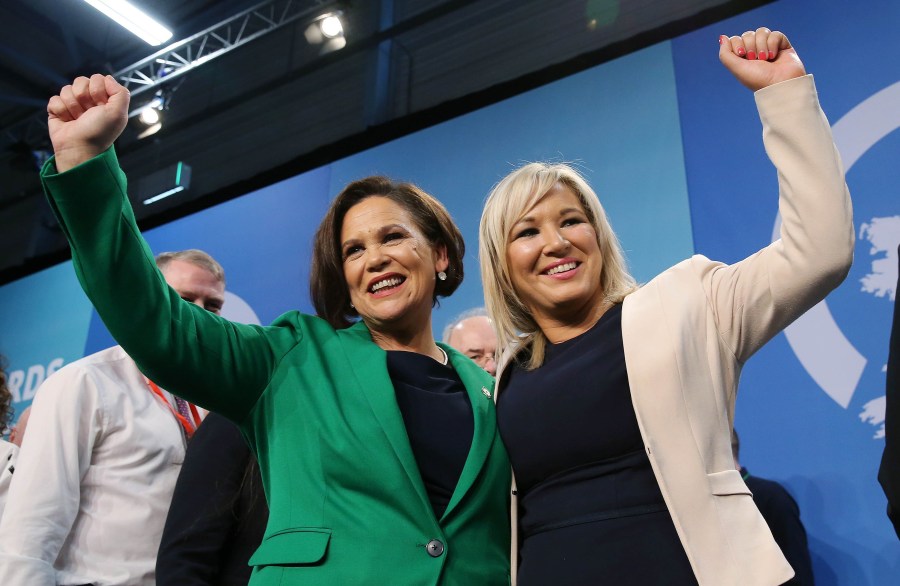
Recently the Queen of the UK and Commonwealth regions reached the 70th year of her reign, called by convention the “platinum jubilee” and has received congratulations from the heads of imperialist, colonial and neo-colonial states around the world. In Ireland, she has also received the congratulations of the head of a formerly Republican party now aspiring to neo-colonial government. When Mary Lou MacDonald, President of Sinn Féin praised Elizabeth II for her “long service” we should ask: service to whom and to what? We are also entitled to compare her words to those of James Connolly, Irish revolutionary socialist and republican, in reference to the British Monarchy.

WHAT THE PRESIDENT OF SINN FÉIN SAID

Mary Lou McDonald, President of Sinn Féin was widely reported reacting to the news that a tree is to be planted in the grounds of Parliament Buildings at Stormont to mark the anniversary.

“I think it is important that we are respectful of the identity of our citizens who are British,” she said on Thursday.

“I think that is entirely appropriate and I welcome that decision.

She was reported wishing well to those who will celebrate the jubilee, and said she believes those who won’t “are now big enough, bold enough, generous enough to acknowledge the identity of others.”

“Can I also extend to the British Queen a word of congratulations because 70 years is quite some record,” she added.

“That is what you call a lifetime of service.”

Any logical consideration of those words should quickly find some problems with them. What does “respecting the identity of our (Irish) citizens who are British” or “acknowledging the identity of others” actually mean? One would imagine that respecting the identity of others would involve primarily not subjecting them to discrimination, racism or religious sectarianism. Does respecting the national identity of any people give them the right to seize with armed force and occupy a part of the nation? Because that is what constitutes the basis for the British colony of the Six Counties in Ireland and the administration of that colony is the purpose of the Stormont Parliament and Executive. Furthermore, discrimination and sectarianism is precisely what is suffered by a huge part of the population of that colony – from the very institutions being upheld by SF and by its President.

Stripped down to its essentials, we are only “big enough, bold enough, generous enough” if we accept the partition of our small nation, the forcible retention of a colony and pay our respects to the Head of that state and the Commander-in-Chief of its armed forces.

This is a monarch who has presided over her armed forces’ participation in at least 24 wars or interventions since her inauguration, two of them in our national territory. Her armed forces invaded foreign lands, bombed and shot down those who resisted, carried out massacres, tortured prisoners and she has personally decorated the leaders of those armed forces, including those who murdered Irish people. The very least one could expect from an Irish politician with any dignity would have been silence or “no comment” on the occasion.

A poster calling for retired Army officer General Sir Mike Jackson to be jailed and advertising a march commemorating Bloody Sunday, on display in the Bogside area of Derry, Six Counties. Jackson was one of many military murderers to be decorated by the British Queen. (Photo by Niall Carson/PA Images via Getty Images).

This is far from the worst thing that the Sinn Féin leadership has done with regard to the British Monarch, for in May 2011 they called for no protests against her while she desecrated the Garden of Remembrance in Dublin and while the Gardaí attacked “dissident” Republican protesters nearby and outside her state reception in Dublin Castle, the old seat of her royal enforcers in Ireland. The following year, Martin McGuinness, prominent in the leaderships of both the IRA and Sinn Féin, welcomed her to her colony and shook her hand.

Martin McGuinness, in leadership of Sinn Féin and the IRA, welcomes the British Queen to visit her colony in 2012 (Photo sourced: Internet)

WHAT JAMES CONNOLLY SAID

James Connolly on occasions too referred to contemporary British monarchs – but in markedly different terms to those from the leadership of Sinn Féin in recent decades.

“What is monarchy? From whence does it derive its sanction? What has been its gift to humanity? Monarchy is a survival of the tyranny imposed by the hand of greed and treachery upon the human race in the darkest and most ignorant days of our history. It derives its only sanction from the sword of the marauder, and the helplessness of the producer, and its gifts to humanity are unknown, save as they can be measured in the pernicious examples of triumphant and shameless iniquities.

“Every class in society save royalty, and especially British royalty, has through some of its members contributed something to the elevation of the race. But neither in science, nor in art, nor in literature, nor in exploration, nor in mechanical invention, nor in humanising of laws, nor in any sphere of human activity has a representative of British royalty helped forward the moral, intellectual or material improvement of mankind. But that royal family has opposed every forward move, fought every reform, persecuted every patriot, and intrigued against every good cause. Slandering every friend of the people, it has befriended every oppressor. Eulogised today by misguided clerics, it has been notorious in history for the revolting nature of its crimes. Murder, treachery, adultery, incest, theft, perjury – every crime known to man has been committed by some one or other of the race of monarchs from whom King George is proud to trace his descent.

…………………….

Two completely opposite attitudes to British Monarchy: Mary Lou McDonald (L) and James Connolly (R)

“Fellow-workers, stand by the dignity of your class. All these parading royalties, all this insolent aristocracy, all these grovelling, dirt-eating capitalist traitors, all these are but signs of disease in any social state – diseases which a royal visit brings to a head and spews in all its nastiness before our horrified eyes. But as the recognition of the disease is the first stage towards its cure, so that we may rid our social state of its political and social diseases, we must recognise the elements of corruption. Hence, in bringing them all together and exposing their unity, even a royal visit may help us to understand and understanding, help us to know how to destroy the royal, aristocratic and capitalistic classes who live upon our labour. Their workshops, their lands, their mills, their factories, their ships, their railways must be voted into our hands who alone use them, public ownership must take the place of capitalist ownership, social democracy1 replace political and social inequality, the sovereignty of labour must supersede and destroy the sovereignty of birth and the monarchy of capitalism.

“Ours be the task to enlighten the ignorant among our class, to dissipate and destroy the political and social superstitions of the enslaved masses and to hasten the coming day when, in the words of Joseph Brenan, the fearless patriot of ’48, all the world will maintain

The Right Divine of Labour
To be first of earthly things;
That the Thinker and the Worker
Are Manhood’s only Kings.”2

SUPPORT FOR SINN FÉIN

Most followers of the Sinn Féin party, who are by long tradition anti-monarchist and desire a reunified and independent Ireland, tend to regard those kinds of heretical statements by the party leaders as no more than some kind of camouflage to get them into power. Once there, they imagine, their party will lead them to the hallowed objectives of Irish independence and unity. In fact, the same kind of attitude that was that of the early followers of Fianna Fáil, “the Republican party”3.

The blindness, or more accurately the ability of self-deception exhibited by these followers is amazing. The majority continued to believe the leadership when it publicly abandoned armed struggle against British colonialism and declared it would never return to that (believing that to be a fake position) and even when it had most of its arms decommissioned. Then the party not only fielded candidates in elections in the partitioned Irish state but also in the colonial one and, in arguably its greatest betrayal of its previous position, participated in the running of the colonial state which it continues to do. Since then its leaders have sought support for and even assisted in recruitment for the sectarian and colonial gendarmerie4 and, more recently, declared its acceptance of non-jury special courts, a clear reference in particular to the no-jury Special Criminal Courts of the Irish state5, condemned by a number of civil rights organisations6 and of which the party’s own supporters have been frequent victims.

The attitude of the larger mass of instinctively pro-independence people, mostly working-class or lower middle-class is that they might as well give Sinn Féin a turn in government – after all they can hardly treat them worse than the other gombeen7 parties that have been in government since the creation of the Irish State. Such attitudes account for the rapid growth in the party’s electoral base in recent years when it became the first party in terms of elected representatives so that two other neo-colonial parties, with a long history of hatred for one another, were obliged to join and form a coalition with a third8 in order to form a government excluding the new kid on the block.

General Jackson with Prince Charles, heir apparent to the throne of England and Commander-in-Chief of the Paratroop Regiment (Photo sourced: Internet)

The attitude expressed by the President of the SF party runs not only completely contrary to the traditions of Irish Republicanism but even to its own history. It is more than that, it is an expression of the lack of dignity and craven forelock-tugging attitude of the neo-colonial Gombeen class that has ruled the Irish state since its inception.

While socialists and republicans rightly condemn that mentality and its practical applications, we should place our hopes in another outlook, as outlined by Connolly over a century earlier, and in the practical expression of that outlook today and in the near future. It is surely appropriate then to end this commentary with Connolly’s own words on another British royal jubilee, Queen Victoria’s in 1897:

“….. It is time then that some organised party in Ireland — other than those in whose mouths Patriotism means Compromise, and Freedom, High Dividends — should speak out bravely and honestly the sentiments awakened in the breast of every lover of freedom by this ghastly farce now being played out before our eyes. Hence the Irish Socialist Republican Party — which, from its inception, has never hesitated to proclaim its unswerving hostility to the British Crown, and to the political and social order of which in these islands that Crown is but the symbol — takes this opportunity of hurling at the heads of all the courtly mummers who grovel at the shrine of royalty the contempt and hatred of the Irish Revolutionary Democracy. We, at least, are not loyal men; we confess to having more respect and honour for the raggedest child of the poorest labourer in Ireland to-day than for any, even the most virtuous, descendant of the long array of murderers, adulterers and madmen who have sat upon the throne of England ….

“The working class alone have nothing to hope for save in a revolutionary reconstruction of society; they, and they alone, are capable of that revolutionary initiative which, with all the political and economic development of the time to aid it, can carry us forward into the promised land of perfect Freedom, the reward of the age-long travail of the people.”9

End.

APPENDIX:

List of armed interventions and wars by British Armed forces under Queen Elizabeth II:

Mau Mau Uprising(1952–1960)

Jebel Akhdar War
(1954–1959)

Cyprus Emergency
(1955–1959)

Suez Crisis(1956–1957)

Border Campaign
(1956–1962)

First Cod War
(1958–1961)

Upper Yafa disturbances[22](1959)

Dhofar Rebellion
(1962–1975)

Indonesia–Malaysia confrontation
(1963–1966)

Aden Emergency(1963–1967)

The Troubles(1968–1998)

Invasion of Anguila, Caribbean
(1969)

Second Cod War
(1972–1973)

Third Cod War
(1975–1976)

Falklands War
(1982)

Multinational Force in Lebanon
(1982–1984)

Gulf War
(1990–1991)

Bosnian War
(1992–1995)

Operation Desert Fox
(1998)

Kosovo War
(1998–1999)

Sierra Leone Civil War(2000–2002)

War in Afghanistan
(2001–2021)

Iraq War
(2003–2009)

First Libyan Civil War(2011)

2019–2021 Persian Gulf crisis(2019–present)

FOOTNOTES:

1In Connolly’s time, the term “social democrats” covered most revolutionaries in Europe in addition to reformists whereas today it is confined to describing only the latter.

2Commenting in 1910 on the announced visit of King George V to Ireland https://www.marxists.org/archive/connolly/1911/xx/visitkng.htm

3Fianna Fáil was a 1926 split from Sinn Féin led be De Valera, based on participating in elections within the Irish State, initially supported by many Irish Republicans in elections and when voted into Government in 1932 released Republican political prisoners jailed by the Government of pro-Treaty forces. Subsequently however a FF Government banned the IRA and jailed and even executed some Republicans.

4A gendarmerie is an armed state-wide military-like police force, such as for example the ones in the Spanish, Italian and Turkish states, typical of a State endeavouring to impose central rule on subject nations or regions where recurrent resistance may be expected. In Ireland the English occupation had the Royal Irish Constabulary which after 1922 in the colonial statelet became the Royal Ulster Constabulary, later changing its name to the Police Force of Northern Ireland. It has always been a sectarian (anti-Catholic) and repressive force.

5Both the Irish State and the colonial statelet have no-jury courts to jail political dissidents on low evidential requirements and under emergency legislation. The position SF’s elected representatives since 1972 has been to vote against the existence of the Special Criminal Court until two years ago, when it began to abstain and finally this year at its Ard-Fheis (annual general meeting), after an extremely poor debate, the party voted to accept such a court.

6Including the Irish Council for Civil Liberties and Amnesty International.

7A term of contempt dating from the years of the Great Hunger to describe capitalists who are happy to use the colonial system to amass personal wealth at the expense of their compatriots; its source is in the Irish language (an gaimbín/ gaimbíneachas — https://www.dictionary.com/browse/gombeen)

8Fianna Fáil, Fine Gael and the Green Party. The first two have been the major parties of the State almost since its inception, with the Greens being a smaller and more recent phenomenon. Fine Gael are the political representatives of the neo-colonial class that supported the partition of the country in the Anglo-Irish Agreement of 1921 for which they fought a Civil War (1922-1923) against the Irish Republicans (chiefly the IRA and Sinn Féin). Fianna Fáil led a major split in the Republican movement to form an Irish Government and soon attracted support (and later domination) by a section of native capitalists, soon becoming the favoured choice of the neo-colonial Irish capitalist class, alternating in government from time to time with Fine Gael (the latter in coalition, several times with the social-democratic Labour Party). However, since 1981 no Irish political party has commanded an absolute majority in elected representatives and all governments of the State since then have been coalitions of one kind or another.

9https://www.marxists.org/archive/connolly/1897/xx/qundimnd.htm Queen Victoria’s Jubilee Day, 22 June 1897, was marked by Connolly and Maud Gonne with protests on the streets of Dublin. Connolly dumped a symbolic coffin into the River Liffey and shouted “to hell with the British Empire”, for which ‘crime’ he spent the night in jail.

SOURCES:

James Connolly on visit of King George in 1911: https://www.marxists.org/archive/connolly/1911/xx/visitkng.htm

and on Queen Victoria’s Diamond Jubilee: https://www.marxists.org/archive/connolly/1897/xx/qundimnd.htm

For list of armed conflicts in which the UK has led or participated since coronation date of Elizabeth Windsor in 1953: https://en.wikipedia.org/wiki/List_of_wars_involving_the_United_Kingdom

Invasion of Anguila (missing from above list): https://en.wikipedia.org/wiki/Operation_Sheepskin#:~:text=Operation%20Sheepskin%20was%20a%20British,itself%20as%20an%20independent%20Republic.

UK Armed forces officially recorded in the Middle East: https://commonslibrary.parliament.uk/research-briefings/cbp-8794/

British military bases around the world: https://en.wikipedia.org/wiki/Overseas_military_bases_of_the_United_Kingdom

The Queen’s Service To ….

Gearóid Ó Loingsigh

(Reading time: one minute)


Queen Elizabeth II / Sinn Fein president Mary Lou McDonald

Mary Lou McDonald, the current president of Sinn Féin, surprised a few, just a few, with her recent comments thanking the English queen, Elizabeth, for her service.  She stated that “Can I also extend to the British Queen a word of congratulations because 70 years is quite some record.  That is what you call a lifetime of service.”(1)

Why someone who describes herself as a republican would want to heap praise on a monarch and refer to the reign of the monarch as service is bewildering.  However, it is not that strange in the context of the Irish peace process.  It is part of the long road of Sinn Féin’s accommodation to the British state that was laid out in the Good Friday Agreement.  Sinn Féin at that time abandoned any pretence of having a critique of imperialism and capitalism.

The agreement signed basically stated that the British had no selfish interest in Ireland and the conflict was a communal one.  Putting it in blunt terms, two savage tribes agreed to settle their differences, the British state was not one of those savage agents in the conflict.(2)

Exactly what service has the English queen given and to whom?  As a monarch she has blessed every British military adventure since her coronation in 1953, including the savagery of the British repression of the Mau Mau rebellion in Kenya, various other colonial wars, not to mention her awarding of an OBE to Lt. Colonel Derek Wilford the man responsible for Bloody Sunday in Derry in 1972.  In 2019 she stood over her behaviour when she stated that the British government would “bring forward proposals to tackle vexatious claims that undermine our armed forces, and will continue to seek better ways of dealing with legacy issues that provide better outcomes for victims and survivors”.(3)  The massacre of Bloody Sunday was placed in the category of vexatious claims.

Part of the service that McDonald now lauds includes this and many more such incidents.  Though it is not unexpected.  It can only surprise those who pay no attention to the outcomes of peace processes around the world.  Yasser Arafat spent more time repressing Palestinians than he did fighting the Israelis after the Oslo Accords.  In South Africa, the former mining trade union leader Cyril Ramphosa became a mining magnate, whose company was involved in the massacre of 34 striking miners at Marikana in 2012.(4)  He and the ANC made their peace with white capitalists and obtained a share of the wealth, in Ramphosa’s case a very substantial amount which some estimates place around $780 million dollars.  In El Salvador, the FMLN eventually gained power, but did not implement a single thing they had ever fought for and their former commander Joaquín Villalobos is now a consultant to right wing forces on how to defeat left wing movements and contributes to the right-wing think tank The Inter-American Dialogue, which includes such illustrious figures as Violetta Chamorro from Nicaragua and former head of the World Bank, Robert Zoellick, to name just two unsavoury characters.(5)  In Colombia, the ink hadn’t even dried on the agreement and the FARC commander Timochenko declared that the Colombian armed forces would be allies of the FARC in building a new country.  The murder of just over 300 members of the FARC since the signing of the peace agreement has not caused him to change his evaluation of the Colombian armed forces, in fact he has doubled down on his position.

It is in the nature of the beast.  In every peace process that has happened, the former enemies of the state reconciled themselves to the regime and the system, without exception.  McDonald’s declarations are just a confirmation of that and also a sign that it is a bottomless pit and there is no level of political depravity that Sinn Féin will not sink to.

Notes

(1)  Belfast Telegraph (10/02/2022) Sinn Féin leader congratulates Queen on ‘lifetime of service’ https://www.belfasttelegraph.co.uk/news/northern-ireland/sinn-fein-leader-congratulates-queen-on-lifetime-of-service-41334673.html

(2)  The agreement can be consulted at https://www.dfa.ie/media/dfa/alldfawebsitemedia/ourrolesandpolicies/northernireland/good-friday-agreement.pdf

(3)  The Irish Post (20/12/2019) Anger as Queen’s speech appears to dismiss fight for justice for Bloody Sunday victim’s as ‘vexatious claims’ https://www.irishpost.com/news/anger-queens-speech-appears-dismiss-fight-justice-bloody-sunday-victims-vexatious-claims-175999

(4)  The Guardian (19/05/2015) Marikana massacre: the untold story of the strike leader who died for workers’ rights https://www.theguardian.com/world/2015/may/19/marikana-massacre-untold-story-strike-leader-died-workers-rights
 
(5) See https://www.thedialogue.org

Bombing children at play

(from The Treason Felony Blog le buíochas: The Weaver Street Bombing and not dealing with the past)

(Reading time: 3 mins.)

In Belfast, on 13th February 1922, some children playing in Milewater Street, at the corner of Weaver Street, off the York Road, were approached by two Special Constables and told to go and “play with their own” (Special Constables invariably being Protestant, the children were Catholics in a largely Protestant district). They joined other children in the mainly Catholic-occupied Weaver Street and played on a swing attached to a lamp-post. Ten minutes later, two men came to the North Derby Street end of Weaver Street (one eye witness claimed one Special Constable had just spoken to the same two men). They were about 20 metres away from where the children were playing. One of the men then threw a bomb into the middle of the children. As the bomb exploded, gunfire directed into Weaver Street from North Derby Street, covered the two men’s retreat.

Weaver St map
Map showing Weaver Street running from North Derby Street to Milewater Street (which isn’t named on the map)

The explosion killed or injured Mary Johnson (13), Catherine Kennedy (14), W.J. Dempsey (13), Annie Pimley (16), John O’Hanlon (16), Elizabeth O’Hanlon (11), Murtie O’Hanlon (16), Barney Kennedy (10), John McCluskey (12), Rose Ann McNeill (13), Mary McClinton (18), Mary Kerr (6), Susanne Lavery (14), George O’Connor (16), Joseph Conway (12), Patrick Maguire (14), Kate O’Neill (14), Robert McBirney (16) and William Connolly (13). All lived in Weaver Street. Adults standing in their doorways were also badly injured.

The force of the blast threw the children up into the air and caused catastrophic injuries, maiming many of those who survived. Mary Johnson and Catherine Kennedy died immediately. Eliza O’Hanlon died the next day. Statements made in the press and in Westminster indicate that three of those injured had died by the next day, the third being O’Hanlon. By the time the inquest was held on 3rd March, a fourth girl had died from the blast. Two adults were to succumb to their injuries. Margaret Smith died on the 23rd March, while Mary Owens (who lived in nearby Shore Street) died from injuries sustained in the blast on the 6th April.

This was not the first bombing of its kind. On September 25th the previous year, a bomb had been thrown into a group of Catholic children on Milewater Street, injuring nine, including four under six years of age. One man, George Barry, died from injuries he received. The bomb had such force that two houses were wrecked. A bomb had also been thrown by loyalists into a group of school children in Herbert Street on 12th January, injuring six (the Belfast Telegraph erroneously reported it as an IRA attack). The same month, a bomb had been thrown into Weaver Street from a passing taxi.

The Belfast Telegraph claimed the 13th February bomb was one of the largest ever used in the city. It also implausibly offered justification for the bomb attack, saying shots had earlier been fired at an armoured car in Weaver Street. In retrospect, the Belfast Telegraph’s link to an attack of an armoured car merely ties the Special Constabulary closer to the bombing (the ‘Specials’, created at roughly the same time, performed the Black and Tans roles in repression and reprisals in the north).

James Craig also included a reference to the bomb in a report sent to the Colonial Secretary, Winston Churchill and read in Westminster the next day. It stated that there had been…

..the indiscriminate throwing of bombs over a wall into Weaver Street, a Sinn Fein area, which resulted in the death of two children and the wounding of fourteen others. These outrages are greatly deplored by my Government, especially the latter dastardly deed, involving the lives of children.

Craig was more concerned about a gun battle in Clones between republican forces and Special Constables travelling to Enniskillen the day before the Weaver Street bombing. Joe Devlin fumed that Craigs wording was deliberately vague and that some international press had been led to believe that the bomb was thrown by republicans.

As sectarian attacks continued through 1921 and 1922, and even after the 13th February bomb, the (relatively) safe places for Catholic families to live in that part of the York Road had shrank to the area around Weaver Street. The attacks continued to intensify in early summer. On 18th May Thomas McCaffrey from Shore Street was killed. On the night of 20th May, Thomas McShane from Jennymount Street was killed. That same night the remaining Catholic residents of Weaver Street, Milewater Street, North Derby Street, Shore Street and Jennymount Street, some one hundred and forty-eight families, were forced from their homes at gunpoint. By the 21st May 1922 the Catholic community that had established itself around Weaver Street had fled. The 1924 street directory only shows one household remaining from the 1918 directory (in comparison, nearby Seaview Street had two thirds of the same households). Houses in Weaver Street remained occupied until the 1960s as Unilever and the Associated Feed Mills bought up property around Shore Street, Weaver Street and Milewater Street eventually enclosing all but the York Road end of Milewater Street.

The view today of where Weaver Street met North Derby Street. This is more or less where the bomb was thrown from.

Today, Shore Street and Weaver Street are gone, no longer visible on the streetscape of Belfast. Patiently neglected over the decades after 1922, their former occupants were dispersed around other districts of the city. Similarly, the detail of its own particular sadness, sectarianism and savagery are now, largely, long forgotten. The memory of the violence of 1920-22, mostly unarticulated, was indelibly etched into the psyche of the Catholic residents of Belfast.

Some 20-25% of those killed in the 1920-22 conflict died in Belfast but, with few notable exceptions, little was written or said about it over the decades that followed (even today only a handful of books have been written about it). So despite what has happened since 1969, few have considered how the memory of 1920-22 influenced communities. Even fewer have considered the role an absence of public discourse around the violence of 1920-22 may have had in later outbreaks of sectarian violence in the 1930s and 1960s.

Today, the very obliteration of Weaver Street from the streetscape of Belfast, somehow elevates it as an appropriate metaphor for the eclipse of public discourse on the violence of 1920-22.

end.

FURTHER READING

https://www.irishtimes.com/culture/heritage/why-don-t-we-remember-the-weaver-street-massacre-in-belfast-1.4797959?fbclid=IwAR2rDtvRV9j1bM8p9SnIxfAEl5ejHHAutwFJG7-U3XtKGiaYPbfwRsiMa38

CRIME, PUNISHMENT AND CLASS SOCIETY

Gearóid Ó Loingsigh

(Reading Time: 12 mins.)

The press and large swathes of the academic world usually think of crime as natural, even normal and constant throughout the history of our societies and consequently, punishment is also natural and normal, although one or other of them usually condemns punishments which seem abhorrent, such as the death penalty. Although within that group there are those who only oppose the death penalty because they acknowledge that they could end up executing some innocent people. But neither crime nor punishment is constant in history.

There have always been transgressions of societal norms, but the concept of crime that we use today is not the same as a transgression in a communitarian society. Of course, a person could attack another, even end up killing them, but the transgression is against the community and its social harmony and not just against the person. Crime as we conceive of it nowadays comes into being with class society. In a society where goods are held in common, such as water or collectively such as tools or food, the modern crime of theft cannot exist. The Anarchist Proudhon, wrote a piece entitled What is Property? Better known for its famous phrase “Property is theft.” Marx in response ridiculed Proudhon explaining with very little patience that in order for there to be theft, the property must previously exist. If there is no private property then neither can there be crimes such as theft. It is something basic the poor Proudhon did not see, but neither do the majority of commentators, academics, jurists and other liberal style personalities.

So in the case of private property, people are alienated from other people’s property, from that which is not theirs. Before, in the face of threat from another tribal group, the collective responded jointly, but any threat to private property is only defended by those who have deeds on the asset and as is obvious, one person cannot respond to attacks or threats from more than one person, nor can they enjoy their property, if they have to protect it constantly and so they have to use a part of their wealth to hire those who will do that work for them and thus private and later still the armed forces are born. As property is no longer collective and the rules on its usufruct, possession or consumption are not agreed upon, nor obvious and with a greater commercial exchange amongst groups there is a need for agreed upon norms between the proprietors on the rights and obligations of others regarding their property. The development of writing allowed for the drawing up of the first penal and civic codes for everyone, so as all knew their rights and duties. So one of the first known codes in the world was the Hammurabi Code in 1,772 B.C., in Babylonia, the region in which writing was born. This code contained severe punishments for physical injury, it is one of the first times the adage of “Eye for an Eye” is mentioned, but the guilty party could avoid such a punishment by paying a fine, however this was not the case with crimes against property, which were punished by the death penalty;1 i.e. with money you could avoid or minimise punishment but private property was sacred. This was a clearly classist penal code just like the other ancient codes from India, China and Philippines amongst others that punished the poor more severely than the rich. One exception was that of the Aztecs that expected the nobility to behave well and punished them more severely when they didn’t,2 i.e. not only is crime born with class society but also punishment is clearly classist.

It is worth saying that the need for a state comes into being with private property, which is a distinct form of community organisation. The State represents the interests of the dominant classes and the form and structure it takes, whether it is slave, feudal, monarchist, or capitalist depends on which are the dominant classes and the dominant mode of production. But as for crime, an infraction was an injury to the community, its social harmony, whereas in class society, crimes are not committed against the person but rather against the State and this can be seen even today in trials which are presented as cases of the State vs X. This is so in cases of crimes against property and against the person.

Even with codes and private and state armed forces, punishment as we know it today in the shape of prisons was not common. Hollywood has inflicted great harm to our concepts of crimes in society, giving us a continuous line in terms of concepts, crimes and attitudes regarding them and also twisting the history of punishment. Prisons as we conceive of them today are an invention in a constant changing state of flux and in Roman and Ancient Greek times that concept did not exist. There have always been places of confinement for criminals, however imprisonment in and of itself was not the punishment. The dungeons of old were on the one hand transitory in nature, whilst the real punishment was awaited or places where debtors and people who had not paid their taxes were placed etc. and stayed there until such time as they paid their debt, tax or fine. Today, in many countries they continue to imprison people for this type of behaviour.

The main punishments were different. You only have to read the Bible, especially the books of Leviticus and Deuteronomy, where the Jews consecrated their laws, both those that were supposedly divine in nature or profane to get a general idea of what punishment was like. There is no real difference between the divine and profane laws, both responded to the material needs of society e.g. the prohibition on adultery in the Ten Commandments is supposedly divine, but really the pleasure of this sin is that it calls in question the lineage and the inheritance of private property.

In the Book of Genesis Adam and Eve are shown to be expelled from the Garden of Eden. Banishment was a common practice and even today there are various tribal peoples who practice it in cases of serious or repeated transgressions. But in various books from the Bible we can see different crimes and punishments such as compensation, whipping, mutilation, torture etc. It is clear however that the main punishment was the death penalty, described precisely according to the type of crime, so prostitution was punished with the bonfire, adultery with stoning, which was the most common method and not only permitted for an endless list of crimes but rather ordained by a supposed law of god, something the modern Right forget when criticising Islamic countries, as they continue to practice the same rules of the Bible in that sense. They weren’t the only ones, the Greeks also used the death penalty for a wide range of crimes just like the Romans.3

Prison, in the modern sense, was rare. The modern prison is the product of large scale expansion at the end of the 18th Century. Before then prisons were different and served a different purpose and what passed for justice was clearly a lack of justice and thirst for vengeance and public shaming with social control in mind. You only have to look at the punishments in the Bible, but if you don’t like referring to a text so basic to the social, moral and legal formation of the European countries that would later impose their vision on the rest of the world, then just look at what those countries did from the Middle Ages onwards. Amongst the punishments, there to be found some practices that leave the chosen people in second place when it comes thinking of the most inhumane thing in the search for a supposed “justice”. It is presumed that we have made progress and have improved, however as Roth explains the punishments were severe and ruthless, but the majority of the ancient punishments were insignificant in comparison to the punishment of the wheel, being burned alive or disembowelled alive.4

Physical punishment was common and there existed a wide variety of punishments across time and societies. Roth shows in his book An Eye for an Eye: A Global History of Crime and Punishment how stoning, flagellation, banishment, mutilation and amputation existed in one form or another in societies as diverse and different as Egypt of the Pharoahs, Greece and Rome, Sumer and China. Of course, the most inhumane punishment is the death penalty. In 2021, there were 35 countries that retained the death penalty in practice, amongst countries as diverse as the USA, North Korea, Iran, China and Japon. There are a further number of countries who retain it for non-common crimes (six, amongst them Israel) of those that retain it as a legal practice but do not implement it (48) and others that abolished it formally for any type of crime (93).5What is clear is that the barbarity of the past is not in the past but the present and can return at any time.

The death penalty as stated has been one of the constant aspects in the sad history of punishment. However, it has evolved and changed through history and was applied in the same manner in all country, just like it is not applied uniformly nowadays.

Chamber for gas execution, USA (Photo cred: WILX by AP)

There are various methods of applying the death penalty, some are from the Judeo-Christian tradition such as stoning and decapitation still exists in various Islamic countries, whilst the Christians in the USA opt for equally cruel methods, such as the electric chair. Fortunately, the practice of crucifixion, which was common amongst not just the Romans but the Jews6 has disappeared from our world.

Electric Chair paraphenalia on exhibition Virginia Museum (Photo sourced: NBC on line)

At the end of the 18th Century, various changes took place in criminal policy. Large prison building projects were undertaken in Europe, particularly in Great Britain. In the British case, it was due to social changes and changes in thinking but also the fact that the war of independence in what would become the USA cut off the possibility of continuing to deport criminals and to populate the colony with felons. So, there was a need for an increase in prisons and the prison would not just function as a temporary point of reclusion before execution, deportation or payment of a fine, debt or tax, but rather prison would be the punishment. Confinement in and of itself was the punishment. Although it seems strange nowadays to think so, but prisons were a progressive measure, the judicial systems aimed to be more than just organisms that rubber stamped vengeance by the state.

One of the most renowned prison architects of the period was John Howard, who saw himself as a prison reformer, and in fact one of the oldest prison reform organisations in that country bears his name, the Howard League. He designed prisons that he thought would contribute to the reform of the person and he introduced a relatively new, though not unknown, concept for the period, the prison cell. The cell for Howard was meant for one prisoner, something which should be borne in mind when we think about modern overcrowding in almost all prison systems in the world and the design of cells for two or more prisoners in various recently built prisons, as is the case in some prisons in Colombia, paid and designed by the US Federal Bureau of Prisons as part of the drugs strategy of Plan Colombia.

Howard was not the only reformer, throughout the 18th Century there were various reformers who published reports and proposals on prisons and what to do with prisoners, amongst them William Blackstone, who believed that punishment should be used to prevent recidivism and reform the criminal,7 a new concept for the period and coincides with various modern proposals and others such as the Italian, Cesare Beccaria who in 1764 supported the idea of using punishment to reduce crime and that it be proportional to the crime committed and selectively applied. His ideas influenced various reformers, including John Howard who travelled throughout Europe on various occasions visiting centres for imprisonment.8 The debate on the suitability of punishment and proportionality i.e. what crimes deserve to be punished and how is not new. It is a clear sign of the slippage we have experienced in the last 30 years, that basic ideas from more than 250 years ago are no longer applied in practice and in many jurisdictions they are questioned and even explicitly rejected as is the case in others such as the USA and other jurisdictions with mandatory sentences.

Photo sourced: Internet

Athough the rise of the prison was an important advance, as with many developments under capitalism it did not lead to the immediate abolition of cruel practices from the past nor the abolition of the death penalty, which plagues us even today. In fact, in England in “1603 there fifty capital offences but by the early 19th century this number had risen to over 200. Crimes ranging from murder to minor theft were punished by execution.”9 Nowadays there are 35 countries where it is still practised, including the USA and Japan and there are a further 48 where it is on the statute book but no execution has been carried out in the last 10 years, amongst the Russian Federation and Cuba.10

The death penalty wasn’t the only form of punishment, as stated previously there existed a variety of physical punishments throughout history, some of the lethal, but not all of them. Amongst the Jews there were varied punishments and they considered their system of justice to be an enlightened one as they did with their monotheistic belief system when compared to the polytheists that surrounded them.11 It may well be the case, but it is not about measuring a society by our current yardstick, but rather about accepting that all societies justify their punishments as being enlightened ones, blessed, when not ordained by their gods. So, in Europe in the Middle Ages, the use of the Wheel was justified as was the burning of witches. A barbaric practice by any measure, but a normal one that was accepted at the time.

The Prison Treadmill, a punishment in early Victorian England (Image sourced: Internet)

When we look at the various punishments, we that some still exist in various countries and others still exist in the popular imagination as desirable and justifiable and in some cases continue to be meted out to minors, even though in many countries corporal punishment is classified as a crime and child abuse. Whipping was common to almost every society throughout history with a great variety of implements used, some designed not only to inflict pain but also death,12 is used in very few judicial systems nowadays, but there is no lack of supposed human rights defenders in Colombia who do not hesitate in leaving their child red raw with a belt and see no contradiction between their own behaviour and their denunciations of abuse and torture at the hands of state forces and there is no shortage of indigenists who justify that same punishment using the argument of cultural autonomy. The legacy of times gone by is still with us in our culture, something which explains the passivity of society in the face of problems and abuses in our prison systems across the globe.

There are other punishments that have now been consigned to history but were common in many countries such as branding, and the bonfire, used throughout history but particularly against supposed witches in Europe. It is difficult to know how many women were burnt alive, though there are estimates that around 100,000 women perished in this manner over three century period in Europe.13

There was a transition in the types of punishment, as slowly various countries banned torture, Scotland and Prussia (1740), Denmark (1771), Spain (1790), France (1798) and Russia (1801), although as Roth points out torture resurfaced in the colonies, under other guises.14 Though they no longer tortured the sentenced prisoner, they tortured the dead post-execution. Following the Murder Law of 1752, up to 1832 the English courts imposed sentences that called for the post-execution punishment of the corpse.

The modern prison was born in this same period in which such punishments were imposed and the death penalty was common. Although it seems contradictory and senseless, the first prisons were a progressive proposal in relation to other sentences and their designers were penal reformers, who sought the redemption of the prisoner and not just punishment, though in practice the idea of punishment has never been far from the minds of judicial and prison functionaries.

Towards the end of the 19th century various national prisons in Great Britain were closed, partly due to a fall in the number of inmates and changes in judicial policies.15 The new prison act of 1898 explicitly promoted the reform of prisoners and throughout the 20th century new policies were introduced to that end, a policy that was echoed in other parts of the world. In the USA the concept of reform and the education of the prisoner was not such a common policy, prison labour never stopped, the so called chain gangs have been a constant feature, that still exist in some parts, with other types of forced labour within the system.

Forced labour was seen for a long time as a punishment and redemption at the same time and later as a punishment and form of the accumulation of surplus value from the prisoners work. One of the countries that countries that has most taken advantage of prison labour as a means of enrichment is the USA. No sooner had the Civil War ended and slavery abolished there was an increase in the sentencing of blacks with forced labour included. Nine states in the South promoted vagrancy laws applied to blacks and eight allowed for prisoners to be rented out to the plantations where the slaves had formerly been slaves.16 In one state they passed a law where the black population had to show documents confirming that they had work, or if not they were sentenced as vagabonds and sent to work in the plantations.17 However, over the course of the 20th century there was a reduction in the number of prisoners producing for the capitalist market, due in part to legislative changes that restricted the sale of such products, but not their manufacture as such. Further legislation in 1979 began to reverse that tendency.18 Sometimes the economic importance of prison production in the capitalist and penitentiary economies is exaggerated. However, it has an ideological importance. It tells quite clearly that the function of the prison is not to reform the person and help them overcome the conditions that led them to jail and it also tells us something about the role of labour in society. Work is foremost, it is the only thing that counts in society and the generation of profits is the only valid aim for a society. In reality, capitalism has always been like that, but the retreat in the discourse points to a real retreat in the correlation of forces in society. The workers movement has suffered large defeats, not just in terms of struggles but also in ideological terms where a vision that does not praise labour and profits over human dignity is not even put forward.

Chain Gang & Armed Guard 1941, Oglethorpe County, Georgia, USA (Photo sourced: Internet)

At the same time, we have seen a massive expansion of the use of prisons for minor crimes, longer sentences and a real explosion in the prison population, particularly in the USA. The increase in that country is due in large part to the policies of the Democratic Party and amongst those with greatest responsibility are Bill Clinton and his wife Hillary Clinton who publicly called for bringing black youths to heel as if it were about punishing dogs and they were jailed in cages like dogs in the new prisons built throughout his presidency, the majority for non-violent crimes related to the consumption of drugs.

Nowadays, we see new changes in the prison system and the concept of punishment in societies. Whilst various countries in Europe have reduced their prison population, that is only to be seen if we exclude another category of prisoner: the migrant. Most of us do not see migrants as criminals and the migrating in what is euphemistically termed in an irregular fashion is not a crime in many countries, but the treatment received by the migrant is punitive and penal. Many countries do this, including the Nordic countries famed for their social security systems, social cohesion etc.

Prison for migrants — Direct Provision (Source photo: RTÉ)

Denmark is not the only country, Great Britain also imprisons migrants, Ireland sends them to a special regime less punitive, but it is still a type of prison (Direct Provision) and in the USA, the Biden government continues with the penal policy in the area of migration.

The migrants are the new debtors, thieves etc., They are seen as something different to decent society, something set apart from us and as has been done for centuries they are punished instead of helped.

End.

(24/01/2022)

REFERENCES

  1. Galvin, A. (2015) Old Sparky: The Electric Chair and the History of the Death Penalty. New York: Carrel Books paras 7.10 y 7.11 (epub format)

2. Roth, M. P. (2014) An Eye for an Eye: A Global History of Crime and Punishment. London. Reaktion Books Ltd. p.11

3. Galvin, A. Op. Cit. para 7.13

4. Roth, M. P. (2014) Op. Cit. p.12

5. Figures taken from https://deathpenaltyworldwide.org

6. Donnelly, M.P. & Diehl, D. (2012) The Big Book of Pain: Torture & Punishment Through History. Gloucestershire. (epub format) para. 12.19

7. Brodie, A. et al (2013) English Prisons: An Architectural History. Swindon. English Heritage (Ebook) p.30

8. Ibid., p.31

9 Ibid., p.18

10. See https://deathpenaltyworldwide.org

11 Donnelly, M.P. & Diehl, D. (2012) Op. Cit. para 12.25

12. Ibíd., para 26.1 & ff.

13 Silvia, F (2014) Caliban and the Witch: Women, The Body and Primitive Accumulation. USA. Creative Commons (epub format) para 10.183

14 Roth, M. P. (2014) Op. Cit. p.109

15 Brodie, A. et al (2013) Op. Cit. P.139

16 Alexander, M. (2010) The New Jim Crow: Mass Incarceration in the Age of Colorblindness, New York, The New Press. P.28

17 Ibíd.,

18 Bair, A. P. (2008) Prison Labor in the United States: An Economic Analysis, New York, Routledge pp. 115 ff