On Saturday morning, Dubliners checking messages or news on their phones or laptops, or listening to or watching news on TV or radio – or even reading a newspaper, learned that the USA had bombed Venezuela and abducted its President.
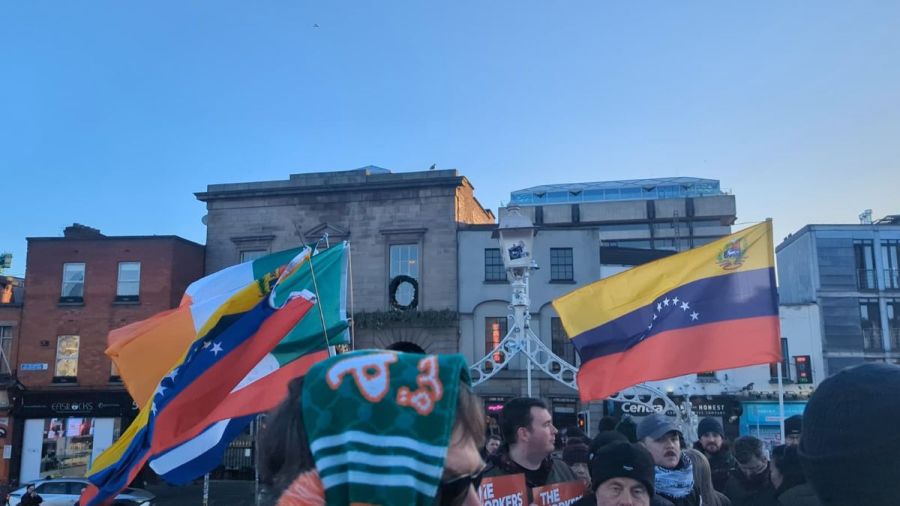
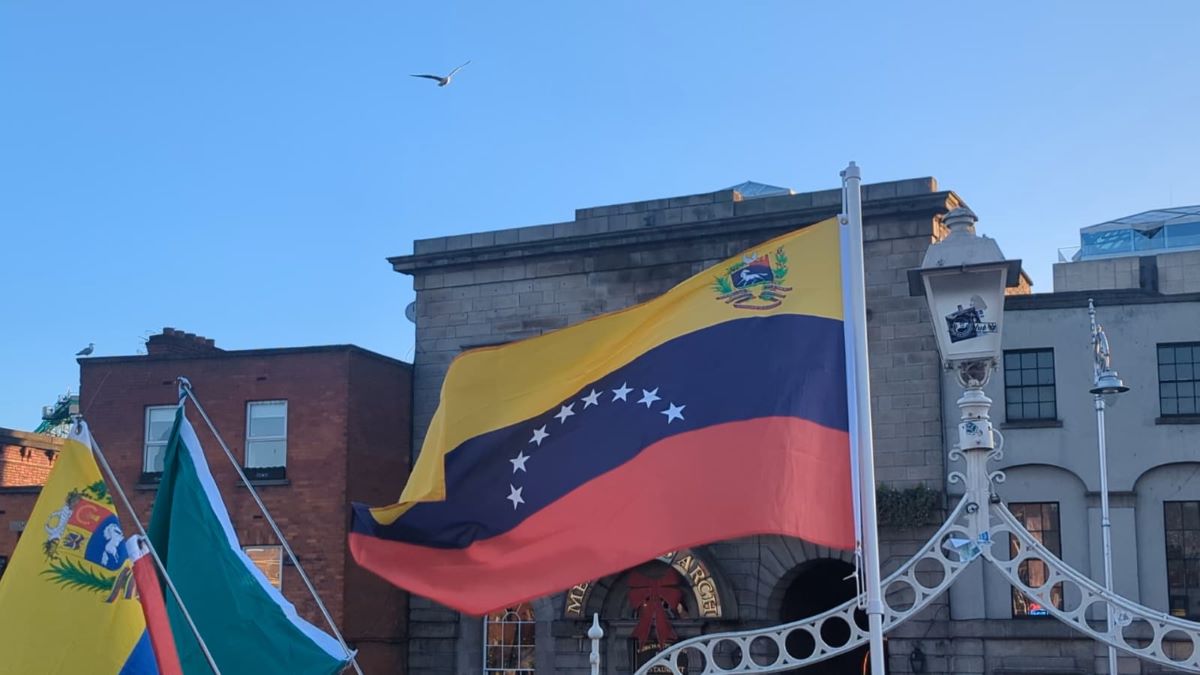
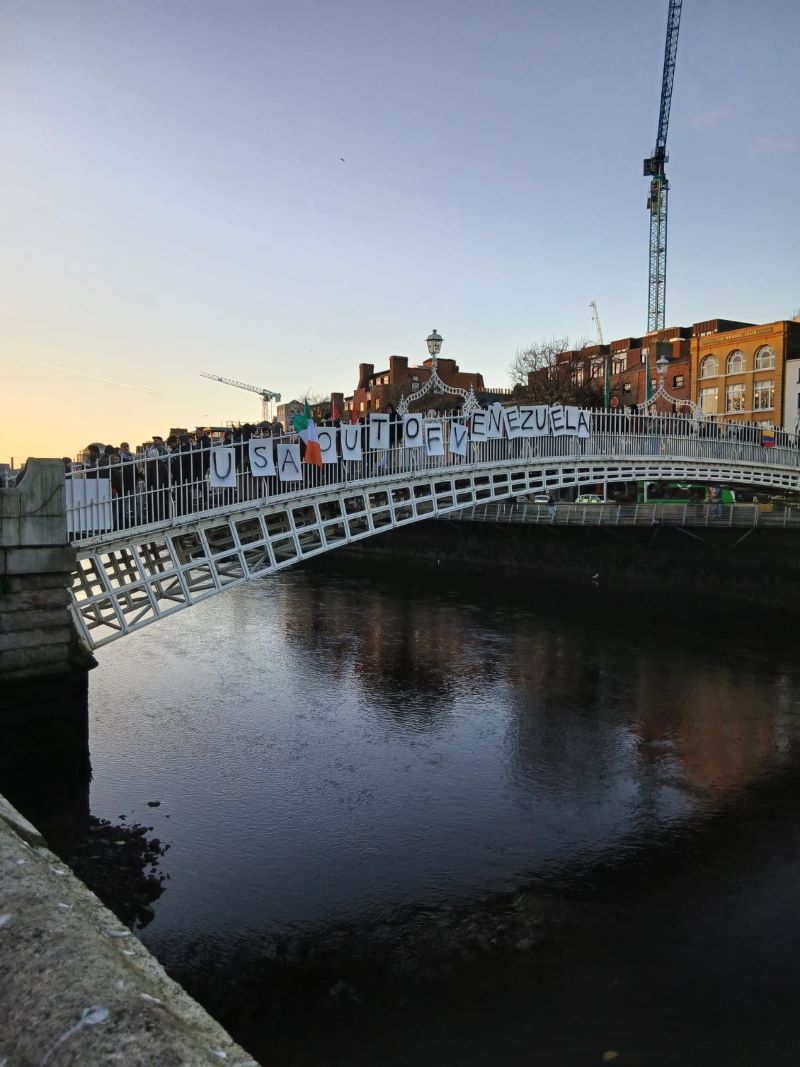
Venezuelan national flags on Ha’penny Bridge during Venezuela solidarity portrait, seen here against sky and south Liffey riverside buildings. (Photo cred: Participant)
An emergency protest and solidarity demonstration was called for 3pm in the city centre and under a clear blue sky but in bitter cold, many attended to line the iconic Ha’penny Bridge, which only a week ago had hosted a New Year’s Eve demonstration in solidarity with Palestine.
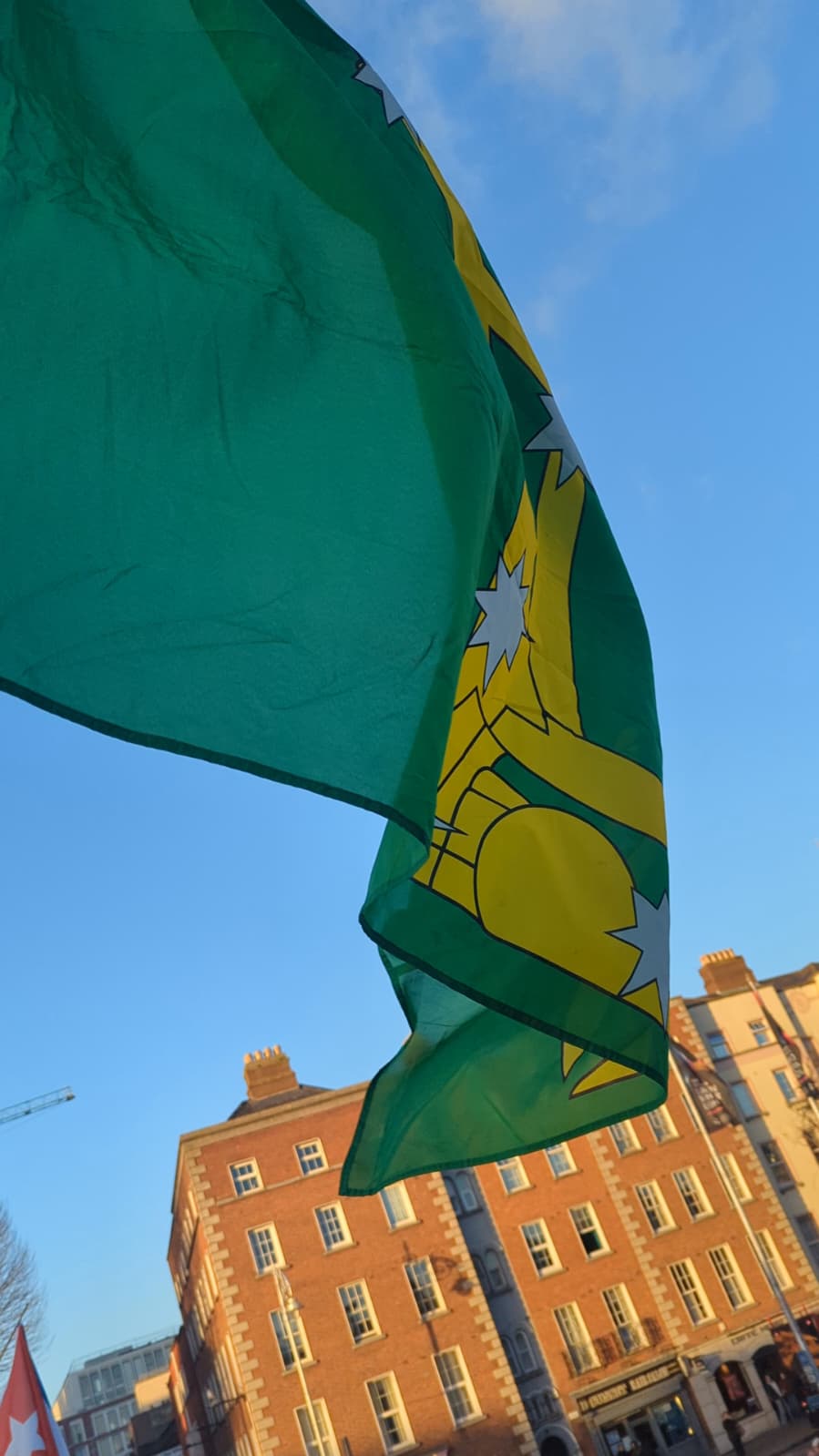
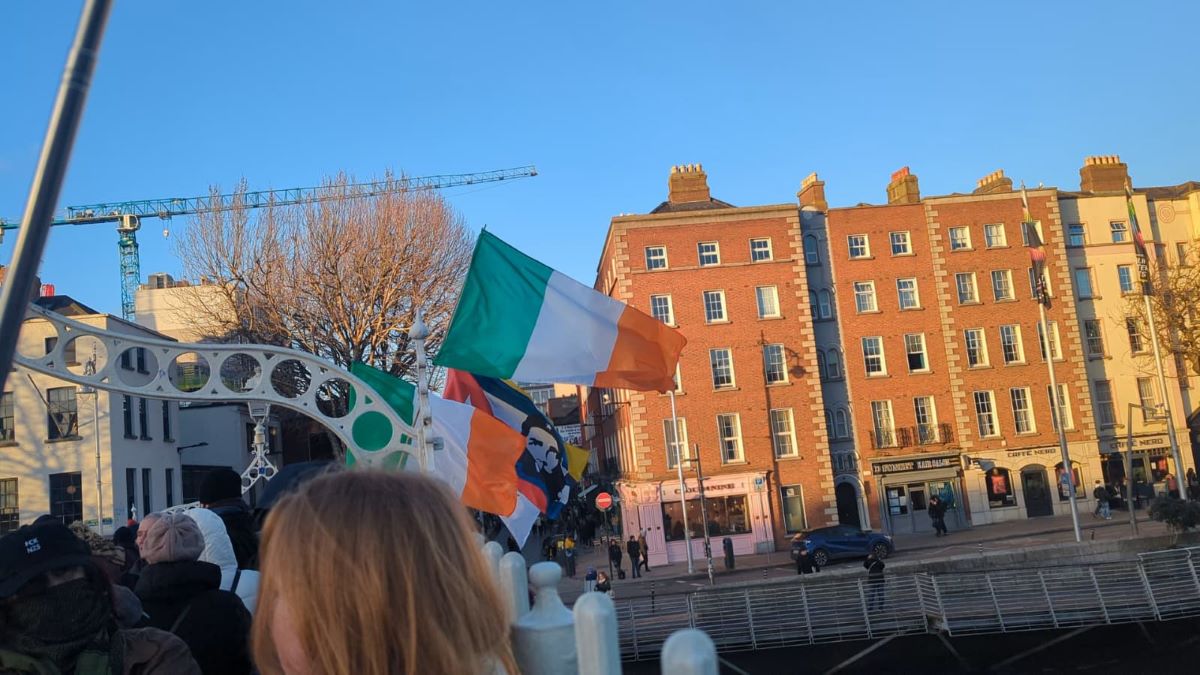
Among the crowd on the Bridge, a few Venezuelan national flags fluttered against the sky or the riverside buildings, along with a number of Irish Tricolours and one green and gold Starry Plough,1 while placards were attached to the railings along the sides of the Bridge.
The well-known slogan of US military – Out of Shannon! was among the call-and-answer chants of course, along with the easily-imagined Hands off Venezuela! But there were some innovative ones too, such as the Irish-language/ English mix of Deirimís go léir le chéile – Hands off Venezuela!
Starry Plough flag on Ha’penny Bridge during Venezuela solidarity protest, seen here against sky and north Liffey riverside buildings. (Photo cred: Participant)Irish Tricolour flags and probably Cuban national flag on Ha’penny Bridge during Venezuela solidarity protest, seen here against sky and north Liffey riverside buildings. (Photo cred: Participant)
Entirely in Castilian Spanish there was also Viva, viva – La Resistencia! Another was USA – Nothing but thieves! – a specific reference to Trump’s nakedly-declared wish to grab the country’s oilwells.
People from a number of different political parties participated as did a large number of independent activists, constituting an ad-hoc and informal anti-imperialist broad front.
Among the crowd were veteran activists but also too many of the younger ones, grown in political awareness and action in recent years of Palestine solidarity, a deep educational experience, including some facing charges from actions in Dublin or Shannon to be tried in the coming months.
It is to be hoped that their support and solidarity will also be broad.
The Ha’penny Bridge during Venezuela solidarity protest. (Photo cred: Eddie O’Reilly)
The latest news is that the kidnapped President Maduro has been charged in the US on counts including drug trafficking and possession of weapon. As the President of Venezuela and titular head of its armed forces, presumably he does indeed hold weapons.
The very existence of the drug cartel of which Trump and his cabal claim Maduro is head is very doubtful, including even to views leaked from US intelligence departments and of course, not one iota of evidence has been produced to date of the alleged drug trafficking.
Mixture of flags and people on Ha’penny Bridge during Venezuela solidarity portrait, seen here against sky and south Liffey riverside buildings. (Photo cred: Participant)
In the lead-up of months of bullying to this invasion, US forces sank many boats, killing at least 115, including one survivor of a bombing in the water. No evidence of their alleged drug-running has been produced in a single case and even so would not merit death penalty under US law.
Following the US attack on Venezuela, Defence Minister Vladimir Padrino López, reportedly from his control bunker, broadcast in military uniform to the nation condemning the imperialist attack and promising resolute resistance.
Diosdado Cabello, Venezuela’s Minister of Interior, Justice, and Peace, was videoed in the street wearing helmet and body protection equipment, calling on citizens to place their trust in the political and military leadership and to give no assistance to invading forces.
Vice-President Celcy, now Acting President made her first ever broadcast demanding the release of the Presidential couple, affirming that “there is only one president in this country, and his name is Nicolás Maduro,” and insisting that Venezuela “will never be a colony of any nation.”
Earlier, mainstream media had reported that Celcy had fled to Russia and that Lopez had been killed, such errors perhaps being caused by the ‘fog of war’ but recalling also the part played by the mainstream media in preparing the ground for the US-instigated Chilean coup of 1973.
The US attack and kidnapping was condemned today by Russia and by President Petro of Colombia. Kallas, on behalf of the EU, while condemning Maduro’s rule, voiced some weak platitudes about the EU Charter but voiced no condemnation of this attack upon a sovereign nation.
President of the USA Trump boasted publicly about how viewing the attack and kidnapping operation had been like watching a TV show and proclaiming that the US are now “going to run” Venezuela for a while “and get the oil flowing.”2
Tomorrow, Sunday, the Anti-Imperialist Action organisation has called a protest demonstration to take place at the US Embassy in Ballsbridge, Dublin for 1pm, in defence of sovereignty and in opposition to imperialism.
End.
Note: If you found this article of interest, why not register with Rebel Breeze for free, so that you will be notified by email of subsequent articles. You can de-register any time you wish. Footnotes:
1The design of the flag of the Irish Citizen Army, a workers’ defence militia against police during the Lockout/ Strike of 1913 and that also fought in the 1916 Rising.
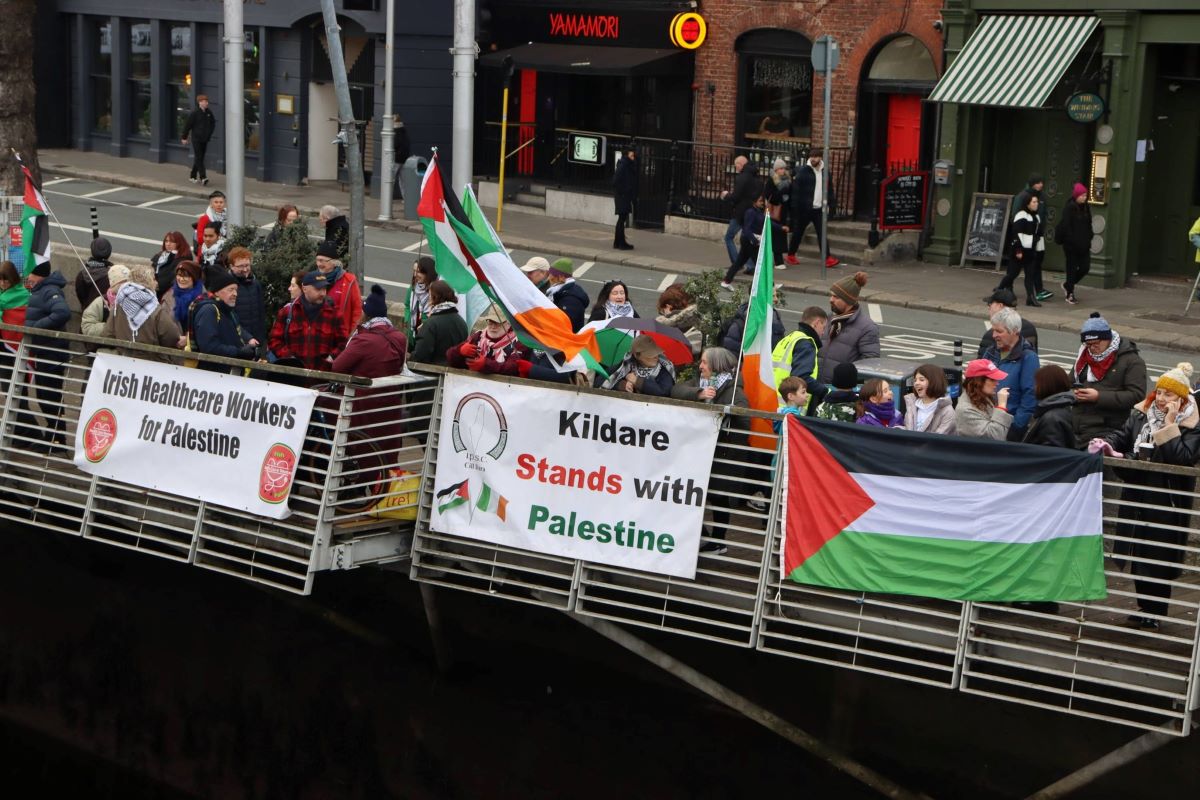
Through three events on Saturday, New Year’s Eve in the city centre, Dublin sent a solidarity message to the Palestinian people and also to the solidarity activists on hunger strike in British jails, referencing also those of the Irish Resistance in 1981.
The Millennium Bridge on New Year’s Eve. (Photo: IPSC)
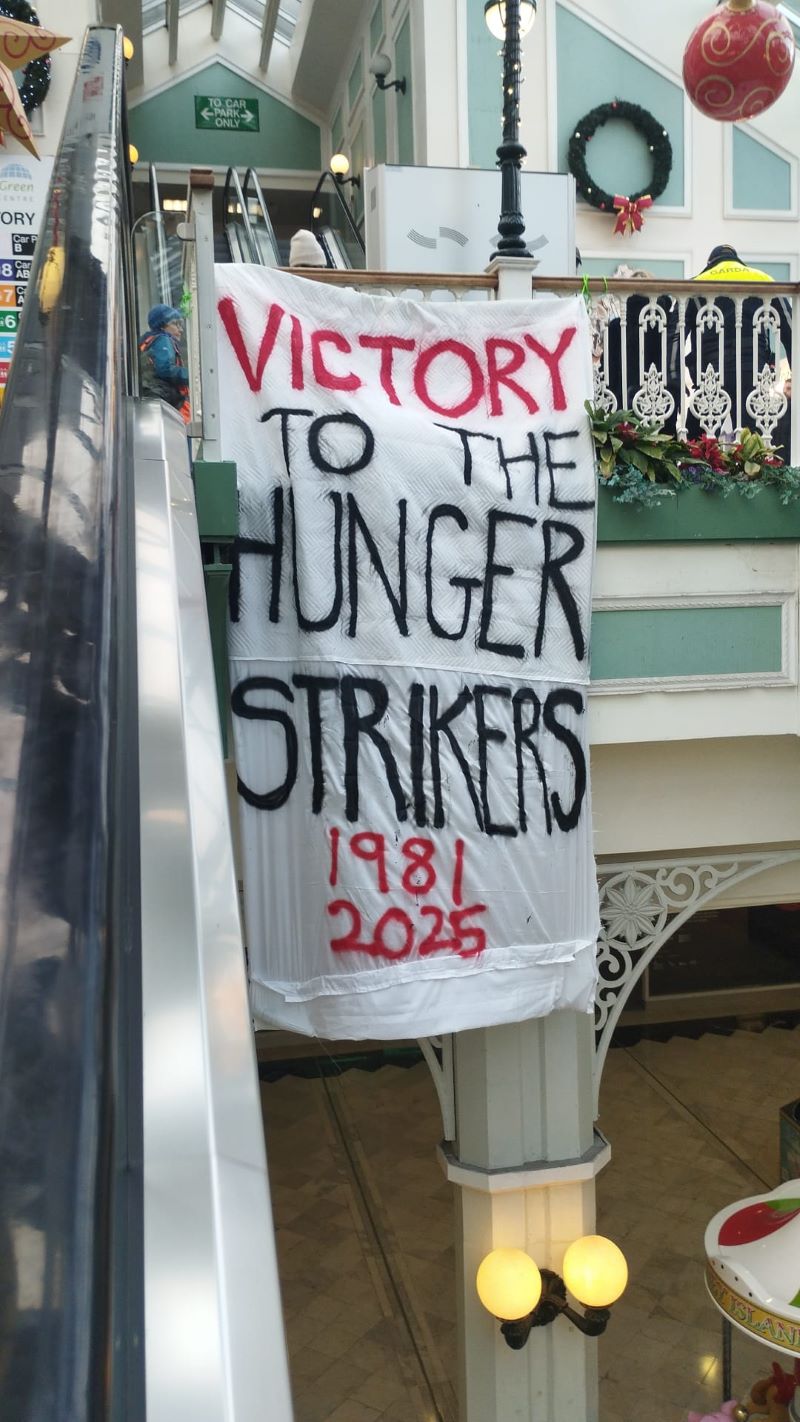
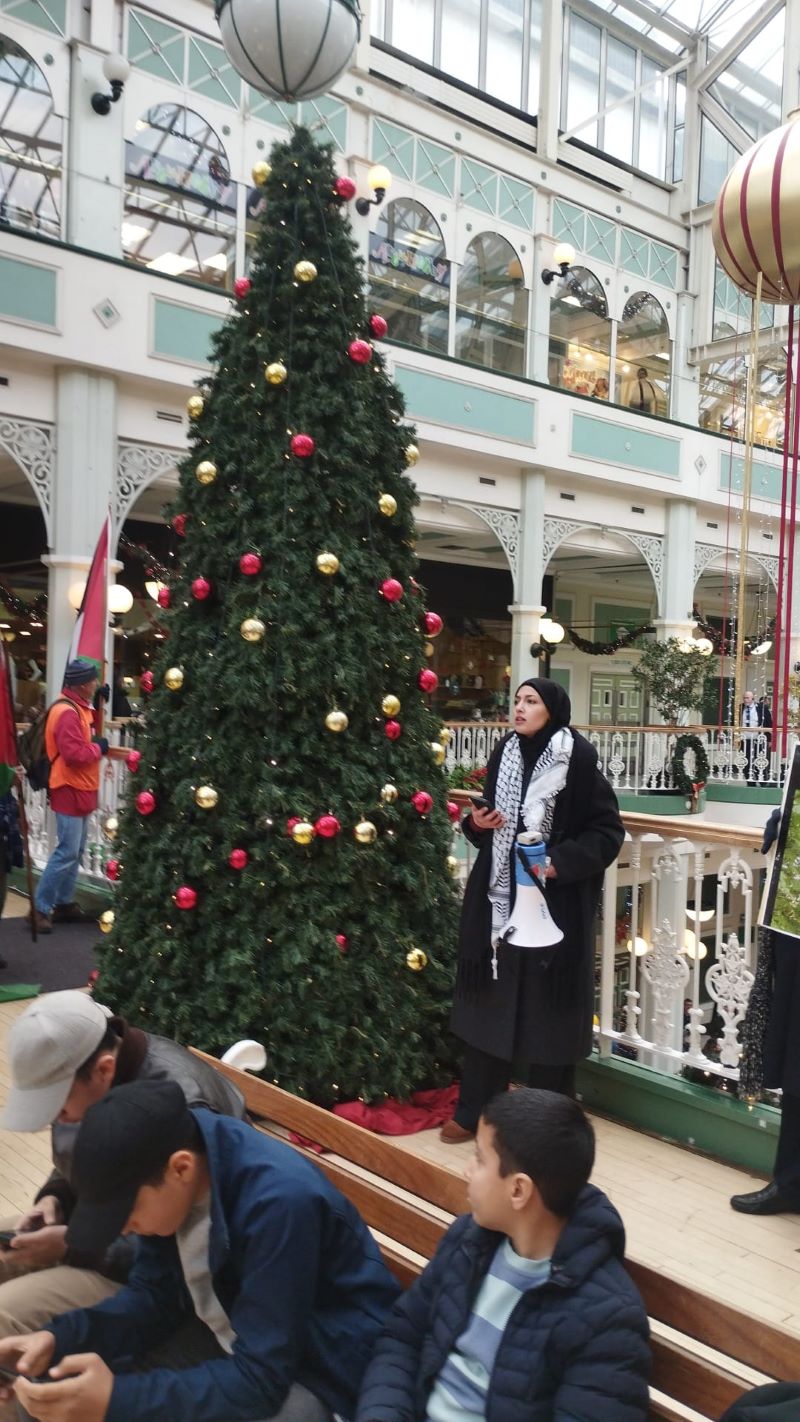
Chronologically first was a protest in the Starbucks café1 in Stephen’s Green Shopping Centre obliging the management to close for hours and a balcony walkway banner drop calling for solidarity with the Elbit accused on hunger strike, referencing also the Irish hunger-strikes of 1981.2
I had not read the poster carefully and arrived at the Starbucks at the north end of Grafton Street, where there were a few other confused people also. By the time I made my way up to the southern end of Grafton Street, the protest there was about to leave and I was about to head elsewhere.
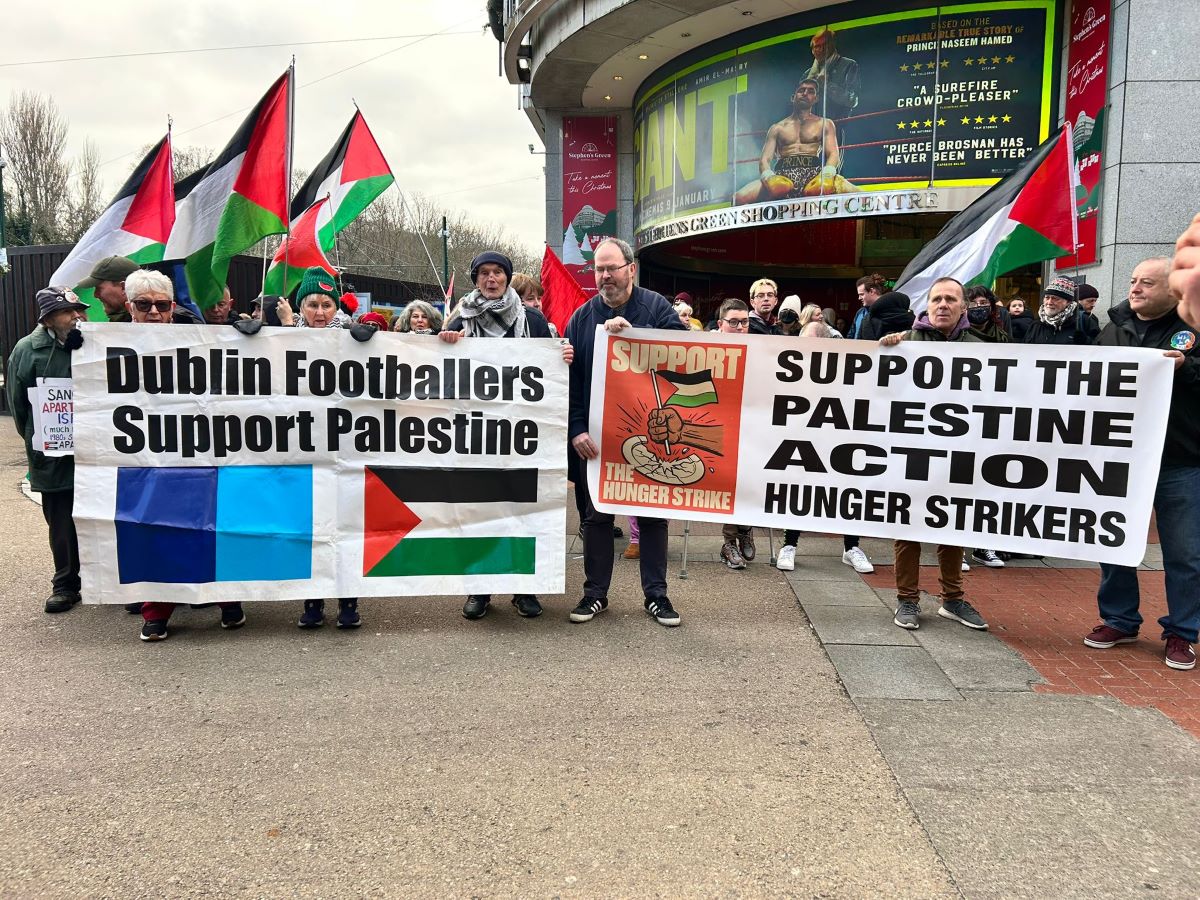
Two main banners present at protest outside the Stephen’s Green Centre on New Year’s Eve, after closing down the Starbucks café inside. (Photo: Bas)
The solidarity crowd continued to demonstrate in the shopping centre’s main doorway before marching away, then went into the Zara3 big shop and demonstrated there awhile before heading on to MacDonald’s in Grafton Street where the Gardaí began to let their nasty side show a little.
Palestine solidarity protesters leaving the Stephen’s Green Centre on New Year’s Eve, heading down to Zara to protest there (Photo: D.Breatnach)
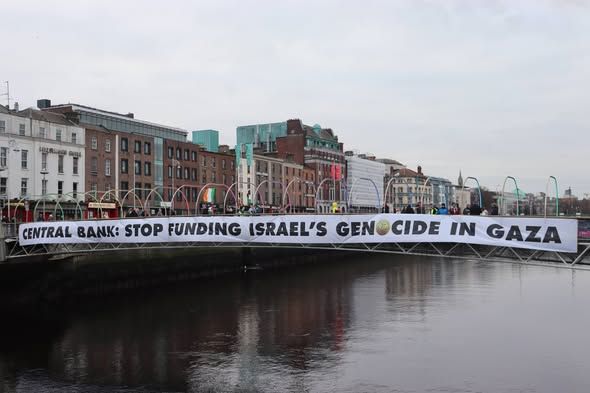
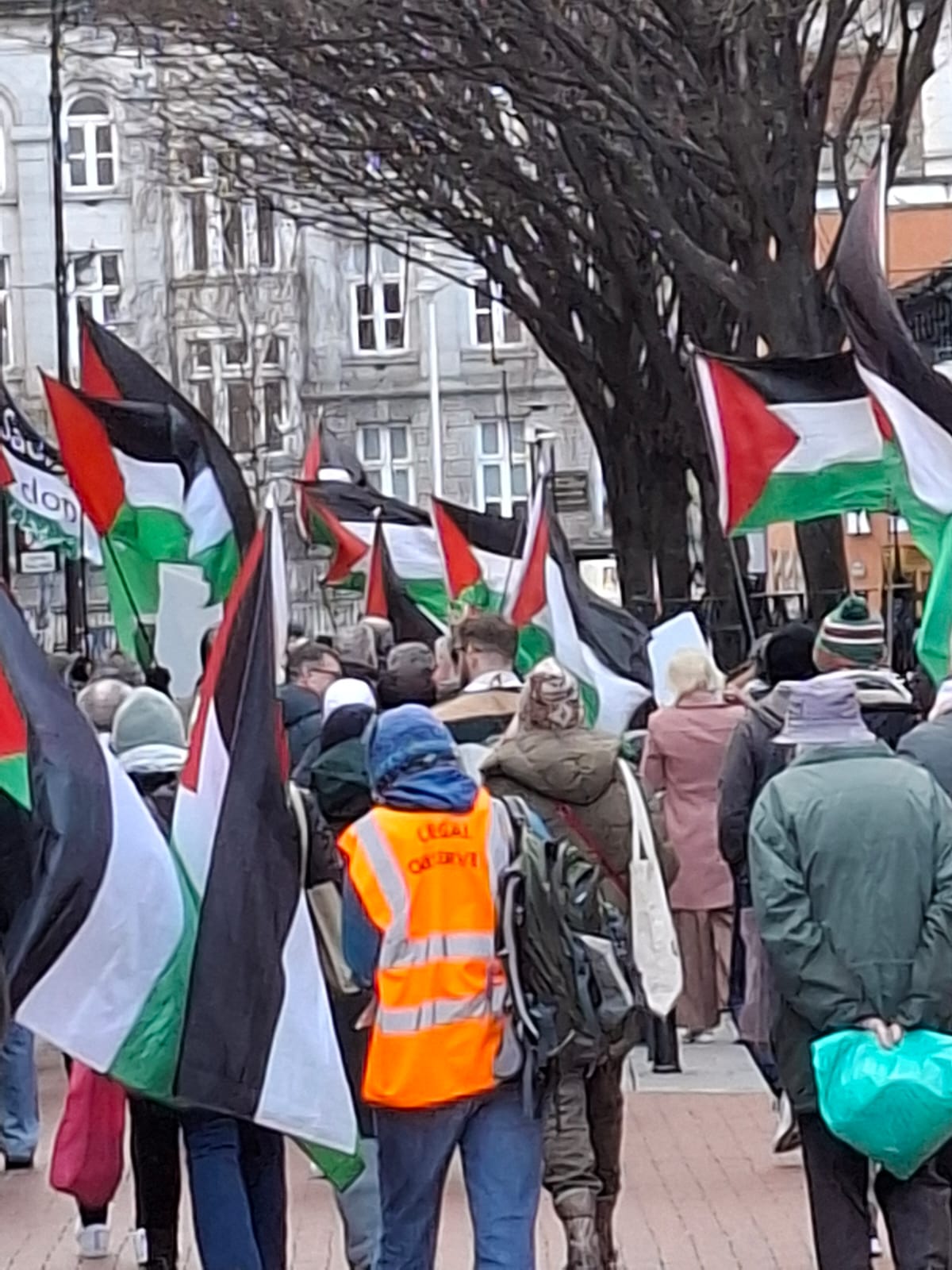
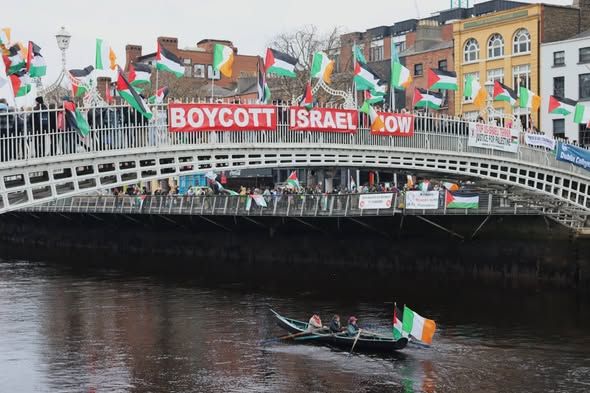
Then another Starbucks, this one on Dame Street got a Palestine solidarity visit before the demonstrators went on to the iconic pedestrian Ha’penny Bridge, where the Ireland Palestine Solidarity Campaign holds a Palestine solidarity protest every New Year’s Eve.
Closeup of banner-drop inside the Stephen’s Green Centre on New Year’s Eve, during protest after closing down the Starbucks café inside. (Photo: G.O.L)
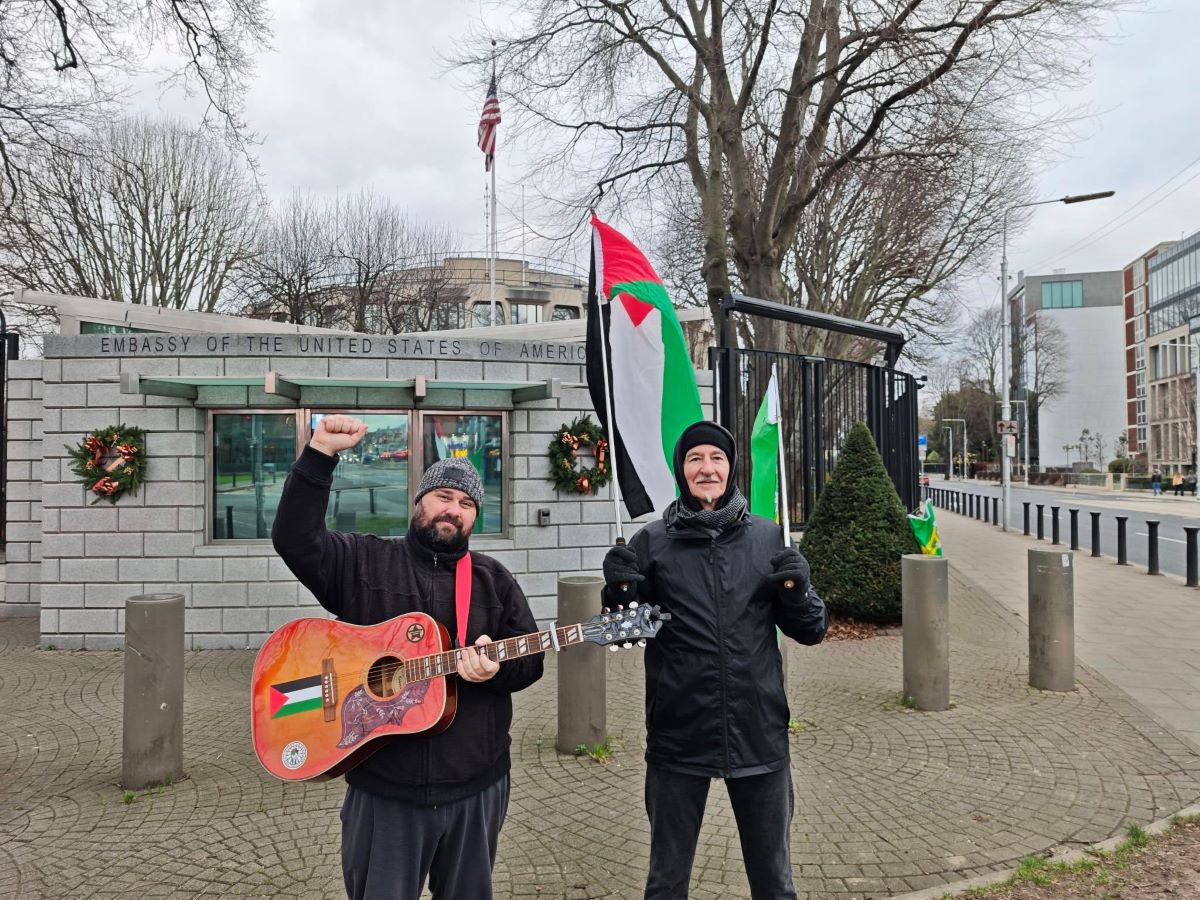
There the demonstrators thronged the Ha’penny and Millennium Bridges and spilled out along the quays. I was elsewherefor the first time in years as it was a Wednesday and therefore Jimi Cullen’s weekly protest with songs at the US Embassy in Ballsbridge, this one to be his 97th straight.
As usual there were police on guard there and one in uniform approached myself and Jimi as we were talking and asked Jimi how long the event would be, how many attending etc. Then she suggested I removed my bike which was leaning against a bollard.
Conducting the protest inside the Stephen’s Green Centre on New Year’s Eve which obliged management to close down for some hours the Starbucks café inside. (Photo: G.O.L)
I told her I was happy with where it was, thank you. Then she said that it might fall on someone (but not, of course, if across the road!), then that someone might steal it, all of which was nonsense of course then said: ‘I am asking you to remove it’ to which I replied ‘And I am declining.’
She was getting quite angry but decided to walk it off. I have attended supporting Jimi’s protest perhaps a score of times and in the early days had a similar approach from a Special Branch4 officer who accused me of causing ‘a security risk’ to the Embassy’s ‘curtilage’ (on a public footpath)!
The Ha’penny Bridge on New Year’s Eve. (Photo: IPSC)
Some police just like to throw their weight around even with regard to things that have nothing to do with the law or causing harm to anyone and over which they have no legal power.
Anyway we unfurled the flags, Jimi had a placard displayed, got out his guitar and we sang through week 97 to frequent waves, clapping, thumbs up, clenched fists, shouts and horn blowing of appreciation and solidarity from passing motorists, pedestrians and cyclists.
Section of northern quays/ Boardwalk on New Year’s Eve, during protest after closing down the Starbucks café inside. (Photo: IPSC)
Jimi began this weekly protest outside the Israeli Embassy but when they left Ireland he moved up the road to the nearby US Embassy, representative of the world leader in terrorism and biggest supporter, politically, financially and militarily of the world’s leading genocider entity.
Usually there are more supporters present. Jimi has a fine stock of protest and solidarity songs, some of which he composed himself and performs them well. Today we did mostly Irish songs of struggle but also one from the black civil rights struggle and Jimi’s own about Palestine.
Jimi Cullen and myself at Jimi’s weekly event outside the US Embassy on New Year’s Eve. (Photo: J.Cullen)
We had a number of Palestinian flags there but also two Starry Plough flags and there were some Irish Tricolours to be seen on the other protests among the many Palestinian ones. It is from our own struggle that we stand in solidarity with Palestine.
End.
Note: If you found this article of interest, why not register with Rebel Breeze for free, so that you will be notified by email of subsequent articles. You can de-register any time you wish.
2Ten Irish Republican prisoners, seven IRA and three INLA died on hunger-strike in a British jail in 1981 in a struggle against criminalisation and for political status
Writing about Christmas and war tends to focus on Christmas celebration as a counter to war,1 or alternatively on how hard it is to be celebrating Christmas in the midst of war. However, in much of West Asia, Christmas is now very much apartof the war.
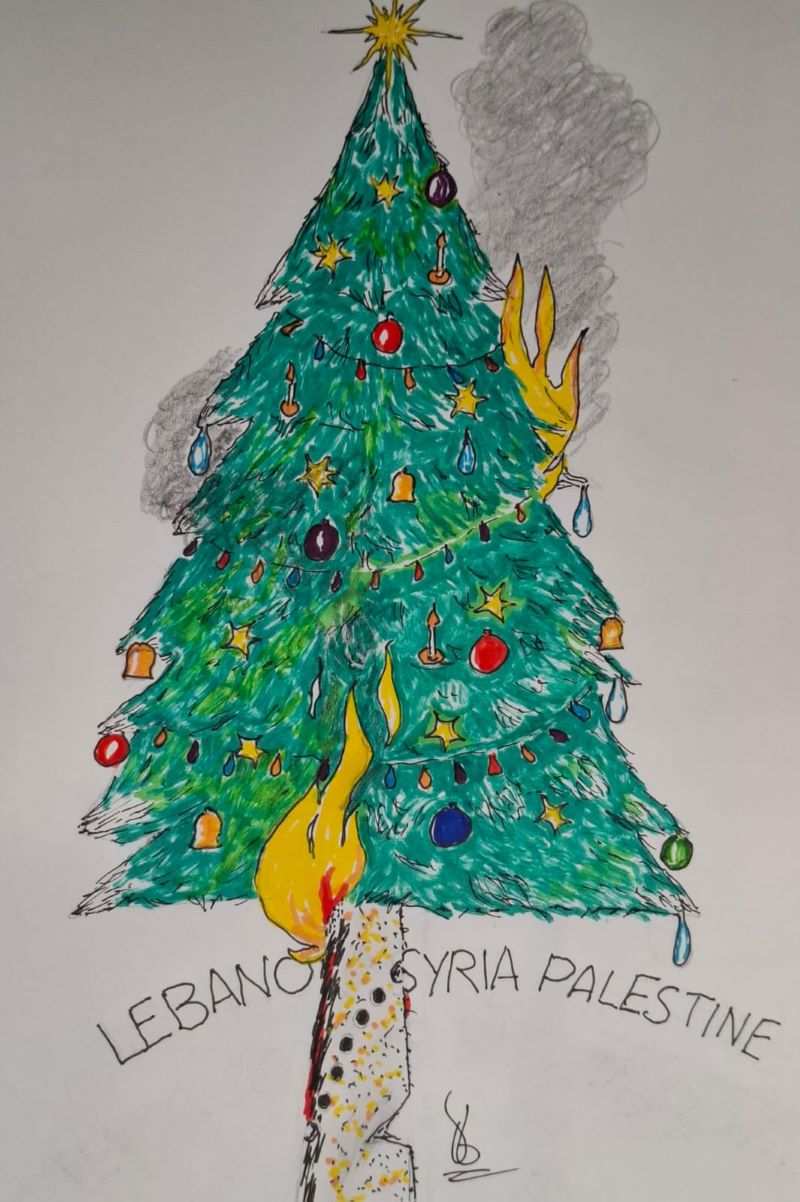
This is certainly the case in Lebanon, Syria, Gaza and the West Bank and even inside ‘Israel’.
Among the peoples of this majority Muslim region the festivities are primarily those of Christian communities. Yet the broad Muslim population has no issue with the religious aspect of the festival, nor even with the iconic symbolism of the Holy Family and the birth in a manger of Jesus Christ.
The latter, among Christians believed a human incarnation of God, is also revered among Muslims but as a prophet, though of course lower in ranking than their highest-ranking prophet, Mohammed (c. 570 – 8 June 632 CE), allegedly of the Banu Hashim clan of the Quaraysh Arab tribe.
Among the Judaic religion, Jesus Christ is also believed a prophet.
It is important – and not just for historical reasons – to note that the major perpetrator of religious persecution from the Middle Ages on has been Christianity, led by European Christian elites persecuting followers of Judaic and Islamic religions and employing the Inquisition2 against them.
Earlier of course Christianity had its internal divisions resulting in one part of Christianity persecuting another (the East-West schism) and then later the split of the Reformation, with religious and temporal powers in war and in persecution of one another and of subject populations.3
The chief object of Christian religious persecution overall was the Jews and the objects of that persecution found sanctuary in many Muslim countries and, in general, within the Austro-Hungarian Ottoman Empire.
Leaders of a number of Muslim states today are traditionally at pains to demonstrate their acceptance of Christian communities and this Christmas both Mohammed Shia al-Sudani, Prime Minister of Iraq and President Masoud Pezeshkian of Iran once more did so publicly.
Mohammed al-Sudani attended a Christian service and Masoud Pezeshkian visited a Christian family.4
Of course, Christmas as celebrated generally across the West is more – and one might say also much less – than a Christian or even a religious festival, with emphasis on feasting, alcoholic consumption and expenditure on presents.
Much of the symbolism too owes more to pagan religion than to Christianity.5
With a number of those aspects, including consumption of alcohol (traditionally forbidden by and to Muslims), pagan symbolism and more than a nod to western imperialist culture, many Muslims may take exception but even then not at all to celebration of the alleged birth of Jesus Christ.
However, for those wishing to cause divisions in predominantly Islamic societies, or in imposing their sectarian absolutist rule on society, the celebration of Christmas has become a hostile target in Lebanon, Syria, Gaza, the West Bank and even inside ‘Israel’.
LEBANON
Lebanon is the most ethnically-diverse of the West Asian states, approximately one-third Christian, one-third Shia Muslim and a third Sunni Muslim. For years, Christmas has been celebrated not only by the Christian community but also, to varying degrees, by the other ethnic groups also.
It is extremely worrying therefore when a primary schoolteacher taught her girl pupils and filmed them not only renouncing Christmas as ‘non-Muslim’ but calling its celebrants the equivalent of heretics. There was widespread shock when she uploaded the video she had made of the girls.
Not surprisingly, the teacher was sacked but this too was orchestrated into a controversy with extreme religious sectarians coming on to the streets to protest, including former sectarian terrorist and ex-convict for bombing a church Samir Geagea of the sectarian Lebanese Forces militia).6
SYRIA
Under the new regime in Syria, celebrating Christmas can get people killed.The celebration was not controversial in the majority Islamic but secular state of Syria under al-Assad but that changed following that regime’s overthrow by western-supported Islamic fundamentalist jihadists.
During Christmas 2024 units of the fundamentalist jihadist coalition under self-appointed al-Julani (formerly Ahmed al-Sharaa of the Syrian chapter of ISIS) led attacks on Christians, forbade the erection of Christmas trees and knocked down and burned some that had been erected.7
Earlier this year Sayara Ahl Al-Sunnah, a Syrian terrorist organization split from the ruling Hay’at Tahrir Al-Sham (HTS) of al-Julani in February carried out a suicide attack on the Mar Elias Greek Orthodox church in Damascus, killing 30 Christian worshippers.8
Not just Christian communities are targeted in this ‘new democratic Syria’ so beloved of the Western powers but primarily really the Shia Muslim offshoots of Alawites9 and Druze10 communities. Both these communities are now mobilising in self-defence against the new rulers.
PALESTINE
In Gaza, blockaded and besieged, starving, flooded, homeless, cold, bombarded, even thinking of a festive celebration seems a crazy idea yet some have attempted to celebrate Christmas this year11 although any gathering of Palestinians seems an invitation to an IOF raid or even bombing.
In the West Bank, the Christian pastor12 in Ramallah, Isaac Munther, faced with the accelerating genocide in Gaza in 2023 declared there would be religious observation only and no Christmas celebrations of lights etc … but his sermon and Christ-nativity-in-rubble scene went ‘viral.’
Munther did the same during Christmas 2024 but this year the West Bank faces its own escalation of Palestinian home demolitions, army invasions, settler attacks on homes, livestock, farmland. However the IOF attacked some Palestinians who did try to celebrate a western-style Christmas.
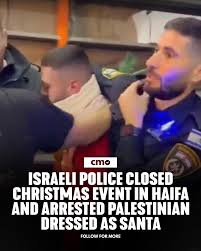
Palestinians of other Christian denominations also tried to celebrate Christmas but met with repression and in Bethlehem there were clashes with Palestinians in Santa costume assaulted and arrested by ‘Israeli’ Occupation Forces.13
Occupied Palestine (‘Israel’ sic) also saw a Palestinian ‘Santa Claus’ being arrested by the IOF and Palestinian celebrants assaulted in Haifa.
As the supposed Holy Land where Jesus Christ was allegedly born, Christian tourism makes a significant contribution to the income of the Zionist state.14 But even so, Palestinian Christians and even tourists have complained of being menaced and spat at by militant Zionist settler youths.15
The Israeli Zionist state likes to promote itself as culturally representing the West much more than the East – which it certainly does – but seeing this repression of Christians even celebrating Christmas, one has to wonder what kind of ‘western society’ is this?
Meanwhile, in Rome …
Discussion of Christmas entails a mention of the majority sect of western Christianity, the Catholic faith and of its leader, the Pope. And the relatively new Pontiff – and first USA-born one – did in fact refer to Gaza in the traditional Papacy Christmas message from the Vatican.
Leo XIV’s message has been lauded by some in apparent ignorance of the political position of the Vatican and of its Papacy, which has been always to support western imperialism, or in his advocacy of Zionist colonisation in the western support for a two-State solution (sic) in Palestine.16
But for democracy and anti-imperialist unity …
Republicans reject any religious role in the management of the state or of its institutions – including education17 – but should also protect the freedom to worship or celebration of festive period of any personal or organised religion — and indeed also the right to promote atheism or agnosticism.18
Anti-imperialist revolutionaries whether secular or not need to oppose religious sectarianism and promote unity in the face of imperialism. It is imperialism and colonialism that promotes inter-religious conflict and fosters fundamentalist sectarians in order to undermine anti-imperialist resistance.
End.
Note: If you found this article of interest, why not register with Rebel Breeze for free, so that you will be notified by email of subsequent articles. You can de-register any time you wish.
2Although it later became an instrument of Rome to ensure orthodoxy in religion, literature and science, the Inquisition was originally instituted in Iberia as a controlling agent over the forced conversions of Jews and Muslims to Christianity and later also operated as an instrument in control of the Spanish colonies.
3Of which we in Ireland have centuries of experience.
5The ‘old man of the woods’ Santa Claus or God of thunder and lightning in a sky-chariot pulled by horned beasts (two of which are also allegedly named Thunder (Donner) and Lightning (Blitzen) and the Christmas Tree and/ or Yule Log, pagan symbols of a festival signalling the turn of the seasons.
14“While there is no precise figure for how much Israel earns specifically from religious tourism, estimates suggest that Christian holy sites alone generate around $3 billion each year to the Israeli economy under normal circumstances — with over half of all tourist arrivals coming from Christians — and a quarter of those visitors going to Christian holy sites.” https://religionunplugged.com/news/war-in-gaza-and-the-disruption-of-pilgrimages-to-jerusalem
17This is an issue in many lands including Ireland where the Irish State and the colony’s both pay the salaries of teachers employed in religious-ethos schools. People have a right to religious education for their children should they wish it but in no way should the State facilitate such and, on the other hand, all children are required to attend formal education supplied by the State.
18The 1916 Rising Proclamation: “The Republic guarantees religious and civil iberty to all …”
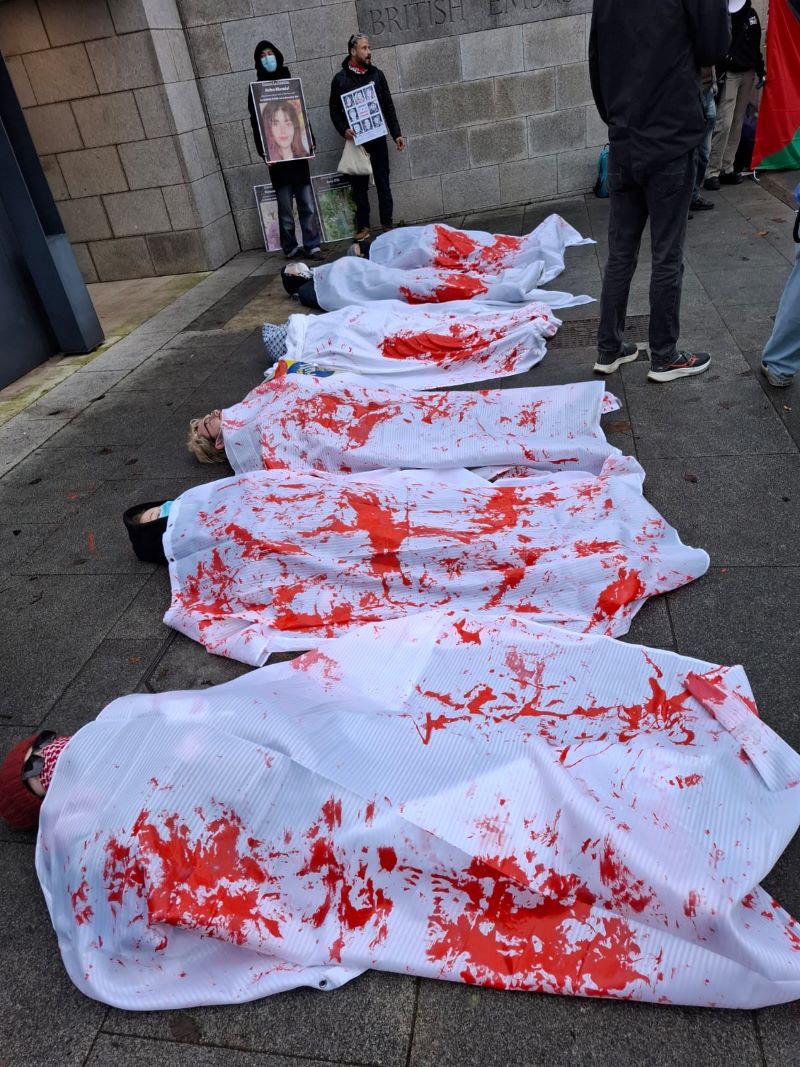
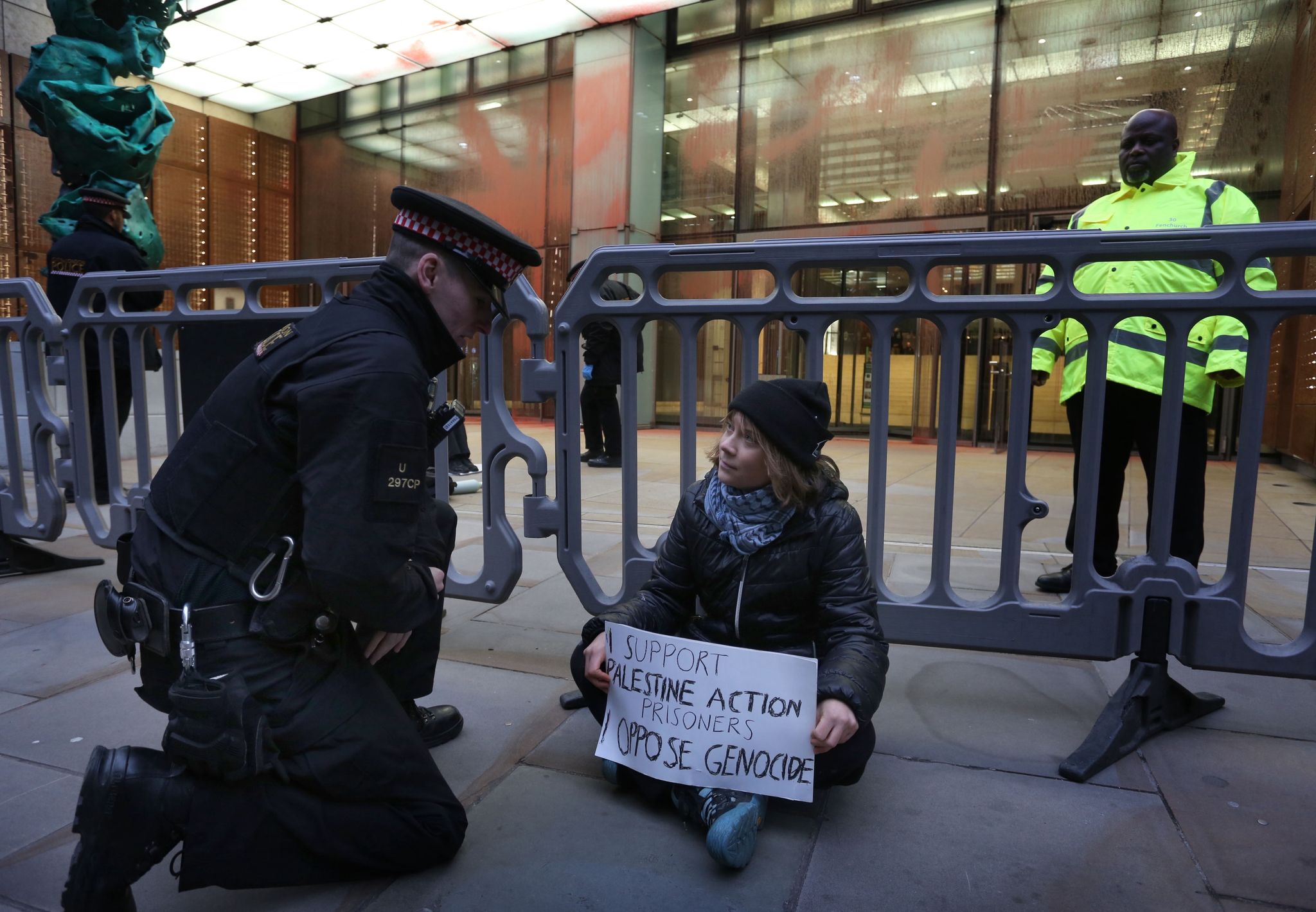
There were lively scenes today outside Dublin’s British Embassy in solidarity with the hunger strikers in British jails awaiting trial on charges arising out of Palestine Action’s operations against the Israeli arms company, Elbit Systems UK.
Two of the six hunger strikers are in their 50th days without food and approaching the point where fatal seizures are possible or suffering irreversible damage to body systems. Their demands are release on bail, a fair trial, de-proscription of Palestine Action and the closure of Elbit Systems.
Early shot of hunger-striker solidarity protesters outside the British Embassy compound today. (Photo: R.Breeze)
There have been daily solidarity protests in Britain, including those led by the Irish Brigade1 in London amid general mass media silence but the arrest of Greta Thurnberg today on ‘terrorism’ charges may bring a focus on the hunger-strikes for a change.
Today also The National newspaper revealed that Barclay’s had asked the British Government to ban Palestine Action and already the question is being asked: How is it that was not admitted by the Government when Huda Ammori took the Palestine Action banning to judicial review?
(Greta Thurnberg about to be arrested earlier in Central London). Photo source: Internet)
The rally today, like that outside the British Embassy last week, was organised by the Peadar O’Donnell Socialist Republican Forum, while another solidarity rally in Dublin last week but on College Green, in the City Centre, was organised Communities for Palestine.
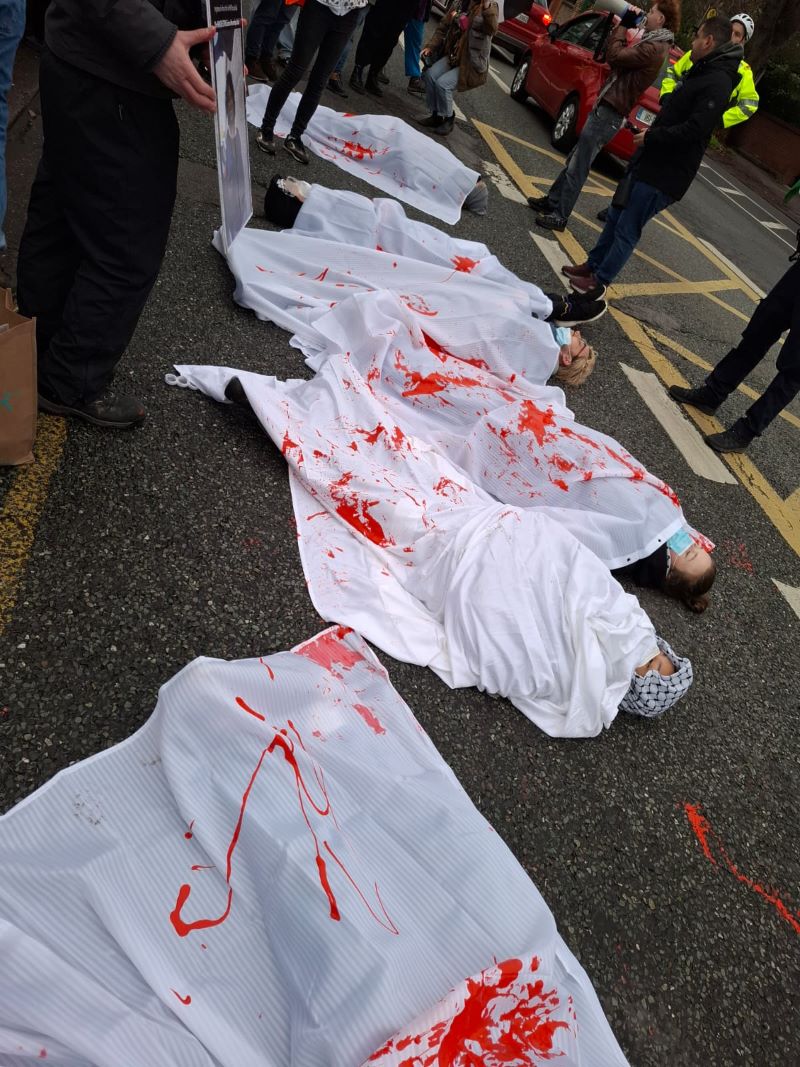
The ‘corpses’ in the road outside the British Embassy compound today. (Photo: R.Breeze)
The chants led outside the Embassy today included the usual ones heard on Palestine solidarity marches, including those referencing the Intifada, the occupation of Ireland and the Irish-language Saoirse don Phalaistín! But there were also new ones and additions to older slogans.
A new Four, Five and Six was added to a previous only One, Two and Three: One – We are the people; Two – We won’t be silenced; Three – Stop the bombing now, now, now! Four – Free our people; Five – Free our land; Six – Kick Zionism out, out, out!
Some other changed and new chants included: One, Two, Three, Four– Support the Filton 24! Five, Six, Seven, Eight – Israel is a terrorist state. We are all Palestine Action! Victory to the hunger-strikers! Brick by brick, wall by wall – all the colonies will fall!
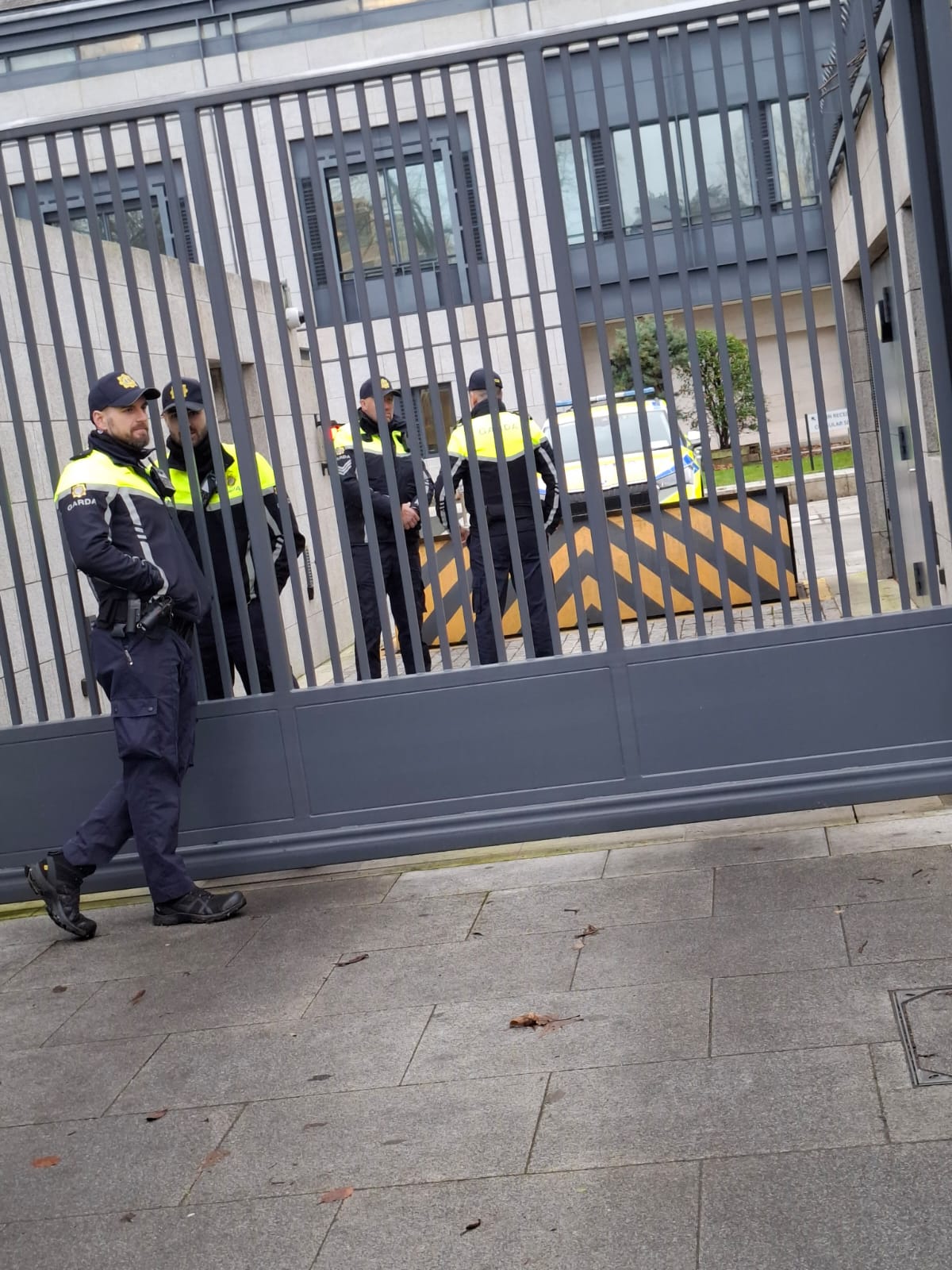
Slogans also castigated British Government collusion in the Israeli genocide, Irish state collusion through militarisation of Shannon Airport and Gardaí collusion through their defence of the British Embassy.
Numbers of Gardaí and one of their vehicles actually inside the British Embassy compound today. (Photo: R.Breeze)
On two occasions the MC asked demonstrators to line both sides of the road outside the Embassy, which is one of the main Dublin routes from and towards the South. Passing traffic frequently sounded their horns in solidarity, passengers often signing thumbs-up or with clenched fist.
But at one point, most of the demonstrators occupied the road, blocking traffic in each direction. The Gardaí moved quickly to break this up and were soon violently shoving demonstrators off the road, one in particular screaming with wild eyes so that he was twice seen restrained by colleagues.2
However part of the northbound road remained occupied in front of the Embassy entrance and at this point a new group of protesters arrived and, unpacking white curtain material, began to squirt red paint on it, then to lie down in the road under the material like massacre victims.
A number of speeches were made during the event and later a man called the crowd to remember also the 1981 hunger strikes in Ireland, for which he sang the Joe McDonnell3 Ballad, with its wonderful chorus lines: You dare to call me a ‘terrorist,’ while you look down your guns!4
Another man recounted the story told by Bobby Sands5 of the caged lark which would not sing for its captor and how that bird came to represent Sands himself, before reciting a poem of an Irish migrant in London in anguish as Bobby Sands lay dying.
The ‘corpses’ were moved from the road to immediately in front of the British Embassy compound today. (Photo: R.Breeze)
The current hunger-strikes are sometimes referenced as “the first coordinated hunger strikes in Britain” since those of the Irish Republicans in 1981. Of course, those strikes were not in Britain but in occupied Ireland and therefore currently part of the United Kingdom.
There are important differences of course. The Irish Republican hunger strikers were convicted, albeit by special non-jury courts, of armed resistance to British occupation; the current hunger strikers have not yet even been tried and none of the charges against them include armed action.
And the motivation of the Palestine Action accused is purely internationalist solidarity against a regime committing daily massacres in a programmed genocide.
Nevertheless, the British ruling class may yet come to regret the day they permitted anti-Zionism to become so strongly linked to anti-British colonialism, and anti-genocide internationalism so closely linked to the memory of Irish colonial resistance.
End.
Note: If you found this article of interest, why not register with Rebel Breeze for free, so that you will be notified by email of subsequent articles. You can de-register any time you wish.
FOOTNOTES
1An ad-hoc broad Palestine solidarity organisation composed of Irish migrants and diaspora in London.
2This may possibly be the same Garda who was seen wildly striking with his baton and pepper-spraying peaceful participants at a Palestine solidarity march to Dublin Port some weeks ago.
4And you dare to call me a terrorist, while you look down your guns! When I think of all the things that you have done: You have plundered many nations, divided many lands, You have terrorised their people, ruled with an iron hand – And you brought the stain of terror, to my land.
5Bobby Sands relinquished his elected post of Officer Commanding the Republican male prisoners in Long Kesh in order to lead the hunger strikes of 1981. On 5th May he was the first of the Ten to die.
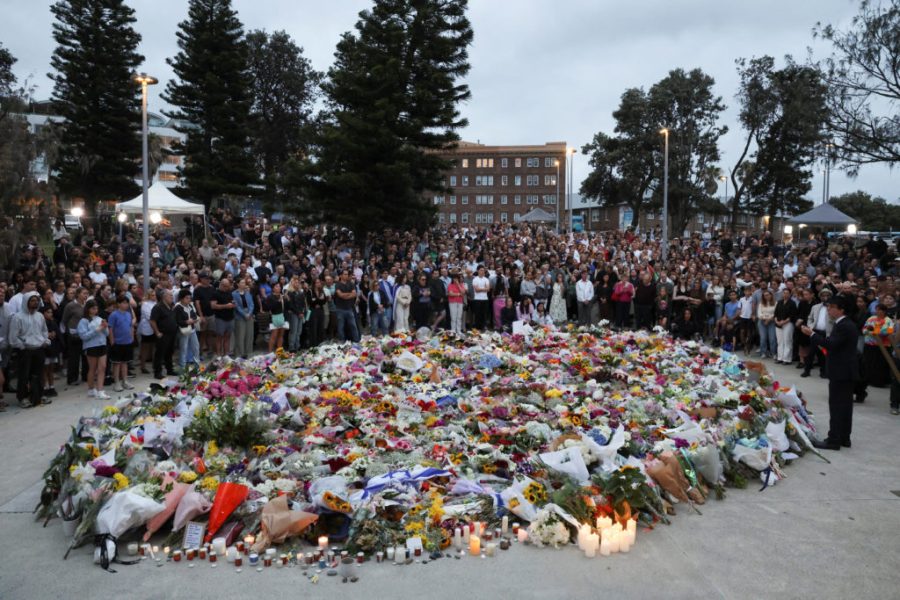
In the aftermath of the Bondi massacre, we might ask: Is anti-Semitism1 on the rise?
It is hard to be certain, given that politicians and media keep conflating anti-Zionism and anti-Israel feelings with anti-Semitism, mixing acts against one with acts against the other, despite their being two very different things.
People pay respects at Bondi Pavilion to victims of a shooting during a Jewish holiday celebration at Bondi Beach, in Sydney, Australia, December 15, 2025. REUTERS/Hollie Adams
But would it be surprising if anti-Semitism were indeed on the rise? And if it is, who are the main culprits?
Undoubtedly, the western imperialists who support the Israeli settler colony and repress their own citizens for opposing genocide must contribute to anti-semitism.
Above all however the Israeli State itself and its genocide against the indigenous Palestinian people, while insisting that the Zionist State is the ‘national’ expression of Judaism, that their Zionism is Judaism, must be counted as particularly responsible.
Zionism is a late 19th Century political movement for the creation of a Jewish state, founded by a small group of European Ashkenazi2 Jewish background which received the support at the time of imperialist European capitalists, particularly the British variety (some of them anti-Semites too!).
A branch of Evangelical Christianity, especially in the USA has also become Zionist.3 Leaving aside religious and prophetic belief, this sector provides a strong base of political and financial support, particularly through AIPAC,4 for US imperialist support for the Israeli Zionist state.
Judaism is a religion, often described as ‘of the Book’, which it shares with Christianity and Islam, all of them with origins in West Asia but with Christianity recruiting most of its congregations and states in Europe (now also the whole West, with the USA, Canada, Australia and New Zealand).
Later, the main supporters of the Zionist project were the USA. A dedicated foothold in West Asia, secure from socialist revolution among its colonial Zionist settler population and with any nationalist Arab movement suppressed by this garrison, was of course attractive to the imperialists.
The project of conflating Judaism with Israeli Zionism has been underway for well over a century but even in the wake of the Nazi genocide, Zionism did not have the support of the majority of Jews around the world.5 This changed as the 20th Century progressed but appears to be reverting now.6
ANTI-SEMITISM?
As more and more people, particularly youth around the world take to the streets and to educational establishments to denounce the daily genocide of the Palestinian people by the Israeli State and the collusion of the Western regimes, they face heavy repression of the states.
Beating with truncheons, use of irritant sprays, threats to academic study programs, arrests, strip-searching and serious charges are already occurring in the Irish state. To those must be added banning of organisations under false ‘terrorism’ classification in the UK and Canada.7
Special repressive measures are routinely taken against public displays of Palestinian solidarity in Germany, Austria and France. Journalists have been harassed and arrested, recording equipment confiscated and professionals have their careers threatened, all for opposing the Israeli genocide.8
Some of the resentment felt by the victims of such repression may be misdirected upon people of Jewish background, particularly since the Zionists and the Imperialists work so hard to identify the one with the other.
In addition there is a long anti-Semitic tradition in European Christian society from the Middle Ages9 which was employed and extended by fascist and Nazi movements in the 1930s, combined with a false and perverted nationalism. And currently fascist movements are once again on the rise.
It is instructive to see British fascist and Israeli flags side by side among groups counter-protesting gatherings of Palestinian solidarity in England, or British colonial Loyalists burning Palestinian flags alongside symbols of Irish Republicanism such as the Irish Tricolour.
AN ANTI-SEMITIC ATROCITY
Is is difficult, particularly in the absence so far of information from the perpetrators,10 to view the Bondi Beach massacre in Australia as other than an anti-Semitic atrocity. The victims were attending a Jewish religious festival when fired upon.
First panel shows the shooters, father and son, said to be linked to ISIS; Second panel shows one of the shooters being tackled and disarmed by Syrian-born Australian Ahmed al Ahmed who was later injured and underwent surgery. (Photo sources: Internet)
Had one of the victims, media-characterised as a saintly rabbi but in fact a Zionist supporter of the genocidal Israeli State (who had himself photographed among its soldiers while holding an automatic rifle)11 been an intended target cannot justify the resulting civilian ‘collateral damage’.
In fact, such disregard for other casualties surrounding a targeted individual is a standard feature of Israeli Occupation Forces assassinations and can never be those supported by Palestine internationalist supporters or by any other democratic movement.
Western politicians and media now strive to employ this massacre and its attendant horror to further strengthen Zionism and to further conflate anti-Semitism with anti-Zionism, none more so than Netanyahu who claimed that recognition of Palestinian nationhood was a causative factor.12
And in Australia, the massacre is already being used in propaganda against the Palestine solidarity movement: Prime Minister Albanese has stated the intention to outlaw the Palestinian liberation and solidarity slogan: ‘From the river to the sea, Palestine will be free!’.13
The fact remains that the Israeli Zionists themselves are the greatest cause of any rise of anti-Semitism in the World.
End.
Note: If you found this article of interest, why not register with Rebel Breeze for free, so that you will be notified by email of subsequent articles. You can de-register any time you wish.
1Although the term ‘Semitic’ describes ethnic cultural groups including Jews and Arabs, the term ‘anti-Semitic’ has been taken largely to mean anti-Jewish, i.e. against people of Jewish religious background, despite its much more recent conflation with anti-Zionism.
2One of the European-based sections of the Jewish community, speaking European languages and the German-based Yiddish, using Hebrew only for religious purposes.
4American Israel Public Affairs Committee, a powerful pro-Israeli Zionist lobbying organisation providing funding to most US Congress and Senate elected members.
7The direct-action organisation Palestine Action was declared a ‘terrorist organisation’ under UK law on 5 July 2005 and so far over 2,490 people have been arrested for declaring support for the organisation.
9Jews in many Christian European countries were required by law to live in ghettoes or were expelled, such as the expulsion of Jews and Muslims by the Christian Monarchs of the Spanish Kingdoms 1492-1614.
10According to reports they were a father and son, the first killed at the scene and the second hospitalised, just now out of a coma.
As two of the six hunger strikers awaiting trial on actions against the Israeli arms company Elbit approach 50 days fasting and concern for their survival rises, the Irish recall their own history and the 10 Republican deaths on hunger strike in 1981.
The 1981 hunger striker martyrs were jailed active service Volunteers of the Provisional IRA (7) and Irish National Liberation Army (3) demanding their treatment as political prisoners. On May 5th Bobby Sands died on hunger strike, followed in stages by another nine Irish Republicans.
The Palestine Action activists on hunger strike in jail face charges of criminal damage and alleged assault during actions targetting buildings belonging to Elbit Systems in Britain, involving destruction of manufacturing equipment and weapons and daubing with red paint.
Placards representing the hunger-strikers and banners calling for solidarity with them on College Green, facing Trinity College, Dublin Saturday 13 June organised by Communities for Palestine. (Photo:Rebel Breeze)
The actions and charges predate the banning on 5 July of Palestine Action under the Terrorism Act 2000. That designation has since been protested across the UK1 with around 2,500 charged with “supporting terrorism” under the same Act (potential penalty 14 years prison or more).
The hunger-strikers have won strong support in Britain with solidarity pickets taking place now daily, along with demonstrations and marches. The protests have seen support from among the Irish diaspora, in particular in London led by the ad-hoc broad grouping of the Irish Brigade.2
Apart from humanitarian considerations, protests have also been directed at the UK’s mass media and its attempt to ignore the hunger-strikes and the solidarity actions.
MPs raised the issue too in the Westminster Parliament. Particularly shocking to many was not so much the video recording of the curt dismissal of Independent MP Jeremy Corbyn’s parliamentary question by a UK junior Minister but rather Labour MPs laughing at the put-down of Corbyn.3
On Thursday, more than 800 doctors, nurses, therapists and carers wrote to Justice Secretary David Lammy to warn that “without resolution, there is the real and increasingly likely potential that young British citizens will die in prison, having never even been convicted of an offence”.4
In Ireland itself, solidarity protests have taken place in Dublin city centre and at the British Embassy on the city’s outskirts, in addition to in Belfast and Derry within the British colony of the Six Counties. Again and again speakers referenced Irish history and in particular that of 1981.
Placard-holders facing westward traffic at College Green rally near Trinity College, Dublin Saturday 13 June. (Photo: Rebel Breeze)
In Dublin on Saturday 13 June, facing Trinity College, speakers at event organised by Communities for Palestine called for solidarity with the hunger strikers, denounced daily genocide in Palestine, the chairperson also leading the crowd in the now-famous chant led by the Bob Vylan band of “Death to the IDF!5”
Threatened Irish neutrality in the face of the growing threat of war by NATO was also raised by speakers, as was the continued British occupation of part of Ireland, the Irish State’s collusion with the Israeli genocide in Gaza and the US militarisation of Shannon Airport.
View of a section of the organised by Communities for Palestinerally from behind the main bannercalling for solidarity with the hunger-strikers on College Green, facing Trinity College Saturday 13 June. (Photo:Rebel Breeze)
On Wednesday afternoon, in almost incessant rain, a large crowd protesting outside the British Embassy in Dublin heard calls from a variety of speakers (independent Palestine solidarity, Irish Republican, Socialist TD Paul Murphy) to save the hunger-strikers’ lives.
The chairperson of the rally repeatedly referred to the building as “the colonial British Embassy” and led chants in solidarity with the hunger strikers, with Palestinian prisoners of Israel and with Irish Republican prisoners in both administrations.
Section of protest rally at main entrance British Embassy (the actual building is set back from the road) on Wednesday 17 June. (Photo: Rebel Breeze)
Referring to the Labour Party MPs laughing at Jeremy Corbyn’s pleas for the hunger strikers, she reminded participants of their cheering the 1916 execution of Connolly6 and dubbed the police “Lackeys of imperialism” as they tried to prevent demonstrators climbing up along the railings.
The slogans were not only of humanitarian concern but also of solidarity, of rage at the genocide in Palestine, of memory of Irish struggle and continuing British occupation. Among chants of hunger striker solidarity at least two speakers voiced the Republican slogan Tiocfaidh ár lá.7
The hunger-strikers’ demands are release on bail, a fair trial, deproscription of their organisation and closure of Elbit factories. The State would claim fair trials and as their period in detention has far exceeded the normal length even for those refused bail, could easily at least release them on bail.
The problem at issue for the British State is that conceding at all risks undermining their according terrorist status to the organisation (which postdates the arrests), a status already in serious danger.
And they need that to stamp out resistance to their genocide collusion, which they perceive as essential to their imperialist system. In that sense a concession in Britain now would have more impact than would have had to the hunger strikers in the colony in 1980 and 1981.
On the other hand, the State’s repression has brought more and more people into the struggle and has exposed the roles of the media, police, judiciary and the Labour Party. Now, the hunger-strikes are helping to draw Palestine solidarity feeling alongside Irish anti-colonial sentiment.
After some time at protest rally some demonstrators mount the wall to display their flags over the railings towards the British Embassy building, set back from the road on Wednesday 17 June. (Photo: Rebel Breeze)
End.
Note: If you found this article of interest, why not register with Rebel Breeze for free, so that you will be notified by email of subsequent articles. You can de-register any time you wish.
FOOTNOTES
1Led by the Defend Our Juries civil rights organisation.
2A broad and growing section of the Palestine solidarity movement in London that has been leading the Kneecap court case music solidarity sessions and the hunger-strikers’ solidarity actions there.
5The famous occasion was in June at this year’s Glastonbury Festival with the irony that it was live-streamed by the BBC in order to avoid featuring the Kneecap band from Ireland and their unequivocal expressions of solidarity with the Palestinian struggle. ‘IDF’ is the acronym of the armed forces of the Israeli state, more often named “Israeli Occupation Forces” (IOF) by Palestinian supporters.
6It was actually worse than that: as has been pointed out on occasion in articles in Rebel Breeze, the Labour Party, being in the UK coalition war government, were part of actually agreeing the post-1916 death sentences.
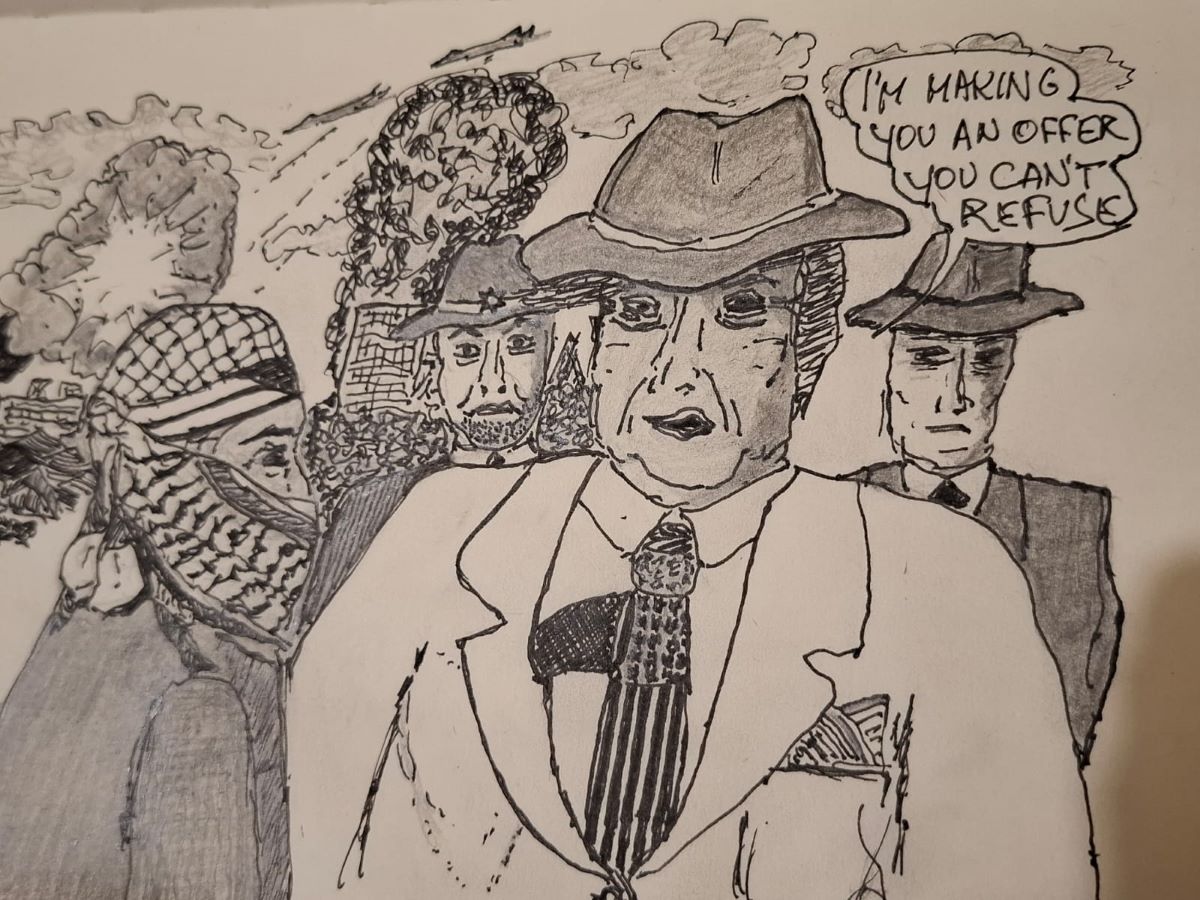
It was great to see the Irish pacification process being referenced with regard to the Trump plan for Gaza1 because that is exactly what the latter is: a plan to pacify the Resistance while ensuring it gets none of what it fought for.2
In other words, exactly like the Irish pacification process.
(Cartoon by D.Breatnach)
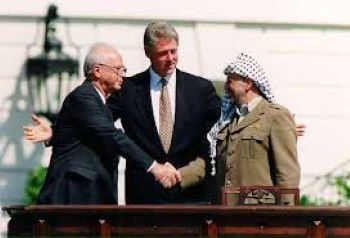
Hamas and Palestine Islamic Jihad grew out of previous Palestinian pacification processes. The Madrid Conference (1991) and the Oslo Agreement (1993) were imperialist/ Zionist attempts to pacify the wide-scale militant Palestinian resistance period of the First Intifada.3
Fatah at that time was the leading group in numbers and influence in the Palestine Liberation Organisation (from which Islamic groups were excluded) but also in Palestinian society in general. But Fatah had agreed to recognise ‘Israel’ and also the two-state solution (sic).
In the Oslo Agreement, furthermore, the question of the return to their homeland of the refugees was left aside. It appears that the Fatah leadership had lost faith in the eventual victory of their people’s struggle and had decided to get what they could by using the struggle to bargain.
The Oslo Agreement: US Imperialism’s President Clinton oversees Yitzak Rabin, Premier of Zionist state of ‘Israel’ shaking hands with Yasser Arafat of Fatah, then leader of the PLO.
What Fatah got was Palestinian Authority control in the first elections (1996), with internal control over/ management of the Palestinian population of the West Bank and Gaza, but not of the Palestinians in Jerusalem (captured by ‘Israel’ in 1967): a far cry from a free Palestine.4
In the Algiers conference of 1988 Fatah had won majority agreement to recognise ‘Israel’ and to accept the two-state solution5 (sic), i.e. embodying a Palestinian state on 20% of Palestinian land, under the eyes and guns of their Zionist neighbour).
Fatah’s rule became known for corruption and nepotism, which then had to be protected and defended from the Palestinian masses, leading to authoritarian, repressive and often arbitrary rule. And repression of the Resistance, along with direct collusion with the ‘Israeli’ State.
Continuing ‘Israeli’ repression and settlement expansion in turn led to the Second Intifada; Fatah lost to Hamas in the Palestinian parliamentary elections of 2006 followed by defeat of Fatah’s attempted coup in Gaza in 2007 (but the West Bank remaining under unelected Fatah control).
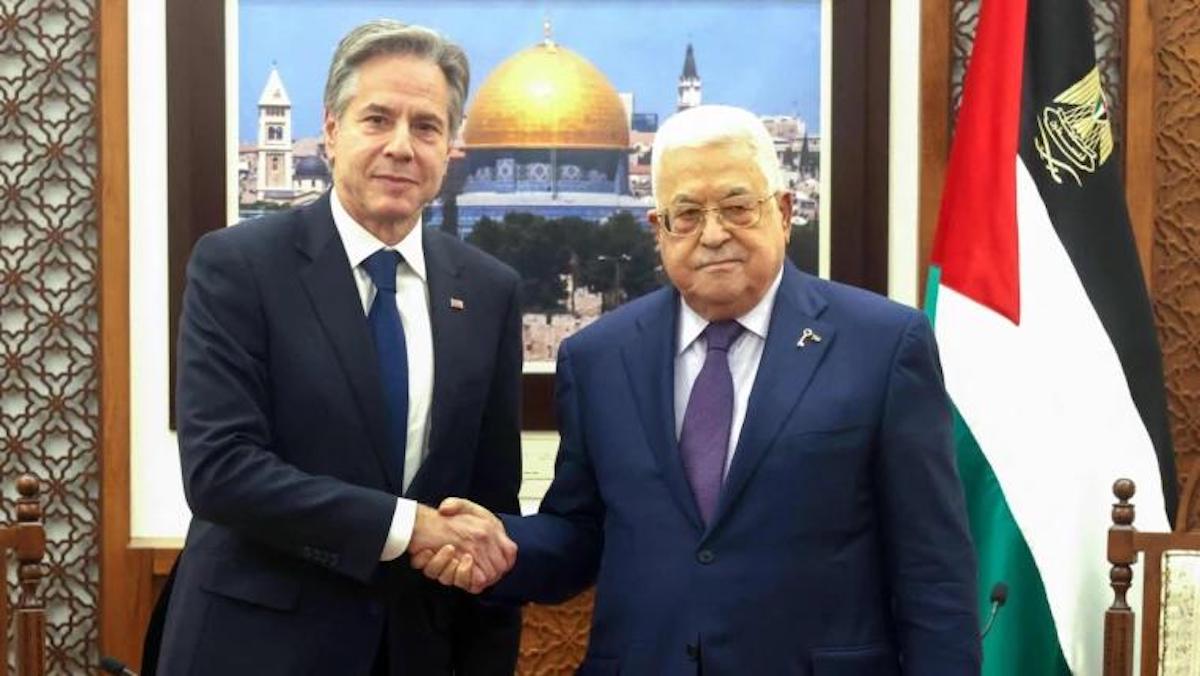
Mahmoud Abbas of Fatah has refused to announce elections since, sitting in unelected control of the PA’s office in the West Bank, collecting the various international grants, presiding over corruption,6 repressing Palestinian resistance of deed or word and colluding with the ‘Israeli’ Occupation.
US Imperialism’s then Secretary of State Anthony Blinken and the PA’s Mahmoud Abbas in Palestine, soon after the start of the accelerated Zionist genocide in Gaza, December 2023
BUT WHAT ABOUT THE IRISH CONNECTION?
Starting with Palestine and South Africa in 1991, an imperialist pacification process spread to Ireland, Basque Country, Kurdish Turkey, Colombia, India, Philippines, Sri Lanka. With some variations the drive has been the same: to give up revolution and join the system.
One of the features of this process was the apparent need of a recognised leader to sell it to the resistance support base and to front it for the world: Arafat (Palestine), Mandela (S. Africa), Adams/McGuinness (Ireland), Ocalan (Turkish Kurdistan), Otegi (Basque Country).
The Provisional IRA was by far the major organisation in the Irish Republican resistance; it gave up armed struggle in return for vague promises and the release of its prisoners under licence.7 Another organisation complied also even as new ‘dissident’ fighters were being jailed.
Nearly 30 years after the signing of the Good Friday Agreement, Ireland is no nearer the Provisional IRA’s declared aims Irish reunification, independence and sovereignty. The Sinn Féin party helps run the colony8 and is attempting to become part of the neo-colony’s government.
Sinn Féin representatives Tina Black (Mayor of Belfast) and Michelle O’Neill, First Minister of the British colony, laying a wreath at the British War Memorial in Belfast, July 2022 (Cred: Liam McBurney/ PA Wire)
Neither the Spanish, French nor Turkish states were interested in other than crushing the Basque and Kurdish resistance and the corresponding movements disabled themselves without getting anything in exchange other than continued repression.9
The resistance movements in parts of India and Philippines continue to resist but in Sri Lanka was wiped out.10
One feature of the spread was the contagion-like way in which leaders of one infected resistance sought to entice others to follow suit: S. Africa and Palestine to Ireland; S. Africa and Ireland to Basque Country; Ireland to Colombia (where only the FARC but not the ELN accepted it).
In only one iteration of the pacification processes was there a partial achievement of the stated aims of the resistance: South Africa got national enfranchisement but the economy remained under imperialist extractive control and its working people under repression.11
In the course of giving up armed struggle, allegedly just changing the methods, the leaders gave up what they had fought for, the very reason for which they had first come into the struggle. Of course, they could still shout the slogans, just not make them real in any way.
The Irish version (and the Basque one) decommissioned their weapons, which makes it very relevant to the Trump Plan for the Palestinian Resistance, particularly Hamas and PIJ. No resistance movement should even discuss giving up their weapons until the defeat of the enemy.
(Image sourced: Internet)
It will be interesting to see what positions the former parties of Irish and Basque resistance, Sinn Féin and EH Bildu12 and their supporters take on this US/ ‘Israeli’ plan for the Palestinian Resistance.
One of the features of the pacification process was the apparent need of a recognised leader to sell it to the resistance support base and to front it to the world: Arafat (Palestine), Mandela (S. Africa), Adams/McGuinness (Ireland), Ocalan (Turkish Kurdistan), Otegi (Basque Country).
Who will the imperialists find to play this role in Palestine?13
End.
NB: If you found this article of interest, why not register with Rebel Breeze for free, so that you will benotified by email of subsequent articles. You can de-register any time you wish.
4“This mirrors Israel’s post-Oslo approach to the occupied West Bank in pacifying the population through economic incentives, avoiding political concessions, and entrenching structural dependence. This model, often dubbed “economic peace,” has transformed the Palestinian Authority (PA) into a subcontractor of occupation – flush with foreign funds, but powerless to deliver sovereignty.” https://thecradle.co/articles-id/34757
7Those released under licence could be returned to jail (and a number were) at the decision of the Secretary of State for Northern Ireland without trial, hearing or details of why the individual was considered to be ‘a threat to public safety.’
8Its representative, Michelle O’Neill, is currently First Minister of the colony’s government. In the Irish State, the party has 33 TDs (MPs), only two behind the party with next largest representation, Fianna Fáil. They Party has abandoned its opposition to the repressive legislation of the State, welcomed British Royal visits to both parts of Ireland, supports recruitment to the colonial gendarmerie and its leader refused to rule out coalition with the neo-colonial political parties of membership of the British Commonwealth. https://www.thejournal.ie/mar-lou-mcdonald-commonwealth-4561600-Mar2019/
9The Basque leadership abandoned armed struggle unilaterally at the time without gaining even the end of dispersal of their jailed fighters throughout the state. The Turkish Kurdish PKK tried to make progress through political electoral means only under continuing repression. But their Syrian version of armed Kurdish forces got a new lease of life with the vulnerability of the Assad regime in Syria but ended up as a NATO proxy in the latter’s war for regime change. The PKK in Turkey very recently agreed to disarm while their Syrian part remains in difficult relationship with the new (formerly ISIS) regime in Syria and some other ISIS elements under Turkish influence.
11See The Marikana Massacre of striking miners by the ANC Government’s police.
12Both parties support the Two-State proposal for Palestine.
13Some liberal and social-democratic sections seem to have fixed on Marwan Marghouti in this role, which of course is no reason not to support his release on human rights grounds. https://www.youtube.com/watch?v=q6IgjlHaaIs
Recently an Irish Palestine solidarity organisation posted a report that 20,000 Palestinian children have been killed in 23 months, an average higher than one child per hour.1 “Have been killed”? Traffic accidents? Unknown causes?
They were killed by Israel, isn’t that the case? Then why not bloody say so! They were murdered by a genocidal European Zionist settler colony called Israel and itcontinues to murder them, along with their older siblings, parents, extended families and neighbours.
We can find different ways to present the facts of the ongoing genocide in order to try to shock but it does not alter the fundamental and well-known truth that a genocide is being committed before our eyes. Why is this continuing despite what everyone knows? Well, because it can!
Israel will continue to do what it does because it can and the cost of doing it is not high enough, as Ali Abunimah said three months ago.2 Or to turn that a little, the Irish Government will continue doing what it does in collusion with the genocide because the cost of doing so is not high enough.
The EU is the biggest importer of Israeli goods and the Irish state is the highest importer in the EU, also the 2nd single biggest Israeli goods importer in the world. And still the weapons of genocide fly through our skies. The Irish Government continues collusion because the cost to them is low.
Marches and pickets show solidarity towards a beleaguered people suffering genocide and in that they are very important. They also show us our strength in numbers. But they do not cost our government much. Not even enough to really stop the Central Bank assisting genocide.
In England, Palestine Action raised the cost of collusion in genocide by targeting the Israeli weapons manufacturer Elbit Systems in Bristol. Activists were arrested but they kept doing it. This Zionist death company has now closed its targeted Bristol factory.
While this was happening, the British Government, in support of Elbit and others and in collusion with the genocide of Palestinians, not only arrested and charged Palestine Action people but designated the organisation as ‘terrorist’ and any supporters as people supporting ‘terrorism’.
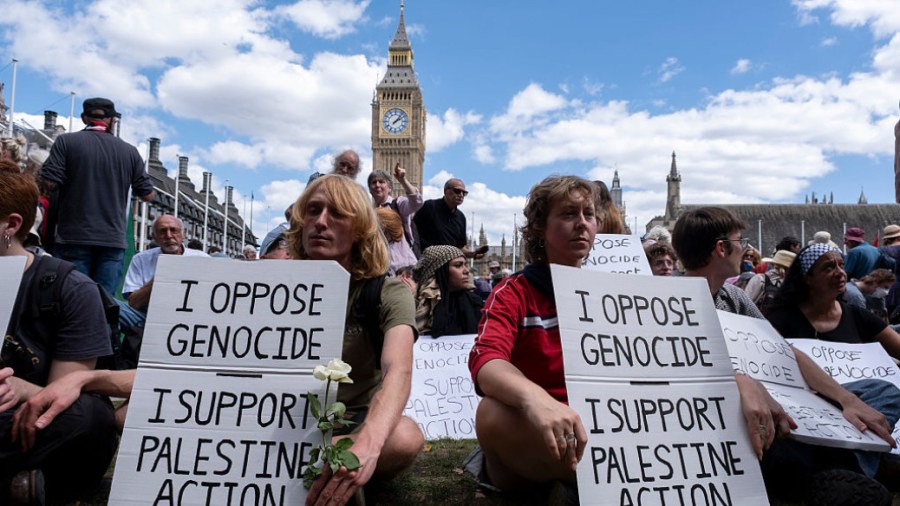
People defied that designation and were arrested for holding a placard saying they were opposed to genocide and supported Palestine Action.
Placards in Westminster August 2025 (Photo credit: Mike Kemp In Pictures/ Getty Images)
Following that action and repression, 1,500 gathered in London on Saturday 6th September 2025 to continue that solidarity and to defeat the attack on civil liberties. By midnight, the last arrest recorded by the police for the day, they had arrested nearly 390 people.
The ‘crime’ of nearly all was to display placards stating “I am opposed to genocide. I support Palestine Action.” The police were unable to arrest them all as it took them 11 hours to arrest the 390. The organisers continued the action in London and other parts of the UK.3
More recently there have been other such acts of public defiance, organised by the Save Our Juries campaigning group and the numbers now arrested on charges of “assisting terrorism” (sic) have reached at least 2,269.
In addition, eighteen arrested Palestine Action activists were jailed, refused bail with some embarking on hunger strike4 of whom two were recently admitted to hospital.
The closure of Elbit Systems, the mass defiance of the terrorist categorisation of Palestine Action and the prison hunger strikes are raising the cost of supporting genocide of Palestinians and criminalising Palestine solidarity action, hitting collusion where it hurts, politically and practically.
We in Ireland are the most-pro-Palestine country in Europe … but we are not doing that.
We are not raising the cost high and despite that being clear to us and to our political and solidarity organisations and trade unions, made clear well over a year ago, we are still not doing it. Until we raise the cost high enough to make them stop, our government will continue its collusion.
And until the external cost is raised high enough to make them stop, Israel will continue its ethnic cleansing and genocide. But marchers attempting to blockade Dublin Port in early October were pepper-sprayed without warning and savagely batoned, with some arrested.
Gathering outside Dublin courthouse in solidarity with two Palestine solidarity activists assaulted and charged by Gardaí during early October attempt to blockade Dublin Port (Photo: R. Breeze).
A trio of activists were arrested in May for invading Shannon Airport to protest the ‘neutral’ Irish State’s collusion with US military flights through there4 and last weekend another three young people were arrested for a similar action.
Activists in Ireland are slowly starting to raise the cost of collusion for the State. However, they are not supported by the leadership of the mass movement which, while aware its tactics are not forcing the Government to end its collusion, nevertheless persists solely in repeating them.
End. Note: If you found this article of interest, why not register with Rebel Breeze for free, so that you will be notified by email of subsequent articles. You can de-register any time you wish.
2Director of the Electronic Intifada, speaking on 29 August at a public meeting organised by the Ireland Palestine Solidarity Campaign in Dublin and hosted by the FÓRSA trade union. The other guest speaker was Abubaker Abed from Gaza, now studying in Ireland after being a journalist for the EI and threatened with assassination by Zionists.
3The Six Counties are at the moment in the UK but the British colonial gendarmerie went very lightly there in dealing with Palestine Action supporters – the rulers do not wish do have Palestine activists as political prisoners while they contain also Irish Republican prisoners.
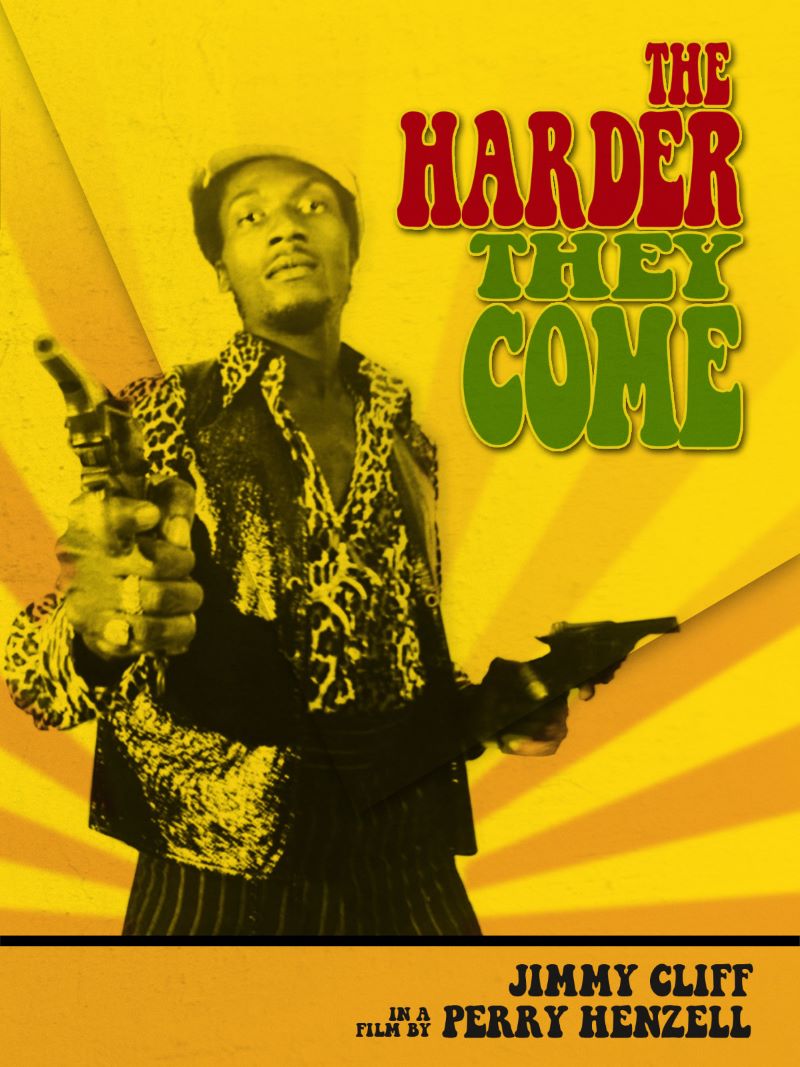
The death is announced on mass media today at 81 year of age of Jamaican reggae singer, songwriter and author Jimmy Cliff,1 famous for songs such as The Harder They Come and for his role in a film of the same title.
As is usual in such cases, tributes have been posted on social media and quoted in the western mass media, including by Ali Campbell of the UB 40 band who was reported to be ‘so sad’2 (which to be honest, seems a little strange as Jimmy Cliff lived to a good 81 years of age before he died).
I first heard a few of Jimmy Cliff’s nearly 30 recordings among the Caribbean community of SE London.
Jimmy Cliff grew up James Chambers in a family of nine in St. James in Jamaica, often mistakenly thought of as the largest Caribbean island (which it is not – that is in fact Cuba). Jamaica, like Trinidad & Tobago, another larger island and Barbados, were among the British colonies in the Caribbean.
The Caribbean islands and coastline3 were first European-colonised by the Spanish, then by the French, Dutch and British Empires, often in armed conflict against its indigenous people but also among themselves, also against slave uprisings and later against local struggles for independence.4
Since WWII the dominant imperialist power in the Caribbean is undoubtedly the United States of America, though France retains some colonial possessions and a few remain part of the British Commonwealth.
Today the Caribbean is in the news through a large force of US Naval forces posted there, along with nearby posting of bombers, along with the murder of over 80 small boat sailors, allegedly drug smugglers (without evidence and as though drug smuggling gets the death sentence).5
According to threats of President of the USA Trump, he intends to target Venezuela and its President Nicolás Maduro, whom he claims – without a shred of evidence — to be the leader of a drug cartel.
Migrant communities and the spread of Reggae
During the decades I spent in London I had a fair amount of contact with parts of the Caribbean immigrant and diaspora community, partly through working alongside some of its members, partly through socialising in SE London and through activity in resistance to fascism and racism.
I first came across Reggae music while living as a migrant in the SE London areas of Lewisham, New Cross and Peckham. There were large Irish and Caribbean communities there with some but not a great deal of interaction between both communities but little hostility between them either.
Both communities were subject to institutional racism and politicised communal racism as organised by the fascist National Front and British Movement, both of which had connections to British Loyalist paramilitary organisations in Scotland and in the Six Counties in Ireland.
I recall reading in a British 1950s sociological study on ‘deviant behaviour’ that ‘Teddy Boy’ gangs would target the post-War newly-arrived Caribbean immigrants (but also the ‘Micks’, i.e the Irish) and a Jamaican workmate told me about the gangs waiting for them on Childeric Rise.6
How he went out armed with a home-made knuckle-duster and how the police would come to the fighting, arresting mostly the Caribbean victims. “Them turn me away when dem see me,” a Caribbean migrant discussing racism told me, “but dem turn you away when dem hear you.”
In Caribbean shebeens7 or illegal ‘clubs’ in that SE London area, one could buy for a modest sum a plate of goat curry and rice, or a can of pale ale or Guinness, while listening to vinyl records of Bluebeat, Ska, Rock Steady, Reggae and, to a lesser extent, Calypso.8 And dance, perhaps.9
Jimmy Cliff composed songs and rode the rising Reggae tide, for a short while rivalling Bob Marley for most popular position. What launched him and the Reggae ship into wider seas was the film The Harder They Come based on the novel of the same name featuring Cliff’s own song.
The Harder They Come novel by Ekwueme Michael Thelwell charting the fictionalised career of a Jamaican who fails to succeed as a reggae singer and becomes a gangster is based on the real life of Jamaican folk hero and reggae star Rhygin.10
But the film’s hero was performed by Jimmy Cliff and his music played as soundtrack.
In Peckham I watched the film years later and enjoyed it but I also read the novel. The latter gives an interesting background of the hero growing up in his grandmother’s care in rural Jamaica, before he goes to Kingston, while the film opens only with the hero’s arrival in the city by bus.
Famous folk singer Bob Dylan is reported to have said that Jimmy Cliff’s 1969 song Vietnam was the best protest song he had ever heard. It is hard to credit that as a true statement; Pete Seeger, Dylan’s contemporary, many others and Dylan himself had composed many better.
Jimmy Cliff’s Vietnam song takes as its theme a US soldier in Vietnam writing about his impending return home at the end of his tour of military service in Vietnam and his desire for his girlfriend, followed by another missive to the soldier’s mother announcing her son’s death in Vietnam.
The tragic juxtaposition of youth, romantic love, violent death and parental bereavement is an inherent theme of war and of course works on our emotions. But the song says nothing about who sent the soldier there nor the reasons for the Vietnam War, though one line calls for its end.
The lyrics tell us nothing about the devastation of the US war upon the peoples of Vietnam, Laos and Cambodia, nor about the heroism of the people’s resistance.11 Not even about the huge protests of many people in the USA — particularly youth — and in much of the western world.
Jimmy Cliff in performance (Photo credit Alastair Wison/ PA)
However, Jimmy Cliff’s performance of the song 20 years ago in Jamaica brings the point of the anti-war movement much more into context as in his introduction to the song on stage he castigates Tony Blair and George Bush and names a number of other imperialist wars.
It was a great performance of Cliff’s at the end of his sixth decade of life and I hope you enjoy it here on video.
Note: If you found this article of interest, why not register with Rebel Breeze for free, so that you will be notified by email of subsequent articles. You can de-register any time you wish.
2Facebook · UB40 Featuring Ali CampbellSo sad James chambers has left a void in reggae music, his voice and influence was exemplary. He was a reggae pioneer, RlP Jimmy cliff.
6This rise gave on to the New Cross Road from terraced housing down below where a number of Caribbean families lived, in one house of which I shared a double room with another Irish migrant. Almost at the top of Childeric Rise itself was the entrance to The Harp Club Irish dance hall with an Irish pub on an opposite corner and another across the road.
7From the acknowledged Irish language word ‘síbín’, etymology uncertain but adopted as far away as the Caribbean and South Africa.
8Music mostly of Trinidad and Tobago, often accompanied by steel band instruments, based on folk dance music from a part of West Africa. https://en.wikipedia.org/wiki/Calypso_music
Diarmuid Breatnach (edited from article posted in Rebel Breeze 2014)
(Reading time: 6 mins.)
Part 1 – who and what gets ‘remembrance’
In the lands under the direct dominion of England, i.e. the “United Kingdom”, and in some others that are under its influence, the dominant class calls the people to join in a cultural event in November which they call “Remembrance”.
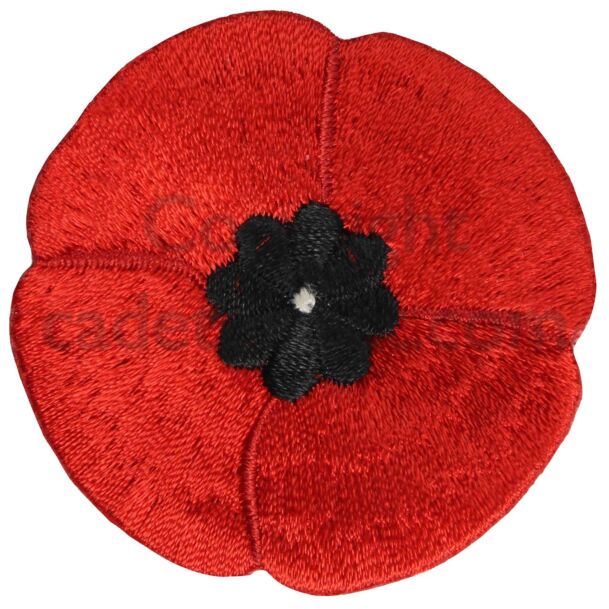
The organisation fronting this event in the ‘UK’ is the Royal British Legion and their symbol for it (and registered trademark) is the Red Poppy, paper or fabric representations of which people are encouraged to buy and display — and indeed often pressured to wear.
In some places, such as the BBC for personnel in front of the camera, they are forced to wear them. In many schools and churches throughout the ‘UK’, Poppies are sold and wreaths are laid at monuments to the dead soldiers in many different places.
Prominent individuals, politicians and the media take part in a campaign to encourage the wearing of the Poppy and the participate in the ‘Festival of Remembrance’ generally and of late, to extend the Festival for a longer period.
High points in the ‘Festival’ are the Royal Albert Hall concerts on the Saturday and the military and veterans’ parades to the Cenotaph memorial in Whitehall, London, on “Remembrance Sunday”. (Also a focus for commemorations by the British far-Right and fascists).
“The concert culminates with Servicemen and Women, with representatives from youth uniformed organizations and uniformed public security services of the City of London, parading down the aisles and on to the floor of the hall. There is a release of poppy petals from the roof of the hall.1
An embroidered version of the poppy emblem (Sourced: Internet)
“The evening event on the Saturday is the more prestigious; tickets are only available to members of the Legion and their families, and senior members of the British Royal Family (the Queen, Prince Phillip, the Prince of Wales, the Duke of York [not this year!] and the Earl of Wessex). 2
“The event starts and ends with the British national anthem, God Save the Queen3(and) is televised. Musical accompaniment for the event is provided by a military band from the Household Division together with The Countess of Wessex’s String Orchestra.”4
The money raised from the sale of the “Poppies” and associated merchandise is said to be used to support former military service people in need and the families of those killed in conflict. On the face of it, military and royal pomp apart, the Festival may seem a worthy charitable endeavour.
Also one which commemorates very significant historical events — therefore a festival which at the very least, one might thing, should not be opposed by right-thinking and charitable people.
Yet the main purpose of this festival and the symbol is neither remembrance nor charity but rather the exact opposite: to gloss over the realities of organised violence on a massive scale and to make us forget the experience of the world’s people of war.
And to prepare the ground for recruitment of more people for the next war or armed imperialist venture – and of course more premature deaths and injuries, including those of soldiers taking part.
Video and song “On Remembrance Day” from Veterans for Peace lists British conflicts (including Ireland) and condemns the Church of England for supporting the wars, calling also on people to wear the White Poppy (see Part 3 for the White Poppy)
Partial Remembrance – obscuring the perpetrators and the realities of war
The Royal British Legion is the overall organiser of the Festival of Remembrance and has the sole legal ‘UK’ rights to use the Poppy trademark and to distribute the fabric or paper poppies in the ‘UK’.
According to the organisation’s website, “As Custodian of Remembrance” one of the Legion’s two main purposes is to “ensure the memories of those who have fought and sacrificed in the British Armed Forces live on through the generations.”
By their own admission, the Legion’s “remembrance” is only to perpetuate the memories of those who fought and sacrificed in the British Armed Forces – it is therefore only a very partial (in both senses of the word) remembrance. More recently it tries to hide this exclusivity.5
It is left to others to commemorate the dead in the armies of the British Empire and colonies which Britain called to its support: in WWI, over 230,500 non-‘UK’ dead soldiers from the Empire and, of course, the ‘UK’ figure of 888,246 includes the 27,400 Irish dead.
Cossack soldier volunteers WWI. Imperial Russia was an ally of Britain and France; the war was one of the causes of the Russian Socialist Revolution 1917. The following year, the war ended. (Image sourced: Internet)
The Festival excludes not only the dead soldiers of the British Empire and of its colonies (not to mention thousands of Chinese, African, Arab and Indian labourers employed by the army) but also those of Britain’s allies: France, Belgium, Imperial Russia, Japan, USA … and their colonies.
No question seems to arise of the Festival of Remembrance commemorating the fallen of the “enemy” but if the festival were really about full “remembrance”, it would commemorate the dead on each side of conflicts.
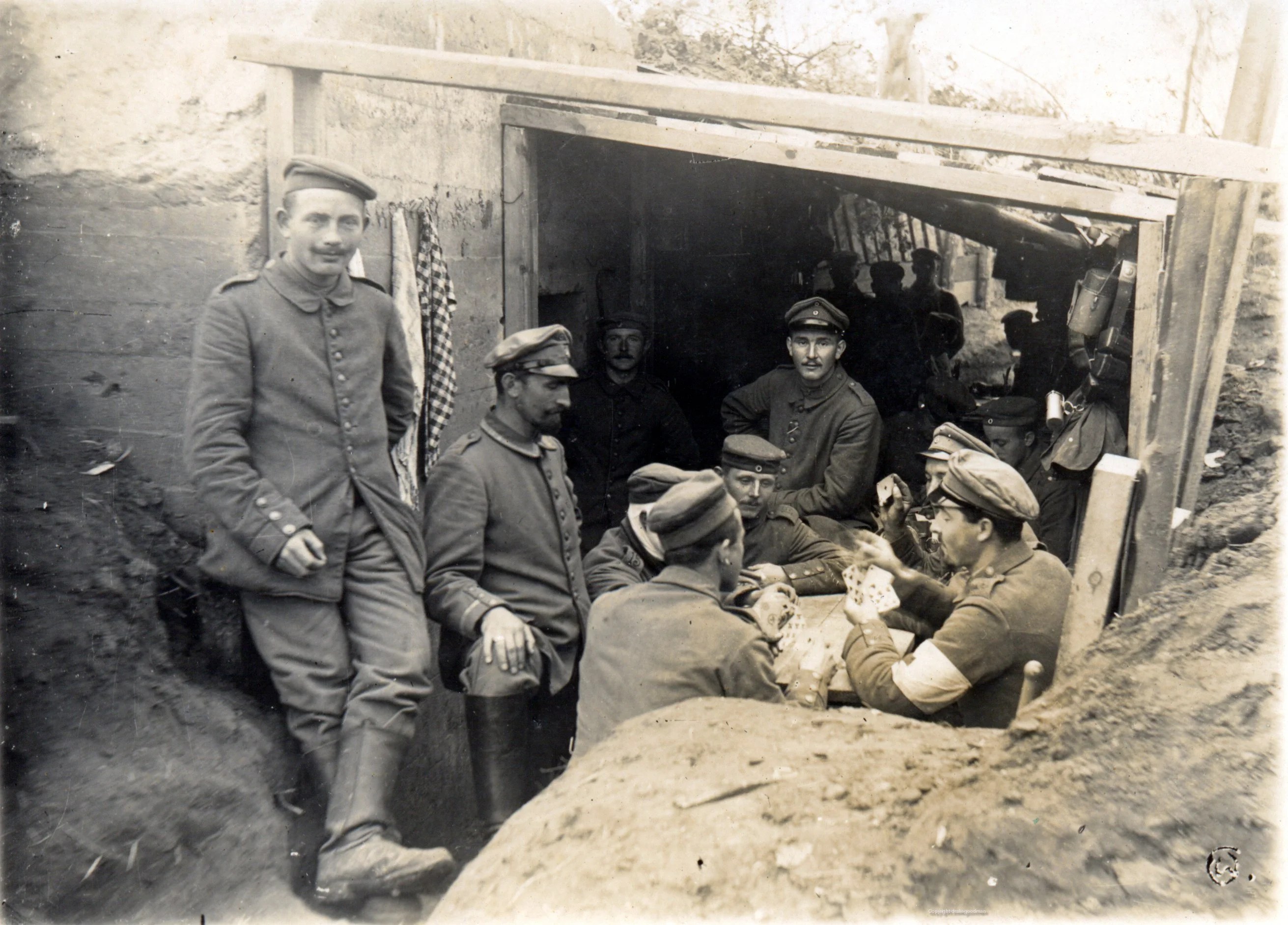
German soldiers playing cards during WWI. Photos of Germans in WWI more readily available show them wearing masks and looking like monsters. (Photo sourced: Internet)
That would particularly be appropriate in WWI, an imperialist war in every respect. But of course they don’t do that; if we feel equally sorry for the people of other nations, it will be difficult to get us to shoot, bomb or stab them in some future conflict.
A real festival of remembrance would commemorate too those civilians killed in war (seven million in WWI), the percentage of which in overall war casualty statistics has been steadily rising through the last century with increasingly long-range means of warfare.
Very recently, the Royal Legion has tried to claim that the “acknowledge innocent civilians who have lost their lives in conflict” but add “and acts of terrorism.” Since we know that that ‘terrorism’ is a highly politicised word and for imperialists has mostly meant resistance struggle, that is hardly welcome.
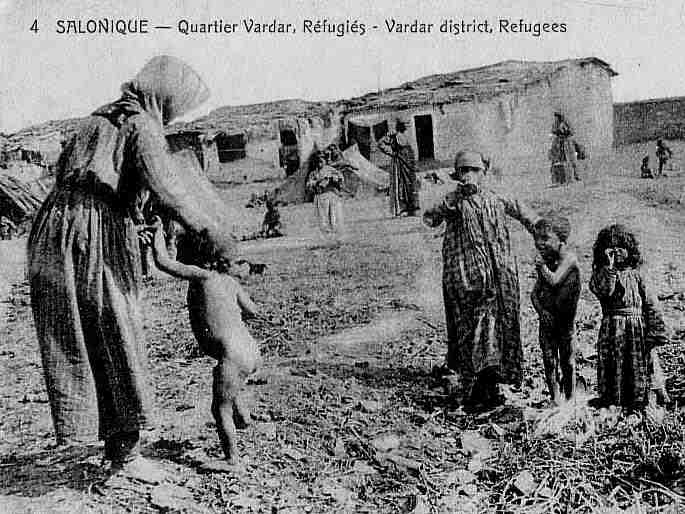
Civilian war refugees in Salonika, NW Greece, WWI (Photo sourced: Internet)
Civilians in the First World War died prematurely in epidemics and munitions factory explosions as well as in artillery and air bombardments, also in sunk shipping and killed in auxiliary logistical labour complements in battle areas.
And through hunger, as feeding the military became the priority in deliveries and as farmhands became soldiers.
In WWII 85,000,000 civilians died in extermination camps or forced labour units, targeting of ethnic and social groups, air bombardments, as well as in hunger and disease arising from the destruction of harvests and infrastructure.
Air bombardments, landmines, ethnic targeting and destruction of infrastructures continue to exact a high casualty rate among civilians in war areas.
One admittedly low estimate up to 2009 gave figures of 3,500 dead in Iraq during the war and aftermath and another 100,000 dead from western trade sanctions, along with 32,000 dead civilians in Afghanistan.
Another review up to 2011 gave a figure of 133,000 civilians killed directly as a result of violence in Iraq and “probably double that figure due to sanctions”.6
The number of civilians injured, many of them permanently disabled, is of course higher than the numbers killed. Most of those will bring an additional cost to health and social services where these are provided by the state and of course to families, whether state provision exists or not.
Real and impartial “remembrance” would include civilians but not even British civilians killed and injured are included in the Festival of Remembrance, revealing that the real purpose of the Festival is to support the existence of the armed forces and their activities.7
And contributing at the same time to a certain militarisation of society and of the dominant culture.
If the Festival were really about “remembrance”, they would commemorate the numbers of injuries and detail the various types of weapons that caused them.
But that might reflect unfavourably on the armaments manufacturers, who run a multi-billion industry in whatever currency one cares to name, so of course they don’t.
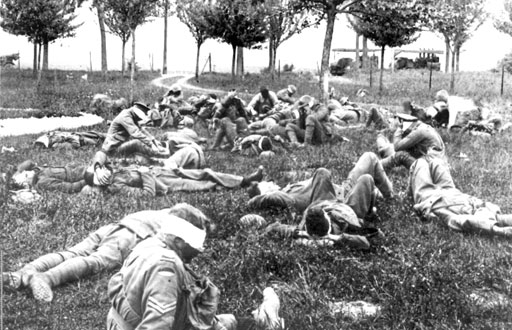
Australian soldiers who survived gas attack but injured by it awaiting hospitalisation, Northern France, WWI 1916. (Photo sourced: Internet)
And if really concerned about death and injury in war, they would campaign to end such conflict – for an end to imperial war.
But then how else would the various imperial states sort out among themselves which one could extract which resources from which countries in the world and upon the markets of which country each imperial state could dump its produce?
So of course the Royal British Legion doesn’t campaign against war. That’s not its role. Quite the opposite.
End. (Parts 2 and 3 to follow).
Note: If you found this article of interest, why not register with Rebel Breeze for free, so that you will be notified by email of subsequent articles. You can de-register any time you wish.
FOOTNOTES:
1Sourced from the British Legion’s website in 2014, its WW1 centenary year.
















 rebelbreeze