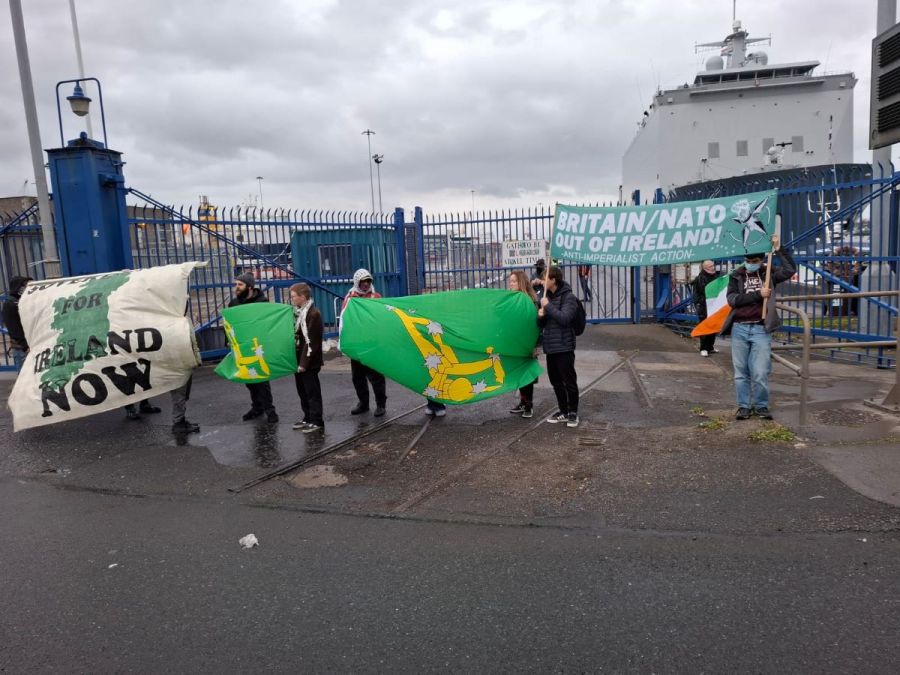
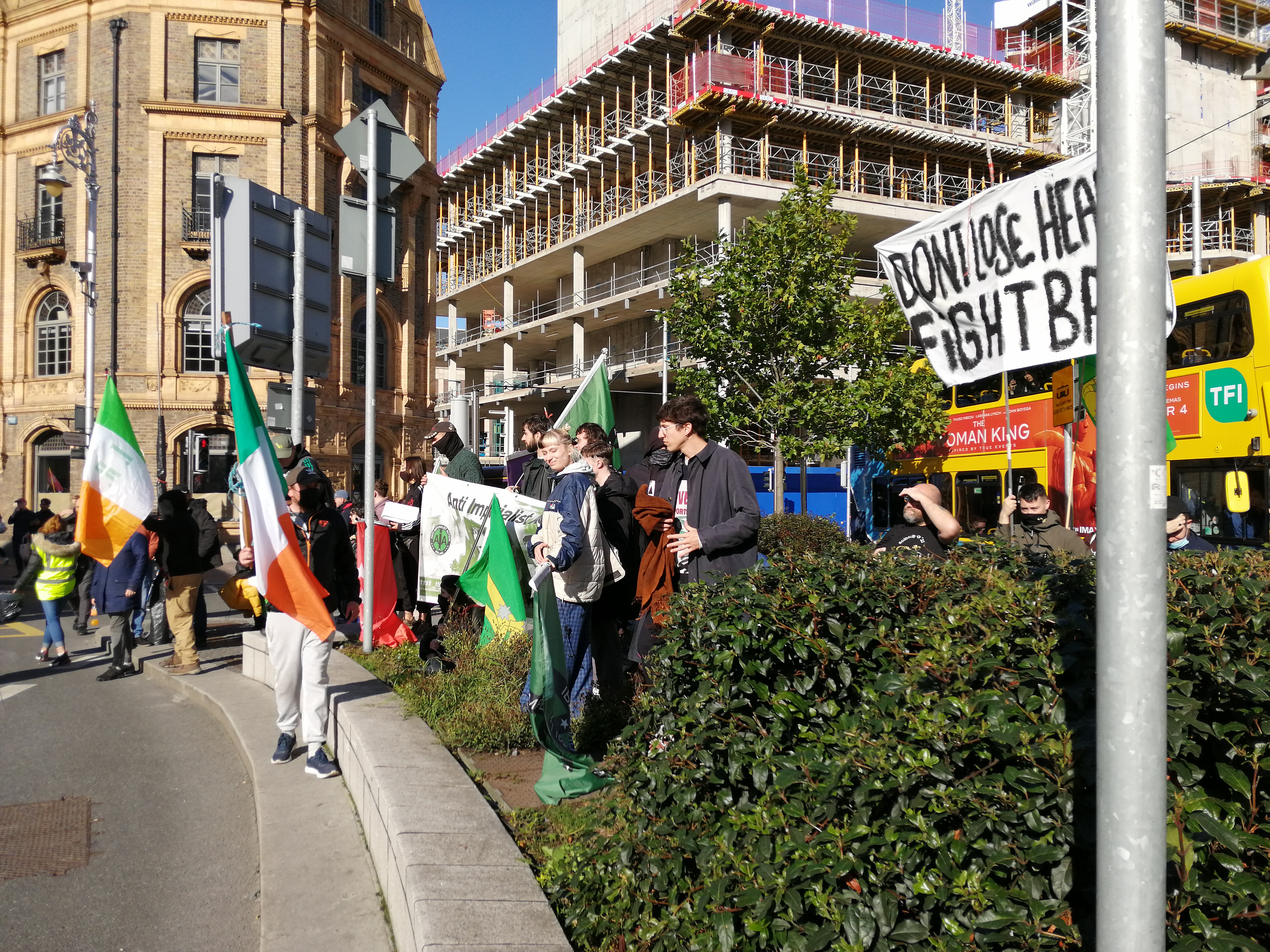
Dutch and German warships docked in Dublin’s Liffey Port were met by anti-NATO protesters late Saturday afternoon with banners, an Irish Tricolour and Starry Plough flags and shouts through a loudhailer with passing traffic beeping in solidarity.
The huge Dutch naval landing platform Johann De Witt was immediately visible on the north Liffey quay just on the seaward side of the Tom Clarke Bridge and the protesters took their stand there in front of the security gates, visible to airport and south and northbound Dublin traffic.
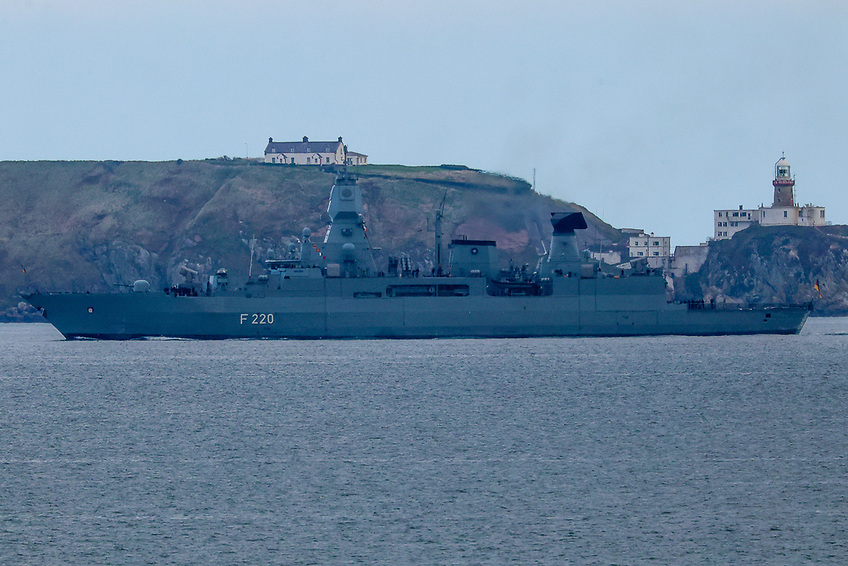
German NATO frigate FGS Hamburg entering Dublin Bay, bound for the Port security gate. (Photo cred: Afloat)
The Dutch ship was flying Holland and NATO flags. Among the slogans the protesters periodically chanted were: No NATO troops in Ireland! NATO, NATO, NATO: Out, out, out! From Belfast to Killarney – We don’t want your NATO Army! NATO imperialism – Out of Ireland!
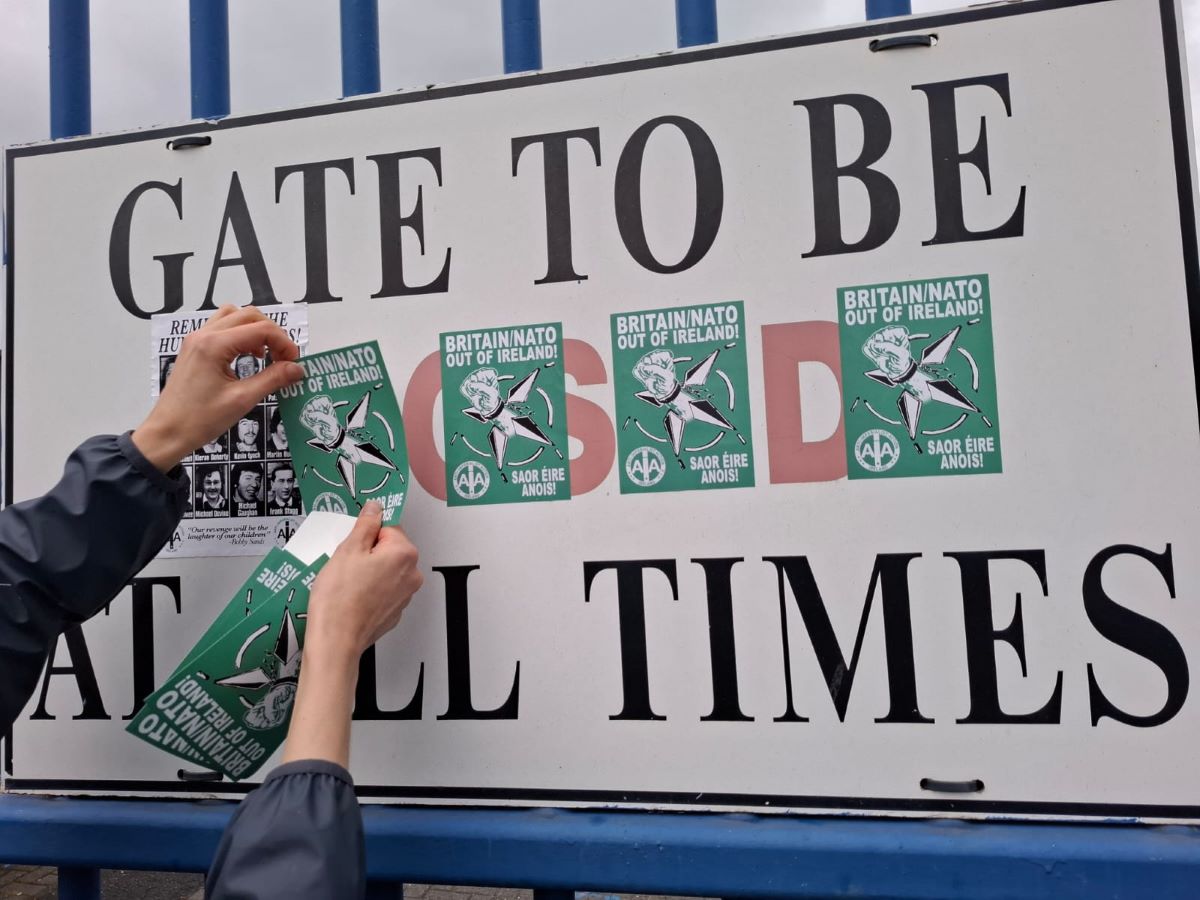
Anti-Nato stickers being affixed to the Dublin Port security gate. (Photo: R.Breeze)
The chants grew louder as military personnel (in street clothes) approached or emerged from the security gates behind the protesters but there was no physical confrontation from either side. No Gardaí attended either, unlike the protest at Ireland’s NATO HQ in April this year.
On that occasion Gardaí pepper-sprayed the peaceful protesters and broke the ankle of one of their number, in addition to arresting them. Some of the arrested were bailed and are due to appear in court in Dublin on 23rd February 2026.
Anti-Nato protesters, the Dutch NATO naval ship clearly visible in background. (Photo: R.Breeze)
NATO was originally claimed to be a western European military defensive force against the Soviet Bloc. However, after the Bloc’s collapse, NATO continued to expand until it has now an additional 17 member states (and the threat of Ukraine joining led to the current war with Russia).
The individual western member states, for example the US, UK, France have been waging imperialist wars for decades. But the NATO military alliance’s forces also fought imperialist wars in a number of countries: Bosnia, Kossovo, Afghanistan and Libya.
Anti-Nato protesters. (Photo: R.Breeze)
The protest on Saturday was organised at very short notice by Action for Palestine Ireland and Anti-Imperialist Action Ireland. Many passing vehicles, both private, company and taxi sounded their horns in support and also gave a thumbs-up or clenched fist salute.
Clearly the protest context was not only a lack of welcome for a member of the western imperialist military alliance but also fears that the Irish ruling class wants to join that alliance too and is currently trying to remove the ‘Triple Lock’ impeding its move in that direction.
End.
Note: If you found this article of interest, why not register with Rebel Breeze for free, so that you will be notified by email of subsequent articles. You can de-register any time you wish.
Anti-Nato protesters on Saturday, the Dutch NATO naval ship clearly visible in background. (Photo: R.Breeze)
The Irish socialist Republican group Anti-Imperialist Action today issued a call to revolution centred around a need for universal social housing to resolve the chronic housing crisis in Ireland (and in particular in Dublin).
This housing crisis has at January’s count left nearly 15,300 living on the streets or in emergency accommodation1 with another unknown number in inappropriate accommodation such as sofa-surfing with friends and relatives or in IPAS centres for refugees.
Rampant property speculation has made a handful of bankers and speculators very rich and along with the social misery of thousands, facilitated the demolition of buildings of historical and architectural importance and their replacement by usually unsightly glass and concrete.2
Well, so what of AIA’s call? Different organisations make various calls at different times but do they have any effect? However, this one has some important distinctions, one of which is that this organisation actively practised its preaching when it called for the occupation of empty properties.
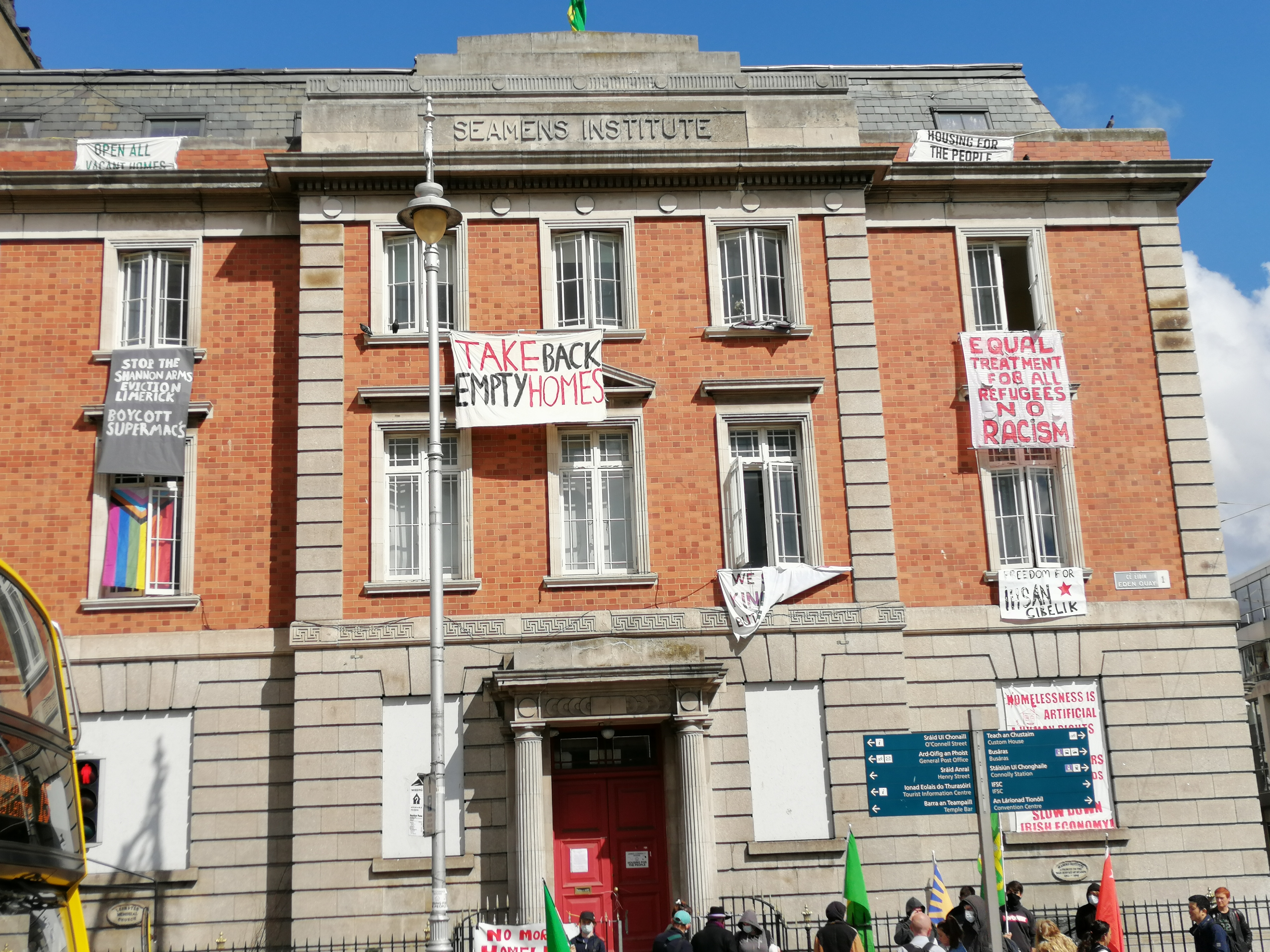
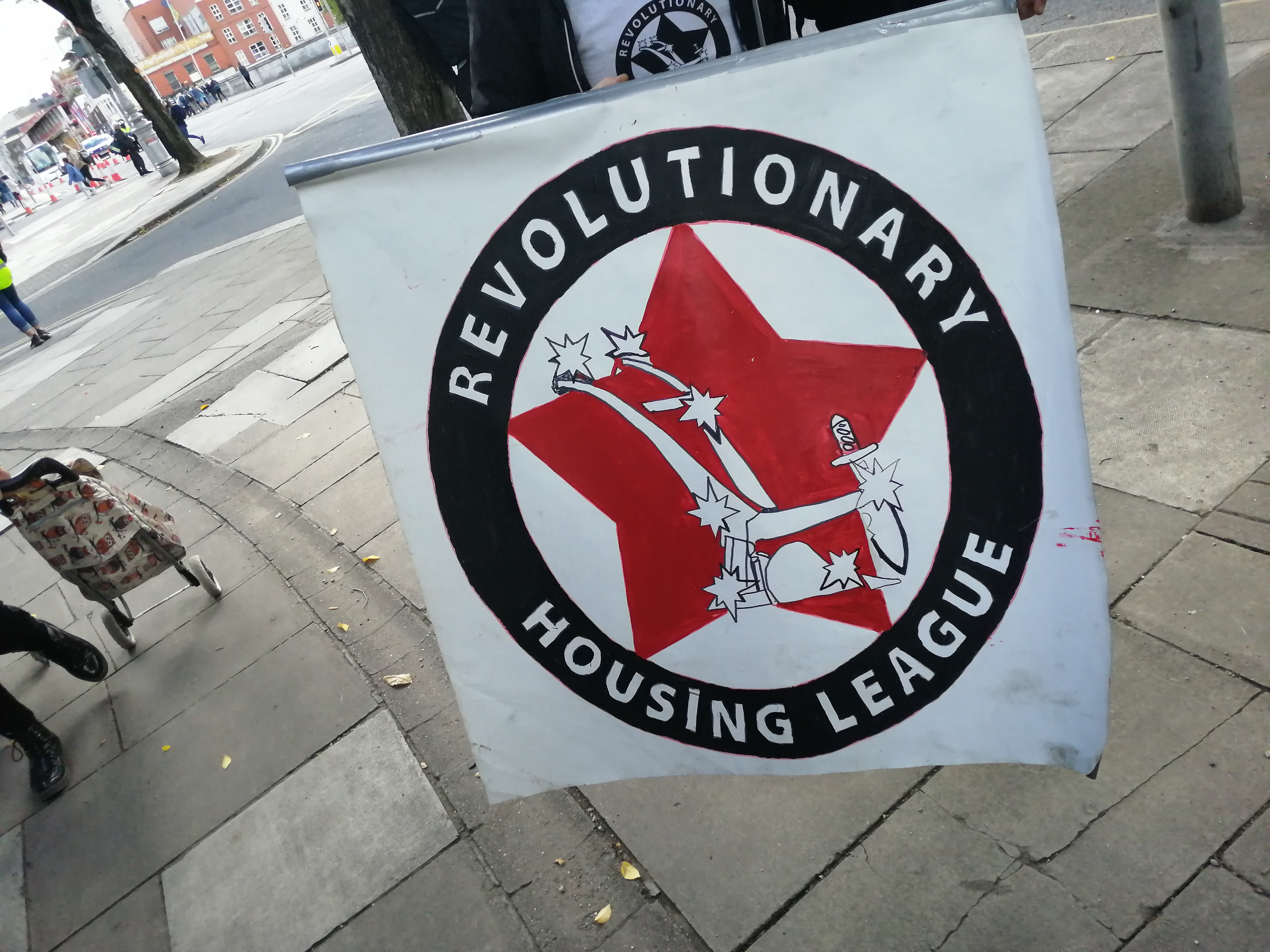
In May 2022 the AIA founded a sub-group called Revolutionary Housing League that occupied empty buildings in Dublin, refused to comply with court orders3 to evacuate or, in court, to agree to bail conditions that they would desist from further building occupations.
‘James Connolly House’ in occupation by the RHL in May/ June 2022. Photo: D.Breatnach)
The first building targeted on May 1st was a former Seamen’s Institute building on Eden Quay, renamed Connolly House, metres from O’Connell Bridge, empty for years since the Salvation Army, a religion-based charity NGO, had lost government funding for its youth homeless accommodation project.
On the morning of June 9th 2022 over a hundred Gardaí, with an armed unit on standby and a helicopter overhead, stormed the building4 and arrested the only occupants, two RHL supporters. In court later that day, they were bailed without making any promise not to re-occupy buildings.5
It seemed that the State was sensitive to the dangers of creating martyrs around the housing crisis.
Instead, RHL renewed its call for mass action across the country to occupy empty buildings. And went on to occupy other buildings, including Ionad Sean Heuston near the eponymous Bridge and another in Belvidere Road, eviction here also including massive police forces and helicopter.
Seen from the north bank of the Liffey, the Starry Plough flag flying high over the ‘Ionad Sean Heuston’ occupied building. The Heuston train station is behind the photographer while the Bridge is out of frame to the right. (Photo: D.Breatnach)
Success for the RHA’s campaign depended on, if not a mass, at least a substantial take-up of its call to occupy empty buildings backed by civil disobedience to the courts. Neither happened and the AIA was far too small to carry the campaign on its own and so suspended it.
It is worth noting that though many organisations and individuals had agitated around housing, including the high-media-profile occupation of Apollo House in December 2016, backed by noted individuals,6 none had initiated the steps advocated by RHA/ AIA.
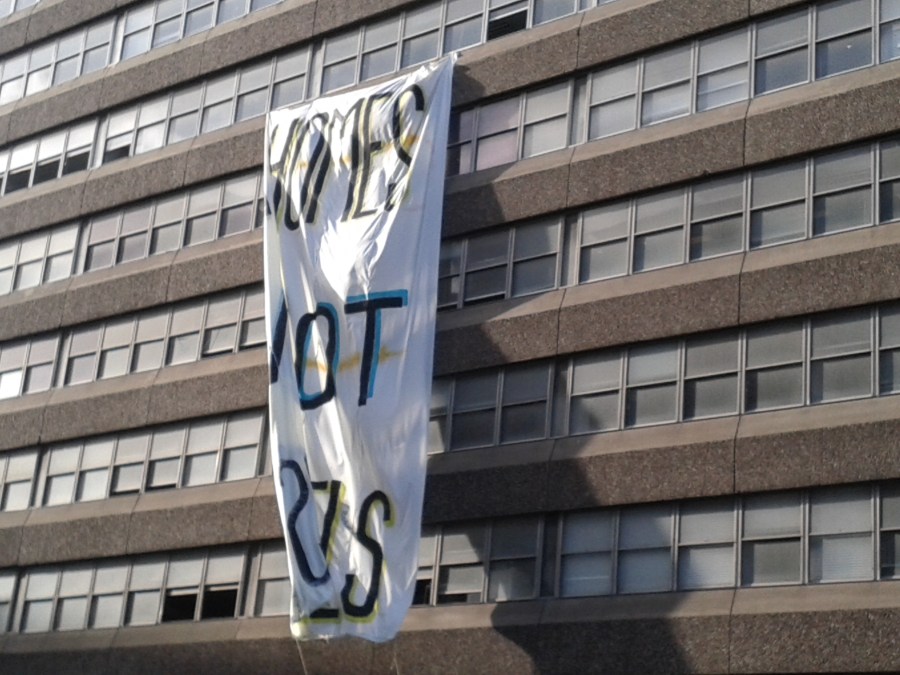
‘Homes Not Hostels’ banner on Tara Street side of occupied Apollo House in December 2016 or January 2017. The building was later demolished and numbers of homeless people continued to rise. (Photo: D.Breatnach)
Amongst a general lack of social condition agitation among the post-GFA7 Irish Republican movement, only the socialist-Republican éirigí organisation had militantly taken up the housing struggle while calling for universal social housing — but it had not led a campaign of occupations.
The electoral left and some anarchists had occupied some empty buildings but had either left when threatened by the State or been evicted by security thugs backed up by Gardaí, without a follow-up of further occupations. Nor had they contextualised housing occupations as part of revolution.
So the record of AIA is stand-alone among the Republican and Socialist Left so far and therefore, one might speculate, failed to inspire a mass movement.
I am not ashamed to say that I supported AIA’s campaign although I did not take part myself in any of the occupations. However I did not view it as an immediate cause for revolution, nor do I now. The Irish gombeen8 State, I believe, can survive the supply of universal social housing.
The ‘rack-renting’ landlords, both big and small, cannot. But the Gombeen class, closely linked to the landlords and speculators will ditch them if they are confronted – not with the suffering of the masses, about which they care not, nor protests – but with the real alternative of social revolution.
The State has access to the means to fund such a campaign of new housing construction and of renovation/ repurposing of existing empty buildings9 by local municipal authorities.
In such a radical change of the Irish neo-colonial capitalist system, people would have more disposable income and purchasing would increase dramatically, stimulating production and expansion of goods and services and raising people’s living standards (and expectations).
Property speculation would be hugely reduced in scope but would continue – in hotels and office blocks, for example and big projects such as transport networks. And possibly in sale of land to State and local authorities for housing projects.
So, essentially a reformist project, not revolutionary at all, right? No, not at all necessarily. Reformist projects fought for with revolutionary intent and energy, teach the masses their potential when they unite in struggle. It also tests their leaders before their eyes, in their experience.
I see universal social housing therefore as a social necessity for the mass of people living on the streets, in hotel-rooms, sofa-surfing, in insecure and inappropriate housing, facing eviction from debt-mortgaged housing (the cost of which has already been paid several times over).
Universal social housing is a social necessity and an urgent one and it is an objective for which all true humanity in Ireland should strive. Revolutionaries should fight for it, pointing towards the evils of the capitalist system and the need for its replacement by a socialist system.
The struggle should be fought relying on the strength and capacity of the working people and will need to embody civil disobedience and sacrifice, while at the same the movement needs to safeguard capacity for other struggles such as against fascism, imperialism and colonialism.
In that context therefore, I think we should unreservedly support the call of the AIA’s statement today and the headline of this article.
End
FOOTNOTES
SOURCES
Anti-Imperialist Action statement on Telegram 19/08/2025
Text of Anti-Imperialist Action statement 19/08/2025:
Housing is a key part of the Republican struggle for National Liberation and Socialist Revolution in Ireland.
Housing is one of the key pressure points in the class struggle in Ireland today, due to the artificial housing crisis created by those in power, designed at driving up profits for landlords and imperialist housing vultures.
Since the days of Tone, Irish Republicans have recognised that land and housing are completely tied to the fight for freedom, and today it is by showing the Republican struggle will solve the land and housing issue once and for all, to the benefit of the working class, that Republicans can mobilise our class to join the fight.
There should be no doubt about the Republican position on housing. The 1916 Proclamation stated that ‘the ownership of Ireland by the People of Ireland’. The Democratic Programme placed public right above private property and stated, It shall be the first duty of the Government of the Republic to make provision … to secure that no child shall suffer hunger or cold from lack of food, clothing, or shelter’.
Landlords and foreign imperialist housing vultures have no place in the Republican vision of a Free Ireland, where homes would be provided by the Republic to all Citizens.
AIA advocates a system of Universal Social Housing as the Republican Housing System that guarantees all citizens a home, and rents based on ability to pay. This system is the death knell for landlords and vultures and it is why the garrison class resists it.
AIA has played a leading roll in the militant housing direct actions of recent years and will continue to do so.
If you want to fight the landlords and vultures and work to bring about the conditions for a Republican system of Universal Social Housing, then join AIA!
Raise the cry of the working class: Smash Landlords and Vultures – Universal Social Housing Now!
2Taking history tour groups around Dublin I often comment that Dublin has suffered three period of architectural devastation, all in the last century: 1) the British artillery bombardment during the 1916 Rising; 2) the Irish neo-colonial State’s bombardment during its Civil War; 3) the property speculators’ rampage from the 1970s onwards. Pete St. John, in his song Dublin In the Rare Aul’ Times:
5I passed by this building recently which, three years later, appeared to be still empty.
6The occupiers eventually agreed to leave under a mixture of threat and promises and the building was demolished.
7The Good Friday Agreements of 1999, the Irish instalment of the imperialist pacification process, following South Africa’s and Palestine’s versions, later to visit Colombia and Turkish Kurdistan.
8From the Irish word gaimbín, first applied to the hustlers opportunistically buying up Irish land in the midst of the disaster of the Great Starvation (1845-1849) but now applied to the Irish comprador or foreign-dependent native capitalist class.
An Irish Republican Easter Rising commemoration conducted on Sunday 20th April followed tradition in some aspects but departed in others. The event in Glasnevin Cemetery was organised by the Anti-Imperialist Action group.
As the 1916 Rising commenced on Easter Monday it is traditionally commemorated on various days around the Easter weekend. The actual date however was 24th April which a now-deceased socialist Republican activist publicly celebrated every year as Republic Day in front of the GPO.1
Taken from near rear of the marching columns approaching Cross Guns Bridge. (Photo: R.Breeze)
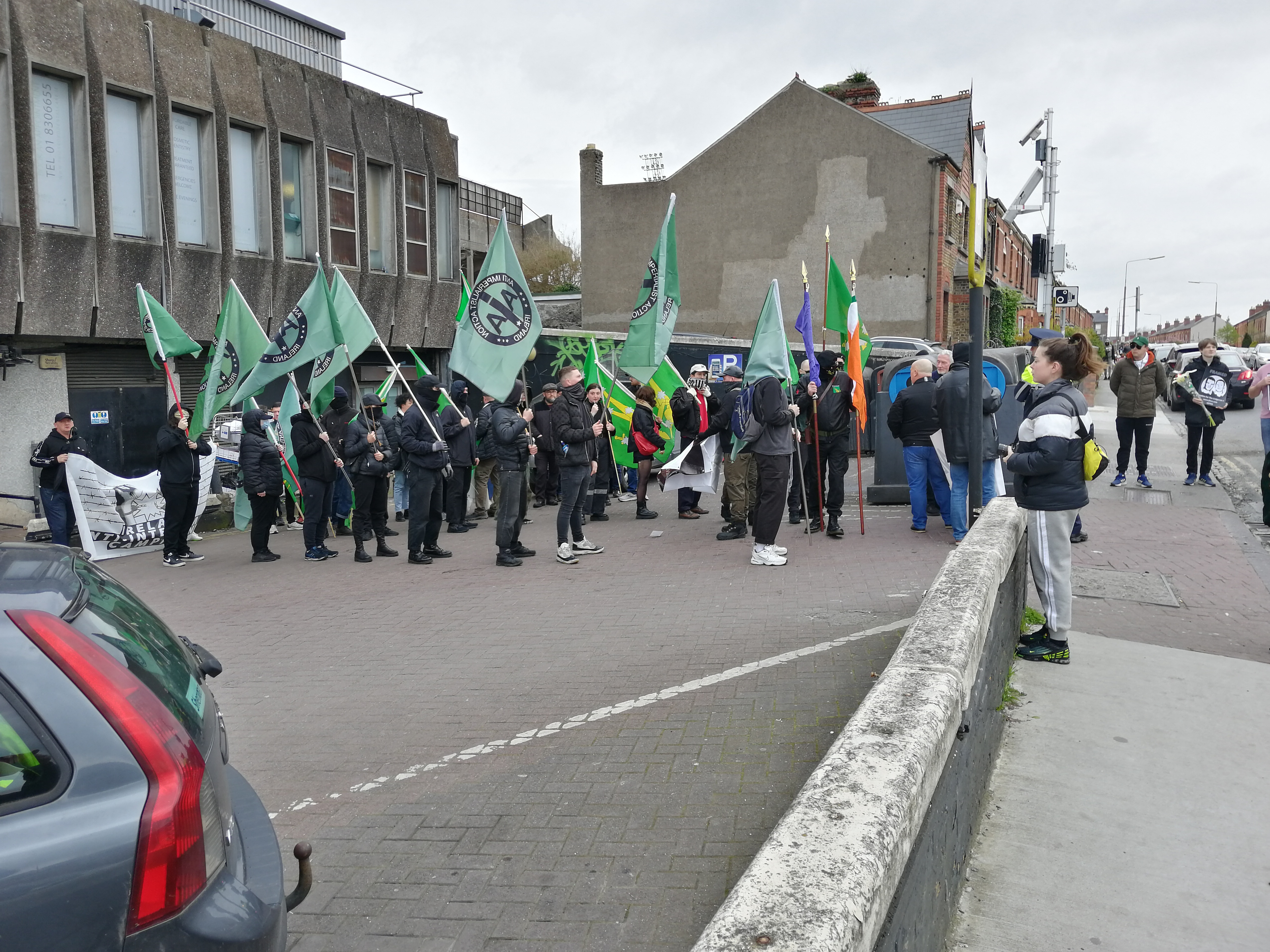
Among the commemorations organised by Irish Republicans around the past weekend was that by the AIA group on Sunday, rallying by the Phibsboro shopping parade for 1pm, before marching out to Glasnevin cemetry along the Phibsboro Road in two parallel separate lines.
This gathering in the past has been marred by the Special Branch, the political plainclothes police, harassing and attempting to intimidate those present, demanding their names and addresses under anti-terrorist (sic) special legislation. This time they were there but did not approach.2
Just after passing Crossguns Bridge over the Royal Canal, a flare was lit and the march stopped in the street.3
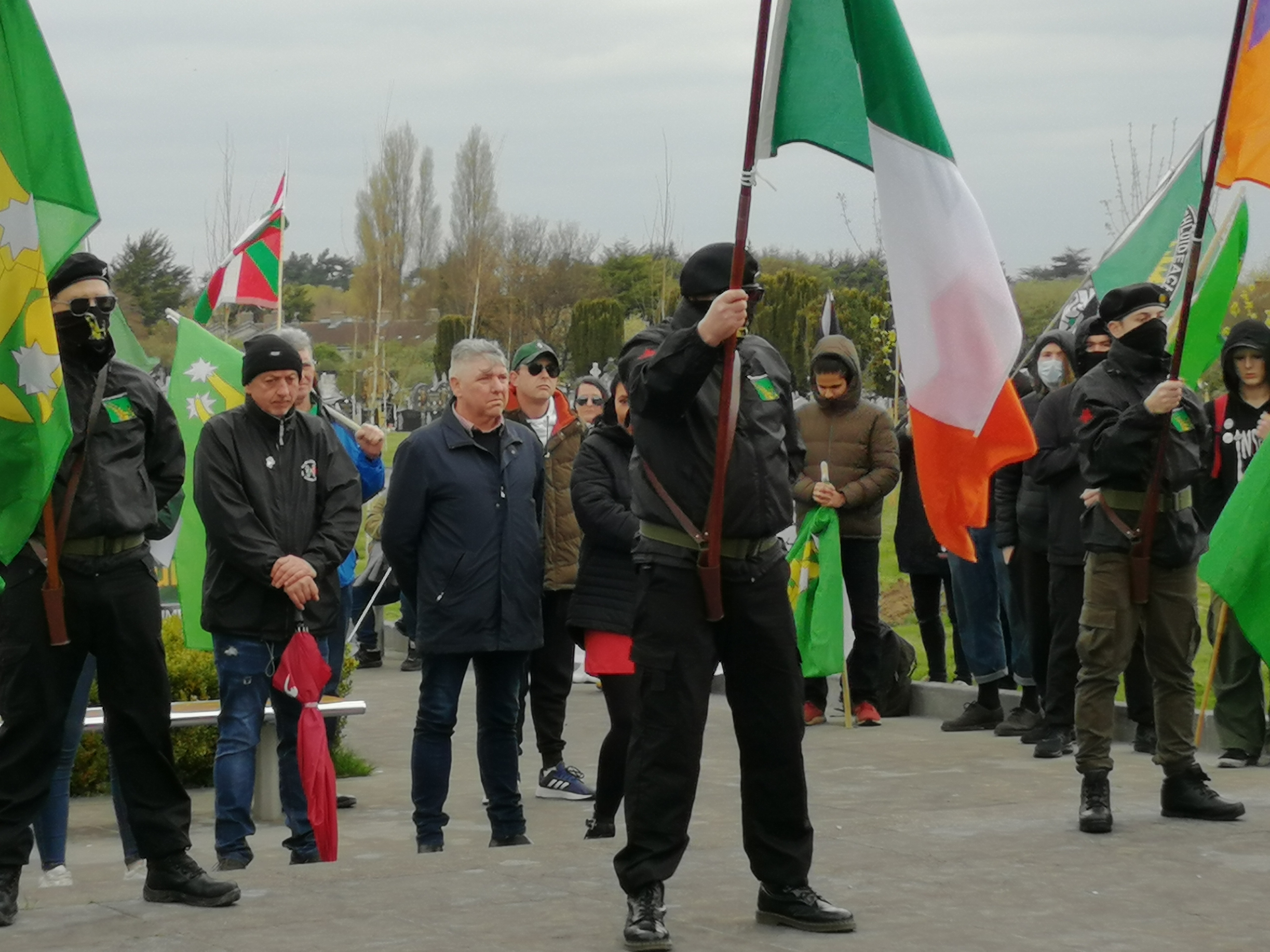
After a short pause the march resumed, led by the colour party,4 six men and women, each carrying a different flag with the Tricolour and Starry Plough in the lead, all dressed in black trousers, white shirts, black berets, sunglasses and lower face masked.
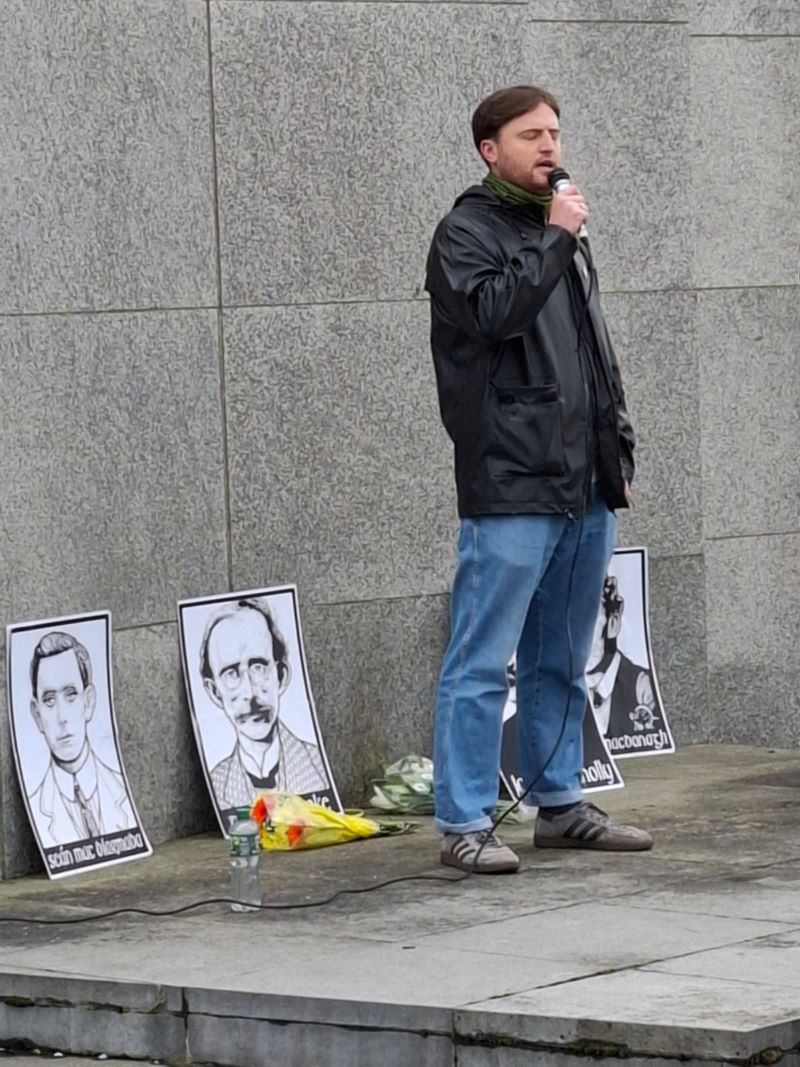
The images of each of the Seven Signatories of the 1916 Proclamation, all shot by British firing squads were on large placards were carried among the marchers: Tom Clarke, James Connolly, Patrick Pearse, Seán Mac Diarmada, Joseph Plunkett, Thomas McDonagh, Eamonn Ceannt.
(Photo: R.Breeze)
A variety of flags were also flown among the marchers, including the green and gold Starry Plough,5 Palestinian flag, Basque Ikurrina and red flags (with gold hammer and sickle emblem on at least one).6 The AIA banner carried at the front bore a quotation from Bobby Sands in Irish.
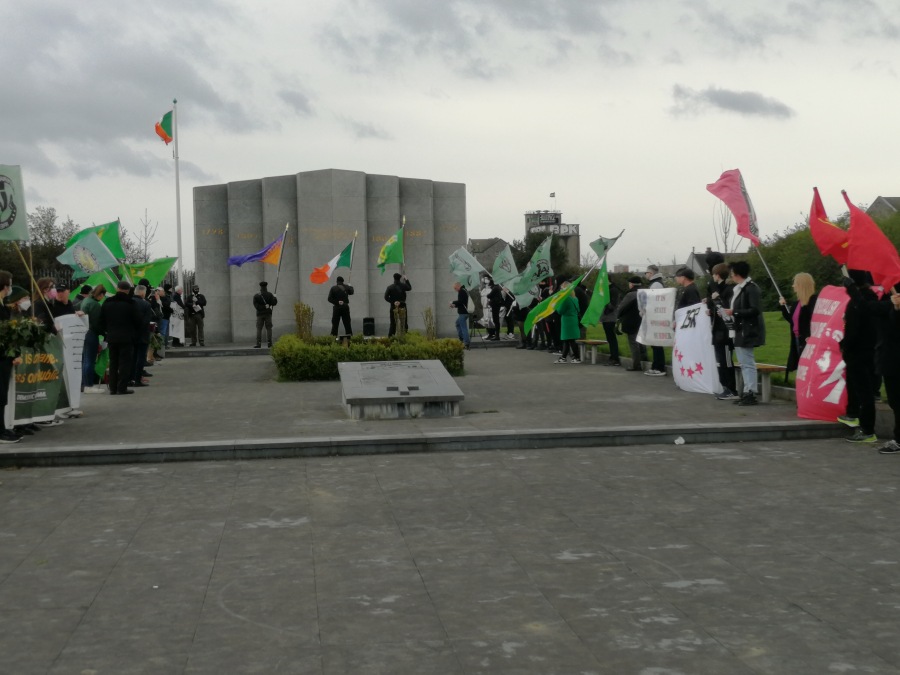
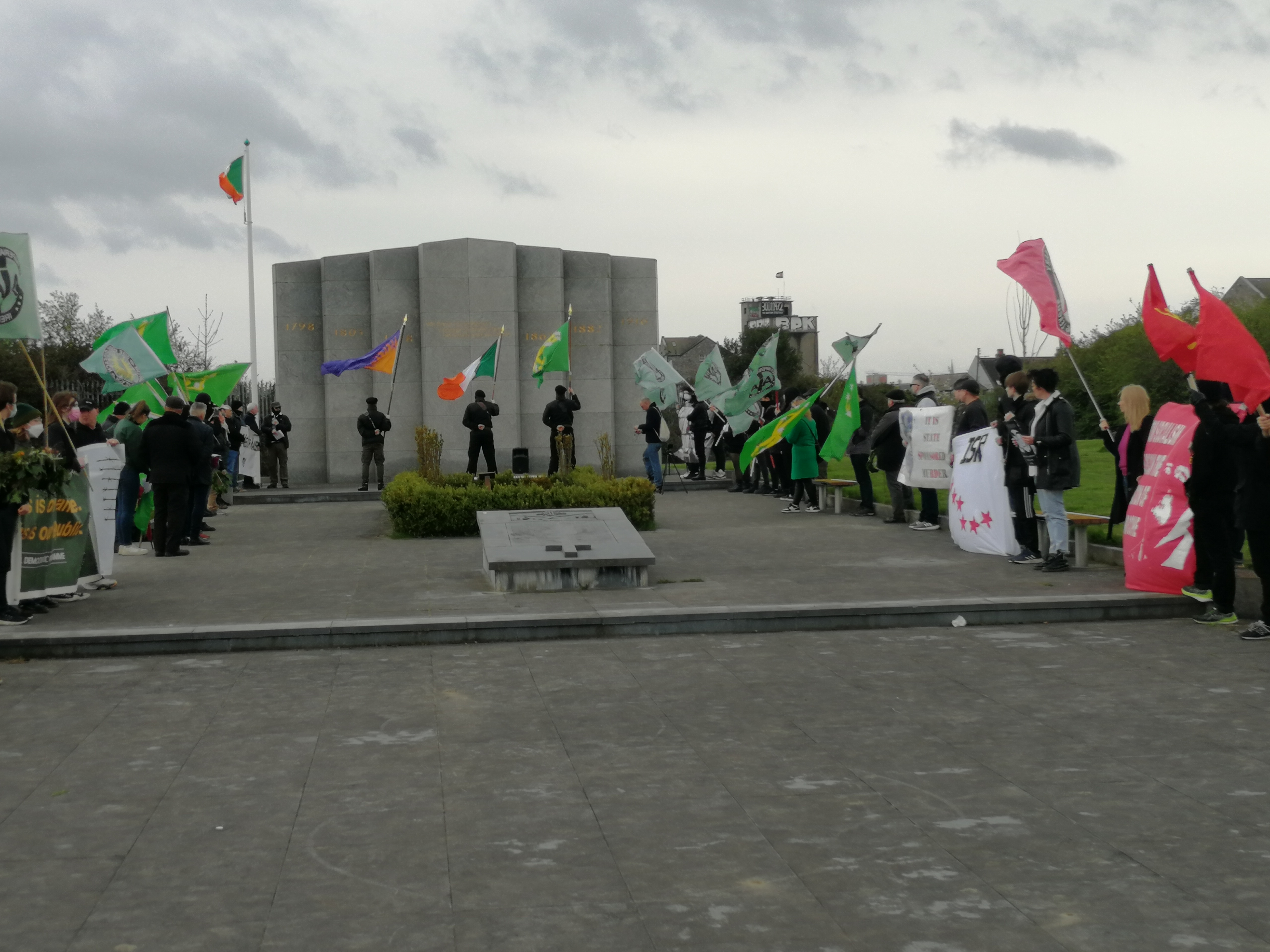
The march soon passed the main gates of Glasnevin Cemetery to their right but continued before turning leftward to then cross over the pedestrian railway bridge to the newer part of Glasnevin Cemetery and up to the monument to the Six armed struggles referred to in the Proclamation.7
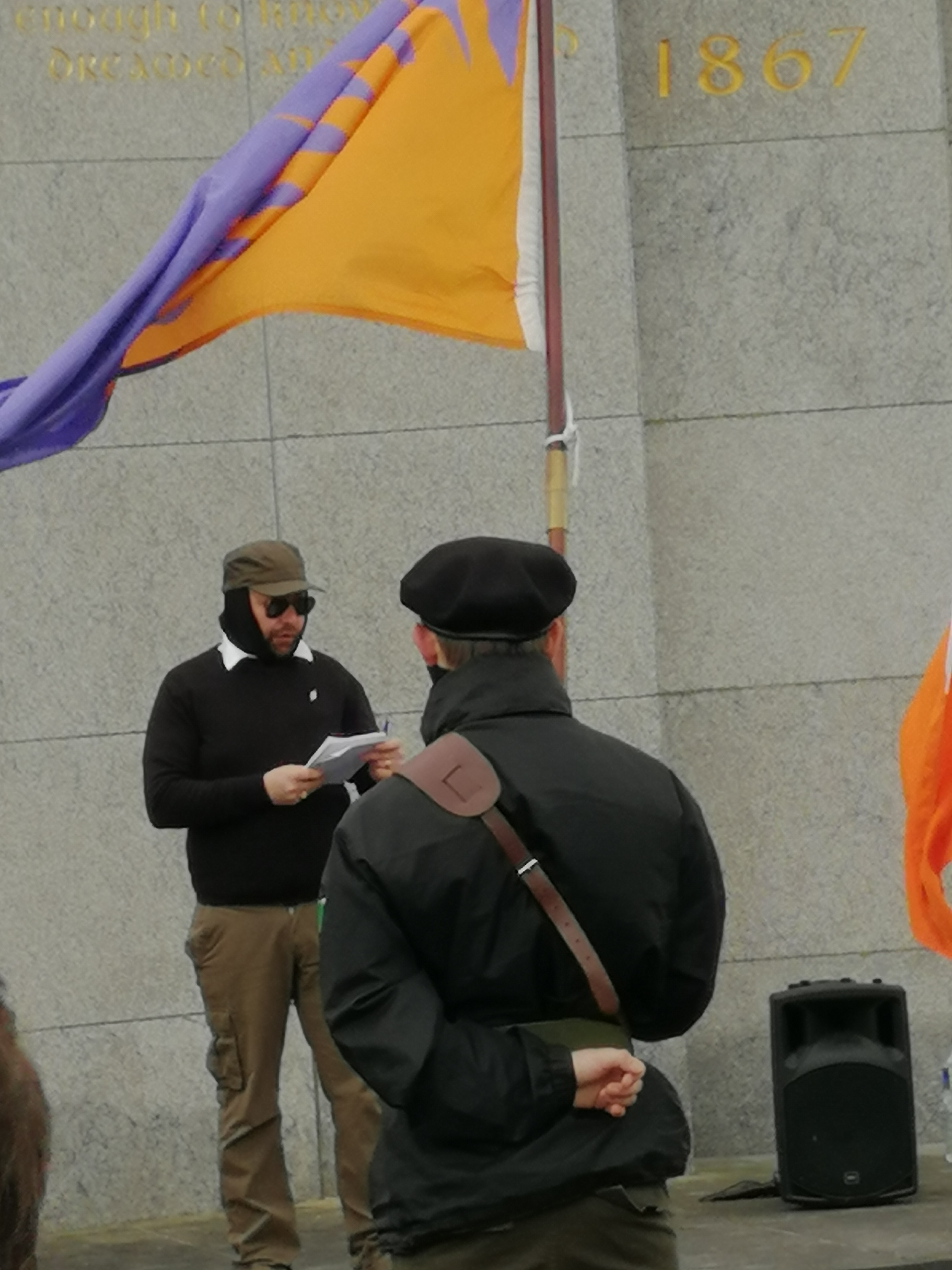
Formed in two lines the attendance was welcomed in Irish and English by the event’s MC, calling also for the reading of the Proclamation of Independence, which a man stepped forward to do. The MC recommended a careful reading of the still-relevant document to attendees from abroad.
Section on the left of the attendance at the commemoration rally with another section to the right out of shot. (Photo: R.Breeze)
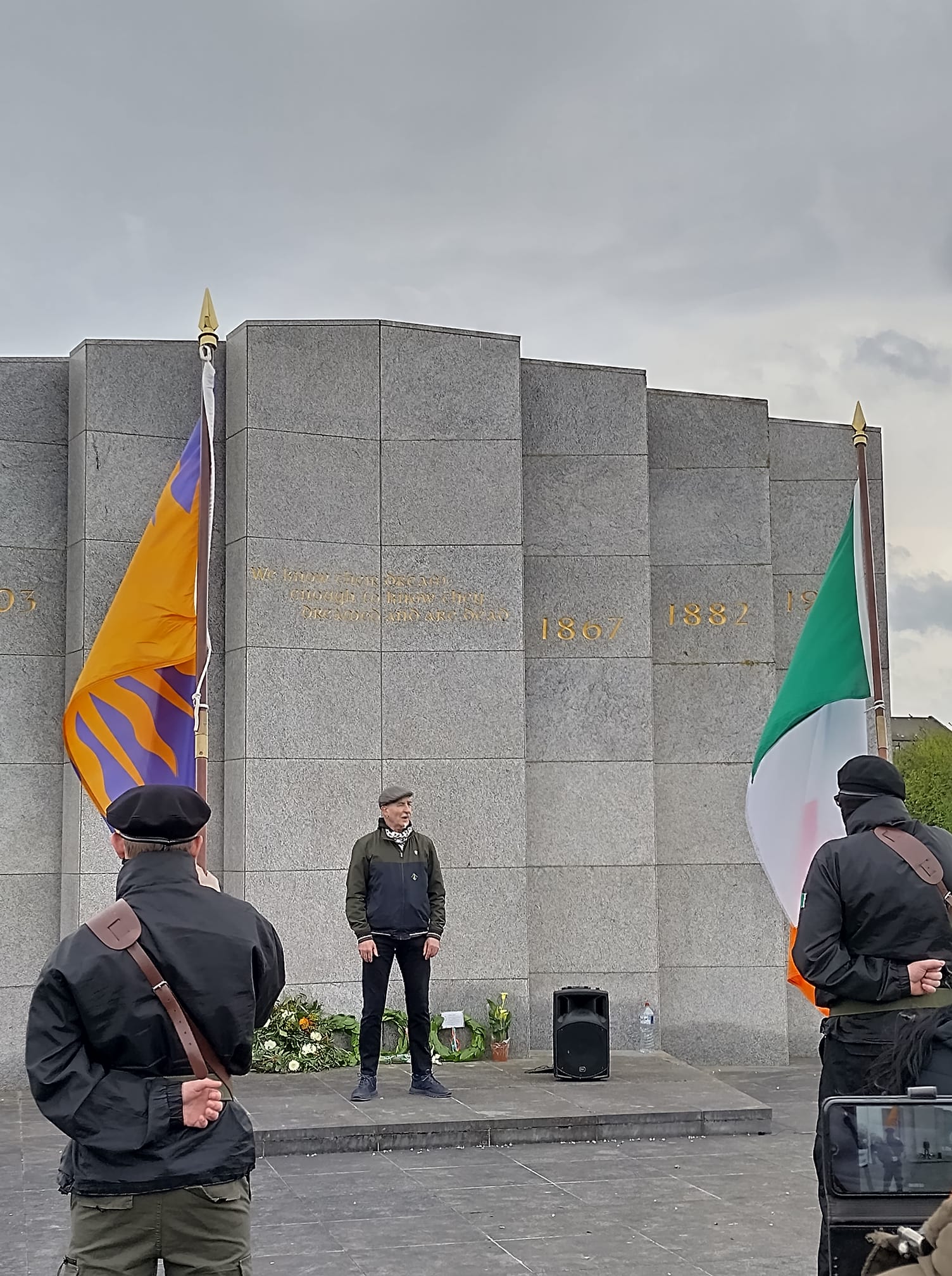
Following the reading, the MC commented on the important role of culture in the 1916 Rising8and called on an activist who he said has done much to promote traditional and folk Irish song, who proceed to sing Patrick Galvin’s Where Oh Where Is Our James Connolly? “with some changes”.
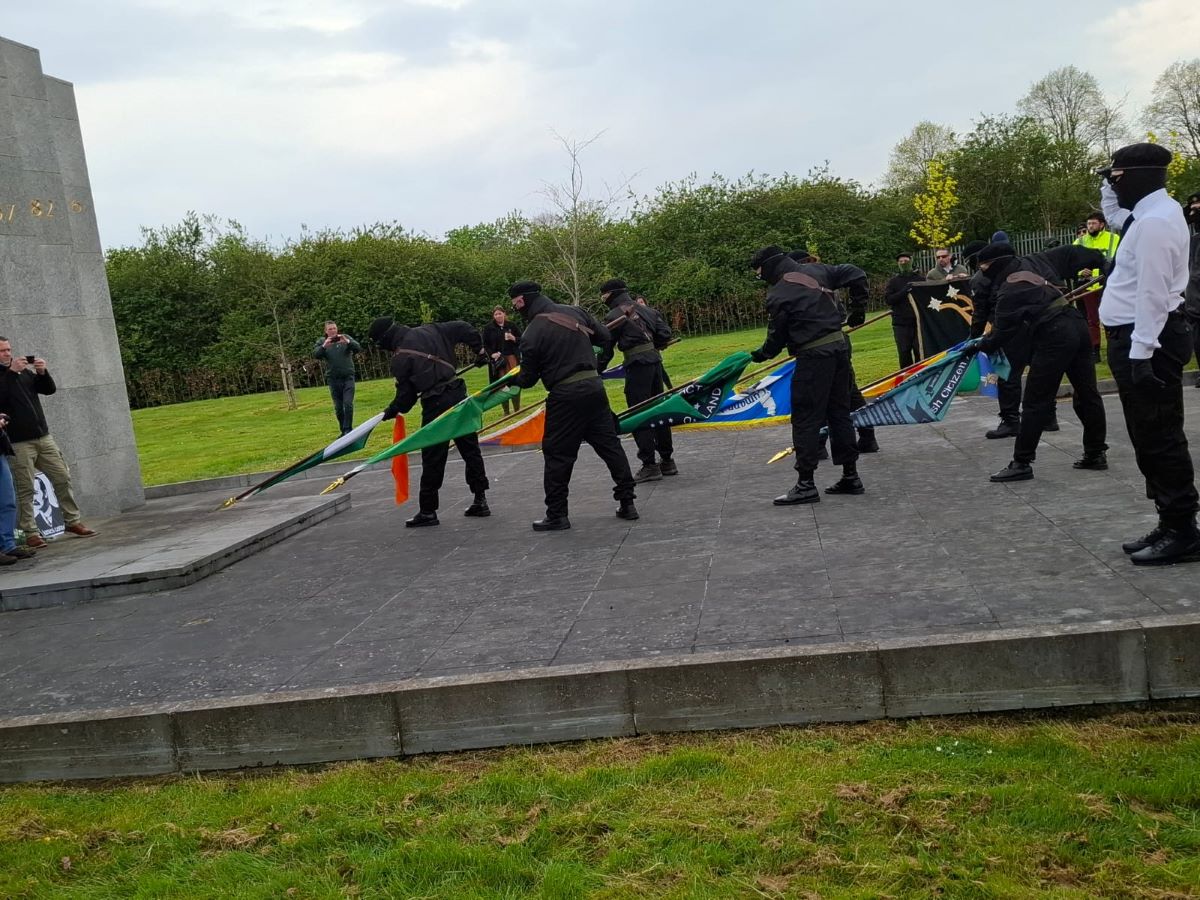
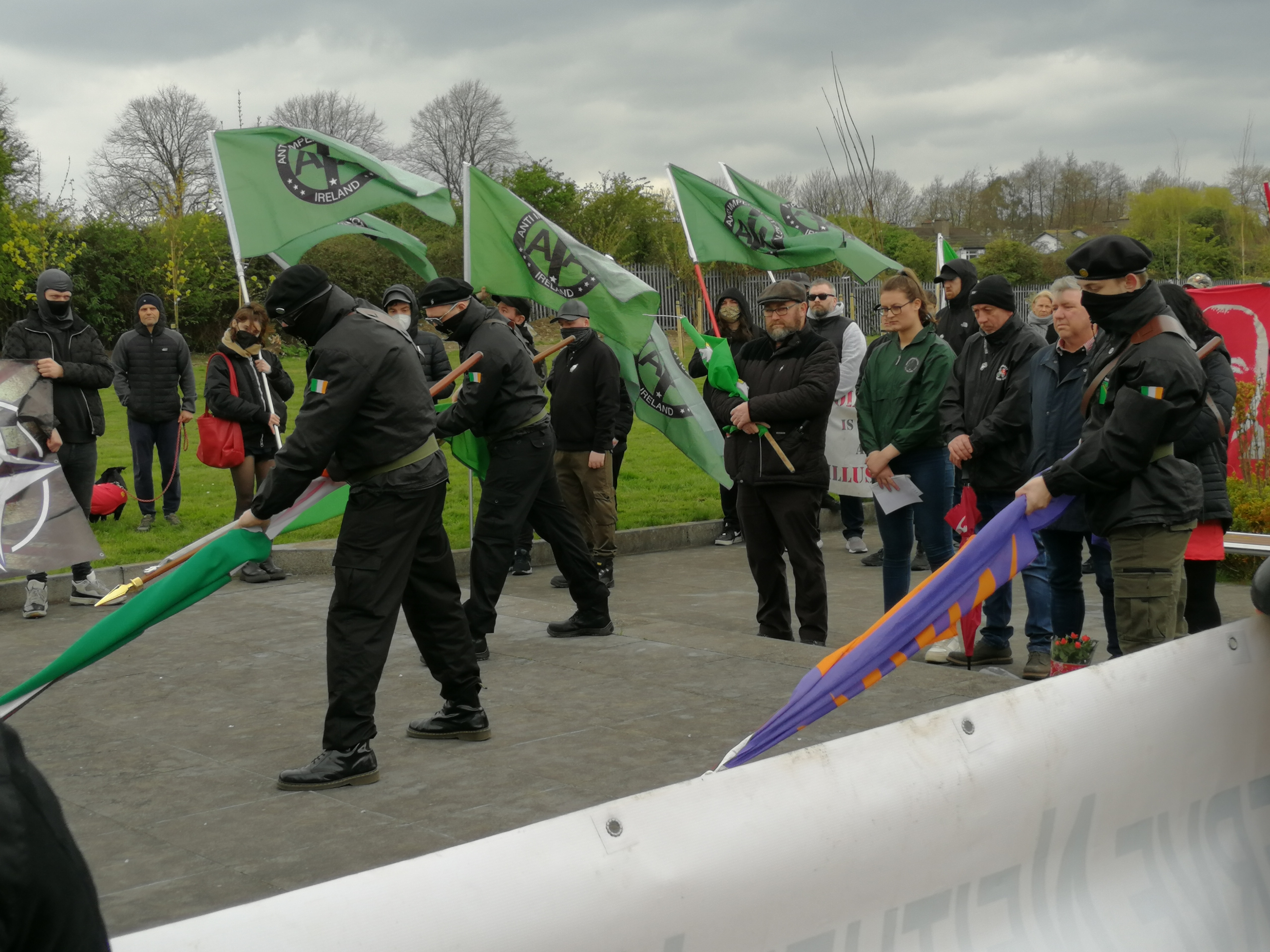
Next the call was given for those who wished to lay floral tributes while the colour party lowered their flags in homage to the fallen to commands in Irish, then slowly raised them again before responding to the command in Irish to stand ‘at ease’.
(Photo: R.Breeze)
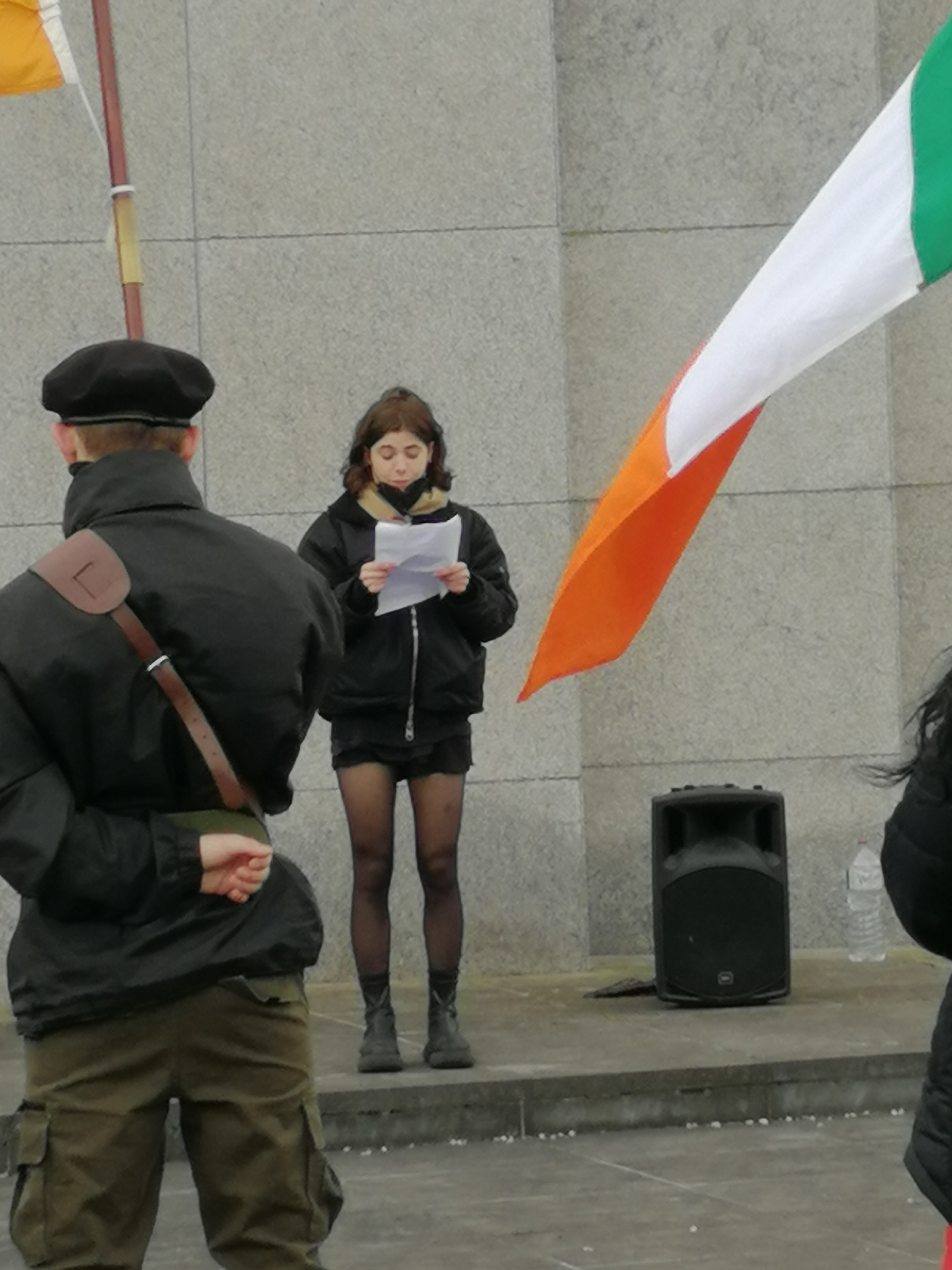
Another activist was called to read the 1915 statement on the Irish Citizen Army by James Connolly in which the revolutionary leader outlined the police violence during the 1913 Lockout that created the need for the ICA and how it had gone beyond defence in assertiveness.
The statement declared its class allegiance and origins “Hitherto the workers of Ireland have fought as parts of the armies led by their masters, never as members of an army officered, trained, and inspired by men of their own class.”
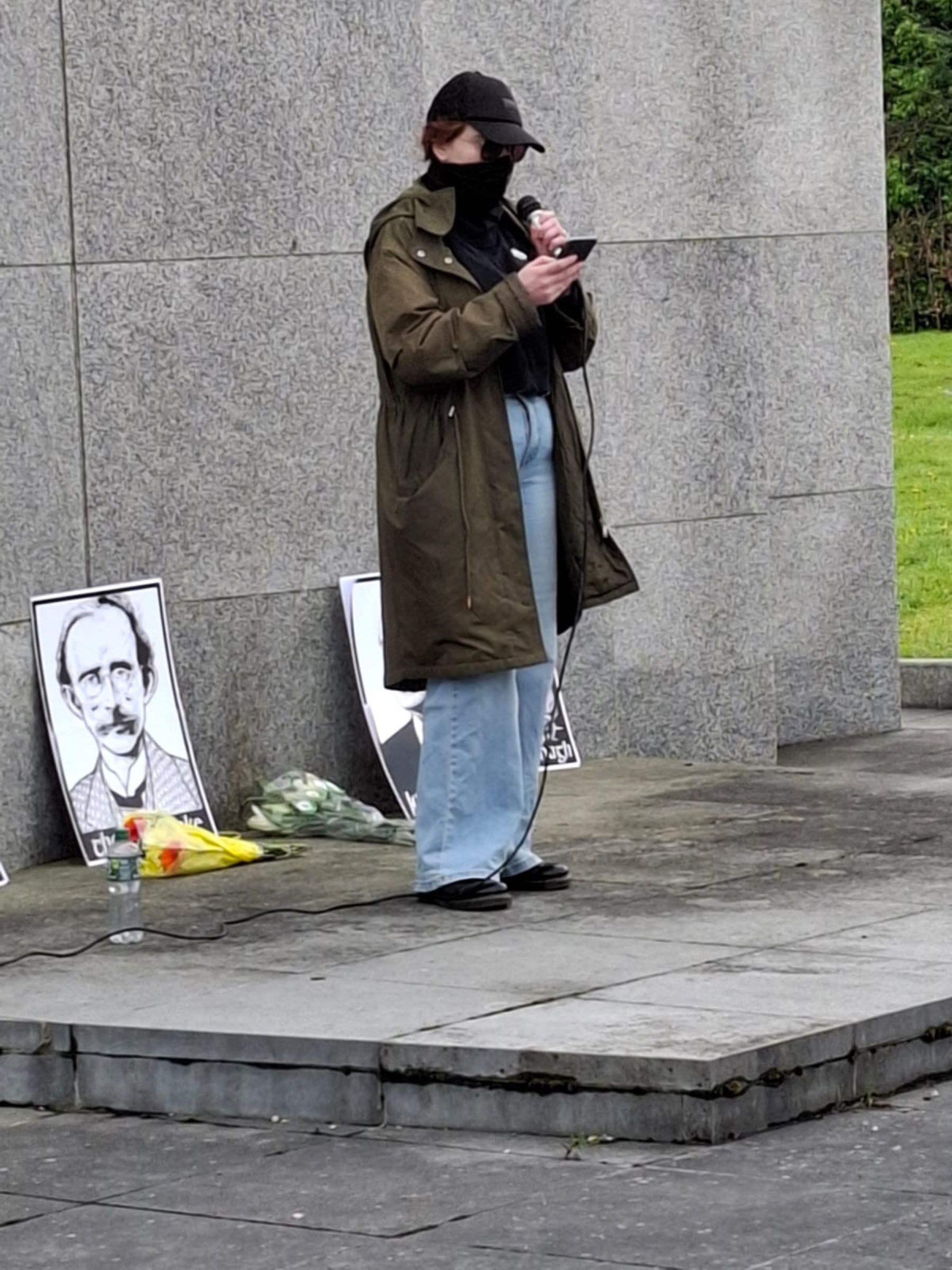
Reading Connolly’s “To the Irish Citizen Army” (Photo: R.Breeze)
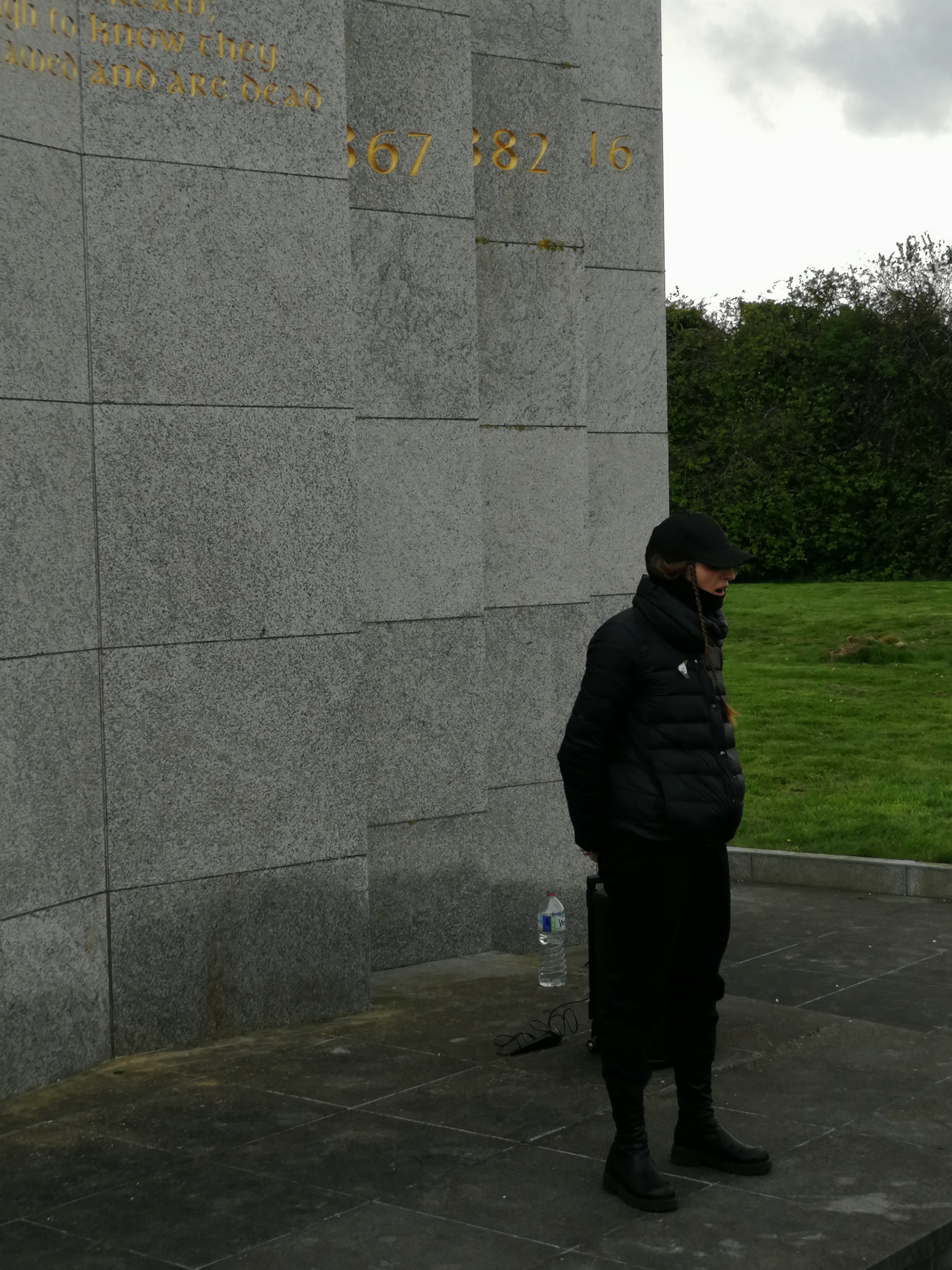
The PA amplification failed on the reader but she carried on in a strong voice reading Connolly’s words that the ICA sought alliance with all progressive forces but remained independent, not to be bound by the limits others set themselves and going further on their own if necessary.9
Another singer was called to perform Erin Go Bragh10 specifically about the 1916 Rising (by Dominic Behan, originally called A Row in the Town).
Singing Erin Go Bragh at the Monument (Photo: R.Breeze)
It is traditional for organisations to deliver a keynote message or statement of aims at 1916 commemorations and a statement was read on behalf of the Irish Socialist Republican Movement (of which the AIA is a part) restating the objectives of national independence and socialism.
In that context the struggles against the Irish ruling class putting the State into imperialist alliance and against the British occupation of the nation, also a NATO member, were greatly important and the Gardaí had broken a comrade’s foot in that struggle.
(Photo: R.Breeze)
Referring to the international context of the 1916 Rising and the international connections of the revolutionary movement in 1916, the MC read out a fraternal message to AIA from the People’s Front for the Liberation of Palestine,11 declaring that the struggles of both peoples are one.
The event concluded at around 2.45pm with a singer performing Amhrán na bhFiann12 (first verse and chorus) followed by an announcement or reminder of a public meeting organised by the AIA titled Rebuilding the Republic to take place at 4pm at a venue not very far distant.
End. Footnotes
1Easter is a religious festival and its date varies from year to year according to computations based on the lunar and solar calendars and cannot fall on the same date annually in the Gregorian calendar (or the Julian one). After the insurrectionary forces had taken possession of the building, Patrick Pearse with James Connolly by his side read the Proclamation outside the General Post Office (GPO) building on the first day of the Rising (after its rescheduling from the previous day, Sunday): 24 April 1916. Tom Stokes tried for years to have the date adopted as Republic Day and annually organised an event outside the GPO on that date. After his death others carried on commemorating the date but rather than outside the GPO, at Arbour Hill. The Republican movement continues to hold its 1916 commemoration events over the Easter weekend.
2Possibly because the dust has not yet settled on the Gardaí’s recent violent arrests on 23 peaceful activists in three different events over four days (See Rebel Breeze’s IrishState Ramps Up Repression) recently.
3This spot has a 1916 history: A group of Irish Volunteers walked from Maynooth on Easter Monday along the banks of the Royal Canal, meeting two Irish Volunteers guarding the bridge and that night slept in Glasnevin Cemetery. The following morning they continued their journey to the city centre. Later, as the Rising was being suppressed, the British soldiers placed a barrier on the Bridge and prevented most people from passing through. A local man who had been deaf from birth failed to heed the soldiers’ challenge and they shot him dead.
4The ‘colour party’ carries the ‘colours’, i.e the flags and usually marches at the front. The number and type of flags varies but Irish Republican colour parties always carry the Tricolour among them, usually followed by the Starry Plough of which for many years the white stars on a blue background version was the most common. Often a flag of each of the four provinces would also carried and the Gal Gréine (or Sunburst) of the Fianna and of the Fenians would be carried too. The Harp on a Green background was another flag that was often carried by Colour Parties.
5The original design of the flag of the first workers’ army in the world, the Irish Citizen Army, created in 1914. It is a plough following the form of the Ursa Mayor constellation with a sword replacing the ploughshare.
6This is usually considered a symbol inherited from the Bolsheviks, the sickle representing the agricultural workers and the hammer, the industrial workers, their conjunction symbolising unity of peasants and industrial proletariat.
71798 and 1803 (United Irishmen), 1848 (Young Irelanders), 1867 (Fenians), 1882 (Invincibles group within the Fenians), 1916 (IRB, Irish Volunteers, Irish Citizen Army, Cumann na mBan, Fianna Éireann)
8Irish language revival, national theatre groups, national sports, poetry, music and song all contributed to an atmosphere conducive to resistance and uprising.
9However it may be for others, for us of the Citizen Army there is but one ideal – an Ireland ruled, and owned, by Irish men and women, sovereign and independent from the centre to the sea, and flying its own flag outward over all the oceans. We cannot be swerved from our course by honeyed words, lulled into carelessness by freedom to parade and strut in uniforms, nor betrayed by high-sounding phrases.
The Irish Citizen Army will only co-operate in a forward movement. The moment that forward movement ceases it reserves to itself the right to step out of the alignment, and advance by itself if needs be, in an effort to plant the banner of freedom one reach further towards its goal. https://www.marxists.org/archive/connolly/1915/10/forca.htm
10The slogan Éirinn (or Éire) go brách (“Ireland for ever”) was rendered in English spelling as Erin go bragh.
11 A socialist and secular resistance Palestinian resistance organisation; its armed wing is Brigades of the Martyr Abu Ali Mustafa which has been part of the armed resistance throughout the period, often in coordination with other groups.
12In a reversal of the usual sequence, the lyrics of this song by Peadar Kearney and Patrick Heeney were first composed in English but later translated to Irish, that being the most popular version of the chorus today.
Scores of people participated in a symbolic ‘funeral of Zionism’ on Monday evening (7th October) in Dublin’s city centre. In front of the James Connolly monument1 and near a mock coffin of ‘Zionism’, they listened to a song and short speeches.
This was followed by a march carrying the ‘coffin’ through city centre streets to O’Connell Bridge, where it was dumped in the Liffey river.
The ethnic composition of the mostly young mixed-gender crowd, by appearance and accent, seemed to be a mixture of Irish and Middle Eastern origin.
The chairperson of the event recalled that a year had passed since the heroic action from Gaza of October 7th and the events that followed, all being gathered there at the James Connolly memorial to hold a funeral for Zionism, the ideology of settler colonialism and genocide.
The first contribution was from a man introduced as Seán Óg with a song of his own composition, three verses rendered acapella in fine voice to the air of two well-known Irish patriotic ballads, Men of the West/ Fir an Iarthair and The Boys of Killmichael.2
The audience began to pick up and join in the chorus lines:
So here’s to the boys of Gaza, Jenin, Nablus and Hebron, Who fought ‘neath the brave flag of Palestine and sent the Settlers on.
Section of crowd at event listening to speeches, viewed facing north-eastwards. (Photo: R. Breeze)
Two speakers followed, pointing out the unanimity of imperialism nowadays in supporting Zionism as distinct from the 1950s and the importance of struggles such as that in Palestine to our own in Ireland, of internationalist solidarity and the need for that solidarity to be for the Resistance.
One speaker interspersed his words in English with some phrases in Irish and recalled the protest against the 1897 visit of the British Queen Victoria which saw James Connolly and Constance Markievicz leading a funeral cortège through the streets bearing a coffin for British Imperialism.
Though a ‘funeral’ for British Imperialism might’ve seemed only aspirational in 1897, the speaker said, signs of its decline were there to be seen for the educated, the intelligent and those who wished to see them — and before two decades elapsed it had received a major challenge.
(Photo: R. Breeze)
It survived that challenge of the First World War victorious but weakened and the embers of revolt were burning around its Empire. Before two decades after that funeral march, the torch of freedom had been lit in Dublin,3 the first uprising against world war of that century anywhere in the world.
The speaker went on to recall the subsequent War of Independence in Ireland three years later and remarked that had it not been for some Irish failures in unity and resolution that British Imperialism might have been given its mortal blow then in Ireland.
Subsequently British Imperialism survived by serving as a subject ally to US Imperialism. “Zionism is a rotten tree”, he said, “planted in Palestine by British Imperialism and nurtured by US Imperialism. Even so, Zionism is damaging its very fosterers and we welcome that.”
“Rotten trees don’t fall on their own,” the speaker continued. Trees that are rotten inside may seem healthy on the outside but when a strong storm comes along, they are knocked down. It is then we can easily see the rot inside them that we may not have noticed before.
Storms are now breaking out around the world, he said. We can and need to play our own part in those storms, “to knock down the rotten tree of Zionism and go on to demolish the whole rotten evil forest of imperialism.”
Section of crowd listening to speeches at the event, photo taken facing south-eastwards. (Photo: R. Breeze)
After applause some chants were led, among them: From Ireland to Palestine – Occupation is a crime! Saoirse don-Phalaistín! There is only one solution – Intifada revolution! From the river to the sea – Palestine will be free! Resistance is an obligation – in the face of Occupation!
The attendance then took to the street, carrying the coffin and flying Irish and national flags of Palestine along with those of factions of the Resistance, also Hezbollah’s and Lebanon’s, continuing the chants as they marched up lower Abbey Street,4 then turning left along O’Connell Street.
Along the way, some bystanders cheered and a man leaned out of a delivery van to shout encouragement with clenched fist in the air.
On O’Connell Bridge, after a few words, the ‘coffin’ containing ‘Zionism’ was pushed over the parapet into the river Liffey, to cheers, which then changed to cycling through the accustomed solidarity chants.
The ‘coffin’ is on the Bridge parapet (left of photo) and about to be dumped into the river Liffey. (Photo: R. Breeze)
There were three external interventions.
A known Irish Zionist who regularly tries to harass Palestinian solidarity participants appeared at the outset in attempted intimidation of an activist but was quickly discouraged from doing so. At the Bridge, a person under the influence of alcohol and shouting confusedly was calmed by activists.
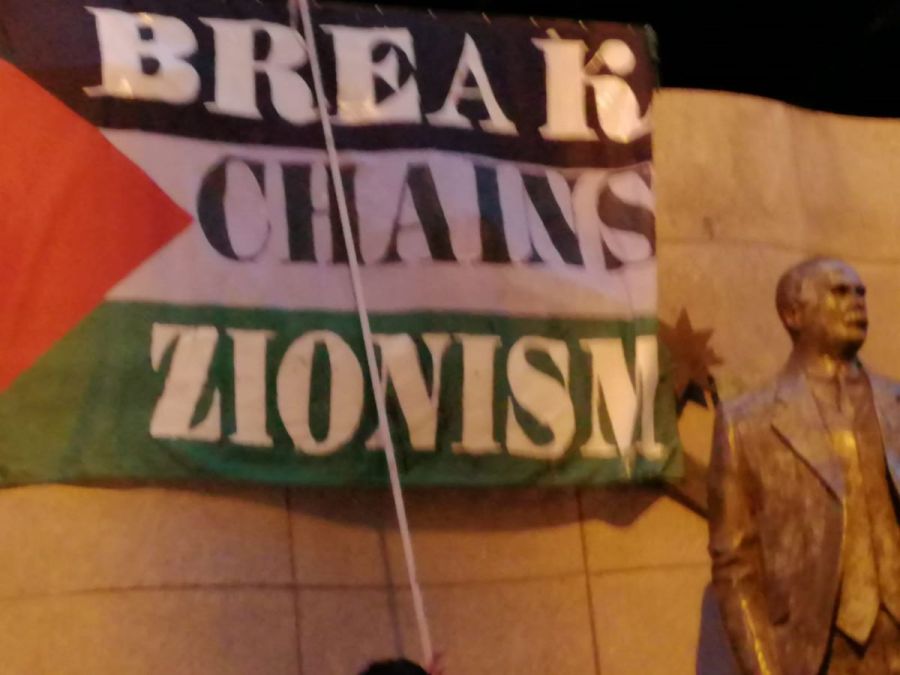
Break the Chains of Zionism banner next to James Connolly Monument (Photo: R. Breeze)
A Garda patrol car crew whose political undercover colleagues had clearly overlooked keeping informed drew up at the Bridge bemusedly during the chanting and, after attempting to gain some information as to events, left again – as did the participants soon afterwards.
The event was organised by Anti-Imperialist Action Ireland and Saoirse Don Phalaistín, the former’s Facebook page having been taken down by Meta while the event was being organised but the groups may be followed on Instagram and Twitter.
End.
Footnotes
1The location of this fine monument is in Beresford Place, across from the site of the original Liberty Hall, home of the Irish Transport and General Workers Union which Connolly led after Jim Larkin departed for the USA at the end of the 1913 Dublin Lockout. The site is now occupied a multi-storey building of SIPTU.
2The first is about the last major engagements of the 1798 Republican uprising, when a relatively small French force landed in Co. Mayo and was joined by Irish Republican insurgents; the second celebrates the IRA ambush of a column of the Auxiliary Regiment in West Cork, wiping it out almost to the last British terrorist.
4Until they reached O’Connell Street they were following in the footsteps of the GPO Garrison on Easter Monday, 1916 and passed by a number of historical political and artistic locations of 1848 and of the early 20th Century.
A number of demonstrations were held in Ireland to make it clear that Kier Starmer, Prime Minister of the UK and supporter of the Zionist state of ‘Israel’, has no céad míle fáilte in Ireland, or indeed any fáilte whatsoever for his Dublin visit.
After fourteen years of Conservative Party management of the UK, Starmer at the head of the Labour Party rode a change-seeking wave to win the General Election in July this year. But he soon revealed how little difference there is between the parties, including on Palestine.
Mostly of the east-facing section on the Bridge (Photo: R.Breeze)
Although the Labour Party on the Zionist State, its Government continues to support that state politically and economically, also militarily with supply of weapons components and RAF missions.1
Very recently the UK Labour Government temporarily suspended 30 military items which may (may!) be implicated in genocide. The UK, holder of one of the five Permanent seats of the UN Security Council is complicit in the ongoing Zionist colonial settler genocide of Palestinians.
In fact, the UK is responsible for settling Zionist Jews in Palestine and then for allocating much of Palestinian land to the settler who, as European settler colonists do, expelled hundreds of thousands of Palestinians and continued extending their land-grabbing ever since.
West-facing section of protest (Photo: R.Breeze)
PROTEST ON O’CONNELL BRIDGE
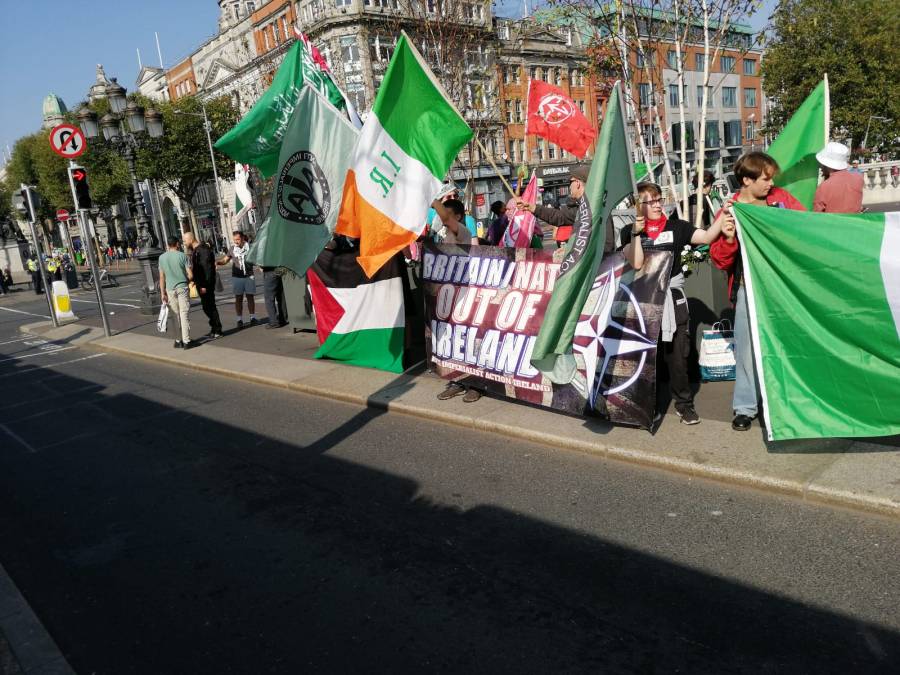
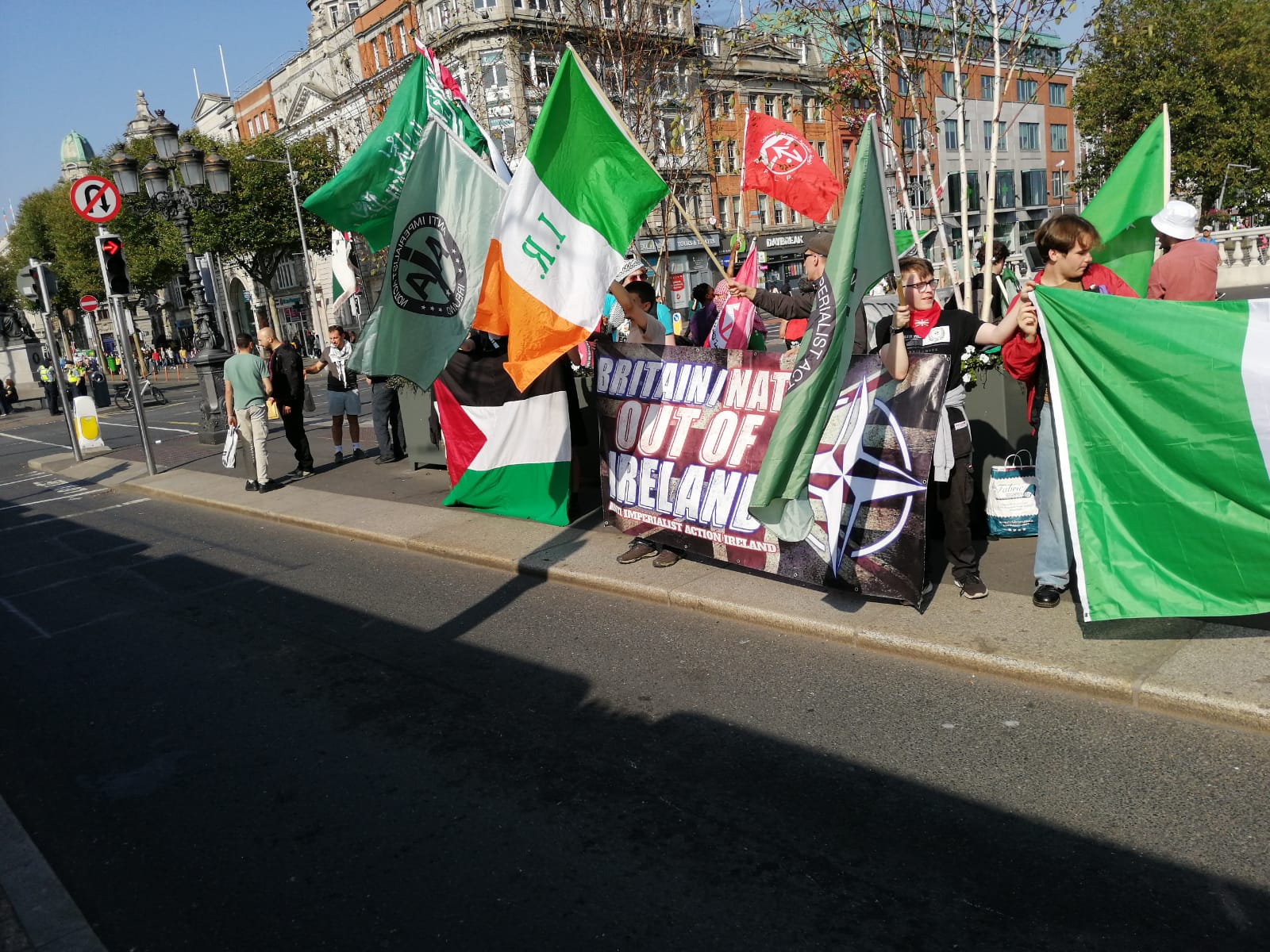
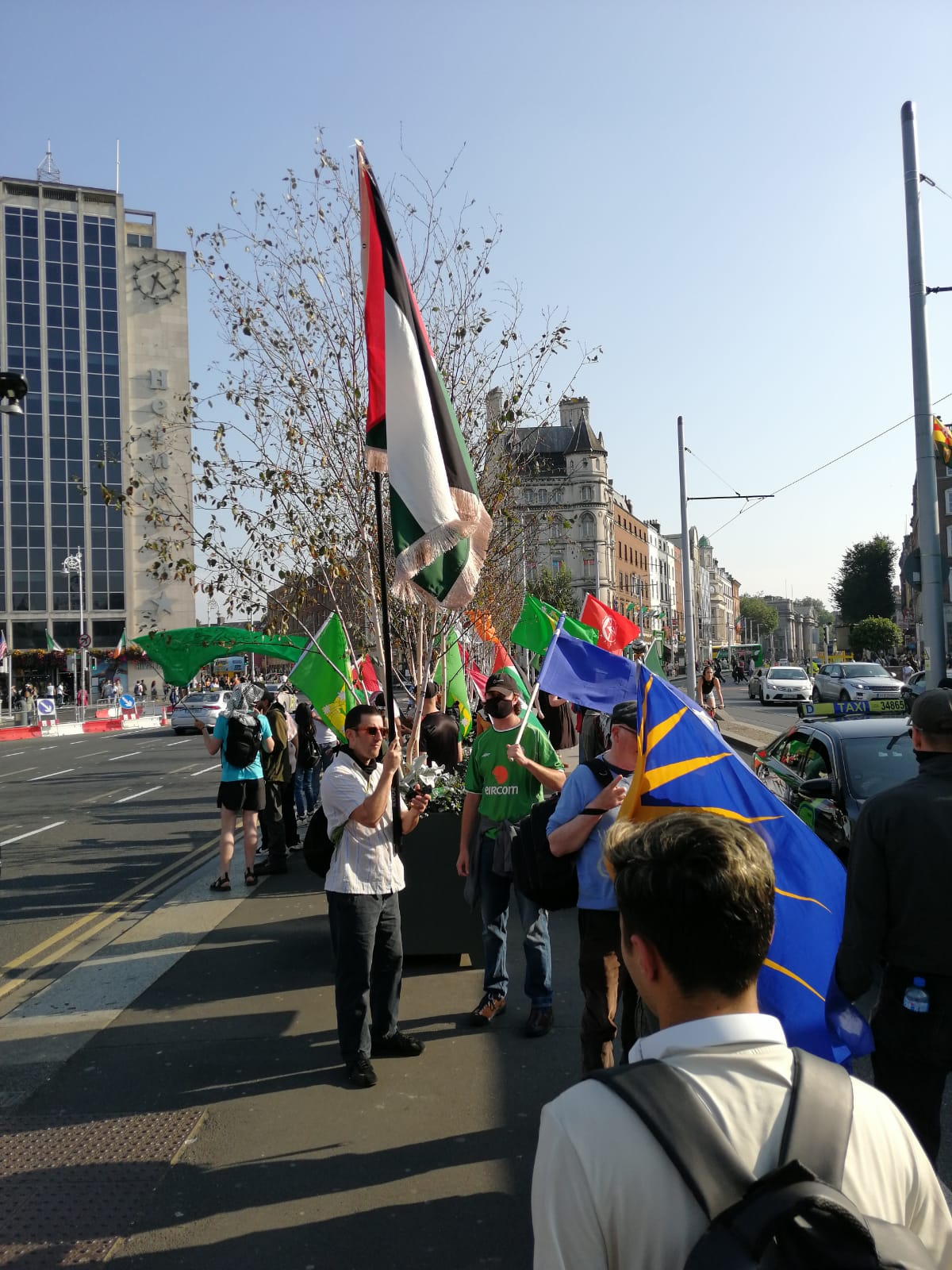
The Saoirse Don Phalaistín and Anti-Imperialist Action groups organised a protest against Starmer’s visit to take place on O’Connell Bridge at 3pm on Saturday and took up position on the central pedestrian reservation, with one section facing eastward and the other towards the West.
The Bridge spans the River Liffey and is in the heart of the city centre, crossed by north and southbound traffic and in view of westbound and eastbound traffic along the quays also.
There was a heavy presence of uniformed police in the vicinity, with five Special Branch nearby and a Public Order Unit van driving by a number of times as did other Garda vans. A prisoner transport van was also parked on the Bridge for a period but no attack was forthcoming.
Collection of banners and flags in west-facing section of protest. (Photo: R.Breeze)
RECORD OF THE LABOUR PARTY
One of the speakers at the O’Connell Bridge event reminded people of the history Labour Governments vis-a-vis Ireland, having sent the troops to the Six County colony to quell the struggle for civil rights there and also targeting the Irish in Britain with the Prevention of Terrorism Act.
This 1974 PTA, the speaker said, was later extended into the current Terrorism Act of repression in Britain. He reminded people too of the innocent Birmingham Six, Guildford Four, Maguire Seven and Judith Ward who were framed and jailed for long years under a Labour Government.
A speaker at the protest giving some reasons why Keith Starmer is not welcome in Ireland. (Video cred: Social Action Ireland)
The speaker could have also mentioned the Labour Party’s participation in the WWI War Cabinet which had sentenced and executed 16 Irish leaders after the 1916 Rising and its bipartisanship with the Conservatives on the partition of Ireland in 1921 and instigation of the Civil War in 1922.
SUPPORT AND OPPOSITION
The attitude expressed by protest passers-by on foot, bicycle or in motorised transport was nearly uniformly supportive. One exception was a fascist who called the protesters ‘traitors’ and attempted to take closeup photos before being blocked by a participant with a flag and seen off.
(Photo: R.Breeze)
Another was a big man who in a UStates accent seemed to shout something derogatory about Ireland and then claimed to be Irish (he might have been part of the diaspora there since the Irish tricolour colours appeared on the back of his top).
For much of the two hours of the event, slogans were shouted in support of Palestine, against the Zionist State, against Starmer, against British occupation of Ireland, for Intifada revolution, and for the solidarity action of Yemen at sea regarding Zionist-collusive shipping companies.
End.
Another view of west-facing section of protest with newly-made ornate Starry Plough flag. (Photo: R.Breeze)
FOOTNOTE
1There have been a number of reports of special units of the British army in Palestine and on British Intelligence personnel assisting the ‘Israeli’ Occupation Force.
Easter is the time of year in Ireland for Easter Egg hunts and/or for attendance at religious services but for the Republican movement it is one of commemoration of the Easter Rising and its martyrs, with parades and speeches.
The commemoration parade proceeding along Phibsboro and approaching the Cross Guns canal bridge. (Photo: Rebel Breeze)
Easter Monday in Dublin saw one of those commemorations organised by the Socialist Republican organisation Anti-Imperialist Action at the Citizen Army plot in the St. Paul’s section of the famous Glasnevin Cemetery at the Republican Struggle Monument1.
Participants rallied near the Phibsboro Shopping Centre to march from there to the Cemetery, a distance of around two kilometres, over the “Cross Guns” bridge over the Royal Canal, then passing the main entrance to the Glasnevin Cemetery on the right before turning left for St. Paul’s.
Garda POU van parked extremely dangerously, hiding left turn from view of eastbound traffic, as they chat with other Gardaí and a ‘Branch man.As is said, “one rule for the people …!” In the laneway between houses visible in the background, a cameraman lurked taking photos. (Photo: Rebel Breeze)
In a marked departure from the previous year, the State’s political police, plainclothes Gardaí of the “Special Branch”2 did not approach the participants to attempt to intimidate them and gather intelligence, demanding their names and addresses under the Offences Against the State Act.3
That had been followed up by a raid on the home of one of the leading activists. Sunday’s police behaviour was an even greater difference from Saturday’s, when a different Republican group, Saoradh, had their Easter Rising commemoration in Dublin’s city centre.
Around 300 police, including many in riot cop uniform (Public Order Unit) had harassed the participants demanding names, addresses and other information, attempting to intimidate them. At least seven police vans had been in attendance also to the bemusement of onlookers.4
(Photo: Rebel Breeze)
LOCAL 1916 HISTORY
The Phibsboro/ Glasnevin area also figured in the 1916 Rising, with an insurgent barricade in Phibsboro and a Fianna youth, Sean Healy, mortally wounded at the crossroads by a British artillery shell fragment (a plaque on the ground at the SW corner commemorates his death.
Earlier, Irish Volunteers had guarded the canal bridge briefly; these were seen by the dozen Volunteers that marched along the canal from Maynooth, slept in Glasnevin Cemetery and got into the headquarters garrison at the General Post Office on Tuesday.
Later British soldiers set up a barricade on the Bridge preventing even foot traffic across and shooting dead a deaf and dumb man who could not hear their challenge.
EYE IN THE SKY? (Photo: Rebel Breeze)
PARADE THROUGH STREETS TO CEMETERY
The parade from Phibsboro on Sunday was led by the Glasgow Republican Flute band (formerly the Garngad RFB, which is where most of them are based) playing the airs of known Republican ballads, muted to regular tocks on their drums as they entered the housing estate.
(Photo: Rebel Breeze)
Also leading was the colour party dressed in white shirts, black trousers, jackets, berets and sunglasses, carrying the traditional flags for Republican colour parties: the Tricolour, Starry Plough, Sunburst, followed by the flags of the four provinces of Ireland: Connacht, Leinster, Munster and Ulster.
Over the marchers the flags of the Tricolour and the Starry Plough, flag of the Irish Citizen Army flew in the breeze while those of the Basque nation, Palestine and of the People’s Front for the Liberation of Palestine lent an international flavour to the commemoration of the Irish Rising.
There was some beeping of passing traffic and cheering from bystanders at the entrance to the laneway that leads to the bridge across the railway tracks to the St. Paul’s section of the graveyard. The marchers filed in and proceeded to the monument.
The Chair of the proceedings welcomed the attendance before reading from the 1916 Proclamation of Independence and calling a singer to step forward. Revolutionary activist Diarmuid Breatnach introduced the two songs he was going to sing as emphasising the role of the working class in the Rising.
(Photo: Rebel Breeze)
“The decision to go ahead with the Rising on Easter Monday was taken in Liberty Hall, the headquarters of the working class at the time,” he reminded the gathering, “which is also where the Proclamation of Independence was printed.”
He sang the “JimLarkin Ballad”: In Dublin City in 1913, the boss was rich and the poor were slaves; The women working, the children hungry, till on came Larkin like a might wave …
Diarmuid Breatnach singing(Photo: Donated by participant)
Pausing to focus on a different key, the singer followed the ballad with Patrick Galvin’s Where Is Our James Connolly?
After applause, floral tributes were laid on behalf of Anti-Imperialism Action Ireland and of Dublin Republicans Against Fascism.
(Photo: Rebel Breeze)(Photo: Donated by participant)
The chairperson asked for a minute’s silence in honour of those men and women who had given their lives in the struggle for freedom in Ireland. The colour party lowered their flags slowly in homage to the fallen, raising them again slowly to signify the continuation of the struggle.
(Photo: Rebel Breeze)
John Heaney, Republican ex-prisoner from Armagh was called to give the oration for the event, which he dedicated to all those men and women who had opened their doors and their homes to fighters in the struggle, whether the latter were in hiding or just resting – his audience applauded.
The speaker also congratulated on those who came forward to carry on the struggle, youth, women and stated he was proud to see the traditions of struggle being upheld in the process to achieve the Republic for which so many gave their lives.
The speaker, John Heaney delivering his oration. (Photo: Rebel Breeze)
The marching band then played the air of Amhrán na bhFiann/ The Soldiers’ Song, verse and chorus and the formal part of the event came to an end. Band members lined up in front of the Monument for photos and a little later played the air of “Black Is the Colour” on whistles, to general applause.
SECOND 1916 COMMEMORATION FOR AIA THIS EASTER
This was the second 1916 Rising Commemoration to be attended by Anti-Imperialist Action as they had also participated in another organised by the Seamus Costello Memorial Committee in Bray on the previous day.
AIA is a young organisation, founded by socialist Republicans unhappy with the direction of the Republican organisation of which they had been members but now containing many young people.
AIA gave rise to the Revolutionary Housing League that occupied empty buildings in a campaign against homelessness and called for a general occupation campaign across the state. A number of court cases against them followed but sadly their lead was not followed.
(Photo: Rebel Breeze)
AIA have also been very active against NATO, picketing promotional meetings and a number have been charged following a demonstration against a visiting British Navy ship in Dublin last November.5 They have also been active as part of the Saoirse don Phalaistín activist group.
Following the event in Glasnevin, many of the participants relaxed at a social evening in a different part of the city where many songs of struggle were sung.
(Photo: Rebel Breeze)
OTHER EASTER COMMEMORATIONS
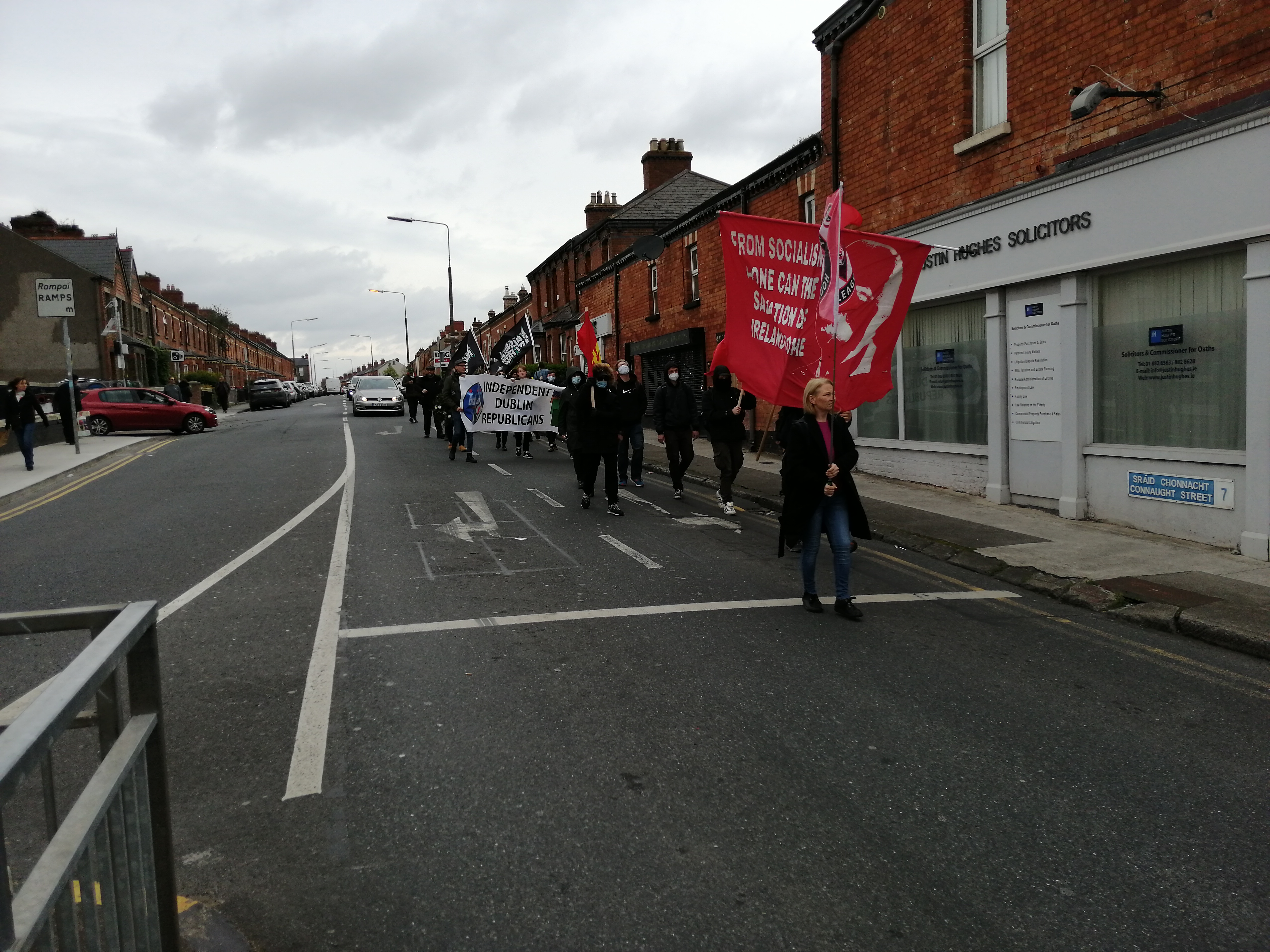
Other Easter Rising commemorations have been held around this time, for example: Lasair Dhearg held one in Belfast on Easter Monday, while Independent Dublin Republicans held theirs in the capital, marching from Liberty Hall to the GPO, then to Moore Street to lay a floral tribute.
On Monday too the Derry 1916 Memorial Committee held an event in its city.6
Former revolutionary Republican party Sinn Féin held theirs in Arbour Hill7 cemetery on Sunday; a large part of their President’s address was devoted to justification of support for the EU and a plea to support the party whenever the state’s general elections are held (this year or next)8.
1My name for the Monument in the St. Paul’s part of Glasnevin Cemetery which stands in recognition of six periods of Irish Republican-led insurrectionary activity in Ireland: 1798-1916.
2Now officially the Special Detective Unit, they were previously known as the “Special Branch”, a name they inherited from the British occupation which had set up a political intelligence unit, the Irish Special Branch, to spy on and disrupt the Fenian movement among the Irish diaspora in British cities. Most political activists in Ireland continue to call them “the Special Branch” or simply “the Branch”. Their equivalent in Britain today and in a number of its colonies and former colonies continues to officially bear the name “Special Branch”.
3As amended in 1972 after a British Intelligence bombing killing two public transport workers in Dublin but blamed on the IRA; the amendment also permitted the setting up of no-jury Special Courts which are in existence to this day.
4In the context of assaults on persons in the city centre there have been regular complaints in the media and in the Parliament about the lack of Gardaí visibly patrolling the area.
7Where the 14 Dublin 1916 executed were buried, now a national monument in a former prison and church graveyard around the back of the former military barracks and now National Museum of Collins Barracks
Palestinian solidarity supporters demonstrated outside the Israeli Embassy in Dublin again this afternoon, calling for the expulsion of the legation and the Israeli Ambassador. The protest was maintained from around 3pm to after 6pm today.
Organised by Saoirse Don Phalaistín and Action for Palestine, supported by Anti-Imperialist Action and independent activists, the protest kept up an almost endless chorus of slogans in English, Irish and Arabic languages, calling for a free Palestine and an end to genocide.
(Photo: Rebel Breeze)
Slogans were shouted denouncing the genocide being committed by the USA, the EU, the “Western Powers” and the “western media”, along with the collusion of the Irish Government. As large numbers of Gardaí arrived their collusion with zionism was called out also.
The latest figures of the Zionist genocide have now passed 27,000 dead in four months, more than two-thirds of them women and children, 66,287 injured, with 70% of Gaza housing destroyed and over 85% of its population displaced, a quarter starving and without clean drinking water.
(Photo: Rebel Breeze)
17,000 children are without parents or separated, according to UNICEF. And now evidence is mounting of Israeli ‘field executions’ and random sniper killing of Palestinian civilians and an Israeli military murder squad shooting three young Palestinian men sleeping in a hospital.
Meanwhile, outside the Zionist Embassy in Dublin …
(Photo: Rebel Breeze)
No less than three van-loads of the POU Gardaí (riot police) and many uniformed officers were there eventually. Later one of the latter threatened all those sitting in front of the entrance as a group with arrest under the Public Order Act, though no public disorder was taking place.
For the rest of their time there, the protesters separated to each side of the Embassy building entrance and the event concluded without any arrests.
(Photo: Rebel Breeze)
Every few minutes car horns could be heard as passing drivers indicated their support, often with a clenched fist or thumbs-up sign out the window. Only two objected: a man walking his dog who said he only cares about Ireland and a woman who shouted from across the road.
It has often been remarked by activists that those who “only care about Ireland” and object to Palestinian solidarity are not seen on the many demonstrations in Ireland protesting lack of housing, health service in tatters or British occupation of the Six Counties.
The Israeli Embassy is in an upper floor of a building rented to the zionist entity by a foreign property company with Irish directors, Quanta Capital at 15 Merrion Square North, a location which has also been the subject of protests.
Other tenants in the building say they have complained about the Embassy tenancy to the company but “they don’t care.”
No doubt protesters will return and the pressure on the Embassy (and on the Irish Government protecting it) will be maintained. Some TD should surely ask in Leinster House how much the taxpayers are being charged for maintaining an official zionist presence in Dublin.
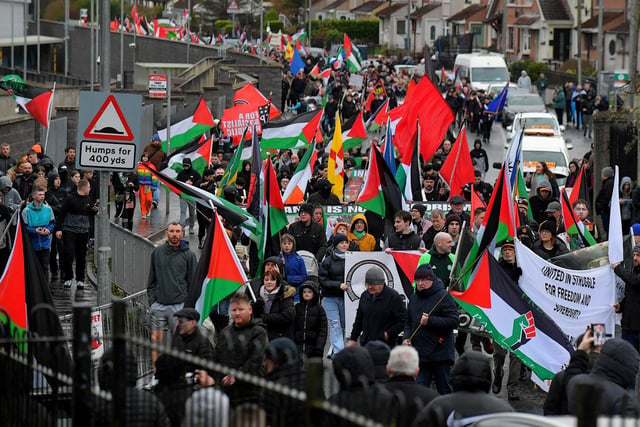
Led by four Republican marching bands and containing a number of organisations, around 6,000 people supported the annual march in Derry on Sunday commemorating the 1972 massacre by the British Parachute Regiment in the city.
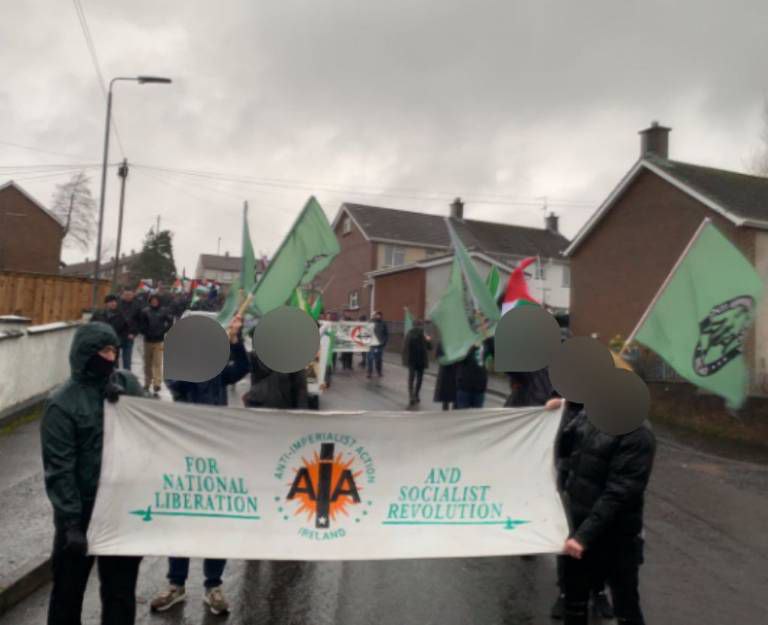
This year a special focus on solidarity with Palestine had been called for by the organisers of the Bloody Sunday massacre commemoration and Palestinian flags mixed with ones of Irish Republican organisations decorated the march route.
The march begins at the Creggan Heights, overlooking Derry, a steep walk up from the Bogside, the city’s centre near the river and winds its way down (with a great view of the Foyle river and surrounding area) but then up Westland Street again and along Marlborough Terrace.
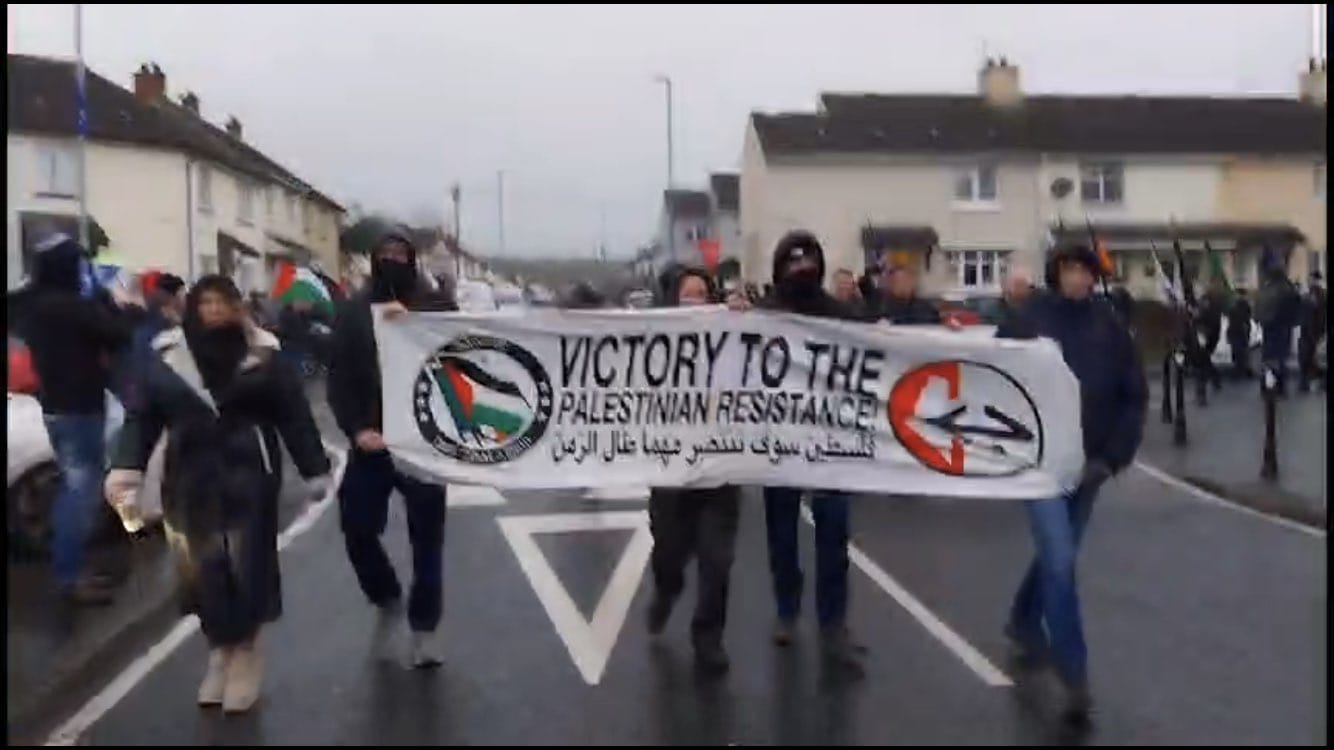
Rear banner of the AIA contingent on the Bloody Sunday commemoration march Sunday. (Photo source: AIA)
For a number of years this commemoration has taken place in heavy rain and high winds, or snow, or sleet but it was dry this year – until the march started! However after a short period of strong gusts driving rain it stopped for the rest of the march.
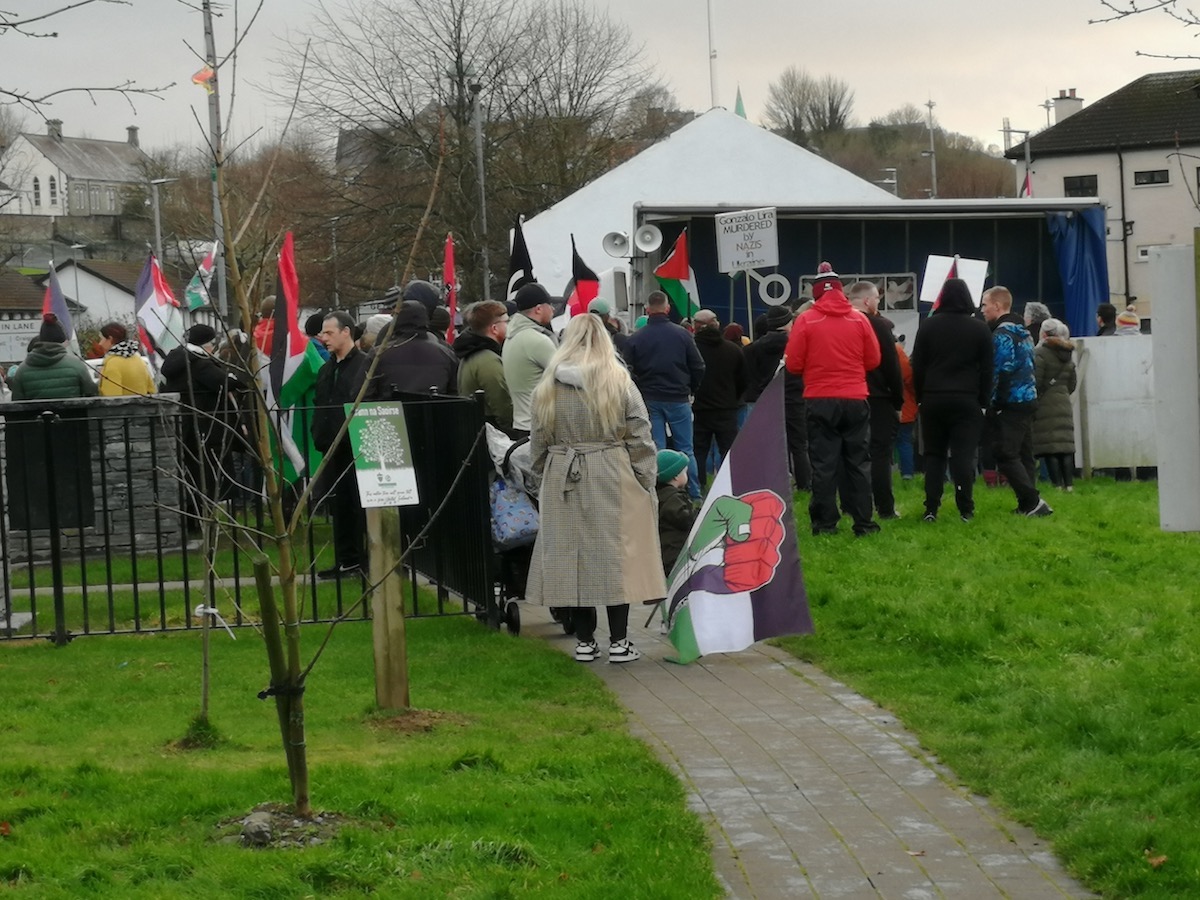
Down Creggan Road to the Bogside once more and past the Bloody Sunday and H-Block memorials to the rally at Free Derry Corner where Kate Nash, one of the main organisers of the march for years and a sister of one of those murdered in the massacre, welcomed the marchers.
The Bloody Sunday 52nd commemoration march makes it way along Lone Moor Road towards the Brandywell on Sunday afternoon. (Photo: George Sweeney via Derry News.)
RALLY AND SPEAKERS
Nash condemned the punitive EU/ UK/ USA cutting of funds to the UNRWA organisation carrying out relief and educational work in Gaza following an Israeli State intelligence allegation1 and also called for no Irish politicians to attend the annual US Presidential St. Patrick’s Day event.2
Kate Nash’s brother Willie was murdered by the Parachute Regiment during the massacre and her father was wounded by fire while trying to reach his fallen son. Kate called for a minute’s silence for the dead and wounded that day but also for those in Gaza, in particular the children.
Kate Nash also mentioned the Noah Donohoe case as being close to everyone’s heart.
The names of the dead and wounded by the Parachute Regiment were read out by Damian Donaghy,3 son of Damian Donaghy one of the survivors on that day. Paddy Nash performed the civil rights anthem “We Shall Overcome” which was popular among marchers of the time.
Section of the rally to the right as facing Free Derry Corner with a mural based on an iconic photograph from the massacre. (Photo: D.Breatnach)
Kate Nash introduced Huda Ammori, a Manchester-based Palestinian activist and one of the Elbit Eight,4 who said she felt at home in Derry because of the people’s solidarity with Palestine.5 The State in Britain failed to convict all but one of any charges arising out of direct action against the arms company.
Ammori drew parallels between the Irish and Palestinian struggles against colonialism and stated that her grandfather had been assassinated for rising up against the British colonisation of Palestine in 1936, when it was a British “Mandate”.
Mural on a wall in the Bogside, Derry; the words “don Phalaistín” are obscured by a vehicle. (Photo: D.Breatnach)
AIA Short Video with Music Bloody Sunday Derry 2024 AIA Video.MP4 (viewable on FaceBook)
“The British signed away the land of Palestine in 1917,” Amori told the rally, “they colonised our lands and then they armed and trained the Zionist militia to commit a Nakba, to displace over 750,000 Palestinians in 1948, over half the indigenous population.”
Huda Ammori said weapons were used on Palestinians in Gaza and then marketed as ‘battle-tested’. She also praised those who had taken direct action in Derry against arms firms (e.g Raytheon).
Section of crowd gathering in front of the stage for the rally. (Photo: D.Breatnach)
Geraldine Doherty, niece of Gerard Donaghy, youngest of the Bloody Sunday victims, also spoke from the platform, saying it was ‘sad’ but ‘heartwarming’ to see so many people attending the march.
“More than half a century since British troops committed this massacre on these streets, innocent children like my murdered uncle Gerard and hundreds of others as well are still being denied justice”, she said and denounced the British State attempting to prevent the trial of legacy cases being tried.
Doherty spoke of the remaining “trauma for Derry and for Ireland” from which many families have never recovered, with long-term post-traumatic damage such as depression, addiction and divided families.
“But while the people of Derry were battered and imprisoned, we were never broken,” she said to cheers from the rally participants. “Derry has rediscovered its … voice and we are using that voice to oppose the murder of children and women and men, and we stand with the people of Palestine.”
Section of crowd to the left of the stage at the rally.(Photo:D.Breatnach)
ON THE MARCH
Over the years since I returned to Ireland, I have marched in that commemoration many times, either as an individual or as a member of a solidarity committee and this year was glad to be welcomed as part of the Socialist Republican contingent, with Anti-Imperialist Action.
The bloc carried two banners: the one at the front was a new one in which the AIA called for anti-imperialist revolution and socialism, while at the rear the banner celebrated the Palestinian resistance. In between the banners marchers carried flags and placards.
New banner of the AIA in the organisation’s contingent on the march on Sunday. (Photo: D.Breatnach)
In the bloc men and women marched with a flags of the AIA, the Starry Plough, Palestine and Cumann na mBan. From the contingent on many occasions could be heard slogans of solidarity with Palestine and some equally applicable to that nation’s resistance or to Ireland’s.
“In the face of occupation – Resistance is an obligation!” and “No justice – No peace!” were in the latter category while “From the River to the Sea – Palestine will be free!”, “Free, free – Palestine!” and “Saoirse don – Phalaistín!” were specifically supporting the Palestinian struggle.
Most Republican organisations and some Irish socialist organisations attend the annual event, along with campaign groups and on occasion solidarity groups from abroad or Irish ones in solidarity with struggles abroad. Sinn Féin no longer attends but some supporters would as individuals.
Giant Palestinian flag displayed below the Derry Walls above the rally below. (Photo: D.Breatnach)
THE MARCH ROUTE AND HISTORY
The Bloody Sunday march covers the same route as the anti-internment march in January 1972 when the British Paratroopers murdered 14 unarmed marchers and injured so many others. Preceded by the Ballymurphy Massacre in August 1971, it was followed by another in Springhill in July ‘72.
The British military claimed that the Derry victims had been armed and fired first and an inquiry tribunal headed by Lord Justice Widgery exonerated the Army and blamed the victims although the Derry Coroner, an ex-British Army officer had called it “sheer unadulterated murder”.
In 1998, presumably as part of the Good Friday Agreement deal, the British State began a new inquiry which however did not deliver a published verdict until 2010,6 stopping short of accusing the Army of murder but exonerating all the victims except one about which it was equivocal.
At that point, Sinn Féin’s Martin McGuinness said that the march should not be continued; however not one British soldier had even been charged, to say nothing of the commanders and Government Ministers who had either given the orders or arranged the cover-up – or both.
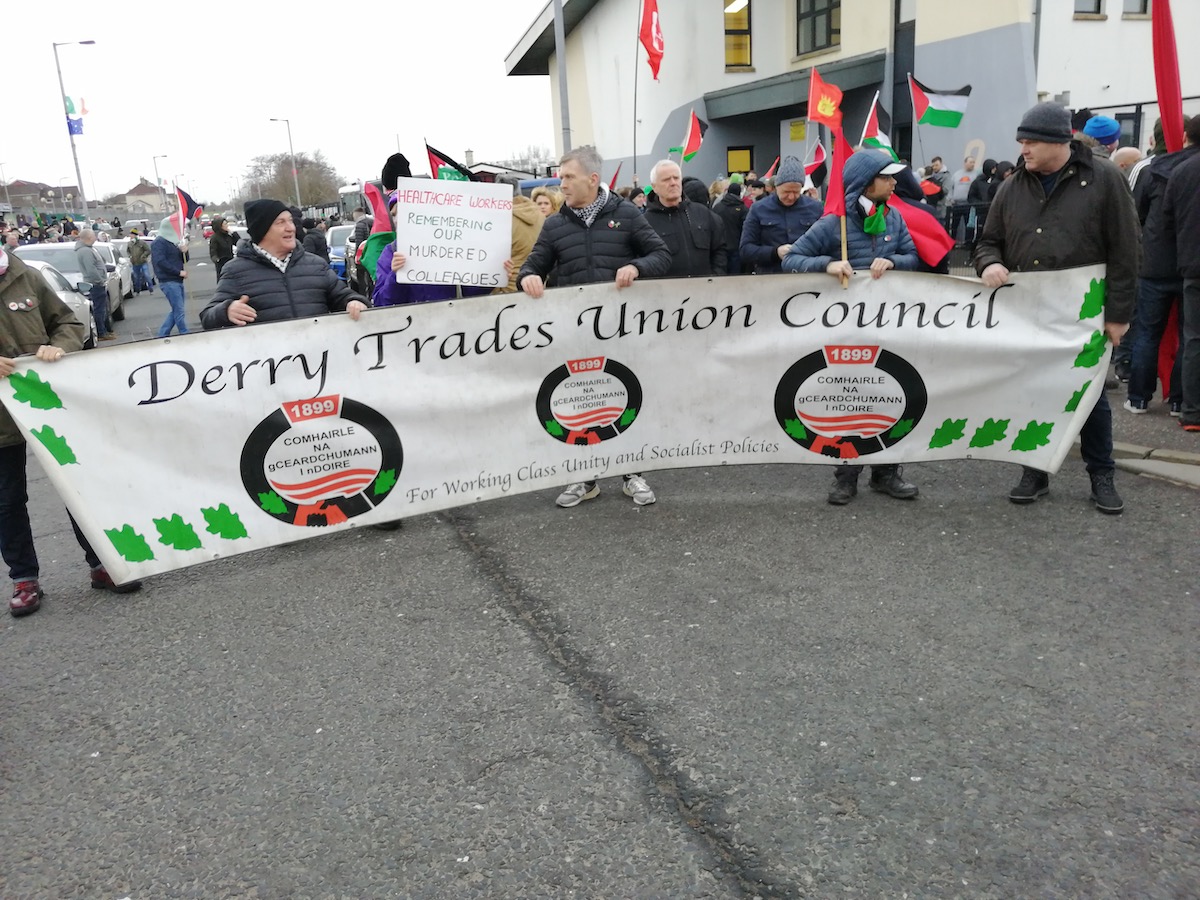
Banner of the organisation combining representation of trade unions in Derry. (Photo: D.Breatnach)
A small group of veterans of the original march and relatives, Kate Nash prominent among them, however decided to keep the march going and have done so every year, often in the face of accusations and disparaging remarks from supporters of Sinn Féin and others.
In 2022, the Massacre’s 50th anniversary, 20,000marched in it while the Bloody Sunday Trust, an institution and museum supported by the colonial state and Sinn Féin, organised a small “memorial walk” and indoors event in the Guild Hall – the only one reported by the mass media.7
An independent group, badly needed since the Coiste na nIarchimí is controlled by the Provisionals. (Photo: D.Breatnach)Display below Derry Walls created by the Saoradh Irish Republican organisation, according to their social media. (Photo: D.Breatnach)
Although veterans of the massacre and of the annual commemoration often meet one another only once a year at the commemoration, some having come from abroad, there are always new young people to be seen among them and hundreds come out to watch the march.
The march is an important commemoration of a massacre by British colonialism which still holds the colony of the Six Counties, a reminder no doubt inconvenient to unionists, neo-colonialists and those who have left the struggle, either through lack of will or for personal advancement.
In its championing and giving voice to other conflicts too, the commemoration march and other related events during the week are a strong expression of internationalist solidarity.
Wreath of the Bloody Sunday Commemoration Committee among others at the Bloody Sunday Monument. (Photo source:Bloody Sunday Commemoration Committee)
End.
FOOTNOTES
1The Israeli state intelligence agency reported that 12 out of 13,000 employees of UNRWA in Gaza had been implicated in the 7th October Palestinian raid following which at least some, possibly all, were sacked by UNRWA, apparently without any hearing or appeal process. The US, UK, Germany, Italy followed this up by suspending all funding to the relief organisation catering for 2 million people in dire circumstances.
2Traditionally, leading politicians of the main Irish political parties, both mainstream and Sinn Féin, have sent representatives to celebrate St. Patrick’s Day with US Presidents, many of whom are of Irish descent. This year a campaign has arisen calling on them not to do so but spokespersons of Fine Gael, Fianna Fáil and Sinn Féin have insisted they will attend, which the SDLP has declared it will not.
3Not to be confused with the family of Gerard V. Donaghy (20 February 1954 – 30 January 1972), sometimes transcribed as Gerald Donaghey, a native of the Bogside, Derry who was murdered by members of the 1st Battalion, Parachute Regiment on Bloody Sunday.
4Eight activists of British-based Palestine Action, a direct action organisation, who as a result of their actions against the Israeli-based military technology company Elbit in Britain, were charged with a total of 12 charges which included criminal damage, burglary and encouraging criminal damage. The trial, which commenced on November 13th, related to a series of actions taken during the first 6 months of Palestine Action’s existence from July 2020 to January 2021. In December last year, one activist was convicted on one charge by 10-2 majority, two were completely cleared and jury failed to reach a majority verdict on the rest of the charges on six remaining activists.
5That would be true of the majority ‘nationalist’ population of the city but not so much of the unionist minority, where support for Israel is more dominant, due in part to susceptibility to British propaganda and also simply out of sectarian hostility to anything favoured by the ‘nationalist’ community.
6At a cost of nearly £200m (€227.7m), half of which went in legal fees, a lawyer’s bonanza, to arrive at a decision that just about everyone in Ireland knew and many abroad knew already and which established no safeguards against a similar massacre being carried out by British military in future.
7Browser searches throw up report after media report, including Al Jazeera’s, of “hundreds” attending the early event, without a mention of the many THOUSANDS who marched later in the day.
On Sunday participants in a 1916 Rising Commemoration organised by the Irish organisation Anti-Imperialist Action were harassed by police as they gathered to march to the Irish Citizen Army Republican plot in Glasnevin Cemetery.
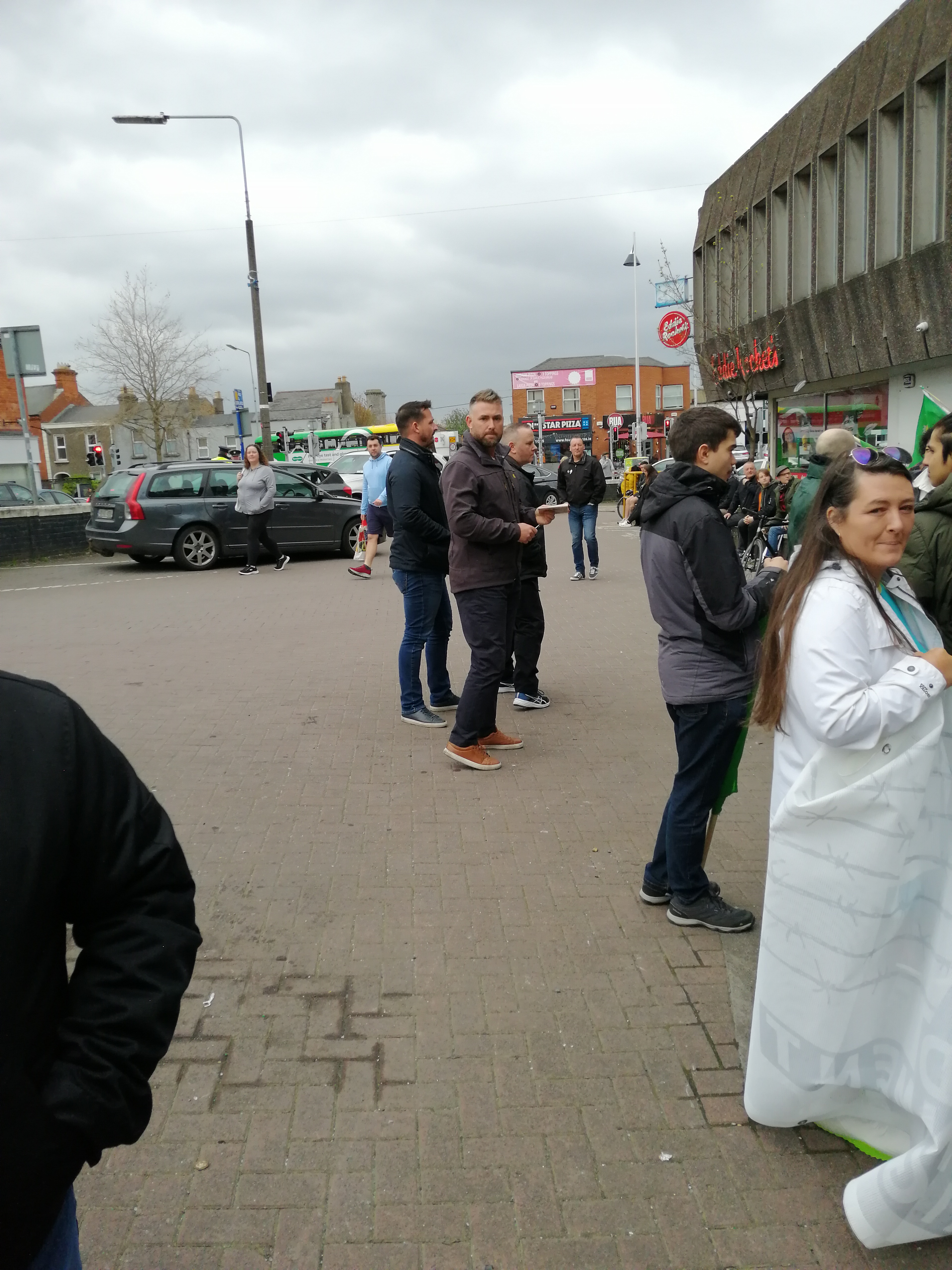
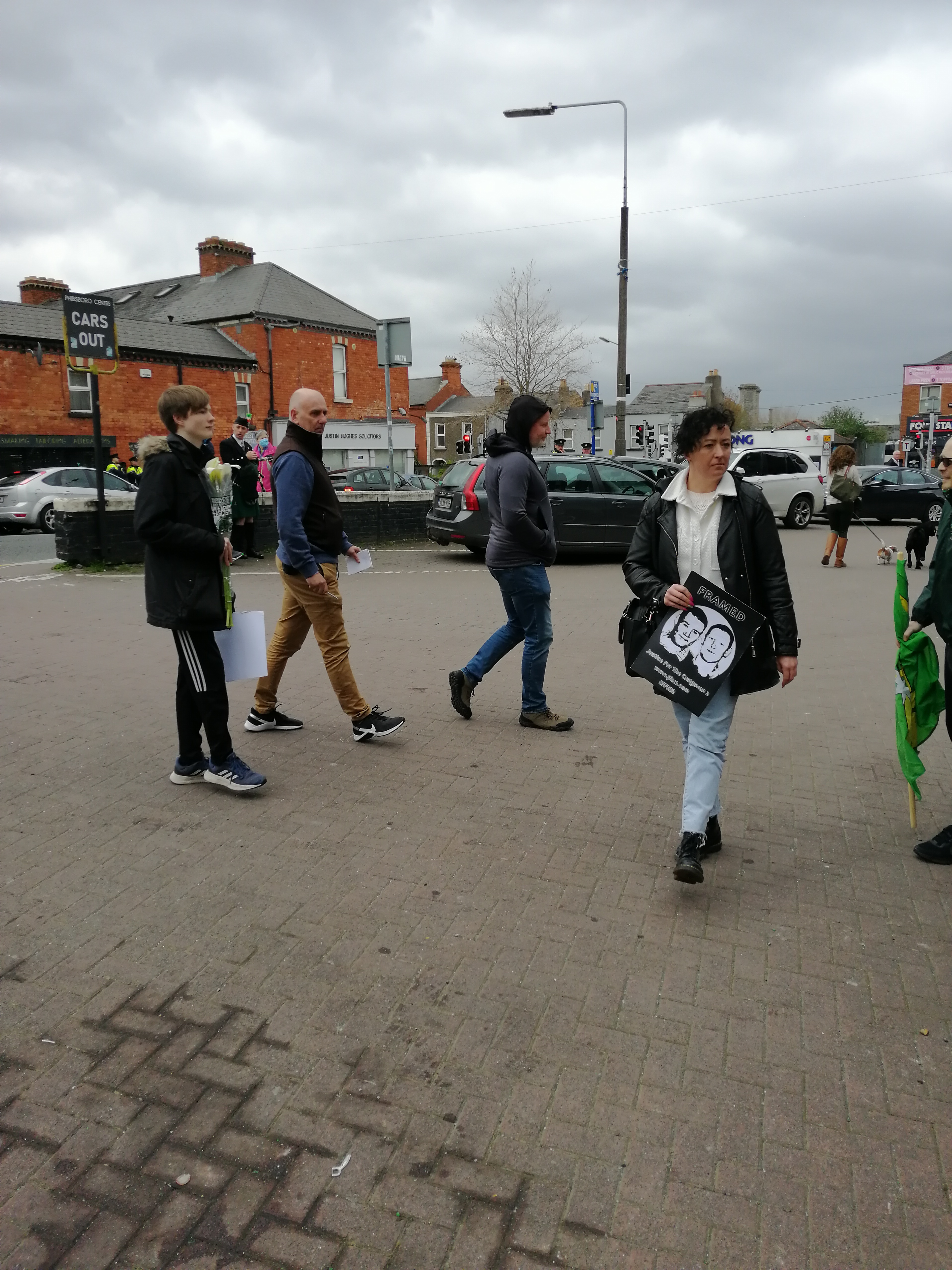
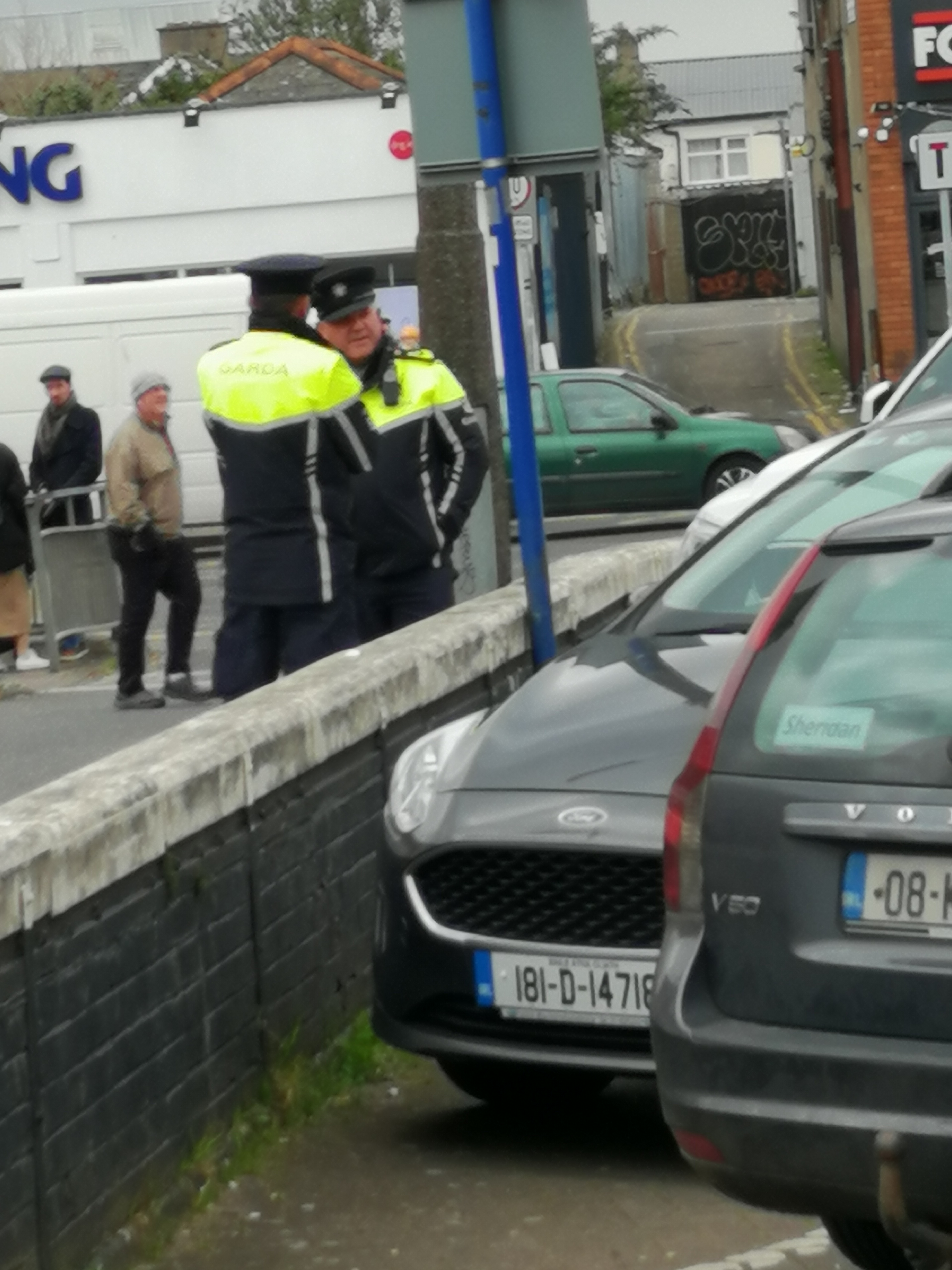
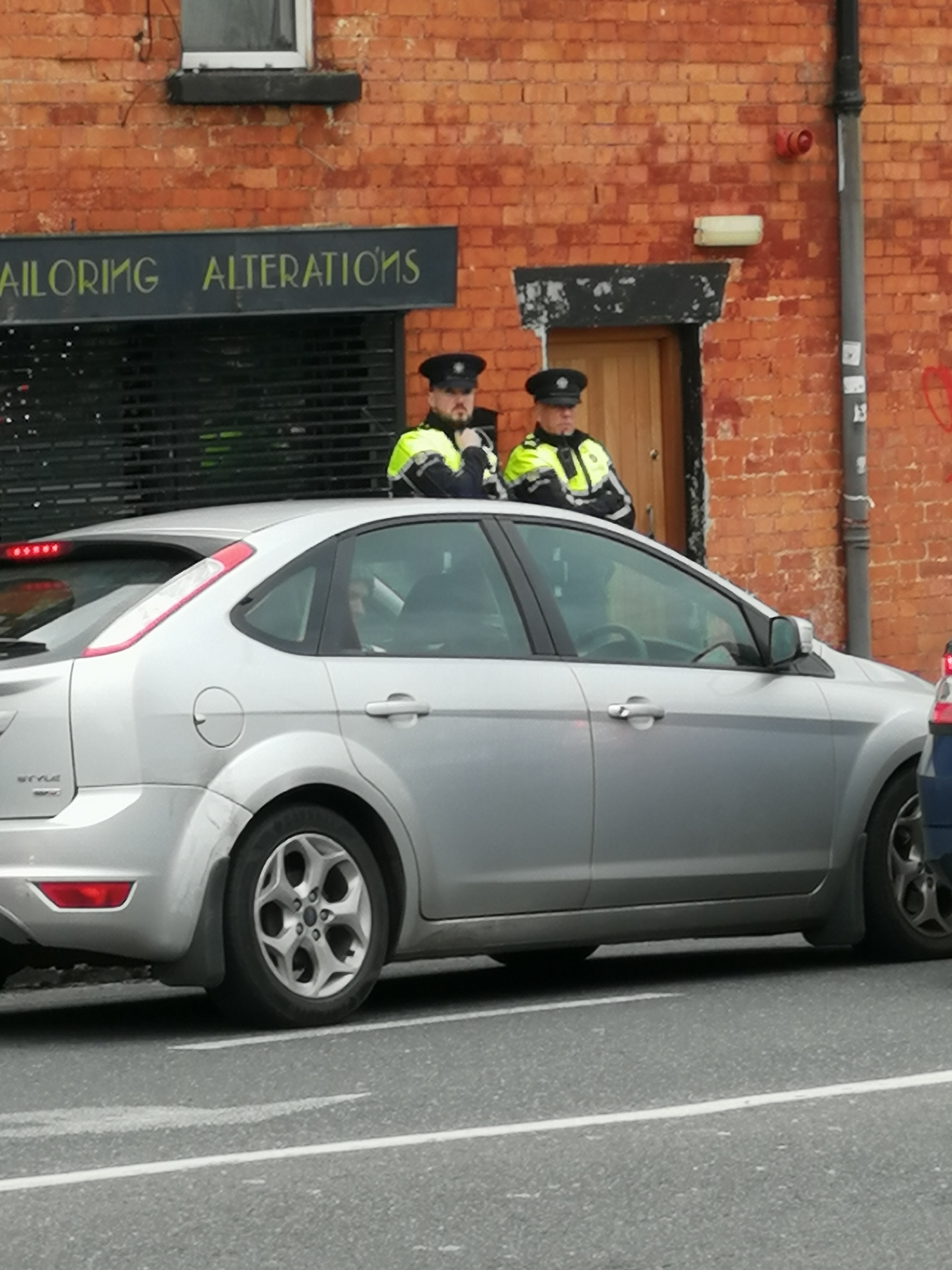
Six political police in plain clothes walked among those gathered beside Phibsborough shops demanding names and addresses of the participants, most of whom were fairly young. Four uniformed Gardaí also stood nearby and a Public Order Unit van parked at the cemetery entrance.
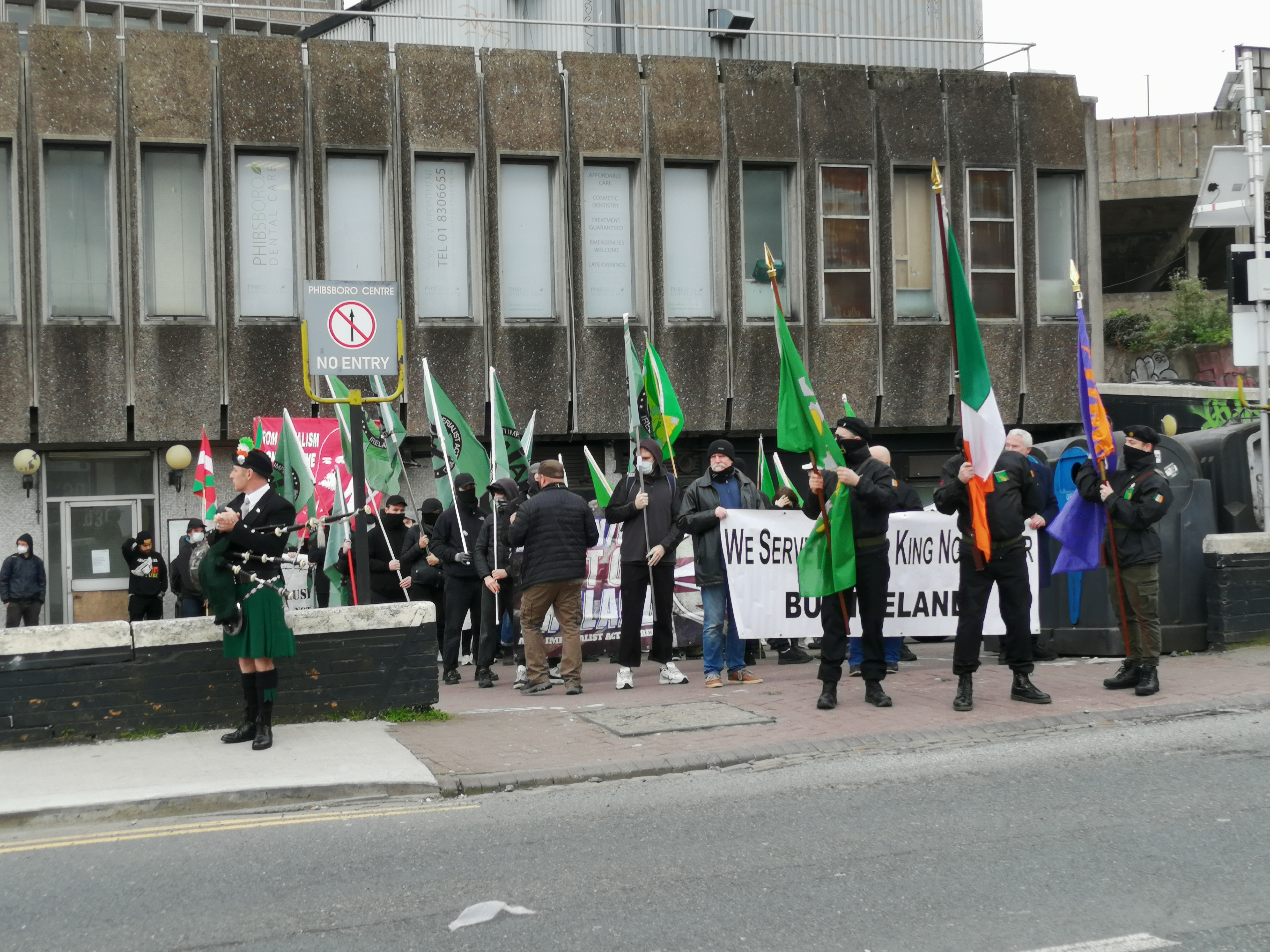
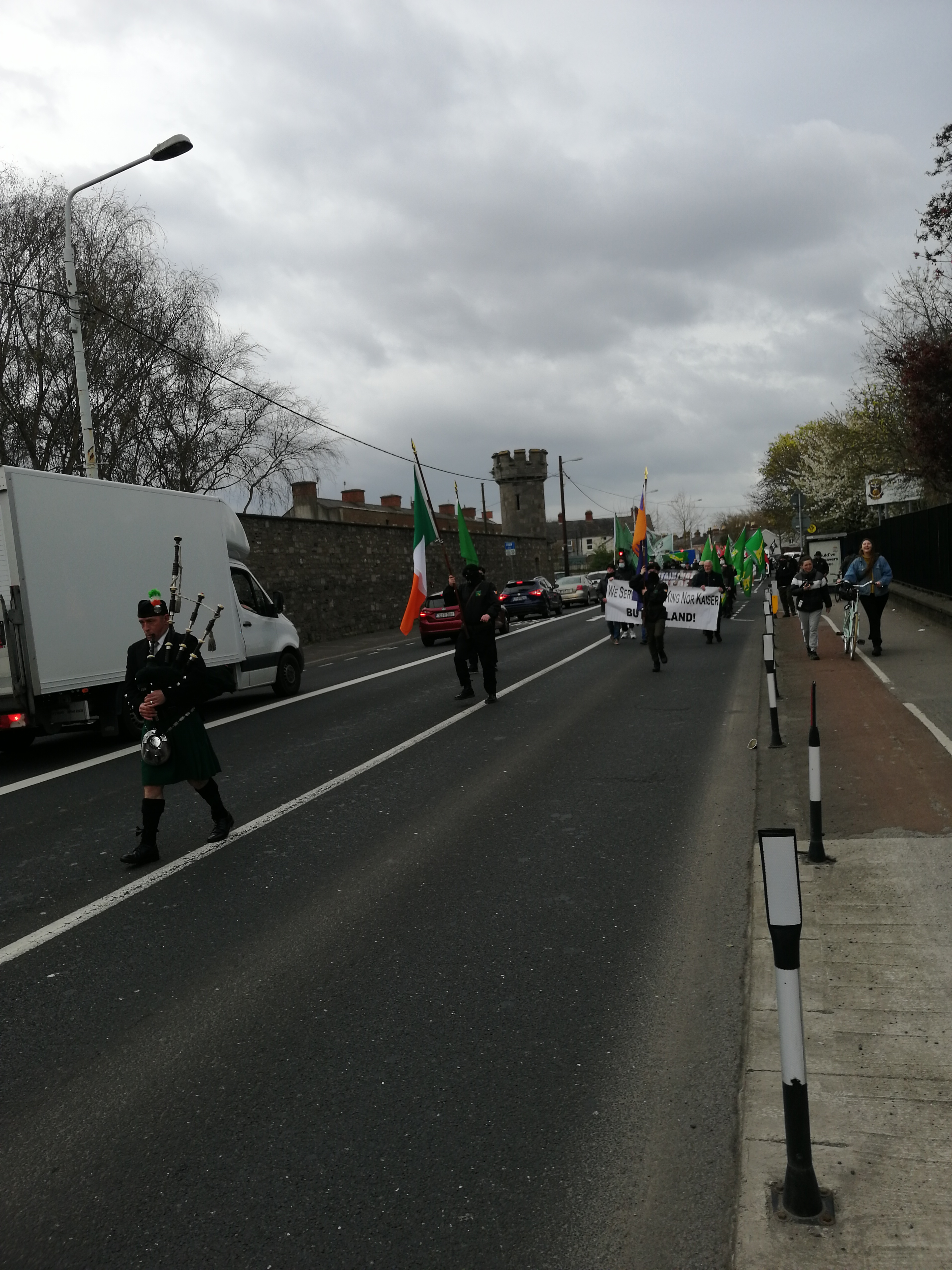
The participants declined to be intimidated and set off on their march, led by a lone piper playing Irish marching airs, followed by a colour party with different banners interspersed among the marchers, among which fluttered many flags.
Organisers had learned that the coach carrying members of the Republican Flute Band from Scotland that was to lead the parade had been prevented by police there from taking the ferry to Ireland.
Centre photo: Four of the six plainclothes political police violating the civil rights of the peaceful people commemorating the Easter Rising. (Photo: D.Breatnach)Centre photo, another two plainclothes political police. The bald man joked while he harassed people. (Photo: D.Breatnach) (Photo: D.Breatnach)
Historical background
In 1916 a broad alliance the Irish Volunteers, Irish Citizen Army, Cumann na mBan, na Fianna Éireann and Hibernian Rifles1 took part in a Rising organised by the Irish Republican Brotherhood against British rule in Ireland and against world war.
Due to a number of unfortunate circumstances, the leader of the Volunteers cancelled the Rising which however went ahead a day later than planned and was for the most part confined to Dublin, where a third of the numbers in the original plan took part and fought for a week.
The occupying British Army shelled the city centre from a gunship in the river Liffey and also from artillery on land. Explosions and resulting fires destroyed much of the city centre including the General Post Office in the main street, which had been the headquarters of the insurrection.2
After a week with the city centre including the GPO in flames, the rebel garrison evacuated to Moore Street where the following day, surrounded and vastly outnumbered, the decision was taken to surrender.3 A British military court passed death sentences on nearly a hundred prisoners.
All but fifteen of those sentences were commuted to long jail periods but the seven Signatories of the 1916 Proclamation4 and another seven were shot by British firing squad in Dublin, a fifteenth in Cork and after trial months later a sixteenth was hanged in Pentonville Jail, London.
At Easter 1917 Irish Republican and Socialist women commemorated the 1916 Rising; ever since then Irish Republicans and sometimes Socialists in Ireland and in many parts of the diaspora have commemorated the Rising, whether legally5 or otherwise, in jail or at liberty.
The War of Independence began in 1919 with many of the Rising’s survivors participating6.
(Photo: D.Breatnach)
(Photo: D.Breatnach)
(Photo: D.Breatnach)
The Parade on Sunday – local and national historical memory marked
At Cross Guns Bridge over the Royal Canal the parade halted and flares were lit in memory of events there in 1916.
Marching along the Cabra Road, the wall and a watchtower of the north side of Glasnevin Cemetery on the left of photo. (Photo: D.Breatnach)
On Easter Monday 1916 a small group of Irish Volunteers had marched from Maynooth along the canal bank to join the Rising in Dublin and found guarding the bridge two Irish Volunteers who advised them to wait until the following day to go into the city centre.
The Maynooth group spent the night in Glasnevin and the following day marched into the GPO, passing an empty Cross Guns Bridge on the way. Back towards Phibsborough, British artillery had blown a barricade and killed Seán Healy, a Fianna member at the Nth. Circular Road crossroads.
Later, the Dublin Fusiliers unit of the British Army blockaded the bridge, preventing people from crossing it in either direction. They shot dead a deaf local man who failed to heed their challenge because he did not hear it.
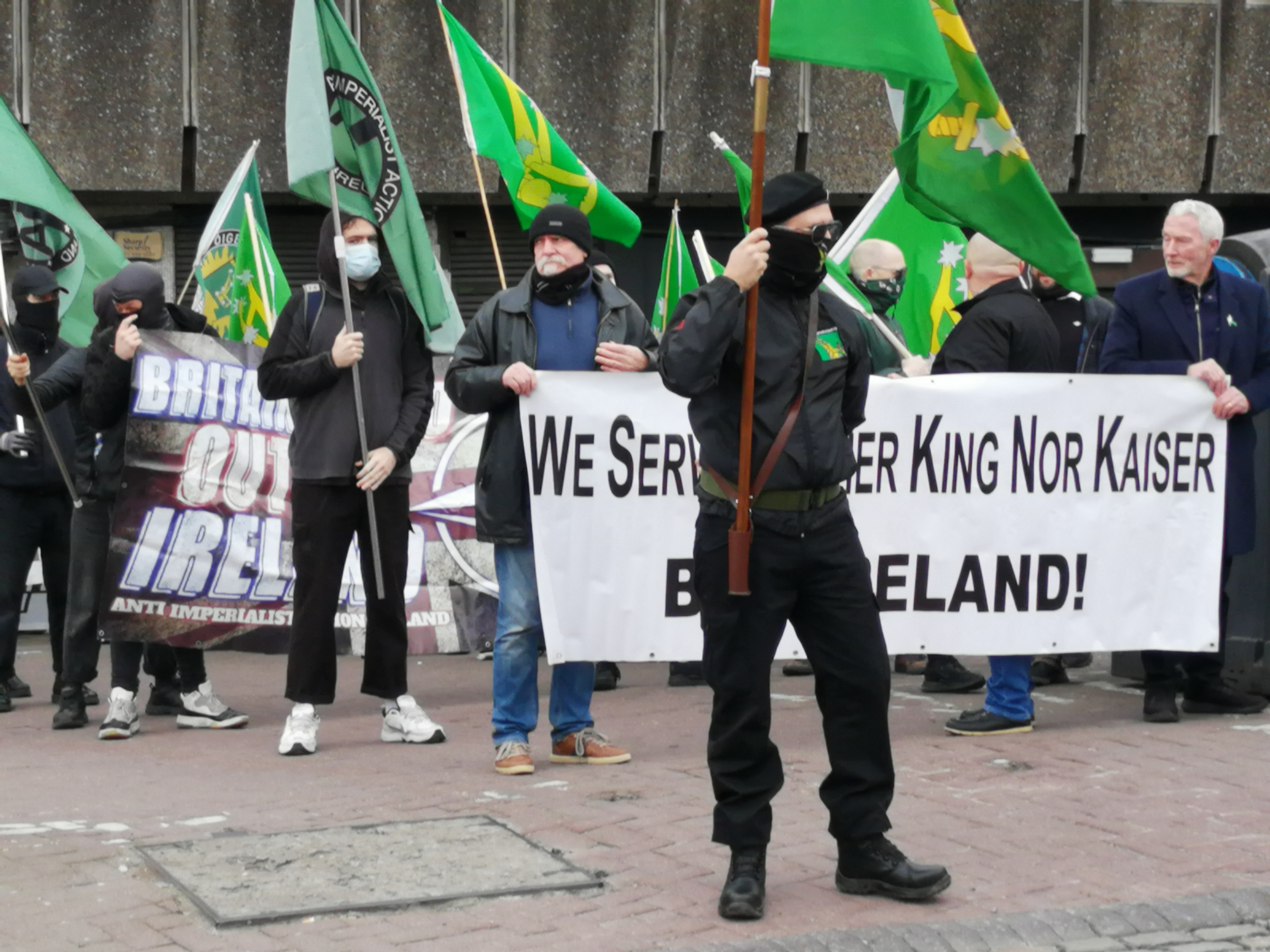
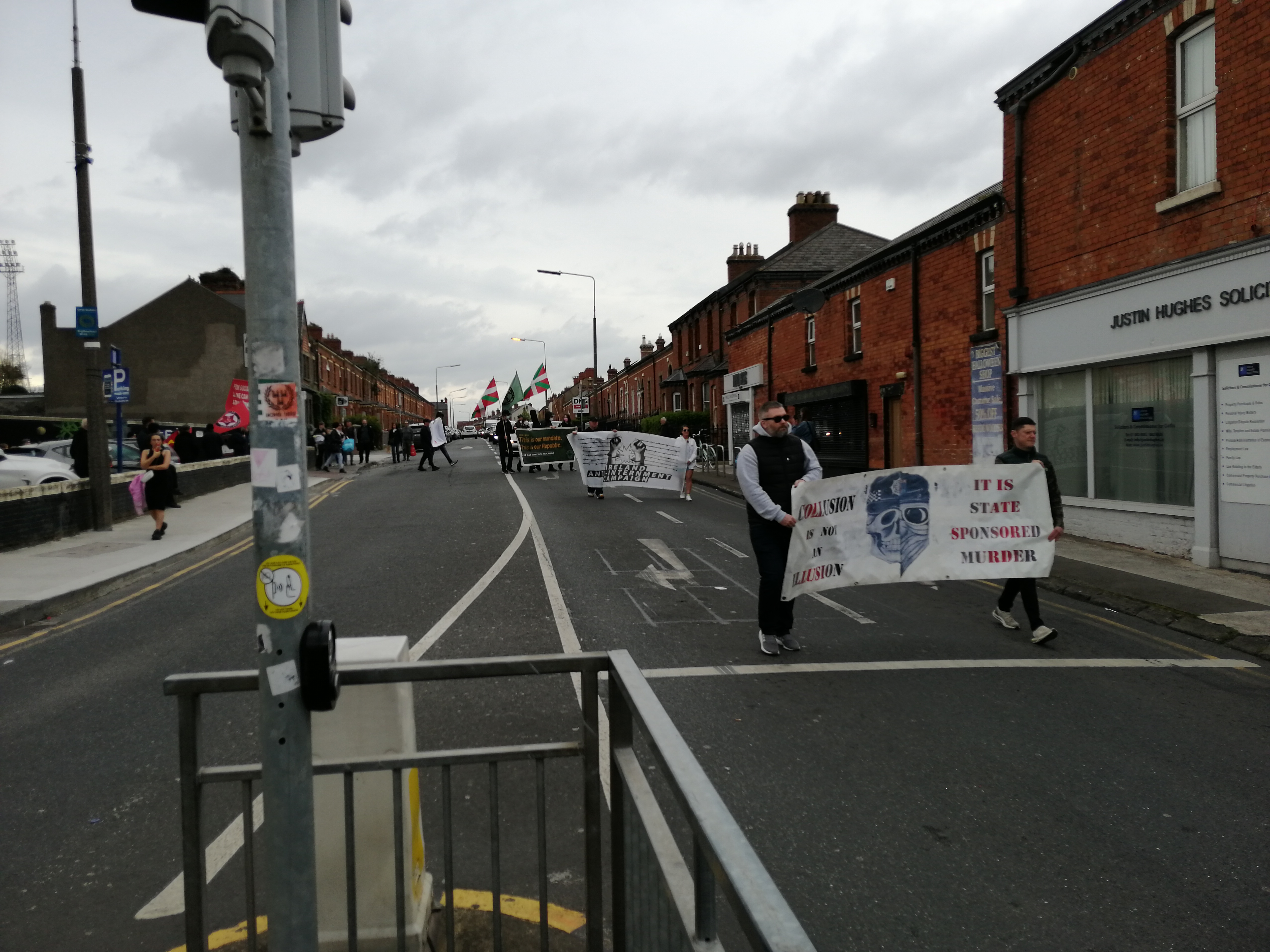
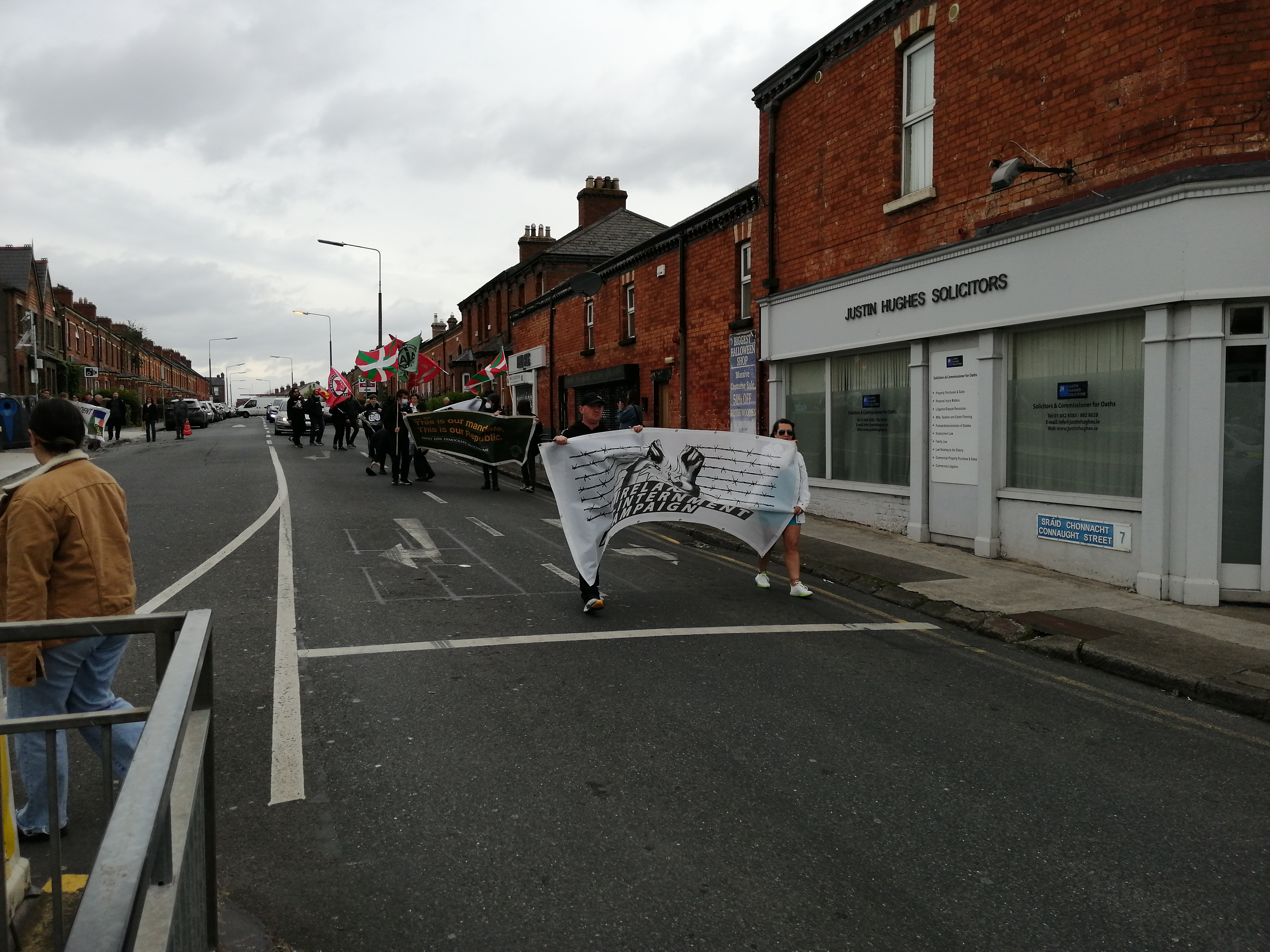
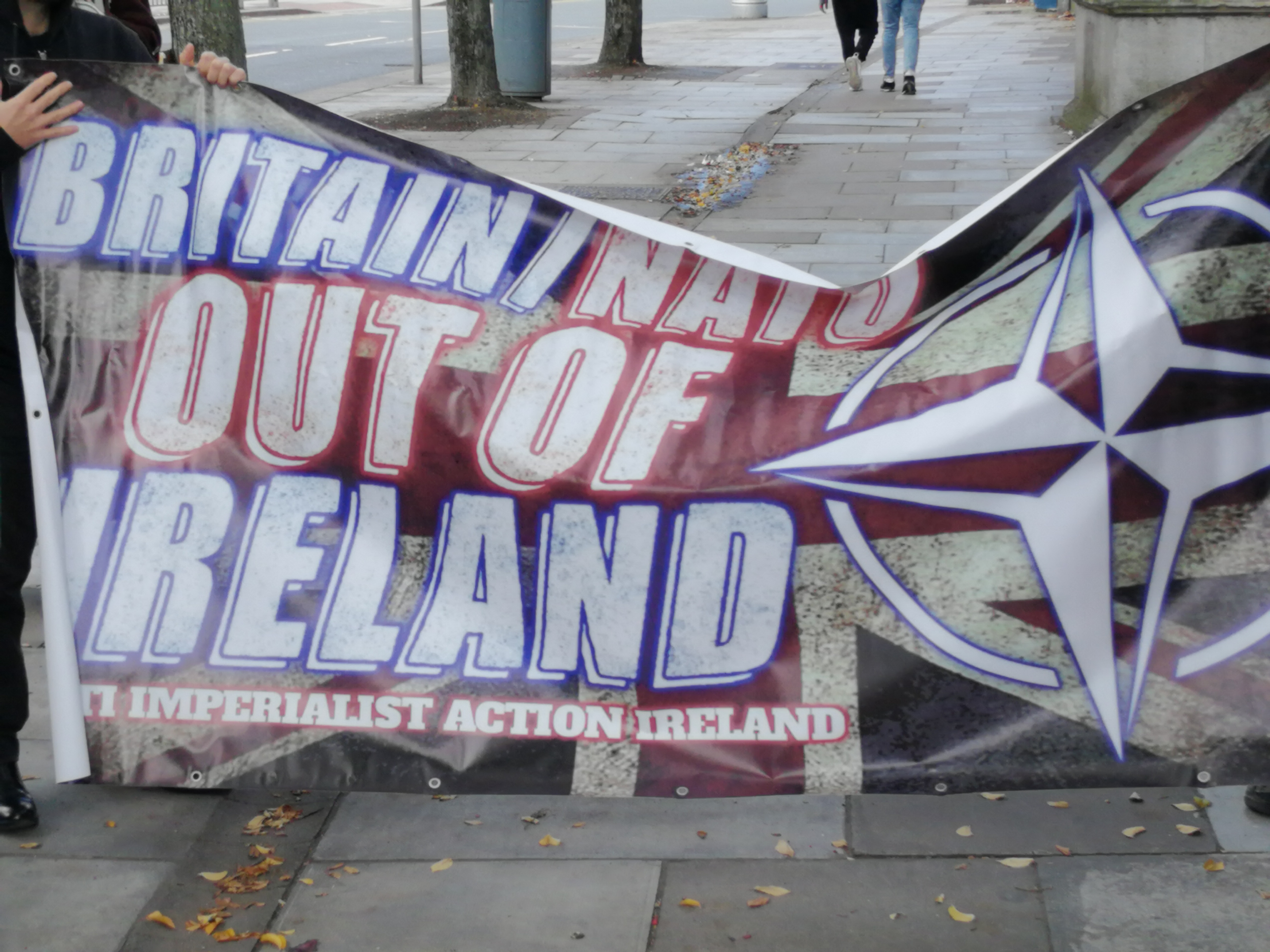
We Serve Neither King nor Kaiser but Ireland declared one banner carried last Sunday, Britain/NATO Out of Ireland another, This Is Our Mandate7, Our Republic and Collusion Is No Illusion, It Is State-Sponsored Murder were another two.
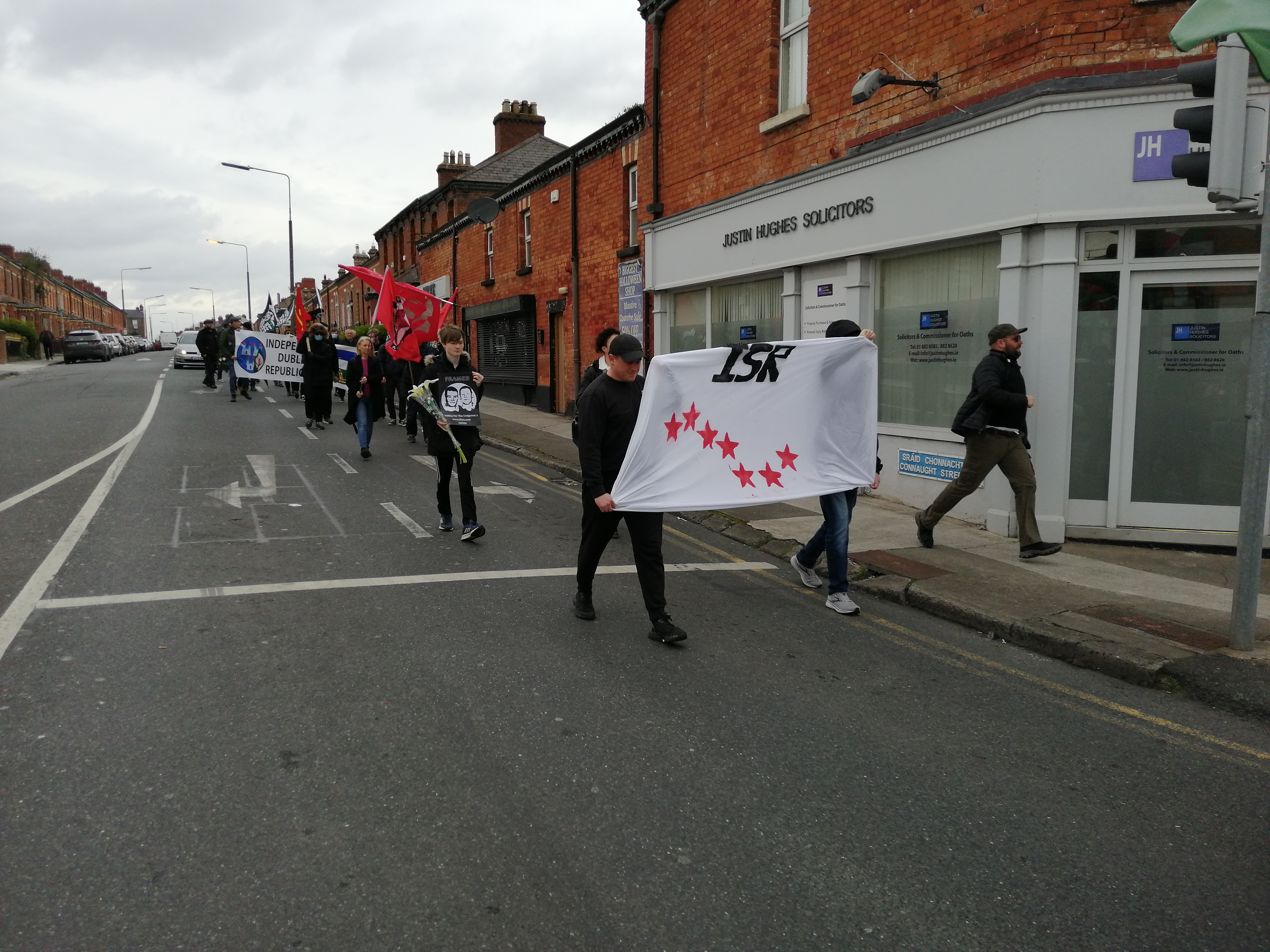
A large banner also declared alongside the image of James Connolly that Only Socialism Can Be the Solution for Ireland. Some organisations also carried their own banners, such as those of Dublin Independent Republicans, Ireland Anti-Internment Campaign and Irish Socialist Republicans.
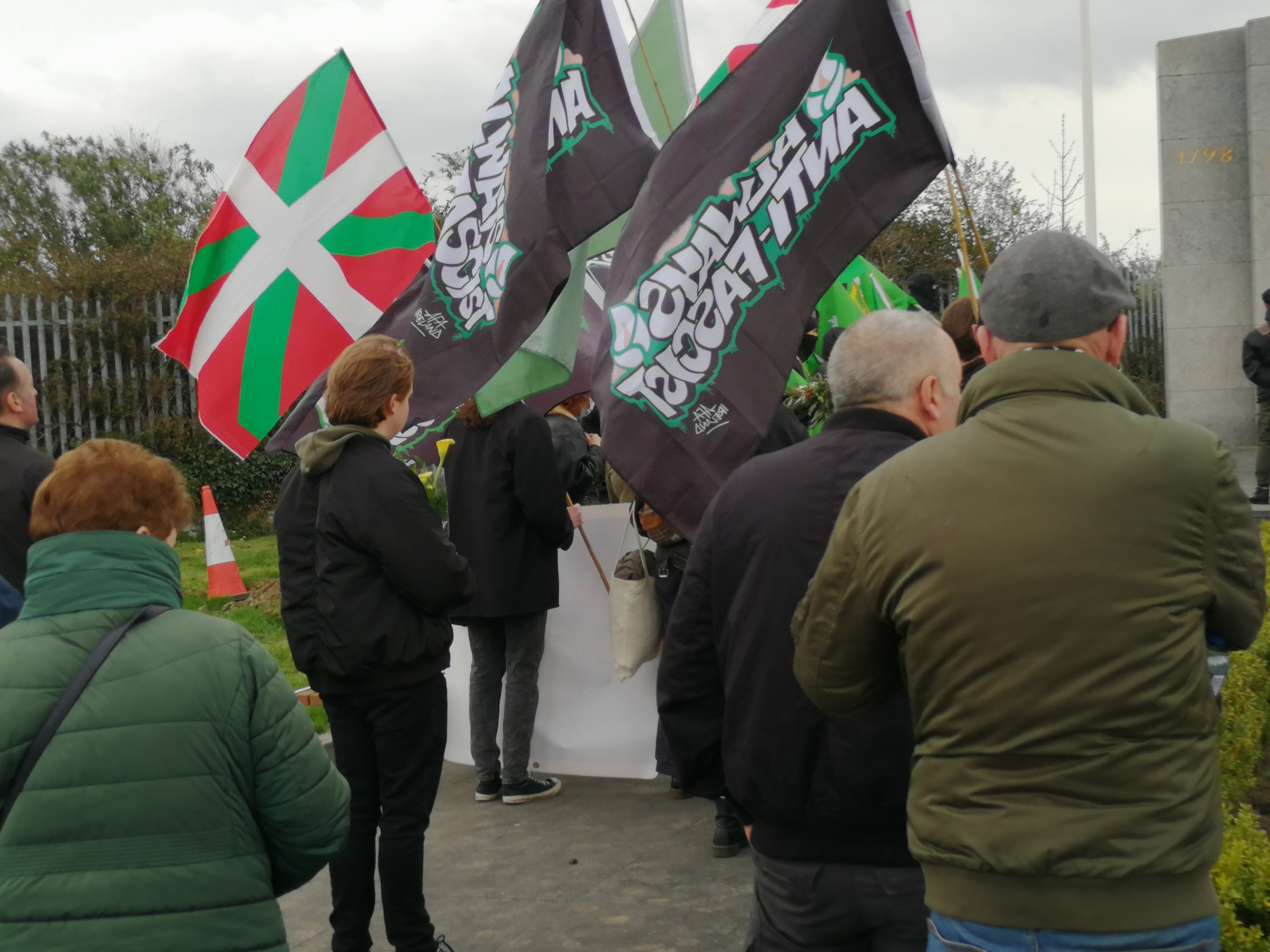
Flags fluttering included those bearing the logo of the organising group Anti-Imperialist Action and others bearing the slogan “Always Anti-Fascist”, green-and-gold Starry Ploughs, a couple of Ikurrinak (Basque flags) and another two of Red with Hammer & Sickle in yellow.
Basque and antifascist flags (Photo: D.Breatnach)
At the Monument: speeches and songs
At the monument (Photo: D.Breatnach)
Glasnevin Cemetery (ReiligGhlas Naíonn) covers over 120 acres in North Dublin city and is in two parts, each with Republican Plots separated by the Cabra Road and contains the graves of both famous and ordinary people.
On the north side there is also access to the Botanic Gardens, both on the south banks of the Tolka river. The imposing Monument to numerous Republican uprisings and the Irish Citizen Army Republican plot is on the south side, across the pedestrian bridge over the railway line.
(Photo: D.Breatnach)
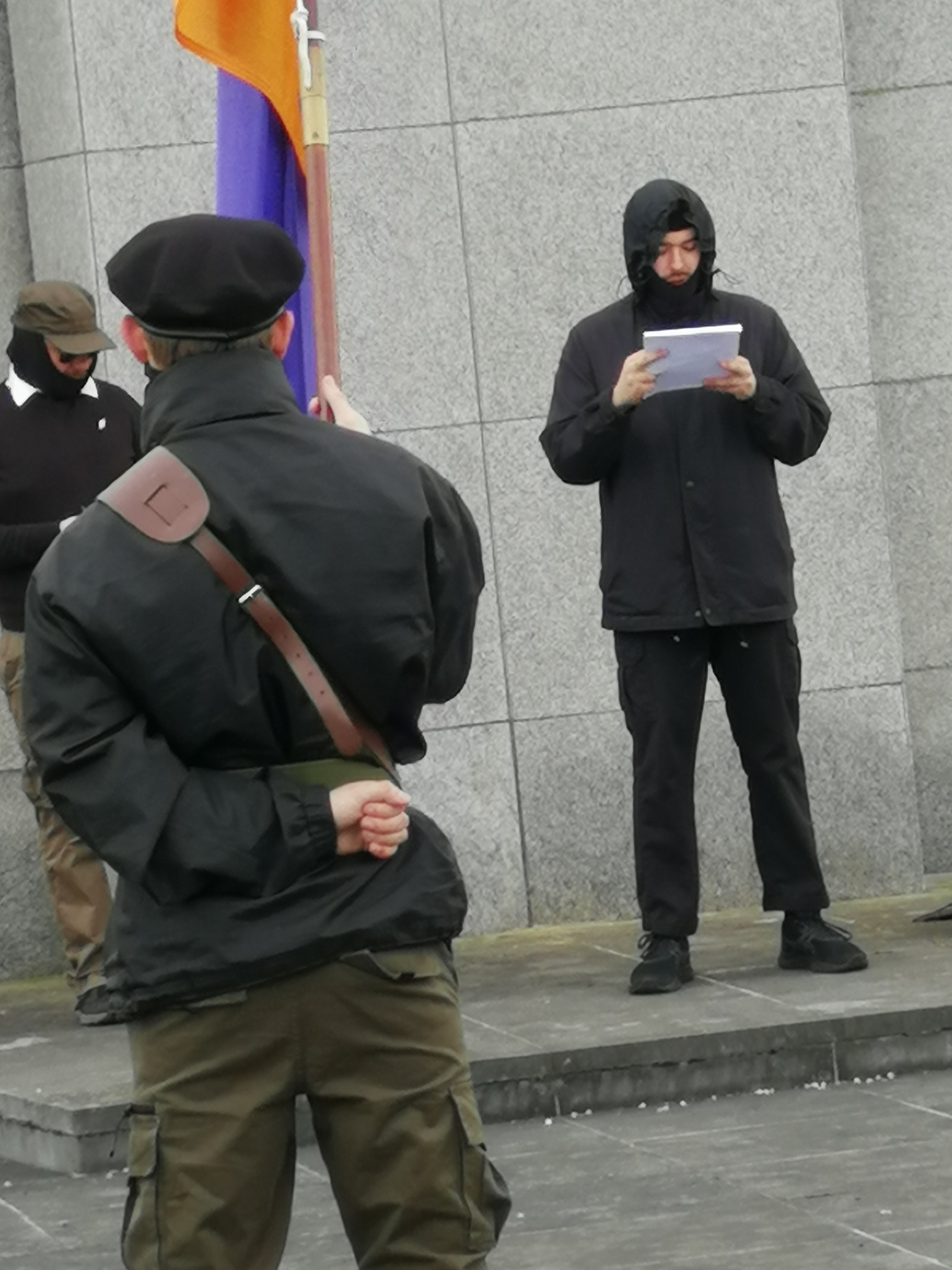
A man chaired the event for Anti-Imperialist Action and spoke briefly, introducing people for readings (all of which were from James Connolly) and for orations. The presentations of these were evenly divided between men and women, three of those being of young people.
Three songs were sung: a woman sang The Foggy Dew (by Charles O’Neill) and Erin Go Bragh (by Peadar Kearney), while a man sang Patrick Galvin’s Where Is Our James Connolly? Two women read out pieces by James Connolly and another read out the 1916 Proclamation.
Person chairing the event (Photo: D.Breatnach)
The words of the chairperson and of those giving orations were different but there were common themes: upholding the historic Irish spirit of resistance, the importance of the working class in history and the objective of a socialist Republic encompassing the whole of the Irish nation.
These words were balanced by denunciation of US and British imperialism and the colonial/ NATO occupation of the Six Counties by the latter; the Irish client regime; the special no-jury courts8 of both administrations in Ireland and repression by police forces and occupation army.
One of the singers (Photo: D.Breatnach)
One of the readers (Photo: D.Breatnach)
One of the readers (Photo: D.Breatnach)
Also denounced were those political parties that had abandoned the struggle for the Republic and instead had become part of the colonial and neo-colonial administrations or, in the latter case, were on their way to becoming so.9
Floral tributes were laid by representatives of a number of announced organisations and then others came forward to lay floral tributes also. The colour party lowered flags for a minute’s silence in homage and salute before slowly raising them again and the piper played Amhrán na bhFiann.
The other singer Lowering of the colour party flags in homage to the fallen in the struggle (Photo: D.Breatnach)Colour party raises flags again in symbolism of the struggle continuing (Photo: D.Breatnach)
The chairperson thanked all for attendance, listing organisations by name and cautioning all to stay close together as they left, due to the threatening presence of Gardaí and in particular the Public Order Unit. In the event, the celebrants exited the cemetery and dispersed without incident.
1A small unit, an armed wing of a split from the more socially conservative USA version of the Ancient Order of Hibernians, their participation in the Rising was notable.
2Photos of much of the destruction are available on the Internet and accessible by search browser.
3The terrace they occupied still stands and is the object of a historical memory and conservation struggle against property speculator plans approved by the municipal city managers and Government political parties (see smsfd.ie).
4A remarkable document, the text of which is available from many postings on the Internet.
5Irish women commemorated it in public in contravention of British WWI martial legislation in 1917 and 1918 and for decades the public commemoration of the 1916 Rising (and even the flying of the Irish Tricolour) was forbidden in the British colony of the Six Counties with attendant colonial police attacks on any attempt to do so.
6Sometimes inaccurately called “the Tan War” (reference to a special colonial police auxiliary force that became known as the “Black n’ Tans”), the war saw the birth of the IRA and lasted from 1919-1921. A British “peace” proposal opened deep divisions in the nationalist coalition and was followed by a Civil War 1922-1923, in which the pro-Treaty government and armed forces were armed and supplied by the British to defeat the Republicans in a campaign of repression and jailing, military actions, kidnapping and torture, murder of prisoners, assassinations and over 80 formal executions.
7Also displaying text referring to the First Dáil’s Democratic Program of 1919.
8The Diplock court in the colony and the Special Criminal Courts in the Irish State, political special courts in all but name, with low proof bar and abnormally high conviction rate and refusal of bail while awaiting trial.
9References to 1) the 1930s split from the Sinn Féin party, the Fianna Fáil political party that became a preferred Government party of the foreign-dependent Irish ruling bourgeoisie and 2) to the Provisional Sinn Féin party who endorsed the British pacification plan in 1998 and embarked on the road to becoming a party of reformist nationalism in the colony and is heading for neo-colonial (and neo liberal capitalist) coalition government at the moment.
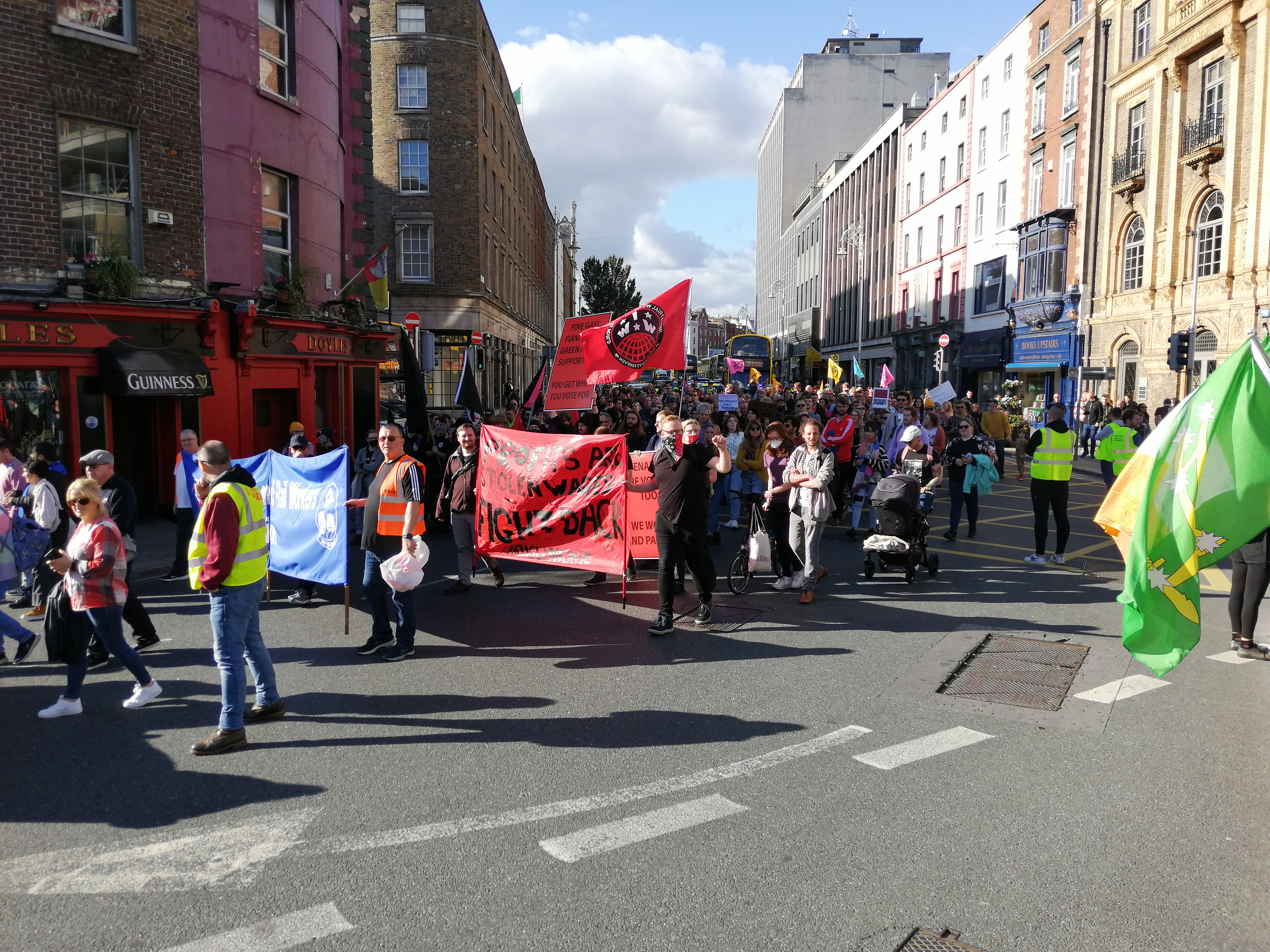
Many thousands marched through Dublin’s city centre yesterday in protest against the soaring cost of living, pushed in particular by rising energy costs. Most mass media avoided estimating numbers except the ridiculous ‘estimate’ of 3,000 by the Irish Times daily1.
As the Cost of Living Coalition convened a mass protest demonstration in Dublin, the Anti-Imperialist Action organisation called for a Revolutionary Bloc to meet at the James Connolly monument2 in Beresford Place.
In mid-July, statistics published showed the average cost of living had risen above 9%. The average figure conceals the higher percentage rise in daily consumables such as food and drink that will rise higher still with price hikes by energy supply companies.
Companies are raising their prices steeply across at least the western world in a trend that began, despite much media discourse, prior to the Russian invasion of the Ukraine. But Ireland emerges as the most expensive country in the EU with Dublin the most expensive city there by far3.
(Photo:Rebel Breeze)
SPEECHES FOR REVOLUTION & AGAINST REPRESSION
At the Connolly monument, people gathered with banners about the housing struggle and against NATO, along with placards and flags, of which latter the most common was the green-and-gold version of the “Starry Plough”, flag of the Irish Citizen Army4.
The cathaoirleach (chairperson) welcomed people, introduced the purpose of the meeting as being to protest the soaring cost of living and introduced the first speaker, from the Revolutionary Housing League. The RHL speaker outlined their program of direct action.
(Photo:Rebel Breeze)
“What can be more direct than to occupy empty buildings?” he asked those assembled. He recounted some of the recent actions of the RHL and said that they are attracting attention and support, ending by calling on others to get involved5.
The second speaker, introduced as a revolutionary socialist anti-imperialist, went through a list of ills brought by the capitalist system, including lack of housing, selling off our resources and infrastructure, disregard for our language, environmental destruction and danger of nuclear war.
For all said the speaker, the Irish national bourgeoisie are guilty, “the Gombeens, a class unable even to free their own country”. “We need broad fronts to fight all these attacks of class war”, he said “but they must be directed openly against capitalism and imperialism.”
(Photo:Rebel Breeze)
The final speaker, a socialist Republican, represented the newly-formed End State Repression campaign group. Those wanting to oppose rising prices, he emphasised, could not share their struggle with those intending to enter a coalition with Fiann Fáil or Fine Gael.
He also recalled how when protests against the bank bailouts and student fee hikes were getting going in 2010, they were met with state violence through the Gardaí. As the resistance builds, it will get attacked, he said but “we can’t allow them to drive us off the streets again.”
(Photo:Rebel Breeze)
Many drivers passing the rally in vehicles, private and of work – including public transport — sounded their horns in solidarity, giving rise to cheers from the protesters.
MARCH TO BLACKWATER
The assembled then set off in two lines along Custom House Quay, across Talbot Memorial Bridge and then eastward along the quays. On the way they shouted slogans including “One, two, three, four – Housing crisis no more!” and “Only solution: Revolution!”
Other slogans include “Whose streets? Our streets!” “Whose Republic? Our Republic!” and “High rent, high taxes – fight back!”
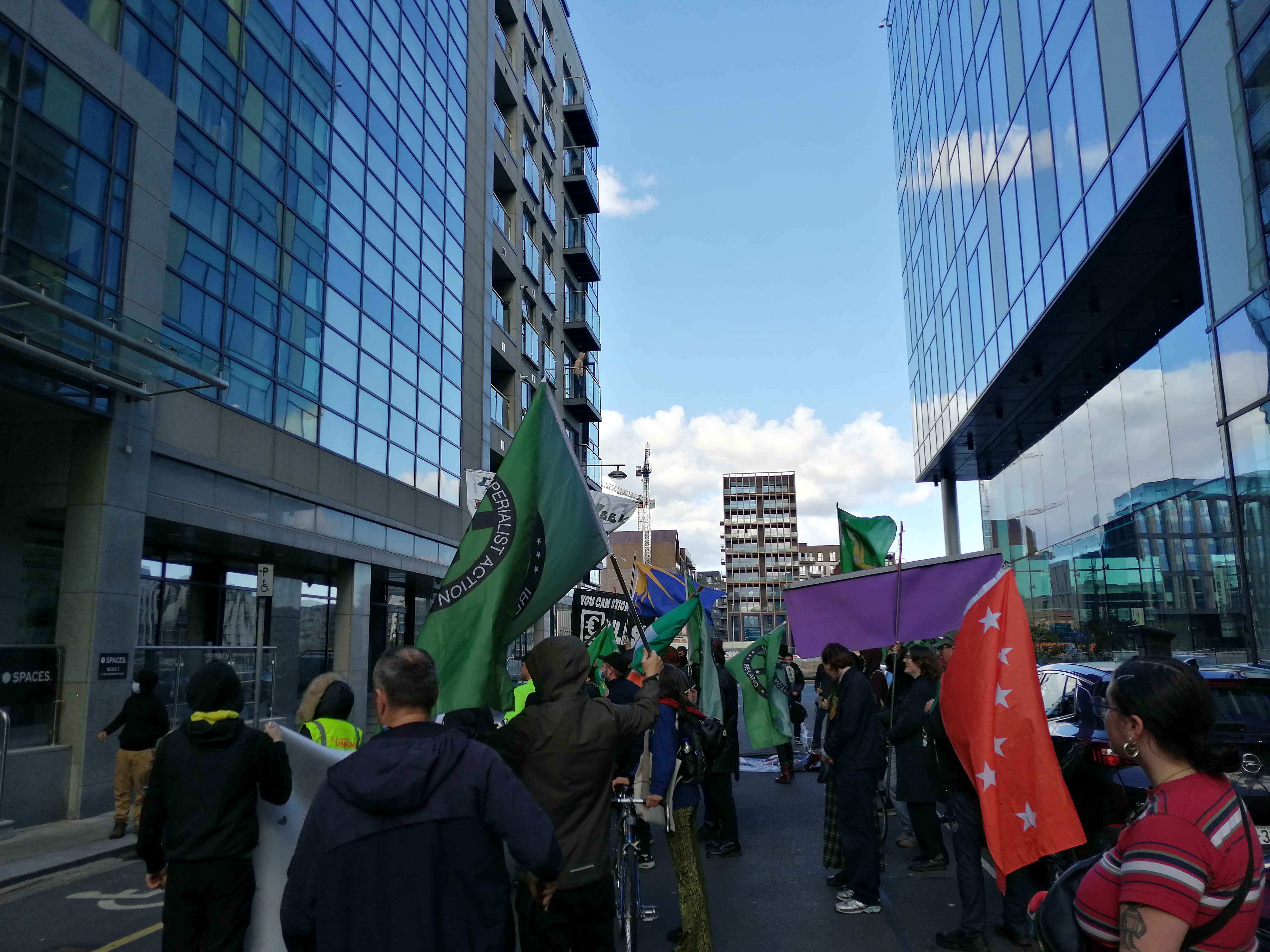
The marchers stopped upon reaching the offices Blackwater Asset Management Company which boasts its background in “coming from the following sectors, Police Force, Legal Profession, Defence Forces, Financial Services & Private Security sectors”.
(Photo:Rebel Breeze)
(Photo:Rebel Breeze)
The crowd expressed its disapproval of the actions of this company. A speaker assured all that any attack on housing activists will be met with resistance. Two songs were sung there too, including Connolly’s Be Moderate/ We Only Want the Earth.6
THE BLOC MEETS THE MAIN MARCH
The Bloc marchers passed through the high-rise apartment blocs in the area before going on to Pearse Street and marching to the junction with D’Olier Street, where they met the main march of many thousands7 rounding Trinity College and still coming down from O’Connell Street.
Here the revolutionary bloc displayed their banners and placards and chanted some slogans. Many in the crowd marching past gave signs of appreciation and people in an anarchist bloc shouted “Solidarity”, raising clenched fists, giving rise to equal response from the Bloc8.
Section of the main cost of living protest march in D’Olier Street and rounding junction with Pearse Street. (Photo:Rebel Breeze)
The large Sinn Féin9 section aroused shouts of “No Collusion! One Solution! Revolution!” from the Bloc. The earlier slogan of “1,2,3,4 – Housing crisis no more!” segued for awhile into “5,6,7,8 – Smash the Free State!”
The main Dublin march was organised by the Cost of Living Coalition of 30 organisations, including People Before Profit but also Sinn Féin, which is on a clear trajectory to enter Government in the near future but in coalition with traditional neo-liberal capitalist political parties.
Revolutionary Bloc meets main march at junction Pearse Street and D’Olier Street. (Photo:Rebel Breeze)
The CLC also includes trade unions which many accused of not mobilising for the protest.
Derry city saw a small protest against the rising cost of living also.
A far-Right march in Cork which was addressed by a representative of the fascist National Party attracted little more than 150. Ostensibly against the housing crisis, speakers of course attacked immigration despite it having no connection to the State failure to build affordable public housing.
A marcher in Dublin carrying a placard calling for an end to immigration until the housing crisis were solved gave rise to a chorus of “Home for All!” from the Revolutionary Bloc, calls echoed by some among the passing marchers.
Anarchist section in the main march indicating solidarity with the Revolutionary Bloc. (Photo:Rebel Breeze)
Gardaí on foot and in patrol cars tailing the main march were greeted, as they passed the Revolutionary Bloc, with shouts linking Drew Harris10, Commissioner of the police force of the Irish State, to the British Intelligence Service MI5.
A notable feature of both marches was the patience with the interruption to their journeys of private and public transport drivers and, indeed, the signs of support from many, including beeping of horns and hand signals such as the ‘thumbs-up’ and even the occasional clenched fist.
end.
(Photo:Rebel Breeze)
FOOTNOTES
1The Irish Times has a track record of drastically reducing the estimated numbers in reports of anti-government demonstrations, demonstrated most strikingly during the giant water protest marches. It gave the figure 3,000 in leading paragraph to its original twitter report but more recently amended that on line to “several thousand”. The Sunday Mirror reported 20,000 and supporters estimated between 15,000 and 20,000.
2The monument includes a representation in bronze of the Scottish-Irish revolutionary James Connolly, across the road from where he had his office in Liberty Hall (the two-storey building was destroyed by British shelling in 1916 and has since been replaced by a tall man-storey building, HQ of the SIPTU union. Connolly was one of 16 executed by the British in 1916 after the Rising that year.
4The ICA was formed to defend striking workers from police attacks during the 1913 Lockout in Dublin. It was based on trade union membership and took a prominent role in the 1916 Rising, with a much-reduced one in the War of Independence (1919-1921) and the ensuing Civil War (1922-1923). The ICA recruited women as well as men and some of the women held officer positions, possibly the first revolutionary organisation, certainly the first socialist-based one to do so.
6The lyrics were composed by James Connolly and published in hist Songs of Freedom in New York in 1907. The title was the ironic “Be Moderate” but has come to be known from the refrain as “We Only Want the Earth”. Furthermore, arranged to the air of “A Nation Once Again”, it provides a chorus of “We Only Want the Earth!”
7Most media would only state “thousands” or “many thousands”, but the Irish Times had the audacity to claim the ridiculously low number of 3,000! Estimates by participants varied from 10,000 to 20,000 (latter also figure of the Sunday Mirror).
8It seemed likely that had the Revolutionary Bloc been widely publicised earlier that it would have been supported by many individuals and at some other organisations.
9The former revolutionary republican party rarely mobilises its large membership for street protests as these days it is more concerned with votes in elections. However, SF is part of the Cost of Living Coalitionand SF’s President, Mary Lou MacDonald, was one of the scheduled speakers at the main march rally.
10Immediately prior to his current appointment, Drew Harris was Deputy Chief Constable of the sectarian British colonial gendarmerie, the Police Force of Northern Ireland which, until 2001, was the Royal Ulster Constabulary.























 rebelbreeze