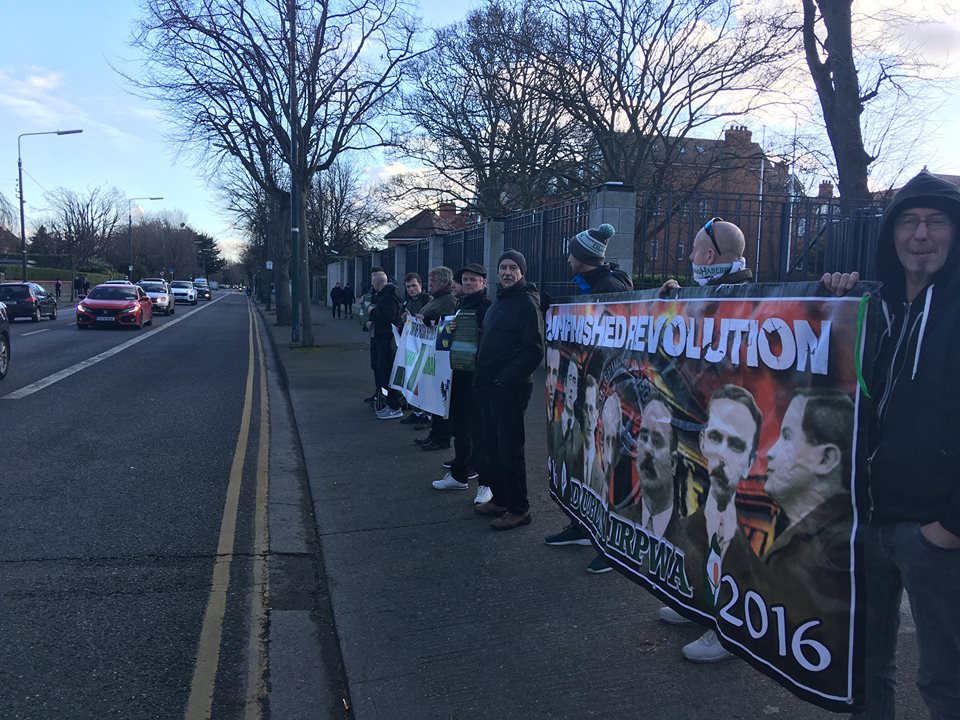
A picket called on the British Embassy to protest against continuing internment and special courts was harassed and kept under heavy surveillance by Irish police, both in uniform and in plainclothes, with marked and unmarked vehicles.
One view of part of the protest (the main entrance to the British Embassy is behind the picketers). (Source photo: Participant in the protest)
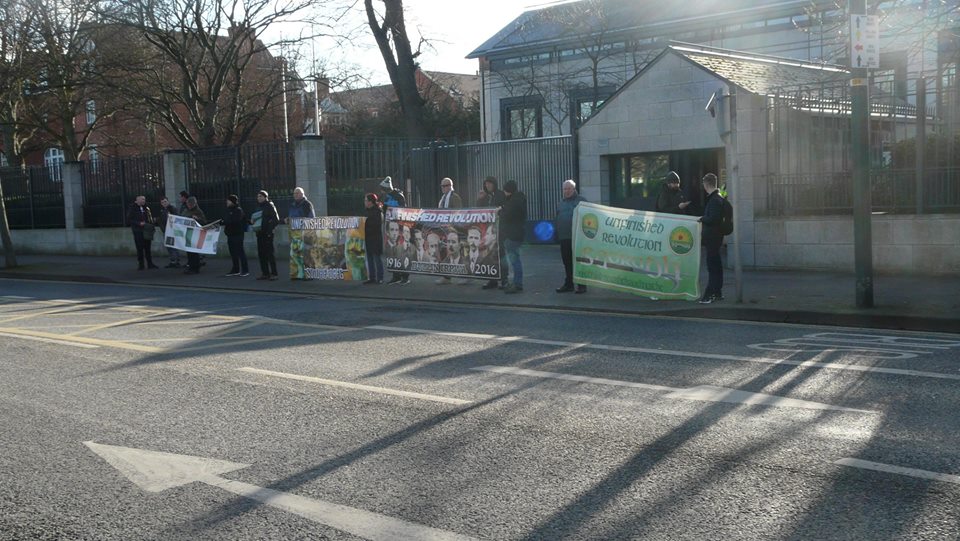
The protest was called by Irish Socialist Republicans, Anti-Imperialist Action Ireland, Dublin Anti-Internment Committee and Abolish the Special Courts campaign, was supported by members of a number of Republican and socialist organisations and independent activists.
Another view of the picket with the entrance to the British Embassy behind them (Photo source: Picket participant)
The objective of the protest was to highlight that the undemocratic practices of using the courts to remove the political opponents of those in power continues – the use of the courts”as a propaganda cover … to remove unwanted members of the public”, in the words of Brigadier Frank Kitson (British Army). These abuses of civil rights continue through a number of methods: revoking of ex-prisoners’ licences; refusal of bail; granting of bail under conditions preventing political activity; convictions in special no-jury courts. And they continue in both administrations: the Six-County British colony and the 26-County Irish state.
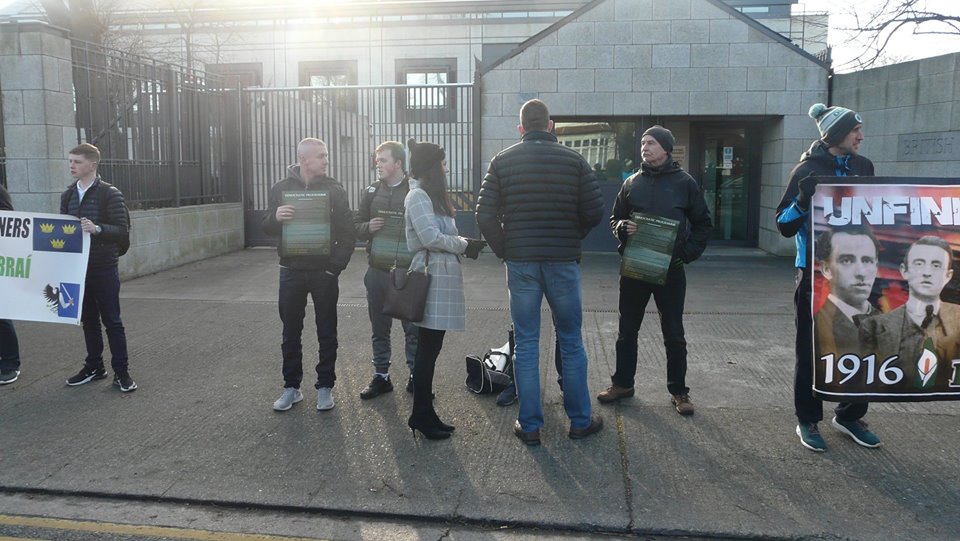
A Garda Special Branch (political police) male officer, accompanied by a female officer, requiring participants to give their names and addresses. (Photo source: Picket participant)
The harassment of the protesters outside the British Embassy was at a level to which Irish Republicans have become unfortunately accustomed: a Garda officer in plain clothes identifying himself as a member of the Special Branch and displaying his Garda identification request, accompanied by another, approached those in the picket line and required them to give their names and addresses, quoting Section 30 of the Offences Against the State Act1.
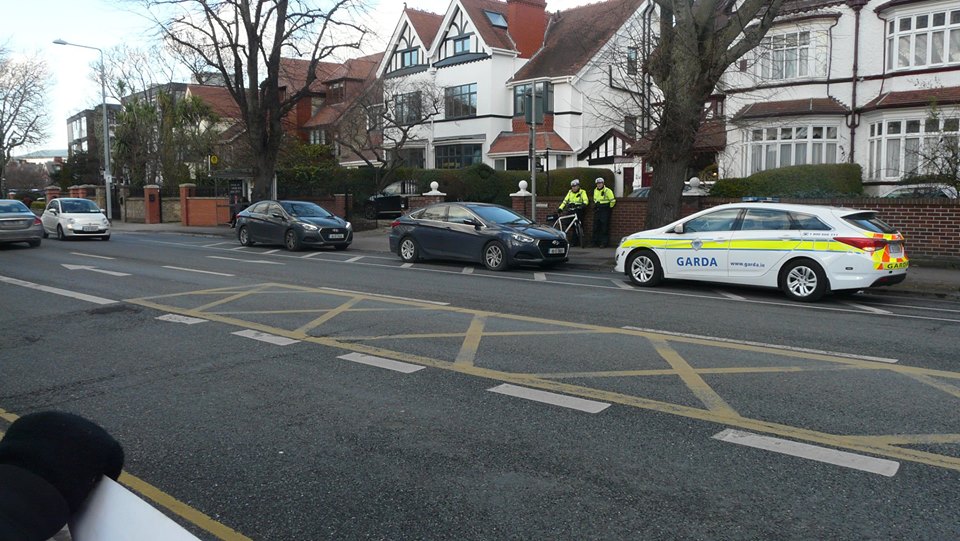
This practice of taking people’s names and addresses is one of intimidation which does restrain some new people from joining such pickets. The surveillance has the same intent, being visible; highly visible on this occasion with three unmarked SB cars, two Garda cyclists and one marked patrol car (in addition to the Garda officer permanently on duty outside the Embassy). “Remember this the next time you hear or read that the Gardaí were unable to respond to a domestic violence call for a number of hours because they were “short on resources’ “, commented one of the protesters. “Or unable to refer young offenders into the Diversion Program2” added another.
Intimidatory police surveillance on the other side of the road from the protest: two unmarked Special Branch cars, two bicycle police and one patrol car. Another SB car was parked on the pavement on the same side as the Embassy, which has a Garda officer on permanent duty also. (Photo source: Picket participant)
The drivers of a number of vehicles, especially taxis, tooted their horns in solidarity as they passed. Although the cold was penetrating through footwear to feet, the protest ended a little after an hour.
FOOTNOTES:
1The section authorises those questions by a Garda officer who has reasonable grounds for suspecting the interrogated may be committing or about to commit a crime – clearly inapplicable in most cases where this is used.
There are many misconceptions about Irish politics and history and the centenary of the inauguration of the First Dáil and of the first shots fired in the War of Independence (one of several of our “wars of independence”) seems like an appropriate occasion to try to tease some of them out.
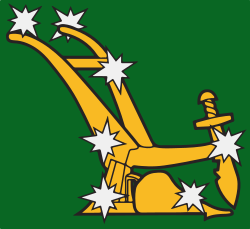
The Irish Tricolour — national flag of the State but also quintessentially of Irish Republicans.The “Starry Plough”, flag of the Irish Citizen Army. Today it is held to belong variously to socialist Republicans, Revolutionary Socialists and even sometimes social democrats.The Red Flag, flown by Communists, Revolutionary Socialists and even sometimes by Social Democrats.Flag colours of the Anarcho-Syndicalists.A different version of the Starry Plough, usually but not only flown by social democrats. However, it was the flag of the Republican Congress in the 1930s.
For sure, many of those misconceptions belong to those viewing us from outside but here I’d like to deal with those from among our own. These misconceptions are spread equally among the Irish Republicans, Irish Socialists, Irish social-democrats and liberals – but each group believes different ones.
REPUBLICANS
To Irish Republicans (and I think I am objectively correct in not applying that to all who claim the title), the War in the Six Counties was lost because their political and military leadership, or most of it, abandoned the struggle or betrayed it. I think that is a fundamental misconception which leads to further misconceptions about what might be the way forward.
Please do not think for one minute that I am excusing the conduct of that leadership – I am not. Anybody is entitled to abandon the struggle but they are not entitled to claim their departure as a new way forward and to call on others to do the same – that is if they do not wish to be called “traitors”. Nor is anyone, least of all, entitled to take part in the colonial administration and if they do so, they have earned the titles not only of “traitors” but also of “collaborators”.
That judgement has nothing to do with peaceful versus armed struggle, parliamentary participation versus abstentionism or any such debate but is simply this: anyone who participates in colonial government is colluding with the colonist power, the invader, the appropriator. That is a truth understood by most people throughout the world.
It is a different point I am making entirely: the 30 Years War was lost because it could never have been won. To see this written or to hear it said will shock many Republicans and be seen as a kind of heresy – but that does not stop it from being true. Think about it: how could an armed struggle fought in one sixth of the country alone against a modern imperial army, possibly succeed? And that one-sixth further divided with at most 30% (and in reality a lot less) possibly sympathetic to the fighters? Who could sit down to ponder this and believe that struggle had a chance? The remarkable thing is not that it was lost or given up – but that it lasted as long as it did.
The only way that struggle could possibly win would be with the support of the 26-County State and it may well be that those who embarked upon it thought that at some point the Irish bourgeoisie would intervene in some way. They did — but to increase repression of Republicans.
A war might have been won if it had been extended across the whole state. Not necessarily an armed struggle across the whole country but certainly a social, economic, political one. It is not reasonable to expect the mass of people in the 26 Counties to fight year after year for those in only one part of the country, be it a colony or not, and have their own needs ignored. The people in the Six Counties would not do that either if the situation were reversed.
Certainly there was no shortage of issues going begging, from gender and sexuality-related civil rights, housing, unemployment, censorship, clerical domination, bleeding of the national language, sell-out to foreign capital, emigration, absentee landlords, private ownership of natural resources, sexual and other abuse by institutions. However, to take on the spread of issues oppressing or of concern to the people in Twenty-Six Counties would have meant taking on the Irish Gombeen class, its State and its supporting Church. Whether because they still had hopes of the Irish State or did not want to clash with the Church which had the religious allegiance of the majority of their followers – or because they themselves did not want to challenge some or all of those institutions,It is clear that the leadership of the Republican movement then could not bring themselves to that confrontation.
If only a struggle across the whole “island of Ireland” (sic) could possibly have won then it seems logical that only such a struggle has a hope of winning today.
Some of the Republican groups perhaps have this awareness and certainly they have been seen in water and housing protests in the 26 Counties. But they are small groups, their activity patchy, lacking collaboration with one another (even in resisting State repression). More fundamentally there is no strategic plan for organising the working class. In a way, they can’t be blamed for that: they are not communists or anarchists; no matter how revolutionary or left-wing, they are primarily and always Irish Republicans.
REVOLUTIONARY SOCIALISTS
There is another sector whose members might well be nodding their heads in agreement with the above criticism but they too are beset by an important misconception – albeit a different one. They are the communists, socialists and anarchists who would consider themselves revolutionary, i.e who claim to believe in a revolutionary transformation of society. A general disdain of the Republicans runs through this sector, considering Irish Republicans to be simple militarists, adventurist and even sectarian.
Their disdain – or perhaps their fear of being tarred by association – is such that they cheerfully allow all kinds of abuses against Republicans by the Irish State and the colonist statelet. By “allow” I mean that they do not protest against the abuses. Ethically, this is reprehensible but functionally it is dangerous. And in a country where the most numerous section ready to take on the State happens to be Irish Republican of one kind or another, such an attitude by the “revolutionary” Left is nothing short of counter-revolutionary.
This is, in a way, the sector to which I most belong but without that disdain or political apartheid.
Nor do our tiny cliques and small parties exhibit revolutionary spirit even in straight socialist issues, being in general concerned more with peaceful mobilisations and speeches or elections to public office than direct action.
One would think that trade unions would be of particular interest to the revolutionary Left – certainly the Republican movement has paid them little attention. However one finds only small struggles to appoint some Left-winger, usually not even a revolutionary, to the heights of union bureaucracy. When issues of industrial conflict arise, one does find revolutionary socialist shop stewards pushing for militant action.
But where is the education of workers? Where is the mobilisation of revolutionaries of different parties and none to support workers in industrial action? There is in fact no such “Broad Left” organisation in Ireland (not that its example in Britain is anything to emulate) and generally strike support is used for party building. When that particular conflict is over, nothing remains that was not there already.
SOCIAL DEMOCRATS AND LIBERALS
The third sector, shaking their heads at the “militarism” of the Republicans and the “impracticality” of the revolutionary socialists, are the social democrats and liberals. Their misconception is that capitalism and imperialism can be reformed so that they no longer be rapacious.
Maybe there was a time when such a belief was reasonable (though I find it hard to imagine it) but certainly that was long ago. Sincere reformers, benevolent capitalists and aristocrats and scheming reformists have all failed to reform the system of exploitation. Indeed, what historical experience has shown is that even if a capitalist or imperialist wished to subscribe to ownership in common, his or her class colleagues would not permit it.
The electoral path, so detested by some communists and many republicans, is where social democrats and liberals most place their hope and faith. And yet, despite an occasional individual exception, what has the history of those experiments shown us? Corruption of individual activists, wholesale corruption of party leaderships; diversion from the struggles on the ground to bureaucratic struggles in parliaments; careerist trade union leaders and bureaucratic officials; disempowerment of the working people; weakening of organs of real struggle; respect for the capitalists’ laws …..
Not one government of a socialist revolutionary kind has emerged by this process and, whenever it seemed to come close, it was overthrown by military coup or foreign imperialist intervention.
But still, it might work next time, eh? To the advocates of this ideology, of these methods, history does not matter – it can be ignored, denied or expected to cease its operation.
MOVING FORWARD
So where does all this leave us? Yes, I know, in the proverbial cac — but how can we move forward?
This is what I think:
The Revolutionary Left needs to a) organise in a revolutionary manner among the working class and b) to defend the civil right of Republicans;
The Republicans need to unite at least against State repression and take up social and economic issues of working people;
the Social-democrats and liberals should unite with the others on issues of civil rights and social issues;
but ultimately the Republicans and Socialists should ignore reformist illusions.
And what about me?
I do what I can where I think I can have a positive effect – criticise but participate; participate but criticise. And hope to learn not only from the mistakes of others but also from my own.
(click on the link above to find the whole article)
“During this past week, near Strokestown, County Roscommon, a usually tranquil corner of rural Ireland, events have unfolded that exhibit undeniable echoes of the Land War of 1879-82. On 11December, three siblings in their fifties and sixties were brutally evicted from their homestead and family farm by private security goons backed by An Garda Síochána (the ‘Guardians of Peace’, aka the police) at the behest of KBC Bank, or by a receiver acting on behalf of the bank.”
The area in 1879: “Evictions of tenant farmers by bailiffs, agents, and sheriffs, with the backing of the Royal Irish Constabulary, were commonplace during this period. As were organized blockades, rent strikes, social ostracism, and other forms of civil disobedience to resist them.”
We often hear stupid statements. I know I’ve made some myself. I suppose the only way to be absolutely sure of not making a stupid statement is to say nothing – not even thinking carefully before speaking is probably going to be enough protection for the length of one’s whole life. Besides, thinking carefully beforehand is not always appropriate. But we can — and should — avoid repeating the stupid statements of others and making them often.
It’s no surprise that a recent statement by a Government Minister got me thinking along these lines – politicians as a group are particularly prone to making stupid statements. By “stupid’ in this case I mean contradicting logic or common sense, although the intended effect may be carefully considered and cunning.
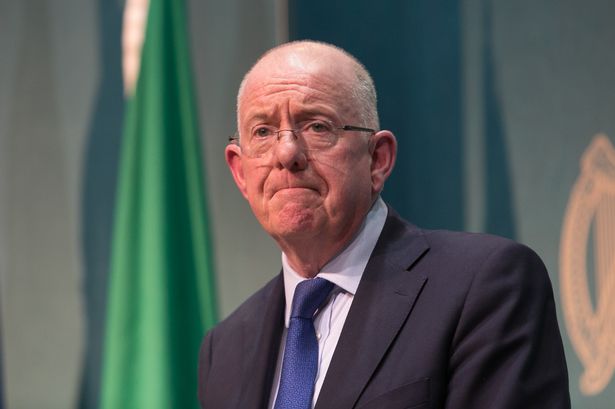
The Minister in question, Charlie Flanagan, was quoted in a number of newspaper reports as having said, in reference to a recent eviction case in Roscommon, that “violence is never justified”. Nothing unusual in that, you might think and that does show how inoculated we have become by stupid statements.
Charlie Flanagan, Minister for Justice of the Irish Government (Source image: Internet)
Charlie Flanagan is Minister for Justice of the Irish Government. As such, the courts, police and prison service come under his oversight. The police force of the Irish State contains, according to the appropriate Wikipedia entry, 10,459 Garda officers. All of these officers are, it is reasonable to assume, trained in the use of their batons, pepper-spray, handcuffs and physical restraint. Some – and it does seem to be more and more of them – are also carrying firearms. In other words, Charlie Flanagan oversees a force of nearly 10,460 people who are trained to use violence and on many occasions expected to use it – and yet he says that “violence is never justified.”
Yes, I know – he didn’t mean the Gardaí in general, or the prison officers who are also trained to use force, or the judiciary who send people to be incarcerated. He didn’t mean the thugs who were using violence to evict people either. Or the specific Gardaí who supervised the violence being used on the evicted and by their presence prevented defence or retaliation.
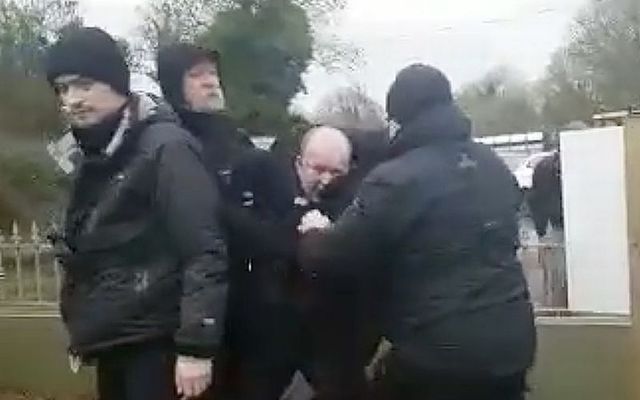
Bailiffs working for KBC Banks evicting elderly people from their home in Roscommon (Source image: Irish Central.com cropped from video)
In system-politician-speak, “violence” is never what the State does and hardly ever what the capitalists do, it is invariably what the victims of the system do to protect themselves or in retaliation. And true to form, Flanagan was referring to the punishment meted out to those eviction gang thugs. So, a statement with cunning intent, to make one action, the violent eviction of people from their home an alright one, and another, the retaliation towards the thugs and repossession of the home, the only one that is “violent”. It makes perfect sense in the way that those who run the system see it and in the way, by perversion of the meaning of words, they want us to see it too.
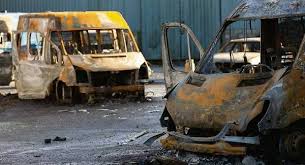
Burned-out vans of KBC Bank bailiffs outside the house from which they had earlier evicted the residents. (Source image: Internet)
But in strictly logical terms, what Flanagan said was nonsense. Unfortunately, it’s the kind of nonsense we hear repeated again and again.
And something like it, through constant repetition, becomes almost common sense. Look at the statement that “Violence never solved anything”: another stupid statement which gets a lot of airtime and mass media repetition with a lot of currency – particularly but not exclusively among the liberal sections of the middle class.
If someone other than a teacher decides to bully you in school and you decide to make it hard for him or her, by responding to violence with violence, in most cases the bully will leave you alone and probably go looking for an easier pick-upon. In that case violence has indeed solved something – at least for you. Of course, it is possible (though not usual) that the situation will escalate from there and the liberal middle class person will tell you that you should report it to the teachers, your parents, etc. What they are expecting is that pressure will be brought upon the bully either directly or indirectly by heavier forces than yours alone. And what lies behind those heavier forces? Ultimately? Violence. It may be the best way to go at times but ultimately it is not non-violent – it is relying for effectiveness on the capacity for violence of others.
Of course, it is possible that the bully may be dissuaded through logic and therapy but that is not often going to happen in our society for a number of reasons.
OK, so you grow up and somebody one night comes to beat you up and take your wallet or purse but you put up a good resistance and either stretch him out on the ground or he runs off. Seems to me that violence did solve that situation.
Taking a more macro look at situations of violence, most people would agree that nations have a right to self-determination. Yet that right has been obstructed and repressed many, many times in history. To take Europe alone, the current nation-states of Poland, Hungary, Czech, Slovakia, Croatia, Austria, Switzerland, Holland, Denmark, Norway and Finland have all been faced with violence and had to respond with violence in order to achieve their independence. Ireland had to do similarly and was partially successful, while a number of other nations remain suppressed despite upheavals and stirrings.
While it may be true that some of those conflicts had questionable results it does not refute the general rule that nations under domination of another state are ultimately controlled by violence and that violence has had to be used many times in response. Nor is the case refuted by territorial share-outs among powers, such as some of the treaties between big powers – the Treaty of Versailles at the end of WWI, for example, authorised the English and French to plunder the Ruhr Valley and was one of the German grievances that helped the Nazis to gain control and begin world expansion. Other treaties have regularly led to violence too, either in states or peoples trying to re-negotiate or negate them, or in suppression of those rebellious forces by the states benefiting from the treaties.
Let us suppose that we are subject to an invasion by a foreign state – that is not too difficult for the Irish to imagine and most European countries experienced it during WWII as did, earlier and later, most of the nations of Latin America, Africa and Asia. The invading force uses violence, of course and they use it more effectively than our defence forces do. Violence worked – in this case for the invading forces. It solved the issue for them – how to overcome our defence forces and occupy our territory for whatever reason they set out to do so.
If we want to resolve the issue to our advantage – to end the invasion and occupation – we would not be able to do so peacefully. That is not a choice the invader will permit us. Our resistance would sooner or later be met with violence by the occupier, whether wholesale in massacres, internment, bans, ’emergency’ laws, curfews etc — or by more selective violence, arrests of leaders and activists, torture, jailing or even executions. And often by a combination of the wholesale and the selective repression.
To rid ourselves of the invader we would have to employ violence too, violence in resistance. It would of course be necessary to combine it with many other tactics – sabotage (violence against things), insurgent propaganda, cartoons, graffiti, song, humour, sarcasm and irony, boycott, demonstrations, pickets, subversion of the enemy’s forces ….. but violence would have to be part of it. There is no nation that freed itself from the domination of a state which was at the time capable of violently suppressing it, without the insurgent nation having had to resort to revolutionary violence.
Returning for a moment to our middle-class liberals, let us imagine the home or business of one is subject to an attempted burglary or robbery. The victim will feel justified in the use of violence in defence of his or her property or home. He or she may choose not to employ that violence themselves – or be unable to — but in that case will certainly turn to the police to employ it on their behalves: “Use cunning to find them and violence to subdue them, bring them to trial by force and punish them by jail. And keep them there for a long time, using violence if necessary.” The middle-class liberal whose business has been robbed or home violated will in most cases not hesitate to, if not use those actual words, to fully imply them by calling for “justice”. However, commenting on the course of a worker’s strike or protest demonstration, he or she will undoubtedly lecture the perceived offenders that “Violence solves nothing.”
Summary: Alarm is being expressed in a number of quarters, especially within the Spanish state’s territory, at the gains made by the hard right in the regional elections in the southern Spanish province of Andalucia. Held on 2nd December this year, a fairly new party, hard-right Vox won seats for the first time – 12 of them. Ciudadanos, another hard-right party which has been around longer, increased their share of the seats by twelve to 21. Should we be afraid? I think not …. we should certainly be alert – but for other reasons.
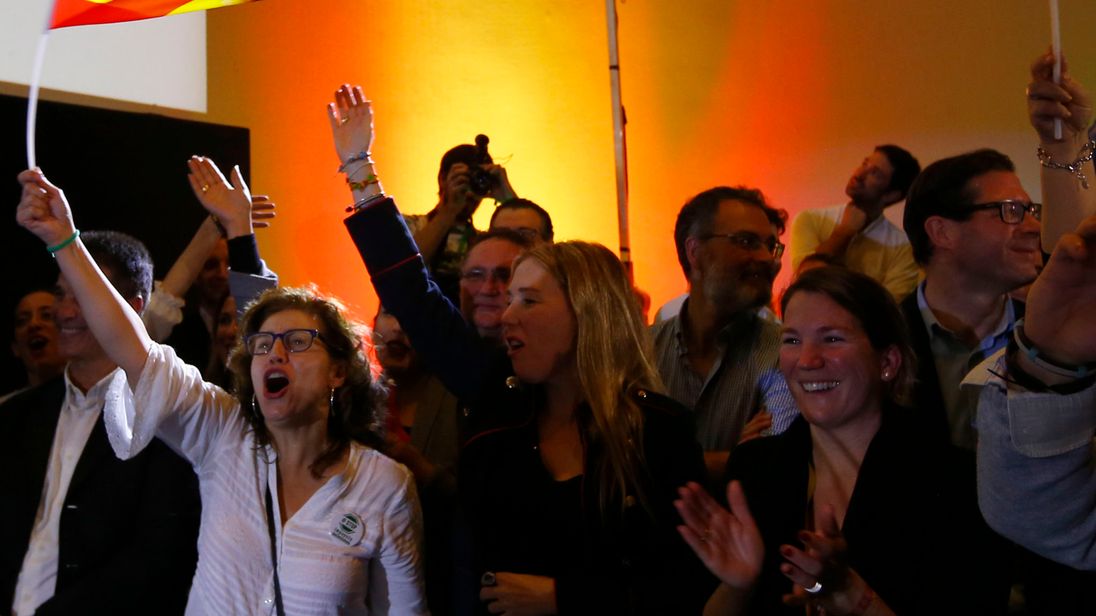
Vox supporters celebrate their party’s results in Andalusian elections (Photo source: Internet)
NB: This is not a deep analysis but rather a look at some of the circumstances in Andalusia in relation to those of the Spanish state as a whole and in the context of its history and current situation.
On 2nd December, elections were held in the Andalusian region, one of the 17 ‘autonomous communities’ of the Spanish state. At the time, the social-democratic PSOE controlled the regional government but only with the ‘confidence and supply’ support of the very right-wing party Ciudadanos; the latter withdrew their support and the PSOE called a snap election. The extremely right-wing (to use the most neutral description applicable) political party Vox for the first time had some electoral success and took 12 seats.
Vox is opposed to the right to choose abortion and also to equal same-sex marriage, proposing instead a different “civil union” for gay and lesbian couples. Like all the main Spanish political parties (and many smaller ones), Vox upholds the territorial integrity of the Spanish state but unlike most others opposes also the Statute of Autonomy which created regions with a degree of autonomy (which was part of the deal of ‘Transition’ from the Franco dictatorship, mainly to placate the nations within the state’s territory). The party is critical of multi-culturalism and immigration policies in general and regarding Islam in particular.
The election of those 12 Deputies has caused a wave of panic across many left-wing and democratic sectors across the Spanish state and one hears and reads comments that “this is the first time a party of the extreme right has gained seats in the Spanish state since the end of the Franco Dictatorship.” If that is true, it is so only in the perception of those commentators.
NOT ONLY FASCIST DEPUTIES HAVE BEEN ELECTED SINCE FRANCO BUT FASCIST GOVERNMENTS TOO
The fact is that fascism was never defeated in the Spanish state after the Popular Front Government was overthrown by Spanish military-fascist coup, aided by Nazi Germany and Fascist Italy, in 1938. For four subsequent decades, there was a fascist dictatorship. After that, there was a fake “Transition”1 in which political groupings directly related to the dictatorship formed political parties and the first two governments (September 1975-July 1976) were of unashamed fascist background followed by two of the UCD (July 1976-December 1982), also of fascist background but wearing the veneer of being ‘centre-right’. One of UCD’s most important movers and shakers was Manuel Fraga, the director of murderous State repression of all antifascist, anti-monarchical and independentist resistance during the “Transition”, his slogan being “The streets are mine”.
The next Government was of the social-democratic PSOE, which swept the board, assisted by a panic about the restoration of a fascist dictatorship, aroused by a somewhat farcical very minor attempt at a military coup, the supporters of which entered the Parliament while it was in session and took it over for a while before they surrendered when it was clear they were out on their own.
The PSOE and its associated trade union, the UGT, had been illegal under Franco. The attempt to rebrand the Spanish State as a “democracy” required a bipartisan social democratic party and also a restraining hand on the illegal trade unions (i.e all that were not fascist). But legalising the PSOE and the UGT would be insufficient if the Communist Party of Spain and its allied trade union, the Comisiones Obreras (CCOO) were left out in the cold, where they would certainly cause a lot of trouble. Both parties were anti-monarchist — would they agree to to monarchy being foisted on the public after more than four decades without one? Could they guarantee not to go after any fascists for crimes of torture and murder? Would they support a unionist constitution? Would they control their unions? They could, would and did, even putting up with the murder of union lawyers (PCE/CCOO) and bombing of the UGT headquarters during the ‘Transition’.
The PSOE was in government from December 1982 to May 1986, during which time it ran assassination and terror squads (GAL 1983-1987) against the Basque left-wing pro-independence movement with the aid of high-ranking Spanish military and police officers directing Spanish and foreign fascist mercenaries.
A number of scandals including the one about GAL helped push the social democrats out of government and next in was a new party of the ‘centre-right’. Well, a new name anyway: Partido Popular — its founder was “The-streets-are-mine” Manuel Fraga, leading a split from the UCD. The PP has been consistently alternating in government of the Spanish State with the PSOE ever since: 1996-2004; 2011-2018.
The PSOE got into government of the state again in 2004-2011 and is in once more at the moment, in a minority government, having unseated the PP on a vote of no confidence on a corruption scandal.
THE 2018 ELECTIONS IN ANDALUCIA
The first thing to note perhaps is that the total turnout was under 57% which indicates a high level of disenchantment with the electoral and political system. The PSOE had been in government there for thirty-six years, i.e since the incorporation of the regional government in 1982. What had it delivered for the people in those years? One need only look at the region’s place in the Spanish state’s economic tables – second from bottom.
The election results gave the the PSOE a drop of 7.4% in votes on their last performance and they lost 14 seats. However, with 33 seats they remain the party with the most deputies in the regional Government, with a seven-seat majority over their nearest rival, the Partido Popular and its 26 seats.
Diaz with PSOE party faithful after making statement on the party’s results in Andalusian elections (Photo source: Internet)
The other social-democratic party, a coalition around Podemos, also took a drop: 5.57% in votes and lost three seats.
The combined or total loss of seats to parties of social-democracy was 17 and the sum of their loss of votes was 12.61%.
As it happens, the right-wing Partido Popular also dropped votes and seats, -5.99% and seven respectively.
Ciudadanos, a newer party than the PP but just as hard right, benefitted with 12 additional seats and 8.99% increase in their votes. And then Vox took the remaining 12 seats from a previous zero on only a 10.51 % increase in their percentage of votes (they had stood before but got no deputies elected).
Where did the other votes go? Apart from the 1.8% invalid votes (exactly the percentage drop of voters on the last turnout, curiously), they were spread between 22 other parties or platforms, of which no less than 15 were totally new in elections. Some of those are right-wing but most, going by their titles, seem to represent a band varying from soft to hard Left to Independentist or regional.
In conclusion, the election results show no sudden far-right advance in reality but a newish party of the far right, competing with other far-right parties, took 22 seats it had not had before, while the social democrats, though losing votes, remain in government for the moment.
Some commentators, including many on the Left, have sought to ascribe the rise in the support for Vox as a reaction to insecurity around the fear of the secession of Catalonia from the Spanish state. This is bit rich from often the very commentators who have tried to portray the popular Catalan movement for independence as an elitist movement, motivated by selfishness to keep their wealth and not share it with poor regions like Andalusia.
So we can all relax, we needn’t worry? No, we DO need to worry but not so much for the reason of these election results. We need to worry because of the fascist nature and history of the Spanish ruling class and its State; because fascist groups are on the rise in the Spanish territory; because the Left has real problems in countering fascism and because fascism is on the rise in Europe in general.
The fact is that most of the Spanish Left, from social-democracy to ‘revolutionary’ socialists, are also totally committed to Spanish territorial integrity. That, and their reluctance to mobilise the masses to take decisive firm action against fascist mobilisations and provocations, makes it very hard for the Left to build a mass and effective anti-fascist movement.
ANDALUCIA
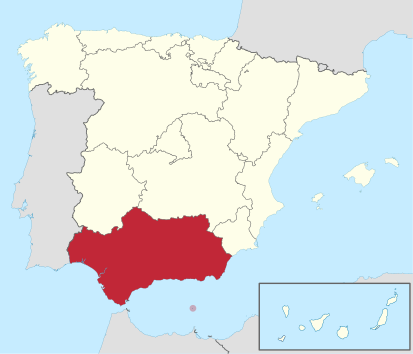
Map of Spanish state (yellow) including Canary Islands with Andalusia in red. (Source image: Wikipedia)
The southernmost part of the Spanish state is where to find Andalucia, sharing a land strip with the Rock of Gibraltar; it is the most populous and the second largest in area of the autonomous communities in the state and its capital is Sevilla (Seville). It is the only European region with coastline on both the Atlantic and the Mediterranean. Parts of the province record the highest temperatures of the state but other parts see quite high rainfall.
The earliest known paintings of humanity have been found in the Caves of Nerja, Málaga.2.The region has been under Phoenician, then Carthagenian control, later under the Visigoths, followed by the Romans and even by the Eastern Roman Empire. For three-and-a-half centuries Andalusia became a Moorish domain from which comes the name (Al Andalus) the region bears today. It was an area of great culture and learning and Christians and Jews were tolerated and protected. The Spanish Christian conquest employed divisions among the Moors, conquered Al Andalus and eventually forced all Muslims and Jews to convert to Christianity or suffer expulsion, allowed only to take the clothes on their backs.
Andalucia in the early-to-mid 20th Century was ruled by a landed aristocracy in a semi-feudal relationship with the mainly rural working population. The region got an early visit from Franco’s military invasion in 1936 and, although there was little armed resistance apart from Malaga and that ill-equipped, an estimated 55,000 were killed deliberately, in executions of thousands of workers and activists of the leftist parties during Franco’s repression.3
The region is characterised by a variety of climatic conditions and topography, inhabited by a great biodiversity of flora and fauna, although some of the latter are quite threatened, such as the Iberian Wolf, Iberian Lynx and the Ibex.
Agriculture and husbandry have traditionally been the main products, with olives, citrus fruits, stone fruits, nuts, alongside some other produce in lower percentages; there is also a depleted but active fishing industry. Andalucia is the single largest producer of olive oil with about 40% of the world market. “One-third of Andalucía’s agricultural land is planted with olive trees, and sales of Andalucian olive oil grew a staggering 56 per cent between 2011 and 2015, to a million tonnes, worth 2,000 million euros. Nearly 500 companies export their olive oil from Andalucía, with Britain the fifth-largest market at nearly 100 million euros.
“Another world-renowned product from Andalucía which is exported all over the world is jamón ibérico de bellota, gourmet air-cured ham made from Iberian acorn-fed pigs, nothing less than a religion for Andalucians, while sustainably-caught bluefin tuna caught off the coast is frozen and sent to Japan to be served as delectably tender sushi.
“In total, one-fifth of all Spanish food and drink exports originate in Andalucía, where the number one area is fruit and vegetables – and tomatoes are the top product”.4
What cause would people in that province have for dissatisfaction that right-wing parties could then exploit? Well, there are no shortage of reasons.
Andalucia is the second-poorest administrative region in the Spanish state. Although unemployment has taken nearly a 4% drop over the previous year, it still stands at an average of 24.4%. Averages conceal other realities and though average male unemployment is almost 3% lower, the female average share is higher than the average by 3.5%. As they age profile drops below twenty-five, the unemployment figures soar to almost 50%.
Table unemployment statistics in Andalucia
Unemployment rate (LFS)
24.4%
28.3%
Male unemployment rate (LFS)
21.6%
25.7%
Female unemployment rate (LFS)
27.9%
31.4%
Unemployment rate less than 25 years
47.9%
57.8%
Unemployment male less than 25 years
48.9%
55.0%
Unemployment rate female less than 25 years
46.6%
61.3%
Unemployed rate over 24 years
22.7%
26.2%
Male unemployment rate over 24 years
19.6%
23.6%
Female unemployment rate over 24 years
26.5%
29.3%
Unemployment rate less than 20 years
66.4%
78.2%
Male unemployment rate less than 20 years
66.8%
76.4%
Female unemployment rate less than 20 years
65.7%
80.5%
(Source: see link for “Unemployment statistics Andalucia)
The situation then in Andalusia may be characterised as one where about every fourth person is unemployed as is every second one under the age of twenty-five. Where paid employment is hard to find, wages are likely to be low, trade union victories harder to achieve and conditions therefore far from the optimum obtainable from the system.
“Between 2000–2006 economic growth per annum was 3.72%, one of the highest in the country. Still, according to the Spanish Instituto Nacional de Estadística (INE), the GDP per capita of Andalusia (€17,401; 2006) remains the second lowest in Spain, with only Extremadura lagging behind.” (Wiki)
Traditionally a region known for agriculture and husbandry, these sectors are now the lowest contributors to GDP in Andalusia. Construction for the tourist industry siphoned off many workers but the collapse of the construction boom left most of those workers with nowhere to go, much of their old agricultural employment mechanised or replaced with migrant labour. Despite agriculture’s very low position in GDP, 45.74 percent of the Andalusian territory is cultivated. That does not mean that those areas are efficiently5 cultivated however and one of the activities for which one Andalusian trade union movement6 has become known is the occupation of agricultural land which is not being adequately or at all maintained, due to absentee owners or land held by banks but not in production.
“The large landowner past of Andalusia has not changed substantially although the banks and some companies now own much of what belonged to semi-feudal aristocrats. “The agrarian census of 1982 found that 50.9 percent of the country’s farmland was held in properties of 200 or more hectares, although farms of this size made up only 1.1 percent of the country’s 2.3 million farms. At the other end of the scale, the census showed that 61.8 percent of Spain’s farms had fewer than 5 hectares of land. These farms accounted for 5.2 percent of the country’s farmland.”7
In May of this year the trade union SAT (Andalusian Union of Workers) published a denunciation of a new Land Law proposed by the PSOE in which they also pointed to some structural problems and their impact on the working people of the region8.
“The most recent act of savagery is the new Land Law that they (PSOE) intend to approve, to finish hanging any dream of Agrarian Reform for our working people of Andalusia. Andalusia is not understood without the struggle for land, and this is more recent than it seems, much more real and topical than we would like.
“The concentration of land ownership is a problem that annihilates our people, currently in Andalusia, 2% of the owners have more than 50% of the arable land, and the worst is that this figure is increasing.
“If we go to Jaén, this figure is even more scandalous, because 4% have 66%, and much of it without giving a job, as is the case of Cortijo del Aguardentero, our Cerro Libertad, one of more than 150 farms, the majority underutilized by the BBVA9 in the Jaén de Piedras Lunares and Olivares de Miguel Hernández areas.
“These figures contrast with the alarming fact that in Andalusia every three days a worker dies, or that more than 60% of Andalusian employees earn less than € 1,000 per month. Also alarming are the number of marginalizations, risk of poverty and lack of school resources, all at more than 40%.
“There are laws that can put an end to all this, but there is no political will in a government that is more a plug-in factory than a socialist party, which only seeks to perpetuate itself in power, being supporters of corrupt banks, all at the cost of death of our land.
“There are alternatives:
1 ° Repeal of this Land Law proposal.
2 ° Implementation of Law 8/1984 of Agrarian Reform of the Statute of Autonomy of the Junta de Andalucía on farms that can be clearly improved.
3 ° The land has to fulfill a social function, for the human and sustainable development of Andalusia.
4th Comprehensive Agrarian Reform, which allows the Usufruct and Land work in Andalusia. Work in the labor force, in the sowing and harvesting, in the primary sector. We do not want property, which must be of a public entity, we want to work and live in peace.
5th Creation of productive, industrial and agro-sustainable Andalusian fabric, generating employment in the transformation and packaging of the product collected.
6 ° Domestic consumption and export of the sown, harvested and agro-transformed product, giving employment and work in the tertiary sector, services.
“This would suppose a Revolution of our earth, a valorization of what we were, of what we are and what we want to be: A FREE PEOPLE WITH FREE PEOPLE.
“This is possible, but political will is needed, and for that, and more importantly, we need the human will to mobilize, as we are defending with our sweat and our lives El Humoso in Marinaleda, Somonte in Córdoba and Cerro Libertad in Jaén10.
“Challenge to the Andalusian society to face with arguments and mobilization the nonsense and unreason of the government of the PSOE of the Junta de Andalucía.
“We announce mobilizations this summer for this, and we call for you to join.
“Andalusians and Andalusians, get up, ask for land and freedom.”
And then, on top of capitalist exploitation and mismanagement, there is corruption. “A recent probe revealed the extent to which PSOE officials exploited their power in the region of Andalusia, where the party has governed without interruption since the return to democracy. Two former regional presidents, Manuel Chaves and José Antonio Griñán, are currently on trial for their alleged part in a scam that included fraudulent early retirement packages, company subsidies and commissions handed out to the tune of €136 million”.11
A recent corruption table based on individual cases puts Andalucia way over all other regions and the PSOE in about 25% of the corruption cases by party (see References for the link to the report).
CONCLUSION
There was no huge swing to the hard right although considering how the social-democrats had abused the votes the people gave them, it would not have surprising if there had been (and there still might be).
Despite their appalling record, the PSOE got 33 seats, the party with the most in the regional Government. That is worth thinking about – despite the crap the working people of Andalusia have had to put up with from the PSOE, they still gave most of their votes to the social democrats. Since this cannot logically — on the performance of the party for the people – be as a result of great affection for thePSOE, it seems likely to indicate at least a dislike or fear of the right-wing parties.
What actually happened is that in a regional election in an impoverished region, on a low turnout and with many candidates; within a state where fascism was never overthrown, with huge legal and illegal repression, with the Partido Popular — a part of the Franco heritage — regularly in government and other right-wing parties snapping at its heels, where social democracy and the established communist party colluded most shamefully with fascism and an imposed monarchy, where the history of the Anti-Fascist War is not taught: a new version of the bedrock Right in Spanish politics won seats in a regional government which it had never won before.
That is what happened. But that is far from being the first time the hard Right won seats in the Spanish state – it has done so regularly in all elections outside parts of the Basque and Catalan countries and has regularly been in government.
Those on the Left who are now wailing about Vox’s success have been and are upholding the myth of Spanish democratic politics since the Transition. They are colluding in the decades of suppression of the Basque and Catalan national movements and the propaganda against them. And many of them have marched with the Right – including fascists – in demonstrations in support of permanent Spanish union, against ‘terrorism’, etc.
Those on the Right who are complaining about Vox are being disingenuous too: they marched with Vox and other fascists for a ‘stronger Spain’ and against the independence of the nations; they saw the fascist salutes and emblems and heard the fascist slogans (whether they joined in with those or not). They were happy to have Vox take out prosecutions against Catalan independence activists and politicians.
NEVERTHELESS, WE SHOULD BE WORRIED. Because generally throughout the Spanish state, the fascists are mobilising on the streets. The fascists are particularly worried by the independentist movements in Catalonia and in the southern Basque Country as well as by proposals to demolish the shrine to Franco and Riveras12 and to remove their remains to a common graveyard. The fascists have strong links with the Spanish police and armed forces and the latter have shown themselves particularly tolerant of the behaviour of fascists on the streets. And in preparation for the repression of the working class in economically austere times to come, fascists have been mobilising throughout Europe with state laws and procedures becoming more repressive. Migrants are being targeted both for extra exploitation and for attack by word and action. We need to do more than worry – we need to mobilise and find ways to unite in effective action.
1All the fascist police commanders, senior armed forces officers, judiciary, lawyers, clergy, senior civil service administrators and academics retained their positions. All the business men and media barons continued and kept whatever plunder they had managed to appropriate during the war and after.
3Executions: “ …. in the city of Cordoba 4,000;in the city of Granada 5,000;in the city of Seville 3,028;and in the city of Huelva 2,000 killed and 2,500 disappeared. The city of Málaga, occupied by the Nationalists in February 1937 following the Battle of Málaga experienced one of the harshest repressions following Francoist victory with an estimated total of 17,000 people summarily executed” (Wiki).
5To be confused with “intensively” which usually implies large-scale monoculture, chemical fertilizers and chemical sprays of fungicides, pesticides and insecticides, along with very advanced mechanisation.
6Sindicato Andaluz de Trabajadores (SAT, ‘Andalusian Union of Workers).
12Valle de los Caídos, a park built in part by political prisoner labour, containing a mausoleum for Franco and Rivera’s remains, a site of frequent fascist demonstrations in homage to the memory of both men.
Liam Herrick, Executive Director of the Irish Council for Civil Liberties and Mallachy Steenson, Irish Republican and practicing lawyer, on Friday 7th June addressed a Dublin meeting on The Right to Protest, convened by the Dublin Anti-Internment Committee.
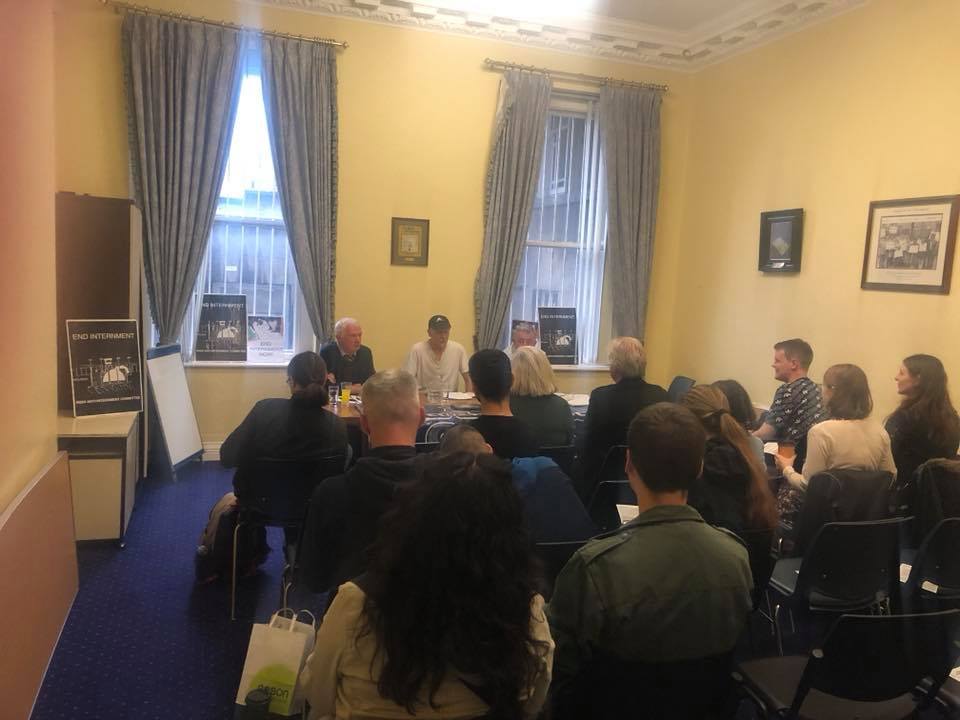
Section of audience and panel at Right to Protest meeting (Photo source: Dublin Anti-Internment Committee)
CHAIR’S INTRODUCTION:
The origins of the Anti-Internment Committee and the Right to Protest
Opening the meeting and speaking for the organisers, the Dublin Anti-Internment Committee, Diarmuid Breatnach welcomed the attendance, introduced the Committee and related how it had grown out of a previous committee, to have Marion Prices released from prison, which had been partially successful (she was released pending trial but her health was destroyed). She and a number of other former Republican prisoners who had been released under license under the Good Friday Agreement, such as Martin Corey and more recently Tony Taylor, had their licenses revoked and were brought to jail without a trial or the right to challenge whatever evidence the Secretary of State for Northern Ireland claimed to have against them. Some considered this a form of internment by some and the Anti-Internment Committee had been set up in June 2013.
Breatnach emphasised that the Dublin Committee had always been and remained — attempts at takeover and accusation notwithstanding — independent of any other organisation and committed to reaching decisions in a democratic manner and conducting themselves in a principled manner towards other organisations. The Committee organises the annual Anti-Internment rally in Newry and holds more-or-less monthly pickets in different parts of Dublin, which anyone is welcome to support, he told the audience.
Chair of meeting Diarmuid Breatnach speaking at Right to Protest meeting (Photo source: Dublin Anti-Internment Committee)
Although the Dublin Anti-Internment Committee updates a list of Republican prisoners in jail and also raises issues about the human rights of Republican prisoners such as right to education and art work, appropriate medical treatment, release from solitary confinement and on occasion about miscarriages of justice such as the Craigavon Two, nine years in jail now – nevertheless the true focus of the Committee is on issues of internment.
Introducing other areas of repression by the states on both sides of the Border which the Committee considers to be types of internment, Breatnach outlined the practice of refusing bail to the accused or of making bail conditional on the individuals removing themselves from all political activity. When the accused justifiably refused to accept these conditions, they were jailed, only perhaps to be found not guilty two or three years later, as had been the case with Stephen Murney. But still having effectively served a jail sentence.
“The right to protest is everywhere under attack” stated Breatnach and declared that maintaining that right was necessary for the winning and maintaining of a wide group of basic social and political rights, from practicing one’s sexuality or religion, or indeed criticising the Church, to forming a trade union, going on strike and marching against unjust laws or measures. Breatnach bemoaned the apparent inability of a number of Republican groups to unite in defence of this right and of Socialists in uniting with them even on this most basic of levels. “We can either stand together or fall separately” he said.
Internment is used by states against political opponents, said Breatnach, recalling that the British had used it in Ireland after the 1916 Rising, the new Irish state had used it during the Civil War and again during WWII under De Valera; the British in the Six Counties between 1971 and 1975.
Internment is a means of “removing unwanted members of the public”, Breatnach said, quoting the words of anti-insurgency specialist Brigadier Frank Kitson, who had been present during the repression of the Malayan resistance and also an operational Commander in Ireland from 1970-1972, years which Breatnach reminded his listeners were those covering the introduction of internment and the massacres of civilians in Ballymurphy and Derry.
Referring to the infamous “Heavy Gang” of the Gárda Síochána whose brutal methods had extracted false confessions on the Sallins Mail Train robbery from socialist republicans in the 1970s and from the family in the Kerry Babies case, Breatnach recalled the formation of the Irish Council for Civil Liberties at that time and that it had been a campaiging organisation unafraid to challenge the State on its repressive actions. Sadly over the years the organisation had fallen away from that path, he said and he was particularly glad to welcome Liam Herrick of the ICCL to speak at the meeting and in the hope that the organisation was returning to its roots.
LIAM HERRICK, ICCL: The Right to Protest and the work of the ICCL.
Liam Herrick, Executive Officer of the ICCL, speaking
After the applause, Liam Herrick thanked the Committee for having invited him to speak. He wished to list some of the efforts in which the Irish Council of Liberties was engaged and also to hear from the audience some of the problems they were encountering.
Briefly covering the early years of his organisation, Herrick related that it had been formed as a response to police repression, mostly of Republicans but also of some Socialists, and in particular due to the activities of the Gárda unit known as the “Heavy Gang”, by academics, activists and lawyers. It had taken up early cases of the ill-treatment of detainees, the use of the Offences Against the State Act, repression of protesters of the Ronald Reagan visit including the case of Petra Breatnach in 1984 and Water protests in the mid-1990s, also in the street-traders’ protests in which Tony Gregory was prominent.
The issue of the right to protest and State repression had come up again a number of times including in 2002 against the Anti-War Movement with the use of the OAS Act and in particular with the Reclaim the Streets protest in 2002, in which video recording of police actions had revealed the extent of police brutality without any arrests. Similar problems had been encountered by protesters at the 2004 EU Council meeting in Dublin, and water canons had even been imported by the State from the UK and widescale repression and had come up again at the Corrib Shell protests.
The ICCL had in 2014 published “Know Your Rights” booklet. And had called for a root and branch review of procedures for dealing with protests, noting that there existed a major gap in rights and policing process and has published a publication by the title of “Take Back the Streets” and has made submissions to the EU and the UN on how states should not just tolerate but manage and create conditions to facilitate the right to protest. The ICCL is part of a network which includes the ACLU in the US.
“If Notifications to the authorities are required should be minimal and reasonable”, Herrick said and gave the contrary example of African Jews who wished to protest against Israeli measures but were charged a 25,000 dollars as a cost of the application for permission.
Police should have a chain of command to deal with protests and be trained not only in weapons and control movements as they are at present but also in de-escalation, in engagement with protesters. Their internal Garda policies should be available to public access but are not.
Herrick said journalists should be facilitated in having access and only just employees of big media organisations but alternative media and individual bloggers whose coverage is often essential to understanding the incidents at an event (in the Reclaim the Streets event such sources were the only source on the Garda violence). There should be restrictions on the use of force as is law and police in Northern Ireland, whatever people might think about practice on the ground, Liam Herrick said. The PSNI every 6 months have to submit a report to the Policing Board which details incidents o the use of force. In the Irish state Gárdaí don’t have to make any report on the use of force which is remarkable in the European context – the use of pepper-spray would seem to be increasing here but no records are available..
Surveillance is an issue and of course can intimidate and have “a chilling effect on protest”, Herrick said. In England face recognition technology is being used which apart from questions about its accuracy, is intrusive. Also trapping of mobile phone activity in the vicinity of a protest. Data collection is an issue and there should be no database on protesters maintained; covert agents have been used and in some cases become personally involved with those they were surveilling – a recording procedure is needed. There needs to be an independent complaint process as the existing process in Ireland has been shown to be inadequate.
At the moment the ICCL is involved in discussions on Gárda reform and the following Friday would be producing a document on Human Rights Policing which people are welcome to read. The international perception is that the law and policy of the PSNI is good, without making any comment on their practice on the ground. The Gardaí should publish a report on their handling of protests every year including statistics (despite the problems on drink-driving statistics) on arrests and the use of non-lethal weapons.
The Gardaí in Ireland have a national security function and there needs to be a discussion on this – in many other countries a separate body is responsible for this. But no legal body is overseeing the operation of the Gardaí on national security or the powers they exercise.
Liam Herrick concluded to applause and Breatnach told the audience that questions could be asked of him and of the next speaker after the conclusion of the latter, then introducing Mallachy Steenson to welcoming applause.
MALLACHY STEENSON: Republicans and the Right to Protest
Mallachy Steenson speaking Section of audience and panel at Right to Protest meeting (Photo source: Dublin Anti-Internment Committee)
Mallachy quoted the right to protest under Article 41 of the Constitution of the State under which document however Republicans would not support.
Moving on to suppression of protests Steenson referred to the most frequently used being the Public Order Act, justification which depends on the subjective view of a cop and is therefore virtually unchallengeable. The result is usually a fine but the use of the Offences Against the State Act is much more serious. In the 1950s there were many arrests of Republicans under the section which prohibits a demonstration within a certain distance of the Dáil and Section 30 was widely used.
Steenson pointed out that almost any gathering of Republicans consitutes some kind of protest due to the basic opposition to the State of Republicans. Funerals are usually protests too, partly in solidarity with the family, partly with movement but also of making a stand and, in the case of the ten dead 1981 Hunger Strikers, in solidarity with their Five Demands.
Steenson believes that most of the protests that occur in the state will be allowed because the they don’t threaten the state from the “trendy liberal side”. For example the housing protests including activist occupations are permitted but when a house was occupied in Charlemont Street and in preparation for moving in a family three years earlier, armed police removed the occupiers.
“The State takes a different view of Republicans” Steenson declared. Referring to the 2016 Sinn Féin Easter 1916 commemorations, Steenson wondered whether they remember their history because the 76th anniversary of the Rising commemoration (1992) was banned and people on the platform arrested. The 66th anniversary commemoration had been beaten off the street in Dublin and people arrested for “membership”, including his own father and others.
“What we have is mostly controlled dissent”, Steenson said. “People remember the Birmingham Six” but are not aware that their campaigners here had their homes raided by police, their jobs visited by the Special Branch, threatened and often lost their jobs.
“What has happened in Ireland is a privatisation of dissent,” Steenson said. “They are funded by the State and he who pays the piper calls the tune.”
The only ones who could really carry out a successful protest in Ireland were the farmers who here, as in France, had no hesitation to block roads and motorways and dump slurry at the Dáil, Steenson declared. The only other really effective protest that hurts the State is the withdrawal of labour as in a general strike – which should have happened when the banks were bailed out — but the trade union movement in Ireland works hand in glove with the State.
“Republicans are well-used to surveillance” Steenson went on to say with a reference to “the new MI5 Garda Commissioner” who declared upon coming into office that the biggest threat to the State is the armed ‘dissident’ Republicans, which Steenson commented were no real threat to anyone except themselves.
“The State is built on the defeat of the Republic,” said Steenson and therefore naturally Republicans are its enemy. Referring to the water protests and their suggested victory, Steenson opined that the success was only due to Fianna Fáil changing sides and he believed that the USC (Universal Social Charge) should be the main object of protest which takes much more out of people’s pockets.
In 1972 the British Embassy in Dublin had been burned in protest at the Bloody Sunday massacre in Derry. Steenson declared that too was managed by the State, having a national Day of Mourning, allowing people to blow off their anger at the sacrifice of a building and listed other protests he believed had been managed or controlled by the State, including the medical cards for the elderly.
People should be able to go to protest without asking the State, Mallachy believed and asked what is a valid protest, referring to gathering protest against the expected visit of Trump while that of Clinton in Dublin passed quietly by without protest. “What is it about Trump?” asked Steenson. “If it’s about killing people, Clinton killed many more. If it’s about treatment of women, well we all know Clinton’s record on that.”
The real problem impacting on most working people is drugs, Steenson said, and the gangs involved in it. Families Against Drugs had been a big campaign but some of the activists were in it to get funding. “People should separate their political activism and their job,” Steenson declared. “We need to move away from having paid groups organise protests”, Mallachy said. “Most protests now are during the week,” he added, “because activists don’t want to interfere with their weekends.”
“We need to look at what is an issue and what is effective”, he said and talked about empty houses and the way housing protesters in the 1960s and ’70s not only occupied them but moved homeless families into them.
“During WWII we didn’t intern Germans or English here”, Steenson commented, “we interned Republicans.”
“Protests will be allowed as long as they don’t threaten the State”, Steenson said, coming to a conclusion and the only ones organising protests that threaten the State are Republicans. He posed the question whether democracy is any use to working people, because it had not brought them much.complained too about police being masked and said that in a normal society you would not have that, nor armed police everyday on the streets. He commented also on the degree of video surveillance used by the State which could track people from leaving the door of the building all the way home.
“Gardaí are there to protect the State, not to protect the citizen, whatever combination of political parties are in government,” he told his audience. “To them and to the State, Republicans are the enemy. That’s just the way it is.”
CONTRIBUTIONS AND QUESTIONS FROM THE AUDIENCE
After the applause following Steenson’s talk, Breatnach opened up the meeting to contribution or questions from the audience, asking them to keep them brief and telling them he was going to take questions in groups and the speakers could choose to which to reply.
Side view of section of the audience (Photo source: Dublin Anti-Internment Committee)
An audience members spoke about the level of repression from Lurgan RUC/PSNI and how eight people had been charged and their bail conditions were not to associate with one another but two of them live near one another.
A contribution declared that Drew Harris being appointed as Garda Commissioner was equivalent to a railroad to jail and related a case of an elderly woman being persecuted in Rossport.
Another directed a question specifically at Liam Herricks about treatment of people in some of the rural courts where protesters were being very badly treated.
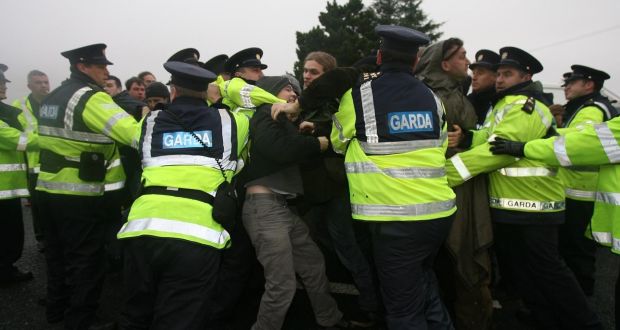
Gardaí attacking protesters
An Ireland Palestine Solidarity Committee activist said that usually they don’t get much trouble from the Gárdaí but more often from the private sectors, from private security personnel when they protest at a business as part of the solidarity campaign. And the Bank of Ireland had closed their account, which caused the organisation considerable difficulty. He wondered whether this was the State’s influence under pressure from the Israelis or others, or instead the banking company under pressure from the same sources or from financial sources. Or whether it was part of the general “de-risking” measures people talked about. The Cuba support group had suffered a similar problem.
Relating his contribution to issues of surveillance, one person described a car journey from an event for about two hours across Dublin, after which he stopped at a fast food takeaway facility. He had felt followed earlier on and when the Garda came in behind him in the takeaway with the usual harassment, he confronted the officer and asked him how had followed him all that way. The Gárda pointed to cameras above on street poles and said: “We don’t have to follow you, they do.”
Another person related how “membership of an illegal organisation” is being frequently used to jail Republicans under the OAS on the word, without the need to display any proof, of a Gárda senior officer.
He thought he had heard of one case where it had been used against a gang member and wanted to know were there any others that the speakers knew of?
Neither had heard of any and Mallachy commented that next year the OAS will be 40 years old. Liam Herrick referred to a piece of research carried out by Nuala Ní Fhaoláin at the UN.
A Polish and a Catalan separately expressed their solidarity with Irish people struggling against repression, briefly alluding to their own struggles and the Polish person mentioning the recent arrest and jailing of a comrade of his in Turkey.
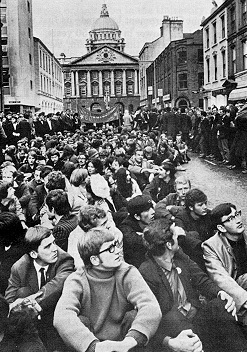
Queens University Belfast students sit-down protest when prevented from marching, 1968.
As there were no further questions or contributions, Breatnach thanked people for their attendance, the speakers for the talks and audience members for their contribution and asked for contribution towards the rent of the room. “This is not the beginning of a broad campaign to defend human rights or if it leads to it, it will not by our Committee leading it,” said Breatnach, adding that no doubt they would be happy to contribute to such a campaign. Urging people present to keep in touch with internment issues through the End Internment Facebook page he stressed once again the need to unite across ideological divisions against State repression.
End.
POSTSCRIPT:
A number of public meetings in Dublin about similar issues followed the one above in quick succession, no doubt coincidentally:
A meeting as part of the Anarchist Bookfair on Saturday 15th September on “State Violence and Cover-ups: Community Responses” heard from a speaker on police infiltration of campaigning groups; from Anne Cadwaller of the Pat Finucane Centre (also author of the “Lethal Allies” exposure) about colonial police and British Army collusion with Loyalist murder gangs; and from Hilary Darcy about what might be considered legitimate reforms to be pursued by revolutionaries.
A public meeting in Abolishthe Special Criminal Courts campaign was held on 17th September and heard from international and Irish speakers.
The Justice Delayed Is Justice Denied group held a public meeting on 19th September, raising issues pertaining to the Ballymurphy and Derry Massacres, the Miami Showband Massacre and the Stardust Fire (report: https://rebelbreeze.wordpress.com/2018/09/24/justice-delayed/ )
Masked Police, Police with machine guns.
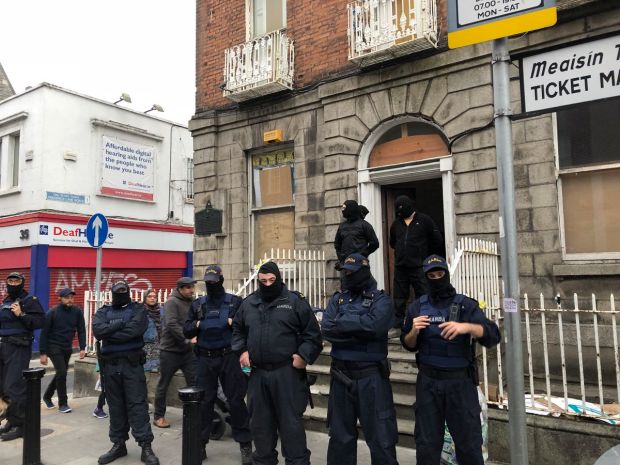
In addition five days after the Right to Protest meeting, masked Gardaí brandishing batons and pepper-spray cannisters assisted a masked “security team” in evicting housing campaigners carrying out a symbolic occupation of an empty building, drawing protest statements from Liam Herrick on behalf of the ICCL to be followed, most unusually, by Colm O’Gorman on behalf of Amnesty International. Five or six housing protesters were detained and at least one was injured..
A few days after that, Gardaí turned up with machine guns and a battering ram to a house where a couple were in dispute with their landlord, leaving when supporters of the couple arrived.
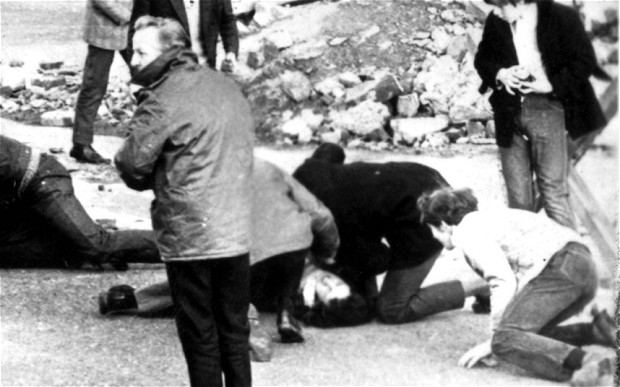
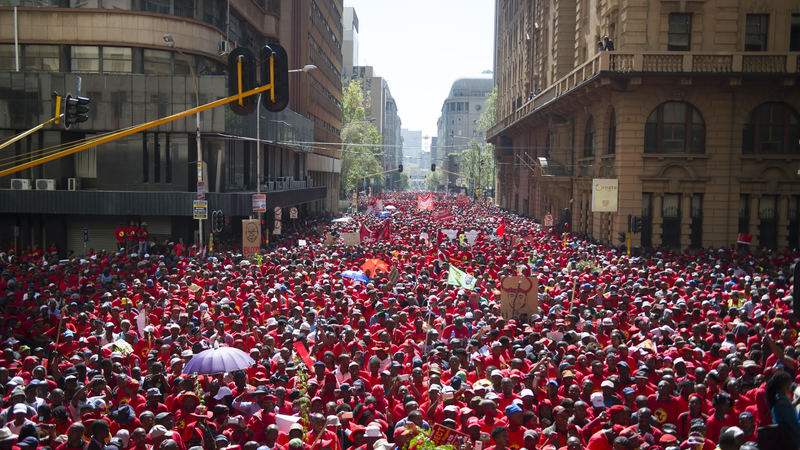
Masked Gardaí and masked “security guards” at eviction of peaceful housing protesters soon after the Right to Protest meeting. (Photo source: Irish Times)1963 Alabama, 17-year-old black civil rights protester attacked by police and police dog. (Photo source: Internet)1972, Derry, part of Bloody Sunday Massacre (Photo source: Internet)Lone man confronting Chines Army tanks on their way to suppress protest in Tienamen Square, 1989Massed Marikana Strikers at Lonmin Mine, South Africa, 2012– 40 were shot dead by police. (Photo source: Internet)
Again and again we come across activists, journalists, musicians and other artists who are lauded for “speaking truth to power”. They are often praised for that, even idolised. “Speaking truth to power” seems to be brave thing to do. And an important thing. But is it really?
First of all, let us think of who are those usually thought of as “Power”: governments, big companies, military dictators, church leaders, powerful individuals in the media or in the arts …..
Why is it considered a good thing to speak truth to them? It may well be brave to do so and often is. People who spoke the truth in certain situations throughout history and currently have had their careers destroyed, been the subject of all kinds of horrible allegations, been marginalised, lost their families and friends, been framed on charges, jailed as a result or just automatically, tortured, killed and “disappeared”. Yes, we could hardly deny the courage of many of those who chose to take that step. But whether it’s an important thing to do is another thing completely.
What? A courageous act against power not important? What can I be suggesting!
Let’s look at those in power again, taking for examples a government, a military dictatorship and the CEO of a powerful company. In our example, we set out to “speak truth” to them.
For the government, we send them an email, or a letter because there are too many Ministers and Secretaries to address verbally – unless of course we are in some kind of privileged position. They in turn ignore us or send us a dismissive reply (possibly tailored to be quoted) or they have us subjected to surveillance, just in case we should turn out to be a real problem in future. And any government in the world is capable of putting citizens under surveillance.
(Cartoon strip source: Internet)
We send the military dictator a letter and he has us arrested, detained for torture and questioning. Or we accost him when he is somewhere in public …. and his security guards shoot us dead. Or arrest us for torture and questioning.
With regard to the CEO, we send him an email. He ignores it but may have us put under surveillance – just in case. And he’ll have our employment and tax records, families and friends checked out too. Like governments, the CEOs of big companies can easily put people under surveillance and run background checks on them. And CEOs likely last longer in the power position than most governments. Or he might reply dismissively. Or he might have his legal services people threaten us with legal action which, as well as shutting us up, would cost us a lot of money we don’t have, probably bankrupting us.
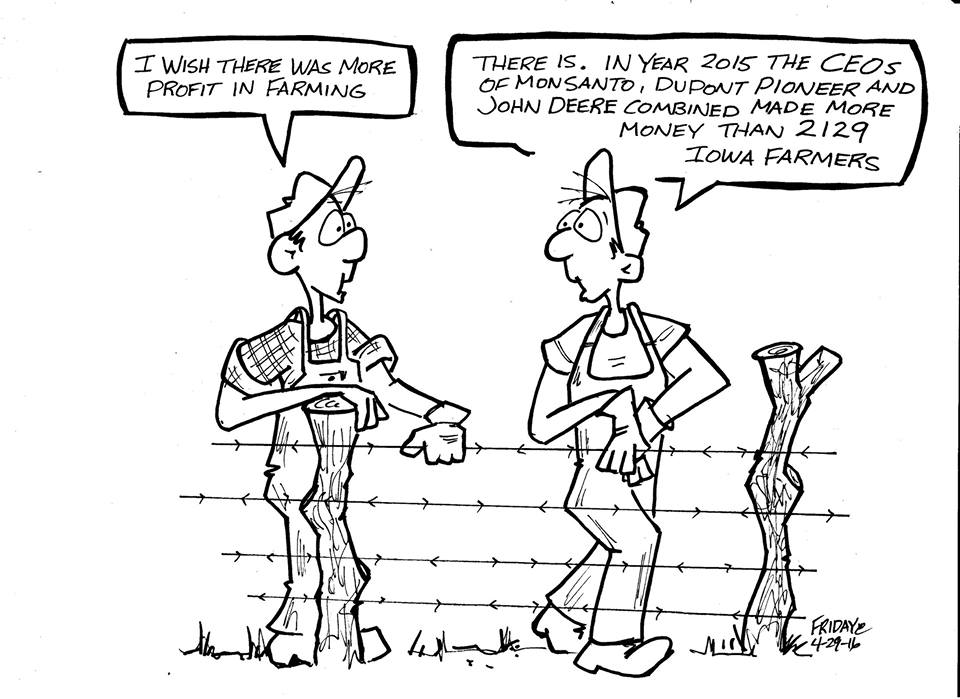
This is the illusion of liberals and social-democrats but the reality is very different. (Image sourced: Internet)(image source: Internet)
In the military dictator’s case, we are out of the picture. In the case of the other two, nothing further may happen if we shut up now. But if not, well …. there’s that list of bad outcomes I listed above. Brave? Certainly – but to what effect? Have we changed anything?
Some people think we can change the essence of the way those in Power think by Speaking the Truth to them. If only we can say it powerfully enough. Nonsense. Those in the Power have already chosen who they want to be, what side they are on and understood the basic dynamics or been taught them along the way. Many choices made have confirmed them in their roles and ideology. Furthermore they know that to break ranks with their own is a dangerous thing to do which can result in bad outcomes for them too and also expose them to painful and even fatal thrusts from their competitors or rivals. Remember the 1983 film Trading Places? Remember how the main hero falls at first, is shunned, loses his privileges, friends and associates? Unlike the film’s ending, there is no coming back from there.
If those CEOs and company owners ever took a progressive step it was because they were shown it would increase their profitability or at very least were shown it wouldn’t hurt it ….. or they were forced to do so by people’s resistance. Not ever by having “Truth Spoken” to them. Unless it was the truth of resistance (and we’ll come back to that).
I don’t see the point of Speaking Truth to Power … except in very exceptional situations. For example, if we are being sentenced in court, even if the public gallery has been cleared or packed with cops (which has happened even in this state on occasion), we might wish to raise a clenched fist and yell “Death to Fascism!” before the guards jump on us and bundle us to the cells, giving us a few punches on the way.
Or being tortured, if we are capable of it (and while we are still capable) we might want to shout something similar or just plain “Fuck you!” Or in front of a firing squad, to shout “Long live the revolution!” before the order comes to “Fire!”
Will it do any good, make any difference? Without an audience apart from those in Power, almost certainly not. It might affect some soldiers or police in the firing squad or some jailers but such results are usually negligible. But in doing so, we assert our humanity, our spirit against them and it is for ourselves alone, at that moment, that we Speak Truth to Power. Otherwise, there is no point, none at all.
I don’t want to Speak Truth to Power and what’s more, question why anyone else would. Is he or she suffering from some kind of liberal illusion that such words make a difference, can convert or subvert Power? Or from an inflated ego that convinces him or her that they have the gift, the eloquence, the importance to make Power change? Or that somehow, by force of their excellent will, they can overcome history and change reality?
Or even worse, are they signaling to the Power that they are articulate, eloquent even with “alternative” credentials and that they are worth recruiting by the Power?
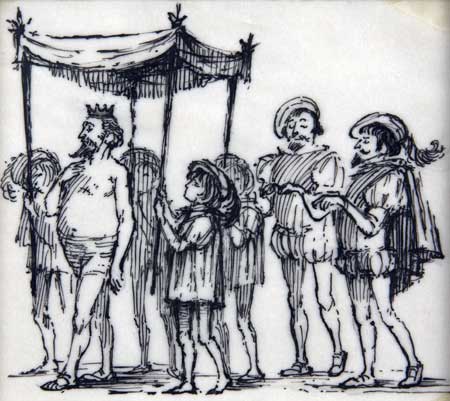
The Naked Emperor. In Hans Christian Andersen’s subversive tale, an undoctrinated child remarks that, contrary to royal propaganda, the Emperor is naked and the people can then admit this to themselves. The child spoke Truth — but to the People. (image source: Internet)Speaking truth among the people. (Cartoon source: Internet)
I repeat: I don’t want to Speak Truth to Power. I want to Speak Truth alright … but to the PowerLESS! I want to expose the Powerful to the people. I want to show them the long list of the crimes of the Power and that it is unreformable. But I don’t want to just read the people a horror story; I want to show them how I think the monster can be killed. I want to show the people that THEY CAN DO IT! The people can grasp power with which to overthrow the Power. I want to show the people what their forebears have done in rebellions, uprisings, revolution, creation of resistance organisations, art, discovery of science, production ….. I want to share what I think with them, argue with them, encourage them, criticise them. And the only time I want to Speak Truth to Power is when they, the People, are listening, or reading what I am saying. Because then, it’s not to Power, in reality, that I’ll be Speaking Truth; the important audience is not Power at all.
So, Speaking Truth to the People is the thing to do. And will those who do so be safe from painful outcomes, that list given earlier? Having careers destroyed, being the subject of all kinds of horrible allegations, being marginalised, losing families and friends, being framed on charges, jailed as a result or just automatically, tortured, killed and “disappeared”? Alas, no, each of those is a distinct possibility: all have happened even to the people of our small island and nearly all of them fairly recently. Some very recently and even ongoing.
There is no safe way to Speak Truth. But at least this way, there is a chance that Speaking Truth will have some effect, will make a difference. It might even make a big difference. We hope so.
And the final Truth is that words, for all their power on people’s minds, don’t change the real world. People do that, through action.
Dublin City Councillors at their meeting on Thursday (13th September) voted by huge majority not to sell the former Magdalene Laundry building in Seán McDermott Street in the city centre. Deputy City Manager Brendan Kenny had earlier announced the possibility of the Council selling the building at an expected price of €14.5 million to a Japanese company that planned and hotel and supermarket on the site.
A campaign group called Separate Church & State had lobbied for the building to become a memorial to the suffering of the inmates of the Magdalene Laundries. The group called people to support an event outside City Hall to coincide with a motion being put forward to prevent the sale of the building. A range of people attended, seeming mostly Left social and political activists independent of any party and a sprinkling of People Before Profit activists.
The motion was propose by Gary Gannon, a Councilor of a very small political party (with only one member on the Council), the Social Democrats. However the motion was supported by the overwhelming majority of a Independent councillors (i.e of no party) and those belonging to a number of other parties and was passed with 37 voting in favour, eight against and two abstentions.
Campaigners and supporters in front of Dublin City Hall from across the street (Photo: D.Breatnach)
The successful motion called on the Council not to sell the building and land and that instead those who suffered abuse there should be commemorated with a memorial. Other than preventing the sale, exactly how the memorialising might be put into effect remains to be outlined and agreed. There is talk of the State taking it over but whether by donation of the Council or sale has not been clarified. There are very few memorials to the Magdalene Laundry victims and all but one of them are small.
The Sean McDermott building appears to have been the last of the Magdalene Laundries in Ireland and was closed in 1996. It is also the last of those buildings in the possession of Dublin City Council.
(Photo: D.Breatnach)
The significance of the victory is greater than that of elected representatives versus unelected City Managers, the former being more responsive to public pressure than to the demands of high-ranking officials who seem happy to hand over much of the city centre to property speculators, shopping centres, hotels and large student accommodation complexes.
The terms in which the issue was raised are an attack on the legacy of the Catholic Church’s grip on secular society and its relationship with the State. The campaigners clearly see the Council vote as a victory, though a moral one, against that legacy. And they are planning to press ahead with the offensive in the terms indicated by the title of their campaign, indicating further targets such as the national health and education services, along with legislation to follow on the national referendum’s rejection of Amendment 8 of the Constitution outlawing abortion.
The Magdalene Laundries – some brief background
The Magdalene Laundries were a major institution of the Irish Catholic Church from the 18th to the late 20th Century. There were some Protestant parallels too in the Six Counties (“Northern Ireland”) run by the Anglican and Presbyterian churches but the vast majority of the Irish population were of the Catholic faith. The Laundries took in and accommodated women who were considered “fallen women” which at first meant sex workers but later included unmarried women who had a child or children or even women whose behaviour was considered immoral or flirtatious (or even whose beauty attracted male attention) and they were put to work in the laundries for no pay. Ostensibly at first a charitable initiative, their title drew on the New Testament story of Mary Magdalene who, from being a “morally loose” woman, after meeting him became one of the most ardent supporters of Testament’s Jesus.
But if the name was associated with the alleged mercy and lack of judgementalism of the Christ, it also implied moral sin and judgement. In the extremely conservative Catholic Church that it became after the Great Hunger, the main element was likely to be punishment and, when allied to an also socially reactionary political class, the Laundries became an institution of social control of the Catholic Church in Ireland and of the new Irish State.
The Magdalene laundries soon became known to their inmates as places of hard work and ill-treatment, mostly of a psychological nature but also physical. If women left them without permission, they were pursued by the police and brought back. Continuous escapes could lead to jail sentences.
(Photo: D.Breatnach)
During their time in operation an estimated 30,000 Irish women were kept in these institutions in Ireland, approximately 11,000 after the State was created in 1922.
The horrors of these “charitable institutions” began to be revealed to the public during the last decade of the 20th Century, notably in 1993 after a mass grave of 155 corpses was uncovered in the north Dublin convent grounds which housed one of the laundries and the last Laundry was finally closed down in 1996. The Church never accepted any financial responsibility for reparations.
The Irish State set aside a sum of up to €58 million (about half of which has been paid out – see Links) but the religious institutes concerned, the Sisters of Mercy, Sisters of Our Lady of Charity of the Good Shepherd and Sisters of Charity refused demands from the Irish Government, the UN Committee on the Rights of the Child and the UN Committee against Torture, along with other groups in Irish society, to contribute to the compensation fund for the the surviving victims, an estimated 600 of whom were still alive in March 2014 (see Wikipedia in Links).
(Photo: D.Breatnach)
The Taoiseach (Prime Minister) of the Irish State apologised publicly and emotionally in the Dáil (Parliament) in February 2013 but the State never accepted any legal responsibility, its representatives saying that they did not control the Church. When they were reminded that the victims had washed not only clothes and vestments of priests and nuns but had also done laundry service for such state institutions as Aer Lingus, the Irish Army, the Gárdai, the State’s representatives declared that the Laundries were like any other contractor in that regard and that the State could could not accept responsibility for how contractors treated their “employees”. But it is known that State courts sent a number of women to the Magdalene Laundries. And it was the State that allowed the Catholic Church to dominate social care, health care and education, areas which are usually considered the responsibility of the State.
The general story of the Laundries is fairly well-known in Ireland now through media coverage and the testimonies of victims and even abroad in some countries through the 1992 Peter Mullan film Magdalene Sisters (see Links) and a number of documentaries for TV. Mary Coughlan sang a fierce attack on them too the same year as the film, composed by J.Mulhern (see Links for a Youtube video).
View of the protesters outside the meeting (some were inside) looking eastward. (Photo: D.Breatnach)
There are very few monuments to the suffering of the victims of the Magdalene Laundries and they are all of a small size except the statue in Ennis which aroused some local controversy.
The monument at Forster Street, Ennis, Co. Clare, dedicated to the Magdalen women and a subject of some controversy. (Photo: Mike Shaughnessy)
Despite the duration of their existence and numbers involved and the international coverage, the Pope claimed when tackled by some survivors on his recent visit to Dublin that he had no knowledge of the existence of the institutions.
Sale of Council buildings and land – the legal position and some background
Due to a legislative change some years ago, Dublin Council Executives such as the City Manager and Senior Planning Officer can make major decisions without consulting elected Councillors and even against their expressed wishes. In this way, for example, the planning permission for the Shopping Centre Plan over the Moore Street Battleground and Market quarter was firstly agreed and secondly, even after the High Court judgement that it is a national monument, was renewed in 2016 by the Chief Planning officer of the time, Jim Keogan.
Many feel and have felt since such decisions that this is an unhealthy state of affairs, with no democratic controls and leaving key officials open to suspicion of bribery from developers influencing their decisions.
Fortunately however when it comes to the disposal of Council assets, the Councillors must agree by majority. This prevented the “land swap” proposed in 2014 by Joe O’Reilly of buildings in Moore Street, which if successful would have enabled his company to demolish half the 1916 Terrace: responding to campaigners and interested elected Councillors, the Council voted the proposal down against senior officials’ recommendations in November of that year.
This is what the South African Peace Process was about, apart from black people getting the vote: white capitalists continue, a few black capitalists climb up on the back of their people, corruption rife in politics and sellout of national resources intensifies.
Cyril Ramaphosa is the current President of South Africa and of the African National Congress and formerly of the National Union of Mineworkers. He is at least a millionaire with a seat on several company boards including that of Lonmin, the workers of which were on strike at Marikana in 2012 and were massacred by South African police.
The following is a statement by General Secretary of the South African Federation of Trade Unions (700,000 members but most workers in the country are not unionised). From Politics.Web (link to original posting below).
SAFTU condemns NUM leaders’ summersault
The South African Federation of Trade Unions condemns the sudden and opportunist summersault by the leaders of the National Union of Mineworkers (NUM), over the Independent Power Producer (IPP) agreement which was signed into law yesterday.
“The NUM views the signing of the IPP today by the communist turned capitalist Minister Jeff Radebe as an insult to the working class and the poor”. “The ANC led government is privatizing Eskom through the back door to satisfy their Davos handlers and white monopoly capital.”
They then make an even bigger about-turn when they say that “Workers of this country will not continue to vote and support an organization which is taking away jobs from the poor. We cannot perpetually campaign and vote for the so-called ‘New Dawn’ as narrated by Cyril Ramaphosa… The NUM demand that President Cyril Ramaphosa must stop this nonsensical IPPs and must reverse the decision. We are tired of supporting the organization which is indicating left but turning right.”
Unlike the NUM, SAFTU, and in particular its affiliate NUMSA, have been consistently opposing the IPP Agreement. NUMSA challenged it in court and argued strongly that while it does not oppose renewable energy or an energy mix, the IPP agreement will automatically result in the closure of five Eskom power stations in Mpumalanga, resulting in at least 30,000 jobs being lost.
They argued that this agreement was a move towards the privatization of the whole electricity generation sector and other state-owned enterprises. As NUMSA said: “These deals are being concluded for the benefit of crony capitalists with ties to the leadership of the governing ANC. They want to loot the state owned enterprise just like the Gupta’s were accused of doing.”
SAFTU Strike Demonstration in April (Photo from Delwyn Verasamy on Internet)
SAFTU saw the move as further evidence for its view, put forward long before Cyril Ramaphosa’s election, that an ANC government led by him would continue to pursue neoliberal policies in the interests of big business which would include handing over publicly owned enterprises like Eskom to capitalist sharks.
But until yesterday, the NUM was one of Ramaphosa’s biggest supporters. They championed his ascendancy and, given his narrow victory at the ANC national conference, may have swung enough votes to ensure his success. There was not a word then about a leader who was “indicating left but turning right” and being handled by Davos white-monopoly capitalists|
So how can they have just suddenly discovered what SAFTU has been saying for months and NUMSA for years about the ANC government’s sell-out to the interests of white monopoly capital
When NUMSA’s 2013 Special Congress withdrew its support for the ANC, the NUM were the spitting blood in condemning the very position which they themselves have now suddenly adopted. They were the most enthusiastic campaigners for NUMSA’s expulsion from COSATU and the dismissal of Zwelinzima Vavi for taking a similar political stance.
They cannot explain how they were able to support the ANC government throughout the years when it was presiding over the very same neoliberal policies like GEAR and the National Development Plan which they now denounce.
They have said nothing about Ramaphosa’s role in private business, particularly as a director of Lonmin, one of their members’ biggest and worst employers, and how he became a multi-billionaire and joined the ruling class whose interests he is now promoting.
They have also not mentioned the role of COSATU, whose leaders were also loyal supporters of Ramaphosa’s campaign. They have said nothing at all about the IPP deal, which presumably means they support it.
The NUM leadership are clearly coming under pressure from their own members, who have been enraged by the IPP deal. Many have already left to joint NUMSA, AMCU and other unions, and more would have followed if the NUM had said nothing about this. But the leaders have merely reacted with demagogic, opportunist and feigned anger, in a desperate bid to regain some credibility with their members.
SAFTU appeals to NUM rank-and-file members not to be fooled by this sudden switch by their leaders. Rather they should join SAFTU-affiliated unions which are serious about opposing Ramaphosa’s neoliberal policies, and have been consistently fighting for the socialist alternative and for independent, democratic, militant and worker-controlled unions.
In particular we urge all NUM members to join the general strike and day of mass protests on 25 April against the poverty national minimum wage, which was endorsed by COSATU, FEDUSA ad NACTU, against amendments to labour laws which will make it almost impossible for you to exercise your constitutional right to strike, and against the “white monopoly capital” which your leaders have suddenly discovered!
Statement issued by Zwelinzima Vavi, SAFTU General Secretary, 6 April 2018
Very recently, the pro-Catalan independence on-line periodical VilaWeb interviewed Marta Vilalta, the spokesperson for the ERC (Republican Left of Catalonia) party, an important component of the pro-independence majority in the Catalan Parlament. Her replies and statements presumably reflect the thinking in the leadership of the ERC party or, if it should not be unanimous, at least the thinking of the dominant section of the party’s leadership.
Marta Vilalta photographed during interview (Photo by online Catalan newspaper VilaWeb)
ERC has 32 Deputies in the Catalan Parlament (and two Members of the European Parliament). The other components of the Catalan independist majority at the time of writing (June 2018) are JuntsxCat (Together for Catalonia – 34 seats) and CUP (Candidatura d’Unitat Popular — 4 seats). The latter is taking the ‘confidence and supply position’ (i.e they will not vote with the Opposition and will vote to keep the Government in power if necessary).
ERC’s President, Oriol Junqueras, has been in a Madrid jail since the October Referendum, awaiting trial on charges of “Rebellion”. The party’s General Secretary, Marta Rovira, went into exile to avoid a similar fate.
The party, along with JuntsxCat, whose President Carles Puigdemont is also in exile, has faced repression by the Spanish State, as has also the cultural organisation ANC (Asamblea Nacional Catalana), whose President, Jordi Sànchez i Picanyol,is also in the Madrid jail.
The independist parties are to be commended for continuing their stance for independence and for facing up to Spanish State repression. In this, they enjoy the support of the majority of the Catalan population, as evidenced by votes in the December elections and the mobilisations and votes cast in the October Referendum, albeit disrupted by Spanish police raids to confiscate ballot boxes and assault voters and demonstrators.
But how prepared are they for the struggle ahead? How critically do they evaluate their past performance and expectations? How willing to learn from mistakes? The signs are not encouraging.
ILLUSIONS ABOUT THE SPANISH STATE
“The Spanish State has been capable of everything …. to defeat independence and the Republic project”, Vilalta says in the course of the interview, with what seems to be an air of surprise, meaning one presumes that there was no lengths to which they were not prepared to go to suppress Catalonian independence. If the Spanish state has been capable of everything, one must assume that it will also be “capable of everything” in future, at least in the absence of some limiting factors, which were not mentioned by Vilalta (except perhaps in the context of reactions outside the Spanish state, which we can look at under the heading of “Illusions about other states”).
So this admission of Vilalta should imbue us with confidence that ERC is taking that into tactical and strategic consideration. However, this appears to be far from the reality, based on the insistence of Vilalta that their struggle will be based exclusively on both “peaceful and democratic” means; nor is this only an iteration of Vilalta’s but it has been stated repeatedly by leading figures of the ERC and of the JunstxCat, i.e of the parties with by far the most numerous deputies in the Parlament. We’ll look at this more carefully under the section dealing with Pacificism but for the moment we can reflect that history in general (and the history of the Spanish state in particular) demonstrates that the combatant that relies principally on moral and or legal means must be defeated by the aggressor who relies on force and its tactical application.
“I suppose the Spanish State understands and agrees with the International treaties that it has signed and which are included in the Constitution,” says Vilalta, in reference to the right to self-determination recognised by the Charter of Human Rights of the United Nations. Why does Vilalta suppose that the Spanish State “agrees” with this right? On the contrary, all its actions with regard to the nations incorporated within its state territory show that it fundamentally disagrees with them, at least where applied to itself. In fact, its own Constitution forbids the secession of any part of the State without a majority vote in favour in the Spanish Parliament and further underlines that the Armed Forces are the guarantors of the Constitution!
Of course, it is possible that Vilalta is being somewhat ironic here, or making a statement for its propaganda value. Maybe she only means that the Spanish State should uphold the right to self-determination in the international treaties which it has signed. Let us hope so. But surely it would be more useful to point out that the Spanish State has a record of fundamentally violating most of the human rights to which it has signed up, including some actually stated within its own Constitution? Such an exposure would help in any project of isolating the Spanish state internationally, undermine its propaganda and, crucially, help to prepare the Catalan people and their allies for what the Spanish State may bring against them.
The Spanish Statehas repeatedly violated not only the human rights to life (for example in running assassination squads against the Basque movement for independence); the right to serve one’s prison sentence in a prison near one’s relatives, children and friends (by deliberately dispersing its political prisoners as far from their homes as possible); the right for terminally and seriously ill prisoners to be released on parole to continue their sentences at home or in hospital (routinely violated in the cases of political prisoners); the right to freedom from torture (routinely used until very recently against political detainees and against some migrant minorities); and the right to upholding one’s language (by originally outlawing the use of Iberian languages other than Castillian and currently banning them from the Spanish Parliament).
Furthermore the Spanish State has a lively record of violating the civil rights of political activity, of assemply, of speech, of publishing, of broadcasting: it has banned Basque demonstrations, cultural and political organisations, radio stations, newspapers and even seized the financial and property assets of organisations; it has jailed Basque and Catalan (and some Spanish) political and cultural activists; jailed and fined rappers and cartoonists and social media posters elsewhere in the Spanish State. It is illegal to “insult” the Spanish King publicly in speech, writing, or other means. Fairly recently the Spanish State created a law which makes it illegal to film police misbehaviour in public, to insult them (i.e denounce what they are doing) or to hold demonstrations in the vecinity of certain state buildings, including Ministries and the Parliament, with very high fines and/ or prison sentences for transgression of any of these prohibitions.
Marta Vilalta, representing Esquerra Republicana, major party of the Catalan independist majority. (Image source: Internet)
PACIFISM
For pacifists, of course, pacifism is a principle. For others, peaceful methods and civil disobedience are tactics, i.e responses to specific issues at a particular time and place, not principles to uphold in all situations on every occasion.
It is a fact that no class has freed itself from domination by peaceful means alone and that similarly, no nation has liberated itself from colonial or imperialist domination without resorting to the use of force. This is not, in a sense, a choice for oppressed people – it is the oppressor itself which uses force and obliges the oppressed, in self-defence, to use force too.
Some recent examples will hopefully suffice to convince the doubtful. The first public actions against the division of Vietnam and the grooming by the French and USA of a puppet regime in the southern part of the nation were largely pacific. Demonstrations were suppressed and activists arrested by the puppet regime. Monks immolated themselves in public. Monks too were suppressed. Anti-imperialist forces within the southern part united in armed action with the Vietnamese state set up in the northern part of the country, which was supported by the People’s Republic of China (the Chinese communist state). Decades of terrible war followed but today the country of Vietnam is united and largely independent of imperialism.
In fact we can observe that all of the states of Europe which were formerly under the domination of another have had to rely on armed force to free themselves from their armed dominators: e.g Austria, Belgium, France (from Nazi Germany), Denmark, Holland (from Spain, France, Nazi Germany), Hungary, Italy (from France and Austria), Norway, Poland (from Russia, Nazi Germany), Switzerland (from the Austro-Hungarian Empire), and indeed the Spanish state itself (from France).
If that were not enough and though it should be, the history of the Spanish State itself shows its reliance on armed force, from the medieval period right up to the 20th Century. The Kingdom of Spain was created firstly by the joint kingdoms of Castile and Aragon, picking up other allies, driving out the Arab kingdoms (and incidentally driving out also Jews, the origin of the Sephardics, along with the Arabs, even their own allies who would not convert to Christianity. The Spanish kingdom became an imperial force outside its own state territory and conquered and plundered territories from the Canary Islands to the Caribbean, the South American sub-continent, Central America and parts of what are now the southern USA. It did the same to parts of Northern Africa and the Philippines. In no circumstance did it refrain from the use of armed force.
In the struggles within the State itself, the ruling class suppressed by armed force the uprisings of the Communeros and many others regionally-based and, crucially, both the First and Second Republics, which had come into being through popular elections. To take the most recent, the ruling class instigated an uprising among its military against the elected Spanish Government, which led to what some call the Spanish Civil War (1936-1939), with enormous loss of life and destruction, and the instalation by the victors of a fascist military dictatorship and a monarchy.
Unlike the other fascist states of Europe (with the exception of Portugal and even they had their Carnation Uprising), no purges of former fascist rulers took place within the Spanish State; on the contrary, the heirs of the fascist military leaders, politicians and industrialists continued in the footsteps of their parents and in the luxury of their appropriations.
Under some external and internal pressure, a veneer of democracy was drawn over the State after the death of the dictator Franco and the social-democratic PSOE and the Communist Party of Spain were drawn into an alliance with the existing fascist ruling class1 in what is often called the Transition (i.e to “democracy”). Far from this addition adulterating the fascism of the ruling class, the reverse happened and both political parties colluded in the suppression of movements of resistance both national and of class; the PSOE in government actually ran assassination squads against the Basque independence movement in the 1980s.
Hopefully this short review of Spanish State history has been sufficient to illustrate the readiness of the State to resort to violence against opposition, whether peaceful or not. What then are the prospects of a resistance which will confine itself to peaceful means alone? Its leadership will be killed or imprisoned, as will the cadres of the popular movement, repression will be the order of the day. The militants will be driven underground, dispersed and the movement will lose the initiative, which is fatal for a revolution.
As to the prospects of a comparatively small nation like Catalonia2 in insurrection against a major power and its military resources, we shall address near the end of this article.
INADEQUATE SELF-CRITICISM
With regard to the issue of preparedness for the actions of the Spanish State, Vilalta responds to a question by saying that ERC have carried out self-criticism of their inability to defend the Catalan referendum against Spanish State attack. Such an admission should not shame them nor demoralise their followers and allies (though it sometimes does so, sadly) – on the contrary, an organisation that does not admit its mistakes is unlikely to learn from them and in any case is not going to be honest with its membership and followers.
It is however worrying that a party pursuing an independist and Republican path in the teeth of the historical and well-known opposition of the quasi-fascist and monarchical state, should have been unprepared for the response of that State. Nevertheless, one could draw reassurance from the fact that ERC acknowledge their error and carried out self-criticism. Or at least, that would have been the case were it not for the fact that Vilalta states that “it is very easy to look back with perspective and think that it could have been done in a different way. I do not dare to say what we should have done differently. The decisions taken at that time, in a specific context and with the information that was had, seemed the best.”
Huge Barcelona Demonstration (in green) for self-determination on Catalonian day, Diada 11 Sep2017, three weeks before the Referendum. (Image sourced: Internet)
Whether that can be called “self-criticism” is debatable but it certainly does not qualify as adequate. It amounts to saying “we were wrong but could not have come to any other conclusion and even now I can’t think of what we could have done differently.” Which is almost to say “We are likely to be as mistaken and to prepare as insufficiently in future.”
As discussed earlier, both the history of national struggles in general and the history of the Spanish State in particular should have informed the independist forces of the full range of possible responses of the Spanish State. Those who were unable to anticipate the actions of the Spanish State need to ask themselves a vital question: “Why, despite that accumulation of historical practice, were we unable to count on a police invasion as one of the possible measures of our opponent?” A truthful reply to that question would tell them and us a lot about their limitations but their refusal to even consider the question is more worrying than whatever their current conceptual limitations might be.
ILLUSIONS ABOUT OTHER STATES
In the course of her interview, Vilata commented that “the international situation is key.” She said that in the context of forcing an unwilling–to–negotiate Spanish State to, in fact, negotiate. How she sees this happening is not very clear. In this context she also said the following:
“The Charter of the United Nations recognizes the right of self-determination of peoples. The Spanish government has had and has the opportunity to discuss and negotiate how other countries, such as the United Kingdom and Scotland, have done. They have opted for repression to the limit and always say no. It is they who have pursued political leaders and freedom of expression. We will continue to defend dialogue and negotiation by asserting that Spain has subscribed to the right of self-determination and confronting violence and repression.”
Leaving aside the fact that Scotland is not truly independent, somehow Vilalta envisages using the treaties referred to above to force the Spanish State to negotiate or to have “it is forced from the outside. This mandate to make it possible to negotiate can come from international spheres.” What does she mean by “international spheres”? She is not specific but in this context mentions the reversals for Spanish extradition warrants, the Catalan Members of the European Parliament (and presumably other friendly MEPs) and the Catalan politicians in exile in European countries, presumably all coordinated by the Council for the Republic, which also gets a mention.
But even in a best case scenario, how is the Spanish state to be “forced”? Economic sanctions? They can only be imposed by individual states or by groups of states, for example the EU. The European Parliament has not seen fit even to condemn in words the repressive actions of the Spanish state and, in fact, the EU President, Junkers, commented that they don’t wish to see “an EU of 99 states”, a clear indication that the independence of Catalonia and other states breaking away is not something the EU would welcome.
And in fact, even without Junker’s comments, that attitude could easily have been predicted. In the case of a successfully independent Catalonia, not only would the Spanish state be vulnerable to similar bids by other nations within its state territory but so would the French and Italian states also. It seems that Vilalta expects the EU to act against the interests of not only its Spanish member state but the interests of two other major European states as well. But why would it do that or, more to the point, why does Vilalta think they will or even might?
Possibly Vilalta envisages some kind of external moral pressure or perhaps “good neighbour advice”. With regard to moral pressure, the Spanish state, both during and after Franco, has shown itself impervious to that. Its practice of torture and impunity for torturers has been criticised regularly by relevant committees of the United Nations and the EU and every year by Amnesty International. None of that has brought about any change.
The European Court of Human Rights has found against the Spanish State on a number of occasions (failure to investigate torture allegations, illegal extension of sentences by retrospective legislation — but never on actual torture, which is “difficult to prove”); the Spanish State sometimes appeals the judgement (and loses) but eventually pays the fine, releases the prisoners at their release dates and …. carries on as before.
The major European state response to the PSOE Government’s undercover campaign of terrorism in the northern Basque Country (i.e within the French State) has been to facilitate the extradition of Basque refugees to the Spanish state (sometimes without even bothering with a court appearance).
No doubt the Spanish State has been given “good neighbour” advice from time to time from European states and even by the USA, advised to appear nicer, to be more democratic etc and even advised that it was in the long-term interests of its own ruling class to do. Perhaps the Spanish State responded, with well-known Spanish fascist arrogance, that it knows its own busisness best or perhaps they replied that only an iron grip can keep Spain “Una, Grande y Libre” (United, Great and Free”, i.e non-communist). In either case, neither good neighbour nor critical state has shown an interest in taking any kind of coercive action against the Spanish State and there is no reason to believe that they will do so now.
European states may not wish to soil their hands doing Spain’s dirty work for them by extraditing refugees to Spain on dodgy European Arrest Warrants but that is a long, long was from being willing to act in a coercive way against a major European partner.
It seems almost certain that Vilalta, in discussing “international force” against the Spanish state was referring to action by other European states and traditionally when “the international community” has been invoked in discussions of ‘peace processes’ and sanctions that is generally what is meant. But there is another way of looking at international pressure.
To examine that possibility, we need to ask ourselves: What are the circumstances in which the Spanish State would be unable to send armed forces to suppress Catalan independence or, if it did, that they would be neutralised?
Such a situation could only be envisaged occurring when the State faced insurrections and similar crises in many other parts of the State at the same time as its crisis in Catalonia. And in fact the Spanish state, of all those in the EU, is probably the most vulnerable to such a scenario. Along with Catalonia and the Catalan Countries, there are the nations of Asturias and Galicia (both of Celtic culture) and the four southern Basque provinces.
Within those areas and in all others of the Spanish state, there is a major disaffection with the dominant order. Never have the institutions of banking and politicians been so widely exposed in corruption, never has the Royal Family been so condemned, nor repression by police so exposed. Unemployment is high as is work on short-term or casual contracts, the housing crisis is serious and numerous victims of eviction have publicly comitted taken their lives over the years. Both political parties of the traditional bi-party system (PP and PSOE) have lost prestige and electoral support, so that now each can only govern as a minority party and their decline has allowed the emergence of a two more sizeable parties, Podemos of the Left and Ciudadanos of the Right (without however much hope of a fundamental change from either). Huge demonstrations have taken place across the state and in particular in Madrid. The collusive trade unions of the Comisiones Obreras and the Unión General de Trabajadores have been found wanting and many independent unions have sprung up.
In other words, the prestige of the State has been slipping and its enemies multiplying. But to tap into these currents of disaffection with the Spanish State, the independist forces would need to do more than threaten the State with the independence of Catalonia. It would need to develop a social-economic program that would not only benefit the majority of Catalons but would also serve as an illuminated example to the rest of what is currently the Spanish territory.
Vilalta does talk a little about a socio-economic program emanating from the Catalan Government and local authorities but says next to nothing about its content. Last week a man about to be evicted in Catalonia killed himself and there are many others facing eviction through inability to pay their rents or their mortgage instalments. A solution to that problem would not only bring many doubters in Catalonia over to the side of the Republic but serve also as an example of what could be done elsewhere in the Spanish State. Support for a Spanish military intervention would be severly undermined in such a scenario, both externally and from within the armed forces and the breaking out of many fires across the state would leave the firefighters stretched too thinly to carry out their task.
This scenario could also affect the French state should it consider a military intervention of its own and the Bretons, northern Basques, northern Catalans and Occitans might seize that opportunity to advance their own claims for independence or autonomy.
The problem for ERC with instituting deep socio-economic changes in Catalonia and in appealing to wide national and class disaffection is that, notwithstanding the “Left” in its title, it is a bourgeois or capitalist party and can hardly be expected to cut off its own head just because it will make its legs firmer. And the JuntsXCat is even more so, at its core a liberal capitalist party.
All of which might serve to remind us of the quotation from James Connolly, a revolutionary socialist who also fought for the independence of a small nation – Ireland. Recognising that only the working class was unable to gain some advantage through a compromise with the imperialist and coloniser, he wrote: “Only the Irish working class remain as the incorruptible inheritors of the fight for freedom in Ireland”. If the words “Irish” were to be replaced by “Catalan” and “Ireland” by “Catalonia”, leaving the rest of the statement intact, would it also be true?
End.
FOOTNOTES
1This was necessary for the Spanish fascist ruling class not mainly as partners in the production of the farce of ‘democracy’ but chiefly for their control of the two main non-fascist trade unions then (and still): the Comisiones Obreras of the CPE and the Unión General de Trabajadores of the PSOE, both illegal until that point but also powerful and with a potential for creating industrial and political instability.
2For the sake of convenience, Catalonia is being described here as a nation, although for many, including the ERC party, at least in the past, it is the Paises Catalans (Catalan Countries) which is the Catalan Nation, a territory extending from Pau in the French state through Catalonia to Tarragon, Valencia and the Balearic Islands.
My full translation to English of introduction and interview:
Marta Vilalta (Torregrossa, 1984) is the spokeswoman for Esquerra Republicana since March. A journalist by profession and Parliamentary representative since 2015, Vilalta has been a member of the ERC since 2004 and, after handling several responsibilities, has now taken a step forward as a result of the repression suffered by the party, with President Oriol Junqueras in prison, Secretary General, Marta Rovira, exiled and members of the Executive persecuted and prosecuted by Spain for having collaborated in the organization of the 1st October Referendum.
We talked with Vilalta about theCatalan political situation, the Republic, autonomism, the new Government of the Generalitat, the effects of repression and the new road map that ERC must approve in its national conference at the end of June . Young, energetic and smiling, Vilalta takes this new stage as a personal challenge, but with the bitter aftertaste of having had to go through the situation of repression against the party and independence.
– Is it true that you do press conferences prepared not to answer questions? Will you respond to this interview?
– [Laughs] I did not say that! It was a joke in relation to this and Sergi Sabrià [the previous spokesman], speaking to the journalist, said laughingly that he had advised me not to answer the questions. We laughed, but it was included in the interview. I am a journalist and I am empathizing with you, it is about responding well.
-Good! Now that there is ‘effective government’, how is the Republic to be brought about?
-Firstly, getting the Government back has been an important and indispensable step towards achieving the objective, which is the Republic. We advocate that to make the Republic real and to complete it we must be strong at all levels and have all the possible tools. Therefore, this also means recovering the Government and the institutions, being connected with the social mobilization and citizenship, being strong in the international bodies, the city councils and the Parliament. We have to be stronger and stronger, to increase and have an amazingly hegemonic social majority that will allow us to bring into existence the Republic we have decided to have, but unfortunately we have not yet been able to make it effective. But it will happen, we’re sure.
-Let’s talk about the ERC strategy paper, the new roadmap to be approved. A fear has been expressed because a section of the grassroots, such as the Mayor of Montblanc, Josep Andreu, believes that the unilateral path is not given enough importance.
-I think that the debate or the controversy about the strategic presentation has been magnified, I do not know if deliberately or not. It analyzes the situation based on the lessons of recent months. It places us where we are and helps us to define what we do and with what instruments to do it in order to bring about the Republic. That’s why it is called ‘Let Us Create the Republic’. We do not rule out any path, providing it is peaceful and democratic, to arrive there. Yes, it is true that it emphasises the need to be stronger and stronger, to expand support in many sectors that share the anti-repressive struggle but yet do not see the need for the Republic. And it defines the multilateral framework of play because it is a process where many political, judicial, economic, and social agencies intervene … We need to know how to move in all this multiplicity of agencies and to maximize opportunities.
– And the unilateral path?
-The paper does not rule out the unilateral path, we understand it as part of the multilateral framework. Perhaps part of the membership thinks that we have not been explicit enough. We are in the process of making amendments so that all the membership can participate and improve the text. We debate with a wish to reach a consensus and for everyone to feel represented. We are very pleased with the level of participation, with 1,400 amendments. Some 1,100 have been incorporatedto be negotiated. This shows a vital strength in the organization and the very participative health of the membership of ERC.One must shine the lights ahead to see the medium term to bring about the Republic and to see what we need to do to achieve it.
-Andreu regretted, however, that there was little participation in the territories (? Trans), and he made a public appeal.
-Yes, the call to participation should be done by all. But I insist, there has been a huge volume of amendments. In 2013, some 300 amendments were presented and now there are 1,400! There have been assemblies in the territories. We hope that on June 30 and July 1 there will also be a lot of participation because the moment requires it. The more participation, the more endorsement of the final paper.
-The CUP accuses the Government of being autonomist.
-We have heard them say this several times, but I do not agree. Whenever we have had the chance to rule, we have done it with a republican call and overtaking autonomy. Interest in autonomy is minimal. Willingness to create a republic, total. This is what the Government of the Generalitat is doing at the moment. The examples of recent days show that there is no intention to go for autonomy nor to drag out the process.
-What examples?
-We need to recover the institutions because we believe that makes us stronger. This is not autonomism, it is to put them into the hands of the citizens and in the service of the country to be able to move forward. With the first government actions alone, both symbolic and effective, it was shown that it was essential to recover the Government. Unlock the money that social agencies had to receive, more than 300 million euros, the reactivation of delegations abroad, the money to recover the quality of TV3 and Catalunya Ràdio, 250 million for social rental … Damn it, they are essential policies! And since they are destined to improve the country, we are sure that they will help us to add more people (to our support — Trans).
-The people who have doubts about independence understand this?
-This is one of the main ideas. From government action and being able to respond to people’s needs and make policies with Republican logic, we can show that with good governance and caring for the citizenship we are able to respond to needs and to improve well-being. We are convinced that this will lead us to make more people see that this is the only way to defend the social, civil and political rights of citizens. This will surely result in an increase of the people who will see that the republican project is the only alternative to guarantee well-being, social justice and equal opportunities. There is no other project that guarantees us all this. It has become clear that in Spain these fundamental rights are not guaranteed and that they have been violated. We have to be capable and must strive to explain all this.
– Will this legislature be a constituent process?
-The intention is that it will be. I cannot say when. We see it as a great space for debate about how we want the country in all its aspects. It also has to serve to reach many people who feel called to participate. In fact, the project of the Catalan Republic is the only one which will ask this of the citizens. The Spanish state will not enact any constituent process. It is only with that that many people can see the opportunity that there is an opportunity for real change and everything that implies. To think and rethink how we want to organize ourselves and how we want our society to be. This will happen, soon; we must ensure maximum participation of the convinced people and of those who feel called to participate. It will help us to add to our numbers and open the project to accumulate forces. It must be a consensual process, with territorial capillary (reach? – Trans) that allows us to know what we want and what goals to have as a country. The constituent process can be one of the tools at our disposal to exceed the limits of the Republican project.
-The conclusions of the citizens’ debate within the territory will be taken to Parliament?
-I do not know the methodology nor what the phases are. To be successful, we will have to agree with all the political, social and economic actors that can participate. Therefore, we will see what steps must be taken. It is obvious that everything that comes out of the constituent process must be channeled institutionally so that it has the effects that we want and so that it does not remain only in a debate.
-Your party has carried out self-criticism of the October events?
-Yes, it’s been done. In any case, it is very easy to look back with perspective and think that it could have been done in a different way. I do not dare to say what we should have done differently. The decisions taken at that time, in a specific context and with the information that was had, seemed the best. Everything was done with the intention of making effective the 1-O (Referendum – Trans) and to be able to vote, after facing the repression and proclaiming and bringing about the Republic. Unfortunately, we could not defend it. Maybe over time we will have more information. In any case, I really appreciate that everything that was done was because at that time it was believed that it was the best way to reach the goal that we all wanted. From now on, I think the most important thing is to learn from lessons. One of the most important is that Spain is willing to anything. We thought they ‘would not be able’, that ‘could not be allowed’, but they were.
-The Spanish state has been capable of everything.
-To defeat independence and the Republic project, it has been capable of dispensing with the rule of law and democracy. This is a very important lesson, because we moved in an ambit of democracy and defence of rights and freedoms, and we continue there. But we have seen the axis upon which Spain moves. We have to be stronger and stronger because it is the only way to face this repressive and strong State. We must continue defending all democratic channels with allies at all levels. Surely we will have a new opportunity. If we keep alive and resisting, we’ll be able to win.
– Do you have any expectation of the new Spanish government? On Thursday, Grande-Marlaska disclaimed the responsibility for bringing the political prisoners closer to home and then Llarena reminded him that this depended on the Ministry of the Interior (of which Grande-Marlaska is Minister — Trans).
– Different things. First of all, to go back a little. We supported the motion of censure (against the PP Government of Rajoy – Trans) because we believe that it was the responsible action to remove the PP and bring down Rajoy. That Government that had repressed us, the leader of repression and corruption …
-The PSOE too.
-Yes, yes. I say that was the responsible action at that time to make that government fall. Not to support the PSOE. That said, obviously, a new scenario opens, but we do not have much expectation of it. We will observe the following steps. On the concrete question of the prisoners, it is shameful what happened on Thursday. The Minister and the Judge passed the ball about the prisoners to one another. It is an aberration, an arbitrariness, that they are detained as hostages, as revenge. And we demand, it is not contradictory, that they bring them to Catalonia. It is a correct action, the law says, that they be as close as possible to families and children. If the Spanish Government had wanted to, it could have already made the decision.
-The other day you commented that any negotiation should start from the first of October. What does this mean?
-We continue defending dialogue and negotiation. If we want a sincere and effective dialogue, we must be able to speak of everything, without renunciations or initial conditions. We should not only talk about concrete demands of economic, social and sectoral policies that have been dragging on for many years, but also about the situation in Catalonia and how we exercise the right of self-determination and make the Catalan Republic real. When we say that we must start from the first of October, let’s talk about it. Conflict must be resolved through the political path, negotiation and dialogue. The 1-O is the founding moment of the Catalan Republic, marks a point of departure in our most recent history.
– Can this be negotiated with Spain?
-I suppose the Spanish State understands and agrees with the International treaties that it has signed and which are included in the Constitution. The Charter of the United Nations recognizes the right of self-determination of peoples. The Spanish government has had and has the opportunity to discuss and negotiate how other countries, such as the United Kingdom and Scotland, have done. They have opted for repression to the limit and always say no. It is they who have pursued political leaders and freedom of expression. We will continue to defend dialogue and negotiation by asserting that Spain has subscribed to the right of self-determination and confronting violence and repression.
– If we want to open a negotiation, the international field will be important. Until now, Spain has refused to accept any mediation offer. Does the Council for the Republic have any role in this regard?
– The international situation is key. When we talk about negotiating with the State, we know that it will not negotiate because it has not given any evidence (of such willingness — Trans). We must force the State to negotiate, or force it so that it is forced from the outside. This mandate to make it possible to negotiate can come from international spheres. The judicial battles of the exiles must also be taken into account. Spain has suffered the first judicial reversals because no European justice recognizes non-existent crimes that are and invented to punish and silence the people of Catalonia. International action must be organized and coordinated. It is clear that the Council for the Republic can be an instrument that helps us to make heard this voice of the demands of Catalonia everywhere and that can help us denounce the violations of rights and repression. We will help the voice that we have in the European Parliament, the exiles, the government delegations that will be reopened … With all these tools we must be able to win.
– Will Marta Rovira be part of the Council for the Republic?
-We will have see how it will be composed. Much has been said about it, but it must be ascertained how the Council is composed by the Republic. Marta Rovira was forced to leave because of this brutal persecution by Spain and will surely play a relevant and important role in the international arena in defense of individual and collective rights and freedoms. We’ll see what role everyone has.
– Does she participate in the internal life of the party?
– She is the General Secretary of Esquerra Republicana and that continues to be the case. She participates in internal meetings and we hope that in the future she will have a more public role. It continues on a daily basis in the way that new technologies permit her.
– In this situation of abnormality and repression, ERC has recovered from having the General Secretary in exile and the President in prison?
-Our organisation has suffered a brutal persecution. They have tried to behead us to weaken, frighten us and make us disappear. In addition to Marta Rovira in exile and Oriol Junqueras in prison, we have many members of the Executives accused and activists persecuted for having done everything possible so that Catalans could vote on 1-O. It was a tough blow, but luckily we are a broad, strong and cohesive organisation. Other people who have been able to take up the duties and responsibilities to continue resisting and persisting, despite the cruelty of the moment.
-The municipal elections will be a good test to measure if the base has been expanded?
-Once polling has taken place we will count and validate the majority in favor of independence and the Republic. Democracy does not frighten us. That is why we know that the Republic will end up winning. The democratic and peaceful way is ours and what we have to use to reach the Republic. In addition to revalidating the majority, we must increase it to show that we are many and that we are multiplying. The independentist movement has grown in recent years, although we still have on the margins many people who have not taken the step but that are in favor of democracy, rights and freedoms.
– Will more than 50% of the votes in the municipal councils involve some change in the political landscape?
-For a start, it places us in a new scenario. Let’s see how the correlation of forces turns out. Surpassing 50% is to pass over one of the important thresholds to validate and certify the majority in favor of independence. We will have to evaluate new steps because we will be stronger and stronger, which is what we want. I cannot specify what will happen, but it would be a very important step to advance, materialize and consolidate the Republic.
– Is it decisive if independentism wins in Barcelona?
– It is very important. But also in other important cities and other capitals, such as Lleida and Tarragona.
-The usual debate has been begun. United lists, separate lists.
-We must be able to compare the projects with everyone in all the elections, whether they are municipal or parliamentary. Confronting all ideas and projects makes us maximize results for all. The elections on December 21 were a test, distinct from September 27. When we present all together as one, it is difficult to widen the base, we are small. When we each present separately, each trying to maximize their results with their project, is when we truly achieve the maximum widening of our perimeter. With the results achieved there will be a need to agree, join and have unity of action to going ahead with the town councils and the policies that are decided. The municipalities must serve so that there are as many republican and independentist city councils as possible. We can make a qualitative leap in many areas, especially in the metropolitan area and the capitals.
-Do you think that you can govern Barcelona without a pro-independence list being the most voted? The last published survey gave a draw between Barcelona in Comú and Citizens.
-If the votes independentist lists are compiled and achieve a majority, we can govern. The Council will end up being controlled by those that who can unite and that are able to agree. So, obviously, yes.
-Will ERC agree with the communes (Catalan version of Podemos – Trans.) and the PSC (Catalan version of the PSOE – Trans.)?
– We do not rule out any option with the objective of being able to guarantee republican, independentist city councils and allowing us to develop the policies to advance. In each case we will have to look at how that turns out. Right now we do not rule it out. But our logic and the priority is to have as many republican city councils as possible for the better. We know that ERC can often be this binding agent, this project that from the centrality of the independentism can unite the most.
-Oriol Junqueras was your teacher. You have a very personal relationship with him. Did you watch the videos from inside Estremera prison?
-I did not want to see them. I have seen some images, but nothing else.
-What did you hear?
-From the little I have seen and what I know, the dignity of these people is clear. The images have been stolen and that is undignified. But their dignity, even though the State holds them as hostages in prison … They are good people. Oriol is one of the best people we know and is kidnapped because he is able to lead, bring together and unite like no one else. With an open mindedness and caring, to be in the company of people and to listen. He and the rest of prisoners are seen as a threat to the State, and that is the reason they are kidnapped.
-Well there is a government in Catalonia, change of Executive in Spain, is there a risk of normalizing the situation of political prisoners?
-We must do everything possible so that it is not normalized. This country will not be normal until all judicialization is ended, until all imprisoned people are on the street or until all exiled people return home. We know that all acts to remember reprisals, lunches and yellow dinners, actions to raise money and report the situation help to ensure it is not normalised. The prisoners tell us not to cry but rather to demand their freedom.
-The situation of the party has led you personally to have to take a step forward. How have you found it?
-It’s a contradictory and bittersweet feeling. Any new responsibility is always accompanied by enthusiasm, but at the same time I have the bitter and sad feeling of having to do it in this context. In addition, it coincided with the second round of imprisonments of Carme Forcadell, Dolors Bassa, Raül Romeva, Jordi Turull and Josep Rull. And when Marta Rovira went to exile. Therefore, in a very tough context. But absolutely convinced that we all have to fight and each one contributes the grain of sand and plays the role that falls to us in the anti-repression struggle and which at the same time advances the Republic. This we do, not only myself, but many colleagues, each with the desire to be of use for the project.