(Translation from article in Castillian by Diarmuid Breatnach)
The Andalusian Union of Workers (SAT) has accused CCOO (Comisiones Obreras,major Spanish trade union – Translator) of “betraying” agricultural workers with the signing of an agreement with the Asaja employers — the signing took place last Thursday in Seville — where hard-won rights have been surrendered, including the 15-minute sandwich break. Accordingly, it will propose a common front to all trade unions to promote the fight for an (alternative) Andalusian agreement.
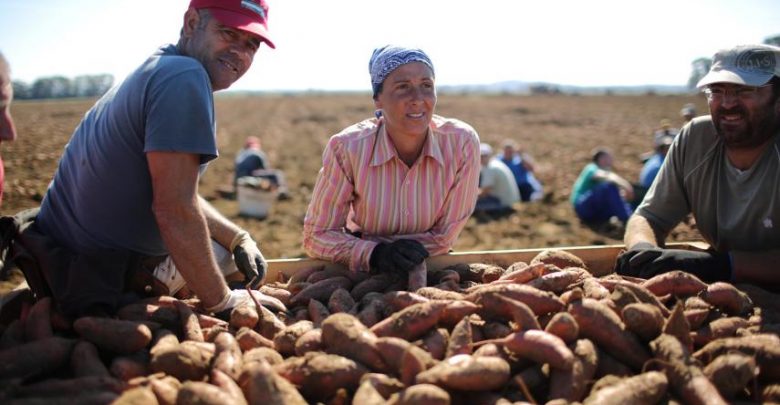
Migrant workers in a sweet potato plantation in Jerez, Andalusia. (Source photo: Juan Carlos Toro, La Voz del Sur)
The SAT “cannot endorse an agreement where you give up the 15 minutes sandwich break, a workers’ victory from a long time back, which has been respected for generations, even during the Franco regime. An achievement that the employer, Asaja, has always wanted to eliminate and has succeeded now thanks to the betrayal of bureaucrats who never got their hands dirty or set foot on the field in their life”.
To this, adds the union, “you cannot endorse a de facto wage loss since the Pyrrhic rise of 1.25% per year does not compensate for the loss of the 15-minute sandwich break, which amounts to 3.8%. In other words, in reality, what CCOO has signed is a salary reduction of two and a half points” (per cent). “This is an outrage and a complete betrayal. There is no other name for it. We would like to say something very different, but above all our duty is to the workers who have been sold and betrayed once more”, they added.
The situation in the Andalusian countryside and the province of Seville, in particular, where some 120,000 people work in the sector, is very precarious. The economic crisis has hit the countryside and its workers hard. The working conditions implemented in the Andalusian countryside, according to the SAT, “seem from other times, thankfully now past.” Breach of agreements is the rule, piece-work predominates, which sometimes means that after a long day of work you only take 20 euros home, well below the salary established in the agreements.
Map showing Andalucia region (in red), Spanish State (in cream) also Canaries and part of coast of North Africa. (Source image: Internet)
There are situations, they add, where fraud is evident by not declaring the workers employed. A fraud that can make a millionaire, since it can mean millions of undeclared euros that put health, pensions and our social protection system at risk. In addition to situations of genuine exploitation of workers — which in many cases border on pure slavery — there continues to be a significant reduction in income to Social Security, as well as a smaller amount of peonages that subsequently give the right to recognition of the subsidy and other benefits (? — Trans).
The reality that is being imposed not only affects labour rights, it is also “strategic suicide”. “The reality,” explains SAT, “is that with these mafia practices they are dropping the market price, so the product loses added value and undermines the market. The final result is to depreciate the product having a direct impact on the living conditions of day-labourers and on the economy of the towns. There have been innumerable complaints filed in the Labour Inspectorate, some of which have led to criminal proceedings being taken for crimes against the rights of workers.”
Accordingly, an Andalusian agreement that puts in place a minimum is necessary and urgent: six hours of work (sandwich break included); 60 euros for the normal working day; 84 on Sundays and holidays; effective ban on piece-work; wage of 69 euros for work with machinery; 96, on Sundays and holidays; on rainy days (when work is not possible) 50% will be paid for showing up at work, and the full wage from two hours of work; 0.27 euros mileage.
It is fundamental, they state in concluding their communiqué, to establish “a common front to fight for an Andalusian agreement with these minimums. It is also necessary and urgent to change the system of union elections in the field, a measure approved in the Congress of Deputies, and grant voting rights to non-permanent workers who represent more than 95% of the workforce in the Andalusian countryside.”
COMMENT:
Diarmuid Breatnach
The CCOO, Comisiones Obreras is one of the two mega-unions in the Spanish State, the other being the UGT. The CCOO was controlled by the Communist Party of Spain (PCE) and the UGT by the social-democratic PSOE; both parties and their affiliated unions were outlawed during Franco’s time. When the Transition to “democracy” was being engineered after Franco’s death, it was considered necessary to legalise the PSOE in order to have a two-party system and therefore necessary to legalise the UGT. However, it was the other way around for the CCOO and the CP. The Comisiones Obreras were by far the largest and most militant trade union and, though illegal, had built up a substantial following among the workers of the Spanish State. To effect as smooth a Transition as possible, it was crucial to legalise the CCOO and therefore to bring the Communist Party on board. Both political parties agreed to a deal, including recognising a monarchy with a King chosen by Franco and publicly supporting a forced union of all nations within the state by a new constitution.
The southern Basque Country and Galicia have a majority of unions of their own nation but everywhere else within the state, the CCOO and the UGT have the majority of workers as members and the majority of elected representatives. Although the CP’s control of CCOO has slipped over the years, the UGT is still strongly associated with the PSOE. There are also some independent trade unions, like the SAT above and also some others based on specific work locations.
SAT has a history of militancy, fighting for its mainly agricultural work force in which, as it states above, the vast majority are migrant workers. The union also campaigns for efficient and socialised use of Andalusian land, much of which is owned by banks and left empty; in addition its spokesperson was arrested last year for “insulting the Monarchy”. It is worth remembering that Andalusia was in medieval times the famed Moorish caliphate of Al Andalus, in many ways the jewel of the Iberian peninsula.
When Franco’s troops were ferried to Andalusia from the Canaries by German Nazi transport, largely without armed opposition in 1936, they butchered 55,000 republicans, socialists, communists, communists, trade unionists and anti-fascists.
As soon as the “Transition” went through after the death of Franco, the PSOE was voted into power in the Andalusian regional government, where it has held the absolute majority ever since – until the regional elections this year. Years of corruption and complacency saw its voting base diminish and, though it still holds the most seats, a right-wing coalition of the Partido Popular, Ciudadanos and Vox, all of which can trace their origins to Franco, has taken over. Many observers think is therefore all the stranger that the CCOO should bring in this agreement at this time.
Report by RAÚL BOCANEGRA in Publico.es (translation and comment by Diarmuid Breatnach).
Mass grave of victims of Francoist repression, Burgos. (Photo source: Internet)
“The City Council of Seville has guaranteed on its own to provide the necessary funding — 1.2 million euros — to exhume the Pico Reja pit, in which historians believe that there are at least 1,103 bodies of of victims of the repression, led by the General Queipo de Llano, following the military coup of July 18, 1936.
This exhumation will be the largest ever to be undertaken in Spain, following that which that was carried out in Malaga, in the San Rafael Trench, between 2006 and 2009, and may indicate the path to take for the other capitals (of Spanish state regions – Trans).
The Mayor of Seville, Juan Espadas (PSOE), guaranteed that the grave will be exhumed throughout the mandate of the current Council. “It is a truly historic step in Seville and one of national importance, since it is perhaps the biggest mass grave that [at this moment] has a definite project for its exhumation,” the Councilor said at a press conference.
“And, therefore, it is also one of the most important projects in terms of Historical Memory to be undertaken in our land, due to the importance and volume of the Pico Reja mass grave. It was a commitment that this Government (i.e of the Andalusian region) gave during the past mandate to relatives and memorial groupsand today it is made a reality with this tender,” added Espadas.
“Next Friday the City Council of Seville, through the Governing Board will approve the specifications and, therefore, the public tender for a technical service for the exhumation and genetic identification of the bodies of the Pico Reja mass grave, in the Cemetery of San Fernando,” reads a statement issued by the City Council. “The ultimate goal [of the exhumation] is to dignify the memory of the people who were thrown there, give them a dignified burial and attend to the requests of their families,” adds the Council (statement – Trans).”
Militia Women of the Anarchist FAI -CNT in Catalonia, early years of the Spanish Anti-Fascist War. Women in areas captured by the Franco forces were exposed to endemic rape and many female prisoners were shot after being raped. (Photo source: Internet).
BEGINNING AND COMPLETION OF WORK
“Accordingly, Espadas will not wait for the Council of Andalucía or the Regional Government to sign the agreement, to which they had committed themselves. Confirming now, at the start of the mandate, the works, the Mayor ensures that the exhumation will not be delayed and will be carried out throughout this term. Municipal sources assured Público of their belief that both the Council and the Andalusian Government will collaborate with the exhumation, the Andalusian Council not before September.
Should they contribute money, the amount would be deducted from the 1.2 million that the Council calculates as necessary to carry out the works. Espadas recalled that the signing of an agreement in this regard with the Board and the County Council to finance these works is still outstanding. “And let’s hope that it is signed as soon as possible.”
“This contract guarantees the beginning of the work and its conclusion, without waiting for the remaining public administrations –- provincial, Andalusian and national — to finalise their contributions,” reads the Council’s note.
Espadas and the Delegate for the Department for Equality, Education, Citizen Participation and District Coordination, Adela Castaño, related the details of this contract to relatives of the victims and to the different organisations involved in the area of Historical Memory in Seville. “Do not fear, the exhumation and the identification of bodies will be done,” the Mayor assured them.
THE DETAILS
The company that gains the contract must include at least one historian, five professionals in Forensic and Physical Anthropology, five in Archeology and 10 auxiliary support workers. “With the maximum guarantees of scientific rigor, a survey will be performed, material collected on the surface, excavations made in the pit, exhumations and recovering of bodies and remains,” says the City Council in the note. “Likewise, it must preserve and safeguard, also with all scientific guarantees, the samples of bone remains and biological samples taken from the family members until delivery to the University of Granada for genetic identification,” the City Council insists.
The project will be be completed in three phases, explained the Council. The first concerns the exhumation itself and the identification of the bodies, along with works including: the archaeological excavation; dealing with the remains found (the excavation and the direct and individualized identification of these bodies will determine whether or not they are relatives); exhumation (identification, recording of traces of violence and individual extraction of each body or remains); forensic anthropology (that is, determining sex, age, pathologies or anomalies); anthropological analysis in a laboratory manner; and conservation and protection to preserve these skeletal remains and DNA analysis.
The second phase will consist of the presentation of a final report as a logical contribution to the history of Franco’s repression. And the last phase will be the final destination of the remains.
The City Council will respect at all times the wishes of relations about the identified remains. The unidentified remains and those which the relatives wish to remain in the same place, “will be buried in an authorised space with appropriate technical indications for future identification”.
After finishing the works, “the area will be restored as an expository and explanatory site of the historical significance of the Pico Reja pit”. The successful bidder must submit a proposal for reconstruction of the current site that includes a columned monument to honor the victims.
Exhumation work on mass grave of Franco’s victims in Burgos. (Photo source: Unai Aranzadi)
COMMENT:
(Diarmuid Breatnach)
According to official figures, 120,000 victims have been identified (not exhumed) from 2,591 unmarked graves around the Spanish state. The areas with the largest number of graves are Andalusia in the south and the northern regions of Aragón and Asturias – in Andalusia alone, 55,000.
Map of grave sites of victims of Francoist repression in Andalucia (Photo source: Internet)
A mapping work undertaken by the Council of Andalusia region, which was presented publicly in the regional capital in 2011, illustrates 614 mass graves in 359 Andalusian municipalities. Only around half of the 47,000 bodies that were discovered have been identified due to there being no relatives available for DNA tracing or because calcium oxide (quicklime) had been thrown over the bodies.1
“In Malaga province alone there are 76 mass graves in 52 towns, containing the remains of 7,471 people who were killed by General Franco’s forces. The largest of these mass graves was discovered in Malaga city’s San Rafael cemetery. 2,840 bodies were exhumed in early 2010, although more than 4,500 are registered as having been buried there”.2
The usual figure given for the total of non-combat killing by Franco’s forces is 150,000 and which does not include those who died of malnutrition and lack of adequate medical care in prisons and “penal battalions” or through confiscations, or economic and financial sanctions in areas occupied by his forces. Nor does it include the civilian victims of bombing by military-fascist air force, whether of cities or of refugee columns.
Against that, the total figure for non-combat killings by the forces against Franco are estimated at around 50,000. Also, while the latter killings for the most part took place in the early months of the military uprisings, before Republican Government control could be established, most of the non-combat killings by Franco’s forces were carried out after they had beaten the resistance and occupied the area and much of it also after the war was over. Typically too, according to Paul Preston (The Spanish Holocaust (2012), Harper Press), women were routinely raped before they were shot.3
The issue of the executed after a cursory military trial or simply taken out and murdered by Franco’s forces is a live one in the Spanish state today. Before Franco’s death it was not even possible to discuss it publicly and bereaved relatives were not permitted to mourn publicly – to hold a funeral or to have a mass said for their souls according to Catholic custom or even to mark their graves.
The Transition process to convert Franco’s Spain into a “democracy” accorded legal impunity to the perpetrators of even the worst atrocities during the Civil War but unofficially extended beyond, to the years afterwards and even to murders carried out during the “Transición” itself. And why not, when all the upper echelons of police, army, judiciary, civil service, Church, media and business were and are for the most part the same people as before — or their sons and daughters? When the Head of State and of the Armed Forces, the King Juan Carlos, was specifically chosen by Franco to be his successor and even after the Dictator’s death glorified him and his political trajectory.
‘LET THE DEAD STAY BURIED’
The fascists and their descendants want the dead and their stories to stay buried and even when a very senior judge like Baltasar Garsón, who presided over the repression and torture of many Basque and Catalan political detainees (but is incredibly lauded as “a foremost human rights defender” by liberals!) decided to play a power and publicity game and and became a problem by authorising the opening of some mass graves in 2012, he was slapped with legal appeals, charges of wire-tapping and disbarred from office for 11 years.
The other graves they don’t want opened are the mausoleum of Franco himself and of Rivera, founder of the Spanish fascist Falange, who lie in the memorial park built by political prisoner slave labour to honour Dictatorship and Fascism, a shrine for fascists today. The order of the PSOE Government to exhume and transfer them to a family graveyard has been paralysed by the Spanish Supreme Court after protests by Franco’s descendants.
If the Pico Reja exhumation in Seville goes ahead and is properly documented, it will be as the PSOE-controlled Seville City Council says, of huge historical — but also of huge political – importance. Can this happen in the same region where the corrupt PSOE administration has lost power after decades without se
The “Valle de Los Caidos” memorial park, constructed by slave prisoner labour, which contains the mausoleum containing the bodies of Franco and Rivera (Photo: Paul Hanna, Reuters)
rious challenge and is now ruled by a de facto coalition of all the main parties descended from Franco, the Partido Popular, Ciudadanos and Vox? The Seville City Council says it can and that if necessary they will fund it all themselves. We can hope.
The first great collective victory of the ‘riders’ against Deliveroo.
A judgment of the Social Court No. 5 of Valencia recognizes the existing contractual relationship between Roodfoods Spain S.L.U., parent company of the British multinational, and 97 delivery riders of València.
(Valencia is in the Paisos Catalans region but not part of the Catalonia region — Translator(
Translated from article in Castillian of PILAR ARAQUE CONDE @ pilarac4 in the on-line newspaper Publico by Diarmuid Breatnach.
The complaints presented by Social Security’s General Finance in different courts against the Deliveroo labour model begin to be resolved. A judgment from Social court No.5 of Valencia ruled that 97 riders of the delivery company are employees and not self-employed, this being the first great collective victory of the workers of the platform Riders x Drets (Riders for Rights) and Intersindical Valenciana, according to the collective’s statement on Thursday.
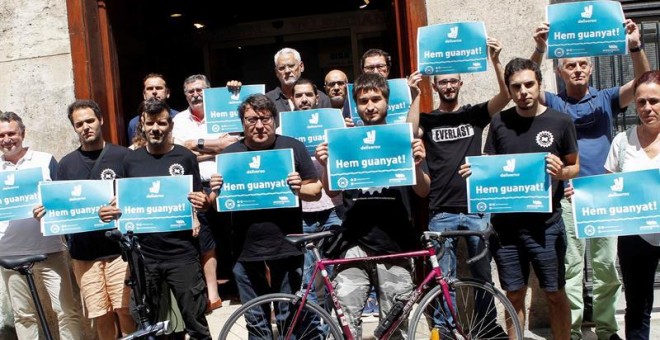
Some of the Riders for Rights, now recognised as employees of Deliveroo, pose for a photo. (Source: Publico)
Last year, Víctor Sánchez became the first worker in Spain to obtain a final judgment against Deliveroo, after Social court Number 6 of València declared his dismissal “unfair”. Deliveroo then accepted the ruling that for the first time questioned the legality of the business model of the distribution firm, maintaing that the riders are falsely self-employed.
The titular magistrate of Social Court No. 5 of València now recognises the existing contractual relationship between Roodfoods Spain S.L.U., the company that owns Deliveroo, and the 97 workers in Turia city. The ruling states that the workers “provide their personal services, inserted in the business organization to which the means of production belong – Deliveroo’s digital platform – according to the criteria and distributions that it establishes and assigns, receiving remuneration, which also establishes the company “, according to the text accessed by eldiario.es.
The judge adds that “the real means of production in this activity are not the bicycle and the mobile phone that the rider uses, but the digital platform of matching supply to demand owned by the company and without which which the provision service is not feasible”. In this way, Deliveroo is the one who determines the orders and schedules of the workers, and not the employees themselves, despite being categorised and taxed as self-employed.
“It is intended that the rider is free or not to accept an order without unfavorable consequences, but it was proved that the service of the rider is valued at different grades, which obviously will be taken into consideration by the order allocation algorithms” explains the judge. And she refutes the argument used by Deliveroo: “The fact of being able to reject orders does not constitute a capability or power that can condition the business activity,” he stresses.
SEVERAL PENDING LAWSUITS
The ruling, made public this Thursday, responded to the lawsuit filed in April 2018 by Social Security against Deliveroo, following a notification from the Labour Inspectorate. The state agency claimed more than 160,000 euros for Social Security contributions that were not paid by the company. Later, the Labour Inspectorate offices in Madrid, Barcelona, Alicante and Zaragoza, among other cities, did the same in the various courts.
Social Court No. 29 of Madrid will be the next to rule on whether these workers should be considered salaried employees of the British multinational and not self-employed, since the trial, which affects more than 500 delivery people in the region, was held for sentencing on May 31st.
GLOVO’S LABOUR MODEL, ALSO CHALLENGED
Glovo’s labour model has also been challenged before the courts. In this case, several judgments have determined that the company’s distributors had an “employment relationship” with the company and ordered their reinstatement.
This digital platform is also involved in the controversy after a worker died when being run over by a garbage truck while delivering. The young man, 23 years old, “was not a collaborator” of Glovo, although he carried its backpack. His death sparked protests about the precariousness of the sector.
And the fact is that Glovo, Deliveroo and Uber Eats continue to operate without a regulation that guarantees the rights of their workers. Also, taking into account that the number of employees in the sector is around 17,000, UGT (one of the major trade unions in the Spanish state – Translator) estimates that Social Security loses a potential 93 million per year due to this situation, figures that it estimates will be three times greater in 2020.
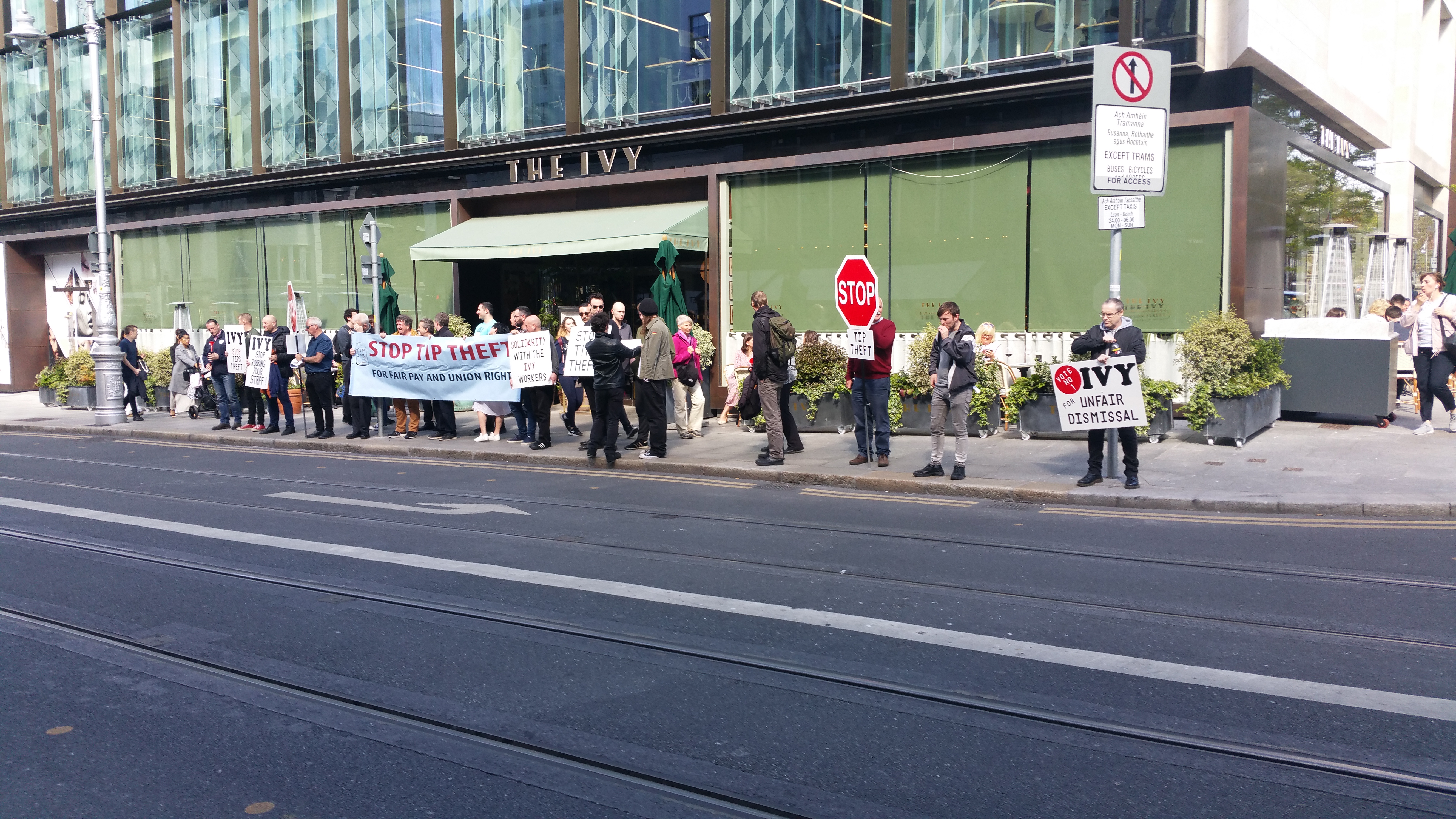
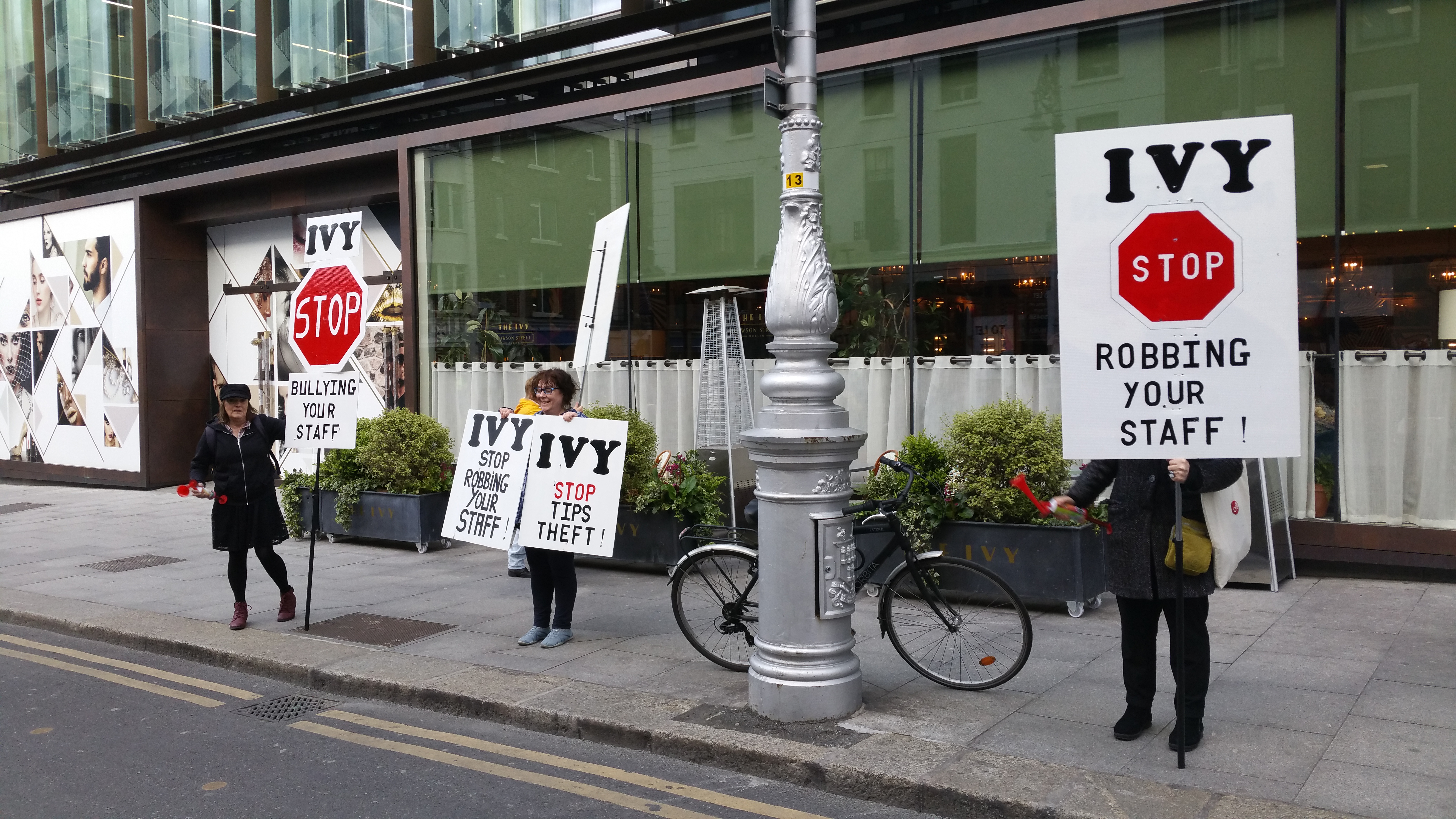
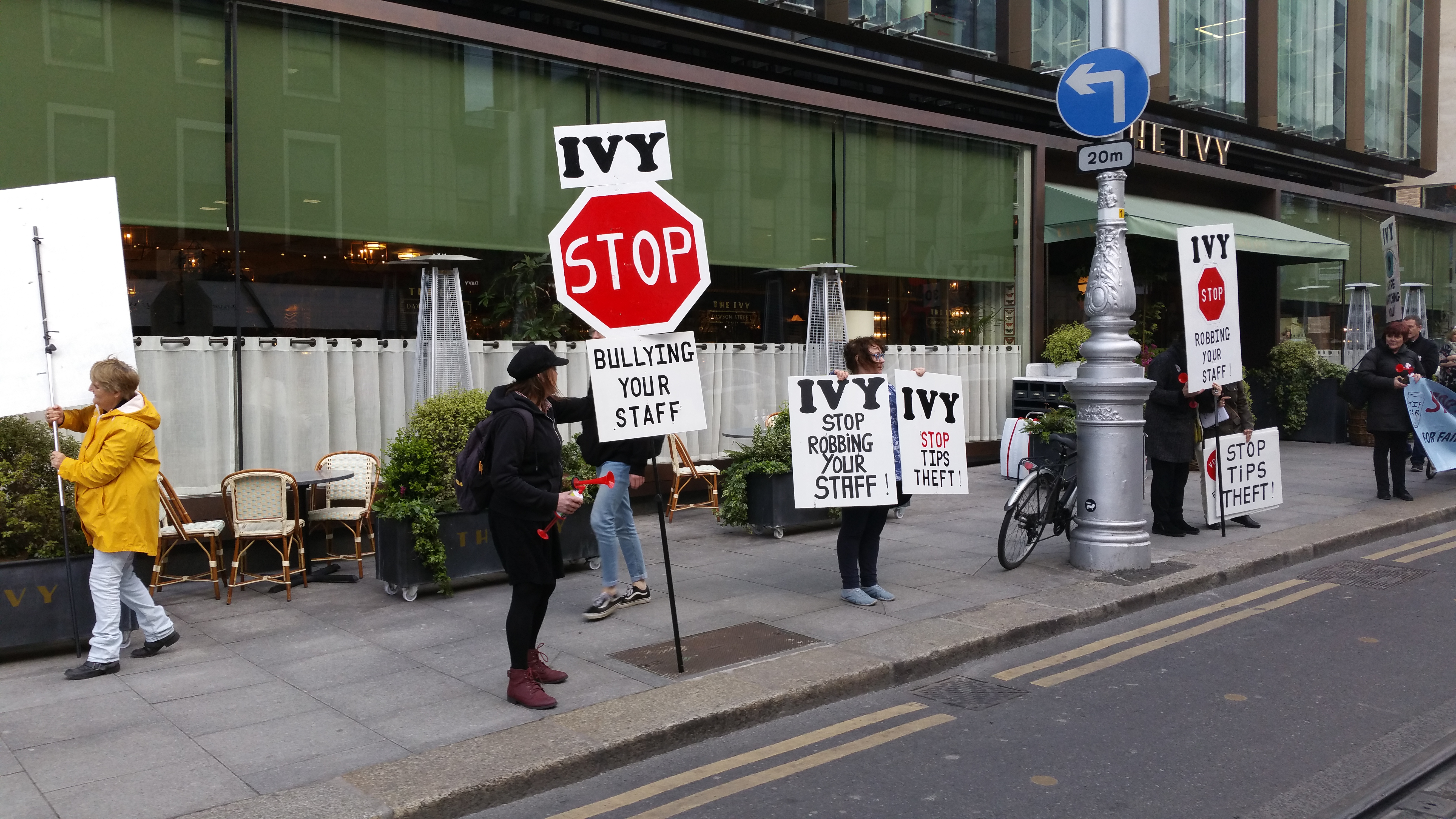
Solidarity protest picket lines up outside the The Ivy restaurant in Dublin city centre’s Dawson Street and, as management draw the blinds to hide the event from their customers, passers-by take photos and passing traffic sound horns in solidarity.
Solidarity protester with placard outside the Ivy Restaurant on Saturday. (Photo image: protester)
On Saturday afternoon (8th June) round a score of men and women participated in a picket outside the The Ivy restaurant in protest against management deducting a percentage of the waiting staff’s tips. The management are able to take this action when customers pay by bank card for their meals as well as the service charge. The protesters were also in solidarity with two sacked workers who protested the practice.
The business pays minimum wage every day except Sunday and staff expect to make a decent wage up from tips ….. but, much of the tips money is being taken by the management.
Picket line outside The Ivy restaurant on Saturday afternoon. (Photo: D.Breatnach)
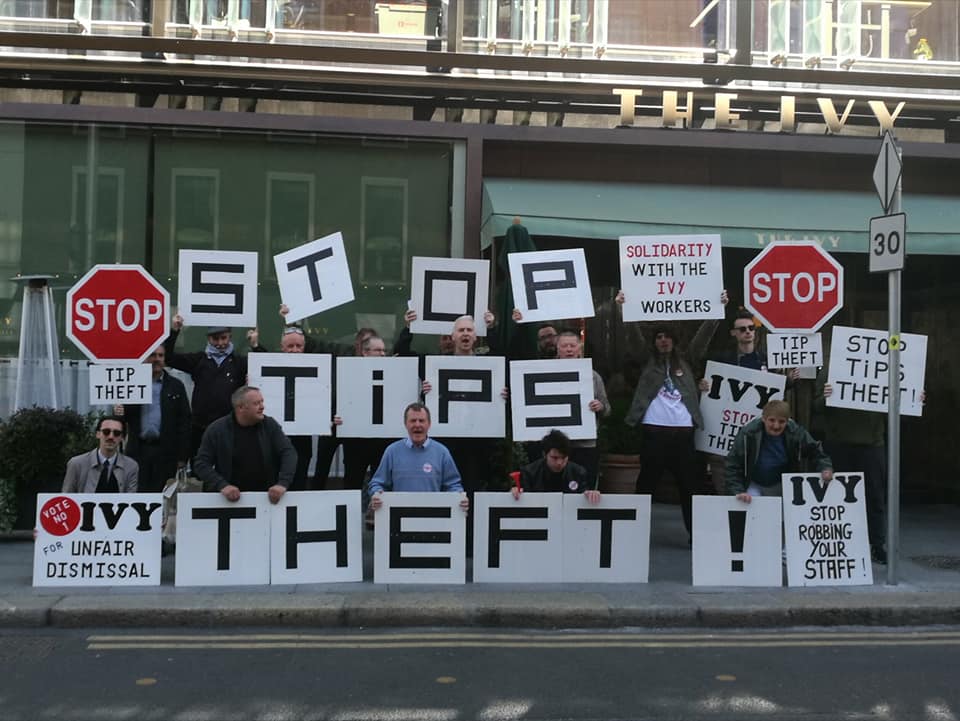
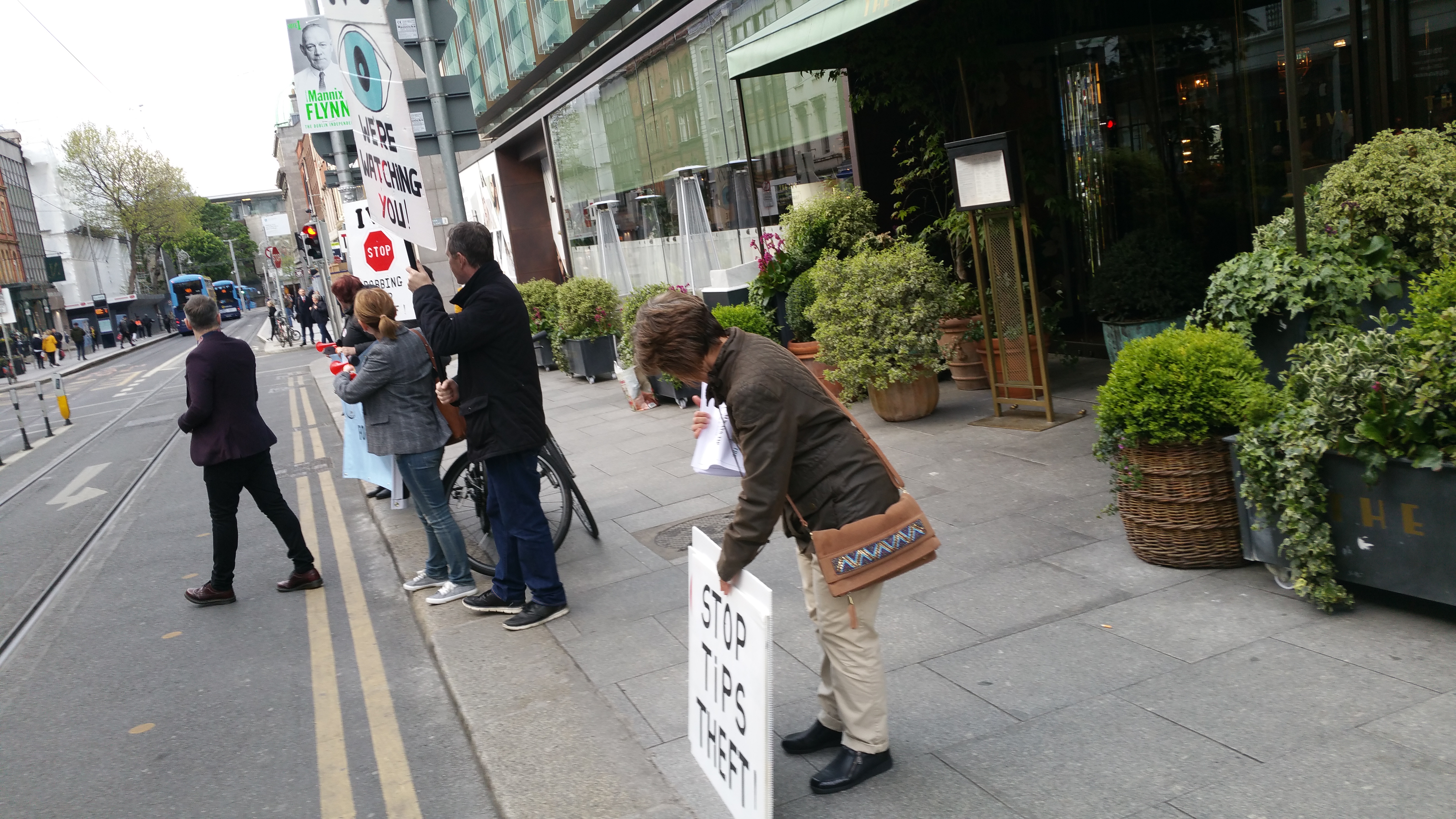
The protesters held up large placards bearing the slogans: “Ivy: stop robbing your staff!”, “Vote Ivy No.1 for unfair dismissal”; “Ivy, stop tip theft!”; “Solidarity with sacked workers” and also displayed a banner which, as well as reading “Stop tip theft” also called for “fair pay and union rights”. The picketers later also held up large letters to display the message STOP TIPS THEFT.
Dawson Street, in which the Ivy Restaurant is located, is an upper-class southside city centre street of mostly old architecture, filled with eateries, art galleries and bookshops and also containing the Mansion House, a historic building and the Lord Mayor’s business residence. It is one of two public bus routes from the south-east into the city centre and also contains a LUAS (tramline) stop.
Section of picket seen closer and front door of The Ivy (note the blinds!) (Photo: D.Breatnach)
Drivers of a number of passing private and public transport vehicles sounded their horns in solidarity while passing the picket while tourists and others took photos and promised to post them on social media. A number of tourists from the Spanish state asked about the protest and I when I explained, were fully supportive.
Since I participated in this protest myself, I was able to identify participants from a range of political allegiances and independents and they included a number of recently-elected Dublin City Councillors (a previous picket I wrote about included a TD – member of the Irish Parliament).
ONGOING STRUGGLE
This controversy has been going on for some time and has been reported in the Irish Times (see Links and References). Since the protests began, management of the once-highly-patronised restaurant had blinds installed so that they could shield their customers from the sight of the picketers but even so, they could not avoid hearing the bullhorns and the chanting outside.
Chants included “Shame, shame, shame on you; pay the workers what they’re due!”
Reports indicate that business at the restaurant in fashionable Dawson Street is down by as much as 40% on many days which bodes ill not only for the restaurant at present but also if the owners try to sell it, since the reputation associated with the business will be of a negative kind.
Catering workers through much of the world are typically unorganised into trade unions, have insecure employment, are often immigrants to the country and are particularly vulnerable to extra exploitation. Ireland is no exception to this rule and there are many examples of it in Dublin. Campaigners for better conditions of employment and pay for catering workers are aware that the Ivy is one among many but hope that breaking the tip-deducting practice at this high-visibility eatery will spread a beneficial effect around the rest of the industry.
Meanwhile the two workers sacked by The Ivy are awaiting their day in the Labour Court.
DISCURSO DEL COMÍTE ANTI INTERNAMIENTO DE DUBLÍN PARA LA CONMEMORACIÓN DE PASCUA ABRIL 2019
A Chomrádaith agus a chairde, go raibh maith agaibh (“Companer@s y amig@s, gracias”) al Acción Anti-Imperialista de Irlanda por invitar al Comité de Anti-Internamiento de Dublín a hablar en este evento.
Tradicionalmente este es un tiempo cada año de conmemoraciones.
Conmemoramos en primer lugar a las mujeres, hombres y chicos que salieron a luchar contra un Imperio, el más grande jamás conocido y, en ese momento, el militar más poderoso del mundo. Algun@s lucharon solo por la independencia de Irlanda, much@s lucharon también por la justicia social y otr@s lucharon contra la guerra imperialista. El nuestro fue el primer alzamiento contra la carnicería de la Guerra imperialista y el mundo tuvo que esperar un año antes de que hubiera otro, en Rusia, y dos años antes del alzamiento espartaquista en Alemania.
Pero también conmemoramos a aquell@s much@s otr@s que lucharon y much@s que dieron su vida contra el invasor a través de los siglos, contra el colonizador, los ladrones de tierras, contra la monarquía inglesa por una República, contra los traidores de la causa de la independencia, contra los Gombeen (capitalistas nativos). Los gobernantes de nuestro propio Estado y los gobernantes coloniales de la colonia inglesa restante en suelo irlandés.
Es correcto y apropiado conmemorar los hechos heroicos y el sacrificio del pasado.
Pero no se trata solo del pasado; también se trata del presente y del futuro. A chomrádaithe (“companer@s), la lucha aún no está terminada y sus objetivos aún no se han alcanzado. Vivimos en un país dividido por una frontera británica y también dividido entre ricos y pobres, donde una pequeña minoría de explotadores vive de los trabajadores y de la clase media baja, convirtiendo la miseria de much@s en los euros y libras de unos pocos.
A medida que el fascismo asoma su fea cabeza y destapa sus sangrientos colmillos nuevamente por todo el mundo, nuestros gobernantes aquí en Irlanda también se vuelven cada vez más a la represión. Recordamos a los que están en juicio ahora por oponerse exitosamente al lanzamiento del fascista Pegida en Dublín en 2012. Y los partidarios del Sinn Féin Republicano atacados en Newry mientras conmemoraban el mismo Alzamiento de 1916 el año pasado, también en juicio ahora, una repetición de los ataques del RUC bajo la Ley de Poderes Especiales. Y las redadas en los hogares de much@s republican@s de otras organizaciones a lo largo del año. Y aquellos que languidecen en la cárcel después de la condena por cortes especiales sin jurado en ambos lados de la Frontera.
Parte del arsenal de la represión ha sido tradicionalmente el internamiento sin juicio. Y camaradas, tras el Alzamiento de 1916, hubo una gran ola de detenciones en Irlanda. Más de 3.500 hombres y mujeres fueron arrestados y se dictaron noventa sentencias de muerte, aunque más tarde todas menos 16 fueron conmutados. 1,852 mujeres y hombres fueron internados en campos de concentración y prisiones en Inglaterra y Gales.
Los británicos recurrieron nuevamente al internamiento durante la Guerra de la Independencia, al igual que los gobiernos irlandeses durante la Guerra Civil y en los años 30 y 40, y los británicos en los Seis Condados en los años 70. Eso fue internamiento masivo, pero el internamiento continúa hoy de forma más selectiva, a través de la revocación de la licencia para ex presos y la negativa de la libertad a fianza para otros. Tod@s l@s republican@s deben oponerse a esta práctica represiva y no solo l@s republican@s, sino también l@s socialistas y, de hecho, todas las personas democráticas. La historia muestra una y otra vez que lo que el Estado se sale con la suya contra un grupo, lo usa más tarde contra otro.
El Comité contra el internamiento de Dublín se esfuerza por celebrar un piquete mensual de información en diferentes partes de Dublín y un evento anual en Newry. No somos sectarios y somos independientes de cualquier partido u organización política, lo que significa que TODAS las organizaciones republicanas deben apoyar nuestros eventos, ya que el internmiento nos afecta a todos. O nos oponemos juntos a la represión estatal, camaradas … o vamos a la cárcel por separado.
AN GORTA MÓR COMMEMORATED IN SLIGO, DUBLIN AND CELTIC PARK
(Reading time of article text: 5 minutes)
Clive Sulish
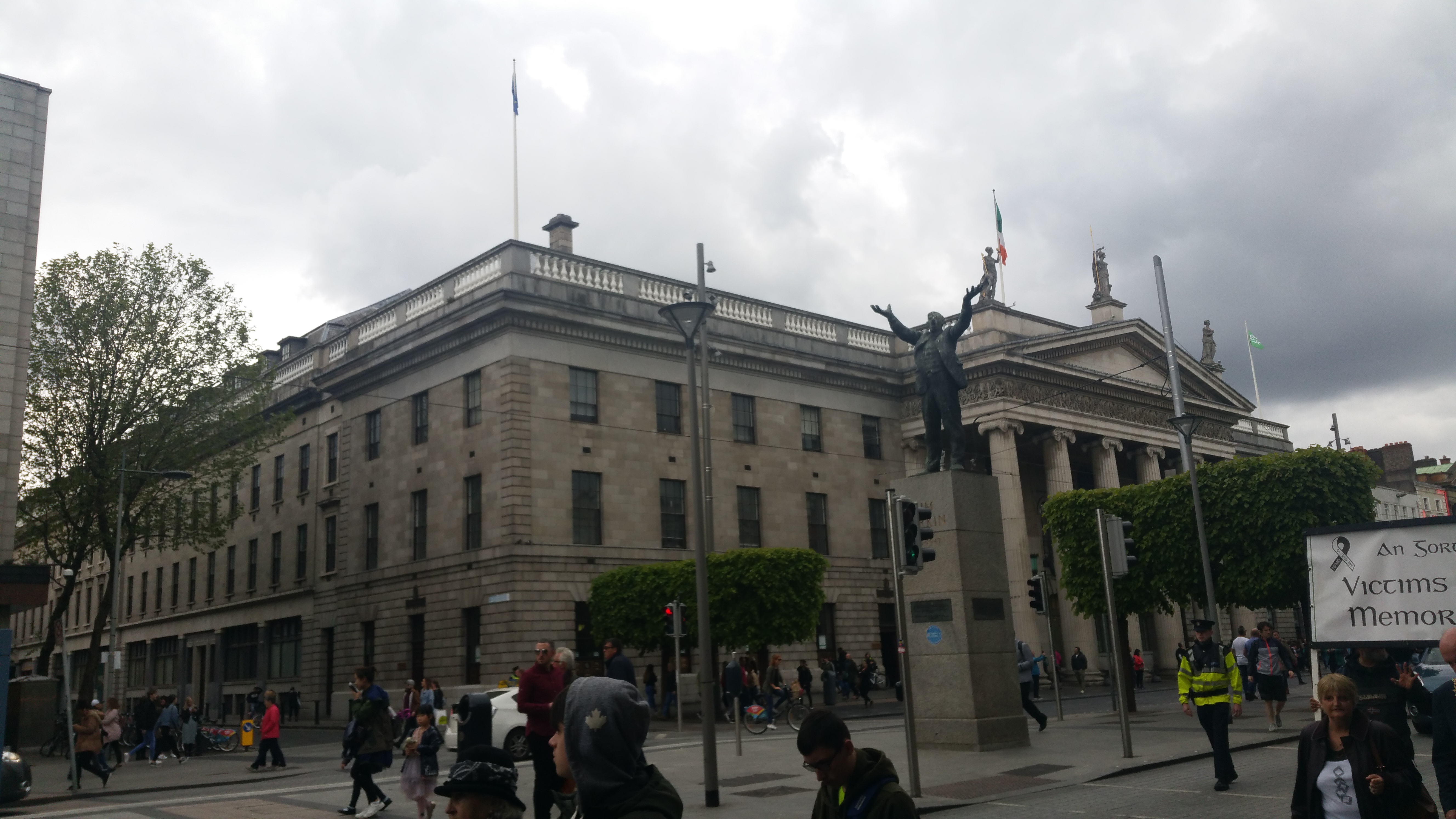
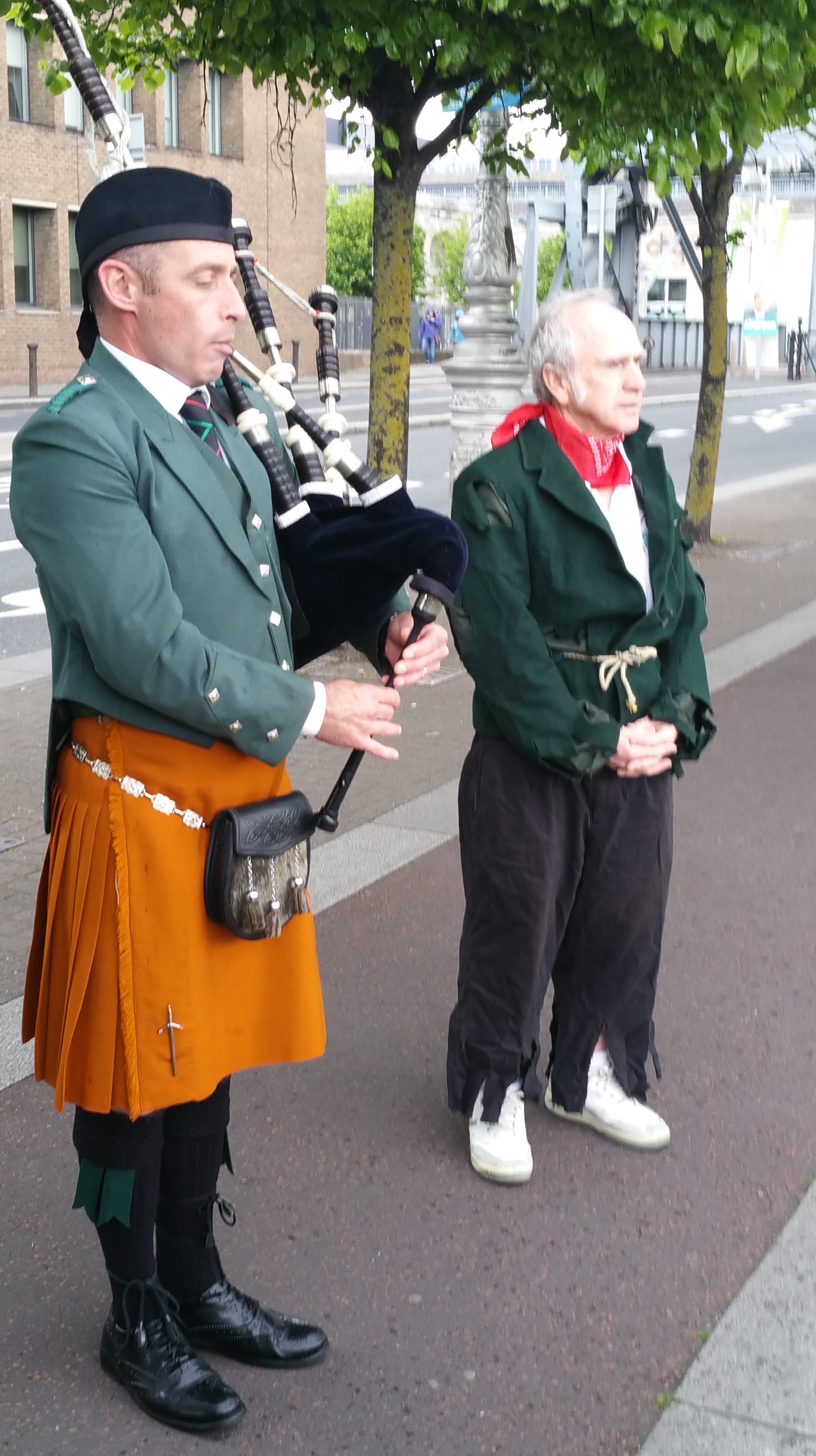
Michael and Olivia Blanch and piper halt the procession for a moment’s reflection outside the GPO building, HQ of the Easter Rising in 1916.
A small crowd gathered at the Garden of Remembrance, Dublin on Sunday afternoon to commemorate the Great Hunger, an Gorta Mór on National Famine Day. Led by a lone piper, they marched through O’Connell St., the city’s main street, some of them in period costume, to the Great Hunger Memorial on the Custom House Quay, North Dock and later on to the iconic sailing ship, the Jeannie Johnson.
Participants proceed after a moment’s reflection at the GPO building, HQ of the Easter Rising 1916 and pass by Jim Larkin’s monument, “who also agitated for the poor of Dublin”.
With some adults and children dressed in period clothes, some of them tattered to represent the destitution of the starving poor, they marched down O’Connell Street led by the lone piper and turned left at the Bridge, proceeding along to Custom Quay’s North Dock and the Great Hunger memorial. There they were addressed by Michael Blanch of the organising committee and by Niall Ring, Lord Mayor (coming to the end of his year in that role), who had accompanied them from the Garden of Remembrance.
Lord Mayor Niall Ring speaking at the Famine Memorial.
Some sentences in Irish were spoken by the MC of the event and by the Lord Mayor, while Michael Blanch referenced the deadly impact the Great Hunger had on the Irish language (i.e with the depopulation of the main Irish-speaking areas of the western seaboard). The Irish Tricolour came in for a mention in the Dublin commemoration also; it had been presented to William Smith O’Brien by women in Paris during the revolution there of 1848 and the Young Irelanders had staged their own uprising that year also, small and certainly too late, easily crushed by the British colonial forces. The huge Irish diaspora was also mostly a result of the Great Hunger and had contributed significantly to the formation and membership of the Irish Republican Brotherhood, also known as the Fenians, founded simultaneously in 1858 on St. Patrick’s Day in Dublin and in New York. The IRB, in turn, had been the main driving force behind the 1916 Rising.
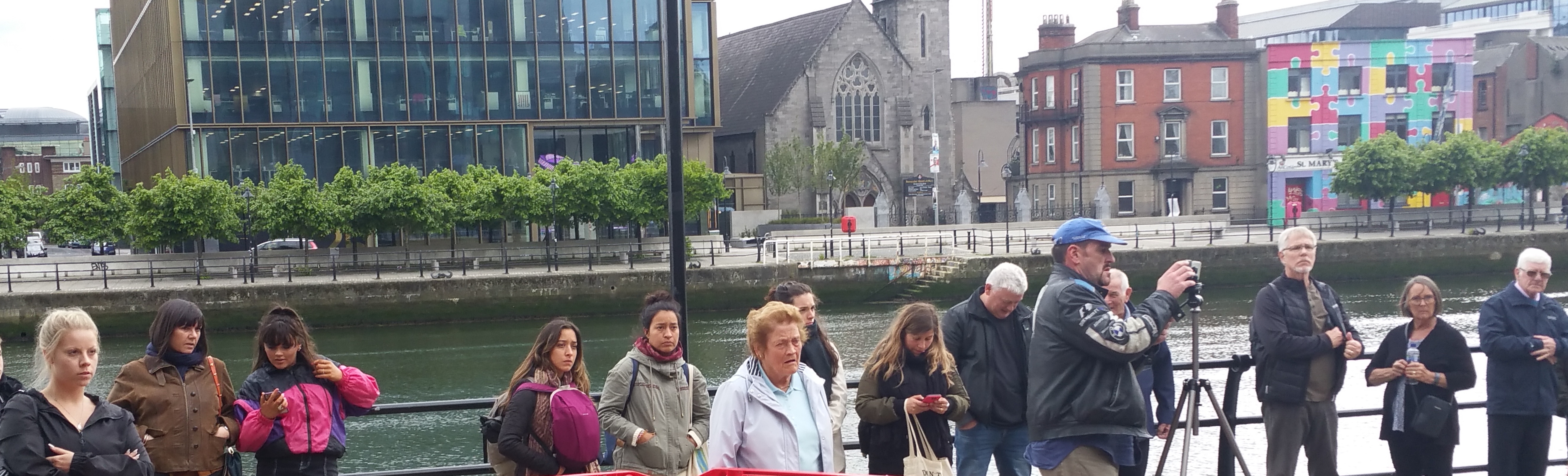
Section of crowd at Famine Memorial (and unintentional illustration of clashing architectural styles and building heights on the south quays opposite).Piper playing lament and Michael Blanch at the Famine Memorial.Michael Balanch and MC of proceedings at the Famine Memorial and banner of the Committee.
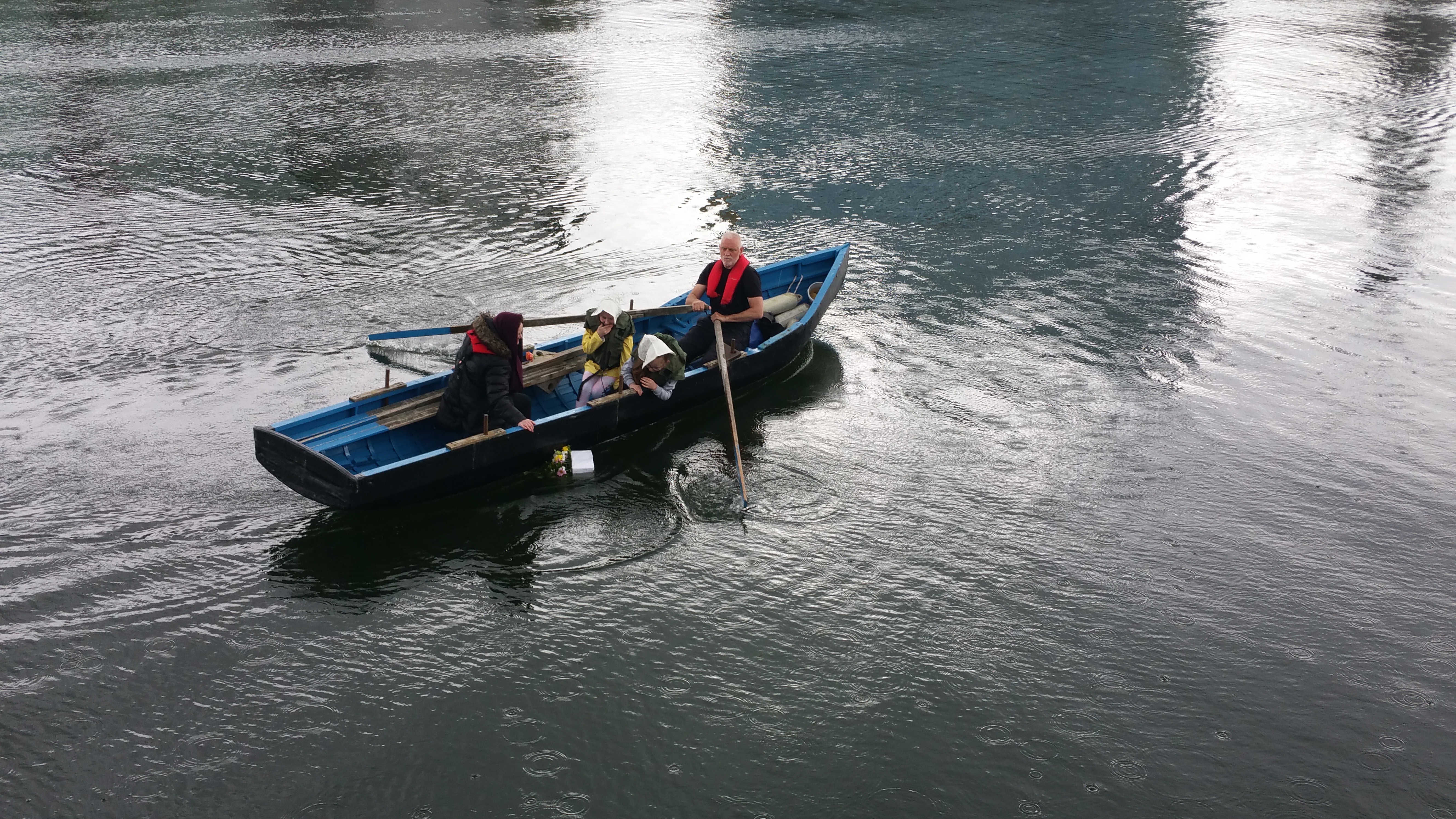
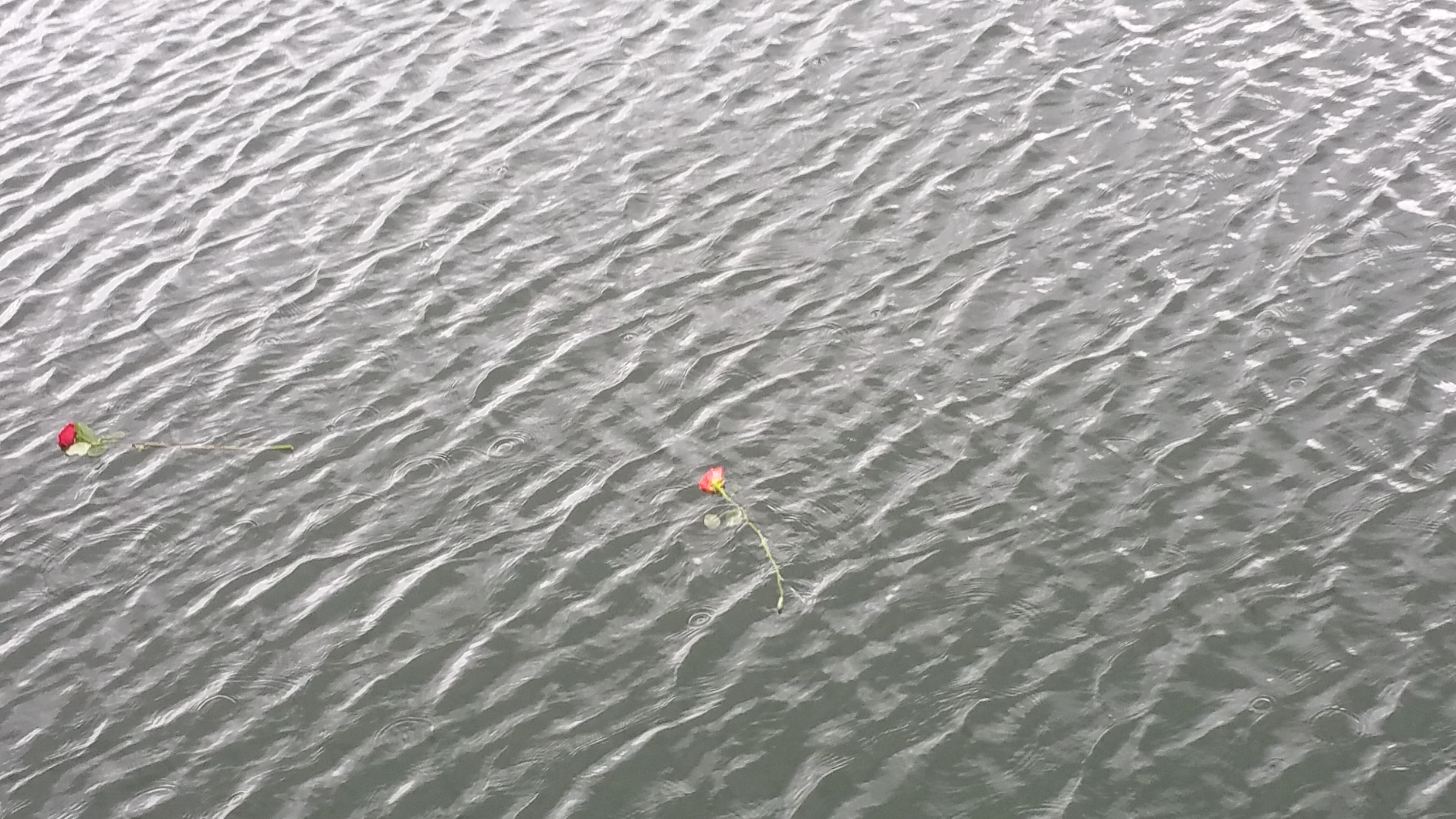
Tourists and other passers-by stopped to watch as wreaths were laid on on the statues of the monument and an Irish-language version of Amazing Grace was sung by a young girl in period costume. A currach (small traditional Irish sea-craft), containing a woman and two young girls in period costume and rowed by a man, pulled into place on the Liffey across from the group; one of the girls placed a wreath in a cardboard box into the river, to commemorate the Irish diaspora and those who had perished during their journeys. Participants then threw single red roses bouquets into the river also and floral wreaths were deposited around the statues of the 1977 memorial by sculptor Rowan Gillespie. And the piper played a lament, Hector the Hero.
Girl singing “Amazing Grace” in Irish.
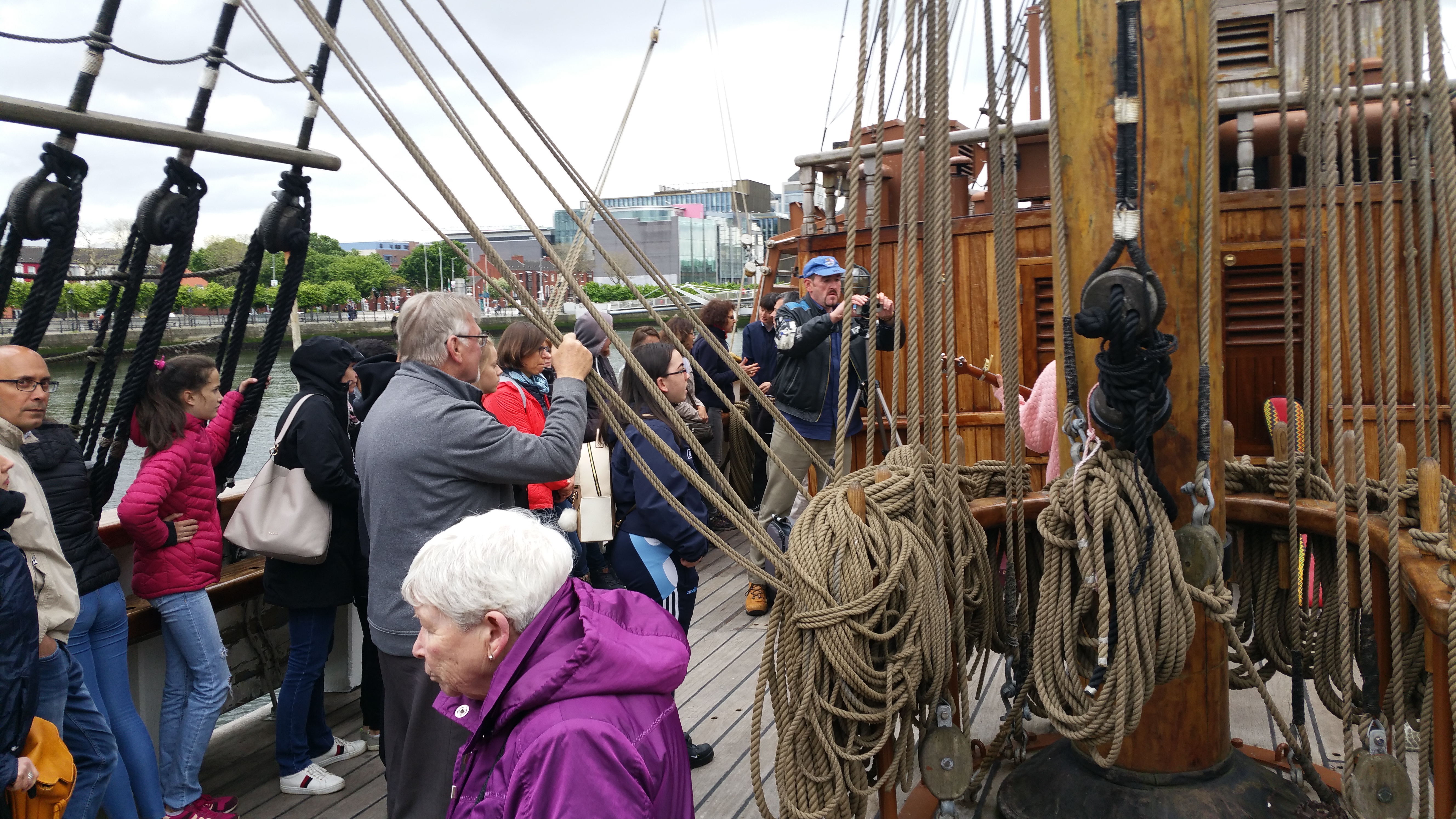
The gathering moved on then to the sailing ship the Jeannie Johnson, to hear Evelyn Campbell sing her Famine Song and Diarmuid Breatnach sing Skibereen and Fields of Athenry. After that, some repaired to the Teachers’ Club, where tea, sandwiches, gur cake and biscuits were on offer. By coincidence, a Musical Society were relaxing there too and it was not long before songs from different parts of the world were being exchanged from different parts of the room.
Somewhat incongruous, the top floors of the International Finance Services Centre, which looms over the Famine Memorial, commissioned by Nora Smurfit of the Irish capitalist family.
Evelyn Campbell on board the Jeannie Johnson, accompanying herself on guitar while she sings her Famine Song.
THE CAMPAIGN FOR A NATIONAL IRISH FAMINE DAY
The currach on the Liffey near the Famine Memorial on the quay.
The commemorative wreath is lowered into the Liffey from the currach.Participants prepare to throw stem roses into the Liffey to commemorate those who died during emigration and the diaspora that survived.Some of the stem roses floating in the Liffey.
The Great Hunger is the preferred term in English by many for the terrible disaster that struck Ireland in the mid-19th Century, for people starved alongside what was for a while at least, an abundance of food.
Mast and some of the rope work of the Jeannie Johnson sailing ship.
For three successive years, a fungus-like oomycete infested the potato crop, staple diet of most of the population. AlthoughPhytophthora infestanshad attacked the potato crops on the European mainland and in Britain also, nowhere was the disaster of the dimensions it grew to in Ireland: nowhere else were the the majority of the population obliged to sustain themselves on the potato while yielding up every other edible product (except perhaps milk) to pay the landlord’s rent on land conquered from the ancestors of the starving, thousands of soldiers and police being on hand to ensure the hungry paid up. “The Almighty indeed sent the potato blight”, wrote Young Irelander journalist John Mitchell, “but the English created the Famine.”
Well over one million Irish starved or died of attendant diseases in less than five years during the reign of Queen Victoria, while ships left Irish ports laden with food and grain was fermented to make lucrative whiskey and beer. Another million emigrated and it is estimated that about one third of those also died – of drowning, of disease aboard ship or of the various dangers migrants faced. Five years after the potato crop failed, estimates put the population of Ireland at around six million, from the over 8 million of before. Over the next decade, another million would leave, paid to go, lied to go, forced to go, or gone out of desperation and loss of faith in any future in the country of their birth under foreign domination.
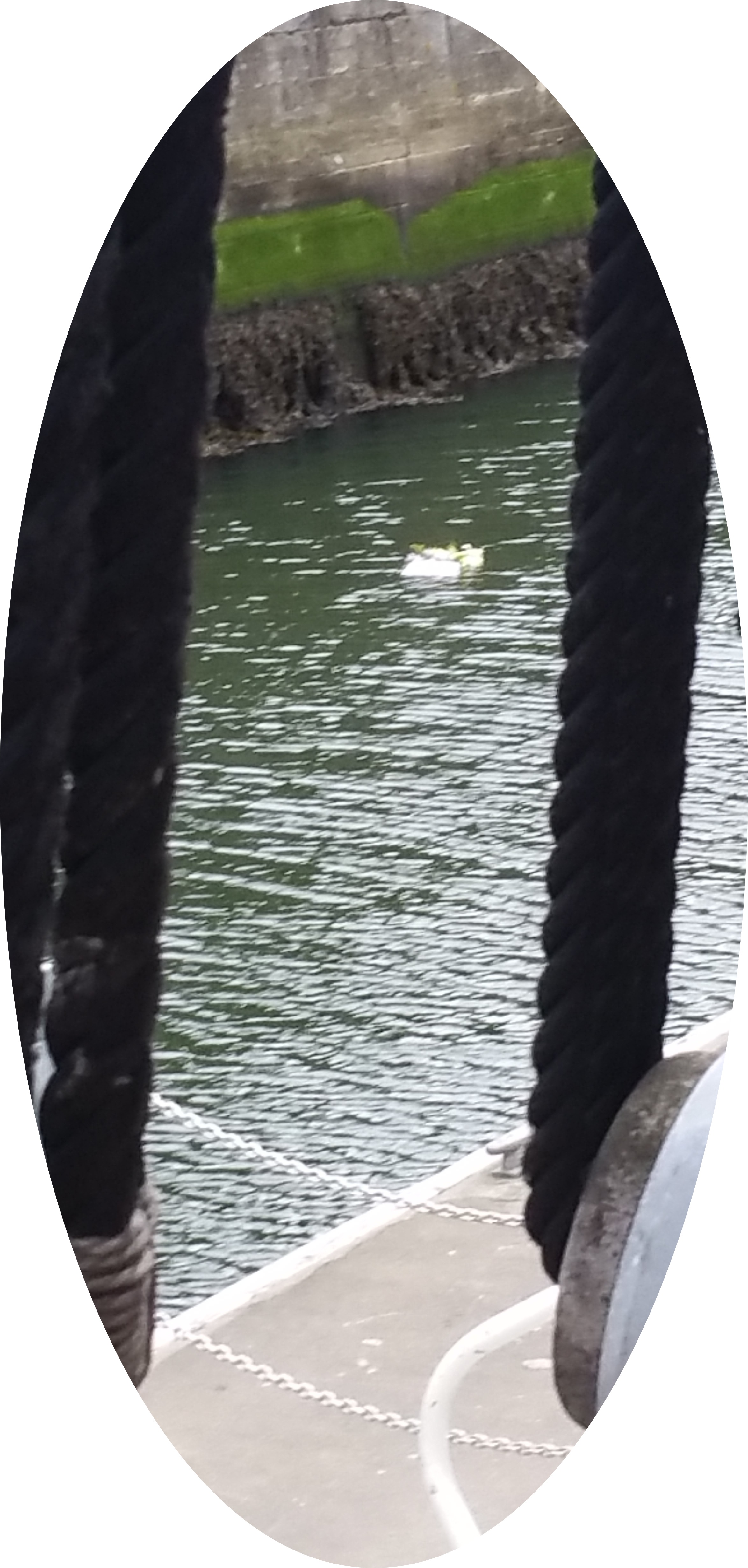
The floral wreath deposited from the currach earlier floats past the Jeannie Johnson.
In 2008 it was agreed by the Irish Government that there would be a national Famine Day in the Irish calendar of national events and it would take place on the third Sunday in May. The State commemoration this year was held in Sligo, attended by Leo Varadkar (who was met by a protest of the Sligo Women’s Cervical Smear Action Group). The ceremony was covered in the RTÉ news which was shown on TV in the Teacher’s Club. Michael Blanch told those present that the campaign he and his wife had started in 2004 through the Committee for the Commemoration of Irish Famine Victims, had resulted in this national event and that it was also being commemorated by the Glasgow Celtic team in the special jerseys they wore that day (in their Scottish Premiership win 2-1 against Hearts). The symbol is black and white which are the colours of the Commemoration and he had also wanted GAA teams playing on this day to wear it on their jerseys (the Munster Hurling Championship match between Limerick and Cork was also being shown that afternoon on the TV screen in the Teachers’ Club).
End.
People commemorating stand among the ghosts of the victims who, as a result of the Great Hunger, died in Ireland or in emigration.
Supporters of staff at a prominent Dublin eatery protested yesterday over the management’s appropriation of some of the tips left by customers for the staff. They are able to do this quite easily when the customer pays the tip by credit card but when staff asked customers to leave their tips in cash, management accused them of “deplorable greed”. They have also dismissed two staff who are currently taking a case for unfair dismissal, accusing the management of sacking them for their unionisation of the staff.
View of some early protesters outside the Ivy Dawson Street restaurant (Photo: D.Breatnach)
The photographs taken here show a smallish group, including Independents for Change TD Joan Collins but more were coming later from the Mayday march on the north side of the river. A supporter claimed that the management offers an hourly rate above the minimum wage but then makes that difference up with tips.
Catering work in general is notoriously low-paid and with transitory staff, making it difficult for trade unions to organise them and relatively easy for management to hire and fire.
View of some early protesters outside the Ivy Dawson Street restaurant (Photo: D.Breatnach)
There have been a number of protests about the tips issue at Ivy, including one on which the Irish Times reported in March.
The report stated that a number of protestors who had booked tables in the restaurant began the protest and were then joined outside the restaurant by a group of 30 people led by Independent TD Joan Collins who held up placards stating “Stop tip theft”.
View of some early protesters outside the Ivy Dawson Street restaurant (Photo: D.Breatnach)
Ms Collins was reported as saying that she was aware of other Dublin restaurants who have are engaging in similar practices when it comes to tips and was quoted as saying that: “The Ivy are abusing the good nature of diners who are tipping staff well because and they are not aware that management are taking some of their tips”.
“Workers are hugely concerned as they are not earning a high hourly wage and they work hard for their tips only for a portion of it to go to the company,” she said.
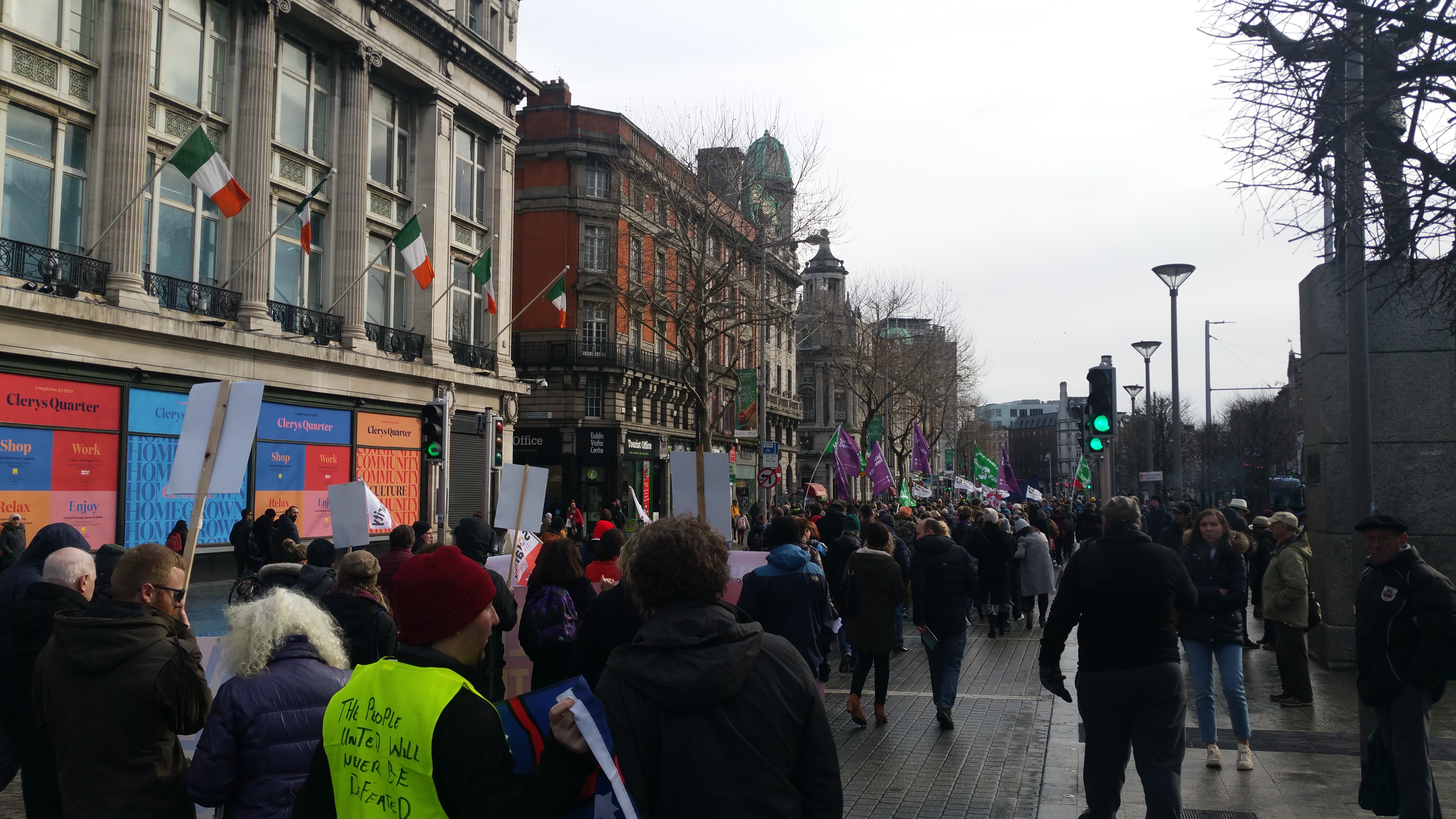
Protesters calling for the urgent construction of public housing marched through Dublin today. Various organisations and many independent activists took part in the protest with a broad range of people took pat, from socialist to republican-orientated, some with their children. The event was organised by the National Homeless and Housing Coalition.
Early part of the march detachment starting from the GPO, here proceeding south along O’Connell St, the long-closed Clery’s department store on the left and the Larkin Monument on the right. (Photo: D.Breatnach)
On their Facebook page, the NHHC had issued a statement, part of which read:
“Rebuild Ireland has been an unmitigated disaster yet the cross party motion that was passed in the Dail in October that called for practical actions that would end the emergency, including making it illegal to evict someone into homelessness, were ignored by the government even though it was supported by all parties except Fine Gael. We are demanding action on the motion.
“We also learned that 15 Dublin hotels received over €1m each in 2018 for accommodating homeless families which further illustrates the reliance on the private sector. These families need public housing built on public lands, they need proper homes. Last year there were 842 cases of children being discharged from the Temple Street Emergency Department back into homeless emergency accommodation. The majority of these cases were a direct result of the fact that these children are living in completely unsuitable and cramped emergency accommodation.”
The march, though far from small, seemed somewhat smaller than expected which may have been due to a cold windy day with lashing rain a little earlier in the day but may also have had another cause. The Coalition of groups has split with ICTU (Irish Council of Trade Unions) and a number of NGOs pulling out to form a different campaign on housing, apparently declining to support the demand for public housing on public land.
Front of the march pausing on Custom House Quay (Photo: D.Breatnach)
The organisers of today’s march published a list of demands:
• Declare the housing and homelessness crisis an emergency. • Provide a minimum of 10,000 public house a year. No to privatization: build public houses on public land. • Make housing a constitutional right. • End evictions, bank repossessions and sell-offs to vulture funds. • Create a national Traveller accommodation agency to oversee and deliver Traveller Accommodation. • Legislate for real security of tenure, real rent control and affordable rents. • End the use of B&B’s and hotels for emergency accommodation. Improve emergency accommodation facilities and provide security for all in need. • Create rent pressure zones for Purpose-Built Student Accommodation (PBSA). Ensure tenant’s rights for students in PBSA and digs-style accommodation.
One group set off from the GPO and after making a circuit on O’Connell Bridge, marched along the north quays, meeting up with another group coming across Butt Bridge to join them from the Housing Agency HQ; apparently another group had marched from City Hall. The march continued on to Samuel Becket Bridge, to the bemusement of some participants, where the participants halted and were addressed by a number of speakers.
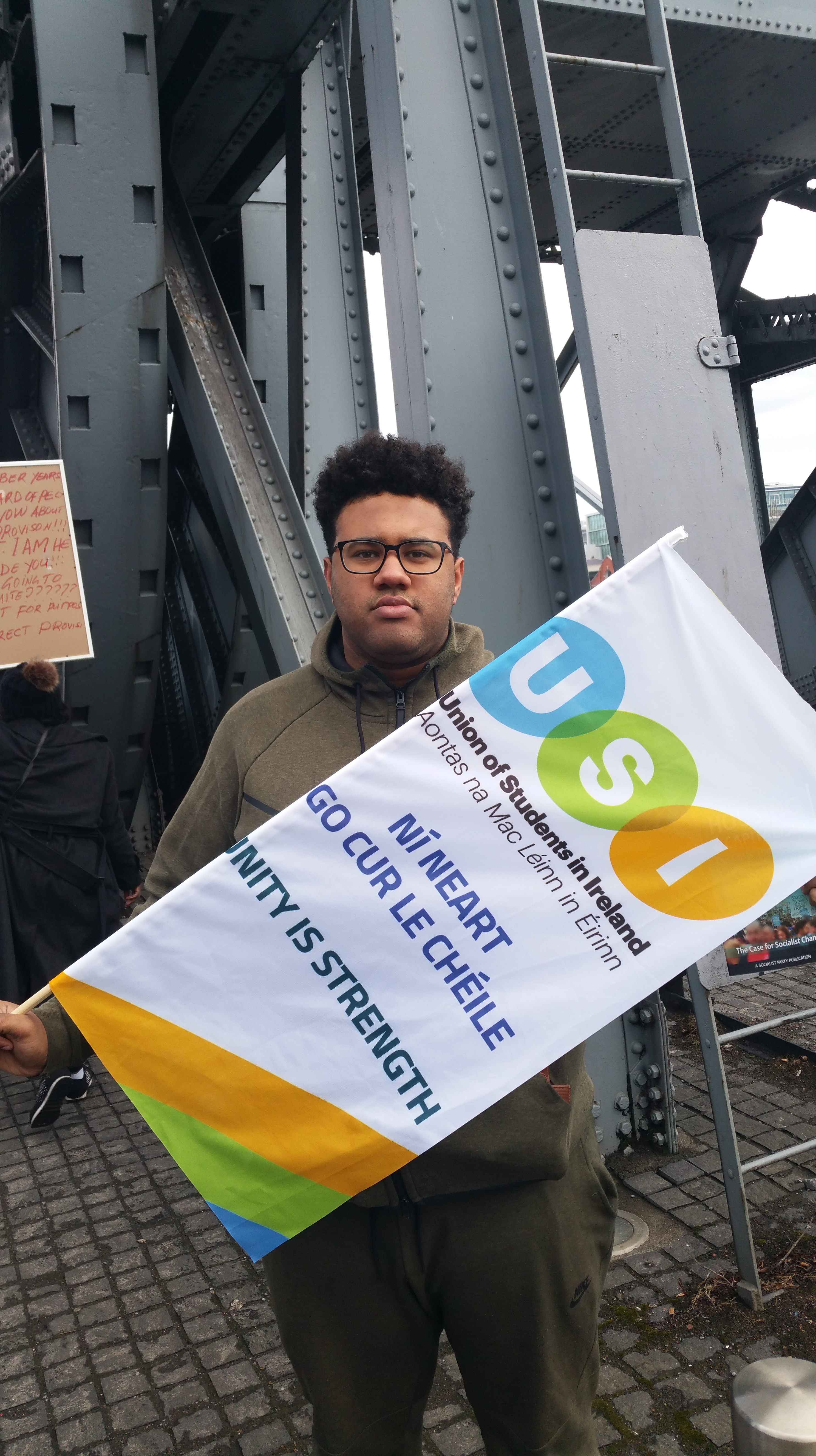
Student on the march displaying flag of Union of Students in Ireland (Photo: D.Breatnach)
Along the route of the march, slogans were shouted, among which were:
“Raise the roof, not the rents!” and “Housing is a human right!”
Section of the march stretching out along the north quays. (Photo: D.Breatnach)One of the organisers speaking at the rally at the end of the march: Tina McVeigh, of PBP. (Photo: D.Breatnach)
As well as Socialists, a number of Republicans were in evidence, marching without party banners. Sinn Féin supporters had a banner and party flags, as did People Before Profit and the Workers’ Party. Some Union of Students in Ireland flags were in evidence too. A Travellers’ group and some community groups also carried banners identifying their group with the march and its cause.
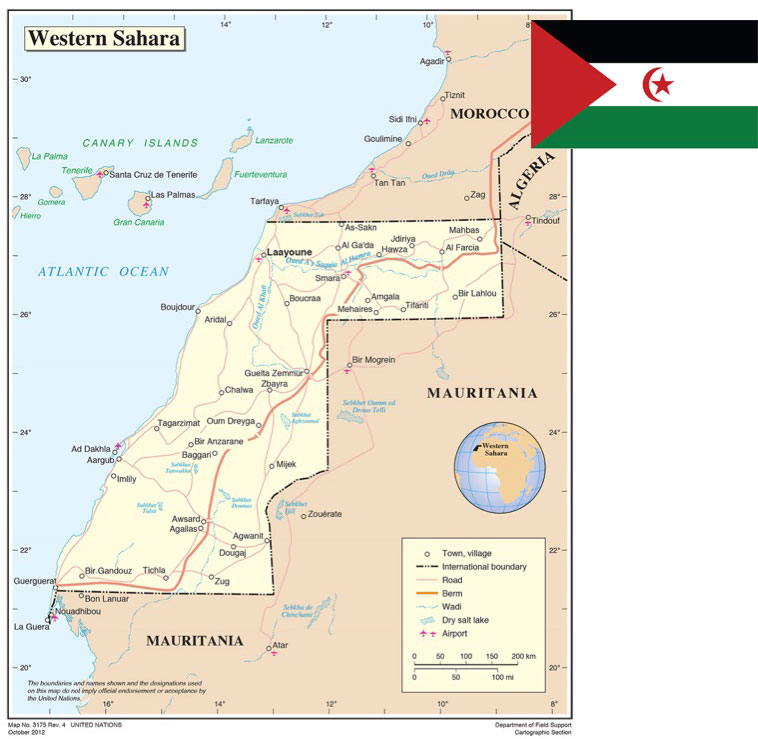
On Tuesday March 5th a meeting in the Teachers’ Club, Parnell Square, was addressed by representatives of the Western Sahara people and by experts in human rights matters.
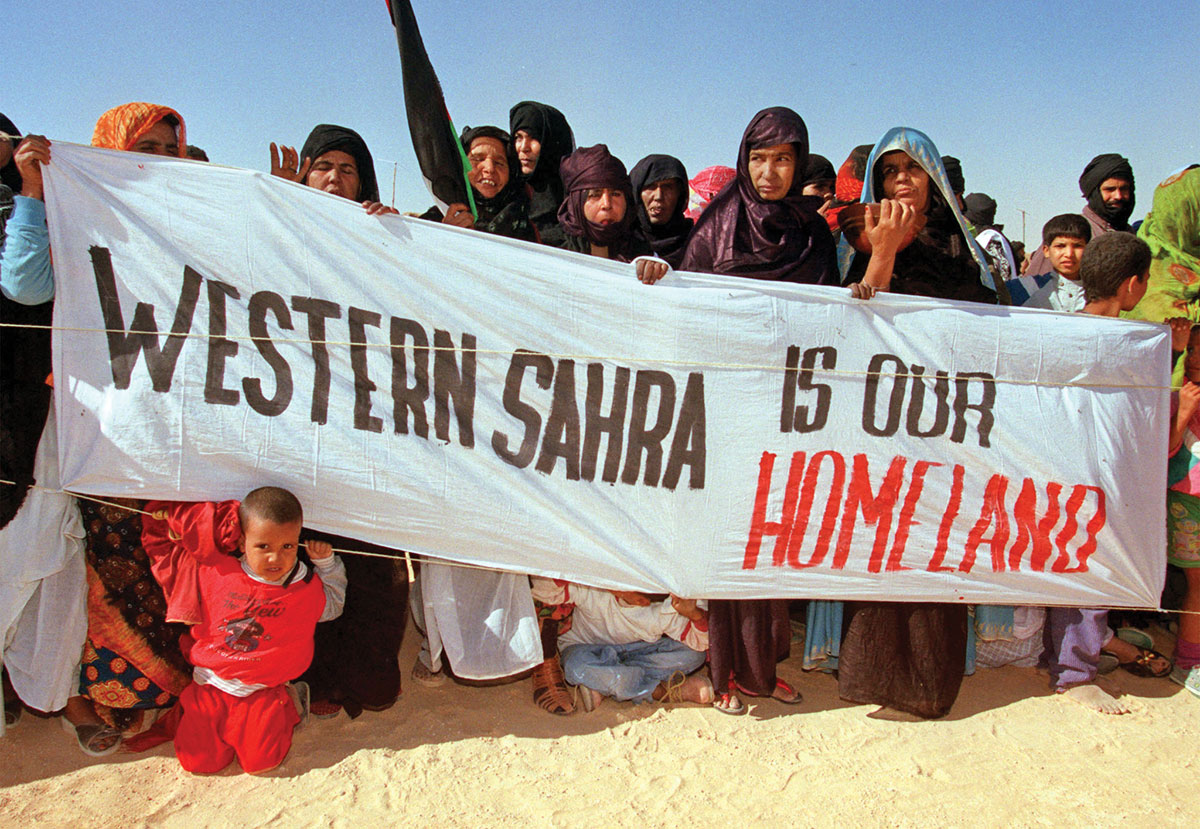
2015 protest by Saharawis, mostly women. (Photo source: Internet)
Western Sahara, a territory of 266,000 square kilometers (103,000 sq. miles) in the Maghreb, was part of Europe’s carve-up of North Africa, when it was known among most states as Spanish Sahara, in acknowledgement of the European state that occupied it. Its people speak Arabic and Castillian (Spanish) and some also speak French, an influence from neighbouring French ex-colonies. Few speak Berber.
Mohamed Belsat of the Polisario speaking at the event (Photo: D.Breatnach)
The UN General Assembly in 1964 called on Spain to hold a referendum there which the Franco fascist regime declined to do but in 1975, after the dictator’s death, the new regime pulled out of the territory, practically handing it over to Morocco and Mauritania. After a conflict between those two states, Morocco emerged as the sole occupier and the conflict since then has been between the Kingdom of Morocco and the Saharawi people, who seek independence.
Chaired by Mark McLoughlin, filmmaker, the Dublin meeting had been arranged at short notice and its advertising further hampered by cancellation of a booking at Trinity College.
TRACING THE PLUNDER OF SAHARAWI NATURAL RESOURCES
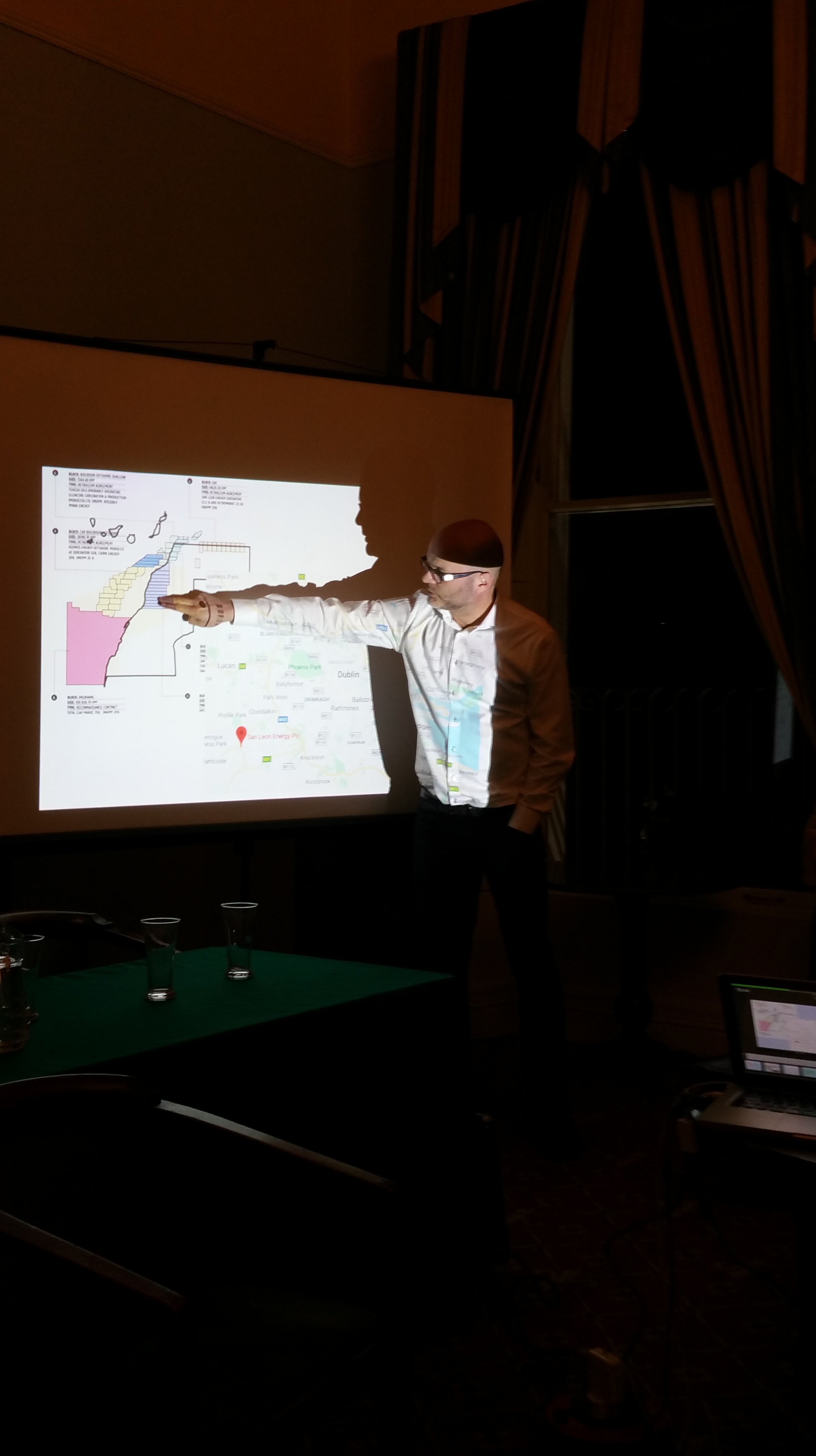
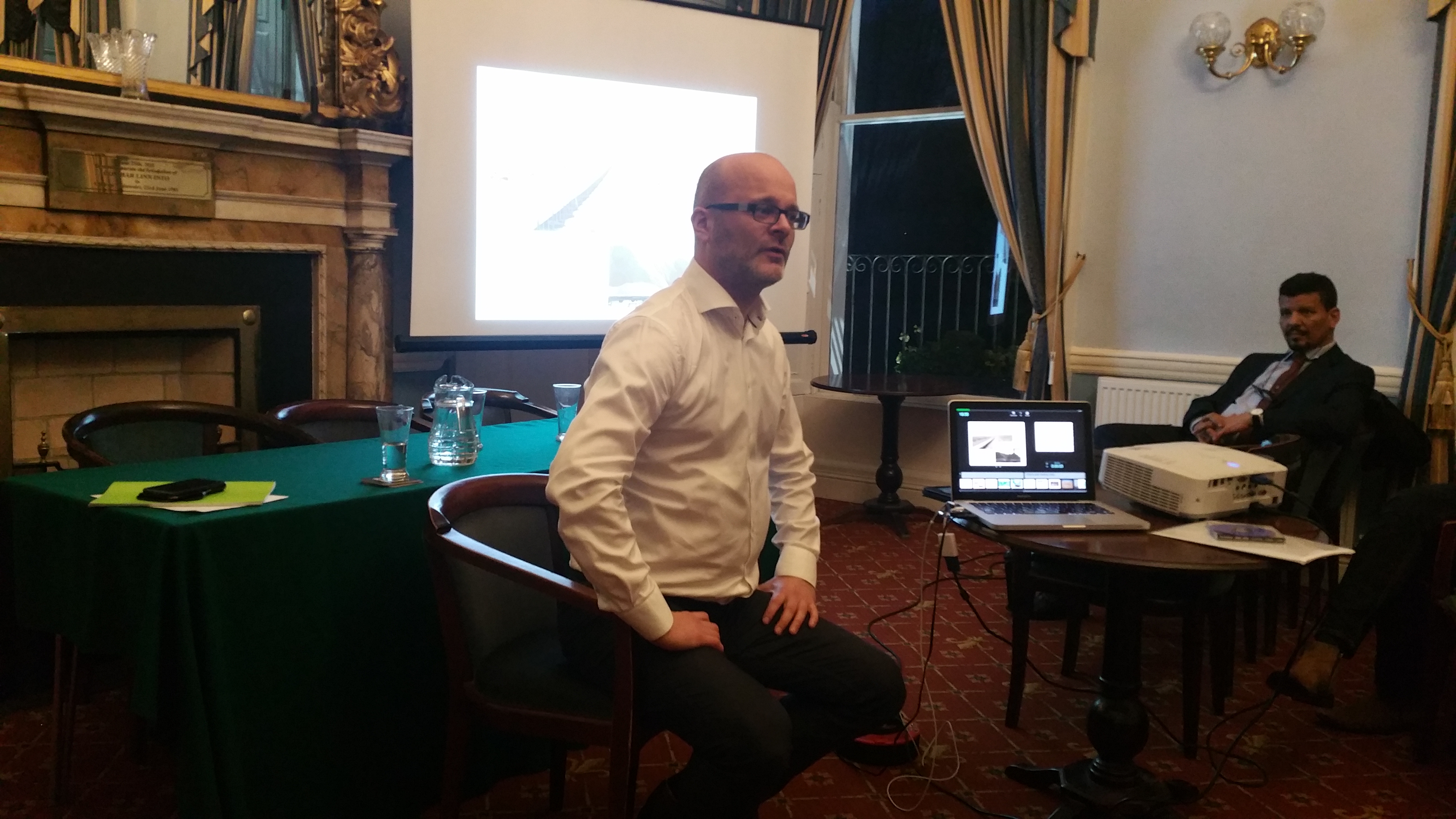
Erik Hagen, of Western Sahara Resource Watch, with a display projected on a screen, showed how his organisation traces the ships arriving at the territory and departing with phosphates mined there to their destinations. From the registered tonnage of the ships, the amount of phosphates plundered can be calculated. The companies involved claim that they are doing no wrong, since they pay Morocco for the cargoes.
Mark Hagen illustrating a point with reference to the display. (Photo: D.Breatnach)
But according to the UN, no state may extract resources from a disputed territory without the consent of the people. Hagen talked about how EU had changed the wording to replace “consent of” with “being of benefit to” and then went on to effectively falsify agreement on ‘benefit‘, using a document on consultation with huge majority – and a total of Saharawi organisations – voting against as evidence for.
The only company currently exploring for oil in Western Sahara is San Leon, an Irish company, although they failed to find any and are currently fighting in financial difficulties.
Clive Symmonds, expert in international law talked about the policy of isolating produce from occupied territories, by first compelling their labeling as such, which, although that would not ban the products, would facilitate a ban if such were decided. The Control of Economic Activity (Occupied Territories) Bill 2018 introduced to the Oireachtas (Irish legislature) and currently being processed with cross-house support despite Government opposition, is an example of how such a ban may be implemented (and Senator Black’s Bill will also be valid for Western Sahara). Of course, as Symmonds pointed out, such labeling is left to the exporter which in this case would be the Kingdom of Morocco.
Clive Symmonds speaking on human rights legislation and W. Sahara (Photo: D.Breatnach)
Symmonds also referred to the EU Fisheries Agreement which, in permitting fishing within what Morocco claims as its territorial waters without reference to the Saharawi people, is permitting the plunder of the Saharawi people’s fish stocks – and the Irish State is a party to this, having signed the Agreement. Symmonds pointed out that the judgement of the European Court of Justice on 21st December 2016, stated that Western Sahara is a “separate and distinct” territory from Morocco and that trade agreements between the EU and Morocco do not apply to the occupied territory. The EU is in violation of this judgement.
“A REFERENDUM IS THE ONLY DEMOCRATIC WAY”
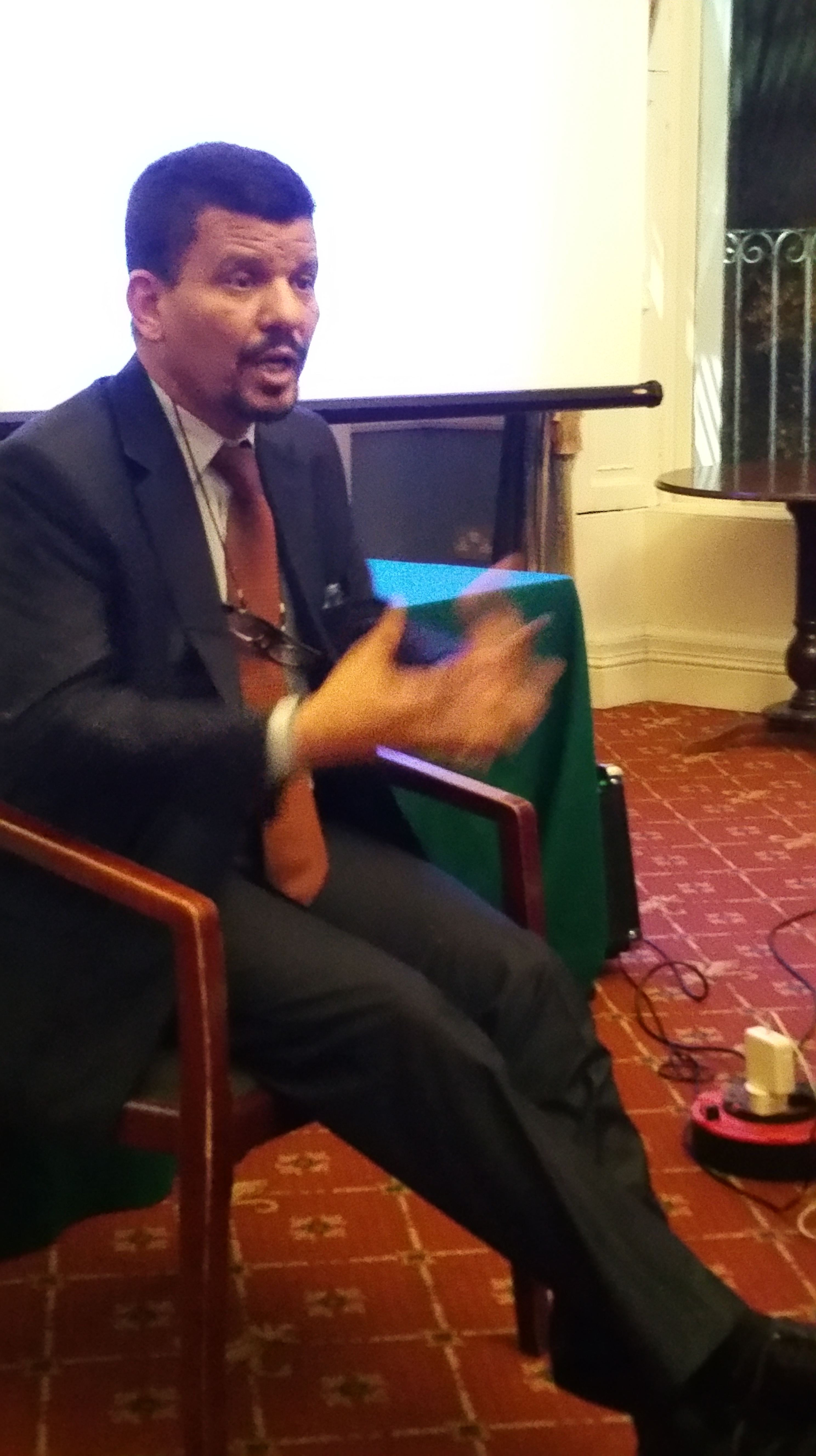
Mohamed Belsat, Frente Polisario Ambassador to Europe, talked about the policies of the Irish state, the EU and, in particular, France. Belsat said that they were in collusion with the Kingdom of Morocco and that in particular, France often seemed to be the opponent of the Saharawi people even more than Morocco.
Referring to what he said was the only democratic of ascertaining the will of the Saharawi people, Belsat said that it was a referendum. Morocco had called for this since they had flooded Western Sahara with Moroccans but, since the process of registration of genuine and historical residents of the area had been completed by the UN, the Moroccan Kingdom had withdrawn all support for a referendum.
(Photo: D.Breatnach)
“The cost of the occupation to the Moroccan kingdom is huge, in terms of military presence maintenance and so on,” Belsat said, adding that the cost of every litre of water supplied to the occupation forces was equal to four times the price of a litre of whiskey.Furthermore, the cost to the Kingdom exceeded the benefits it extracted from the colony. In January, Morocco had at last joined and signed up to the constitution of the African Union, the organisation of African states, of which Western Sahara is a founding member and which has a long-standing position on Western Sahara being an occupied colonyFor all these and other reasons, including dissatisfaction with the regime among the Moroccan general population, he felt that a campaign of pressure on Morocco and on the EU might well bear fruit in terms of the decolonisation of this “last colony in Africa”.
Later, Belsat’s response to a question from the audience amounted to an admission that there was no “peace process.” (sic) in operation (despite a reference to it by a number of speakers) and that as a result of this and the conditions under which they were kept by their oppressors, it was increasingly difficult to restrain the youth from resorting to armed resistance. At this a member of the audience commented that armed struggle against the army of the Moroccan Kingdom backed up by France would be “suicidal”.
“57 POLITICAL PRISONERS BUT MANY MORE HAVE DISAPPEARED WITHOUT TRACE”
ElGhalia Djimi, Vice-President of ASDH (Saharawi Association of Victims of grave violations of human rights by the Moroccan State), which cooperates with the League for the Protection of Western Sahara Political Prisoners in Moroccan Jails (LPPS), who had arrived in Ireland that day, made her presentation next. Speaking in French through a translator, Djimi talked about the conditions of life under occupation for the Saharawi people. Djimi showed a compilation of clips of soldiers, police and people in civilian clothes physically assaulting protesting Saharawi women, pulling their hair, punching and kicking them and informed the meeting that those in plainclothes were Moroccan police.
ElGhalia Djimi speaking on Moroccan Kingdom repression of Saharawi people (Photo: D.Breatnach)
“There are 57 Saharawi political prisoners in Moroccan jails,” ElGhalia Djimi said, “but many more that have disappeared without trace.”
Unemployment is high among the Western Sahara people and as a result of that and other deficiencies in their lives, a drug problem has arisen, she told her audience. There are no third-level education facilities in the territory, obliging them to go to institutions in Morocco. Although they can study to gain professional qualifications for civil employment, those available are not usually those required by the employers, which is not true for their equivalent in Morocco, with the result that often Moroccans fit into the administrative jobs better than do the Saharawi people. In terms of their treatment by the authorities, all Sahawaris carry a Moroccan ID card but letters on it indicate their ethnic origin (which Belsat likened to the Nazi State’s requirement that German Jews by identifiable in their national ID documentation).
Moroccan citizen settlement in Layoune, the capital of Western Sahara, had now placed the indigenous people, once the majority, in a minority.
Mark Hagen, of Western Sahara Resources Watch. (Photo: D.Breatnach)
SOLIDARITY IN DUBLIN
In conclusion of the speakers’ presentations, Mohamed Belsat asked for support from the Irish people with their “history of struggle for freedom and solidarity with other struggling nations”‘
A couple of members of the audience mentioned that there had been an active solidarity committee with Western Sahara in Dublin in the past and one wondered about the possibility of resuscitating it.
Comment: The solidarity Committee in Dublin was independent of any political party or organisation, its name was Western Sahara Action Ireland and its FB page is still in existence. Between 2011 and 2012, the group organised a number of public events, including: two protests about Moroccan repression of Saharawi protesters, one in Dame Street and another in O’Connell Street; a protest against the EU’s Fisheries Agreement outside the Dublin offices of the EU in Dawson Street; the construction and maintenance of a “Western Sahara Tent” at the Electric Picnic of 2012, along with an exhibition of photographs taken in the territory. The latter was visited by Michael O’Higgins who was then campaigning for the Presidency of Ireland (he also appeared in the film shown at the beginning of public meeting in Dublin).
On each of the Dublin street events, a small group of Moroccans had attended to harass and attempt to intimidate the protesters, almost certainly sent by the Moroccan Embassy but their efforts were to no avail.
Flag of the Western Sahara liberation movement. (Photo source: Western Sahara Action Ireland)
BACKGROUND
There had been many uprisings against colonial rule in the history of Western Sahara and the last Rif War, from 1920 to 1927, had cost the Spanish State military 23,000 casualties, of which 18,000 were fatalities. Only for the intervention of the French1, the forces led by Abd el Krim would have kicked the Spanish colonialists out of the footholds to which they were still clinging.2
Like the French in their North African colonies, the Spanish occupiers had suppressed risings not only by military force against insurgents and torture of captives, including electric shocks, but also by terror against the civilian population, including assassinations, massacres, rape and internment without trial.
Both European states also developed their own Foreign Legions. Forget about the 1924 Beau Geste novel by PC Wren and the various screenplays3 to which it gave rise; the Foreign Legions were tough terrorists in uniform, founded not to fight in open war but against resisting colonial peoples.
Since 1963, Western Sahara has been on the United Nations’ list of “non self-governing nations”. In 1965, the UN General Assembly, in its first declaration on Western Sahara, called on the Spanish State to decolonise the territory and, in 1967, to hold a referendum on self-determination but Spain refused. From 1973 to 1975, the Frente Polisario fought an armed struggle for national liberation.
Western Sahara in context. (Source image: Internet)
After the Spanish State abruptly pulled out in 1975 (following the death of its fascist dictator General Franco) and – without allowing elections of an independent Saharawi government before doing so – it relinquished control to the Kingdom of Morocco (which had formally claimed the territory since 1957) and Mauritania and conflict broke out between those states. Mauritania in time abandoned its claim and Morocco moved in and seized Western Sahara.
The Saharawi people protested Morocco’s occupation of their land and were suppressed by military and police. The Frente Polisario fought the occupying Moroccan military from 1975until a UN-brokered ceasefire in 1991, since which there has been no Saharawi armed struggle but plenty of Moroccan repression. One of the features of the struggle was the displacement of a large part of the Saharawi population as people fled the Moroccan military, many to Algeria (which had won independence from France in 1962 after a fierce and dirty war), where they remain in a refugee camp. The Moroccan Kingdom then built a wall to prevent Saharawis from returning, which it guards by troops and miles of landmines.
End.
FOOTNOTES
1The casualties of the French, according to Wikipedia, amounted to 10,000 with 2,500 killed in battle. The casualties of the insurgents and of the indigenous civilian population, as usual in these situations, is difficult to determine but, according to Wikipedia, came to 30,000, of which 10,000 were fatalities.
2For more on the Rif War 1920, read the article about it (see link in Resources and Useful Links).
3Including those of 1939 starring Gary Cooper and Ray Miland, 1966 with Telly Savalas and Doug McClure and the BBC serial of 1982.
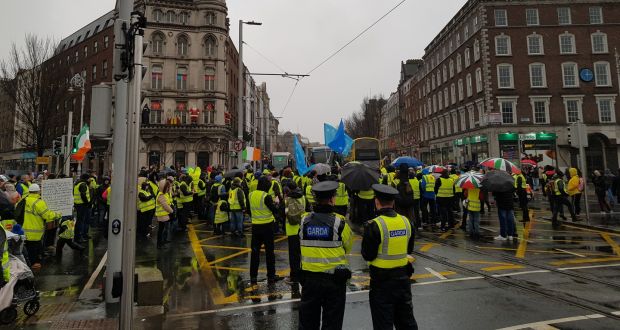
Recently a number of people have been marching in Dublin, saying that they are the Yellow Vests of Ireland. This is obviously inspired by the Gilets Jaunes (“Yellow Vests”) whose protests against the French Government began in November last year and swelled to huge numbers in Paris demonstrations and riots. Some smaller groups have announced their formation in different parts of Ireland too. But there are questions concerning them.
Irish Yellow Vest protest crossing O’Connell Bridge 15 December 2019. (Photo source: Internet)
The Yellow Vests in Dublin have been meeting on Saturday afternoons at the Custom House and marching from there. I am busy on Saturdays and on the one day I made the time to join them, I did not find them and learned later from their posts that on that occasion they had gone to Dublin Port and apparently blocked the approach road for a period.
Originally the organisers stated that there would be no leaders but then two emerged, Glen Miller and Ben Gilroy. Until last week Gilroy was serving three months for contempt of court, a sentence imposed by a judge when he learned that Gilroy had not completed the community service sentence imposed for a previous contempt of court. Held in contempt of court a number of times Gilroy has always apologised afterwards and had his contempt considered “purged”, i.e cleared. It seems that the judge in this case decided that Gilroy was playing games with the court around the issue of contempt, which is probably a fair assumption (which is not at all to say that such actions are wrong).
Gilroy took a case to the High Court alleging failure to comply with certain legal requirement and on February 4th the Judge granted him liberty on bail in his own recognisance (i.e his own financial bond) while is case was discussed and decided. However this week the Judge ruled that his imprisonment was not unlawful and revoked Gilroy’s bail, which meant he had to return to jail.
In recent years a number of groups have sprung up which oppose a number of unpopular legal procedures, for example evictions, by a mixture of physical obstruction (by numbers of people) to bailiffs but also by appealing to what they claim are laws that take precedence over the legal procedures they are confronting. The “Land League” is one of these (no organic relationship to the 19th Century Irish organisation of Davitt and Parnell) and, not unrelated to the “League” in its reliance on arcane laws and procedures, real or imagined, is the Sovereign Movement, the “Irish Republican Brotherhood” (again, despite their claim of “inheritance”, no organic relationship to the 19th and 20th Century organisation) and the Fremen.
While some people are impressed by these arcane legalisms others are bewildered by or scornful of them and, despite their claims, these organisations seem unable to point to where their legalisms have actually been ultimately successful. They have certainly succeeded in slowing down such actions as repossessions and evictions by taking up court time and numbers turning up to block an eviction will often succeed in delaying the process, without any need to appeal to any kind of legalistic underpinning. Property rights reign supreme under capitalism and certainly the Irish state is no exception to that rule; on the other hand the authorities in the Irish state tend to prefer to carry out the normal business of capitalism with as little confrontation as possible.
Summoning numbers to block or delay an eviction and to support a victim of the system in court are of course tactics of struggle honoured by time and usage in Ireland, whether against the British administration or that of the Irish State. Such reliance on mobilisation of numbers can sometimes produce small or partial victories but they hint at something else – the mass mobilisation of insurrection and revolution. And that is part of the appeal of groups such as the “Land League” and probably in part of the Yellow Vests.
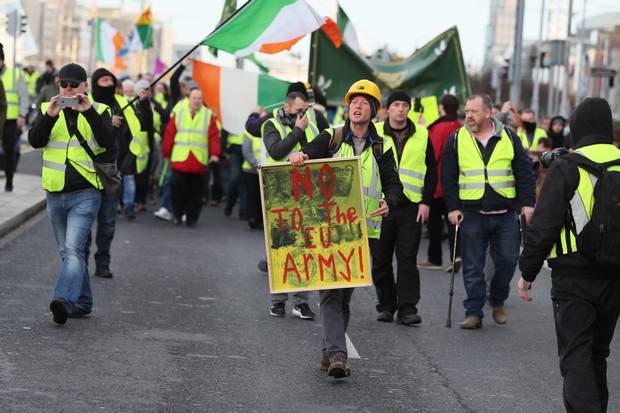
Section of Irish Vest protest Dublin 22 December 2019. (Photo source: Internet)
But if insurrection and revolution are hinted at, we need to know whether the hints are in earnest. Calling for a general election, one of the demands of the Yellow Vests, hardly seems insurrectionary. How would that change anything? Calling for an end to a number of attacks on working people including evictions is good but how is it to be achieved? Is there an objective of overthrowing capitalism and imperialism in Ireland? We do not hear so if there is. If an insurrection is hinted at, by whom is it to be and for whom?
RACISM
It is here that we run into a disturbing problem: racism, of which Gilroy and Miller have both been accused. Any movement or organisation led by racists is not going to be one for progressive change in society, let alone a socialist insurrection but worse – it is likely to be a breeding ground for fascism. And of late, fascist forces are gathering throughout most of the world and certainly in Europe. Capitalism is struggling and the workers must be made to pay the cost through keeping wages and social expenditure down and profits high. When persuasion and collaborationist workers’ leaderships are no longer effective, capitalism must fall back on naked force. Fascist movements are the frontline of that force, its leading edge and racism (or religious sectarianism, with which we in Ireland have more experience) is used to divide the lower classes, the ones that will be made to pay.
Of course not all the people supporting the Yellow Vests are racist but when an anti-immigration banner is tolerated on a march1 then it would be remarkable if racism were not being tolerated as well. And with regard to the leadership, Glen Miller’s racism is well established from his posts on social media. He has posted material against immigration, against Muslims, against Travellers and against lesbian, gay and transgender people – classical minority targets of fascism to split the working people. He also shares racist material by others including Tommy Robinson, a fascist public figure operating in England.
Gilroy is not usually so glaringly racist but he has certainly posted an islamophobic rant on social media.
One might argue that Islam is a religion and that being against it is not racism. Perhaps not, if one were against all religion, for example. But ethnicity and religious belief or organisation are often interconnected, at least in particular periods and societies. Most muslims are not white European. And the Irish certainly know from their own experience how easily anti-Catholicism became conflated with anti-Irishness, in Britain for example, in the USA (think of WASPS and the ‘Nativists’) and in Ireland under colonial rule.
Islamophobes fantasise about Moslems taking over the country, anti-immigrationists fantasise about immigrants taking over the country, racists fantasise about non-Europeans taking over the country. There are nuances between them but in the end do they matter that much? The effect is the same: society is portrayed as divided by ethnic origin rather than by class and the focus is diverted from the bankers, gombeen capitalists and their political servants an on to migrants instead.
It might be argued that “looking after our own first” is a natural outlook and not racist. But we need to look at where that comes from and where it leads. It starts from the false premise that there is a great shortage and that we should divide those scarce resources first among the Irish. But in fact there is sufficient wealth produced in Ireland to fund all the education, housing and healthcare needs of all the people, immigrants included. And this is because the wealth is produced by working people – including migrants. The problem for us all is that that huge portions of that wealth is being diverted to fund the market gambling, lifestyles and financial empires of Gombeen (Irish capitalists) and foreign capitalists and bankers. Those are the people who would be rubbing their hands with glee or happily exchanging bribes and payoffs if, instead of uniting to confront them, the workers began to fight amongst themselves, divided by race or religion.
When the 1916 Proclamation declared the objective of the insurgents to “pursue the happiness and prosperity of the whole nation ….oblivious of the differences carefully fostered by an alien government, which have divided the minority from the majority in the past”, it was addressing in part that religious sectarianism by which England had restrained the descendants of its colonists from overthrowing its colonial rule and also the pitting of Protestant against Catholic workers, a division which had been played out before 1916 and was to be enacted to even worse degree later. The “Protestants” were the “immigrants” of those years, along with their descendants2, albeit a privileged minority which migrants rarely are.
In making that statement, the insurgents of 1916 were drawing on an Irish revolutionary tradition stretching back to the United Irish of the 1790s and early 1800s, of the likes of Wolfe Tone, Henry Joy McCracken and Robert Emmett. It was a tradition that ran through every revolutionary movement in Ireland since that time, through the Young Irelanders, the Fenians, the Volunteers and the Irish Citizen Army, a tradition that called for overcoming differences to build unity against the common enemy. That is the unity that fascists and racists seek to shatter.
Fascists may and often do verbally castigate capitalist governments, politicians, industrialists and bankers. But they end up serving them. They split the mass of the working and lower middle classes on the basis of race, they attack the defence organisations of the working class, they target other groups such as gay and lesbians, push women into the most subservient roles possible. The Nazis were “National Socialists” and part of their movement talked about nationalising industry under workers’ control. But they were backed by big capitalists such as Thyssen, Krupp and IG Farben and many others in Germany. In the USA and in Britain they were backed by Henry Ford and promoted by Viscounts Northcliffe and Rothermere, owners of the Daily Mail (until England declared war on Germany and the US entered WWII on the Allied side). The Nazis in Germany took over the trade union offices on Mayday and closed them down, forcing workers instead to join fascist unions controlled from the top, part of the State.
WHAT KIND OF UNITY?
It is interesting that while fascists divide the working people in order to facilitate their control and undermine the struggles against the capitalist class, they often cry for unity. German unity. Aryan unity. White unity. Spanish unity. British unity. Irish unity. And when people have criticised individual leading figures in these groups, in particular recently of the Yellow Vests in Ireland, they have been accused of dividing, of undermining the struggle and calls for “unity” have been raised.
Whether it is right that the court should consider it criminal for someone to hold it up to disrepute, as Gilroy and some others have done on occasion, is another question and whether three months is a reasonable punishment for “contempt of court” in another. The courts are instruments of the State which in turn is an instrument of the ruling class and as such all revolutionaries must perforce hold them in disrepute and, in my opinion, three months in jail is excessive by normal standards in this state. But cries raised by the Irish Yellow Vests against this seek to glorify Gilroy as some kind of “people’s leader” and in turn to promote the ‘Vests’ as a viable resistance movement.
Workers know that unity in struggle is necessary but have also learned over the years that calls for unity may also be used to allow collaborationist trade union leaders and politicians to continue misleading the workers. Such calls can be employed to silence questions about where the movement is going. And now they are being used, unwittingly by some no doubt, to the effect of trying to silence the challenges to such as Gilroy and Miller about their racism and where they are trying to lead the Yellow Vests.
Such calls are being used not only to stifle the criticism of the leaders’ racism but to undermine the criticism of racism itself, as though racism were some kind of Leftie concept or diversion from the real issues. In a post in defence of Gilroy on 18th January, Miller posted a long ‘plain folksy’ discourse in which he said that Gilroy and he have “no time for political correctness and the posh talk”. So according to that discourse we should ignore the accusations of racism, action is needed, and for that we need unity – we should stop bleating on about racism. But the action is often dubious, the destination vague, the unity based on lack of analysis and stifling of criticism and – ultimately – on the opposite of unity, the division of the working people and the undermining of their resistance to those who are the real source of their misery and discontent.
It is not because of the anti-racist or politically-correct posturing of anyone, whether middle class or not, that socialists stand against racism: it is not just because it is inhumane, either; it is primarily because it splits and weakens the working class and diverts anger and resentment from the real enemy.
The Yellow Vests in Ireland are by no means a fascist or even racist movement. But they tolerate racists, are led by racists and could provide a breeding ground for fascists – something for which fascists are always on the lookout.
WHAT TO DO?
So what should be our response, as socialists of various kinds?
First, I think we need to step back and examine the situation a little. The Yellow Vests here copy the Yellow Vests in Paris. Awhile back, the Socialist parties (I do not count the Labour Party in this) wanted us to copy the Greek uprising and Syriza’s electoral success. Earlier than that, some people wanted us to emulate the Indignados of Spain. And further back still, others sought to copy the Occupation movement of the USA.
It seems to me that all that striving speaks of a desperate need felt by some elements in our society, a need that cries out that something must be done; something to cure the mess that our Gombeen system has made of our health and welfare systems, of the housing crisis, of cuts to other services; that some stand should be made against paying off the bankers’ gambling debts with our hard-earned money and trying to get us to pay a third tax on our water supply when the money collected already has not been used as it should. A feeling that something should be done about the corruption of that give-away of our natural resources, about the selling of our transport, postal, telecommunications systems, about the funding of private landlords, about renewed emigration of our young. About increased hours and travel time spent just trying to stay still economically but nevertheless slipping slowly back. About evictions of people who have paid the actual building cost of their homes a number of times over. About governments that oversee this rotten system, worrying chiefly about staying in government and pleasing native and foreign capitalists; about a police force in which we find an average of a scandal per year with no end in sight and yet happy to repress people’s resistance …. and with their Armed Response Unit cars to be seen everywhere around the city centre.
Those people are right, of course. Something should be done. Something must be done. But what? There’s the rub, as they say. The working class should rise and take power, is the classic revolutionary socialist answer; also of the socialist Republicans, who tie the question to getting rid of British colonialism. Whether our revolutionary socialists in Ireland are actually revolutionary is a good question however, and in any case they are small parties. Whether our socialist Republicans are actually socialists or Republicans first is another interesting question and in any case they are splintered in groups and independents.
All those movements abroad that various people tried to emulate or reproduce here in Ireland did not succeed in changing the situation in their own lands. The USA, the country with the most billionaires in the world (and in politics!), continues to slide towards eventual downfall, in huge debt as a result of funding its military-industrial-financial system, for which billions around the world and millions inside its own borders pay with misery ….. and still the debt cannot be paid. But a huge sub-class exists, often living in city wastelands of run-down housing estates.
The Spanish state continues to squeeze its citizens, prepares to go to war against a nation seeking independence and fascist groups organise openly. Suicides prior to, during or after evictions are no longer startling news.
The Greek Left-coalition government of Syriza collapsed and prostrated itself to the EU and the IMF and schools had to close in winter for lack of heating fuel.
The French Government has alternated repression with some concessions but ultimately nothing has changed.
The growing vacuum of resistance in Ireland will be filled by a revolutionary movement based on working people in militant resistance to – and directed at – the capitalist system. Or it will be filled by fascism.
To build a revolutionary resistance movement, unity in struggle is needed and for that unity, racism must be driven out of the people’s movements. That will not be done by condemnation of racists alone. It will not be achieved only by calling for unity against capitalism. The revolutionary movement must be built and it is by action that it will distinguish itself and attract support from the militant sections of the people.
It is by its revolutionary critical discussion on politics, history, science and culture that it will inform the mass of its potential and necessary objectives.
It will not be built by theoretical declarations or arguments alone, nor by actions that are either timid or cannot be maintained, or by actions of only a few far in advance of the mass. Some of the actions will, perforce be risky and the State will exert a price.
But it is either that or – fascism awaits.
End.
FOOTNOTES
1Reported on at least one of the marches and I have seen a photograph of it
2Some Protestants were descendants of Catholics who had changed their religion to avoid persecution or land confiscation and some Catholics were descendants of Protestants who had converted or who had married a Catholic who raised their children in that faith. But largely, Anglicans, Presbyterians and other Protestant sects in Ireland were descendants of waves of colonists in particular from the 15th Century onwards, while Catholics were largely descendants of the indigenous Irish and of the Norman invaders.