“PRO-LIFE” — REALLY? AND DO WE LEARN FROM YEAR TO YEAR?

Diarmuid Breatnach

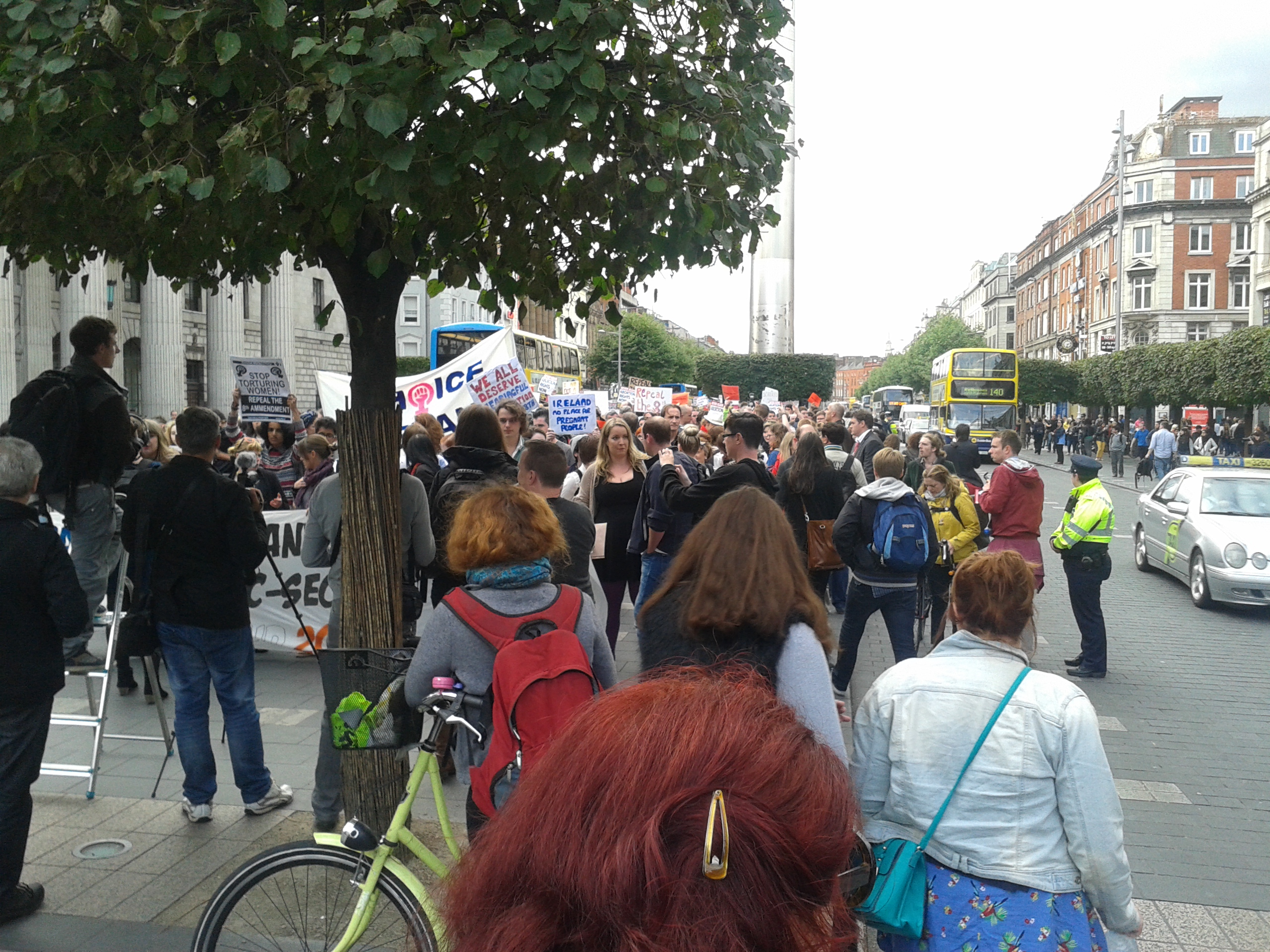
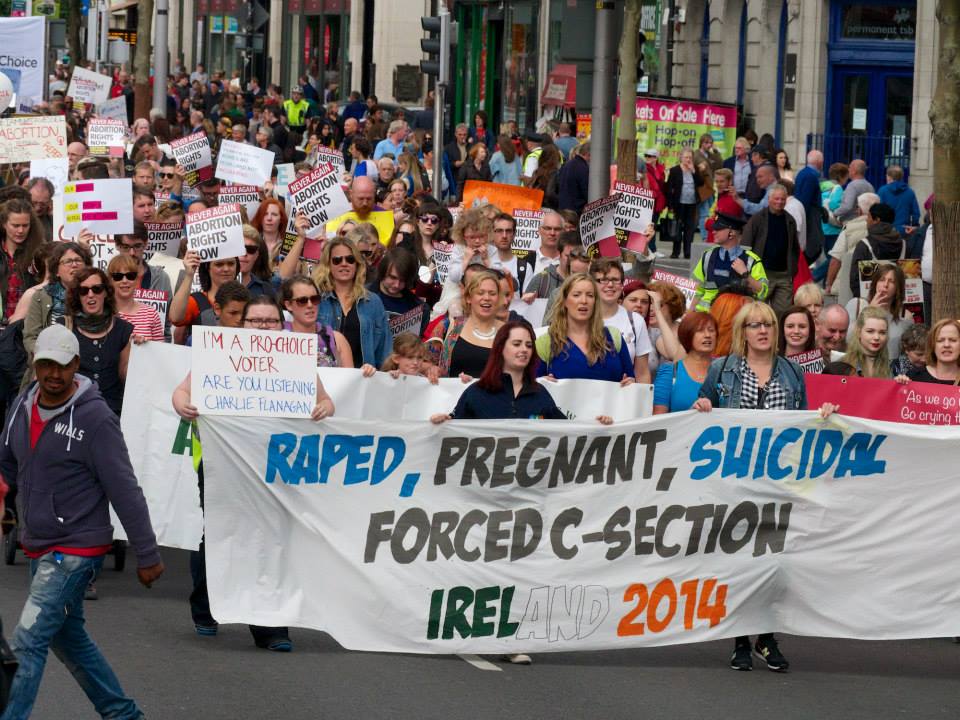
They came down O’Connell Street in their tens of thousands – colourful banners and heart-shaped balloons, music in sections, black, brown and white faces and if many were old, many were also young – and not just the children brought by a parent. “Right to life” was the most common chant, obviously tailored to undermine their opposition’s “Right to choose”, from those who favour the unfettered right to abortion. And LIFE is the name of the organisation that brought these marchers together on their annual march through Dublin city centre.Separat Church & State top
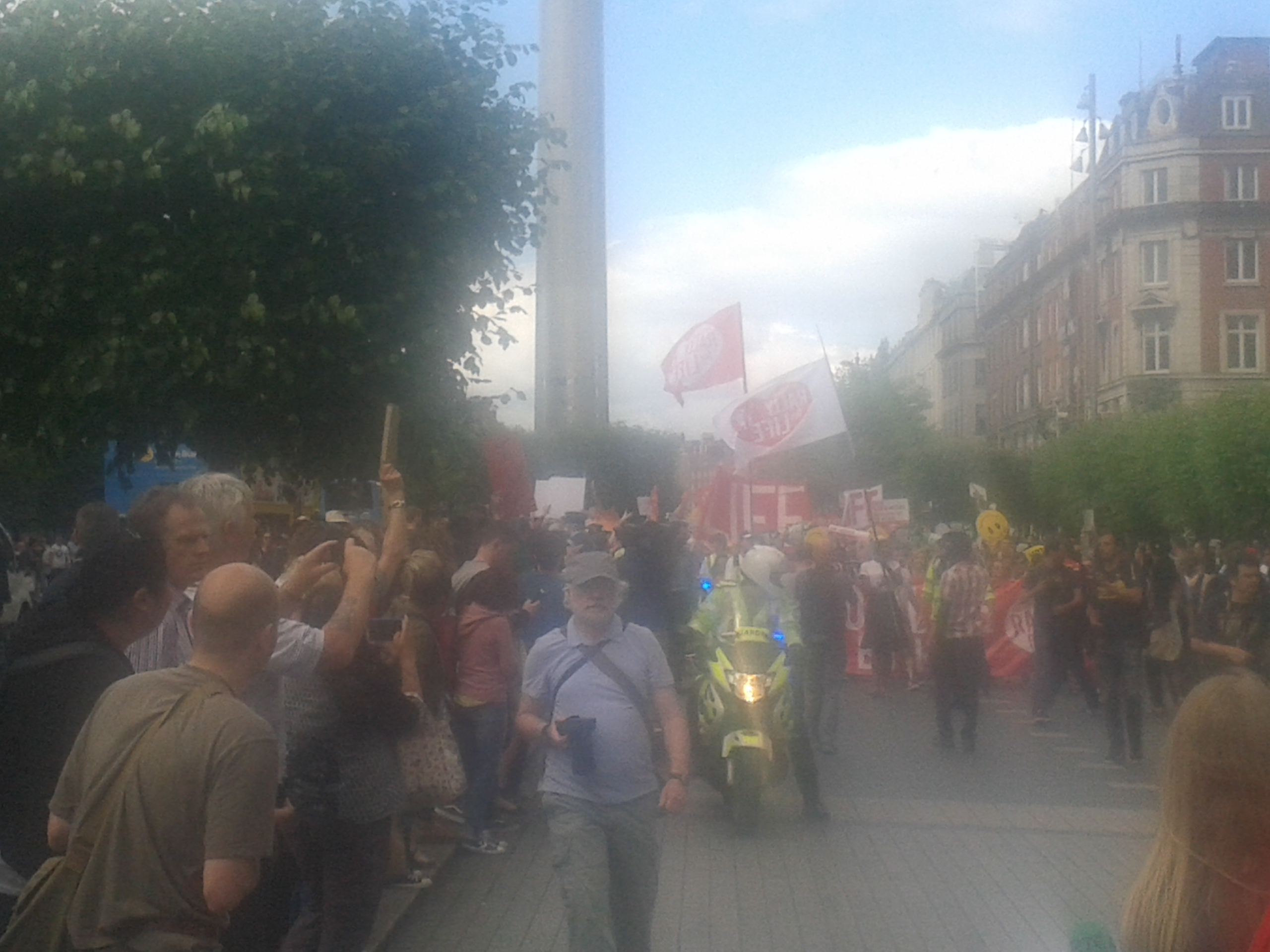
Bad photo of approach of anti-abortion march in O'Connell Street
Bad photo of approach of anti-abortion march in O’Connell Street

Nobody has a right to kill!” was the last line in another chant. So with that, the name of their organisation and “Right to life”, we have what they are about, right? They are for life and are upholding, apparently, the Christian Commandment “Thou shalt not kill”. Yes, it was there on the tablets of stone Moses brought down the mountain, Number Six – wayyy down the list. Actually, apparently in Hebrew it translates as “Though shalt not murder”. And defining “murder” is not so simple either. But anyway, the Jewish faith has the same prohibition. In fact, there is hardly a religion that does not. Of course, the Old Testament also calls for “an eye for an eye” and says that “you shall not suffer a witch to live”. But anyway ….

Interestingly, the highest leaders of organised religions across the world have blessed their soldiers as they went off to kill soldiers and civilians in other lands. Sometimes their victims were infidels according to the ones who were killing them but often they didn’t even have that excuse, as when the first Crusade attacked the overwhelmingly Christian city of Damascus, or when Catholic Spain fought Catholic France, or when Protestant England fought Protestant Germany, or Catholic Italy invaded Catholic Spain, Catalonia and the Basque Country. But presumably, those pastors, bishops, pontiffs, cardinals and mullahs can fall back on the dispute about the meaning – it wasn’t “murder”, it was legal killing.
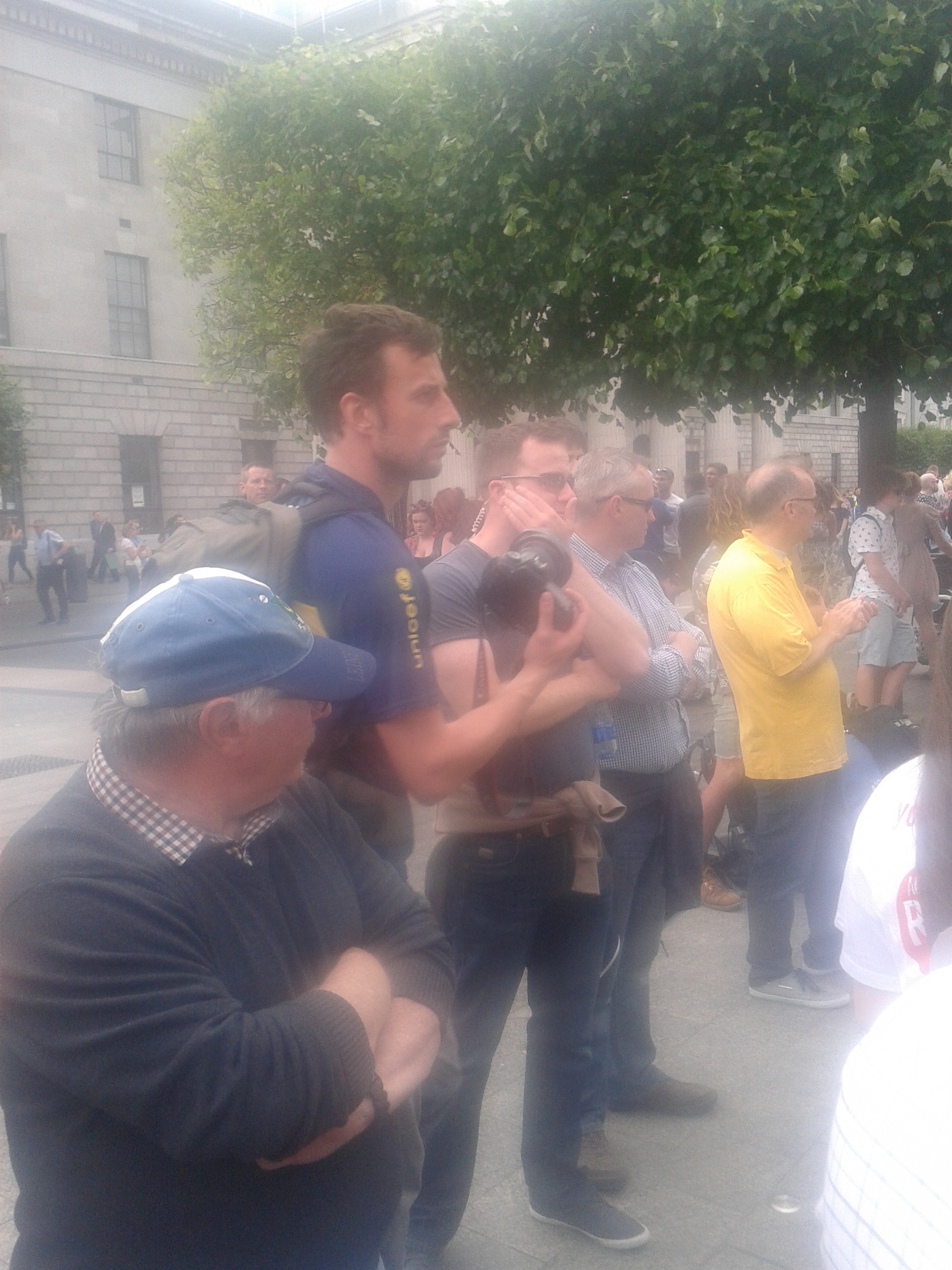
Two Special Branch officers (political police) centre photo in sunglasses -- blue pattern shirt and brown T-shirt top next to him.  There were eight SB identified, all watching the counter-protesters.
Two Special Branch officers (political police) centre photo in sunglasses — blue pattern shirt and brown T-shirt top next to him. There were eight SB identified, all watching the counter-protesters.  The blue-patterned shirt individual threatened a counter-protester without identifying himself.

The wiping out of the Guanches of the Canaries was not murder, the genocide of the indigenous American “Indians”, the enslavement and consequent killing of hundreds of thousands of Africans – they were not murder either. Nor the wiping out of every single Tasmanian and most of the Australian Aborigines. The West was exploring and, by the way, bringing Christianity and civilization to those poor benighted people.

I’d hazard a guess that compiling a list of Christian bishops in most denominations who condemned the wars in Malaya, Korea and Vietnam would a short one. Cardinal Spellman, notorious as anti-communist and anti-militant organized labour, a supporter of McCarthy’s witch-hunts, had the words “Kill a Commie for Christ” put into his mouth due to his enthusiastic support for the US waging the Vietnam War. Leaving out the maimed in mind and body, even in the wombs of their mothers, somewhere between 1.5 and 3.6 million were killed in that war – but presumably they weren’t murdered.

Billions of people are killed by unsafe working conditions, uncontrolled pollution, police and army repression, crime in slums, famine, alcohol and drug addiction, curable disease – almost all conditions that can be avoided except that doing so would cut into profits of local capitalists and/or foreign “multinationals” (read, monopoly capitalists/ imperialists). Those “entrepreneurs” aren’t murdering anyone either, even when their practices are illegal (even by their own laws) …. The ways of God are indeed mysterious, certainly so if the ways of his representatives on Earth are anything to go by.

Some suggested actions for lowering the abortion rate which involve caring for people instead of just foetuses

I have digressed, mea culpa. I have gone down a well-worn philosophical and logical path to ask a particular question: Are those tens of thousands marching down O’Connell Street really for Life and against killing human beings? I doubt it and I have not seen among their number most people I see against the bombardment of Gaza or the invasion of Iraq and Afghanistan, nor vice versa. A few, certainly, but not many. So I have to assume that it is not life that they value so much, except the life of a foetus. And once born, it is pretty much up to luck what happens to that foetus, as far as most of these ardent defenders of life are concerned.

As I said, that philosophical and logical path of discussion has been well trodden before me and no doubt to better effect than mine here. But I wish now to take another path of discussion – I wish now not to criticise the opposition, the anti-abortion brigade, but rather ours, the pro-choice movement of which loosely I am a member.

All Irish surveys and opinion polls published show a rising trend of support for the unfettered right to abortion, even if that section is still a minority. The majority of those polled have been for a greater access to abortion than is currently available in this state. Furthermore, some scandals involving refused abortions, refused permission to travel and the death of a woman who needed an abortion have mobilised considerable passion which the pro-choice movement could enlist in its favour.

Yet, despite what the polls tell us, and despite those high-profile cases, the anti-abortioners succeed in mobilising much larger numbers in opposition to abortion than do those who are in favour of permitting it. Putting this conundrum to some pro-choice campaigners, they have all answered to the effect that the anti-abortioners receive huge funding from reactionary political and religious foundations, especially in the USA. They spend millions on advertising and propaganda, I am told.

I’m sorry, I don’t accept that reply. Because despite their well-funded advertising and propaganda, the opinion polls show a climbing majority for some access to abortion and a climbing minority in favour of unfettered access.

The Riot Squad were also there for the counter-demonstrators.  Some may be seen in this misty image of them at the Princes Street end of the GPO.
The Riot Squad were also there for the counter-demonstrators. Some may be seen in this misty image of them at the Princes Street end of the GPO.

The Antis just seem to be better at mobilising their supporters – why is that? Well, the funding again, I’m told. They hire coaches and bus people in. So why can’t we do that? Are we incapable of raising money to hire coaches? Obviously not in the case of the Water Tax, for example. Republican groups hire coaches traveling to other parts of the country and pay their share as individuals; they often fund their posters, placards, banners public meeting-room hires, for example through fund-raising events. We don’t see many fund-raising events in support of the right to abortion. In fact, the public doesn’t see much evidence of the movement as a rule except when we come out to protest about a high-profile case or to oppose the march of the anti-abortioners. And our movement doesn’t seem to do much mobilising for the latter, either. And this march happens every year so it can easily be planned for.

Yet how many were there to show their opposition to these tens of thousands of anti-abortion campaigners? Maybe six hundred …. at a very long stretch, a thousand. Going by the opinion polls, in Dublin alone there are a great many more people who support unfettered access to abortion than appear on that counter-demonstration.

Nor did we even distribute our meagre forces in the most effective way.

Each year, it is the same. The anti-abortion people march down from the Garden of Remembrance, and the pro-choice people wait for them at the Spire. Most on the island, some on the east side pavement. The heaviest concentration of people is on the island (or pedestrian reservation), between the Spire and for about 20 or so yards heading north. Then the line starts to straggle. We didn’t even stretch quite to Larkin’s statue. Even those low numbers, properly distributed, could reach from the Spire down to O’Connell Bridge. But we don’t do that. We bunch up in a short concentration so that every section of their march is quickly past us and, what’s more, it allows them to focus their loudhailers and PA systems on our heaviest concentration in order to drown us out, as they were doing on Saturday.
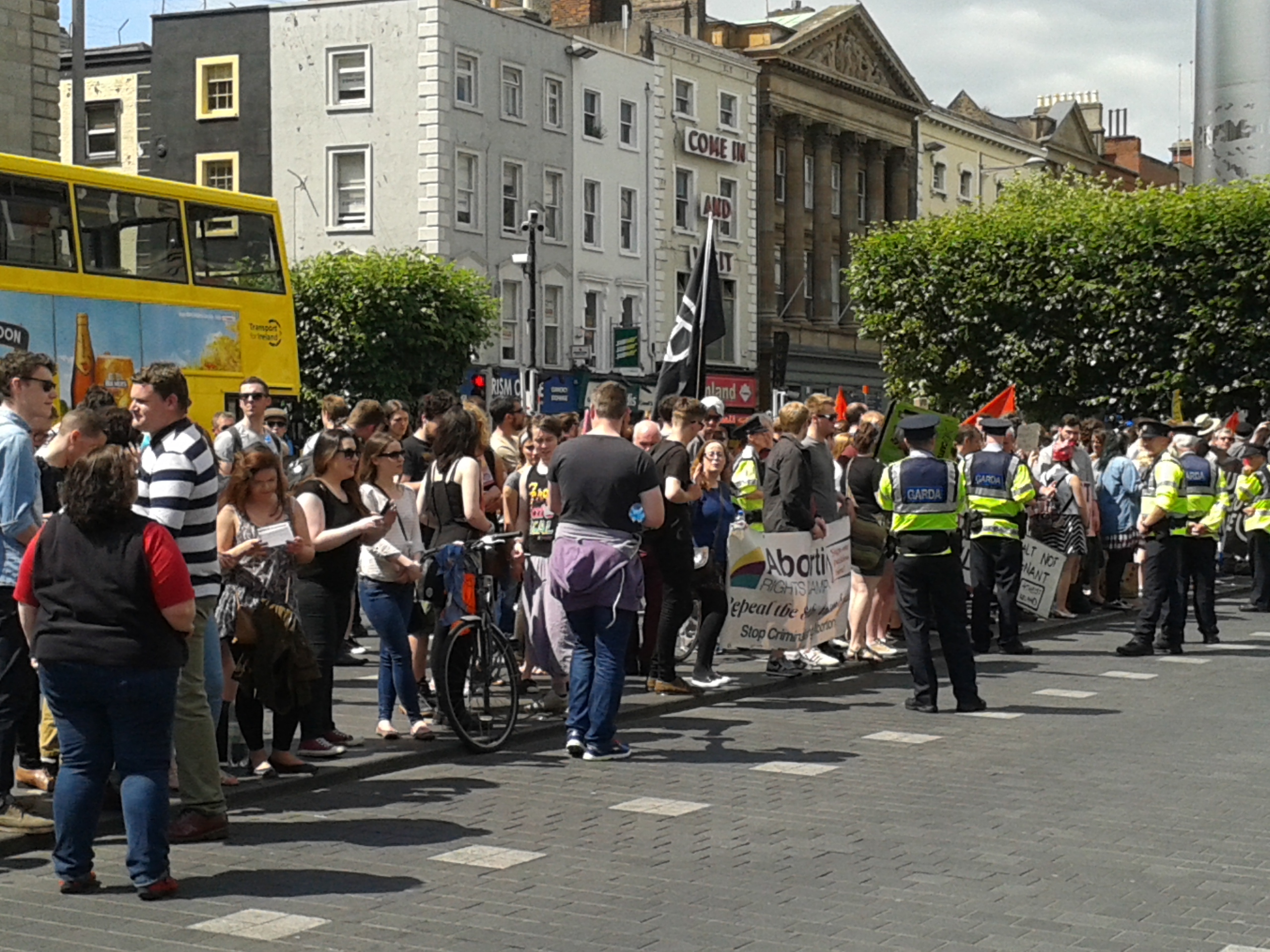
The section containing most of the counter-demonstrators.  The anti-abortioners were able to park two mobile PAs in front of them there to drown out their opposition as the march went by.
The section containing most of the counter-demonstrators, from left photo to the Spire. The anti-abortioners were able to park two mobile PAs in front of them there to drown out their opposition as the march went by.

Broadly speaking, we outnumber them but on most mobilisations, they outnumber us hugely. They appear more broadly militant and organise better. And they learn. I didn’t see anything like as many people in religious robes this year, which suggests to me that they are tailoring their presentation to avoid an over-identification in popular perception with religion. They can’t keep all their religious nutcases under wraps but I saw much less crosses or rosary-waving this year. They have adapted their slogans and chosen what seems the hardest argument to oppose, that which appears to be for “life”, and they ensure that they are all on message, chanting the same lines, again and again.

They are the reactionaries – how is that they seem better able to learn than us? Should it not be the other way around?


End
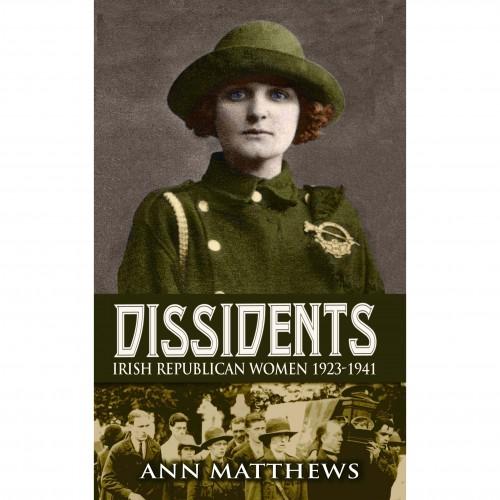
DISSIDENTS — A FLAWED CONTRIBUTION TO THE HISTORY OF A NEGLECTED GROUP

REVIEWING DISSIDENTS BY ANNE MATTHEWS:

Diarmuid Breatnach

The role of women has been often ignored and undervalued in the body of Irish historical writing. Whatever the reasons for this state of affairs, a tendency in more recent writing has been, at least to a degree, to attempt to rectify this. In the decades since Margaret Ward’s Unmanageable Revolutionaries (Brandon, Ireland, 1983), this rectification has been slowly gathering pace. Dissidents – Irish Republican women 1923-1941, by Anne Matthews (Mercier, 2012), is a contribution to this movement in historical writing; it is essentially the history of an Irish women’s political movement, Cumann na mBan, during the years outlined. A previous work of hers, “Renegades”, deals with Irish Republican women from 1901 to 1922. 

Dissidents Irish Republican Women bookAlthough Dissidents deals with the period 1923-1941, Cumann na mBan was founded on 2nd April 1914 as an auxiliary to the all-male Irish Volunteers’ organisation, which had been founded in 1913. In 1914 the Volunteers split after John Redmond, leader of the Irish Parliamentary Party (in Westminster) and the main open Irish political party in Ireland, committed the Irish Volunteers to fight in the British Army in WW1. The smaller section of the split went on to participate in the 1916 Uprising and more coherently later in the War of Independence (1919-1921). Redmond’s party and “constitutional” Irish nationalism was all but wiped out in the British General Elections of 1918, at which time the whole of Ireland was still under British rule and Redmond’s nationalist opponents, then amalgamated under the name of the reformed Sinn Féin, gained the vast majority of parliamentary seats in Ireland.

Today it is common to define the ideology of both both Cumann na mBan and the Irish Volunteers as “Irish Republican” and, although they quickly became so, and the impulse in the formation of the Volunteers in 1913 was of the secret Republican organisation the IRB (Irish Republican Brotherhood), both organisations at first could be more accurately described as broadly nationalist. Both organisations contained prominently in their midst people whose ideology conformed to that of Irish Republicanism as well as those whose thinking did not, people who expressed a strong interest in equality for women as well as those who were against it, people with at least a sympathy for socialist ideas and those who condemned any such tendencies – and of course variations in between.

In the period specifically chosen by Matthews, 1923-1941, the Irish Volunteers had morphed into the political party Sinn Féin and the armed organisation the IRA (Irish Republican Army) and become Irish Republican in ideology, as had Cumann na mBan. They had in fact been that way since 1919, although the period 1921-’23 was to expose some deep fracture lines which found expression in the Civil War (1922-1923) and later again with the founding of Fianna Fáil and its eventual management of the Irish State (the 26 Counties).

In order to compile her history, Matthews has consulted minutes of committee meetings of Cumann na mBan in its various incarnations (she identifies four periods, or versions of the organisation), personal recollections of participants recorded in writings, interviews, comments quoted by contemporaries, newspaper reports and articles, the Republican movement’s own publications, as well as records of prisons and police under both British and subsequently Free State rule. And she has used some of this material to reproduce and also compile lists such as the numbers and names of women convicted and jailed, the women who went on hunger-strike and the length of time on that protest. The lists also include figures on the decline of Cumann branches between 1934 and 1936, as well as a list of “women in organisations listed as dangerous by the Free State CID in 1934”. These lists are a particularly valuable contribution and will be of great use to many writing on the political movements of the period in Ireland.

Looking at some of those lists alone, one is struck by the sheer extent to which the contribution of women activists to the struggle for Irish independence, and the price they had to pay, has been overlooked. In 1930 twenty-nine women were in organisations listed as “dangerous” by the Free State detective branch of the police – twelve of these were in senior positions of Cumann na mBan, three in directing positions in Saor Éire, three for Comhairle na Poblachta, three also for Sinn Féin, one for the Prisoners’ Defence Organisation, two for Women Prisoners’ Defence League and one for the Anti-Imperialist League. The rest were rank-and-file members of those organisations and one was in Friends of Soviet Russia.

The Free State interned 645 women during the Civil War (as against over16,000 men). In her Introduction, Matthews points out that “There were twenty-four strikes in the three (women’s) prisons during the period from November 1922 to November 1923, in which 219 women took part.”  According to the table drawn up by Matthews, one woman was on hunger strike for 35 days, another for 34, seven for 31, many for different amounts of days but the vast majority into double figures. Furthermore, some of them were on hunger strike more than once.

Matthews also provides a list of the occupations of 79 women activists jailed in the North Dublin Union, which were surveyed in August 1923: the highest number for a single occupation were the 19 listed as “at home”, while the next were 11 whose occupations were given as “packer in Jacob’s” (the biscuit factory in Dublin); 10 had been engaged in “printing”; eight were “shop assistants” while 15 were variously listed as “typist” or “clerk”. This list shows quite a variety of social background among what one presumes to be fairly politically-active women which the Free State considered its enemies.

Republican women acting as couriers or delivering weapons made many journeys by bicycle, often at night without lights in order to avoid Free State patrols, “often round trips of up to forty miles” Matthew tells us (p.32).

BIAS

As has been pointed out by a number of commentators, history writing involves a degree of bias. This bias is exercised not only in explicit judgements but in inferences made, choice of phrasing and so on. Choices are made in what sources to use and what prominence to give them as well as in the opposite, which sources to disregard.

If the Fall of Lucifer and his angel followers were a historical event, for example, we would expect Lucifer’s version to be very different from the Judaeo-Christian story with its sympathy for the Archangel Michael (a great example of history being written by the victors). There might be yet other versions, for example by the Seraphim and Cherubim, one of which might be in partial sympathy with the Fallen side and the other which might be against both sides of the conflict.

Whereas in the ancient past history writing was blatantly partial, in the past century historians have generally claimed to be impartial dispassionate observers recording what they discover. But every one of those writers had views influenced by class, ethnicity, gender, position in or out of power groups, status, upbringing and personal experience. And those views influenced their historical judgements, quite likely their choice of sources and possibly their choice of audience. Written records could only be left by literate people and yet for most of history the majority of people have been illiterate. A more recent trend in history writing is to recognise the inevitability of bias and for the historian to declare which is his or hers.

One should beware of historians who don’t declare their bias at the outset. That will not be a problem with Anne Matthews because although she does not formally introduce her bias to her readers, it very soon becomes clear. Or maybe that is not quite accurate, for in order to have a bias against a group one must presumably also have a bias in favour of another. It is difficult indeed in the pages of this book to find any group for which Matthews has any sympathy or, even more important for a historian, empathy.

To express a bias is expected, as I commented earlier. But unless one is engaged in pure propaganda or character assassination (or glorification), one should present the evidence in favour as well as that against and, in weighing one against the other, make a judgement. When Matthews has anything favourable to say about her subjects it seems to be an accident which will soon be remedied a little later – just keep reading!

A particularly clear and nasty example of this bias is in Matthews’ treatment of Constance Markievicz whom she calls a “self-proclaimed heroine” (p.28) but does not tell us when and where Markievicz allegedly “proclaimed” herself to be a “heroine”. Matthews also inferred that Markievicz was a given to warlike statements but a coward who ran away to Scotland. Whatever the reason for her departure in 1922, one wonders how, no matter how much she may dislike the person, someone could call Markievicz, who prominently took up arms and fought for a week against the British Empire, a coward.

In the Matthews view of the organisation, Cumann na mBan was a largely ineffective body, doctrinaire and full of in-fighting. The leadership and many prominent activists were aristocratic or upper middle class, used to the privileges afforded by their class. The working and lower-middle class members accepted the leadership’s decisions or just deserted.

Some of those things may be true and there might even be some truth in all of them — but where is the counter-argument before coming to judge? One doesn’t find it in Matthews, except by an inference that one can make from the lists I mentioned earlier and other information.

If a woman came from a higher social class and was used to having servants do her cleaning, do those facts diminish in the least her courage in facing bullets in insurrection, the threat of the firing squad, the pangs on hunger-strike and the risk of permanent damage to health, the risk of physical beatings and unhealthy prison conditions? Or on the contrary, in some ways, are those risks and sacrifices not all the more remarkable for one from such a background as that? And if an upper-class mother can pay a nanny to look after her children while she herself in in jail, does that take away from her courage and fortitude? A working-class mother without those resources (though she might be able to avail of extended family) of course has even more obstacles to surmount and deserves our greater praise but that is no reason to disparage the sacrifice or commitment of a woman of a higher class.

And if infighting and bad policy choices were a significant feature of the organisation, were there not others to weigh against them on the scales of judgement? What of transporting, hiding and distributing weapons? Of carrying secret correspondence and intelligence? Or of continuing to feed the flame of resistance while men were in prison, organising pickets and demonstrations, outside jails etc? What of creating the enduring 1916 emblem and Republican commemoration emblem, the Easter Lilly? Or of organising Republican commemorations year after year, as well as funerals of fighters in the midst of repression? Or the work of supporting prisoners and their dependents? Matthews records these and often the difficulties entailed but without a word of approval to balance the censorious words used in her criticisms. Nor do we see an attempt to understand the choices these women made or the constraints upon them, much less see anything to admire; we are shown few lessons to learn from, unless it is something like “don’t be these people or anything like them”.

In Dissidents, Anne Matthews has made a contribution to the story of Republican women but its judgement is clearly skewed and the work suffers as a result. Matthews could have recorded all the negative information that she did but also the points to throw in the balance – had she done so, her book would have been a much better return on her investment in historical research and writing as well as a better reward for the reader.

End.

TÁ OR NÍL — SAME-SEX MARRIAGE, SURROGACY, HOMOSEXUALITY

Diarmuid Breatnach

When the votes are counted after today, we will either have a new clause inserted into our Bunreacht (Constitution) or we will not. If we do not, many of the “Vote Yes” campaign and opinion will be despondent. The revolutionaries among them should not be so but should instead reflect on their weakness as a force and on how to make that force stronger.

Should the vote result in a change in the Constitution, it will be probably the biggest blow so far to the power of the Catholic Church in lay society, a power it has enjoyed and abused even before 1921 but certainly since. Some, on both sides of the question, will see it as a blow against the Catholic religion itself but that is not necessarily so. Christianity and its Catholic variant survived and even thrived without State support in the past – indeed when its followers were discriminated against in every conceivable way by State power, a situation its faithful endured for centuries in Ireland as a whole and continue to do today, to a lesser extent, in the Six Counties.

What is the issue upon which we were being called to vote today? Although the NO campaign has tried to make us think it is, it is clearly not about whether two-gender households are better for raising children, whether surrogate birthing is right or wrong. It is not about whether we approve or homosexuality or not – although I suspect that is the real issue at base with many of the NO campaigners. In fact, it seems to me that it would be quite possible to disapprove of homosexuality and still to vote “Tá”, a question I will return to later. This might seem illogical, until we examine the actual issue upon which we are voting: do we agree with inserting a clause into the Bunreacht (Constitution) which states that a couple has a right to marry regardless of gender.

Presented with this question, which is a legal and Constitutional one, a number of issues arise, I think.

  1. What does the Bunreacht say at the moment about this question?
  2. What right has the State to define anything about sexual relationships?
  3. Are we in favour of equal civil rights for people?

1. It may come as a surprise to people that our Bunreacht, our Constitution, currently says nothing about the gender issue in marriage. There is nothing actually in our Bunreacht to prevent same-sex marriage. But the prohibition does exist in law. In other words, legislators at some point decided to propose and pass a law which confined the right (and rite) of marriage to heterosexual couples alone. Why did they do so if it was not an issue at that time? It seems to me that they were aware that same sex relationships did exist and strove to exclude those people from the rights enjoyed by others. This was the point of a number of other pieces of legislation against homosexuality which were not finally overturned until 1993 in this State (1982 in the Six Counties, 1980 in Scotland, 1967 in England and Wales) – five years after the European Court of Human Rights ruled that this state’s laws against male homosexual acts violated human rights.

According to the Catholic Church (and most other churches), despite the current legal situation with regard to homosexuality at the moment, it is still wrong. Well, the Catholic Church – and before them the established Anglican Church of Ireland – can have their views but they are not entitled, nor is any other church, to impose those on lay society, neither by legislation nor by other means. They are, of course, entitled to express their opinion – just like any other organisation.

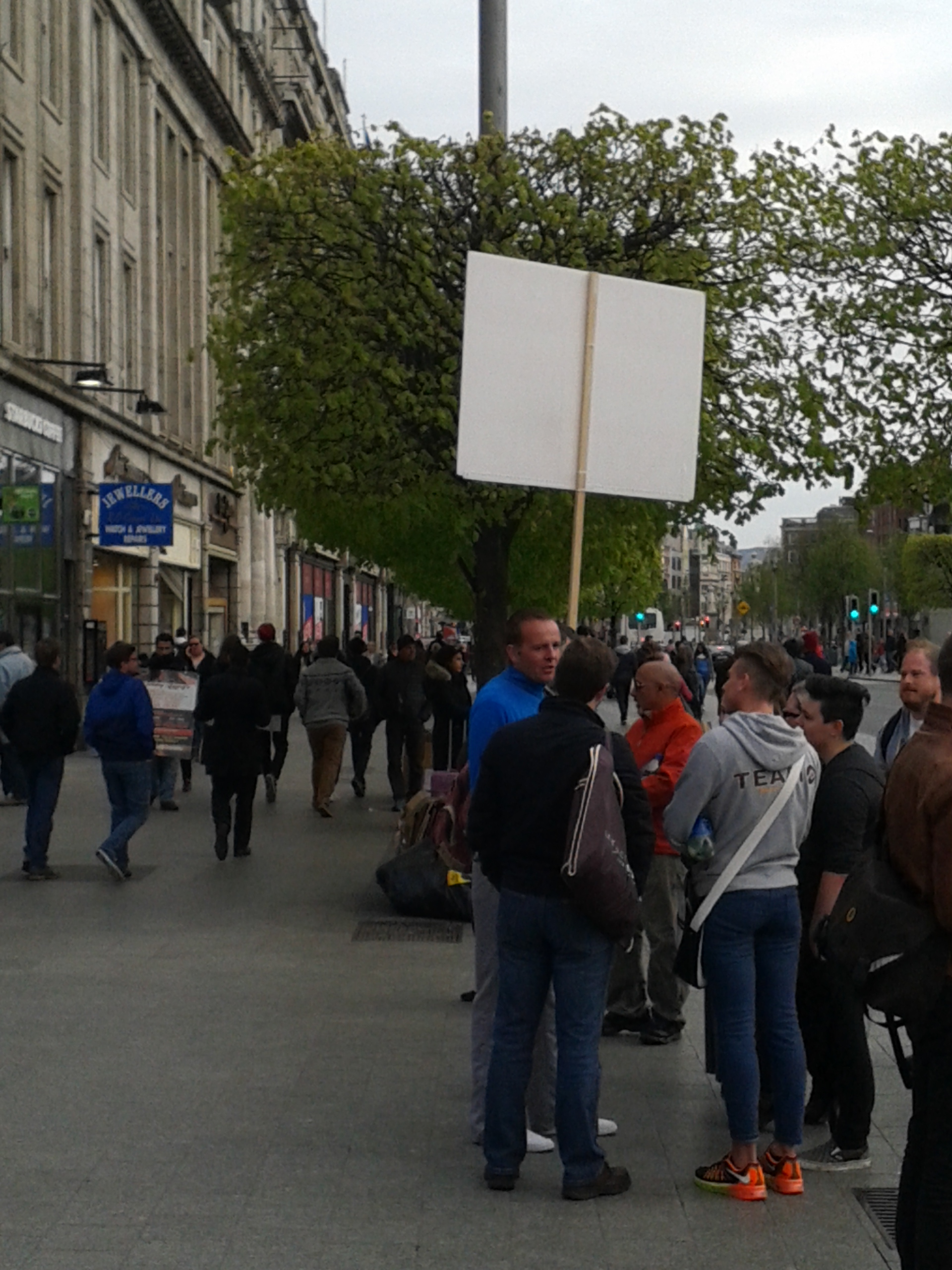
“God and Nature say NO” was the caption on this placard paraded in O’Connell St. near the Spire, some weeks prior to the Referendum. Some young people are arguing with the placard-holder.
One of the many badges worn in support of a vote to insert the clause into the Irish Constitution (there was also an English-language one)
One of the many badges worn in support of a vote to insert the clause into the Irish Constitution. There was also an English-language one and each were to be seen nearly everywhere in public in the weeks prior to the Referendum.

So, going back to the beginning of the legal status of heterosexual marriage within our current legal system, it was introduced as an excluding measure, at a time when male homosexuality was illegal and subject to heavy punishment and when lesbianism was frowned upon (though not actually illegal for complicated reasons). In other words, a law excluding a group of people was passed at a time when any man who declared himself to be one of those people was subject to prison sentence and any woman who did so was subject to extreme opprobrium in society. What chance was there for their point of view to be represented? In the absence of such representation and informed opinion-making, how can any democrat defend the laws passed at that time?

2. Turning now to the question of what right the State has to make a ruling of any kind upon a sexual relationship between any two people, of either gender, it must be difficult indeed for anyone to justify that without recourse to church canon or prejudice. Those who do so tend to bring up questions of childcare, inheritance and taxation – in fact just about the same questions that were brought up in the Irish referendum on divorce in 1995. But childcare, or at least the financial aspect of it, can be regulated by the State without any interference whatsoever in the sexual relationship between the parents. Whether it does so fairly at the moment is another question which has no bearing on the concept. And inheritance – ignoring for a moment whether we agree with a political economy where land and other wealth may be appropriated by individuals or families and then legally handed on through their following generations — can also be managed without recourse to State regulation of marriage. Taxation, similarly. Were we to have a socialist society, one based on other principles than that which we now have, even those current excuses for state interference should no longer be even a consideration.  In fact, it is difficult to see any reason why even now the State continues to have a role in the formalisation of a sexual contract between two individuals or, indeed, in its dissolution, except perhaps in ensuring fair divisions of belongings.

3. Those opposed to insertion of the new clause into the Bunreacht have done so from a number of perspectives of opposition: to lesbianism and homosexuality on religious or other grounds; to formalising same sex relationships; to the alleged undermining of the “sanctity of marriage” or of “romance”; in opposition to surrogate child-bearing and raising of children by gay and lesbian parents ….

Those supporting the new clause have defended the naturally-occurring continuum of sexual preference; maintained that the “sanctity of marriage” will be the same between same-sex couples, as will “romance”; denied that it opens the way to or encourages surrogate child-bearing and raising of children within a gay or lesbian household ….

Who is right and who is wrong? There is no doubt that as long as cultural beliefs and practices have been recorded, homosexuality and lesbianism have existed within societies — sometimes tolerated, often repressed, on rare occasions celebrated. We see homosexuality occurring too among animals. If there is such a thing as “sanctity of marriage” and “romance”, why should same-sex couples have any less of it than heterosexuals? Surrogate child-bearing is already possible and the hugely unequal distribution of wealth in our society – and between even our society and many others – ensures it can and will continue while the rewards are financial. Raising of children within a same-sex household is already happening, even without surrogacy. It is more difficult for gay men at present, but in the case of a gay man having custody of his children through widowhood (yes, some gay men do marry women), or the mother deserting the children or being deemed unfit by a court to have custody, a gay man may bring up his children within a homosexual parent household.

But will this change in the Constitution (and therefore also in the law) make surrogacy and child-rearing by gay couples more likely to happen? Will it increase the frequency of its occurrence? I think the answer to that, logically, must be yes – despite all the denials of the “Vote Yes” camp. And I think some of them must know that. Slowly perhaps and who knows by how much – but logically it must tend to increase the chances. But is that so awful? I find the idea of surrogacy in general distasteful but isn’t that just a prejudiced reaction? Probably. Will children reared by same-sex parents experience uncertainty about their own sexuality? Some will probably and some won’t. And if they do, why should they not be able to resolve that in time – as children reared in heterosexual relationships also find themselves having to do? Is uncertainty about sexuality such a terrible thing? In a judgmental, prohibitive and penalising society, it can be – so let’s create a society that is the opposite.

However, I have to say that I think all those questions and considerations are beside the point. If marriage is to be a legal status, then it is a civil right for everyone who is at the age of consent (and of sufficient mental ability to know to what they are consenting — in so much as any one of us was or does!). The right to same-sex marriage, as a civil right, should be supported even by people who do not approve of homosexuality, or marriage, or surrogacy, of child-rearing in a homosexual household. As for myself, someone who seeks revolutionary social, economic and political change, who wishes to see the overthrow of this State, a revolutionary as opposed to a reformist, I must nevertheless support reforms that extend civil rights, even when not led from below …. and so I voted “TÁ”.

WHEN EAGLES SING — Kurdish singer and fighter Viyan Peyman falls in battle/ Cantante y Luchadora Kurda falla en batalla

Viyan Peyman, famous fighter-singer of the YPJ, fell in battle against Islamic State in Serekaniye (Yazira canton) on Monday 6th April 2015, according to news agency Hawar News.

Viyan Peyman, famosa luchadora y cantante del YPJ cayó én lucha contra el Estado Islamico el lunes 6 de Abril 2015, según la agencia de noticias Hawar News (miren enlace al fondo de este corto trozo para las noticias en castellano).

When Eagles Sing

(I ndil chuimhne Viyan Peyman/Gulistan Tali Cingalo)

A bird fell from the sky —

the birdsong now has died. 


A songbird but also a fighter — 


When eagles sing 


our struggle is made lighter.

She flies now in different skies,


skies of our memory,


of our heart, spirt and mind


where her song cannot be silenced


for Kurds or for humankind.

Diarmuid Breatnach April 2013

Viyan’s real name was Gulistan Tali Cingalo (Gulistan means “garden”) and she was from Mako city in the part of Kurdistan located within the Iranian state’s territory.

The song she sings in the video was composed by her; the lyrics say:

“Oh, mother, woe to me!


My heart cries today — what disaster has fallen upon us!


I will sing today of the resistance of Kobane,

that it may be a poem recited for the world and humanity, oh mother!


Today again our Kurdish boys and girls have made their chests into shields

against the tanks and bombs …
Oh, mother, woe to me!


Today I imagine the mothers of Kobane crying in the streets;


I imagine the boys, the girls, the elderly screaming in pain and rage.


I see the tears of the children of Kobane as if they were the Euphrates river, 


flooding the streets of Kobane!


Oh, mother, woe is me!”

Information and song lyrics translated from Castillian text sourced here: https://comitesaharaui.wordpress.com/…/cae-en-combate-la-c…/

THE WOMEN STARTED IT

(Reading time: 5 mins)

Diarmuid Breatnach

We celebrate International Women’s Day on March 8th but are we aware that on that day in 1917, women started the Russian revolution?  It was one of the many contributions of women the world over to the struggles of humanity.

BACKGROUND

          There were many causes of discontent with the ruling regime in Russia in 1917: it was monarchic, autocratic, repressive, incompetent. It had put the country into a war with Germany and Austria, which was in its third year. People were very hungry with food shortages for a number of reasons including the trains being used to transport war materials and soldiers rather than to bring food into the city. Nationalities within Russia and Greater Russia were denied self-determination.

Peasants were serfs to the aristocracy, who could beat, imprison and even hang them. Officers, always from the aristocracy or — to a lesser degree — from the professional classes regularly struck ordinary soldiers or had them whipped. The officers were also for the most part grossly incompetent.

The Christian Church (Russian Orthodox) was allied to the regime and corrupt. Free speech was suppressed and the secret police could be anywhere; the regular police were brutal and could not be challenged by ordinary people. Wages were often barely enough to live on.

START OF THE REVOLUTION

          Petrograd was the Imperial capital city of Russia (the name had been changed in 1914 from St. Petersburg, which sounded too German) and in February and March 1917 a number of factories there were on strike for better wages.   In particular, on March 7th (February 22 according to the calendar in use in Russia then), workers in the large Putilov works went on strike. The factory owners sacked the workers but not had not yet replaced them; there were some clashes with police.

The following day, March 8th (by our calendar), International Women’s Day, women in Petrograd organised a number of meetings and rallies. Led by no political party but in an atmosphere of deep discontent throughout the city, the women’s activities became increasingly energetic and militant. Demonstrations began to march, demanding bread and the women went to factories not yet on strike, calling on the workers to down tools and join the demonstrations. As as many as 50,000 did.

Two days later, a general strike had seized Petrograd’s manufacturing industries, much of the city’s services and even some commercial business, bringing clerks, teachers and students to swell the numbers in protests. Everywhere there were street meetings, marches; red flags and banners began to appear among the crowds. Slogans hardly considered before were shouted and became current, including calling for the monarch, the Tsar, to abdicate or to be deposed.

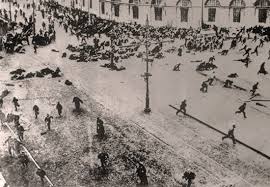
Demonstration during the "February Revolution" 1917. Note the prominence of women in the demonstration.
Demonstration during the “February Revolution” 1917

The Petrograd police were powerless to control the demonstrators who would have turned on them had they intervened. On the 11th, three days after the women’s mobilisation, the Tsar called on the Russian Army to intervene and to shoot demonstrators.

Russia had the largest single army in the world and despite the war, thousands were still in Petrograd. They had been used in the past against the workers and in 1905 had massacred people on a demonstration to petition the Tsar. But now, after three years of war and shortages, they were not keen to do so and particularly reluctant to open fire on women. Soldiers began to mutiny and, when threatened by officers, often shot them instead.

On that day, the Chairman of the Duma, the parliament which the Tsar Nicholas had kept powerless, sent an emergency telegram to the Tsar, who was at the Headquarters of the Russian Army, asking him for urgent action. The Tsar’s reply was dismissive – his wife, the Empress Consort Alexandra, had written to him that the problems in Petrograd were being exaggerated.

A Russian Army barricade during the "February Revolution" -- the soldiers refused the orders of their officers to shoot demonstrators.
A Russian Army barricade during the “February Revolution” — the soldiers refused the orders of their officers to shoot demonstrators.

But the garrison of Petrograd, including elite units, had mutinied by the 12th, four days after the women’s marches and demonstrations. In addition the Cossack troops, usually reliable in shooting and sabring demonstrators and rioters, were disobeying the orders of their officers to attack the people (although they had not joined the mutiny). Officers began to go into hiding as more of them were being shot by soldiers from their own units. Symbols of Tsarist rule were being torn down in public places.

Two days later, on the 14th, the socialist parties and organisations established the Petrograd Soviet, last seen there twelve years previously, in 1905, before it was crushed by the Russian army. The Petrograd bourgeoisie were frightened but were unused to ruling except as permitted to by the Tsar, who himself now seemed unable to control events. Their powerless Duma (parliament), although ordered closed down by the Tsar that morning, set up a temporary committee to restore law and order and later, their Military Commission as part of the Provisional Government they created.

Thus began a period of dual authority in the city – the revolutionary workers, soldiers (and later, sailors) through the Soviet on the one hand and the bourgeoisie through their Military Committee on the other.

The Petrograd Soviet set the tone for what was to come by approving a number of points in Order No.1, effectively the first law drawn up by the Soviet, point 4 of which stated:

The orders of the Military Commission of the State Duma shall be executed only in such cases as do not conflict with the orders and resolution of the Soviet of Workers’ and Soldiers’ Deputies.”

The Soviet was making sure it could not be overruled by the new unelected body which the bourgeoisie had set up, the Provisional Government, or by its Military Commission.  

Senior Army and political appointees advised the Tsar to do what just over a week previously would have been unthinkable – to abdicate. On the 15th, the Tsar abdicated on his own behalf and of his son, nominating instead his brother, the Grand Duke Alexandrovich, to be Tsar. But he in turn knew he had no support as things stood and refused the “crown”.

July Days Russia 1917
Demonstrating workers shot down by Army units in the Russian “July Days”, 1917

The Russian monarchy of centuries had been overthrown — only seven days after the women’s mobilisation in Petrograd.

Maneouvers by the different sides continued during May and June, including an attempted military coup by senior officers commanding army units away from Petrograd. The fortunes of the revolution swayed back and forth across the country until demonstrations in July supported by the Anarchists and the Bolsheviks were suppressed by army units loyal to the Mensheviks and Socialist Revolutionaries political parties in power.

Workers were being disarmed, soldiers re-submitted to the old discipline and revolutionary leaders were being hunted; the War was also ongoing.

In October, the Bolsheviks seized power, ended Russia’s involvement in the War and began to construct a socialist state.

Two years later the people had to fight to defend it against a right-wing military uprising supported by eight states, including the Allies but were successful in the end.

But it was the women who had started the ball rolling seven months earlier on March 8th, with their rallies and demonstrations and calling the workers out from the factories. Henceforth too, they played their part in government, in building the country and in the armed forces, particularly during the war against fascism and in defence of the USSR from June 1941 to the fall of Berlin and Nazi Germany in 1945.

Nearly 200,000 women were decorated and 89 eventually received the Soviet Union’s highest award, the Hero of the Soviet Union. Some served as pilots, snipers (some of the ace snipers at the famous battle (or siege) of Stalingrad were women), machine gunners, tank crew members and partisans, as well as in auxiliary roles of nursing, construction, administration, factory work and of course food production.

end.

Soviet female combat pilots in WW2. The USSR was the only state to have female combat pilots.
Soviet female combat pilots in WW2. The USSR was the only belligerent state to have female combat pilots during WW2.

ANOTHER SHOCKING STATE ATTACK ON THE RIGHTS OF A WOMAN BRINGS DEMONSTRATORS ON TO THE STREETS

A suicidal woman refused an abortion, is then force-fed to preserve her embryo which is later delivered at 25 weeks by caesarian section.

Diarmuid Breatnach

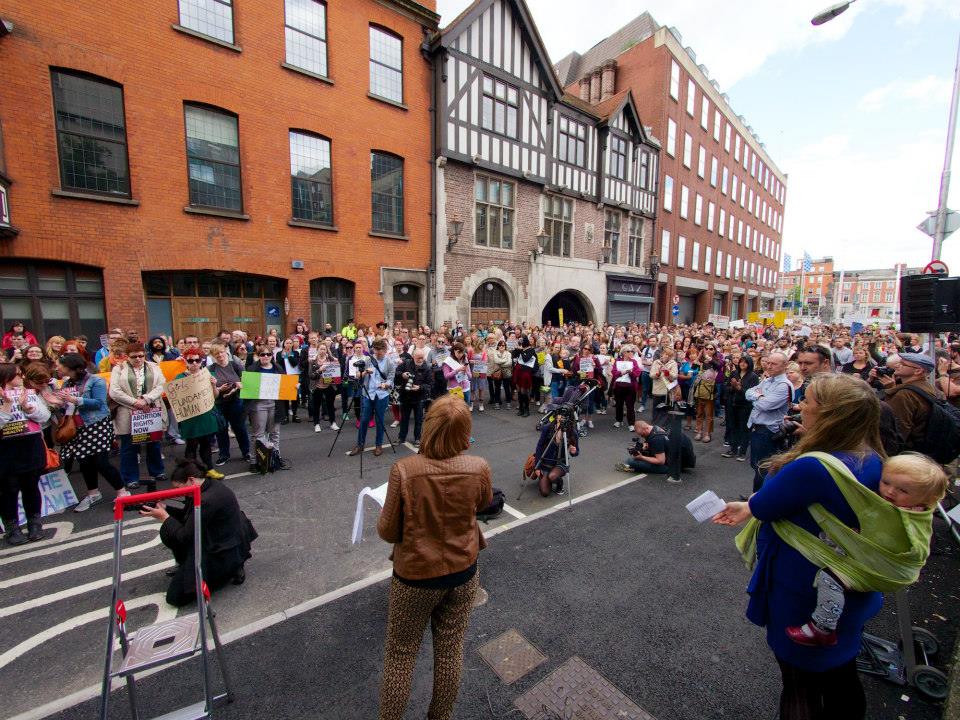
A woman considered suicidal by a medical panel was recently refused an abortion in Ireland and was subsequently force-fed. Within days a call was made for a protest demonstration and was answered by a substantial number in Dublin on Wednesday night last. The protestors filled the central section of O’Connell Street from the Spire to the Larkin monument and also spilled out into the road. Numbers of protestors took up station on the pavement fronting the GPO. A weekend demonstration was also convened in Dublin and another in Cork.0

Protest Caesarian etc rally 20Aug2014
Protesters in Dublin on Wednesday evening denouncing the treatment of the woman refused an abortion and force-fed. They called for the repeal of the Eight Amendment to the Irish Constitution.  (photo D. Breatnach)

The pregnant young woman, apparently under 18 years of age, was a migrant, who sought an abortion in Ireland. Some media reports say that her pregnancy arose as a result of a rape in her native country prior to her travelling to Ireland. Not all the details are clear but it seems that an Irish advice centre gave her the necessary information to travel to Britain to receive an abortion but that she was unable to afford it (there is also some question about her immigration or asylum status should she wish to reenter Ireland). It seems she then became depressed, not surprisingly, and expressed suicidal ideation. Under the Right to Life During Pregnancy Act 2013, introduced following the “X” case, a woman is entitled to receive an abortion if carrying the foetus should result in a substantial risk to her life – suicidal ideation being one of of those risks.

In accordance with the 2013 Act the young woman’s case was reviewed by a panel, consisting of two psychologists and an obstetrician. According to reporting in the mass media, the psychologists agreed that she was suicidal and that she she should therefore have the termination. The obstetrician apparently agreed that she was suicidal but argued that in a short while (two weeks has been mentioned), a caesarian could be carried out and a baby delivered alive and viable. Since the Act requires the unanimous concurrence of all three members of the panel, the young woman was refused an abortion.

It seems the woman became further depressed and stopped eating, whereupon lawyers for the hospital went to the High Court to obtain a court order permitting the woman to be force-fed, which procedure was carried out (probably intravenously). The woman is said to have subsequently agreed to a caesarian section by which method a baby was delivered. The fate of the woman is not in the public domain at this time but the baby was reportedly delivered alive and well after 25 weeks in the womb.

A number of speakers at the rally made the point that “here we are again”, i.e. that the lack of the necessary legislation has led to another case of terrible mistreatment of a young woman, a reference to other cases of refusal of abortion that have become scandals and lead to demonstrations such as about the death of Sadita Halappanavar in 2012 and the “X” case in 1992.

At the rally, all the speakers, campaigners and providers of services and a male doctor from Doctors for Choice, called for a referendum to repeal Amendment Eight of the Bunreacht (Irish Constitution). This is the amendment passed in 1983 in order to prevent abortion becoming legal. Some very telling points were made, one speaker saying that no-one in Ireland but a pregnant woman would be force-fed or bullied into submitting to an invasive surgical operation. Perhaps we cannot say that none of those things would ever happen to anyone else but it is certainly true that only in the case of a pregnant woman would that combination of coercive and intrusive procedures, clearly in violation of the Hippocratic Oath, have been considered so readily and applied in conjunction. That the woman was a migrant probably made it easier for the authorities but it is the legal position on abortion in Ireland and its moral underpinning which reduces the pregnant woman to the status of some kind of living vessel, the status of the unborn foetus being higher than that of the mother.

Men’s place in the movement

Breaking from the general trend at the rally, one of the speakers addressed many of her remarks specifically at the males present there in support. She told them “they should know their place” and that they had no right to express any opinion on the issue except to support the women. Some women applauded her and some did not.

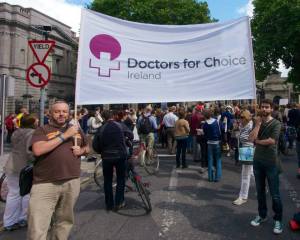
Drs for Choice 23Aug2014 AF
On the Dublin march for the repeal of the 8th Amendment on Saturday. This banner was also present at the Wednesday protest rally where one of their representatives spoke. (photo Andrew Flood)

Since variations of this view have emerged quite frequently, including the view that it’s a women’s issue or that men should just follow the opinion of women in the movement, it is worth examining this a little further. The current situation on abortion in Ireland of course impacts in the first place on women but it does not affect them only. An unwanted pregnancy, especially at an early age or stage in a relationship can force decisions that may later be regretted, including marriage or abandonment. Raising a child from what was an unwanted pregnancy has long-term social and economic implications, not just for the mother but for a much wider circle – as well as for the child growing up in society. The existence of legislation on abortion and its repeal is in the realm of criminal law — but above all it is a social issue, one affecting society. The provision of abortion is also a medical and social question: medical and social structures and services will need to be put in place, funded, monitored and its practitioners trained. Therefore all of adult society has a right to a voice on it. To call on a section of society to be mute supporters is to treat them as voting fodder and should not be supported by any genuinely democratic person.

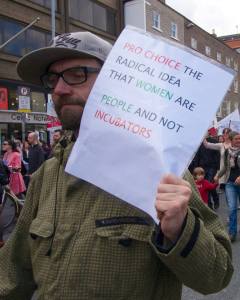
Pro-Choice that W not incubators
Man on the Dublin march for repeal of the 8th Amendment (photo Andrew Flood)

Also, if men, because they are not after all going to be the ones being impregnated and bearing children, should not have a voice but should only support women, which women’s opinions should they support? Why not support the many women who are totally against abortion? And even if supporting women who are for greater access to abortion, which section of opinion about which degree of access should men support?

Clearly men have to think about these issues to come to decisions. Are they to think silently, expressing no opinion and discussing with no-one, and then be expected to develop rational opinions to inform their actions and, in the case of a referendum, their voting too? Clearly the expectations expressed in such calls or statements are not only undemocratic but unrealistic too. Men not only have the right to express opinions on these issues but need to be able to do so in order to have the discussions that make it possible for them to make rational choices.

The attitude of the state and a referendum

The Dublin pro-choice demonstration on Saturday, according to observers, matched the numbers at the anti-abortion demonstration in the city on the same day – about seven hundred. The pro-choice demonstration took an unusual route from O’Connell Street and became the third demonstration to cross the Rosie Hackett Bridge (opened in May this year). The Bridge is the only one in Dublin named after a woman and Rosie was a trade union militant active in the Dublin Lockout of 1913, as well as taking part in the 1916 Rising as a member of the Irish Citizen Army. The demonstration rallied just across the river at the Department of Health in Hawkins Street (the Department under which the young woman had been refused an abortion and force-fed) and then went on to demonstrate at the Dáil (the Irish parliament).

ProChoice DeptHealth 23Aug2014 AF
Speaker addresses the crowd in Hawkins Street, outside the Department of Justice — Rosie Hackett Bridge is to the far right of the photo. (photo Andrew Flood)

Some supporters of a change in the law have presented the issue as though it is essential to the State and to the Catholic Church, two institutions closely linked, to control women’s bodies through refusing access to abortion, free and on demand. I do not think it is so. Certainly those forces may want to control women’s bodies (and indeed, men and women’s minds) but such control is not essential for the continued existence of the State. Many capitalist countries have either easy access to abortion or much more liberal laws than has the 26-County state. This state can afford to give that right but that does not mean that it will. When a state is able to give something but does not want to, sufficient force must be mobilised in order to convince it that yielding will cost it less than denying. Substantial pressure will need to be brought to bear on the State so that it agrees to holding a referendum.

But having a referendum does not mean that the correct and necessary outcome will be the result. We have had referenda in which the side of progress and justice was successful but also those in which it was not. The present Amendment Eight to the Bunreacht (Constitution), which the movement seeks to repeal, was the result of a referendum.

Yes, true, that was 30 years ago and opinions have changed since. In recent years, opinion surveys have shown a majority in favour of some relaxation of the law. Also, two legislative attempts to tighten restrictions on access to abortion, in 1992 and 2002, failed. On the other hand, the Thirteenth and Fourteenth amendments, both in 1992, were successful in loosening the ban, establishing the right of a pregnant woman to travel, even if to obtain an abortion, and to be given information about abortions services abroad. However, although the numbers in favour of unfettered access to abortion have grown substantially they do not yet constitute a majority.

According to analysts of the socio-economic background of respondents to the questionnaire, the indication is that the areas of greatest resistance are among a section of the middle class and a section of the working class. That particular section of the middle class is one of generally right-wing views and not amenable to change. Besides, they have the economic resources to lessen the chances of unwanted pregnancies including, despite their ideological position against it, to send their pregnant daughters quietly to Britain, having them return after a brief holiday without the neighbours being any the wiser. Or for a wife to go on a weekend visit to a friend in Britain even without her husband knowing the real reason for the trip.

The working class is in a different situation. High social and economic deprivation in Western countries tends to be accompanied by a higher degree of unplanned pregnancies and single parenthood than is the case with other socio-economic groups. Most working class families would also struggle to find the funds to send a family member to Britain (or to the Netherlands, apparently a new trend) to have an abortion, usually accompanied by at least one friend or family member, paying for travel, accommodation and the procedure itself. And the level of care is likely to be at the lower end of the scale. Of course many, many families and friend groups do manage it somehow.

The working class has a vested interest in this reform and this is recognised among some sections of the class but not in others. Traditional obedience to the Church has broken down in many areas, for example in ideas about sex before marriage and in using barriers to impregnation. However, the opposition to abortion remains, for many, a line not to be crossed. If a referendum is to be forced from the State and, in particular if the outcome is to be such as needed, a change in the outlook of at least a substantial section of this class needs to be achieved. Most working class people outside the immediate circles of the pro-choice movement tend not to see any campaigning on the issue except after such scandals hit the headlines – then a flare-up is briefly visible until things die down again.

The pro-choice movement will need to get out on to the streets and into communities on a regular basis if it is to win. I think it also needs to counter the work of the anti-choice propagandists, particularly those who put up their stalls in public areas or picket information centres. In discussion with some activists in the pro-choice movement, they say they do these things to some degree but don’t have the numbers of activists needed to do it more regularly. I confess that I find it hard to believe that in Dublin, for example, the movement is incapable through lack of activists to put a stall – indeed a number of stalls in different areas – on the street at least once a month. Some of those in the movement have been campaigning for decades and others for many years – and yet, as so many of their speakers said on Wednesday night in O’Connell Street, “here we are again”, responding to another fatal tragedy or shocking violation of human and civil rights.

Front Rally Repeal 8th 23Aug2014
Front of the march on Saturday in Dublin (photo Andrew Flood)

Facebook organising and networking by pro-choice campaigning groups can produce quick mobilisation of substantial numbers of people. These people are already convinced. Most of the working class remains untouched by these mobilisations and certainly their overall outlook remains unchanged. If the pro-choice movement is to have its desires become reality, it needs to get out into the working class communities and promote its cause, hopefully recruiting from among those communities to better carry the message among their own. The movement needs to engage in dialogue with movements with a high percentage of people of working class background, such as – dare one say it? — the Irish Republican movement. The latter is, despite one very deep idealogical divide and the existence of a number of factions, the political opposition movement with the largest active participation of people of working class background. At the moment, the overall position of the movement is anti-choice but that is nowhere near as monolithic or as unassailable as it was even a decade ago.

The hope is that the necessary mobilisation will be done and that very soon the State will be forced to concede a referendum on the abolition of Amendment Eight. The hope is also that the necessary educational work will be done to achieve an overwhelming victory in that referendum. The activists in the movement need our support, men as well as women, in all of that.

End.

THIRTEEN ROSES ….. AND 43 CARNATIONS

MILICIANAS 2

RAFAEL NARBONA

(Translation by Diarmuid Breatnach; original version published in Spanish in Rafael Narbona’s blog August 2013, also republished by kind permission in Rebel Breeze https://rebelbreeze.wordpress.com/2014/03/28/trece-rosas-y-43-claveles/)

On the morning of August 5th 1939 thirteen women were shot dead against the walls of the Eastern Madrid Cemetery.

Nine were minors, because at that time the age of majority was not reached until twenty-one. Ranging in age from 18 to 29, all had been brought from the Sales women’s prison, a prison that was designed for 450 people and in 1939 contained 4,000. Apart from Brisac Blanca Vazquez, all belonged to the Unified Socialist Youth (JSU) or PCE (Communist Party of Spain). Although they had not participated in the attack that killed Isaac Gabaldon, commander of the Civil Guard, they were charged with being involved and conspiring against the “social and legal order of the new Spain”.

The trial was held on August 3rd and 56 death sentences were issued, including the perpetrators of the attack. The Thirteen Roses went to their execution hoping to be reunited with their JSU comrades. In some cases it would have meant a boyfriend or husband but their hopes crumbled upon learning that the men had been shot already.

conesa

The brick wall clearly showed the bullet holes and the earth had been turned dark by blood. Some days, the death toll exceeded two hundred and machine guns were used to facilitate the work. Between 1939 and 1945, four thousand people were shot in the Eastern Cemetery, including Julián Zugazagoitia, Minister of the Interior with Juan Negrín and remarkable writer and socialist politician.

According to Maria Teresa Igual, prison officer and eyewitness, the Thirteen Roses died with fortitude. There were no screams or pleas. In an eerie half-silence, only the steps of the firing squad were heard, the sound of the guns striking the straps and the voice of the commanding officer. Lined up shoulder to shoulder, after the shooting all received the coup de grace, which was clearly heard in the Sales women’s prison. Apparently, one of the condemned (whether Anita or Blanca is not known), did not die immediately and had shouted, “Am I not to be killed?”

Antonia Torre Yela was spared execution by a typing error.  In transcribing her name, the letters danced and became Antonio Torres Yera. The error only postponed death for Antonia, a member of the JSU and only 18. She was shot on February 19th, 1940, becoming the 14th Rose. In her farewell letter, Julia Conesa, nineteen and member of the JSU, wrote: “Let my name not be erased from history.” Her name and that of her comrades has not been forgotten, unlike those of their tormentors, who enjoyed impunity for 38 years of dictatorship and a shameful amnesty which only helped to deepen the hurt suffered by all victims of Francoism.

The PSOE (main social-democratic party — DB) tried to appropriate the Thirteen Roses, concealing that at the time of the executions the PSOE had split from the JSU to found the Socialist Youth of Spain (JSE), with the purpose of clearly distancing themselves from the Communist Party of Spain (PCE). In fact, the Law of Historical Memory of Zapatero’s government (the first PSOE government after Franco — DB) did not even consider overturning the dictatorship’s judicial verdicts. It should be remembered that nearly fifty men were also shot dead that sad August 5th, the “43 Carnations”. Franco showed the same ruthlessness to men and women.

A hell

Sales jail was a hell, with children, elderly and mothers with children huddled in hallways, stairs, patios and bathrooms. Manuela and Teresa Basanta Guerra were the first women executed against the walls of the Eastern Cemetery. They shot them on June 29th 1939 along with a hundred men. Some historians claim that other women preceded them but their names were not recorded in the cemetery’s files. Like others on death row, the Thirteen Roses could only write to their families after receiving confession. If they did not take confession, they gave up the opportunity to say goodbye to their loved ones.

Brisac Blanca was the eldest of the thirteen and active in no political organization. Catholic and one who voted for the Right, she nevertheless fell in love with a musician who belonged to the PCE, Enrique Garcia Mazas. They married and had a son. Both were arrested and sentenced to death in the same trial. In fact, Enrique was in Porlier prison and would be shot a few hours before her. Blanca wrote a letter to her son Enrique, asking him not to harbour ill-will towards those responsible for her death and to become a good and hardworking man.

MILICIANAS 3

In postwar Madrid there was vicious persecution and resentment of any citizen suspected of “joining the rebellion”, the technicality that was used to reverse the law, accusing supporters of the Second Republic of violating the law in force. Only the military, the clergy, the Falange and the Carlists could breathe easily. No one dared to walk around in workers’ overalls or wearing the traditional local bandanna (worn by men around the neck and by women as a kerchief around the head, it is still worn today at festival in Madrid — DB).

The city was a huge prison where “hunt the red” was taking place. The earlier militia-women aroused particular animosity. The Arriba newspaper edition of May 16th 1939, featured an article by José Vicente Puente in which his contempt does not mince words: “One of the greatest tortures of the hot and drunk Madrid were the militia-women parading openly in overalls, lank-haired, with sour voice and rifle ready to shoot down and end lives upon a whim to satiate her sadism. With their shameless gestures, the primitive and wild, dirty and disheveled militiawomen had something of atavism, mental and educational. … …. They were ugly, low, knock-kneed, lacking the great treasure of an inner life, without the shelter of religion, within them femininity was all at once extinguished.”

In this climate of hatred and revenge, denunciations proliferated — they were the best means of demonstrating loyalty to the fascist Movement.

The interrogations …. copied Gestapo tortures

The interrogations in police stations copied Gestapo tortures: electric shock on the eyes and genitals, the “bathtub”, removing fingernails with pliers, mock executions. Women suffered especially because the torture was compounded by sexual abuse, castor oil and hair cut down to the scalp. In some cases they even shaved eyebrows to further depersonalize. Rapes were commonplace.  The testimony of Antonia Garcia, sixteen, “Antoñita” is particularly chilling: “They wanted to put electric currents on my nipples but since I had no chest they just put them in my ears and burst my eardrums. I knew no more. When I came to I was in jail. I spent a month in madness”.

Among those responsible for the interrogations was General Gutierrez Mellado, hero of the Transition and Captain in the Information Service of the Military Police (CPIS ) during the toughest years following the war. He regularly attended executions, seeking last-minute confessions. On August 6th 1939 he pulled Cavada Sinesio Guisado, nicknamed “Pioneer”, military chief of the JSU after the war, out of the execution line. “Pioneer” had been lined up against the Eastern Cemetery wall and was awaiting the discharge of lead along with the rest of his comrades. Gutiérrez Mellado stepped forward and ordered his release. He forced him to witness the executions and asked for more information about PCE clandestine activity. Although he was cooperative and diligent, he was shot in the end on September 15th. Some claim that Gutierrez Mellado witnessed the execution of the Thirteen Roses but I was not able to verify the data.

MILICIANAS 4

The women’s prison in Sales was run by Carmen Castro. Her inflexibility and lack of humanity found expression in the conditions of life of the children in prison with their mothers. No soap or hygienic facilities — almost all had ringworm, lice and scabies. Many died and were placed in a room where the rats were trying to devour the remains. Adelaida Abarca, JSU activist, said the bodies were only skin and bones, almost skeletons, for hunger had consumed them slowly. Another prisoner said: “The situation of the children was maddening. They were also dying and dying with dreadful suffering. Their glances, their sunken eyes, their continuous moans and stench are branded on my memory.” (Testimony given to Giuliana Di Febo in Resistance and the Women’s Movement in Spain [1936-1976] , Barcelona 1979).

The prisoners lived within the shadow of the “pit”, the death penalty. Since the execution of the Basanta Guerra sisters, they knew that the regime would have no mercy on women. On the morning when the Thirteen Roses were shot, Virtudes Gonzalez ‘s mother was at the jail doorway. When she saw her daughter climbing into the truck that was carrying prisoners to the cemetery walls, she began shouting: “Bastards ! Murderers ! Leave my daughter alone!” She chased the truck and fell. Alerted by the commotion, the Sales jail officers went outside and picked her off the ground, taking her into the prison. She was kept inside as yet another prisoner.

“If I had been sixteen they would have shot me too”

No less dramatic were Enrique’s repeated attempts to find out the whereabouts of his parents, Blanca and Enrique Garcia Brisac Mazas. In an interview with journalist Carlos Fonseca , author of the historical essay Thirteen Red Roses ( Madrid, 2005 ), Enrique gave his bitter account: “I was eleven years old when they shot my parents and my relatives tried to conceal it. They said they had been transferred to another prison and therefore we could not go to see them, until one day I decided to go to Salesas and there a Civil Guard Brigadier told me they had been shot and that if I had been sixteen they would have shot me too, because weeds had to be pulled up by the roots.

My grandmother and my aunts, my mother’s sisters, who had fallen out with my mother, ended up telling me that if Franco had killed my parents it would be because they were criminals. They even concealed my mother’s farewell letter for nearly twenty years.”

MILICIANAS 6

I will not end this article by invoking reconciliation, because the Transition was not based on repairing the pain of the victims, but rather on the acquittal of the executioners. In fact, the reform of the criminal dictatorship was designed by those as low as Manuel Fraga, Rodolfo Martín Villa and José María de Areilza. Martín Villa concealed and destroyed documents to bury the crimes of Francoism and the dirty war he organized against anarchist and pro-independence activists of the Basque, Catalan and Canaries areas, from his post as Minister of the Interior between 1976 and 1979. Among his achievements one should list the Scala case (an attack that killed four workers, which was blamed on the CNT), the attempted assassination of Canaries independence leader Antonio Cubillo, the machine-gunning of Juan Jose Etxabe, historic leader of ETA and his wife Rosario Arregui (who died from eleven bullet wounds), also the murder of José Miguel Beñaran Ordeñana, “Argala”.

The impunity of the perpetrators

He is now a successful businessman, who gets excited talking about his role in the Transition. He lives quietly and no one has called for his prosecution. His example is an eloquent one of the impunity of the perpetrators, who continue to write the narrative while demonizing those who dared to stand against the miseries of the dictatorship and false democratic normalization.

No justice has been done. So it is absurd to talk of reconciliation, because nobody has apologized and repaired the damage. Franco committed genocide but today Manuel Gonzalez Capón, Mayor of Baralla (Lugo), of the Partido Popular (the main right-wing party), dares to declare that “those who were sentenced to death by Franco deserved it.” The Biographical Dictionary of the Royal Academy of History, funded with nearly seven billion euros of public funds, says Franco “set up an authoritarian but not totalitarian regime”, although in his speech in Vitoria/ Gastheiz, Franco himself said that “a totalitarian state in Spain harmonises the functioning of all abilities and energies of the country …”. The current scenario is not a reconciliation but instead is a humiliation of the victims and society, obscenely manipulated by a media (ABC, El País , El Mundo, La Razón), playing a similar role to newspapers of the dictatorship (ABC, Arriba, Ya, Pueblo, Informaciones, El Alcázar), covering up and justifying torture cases and applauding antisocial measures that continue reducing working class rights.

Let us not remember the Thirteen Roses as passive and submissive but instead for their courage and determination. With the exception of Blanca, trapped by circumstances, all chose to fight for the socialist revolution and the liberation of women. I think that if they were able to speak out today, they would not talk of indignation and peaceful disobedience, but would ask for a rifle to stand in the vanguard of a new anti-fascist front, able to stop the crimes of neo-liberalism. Let us not betray their example, forgetting their revolutionary status, they who sacrificed their lives for another world, one less unjust and unequal.

rosario dinamitera