The ongoing slaughter by Israeli soldiers of Palestinians demonstrating at the border of the Israeli State for the right to return to their homeland has rightly received media attention and, after a motion condemning Israel in the UN Security Council was blocked by the USA, the General Assembly passed another by a huge majority. The shootings demonstrate the total disregard of the Zionist authorities for Palestinian life and also the degree to which, by refusing to condemn and by supplying finance and equipment, the USA and major European states stand in support of Israel and are therefore complicit in its murderous actions. But the whole history of the right of return of Palestinians raises another issue of international importance and provides a historical and political lesson applicable widely, far beyond Palestine or even the Middle East.
A Palestinian woman brandishes a key, symbol of the house her family left behind when forced out of Palestine. Ironically Sephardic Jewish families were forced out of medieval Spain and some still keep a key to their ancestral home. (Photo from Internet)
Negotiations, Agreements and ….?
Back in 1993, the Palestinian Liberation Organisation was in secret negotiation with Israel in Oslo, with Norway in the ‘honest broker’ role (but a later Norwegian Foreign Office investigation concluded that the Norwegian participants had acted as “Israel’s errand boys” – see link). Later it was to be the USA playing the ‘facilitator’ role — yes, bizarre, given the USA’s major economic and strategic interests in the Middle East and its role in supporting Israel. But then, perhaps the PLO figured they’d best have both their enemies there at the same time, both tied to whatever agreement was hammered out.
What had brought the parties to the negotiation table was the First Intifada, a Palestinian uprising against Israeli occupation of Gaza and the West Bank. This uprising had begun on 9th December 1987 and had been characterised by repeated street fighting, barricades, refusal to work for the Israelis and strikes and boycotts, along with refusal to pay taxes. The Israeli state had replied with arrests and shootings, killing over 1,600 Palestinians as against 277 Israelis killed. Between 23,600–29,900 Palestinian children required medical treatment from Israeli Occupation Force beatings in the first two years (Wikipedia).
Palestinian youth throwing stones at Israeli military during First Intifada (Photo: Internet)
Palestinian women confront Israeli soldiers during First Intifada (Photo: Internet)
After signing the Oslo Accords in Washington, Yasser Arafat, Chairman of the PLO and Yitzak Rabin, Prime Minister of Israel, were photographed there shaking hands with US President Bill Clinton looking on approvingly, arms almost around them, like a big friendly uncle making peace between nephews. Yizhak Rabin, Shimon Perez and Arafat were jointly awarded the Nobel Peace Prize in 1994 (a prize already devalued ever since it had been awarded to notorious warmonger Kissinger).
Rabin, Clinton and Arafat, Washington, after signing of the Oslo Accords. (Photo: Internet)
Much was made of the Oslo meeting and the Accords (including later meetings and agreements) in the international media with talk of coming peace in Palestine and a resolution to the conflict etc signposted and not too far ahead. These prediction proved false and hopes were dashed.
But anyone examining the situation cooly would not have been surprised. Leaving aside other issues such as whether a two-state solution was justifiable, or viable even then, or whether the legitimacy of Israel should ever have been agreed to, the right of return of Palestinian exiles had been set aside by the PLO in the final Oslo agreement, a postponement, along with a number of other big issues, such as illegal settlements, to be discussed later. The Palestinian diaspora is today estimated at 9.6 million people (see link).
Since the omissions were of issues fundamental to any solution even within the parameters of the dubious two-state solution, it would have been obvious to anyone who had their eyes open that the Oslo Accords were no solution nor even a step towards a solution. So why were they agreed by the PLO?
A belief in the Accords as a stepping-stone would not have been sustainable on its own (except for wishful-thinking liberals) and the partial withdrawal of Israeli armed forces insufficient, given that Israel controlled all borders (except the Gaza one with Egypt, in which that state colluded with Israel). In addition, the Israeli troops had the capacity to return whenever they wished (and did so many times).
The motivation has to have been status or money.
The PLO, although containing a number of Palestinian organisations at that time (but not Islamic Jihad or Hamas), was dominated by Al Fatah, a secular Palestinian national liberation organisation. Fatah had the prestige of long existence and of having withstood the Israeli armed assault at Karameh in Jordan in 1968 during which, at a huge cost, it had forced the Zionist army to retreat. The following year Fatah had reportedly racked up 2,432 guerrilla attacks on Israel too — for a population with the Zionist jackboot on its neck, that counted for a lot.
Concluding an agreement with the Israelis, who previously said they would not talk to the Palestinian resistance, might have seemed like a status-raising event to Fatah. And setting up the Palestinian Authority, which of course they would run, would definitely give them status in the eyes of many outside and even inside Palestine.
But running the PA, which would be in receipt of funds and in charge of their distribution, also managing employment, would also provide myriad opportunities for corruption and nepotism, unless the organisation were to be rigorously monitored either externally or internally. That monitoring did not happen and corruption among Fatah was rife. Only the people on the ground seemed to mind, the ones who wanted strong opposition to the Israeli occupation and whatever development could be brought about in the infrastructure and communities, along with the longer-term aims of a Palestinian state and the return of refugees and exiles. And who weren’t part of the corruption.
Failure of Agreements and Insurrection
In 2000, after the failure of the Camp David talks in the US and many failures in the Accords in the nine years of their existence, no-one seriously believed in the Oslo Accords any more and the Second Intifada began. An intifada had provided the reason to negotiate for the Israelis, however insincerely intended and now another intifada brought the negotiation period formally to a close.
As observed earlier, Fatah was the organisation to which the majority of Palestinians (certainly within Palestine) had given their support and it was a secular party (although for the first time the PLA declared the “state religion” to be Islam in 2003, where previously there had been no mention of religion whatsoever). We can assume that most Palestinians were happy to be represented by a secular organisation and perhaps even preferred it.
But in the 2005 municipal, most Palestinians voted for Hamas, a fundamentalist Moslem organisation, for the first time pushing Fatah into second place. And in the Presidential and Parliamentary elections of 2006, again. What brought about that change? Was it a sudden devotional conversion? No, it was that Al Fatah had become corrupt, was not seen to be fighting Zionism hard enough (some would have said was becoming collaborationist) and had given up on the right of refugees and exiles to return. Hamas, though not officially represented in the PLO, was running social programs, its activists seemed disciplined and it was resolutely opposing Israeli Zionism politically and militarily. And it insisted on the right of refugees and exiles to return.
Hamas won the 2006 Palestinian elections with a 3% lead over the incumbents. Unwilling to accept the popular will, Fatah staged an armed uprising against Hamas which, in the Gaza strip, Hamas decisively won (what the Wikipedia entry on Hamas calls a “takeover”!). For some reason, although Hamas was undoubtedly the winner electorally, they let Fatah hang on to power in the West Bank. And the US-led demonisation and isolation of Hamas in Gaza by the West began, along with a series of Israeli armed attacks from that year until 2014, including full-scale missile and air bombardments and infantry incursions, killing thousands of Palestinians including civilians, women and children and destroying much infrastructure.
Since then, the Gaza population is being squeezed with electricity supply reduced to four hours a day and hardly any fuelto run generators or transport allowed in past Egyptian and Israeli gates, its water supply contaminated by damaged sewage treatment plant, the inshore sea likewise contaminated and Palestinians fishing further out attacked by Israeli gunboats, factories bombed out ….
The message seems to be: “Get rid of Hamas, get back with Fatah and we’ll stop exterminating you.” But a delayed extermination is all it would be, as evidenced from the deeper penetration of Zionist colonist enclaves on to Palestinian land, the Zionist-only roads, the ongoing takeover of Jerusalem, the Israeli Wall, the continual theft of water and the harassment by settlers and Israeli Army of any populations of Palestinians living near to Israeli colonists.
The Processes outside of Palestine
Taking a trip back in time to 1993, we saw the Oslo Accords being hailed as a great step forward by the majority of commentators across the West. These coincided with the new interim constitution as a result of the negotiations in South Africa — so that then two major areas of conflict were being hailed as definitely on the way to a solution, to come sooner rather than later. “Peace process” became a buzz-word, firstly among the participants and some of the commentators, then in the agreed discourse of the rest of the media and politicians.
In Ireland, as the Provisionals’ leadership and the British looked at one another across the dance floor, the former wondered what they could get from the same kind of process but crucially, how to sell it to their rank and file. At the Sinn Féin Ard-Fheiseanna (annual congresses of the party), the ANC and Al Fatah (wearing their PLO hat) fraternal delegates were welcomed by hype from the SF leadership and enthusiastic reception from the floor of the hall. The ANC and Fatah of course talked up their parts of the Processes and no-one seemed to examine critically what either the South African blacks or the Palestinians were likely to get out of them.
Ramaphosa, Mandela & Zuma at Jo’burg Conference 2012. Zuma is now deposed from ANC for corruption and Ramaphosa is millionaire President of South Africa and ex-leader of the National Union of Mineworkers. (Photo: from Internet, by Walter Dhiadhia)
And the Pal-African partnership continued to attend congresses, to send fraternal messages to areas of ongoing anti-imperialist resistance, to sing their siren song with a Western chorus backing. The Provisionals joined the actors and took to the stage as they neared and finally accepted the Good Friday Agreement in 1998. But with the Palestinian conflict showing no sign of resolution (unless one considers a kind of genocide of Palestinians) or even a respite — and in particular after the 2006 elections victory by Hamas — the Palestinians were no longer quoted as a good example of the “peace process”. Various actors, including South Africans and Irish, went on to try to sell the “Process” to areas of stubborn anti-imperialist resistance: the southern Basque Country, Turkish Kurdistan, Columbia, Phillipines, Sri Lanka ….. But the Palestinians (or rather Fatah) had been dropped off the billing and bowed quietly out of the Traveling Peace Process Show. They had not even an illusion to portray any more.
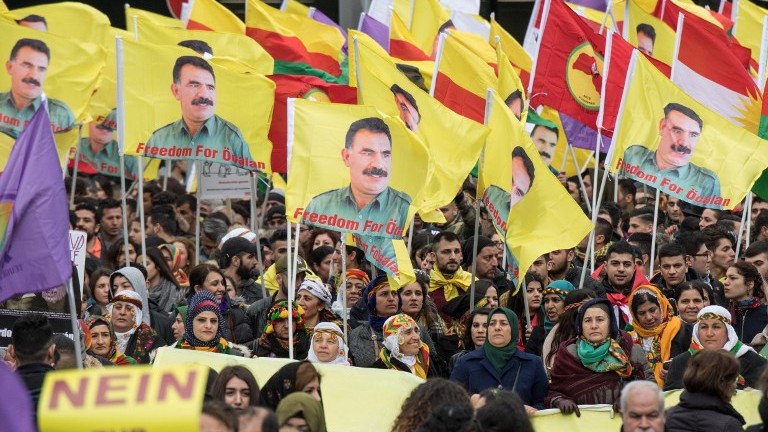
Kurds demonstrating against Turkish dictatorship in Germany fly flags bearing image of Abdullah Ocalan. Some years ago he said he supports a peace process in Turkey but he needs to be freed from prison to lead it (Photo: the Times in Israel).
However, the show must, as we are often reminded, go on. It failed to deliver in Kurdistan and the Basque Country, not because the leaders of the resistance movements were not amenable but because of the unwillingness to adapt of the Turkish and Spanish regimes respectively. However, the Basque armed organisation ETA threw in the towel a couple of years ago anyway, abandoning their fighters in the jails to seek their own individual ways out through begging forgiveness of the occupiers of their land and oppressors of their people. The Turkish and Syrian Kurds were drawn into partnership with the imperialist allies dominated by the US, in their war against ISIS but also for the overthrow of the Assad regime, though deep Kurdish contradictions continue with the Turkish regime, to which it looks like the US Coalition will abandon them and they may seek an accommodation of sorts with Assad.
The Colombian FARC and MIR swallowed the Processed bait and gave up the armed struggle for a promise of a political one but those of their leaders who are resolute are being hunted by the regime, the quasi-liberated areas terrorised by the Army and assassination squads, the resistance fragmenting and disorientated. The Tamil Tigers didn’t entertain the Peace Process Show but the Sri Lankan Army were able to surround their liberated areas and bombard them to defeat, murdering their leaders and raping, murdering and repressing their followers.
The Phillipines and India? The resistance groups in both these areas are led by a Maoist-type leadership and we wait to see.
And in Ireland, after two decades since the signing of the Good Friday Agreement, the colonial occupier has the leadership of Sinn Féin, the former resistance, in joint colonial government, the party’s southern arm seeking admittance to the Irish comprador capitalist club, the remaining anti-imperialist resistance fragmented and the country not one step nearer to unity and independence.
The Palestinian lesson for the world
All the issues which led to these conflicts and which the processes of pacification did not address – were never intended to address – will return again, to be struggled over anew, under new leaderships. In Palestine now, that is what has been happening. The Right of Return for exiles and refugees, put to one side by Fatah in the Oslo Accords nearly three decades ago, is being demanded again on the Israeli border, the protesters (along with the ‘collateral damage’ of journalists and paramedics) being bombarded by tear gas and shot down by Israeli snipers. The Palestinians, whose leadership nearly three decades ago were chosen by US imperialism to be among the first to accept the new round of historical pacification processes and to become complicit in being its missionaries, are teaching us the fallacy of the facile promises they were made at the time.
There is another irony here: while refusing the right of return to Palestinians who were themselves exiled or are children and grandchildren of exiles, i.e within living memory, the State of Israel offers “the right of return” (sic) to people who have never been there and cannot even prove that their ancestors were, providing only they can prove their Jewishness. And a further irony: Sephardic Jews, who were expelled by the Christian kingdoms in Spain and Portugal in the Middle Ages, were being offered a “right of return” by the Spanish Government in 2014 (see link).
Over time, the people in the other areas of anti-imperialist resistance around the world will regroup, gather strength and return to the resistance. The imperialists almost certainly know this. But they have bought themselves three decades of damage to their opposition and, since they need the people as producers and consumers, cannot eliminate the deep wells of resistance. And capitalism is not about enduring solutions – they work away at undermining the resistance on a temporary basis and as for the future, like Micawber in Dickens’ David Copperfield, believe that “something (else) will turn up”.
End.
LINKS (NB: I have deliberately chosen most background references regarding Palestine from Wikipedia, which is known to be heavily monitored by Zionist interests and also has inputs from friends of the Palestinians and therefore cannot be said to be completely favourable to either side):
Very recently, the pro-Catalan independence on-line periodical VilaWeb interviewed Marta Vilalta, the spokesperson for the ERC (Republican Left of Catalonia) party, an important component of the pro-independence majority in the Catalan Parlament. Her replies and statements presumably reflect the thinking in the leadership of the ERC party or, if it should not be unanimous, at least the thinking of the dominant section of the party’s leadership.
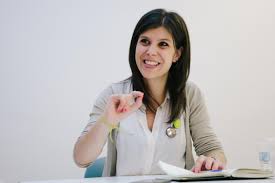
Marta Vilalta photographed during interview (Photo by online Catalan newspaper VilaWeb)
ERC has 32 Deputies in the Catalan Parlament (and two Members of the European Parliament). The other components of the Catalan independist majority at the time of writing (June 2018) are JuntsxCat (Together for Catalonia – 34 seats) and CUP (Candidatura d’Unitat Popular — 4 seats). The latter is taking the ‘confidence and supply position’ (i.e they will not vote with the Opposition and will vote to keep the Government in power if necessary).
ERC’s President, Oriol Junqueras, has been in a Madrid jail since the October Referendum, awaiting trial on charges of “Rebellion”. The party’s General Secretary, Marta Rovira, went into exile to avoid a similar fate.
The party, along with JuntsxCat, whose President Carles Puigdemont is also in exile, has faced repression by the Spanish State, as has also the cultural organisation ANC (Asamblea Nacional Catalana), whose President, Jordi Sànchez i Picanyol,is also in the Madrid jail.
The independist parties are to be commended for continuing their stance for independence and for facing up to Spanish State repression. In this, they enjoy the support of the majority of the Catalan population, as evidenced by votes in the December elections and the mobilisations and votes cast in the October Referendum, albeit disrupted by Spanish police raids to confiscate ballot boxes and assault voters and demonstrators.
But how prepared are they for the struggle ahead? How critically do they evaluate their past performance and expectations? How willing to learn from mistakes? The signs are not encouraging.
ILLUSIONS ABOUT THE SPANISH STATE
“The Spanish State has been capable of everything …. to defeat independence and the Republic project”, Vilalta says in the course of the interview, with what seems to be an air of surprise, meaning one presumes that there was no lengths to which they were not prepared to go to suppress Catalonian independence. If the Spanish state has been capable of everything, one must assume that it will also be “capable of everything” in future, at least in the absence of some limiting factors, which were not mentioned by Vilalta (except perhaps in the context of reactions outside the Spanish state, which we can look at under the heading of “Illusions about other states”).
So this admission of Vilalta should imbue us with confidence that ERC is taking that into tactical and strategic consideration. However, this appears to be far from the reality, based on the insistence of Vilalta that their struggle will be based exclusively on both “peaceful and democratic” means; nor is this only an iteration of Vilalta’s but it has been stated repeatedly by leading figures of the ERC and of the JunstxCat, i.e of the parties with by far the most numerous deputies in the Parlament. We’ll look at this more carefully under the section dealing with Pacificism but for the moment we can reflect that history in general (and the history of the Spanish state in particular) demonstrates that the combatant that relies principally on moral and or legal means must be defeated by the aggressor who relies on force and its tactical application.
“I suppose the Spanish State understands and agrees with the International treaties that it has signed and which are included in the Constitution,” says Vilalta, in reference to the right to self-determination recognised by the Charter of Human Rights of the United Nations. Why does Vilalta suppose that the Spanish State “agrees” with this right? On the contrary, all its actions with regard to the nations incorporated within its state territory show that it fundamentally disagrees with them, at least where applied to itself. In fact, its own Constitution forbids the secession of any part of the State without a majority vote in favour in the Spanish Parliament and further underlines that the Armed Forces are the guarantors of the Constitution!
Of course, it is possible that Vilalta is being somewhat ironic here, or making a statement for its propaganda value. Maybe she only means that the Spanish State should uphold the right to self-determination in the international treaties which it has signed. Let us hope so. But surely it would be more useful to point out that the Spanish State has a record of fundamentally violating most of the human rights to which it has signed up, including some actually stated within its own Constitution? Such an exposure would help in any project of isolating the Spanish state internationally, undermine its propaganda and, crucially, help to prepare the Catalan people and their allies for what the Spanish State may bring against them.
The Spanish Statehas repeatedly violated not only the human rights to life (for example in running assassination squads against the Basque movement for independence); the right to serve one’s prison sentence in a prison near one’s relatives, children and friends (by deliberately dispersing its political prisoners as far from their homes as possible); the right for terminally and seriously ill prisoners to be released on parole to continue their sentences at home or in hospital (routinely violated in the cases of political prisoners); the right to freedom from torture (routinely used until very recently against political detainees and against some migrant minorities); and the right to upholding one’s language (by originally outlawing the use of Iberian languages other than Castillian and currently banning them from the Spanish Parliament).
Furthermore the Spanish State has a lively record of violating the civil rights of political activity, of assemply, of speech, of publishing, of broadcasting: it has banned Basque demonstrations, cultural and political organisations, radio stations, newspapers and even seized the financial and property assets of organisations; it has jailed Basque and Catalan (and some Spanish) political and cultural activists; jailed and fined rappers and cartoonists and social media posters elsewhere in the Spanish State. It is illegal to “insult” the Spanish King publicly in speech, writing, or other means. Fairly recently the Spanish State created a law which makes it illegal to film police misbehaviour in public, to insult them (i.e denounce what they are doing) or to hold demonstrations in the vecinity of certain state buildings, including Ministries and the Parliament, with very high fines and/ or prison sentences for transgression of any of these prohibitions.
Marta Vilalta, representing Esquerra Republicana, major party of the Catalan independist majority. (Image source: Internet)
PACIFISM
For pacifists, of course, pacifism is a principle. For others, peaceful methods and civil disobedience are tactics, i.e responses to specific issues at a particular time and place, not principles to uphold in all situations on every occasion.
It is a fact that no class has freed itself from domination by peaceful means alone and that similarly, no nation has liberated itself from colonial or imperialist domination without resorting to the use of force. This is not, in a sense, a choice for oppressed people – it is the oppressor itself which uses force and obliges the oppressed, in self-defence, to use force too.
Some recent examples will hopefully suffice to convince the doubtful. The first public actions against the division of Vietnam and the grooming by the French and USA of a puppet regime in the southern part of the nation were largely pacific. Demonstrations were suppressed and activists arrested by the puppet regime. Monks immolated themselves in public. Monks too were suppressed. Anti-imperialist forces within the southern part united in armed action with the Vietnamese state set up in the northern part of the country, which was supported by the People’s Republic of China (the Chinese communist state). Decades of terrible war followed but today the country of Vietnam is united and largely independent of imperialism.
In fact we can observe that all of the states of Europe which were formerly under the domination of another have had to rely on armed force to free themselves from their armed dominators: e.g Austria, Belgium, France (from Nazi Germany), Denmark, Holland (from Spain, France, Nazi Germany), Hungary, Italy (from France and Austria), Norway, Poland (from Russia, Nazi Germany), Switzerland (from the Austro-Hungarian Empire), and indeed the Spanish state itself (from France).
If that were not enough and though it should be, the history of the Spanish State itself shows its reliance on armed force, from the medieval period right up to the 20th Century. The Kingdom of Spain was created firstly by the joint kingdoms of Castile and Aragon, picking up other allies, driving out the Arab kingdoms (and incidentally driving out also Jews, the origin of the Sephardics, along with the Arabs, even their own allies who would not convert to Christianity. The Spanish kingdom became an imperial force outside its own state territory and conquered and plundered territories from the Canary Islands to the Caribbean, the South American sub-continent, Central America and parts of what are now the southern USA. It did the same to parts of Northern Africa and the Philippines. In no circumstance did it refrain from the use of armed force.
In the struggles within the State itself, the ruling class suppressed by armed force the uprisings of the Communeros and many others regionally-based and, crucially, both the First and Second Republics, which had come into being through popular elections. To take the most recent, the ruling class instigated an uprising among its military against the elected Spanish Government, which led to what some call the Spanish Civil War (1936-1939), with enormous loss of life and destruction, and the instalation by the victors of a fascist military dictatorship and a monarchy.
Unlike the other fascist states of Europe (with the exception of Portugal and even they had their Carnation Uprising), no purges of former fascist rulers took place within the Spanish State; on the contrary, the heirs of the fascist military leaders, politicians and industrialists continued in the footsteps of their parents and in the luxury of their appropriations.
Under some external and internal pressure, a veneer of democracy was drawn over the State after the death of the dictator Franco and the social-democratic PSOE and the Communist Party of Spain were drawn into an alliance with the existing fascist ruling class1 in what is often called the Transition (i.e to “democracy”). Far from this addition adulterating the fascism of the ruling class, the reverse happened and both political parties colluded in the suppression of movements of resistance both national and of class; the PSOE in government actually ran assassination squads against the Basque independence movement in the 1980s.
Hopefully this short review of Spanish State history has been sufficient to illustrate the readiness of the State to resort to violence against opposition, whether peaceful or not. What then are the prospects of a resistance which will confine itself to peaceful means alone? Its leadership will be killed or imprisoned, as will the cadres of the popular movement, repression will be the order of the day. The militants will be driven underground, dispersed and the movement will lose the initiative, which is fatal for a revolution.
As to the prospects of a comparatively small nation like Catalonia2 in insurrection against a major power and its military resources, we shall address near the end of this article.
INADEQUATE SELF-CRITICISM
With regard to the issue of preparedness for the actions of the Spanish State, Vilalta responds to a question by saying that ERC have carried out self-criticism of their inability to defend the Catalan referendum against Spanish State attack. Such an admission should not shame them nor demoralise their followers and allies (though it sometimes does so, sadly) – on the contrary, an organisation that does not admit its mistakes is unlikely to learn from them and in any case is not going to be honest with its membership and followers.
It is however worrying that a party pursuing an independist and Republican path in the teeth of the historical and well-known opposition of the quasi-fascist and monarchical state, should have been unprepared for the response of that State. Nevertheless, one could draw reassurance from the fact that ERC acknowledge their error and carried out self-criticism. Or at least, that would have been the case were it not for the fact that Vilalta states that “it is very easy to look back with perspective and think that it could have been done in a different way. I do not dare to say what we should have done differently. The decisions taken at that time, in a specific context and with the information that was had, seemed the best.”
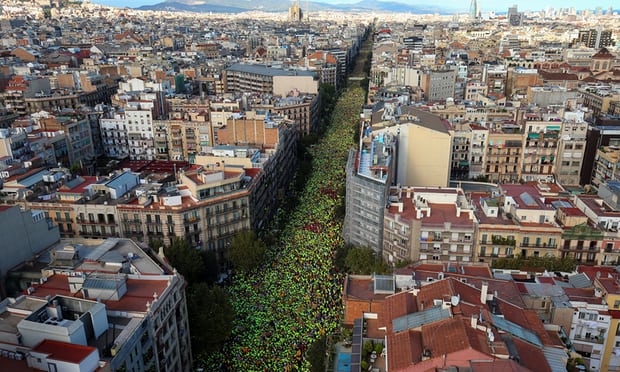
Huge Barcelona Demonstration (in green) for self-determination on Catalonian day, Diada 11 Sep2017, three weeks before the Referendum. (Image sourced: Internet)
Whether that can be called “self-criticism” is debatable but it certainly does not qualify as adequate. It amounts to saying “we were wrong but could not have come to any other conclusion and even now I can’t think of what we could have done differently.” Which is almost to say “We are likely to be as mistaken and to prepare as insufficiently in future.”
As discussed earlier, both the history of national struggles in general and the history of the Spanish State in particular should have informed the independist forces of the full range of possible responses of the Spanish State. Those who were unable to anticipate the actions of the Spanish State need to ask themselves a vital question: “Why, despite that accumulation of historical practice, were we unable to count on a police invasion as one of the possible measures of our opponent?” A truthful reply to that question would tell them and us a lot about their limitations but their refusal to even consider the question is more worrying than whatever their current conceptual limitations might be.
ILLUSIONS ABOUT OTHER STATES
In the course of her interview, Vilata commented that “the international situation is key.” She said that in the context of forcing an unwilling–to–negotiate Spanish State to, in fact, negotiate. How she sees this happening is not very clear. In this context she also said the following:
“The Charter of the United Nations recognizes the right of self-determination of peoples. The Spanish government has had and has the opportunity to discuss and negotiate how other countries, such as the United Kingdom and Scotland, have done. They have opted for repression to the limit and always say no. It is they who have pursued political leaders and freedom of expression. We will continue to defend dialogue and negotiation by asserting that Spain has subscribed to the right of self-determination and confronting violence and repression.”
Leaving aside the fact that Scotland is not truly independent, somehow Vilalta envisages using the treaties referred to above to force the Spanish State to negotiate or to have “it is forced from the outside. This mandate to make it possible to negotiate can come from international spheres.” What does she mean by “international spheres”? She is not specific but in this context mentions the reversals for Spanish extradition warrants, the Catalan Members of the European Parliament (and presumably other friendly MEPs) and the Catalan politicians in exile in European countries, presumably all coordinated by the Council for the Republic, which also gets a mention.
But even in a best case scenario, how is the Spanish state to be “forced”? Economic sanctions? They can only be imposed by individual states or by groups of states, for example the EU. The European Parliament has not seen fit even to condemn in words the repressive actions of the Spanish state and, in fact, the EU President, Junkers, commented that they don’t wish to see “an EU of 99 states”, a clear indication that the independence of Catalonia and other states breaking away is not something the EU would welcome.
And in fact, even without Junker’s comments, that attitude could easily have been predicted. In the case of a successfully independent Catalonia, not only would the Spanish state be vulnerable to similar bids by other nations within its state territory but so would the French and Italian states also. It seems that Vilalta expects the EU to act against the interests of not only its Spanish member state but the interests of two other major European states as well. But why would it do that or, more to the point, why does Vilalta think they will or even might?
Possibly Vilalta envisages some kind of external moral pressure or perhaps “good neighbour advice”. With regard to moral pressure, the Spanish state, both during and after Franco, has shown itself impervious to that. Its practice of torture and impunity for torturers has been criticised regularly by relevant committees of the United Nations and the EU and every year by Amnesty International. None of that has brought about any change.
The European Court of Human Rights has found against the Spanish State on a number of occasions (failure to investigate torture allegations, illegal extension of sentences by retrospective legislation — but never on actual torture, which is “difficult to prove”); the Spanish State sometimes appeals the judgement (and loses) but eventually pays the fine, releases the prisoners at their release dates and …. carries on as before.
The major European state response to the PSOE Government’s undercover campaign of terrorism in the northern Basque Country (i.e within the French State) has been to facilitate the extradition of Basque refugees to the Spanish state (sometimes without even bothering with a court appearance).
No doubt the Spanish State has been given “good neighbour” advice from time to time from European states and even by the USA, advised to appear nicer, to be more democratic etc and even advised that it was in the long-term interests of its own ruling class to do. Perhaps the Spanish State responded, with well-known Spanish fascist arrogance, that it knows its own busisness best or perhaps they replied that only an iron grip can keep Spain “Una, Grande y Libre” (United, Great and Free”, i.e non-communist). In either case, neither good neighbour nor critical state has shown an interest in taking any kind of coercive action against the Spanish State and there is no reason to believe that they will do so now.
European states may not wish to soil their hands doing Spain’s dirty work for them by extraditing refugees to Spain on dodgy European Arrest Warrants but that is a long, long was from being willing to act in a coercive way against a major European partner.
It seems almost certain that Vilalta, in discussing “international force” against the Spanish state was referring to action by other European states and traditionally when “the international community” has been invoked in discussions of ‘peace processes’ and sanctions that is generally what is meant. But there is another way of looking at international pressure.
To examine that possibility, we need to ask ourselves: What are the circumstances in which the Spanish State would be unable to send armed forces to suppress Catalan independence or, if it did, that they would be neutralised?
Such a situation could only be envisaged occurring when the State faced insurrections and similar crises in many other parts of the State at the same time as its crisis in Catalonia. And in fact the Spanish state, of all those in the EU, is probably the most vulnerable to such a scenario. Along with Catalonia and the Catalan Countries, there are the nations of Asturias and Galicia (both of Celtic culture) and the four southern Basque provinces.
Within those areas and in all others of the Spanish state, there is a major disaffection with the dominant order. Never have the institutions of banking and politicians been so widely exposed in corruption, never has the Royal Family been so condemned, nor repression by police so exposed. Unemployment is high as is work on short-term or casual contracts, the housing crisis is serious and numerous victims of eviction have publicly comitted taken their lives over the years. Both political parties of the traditional bi-party system (PP and PSOE) have lost prestige and electoral support, so that now each can only govern as a minority party and their decline has allowed the emergence of a two more sizeable parties, Podemos of the Left and Ciudadanos of the Right (without however much hope of a fundamental change from either). Huge demonstrations have taken place across the state and in particular in Madrid. The collusive trade unions of the Comisiones Obreras and the Unión General de Trabajadores have been found wanting and many independent unions have sprung up.
In other words, the prestige of the State has been slipping and its enemies multiplying. But to tap into these currents of disaffection with the Spanish State, the independist forces would need to do more than threaten the State with the independence of Catalonia. It would need to develop a social-economic program that would not only benefit the majority of Catalons but would also serve as an illuminated example to the rest of what is currently the Spanish territory.
Vilalta does talk a little about a socio-economic program emanating from the Catalan Government and local authorities but says next to nothing about its content. Last week a man about to be evicted in Catalonia killed himself and there are many others facing eviction through inability to pay their rents or their mortgage instalments. A solution to that problem would not only bring many doubters in Catalonia over to the side of the Republic but serve also as an example of what could be done elsewhere in the Spanish State. Support for a Spanish military intervention would be severly undermined in such a scenario, both externally and from within the armed forces and the breaking out of many fires across the state would leave the firefighters stretched too thinly to carry out their task.
This scenario could also affect the French state should it consider a military intervention of its own and the Bretons, northern Basques, northern Catalans and Occitans might seize that opportunity to advance their own claims for independence or autonomy.
The problem for ERC with instituting deep socio-economic changes in Catalonia and in appealing to wide national and class disaffection is that, notwithstanding the “Left” in its title, it is a bourgeois or capitalist party and can hardly be expected to cut off its own head just because it will make its legs firmer. And the JuntsXCat is even more so, at its core a liberal capitalist party.
All of which might serve to remind us of the quotation from James Connolly, a revolutionary socialist who also fought for the independence of a small nation – Ireland. Recognising that only the working class was unable to gain some advantage through a compromise with the imperialist and coloniser, he wrote: “Only the Irish working class remain as the incorruptible inheritors of the fight for freedom in Ireland”. If the words “Irish” were to be replaced by “Catalan” and “Ireland” by “Catalonia”, leaving the rest of the statement intact, would it also be true?
End.
FOOTNOTES
1This was necessary for the Spanish fascist ruling class not mainly as partners in the production of the farce of ‘democracy’ but chiefly for their control of the two main non-fascist trade unions then (and still): the Comisiones Obreras of the CPE and the Unión General de Trabajadores of the PSOE, both illegal until that point but also powerful and with a potential for creating industrial and political instability.
2For the sake of convenience, Catalonia is being described here as a nation, although for many, including the ERC party, at least in the past, it is the Paises Catalans (Catalan Countries) which is the Catalan Nation, a territory extending from Pau in the French state through Catalonia to Tarragon, Valencia and the Balearic Islands.
My full translation to English of introduction and interview:
Marta Vilalta (Torregrossa, 1984) is the spokeswoman for Esquerra Republicana since March. A journalist by profession and Parliamentary representative since 2015, Vilalta has been a member of the ERC since 2004 and, after handling several responsibilities, has now taken a step forward as a result of the repression suffered by the party, with President Oriol Junqueras in prison, Secretary General, Marta Rovira, exiled and members of the Executive persecuted and prosecuted by Spain for having collaborated in the organization of the 1st October Referendum.
We talked with Vilalta about theCatalan political situation, the Republic, autonomism, the new Government of the Generalitat, the effects of repression and the new road map that ERC must approve in its national conference at the end of June . Young, energetic and smiling, Vilalta takes this new stage as a personal challenge, but with the bitter aftertaste of having had to go through the situation of repression against the party and independence.
– Is it true that you do press conferences prepared not to answer questions? Will you respond to this interview?
– [Laughs] I did not say that! It was a joke in relation to this and Sergi Sabrià [the previous spokesman], speaking to the journalist, said laughingly that he had advised me not to answer the questions. We laughed, but it was included in the interview. I am a journalist and I am empathizing with you, it is about responding well.
-Good! Now that there is ‘effective government’, how is the Republic to be brought about?
-Firstly, getting the Government back has been an important and indispensable step towards achieving the objective, which is the Republic. We advocate that to make the Republic real and to complete it we must be strong at all levels and have all the possible tools. Therefore, this also means recovering the Government and the institutions, being connected with the social mobilization and citizenship, being strong in the international bodies, the city councils and the Parliament. We have to be stronger and stronger, to increase and have an amazingly hegemonic social majority that will allow us to bring into existence the Republic we have decided to have, but unfortunately we have not yet been able to make it effective. But it will happen, we’re sure.
-Let’s talk about the ERC strategy paper, the new roadmap to be approved. A fear has been expressed because a section of the grassroots, such as the Mayor of Montblanc, Josep Andreu, believes that the unilateral path is not given enough importance.
-I think that the debate or the controversy about the strategic presentation has been magnified, I do not know if deliberately or not. It analyzes the situation based on the lessons of recent months. It places us where we are and helps us to define what we do and with what instruments to do it in order to bring about the Republic. That’s why it is called ‘Let Us Create the Republic’. We do not rule out any path, providing it is peaceful and democratic, to arrive there. Yes, it is true that it emphasises the need to be stronger and stronger, to expand support in many sectors that share the anti-repressive struggle but yet do not see the need for the Republic. And it defines the multilateral framework of play because it is a process where many political, judicial, economic, and social agencies intervene … We need to know how to move in all this multiplicity of agencies and to maximize opportunities.
– And the unilateral path?
-The paper does not rule out the unilateral path, we understand it as part of the multilateral framework. Perhaps part of the membership thinks that we have not been explicit enough. We are in the process of making amendments so that all the membership can participate and improve the text. We debate with a wish to reach a consensus and for everyone to feel represented. We are very pleased with the level of participation, with 1,400 amendments. Some 1,100 have been incorporatedto be negotiated. This shows a vital strength in the organization and the very participative health of the membership of ERC.One must shine the lights ahead to see the medium term to bring about the Republic and to see what we need to do to achieve it.
-Andreu regretted, however, that there was little participation in the territories (? Trans), and he made a public appeal.
-Yes, the call to participation should be done by all. But I insist, there has been a huge volume of amendments. In 2013, some 300 amendments were presented and now there are 1,400! There have been assemblies in the territories. We hope that on June 30 and July 1 there will also be a lot of participation because the moment requires it. The more participation, the more endorsement of the final paper.
-The CUP accuses the Government of being autonomist.
-We have heard them say this several times, but I do not agree. Whenever we have had the chance to rule, we have done it with a republican call and overtaking autonomy. Interest in autonomy is minimal. Willingness to create a republic, total. This is what the Government of the Generalitat is doing at the moment. The examples of recent days show that there is no intention to go for autonomy nor to drag out the process.
-What examples?
-We need to recover the institutions because we believe that makes us stronger. This is not autonomism, it is to put them into the hands of the citizens and in the service of the country to be able to move forward. With the first government actions alone, both symbolic and effective, it was shown that it was essential to recover the Government. Unlock the money that social agencies had to receive, more than 300 million euros, the reactivation of delegations abroad, the money to recover the quality of TV3 and Catalunya Ràdio, 250 million for social rental … Damn it, they are essential policies! And since they are destined to improve the country, we are sure that they will help us to add more people (to our support — Trans).
-The people who have doubts about independence understand this?
-This is one of the main ideas. From government action and being able to respond to people’s needs and make policies with Republican logic, we can show that with good governance and caring for the citizenship we are able to respond to needs and to improve well-being. We are convinced that this will lead us to make more people see that this is the only way to defend the social, civil and political rights of citizens. This will surely result in an increase of the people who will see that the republican project is the only alternative to guarantee well-being, social justice and equal opportunities. There is no other project that guarantees us all this. It has become clear that in Spain these fundamental rights are not guaranteed and that they have been violated. We have to be capable and must strive to explain all this.
– Will this legislature be a constituent process?
-The intention is that it will be. I cannot say when. We see it as a great space for debate about how we want the country in all its aspects. It also has to serve to reach many people who feel called to participate. In fact, the project of the Catalan Republic is the only one which will ask this of the citizens. The Spanish state will not enact any constituent process. It is only with that that many people can see the opportunity that there is an opportunity for real change and everything that implies. To think and rethink how we want to organize ourselves and how we want our society to be. This will happen, soon; we must ensure maximum participation of the convinced people and of those who feel called to participate. It will help us to add to our numbers and open the project to accumulate forces. It must be a consensual process, with territorial capillary (reach? – Trans) that allows us to know what we want and what goals to have as a country. The constituent process can be one of the tools at our disposal to exceed the limits of the Republican project.
-The conclusions of the citizens’ debate within the territory will be taken to Parliament?
-I do not know the methodology nor what the phases are. To be successful, we will have to agree with all the political, social and economic actors that can participate. Therefore, we will see what steps must be taken. It is obvious that everything that comes out of the constituent process must be channeled institutionally so that it has the effects that we want and so that it does not remain only in a debate.
-Your party has carried out self-criticism of the October events?
-Yes, it’s been done. In any case, it is very easy to look back with perspective and think that it could have been done in a different way. I do not dare to say what we should have done differently. The decisions taken at that time, in a specific context and with the information that was had, seemed the best. Everything was done with the intention of making effective the 1-O (Referendum – Trans) and to be able to vote, after facing the repression and proclaiming and bringing about the Republic. Unfortunately, we could not defend it. Maybe over time we will have more information. In any case, I really appreciate that everything that was done was because at that time it was believed that it was the best way to reach the goal that we all wanted. From now on, I think the most important thing is to learn from lessons. One of the most important is that Spain is willing to anything. We thought they ‘would not be able’, that ‘could not be allowed’, but they were.
-The Spanish state has been capable of everything.
-To defeat independence and the Republic project, it has been capable of dispensing with the rule of law and democracy. This is a very important lesson, because we moved in an ambit of democracy and defence of rights and freedoms, and we continue there. But we have seen the axis upon which Spain moves. We have to be stronger and stronger because it is the only way to face this repressive and strong State. We must continue defending all democratic channels with allies at all levels. Surely we will have a new opportunity. If we keep alive and resisting, we’ll be able to win.
– Do you have any expectation of the new Spanish government? On Thursday, Grande-Marlaska disclaimed the responsibility for bringing the political prisoners closer to home and then Llarena reminded him that this depended on the Ministry of the Interior (of which Grande-Marlaska is Minister — Trans).
– Different things. First of all, to go back a little. We supported the motion of censure (against the PP Government of Rajoy – Trans) because we believe that it was the responsible action to remove the PP and bring down Rajoy. That Government that had repressed us, the leader of repression and corruption …
-The PSOE too.
-Yes, yes. I say that was the responsible action at that time to make that government fall. Not to support the PSOE. That said, obviously, a new scenario opens, but we do not have much expectation of it. We will observe the following steps. On the concrete question of the prisoners, it is shameful what happened on Thursday. The Minister and the Judge passed the ball about the prisoners to one another. It is an aberration, an arbitrariness, that they are detained as hostages, as revenge. And we demand, it is not contradictory, that they bring them to Catalonia. It is a correct action, the law says, that they be as close as possible to families and children. If the Spanish Government had wanted to, it could have already made the decision.
-The other day you commented that any negotiation should start from the first of October. What does this mean?
-We continue defending dialogue and negotiation. If we want a sincere and effective dialogue, we must be able to speak of everything, without renunciations or initial conditions. We should not only talk about concrete demands of economic, social and sectoral policies that have been dragging on for many years, but also about the situation in Catalonia and how we exercise the right of self-determination and make the Catalan Republic real. When we say that we must start from the first of October, let’s talk about it. Conflict must be resolved through the political path, negotiation and dialogue. The 1-O is the founding moment of the Catalan Republic, marks a point of departure in our most recent history.
– Can this be negotiated with Spain?
-I suppose the Spanish State understands and agrees with the International treaties that it has signed and which are included in the Constitution. The Charter of the United Nations recognizes the right of self-determination of peoples. The Spanish government has had and has the opportunity to discuss and negotiate how other countries, such as the United Kingdom and Scotland, have done. They have opted for repression to the limit and always say no. It is they who have pursued political leaders and freedom of expression. We will continue to defend dialogue and negotiation by asserting that Spain has subscribed to the right of self-determination and confronting violence and repression.
– If we want to open a negotiation, the international field will be important. Until now, Spain has refused to accept any mediation offer. Does the Council for the Republic have any role in this regard?
– The international situation is key. When we talk about negotiating with the State, we know that it will not negotiate because it has not given any evidence (of such willingness — Trans). We must force the State to negotiate, or force it so that it is forced from the outside. This mandate to make it possible to negotiate can come from international spheres. The judicial battles of the exiles must also be taken into account. Spain has suffered the first judicial reversals because no European justice recognizes non-existent crimes that are and invented to punish and silence the people of Catalonia. International action must be organized and coordinated. It is clear that the Council for the Republic can be an instrument that helps us to make heard this voice of the demands of Catalonia everywhere and that can help us denounce the violations of rights and repression. We will help the voice that we have in the European Parliament, the exiles, the government delegations that will be reopened … With all these tools we must be able to win.
– Will Marta Rovira be part of the Council for the Republic?
-We will have see how it will be composed. Much has been said about it, but it must be ascertained how the Council is composed by the Republic. Marta Rovira was forced to leave because of this brutal persecution by Spain and will surely play a relevant and important role in the international arena in defense of individual and collective rights and freedoms. We’ll see what role everyone has.
– Does she participate in the internal life of the party?
– She is the General Secretary of Esquerra Republicana and that continues to be the case. She participates in internal meetings and we hope that in the future she will have a more public role. It continues on a daily basis in the way that new technologies permit her.
– In this situation of abnormality and repression, ERC has recovered from having the General Secretary in exile and the President in prison?
-Our organisation has suffered a brutal persecution. They have tried to behead us to weaken, frighten us and make us disappear. In addition to Marta Rovira in exile and Oriol Junqueras in prison, we have many members of the Executives accused and activists persecuted for having done everything possible so that Catalans could vote on 1-O. It was a tough blow, but luckily we are a broad, strong and cohesive organisation. Other people who have been able to take up the duties and responsibilities to continue resisting and persisting, despite the cruelty of the moment.
-The municipal elections will be a good test to measure if the base has been expanded?
-Once polling has taken place we will count and validate the majority in favor of independence and the Republic. Democracy does not frighten us. That is why we know that the Republic will end up winning. The democratic and peaceful way is ours and what we have to use to reach the Republic. In addition to revalidating the majority, we must increase it to show that we are many and that we are multiplying. The independentist movement has grown in recent years, although we still have on the margins many people who have not taken the step but that are in favor of democracy, rights and freedoms.
– Will more than 50% of the votes in the municipal councils involve some change in the political landscape?
-For a start, it places us in a new scenario. Let’s see how the correlation of forces turns out. Surpassing 50% is to pass over one of the important thresholds to validate and certify the majority in favor of independence. We will have to evaluate new steps because we will be stronger and stronger, which is what we want. I cannot specify what will happen, but it would be a very important step to advance, materialize and consolidate the Republic.
– Is it decisive if independentism wins in Barcelona?
– It is very important. But also in other important cities and other capitals, such as Lleida and Tarragona.
-The usual debate has been begun. United lists, separate lists.
-We must be able to compare the projects with everyone in all the elections, whether they are municipal or parliamentary. Confronting all ideas and projects makes us maximize results for all. The elections on December 21 were a test, distinct from September 27. When we present all together as one, it is difficult to widen the base, we are small. When we each present separately, each trying to maximize their results with their project, is when we truly achieve the maximum widening of our perimeter. With the results achieved there will be a need to agree, join and have unity of action to going ahead with the town councils and the policies that are decided. The municipalities must serve so that there are as many republican and independentist city councils as possible. We can make a qualitative leap in many areas, especially in the metropolitan area and the capitals.
-Do you think that you can govern Barcelona without a pro-independence list being the most voted? The last published survey gave a draw between Barcelona in Comú and Citizens.
-If the votes independentist lists are compiled and achieve a majority, we can govern. The Council will end up being controlled by those that who can unite and that are able to agree. So, obviously, yes.
-Will ERC agree with the communes (Catalan version of Podemos – Trans.) and the PSC (Catalan version of the PSOE – Trans.)?
– We do not rule out any option with the objective of being able to guarantee republican, independentist city councils and allowing us to develop the policies to advance. In each case we will have to look at how that turns out. Right now we do not rule it out. But our logic and the priority is to have as many republican city councils as possible for the better. We know that ERC can often be this binding agent, this project that from the centrality of the independentism can unite the most.
-Oriol Junqueras was your teacher. You have a very personal relationship with him. Did you watch the videos from inside Estremera prison?
-I did not want to see them. I have seen some images, but nothing else.
-What did you hear?
-From the little I have seen and what I know, the dignity of these people is clear. The images have been stolen and that is undignified. But their dignity, even though the State holds them as hostages in prison … They are good people. Oriol is one of the best people we know and is kidnapped because he is able to lead, bring together and unite like no one else. With an open mindedness and caring, to be in the company of people and to listen. He and the rest of prisoners are seen as a threat to the State, and that is the reason they are kidnapped.
-Well there is a government in Catalonia, change of Executive in Spain, is there a risk of normalizing the situation of political prisoners?
-We must do everything possible so that it is not normalized. This country will not be normal until all judicialization is ended, until all imprisoned people are on the street or until all exiled people return home. We know that all acts to remember reprisals, lunches and yellow dinners, actions to raise money and report the situation help to ensure it is not normalised. The prisoners tell us not to cry but rather to demand their freedom.
-The situation of the party has led you personally to have to take a step forward. How have you found it?
-It’s a contradictory and bittersweet feeling. Any new responsibility is always accompanied by enthusiasm, but at the same time I have the bitter and sad feeling of having to do it in this context. In addition, it coincided with the second round of imprisonments of Carme Forcadell, Dolors Bassa, Raül Romeva, Jordi Turull and Josep Rull. And when Marta Rovira went to exile. Therefore, in a very tough context. But absolutely convinced that we all have to fight and each one contributes the grain of sand and plays the role that falls to us in the anti-repression struggle and which at the same time advances the Republic. This we do, not only myself, but many colleagues, each with the desire to be of use for the project.
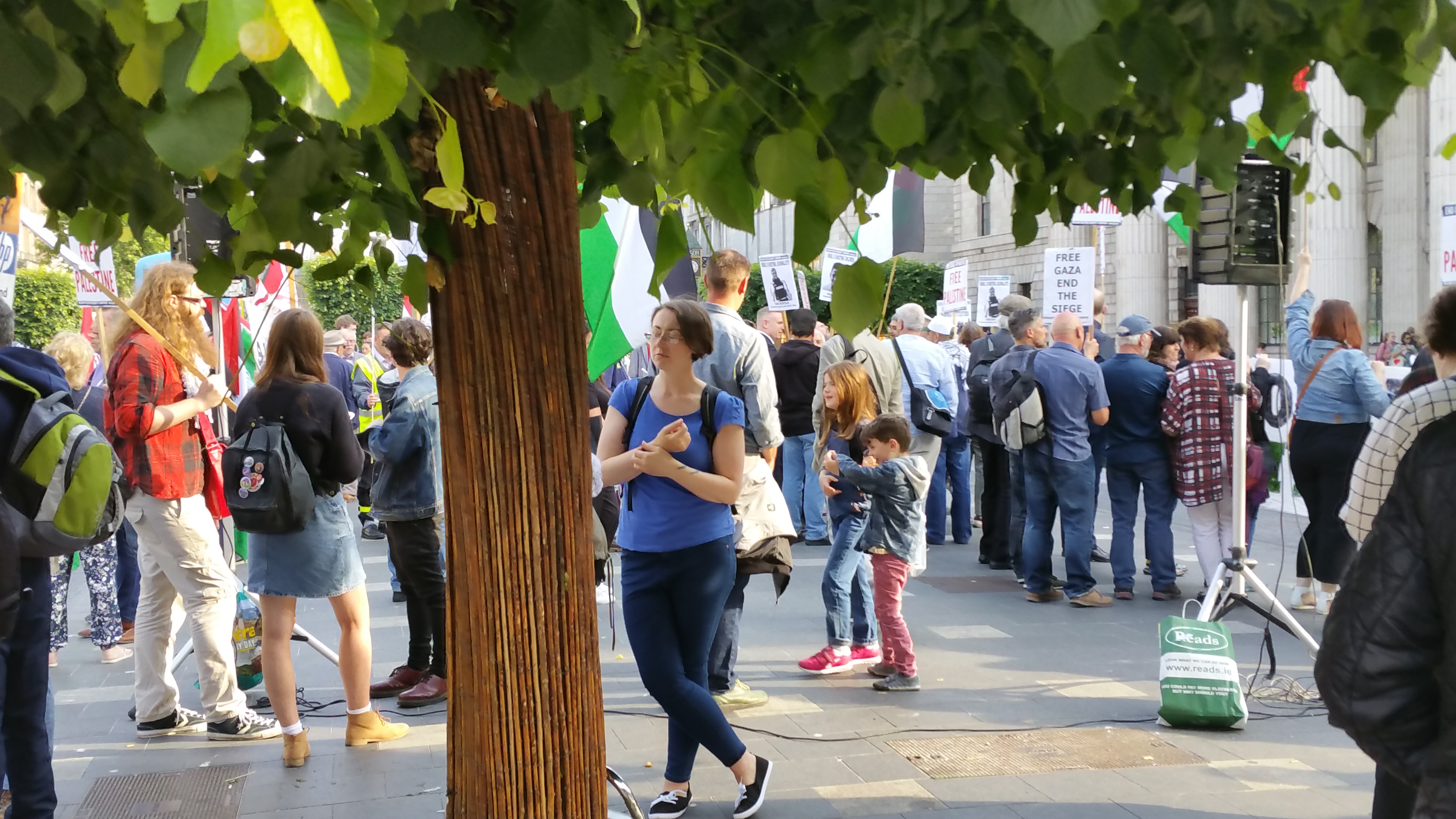
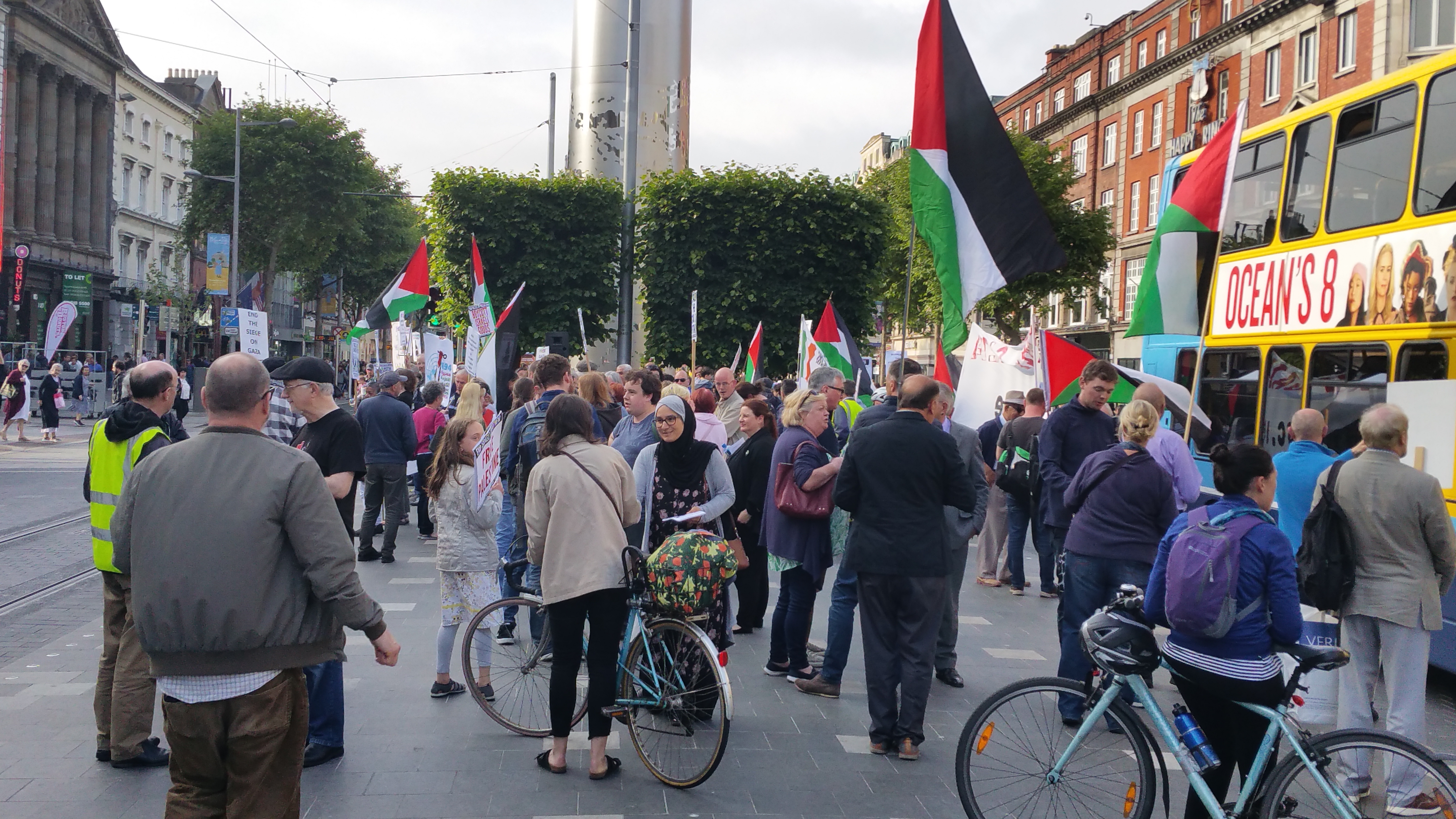
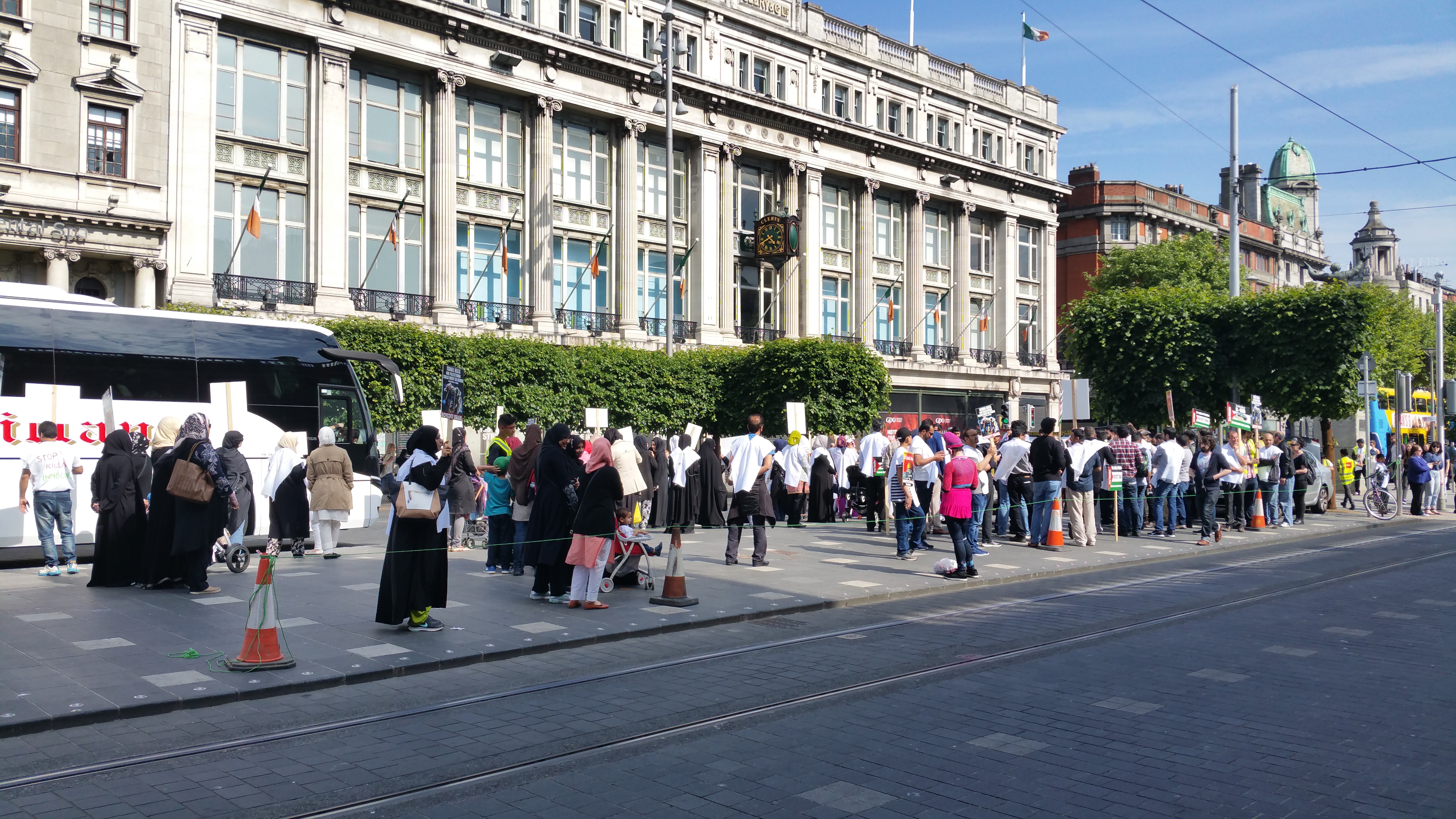
The regular blowing of horns by passing motorists, including taxis and buses, would have indicated that something of interest was happening in the city centre yesterday, Monday 5th June. As people came within sight of the centre of O’Connell Street, they could also see the Palestinian flags flying, the banners and the placards.
View of the rally on the east side of the central pedestrian reservation, looking southwards. (Photo: D. Breatnach)
The Great Return March
The Ireland Palestine Solidarity Campaign had convened a rally of hundreds in the central pedestrian reservation of O’Connell Street, main street of Ireland’s capital city, near to the Spire and opposite the historic and iconic building, the General Post Office. Billed as a rally in solidarity with the Great Return March of Palestinians, demonstrators carried placards denouncing the shooting dead by Israeli soldiers of demonstrators as well as of journalists and paramedics. The Palestinian death toll since March 30th has reached 120, with over 5,500 injured. Palestinians have also accused Israeli snipers, when they wish not to kill, of shooting young men through parts of their legs calculated to ensure permanent disability. The shooting dead of unarmed protesters, the killing of paramedics and journalists (who wear clearly identifiable clothing), are all crimes according to international law but, as Palestinians and their supporters repeatedly ask, who will hold Israel to account?
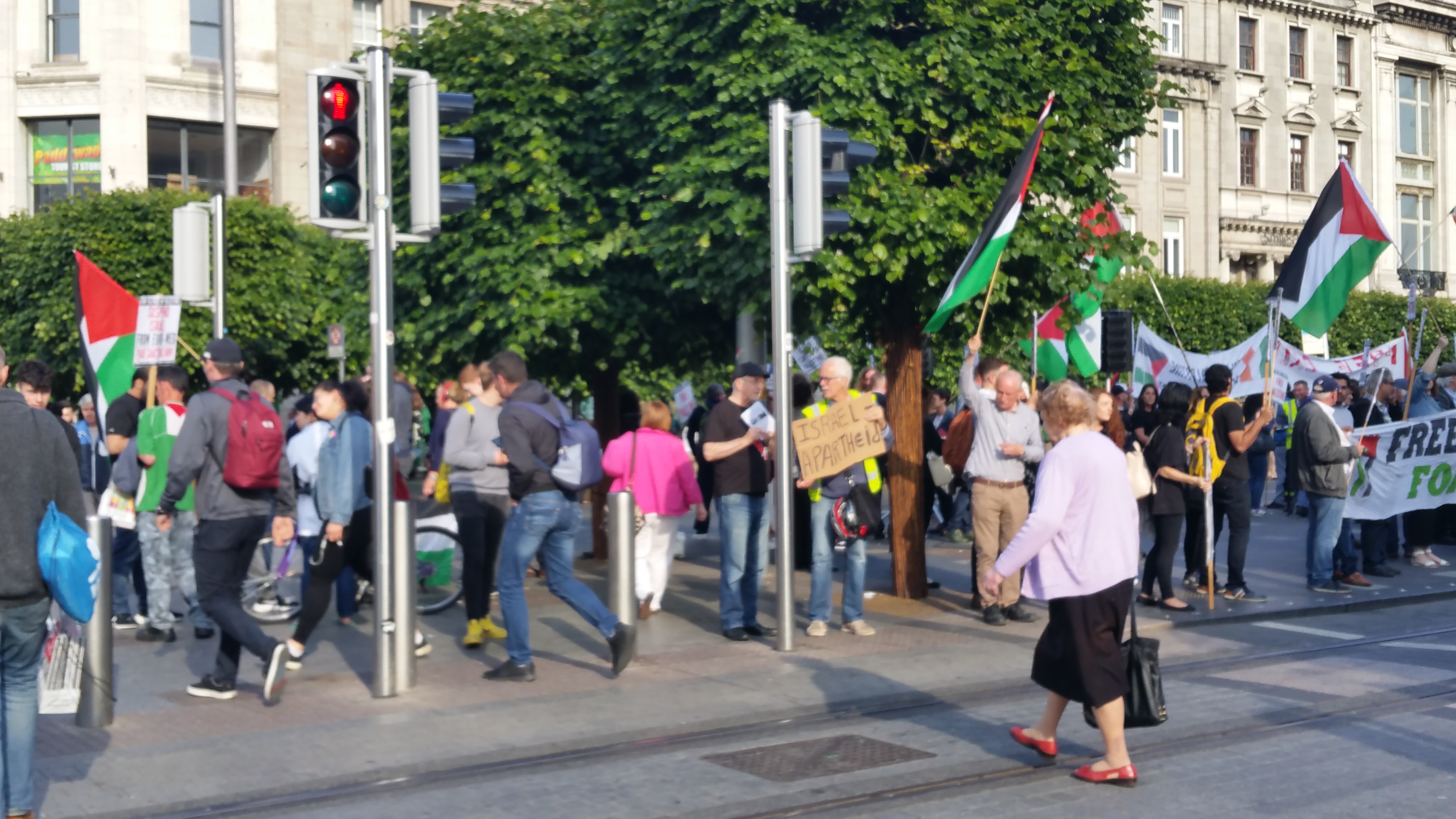
A view of part of the rally on the central pedestrian reservation, looking southwards. (Photo: D. Breatnach)
The demonstrators being targeted by Israeli military are protesting the expulsion by Israel of 700,000 of what was then the majority Arab population of Palestine in 1948, followed by their exclusion and that of their descendants from Israeli-controlled Palestine. There are an estimated four million Palestinians 1 barred from entry to Palestine, their lands or those of their grandparents, while anybody in the world who can prove his or her Jewishness, even though their families had not lived there for thousands of years2, can gain entry and claim Israeli citizenship.
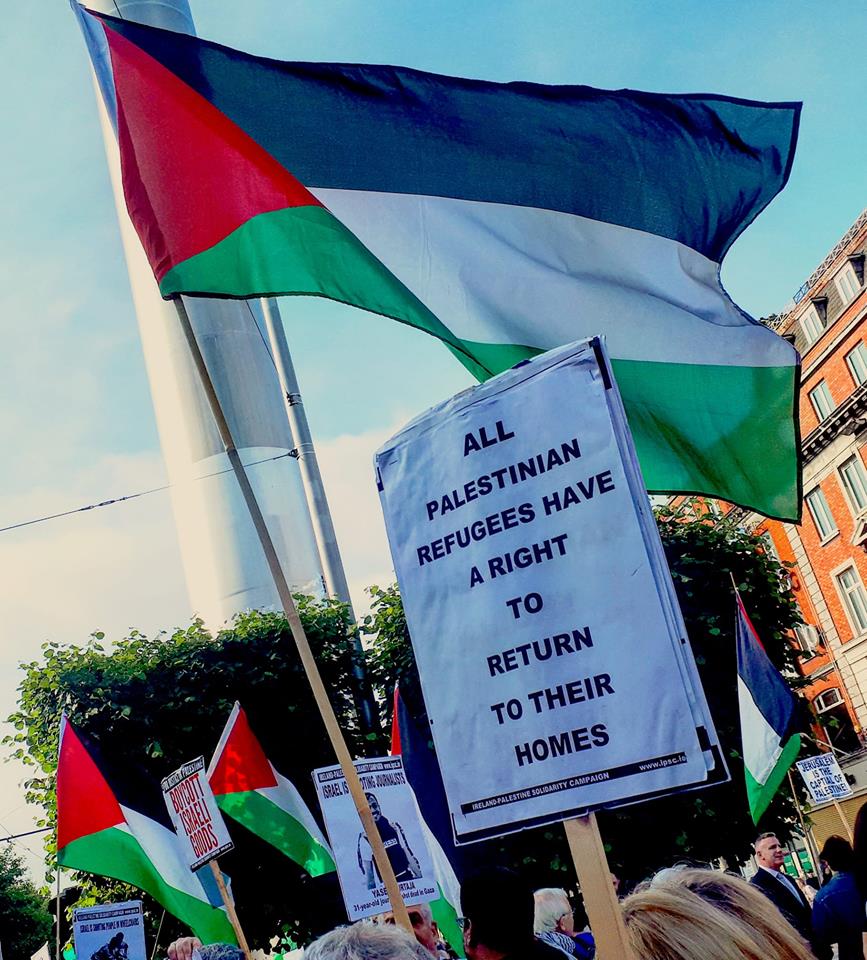
Placards held by supporters in the rally yesterday upheld the right of the Palestinians to return to their homeland. It is ironic that the Zionists since 1924 at least have been upholding that demand for people who had never set foot in the land, nor whose ancestors had not for thousands of years but are denying that right to Palestinians driven out within living memory and their descendants.
View of the rally on the west side of the central pedestrian reservation, sretching southwards. (Photo: D. Breatnach)
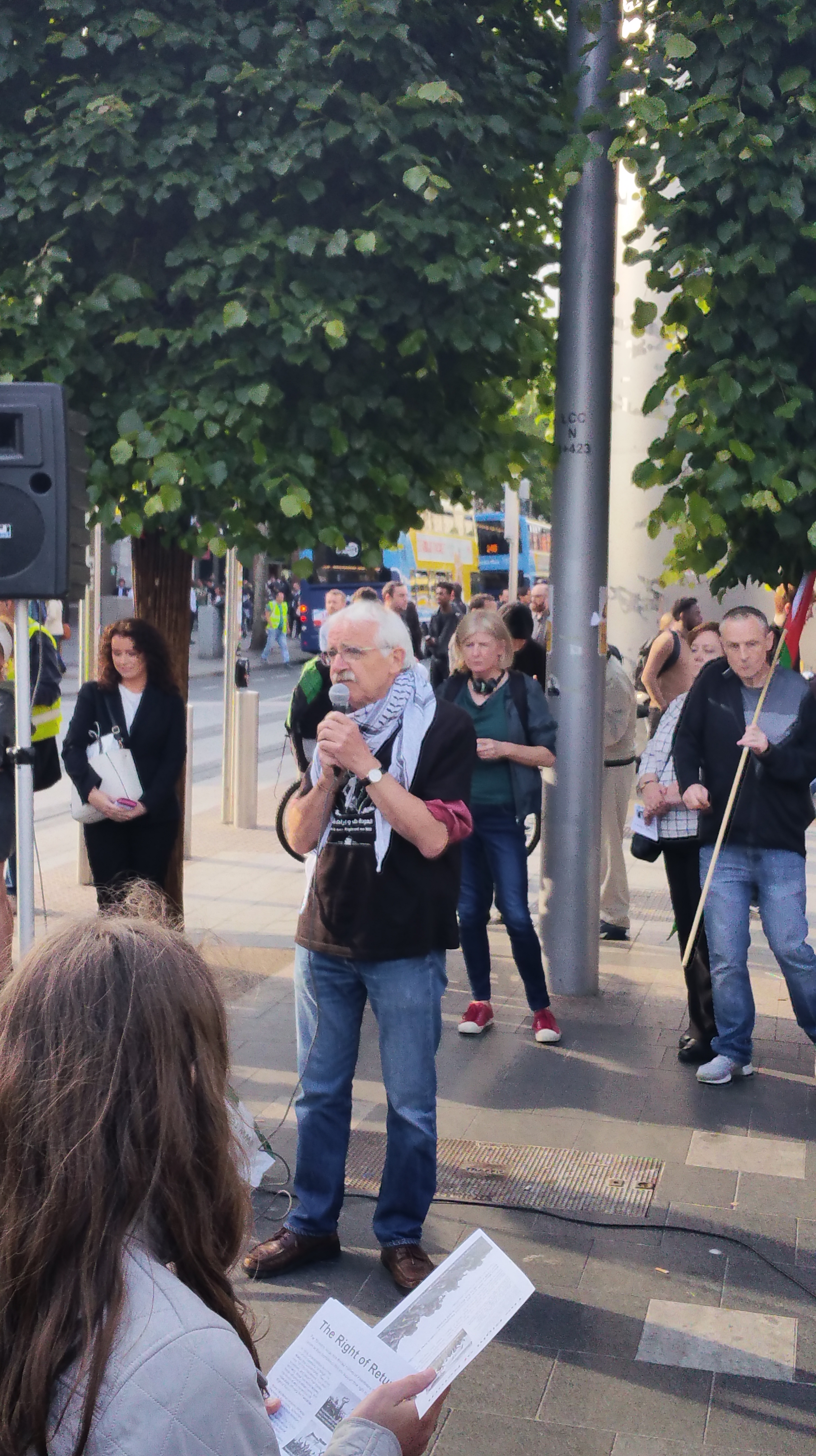
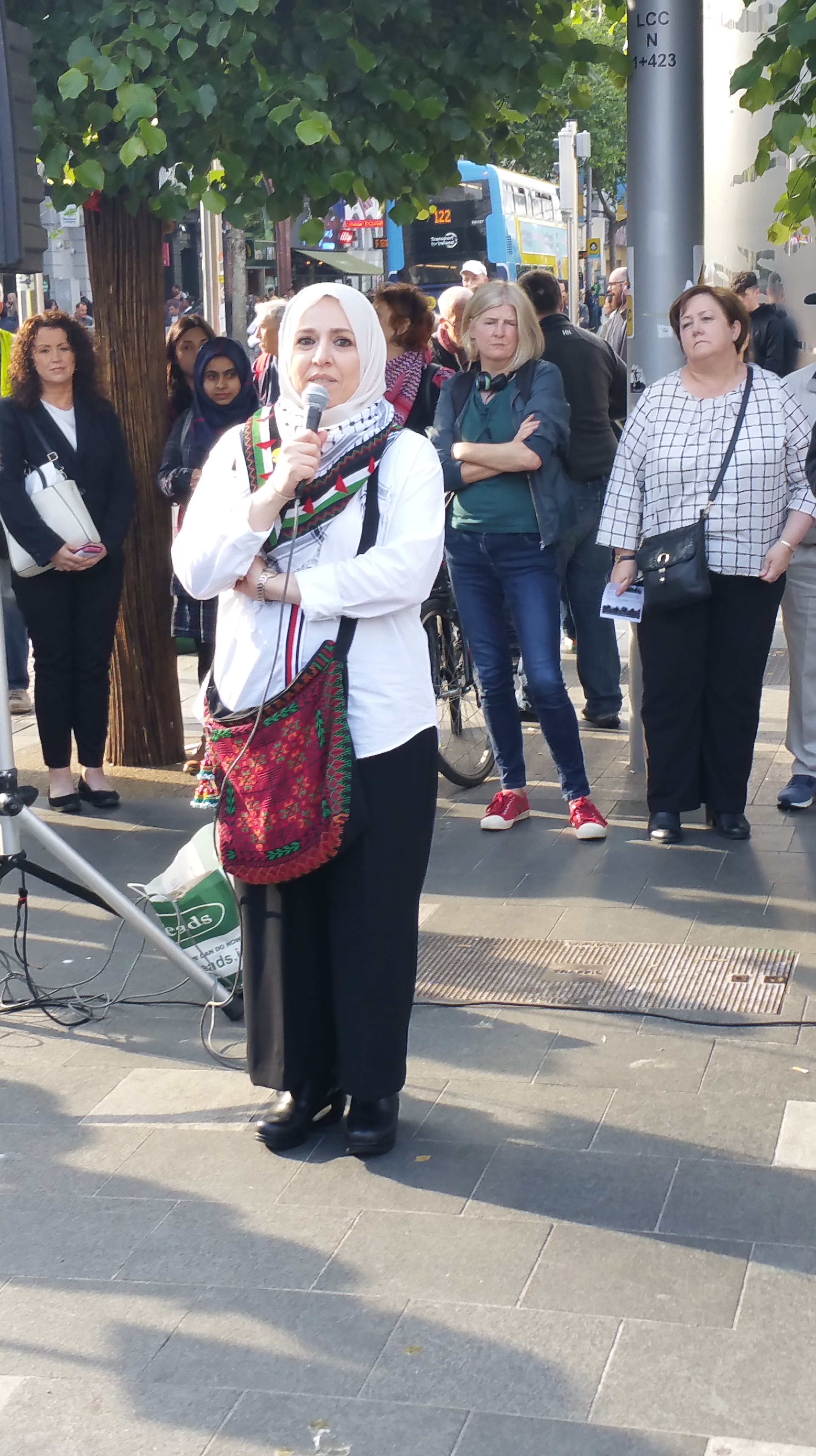
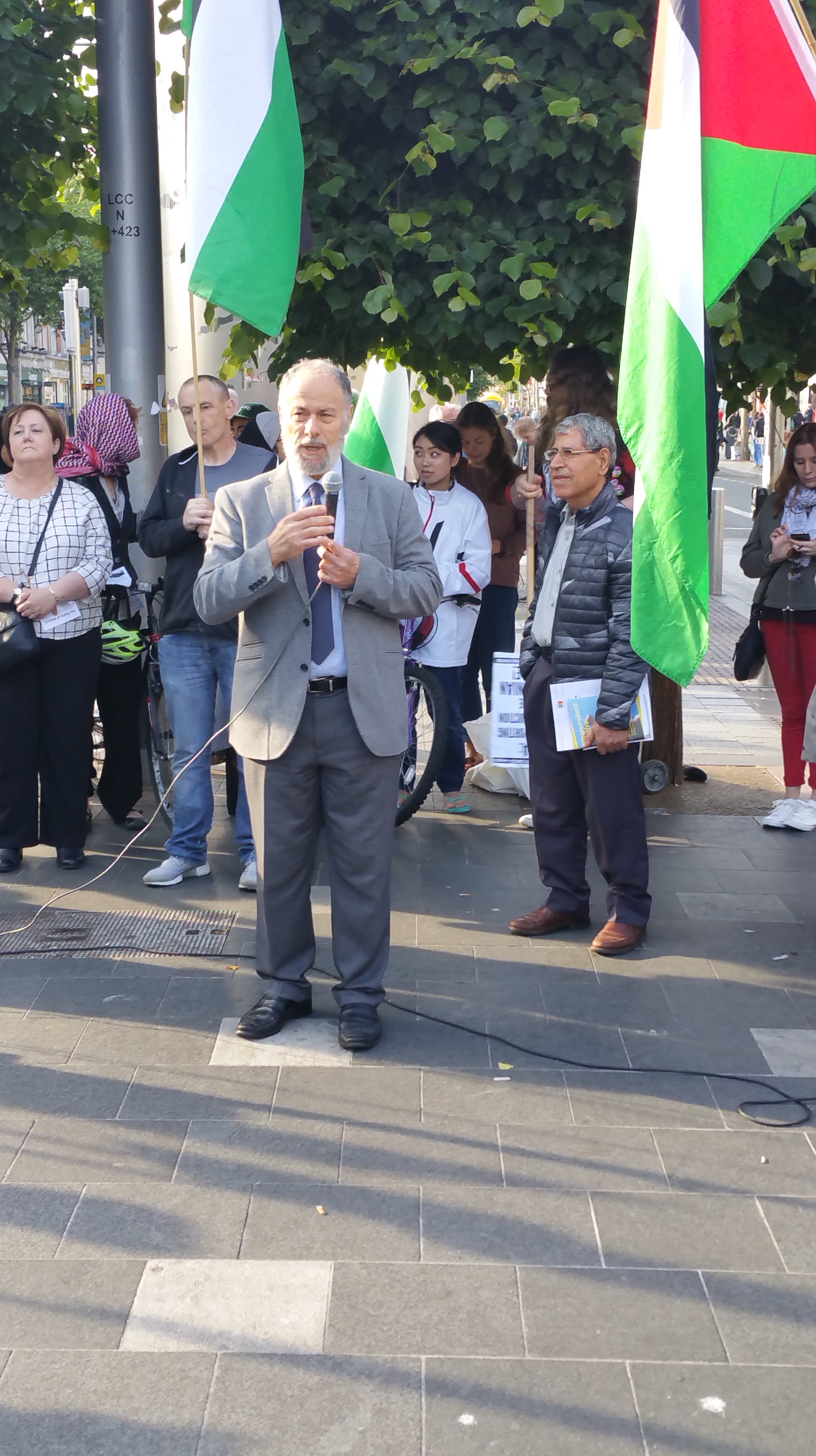
Speaking through a microphone, Martin Quigley thanked those attending the rally and after some remarks, introduced the Chairperson of the IPSC, Fatin Al Tamimi. Speaking about the right of return of Palestinians, Tamimi also said that she had relatives in both Hebron (West Bank) and in the Gaza strip and spoke about the privations of the people there blockaded by Israel, including contaminated water and lack of electricity. However not only is Israel guilty but also Egypt, as Tamimi alluded to when she said that Egypt had only temporarily opened the Rafah Crossing Gate, which Egypt maintains, for the feast of Ramadan, as a result of which she was expecting to be able to see her sister for the first time in seven years (the crowd cheered and applauded this news).
Marting Quigley for IPSC. (Photo: D. Breatnach)
“Expel the Israeli Ambassador and close down the Embassy!”
Two other Palestinian speakers addressed the rally, including one who had come out through that very Rafah crossing, Asad abu Shark who was introduced as from the Great March of Return and Ahmad El Habbash, introduced as representing the Palestinian Community in All Ireland3. All speakers drew attention to the Nakba (from Yawm an-Nakba, meaning “Day of the Catastrophe”, referring to the expulsion of thousands of Palestinians in 1948 –), to the right of return, the terrible conditions within the Gaza strip (which place, they said, would become uninhabitable by 2020 — see link), the impunity of the Israeli authorities and the inactivity of “the international community”.
Fatin Al Tamimi, Chairperson of IPSC, addressing the rally. (Photo: D. Breatnach)
Al Tamimi was cheered loudly when she called for the expulsion of the Israeli Ambassador to Ireland and the closure of the Israeli Embassy, a call repeated by other speakers.
Ronit Lenten, who introduced herself as “an Israeli Jew” and representing Academics For Palestine (Ireland), also spoke briefly.
Last to speak was John Lyons, a Dublin City Councillor for the People Before Profit party, who made similar points. Referring to visit of his own to Palestine he referred to the courage and persistence of the Palestinians in merely trying to live their daily lives under the conditions of Israeli military occupation, apartheid and harassment and called on the Irish people to match that determination in taking action in solidarity with the Palestinians.
An Ireland-based Palestinian speaker addressing the rally. (Photo: D. Breatnach)
Throughout the speeches, the solidarity beeping of horns of passing car and bus drivers could be heard and occasionally shouts of encouragement from open bus or car windows.
Bill to ban imports from Occupied Territories
All speaker highlighted the importance of the BDS campaign (Boycott, Divestment and Sanctions) and the need for Irish people to contact their elected public representatives to ask them for concrete action in support of Israel, including for a Bill to be introduced in the Seanad by Senator Francis Black, (well-known singer, also campaigner for human rights and for support for recovery from alcohol addiction). The Bill in question is the Occupied Territories Bill, the intention of which is to place a national ban on any products shown to be exported from territories under illegal occupation. The Bill, a draft of which has already been approved in committee (see link), is expected to go before the Seanad in July, though that may change and, if passed twice there, will go on to the Oireachtas for debate and, if passed there, into Irish law.
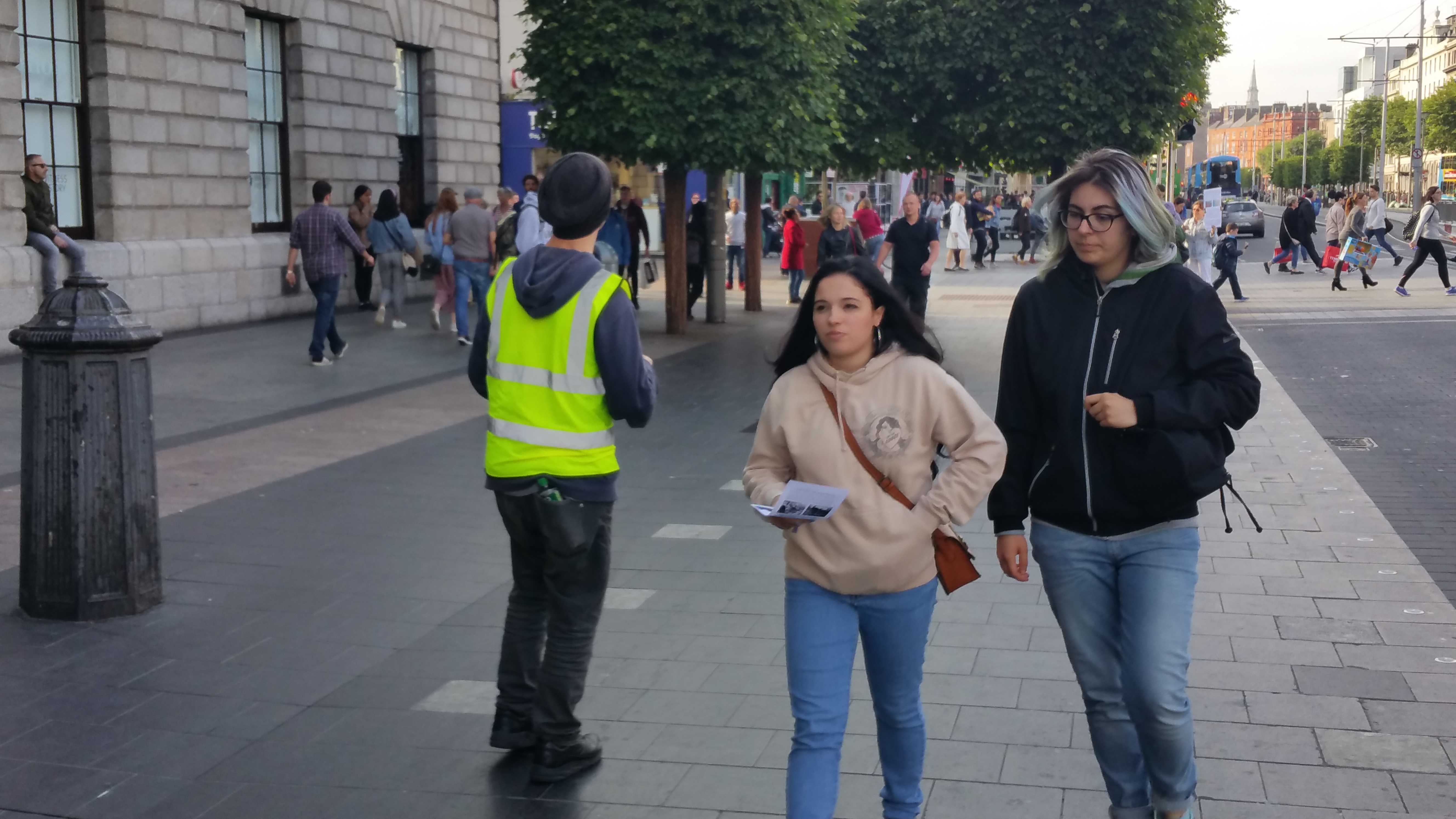
One of the IPSC’s leafleters and passers-by who have just accepted a leaflet. (Photo: D. Breatnach)
Calling on all present to stay in touch with the IPSC or with other Palestine solidarity organisation, Martin Quigley brought the event to an end by leading the rally in leading a number of chants: “From the river to the sea, Palestine will be free!” “Free, free Palestine!” “One, two, three, four – occupation no more!” “Five, six, seven, eight – Israel is a fascist state!”
Early moments as Palestinian supporters gather, view northwards. (Photo: D. Breatnach)
Argentina cancels scheduled football match with Israel. Dozens of Palestine flags defy GAA ban.
In a separate but related development, the national soccer team of Argentina yielded to calls to abandon its scheduled ‘friendly’ match with the Israeli national soccer team (see relevant link). Strong advocacy for the cancellation had been brought about by the movement for BDS both within and outside Argentina but statements of team officials to the media made it appear that members of the team had been threatened (but without producing any evidence of such).
And on Sunday, dozens of Palestinian flags were flown during a match at Omagh between Senior Gaelic Football teams Tyrone and Monaghan. The actions seemed not only to represent solidarity with the Palestinians at this time but also defiance of GAA officials who had removed flags and a banner at a previous match (see relevant link).
End.
POSTSCRIPT:
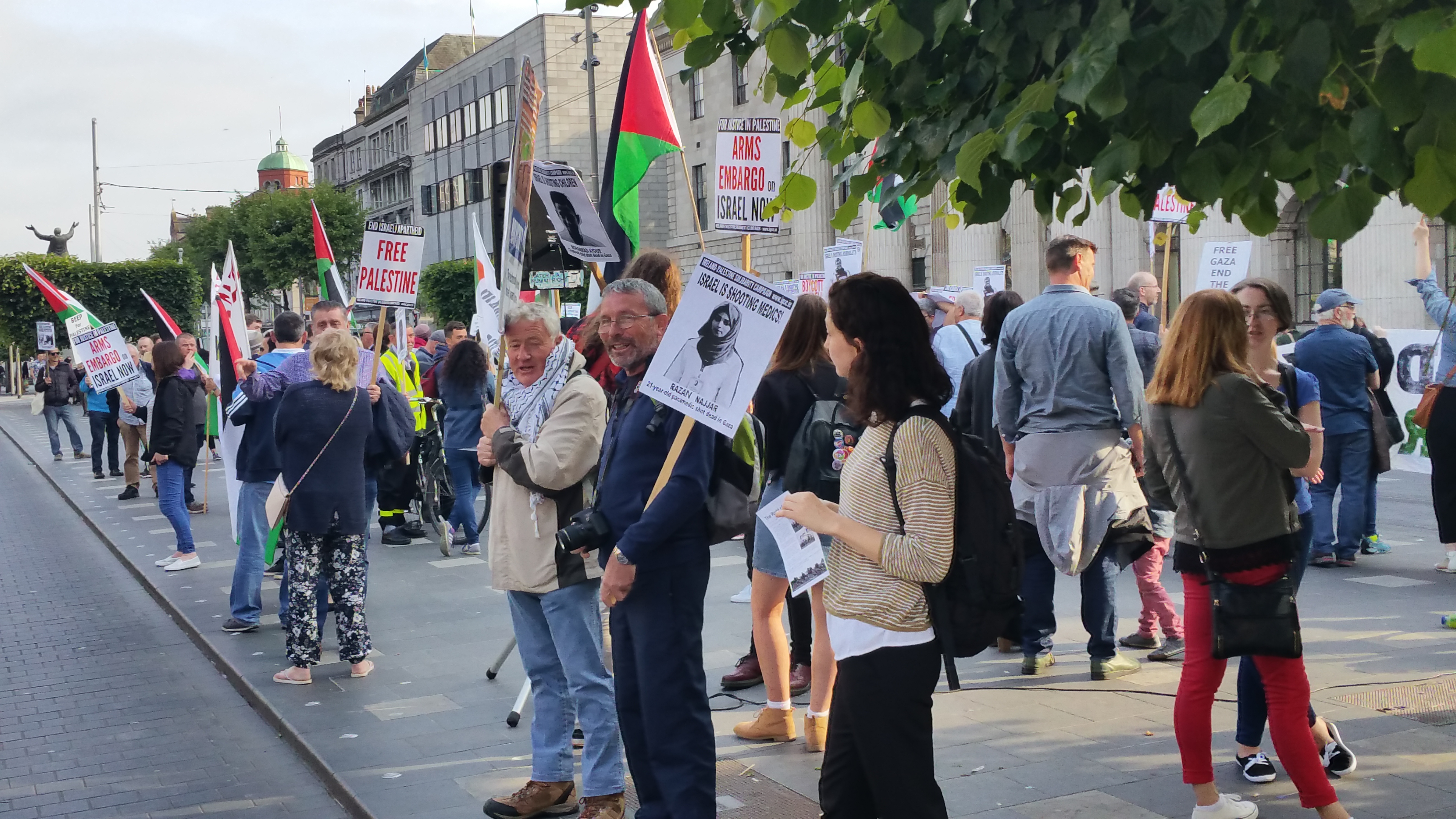
Palestinian solidarity demonstration in Dublin Friday 8th June (not organised by IPSC). (Photo: D.Breatnach)
Footnotes:
1“Today the number who qualify for UNRWA’s (United Nations Refugee and Welfare Agency) services has grown to over 4 million. One third of whom live in the West Bank and Gaza; slightly less than one third in Jordan; 17% in Syria and Lebanon (Bowker, 2003, p. 72) and around 15% in other Arab and Western countries. Approximately 1 million refugees have no form of identification other than an UNRWA identification card.”
2Or the many Jewish converts who never had any contact whatsoever with Palestine.
3 Actually no individual or separate organisation can claim legitimately to “represent the Palestine community in Ireland or anywhere” but there does exist a Palestinian organisation in Ireland which has appropriated that title as its organisational name. A number of different organisations (and none) find support among the general expatriate Palestinian community, including Hamas, Al Fatah and perhaps the PFLP.
The minority right-wing government of Rajoy’s Partido Popular fell on a motion of no confidence proposed by Sanchez, leader of the second Spanish party in terms of electoral strength, the social-democratic PSOE. The ostensible reason for the motion was the recent court decision implicating officials of the PP in a massive financial corruption case. But will the change make any basic difference?
In order to be successful, in addition to his own party’s votes, Sanchez had to call on the support of the elected representatives of Podemos, the Basque Nationalist Party (PNV) and the Catalan representatives in the Spanish Parliament.
In proposing the vote, dedicating two seconds of his speech to the Catalans, he said that he would talk to them. He almost certainly promised the PNV beforehand that he would honour Rajoy’s recent budgetary sweetener for them. He may not have made Podemos any promises but with the PP having 137 seats out of the 350 in the Cortes (Spanish Parliament) and Sanches only having90, with other right-wing parties having 48 between them, the social democrat is going to need all of Podemos’ 71 and all the rest of the help he can get for his party to stay in government.
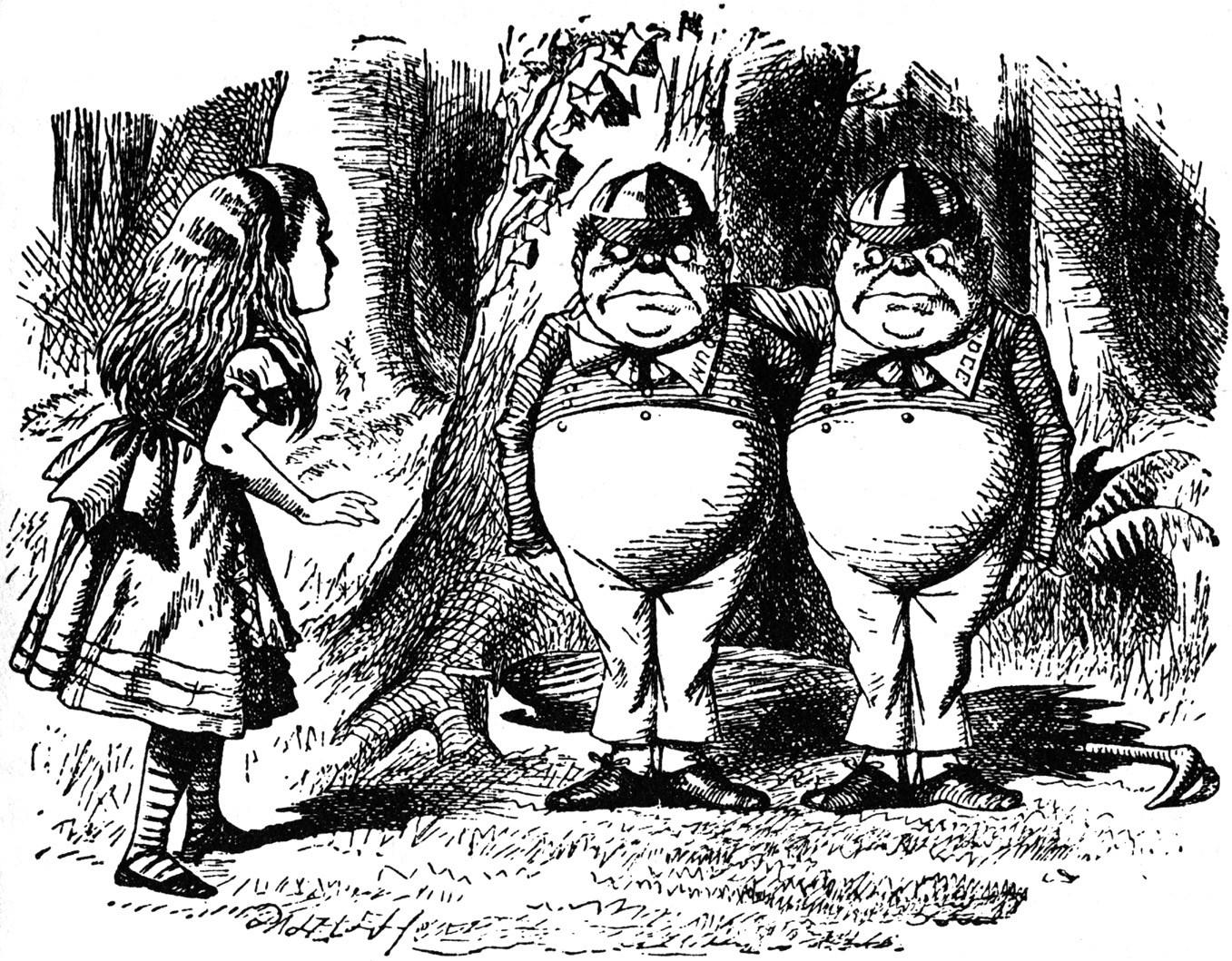
Alice: “Excuse me, one of you is the new Government of Spain, right? But which one, please?” (image from Alice Through the Looking Glass)
The PSOE (Partido Socialista Obrera de Espana) was outlawed during Franco’s dictatorship but after Franco’s death was brought inout of the cold, along with the Communist Party of Spain (PCE) by a deal done during the Transición to the new way of running the Spanish state.
The PSOE has been in government before and collaborated with the monarchy which was imposed on the Spanish people by Franco and his successors. In addition, the PSOE was the party reputedly responsible for the creation of the GAL terrorist and assassination squads against the Basque national liberation movement during the 1980s; one of the PSOE Government’s Ministers went to jail over that and although it was widely believed that the Prime Minister was the main force behind the gangs he was never even questioned by the police.
During recent developments of the Catalan independence bid, Sanchez and the the PSOE’s Catalan version, PSC-PSOE (usually referred to simply as the PSC) were hardly less hostile to the Catalan independists than were the Spanish Government or Ciutadans (right-wing Catalan party with roots in the PP).
Nobody who understands history in general and that of the Spanish state in particular can believe that a PSOE Government is going to anything much else than fight tooth and nail against Catalan independence. But Sanchez might try the velvet glove before revealing the steel fist underneath. One thing he might do is to release on bail the Catalan elected representatives and cultural activists who have been in jail since October awaiting trial.
To discuss a thriller-writer who was in jail in the USA for one of the largest payroll heists in US history and who before that was in the H Blocks, an incarcerated IRA Volunteer, is to have most people thinking one is writing about a fictional character – but I’m not. The man exists and his name is Sam Millar.
WRITER
Millar has a number of novels and a memoir to his credit, all the most recent published by the O’Brien Press. Some of them are detective novels, centred around Karl Kane, a tough private investigator, back-talking cops and gangsters alike. Yes, we’re familiar with the type, from Chandler’ Philip Marlowe to Spillane’s Mike Hammer, Hammet’s Sam Spade or Towne’s Jake Gittes in Chinatown (1974). But if we’ve liked his type in print or film before, them then we tend to like him again. To be truthful, Kane is a bit different: I can’t recall or even imagine any of the others ever opening their front door dressed only in their lover’s short pink dressing gown and falling on their arse, accidentally flashing their tackle at passing schoolgirls. And Kane’s health problems are perhaps more reminiscent of some of the Scandinavian fictional police detective heroes (and heroines) than his fast riposting counterparts in the USA-based stories.
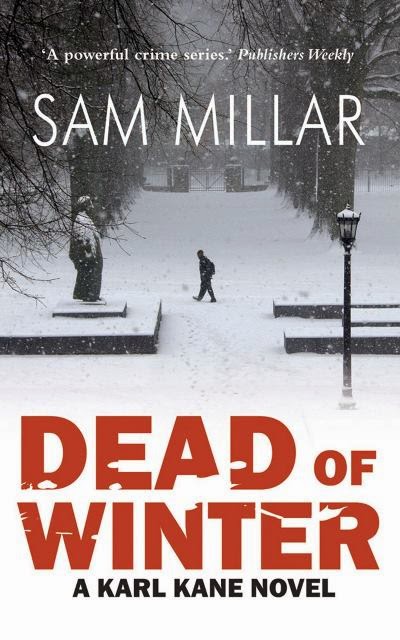
Cover Dead of Winter, a Karl Kane novel by Sam Millar.
The dialogue and commentary in the Karl Kane novels is good with some very funny lines, his plots interesting and he keeps the story moving along at a good pace, with a few twists along the way. Kane, like Marlowe has a conscience pushing through his hard exterior and though he’s tough he tends not to invite more slaps after the first few. And not every thread in the story is tidily tied up at the end of the book.
The dialogue is not so slick in some of his other novels (one set in the USA) but the conjuring of the ill-boding atmosphere is well done, as is the description of the thinking in the adolescent characters’ minds.
Belfast is where his writing is centred now:
“I have deliberately used (Belfast) as a backdrop for all my crime noir novels for a number of reasons”, he was quoted as saying in a Crime Review author profile “- mainly because I know it so well, but chiefly to bring the imaginary one-dimensional Belfast of badly written novels into the modern era.”
Sam Millar (Photo source: Democrat and Chronicle)
His stories are dark (which is part of the meaning of “noir”) but generally not without humour or redemption, at least for some of the characters. The Police Service of Northern Ireland are not presented as shining good guys and in that Millar fits in with the general attitude to the enforcers of law and order in the detective noir stories: the cast of cops usually includes the downright nasty (and often corrupt), the in-between and the good guy – the latter being the cop who feeds the private investigator information or warns him of trouble coming his way from the cop’s superiors. For the genre and for Millar’s stories it works, providing one doesn’t step back too much to think about the sectarian and often murderous RUC now transformed by name into the PSNI.
However, Millar doesn’t try and paint a rosy picture of a post-Good Friday Agreement society and has been quite open about his own views: “I hate bursting people’s bubbles, everybody wants to believe something like a fairytale has happened over here but it hasn’t”, he said in a 2014 interview with David Henessy in the Irish in Britain weekly The Irish World.
“It’s changed superficially but for working-class Protestants and working-class Catholics it hasn’t changed. There’s still a lot of people out of work, a lot of poverty and it seems the politicians are the only ones who seem to benefit out of this Good Friday Agreement which has been a terrible let down, to be honest with you, especially in nationalist communities.
“But for myself being a writer, of course, I have been able to move away and I felt guilty. You don’t want to turn your back on your neighbourhood but at the same time, I’ve young children. I want them to have a better life…”
SELLING WELL ABROAD
A number of Millar’s books have been translated and sold well in France (where he was won a number of literary awards), Italy, Germany and Poland and some as far as Turkey and Bulgaria. He is not without Irish awards either: the prestigious Aisling Award for Art and Culture; Martin Healy Short Story Award; Brian Moore Award and Cork Literary Review Award, et al.
“I could probably sell more books in Ireland if I kept my mouth shut about what I thought,” Millar commented more recently. Perhaps he’s right. I find it hard to believe I never heard about him until picking out a book by chance in the library, saw it was about a PI working in Belfast and with a sigh, felt obligated to read it. But without any great expectations, having come across some novels allegedly about the Six Counties that seemed to be about somewhere else in the world but also bearing Ulster place and family names. I was glad I chose it and am now working my way through his other published works.
Asking some Dublin Republicans about Millar and his writing, I was again surprised that they had not heard of him, particularly since they would share his view of the Six Counties today.
IRA VOLUNTEER AND HEIST
Millar was brought up a Catholic in Belfast (but with a Protestant grandfather), became politically active and went to jail in 1973, “the first nationalist put away under the Diplock court system. That’s a forgotten historical footnote, except for me”, he says. Released in 1975, his days of freedom were short, like many another in those days and a year later he was back inside after being caught with explosives in Belfast city centre. He joined the blanket protest against the British policy of criminalisation of Republican prisoners.
Released from the H-Blocks in 1982, he got acquainted with Bernadette, now his wife, whom he had known as a child, a few streets away from his family‘s home.
Photo source: New York Times
Moving to the USA, in 1993 Millar got involved in the New York Brinks Armoured Car Depot robbery, “the biggest in US history” (in which no-one was killed), for which he got caught a year later and served six years in a penitentiary, to be released by Clinton. Millar wrote about the heist in On the Brinks (2003) and apparently investigators believe that though Millar masterminded the robbery, he fictionalised some of the details in order to protect some accomplices.
Cover of extended version of the best-seller On the Brinks, Millar’s memoir of Republican activism, British colonial jail and the Brinks Heist of 1993.
Warner Bros. bought the rights to the book for a screenplay before backing out of making the film and a long “and draining” legal battle followed as Millar fought to win back the rights, so as to have some other company make the film.
THRILLER WRITER AND REVIEWER
Writing for the New York Journal of Books, Millar said he had “reviewed tons of books”, in reply to an accusation by Armagh author Stuart Neville that he had indulged in “sock puppeting”, i.e using fake identities to rate his own work highly and do down some others, including Neville’s.
“If you look at my books reviewed by people on Amazon,” said Millar to Nuala McCann for BBC News in September 2012, “you will see one stars and two stars, some by writers. I have never asked Amazon to remove them, nor complained on line about them.
“Ironically, the only book I’ve ever read by Mister Neville I reviewed for the influential website New York Journal of Books,” he added.
“I think if you read it, it wasn’t too bad a review. I get lousy reviews sometimes myself, but take it on the chin. I’ve reviewed ‘tons’ of fiction/crime books for writers, and never given a negative review of any of them.
“If I don’t like a book (after a few chapters) I will not review it, as I do not like to give bad reviews to fellow writers, as I know how difficult enough it is without adding grief.”
Cover of Millar’s next novel, with a new anti-hero, due out in June.
Sam Millar has another anti-hero novel (not Kane) novel due out in June, The Bespoke Hitman, as part of a three-book deal with O’Brien. I’m looking forward to reading it.
End.
BIBLIOGRAPHY:
Dark Souls (April 2003)
The Redemption Factory (July 2005)
The Darkness of Bones (2006)
Bloodstorm: A Karl Kane Book (2008)
The Dark Place: A Karl Kane Book (2009)
The Dead of Winter: A Karl Kane Book (2012)
Brothers In Arms (Stage play 2012)
Black’s Creek [originally Small Town Killing] (2014)
On The Brinks, O’Brien Press (April, 2014) [but originally by Wynkin de Worde (Sep. 2003) then bought by Millar’s present publisher, The O’Brien Press]
In most of the World, most people would say that they are in favour of a system of democratic rule – whether their states embrace that system or not. The typical western European system of government is usually called a “democracy” or a “western democracy”, with political parties representing different interests competing for popular support in general elections, the victorious party or parties then forming a government.
Image source: Internet
Since these states are capitalist and, whatever about the victory of one political party or another are clearly run to protect and expand the interests of big business (monopoly capitalism), we must ask ourselves why for the most part the capitalists and their supporting parties support the “western democratic” system and why parties who make much of their support for social justice support this system too. And why the majority of people, who are of course not at all capitalists but are in fact exploited by them, participate in this system.
But first, let us note that there are those who don’t at all like the western democratic system: chief among these are the monarchists and the fascists. Monarchists aspire to a system where society is ruled by (usually) a single individual, whose entitlement to that office is through bloodline, through ancestry. Traditionally the rule of the monarch was influenced or moderated by advisors, whether officially appointed by the monarch or by interest groups, or unofficially as with the monarch’s personal friends or lovers.
Monarchy has a long history in human society, with inheritance mostly through male lines but by no means always. Usually it was supported by a social caste or two, an upper stratum in society, or aristocrats or priesthood and often the higher priests were themselves from the aristocratic caste. This system was called feudalism and the aristocrats and monarchy controlled land, taxing the various productive classes within society. Within the aristocracy there were frequent struggles for extension of their power and (taxable) lands and, at times, against the King also.
These struggles went backwards and forwards in societies and between states also until capitalism overthrew feudalism and put its own power in place. And since capitalists have always been in a minority and as capitalism was particularly weak in its early days, the bourgeoisie (capitalists) needed the support of small businessmen, artisans, labourers of town and country, small farmers …. to be successful, they had to give those masses a reason to support the capitalists. What they gave them was some variant of democracy. The capitalists (bourgeoisie) promoted “liberty” (freedom), as in freedom of thought and speech, of religious worship, of assembly, of writing, of movement but all within certain boundaries, the extent of these depending on the country and the times. Increasingly the bourgeoisie had to grant the right to elect a government not just to themselves but to other social groups also. Second-to-last to be granted after many struggles was universal male suffrage, which included workers without any property, but last of all was womanhood, also after fierce struggles.
Another view of western democracy (Image source: Internet)
Fascists are neither monarchists nor feudalists and though often having a single figurehead who would seem to wield monarchical power, their source is clearly within capitalism. In Germany and in Italy, fascism was supported by big industrialists but in the latter also by big landlords (who still ruled in quite a feudal way in parts of the country). Even in countries where fascist movements did not succeed in coming to power (for example the Blueshirts in Ireland and the Blackshirts in Britain), fascism was supported by elements of the ruling classes.
“EVERYBODY’S A DEMOCRAT”
Aside from the exceptions then, of monarchists, feudalists and fascists, everybody’s for democracy, right? Well, not really. The capitalists who support western democracy today may support the fascists tomorrow, if they consider it necessary. And some of the principal opponents of the capitalists, the communists, don’t support it either. They call it “bourgeois democracy” and see it as a way in which the capitalists fool the people that they are making choices to make a real difference while whichever party or parties come to power are going to ensure that the measures they take will benefit the capitalists or at the very least not harm their interests. James Connolly, a Scottish-Irish Marxist without a party, declared that “governments in capitalist society are but committees of the rich to manage the affairs of the capitalist class”.1
In fact we may observe here that many people who are not communists believe something similar, which may account for the fact that routinely around 30% of those eligible in the Irish state do not vote.2 In Scotland, England and Wales the average turnout traditionally has been slightly higher, until the huge slump in 2001 which recorded an overall UK turnout of below 60% for the first time.3 Post-Nazi West German general election turnout climbed from over 70% to reach its highest point of over 90% in 1972 and has been falling steadily since to over 72% in 2017.4
From the highest-performing of the Nordic countries to big European powers, the average legislature election turnout varies from between just over 60% to just over 80%, while in the USA it is around 55%, which means that between 20% and 45% of people in the western democracies do not participate in their elections.5 Such ironic statements as “It doesn’t matter who you vote for, the Government gets in” are common enough and “all the parties are the same” is an even more commonly-expressed sentiment. The satirical comment from Britain that “Guy Fawkes6 was the only man to enter Parliament with honest intentions” finds a general acceptance, even often among people who do vote.
The trend towards small majorities in winning parties and of coalition governments (or governments ruling with the tolerance of an opposition party) also suggests that people can see less and less difference between the established political parties. The Irish state for example has had coalition governments of some kind since the 1981 General Election (and that itself was a very interesting year electorally, with the election and near-election of a number of Republican Hunger Strikers on both sides of the Border).
SOCIAL DEMOCRACY
People vote for all kinds of reasons apart from a belief in the party for which they are voting. Some vote according to local or family tradition, while others vote for one party in order to keep out another they consider worse. Voting for a popular individual is by no means rare. Some vote to exercise what was a hard-won right and also to try and get what they consider the best out of the system. But voting in general elections does not really reflect the fundamental social desires of the population. We can see this when for example polls show that most people do not want cuts in services, yet all the main parties either propose cuts in services or have refused to rule them out of their program when in government.
It might appear that people could put together a party campaigning for social justice, get the workers and a section of the lower middle class to vote for it and take power in that way. That is certainly the whole basis on which social democratic political parties with trade union backing have sold themselves for the past two centuries. But it seems possible onlyin the absence of examining history and the current realities.
Public opinion is formed not only by people’s experience but also by years of the system’s indoctrination and by the current mass media – the latter not only favour the system in place but often the newspapers, radio stations and TV programs are owned by one or two capitalists. When the mass media is owned instead by the State, it follows the interests of the ruling sections of society. Low confidence in the people’s own potential also plays a big part. There are in addition legal and financial constraints, domestic and foreign, on a party in government breaking with the capitalist norms. In the last analysis, there is always the Armed Forces and the coup.
The best that a worker’s party can do through the electoral system is to cause the capitalists some difficulties around particular initiatives or introduce a few reforms but without changing the system itself.
DEMOCRACY: THE SAFEST OPTION
Given the apparent potential, despite all its difficulties, for a party to hamper the designs of the capitalist class, why do capitalists continue to support this system and as a general rule to prefer it over others, even over fascism? It’s not just because in general, despite wide-scale cynicism and falling election participation, the system works well for them. And it’s not just because fascist societies are inherently unstable in the longer run. No, it’s because the democratic system is much better for capitalism than the other alternative, which is social revolution.
When enough people feel that they are suffering under a system and that that system cannot be changed through voting, what will be logical conclusion? Clearly that a new system is necessary, one that serves the people rather than the capitalists — but that system cannot be achieved through voting. Have enough of the people thinking that and becoming organised around imagined alternatives and social revolution will be the result. Western democracy perpetuates the illusion of potential to change the system to reflect the people’s needs and desires, while fascism clearly does not.
Therefore the capitalists, who in their daily dealings of expropriation of the labour power of billions and natural resources have no belief whatsoever in democracy, go to substantial lengths to promote parliamentary democracy as either the best system of government or at least the best possible system in an imperfect world. For the capitalists, parliamentary democracy is the safer option and it worries them that engagement with the process is falling. The capitalists promote parliamentary democracy through the history and principles taught in the educational system, through laws enacted, through the mass media, through novels and films and through promotion of political or philosophy commentators. And also through denigration of who they see as opponents of their system historically or in the present. The ideal of democracy, whatever about its actual practice, is high in our culture.
ORIGINS OF DEMOCRATIC SYSTEMS
The word “democracy” comes to us from the combination of two Greek words: “demos” and “kratos” The first word means “people” and the second “power”, literally “people’s power” or “rule by the people”. It is supposed to describe the Athenian city state system developed and practiced five centuries Before the Common Era (or 500 BC) and which waxed and waned for many years until the city came under Roman dominion. However this democracy of voting rights extended only to male freemen, a very small portion of the population. Around the same time, the city state of Rome also developed a kind of democracy, built around distinct voting colleges or social groups but ruled overall by the Senate, where most of the members were upper-class patricians. Women and slaves were again excluded from this democracy, as were immigrants.
The big slave-owning societies gave way to feudalism and much is made of the Magna Carta of 1215 in Britain when barons forced King John into a written agreement to respect laws and rights – but whose? Yes, in the main, the barons’, with some limited rights for serfs and ‘free men’ (whom the barons would have needed to fight for them against the king if necessary).
The first successful overthrow of monarchy by capitalism was in Britain in 1649, when a majority of Parliament, backed by commercial and financial interests in the City of London, rebelled against King Charles I (and eventually beheaded him). At the same time, movements such as the Levellers and the Diggers sought to impose their concepts of the rights of working people on to the Parliamentarians. Over the centuries there have been many struggles for rights to vote, to belong a trade union, for relief from heavy taxation and expropriation, for fair trial etc., including the Peasant’s Uprising of 1381 and the Chartist’s struggle of 1838 to 1857. People struggling for some measure of democracy and rights were dismissed from work, exiled, jailed, deported to penal colonies, tortured and executed. But universal suffrage, with the right to vote of every citizen at the age of majority (originally 21, then reduced to 18 in 1969) did not enter the British system until 1928. The Irish Free State beat that by five years, with voting rights in the 26 Counties for men and women over 21 years of age in 1923. Of course, this was also a time of considerable repression in the land.
Meeting of Chartists and supporters in 1845 at Kennington Common, SE London. Their movement has been described as the first mass working class movement in Britain. Two of their foremost leaders were Irish. (Image source: Internet)
LOOKING TO THE FUTURE
The communists espouse a system they call “proletarian democracy” but it has not had a great record overall so far. In Soviet Russia the Bolsheviks turned quickly on their former political party allies and on movements that had supported them among workers, peasants and the armed forces and after that on many members of their own party.
Other revolutionary socialist trends such as Anarchists, Trotskists and some Marxist-Leninists say the problem was not proletarian democracy but the “bureaucratic”, “revisionist” or “Stalinist” way in which it was administered. But how did that proletarian democracy allow itself to be used in such a way? Might that not point to a serious flaw in that system?
On the other hand, Anarchism and Trotskyism have not managed to hold a society long enough for us to judge their own systems of democracy (although critics would say that their general behaviour in managing their own organisations does not give cause for optimism) and states run by people claiming to be marxist-leninists opposed to the USSR have not produced anything like democracy for the people either.
Clearly a way for people to have an equal say in decisions and to participate in their implementation is a necessity for any kind of egalitarian social or political system. Clearly also, if a fair and just society is to be achieved, power must be taken out of the hands of those who use it to exploit the labouring people and to steal natural resources. Perhaps, after a revolution and the expropriation of the rich, the broad outlines of the parliamentary democratic system can be used by the people, combined with checks prohibiting for example involvement in any profit-making schemes and the power of instant recall of a representative when a certain number of the electors demand it. Constituencies might be based on industrial and agricultural sectors and other social groups rather than as they are now, on area alone.
We might want to do away with political parties and have individuals stand on declared policies for election. We could restrict the amount of electoral literature and posters permitted per individual. Of course, we could not prevent such individuals belonging to a party but their election would be as individuals advocating certain policies and they could be elected even if disowned by their party. Such a system would help erode the practice of putting the party first before the needs of the people and encourage the election of individuals on policy advocated and on track record.
Some advocate a decentralised system of self-governing communities relating freely with one another but it is difficult to see what chance such a system would have of working initially, when the old is being overthrown but also possibly mobilising for a comeback and with other parts of the world still under capitalism.
Much more than voting will be required for a real democracy, such as means of engaging people in decision-making at all levels and in toleration of criticism. In this latter area the performance of certain political individuals and all socialist or Irish Republican parties does not give reason for optimism. Again and again we see critics expelled or silenced, or even maligned and threatened, the cult of the individual, cliques pushing for power, the promotion of the party above the interests of the masses, written words censored, untruths promoted, critical thinking discouraged. And sadly, we see many people willing to go along with these practices, whether out of physical fear, fear of isolation or simply not wishing to desert a comfortable path.
It is uncomfortable to be criticised and it is easy to lose patience with critics. However, criticism should be tolerated not only in order to encourage freedom of speech but because no matter how right we think we are and how much we’ve thought it through, we can’t always be right. At the very least, the critics oblige us to justify whatever programs we put forward and criticism can reveal faults, great or small that might otherwise have been overlooked. Toleration of criticism also helps us to relegate our egos to second place next to what is good for an egalitarian social system.
It seems clear that toleration of criticism must be an essential component of any genuine revolutionary democracy. And if that is to be practiced after the revolution, it must be practiced NOW, in our organisations of struggle whether political or social. That practice of toleration of criticism in pre-revolutionary society is one of the most important fronts of organisational struggle at this moment, in preparation for the revolution and the construction of a just society on the rubble of the old. If we fail in this, everything else we do, no matter how well, will come to naught.
6 Guido (Guy) Fawkes was an anti-English Reformation Catholic who was discovered in the Gunpowder Plot of 1605 to blow up the Houses of Parliament, for which he and others were executed in 1606.
After the Spanish police attack on voters in a referendum on independence in Catalunya1 on October 1st, People Before Profit2 Councillor Tina McVeigh put forward a motion condemning the attack and calling for the Catalan Flag to be flown over Dublin City Hall as a mark of solidarity with the Catalan people and their right to determine their future.
Front view of Dublin City Hall showing the Ensaya flying next to the Irish Tricolour (Photo: Casal Catala Irlanda)
This was not such a wild step for the Council to take as it may seem: the Palestinian flag had been flown from City Hall in May, to the delight of most Dubliners but to the disgust of the Israeli Ambassador and to Zionist sympathiser and former Government Minister Alan Shatter. And Dublin city has been ‘twinned’ with Barcelona since 1998.
Nevertheless, in November the Protocol Committee agreed to recommend flying it by majority only, seven votes for and five against. It still had to be voted on by the whole Council and so went forward on to the agenda for the monthly meeting in December. Councillors began receiving emails from Spanish unionists asking them to vote against, which at first substantially outnumbered those in favour. As the first Monday in December drew nearer, the correspondence equalised between those in favour and those against. But the meeting ran over time before the motion was reached on the agenda and another date was set to discuss it. When the councillors reconvened, the motion was proposed, discussed and voted on. Unlike the decision on the Palestinian flag earlier this year, the vote was very close but the motion passed by three votes.
Section of the attendance at the event (Photo: D.Breatnach)
In January this year the Catalan flag was hoisted – the regional ensaya and not either of the independence esteladas3 – on top of City Hall, where it will fly for a month. City Hall is itself a historic site, having been part of a battleground during the 1916 Rising. On January 6th, Catalans and some supporters gathered outside City Hall to celebrate the show of solidarity in the flying of the Catalan flag.
Joan Pau of Casal Catala of Ireland4 welcomed the attendance and thanked the Councillors for flying the flag and introduced the Lord Mayor, Mícheál Mac Donncha, telling those present how he had approached the Catalans to help them. Mac Donncha (SF)5 thanked the Catalans for the invitation to attend and said that he was proud of the Council for the decision they had taken. He remarked also that in the past Ireland had political prisoners just like those now in Spanish jails for supporting the Catalan referendum and deplored elected officials of Catalunya being jailed for following the mandate of the people. He spoke also about Ireland’s fight for freedom and how in the 1916 Rising, Volunteers had taken over City Hall itself.
Another view of a section of the attendance Front view of Dublin City Hall showing the Ensaya flying next to the Irish Tricolour (Photo: Casal Catala Irlanda)
Joan Pau then expressed his regret that Cnclr. Tina McVeigh could not be present due to a family bereavement, since she had been very active in solidarity with the Catalan people. He introduced Cnclr. John Lyons (also PBP) who also expressed his pride on the result of the vote, as well as his condemnation of the Spanish Government, as distinct from the Spanish people, for their undemocratic and violent behaviour in the October 1st attacks and subsequently in the jailing of Catalan public representatives. He also condemned the Irish Government for not supporting the right of the Catalan people to self-determination.
Front view of Dublin City Hall showing the Ensaya flying next to the Irish Tricolour (Photo: D.Breatnach)
Although a Spanish unionist had contacted the Council to threaten a counter-demonstration, there was no sign of any such presence throughout the ceremony. A number of passing tourists took photos (some even having themselves photographed with the group) and a number of passing motorists tooted their horns in solidarity.
Section of the attendance with flags (including the “Sí” ones used campaigning for the referendum) & placards calling for the release of the political prisoners. (Photo: D.Breatnach)
After the formal part of the meeting was over, Dublin walking history tour guide Diarmuid Breatnach invited Catalans to gather around DCC’s plaque to the garrison of City Hall and surrounding buildings in 1916. The guide explained the origin of the Irish Citizen Army in the Dublin Lockout of 1913 as a workers’ defence militia against brutal attacks by the Dublin Metropolitan Police Force. It has been called “the first workers’ army” Breatnach told them and drew attention also to it being the only one of the various organisations taking part in the Rising that formally gave equal status to men and women. There were women officers in the ICA and after the killing of the commandant of this garrison Seán Connolly, it was a woman who took over as commandant. The fighting here had been fierce as Dublin Castle is just next door and that had been the HQ of the British Occupation of Ireland since 1169.
Plaque (located to the right side of the front of City Hall) listing the names of men and women of the Irish Citizen Army who fought at that location in 1916. Four ICA Volunteers died there.
After receiving answers to a few questions, many of those present retired to a local pub to warm up and to carry on conversation on a number of topics, in the best Irish – and Catalan – manner. Up above, the Catalan flag on the east side of City Hall’s roof waved in the breeze, with the Irish tricolour next to it, in the centre, waving too.
End.
FOOTNOTES:
1Catalunya is considered part of wider nation called Paisos Catalans (Catalan Countries) which includes Valencia, the Balearic Islands and parts of Aragon and Murcia; most of it lies within the current territory of the Spanish state, with a small part within the French state. Catalunya (capital Barcelona) is one of the regions within the Spanish state with limited autonomy and it is there that the referendum was held, the result mandating its Parlament to create and independent republic. The Spanish Government and Constitutional Court ruled the referendum illegal, confiscated ballot boxes, assaulted hundreds of voters, declared the referendum result non-valid, jailed a number of elected members and activists, threatened others with jail, ruled Catalunya directly Spain and called for new elections, which confirmed the situation more or less as before. The struggle is ongoing.
2People Before Profit was launched as a broad front by the Trotskyist organisation the Socialist Workers’ Party Ireland, formerly the Socialist Workers’ Movement, founded in 1971 and close to the SWP of Britain.
3There are two Catalan independence flags or estelladas: the Republican one with red stripes on a yellow background, with a small blue triangle to the left, containing a white star; the Socialist (or Communist) one, also with red stripes on a yellow background but with a red star to the left and no triangle. The regional ensaya, without any star, was proposed as the one least likely to cause division.
4Casal Catala are Catalan cultural associations that have been founded in a number of countries outside Catalunya.
5SF or Sinn Féin – the party is represented on Dublin City Council and tradition has it that the Lord Mayor is elected yearly in rotation from among the elected representatives; this Council year it was SF’s turn again.
ln the Six Counties, the British colony in Ireland, the sectarian lines are drawn. The Good Friday Agreement did nothing to eliminate them, contrary to the praises of many and perhaps even the wishes of some who supported it. The majority section of the population has a badge of professed faith to identify it, Protestantism, while the other has its own badge, Catholicism. But each section also has other symbols of its own.
Politically, each section has a number of divisions within it but each has its majority representation: the Democratic Unionist Party for the Protestants and Sinn Féin for the Catholics. Both of these parties have overcome others to rise to prominence over their respective sections – the DUP deposed the Ulster Unionist Party and Sinn Féin overtook the Social Democratic and Labour Party. Both Sinn Féin and the DUP display the symbols of their respective sections and employ them to sectarian electoral advantage.
Apart from professed religion as a signifier, each section also has its own visible symbols: the Tricolour and Harp for the Catholics, the Union Jack and Crown for the Protestants. And to this has now been added language: Irish for the Catholics and Ulster Scots/ English for the Protestants.
The Irish Tricolour, a flag of the Irish Republican movement and official flag of the Irish State. (Image sourced on Internet)Flag of the United Kingdom, colloquially known as the “Union Jack” (it has other less neutral names too). (Image sourced on Internet)
There are other symbols too but they are of minor importance, for example for the Catholics flying the Palestinian flag in solidarity with Palestinians and, just because they must oppose anything the Fenians do, the Israeli flag for the Protestants. Soon we may see the Catholics adopt the Catalan Estelada flags and the Protestants, the flag of the Spanish State. But would Unionist Protestants fly the flag of a Catholic country? Yes, it’s quite possible – they already fly one of a Jewish state.
Coat Arms UK (black & white), itself a symbol of UK authority and power, displaying a number of other symbols within it, including the Irish Harp within the shield. Note the symbolic Crown above all. (Image sourced on Internet)United Irishmen Harp Motif (Image sourced on Internet)
The opposing sections are in this discussion described as “Catholic” and “Protestant”, as though religion were really the issue – however it is not. Some commentators like to speak in term of “nationalists and unionists”, with the more extreme wing of the latter described as “Loyalists”. That particular sub-group of Unionism is more likely to refer to Catholics as “Taigues” or “Fenians”.
There are religious differences in doctrine and in temporal supremacy between both religions: Catholics believe in the immaculate conception of Mary, the mother of the Christ figure and Protestants do not, though she is seen as a saint in their churches also. Perhaps more relevantly, for Catholics the Pope is, notionally at least, the supreme temporal religious authority while for Anglican Protestants, it is the ruling British Monarch (other British-based Protestant sects acknowledge only their own vicars, their reading of the Christian Bible or their own consciences). Currently, that monarch is Queen Elizabeth II Windsor and lest she be considered just some kind of figurehead, albeit with untold (literally!) riches quite apart from public funds allocation and properties, it is well to remember that she is also Commander-in-Chief of the British Armed Forces.
Back in the day, the Pontiff (the Pope) also controlled a fair share of armed force and also brokered deals between the monarchs of different kingdoms. And in that respect, we’ll shortly come to some great ironies with regards to the Six Counties but first there are other matters to deal with.
RELIGION AS A QUESTION OF STATE POWER
Henry VIII of England disestablished the power of the Pontiff in English-ruled domains and made himself head of the Church, which of course required a split in the Christian Church, and the whole process has since become known as the English Reformation. That happened in the 16th Century; Henry’s daughter Elizabeth I continued this policy in the 17th Century and also extended the power of England and the territories under its domain. Of course, none of this was done by those monarchs alone; powerful feudal and commercial interests were involved also. Being Head of the Church of England allowed Henry to dissolve monasteries and confiscate their lands, filling the coffers of the Crown and of the faithful – faithful to the Crown.
Unfortunately for Ireland, a large part of the country was in the possession of England at this time, though not without resistance. And the original “English” colonists, the Gall-Ghael (“foreign Gael” in Irish), the Normans who had invaded from a colonised Wales with their mercenaries, wanted to stick to their earlier religion, continuing to acknowledge the Pontiff as their spiritual leader. They held their lands through conquest of arms under English monarchs (though the first had been a French Norman) but their loyalty to the British Crown was somewhat shaky. In 1366, nearly two centuries after their conquest of the Irish lands they held, the English Normans called them “the degenerate English” and accused them of having become “more Irish than the Irish themselves”.1
And what of “the Irish themselves”? They too were of the old faith, although their earlier Celtic Christian Church had been more than a little lax in its application of Roman doctrine, especially in laws and mores around marriage, justice and the status of women. The Roman Church was feudal and Irish society still ran along clan lines.
An uneasy alliance was formed between the Gael and the Gall-Ghael which emerged first for the English king Charles I against Cromwell, in the middle of the 17th Century and later again near the end of that century for King James II against King William III (of Orange). On each occasion the Irish alliance lost.
BATTLE, SECTARIAN LINES AND IRONIES
And here we come to ironies. William of Orange was a Protestant and the victory of his forces at the Battle of the Boyne is considered by Unionists a victory of Protestant forces over Catholic. Actually, there were some Catholics among William’s force and some Protestants among the opposing James II forces but that is not the irony. Nor is the fact that William of Orange was a homosexual and that Rev. Ian Paisley, who founded the Democratic Unionist Party and led it until his death in 2014, led a campaign against decriminalisation of homosexuality under the slogan “Save Ulster from Sodomy!”
No, the irony is even greater than those two facts and it is this: William’s armed forces were part-financed by the Vatican, in other words through the Pontiff himself. Although in Ireland the conflict took on the shape of Catholics fighting for freedom to practice their religion (and even Gael and Gall-Ghael holding on to their respective powers), against Protestants forcing their religion and colonial power on others, it was part of a European-wide conflict known to historians as The Nine-Years War. A coalition of forces composed of Austria, the Holy Roman Empire, the Dutch Republic, Spain, England and Savoy, styling itself the League of Augsburg, drew up to oppose Louis XIV of France. And James found himself on the side of France and against his own Parliament.
The Pontiff, as leader of the Holy Roman Empire, was very much a member of the League of Habsburg as was the Kingdom of Spain and Savoy – all under Catholic rule. When news of William’s defeat of James’ forces at the Battle of the Boyne on 1st July 1690 reached the Vatican, a Te Deum mass of praise was celebrated there and similar demonstrations of praise were practiced in the Spanish Kingdom also. That war in Ireland had fundamentally little to do with religion in reality but everything to do with English state and colonial power and European power struggles.
And of course this is not only an irony for the Protestants, who annually celebrate the Boyne victory on the 12th of July in their most sectarian and anti-Catholic manner, but for the Catholics too, who see James as defending their Catholic faith, of which the Pope was the spiritual leader. Nor is that the only irony in connection with Ireland and the Vatican: it was a Pope, Adrian IV, who issued a Papal Bull (something like a warrant) in 1155 legitimising invasion and conquest of Ireland by Henry II of England. Pope Adrian IV, aka Nicholas Breakspear, was the only English Pontiff ever, true but he was a Pope and he must have had substantial support in Rome to issue such a document.
RELIGION
One of the characteristics of republicanism in the late 18th Century, apart from the abolition of the monarchy, was the separation of Church and State. Freedom of conscience and worship were important principles in the French and American revolutions. The United Irishmen also adhered to those principles with an even greater motivation, which was that the majority of the Irish population was excluded from participation in government, military and civil profession by a religious bar.
The Unitedmen were defeated, crushed. Their Protestant (Anglican) and Dissenter (Presbyterian) leaders and supporters were executed or exiled2 and the remnants for the most part became dominated by sectarian anti-Catholicism. And Irish nationalism, including republicanism, came to contain a strong Catholic bias (notwithstanding the continuing presence of Protestants and true Republicans in the movement).
Despite the fact that the Irish (and English) Catholic Church hierarchy has been publicly and energetically hostile to Irish Republicanism from the 1780s onwards, the majority of the Irish Republican movement of the early 20th Century observed the practices of the Catholic faith and never broke from its religious allegiance nor sought to overcome the dominance of the Church in society. As a result the Republican movement was unable, had it wanted to, to tackle many of the social injustices in the Irish State’s education, health, intellectual, literary, art, gender and sexuality policies and legislation, where the Church held sway.
Liberty of conscience and worship remains an important civil right, a democratic demand. People are entitled to practice their concept of religion or to abstain from it and their choices in this regard should not influence people’s participation in society as a whole. The Catholic Church is losing its power in the Twenty-Six Counties and that is reflected too in the Six. The Presbyterian churches are likewise losing influence. However, faith congregation membership continues to be a communal marker and to be used by the DUP and SF to hold their respective voting blocs together.
If separation of Church and State is an important principle of Republicanism then Republicans should actively campaign for that end. No school that bases its intake of pupils on the practice or belief of any religion should receive State support. But in the unlikely event that Sinn Féin should embark on a campaign to apply that principle, they would find themselves losing their voting block, for that is how their block is identified in the Six Counties: as Catholics, baptised in Catholic church, attending Catholic services to some degree or other and being educated in Catholic Schools.
The Unionists are of course just as careful to look after their own sectarian voting block and at least as sectarian. But they don’t claim to be Republicans.
THE ESSENCE OF THE SYMBOLS
Symbols of course do not merely stand for what they are themselves but, in being a symbol, for something else also. A sculpture or drawing of a lion may represent the animal but when used as a symbol, frequently stands for monarchy and power: for examples, the lion on the coat of arms of the United Kingdom and the lions at base of Nelson’s Column in Trafalgar Square, London. And symbols can also change their symbolic meaning and come to mean something else than was originally intended. The cross symbolised martyrdom for early Christians, later came to symbolise Christianity itself, later still the Holy Roman Empire and the Crusades, the Spanish Inquisition …. For the Ku Klux Klan in the southern states of the USA, the burning cross symbolises the power of their organisation and white anglo-saxon ethnic supremacy.
The Irish Tricolour flag was presented to Thomas Francis Meagher of the Young Irelanders by women revolutionaries in Paris in 1848, the Year of Revolutions in Europe (but not really in Ireland, where the fight had been knocked out of the remaining survivors of the Great Hunger 1845-1849). Reputedly the flag’s colours signified peace (White) between the traditions of the Gael (Green) and the descendants of those who had fought for William (Orange). The Unionists see it, however, firstly as a symbol of rebellion against the Crown (not without reason, given its historical use) and secondly as a flag of a Catholic Ireland.
The Harp is an Irish symbol of some antiquity and was reputedly flown on standards in ancient medieval times in Ireland. The Norman and English invaders appropriated it firstly as symbol of a conqueredIreland and incorporated it into their colonial standards and flags. Revolutionary republican grandchildren and great-grandchildren of Cromwellian settlers then appropriated the harp as the symbol of the republican United Irishmen, with the motto “It is newly strung and shall be heard”. After the defeat of the Unitedmen (whose leaders were nearly all Protestant), the Harp became a rather suspect symbol for Unionists, mostly Protestants and besides, it is the official symbol of the Irish State (the only state in the world with a musical instrument as its national symbol). However, it remains within the arms of the United Kingdom, representing the Six Counties colony still in British/ English possession.
“Easter Lilly” design, traditionally produced as a paper ‘flag’ and worn pinned to clothing with a straight pin. More recently also produced in enameled metal. (Image sourced on Internet)
The “Easter Lilly” emblem is a symbolic representation of a white lilly with an orange centre, with a green leaf as a background. It was developed by Irish women Republicans in the second decade of the 20th Century to commemorate those who died fighting for Irish national freedom, in particular during the 1916 Easter Rising. For decades it was produced as a simple paper representation for the Irish Republican movement and sold on streets or pubs in the lead-up to Easter Monday, when the Rising would be commemorated. In more recent times it has been worn for up to a week each side of Easter Monday and it has also been produced as a metal badge or pin, which some Republicans wear all year around.
The flag of the United Kingdom, commonly known as the “Union Jack”, embodying a design composed of the symbols of the Crosses of Saints George, Andrew and Patrick, represents the union of the nations through their respective patron saints3: Scotland and Ireland under the rule of England and its Royal Family. It was a forced, not a voluntary union and is therefore a reactionary symbol but Unionists in the Six Counties view it as a symbol of the union with England which they wish to maintain.
Paper “Remembrance Poppy” produced for the British Royal Legion (Image sourced on Internet)
The Crown represents the English Royal Family and UK State power. Since it is the same State that imposes its rule on the other nations of Ireland and the British Isles, it is fundamentally a reactionary symbol, also representing the reactionary institution of monarchy.
The Poppy, a cloth representation of the red flower, is worn by many British people in the lead up to Armistice Day, November 11th and sometimes for days afterwards. Many British people apparently believe that the purpose of this symbol is to commemorate the dead in wars or to support veterans and their families. In fact as research has shown, the primary purpose of commemorating ‘Remembrance Day’ and the Poppy is to gather public support behind the Armed Forces of the UK. Unionists seemingly see wearing it as proof of their political allegiance to Britain, England or the Crown – or all three.4
In the most recent history of the Six Counties, the symbols listed above have been those of the respective communities, with the added fact that Crown and Union Jack have also been symbols of the colonial statelet itself.
Recently two other symbols have been promoted, also with sectarian allegiances: Irish and Ulster Scots. Neither of these two languages is spoken by the majority of either community, for whom English (with some words specific to Ulster) is the majority language.
THE IRISH, ENGLISHAND ULSTER SCOTS LANGUAGES
Irish or an Ghaeilge, one of the languages of the Goidelic branch of the Celtic languages group, was the language of the people living in Ireland before it was invaded by England and remained the majority language in Ireland until the end of the19th Century. It continues as a community language5 in all provinces of Ireland including Ulster but there in parts of Co. Donegal, the northernmost county of Ireland (and not part of the Six Counties despite the statelet being called “Northern Ireland”).
Irish died out as a community language in the Six Counties from its last refuge, the Sperrin Mountains, sometime in the early decades of the 20th Century (the 1911 Census recorded a majority of Irish speakers in that region but also, interestingly, in the Protestant Sandy Row area of Belfast City). However, some Irish speakers survived and others learned the language so that it continued to exist in the colony after the partition of Ireland in 1921. During the recent 30 years’ war, Irish enjoyed a resurgence and to some extent became a badge of resistance to colonial rule.
English is, more than most, a language composed of a number of different languages. Given that it sounds like and is classified as a Germanic language, it is surprising that its major component is of French language origin with the minor component based on Saxon German. English developed in what became England over a period including the defeat of the Romanised Celtic tribes of the area by the Saxons and Angles and the subsequent conquering of the Saxons themselves by the French-speaking Normans.
A century after their victorious invasion of England, the Normans invaded Ireland. In most of the area they conquered in Ireland, the Normans soon came to adopt many local customs, including the speaking of Irish so that less than two centuries later, their England-based colleagues referred to them as “the degenerate English” who had become “more Irish than the Irish themselves.”6
Although the invaders failed to enforce the Statutes of Kilkenny, over the following centuries they managed through eviction of natives and plantation of colonists, as well as the exclusively official use of English and legal repression of the Irish language, to make Irish a minority language and to reduce it, as a community language, to a number of reservations in certain parts of the country.
Ulster Scots is a dialect of Scots, in turn a dialect of German spoken by Saxon colonisers of the Scottish Lowlands (the reason the dialect became known as “Lallands”). The Scottish colonists of Irish lands given to them by James I, Oliver Cromwell and English bankers brought the language into Ulster where it developed into “Ulster Scots”. That too gave way to English over time except in some pockets, without any serious effort to revive its fortunes. Until, that is, agitation began in recent times for rights for Irish speakers and for the teaching of Irish, when some Unionists, seeking an “Ulster”7 “Protestant” equivalent with which to oppose any benefits for Irish, began agitation for the preservation and teaching of Ulster Scots.
However, the real competitor with Irish for dominance in the Six Counties (as also in the Twenty-Six, the Irish State) is of course English.
“PARITY OF ESTEEM”
“Parity of esteem” is a concept that was put forward by Sinn Féin within the atmosphere of the Good Friday Agreement.
To many people at the time, including myself, it seemed like something between “soft” Republicanism and a token demand, something to represent to the party’s following that it was doing something for them in the Six Counties. Sinn Féin would have claimed it was much more than that – and it was.
When some critics of SF or of the Peace (sic) Process claimed that sectarianism was being institutionalised, was being “copper-fastened”, I wondered how that was. Obviously, people in Catholic areas would vote Sinn Féin but how was that any different other than how they would have voted previously, viz. Nationalist or SDLP?
But in the past, except for the brief “power-sharing” agreement8 which the Loyalists had so effectively sunk, no political representative on a Catholic voting base had even come close to carving up the Six Counties on a community proportional basis. Now Sinn Féin have done so – not just in local authorities but in the government of the statelet itself (present difficulties excepted). That is what SF has achieved, after some years of civil rights agitation, Catholic communal resistance to repression and nearly three decades of armed struggle – a sharing out of the spoils of office. Power-sharing. Parity of esteem. A sectarian carving out of areas of influence.
And every power-base must have its symbols. Recently the Irish Language has become one such. Obviously the Irish language is entitled to support and its speakers have civil language rights. Clearly the sectarian opposition of Unionist politicians to concessions in this direction is fundamentally wrong. Of course a Language Act is needed so that Irish speakers can use it to push for their rights where the institutions oppose and block them. But that is not why SF has come so late into this struggle. It’s another symbol of their ethnic power-base and another stick with which to beat the Unionists.
A view of a section of the “Dearg le Fearg” protest demonstration in Belfast in 2014, demanding State recognition of and facilities for the conservation and dissemination of the Irish language. (Image sourced on Internet)
And of course there are Irish language speakers and campaigners who are Sinn Féin members. They made clear you knew that during the huge demonstration in favour of Irish language rights, the Dearg le Fearg9 demonstration of 2014 in Belfast, when they were the only political party displaying a banner in violation of an understanding that no political party would do so.
But what does Sinn Féin do in order to forward the language among its own members and activists? Are its public speakers obliged to be competent Irish speakers? Are its Ard-Choiste (Executive Committee) meetings conducted through Irish? Its cumann (branch) meetings? Its Ard Fheis (annual congress)?10 No, none of those. Is the party even running an Irish language instruction program to overcome this deficit at some point in the future? No.
Apart from some enthusiasts among its activists and a vague nationalist emotional attachment, Sinn Féin as a party is not really interested in the language. In the Six Counties, it is interested in a sectarian carve-up which will keep it at the power table and the Irish language has now become useful for that. Just as, in the Twenty-Six Counties state, it is interested in coming to power in a different kind of power-sharing.
THE EASTER LILLY AND THE “REMEMBRANCE” POPPY
And the latest symbol to be sullied by joining this war of symbols is the Easter Lilly. In times past the Easter Lilly, commemorating in particular the dead who fell fighting for freedom in the 1916 Rising, was worn by many in the Twenty-Six Counties state who were not Republicans. In the latter decades of the last century, few wore it apart from Republicans and, in the Six Counties, it was asking for trouble from the colonial police or Loyalists (often the same thing) to display it. The Flags and Emblems (Display) Act (1954-1987) there empowered any police officer to decide it was likely to lead to “a breach of the peace” and to remove it by force; conviction of a breach of the Act was punishable by a fine of up to £500 (sum equal to about £15,300 in 2017) or up to five years in prison.11
The Act, the repeal of which was one of the demands of the Civil Rights movement of the late 1960s, was finally repealed in 1987 but of course, any signifier identifying a person as a Republican or even a Catholic in the Six Counties is at the very least an invitation to less favourable treatment by the authorities and at worse to harassment and assault by Loyalists or colonial armed forces personnel.
It is of course right that people should have the right to wear the Easter Lilly but to pose it as an equal right to wearing the Remembrance (sic) Poppy is to devalue the Lilly, to putting an anti-imperialist and Irish Republican history emblem on the same level as an imperialist military-glorifying one. But that is exactly what Sinn Féin is now doing12. And Leo Varadkar, Taoiseach (Prime Minister) of the Irish state, recently publicly agreed with that notion.13
And is that not the same project as those of the “Museum of Free Derry”14 and of the Glasnevin Cemetery Trust15, one on each side of the Border, commemorating dead British colonial force members side-by-side with their victims and those who fought against them? As though they are of the same worth to commemorate? As though the objectives of each were (are) of equal value?
What more effective way to undermine the power of an anti-imperialist and anti-colonialist symbol than to equate it with its opposite?
THE IMPORTANCE OF SYMBOLS
I once heard an organiser of a British-based left-wing party, himself of Irish parents, declaim against Irish political commemorations in London as “only of symbolic importance”. How little he understood of human beings to say that! Outside of urgent situations, natural surroundings and chemical reactions, symbols are the only things that convey meaning to human beings.
This page is covered in printed symbols, which we have learned to decipher into words which, in turn are symbols to convey meaning by association. If I write the letters h,o,u,s,e joined together, or say “house”, a symbol in sound, the listeners construct the shape of a house inside their heads, based on the culture and structures to which they have been exposed in their lives, to understand what I mean. If I write or say instead “tent”, they will visualise something else. If I write or say “party” the listener may struggle between visualising a festive occasion or a political party but should I have preceded that word with another, “house”, confusion disappears and the only question is whether the listener’s experience or understanding of a “house party” is the same as mine.
A nod of the head is a symbolic gesture which in most cultures signifies some level of agreement, a shake of the head its opposite. We understand symbolic hand gestures, shrugs, grimaces, smiles, winks, the lift of an eyebrow, bodily posture. Shapes of body or posture can convey sexual availability and induce arousal, or convey threat and give rise to fear. Symbols haunt our dreams, according to Jung and Freud, communications from our subconscious. Symbols are crucial to conveying and understanding meaning.
WHAT IS RIGHT AND WHAT IS NOT
It is right and proper that people should uphold the symbols of anti-imperialist and anti-colonial historical resistance, including the Irish Tricolour (although more appropriate to my thinking is the Starry Plough of the Irish Citizen Army16). Another symbol of that resistance, the Easter Lilly, is equally valid. It is right and proper that people should
“The Starry Plough”, design of the flag of the Irish Citizen Army, first produced 1914. (Image sourced on Internet)
value the cultural and political history embodied in the symbol of the Irish Harp. It is a matter of great cultural world importance that the Irish language survive and flourish. These are important symbols and, in the case of the language, an important thing in itself. These are not things to be equated with symbols of oppression, colonialism and imperialism.
The Union Jack, the Crown and the Poppy deserve to be shunned by all progressive people, because of the values they symbolise and the continuing effect of those things today. The English language, on the other hand, is worthy of a place in a bilingual Irish society.
Let Republicans and others promote the wearing of the Easter Lilly and the display of flags of historic Republican resistance. Let them never place them in the same context or on equal status with the symbols of imperialism and colonialism. Let many promote the use of the Irish language and rights for its speakers but let it not be used as a crude political weapon, much less to further the prospects of a party which actively colludes with and shares in colonial rule by an invader and has done nothing in reality to promote the language even among its own ranks.
End.
FOOTNOTES
1The Statutes of Kilkenny sought to halt this “degeneracy” with 35 Actsforbidding the “intermarriage between the native Irish and the native English, the English fostering of Irish children, the English adoption of Irish children and use of Irish names and dress.[7] Those English colonists who did not know how to speak English were required to learn the language (on pain of losing their land and belongings), along with many other English customs. The Irish pastimes of “hockie” and “coiting” were to be dropped and pursuits such as archery and lancing to be taken up, so that the English colonists would be more able to defend against Irish aggression, using English military tactics.[8]
“Other statutes required that the English in Ireland be governed by English common law, instead of the Irish March law or Brehon law[9] and ensured the separation of the Irish and English churches by requiring that “no Irishman of the nations of the Irish be admitted into any cathedral or collegiate church … amongst the English of the land”.[10]
“………. Statute XV, which forbade Irish minstrels or storytellers to come to English areas, guarding against “the Irish agents who come amongst the English, spy out the secrets, plans, and policies of the English, whereby great evils have often resulted”.[11]https://en.wikipedia.org/wiki/Statutes_of_Kilkenny
2 e.g William Orr, Edward Crosbie, Wolfe Tone, Edward Fitzgerald, Edward Hayes, Henry Joy McCracken, Henry Munroe, William Aylmer, Thomas Addis Emmet, Bagenal Harvey, Joseph Holt, Napper Tandy, Robert Emmet ….
3 Ireland has in fact three patron Christian saints: Patrick, Bridget and Columcille.
5 By use of the term “community language” here I mean a language used by a community settled on an area, as distinct from say a community of people separated by distance but united by use of a language, or a language used by a few families separated from one another by a majority not speaking that language.
7 A misnomer constantly repeated not only by Unionists but also by British public commentators: the province of Ulster has nine counties, of which three are in the Irish state and six in the British statelet.
8 The Sunningdale Agreement of 1973, which proposed power-sharing between Protestant and Catholic communities in the shape of the Northern Ireland Assembly and Executive, was overthrown by the Loyalist action of the Ulster Workers’ Council (and Ulster Army Council) strike of 1974, including armed intimidation of Catholic areas, with British Army troops and RUC police standing by (or in the latter case openly colluding) .
9 Literally “Red with Anger”, a campaign of demonstrations organised both sides of the Border, against administrations of both states, by Irish language campaigners and speakers. Connradh na Gaeilge (the Gaelic League, an organisation part-funded by the Irish state) took part in organising this but it was only one of many much more grass-roots organisations across the country involved. It had been agreed that political party representatives would not be speakers (this was violated in some instances) and that political party banners would not be displayed (violated by Sinn Féin on the Belfast demonstration).
10 This is very different from comparable movements for national independence in Catalunya and the Basque Country, where their own national languages dominate their political discourse, despite repression (until the 1980s) and lack of state support.
When the Irish financial bubble, expanded far beyond capacity, finally burst and the private banks that had caused the crisis were bailed out with public money, the Irish people did not immediately rise up. The big trade unions made some noises, called hundreds of thousands to march, then collapsed. The smaller unions, for the most part, caved in afterwards.
It was not long before the Irish people began to be jeered and insulted – and for the most part, by some people who were themselves Irish. They seemed unaware of a thousand years of militant resistance to foreign occupation and many workers’ battles over decades. The frustration, if that was the cause of their insults (not to say contempt), was understandable. Less so, I pointed out at the time, was their dismissal of the only force that could possibly save us – the Irish people.
“The people?” they jeered. “You mean the SHEEPLE!”
They pointed to massive demonstrations and riots in Greece and in France and to none in Ireland. I commented that all their insults could possibly achieve would be to discourage the Irish people further. The limitations under which the Irish people laboured needed to be understood. There was no large revolutionary party in Ireland to provide leadership. There was not even a militant radical social-democratic party or reformist Communist Party. There were no militant trade unions to provide organisation. These things existed in Greece and in France.
Our trade unions had twenty years of “social partnership” – i.e they had during that time negotiated agreements nearly always without industrial action in joint committees where the unions, the employers and the State each had representatives. Their fighting muscle had atrophied to the extent it no longer existed. Notwithstanding all their faults, the Greek and French unions had not similarly wasted away their muscle. Our trade union leaderships had settled for a comfortable life, highly paid, building up their memberships and safeguarding their officers and structures, or trying to, neglecting the purpose for which those unions had been created. They were captains of ships in dry dock, shining and varnished, but riddled with worm holes and sails safely furled – they would never take to sea and be tested in any storm.
As time went by, we saw no significant reforms in the French situation as austerity bit there. There was much excitement in Left social-democratic and Trotskyist quarters as the Greeks elected a social-democratic party with a radical program of resistance to austerity measures. The Greeks had been driven to a much worse economic situation than had the Irish – during the winter, many schools had to close as heating could not be supplied. But then the radical Greek party and new Government collapsed under pressure from the EU’s financial commissars.
The people in the Spanish state were marching in their hundreds of thousands under a new party that was not really a party, they said. But it turned out if one did some digging, that it was not such a new party/ non-party after all, as its leadership came from the old reformist Communist Party-Trotskyist alliance, Izquierda Unida. But still …. huge marches and then huge electoral gains (for what was now without question a political party – Podemos).
But the Spanish ruling class, although unable to receive a governing mandate for a single political party, carried on with its austerity program. Evictions continued as did a great many suicides of those evicted or about to be evicted.
IRELAND (THE 26 COUNTIES)
Meanwhile, what about the “Irish Sheeple”? What were they doing?
They too began to march, in small numbers at first, then larger until they choked the capital city’s centre. The media under-reported them, lied about numbers, stopped doing aerial photos that would show the full extent of the masses in protest.
First in line of the resistance movement was the Household Charge. The campaign slogan proposed by independent protesters and small parties and political organisations was “Don’t register, don’t pay.” Despite that tactic, the most effective to defeat the Charge, not being supported by the alternative party with the highest number of elected representatives in the Dáil (Irish Parliament), i.e Sinn Féin and despite no trade union mobilising against it, the ruling class had to concede defeat. But they changed the tax to the Household Charge and made it collectable from people’s salaries at source, changing the law in order to do so.
A section of a Water Charge protest march on the south quays of the Liffey while another section marches on the north quays in August 2015 (Photo: D.Breatnach)
The Water Charge was next. The people already paid for water supply maintenance through ordinary taxation and, it later emerged, through the diversion of Motor Tax to pay for the water! Nevertheless, a new charge was levied and again, the campaigners asked the people: “Don’t register, don’t pay!” Again, this tactic was not supported by the same alternative political party or the unions, although they all declared that they were, of course, against the Water Charge.
Despite police harassment, violence and arrests, people in local areas began to block the work-gangs installing the water meters. Some arrested activists refused to obey a court injunction intended to paralyse their activities and were sent to jail. A large protest demonstration marched to their jail and they were released. Many trials collapsed and activists, though hampered by many court attendances, walked free. Some others paid their fines and continued their resistance.
March against the Water Charge finishing for rally at Dublin’s Stephens Green in September 2016 (Photo: D.Breatnach)
Police attacks on water charge and anti-austerity protesters multiplied and pickets, particularly of women, protested outside Garda stations.
Hundreds of people began to march, then thousands. As the numbers grew, the reformists of political party and trade union climbed on board and the numbers continued to rise to hundreds of thousands. The media were exposed as they grossly underplayed the numbers.
MOORE STREET
Meanwhile, another struggle had been shaping up, between heritage conservationists campaigning to save a valuable piece of the City Centre of huge historical importance from property speculators. Firstly the State was obliged to declare four houses in Moore Street as of historical preservation status (while however the Planning Department of the local authority gave planning permission for a huge “shopping mall” of a number of acres around those houses). Subsequently campaigners prevented the Planning Department from carrying out a land-swap of Council land to facilitate the Speculator.
Then the State had to buy four houses in the historic terrace; at the same time their plans to demolish three other houses in the same terrace were prevented by their occupation by protesters for five days and a subsequent blockade of demolition workers of almost six weeks.
The blockade ended when a case taken by a concerned individual to the High Court resulted in a judgement that the whole quarter is a historical 1916 monument (against which judgement the Minister of Heritage is currently appealing, scheduled for hearing December 2017).
Moore St. historical conservation campaigners in the street itself celebrate High Court judgement shortly after receiving the news on March 18th 2016 after which they ceased the blockade. (Photo: J.Betson)
During the 1916 State commemorations, the Minister of Heritage’s hypocritical laying of a wreath in Moore Street was met with vociferous denunciation by campaigners on the spot, without any of the protesters being arrested.
JOBSTOWN
Two years before that Moore Street event, a mass protest for had prevented two hoursthe Minister for Social Protection’s car from leaving a working class area where she had gone to attend a ceremony.
Some supporters of those charged for protesting in Jobstown in show of solidarity outside the Court where they were being tried in March this year. (Photo: D.Breatnach)
“Enough!” cried the ruling class and they argued about what to do, their more revanchist section winning the argument. They were going for maximum legal attack, to teach those protesters a lesson and frighten all others in future.
The offensive against the resistance was planned. Early morning raids, to increase disruption and fear. Mass arrests, including of a juvenile. This latter might have looked like a mistake, as it was obvious he’d attract sympathy — but actually it was cleverly thought out. They put his trial on first – in the Juvenile Court where the judge can get away with more, where access to media was restricted to one representative each of print and audio media and where no members of the public were permitted entry. And they found him guilty, of course they did. They avoided much of sympathy outcry by giving the youth a non-custodial sentence but – and this was the crucial thing – they had found him guilty of “false imprisonment”. They now had a precedent for the eighteen or so awaiting trial in the adult court.
The media mostly colluded, of course in their news coverage of events, trial and in comment.
The trial process began with an attempt to eliminate from the jury those who disagreed with the Water Charge (i.e most ordinary people) and people from the area where the incident had taken place. Then the Minister herself, in the witness box for four days, regularly failing to answer the questions of the Defence lawyers but using the opportunity instead to attack the defendants, without attempt by the Judge to direct her to answer the question and confine herself to doing so. After all, it’s the Prosecution lawyers’ job to draw out the unfavourable comments.
That was followed by two similar days with the Minister’s secretary, who had been in the car with her at Jobstown.
Then police officers, lying through their teeth. This is of course a regular occurrence in the courts but unfortunately for them, they were contradicted by video and audio recording. Somehow, not only one but several Gardaí heard one of the defendants say something which the recording showed he had not.
Finally, all were found not guilty. The next group were to be tried similarly on charges of false imprisonment but also with use of violence. But how could the State find them guilty of kidnapping on the same evidence that a jury had rejected in the case of the first group? Would even the violence charges stick? The ruling class took a decision to cut their losses, avoid a possible second defeat and decided to drop the charges against them too and against another group scheduled for later still.
POLICE CORRUPTION AND COVER-UPS
Meanwhile, independently of all but perhaps distantly affected by the people’s resistance and the anger at the behaviour of the police, two whistle-blowers emerged from among the Gardaí to accuse them of allowing powerful people to escape drunk-driving charges. Then it emerged that people charged with driving offences had been automatically convicted without the option to defend themselves in court. That was followed by revelations that the Gardaí had claimed to have stopped hundreds of drivers for drink-driving tests which they had not in fact done – and the false numbers grew to thousands. And then Gardaí senior officers tried to discredit one of the whistle-blowers by implying he was a paedophile and even enlisting the involvement of a child-protection agency.
Before the conclusion of the Jobstown trials, general elections had been held. The ruling class in the Irish State has not managed to have an overall majority for a single one of its political parties since 1981 — and this election was no exception. However, one of the parties of the ruling class (its favourite actually, since shortly after the creation of the State) now felt the pressure of the people and made non-implementation of the Water Charge a condition of not bringing the minority Government down, to which the parties in governing coalition were obliged to agree.
THREE FORCED TO RESIGN: Alan Shatter, then Minister for Justice, congratulating Nóirín O’Sullivan on her appointment as Deputy Garda Commissioner while Commissioner Martin Callinan looks on. As a result of exposure of alleged attempts to silence Garda whistleblowers and alleged covering up Garda corruption and misdeeds, Shatter and Callinan had to resign in 2014 and O’Sullivan recently. (PIC: MAXWELLS NO REPRO FEE)
As a result of all this (and a number of other less-highly publicised corruption and wrongdoing by Gardaí cases), eventually Allan Shatter, Minister for Justice and Garda Commissioner Martin Callinan, the highest-ranking officer in the Gardaí had to resign. Less than three years later, the new Commissioner, similarly implicated but now also in a scandal regarding officers’ financial corruption, had to resign as well.
SHEEPLE?
In this period, during which Irish people had been compared to sheep, cursed and denounced by some from the “Left” and compared unfavourably with protesters in Greece, France and Spain (despite the people of those three states having failed to succeed to any significant degree), the Irish people have
Totally defeated the Household Tax and obliged the ruling class to change the law and substitute another Tax collectable from income
Paralysed the Water Tax (Charge)
Exposed the mass media
Halted the Government and Dublin City Council’s Planning Department plans to give a historical memory area in the City Centre, prime “development” land, to speculators
Prevented the Government demolition of historic buildings in that area by campaigning, occupation of buildings and a blockade, without a single protester being arrested
Helped obtain a historic judgement from the High Court that the whole quarter is a historical 1916 Monument
Vociferously denounced the Minister of Heritage while she was laying a 1916 wreath at Easter in Moore Street, without a single protester being arrested or prevented from the denunciation
Held up the Minister of Social Protection’s car in mass protest for two hours
Exposed the police in violence and in corruption
Defeated plansto deal a major blow to the right to protest by conviction on kidnapping charges
Caused the resignation of a Minister of Justice and two Garda Commissioners inside a period of three years
And all this was achieved by the Irish people without the organisation or leadership of a mass revolutionary or radical political party or a mass militant trade union.
I got a phone call today – my drum has been found. I was astonished.
Three or four years ago, my drum went into hiding. No, I don’t mean “I went into hiding in my drum” – I’m not talking Cockney rhyming slang or Romany. I mean a real drum, a music-rhythm drum. It’s a dholak — looks like a smallish bongo in shape but both ends are played and it is South Asian in origin. It was bought for me many years ago from a London charity shop.
Why did my dholak go into hiding? I am not sure. Drums are sensitive; sensitive to vibrations. Yes of course, they are about vibration, that’s how they are made to produce sound. But more than that – they also pick up vibration. The skin or membrane, stretched tight, can pick up vibrations of machines, wind or even speech, which resonate inside the hollow instrument. Perhaps I was giving off bad vibrations. Or more likely not supplying enough vibrations at all.
A dholak, very similar to mine. (Photo source: Internet)
It is true that I had stopped playing her and taking her to music session. I knew I wasn’t a great player but I thought I was OK – most of the time. Percussion gave me something to do at a session, to be part of it when I wasn’t singing. Then something happened that shattered the veneer of confidence. And there was a session I used to go to where I played it but I stopped going there; I can’t even remember why now.
The percussion illness began years ago in London. It was an infection that spread from my tapping feet to my tapping fingers and to rapping on wooden tables; there were nights I got carried away and came home with sore and skinned knuckles.
The infection spread and I took to playing the violin cases of tolerant musicians at London sessions. Or occasionally an accordion case. And then the dholak arrived. I played her indoors for months before I dared bring her to a session.
Musicians’ eyes widened when they saw me bring out a drum more than two feet high from a sports bag. They were apprehensive, for sure. Musicians playing Irish music (not all of them are Irish) have learned – or been taught – to be wary of percussionists. Percussion usually descends on an Irish session in the shape of a bodhrán (from the Irish, literally “a deafener”) and though the instrument can be played very well and sensitively, too often it is not. When played badly it is out of time with the music or a monotonous boom-boom-boom trying to kill the music … and nearly always too loudly.
There is a joke about the banjo which can be even more easily applied to the bodhrán: “You can tell from a fair distance when a man with banjo is approaching – but there is f.a. you can do about it.”
Even the bodhrán has a dubious history in traditional Irish music and it was really a classically-trained Irish musician, the great Seán Ó Riada, who gained the instrument popularity by working it into his suites — his compositions and arrangements. Norman observers in the 12th Century, describing Irish music, mentioned only a kind of drum, some kind of whistle (flute) and the harp (of which there were two, the small and the large). Not even the uileann pipes were mentioned! Over the years, the wooden whistle came in or was developed domestically (replaced for a while by the metal one, mass-produced in Manchester!), also the concert flute from Europe, the violin from Austria-Hungary perhaps, the accordion from Germany and Italy, the banjo from African slaves and their descendants in the USA, the mandolin from Italy, the bouzouki introduced from Greece in the 1960s, the guitar originally from Iberia but probably through English and US folk music, also in the 1960s.
The uileann pipes, despite the Norman observers, have been around for a while too but difficult to say when exactly it came in, some sources say not till the 1700s – certainly later than the marching war pipe depicted in Elizabethan-period drawings and woodcuts.
Instruments in Irish traditional music — a panel carving in St. Michan’s Church, Dublin. (Photo source: Internet)
In Irish music, it is normally the guitarist who plays rhythm and many musicians think that with a guitarist, you don’t need a percussionist. If indeed you ever do – Séamus Ennis, once asked what was the best way to play the bodhrán, famously (or infamously) replied: “With a penknife”.
Whatever else could be said about my playing of the dholak, good or bad, at least I never played it too loudly.
Traditional Irish music sessions in London, at least in those years, tended to be more tolerant and inclusive than I experienced in Ireland on visits home or since. So they let me get on with it and we got on ok – me, the dholak and the musicians. And the ‘audience’ seemed ok with us all too.
When I came home to Dublin, to work and to live, after decades in London, she came with me. There was a session in Rathmines I attended regularly and I took the drum there, played it some to accompany the trad music instruments and sang a few songs. At that particular session one heard a variety of types of song and could sometimes see dancing: set-dancing, freestyle sean-nós and there was an elderly couple who did what I took to be a schottische. There was a bodhrán player or two there most times and when they were, I mostly laid off the dholak until they took a break, went to the toilet or out for a smoke.
Usually, the session would start around 9.30pm and go on till 1.00am or even later. Many a time on my way home from that session, a song or a tune would be running through my head, non-stop. Sometimes I even composed a tune, or thought I did — but had forgotten it by next day.
Walking the 4.5 km.s after a session to catch the night bus from D’Olier Street (and a half-hour wait if I missed one) grew tiresome, which might have been the reason I stopped going. Maybe my bike wasn’t working at that time. The truth is, I don’t know why but I did stop going. There was a Sunday session I was going to for a while but I dropped out of that too, for other reasons. The result was that I stopped playing the dholak, even at home.
Maybe she missed the tapping of my fingers on her skin. Perhaps she missed the vibrations of Irish traditional music. And grew to resent the silence. Maybe she planned to leave me.
If so, the occasion came when a large group of Basque musicians were visiting Dublin and I had organised a musical pub-crawl for them (kantu-poteo), as well as a concert for them to perform. I brought the dholak in case there should be an informal session at the end of the evening but there wasn’t and, in amongst all the leave-taking and so on, I forgot about her.
A few days later I looked for the dholak at home and realised I must have left it behind. To the management of the hall I went rushing — but it could not be found. So, someone had stolen her. Or she had gone off with someone she thought would appreciate her more than I had.
I was upset – of course I was – but there was nothing to be done about it. Of course, if I ever should see someone with her, while on my travels ….!
The years went by and I reconciled myself to my loss. I had already mostly stopped going to traditional sessions and was concentrating on singing. For a while I was singing at a different gathering as often as twice a week. Then that too tailed off. Some sessions were a distance away around Dublin bay and finished after public transport did. One was on a Sunday and I was often tired. But the truth is, although I always enjoyed a singing session, I was losing some of the drive, the urge that had me attending regularly.
And then, this morning, from the manager of the hall where I had lost the dholak about four years ago, I got a phone call. She had been found!
Overjoyed as I am, I can’t help wondering what it means, that she turns up now. Of course, it could mean nothing. Just a lucky happenstance that it turned up, was found among stuff stored away, probably by someone searching for something else or having a clear-out.
The cops and private detectives with starring roles in the novels I sometimes read don’t believe in coincidence and happenstance. Much as I hate to take part of my world view from cops, nor do I.