INTERNATIONAL WORKERS’ DAY IN DUBLIN


Clive Sulish

May 1st, International Workers’ Day was celebrated in warm sunshine in Dublin with a parade and rally organised by the Dublin Council of Trade Unions and a later event organised by the Independent Workers’ Union.

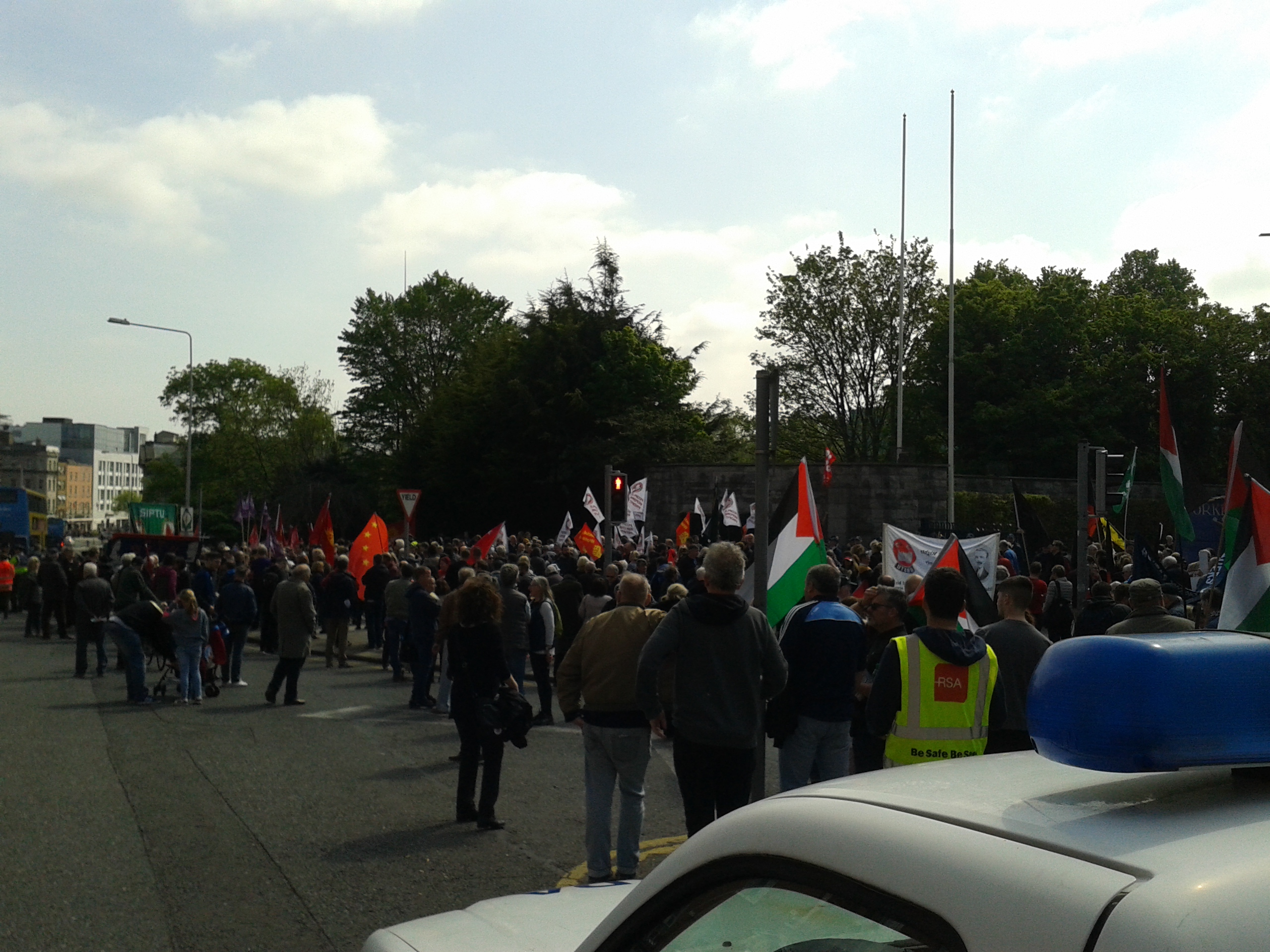
Crowd scene outside Garden of Remembrance, the starting point of the DCTU march

The DCTU-organised event met at the Garden of Remembrance at 2pm and set off at nearly 3pm, with numbers although still small by European standards nevertheless larger than has been seen for some time in Dublin, according to the organisers filling O’Connell Street, the city’s main street throughout its whole length (500 metres or 547 yards).

Seen on the parade were trade union banners, those of some political parties, also of campaigns and community groups.

As it has been doing for years, the parade ended in a rally in Beresford Place, in front of Liberty Hall, the very tall building owned by the SIPTU trade union, where the audience were addressed by speakers from trade unions and campaigns and NGOs.

Section of crowd at rally in Beresford Place

Curiously, soon after arrival the comparatively strong showing of Sinn Féin flags, the green one with their logo and the blue and white version of the Starry Plough, were nowhere to be seen.

Similar section with some banners noticeably missing

The issues of lack of affordable housing, of public land being sold for private housing and speculation, of precarious employment, of financial speculation and cuts in services were addressed by speakers, with a mention also of solidarity for the Palestinian prisoners on hunger strike. A number of speakers also addressed the treatment of migrants and in particular the conditions suffered by refugees in the Direct Provision hostels of the state’s welfare service.

Stage erected at Beresford Place, outside SIPTU’s offices
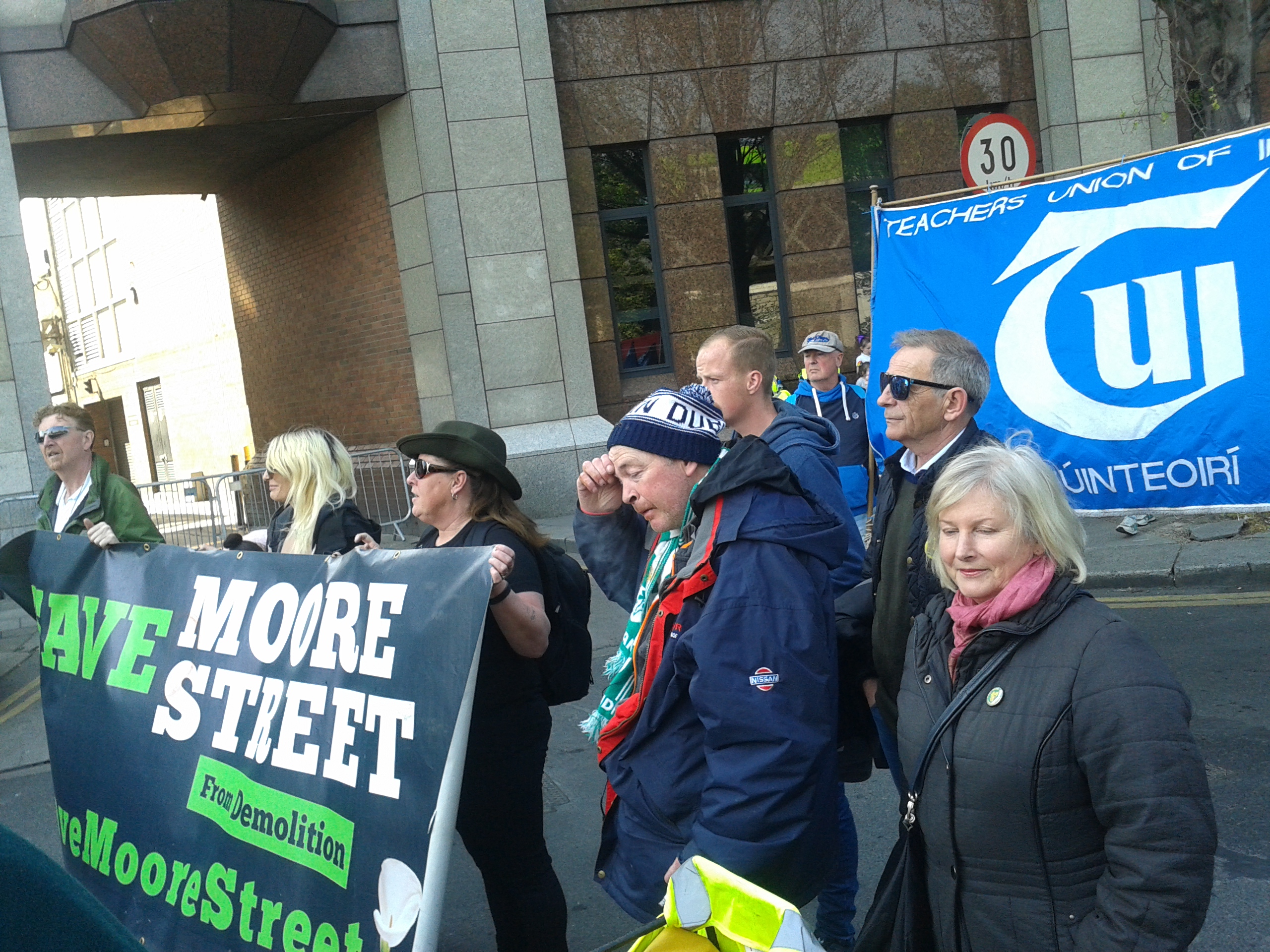
The Moore Street campaign banner was one of the campaign groups present on the parade and mentioned from the stage by the rally’s chairperson.
One of the speakers at the rally — she denounced the sale of private land including the deal done at O’Devaney Gardens estate in Dublin.

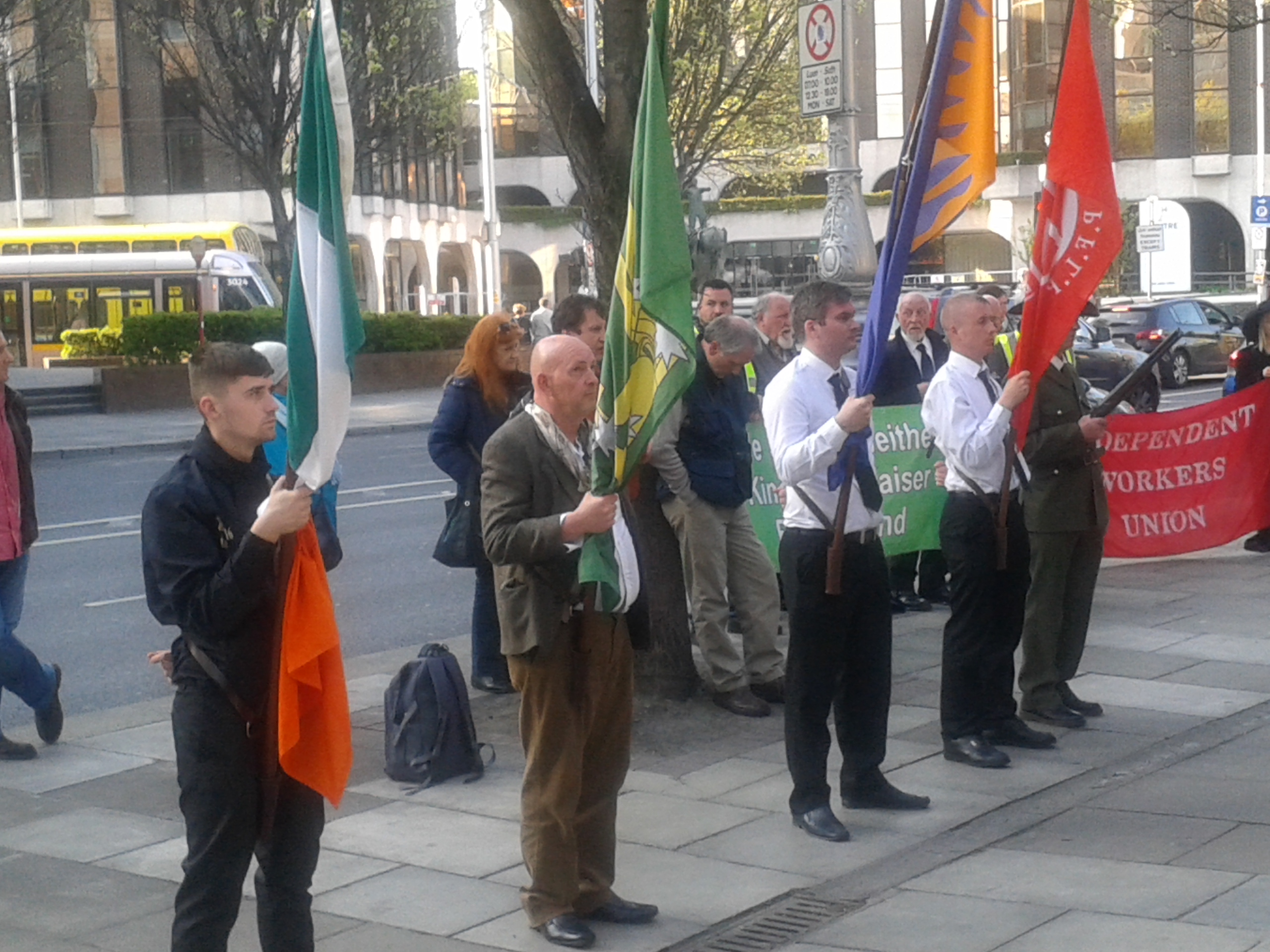
Somewhat later, the Independent Workers’ Union held their own event, marching with a colour party from their offices to James Connolly monument, also in Beresford Place and across the road from Liberty Hall.

IWU event colour party at Connolly Monument

Damien Keogh chaired the event and introduced veteran campaigner Sean Doyle who gave a short and to the point speech about the situation in which working people find themselves today and ending with a quotation from James Connolly, in which the revolutionary socialist castigated those who claimed to love Ireland but could tolerate seeing poverty and deprivation among its people. Doyle also sent solidarity greetings to the Palestinian political prisoners on hunger strike in Israeli jails.

Paul Bowman was then introduced and in a longer speech covered Connolly’s time in the USA, his membership of and activities of the IWW (“the Wobblies”); the Haymarket Incident in Chicago which led to the choosing of May 1st as International Workers’ Day and the state murder of the Haymarket Martyrs; the principles and attitude of the IWU today.

Another Moore Street campaign banner and supporters in period costume also participated in the IWU event
Some random tourists, one form London and the other from Madrid, who chanced to pass by and remained for the whole ceremony.

Damien then introduced Diarmuid Breatnach to sing “We Only Want the Earth” (an alternative title to the original of “Be Moderate”). Breatnach explained that the lyrics had been composed by James Connolly and published in a songbook of his in New York in 1907 without an air. As a consequence the lyrics have been sung to a variety of airs but Breatnach said he sings it to the air of “A Nation Once Again” (composed originally by Thomas Davis some time between 1841 and 1845). This arrangement provides a chorus and Breatnach invited the audience to join in the chorus with him, which they did.

We only want the Earth,

we only want the Earth,

And our demands most moderate are:

We only want the Earth!”

A wreath was laid at the monument on behalf of the IWU by Leanne Farrell.

The chairperson then thanked those in attendance, speakers and singer and invited all back to the offices of the IWU in the North Strand for refreshments.

End.

WHICH GROUP REPRESENTS MOST PALESTINIANS?

Not Al Fatah, the Palestinian Authority or the PLO, according to this journalist, who concludes that today it is Hamas as shown by their elections.  Israel, the West and Egypt tried to negate this decision by squeezing Gaza and bombarding it, where the IOF have no troops on the ground but failed so far.  In the West Bank, Israel was able to subvert the elections through the arrest of Hamas representatives elected and through recognising unelected bodies such as the PA.  Today Al Fatah is running a Prisoners’ hunger-strike.

D.Breatnach comments: Despite the Palestinians being a mostly secular one politically, they voted in Hamas because of the corruption and collusion of Al Fatah including its shameful agreement to the Oslo Accord 1 in 1993 as part of a whole swathe of “peace (sic) processes” which swept through South Africa and Ireland in the 1990s.  Observers of the reality of Irish politics will find this article of interest and will surely see some parallels.

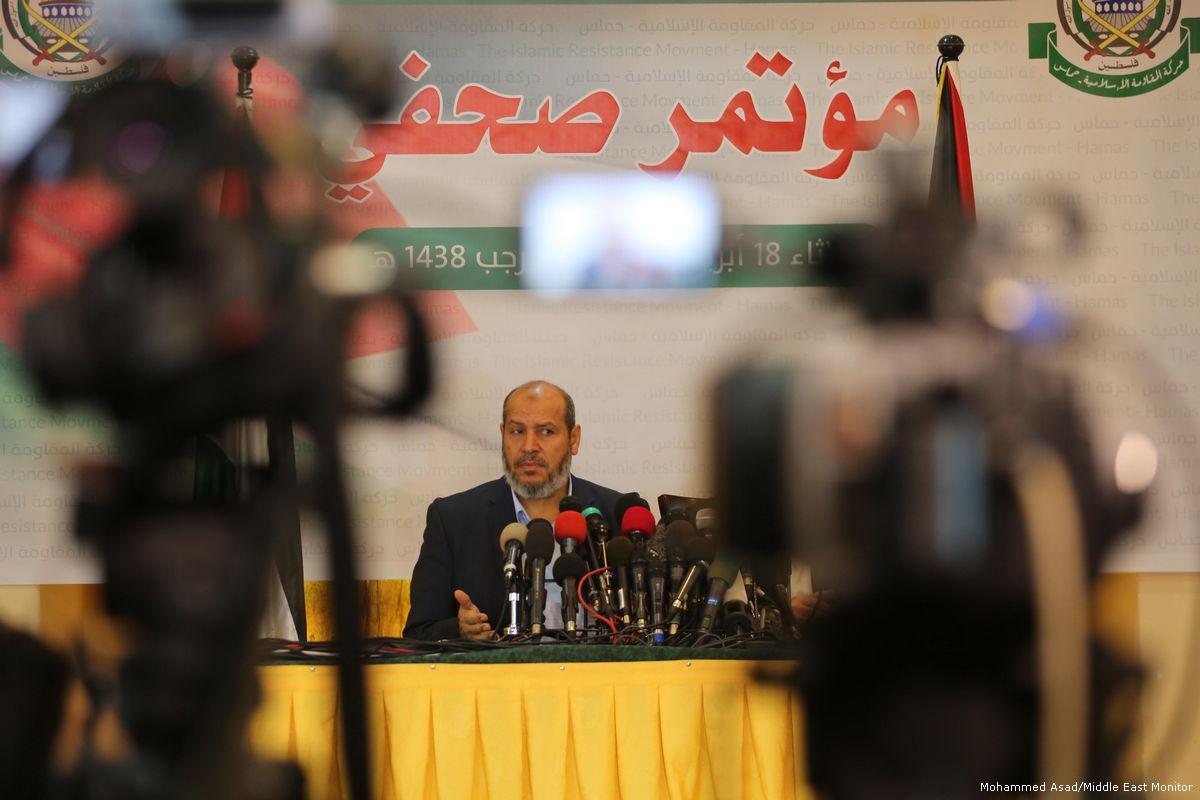
Dr. Khalil al Hayyah, representing Hamas at a press conference today on the question of talks with Al Fatah.
(Photo source: Mohamed Asad, MEMO)

Motasem Al Dalloul, 13th February 2017.

The main Palestinian secular movement, Fatah, which dominates the Palestine Liberation Organisation (PLO) accused regional powers on Sunday evening of supporting its Islamic rival Hamas to carry out a coup against the umbrella body and the Palestinian Authority which it controls. The reason given is that such regional powers are trying to ease, or lift, the Israeli-led, internationally-backed, siege on the Gaza Strip.

In several official press releases, Fatah named Turkey and Qatar. They claimed that these two countries are planning to help Hamas and its supporters in the occupied Palestinian territories and diaspora to supersede the PLO and the PA.

According to Fatah spokespeople, Turkey is hosting a pro-Hamas conference for Palestinians in the diaspora, the preparations for which are going ahead without the PLO’s knowledge. However, a spokesman for the organising committee, Ziad Al-Aloul, has said several times that PLO members are among the organisers.

Fatah has also accused Turkey of supporting a military coup against the PA in the Gaza Strip, which has been under siege for more than ten years, simply because the government in Ankara sent its minister of energy and other officials to conduct a study on how they can help to solve the electricity crisis in the coastal enclave. The accusation is really unbelievable, not least because the Turkish delegation met with PA officials in the West Bank before entering the Gaza Strip. In fact, Turkey has been cooperating with the PA in the West Bank regarding a fuel grant for Gaza’s sole electricity plant.

Qatar stands accused by Fatah of the doing the same thing as Turkey, possibly because it is the only international state which has faithfully fulfilled its pledges made during the International Donor Conference held in Cairo in the wake of the 2014 Israeli military offensive on Gaza. The conference aimed to collect donations to rebuild the Gaza Strip.

Since the Cairo conference, Qatar has rebuilt thousands of homes destroyed by the Israelis during the offensive, and built thousands of new homes for the poor and homeless in Gaza. On Saturday, the latest batch of Qatari-built properties were handed over officially by a representative of the Gulf State. Mohamed Al-Emadi also announced a commitment to build a new hospital in the southern Gaza city of Rafah.

These are the Turkish and Qatari acts that Fatah, which dominates the PLO, apparently regards as illegitimate efforts to help Hamas to supersede the PLO and the PA. The movement has overlooked the simple fact that every single Turkish or Qatari donation for the Palestinians in Gaza is handed over to the beneficiaries either through the PA or directly from official Turkish and Qatari bodies working in the territory.

The latest remarks by Al-Emadi have complicated the situation even more for Fatah, the PLO and the PA, which are more or less considered to be the same body. He is the man responsible for the supervision of the reconstruction projects in Gaza. Qatari representative told the IsraeliWalla website that his country has offered to pay all of the costs needed to help solve the Gaza electricity crisis, but the leader of the PA, Fatah and the PLO, President Mahmoud Abbas, rejected Qatar’s offer. Fatah denied this and said that Al-Emadi and his government are working to support Hamas in Gaza; the movement cited the $100m grant for the new hospital in Rafah as “evidence”.

All of this leads me to wonder if the PLO and PA have any legitimacy any more. I am also wondering about Hamas’s role in the Gaza Strip.

Is the PLO the sole, legitimate representative of the Palestinian people as claimed by the UN and Arab League in 1974? The Palestinian people in the occupied Palestinian territories and the diaspora have never recognised the PLO as any such thing. The designation arose when the late Yasser Arafat went to the UN holding an olive branch in his hand. Both of these international bodies recognise Israel, which is a state built on about 78 per cent of historic Palestine; the Palestinians have been waiting for almost 70 years to fulfil their legal right to return to their land. In 1993, the Israeli occupation state also recognised the PLO as the sole, legitimate representative of the Palestinian people after signing the now notorious Oslo Accords.

Regarding Hamas, which swept Fatah — and thus the PLO and Ramallah-based PA — out of the Gaza Strip in 2007, having won the previous year’s elections, there has been no clear-cut evidence that it represents more than half of the Palestinians in occupied Palestine. Hamas refused to take part in the first Palestinian parliamentarian elections in 1996, when Fatah, its allies and a number of independent candidates won all the seats. However, in the following ten years, Hamas — whose roots in Gaza go back to the early 1970s and in the West Bank to the 1980s — won most of the elections for student councils and professional syndicates in both territories.

It became very clear that Hamas is the real and legitimate representative of the Palestinians in the territories in 2006, when the Islamic movement achieved an overwhelming victory in the municipal and parliamentary elections in both the West Bank and the Gaza Strip. Fatah, the PLO and the PA, as well as Israel, the UN and the Arab League, have always refused to recognise the subsequent Hamas-led Palestinian Authority which has been the de facto government in Gaza ever since.

Supported by Israel and backed by the most effective Arab states and the international community, Fatah, the PLO and the PA have tried to topple Hamas. They could do this in the West Bank, where Israel arrested most of the democratically-elected Hamas MPs and mayors, but in Gaza, where there is no Israeli existence on the ground, Hamas could sweep Fatah out and control the Palestinian institution.

Since then, the internal political division has been dominating the Palestinian political process. Hamas and Fatah have met together several times in various countries, but they have been unable to reconcile their differences. That is why, to all intents and purposes, the Gaza Strip controlled by Hamas has been under a strict Israeli, Egyptian and international siege supported tacitly by the Fatah, PLO and PA.

As a result, any national or international effort to facilitate a better life for the Palestinians in Gaza is considered to be “aggression” against Fatah, the PA and the PLO from their point of view. Such is the involvement of the secular Fatah in the stranglehold on Gaza that Qatar’s Al-Emadi, during his current visit to the Strip, said that the construction of a seaport and an airport under international observers are still proposed as solutions for the Gaza crisis should Israel, the world and Fatah agree.

According to the Assistant Professor of US and Middle East History at Syracuse University, Osama Khalil, in a four-year-old study, the PLO is a “shield and a cudgel against internal and external foes and competitors.” He added: “What remains of the PLO today — its name, its international status, and the few vestiges of its bureaucratic institutions, offices, and titles — have and continue to be used by a small, unelected, and unrepresentative clique to further their own agendas.”

It is fairly obvious to most reasonable people, therefore, that the PLO has little, if any, claim to be the “sole, legitimate representative” of the Palestinian people. Its leaders appear to be representing the interests of nobody but themselves.

Link to the article in MEMO — Middle East Monitor: https://www.middleeastmonitor.com/20170213-is-the-plo-still-the-sole-legitimate-representative-of-the-palestinians/


RENOWNED COMPOSER CHOOSES DUBLIN FOR WORLD PREMIER OF HIS MOST FAMOUS WORK

Diarmuid Breatnach


On 13th April 1742, Dublin City heard the world première of the Messiah oratorio (a bit like an opera but not quite), composed by George Frideric Handel. The choice of Dublin shows the importance the city had in the European Anglo world, probably second only to London at that time, the city in which German-born-and-raised Handel had based himself.

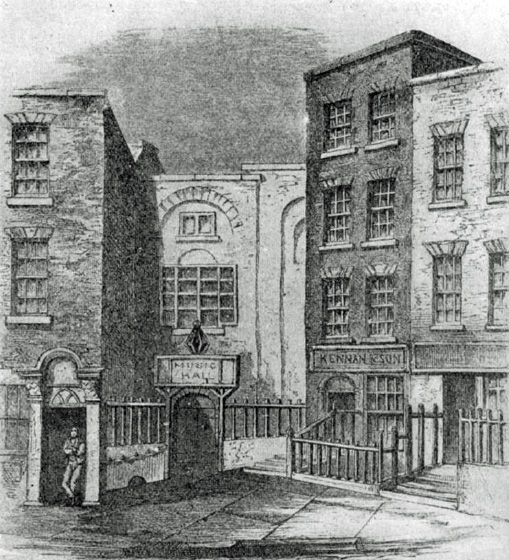
A drawing representing the Great Musick Hall in Fishamble St (image source Wikipedia)

It may be also that Handel wished to remove himself from Anglican Church criticism and interference in of work built on religious material, problems he had encountered in London.

Incidentally, there is a tradition that Handel also played the organ in St. Michan’s (Protestant) church in Church Street (but not the organ that survives there today).

The oratorio was written in English, something of rupture in Handel’s work which had been firmly based in Italian-language opera. However, the fashion in London was changing and Handel gave in to it, writing first Esther in English, then the Messiah. The somewhat radical Englishman Charles Jennens wrote the libretto (like a script or text passages) for Handel to work in the musical score.


A COLONIAL CITY

Dublin in 1742 would have been primarily English-speaking, with pockets of Irish-speakers from the surrounding countryside and further afield, with linguistic artifacts of Irish and Norse audible in the English spoken by the lower social orders in the city, some of which survive to this day.

Ireland was then recovering from “the Irish Famine of 1740–1741 (Irish: Bliain an Áir, meaning the Year of Slaughter) in the Kingdom of Ireland, (which) was estimated to have killed at least 38% of the 1740 population of 2.4 million people, a proportionately greater loss than during the worst years of the Great Famine of 1845–1852.

The famine of 1740–41 was due to extremely cold and then rainy weather in successive years, resulting in food losses in three categories: a series of poor grain harvests, a shortage of milk, and frost damage to potatoes. At this time, grains, particularly oats, were more important than potatoes as staples in the diet of most workers.

Deaths from mass starvation in 1740–41 were compounded by an outbreak of fatal diseases. The cold and its effects extended across Europe, but mortality was higher in Ireland because both grain and potatoes failed. This is now considered by scholars to be the last serious cold period at the end of the Little Ice Age of about 1400–1800.” (Wikipedia).

Of course, it would not be the primary sufferers of famine, the poor (and largely the natives) who would attending the event and this was made clear by the advice to prospective audience members to leave their “swords and hoopskirts” at home so as not to overcrowd the premiere.

The main elements of the Penal Laws were still in place in 1742 and the Irish Parliament in College Green admitted only Anglicans, thereby barring representation not only from the huge majority of the Catholic faith but also from the next largest group, the Presbyterians and all the other ‘Dissenter’ groups.

However, the audience for the premiere may well have had wide representation from the higher social classes in Dublin across religious lines. Handel was, after all, a superstar!

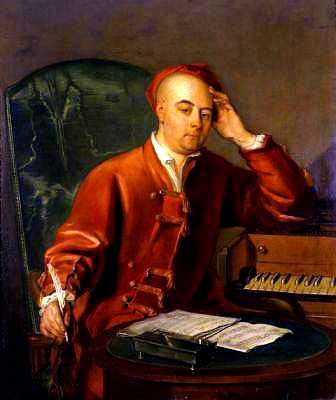
George Friderik Handel without his wig
(Image source: Internet)

A tradition arose over the years for audience members to arise as the Halleluyah chorus begins. This is based on a belief that King George was so impassioned by hearing it that he stood up, obliging the audience to do so too so as not to remain seated when the King was standing. Of course, knowing the reason for that tradition would be enough to to keep any democratic republican firmly seated. But apparently the story is without foundation and it is not even certain that the murderous Royal was even present at a London performance.

The Messiah was performed in the Great Music Hall in Fishamble Street (see video by Wayne Fitzgerald — https://www.youtube.com/watch?v=HHWDJjS_JkU — the white arch is all that remains of it today). That street was a busy medieval one, close to what was the seat of foreign domination since the Norse built their fortifaction by Dubh Linn some time around 841. The Normans, after driving them out in 1171 and banishing them to Oxmanstown, constructed their own castle there in increments as they gradually became the “English” and remained in formal control until 1921.

I watched (if that’s the right word) a performance of the Messiah some years ago in St. Patrick’s Cathedral, not far from Fishamble Street. I had bought tickets only as a favour to a friend visiting Dublin and I was really impressed with it. The performers often stood on the pews to deliver their lines and I remember, despite my atheism, being uncomfortable with this – cultural conditioning runs deep!

No wonder the oratorio was a raging success in Dublin in the 1740s and since. At the Dublin performance, “the alto soloist, Susanna Cibber, was an actress who had attracted scandal in the past, but legend has it that her emotional performance of ‘He was despised’ moved Dr Patrick Delany – the husband of one of Handel’s most ardent champions – to exclaim ‘Woman, for this, be all your sins forgiven’” (!)  It took the London higher classes a little longer to take to the oratorios but they did so in time.  One is reminded of Shaw’s comment that went something like this: “No-one could accuse the English of failing to note a work of genius — providing someone was kind enough to point it out to them.”


End.


SOURCES
https://www.bsomusic.org/stories/5-things-you-might-not-know-about-handels-messiah.aspx

https://en.wikipedia.org/wiki/Irish_Famine_(1740–41)

https://www.gramophone.co.uk/feature/the-story-behind-the-triumphant-premiere-of-handels-messiah


PLAIN-CLOTHES POLICE OFFICER SHOT DOWN IN DUBLIN STREET


Diarmuid Breatnach

He’s up there if you want him …. on the footpath.”

On 14th April 1920, a man in plainclothes was shot by another, also in plain clothes, in Camden Street, Portobello, on the south side of the city and not far from the centre. A passing motorist rushed the gunshot victim to the nearby Meath Hospital but he died there.

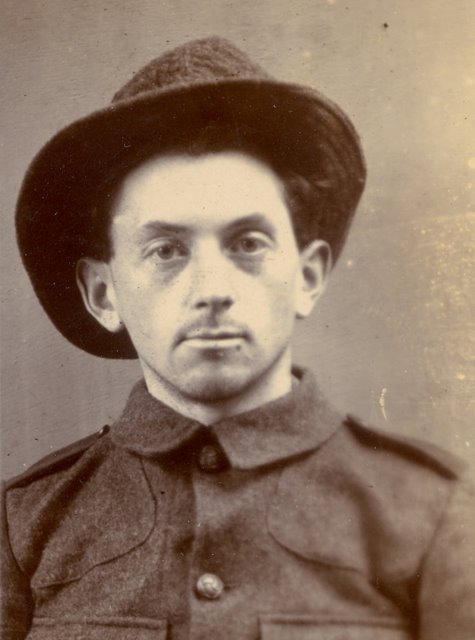
The victim was Det. Constable Harry Kells of the Dublin Metropolitan Police, a man of 41 years of age who lived in No. 7 Pleasant Street, i.e very close to where he was shot. He was married without children.

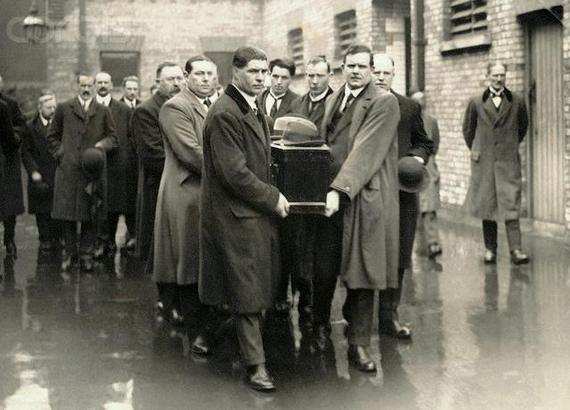
Funeral party of DMP colleagues of Det. Constable Kells, with the coffin holding his remains.
(Source: irishconstabulary.com)

Many reports say that Kells was a member of the DMP “G” Division, which were known as “the political police” (apparently both within the DMP and outside). However, “McRIC” in the irishconstabulary forum states that this is inaccurate and that the man, although recently promoted to plain clothes work, was rather in “B” Division and investigating a number of burglaries in the city.

From a number of investigations carried out it seems that this question may never be resolved but it is highly likely that Kells was at least in the process of being transferred to “G” Division. However, the reason for his killing is almost certainly much more specific. It seems that Kells had been reviewing identity parades in Mountjoy Jail in attempts to find the killers of British intelligence agent Alan Bell, who had been assassinated on the 27th March. While engaged in this work, he had been identified by Peadar Clancy1, Vice-Commandant of the Dublin Brigade of the IRA, who sent a note about him to Michael Collins, who put the execution order on Kells.

It is worth noting that Republican prisoners in Mountjopy had also been taking part in a hunger-strike at that time in protest at removal of political status while detained without trial. Ironically, 90 prisoners were released on the very day Kells was killed.

Peadar Clancy, who got the word out to Collins about Kells working Identification parades in Mountjoy Jail, Dublin. (Image source: Wikpedia)


THE LARGEST RAID EVER CARRIED OUT BY BRITISH TROOPS IN DUBLIN

“Aul Decency”, posting on Dublin Forum.ie on 31st March 2012, drawing on April reports in the Irish Times and New York Times, says that the incident “was the cause of the largest raid ever carried out by British Troops in Dublin.”

According to “Aul Decency”: “Two of those sought in connection with Kells’ killing were Sinn Féin members Michael and William Kavanagh who lived at 5 Pleasant St., who had previously been “fingered” by Kells, and it was thought they would seek refuge among friends in the neighbourhood. The troops swarmed over Camden St from Cuffe street and into Portobello and the homes of the local Jews2. Over 100 people were arrested that day but Kells’ killer was not among them.”

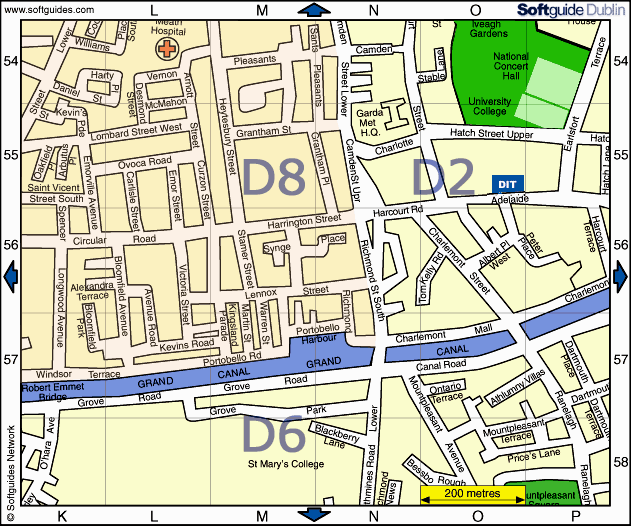
Portobello area map today,  Camden Street is a longish one right between the D8 and D2 legends.   Pleasant St. is off Camden St. to the left, near the top of the image. (Source: Internet)


This “fingering” had in fact been carried out after the 1916 Rising when Kells reported that the brothers had been seeing changing into Volunteer uniforms in the house, information which had resulted in at least one of the brothers ending up in Frongoch concentration camp that year and losing his job.

It is enough perhaps to know that Kells was killed by Republicans and the probable reason but we can go a bit further, drawing on The Squad by T. Ryle Dwyer (quoted in irishconstabulary.com) where Paddy Daly of the Squad is quoted about the operation to kill the police officer:

On our way we picked up Hugo MacNeill, a nephew of Eoin MacNeill3 the initial President of the Irish Volunteers. He was not a member of the Squad but he asked to come along.

We divided up into patrols of two4, MacNeill was with Joe Leonard. ODaly said he heard a couple of shots, and saw MacNeill sauntering down Pleasant St. as if nothing had happened.

What was the shooting about? O’Daly asked.

Kells is up there if you want him, MacNeill replied.

Where?O’Daly asked.

On the footpath‘, replied MacNeill.

Det. Constable was the third police officer to be killed in Dublin so far in 1920 in a war between the British occupation forces and the IRA, in which not only police officers but intelligence agents and British soldiers on one side were killed and, on the other, Volunteers, active Republicans, sympathisers and uninvolved civilians. Of course the war was going on in many other parts of Ireland but it is often forgotten that among those areas subject to martial-type law were Dublin County and City, where had been the HQ of the British occupation since 1171: Dublin Castle.


SOURCES:


http://www.dublinforum.net/forum/showthread.php?t=2110&page=3

http://irishconstabulary.com/topic/1477#.WO6mGEvb-_s

https://en.wikipedia.org/wiki/Timeline_of_the_Irish_War_of_Independence

http://www.irishmedals.org/r-i-c-d-m-p-k-i-a-.html

1Peadar Clancy was one of two Volunteers and one civilian who were tortured by RIC Auxiliaries in Dublin Castle and killed on November 21, 1920 (Bloody Sunday).

2Portobello had a Jewish quarter at that time. Some of the residents are reputed to have been active in the resistance movement and a number had been on strike or locked out in 1913.

3He who had on Easter Saturday 1916 issued the cancellation order for the Rising.

4According to testimonies by Squad members, working in two groups of two was standard procedure. Typically each pair would take one side of the road. Once the assassination was carried out, the two who had not done the killing would cover the escape of the two who had.

AN EASTER STORY


Diarmuid Breatnach

There are many different kinds of Easter stories – religious ones, or about Easter parades and processions, ones about family reunions, Easter egg hunts, even holidays …. this isn’t one of those.

The man, let’s call him Jeremiah or Jerry for short, stood outside the pub on a Sunday afternoon and struggled to quell the apprehension threatening to flood his mind and body. It had to be done. He turned to his companion, who seemed to view everything through laughing eyes and was no different now. Brian had three teenage kids with him, two of his own and a friend of one of them. Hardly ideal, but Brian had turned up with them a little while ago and there was no-one to leave them with. Well, they’d be all right – Jerry would be the target and, after him, Brian. They wouldn’t touch the kids.

Best give me the bag, Brian,” he said and, receiving it, checked inside. The stuff was there. Of course. Jerry folded the bag and stuck it under his jumper, under his coat.

He was focused on the tasks ahead but the trail that led them here had started days earlier. And, in some ways, years before that.

He squared his shoulders, turned and entered the pub. Brian and the kids followed.

**** **** ****

He had been at work on Friday afternoon when the call came from the Manager of the Irish Community Centre. Of course, he asked the staff to put it through to his office.

Do you know your event is in the newspapers?”

Something in the Manager’s voice alerts him that he is not being congratulated on the publicity.

The Easter Rising commemoration?”

Yes. It’s in the Evening Standard.”

Well, that answered the second question he had in mind.

No, I didn’t know. What are they saying?”

He knows what the British media are like and he’s got a sinking feeling.

It transpires that an Irish Republican organisation had put the event on their website, which had been noted by an Englishman who lost his son in the Omagh bombing of 1998. There are many questions to be answered about that bombing, both within the Republican and the State side, but for many years, not unnaturally, the father had been focused on the Republican group allegedly connected to the Real IRA, who had placed the bomb. In addition to his son, the bomb had killed 28 other people, the second-highest death toll for any day during the war in Ireland, the highest being the Dublin-Monaghan bombing of 1974, with a toll of 34. Jerry was aware that the 1974 bombings did not attract anything like the same media attention and understood the reason – they had been carried out by Loyalists under British Intelligence Service direction.

But what had all this to do with the Irish in Britain Representation Group in South London, and their Easter Rising Commemoration? Or with the Irish Community Centre? Well, the grieving father had noted the posting by the Irish organisation, noted the venue and rang, demanding that the event be cancelled.

I told him the commemoration is an annual event organised by an Irish community organisation and that there’s never been any trouble at it. I told him it has nothing to do with that Republican organisation …. it doesn’t, does it?”

No, it’s just us, the local Irish in Britain Representation Group branch. But surely any organisation is entitled to advertise the event?” replies Jerry.

Jerry is noting doubt in the Centre Manager’s voice responding to him. He is on the receiving end of huge pressure, working in his office, alone.

He wanted me to cancel the booking and I said I couldn’t do that,” said the Manager.

The grieving father had got on to the local authority, who replied that the event was the business of the Irish Centre. The father then contacted the media, who rang the local authority again and this time, instead of sticking to their original line and weathering what would be a short-lived storm, and without phoning the Centre Manger, their spokesperson condemned the event and stated they would be asking hard questions of the Centre, which they part-funded.

Jerry reads all this again when he slips out to get a newspaper. He feels for the beleaguered Centre Manager but can do nothing. It’s too late to contact the newspapers because the story is published. The event is to be held that evening. It has been advertised in the local area and in the Irish Post, the main newspaper at the time for the Irish diaspora in Britain. And in any case, one cannot – should not – give in to intimidation, coercion. The community had mostly caved under the Prevention of Terrorism Act in 1974 and had not really rallied again until the Hunger Strikes of 1981. The event must go on.

Jerry heads home, thinking about additional security needed on the door for the event, composing replies to the local authority, a letter in the newspaper ….

The IBRG Ard-Choiste, its governing body, had withdrawn its support of the Time To Go coalition in Britain some years earlier because of undemocratic maneuvering by some left Labour politicians, along with the sidelining of specific Irish community concerns. They had not been alone: Stop the Strip Searches Campaign and the Troops Out Movement had pulled out also, leaving the tiny Labour Committee on Ireland, the Socialist Workers Party and Communist Party of Great Britain to be supported by only the Wolfe Tone Association (SF support group in London) and the Connolly Association (linked to the CPGB) among the Irish campaigners .

Later, in 1998, the IBRG had been divided on the Good Friday Agreement. It was not the issue of continuing or ceasing the armed actions of the IRA that had been the source of the division, rather the acceptance of colonial rule, albeit claimed to be for tactical reasons only. A majority within the IBRG came out against the Agreement and that was in accordance with Jerry’s position too.

Although he supports none of the Republican groups opposing Sinn Féin, he has heard whispers in the Irish community at various times associating him with this or that group. This might well be feeding doubts in the Centre Manager’s mind.

Jerry is in a more difficult position than might seem. He is not only Secretary of the local IBRG branch that has organised the event and is affiliated to the Community Centre, but also the Chairperson of the Irish Centre’s Management Committee itself. The Management Committee is the Centre Manager’s employer and has a duty of care to him. And after nearly a decade of campaigning for the provision of the Centre and the meagre funding it receives, no-one on the Committee would want to antagonise the local authority.

But it was the IBRG branch itself and in particular the Irish Pensioners’ Association which was then a part of it, which had won the provision for the community in the end. And Jerry had been part of the campaign, elected as Chairperson of the Steering Group in the years while renovations of the building and available funding were discussed, elected Chairperson for the first six months after the Centre opened and at the Annual General Meeting for every year afterwards. In fact, recently Jerry had been trying unsuccessfully to step down, to ease a replacement into his position.

On the train from London Bridge on the last leg of his journey home, Jerry reflects ruefully that this controversy might cause his stepping down, which was hardly the way he had anticipated his leaving. No stepping back slowly, supporting someone new in position and easing himself out. No – thrown out instead! That would of course imply he had done something wrong, which he hadn’t and that the IBRG had been wrong to commemorate the Rising, which they hadn’t either. Ironically, if moves were made now to replace him, he’d have to fight them.

**** **** ****

Before he arrives at the Irish Community Centre, Jerry looks carefully around the mostly residential street. Nothing seems threatening but can one be sure? He is carrying the IBRG’s branch’s banner, wrapped up in black bin liners, which makes him a visible target if someone’s searching. On the other hand, one of the poles of the banner is loose within the bundle, in case of need ….

He drops the Centre’s keys in his nervousness and enters, disabling the alarm and turning quickly to retrieve the keys and lock the door. Then, into the hall, to begin arranging some of the material ….

He is anxious for some of the IBRG members to arrive but jumps when the doorbell rings. Checking through the fish-eye spyhole, he is surprised to see one of the Irish Pensioners, who lives locally.

Opening the door and ushering her in, he locks the door behind her, saying apologetically “There’s only myself here so far.”

Are others coming?” she asks – she has read the newspaper and unerringly touches Jerry’s main fear at the moment.

I’m sure they are, Ellie. What are you doing here so early?’

I thought you might need some help.”

Jerry is touched straight through to his heart but has to refuse. He can’t have her here if there’s an attack with no-one else but himself to defend her.

Oh no, Ellie that’s very kind of you. But I kind of know what I have to do and explaining it to others will just take longer and make me flustered. You know how it is. Thanks a lot. Besides the others will be here soon. Come back when we’re open …..” he trails off guiltilly.

Still, she goes and he heaves a sigh of relief, at the same time feeling shame.

But there’s work to be done.

A scattering of volunteers arrives over the next half hour. The reception table is set up in the lobby, to sell tickets and distribute leaflets. Hidden behind, are the lengths of wood in case of attack by one of the British fascist groups. Up goes the green-white-&-orange bunting, portraits of the executed 1916 leaders, enlarged copies of the 1916 Proclamation. At the back of the stage, facing the hall, the large artwork Jerry made a few years ago of green, white and orange flames bursting from the date 1916. And the IBRG branch banner.

The stage is ready for the band, a group called The Mc ____ Brothers, who play Irish ballads, including Republican material. Water jug and glasses for the speakers. Tables and chairs rearranged on the hall floor (the part-time Caretaker had laid them out but Jerry always prefers a more “club” arrangement, of smaller tables spaced apart surrounded by some chairs).

By the time the opening hour arrives, Jerry is sweating but it is the sweat of work, not of fear or apprehension. The hall looks good. People are starting to arrive. Maybe he can relax now. Maybe. Brian is on the door with others close by.

The event is a bring-your-own-alcohol one and Jerry and others in the lobby spend some time directing people to the nearest off-licence, so that people are coming in, going out, coming in, sitting in the hall …. Jerry is scanning their faces, looking for possible sources of trouble.

An hour later and the band has not arrived. Pol phones them but gets no reply. Phones their manager but no reply either. Another hour later, the reality dawns on the organisers. The band will not be coming. They have seen the newspaper and decided to look after their safety. But they haven’t even bothered to tell them.

The organisers confer, after which Jerry mounts the stage, calls for attention and begins to speak.

A Chairde Gael agus a chairde ó thíortha eile, go raibh míle maith agaibh for coming here tonight to commemorate the 1916 Easter Rising with us. This is a hugely important event in Irish history and indeed in the history of the world and the local branch of the IBRG has been not just commemorating but publicly celebrating this historic event every year for some time now.

But we are very sorry to say that we have some bad news for you now. Some of you will know that very recently pressure was put on us to cancel this event but that we refused to do so. Pressure was put on the Irish Centre to cancel the event which they also and rightly refused to do.

That the British media would attack us is no surprise, they have been doing that for years. But that the local authority’s spokesperson should bow down to them and, without consulting with us, imply that we are doing something wrong here, that the Centre should not have taken our booking, is something else.

And worst of all, that an Irish band, which makes a living playing Irish ballads, should allow themselves to be scared off and not even have the decency to ring us – well, I don’t really have the words to tell you what I think about that.

So, a chairde, we offer you your money back and no questions and our sincere apologies. However, those of you who wish to remain are welcome to do so and we’ll make our own entertainment with a few songs …. we have a guitar player here …. another man plays a whistle …. But please, you are entitled to your money back and those who wish to please go to the table in the lobby now.”

As though he had been primed to do so (but Jerry knew he had not), a middle-aged Irishman at a table nearer the stage jumps up and shouts: “NO! We will not ask for our money back! We’re not going to be chased out by no British newspapers!”

A round of applause from the audience and a few cheers greet his outburst. And just like that, the evening is saved.

The guitarist plays some numbers and sings. Jerry gives an abbreviated oration and sings a few ballads. The whistle player plays some tunes. People sing along to songs. They drink, chat and buy raffle tickets. One of the raffle prizes is auctioned by the winner, a local publican Jerry had been surprised to see in the audience. The money goes into the takings. At the end of the evening, as they finally cajole the last of the audience out of the Centre (still with a wary eye on the street) and finish cleaning and tidying up, they count the takings. Financially, it has been their most successful evening ever, especially since they didn’t have to pay a band.

But the band ….. their action and lack of notification have left a sour taste in the mouths of the organisers. And during the evening, they learned that the Mc___ Brothers are booked to play at an Irish pub, on Sunday afternoon, just two days away. And only a five minutes’ drive from the Irish Centre.

**** **** ****

A council of war decides that the bar will be visited, Jerry will mount the stage (“you’re our best speaker”) and present the band with white feathers, symbolising cowardice. Some can’t be there. One or two think it will be dangerous. Brian, Pol and Jerry think it’s a good plan — so then they just need some white feathers. How hard can it be to get some?

Visits to duck pond parks yield none. The quaysides along the Thames show no seagull feathers. Brian drives to the coast and walks some beaches – and finds a couple of wispy ones. In desperation on Sunday morning, they burst open a pillow and drag out a handful of feathers. They are small, not at all like the large ones they had envisaged presenting to the band but they are white and they are feathers. Into the plastic bag they go and then Brian is driving Jerry and the kids to the pub. Brian has remarkable personal resources and has been through some very serious situations so this might be small potatoes to him …. but Jerry’s guts are churning.

Some faces in the pub turn to look at them as they enter. Jerry has been here before only once but a number of the clientele are known to him from other pubs and events. And he is probably known to more of them, as Chairperson of the Irish Centre. A few catch his eye and he nods at them, keeping his face impassive.

Do they know that the band playing here let down the audience two days ago? Of course they do …. or at least many would. This is the Irish community in SE London. Besides, the Manager of this bar, Kate, until recently worked for the publican who auctioned the raffle prize at the event on Friday night. At least one of them was there that night too.  Are they wondering what Jerry intends to do?

The band, which Brian has taken to calling the “McChicken Brothers”, is already playing on stage. Jerry had meant to get here before they got on but the feather search had been a delay. To get in front of them now might be resented by the audience and anyway, the band’s control of the microphones could drown out what needs to be said. Jerry goes to the bar, orders pints for himself and Brian and soft drinks for the kids, stitches a smile on his face and chats to Brian. And they wait.

Eventually the band takes a break and Jerry waits tensely for the indication that they are returning for the second half of their gig. When he sees them coming he nods to Brian, whose job is to fend off anyone attacking him before he has finished.

Just as the band reach the low stage but have yet to mount it, Jerry jumps up on it and begins to speak in a loud voice.

Ladies and gentlemen, your attention for a moment please!” EVERYBODY turns to look.

These musicians here were booked to play at an Easter Rising commemoration at the Irish Community Centre on Friday. They didn’t turn up. They left the audience (ok, bump up the figures a little!, he thinks) — 200 people – and the organisers stranded. And they didn’t even have the decency to tell us they weren’t coming. They ran scared, my friends, from lies in the British press.”

Jerry has the plastic bag in his hand and now dips into it, withdrawing a handfull of fluffy little white feathers.

Shame on you!” he says, facing the band members. “And this is what we think of you!”

So saying, he tries to throw the bunch of feathers at them but they erupt in a cloud between them, some clinging to Jerry’s hands. No matter, it is done. He steps off the stage and heads for the door, hoping to make it before anyone tries to stop him, before Brian has to get into physical stuff.

Surprisingly, someone shouted “Hear, hear!” and there had been a scattered round of applause.

Outside, they head for Brian’s car. A man comes running out and Brian steps forward to confront him, Jerry getting ready too, the kids behind him. Kate, the Manager, comes running out too and grabs the man. She says some things to him and he goes back in reluctantly, Jerry thinking the man doesn’t know how lucky he is that he didn’t tangle with Brian. Then Kate comes up to Jerry, shaking with anger, her face white.

You had NO right, NO right to do that in my pub!” she says.

We couldn’t let them get away with that, Kate,” Jerry replies.

Anywhere else. Not in my pub,” she says again.

The adrenaline is now seeping away and Jerry knows that his leg will start to shake soon. He feels a little sorry for Kate but needs to get away.

Sorry, Kate, that’s where they were,” Jerry replies and turns to go.

Don’t ever come in my pub again,” she calls out at his back.

**** **** ****

Many things were probably said in the local Irish community about the IBRG branch before and after that incident but probably that action contributed to an estimation that whatever you might think of them, they stood up for themselves and didn’t back down. That and their annual Children’s Irish Hallowe’en Party, their weekly Children’s Irish Art and History Group, their participation in the South London St. Patrick’s Day Parade and their occasional dramatic productions earned the small group a kind of respect in the local Irish community, a community often quite conservative in social outlook, often insular, often riven by jealousies and back-biting.

One night two weeks after the 1916 commemoration, there was a crude arson attempt on the Centre – a bottle with accelerant leaned against the front door and set alight. It burned a hole in the door and set off the fire alarms. Jerry, as a keyholder, got a call to attend from Ellie. The police were already there and Jerry dealt with them politely. Any enemies? they asked. Jerry wondered whether he should give them a list.

My guess is some British far-right group”, he replied, very glad that back in the Steering Group days, he had insisted on all the windows being covered with wire mesh panels, thinking of possible rock or even petrol bomb attack.

The police suggested they look through a list of recent attendance at the Centre. Jerry politely refused. Security provisions were made at the Centre.  Nothing came of whatever investigations the police carried out and Jerry was not surprised.

Media attention went away and the local authority didn’t take the matter further. Jerry wrote a letter to the Irish Post, denouncing the pressure applied against the IBRG and the Irish Centre and which might even have encouraged the arson attack. He did so under an assumed name because, as Chairperson, he wished not to implicate the Centre in his denunciation of the craven action of the local authority spokesperson. The beleaguered Centre Manager did not see it that way, assuming that Jerry was trying to have his say while avoiding responsibility.

When, a number of years later, in a heavy round of cuts in expenditure, the Centre’s main funding, the Manager’s and caretakers’ salaries were targeted in the local authority’s budget, Jerry led the Management Committee in a campaign of resistance. They picketed Council meetings and drew up lists of elected Councillors to lobby. Irish musicians and children in Irish dancing school costumes were brought to perform in front of the Council offices, leading to photographs in the local press. The Pensioners’ Association, amicably separated some years earlier from the IBRG branch, played a prominent part once more. Some local English people came forward to support the Centre’s case. Jerry prepared a submission for the IBRG branch and spoke to it at a Council meeting. Eventually, their meagre funding, the removal of which would have meant the closing of the Centre except for sporadic events, was saved.

Jerry didn’t go back to that bar where he had confronted the “McChicken Brothers” for about a year after that incident. When he did, he wondered whether he’d be served. He was — but it was another two years before Kate spoke to him again.

End.

WAR, IMPERIALISM AND ‘PEACE PROCESSES’

Diarmuid Breatnach

As news reaches us of wars in various parts of the world it behoves us to try, not only to discern who did what when to whom but to see whether there is an overall pattern behind them. A religious explanation might be that there is much evil loose in the world but that analysis will advance us little.

The fact is that there are powerful imperialist powers ‘loose in the world’ and they are either directly causing these wars or exacerbating them, not because the men and women dominating these powers are evil as such but because they strive to control resources, markets and strategic areas. This striving brings these powers into conflict not only with the interests of millions of people in the respective areas but also into competition with other imperialist powers – and this competition has led to two World Wars and many smaller ones in the last century alone.

In the first of those on a World scale, 1914-1919, Britain (or the UK, if one prefers) went to war with Germany. The Austro-Hungarian Empire lined up with Germany as did the Ottoman Empire. Russia, France, the USA and other powers lined up with Britain. And many other states and colonies and territories got pulled into the conflict.

The British Empire in 1916 excluding territories of influence, for example Latin Amarica, where it was then dominant. Source internet

WHAT WAS THE WAR ABOUT?

It was about many things – and not exactly the same things for each participating state – but basically it was about who would have the lion’s share of the resources of the less-developed world, in particular Africa and who would control the markets for selling those resources and also the industrial goods produced in the “home countries”. And, in order to control those things, which power would control strategic areas in the world – which included ports for navies and forts along certain overland trade routes and coasts.

What brings other countries and territories in?

Smaller players join with great powers for a share of the spoils or have been bound to them by treaties – perhaps they were themselves brought to heel in earlier times by the power to which they are now joined. Colonies and “dependent” territories contributed huge numbers of people on both sides, either recruited in preference to poverty, by war-excitement or by misleading propaganda that their sacrifice would buy their freedom or greater autonomy after the war.

Germany was defeated eventually and the French and British imposed a punitive surrender condition on them, allowing them to plunder Germany’s industrial Ruhr Valley. This injured national pride so much that Hitler was able to use it to whip up an aggressive German nationalism which facilitated another war, 1939-1945.

THE SECOND WORLD WAR

This war also pulled in allies, colonies and other territories. But what was the war actually about? Essentially the same things: which power would control the markets for selling those resources and also the industrial goods produced in the “home countries”. And, in order to control those things, which power would control strategic areas in the world.

The German industrial and financial ruling class, which supported Hitler, was not going for war out of injured pride – they wanted to control the oilfields and land to the east and Middle East and to knock out their main competitors in world domination – once again, the British and French but also now the USA, which had been a much smaller player in WWI. By now Holland and Belgium were mostly small fry and Imperial Russia had, along with a number of other countries, become the USSR. Fascist Italy and Imperial Japan were prominent players with their own objectives but joined with Nazi Germany.

Map on which one can see the encirclement of Russia: Turkey in NATO, Ukraine is hostile to Russia, Georgia tried to break away, Afghanistan is occupied, Pakistan is hostile, Syria is embattled, Iran awaits.
(source Internet)

WAR IN THE MIDDLE EAST TODAY

Nowadays, the USA strides the world as almost unchallenged superpower, supported enthusiastically by a reduced UK and with varying degrees of enthusiasm by its other allies in the EU and elsewhere across the world. Only one challenger on the world power level exists, which is Russia, now a capitalist country, certainly with colonial and no doubt with imperialist ambitions.

The USA (with the assistance of its allies) seeks to surround Russia with regimes allied to itself. Not so long ago, this was impossible in the Middle East, where a number of strong regimes were opposed to US domination: Iraq, Libya, Syria and Iran. The US and allies have succeeded in knocking out the first two of these and the third is fighting to defend itself from multi-pronged attacks. If Syria falls, Iran will be next and then, from the Middle East, Russia will be totally blocked. So of course, Russia decides not to wait for that to happen and gives military aid to the Syrian regime.

THE FUTURE?

The struggle for world domination is being played out in other areas of the world too, of course but this is the most intense area at the moment and the Israeli Zionist v. Palestinian struggle also plays a part in it.

It is difficult to look too far ahead in order to predict the various local and overall world outcomes. However, from the history of empires in general it seems inevitable that at some point the power of the USA must wane.

There are a number of contradictions besetting the USA but one of its potentially most disastrous is its external debt. In the typical pattern of imperialist capitalism, the financial capital of the USA has merged inextricably with industrial and military capital, leading to the description of “the US military-financial-industrial complex”. That in itself does not perhaps make the USA too vulnerable but its borrowing abroad to sustain this complex does: according to a number of sources on the Internet the foreign debt of the USA is nearly 18 trillion dollars: $17,910,859,000,000.

Well, we may think, the USA is an enormous country with huge resources and controlling huge amounts of resources around the world. Yes, it is – but that debt keeps growing. And the interest payments on it are huge – so huge that each year they are not repaid in total and are added to the debt.

Of course, if creditors were to call in the debts and the US financial system collapsed, the creditors would end up with very little in terms of repayment. That leaves the USA safe for the moment but each year it becomes more vulnerable. 32.5% of the total foreign debt is held by China and that huge country may at some time in the future find it in its interest to bring the USA down or to use that finance to pressure greater penetration into US markets (above the current level which US manufacturers are already complaining about). At the moment, President Trump is talking about getting the USA’s foreign creditors to accept lower interest repayments. He may or may not get his way but for the US, it is a bad sign.

USA national debt 2016 (source Internet)

The domestic debt of the US is over $12 trillion and 47% of that is foreign-owned too.

The USA’s economy is in many ways a military one. It needs wars – not just to fight itself but by its proxies. Since WW2 alone, it has been involved in 24 offensive military conflicts, from Korea to Syria.  Without wars, how can the USA justify its military expenditure? And without that expenditure, what happens to the military-financial-industrial complex?

For the continuing extraction of resources, the USA needs compliant regimes – compliant with US needs, that is. Inevitably this results in support for dictators or regimes who are massively corrupt and who get armed to the teeth by the USA and repress their own populations, resulting in poverty, torture and violation of human rights. It also results in resistance, in popular movements which at times turn to armed struggle. Overall, the US, which seeks stability for its extraction of natural resources, creates massive INstability in the world.

THE MEANING FOR US

So what does all this mean to us? Firstly, that we should oppose imperialism. The question of “how” is a different one but the objective is unavoidable. Secondly, that to talk of achieving “peace” without eliminating imperialism is at best an indulgence in wishful thinking, at worst a cruel duping of people. Any kind of “peace” deal without the removal of imperialism is at best a temporary one only.

Peace with imperialism (sourced on Internet)

As for “peace processes” in areas of strong popular resistance, where ironically we often see major representative of imperialism enthusiastically engaged, since they never remove the central reasons behind the conflict, those processes merely buy a short-term stability for imperialism and capitalism to continue, more or less as before. For that reason, “pacification” is a much more correct term than “peace process”. The effect of pacification processes on the imperialist, colonialist and capitalist systems is often undramatic, not so the scale of their detrimental effect on the movements of popular resistance – but that’s another topic.

A chríoch

SHOOT-OUT IN DUBLIN ON MARCH 14 LEAVES SEVEN DEAD

SHOOT-OUT IN DUBLIN ON MARCH 14 LEAVES SEVEN DEAD1

By John Dorney

(Re-published from The Irish Story, History webpage http://www.theirishstory.com/2015/01/26/the-pearse-street-ambush-dublin-march-14-1921/#.WN6_Ukvb-_s by kind permission of John Dorney)

Dublin awoke on the morning to March 14th 1921 to the news that six IRA Volunteers, captured in an ambush at Drumcondra two months before, had been hanged.

The gates of Mountjoy Gaol were opened at 8:25 am and news of the executions was read out to the distraught relatives of the dead. As many as 40,000 people had gathered outside and many mournfully said the rosary for the executed men.

On the morning of March 14 1921 six IRA Volunteers were hanged in Mountjoy Gaol.

Crowds of protesters outside Mountjoy Jail being held back by British troops and a tank (image from Dorney’s article)

The labour movement called a half-day general strike in the city in protest at the hangings. The clandestine Republican Government declared a day of national mourning. All public transport came to a halt and republican activists made sure the strike was observed. IRA officer Frank Henderson recalled:

Patrick Sweeney, Vice Commandant of the 2nd Battalion, and other members of the Battalion paraded the Battalion area during the hours of public mourning to ensure that shops were closed. With the exception of one or two public houses which had to be cleared, the order to cease work was loyally obeyed by the citizens.”

By evening, the streets cleared rapidly as the British-imposed curfew came into effect at 9pm each night. The city must have been a fearful place, patrolled by regular British troops and the much-feared paramilitary police, or Auxiliaries, as people scurried home and awaited IRA retaliation for the hangings. This was not long in coming.

Pearse Street, or Great Brunswick Street as it then was, nestles just south of the river Liffey, running from Ringsend, an old fishing port, to the city centre. Number 144 housed the company headquarters of the Dublin IRA’s 3rd Battalion at St Andrews Catholic Hall. It had been used for this purpose since before insurrection of 1916.

On the evening of March 14, their captain Peadar O’Meara sent them out to attack police or military targets. As many as 34 IRA men prowled the area, armed with the standard urban guerrilla arms of easily-hidden handguns and grenades. One young Volunteer, Sean Dolan threw a grenade at a police station on nearby Merrion Square, which bounced back before it could explode, blowing off his own leg.

Auxiliaries on a raid c.1920 (image sourced on Internet)

It was about 8 o’clock. The curfew was approaching. A company of Auxiliaries, based in Dublin Castle was sent to the area to investigate the explosion. It consisted of one Rolls Royce armoured car and two tenders (trucks) holding about 16 men. Apparently the Auxiliaries had some inside information as they made straight for the local IRA headquarters at 144 Pearse Street. One later testified in court that – “I had been notified there were a certain number of gunmen there”.

But the IRA were also waiting. As soon as the Auxiliaries approached the building, fire was opened on them from three sides.

What the newspapers described as ‘hail of fire’ tore into the Auxiliaries’ vehicles. Five of the eight Auxiliaries in the first tender were hit in the opening fusillade. Two of them were fatally injured, including the driver (an Irishman named O’Farrell) and an Auxiliary named L. Beard.

But the IRA fighters were seriously outgunned. The Rolls Royce armoured car was impervious to small arms fire (except its tyres, which were shot out) but mounted a Vickers heavy machine gun, which sprayed the surrounding houses with bullets. The unwounded Auxiliaries also clambered out of their tenders and returned fire at the gun flashes from street corners and rooftops.
Civilian passersby flung themselves to the ground to avoid the bullets but four were hit, by which side it was impossible to tell. The British military court of inquiry into the incident found that the civilians had been killed by persons unknown; if by the IRA then they were ‘murdered’, if hit by Auxiliaries the shootings were ‘accidental’ — which, aside from demonstrating the court’s bias, shows us that no one was sure who had killed them.

Firing lasted for just five minutes but in that time seven people (including the two Auxiliaries) were killed or fatally wounded and at least six more wounded. A young man, Bernard O’Hanlon aged just 18, originally from Dundalk, lay sprawled, dead, outside number 145, his ‘bull-dog’ revolver under him which had five chambers, two of which contained expended rounds and three live rounds – indicating he had got off just two shots before being cut down.
Another IRA Volunteer, Leo Fitzgerald was also killed outright. Two more guerrillas were wounded, one in the hip and one in the back. They, along with Sean Dolan who had been wounded by his own grenade were spirited away by sympathetic Fire Brigade members and members of Cumann na mBan and treated in the nearby Mercer’s hospital.

Three civilians lay dead on the street. One, Thomas Asquith was a 68 year-old caretaker, another, David Kelly was a prominent Sinn Fein member and head of the Sinn Fein bank. His brother, Thomas Kelly was a veteran Sinn politician and since 1918 a Member of Parliament. The third, Stephen Clarke, aged 22, was an ex-soldier and may have been the one who had tipped off the Auxiliaries about the whereabouts of the IRA meeting house. An internal IRA report noted that he was ‘under observation… as he was a tout for the enemy’.

Location of the plaque on house near to Library in Pearse St. (formerly Gt. Brunswick St.) commemorating the fight. The plaque is in the 3 o’clock position on the photo. (photo D.Breatnach this year)

In five minutes of intense gunfire, seven people were mortally wounded; two IRA Volunteers, two Auxiliaries and three civilians.

Two IRA men were captured as they fled the scene, one, Thomas Traynor a 40 year-old veteran of the Easter Rising, was carrying an automatic pistol but claimed to have had no part in the ambush itself. He had, he maintained, simply been asked to bring in the weapon to 144 Great Brunswick Street. The other was Joseph Donnelly a youth of just 17.

As most of the IRA fighters got away through houses, over walls and into backstreets, the Auxiliaries ransacked St Andrew’s Catholic Hall at number 144, but found little of value. Regular British Army troops quickly arrived from nearby Beggars Bush barracks and cordoned off the area, but no further arrests were made. Desultory sniping carried on in the city for several hours into the night.

The plaque closer.
(Photo sourced Internet)

Footnotes

1The title is our own, i.e of Rebel Breeze blog

SPANISH POLICEMAN TORTURER ON UN COMMITTEE FOR PREVENTION OF TORTURE

From FB page of Dublin Basque Solidarity Committee

SPANISH STATE APPOINTS POLICE OFFICER CONVICTED OF TORTURE TO UNITED NATIONS COMMITTEE FOR THE PREVENTION OF TORTURE.

Convicted Guardia Civil torturer of prisoner, Jose Maria De las Cuevas Carretero, appointed by the Spanish State to the UN Committee for the Prevention of Torture.
(Photo sourced from Gara newspaper)

No-one could accuse the Spanish authorities of failing to appreciate irony.

In 1997, in one of the rare cases of the Spanish authorities charging a police officer with torture and even rarer of conviction, Captain (then a Sergeant) José María De las Cuevas Carretero, along with fellow Guardia Civil officers Manuel Sánchez Corbi and Antonio Lozano García were found guilty of torturing Basque ETA suspect Kepa Urra when they detained him in 1992. A further three police accused were found not guilty but the medical evidence on Mr. Urra’s admission to hospital six hours after his arrest made it impossible for the Bizkaya court not to find his captorsguilty. Despite the police officers’ denials, the three were found guilty of having taken Mr. Urra to a deserted spot after this arrest and there, while he was handcuffed, to have beaten him with a blunt object and dragged him along the ground. They were sentenced to four years in prison and barred for six years from public office (a common accompaniment to prison sentence in the Spanish State).

However, one year later the Spanish Supreme Tribunal reduced the prison sentence of each to one year which meant they were free to go but with the public office disqualification still in force. The following year, they were pardoned by the Spanish Minister of Justice of the incoming PP Government of Aznar and Mr.De las Cuevas Carretero carried on with his police career, rising to the rank of Captain and participating in fora of the State and internationally.

Mr. De las Cuevas Carretero, who is a qualified lawyer, has been lecturing of the treatment of prisoners and about corruption. And who could say that he is not eminently qualified to lecture on those subjects? Or to represent the Spanish State authorities on those issues?

(News and photo source: Gara, also some background Internet research)

A VERBAL HANGING IN DUBLIN’S THOMAS STREET

Clive Sulish

While eastbound drivers in Thomas Street on Friday 3rd March gawped, traffic slowed in the westbound lane to allow az small procession pushing a gallows, trundling along on wheels. There were surprisingly few witty comments, even the notoriously quick Dubliners too surprised to come up with a witty bon mot (or even a focal maith).

Diarmuid Breatnach outside St. Catherine’s Church, Thomas Street.
(Photo: /////)

The procession stopped at the Robert Emmet plaque, in the railing wall of the former Protestant St. Catherine’s Church, approximate place of execution of Robert Emmet on 20th December 1803.

Elayne Harrington, aka Temperamental MiscElaynous performing her piece outside St. Catherine’s Church, Thomas Street.
(Photo: D.Breatnach)

Despite continuous rain a small crowd had gathered on the pavement in front of the monument and the gallows, with a small platform less than a foot high, was placed facing them. Dublin artist Elayne Harrington, also known as the well-established street poet/ rapper artist from Finglas, Temperamental MiscElayneous, stood on the platform to announce that the event was to honour Robert Emmet and was a project as part of the Liberties Street Project, a continuation of the IPIP (In Public In Particular) program at the National College of Art and Design, Thomas Street, Dublin 8.

Harrington thanked people for attending despite the weather and, after outlining the program for the event, announced Diarmuid Breatnach, who took up position with the gallows and hanging noose just behind him.

Breatnach is best known as a co-founder of the Save Moore Street From Demolition campaign, maintaining a campaign table with a petition and leaflets on the market street for a few hours every Saturday but is also known as an acapella singer, particularly in Dublin traditional-folk circles.

Section of the crowd at the event outside St. Catherine’s Church, Thomas Street.
(Photo: D.Breatnach)

After thanking MiscElayneous for the invitation and the crowd for attendance, Breatnach proceeded to reiterate that the event was taking place very near the spot where, at the age of 25, Robert Emmet had been hung and then decapitated by the British colonial administration in 1803.

Harrington reminded him to stand on the low platform which Breatnach did, drawing a laugh from the crowd when he indicated the hanging noose and commented: “Me Ma always said I’d end up like this.”

Breatnach asked the audience to imagine the scene of the execution in 1803 and referred them to a painting of the scene available on the Internet, showing a huge crowd, with people looking out of windows in nearby buildings and mounted redcoats keeping the crowd back from the gallows. Many of in the crowd would have been supporters but the better-known would not have been there – they were in jail or in hiding.

The execution was carried out there, Breatnach said, because the whole Thomas Street and Liberties was known as a revolutionary area, which Breatnach went on to describe (see video below).

Elayne Harrington, aka Temperamental MiscElaynous performing her piece outside Stl Catherine’s Church, Thomas Street.
(Photo: D.Breatnach)

Executions, said Breatnach, have been carried out down through the ages on Irish people resisting invasion, colonialism and imperialism and fighting for social justice. The gallows have become an enduring image in Irish history and a number of songs (Breatnach mentioned ten from the 19th century up to the present) refer to it.

The state we have now, said Breatnach, set up in 1922, preferred shooting, which was the method by which it eliminated its opponents at the time, 81 of them in official executions. Hanging remained however in this state but the last execution was in 1954.

Breatnach stated that we are often taught history as a dead subject, something in the past to which we are largely unrelated but he believed history to be a living thing, in the stones of walls and streets, in the air and in the words people have left us. And in our songs.

Breatnach selected three songs that mentioned Robert Emmet: The Three Flowers, written early last Century by Norman G. Reddin (two verses); Bold Robert Emmet perhaps by Tom Maguire around 1916 but certainly published in 1934; and Anne Devlin in recent decades by Pete St. John. Breatnach sang the three songs one after the other with MiscElayneous accompanying on her bodhrán.

Diarmuid Breatnach outside St. Catherine’s Church, Thomas Street, talking about the radical revolutionary history of the area.
(Photo: ////)

During the applause which greeted the end of Breatnach’s performance, Elayne Harrington replaced him on the stage, thanked him and introduced herself as Temperamental Miscellaneous and spoke about her contribution, which was to be an extract of Emmet’s famous speech from the dock in the Green Street Courthouse, but re-worked into more modern Dublin idiom. Harrington then launched into a spirited rendition of her piece (see video below for the full performance).

No matter what words I utter, it’ll fail to change your mind and I wouldn’t have it any other way. You’ve made me a bed and I’ll lie in it. ………….

There’s plenty I could tell why my reputation should be kept clean from the utter lies and slander which’ve been lashed upon it. ……………

I wouldn’t dream that I could impress upon a court as trapped in its own self and corrupted, a fair impression of my character. …………………….

If merely dying was the case, after being deemed in the wrong and you in the right I’d take it on the chin and I wouldn’t breathe a word but that same law that not only wants to get rid of me also aims at filthying my name and sullying the memory of me. ……………..

In the hope that my memory won’t fade and that it might retain its honour among my brothers and sisters, I’ll stand up for myself and my integrity and weaken those charges against me. ……………

…. our cloths are entwined, mine and the martyred heroes of the gallows and battlefield, consecrated by sacrifice … for protection and guardianship of their homestead and their righteousness. ………..

This is what I hope: for my memory and name to serve those who live on by it being a source of empowerment …. witness the malignant malicious government that gains its false riches through sin alone, that treats a people as wolves to be domesticated and blooded to the taste of their fellows, to dance to their tune and to the death knell ……………..

Concluding the event, Harrington thanked the attendance and invited them to place small pots of growing flowers she had provided in front of the monument, which they did.

Stablising the scaffold outside St. Catherine’s Church, Thomas Street.
(Photo: D.Breatnach)

WHY THE EVENT?

What had led Elayne Harrington to choose this act as part of her course?

“I was interested in Robert Emmet and his uprising ever since I heard a Dublin tour guide dismiss Robert Emmet while briefly mentioning his uprising”, explained the rapper from Finglas.

“I came to think that although Emmet failed in his objective, he had attempted a brave and good thing and his speech was really impressive. His uprising attempt took place in the area where my college is and he was executed just down the road, so that’s how I came to think of this event.

“I’m thankful to my course tutor and fellow students for supporting me in this act and to another tutor who helped me with the construction of the gallows. I am grateful to Diarmuid Breatnach also, who has been very supportive and contributed to the performance and I was really glad that my Da was able to be here and help today too.”

Why did Harrington call this “the first of the verbal execution series”?

“I see this as an event that can be brought to other places – like the gallows I built, it is transportable” she says with a grin but then turns serious. “The performances can be adapted also to other occasions of which Irish history is full.”

We’ll be watching this space!

Elayne Harrington and section of audience outside St. Catherine’s Church, Thomas Street, looking eastward (in the direction of Dublin Castle, ten minute’s walk away).
(Photo: D.Breatnach)

VIDEO OF EVENT

(complete event outside St. Catherine’s)

https://www.youtube.com/watch?v=wJmb553yKf8


The History Beat

Diarmuid Breatnach

View of the campaign table through fruit stall on a sunny Saturday in Moore St in June 2015 (Photo D.Breatnach)


Here we are on famed Moore Street

in close touch with market beat,

in the air and beneath our feet,

defending heritage and history

knowing that it’s no mystery —

no accident or just a mistake —

why they want our history to take

to offer on the altar of the speculator,

Gombeen and foreign vulture taker.


A people without history is easier to rule

without that memory, easier to fool;

without a past, having no future

our masters hope we’ll be safely neutered

to be consumers dumbly tutored.


But history trembles beneath our feet

here we hear it and also feel it

we speak to the foolish and the wise

denouncing speculators and their allies

refuting Government Minister lies

our voice joining street traders’ cries.


Lemons and leeks here for selling

History stories here for telling

You never know who you’ll be meeting

Old friend or new to be greeting.


This whole area was a battleground;

A knot of people gather to sign the petition in Moore Street (photo: D.Breatnach)
A knot of people gather to sign the petition in Moore Street on a colder day in 2017 (photo: D.Breatnach)

it is again, the speculators found:

through city streets protests wound,

people stood and linked arms around,

occupied also against demolition,

blockaded five weeks of attrition;

and here on Saturday some of us meet

to set up our table on the street

a part of the Saturday market beat

in dry or wet or sun or sleet.


Diarmuid Breatnach, Feabhra 2017.