Policing Palestine Solidarity

By Nicki Jameson 13 January 2025 (Reading time: 12 mins.)

(NB: An unconnected article with very similar title about the Irish organisation IPSC, rather than the English one as this is, was published on this blog in December 2023)

The below speech was delivered by Nicki Jameson at a Revolutionary Communist Group public meeting in London on 12 December 2024 titled ‘Defend the right to defend Palestine: fight back against state repression and media lies’. It is reprinted here from its publication in the RCG’s Fight Racism Fight Imperialism newspaper with permission and reformatted by RB for publication.

The genocidal Zionist onslaught which followed the 7 October 2023 Al Aqsa Flood operation caused a crisis for the imperialist ruling class.  In both the US and Britain this was reflected in election results, for example. 

Whatever now happens in the aftermath of this week’s events in Syria, and what splits in the solidarity movement this may lead to, it remains the case that international support for the resilient Palestinian struggle is widespread and not diminishing.

In this context, the British government, both under the previous Conservative administration and now under Labour, has sought to contain and limit the effectiveness of the protest movement. 

It does not want to be seen to ban protests entirely, but it has aimed to render them impotent and tokenistic.

While it would, of course deny this, the role of the national Palestine Solidarity Campaign (PSC) is to facilitate this limitation.

It does this by ensuring that anger against the Zionist genocide is channelled into ‘safe’ slogans such as the demand for a ceasefire, and formulaic A to B marches, organised on terms dictated by the police, culminating with a passive crowd listening to anodyne speeches from the usual suspects.

Contained as they are, that PSC marches nonetheless constitute a regular expression of solidarity with the Palestinian struggle by a significant section of the British public is way too much for some in the political establishment.

And also for the vocal cohort of Zionists whose angry social media presence is used to decry ‘hate marches’ and demand greater policing and more arrests.

The police themselves vacillate between different approaches, dependent on the whims of the Home Secretary of the moment and Zionist political pressure. 

Palestine protests

The very first protests in early October 2023 after the AAF operation were lightly policed.  On 9 October we stood directly outside the Israeli embassy with no conditions or attempt to prevent the demo. 

Within a very short period of time this had changed dramatically and the then weekly protests organised by PSC were subject to heavy policing. 

Zionist keyboard warriors on twitter began immediately to play a role in fingering people, posting video footage of alleged crimes, with the demand that people be arrested. The police duly obliged. 

While total overall arrest figures seem hard to track down, between October 2023 and March 2024 there were 305 arrests under the Metropolitan Police’s Operation Brocks – the policing operation related to Palestine protests in London.

This included 89 far-right counter protesters arrested on Remembrance Day, when – riled up by then Home Secretary Suella Braverman – they came to ‘defend the cenotaph’ from a non-existent attack.

During this period eight people were arrested on FRFI contingents in London. Their experience is fairly typical of those targeted at the time.

London police making an arrest on Palestine solidarity march 13 January 2024 (Photo cred: FRFI)

In the main they were profiled by Zionists on twitter, who flagged up to the compliant police that the comrades either had placards bearing the words ‘Victory to the Intifada’ or were using that slogan. 

A young person was also arrested on the spurious pretext that he was wearing a symbol of a proscribed organisation, although the PFLP is not in fact proscribed in this country.  He was subsequently de-arrested but not before those who came to his aid were also swept up. 

Of this eight, only one person was charged. This was subsequently thrown out of court.  Of the others, all but one have been definitively told they will not be charged.

A ninth comrade, arrested in a dawn-raid on their home remains on bail under the Terrorism Act in relation to a speech made 15 months ago.

It was clear from police interviews, that the cops in Operation Brocks had no idea what Intifada actually meant and had been given a script by their political masters. 

We take the exoneration of those arrested to mean that VICTORY TO THE INTIFADA, a call for solidarity with the uprisings of Palestinians against Zionist oppression, is entirely legitimate and in no way criminal.

Spurious arrests continue to take place, using the now tried and tested process of Zionist twitter posts highlighting the offensive words or item, prompting either immediate arrest or the publishing of a police ‘wanted’ notice.

Following the lack of any prosecution for slogans such as ‘From the river to the sea’ or ‘Victory to the Intifada’, the most common ‘crime’ is comparison of Israeli genocide to the Nazi holocaust.

Although no-one has been successfully prosecuted along these lines, Zionists continue to claim it is an anti-Semitic hate crime. 

Many of these arrests are farcical.

People will remember the arrest, charging, trial and not guilty verdict of Marieha Hussain, who had depicted Conservative politicians Rishi Sunak and Suella Braverman as coconuts on a homemade placard she took to a protest on 11 November 2023. 

In May 2024, four activists from Camden Friends of Palestine were arrested under the Terrorism Act for holding a banner depicting a dove flying through the Israeli apartheid wall.

Police claimed that as the banner depicted ‘a clear blue sky with no clouds’ and there had been similar weather on 7 October, this showed obvious support for Hamas. After 3 months on bail they were told that there would be no charges.

A tremendous amount of police time and money is being spent on this process with what would appear to be no tangible reward in terms of convictions or imprisonment.

However, what simply looking at the charge or conviction rates fails to show is the way these arrests are used as harassment and interference both in people’s ability to protest and their everyday lives.

Those described here have had bail conditions which specified variously that they could not enter the borough of Westminster, could not enter university premises other than for study and must surrender their passports and not leave the country.

Arrestees from the CPGB-ML were banned for the duration of their bail from attending protests and distributing literature. People flagged for arrest by Zionist twitter have also been reported to their employers, professional bodies and universities in an attempt to ruin their ability to work or study.

While most early arrests were under Public Order police powers, there is increasing use of the Terrorism Act (TA) 2003 to criminalise solidarity with Palestine, targeting both protesters on the streets and what people say on line.

Journalists and youtubers, such as Richard Medhurst, Sarah Wilkinson and Asa Winstanley have been subject to arrests and house raids.

The TA was brought in by the last Labour government at a time when Keir Starmer was Director of Public Prosecutions.

On 27 November, the Met Police used the TA to raid the premises of the Kurdish Community Centre in Haringey, north London, arresting six people and placing the centre under siege.

Anti-Zionist blogger/activist Tony Greenstein will be in court next week on a charge under section 12 of the TA, for responding over a year ago to a Zionist tweet accusing him of being a Hamas supporter with the words: ‘I support the Palestinians, that is enough and I support Hamas against the Israeli army.’  
Anti-imperialist Jewish and Palestine Solidarity activist Tony Greenstein, who is being persecuted by the British police. (Photo sourced: Internet)
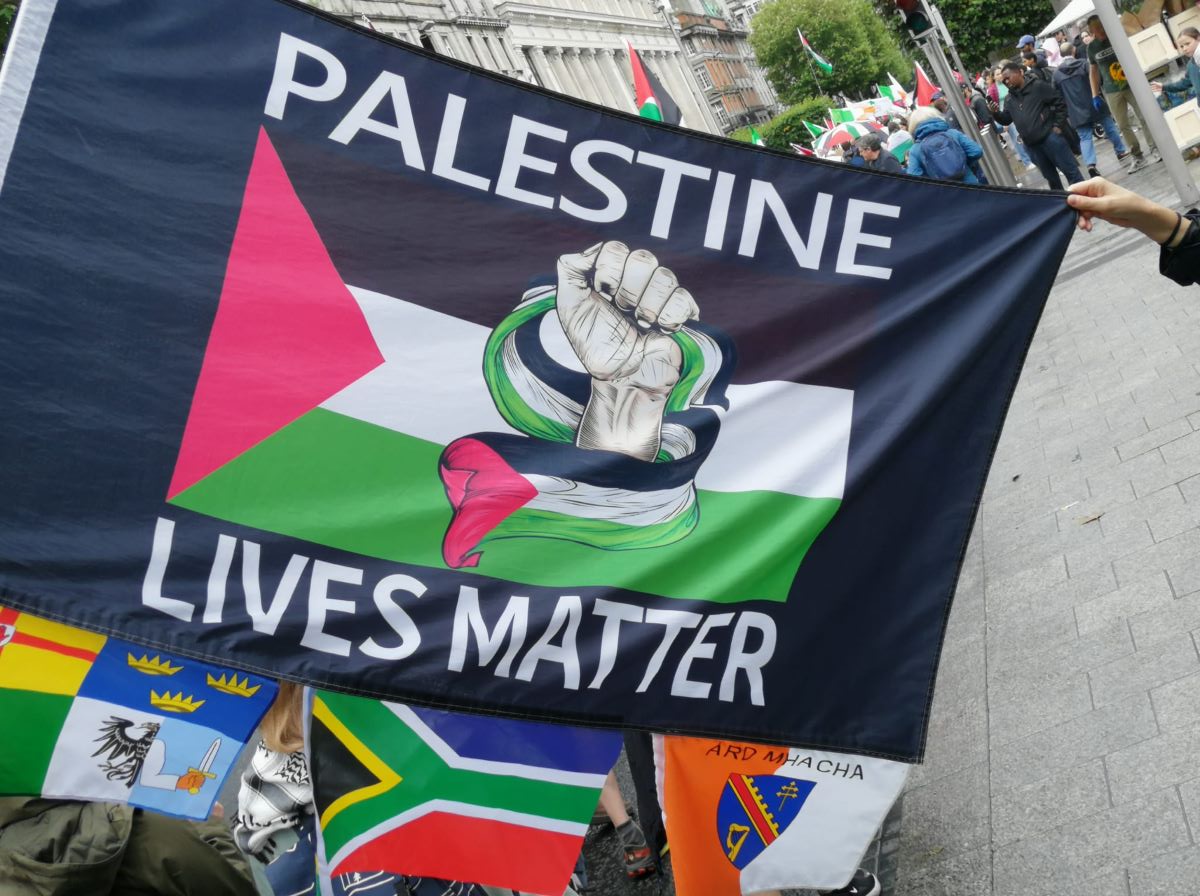
The aim is to create a climate of fear in which people become scared to attend even the most peaceful and routine of protests, where we censor our own slogans, placards and behaviour in order to evade the eyes of the on-line harassers and the police.

Palestine Action and Elbit

Alongside all this has run another process in which the brave participants show no fear in the way they exercise their solidarity with the Palestinian struggle.

Palestine Action was set up in 2020 by activists who were frustrated by the PSC’s lack of direct action to enforce BDS – Boycott, Divestment and Sanctions. 

Since then it has primarily targeted the British operation of Israeli arms company, Elbit Systems, as well as other companies collaborating with Elbit or are otherwise implicated in the arming of the Zionist war machine or sale of its ‘battle tested’ technology to other countries’ militaries.

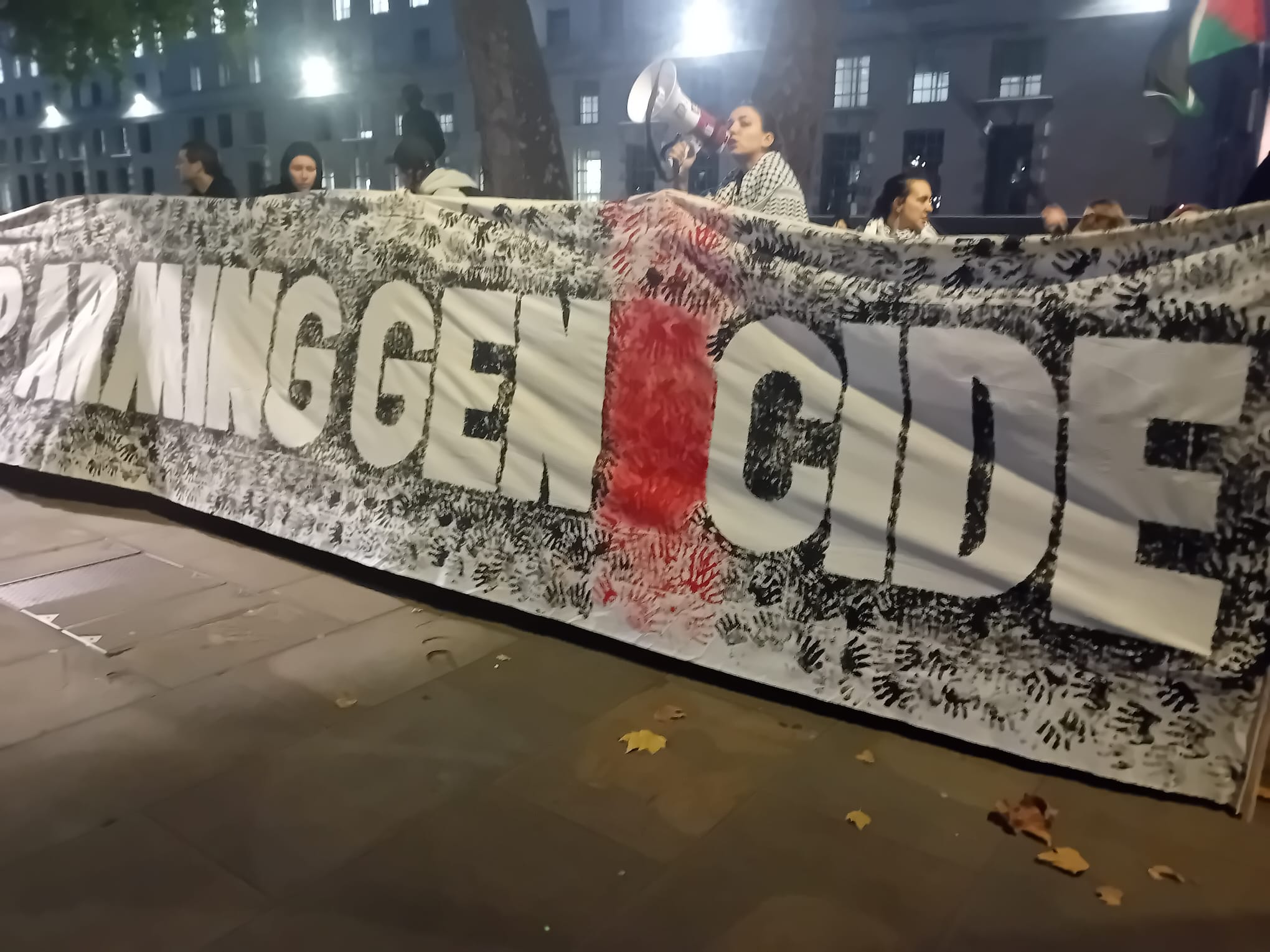
Daily Stop Arming Genocide banner outside Houses of Parliament, Westminster, London. (Source photo: Internet)

Palestine Action’s tactics mainly consist of occupations, blockades and drenching premises in red paint to symbolise the blood on the hands of these profiteering companies.

Until recently, although a lot of these actions led to arrests, very few Palestine Action activists ended up behind bars. This has changed since Keir Starmer’s Labour government came to power. There are currently 18 Palestine Action activists in prison in England, along with 2 in Scotland.

One of the Scottish prisoners is the last of the group known as the Thales 5, who were convicted of occupying the roof of the Glasgow premises of French company Thales in 2022. Thales was working with Elbit to produce Watchkeeper drones for the British military.

The prisoners in England have not been convicted and are all held on remand, having been refused bail by the courts.  The majority were arrested in relation to actions against the Filton arms factory in Bristol. Ten people were remanded in August and a further eight in November. 

Although none have been charged with terrorism offences, the TA was used to effect their arrests, allowing the police more powers to detain pre-charge, raid homes and generally act in a heavy-handed manner. 

In the latest arrests in November, flatmates and families were evicted from their homes, sometimes for several days while the police searched premises.  In one raid, the mother and younger brother of the person arrested were both handcuffed, despite not being accused of any offence.

In prison, those on remand for pro-Palestine direct action have come in for special scrutiny and additional intrusive measures on top of those which all prisoners are forced to deal with.

The six women detained in Bronzefield prison in August were all allocated to separate wings and deliberately prevented from associating with one another. Their mail has been heavily censored.

Four male prisoners in Wormwood Scrubs, although not subject to the same separation regime, have also had their correspondence held up, censored and returned to sender, with supporters being served with notices to the effect that no communication between them is permitted.

FRFI successfully appealed against such a notice in relation to our sending the paper to the prisoners, although the prison claims it still has a right to withhold the paper or other publications if the censors decide they are ‘inappropriate for a prison setting’.

The purpose of all this is clearly to scare those it is directly targeting it and to deter others from coming forward to join Palestine Action’s activities.

As Palestine Action carries out more actions against Elbit, including repeatedly blockading the UAV Engines site at Shenstone in the Midlands, which manufactures engines for Elbit, it is clear that the repression is not succeeding.

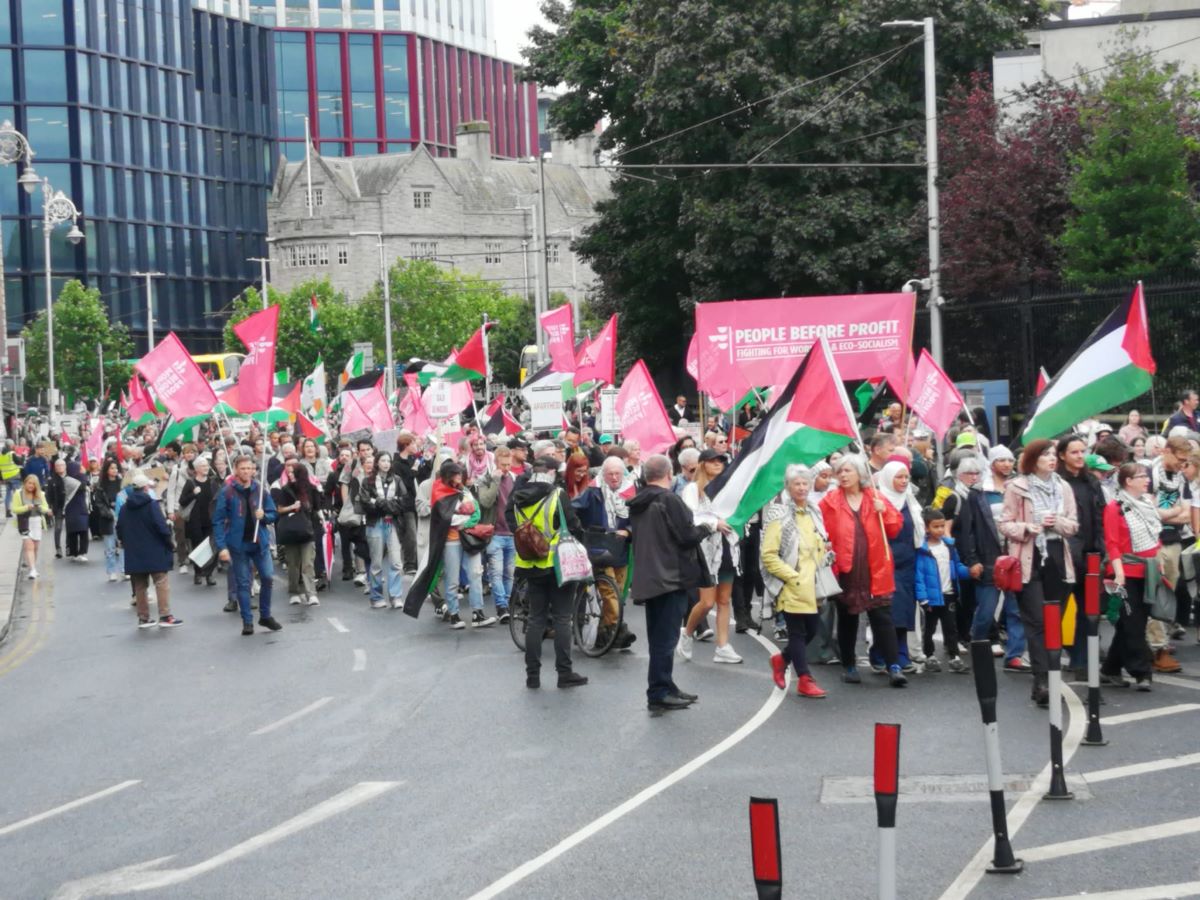
Palestine solidarity demonstration Downing Street 14 December 2024. (Source photo: Internet)

Kitson methodology

General Sir Frank Edward Kitson died on 2 January 2024, aged 97, after a long and illustrious career as a dedicated servant of British imperialism.

In addition to the litany of his war crimes, he will be remembered for authoring the text book Low Intensity Operations – Subversion, Insurgency and Peace-keeping (1971), a manual for dealing with subversive and recalcitrant populations, both at home and abroad.

Kitson’s work continues to form a central plank of British strategy for policing dissent and his disciples are clearly leading policing operations against pro-Palestine protesters.

In Kitson’s book, he details how ‘psychological operations’ should be used to isolate ‘subversives’ from the people while building links with and strengthening support for moderate elements who do not oppose the state but disagree on certain policies.

This technique was used both abroad in Britain’s colonies, and at home to police, for example, the Irish solidarity movement of the 1970s-80s.

Today’s ‘moderates’ take the form of the PSC, Stop the War and similar organisations. PSC marches are negotiated with the police, with strict conditions imposed on the protests.

The PSC has provided no support for people arrested on its demonstrations, citing the low arrest rates as proof of how respectable their protests are, while distancing itself from those who have been targeted.

While the PSC opposes Zionist massacres of the Palestinian people, it does not support the resistance of those under attack. 

Consequently it does not complain when the British police uses Terrorism Act powers to criminalise people for supporting the right of Palestinians to resist their oppressors through armed struggle.

This treachery puts the PSC on the wrong side of international law – oppressed nations successfully fought for the right to self-defence by means of armed struggle to be enshrined in UN resolutions in 1974 and 1982.

Fighting back, building solidarity

For some of us, the culture around supporting our arrested comrades was drilled into us many years ago.  A whole new generation has had to learn these lessons. 

It is positive to see that, although the PSC and such organisations continue not to want to get their hands dirty with supporting anyone targeted by the police, a different attitude is also widespread and ‘arrestee support’, prison solidarity letter-writing etc are common currency among activists. 

At the same time there is an element of this solidarity which is depoliticised. For example, the provision of a constant presence at a police station to monitor things and be there when arrestees are released is a good thing and the support organisations which provide this do an invaluable job.

However, when we have comrades under arrest, we want to do more than legal monitoring and instead turn the police station into a focus for protest.  The same with courts and prisons. 

It’s very positive to see Palestine Action, the SOAS encampment and others also doing this to great effect, thus ensuring that the focus is not just on the Israeli companies who are their principle targets, but also on the British criminal justice machinery which is being marshalled against those who take a stand.

Our task, as always, here in the belly of the imperialist beast, remains to protest against the British government and British corporations’ complicity in the Zionist genocide.

And to show unconditional solidarity with those who fight back against the Zionist war machine by whatever means are at their disposal.

Supporting the resistance and opposing the British state cannot fail to bring us into conflict with that same state and we must continue to stand alongside everyone who is criminalised for their solidarity.

End.

SOURCE

WHAT KIND OF ‘IRISH NATIONALISM’ IS THIS?

Diarmuid Breatnach

(Reading time: 4 mins.)

Claiming to be ‘Irish nationalists’, denouncing refugee accommodation, calling LGBT people “paedophiles”, promoting “Christian values” and attacking Muslims, calling people “traitors” for expressing solidarity with Palestinians.

What kind of ‘Irish nationalism’ is this?

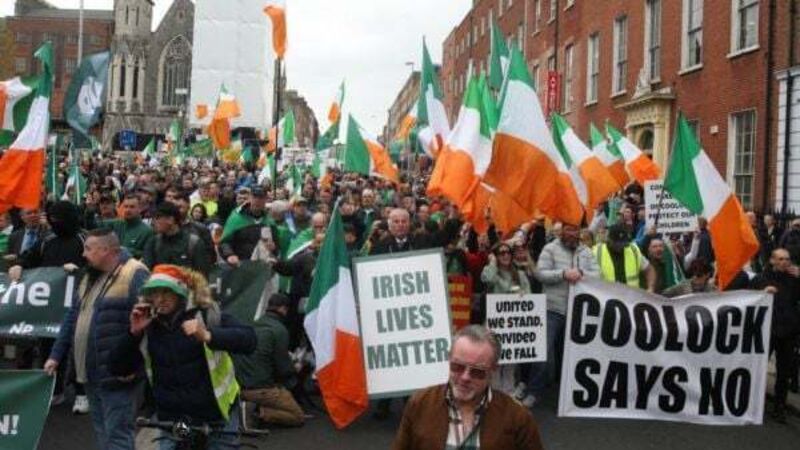
In recent years far-Right elements in Irish society have been pushing an ideology composed of the elements listed above, while claiming to represent the Irish people and the Irish nation. In their justifications they sometimes refer to struggles in Irish history and to Irish culture.

They do this not only in words but also in debasing flags of the Irish struggle, such as the Tricolour and the ‘Irish Republic’ flag, by waving them at their public events and even, on occasion by playing Irish Republican ballads on their PA machines.

Plenty of Irish Tricolour flags brandished on this anti-immigration march in Dublin in May (2024). Flags of the fascist National Party can also be seen. (Photo sourced: Internet)

Yet with a tiny unrepresentative exception, these elements have not been involved in the promotion or creation of Irish music or dance. They have not struggled for the promotion of the Irish language nor do they themselves speak the Irish language.

As to the history of Irish struggle, again with the exception of a miniscule minority, the far-Right elements have not fought against the British occupation, not picketed British Occupation buildings, not confronted the colonial police nor agitated in solidarity with Republican prisoners.

Again, I ask, what kind of ‘Irish nationalism’ is this?

Palestine solidarity ‘treason’?!

As Ireland experienced a wave of solidarity with the Palestinian people facing a campaign of genocide by the Zionist regime and its Western powers allies, these far-Right elements not only disdained that solidarity but harassed and labelled those who expressed it as “traitors”.

Again, I ask, what kind of ‘Irish nationalism’ is this?

How is opposition to genocide or solidarity with another colonised and oppressed people the activity of ‘traitors’? Surely it is the natural reaction of people with our history? Doesn’t the term ‘traitors’ mean that the accused have aligned themselves with enemies of the Irish people?

In fact, that is precisely what these far-Right elements are doing themselves. They are aligning themselves with a number of Western imperialist powers but in particular, in the case of Ireland, aligning themselves with the rulers of the UK, invader and occupiers of the Irish nation.

That connection was amply demonstrated when the colonial police savagely attacked people attempting to set up a Palestine solidarity camp in the grounds of Queen’s, the colonial university in Belfast. As it is also by burning Palestinian flags alongside the Tricolour on Loyalist bonfires.

A sectarian July bonfire with the Irish Tricolour, ‘Irish Republic’ and Palestinian national flags on top awaiting burning. (Photo sourced: Internet)

Or by English fascist and Loyalist flags accompanying Zionist flags on demonstrations in England. And by far-Right posters and activists who called for friendship with English fascist Tommy many-names Robinson, notorious for supporting the Paratroopers’ 1972 massacre of protesters in Derry.

Love Irish history?

Recently a far-Right person posting on social media, while claiming to “love Irish historical sites”, denounced efforts to save the Moore Street market and 1916 Battleground because “it’s not Irish any more” and called for it to be torn down “to get them1 out”.

She called for the destruction of the oldest street market in Ireland and the site of the last stand of the GPO Garrison, the 1916 Battleground where at least four Volunteers were killed and the last place of freedom for hundreds, including five of the Seven Signatories of the 1916 Proclamation.

Again, I ask, what kind of ‘Irish nationalism’ is this? It is in fact aiding the property speculator who wants to demolish and obliterate Irish history and heritage, a speculator currently based in Britain, though actively assisted by Dublin City Managers and successive Irish governments.

Another poster on social media calling itself “Christian Wisdom” asked people to vote for “Irish nationalist candidates” in the forthcoming elections within the Irish state, the sub-text being against migrants or Left-wing candidates and presumably for religious sectarianism.

What kind of ‘Irish nationalism’ is this?

It aligns itself with the western imperialist powers, including the invader that has been in occupation of some part of our country for 800 years and still is.

It denies people the democratic rights to express their sexuality.

In promoting Christianity as ‘Irish’ and in opposition to free expression of sexuality, it seeks to put us back under religious social control and also opposes the 1916 Proclamation, which guaranteed “religious and civil liberty and equal opportunities… for all.”

In blaming migrants and refugees for homelessness, it is covering up for the actual people who cause that crisis: the bankers, property speculators and big landlords who keep making huge profits out of people’s needs and misery.

Who are they really? They are certainly not ‘Irish nationalists’ in the sense of the many who fought and sacrificed all in the struggle to free the Irish nation through 800 years of Irish history.

Fascists and racists based in Coolock, North Dublin city photographed in joint rally with loyalists in Belfast in 2024. (Photo sourced: Internet)

What it really is and what they really are

What they are disseminating is not at all Irish nationalism.

On rational examination of the evidence, I must conclude that these people are not Irish nationalists at all. But since they claim very stridently that’s what they are indeed, I must conclude that they are using that label to cover their real identity.

What they are really is simply nothing more nor less than Irish fascists, serving property speculators, corporate landlords, bankers, the native Gombeens and foreign imperialists. Or the ignorant manipulated tools of those fascists.

In total, enemies of the Irish nation, of working people and of all democratic freedoms.

End.

1Presumably meaning people born abroad (as were James Connolly, Tom Clarke, Constance Markievicz, Eamonn De Valera, Eamon Bulfin, the father of the Pearses and mother of Thomas Mac Donagh, father of Thomas Davis … and hundreds of other Irish patriots).

IN SOLIDARITY WITH THE PALESTINIAN RESISTANCE, THOUSANDS MARCH IN BASQUE CITIES

Diarmuid Breatnach

(Reading time: 4 mins.)

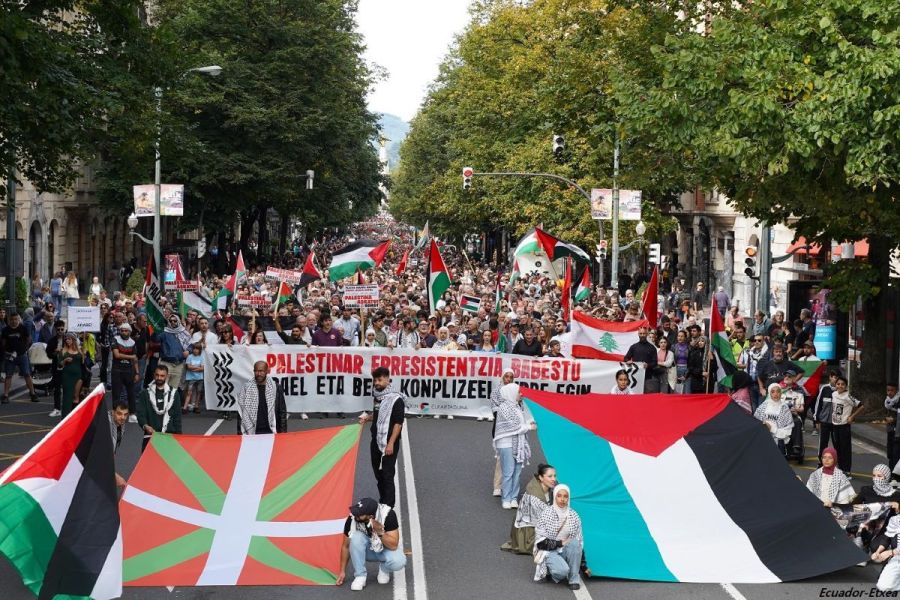
Thousands marched recently in two cities of the Basque Country, Bilbo and Iruña/ Pamplona,1 respectively the capitals of the Bizkaia and Nafarroa2 provinces, in solidarity with the Palestinian people and with their Resistance.

And almost immediately posters could be seen calling for the same on the 11th November, but in four Basque cities, including a city in one of the provinces on the French state’s side.3

“Well that’s great but sure we do that here every second week or so,” some might say. But they’d be wrong. The marches organised by the Ireland Palestine Solidarity Campaign, while calling for solidarity with the Palestinians and BDS4 of the ‘Israeli’ state and businesses, do not support the Resistance.

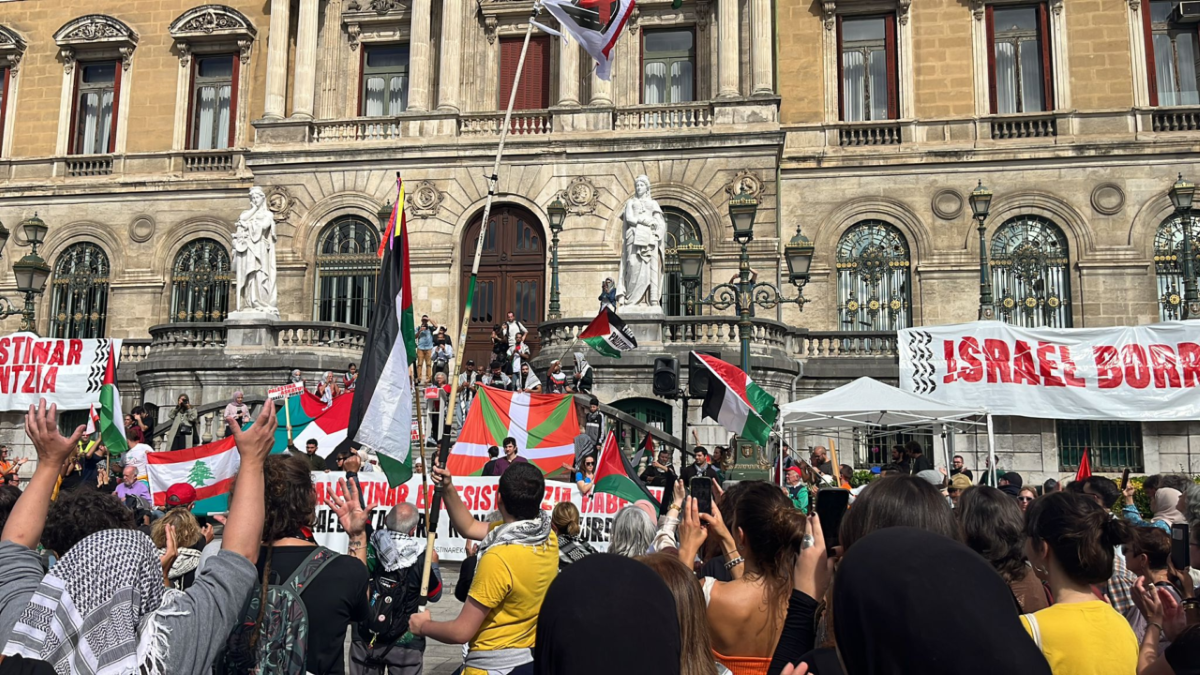
The rally stage at the end of the march in Bilbao, on the east bank of the Nervion river. Banner exalting the Resistance in the centre facing the crowd, banner to the left calling for solidarity with the Resistance and another to the right calling for struggle against ‘Israel’. (Photo cred: Resumen Latinamericano)

Nor do the marches organised by the main Palestine solidarity organisations in England or in Scotland. It might be pleaded that in the UK at least, people could be arrested for declaring support for a number of Palestinian resistance organisations that are on the EU “terrorist” list.5

The leadership of the Basque Patriotic Left6 does not support the resistance either, preferring to draw the Palestinians and Basques together as victims under a Gernika-Gaza initiative and even criticising the resistance along with the Zionists in a “both sides” kind of analysis.

But no law exists in these countries forbidding expression of “solidarity with the Palestinian Resistance.” The organisers of those campaign organisations don’t declare for the Resistance because a) they don’t support it or b) wish to remain tolerated by the upholders of the status quo.

View of section of the crowd, giving an idea of its size, the largest Palestine solidarity demonstration in the Basque Country since the present phase of Zionist genocide began on 8th October last year. (Photo cred: Resumen Latinamericano).

IT MATTERS

Well, ok, but does it really matter? Yes, it does and it matters a lot, for the Palestinians, for others struggling against imperialism elsewhere around the world – and for us. Not supporting the Resistance leaves open the question of, for example, the Palestinian Authority.

This Vichy-like organisation headed by a corrupt Quisling sends its security force to intimidate and beat up critics and demonstrators, to arrest them and also Resistance fighters (including invading hospitals to chase down the wounded) and removes defences against IOF invasion.

The PA, despite its widely-acknowledge corruption and the contempt in which it is held by broad Palestinian society, is formally recognised as the ‘representative of the Palestinian people’ by the western imperialists and by many social-democratic parties in Europe.

It is an offence against the Palestinian people and internationalist solidarity to accept the PA as any kind of representation of the heroic Palestinian people – or even to leave the question open. Furthermore, such a stance leaves the door open to all kinds of traitors and confusion.

In our own struggles, we need to be clear who are our enemies and friends. To accept treasonous agencies as representatives of struggling people contaminates our own attitudes in struggle, confuses and undermines our thinking, clouding our vision.

A woman holds high a placard calling to “Free Palestine” and to “Boycott Israel.” (Photo sourced: Internet)

BEING CLEAR AND MAKING IT CLEAR

We need to be clear – and to make it clear – that we support the Palestinian resistance in all its forms: popular, armed, trade unionist, cultural, artistic … and that we abhor collaboration and collusion with the enemy.

We can do that – and it has been done on occasion – by mobilising all who agree on a demo behind a banner celebrating the Palestinian Resistance. But how much better, if like the Basques today in Bilbao and in Iruña/ Pamplona, the whole demonstration marched behind that kind of slogan!

It might be thought that the demonstrations on 5th October would gather less than the safer Gernika-Gaza group of the official leadership of the Left Basque Patriotic movement (Otegi & co.) and other liberals but this was not the case in Bilbo anyway, on the biggest solidarity demonstration since October last year.

Advance posters for the solidarity march. (Photo sourced: Internet)

Two Palestinian Resistance factions, the Popular Front for the Liberation of Palestine and the Democratic Front for the Liberation of Palestine sent messages of thanks to the organisers and the demonstrators.

The demonstration and its theme were covered widely in Basque, Spanish, European and Latin American media, usually with photos.

Addressing the rally after the march in Bilbo on 5th October, a speaker listed the many crimes of the Zionist State and was loudly cheered when she said that only the abolition of that state could bring that career of genocidal crimes to an end.

The cheers grew louder still as she called for solidarity with the Palestinian resistance and all others fighting against imperialism and Zionism. And continued as she went on to call for a break with all states and political parties that support the Zionist State.7

The cheers might even have reached EH Bildu’s office and the leadership of the Gernika-Gaza group.

The march on its way to the rally across the river pauses on the way for photos. The long banner calls for “Support for the Palestinian Resistance” but also ” Oppose Israel and its accomplices.”(Photo cred: Boltxe)

End.

FOOTNOTES

1A number of places with Basque toponymics, under Spanish colonialism, were given Spanish names.

2Also known as ‘Navarre’ and ‘Navarra’.

3There are seven provinces in the Basque Country, three on the French side of the Border (Iparralde, ‘the North Country’) and four on the Spanish side (Hegoalde, ‘the South Country’).

4Boycott, Divestment and Sanctions

5https://www.gov.uk/government/publications/proscribed-terror-groups-or-organisations–2/proscribed-terrorist-groups-or-organisations-accessible-version There is actually no universally agreed definition of ‘terrorism’ neither in objectives nor in actions but if we were to accept “use of violence to achieve a political end” then we’d had to include the chief actors fitting that definition in the world – the western imperialist states, in particular the USA and the UK!

6That was the broad movement of legal and banned organisations of revolutionary Left and independentist outlook, the movement now reformist, much reduced and fragmented under the leadership of Arnaldo Otegi and the EH Bildu party.

7That clearly includes the conservative Basque Nationalist Party (PNV) and the social-democratic Spanish Socialist Workers Party (PSOE) currently in coalition government in the Basque Autonomous Regional Government.

SOURCES

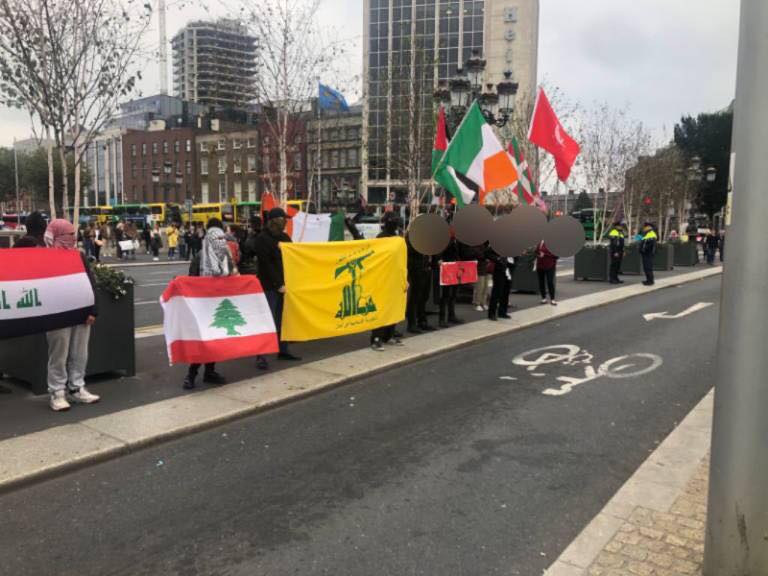
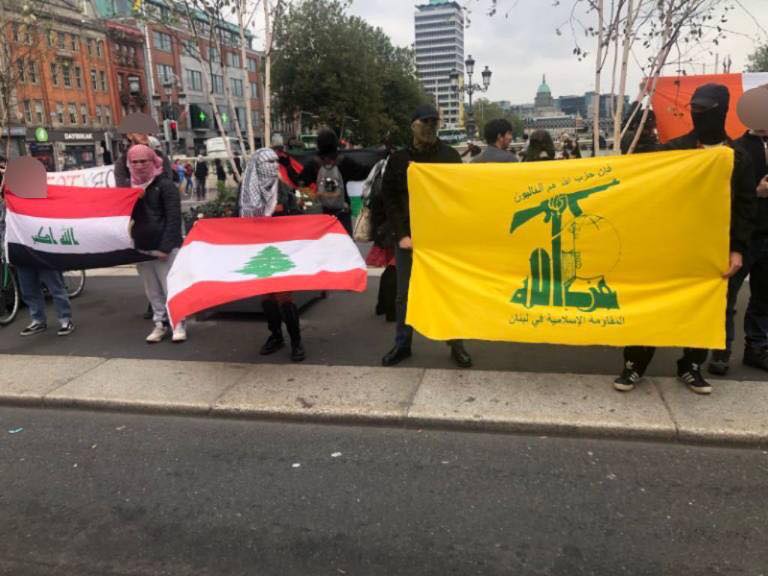
Dublin demonstration in solidarity with Hezbollah and the Lebanese people.

As the Zionist state followed up its communication device terrorism with aerial bombing … (Report from AIAI- For National Liberation and Socialist Revolution):

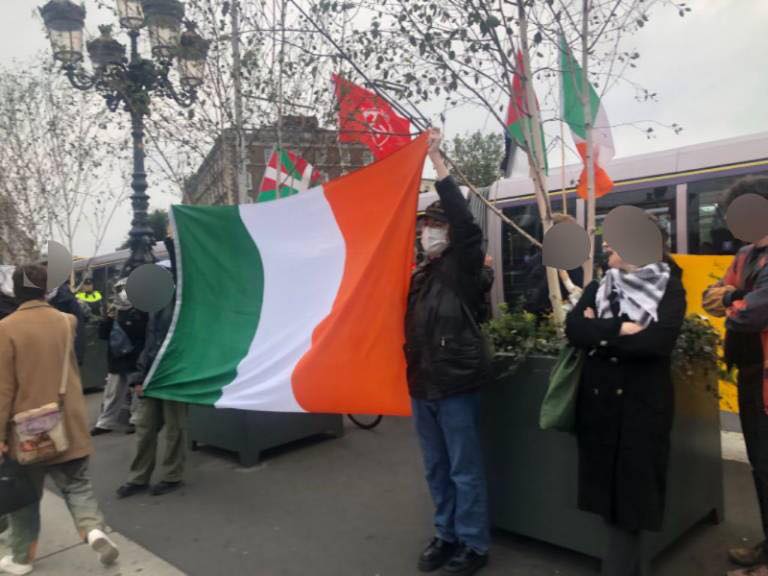
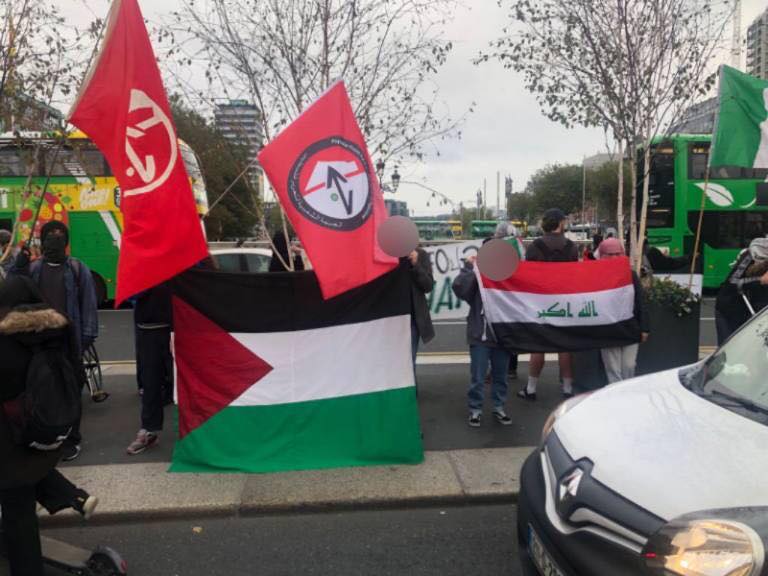
On Friday September 20, Anti-Imperialist Action Ireland and Saoirse Don Phalaistín held an emergency solidarity demonstration with Hezbollah and the Lebanese people on O’Connell Bridge in Dublin.

(Photo sourced: AIA social media page)

Although called at short notice, there was a great turn out, demonstrating the support of Irish Revolutionaries for the Anti Zionist Resistance.

A large Hezbollah flag was the centrepiece of the demonstration and flew proudly beside Irish Republican flags including the Tricolour and Green Starry Plough of the Irish Citizen Army, Palestine, Lebanese, Iraqi and Basque national flags and the flags of the Popular Front for the Liberation of Palestine.

Chants at the demonstration included From Ireland to Palestine – Occupation is a crime! and Hands off Lebanon!. As it was culture night, two singers gave renditions of ‘We only want the earth’ by James Connolly and ‘Go on Home British and Zionist Soldiers’, a twist on the Republican classic linking the fights for Freedom in Ireland and Palestine.

(Photo sourced: AIA social media page)

The demonstration was monitored by the special branch who took photos of the participants but their presence could not stop the solidarity action with Hezbollah and the Lebanese People.

Irish Republicans will always stand with our international anti imperialist comrades in the fight against Imperialism and Zionism. AIA and SDP will continue to organise events and actions to increase our solidarity with the Anti Zionist Resistance.

(Photo sourced: AIA social media page)

Additional comment – Clive Sulish: The event was also filmed by a well-known Irish Zionist who regularly tries to intimidate Palestine solidarity activists and also tries to get the Gardaí to arrest those carrying flags of Palestinian resistance organisations.

O’Connell Bridge crosses the Liffey river dividing the north from the south Dublin city centres and is directly passed by north and southbound traffic but also closely by west and eastbound traffic along the quays.

There were many expressions of appreciation from passersby on foot, in vehicles or on bicycle.

End
.

(Photo sourced: AIA social media page)

THOUSANDS MARCH THROUGH DUBLIN CITY CENTRE IN SUPPORT OF PALESTINE

Diarmuid Breatnach

(Reading time: 3 mins. Note: Apologies for delay in publishing this report)

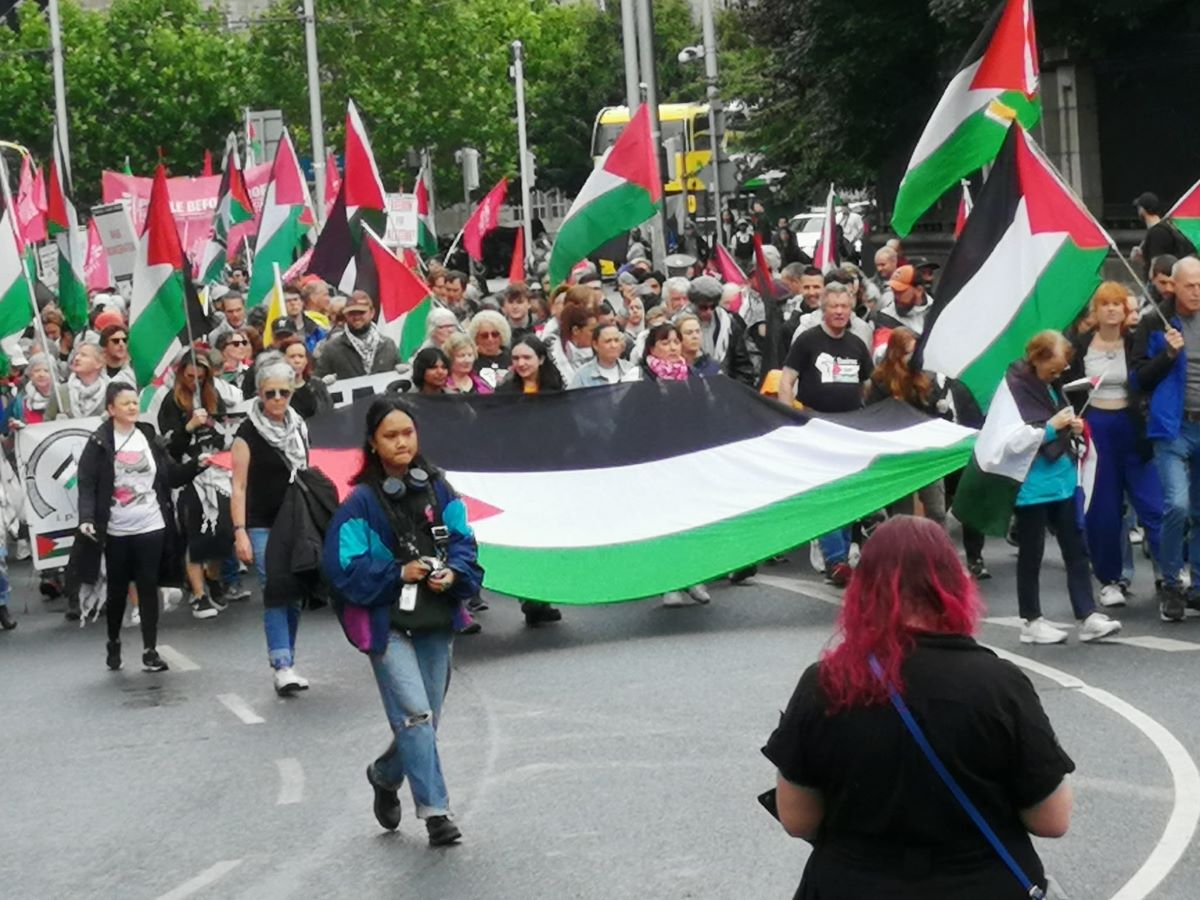
On Saturday 20th June the Irish people, despite their Governments once again marched in a national demonstration to show the Irish majority solidarity with Palestine and horror at their continuing genocide by the ‘Israeli’ armed forces.

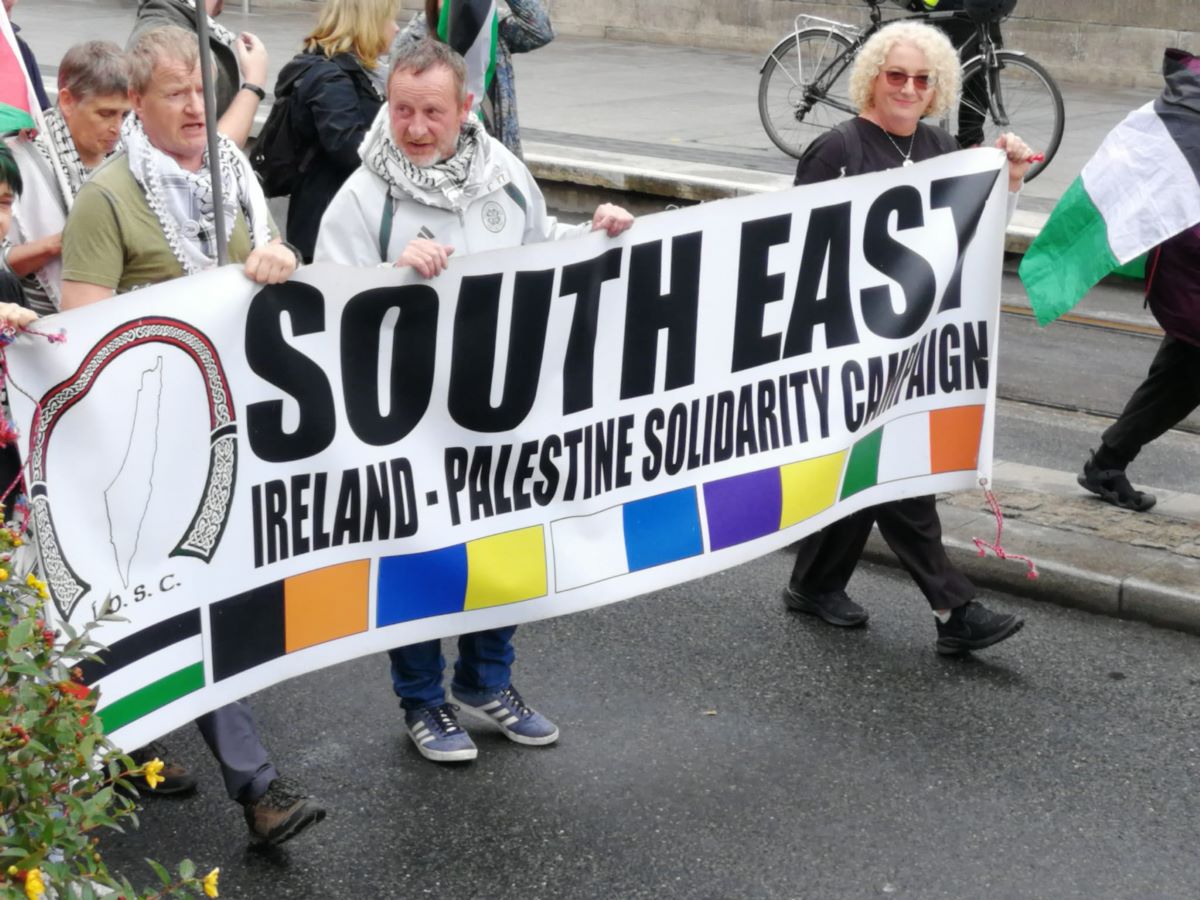
The march had been convened by the long-standing Ireland Palestine Solidarity Campaign which has branches across Ireland from Cork to Donegal, including in some parts of the British colony (where however the Loyalists are anti-Palestinian).1

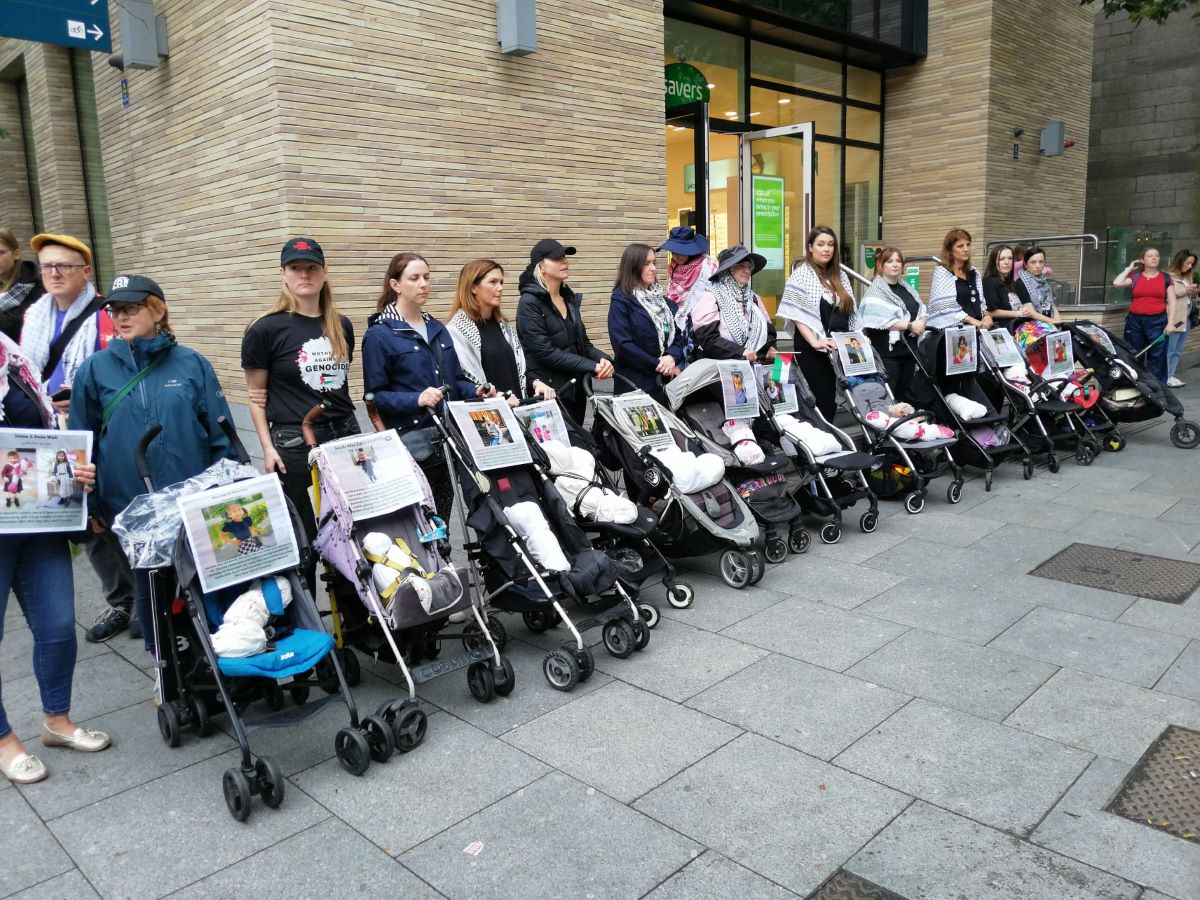
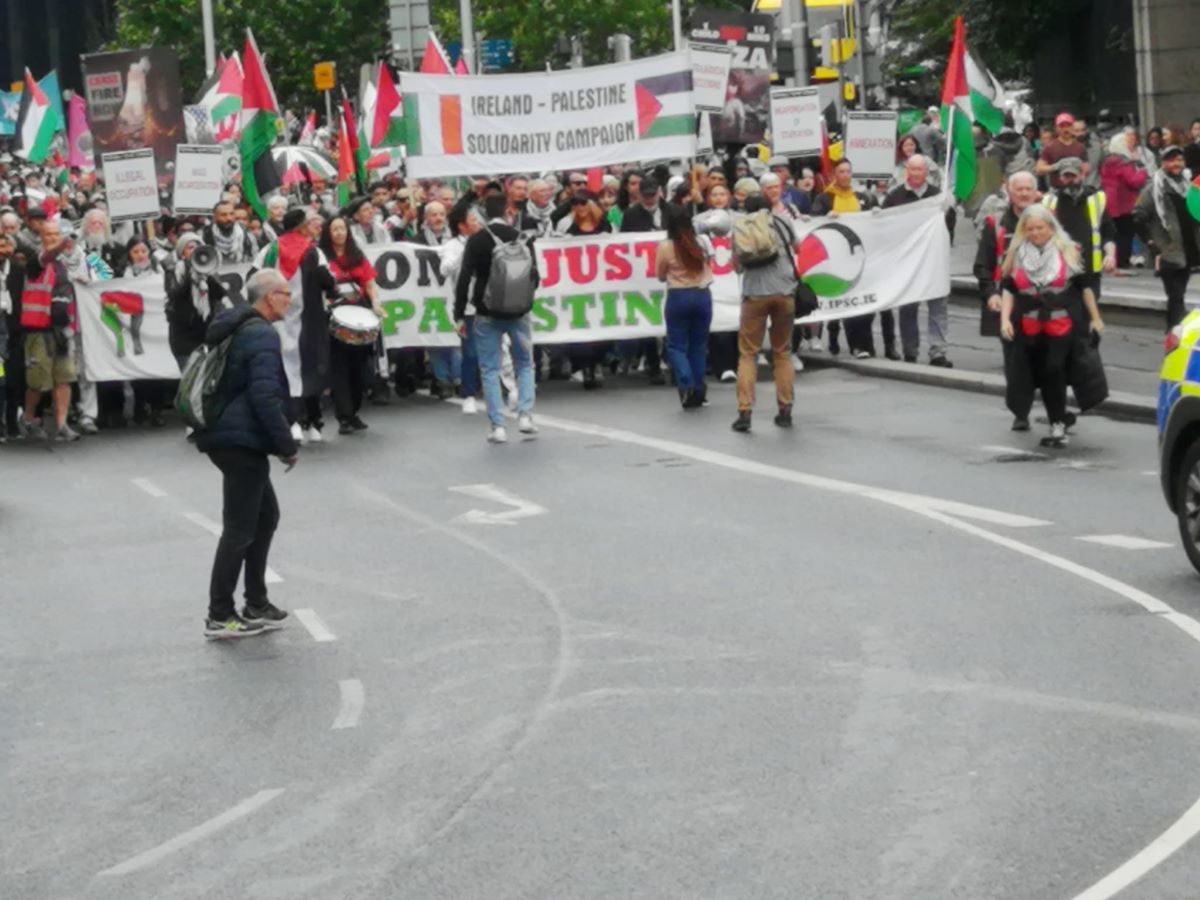
Mothers Against Genocide group in Dawson St. (around corner from Molesworth St.) evoking individual children murdered by ‘Israel’. (Photo: D.Breatnach)
Dublin community group that holds Thursday evening vigils in four areas of North Dublin. (Photo: D.Breatnach)
(Photo: D.Breatnach)

The assassinations of resistance leaders were still to come2 but it had been business as usual in Palestine with daily massacres of civilians by the ‘Israeli’ Occupation forces, ongoing starvation, destroyed health service, impending epidemics, prisoners released as ghosts of their former selves.

Also IOF raids and kidnappings3 in the West Bank, at times with Palestinian Authority4 collusion in arrests of activists, confiscation or destruction of Resistance weapons …

(Photo: D.Breatnach)

To all this the Palestinians in general have responded by helping one another trying to survive, digging people out of bombed rubble, documenting atrocities, burying their dead, trying to feed their children and elderly …

And their Resistance in all factions (and none) threw stones, fired bullets, launched anti-tank rockets, mortars, missiles and blew up bombs against Occupation armour and soldiers. And of course, contributed new names to the long list of martyred resistance fighters and commanders.

The ECJ,5 to howls of protest from the regime had pronounced its verdict that Israel was indeed, as has long been evident, guilty of practising apartheid against the Palestinians. However not one state ceased giving political or financial cover to the Occupation or supplying it with arms as a result.

Irish Healthcare Workers for Palestine. (Photo: D.Breatnach)

(Photo: D.Breatnach)

IPSC Police?

Only a few Irish Tricolours were displayed on the march which is visually a political mistake, as I’ve observed earlier and the organisers should state that such are welcome. Not one Starry Plough flag, that of socialist Republicans, could be seen either, despite no doubt there being many such participating.

Irish language placards and banners have been getting rarer, despite a previous welcome upsurge upon which I’ve commented in the past. However there were some to be seen, including a number of Saoirse Don Phalaistín flags and the banner of a Newry group, from Co. Down, under British occupation.

(Photo: D.Breatnach)

As they filled Molesworth Street towards the IPSC stage and police barriers at the end, facing the Leinster House Irish Parliament building, some marchers already began to leave, having heard speeches before and perhaps heading for their transport back to their earlier points of departure.

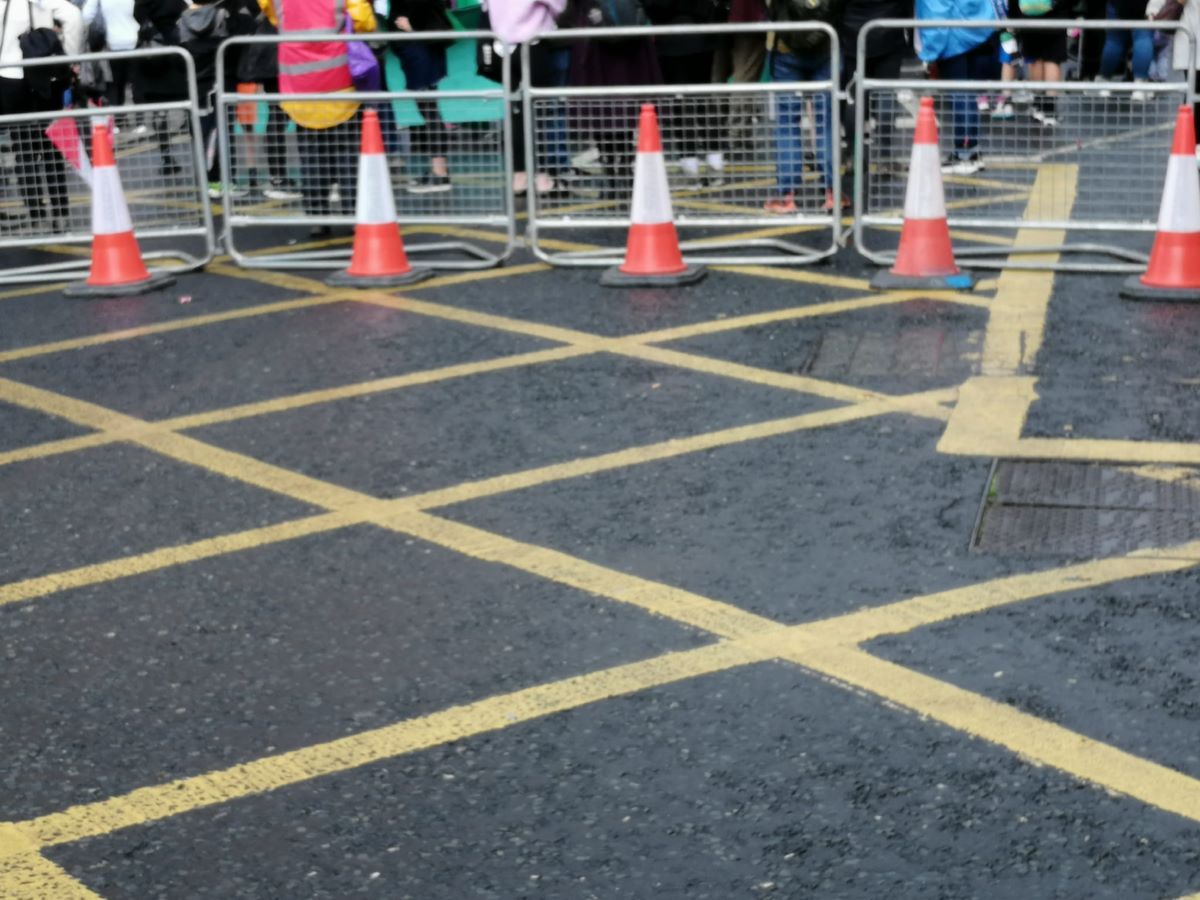
The company that erects crowd barriers were ready to install them to cut off a section of Molesworth Street at the intersection of narrow lanes and the Gardaí wanted to cram the crowd in beyond the barriers. IPSC stewards began to usher marchers further into Molesworth street.

One approached a group of marchers telling them what the police wanted to which one of the group replied: “I don’t give a f..k what the police want!” and after the steward’s persistence, accused him of doing the job of the police.

The IPSC stewards have helped the police pack marchers into the stretch of Molesworth Street beyond the intersection (and incidentally leaving any demonstrating in Dawson Street cut off from the main group). (Photo: D.Breatnach)

Aside from the rough language, what were the IPSC stewards doing passing on police orders?

People in the group said that the IPSC stewards have done this before and that furthermore there was no important-through way being cleared,6 the exercise serving no real purpose other than getting the public used to being corralled and that at the least the police should do their own job.

(Photo: D.Breatnach)

The main purpose of stewards is to keep the march moving and safely from traffic. The route has been agreed beforehand by the IPSC with the Gardaí which is not a legal requirement in Ireland. Even in that case the stewards should keep a strict separation in functions from the police.

The IPSC does an important job, publishing information and organising events, especially nationally but back in October delayed in even calling for the Zionist Ambassador’s expulsion. Some other groups also organise events and it appears that the IPSC supports some and not others.

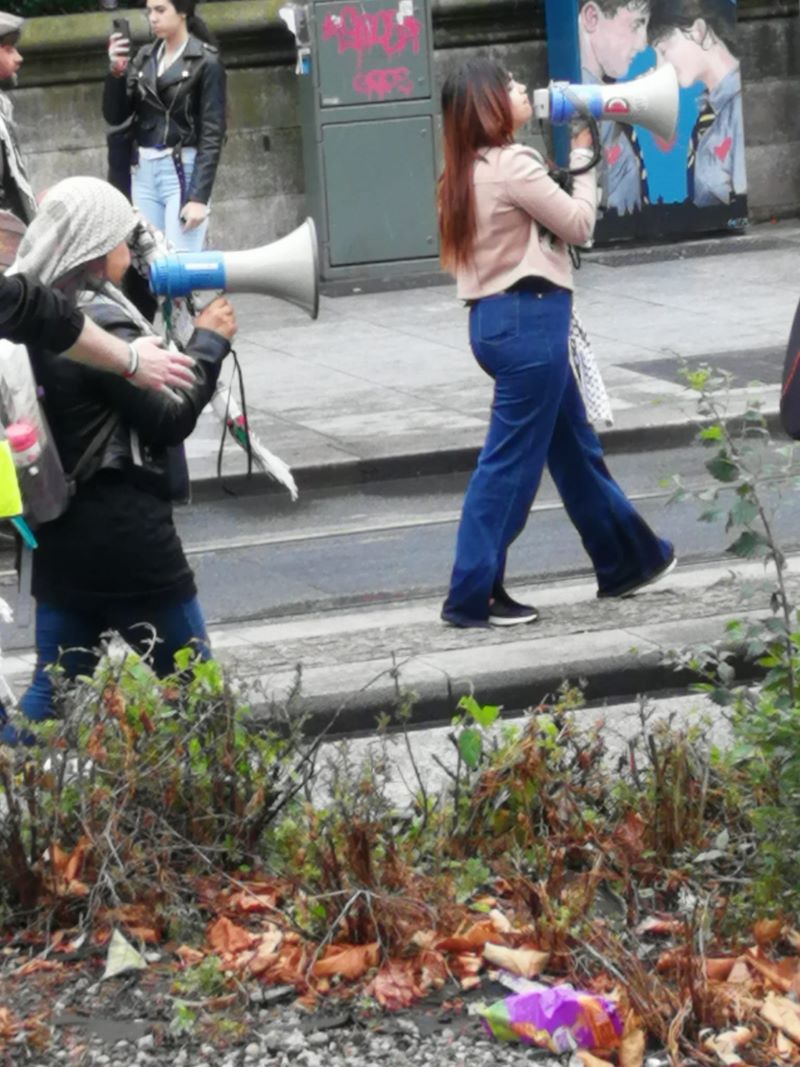
Young Palestinian women leading the slogans call-out. (Photo: D.Breatnach)
(Photo: D.Breatnach)

Going forward it seems that the solidarity movement, including of course the IPSC, will need to take into account their meagre effect on the Irish Government, not to speak of upon the genocidal state itself and on its supporting states in the West, in particular the USA, Germany, UK …

Such recognition will call for escalation, for direct action, for different kinds of solidarity action … whether some organisations want to participate or not.

(Photo: D.Breatnach)
Some trade union banners on the march (though the unions do little to mobilise support, much less take action against ‘Israeli’ products etc.). (Photo: D.Breatnach)
Front of the march turning into College Street. (Photo: D.Breatnach)

FOOTNOTES

1This could be because they see themselves as ‘British’ settlers, while the ‘Israelis’ are European settlers too but is more likely a knee-jerk reaction to the Palestine solidarity exhibited by Irish nationalists (something like “If they’re for them, we must be against them”.

2Assassinations of leaders of Hamas, Hezbolah and senior officers of Islamic Resistance Iraq.

3The IOF and the Zionist State may call them “arrests” or “detentions” but typically they are random or working off a list without warrants or due process. Former prisoners are re-arrested constantly; family of ‘wanted’ individuals are detained in order to pressure the ‘wanted’ to give themselves up. Typically the detained are served ‘administrative detention’ orders, jailing them for months without trial or evidence. Prisoners are underfed, overcrowded, beaten by guards, have dogs set upon them and medically neglected.

4Unelected, undemocratic, corrupt and zionist-colluding body financed by some Western powers and some colluding Arab states.

5https://palestinecampaign.org/icj-ruling-finds-israel-guilty-of-unlawful-occupation-and-apartheid/

6Furthermore, with no side-streets available in that section beyond the intersection, the police could close that west end of the street should they wish to, ‘kettling’ all the demonstrators between two Garda barriers.

HEZBOLLAH DRONE TECHNOLOGICAL ADVANCES SHOCK ‘ISRAELI’ SECURITY

Clive Sulish

(Reading time: 4 mins.)

The ability of enemy drones to evade detection and even attack, reaching into the heart of the ‘Israeli’ state’s territory, both to photograph and, in the case of the Jaffa (‘Haifa’) town and ‘Eilat’ port to strike, have shocked the state’s military.

They have shocked settler society too. Hadashot Bazman1 reported: “Hezbollah’s drones do not need a visa, and they are controlled remotely via cameras with an operator in the control room. What you do not know will not kill you now …2

they are telling us: ‘We are here, inside you, planning, and capable of delivering harsh strikes’.” ‘Israeli’ daily newspaper Maariv added: “The Air Force has been asleep at the wheel for years.3

‘The sarcasm reached the point where one person wrote: “I lost a black leather wallet at Haifa (sic) Port; we hope Hezbollah will locate it accurately and professionally.”4

The hit in Jaffa was by Ansar Allah, exploding a drone near what was the former main US Embassy building (before its internationally illegal relocation to Jerusalem)5; the other was claimed by the Islamic Resistance in Iraq. But the drones hitting them almost daily are from Hezbollah.

Why the shock? It’s because they have come to believe in their security, their own racist European settler propaganda of innate superiority, instead of recognising the real source of their domination over the indigenous: the financial, military and political support of the Western powers.

With constant propaganda through western mass media, that image of the westernised (‘civilised’) ‘Israelis’ has permeated throughout the west, even infecting many who detest the Occupation’s genocidal actions.

Imagine the reaction as we explain years of Hezbollah’s drone development, testing, production, more testing … “We thought they got their weapons from Iran.6 Wait a minute! You’re talking engineers, designers, labs, test crews … Actual factories, assembly lines! In an Arab insurgency army?!”

We have been trained to see the ordinary people of the Middle East as underdeveloped industrially and (therefore!) socially, their fighters as religious fanatics. This image is not compatible with decades devoted to research development and production of sophisticated modern weaponry.

And yet, that is the ‘secret’ of the Yemeni success: determination, years of R&D, testing their ability, testing the enemy’s, redesign, more testing, tight security and deceiving the enemy … until the cat is out of the bag, spitting, claws fully extended.7

Hezbollah’s Karar drone. (Source: Yemen’s Air Force PDF)

And yet … and yet … Hezbollah is still showing restraint. Yes, they are targeting the IOF in the occupied lands and, in response to genocidal attacks on Palestinians, also some of the colonial settlements until recently untouched.

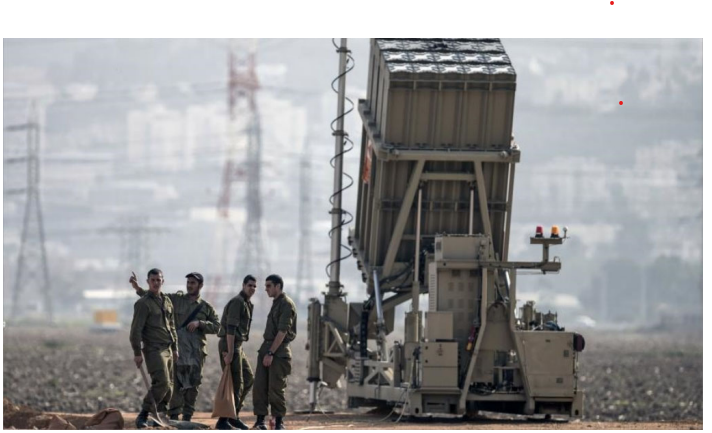
They are also hitting and destroying parts of the genocidal state’s surveillance and defence infrastructure, practically on a weekly basis. The “Iron Dome” depends on launching interception missiles and the launchers are being periodically hit by Hezbollah too.

‘Iron Dome’ launcher of interception missiles with members of the IOF in attendance (Source: Yemen’s Air Force PDF)

And they will continue doing this, they say, until the genocidal attacks on Palestinians cease and international humanitarian aid returns unimpeded (Yemen’s attacks on certain shipping will continue until the same point, as made clear by Ansar Allah).

Hezbollah, like most anti-imperialists, Arab or otherwise, want to see the demise of the genocidal state. But they clearly don’t want all-out war with it at present, with attendant wide-scale destruction of Lebanon by the air forces of the imperialist alliance.

So they have published the results of their surveillance drones flyovers, including most recently of the IOF’s high-security military airport, noting the identity of its commanding officer and also exploded a warning in the centre of the state’s third-largest city.

Published results from the earlier ‘Flight of the Hoopoe’ in June.

THE SHORT, MEDIUM AND LONGER-TERM SIGNIFICANCE

In the short term, the significance of this development is that the settler state is very vulnerable. It must endure Hezbollah’s attacks on its military and its defence systems, knowing that its vulnerability increases steadily.

Scenes from and commentary on the most recent published results of Hezbollah’s undetected drone flight containing detailed aerial film of the IOF’s airbase.

Or attack the source, which Gallant has threatened and Netanyahu desires — for which, as this was being written, they tried to find an excuse in a deadly explosion on children playing football in the occupied Golan, blamed on Hezbollah but for which they’ve denied responsibility.8

But it is extremely doubtful that their armed forces now have the necessary numbers of armour or troops to attack Lebanon, having suffered so many damaged or destroyed of the first and dead or severely injured of the second, inflicted by the lower-tech fighters of the Palestinian Resistance.

In the short-to-medium term, all the allies of the Palestinians in the Middle East draw encouragement in their own contention with the ‘Israeli’ state and with its imperialist supporters and suppliers, while some other states reconsider their alliance with what looks increasingly like a loser.

There is no question but that in recent decades the role of drones in wars between states has been significant but also in asymmetrical conflicts against resistance fighters, such as that of the ‘Israeli’ state against the Palestinians, both against fighters and more commonly against unarmed civilians.

(Source: Yemen’s Air Force PDF)

From now on, insurgency movements will have to organise not only to neutralise the adverse effects of drones in their adversaries’ hands but also to maximise the numbers and efficiency of their own against their enemies’ troops, armaments and battle HQs, production and administrative centres.

The term “drone” is used to describe UACVs (unmanned aerial combat vehicle) but versions operating on the ground, on and under sea have also been developed.

Sea versions like an unmanned boat exploding on contact or from radio signal have been used by Yemen recently. In the NATO proxy Ukraine war, the latter has also deployed them against Russian assets. The development of multi-environment military drones cannot be far away.

Drones can also observe, record, hunt and attack through detection of infra-red imaging, attacking human fighters of either side at night or in heavy fog, rain or snow – as long as the drones can fly.

In future, killer combat drones may hunt not only by detecting infra-red light and carbon dioxide emission,9 gun oil odour, presence of ammonia etc but even of pheromones, able to distinguish between sexually active males and females.

Of course, the development of drones could focus on means to find survivors (or recover bodies) in collapsed mines or buildings (something the Palestinians could make great use of due to IOF bombing), locate missing persons etc, instead of for observing people in order to kill them.

Well … not much chance of that, is there?

End.

FOOTNOTES

1Middle East commentator.

2Hezbollah_Air_Force.pdf from Resistance News Network (see Sources).

3Ibid.

4Ibid.

5Under Trump’s previous Presidency but not withdrawn under Biden’s.

6Well Iran might be viewed as ‘mad Arabs’ (they’re not even Arabs, for the most part) but at least it’s a state, not an insurgent army. In fact, it appears to be the case that Hezbollah have not only developed their own drone-building capacity but contributed to Iran’s.

7Or one of the cats, anyway; Hezbollah says it has more surprises in store and it’s hard not to believe them.

8The western mass media has recorded Hezbollah’s denial of responsibility for the explosion perfunctorily while giving much space to ‘Israeli’ and US accusations against the organisation. This should be bizarre, given Hezbollah’s record of accuracy in missile firing and in statements, compared with an ‘Israeli’ history of blatant and monstrous lies (as recently as by Netanyahu in his address to the US Congress in Washington) … but has sadly become routine.

9One of the ways in which female mosquitoes locate their prey from which to suck blood.

IF WE DON’T SUPPORT THE RESISTANCE

Diarmuid Breatnach

(Reading time: 5 mins.)

In an anti-imperialist struggle, if we don’t support the Resistance, what are we doing?

Among the Left – and even among many liberals — the importance of internationalist solidarity is generally accepted as taken for granted. However, as with many principles, it is in its application that we find substantial disparity.

After the October 7th breakout from the Zionist siege of Gaza the leading elements of the western world rushed to condemn the Palestinian resistance led by the Hamas group. Atrocity propaganda created by the Zionists abounded.1

Hamas2 and Islamic Jihad3 had planned and carried out the breakout operation in which they knocked out the Zionist surveillance and automatic firing defences, damaged communications, went through and over the apartheid wall and overran the Golani Brigade4 forces.5

The Resistance killed many of the IOF6 and captured others. In addition, the Resistance captured a number of civilians in order to exchange them for the huge number of Palestinian political prisoners held by the Zionist authorities.

Some Left groups joined the anti-Resistance chorus immediately while others took a little longer but then did so too. In Ireland, for example, leading figures in People Before Profit and the Socialist Party condemned Hamas, seen as the leading Palestinian element in the operation.

So too did the leadership of the formerly revolutionary Irish Republican political party Sinn Féin.7

Of the Left Zionists in ‘Israel’ (in so far as they can be called ‘Left’), they too joined the chorus. The Israeli state’s presidency has had representation from the Labour Party without interruption from 1948 to 1977 and most of the settlement expansions took place under a Labour government.8

Saoirse Don Phalaistín solidarity group banner (bearing logo of the People’s Front for the Liberation of Palestine on right of photo) after Palestine solidarity march in Dublin 27 January 2024. Also visible in addition to the Palestinian national flag perhaps are two versions of the Starry Plough flag of the Irish Citizen Army, the Republican Congress version at extreme left and the original version above the banner. (Photo: D.Breatnach)

CIVILIANS

Some of the western ‘Left’ organisations stated that it was not the armed breakout of the Palestinians to which they objected but instead the killing of civilians. The liberals and media also made much of the issue of ‘civilians’ – to an extent never accorded to Palestinian civilians.

It is important to note that the adult civilians in the ‘Israeli’ state are, apart from tourists, settlers. They are colonising land from which the indigenous Palestinians have been ethnically cleansed. In addition military service is required of all ‘citizens’9 and a great many are armed anyway.

This is similar to what the Indigenous people of the Americas and Antipodes faced from European settlers from the 18th to the 20th Centuries or the Irish during the various plantations from the 17th Century onwards and the Land War during the 19th.

One baby was killed on October 7th quite likely by excessive heat in a burning building and another 13 children were killed, according to ‘Israeli’ social services. But by whom? By Palestinians or by indiscriminate Hellfire missiles from IOF helicopters and at least one tank firing into a building?10

Civilians may have been deliberately killed knowing they were civilians or by crossfire or by Israeli counterattack. Certainly there was at least one teenager taken captive, the daughter of the Irishman settler who infamously said he would rather his daughter were dead than captured by Hamas.

We’d like to know, of course, which case and how many. But in terms of solidarity principle, it’s beside the point: While we are not required by internationalist solidarity basic principles to approve of every one of its actions, we ARE required to be in solidarity with the Resistance.

A number of Palestinian armed resistance groups displaying unity in the struggle (Photo sourced: Iran News)

BUT, ISLAMIST…!

Many in western society are secular in their politics, many of agnostic or atheist position. So, that is our choice. Others belong quite strongly to one religious belief or another. What is different about Islamists (or fundamentalist Christians) is that they aspire to a society run in accordance with their religious beliefs.

We may not agree with that objective. We should not agree with the subordinate social and political status accorded to women in some religious cultures nor to the outlawing of LGBT sexuality. But even so, we should support the Resistance, Islamist or otherwise, in resisting repression.

Basque society was largely conservative Catholic while resisting Spanish State fascism up to the 1970s; Welsh mining society was often conservative Methodist in the struggles of the miners in the 1930s. The Irish Republican movement was permeated by Catholic symbolism and ideology.

We could have been, should have been capable of supporting the resistance in each of those cases while not supporting the religious conservative, reactionary or fundamentalist beliefs or conduct of participants or leaders in those struggles.

For revolutionaries, the general principles or internationalist solidarity are not of the kind from which one can pick and choose, while rejecting others. We are however entitled to accord ‘favoured status’ to an organisation the ideology and practice of which we most approve.

We may for example prefer a secular or even socialist resistance organisation (e.g the People’s Front for the Liberation of Palestine). We may carry its flags, promote its statements, share its social media postings. But we do so while also expressing solidarity with the Resistance as a whole.

That is reasonable and honourable. It is neither to participate in attempts to break up whatever unity exists among the organisations of the resistance.

During the 30 Years War in Ireland, there were those in Britain who participated in those activities – people who colluded for example with SF refusing to share a platform with the IRSP11 on Hunger Strike commemorations, threatening refusal to attend if their wishes were not acceded to.

No doubt that seemed justified to the Provisionals in their promotion of their organisation above any other choice but that activity split commemoration committees, disheartened activists and killed some solidarity events on the annual calendar.12

HOW BEST TO DO IT … AND IN PUBLIC

We often hear people ask a speaker from the resistance movement what we should do in solidarity. This is in general incorrect behaviour because we have our own revolutionary program and we best know our own circumstances and capabilities.

It is a different thing to ask what are the things that the resistance movement needs: medicines, weapons, representation, contacts, publicity etc. But we still have to decide how well to fit the effort of obtaining those within our capabilities or even whether the objective is worth the energy expanded.13

The Resistance can tell us what they need but the decision on which solidarity actions to take is ours. However whether to express solidarity is not a choice for revolutionaries – it is an obligation.

As revolutionaries we have a public position and part of that should be public solidarity with the Resistance. It is not unknown for some to claim to support a resistance organisation but to decline to do so publicly.

An African National Congress speaker in London years ago told me privately that they supported the Palestinian and Irish resistance but would not do so publicly as it might undermine support they were receiving from UK and other western bourgeois organisations.

I argued with him against this.14 Relating the discussion to a senior SF activist later I was astounded at the response that they would do the same if required.

Solidarity with the Resistance means also solidarity with those incarcerated during the struggle, the resistance in the jails. Again, though an organisation may think differently, we are not required to support the specific organisation to which the prisoners owe allegiance.

Nor does any Resistance organisation have the right to dictate to us whether we may or may not express solidarity with political prisoners who are aligned with that organisation. Over the years, the Ireland Anti-Internment Campaign has faced down attempted coercion along those lines.

So also did the Irish Political Status Committee in London. And both groups remained independent. Unfortunately the Troops Out Movement of the day was unable to do so and after a brief period of asserting independence, eventually succumbed to domination by Provisional Sinn Féin.15

Supporting political prisoners is an act of necessary solidarity with the resistance and also one of self-defence in the longer term but it does not necessarily mean expressing support with the actions or organisation of the prisoners before or indeed after they were jailed.

Banners and flags presumably at Celtic FC home stadium during the current episode of the Zionist genocidal war. (Photo sourced: Internet).

SUMMARY

We are entitled if we wish to prioritise support for a specific organisation or its program but not obliged to do so, nor to accept their advice on how to conduct our solidarity work. Nor is it required of us to condone every action of the Resistance in general.

But we are required to publicly support the Resistance in general and not to join in public condemnations. And that’s the minimum to do if we are going to claim being in solidarity with a struggle.

For any revolutionary struggle, internationalist solidarity is an important factor, in encouragement to the Resistance, in de-legitimising the repression and in practical terms of supplies to the resistance, also in hampering the repression through blockades, boycotts or industrial action.

If we don’t support the Resistance, how can we claim to be in solidarity with Palestinians? Charity is not the same as solidarity. Pity is not the same as support. Outrage at the crimes of the oppressor is not the same as solidarity with the Resistance.

Furthermore, why should we expect solidarity with our struggles, now and in the future, if we cannot express that solidarity with the struggles of others?

End.

POSTCRIPT

Some will have searched in vain for a reference from Lenin, Mao, Trotsky, Luxemburg – or Connolly or even a famous Irish Republican leader – to justify the principles I have discussed here. At the end of the day, people should stand by principles because they have been tried and tested and are aligned with revolutionary experience but should also test them on their own experience in struggle.

In presenting some credentials towards giving these principles some consideration I can only say that I have thought about them and sought to practise them over decades of activism in Britain and Ireland.

Among the areas of Resistance and of political prisoners which have claimed my activity have been Ireland, Palestine, S. and SW Africa, Vietnam, Housing struggle, US Indigenous and African American people, organised Workers, Anti-Fascism & Anti-Racism, Kurdistan, the Basque Country, Syria, Haiti, Western Sahara, Catalunya, the Donbas …

FOOTNOTES

1All since thoroughly debunked though still repeated on occasion: “‘Israeli’ babies beheaded, torn from a womb and stabbed, women raped, people and houses burned.” These fake atrocity stories were repeated in the western media and by some politicians, including Biden and helped create an atmosphere assisting genocide by the ‘Israeli’state.

2Hamas began as an Islamist community organisation which then became a political party and developed an armed wing (like most Palestinian political groups, in response to the armed Zionist State and its settlers). In 2006 the party won the Palestinian legislative elections but the defeated Fatah (widely acknowledged as corrupt) administration in Gaza refused to give way and, in a short conflict, the Fatah armed group was defeated by that of Hamas. They chose not to do the same in the West Bank, presumably to avoid civil war from which the ‘Israeli’ state would benefit but from that moment onwards the Zionist State blockaded Gaza and the organisation was labelled a “terrorist” group in the west and financial support went instead to the Fatah-run Palestinian Authority in the West Bank (which has refused to run new elections in two decades).

3Palestinian Islamic Jihad was formed in 1981. The armed wing of PIJ is Al-Quds Brigades (also known as “Saraya”), also formed in 1981, which is active in the West Bank and the Gaza Strip, with its main strongholds in the West Bank being the cities of Hebron and Jenin. In addition to this organisation and Hamas there exist a number of other resistance factions, some of which are secular, all working together as a broad armed resistance front with organisational autonomy but ofen in joint operations also.

4The Golani Brigade of the Gaza Division is the most highly decorated IOF Brigade, having taken part in all of the state’s major ethnic cleansing and genocidal operations. On October 7th hey were overrun in minutes and 72 killed with an unknown number captured (‘unknown’ because many, along with their Palestinian fighter captors were burned to death in their cars by ‘Israeli’ Apache helicopter Hellfire missiles).

5 The Palestinian operation went deep, passing Golani’s 3rd defensive line.

6‘Israeli’ Occupation Forces, aka the official but misnomer IDF (“Israeli Defence Forces”).

7The current iteration of Sinn Féin abandoned its revolutionary anti-colonial and anti-imperialist path in embracing the pacification process in1999. It stood down its armed wing, the IRA and largely dissolved it, also having their weapons decommissioned, since when it has participated in the administration of the colony and in recruitment of the colonial police force.

8Yet for years the Socialist Party have opposed boycotting the Zionist State, calling instead for unity with the “Israeli Left”.

9With the exception of most ‘Israeli’ Palestinians and all ultra-Orthodox ‘Israelis’ but for the latter is in the process of change https://www.aljazeera.com/news/2024/6/11/israels-knesset-advances-contentious-ultra-orthodox-conscription-law

10Documented by military and survivor sources on ‘Israeli’ media.

11The Irish Republican Socialist Party with an armed wing up to the 1990s, the Irish National Liberation Army, which contributed three Volunteers to the 10 martyrs who died on hunger strike in 1981.

12And what, in the end, did the Provisionals achieve with the supremacy gained?

13The Resistance organisation may ask us to arrange meeting for them to address our state’s parliament, or for interviews with the media … Or even to restrict our propaganda from solidarity to self-interest for people, as Sinn Féin did in England in the 1980s when they were promoting Time To Go: “Push the issue of the expenditure on troops, better spent on the health and social services.@

14If to do so incurred a legal penalty would have been a different situation, of course.

15And from that moment onwards became a less broad and less effective, eventually ceasing to exist as a solidarity organisation.

SOURCES

Including a discussion on the importance of solidarity with the Resistance: https://youtu.be/yj9hQaqeeio?si=z1oSOAYGX8z-Ney8

Ireland Anti-Internment Campaign: https://www.facebook.com/p/Ireland-Anti-Internment-Campaign-100063166633467/

BRITISH NAVY VESSEL PROTESTERS SENTENCED IN DUBLIN

Diarmuid Breatnach

(Reading time: 5 mins.)

Around 30 people demonstrated outside Dublin’s Criminal Court on Thursday, many of them displaying Irish flags (Tricolour and Starry Plough) along with those of Palestine in solidarity with three activists before the court.

The activists were charged under Public Order legislation arising out of protesting a British war ship at Dublin docks in November last year, in solidarity with Palestine and against NATO’s support for the Israeli state’s slaughter in Gaza.

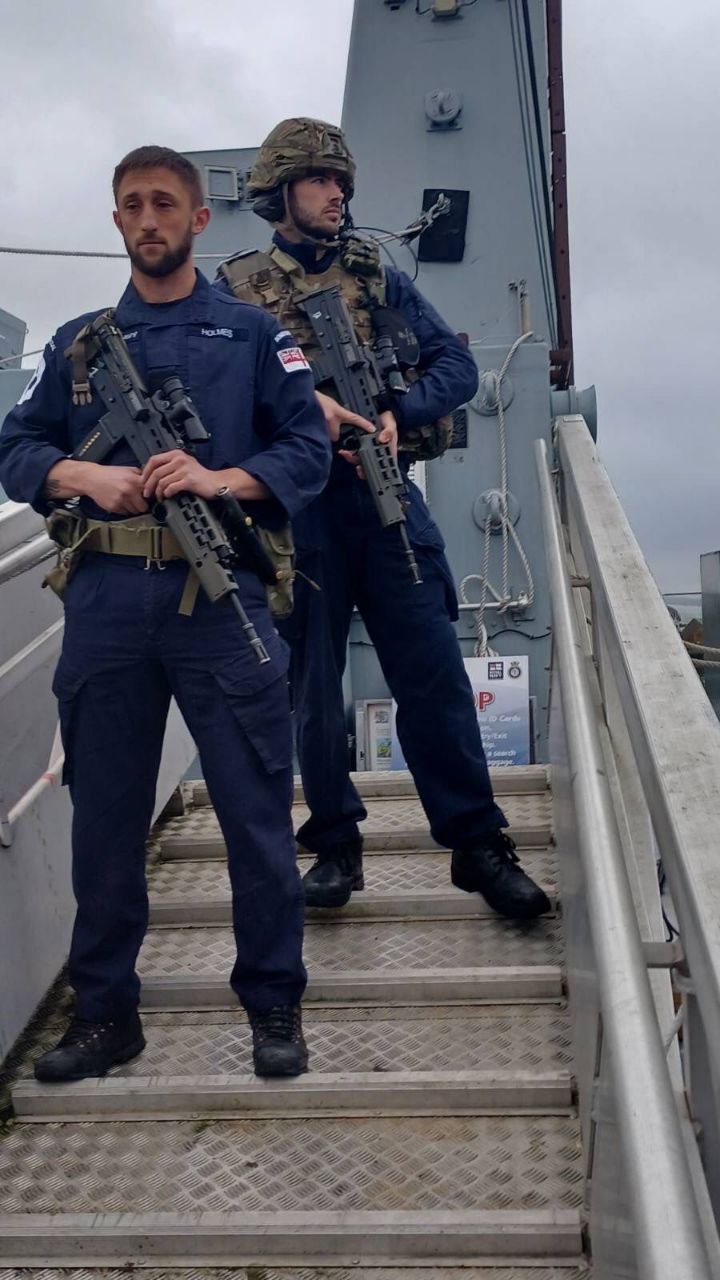
It was alleged that the activists (variously from Saoirse Don Phalaistín and Anti-Imperialist Action organisations) had entered a restricted part of the Dublin Docks and, holding a Palestine flag, had approached a British warship docked there and then occupied the gangway.

British military displaying firearms on Irish state soil in November last year. (Photo: Anti-Imperialist Action)

Gardaí had been called and the activists had refused their instruction to leave under the Public Order legislation and they had then been arrested. No act of violence, physical or verbal, took place on either side other than the refusal to leave and the arrests.

The activists appeared in the Parkgate Street building before Justice John Hughes and all three were defended by Damien Coffey of Sheehan Partners, a law firm which often handles political and human rights cases. Three Gardaí from Store Street acted in the role of the Prosecution.

The Garda in charge of the prosecution and his two colleagues gave evidence as to the arrests. Questioned by Coffey for the Defence, all confirmed that although the protesters had refused to leave, there had been no violence offered by them during their arrests.

Strangely, as shall become evident and relevant, one did not recall the British military presence on the gangway to be armed, whereas another did and confirmed that a photo of the armed men was of those who had been present.

One of the Garda offered his opinion that whereas the vessel was regarded in law as “British soil”, the gangplank was legally “Irish soil” and, if the protesters had actually set foot on the ship, they might have been charged with piracy. This piece of evidence also had unintended consequences.

One of the placards displayed by supporters outside the courthouse (Photo: Rebel Breeze)

According to this evidence, the British in a foreign military uniform had been present on Irish state soil and all replied to the defence lawyer that they were unaware of any Ministerial permission to do so — or that this could have constituted an offence under Section 317 of the Defence Act 1954.1

Furthermore, none were aware of any special permission granted to them to carry firearms on Irish state ground. The British military personnel themselves were not present as witnesses as their superiors had not replied to the Garda request to discuss giving evidence in the case.

Port security camera footage was shown as evidence by which protesters could be seen at the gates of a fenced-off section of the docks and some time later proceeding through a gate. A port security employee had been summoned by the Gardaí as a witness.

After he had been taken through his evidence (and failed to respond to what seemed an attempted prompt) by the Garda in charge the only relevance of his evidence was that a) the area was restricted and b) that he was worried for the safety of the protesters.

This (and the reason for the possible attempted prompt) was of importance when Coffey developed his defence summary on the legal grounds that Section 14 (1) of the Public Order Act required there to be an element of fear arising from the actions of those to be charged under the Act.

None of the evidence for the Prosecution had shown the presence of fear of anyone from the defendants and, furthermore, he submitted, any element of fear was much more likely to arise from the presence of two men holding firearms, to whit, the British military personnel.

The second part of the Defence summary dealt with right to protest, Coffey quoting a number of legal sources, also referencing the Irish Government’s recognition of a Palestinian state and statistics of people killed by the Israeli state against which the activists had been protesting.

Judge Hughes announced that a recess was due for lunch and that he wished to consult legal authority (case law etc) so they would recess and reconvene in an hours’ time.

A number of supporters who had taken time off from other commitments left at this point while a few arrived instead.

THE JUDGEMENT

After reconvening Judge Hughes began his long drawn out summing up and it gradually became clear that he intended to find the accused guilty. However people awaited with varying degrees of patience for the details of the sentence.

The Judge referred to the right to protest but also to the restrictions upon it (usually limiting its effectiveness) though he did not say that, nor that powers exist to abolish those rights when the State feels it necessary.

With regard to the ‘element of fear’ required for conviction under the Public Order Act Hughes quoted a judgement as a reference that seemed neither relevant nor reasonable, involving a woman experiencing fear of being broken into and even fear of children playing outside her home.

Despite repeating the standard claim of capitalist law that judges cannot adjudicate emotionally nor be swayed by what was occurring in Palestine, John Hughes revealed his own political bias when he bizarrely claimed that a British fleet had been welcomed into an Irish port in 1820.

He revealed his political naivety also when he expressed surprise that the British had not replied to the Garda communication regarding the incident.

On submission by Coffey regarding the lack of previous convictions and effect of criminal convictions on the lives of the three, Johnson, again drawing out the moment, gave them what amounts to a conditional discharge with a provisional forfeit of 500 euro.2

No doubt the desire not to create martyrs around whom solidarity campaigns might intensify played at least as much a part as any concern for the lives of the activists.

The defendants and their supporters left; outside the court they were embraced by a number of supporters before the gathering broke up, some attending to other solidarity activities elsewhere. The show of support was a good sign of solidarity against state repression.3

View of some of the people outside the courthouse on Thursday in solidarity with the three activists (Photo: Rebel Breeze)

SERIOUS ISSUES AMONG ELEMENTS OF COMEDY

The name of the British naval vessel being The Penzance and the mention of a possible piracy charge brings to mind of course the Gilbert & Sullivan opera The Pirates of Penzance (1879).

The focus of the Gardaí on arresting peaceful protesters in preference to unauthorised people in foreign military uniform carrying unlicensed firearms on Irish soil and also trying to suggest that not they but the protesters would give rise to fear is not without its comedic elements.

However overall the whole matter is extremely serious, with regard to the zionist genocide in Palestine, the active collusion of the UK/NATO, the active collusion of the Irish ruling class4despite its verbal positions – and the repression of its State on more active and directed solidarity actions.

End.

FOOTNOTES

1 317. — (1) No person shall, save with the consent in writing of a Minister of State, enter or land in the State while wearing any foreign uniform. (2) No person shall, save with the consent in writing of a Minister of State, go into any public place in the State while wearing any foreign uniform.

2 It will not appear as a criminal record but in the event of a subsequent conviction, the 500 euro can be levied as a fine in addition to any other punishment in court sentence.

3 Though the absence of a number of political organisations and trends was also marked.

4 “Dual-use”exports to the zionist state which can be adapted to military use; failure to press for any economic, academic or cultural sanctions against the zionist state; shelving of the Occupied Territories Bill; failure to impose diplomatic sanctions of any kind.

REFERENCES AND USEFUL LINKS

Anti-Imperialist Action

Defence Act, 1954, Section 317 – irishstatutebook.ie

Dunnes Stores, South Africa, Gaza: A Tale of Two Boycotts

Gearóid Ó Loingsigh

29 February 2024

Anti-apartheid activist Nimrod Sejake with some of the Dunnes Stores striker.

Reference has been made on a number of occasions to the heroic actions of the Dunnes Stores Anti-Apartheid strikers in 1984 who spent nigh on three years on strike because they refused to handle South African merchandise.

It has been pointed to as a success story for boycotts and one to emulate. The real story of the strike points to the difficulties we now face in implementing a real boycott of Israel.

I used to go down to the picket line at the Dunnes branch in Henry Street every Wednesday, as we had a half day at school and on Saturdays when there was no school and then more regularly once I had sat my Leaving Cert exam and was, like many young people in 1980s Ireland, unemployed.

So, I recently bought a copy of Mary Manning’s autobiographical account of the strike, Striking Back: The Untold Story of an Anti-Apartheid Striker (Collins Press).

The book brought to mind many of the instances and difficulties that they faced and it raises many questions for those who wish to point to them as an example to follow.

The strikers were implementing a trade union resolution, and at first knew little of the reality of South Africa, something they corrected relatively quickly, thanks in no small part to a South African exile, Nimrod Sejake, who turned up to join them on the picket line.

Sejake was an activist who had been arrested as part of the infamous Treason Trial. Mary Manning is full of praise for Nimrod and rightly so.

Others do not come out so well and it is worth remembering the reality of that strike as it tells us some of the things that need to happen if we want to see similar action in relation to Israel.

The first thing that jumps out of the pages, early on, is that the trade bureaucracy did not give them any support and even their own trade union, IDATU (now called Mandate) was very reluctant to support them.

What support they got was down to their official Brendan Archbold who was a stalwart in supporting them and the then head of the union John Mitchell. At every twist and turn they had to fight the executive of IDATU, whilst the rest of the trade union movement ran for cover.

There will be no similar type of action around the Zionists unless it is put to the bureaucracy and they are challenged over their inaction in the midst of a genocide.

Karen Gearon, the shop steward at Dunnes Store made a call at the National March in Dublin on February 17th for the trade union movement to stop talking and take action. It is not something that has been seriously echoed by others.

Neither People Before Profit TDs or the IPSC have ever made a clear call for action from the trade union movement. It should be a central part of any boycott movement now.

It is all well and good picketing Starbucks, but stopping the importation of Israeli goods would be more important and will only happen if the bureaucracy is pushed to it. The history of PbP is one of cowering in the shadow of the bureaucrats and never putting it up to them on any issue.

They frequently share polite platforms with the bureaucrats and never challenge them. Their calls, when made are generic and are in passing. Their website and the IPSC site is limited to a consumer boycott with calls for the government, not workers, to take action.

I was also reminded by the book how the great and good in Irish society stood by whilst these workers were on strike. The Minister for Labour at the time was Ruairí Quinn, a member of the Irish Anti-Apartheid Movement (IAAM) and yet he did nothing.

He was not the only mealy-mouthed figure in Irish society, nor indeed in the Irish Anti-Apartheid Movement.

The head of the Catholic Bishops Aid Agency, Trócaire, Bishop Eamon Casey privately wrote to IDATU early on describing the strike as ‘economically harmful to the already impoverished Black South Africans.’

The strikers’ request for support from the Catholic Church was described as impertinent and just in case anyone doubted how he saw himself, he was of the view that both he and Trócaire should have been consulted before the strike took place.

Their currency now is much devalued in Ireland but there are others like them who also think they have a veto on decisions.

He was later forced to publicly back the strike having been embarrassed by Archbishop Desmond Tutu’s decision to present two strikers to the world at his London press conference en route to pick up his Nobel Peace Prize.

Though that took a while and meantime nuns proudly scabbed and crossed the picket line. Casey’s attempts at sabotage and his later hypocrisy in belatedly supporting the strike, should not be forgotten.

At the time he was seen as a moral guardian, his plundering of church funds to keep his lover and his child comfortable was not known.

There are lots of other figures like him around now, who we might expect to support workers implementing a boycott, but might not when faced with the reality of it.

Another figure who comes out badly in it is Kader Asmal, the head of the IAAM. After three months of strike action, he met with John Mitchell and Brendan Archbold and told them to call off the strike, that it had served its purpose and that he was pulling his support.

When Desmond Tutu invited the strikers to South Africa he privately told them he would not support them going as it was a breach of the cultural boycott of South Africa.

Their trip to the country and the refusal of the Apartheid regime to let them in along with their detention at the airport was a pivotal moment in the strike.

Upon their return to Ireland, Asmal was one of the people to rush to the airport and give interviews and bask in the glory, as his position opposing the trip was never made public. He comes across very badly in the book.

I recall him asking me for information on South African goods coming through the port where I had begun working and Brendan Archbold telling me not to trust him, that he was a sleiveen and would hang me out to dry. He was, and like him there are others just like that on the issue of Gaza.

The contrast with Nimrod Sejake could not have been greater.

Sejake was a working class militant who suffered greatly and enjoyed none of the middle class trappings of Kader Asmal’s life in Ireland and unlike Asmal he had never crossed a picket line, something Asmal did in Trinity College where he worked, scabbing during a strike there.

There are Palestinian equivalents to Asmal and also to Sejake. The IPSC pretends otherwise.

So, what are the lessons of the Dunnes Stores strike?

One is that it wasn’t just a consumer boycott, it was a workers’ boycott and they were left high and dry by many of those who would have been expected to support them.

If we are going to call for workers action, various people and bodies need to be challenged and would have to commit themselves publicly to it. So far this is absent. PbP and the IPSC are not putting it up to any of the institutions.

View of the protest outside Axa Insurance 14 December 2023 while others inside carried out a protest sit-in. (Photo: D.Breatnach)

In fact, the UNITE union complained about a sit-in at Axa Insurance company saying it was harmful to the workers. The sit-in was not organised by the IPSC but by CATU and Dublin for Gaza.

It turns out that UNITE is a bit like IDATU.

The union has also passed resolutions supporting the campaign of BDS and yet “according to union insiders, Axa is Unite’s insurer in Ireland – and Unite’s designated provider of hotel accommodation is the Leonardo hotel group, which is part-owned by the Israeli Fattal group.”(1)

UNITE members taking action would most likely be shunned by their own union. Just like the head of the IAAM, Kader Asmal had tried to undermine the Dunnes Stores strike, there are those in the IPSC who would run for the hills were workers to take action against Israel.

So, we do need to emulate the Dunnes Stores strikers, but we need to be clear about the challenges and the opposition we would face from the trade union movement itself, the Catholic Church (they never went away either) and sectors of the IPSC.

It is time for action, but it is also high time that both PbP and the IPSC made clear calls for action and workers are not left hung out to dry, should they take action.

Notes

(1)Skwakbox (15/12/2023) Outrage builds over Unite’s use of Israel-linked firms as protestors occupy Axa Dublin office
https://skwawkbox.org/2023/12/15/outrage-builds-over-unites-use-of-israel-linked-firms-as-protesters-occupy-axa-dublin-office/

IRELAND IN RUGBY – AND PALESTINE!

Clive Sulish

(Reading time: 3 mins.)

Thousands on Saturday (24th) witnessed Palestine supporters demonstrating outside the Israeli Embassy in Dublin’s Ballsbridge, their reactions for the most part ranging from neutral to applause, some having their photos taken alongside the picketers.

On this Saturday there was no Palestine solidarity march in Dublin and some instead attended a picket of the Zionist Embassy.

There were also a handful of hostile provocative reactions, ranging from mention of “the hostages” to cheering “Israel” and one who tried to make an issue of Jewishness but was firmly told that opposition to Zionism has nothing to do with anti-semitism.

Palestinian solidarity flag displaying designed by Brazilian political cartoonist Carlos Latuf during an earlier attack by the Zionist State on Palestinians. The building housing the Israeli Embassy is in the background. (Photo: Rebel Breeze)

Those who mention “the hostages” refer only to the 130 or so prisoners taken by the Palestinian resistance in their operation of October 7th, never to the thousands of civilians, including children, taken prisoner by the Zionist state and, if judicially processed, tried in Israeli military courts.

Initially the crowds leaving the Rugby game between the Irish and Welsh teams, seemed neutral as they passed the picketers but gradually grew warmer.

The handful of passersby who expressed support for the Zionist state were militantly denounced by the picketers as “Genocide supporters” but much more common from the crowds were signs of approval such as applause, thumbs-up and occasional cheers and clenched-fist gestures.

A few in the crowd also shook hands with or gave a fist-bump to a demonstrator and some also thanked the picketers.

Some asked to have their photos taken alongside a picketer, one also waving a borrowed Palestinian flag. A woman approached one of the demonstrators, removed her Ireland rugby colours scarf and wrapped it around the picketer’s neck, saying “We support you” before walking away.

One of the Palestine solidarity picketers wearing the Irish rugby colours scarf with which he was presented by one of the Irish team’s fans returning from the game. (Photo: Rebel Breeze)

The nearly non-stop chants of the picketers, led by a young man of Middle Eastern appearance in a keffiyeh were directed at solidarity with the Palestinians and denunciation of the Israeli State, including calls for boycott and sanctions and the expulsion of the Israeli Ambassador.

One of the female demonstrators, a regular at the site, is garbed in white “blood-stained shroud.” At least half the picketers appeared Irish by appearance and accent. A majority were female, which seems to be the pattern in pickets, rallies and marches in solidarity with Palestine.

The thousands who passed the picketers were in contrast to the earlier near-deserted Shelbourne Road, as the Gardaí had closed the road to vehicular traffic in the vicinity of the Aviva Stadium where the Ireland rugby team was playing the Welsh one.

A fragment of the rugby fans leaving the Aviva Stadium after the game and passing the picketers. (Photo: Rebel Breeze)

The Israeli Embassy moved in 2019 to its current location on the fifth floor of a multiple-business-occupied building at 23 Shelbourne Road. Formerly the zionist embassy occupied an upper floor at Carrisbrook House, Northumberland Road, with every other floor unoccupied.

Some of the occupants of the current building, which is protected by a Garda presence, have reportedly asked their landlord to remove the Embassy but the request was denied.

When Gardaí reopened the road a senior Garda officer directed the demonstrators, ‘for their safety’, to remove from the road in front of the Embassy building to the side. However, it is the Gardaí who have barricaded off the entire section of pedestrian pavement in front of the building.

It seems likely that this will become an issue at some point in the future.

The scene outside the Israeli Embassy in Dublin shortly before the commencement of the protest, showing the pedestrian footpath completely fenced off by Garda barricades. (Photo: Rebel Breeze)

THE RUGBY

The Irish team beat the Welsh one 31-7 on Saturday. The Irish rugby team is a 32-County team, unlike soccer, where the Irish state and the colony each has their own ‘national’ team and are obliged to compete against one another internationally.

However, the song played for the Irish rugby team is the anodyne Ireland’s Call and not Amhrán na bhFiann/ The Soldiers Song, which is played for the Irish soccer team and in Gaelic Athletic games.

Rugby has gained in wider popularity in Ireland in recent decades but formerly in most parts of Ireland was considered a game for Anglophiles or “West Brits”.

Also, with the exception of Limerick, socially a game of the upper middle class, being played in Anglican colleges and in Catholic colleges of the English public school model.

Until the advent of the now-defunct Irish Press(1931-1995), neither of the main national newspapers, The Irish Times nor The Irish Independent reported on Gaelic Athletic Association games, reporting instead on the minority rugby, hockey and cricket matches.

End.

(Photo: Rebel Breeze)