People outside the Mexican Embassy in Dublin on Wednesday evening remember the 43 students and call for justice.
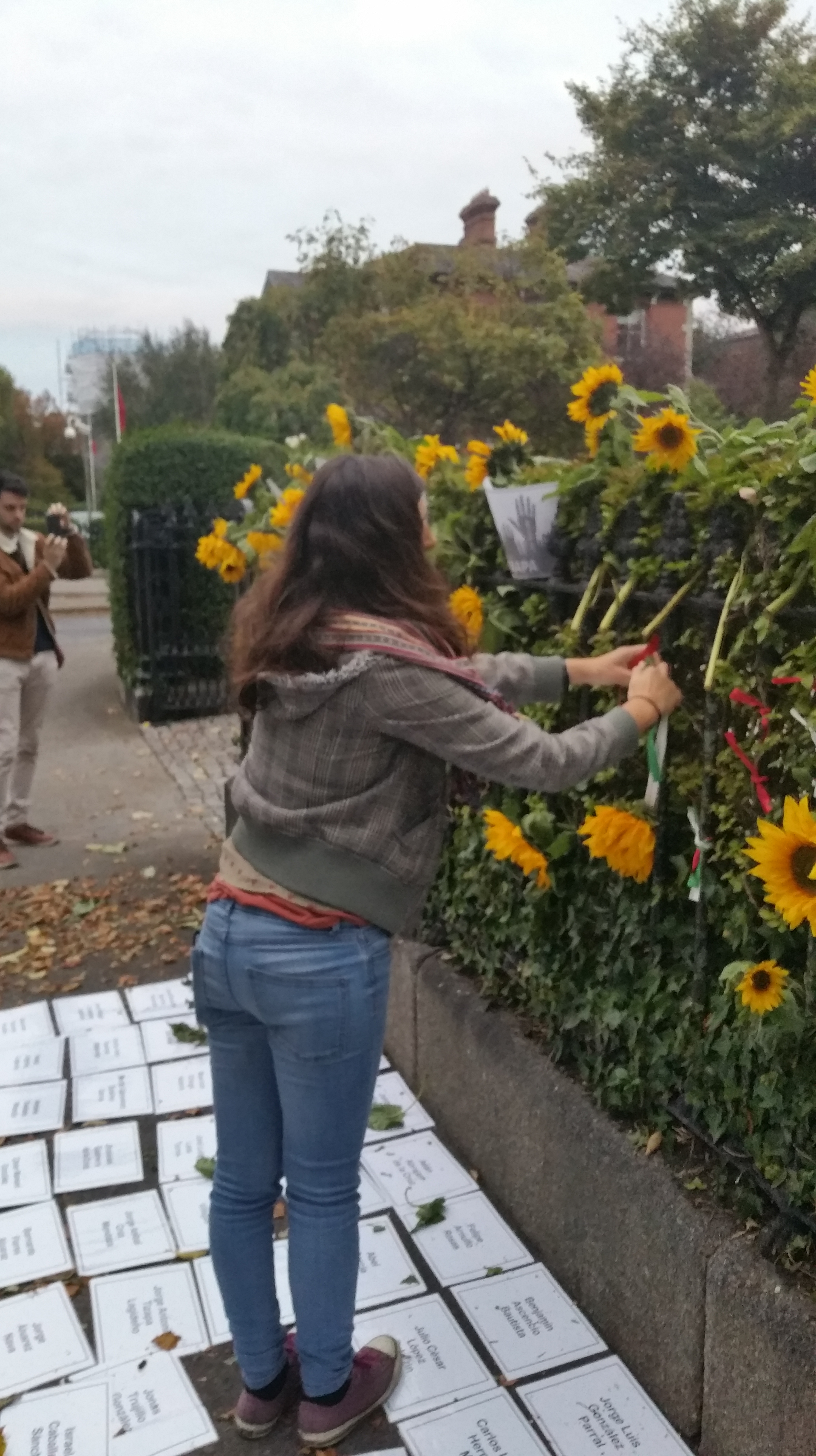
(Photo: D.Breatnach)Names of the Disappeared being laid outside the Mexican Embassy (Photo: D.Breatnach)
A short but moving event was held in Dublin yesterday evening (Thursday 26th September) to remember the 43 Mexican students made to “disappear” in Mexico by the authorities or in collusion with them on 26th September 2014. The students from the Ayotzinapa Rural Teachers’ College were kidnapped while they were taking part in an annual commemoration of the Tlatelolco Massacre (of 300-400 students and other civilians by police and military on 2nd October 1968, less than a fortnight before the opening of the Olympics in the city that year). They are widely believed to have been murdered and a supposed investigation by Mexican State authorities petered out without a result.
Names of the Disappeared being laid outside the Mexican Embassy (Photo: D.Breatnach)Some staff leaving the Mexican Embassy in Dublin (Photo: D.Breatnach)Names of the Disappeared being laid outside the Mexican Embassy (Photo: D.Breatnach)(Photo: D.Breatnach)
The event last night was organised by the Mexico Ireland Solidarity Collective (MISC) and Latin America Solidarity Centre (LASC). Sunflowers as a symbol of hope were placed in the railing of the Mexican Embassy in Raglan Road, Dublin and ribbons in the Mexican colours of green, white and red were also tied there. The names of the 43 “disappeared” students were laid on the pavement in front of the Embassy which, like the embassies of a number of other states, is located in a quiet upper-middle class area south of the Grand Canal. Few people passed the remembrance event and staff leaving the Embassy did not stop to talk to the gathering except for the last two who greeted them politely and took a photo of the display.
A spokesperson for MISC said that the event is organised every year so that the people are not forgotten.
People took turns to read the name of each of the 43 from their cards and the traditional “Presente!” was called out after each one, signifying that alive or dead, they are present with us, remembered.
A statement was read and some verses from Woody Guthries’s Plane Crash at Los Gatos were sung and then a long silence was observed, which ended with a call for “Justicia!”
end.
Placing the sunflowers for hope outside the Mexican Embassy (Photo: D.Breatnach) (Photo: D.Breatnach)Reading a statement on the Disappeared outside the Mexican Embassy (Photo: D.Breatnach)
Placing the sunflowers of hope (Photo: D.Breatnach)Protesters in Mexico demanding the authorities reveal what happened to the 43 students. (Photo source: Internet)
Motorbike cops zoom up to junctions at noon in Dublin today, lights flashing and hold traffic up to clear the way for what is coming. But who or what is it that is coming? “Must be some nasty capitalist diplomatic representative from abroad”, we think. “Or maybe one of our own Gombeen Government politicians,” we add as an afterthought. And usually we’d be right — but not this time.
(All photos source: D.Breatnach).
It’s the annual Taxi-Drivers’ Day Out for Special Needs Children.
A quick search failed to find anything on Google about it other than a post from a Journal.ie report dated last year. From that I learned that this is an annual event, first organised in those far-off days of unfunded un-NGO-organised community events — 1960 to be precise.
The report from last year quoted a figure of 400 taxi-drivers signed up for the day but the organiser was appealing for more drivers still. The report stated that the previous year (2016), 1,000 children had been taken on the day out.
The following three paragraphs are from the Journal’s pre-event report last year.
‘On the day, children are picked up from hospitals, care homes or private homes by their own personal taxi driver for the day. From there, they are taken to Parnell Square where all taxis gather for a speech by the Lord Mayor and some music from the Garda Band and DJs.
‘The taxis are then escorted through the city by gardaí to the racecourse where they are treated to music, games, face-painting and finger food.
‘“Our aim is to treat the special needs children of the city to a fun day out and put smiles on faces. That’s exactly what you get when they arrive in Parnell Square and they’re meeting and greeting the mascots and characters,” Matthews (the organiser) said.
These photos were taken from outside Liberty Hall, where I was awaiting a group in order to start a history tour.
PS: Good to see the cops were not masked, wielding batons and pepper-spray canisters or carrying machine-guns and battering-ram.
Martin McDonagh’s play, A Skull in Connemara, one of his Leenane Trilogy, directed by Andrew Flynn, is currently playing at the Olympia in Dublin’s Dame Street. With a cast of four the play takes us on a hilarious tour of hidden secrets and gossip in a rural community but with a dark side hinted at and growing towards the end. Despite the buildup, there is more than one surprise – and shock even – in store.
What one might call the central character is Mick Dowd (Pat Shortt) a gravedigger with a difference: his job is to dig up old graves and to collect the remains to transfer to another location. The population is outgrowing or outbreeding the available graveyard space. He is visited by a Mary Johnny, a local elderly woman (played by Maria McDermottroe) whose grandsons appear later, the youngest being Máirtín (Jarlath Tivnan), with an unhealthy interest in the macabre and wishing to be the gravedigger’s apprentice. His brother is local Garda Tom Hanlon (Patrick Ryan), who aspires to promotion as a detective.
The dialogue is fast at times while at others, silence or sparse words are used effectively. It is hilarious but the shadow of secret is never very far from the sunshine. In terms of acting, one must complement them all but Jarlath Tivnan as Máirtín really stands out. He was, it is true, given some marvelous dialogue (though perhaps a little irritating at the beginning) and acting lines, but he makes the best of it and his physical acting is extraordinary.
I didn’t see the previous production four years ago at the Gaiety, when it got a bad review from John McKeown in the Irish Independent but I’d have to disagree with his opinion of the script.
The sets, or really one set that converts into another, combined with the lighting, are really excellent. It takes some imagination to convert a house into a graveyard and some skill to convince the audience that they have moved from one to the other but this is achieved; one can see why the designers Owen McCarthaigh and Sinead McKenna are winners of the Irish Times Theatre Award.I
McDonagh gained fame (and some controversy) with his West of Ireland trilogies, some plays more than others but he is the author of another four plays and the film script for Six Shooter, for which he won an Academy Award in 2004.
Adverse criticism of A Skull? A little. As indeed the title informs us A Skull in Connemara is set in the West of Ireland, as with the rest of McDonagh’s Leenane Trilogy and also his Aran Trilogy but, in reality, it could be anywhere in rural Ireland. Some would say this is its strength but I regret that the only concession I noted to the Irish language was that the woman carries the name of a parent attached to her own, as is the custom in the shrinking Irish-speaking districts … and that one of the characters is named Máirtín.
And, though most of the time not noticed, one does wonder what the reason for the huge cracks and the cross etched into the house walls are about, making it appear perhaps as a set for the Mexican Mission in a play about the Alamo.
Whether you agree with those criticisms or do not, you will I feel sure enjoy it. The audience last night did and many, perhaps most, gave it a standing ovation. A Skull in Connemara is set to run to September 1st.
English Prince Harry Windsor and his bride Meaghan were in Ireland this week and were shown around Dublin.
“Ah yeah, this is where we fought yez in 1171 ….
“Our people were banned from the city for a while after that. Yes, security … quite ….
In 1366 yez got in a strop wit yer own people for starting to talk Irish, wearing Irish clothes, playing Irish games …. Called them ‘the degenerate English’ … said they’d become ‘more Irish than the Irish themselves.’ Yes, a few of them got hung.
There’s where some of our chieftains’ sons escaped your jail in 1592 after you took them hostage — some never escaped of course, ha, ha and their heads remained on spikes. Yes, a bit gruesome.
Then in the 1640s again because yer people wouldn’t change their religion (nor us, as it happens). Yes, old Oliver. I know, your family’s not too fond of him either ….
“This used to be ours, Meaghan.” Prince Harry Windsor and Meaghan in Dublin Castle, July 2018. (Photo source: Internet)
Yes, Trinity College, founded by yer own Queen Elizabeth. What, no, bless me, not her Majesty now — the first one! Well, to educate yer people here in the Protestant faith because they were being sent off to Catholic countries to be educated.
Just down the hill there’s where yez arrested the Leinster Directorate of the United irishmen in 1798. No, mostly Protestants …
And the bridges there, where yez hung a lot of their followers, putting their bodies in Croppies’ Acre afterwards, just across the river there. No, not a graveyard as such — a mass grave, just a hole in the ground. There are quite a few songs about that period. Yes, still sung today.
And across the road there is where the irish Parliament was — well, Anglicans only — abolished to precede the Act of Union in 1801. Yes, that was when all of Ireland became part of the UK.
….. Back up there, Robert Emmet was hung and beheaded two years later …. Yes, there is a song about that too.
Ah yes, and just down from the Castle, which was yer Headquarters, is where the The United Irishman newspaper was suppressed in 1848 and its editors and writers sent to Australia and Tasmania. No, not for a holiday — as convicts.
Now, across the river … Worker killed there during the 1913 Lockout and many injured by police the day after too. Oh, it lasted about eight months. Yes, it is a long time, your Highness. But they had some help from England. Oh, not from the Government, not at all, bless your Highness. From British trade unionists. Yes, a few songs about that Lockout also. Yes, we are very musical, thank you.
Oh yes, Bachelor’s Walk Massacre over there, 1914 …. No, nothing to do with stag parties — though sometimes …. No, not by the IRA — by the Scottish Borderers, British Army.
1916 Rising fighting post there …. there …. over there to the East …. further back there to the west…. and south …. and there. Yes, fourteen executed in the Kilmainham Gaol Museum …. no, it wasn’t a museum at the time … Oh, many, many songs …
Now, over there was where Kevin Barry was hung … Yes, there is a song about that as well, your Highness.
One of the RIC G-men shot there by our people… and another over there … Ah, the RIC? Well, sort of like yer PSNI up north now …
Civil War, yes, 1922 -’23. Yes, Collins was glad of yer cannons for that.
Dublin Bombings …. yes, in 1974. The IRA? No, bless me, not at all! Yer own intelligence service and loyal allies. Yes, it was …. biggest number of deaths in one day during the whole recent 30 years war. No, strangely, not one arrest ……
No, the British Embassy’s not in the City Centre anymore, Your Royal Highness Meaghan …. not since 1972. Well it got burned. No, not accidentally — a big crowd burned it after Bloody Sunday up in Derry, you know, when 14 were killed by your father-in-law’s regiment ….
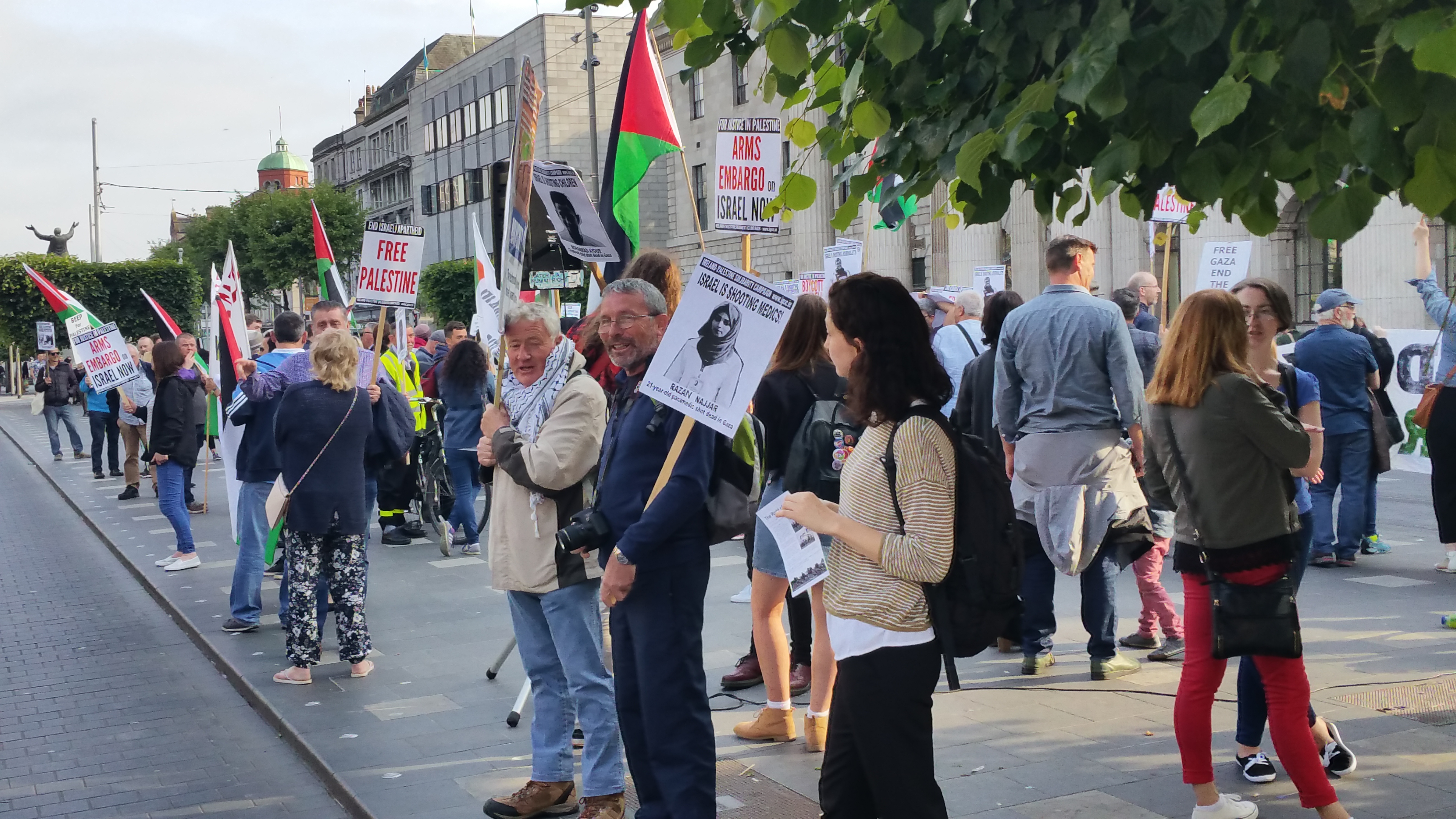
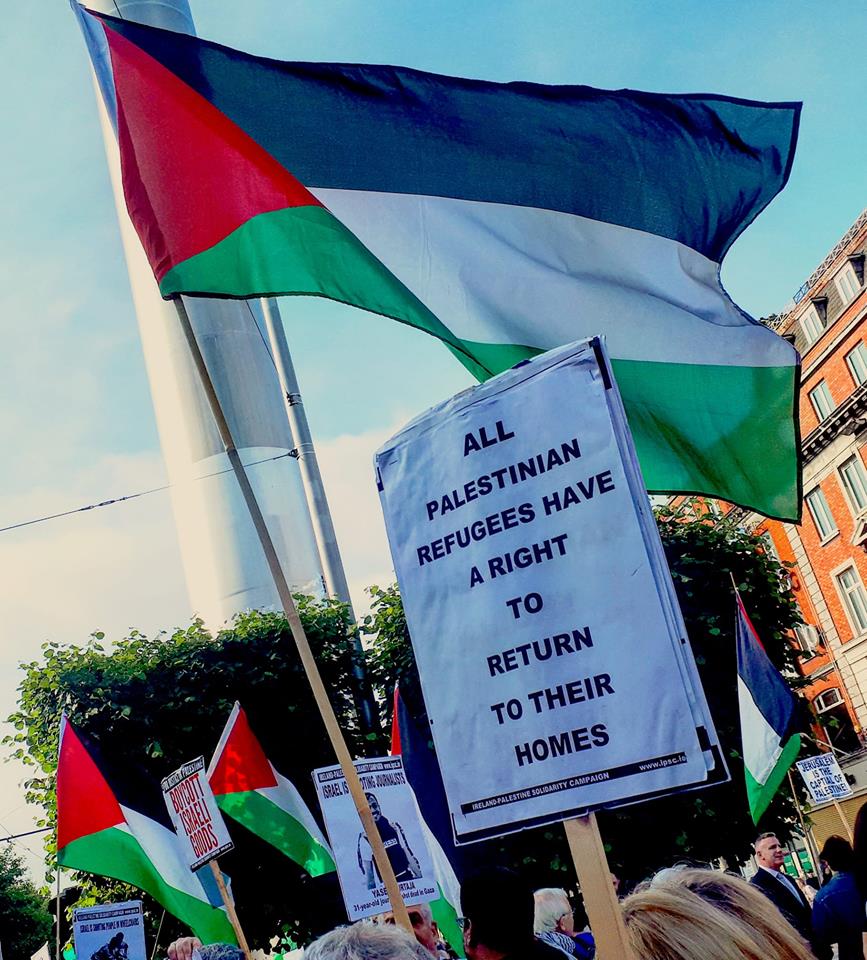
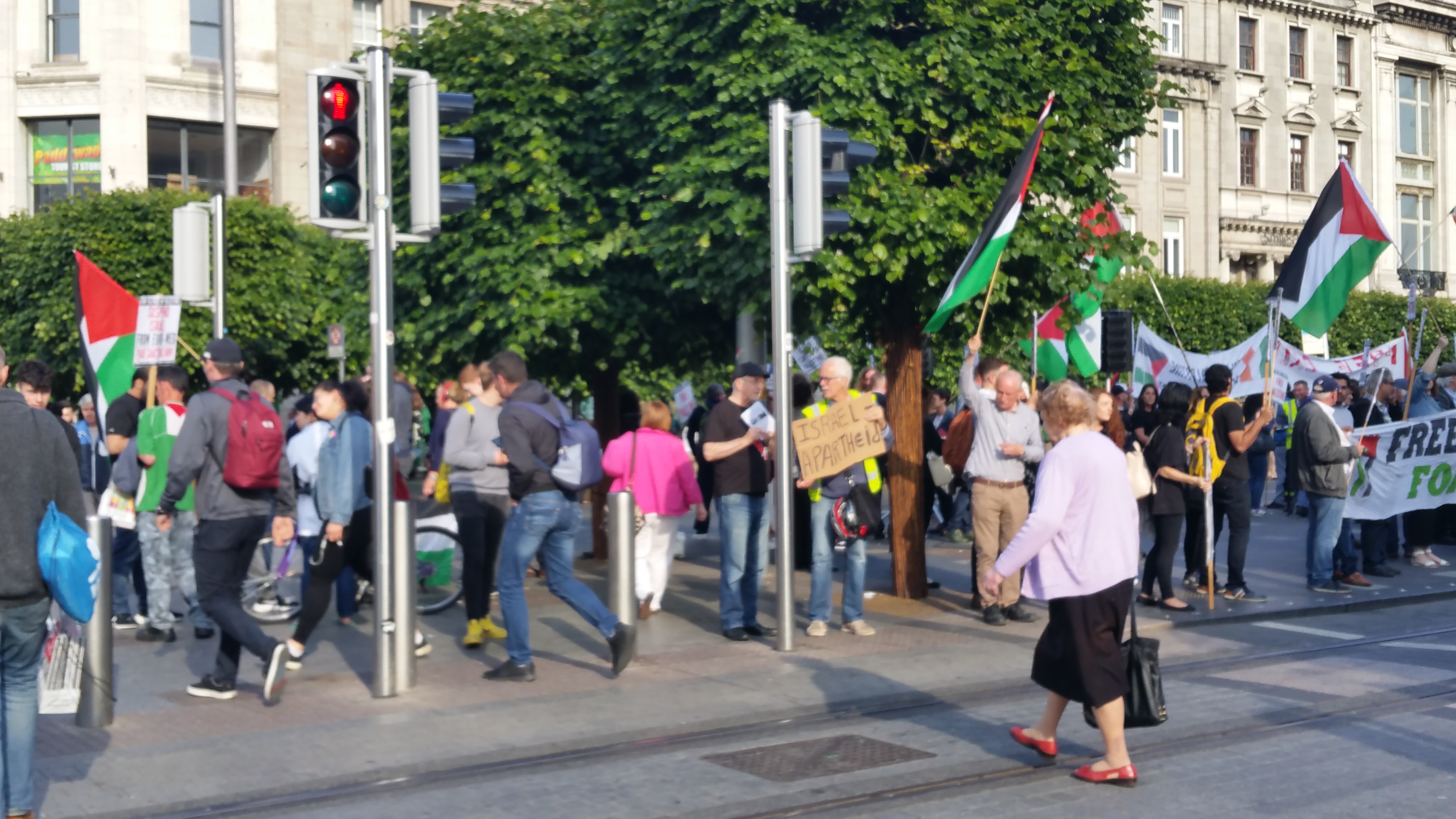
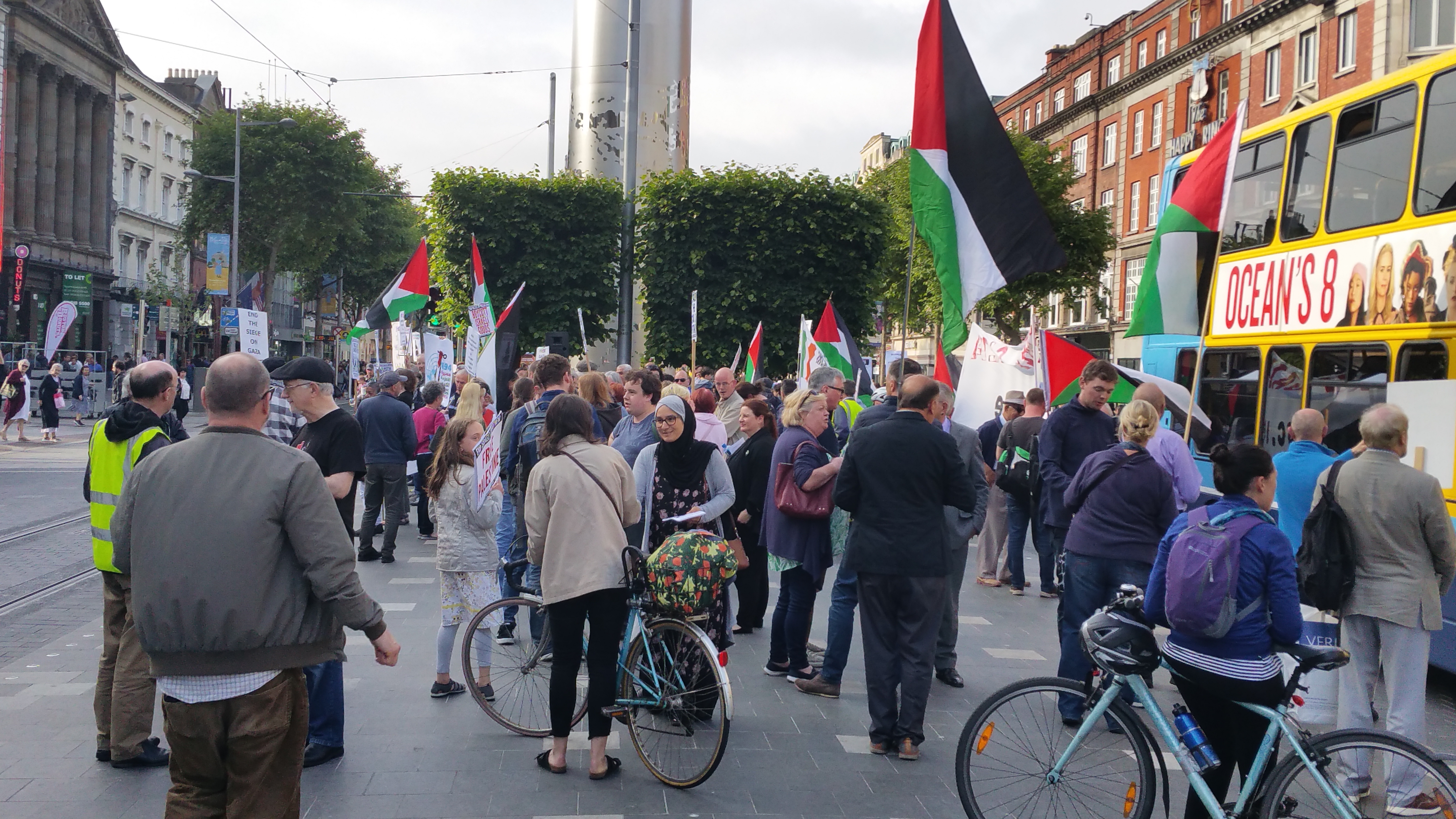
The regular blowing of horns by passing motorists, including taxis and buses, would have indicated that something of interest was happening in the city centre yesterday, Monday 5th June. As people came within sight of the centre of O’Connell Street, they could also see the Palestinian flags flying, the banners and the placards.
View of the rally on the east side of the central pedestrian reservation, looking southwards. (Photo: D. Breatnach)
The Great Return March
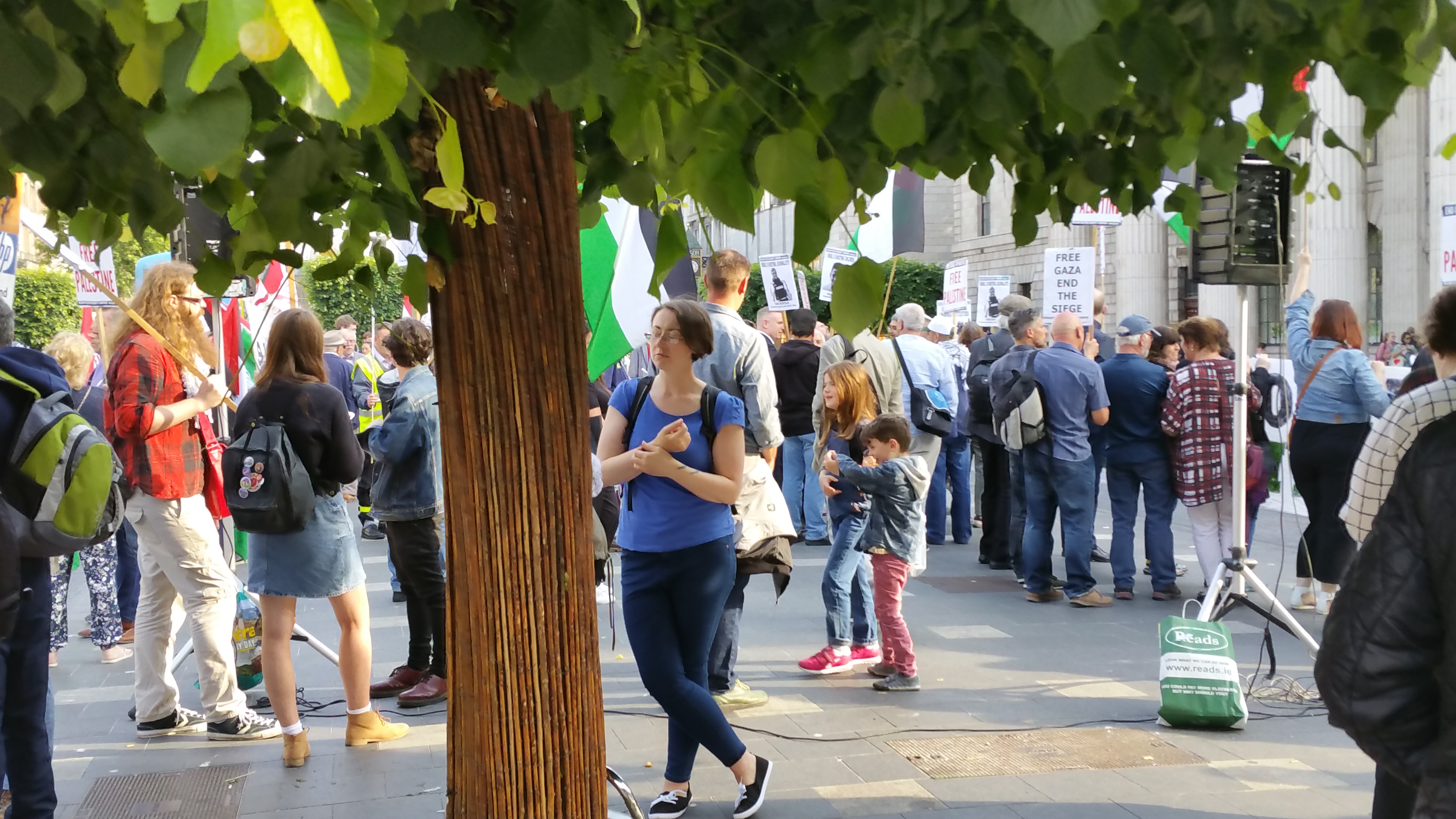
The Ireland Palestine Solidarity Campaign had convened a rally of hundreds in the central pedestrian reservation of O’Connell Street, main street of Ireland’s capital city, near to the Spire and opposite the historic and iconic building, the General Post Office. Billed as a rally in solidarity with the Great Return March of Palestinians, demonstrators carried placards denouncing the shooting dead by Israeli soldiers of demonstrators as well as of journalists and paramedics. The Palestinian death toll since March 30th has reached 120, with over 5,500 injured. Palestinians have also accused Israeli snipers, when they wish not to kill, of shooting young men through parts of their legs calculated to ensure permanent disability. The shooting dead of unarmed protesters, the killing of paramedics and journalists (who wear clearly identifiable clothing), are all crimes according to international law but, as Palestinians and their supporters repeatedly ask, who will hold Israel to account?
A view of part of the rally on the central pedestrian reservation, looking southwards. (Photo: D. Breatnach)
The demonstrators being targeted by Israeli military are protesting the expulsion by Israel of 700,000 of what was then the majority Arab population of Palestine in 1948, followed by their exclusion and that of their descendants from Israeli-controlled Palestine. There are an estimated four million Palestinians 1 barred from entry to Palestine, their lands or those of their grandparents, while anybody in the world who can prove his or her Jewishness, even though their families had not lived there for thousands of years2, can gain entry and claim Israeli citizenship.
Placards held by supporters in the rally yesterday upheld the right of the Palestinians to return to their homeland. It is ironic that the Zionists since 1924 at least have been upholding that demand for people who had never set foot in the land, nor whose ancestors had not for thousands of years but are denying that right to Palestinians driven out within living memory and their descendants.
View of the rally on the west side of the central pedestrian reservation, sretching southwards. (Photo: D. Breatnach)
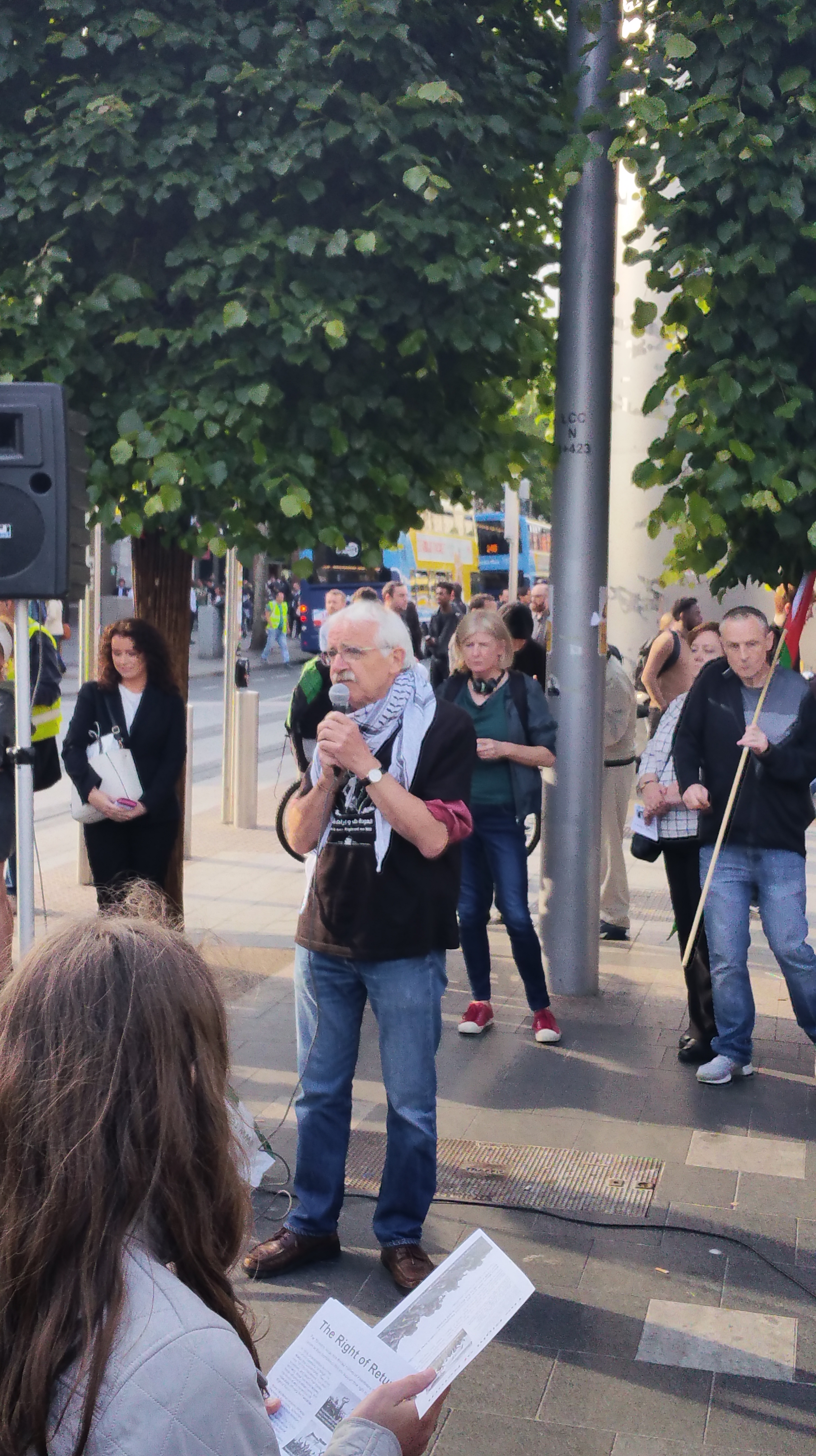
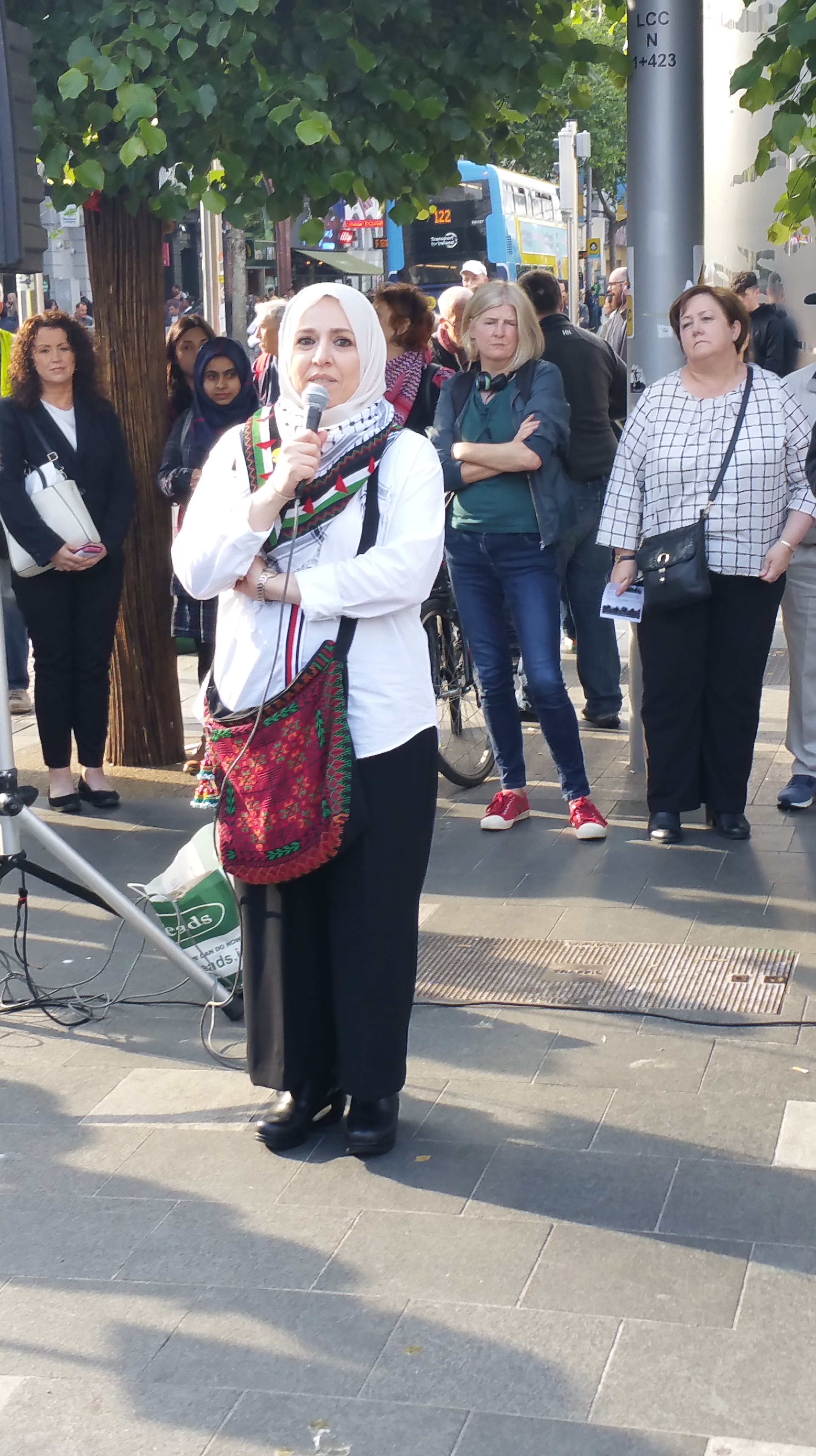
Speaking through a microphone, Martin Quigley thanked those attending the rally and after some remarks, introduced the Chairperson of the IPSC, Fatin Al Tamimi. Speaking about the right of return of Palestinians, Tamimi also said that she had relatives in both Hebron (West Bank) and in the Gaza strip and spoke about the privations of the people there blockaded by Israel, including contaminated water and lack of electricity. However not only is Israel guilty but also Egypt, as Tamimi alluded to when she said that Egypt had only temporarily opened the Rafah Crossing Gate, which Egypt maintains, for the feast of Ramadan, as a result of which she was expecting to be able to see her sister for the first time in seven years (the crowd cheered and applauded this news).
Marting Quigley for IPSC. (Photo: D. Breatnach)
“Expel the Israeli Ambassador and close down the Embassy!”
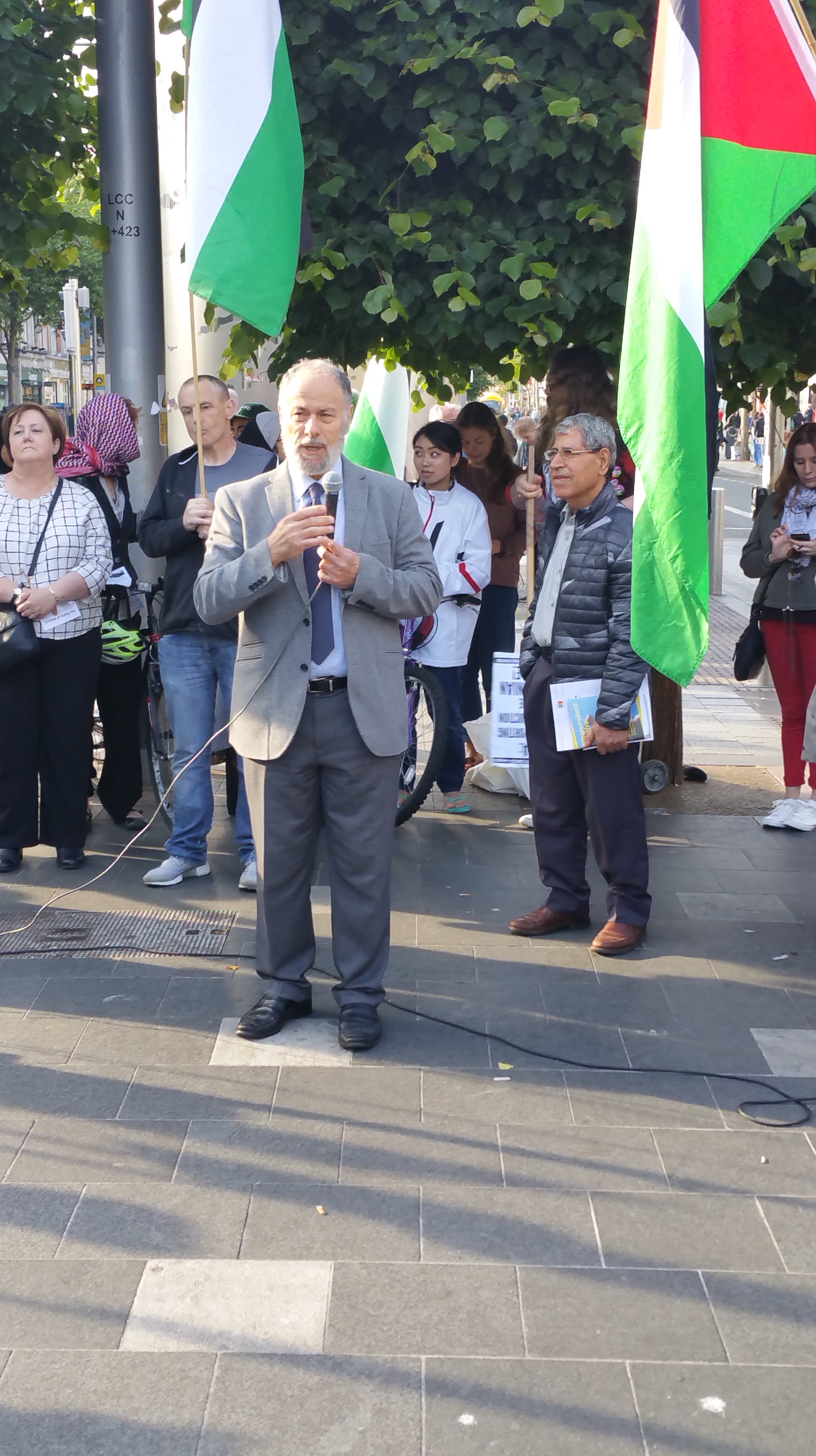
Two other Palestinian speakers addressed the rally, including one who had come out through that very Rafah crossing, Asad abu Shark who was introduced as from the Great March of Return and Ahmad El Habbash, introduced as representing the Palestinian Community in All Ireland3. All speakers drew attention to the Nakba (from Yawm an-Nakba, meaning “Day of the Catastrophe”, referring to the expulsion of thousands of Palestinians in 1948 –), to the right of return, the terrible conditions within the Gaza strip (which place, they said, would become uninhabitable by 2020 — see link), the impunity of the Israeli authorities and the inactivity of “the international community”.
Fatin Al Tamimi, Chairperson of IPSC, addressing the rally. (Photo: D. Breatnach)
Al Tamimi was cheered loudly when she called for the expulsion of the Israeli Ambassador to Ireland and the closure of the Israeli Embassy, a call repeated by other speakers.
Ronit Lenten, who introduced herself as “an Israeli Jew” and representing Academics For Palestine (Ireland), also spoke briefly.
Last to speak was John Lyons, a Dublin City Councillor for the People Before Profit party, who made similar points. Referring to visit of his own to Palestine he referred to the courage and persistence of the Palestinians in merely trying to live their daily lives under the conditions of Israeli military occupation, apartheid and harassment and called on the Irish people to match that determination in taking action in solidarity with the Palestinians.
An Ireland-based Palestinian speaker addressing the rally. (Photo: D. Breatnach)
Throughout the speeches, the solidarity beeping of horns of passing car and bus drivers could be heard and occasionally shouts of encouragement from open bus or car windows.
Bill to ban imports from Occupied Territories
All speaker highlighted the importance of the BDS campaign (Boycott, Divestment and Sanctions) and the need for Irish people to contact their elected public representatives to ask them for concrete action in support of Israel, including for a Bill to be introduced in the Seanad by Senator Francis Black, (well-known singer, also campaigner for human rights and for support for recovery from alcohol addiction). The Bill in question is the Occupied Territories Bill, the intention of which is to place a national ban on any products shown to be exported from territories under illegal occupation. The Bill, a draft of which has already been approved in committee (see link), is expected to go before the Seanad in July, though that may change and, if passed twice there, will go on to the Oireachtas for debate and, if passed there, into Irish law.
One of the IPSC’s leafleters and passers-by who have just accepted a leaflet. (Photo: D. Breatnach)
Calling on all present to stay in touch with the IPSC or with other Palestine solidarity organisation, Martin Quigley brought the event to an end by leading the rally in leading a number of chants: “From the river to the sea, Palestine will be free!” “Free, free Palestine!” “One, two, three, four – occupation no more!” “Five, six, seven, eight – Israel is a fascist state!”
Early moments as Palestinian supporters gather, view northwards. (Photo: D. Breatnach)
Argentina cancels scheduled football match with Israel. Dozens of Palestine flags defy GAA ban.
In a separate but related development, the national soccer team of Argentina yielded to calls to abandon its scheduled ‘friendly’ match with the Israeli national soccer team (see relevant link). Strong advocacy for the cancellation had been brought about by the movement for BDS both within and outside Argentina but statements of team officials to the media made it appear that members of the team had been threatened (but without producing any evidence of such).
And on Sunday, dozens of Palestinian flags were flown during a match at Omagh between Senior Gaelic Football teams Tyrone and Monaghan. The actions seemed not only to represent solidarity with the Palestinians at this time but also defiance of GAA officials who had removed flags and a banner at a previous match (see relevant link).
End.
POSTSCRIPT:
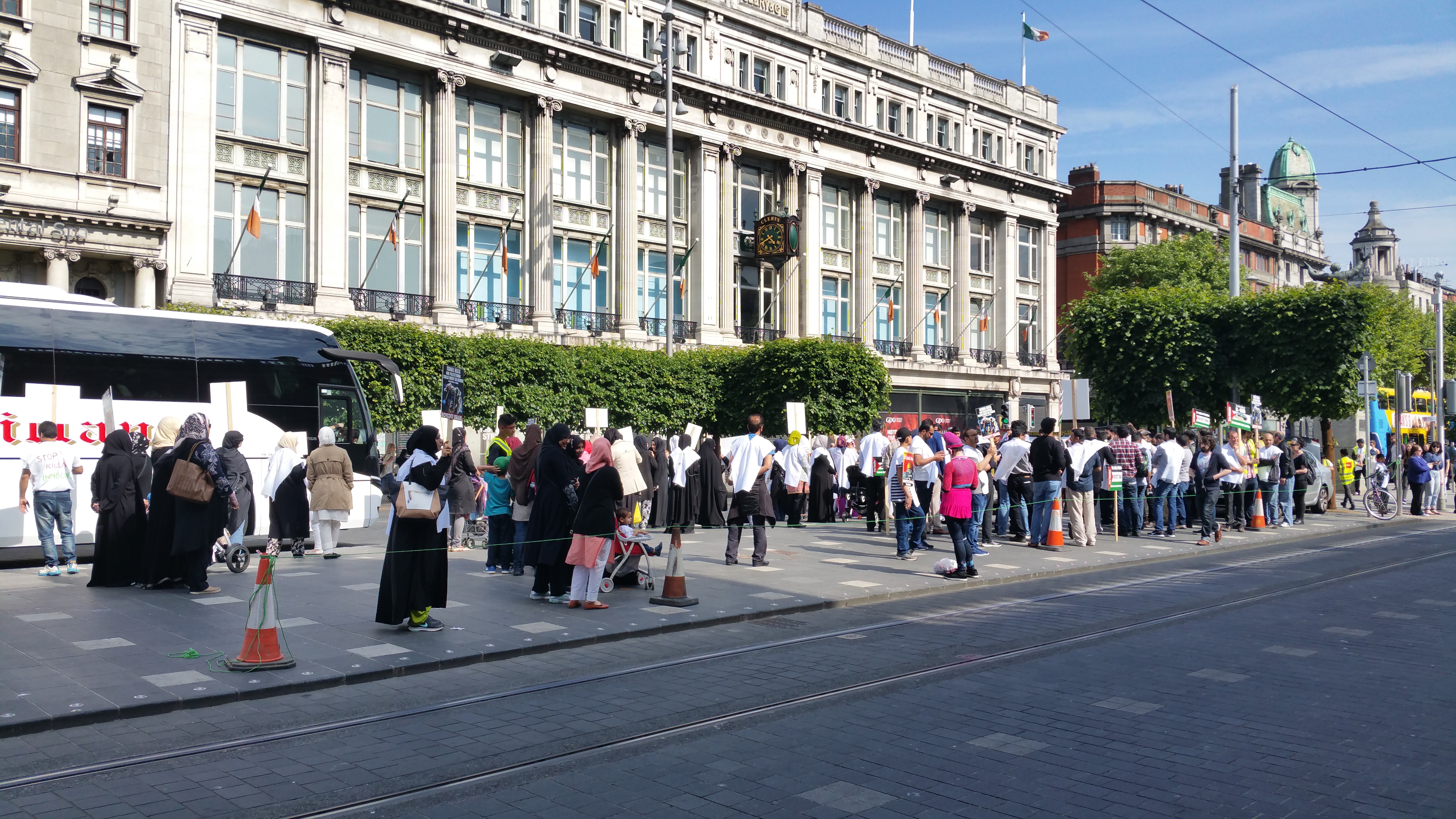
Palestinian solidarity demonstration in Dublin Friday 8th June (not organised by IPSC). (Photo: D.Breatnach)
Footnotes:
1“Today the number who qualify for UNRWA’s (United Nations Refugee and Welfare Agency) services has grown to over 4 million. One third of whom live in the West Bank and Gaza; slightly less than one third in Jordan; 17% in Syria and Lebanon (Bowker, 2003, p. 72) and around 15% in other Arab and Western countries. Approximately 1 million refugees have no form of identification other than an UNRWA identification card.”
2Or the many Jewish converts who never had any contact whatsoever with Palestine.
3 Actually no individual or separate organisation can claim legitimately to “represent the Palestine community in Ireland or anywhere” but there does exist a Palestinian organisation in Ireland which has appropriated that title as its organisational name. A number of different organisations (and none) find support among the general expatriate Palestinian community, including Hamas, Al Fatah and perhaps the PFLP.
I stand shoulder to shoulder with my fellow countrymen and women against the injustices wrought on the people of my beloved country, be it civil rights or human rights I will stand with you. If I ask you the people of Ireland to stand with me to ensure my civil and human rights are upheld – will you? Or will you exile me to foreign soil to seek a medical procedure that is denied to me here unless I`m at death’s door?
I grew up in the 70`s & 80`s. Abortion was not a subject that was openly discussed, the general consensus was only “floozies” had them. Abortion came into my young life when a conversation between adults was overheard: “yer one took the boat”; “she is a baby killer”; “the babbie was deformed” etc. Their victim was a mother of one who had an abortion due to FFA (fatal foetal abnormality); if she carried to term like she was advised by doctors it would have resulted in her death. This woman lived the rest of her life filled with shame and guilt not only for making the choice to terminate but because of the closed minds and nasty hateful words of those around her. Cancer claimed her life, in her words “it was God`s punishment for killing my baby”. Like so many women before and after her she had to leave her baby’s remains in a foreign clinic, forever separated because of laws that said a mother trying to save her own life was a criminal! Her husband and son had the baby’s name engraved on her headstone, uniting them again if only in name.
Here we are in 2018, a so-called new liberal age when marriage between same-sex couples is legal, they are rightfully afforded the same rights as a heterosexual married couple, yet a woman is denied the right to her own bodily autonomy. The fear-mongering is still the same, cries of “it will be used as a form of contraception!” echo the cries of “Floozie”.
I am a mother of three much wanted children; my eldest daughter from my first marriage was conceived with the help of ICSI. I miscarried two of the embryos implanted with her early in the pregnancy and in time suffered more miscarriages. I was then blessed with my son and youngest daughter with my second husband. I have also suffered because of the 8th Amendment. I was forced to have three major abdominal surgeries against my will to save the life of the baby. My eldest was delivered a month early as my waters broke but not completely. The decision was taken to deliver her by c-section when I developed an infection that they feared would put the baby at risk although she showed no signs of any ill effects. I was put under general anaesthetic and did not get to see my baby till the next day due to my reaction to the anaesthetic. I developed a massive infection in my wound in the hospital which took six months to clear. My son was delivered in the same way as I was not progressing fast enough; I was in labour a mere five hours.
After my first experience I was terrified, in the height of pain and in great fear I refused. My husband was told if I kept refusing I would be sectioned under the mental health act and he could lose me and my son. The doctor was somewhat sympathetic, he allowed my husband to try and comfort me yet at the same time booking the theatre for the c-section.
I was lucky this time, I was awake for the birth but again developed a massive wound infection while in hospital.
My third and final dance with the 8th came when I was told during my pregnancy on my youngest daughter that as my womb was so weak due to the previous sections and subsequent wound infections I would not be allowed deliver her naturally. All my children suffered with shock due to their arrival into the world. My consent was not needed for any of these major surgeries, my body was not my own because the baby`s life came before my own, I live with the consequences of the infections to this day.
RAGING DEBATES — HOW FAR HAVE WE COME?
The raging debates regarding the upcoming vote have brought out the worst in many. I have had my life threatened, been called the vilest of names, my morals and suitability as a mother called into question because I`m pro choice. Ridiculous arguments thrown at me, I answer all these arguments with “I am pro-choice be that keep, abortion or adoption”, only to be met with more scorn and a refusal to engage in a sensible debate. I have been judged without people knowing what brought me to my stand on repealing the 8th: the suffering of a mother, my own experience of the 8th, a love for the women of my country.
100 years after a minority of woman were given the right to vote, I hear about sexual equality but I have to question this when an unborn foetus up until birth shares the same if not more rights than the woman who is used as a vessel. How far have we truly come in this liberal country? How can we speak of equality or loving both when our women have no say over their own body at the most vulnerable time of her life?
Crisis pregnancies, FFA, happen each day, the support we offer these woman is to exile them in shame to face a medical procedure in many cases alone on foreign soil. We force women to procure abortion pills online putting her life at risk in fear of discovery and face up to 14 years in prison, we force women to leave the babies remains in a foreign clinic, or to smuggle it into the country to bury it in secret, to have the cremated remains delivered in the post.
I will vote to repeal the 8th as I want to live in a country where I have a say over my own body, for my daughters and all the generations to come. I will stand shoulder to shoulder with all the women in Ireland. I will stand against the shame and fear culture we inflict on our women. I will vote Yes so young girls like Ann Lovett do not die because she could tell no one she was pregnant, so young girls like the X Case have a choice, for all the women like Savita Halappanava who died unnecessarily. Ireland owes it to our women to put them first.
As we have been shown this year, if we did not already know, Spring comes in its own time. Roughly around the calendar yes, but not exactly. It’s not like the clothing merchants, who withdrew the gloves in March and left people like me, who regularly lose them, with frozen hands unable to buy cheap replacements while the models stood in windows in shorts and bikinis.
But spring wild flowers are already out and have been for weeks, though the city is not a great place to see them. However in gardens, parks, canal banks and on empty sites, the dandelion, much disregarded as a decorative flower has been flaunting its bright yellow flower for weeks and will continue to do so for quite a while yet.
Some variety of Speedwell and Cat’s Ear (Photo D.Breatnach)Furze (Aiteann) in bloom (photo: D.Breatnach)
In early April I spent a few days in Wicklow by the Dartry river. In a very short walk to Ashford I encountered eight types of wild flowers in bloom, including furze (or gorse), daisies,
Fumitory maybe (pink), mystery white flower on stalk and Groundsel on a bit of waste ground. (photo: D.Breatnach)The humble daisy (Nóinín) looking splendid on some waste ground. (Photo: D.Breatnach)
groundsel, cat’s ear, speedwell, and of course dandelion. On a longer walk heading away from the river I came upon primrose, lesser celandine and wild or barren strawberry (not knowing how to tell the two apart at this time of year). And a mystery plant also (see photo). Swathes of wild garlic (creamh), grew both sides of the country road; I had long thought this plant a foreign import but it seems I was wrong. It certainly spreads when established however, as witnessed by this Wicklow road and wooded areas of Dalkey Hill where I have also seen large patches of it. My father transplanted some to our garden but rarely used it in cooking – or if he did, not often enough, for it soon took over large areas of the smallish garden.
Wild Garlic (Creamh). (Photo: D.Breatnach)Blue Tits even upside down on bird feeder (note that the tree is the Cherry Laurel, an invasive tree species). (Photo: D.Breatnach)
At a Wicklow hotel garden’s bird feeder, blue tit, chaffinch and some other species flicked in to take a snack and flicked out again, making it very difficult to photograph them but which of course did not bother them at all.
Returning through Ashford (Áth na Fuinseoige) I came across one of our
Chaffinch (Rí rua) picking up some of the spillage from the feeder on the ground. (Photo: D.Breatnach)
feathered anglers, the smaller grey heron. Patience personified, this species stands in the water waiting for the appropriate moment to strike, apparently not feeling the cold. But perhaps this one did feel it, for it stood on the bank.
Grey Heron (Corr réisc) on the Vartry riverbank. (Photo: D.Breatnach)
The Gael reckoned the start of Spring with the feast of St. Brigid (and probably the Goddess Brig before her), February 1st, when the ewes come into milk, with their expected birth of lambs. As Brigid/ Brig was associated with butter in some traditions it is possible that some early butter was made from sheep’s milk, though that is not recorded in records, as far as I know. The lambs and many other animals born in Spring had no choice regarding when to appear – that had been decided in the Autumn or Summer of the year before when their mothers mated. Birds, on the other hand, who are more vulnerable, mate in the Spring itself.
In Dublin city until perhaps a week ago, there was very little sign of Spring apart from the lengthening of the day. The blind wandering poet Antoine Ó Raifteirí (1779-1835), writing in the month of January, was already anticipating spring in one of his better-known poems:
Anois teacht an Earraigh beidh an lá dúl chun síneadh,
Is tar éis na féil’ Bríde ardóigh mé mo sheol;
Ó chur mé ‘mo cheann é, ní stopfaidh mé choíche
Go seasfaidh mé síos i lár Chondae Mhaigh Eo.
He’s thinking of heading home to County Mayo, he feels Spring coming but will wait until Bridget’s feast day to “hoist his sail” and since it’s in his head now won’t stop till he gets there. We might have been anticipating Spring ourselves in January this year and into February — though cold and wet enough — but if so we were in for a shock towards the end of the month and into March with “snow dumps”.
The birds have to set up their territory even so and in fact the robin (Spideog) was marking its territory in song sporadically through December and January, often enough even at night in the city and particularly near street or train station lighting. The polygamous wren (Dreoilín), if not already at it followed in February. The seagulls at their nesting sites on roofs were calling and mating in mid-March but may have been delayed a little by the snow; however they are hardy birds. Some blackbird males have been singing since March and now are all in full throaty song. In March also we heard the high-pitched “peeps” of those acrobats, the tits as they foraged for invertebrates through the branches of tree and bush and at the end of April, also the bursts of chaffinch song which remind us often of caged canaries — and why not, when the canaries are often taught that very bird’s song to sing.
The Lesser Celandine, I think (Grán arcáin) (Photo: D.Breatnach)
January was the time to hear adult foxes in the city, the somewhat frightening scream of the vixen and the two or three-times bark in quick succession of the dog fox. This month the cubs, born a month earlier, will venture out of their den and may be heard sometimes by night at play too, though this is more likely in the months to come.
The mystery plant with flower or hood bud (going by the leaves, not ‘Lords and Ladies’). (Photo: D.Breatnach)The Primrose (Sabhaircín) leaf, bud and flower.(Photo: D.Breatnach)Wild (or perhaps Barren) Strawberry (Sú talún or bréige) in blossom. (Photo: D.Breatnach)
The trees and ground plants apparently respond more to length and angle of sunlight to tell them it is time to grow from seed or to burst open into bud and some of them are doing so now in late April, for example the birch (Beith). Others delay and the ash trees (source of our camáin or hurley sticks and much else) are still in their black hard bud stage in late April and the oak waits along too. Trees that flower tend to do so first and put out leaf later, as the blackthorn (Draighneán donn) did in February with its little white blossoms which will develop into sloes (airne) later in the year. In March hawthorn (Sceach geal), willow (Sail, from which we get “The Sally Gardens”) and elder (Ceireachán), all of which may be seen in gardens or parks (and the elder growing even on empty sites) were already green-misting in tiny leaf and are now well advanced. The “candles” of the horse chestnut (Crann Cnó capaill), to be seen in parks and in some leafy suburb streets, are however forming alongside the tree’s large leaves right now at the end of April (Aibreán) and the rowan (Caorthann) and sycamore (Seiceamar) of the whirling seeds are also in stages of leaf.
Slender Speedwell perhaps (there are a number of different species). (Photo: D.Breatnach)
Spring is really coming for us but for many plants, mammals and birds, it is already here.
end
PS: When checking The Tree Council of Ireland for tree species names in Irish, I was shocked to find that they do not supply them. Nor reference the huge number of places across the land whose names in English are corruptions of the original Irish place names derived from the names of trees.
The heights around Phibsboro and Glasnevin were reported snowbound so I decided to head down to the Tesco post for my shopping. Bundled up warm and with boots coated in dubbin, I stepped out into snow powder whipped up by the icy wind. I had to close my eyes to slits when it blew against my face.
Heading towards Drumcondra Tesco station
A whistle woke the dogs and they came out of their snow-holes, shaking themselves and trotting over. Handing out small pieces of meat which they wolfed down, I called Buck to follow me over to the sled, where he sat supervising while I put the other dogs in harness. They were eager to go, skittish, whining, tail-wagging, occasionally growling at a perceived trespass by a team-mate. Buck stared down the most fractious but ignored Bríd altogether. Lately she’d been getting at Buck, undermining him. I didn’t know what to do about it. I couldn’t put her in the lead as, apart from that reversing the problem, the team probably wouldn’t follow a bitch. A dog team is like a wolf pack – there can be a dominant male and a dominant female but in almost all cases the male is the lead, the top dog.
Heaving the sled to left and right a couple of times I broke it free of its ice, took the leads and, with my shouted “Mush!” we were off.
A little later, going down towards the frozen Tolka, I had to apply the brakes a little to ensure the sled didn’t run into the hindmost dogs. They all felt the drag and then the jolt as the left brake hit something hard frozen under the snow, canting the sled momentarily to one side. Buck looked back at me reproachfully. You think dogs can’t look reproachful? Many can … and Buck is a master at it.
“Sorry, Buck, couldn’t help it … couldn’t see it.”
But he was already turned away, his shoulder muscles bunched, pulling along, leading. We crossed the Tolka no trouble despite one of the hindmost dogs slipping for a moment, righting himself some what embarrasedly, continuing. The sled runners hissed from the snow, then a grating tooth-gritting high-pitched scraping and then a low hiss across the ice.
Crossing the frozen Tolka
“Up boy, pull away!” I shouted but Buck was already bunching himself for the slope of the far bank, pulling steadily, all dogs in the traces pulling together. As soon as the sled was clear of the ice I jumped off and ran alongside it, one hand on the sled. As it gained the top of the bank, the dogs already over, I jumped back on and mushed them on to the Tesco post, the wind whipping ice powder towards me, sometimes higher than my head but often only at knee height.
There was another sled there, hitched to the rail outside the post, its dogs still in traces, huddled down against the wall. Swinging the team around by pulling on the leads, I got the sled in near the other dogs with my team furthest away. I didn’t want to come out to the aftermath of an argument between that team and mine.
Hitching the sled to the rail, I walked up to the front entrance, scraped the snow off my boot soles on the steel scraper and slapped it off where I could reach on my fleece-lined jacket. Opening the door, I stepped in quickly on to the mat and closed the door behind me.
Arnka Flaherty was on duty at the register and flashed me a smile.
“Fuar go leor duit?” I enquired.
“It is, yes it is cold enough,” she replied, still smiling, the blue eyes and curly hair looking a little out of place on her broad Inuit face. But her smile would light a dance hall.
I saw a few pairs of snowshoes by the door and guessed some customers had hiked it in. Not too bad really at the moment with snow only a foot to two feet deep most places, though in some hollows you might sink up to your waist in drifts.
Bart was there, a big Dutchman from over Santry way, as I already knew. I’d recognised his sled and some of his dogs outside.
“Bart”, I nodded.
“Diarmuid,” he nodded back.
“Looks like getting worse,” I said.
“Yes, says on the Internet.”
“Best get supplies in then, right?”
“Right.”
So saying, we went about our separate business. In that little exchange, we had enquired without the exact words about one another’s mental and physical health, whether we each had enough fuel and food. And said that we cared about one another and would help, were it needed.
Going through the aisles picking up my items I nodded to the other customers, a spry old woman who must have snowshoed in and two young students from the college not far away, a male and a female, perhaps a couple, perhaps not. Their winter clothes looked on the expensive end of the range.
I picked up some tins of fish (though I might catch some fresh later, hole-fishing through the Tolka ice), frozen meat for the dogs, a bag of tatties and a smaller one of rice, a parcel of briquettes, a bag of porridge oats and laid them in front of Arnka. Then I went back for milk powder, beet sugar, frozen butter, olive oil, frozen greens and a butane cylinder.
Arnka raised her eyebrows at the latter. “Where’s the empty?” she queried.
“I forgot and left it at home. I’ll bring it in tomorrow. I promise.”
She said nothing and started to tot up my account. Perhaps she minded, perhaps not. It was hard to tell with Arka. I paid, bid her slán on my second trip outside with the last of my supplies, waving to Bart and to the old lady on the way.
Outside, the wind had died down below but up above the clouds were moving fairly fast, leaving a clear starlit night. Beautiful but cold and soon to get colder. The dogs were already on their feet, shaking themselves, some whining. I loaded up the sled, pulled by scarf across my nose and mouth and we mushed back homeward, the dogs glad of the exercise and knowing they’d be fed soon. We crossed the Tolka ice, now glittering in the starlight or ghostly shining in places and up the opposite bank, the dogs straining, me pushing the heavy sled this time and trying not to slip ….
Then clear and pulling away up the rise into Drumcondra proper and soon to be home. Hot food and warmth for me, defrosted meat for the dogs and their own holes in the snow, curled up inside and soon warm with the snow piling up around them.
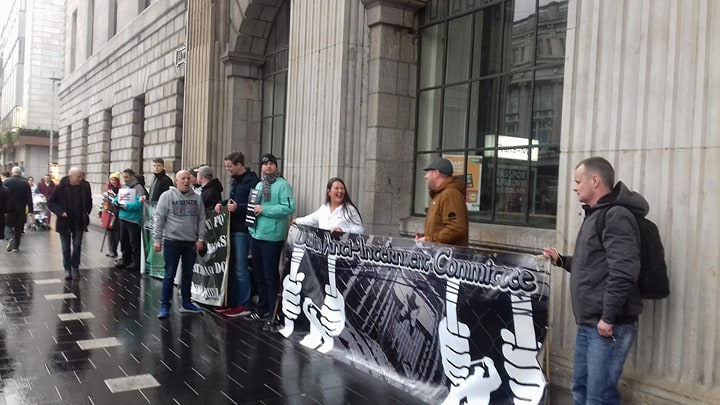
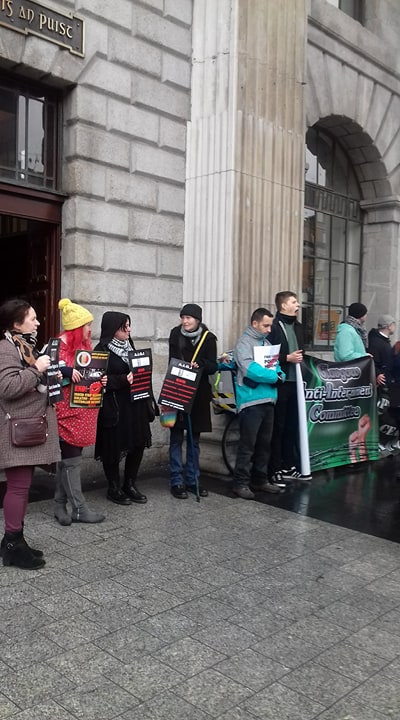
Glasgow and Dublin Anti-Internment Committees joined forces on 18th February in a protest against continuing internment without trial in Ireland. Around two score protesters gathered outside the iconic General Post Office building in Dublin city centre’s main thoroughfare, O’Connell Street. They displayed the anti-internment banners of the Dublin and Glasgow committees and placards against internment, including one against the jailing of Catalan political activists by the Spanish state (also refused bail).
Section of protesters outside the GPO building, O’Connell Street, Dublin (Photo source: End Internment FB page)(Photo source: End Internment FB page)
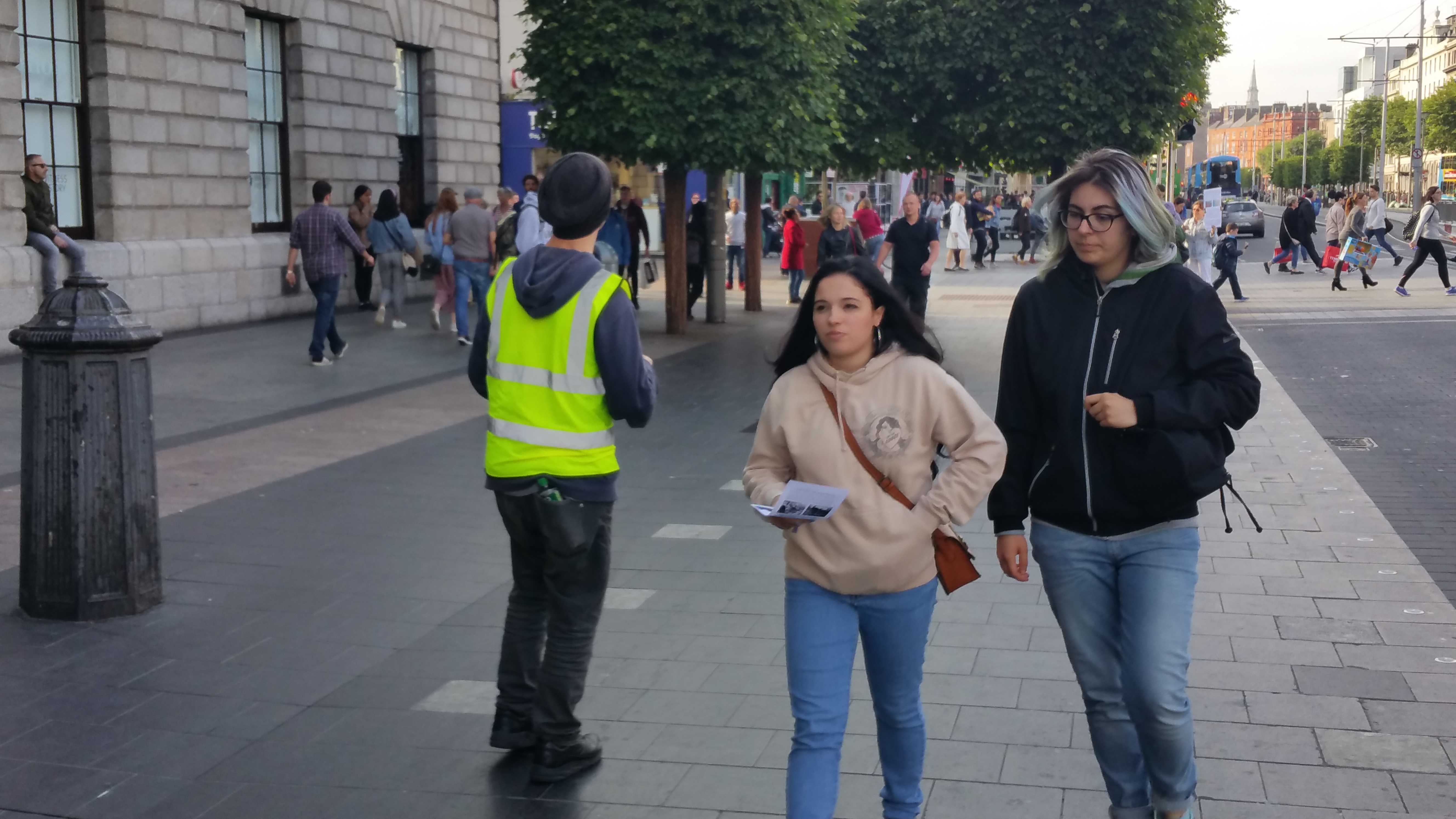
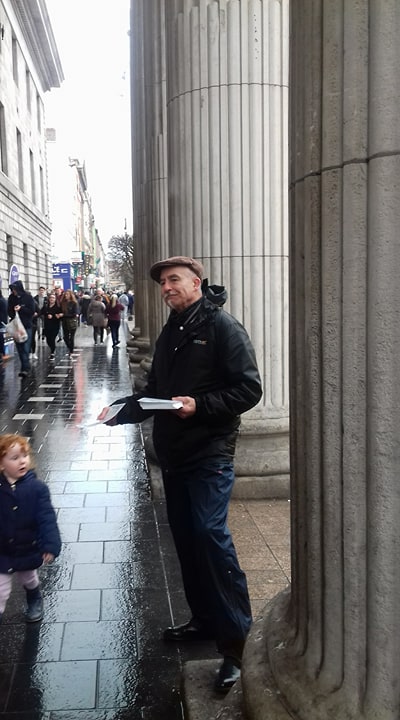
Leaflets of the Anti-Internment Group of Ireland were distributed to shoppers and visitors passing by, along with others about the conviction of Brendan McConville and John Paul Wooton (the Craigavon Two), framed and jailed in 2009 and still in jail, serving life sentences. Songs about internment and political prisoners were played on a sound system, as well as Labi Siffre’s Something Inside So Strong and Christy Moore’s Viva La Quinze Brigada.
Young passer-by accepts leaflet from Dublin Committee leafleter (Photo source: End Internment FB page)
Despite the official end of internment by the British in 19751and by the Irish state in 19572, Republican activists continue to be jailed without trial in a number of ways: Licence revoked and bail refused or revoked.
(Photo source: End Internment FB page)
When a Republican leaves jail under license, she or he can be returned there without any court hearing or the presentation of any evidence against them; this is what has happened to Tony Taylor and Gerry Mackle, for example. Refusing bail for accused Republicans has become almost standard, despite the fact that this is supposed to be a last resort, for example when there is a serious risk of the accused fleeing the administration, or interfering with witnesses – which has rarely applied to Republicans refused bail. The real reason has usually been revealed when they have been granted bail: they are required not to attend protests, meetings or to associate with other active Republicans. In other words, they are being prevented from exercising their civil rights to express their opinions and to organise politically.
Welcoming the participation of the Glasgow Committee in Dublin, a spokesperson for the Dublin Committee stated that “members of the Dublin Committee have been proud to attend anti-internment protests in Glasgow in the past” and went on to say that “we look forward to future cooperation with the Irish diaspora and internationally against political repression, particularly of jailing without trial of political activists.”
Another Dublin Committee leafleter. (Photo source: End Internment FB page)
The Dublin Anti-Internment Committee is entirely independent of any political party or organisation and holds regular awareness-raising protests at different locations. The Committee welcomes the participation of other organisations or individuals in their protests but asks them not to bring political party material etc to the anti-internment protests.
On its FB page the Committee also maintains a list of Republican prisoners in jails on both sides of the British Border, updating it from time to time.
FOOTNOTES
1By then more than 1,900 people – only around 100 of them Loyalists – had been interned, many of them tortured; it was during protests against it in 1971 in Ballymurphy and 1972 in Derry that the Parachute Regiment killed 25 unarmed people.
2Introduced by De Valera’s government in July 1957 during the “Border Campaign” of the IRA.
(Photo source: End Internment FB page)(Photo source: End Internment FB page)











 rebelbreeze