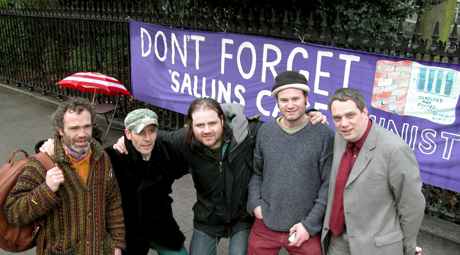
Tipping the Bosses!

Diarmuid Breatnach

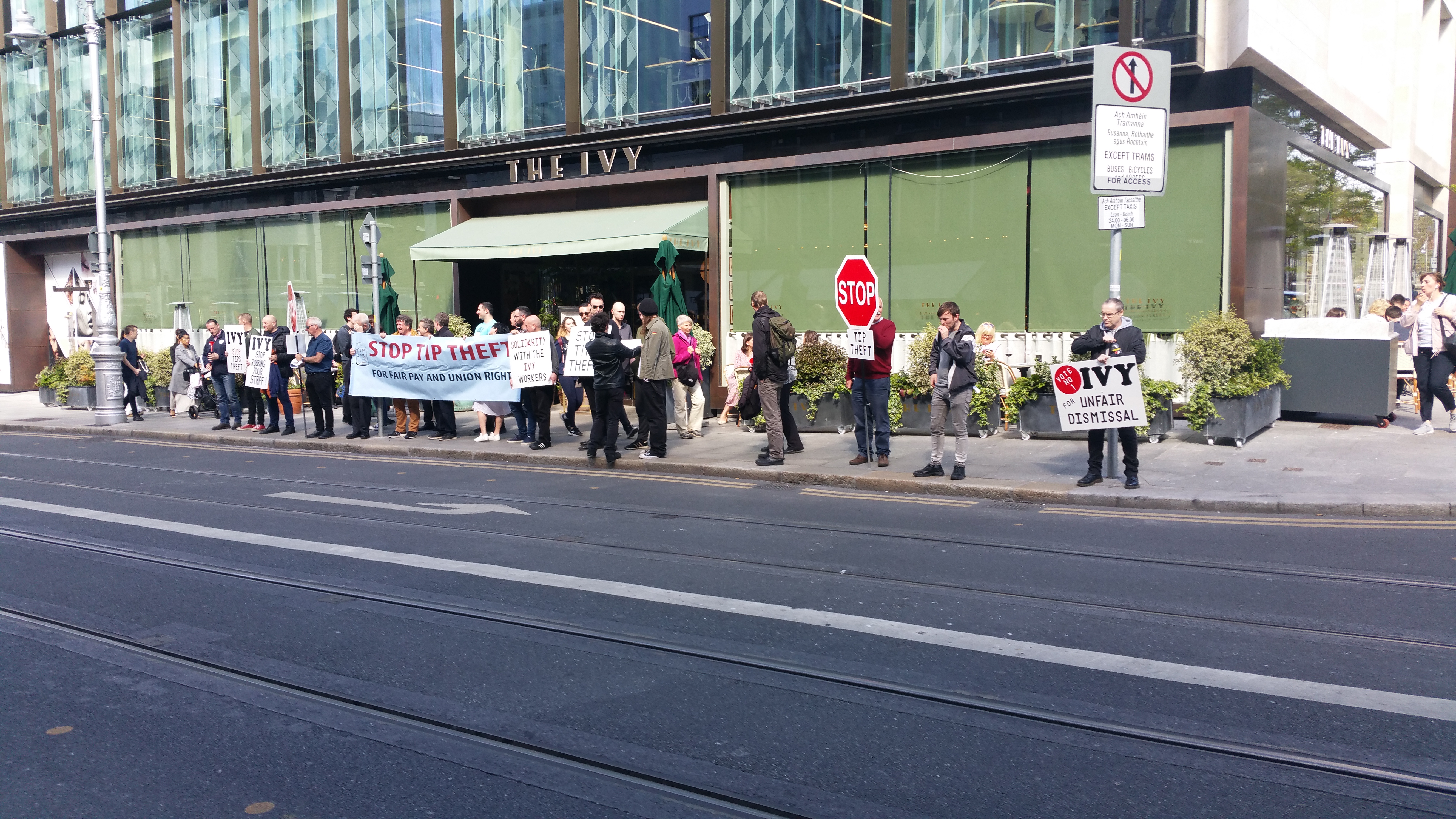
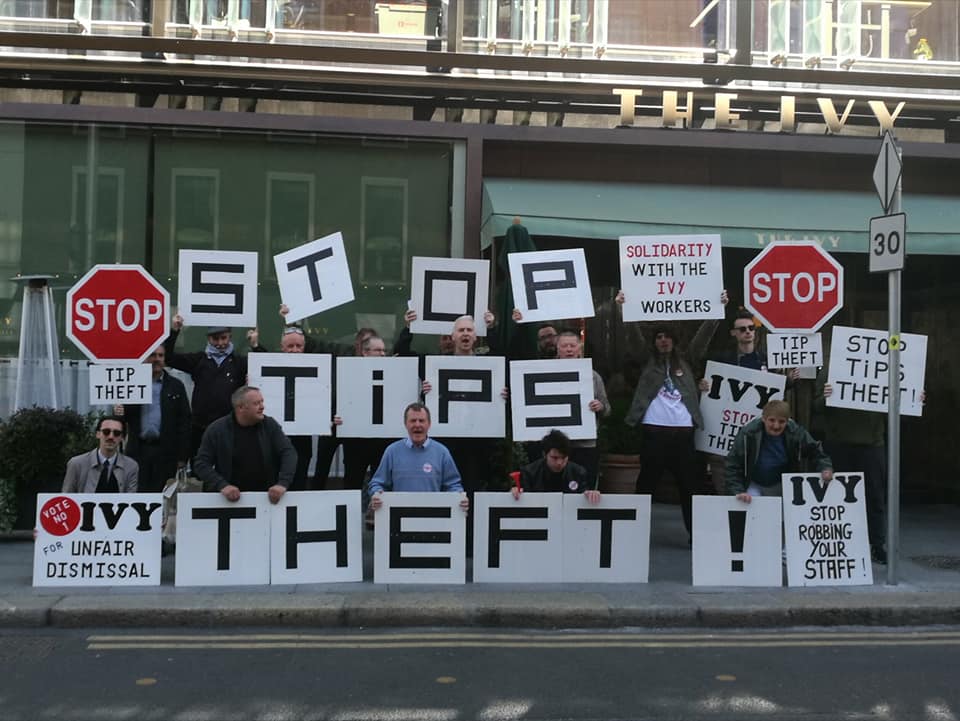
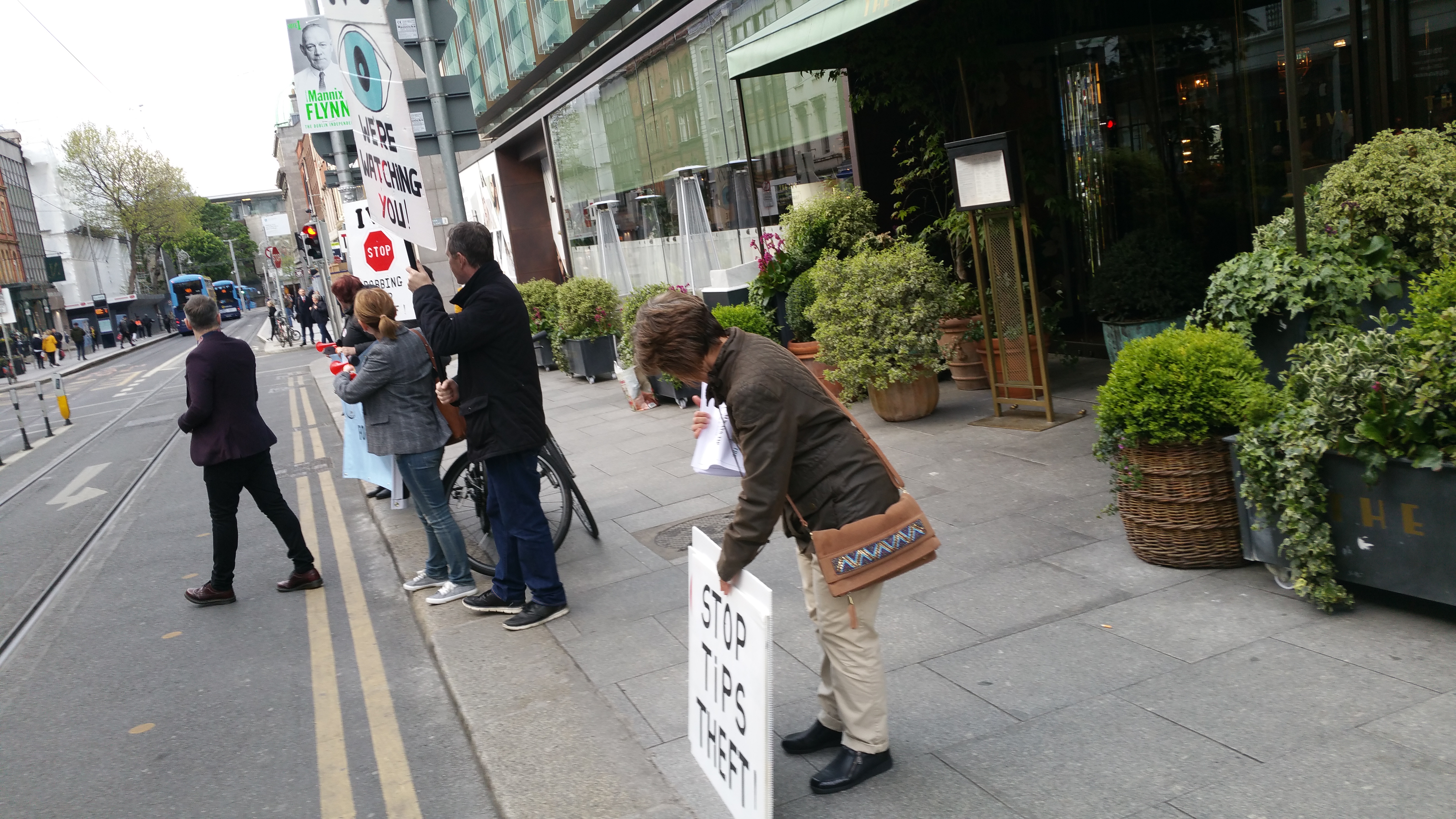
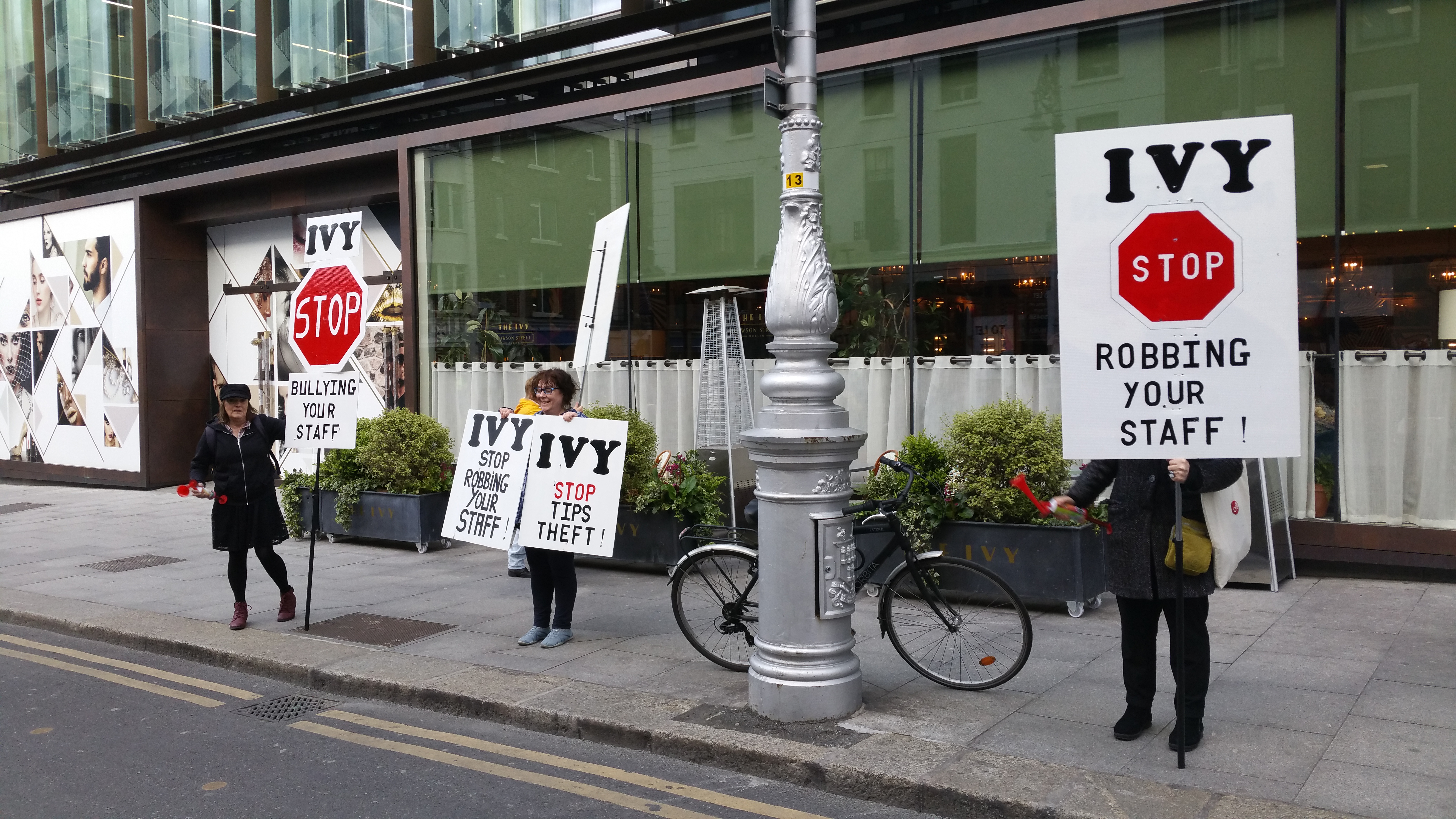
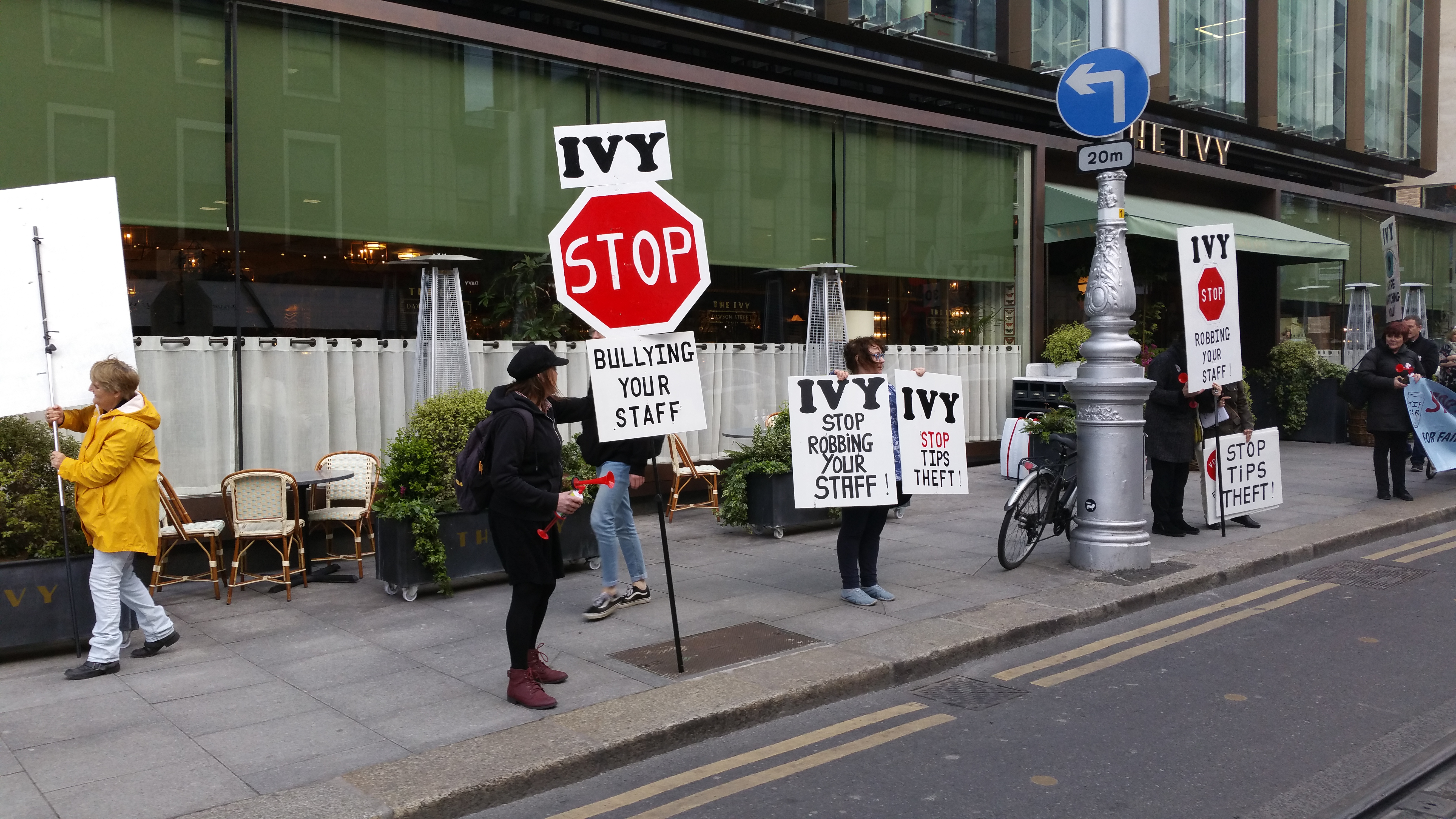
Supporters of staff at a prominent Dublin eatery protested yesterday over the management’s appropriation of some of the tips left by customers for the staff. They are able to do this quite easily when the customer pays the tip by credit card but when staff asked customers to leave their tips in cash, management accused them of “deplorable greed”. They have also dismissed two staff who are currently taking a case for unfair dismissal, accusing the management of sacking them for their unionisation of the staff.

View of some early protesters outside the Ivy Dawson Street restaurant (Photo: D.Breatnach)

          The photographs taken here show a smallish group, including Independents for Change TD Joan Collins but more were coming later from the Mayday march on the north side of the river. A supporter claimed that the management offers an hourly rate above the minimum wage but then makes that difference up with tips.

Catering work in general is notoriously low-paid and with transitory staff, making it difficult for trade unions to organise them and relatively easy for management to hire and fire.

View of some early protesters outside the Ivy Dawson Street restaurant (Photo: D.Breatnach)

There have been a number of protests about the tips issue at Ivy, including one on which the Irish Times reported in March.

The report stated that a number of protestors who had booked tables in the restaurant began the protest and were then joined outside the restaurant by a group of 30 people led by Independent TD Joan Collins who held up placards stating “Stop tip theft”.

View of some early protesters outside the Ivy Dawson Street restaurant (Photo: D.Breatnach)

Ms Collins was reported as saying that she was aware of other Dublin restaurants who have are engaging in similar practices when it comes to tips and was quoted as saying that: “The Ivy are abusing the good nature of diners who are tipping staff well because and they are not aware that management are taking some of their tips”.

“Workers are hugely concerned as they are not earning a high hourly wage and they work hard for their tips only for a portion of it to go to the company,” she said.

end.

Link to Irish Times article (and photo): https://www.irishtimes.com/life-and-style/food-and-drink/protest-held-outside-ivy-restaurant-in-dublin-over-waiters-tips-1.3827055

TRAGEDY AND THE CONDEMNATION BANDWAGON

(Comment: Approximate reading time 5 minutes)

Diarmuid Breatnach

A woman dies; she was young, a tragedy. Where did this happen and when? In Derry on Thursday evening. How did she die? Apparently (and I say that advisedly, for I do not know the examining doctor‘s verdict nor has an inquest yet been held) by a gunshot to the head. And according to a number of witness statements, she did not have a gun herself and therefore the bullet came from someone else.

THE CONTEXT

          All this and more has been reported in unanimity. What was the context? Ah, there we have to do some digging.

There was a riot going on at the time – there were petrol bombs and stones thrown at the police. Oh, why? Well, some of the early reports didn’t even try to answer that. But later, we were told: the police were searching houses for IRA arms. The police had “a tip-off”, some papers reported.

OK, now we’re getting somewhere. Reading between the lines, if we know enough about the general situation, we can reconstruct a probable narrative: British armed colonial police were searching the homes of Irish Republicans in ‘nationalist’ areas, just before their Easter commemoration, a commemoration during which they attacked another Republican group in Newry last year and one which was for decades banned under the Special Powers Act in the Six Counties – a ban enforced violently by the forerunners of the very police force carrying out those house searches on Thursday.

And it turns out, as admitted by senior PSNI command and reported in only some media outlets, including the Irish Examiner, that the purpose of the police raid was harassment: PSNI officers were carrying out a search operation in the Creggan area of Derry aimed at disrupting dissident republicans ahead of this weekend’s commemoration of Irish independence.”

And we might know, though not from the general media, that the colonial police have been carrying out these raids on numerous occasions of late, as well as stopping cars of Republican activists and searching them, stopping people out walking and searching them too, as well as questioning them about where they are going and where they have been. Most people of course won’t know that – how could they?

So now that we have context, we might see the rioting as a justified response, even natural perhaps, of a colonised people to provocation and harassment by a militarised police force of a colonial occupation. And a colonial administration with a long history of atrocities by the occupying power. Or we might not – but context gives us the opportunity to interpret, while its absence leaves us bewildered or manipulated.

If we take the view that the people are justified in resistance, does that excuse the killing of the woman in question? No, not at all. But it does take us some way to understanding the situation and perhaps we wouldn’t want to see Irish Republicans as monsters then.

Lyra McKee’s death is a tragedy, as is the premature death of any innocent person and particularly a young person. The Six Counties too, that repressive backward statelet, can ill afford the loss of an LGBT campaigner.

Firing a gun in that situation was highly irresponsible and unnecessary. The shooter (or shooters) could not be sure of hitting a police officer and did, in fact, hit a totally innocent bystander. And if the police had fired back, the shooter(s) would have put everyone around them in mortal danger too.

CONDOLENCES AND CONDEMNATIONS

            Saoradh, an Irish Republican organisation active in the area who were involved in preparing for the Easter Rising commemoration in Derry felt they had to cancel the event after the death. They issued a statement providing context for the riot and also extended condolences to the bereaved family and friends. Most media didn’t quote the relevant parts of the statement and some never even mentioned it.

On Saturday, their representative at their Easter Commemoration outside the GPO building in Dublin repeated the statement and amplified it, saying also that the IRA was not always right and, when they erred, they should apologise for it. The media didn’t report that either.

The media rushed, not to report the shooting and its context, but to condemn Irish Republicans who don’t agree with the Good Friday Agreement, i.e the ‘dissidents’. The BBC, in its first report on line, along with some others, called it a “murder”. Were they justified in saying that?

In law, not all homicides can be called murders.  According to Wikipedia, Murder “…. is considered the most serious form of homicide, in which one person kills another with the intention to cause either death or serious injury unlawfully.” So there has to be intention to cause either death or serious injury to the victim. Are the BBC and other commentators really suggesting that the person or persons intended to kill a journalist? Apart from seriously inaccurate reporting, one might see those kind of claims as prejudicial to a fair trial for anyone arrested for the homicide.

THE CONDEMNATION BANDWAGON

          And then, of course, jumping on to the condemnation bandwagon, we have the usual collection of hypocrites and opportunists. What would we expect from Unionist politicians? They have been running that colony with regular pogroms and armed repression for nearly a century – Irish Republicans are their enemies to the marrow. Arlene Foster couldn’t resist using the opportunity to praise their colonial police and to take a swipe at SF: Those who brought guns onto our streets in the 70s, 80s & 90s were wrong. It is equally wrong in 2019.” Actually, at first it was usually the RUC with the guns on the street, wasn’t it? And then the British Army. But then after the Ballymurphy Massacre, Bloody Sunday …. well, you shoot at people long enough, they shoot back.

British Ministers and politicians had their condemnation to get in as well – well, the colony is theirs, isn’t it? The Republicans are their enemies too (and Theresa May must’ve been glad to be talking about something other than Brexit, for a change).

But then we had the Irish politicians also, including our own Taoiseach (Prime Minister), who presides over a State that is made secure for native and foreign capitalists by, among other things, persecution of Irish Republicans and sending them to jail through non-jury Special Courts. Mr. Varadkar is so supportive of the people of Derry, so sensitive to their needs, that whilst he condemns the Republicans, he praises the people of Derry for being “as strong as your walls.” Is he expressing Loyalist views or is he so ignorant of the people of Derry and their history?

Is Varadkar unaware that the Derry Walls belonged to the foreign occupation force? That the song that celebrates them is a triumphalist anti-Catholic sectarian and colonist song? That during the recent war in the Six Counties those walls were frequently a point of surveillance for the occupying military and that during the Bloody Sunday massacre, some British soldiers were up there with special rifles?

Oh yes and let’s not forget Nancy Pelosi, she too found a place on the bandwagon (well, to be fair, the others made room for her). This is long-standing career US Congresswoman who, although an outspoken opponent of the Iraq War and supporter of civil rights, blocked her party colleagues from going for impeachment of war criminal President Bush because “you never know what might come out”. She also voted for the Patriot Act, a huge attack on civil liberties in the USA and labeled Edward Snowdon “a criminal” for his whistle-blowing. And yes, after a briefing relating to a CIA agent destroying hundreds of hours of videotaping of torture in their US base in Guantanamo, she issued a statement saying that she eventually did protest the techniques (e.g “waterboarding”, euphemism for simulated drowning of prisoners under interrogation – DB) and that she concurred with objections raised by a Democratic colleague in a letter to the C.I.A. in early 2003. Yes you did, Nancy – but you waited four years to do so.

And what are we to say of Sinn Féin, they of association with the late Provisional IRA, putting their name to a joint statement of colony politicians? One would think that considering their past, they would hesitate to join the mob or to climb upon this particular bandwagon. One might think they would remember the innocent people the PIRA killed on occasion by accident, such as for example the Birmingham pub bombings where 21 people were killed and 182 injured or even, on some occasions, with intention.

Perhaps Michelle O’Neill did remember, perhaps she did hesitate, perhaps she wished to issue SF’s own statement. But climb aboard they did – and isn’t it all about climbing with them now?

The political parties that support the occupation said in joint statement: “Lyra’s murder (see that “murder” word again – DB) was also an attack on all the people of this community, an attack on the peace and democratic processes.

“It was a pointless and futile act to destroy the progress made over the last 20 years, which has the overwhelming support of people everywhere.” (Oh, that was its purpose, was it? And this progress has been what, exactly? And towards what?– DB).

O’Neill was herself quoted as saying that the “murder” (that word again !) was “an attack on our peace process and an attack on the Good Friday Agreement.”

And We will remain resolute in our opposition to the pointless actions of these people who care nothing for the people of Derry.

I can’t say whether those people putting up a resistance to the colonial police care for the people of Derry or not but presumably they care for the people of their own neighbourhoods who are being harassed by the PSNI. And I remember in another city, Belfast, how the Loyalists had been threatening the Ardoyne area for many months and that in 2015, the PSNI blocked the Anti-Internment League from marching down to the city centre. Although the march eventually dispersed without incident, the heavy police presence in the area provoked some residents to remonstrate with them and, when the police began to arrest a woman, the area erupted in a riot. Who did SF blame? The local youth and the anti-internment marchers! And when a meeting was convened soon afterwards in a local venue for the march organisers and SF to explain their views, it was the latter that failed to attend.

* * *

Well, it must have been getting tight up there on the bandwagon but there’s always room hanging off the sides and if that doesn’t work …. why, one can run behind. And if not, not to worry, there’ll be another one along soon.

End.

LINKS

BBC initial news on line: https://www.bbc.com/news/uk-northern-ireland-47985469

Irish Examiner (including intention of PSNI to disrupt Republicans): https://www.irishexaminer.com/breakingnews/ireland/a-senseless-loss-of-life-journalist-lyra-mckee-29-shot-dead-during-riots-in-derry-918754.html

The Saoradh statement: http://saoradh.ie/the-death-of-lyra-mckee-in-derry-saoradh-statement/?fbclid=IwAR2nH20ILtiGjgCyih2eo0HEpkK27_F89MRptEb_OIMfA0SbRz4YB8Fneiw

CATALAN PRESIDENT-IN-EXILE MEETS IRISH PARLIAMENTARIANS IN DUBLIN

Rebel Breeze Reporter

Puigdemont. President-in-exile of Catalonia, visited Dublin to take part in a debate in Trinity College on Tuesday 29th January and visited the Dáil and a number of Irish politicians on the same day.

Puigdemont and Puignól at the Barcelona-ireland friendship tree in Cow’s Lane, bracketed by activists of Casals Catalá de Irlanda, Catalan cultural organisation in Ireland on each side.
(Photo source: ACN, El Nacional).

          Carles Puigdemont was elected President of the pro-independence Catalan Government, declared an independent Catalan Republic but immediately suspended it; then had his Presidency abolished by the Spanish State, which took direct control of Catalonia for a period. He went into exile with a number of other Catalan Government ministers in order to avoid arrest; the Spanish State issued a European Arrest Warrant for him which was party unsuccessful and then withdrew it; however, he remains in exile in Brussels. Most pro-independence Catalans and even others consider him the legitimate President of Catalonia, though another had to be elected to fill his place; Quim Torra, who is currently the elected President, says that he considers himself only “the interim President”.

Carles Puigdemont was elected President of the Govern, the Catalan Government, in January 2016, in an agreement between pro-independence parties. On 27th October 2017, with a majority of October 1st Referendum votes salvaged and counted — after the Spanish police attacks on the voters – in favour of independence, he declared a Catalan Republic on behalf of the Govern. However, he almost immediately suspended it, to the dismay of many Catalans, including supporters of his own party. The Spanish State, the Constitution of which forbids any secession without the majority vote of the Parliament of the whole territory, was not mollified by the suspension and, as the Spanish State prepared criminal charges against him and Catalan Ministers, Puigdemont went into exile (as did another five Catalan ministers).

ARRESTS AND EXILE

          The Spanish State arrested a number of others, including seven ministers and two leaders of grass-roots movements and charged them with sedition, rebellion and misuse of public funds, carrying 30, 15 and six years in prison respectively and European Arrest Warrants were issued for Puigdemont and other ministers. On 25th March 2018, Puigdemont was detained on that warrant while passing through Germany on his way back to Brussels from a speaking engagement in Finland. A German judge decided the issue of the “rebellion” charge first, declaring that any such charge had to provide evidence of violence, of which there had been none by the detainee (there had been plenty of violence but all by the Spanish police) nor under his direction.

The German court decided in July that Puigdemont could be extradited to the Spanish State to be tried for misuse of public funds but the Spanish State, not wishing to have to try him and the other ministers only on those while the other ministers were being tried on the more serious charges, withdrew the arrest warrants. These charges can of course be renewed at any time and another warrant issued.

Since his return to Brussels after release by the German court, this Dublin visit has been Puigdemont’s first venture outside Belgium.

Accompanied by Jordi Puigneró, the current Minister of Digital Policies and administration of Catalonia, also visiting Ireland, Puigdemont paid a brief visit to an olive tree donated by Barcelona to Dublin in acknowledgement of the Irish who had fought for Catalonia in the War of the Spanish Succession. After a meeting with the Mayor of Dublin for the year, Niall Ring, Carles Puigdemont attended the Dáil (the Irish Parliament) for a private meeting with Bertie Ahearn, a Fianna Fáil party parliamentarian and ex-Taoiseach (Prime Minister).

Puignól attaches a yellow ribbon to the Barcelona-Ireland olive tree in solidarity with the Catalan political prisoners.
(Photo source: Casals Catalá de Irlanda)

MEETING IN THE DÁIL

          Afterwards Puigdemont addressed a meeting room of around 100, organised by the Dáil organisation Oireachtas Friends of Catalonia, with its chairperson Pat Gavan, Sinn Féin Senator, presiding.  Jordi Puigneró sat beside Puigdemont as did Lynn Boylan, Sinn Féin MEP.

Puigdemont in the packed Dáil meeting room, Leinster House, Dublin.  Others L-R: Minister Jordi Puignól, MEP Lynn Boylan, Sen. Paul Gavan.
(Photo source: Internet)

Fifty-seven years of age last December, Carles Puigedemont is a journalist by trade and ex-Mayor of Girona, a major Catalonian city of over 100,000, just under 100 kilometres (62 miles) north-east of Barcelona. In 2006, after a track record of activism in Catalan culture and nationalist activism, he was adopted as a political candidate by the CIU (Convergence and Union) political party and later to represent the reformation of that party in the Junts per Si (Together for Yes) coalition, composed of mostly nationalist capitalist elements. He has been successful in every election and currently heads the uneasy coalition platform Junts per Cat (Together for Catalonia). The current Govern is made up of a coalition between JuntsXCat and ERC (Republican Left of Catalonia), with the other pro-independence party, CUP (Popular Unity Candidacy) in opposition, though not voting with the Spanish-unionist opposition.

In what seems an action contradictory to his political position, in January 2019 Puigdemont filed a constitutional application for amparo (remedy, to put right) directed against the President of the Catalan Parliament, Roger Torrent and the Board of the Chamber, to the Spanish Constitutional Court. The application argues Puigdemont had been denied the use of his political rights as Torrent did not allow him to delegate his vote from Belgium after Puigdemont’s criminal indictment and suspension of his parliamentary position by Supreme Court judge Pablo Llarena.

Despite constant Spanish-unionist claims from both Right and Left, the Catalan pro-independence movement has shown itself more tolerant of migrants and diversity than can be said in general of much of the rest of the Spanish State and one of the laws of the Govern, twice squashed by the Spanish Supreme Court, sought to give migrants equal access to Catalan national health care. Puigdemont is himself married to Romanian journalist (Marcela Topor in 2000) and they have two daughters, Magali and Maria, the family home in Girona. His children are multi-lingual and Puigdemont himself speaks Catalan and Castillian (Spanish), as do most Catalans but also English, French and Romanian.

Addressing the full room, after thanking Gavin for presiding over the meeting and those assembled for their presence, Puigdemont presented his case that Catalonia had the right to secede, that holding a referendum was a democratic activity per excellance, that the arrest and trial of politicians for having promoted that referendum was undemocratic and that such activity was not within keeping of the EU ethos.

Replying to questions on what he would ask Irish politicians to do in order to help Catalonia’s struggle and on how he saw his nation’s struggle combining with other nations within the Spanish state, for example the Basque Country, Puigdemont said he did not wish to tell other countries what do and that the struggle of Catalonia stood on its own. He declined to relate the content of his discussions with Aherne, which he said were confidential. One member of the audience reminded Puigdemont that 100 years ago, the first democratically-elected Irish national parliament had met and that many of its delegates were also in jail or in exile.

To a question about alleged flight of business from Catalonia, Puigdemont said that one had to read alternate media to some of the dominant ones and make up one’s own mind, critically examining all sources – including himself! But he did say that although some addresses of head offices were transferred to the Spanish State in what he said was not legally right, not one factory, working office or member of staff had been transferred out of Catalonia. Also, the struggle with the Spanish State and some Spanish attempts at boycott had obliged Catalans to look outside the Spanish state for their markets and business links whereas previously, imports from and exports to the Spanish state had accounted for 90% and 80% respectively. Jordi Puigneró commented that he was in Ireland in part because of that, in particular to follow up on the Irish state’s success in attracting and developing information technology business.

After the Dáil meeting, Puigdemont and Puignól pose for photos with Catalan solidarity supporters.
(Photo source: Casals Catalá de Irelanda)

Outside in the icy cold after the fairly short meeting, Puigdemont lined up for a few photos surrounded by Catalan and other well-wishers and departed to the singing by them of Catalan’s national anthem, Els Segadors (The Reapers). He had a debate at which to speak in a few hours and most of the Catalans in attendance would be there too.


End.

OTHER MEDIA REPORTS:

https://www.independent.ie/irish-news/politics/well-continue-fighting-for-our-freedom-it-doesnt-matter-if-were-in-jail-excatalan-president-tells-tds-37763055.html

https://www.irishtimes.com/news/world/europe/carles-puigdemont-i-may-participate-in-the-european-elections-1.3776372


Priceless Solidarity on the Ha’penny Bridge

Diarmuid Breatnach


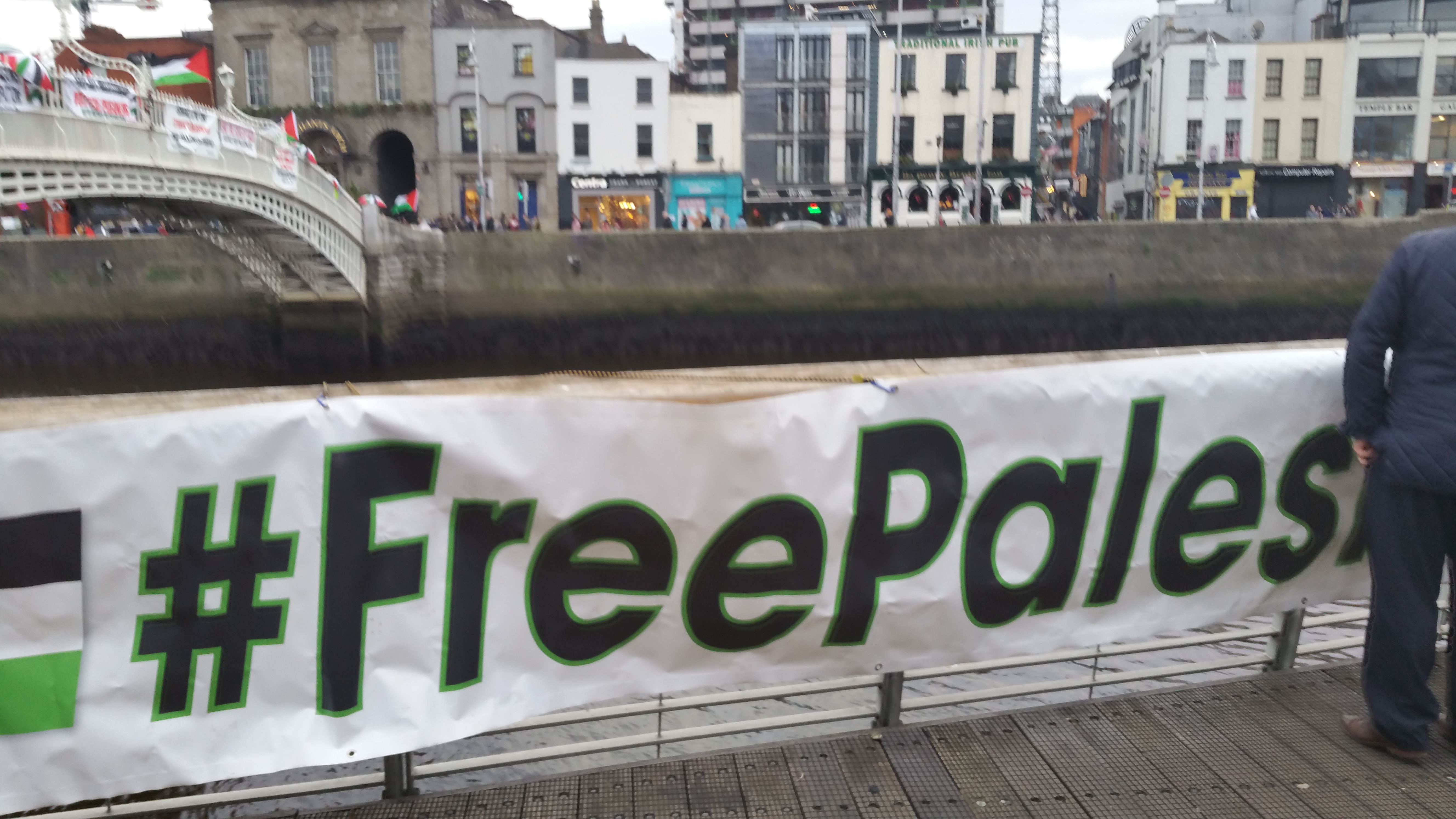
Palestinian flags and solidarity banners decorated each side of Dublin’s iconic Ha’penny Bridge on Sunday 31st December as people crossing towards both sides of the river passed between people holding flags, wearing kifiyehs or standing under umbrellas in the Palestinian colours. The overwhelming majority of the supporters seemed Irish and could be identified as from a range of socialist and republican backgrounds, whether independent or not.

A bridge of Solidarity (Photo: D.Breatnach)

This is an annual New Year’s Eve event, organised by the Ireland Palestine Solidarity Campaign, whose stall had been set up on the south side, near Merchant’s Arch.

On the Boardwalk
(Photo: D.Breatnach)

Two versions of leaflets were being distributed; one which called for an end to the siege of Gaza pointed out that in 1017 a UN report stated that “the unliveability threshold has already been passed there.” Among other recommended actions the leaflet asked people to contact their TDs (Irish parliamentary representatives) and urge them to support Senator Frances Black’s Bill this year which will ban trade with Israeli illegal settlements in Palestine. Those settlements seize Palestinian land and water resources and are illegal by UN declaration.

The west side of the bridge, from the northern side of the river (Photo: D.Breatnach)

According to a report “Between July 2016 and June 2017, Israeli authorities authorized construction work on more than 2,000 new housing units for settlers in the West Bank, excluding East Jerusalem”, another area of Zionist expansion.

The Bridge was busy (Photo: D.Breatnach)

During the same period, “Israeli authorities destroyed 381 homes and other property, forcibly displacing 588 people as of November 6, in the West Bank, including East Jerusalem, as part of discriminatory practices that reject almost all building permit applications submitted by Palestinians.”

A closeup on some of the banners on the east side of the bridge.
(Photo: D.Breatnach)

During the Great March of Return protests on Gaza’s border which began in May, Israeli Occupation Force snipers shot dead or caused death by gassing of 168 Palestinians and injured 17,259 people, including women, children, medical workers and journalists. During the same period one Jewish Israeli was killed 11 and injured, six of which were soldiers.

A great many passers-by expressed their approval of the demonstration, some stopping a while to talk with the demonstrators.

It was a child-friendly affair (Photo: D.Breatnach)

Some chanting of Palestinian supporters could be heard as well as occasional passing drivers tooting their horns in solidarity, occasionally with a clenched fist also raised outside the window. A counter-protest planned by the zionist Irish Friends of Israel on Essex Bridge however failed to materialise.

End.

LINKS FOR REFERENCES & FURTHER INFORMATION:

IPSC (an organisation independent of all political parties): www.ipsc.ie

Information and statistics: https://www.hrw.org/world-report/2018/country-chapters/israel/palestine

Biased Wikipedia entry which however could not disguise the casualty statistics: https://en.wikipedia.org/wiki/2018_Gaza_border_protests


ABUSE OF POWER AND VIOLATION OF CIVIL RIGHTS IN IRELAND ARE NOT THINGS OF THE PAST

Diarmuid Breatnach

The violation of the civil rights of Osgur Breatnach (then a leading member of the IRSP) exposed in the program in the Finné series on TG4 (Irish language TV channel) shown recently and repeated a week later was set in the 1970s but the injustice did not end there.

Osgur Breatnach, photographed recently and still wanting his beating and framing investigated
(Source image: Dara Mac Dónaill, Irish Times).

          Even after a High Court admission that he and McNally had been subjected to “oppression” and his conviction thereby overturned 17 months after his jailing, the court still maintained he had beaten himself up – a fiction it maintains to this day.

Of course to say otherwise would have been to admit the Gardaí special unit that came to be known as “The Heavy Gang” were vicious thugs who fabricated “confessions”. And that the judiciary of the Special Criminal Court had, despite the medical evidence and signs of beating on all, including the three who had “confessed” and the repudiation of those statements in court, colluded with the beatings, accepted the statements as true confessions and convicted three of the men for up to 12 years’ jail. And to admit that the Court of Appeal and High Court had been complicit in accepting as a “finding of fact” which could not be overturned that they had beaten one another up (and done it to himself, in the case of Breatnach).

All of which meant that the Heavy Gang got more encouragement for their ‘work’ so that some of them were able to turn up on the scene of other scandals, including that of the false confessions of Joanna Hayes and her family (about which Gardaí nothing has been done either).

Even today, not one of those Gardaí has been even charged and the complicit judiciary and State Prosecution carried on in their jobs and in some cases rose higher.

The injustice did not stop there, for when Nicky Kelly, who had been on the run, gave himself up, even though exactly the same evidence had been used to convict him, he was told he had run over the timeframe in which he could appeal and it took four years of campaigning to get him out too. And then only for “humanitarian reasons,” so the “guilty of armed robbery” verdict still stood for his reputation, potential relationships, job prospects etc.

Another eight years later he received a Presidential “Pardon” from Uachtarán Mary Robinson.

Then the State fought the financial compensation case, taking it to the extreme of bringing Gay Byrne to court over an interview he had given Osgur Breatnach. At this point some wiser heads decided to limit the damage, pay up but with the condition that the three did not go after the police or proceed with any case about the beatings.

A facet of British and Irish civil law of which many are probably unaware is this: If the respondent (i.e the one against which you are taking the case) offers you a sum and you refuse it, and you later win the case but are awarded less than what you were offered earlier, you have to pay all the costs of the defence! You can actually end up owing money!

But back to ongoing injustice. Since not a single one of the Heavy Gang was ever even charged or disciplined over this and other similar behaviour and some were even promoted; since not a single member of the legal profession or judiciary was even reprimanded for their part in it; no warning about where the boundaries are has been given to the Gardaí much less to the judiciary. Which means that it can all easily happen again.

The defendants in the Jobstown case were not beaten up to force them to ‘confess’ but when we hear Garda after Garda, including a senior one, affirm under oath in court that one of the defendants said something which all the video evidence proves he did not, at what conclusion can we arrive other than that they were all lying? But not one of them has been charged or even disciplined either.

Conversely, the State has no problem with dragging anti-fascists to court recently and this to answer charges such as “violent disorder” arising out alleged actions preventing the European fascist organisation Pegida from launching a branch in Dublin.

12-hour protest at Department of Justice in January 2004 –Cormac Breatnach, musician and brother of heavy gang victim Osgur with other musicians including of the Ó Snodaigh family and TD Aongus, their brother.
(Photo source: Indymedia — see Links)

ARE THINGS TODAY IMPROVED?

          The Heavy Gang is not operating as such today (or at least not yet) but in some respects things are actually worse than they were back in the 1970s ad ’80s. There was one Special Criminal Court then – now there are two! The Public Order Act was brought into force in 1994 to give Gardaí great powers to repress public protests and the scheduled offence of Violent Disorder was included in that Act: three unconnected individuals at the scene of a “disorder” can be convicted under the latter provision and sentenced up to ten years in jail or fined an unlimited amount (or both)!

The non-jury Special Criminal Court on its last day in Green Street before it moved to its new location in Parkgate Street (Photo source: Internet)

Courts are imposing bail conditions preventing activists from continuing to be politically active, i.e from attending public meetings, rallies, demonstrations, pickets etc – for up to the two years it can take the case to come to trial.

And just as in the ‘bad old days’, the unsupported opinion of a Garda of Superintendent rank or over is sufficient to convict Republicans of “belonging to an illegal organisation” and visitors to the public gallery of the SCC have to give their names and addresses to the Gardaí before being admitted.

Special Branch officers still routinely and openly watch Republicans carrying out their peaceful political work and demand their names and addresses on pickets. But now not only is surveillance carried out on people’s electronic communication equipment, communication is also being blocked at times by special equipment of the Gardaí.

Sadly, as the struggle over social and political issues becomes more acute in this state, we will see more repression, as the State tries to force the whole of civil society into compliance, especially by concentrating that repression on society’s more politicised and active sectors. Already in Dublin we have seen masked bailiffs and masked police carrying out an eviction of a small token occupation group in an empty house and, a week later, armed police turning up to a dispute between a couple and their landlord.

Only by admission of wrongdoing followed by actions overturning the current impunity of the Gardaí and the judiciary can a worsening of the situation perhaps be averted. But there is no sign of that happening.

End.


LINKS FOR REFERENCE/ FURTHER INFORMATION

https://www.irishtimes.com/news/crime-and-law/wronged-man-still-seeking-answers-40-years-after-sallins-train-robbery-1.3673264

https://www.indymedia.ie/article/63140?userlanguage=ga&save_prefs=true

https://www.independent.ie/opinion/analysis/from-heavy-gang-to-bailey-case-how-gardai-havent-learnt-lessons-30201431.html


FREE CARPETS AND PERFUME!

Diarmuid Breatnach


The carpet is a lush deep kind of green – not too deep a green though. We didn’t order it but I’m not complaining – I like it. Much better than that yellow one we had for a while a few months back.


Next to it is another kind of carpet – very different. The same green background but covered in big blobs of yellow, brown, orange and mixtures of all three. Even some reds. The blobs are large and small, some shaped like the spades suit in a deck of cards, others like a cat’s iris, some with many points, like a star … Didn’t order that carpet either but I like it too. It might not sound that great but you’d have to see it.

There was the wallpaper too, great stretches already unrolled, ready to look at. A blue-white background with puffs of white and, in the foreground, thin black shapes, some of them decorated with those blobs of colours, like those on that carpet. Great contrast with the thin black shapes.

The carpets and wallpaper were just delivered – no order was placed by phone or email. And no request for payment by cash or credit card. Not even an invoice. Totally free! Hard to believe, I know.

Then there was the perfume. No, not in bottles, in the air. I swear! (Yes, I know that rhymes but I didn’t plan it). It was heady but not in the way that rose is, or honeysuckle, or privet flower. Those aromas make you kind of want to sit down and drowse …. or even lie down and go to sleep. Then you remember the story of the artist who died inhaling in his sleep the aroma of flowers he had in a vase to paint – and you don’t linger too long. Did that really happen? Not sure – best not take the chance. Didn’t take a chance on the dandelion flowers when you were a kid either. Waking up in a wet bed is not a pleasant experience at any age but definitely gets worse, even if rarer, as one grows older.

Glade part-sunlit, Botanic Gardens November 2018
(Photo: D.Breatnach)

No, this perfume does not make you want to sit or lie down; it makes you want to jump, run (or at least stride purposefully). It is invigorating. That too was delivered free.

All of this – well, most of it – was donated by the trees. Not the green, surely? Not directly, no … but indirectly, yes. The grass grows in the earth which is fed by dead leaves and other material, broken down by insects and fungi and especially recycled through the digestive tracts of worms. May those gardeners who poison worms on their lawns be forever damned!

Autumn leaves on green grass, Botanic Gardens November 2018
(Photo: D.Breatnach)

Before Ireland was denuded of her mixed forests, what a site she must have been!

All this visual, olfactory and mood-enhancing stuff was delivered free to us but there is, you are right to suspect it, a hidden cost. The weather is getting colder and sitting nearly naked on a beach is definitely out, to say nothing of plunging into the freezing water (well, with some lunatic exceptions). Outdoor cafe-sitting is becoming more of an endurance test than a pleasure. There are days coming when lots of good arguments (convincing at the time anyway) will be found against getting up to go about once’s business.

Trees on banks of Tolka River, Botanic Gardens November 2018
(Photo: D.Breatnach)

But then there will be glittering jeweled grass, constellation of stars in the pavement, artwork fronds on glass, white star patterns in things floating from the sky, white blankets over everything or at least over the hilltops in the distance, the special joy of a hot soup, a warm fire and blankets (if you have them) ….

And not too long away, sprouting buds pushing through bark and soil, misty green branches, a different perfume, quickening the blood in a different way.

End.

THE 43 DISAPPEARED MEXICAN YOUTH REMEMBERED OUTSIDE DUBLIN MEXICAN EMBASSY

Diarmuid Breatnach

People outside the Mexican Embassy in Dublin on Wednesday evening remember the 43 students and call for justice.

(Photo: D.Breatnach)
Names of the Disappeared being laid outside the Mexican Embassy
(Photo: D.Breatnach)

A short but moving event was held in Dublin yesterday evening (Thursday 26th September) to remember the 43 Mexican students made to “disappear” in Mexico by the authorities or in collusion with them on 26th September 2014. The students from the Ayotzinapa Rural Teachers’ College were kidnapped while they were taking part in an annual commemoration of the Tlatelolco Massacre (of 300-400 students and other civilians by police and military on 2nd October 1968, less than a fortnight before the opening of the Olympics in the city that year). They are widely believed to have been murdered and a supposed investigation by Mexican State authorities petered out without a result.

Names of the Disappeared being laid outside the Mexican Embassy
(Photo: D.Breatnach)
Some staff leaving the Mexican Embassy in Dublin
(Photo: D.Breatnach)
Names of the Disappeared being laid outside the Mexican Embassy
(Photo: D.Breatnach)

The event last night was organised by the Mexico Ireland Solidarity Collective (MISC) and Latin America Solidarity Centre (LASC). Sunflowers as a symbol of hope were placed in the railing of the Mexican Embassy in Raglan Road, Dublin and ribbons in the Mexican colours of green, white and red were also tied there. The names of the 43 “disappeared” students were laid on the pavement in front of the Embassy which, like the embassies of a number of other states, is located in a quiet upper-middle class area south of the Grand Canal. Few people passed the remembrance event and staff leaving the Embassy did not stop to talk to the gathering except for the last two who greeted them politely and took a photo of the display.

A spokesperson for MISC said that the event is organised every year so that the people are not forgotten.

People took turns to read the name of each of the 43 from their cards and the traditional “Presente!” was called out after each one, signifying that alive or dead, they are present with us, remembered.

A statement was read and some verses from Woody Guthries’s Plane Crash at Los Gatos were sung and then a long silence was observed, which ended with a call for “Justicia!”

end.

Placing the sunflowers for hope outside the Mexican Embassy
(Photo: D.Breatnach)

(Photo: D.Breatnach)
Reading a statement on the Disappeared outside the Mexican Embassy
(Photo: D.Breatnach)

Placing the sunflowers of hope
(Photo: D.Breatnach)
Protesters in Mexico demanding the authorities reveal what happened to the 43 students.
(Photo source: Internet)


LINKS FOR FURTHER INFORMATION

MISC (Mexico Ireland Solidarity Collective): https://www.facebook.com/mexicoirelandsolidaritygroup/

LASC (Latin American Solidarity Centre): https://lasc.ie/

https://www.facebook.com/latinamericasolidaritycentre/

Wikipedia page about the 43 disappeared: https://en.wikipedia.org/wiki/2014_Iguala_mass_kidnapping

Jacobin on line article about the 43 disappeared: https://jacobinmag.com/2018/09/ayotzinapa-massacre-missing-students-pena-nieto

Should you wish to contact the Mexican Embassy to register a protest, request the investigation to be pursued etc:
info@embamex.ie

Tel: (+353) 1 667 3105

FAX: (+353) 1 664 1013


Mr Miguel Malfavón, Ambassador

19 Raglan Road
Ballsbridge
Dublin 4
Ireland

Dublin Taxi Drivers give Special Needs Children a special Day Out

Diarmuid Breatnach


Motorbike cops zoom up to junctions at noon in Dublin today, lights flashing and hold traffic up to clear the way for what is coming.  But who or what is it that is coming?  “Must be some nasty capitalist diplomatic representative from abroad”, we think.  “Or maybe one of our own Gombeen Government politicians,” we add as an afterthought.  And usually we’d be right — but not this time.

(All photos source: D.Breatnach).

It’s the annual Taxi-Drivers’ Day Out for Special Needs Children.

A quick search failed to find anything on Google about it other than a post from a Journal.ie report dated last year.  From that I learned that this is an annual event, first organised in those far-off days of unfunded un-NGO-organised community events — 1960 to be precise.

The report from last year quoted a figure of 400 taxi-drivers signed up for the day but the organiser was appealing for more drivers still.  The report stated that the previous year (2016), 1,000 children had been taken on the day out.

The following three paragraphs are from the Journal’s pre-event report last year.

‘On the day, children are picked up from hospitals, care homes or private homes by their own personal taxi driver for the day. From there, they are taken to Parnell Square where all taxis gather for a speech by the Lord Mayor and some music from the Garda Band and DJs.

‘The taxis are then escorted through the city by gardaí to the racecourse where they are treated to music, games, face-painting and finger food.

‘“Our aim is to treat the special needs children of the city to a fun day out and put smiles on faces. That’s exactly what you get when they arrive in Parnell Square and they’re meeting and greeting the mascots and characters,” Matthews (the organiser) said.


These photos were taken from outside Liberty Hall, where I was awaiting a group in order to start a history tour.

PS: Good to see the cops were not masked, wielding batons and pepper-spray canisters or carrying machine-guns and battering-ram.

End.

Link: http://www.thejournal.ie/dublin-taxi-drivers-special-childrens-outing-3519742-Jul2017/

THE CONNEMARA SKULL — DARK SECRETS AND FUN

Diarmuid Breatnach


Martin McDonagh’s play, A Skull in Connemara, one of his Leenane Trilogy, directed by Andrew Flynn, is currently playing at the Olympia in Dublin’s Dame Street. With a cast of four the play takes us on a hilarious tour of hidden secrets and gossip in a rural community but with a dark side hinted at and growing towards the end. Despite the buildup, there is more than one surprise – and shock even – in store.


What one might call the central character is Mick Dowd (Pat Shortt) a gravedigger with a difference: his job is to dig up old graves and to collect the remains to transfer to another location. The population is outgrowing or outbreeding the available graveyard space. He is visited by a Mary Johnny, a local elderly woman (played by Maria McDermottroe) whose grandsons appear later, the youngest being Máirtín (Jarlath Tivnan), with an unhealthy interest in the macabre and wishing to be the gravedigger’s apprentice. His brother is local Garda Tom Hanlon (Patrick Ryan), who aspires to promotion as a detective.

The dialogue is fast at times while at others, silence or sparse words are used effectively. It is hilarious but the shadow of secret is never very far from the sunshine. In terms of acting, one must complement them all but Jarlath Tivnan as Máirtín really stands out. He was, it is true, given some marvelous dialogue (though perhaps a little irritating at the beginning) and acting lines, but he makes the best of it and his physical acting is extraordinary.

I didn’t see the previous production four years ago at the Gaiety, when it got a bad review from John McKeown in the Irish Independent but I’d have to disagree with his opinion of the script.

The sets, or really one set that converts into another, combined with the lighting, are really excellent. It takes some imagination to convert a house into a graveyard and some skill to convince the audience that they have moved from one to the other but this is achieved; one can see why the designers Owen McCarthaigh and Sinead McKenna are winners of the Irish Times Theatre Award.I

McDonagh gained fame (and some controversy) with his West of Ireland trilogies, some plays more than others but he is the author of another four plays and the film script for Six Shooter, for which he won an Academy Award in 2004.

Adverse criticism of A Skull? A little. As indeed the title informs us A Skull in Connemara is set in the West of Ireland, as with the rest of McDonagh’s Leenane Trilogy and also his Aran Trilogy but, in reality, it could be anywhere in rural Ireland. Some would say this is its strength but I regret that the only concession I noted to the Irish language was that the woman carries the name of a parent attached to her own, as is the custom in the shrinking Irish-speaking districts … and that one of the characters is named Máirtín.

And, though most of the time not noticed, one does wonder what the reason for the huge cracks and the cross etched into the house walls are about, making it appear perhaps as a set for the Mexican Mission in a play about the Alamo.

Whether you agree with those criticisms or do not, you will I feel sure enjoy it. The audience last night did and many, perhaps most, gave it a standing ovation. A Skull in Connemara is set to run to September 1st.

Link:

http://www.olympia.ie/whats-on/a-skull-in-connemara/

SHOWING THE BRITISH ROYAL COUPLE AROUND DUBLIN

Diarmuid Breatnach

English Prince Harry Windsor and his bride Meaghan were in Ireland this week and were shown around Dublin.


“Ah yeah, this is where we fought yez in 1171 ….

“Our people were banned from the city for a while after that. Yes, security … quite ….

In 1366 yez got in a strop wit yer own people for starting to talk Irish, wearing Irish clothes, playing Irish games ….  Called them ‘the degenerate English’ … said they’d become ‘more Irish than the Irish themselves.’ Yes, a few of them got hung.

There’s where some of our chieftains’ sons escaped your jail in 1592 after you took them hostage — some never escaped of course, ha, ha and their heads remained on spikes.  Yes, a bit gruesome.
Then in the 1640s again because yer people wouldn’t change their religion (nor us, as it happens).  Yes, old Oliver.  I know, your family’s not too fond of him either ….
“This used to be ours, Meaghan.”
Prince Harry Windsor and Meaghan in Dublin Castle, July 2018.
(Photo source: Internet)
Yes, Trinity College, founded by yer own Queen Elizabeth. What, no, bless me, not her Majesty now — the first one! Well, to educate yer people here in the Protestant faith because they were being sent off to Catholic countries to be educated.
Just down the hill there’s where yez arrested the Leinster Directorate of the United irishmen in 1798.  No, mostly Protestants …
And the bridges there, where yez hung a lot of their followers, putting their bodies in Croppies’ Acre afterwards, just across the river there. No, not a graveyard as such — a mass grave, just a hole in the ground.  There are quite a few songs about that period. Yes, still sung today.
And across the road there is where the irish Parliament was — well, Anglicans only — abolished to precede the Act of Union in 1801.  Yes, that was when all of Ireland became part of the UK.
….. Back up there, Robert Emmet was hung and beheaded two years later …. Yes, there is a song about that too.
Ah yes, and just down from the Castle, which was yer Headquarters, is where the The United Irishman newspaper was suppressed in 1848 and its editors and writers sent to Australia and Tasmania.  No, not for a holiday — as convicts.
Now, across the river … Worker killed there during the 1913 Lockout and many injured by police the day after too. Oh, it lasted about eight months. Yes, it is a long time, your Highness. But they had some help from England. Oh, not from the Government, not at all, bless your Highness. From British trade unionists. Yes, a few songs about that Lockout also. Yes, we are very musical, thank you.
Oh yes, Bachelor’s Walk Massacre over there, 1914 …. No, nothing to do with stag parties — though sometimes …. No, not by the IRA — by the Scottish Borderers, British Army.
1916 Rising fighting post there …. there …. over there to the East …. further back there to the west…. and south …. and there. Yes, fourteen executed in the Kilmainham Gaol Museum …. no, it wasn’t a museum at the time … Oh, many, many songs …
Now, over there was where Kevin Barry was hung … Yes, there is a song about that as well, your Highness.
One of the RIC G-men shot there by our people… and another over there … Ah, the RIC? Well, sort of like yer PSNI up north now …
Civil War, yes, 1922 -’23. Yes, Collins was glad of yer cannons for that.
Dublin Bombings …. yes, in 1974. The IRA? No, bless me, not at all! Yer own intelligence service and loyal allies. Yes, it was …. biggest number of deaths in one day during the whole recent 30 years war. No, strangely, not one arrest ……
No, the British Embassy’s not in the City Centre anymore, Your Royal Highness Meaghan …. not since 1972. Well it got burned. No, not accidentally — a big crowd burned it after Bloody Sunday up in Derry, you know, when 14 were killed by your father-in-law’s regiment ….
end