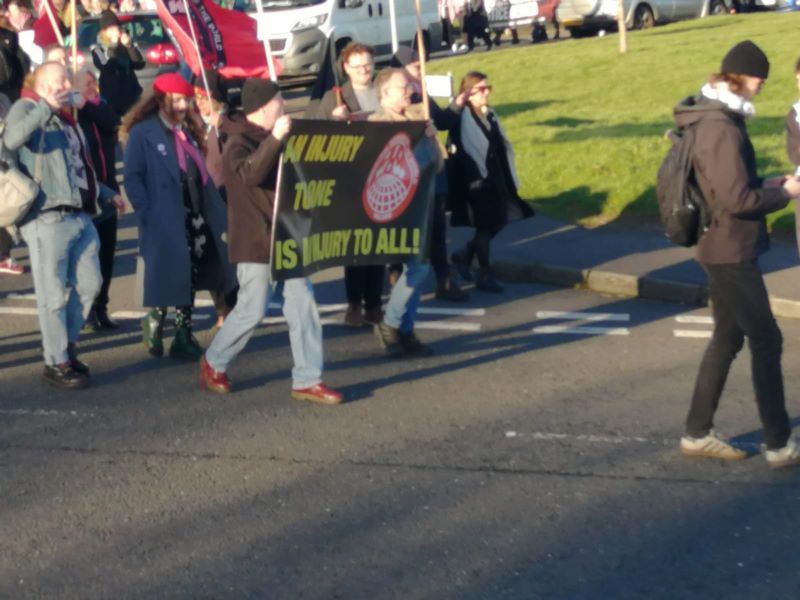
FEW CAN SEE – Censoring the Conflict was screened last week (Wednesday 4th night) in the Irish Film Institute to a moderately-sized audience, followed by questions of film-maker Frank Sweeney and Betty Purcell by Ruairí McCann from Belfast.
Sweeney took a look at state censorship during the three decades’ war in Ireland which was effected through the introduction of Section 31 of the Broadcasting Act, the sacking of the entire RTÉ Board of Directors and the jailing of a journalist.
Henceforth, self-censorship was the rule.
Specifically, the State ban applied during this period in refusals to interview any member of the IRA (Provisional or Official) and was later extended to Provisional Sinn Féin. It was enforced within RTÉ by management including members of the Workers’ Party1 who also led one of the unions.
Docudrama Few Can See focused on the application of the ban to spokespersons of people in the occupied Six Counties and of a number of campaigning groups: Gays Against the H-Blocks; Concerned Parents Against Drugs; the Gateaux bakery strike in Finglas (factory closed 1990).
Gay rights activists in Cork also campaigned against the H-Blocs and were subjected to censorship under Section 31. (Photo sourced: ICCL website)
Frank Sweeney said he had been intrigued by Betty Purcell’s memoir of her time producing programs for RTÉ and her battles with censorship there2. Conducting interviews with people about their experiences of being censored, he then worked the material into a script.
The format was of a 1980s studio with a program presenter in the style of the times and smoking, intercut with grunge-style footage, electronic interference noise and visuals, then narrowing to interviews with actors playing the parts of victims of the ban at the time.
If the intention was to show how ridiculous it could be to apply a political ban aimed at alleged terrorists instead to community struggles against oppression and the heroin epidemic, the struggle of gays around legality and health and a bakery strike, it succeeded.
The ‘RTE presenter’ in the docudrama screening (Photo: R.Breeze)
However, the issues of whose interests the State was representing in that period of heavy censorship and why it felt threatened were not teased out. Nor why it was able do what it did.
Had those issues been addressed we might have observed a vulnerable neo-colonial ruling class during a high point of struggle against the very colonial and neo-colonial nature of the state and the colony of its imperial neighbour, which also imposed censorship on broadcasting at home.
An aspect of such censorship which might not occur to one but which was discussed in the documentary is the effect of censorship not only on struggles of the time but also on the lack of available footage for archives in the future, leaving history the poorer in material.
Few Can See film has been screening around the world this year and has won some awards including the Tiger Short Award at International Film Festival Rotterdam and is due in Barcelona next year, hopefully to be screened in Ireland again, followed by a fuller discussion.
Film maker Frank Sweeney (centre) speaking during post-screening discussion at the IFI with Ruairí McCann (left) and Purcell (almost out of shot, right). (Photo: R.Breeze)
In addition to exposing the State-led censorship of the past, Sinn Féin might benefit from the film as those who were being gagged were either members or were thought to be supporters of the party. However, SF has its own history of censoring critics both within the party and outside.
And as one member of the audience was heard to remark: “It’ll be the dissidents, not SF that will be getting censored now.” True, though no longer enforced by the State, rather voluntarily by program makers, editors and by the reporters themselves, as with the genocide in Palestine.
Indeed both Sweeney, Purcell and a member of the audience alluded to ongoing censorship around that subject. But it is not only suppression of the truth which is the problem but also the obligatory insertion of the false narrative that everything began on 7th October with the Palestinian raid.
BACKGROUND: THE BROADCASTING BAN MECHANISM
Section 31 of the Broadcasting Authority Act 1960 empowered the Minister for Posts and Telegraphs to issue a ministerial order to the government-appointed RTÉ Authority not to broadcast any material specified in the written order.
The first order under the section was issued in 1971 by Fianna Fáil Minister for posts and Telegraphs Gerry Collins.It instructed RTÉ not to broadcast
any matter that could be calculated to promote the aims or activities of any organisation which engages in, promotes, encourages or advocates the attaining of any particular objectives by violent means.
Collins refused clarification when RTÉ asked for advice on what this legal instruction meant in practice and RTÉ interpreted the Order politically to mean that spokespersons for the Provisional and Official IRA could no longer appear on air.
The following year, the government sacked the RTÉ Authority for not sufficiently disciplining broadcasters the government accused of breaching the Order.
RTÉ’s reporter Kevin O’Kelly had referred to an interview that he conducted with the then Provisional IRA Chief of Staff, Seán Mac Stíofáin, on the Radio Éireann This Week programme. The recorded interview was not itself broadcast, nor was Mac Stiofáin’s voice heard.
Premiere balladeer Christy Moore (right) marching with Provisional Sinn Féins Joe Cahill (Photo sourced: Internet)
Mac Stiofáin was arrested after the O’Kelly interview and charged with membership of the IRA, an organisation listed as illegal by the State.
Soon afterwards O’Kelly was jailed for ‘contempt’ at the non-jury Special Criminal Court because he refused to identify a voice on a tape seized by the Gardaí as that of Mac Stiofáin. However Mac Stiofáin was convicted anyway in the “sentencing tribunal” of the SCC.
O’Kelly appealed to the Supreme Court and a fine was substituted as a means of purging O’Kelly’s alleged contempt. O’Kelly declined to pay the fine but it was said to have been paid anonymously and O’Kelly was released.
In 1976, when Conor Cruise O’Brien (Labour) Minister for Posts and Telegraphs amended Section 31 of the Broadcasting Act, he also issued a new Section 31 Order. This censored spokespersons for specific organisations, including the legal Sinn Féin political party, rather than specified content.
That prevented RTÉ from interviewing Sinn Féin spokespersons under any circumstances, even if the subject was unrelated to the IRA campaign in Northern Ireland conflict.
Visually impacting and clever punning in placard parade protest against Section 31. (Photo sourced: Internet)
Bizarrely even a call-in show on radio about gardening was interrupted once because a caller was a member of Sinn Féin.
The changes undermined the relatively liberal interpretations by RTÉ of its censorship responsibilities under the original 1971 Order and encouraged a process of self-censorship and illiberal interpretation.
However in 1976 O’Brien attempted to extend the censorship to newspaper coverage of the conflict, targeting in particular The Irish Press, revealing his thinking in an interview with Washington Post reporter Bernard Nossiter, naming as a possible target Press Editor, Tim Pat Coogan.
Nossiter immediately alerted Coogan, who then published the Nossiter-O’Brien interview in the Irish Press (as did The Irish Times).
Due to public opposition the proposed provisions were amended to remove the perceived threat to newspapers.
But Fine Gael and Labour were not to be left out as the 1973-77 Fine Gael/ Labour Coalition Government also tried to prosecute the Irish Press for its coverage of the maltreatment (not to say torture) of republican prisoners by the Garda ‘Heavy Gang’, with the paper winning the case.
1The Workers’ Party grew out of Official Sinn Féin which was declining after the split which led to the creation of Provisional Sinn Féin in 1970 and later another split, resulting in the 1974 creation of the Irish Republican Socialist Party. The WP was extremely hostile to the IRSP and PSF, in particular the latter.
2Inside RTÉ – a memoir, Betty Purcell, New Island Books (2014).
Large numbers attending a rally Sunday afternoon were addressed by a number of speakers from a platform in the centre of the 1916 Terrace organised by the Moore Street Preservation Trust on part of the very site they wished to preserve.
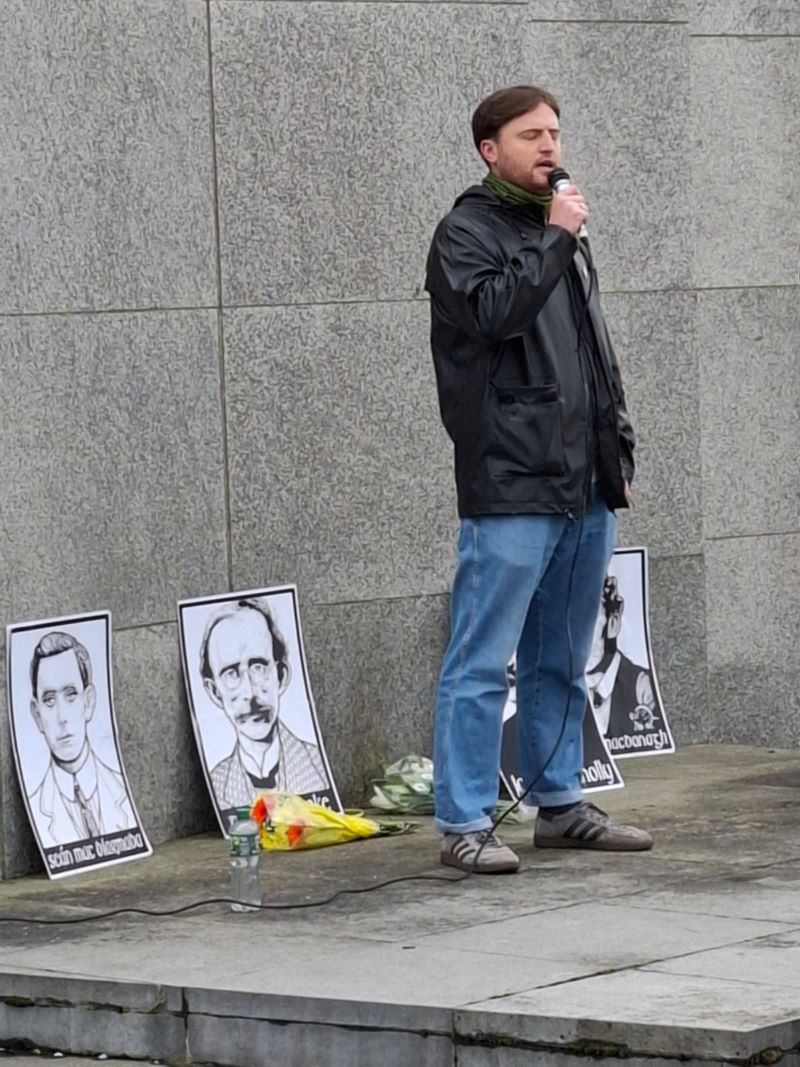
Fintan Warfield, a Sinn Féin Senator (and cousin of Derek and Brian Warfield of the Wolfe Tones) came on stage to perform Come Out Yez Black ‘n Tans followed by Grace, about Grace Gifford’s wedding to Vol. Joseph Plunkett hours before his execution by British firing squad.
Fintan Warfield performing at the event, behind him the portraits of two of the Moore Street Garrison in 1916 may be seen. (Photo: R. Breeze)
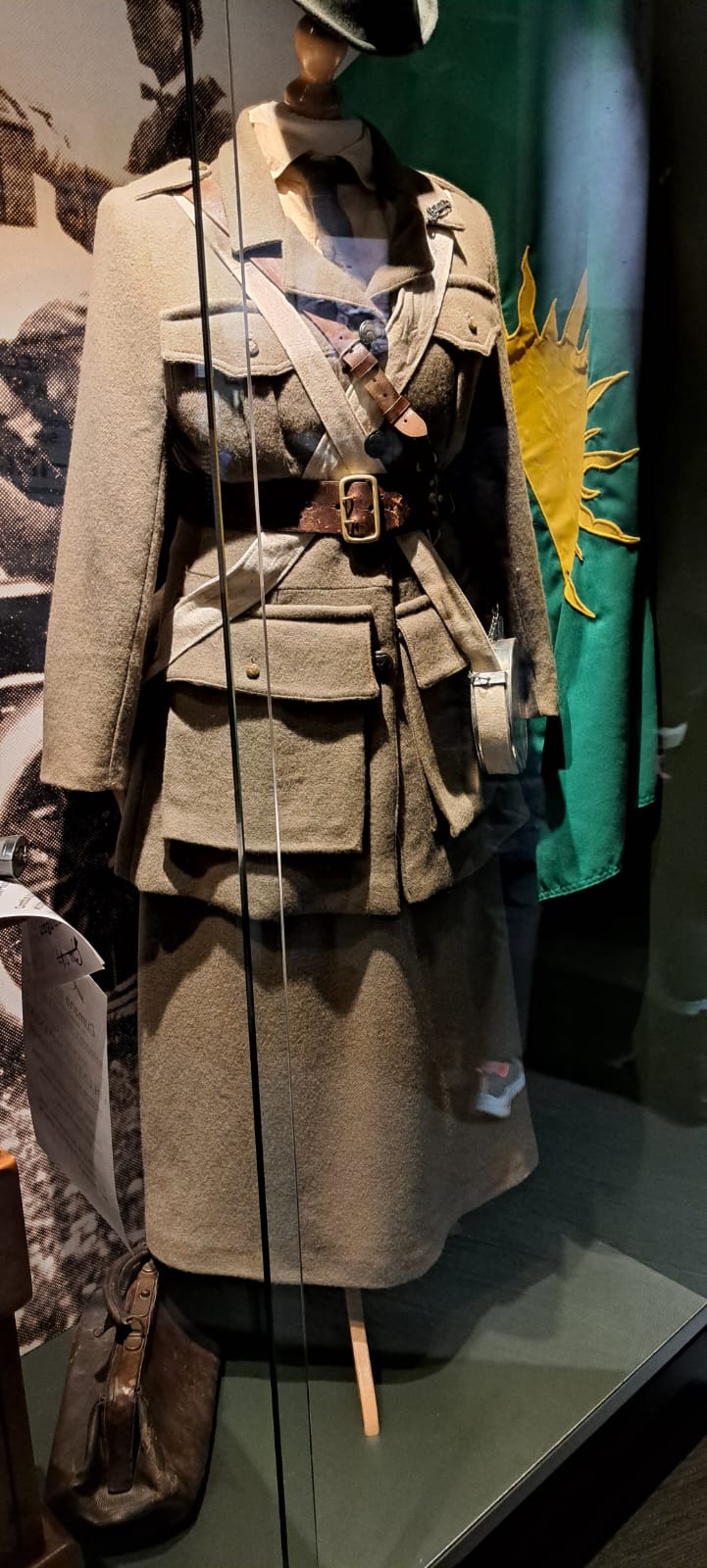
Warfield performed in front of a number of large board posters bearing the images of a number of leaders of the 1916 Rising who had occupied Moore Street in 1916 and Vols. Elizabeth O’Farrell and Winifred Carney, two of the three women Volunteers who had been part of the garrison.
The start of the rally however was delayed, apparently awaiting the arrival of Mary Lou Mac Donald, billed as the principal speaker on the Moore Street Preservation Trust’s pre-rally publicity.
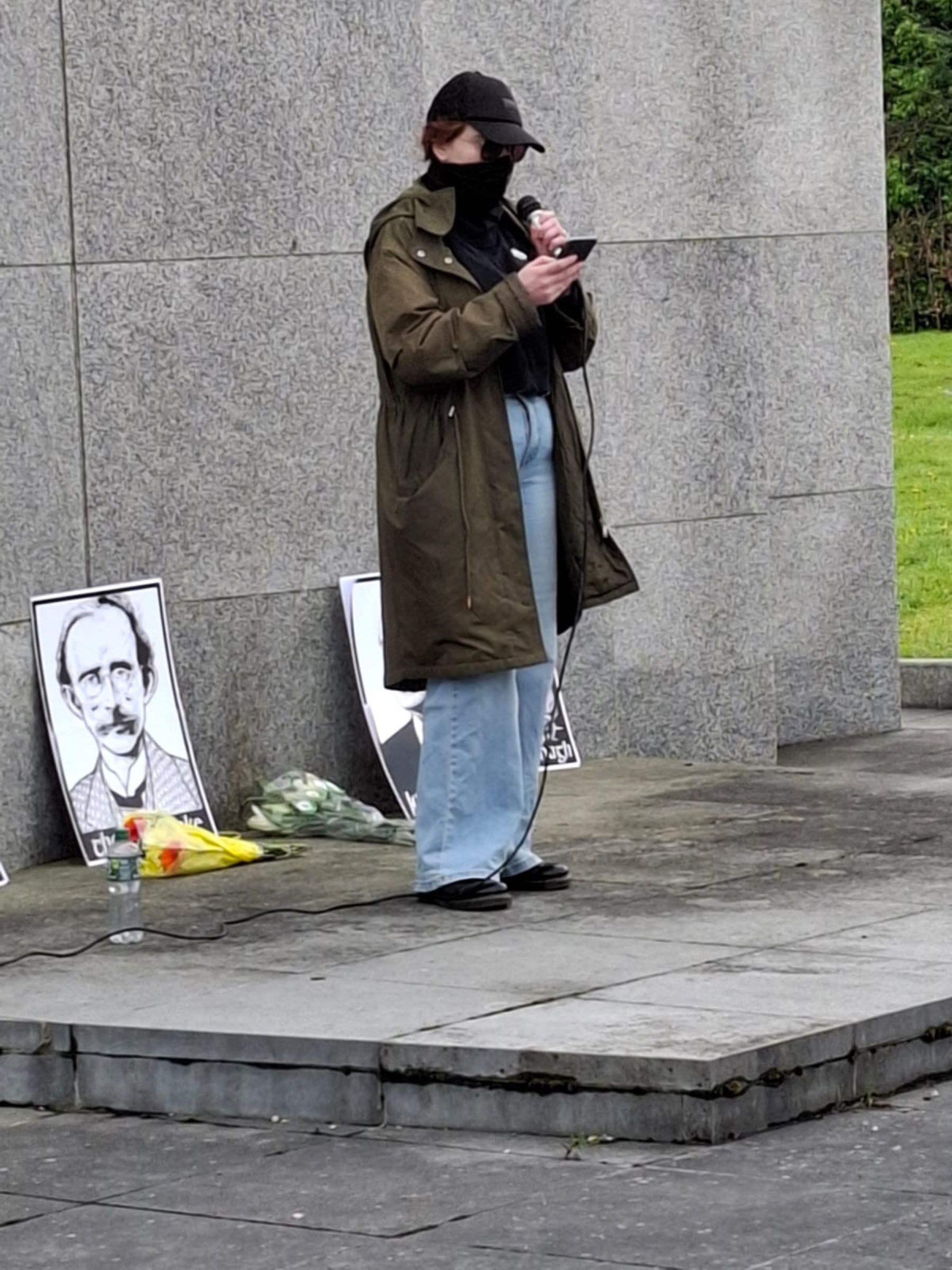
Eventually Mícheál Mac Donncha, Secretary of the Trust and a Sinn Féin Dublin City councillor came on the stage to promote some MSPT merchandise (some of it for free) and to introduce the MC for the event, Christina McLoughlin, a relative of Comdt. Seán McLoughlin.
Christina McLoughline, MC of the event. (Photo: R. Breeze)
Vol. Seán McLoughlin had been appointed Dublin Commandant General by James Connolly during the GPO evacuation and was about to lead a charge on the British Army barricade in Parnell Street when the decision was taken to cancel after which he organised the surrender.
He later became a communist and was never acknowledged at Commandant level by the War Pensions Dept. of the State under De Valera, despite his rank in Moore Street and later also in the Civil War in Cork.
Sean’s relative Christina McLoughlin welcomed Mary Lou Mac Donald on to the stage.
Mac Donald’s appearance on the stage received strong applause. In fairness, many present, if not most, were of the party faithful. Despite the presence of some younger people, the general age profile was decidedly from the 40s upwards, indeed many being clearly in the later third.
Mary Lou Mac Donald, President of the Sinn Fein party, speaking at the event. (Photo: R. Breeze)
Mac Donald, who is not an Irish speaker, read the beginning of the address well in Irish before going on to talk in English about the importance of Moore Street site in the history of the 1916 Rising and in Irish history generally and how her party in government would save it.
After the applause for Mac Donald, the MC called Proinnsias Ó Rathaille, a relative of Vol. Michael The O’Rahilly, who was mortally wounded leading a charge up Moore Street against a British Army barricade in Parnell Street and who died in the nearby lane that now bears his name.
Ó Rathaille’s address was heavy in the promotion of the Sinn Féin party and, in truth rather wandering so that he had to return to the microphone after he’d concluded, to announce Evelyn Campell to perform a song she had composed: The O’Rahilly Parade (the lane where he died).
Evelyn Campbell performing her composition O’Rahilly’s Parade at the event. (Photo: R. Breeze)
Campell is a singer-songwriter and has performed in Moore Street on previous occasions, the first being at the invitation of the Save Moore Street From Demolition group who were the only group to campaign to have the O’Rahilly monument finally signposted by Dublin City Council.
McLoughlin announced Deputy Mayor Donna Cooney to speak, a relative of Vol. Elizabeth O’Farrell, one of the three women who were part of the insurrectionary forces occupying Moore Street. Cooney is a Green Party Councillor and a long-standing campaigner for the conservation of Moore Street.
Deputy Dublin Lord Mayor and Green Party councillor Donna Cooney speaking at the event. (Photo: R. Breeze)
While speaking about the importance of Moore Street conservation for its history and street market, Cooney also alluded to its deserving UNESCO World Heritage status, adding that the approval of the Hammerson plan for the street was in violation of actual planning regulations.
Next to speak was Diarmuid Breatnach, also a long-time campaigner, representing the Save Moore Street From Demolition campaign group which, as he pointed out has been on the street every Saturday for over a ten years and is independent of any political party or organisation.
Diarmuid Breatnach speaking at event on behalf of the independent Save Moore Street From Demolition campaign group. (Photo: R. Breeze)
Breatnach also raised the UNESCO world heritage importance, as the SMSFD group were first to point out and have been doing for some years, based on a number of historical “firsts” in world history, including the 1916 Rising having been the first anti-colonial uprising of that century.
The Rising was also the first ever against world war, Breatnach said. He told his audience that the Irish State has applied for UNESCO heritage status for Dublin City, but only because of its Victorian architecture and that it had once been considered “the second city of the British Empire”.
Stephen Troy, a traditional family butcher on the street, was next to speak. He described the no-notice-for-termination arrangements which many phone shops in the street had from their landlord and how Dublin City Planning Department had ignored the many sub-divisions of those shops.
Stephen Troy, owner of family butcher shop on the street and campaigner, speaking at the rally. (Photo: R. Breeze)
Troy’s speech was probably the longest of all as he covered official attempts to bribe the street traders to vote in favour of the Hammerson plan and what he alleged was the subversion of the Moore Street Advisory Group which had been set up by the Minister for Heritage.
It began to rain as Troy was drawing to a close but fortunately did not last long.
Jim Connolly Heron, a descendant of James Connolly and also a long-time campaigner for Moore Street preservation was then called. Speaking on behalf of the Trust, Connolly began by reading out a list of people who had supported the conservation but had died along the way.
Connolly Heron went on to promote the Trust’s Plan for the street which had been promoted by a number of speakers and to announce the intention of the Trust to take a case to the High Court for a review of the process of An Bord Pleanála’s rejection of appeals against planning permission.
Jim Connolly Heron, great-grandson of James Connolly and prominent member of the Moore Street Preservation Trust, speaking at the event. (Photo: R. Breeze)
The MC acknowledged the presence in the crowd of SF Councillor Janice Boylan, with relatives among the street traders and standing for election as TD and Clare Daly, also standing for election but as an Independent TD in the Dublin Central electoral area.
MOORE STREET, PAST AND PRESENT
Moore Street is older than O’Connell Street and the market is the oldest open-air street market in Ireland (perhaps in Europe). It became a battleground in 1916 as the GPO Garrison occupied a 16-house terrace in the street after evacuating the burning General Post Office.
At one time there were around 70 street stalls in the Moore Street area selling fresh fruit, vegetables and fish and there were always butchers’ shops there too. But clothes, shoes, furniture, crockery and vinyl discs were sold there too, among pubs, bakeries and cafés.
Dublin City Planning Department permitted the development of the ILAC shopping centre on the western side of the street centre and the Lidl supermarket at the north-east end of the street, along with a Dealz as the ILAC extended to take over the space on its eastern side.
While many Irish families turned to supermarkets, people with backgrounds in other countries kept the remaining street traders in business; but the property speculators ran down the street in terms of closing down restaurants and neglecting the upkeep of buildings.
The authorities seem to have colluded in this as antisocial behaviour that would not be tolerated for a minute in nearby Henry Street is frequently seen in Moore Street.
The new craft and hot food stalls Monday-Saturday run counter to this but are managed by the private Temple Bar company which can pull out in a minute. On Sunday, the street is empty of stalls and hot food or drinks are only available in places that are part of the ILAC shopping centre.
The O’Reilly plan was for a giant ‘shopping mall’ extending to O’Connell Street and was paralysed by an objectors’ occupation of a week followed by a six-week blockade of the site, after which a High Court judgment in 2016 declared the whole area to be a National Historical Monument.
A judge’s power to make such a determination was successfully challenged by then-Minister of Heritage Heather Humphries in February of 2017. NAMA permitted O’Reilly to transfer his assets to Hammerson who abandoned the ‘shopping mall’ plan as not profitable enough.
The Hammerson plan, approved by DCC and by ABP is for a shopping district no doubt of chain stores like Henry Street or Grafton Street, also an hotel and a number of new streets, including one cutting through the 1916 central terrace out to O’Connell Street from the ILAC.
In the past dramatist Frank Allen organised human chains in at least three ‘Arms Around Moore Street’ events and the Save Moore Street 2016 coalition organised demonstrations, re-enactments, pickets and mock funerals of Irish history (i.e under Minister Humphries).
The preservation campaigning bodies still remaining in the field are the SF-backed Moore St. Preservation Trust and the independent Save Moore St. From Demolition group. The former is only a couple of years in existence and the latter longer than ten years.
However, both groups contain individuals who have been campaigning for years before that. The MSPT tends to hold large events sporadically; the SMSFD group has a campaign stall on the street every Saturday from 11.30am-1.30pm. Both have social media pages.
Fully in view, four prominent members of the Moore Street Garrison (L-R): Patrick Pearse, Commander-in-Chief; Vol. Elizabth O’Farrell, of Cumann na mBan; Vol. Joseph Plunkett, one of the planners of the insurrection; Vol. Willie Pearse, Adjutant to his brother Patrick. All but O’Farrell were tried by British court martial, sentenced to death and shot by British firing squad in Kilmainham Jail. (Photo: R. Breeze)
LEGISLATION & COURT CASES
2007 Nos. 14-17 Moore Street declared a National Historical Monument (but still owned by property developer Joe O’Reilly of Chartered Land)
2015 Darragh O’Brian TD (FF) – Bill Moore Street Area Development and Renewal Bill – Passed First Reading but failed Second in Seanad on 10th June 2015 by 22 votes against 16.
2015 – Colm Moore application — 18th March 2016: High Court judgement that the whole of the Moore Street area is a national historical monument.
2017 – February – Minister of Heritage application to Court of Appeal – judgement that High Court Judge cannot decide what is a national monument.
2021 — Aengus Ó Snodaigh TD (SF) – 1916 Cultural Quarter Bill – reached 3rd Stage of process; Government did not timetable its progress to Committee Stage and therefore no progress.
2024 – Property Developer Hammerson application to High Court Vs. Dublin City Council in objection to decision of elected Councillors that five buildings in the Moore Street area should receive Protected Structure status as of National Historical Heritage. Hammerson states that the decision is interfering with their Planning Permission. Case awaits hearing.
Five prominent members of the Moore Street Garrison (L-R): Vol. Winifred Carney of Irish Citizen Army and Cumann na mBan; Vol. Sean Mac Diarmada, one of the planners of the insurrection; Vol. Tom Clarke, one of the insurrection’s planners; revolutionary socialist James Connolly, Irish Citzen Army and Commandant General of the Rising (especially of Dublin); Patrick Pearse, Commander-in-Chie. All but Carney were tried by British court martial, sentenced to death and shot by British firing squad in Kilmainham Jail. (Photo: R. Breeze)
POSTSCRIPT
Someone commented later that in general the rally, from the content of most of the speeches, had been at least as much (if not more) of a Sinn Féin election rally as one for the conservation of Moore Street.
That should have been no surprise to anyone who knows that any position taken by Sinn Féin activists tends to be for the party first, second and third. And with the Irish general elections only weeks away, well …
And while Mac Donald spoke in Dublin of the importance of Ireland’s insurrectionary history and the need to conserve such sites, her second-in-command Michelle O’Neil was laying a wreath in Belfast in commemoration of the British who were killed in the First imperialist World War.
Not only our internationalist duty but also our longer-term practical interests are with supporting the Resistance. If so, then it is surely even more required of us that we condemn the collusion of the collaborators.
This is based on the fact of the Resistance opposing colonialism, occupation, imperialism, fascism, exploitation and so on. It is not based on whether the Resistance embraces all of our particular ideology or objectives. But that also means that we do not necessarily offer unconditional support.
Karl Marx, who from Britain not only went to some lengths to support the Irish Resistance to colonialism1 but advised the working class in Britain to do likewise,2 also remarked that it was not to be expected that British workers would support themselves being blown up for Irish freedom.3
I say that internationalist solidarity is not only a question of a kind of moral duty, but also a practical one. If we examine our own situation here in Ireland and our hopes for a united independent and socialist republic, we must also look to what happens when we achieve it.
The lessons of struggles in the world have surely taught us that we cannot hope that the imperialist countries around us will allow us to nationalise our resources and infrastructures which they’ve appropriated in full or in part, close their military bases and wish us good fortune!
Or that they will allow a positive example of the potential of socialist society to exist for the encouragement of their own working classes or for those they exploit elsewhere.
No, we will need movements of solidarity, especially in the states which will be the quickest to threaten us, i.e the western imperialist states. And, whether by coincidence or not, those are in great part the very states that are at this moment attacking Palestine and independence in the Middle East.
We think in that respect first of the United States, UK, Germany but also France, Italy, Spain, Netherlands, Sweden (even Switzerland4). Of course, we’ll be dealing with their interventions of various kinds before we even reach our independent, united socialist republic.
PA Security Forces attacking a demonstrator (Photo cred: Getty Images)
COLLABORATORS AND COLLUSION
Naturally, if we support the Resistance, we must have a corresponding attitude to those who collaborate and collude with colonialism, occupation, imperialism, fascism, exploitation and so on, not only in our own immediate struggle but also in those we support internationally.
The genocidal attacks of the ‘Israeli’ Zionist state could not last a week without the financial, military and material support in particular of the USA, but also without those from Germany, the UK and France, nor in turn without the collusion of many Arab states of the Middle East.
That is a collusion in many cases of the regimes and not supported by most of their own populations. Most dangerous of all of course are those agencies of collusion among the oppressed people themselves and we have experienced those throughout our history of anti-colonial struggle.
Our historical culture is full of contemptuous references to them, even to terms such as “Castle Catholics”; Marx too was scathing in reference to Daniel O’Connell, who sought only Irish autonomy within the British Empire, as did John Redmond, later rejected by the population.5
Many other struggles around the world have had such temporisers and actual collaborators in their midst. Indeed after liberation from fascism in countries in WWII, many of them were executed, some such as “Quisling” and “Vichy” becoming bywords in treachery and collusion.6
Palestinians hold posters depicting human rights activist Nizar Banat during a protest triggered by the violent arrest and death in custody of Banat, in his hometown of Hebron in the occupied West Bank, on June 27, 2021. [ Photo cred: Mosab Shawer/AFP]Al Jazeera correspondent Laith Jaar, beaten up by PA officer while covering the Tulkarem massacre by the IOF, then jailed when he complained to the PA. [Photo sourced: Internet]
Well then, how is that we tolerate the presentation of the ‘Palestine Authority’ as a representation of the Palestinian people? This corrupt agency with its ‘security force’ beating up and jailing critics and freedom fighters, some of which it also shoots? And dismantling defensive anti-IOF bombs?
This agency which in the Oslo Accords gave up the struggle in exchange for corrupt control of 20% of Palestinian land, which has held no elections since 2006 because the Palestinian people across the political and religious spectrum rejected the Fatah party then and elected Hamas instead.
It is no surprise then that the western imperialist countries claim the PA to be the legitimate representation of the Palestinian people and that some of them fund it, that Palestine ‘embassies’ are PA-run and that Palestine ‘Ambassadors’ are employed by the PA.7
But how is that the PA is not publicly denounced by the wide Palestine solidarity movements in the Western countries? Why this conspiracy of silence and spreading of ignorance?
It is not easy in on-line searches to find how many political prisoners the PA has in its jails or wounded or shot dead – and of course the amount of information about the Resistance passed on to the Zionists and the US awaits some historical investigations in a free Palestine of the future.
What we do know is that the PA holds over 100 political prisoners, that it arrests freedom fighters (even invading hospitals to arrest wounded fighters), that it tortures prisoners, beats up critics and demonstrators and clears the way of explosives for IOF invasion of West Bank communities.
Very recently, Palestinian journalist Laith Jaar, after reporting on the Palestinian Resistance in Tulkarem, was beaten up while covering the massacre there by Ahmed Ghassan Qawzah, an officer of the PA’s security force. When the journalist went to complain to the PA, they threw him in jail.
The Palestinian Resistance periodically denounces the PA, calling on it to support the people, threatens it when the PA’s actions are particularly egregious but refrains from using arms against it. I admit that I cannot understand that degree of forbearance, even for temporary tactical reasons.
But what about us? How is that only one protest against the PA’s Ambassador to Ireland took place and that the protesters were ejected by alleged Irish supporters of the Palestinian people? How is that only one small protest to date has taken place outside the PA’s Dublin Embassy?
How can we stomach this collusion in what is effectively a conspiracy of silence?
End.
Palestinian Police – their firearms are for opposing the Palestinian Resistance (Photo cred: Issame Ravi/ Flash90)
FOOTNOTES
1Marx and Engels had led the International Workingmen’s Association (later known as the “First International”) in not only supporting the Fenian movement but also accepting Fenians in Britain into the organisation.
2Not out of altruism but in their own interest! “As to the Irish question….The way I shall put forward the matter next Tuesday is this: that quite apart from all phrases about “international” and “humane” justice for Ireland – which are to be taken for granted in the International Council – it is in the direct and absolute interest of the English working class to get rid of their present connection with Ireland.And this is my most complete conviction, and for reasons which in part I cannot tell the English workers themselves. For a long time I believed that it would be possible to overthrow the Irish regime by English working class ascendancy. I always expressed this point of view in the New York Tribune.Deeper study has now convinced me of the opposite. The English working class will never accomplish anythingbefore it has got rid of Ireland. The lever must be applied in Ireland. That is why the Irish question is so important for the social movement in general.”
3Karl Marx, then living in London, observed: The London masses, who have shown great sympathy towards Ireland, will be made wild and driven into the arms of a reactionary government. One cannot expect the London proletarians to allow themselves to be blown up in honour of Fenian emissaries.Marx was commenting on the reaction to the disastrous explosion attempt to liberate Fenian prisoners from Clerkenwell Jail in London, on 13 December 1867, when 12 mostly working class people were unintentionally killed and around 120 injured.
5That was the essence of the O’Connell’s constitutional Repeal Movement objective of the 1840s and of the Home Rule promised by the UK ruling class to the Irish Parliamentary Party in 1914, against which the 1916 Rising took place. In the British General Election of 1918 in Ireland, Redmond’s party was all but annihilated.
6Nazi collaborator Prime Minister in occupied Norway and the French collaborator government under Petain and Lavalle.
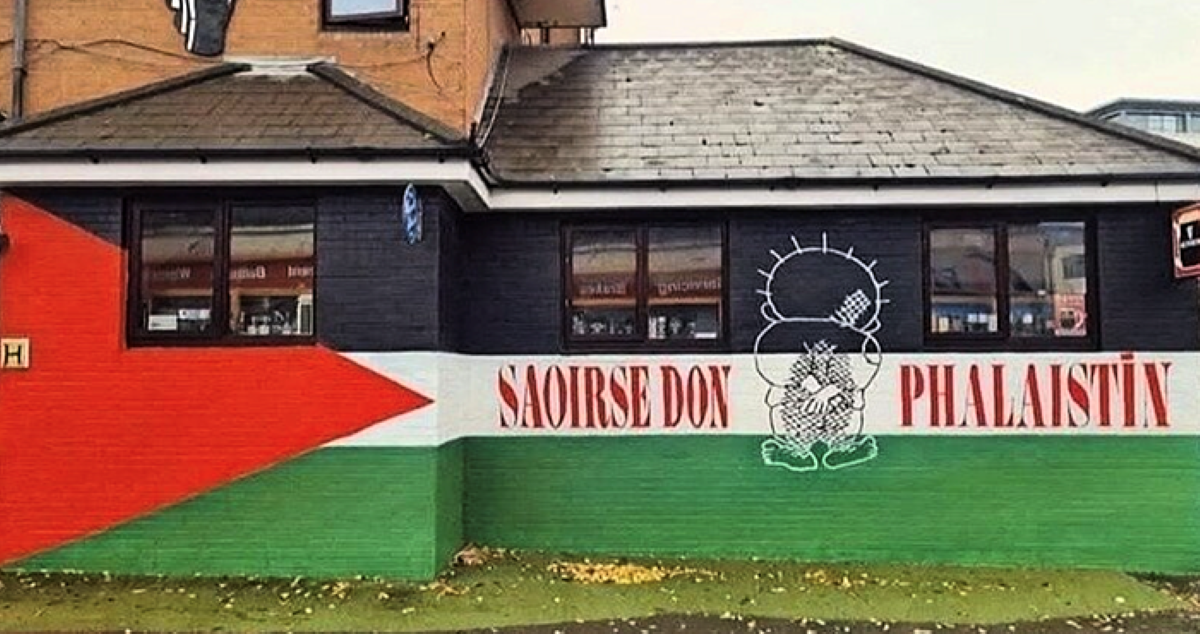
7It should perhaps be a surprise that certain parties in Europe, including Ireland, also support the PA but then, perhaps not. Not a year has passed since a meeting hosting the ‘Palestine Ambassador’ for Ireland in Belfast was protested by Palestinians who were ejected among cheers by ‘Irish Republicans’.
A number of demonstrations were held in Ireland to make it clear that Kier Starmer, Prime Minister of the UK and supporter of the Zionist state of ‘Israel’, has no céad míle fáilte in Ireland, or indeed any fáilte whatsoever for his Dublin visit.
After fourteen years of Conservative Party management of the UK, Starmer at the head of the Labour Party rode a change-seeking wave to win the General Election in July this year. But he soon revealed how little difference there is between the parties, including on Palestine.
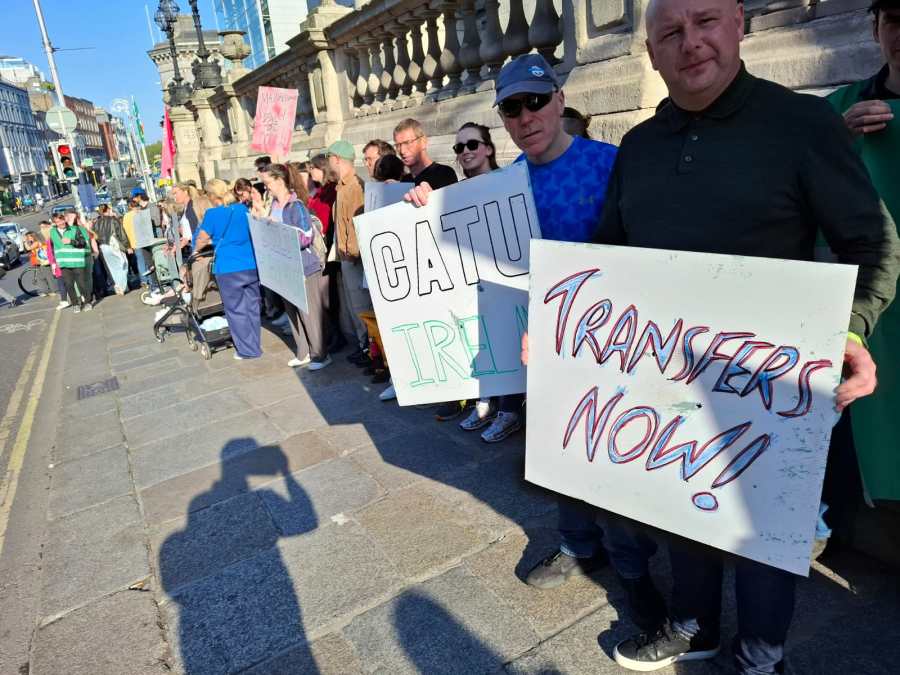
Mostly of the east-facing section on the Bridge (Photo: R.Breeze)
Although the Labour Party on the Zionist State, its Government continues to support that state politically and economically, also militarily with supply of weapons components and RAF missions.1
Very recently the UK Labour Government temporarily suspended 30 military items which may (may!) be implicated in genocide. The UK, holder of one of the five Permanent seats of the UN Security Council is complicit in the ongoing Zionist colonial settler genocide of Palestinians.
In fact, the UK is responsible for settling Zionist Jews in Palestine and then for allocating much of Palestinian land to the settler who, as European settler colonists do, expelled hundreds of thousands of Palestinians and continued extending their land-grabbing ever since.
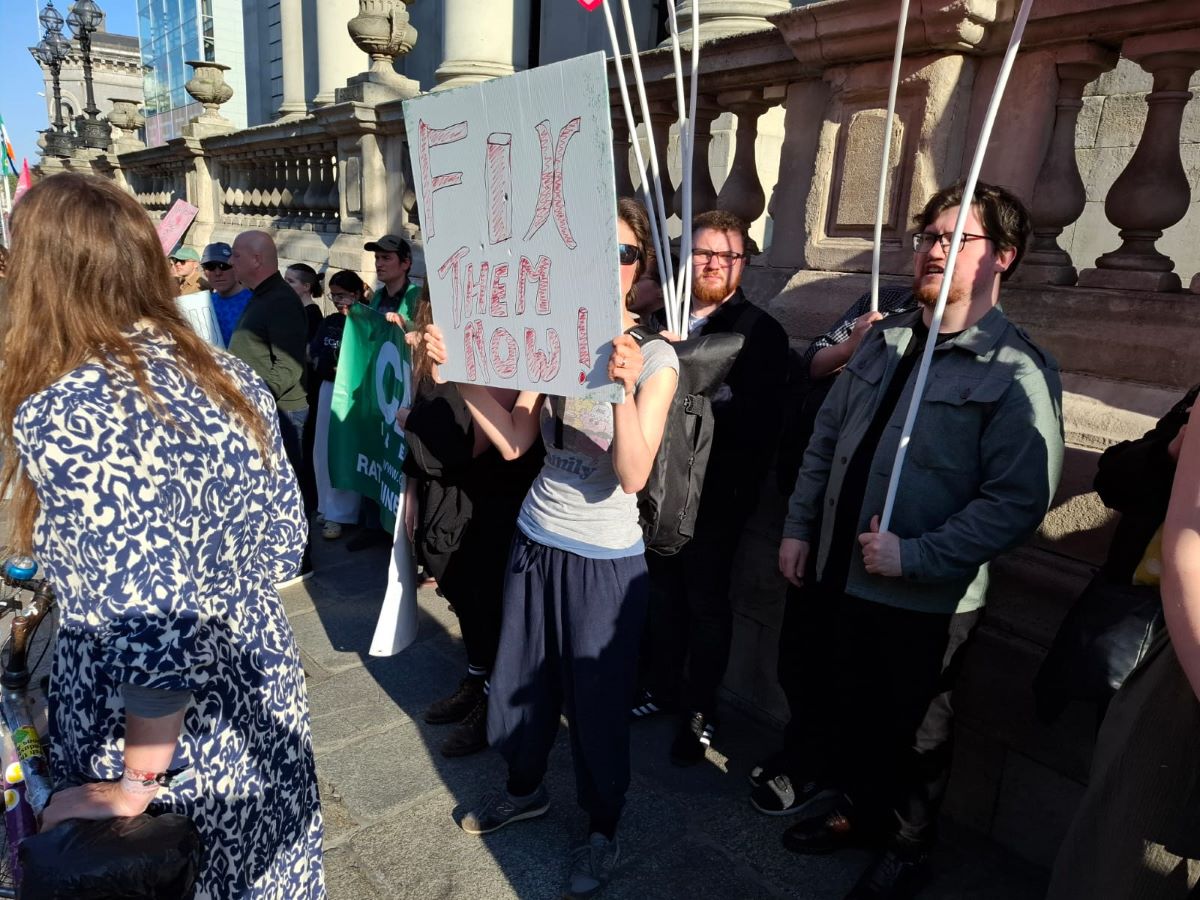
West-facing section of protest (Photo: R.Breeze)
PROTEST ON O’CONNELL BRIDGE
The Saoirse Don Phalaistín and Anti-Imperialist Action groups organised a protest against Starmer’s visit to take place on O’Connell Bridge at 3pm on Saturday and took up position on the central pedestrian reservation, with one section facing eastward and the other towards the West.
The Bridge spans the River Liffey and is in the heart of the city centre, crossed by north and southbound traffic and in view of westbound and eastbound traffic along the quays also.
There was a heavy presence of uniformed police in the vicinity, with five Special Branch nearby and a Public Order Unit van driving by a number of times as did other Garda vans. A prisoner transport van was also parked on the Bridge for a period but no attack was forthcoming.
Collection of banners and flags in west-facing section of protest. (Photo: R.Breeze)
RECORD OF THE LABOUR PARTY
One of the speakers at the O’Connell Bridge event reminded people of the history Labour Governments vis-a-vis Ireland, having sent the troops to the Six County colony to quell the struggle for civil rights there and also targeting the Irish in Britain with the Prevention of Terrorism Act.
This 1974 PTA, the speaker said, was later extended into the current Terrorism Act of repression in Britain. He reminded people too of the innocent Birmingham Six, Guildford Four, Maguire Seven and Judith Ward who were framed and jailed for long years under a Labour Government.
A speaker at the protest giving some reasons why Keith Starmer is not welcome in Ireland. (Video cred: Social Action Ireland)
The speaker could have also mentioned the Labour Party’s participation in the WWI War Cabinet which had sentenced and executed 16 Irish leaders after the 1916 Rising and its bipartisanship with the Conservatives on the partition of Ireland in 1921 and instigation of the Civil War in 1922.
SUPPORT AND OPPOSITION
The attitude expressed by protest passers-by on foot, bicycle or in motorised transport was nearly uniformly supportive. One exception was a fascist who called the protesters ‘traitors’ and attempted to take closeup photos before being blocked by a participant with a flag and seen off.
(Photo: R.Breeze)
Another was a big man who in a UStates accent seemed to shout something derogatory about Ireland and then claimed to be Irish (he might have been part of the diaspora there since the Irish tricolour colours appeared on the back of his top).
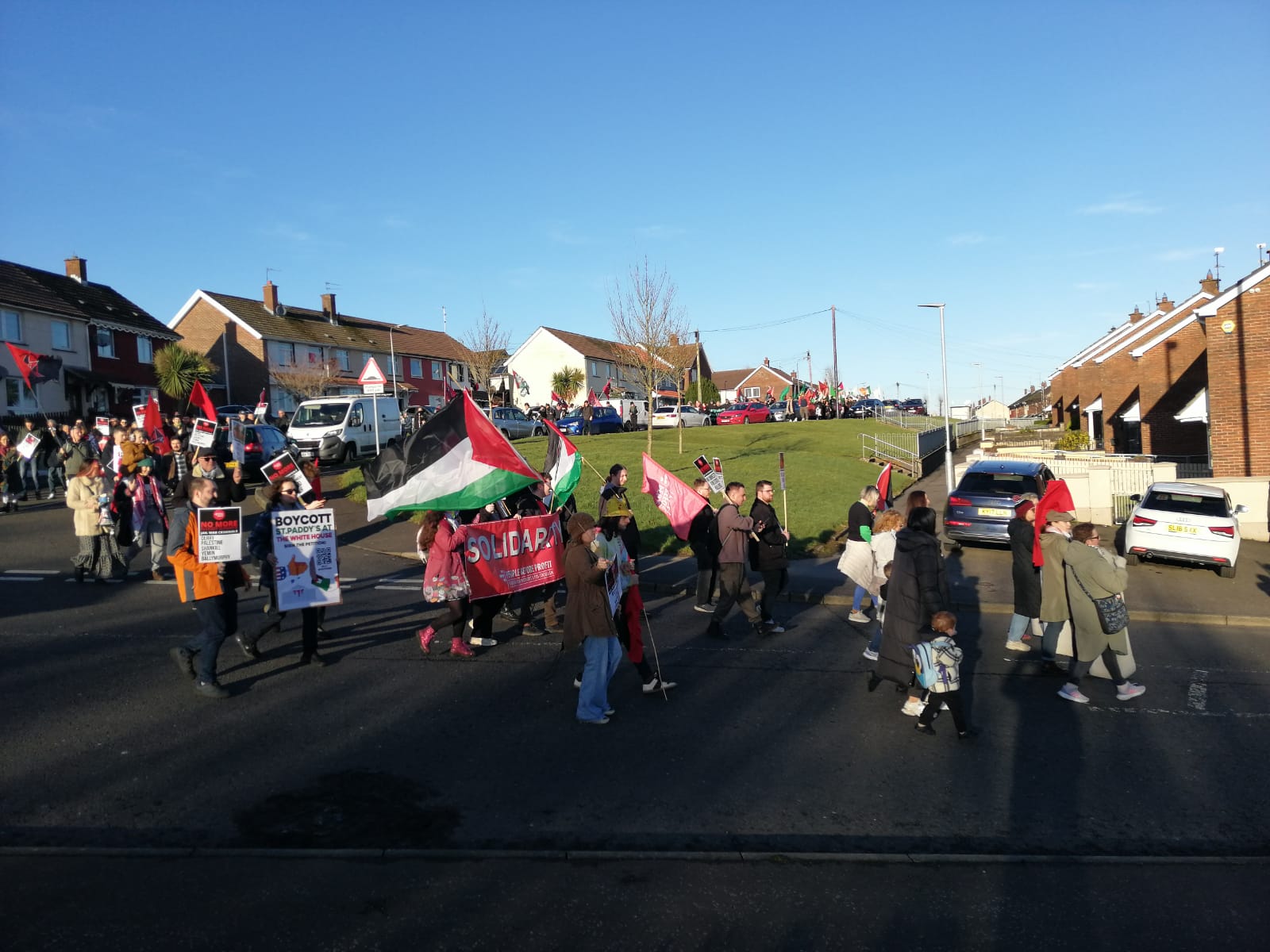
For much of the two hours of the event, slogans were shouted in support of Palestine, against the Zionist State, against Starmer, against British occupation of Ireland, for Intifada revolution, and for the solidarity action of Yemen at sea regarding Zionist-collusive shipping companies.
End.
Another view of west-facing section of protest with newly-made ornate Starry Plough flag. (Photo: R.Breeze)
FOOTNOTE
1There have been a number of reports of special units of the British army in Palestine and on British Intelligence personnel assisting the ‘Israeli’ Occupation Force.
Irish Republican hunger strikers were commemorated in Dublin with a march and rally on 24th August. The event was organised by Dublin Independent Republicans and attracted representation from many groups in addition to independent activists.
Those ten Irish Republicans who died on hunger strike in 1981 are still remembered well in the general Irish population, most of all their leader Bobby Sands. However another twelve died on hunger strike in earlier days, going back to 1917, before the War of Independence (1919-’21).
Marchers in Westmoreland Street carrying images of the hunger-strike martyrs on the return to the Garden of Remembrance. (Photo: D.Breatnach)
For over a century, hunger strikes have been one of the traditional methods of protest and struggle by Irish Republican prisoners in jails of the British and also of the Irish State.
Those Republican prisoners who died on hunger strike in 1981 did so from the effects of starvation but some died through force-feeding also, which was the case with Vols. Thomas Ashe (1917), Michael Gaughan (1974) and Frank Stagg (1976).1
James Connolly Memorial Band with their own colour party in Westmoreland Street on the return to the Garden of Remembrance. (Photo: D.Breatnach)
PARADE THROUGH CITY CENTRE AND RALLY
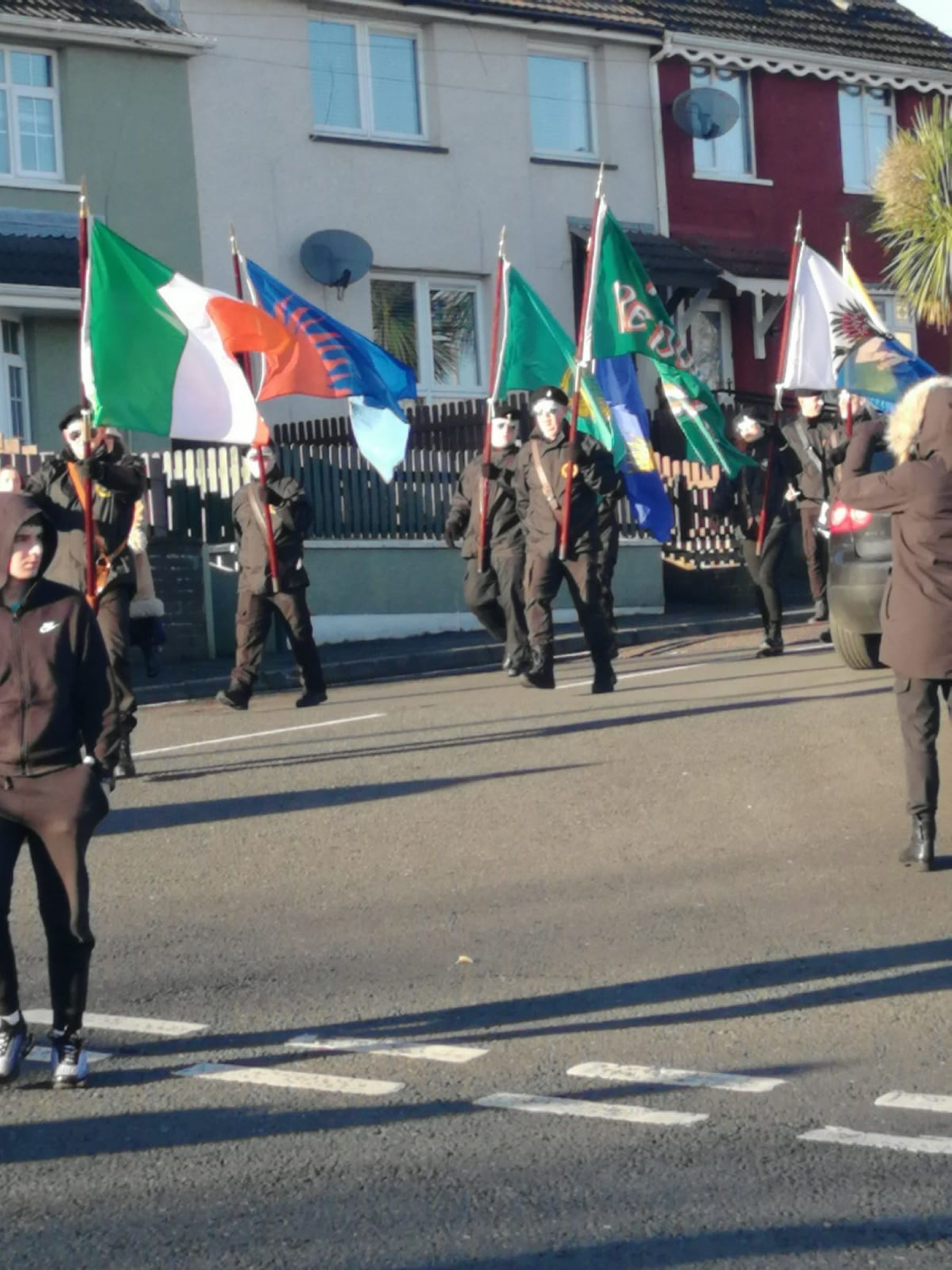
Led by a colour party,2 the parade set off in two columns3 from the Garden of Remembrance in Parnell Square with the James Connolly Memorial Republican Flute Band leading and along the City’s main thoroughfare, O’Connell Street, crossed the Liffey to ‘touch’ Trinity College and back again.
Marchers setting off from the Garden of Remembrance in Parnell Square. (Photo: D.Breatnach)
Upon returning to the Garden of Remembrance, the banners and band took up position in front of the memorial with the audience facing them, where Ado Perry as MC for the event welcomed all.
As well as recalling the struggles of Republican prisoners within the jails and deaths on hunger strike, Perry also took some time to denounce the Zionist genocide in Palestine and to express the Palestinian solidarity of Republicans (and of the majority of the Irish people).
Ado Perry as MC of the rally in the Garden of Remembrance, flanked by the No Extraditions banner, the colour party behind and behind them, the Monument to those who fell in the struggle for Irish freedom. (Photo: D.Breatnach)
Perry also condemned the planned extradition of Irish Republican prisoners to British jurisdiction and called for Irish Republicans to unite in opposition, recalling the struggles against extradition over the years.
Floral tributes were laid at the Monument and Cáit Inglis read the names of the 22 who died on hunger strike, before the MC called on Cathal Graham for a song. Graham performed Wrap the Green Flag Around Me, a song that seems to have fallen somewhat in popularity in recent years.
Frankie Quinn giving his speech at the rally. (Photo: D.Breatnach)
The main speaker for the day was Frankie Quinn, a long-time Republican, community activist and ex-political prisoner who spoke first in Irish before turning to English. Quinn too condemned the genocide in Palestine and expressed solidarity with the Palestinian resistance.
In a reference to recent racist mobilisations in Ireland, Quinn made it clear that those people had nothing in common with Republicans or with the Irish national struggle for a socialist republic. (A known racist female activist had reportedly been encouraged to leave the scene a little earlier.)
The speaker was vigorously applauded and was followed by Gráinne Gibson who performed hunger strike martyr Bobby Sands’ poem The Rythm of Time.
(Photo: D.Breatnach)
Cathal Graham returned to perform The Time Has Come, a representation of hunger strike martyr Patsy O’Hara’s plea to his mother not to withdraw him from the fast when he lost consciousness, unless their demands were conceded. The colour party lowered their flags in respect to the martyrs.
Perry thanked all for their attendance in particular the marching band, colour party, performers and stewards, once again emphasising the need for united action to prevent the extradition of Irish Republicans to British jurisdiction, then called the band to perform Amhrán na bhFiann.4
The colour party leading the march out of Westmoreland to cross the river to the rally in the Garden of Remembrance. (Photo: D.Breatnach)
There was broad support for the event as shown by the participation of a number of different organisation and individual activists, which is a hopeful sign for the future. The real test however will be whether the disparate elements will act in unity as called for by Perry and Quinn.
End.
The lowering of the flags in honour of the martyrs in the struggle. (Photo: D.Breatnach)
Footnotes
1Their deaths under medically-supervised force-feeding caused the British Medical Association to oppose force-feeding of any hunger-striker in possession of normal cognition.
2The flag composition of Irish Republican colour parties varies but when flags and members are available traditionally are composed of the Irish Tricolour, the Starry Plough (blue or green version), the Sunburst and the flags of the Four Provinces. I have also seen on occasion the inclusion of a Scottish Saltere and on another, the Palestinian flag.
3More or less two columns – outside of the Six Counties marchers are unaccustomed to that formation and stewards were hard-pressed to ensure marchers kept to either one column or the other, a difficulty I remember well myself from my capacity as chief steward on a Dublin march against internment of Marion Price years ago.
4Irish language translation of The Soldiers’ Song by Peadar Kearney and Patrick Heeney, the air of the chorus which is the official National Anthem of the Irish State. At commemorations and such events it is usual for the air of both the verses and the chorus to played. In the 26 Counties it is common for people to sing along to the air played (or to a solo singer) but not in the 26 Counties. Unusually with cases of songs with versions in both langauges, it is the translated lyrics into Irish which most people know.
Most people in the Western world will have experienced being stopped at a checkpoint, usually feeling irritated at the delay to their journey, commonly afraid only if driving under the influence of alcohol or drugs.
Or curious perhaps – what is this stop about? In many parts of the world however, apprehension or fear are the normal emotions for drivers approaching a checkpoint. The mind wonders: Might I be arrested, beaten, robbed, raped, killed?
For people in a country invaded and occupied, those are rational fears; the people staffing the checkpoints are occupying soldiers or police; or perhaps auxiliaries, locals working for the occupation, perhaps from a different ethnic group. Which can sometimes be worse.
Many Palestinians have been arrested at checkpoints and certainly some have been killed there, while arrest does not mean one will not be killed anyway, or not be used as a human shield under threat of death, or even killed despite doing what their captors asked.
In those situations there are other negative experiences not necessarily including physical harm: humiliation, harassment, the display of power imbalance in how people are treated, delayed, mocked, insulted. An everyday experience for Palestinians passing through IOF checkpoints.
A busy checkpoint, the Palestinians packed worse than cattle. (Photo source: Internet)
It was so also for many people going through British Army and colonial police checkpoints in the occupied Six Counties of Ireland. Cars with Irish registration plates might be held up for half an hour or longer. Or people who answered that their destination was Derry, instead of “Londonderry” (sic).
People have had their children upset by searches, cuddly toys ripped open, intimate adult clothing in luggage inspected, been body-searched, intimidated by loaded weapons pointed at them and, if known as activists, or even related to activists, been threatened with murder.
All of this happens to Palestinians at checkpoints where Israelis can pass through, hardly stopping. And there are LOTS of checkpoints throughout the West Bank or on the way into “Israel” (i.e. the lands seized and occupied by the Zionists since 1948).
Map of established Occupation checkpoints in the West Bank, illegally occupied according to the UN. Temporary checkpoints in addition are often established. (Source: Internet)
The guards on checkpoints are often bored or irritated and take out their feelings on those trying to pass through. But the oppressing power wants that to happen: the checkpoints are part of the control structure, physical and mental in effect.
The structural effects and attitudes of the checkpoint guards affect Palestinians travelling to and from their jobs inside ‘Israel’ in addition to Palestinians travelling between one place and another in the occupied lands outside official ‘Israel’.
Those journeys can be for medical treatment (including emergencies), to work or apply for work, to school or university, shopping, to visit friends or relatives, to attend weddings, births, funerals, to support the elderly or disabled, to assist in community work, to take a break, attend festivals …
Apart from anything else, for the Palestinians queuing it may mean a long time in stifling heat in close proximity to other bodies, without water or with a limited supply, no access to a toilet, possibly in direct sun or, in winter, exposed to cold wind and rain …
An Occupation soldier at a pedestrian checkpoint examines the IDs of Palestinian children accompanied by an adult for their protection. (Source: Internet)
VULNERABLE
Temporary checkpoints however are also vulnerable. A soldier or policeman approaching a vehicle or even pedestrians on foot has only his body armour and firearm standing between him and attack, even if having done this four hours a day for weeks without a single misadventure.
Because one day, just that once, it might be different.
In the past, a Palestinian might blow himself up at a checkpoint. More recently another who’d had enough drove his car through a checkpoint at speed, fatally wounding one of the guards and then shot another. On another occasion, a Palestinian seriously injured two guards by stabbing them.
A long line of Palestinian vehicles await clearance to proceed through IOF checkpoint (Photo sourced: ARU)
Now, more and more frequently, IOF checkpoints are coming under fire. An incident might last no more than a minutes or two but how long does it take a bullet to travel and enter a body? And even without killing or wounding the body, what is the affect on the mind to feel like a stationary target?
These might seem easy operations but no armed action against the Zionist state is free from danger, especially with IOF drones to record or even fire at Palestinian fighters, to say nothing of artillery shells, bombs and missiles. Success rate in killed or injured IOF in such operations tends to be low.
But their psychological effects are quite significant and wars are not fought just by and on bodies; they are fought by and on minds too. The checkpoints, instruments and symbols of power and oppression have become vulnerable and targets … like the repressive forces staffing them.
End.
A Palestinian youth being arrested by Occupation soldiers at a checkpoint. (Photo cred: Zain JAAFAR / AFP)
Prominent among the many words quoted from Theobald Wolfe Tone, ‘the father of Irish Republicanism’, are that ‘Our Strength shall come from that great and respectable class, the men of no property’.
The interpretation of those words has led to some confusion between socialism and republicanism.
Wolfe Tone, as he is normally known historically, co-founded the Society of United Irishmen in 1791, which led a mass armed uprising in 1798 against British Rule in Ireland, as a speaker said at the Anti-Imperialist Action’s oration at their annual commemoration at Tone’s grave last month.1
Tone himself was arrested on a French ship captured by the British Navy and despite his French Army officer rank, tried on treason charges and sentenced to death upon the gallows … but died instead in prison of a wound to his throat.
Wolfe Tone Monument, Stephens Green, Dublin (Photo cred: National Built Heritage Service)
An important part of the leadership of the United Irishmen, most of the Leinster Directorate was arrested in Dublin but the Rising went ahead in other parts of Ireland, notably Antrim, Wexford and Wicklow, and another with French troop reinforcements, too few and too late, in Mayo.
The Rising was crushed, the leaders executed or exiled, along with many of their followers. A large body of Irish traditional and folk song, mostly in English and much of it composed in its centenary, commemorates the struggle and sacrifice of the United Irishmen.
The AIA speaker: “Tone’s most important belief was that we must ‘break the connection with England’ by any means necessary – one of the most important teachings for the Revolutionary Republican Movement today,” to work “for National Liberation by any means we decide necessary”.
No-one who has even the most cursory acquaintance with the historic figure of Wolfe Tone can deny that he was determined to break away from English colonial rule and, once he became convinced there was no peaceful way to do so, was determined to do it by force or arms.
“Tone was also clear that the revolutionary struggle could only be successful,” continued the speaker, “if it was based on the masses of the Irish People, stating that, ‘Our Strength shall come from that great and respectable class, the men of no property’.”
From that, the speaker went on to claim that “we learn from Tone that the fight for our Republic is a class struggle and that the driving force of that struggle will be the working class fighting for their own liberation.”
I do not believe that the writings or recorded words of Wolfe Tone justify that interpretation. Indeed, it would have been strange if they had; the 1798 Rising was what Marxists describe as a “bourgeois revolution”, i.e. one led by a section of the capitalist class in its own class interests.2
Such also were the Revolutions in England of 1649 and 1688, of the French in 1789 and the American in 1765-1783, the Italian of 1848, the Chinese of the early Kuo Min Tang and the Latin American revolutions against the Spanish Empire, along with the Mexican 1910-1920.
Yes, the capitalist class, which is always telling us to employ only constitutional means to get what we need or want, tries to conceal that they themselves came to power by revolution.
Colorised illustration by unknown artist of the storming of the Bastille in July 1789 (Source: Wikipedia)
The leadership of the United Irishmen was almost totally of the established Anglican church or of Protestant sects – “Protestant and Dissenter”, in Tone’s words. They were descendants of settlers from Britain and they were of bourgeois social strata.
This section of the bourgeoisie and petit-bourgeoisie were fed up with restraints imposed from England on developing the colony’s potential, on a taxation system they considered unfair, on corruption in the Irish Parliament and in management by the Monarch’s representative in Ireland.
Being only a very small minority of the Irish population3 they were aware that they needed the mass behind them in order to build an independent national economy, for which they tried to gain Catholics admission to the Irish Parliament, which at the time only admitted Anglicans as MPs.
When Henry Grattan, who had earlier led quite a rebellious Irish Parliament,4 failed in the attempt to make Parliament more representative, Tone and many others became convinced that only revolution could progress society in Ireland and from then on he strove to bring that about.
Grattan
Statue of Henry Grattan, failed reformer of the Irish Parliament, situated in Dame Street junction with Grafton Street and facing Trinity College. (Photo cred: Trip Advisor)
A revolution against England, a great European naval power, even with the help of revolutionary France, would require mass participation and support, as the AIA speaker remarked at the commemoration. So Tone aspired to the unity of “Catholic, Protestant and Dissenter.”
The section of the religions that most fell into the category of the “men of no property” were of course the Catholics, dispossessed of their lands and under Penal Laws of the Occupation. Without the support of the Catholic majority there was no chance of a successful revolution.
Tone may well have been a most democratic Republican in favour of all kinds of progressive social reform but nowhere in his writing does he advocate the overthrow of the bourgeoisie, seizure of private property and the setting up of a socialist system to be run by the working class.
united men
Reenactment of the United Irishmen in battle, depicting the “men (and women) of no property. (Photo sourced: Internet)
Theobald Wolfe Tone was a courageous democratic revolutionary, anti-colonial and a martyred patriot but was not nor could have been a socialist leader. That which he was, was the best of his time and among the best we had to offer and there is no need to try to make him something else.
The United Irishmen represented a section of the Irish bourgeoisie that was truly Republican and revolutionary. That section of society was mostly of settler descent since the mass of the native and Catholic population had been ground down and oppressed.
Thereafter most of the native Irish bourgeoisie developed as a subservient client class, “Castle Catholics” ag sodar i ndiaidh na n-uaisle,5 up to whatever “cute hoor”6 and gombeen7 tricks they could get up to but without a fraction of the spine necessary to fight for real independence.
A successful Irish national revolution does indeed need to be led by the Irish working class as demonstrated by what James Connolly – rather than Wolfe Tone – observed: “Only the Irish working class remain as the incorruptible inheritors of the fight for freedom in Ireland.”
The reason for that, as outlined by Connolly, is quite simple: the working class is the only social class of any size that has nothing to gain from compromise and betrayal of the revolution.
Some other key points laid down by Tone, continued the speaker, include that Republicanism is Anti Imperialist and it is Internationalist. Our struggle in Ireland is part of a wider international struggle of oppressed people against occupation, colonialism and imperialism.
Tone understood this when he looked to Revolutionary France to support the 1798 uprising.
This was well understood by Irish Republicans of Tone’s time who celebrated the fall of the Bastille in 1789 and the defeat of the English by the settlers in America. The United Irishmen also helped the creation of the United Englishmen and led two of the British Navy’s most serious mutinies.8
Today, continued the speaker, Republicans must fight our struggle while also supporting Liberation struggles around the world in the belief that every blow struck against imperialism brings our victory closer.
So from Palestine to the Philippines and from India to the Basque Country, and everywhere people take a stand against NATO, the Revolutionary Republican movement must raise our cries in solidarity.
End.
Footnotes
1The event was organised by Anti-Imperialist Action, a socialist republican organisation, with the oration being given on behalf of the organisation. A pilgrimage to Wolfe Tone’s grave in Bodenstown is a fixture on the calendars of most Irish Republican organisations.
2This should not be taken as a criticism since Marxists agree that many bourgeois revolutions were progressive in their time.
3Tiny, in the case of the Anglicans in particular; the Presbyterians were much more numerous.
6An admiring description in Ireland for one who manages to benefit by dubious means.
7Corruption of an Irish language term for the ‘carpet bagger’ types who benefited amidst the disaster of the Great Hunger in the mid 19 Century, snapping up land in particular at the lowest of prices.
Diarmuid Breatnach – Talk given at 1916 Performing Arts Club, May 2024.
(Reading time: 6 mins.)
There was a time when from Dublin to Galway, from Kerry to Donegal, the dominant language was Irish. There was a time too when it was widespread in Scotland, in parts of Wales and the main language on the Isle of Man.
Now however one can travel through all of those places and not hear it.
Irish was the first vernacular language to be written down in Europe and though island people, its speakers were not “insular”. The educated spoke Greek and Latin too and when the Dark Ages fell upon Europe it was the Irish intellectuals, the monks who revived and spread literacy there.
But here we are, you and I, speaking English – which did not even exist until at least the 12th Century.
She (I say ‘she’ because language in Irish is a feminine noun and in many other languages too) – she is all around us in place names, though we may know them only through their corrupted forms into English.
Árd/ Ard, a height; Baile/ Bally, a town or village; Béal/ Bel, the mouth of; Bun, the bottom of; Carraig/ Carrig, a rock; Cnoc/ Knock, a hill; Cluain/ Clon, a meadow; Dún/ Dun, a fort or castle; Inis/ Inis or Ennis, an island or a raised mound surrounded by flat land; Loch/ a lake …
The English-language names of twenty-nine of our counties are corruptions of words in Irish: from Ciarraí to Dún na nGall, from Átha Cliath Duibhlinne to Gaillimh. This includes all six counties in the colony: Aontroim, Árd Mhacha, Doire Cholmcille, An Dún, Tír Eoghain, Fear Manach.
Just over half the States of Stáit Aontaithe Meiriceá on Turtle Island have names in the indigenous native languages, so we’re doing well with placenames and also of course have survived the colonial genocidal campaigns and wars much better.
By the way we also have Irish names for some places in Britain: Glaschú, Dún Éidin, Manchuin, Leabharpholl, Brom agus Lúndain. In fact probably none of the names of those cities are originally English anyway.
Irish has left only a small imprint on the general English language for example with “a pair of brogues, whiskey and slogan” (from slua-ghairm, a call to or by a multitude), banshee, carn and smithereeens. And shebeen, in parts of the USA, the Caribbean and in South Africa.
But its influence on the way we speak English in Ireland is clear.
We might say, instead of complaining that we are thirsty, that we have a thirst on us – a direct translation from Tá tart orainn. Or that the humour is on us – Tá fonn orainn. We might “have a head on us”, as in a headache. “The day that’s in it” – an lá atá ann.
We pronounce “film” with a vowel between the L and the M, as it would be in Irish – take the name for a dove and also a personal male name, Colm. We get that with R and M and R and N too, in some areas “a carun of stones” or “down at the farrum”.
We often indicate the absence of ‘Yes’ or ‘No’ in Irish by replying in English to the verb in the question: ‘Will you be there?’ ‘I will surely’ (Beidh, cinnte). ‘Will you do it?’ ‘I will not’ (Ní dhéanfad).
We have an extra tense in Irish, the very recent past tense, which we translate into English as spoken in Ireland: ‘I’m just after cleaning that floor!’ Táim díreach thréis an urlár sin a ghlanadh!
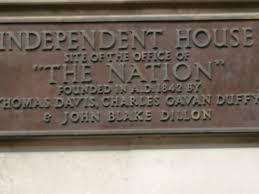
Renaissance of language and culture has often preceded periods of heightened national struggle: the Harp Festival of 1792 was followed soon by the uprising of the United Irish; the cultural work of The Nation newspaper was followed by the rising of the Young Irelanders.
The Nation newspaper of the Young Irelanders sought to create and encourage a nationalist republican culture and was followed by an unsuccessful rising in 1848, during the Great Hunger. (Source image: Internet)
LANGUAGE AND NATIONAL STRUGGLE
The Fenians too had their cultural precursors and the great revivals of the Irish language, Irish sport, speaking and writing in Irish and Irish theatre were not long in finding expression of another kind in the 1916 Rising and the War of Independence.
And campaigns of civil disobedience in the 1960s secured for us Irish-language broadcasting in Radió na Gaeltachta and TG4. Not to mention motor insurance documentation in Irish which Deasún Breatnach won only after going to jail for refusing to display the documentation in English.
Though we can hear the influence of the indigenous language upon our speaking Sacs-Bhéarla, or English, the Irish language itself at this point is in retreat. In fact some might say that it’s in a rout.
Yes, the Gaelscoil movement is broader and deeper than ever before but outside the schools? The Gaeltacht areas are receding, receding … and where can the language be heard outside of those?
Though the Great Hunger caused the most impressive loss of Irish-speaking modern Ireland on the map, the percentage lost during the period of the Irish State is greater. (Image source: Internet)
I had an experience recently that illustrates the problem. In a pub with some friends, I observed a man wearing a silver fáinne, the ring that many people wore to show a proficiency in Irish. It identified the wearer to other Irish-language speakers (my father wore a gold one).
The man had overheard me bidding farewell to friends in Irish and asked me: “Are you an Irishman?” I thought the question strange and said so. Then he asked me was I an Irish speaker, to which I replied in Irish language.
Eventually he came over and said that he didn’t speak Irish himself.
The fáinne was a family heirloom and he had been wearing it, he said, for six months in Dublin, wanting to come across an Irish speaker to whom he would give the ring. Since I had been somewhat abrupt with him, he gave the ring to one in the company who can speak Irish.
Badge inviting people to speak Irish to the wearer (Image sourced: Internet)
LABHAIR Í
Six months in Dublin without hearing Irish spoken or recognition of the fáinne! That illustrates one aspect of the linguistic problem in Ireland. But it is one that we can resolve, fairly easily too. And that brings me to the kernel, the poinnte or point of this talk here today.
I am asking you to speak a cúpla focal, regularly, go rialta, so that she may be heard. Labhair í ionnas go gcloisfear í. Imagine if everywhere in Dublin, on every side, one heard just a few words in Irish – imagine the social and psychological effect over time!
Those who know some Irish would speak her more often. Many who don’t, would feel it worthwhile to learn at least some phrases and some responses. Some might take it further and learn Irish well. Public services might regularly facilitate services through Irish.
Dia dhuit. Dia’s Muire dhuit. Or the non-religious form: Sé do bheatha. Go mba hé duit.
Má sé do thoill é or le do thoill.
Go raibh maith agat in many situations, including to the driver of the bus.
Tá fáilte romhat.
Gabh mo leithscéil.
Would you like a bag? Ní bheidh, go raibh maith agat.
Cash or card? Íoch le cárta, le do thoill as you wave your bank card. Or Airgead thirm, as you take out your wallet or purse.
Go léir, as you indicate that you wish to pay the full amount.
Isteach, le do thoill, when returning a book to the library. Amach, le do thoill, when borrowing one.
Slán, as you leave.
Easy enough, yes? Yes? But though a part of the mind is willing, another part is afraid.
“What if I get a big load of Irish in response and not even understand it? Won’t I look like a right eejit!” Well, there are risks in anything worth doing as was demonstrated in a short play here some time back when two fellas were debating whether and when to chat up a certain woman.
She was not uninterested but they took so long about it she walked out and left them, like fish brought up by fishing line, gasping on the dry quay.
So you could prepare a small survival kit: “Gabh mo leithscéil. I only have a few words/ níl agam ach cúpla focal.”
“Níl agam ach beagán ach tá mé ag iarraidh í a úsáid/ I only have a little but I want to use it. Is foghlaimeor mé/ I am a learner.”
I am not asking for any of us to campaign, to agitate for services to be provided through Irish though that is certainly a linguistic civil right and, as far as state or semi-state services go, a constitutional one.
I am only asking that you contribute to the audibility of the language, to use a few standard greetings and responses and to use them not only to people you know to be Irish speakers, not only to friends and relations … but everywhere in public.
Everywhere
in public.
Go ye out among the people and spread the word – or rather the few words. Scapaigí an cúpla focal.
Irish media on Thursday 9th reported that the authorities removed the tents of refugees and asylum-seekers from along the banks of the Grand Canal. These had set up there after being removed from the vicinity of the IPO1. Where could they go?
Apparently they are dispersed to Newmount Kennedy (where we’ve seen – if not fascist mobs, certainly mobs containing some fascists), Dundrum, Crooksling and City West. Hopefully they will get a roof, showers and food, though thrown out to outskirts without any plan of integration.
The tents were dismantled when Harris said they were unacceptable and that accommodation was now available. However, despite four dismantling actions by government, on each occasion many asylum seekers were not provided with accommodation, thus causing a new camp to be established each time.(Photo: SRI)
In the four months since January a thousand have applied to the International Protection Office. They get issued with a Temporary Residence Card2 (known as the “Blue book”) and not much else; if they lose that documentation (e.g during eviction) they are in trouble.
Photo ID is issued to them when they make their application for asylum at IPO. Finger prints are taken, statements recorded etc. All evidence is cross-checked with relevant authorities including Interpol. Hence, the notion that men are “unvetted” or “undocumented” is inaccurate.
They are told there is no accommodation available which is why they end up in tents, since clearly they cannot afford to rent, much less take out a mortgage to buy a property. But Róisín McAleer of Social Rights Ireland questions whether the IPO have been telling applicants the truth.
“We’ve got video showing empty beds inside Direct Provision Centres at City West and Dundrum” the activist says. The IPO admits that they have 5,000 empty beds but says that they have to keep those empty beds available in case they have to cater for women and children.
The response of the Irish Government has been to blame the refugees and remove their tents from their locations, while simultaneously funding NGOs who have recently supplied them with identical-type tents and “may provide access to meals, access to showers during the day.”3
“Taoiseach Simon Harris said that neither he, nor the Government, would accept tented encampments in the city” and “hundreds of tents were destroyed when two encampments were removed … in the capital in multi agency operations in the past week.”4
A slogan attacking the Green Party’s role in the Irish Coalition Government (Photo: SRI)(Photo: SRI)
A common line in discourse is that the refugees and asylum-seekers are “undocumented” apart from whatever documentation they are issued here, which they often are, of course.
What documentation would one expect to have when fleeing war, persecution or natural disaster, always on the move, crossing mountains, deserts, rivers, seas, national boundaries?
In some places, the ‘wrong’ documentation can get you killed, marking you as the ‘wrong’ religion, nationality, tribal group … Thousands of us emigrated undocumented too and what’s more, worked undocumented as well.
Yet Helen McEntee, Justice Minister of this Government, who will never have had anything like the experiences of refugees and asylum seekers, throws around the “undocumented” word, straight from the playbook of the Far-Right, whipping up fears, hinting at some kind of menace.
“Everyone fleeing persecution or serious harm in their own country has the right to ask for international protection. Asylum is a fundamental right and granting it to people who comply with the criteria set in the 1951 Geneva Convention relating to the status of refugees.”5
It “is an international obligation for States parties, which include EU Member States.”6 While applicants are waiting for a decision on their application for international protection, according to EU legislation the Irish State is required to supply accommodation, food and medical care.7
Róisín McAleer for Social Rights Ireland stated that the Irish Government was in breach of its EU obligations which oblige all states to provide seekers of asylum with accommodation at the point of presentation. A number of agencies have pointed out this serious breach.
Protest outside Dublin City Council’s main offices. (Photo: SRI)
McAleer states that SRI had been trying to get solicitors to take a case against the Irish Government under EU law but had found difficulty in doing so, some saying that immigration law was not their forte. “This is a case of human rights, not immigration law,” stated the interviewee.
What about Lawyers for Palestine, have they contacted them? “Yes,” is the answer “but no reply.”
THE FAR-RIGHT’S CAMPAIGN AGAINST REFUGEES
Not only the Irish Government but the Far-Right also have been working to mobilise public opinion against these refugees and asylum seekers. And at times actually physically attacking them also, going as far as to burn an encampment area in South Dublin dockland not far from the IPO.
Masquerading as “patriots” who “want to put the Irish first”, they repeat foreign-origin racist stories and false conspiracy tales,8 spread lies, false news and misinformation. Chief among those is that “Ireland is full”, which is untrue as even a little knowledge of our history will show.
In fact, being far from “full”, Ireland is UNDER-populated. The population of the whole of Ireland in the mid 1800s was 8 million but now hovers just over 7 million.9 Do those pushing that false story care about the real facts? If they don’t, then what is their real agenda?
One of the nastiest calls to action has been to “get them out” – no, not the Government, nor the ruling Gombeen class, not the British colonial occupiers. No, not any of the justifiable targets (but which might involve risk). No, they mean refugees, asylum seekers and really any migrants at all.
And why? Who are these groups harming? Well, apparently it’s because the Government should “house the Irish first”. But … how would evicting refugees from tents, repurposed buildings or Direct Provision Centres get any Irish person housed any quicker?
It wouldn’t of course, nor be of even the slightest help to people struggling to pay high rents to landlord companies, or to pay their mortgages to banks, or about to be evicted by vulture funds.
(Photo: SRI)
But the fascists and racists manipulating their followers don’t care, that’s not what they are there for. If they really did want to get ‘the Irish’ housed, they could occupy empty buildings to pressure the system, like the Revolutionary Housing League have been doing and calling on others to do.
No, the Far-Right prefer to torch buildings, including one in the south docklands that was earmarked for general homeless people.
Ironically, near the tents’ location a national liberation battle was fought around Mount Street Bridge in 1916 and the Commandant of that garrison was a migrant, as were many others, including two of the 1916 Proclamation’s Seven Signatories — of which another two were sons of migrants.
Mount Street Battle Monument on the Bridge over the Grand Canal. (Photo: D.Breatnach)
In April, according to the Department of Housing, 13,866 people were in emergency accommodation in the Irish state, including 4,147 children, with many others sleeping on the streets, others in hotel rooms, hostels or sofa-surfing with friends and relations.10
But of course, the Far-Right don’t occupy empty buildings, having no intention of taking on the powerful financial interests that are making money out of all this misery. In fact, the Far-Right are helping those parasites, by diverting attention from them on to refugees and asylum seekers.
“SINGLE, MILITARY-AGE MEN”
Yes, the men are alone, whether they left a partner and children behind to find a way out for them or indeed are single. And yes, they are “military age” – 18-45 years of age, just like most male migrants that left Ireland for work in the UK, USA, Australia, New Zealand, Canada …
That is the usual profile when the migrant is male. Because they can work and then send money back to family. And because in a risky endeavour they are generally less at risk and more willing to take the chance than females.11
(Photo: SRI)
But we never used that kind of description of our own emigrants, did we? We just said “young men” mostly. Where did that terminology come from, with its implied threat? From the USA, the hatchery of most Far-Right religious fundamentalism, conspiracy and racist theories and memes.12
We do have our own home-grown fascists of course with quite a high concentration of them among the Loyalists in the Six County colony. But also a few small crews this side of the British Border, well-linked to Loyalists and British fascists like Tommy “Robinson” and Nigel Farage.
The threat of sexual attack from foreigners is a version of that US fear propaganda, especially fear of black rape of white women — which is ironic since it was white slavers, slave-owners and plantation managers who raped black slaves and their children.
If we go through the media reports of court cases concerning rape, sexual assault and child sexual abuse, we find that by and large it’s the “indigenous Irish” who are the culprits. A minority of the population of course but Irish nevertheless.
How do volunteers working with the tent-living refugees experience them? “Respectful …. grateful” says one volunteer. “Quiet …. modest” is another description. “Some have high hopes of the values of western society but find themselves in shock and incomprehension at some of their treatment.”
Where have they come from? “Mostly Nigeria, Afghanistan, Jordan, Syria, Palestine …” Interestingly from an Irish point of view, all countries that the British have invaded at one time or another.
What causes waves of emigration from one area of the world and immigration to another? High on the list of causes are domestic unemployment, wars and natural disasters. Irish people have left Ireland pushed by all those factors.
Wars of occupation and ethnic cleansing, i.e plantations by England along with domestic resistance have sent Irish people outward from the 17th century onwards. In the mid-19th Century the natural disaster of the potato blight amongst imposed impoverishment flung out millions of migrants.
Throughout most of the decades of the Irish State’s existence, unemployment was the main driving force of emigration, so much so that until the years of the “Tiger economy”,13 Ireland remained underpopulated but with stable population figures despite a high birth and survival rate.
The factors that drive migrants to our shores are no different. When it comes to foreign wars of imperialism however, ironically the Far-Right deride socialist Republicans and socialists for protesting against those wars, going so far as to call them “traitors” for doing so.
When people are neglected, they often resent any focus on others. “What about me?” is their cry, whether voiced out loud or not. There is no doubt that many communities in Ireland have suffered government neglect, even been devastated by substance misuse and social crime.
Resolution of those social problems can only come about through organising against the culpable authorities and their pandering to the banks, property speculators and big landlords who benefit from the current situation – never by “punching down” on even more vulnerable people.
Homeless refugee tents along the Grand Canal, Dublin, before they were removed by the authorities. Simon Harris, Taoiseach (equivalent to Prime Minister) said that homeless tents in Dublin are not acceptable – however, homelessness apparently is. (Photo: SRI)
LIKE US
I called this article “emigrants and refugees like us” to make a number of points. One is that we too have been emigrants and refugees for centuries (and many still are). We went to Britain for seasonal work in the harvests and later for work on canals, roads and in factories.
We went to the USA too, Canada, Australia, New Zealand …
That’s about economic emigration. But we went as refugees too, fleeing religious and political persecution, fleeing ethnic cleansing, genocide and famine. Gaelic clans found asylum in Spain, Italy, France, Austria … Republicans found asylum in France and the USA …
Message in Irish to Roderic O’Gorman, Minister of Integration (and other social responsibilities). (Photo: SRI)
It wasn’t always easy. We faced racism, yes real anti-Irish racism14, slurs that we were dangerous, dirty, carrying disease, taking jobs of locals … And we had the cheek to organise ourselves and to make alliances with a number of other discriminated-against groups to win some power!
We fought racists like the “Know Nothings” and the Ku Kux Klan,15 Blackshirts and National Front16 on the streets. We fought rich mine, factory and railroad-owners, formed trade unions and associations and we were clubbed, shot, jailed and executed. And we clubbed and shot back too.17
There’s another reason I called this article “emigrants and refugees like us”: We are ALL descended from migrants or refugees. The Irish nation is composed, apart from the “native Irish”, of Viking, Norman, Scottish, English, Flemish, Dutch and Italian blood (remember, fish and chip shops, ice cream and cafés) before others came from further away.
And the “native indigenous Irish”? The Celts? Yes, migrants too, from central Europe, with iron tools and weapons. Before them? The bronze-metal people. And before them again? The Neolithic people who built the likes of Newgrange, Knowth and Dowth in the Boyne Valley.
The human race did not evolve in Ireland. We are all descended from migrants.
The third reason I called this article “emigrants and refugees like us” is because, like us, they are human. The feel hunger and fear just like we do. They need safety and warmth just like we do. If we deny them those things we diminish our own humanity in doing so.
That might seem a bit wishy-washy but to me, our humanity in its best sense is worth everything and if need be, it’s worth fighting for.
End.
FOOTNOTES
1 International Protection Agency, the Irish State’s agency with responsibility for processing refugees and people seeking asylum in the state.
2 This is photo ID issued to them when they make their application for asylum at IPO. Fingerprints are taken, statements recorded etc. All evidence is cross-checked with relevant authorities including Interpol. Hence, the notion that men are “unvetted” or “undocumented” is inaccurate.
8 Such as the “white replacement” conspiracy theory from settler colonies like South Africa and Rhodesia, then via white supremacist groups in the USA and through social media to Ireland.
14 Not the rubbish “racism” of which the Far-Right claim they are the “victims” whenever anyone calls out their racism or homophobia.
15 The “Know Nothings” were mostly white, Anglo-Saxon and Protestant settled nativists in the USA who organised against other European migrants such as the Irish and when brought to court for murder or riot, they would claim to “know nothing”. The Ku Klux Klan was set up primarily to suppress freed slaves and other black people in the USA but they also organised against the Irish. British fascist groups: Blackshirts (British Union of Fascists) in the 1930s and after WW2 and National Front in the 1960s and 1970s, later replaced by the British Movement.
16 Both British fascist organisations: the first from the 1930s and resurrected after WWII for a period; the second from the 1960s, later superseded by others (British Movement, EDL etc).
17 Not just in the Molly Maguires but also in the IWW and the Knights of Labor.
President Michael D Higgins speaks during a wreath-laying ceremony at the Memorial to the victims of the Dublin and Monaghan bombings on Talbot Street in Dublin, to mark the 50th anniversary of the Dublin and Monaghan bombings. (Photo cred: Brian Lawless/PA Wire)
Fifty years ago, on May 17th bombs exploded in Dublin and Monaghan killing 34 people. The anniversary was marked in Talbot St. Dublin beside the monument erected in memory of those murdered on that day.
The attendance at the anniversary was addressed by Michael D. Higgins, the southern president.(1)
He made a number of points in his speech, mixing his praise for the Good Friday Agreement and Elizabeth Windsor’s visit to Ireland with calls for the rights of the victims to know the full truth, oblivious to the inherent contradictions in his statement.
He did acknowledge that there were huge problems with the subsequent investigations and cited the Barron Report.
The report compiled by the late Judge Henry Barron, published 10th December 2003, provided some of the answers, pointing as it did to systemic failures at State level, one that included possible collusion between the security forces and loyalist paramilitaries.
Also featured was the disappearance of important forensic evidence and files, the slow-motion conduct of the investigation, a reluctance to make original documents available, and the refusal to supply other information on security grounds.(2)
There is nothing surprising about this. The dust had barely settled in Dublin and Monaghan and the Irish Government and the Opposition rushed out to deflect and suppress any debate.
Both the Taoiseach at the time, Cosgrave (Fine Gael) and the Opposition leader Jack Lynch (Fianna Fáil) both issued statements that were remarkably similar.
In them they broadened out responsibility for the attacks to anyone who had been involved in any violent act; i.e. they blamed the IRA by implication and failed to mention loyalists at all. This was not accidental. It was deliberate.
The nature of the bombings, the coordination, technology used all indicated the involvement of the British secret services, coupled with the fact that the loyalists never again showed the same capability ever.
Under no circumstances was the southern establishment going to accuse the British of anything.
Just over two years earlier, following the murder of 14 people on the streets of Derry by the Parachute Regiment in full view of TV cameras, an angry nation protested and burned the British Embassy in Dublin to the ground. Cosgrave and Lynch sought to avoid a repetition of that.
As the Barron Report pointed out the Garda investigation was poor, forensic evidence was destroyed, the team set up to investigate it was wound down after just two months and the murder inquiry itself was closed after seven months.
All of this shows clearly that they had no interest in getting to the bottom of it. So much so, when the RUC informed them that they had arrested some suspects in relation to the bombing, the Gardaí did not follow it up.
Years later when Judge Barron carried out his investigation, it was not just the British who were uncooperative. The Gardaí and the Department of Justice didn’t provide him with any information, their files were “missing”.
So, any call for truth means demanding the southern government reveal what it knows and also who shut down the inquiry, why, what happened to the files etc.
It was ironic that the Taoiseach, Simon Harris, the former Taoisigh, Micheál Martin (Fianna Fáil) and Leo Varadkar (Fine Gael) who were present and laid wreaths represent those who covered up the bombings.
If we are going to talk about truth, then a starting point should be that Fine Gael and Fianna Fáil covered it up and bear part of the blame for the failure to prosecute anyone.
But when Higgins and others demand the British hand over files and information, including the information offered at the time but not sought by the Gardaí, a question arises. Why would you ask the British government for information and files on a bombing that took place in Dublin?
There is only one possible answer: the British were involved in the bombing.
So, a good starting point would be not so much to talk euphemistically of full disclosure, but rather for them to admit their guilt and tell us all what they did and how and provide all the documentation relevant to their admission of guilt.
No Irish politician has ever demanded that the British own up for it. The demand is they give over information on those who carried it out, as if they were not serving members, at the time, of the British security forces.
The Irish state deliberately failed the victims of the bombings and continues to do so, to this day.
It is telling that the Barron Report on the bombings in not available on Irish government sites but rather on a site set up by victims of the bombings, Justice for the Forgotten (http://www.dublinmonaghanbombings.org/home/).
The Irish state has little interest in talking about the issue or of informing the Irish public, most of whom were born after the bombings.
Though Higgins criticised the Legacy Act, which puts a time limit on prosecutions, the Good Friday Agreement was always about drawing a line under what had happened. The GFA rewrote history to portray the British as honest brokers in a tribal sectarian conflict and not as an imperial power.
Acknowledging their role in the Dublin and Monaghan bombings would undermine that carefully crafted and now universally accepted lie about the British role in Ireland. The British will not release the files as to do so would be an admission of what their role in Ireland is.
The southern establishment despite its occasional calls for clarity and truth, dreads the British even considering such a move, as again it would undermine their role in the conflict as well and their responsibility for the ensuing cover up.